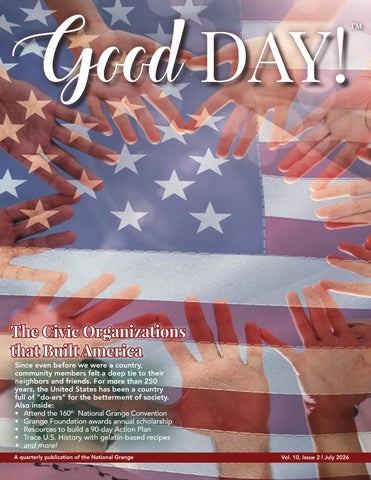
Good DAY!
™
The Civic Organizations that Built America Since even before we were a country, community members felt a deep tie to their neighbors and friends. For more than 250 years, the United States has been a country full of "do-ers" for the betterment of society. Also inside: • Attend the 160th National Grange Convention • Grange Foundation awards annual scholarship • Resources to build a 90-day Action Plan • Trace U.S. History with gelatin-based recipes • and more!
A quarterly publication of the National Grange
Vol. 10, Issue 2 l July 2026
ADVERTISE WITH US Our quarterly publication welcomes advertisers. Up to a 20% discount may be offered to Grange members on their ad purchases. All rates shown are for pre-designed content submitted at least 2 weeks in advance of press date for an issue. You may request rates for ads to be designed by our staff.
GOOD DAY!™ 2026-2027 PRESS DATES Issue
Due Date
V10, I3 August 31 V10, I4 November 30 V11, I1 February 28, 2027
V11, I2 May 31, 2027
Hits Mailboxes October 2026 January 2027 April 2027 July 2027
Classified ads are also welcomed at $0.50 per word up to 25 words, $1 thereafter; $2.50 per website, email, or other link regardless of word count; $5 per photo (will appear no larger than 1.5”x1”). Special requests (bold design, font increase) available for extra charge. All copy should be submitted no later than 10 days prior to the due date. National Grange assumes no responsibility for that which is advertised in Good Day!™ and reserves the right to reject ads deemed offensive or irrelevant. Please contact Philip Vonada by email at pvonada@nationalgrange.org or by phone at (814) 404-7985 for details.
WRITE FOR US This is your chance! This is your magazine. Submissions may be made by any Grange member in good standing, especially including Junior and Youth members, and must be your own original work. For Juniors, you may get your parent, guardian or another mentor or adult’s assistance to write or draw the piece, but we expect all those who assist to adhere to high ethical standards and allow the Junior’s work to be reflected without influence by the adult/ older assistant. All work must be in good taste and appropriate for our audience. The National Grange reserves the right to reject any submissions.
Guidelines & The Fine Print Entries may include: photo essay (at least three photos that together tell a story with captions identifying the people in the photo if applicable and what is happening in the scene); short story (max. 1,500 words); poem; essay/article (maximum 1,500 words and must include at least two relevant photographs with captions); skit (no more than six speaking characters; should not take more than 10 minutes to perform and should not require an elaborate set); D-I-Y (do-it-yourself) project with supply list, step-by-step instructions and photos of each step; or open category (examples include but are not limited to a coloring book page related to Grange or agriculture; comic strip or box; recipes, etc.).
GOOD DAY!™ MAGAZINE
2 ®
www.nationalgrange.org
Each entry must be submitted digitally and include name, address, phone number, email (if applicable) and Grange details (name, number and state of Subordinate Grange and office held). Junior 1+ members can list the Subordinate or State Grange they are affiliated with. E-members can list National Grange E-member. Submission
is
acknowledgment
that
publication is authorized. In the case of Junior submissions, this is acknowledgment of right to publish by both Junior and their parent/ guardian. All submissions must be made via email to pvonada@nationalgrange.org.
Good DAY!
™
N & V
GRANGE NEWS & VIEWS
5
F
GRANGE FOUNDATION
21
S RA
THE STATE OF RURAL AMERICA
22
I
IDEAS FOR GRANGE PROGRAMS & ACTION
25
H W
HEALTH & WELLNESS
31
M
MEMBERSHIP NEWS & RECOGNITION
47
J
JUNIOR GRANGE & GRANGE YOUTH
64
H & L
HOBBIES & LIFESTYLE
75
F & R
FOOD & RECIPES
Y
L W
78 85
THE LAST WORD
On the cover:
Volunteers join hands in the reflection of an American flag. For more than 250 years, volunteers and civic organizations have worked in all corners of the country to build a stronger America. Photo via AdobeStock
P
PERSPECTIVES:
The civic organizations that built America
40
Follow us on Social Media National Grange
@nationalgrange
@nationalgrange
National Grange
@nationalgrangeofficial @nationalgrangeyouth @national_junior_grange
@nationalgrange
Good Day! Magazine is a quarterly publication of the National Grange located at 1616 H St. NW, Suite 300, Washington, DC 20006 ISSN: 2688-6030. | All comments and questions can be directed to pvonada@nationalgrange.org. Reproduction or distribution of any part of this magazine is prohibited by anyone other than a Grange member or a chartered Grange without written permission from the National Grange Communications Department.
GOOD DAY!™ MAGAZINE ®
www.nationalgrange.org
3
OUR
WHAT’S THE GRANGE? The National Grange is a community-driven, nonpartisan organization that brings people together to strengthen their local communities through service, shared learning, leadership, and connection to the land. Founded in 1867, the Grange includes more than 1,400 local chapters across the country, where members take action on what matters most close to home. From supporting families and schools to organizing events and advocating for local needs, Grange members contribute millions of hours of service each year. The Grange creates opportunities for people of all ages and backgrounds to make a meaningful difference in their communities.
Christine E. Hamp, Publisher National Grange President President, Grange Foundation President, Grange Advocacy champ@nationalgrange.org Philip J. Vonada, Editor Communications Director pvonada@nationalgrange.org Stephanie Wilkins, Subscriptions Manager IT Director swilkins@nationalgrange.org Burton Eller, Advertising Partner Government Affairs Director Executive Director, Grange Advocacy beller@nationalgrange.org
®
Learn more at www.nationalgrange.org.
OUR
Officers
Christine E. Hamp, WA, President champ@nationalgrange.org John Benedik, NJ, Vice President jbenedik@grange.org
Susan Noah, OR, Executive Committee Chair snoah@grange.org Joseph Stefenoni, CA Executive Committee Member jstefenoni@grange.org William “Buddy” Overstreet, TX, Executive Committee Member boverstreet@grange.org Walter Hartley, RI, Executive Committee Member whartley@grange.org Dr. Richard Stonebraker, MD, Lecturer lecturer@nationalgrange.org
Amanda Leigh Brozana Membership & Leadership Development Director & Grange Foundation Associate abrozana@nationalgrange.org Loretta Washington Sales, Benefits, Programs & Membership Recognition Director lwashington@nationalgrange.org
Christopher Johnston, MI, Steward Doug Baldwin, IA, Assistant Steward
Randee Farmer & Bonnie Mitson Community Service Directors communityservice@grange.org
Kathy Gibson, MA, Lady Assistant Steward
Katie Girtler Junior Grange Director junior@nationalgrange.org
Kay Hoffman Stiles, MD, Chaplain Joseph Goodrich, VT, Treasurer
Samantha Wilkins Youth & Young Adults Director youth@nationalgrange.org
Debbie Campbell, PA, Secretary
Brittney & Jonathan Pittman Grange Youth Fairs Coordinators grangeyouthfairs@grange.org
David Allen, NC, Gatekeeper Cindy Greer, CO, Ceres Barbara Foster, WV, Pomona Welina Shufeldt, OK, Flora
HEADQUARTERS PHONE (202) 628-3507 HEADQUARTERS ADDRESS: 1616 H ST NW, SUITE 300 WASHINGTON, DC 20006
Additional Editing by John Benedik & Lynette Schaeffer and the 2026 National Grange interns
GOOD DAY!™ MAGAZINE
4 ®
Staff
www.nationalgrange.org
PRESIDENTIAL Perspective Christine E. Hamp
Shaping the Next 250 Years
As our nation approaches we bring people together, when we create space for its 250th anniversary, we find conversation, and when we turn ideas into action. All ourselves at a moment of these actions are what has made us a trusted voice for reflection, and of responsibility. generations, and it is what will carry us forward. For nearly 160 years, the But having a seat at the table is not something we Grange has stood alongside inherit. It is something we earn. rural America, helping to shape not only our It is earned through engagement. Through relevance. communities, but this country itself. We were there Through showing up in our communities not just as an in the early days, when rural voices were too often organization, but as a force for good. It is earned when overlooked and underserved. We organized. We we listen as much as we speak, when we adapt while educated. We advocated. We built an organization that staying true to our values, and when we are willing to has endured. do the work necessary to make a difference. The story of America cannot be told without the Every community. Every Grange. Every member. story of rural America, and the story of rural America This is where our future is built. cannot be told without the Grange. We have an opportunity, right now, to define what From advancing agricultural the next chapter of the Grange practices and rural education, looks like. Through our programs, The story of America to championing infrastructure, our advocacy, and our presence in electrification, and access to our hometowns, we are shaping cannot be told without the opportunity, the Grange has how rural America is seen, heard, story of , and and supported. never waited to be invited into the conversation – we earned our We are not just preserving a the story of rural America place at the table. Our founders legacy. We are building one. cannot be told without understood something that still A legacy where rural rings true today: if you want to communities are strong, . shape the future, you must be connected, and thriving. Where willing to show up, speak up, and young people see a place for lead. themselves. Where families know That legacy is ours to carry forward – proudly and they are supported. Where the Grange continues to be confidently. a place to belong and a place to lead. As we look toward America’s next 250 years, the The next 250 years of America will be shaped by question before us is not whether the Grange has been those who are willing to take responsibility for the relevant. The question is whether we will continue to future. claim our relevance, and our responsibility, in the years That is who we are. We are the hands that feed. We ahead. are the hearts that lead. Together, we are the voice that Rural America still needs a strong, steady voice. ensures rural America is not only part of the conversation Our communities still face challenges that require but helping to lead it. thoughtful solutions and persistent advocacy. Access So let us step forward with pride in what has been to healthcare, reliable infrastructure and broadband, built, and with purpose in what is yet to come. Let us economic opportunity, education, and quality of life – claim our seat at the table. Let us use our voice. Let us these are not abstract issues. They are real, they are continue, together, to shape the future of rural America, local, and they matter deeply to the people we serve. and this nation we call home. Here is the truth: if we are not at the table, those Because when we are united in purpose, connected conversations will happen without us. in community, and committed to action – we are The Grange has never been content sitting on the unstoppable! sidelines. We are at our best when we lean in, when
rural America
the Grange
N GOOD DAY! MAGAZINE & V ™
www.nationalgrange.org
5
From the desk of the PHILIP J. VONADA In a world where we can connect with anyone at any time, it seems almost paradoxical that so many people feel alone. Study after study points to rising levels of loneliness, social isolation, and disconnection. We have more ways to communicate than any generation before us - phone calls, texting, video calls, and social media, to name a few - yet many people struggle to find meaningful relationships, trusted networks, and a true sense of community. The challenge is not necessarily a lack of connection, but rather a lack of belonging. There is a difference. Connection is exchanging messages, following updates, or sharing a common interest. Belonging is deeper. It is the feeling that you are known, that your presence matters, or that somebody will notice and reach out if you don’t show up. Belonging is one of the most powerful forces in human life. It shapes our well-being, our confidence, and our willingness to engage with the world around us. It gives us purpose and reminds us that we are part of something larger than ourselves. Yet belonging doesn’t happen by accident. It is built through shared experiences, common goals, and regular interaction. Belonging grows when people work together, celebrate together, and sometimes even disagree respectfully with one another. It develops over time and requires effort from everyone involved. For generations, civic organizations have helped create that sense of belonging. Long before social media groups and online networks, Americans gathered in local organizations to improve their communities, learn new skills, advocate for common interests, and build relationships. These organizations became places where people could find friendship, mentorship, leadership opportunities, and a sense of purpose. For nearly 160 years, the Grange has been that place for many people. At its best, the Grange is more than a meeting or a building or a list of programs and projects. The Grange builds a community within a community. People join or attend events for many reasons. Some are interested in service, while others are drawn to advocacy, agriculture, leadership development, education, or fellowship.
6
Editor
But when you ask longtime members why they stayed, many will tell you the same thing: the people. They found individuals who encouraged them, challenged them, and welcomed them. They found opportunities to contribute. They discovered that their ideas mattered and that their efforts could make a difference. In other words, they found a place where they belonged. My own experience is an example of this - I stepped away from the Grange for a few years while I was in college and grad school, but “my people” were still there when I came back into the Grange over a decade ago. Now, we take long weekend trips together, share important (or sometimes just silly) updates with each other, and we are there for each other when we really need it. We are builtin aunts and uncles for our friends’ kids, no matter how few times we may see each other in a year. Belonging may be one of the most important things the Grange can offer today. As communities change and traditional gathering places disappear, opportunities for meaningful engagement become harder to find. Local newspapers have shrunk, civic participation has declined, and many social organizations and churches struggle to attract new members. Even simple opportunities to get to know our neighbors seem less common than they once were. At the same time, people continue searching for connection and purpose. They want to be part of something meaningful. They want to contribute their talents. They want to know that their presence matters. The challenge for organizations like ours is not simply attracting members, but is in creating environments where people feel welcome, valued, and needed. That means listening to new ideas. It means making room for different experiences and perspectives. It means ensuring that every member, whether they joined last week or fifty years ago, has opportunities to participate and contribute. Most importantly, it means remembering that belonging is not something we provide. It is something we build together. Every time we welcome a guest, invite someone to participate, mentor a new member, or encourage a young person to take on a leadership role, we strengthen that foundation. Every act of inclusion helps create the kind of community that people are searching for.
N GOOD DAY! MAGAZINE & V ™
www.nationalgrange.org
ARDELYX IS A PROUD SPONSOR OF
Dedicated to improving the lives of patients by discovering, developing and commercializing first-in-class therapies that advance patient care
©Ardelyx, Inc. 2024. All rights reserved. Ardelyx is a registered trademark of Ardelyx, Inc. US-COR-0065 02/24
Stronger connections for rural �merica For decades, National Grange members ha�e championed rural opportunity and community resilience. Today, reliable connecti�ity is central to that mission, and T-Mobile’s completion of its acquisition of UScellular’s �ireless operations is a meaningful step for�ard for rural �merica. This landmark move brings more than four million former UScellular customers onto the nation’s best network, unlocking access to blazing fast speeds, connectivity, and new perks many families and businesses are seeking. Since the companies came together in August, T-Mobile has strengthened network performance and expanded coverage across UScellular’s areas, leading to an enhanced voice and data experience locally and nationwide. In fact, overall median network speeds for UScellular customers have increased by an average of 125%. Additionally, 2,000 UScellular sites nationwide have been integrated into the T-Mobile network, improving the experience for T-Mobile and UScellular customers.
8
For Grange members—farmers, educators, small business owners, and families—strong coverage means rural communities can more fully participate in today’s economy. Improved connectivity supports precision agriculture, telehealth appointments, remote learning and economic development, while expanding options for high-speed home broadband in areas that lacked it before. Importantly, the transition was designed to be seamless: most devices work on the expanded network with no immediate plan changes required, and UScellular customers can later opt for T-Mobile plans with additional benefits like valuepacked perks and savings. National Grange members know that modern rural life depends on reliable connections. With this acquisition now complete and customer integrations well underway, rural America is better positioned for growth, opportunity, and connectivity—helping ensure no community is left on the sidelines.
GRANGE ADVOCACY ADVERTORIAL
National Grange heads to Oklahoma Attend the 160th Annual National Grange Convention this November From November 9–14, 2026, Grange members from across the country will gather in Broken Arrow, Oklahoma, for the 160th Annual Convention of the National Grange. The milestone event promises a week of fellowship, learning, celebration, and inspiration as the organization officially begins its 160th birthday year. Located just outside Tulsa and along the historic Route 66 corridor, Broken Arrow offers the perfect backdrop for a National Grange gathering. Visitors will find a blend of small-town hospitality, modern amenities, local culture, and a connection to the transportation and agricultural history that helped shape the American heartland. Convention activities will be centered at the Stoney Creek Hotel & Conference Center, providing attendees with opportunities to participate in business sessions, workshops, educational programs, networking events, and special celebrations. Members can expect a schedule designed to engage Grangers of all ages and backgrounds, from first-time attendees to long-time delegates. As always, National Convention serves as more than a business meeting. It is an opportunity to reconnect with friends from across the country, exchange ideas, celebrate
Special events and speakers will be featured throughout this year’s Convention, including Geoffrey Standing Bear, Principal Chief of the Osage Nation (left) and Jay Snider, Oklahoma State Poet Laureate. Photos provided
Christmas IN
Broken Arrow KICK-OFF 6:30 PM
November 12
VISITBROKENARROWOK.COM/CHRISTMAS
als Mur
Fa e Marrm ketrs
Livesic Mu
Lo & wcainl dining e
Complimentary Rides Airport, Hotels & the Rose District! VisitBrokenArrowOK.com/Uber
ping!
Shop
REDEEM:
Seewebsitefordetails.
accomplishments, and chart a course for the future of the organization. Whether your interests lie in community service, advocacy, agriculture, leadership development, membership growth, or youth programming, Convention provides a chance to learn from fellow members and bring new ideas home to your local Grange. This year’s gathering carries added significance as the National Grange prepares to celebrate 160 years of service to rural and urban communities alike. Since its founding in 1867, the Grange has adapted to meet the needs of changing times while remaining committed to strengthening communities and improving the lives of individuals and families. The 160th Annual Convention will mark the beginning of a year-long celebration of that legacy while focusing on the opportunities that lie ahead. Attendees will also have the chance to experience Oklahoma hospitality firsthand. The Broken Arrow and Tulsa region offers vibrant arts, entertainment, dining, and cultural attractions that showcase the
N GOOD DAY! MAGAZINE & V ™
www.nationalgrange.org
9
Food Drive at Annual State Grange Session A “Share Your Project’s Story” submission by Bonnie Mitson & Randee Farmer
National Grange Community Service Co-Directors Theresa Kenney, Director of Massachusetts State Grange Home & Community Service, introduced an annual food drive at the 2025 Annual Massachusetts State Grange Session and has forwarded the following details to share with others. We hope this information might be helpful to states looking for a project to include at their state meetings. Congratulations and thank you to the Massachusetts State Grange, and their families and friends for supporting such a project for the betterment of the community. Project Name: Food Drive at Annual State Grange Session Grange: Massachusetts State Grange Yearly Project First Implemented: 2025 2025 Results: 673 items collected, totaling 558.5 pounds Thank You Prizes: Donated
Theresa Kenney (left) and other volunteers pictured with their collected food donations. Photo provided
On the next page is the letter sent to the Secretaries of Community and Pomona Granges in Massachusetts prior to 2025 State Session, which contains details for the food drive. All items donated were presented to a local food pantry near the location of State Session. This will become a yearly event. The prizes offered in a drawing for indviduals donating items were thoughtfully connected to food, sustainability, and community resilience, aligning with the Project Sustenance theme.
Examples included: • Local Gift Basket (jams, honey, syrup) Tag: “Sweet gifts from our local land—sustaining farms, families, and community.” • Fun Lunchbox + Snacks Tag: “Fuel for learning, play, and dreams.” • Kid’s Gardening Kit (small pots, seeds, soil) Tag: “Little hands, big harvest—growing food, growing futures.” • Refillable Water Bottle + Healthy Snacks Tag: “Strong bodies, bright minds—sustaining tomorrow’s leaders.” • Reusable Tote Filled with Food Tag: “Carry sustainability forward—each choice makes a difference.” • Coffee or Tea Sampler Tag: “A warm cup to remind us of the comfort food brings to every community.” Be sure to SHARE YOUR PROJECT’S STORY by submitting the form located at https://www. nationalgrange.org/community-service-programs/.
12
N GOOD DAY! MAGAZINE & V ™
www.nationalgrange.org
Sample Food Drive Letter: Dear Worthy Secretary of Grange #, I am excited to invite you and your members to take part in a special Food Drive supporting the Loaves & Fishes Food Pantry during this year's Massachusetts State Grange Annual Session (date & location). As Grangers, we have a long-standing tradition of service. This food drive is a meaningful way for us to come together and support local families facing food insecurity. We ask each attendee to bring at least one non-perishable food item to donate. All collected items will be delivered directly to the Loaves & Fishes Food Pantry, where they will help neighbors in need. While donations are completely optional, every contribution—big or small—is truly appreciated and makes a difference. As the session approaches, I will share an updated list of the pantry's most-needed items. If you have any questions or if your Grange would like to assist with organizing or collecting donations, please feel free to contact me at (email) or (phone). As a token of appreciation, everyone who donates will be entered into a special prize drawing during the session, with separate drawings for adults and for youth under age 14. Thank you for helping to spread the word and support this important effort. Together, we can make a meaningful impact. Fraternally, Theresa Kenney, Director Home & Community Service
A Look Back: “Enough”
This column reflects on historic documents and writings from Grange leaders, Grange publications, and other historic, related sources, and pairs them with responses from current Grange leaders on how these ideas can be applied to the Grange’s work today.
an except from a speech by U.S. Secretary of Agiculture Earl L. Butz at the Carolinas District Kiwanis Convention September 11, 1975 Portions of this speech were quoted by National Grange President John W. Scott in his 1975 Address at the National Grange Convention in Columbus, Ohio. Two hundred years ago an extraordinary thing happened. A small group of men stood together here on this continent and said, ‘’Enough.” After eons of primitive tribalism, of silent subservience to monarchs and patriarchs, these men stood alone, unaided by custom or tribal consent. Their message was simple. “We are individuals,” they said. “We have inalienable rights. We are rational beings with the ability to think and to reason. We are responsible for our own lives and we shall rule ourselves.” Those were earth-shattering pronouncements. Adherence meant the beginning of the end to serfdom and slavery. It meant the beginning of the end to the sort of mindless arrogance that could send a pauper’s head rolling
before the guillotine for no other reason than vindictive whim. It meant the beginning of the end to the sort of senseless mysticism that could send thousands of human beings to be sacrificed before the primitive priests’ temples. But that initial stand was only the beginning; the battle goes on. The opponents of individualism and economic opportunity are tough. During the first half of the twentieth century in Soviet Russia millions of people were either shot or sent into exile -- because their thinking did not square with the leaders’ wishes. In World War II, 6 million Jews were forced into the gas chambers of Nazi Germany -- because their religion and genetic makeup were not what Hitler had in mind for his ‘’master race.” In 1975, the entire population of Phnom Penh, Cambodia, was ordered into the countryside away from their homes and businesses -- so that the “social restructuring of the society” could begin. How many will be able to go back, no one knows. How many can never
N GOOD DAY! MAGAZINE & V ™
www.nationalgrange.org
13
Restoring Your Energy: Why Tackling Sleep and Weight Together May Be the Best Medicine as You Age by Jennifer L. Pettis, MS, RN, CNE Director, Strategic Alliances, Gerontological Society of America (GSA) For many older adults, weight and sleep aren’t just separate health concerns—they are two sides of the same coin. Scientists have found a “two-way street” between obesity and obstructive sleep apnea (OSA): extra weight can crowd the airway and make breathing difficult at night, while the exhaustion and hormonal shifts caused by poor sleep make it even harder to shed those extra pounds. When these two conditions team up, they significantly raise the risk for serious issues like heart disease, diabetes, and even memory loss. Breaking this cycle requires more than a single prescription; it takes a team of experts working together to help aging adults reclaim their energy and protect their long-term health. While the sleep apnea numbers are high, the statistics for obesity in the U.S. are even more staggering. Today, over 100 million adults live with obesity, and one out of every five of them is dealing with a severe form of the condition. Carrying this extra weight often leads to a “domino effect” of other health problems. According to recent data from the Centers for Disease Control and Prevention, more than half of adults with obesity struggle with high blood pressure, nearly a quarter have developed diabetes, and almost half also suffer from obstructive sleep apnea. These aren’t just isolated issues; they are deeply connected challenges that affect millions of Americans every day. For this month’s column from the Gerontological Society of America, it is my pleasure to share an interview with colleague, Monica Mallampalli, PhD, president and CEO of the Alliance for Sleep Apnea Partners (ASAP). Dr. Mallampalli brings a unique perspective to the sleep apnea community as an OSA patient, a trained biomedical scientist, and a policy advocate. Jen Pettis: Dr. Mallampalli, to kick things off, could you help us understand the scope of the problem? We hear a lot about OSA, but just how common is it among adults today? I’d also appreciate knowing if this is something that naturally becomes more of a risk as we get older, and how much of a role our weight actually plays in causing—or worsening—the condition. Dr. Monica Mallampalli: OSA is one of the most common
34
sleep disorder and is estimated to occur in over 54 million Americans and a billion people worldwide. We believe that estimate is even larger as many remain undiagnosed. Men have a higher prevalence of OSA compared to women but the risk of OSA in women increases after Dr. Monica Mallampalli, menopause. Risk for CEO of the Alliance for OSA increases as we Sleep Apnea Partners, become older due to provides her perspective physiological changes for this article. Photo provided to the upper airway, reduced neuromuscular control and changes in sleep patterns. Weight gain also increases the risk of OSA and several large population studies have demonstrated this association. According to the OSA National Indicator Report (https://sleepeducation.org/getinvolved/count-on-sleep/public-health/nationalindicator-report) by the American Academy of Sleep Medicine (AASM), central obesity or weight concentrated around the waist and neck is a modifiable risk factor. Similarly, the risk of OSA increases with neck circumference greater than 17 inches for males and 16 inches for females. Jen Pettis: While we are focusing on OSA today, I am curious about what the other types of sleep apnea are and what causes them. Dr. Mallampalli: There are two other types of sleep apnea: central sleep apnea and complex or mixed sleep apnea. Central sleep apnea is a condition when the brain fails to send a signal to the muscles that control breathing. There is no obstruction in the airway as we see in OSA. It is more common in people with heart failure or who have had a stroke. It is also more prevalent in older adults compared to younger and middle-aged adults. Other common causes might be due to certain neurological conditions such as Parkinson’s, high altitude, or opioid medication use. The symptoms tend to be similar to what we see in OSA such as snoring, gasping for air on waking, frequent awakenings, morning headaches, fatigue
H GOOD DAY!™ MAGAZINE W www.nationalgrange.org
or brain fog. You can learn more about central sleep apnea at American Thoracic Society (thoracic.org). Complex sleep apnea is when both OSA and central sleep apnea are present. Central sleep apnea can emerge in some individuals when their obstructive events have disappeared with treatment with Positive Airway Pressure (PAP) therapy. Jen Pettis: What risks do aging and older adults face due to sleep apnea, particularly if it remains untreated? Dr. Mallampalli: If untreated, aging and older adults are at high risk for cardiovascular disease such as heart failure, atrial fibrillation, stroke, myocardial infarction. In fact, the American Heart Association in 2023 put forth a scientific statement acknowledging the connection between OSA and cardiovascular disease such as heart failure, coronary artery disease, atrial fibrillation, pulmonary hypertension and stroke. The link between OSA and atrial fibrillation is particularly strong with the incidence of atrial fibrillation being 88% higher in OSA patients. This statement further recommended that cardiologists screen for OSA in their patients and encourage treatment. Untreated OSA can lead to cognitive decline and Alzheimer’s disease in older adults. Older adults with OSA who struggle with disturbed sleep and OSA related consequences are at increased risk of developing mild cognitive impairment or Alzheimer’s disease. Furthermore, continuous positive airway pressure (CPAP) therapy has shown promise in improving cognition in OSA patients with Alzheimer’s disease. Jen Pettis: Would you explain how weight and OSA are connected? It seems like a ‘chicken and egg’ situation for many people. How does this relationship evolve as we get older—does it become more dangerous or harder to manage as we age? Dr. Mallampalli: Weight gain or obesity and OSA are interconnected and have a bidirectional relationship, meaning OSA contributes to weight gain and excess weight can make OSA worse. We also know that the chance of developing OSA is six times higher with a 10% weight gain and an increase in body mass index can increase OSA. In the U.S. 69% of individuals with obesity have some form of OSA and about 32% of people with obesity have moderate to severe OSA. OSA drives the risk for obesity by driving hunger, reducing energy, and causing insulin resistance. ASAP has created a downloadable fast facts highlighting the link between OSA and obesity. Jen Pettis: What kinds of signs and symptoms might indicate that a person may have sleep apnea, and what should they do if they notice those symptoms?
Dr. Mallampalli: Typical signs and symptoms include snoring, choking or snorting or gasping for air during sleep, unrefreshed sleep leading to daytime sleepiness, and fatigue. Snoring occurs when the soft tissues in the back of the throat relax during sleep and block the airway, often causing you to snore loudly. Snoring or snorting is a more common symptom in men whereas fatigue is more common in women. Morning headaches can occur in some OSA patients. Anxiety and depression can also occur with OSA. Most people with undiagnosed OSA might be unaware of these symptoms since they only occur they are sleeping, and a person may not know they have a problem until a bed partner or roommate complains about their snoring or observes gasping. Therefore, bed partners play an important role in noticing sleep apnea symptoms. People who suspect sleep apnea symptoms should immediately seek help from their primary care providers. Jen Pettis: If a person’s health care provider suspects that they have sleep apnea, what might the provider do to confirm or rule out the condition? And how do they determine the kind of sleep apnea? Dr. Mallampalli: The provider can prescribe a home sleep test (HST) to someone who is suspected of having OSA. Sometimes a HST can be negative and in that a repeat test should be ordered by a provider. If a test is positive, the provider can send the patient to a sleep expert who can determine the best treatment for that patient. If the HST is negative and a person continues to complain of sleep problems, a provider should recommend an in lab polysomnography (a more comprehensive sleep study) to detect any underlying sleep problems. Jen Pettis: What are treatment options for OSA and OSA combined with obesity? Dr. Mallampalli: Several treatment options are currently available. Positional therapy is a behavioral therapy, using certain devices or techniques, to help a person to sleep on their side rather than sleeping on their back preventing the tongue from blocking the airway. Continuous positive airway pressure or CPAP therapy (considered gold standard) involves administering continuous air through the nose to keep the airway open. A patient will typically start with a CPAP therapy but may be prescribed APAP (automatic PAP that automatically adjusts pressure with a sensor) or BiPAP (bi-level PAP with two pressure settings for inhalation and exhalation) based on what works best for the patient. Mandibular advancement devices (MAD) work by increasing the space in the back of the throat by
H GOOD DAY!™ MAGAZINE W www.nationalgrange.org
35
moving the jaw forward changing the position of the tongue. They are similar to a mouth guard or a dental device. However, patients should only get this treatment from qualified dentists certified by the American Academy of Dental Sleep Medicine. While CPAP is usually more effective than oral appliances, oral appliances might be easier to use, and therefore in some patients, they may be used for more total hours per night, providing good control of apneas. When an OSA patient is unable to adhere to CPAP therapy, they may be a candidate for hypoglossal nerve stimulation such as the Inspire therapy. This therapy treats moderate to severe OSA and uses a small surgically implanted device to stimulate the hypoglossal nerve to move the tongue forward and keep the airway open during sleep. This surgery is typically performed by otolaryngologists or ENTs. When all else fails, maxillomandibular advancement (MMA) surgery, performed by an oral doctor is an option for some patients where the airway is permanently expanded by repositioning some bones in the upper and lower jaws. Although MMA is considered the most effective surgery for OSA, side effects such as facial numbness due to nerve damage are a concern. Recent innovations are bringing more options to patients such as the GLP-1s. Zepbound® was approved by the FDA in November 2023 for longterm weight loss in adults with obesity who have either diabetes or an elevated risk of cardiovascular conditions. In December 2024, Zepbound® received an added indication for OSA in adults with obesity, making it the first pharmaceutical treatment for OSA. Other medications are under investigation. Jen Pettis: What are other important points that we haven’t addressed that you’d like people to know about obesity and OSA? Dr. Mallampalli: There are a couple that come to mind. For many years, OSA was considered to be a condition that only affects men but that is not true anymore. Research has now shown that OSA also affects women and in fact sex and gender differences exist in its clinical presentation and symptom profile. Currently we lack screening tools for sleep apnea in women, and this is a gap that needs to be addressed. OSA is also complex and heterogenous in nature and should be considered a chronic disease. We know that it is connected to other chronic diseases (as we discussed above) but the exact nature of biological connections are unknown but inflammation has been considered to play an important role.
36
Jen Pettis: It is always a delight to talk with you; thank you so much for your time and all the wonderful information you shared. Would you close us out with sharing how the Alliance of Sleep Apnea Partners supports people living with OSA and how they can find more information? Dr. Mallampalli: At the Alliance of Sleep Apnea Partners, we put patients first as we are a patientcentered organization. We support patients by providing medically accurate and evidence backed resources and information through our website at apneapartners.org. We also provide expert webinars through our signature program called the Breathing Room on our YouTube channel (youtube.com/@ apneapartners). Two years ago, we launched Sleep Apnea Education Week, a social media campaign that runs from April 18-26 annually, to raise awareness and education around sleep apnea. This is a national campaign launched to ensure that we make sleep apnea a national priority and that it gets the same level of attention as other chronic diseases. We also encourage everyone to follow and engage with us on our social media channels on Facebook, Instagram, LinkedIn and Twitter. Jen Pettis: Great information! Thank you for spending some time with me today and sharing so much great information, and many thanks for all that you do to improve care and outcomes for people living with sleep apnea, including those with OSA and obesity.
About the Gerontological Society of America: GSA is the oldest and largest interdisciplinary organization devoted to research, education, and practice in the field of aging. GSA’s principal mission — and that of our 6,000 members — is to promote the study of aging and disseminate information to scientists, decision makers, and the general public. Founded in 1945, GSA is the driving force behind advancing innovation in aging — both domestically and internationally. Our members come from more than 50 countries. The Vision of GSA is Meaningful Lives as we Age. Learn more at www.geron.org.
H GOOD DAY!™ MAGAZINE W www.nationalgrange.org
FAST FACTS
SLEEP APNEA & OBESITY 54 million adults have obstructive
sleep apnea (OSA) and 93 million are affected by obesity in the U.S.
OSA raises obesity risk by driving hunger, reducing
energy, and causing insulin
69% of individuals with obesity in
U.S. have some form of OSA—and about 32% of people with obesity have moderate to severe OSA.
resistance.
OSA
Obesity
OSA rates higher in the
African American, Asians, Hispanic, and Native
American communities due to higher rates of obesity.
A Vicious Cycle
OSA contributes to weight gain, and excess weight makes OSA worse. The chance of developing OSA is six
times higher with a 10% weight gain.
OSA and obesity can increase
risks of type 2 diabetes,
hypertension, osteoarthritis, and cardiovascular conditions.
An increase in BMI can increase OSA severity as measured by apnea hypopnea index.
Fat accumulation around
Excess fat around the neck
the strongest risk factor for
the upper airway, making
OSA for both men and women.
An increase in waist-to-hip ratio raises OSA risk in women.
can narrow and compress breathing more difficult.
FDA approved tirzepatide (Zepbound®) as a treatment for OSA in patients with obesity 2024.
Reprinted with permission of ASAP
the neck and abdomen is
This educational resource was created with support from Eli Lilly and Company
H GOOD DAY!™ MAGAZINE W www.nationalgrange.org
37
The Civic Organizations that Built America Celebrating more than 250 years of ordinary citizens working to create a better, stronger country.
by Philip J Vonada
Photo licensed via AdobeStock
40
P
GOOD DAY!™ MAGAZINE www.nationalgrange.org
When Americans think about the institutions that shaped the nation, they often point to Congress, the courts, the military, or the presidency. Yet some of the most influential institutions in American history were never part of government at all. On any given evening in America, people gather in Grange Halls, church fellowship rooms, lodge buildings, volunteer fire stations, community centers, libraries, and school cafeterias. They come together to plan a fundraiser, organize a community festival, collect food for local families, raise money for scholarships, support veterans, maintain a historic building, or solve a problem facing their town. These local meetings rarely attract media attention. Most produce no viral social media posts, no breaking news alerts, and no national recognition. Yet, they represent one of the most enduring traditions in American life: citizens voluntarily joining together to strengthen their communities. As the United States celebrates its 250th birthday, conversations about the nation’s history often focus on presidents, wars, legislation, and major political events. Those stories matter, but they tell only part of the American story. Running alongside them is another history, one built by local associations, civic groups, service clubs, fraternal organizations, charitable societies, and community institutions. These organizations helped educate citizens, support families, respond to disasters, improve public health, advocate for reforms, strengthen agriculture, and create opportunities for leadership and service. The history of America cannot be separated from the history of its civic organizations.
More than 250 years of service
For over two and a half centuries - since even before the United States existed and the Revolution occurred - civic organizations have served as the connective tissue of American society. Their names, missions, and membership have changed over time, but their role has remained remarkably consistent. They have provided a way for ordinary people to accomplish extraordinary things together. Benjamin Franklin understood the power of civic action decades before the Declaration of Independence was signed. In 1727 at age 21, he organized a discussion group in Philadelphia known as the Junto, or Leather Apron Club. The group brought together tradesmen and business owners who met regularly
P
“Benjamin Franklin, The Firefighter,” a painting by Charles Washington Wright portrays Franklin in the helmet of the Union Fire Company, which he helped found. Image in Public Domain, CC0 Held by the Smithsonian Institution to discuss community concerns and identify practical solutions. Members of the Junto helped establish a lending library, a volunteer fire company, educational institutions, and a public hospital. Franklin believed communities improved when citizens took responsibility for their future, and his example influenced generations of Americans who followed. A branch of the Junto still exists in the form of the American Philosophical Society, which was founded in 1743. Throughout the colonial era, communities relied heavily on voluntary organizations. Churches coordinated charitable activities and assisted families in need. Mutual aid societies provided support during illness, injury, or economic hardship. Volunteer fire companies protected growing towns. Agricultural societies shared knowledge among farmers. These organizations filled gaps that government either could not or would not address. When French aristocrat and political philosopher Alexis de Tocqueville traveled through the United States in the 1830s, he became fascinated by this distinctly American habit. In his landmark work Democracy in
GOOD DAY!™ MAGAZINE www.nationalgrange.org
41
By Ann Olson Bercher President, Minnesota State Grange Certified Culinary Specialist Jell-O Enthusiast In my lifetime, it started with… “Watch it wiggle, see it jiggle.” My mother apparently took it to heart that wiggly food would be fun for kids to eat. And my mother became a master at hiding vegetables and who knows what in Jell-O. Unsuspecting kids that we were, we ate the stuff because, well, it was pretty: Red, or orange, or that lovely lime green! And it tasted pretty good, with an alluring texture of applesauce, maybe. But then things started to get mysterious. Mom started getting braver at including more things in the Jello… like beets or broccoli topped with Miracle Whip or maybe Cool Whip. We really weren’t sure what all was in there. My brother took to the task, and before every meal that included a gelatinous salad, or dessert, or main course (?), he would simply ask, “What’s in the Jello?” It became his mantra. One year when we were grown up and I was feeling nostalgic, I made aprons for my siblings with some foodrelated sentiment. The apron I made for my dear brother had a plaid Jell-O mold cut-out appliqued on it with the words, “What’s in the Jell-O?” He still has it. Gelatin has a much longer history than the 1960s and 70s when it was the wriggling star of the advertising world and the joy of my mother’s creativity and concoctions. Gelatin is a protein made up of amino acids, created by extracting the collagen from animal bones, often left over from a family’s meat sources. Cattle and pork bones, pork skins, and split cattle hides would be boiled in large kettles for multiple days under constant supervision. After the collagen was extracted, the mixture had to be drained, refined, and cooled to become usable. This was a long and tedious process done by servants back in the Middle Ages, and continued to be a task for the cooks and maids into the 18th century. At some point,
78
the resulting gelatin could be dried into rounds or sheets that required a long soak to reconstitute before use. Martha Washington, wife of President George Washington, hosted elegant and complex dinners at the president’s home. At that time, they had at their convenience the staff necessary to produce the luxurious commodity of gelatin and created some delectable dishes of wriggling proportions In 1845, Peter Cooper, an industrialist and inventor, secured a patent for a gelatin dessert powder called “Portable Gelatin.” This product required only the addition of hot water to make it useful. Nothing happened with the patent for over 50 years, as Cooper was interested in the use of gelatin for glue. (This makes sense to me, as after my exploration of gelatin, everything in my kitchen was sticky!) Food manufacturers experimented with gelatin but were unable to come up with an appealing product. It looked bad and did not taste very good. Cooper sold his patent to Pearle Bixby Wait, a cough syrup maker,
Above: Pearle Bixby Wait, who is recognized as the inventor of Jell-O. Right: An advertisement for Jell-O, circa 1910. Images in public domain, via WikiMedia
F GOOD DAY! MAGAZINE & R ™
www.nationalgrange.org
in 1895. His wife, May, added strawberry, raspberry, lemon, and orange flavoring to the powder and called it Jell-O. Marketing for this product was unsuccessful, so Wait sold the business to Orator Francis Woodward in 1899. Fannie Farmer, an American culinary expert, published her cookbook, The Fannie Farmer 1896 Cook Book, which included several recipes using gelatin in recipes and desserts called jellies. An extravagant display of jellies could be made by layering flavors and colors of gelatin in clear molds that were tilted while the gelatin solidified in the ice box. Once served upright, the layers were dramatically displayed at an astonishing, gravity-defying 45-degree angle. Again, another example of labor-intensive gelatin use that required extra time and skill to guarantee success. Charles B. Knox invented the first household version of gelatin in 1889. Unflavored powdered gelatin
Rose Knox, wife of the inventor of unflavored gelatin packets, helped market gelatin toward the housewife. Knox Gelatin remains a leader in homeuse gelatin powder. Image originally for American Magazine, now in public domain, accessed via WikiMedia
was sold in packets and marketed as During the 1960’s, Tom Lehrer, a health food and medicine. His wife, an American Singer-songwriter and Rose Knox, developed hundreds satirist, is said to have invented the of recipes and produced recipe Jell-O Shot, which mixes alcohol pamphlets as aids to help housewives such as rum or vodka into the liquid, stretch their rationed food stores using half of the liquid needed. The and utilize leftovers during WWI and purpose of this invention was to get WWII. She also marketed gelatin as a around the alcohol restriction at the weight-loss aid. Army base where he was stationed. In 1927, Jell-O was purchased At the same time, Jell-O by General Foods Corporation and introduced some new savory flavors introduced the jingle “J-E-L-L-O” such as celery and Italian (vegetable and the slogan, “There’s always room and seasoned tomato). These flavors for Jell-O.” During the Depression, didn’t last long. Jell-O introduced more flavors, with Lime Jell-O making its first appearance in 1930. During the 1930’s, Knox introduced flavored gelatins but soon discontinued them, maintaining its brand reputation for being “100% pure gelatine.” Pamphlets extolled the virtues of gelatin for providing healthful meals for the family while watching calories. When the US entered WWII, A 1960s advertisement for Jell-O “for salads,” including James Knox, Rose’s flavors like mixed vegetable and celery. son, invented the CC BY-NC 2.0 plasma extender, a product made with Today, gelatin is used as a gelling gelatin as a replacement for blood agent in foods such as trifles, aspic, plasma. Through the 1950s and 60s, marshmallows, and confectionery Knox Gelatin continued to capitalize such as Peeps, gummy bears, on “healthful eating” and how to and jelly babies. It can be found use gelatine to lose weight. Savory in jams, yogurt, cream cheese, recipes and salads, in addition to low- and margarine. It is also used in photography, calorie desserts, were the mainstay pharmaceuticals, of their marketing campaigns. and cosmetic manufacturing. For
F GOOD DAY! MAGAZINE & R ™
www.nationalgrange.org
79
Join us in Broken Arrow
November 9-14, 2026 Broken Arrow, OK Book your room today! Stoney Creek Hotel & Conference Center https://grange.biz/160hotel Book your room early - when the hotel is full, additional rooms will be moved to the Hilton Garden Inn
www.visitbrokenarrowok.com/