Dairy Grist
A PERIODIC NEWSLETTER PRODUCED BY GRAND VALLEY FORTIFIERS VOLUME 23, ISSUE 1 | SPRING 2021
Dear Friends, It has been wonderful this last number of months to witness the stabilization and even growth in demand for dairy products in Canada. It is hard to believe that a year has passed since the start of the impact of COVID-19 on our industry, our country and our daily lives. As we soon enter the Spring of 2021, we pray that we will see much of this impact lessened, but regardless, we remain grateful that we are all involved in the Agri-Food industry, an industry that is more recognized as essential than it has been in recent history. Certainly, the impact of COVID has, for various reasons, increased the demand for butterfat. With the recent negative press on the use of palm fat in dairy rations, it is encouraging to read of various butterfat improvement strategies in the articles below that can assist in hitting component targets. Throughout this past COVID-19 impacted year, we have felt truly blessed to be able to work in an industry that is so very necessary to continue to provide fresh, wholesome, safe and nutritious food for fellow Canadians. We wish to thank each one of our dairy producers for their commitment to this honourable and (even more so now) appreciated cause. We trust that you will find the articles in this edition of the Dairy Grist to be both informative and helpful to you in your dairy operation. Sincerely, Ian Ross, President & CEO
MILK FATTY ACID ANALYSIS A SHARP TROUBLESHOOTING TOOL
by: KATHLEEN SHORE Ruminant Nutritionist, Grand Valley Fortifiers, Nutrition Direct
R
3 Preformed
Sythesized in the mammary gland. Reflect rumen health • Healthy rumen • Good microbial function
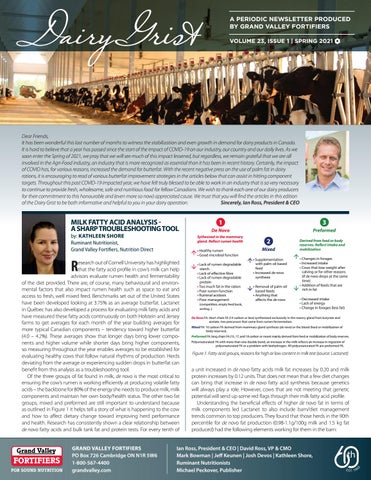
esearch out of Cornell University has highlighted that the fatty acid profile in cow’s milk can help advisors evaluate rumen health and fermentability of the diet provided. There are, of course, many behavioural and environmental factors that also impact rumen health such as space to eat and access to fresh, well mixed feed. Benchmarks set out of the United States have been developed looking at 3.75% as an average butterfat. Lactanet in Québec has also developed a process for evaluating milk fatty acids and have measured these fatty acids continuously on both Holstein and Jersey farms to get averages for each month of the year building averages for more typical Canadian components – tendency toward higher butterfat (4.0 – 4.2%). These averages show that longer days bring lower components and higher volume while shorter days bring higher components, so measuring throughout the year enables averages to be established for evaluating healthy cows that follow natural rhythms of production. Herds deviating from the average or experiencing sudden drops in butterfat can benefit from this analysis as a troubleshooting tool. Of the three groups of fat found in milk, de novo is the most critical to ensuring the cow’s rumen is working efficiently at producing volatile fatty acids – the backbone for 80% of the energy she needs to produce milk, milk components and maintain her own body/health status. The other two fat groups, mixed and preformed are still important to understand because as outlined in Figure 1 it helps tell a story of what is happening to the cow and how to affect dietary change toward improving herd performance and health. Research has consistently shown a clear relationship between de novo fatty acids and bulk tank fat and protein tests. For every tenth of GRAND VALLEY FORTIFIERS PO Box 726 Cambridge ON N1R 5W6 1-800-567-4400 grandvalley.com
1 De Novo
• Lack of rumen degradable starch • Lack of effective fibre • Lack of rumen degradable protein • Too much fat in the ration • Poor rumen function • Ruminal acidosis • Poor management (competition, empty feed bunk, sorting...)
2 Mixed • Supplementation with palm oil based feed • Increased de novo synthesis • Removal of palm oil based feeds • Anything that affects the de novo
Derived from feed or body reserves. Reflect intake and mobilization • Changes in forages • Increased intake • Cows that lose weight after calving or for other reasons (if de novo drops at the same time) • Addition of feeds that are rich in fat • Decreased intake • Lack of energy • Change in forages (less fat)
De Novo FA: short chain FA (14 carbon or less( synthesized exclusively in the mamry gland from butyrate and acetate, two precursors that come from rumen fermentation. Mixed FA: 16 carbon FA derived from mammary gland synthesis (de novo) or the blood (feed or mobilization of body reserves). Preformed FA: long chain FA (15, 17, and 18 carbon or more) mainly derived from feed or mobilization of body reserves. Polyunsaturated: FA with more than one double bond, an increase in the milk reflects an increase in ingestion of polyunsaturated FA or a problem with biohydrogen. All polyunsaturated FA are preformed FA.
Figure 1. Fatty acid groups, reasons for high or low content in milk test (source: Lactanet)
a unit increased in de novo fatty acids milk fat increases by 0.20 and milk protein increases by 0.12 units. That does not mean that a few diet changes can bring that increase in de novo fatty acid synthesis because genetics will always play a role. However, cows that are not meeting that genetic potential will send up some red flags through their milk fatty acid profile. Understanding the beneficial effects of higher de novo fat in terms of milk components led Lactanet to also include barn/diet management trends common to top producers. They found that those herds in the 90th percentile for de novo fat production (0.98-1.1g/100g milk and 1.5 kg fat produced) had the following elements working for them in the barn:
Ian Ross, President & CEO | David Ross, VP & CMO Mark Bowman | Jeff Keunen | Josh Devos | Kathleen Shore, Ruminant Nutritionists Michael Peckover, Publisher
1. 2. 3. 4. 5.
More frequent feeding – 2x/day More physically effective fiber in the diet - >21% Lower dietary fat - <3.5% 10x more likely to provide >18 inches of bunk space 5x more likely to stock stalls <110%
The second group of fatty acids, mixed fatty acids, are also partially made in the rumen (approximately 50%), while feeding palm fat is also a way to boost this fat. However, too much palm fat and the rumen will slow down its own production of fatty acid production. This is where we can see a quick rise in butterfat and subsequently decline once we remove the palm fat from the diet. It goes back to ensuring that rumen function is optimized. The last group, preformed fatty acids, has little effect on milk components but still represents a source of energy in the diet. A major source of fat in this group comes from corn products (corn silage, distillers, corn gluten feed) as well as other silages and haylages in the diet. This is a good indicator of dry matter intake; it can also tell us if cows are mobilizing body fat should cows have lower de novo and higher preformed fatty acids. Looking at bulk tank milk samples is a great tool toward finding bottlenecks on farm. This window into the rumen should not be established with one sample since a sample taken from the bulk tank will help establish what was going on at the last milking. Cows will fluctuate throughout the day so multiple samples over several days will help establish a herd average. Cows that do not fluctuate as much in milk fatty acid profile throughout a day will often test positive for ketosis showing that a healthy rumen has a daily rhythm toward making fatty acids. Thanks to many of our Grand Valley customers we have been able to gather some data and often found that low butterfat was not always a sign that more forage was required in the ration or that too much starch has been fed. Using the milk fatty acid results, we can ascertain if energy is missing from the diet or dry matter intake is being limited. This improves our chances, along with normal feed management assessments, of identifying why a herd is struggling with butterfat or milk protein. We continue to gather data and learn more about this emerging tool toward making smart, pointed diet adjustments. ■
SUCCESS TIPS FOR MANAGING TRANSITION DAIRY COWS
by: JEFF KEUNEN Ruminant Nutritionist, Grand Valley Fortifiers, Nutrition Direct
T
ransition cows are traditionally the most problematic production phase for dairy producers. It is an area that requires higher levels of attention and management, on both the feed and environmental side, and is easily the most heavily researched area relating to dairy cow production. Yet with all this attention and research, producers and advisors alike are still trying to find the perfect program that can successfully transition cows from the dry period into the fresh cow milking groups. Dairy advisors and researchers have made many great discoveries in recent years that improve transition cow feeding and management. Here we will focus on some recent management strategies that can and should be implemented on your farm today in order to have a positive impact on your transition cow program.
at the feed bunk and the lying area. Cows should be allowed to all eat at the same time and should have at least 30” (0.75 m) of feed bunk space for 21 days before and after calving. We also want to have cows able to rest at the same time with at minimum 1 stall or 125 sq ft per cow. In terms of Screening, we need to ensure that we have well-trained, caring, enabled people to screen our cows for potential disorders in an efficient and effective manner post-calving. Screeners should be able to assess cattle for attitude, intakes, rumen fill, discharge/smells, temperatures, and ping for a DA if needed. Combined with electronic information that can be gathered on cows like rumination or dairy milk yields, decisions can be made quickly on whether a cow requires some intervention. Ideally, screening is done immediately after milking when cows are at the feed bunk with cows assessed and sick cows requiring treatment all being completed within 1.5 hours of the 1st cow returning from the parlour. Other considerations for transition success in terms of cow comfort are to minimize group changes, especially in the final 2-7 days pre-calving. Moving cows or regrouping them will introduce social stress that will decrease feed intakes and lying time and increase cow displacements, none of which benefit the transition cow. Allow a cow a quiet place to calve, with limited disturbances from humans or other cows. This will ensure a birth as natural as possible with lowered risk for dystocia and stillbirths. This can be as simple as putting up a divider or screen in the dry cow pen, or having a separate calving pen located adjacent to the dry cow pen to allow for easy and efficient movement of cows when she begins to labour.
Monitor and Manage Body Condition Score (BCS) It is well established that over-conditioned dry cows will calve with more transition issues and do not do as well into the next lactation. Higher BCS (>3.5) is associated with higher Non-esterified Fatty Acids (NEFA) and Beta-hydroxy butyrate (BHBA) concentrations after calving, leading cows to higher incidences of ketosis and other transition cow disorders. This is because these higher BCS cows eat less in the close up dry period and their level of dry matter intake (DMI) decreases at a much faster rate than cows with a desired BCS (ideally ~ 3.0), and thus are mobilizing more body fat reserves right around calving. Recent data also found that cows with a BCS <3.0 (but not <2.5) 21 days before calving tended to not lose condition post calving and were more likely to get pregnant sooner. Maintaining DMI prior to calving of a controlled energy diet without adding or losing BCS is key to a successful transition. When focusing on the fresh transition cow, we want to be able to increase BCS in the first 3 weeks if possible. Research studies show that cows that gain BCS in the first 3 weeks after calving have a much higher rate of being pregnant vs. cows that lose or maintain the same BCS. Table 1 shows an example of a herd level study conducted where more than 1800 cows were grouped based on having either; lost, maintained, or gained BCS in the first 21 days of lactation. Cows that gained BCS in those first 3 weeks had a much higher chance of becoming pregnant after a timed AI service compared to the cows that lost or maintained BCS. This gain in BCS did not come at the expense of milk production as cows in all three categories had similar milk yields. Table 1. Pregnancy results of cows based on body condition score change in first 3 weeks after calving.
BCS Change
Lost
Maintained
Gained
Improve Cow Comfort
% of Cows
41.8
35.8
22.4
While this may seem obvious, it is still an area that is often overlooked or could still be improved in many dairies. When thinking about cow comfort an easy rule for your cows is to provide them 3 “S’s”: Softness, Space and Screening. Softness refers to the surface that the cow is laying on. Allow cows to rest on a comfortable dry surface. Deep bedded stalls or a deep bedded pack are ideal. Space refers to providing adequate space for your transition cows both
BCS at Calving
2.93
2.89
2.85
BCS at 21 DIM
2.64
2.89
3.10
Pregnant 40 Days Post AI (%)
25.1
38.2
83.5
Dairy Grist This study reinforces the need for excellent cow comfort and feeding management in the fresh period as both have a huge impact on early lactation success, which will pay you back later in lactation. Transitioning cows successfully from the dry pen to the fresh cow pen and well into lactation continues to challenge dairy producers. Feeding top quality feeds and research proven additives will help producers get through some of the common issues that afflict your farm, and these feeding strategies will be discussed in a future article. However, paying attention to the details of cow comfort and body condition score in your herd, especially through the transition period, will have a positive impact on your cows, milk production and improve your overall profitability. Start implementing some of these management changes today to see positive results tomorrow. ■
with MARGARET CURRIE Dairy Specialist, Grand Valley Fortifiers
PART III - DON’T DISCOUNT THE DRY COWS
D
ry cows are often viewed as low maintenance groups on a dairy. However, quality of dry cow care is linked to success at transition and calf health. The dry period is a cow’s holiday; we often analyse the dry cow procedures when cows start derailing at calving. This is too late - cows are already coming through the dry cow program that are susceptible to problems. Dry cows need high standards when it comes to environment and feed consistency. Moreover, the dry cow period can influence mastitis prevalence and colostrum quality/volume. If her care in the dry cow pen is ignored, this leads to poor transition and ultimately impact the strength of a cow’s immune system and the ability to re-breed her efficiently. Taking into consideration how dry cows are treated for the 45 to 60 days she is dry rounds out a successful 365-day year for a cow.
Environment Like any animal production system, the cleaner the environment the better it is for their health. In the dry cow pen, clean and dry stalls/pens help reduce mastitis prevalence in early lactation. Air quality is important as well as pen layout for cow flow. Many bred heifers are introduced to dry cow groups with mature cows, so they need lots of space giving everyone access to feed, water and laying time. There should be no dead ends. Additional features for dry cows should include fans. In summertime heat, dry cow cooling is very important. Heat stress will reduce dry matter intake and will add stress to the cow which can lead to early calving and lower birth weights. Further to that, calves born to heat stressed dams are found to be less bright/alert and go on to produce less milk once they join the lactating herd. The most obvious loss due to heat stress is milk production. In 2012 researchers found that cows averaged 6.3 kg/day more milk when cooled and consistently produced more milk through 294 days in milk (42 weeks). Several studies (2009-2012) found that cooling cows in lactation did not reverse the negative effects on milk production from heat stressed dry cows. On average, the heat-stressed dry cows produced 20%+ less milk in their lactation.
Group Dynamics and Consistent Intakes The two main dry cow management systems for herds are a one group dry cow or a far off and closeup dry cow program. In a two-group system most farms (depending on space) aim for 21 days in the close-up group.
However, we need to move cows at the right time. If cows tend to calve a few days early and protocol is to only move cows once a week, a few days late can already set her up for a shortened close-up period. The close-up period prepares them for calving and promotes a positive transition. Close up dry cow pens/ packs should never be overcrowded and where possible running them at a capacity of 80 to 90% is desirable. This pen should have minimal stress on the animal both socially and environmentally. Cows need to get the right amount of time in the close-up Figure 1 Evaluating air flow for heat group and have adequate eating stress during the summer. space to keep intakes consistent. Energy and protein intake in the last 21 days is very important so that cows calve in good health. Colostrum formation also begins one to three weeks prepartum so volume and quality will be determined by how well she eats. Group changing protocols and keeping a consistent dry cow diet in front of them is something we can easily control and can have huge impacts if not managed correctly.
Body Condition Scoring Throughout the entire dry period the goal is to maintain a dry cow’s body condition. There should be no significant swings up or down in weight. Their controlled energy diet is what makes this happen. Cows may range from a score of 3.0 to 3.75, but we do not want large fluctuations (greater than 0.5 points) both during the dry period and immediately after calving. The ration should be set up as approximately 1.8 – 2.0% of body weight in dry matter intake. Of that dry matter intake forages should make up 85 to 90 % of the total. The largest factor in having body condition correct in the dry period is making sure cows do not enter the system too fat. This can be achieved by feeding a lower energy diet near the end of lactation but having a strong reproduction program can influence this by having cows in calf in a timely manner. Table 2 demonstrates recommended dry cow weights. The picture to the right shows an overweight dry cow more likely to have transition issues. Walking the dry cow pens and tracking body condition will tell you where your cows are in condition and where they need to be to be successful. Table 2: Suggested Body Condition Scores for Cows by Stage of Lactation (Source: Penn State University)
In conclusion, environment and group dynamics have a role in a successful dry cow program alongside nutrition. Dry cows are under a lot of stress, eliminating stress that can be controlled will contribute to successful transition. Healthy transition leads to better milk production and better reproduction in the following lactation. Maintaining a clean environment, monitoring group dynamics and having consistent body condition through the dry period is imperative to a herd’s success. Don’t discount the dry cow’s requirements! ■
grandvalley.com
with HENRY VERHOOG Senior Dairy Specialist, Grand Valley Fortifiers
worked with. We are grateful for the service and support that he offered his clients as well as the example of humble confidence, care and professionalism that Rick exemplified so well. All the best to Rick in enjoying many years of a happy and healthy retirement. ■
REMEMBERING GORD TOWNSEND
Q:
With the new DFO pricing coming into effect how will my butterfat and SNF ratio affect my milk cheque?
As hopefully everyone is aware of by now, your milk cheque will start to look different starting February 2021. In simple terms those of you that have been shipping milk from your farm with higher-than-average butterfat (BF) content will start to receive a much better price per kg butterfat. With the Ontario average BF% sitting around 4.2% it will mean that everyone producing milk above this BF content will benefit from the new pricing model. Those of you who milk Jerseys will finally start to be rewarded for producing milk with much higher components! On the other end of the scale those producers who have really benefited from the present and past milk pricing through producing milk well over the 2.35 SNF:BF ratio (for example 3.7 BF and 3.1 protein) will see a slight reduction in their returns per kg BF. Having said all this, when I use various butterfat and protein levels, it appears to me that those producers who ship milk close to the 2.30 SNF:BF will still earn the best price per kg BF, but the gap is much smaller than with the old pricing. In a recent update published by the DFO last summer they used a comparison of an average Jersey herd with 5.2% BF to a Holstein herd producing 3.7% BF. In this model the Jersey herd was going to see a nice increase from $17.82/kg to $18.44/kg. The Holstein herd was going to drop from $18.93 to $18.68/kg. I have used these two extremes to show you that depending on where your herd is at today High producing Holstein herds will continue to see a very healthy return on a kg of butterfat. And other than a personal choice to perhaps feed cows a little differently or breed for higher BF, their returns per kg are well maxed out. Likewise, some very high producing Holstein herds have bred for years to get their BF up to 4.4% and as a result will also receive a nice little bump in their milk cheque. If I have not lost you so far, the main take home message is that I truly believe our dairy industry is slowly heading to a milk pricing mechanism that will reward those who ship milk components rather than liters of milk. And whether you milk Holsteins, Jerseys, or any other breed of dairy cow you will still always have a personal choice whether to breed and feed for components or for liters of milk on its own. From a nutritional standpoint the most economical way to produce high levels of butterfat is to grow and feed top quality forages that promote strong intakes. Whether that be dry hay, haylages, or corn silage, the key is to grow and preserve excellent forages. By accomplishing this, today’s modern dairy cow can produce both lots of liters of milk and kgs of solids. Moreover, she will stay healthiest when doing both. ■
THANK YOU RICK FABER AND ALL THE BEST IN YOUR RETIREMENT!
W
e want to wish the very best to Rick Faber in his retirement. For 34 years, Rick has been a loyal, dedicated Dairy and Swine Specialist for GVF in Kent and Essex counties. With a love of the industry and the producers that he served, Rick was a leader in service and support, going to any length to ensure performance and profitability was met on each farm he
I
t is with sadness that we share of the passing of a former GVF Dairy Specialist, Gord Townsend. Gord was a dedicated Dairy Specialist with the GVF Dairy team for 28 years, before his retirement in 2014. Gord was the first to join our dairy team in 1986, developing markets for GVF in many regions with professionalism and consultative expertise. Gord was very strong in his role, providing solid advice and determination to help producers continue to do better in all aspects of their operations. Gord and his wife Glenda were often on the road together, supporting each other as well as the producers in the regions from central Ontario to New Liskeard. Our condolences to the Townsend family. ■
JOIN US ONLINE FOR VIRTUAL CDX 2021 April 7th - 8th | 9am - 4pm Stop by our virtual booth for a chance to win our Calf Startup Pack. Calf Startup Pack includes 20 bags of BioForce® Acidified Milk Replacer, 10 bags of Bionic® Calf Starter, and 10 bags of Ecolac® Heifer Premix.
Visit dairyxpo.ca to see the virtual show!
Thought for the Day “Solomon was a hard worker and observed the folly of laziness. He discovered that the wisdom of hard work is the secret of success in every area of life, from family to government.” – exert from God’s Wisdom for Daily Living Proverbs 27:23-26 23 Be sure you know the condition of your flocks,give careful attention to your herds; 24 for riches do not endure forever, and a crown is not secure for all generations. 25 When the hay is removed and new growth appears and the grass from the hills is gathered in, 26 the lambs will provide you with clothing, and the goats with the price of a field.