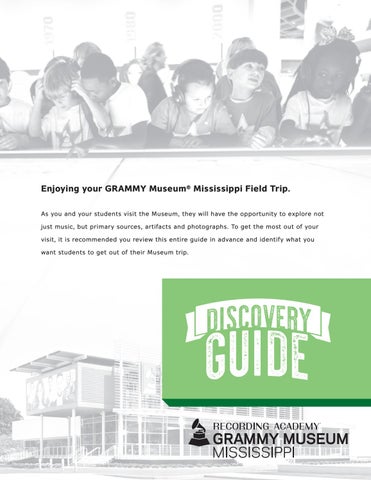
Enjoying your GRAMMY MuseumÂŽ Mississippi Field Trip. As you and your students visit the Museum, they will have the opportunity to explore not just music, but primary sources, artifacts and photographs. To get the most out of your visit, it is recommended you review this entire guide in advance and identify what you want students to get out of their Museum trip.
THE POWER OF MUSIC THE MUSEUM EXPERIENCE Music is more than just a hobby and passion for your students, it’s a means of expression and a way they identify with and shape cultural identity. Our mission is to help students use music as a gateway to learning and as a way to inspire and cultivate creativity and critical thinking. We invite you to immerse your students in a cutting-edge experience complete with interactive exhibits, films and artifacts. Students will leave inspired to continue learning and will be more aware of how music impacts many aspects of society. The moment you enter, you will be fully immersed in the GRAMMY Museum Mississippi experience. A grand lobby filled with photos of iconic artists welcomes you. A hallway of music and GRAMMY Awards® opens up to exciting gallery spaces filled with content-rich interactives, films and artifacts. These can be explored in any order you choose. Both on their own or taken in as a whole, they reveal the legacy of recorded music and the many ways in which it intertwines with social and cultural history.
MUSEUM TOURS To make the most of your students’ experience at GRAMMY Museum® Mississippi, downloadable lesson plans are available on our website: grammymuseumms.org. Teachers are encouraged to utilize these lessons in the classroom before or after they bring students for a tour. Scavenger hunts are also available to students and teachers to enhance their Museum experience. Teachers enjoy a FREE visit prior to bringing students for a tour!
BOOK A SCHOOL
TOUR!
MUSEUM TOUR + WORKSHOP
Building on exhibit themes, workshops at GRAMMY Museum Mississippi cultivate critical thinking. These interdisciplinary workshops expand upon the tour experience to fully engage students, introduce them to careers in the entertainment industry, give them a deeper understanding of music history
If you would like to bring your students to the Museum, please follow the instructions below. To book a Tour or Tour + Workshop, visit:
and extend learning outcomes.
SCHOOL TOURS FOR K-12 STUDENTS
grammymuseumms.org/education/school-tours
Choose a date and/or workshop that best suits your needs by selecting it from the online calendar and follow the steps to complete your reservation.
Prior to booking a tour, educators are provided with resources to complement their lesson plans. Using music as an educational tool, students will learn about English language arts, history, science, math and social science, while
Workshops must be booked no less than three weeks in advance and require at least 25 students.
also exploring music history, innovation and careers in music. A Museum tour immerses students in a
Tour Admission is $5/student. Tour + Workshop is $8/student. Lunch options are also available.
cutting-edge experience, complete with interactive exhibits, films and artifacts designed to explore the historical, cultural and social context of music.
For additional questions not covered in this packet, please call 662.441.0100 or email: education@grammymuseumms.org
Upon entering the Museum, students are engaged as they learn about the creative process and the art and technology of recorded sound.
INCLUDED IN THIS PACKET • Beyond Your Visit: Preparation activity suggestions • Field trip letter to parents • At the Museum: Expectations for making your visit successful • Map of the Museum and exhibits • Museum Manners: Basic do’s and don’ts to share with students • Exhibit guide with detailed logistics, optional activities and discussion questions targeted to specific exhibits • Experience guides to go along with any
Your GRAMMY Museum® Mississippi Field Trip
possible activities you choose to implement
For additional questions not included in this packet, please email education@grammymuseumms.org or call 662.441.0100. Be sure and check out our free curricula at http://www.grammymuseumms.org/education/curriculum
BEYOND YOUR VISIT In preparation for your trip, you might want to encourage your students to think about how to gain information from the exhibits. Some of the discussion questions and activities can be introduced in advance, so that students make sure to look for that information while at the Museum. Here are some possibilities for overall Museum visit explorations:
WHEN LOOKING AT AN EXHIBIT, ASK YOURSELF…
•
Photographic analysis- What does a particular photo represent? What emotion is the subject showing? What can you learn about the time period based on the photograph?
•
Primary source analysis- How does this reflect what you already know about the time period or music? Is this the original source of information or an interpretation regarding this subject? How do the various artifacts within a single display relate to each other?
•
Music Analysis- Find familiar and unfamiliar songs and ask, “What makes this music work and why?” What instruments do you hear? What does the music convey behind the lyrics, what do you notice in the lyrics?
• Career Analysis- What careers are represented? What skills and knowledge are utilized in the careers you see represented? •
Ask students to predict what they will be able to see and do at the Museum—further discuss upon completion of your trip.
• Have students create a KWLS chart for the GRAMMY Museum - identifying what they already Know about the recorded music and the GRAMMY Awards® and what they Want to know before going to the museum writing what they Learned after they have returned and what they Still want to learn. This activity can be used as a group discussion or as a writing assignment. • Encourage students to choose one music industry — related area before their visit and have them investigate that specific profession throughout the Museum. • Do a scavenger hunt! The Museum has scavenger hunts available for your students. Please request this activity through your Museum contact prior to your group’s arrival. • Research! Use your Museum visit as an initial overview and choose something to research further — thinking about questions as you go through the exhibits.
Dear Parents, I am excited to announce that we will be going on a field trip to GRAMMY Museum® Mississippi!
Our field trip is scheduled for:
___________________ at _________________!
Please remember that we are representing our school/organization when we visit the Museum. Be sure to remind your children of the importance of good behavior and respect for themselves and others.
There are 2 ways the Museum accepts payment for chaperones. 1. Chaperones may pre-pay the school, and the school cuts the check 2. Chaperones may come to the front desk upon arrival and pay the previously confirmed rate made during the organization’s registration
If you are signed up to be a chaperone, here are a few things to remember: • • • • • •
The adult chaperones assist in monitoring and maintaining behavior within the Museum. They should also help facilitate learning and stay with the group at all times Enjoy the Museum! When you experience the exhibits, you encourage students in your group to learn and to enjoy them as well Please be advised that your group will be sharing the Museum with other visitors during the visit Be mindful that the exhibits on display contain artifacts. Please remind children not to touch or climb on artifacts/exhibits on any part of the Museum grounds Photography will only be allowed in specific locations within the Museum. Museum personnel will advise you of these locations upon your arrival If at any time someone in your group needs assistance, please contact one of the Museum employees
Sincerely,
AT THE MUSEUM
Make the most of your experience. Here’s a list of things to consider prior to your arrival at the Museum:
•
We recommend allowing 1.5-2 hours to fully experience
everything the Museum has to offer
Be sure to let us know at least three days in advance if you will
•
be enjoying lunch with us on our front porch or if you will be providing
your own sack lunch. Please contact us for prices and options
One chaperone is expected for every 10 students visiting.
•
Chaperones are expected to attend to their students at
all times
•
Be prompt. In order to give our visitors the best experience,
time is a key factor. The Museum is open to all visitors, even
during group tours
We ask that the group leader come inside to receive all
•
materials BEFORE bringing in the group. The group may
gather with remaining chaperones on the front porch,
weather permitting, to await further instruction
Buses or group transportation may drop off/pick up guests at
•
the front, however, we ask that you please park toward the back
of the parking lot to allow parking for other visitors
We ask that chaperones bring students in small groups
•
to use the restroom when necessary to avoid possibly
disturbing other guests in the Museum
For written activities during your visit, please have students
•
bring a surface on which to write (clipboard or notebook) and
use only pencils
Familiarize yourself and your students with the layout of
•
the Museum During your tour, your group will be asked to move through the Museum as a whole or within the smaller groups created (dependent on size of entire group). We understand that not everyone will be viewing exhibits at the same time. Should you want to gather your group, here are places that will work best:
•
Upon Arrival (weather permitting) the front porch is preferred
•
Front lobby off to one side
•
For smaller gatherings:
- Great GRAMMY Performances gallery = 12 seated,
10 standing (22 total)
- The Roland Room capacity=12
- The Sanders Soundstage capacity=140
- Evolution of the GRAMMY capacity=30
ALBUM OF THE YEAR
L
OF
PERMANENT E
PERMANENT & TEMPORARY GALLERY
RE
OF
TO
L
TABLE
ROOM
BAR
ROLA
TEMPORARY
MUSEUM MAP
MUSEUM MANNERS
Please go over these policies with your group ahead of time to help us ensure that everyone has an enjoyable visit • BE INVOLVED AND ACTIVE! Teachers and chaperones are responsible for keeping track of and staying with their students for the safety of everyone visiting the Museum •
REPRESENT YOUR GROUP WELL, as you will be in the Museum with other guests
•
HAVE FUN! In order for each person to fully enjoy the Museum, please divide students/chaperones into smaller groups of no more than 20 (One chaperone per 10 students)
• EXPLORE THE MUSEUM! We have many exhibits and artifacts to explore, but please do not run, climb on or touch artifacts unless instructed. Museum personnel will identify interactive activities! •
NOTHING EXTRA! Please remember that no food, drink or gum is allowed in the Museum. Please leave all backpacks and other bags in your vehicles whenever possible. If you are arriving via public transportation, we will assist your group with checking bags, coats and lunches
•
PHOTOGRAPHY will only be allowed in specific locations within the Museum. Museum personnel will advise your group of these locations upon your arrival. The following icons are used to denote areas for photography
Photography allowed
Photography allowed NO FLASH
•
BE EXCITED AND SHARE WHAT YOU SEE! Remember to use quiet voices as not to disturb other guests
•
TIE YOUR VISIT TO CLASSROOM LEARNING! As you experience the Museum, take in as much information as you can to share with others through your school work!
•
RESPECT THE ARTIFACTS! Many of our items in the Museum are one-of-a-kind and cannot be replaced. Remember…hands off! Unless Museum personnel instruct otherwise. For written activities during your visit, please bring a surface on which to write (e.g. notebook or clipboard), and use only pencils!
EXHIBIT: THE EVOLUTION OF THE GRAMMY®
AWARD
As you enter the Museum’s exhibit area, watch some of the most significant, exciting and occasionally outrageous stories told by artists as you follow The Evolution of the GRAMMY Award®. Then proceed to the History of the GRAMMY Awards® timeline to learn the history of the awards and important moments from past GRAMMY telecasts. To learn more about each album that captured the coveted Album of the Year GRAMMY, use interactive screens at each pylon to get details on the artist(s) and the songs that earned them one of the most prestigious awards.
Next, relax in the mini surround sound theater and witness some of the best collaborations in previous GRAMMY telecasts. As you head towards the next exhibit, check out the glitz and glamour of Music’s Biggest Night by admiring the original clothing that artists wore on the GRAMMY Red Carpet.
Logistics:
-The Evolution of the GRAMMY Award, capacity=30
-History of the GRAMMY Awards timeline
-Mini surround sound theater; capacity=22
footage loops approx. 18 minutes
-4 Album of the Year interactive screens
-Multiple cases featuring costumes and objects
from GRAMMY winners and nominees
EXHIBIT: HISTORY OF THE
GRAMMY
AWARDS®
Possible activities at this exhibit: The structure of this exhibit lends well to small group exploration. Students can visit the area and find their three favorite pieces/artifacts/performances, research what year they are from as well as additional information about the artist/owner and share with the rest of the class after returning from the experience.
Discussion Questions: How have the GRAMMY telecast performances changed since the first live telecast in 1971?
What do you notice about the production of the shows?
How has technology changed since the GRAMMYs first aired?
Consider the various professions in the music industry and discuss what role each of these jobs play in the production of the GRAMMY telecast. (see “Possible Careers” experience guide)
EXHIBIT: Archives and Recent Winners
This audio/visual interactive is a “who’s who” of the history of the GRAMMY Awards . ®
Listen to music from some of the world’s best artists while you scroll through the winners of GRAMMY Awards , GRAMMY Hall of Fame awards, and Special Merit awards. ®
Logistics:
®
3 work stations; 6 head phones
Possible activities at this exhibit: Compare and contrast the awards won by two artists in the same genre
Discuss the difference between the LIFETIME ACHIEVEMENT AWARDS and the GRAMMY LEGEND AWARDS
Search for the artists who overlap in the three main categories
Ask students to write a research paper on a specific genre, artist or time period and use the GRAMMY Museum Archives as a reference
EXHIBIT: DANCE TO THE MUSIC
Have a blast learning dance moves with GRAMMY winner NE-YO as you step onto our colorful dance floor. Learn about dance fads through the years inspired by the music of the time. Logistics: - approximately 30 in the dance area Possible activities at this exhibit: Ask students to develop their own short dance based on a specific era or style and have them show the class. Discussion Questions: Describe how an artist’s dance moves can define his/her style. How does dance complement an artist’s performance? How important is it for the artist to be able to join or lead the dancing?
EXHIBIT:
MUSICAL INTERSECTIONS
“Pop music affects pop culture. Pop culture affects pop music.” Take a look at some of the actual instruments used in performances by musicians including B. B. King and Bruno Mars in the Iconic Instruments exhibit. The Legacy of the Guitar exhibit allows guests to take a more in-depth look at an instrument that had a profound effect on music history: the electric guitar. Check out features including original instruments from National, Fender and Mississippi’s own, Peavey Electronics Corporation. Continue your journey at the Landmark Moments in Music timeline. Logistics:
The 3 exhibits are slightly separated and surround the Singer/Songwriter Pods
Possible activities at this exhibit: Ask students to choose one of the iconic instruments and further research who/what/when/where/why/how it impacted the artist Career-based scavenger hunt. How many careers can you find in these exhibits or within the Museum? (see “Possible Careers” experience guide) Ask students to identify their favorite instrument and share their findings with the class Students can choose one landmark moment and develop their own project based on the information gathered during their visit
Discussion Questions: Choose a specific landmark moment in music. What kind of ripple effect did this have on a specific genre or the industry itself? What makes an instrument iconic? How did the development of the electric guitar affect pop music? What genres are best known for their use of the electric guitar? Acoustic?
EXHIBIT:
IN THE
STUDIO
Keb’ Mo’ welcomes you into these exciting interactive pods where you will first write and record your own blues song and then produce your collaboration inside the production pod. With a variety of mixing capabilities, you can create a hit and store it in the Museum’s archives. Who knows, you may be a future GRAMMY winner! Logistics:
- 4 Singer/Songwriter pods with a capacity of 3 guests each
- 1 Producer pod with 4 stations of 3 guests each
- Video/audio related activities in each booth are approx. 11-12 minutes
Possible activities at this exhibit: The structure of this exhibit lends well to small group exploration. Students can explore the booths and share their experience with the rest of the class. Discussion questions: What part of the music process was your favorite and why? How does this step contribute to the final work? What tools or equipment are needed to perform this step? What other professions interact with the primary professional at this step? (see “Possible Careers” experience guide)
EXHIBIT: CULTURE
SHOCK
Against a backdrop of some of modern music’s most revolutionary figures, a video timeline reveals the past half-century of music culture. As you explore this exhibit, the frequently heated intersection of music and the broader culture is revealed, telling some of society’s most compelling stories, and spurring critical thinking. Logistics:
- 4 video/listening boards for 7 decades: ‘50s, ‘60s, ‘70s, ‘80s, ‘90s, 2000s, 2010s
- 8 head phones
- Each decade includes 5 short videos, approximately 2 minutes each
Possible activities at this exhibit: Focus on one decade to explore in-depth. Find out as much as you can about the time period and its music. Look for one theme through all the decades (e.g. social mores, the role of women, technology, attitudes toward government…). Looking and listening for this theme in each of the seven decades shown, develop a theory about how that theme changed from the 1950s to today. Discussion questions: Discuss themes that resonate throughout all of the decades (e.g. role/representation of women). Who were the major influences in each decade? How did they influence others? What effect did their music have on society as a whole? What seemed to be the social standards and American cultural beliefs for each decade? What additional information could confirm or explain this?
EXHIBIT: MISSISSIPPI
GALLERY
This area features a state-of-the-art interactive table inviting you to explore artists from Mississippi. Select an artist as it floats across the table to reveal photos, songs, awards and more. Listen to a song as you learn about the artist’s lineage, share it with a friend or just “like it.” To listen to more music, slide over to the Mississippi Music Bar and scroll through countless selections of hit songs performed or written by Mississippians. Explore familiar and unfamiliar tunes to get a taste of all the genres in which artists from Mississippi have excelled. In addition to these exciting features, check out outfits, instruments, handwritten lyrics and special artifacts on loan from various Mississippi music legends. Logistics:
- Table has 12 listening stations with touch screens
- Bar has 4 listening stations with 4 touch screens
Possible activities at this exhibit: Go to the Music Table and select one of your favorite artists/songs/genre. What is the lineage of artists/songs/genre for the one selected? How are they related? Follow this same outline for an artist that you do not know. Find two artists/songs/genres that share characteristics. What are those characteristics? Can you hear them in the indicative recordings? Who/what came first? How might they have influenced one another?
Discussion questions: What makes a genre or an artist unique? Why do you think so many artists/genres are interrelated? How do you think a genre develops? How did they influence others? What effect did their music have on society as a whole? What seemed to be the social standards and American cultural beliefs for each decade? What additional information could confirm or explain this?
EXHIBIT: MONO TO
SURROUND
In a small acoustically enhanced room, trace the evolution of recorded sound. Select a performance and listen how sound developed through the advancement of technology from 1877 until today.
Logistics:
- 1 enclosed booth (equipped with surround sound), capacity 12
- Choose between 4 different video performances
- Each video performance is approximately 3-5 minutes
Possible activities at this exhibit: Write down the name of each sound device that displays on the screen. Find out what new features were added as sound evolved from acoustic to digital and what advantages and/or disadvantages these upgrades had on the way we hear sound now.
Discussion questions: How does technology affect the way we hear sound? What knowledge is needed to develop new sound technology?
* A workshop is available to extend this exhibit. To book this workshop, please contact the Museum prior to your visit.
EXHIBIT: ROLAND
ROOM
The Roland Room gives visitors a chance to participate in the music making process. By playing electronic instruments, guests will have the opportunity to explore and think critically about how today’s music is crafted. Logistics:
- 1 drum kit
- 1 keytar
- 1 piano
- 1 mixing station
- 1 guitar
- 1 DJ table
- 1 sampling station
- 1 hand percussion
Possible activities at this exhibit: Prior to starting, ask students which instruments they would most like to learn. What do they think would be the easiest/most difficult instrument? Ask which genres are represented on the guitar pedals. What are the shared characteristics of each genre? How do they work well together? Discussion questions: What is the difference between acoustic and electric instruments? How is the sound different?
What instruments do you think sound best acoustic and which sound best “plugged in?”
EXHIBIT: SANDERS
SOUNDSTAGE
Join us in the Museum’s 130 seat theater to watch special GRAMMY footage only viewable here - from first-hand artist interviews to clips of historic performances. Logistics:
- 130 seats (10 Handicap Accessible)
- 15-25 minute looping video
*Sanders Soundstage is a multi-purpose space. The theater may temporarily be closed during your visit.
EXHIBIT: TEMPORARY EXHIBIT
As one of the Museum’s more popular attractions, visitors and fans get a chance to take an in-depth look at a specific GRAMMY-winning artist, genre or event that was impactful in music history. Experience personal photographs, handwritten lyrics, iconic performance outfits and interactive experiences in this special, temporary exhibit. Special exhibitions change every few months. Be sure to check www.grammymuseumms.org for details on our current exhibit and its availability.
VOCABULARY Archives- any extensive record or collection of data Acoustic- not having electrical amplification Genre- term used to describe different styles of music GRAMMY- highest award given in the field of music. It is voted on by music industry peers who are members of the Recording Academy. There are over 80 categories of awards Iconic- to be widely recognized for distinctive achievement in a specific area Improv- to create and perform without preparation Lineage- describes how a person or a place is directly related to another Lyrics- the words of a song MIDI- music instrument digital interface, a means by which electronic musical instruments can communicate with each other and computers Special Merit Awards- category of GRAMMY AwardsÂŽ presented to individuals involved in the music industry who have made outstanding contributions, sometimes other than performances, to the field of recording such as technical and influential contributions. These awards include: The Lifetime Achievement Award, Trustees Awards, Technical GRAMMY Awards and GRAMMY Legends Awards The Recording Academy- founded in 1957 to award people on an artistic level for contributions to the art and science of recording Song- a story told with words and music
VOCABULARY Continued Title- tells what the song is about. A songwriter may come up with this before writing a song Rhyme- occurs when words at the end of each line of a song have the same sounds. (ex. last, past, and fast all have the same sounds) Verse- a part of a song that tells the details of your story. It has the most information about the story or situation such as who, what, where, when and how Melody- the tune of the song Chorus- the section of a song that usually has a part that is repeated. It is the part of the song that an audience sings along with and looks forward to hearing. This section normally contains the title of the song Tempo- the rate of speed at which the music played or sung
CAREER POSSIBILITES Artist and Repertoire (A&R) Representative Agent-Representation Arranger-Orchestrator Campus Representative Composer Conductor Distributor DJ-Remixer Film and TV Composer Manager-Management Music Attorney Music Educator Music Editor
Music Journalist Music Publisher Music Supervisor Music Therapist Producer Publicist Radio DJ Radio Program Director Recording Engineer Songwriter Sound Design Video Director Video Game Composer
BASIC GENRE OVERVIEW BLUES- a vocal and instrumental form of music based on a pentatonic scale and a characteristic twelve-bar chord progression. It was one of the first genres of music to develop in America. It evolved from African-American spirituals, shouts, work songs and chants that found its earliest stylistic roots in West Africa. This style of music represents tradition and personal expression. Blues has been a major influence of later American and Western popular music, such as ragtime, jazz, big band, rhythm and blues, rock & roll, country, conventional pop and even modern classical music CLASSICAL- generally refers to music composed and performed by professionally trained artists. It is composed and written to be played exactly as the composer intended. In everyday language, it often refers to orchestral music in general, regardless of when or for what purpose it was composed COUNTRY- once known as Country & Western music, this genre was developed mostly in the southern U.S. with roots in traditional folk music, spirituals and blues FOLK- music of the common people. This music focuses on universal truths accompanied by acoustic instrumentation and a simple melody. This music was originally performed and shared by entire communities by word of mouth ELECTRONIC- electronic-based music that can be defined as music designed for the dance floor; however, it is more recently being designed for home listening. It is based off of the 1970’s disco grooves and is all about creating new sounds using technology GOSPEL- refers to music comprised of dominant vocals referencing lyrics of a religious nature. It can be seen being performed in worship services or other entertaining venues HIP HOP- is composed of four main elements: rapping, disk jockeying, breakdancing, and graffiti. It began as a cultural movement in the 1970s. It typically consists of a rapper who chants in a poetic fashion being accompanied by an instrumental track performed or produced by a DJ
BASIC GENRE OVERVIEW Continued JAZZ- has often been referred to as America’s classical music for being one of the first genres of music to develop in America. It began primarily as dance music and overtime it changed when improv became the most important element METAL- can be characterized as having aggressive, driving rhythms, and highly amplified distorted guitars. It was created in the late 1960s-early 1970s as musicians developed a hybrid between blues and rock adding a heavy guitar and a drum centered sound POP- also known as Popular Music it is generally thought of as any music that grabs the listener’s attention due to a very upbeat attitude and repeated sections and lyrics R&B- stands for rhythm & blues. This genre originated in the late 1940s as a way to designate popular music as performed by African-American artists that combined jazz and blues. By the 1970s, this genre was also being used to describe soul and funk ROCK- also called rock ’n’ roll. It is generally characterized by having featured vocals, a strong backbeat, electric guitars, and a catchy melody backed by three or four chords
ANALYZING PHOTOGRAPHS There are many graphics located throughout the GRAMMY Museum. Study a photograph for a few minutes. What is your overall impression of this piece? Use the table below to list people, instruments, activities, and the setting found in the photograph.
PEOPLE
INSTRUMENTS
ACTIVITIES
SETTING
Based on your observation, list three things you might infer from this photo? ________________________________________________________________________________________________ ________________________________________________________________________________________________ ________________________________________________________________________________________________ What questions does this photograph raise? ________________________________________________________________________________________________ ________________________________________________________________________________________________ ________________________________________________________________________________________________ Where could you find the answers? ________________________________________________________________________________________________ ________________________________________________________________________________________________ ________________________________________________________________________________________________ Copy and print this page for use during your field trip.
Copy and print this page for use during your field trip.
GRAMMY Museum® Mississippi 800 W Sunflower Road Cleveland, MS 38732
NONPROFIT U.S. POSTAGE PAID Cleveland, MS PERMIT NO. 10