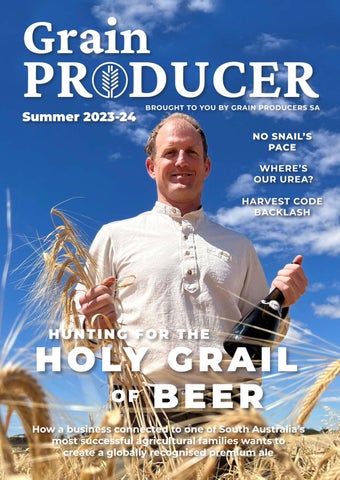
Summer 2023-24
BROUGHT TO YOU BY GRAIN PRODUCERS SA
NO SNAIL’S PACE WHERE’S OUR UREA? HARVEST CODE BACKLASH
HUNTING FOR THE
H O LY G R A I L OF B E E R How a business connected to one of South Australia’s most successful agricultural families wants to create a globally recognised premium ale SUMMER 2023-24
GRAIN PRODUCER
1
SECTION TITLE NAME XYZI
HANNAFORD DRY SEASON PROGRAM – 2024 Worried about planting with a dry start? We’ve got you covered! Image: Bureau of Meteorology Australia
To receive PROTECTION on your crop input investment under the Hannaford Dry Season Program, simply: 1
Purchase, and have applied, Hannaford seed treatment products from a Hannaford franchisee before 15 March 2024 – a minimum of 10L Sylas-ST® + at least one other Hannaford seed treatment – either Rancona® Dimension, Vitaflo® C, Rancona® C, Foliarflo® C or Zincflo® Plus.*
2
Complete the online enrolment form by 31 March 2024 at https://hannafords.com/boost.html
3
If a Decile 2 period occurs between 1 April and 30 June 2024, the customer invoiced value of Hannaford seed treatment products* will be credited.
®
ZINCFLO PLUS
OPTIMISE SEED ESTABLISHMENT
HEALTHY SEEDLING GROWTH
Increased root growth further exacerbates improved uptake of water & nutrients, enabling healthy germination & crop establishment.
No damage assessments and No claims.
®
SYLAS-ST SYLAS® is a super-concentrated biological seed treatment that stimulates & supports seed germination & root growth.
Enrolment in the Hannaford Dry Season Program provides you with payment if your crop doesn’t get the rain it needs^
®
RANCONA DIMENSION
The Hannaford Dry Season Program is designed to help compensate Australian broadacre farmers for the cost of inputs during a dry establishment period.
VITAFLO C ®
RANCONA C ®
FOLIARFLO C ®
PROTECT AGAINST YIELD ROBBING DISEASES
For more information contact your local Hannaford Seed Specialist or visit https:// hannafords.com/boost.html
*Eligibility requirements apply. The Program is specific to Hannaford franchisees. Cover period 1 April – 30 June 2024. ^Customer reimbursement enacted if Decile 2 event occurs during the cover period and is limited to the ‘applied value’ of Hannaford seed treatments, to be utilised via a Hannaford franchisee credit note prior to 31 March 2025. Refer to full Terms & Conditions at https://hannafords.com/boost.html ® registered trademarks of UPL group of companies
WWW.HANNAFORDS.COM
FROM THE EDITOR
W
elcome to the Summer edition of the Grain Producer Magazine.
Normally the prospect of summer brings on thoughts of hot and dry days and warm nights. However, throughout December, we’ve been hit with four seasons. Heat, rain, hail, wind, thunder, lightning - you name it, South Australia has had it. Many people – from politicians to climate experts – have weighed in on the weather forecast debate. We are in an El Nino…but it appears it’s a different type of El Nino. One where an umbrella is needed. For many grain producers in South Australia, it has gone from the latest to the earliest ever finish to a harvest in the space of a single season. Hopefully, after all of that, growers will have a chance to sit down with a cup of tea, put their feet up and have a read of our magazine. The Winter edition of our revamped Grain Producer Magazine was very
Contact: T: 1300 734 884 E: info@grainproducerssa.com.au A: Level 13, 431 King William street Adelaide, 5000 Editorial, Design and Published by: Grain Producers SA Printing: Terry Howe Printing Online: www.grainproducerssa.com.au Interested in Advertising? Contact Rowan Thomas: rowan@grainproducerssa.com.au
Articles appearing in GRAIN PRODUCER do not necessarily represent the policies or views of Grain Producers SA. Products and services advertised in GRAIN PRODUCER are not necessarily endorsed by Grain Producers SA.
well received by those who took the time to have a read and share with family, friends and work colleagues. This is not a traditional grower magazine where you’ll read about grain trials and technical aspects of the industry – GRDC’s Ground Cover Magazine already does a fantastic job of that. Instead, we are taking a deeper dive into the South Australian grain industry – the people, the policy issues and what makes it tick. The 2023-24 Summer edition of the Grain Producer is no exception. Read about what growers told Grain Producers SA when a proposal was floated to change current practice for fire danger under the cease harvest threshold. Come on the journey with us as we explore why one of South Australia’s most famous agricultural families is searching for the pinnacle of malt barley. On top of that, we explore South Australia’s biggest wheat market – Indonesia, find out why snails continue to cost grain producers, explore how life is being breathed into defunct grain silos and meet a South-East family who are setting up their sons for the future.
And you won’t want to miss the story about a Yorke Peninsula grain producer’s rare machinery find and the amazing photos that accompany that yarn. At GPSA, we’ve entered a new period of Board leadership with Northern Mallee grain producer John Gladigau taking the reins as Chair. You can hear from John on what the future holds and how he wants to steer the GPSA ship. Thank you once again to all the advertisers, content providers and our graphic designer, Rowan Thomas, for their efforts in bringing this magazine to fruition. As always, I’m keen to get feedback on issues you think we should cover or just general feedback about the magazine. Happy reading!
Brad Perry, GPSA CEO
DISCLAIMER: This publication is published by Grain Producers SA (the “Publisher”). Materials in this publication have been created by a variety of different entities and, to the extent permitted by law, the Publisher accepts no liability for materials created by others. All materials should be considered protected by Australian and international intellectual property laws. Unless you are authorised by law or the copyright owners to do so, you may not copy any of the materials. The mention of a product or service, person or company in this publication does not indicate the Publisher’s endorsement. The views expressed in this publication do not necessarily represent the opinion of the Publisher, its agents, company officers or employees. Any use of the information contained in this publication is at the sole risk of the person using that information. The user should make independent enquiries as to the accuracy of the information before relying on that information. All express or implied terms, conditions, warranties, statements, assurances, and representations in relation to the Publisher, its publications and its services are expressly excluded. To the extent permitted by law, the Publisher will not be liable for any damages including special, exemplary, punitive, or consequential damages (including but not limited to economic loss or loss of profit or revenue or loss of opportunity) or indirect loss or damage of any kind arise in contract, tort or otherwise, even if advised of the possibility of such loss of profits or damages. While we use our best endeavours to ensure accuracy of the materials we create, to the extent permitted by law, the Publisher excludes all liability for loss resulting from any inaccuracies or false or misleading statements that may appear in the publication. Copyright © - Grain Producers SA Copyright (C) All material published in this communiction is copyright protected and may not be reproduced in any form without written permission from Grain Producers SA.
SUMMER 2023-24
GRAIN PRODUCER
3
SECTION TITLE NAME XYZI
Your South Australian partner in grain marketing Why SA farmers use and trust Centre State: • Competitive prices and reliable payment every time. • Independent.
• Trusted service for over 25 years.
• Focussed on the best returns for Farmers.
• People who own the business run the business.
• Direct access to the decision makers, no call centres. • Proudly SA owned and operated.
• No fees, no promises of what you might get, just the best cash price up front.
Buying wheat, barley, canola, field peas, faba beans, lentils, chick peas and lupins right across South Australia.
Call us now to receive our free grower price update service.
1800 244 211
www.centrestateexports.com.au
Centre State Exports Pty Ltd Level 1, 16 Unley Rd UNLEY South Australia 5061 4
Members Grain and GR A I N P R Oof DU C E R Trade S U MAustralia MER 202 3 Pulse Australia supporting the grain industry.
CONTENTS HARVEST CODE BACKLASH
PAGE MALT BARLEY KINGS
PAGE PAGE
CLOSING THE CONNECTIVITY GAP
8
PAGE
39
BIOSECURITY ROBO-COP
76
PAGE
92
6
Quick Questions
39
67
8
Harvest Code Backlash
Closing the Connectivity Gap
End Point Royalty Compliance
42
No Snail’s Pace
70
A Step Back in Time
14
Where’s our Urea?
46
3D Snails Project
76
Malt Donkey
18
Still a Pulse?
48
Caught on Camera
83
22
Innovation - Grain classification
51
26
Profile - The Jaeschkes
30
Q&A with new GPSA Chair
Government declares SA open for 84 hydrogen business 88 A legal perspective: Hydrogen & Renewable Energy 92 Act
Taking the Lead on Ag Careers
32
Strategies to help with stress
56
Spotlight on the Indonesian Market
60 Bringing Grain Silo Art to Life
34
54
All Roads Lead Back to China?
Harvest Photos Premier Conference Grows Biosecurity RoboCop
94
Road to Rubble
98
Grain Showbag
103
Harvest 100
SUMMER 2023-24
GRAIN PRODUCER
5
QUICK QUESTIONS
Quick Questions Adam and Alison Flavel farm at Meribah in partnership with John, Karen and Pat Flavel. The soon to be family of six love life on the land in the South Australian Mallee. It hasn’t been easy after their crops were hit by hail but last year’s massive harvest was a testament to the Flavel’s resilience.
Name: Adam, Alison, Ruby, Jack, Levi Flavel Farm location: Meribah Grows: Wheat, Barley, Lupins, Canola
6
GRAIN PRODUCER
How long have you both been involved in the grain industry?
What’s been the biggest challenge farming in the Riverland/Mallee?
Adam was born and bred on the farm. He came home to farm post school, so 22 years. I married into the Flavel family in 2012.
The unknown weather events! ie. hail wipeout two years ago!
The Flavel family has been farming within the district for 108 years.
How would you describe harvest time at your farm?
What’s your fondest memory on farm?
Crazy! Family life still goes on. Busy but lots of fun and laughter along the way with the team.
Planting and growing season this year. There has been a lot of chasing our tails and we’ve had only 135 millimetres of rain for the growing season with above average results. It’s been the best year for return on management. SUMMER 2023-24
The kids get so much joy out of harvest from header rides to trucks to CB conversations to delivering meals to the workers each night.
What’s the preference: day shift or night shift at harvest?
What type of music is on the playlist in the header?
No preference. We don’t run a night shift. We run five 13 hour weekday shifts with early knock off and Saturday and Sunday off.
Adam doesn’t really have a playlist, but if we’re working late and I’m getting a bit tired, I will pump AWOL Nation by Sail - pretty loud. Or we will listen to the local 5RM Radio station. This season, Adam has also enjoyed listening to podcasts. When the kids come visit and it’s a long day, the iPad gets a run.
Go-to harvest snack? Cheese & crackers and cheese & onion chips.
What do you love most about living in a small community? Just catching up with all the locals and neighbours. Everyone knows each other and has a chat about what’s going on at their place.
Best advice your parents gave you? Trust yourself. You seem to be an ‘arsey’ person.
If you both weren’t on farm, what would you be doing? As a family we would be fishing, camping and anything that involves travelling South Australia and spending time with the kids, family, and friends. If you mean, what would we be doing if we weren’t farming - I can’t imagine where we would be today. I think I was born to be here.
What advice would you give to someone just entering the grain industry? I always say good luck. Do it properly. Cutting corners always seems to cost you more.
Favourite podcast? Alpha Blokes. Adam has only just started to listen to podcasts this season.
Favourite holiday destination? Anywhere near the river with a fire. Camping, fishing and swimming.
Last book you read? Any and all of the Clive Cussler books.
NO.1 IN GRAIN BUNKER COVERS
Bunker Tarps
STORAGE SOLUTIONS FOR ON-FARM AND BULK HANDLERS BUNKER COVERS • GROUND SHEETS • BUNKER BROOMS • TARP ROLLERS TARP PULLERS • TARP PRONGS • REPAIR PRODUCTS • SEWING MACHINES
Ground Sheets
Talk to one of our team today 1300 059 003 polytex.net.au sales@polytex.net.au
SUMMER 2023
Machines G R A I NSewing PROD UCER
7
SECTION TITLE NAME XYZI
Major backlash against proposed change to Grain Harvest Code…
FIXING SOMETHING THAT’S NOT BROKEN
A push to enforce a 10-metre measurement of the Grassland Fire Danger Index at 35 and dismiss harvest practice of more than a decade has been met with anger by grain producers across the state.
S
outh Australian grain producers have threatened to walk away from the South Australian Country Fire Service as volunteer fire fighters, and some as brigade captains, if the Grain Harvesting Code is changed resulting in a loss of harvest hours. A Grain Producers SA (GPSA) survey of nearly 400 grain producers reaffirmed that almost 90 per cent measure through the Grassland Fire Danger Index (GFDI) at two metres unconverted. This practice of measuring at a standing height of two metres has been widely undertaken since the voluntary Code was adopted by grain producers. Eighty-six per cent of grain producers stated they measure wind speed under the South Australian Grain Harvest Code at two metres, with just three per cent measuring at ten metres and four per cent measuring at two metres then converting to ten metres.
8
GRAIN PRODUCER
When asked whether they support a “correction” to the Grain Harvest Code to GFDI 35 measured at ten metres, 90 per cent said no, with just two percent saying yes. Grain producers replying to the survey were also asked whether they tested out the Fire Behaviour Index (FBI) last season, with 50 per cent saying they didn’t, demonstrating the confusion around a national system roll-out. In the survey, GPSA also requested grain producers provide information on what else they do for fire safety outside of the equipment required by law. There were hundreds of responses ranging from the purchase of ex-CFS fire trucks, installation of firefighting equipment on chaser bins, additional water tankers, adding fire extinguishers and utilising farm firefighting units. From the feedback, it was made clear that many farms are equipped with thousands of litres of extra water in
SUMMER 2023-24
case of a fire, and they maintain and check their machinery and fire breaks. GPSA Chief Executive Officer Brad Perry said nearly 60 per cent of South Australian grain producers surveyed indicated they were CFS volunteers. “There is no doubt that in South Australia, we need more people to put up their hand and volunteer for the CFS but a failure to listen to grain producers certainly does not help the cause,” he said. “Our survey data shows that in the eyes of the farmers, any change to the cease harvest threshold that impacts their business is likely to hit CFS volunteer numbers and in turn, fire danger risk. “The current system works particularly well because our grain producers are able to measure the cease harvest threshold in their paddock in local conditions and continue to harvest safely under the Code.”
DISCUSSIONS: GPSA CEO Brad Perry and Chair John Gladigau meeting with the Minister for Emergency Services, the Hon. Joe Szakacs MP and SA Country Fire Service Chief Officer Brett Loughlin and Executive Director of Operations Cameron Devey to discuss the Grain Harvesting Code. A GROWER’S VIEW Yorke Peninsula grain producer Matthew McDonald said adherence to the Code has been outstanding and any change would impact that. “It has worked so well due to the persistent education across the sector from those who are passionate about it and the ease in which an operator can collect the data, cross reference it on a chart and make an informed decision on actual data collected in their paddock whether to stop operations or continue,” he said. “Having this system stay the same as it has been for a decade and has worked so well is important. “Operators have come on board with this system and compliance is high, making changes and complicating it runs the risk of people switching off and operating outside the Code.”
Mr McDonald said any loss of harvest hours on his properties is going to impact his business. “My main concern was losing harvest hours due to a potential change in the limit, especially within the coastal environment where quite often sea breeze winds are much stronger than inland environments,’ he said. “The system has been simple and widely adopted. Changing it and adding complexity in my opinion, would run the risk of the compliance rate going backwards.” ANNOUNCEMENT A WIN FOR SA GRAIN SECTOR In late August 2023, the Minister for Emergency Services the Hon. Joe Szakacs MP and the CFS Chief Officer Brett Loughlin announced the “existing Grain Harvest Code of Practice will remain unchanged for the 2023-24 harvesting season and the farming com-
munity will continue to use the Grass Fire Danger Index (GFDI) measurement this year, with the cease harvest threshold of GFDI 35”. Effectively, for the nearly 90 per cent of grain producers measuring at working height in the paddock unconverted and three per cent measuring at 10 metres, they were able to continue doing so through 2023-24 harvest. CFS Chief Officer Brett Loughlin said the CFS is committed to continuing working with GPSA into the future. “I firmly believe our ongoing dialogue, in particular throughout and post the coming Fire Danger Season, will position us well to refine the Grain Harvest Code of Practice,” Mr Loughlin said. “We acknowledge there are varying practices, as well as capability, in use across our farming districts for the collection of data used to calculate and apply the GFDI.
SUMMER 2023-24
GRAIN PRODUCER
9
IN FOCUS - HARVEST CODE
The CFS argued there was a mistake in operation when the Code was adopted. GPSA disputed this, arguing the Code was always intended to be measured at working height in the paddock. In practical terms, this means the Code cease harvest number would become markedly lower by comparison if measured at 10 metres. GPSA Chief Executive Officer Brad Perry said any change to reduce cease harvest guidance and the way to measure it in the future will undermine the very successful adherence to the Code.
“At the end of the Fire Danger Season we will debrief together, so that the entirety of the harvest period can be evaluated, and lessons learned be applied in years to come.” Minister Szakacs said there had already been significant consultation with fire services and the harvesting community over the Grain Harvest Code of Practice, which would continue. “I thank the CFS and GPSA for the constructive approach that has been taken to managing harvesting safety ahead of the upcoming summer,” he said. “I look forward to the continuation of this ongoing work and dialogue, with a focus on achieving positive outcomes for both the harvest season and community safety.” 10
GRAIN PRODUCER
HOW DID WE GET TO THIS?
“It would also stop grain producers from reaping during conditions that are described by farmers as excellent harvesting weather, likely delaying the end to harvest and impacting the more than $4 billion industry,” he said.
Following GPSA’s lobbying leading to a delay of the roll-out of a new national FBI at short notice prior to the 2022 harvest, a Working Group was set up with the members being SA Country Fire Service (SACFS), SA Police (SAPOL), Department of Primary Industries and Regions (PIRSA) and GPSA. The Group was established to review the FBI in relation to the Grain Harvesting Code of Practice (Code).
“Community safety is forefront of mind for grain producers. The current Code has been well adopted and has great adherence. Having a new Code which is unworkable, and causing economic loss for farm businesses, will cause great unrest, anxiety, and a lack of compliance. Compliance issues have the potential to greatly impact policing of this code.”
After four meetings of the Working Group, upon realisation the FBI was unworkable in its current form, it was decided to no longer pursue this option. The SACFS proposed a wider review of the currently accepted GFDI.
Two key players in the negotiations around the Code are the independent weather station businesses – COtL Mesonet and AgByte. The Mesonet operates more than 100 weather stations across the Mid North, Riverland, Mallee and South-East, while AgByte has over 300 sites across South Australia, primarily in the grain growing region.
The preferred option put forward by the CFS was to set the GFDI to 35 measuring wind speed at 10 metres.
SUMMER 2023-24
A WEATHER STATION VIEW
COtL Director Damon Grace said the initial attempts to move the cease harvest threshold for grain producers to a national system was often difficult to follow. “There seemed to be a bit of confusion, because the FBI threshold of 40 did not seem to match the previous GHCoP fire danger metric of 35. Additionally, many people don’t realise that the difference between using a two metre wind or a 10 metre wind in the calculations can lead to big differences in the Fire Danger Index,” he said. Mr Grace said the voluntary Code adhering to a GFDI has been working well in South Australia. “In all of our visits to our stations, we have observed very clear respect and compliance with the Grain Harvesting Code. Compliance with all aspects of the Code is one of the first things our farmers request of us when visiting a site,” he said. “We also note that the GHCoP metric is by far our most popular metric on the Mesonet during harvest time. This
is great to see and shows widespread community adherence and support.” AgByte owner Leighton Wilksch said he has witnessed the success of the voluntary Code for a decade.
Mr Wilksch said South Australia is in a unique situation with grain production scattered along coastal regions.
“I have been intimately involved in alerting of fire risk for the grains industry and have been impressed at the adoption of tools and practices to observe fire risk, share information amongst neighbours and ultimately, make sound decisions about when to cease harvest and when it is safe to go back in.” - Damon Grace, COtL Director “The adherence has improved each year during my 10 years of observing the GFDI implementation – this has been driven not only by access to local weather data, but community champions willing to stand up and take responsibility for assessing data and then sending out SMS alert messages to those in their region about what path to take on high risk days,” he said.
“We have many factors that influence fire risk – in South Australia much of our ag occurs within 100 kilometres of the coast, so there can be large variations in fire risk within 10 to 20 kilometres, particularly on the Eyre and Yorke Peninsulas. “This is where having a local weather station to assist in decision making becomes important.”
Goodbye 3G. Hello to a better network experience. To help provide you with an improved experience, we’re evolving our mobile network. This means that on 30 June 2024 we’re switching off our 3G network. Our 4G and 5G networks will be available instead and offer an improved experience, representing the next leap forward in mobile network technology. Some of your devices - including handsets, medical devices, and EFTPOS machines - may need to be updated or replaced ahead of next year’s closure to ensure ongoing service. We’re here to help you with he change and answer any questions you may have.
Telstra 3G Closure
SUMMER 2023
GRAIN PRODUCER
11
IN FOCUS - HARVEST CODE
W hat SA grain producers said: “Very disappointed with CFS head office not listening to farmers. I’m a captain and 90 per cent of our local growers are CFS volunteers who all have multiple farm fire units. We have weather stations and monitor the weather very regularly. The harvest code of conduct has worked very well.”
“I have been a brigade captain for 6 years and Deputy Group Officer for 10 years. I anticipate a large loss in volunteer numbers in farming areas if this goes ahead, possibly including myself. The current system of ceasing harvest at FDI 35 is working well in our local area”
“Stop trying to fix something that’s not broken. It’s taken a long time to get people to comply to the system we have. Lower the FDI and we are back to square one with people not stopping when they should and the onus coming back on the neighbours to make them stop. Leave it alone, it works.”
“If they change the index number, the harvest will take months longer. It’s safe now.”
“It’s not practical to lower it at all and would impact hugely on farming communities, not just farmers.”
“I think the current system works really well and 99% of operators have a good idea when the weather is reaching the point of 35 on the GFDI before it gets to that and will operate to the conditions. Why fix something that isn’t broken?”
“We have a system that is understood, adhered to, and proven to work. There is no need to mess with it.”
“The current Harvest Code of Practice has been working fine. If you restrict the Code more there would be a likelihood that some farmers would not stop harvesting.” 12
GRAIN PRODUCER
SUMMER 2023-24
PERFORMANCE YOU CAN RELY ON
With a significant number of glyphosate products in the Australian broadacre market, it can be difficult to know which glyphosate product is the best fit for the pre-sowing segment. Roundup Ultra®MAX is a high concentration product (570 g/L) with a premium, fully loaded surfactant package, allowing for rapid uptake and translocation within weed species.
Always refer to product labels for full application instructions. Roundup Ultra® is a Registered Trademark of the Bayer Group. Bayer CropScience Pty Ltd ABN 87 000 226 022. Level 4, 109 Burwood Rd, Hawthorn Vic 3122. Copyright © 2023 the Bayer Group. All rights reserved.
S P OT L I G H T O N - U R E A
W HE RE ’S OU R URE A? Grain producers across South Australia were left shortchanged on their urea during the 2023 growing season with some orders completely cancelled and others rationed. Analysts highlighted that there was a record amount of urea being imported into Australia with total fertiliser consumption in 2022-23 being 7.25 million tonnes. So the question everyone is still asking is: where did it go?
S
earching for answers on the urea shortage, Grain Producers SA hosted a webinar in August 2023 where hundreds of people from across Australia tuned in as the industry took a deep dive into the problem. Grain Growers Advocacy and Rural Affairs Manager Sean Cole told the webinar the urea shortage was due to a combination of factors. “Everyone’s acutely aware of the shortages and potential near misses we’re having there in South Australia at the moment with urea,” he said. “We did have that perfect storm this year, where both importers and growers wanted to commit to as little as possible. Urea is basically a cash and carry trade mainly for importers as well, so if you’re once bitten twice shy you can often overreact and hoard more.
14
GRAIN PRODUCER
“If you’ve been caught out this year on the back of a changing weather forecast you’d have to ask yourself: do you want a bit more in the shed coming into it? “Since late 2022, we’ve become exclusively an importer of urea. We had a plant in Gibson Island, which was shut down and that used to make 250,000 to 300,000 tonnes of urea per year depending on the season, so that’s only about 15 per cent of Australia’s total demand. “Growers lately have been saying, ‘look is it because of the shutdown of the plant?’. Not necessarily, it’s more got to do with the huge uplift (in crop yields) we’ve had and the big seasonal change that we’ve witnessed with good rains, especially in South Australia and other parts. “In terms of the price of gas it was noted by Incitect Pivot that they shut down Gibson Island because they couldn’t get gas at a competitive price and we make
SUMMER 2023-24
urea globally elsewhere at a lot lower cost. So if we were to make urea right now, Gibson Island arguably would be a lot more expensive than the urea people purchased this season at that price of say $500, $600, $700 a tonne. “We’ve had reports of ordering up, 50, 60, 70 per cent on what was the demand forecast for the importers, so that’s a huge strain on the supply chain. So obviously coming to a season like this importers and growers have been reluctant to lock in extra supplies.” Episode 3 Founding Director Andrew Whitelaw said having record amounts of urea imports into Australia was rightly confusing for grain producers given the lack of availability and access to supply. “This time of year, there are always going to be a certain level of inaccuracy to them (weather forecasts) so we’ve got a situation where technically our imports of urea are at record,” he said.
INFORMATIVE: Screenshot of the GPSA hosted Webinar on urea supply held in August 2023. “We mentioned the fact that we’ve lost the domestic processer, so we do need to import more and we also need more because of the fact that we’ve sucked out so much nitrogen through growing some pretty strong crops. “The fact of the matter is just because we’ve got record imports doesn’t mean it’s all in the right places at the right time, so that’s why I was saying that it’s regionalised some of those stock availability issues.” Mr Whitelaw said there is a lack of trust between farmers and the fertiliser representatives when it comes to urea ordering and supply. “We’ve all been told in the last five years, every year, that there’s going to be a shortage of urea and you need to get your order in quick before it runs out and it’s never happened until now,” he said. “So it’s created that old kids story ‘the boy who cried wolf ’ and we’d sort of warned people from the fertiliser industry they can’t keep telling people there’s going to be a shortage every year because the farmers won’t believe it when a shortage does come. I think something needs to be done to increase that trust and transparency.” There are currently three fertiliser production projects in the pipeline for
Australia, with one in South Australia and two in Western Australia. “We need to look at stability of supply,” said Mr Whitelaw. “The fact that we are going to be producing a lot of fertilizer in Northern Western Australia is one thing that does provide a welcome addition to Australia’s fertilizer imports through domestic demand mix. “However, that’s still going to be priced on international values but it is still a good thing. “We also need to be very careful and start thinking about what the green policies are with fertiliser usage and what our wider picture of our emissions is because at some point our customers are going to question a lot of these emissions. “I believe there’s some information out there about nitrogen inhibitors and all sorts of other stuff, so we need to be at the forefront of policy to ensure that we have access to the tools we need to produce what we’re good at.” When asked about whether he thinks grain producers are likely to buy excess fertiliser stocks given urea shortages in recent years, Mr Whitelaw said it was a possibility.
“People will be hoarding a bit more and keeping more for a season where stocks are going to be an issue,” said Mr Whitelaw. “Let’s be honest, the responsibility of an importer is to make profits for their shareholders and I’m sure they could handle stock but is the grower willing to pay a premium to ensure that those importers carry stock for ‘x’ number of years? “It would be nice in theory for fertiliser companies and importers to be bringing in stock and then holding it there to make sure it’s available for you but it’s just not realistic, it’s not what’s going to happen and these are commercial entities.” Fertilizer Australia is the peak body for the Australian fertiliser industry making up 97 per cent of the fertiliser tonnes imported, manufactured and distributed through Australia. Its Chief Executive Officer Stephen Annells said the urea shortage was effectively created by a perfect storm of global events and was a “short-lived issue”. “They [fertilizer companies] are there to make profits but we also want to make sure that growers are getting that product. This has been a hard time for the fertilizer industry as well,” he said.
SUMMER 2023-24
GRAIN PRODUCER
15
IN FOCUS - UREA “If we look at what happened in 20082009 when there was a peak, on the other side of that we lost quite a few fertiliser companies because they were carrying stock and they were caught out with massive losses with products. “So you are as good as your last import and these guys are taking risks at 50,000 tonnes at a time versus a grower taking a risk at 50 to 100 tonnes at a time.” Mr Annells said fertiliser companies were expecting a severe drop in usage in 2022-23 considering the global events which impacted the world including Chinese restrictions on nitrogen, COVID effects on the supply chain, the Russian invasion of Ukraine impacting ammonium nitrate supplies and expectations of an El Nino event. “Growers waiting for prices to drop led to a diminishing number of contracts and in a market where prices are dropping, no one wants to take a long position,” he said.
“As such, our members brought in as much as was needed for those contracts, so despite that, Australia’s total fertiliser consumption was 7.25 million tonnes and that’s a record. “The global supply of fertiliser hasn’t dropped away. There are people out there talking down the supplies of phosphorus but that’s not the case. The world has plenty of phosphorus and there’s certainly plenty of nitrogen fertiliser out there. “When there is a tight supply market, the product goes to the countries that can pay for it first, so countries like the US, Canada and countries in Western Europe and Australia who can afford to pay for those fertilisers, will get those fertilisers. “We take the prices that the rest of the world provides us, we put a little bit of a profit margin on top and that’s basically the prices that that we see in Australia. So Global Euro production is around about 260 million tonnes and this is expected to increase to about 300 million tonnes by 2030.
BRAVE. BOLD. FUTURE.
SUPPLY: Fertilizer Australia CEO Stephen Annells. “Australia’s suppliers have diversified. We’ve got lots and lots of markets all over the world and we can move from one market to another to make sure that we can access supply and that’s a testament to the supply strength of the Australian Market.” REPORT HIGHLIGHTS IMPORT RELIANCE In September, Grain Growers Limited released its ‘Fertilisers of the Future Report’ examining fertiliser inputs – ni-
Getting your business where you want to be. With over 40 years experience, our agribusiness specialists will help you get where you want to be. Whatever your goals for your business, the team at Bentleys will take the time to understand and support your vision and aspirations and offer solutions for a changing landscape. — — — — — —
16
GRAIN PRODUCER
SUMMER 2023
ESG and carbon farming Succession planning Cashflow, finance and tax planning Using government grants and incentives Structuring and restructuring your agribusiness Superannuation, estate & wealth planning
bentleys.com.au | advice@adel.bentleys.com.au | 08 8372 7900
trogen, phosphorus, and potassium – looking at the ability of potential emerging technologies to displace current technologies over the next five years. With Australian agriculture dependent on adding fertiliser to sustain production levels and meet consumer food demands, the report examines ways to drive efficiency and best practice, minimising inputs and maximising production. GrainGrowers Chair Rhys Turton said the recent tight supply of urea emphasises Australia’s reliance on imports. “If we are to solve this problem, we need to look carefully at technologies and projects under development and see how we maximise the available opportunities,” he said. “We believe there is a clear role for government to provide targeted co-funding, using mechanisms such as the National Reconstruction Fund to help industry transition to a lower cost, more environmentally sustainable, domestic manufacturing base.”
Unfair contracts trigger ACCC investigation Grain Producers SA (GPSA) raised fertiliser supply and contract complaints from some of its members with the Australian Competition and Consumer Commission (ACCC), with the fertiliser industry subsequently agreeing to amend their contract following an investigation. GPSA Chief Executive Officer Brad Perry said member feedback over the past few seasons exposed concerns with contracts. “We thank the ACCC for investigating unfair contract terms and strengthening protections when it comes to fertiliser supply and urge grain producers to use the new and upcoming standard form fertiliser supply agreements,” he said.
Some of the potentially unfair terms identified by the ACCC included terms giving the supplier the right to unilaterally vary the quantity to be delivered to the buyer or to terminate the agreement if the supplier believed it would not be able to supply the goods. Some terms restricted buyers’ rights to raise issues about defects with the goods. Under the new unfair contract term laws, the ACCC can take court action to seek pecuniary penalties for breaches of the unfair contract term law. The maximum penalty is the greater of $50 million or three times the value of the benefit derived or, if that value cannot be determined, 30 per cent of the company’s turnover during the period it engaged in the conduct.
Made in USA
New Rubber Tracks
for John Deere, Challenger & Case Machines Industry-Leading Innovations » Fully-moulded construction. » Galvanised cable resists corrosion. » Helically wound main cables prevent stretching. » 50% more wire per ply layer.
Case / New Holland tracks » World’s strongest drive lugs thanks to ARMORLUG® reinforcement*. » Anti-Vibration technology* reduces vibrations by up to 70%. * Available for most machines
Drives, Idlers and Mid-rollers Rebuilt - Great Prices - Service Exchange
1300 244 897
STUNNING: The completed silo accommodation project atQLD Freeling. 226 North St, Toowoomba 4350 Source: Ben Huckstepp Photography. Monday to Friday, 8AM - 5PM AEST btsales@bigtyre.com.au SUMMER 2023
G R A I N www.bigtyre.com.au PRODUCER 17
The content of this ad is not legally binding and is provided as information only. The trademarks displayed in this ad are the property of Loc Performance and/or its affiliates
I N F O C U S - P L A N T P R OT E I N VA LU E A D D
Federal Government withdraws funding for plant protein hubs but is there….
STILL A PULSE? It was touted as game-changer for value-add in the grains industry in South Australia but less than two years after it was first announced, the joint Federal and State Government initiative to build three plant protein manufacturing hubs in South Australia has fallen apart. While the Federal Government has withdrawn $113 million in funding, can the State Government salvage something?
I
n March 2022, a media release was distributed across Australia announcing “an Australian-first food manufacturing consortium” that will transform Australia’s plant protein value chain.
source local ingredients and work with domestic plant protein ingredient manufacturers and researchers, creating 8,517 jobs nationally and contributing $5.2 billion in Gross Domestic Product (GDP) over the next 12 years.
Thomas Foods International, AGT Foods Australia and Australian Plant Proteins had jointly applied and been successful in winning funding for a $378 million project to establish some of the World’s largest pulse protein extraction facilities and plant-based food manufacturing capability in South Australia. This was to be funded through the Federal Government’s Modern Manufacturing Initiative (MMI) contributing $113 million and $65 million allocated by the State Government.
At the time, the three proponents were ecstatic at the opportunity to be world leaders in protein value-add from South Australia.
The project was touted as enabling Australian food manufacturers to
Australian Plant Proteins Co-Founder and Director Brendan McKeegan
18
GRAIN PRODUCER
Thomas Foods International Managing Director Darren Thomas said: “Delivering a best-in-class plant protein value chain in Australia is now one step closer. Plant protein can benefit a range of products, presenting new product development opportunities for the Australian industry using Australian-sourced ingredients”.
SUMMER 2023-24
said: “This is a fantastic opportunity to establish a world-class hub for plant protein manufacturing in South Australia, capable of supply both local and international markets. The facilities our consortium plans to build will provide an important value-add route to market for our pulse crops and position Australia as a key player on the World stage as a premium supplier of plant-based products and ingredients”. AGT Food and Ingredients President and Chief Executive Officer Murad Al-Katib said: “Today’s news will see South Australia at the forefront of the plant protein industry. The World is seeing a major increase in plant-based food products as part of a global consumer megatrend, with an increased focus on food safety, provenance and sustainability”.
Fast track less than two years later and the Federal Government has withdrawn the $113 million announced for the project and one of the three members of the grant consortium has formally withdrawn. INDUSTRY SEEKS EXPLANATION ON FUNDING South Australia was to become the “plant protein powerhouse” under this project but the future of that tag is now uncertain. Grain Producers SA (GPSA) wrote to both Federal and State Ministers responsible asking for a please explain prior to the Federal Government funding being withdrawn. At Senate Estimates on 1 June 2023, department secretary Meghan Quinn said there was a lot of detail that was left to negotiation on the collaborative aspects of the MMI grants. “Some external events have happened in that time that have made it difficult
for some of the proponents to be able to provide certain aspects. There have been State Government changes that have meant that some of the funding or policy arrangements under state programs changed. There were also changes in the business landscape for some of the collaborations,” she told Senate Estimates. It was reported that Federal Minister for Industry and Science, Ed Husic MP, whose portfolio is responsible for the MMI grants, said the decision to withdraw $113 million in funding for the South Australian plant protein project was due to plans varying too much from the original application. “We often will have cases where in that particular stream, which bring a number of companies together, it sounds great in theory but proves difficult to land in reality and some companies will change the circumstances from the point they put the grant in to the point at which they want to be able to get the money,” he told ACM Ags.
“We couldn’t go ahead with that because there was too much variance from where the application was at in the first place.” MAYBE A WAY FORWARD? GPSA Chief Executive Officer Brad Perry said withdrawing $113 million in funding without considering re-investment into a project in the plant protein space is disappointing. “The successful establishment of a plant-protein manufacturing sector in South Australia would not only diversify our economy but also contribute to our broader agricultural and trade objectives,” he said. “The initial announcement of this investment was met with great enthusiasm and anticipation, as it represents a significant opportunity for our state to emerge as a leader in the rapidly growing plant-protein industry. “The development of such a sector not only aligns with South Australia’s
Agrifutures ad
Scan QR code to fill out our Grower Interest Survey.
SUMMER 2023
GRAIN PRODUCER
19
I N F O C U S - P L A N T P R OT E I N VA LU E A D D Grain Industry Blueprint but our state’s commitment to sustainable and innovative economic growth.” Mr Perry said GPSA is now working with the State Government to see if there is an opportunity to invest the $65 million it had earmarked for the project into the plant protein sector. In a reply letter to GPSA, State Trade Minister Nick Champion said the State’s contribution to facilitate a viable industry with the commercial partners remains under investigation.
image
“I can advise we remain in active discussions with the remaining members of the consortia as we strive to reach the best possible outcome for the state and our primary producers,” the Minister wrote. “I also note that following a grant from the State Government, Australian Grain Exports is currently building a plant protein facility at its Dublin site which will help South Australia to develop in this emerging sector.”
20
GRAIN PRODUCER
OPPORTUNITIES: SA Minister for Trade and Investment the Hon Nick Champion MP speaks with journalists during his recent visit to India.
SUMMER 2023
SOUTH AUSTRALIA’S TRUSTED FARM SHED COMPANY SUMMER 2023
GRAIN PRODUCER
21
I N N O V AT I O N - A R T I F I C A L I N T E L L I G E N C E
TECHNOLOGY: Andrew Hannon and Anna Falkiner at the Yorke Peninsula Field Days showcasing their AgTech company Cropify to local grain producers.
GRAIN CLA S S IF I CAT I ON I N T HE E YE OF T HE BE H O L D ER 22
GRAIN PRODUCER
SUMMER 2023-24
Most grain assessment is undertaken by the naked eye. The process is often slow and subjective and can vary from person to person based on their experience. It’s been done this way because there has been no alternative. But as technology advances, so does the ability to remove human error. Adelaide based AgTech company ‘Cropify’ believes it has the solution to change the way the grain industry does classification.
A
s millions of tonnes of grain gets delivered to Viterra and T-Ports receival sites across South Australia, each load is being sampled and visually inspected. They’re looking for defects in the grain: disease, rocks, pests. Anything that doesn’t visually look right, so the receivals can be segregated. It’s the conclusion from the inspector that also determines the financial returns for the grain producer.
cent of the classification standard and relies on human judgement,” she says.
Cropify co-founders Andrew Hannon and Anna Falkiner say it’s impossible for those inspectors using their naked eye to classify grain 100 per cent accurately. After all, it’s proven science that the human eye has limitations.
“This technology means that the grain supply chain can ultimately be a lot more efficient, delivering more accurately to the specification of the customer.” Andrew Hannon
Anna says the future for grain assessment is in Artificial Intelligence (AI) and Machine Learning (AIML), both of which are utilised in Cropify’s technology. “Cropify is eliminating the visual, subjective testing component that is currently used in the classification of pulses and grains. This subjective testing accounts for approximately 53 per
“We are using AI and AIML to provide a solution that is objective, repeatable, fast and importantly aligned to Grain Trade Australia (GTA) trading standards.” Cropify’s technology will enable growers, grain handlers and marketers to classify a particular grain sample without objectivity.
“It means that sellers are getting paid for the quality they produce, and marketers are buying more accurately to the market requirements.
SUMMER 2023-24
GRAIN PRODUCER
23
SECTION TITLE NAME XYZI
“The objective testing method that AI allows, ensures a level playing field; grower loads are getting the same quality results no matter who classifies it, and they are renumerated for that quality. “Growers with on-farm storage can be confident of their quality and share results in real time with their broker/customer to negotiate the best commercial outcome.” Creating this type of AgTech after seeing a need and gap in the supply chain, the husband-and-wife duo admit the journey has not been easy. “We really believe we can deliver a commercially viable solution to solve this grain supply chain challenge,” Anna says. “We set ourselves a goal to develop a highly accurate prototype for lentils before seeking outside investment and we reached that goal in April 2023. “Cropify has the potential to deliver a true competitive advantage to grain growers, by giving their customers
ENTREPRENEURS: Andrew Hannon and Anna Falkiner are changing the way grain classification happens by using advanced tech. Photo: Lot Fourteen. confidence that what they are receiving is a consistent quality, in line with what they require.
“Benchmarking against laboratory samples shows how outstanding our prototype truly is.”
“The feedback has been extremely positive. We have demonstrated our prototype to growers, bulk handlers, industry bodies and marketers and the results speak for themselves.
Anna and Andrew are aiming to have Cropify commercialised in 2024, starting with a pulse solution. For more information, visit: www.cropify.io
March 15 th & 16 th
2024
Yakka Park • Lucindale SA Celebrate the diversity of the Limestone Coast 24
GRAIN PRODUCER A PROJEC T OF T HE LUCINDALE LIONS CLUB
SUMMER 2023-24
Grain growers, take your hard work to the world.
Tap into premium markets and unlock value for your crop. Choose Australia’s largest grain exporter for reliable contracts, with prompt payments and deferred selling options.
1800 107 759 cbhgroup.co/sell-grain
SUMMER 2023-24
GRAIN PRODUCER
25
PROFILE - THE JAESCHKES
KEEPING IT IN THE FAMILY South East family, the Jaeschkes, know all too well the importance of the next generation. Getting their two sons involved early is giving them a glimpse into the future.
FAMILY: Elliot and Oliver Jaeschke out inspecting the wheat c smiles as he discusses the future of the family farm.
A
nthony Jaeschke is noticeably proud as he talks about the involvement of his two sons, Elliott and Oliver, in the family’s Mundulla grain farm, which is unusually surrounded by rows of grape vines. “I’ve got to say I’m very grateful and blessed to have two energetic sons that are interested in the whole industry, and you know, why wouldn’t you be? But these guys certainly see it,” he says. “Elliott, he’s just completed a Bachelor of Business with Ag over at Marcus Oldham College, so he’s fresh out. He’s had good experience in Western Australia, and he’s come back full of energy.
26
GRAIN PRODUCER
“Ollie is just full of energy, full stop. So, we’re a business together and a family together and I won’t be holding back for them, this (the farm) is their project now. “I’m just on the tail end of it really, so I think it’s great. Fantastic. And in this area too, a lot of the young farmers this age are terrific and they seem to gel together.” Anthony’s wife Jude also sees huge upside in having her sons involved in the farm. “It is exciting to have the kids on board. I definitely think the future is bright with them showing so much interest,” she says.
SUMMER 2023-24
“Ollie loves the technology so he’s on the mapping and planning paddocks. “We occasionally have sheep up these vineyard rows, so technology has come in handy as we can actually get them out with a drone whereas a dog and people on motorbikes just don’t cut it now,” she says with a laugh. DECADES OF GRAIN GROWING The Jaeschke family has been farming for decades with Anthony growing up in the Tintinara region after his parents moved from a grain property in the Mid-North to the South East in the late 1950s.
crop. RIGHT: Anthony Jaeschke is all
“I was born in 1960, so I’ve known grain all my life through what dad had done,” he says. Anthony remembers the good times and the challenges of the family farm at Sherwood. “We had reasonably assured rainfall at 425 millimetres [annually] in that particular area and we pooled our resources, we worked with old machinery, and we didn’t take on bad debt or the wrong debt” he recalls. “It was only really wheat that we were planting in the early days because of the nature of the Sherwood soil - it was sandy soil. Once we started growing lupins and realising the benefit of lupins
and that legume in the rotation, it was pivotal.”
YOUNGER GENERATION’S INFLUENCE
When asked what the biggest challenge and biggest opportunity grain producers in South Australia have in front of them, Anthony considered several factors, including succession planning.
Oliver and Elliott have already had a strong impact on the operations of the Jaeschke farms.
“I see upside because we’ve got another generation that is interested,” he says. “When I left school in the mid-1970s, we didn’t have much and we’ve had a lot of growth between then and now. If that same amount of growth happens for this generation in the next 30 to 40 years, then their life will be pretty good.”
“I’ve always been interested in it and went away to school for a few years and didn’t really enjoy the life down there in the city, so I always knew I wanted to come back on the farm and be in agriculture,” Elliott says after recently returning from work experience on a mixed grain and livestock farm in Western Australia. “As the younger generation, you come with another sense of vision. It is where it is now and who knows where it goes
SUMMER 2023-24
GRAIN PRODUCER
27
PROFILE - THE JAESCHKES
FUTURE FOCUSED: (From left) Elliot, Jude, Anthony and Oliver Jaeschke on their farm in the South-East. from here but there’s a fair bit of potential in the industry to grow. “It’s good being able to work together and if you’ve got manpower, you can get more done quickly than being by yourself and trying to get through. “Technology is a big one because we’ve grown up with it since we were born, so now it’s a lot easier to pick it up and understand it as it moves and changes.” Oliver is enjoying the opportunity to be involved with the family farm after recently finishing high school. “I’m fresh out of school so I’m still new to it but there’s nothing I don’t enjoy about it because it’s just gardening on a big scale,” Oliver laughed. FROM STATION COUNTRY TO CANOLA HEAVEN Anthony says the investment in research, development and extension has also been critical for the grain sector and will continue to be going forward. “When we were first out farming at Sherwood it was classed as station country and now, we are growing canola and wheat,” he says. 28
GRAIN PRODUCER
“Some of those years out there we’ve averaged over four tonne for all hectares that we grow and that’s a terrific way forward and I think we haven’t stopped there with our yield growth. There’s a lot of upsides with our science, genetics and even our timeliness of sowing and machinery, so I think there’s a lot of positives for an increase in production.”
“We’re realising now that every day or every week of rainfall that we can make use of is so important, particularly when it seems to be trending towards dry conditions.” - Anthony Jaeschke The Jaeschkes weathered the storms in the past when challenges were thrown at them, building a remarkable resilience typical of farmers in South Australia. Anthony said the severe drop in livestock prices following the an-
SUMMER 2023-24
nouncement of the Federal Government’s intention to phase out live sheep exports triggered memories of the past. “We went through that time of the wool floor price dropping out, so sheep had a hard time then, but we were growing grain and we were still able to keep ourselves going back then,” he says. “Plus, back then we didn’t owe a lot of money so that helped me along too in that high interest rate period. “We used to have co-ops and you delivered to the pools and there was a generation, particularly the older crew, that wish they had those old days back again. I don’t think that at all. I think we’ve got much better control of what we’re doing now, and understanding markets, economies of scale, agronomy and cost of production.” SUSTAINABILITY, TRACEABILITY AND WINE GRAPES The reporting around sustainability is only going to get more stringent, Anthony believes. “We’ve just had this audit with SGA (Sustainable Grain Australia) which
was no problem, but we are starting to understand that we’ve got to be really careful about how we report and use chemicals and all this sort of stuff. The traceability issue is a challenge and we are checking and double checking all the time,” he says. “We are selling our produce to other parts of the World and if that’s what they want, that’s what we’ve got to do.” The hectares of vineyard surrounding the Mundulla farm may be a potential project for Anthony in retirement using the experience he’s accumulated in the grain industry. “The grape industry is going through a tough time at the minute, but we’ve had a bit of a crossover with some of the experience we’ve had with grain and forward selling grain,” he says.
FAMILY: Anthony’s parents Eric and Gladys Jaeschke in 1987.
“We’ve forward sold grapes. So, we’ve had a couple of lots of three-year grape contracts so that’s really made it for us and held us in the game.
are home now to take care of the otherpart of the business, this might be my retirement days.
“I like doing it (managing the vineyard) and particularly as Elliott and Oliver
“After four or five years on our own of fully managing the vineyard, I think
Your Partner in Crop Protection
we’re starting to understand what we need to do, but where it goes from here, I don’t know.”
Farmers SAVE UP TO 90% on chemical costs with GeoSelect.
Don’t let unnecessary chemical expenses eat away at your profits. Choose GeoSelect and see how much you can save!
SARITOR 7000 7000L | 36.5 - 48.5M
COMMANDER 6500/8500/10000L | 30 - 54.5M
RUBICON 6500/9000L | 36.5 - 54.5M
ALPHA 4200/5100L | 24 - 42.5M
MACHINES
Blanket Spray | Selective Spray | Combination
HARDI Australia www.hardi.com.au
A spraying solution designed to save farmers money, time and create greater efficiency. With minimal on-boom hardware, it optimises boom ride, weed targeting and sprayer speed. Work up to 30km/h to save time and running costs.
SUM M E R 2 0 2 3 Email G Rus: AIN PRODUCER 29 GEOSELECT RETROFIT SOLUTIONS AVAILABLE! hau.marketing@hardi.com Ask us how. Call us: 1 300 042 734
Q&A WITH NEW GPSA CHAIR
Q&A with the new GPSA Chair John Gladigau Why did you put your hand up to take on the role as Chair of GPSA?
B
eing a Board member of GPSA for three years and having the opportunity to sit around the table with a group of highly skilled and passionate grower and independent directors who have such a heart for their industry has been a career highlight for me. Much of my life has been about building teams of people for specific projects, whether that be in our business or within the community – and encouraging people to discover their own skills and passions and empowering them to utilise them for the greater good. As I look around our GPSA Board table and our management team – I see so much opportunity for all of us to make a positive difference to our industry and our individual members within it. I see my role as facilitating and enabling people – as well as being a positive advocate for our industry.
Prior to becoming Chair, what has been your biggest highlight being on the GPSA Board? I really enjoy getting out and meeting people in their own environments. As such, I really enjoyed spending a couple of days on the Eyre Peninsula a while back meeting with growers and representatives within the supply chain. 30
GRAIN PRODUCER
HANDING OVER THE REINS: John Gladigau (left) with immediate past GPSA Chair Adrian McCabe.
And a side highlight of that trip was the amazing egg and bacon rolls at Arno Bay – spectacular!
What’s your vision for the future of GPSA? During my involvement to date, prior to becoming Chair, I think there has been a strong focus on being proactive on issues rather than reactive – and that it testament to the previous chair Adrian, our board and the two CEO’s (Brad and Caroline) that I have worked with. In continuing that vein, there are a number of issues such as the Harvest Fire Code, chemical stewardship, land access and more, where I would like GPSA to proactively work with growers to ‘set the bar’ and take ownership of our own issues, rather than have regulation forced upon us. As such, I would like for us to increase our engagement with members so they feel a far greater ownership of GPSA and how it can be a positive influence for our industry. Also, I personally believe one of the biggest sleeping issues in our industry is mental health and wellbeing of farmers and those in rural communities. It not only affects individuals, but also their families and the ability for farming businesses to develop, grow and become more resilient. And it is not just in times of drought or peril that this comes to the surface, it is as much about creating an effective work-life balance to ensure our families and businesses remain healthy. One of my visions for GPSA is for us to have a mental health and wellbeing focus across all aspects of everything we
SUMMER 2023-24
do, whether that be in regards to the issues we are working on and advocating for, but also internally within our GPSA Board and team. Part of my vision is also for us as GPSA to look at how we can celebrate and recognise those who have made significant contributions to the grain industry in South Ausralia to enable us to become the industry we are today.
Why do you think advocacy is so important for grain producers? One of the frustrations I hear from grain growers is that they don’t always feel they have a voice, or that their opinions don’t matter. And as an individual farmer it is certainly difficult to have your voice heard. As the peak grains body in South Australia, we spent a great deal of our time networking and building relationships with key stakeholders within government, industry bodies and others within the value chain. One of the biggest eye openers for me in my three years on the GPSA Board to date is how much advocacy occurs behind the scenes which growers never see. Many potential issues are nipped in the bud or are works-in-progress because of the relationships which are developed or the behind-the-scenes conversations which are had. But then there are also times when a strong, united industry case needs to be put. We saw this recently with the overwhelming grower support for the Harvest Fire Code, with the leadership
of GPSA publicly advocating strongly to maintain what had been successfully in place for the past 10 years, while negotiating behind the scenes to create a positive outcome. This was supported by individual growers backing the GPSA position on social media and within the local community. This is a great example of growers and GPSA working together to advocate a position and creating a positive result.
What’s your biggest challenge as Chair?
There are the unknowns on land use implications from the recently introduced Hydrogen and Renewable Energy Act in South Australia and possible future indigenous heritage legislation. There are rapidly changing consumer concerns around the environment, food safety and health and the impacts of a changing climate. We are all concerned about the high cost of production and declining terms of trade, along with the difficulties in accessing labour when we need it most.
My biggest challenge as Chair is to ensure that we as GPSA continue to have our eye on the ball, remain focused, and are being proactive on the issues that have the greatest impact on growers.
Another challenge is how GPSA can increase our engagement with members, including the next generation coming through. All of this is also occurring in a rapidly changing global political environment which keeps us constantly on our toes!
We are facing some very big issues in our industry. Chemical stewardship and spray drift is one which is lurking beneath the shadows which has the potential to change how we farm if we were to lose access to some chemistry or have regulation forced upon us.
My other big challenge is to find the best hot cappuccino and wake up food, while doing the constant three hour trek between Loxton and Adelaide for meetings!
What’s your biggest opportunity as Chair? It is actually a really exciting time as an industry. We have seen rapid change over the last 10 years as technology and research drives innovation. There is a swing to higher value crops, value adding opportunities and more sustainable farming systems.
“I think my biggest opportunity as Chair is to lead an organisation focused on engaging with and working with our membership to take ownership of the issues that drive our industry.” This includes being proactive in looking at how we tackle the challenges that are staring at us to create positive outcomes.
Supporting regional businesses for over 100 years. CommBank is proud to be a part of your community. We have a deep understanding of the Grain industry in South Australia and are here to support your business banking needs. Speak to your local banker.
Ed Rowntree Executive Manager 0419 985 180 rowntejh@cba.com.au
Naomi Munn Executive Manager 0429 800 714 naomi.munn@cba.com.au
Barry Clarke Executive Manager 0417 392 358 barry.clarke@cba.com.au
commbank.com.au/regionalbusiness Things you should know: If you have a complaint in respect of this information, the Commonwealth Bank’s dispute resolution service can be accessed on 13 22 21 or commbank.com.au/support compliments-and-complaints. Commonwealth Bank of Australia ABN 48 123 123 124 AFSL Australian credit licence 234 945
T H E FA R M E R ’ S V I E W
PADDOCK PERSPECTIVE WITH STEPH SCHMIDT As farmers, we are no strangers to tough times. Droughts, floods, and market fluctuations are just a part of our everyday lives. But when these challenges pile up, stress can become chronic and ongoing, creeping into our thoughts and overwhelming us when we least expect it. As a psychologist and farmer in the Mid-North, I know just how easily stress can overwhelm us in everyday life on the farm. Here are three key strategies I’ve found effective — science-backed — to help manage stress and improve wellbeing. They are also paddock-tested to be achievable and do-able even during busy times on the farm. Strategy 1: Complete the Stress Cycle Stress is our body’s natural response to perceived threats. Unlike caveman times, however, the threats around us are no longer the tiger coming to eat us, but often threats from our own mind. In farming, these threats can be anything from a forecasted storm to the pressures of harvest, fatigue and market fluctuations. While acute stress can actually be beneficial, providing us with the adrenaline to act, chronic stress can be detrimental to our physical and mental health. However, we can take small steps to complete the stress cycle. Physical activities like exercise, release built-up tension and hormones such as cortisol and adrenaline, effectively telling our bodies that the ‘threat’ has passed. Laughter, deep breathing, physical affection and social support can also serve as powerful tools to help move through the stress cycle. Strategy 2: Get Present Farming requires a constant eye on the future and learning from the past, which can take us from the present moment. While this ability to time-travel in our minds can be incredibly helpful, losing contact with what’s actually happening in the present can worsen stress. Mindfulness is simply the practice of being present and engaged in the here and now, non-judgementally. Simple practices, such as paying attention to our breath or tuning into the sensations in our environment, can anchor us in the present. A strategy to try is to “find your feet”, take 60 seconds to really pay attention to the feeling of your feet on the ground. This can help ground you in the present moment, and give you mental space to better approach the task at hand. Strategy 3: Strengthen Connection and Gratitude Isolation and a sense of disconnection can worsen our experience of stress. While we might spend a lot of time on our own in the header, or doing other farm work, focusing on strengthening our relationships and social connections provides emotional support, knowing that “you’re not in it alone”. Again, this doesn’t have to be complicated. It might simply be making a conscious choice to send a quick sms, “Hi, I’m thinking of you” to your partner.
Even during challenging times, when we pay attention in the moment, we can notice small moments of joy or contentment. By actively acknowledging the things we are grateful for, we can shift our focus from what’s going wrong to what’s going right. This doesn’t invalidate our struggles but provides a more balanced view of our lives, energising us to tackle the inevitable challenges ahead. These strategies are not quick fixes but rather tools to help navigate the challenges that we all face day-to-day. Implementing them might require practice and patience, but the investment can lead to greater resilience and well-being. Don’t try to change everything at once, instead, focus on ONE small change that you can make and add it into your daily routine. Managing stress is not only vital for our individual health but also for the effectiveness of our businesses and the health of our families and relationships. Take care and remember that seeking professional help is a sign of strength, not weakness. Just like we need a team to get the crop in, sometimes we need a team to care for ourselves as well.
Steph Schmidt is a Farm Life Psychologist, together with her husband and three boys they have a sheep/cropping farm in Worlds End, SA. Sign up for weekly reminders to care for your wellbeing on the farm - www.stephschmidt.com.au/littlerocks 32
GRAIN PRODUCER
SUMMER 2023-24
Inhibits both ammonia volatilization & nitrification
NEW Products
Active STABILIZERTM PLUS Economical, flexible & sustainable
Mitigate harvester grain loss in real-time from the cab
Farmwave Full Harvester Kit Mitigate loss on the go
Disc parts for John Deere
Atom-Jet
-SHARE THE SAVINGSJoin the Disc Seeder Owners’ Group for Needham Ag products
-STRONG GUARANTEEAtom-Jet quality Canadian carbide range of tillage openers
AGI Westfield Augers (60-100 foot) and conveyors (45-100 foot)
more yield from your field with S3 AWS air-assist harvesting
AG Culture Pty Ltd is a proud supplier of:
For stock and availability, call Gav 0447 253 264 www.agculture.com.au @Agculture1
SUMMER 2023 @intelligentfarmsolutions
G@agculture_1 RAIN PRODUCER
33
S P OT L I G H T O N T H E I N D O N E S I A N M A R K E T
OODLES OF NOODLES IN INDONESIA
Indonesia is South Australia’s biggest wheat export market with demand increasing for a range of wheat-based foods, including noodles, breads and biscuits. But what are the opportunities for greater growth for South Australian grain in the Indonesian market?
L
ike many middle classes in South-East Asia, the Indonesian population is growing and so too the appetite for South Australian grain.
In 2022-23, South Australia exported 1.27 million tonnes of wheat to Indonesia, a significant increase from 2021-22. Australian Export Grains Innovation Centre Chief Economist Professor Ross Kingwell said the demand for South Australian grain is expected to continue.
34
GRAIN PRODUCER
“South Australian exports of wheat to Indonesia supply between 6 to 13 per cent of Indonesia’s wheat imports. South Australia and Western Australia are Australia’s two main exporters of wheat to Indonesia,” he said.
“South Australia’s proximity to Indonesia gives SA wheat an international freight advantage” - Professor Ross Kingwell
SUMMER 2023-24
“Being a tropical country, Indonesia does not produce wheat. However, although the diets of Indonesians are rice-centric, they do consume a range of wheat-based foods, including noodles, breads and biscuits. In addition, some imported wheat is used in animal feeds. “Moreover, Indonesia’s population continues to grow strongly, fuelling its demand for imported wheat. Accordingly, so long as South Australian grain producers remain able to produce sufficient volumes of affordable wheat, the nearby Indonesian market will readily accept that wheat.”
GROWTH: Indonesia’s population will continue to grow steadily over the next few decades, with its capital Jakarta (right) serving as its economic centre. Source: https://www. macrotrends.net/countries/IDN/indonesia/
POPULATION GROWTH FUELS EXPORTS Indonesia’s population continues to grow (see chart above). Its current population is 277 million, yet by 2040 is projected to be 308 million. Towards 2040, Indonesia’s population will grow by more than the current entire population of Australia. According to the World Bank, people with daily expenditures between US$7.75 and US$38 are classified as middle-class. In Indonesia this group currently comprises of 52 million people, double the current population of Australia. DECADE OF OPPORTUNITIES FOR SA Professor Kingwell said the opportunities for South Australia to grow its exports to the sunny country over the next decade are huge. “In 10 years’ time, assuming the conflict between Ukraine and Russia is over, then greater volumes of grain are likely to be available for global export from that Black Sea region,” he said. “However, the extent of infrastructure damage caused by the war and the high cost of its replacement will likely make Black Sea grain more expensive than it otherwise would have been. Professor Kingwell says the South Australian challenge with Indonesian exports is feed barley or feed pulses. “There are local and internationally competitive substitutes like corn and soybean meal,” he says. SUMMER 2023
GRAIN PRODUCER
35
S P OT L I G H T O N T H E I N D O N E S I A N M A R K E T
TRADE: Indonesia is the world’s second largest wheat importer by volume and South Australian grain producers help service this demand. “Processed oats may, in coming decades, be a more robust opportunity. Oats are a healthy grain that aid the fight against obesity and improve gut health.
the state’s relationship with Indonesia has strengthened in the past five years. “Formal education in Indonesia is at a new level and will continue to grow,” he said.
“Accordingly, given per capita income growth and population growth in Indonesia, the need for wheat importation by Indonesia will remain strong. South Australia has a geographical advantage in continuing to service that growth in Indonesian grain demand.” - Professor Ross Kingwell “As Indonesians become more health-conscious they are more liable to increase their consumption of oatbased noodles and oat rice.” Australia-Indonesia Business Council South Australia Chair David West said
36
GRAIN PRODUCER
“With this development also comes dramatic improvement at administration level. A new clarity with administration makes business better for all parties.”
SUMMER 2023-24
IMPORTS: South Australian wheat will continue to be sought after in Indonesia.
SUMMER 2023
GRAIN PRODUCER
37
SECTION TITLE NAME XYZI
38
GRAIN PRODUCER
SUMMER 2023-24
CLOSING THE CONNECTIVITY GAP When Eyre Peninsula grain producer Peter Glover got mobile phone reception at part of his farm he’d never had before, he knew he was onto something. He’d always operated with patchy connectivity, so did finally bridging the connectivity gap even make a difference? You bet it did.
T
he Glovers’ farm at Brooker on the Eyre Peninsula is in an area where voice and data communications are notoriously unreliable. The family has been farming this same patch of land for more than 100 years. Annoying as it is, many farmers are forced to accept the fact that they can’t access reliable connectivity, however Peter Glover refused to believe that blackspots should impact his business so severely.
al their connectivity solution at Westbrooke Ag – the Glovers’ farm. “We are in one of the blackest blackspots for any sort of coverage on any network at the moment, so the Connected Farms connectivity has really filled those holes in,” Mr Glover said. “We now have great download speeds and connectivity in every corner of the farm and it’s the ‘holy grail’ that we’ve been working towards for quite a while.
That’s when he reached out to Grain Producers SA for help.
“As we move forwards with connectivity in every part of our farm, then the benefits are only going to improve.
From there, a successful grant from Agrifutures Australia enabled GPSA to work with Connected Farms to tri-
“You tell me what the future advances in technology are going to be and we’ll need to be connected to the internet for
that. I just don’t see any future that’s not connected at all times and that’s always been an issue for us in this area.” The installation of Connected Farms Satellite on the Move (SOTM) technology began in mid-2023 on the Glovers’ farm’s machinery and vehicle fleet for harvest. GPSA and Connected Farms also ran a demonstration day showcasing the technology with more than 30 attendees, including local farmers, to experience the connectivity speeds and early results that the trial farm was experiencing. “We’ve never had reliable phone coverage as long as I can remember, and a lot of the business is done via mobile phone these days,” Peter’s son Zac said.
SUMMER 2023-24
GRAIN PRODUCER
39
IN FOCUS - CONNECTIVITY
EQUIPPED: Connected Farms devices fitted to the machinery at Westbrook Ag on the Eyre Peninsula. contact somebody, that’s just a big plus for worker safety on the farm. “As things go forward, more machines use remote uploads and software updates and things like that are all done remotely without having to return to a home farm to get Wi-Fi to make those updates.” According to Connected Farms, around 65 per cent of farmland in Australia has no or very poor mobile phone coverage.
CLOSE UP: The connectivity devices attached to the machinery. “Without mobile phone connection we struggle to run the business as we know it. “Also, just being able to make a phone call when you don’t have phone signal with Wi-Fi calling will be a huge advantage for us. “Say there’s a fire or an accident somewhere in the paddock, not being able to make a phone call or to reach somebody to bring assistance or get that person out of there, being able to know that you can make that phone call or to 40
GRAIN PRODUCER
“In modern grain production there are major advantages for producers to be able to make real-time decisions during the production cycle such as monitoring the grade of grain being harvested to make storage and or selling decisions,” Connected Farms Chief Executive Officer Tom Andrews said.
“Reliable connectivity enables precision and digital agriculture systems to help reduce inputs and maximise outputs.” - Tom Andrews, Connected Farms CEO
SUMMER 2023-24
“During the planting and growing seasons, the ability to download variable rate application plans directly from the Cloud to the machine in the paddock and upload as planted or treated areas, improves efficiencies, and reduces inputs, this helps with overall crop management and very accurate record keeping.” Mr Andrews said the Connected Farms system uses satellite antennas fixed to the top of vehicles/machinery and enables Wi-Fi in and around the machines. “For the connectivity solution used at Westbrooke Ag, we use a Starlink mobility device to provide very highspeed mobile internet to the machines. This enables all the precision agriculture sensors and screens the machine uses, whilst also providing high quality Wi-Fi in and around the machine to allow the operator and service crews to make Wi-Fi calls and access the general internet,” he said. “Our team is also looking at how we work with the farm during the upcoming planting season to maximise the use of the connectivity technology on the machines and incorporate it into their plans for sowing.”
The pending 3G switch-off will not impact on the Connected Farms system, according to Mr Andrews. “Connected Farms’ products are not reliant on 3G in any way,” he said. “We do, however, see that the 3G switch off will have enormous implications for South Australian farms of all types. Not only will voice services shrink, all current digital agriculture from older screens through to sensors and irrigation systems that currently rely on 3G will need to be changed to an alternate technology. “The problem will be compounded by the fact that the major mobile operators’ 4G coverage may not replicate the existing 3G coverage, however Connected Farms have products such as CommsXtend, Satellite on the Move, and are looking at Private 4G network builds on larger South Australian farms to give farmers peace of mind that connectivity solutions are available.”
“Farmers will face a bill equivalent to 10 per cent of their industry-led agricultural levies – levies which already fund many biosecurity activities and organisations.” - Fiona Simson
DEMONSTRATION: Shane Gale (GPSA), Keith Howland (Emmetts), Tom Andrews (Connected Farms) and Peter Glover (Farmer) showcasing the Connected Farms technology at a demo day.
Connecting the Unconnected Empowering farmers with leading connectivity technology. Stay connected, anywhere on your farm, even in the most remote corners!
Our Broadacre Solutions: Satellite-on-the-move On Machine/Vehicle Wi-Fi On Building Wi-Fi LoRaWAN / IoT Gateway
“We now have connectivity in every corner of the farm, and it’s holy grail we have been looking for quite some time.” Peter Glover, Eyre Peninsula.
Plus sensors and more!
Ph 1800 497 148 info@connectedfarms.co www.connectedfarms.com.au
Get up to a 50%* rebate on our solutions through the on farm program! S Uconnectivity MMER 2023 GRAIN PRODUCER *Subject to eligibility and T&Cs
41
SECTION TITLE NAME XYZI
NO SNAIL’S PACE FOR GRAIN PEST Grain Producer magazine’s ‘Pest in Focus’ for Summer 2023/24 is invasive snails. Reports across South Australia are that despite ongoing investment in their destruction, snails continue to cause challenges in some regions, particularly on the Yorke Peninsula. It is estimated snails cost South Australian growers $40 million every year in grain value loss, harvester damage and grain cleaning.
T
hey may be slow in movement but pest snails can have a sudden impact on crops grown in South Australia. And from all reports, the challenge of pest snails hasn’t subsided. Yorke Peninsula grain producer Adam Cook, who farms wheat, barley, canola and lentils at Koolywurtie, says the numbers of snails continue to be a problem each harvest. “The numbers have increased but so has detection in grains harvested and tolerances are getting stricter,” he says. “I think modern farming systems have provided a good environment for them to breed. Also control of the easier to kill large white snails has given space for conical numbers to grow. “The mild climate of the Yorke Peninsula coupled with lime rich soils make it ideal for snails.” HIGH PRIORITY SNAILS
Pest snails are known to eat crops, reduce yields and at harvest time, climb the stalks of crops to get off the warm ground leading to blocked machinery and contaminated grain. According to the Grains Research and Development Corporation (GRDC), their potential to contaminate the grain harvest leads to substantial pre and post farmgate losses for affected growers, as well as significant risks to trade for the industry. It was the Yorke Peninsula where snails were initially discovered but the invasive pests have now spread much further across the state and throughout Australia. The exotic snails impacting South Australian crops first arrived on cargo ships before the Second World War. Effectively they hitchhiked their way from countries such as Europe and South-East Asia. These days fewer grain producers burn stubble and the snails in it due to sustainable soil practices, so there is reliance on baiting, but timing is a big factor.
Five snail species are a high priority for surveillance and are not present in South Australia, having been interSouth Australian Research and Decepted at the national border, while five velopment Institute (SARDI) research exotic snails have become established scientist Dr Kym Perry said there were in Australia, mostly of European-Medfour pest snail species introduced to iterranean origin. In South Australia, Australia from the Mediterranean rethe State Government is delivering a gion of Europe around 100 years ago. Lens Snail eradication campaign on behalf of grain producers. 42 GRAIN PRODUCER SUMMER 2023-24
“The two round-shaped snails are the vineyard snail (Cernuella virgata) and the Italian snail (Theba pisana). The two conical-shaped snails are the conical snail (Cochlicella acuta) and the small, pointed snail (Cochlicella barbara). Snails are generally more abundant in coastal regions of Southern and Western Australia. Different snail species predominate in different areas. Snails do particularly well in areas where there is free calcium available in the soil,” he said. “Snails can cause feeding damage to establishing crops, but the major issue is that they climb crop plants in spring and can become contaminants of harvested grain. This can cause grain value losses or rejection at delivery. Keeping grain snail-free is critical to meet market specifications and maintaining the strong reputation for quality and market access for Australian grain. “Snail populations can fluctuate across years depending on weather conditions. Snail numbers have almost certainly increased in some regions in recent years. Unfortunately, snails are continuing to be spread through human activities. Snail frequently hitchhike on machinery, vehicles, and infested fodder, and can be inadvertently spread between paddocks, particularly during harvest time and in summer when dislodged snails climb onto structures.
Dr Perry says many growers are doing a great job managing snails using integrated management strategies. “Since no single strategy is effective enough, the key principle is to take every opportunity to drive down snail populations between cropping seasons. Weed control is very important, followed by summer controls such as cabling and chaining on hot days, and rolling stubble flat in summer and autumn. Baiting early in autumn prior to egg lay is critical to prevent further breeding. The final step is to use harvest strategies to minimise snails entering the header, and postharvest cleaning where needed to maximise snail/grain separation,” he says. “These strategies work well against round snails, but conical snails are unfortunately particularly challenging targets to control and remove from grain. Conical snails are presently the main management challenge for growers in snail-affected areas.” EXTRA COST TO RID OF PEST During the most recent harvest, Adam Cook said he had to run half his lentils through a snail crusher, along with all his barley, and was expecting to do the same with wheat. “We use rolling stubbles in hot weather with heavy steel land rollers to crush or dislodge the snails and bake them on the hot soil,” he says. “We also do some baiting in Autumn and post-sow with some follow-up border baiting. “This year we trialled some snail bait trails around some of the canola windrows with promising success. We run grains through a snail crusher at harvest.” Adam said the biggest impact from snails is the cost of bait. “We spread over 35 tonnes this calendar year at a cost of just over $1000 per tonne plus freight and the cost to spread it,” he says. “There’s the cost of diesel and labour for rolling stubbles over summer. It costs $15 to 20 per tonne to run grain through the snail crusher at harvest. Sometimes this is done to get a better grade and sometimes just to make it deliverable at all. “Control success is very dependent on timing so a better understanding of snail movement and breeding may help, some of the old rules of “what snails do and when” doesn’t always ring true.” This harvest Adam has also seen the emergence of earwigs in sizeable numbers at his Stansbury property. “This is a new problem for us on a new leased property. Apparently, it is not uncommon on the sandier
SUMMER 2023-24
GRAIN PRODUCER
43
PEST IN FOCUS - SNAILS
LOTS: Yorke Peninsula grain producer Adam Cook dealt with many snails on-farm this harvest Stansbury scrub soils to have earwig problems in windrows,” he says. SNAILS JAM MACHINERY Adam’s sentiments are echoed by Arnold Bennett, who grows canola, lentils, barley, wheat and faba beans, as well running sheep, at Warooka on the Yorke Peninsula. “Conical snails have definitely been getting worse with the introduction of canola into our rotation. I do believe the pros outweigh the cons with canola,” he says. “As for impact on harvest, we have had issues with our tailing’s re-thrasher blocking up with lentil dust mixed with snails, as also on our sandier costal properties we have had to let the lentils sit in a bag for a month to dry them out to clean and snail roll them. “The snails were so bad; the roller was gumming up after cleaning, with snails jamming the rollers after a minute or so of work.” Arnold says he has tried every possible method to control snails on his farm including: “cabling on 34 degrees plus days, grazing sheep over the stubbles, flat steel rolling and baiting at any opportunity that is given”. “As a practice we are going to start following the seeder around and throw 15 to 20 kilograms of bait out after the paddock is sown before the crop is emerged,” he says. 44
GRAIN PRODUCER
“I think more funding and research has to be pumped into the issue before snails spread even further, especially the conicals.” EFFECTIVE RESEARCH NEEDED Decades of research has been undertaken at great expense to the industry in the search for effective control methods of pest snails in grain. A South Australian Grain Industry Trust (SAGIT) project investigated the role that various innovative on-ground management techniques could have on reducing the ongoing and spreading impact of snails on crop productivity on the Yorke Peninsula. It found that juvenile snails can be killed with bait, however snail species, bait product and environmental factors will impact bait efficacy. The project also showed that bait density is more important than bait size and ideally, a snail baiting program should focus on the brief period of early season snail activity prior to the beginning of egg laying and appearance of juveniles. GPSA PART OF RE-VEG PROJECT TO HELP RID OF SNAILS Another project of which Grain Producers SA (GPSA) is a partner in, has been utilising a biocontrol measure on the Yorke Peninsula targeting snails. Two native vegetation plots at a grain producer’s properties on the southern
SUMMER 2023-24
Yorke Peninsula near Yorketown had plantings undertaken. The vegetation creates a habitat for parasitoid flies that act as a biocontrol agent for pest conical snails. Led by SARDI and the University of Adelaide, the three-year research program is funded and supported by SAGIT, GRDC and Viterra in partnership with Trees for Life and GPSA. Viterra supplied area on their Port Giles and Ardrossan sites for two of the native vegetation strips, which the business helped to successfully plant in August last year and continues to maintain on an ongoing basis. Viterra Senior Commercial Manager Lyndon Asser says the planting was a success and the initiative is a great example of the industry coming together to benefit local communities. “We are hoping the project will continue to create and improve the environment for the flies which supports their establishment and continued survival in these areas,” he says. “It was great to see our staff taking part and supporting the initiative, and together with team members from SARDI and GPSA, the landowners and other local growers, we planted 500 seedlings.” SARDI will continue to monitor the habitat, and the effect on snail populations over the remainder of the project.
SUMMER 2023
GRAIN PRODUCER
45
PEST IN FOCUS - SNAILS
SA’s invasive grain snails come to life on screen
A
n Australian-first project has turned South Australian pest grain snails into 3D models – bringing them as real to life as possible through a computer screen.
“A prime example of this is the Lens Snail, currently being eradicated at a South Australian port, but as it was discovered for the first time in Australia, there is much less information about the snail than you’d expect.”
Grain Producers SA (GPSA) has teamed up with AgTech business Think.Digital to create an interactive website incorporating 17 of the South Australian grain industry’s pest snails that are either present in the state and/ or listed as a threat.
Think.Digital Chief Executive Officer Kat Bidstrup said the project occurred when GPSA identified a need to raise awareness about invasive snails and to aid growers to identify, report and eradicate them.
GPSA Chief Executive Officer Brad Perry said the project, funded by the Federal Government through the Agricultural Trade and Market Access Cooperation Program (ATMAC), is aimed at educating grain producers, the supply chain, the public and school children about invasive snails in grain. “This unique project demonstrates how we can use technology to help identify our pests and understand them better, without even stepping foot on a farm,” he said. “One of the really interesting things we discovered during this project is that some of South Australia grain’s pest snails have very little information globally about their history and the impact they could cause to the grain sector in the state if established. 46
GRAIN PRODUCER
“When it comes to biosecurity, we know that awareness is a key pillar of preparedness, so providing an innovative tool to engage growers about the various invasive snails seemed like a clever idea,” she said. “Think.Digital worked with GPSA on a concept to develop a web-based tool that recreated invasive snails as three dimensional (3D) models that would look realistic and could be closely inspected - without any of the biosecurity risk. “We know that most farmers are visual learners, so creating a sense of how the snail might appear in real life, straight from a computer screen, would allow self-paced investigation as well as provide a training and education tool, even in the classroom.
SUMMER 2023-24
“We collected reference images and data from GPSA and our artist set about creating our family of 3D snails. Snail experts at the South Australian Research and Development Institute (SARDI) provided input to ensure accurate representations were built. “Each of the snails can be rotated and closely studied, includes a coin for size reference, as well as fact sheets and links for more information, making this a truly engaging, immersive and educational tool for both producers and students.” Mrs Bidstrup said the 3D snail website is the first of its kind. “GPSA is certainly leading the field with this,” she said. “There are existing reference websites with 2D photos and descriptions, but this is the first 3D interactive tool to aid identification. “With the use of immersive, interactive technology, we can be at the forefront of any kind of pest or disease identification and ultimately management in agriculture. We can create engaging tools to help farmers recognise potential biosecurity threats, without having to leave their own property.” One of the big challenges of the proj-
ect was gaining better understanding of the invasive snails. “As most of these snails do not currently exist in Australia, a key challenge was to source sufficient reference photos to be able to accurately create the 3D models,” Mrs Bidstrup said. “Another challenge faced was demonstrating the scale and size of the snails in an on-screen model - that’s why we have chosen to use a coin as a size reference.” With the advancement of technology, Think.Digital is seeing more acceptance amongst farmers.
DIGITAL INNOVATION: Think Digital’s Tim Gentle and Kat Bidstrup have been working on the 3D-Snails project.
“We have seen a rise in the use of mobile applications, virtual reality training and even augmented reality (when you see a digital object in the real world) as ways of communicating and training effectively in agriculture,” Mrs Bidstrup said.
Artificial Intelligence to provide diagnostic support for livestock biosecurity threats, such as foot and mouth and lumpy skin disease via a mobile application that can run offline.
“With the technology rapidly evolving, we are now incorporating
Visit:
www.grainproducerssa. com.au/3d-snails
This is set to provide some of our most remote workers with rapid insight and support.”
Boost your connectivity and add time saving devices Satellite
Cellular
Wi-Fi
See us in the Grains SA tent at the Riverland and Yorke Peninsula Field Days
Instant, on-the-spot data for better SUMMER 2023-24 GRAIN PRODUCER 47 informed decisions
PEST IN FOCUS - SNAILS
CAUGHT ON CAMERA
ALWAYS WATCHING: The Snail Sentinel system records snail movements and data.
S
outh Australian AgTech business – Data Effects – has developed a cutting-edge solution to help combat pest snails in the grain industry.
In collaboration with the South Australian Research and Development Institute (SARDI) and funded by GTDC, Data Effects has created the “Snail Sentinel” system. Data Effects Research Director Andrew Baker said the creation of the Sentinel marks a significant advancement in combating pest snails within the Australian grain industry. “This comprehensive system addresses challenges posed by snails through the creation of automated snail movement cameras, a cloud-hosted data management solution, and a user-friendly data visualisation dashboard,” he said. “The Snail Sentinel system is solar powered and incorporates near re-
48
GRAIN PRODUCER
al-time environmental sensors monitoring parameters such as near-surface soil moisture, temperature, humidity, rainfall, and barometric pressure. “Illuminated by LED lights, images are captured by the sentinels every minute during the night when snails are active. “The images are transmitted via a Starlink satellite to an Amazon S3 bucket, where Data Effects conducts image processing for snail movement recognition, subsequently generating alerts. “Complementing this, Data Effects has developed a user-friendly data visualisation dashboard, serving as a crucial tool for stakeholders. This dashboard empowers stakeholders to visualise and comprehend environmental conditions while receiving timely updates on snail movement alerts. “To further enhance the capabilities of the Snail Sentinel system, Data Effects is expanding its reach by developing
SUMMER 2023-24
satellite-connected in-crop environmental monitoring networks. “These networks consist of individual sensor nodes monitoring in-crop temperature, humidity, and near-surface soil moisture. The sensor nodes transmit environmental data and condition-based alerts directly to the cloud data repository through satellite links. In future, it is hoped that this data will be used to generate regional alerts for snail movement.” Mr Baker said the Snail Sentinel project has successfully field-tested prototypes and is set to collaborate with SARDI to deploy three Snail Sentinel systems in the South Australian grain belt in February 2024. “The Snail Sentinel project is a comprehensive and invaluable tool for addressing snail-related challenges in the Australian grains industry.” siad Mr Baker.
Keeping families together Succession planning can’t be put off We understand succession planning can be one of the biggest challenges business owners face in their lifetime. Seeking input from all family members creates alignment of the family structure and sets the framework for effective governance. Without family alignment, even the best financial strategy can fail. Our agribusiness specialists and family office advisors work closely together to help identify the various personal and financial objectives, before developing a tailored solution. William Buck genuinely understands the complexities involved in rural and regional business, having advised successful family owned agribusinesses for over 75 years.
williambuck.com SUMMER 2023
GRAIN PRODUCER
49
SECTION TITLE NAME XYZI
50
GRAIN PRODUCER
SUMMER 2023
S P OT L I G H T O N - L A N D ACC E S S
Far me r s awa it m ore detai l as. . .
Gover nment declares SA open for hydrogen b usiness Grain producers await the details of a new law that passed South Australian Parliament making it easier for hydrogen and renewable energy businesses to set up in the state. Primary Producers SA, along with Grain Producers SA and Livestock SA, raised serious concerns about the new laws, with hope remaining that these issues can be addressed when regulations are drafted.
T
he “landmark” Hydrogen and Renewable Energy Bill passed both Houses of the South Australian Parliament, with minor amendments, in November 2023 with the State Government describing it as “paving the way for the state to capitalise on its abundant wind and solar and underlining our status as a global clean energy leader”. Members of Parliament’s Legislative Council from SA Best and One Nation supported the State Government’s new legislative framework – the nation’s first – due to “unprecedented global interest in investing in and developing South Australian hydrogen and renewable energy”. The Act streamlines the process for companies wanting to invest in largescale hydrogen and renewable energy projects in South Australia, bringing issues such as land access, environmental impacts and native title rights into a single regulatory process. Energy Minister Tom Koutsantonis called the passing of the legislation an historic day for South Australia.
“We’ve passed world-first legislation that is set to transform the state’s economy,” he said.
ment’s commitment that they will be handled via regulation,” he told Parliament.
“The passage of this Bill through Parliament marks a significant milestone in the state’s energy transition, and in our journey as a leader in the clean energy revolution and the economic opportunities it provides.
“There were some real concerns around making sure stakeholders were consulted properly and making sure they were able to droughtproof their properties as well; significantly, for the purpose of the special enterprise licence, to make sure that the rights of freehold landowners are in no way diminished.”
“It’s disappointing to see the Greens joining forces with the State Liberal Party to try and frustrate the passage of this important and landmark legislation. “This unique regulatory framework will provide significant opportunities for South Australia to attract and retain high quality investment, confirming us as a global leader in the clean energy transition.” Shadow Minister for Energy Stephen Patterson said the Opposition had tried to move further amendments to the Bill to provide greater protection for landowners and pastoralists. “We did try to put those concerns legislatively, but we accept the Govern-
One of the agriculture industry’s main concerns is with a ‘special enterprise licence’ for access to property. Minister Koutsantonis described it in Parliament as: “A further licence type, a Special Enterprise Licence, has been provided for, to facilitate the establishment, development or expansion of hydrogen and renewable energy enterprises of major significance to the economy of this State. The power to grant a special enterprise licence may be exercised as a last resort to enable appropriate enterprises to proceed where access to the relevant land or waters is not able to be agreed.”
SUMMER 2023-24
GRAIN PRODUCER
51
S P OT L I G H T O N - L A N D ACC E S S
POTENTIAL: Gold Hydrogen frillers on site at the Ramsay Project near Minlaton on the Yorke Peninsula. Photo: Gold Hydrogen Shadow Minister for Primary Industries Nicola Centofanti told the South Australian Parliament that the Opposition has serious concerns with the legislation. “This Bill really seeks to drive and enable an efficient and flexible licensing and regulatory framework for hydrogen generation and renewable energy infrastructure in South Australia. However, what it does not do enough of is recognise the long-established rights of landowners and of pastoral lessees. Furthermore, several clauses of this bill, we fear, have the risk of significantly compromising pastoral leaseholder and freehold landowner rights,” she said. “What we cannot understand is, given legislative arrangements already exist which provide for landholders and renewable energy companies to directly negotiate and enter into a commercial arrangement for the purposes of a landowner’s property, or indeed a leaseholder’s land in the case of pastoral leases, for solar farms or wind turbines, why the government is removing the ability for parties to enter this commercial arrangement or usurping this process and instead is providing renewable energy companies with the right to access land, establish solar or wind farms and pay compensation based on losses, being damage to lands and loss of productivity or profits, rather than on a commercial basis leading into the future.
52
GRAIN PRODUCER
“This is akin to what we see in the Mining Act, and it seems that the government is intending to treat wind and solar in the same way that they treat minerals. The flaw in this theory, though, is of course the fact that there is a clear difference between the two. One is owned by the State Government by virtue of it being a mineral resource under the ground and the other, based on property rights, is owned by the landholder or lessee. “Farmers and pastoralists are educated to make their own business choices on their land and should be able to continue to do so.” In her speech to Parliament, the Minister for Primary Industries the Hon Clare Scriven MLC confirmed the State Government-funded independent Landowner Information Service will be extended to cover renewable energy activities so landowners can access support and advice about their rights. NATURAL HYDROGEN EXPLORATION BEGINS The exploration for natural hydrogen had already begun on South Australian agricultural land before the new Bill passed the South Australian Parliament. Exploration became possible in South Australia in February 2021 via regulatory change to the Petroleum and Geothermal Energy Act. Western Australian company H2EX has been exploring natural hydrogen
SUMMER 2023-24
opportunities on the Eyre Peninsula since 2022. Drilling is occurring at a farm near Minlaton on the Yorke Peninsula with Brisbane based business ‘Gold Hydrogen’ confirming it had found an active natural hydrogen field with purities similar to those discovered a century ago. Gold Hydrogen was awarded a petroleum exploration licence (PEL) 687, after it “provided evidence for natural hydrogen occurrences of greater than 80 per cent purity”. Gold Hydrogen’s website states: “During the 1920s and 30s, South Australian State Department geologists reported finding natural hydrogen gas while exploring for oil. More than a century later, we are looking at these results with a new understanding that naturally occurring hydrogen could be the key to unlocking a revolutionary low-cost fuel source”. It was reported that in the 12 months between February 2021 and 2022, 18 exploration licenses were granted or applied for in South Australia searching for natural hydrogen. The previous 12 months had been zero. “It is incredibly exciting that we have replicated the results of 100 years ago at 240 metres,” Gold Hydrogen Managing Director Neil McDonald said in a statement.
“With the additional find of helium we view these results as being better than planned.”
ilar to mining rights) under this proposed Act and this remains a serious concern,” he wrote.
“The MDT results are exciting for us as it demonstrates that the limestone has suitable porosity and permeability to allow natural hydrogen to be produced. Although early days, this result is likely to lead to Australia’s first natural hydrogen discovery.”
“It appears these Special Enterprise Licenses would be granted over any Land (including freehold land) without the consent of the landowner or other interest holders, for projects that the Governor (on advice from the Minister) declares to be a ‘Special Enterprise’ because they are of major significance to the economy of the state. Although compensation would be payable to the landowner, through this Act, farmers will lose their consent and negotiation power.
PEAK INDUSTRY BODIES RAISE CONCERNS Grain Producers SA (GPSA) provided a submission to the consultation process for the new Bill, with GPSA Chief Executive officer Brad Perry writing that much of the framework is too broad. “GPSA feels the draft Act has very broad powers that may infringe on the rights of landholders, including freehold landholders such as grain producers. As we understand it, renewable projects such as wind turbines and solar farms may be granted access (sim-
“GPSA also believes that a project “of major significance to the economy of this State” is much too broad and must be defined. Grain producers are the biggest agricultural contributor to the South Australian economy, so we would need to better understand what the “test” or definition is for the Governor/Minister to sign off on a project of major significance, which erodes freehold land rights.
“GPSA believes that less productive land could be used for value-add purposes but it must be done so on the decision of the grain producer and the grower’s rights should not be compromised.” Primary Producers SA Chief Executive Officer Caroline Rhodes echoed those sentiments in a submission: “The existing legislative arrangements, which currently work satisfactorily, allow landowners and renewable energy companies to directly negotiate and enter into a commercial arrangement for the use of a landowner’s property (or leaseholder’s land in the case of pastoral leases) for solar farms or wind turbines,” she wrote. “What is proposed by the Bill is to usurp this commercial relationship by providing renewable energy companies with a right to access land, establish solar or wind farms and pay compensation based on ‘losses’ (being damage to land and loss of productivity or profits) rather than on a commercial basis.”
SUMMER 2023
GRAIN PRODUCER
53
S P OT L I G H T O N - L A N D ACC E S S
A l e gal p ersp e c ti ve: Hy dr o ge n & R enewabl e En e r gy Ac t B y An t h ony Ke l ly, M e l l o r O ls s o n
A
s most people are aware, the current State Government has made renewable energy and, in particular, hydrogen energy, front and centre of its agenda. This culminated in the introduction of the Hydrogen and Renewable Energy Bill 2023 in September 2023. In somewhat of a whirlwind process by typical Parliamentary standards, on 16 November 2023, the Bill passed through both houses of Parliament and is now awaiting assent. So what does all of this mean for those in rural and regional areas?
Whilst there is a lot to digest, the following is a snapshot of some of the more significant points you should be aware of: •
•
Until such time as the Bill is assented to, the current state of play is that there is no mechanism in place for dealing with hydrogen facilities. For solar and wind power and the facilities associated with these uses, the process at the moment is fairly uncomplicated and applies to all land equally. It is a commercial negotiation where the company wanting to come onto the land has to negotiate an arrangement which satisfies the landowner or pastoral lessee. In the absence of any agreement being reached, the company is unable to come onto the land and that is the end of the matter. Depending on the status of the land, this will potentially change once the Act comes into operation and steps are taken to implement what is anticipated in the Act. Once assented to, the Act will provide a structure for exploration activities and the establishment hydrogen and renewable energy facilities. As with most legislation, the process is anything but straightforward. 54
GRAIN PRODUCER
•
the Act deals with certain types of land differently- pastoral land, Crown land and South Australian waters are deemed ‘designated land’ for the purposes of the Act. The consequence of this, which is detailed further below, is that pastoral leaseholders, in particular, may be significantly impacted by the new legislation. Land being classed as ‘designated land’ is significant as the Minister has the ability to declare an area comprising designated land as a ‘release area’, in respect of which licences can then be sought. The release area can be declared for one or more renewable energy resources. Whilst there will be general consultation before a Minister declares a release area, there is no obligation on the Minister to specifically consult with any pastoral leaseholders. Certain activities are classed as ‘regulated activities’, for which a licence is required. These include generating hydrogen for a commercial purpose, exploring for and exploiting a renewable energy resource, and the construction of infrastructure associated with the renewable energy resource.
There a six types of licences, with various requirements for each of these: •
A hydrogen generation licence is essentially for a hydrogen generation facility. It can be granted in respect of any land, but the proponent has to
SUMMER 2023-24
demonstrate that it has a sufficient interest in the land to proceed with the operations. •
A renewable energy feasibility licence allows the licence holder to explore for a renewable energy resource for the area covered by the licence. Importantly, this type of licence can only be granted in respect of designated land and within a release area.
•
A renewable energy infrastructure licence allows the licence holder to build energy infrastructure and generate energy from it, for the area covered by the licence. It provides a right to enter and use the land within the licence area.
This is where part of the Act becomes confusing (or more confusing depending on your views of the Act!). To be granted a renewable energy infrastructure licence it is necessary to have held a renewable energy feasibility licence for the area. As commented on above, a feasibility licence can only be granted in respect of designated land. Strangely, despite this, the Act provides for a renewable energy infrastructure licence to be granted over land that is not designated land, provided the proponent has demonstrated that they have a sufficient interest in the land to proceed with the operations. •
A renewable energy research licence provides for the exploration for a renewable energy resource and the exploitation of that resource for the purposes of ‘researching a technology, system or process for generating renewable energy’. There do not appear to be the same limitations on the
need for these activities, for this type of licence, to only occur on designated land, but there is the same need for a proponent to demonstrate that they have a sufficient interest in the land to proceed with the operations where the land is not designated land. •
•
An associated infrastructure licence allows a proponent to build infrastructure associated with the renewable energy resource, such as storage facilities, transmission facilities, access roads, camps and the like. It is again not entirely clear, but there do not appear to be the same limitations on the need for these activities, for this type of licence, to only occur on designated land, but there is the same need for a proponent to demonstrate that they have a sufficient interest in the land to proceed with the operations where the land is not designated land. A special enterprise licence, which is for enterprises which will be of major significance to the economy of the State. The land for
•
•
•
a special enterprise licence does not need to be designated land. Where someone applies for a licence (other than a special licence) there is a requirement for the Minister to consult with the landowner or pastoral lessee, amongst others. There is a requirement for any licence holder to enter into an access agreement with the pastoral leaseholder or owner of land before undertaking any operations. If the parties cannot agree, the Minister can mediate between them (although it can be expected that this will be delegated to another person). If no agreement is reached, any party involved can go to Court to have it determine the matter. What this means is that it will be in the hands of the Court as to what the terms of the access agreement are. The Court does not have the ability to preclude access being granted. Despite the requirement to have an access agreement, if there is no access agreement the holder of a licence (other than where a spe-
cial enterprise licence) is required to give 42 days notice before entering any part of the licence area that comprises designated land. This notice can be objected to by the pastoral lessee or landowner. •
Under the Act, the landowner or pastoral leaseholder is entitled to receive compensation from a licensee for any economic loss, hardship or inconvenience suffered as a result of the operations. This includes any loss of productivity or profits as a result of the authorised operations. If there is no agreement, then the parties can go to Court for a determination on the amount of compensation.
What is not clear in relation to this compensation is whether this is intended to be in addition to, or instead of, the commercial compensation currently negotiated between the relevant renewable energy company and a landowner/pastoral lessee. If it is instead of, it has the potential to make landowners and pastoral lessees significantly worse off.
YOUR GRAIN HANDLING SOLUTIONS Innovative Design Ensuring Seamless Performance
1800 655 033 sales@commanderagquip.com.au www.commanderagquip.com.au
SUMMER 2023
GRAIN PRODUCER
55
FOCUS ON - BARLEY RETURNS
ALL ROADS LEAD BACK TO CHINA? In 2020, China imposed tariffs of more than 80 per cent on Australian barley, wiping out more than one billion dollars of trade overnight. Three years later, the tariffs have been removed and shipments of barley to China from South Australia have returned. But can the full trust in the market be regained?
W
hen China announced the removal of tariffs on Australian barley in August 2023, earlier than expected, it was hailed as a win for Australian grain producers. The initial anti-dumping and countervailing duties were imposed for five years sending barley prices into a spiral on the tariff announcement. Prior to the tariffs being imposed, about 70 per cent of Australia’s barley was sent to China. Federal Minister for Trade Don Farrell described the announcement of the removal of the tariffs as “another positive step towards the stabilisation of our relationship with China”. FIRST SA BARLEY SHIPMENT TO CHINA IN THREE YEARS Viterra’s first shipment of new season South Australian grain set sail from Port Lincoln in November 2023 with 66,000 tonnes of barley marked for China – the first since the removal of the tariff on Australian barley exports.
56
GRAIN PRODUCER
Viterra General Manager of Supply Chain Derek Robjohns said the Chinese demand for barley resumed almost immediately. “We’ve seen significant interest from the Chinese market for new season South Australian barley,” he said. “Since the first vessel, another shipment of 66,000 tonnes of barley has left our Outer Harbor terminal bound for China, and we are set to commence loading a number of other vessels for China and other international markets in the coming weeks. “The removal of the tariff is great news for Australian barley growers, particularly South Australian growers who produce high-quality malting barley preferred by maltsters and brewers in China. “China is the largest demand point for malting and feed barley globally and Australia is the most suitable and preferred origin with Australian barley now attracting zero import tariffs versus other main supplying countries who see a three per cent import tariff.”
SUMMER 2023-24
Mr Robjohns said South Australia is in an enviable position where 95 per cent of barley plantings are varieties that are suitable and favoured in the Chinese market. “Chinese buyers like South Australian barley due to its cleanliness, bright colour, low moisture and suitability to the brewing and livestock feed industry,” he said. “South Australian barley is over 90 per cent malting varieties, meaning it is typically higher quality. “The South Australian grower has seen a lift of approximately $45 per tonne to grower pricing, this equals to a $90 million increase in value to the South Australian barley crop based on a two million tonne production.” INDUSTRY URGES CAUTIOUS APPROACH National grain representative body, Grain Producers Australia (GPA), cautioned against a rush back to the China market at the expense of other markets. GPA Chair Barry Large urged exporters to maintain links with emerging
markets that helped to fill the threeyear void. “We thank and acknowledge the work of both governments in contributing to this positive outcome through an expedited process to reach a resolution which has been significantly shorter than if the World Trade Organisation process continued,” he said. “Barley is an important rotation crop for Australian growers and having another strong market and commercial option to sell our barley into will further support our sustainability and production programs. “While other exports markets have purchased Australian barley over the past two years, and trade for other important Australian grains such as wheat have continued with China, growers will look forward to the added opportunity this re-opening of the barley trade delivers.” Grain Growers Limited Chair Rhys Turton said dialogue between the Aus-
tralian and Chinese governments delivered an outcome in the longer-term interests of both countries and Australian growers.
“Markets are markets. We can’t control them, we are an exporting country which unfortunately, is a price take not a maker,” he said.
“Thankfully, we now have a trading environment that allows us to get on with the business of producing high-quality products that meet the needs of our Chinese trading partners,” he said.
“Growers will plant more barley as the market is becoming more stable than the past three years.
“With around 70 per cent of Australian barley production headed overseas, any concentration of exports makes us vulnerable to external market forces. Market diversification to mitigate those risks is a key priority over the long term for the Australian industry.” LONG TERM OUTLOOK POSITIVE Yorke Peninsula grain producer Mark Schilling said the reinstatement of the China barley market will be positive in the long term if political tensions are not reignited.
“It doesn’t change my rotation too much but gives me more confidence going into the new planting season. I have another option to rearrange my program dependent on whether we have a late or early start.” GPSA Chair and Northern Mallee grain producer John Gladigau said decisions on barley plantings are now more related to rotation and frost areas than markets. “While everyone I’ve spoken to are very happy about the change to Chinese policy on barley and the price return that came with this, it’s seen more as a bonus than a reason to alter the grain split/rotation in the short term,” he said.
UT RINSE THEM O UP ROUND THEM RUN THEM IN drumMUSTER® provides Australian agricultural and veterinary chemical users with a recycling pathway for eligible empty AgVet chemical containers.
REMEMBER INER EVERY CONTA
Recycle your empty eligible AgVet containers. Visit the drumMUSTER website to find the nearest collection site to you. Remember, every container counts.
drummuster.org.au
COUNTS
Connect with us
Look for the drumMUSTER logo
Agsafe’s drumMUSTER ® program is a national product stewardship program that is supported by AgVet chemical manufacturers, industry stakeholders including member and farming associations as well as state and local governments.
FOCUS ON - BARLEY RETURNS
EXPORTS: Viterra loads its first vessel at Port Lincoln with SA barley to China since the tariff removal. Source: Viterra. GLOBAL FACTORS INFLUENCE Market Check Chief Executive Officer Nick Crundall said Australian barley commands a price premium into China due to freight and quality advantages over other export origins. “There’s no reason why exports won’t return to pre-tariff levels, which was around 65 per cent of Australian barley exports going to China per season,” he said.
“Our values had to ratchet lower in order to compete with EU barley,” Mr Crundall said. “Competing for Saudi demand equated to a A$20 to 30 per tonne price discount versus pricing with China. “Australia also did a lot of work opening up new markets in South East Asia, so kudos to the industry there in being able to pivot quickly to new export destinations.”
“We are still at the mercy of global values, and the fact China’s back doesn’t change the big picture outlook for global values, but export parity values in South Australia are A$20 to $30 per tonne higher now that China’s buying again,” - Nick Crundall, Market Check CEO A majority of Australian barley was exported to the Middle East, particularly Saudi Arabia, and Mexico during China’s barley market exit. 58
GRAIN PRODUCER
What about the Middle East conflict, is that anticipated to impact the South Australian grain industry?
SUMMER 2023-24
“No, only if there is a significant escalation from here i.e. enveloping countries like Jordan and Egypt would affect barley trade flows. In this event the impact would be secondary as we are no longer sending boats to that part of the world,” according to Mr Crundall. And what about the Russia/Ukraine conflict? “The conflict created a cloud over Black Sea supply and uncertainty amongst global consumers,” said Mr Crundall. “As such, a risk premium emerged in world wheat, feed grain and oilseed prices, which were already impacted by relatively tight balance sheets around the world. This was most obvious in wheat and canola, of which Black Sea origin is a key player. “The market has since removed this risk premium from prices as grain has been flowing out of both Ukraine and Russia more freely than first feared.”
GOT OVERWATCH®? GOT OPTIONS. When you have Overwatch® in the mix, you’re ready for anything. By delivering broad spectrum control of many important weeds including up to 12 weeks residual activity on annual ryegrass and a nil re-cropping interval to wheat, barley, canola and select pulse crops, only Overwatch® Herbicide gives you the flexibility you need.
UNIQUE MOA FOR BROADACRE
SUMMER 2023
GRAIN PRODUCER
ALWAYS READ AND FOLLOW LABEL DIRECTIONS. FMC and Overwatch® are registered trademarks of FMC Corporation or an affiliate. © 2023 FMC Corporation All Rights Reserved. 02/2023
59
SECTION TITLE NAME XYZI
BRINGING GRAIN SILO ART TO LIFE Over the past five years, a remarkable trend has captured regional Australian towns– silo art. With many former grain silos sitting unused, communities are turning them into tourist attractions, breathing life back into what was destined to be a defunct asset. And as we’ve come to find out, it’s not just vacant silos that are getting a makeover but operational ones too.
I
f you stand outside the former Viterra grain silos at Coonalpyn in the Murray Mallee of South Australia, the painting almost jumps out at you. Spanning across three huge silos is an expansive painting of five children playing. We are told these are children from the Coonalpyn Primary School and what a remarkable way to be a part of the town’s future. Cars pass on the Dukes
60
GRAIN PRODUCER
Highway but many stop to admire the sight. The Viterra Coonalpyn Silos were the first silos to be painted in South Australia and were completed in 2017. The award-winning ‘Creating Coonalpyn’ initiative was a joint project of the Coorong District Council, Country Arts SA and Viterra to paint the 30-metre-high grain silos, which are remarkably still in operation.
SUMMER 2023-24
It was world renowned mural artist Guido van Helten who used 200 tins of paint across many days to create his masterpiece. Today if you travelled across South Australia, you’d find almost 20 former silo sites painted with magnificent murals. From the Mallee to the Mid North to the Yorke Peninsula, South-East and Eyre Peninsula, there’s an entire silo art
THE ORIGINAL: The famous Coonalpyn SILO CAPTION silo art which kicked off the trend that has spread across the state.
trail attracting tourists from around the nation and the world.
cals and visitors to towns across South Australia,” he said.
Viterra Chief Operations Officer James Murray said supporting silo art on its former and current grain silos is a “visual way we’ve been able to give back to regional communities”.
“Each silo artwork is unique, with the artists capturing elements of the region’s history and culture. We continue to receive feedback from local communities on the positive cultural and economic impacts that silo art projects have had on their region, as they attract many tourists to view the artworks.
“Viterra’s silo art initiative has seen our silos turned into stunning, large-scale artworks that have delighted both lo-
“Silo art projects are driven by regional community groups and local councils, taking place on operational and closed sites. We provide in-kind support throughout the process and work closely with local community groups and councils while providing our silos as canvases.” Mr Murray said it’s not as easy as simply providing the artist access to the silos.
SUMMER 2023-24
GRAIN PRODUCER
61
I N F O C U S - S I LO A RT
STUNNING: The beautiful artwork on the Karoonda silos.
62
GRAIN PRODUCER
SUMMER 2023-24
“Each project is assessed on individual merit as well as being carefully considered against operational and health and safety requirements,” he said. “Proposals need to address a range of criteria for a silo art project to be progressed, including local council support, detailed planning and an engineering assessment. “In 2017, our Coonalpyn silos became the first Australian silo art painted on an operational site.
“There are now twelve sites in Viterra’s network decorated with artwork or light projections - Bute, Coonalpyn, Cowell, Eudunda, Farrell Flat, Karoonda, Kimba, Owen, Tumby Bay, Quorn, Wirrabara and Waikerie. A number of these projects have been recognised with awards in recent years.” - James Murray, Viterra Chief Operations Officer “We are proud to be a part of bringing Australia’s growing silo art collection to life.” An Australian-first “Silo Art and Wellbeing” study was undertaken in 2021 at the Griffiths University in Queensland. The report found that silo art is undoubtably a big attraction with 54 per cent of visitors surveyed stating they would not have otherwise visited these towns, while 34 per cent said they may have visited. Of a survey of more than 1,100 people, 48 per cent said they visited multiple silo art sites or a trail in one journey. And on the economic side, 58 per cent of South Australian business owners/managers said that silo art attracts visitors. Dr Amelia Green, who authored the study, said silo art presents a ‘golden opportunity’ economically, but the broader challenges lie in deepening the visitor experience, inspiring return visits, and re-framing silo art as a launching pad for
SUMMER 2023-24
GRAIN PRODUCER
63
I N F O C U S - S I LO A RT
ABOVE: The grain silos at Bute feature a colourful rooster, while the Tumby Bay silos (BELOW) showcase the local water activities. RIGHT: Cowell silos feature a unique mix of local characters in their artwork.
64
GRAIN PRODUCER
SUMMER 2023-24
broader tourism strategies and revitalisation. “Visitor awareness and attraction are two initial hurdles. The question then becomes, how do you make visitors fall in love with your town?” she said. The State Government’s Department for Primary Industries and Regions, General Manager of Regions, Peta Crewe said the report found that silo art consistently attracts visitors, but the extent to which it directly stimulates local economies and individual businesses varies widely across each of Australia’s silo art sites. “The report states, silo art alone will not automatically save local economies, and long-term plans for activating and developing both the site and town should be in place,” she said.
March 22nd & 23rd 2024
SUMMER 2023-24
GRAIN PRODUCER
65
The benefits of IMI technology plus the performance of Nuseed’s hybrid canola genetics. That’s why I grow Nuseed Your new choice for IMI tolerant canola, combining Nuseed’s high performing hybrids with more options for paddock management. IMI tolerant canola from Nuseed is a new alternative in this herbicide technology bringing the benefits of the imidazoline herbicide tolerance system and the power of Nuseed’s market leading hybrid canola genetics, giving you a new option in this segment. That’s how we offer # ValueBeyondYield
Scan this QR code to view the full range
nuseed.com/au Nuseed is a registered trademark of Nufarm Australia Ltd.
S P OT L I G H T O N - E P R S
COMPLANCENCY PUTTING PLANT BREEDING AT RISK Australian Crop Breeders is concerned the future of plant breeding could be under threat if grain producers do not adhere to the End Point Royalty system across Australia. South Australia’s compliance rate is higher than some other states but there’s still plenty of room for improvement.
AUDITS: Australian Crop Breeders’ members are now undertaking random audits to check on grower compliance for End Point Royalties.
F
or the past 20 years End Point Royalties (EPR) have provided a funding mechanism to help individual breeding companies develop new grain varieties. While South Australia’s compliance rate record in declaring EPRs has been strong, there’s been reports of complacency and misdeclarations creeping in. One of the major challenges is that because of the process, many grain pro-
ducers may not realise they haven’t paid their EPR obligation properly and can receive a bill some months or even years later. The 1994 amendments to Plant Breeder’s Rights Act (PBR) formed the basis by which the variety owner could licence their intellectual property to grain growers in exchange for the payment of an EPR. The PBR protects the breeder’s intellectual property within a commercialisation process. The EPR is the way a grower pays for the Licencing
Rights when producing and harvesting a variety. It is a small amount paid per tonne of harvested grain volume delivered to market or used on-farm (such as for stock feed). Australian Crop Breeders (ACB) is the peak body representing organisations (public and private) that generate new varieties for Australian field crop farmers. Its Chair, Tress Walmsley, said the EPR compliance rate for wheat in South Australia over the last five years has been 89 per cent.
SUMMER 2023-24
GRAIN PRODUCER
67
S P OT L I G H T O N - E P R S
IMPORTANT: End Point Royalties (EPR) provide a funding mechanism to help individual breeding companies develop new grain varieties. “This (compliance rate) is great and shows it is clearly possible for growers to do the right thing,” she said.
growers, farmer groups, traders and others to find ways to improve this experience.
“With the vast majority of grain in South Australia and Western Australia being sold to exporters, EPRs are auto deducted, leading to higher compliance rates.
“The disparity between states and regions, however, cannot continue. Having said that, the EPR is a contractual obligation that growers must comply with. Breeders of the new varieties licence their developed intellectual property to grain growers in exchange for the payment of EPRs.
“In states where there is a much higher sale of grain for domestic use, compliance rates are below 75 per cent and in some regions below 50 per cent. This leads to growers disproportionately funding varietal development.” Ms Walmsley said there are a myriad of reasons why compliance is lower in some states. “From growers not clearly understanding their obligations, misunderstanding on where and how it is collected, through to individuals that are deliberately mis-declaring or not at all,” she said. “We know there are challenges in how the declaration process operates across the sector and we are working with
68
GRAIN PRODUCER
checks and balances in place to ensure everyone meets their obligation.” ACB members are now undertaking random audits to check on grower compliance for EPRs. “We know mistakes are made – harvest is an incredibly busy time. Which is why the introduction of these ongoing, regular audits can help manage these situations,” said Ms Walmsley
“It is apparent across our members that some growers are not declaring their EPR obligation accurately or at all.” - Tress Walmsley, ACB Chair “This is generally done to avoid paying the applicable EPR back to the breeder that developed the variety, which is not always the same as the company the seed was purchased from. “Essentially, these growers are receiving the benefit of varietal improvement but leaving their neighbours to pay for it. It is why we are formalising the
SUMMER 2023-24
“The audits will help identify where this may have happened, so it can be rectified before too much time passes. “The audits assess the accuracy of grower reporting with the aim to improve compliance. As an industry, EPR compliance decline and therefore funding available for variety development cannot continue if we want to
“We are at the stage where, in regions where compliance is dismally low, breeding companies are considering whether they can continue to develop varieties for these areas if compliance doesn’t improve.
have a robust Australian grains sector in the years and decades to come. “Compliance percentages in some areas are shockingly low, making some of these the focus of the initial audits.
“When we look globally, the Australian EPR system is one of the fairest for growers, breeders and the overall sustainability of our grains sector.
“By holding audits as an ongoing program, we aim to identify any issues early, and work with growers to rectify their payments if they have mis-declared.”
“In the United States, for example, the funding model is quite different and has contributed to a looming issue, as breeding scientists are starting to retire and there hasn’t been sufficient investment in breeding outside select (often University) programs. It’s a major risk to their national cropping sector.”
Ms Walmsley said without full collection of EPRs, Australia’s crop breeding programs were at risk. “It takes around 8 to 10 years to develop a new variety with desirable traits for Australian conditions, so the EPRs growers pay today are helping to create the varieties they will grow in the future,” she said.
In response to the commencement of grower audits, Grain Producers Australia (GPA) immediately sought information from ACB to clarify key questions regarding these processes that have now been initiated by some of their members, to assess the accuracy of reporting and improve EPR compliance.
“Continued non-compliance will have significant impact. Breeders may need to make tough investment decisions that would mean some varieties are not taken forward for commercialisation.
COMPLIANCE: Australian Crop Breeders Chair Tress Walmsley,
HAZARDOUS INVERSION RAINFALL
FIRE DANGER
AG-WEATHER YOU CAN TRUST MORE SPRAYABLE HOURS COVERING A LARGE PORTION OF SA
“The Mesonet has been a game changer. We can see trends and changes and make discissions on ‘go / no-go’ and that is priceless” Graeme J.
SUMMER 2023
www.mesonet.com.au
GRAIN PRODUCER
69
SECTION TITLE NAME XYZI
A STEP BACK IN TIME When you drive past Bernard Cook’s home at Koolywurtie on the Yorke Peninsula, you’ll notice a dozen old ploughs sitting out front along the road. This is just a glimpse into the passion Bernard has for collecting vintage farm machinery.
Y
orke Peninsula grain producer Bernard Cook says he has always been interested in history, so when he drove past a scrapyard in Moonta and saw an old ‘Sunshine’ harvester, he knew he had to save it. “I’ve always wanted one,” Bernard proudly admits. “The bloke was a scrapper but even he had the wisdom to not throw it in the scrap bin and I just happened to drive past there not long after he got it, and I ended up buying it off of him.” Bernard started his collection with
some generous donations from his father. “I got dad’s old tractor and his old combine as well and put a couple of acres in trying to start a vintage farming thing and then I got hold of the Massey Ferguson 587 a month ago from this old bloke’s shed.” And interest from the locals grew, turning out in numbers to see the three vintage harvesters in action. “I thought the crops were a bit thick for the old girl, so I ended getting all three out there and once we had all three there, I just wanted to get a photo of them running down the paddock,” Bernard says.
HISTORIC: Bernard Cook’s old harvesters in action. Image Credit: Lauren Clift Droneography 70
GRAIN PRODUCER
SUMMER 2023-24
SUMMER 2023-24
GRAIN PRODUCER
71
PROFILE - A STEP BACK IN TIME
VINTAGE: The old harvesters getting the crop off. Image Credit: Lauren Clift Droneography. “I rang a few of the locals to come out and watch me go, there was a handful of people there when we got all three going and they seemed to like what I’m doing.” Bernard has a passion for collecting vintage machinery and is keen to get more people involved. “I’m the only young fella around here interested in it, that’s for sure. I’m only 26 and there’s no one else my age that is really interested,” he says. “I just love dragging an old tractor out
72
GRAIN PRODUCER
of a shed that’s been sitting there for 20 years and getting it going. It’s what I’m good at and I really enjoy doing that. “The dream one day would be to start a museum, but I was born a bit too late in
life to get all the bargains; you’ve got to pay lots for everything these days. “If anyone has some old harvesters, tell them to get hold of me and I’m happy to bring them here,” he says with a laugh.
“I’ve always been keen on that sort of stuff and love the history. I wouldn’t like to go out there and do a whole day’s work with one (a vintage harvester) but it’s good to mess around with for a couple of hours here and there.” - Bernard Cook, Yorke Peninsula grain producer
SUMMER 2023
UPGRADE TO AUSTRALIA’S MOST EFFECTIVE 2,4-D.
When you think 2,4-D expertise, think Nufarm Australia. Our locally innovated and formulated solution, Nufarm DROPZONE is setting a new standard for weed control. Unique formulation. Improved droplet retention, results in better efficacy and faster brownout. Droplet Optimisation. Spray and stay on your target with the right sized droplets for better control & less drift. Low odour. Enhance your application experience with our new low odour formulation.
To find out more, scan the QR code or speak to your reseller.
DROPZONE ®
SECTION TITLE NAME XYZI
74
GRAIN PRODUCER
SUMMER 2023
A DV E RTO R I A L
Riverland vineyard reaps solar rewards Just downstream from picturesque Loxton, Starrs Reach is a family-owned vineyard with sustainability at its heart.
T
he family behind Starrs Reach runs three vineyards. Across a combined 210 hectares, they produce more than 5000 tonnes of premium wine grapes each year, as well as almonds and citrus. Conservation has always been at the heart of the business, which restores and maintains wetlands, river floodplains and Mallee highland vegetation, native to the region. In 2018, Starrs Reach was looking for a way to reduce its carbon footprint and offset energy usage from its pumps. To do this, they turned to another proudly South Australian family-owned business – Living Energy, which is now part of RAA. Living Energy – now RAA Solar – helped Starrs Reach maximise their energy efficiency and reduce their carbon footprint. They’re firm believers that there’s much more to energy efficiency than simply installing solar panels on a roof. Living Energy proposed that Starrs Reach invest in a 100kW solar farm. Fast forward to present day, and the venture has well and truly paid off – the
environmental and economic benefits have been nothing short of staggering.
The benefits of switching to solar The 307-panel, 4-inverter solar system at Starrs Reach generates a total of 556,470 kWh of energy. By comparing the actual generation against the quoted yield, it’s performing above expectation by 10%. Average yearly savings are $28,552. By installing solar, Starrs Reach drastically reduced its carbon footprint. Their water pumping stations now run at 157% carbon neutral – that means the solar system is generating more than 1.5 times the amount of energy it consumes on-site. With a 17.5% return on investment, Starrs Reach has already paid over three quarters of the plant’s entire cost through solar savings.
About RAA Commercial Solar RAA acquired Living Energy and Lovell Electrical in July 2022 to form RAA Solar, which has both residential
and commercial offerings. Bringing together more than 100 years of combined experience in renewables, no job is too big or small. RAA Commercial Solar helps SA businesses save money on power bills and reduce their carbon footprint. Their services include: • • • •
Commercial solar panels and battery systems, tailored to suit the needs of your business. Installation of your commercial solar system, including all panels and hardware. Detailed reporting of costs and return on investment. Hybrid solar options, allowing you to store energy for later use.
Together with experienced in-house electricians, they offer an exceptional level of service, from first quote to final installation.
Enquire at raa.com.au/solar or call 8202 8078 to find the right commercial solar solution for your business.
SUMMER 2023-24
GRAIN PRODUCER
75
F E AT U R E - M A LT D O N K E Y
THE SE A RC H FO R THE G O L D EN BAR L E Y What does a famous South Australian wool family name, a champagne shaped beer bottle and the search for the most unique malt barley in the world all have in common? The hunt for the Grange of beer has begun and it’s happening right here in sunny South Australia.
A
s we push through the golden barley crop in the state’s South-East, it’s evident there are a number of varieties all tied into one patch. These barley varieties don’t look out of place in the trial plot of a strong looking surrounding crop. Unsuspecting to all but those involved in the project, these are varieties that have been collected, tried and selected by a member of a South Australian name more known for wool. On the hunt for the most premium and unique tasting malt barley varieties to create the pinnacle of all beers. Peter Michell and his brother David are owners of Australia’s oldest and largest exporter of Australian wool, Michell Wool, based in South Austra-
76
GRAIN PRODUCER
lia with manufacturing and processing facilities in Australia and China. The Michell name has been synonymous with Australian wool for more than 150 years.
“We bought and sold textile mills, built and ran others, and used the business to create others. In many ways I am doing it again, this time with mates not my kin.
But the family name expectation when starting a new business doesn’t faze Peter.
“I still love the wool business; it’s a tough business and I hope we can continue to survive and thrive. But I define my life by a much wider measure than the family legacy and ‘The Malt Donkey’ is one of a number of enterprises I have either started or taken a strong interest in.”
“When you have grown up with this name, you eventually realise it means nothing,” he says. “We bought out our 38 cousins from the family wool business in 2004. I was the company’s Managing Director for 10 years and am still a 50 per cent owner... but what people don’t know is that we used that now 154-year-old business to create many businesses.
SUMMER 2023-24
And it’s The Malt Donkey that’s a labour of love for Peter as he invests time, money and effort to create ultra premium beer. It may sound like no easy task, but Peter isn’t one for cutting corners.
INSPECTION: Shane Masters examines Malt Donkey’s barley crop at Pine Hill in the South East.
“I like to perpetuate a “black sheep” image. More someone that is not constrained by other’s judgement. I love entrepreneurial risk taking and I have failed plenty of times and succeeded enough times to keep the average okay,” he says. “I love to tell my kids that it is better to have tried and failed than not to have tried, because if you don’t try, you are guaranteed not to succeed. “I’ve been working on ‘The Malt Donkey’ for seven or eight years now. There’s been lots of false starts and with the realisation that we only have a limited number of seasons in us, I decided I did not want to be too old when we found ‘it’ and started ramping up the hunt from 2018.
“Something most people don’t know about me is that my grandfather was a professor of genetics in Cambridge. He was brought out here to South Australia in the Playford era to start the plant genetics school at Adelaide University, both at North Terrace and then the Waite. Later moving to ANU to do the same there. So, having a grandfather who was one of the early wheat and barley scientists gives me a secondary passion for making this not just a beer project but a science experiment.” When asked how The Malt Donkey concept came about, Peter says it was after early retirement from being Managing Director at Michell Wool. “It was a mistake. The now Head Maltster at The Malt Donkey, Gusius Gus,
and I were working on an agritech project and I promised him our next project would be more fun. He was a keen home brewer and I dabbled in it. I was not very attentive, and my beers were poor until I invested in some small equipment and automated my home brewing. “I loved it as I had retired from Michell Wool and was missing factories. This was a mini play factory at home. I started making better beers, but I wanted more and I wanted to get better ingredients and fell into the hole that is the beer industry. The commercial beer industry is designed with a focus on volume and price and in my view, not quality and taste.
SUMMER 2023-24
GRAIN PRODUCER
77
F E AT U R E - M A LT D O N K E Y
ABOVE: A bag of Malt Donkey seed and Malt Donkey Founder Peter Michell. “So I started a crazy adventure into looking for malting technology, inventing tech with Gus (well actually Gus is the brains here) to make this possible and then collecting barley seeds and starting to grow out all these old and new and ‘different’ varietals.” There are so many different types of beer in the market across the world, so Peter is looking for a taste that consumers are willing to pay a higher premium for. “In my view, a Grand Cru Ale is something that delivers great tastes to the whole palette,” he says. “The flavour in most beers stop halfway back along the tongue. But if you
want something a wine connoisseur would rate, it needs to have a “good” mouth feel, that is, it holds to your mouth and allows the good flavours to linger instead of disappearing quickly. The longer the great flavours last at the back of your palette, the better - that is a beer that keeps giving. “I don’t like the “over hopped” beers on offer currently, the flavour is good, but too strong and I can’t drink all of it. I respect anyone who does. But for me, I like it when it is malt forward, not hop forward. I love the slightly higher alcohol, slightly sweeter and more complex fruit and pepper and caramel flavours. These probably present more at a couple of degrees warmer than you usually drink beer.
“In my view, a beer that has gotten warmer in the glass, if it is good, should be even better and this is rare in Australia.” According to Peter, the ultimate goal for The Malt Donkey is to make amazing flavours that delight the pallets of discerning drinkers. “I want to lift people’s expectations and consider the best ales can match and enhance the food we eat in the same way people think wine can,” he says. “The Malt Donkey will never be a big Malthouse. We will, however, be a high value business that puts flavour in front of everything else. Yes, to survive we must be economic, but to earn the right
ROLLMAX GROUND ROLLER THE PERFECT TOOL FOR ROLLING LENTILS SMOOTH DRUM AND STUBBLE CRUNCHER ROLLERS AVAILABLE FOR THE COMING SEASON CONTACT US 1800 517 417 sales@auscutglobal.com.au
78
GRAIN PRODUCER
SUMMER 2023
www.auscutglobal.com.au
FOR YOUR NEAREST STOCKING DEALER
PROVENANCE: Limestone Coast Seeds Director Greg Excell and Malt Donkey’s Shane Masters showcase the malt barley grown in South Australia selected to create the Malt Donkey beer. to survive, we need to create a beer that is something special.”
quit my job and joined Malt Donkey,” he says.
In order to ramp up the hunt for the best tasting malt barley, Peter enlisted a former international venture capitalist who grew up on a wheat farm near Arno Bay on the Eyre Peninsula. It didn’t take a lot to convince Shane Masters to get on board as Chief Executive Officer of The Malt Donkey.
“I love beer, growing and harvesting grain and being a South Australian, so Peter’s vision for Malt Donkey fits perfectly with where I came from, who I am and where I’m going.
“When I met Peter Michell earlier this year and he shared his vision for the future of Malt Donkey and the South Australian beer and barley industry, I
“We have the opportunity to make the most innovative South Australian grain farmers as famous in the beer and whisky world, as the best grape growers are in the wine industry.
“To be a small part of making this happen, is a pretty exciting prospect. I can imagine a future where the best barley producing families in South Australia each have their family-owned barley varieties that have been developed over generations and grown in their family farm’s best soil and start by partnering with top-shelf whiskey distillers and brewmasters, where the value of the bottles are just as much about the maker as the grower. “With the latest generation German malting technology used by Malt Donkey, there is no reason in the long-term
SUMMER 2023
GRAIN PRODUCER
79
F E AT U R E - M A LT D O N K E Y
CHEERS: Peter Michell (second left) samples some of Malt Donkey’s beer trials with the team. why our grain producing families can’t become some of the leading premium whiskey or beer producers themselves. “Malt Donkey is on a mission to create the rarest and purest malt with the most amazing flavours grown in the unique soils and terroirs of South Australia. “For our brewery and distillery partners who are on the path to make their own ‘grange’ of beer or whisky, they need the freshest top-shelf malt barley that no one else has. Malt Donkey will be famous for its malt barley and we will make sure to share that recognition with those who most deserve it, our farming families producing the barley.” Shane sees a pathway through The Malt Donkey to change the way South Australia grows malt barley and the way Australians consume beer. “I see a lot of parallels with the evolution of the wine industry and what’s possible with our beer and whisky industries. At the start of the Australian wine industry, the premium wine market was dominated by the European producers. As Australian growers and wine makers honed their craft and improved their raw inputs, our best wine now goes head-to-head with the best 80
GRAIN PRODUCER
of Europe. The same will happen in the Australian beer and whisky space, but to do this our brewers and distillers need access to the World’s freshest and amazing flavours from our malted barley,” he says. “The premium craft beer market already exists, but still the majority of beers in Australia that sell for more than $100 per litre are those primarily from the United States and Belgium. “Australia has been making beer much longer than wine, so there is no reason why we can’t produce some of the best premium beers on the planet. Our plan is to help local brewers make amazing premium grand cru ales made with single origin, single varieties and single soil malt, where we can keep some for ourselves and export the rest to premium export markets. “Our unique approach to malted barley is different to how the vast majority of malt is produced in Australia and beyond, which is for scale and maximising volumes. Our focus is on growing barley varieties that prioritises flavour and taste over quantity. We’re looking to capture the maximum flavour potential of our barley, by keeping the grains fresh in post-harvest cool storage, then malting on the World’s best German made equipment.
SUMMER 2023-24
“We recently visited other premium craft maltsters using the same German made equipment in Germany, Italy and the United States. Malt Donkey will be the first in Australia and South East Asia to use this type of malting technology, giving our customers access to the some of the rarest, freshest and flavourful malt in Australia.” The Malt Donkey’s trial plots of different malt barley varieties have spanned across South Australia in recent years. “This year we have four growers involved in our trials with an average of four varieties over 15 hectares planted on each farm. Three of our growers are located in the South-East and one in the Truro area,” Shane says. “Once we reach our target size within five years, we hope to have a group of up to 20 South Australian grain producers, growing more than 20 hectares each of specialty barley for Malt Donkey’s brewing and distilling customers in Australia and Asia. “To keep our malt varieties exclusive and the beers and whiskeys using them rare, we don’t want to grow more than 10 tonnes of any one variety in the same terroir (soil type/region).
“As we scale-up over the next few years, we are looking for South Australian grain producers who have unique locations and soil types to run trial plots, as we’re always looking for those special terroirs to make amazing tasting malt, that our partners can translate into a bottle.” One of the grain producers who ran a trial plot for The Malt Donkey in the 2023 season was Truro based Neil Saegenschnitter. “It’s niche farming but could be interesting if it works out and is profitable for us to grow it that way,” he says. The Malt Donkey team wanted to test growing its barley varieties in marginal land and ancient red sands, so found the Truro location to fit the bill. “This year the trial was planted a little too late, the aim for next year would be to get it in early, as we are used to growing barley on our farms. The conditions we grew in this year couldn’t get much worse, so next year it should be way better,” Neil says. In contrast, The Malt Donkey also have a trial plot on Anthony Jaeschke’s farm at Mundulla in the state’s South-East where rainfall wasn’t a problem. “I think it’s a good project for us to be involved in, particularly for the young guys here who are the next generation,” he says.
LOCAL: Truro grain producers Neil and Robert Saegenschnitter have a Malt Donkey trial site.
“What have we got to lose? Let’s see where it takes it and see where it goes. “Peter Michell knows what he can do and that’s a vision bigger than what I can probably comprehend. But at the same time, if you don’t try new things, then you’ll never know.” As part of the supply chain process, The Malt Donkey has been using the services of Keith based Limestone Coast Seeds. Director Greg Excell says it’s exciting to be involved in the process. “They are looking to value-add barley and most consignments we do are feed barley because the price of malt is just not there for them (growers),” he says. “To see it go from the first varieties to actually producing beer and to see what they’ve done, it’s amazing really.” The Malt Donkey is still some way off being available in a restaurant or bar near you but early results have certainly got peaked interest. “Our 2023 Grower Day saw four of our growers give a 10 out of 10 rating for one of the sample brews they tasted with the average score from all growers being 7.3 out of 10,” Shane Master says. It’s still early days but watch this space! SUMMER 2023
GRAIN PRODUCER
81
SECTION TITLE NAME XYZI
Est. 1994 ADVISORY . MANAGED PROGRAMS . GRAIN AGENCY
Grain marketing made easy. 82 G R A I N P R O D U C E R S U M MSA E R (08) 2 0 2 3 -7093 24 marketcheck.com.au 7870
Copyright © Market Check. All Rights Reserved. Financial Services License 223688 | ABN 33 067 313 722
S P OT L I G H T O N - SAG I T
Taking the lead on ag careers Since October 2022, the South Australian Grain Industry Trust (SAGIT) has funded a Lead Agriculture Teacher role in South Australia. The person fulfilling that role is Sue Pratt and she’s made some serious inroads in a short amount of time.
A
s someone who has been involved in teaching for more than three decades, Sue Pratt understands the needs and gaps when it comes to agricultural education.
but
South Australia’s Lead Ag Teacher started her career teaching at Balaklava High School in 1987 and was at the forefront of the school’s agricultural program for almost 15 years. Sue approached SAGIT for funding for the Lead Ag Teacher position after being unable to secure support through government and other resources. “We had the idea and knew that it would be really welcome but just needed an organisation to trust our instincts and be understanding of the need,” she says. “I believe SAGIT were able to see the big picture of the benefits to agriculture in general from a workforce development perspective, not just the grains sector perspective, and we are really appreciative of their vision and faith in us delivering the results. “For this second year, we are very pleased that the Sheep Industry Fund are our funding partner. The next challenge is to develop a model for on-going funding as part of a bigger ag education strategy for South Australia.” Sue is frank when she discusses the challenges she faces in her role. “There are 75 schools in South Australia with specialist ag programs, out of a total of 765 schools,” she says. “There are only a couple of primary schools with specialist ag but many Area Schools have great ag programs into the primary years. Every school should be delivering food and fibre content – it is in the Australian Curriculum, so is expected in every school.
SHOWING THE WAY: Lead Ag Teacher Sue Pratt. Without teachers who have ag training or background, we know many schools are not covering it in the meaningful way that industry would be expecting. “Lacking confidence to teach a specialist program is a really big barrier that we are working with. There are not enough ag teachers in our state and I can’t solve this on my own. “There have been 22 ag teaching jobs advertised for 2024 and at this stage, only eight of them have been filled. We don’t have enough ag graduates and there are some really big reasons for this that need Government and industry input to sort through. “We also need a fast track to get people with industry experience into a teaching role more quickly. At the moment, they must complete at least 18 months study before they are qualified, which is a big disincentive. “I would love to see a system where people with ag industry experience are placed in a paid role in schools with a mentor teacher to help them learn the classroom management aspects while they deliver their expert content knowledge and study part time. It seems like such a logical strategy to get more bodies into classrooms in a supported and encouraging way.”
Sue says connecting endorsed grains resources into schools and classrooms has been a big breakthrough in the role – including a Year 10 unit she wrote called ‘Top Crops’. “This is a complete package with videos, website links and assessment tasks, all based around broadacre cropping in South Australia and I have had really positive feedback from teachers and students about it,” she says. “Grains can be a great vehicle for teaching about some of the big picture issues we are dealing with – biosecurity, food security, technology, environmental stewardship - and they are a brilliant resource to use for practical investigations applying the scientific method.” Upon announcing the funding, immediate past SAGIT chair Max Young said the Trustees saw the value in the role not only in supporting teachers, but in delivering graduates back into the industry in the longer term. “We all know about the challenges of filling the numerous roles available in the agricultural industry, so to be able to support teachers and for them to educate students on agriculture careers is essential,” he says.
SUMMER 2023-24
GRAIN PRODUCER
83
H A RV E S T P H OTO S
84
GRAIN PRODUCER
SUMMER 2023-24
ABOVE: Crack! Meridee Groves at Karawa, Booleroo Centre SA, took this stormy photo during harvest. TOP: Mark from Arthurton took this photo and said: “Reaping away at Arthurton (and) noticed the sunset”. SUMMER 2023-24
GRAIN PRODUCER
85
H A RV E S T P H OTO S
ABOVE: Fiona McSporran from the Mid North took this snap and said “2023 is finished for us”.
86
GRAIN PRODUCER
SUMMER 2023-24
ABOVE: Rohde’s Free Range Eggs said: “Harvest 2023 has been in full swing and so have Michael’s drone shots”.
ABOVE: Peter Woolford from Buckleboo said: “Harvesting at Buckleboo with a 60 foot front. This photo typifies what farming is like in 2023, no room for error!” SUMMER 2023-24
GRAIN PRODUCER
87
GROWING SA 2023
PREMIER CONFERENCE GROWS
Almost 240 people attended the Adelaide Convention Centre in late August for the annual 2023 Growing SA presented by Grain Producers SA in conjunction with Livestock SA.
I
AgTech businesses AgriWebb, Farmbot, CERES, DART and TraitSelect were selected by a panel of expert judges as the final five after a strong number of entrants.
t was a jam packed one-day format featuring keynote speaker Dr Kate Burke, a highly experienced independent farm consultant, agri-strategist and author. Also featured were presentations from Cam Nicholson, Australian Export Grains Innovation Centre and Grains Australia’s Mary Raynes and Dr John Ackerman, panels on the global impacts on grain and livestock, succession planning, and multiple breakout sessions on a variety of relevant topics – including connectivity, white grain disorder research and mental health.
Grain Producers SA Chair John Gladigau said the 2023 Growing SA Conference was another great success.
For the first time at Growing SA, the AgriFutures evokeAG AgTech Pitch featured and was a hit. The audience listened to the grain and/or livestock businesses pitch to see if they could be convinced to vote for their product.
Thanks to Growing SA 2023 sponsors: Alvan Blanch Australia (Event Partner), PIRSA (Platinum Sponsor), GRDC (Gold Sponsor), Agrifutures EvokeAg (AgTech Pitch), AWI, HFLB, Bayer, CropLife Australia, Viterra, Tel-
“Growing SA continues to grow from strength to strength and it was pleasing to see a strong contingent of people in attendance from across the grain supply chain,” he said.
stra, Regional Investment Corporation, Mellor Olsson Lawyers, Ramsey Bros, William Buck, Regional Tech Hub, NASAA, AgRi-Silience, RaboBank, DEW, SA Drought Support Hub, Polytex, Centre State Exports Purvis AgriFinance, Bentleys, Loam Bio, AgCareerStart, PPSA, HARDI, Defab, FarmBot, Rural Business Support, Hills and Fleurieu Landscapes Board and Axistech. FLYING HIGH OFF PITCH WIN For budding entrepreneur Adam Rice, being able to stand amongst some of South Australia’s best and emerging AgTech businesses at the Agrifutures EvokeAg AgTech Pitch at Growing SA was humbling and recognition for persistence.
ROSEWOOD RESEARCH ROSEWOOD RESEARCH ROSEWOOD RESEARCH ROSEWOOD RESEARCH grain foods Partnership Program Innovation in baking & grain foods Innovation in baking &Partnership Program Innovation in baking & grain foods Innovation in baking & grain foods
Funding opportunities for research ROSEWOOD RESEARCH ROSEWOOD projects in baking, cereal andRESEARCH grain foods. ROSEWOOD RESEARCH ROSEWOOD RESEARCH Innovation in baking & grain foods Partnership Program Rosewood Research is an independent self-funded organisation. We offer collaborative partnerships and funding to academic institutions and Innovation in baking & grain foods Innovation in baking & grain foods business for research projects that advances innovation in baking, cereal and grain foods.
Partnership Program
Collaborative Research Partnerships Applied Research ✔
✔
Collaborations between academic institutions and business, desktop research & pilot studies to provide valuable input into new research studies.
Baking technology and baked foods, new product and process development, sustainability projects.
Contact Us
Innovation in baking & grain foods
Academic Research ✔
Long term initiatives that support future advances in baking, cereal and grain foods.
Bill Hazard, Research Director – 0416 293 703 – b.hazard@rosewoodresearch.com.au
Project Management ✔ ✔
Structured approach to multidisciplined projects.
Provision of Funding Agreements, Management of IP and Nondisclosure Agreements.
The founder of DART (Drone Agricultural Remote Technology) has undertaken a complete career pivot to get where he is today. After 11 years as Head of Sport at prestigious Sacred Heart College, Adam knew it was time for a change. “I got to the point where I wasn’t personally getting enough out of myself and I was looking for the next opportunity,” he said. “I’m very lucky to have married a beautiful wife and her family are very entrenched in the ag sector, so that’s thrown me into the deep end the last eight years and exposed me to all that is ag.” That’s where DART was born, after Adam recognised a gap in the drone market in South Australia. “Ultimately the uptake on drones in South Australia hasn’t been the same as interstate, so it was worth having a crack and it’s been an absolute thrill,” he said. “We are a drone agricultural contracting service where we can get out and
provide liquid or granular applications to landholders. We can either throw out 40 litres of liquid or 60 kilograms of granular at a time and that can range from weed control, pest control and fertilisers. “Our jobs have moved from weed control to pest baiting to things like, in the wet months, throwing out urea, throwing out fertilisers, any place where machinery couldn’t get on.” The drones that Adam uses weigh upwards of 100 kilograms and an aviation licence is required to fly them. DART’s pilot is also an old friend of Adam’s, Tom O’Donnell, who taught with him at Sacred Heart College, flew commercial planes for 11 years, and owns farming property at Snowtown in the Mid North. “Every month the interest is definitely getting more and more,” Adam said. “We still need to do a lot of education around drones (and) that mindset of thinking that a drone is just a toy.” DART beat four other finalists in the Growing SA Agrifutures evokeAg
AGTECH PITCH WINNER: DART founder Adam Rice. AgTech Pitch when he won over the audience. Adam took home the prize of tickets to the 2024 evokeAg Conference in Perth and a bursary for accommodation and flights. “To walk away with the win and the recognition and the exposure is outstanding and (I’m) very, very grateful for the opportunity.
SUMMER 2023
GRAIN PRODUCER
89
GROWING SA 2023
MENTAL HEALTH: Kate Gunn and John Gladigau present to a breakout session at Growing SA 2023. “If I’d said to my mates that I would have been presenting an ag conference five years ago they definitely would have laughed at me. “Hopefully there’s some people out there similar to me who can see there’s some great opportunities in ag and take it by the horns and have a crack and showcase what they can do.” GETTING FARMERS OUT OF THEIR OWN HEAD One of the most popular speakers at Growing SA was Associate Professor Kate Gunn who spoke about her business ifarmwell and the short video series known as a ‘Mockumentary’ called ‘Kalm Your Farm’. “I’m a clinical psychologist but grew up on a farm near Streaky Bay,” Mrs Gunn said. “We started researching this field 15 years ago and then seven years ago we made public the ifarmwell website, which has got a range of resources on there to help farmers improve their own wellbeing. “Everything we have on there (the website) has been designed with input from farmers, but it’s also been based on psychological evidence.” One of the latest editions is the ‘Kalm Your Farm’ video series that aims to take a light-hearted look at some of the serious issues farming families face. “Farmers seem to be loving them, they are getting a lot of laughs,” Mrs Gunn said. “A lot of strategies on the ifarmwell website are designed to help farmers work out what they can control and what they can’t control because there’s 90
GRAIN PRODUCER
good research that shows us that if you focus your energy on the things you can control and you let go of the things you can’t, it’s a lot easier to be living your life. “We know that a lot of farmers spend plenty of time driving tractors and driving long distances and they can concoct stories in their head, so getting them out of their head and into the present is really important as well. “Over the years we’ve expanded the focus so that it’s not just beneficial for farmers but it’s also helpful for farming family members, for agronomists, for rural financial counsellors, all the people that support farmers. “Don’t be too proud to reach out for help because it can improve your productivity and make your life a whole lot easier.” For more information, visit: www.ifarmwell.com.au DECISION MAKING – HEAD, HEART, GUT Agronomist Cam Nicholson had the Growing SA audience thinking about their “gutfeel” on decision making. “There are three really important influencers on any decision that you make. We distilled it down to head, heart and gut. Head meaning the logical, the analytical, the calculated bits - you call them the facts and figures and we deal a lot in that in agriculture,” he said. “I learnt fairly early on in my consulting days that it’s not just the facts that influence a farmers’ decision, it’s what we call the heart, their beliefs, their preferences and some of the fears they’ve got.
SUMMER 2023-24
“You know when people are talking from the heart because they’re willing to defend a position and view that doesn’t seem logical. “The third one is the gut which is what I call the intuitive part of your decision making and a lot of people make intuitive decisions. Importantly that’s where people’s view on how risky a person’s choice may be generally resides rather than their head.” Mr Nicholson said the decision making of a farmer is more complex than many people realise. “Sometimes people outside criticise farmers for being too conservative but in fact that conservative nature is because they’ve had that experience of that volatility, and they know how, at that time, it nearly put them to the wall if they’re too aggressive with the things that they do,” he said. “That comes back to your gut and that is your past experience shaping that. “It’s a very personal thing – risk - and it changes with circumstances, so you may be more risk-adverse earlier in your farming career rather than later in your farming career. “If you can’t sleep comfortably at night because you are worried about the risk of a decision that you’ve made or a big thing you’ve got to do, then you’ve got the wrong risk profile. “We face hard decisions quite often in our lives (and) we need a process to be able to think that through. “The best farmers I’ve dealt with, you can recognise they have a process and they have this continuous learning. We need to approach decision making as a skill.”
Re m e m ber i n g a gr ain le ge n d Growing SA paid tribute to the late Ken Schaefer – a legend of the South Australian grain industry. Ken’s contribution to the grain industry was celebrated through the eyes of friend Leith Cooper. “Ken was indeed a stalwart of the South Australian grain industry and an inspiration to many over many years,” he told the Growing SA audience. “My first impressions of Ken were gained at the AGMs of the then United Farmers and Graziers in the late 1970s, probably about 45 years ago. Ken would usually sit towards the front of the gathering, naturally he dressed in a suit but more importantly when speaking on the business in hand was always concise and informed. “He was elected very early in his United Farmers and Graziers career as a member of the grains section and in due course, became chairman of that body. In 1986, I was elected to the South Australian Co-operative Bulk Handling Board, that was the Board that controlled the South Australian silo systems at that time, and from that point on my contact with Ken improved significantly. “It should be remembered in that era all the bodies of the grain industry of South Australia, that’s SA CBH, the statutory Australian Wheat Board and Australian Barley Board, together with the grower organisation, all shared the ‘Grains House’ on South Terrace and there was a fair bit of informal contact between various members of those bodies, which often resolved lot of the issues involved with the industry. “Annually the grain section executive, led by Ken Schaefer as chairman, would speak to the SA CBH Board to reinforce the issues. Some of those discussions were quite tense. “There were two new directors on the Board at that time, myself and Bren-
dan Fitzgerald from Kimba, and we both suggested to the rest of the Board that we ought to be considering storing grains apart from barley and wheat, particularly the pulse crops, the beans and peas (the levy was initially collected by SA CBH in the 1950s based on barley and wheat only). “When the grains section came along Ken Schaefer suggested we ought to consider sourcing some other crops,” Leith said. “I believe that the most significant legacy of Ken through the grains section was the establishment of the South Australian Grains Industry Trust Fund in 1991. Since that time, all growers have voluntarily contributed 30 cents per tonne of each grain produced and those accumulated funds, about $2 million a year, are used to facilitate research in areas which the GRDC are unable to fund. “This fund is unique to South Australia and also provides employment for researchers who otherwise would not be supported and hence indirectly helps maintain a more robust research environment service in the South Australian grains industry. “Ken was the first chairman of that Trust Fund and remained in that position for over a decade. “All should recognise though that throughout that period, Ken was operating from his farm west of Buckleboo, a road distance of 530 kilometres from Adelaide, that’s no mean achievement.” Leith said Ken will be remembered as a champion of the South Australian and national grain industry. “Ken was a member of the grains council of Australia for many years and a
LEGEND: The late Ken Schaefer’scontribution to the grains industry was remembered at Growing SA 2023. trusted and respected advocate for the South Australian grain industry in that national body, as well as contributing significantly to the national grains industry policy development,” he said. “The fact that Ken was well respected across the grain growing community was reflected in that he was re-elected three times in grower elections in 1996, 1998 and 2000. “Throughout all the years of involvement in the grains industry, I’ve never known Ken to be parochial, he always took his producer duty seriously and advocated for the whole of industry advancement. “Ken Schaefer clearly has had a significant impact on the grains industry in this state. The SAGIT Fund is his legacy to the grains industry.” Vale Ken Schaefer.
SUMMER 2023-24
GRAIN PRODUCER
91
S P OT L I G H T O N - R O B O - CO P
The Biosecurity Robo-Cop The Federal Government’s Department of Agriculture has been working on a project that uses the latest technology in the fight against biosecurity. It’s a new breed of dog – a robotic version.
P
rotecting the agriculture industry against pest and disease threats on Australia’s borders is not an easy job. There’s only so much the human eye can detect and many of the pest and diseases that could wipe out entire industries are difficult to see with the naked eye. That’s why the Federal Government has turned to robotics, artificial intelligence and machine learning to provide another layer of protection. The robo-dog, affectionately known as Spot, is an exciting work in progress for all agricultural biosecurity, including grains. “He can climb stairs, traverse rough terrain, carry up to 14 kilograms and
92
GRAIN PRODUCER
has a plethora of imagery and sensory devices,” Principal Director of the Federal Government’s Biosecurity Innovation, Research and Education Branch Rich Keane said.
a cargo container, which he saw with ease. This exercise also tested Spot’s infrared night vision and ability to inspect the container’s underside,” Mr Keane said.
Spot was trialled as part of the Federal Government’s commitment to explore new technologies to bolster capability to detect biosecurity risks on imported goods.
“Next stop was Jabiru and the decommissioned Ranger Uranium Mine. Spot’s commands were to survey flora and fauna at a revegetation site, including identifying weeds and looking for signs of returning wildlife. Spot was asked to traverse terrain that would be difficult or unsafe for human biosecurity officers to inspect. At this trial Spot was also fitted with a gamma sensor and conducted radiation readings at the mine rehabilitation site.
With the support of robotic engineering company Corematic, the Boston Dynamics robo-dog has been on a rigorous testing schedule. “On his first exercise, Darwin-based biosecurity officers let Spot off the lead hoping he would be able to detect high biosecurity risk materials planted in
SUMMER 2023
“During the trials it was clear Spot was a valuable resource for the Department
POPULAR BOY: Spot attending the National Farmers’ Federation Annual Conference in Canberra. of Agriculture Fisheries and Forestry. With a few tweaks in modification this robotic dog could be one of Australia’s best friends in detecting biosecurity risks threatening the Australian environment, industries, and our way of life.” Mr Keane said the robot detector dog is now training for Stage two trials where he will go to ports and other remote environments with the aim of testing his autonomous capability.
ON SITE: The robo-dog inspects a shipping container.
“Spot will be sporting new high-tech accessories including a manoeuvrable arm, allowing more thorough vehicle and container inspections, and thermal cameras. Results will indicate how well Spot’s skill set can accommodate and integrate with other technologies,” he said. “The Department of Climate Change, Energy, the Environment and Water is enthusiastic about Spot assisting them to undertake feral animal population surveys. Another gig is exploring his ability to automate chemical residue sampling after insect spraying. “Being a robotic dog, Spot is not vulnerable to occupational health and safety risks that jeopardise human workers’ health in pesticide-exposed areas. “The Department is excited to continue to explore Spot’s capability to support staff protecting Australia’s agricultural industries, unique environment and lifestyle while decreasing safety risks for DAFF staff.” The robotic dogs will not be replacing the real-life detector dogs which will continue to be deployed to screen items at international passenger terminals, seaports and mail facilities to help protect Australia. “The characteristics of these purpose-bred canines - extraordinary sense of smell, co-operative, gentle with people and extreme hunt, food and retrieve drives – can just not be replaced,” Mr Keane said.
MULTI-FUNCTION: Spot’s claw arm is able to undertake a variety of intricate biosecurity tasks. SUMMER 2023-24
GRAIN PRODUCER
93
IN FOCUS - WORST GRAIN ROADS
Road to Rubble
A South-East road was named in the top 10 of Grain Producers SA’s Worst Grain Roads and grain producers are reporting that the key route is getting much worse before it gets better.
NARROW: Frances road is in dire need of upgrading, with some areas worse than others.
F
rances Road runs for 76 kilometres from south of Bordertown to Hynam, through Frances and several small towns. As a main grain route during harvest, many respondents to Grain Producers SA’s (GPSA) Worst Grain Roads campaign called the road “rough”, “narrow”, and “unsafe”, with the deteriorating condition of the road causing trucks and their trailers to pitch and bounce dangerously.
94
GRAIN PRODUCER
LIKE HITTING A MOTOCROSS JUMP Kybybolite grain and livestock producer Andrew Shepherd uses Frances Road often as the main thoroughfare to get to other towns. “Parts of this road are terrible given the amount of traffic that uses it,” Mr Shepherd says. “If you live in the Kybybolite/Frances region and anywhere between Hynam
SUMMER 2023-24
and Bordertown, you would use this road all-year round. It is one of the most poorly maintained sealed roads anywhere. This road is one of the most neglected roads I’ve seen. “I believe because it is not a highway it doesn’t get the attention it needs. I think that the authorities forget how important this road is not just for everyday farming life but for everyday road users. It is the life link that joins Bordertown to Frances, Kybybolite, Hynam and everywhere in between
and includes close areas over the South Australian/ Victoria border.” Mr Shepherd says the South-East stretch needs to be widened and the surface requires immediate attention. “The road is barely wide enough in places to safely pass without risk of tyre damage from rutted road edges and sections of the road have been sheet potholed to an extremely poor standard,” he says. “There is a section of road - two to three kilometres north of Frances - over a distance of one kilometre that has four of the worst repair jobs ever done. Hitting these in a truck is like hitting a motocross jump.” Frances Road is a major freight route to local grain delivery points, farms and seed cleaning sheds at Frances, Wolseley, Bordertown, Naracoorte and more. “Trucks are no longer eight to 10 tonne weight carrying, and this road has not been maintained for the safe travel of these vehicles,” Andrew says. “The Governments allocated some money to fix part of this road recently and it has made a big difference, however, it needs to be the whole length of the road not just a part of it. There are sections of the road that literally throw your truck around.
REPAIR NEEDED: Grain producers believe Frances Road is one of the worst in the state.
Plan for success. Mellor Olsson are committed to providing quality legal services to rural & regional South Australia.
P: 08 8414 3400 E: lawyers@molawyers.com.au www.molawyers.com.au Adelaide Clare Valley Barossa Valley Port Lincoln
We advise on: Commercial & Agribusiness Succession Planning Wills & Estates Family Law Employment & Workplace Relations Litigation Mining & Native Title Personal Injury Planning & Environment Property & Conveyancing Insolvency & Restructuring
By appointment: Balaklava, Bordertown, Burra, Ceduna, Cleve, Cummins, Elliston, Kadina, Keith, Kimba, McLaren Vale, Riverton, Streak Bay and Wudinna.
SUMMER 2023
GRAIN PRODUCER
95
IN FOCUS - WORST GRAIN ROADS
GRAIN PRODUCERS: The road is a main route for movement of grain freight in the area. “From a safety point of view, it is scary sending a new driver with little experience down this road as the margins for error are so tight. It’s scary enough for experienced drivers as you’ve only got to catch the edge whilst giving room for another truck and the trailers can flick around.
but to use this road and thus we have to slow down and it is very hard on the trucks,” he says.
“We literally have to tell our drivers to go slow, but they feel pressured when cars catch them and try to overtake with limited safe areas to do so.”
“The toll the road takes on trucks is unnecessary and alarming. If an alternative way could be found, then a lot of grain growers in the area would access it.”
TAKING A TOLL ON TRUCKS Hynam grain producer and GPSA Director Nick Hillier says his business would avoid using Frances Road if it could. “Trucks carrying grain going from Frances to Wolseley have no choice
“Even slowing down in some sections, the trucks with multiple trailers lurch over the road, making it potentially more dangerous for other road users.
Nick says the road condition has been getting worse every year. “I have been travelling on this road for almost 30 years and it has been getting worse each year, especially since the rail line was shut down, putting all of
the grain from Frances and the surrounding area onto trucks which use the road almost 12 months of the year,” he says. “The intensity of use of Frances Road by the trucking industry is high to shift grain from farm to Bordertown/Wolseley (Viterra Strategic Sight) during harvest and then during the year shifting grain from the accumulated grain stored at Frances to Wolseley, where it is transferred to rail. “The reliance for the grain industry on this road is going to increase and thus the wear and tear/damage to the road will increase. Being in a poor state of repair at the start quickens the process of road degradation. “Immediate government investment in this road is essential as the grain indus-
PROTECT YOUR STORED GRAINS BY CONTROLLING PEST INFESTATION WITH PROFUME Flexible for use in long or short exposure fumigation. Effective on all life stages of insects, other arthropods and rodent pests. Non-flammable, colourless 96 G R A Iodourless, N PROD U C E R gasSthat U Mrapidly M E R vaporises 2 0 2 3 and distributes quickly. Non-corrosive gas for use in sensitive areas.
www.trical.com.au 08 8347 3838
CRUMBLING: The edges along Frances Road are in various stages of disintegration.
try is one of the main economic drivers in the state of South Australia.” ONE BILLION REASONS TO FIX A Grattan Institute Report released in late 2023 titled ‘Potholes and Pitfalls’ found an extra one billion dollars in funding from the Government is needed each year to fix local roads across Australia. Grattan Institute Program Director Marion Terrill told a podcast that governments don’t invest enough in road repair programs. “About 20 percent of the cost of a road is in the construction, and the rest of the costs are the whole of life costs. But when they make these decisions to invest, they often don’t take account of the whole of life costs,” she says. “Over time the usage of roads, particularly by heavy vehicles that do almost all of the damage, has increased. Whereas the spending on maintenance has not increased. “We would like to see an extra billion dollars a year spent on local roads. We think it should be funded by the Commonwealth.” FRANCES ROAD DESERVES FUNDING The local Member of Parliament, who sits on the crossbench as an Independent, Nick McBride has been concerned about the condition of Frances Road for some time. “The road is a narrow road without any shoulders but very, very undulating is
the best way to describe it,” he says. “It is a very bad road for heavy transport and recognising that it’s a road that’s got a lot of agricultural produce being transported (on it). “It doesn’t surprise me that it’s one of the worst roads for the South Australian grain producers. “It beggars’ belief that you can have roads of this sort of quality.” Mr McBride says the Worst Grain Road Campaign deserves recognition through funding from the State and Federal Governments. “One of the things that I’m probably saddened by is that some electorates seem to get a lot more funding than others and I think that when you talk about the Worst Grain Roads, it doesn’t matter what electorate that grain road is in,” he says. “Having a campaign like this ignores electoral boundaries, ignores whether the electorate’s Labor, liberal or Independent, and it highlights, obviously, the worst roads that grain growers and transport operators have to use. And I think that those roads need to be recognised. “The State and Federal Governments need to be investing more in these freight routes if they’re going to consider and value farm produce that are export commodities on the world stage.” To view the Worst Grain Roads report, visit www.worstgrainroads.com.au
SUMMER 2023
GRAIN PRODUCER
97
S P O T L I G H T O N - G R E AT G R A I N S H O W B A G
FILLING THE GRAIN CAREER GAP ONE SHOWBAG AT A TIME
P
eople from across South Australia and beyond flocked to the Golden Grains Pavilion at the Royal Adelaide Show to snap up the only genuinely free showbag at the popular event. Grain Producers SA’s (GPSA) Great Grain Showbag included a hat, drink bottle, a packet of oats, seeds, pens, a notepad and most importantly – information about careers in grain and agriculture. GPSA Chief Executive Officer Brad Perry said there was no better place than the Royal Adelaide Show, where around 500,000 people traditionally attend, to promote grain career opportunities. “The Great Grain Showbag exceeded our expectations with the GPSA team giving out 6,000 and running out regularly each day of the show,” he said. “What we take from this exercise is that 6,000 people now have information about grain careers and may be talking about these opportunities at a time when we face labour and skill shortages currently and into the future. “And the best part is that many of the families taking our free showbag full of information are from metropolitan areas of South Australia and we need people from outside of grain to work in our industry if we are to have any hope of filling job gaps to meet future workforce demand.” The Primary Industries Education Foundation Australia (PIEFA) was formed through the collaboration of the Federal Government, primary industries organisations and the education sector to engage schools and communities and promote agriculture careers.
98
GRAIN PRODUCER
A HIT: Hamley Bridge grain producer Matthew Koch congratulated GPSA for promoting the grains industry at the Royal Adelaide Show. PIEFA Chief Executive Officer Luciano Mesiti said PIEFA provided educational information for the Great Grain Showbag and was impressed when visiting the GPSA stand. “Showbags are an excellent way to engage the general public, particularly young people, at an Ag Show,” he said. “The bag was full of great content, and it demonstrated the commitment of GPSA to connect with communities and to educate people about the grains industry in South Australia. I think a traditional method, such as a showbag, is a great education tool in that setting.
SUMMER 2023-24
“The aim was to further the reach of awareness about PIEFA’s education programs. Generally, we target teachers, but we do know that parents and the general public are also keen to know about food and fibre education initiatives and are very good at promoting such initiatives - because someone knows a teacher or has a child/grandchild at school.” Mr Mesiti said it is important that industries, such as the grains sector, connect directly with the public to educate about agriculture, food and fibre and to help dispel the stereotypes of ‘old man on a tractor’.
“These efforts expose people to current career opportunities available, that many people are not aware of. There is so much more work to be done in this space and it needs to be all of our primary industries collaborating towards the same goal – building our workforce for a strong future of Australian farming,” he said. South Australia’s Lead Ag Teacher, Sue Pratt, also provided education material for the Great Grain Showbag. “People loved the show bags! There is a genuine appetite for information about agriculture by people at the show and the showbags tapped into that well,” she said. “It is really important for the general public to connect with where their food is coming from and increase their understanding of production systems in South Australia. “Everyone loves free things so a showbag instantly creates interest and curiosity, which will naturally open the opportunity to absorb information. It
is a great teaching strategy used commonly in schools – create the intrigue, then deliver the content.” Ms Pratt said that with only about ten per cent of schools in South Australia having specialist ag programs, feeding information into the public arena can really help to get the messages to a wider audience outside of the traditional ag schools. “Building more industry partnerships with the education sector can only be of benefit to everyone, but especially the students who can see the purpose of their school programs and the scope of where it could take them,” she said. “There are great opportunities for young people to find really meaningful and rewarding work within agriculture but we know that many are not aware of what the sector is offering, what employers are looking for or how to get into it. “The idea of the Ag Careers flier (in the showbag) was to let people know what a great sector agriculture is, there are
EDUCATIONAL: PIEFA Chief Executive Officer Luciano Mesiti with a Great Grain Showbag. amazing opportunities and that there is a place for everyone, no matter what skill set or interest you have.”
Visit an AgTech Demonstration Farm Learn how AgTech can help future-proof your business and visit an AgTech Demonstration Farm located at Struan, Loxton, Nuriootpa, Turretfield and Minnipa. Our AgTech Extension Officers can help you: • • •
make informed decisions about AgTech adoption navigate the implementation and use of AgTech identify AgTech solutions to suit your connectivity.
Email agtech.researchfarms@sa.gov.au to book or visit pir.sa.gov.au/agtech-demos to learn more.
SUMMER 2023
GRAIN PRODUCER
99
SECTION TITLE NAME XYZI
Delivering value to growers When you deliver to Viterra, you have access to: our fully integrated storage network •
choice and confidence when selling your grain
55 sites, including 6 world class ports
•
annual investment programme with $60 million spent this harvest
•
10 million tonnes storage capacity
•
•
multiple segregations providing
45+ buyers including 18 exporters
•
25 cash buyers so far this season
•
21+ million tonnes of shipping capacity booked over the next four years including 6.3+ million tonnes for the 2023/24 season
you more delivery options
our services that make it easier to do business • Ezigrain • Viterra app • digital delivery advice • warehouse to cash • dynamic binning • port direct
100
GRAIN PRODUCER
SUMMER 2023-24
A DV E RTO R I A L
WHY THE BANK IS MORE INTERESTED IN YOUR CASH FLOW THAN YOUR LAND VALUE
I
By Deb Purvis n recent years, we’ve seen significant increases in rural and agribusiness property values.
There’s no doubt this is a positive development. Equity has increased considerably for farmers. But it has also led to some unrealistic borrowing requests. Many people assume the bank will always lend 60-70% of the land’s value. But land value is only one part of the finance equation. It doesn’t matter how much your property is worth, if you don’t have the cash flow to service the loan, the bank will be reluctant to lend to you.
Putting together a realistic cash flow budget is one of the most important documents when applying for a loan or refinancing. Your lender will look at how well your historical and projected financial performance matches. If you’re borrowing to buy additional land, you’ll need to project future income from increased production. To calculate farm income, lenders will usually accept current commodity prices for the first 12 months. But for years 2 and 3 in your cash flow budget, prices would need to reflect a 5-10 year average. They’ll also consider your repayments (including both principal and interest). We usually calculate this on
a 15-25 year repayment term with interest rates 2-3% higher than the current rates. In recent years, increasing land prices, low interest rates and high farm incomes have improved a farmer’s ability to access debt. But as interest rates rise, the proportion of farm income needed to pay interest will increase. Put simply, ‘loan serviceability’ is the measure of your capacity to meet loan repayments, by considering the loan amount, your income and expenses. When interest rates rise, it becomes more challenging to ‘service’ your loan, which is why the bank continues to assess your repayment ability, even if your equity has grown.
AGRIBUSINESS FINANCE EXPANSION CAPITAL WORKING CAPITAL SUCCESSION CAPITAL REFINANCE EQUIPMENT FINANCE 0409 438 115 deb@purvisagrifinance.com.au www.purvisagrifinance.com.au
"THE BROKER IN YOUR CORNER"
SECTION TITLE NAME XYZI
Do more with your dirt! Give Harvest 24 the best chance of success with the Terraland • Increase oxygen supply to the roots and remove hardpans. • Mix top and subsoil for better soil structure and nutrient availability. • Increase root growth and microbial activity to increase soil organic matter at depth. For more information contact your local Ramsey Bros.
102
GRAIN PRODUCER
SUMMER 2023
ramseybros.com.au/bednar
Aussie rock anthem takes out number one in Harvest 100 Well known rock band AC/DC was chosen as the number one song - with Thunderstruck - for the second Harvest 100 countdown. The 2023 Edition of Harvest 100 is a diverse mix of country music, hits from decades past and some of the latest songs frequenting the airwaves that has gotten a strong run during harvest. Over 70 per cent of the hundreds of song submissions came from grain producers with grain supply chain participants, other agricultural industries, media and political identities, and community members also participating. The playlist acts as a reminder about the importance of mental health and wellbeing and talking to fellow growers during harvest.
VISIT: WWW.HARVEST100.COM.AU
! mer We tIhN e Far
Georg k valued at ac Book P
0! w $30 lo ails be t
see de
Concept Store NOW OPEN!
Visit us at 52 Riddoch Street, Penola for fab book and toy ideas or shop online at www.georgethefarmer.com.au S U M M E R 2 0 2and 3 tell G RusA I N P R O D U C E R WIN a George the Farmer book pack valued at $300! Email connect@georgethefarmer.com.au what you think the next story topic should be before December 20, 2023! Winner announced January 2, 2024.
103
SECTION TITLE NAME XYZI
‘Big enough to deliver, small enough to care’ 104
GRAIN PRODUCER
SUMMER 2023-24