BROUGHT TO YOU BY GRAIN PRODUCERS SA
Spring/Summer 2026
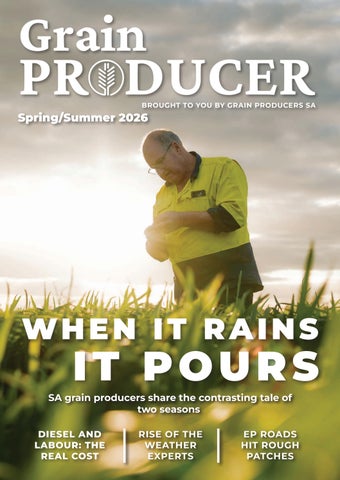
WHEN IT RAINS
IT POURS
SA grain producers share the contrasting tale of two seasons DIESEL AND LABOUR: THE REAL COST
RISE OF THE WEATHER EXPERTS
EP ROADS HIT ROUGH PATCHES
PAGE TITLE
NITROGEN DECISIONS MATTER
AND GOOD ENOUGH IS NO LONGER
ENOUGH.
WHY NOT GREAT? Easy N® and Incitec Pivot Fertilisers® are registered trademarks of Incitec Pivot Pty Ltd (ABN 37 007 656 046). Incitec Pivot Pty Ltd is a business of Ridley Corporation Limited.
2
GRAIN PRODUCER
SPRING/SUMMER 2026
THERE MAY BE SIGNS...
BREATH HATE EWIF YOU EEDS
RYEGRASS
Population
1,000
BRING THE MILLS. SMASH YOUR SEEDBANK. CALL OUR TEAM FOR A NO OBLIGATION CHAT ABOUT GETTING RID OF WEEDS Tom Slatyer 0438 789 160
seedterminator.com.au
Paul Gill 0439 065 558 SPRING/SUMMER 2026
GRAIN PRODUCER
3
ADVERTORIAL
EASY N: A flexible and efficient nitrogen choice for southern growers
N return.
itrogen management is increasingly about flexibility: applying nitrogen when it can deliver the greatest
Across South Australian broadacre systems, seasonal variability, operational constraints and supply volatility are placing greater emphasis on nitrogen efficiency, flexibility and reliability. This is seeing more growers exploring alternate nitrogen sources such as urea ammonium nitrate (UAN), delivered by Incitec Pivot through EASY N. Unlike traditional programs that can be heavily reliant on weather events and just-in-time availability, EASY N® can be stored on farm in advance and applied accurately across multiple crop stages. This gives growers flexibility to make nitrogen decisions closer to crop demand with
4
GRAIN PRODUCER
confidence as the product is available when required. Incitec Pivot Technical Agronomist David McRae said growers are looking closely at timing, placement and application efficiency. “The ability to apply nitrogen precisely when crops require it provides greater flexibility and can help improve overall nitrogen use efficiency,” Mr McRae said. Yorke Peninsula grain growers Tim and Peter Edwards have seen the benefits since introducing EASY N and Liquids Systems equipment in 2019 across their 2,300-hectare wheat, barley and lentil operation near Port Broughton. “Since switching to EASY N in 2019, we’ve seen more vigorous early establishment, thicker canopies, healthier crops and yield gains,” Tim Edwards said.
SPRING/SUMMER 2026
To improve accessibility to EASY N, Incitec Pivot is investing $5 million in storage infrastructure at Port Adelaide and Portland, increasing southern Australian storage capacity by 64 per cent and creating four dispatch points with product expected in the new sites from early spring 2026. “The increased storage capacity will improve freight efficiencies and regional responsiveness during peak demand periods,” Incitec Pivot Chief Operating Officer Scott Bowman said. For growers already using EASY N®, the benefits extend far beyond application performance to on-farm confidence and operational reliability. Combined with the application flexibility of UAN systems, the expanded storage network supports more flexible and diversified nitrogen availability across southern farming systems.
From the Editor
EARNED, NOT GIVEN
After the run of seasons we have just been through, a big harvest is a reward, not a windfall.
T
wo years ago, plenty of paddocks across this state were bare and blowing. This spring, they were shoulder-high. South Australia is now on track for one of its biggest harvests on record, and across most districts the headers will be running hard and the bins full over the coming months. Nobody got here by luck. They got here by sowing dry, holding their nerve and backing themselves when the numbers said otherwise. Cashflow is still tight for many, but take the win. You’ve earned it. Canola has been the picture of the year. Paddock after paddock of it, and with it the annual reminder that a crop which looks like a tourist attraction is still somebody’s livelihood and somebody’s biosecurity risk. We hear every spring from growers who have come across open gates, flattened fences and strangers standing (or lying!) in a crop for a photograph. Inside, we hear why grain producers are asking people to admire it from the road. The message has not changed: it is not a public garden, it is
a paddock, and walking into it is trespass. A good year does not make the hard questions go away, and two of them are coming straight at us. Diesel and labour are both the sort of issue that is easy to park when the season is kind and challenging to fix when it is not. Our survey puts numbers around what grain producers have been telling us for a while, and the initial results are laid out for you here. Something else has shifted. The rise of the social media weather forecaster has been remarkable, and in a harvest like this one it matters more than it used to. So we put the question to the sector: is someone with a chart and a following helping or hindering? Then there are the roads. Every tonne of this harvest has to travel, and our freight routes were taking a hammering before the big year arrived. Grain producers are not asking for gold plating. They are asking for roads that can carry the trucks already using them.
ABOUT GPSA This magazine is brought to you from the grassroots, with Grain Producers SA (GPSA) providing content and editorial. If you are not aware of GPSA, we are the peak industry body for the 4,500 grain producers in South Australia and are funded by growers through a contribution under the Grain Industry Fund.
GPSA develops and implements policies and projects that enhance the productivity and profitability of South Australian grain growing businesses. For South Australian grain producers, GPSA is your opportunity to influence the policies and issues that matter to you. Are you a Member? If you aren’t, sign up by visiting: www.grainproducerssa.com.au
Our feature makes the case that maintaining a road costs a good deal less than rebuilding one. A big harvest brings long days, and long days take their toll. Technology used to support military veterans in the United States is now being trialled on South Australian grain farms. We explain how it works and how to take part. There is also a first in these pages. New Chair Steve Ball sits down with us on what he wants this organisation to be, and reading this feature is certainly worth your time. Have a safe one. Get the crop off, keep an eye on the person next door, and most importantly, enjoy it.
Brad Perry GPSA Chief Executive Officer CONTACT T: 1300 734 884 E: info@grainproducerssa.com.au A: Level 13, 431 King William St, Adelaide, 5000 PRINTING Terry Howe Printing PUBLISHED BY Grain Producers SA ADVERTISING stacey@grainproducerssa.com.au
DISCLAIMER: Articles appearing in GRAIN PRODUCER do not necessarily represent the policies or views of Grain Producers SA. Products and services advertised in GRAIN PRODUCER are not necessarily endorsed by Grain Producers SA. This publication is published by Grain Producers SA (the “Publisher”). Materials in this publication have been created by a variety of different entities and, to the extent permitted by law, the Publisher accepts no liability for materials created by others. All materials should be considered protected by Australian and international intellectual property laws. Unless you are authorised by law or the copyright owners to do so, you may not copy any of the materials. The mention of a product or service, person or company in this publication does not indicate the Publisher’s endorsement. The views expressed in this publication do not necessarily represent the opinion of the Publisher, its agents, company officers or employees. Any use of the information contained in this publication is at the sole risk of the person using that information. The user should make independent enquiries as to the accuracy of the information before relying on that information. All express or implied terms, conditions, warranties, statements, assurances, and representations in relation to the Publisher, its publications and its services are expressly excluded. To the extent permitted by law, the Publisher will not be liable for any damages including special, exemplary, punitive, or consequential damages (including but not limited to economic loss or loss of profit or revenue or loss of opportunity) or indirect loss or damage of any kind arise in contract, tort or otherwise, even if advised of the possibility of such loss of profits or damages. While we use our best endeavours to ensure accuracy of the materials we create, to the extent permitted by law, the Publisher excludes all liability for loss resulting from any inaccuracies or false or misleading statements that may appear in the publication. Copyright © - Grain Producers SA Copyright (C) All material published in this communication is copyright protected and may not be reproduced in any form without written permission from Grain Producers SA.
SPRING/SUMMER 2026
GRAIN PRODUCER
5
PAGE TITLE
What affects the cost of a machinery shed? Find out in the Machinery Shed Cost & Planning Guide
Download the FREE Machinery Shed Guide Find indicative machinery shed costs, factors that affect your budget, shed design tips and examples of machinery sheds built across South Australia.
SA’s rural shed experts 6 GRAIN PRODUCER SPRING 2026
SCAN HERE TO DOWNLOAD
spanlift.com.au
1300 234 321
Contents
14 COVER STORY
The year the green came back Five South Australian grain producers reflect on the turnaround, what a good harvest could mean, and why none is counting it yet.
24 All eyes on the Ball
68 Forecasts for sale
Riverton grain producer Steve Ball on his farm, his path to the top job and the priorities he’ll pursue as GPSA Chair.
Free forecasts, paid subscriptions and social media predictions: which deserve growers’ confidence?
ALSO IN THIS EDITION 5
From the Editor
9
Press play on podcasts
10 Quick questions 13 Inside the Grain: GPSA’s new podcast 22 Phosphine changes delayed 30 Canola: the right side of the fence 36 Harvest Survey: diesel burns a hole in returns
40 Tom Chapmen: don’t be a bloody sheep 45 Worst Grain Road: Flinders High way tops the list
88 Bratten Way’s costly road 94 SAGIT: barley head loss 96 Locusts and mice
50 Eyre Peninsula rail study
100 Making toom for a record harvest
56 The rising cost of growing grain
102 Comic strip
62 Who’s coming for harvest 80 Harvest fire safety: don’t be like Baz 84 AirAgri wellbeing pilot
SPRING/SUMMER 2026
GRAIN PRODUCER
7
PAGE TITLE
Seeding needs a specialist. Fencing needs a specialist. Shearing needs a specialist. Insurance needs a specialist. Harvesting needs a specialist. Cropping needs a specialist. Spraying needs a specialist.
8
GRAIN PRODUCER
S P R I N G 2 0 2 6mga.com
PODCAST PICKS
YOUNG GRAIN PRODUCER COMMIT TEE
P ress pl ay o n podca st pi c ks Podcasts are always the perfect companion for long drives between paddocks, time in the tractor, or even a quiet ‘cuppa’ at the end of the day. Members of the Young Grain Producers Committee have provided their pick of the bunch. So grab your headphones, press play, and let these conversations keep you company from dawn to dusk.
The Howie Games Mark Howard
The Imperfects
PICKED BY DION TREZONA, EYRE PENINSULA
Hugh van Cuylenburg, Josh van Cuylenburg and Ryan Shelton, from The Resilience Project
Assassins
Secrets We Keep
PICKED BY PENNY ROBERTS, MALLEE
PICKED BY DILI SCHOENBERG, MID NORTH
Aslan Pahari, ABC
Keepin’ It Cricket
Adam Peacock and Alyssa Healy, with Brad Haddin
PICKED BY MATT HOWELL, SOUTH EAST
PICKED BY MATT CADD, YORKE PENINSULA Joey Watson, LiSTNR
Diary of a CEO
Steven Bartlett, DOAC
PICKED BY DEANNA PAECH, MURRAYLANDS
FOR PROVEN RESULTS, CONTACT YOUR LOCAL HANNAFORD SEED PROTECTION SPECIALIST IN SA:
Seed grading & treatment 9 reasons the locals go to Hannaford ...
Pay for the service only - no surcharges for fuel or incomplete jobs
Independently owned & operated local small businesses
Multiple screen options enables grading of majority of grains
Being local, we have flexibility to work in with farming schedules
Accurate application of up to 4 seed treatments simultaneously
Proven business model for long-term service continuity
Accredited franchisees trained in safe use of seed treatments
Fully mobile equipment designed for specialist seed processing
Access to the latest technology & largest range of seed treatments
Streaky Bay, Ceduna, Port Kenny & Poochera Daven Tomney
0477 002 366
Port Lincoln, Cummins, Cleve & Kimba Gilbert & Brian Turner
0447 069 335
Gladstone, Crystal Brook, Jamestown & Melrose David & Tracy Smith
0428 847 949
Maitland, Ardrossan, Warooka, Arthurton, Kadina Luke Derrington
0427 738 029
Snowtown, Blyth, Nantawarra, Bute & Avon Kane Ruiz
0458 355 838
Auburn, Clare, Manoora & Burra Matt & Chelsea Hunt
0431 570 660
Barossa, Riverland, Eudunda & Tarlee Jon & Margaret Schutz
0417 812 760
Strathalbyn, Fleurieu Peninsula & Kangaroo Is. Terry & Kelly Jackson
0403 298 076
Naracoorte, Bordertown, Keith & Tintinara David & Karen Harris
0428 857 725
FREE* Seed Germination Test *For Hannaford customers only
WWW.HANNAFORDS.COM
SPRING 2026
GRAIN PRODUCER
9
A UPL Group Company
PAGE TITLE
Jamie on holiday with his family.
QUICK QUESTIONS
EYRE PENINSULA
Meet Ungarra grower
Jamie Phillis
Ungarra grain producer Jamie Phillis has been growing crops on Eyre Peninsula for 30 years. For him, harvest remains the most rewarding part of the job, whatever the yield, because it is the culmination of a year’s work.
10
GRAIN PRODUCER
How long have you been a grain producer and how did you choose this as a career pathway?
Unfortunately probably my phone nowadays! We are connected and reliant on technology, but that connection can also be against us.
Thirty years, have always loved the outdoors and growing crops
If you weren’t farming, what would you be doing?
What’s the most rewarding part of being a grain producer?
Really not sure on that one. Travel photographer maybe.
Harvesting of our produce, regardless of yields, is always rewarding as its the culmination of your years work.
What’s your pick for a header? Red, Green, Yellow or another colour?
How do you unwind after a busy season?
Have always had green, and had a good run with them.
Relaxing around the pool or at the beach after harvest is always good.
What do you think is the biggest challenge facing the grain industry today?
What’s the one piece of equipment you couldn’t live without on your farm?
Rising inputs (land, lease, fertiliser, machinery), and grain prices not ris-
SPRING/SUMMER 2026
ing the same, are certainly concerns. What is the most important piece of advice you’d give to a young grain producer starting out? Make sure you love what you’re doing! What’s the worst task that needs to be done on your farm during harvest?
What’s one item on your bucket list and if you don’t have one, what would be the first item on it if you created it today? Overseas travel with the family Where is your go-to travel destination after harvest? I always look forward to some skiing on the River Murray.
Cleaning down the header at season’s end is the worst. I don’t feel harvest is over until its done, though. What song is currently on repeat on your playlist? Stephen Wilson Jnr’s “Stand By Me” What’s your go-to lunch option during harvest? My wife supplies a variety, so whatever she packs or brings out is always good.
Supporting regional businesses for over 100 years. CommBank is proud to be a part of your community. We have a deep understanding of the Grain industry in South Australia and are here to support your business banking needs. Speak to your local banker.
Naomi Munn Executive Manager 0429 800 714 naomi.munn@cba.com.au
commbank.com.au/regionalbusiness
Ed Rowntree Executive Manager 0419 985 180 rowntejh@cba.com.au
SPRING 2026
GRAIN PRODUCER
Things you should know: If you have a complaint in respect of this information, the Commonwealth Bank's dispute resolution service can be accessed on 13 22 21 or commbank.com.au/support compliments-and-complaints. Commonwealth Bank of Australia ABN 48 123 123 124 AFSL Australian credit licence 234 945
11
PAGE TITLE
Exirel
®
I N S EC T I C I D E
Product Guide
Parachute
®
I N S EC T I C I D E
Insecticides
ALWAYS READ AND FOLLOW LABEL DIRECTIONS. FMC, the FMC logo, Exirel and Parachute are registered
12 trademarks G R A I N of P RFMC O D UCorporation C E R S P Rand/or I N G 2an 0 2affiliate.© 6 2026 FMC Corporation. All rights reserved. 07/2026
Inside the Grain: GPSA takes you behind the scenes
G
LISTEN NOW
Search Inside the Grain on Spotify. New episodes every fortnight.
rain Producers SA has launched a new podcast taking listeners behind the scenes of what the organisation does, the challenges it takes on, and how it represents grain producers in the rooms where decisions get made.
“This is a way of opening the door on that, and giving a unique insight into how GPSA advocates on behalf of grain producers, day in, day out.” Brad said.
‘Inside the Grain’ is hosted by GPSA Chief Executive Officer Brad Perry and Policy Manager Rowan Thomas, with a special guest joining them each episode. New episodes land every fortnight on GPSA’s Spotify channel. said.
The first episode, features world renowned pest weed expert Professor Chris Preston talking about the changes to paraquat and diquat access and future chemical access. The latest episode is out now by searching ‘Inside the Grain’ on Spotify.
“There are plenty of serious issues to work through, and a bit of lighthearted fun along the way.”
“A lot of our work happens in rooms that growers never get to see.” BRAD PERRY, GPSA CEO
RTO: 41026 | CRICOS: 00092B | IHE: PRV14002 | Accurate as at June 2026
STUDY AGRICULTURE AT TAFE SA PRACTICAL, CAREER-FOCUSED TRAINING THAT LEADS TO REAL JOBS AWARD COURSES
SHORT COURSES
Certificate II in Agriculture (AHC20122)
Chemical Card
Certificate III in Agriculture (AHC30122)
Drones in Agriculture
Certificate III in Rural Operations (AHC32822) Pest Management Technician Certificate IV in Agribusiness (AHC41024) Apprenticeships and traineeships also available. Visit tafesa.edu.au or scan the QR code below for more information.
SPRING 2026
GRAIN PRODUCER
13
PAGE TITLE
GREEN: South East grain producer Michael Hunt inspecting his crops.
14
GRAIN PRODUCER
SPRING 2026
SEASON 2026
FIVE GROWERS, ONE TURNAROUND
The year the green came back From ankle-high and dusty to shoulder-height and full of promise. Five South Australian grain producers reflect on the turnaround, what a good harvest could mean, and why noone is counting it yet.
S
tand on the Adelaide Plains this month and, as Gian Piscioneri puts it, you cannot see a bad crop. On Yorke Peninsula, Matthew Cadd is looking at wheat yields above seven tonnes per hectare. North of Streaky Bay, Dion Trezona is weighing up crops that could double his long-term average.
second shows a transformation he could scarcely believe.
It has been a long while since those three sentences belonged in the same paragraph.
This year, the break came earlier and the green has grown higher. After the run South Australian grain producers have had, that alone has been worth something. But the damage left behind, and the cost of growing the crop now standing, mean recovery is more complicated than a change of colour.
In the upper South East, Michael Hunt has two photographs that capture how quickly a season can turn. Taken from the same spot three months apart last year, the first shows a clover pasture paddock stripped of feed after the long dry. The
In the Mallee, Lachie Singh needs only one word to describe how his farm looks today. “Fantastic.”
SPRING 2026
GRAIN PRODUCER
15
SEASON 2026
THE YEAR THE GREEN CAME BACK have a couple of cool drinks and discuss our options,” Michael says.
A hundred dollars every three minutes Michael Hunt farms at Cannawigara, west of Bordertown, where his family moved in 1910 to be closer to town and school. The home farm is small, so the business leases and share farms additional country to make it work. Michael and his wife Coleen farm alongside son Josh and daughter-inlaw Sammy, growing about 1,400 hectares of wheat, canola, beans, barley and lentils. Irrigation and a couple of thousand Merino ewes round out the operation, in a comparatively reliable pocket averaging 460 millimetres of rain a year. “We don’t do everything as well as we would like,” he says, “but every year we strive to improve on the last.” The autumn of 2025 tested that resolve. The business had taken on extra leased properties and bought more sheep for grazing. Cropping and lease costs had to be paid upfront, while any income was months away.
“We had worked out we were spending money at a rate of a $100 note going into the ground every three minutes.” MICHAEL HUNT By the middle of June, the family were seriously worried about how they would get through. Michael had done the sums on what it was costing to keep going.
The choice was stark: keep sowing and make the most of whatever rain arrived, or wait and risk not planting at all. Waiting offered a below-average year at best. By the time they sowed, the ground would be colder and the program would be another month behind. Changing the program altogether would take years to unwind as they worked back towards their planned rotations. They chose to forge ahead, watch their inputs and avoid compromising the crop. Every hectare went in dry. Then they waited. “Every option we looked at had risk but this was the least riskiest of them all,” Hunt says. Eventually, it rained. The canola barely emerged until July, yet delivered extraordinary yields. The wheat followed suit. “I couldn’t believe the change in such a short time,” he says. Twelve months on, what has stayed with him is more than the yield. It is the conversation that helped the family get there.
He said some exposed areas had lost so much soil that rebuilding their productivity would take years. “So all the good stuff ’s gone, and now you’re just left with dead sand that’s never had any fertilizer or anything,” he says. Even where damaged ground had been levelled, the repaired patches were still visibly poorer than the surrounding country. The rain has transformed the outlook, but it has not restored everything the drought took away.
What the wind left behind
He started around 2018 on 20 hectares owned by his parents, moving from hay into grain and building the operation through share farming and leasing. Buying country in his area is now, in his view, unviable.
For Lachie Singh at Alawoona, the effects of the drought are still written into the paddocks.
“After sowing the barley and canola we stopped and decided to make pizzas,
During the dry years, the family reduced sheep numbers, sold older
GRAIN PRODUCER
The erosion was particularly confronting on a farm that had not been cultivated for 15 years. Some paddocks were damaged badly enough that Lachie left them out of this year’s cropping program because there was no time to smooth them out.
You can’t see a bad crop
They decided to pause.
16
Keeping the remaining sheep fed added a relentless round of jobs to the working week. Grain feeding was followed by carting and distributing hay, consuming time and money while the wind kept blowing.
“The relief of having talked it through and made plans for different scenarios was incredible for our mental health, and the rest of the seeding was a lot less stressful,” Michael says.
His family has farmed in the South Australian Mallee for more than a century. The business, LC and BJ Singh Farming, combines cropping and Merino sheep across about 7,000 hectares of owned and share farmed country.
“We had worked out we were spending money at a rate of a $100 note going into the ground every three minutes with no sign of rain,” he says.
stock and pulled spending back. The cropping program focused on cereals rather than canola or lentils, with dry sowing repeatedly interrupted by dust storms.
SPRING/SUMMER 2026
On the Adelaide Plains, Gian Piscioneri is having his biggest year in more ways than one.
Alongside his own operation, he manages a neighbouring farm and works for the Shanahan family at Freeling. This is his first season taking responsibility for all the share farmed and leased country himself, with his father cutting back to his own 20 hectares.
Michael Hunt (centre, in hi-vis) talks the season through with his family and neighbours.
Gian has expanded from roughly 100 acres to 400, funding the increase through his other income.
years, many crops were written off without being harvested.
“There’s a lot riding on this year,” he says. “And so far, it’s looking promising. And when I say it’s looking promising, I mean very good.”
On the Yorke Peninsula, Matthew Cadd manages Whitlees Farm at Agery, where his family has farmed for six generations, stretching back to the late 1880s.
At this point last year, his crops were below average: nothing exciting, but faring much better than those in some other parts of the state.
This season, fertiliser prices squeezed the gross margins of other crops enough for the family to plant only wheat and lentils.
“This year you look across and you can’t see a bad crop, they’re all huge,” he says.
So far, the decision looks to have paid off.
The contrast with 2024 is greater still. In one of the driest years growers can remember, many struggled to grow much at all. Late sowing and a little late rain delivered Gian a wheat yield of 2.7 tonnes per hectare on country that averages almost five and can reach six or seven in a very good year. Further north around Melrose, where he had worked for three and a half
“The wheat is absolutely going bonza,” he says, “We are expecting yields over seven tonnes per hectare, which is incredible.” Matthew credits a sequence of welltimed rain. A hundred millimetres through February and March restored much-needed moisture to the soil profile. Good early rain in May helped establish the crops, with deeper moisture available as they grew.
Another 280 millimetres fell across June, July and August. Few cold nights or hot days added up to what he describes as “soft growing conditions”. The lentils are harder to read. Early sowing produced substantial growth, but the canopy shaded lower flowers and caused them to abort. Half an inch of rain at the start of October will help the plants keep flowering and podding. North of Streaky Bay, Dion Trezona’s paddocks tell a more varied story. “Crops are a mixed bag,” he says. “But we’ve also got some really nice crops.” The fifth-generation grain producer crops around 4,000 hectares of cereals, mostly wheat, with about 20 per cent barley and some oats for hay and sheep feed. His grey calcareous soils do not hold nutrients well, and this season a considerable amount of nitrogen has leached through the profile. Even so, the potential yields are remarkable for
SPRING/SUMMER 2026
GRAIN PRODUCER
17
PAGE TITLE
YELLOW: Canola has been plentiful across the state.
country averaging 1.2 to 1.4 tonnes per hectare. “This year, for us to have crops yielding 2.5 to 4 tonnes per hectare is double the average and that’s realistically what we are looking at right now,” he says.
For Dion, the rain that lifted yield potential also lifted the fertiliser bill. Nitrogen lost through the soil profile had to be replaced mid-season, at very high prices, stretching the budget to its limits.
strong returns this year will depend heavily on yield.
“The wheat and barley price has not kept up with the diesel and fertiliser price rises,” he says.
A spike in canola prices is welcome, although the crop is expensive to establish and grow. In his first season growing it, Gian has also found plenty to learn.
Fuel tops his list of concerns heading into harvest. Running trucks on diesel at three dollars a litre will take a substantial bite out of any profit. Matthew is looking at a vastly different season, but his biggest concerns have carried over from last year. “Diesel prices and grain prices are our biggest concerns,” he says.
Streaky Bay grain producer Dion Trezona.
The difference is rain, and when it arrived. Early falls allowed the crop to go into warm, wet soil. A late March rain Dion describes as “awesome” also brought plenty of feed, easing the pressure of keeping livestock going through the dry.
“It’s going to be a record harvest, so there’s no doubt that our diesel usage will be at record levels as well. It would be fantastic, in an ideal world, if grain prices were higher to help cover the significant increase in diesel and other variable costs.”
Plenty of grain but plenty of bills
The cost pressure has already shaped his season. Fertiliser prices were a major reason for limiting the program to wheat and lentils.
For all five growers, talk of a big crop soon turns to what it has cost to grow.
Gian is blunt about the gap between production costs and grain prices. Any
18
GRAIN PRODUCER
SPRING/SUMMER 2026
“You can’t expect anything to be sustainable long term with the price of grain currently,” he says.
Michael’s inputs have been enormous too, but the timing offered some relief: fertiliser prices eased before his larger applications were due. For Lachie, the better season has brought another financial squeeze. After two lean years, the business needed to make the most of the rain, but chasing that yield meant committing more money at sharply higher prices. He said successive loads of urea had risen from $750 per tonne to $1,200 and then $1,400. “Everything just seems to have doubled in price at a drop of a hat, except the price of wheat,” he says. The need to recover lost income has pushed the business further into debt this season. Yet there was still a limit to how much fertiliser Lachie could
afford, forcing him to target the areas most likely to deliver a return. The crop looks better. The financial pressure has not disappeared.
Where to put the record harvest? A big crop brings its own problems. On Yorke Peninsula, an earlier-than-expected harvest has sharpened the question of where all that grain will go.
Additional grain storage is on Dion’s investment list too, just behind onfarm fuel storage. Michael is tackling the challenge from the freight end. He is organising extra help with grain cartage, checking machinery before harvest and planning the workflow to keep delays to a minimum. He is also revisiting the marketing plan, so decisions made in the rush of harvest stay grounded in the business’s broader goals.
What a good year buys Ask these growers what a strong harvest would mean and new machinery is rarely the first answer. Dion’s priority is paying down the substantial debt accumulated through three disastrous seasons, followed by a year of huge input costs. A good result would give the business room to plan for next season and its longer-term viability.
Matthew invested in a couple of large permanent silos earlier this season, giving the business more flexibility to hold grain and access post-harvest delivery markets.
Michael is in similar territory. A strong harvest would help reduce the extra debt taken on in recent years. He says some local growers began that process last year and hopes this season will let them consolidate further.
Those silos will cover only a small portion of the expected crop. Silo bags were always part of the plan. Finding them proved harder than expected.
For those who have pushed ageing machinery through the difficult years, it may also create room for overdue upgrades or major repairs.
“I had thought I was reasonably organised mid-August when I was enquiring about silo bags,” he says, “however clearly, I wasn’t, as I was told most sizes were already in short supply and had been for a month. One supplier mentioned they wouldn’t be receiving more stock until post-harvest.”
Matthew is thinking about the soil. High stubble loads offer another opportunity to build organic matter, something the business has worked on for years, with gradual gains.
He secured bags through another supplier and had a handful left in the shed from previous harvests. The family prefer smaller bags, which are easier to handle and spread the risk by putting less grain in each one, although that also limits their storage capacity. Bag prices have not changed the wheat storage plan, but they have influenced the approach to lentils. Rather than warehousing the majority as they usually would, the business will chase a premium in post-harvest delivery markets. Without the bags, the fallback was to use on-farm silos normally set aside for other purposes. That would provide only a fraction of the capacity and create competing demands for space, particularly if lentils remained in storage when fertiliser needed to be bought.
Yorke Peninsula grain producer Matthew Cadd.
The extra income may also support a significant investment in soil amelioration equipment to tackle non-wetting sand and compaction.
Hon Geoff Brock MP
Independent Member for Stuart
If you have any state: CONCERNS SUGGESTIONS ISSUES
I would love to hear from you! 08 8633 1210 stuart@parliament.sa.gov.au www.geoffbrock.com.au SPRING 2026 GRAIN PRODUCER 19 Serving the Community of Stuart
SEASON 2026
THE YEAR THE GREEN CAME BACK
For Gian, carrying the expanded operation himself for the first time, the outcome will help shape what comes next. There is plenty riding on getting this crop through. Lachie is looking beyond this harvest. After two poor seasons, and three for some growers in his district, he believes another reasonable year will be needed to rebuild the business position. A good crop has to be considered alongside the losses that came before it, as well as machinery and land repayments, wages and this season’s costs. “The margins are pretty skinny. I’m not trying to talk down the season. Like, I’m just trying to be realistic,” he says.
“One or two rain events will see a downgrade of $50 to $75 per tonne and our budget will be stuffed.” DION TREZONA
“It’s not over until it’s in the bin and it’s sold,” Gian said. His attention is now turning from quantity to quality. The bulk is there, but a wet finish or wet harvest could bring sprouting and lower test weights, quickly eroding the value of the crop. He wants a few small falls to finish filling the cereals and canola and keep the lentils flowering, without heavy downpours. Warmth and moisture have also brought disease pressure, driving strong demand for fungicides across the district and beyond. Dion had a frost about six weeks ago that affected some early crops. They still look good, but some grains have GRAIN PRODUCER
He needs gentle weather over the next couple of weeks to allow the grain to fill, followed by conditions that let him get it safely into storage. There is little room in the budget for a quality setback. “One or two rain events will see a downgrade of $50 to $75 per tonne and our budget will be stuffed,” he says. Asked how he feels looking across his paddocks, the first word that comes to mind is “stressed”. Michael is still watching for frost, while his beans could do without a week of hot weather. Matthew’s wheat is effectively set, but he wants warm days, rather than hot ones, to finish the lentils. For Lachie, grain quality is also tied to how much the business could afford to invest in the crop. “I think the grain quality will be there where sufficient nitrogen’s been put out,” he says.
Sunshine and showers “As farmers we are walking around lost,” Michael Hunt says. “We have nothing to complain about at the minute.”
It’s not over until it’s delivered
20
aborted on one side of the head.
For Matthew, the value of a season like this extends well beyond the balance sheet. “We are very optimistic,” he says of the months ahead into harvest. “Seasons like this don’t come around often, so it’s great to get out into the paddock and really enjoy it. It’s good for mental health and very rewarding to see the crops looking so great, having come off the back of a couple of tougher years.”
the risks in view. He rates 2014 and 2015 as his worst years and sees every drought as a learning experience. This season, one challenge was holding his confidence when soil moisture looked good but the long-range forecast suggested otherwise. The difficult years taught him to keep written plans and rules, make communication within the work crew a priority, and regularly bring in someone from outside the business to offer an objective view. For Lachie, the lesson is to let available moisture guide the cropping program. Early moisture creates opportunities to try canola or other crops. Without it, pulling back can be the more sensible decision. He has about 3,000 hectares out of crop this season, with spraying underway since July to conserve moisture for next year. Some areas have already been sprayed three times. “Because I can buy nitrogen, I can’t buy moisture,” he explains. It is a trade-off. In some seasons, later rain might reward a bigger cropping program. Over time, Lachie believes conserving moisture works for his part of the Mallee. Michael also remembers a mate’s observation about what the good seasons can make possible. “It sucks when you lose thousands or hundreds of thousands of dollars in drought, but in the big years, we can earn a professional income based purely on what the weather does for us,” Michael says. “It’s nice to be able to remember these types of seasons in the tough years.” For now, there is time to appreciate what is standing in the paddock.
Dion says a successful harvest would bring enormous relief, financially and mentally.
“Nothing beats standing in a good crop with the anticipation of a good harvest around the corner,” he said.
Michael has farmed long enough to enjoy the promise while keeping
“Good luck to everyone this year, and for those who have had a series of bad ones, I hope this is your best ever.”
SPRING/SUMMER 2026
Priced to move Ready for 2027 Clearance pricing on in-stock Morris seeding equipment With a wide range of Morris seeders and bars available now, there’s never been a better time to upgrade. Secure never to be repeated, end-of-season pricing today and have your machine delivered, set up and ready well before Seeding 2027. Act now to take advantage of clearance opportunities while stock is on hand. Best selection. Best pricing. Ready when you are. Contact Ramsey Bros today.
Hear from a Morris grower
ramseybros.com.au/morris
C L EV E 8 268 21 00 · C U MMIN S 8 676 21 03 K IMB A 8 627 2371 · MU R R AY B R IDG E 8 5 3 1 2 2 4 4 R IV ER TO N S8P8R47 28 04 · WU DIN N A 8 68 0 2 2 0 0 21 ING 2026 GRAIN PRODUCER
ADVOCACY
WORKPLACE EXPOSURE LIMITS
Relief for SA grain producers as...
Unworkable Phosphine Changes Delayed An 18-month delay to new phosphine exposure limits has delivered an important advocacy win for South Australian grain producers, protecting the next two harvests while work continues on practical compliance requirements.
G
rain Producers SA (GPSA) secured an important outcome ahead of what is expected to be a record harvest, with the State Government agreeing to defer the introduction of a lower workplace exposure limit for phosphine until July 2028.
new phosphine exposure limit in the middle of a potentially record harvest,” GPSA Chief Executive Officer Brad Perry said.
The new limit was scheduled to take effect on 1 December 2026, midway through harvest, prompting GPSA to warn of serious consequences for grain storage, insect control and the movement of grain through the supply chain.
Practicality of changes still left wanting
“We welcome the Government listening to those concerns and acting to give growers and the grain supply chain certainty.”
The revised limit would reduce allowable phosphine exposure from 0.3 parts per million to 0.05 parts per million, a reduction of more than 80 per cent.
Phosphine is the primary fumigant used to protect stored grain from insect infestation, with its use extending from on-farm silos to bulk storage and export facilities. Grain Trade Australia has advised there is no equivalent, registered and commercially viable alternative available at the scale required by the industry.
“GPSA has worked closely with the State Government to explain the serious consequences of introducing the 22
GRAIN PRODUCER
“18 months gives us valuable time to work with government, regulators and technical experts on reliable monitoring, practical controls and a clear path to compliance.” BRAD PERRY, GPSA CEO
GPSA wrote to Minister for Industrial Relations Kyam Maher seeking a deferral, highlighting unresolved questions about monitoring technology, compliance guidance and the controls needed across different grain storage facilities.
Phosphine protects grain in storage
on grain dust, with changes set to come into effect on 1 December 2026.
Mr Maher said the issues raised by industry required detailed consideration and the extension would allow regulatory authorities time to work through them. SafeWork SA has also committed to developing guidance, education and support with the grain industry, including
SPRING/SUMMER 2026
The South Australian outcome follows WorkSafe Victoria’s August proposal to defer 15 workplace exposure limits, including phosphine, until 1 December 2029. Western Australia and New South Wales has also announced a delay. GTA welcomed South Australia’s decision, while maintaining that a threeyear deferral would provide the time needed to validate measurement methods and develop practical controls. “While the deferral is shorter than Victoria’s three years, 18 months gives us valuable time to work with government, regulators and technical experts on reliable monitoring, practical controls and a clear path to compliance,” Mr Perry said.
Research to support the transition
Push continues on other exposure limits
The Grains Research and Development Corporation (GRDC) is investing $4.7 million in a coordinated program to help growers and the supply chain prepare.
With the phosphine extension secured, GPSA is continuing to seek a practical transition for other airborne contaminants affecting the grain industry working with the State Government.
It includes research into phosphine exposure across the supply chain, a practical on-farm testing procedure and data to support future label updates. Guided by 18 industry organisations, the program is due to finish by mid2028, around when South Australia’s deferral ends.
GPSA is seeking a deferral for nationally agreed Safe Work Australia changes to grain dust, methyl bromide and flour dust, which remain scheduled to come under the new limits on 1 December 2026.
“Phosphine remains an essential tool for protecting stored grain and maintaining market access, so our focus is on supporting practical, science-based solutions that allow growers to continue using phosphine safely and effectively,” GRDC Manager Biosecurity and Regulation Dr Amy Koschella said.
For grain producers, grain dust is a particular concern because it is generated during routine activities including harvesting, augering, loading and unloading grain, and cleaning machinery and storage facilities. GPSA has raised concerns about how growers will assess exposure across changing tasks and weather conditions, access specialist monitoring services in regional areas and put any necessary equipment or workplace changes in place before harvest.
Workplace exposure standards can include an average measured over an eight-hour working day, rather than a single reading taken when dust is visible. Shadow Minister for Primary Industries and Regional Development Nicola Centofanti also called for the grain dust changes to be deferred until at least the end of 2029. “With harvest approaching, now is not the time to impose major regulatory changes when industry is still searching for answers about how they will actually work in practice,” Dr Centofanti said. For GPSA, the immediate priority is securing time and clear guidance for growers and the supply chain to prepare. The phosphine decision has addressed a significant concern ahead of harvest; work continues to ensure the remaining changes can be implemented practically while protecting worker safety.
YOU LITTLE REAPER AGT-Reaper CLP barley is here! Contact your AGT Variety Support Manager for more details: SA Brad Koster 0400 812 475
SPRING 2026
GRAIN PRODUCER
23
DELIGHTED: New GPSA Chair Steve Ball is passionate about the industry.
24
GRAIN PRODUCER
SPRING 2026
Q&A WITH STEVE BALL
ALL EYES ON THE BALL Riverton grain producer Steve Ball tells us about his farm, his path to the top job and the priorities he’ll pursue as GPSA Chair.
A
new season has brought a new leader to the Grain Producers SA (GPSA) Board, with Riverton grain producer Steve Ball appointed Chair of the organisation in September.
Steve takes over from John Gladigau, who served six years on the GPSA Board, including three as Chair. Now in his second stint with GPSA, Steve has previously been involved with GrainGrowers, Grain Producers Australia and the South Australian No-Till Farmers Association. He steps into the role at what he has described as an important period for the industry. “While the current season has created considerable optimism, growers continue to manage rising costs, regulatory pressures, market uncertainty and the long-term impacts of consecutive difficult seasons,” Steve said on his appointment. Grain Producer Magazine sat down with Steve and asked him all about life on the farm at Riverton, what led him into grower representation, and what he hopes to achieve for South Australian grain producers as Chair.
“Farmer advocacy is not a sexy role; however, it is a much needed one.”
Q: Take us out to Riverton. What does the farm look like, what have you got in the ground this year, and who’s in the business with you? SB: Our family farm is at Riverton, which is situated in the Gilbert Valley in the Lower North of South Australia. Our farm is largely undulating, with soils ranging from red-brown earths to black cracking vertosols. Our cropping program revolves around a range of crops. The rotation we mainly use is legume, oilseed and cereals, with faba beans, lentils, canola, wheat and barley, with canola our main focus. All of the paddocks coming out of the legume part of the rotation are spread with a mixture of pig and chicken manure. Our son Henry and I work the farm together, and Nikki, my wife, also helps out during the busy times, as well as doing the books. Q: How long has your family been farming in the district, and how did you come into the business? SB: I am a first-generation farmer, however Nikki was born and raised in Riverton. We met at Roseworthy and, after doing a few different agricultural jobs around the state, we moved back to Riverton and we now live on the old Hannaford farm, “Wattle Vale”. Henry is now the seventh generation to farm the land. Q: What’s the biggest change you’ve made on farm over the years that’s really paid off? SB: No-till farming has certainly been the biggest change that we have made to our farming system over the years that has significantly paid off. Q: How is the 2026 season shaping up on your place heading into harvest? SB: The 2026 season has been tracking well for us. Although we have had a slightly below average rainfall season, the rain has fallen at the right time. As we get near-
STEVE BALL, GPSA CHAIR SPRING/SUMMER 2026
GRAIN PRODUCER
25
Q&A WITH STEVE BALL er to harvest, we are looking forward to seeing how the crops pan out, with hopes of above average yields for the canola and cereals. Whilst the beans look good with plenty of height, they haven’t set many pods down low. The lentils are currently still flowering and setting pods. Q: What first got you involved in grower representation? Was there a particular issue or moment that pulled you in? SB: After completing my Nuffield, I was approached by GrainGrowers (GGL) then Chair John Eastburn to join their reference group to be their South Australian representative. From that time, I have enjoyed being involved in the advocacy space and looking to improve farmer representation. Q: You’ve been involved with a number of grower organisations. Which ones, and what have those roles taught you about what works in advocacy and what doesn’t? SB: I have worked with a number of grower organisations, including national ones GGL and GPA (Grain Producers Australia), and am now in my second stint at GPSA. Given my experience at both a state and a national level, it has shown me that to be successful in advocating for grain farmers, there needs to be strong cooperation amongst key organisations and there needs to be a consistent message coming from them. Q: What made you put your hand up for Chair, and why now? SB: GPSA was in very good hands with John Gladigau at the helm, and he was carrying on the good work started by Adrian McCabe. There was a succession plan in place, however due to changing circumstances the then Vice Chair couldn’t continue in the role. John, on behalf of the Board, approached me to see if I was willing to stand in the next election and consider the vacant Vice-Chair role. As happened when I did my Nuffield scholarship, it was the right time in my life to take on a new role. Now Henry is taking over the role of managing the 26
GRAIN PRODUCER
farming business, I am able to dedicate the time to doing the Chair role for GPSA. Farmer advocacy is not a sexy role; however, it is a much needed one in areas of supporting, representing and amplifying the voices of farmers to influence public and government policy. Q: When you were appointed, you said growers are dealing with rising costs, regulatory pressures, market uncertainty and the impacts of consecutive difficult seasons. If you could make real headway on one of those during your term, which would it be and why? SB: All of those issues raised are challenging ones and quite often farmers don’t have any real ability to directly influence them. With rising costs, everyone has an issue, however all of these are passed on down the line to farmers, who cannot do likewise, as they are the last stop. As JFK once said, “The farmer is the only man in our economy who buys everything at retail, sells everything at wholesale, and pays the freight both ways.”
“I believe grain farmers across the country want one RO and they need to be strong advocates for them.” STEVE BALL What I would like to see more of is, when farmers are looking at buying and selling, the sector as a whole needs to help them mitigate the risks and know when the price for inputs and price for selling is good, based on available knowledge. For instance, there was an offering of urea for next year in the mid $700s, which is coming off prices close to $1,400 this year, and with urea being just over $800 before the war in the Middle East started. This would have been a good time to lock in some urea for next season if circumstances al-
SPRING/SUMMER 2026
lowed for individual farmers. The reverse can work when selling our grain and livestock and knowing what prices are historically good. We all like to get the top price being offered over the season, however knowing when it is a decile 8 or 9 price helps us make good decisions. The terms of trade are continually squeezing us grain farmers, and we need to maintain profitability and achieve more, and the key to this I believe is greater and continual investment in research and development. This is an area that the current State Government believes in, and we must continue to put forward the message that they need to not only maintain their current spending on research, development and extension but increase spending for the benefit of the whole state.
Steve took over as GPSA Chair in September We must also continue our support for the likes of GRDC and our homegrown South Australian Grain Industry Trust, who do a fantastic job, currently chaired by Professor Andy Barr. We cannot be doing just any research; it must be relevant to modern farming, and this is the job for our national Representative Organisations (ROs), to make sure that GRDC remains relevant and on track. There has been, at times, disunity amongst the ROs, and I believe grain farmers across the country want one RO and they need to be strong advocates for them. Q: What are the two or three issues you’ll be pushing hardest on over the next 12 months? SB: In no particular order, I’d personally like to see a move to one RO for grain representation at a national level; work with government and other stakeholders on opportunities to increase spending on quality research, development and extension in South Australia, in
particular working with SARDI; and, in the same vein of research, looking at capacity building of the next generation of researchers. Another thing I’m looking forward to being delivered is our new program called Business & Beyond. On a wish list for the longer term, I would like to see further analysis and work done on GRDC converted as an Industry Owned Corporation (IOC). Q: A lot of GPSA’s advocacy happens behind closed doors, so growers don’t always see the wins. How do you make sure members know what they’re getting from the organisation? SB: Lately, we have been able to significantly expand our communications list, which has enabled us to reach more grain and mixed farmers with our magazine, which gives producers a good insight into what we are doing at GPSA and broader industry issues. Brad Perry, in the role of CEO, continues to be very active with mainstream media, particularly radio and print, which is extremely important to reach city and regional audiences. Q: Where do you think GPSA has made the biggest difference in recent years, and where can more be done? SB: GPSA has set the strategic industry vision with the Sustainability Roadmap and shortly we will release the new SA Grain Industry Blueprint. GPSA has also successfully given the sector a unified voice over time, and they have championed the industry and given producers the opportunity to celebrate our successful ones through the SA Grain Industry Awards. GPSA has also worked with other organisations like GRDC, GPA and GGL to come through in times of crisis, like securing emergency chemical approvals (such as ZP50 for escalating mouse plagues). According to a recent grower survey that GPSA conducted, almost 50 per cent of SA grain producers still lack reliable connectivity. As tech adoption is viewed by a third of growers as their single biggest future opportunity, GPSA can continue to work with national stakeholders to increase efforts
for greater investment to eliminate data dead zones that prevent farmers from adopting modern, data-heavy precision ag tools. It’s not an easy issue to solve but one we won’t shy away from. Q: For a grower who’s never had much to do with GPSA, why should they care who the Chair is? SB: Growers need to know who the Chair of the Board is and who the other members of the Board are, as they set the strategic direction of the organisation. However, more importantly, they need to know who the CEO and his management team are, as they are on the ground and running the business of GPSA. Q: Where do you see the South Australian grain industry in 10 years’ time? SB: The South Australian grain industry will see a number of growers exit the industry due to retirement in the next decade and many may be forced out due to squeezing of margins. Those left will need to continue to focus on maximising output, like grain yield, for the inputs, and this will be heavily reliant on higher yielding varieties, but also on those varieties that continue to yield well over a range of climatic conditions. Farmers will also utilise tools such as precision agriculture, automated machinery and data-driven soil management, which will become standard practice to continue to reduce input costs like fuel and fertiliser. Q: What’s the biggest threat to SA grain producers right now? SB: Our biggest threat that I see is complacency. We need to make sure government is more proactive rather than reactive in terms of biosecurity. We are always only one incursion away from significant market impacts, which could restrict our exports. All the State Farming Organisations (SFOs) across Australia and ROs must keep pressure on government to implement the right strategies to keep biosecurity front and centre. In my opinion, the agriculture sector has been complacent when looking at chemistry availability and continuing usage. SPRING/SUMMER 2026
OFF THE HEADER
QUICKFIRE Q: Favourite time of the farming year? SB: As a mixed farmer, on the grain side, I like sitting in the header and watching the grain coming into the header box, knowing that the work you have been putting in during the year has paid off, and you see that last truck taking the grain to the silo and knowing everyone has played their role. On the livestock side, I love lambing time. Seeing all those lambs racing around the paddock having the zoomies, I feel, is quite uplifting. Q: Best piece of advice you’ve been given as a farmer? SB: Work smarter, not harder. Q: If you weren’t farming, what would you be doing? SB: Something outdoors, like outdoor education, or something particular, like being a snow ski instructor. Q: How do you switch off? SB: I like to do a number of outdoor activities like surfing and snow skiing, and I ride my bike a bit (certainly not as much as I should). I’m also still the boundary umpire most weeks for RSMU Hawks’ A grade footy team. My good mate, Behny, and I do a reasonable amount of hunting. It’s not just about the shooting, it’s about being out in the bush, putting your skills to the test, spending time around the campfire, and maybe the odd frothie at the end of a day. If we are successful, then we bring home a fair bit of meat for the freezer and the venison tastes fantastic!
GRAIN PRODUCER
27
PAGE TITLE
28
GRAIN PRODUCER
SPRING/SUMMER 2026
ADVERTORIAL
Supporting success across generations
F
or many South Australian grain producers, the farm is more than a business. It represents generations of hard work, resilience and family commitment, with the shared goal of seeing it continue to prosper for years to come. As farming businesses evolve, so too do the challenges they face. Expanding operations, valuable land and assets, changing family dynamics and increasing regulatory requirements all add complexity to running a successful enterprise. Planning for the future has never been more important. One of the most effective ways to protect both the business and the family behind it is through proactive succession planning. While often associated with retirement, succession planning is about much more than deciding who takes over the farm. It involves considering ownership structures, governance, decision-making, asset protec-
tion, and estate planning to help ensure the business remains strong across generations. Every family business is different. Some family members may be actively involved in day-to-day operations, while others are not. The next generation may also have different aspirations, skills or priorities. Starting these conversations early and putting the right legal foundations in place can provide certainty, minimise the risk of disputes and support a smoother transition when the time comes. At Mellor Olsson, we understand the unique opportunities and challenges facing South Australian farming families. For generations, we have worked alongside family businesses, providing practical advice on succession planning, business structuring, governance, commercial arrangements, estate planning and dispute resolution.
Mellor Olsson Partner Callen Bubner
With the right planning, farming families can protect both the business and the relationships that underpin it. Clear structures and thoughtful succession planning provide the confidence and certainty needed to support future generations and ensure the farm continues to thrive for years to come. Written by Mellor Olsson Partner Callen Bubner.
Me l bee lor O lss nr o Bes ecogn n has t Law ised Au b str alia yers i y i n Tru n the ™ 20 27 are sts a & Agr icu Estat of ltu ral es and & Aff airs Rura l
Supporting success across generations. P: 08 8414 3400 E: lawyers@molawyers.com.au molawyers.com.au Adelaide Barossa Valley Clare Valley Port Lincoln By appointment: Balaklava, Bordertown, Burra, Ceduna, Cleve, Cummins, Elliston, Kadina, Keith, Kimba, McLaren Vale, Riverton, Streaky Bay and Wudinna.
Mellor Olsson provides clear, commercial legal advice to family‑owned and owner‑managed businesses. We support family businesses at every stage, from establishment and growth to transition, succession and dispute resolution. We advise on: Succession planning and asset protection Business structuring and strategic advice Governance and advisory services Contracts and commercial agreements Mergers, acquisitions and business sales Property, leasing and conveyancing Employment and workplace relations Regulatory compliance and risk management Dispute resolution and litigation
S P R Iguidance N G 2 0 2 6 for G Rfamily A I N P Rbusinesses. ODUCER 29 Trusted legal
PAGE TITLE CANOLA SEASON
PRIVATE PROPERT Y
It’s a paddock, not a postcard South Australia’s flowering canola drew an audience this spring. After two difficult seasons, bright yellow paddocks became a welcome sight for growers and a favourite backdrop for photographers.
THE WRONG SIDE Visitors’ photos posted online. Faces blurred. 30
GRAIN PRODUCER
SPRING/SUMMER 2026
But behind every photograph is a working farm, a crop and a family’s livelihood. GPSA’s message to visitors was simple: enjoy the view, take the photograph and stay on the right side of the fence. Charlie (left), Jack (right) beside a GPSA canola sign and Reggie ( foreground) on their family’s farm at Keith. The signs were supplied free to grain producers to encourage safe photography and respect for working farms.
SPRING/SUMMER 2026
GRAIN PRODUCER
31
CANOLA SEASON
PRIVATE PROPERT Y
Fields of gold, boundaries to respect South Australia’s canola paddocks captured plenty of attention this spring. Grain producers welcomed the interest, but a photograph should never come at the expense of safety, biosecurity or someone else’s crop.
A
flowering canola paddock is hard to miss. This spring, across South Australia’s cropping regions, the bright yellow fields gave passing motorists plenty of reasons to stop. After two difficult seasons, growers were pleased to see their crops attracting attention for a different reason. Photographs appeared on community, tourism, weather and photography pages, showcasing paddocks from the South East to Eyre Peninsula and Yorke Peninsula.
and property are safe and our biosecurity protocols are respected.”
was definitely a new for us this year too,” she says.
Seven cars inside the fence
It was not an isolated incident. Matilda says other people had stopped to move visitors out of the paddocks and shut gates when the family was elsewhere.
For Matilda Lienert and her family, the attention went well beyond people stepping into a crop for a photograph.
Matilda says visitors had also opened gates and left fencing down, with her father driving over a section on one occasion.
But while many visitors admired the view from the roadside, others crossed fences, walked into crops or parked across farm entrances to get their photographs.
During the incident involving the larger group, children were running through lentils before coming across to the canola. The family also received reports of visitors picking flowers.
Grain Producers SA responded by supplying growers with free signs carrying a clear message: “Stay on the right side of the fence”. Designed to hang between the road and a flowering paddock, the signs ask visitors not to enter and explain why: their own safety, farm biosecurity and protecting the crop. For Maddie Allen, who farms at Keith, putting up a sign was about welcoming people’s interest, while helping them understand the responsibilities that come with visiting farming country. Her photograph of three boys beside the sign also brought the message back to the families whose livelihoods depend on those paddocks. “We are thrilled that people who are not connected to the industry are recognising the beauty of agriculture,” she says. “However our properties are private, we do use chemicals on our crops, and we want to ensure that both people 32
GRAIN PRODUCER
Closing gates created another difficulty for her father, who generally works alone. Moving machinery into a paddock meant stopping on the main road to get out and open them.
Matilda Lienert at the family farm near Gomersal Road, Shea-Oak Log. Photo: Supplied. Matilda helps her father on the family farm at Shea-Oak Log, in the Barossa Valley, alongside her sisters during seeding and harvest. This season, three adjoining canola paddocks along Gomersal Road attracted considerable interest. Her father has always enjoyed people stopping to admire his crops. But this year, the family arrived to find seven cars and about 20 to 25 people roughly 400 metres inside a paddock. “We’ve actually had people driving their cars into our paddocks, which
SPRING/SUMMER 2026
“We’ve actually had people driving their cars into our paddocks.” MATILDA LIENERT For Matilda, the concerns included damage to crops, biosecurity and the safety of people entering a paddock without knowing what farm work was underway. “They don’t know if it’s just been sprayed,” she says. Matlida says visitors might not appreciate how much work and income depended on the crop, or the risks they could introduce by moving between paddocks. Her message was straightforward.
“Enjoy it. Take photos, but yeah, please don’t trespass,” she says.
a farmer had hundreds of acres, while a homeowner might have only six roses.
A photograph with consequences
For growers, however, the size of the paddock does not make the crop any less valuable or the property any less private.
Matthew Burford says the trespassing issue on paddocks of canola has been happening for decades but seems to have intensified this year. He farms with his uncle on the Adelaide Plains, south of Balaklava on the Nine Mile, and wants the signs ready for when he puts canola into the rotation. “I think it’s just an awareness thing,” he says. “Stop the problem before it begins.” Matt has already experienced the challenges of roadside spectators even without a yellow crop to draw them in. On one occasion, a vanload of tourists lined up beside his fence to photograph him spraying beans, waving as he drove past. He switched off the fence-line nozzle and the outside section of the boom to create more distance between the visitors and the spraying operation. Another time, a car parked across a paddock gateway on a sweeping bend, where the entrance dropped about a metre and a half below the road. Had he needed to bring the boom spray through, the vehicle would have blocked his access and left little room for either party to manoeuvre safely. “Gateways aren’t there for parking,” Matt says. “They’re there for getting in and out.” When people tell him online that entering a crop is harmless because it is only for a photograph, Matt asks them to consider the same situation at home. “I’m gonna come to your place, and I’m gonna go and stand in the middle of your rose garden, stand on half your roses, right? Take photos with the rest of them and then walk out a different direction than what I came in,” he says. He says many people did not respond. Others argued it was different because
An open gate is not an invitation
BY THE NUMBERS
It’s a big, beautiful canola crop South Australia’s spectacular flowering paddocks reflect a favourable growing season, rather than a record area planted to canola.
Some social media responses showed why the campaign was needed. After a Yorke Peninsula tourism page shared the message, one commenter posted a photograph of herself standing deep in a flowering crop. “I’m sorry if I had a photo in your paddock, I wasn’t aware my footprint could cause a bug,” she wrote. “But your gate was open and the brilliance of yellow called me to have a photo.” The page administrators explained that entering a crop was precisely what their advice sought to discourage and asked her to remove the photograph. Another commenter pointed out that an open farm gate was not permission to enter, and that the same view could be enjoyed from a safe distance.
This season’s estimated area is about 5 per cent above last season and about 2 per cent below the five-year average. PIRSA’s September report forecast total SA grain production of 11.6 million tonnes, about 32 per cent above the five-year average, with canola yield potential among the best seen in several years across many regions. Source: PIRSA, September 2026 Crop and
Elsewhere, a photograph posted to a weather group showed a woman standing in canola with her middle finger raised. It attracted criticism from people who understood why growers were asking visitors to respect their boundaries.
Pasture Report.
Photographers also helped reinforce the message. One drone operator who regularly shares images from cropping districts reminded followers to respect working farms, remain on public roadsides and obtain landholder permission before entering paddocks. The campaign asks people to make a few simple decisions before taking a photograph: find a safe place to stop, keep gateways clear and respect the fence. Matt summed it up. “Park safely, off the road, away from gateways, and stay on the right side of the fence,” he says.
Matthew Burford with his son Thomas showcasing one of the “Stay On the Right Side of the Fence” signs. Photo: Supplied.
SPRING/SUMMER 2026
GRAIN PRODUCER
33
RIC (Regional Investment Corporation) CEO John Howard.
ADVERTORIAL
RIC loans support SA grain producers to...
Recover, Prepare and Grow
A
fter several challenging seasons, many South Australian grain producers are now transitioning from drought management to recovery. While improved seasonal conditions are welcome, many producers are still carrying the financial impacts of drought, while managing higher input costs and increased pressure on cash flow.
34
GRAIN PRODUCER
The Regional Investment Corporation (RIC)’s low-interest loans are designed to help eligible farmers improve cash flow and create valuable breathing space, allowing them to focus on strengthening their business while continuing to manage shortterm financial pressures. RIC’s Drought Loan is designed to support farm businesses throughout
SPRING/SUMMER 2026
the drought cycle. This means farm business may still be eligible for a RIC Drought Loan, even if seasonal conditions have improved. Eligible farm businesses can apply up to five years after drought, provided they can demonstrate significant financial impact over a consecutive two-year period.
Since 1 July 2018, RIC has approved more than $428 million in loans to South Australian farmers, with the majority provided to cropping-only or mixed farming businesses. This strong uptake highlights the important role RIC plays in supporting SA’s grain-growing regions. RIC Chief Executive Officer John Howard said the organisation plays
an important role in helping viable farm businesses navigate unforeseen financial impacts.
“RIC loans provide a ‘leg up’, not a ‘hand out’, helping viable farmers to continue farming.”
“RIC loans are designed to provide practical support when farmers face challenges beyond their control. By reducing interest costs and improving cash flow, our loans help eligible farm businesses manage through difficult times, recover from disruption and prepare for the future,” he said.
“They can be used to upgrade water and storage infrastructure, pay operating expenses and restructure or refinance existing commercial debt.” Visit ric.gov.au or call 1800 875 675 to speak with the RIC team about your options.
ABOUT RIC RIC (Regional Investment Corporation) is an Australian Government farm business lender providing low-interest loans for farmers and farm-related small businesses in financial need to strengthen Australian agriculture. RIC loans can be used for
management, recovery and future proofing following severe business disruption due to drought, natural disasters, biosecurity issues or other significant market events. RIC loans can also help to establish farm businesses for first
generation farmers or succession planning for next generation farmers. Since 1 July 2018 RIC has approved more than 3,620 loans valued at over $3.8 billion as of 31 July 2026.
SPRING 2026
GRAIN PRODUCER
35
PAGE TITLE COVER STORY
PRE - HARVEST 2026 SURVEY
Diesel burns a hole in harvest ret South Australian grain producers are preparing to harvest a promising crop, but expensive diesel and concerns about supply are putting pressure on the season’s potential returns.
T
he crop may be bigger, but so is the task of bringing it in.
More hours harvesting, more grain to cart and more machinery running will increase diesel consumption across South Australia this harvest. GPSA’s pre-harvest survey shows grain producers are approaching that workload with widespread concern about fuel prices and supply.
translate into a comfortable financial result. As one grain producer put it: “Everyone passes their costs on to the customer. As farmers who do we pass our costs onto? We just have to suck it up”.
More grain means more diesel
One respondent explained: “We will be running a windrower this year, as well as an extra truck and second chaser bin to help move the crop, then whatever extra each machine will go through in harvesting the larger crop”. Another wrote: “Will have to run the chaser bin constantly which will add to the cost.”
Almost all survey respondents expected the larger crop to increase their fuel consumption.
A larger harvest creates the opportunity for more income, but growers must first fund the work needed to get it off and into storage or receival sites.
Almost three-quarters were concerned about supply reliability, while approximately 45 per cent nominated delivery timeframes or rationing by suppliers as a major worry.
“As farmers who do we pass our costs onto? We just have to suck it up.”
Their comments repeatedly raised the gap between production costs and grain prices.
Only four respondents reported no significant diesel concerns.
SURVEY RESPONDENT
A substantial bill ahead
Almost 50 per cent of grain producers expected to use more than 20 per cent additional diesel compared with a typical harvest. Another 82 expected an increase of up to 20 per cent.
Grain producers were asked how much additional harvest fuel expenditure they expected from higher diesel prices since seeding.
Of the nearly 200 grain producers who responded, about 97 per cent identified diesel prices as a concern.
The responses came from across South Australia’s cropping regions, with Eyre Peninsula and the Mid North/Upper North accounting for the largest cohorts to fill out the survey. Businesses ranged from those preparing to harvest less than 500 hectares to operations covering more than 8,000 hectares. Together, their answers show why a strong crop does not automatically 36
GRAIN PRODUCER
Combined, that means about 93 per cent anticipated using more fuel. None expected to use less than usual. The additional consumption extends beyond the header.
SPRING/SUMMER 2026
“High costs but grain prices don’t match the increases in all of our overheads,” one grain producer wrote.
The most common answer was $10,001 to $25,000, selected by 48 respondents. Another 37 selected $25,001 to $50,000, while 20 selected $50,001 to $100,000.
turns
Cost was a consideration, with 16 per cent identifying the expense of increasing storage capacity as a concern, while 16 per cent nominated insufficient onfarm storage as a challenge this harvest.
Reported delivery prices also varied. Some growers had bought earlier or secured bulk supplies, while others were facing more expensive recent purchases. That makes purchase timing important when comparing businesses. The most recent delivery does not necessarily reflect what a grain producer will pay to refill during harvest. For many, the immediate question is how much the next load will cost, and whether it will arrive when needed.
Waiting on the next delivery Most respondents (83 per cent) reported no change to their on-farm diesel storage capacity since seeding. Another 13 per cent had added permanent tanks and 3 per cent had increased capacity through hired or temporary tanks.
UNDER THE PUMP: Diesel prices are significantly increaing grain producer costs. Photo: supplied. One grain producer explained that additional storage had been considered but could not be justified alongside other purchases. “Once again, we’ll have to spend more just to stay the same,” they wrote. When asked how long fuel on hand and already-confirmed deliveries would cover harvest operations, approximately 14 per cent reported a week or less. Another 31 per cent had eight to 14 days covered, while 39 per cent had 15 to 28 days. Only 14 per cent reported coverage for the entire harvest. SPRING/SUMMER 2026
GRAIN PRODUCER
37
INDUSTRY SURVEY
PRE - HARVEST 2026
For most respondents, further deliveries will be needed as harvesting progresses. Reliable supply therefore matters alongside price. One grower described the task plainly: “We require a complete refill of our fuel storage each week during harvest, and our harvest runs for six to seven weeks”.
Labour confidence, with some gaps The survey showed a more varied picture on harvest labour. About 50 per cent of grain producers said they needed no additional workers beyond family members and permanent staff. Among the remainder, 33 needed one worker, 48 needed two or three, six needed four or five, and four needed more than five. Nearly 80 per cent were ‘very or somewhat confident’ they would have
38
GRAIN PRODUCER
enough skilled header, chaser bin and truck operators.
workers whose visas were already approved.
The recruitment follow-up attracted 114 answers. Of those, 68 reported securing all their workers, 17 had secured most and 20 had secured none. It is clear that recruitment remained unfinished for some respondents.
The survey was completed while recruitment and government decisions were changing. Its results capture growers’ circumstances when they responded, rather than a fixed position for the whole harvest.
Visa delays still matter
Longer hours and fatigue
Five respondents reported delayed or pending Working Holiday visa applications. None reported a refused application or a pending skilled or other visa. Of the 118 people who answered the visa question, 98 said they were not employing overseas workers this harvest.
Of the 116 respondents who answered the question about the effects of worker shortages or visa delays, 81 reported no impact.
That result should not obscure the disruption facing businesses that rely on those workers. One respondent said two recruited workers were still awaiting visa approval after applying in July. The business subsequently recruited two different
SPRING/SUMMER 2026 Eligible plan and compatible mobile required.
Twenty-three identified owners or family members working longer hours, 17 identified increased fatigue and safety risk, and 15 reported paying more for labour or contractors. Eleven selected reliance on less experienced operators, and another 11 selected actual or anticipated crop losses or quality downgrades from a slower harvest.
When all grain producers were asked about the risks of being short of workers, harvest delays leading to losses or downgrades were the most selected concern. Fatigue and the wellbeing of owners, family and staff also featured prominently.
Clearer guidance needed on exposure limits
practical information on how we manage the changes.”
The survey also highlighted how important phosphine is to on-farm storage.
With harvest approaching, the survey shows grain producers need reliable fuel supplies, skilled workers and clear guidance to turn a promising crop into a successful result.
Of those surveyed, 75 per cent used phosphine regularly or occasionally. Among respondents who answered the question about its importance, 63 per cent rated access as essential or very important. Understanding of the proposed phosphine and grain dust exposure changes was limited. Seventy-seven growers were unaware of the changes before the survey. Another 78 had heard of them but had limited understanding of what they meant for their farm. Those findings underline the importance of having enough skilled people to manage a demanding harvest, particularly when weather, breakdowns or delivery delays interrupt the plan
Following GPSA’s advocacy, the State Government deferred the lower phosphine exposure limit until July 2028. The grain dust changes rwere also deferred, with more than 50 per cent ‘very or somewhat concerned’ about meeting and demonstrating compliance. Growers asked for fact sheets, practical guidance, training and information about monitoring equipment.
.
One respondent summed up the information gap: “There seems to be a lot of talk about the new limits but not much
CHANTELLE
THOMAS MP
MEMBER FOR NARUNGGA
Our farmers deserve a strong voice RELIABLE INFRASTRUCTURE
LABOUR: An expected bumper harvest will mean long hours in the paddock. Photo: supplied.
STRONGER HEALTH SYSTEM
FISHING RESTORATION
TOURISM ADVOCATION
37 Graves Street, Kadina SA 5554 (08) 8832 2455 S P R I N G / S U M M E R 2 0 2 6 narungga@parliament.sa.gov.au GRAIN PRODUCER 39
PAGE TITLE
GROWER PROFILE
HOME: Clare grain producer Tom Chapman with his dog.
TOM CHAPMAN
Don’t be a bloody sheep Nearly 82 and still growing a crop, Clare local Tom Chapman has spent a lifetime making his own decisions. A lesson from his primary school headmaster helps explain why.
40
GRAIN PRODUCER
SPRING 2026
T
om Chapman reckons he started work the day he was born.
His mother was in a private hospital. The matron stepped out of the room and, by the time she returned, Tom had arrived. He has been getting on with things ever since. “I’m still working now, and I’m knocking on the door of 82 years old,” he says. Tom says his family’s connection to South Australia stretches back to 1838. Today, he is the last member of the family still farming. His working life has included dairying, sheep, cropping, road construction and vineyard pruning. There have been difficult seasons, steep interest rates and a serious accident along the way. Most of the farm is now leased out, but he still crops 400 acres himself each year. “Just for something to keep my hand in around the place,” he explains.
A start in the scrub After the First World War, Tom’s father took up a soldier settlement property at Dorset Vale in the Adelaide Hills. It was a scrub block, and his father wanted the right to own it outright. Although the authorities were initially reluctant, Tom says his father secured the freehold title after six years. Clearing the country took hard work and heavy machinery. He bought a bulldozer as the returned servicemen’s land-clearing operation on Kangaroo Island was winding up and had it brought across to the mainland. Three years later, devastatingly a tree struck and killed his father while he was working. Tom was just 15 years of age at the time. Tom later continued clearing where his father had left off, combining farm work with jobs in road construction and vineyard pruning.
But the property’s future was uncertain.
its peak, Tom says the dairy became Golden North’s third-largest supplier.
For years, there was a prospect of government acquisition for a reservoir at Clarendon. That did not proceed, but surrounding land was subsequently acquired for Scott Creek Conservation Park, leaving Tom and a neighbour farming between the conservation park and the waterworks.
Milk industry deregulation eventually prompted him to leave dairying. Sheep and cropping remained.
Tom recalls officials warning him that continuing certain farming activities without the necessary paperwork could result in penalties. He contacted his local member of parliament, who at the time was the wellknown political figure Stan Evans, and began trying to resolve the situation. Months of negotiations followed. A settlement was eventually agreed with the waterworks, but the paperwork and payment were still holding things up. By then, Tom had taken an option on another property and needed the money to proceed. He rang Stan again. “Leave it with me,” he recalls being told. Tom says the promise was that the settlement money would reach his account at 1.30pm the following afternoon and much to his surprise, it did.
The new bloke Fifty-one years ago, Tom bought the property he farms today, walk-in, walk-out, at harvest time. The purchase included the standing crop. He had been looking for a dairy and arrived ready to work, accustomed to the demands of farming in the Adelaide Hills. Tom’s arrival attracted attention. “Everyone was watching this new person here, and all those people are nearly all gone from the district, and I’m still alive,” he says. The business combined milking cows, running sheep and growing crops. At
Then, a few years ago at the age of 80, a roll of hay fell onto him. Tom recalls his neck and back cracking before he found himself trapped underneath. The injuries reduced his ability to handle sheep and led him to lease out most of the property.
“Everyone was watching this new person here, and all those people are nearly all gone from the district, and I’m still alive.” TOM CHAPMAN
The cropping area he retained keeps him involved without carrying the workload of the whole farm.
Reading the country Tom considers his district reasonably dependable, even when rainfall is short. “We always get something. We never totally miss out,” he says. Frost is a different proposition. Part of the farm lies low in a gully, with a river running through it. Tom has learnt to watch the country closely, particularly from higher ground in the early morning, when fog traces the damp areas around the river. He recalls about three damaging frost events over the years.
SPRING/SUMMER 2026
GRAIN PRODUCER
41
GROWER PROFILE
TOM CHAPMAN
This season, he suspects frost has affected grain in one part of a paddock, while other areas only a short distance away look better. Knowing the paddock helps him understand where the risk lies, although it does not give him much power to change it. The season has also shifted quickly. After substantial rain and cool conditions, warmer weather has begun drying crops and grasses. His harvest outlook remains cautious. “Anything could happen,” he states.
Three passes instead of seven For Tom, machinery improvements have made one of the biggest differences to farming. He remembers sitting on a small tractor, exposed to dust, while working the ground repeatedly before sowing. There was digging, working it back, harrowing and eventually seeding. What once required about seven passes now takes three. An air-conditioned cab has made the job considerably more comfortable. Wider equipment gets more done each run, although Tom still harrows after planting. He appreciates the improvements. Paying for them is another matter. “Nearly every piece of machinery starts at half a million dollars, and goes up to a million,” he says with frustration. The purchase price is only part of his concern. A machine can lose considerable value over five years, even while the cost of replacing it rises. Fuel, fertiliser and chemicals are putting more pressure on the business too. Tom estimates his inputs have increased by close to 50 per cent this year. With diesel above $3 a litre and one tractor taking 900 litres at a fill, a day’s work carries a substantial bill. 42
GRAIN PRODUCER
He questions how much of this season’s spending will come back at harvest. There are paddock challenges as well. Brome grass spread through one of his barley crops, leaving grain he says will have to be fed to his own sheep rather than sold.
Leaving room for interest rates Tom has learnt to give financial decisions room to move. When he took on the farm 51 years ago, the mortgage was $100,000 at 10.5 per cent interest; a substantial commitment at the time. He also recalls a later land purchase during a period of rapidly rising interest rates. Rates eventually reached 21 per cent, but he had already allowed for it in his calculations. Not everyone in his district was as prepared. That preparation helped, although there was little spare money. Interest consumed most of the repayments, leaving the business operating on a shoestring.
“When you’re 60, be totally out of debt because your working life is over.” TOM CHAPMAN Even when rates were much lower, Tom assessed purchases using a 10 per cent interest rate. It gave him some protection if borrowing costs changed. One piece of advice has stayed with him. “When you’re 60, be totally out of debt because your working life is over,” he says.
SPRING/SUMMER 2026
Tom with his Kelpie and the farm motorbike. He connects that advice with the physical demands of farming. The heavy fertiliser bags he once handled are beyond him now. These days, he jokes, lifting a glass of beer off the bar is more his measure.
Think for yourself Another lesson came when Tom was in grade three or four in the early 1950s. A new headmaster gave the students advice that he still remembers. “Throughout your life, do what you think is right, not what the majority think is right. Don’t be a bloody sheep for the rest of your life,” he says with a laugh. Tom carried that approach into his time as a local councillor.
“Do what you think is right, not what the majority think is right.” TOM CHAPMAN
He recalls a proposal that, in his view, favoured a particular person on council. The other councillors supported it. Tom did not. “Not this black duck, mate.” He says the disagreement led him to quit. People have since encouraged him to return, but he has no intention of serving on council again. The headmaster’s advice clearly stuck.
Old tractors, plenty of pull Tom’s interests away from farming still tend to involve machinery. He is not a bowls player. Historic field days, rallies and tractor pulls are more his territory.
Traction made the difference: one held onto the ground better and out-pulled the other. Decades after his father’s challenge, Tom remains interested in what an old tractor can do.
Straight advice
He has taken old tractors to events in Victoria, where he appreciates a good track and sled and the chance to see how the older machines perform.
Ask Tom what people might be surprised to learn about him and he struggles to nominate much.
The interest has a family history.
“If I say something, I mean what I say.”
Around 1952 or 1953, his father was approached about replacing a tractor. His response was to challenge the proposed replacement to out-pull the machine he already owned.
For those starting out in the grain industry, Tom’s advice is to resist the pressure to buy new machinery simply because the neighbours are doing it.
Tom still remembers the proposition, and the considerable cost of a new tractor at the time.
“Stick with the old stuff. You’ll be there longer than they are,” he says. At nearly 82, Tom is still putting that approach to work.
Last year, he took two tractors to Victoria and compared their performance.
+ DASH
One platform. MULTIPLE SOLUTIONS. WHEN SPRAYING REQUIREMENTS CHANGE, FLEXIBILITY MATTERS Revised paraquat requirements are changing the approach to fallow weed control. Optical spot spraying remains an important option with WEED-IT + DASH, that’s just one of multiple precision spraying solutions available from one platform Target weeds, not the whole paddock Record where, and how much, was applied Do more with the same spraying platform GREEN-ONBROWN
PARAQUAT RESTRICTIONS WEED-IT spot spraying supports ongoing use of paraquat for fallow weed control
PWM BLANKET SPRAYING
SPOT-IN-CROP
LIVE VRA
ROW RECOGNITION
AUTONOMOUS INTEGRATION
PRECISE FULL BOOM APPLICATION
TARGET WEEDS IN GROWING CROPS
ADJUST RATES ON THE GO
SPRAY BETWEEN OR ON-ROW
INTEGRATES WITH AUTONOMOUS PLATFORMS
PARAQUAT OPTION
TARGETTED SPOT SPRAYING
weedit.com.au
Precision applicationS Psolutions R I N G 2 0 2 6 G R A I N Book PRO DUCER 43 a demonstration: More than spot spraying
Mark Sloan 0417 590 086 Joe Williams 0477 938 918
PAGE TITLE
ADVERTORIAL
Industry welcomes systems approach review for
weed control in multiple crops MIX, rotate and use multiple modes of action as part of a systems approach to achieve the best results with crop protection treatments.
T
hese are common themes in the crop protection industry, but have seldom been showcased by commercial organisations in theory and in-field, and, compared with traditional summer industry research updates, also in real-time – until now. In Western Australia, crop protection supplier ADAMA Australia recently held a week-long program of seminars and trial visits with a large contingent of rural agribusinesses, farm consultants, agronomists and researchers. The trial sites also have since been visited by growers from across the State’s agricultural region.
The seminars were held at York in Western Australia’s Avon Valley region, and five trial sites featuring cereal, canola and pulse crops were visited from the local area though to West Talbot. ADAMA Australia Market Development Manager Bevan Addison said a primary focus of the seminars and trials was to determine the best systems approach to weed control and resistance management challenges using all tools available to growers. “We are not just looking at our own products. We are combining popular industry products to highlight the best systems approach to different challenges,” he said.
Boost your herbicide efficacy with
Sierra
®
GRAIN PRODUCER
“The systems approach was used to determine the best knockdown herbicides to apply following the restrictions on paraquat. This included the use of Sierra®, containing saflufenical, as a knockdown herbicide spike, plus its use with glyphosate and paraquat in knockdown programs,” Bevan said. He said the effectiveness of combining Marathon® and Quadrant® herbicides in cereals, bringing together four modes of action and five active ingredients, was highlighted for maximum broadleaf weed control.
Bevan said there had been strong, positive feedback from agricultural consultants who had since taken growers around some of the trial sites.
Scan here for more information.
44
Another major theme was determining how to use paraquat herbicide in farming systems under the new lower application rates now imposed on the industry.
Marathon is ADAMA Australia’s patented, high-load pyrasulfotole herbicide that comes with a safener, allowing it to be easily tank-mixed with standard products like Quadrant and also ensuring crop safety.
A unique liquid saflufenacil formulation designed to enhance control of tough annual weeds when used with ADAMA Wipe-Out® or Spraytop®.
®Registered trademark of an ADAMA Agricultural Solutions Company.
“We don’t believe any other organisations are looking at it from this perspective.
S P R I N GHERBICIDE 2026
For further information on the range of weed control systems and trials, agronomists and growers can contact their local ADAMA Australia representative.
WORST GRAIN ROAD 2026
ROADS AND FREIGHT
Flinders Highway’s rough road to the top Narrow lanes, crumbling edges and constant heavy freight have put the Flinders Highway as the number one Worst Grain Road in South Australia. Grain producers say investment must flow into this critical stretch with a record harvest to add to the pressure.
W
hen two grain trucks pass on the Flinders Highway, grain producers say there is little room to spare. The Flinders Highway is approximately 396 kilometres long, connecting Port Lincoln and Ceduna along the western side of Eyre Peninsula. Narrow sections, unsealed shoulders and steep drop-offs at the edge of the bitumen were recurring concerns in submissions to Grain Producers SA’s 2026 Worst Grain Road campaign. The highway received 10 per cent of the nominations, more than any other road or corridor identified. Harry Butler Road between Minlaton and Yorketown followed with 6 per cent of nominations, among the hundreds received.
From fifth to first Flinders Highway was already on growers’ radar in GPSA’s 2022 Worst Grain Road campaign, when it ranked fifth. Four years later, it has received more nominations than any other road. Government-funded improvements have occurred in the intervening period. A southbound overtaking lane
at the Tod Highway junction was completed in 2023, followed by safety works between Port Lincoln and Wangary, completed in early 2025. But the latest submissions show grain producers continue to identify narrow sections, deteriorating edges and inadequate shoulders. The highway’s rise from fifth to first reinforces the case for further targeted investment, building on completed works and addressing the sections road users continue to nominate. One submission highlighted the stretch on the Flinders Highway between Wangary and Elliston as very concerning. “When two road trains or B-doubles pass, there is very little margin for error,” the local grain producer wrote.
freight corridor without consistently providing the road width, sealed shoulders, pavement strength, overtaking opportunities and roadside safety treatments expected of a modern high-volume freight route,” another grain producer wrote. Others described the same problems more briefly. “No shoulders, the road is so narrow, it’s very dangerous,” one wrote. “Narrow and rough with tree roots pushing up edges,” another reported. The submissions describe the difficulty of moving large vehicles safely on sections where the usable road width leaves little space to recover from a mistake.
More freight, limited room
“Drivers are often forced towards the edge of the seal, where there is inadequate shoulder or a significant dropoff.”
Grain producers linked their concerns to the distances grain now travels and the amount of heavy traffic using Eyre Peninsula’s road network.
The submission called for improvements extending beyond routine patching.
One campaign submission described carting grain from Streaky Bay to Port Lincoln and questioned the highway’s capacity to handle the task. The respondent pointed to the closure of the
“The Flinders Highway is being required to perform as a strategic heavy-
SPRING/SUMMER 2026
GRAIN PRODUCER
45
WORST GRAIN ROAD 2026
ROADS AND FREIGHT
rail line, increasing freight costs and the difficulty of passing another truck where the road has little shoulder. The relationship between road freight and rail also appeared in nominations for the Tod Highway, which featured consistently. Some growers argued that road improvements should take priority for funding. Others wanted rail restored to reduce pressure on the road network. Their preferred solutions differed, but the underlying concern was the same: the freight task needs infrastructure capable of handling it safely and efficiently.
The Mallee Highway was nominated in 4 per cent of responses, followed by Owen Road and the Balaklava to Owen corridor in just under 4 per cent of nominations.
One Worlds End Highway submission described deteriorating shoulders, potholes and sunken sections, including near Point Pass Church and closer to Eudunda.
The Kadina to Bute to Snowtown corridor was nominated in 3 per cent of submissions.
“This road is used by grain farmers delivering to Eudunda silos or going on to Roseworthy or Port Adelaide silos.”
Four roads or corridors followed in the top 10, each appearing in just under 3 per cent of responses or similar: Arthurton to Agery to Moonta Road, Worlds End Highway between Robertstown and Eudunda, Balumbah Kinnaird Road in the Cleve district, and Tod Highway.
Another respondent described school buses, livestock trucks, grain trucks, contractors and caravans sharing the narrow road.
Horrocks Highway rounded out the top ten, appearing in 2 per cent of responses.
Familiar road names, continued concerns Four roads appearing in the latest top ten also featured in GPSA’s 2022 results. Flinders Highway was fifth in 2022. The Mallee Highway was fourth, Owen Road sixth and Worlds End Highway third.
Harry Butler Road on the Yorke Peninsula received the second-highest number of nominations, with grain producers highlighting limited width and dangerous edges between Minlaton and Yorketown.
GRAIN PRODUCER
There is also a significant absence from this year’s nominations.
The announced works covered 35 kilometres between Kulpara and Arthurton, after GPSA’s members took key decision makers on a drive along the road in a heavy vehicle.
“Extremely narrow,” one respondent wrote. “Can’t even stay on the road due to poor width.”
46
Upper Yorke Road investment shows what can change
Following sustained advocacy through the Worst Grain Road campaign by GPSA, upgrades to Upper Yorke Road were included in a jointly funded Commonwealth and State Road Safety Program.
Narrow roads beyond Eyre Peninsula
“Trucks only have a few centimetres to the edge of the road and in places there are big drop offs.”
“These roads serve whole communities. Their condition affects the school run and local travel as well as the movement of grain.”
Upper Yorke Road between Arthurton and Kulpara was named South Australia’s worst grain road in GPSA’s 2022 campaign. It received no direct nominations in the latest combined responses and there’s a very good reason why.
Crumbling and broken edges were common complaints. Photo: Chris from the Yorke Peninsula.
Another described how little space remained beside a truck.
Another nomination, covering the section between Point Pass and Eudunda, also raised concerns about school buses travelling alongside heavy freight.
A wider maintenance challenge Their return shows grain producers and truck drivers continue to identify problems on routes raised four years earlier, despite many of those stretches receiving licks of funding.
SPRING/SUMMER 2026
The nominations sit within a broader concern about South Australia’s road maintenance backlog.
In its response to the 2026–27 State Budget, RAA warned that the state’s $2.1 billion backlog would continue to grow without sufficient funding. RAA acknowledged almost $200 million allocated for road maintenance in 2026–27, but said this remained below the $250 million a year it was seeking to address the problem.
“All of them. If they are not stuffed now they will be by the end of harvest.” SURVEY RESPONDENT
Growers’ submissions reflect that wider frustration. Some declined to single out one road because they considered too many in their district to be in poor condition. One survey respondent wrote: “All of them. If they are not stuffed now they will be by the end of harvest”. Others questioned the durability of repairs, describing potholes returning after rain, deteriorating edges and repeated patching that failed to address the underlying problem. There were positive responses too. One survey participant reported no poor roads on the routes they used, while another considered roads around Loxton generally good but identified a particular concern with the width of Stanitzki Road. Those differences reinforce the importance of identifying specific sections and the work needed, alongside seeking greater investment across the network. For GPSA, the campaign provides evidence from the people using these roads to move grain, machinery and farm inputs.
TRANSFORMED: The before and after images of Upper Yorke road, which was upgraded after topping the last Worst Grain Road Report.
Proudly supporting OUR LOCAL COMMUNITY
DAVID
PATON
MP NGADJURI 08 8842 3403
153 Main North Road, Clare ngadjuri@parliament.sa.gov.au
SPRING/SUMMER 2026
GRAIN PRODUCER
YOUR VOICE. OUR COMMUNITY.
47
WORST GRAIN ROAD 2026
ROADS AND FREIGHT
WHERE THEY ARE The top 10 worst grain roads as nominated by growers. Numbers match the list below.
48
GRAIN PRODUCER
SPRING/SUMMER 2026
The roads you named, region by region Beyond the top 10, growers nominated dozens of other roads in GPSA’s Worst Grain Road campaign. Here is a selection, in their words. EYRE PENINSULA
YORKE PENINSULA
Tod Highway
Yorke Highway, Ardrossan south
“There are minimal overtaking lanes, long stretches of poor visibility and often minimal or no shoulder on the road.”
Tod Highway, Cummins to Port Lincoln
“Huge concern with the amount of grain to move to the port in Port Lincoln. It’s breaking up more and more.”
Possum Flat Road, Waddikee
“Can’t get trucks through with even a slight rain, and the road gets severely damaged.”
Pordia Road
“Dangerous, uneven, very rough, many patches and repairs, and a major silo to silo route.”
Ardrossan to Arthurton Road
“Edges worn away with a big drop, especially on curves and corners.” “The potholes are so deep for about 1km that you need to go so slow to not damage machinery.”
Kainton to Paskeville Road
“Bad corrugations caused by wet weather and traffic.”
MID AND UPPER NORTH
Baird Bay Road
“Narrow and winding and very rough in a truck. Its traffic load has been doubled by renewable energy developments.”
Cleve to Arno Bay Road
“There is a deep trench where the road was widened on the verge but has sunk.”
Ten Chain Road, Nunjikompita
“Not a formed road, used by many farmers, main tourist route for travellers to the Gawler Ranges.”
McKenzie Road, Minnipa
“Possibly 50,000 tonnes of grain will travel on this road this harvest, with it already potholed to the point of sliding sideways.”
“Narrow, no shoulder, broken edges.”
Hamley Bridge to Owen
“Excessive and large potholes being partially maintained by bucket and shovel.”
Main road through Manoora
“Very bumpy, causing bull dust to fall off trailers when empty.”
Kainton Road
“Water 30cm deep over the road for 100m on some swampy low-lying ground. We will need to use this road for harvest grain carting.” “Unsealed heavy vehicle road and goes to a tourist destination. Seen multiple instances of vehicles having near misses during harvest.”
Auburn to Saddleworth Road
RM Williams Way, Spalding to Horrocks Highway
Highway One, Redhill to Snowtown
“One of the busiest roads in the state and very uneven and dangerous.”
Barunga Gap Road
“Narrow, holes, breaking up. It’s an important link during dry years when grain needs to get to rail sites.”
Appila to Laura
“Full of potholes which have been filled with rubble, not bitumen. Road shoulders are badly eroded.”
MURRAYLANDS, MALLEE AND SOUTH EAST Dukes Highway
“Potholes that have been in the pavement since last harvest are still there, only getting bigger.”
Tynan Road
“Not wide enough, and edges of bitumen are cracking away, causing dangerous potholes.”
Pallamanna Road
“Narrow road with trees. Very hard to get onto the road from paddocks with a half-blind intersection.”
Three Chain Road, Sanderston
“Extensive potholes. Dust.”
Boundary Road
“Far too narrow over rises. No room for two trucks to pass. Watch for dust to see if someone is coming!”
Netherton Road
“Massive potholes, verge rubbing off.”
Wellington Road
“Narrow, uneven surfaces.”
SPRING/SUMMER 2026
GRAIN PRODUCER
49
TRANSPORT & LOGISTICS
EYRE PENINSULA
Eyre Peninsula’s freight future at a crossroads A new study has identified potential benefits from restoring grain rail services on Eyre Peninsula, but further assessment, industry agreement and funding would be needed before any return to the tracks.
R
oad upgrades and the possible reinstatement of rail remain under consideration for Eyre Peninsula’s grain freight network, following the release of a planning study jointly funded by the State Government and Eyre Peninsula Local Government Association. ‘The Eyre Peninsula Grain Export Supply Chain Planning Study’ shortlisted four infrastructure options, including two rail reinstatement scenarios. According to its summary report, a rail-based supply chain has the potential to deliver the strongest economic benefit among the options considered. That finding does not amount to a commitment to reopen the network. The Department for Infrastructure and Transport said the next phase would involve a full business case examining preferred options, costs, benefits, risks and implementation requirements. The department said any investment would depend on detailed economic, technical and commercial assessments, available funding and agreement with key industry stakeholders, including Bunge and Aurizon.
Four options for a changing freight task The study, funded by the State Government and Eyre Peninsula Local Government Association on a 75:25 basis, examined:
1. 50
Upgrading key east–west roads. GRAIN PRODUCER
2. Reinstating rail between Port Lin3. 4.
coln and Wudinna. Reinstating that route and the connection between Cummins and Rudall. Upgrading the Flinders, Birdseye and Lincoln highways to accommodate larger road trains.
Member for Flinders Sam Telfer said the next stage needed to progress quickly, alongside investment in roads. “The government has finally released the EP Freight Planning Study, but the next step is crucial, which is to develop a Full Business case to ascertain the most cost-effective solution. This needs to be fast-tracked, and in the meantime we need to see more investment into our road network which is deteriorating under the freight and traffic burden,” he said.
GPSA sought a broader freight assessment In 2024, Grain Producers SA commended the State Government for responding to its request for a grain freight study for Eyre Peninsula, following a GPSA survey on the proposed reinstatement of rail. Almost 100 Eyre Peninsula grain producers completed that survey. Of those respondents, 59 per cent supported the return of freight rail and 41 per cent did not. The results reflected the views of that smaller survey sample. GPSA Chief Executive Officer Brad Perry said the organisation had raised the need for a freight study with the
SPRING/SUMMER 2026
State Government before Country Cabinet was held on the Eyre Peninsula. GPSA subsequently met with the consultants to provide grower feedback.
“There’s a lot of grain freight export opportunities and challenges on the Eyre Peninsula utilising rail, ports and roads and it’s critical that we get planning for the future for grain movement right,” he said. “If a decision is made to reinstate rail, we have made it clear that we want assurances from the State and Federal Governments that its operational return would not result in an additional levy created for grain producers to fund it as had been done in the past.”
Changing routes, changing pressures According to the department’s project information, grain haulage by rail ceased on Eyre Peninsula in 2019. Before closure, the network carried around 750,000 tonnes to Port Lincoln annually, equivalent to about 30 per cent of the region’s average crop. The study reported that the transition to road transport increased pressure on state and council roads and freight routes through Port Lincoln.
SUPPORTING AUSTRALIAN AGRICULTURE WITH AUSTRALIAN MADE STORAGE SOLUTIONS
kotzur.com
SPRING 2026
GRAIN PRODUCER
51
WALLA WALLA, NSW | TOOWOOMBA, QLD | NORTHAM, WA
TRANSPORT & LOGISTICS
EYRE PENINSULA
It also identified changes following the opening of Lucky Bay in 2020, with more grain moving east–west towards the port. The accompanying “What We Heard” report summarised consultation with councils, bulk handlers, port operators and industry stakeholders undertaken in October and November 2024. Participants reported that Lucky Bay had reduced transport distances for northern Eyre Peninsula growers and increased competition among grain buyers. They also raised concerns about the impact of larger freight movements on council roads and the cost of maintaining them.
Who maintains the freight roads? The consultation report recorded concerns that council budgets could not sustain the upgrades and ongoing maintenance required on heavily used freight routes. Councils reported that spending on those roads was affecting their capacity to fund other community improvements. Some sought departmental management of routes including Kimba–Cowell, Balumbah Kinnaird and Bratten Way to Mount Hope. Stakeholders also called for sealed shoulders, additional overtaking lanes and ongoing maintenance, particularly on busy southern Eyre Peninsula routes. The report recorded requests for fertiliser and gypsum freight to be con-
52
GRAIN PRODUCER
sidered because those movements use many of the same roads and trucks as grain.
Different views on a rail return The consultation report recorded both support for rail reactivation and questions about its commercial viability and wider consequences. Some participants believed rail could accommodate larger crops, improve export capacity and reduce pressure on roads. Others questioned whether reinstatement would represent the best use of public money and whether the full cost of upgrading tracks, crossings and silo connections had been considered. The report also recorded concerns about the effect on local truck drivers and transport businesses supporting year-round freight movements. Participants questioned whether growers would be protected from additional rail levies if costs exceeded budget. Others raised concerns about possible restrictions on delivery locations and the implications for grower costs. These were views raised during consultation, rather than confirmed operating arrangements for a future rail service.
Ports remain part of the discussion The consultation report also captured differing views about additional port development.
SPRING/SUMMER 2026
Some participants questioned whether sufficient grain volumes would be available to justify a new deep-water port and who would fund the connecting freight infrastructure. Others identified competition in southern Eyre Peninsula as a reason for considering additional facilities, rather than a shortage of existing export capacity. The feedback highlighted how decisions about ports, roads and rail are connected, with each influencing where grain moves and which infrastructure carries the load.
A business case before a decision The study estimated average annual grain production on Eyre Peninsula at about 2.5 million tonnes and projected production of approximately 3.4 million tonnes a year by 2050. Its summary report identified the need for careful infrastructure planning to accommodate changing freight patterns and future production. The full business case is intended to test the preferred options in greater detail. For growers and communities, the questions raised through consultation include freight costs, road safety, maintenance responsibilities and how any investment would be funded. Rail remains a part of the region’s discussions on itsfreight future. Its role, and the road investment needed alongside it, remain subject to further assessment.
SPRING/SUMMER 2026
GRAIN PRODUCER
53
ADVERTORIAL PAGE TITLE
Expressions of Interest Open for 2027 William Buck
Regional Scholarship
W
illiam Buck is pleased to announce that expressions of interest are now open for the 2027 William Buck Regional Scholarship, an initiative designed to support students from regional South Australia who are pursuing tertiary education in accounting, finance or related fields. The scholarship provides financial assistance, industry exposure and professional mentoring to help regional students transition to university life and begin building a career in accounting or finance.
Following the success of the 2026 scholarship, awarded to Jack Slattery from Armagh, William Buck is inviting eligible students to register their interest for the next intake. The program is aimed at students from regional South Australia who demonstrate academic potential, a strong interest in accounting, finance or commerce, and a commitment to contributing to their communities. The successful scholarship recipient will receive $15,000 to help alleviate the financial pressures associated with relocating for study, as well as access to an internship opportunity and ongoing guidance from William Buck professionals.
2026 William Busk Regional Scholarship winner Jack Slattery from Armagh.
“We are delighted to open expressions of interest for the 2027 William Buck Regional Scholarship and continue supporting talented students from regional South Australia. This initiative reflects our commitment to giving back to the communities that have supported us and to helping create pathways into rewarding careers in accounting and finance,” said Adrian Chugg, Managing Partner William Buck Adelaide. “The scholarship not only eases the financial pressures of relocating for study but also provides mentorship, networking opportunities and practical industry experience. We encourage eligible students and their families to register their interest and learn more about the opportunity.” Students who are interested in applying for the 2027 scholarship are encouraged to submit an expression of interest and stay connected for further application details. Please visit: williambuck.com/lp/regional-scholarship
Supporting Regional Talent With one-third of William Buck’s Adelaide partners originating from country South Australia, and many clients based in regional areas, the scholarship reflects the firm’s strong connection to regional communities. • • •
Financial support valued at $15,000 Access to an internship with William Buck Ongoing mentoring and career guidance from experienced professionals
We understand rural business As South Australia’s largest locally owned accounting and advisory firm, we genuinely understand the complexities involved in rural and regional business. Our agribusiness specialists help farmers and agribusiness owners navigate industry-specific challenges such as fluctuating commodity prices, shifting tax legislation and extreme weather. Our services range from family farm accounting to assisting export businesses, covering areas like succession planning, cash flow forecasting and debt structuring. Get in contact with our agribusiness specialists today!
Ben Trengove Partner- Agribusiness ben.trengove@williambuck.com
Paula Liddle Partner - Agribusiness paula.liddle@williambuck.com
54 S P R I NShane G Taylor 2026
G R A I N P R O D UEben C ELokR
Partner- Agribusiness shane.taylor@williambuck.com
Principal - Wealth Advisory eben.lok@williambuck.com
More storage, exporters and demand for your grain this harvest 54 sites with 10+ million tonnes of storage plus additional storage capacity for this harvest
35+ buyers ready to purchase your grain, including 12 exporters
Significant strategic investments in bunkers, drive over hopper stackers, classification offices and weighbridges
7 million tonnes of shipping booked, including 1.8 million during harvest
Safe site operations incorporating local feedback and delivery needs
Sell with confidence Bunge provides local expertise with the global financial security of a company listed for 25 years on the New York Stock Exchange. Buying across all 54 sites, contact our local accumulation team for pricing and contract options on 1300 453 626.
Shipping booked for 1/10/26 to 30/9/27 as at 19/10/26.
SPRING 2026
G R A I N P bunge.com.au RODUCER 55
INPUT COSTS
The rising cost of growing grain A new analysis has found rising input costs are reshaping farm budgets, with reliance on imported fuel, fertiliser and chemicals leaving grain producers in South Australia exposed to pressures well beyond the paddock.
Eyre Peninsula grain producer Andrew Polkinghorne is concerned about the impact of rising regulatory costs. Photo: GPSA. good season can fill the tween 2020 and 2025, compared with An expense can rise sharply in percentsilos. How much grow5.2 per cent across the decade from age terms yet contribute relatively little ers retain after paying to 2015. Fertiliser cost growth exceedto the overall increase if it starts from a small base. Larger recurring expensproduce that grain is aned 10 per cent a year after 2020, while es can add substantially to the farm other question. electricity and insurance approached 9 budget even when their rate of increase per cent rises. is less dramatic. After successive difficult seasons in South Australia, the cost of putting in “Importantly, these increases comFor grain producers, the result is presand harvesting a crop matters as much pound, raising the baseline cost of prosure across several parts of the business as ever. Grain producers are commitduction and increasing working capital at once. ting more money, often earlier, while requirements for farm businesses,” the remaining exposed to weather, interreport says. national commodity markets and the “In effect, the diesel price of essential inputs. Where the money goes
A
Grain Producers SA (GPSA) commissioned independent analysts Episode 3 to examine those pressures and identify what could help address them.
Fuel and fertiliser are highly visible expenses, but the report finds the increase in farming costs extends across the business.
The resulting report finds that, unsurprisingly, rising costs have become a lasting challenge for farm profitability. “Australian grain producers are facing a materially different cost environment than that of the past decade,” the report says.
Support services accounted for just over a quarter of total cost growth between 2015 and 2025, making them the largest individual contributor.
“While seasonal conditions and commodity prices continue to drive yearto-year outcomes, rising input costs have emerged as a structural constraint on farm profitability.” Its analysis shows average annual growth in fuel costs of 9.7 per cent be56
GRAIN PRODUCER
The report links this to the expanding use of professional services, contractors, compliance activities, technology and other outsourced functions. Fodder, seed and labour together accounted for another quarter. Fertiliser, repairs and maintenance, marketing and fuel each contributed between 7 and 10 per cent.
SPRING 2026
market has shifted to a higher pricing regime compared to crude.” EPISODE3 REPORT
Limited control at either end The report stops short of declaring that agriculture is currently experiencing a cost-price squeeze, where production costs rise faster than the prices farmers receive. However, the report only assessed costs up to 2025, before fuel and fertiliser prices escalated sharply in 2026.
It finds that the conditions which typically produce one have strengthened. “The risk arises from farmers’ structural position as price takers in both input and output markets,” the report says. “On the input side, global suppliers can pass higher costs directly through to Australian growers, often with limited competition to moderate these increases. On the output side, prices for grain and livestock are set in international markets.” Drought compounds that exposure. Lower production leaves fewer tonnes over which to spread costs, while additional spending on feed, water and freight can place further pressure on cash flow. The analysis examines three essential inputs in detail: fertiliser, diesel and agricultural chemicals. Across all three, it identifies substantial dependence on international suppliers.
Fertiliser: concentrated supply, seasonal demand Australia’s urea supply is dominated by imports from a small group of countries, particularly the United Arab Emirates, Saudi Arabia and Qatar.
Diesel: demand rises as local production falls The report identifies a widening gap between Australian diesel production and consumption. Domestic production peaked at approximately 13,151 megalitres in 2011 before falling to 4,422 megalitres in 2024, a decline of 66 per cent, according to the report. National diesel sales moved in the opposite direction, increasing from approximately 10,628 megalitres in 2010 to 33,418 megalitres in 2024. The report puts the share of national demand met by domestic production at more than 55 per cent in 2011, compared with about 13 per cent in 2024. In South Australia, diesel demand increased by approximately 162 per cent between 2010 and 2024, from 753 megalitres to 1,975 megalitres. The analysis also finds that diesel’s relationship with crude oil prices has changed. From 2022 to 2025, the report found the price gap widened and remained elevated, meaning an easing crude oil price does not necessarily deliver a corresponding reduction in growers’ fuel bills.
According to the report, this leaves growers exposed to international energy prices, shipping availability and disruptions in major exporting regions.
“In effect, the diesel market has shifted to a higher pricing regime compared to crude,” the report says.
South Australia’s share of national urea imports fell from just under 12 per cent in 2015 to below 9 per cent in 2024.
For cropping businesses, diesel remains essential during time-critical operations such as seeding and harvest, when there is little flexibility to delay use in response to a price increase.
The state’s purchasing is also concentrated within the year. In many years, fewer than four months account for half its annual urea imports. That narrow window increases the importance of timely deliveries. Forward purchasing can help secure supply, but it also ties up working capital earlier and creates storage requirements on farm.
Chemicals: reliance on one country Australia’s agricultural chemical imports increased from approximately 134 million kilograms in 2014 to 362 million kilograms in 2024, according to the analysis. Over the same period, imports from China rose from about 56 million kilograms to 272 million kilograms. Its
share increased from roughly 42 per cent to 75 per cent. “This means that three-quarters of all formulated agricultural chemicals imported into Australia are now sourced from a single country,” the report says. That concentration creates exposure to manufacturing interruptions, export restrictions and freight disruption,
SPRING 2026
GRAIN PRODUCER
57
INPUT COSTS
even when supplies and prices appear settled. The report’s assessment of glyphosate captures that distinction. “The market’s history proves that stability is the norm, but disruption is the defining risk.”
Beyond the farm gate The report identifies practical ways grain producers can manage exposure, including forward purchasing, additional storage, buying groups and more efficient input use. It also makes clear that individual businesses cannot resolve the wider supply and market pressures themselves.
Its recommendations include recognising cropping as a critical diesel-dependent industry in fuel security planning, strengthening regional storage and improving transparency around fuel and fertiliser pricing.
“The market’s history proves that stability is the norm, but disruption is the defining risk.” EPISODE3 REPORT For chemicals, it recommends faster emergency approval pathways for alternatives during supply failures. Concessional finance and suitable
depreciation arrangements could also help grain producers purchase inputs earlier and invest in storage. “Historically, lobbying efforts have rightly focused on trade access, market development, biosecurity and drought aid,” the report says. “However, the pace and scale of cost escalation now pose a direct risk to the competitiveness and long-term viability of Australian agriculture.” For growers, those pressures are already influencing how much money must be committed before a crop earns a return, which crops are planted and whether machinery is replaced. Three South Australian producers interviewed for the analysis explain those decisions in the accompanying profiles.
The wheat growers’ can rely on
Broadly adapted mid-maturing AH wheat
High yielding AH wheat with consistent performance across a range of SA environments Good disease resistance and grain package, including good grain size and hectolitre weight Good pre-harvest sprouting tolerance For more information, contact your local Territory Manager
Darcy - South Australia 58 Moore GRAIN PRODU CER SPRING 2026 0448 138 944 | dmoore@intergrain.com Disclaimer: Refer to www.intergrain.com/disclaimer
Download your local 2026 InterGrain Variety Guide
intergrain.com
Higher costs, harder calls For three South Australian grain producers interviewed for the input cost analysis, rising expenses are changing more than the annual budget. They are influencing crop choices, machinery purchases and how much risk their businesses can carry. Dili Schoenberg ADELAIDE PLAINS
Fertiliser takes a bigger share
Fuel and fertiliser costs have doubled over the last 5-10 years, while commodity prices have remained largly flat, further squeezing margins. In Episode 3’s analysis, the Adelaide Plains grower described how rising fertiliser and machinery expenses had reshaped farm budgets, leaving less room to absorb another increase or a disappointing season.
Machinery depreciation and loan repayments account for anotehr large portion of total costs. Using contractors brings its own exposure to machinery costs through their charges.
The report puts the cost of multiple software subscriptions and workarounds needed to connect those systems are a significant cost each year, without corresponding productivity gains.
Access to inputs adds another layer of uncertainty. The business relies on international supply chains for fertiliser, chemicals and fuel, with few domestic alternatives when supplies tighten.
According to the case study, another poor season would prompt a reassessment of its long-term sustainability, taking account of both financial pressure and workload.
Precision agriculture and variable-rate technology have helped manage input use, but those tools also require investment. Ms Schoenberg identified better compatibility between farm technology systems as one practical improvement.
Crop decisions remain guided primarily by frost risk, dryland conditions and market prices. But the cumulative cost burden has made expansion and new machinery purchases harder to justify.
UNIBOX™
A Safer, More Controlled System for Handling Bulk Product Protected storage, stable transport and controlled discharge in one rigid, reusable system
Practical Bulk Handling
United Ag works with Australian agricultural and commercial operations to solve practical bulkhandling challenges. Our approach is grounded in understanding how people work and identifying equipment that can protect people and product, improve productivity and perform reliably in real operating conditions. Each time grain, seed, feed or fertiliser is transferred between bags, storage and equipment, it can add labour, handling time and exposure to spillage, product loss or contamination.
UniBox™ was introduced to Australia because it addresses these challenges across the handling process. By keeping product within one rigid, reusable system as it is stored, moved and dispensed, UniBox™ supports safer, more efficient operations from farms through to processing and distribution.
At its Horsham facility, APP cut unloading time for one tonne of faba beans from 17 to 8 mins using UniBox™. Reporting $250,000 in annual savings & triple the storage capacity within same footprint
Rethinking the Complete Handling Process UniBox™ is a rigid, reusable system that stores, transports and dispenses granular product from the same container, reducing transfers between bags, storage and equipment. Built from durable HDPE structural foam, UniBox™ has a tightfitting lid that helps shield contents from weather, rodents and external contaminants. It can be lifted from any side, with the load supported underneath for greater stability. When dispensing, the smooth, funnel-shaped interior guides product towards a central outlet, while the side slide gate allows one operator to control partial or complete discharge in suitable applications. Together, these features provide protected storage, safer handling and controlled discharge throughout the bulk-handling process.
Extending the UniBox™ System Box Bullet Remote Slide Gate Control BoxIQ Connected Product Monitoring
SPRING 2026 |
Precision Engineering. Safer Systems. Sustainable Results
Scan to see UniBox™
GRAIN PRODUCER
59
Tim McFarlane | 0419 333 799
tim@unitedag.com.au · unitedag.com.au
INPUT COSTS The report records an increase of approximately 20 per cent in working capital requirements over two years.
Andrew Polkinghorne EYRE PENINSULA More money committed earlier Andrew Polkinghorne identified fertiliser as his largest direct input cost increase in recent years. His greatest concern looking ahead, however, was the continuing rise in government charges and regulatory costs. The case study records his view that these expenses are particularly difficult to manage because grain producers have little ability to offset them or pass them on. Repairs are another pressure point, with both parts and labour becoming more expensive according to Mr Polkinghorne. The response has involved changes across the business: completing more repairs in-house, buying inputs earlier and choosing second-hand machinery where possible. Some fertiliser products have been replaced with less preferred but more affordable alternatives. Higher nitrogen and seed costs have also contributed to a reduction in canola area in favour of lentils. Earlier purchasing helps secure supplies, but it commits money sooner.
60
GRAIN PRODUCER
Mr Polkinghorne’s experience also highlights differences in pricing transparency. Buying liquid fertiliser through a group, with several importers competing, has provided greater confidence in pricing. He perceived less competition and transparency in the regional granular fertiliser market. According to the case study, the business could likely withstand one poor season. They would find two below average seasons very challenging under the current cost and return scenario. That exposure is shaping investment decisions, with expansion and machinery replacement deferred unless the returns justify the commitment.
Cameron Longbottom MID NORTH Protecting cash flow has a cost
For Cameron Longbottom, machinery replacement is the largest cost pressure, followed by land ownership and finance costs, with input costs also weighing heavily.
SPRING/SUMMER 2026
The report describes a business facing higher working capital needs and greater exposure when seasons fall below expectations. Longbottom has held their fertiliser budget to protect cash flow, but that decision carries a longer-term concern: having less soil nutrient reserves and limiting what crops can achieve when conditions are favourable. According to the case study, insufficient nutrition can leave potential yield and income unrealised. Budgets are reviewed in October for the following year, and market pricing and commentary plays a greater role in purchasing decisions given geopolitics has large play in today’s pricing. The case study also records concern about pricing volatility and whether some advice encourages earlier buying by emphasising supply risks. Machinery is being retained longer and more mechanical work completed in-house. Expansion is currently considered extremely challenging, despite its potential importance for scale and succession. The report records that another drought similar to recent seasons would cause severe financial stress, particularly with continual elevating input costs.
SPRING/SUMMER 2026
GRAIN PRODUCER
61
PAGE TITLE
Vince Civello in the paddock at Karinya Ag, near Kimba, where he and Karen are working this harvest. Photo: Chasing the Civellos.
HARVEST WORKFORCE
LABOUR
Who’s coming for harvest? Travelling Australians have become a valued part of the harvest workforce. But as grain producers plan for this season and beyond, an ageing pool of experienced workers and uncertainty over backpacker visas are raising questions about who will fill the seats.
K
aren and Vince Civello travelled 2,194 kilometres from the Sunshine Coast to Buckleboo for a harvest job.
Their arrival is a familiar part of harvest in the district. Travelling Australians and retired farmers have helped the Baldocks bring in crops for years, often returning season after season.
Within weeks, they had found more than just work.
It is an arrangement that brings experience into the business and helps fund the next stretch of road for those doing the travelling.
“We came for harvest. We might have found a little more than that,” Karen wrote to the couple’s social media followers on their page, ‘Chasing the Civellos’. Their destination was Karinya Ag, where Tristan and Lisa Baldock farm near Kimba on the Eyre Peninsula. With their caravan parked on the property, the Civellos settled into pre-harvest preparations and the rhythms of another farming family. For Karen, that meant cooking, cleaning, gardening and, unexpectedly, helping with insect research. For Vince, it meant slashing, spot spraying, workshop jobs and preparing to drive a chaser bin.
62
GRAIN PRODUCER
But it also leaves the Baldocks thinking about who comes next. “We have an older workforce really, when you look at the average age of our staff. Permanent, let alone casuals,” Lisa says. “Tristan’s the youngest on the books.”
A different kind of working life The Civellos began their life on the road in 2023, after selling their tourism business, a wedding car hire and wine tour operation in Western Australia’s Margaret River region, along with their
SPRING/SUMMER 2026
house, cars and much of what they owned. They set off in March that year in a 30-foot motorhome named Monte. As their contracts took them further into remote country, they upgraded in 2025 to a Chevrolet Silverado 2500HD and a custom-built Wildtrail caravan. Agriculture was not part of the original plan. The couple fell into it through Vince’s bucket-list wish to drive a header, which they made happen in 2023, returning to the same farm for another harvest in 2025. They enjoyed it so much that seasonal farm work, usually harvest and seeding, became the focus of their travels. Rather than working as employees, they operate as a business, contracting their services to farms and agribusinesses. They also work as caretakers for farms, stations and large agricultural properties. This season is their fourth harvest on the road. Earlier this year, they con-
tracted to another Eyre Peninsula farm for their fourth seeding season. Vince has a background in mining and heavy machinery, and Karen is a qualified chef, skills that mean they are usually snapped up quickly when they advertise their services. They now combine seasonal work with travel, sharing their experiences with more than 10,000 followers across Facebook and Instagram. At Buckleboo, Karen’s account of farm life has ranged from the practical to the unexpected. “I’ve been promoted to Domestic Goddess,” she wrote. “Gardening. Pulling up brick paving. Cooking. Cleaning.” Vince, meanwhile, has been slashing, spot spraying and helping in the workshop. Heading into the paddock with the boss to check crops. The harvest roles were decided early.
“Maybe we ended up exactly where we needed to be.” KAREN CIVELLO “I’ll be in the kitchen cooking up a storm, while Vince jumps into a chaser bin,” Karen wrote. Then the job list expanded. “Bug researcher. Apparently, I’m doing something involving bugs for the Adelaide University…there’s science happening.”
Karen and Vince Civello. Photo: Chasing the Civellos or investigating the local bug population.” “I’m not sure what my official title is anymore. Farmhand’s wife? Domestic goddess? Amateur entomologist?” What stood out most, however, was the welcome. “The funny thing is, we’ve only been here two weeks and somehow it already feels like we belong,” Karen wrote. “Lisa, Tristan, Mackenzie, Nate & Pippa the dog have welcomed us like we’ve been here forever.” She also noticed how the business operated. “The crew is chilled. The workplace is healthy. There are toolbox meetings everyday, with a main one Monday morning, so everyone actually knows what the hell they’re doing.” The Civellos found the contract through the same channel that had delivered their other seasonal work.
It was another addition to a role that had already become difficult to summarise but incredibly rewarding and diverse.
“Facebook groups. Every single contract we’ve had came through them,” Karen wrote. “Our favourite is Harvest Australia.”
“When you live and work on farms around Australia, the job description can get pretty interesting,” she wrote.
Experience that returns each season
“One minute you’re pressure cleaning, the next you’re checking rainfall figures
For the Baldocks, travelling workers have provided more than a short-term answer to a staffing gap.
One retired chaser bin driver and his wife returned for 12 years before finishing two harvests ago. That continuity brings familiarity with the machinery, paddocks and people, reducing the amount that has to be learned when harvest begins. Tristan says their experience reflects much of the surrounding district. “Most staff, most farms, casual or otherwise, tend to be made up by retired farmers or grey nomads,” he says. Lisa says the arrangement suits people who want a concentrated period of work followed by time to travel. Harvest provides “an intense six-toeight-week period”, and many workers arrive with their accommodation already attached. “It’s a win for everybody,” she says. The business has so far managed without employing backpackers. But maintaining that approach indefinitely is another question. An older workforce brings considerable experience. It also makes recruiting younger people increasingly important, both to provide cover and to prepare for the eventual departure of long-serving staff. This year, the Baldocks began exploring international recruitment more seriously.
SPRING/SUMMER 2026
GRAIN PRODUCER
63
HARVEST WORKFORCE
LABOUR
Looking beyond the usual workforce Lisa interviewed several international couples and found there was more to consider than whether someone was available and willing to work. “There’s a lot more that you’ve got to be aware of with the international backpackers than obviously if you were to get an Australian in, in terms of not just the visa, but driver’s licence (among other things),” she says. One prospective appointment did not proceed because of concerns about the applicant’s driving licence documentation. The Baldocks were also looking for people who could stay for six months, rather than workers seeking only a shorter period of regional employment. “It’s still very much a learning experience and we haven’t jumped as such,” Lisa says. “But we definitely have started to explore it a lot more, realising that that’s potentially where we have to really look harder.” Their interest comes as the availability of international harvest workers attracts national attention. In September, the Federal Government announced plans for a ballot system for second and third year Working Holiday Maker visas, with annual limits of 45,000 and 5,000 places respectively. Those figures compare with approximately 57,000 second-year and 31,000 third-year visas cited in the announcement. Separate concerns about visa processing delays have added uncertainty for businesses recruiting ahead of harvest. For grain producers, the exposure can extend beyond the people they employ themselves. Tristan points to the international workers employed by grain handlers and the contractors who move between farms.
64
GRAIN PRODUCER
Eyre Peninsula grain producer Tristan Baldock (left) and Vince Civello in a crop at Kimba. Photo: Chasing the Civellos. “There’s lots of backpackers, though, in the Bunge system even,” he says. “They rely on them big time, both Bunge and T-Ports.” The Baldocks also use a contract harvesting crew. For a period during their preparations, uncertainty over its workers’ visas raised concerns about whether the contractor would have everyone it needed. “He was looking pretty dicey whether he would end up with all his staff because of the visa problems at the moment,” Tristan says. “I was only talking to him two days ago and no, he’s managed to get all his staff there this week, which is a pretty big relief.”
A different approach around the corner Nearby, Randall Cliff has built his seasonal workforce around backpackers. He farms about 4,000 hectares near Kimba, with approximately half planted to wheat and the balance to legumes and canola. At the time he was interviewed, the crop growth was unlike anything he’d ever seen in the area.
SPRING/SUMMER 2026
“Biggest harvest we’ve ever had is what it’s looking like,” he says. For three years, recruiting seasonal workers was made easier by a German backpacker who returned for seeding and harvest, bringing others with him. “We just ring him up and tell him how many more people we need, and he finds some mates and brings them along as well,” Randall says. “That’s been really good, but he’s finished his three years of his visa now, so he’s left,” he says. This season, Randall returned to Facebook to recruit. Two workers were due to arrive for this harvest, and he was still seeking another one or two people to help with meals and childcare. Asked whether visa restrictions had affected his recruitment, his answer was measured. “Not yet,” Randall says. “At the moment there’s still a lot of backpackers in the country looking for work, still on the existing visas, for our sort of job.” His concern is what happens as those workers leave.
“It’ll be in 12 months’ time, once those visas have all expired and they all have to leave, that we’ll really feel it,” he says. “On all the Facebook sites we look on there’s still plenty of people looking at the moment, but it’ll be in 6 to 12 months’ time that the real effects will be seen.” For Randall, filling positions this season does not settle the longer-term question.
Keeping good workers One former employee’s experience has also stayed with him. According to Randall, the backpacker had completed three years in Australia and planned to apply for a student visa to train as a carpenter. He had bought a car and planned to continue his life here. Randall says the worker was then advised he would
SPRING 2026
GRAIN PRODUCER
65
PAGE TITLE
Seeding near Kimba. Photo: Randall Cliff.
need to leave Australia to complete the application process.
“He’s a brilliant worker. He’s really keen and with a good attitude,” Randall says.
“On a moment’s notice he’s suddenly got to leave the country in two weeks,” he says.
“He’d make a really good builder for someone one day, and now Australia’s kicking him out.”
Randall understood that the worker planned to travel to Bali to lodge the application before returning.
Planning for the next harvest
“He’d make a really good builder for someone one day, and now Australia’s kicking him out.” RANDALL CLIFF The experience frustrated him because he saw someone with both the ability and the attitude to contribute. 66
GRAIN PRODUCER
GPSA’s pre-harvest survey suggests most responding grain producers were not directly experiencing workforce disruption when they completed it. About 83 per cent reported they were not employing overseas workers this harvest. Among those answering the relevant questions, five reported pending or delayed Working Holiday visas, while approximately 70 per cent reported no impact from worker shortages or visa delays. Those results describe growers’ circumstances at the time. They do not
SPRING/SUMMER 2026
Harvest near Kimba. Photo: Randall Cliff.
measure every workforce pressure facing contractors, grain handlers or the businesses that will need to recruit in future seasons. The Baldocks and Randall illustrate different parts of that challenge. One business has relied on experienced travelling Australians and is beginning to look further afield. The other has benefited from returning international workers and is considering how that recruitment pipeline might change.
Both need people they can depend on when the crop is ready. At Buckleboo, the Civellos have found a place in that workforce and a warm welcome along with it. “For two people who have spent the last four years chasing whatever comes next, it feels pretty bloody good to stop for a minute,” Karen wrote. “Maybe we didn’t just end up in Buckleboo. Maybe we ended up exactly where we needed to be.”
GPSA survey results show most respondents are confident of securing their harvest workforce. Photo: supplied,
SPRING/SUMMER 2026
GRAIN PRODUCER
67
COVER STORY
WEATHER FORECASTING
Forecasts for sale. Certainty not included. Grain producers have never had more weather information at their fingertips. But with free forecasts, paid subscriptions and dramatic social media predictions competing for attention, working out which advice deserves their confidence is another decision altogether.
F
or a grain producer, a forecast can influence whether to sow, spray, spread fertiliser or keep the header running.
It can also shape bigger decisions: how much money to commit to a crop, whether to retain livestock and how to prepare for the season ahead. That makes reliable weather information valuable. It also creates a ready market for anyone offering to interpret it. Social media has brought that market into almost every farm office and ute. Forecast maps, rainfall predictions and warnings arrive alongside family photographs and machinery advertisements, whether growers have sought them out or not.
68
GRAIN PRODUCER
Mid North grain producer Ben Plueckhahn is one of those farmers who sees them pop up as he scrolls his social media feed. “As a farmer they seem to be in my algorithm, but I see and scroll rather than read too much into them,” he says. “It’s an interesting space. As the saying goes, a broken clock is right twice a day. That’s not to say they’re bad forecasters, but even the bad ones will be right sometimes.” For grain producers comparing services, that raises a practical question: how do you distinguish a reliable forecasting record from a few memorable successes?
SPRING/SUMMER 2026
A ready audience Clare grain producer Cameron Longbottom understands why farmers look beyond the national forecaster, the Bureau of Meteorology. “There’s massive demand for it, particularly in agriculture, given historically there have been minimal accuracy in previous forecasts, and the large financial reward available for farmers if it can be accurate and trusted,” he says. “Weather often has the biggest influence on our business, and farmers naturally want as much information as they can get about it.” Building an audience no longer requires a television studio or a newspaper weather page. Someone who can interpret models and explain them
A storm builds over open country. Photo: Victoria Kenny
clearly can reach thousands of people directly. “Social media makes it very easy for someone who is good at interpreting weather models and communicating them to build an audience,” Cameron says. “The issue is separating quality analysis from someone simply publishing an interesting model run.” His concern is not the number of people discussing the weather. It is the information missing from some of those discussions. “My concerns aren’t necessarily that there are more people talking about weather on social media, more information on weather can actually be useful,” he says.
“My concern is how often there’s no transparency around where the forecast has come from, what model or other it’s based on, or how reliable that person’s previous forecasts have been.” The competition for attention can complicate that further. “Social media tends to reward the biggest or most exciting forecast rather than necessarily the most accurate one,” he says.
What does a subscription buy? Weather services range from free to inexpensive annual subscriptions to detailed, location-specific advice costing hundreds of dollars.
“As the saying goes, a broken clock is right twice a day.” BEN PLUECKHAHN MID NORTH GRAIN PRODUCER
Some offer radar and satellite information, model comparisons and storm SPRING/SUMMER 2026
GRAIN PRODUCER
69
PAGE TITLE
Rain sweeps across the plains. Photo: Victoria Kenny
alerts. Others provide seasonal outlooks, briefings and direct access to a forecaster.
“Social media tends to reward the biggest or most exciting forecast rather than necessarily the most accurate one.” CAMERON LONGBOT TOM Cameron sees a legitimate place for paid expertise. “I don’t think paying for a weather service is concerning in itself. Farmers pay consultants for specialist information all the time,” he says. “If someone adds genuine value by interpreting multiple models, explaining 70
GRAIN PRODUCER
them well and relating them to agricultural decisions, I don’t think there is an issue with them charging for that expertise.” The difficulty comes when the confidence of the presentation exceeds what the forecast can support. “Where I become concerned is if someone is selling certainty that simply doesn’t exist, particularly at long lead times,” he says. Victoria Kenny, a Peterborough resident who grew up at Wallaroo, has followed weather forecasting closely since about 2002 and is passionate about the impacts from what is an unregulated system. She is not a farmer, but her interest in drought effects extends beyond the forecast. Last year, she petitioned her council for rate relief for farmers and small businesses. She knows growers who pay for several online and unofficial forecasting services.
SPRING/SUMMER 2026
“I know farmers who purchase multiple weather subscriptions, almost as though they are buying lottery tickets,” she says. “It feels as if they are subscribing to every service in the hope that one of them will be accurate or will know something the Bureau of Meteorology doesn’t.” She questions the assumption that a price tag necessarily indicates better information. “I often say that paying for a forecast does not necessarily mean you are getting a better one,” Victoria says. “Many of the models and long-range outlooks are already available online. Much of what these services provide is an interpretation of that information.” That interpretation may be useful. The challenge for the customer is assessing its quality.
Show us the record Cameron wants services to explain their methods and demonstrate their performance.
“What is often missing from these services is documenting what their qualifications are, what models they are using, do they show the range of possible outcomes, and most importantly, do they actually measure and publish how their forecasts have performed over time,” he says. The Bureau publishes forecast verification, allowing its performance to be examined. Comparable information is generally harder to find for social media and online forecasting services. Without it, growers can be left relying on recommendations, recollections and the forecasts that attracted the most attention. A discussion in the ‘Harvesting the Crop’ Facebook group in July 2025 showed how divided those experiences can be. One grower asked whether others had paid for a particular online long-range forecast and found it accurate. Replies ranged from strong endorsements to outright scepticism. “Probably cheaper to study it yourself and make your own forecast,” one respondent wrote.
“As you probably know, weather forecasts aren’t fortune telling, they’re actually just giving you the most repeatable outcome of multiple models.” Others saw value in having another source of information. “For my two Bobs worth, I reckon he is excellent,” one person wrote. “His forecasts can seem very broad, but the information he provides within is second to none.” “Isn’t is all about getting the maximum information into the pot, then we make up our own minds?” another added. The thread captured the central difficulty. Farmers were comparing experiences, but without a consistent measure of accuracy, they were not necessarily comparing the same thing.
The Bureau under scrutiny Demand for alternatives has grown alongside dissatisfaction with the long term forecasting accuracy of the Bureau.
A dust storm rolls across dry country. Photo: Victoria Kenny
SPRING 2026
GRAIN PRODUCER
71
PAGE TITLE Dust turns a country street orange. Photo: Victoria Kenny
“I know farmers who purchase multiple
weather subscriptions, almost as though they are buying lottery tickets. VICTORIA KENNY
72
GRAIN PRODUCER
SPRING 2026
Storm over the railway line. Photo: Victoria Kenny
Its $96.5 million website rebuild attracted sustained criticism. In August, the Bureau announced an independent review examining whether it was meeting Australians’ needs and retaining their trust. Led by former Murray-Darling Basin Authority chief executive Phillip Glyde, the review is due to report by 31 March 2027. GPSA’s 2025 Annual Grain Producer Survey provides a clear picture of grower frustration. The survey, which received more than 1,000 responses between December 2025 and March 2026, asked growers to rate the accuracy of Bureau forecasts for their farm out of 10. Sixty-nine per cent rated accuracy at five or below, including 37 per cent who gave a score of three or below. Fewer than one in every forty respondents rated it nine or 10. Asked whether Bureau forecasting had improved over the previous decade, more than 70 per cent said it had not. Written responses raised concerns about rainfall predictions, warnings and the website.
“Terrible rain forecasts always drops from three to four days out,” one respondent wrote. “The sheep weather warning is pathetic. Used to be for significant bad weather, now it’s just for a cold night.” Another wanted investment directed towards observations. “Please go back to the old BOM site, spend money instead on new radar stations (eg middle of the EP),” they wrote. There were also growers who believed performance had improved. “Considering all the atmospheric variables, the Bureau forecasts are better than 10 years ago,” one respondent wrote. The results record growers’ assessment of the service they receive. They also underline how much confidence matters when forecasts inform expensive decisions.
A dry spring can still have a wet month The events of spring 2023 illustrate how a seasonal outlook and an
SPRING/SUMMER 2026
GRAIN PRODUCER
73
COVER STORY
FORECASTS FOR SALE
individual business decision can pull in different directions.
“Where I become concerned is if someone is selling certainty that simply doesn’t exist, particularly at long lead times.” CAMERON LONGBOT TOM The Bureau forecast an increased likelihood of below-median spring rainfall across much of Australia. September and October were exceptionally dry, but November brought above-average rainfall to much of the mainland. Livestock producers who had sold stock in anticipation of worsening conditions watched prices rebound as rain arrived. South Australian cattle producer Timothy Burvill told The Australian in December 2023 that he had retained stock after backing a paid provider’s prediction of a wet November. “How can a small business like that predict the weather more accurately than a massive organisation like (the Bureau)?” he said at the time.
74
GRAIN PRODUCER
Yet the Bureau’s national summary recorded spring rainfall 20.1 per cent below the 1961–1990 average. The season was dry overall. The timing of rain within it still mattered enormously. Speaking to The Australian in 2023, Bureau climate services manager Karl Braganza explained that climate drivers such as El Niño describe atmospheric conditions rather than determine rainfall at an individual property. “The problem with basing (forecasts) off those climate drivers is that the background state keeps changing,” he said. “The oceans are now a lot warmer than a lot of the historical analogs that the climate drivers are based on.” He also pointed to the confusion created by descriptions such as “super El Niño”, which appeared in media coverage but were not Bureau terminology. For Cameron, this gap between a forecast and the decision a farmer must make deserves more attention. “I don’t think saying it’s completely failed is necessarily fair,” he says. “I think there’s a mismatch between what farmers want from a long-range forecast and what the science can currently provide, and potentially the way forecasts are communicated can be
SPRING/SUMMER 2026
confusing to the agricultural user.” Probabilities can help without resolving the decision. “Telling us there’s a 65 per cent chance of above-median rainfall is useful, but we still have to make a business decision knowing the alternative outcomes remain possible,” he says.
More accountability, or more regulation? Australia does not have a specific licensing system requiring everyone publishing weather forecasts to hold meteorological qualifications. Commercial services still operate within consumer law, but there is no common forecasting standard requiring providers to publish their methods or historical accuracy. Victoria would like stronger oversight, something she has advocated strongly for. “There seems to be a grey area around weather forecasting services: what they can claim, how they market their forecasts, and what accountability applies when those claims are not borne out,” she says. “I would like to see stronger regulation, particularly around qualifications, marketing claims and the communication of uncertainty.”
First light over a windmill and turbines. Photo: Victoria Kenny
Cameron favours greater transparency without restricting access to different interpretations. “I don’t think we need to regulate people talking about the weather. Farmers should still be able to access different opinions and interpretations,” he says. “There just needs to be more information regarding the way the forecasts are developed.”
“While the BoM isn’t perfect, it’s reputable and funded by us all, so I will look at that, but know in the back of my mind it’s all based on probabilities, so any outcome is possible,” he says. Farmers will keep looking for better weather information. With so much riding on the answer, knowing how much confidence to place in it is part of the job.
For commercial services, he wants “more accountability for when someone is commercially selling a forecasting service, such as greater transparency around data sources, qualifications, methodology and historical accuracy”. Both perspectives lead back to what growers can establish before relying on a forecast: who produced it, how they reached their conclusions and how well their previous predictions performed. Ben keeps that uncertainty in mind, including when he checks the Bureau.
SPRING 2026
GRAIN PRODUCER
75
ADVERTORIAL
How one Yorke Peninsula farmer is
Securing Water for the Future WORDS: JOANNA TUCKER
F
or third-generation Yorke Peninsula farmer Greg Hean, water has never been something he could afford to take for granted.
Based at Akaringa Farming near Maitland, Greg runs a cropping operation built from the joining of two farming families.
Greg said at Akaringa Farming, they use Pioneer Tanks rather than the Murray River, as he would much rather use natural resources instead of taking away from the river - especially in recent dry years. That approach to problem-solving is a defining characteristic for Greg.
The Kelly and Hean families came together in the mid-to-late 90’s to create the successful enterprise that exists today.
“Near enough is not good enough,” he said.
Their 6,000-acre farm crops mainly lentils, which Greg said are “gold” on the Yorke Peninsula.
“Always try to maximise what you’ve got.”
Behind every successful cropping season sits a resource that farmers are increasingly anxious about: water.
“Put in where it’s needed.
That mindset drove Greg’s decision two years ago to invest in a new Pioneer tank. “There was no question about it, I wanted a Pioneer tank,” he said.
Water security is a constant consideration for every farming decision Greg makes.
“I had great experiences with them previously, so it was an easy decision.”
“Water plays a vital role on the farm,” Greg said.
Beyond the environmental benefits, having water readily available on his property has saved Greg fuel costs and travel time between paddocks.
“We use over a million litres a year in cropping.” With variable seasons and no nearby river systems to fall back on, reliable water storage has become a necessity for growers on the Yorke Peninsula. For an operation the size of Akaringa Farming, the ability to capture, store and manage water on property directly underpins the certainty Greg needs to plan a season with confidence. Rather than relying on trucked-in water from the Murray River, Greg has built his operation around what falls naturally on his own property. “The shed that catches the water is 54 metres by 50, so every one millimetre of rain is about 2,334 litres of water, approximately,” Greg said. “We had to do something to catch the water off that roof, and we needed more water. “We’re limited with water out here, unless you’re going to use the Murray River.”
76
GRAIN PRODUCER
A State Government grant played a key role in the scale of what Greg was able to install. “We’re very lucky to get the grant,” he said. “We were looking at a smaller tank otherwise, so the grant helped us get a bigger tank, which we needed to catch the rain off the shed roof.” The result was a 500,000-litre tank, which is 200,000 litres bigger than what Greg had originally planned for. “Installation was seamless, with no troubles at all,” Greg said. “I’m no longer worried about chasing water for my cropping.” Greg has also included tech in his advancements to improve Akaringa Farming’s operation. Adding AgBot to his water tanks has meant that rather than the typical quarter full, half full, and empty gauge for his water tanks, Greg now knows exactly how many litres are in his water tanks at any given time.
SPRING/SUMMER 2026
That precision matters on a working farm where water needs to be carefully managed. In addition to simply knowing how much water is on hand, the monitoring system also gives Greg visibility he has never had before. This includes the ability to spot a leak or an unexplained drop in water levels early before it becomes a bigger problem. On a property where every litre is accounted for, catching an issue early rather than discovering it days later on a physical check can make a huge difference to how much water is available when it is needed most. Greg keeps around 170,000 litres in reserves at all times for firefighting purposes, with the rest allocated to his cropping program. “It is great to know what’s in there at any given time for our cropping program,” he said. The technology has also cut down on time spent physically checking tanks across the property, saving Greg valuable hours during busy periods. “We would just go by the gauge if we didn’t have AgBot,” he said. “It is just not limiting us now. We’ve got water in there. We’ve got water supply. “To have this resource and to have that much water is incredible.” Greg said the confidence that comes with reliable, well-monitored water storage has changed the way he plans across his whole operation. It’s a shift that reflects his broader approach to running Akaringa Farming. Greg is always working to get the most out of what’s available and never settling for a system that simply is not good enough. “This year, as soon as we use it, we are filling up again,” he said. “I would definitely recommend Pioneer water tanks to other growers.”
BUILT STRONGER TO LAST YOU
LONGER Prepare Now for the Season Ahead!
1800 999 599
pioneerwatertanks.com.au SPRING/SUMMER 2026
GRAIN PRODUCER
77
PAGE TITLE
ADVERTORIAL
PRODUCER CASE STUDY
How Nat Sommerville took a conversation
from evokeAG to Wingjara Ag Sometimes the most valuable outcome from an event is not a new idea written in a notebook. It is the conversation that keeps moving forward after the event ends and in the right circumstances, turns into a practical opportunity on farm.
F
or South Australian grain and livestock producer Natalie Sommerville, a conversation with an agrifood business at evokeAG. 2026 in Melbourne created a pathway for testing technology at Windjara Ag, the cropping and livestock enterprise she runs with her husband. It also reflected the value of producer input in shaping tools that need to work across the pressures, priorities and practical realities of a mixed farming business. “I think it’s important to provide grassroots feedback on systems that are being designed for industry, especially if they’re going to be valuable to the industry and a reasonable cost than what is already out there,” explained Natalie.
78
GRAIN PRODUCER
A producer perspective grounded in the whole system
“It was great to go there see things and hold things and talk to innovators about what they’re producing and what their hopes are,” explained Nat.
With more than 20 years’ of experience in farming, Nat’s approach to agriculture has been shaped by a lifelong connection to food production and a strong awareness of the relationship between people, Country, and the broader environment.
While exploring the technologies and start-ups exhibiting at evokeAG. 2026, Nat met the founder of a livestock management platform.
That same mindset influences how Nat approaches technology. New products need to solve a genuine problem, fit within the farm business and provide value that justifies the cost of change. “As a producer, it’s great to understand what’s on the market and what’s coming. It helps with our planning.
SPRING/SUMMER 2026
The conversation led to Nat later reviewing the platform’s app and providing feedback based on how a producer might use it. When they reconnected in mid-2026, the founder provided Nat with an ear tag scanner to test with the platform at Windjara Ag. Nat was particularly interested in the platform’s potential accessibility, competitive price, usability and approach to protecting producer data. The trial
ADVERTORIAL
PRODUCER CASE STUDY
also gives her an opportunity to provide feedback across the entire experience, from using the app to testing the scanner and considering whether the system could work on farm, for her business enterprise. For Nat, this exchange works both ways. She gains early insight into a potential farm management tool, while the innovator receives grounded feedback from someone who understands the day-to-day realities of livestock production.
are weighing up registration, travel and time away from the farm, particularly through difficult seasonal conditions. “I only attended evokeAG. because of the producer ticket and that is what helped me get in the door,” Nat explained. What followed were new connections, practical insights and an opportunity to influence technology that could one day support her farming business and other livestock producers.
Seeing and hearing what is possible
For producers considering evokeAG. 2027 in Adelaide, Nat’s advice is simple.
Not every technology Nat discovered at evokeAG. was ready to adopt immediately, and that was not necessarily the point.
“Keep an open mind, ask questions and engage,” she said.
The event gave her an opportunity to consider how emerging technologies could influence longer-term investment decisions at Windjara Ag and hear perspectives from outside her own areas of cropping and livestock production.
“Put your perspective out there, because that’s what people want to hear. They want to hear different perspectives in order to move forward and innovate what we need for our industry.” For producers considering evokeAG. 2027 in Adelaide, the producer ticket
“I think it’s important to provide grassroots feedback on systems that are being designed for industry.” NATALIE SOMMERVILEE, WINDJARA AG “Just knowing what’s out there and then keeping that in my back pocket aids our planning and understanding of what’s here and what will be, hopefully, into the future,” explained Nat. “I also really value hearing different people from different industries. It’s awesome to get everybody in the room from different sectors. It’s creating the space and its opening doors for other people to learn and add value.”
The ticket that opened the door Nat acknowledged that while events like evokeAG. are important for producers to be involved in, the cost can be a significant barrier when producers
ABOVE: Nat Sommerville presenting at evokeAG in Melbourne. BELOW: Nat out on the farm at Windjara Ag.
helps make these kinds of conversations more accessible, creating more opportunities for farmers to connect, explore new technology and share the on-farm perspectives that can shape what happens beyond the event. According to Nat, producers do not need to arrive with a clear solution in mind. Their understanding of on-farm challenges, costs, practical constraints and opportunities is what makes their contribution valuable. It is also what helps move innovation closer to adoption. To buy tickets to evokeag Adelaide, visit www.evokeag.com.
SPRING/SUMMER 2026
GRAIN PRODUCER
79
HARVEST SAFET Y
DON’T BE A BRIGHT SPARK
This harvest remember...
Don’t be like Baz A bumper crop brings plenty of opportunity, but little room for shortcuts on fire safety. With additional firefighting aircraft on standby and the Harvest Code retained, GPSA’s latest campaign puts prevention firmly in the frame.
A
header packed with dust and chaff. A fire pump that will not start. A presumed weather reading not taking into account the actual conditions. Farmer Baz has a few things to learn before harvest. The fictional AI grower is the face of Grain Producers SA’s latest Don’t Be a Bright Spark campaign, using social media tiles and familiar situations to reinforce the decisions that help prevent paddock fires. Behind the humour is a serious message for a substantial harvest: preparation matters, conditions can change quickly and a small oversight can put much more than one crop at risk. ABARES’ September Australian Crop Report forecast South Australia’s winter crop at 11.3 million tonnes, the second highest on record. Predictions are now pushing beyond 13 million tonnes. Bringing it in safely will require sustained attention from grain producers, contractors and everyone working around harvesting machinery. Two measures will support that effort this season: the retention of the Grain Harvesting Code of Practice’s existing cease-harvest threshold under the Grassland Fire Danger Index model and five additional firefighting aircraft stationed in the state’s grain-growing regions.
80
GRAIN PRODUCER
A familiar Code for a busy harvest The Code will again use a Grassland Fire Danger Index threshold of 35, measured at two metres (or 10 metres for those who choose to do so). Retaining that approach provides continuity for growers who have built their monitoring and harvest decisions around it. It also follows sustained GPSA advocacy against proposals to change the measurement height or lower the threshold some years ago. GPSA’s survey of 376 grain producers found 86 per cent measured conditions at two metres, while just three per cent used 10 metres. Ninety per cent opposed any change to the current voluntary code and ability to measure and harvest according to local conditions in the paddock. Close to 60 per cent of respondents were also CFS volunteers, bringing experience of both harvesting and firefighting to the discussion. The existing approach was retained following consultation and will continue this harvest. “GPSA thanks the State Government and the CFS for their ongoing support of the Grain Harvesting Code of Practice, including retaining the Grassland Fire Danger Index threshold of 35, measured at two metres, for the
SPRING/SUMMER 2026
SPRING/SUMMER 2026
GRAIN PRODUCER
81
PAGE TITLE
GPSA CEO Brad Perry speaks at the announcement of harvest fire safety measures. Photo: GPSA.
coming harvest,” GPSA Chief Executive Officer Brad Perry said.
The seasonal outlook reinforces the importance of that preparation.
“While the Code is voluntary, we believe it is one of the best harvest fire safety codes in the world. It reflects years of cooperation between growers and the CFS.”
Bureau of Meteorology senior meteorologist Kylie Egan said maximum and minimum temperatures were likely to be above average across South Australia through November and December. Much of the state had a 70 to 80 per cent chance of unusually high minimum temperatures.
The threshold is one part of that approach. A reading below 35 does not remove the need to assess local conditions, machinery and the risk of continuing work.
More aircraft supporting grain regions The CFS has contracted three additional fixed-wing bombers and two rotary-wing helicopters, stationed at Port Pirie during harvest from mid-October to late December. They will support rapid response across the Mid North, Flinders Ranges and Northern Yorke Peninsula. “In direct response to the exceptional harvest we’re anticipating, the CFS has contracted five additional aircraft to support and protect our state’s grain growers,” CFS Chief Officer Brett Loughlin said. “Aircraft are there to respond quickly if a fire starts, but the best protection is still prevention.” 82
GRAIN PRODUCER
For harvest crews, the message is to maintain attention across the working day and reassess conditions rather than rely on an earlier reading.
A reminder worth watching Baz’s contribution is to demonstrate how easily the basics can be overlooked. The deliberately stylised, AI-generated character encounters a succession of avoidable problems: inadequate preparation, neglected machinery, misleading measurements and firefighting equipment that is not ready when needed. The campaign pictures bring a lighter touch to familiar safety messages at a time when long days and competing demands can make routine checks easier to put off.
SPRING/SUMMER 2026
Each scenario returns to a practical action: prepare the paddock, maintain the machine, monitor actual conditions, check firefighting equipment and communicate with others.
“A bumper harvest is a major opportunity for South Australia and bringing it in safely is a shared priority for grain producers, the CFS and the State Government,” Perry said.
The aim is to keep those habits front of mind throughout harvest, including when the pressure to finish is greatest.
Baz may get the reminder wrong. The point is to get it right before the header starts.
STRONG REGIONS, STRONG STATE
ASHTON HURN MP LEADER OF THE OPPOSITION MEMBER FOR SCHUBERT leaderoftheopposition@parliament.sa.gov.au (08) 8237 9137
SAM TELFER MP MEMBER FOR FLINDERS flinders@parliament.sa.gov.au Port Lincoln | (08) 8683 0722 Ceduna | (08) 8625 2392
NICOLA CENTOFANTI MLC LEADER OF THE OPPOSITION LEGISLATIVE COUNCIL
SPRING 2026
TIM WHETSTONE MP MEMBER FOR CHAFFEY
G R A I N Pchaffey@parliament.sa.gov.au RODUCER 83
centofanti.office@parliament.sa.gov.au (08) 8237 9350
(08) 8582 4230
PAGE TITLE
James and Paul Diamond of AirAgri. Photo: AirAgri
GROWER WELLBEING
GPSA PILOT
From US veterans to the grain paddock Technology used to support military veterans in the United States is being brought to South Australian grain farms in a new GPSA pilot exploring whether a short voice check-in can help growers keep track of their wellbeing.
A
grain producer picks up the phone and talks about the day ahead.
There might be a header to move, a weather forecast to consider or a crop ready to come off. The subject is ordinary. What happens next is less familiar. The recording is analysed for patterns in the person’s voice, providing feedback on mood, stress and energy. Repeated over time, those check-ins are designed to help the speaker notice changes that might otherwise be easy to miss. The voice analysis technology has also been used to support military veterans in the United States. Now, Grain Producers SA (GPSA) and Victorian agtech business AirAgri are bringing
84
GRAIN PRODUCER
it to South Australian grain producers through a six-month pilot. The question is whether a short daily conversation can give growers and their families useful information about how they are travelling, and help connect them with support when they need it.
From veterans to the farm The voice technology was developed by US company Canary Speech. In 2024, it announced a partnership with the Veteran Business Project, an organisation that supports veterans and military families, to make its technology available to veteran entrepreneurs. Canary Speech uses artificial intelligence to analyse features of speech associated with mood, stress and en-
SPRING/SUMMER 2026
ergy. The approach is known as vocal biomarker analysis: it looks for measurable patterns in a person’s voice that may be associated with their physical or emotional state. The system examines features such as pitch, speaking speed and cadence. Its models have been developed using voice samples alongside other information, with the aim of identifying patterns that may be relevant to wellbeing. A voice recording cannot tell the whole story of someone’s health. A person might sound tired because they have had a long day, a poor night’s sleep or a cold. The interest for this pilot is whether regular check-ins provide information participants find useful over time.
For AirAgri Chief Executive Officer James Diamond, that question has a personal connection.
An idea born on the farm James and his brother Paul are third-generation graziers at Mansfield in Victoria’s high country. They established AirAgri after looking for ways technology could help people working on farms. Their interest in wellbeing grew from pressures they had seen in their own business. “We saw the toll that wild dogs, drought and fatigue were taking on our family farming operation and team,” James says. “When we sought help, we encountered waits of more than 12 months for suitable appointments through the public system. We also realised how difficult it can be to recognise changes in your own mental wellbeing when you are under pressure.” That last point is central to the project. When someone is busy making decisions, managing staff and dealing with the next problem, taking stock of their own wellbeing can easily fall down the list. Speaking to Grain Central in 2024, James described why that can be difficult.
“We also realised how difficult it can be to recognise changes in your own mental wellbeing when you are under pressure.” JAMES DIAMOND, AIRAGRI
James Diamond AirAgri CEO. Photo: AirAgri. “Your brain assessing your brain is one of the hardest things that happen on the planet,” he said. The pilot is designed to offer another point of reference: a regular check-in that can be completed without sitting down to fill out a wellbeing questionnaire every day.
How does a check-in work? Participants use a mobile app or call a dedicated number and speak for at least 45 seconds. They can talk about an everyday topic, whether that is the harvest, the footy or what they have planned for the day. According to AirAgri, the system analyses features of the recording and provides scores for mood, stress and energy. Participants receive feedback through the app and an email report. “The aim is to help participants follow changes over time and use those insights as a starting point for reflection or a conversation with a health professional,” James says. The tool does not diagnose a mental health condition or replace a qualiSPRING/SUMMER 2026
GRAIN PRODUCER
85
GROWER WELLBEING
AIRAGRI PILOT
fied professional. The pilot will assess whether participants find the feedback useful and whether it helps them access support when they want it. A score can be a prompt to pay attention or start a conversation, but it cannot explain everything happening in someone’s life.
After the rain For many South Australian grain producers, the pilot arrives during a very different season from the ones immediately before it. Crops have returned to paddocks where drought and poor yields had put considerable pressure on farm businesses. A promising harvest brings opportunity, but it does not automatically settle the financial and personal effects of those seasons. “Financial pressure, exhaustion and the emotional strain of drought can continue even when crops and conditions improve,” James says.
Harvest also brings long hours, machinery demands and decisions that can be difficult to put off. For a family business, those pressures may be shared by several people, including family members and employees whose work and wellbeing are closely connected to what happens on the farm. The pilot will run for six months, giving participants the opportunity to use the check-in beyond the immediate harvest period.
From a score to a conversation One of the questions for any digital wellbeing tool is what happens after it provides feedback. The GPSA and AirAgri pilot includes a clinical support pathway. AirAgri says approved Australian clinical providers will contact a participant when their
results meet agreed criteria for follow-up. Participants can also request a confidential conversation without waiting for a result to trigger contact.
“Success would mean growers finding the system easy to use, the feedback useful and the support pathway accessible.” JAMES DIAMOND, AIRAGRI The project is intended to see how those arrangements work in practice, along with whether the check-in is easy to use and relevant to the people taking part.
BECOME A
GRAINGROWERS MEMBER GrainGrowers represents growers across Australia on national issues and develops resources, development programs and events especially for the grain industry. Join today!
86
FIND OUT MORE AND JOIN NOW AT www.graingrowers.com.au/membership Or contact 1800 620 519 or membership@graingrowers.com.au
GRAIN PRODUCER
SPRING 2026
“Success would mean growers finding the system easy to use, the feedback useful and the support pathway accessible,” James says.
unless you are solving something which is of significant value, then it simply won’t get prioritised by potential customers,” he said.
Participation is free, with funding provided by PIRSA through the State Government’s Drought Support Package.
The pilot’s findings will help GPSA and its partners consider what role the technology could play in supporting grain-producing families and whether it should be offered more widely.
Will growers use it? For all the technology behind the check-in, the pilot’s success will also depend on a familiar challenge: finding a place for something new in an already busy day. Participants are asked to check in daily. Over six months, the question will be whether they find the process and feedback useful enough to continue. Paul Diamond has previously acknowledged how much competes for a farmer’s attention. “The agricultural community has enough on their plates already and
“PIRSA’s funding has enabled the staffing, project coordination and clinical support needed to deliver the pilot,” James says. “Government investment is valuable because it allows us to assess whether the technology is practical, useful and worth expanding.” For now, the starting point is a short conversation about whatever is happening that day. To register your interest in the pilot, visit www.grainproducerssa.com.au. ■
SPRING 2026
GRAIN PRODUCER
87
PAGE TITLE
It’s a long and costly road...
Trucks carrying heavier loads face detours of hundreds of kilometres to reach Cummins due to part of a critical Eyre Peninsula grain route lacking investment. Temporary harvest permits offer some relief, but grain producers are seeking a lasting solution.
Pavement failures along Bratten Way West road. Photo: Fiona Tomney.
88
GRAIN PRODUCER
SPRING 2026
A
37-kilometre stretch of Bratten Way is limiting freight efficiency for West Coast based Eyre Peninsula grain producers, with unfinished upgrades restricting trucks carrying heavy loads accessing one of the region’s key grain delivery points.
Every kilometre counts
Approximately 150,000 tonnes of grain travels along Bratten Way West to Cummins each harvest, according to Lower Eyre Council. That task could grow this season as producers prepare to bring in a record crop.
Geoff farms in the Port Kenny, Mount Cooper and Talia districts, growing wheat, barley, lentils and canola alongside a commercial self-replacing Merino flock and the Kattata Well White Suffolk stud.
Yet the council-managed road cannot provide the same heavy vehicle access as its State Government-managed eastern section. Without a continuous Higher Mass Limit (HML) route, some freight from the Mount Hope area faces detours of approximately 108 kilometres via the Tod Highway, or up to 247 kilometres via Elliston and Lock.
For his business, access to Cummins determines where several crops and grain grades can be delivered.
Temporary permits will be considered during a two-month harvest window. Beyond that, grain producers and carriers face a longer-term problem: much of the route still needs significant upgrading, and the approximately 11 kilometres between Kapinnie and Mount Hope has no allocated funding or committed completion date.
urgent meeting with the Minister for Infrastructure and Transport about funding and ownership. According to its September report, the department has confirmed that future State Government ownership remains under consideration.
“Bratten Way West Road is extremely important to our business in that in most years Cummins is the only location for a lentils and canola segregation on our side of the Eyre Peninsula,” he says. Geoff says alternative delivery arrangements can add considerable cost to the journey.
Lower Eyre Council has sought an
Growers and carriers want access for larger combinations that can move more grain efficiently. “Bratten Way West Road was gazetted for A-Double combination rigs but what farmers and grain carriers need is to be able to use AB triple rigs,” Geoff says. “With fuel costs being as they are we have to make every kilometre count.”
One route, two road managers Bratten Way connects the Lincoln Highway at Tumby Bay with the Flinders Highway at Mount Hope, passing through Cummins. The approximately 40-kilometre eastern section is managed by the Department for Infrastructure and Transport. It allows Type 1 road trains at General Mass Limits and Higher Mass Limits, along with larger AB-triple and BA-triple combinations under Performance Based Standards Level 3A.
West coast grain producer Geoff Hull says the route’s importance warrants State Government responsibility. “Bratten Way West Road is under the care and control of the Lower Eyre Peninsula Council and we feel the road should be a State Government responsibility as it is one of the main freight accesses to Cummins and as such, is extremely important for getting our valuable produce to storage in a cost-efficient manner,” he says.
roughly the Bratten Way West Road. Most years certain grades of wheat and barley can only be taken to Cummins Silos and from our side of the Eyre Peninsula, Bratten Way West Road is the obvious route otherwise we must travel down the Flinders Highway to Port Lincoln and then back up the Tod Highway, an additional 200 kilometres,” he says.
Signs at a Bratten Way junction. Photo: Fiona Tomney. “Bunge closes Port Lincoln Silos to farmers above the line, that line being
The western section is managed by Lower Eyre Council. Its gazetted access allows General Mass Limit A-double and B-triple combinations but does not provide the same higher mass or PBS Level 3A access. Those differences mean a combination approved for the eastern section cannot necessarily continue west under the same arrangements.
SPRING/SUMMER 2026
GRAIN PRODUCER
89
PAGE TITLE
Geoff began asking questions after seeing larger combinations using the road and wondering whether they had the necessary access. He and fellow grain producer Craig Kelsh raised the issue with GPSA and the National Heavy Vehicle Regulator. “Craig Kelsh and myself undertook discussions with NHVR and GPSA, who were positive about our concerns and gave us information to pass on to the Council of Lower Eyre Peninsula,” Geoff says. The council’s subsequent assessment brought the freight demand, pavement limitations and funding challenge together.
A road already under pressure Lower Eyre Council’s September report found that Bratten Way West carries 90
GRAIN PRODUCER
an average of 253 vehicles a day, with heavy vehicles accounting for 21 per cent. During harvest, traffic rises to more than 300 vehicles a day, with heavy vehicles making up around 32 per cent. The closure of Eyre Peninsula’s grain rail network in 2019 and changes to grain handling arrangements have increased the road freight task, according to the report. But pavement investigations show the route was already struggling with existing loads. A 2017 assessment found that much of the original pavement, constructed from locally sourced limestone, did not have sufficient strength to reliably support the General Mass Limit freight using it. The road’s failure history illustrates the consequences. During the 2015–16 harvest, about five kilometres around
SPRING/SUMMER 2026
Kapinnie and Lawrence Road deteriorated rapidly over six weeks. Reduced speed limits, frequent patching and almost daily intervention were needed to keep freight moving. Further failures appeared west of Lawrence Road in 2023, in an area previously considered lower risk. The Council report found that strengthening pavement before it fails is substantially less expensive than rebuilding it after deterioration begins. It also estimated that moving from General Mass Limits to Higher Mass Limits would increase the pavement wear the road must be designed to withstand by approximately 60 per cent. Higher mass access offers freight efficiencies, but the Council concluded that fewer vehicle movements would not offset the structural risk to sections yet to be upgraded.
Your harvest, our commitment Market your grain with CBH
Fast cash payments powered by local knowledge and global reach
1800 107 759
CBHMarketingEA@cbh.com.au
SPRING 2026
GRAIN PRODUCER
91
PAGE TITLE
The limestone base shows through a pothole on Bratten Way West. Photo: Fiona Tomney. .
eight will add another 2.1 kilometres, with construction planned between February and June 2027.
Upgrades stop short
Once complete, about 16 kilometres of the 37-kilometre route will have been rebuilt to HML structural capacity. Further work between Cummins and Kapinnie depends on council budgets and external funding. The remaining 11 kilometres from Kapinnie to Mount Hope sits outside the current funded works. That leaves a substantial gap between the freight access grain producers are seeking and the road’s capacity to support it across the full route.
Patching on Bratten Way West Road. Photo: Fiona Tomney. Lower Eyre Council has been rehabilitating Bratten Way West Road since 2019, using staged works supported by the Special Local Roads Program and Roads to Recovery funding. Completed sections have been built to Higher Mass Limit structural capacity. Testing in 2025 confirmed those works met or exceeded the required strength. Stages one to seven have rehabilitated approximately 14 kilometres. Stage
92
GRAIN PRODUCER
Harvest permits offer a pathway At its 16 September meeting, the Council resolved not to seek a network-wide change to the road’s mass limit classification at this stage. It will reconsider access as more sections are upgraded and assessed, while continuing to consider operator-
SPRING/SUMMER 2026
“With fuel costs being as they are we have to make every kilometre count.” GEOFF HULL specific NHVR permit applications where adequate pavement capacity can be demonstrated. The council also authorised its administration to issue temporary HML permits for Bratten Way West Road between 1 November 2026 and 1 January 2027, subject to the specified pavement and administrative assessment. The decision does not provide automatic access for all higher mass vehicles. Operators require the relevant permit and must comply with its conditions. Geoff welcomed the harvest arrangement. “On behalf of the farming community on western Eyre Peninsula we would
like to thank Lower Eyre Peninsula Council for granting temporary permits from 1 November 2026 to January 2027 for HML access on Bratten Way West Road subject to expedited pavement failure and administration assessment,” he says.
A bigger funding question The council’s resolutions extend beyond this harvest.
“What farmers and grain carriers need is to be able to use AB triple rigs.”
The edge of the seal is breaking up. Photo: Fiona Tomney.
GEOFF HULL It will continue seeking sustainable State Government funding and discussing a possible transfer of Bratten Way West to the Minister’s care and control. According to the Council report, the Department for Infrastructure and Transport expects the road to remain an important west–east freight connection to Cummins regardless of the outcome of the Eyre Peninsula Grain Export Supply Chain Planning Study. That gives grain producers and council a common starting point: the freight task will remain, and the road needs investment to carry it.
Patched pavement on Bratten Way. Photo: Fiona Tomney.
Crop Consulting Services Independent Agronomy Services
Agronomy Livestock Integration Precision Farming Personalised Farm Business Analysis & Planning Veris pH Mapping Soil Testing Plant Tissue Analysis Nutrition & Fertiliser Advice Integrated Pest Management SPRING 2026 GRAIN PRODUCER 93 Contact Craig ~ M: 0447 541 654 E: craig@cropconsulting.com.au
PAGE TITLE
Barley trial plots ready for a deliberately delayed harvest. Photo: SAGIT
SAGIT RESEARCH
BARLEY HEAD LOSS
Keeping a head of the losses A newly completed research project has found some barley varieties remain vulnerable to dropping heads before harvest, while treatments designed to reduce losses do not deliver a yield benefit every season.
N
ewer barley varieties have not clearly overcome the risk of dropping heads before harvest, a SAGIT-funded project has found, leaving growers exposed to grain losses when the header is delayed. The South Australian Grain Industry Trust (SAGIT) funded trials delivered a more encouraging finding for plant growth regulators, which shortened the stems supporting barley heads. But that response did not always translate into extra grain at harvest. The strongest yield protection came in one season, largely by reducing lodging, where plants lean or collapse. In the following dry season, the treatments made no significant difference to yield. For grain producers, the findings reinforce two points: newer varieties cannot be assumed to have solved head loss, and spending money on a growth regulator will not necessarily produce a return every year. There was also promising news for future breeding, with researchers identifying genetic traits that could help develop barley that holds onto its heads better.
94
GRAIN PRODUCER
Grain lost before the header arrives Led by Adelaide University’s Professor Matthew Tucker, the project investigated a frustrating problem: a crop can make it through the growing season, only to leave some of its grain on the ground before harvest. The research focused on the final section of stem between the top leaf and the barley head, known as the peduncle. Its length and strength help determine how well the head stays attached as the crop matures. Researchers tested 10 barley varieties at Tarlee in the Mid North and Cooke Plains in the Murray Mallee across the 2023–24 and 2024–25 seasons. Each variety was grown without a plant growth regulator, with a single application of Moddus Evo, or with two applications at different stages of crop development. Harvest was deliberately delayed to assess how the crops held up while standing in the paddock. However, neither season produced a major head loss event. That limited the researchers’ ability to compare
SPRING/SUMMER 2026
varieties under the conditions that cause the greatest damage.
Newer varieties face a familiar problem The trial included Beast and Commodus CL, newer varieties developed from Compass, a widely grown barley variety. Researchers wanted to determine whether those newer options held their heads better. Under the conditions tested, Beast and Commodus CL showed broadly similar susceptibility to head loss and similar responses to growth regulators as Compass. The final report concluded: “Modern cultivars do not show major advances in head retention.” The result does not establish how every variety would perform in a severe head loss season. It does show that growers should not assume a newer variety automatically provides better protection. Earlier SAGIT research identified 26 detached heads per square metre as a threshold for significant losses. No variety reached that level during the two seasons of this project.
Shorter stems did not always mean more grain Plant growth regulators consistently shortened the section of stem supporting the barley head across most varieties tested. A single application significantly shortened that section in Schooner, Beast, Compass and Commodus CL at one or both sites. Two applications shortened it further and reduced overall plant height. At Tarlee in 2023–24, the two-stage treatment provided the strongest yield protection. The report attributed that benefit “largely through protection against lodging”. In practical terms, much of the benefit came from helping the crop remain standing. The following season was different. Dry conditions produced shorter plants, and although the treatments still shortened the stems supporting the heads, there was no significant yield difference. The distinction matters when grain producers assess whether treatment is worthwhile. Changing the plant’s structure was a consistent result; protecting additional yield depended on
the season and the pressures the crop encountered. The findings support considering the likelihood of lodging and delayed harvest alongside treatment costs.
A different approach through breeding While the field trials examined options available to growers now, another part of the project looked for ways to improve future varieties. Researchers grew approximately 240 barley varieties from the OzBarley collection at Roseworthy and assessed differences in their stems. X-ray imaging helped examine stem dimensions and density. They found substantial variation in how much of each plant’s height was made up by the section supporting the head. A shorter section could help the plant support its head without requiring the whole crop to be shorter. Researchers identified regions of barley’s genetic code associated with that trait, providing potential targets for breeding. Further analysis identified 764 genes active specifically in the head-support-
ing section of the stem and approximately 76 that responded to growth regulator treatment. These findings give researchers leads to investigate as they work towards varieties with stronger head retention.
Harvest timing remains important The work is continuing through a Grains Research and Development Corporation (GRDC) investment and a PhD project that began in March 2025. The longer-term goal is to develop “cultivars with improved head retention and reduced reliance on PGR application in season”. For grain producers making decisions now, the trials offer useful guidance rather than a single answer. Growth regulators can shorten the stems supporting barley heads and help protect yield in some conditions. The absence of a yield response in the dry season shows why their value needs to be assessed paddock by paddock and season by season. Until breeding delivers stronger protection, timely harvest remains the first defence against leaving barley heads on the ground.
SPRING/SUMMER 2026
GRAIN PRODUCER
95
PEST WATCH
LOCUST AND MICE
Small pests, big bills Locusts and mice are adding to the pressure on South Australian grain producers ahead of harvest, with growers reporting that application costs, bait availability and permit delays can make control harder than the pests themselves.
L
ocust chemical costing about $2 a hectare is leaving one Riverland grower with a much bigger bill. In the Mallee, an agronomist reports mouse damage fell by 95 per cent within three days of baiting, but securing further supplies meant waiting for the bait to be manufactured and freighted. The experiences highlight a shared challenge as growers protect crops approaching harvest: having an effective product is only part of the job.
Still hatching, still spraying North-east of Loxton, towards the Victorian border, Tom Fielke is also dealing with an outbreak that has lasted longer than he expected. He first saw locusts flying in around seeding. By the time of his interview, hatchings had continued for about a month.
For Pata grain producer Sam May, the cost of controlling locusts lies largely outside the chemical container.
“I was under the impression that all the hatchings would happen within 10 to 12 days or 14 days or so, but we’re still getting locusts hatching after a month,” he said.
“At a first glance the government support looked great, but after looking into it doesn’t cover application or water,” he said.
“If we see them, we’ll spray them. I suppose we can’t get them all, but we can just get what we can.”
“The cost is the application, water and crop we are knocking down while spraying.” Sam, who farms about 10 minutes from Loxton, first found locusts on 20 April. He has sprayed three times and expects damage in the worst-affected patches. He puts the chemical cost at about $2 a hectare. Driving through standing crops to apply it brings another loss, while using a drone would mean paying for application that is not covered by the rebate. “If it covered cost of application we could use a drone to avoid damaging the crop driving over it,” he said.
96
GRAIN PRODUCER
“If we could get on top of them now before they fly, then they won’t become a problem for someone else in a different area.” TOM FIELKE Tom has little previous experience of managing a substantial outbreak. During the last major event, about 16
SPRING/SUMMER 2026
years ago, he dealt with one band along a roadside. This time, his concern extends beyond feeding damage to what could happen when the header arrives. “If those hoppers get big enough and hang around in the crop when we’re harvesting, obviously they will then get into the sample,” he said. “If we could get on top of them now before they fly, then they won’t become a problem for someone else in a different area.” PIRSA’s 28 October stakeholder update reported approximately 50,000 hectares treated by air across the Flinders and Mid North. Activity around Yunta had prompted an expansion of the surveillance area by a further 12,000 square kilometres. In the Riverland and Mallee, surveillance identified localised but concentrated activity near the Victorian border, with PIRSA and the Australian Plague Locust Commission assessing options for limited, targeted aerial treatment.
More flexibility for rebate claims The State Government’s $6.5 million locust response includes a $4.6 million Chemical Rebate Scheme, providing up to $35 a hectare for eligible control chemicals. Updated guidelines now allow eligible
producers to submit two applications over the life of the scheme, helping them receive an initial payment sooner and claim further eligible costs later. Applications close on 14 February 2027. GPSA Chief Executive Officer Brad Perry said the change followed recommendations from the organisation. “GPSA welcomes the State Government’s decision to adopt the recommendations we put forward to allow multiple claims under the locust chemical rebate scheme and to get payments to growers sooner,” he said.
“The cost is the application, water and crop we are knocking down while spraying.” SAM MAY, PATA
“We’ve also advocated for locust control in national parks and non-agricultural areas where growers can’t manage infestations themselves.” PIRSA says it is working with the Department for Environment and Water and the Australian Plague Locust Commission on management plans in and around national parks and private land. For growers already spending time monitoring and spraying, finding time to complete a claim is another task. “I just got to find the time to actually get through it, and wade my way through all that paperwork,” Tom said.
Mouse damage brings a different challenge While locusts have kept Riverland growers watching for fresh hatchings, mice have caused substantial damage in parts of the Mallee.
batch, with its extent influenced by crop maturity and how well stubbles had been grazed. “Canola pods dropped in piles on the ground, stems shredded in cereals. Flowers and pods chewed in faba beans,” he said. Stronger zinc phosphide bait, applied by air, brought a rapid response. “A single application of the ZnP50 bait pulled up the mouse population very quickly. Within 3 days the damage declined by 95%,” he said. Matt reported mouse numbers were reduced across the affected area within three weeks. Access to the bait was less straightforward. The first supply arrived within days of the relevant activity classification moving to high in August. Subsequent supply took about 10 days because it had to be manufactured and freighted.
Agronomist Matt Howell reported damage from Karoonda south to Cole-
SPRING 2026
GRAIN PRODUCER
97
PEST WATCH
LOCUST AND MICE
He said the fortnightly assessment cycle for access, combined with retailers’ reluctance to carry stock, could add to the wait.
“Within 3 days the damage declined by 95%.” MAT T HOWELL, AGRONOMIST “Retailers don’t want to hold stock of the bait due to the variable permit time of the bait, it means that there’s another layer of delay beyond the permit being turned on,” he said. The stronger bait is available under an emergency permit with eligibility, training and other conditions. Growers need to check current requirements before arranging supply or use.
Watch the paddock, not just the forecast CSIRO’s October spring forecast indicated mostly low mouse numbers across South Australia, with moderate activity on southern Yorke Peninsula.
wait for more. Both experiences point to practical improvements that could make the next response faster and less costly.
However, strong crop growth and the shift from prolonged dry conditions to wetter weather raised concern about population growth in coming seasons. The forecast also identified potential risks in areas without recent field surveys, reinforcing the importance of local monitoring. For grain producers facing either pest, the experiences this spring show why the response needs to extend beyond choosing a chemical. Application costs, timely supply and access arrangements all influence how quickly they can protect a crop. Sam can see a way to spray without driving over his plants. Matt has seen bait rapidly stop damage, then faced a
STOP THE
An Australian Plague locust. Photo: PIRSA.
HOP!
Spotted locusts on your property? Treat them early and stop the hoppers before they take off. Chemical rebate available for eligible landowners Check your eligibility: pir.sa.gov.au/locusts GRAIN PRODUCER SPRING 2026
98
Tom VENNING MP FEDERAL MEMBER FOR GREY
Backing South Australia’s strong grain industry
Let’s talk
1300 301 742
SPRING 2026
GRAIN PRODUCER
99
Tom.Venning.MP@aph.gov.au
PAGE TITLE
Bunge grain bunkers under construction at their Wolseley site. Photo: GPSA.
HARVEST 2026
GRAIN STORAGE
Making room for a record Temporary grain storage has been exempted from development approval as South Australia prepares for a potentially record harvest, following GPSA advocacy to help accelerate additional capacity at key receival locations.
S
outh Australia’s growing harvest forecast has prompted a change to planning rules, allowing temporary grain bunkers to be installed faster as growers and handlers prepare for a crop that industry expects could reach beyond 13 million tonnes. The State Government announced the exemption on 29 October, warning that insufficient storage could put up to $70 million worth of grain at risk of spoilage. PIRSA’s official production estimate stands at 11.6 million tonnes. Higher industry expectations have added urgency to securing storage, receival and freight capacity before deliveries peak. For GPSA, that work has included helping progress approvals for temporary storage on State Government land, with Thevenard a particular focus ahead of a large Eyre Peninsula harvest. “GPSA has been working closely with the State Government and Bunge to
100
GRAIN PRODUCER
secure the additional temporary storage capacity needed for what we expect to be South Australia’s biggest grain harvest,” GPSA Chief Executive Officer Brad Perry said. “Thevenard has been a particular priority, with Eyre Peninsula shaping up for an enormous crop. Grain producers need the storage and receival capacity to match that production so they can keep headers moving and get their grain safely off the paddock.”
Clearing the way for bunkers The planning changes allow temporary grain storage bunkers and associated infrastructure to be installed without development approval at existing grain storage and processing facilities, and in other areas designated by the chief executive of the Department for Housing and Urban Development. The exemption also covers portable weighbridges, staff facilities, internal roads and drainage works.
SPRING/SUMMER 2026
Temporary infrastructure must be removed within 12 months unless development approval is obtained to retain it. Mr Perry said GPSA had worked to resolve several matters affecting access to additional storage sites. “Through GPSA’s advocacy, we have helped expedite the approvals needed to use State Government land for temporary storage, including progressing land-use and native vegetation matters that required urgent attention,” he said. Minister for Primary Industries and Regional Development Clare Scriven said the changes meant “more storage where it’s needed, supporting growers to get the most out of this year’s harvest”.
Capacity in, grain out Bunge has added approximately 500,000 tonnes of storage for the season, alongside investment in bunkers,
drive-over hopper stackers, classification offices and weighbridges. Its network includes more than 10 million tonnes of storage across 54 sites.
“Grain producers need the storage and receival capacity to match that production so they can keep headers moving.”
“Our teams have been preparing for a large harvest for several months, working closely with farmers, buyers, exporters and logistics partners so we can support customers safely and efficiently through the season,” Bunge Director Industrial Management Gavin Cavanagh said. Preparations, including harvest recruitment, were brought forward for an earlier and potentially larger crop. Moving grain out of storage while deliveries continue will also be important. More than 35 buyers are operating in Bunge’s network, including 12 exporters with more than seven million tonnes of shipping booked across the season.
Of that, 1.7 million tonnes is booked to ship during harvest, helping create space as grain arrives. “We know harvest can change quickly depending on local conditions,” Mr Cavanagh said. “Clear and timely communication will help everyone plan during harvest.” Bunge is asking growers to keep local teams informed about expected delivery timing, tonnages, quality and changes to their plans. For producers, the practical test will come when deliveries peak: whether the extra capacity and grain moving through the system keep pace with the headers.
BRAD PERRY, GPSA
PROTECT YOUR STORED GRAINS BY CONTROLLING PEST INFESTATION WITH PROFUME Flexible for use in long or short exposure fumigation. Effective on all life stages of insects, other arthropods and rodent pests. Non-flammable, odourless, colourless gas that rapidly vaporises and distributes quickly. SPRING 2026 Non-corrosive gas for use in sensitive areas.
G R A I Nwww.trical.com.au PRODUCER 101 08 8347 3838
PAGE TITLE
102
GRAIN PRODUCER
SPRING 2026
TIME Best Inventions 2025
THE CONCAVE MAKING HEADLINES AROUND THE WORLD. SAMPLE CALCULATION - 600 HECTARES · WHEAT · JOHN DEERE YOUR FARM DATA
YOUR RESULTS
Total harvested area
600 ha
Annual savings (losses + fuel)
AUD $15K
Crop
Wheat (APW/H2)
Bushels recovered per year
~36 t/y
Wheat price
AUD $344/tonne
Fuel savings (1,020 L saved)
AUD $12,384/yr
Concave price
AUD $11,999
Payback period
~0.80 yrs
Diesel price
AUD $2.58/L (mid)
Throughput gain
+19%
$45.1K 3-YEAR SAVINGS
$33.1K NET GAIN
~0.80 YR PAYBACK PERIOD
3 harvests · losses + fuel
after concave cost
~6 months ALL FIGURES IN AUD
DESIGNED FOR YOUR COMBINE, READY FOR ALL CROPS SEE WHAT HARVEST LOSS COSTS YOU
THUNDERSTRUCKAG.COM.AU S P R I N G 2 0 2 6 1300.682.045 GRAIN PRODUCER
103
PAGE TITLE
THE NEW WAY TO TREAT GRAIN. BACKED BY RESULTS.
Patent-pending fumigated grain sheds with recirculation & ventilation.
FUMOFLOW.AU
104
|
1800 687 888
GRAIN PRODUCER
SPRING/SUMMER 2026