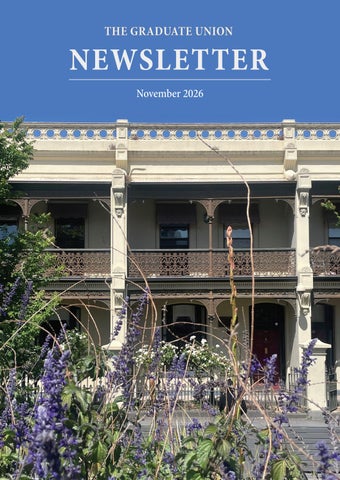
THE GRADUATE UNION
NEWSLETTER November 2026
CONTENTS News 4
Member Profile: Councillor Billy Lee
Events 6
October Luncheon Recap
7
October Twilight Lecture Recap
9
3MBS Evening Recital Recap
10 Novemebr Montly Lunheon 11 December Christmas Lunches + Women’s Forum
Dear Members, If you have any suggestions or would like anything of interest to be featured in the newsletter, please send an email to publications@graduatehouse.com.au so the team can consider your topic or answer any queries you may have.
2
3
N EWS
Graduate Union Member News
Member Profile: Councillor Billy Lee
Billy Lee is the Director of Alumni Relations at the University of Melbourne and serves as a Vice-Chancellor representative on the Graduate Union council, a position he has held since September of last year. “I think there’s a fairly natural affinity for my day job looking after alumni relations with the work that the Graduate Union does,” he said. His career has focused primarily on higher education and educational publishing, with his first professional roles being in commerical marketing. Billy is motivated by the transformative power of education, and as a first generation graduate himself, he knows the life-changing benefits of attending University. Reflecting on his first year on council, Billy noted the Graduate Union’s “mix of 4
people at different stages of their lives, which is something that you find across most alumni communities. And I think that diversity can at times be a challenge, but is also a strength, and when you see how passionate members are about the organisation, it’s a testament to the connection and community that has been built over time.” Billy spoke about the evolving relationship and shared history between the Graduate Union and the University of Melbourne and he shared curiosity about GU’s future, in reflection of its colourful history. While the Graduate Union is now an independent association, open to graduates from any university worldwide, its origins are closely tied to the University of Melbourne. Founded in 1911 as the Melbourne University Graduates
N EWS
Association (MUGA), it was absorbed into the broader Melbourne University Union (MUU) in 1938, bringing together students, staff and graduates under one organisation.
currently offer an equivalent network of reciprocal club arrangements. He sees this as a genuine point of difference for the Graduate Union, one that deserves greater recognition and promotion.
As membership grew and the MUU faced overcrowding, MUGA began a new phase. In 1953, it formally separated its operations from the MUU, becoming the Graduate Union of the University of Melbourne. Although it established operational independence, it retained important legal and financial connections with the University and maintained its place within the University community.
“These partnerships are a key part of the value proposition to University of Melbourne alumni as to why they should join the Graduate Union,” he said.
The next significant milestone came in 1962, when the Graduate Union established its own physical home, opening Graduate House on Leicester Street in Carlton. In 1971, it was formally designated as the University of Melbourne’s 11th residential college. This history has shaped the organisation into what it is today. For Billy, it is important to understand this history, but considering our future brand also requires recognising the unique strengths the Graduate Union brings to the broader community.
The University of Melbourne has over 500,000 alumni, with nearly 200,000 living outside the state of Victoria. For a University of Melbourne alumnus living in London, New York, or Sydney, joining the Graduate Union is worth it purely because it unlocks high-end club access in their own local city or wherever they travel, to meet and use facilities in person. We thank Councillor Billy Lee for sharing the insights and expertise he brings from his role as Director of Alumni Relations at the University of Melbourne and beyond and look forward to his continued support in 2027.
Billy believes one of the most underused assets of the Graduate Union is its extensive global network of reciprocal agreements with other clubs and associations. This network grants members access to unique facilities and communities worldwide. Billy was particularly enthusiastic about this advantage, noting that the University of Melbourne Alumni network does not 5
EVE N TS
October Monthly Luncheon
Judith Buckrich: North Fitzroy: Place, People, Protest Dr Judith Buckrich shared her findings on Fitzroy North from the makings of her book Fitzroy North: People, Place, Protest. Long before European settlement, the land we now know by Fitzroy North was known as Ngár-go and belonged to the Wurundjeri people. Through the diaries of early resident William Thomas, he documents the displacement of Indigenous people from the 1830s to the 1860s. Initial suburban growth was slow, with the area being covered in quarries. The establishment of the Gas Works in the 1870s began the transition. Several key developments shaped the modern suburb. In the 1850s, the Yan Yean Tramway brought fresh water to Melbourne, creating a pipeline track that later became St Georges Road. Following the 1872 Education Act, which made Victoria the first Australian colony to establish a free, secular, and compulsory public education, Alfred Crescent Primary was opened in 1875. By the 1880s boom, Fitzroy North’s population grew to roughly 2,000 residents across over 100 occupations. Businesses like bootmakers, dairies, cordial factories, and the Echo Printing Works thrived alongside horse-drawn buses and cable trams.
6
Wealthier families built grand homes along Alfred Crescent, while banks, post offices, churches, and pubs transformed the landscape. Significant community institutions emerged, including the 1884 Rae Street Temperance Hall, a Salvation Army barracks that faced clashes with local “Skeleton Army” larrikins, and the historic Old Colonists and Old Actors Homes near Merri Creek, which sat adjacent to Chinese market gardens. The Brunswick Street Oval was also established, serving as the home of the Fitzroy Football Club until the 1960s. The book highlights notable individuals, such as Chinese detective Fook Sing, physiotherapy pioneer Frederick Teepoo Hall, and May Stewart, whose 1905 diary challenges historical stereotypes of constrained women, as Dr Buckrich noted, she went out 181 days out of 356 that year, and was often catching the last tram home after grand adventures. After a severe economic depression in the 1890s left many homes vacant, Fitzroy North entered a slow recovery, eventually revitalised by postwar migration in the 1950s and gentrification in the 1960s and 1970s. All this and more awaits the reader in Fitzroy North: People Place Protest.
EVE N TS
October Twilight Lecture
Professor Eduard Hovy: The Future of AI Professor Eduard Hovy has been working in the Artificial Intelligence (AI) and computer science field all his adult life. He did a PhD at Yale in 1986 and spent two years at DARPA in Washington; the agency that initially funded the internet and GPS systems. He came to Australia in 2022 to head Melbourne Connect, the University’s research and student transition building that helps transition results and research to government and society. Professor Hovy began by challenging the alarmist narrative that AI threatens human control. Media reports of chatbots supposedly “lying” to programmers, overriding commands or acting without approval, often overlook the predictable, programmatic processes behind their behaviour. While AI can override instructions in certain circumstances, these actions occur within logical systems rather than through independent humanlike intentions. A core tenet of Professor Hovy’s talk was that humanity’s perceived exceptionalism has been sequentially dismantled and we are facing a crisis of meaning. Copernicus showed we aren’t the centre of the universe, Darwin proved we are evolutionary beings, and Freud exposed the mind’s nature. Now, AI can write Latin poetry and has produced advanced mathematical proofs, delivering another decentering of human kind that forces us to question where our true value lies as a species.
Using AI tools as helpful servants is no different than relying on GPS, calculators, or the internet. As long as technology is safe, moral, and beneficial, leveraging it to enhance life is completely logical. Artificial Intelligence began in the late 1950s at Dartmouth College. Decades later, machine learning emerged by training algorithms on human examples. Around 2004, Geoffrey Hinton and colleagues showed that neural networks can successfully shift the field from rigid, rule-based programming to data-driven learning that mimics biological brain structures, earning him a Nobel Prize. Mobile predictive texting relies on 1970s “language models” that count historical word combinations to suggest the next word based on mathematical likelihood. Modern Large Language Models (LLMs) process words as numerical representations and learn patterns by analysing enormous quantities of text. Through repeated predictions and adjustments to billions or trillions of internal parameters, they learn to generate increasingly convincing responses. Generative AI works through a continuous process of predicting the next most likely word, building sentences and paragraphs one word at a time. However, Professor Hovy emphasised that AI recognises and reproduces patterns rather than genuinely understanding them. Alan Turing, the persecuted wartime genius, created the Turing Test to measure perceived intelligence through dialogue. Yet from the 1966 Eliza 7
EVE N TS
chatbot to modern Large Language Models (LLMs), machines simply match words and data. They simulate intelligence, but they do not truly think. One day, LLMs will reach their inevitable plateau. Generalist human reasoning is becoming far more valuable than specialised skills like coding. Four years after ChatGPT’s November 2022 release, AI easily excels at specific tasks, but it remains a passive tool that requires human initiation, oversight, and a moral compass. People must audit AI outputs for hallucinations, think across diverse domains, and decide what goals are worth pursuing. Instead of mastering routine execution, the focus must shift to high-level critical thinking, emotional intelligence and maximizing technological benefits for society. Professor Hovy also highlighted the threats posed by state-sponsored disinformation and cyber warfare. Drawing on his DARPA experience, he discussed how adversaries, including Vladimir Putin’s regime, use automated bots to spread misinformation and destabilise democratic debate. His proposed response is to develop protective 8
AI capable of identifying vulnerabilities and countering malicious AI, strengthening our digital defences. AI’s environmental footprint was also brought into conversation. While individual AI requests consume relatively little energy and water, the cumulative impact is significant given AI’s extraordinary adoption rate, reaching 150 million users within four months of ChatGPT’s launch. He cited estimates suggesting that generating two paragraphs using AI consumes approximately 17 seconds of lightbulb energy, 0.121 millilitres of water and 11 micrograms of carbon. This is comparable to the environmental cost of a single Google search. Like Google, which relies on massive data centres globally, AI has an ecological cost that must be balanced with its immense value. Rather than rejecting technology based on uninformed reports, people need to follow the facts, acknowledge the costs, and leverage these superior tools to enhance their work and lives.
EVE N TS
3MBS Evening Recital
Coady Green
Melbourne pianist Coady Green presented a twilight recital for the 3MBS Graduate House series, bringing together music by Franz Liszt and Australian composer Linda Kouvara on Thursday 29 October. In the October issue of 3MBS ON AIR, Coady explained that both composers explore landscape as a powerful expression of “histories and memories through which human experience can be recalled”. “When contemplating a program for the wonderful 3MBS Graduate House series, I wanted to bring together two composers whose music I have been working on extensively. Franz Liszt and Linda Kouvaras are composers from vastly different eras and geographies whose work nevertheless engages with landscape in fascinatingly symbolic ways.
The music of Liszt and Kouvaras exploits the extraordinary colours, sonorities and range of the piano, while landscapes are treated as repositories of histories and memories through which human experience can be recalled. This idea lies at the heart of a program bringing together selected pieces from Liszt’s Années de pèlerinage: Première année—Suisse with Kouvaras’s Herring Island Piano Sonata.” Audience feedback was equally positive, with attendees enjoying both the recital and the dinner that followed. The twilight format also appeared successful, attracting some different faces from those who usually attend the lunchtime recitals.
9
EVE N TS
10
EVE N TS
11
THE GRADUATE UNION of The University of Melbourne Inc.
220 Leicester Street, Carlton, Victoria 3053, Australia Telephone: +61 (0)3 9347 3428 Australian Business Number: 55 610 664 963 Incorporated Association Registration Number: A0023234B
www.graduatehouse.com.au