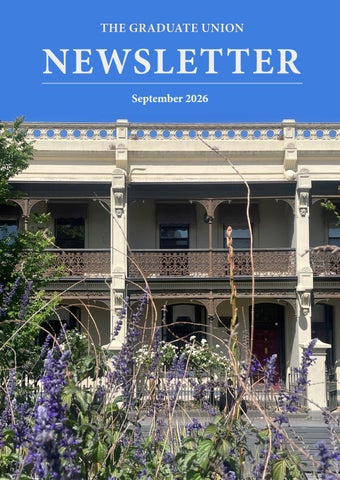
THE GRADUATE UNION
NEWSLETTER September 2026
CONTENTS News 4
Member Enagement Activities
6
Notice of Special General Meeting
8
University Square Upgrades
Events 9
September Luncheon
10
Mid-Year Residents Party
11
XJTLU Alumni gathering at Graduate House
12 August Monthly Luncheon Report 15 August Twilight Lecture Report 17 Groups that meet here
Appeal 18 Mid-Year Appeal
2
3
N EWS
Graduate Union Council News
Member Enagement Activities The Council thank all members for the continued support of The Graduate Union. The Council formed the Member Engagement Working Group to plan and enact engagement with all members now and into the future.
The University of Melbourne (UoM) has put two proposals on the table for Graduate Union to consider. Nothing has been signed, some pricing details are still commercially confidential, and Council does not currently favour one option over the other.
Town Hall Information Session
Under both proposals, Graduate Union keeps its University affiliation and its charitable status. That’s a large part of why Council sees these two options from the University of Melbourne as preferable to an earlier proposal from a commercial, forprofit provider.
On Wednesday 27th July a Town Hall style Information Session was conducted, and we thank the near 50 members that attended in person at Gradate House and online via zoom. Opening the Town Hall, Chair Martin Comte OAM spoke about what he sees as nonnegotiable: Graduate Union’s independence as a graduate college, and its future as a graduate membership association. Beyond that, he said, everything is genuinely open for discussion with members. Graduate Union recently refinanced its bank debt through to July 2028, which will save money - but the bank agreed to this only because Graduate Union could show a credible plan towards repayment. In other words, the refinancing has bought time to work through this decision properly; it isn’t a solution to the underlying problem on its own. Martin was also keen to address a concern he knows some members hold: that Council has already made up its mind. He said that isn’t the case, and asked members to help Council reach the best long-term decision for the organisation.
4
The Town Hall was designed around smallgroup discussion rather than a one-way presentation, with a Wonderwall where members could leave written feedback through the evening. Members shared a wide range of views, including; A strong wish to protect Graduate Union’s community and identity - not just the property; Concern about what happens to displaced residents, and what future accommodation would cost; A request for independent verification of the compliance case behind the proposed changes; Concerns about transparency and trust, and calls for a referendum or an indicative member vote; A wish to see alternatives - refinancing, an open-market sale, fundraising - properly tested; and differing views on whether to act quickly or take more time to decide. No single preferred option emerged from the evening. What the Town Hall did do was surface the key questions members
EWS NNEWS
still need answered - and that’s what the next phase of engagement is for. All of the questions and answers from the night are on the Graduate House website or link: https://www.graduatehouse.com.au/ graduate-house-future-development/
Next Steps Survey & Focus Groups - Facilitator Appointed Graduate Union has appointed an independent facilitator to run the member survey and focus groups. This work is expected to commence in the coming days. Full details on Focus Groups and on how to take part, including dates and how to register, will be shared shortly. So, keep an eye out for our next update. The Member Survey will be out at the start of September.
The video is on our website, at the “Graduate House Future Development” page, found when you navigate to the “About Us” page: https://www.graduatehouse.com.au/ graduate-house-future-development/. Future Communications As previously noted, we are planning to send a weekly update on the engagement process. As always, Council remains committed to keeping Members informed on a regular basis as these matters progress. Should you have any questions or wish to comment or contribute ideas, please contact our Secretariat at: secretariat@graduatehouse.com.au or the Member Engagement Working Group at: memberengagement@graduatehouse.com. au.
Video Discussion on the University of Melbourne Offers The President of the Graduate Union Diana Bryant AO KC and Chair of Council Martin Comte OAM outline and discuss the current offers from the University of Melbourne. 5
N EWS
Graduate Union Council News
Notice of Special General Meeting
Incorporated Association Registration Number A0023234B
NOTICE OF MEMBER-REQUESTED SPECIAL GENERAL MEETING The Graduate Union of The University of Melbourne Incorporated will hold a Member-requested Special General Meeting on: Wednesday, 16 September 2026 at 5.30pm at Graduate House, 220 Leicester Street, Carlton (and online using Zoom video conferencing)
AGENDA 1.
WELCOME, APOLOGIES AND RULES FOR CONDUCT OF THE MEETING
2.
CONFIRMATION OF QUORUM
3.
MOTIONS FOR RESOLUTION
MOTION ON NOTICE FOR SPECIAL RESOLUTION 1: RULE AMENDMENT To consider and, if thought fit, pass the following special resolution:
We resolve that Part 5 Division 1 Section 45.2 of the Rules, "Council may exercise all the powers of the Association except those powers that these Rules or the Act require to be exercised by General Meetings of the Members." be amended as follows: 45.2 Council may exercise all the powers of the Association except if a) those powers that these Rules or the Act require to be exercised by General Meetings of the Members; or b) the real or personal property as set out in Rule 45.2(a) has a value of greater than $100,000, unless: 1
6
N EWS
i. ii. iii. iv. v.
plans for acquisition, holding, and/or disposition of real or personal property, including alternate possibilities, have been made fully accessible to all Members; and all Members have had not fewer than 30 days to examine and discuss said proposals; and a Special General Meeting is held after the period stipulated in 45.2(b)ii to debate said proposals and others which may be raised at that meeting; and a vote is taken in which an Absolute Majority in favour of a course of action is reached; and Council's subsequent action on the matter is a true and honest reflection of the result of the vote referred to in 45.2(b)v.
MOTION ON NOTICE FOR RESOLUTION 2: To consider and, if thought fit, pass the following resolution:
We resolve Council be prohibited from engaging in any agreement regarding the disposition of the real property known as Graduate House, contractual or otherwise, until the terms of the above amendment have been met, whether or not the amendment is voted into being, and we further resolve that this prohibition be enforced retroactively to 28 May 2026, the date at which the 2026-27 Council assumed power.
4.
DISCUSSION AND QUESTION TIME
5.
DATE OF NEXT ANNUAL GENERAL MEETING Thursday, 27 May 2027
6.
CLOSE
2
7
N EWS
Graduate House set to have new backyard open by end of year, with University Square Stage 2 Under Construction The City of Melbourne is progressing with Stage Two construction of the University Square Master Plan in Carlton, following the completion of the adjacent Metro Tunnel Parkville Station. Originally adopted in 2016 with Stage One finalized in 2019, the project was temporarily paused to accommodate underground rail works.
• Enhanced Connectivity: Improved pedestrian pathways linking the new Parkville Station directly to the square via Barry Plaza.
The refreshed master plan adapts the 19thcentury public square into a resilient, 21st-century urban park tailored to one of Melbourne’s fastest-growing high-density precincts. With over 80 percent of Carlton residents living in apartments, the expanded open space serves as an essential backyard for the community.
• Sustainable Water Management: Infrastructure designed to redirect and reuse stormwater runoff across the precinct.
Stage Two environmental including:
introduces significant and social upgrades,
• Urban Greening: The integration of approximately 130 new trees, boosting canopy cover by 41 percent to combat the urban heat island effect. University Square Plaza
8
• Community Infrastructure: New public art, active recreation spaces like a multi-purpose sports court, barbecue areas, and modern street furniture.
The refreshed design also successfully incorporates contemporary neighborhood features, such as the Glen Murcutt-designed MPavilion (licensed on-site until 2032). Scheduled for completion by the end of 2026, the revitalized University Square will deliver over 6,500 square metres of lush, accessible public domain that seamlessly knits transport infrastructure with highquality civic landscape design. Information sourced from City of Melbourne and World Landscape Architecture websites.
EVE N TS
9
EVE N TS
Mid-Year Residents Party: Report from the Graduate House Student Group
Forget the Oscars, forget the Met Gala.... the 2026 GH Residents’ party was The Night of the Year. The GH Dining Room was transformed from ordinary dining hall to glamorous ballroom by the wonderful bar staff. Residents enjoyed delicious salmon steaks before hitting the floor. The dancing was tentative at first, with the GHSG Presidents trying valiantly to get things going by busting out some awkward aunty moves (which was perhaps more deterrence than invitation). Eventually, as the post-prandial glucose boost started to work its magic, things kicked off. At multiple moments during the night, 25+ Residents could be seen on the dance floor. While at first glance this may not sound impressive, readers must consider that most GH Residents are rather nerdy people, many of whom fear dancing in public as much as they fear failing an exam. In 10
spite of this, several of our number proved to be superb dancers. Congratulations to Tushar, who won the coveted Best Dancer, with honourable mentions awarded to Abhishek and Grace. The Residents’ party was, as ever, a spectacle of great elegance. Whether they were wearing tracksuit pants and a flannel shirt, or a rainbow-coloured wig with flashing LEDs, GH Residents have proved once again that Fashion is not dead. Best Dressed on the night went to Laura, who’s creative ensemble - quite literally - outshone all others. Honourable mentions went to the stylish Areeba and the dapper Anshul. All in all, a smashing success. Many thanks to the Grad House staff for organising such a memorable evening (and for briefly braving it on the dance floor too!)
EVE N TS
Special Events at Graduate House
XJTLU Alumni gathering at Graduate House On Saturday 8th August, alumni from Xi’an Jiaotong-Liverpool University gathered in the Taylor and Cochrane rooms at Graduate House, and Professor Younin from the University, was the special guest.
The afternoon highlighted the purpose of Graduate House: to connect graduates to their Universities and peers in a way that inspires intellectual and career development.
Professor Youmin Xi is Xi’an JiaotongLiverpool University’s Executive President and a management scholar. He created HeXie Management Theory and leads global educational innovation as Founding Editorin-Chief of Future Education. The event ran from 1pm to 6pm, and featured a panel talk, Q&A, book signings and afternoon tea.
11
EVE N TS
August Monthly Luncheon
Dr Andrew Prentice: How Stands the Author’s 50year old Laplacian Theory? An abundance of Graduate Union members and guests were honoured to be addressed by Dr Andrew Prentice of Monash University, who gave an exciting account of his extraordinary research and predictions based on his novel theory of planetary formation which at many turns were denied and then vindicated in time. The lecture covered the evolution of the solar system, chemical gradations across planetary bodies, and the role of supersonic turbulence in solving long-standing astrophysical anomalies. These at times abstract-seeming concepts were grounded with an array of colourful slides and mathematical demonstrations. Dr Prentice’s anecdotes, humour and deeply engaging explanations were aptly described as “fascinating stories” by one member. The evolution of solar system models The presentation traced the evolution of solar system models from Copernicus, Kepler, and Newton to Pierre-Simon Laplace’s nebular hypothesis. Laplace’s original concept proposed that the sun contracted from a massive gas cloud, leaving behind rings that formed the planets. However, this model was widely rejected in the 19th century due to physical inconsistencies regarding the sun’s angular momentum and the mechanics of ring formation. Revival via supersonic turbulence Dr Prentice discussed his time at Oxford working with his doctoral mentor Dr Dirk ter Haar, where they successfully revived Laplace’s 12
Dr Prentice at Graduate House after his talk
model. They introduced the new concept of supersonic turbulence, driven by the release of massive amounts of gravitational energy, which created fast moving columns of gas inside the primitive solar cloud. This concept mathematically accounted for how outer gas layers were pushed outward, lowering the cloud’s moment-of-inertia and so enabling the shedding of distinct gas rings from which the planets condensed. At this point in the
EVE N TS
absence of sulphur in Mercury’s interior and successfully accounted for the revised planet’s moment-of-inertia with the inclusion of iron-silicon miscibility. o Ceres & Asteroids: Accurately predicted the flat morphology of Ceres and proposed that all asteroids originated as ocean worlds, heated by the decay of radioactive aluminum. o Moons of the outer planets: Successfully predicted the existence of new moon families around Uranus and Neptune. o Jupiter: Accurately accounted for the sizes, physical structure and broad chemical composition of the four Galilean satellites. Precisely predicted Europa’s moment-ofinertia coefficient 0.347. lecture, expressions of astonishment were heard. Planetary chemistry and composition The lecture highlighted the remarkable chemical gradations observed from Mercury outward to Ceres and within the satellite systems of the outer planets. Rather than chaotic planetary collisions, Dr Prentice argued that planets largely formed where they reside today, supported by accurate predictions regarding iron content, surface composition, and physical structure.
o Saturn: Successfully explained the sizes and broad chemical composition of Saturn’s regular satellites, as well as predicting the capture origin and structural characteristics of Saturn’s largest moon Titan, and the source of Titan’s nitrogen-methane atmosphere.
Notable predictions and validation A central theme of the talk was the predictive power of Dr Prentice’s model, which was frequently validated by subsequent space missions (including NASA’s Messenger, Dawn, Voyager, Galileo, Cassini-Huygens and the New Horizons probes): o
Mercury:
Accurately
predicted
The MLT predicted (Prentice, 1980) that Titan formed in a Solar orbit, prior to capture by Saturn
the 13
EVE N TS
o Pluto: Accurately explained the relative sizes, densities and surface chemical composition of Pluto and its largest moon Charon, especially that the surface of Charon and the other smaller moons be ‘flat and smooth and consist solely of water ice’.
Top: Pluto (discovered 1930) Bottom: Charon (discovered 1978)
Academic challenges Dr Prentice shared personal anecdotes on the initial resistance he faced from mainstream scientific journals and institutions (such 14
as Science and the Royal Astronomical Society) before his theoretical predictions were ultimately vindicated by empirical space exploration data. One reviewer claimed supersonic turbulence was unphysical and asked, “Man has never been able to produce supersonic turbulence experimentally: how does the author think that Nature can do it?”. Reflecting on those tough days as a young researcher, Andrew credited his resilience to his supportive family, his wife, and his faith in a loving God. The presentation concluded with a reflection on the triumphs of the Modern Laplacian Theory. By utilizing rigorous mathematical predictions rather than relying solely on conventional consensus, Dr Prentice’s work demonstrates how historical theories can be successfully modernized to accurately decode the physical and chemical architecture of our solar system. At the conclusion of the lecture, there was a strong sense of awe and gratitude towards Dr Prentice, an Australian scientist who has made significant contributions to a theory of such profound importance.
EVE N TS
August Twilight Lecture
Reginald McNee: Dealing with My First Kidnapping Situation in Nigeria reserves in the Niger Delta added another layer of complexity. The region became the source of much of Nigeria’s wealth, yet the people living there often saw little benefit from the oil industry. Enormous amounts of money disappeared into the hands of politicians, wealthy individuals and organised networks instead of the people and Reginald described a system in which oil companies were often forced to provide their own electricity, water, medical facilities and security because government services were unreliable.
Reginald McNee’s presentation offered a gripping first-hand account of working in the Niger Delta in Nigeria. Drawing on more than 50 years in the maritime and oil and gas industries, he described a world of enormous oil wealth existing alongside poverty, corruption, political instability, piracy and kidnapping. Reginald began by providing some historical background on Nigeria. The country became independent in 1960 and initially appeared to have enormous potential. However, deep political, religious and tribal divisions soon created instability. Tensions between the predominantly Muslim north and the largely Christian south contributed to the Biafran War from 1967 to 1970. The discovery and development of huge oil
Working for the American company Tidewater Marine International, Reginald was involved in providing vessels and marine services to major oil companies, including Shell. The Niger Delta was a challenging operating environment because much of the oil was produced in vast swamp and offshore areas. Offshore supply vessels transported equipment and materials, supported drilling operations and serviced production facilities. The biggest danger were armed groups using boats fitted with machine guns that travel at speeds of up to 45 knots to attack vessels and kidnap foreign workers. This meant that once an attacking boat appeared on the radar, a vessel might have only about five minutes before the attackers reached it. Over approximately 18 months, Reginald was involved in six kidnapping incidents. In one case, six foreign crew members were taken from an offshore supply vessel. The Nigerian security personnel on board abandoned their weapons and jumped into the water, while 15
EVE N TS
the kidnappers took the foreign workers. Reginald suddenly found himself responsible for managing a hostage crisis despite having no formal hostage-negotiation training. The hostages were taken deep into the swamp, where they were held by another group. Communication was extremely difficult and relied on satellite telephones. Fortunately, the satellite system could help identify the approximate location of the phone, giving Reginald and his team an idea of where the hostages were being held. Reginald deliberately avoided negotiating directly. Instead, he used a Nigerian employee as an intermediary, allowing him to claim that he needed to consult “the white man” before agreeing to anything. Reginald also relied on an extraordinary network of contacts, from security specialists in London, embassies and local Nigerian communities. Because the company employed hundreds of Nigerians, Reginald was able to identify people who came from villages near the area where the hostages were being held. Local chiefs could then be approached and offered assistance for their communities, such as roads or medical facilities, in exchange for helping secure the hostages’ release. The negotiations lasted more than three weeks. The kidnappers initially demanded enormous sums of money, but their demands gradually decreased. The company had to balance the need to recover its employees with legal restrictions surrounding ransom payments. The kidnappings eventually forced the industry to rethink its approach to security. Reginald helped develop stronger maritime 16
security practices. Supply vessels were fitted with razor wire and secure areas where crews could shelter if attackers approached. Doors were modified so they could not easily be opened from outside, and emergency satellite communications were installed. Crews were trained to immediately lock down the vessel and retreat into the secure area when a suspicious boat was detected. The industry also introduced armed security helicopters and convoy sailing. When an attacking boat was detected, the vessel could stop, secure its crew and send a distress signal. Helicopters carrying armed Nigerian personnel could then respond. These measures became an important part of protecting offshore workers in the region. Reginald described a system in which oil companies were often forced to provide their own electricity, water, medical facilities and security because government services were unreliable. Ultimately, Reginald’s presentation was a firsthand account of managing extreme situations in places where ordinary assumptions about security, government and business could not be taken for granted. His experiences in the Niger Delta revealed the human cost of corruption and inequality while also demonstrating the courage, ingenuity and determination required to bring people home safely from some of the world’s most dangerous environments. At the conclusion of the talk, there was much discussion about the corruption of the government in Nigeria and parallel experiences elsewhere. Many found the presentation to be a reminder of the complex and often dire realities of some countries.
EVE N TS
GU General Manager Daniel Clark, member Howard Pascoe and guests at Christmas in July
17
A PPE A L
18
A PPE A L
My Contact Information Firstname :
Title:
Surname:
Phone number:
Mobile:
Email: Address: (number, street name or Post Office box, suburb, state, postcode and country)
My Donation
OR
Acknowledgement
Contact Us
graduatehouse.com.au/give-here/
Payment Options Card Number Expiry Date / Cardholder Name Signature
CSV
Account Name: The Graduate Union of The University of Melbourne Inc. Bank: National Australia Bank BSB: 083 170 Account Number: 515 612 137 Swift Code: NATAAU3303M Description: 2023AnnualAppeal
Financial Institution BSB Account Number Signature
I would like to give regularly through my selected payment option Commencing:
/
/
Amount $AUD: Weekly
Fortnightly
Monthly
Yearly
Please contact us for alternative giving frequencies ABN 556 10 664963 IARN A0023234B
19
THE GRADUATE UNION of The University of Melbourne Inc.
220 Leicester Street, Carlton, Victoria 3053, Australia Telephone: +61 (0)3 9347 3428 Australian Business Number: 55 610 664 963 Incorporated Association Registration Number: A0023234B
www.graduatehouse.com.au