- Landscapes of Sensitive Matter: Invisible Visual Environments, κ.α.,
ABSTRACT
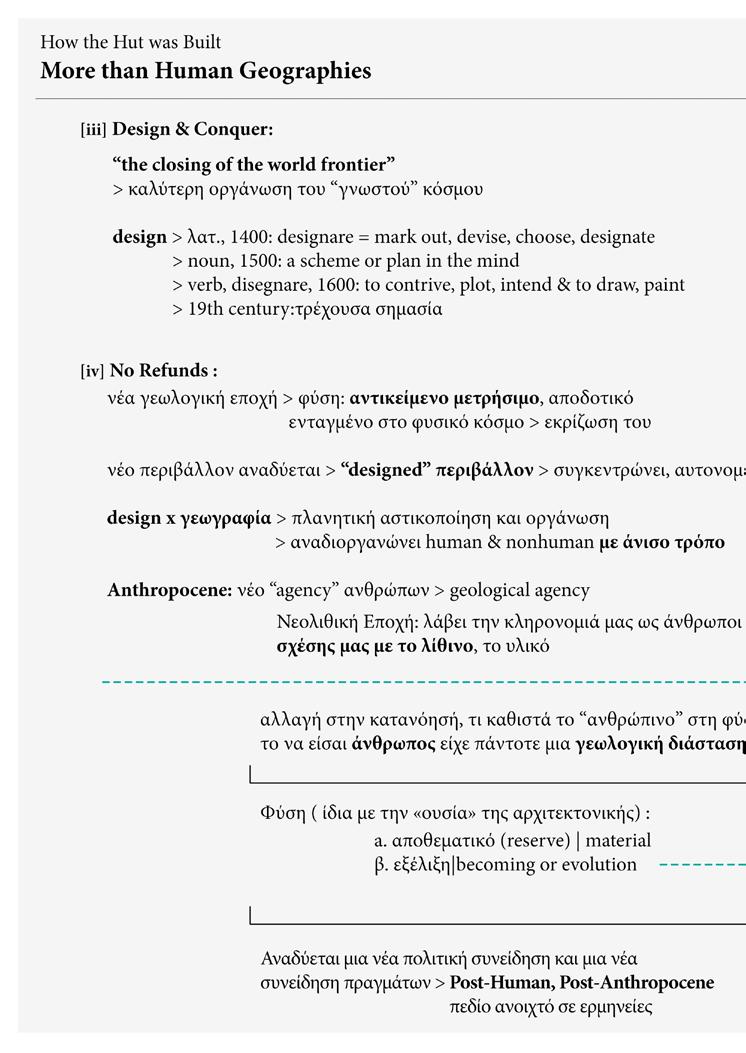
As part of the research work, a research tour was carried out in environments that shape the more-than-human geographies, today. It was investigated that design and its role as a geographical agent has evolved and ended up being involved in modern territorial practices of “being” today, framing the geographical scale to the Spatio-temporal stage of “post-” situations. This approach was fueled by the fact that both geography and design (as disciplinary fields and spatial considerations) have historically been the means of delimiting, searching for, and conquering “new frontiers”, thus serving the ambition of relentless human expansion.
In other words, these are planning strategies and geographical knowledge which were applied and were crucial as they contributed to: territorial conquests, economic exploitation, militarism, practices of class and tribal domination, etc., which characterize the imperialist power.
Consequently, geographical and design thinking were interpretive tools of such “new borders”, in order to highlight the conditions that have destabilized the inherited position of man in the world, manifesting the spatially complex geographical formations of the modern built environment. Specifically, this tour addressed a wide range of built environments, such as:
- Landscapes of Sensitive Matter: Invisible Visual Environments, etc.,
incorporating the multiple entanglements between “human” and “nonhuman”, thus defining the hybrid geographies of the world where the “post-” spatial states take place.
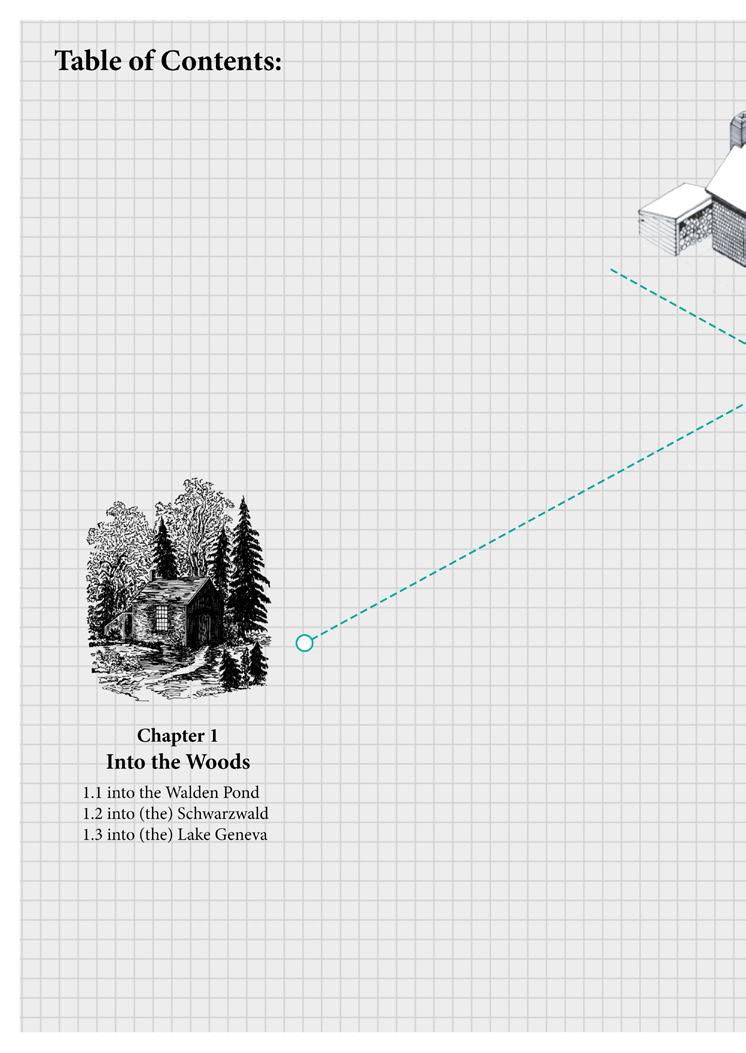
CHAPTER 1 - INTO THE WOODS:
- 1.1 into the... Walden Pond - 1.2 into the... Black Forest
- 1.3 into the... Geneva Lake
- 1.3.1 the fire
- 1.3.2 the monster - 1.3.3 the map
- 1.3.4 the posthuman that could have been
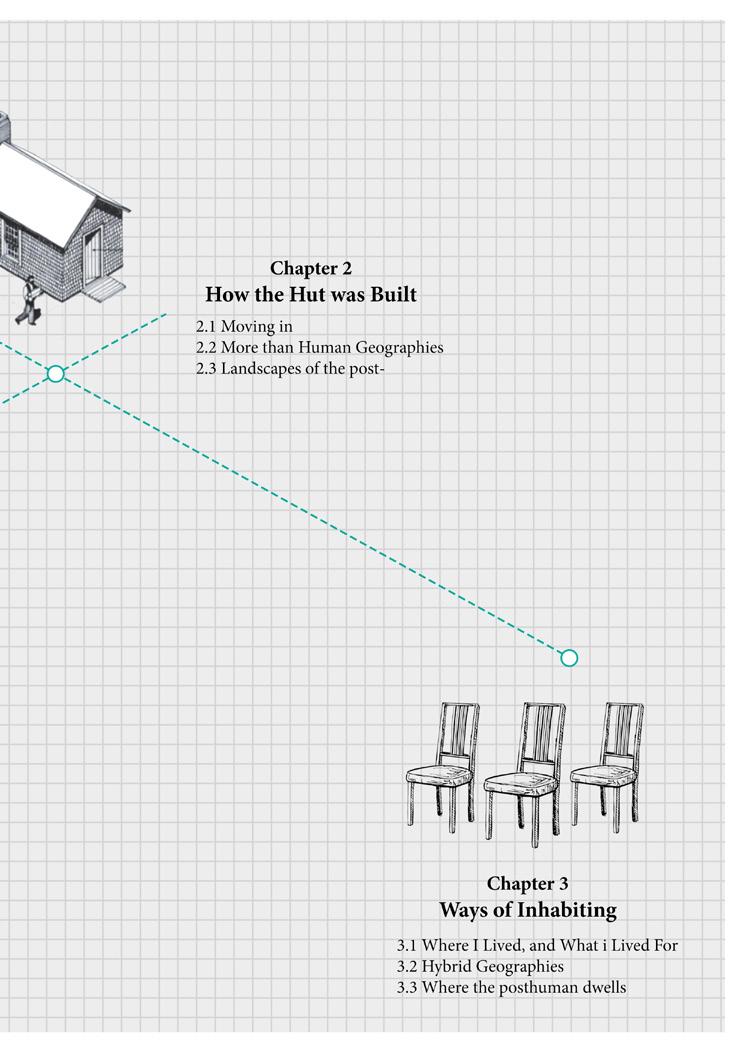
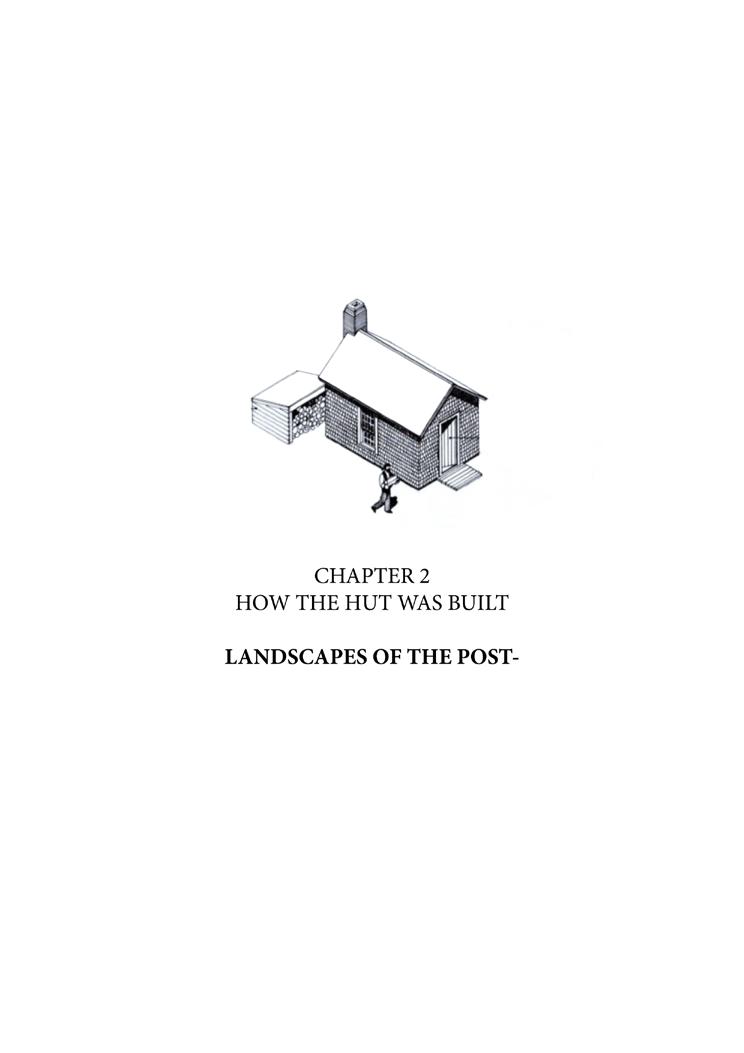
CHAPTER 2 - HOW THE HUT WAS BUILT:
- 2.1 Moving in
- 2.2 More than Human Geographies
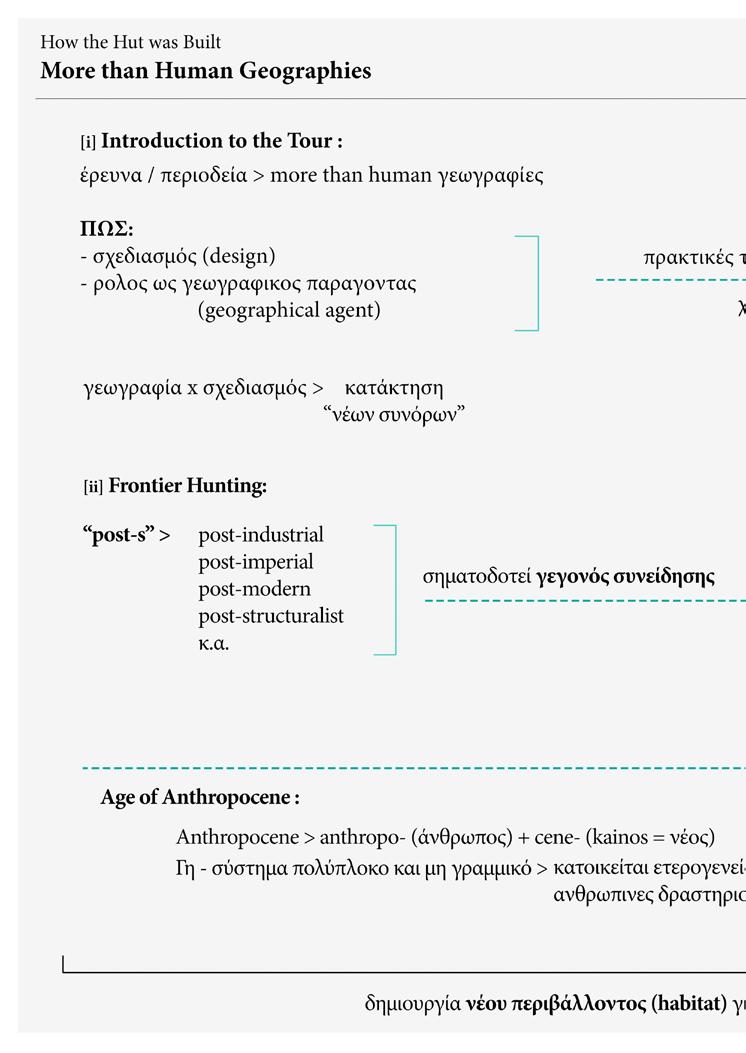
- 2.2.1 introduction to the tour
- 2.2.2 frontier hunting - 2.2.3 design and conquer - 2.2.4 no refunds
- 2.3 Landscapes of the post- _____ - 2.3.1 fill the blank
- 2.3.2 Infrastructural Landscapes: Data Centers - 2.3.3 Where the Landscapes of Resource and Data-Extraction Meet
- 2.3.4 Data Center is the new Oil Rig
- 2.3.5 Industrialized Infrastructures: Sacrifice Zones
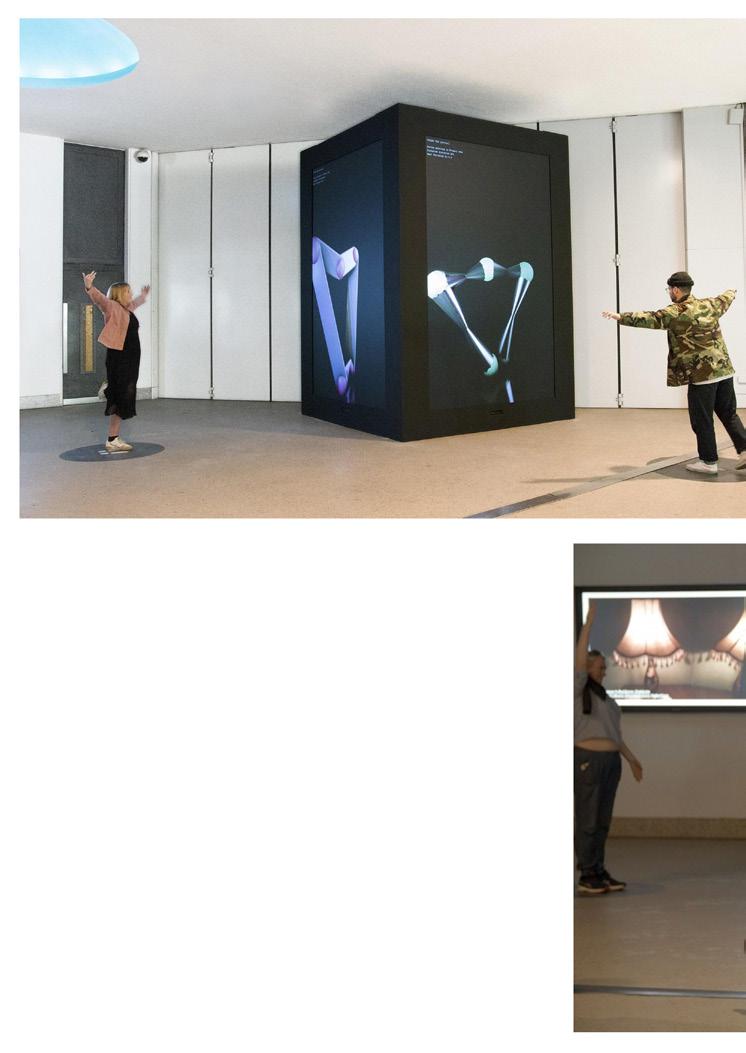
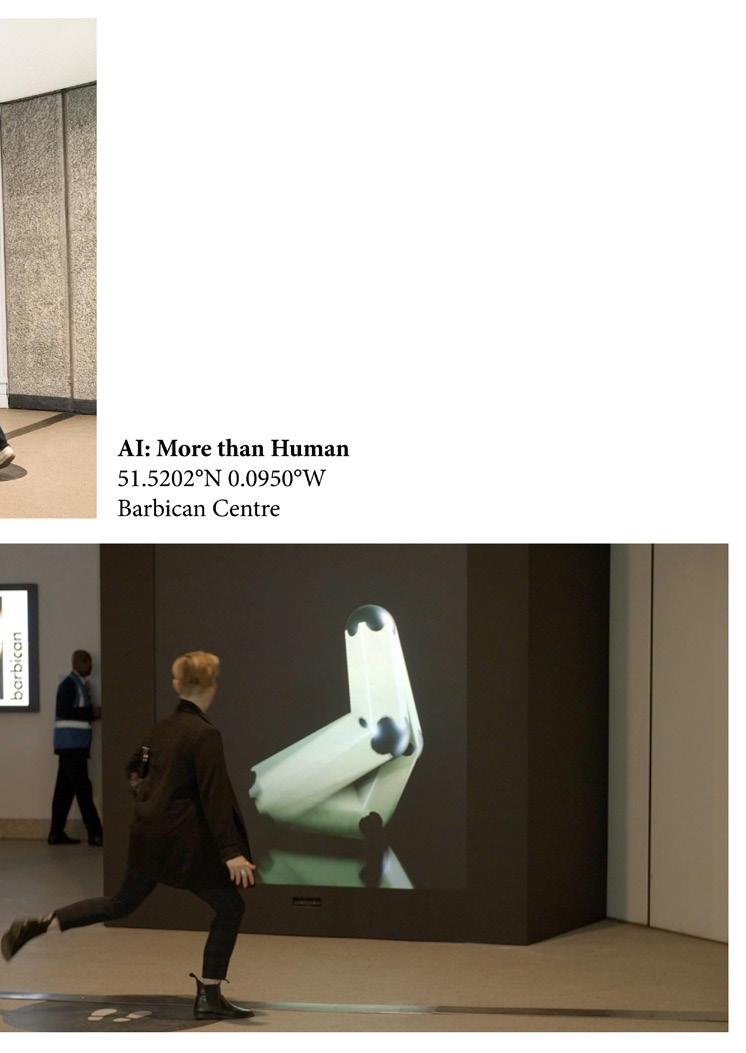
- 2.3.10 Automation of the Everyday - 2.3.11 Landscapes of Sensitive Matter: Invisible Visual Environments - 2.3.12 AI: More than Human
- 2.3.13 Outro: Incomplete Landscapes
CHAPTER 3 - WAYS OF INHABITING:
- 3.1 Where I Lived, and What i Lived For
- 3.2 Hybrid Geographies: Ways of Inhabiting the World - 3.2.1 Latest Landscapes - 3.2.2 the Environment that Could Be - 3.2.3 False Choices - 3.2.4 speculating the post- 3.2.5 i Consume, therefore i am Politics
- 3.2.6 nature as design - 3.2.7 where the posthuman dwells (ways of inhabiting)
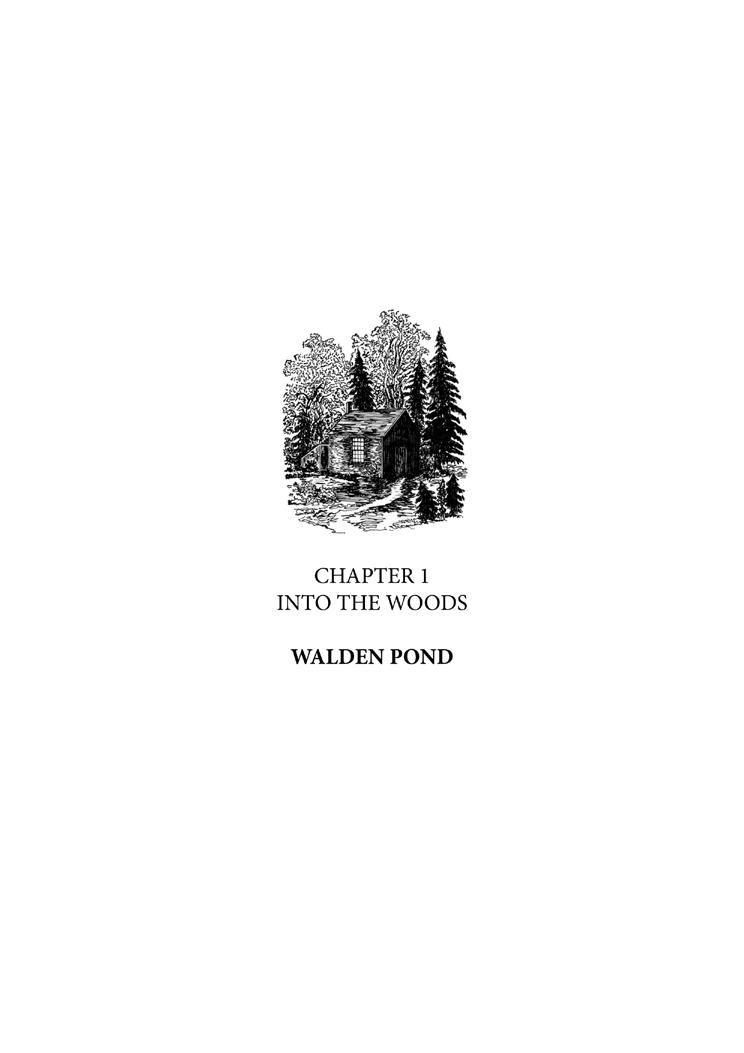
CHAPTER 1 - INTO THE WOODS
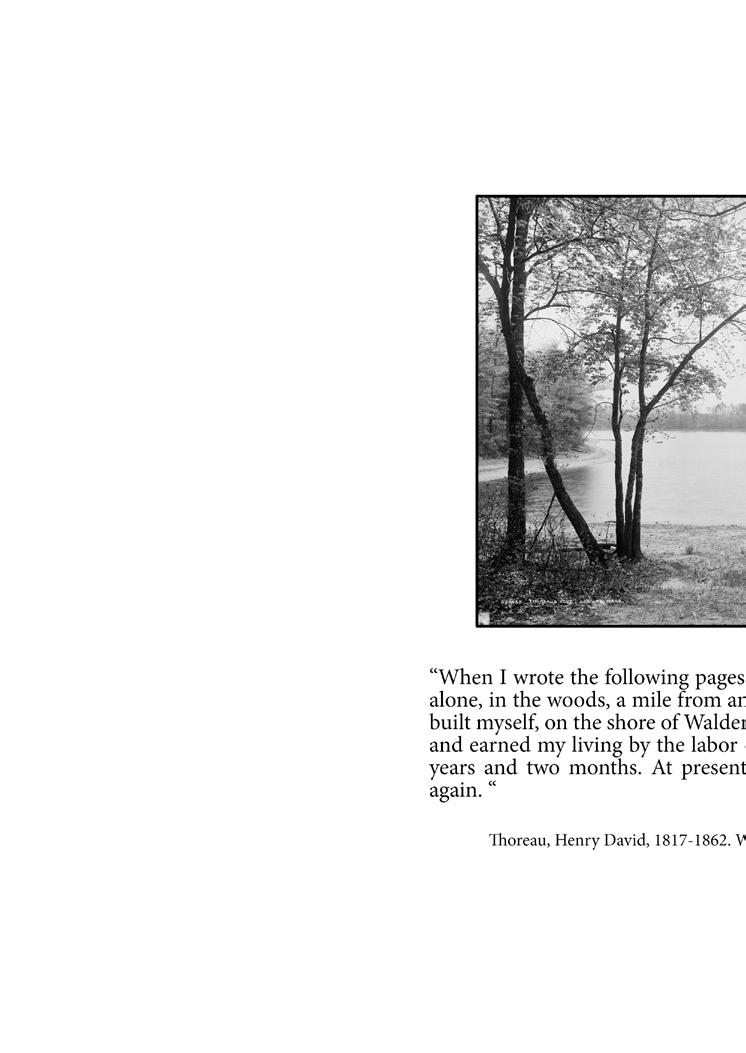
[1.1] into the... Walden Pond
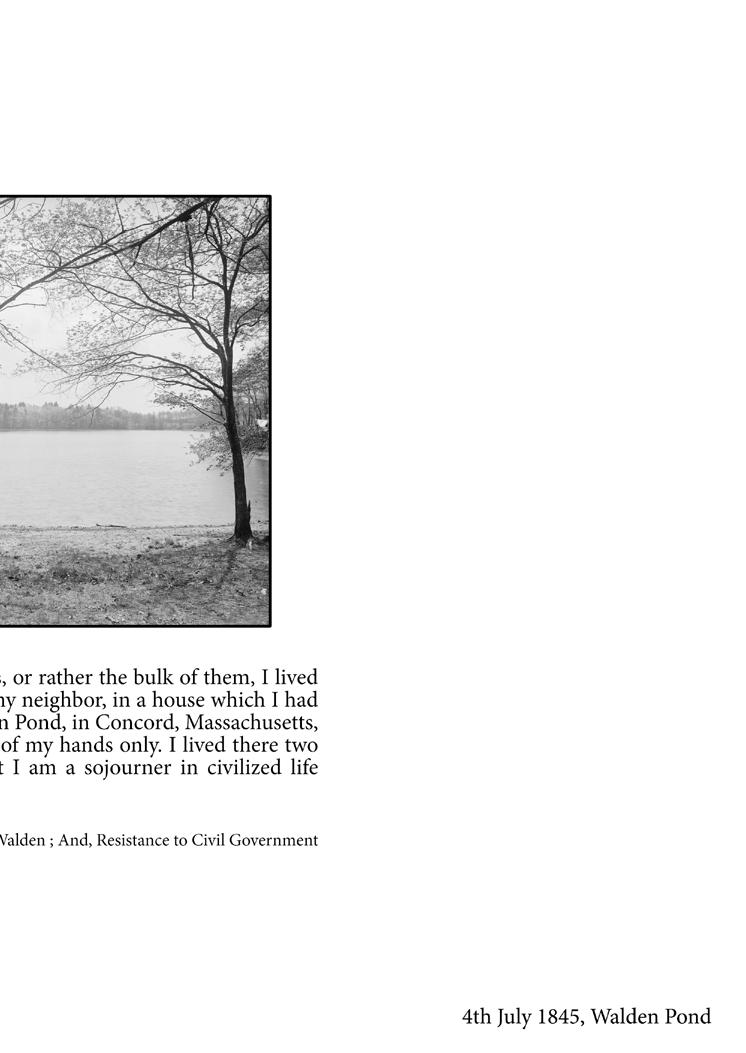
“When I wrote the following pages, or rather the bulk of them, I lived alone, in the woods, a mile from any neighbor, in a house which I had built myself, on the shore of Walden Pond, in Concord, Massachusetts, and earned my living by the labor of my hands only. I lived there two years and two months. At present I am a sojourner in civilized life again. “[1]
[1] Thoreau, Henry David, 1817-1862. Walden ; And, Resistance to Civil Government : Authoritative Texts, Thoreau’s Journal, Reviews, and Essays in Criticism. New York :Norton, 1992.
“The Myth of Sisyphus”: “rising, streetcar, four hours in the office or the factory, meal, streetcar, four hours of work, meal, sleep, and Monday Tuesday Wednesday Thursday Friday and Saturday according to the same rhythm, this path is easily followed most of the time.”[2]1
Gray Otis Blake
and Guattari,
[2] Camus, A. (2012). The myth of Sisyphus: And other essays. New York, NY: Knopf Doubleday, 2012.
[3] A philosophy that emphasizes the a priori conditions of knowledge and experience or the unknowable character of ultimate reality or that emphasizes the transcendent as the fundamental reality. “Transcendentalism.” Merriam-Webster.com Dictionary, Merriam-Webster, https://www.merriam-webster.com/dictionary/transcendentalism. Accessed 29 Apr. 2020.
[4] Finseth, Ian. “American Transcendentalism”. Excerpted from “Liquid Fire Within Me”: Language, Self and Society in Transcendentalism and Early Evangelicalism, 1820-1860, - M.A. Thesis, 1995.
[5] The Walden Woods Project. (n.d.). Work quotations. Retrieved from https://www.walden.org/quotation-category/wok/
Όπως
ο Henry D. Thoreau: “What I have heard of Brahmins sitting exposed to four fires and looking in the face of the sun; or hanging suspended, with their heads downward, over flames; or looking at the heavens over their shoulders until it becomes i possible for them to resume their natural position, while from the twist of the neck nothing but liquids can pass into the stomach” 1[6]
[8]
[6] Henry David Thoreau, 1854. Walden; or, Life in the Woods. Boston: Ticknor and Fiel [7] Thoreau, H. D. (2006). Walden and civil disobedience. Ann Arbor, MI: Borders Classics. (Original work published 1854). σελ. 37 [8] ο.π. σελ. 65
CHAPTER 1 - INTO THE WOODS
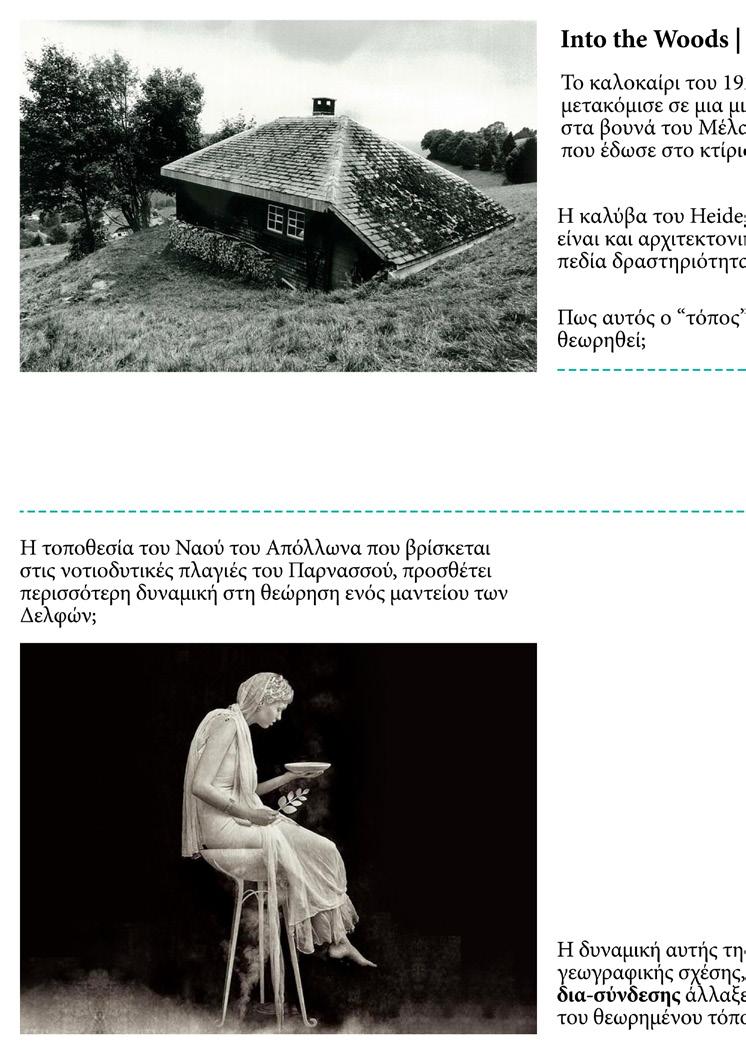
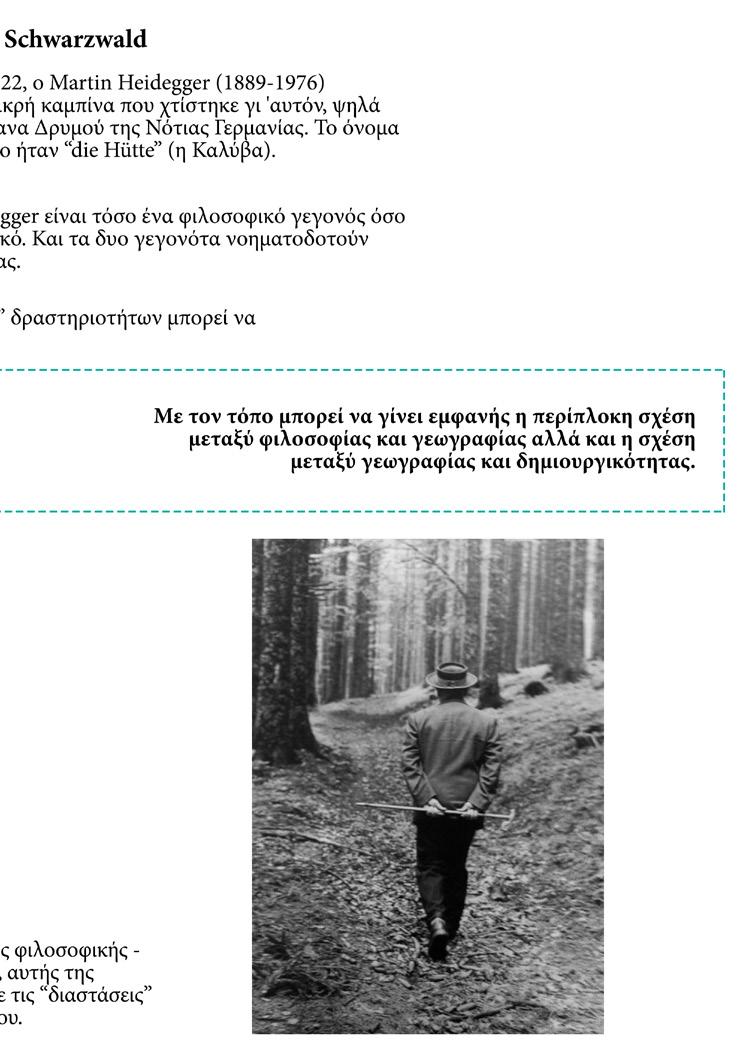
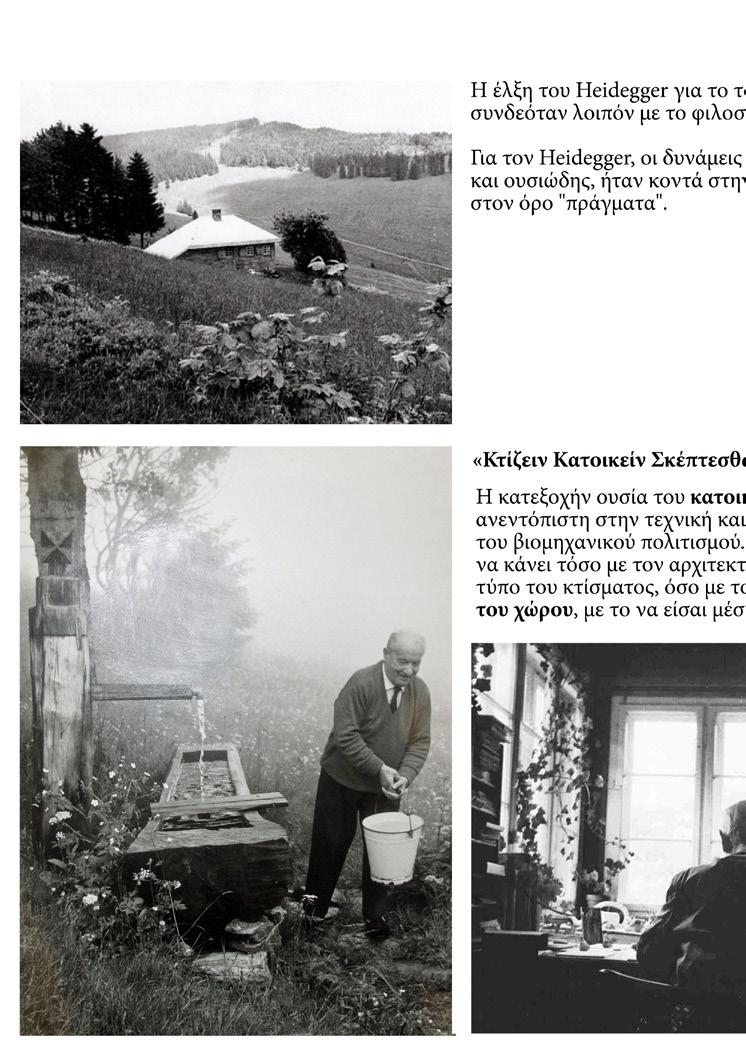
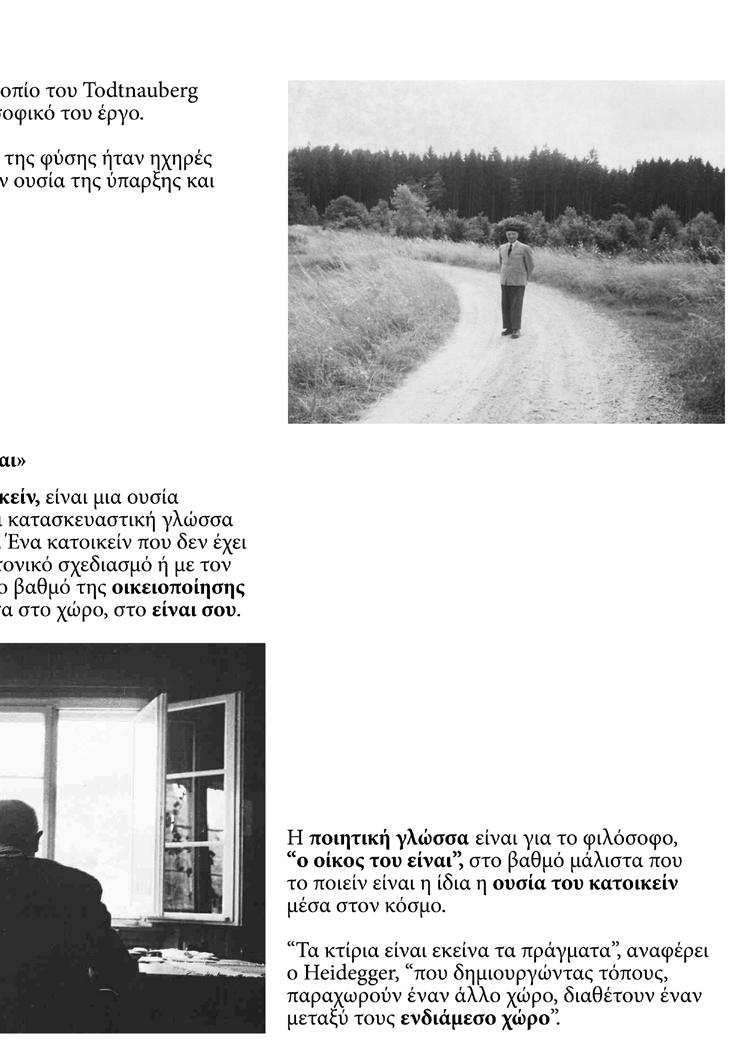
[1.2] into the... Black Forest
Το
1922, ο Martin Heidegger (1889-1976)
Heidegger
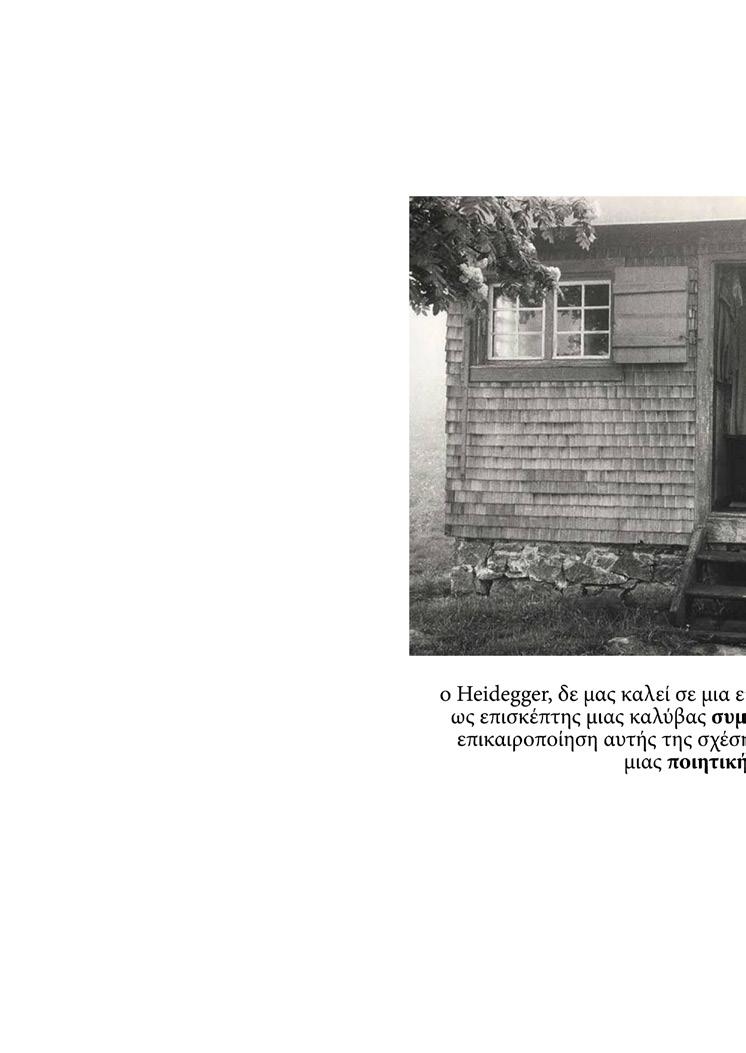
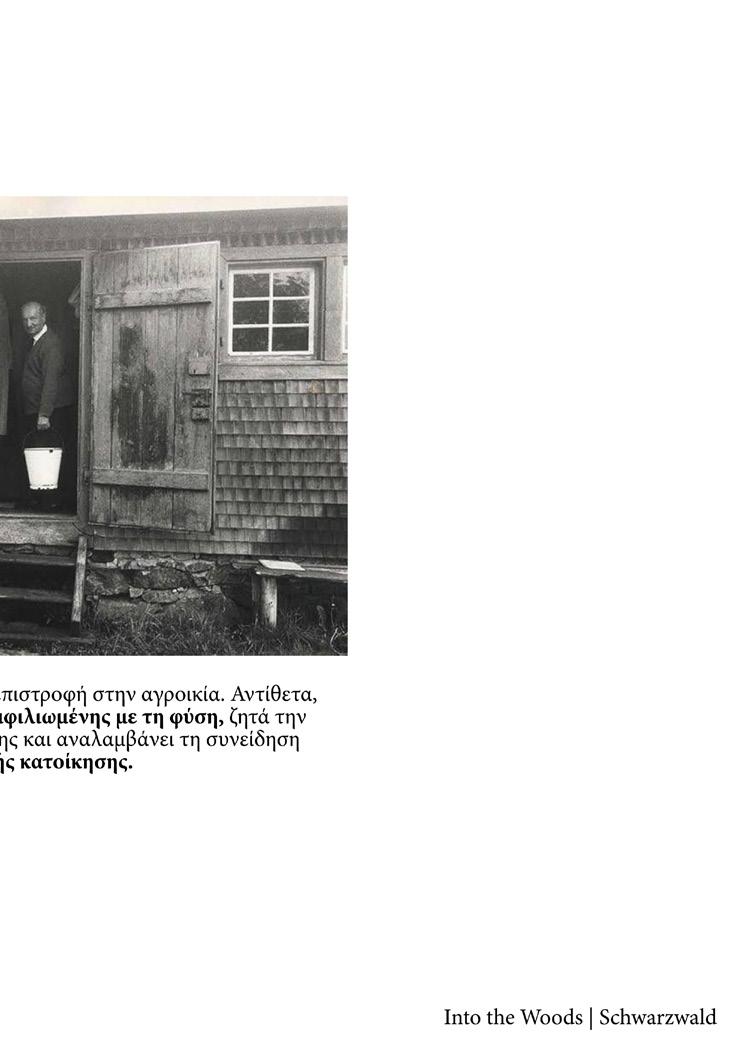
Todtnauberg, Schwarzwald
become a transparent eye-ball; I am nothing; I see all; the currents of the Universal Being circulate through me; I am part or particle of God.”
[1] M. Heidegger, “Why Do I Stay in the Provinces?,” trans. T. Sheehan, in T. Sheehan, ed., Heidegger: The Man and the Thinker (Chicago: Precedent, 1981).
[2] Adam Sharr, 2006. Heidegger’s Hut. The MIT Press p. xv
[3] Ralph Waldo Emerson, 1836. Nature. James Munroe and Company
[4] Ralph Waldo Emerson, 1836. Nature. James Munroe and Company
Heidegger
Todtnauberg
[6] Claire Colebrook, 2003. Understanding Deleuze, Allen & Unwin
[7] M. Heidegger, “The Thing,” in Poetry, Language, Thought, pp. 163–186; T. Kisiel, The Genesis of Heidegger’s Being and Time (Berkeley: University of California Press, 1993), pp. 309ff.
[8] The philosopher’s title intentionally avoided commas to emphasize a unity he perceived between the three notions. See A. Hofstadter, introduction to Heidegger, Poetry, Language, Thought, p. xiii.
CHAPTER 1 - INTO THE WOODS
[1.3] into the... Geneva Lake
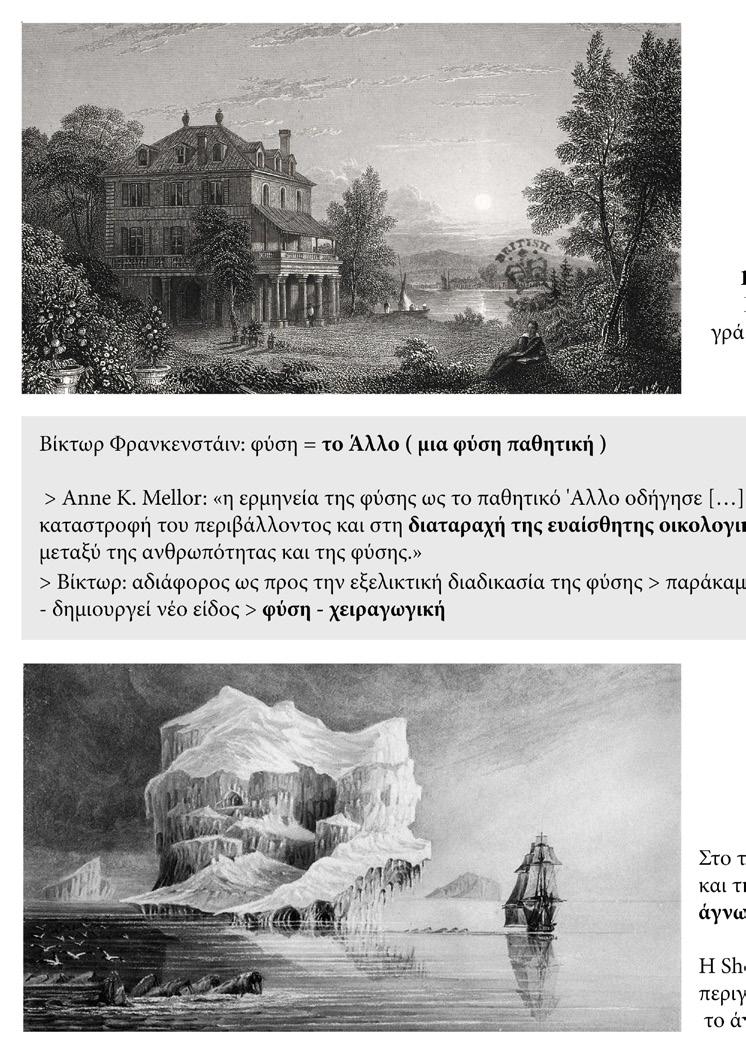
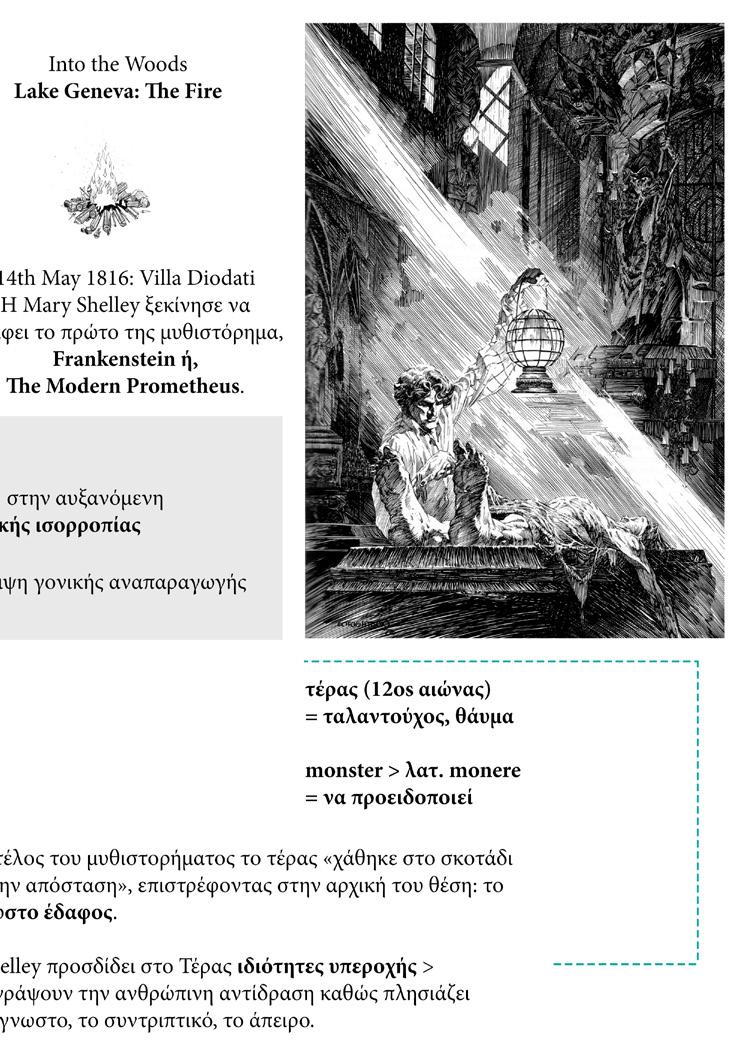
[1.3.1] the fire Στις
Frankenstein
The Modern Prometheus,
K. Mellor,
[1] Gittings and Manton, 31; Seymour, 152. Sometimes spelled “Chappuis”; Wolfson, Introduction to Frankenstein, p. 28-31.
[2] Gittings and Manton, 31; Seymour, 152. Sometimes spelled “Chappuis”; Wolfson, Introduction to Frankenstein, 273.
[3] Bridgwater, Patrick (2004). De Quincey’s Gothic Masquerade. Rodopi. p. 55. ISBN 9789042018136.
[4] Paragraph 7, Introduction to the 1831 edition of Frankenstein; Sunstein, 118.
[5] Bennett, An Introduction, 30–31; Sunstein, 124.
[6] Mellor K. A. (2003) ‘Making a “monster”: An Introduction to Frankenstein’, in Schor E. The Cambridge Companion to Mary Shelley, Cambridge, Cambridge University Press, 111-12.
[7] Mellor, Anne K., ed. Romanticism and Feminism. Bloomington: Indiana University Press, 1988.
[8] Van der Laan M. J. (2010), Frankenstein as Science Fiction and Fact, in Bulletin of Science, Technology & Society, 30/4: 298–304.
[9] Mellor K. A. (2003) ‘Making a “monster”: An Introduction to Frankenstein’, in Schor E. The Cambridge Companion to Mary Shelley, Cambridge, Cambridge University Press, 22.
CHAPTER 1 - INTO THE WOODS
[1.3] into the... Geneva Lake
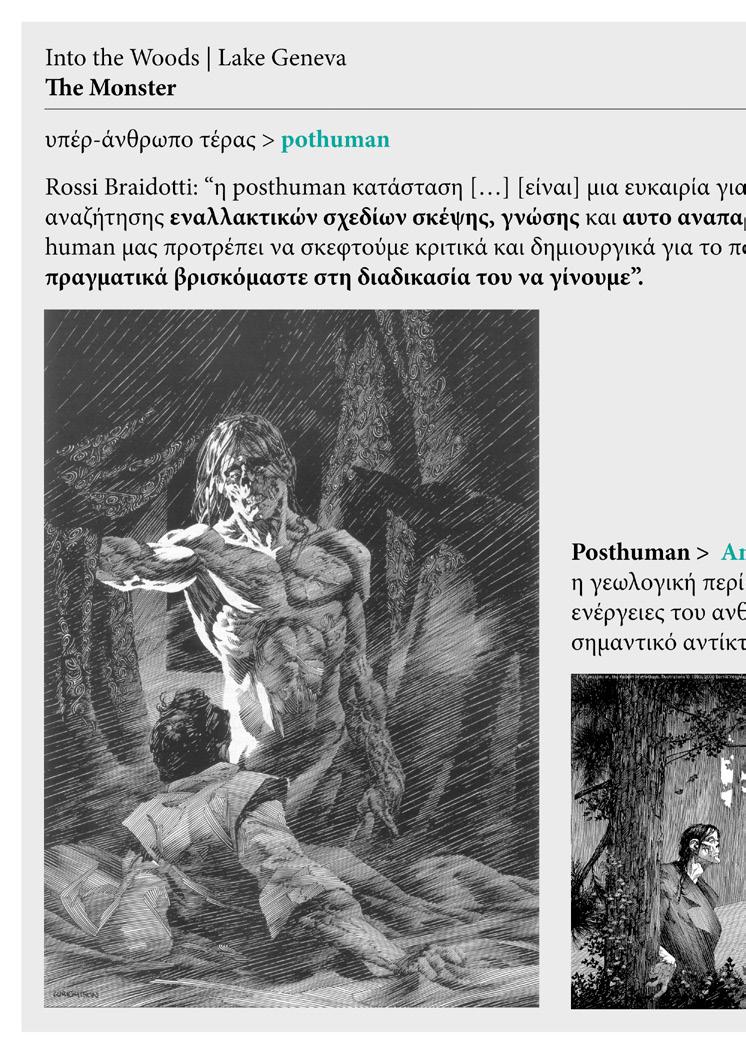
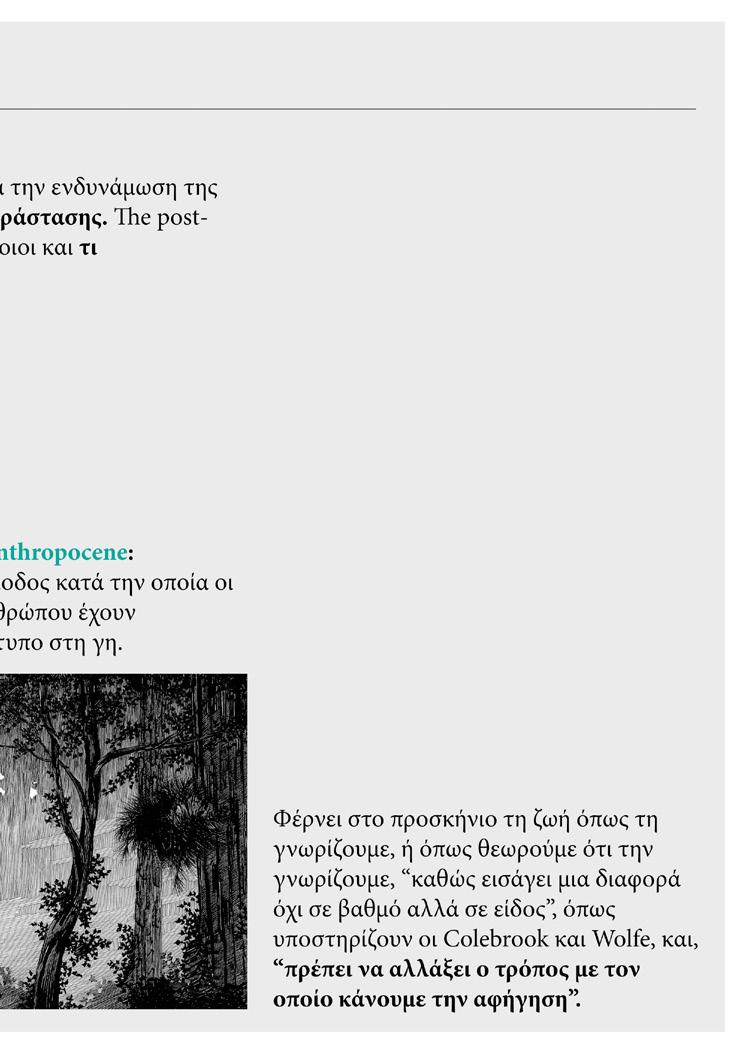
[1.3.2] the monster
Donna Haraway,
[10] Haraway D. J., 2016. Staying with the trouble: making kin in the Chthulucene, London, Duke University Press.
[11] Braidotti R., 2013. The Posthuman, UK, Polity Press.
[12] Miah A. (2008) ‘A critical history of Posthumanism’, in Gordijin B., Chadwick R., Medical enhancement and posthumanity, Springer, σελ. 98
[14] Crutzen P. J., Stoermer E. F. (2000) ‘The ‘Anthropocene’’ Global Change News Letter, 41: 17-18.
[15] Cary Wolfe and Claire Colebrook | Dialogue | The Anthropocene Project. An Opening
CHAPTER 1 - INTO THE WOODS
[1.3] into the... Geneva Lake
[1.3.3] the map
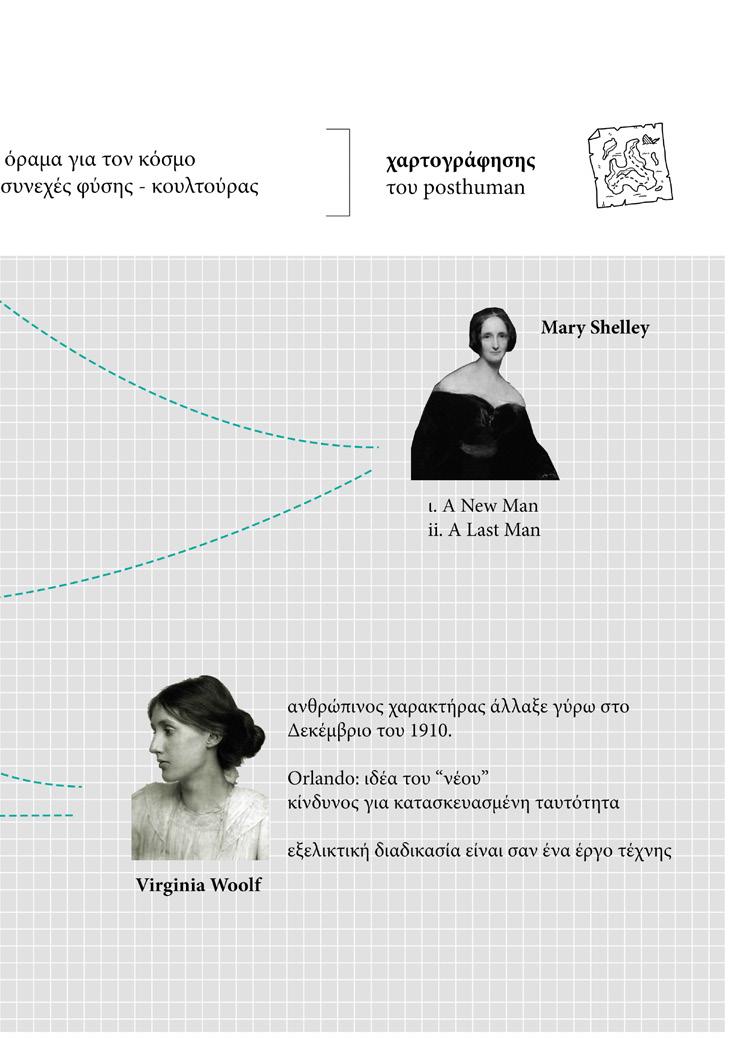
Toward a Posthumanist Culture? A University Masque in five Scenes (1977),
Alan W. France
“becoming-animal, becoming-earth and becoming-machine […] [grounded on] our being enviro mentally based, that is to say, embodied, embedded and in symbiosis with other species”. [18]
[16] Hassan I. (1977) ‘Prometheus as Performer; Toward a Posthumanist Culture? AUniversity Masque in five Scenes’ in The Georgia Review 31/4: 830-850.
[17] France A.W. (2001) ‘Historicizing the Posthuman’, in JAC 21/1: 175-183.
[18] Braidotti R. (2013) The Posthuman, UK, Polity Press. σελ. 66
Επανεκτιμώντας
“posthuman Romanticism flattens the robust construction of interiority and exposes it to the outside. Rather than lan scapes fashioned through an experience of overly powerful feeling reflected in tranquillity, humans are one of many elements in the land.” [19]1 Στα
[19] Broglio R. (2017) ‘Romantic’ in Clarke B., Rossini M. The Cambridge Companion to Literature and the Posthuman, Cambridge University Press, Kindle Edition
[20] Shelley, Mary. The Last Man. Ed. Morton D. Paley. Oxford: Oxford Paperbacks, 1998. ISBN 0-19-283865-2.
[21] Nietzsche, Friedrich Wilhelm, 1844-1900. Thus Spoke Zarathustra : a Book for All and None. Cambridge :Cambridge University Press, 2006.
The sound of the trumpets died away and Orlando stood stark naked. No h man being, since the world began, has ever looked more ravishing. His form combined in one the strength of a man and a woman’s grace. [22]1 Η Virginia
[22] WOOLF, V. (1933). Orlando: a biography. London, Published by Leonard & Virginia Woolf at the Hogarth Press. σελ. 132-133
CHAPTER 1 - INTO THE WOODS
[1.3] into the... Geneva Lake
[1.3.4] the posthuman that could have been
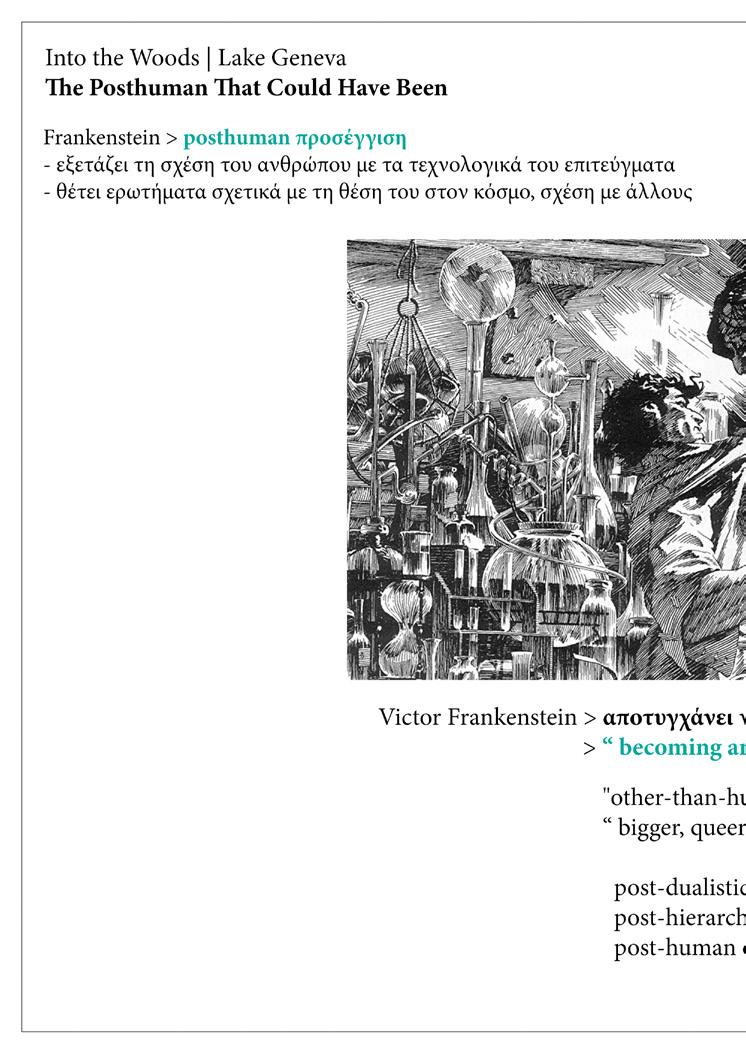
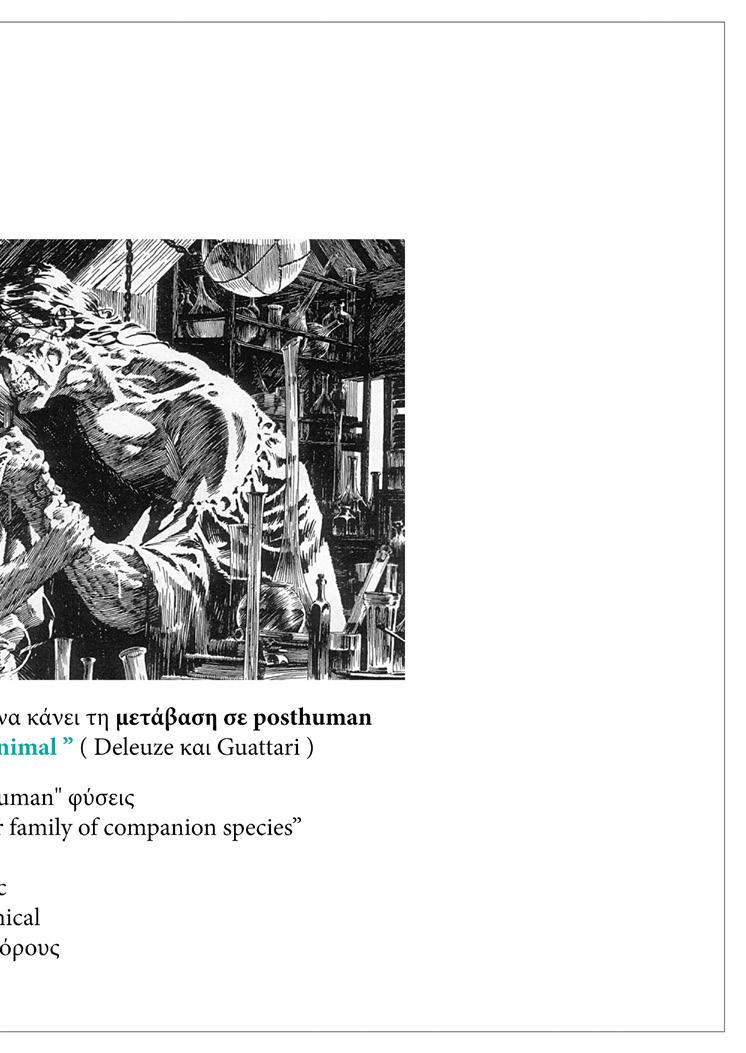
“We are ethical only insofar as we move away from the assimilating ‘horrors’ of the face, which they tie to an aversion to difference”,
Mary Bunch. [24]
[23] Carroll, Joseph; Gottschall, Jonathan; Johnson, John A.; Kruger, Daniel J. (2012). Graphing Jane Austen: The Evolutionary Basis of Literary Meaning. London, England: Palgrave Macmillan. ISBN 978-1137002402.
[24] Bunch, Mary. 2014. “Posthuman Ethics and the Becoming Animal of Emmanuel Levinas”. Culture, Theory and Critique 55 (1): 34-50.
Mary Shelley,
post-dualistic, post-hierarchical, post-human
[25] Deleuze, Gilles and Félix Guattari. 2007. Becoming Animal. In Linda Kalof and Amy Fitzgerald (eds.), The Animals Reader: The Essential Classical and Contemporary Writings , 37-50. Oxford, UK: Berg. (Summarized by Jessica Bell, Animal Studies Program, Michigan State University)
[26] Haraway, Donna. 2003. The Companion Species Manifesto: Dogs, People, and Significant Otherness. Chicago: Prickly Paradigm Press. σελ. 11
[27] Shaw D. (2000) Women, Science and Fiction: The Frankenstein Inheritance, New York, Palgrave Macmillan. σελ. 178
CHAPTER 2 - HOW THE HUT WAS BUILT
[2.1] Moving in
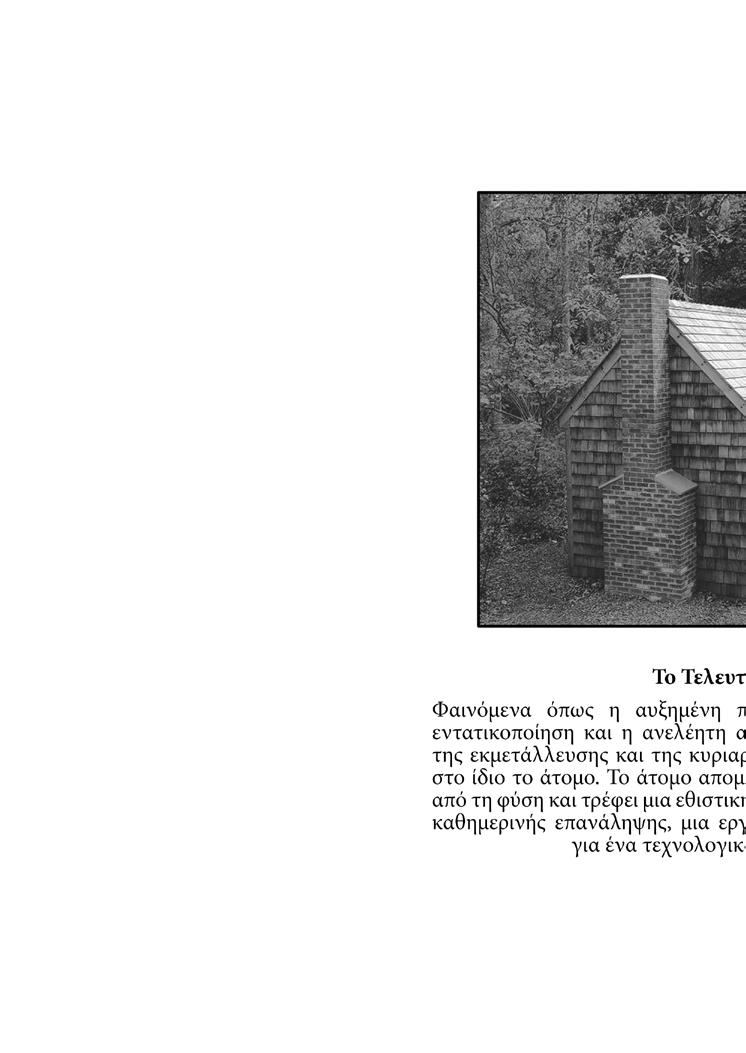
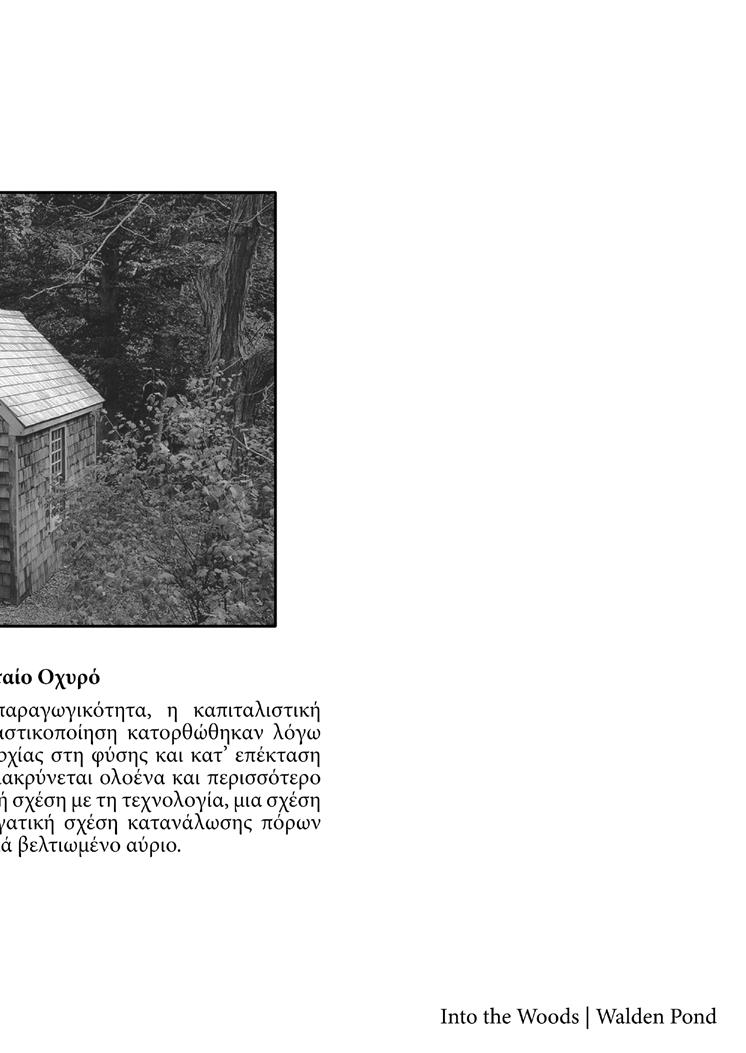
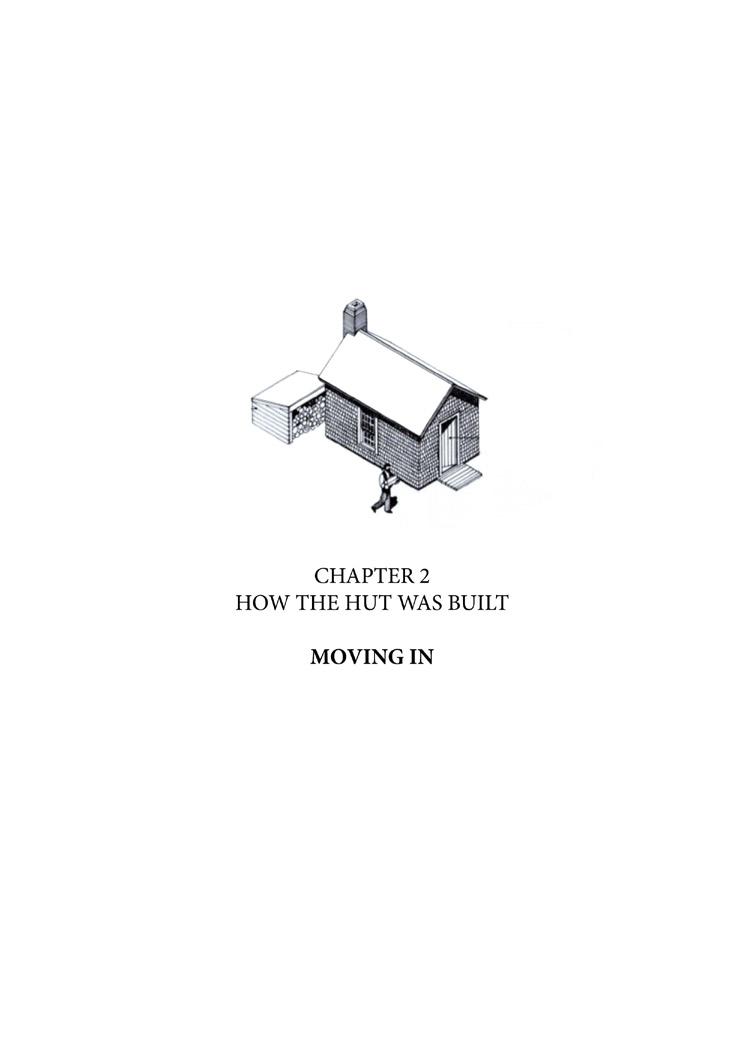
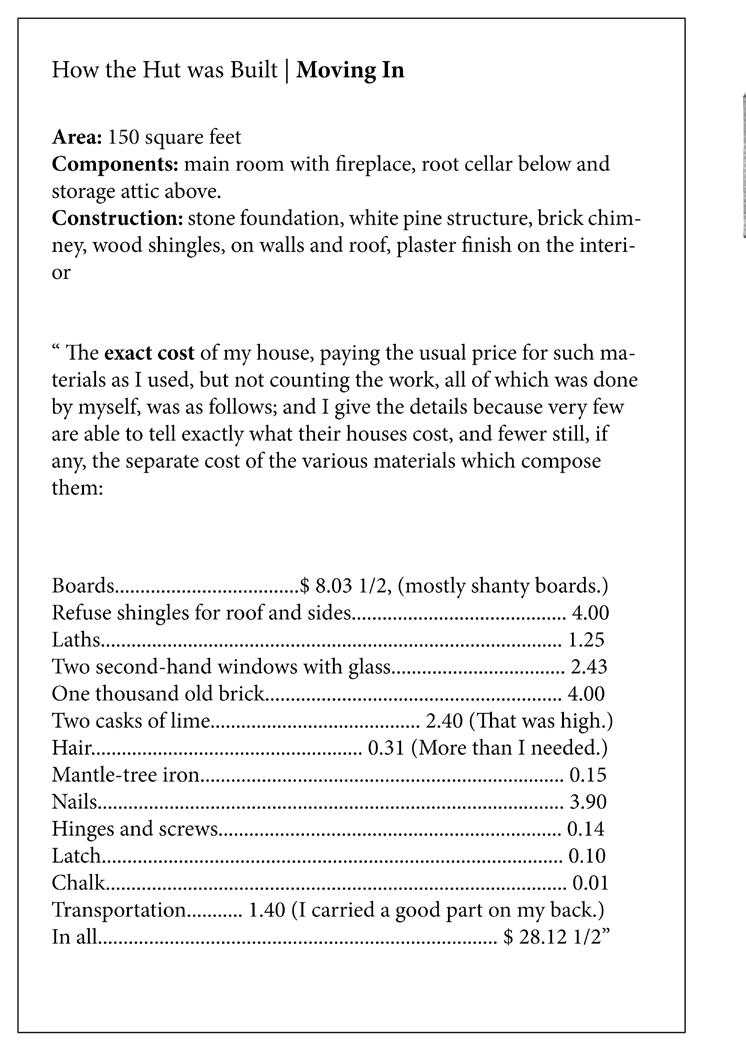
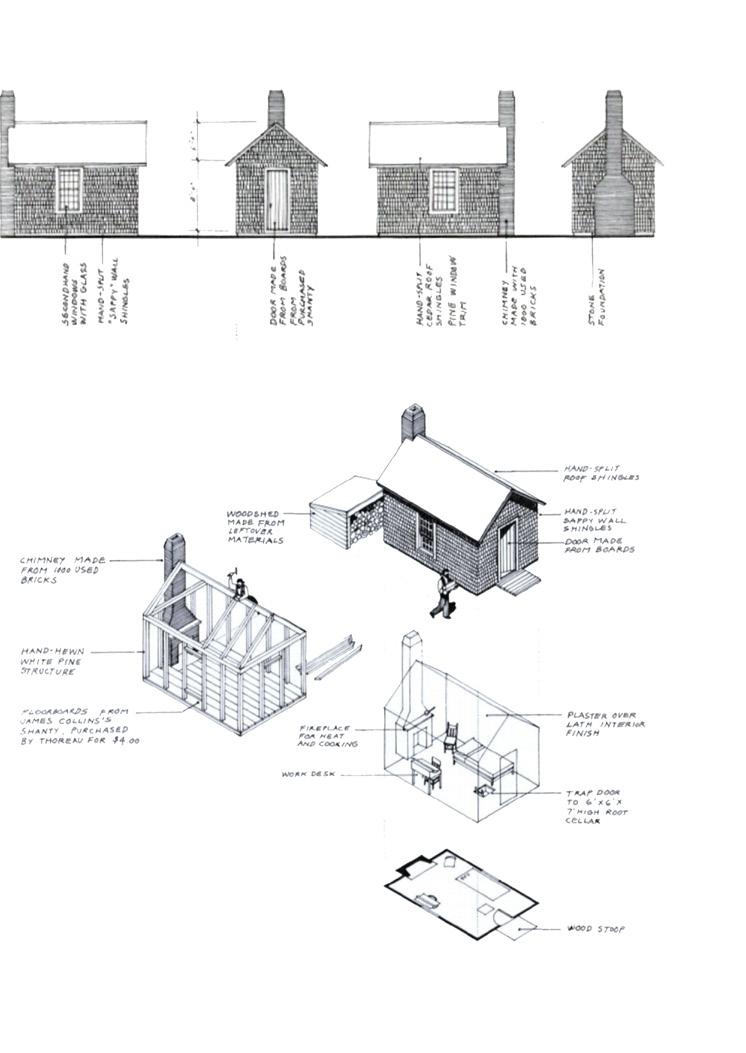
“Near the end of March, 1845, I borrowed an axe and went down to the woods by Walden Pond, nearest to where I intended to build my house, and began to cut down some tall, arrowy white pines, still in their youth, for timber.
By the middle of April, for I made no haste in my work, but rather made the most of it, my house was framed and ready for the raising. I began to occupy my house on the 4th of July, as soon as it was boarded and roofed, ...I built the chimney after my hoeing in the fall, before a fire became necessary for warmth, doing my cooking in the meanwhile out of doors on the ground, early in the morning: which mode I still think is in some respects more convenient and agreeable than the usual one.” [1]1
[1] Thoreau, Henry David, 1817-1862. Walden ; And, Resistance to Civil Government : Authoritative Texts, Thoreau’s Journal, Reviews, and Essays in Criticism. New York :Norton, 1992.
[2] David Bouchier, 2004. The Accidental Immigrant: America Observed, Published by: iUniverse (June 24, 2004)
The exact cost of my house, paying the usual price for such materials as I used, but not counting the work, all of which was done by myself, was as follows; and I give the details because very few are able to tell exactly what their houses cost, and fewer still, if any, the separate cost of the various materials which compose them:
Walden, o Thoreau
CHAPTER 2 - HOW THE HUT WAS BUILT
[2.2] More than Human Geographies
[2.2.1] introduction to the tour
[2.2.2] frontier hunting
“In this way the greatest and most dramatic, rapid, and universal social transformation in human history entered the consciousness of reflective minds who lived through it.” [1] 1
The Age of Extremes,
Hobsbawm
[1] Eric Hobsbawm, The Age of Extremes: A History of the World, 1914–1991 (1994; repr., New York: Vintage Books, Random House, 1996), 288.
[2] The term ‘neolithic revolution’ was coined by V. Gordon Childe in his 1936 book Man Makes Himself. Childe, Vere Gordon (1936). Man Makes Himself. London: Watts & Company.
[3] Jean-Pierre Bocquet-Appel (July 29, 2011). “When the World’s Population Took Off: The Springboard of the Neolithic Demographic Transition”. Science. 333 (6042): 560–561.
[4] Eric Hobsbawm, The Age of Extremes: A History of the World, 1914–1991 (1994; repr., New York: Vintage Books, Random House, 1996), 289.
[5] New Geographies 09: Posthuman, Edited by Mariano Gomez Luque and Ghazal Jafari. Copublished by the Harvard University Graduate School of Design and Actar, Fall 2017.
[6] Crane, Nicholas (2003). Mercator: the man who mapped the planet (paperback ed.). London: Phoenix (Orion Books Ltd).
[7] Turner, Frederick Jackson (1920). “The Significance of the Frontier in American History”. The Frontier in American History. p. 293.
[8] Rosalind Williams, The Triumph of Human Empire (Chicago and London: University of Chicago Press, 2013): ix–xi, 9–11.
CHAPTER 2 - HOW THE HUT WAS BUILT
[2.2] More than Human Geographies
[2.2.3] design and conquer
designare
“mark out, point out; devise; choose, designate, appoint,”.
1500, και
“a scheme or plan in the mind,”.
disegnare, το 1600, ανέπτυξε
contrive, plot, intend,”
“to draw, paint, embroider, etc.”.
[9] New Geographies Journal statement of purpose, initially written by the founders of the journal in 2009. www.new-geographies. squarespace.com/about. [10] ό.π.
[2.2.4] no refunds
Ο Le Corbusier,
[15]
[11] Dipesh Chakrabarty, 2012. Human Agency in the Anthropocene, Published by the newsmagazine of the American Historical Association: Perspectives on History Link: https://www. historians.org/publications-and-directories/perspectives-on-history/december-2012/human-agency-in-the-anthropocene
[12] David Farrier, 2019. Anthropocene Poetics: Deep Time, Sacrifice Zones, and Extinction
Published by University of Minnesota Press
[13] Isabelle Stengers, Cosmopolitiques (Paris: La Découverte, 2003);
[14] Chantal Mouffe, On the Political (London: Routledge, 2005)
[15] New Geographies Journal statement of purpose, initially written by the founders of the journal in 2009. www.new-geographies. squarespace.com/about.
“For it is no longer a question simply of man having an interactive relation with nature.” [16] Όπως
Henry David Thoreau
λέγοντας: “Man is altogether too much insisted on. The poet says the proper study of mankind is man. I say i study to forget all that - take wider views of the universe. That
[16] Imre Szeman, Dominic Boyer, Energy Humanities: An Anthology, Johns Hopkins University Press (April 22, 2017)
[17] Bruno Latour, Politics of Nature : How to Bring the Sciences into Democracy, trans Catherine Porter (1999; repr., Cambridge, MA: Harvard University Press, 2004)
[18] Dipesh Chakrabarty, “Brute Force,” Eurozine, October 7, 2010, Link:http://www.eurozine.com/articles/2010-10-07-chakrabarty-en.html.
[19] Elizabeth Grosz, Architecture from the Outside: Essays on Virtual and Real Space (Cambridge, Mass.: MIT Press, 2001), 99, 100.
[20] Stacy Alaimo, 2016. Exposed: Environmental Politics and Pleasures in Posthuman Times. Published by University of Minnesota Press
is egotism of race”. [21] 1Ο Thoreau
[21] Thoreau, Henry D. 1962. The Journal of Henry D. Thoreau, edited by Bradford Torrey and Francis H. Allen. Mineola, NY: Dover.
CHAPTER 2 - HOW THE HUT WAS BUILT
[2.3] Landscapes of the post- _____________
[2.3.1] fill the blank
[1] Benjamin H Bratton, ‘Some Trace Effects of the Post-Anthropocene: On Accelerationist Geopolitical Aesthetics’, E-Flux Journal, 46, June 2013, pp 1–12.
[2] Liam Young, Machine Landscapes: Architectures of the Post-Anthropocene, Architectural Design, January/February 2019 σελ. 8
CHAPTER 2 - HOW THE HUT WAS BUILT
[2.3] Landscapes of the post- _____________
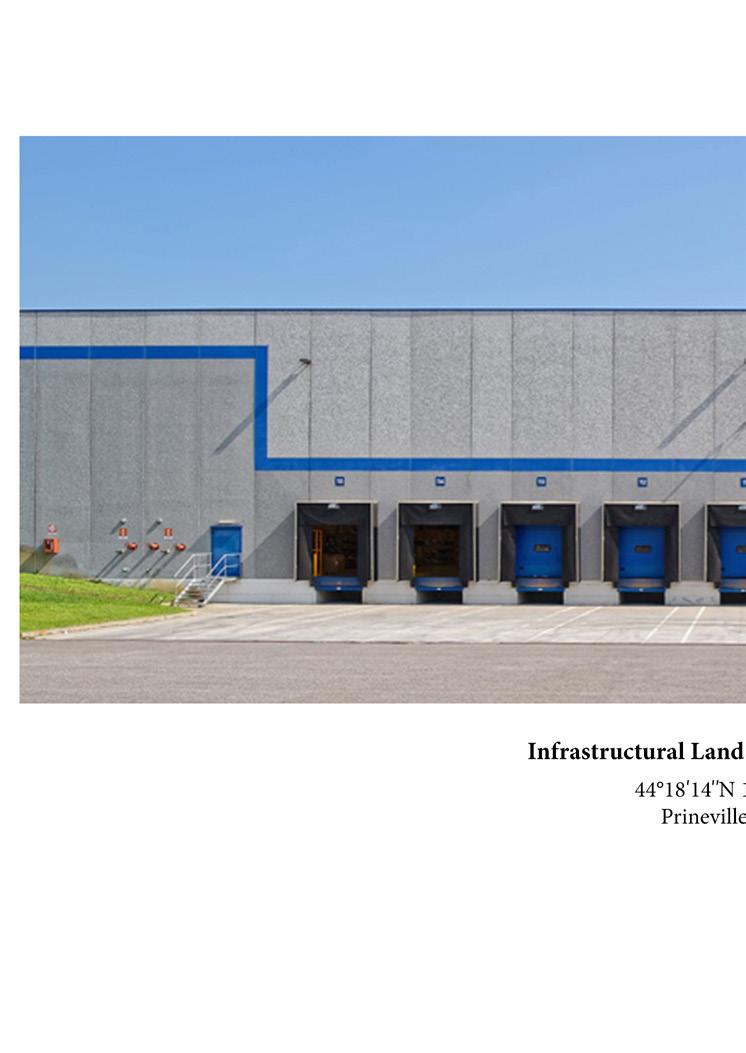
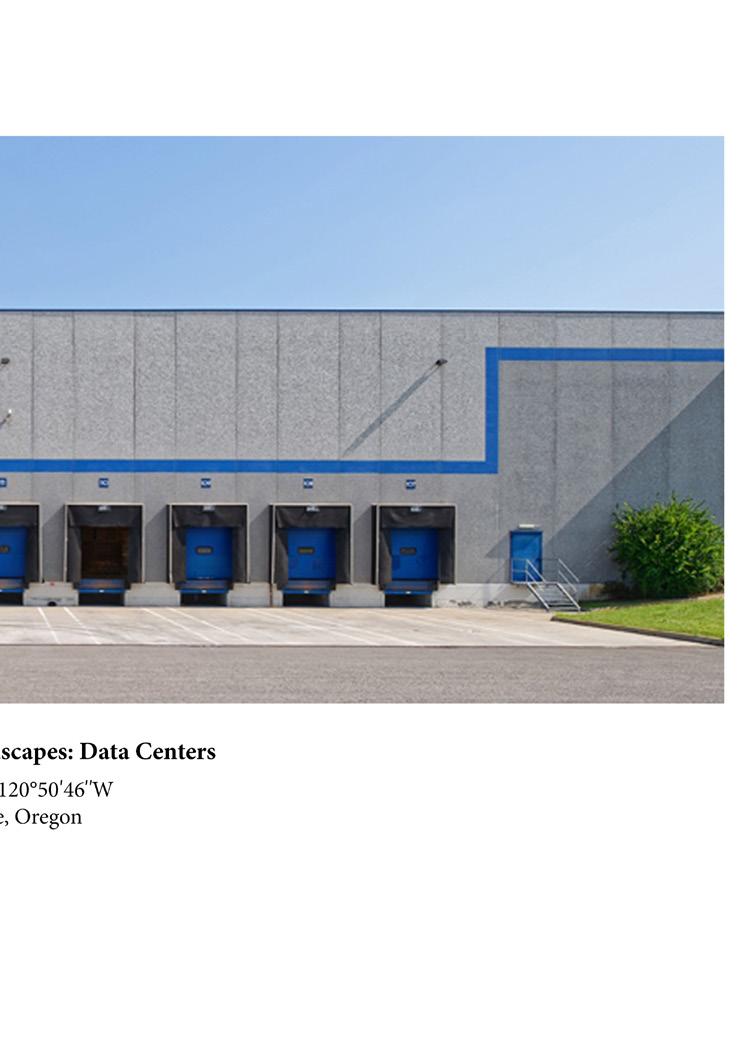
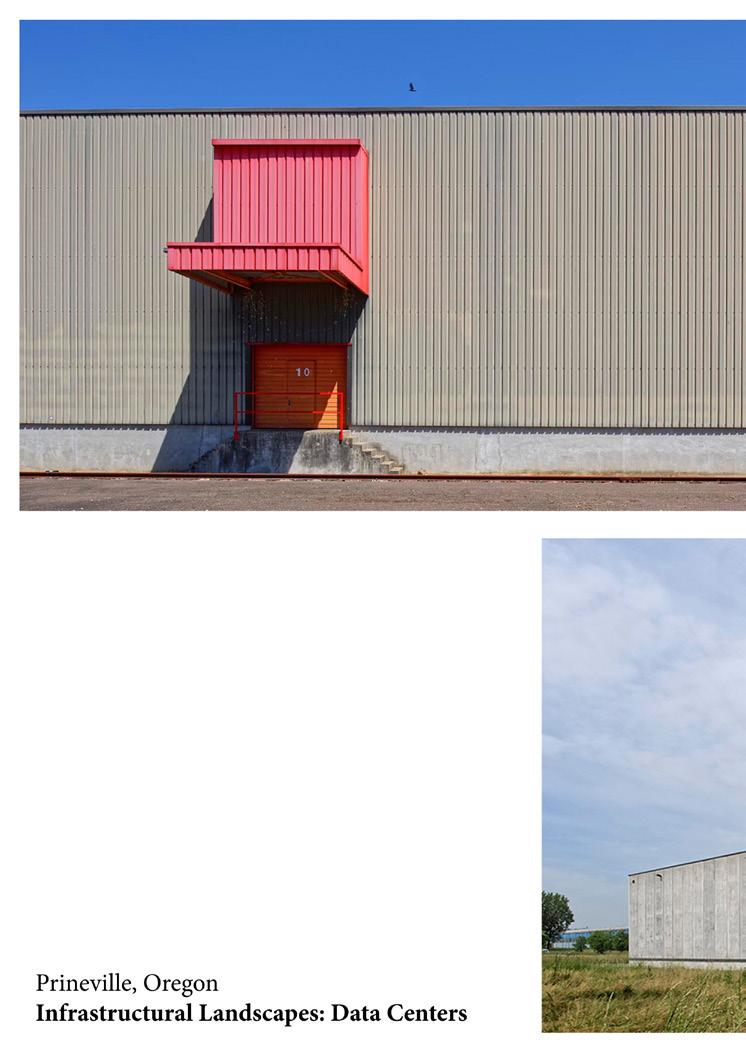
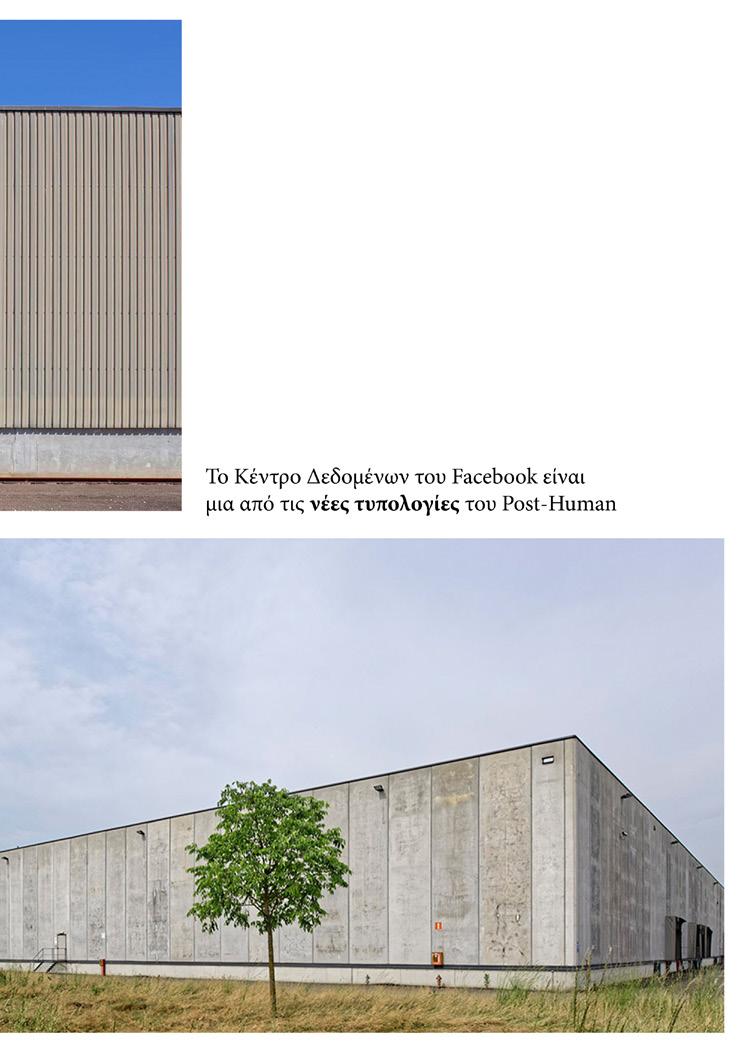
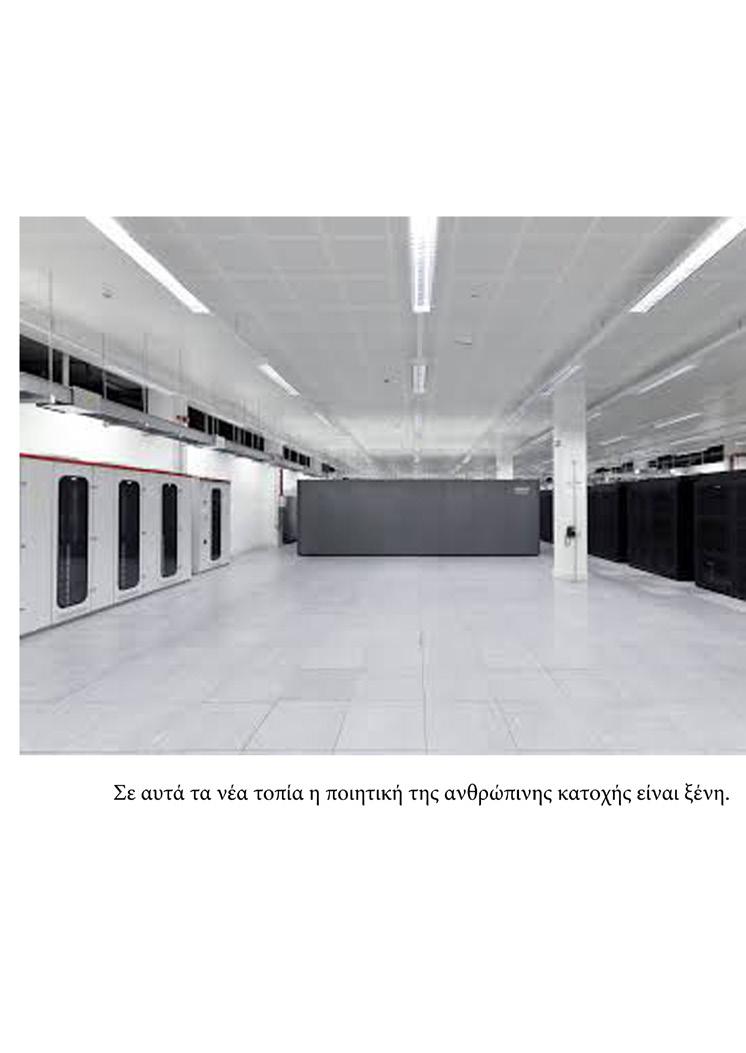
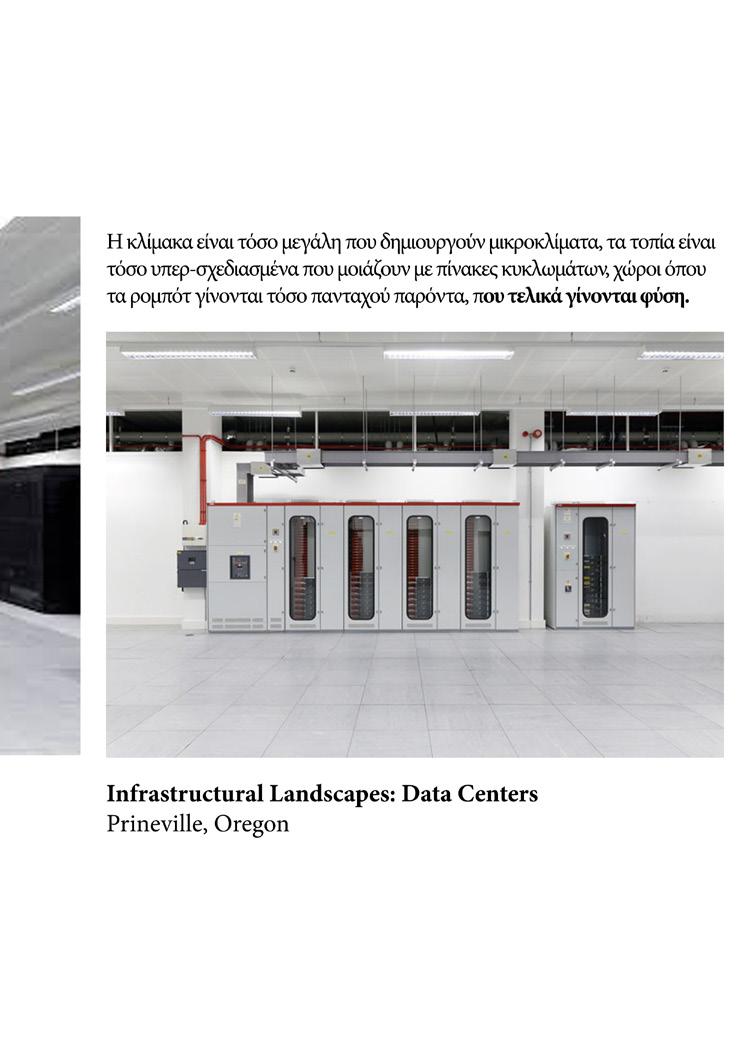
[2.3.2] Infrastructural Landscapes: Data Centers
Prineville, Oregon - 44°18 14 N 120°50 46 W
Στη
Prineville, Oregon,
Ochoco Wayside,
[3] Liam Young, Machine Landscapes: Architectures of the Post-Anthropocene, Architectural Design, January/February 2019 σελ. 8
[4] ο.π. σελ. 13
[5] Liam Young, Machine Landscapes: Architectures of the Post-Anthropocene, Architectural Design, January/February 2019
13
CHAPTER 2 - HOW THE HUT WAS BUILT
[2.3] Landscapes of the post- _____________
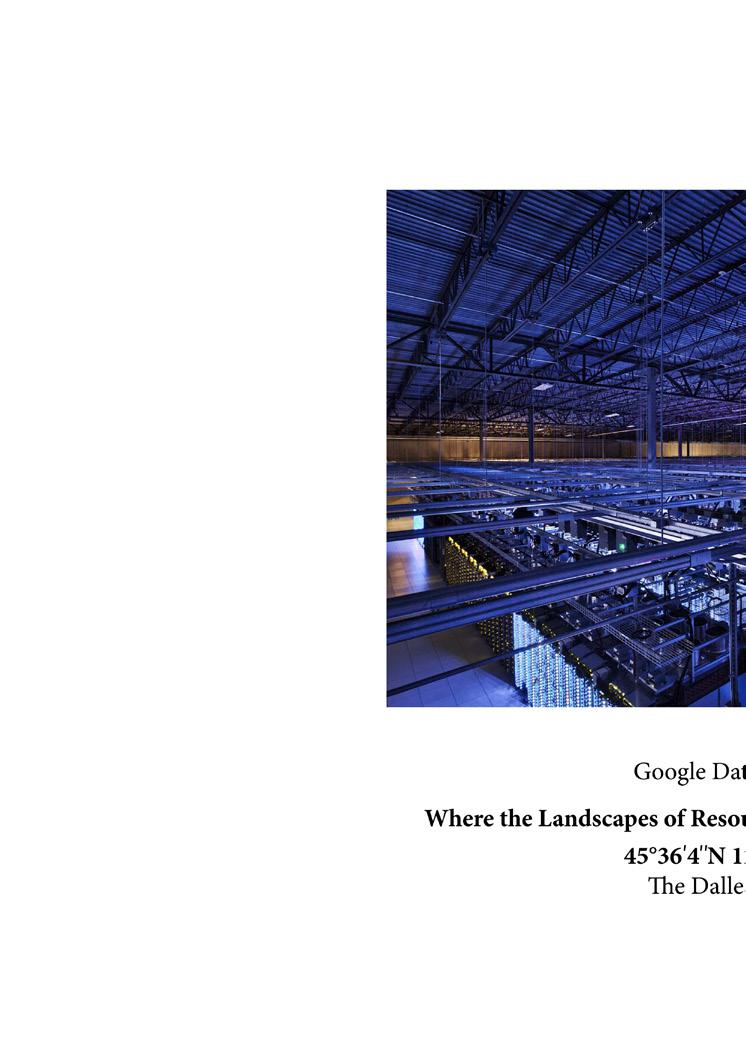
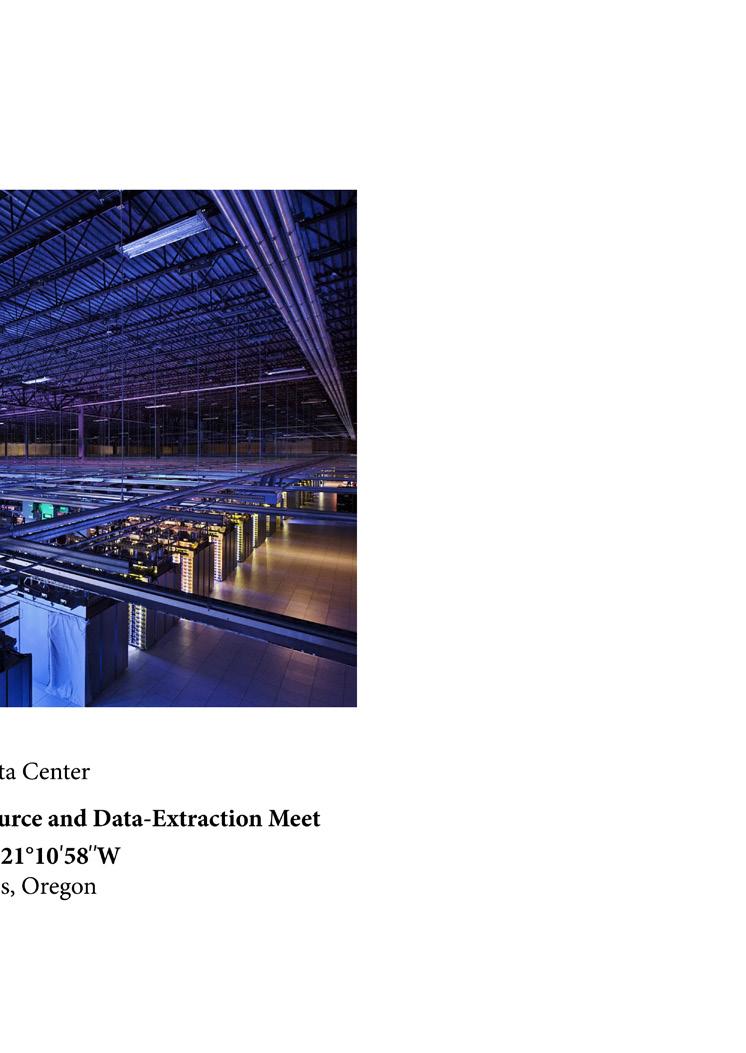
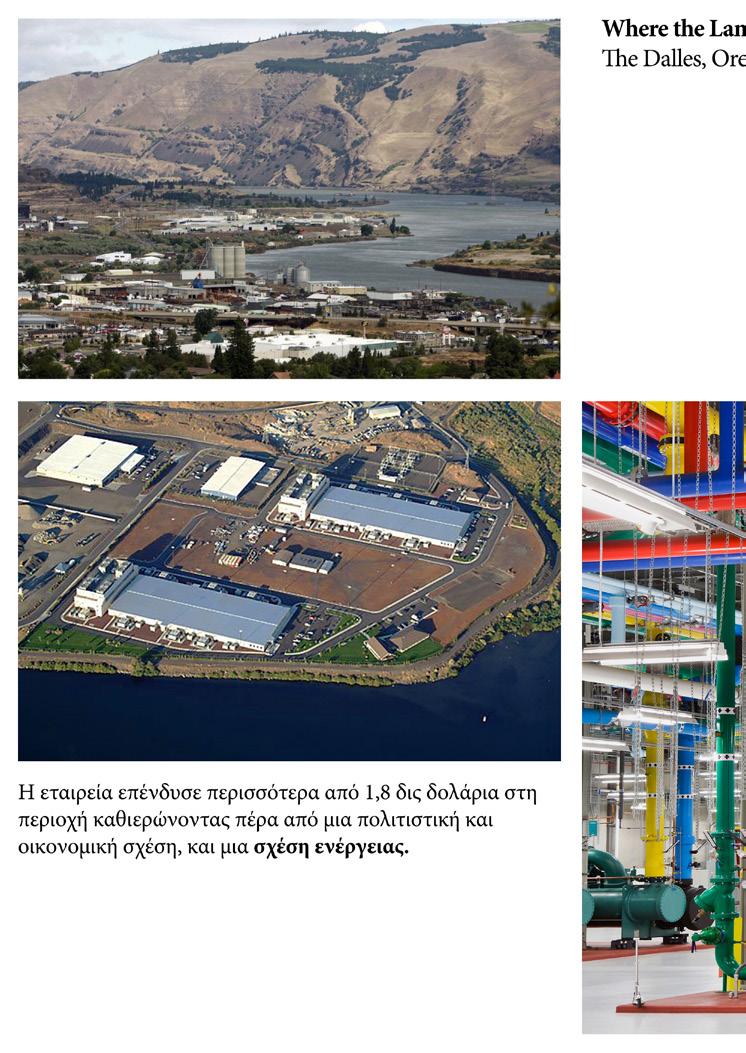
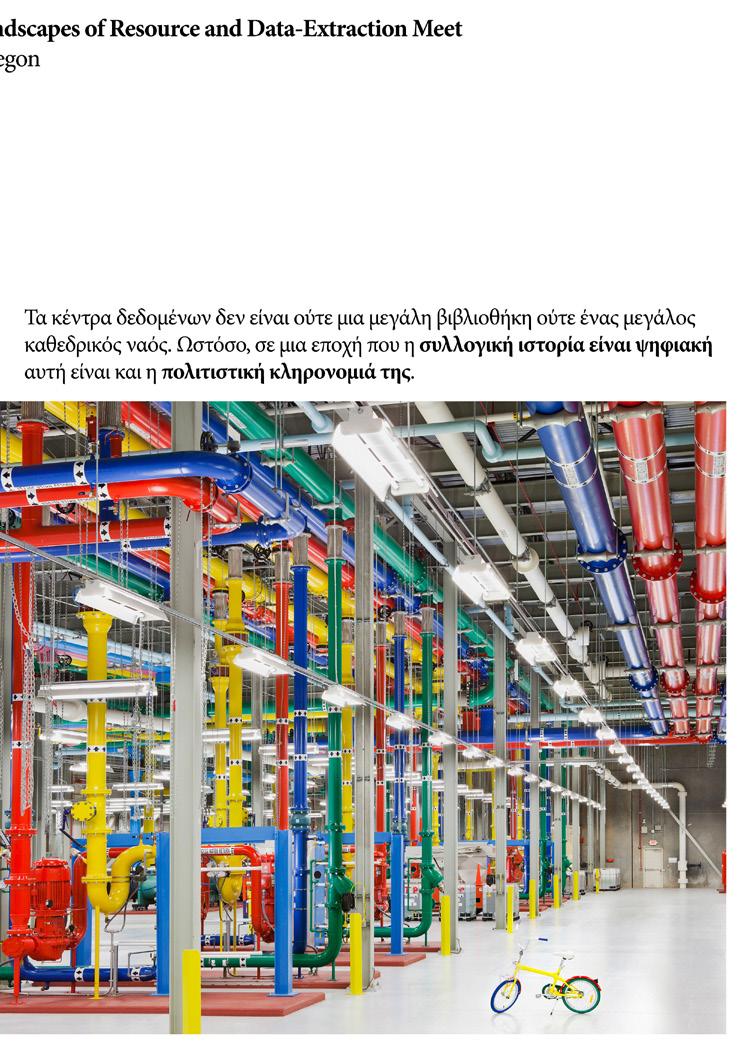
[2.3.3] Where the Landscapes of Resource and Data-Extraction Meet The Dalles, Oregon - 45°36 4 N 121°10 58 W
Στη
The Dalles, η
[6] Google Moves In And Wants To Pump 1.5 Million Gallons Of Water Per Day. National Public Radio, May 8, 2017. Link: https://www.npr.org/2017/05/08/527214026/google-moves-in-andwants-to-pump-1-5-million-gallons-of-water-per-day
[7] Susanne Wright. Google Unwrapped, Columbia Insight - Independent Environmental Journalism, July 12, 2018. Link: https://columbiainsight.org/google-unwrapped/
[8] Liam Young, Machine Landscapes: Architectures of the Post-Anthropocene, Architectural Design, January/February 2019 σελ. 67
CHAPTER 2 - HOW THE HUT WAS BUILT
[2.3] Landscapes of the post- _____________
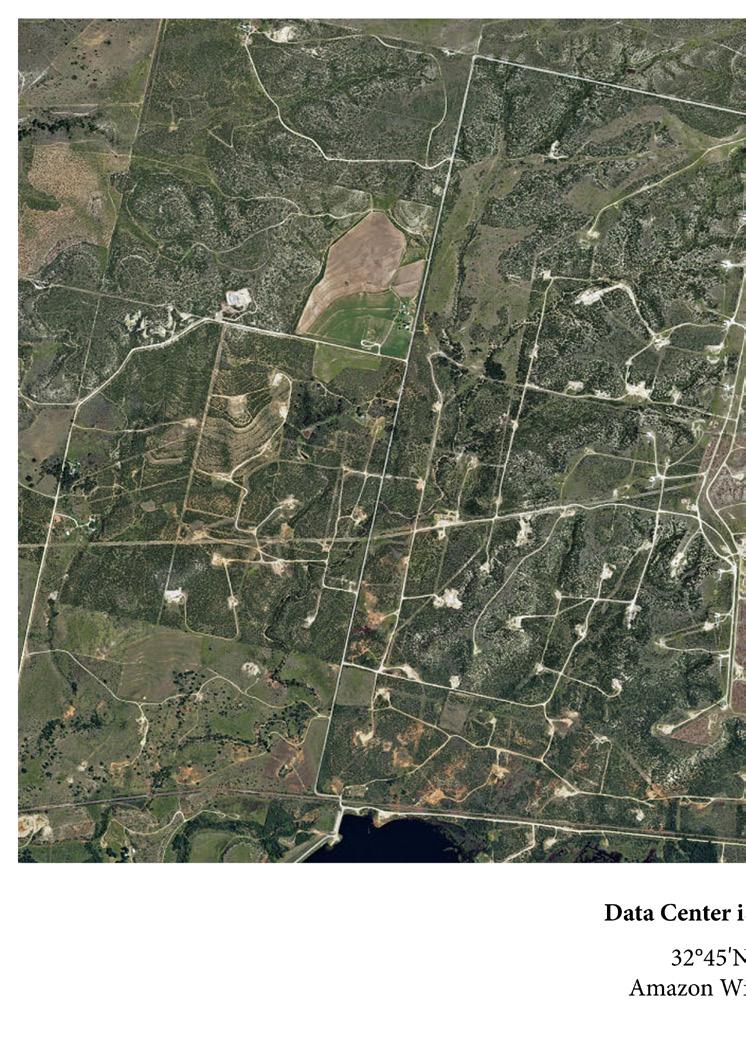
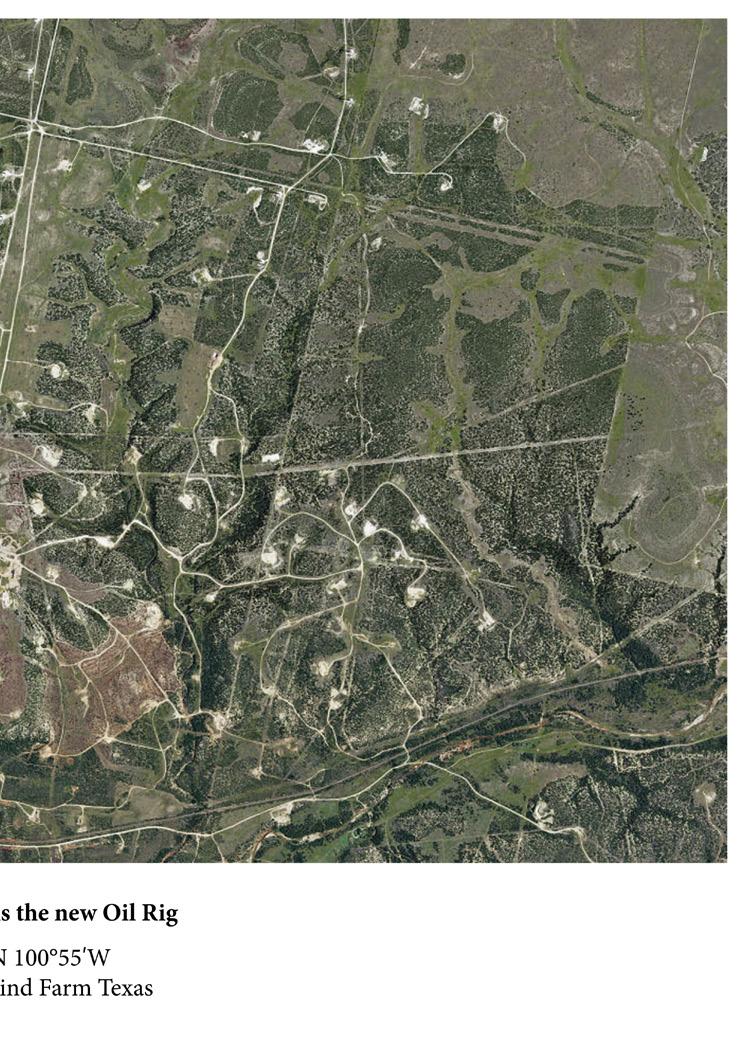
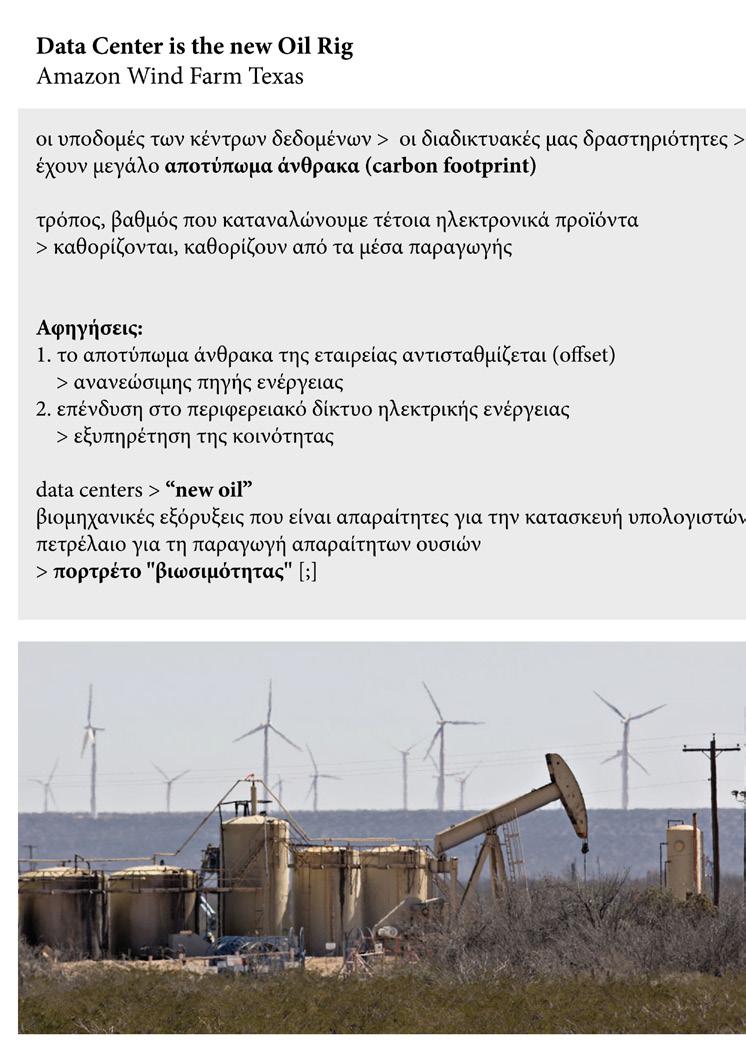
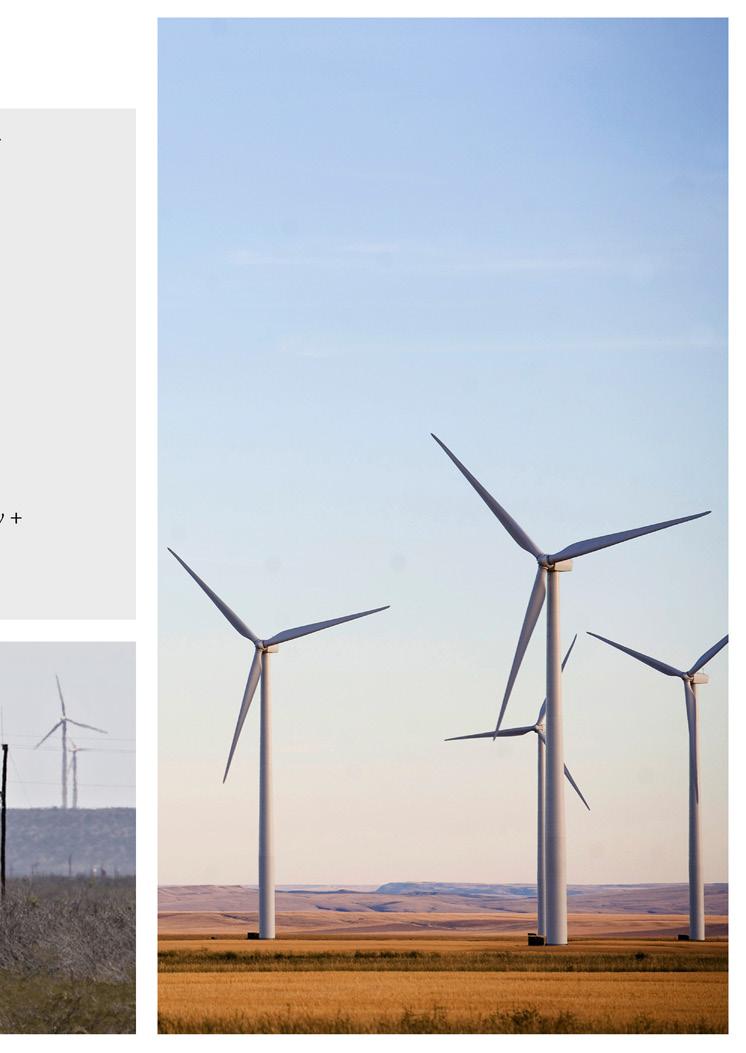
[2.3.4] Data Center is the new Oil Rig
Amazon Wind Farm Texas - 32°45 N 100°55 W
[9] “Your Data Is Dirty: The Carbon Price of Cloud Computing” - Time Magazine. April 2, 2014
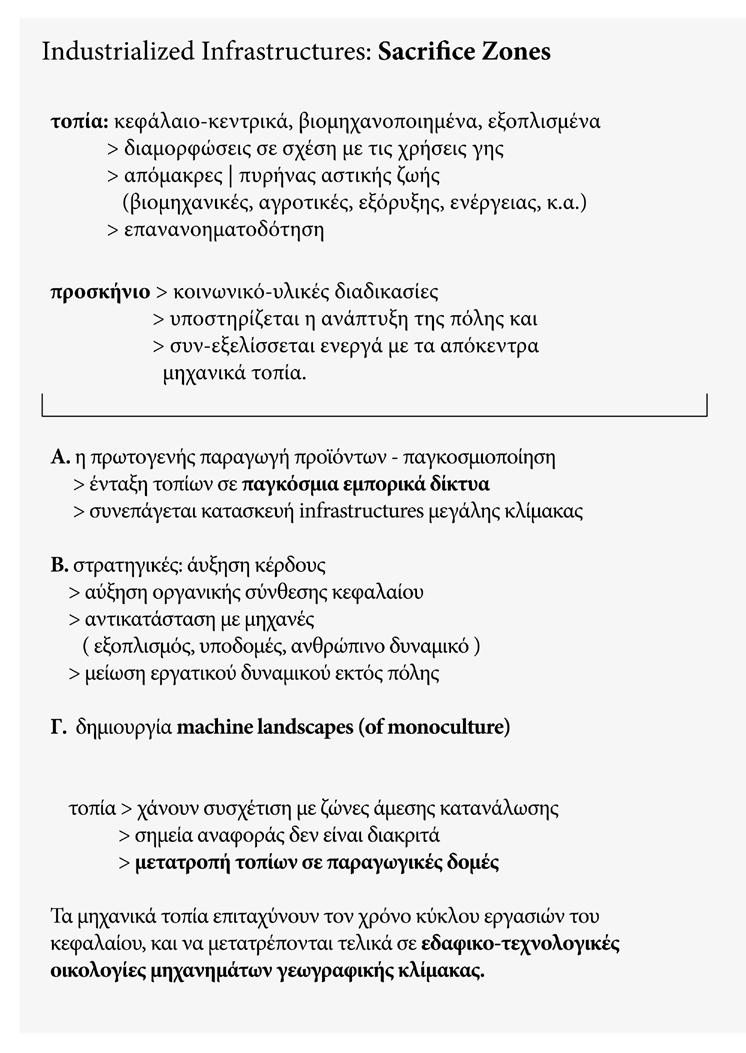
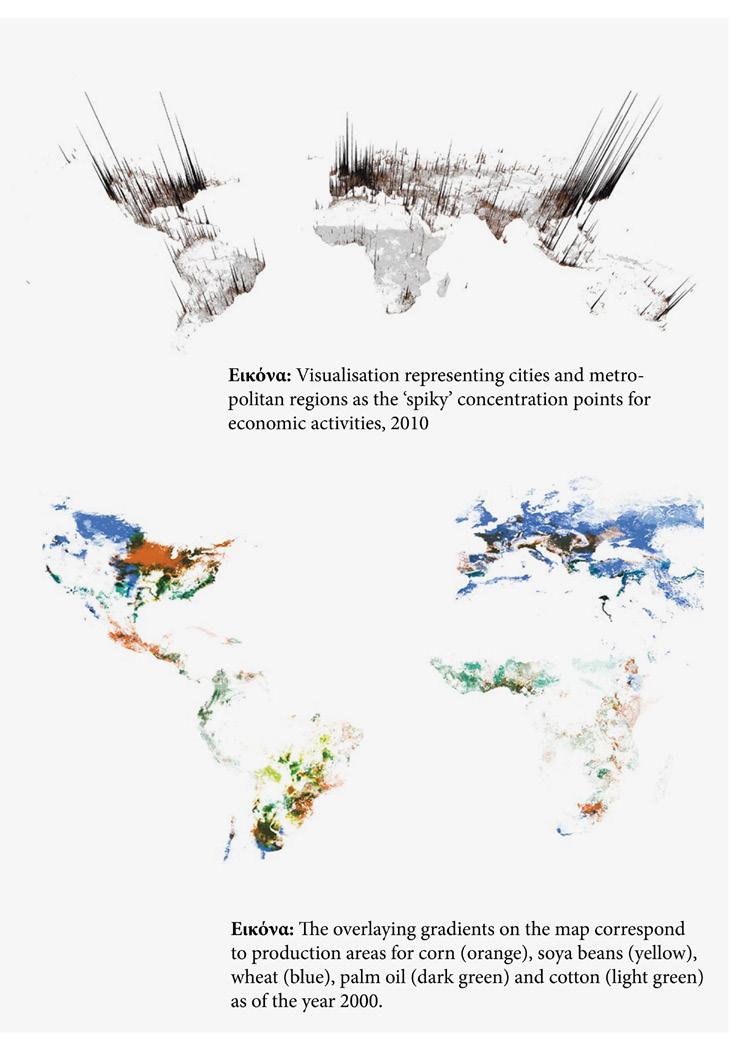
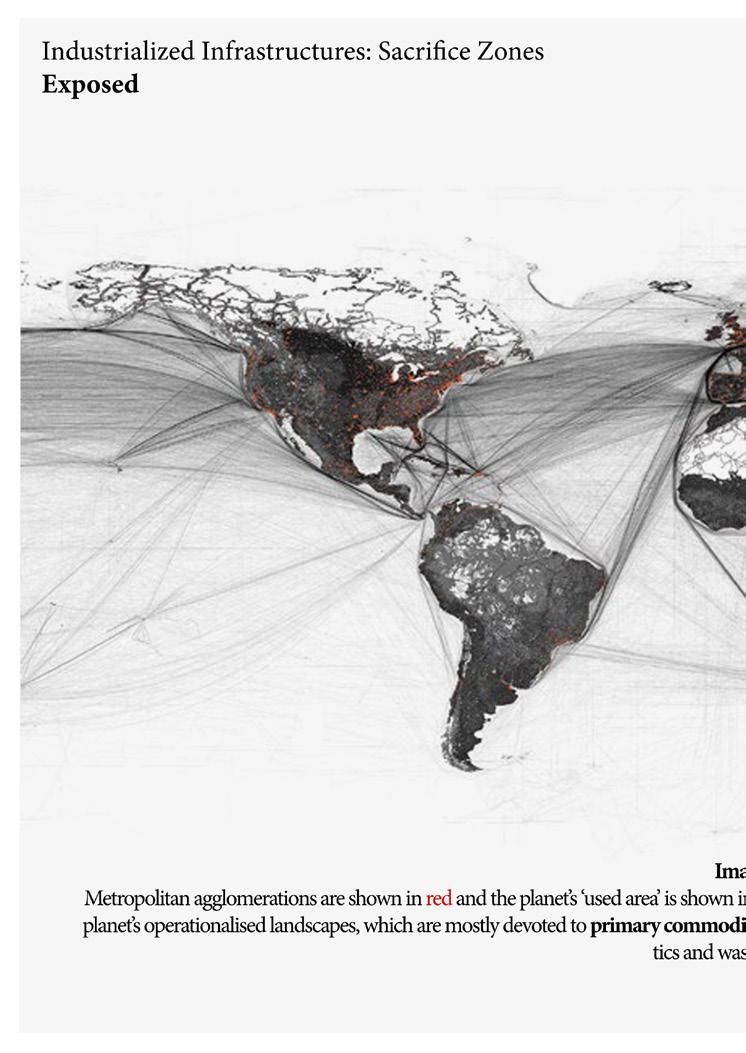
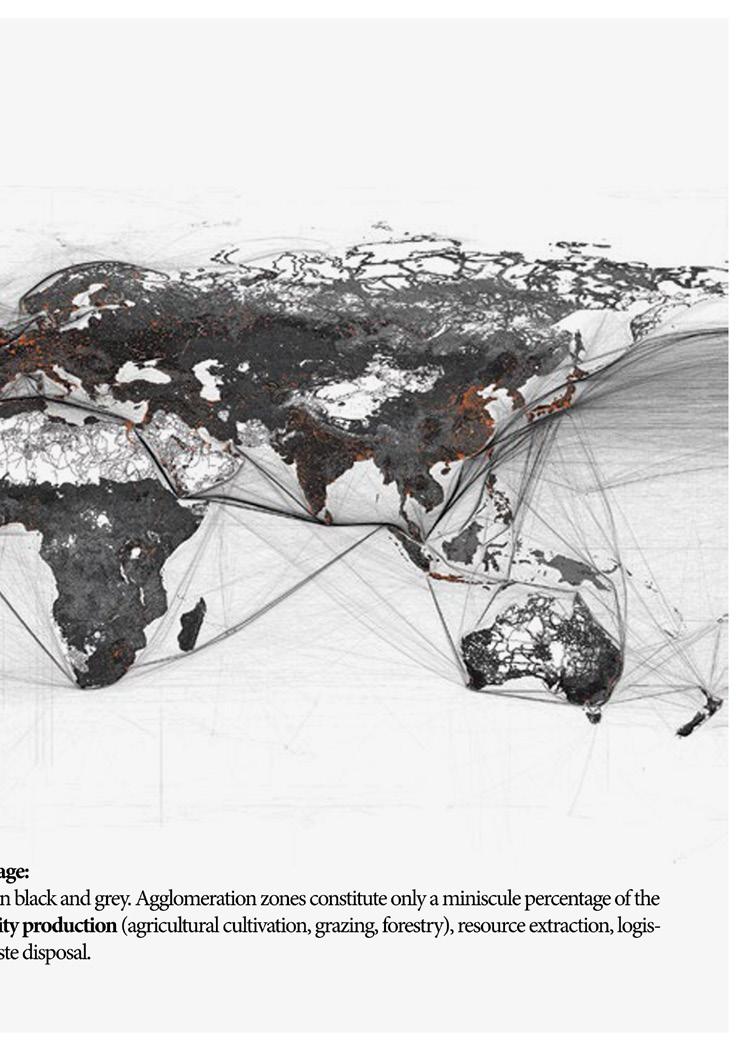
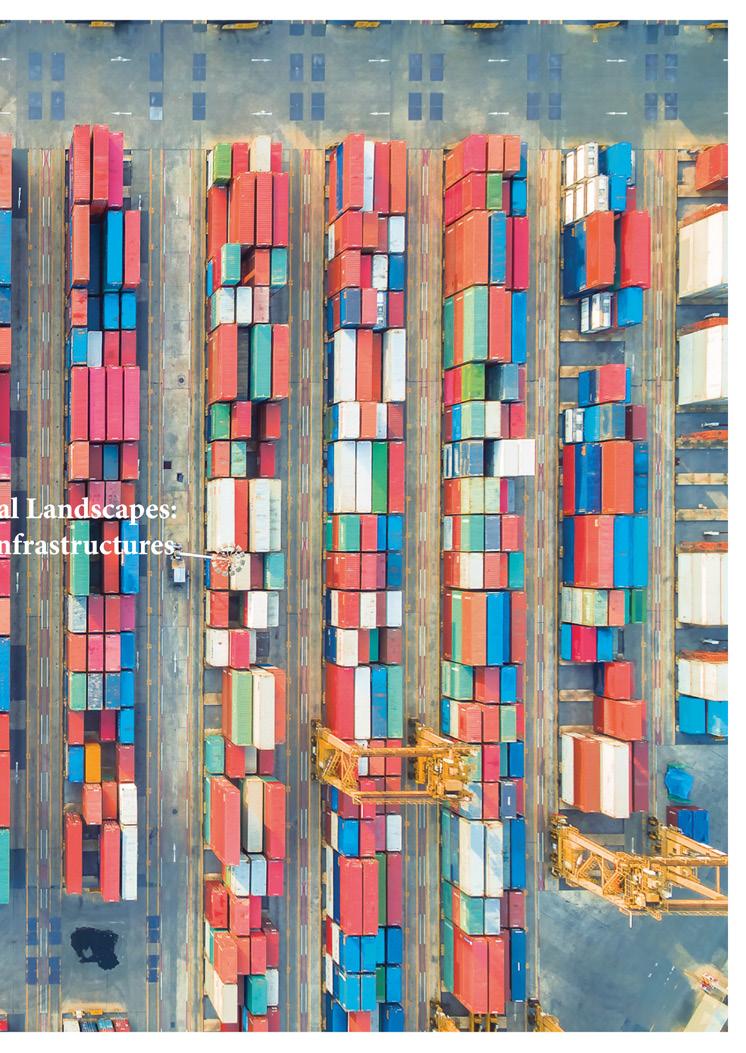
[2.3.5] Industrialized Infrastructures: Sacrifice Zones Κεφάλαιο-κεντρικά,
[1] Ed Wall, The Landscapists, Architectural Design, Wiley; 1 edition (April 6, 2020) σελ. 24
[2] Henri Lefebvre, The Urban Revolution [1970], trans Robert Bononno, University of Minnesota Press (Minneapolis), 2003
[3] David Harvey, The Limits to Capital [1982], Verso (London), 2018.
[4] Ed Wall, The Landscapists, Architectural Design, Wiley; 1 edition (April 6, 2020) σελ. 28 [5] ο.π.
[2.3.6] Exposed
[6] Jason W Moore, Capitalism in the Web of Life, Verso (London), 2015.
[7] David Goodman, Bernardo Sorj and John Wilkinson, From Farming to Biotechnology: A Theory of Agro-Industrial Development, Blackwell (New York), 1987.
[8] Ed Wall, The Landscapists, Architectural Design, Wiley; 1 edition (April 6, 2020) σελ. 28
[3] Deep Fake definition. Link: https://www.merriam-webster.com/words-at-play/deepfake-slang-definition-examples
CHAPTER 2 - HOW THE HUT WAS BUILT
[2.3] Landscapes of the post- _____________
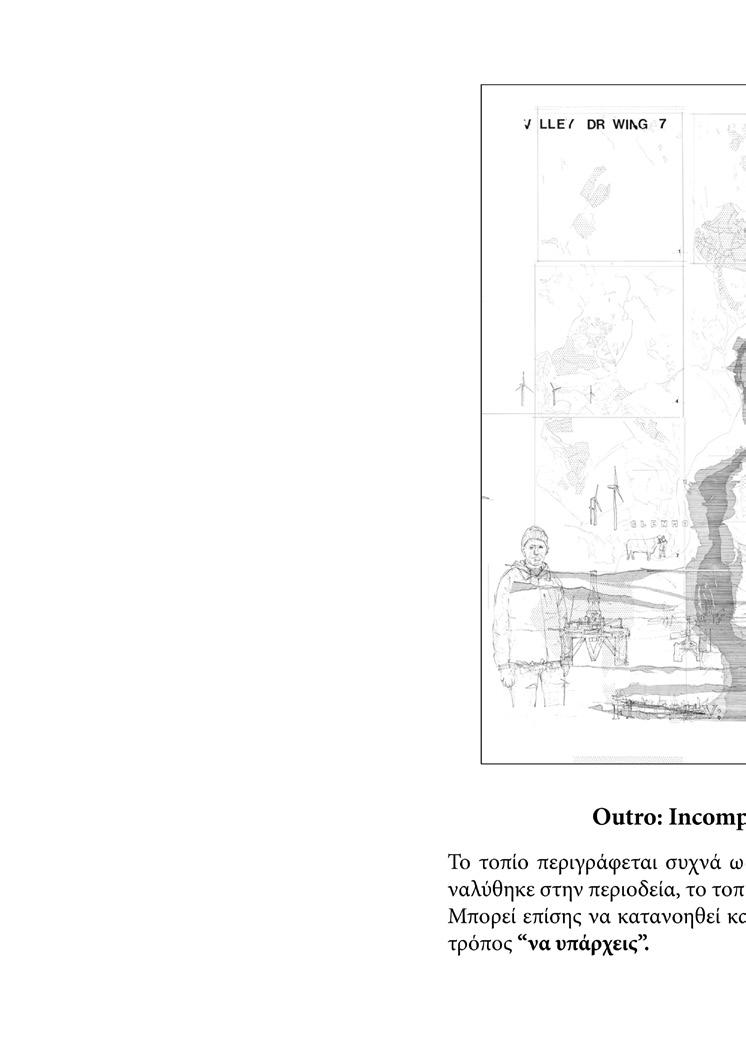
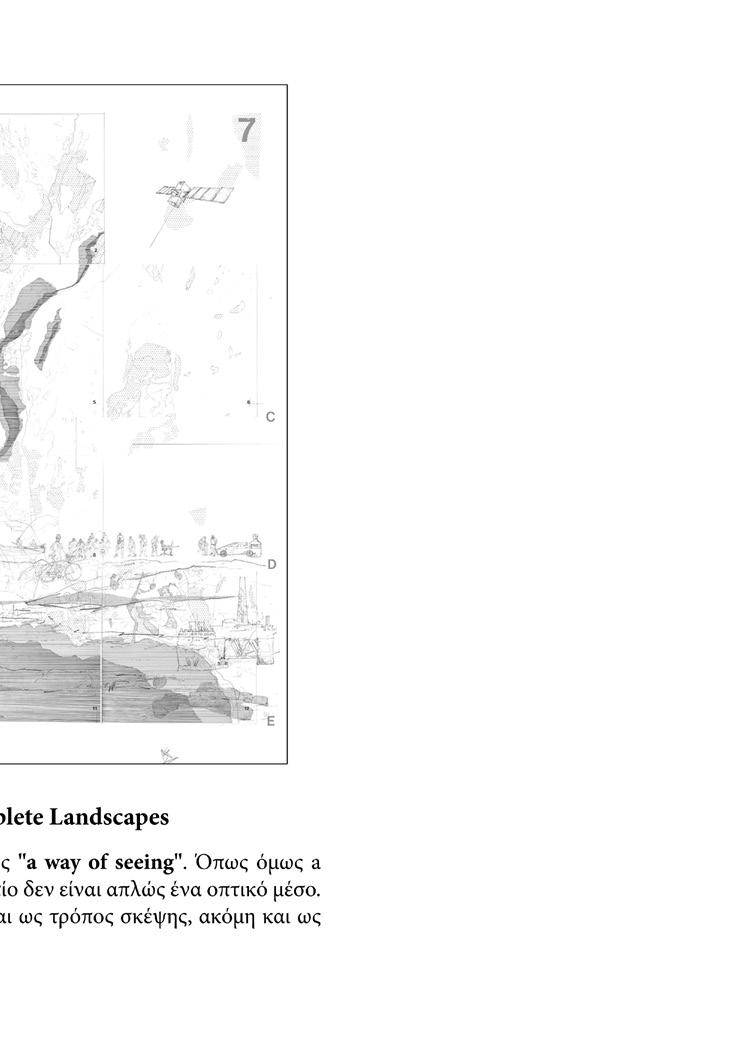
[2.3.13] Outro: Incomplete Landscapes
Η Donna Haraway,
[4] Barbara Bender, Landscape: Politics and Perspectives, Berg (Oxford), 1993, σελ 3.
[5] Ed Wall, The Landscapists, Architectural Design, Wiley; 1 edition (April 6, 2020)
[6] Denis Cosgrove, ‘Prospect, Perspective and the Evolution of the Landscape Idea’, Transactions of the Institute of British Geographers, 10 (1), 1985, pp 45–62, and John Berger, Ways of Seeing, Penguin (London), 1972.
[7] Donna Haraway, ‘Situated Knowledges: The Science Question in Feminism and the Privilege of Partial Perspective’, Feminist Studies, 14 (3), Autumn 1988, σελ. 582.
Haraway
[8] Ed Wall, The Landscapists, Architectural Design, Wiley; 1 edition (April 6, 2020)
[9] Donna Haraway, ‘Situated Knowledges: The Science Question in Feminism and the Privilege of Partial Perspective’, Feminist Studies, 14 (3), Autumn 1988, σελ. 583.
[10] ο.π.
[11] Ed Wall, The Landscapists, Architectural Design, Wiley; 1 edition (April 6, 2020)
CHAPTER 3 - WAYS OF INHABITING
[3.1] Where I Lived, and What i Lived For
I Lived, and What I Lived For.».
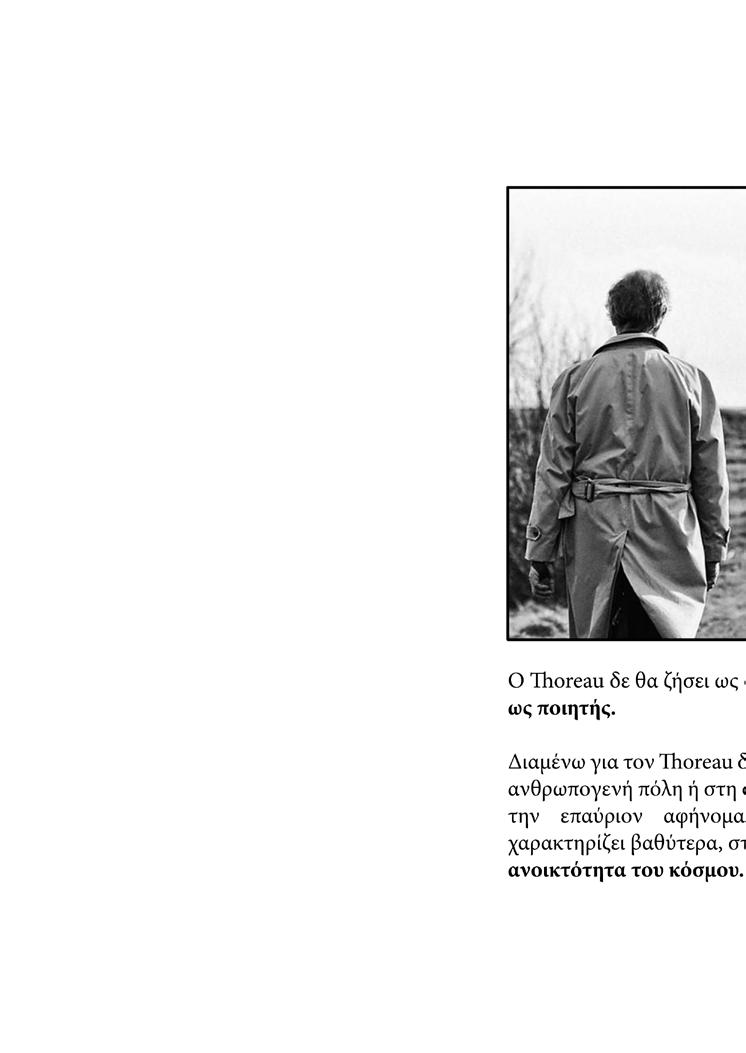
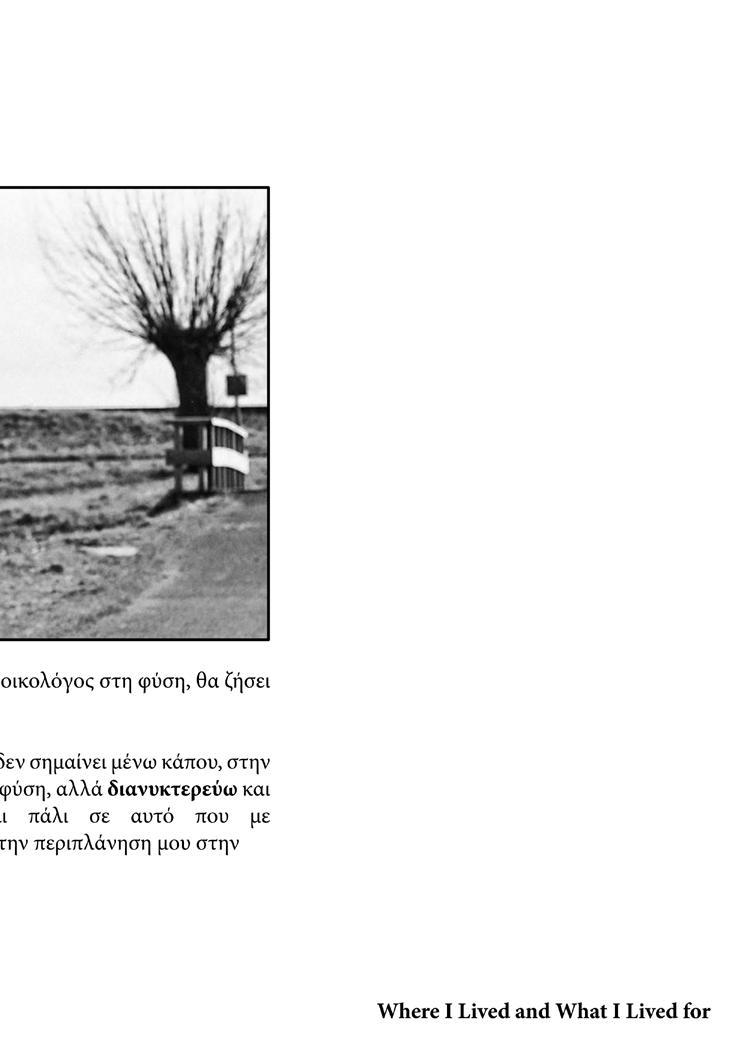
“ I went to the woods because I wished to live deliberately, to front only the essential facts of life, and see if I could not learn what it had to teach, and not, when I came to die, discover that I had not lived.” [1]1
“the essential
O Thoreau
[1] Thoreau, Henry David, 1817-1862. Walden ; And, Resistance to Civil Government : Authoritative Texts, Thoreau’s Journal, Reviews, and Essays in Criticism. New York :Norton, 1992.
CHAPTER 3 - WAYS OF INHABITING
[3.2] Hybrid Geographies: Ways of Inhabiting the World
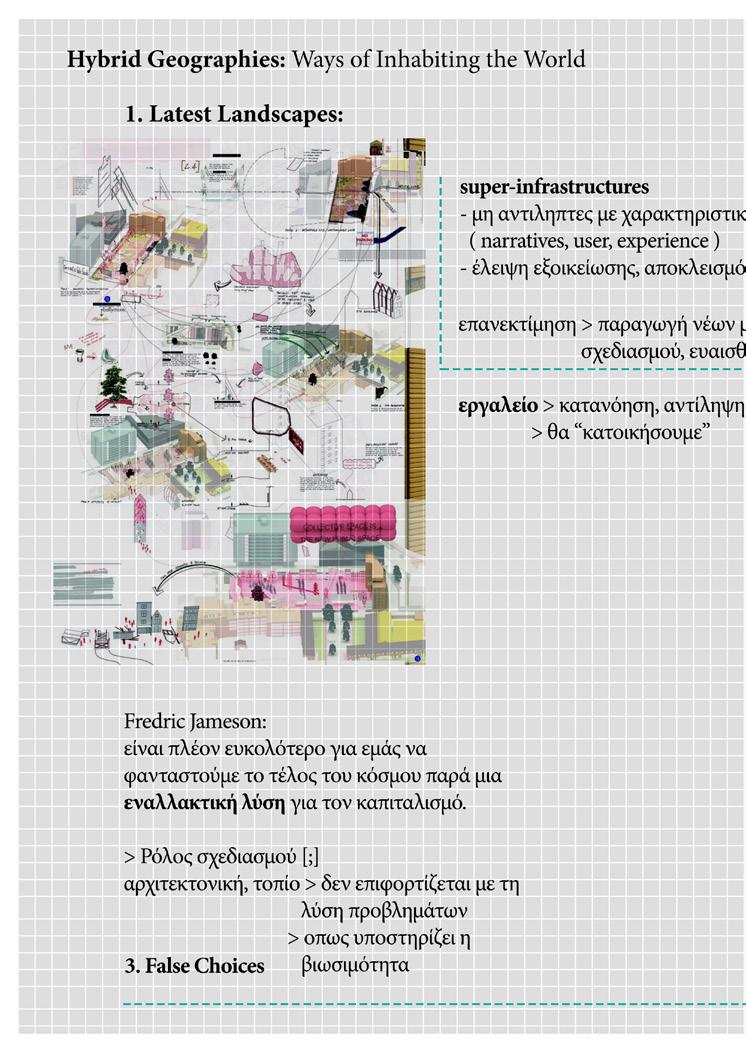
[3.2.1] Latest Landscapes
Οι
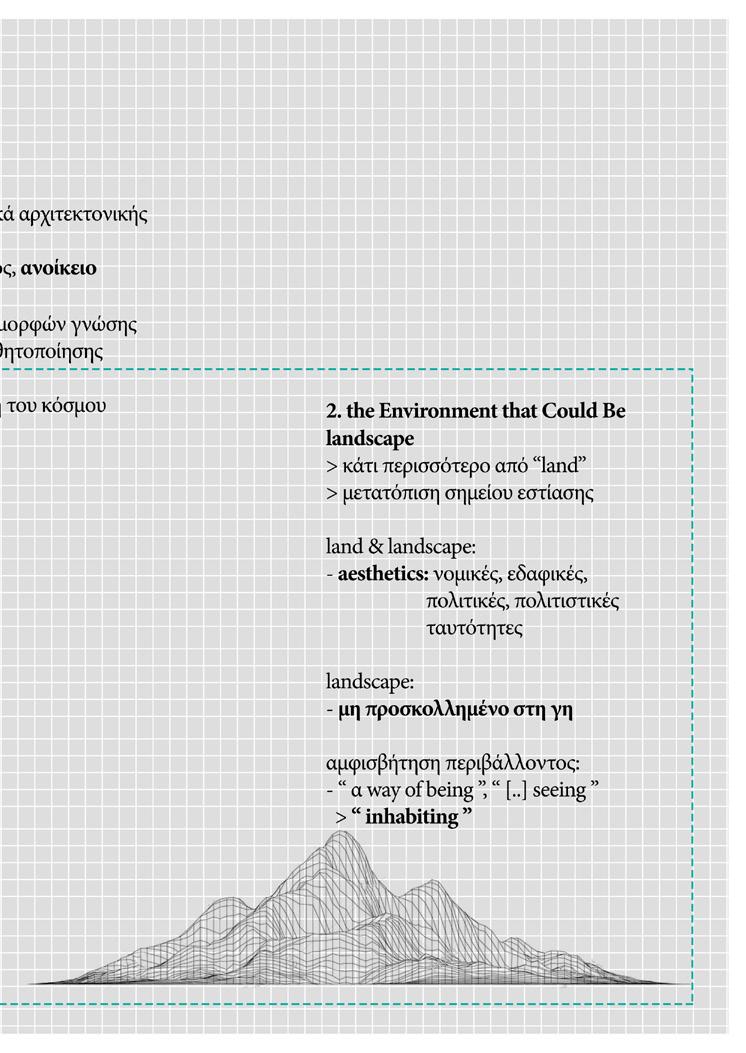
[3.2.2] the Environment that Could Be
“customs and culture defined a Land, not physical geographical characteristics” [2]
[1] Ed Wall, The Landscapists, Architectural Design, Wiley; 1 edition (April 6, 2020)
[2] Kenneth Olwig, Landscape, Nature, and the Body Politic: From Britain’s Renaissance to America’s New World, University of Wisconsin Press, Madison (WI), 2002, p 19.
CHAPTER 3 - WAYS OF INHABITING
[3.2] Hybrid Geographies: Ways of Inhabiting the World
[3.2.3] False Choices
Όπως
[3] Anthony Dunne and Fiona Raby, Speculative Everything: Design, Fiction, and Social Dreaming, The MIT Press; 1st edition (December 6, 2013)
[4] Liam Young, Machine Landscapes: Architectures of the Post Anthropocene (Architectural Design), Wiley; 1 edition (February 11, 2019)
CHAPTER 3 - WAYS OF INHABITING
[3.2] Hybrid Geographies: Ways of Inhabiting the World
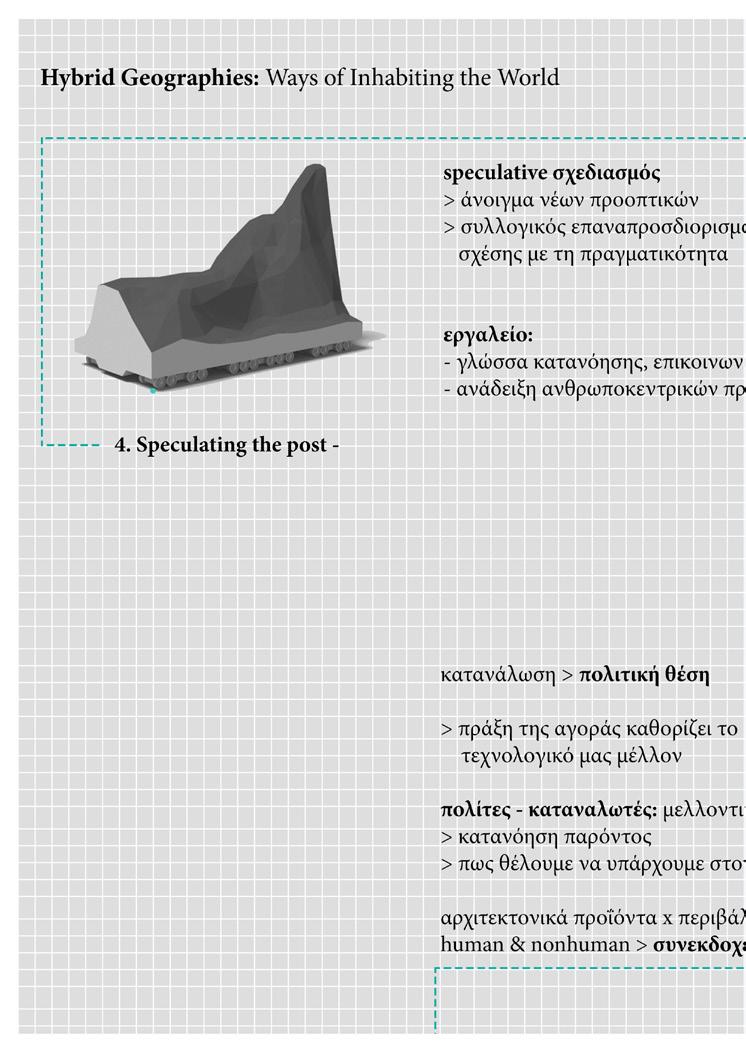
[3.2.4] speculating the post-
[5] “Ideals are not measured by whether they conform to reality; reality is judged by whether it lives up to ideals. Reason’s task is to deny that the claims of experience are final—and to push us to widen the horizon of our experience by providing ideas that experience ought to obey.” Tim Black, interview with Susan Neiman, Spiked Online.
[6] Anthony Dunne and Fiona Raby, Speculative Everything: Design, Fiction, and Social Dreaming, The MIT Press; 1st edition (December 6, 2013)
(material
[7] Anthony Dunne and Fiona Raby, Speculative Everything: Design, Fiction, and Social Dreaming, The MIT Press; 1st edition (December 6, 2013)
CHAPTER 3 - WAYS OF INHABITING
[3.2] Hybrid Geographies: Ways of Inhabiting the World
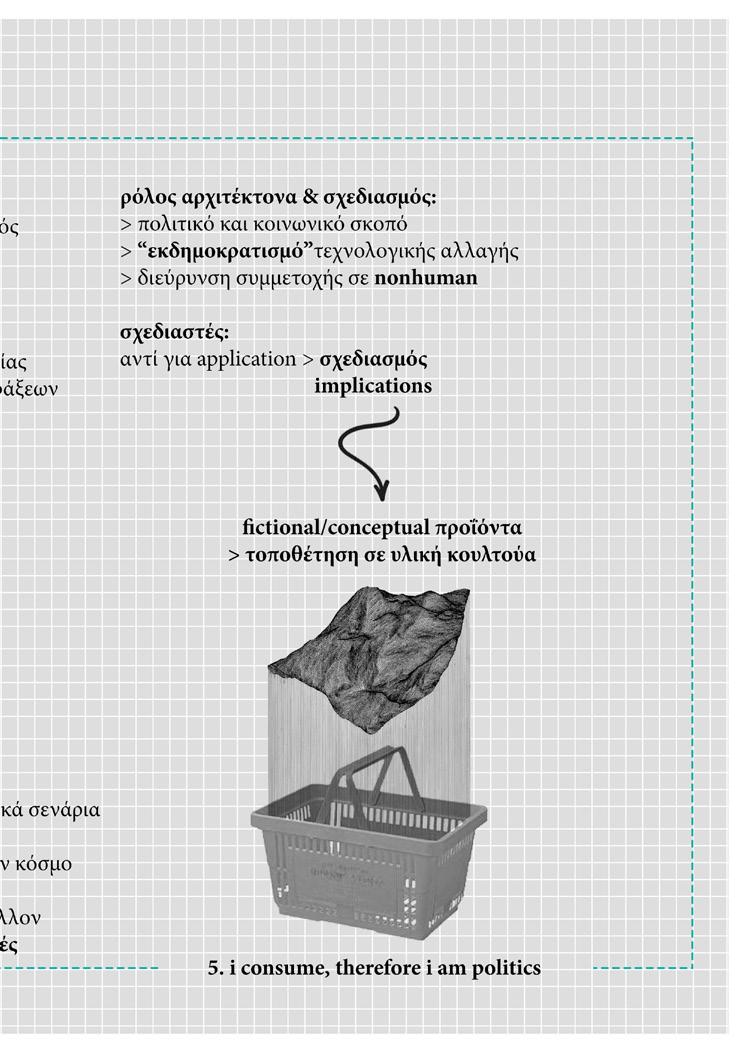
[3.2.5] i Consume, therefore i am Politics
[8] Anthony Dunne and Fiona Raby, Speculative Everything: Design, Fiction, and Social Dreaming, The MIT Press; 1st edition (December 6, 2013)
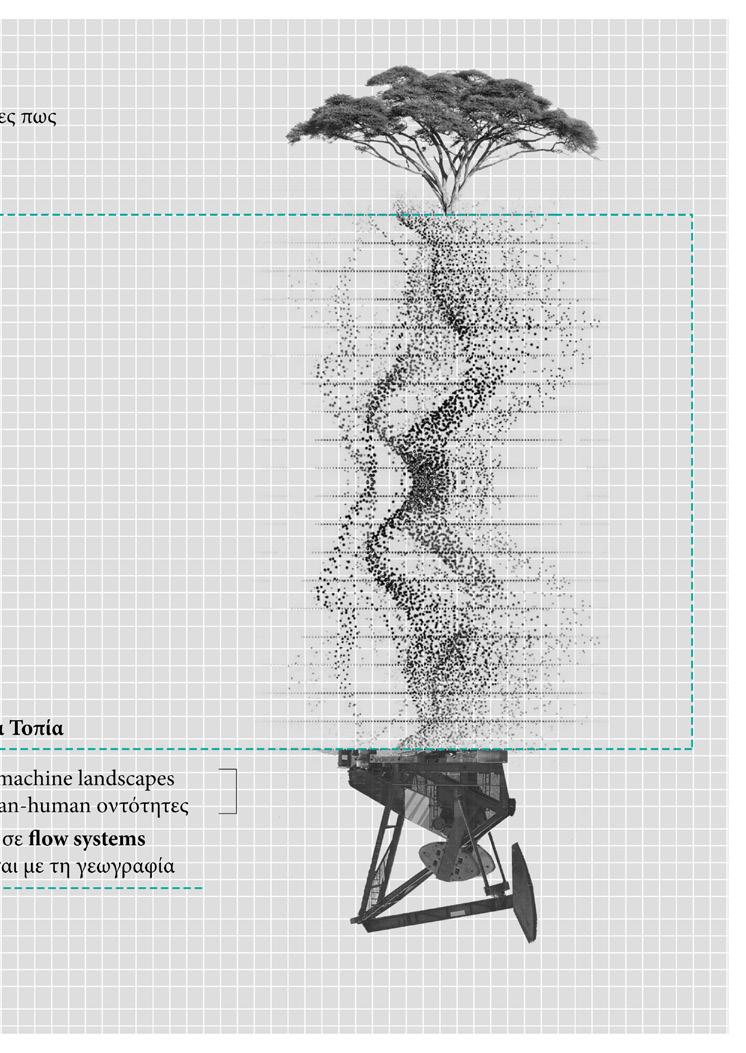
[3.2.6] nature as design
[9] Adrian Bejan, Design in Nature: How the Constructal Law Governs Evolution in Biology, Physics, Technology, and Social Organizations. Anchor; Reprint edition (January 8, 2013)
[10] ο.π.
[11] ο.π.
Design in Nature: How the Constructal Law Governs Evolution in Biology, Physics, Technology, and Social Organizations. “Μore power for more individuals over larger territories, and more power used by every individual.” [13]
[12] Adrian Bejan, Design in Nature: How the Constructal Law Governs Evolution in Biology, Physics, Technology, and Social Organizations. Anchor; Reprint edition (January 8, 2013) [13] ο.π.
CHAPTER 3 - WAYS OF INHABITING
[3.2] Hybrid Geographies: Ways of Inhabiting the World
[3.2.7] where the posthuman dwells (ways of inhabiting)
Thoreau
Walden.
[14] Braidotti Rossi. 2009. “Animals, Anomalies and Inorganic Others”. PMLA
Brian Massumi,
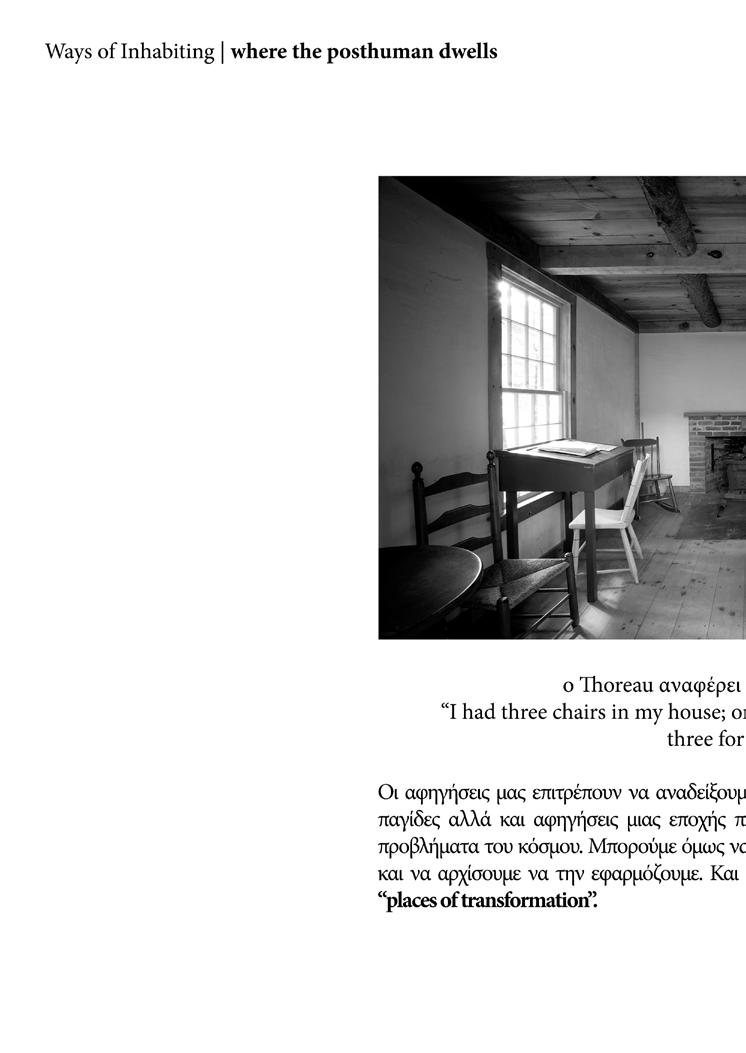
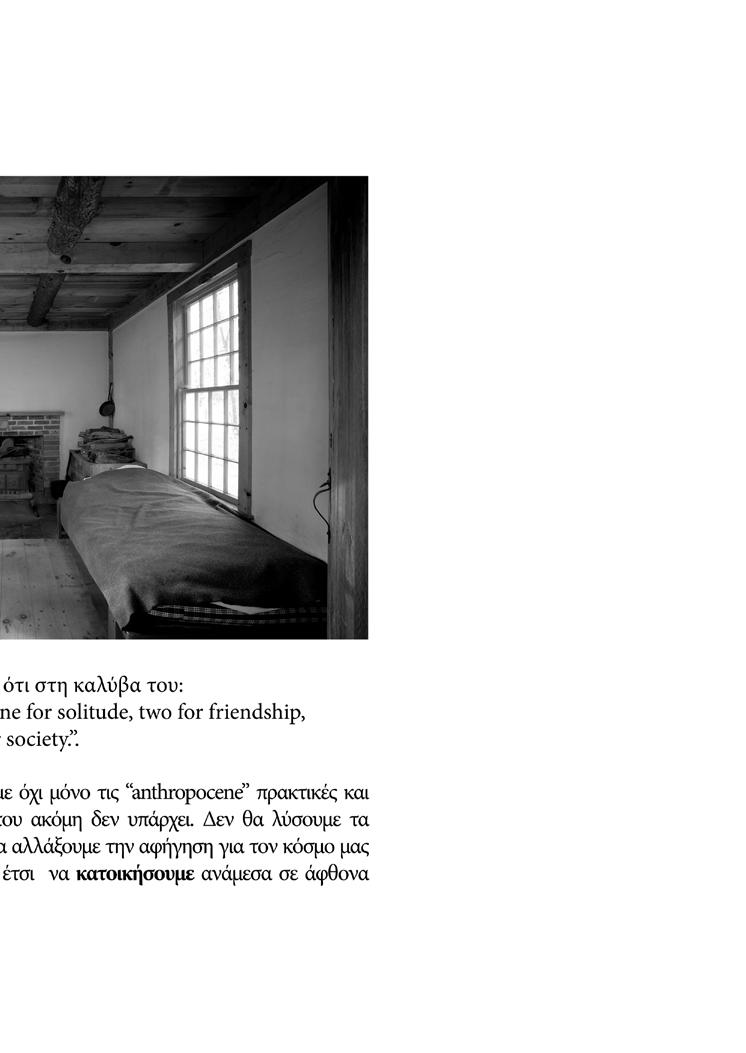
“I had three chairs in my house; one for solitude, two for friendship, three for society.”,
[15] Claire Colebrook, 2003. Understanding Deleuze, Allen & Unwin, National Library of Australia
[16] Stacy Alaimo, 2016, Exposed: Environmental Politics and Pleasures in Posthuman Times. Published by University of Minnesota Press