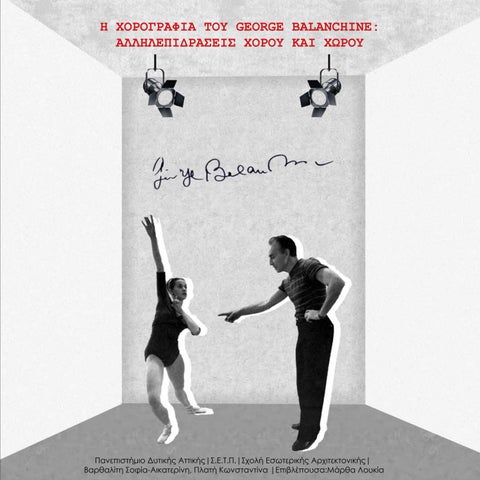
Η Χορογραφία του George Balanchine: Αλληλεπιδράσεις Χορού και Χώρου

Page 1


1.1

2.3

6.1

“The choreographer and the dancer must remember that they reach the audience through the eye. It’s the illusion created which convinces the audience, much as it is with the work of a magician”

Balanchine

2

3

6

7 The George Balanchine Trust.

George Balanchine.

“Everyone wants to be the favorite child in a family, but not everyone has the luck”

sky-an-innovative-partnership.

11

12

Corps de

American Ballet Theatre (ABT),

Balanchine

14 S. Volkov.(1985).Interviews with George Balanchine, Balanchine’s Tchaikovski, Νέα

: Simon and Schuster, σελ 159.

Tamara , Georgi , and Andrei dressed as Harlequins
Photo by R. Charles Courtesy

(abstract),

(disembodiment)19.

16 S. Volkov.(1985).Interviews with George Balanchine, Balanchine’s Tchaikovski, Νέα

17 S. Volkov.(1985).Interviews with George Balanchine, Balanchine’s Tchaikovski, Νέα

: Simon and Schuster, σελ 147.

: Simon and Schuster, σελ 171.

18 S. Volkov.(1985).Interviews with George Balanchine, Balanchine’s Tchaikovski, Νέα Υόρκη : Simon and Schuster, σελ 159. 19Tate. (χ.χ.). Formalism. Tate.

Balanchine

Balanchine.

20 Christensen, J. F., Pollick, F. E., Lambrechts, A., & Gomila, A. (2016). Affective responses to dance. Acta Psychologica,

actpsy.2016.03.008

Tate, «Formalism is the study of art based solely on an analysis of its form – the way it is made and what it looks like»

Henri Matisse,Τhe Morrocans ,(1916),
, 181.3 x 279.4
Wassily Kandinsky , After Right - to the Left, (1932) ,
, 60 × 70
Piet Mondrian,Broadway Boogie-Woogie (1942-1943) ,
, 127 x 127

Pollick, Lambrechts & Gomila (2016)

24Levin, D. M. (1976). Balanchine’s formalism. Salmagundi, σελ 225. Ανακτήθηκε

https://www.jstor.org/stable/40546934

Merce Cunningham
Merce Cunningham Dance Company in Cargo X, 1989,
Jed Downhill

25Levin, D. M. (1976). Balanchine’s formalism. Salmagundi,

27 Levin, D. M. (1976). Balanchine’s formalism. Salmagundi,

Releve

Portnova(2022)

(active)

the music, hear the dance» Croce, A. (1993). Going to the dance. New Haven, CT: Yale University Press

28McAuley, G. (2000). Space in performance: Making meaning in the theatre. University of Michigan Press.Σελ 126.

The Four Temperaments

The Four Temperaments

The Four Temperaments

Jewels (1967),

Balanchine,

(Emeralds, Rubies, Diamonds).

31 Homans, J. (2010). Apollo’s angels: A history of ballet. New York, NY: Random House.

32 Ο James Jerome Gibsom (1904–1979)

33 Gavriliou, E. (2003). Inscribing structures of dance

London.

(Sheets-Johnstone, 1980)

34

Maxine Sheets-Johnstone

35 Gavriliou, E. (2003). Inscribing structures of dance

London.

derrière en pointe, arabesque penchée

arabesque en pointe,

Cambre derriere en pointe Arabesque penchee Arabesque en pointe

36 Ghisleni, C. (2025, January 22). Promenade architecturale: How the modernist concept continues to inspire contemporary architecture. ArchDaily. Ανακτήθηκε

https://www.archdaily.com/1025951/promenade-architecturale-how-the-modernist-concept-continues-to-inspire-contemporary-architecture

Analysis (LMA).

LMA —Body, Effort,

Laban,

37 Fraleigh, S. (1987). Dance and the lived body: A descriptive aesthetics. University of Pittsburgh Press.

W., & Clark, R. H., 1970. Kinetic Architecture. New York: Van Nostrand Reinhold.

39 Au, S. (2002). Ballet and modern dance (2η

Thames & Hudson.

40 Jowitt, D. (2004). Time and the dancing image. Μπέρκλεϊ: University of California Press.

41 Ο Rudolf Laban (1879–1958)

42 Bradley, K. (2008). Rudolf Laban.

Routledge.

Forsythe, W. (2009). Choreographic Objects.

Motion Bank

The Forsythe Company.

47

(embodiment)

Juhani Pallasmaa

49 Pallasmaa, J. (2012).

50 Gioia Monda, L. (n.d.). Choreographic architectures: When dancing designs the urban environment.

J. M.

Balanchine,

54 Katz, R. (2004). Light fantastic: The art and design of stage lighting. New York, Routledge. McAuley, G. (2000). Space in performance: Making meaning in the theatre.Ann Arbor, University of Michigan Press. 55 Brandstetter, G. (2015). Poetics of dance: Body, image, and space in the historical avant-gardes. Oxford, Oxford University Press

George Balanchine.

56 McAuley, G. (2000). Space in performance: Making meaning in the theatre. Ann Arbor, University of Michigan Press.

57 Balanchine, G., & Mason, F. (1975). 101 stories of the great ballets. Garden City, NY: Doubleday

58 Garafola, L. (2005). Legacies of twentieth-century dance. Middletown, Wesleyan University

59 Homans, J. (2010). Apollo’s angels: A history of ballet. New York, Random House

62 S. Volkov.(1985).Interviews with George Balanchine, Balanchine’s Tchaikovski, Νέα

63

: Simon and Schuster,

158.

“Apollo I look back on as the turning point of my life. In its discipline and restraint, in its sustained oneness of tone and feeling, the score was a revelation. It seemed to tell me that I could dare not to use everything, that I, too, could eliminate. “

64 Los Angeles Philharmonic. (n.d.). Agon: Igor Stravinsky. Retrieved from https://www.laphil.com

65 Oregon Ballet Theatre. (2015). Agon: A trip into outer space (Part 2). Retrieved from https://www.obt.org.

66 Cambridge University Press. (2000). Agon: A musical/choreographic analysis. Dance Research, 18(1), 45–61.

67 “Agon: A Musical/Choreographic Analysis”, Dance Research (Cambridge), vol. 18, no. 1 (2000). Cambridge University Press & Assessment+1

68 Macaulay, Alastair. “50 Years Ago, Modernism Was Given a Name: ‘Agon’”. The New Yorker. Alastair Macaulay

69 Stilwell, Robynn Jeananne. Stravinsky and Balanchine: A musico-choreographic analysis of Agon. University of Michigan, 1994. deepblue.lib.umich.edu

70Macaulay, A. (2007, December 2). 50 years ago, modernism was given a name: Agon. The New York Times. Retrieved from https://www.alastairmacaulay.com

6.1 Dance House Helsinki:JKMM Architects,ILO Architects

Au, S. (2002). Ballet and modern dance (2nd ed.). Thames & Hudson.

Balanchine, G., & Mason, F. (1975). 101 stories of the great ballets. Doubleday. Bradley, K. (2008). Rudolf Laban. Routledge.

Brandstetter, G. (2015). Poetics of dance: Body, image, and space in the historical avant-gardes. Oxford University Press.

Cambridge University Press. (2000). Agon: A musical/choreographic analysis. Dance Research, 18(1), 45–61.

Christensen, J. F., Pollick, F. E., Lambrechts, A., & Gomila, A. (2016). Affective responses to dance. Acta Psychologica. https://doi. org/10.1016/j.actpsy.2016.03.008

Forsythe, W. (2009). Choreographic objects. Motion Bank / The Forsythe Company.

Fraleigh, S. (1987). Dance and the lived body: A descriptive aesthetics. University of Pittsburgh Press.

Garafola, L. (2005). Legacies of twentieth-century dance. Wesleyan University Press.

Gavriliou, E. (2003). Inscribing structures of dance into architecture. In Proceedings of the 4th International Space Syntax Symposium. University College London.

Ghisleni, C. (2025, January 22). Promenade architecturale: How the modernist concept continues to inspire contemporary architecture. ArchDaily. https://www.archdaily.com/1025951/promenade-architecturale-how-the-modernist-concept-continues-toinspire-contemporary-architecture

Homans, J. (2010). Apollo’s angels: A history of ballet. Random House.

Jowitt, D. (2004). Time and the dancing image. University of California Press.

Katz, R. (2004). Light fantastic: The art and design of stage lighting. Routledge.

Kendall, E. (2013). Balanchine and the lost muse. Oxford University Press.

Levin, D. M. (1976). Balanchine’s formalism. Salmagundi. https://www.jstor.org/stable/40546934

Los Angeles Philharmonic. (n.d.). Agon: Igor Stravinsky. https://www.laphil.com

Macaulay, A. (2007, December 2). 50 years ago, modernism was given a name: Agon. The New York Times. https://www. alastairmacaulay.com

McAuley, G. (2000). Space in performance: Making meaning in the theatre. University of Michigan Press.

Monda, L. G. (n.d.). Choreographic architectures: When dancing designs the urban environment.

Pallasmaa, J. (2012). The eyes of the skin: Architecture and the senses. Melissa.

San Francisco Ballet. (n.d.). Balanchine and Stravinsky: An innovative partnership. https://www.sfballet.org/discover/backstage/ balanchine-and-stravinsky-an-innovative-partnership

Skorletou, G.-A., & Tzevelekou, H.-K. (2014). Sensations and architecture: Mapping syn-aesthetics in the city. National Technical University of Athens.

Stilwell, R. J. (1994). Stravinsky and Balanchine: A musico-choreographic analysis of Agon (Doctoral dissertation, University of Michigan).

Tate. (n.d.). Formalism. https://www.tate.org.uk/

The George Balanchine Trust. (n.d.). Biography of George Balanchine. https://balanchine.org/about-george-balanchine/biography

Tsoukala, K. (2014). Roikes choreographies. Epikentro. (Τσουκαλά, Κ. (2014). Ροϊκές

Volkov, S. (1985). Balanchine’s Tchaikovsky: Interviews with George Balanchine. Simon & Schuster.

Wölfflin, H. (1915). Principles of art history. Nefeli.

Turn static files into dynamic content formats.

Create a flipbook
Η Χορογραφία του George Balanchine: Αλληλεπιδράσεις Χορού και Χώρου by GRADreview - Issuu