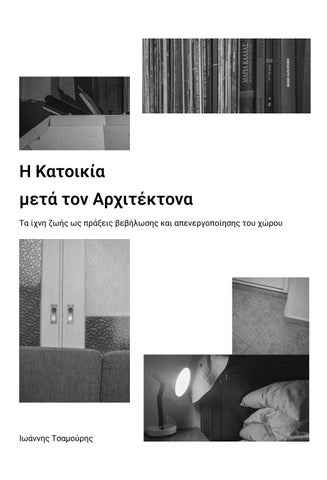
Abstract
This research investigates the dynamic relationship between architectural design and the everyday practices of inhabitants. Through the philosophical lens of Giorgio Agamben, it interprets the "traces of life" (material modifications, reappropriations of use, etc) in the domestic space as acts of profanation of the "sacred" initial design and inoperosity of its predetermined function.
The research is based on a comparative qualitative analysis of five (5) residential cases in Athens. The methodology employs ethnographic techniques, including semi-structured interviews, in-situ observations, and visual documentation, to capture the lived reality of space use. The analysis reveals how these practices constitute a critical response to issues such as the negotiation of privacy, the longevity of the building stock, and the limitations of standardized design.
As a final conclusion, the work proposes a framework of design principles for a "pre-deactivated" dwelling, where human adaptability is integrated as a fundamental parameter. The aim is to contribute to the scientific dialogue on the future of housing by proposing flexible architectural frameworks that legitimize and encourage the creative reuse of space.
Keywords
Profanation, Inoperosity, Traces of Life, Dwelling, Architectural Design, Adaptability
Abstract

1. Jeremy Till, Architecture Depends (Cambridge, MA: MIT Press, 2009)
2. Henri Lefebvre, The Production of Space, trans. Donald Nicholson-Smith (Oxford: Blackwell, 1991)
3.
4.
5.
Με τον όρο «βιώμενος χώρος» (represensational space) ακολουθώντας την θεώρηση

6.
Giorgio Agamben, Profanations, μτφρ. Jeff Fort (New York: Zone Books, 2007). Κατά τον Agamben, η «βεβήλωση»
7.
Giorgio Agamben, "On Potentiality." In Potentialities: Collected Essays in Philosophy, ed. and trans. Daniel Heller-Roazen (Stanford, CA: Stanford University Press, 1999).


9.
μελέτης περιπτώσεων (comparative multiple-case study), βλέπε: Robert K. Yin, Case Study Research: Design and Methods, 3rd ed. (Thousand Oaks, CA: Sage Publications, 2003), σ. 47-55
10. Daniel Miller (ed.), Home Possesions: Material Culture Behind Closed Doors (Oxford: berg 2001)
11. Leonardo Chiesi and Paolo Costa, "How Design Is Appropriated: Understanding Habitation through the Observation of Situated Behavior," Social Sciences 12, no. 6 (2023): 319, https:// doi.org/10.3390/ socsci12060319

12.
(purposive sampling)
στην
βλ. Michael Quinn Patton, Qualitative Research & Enviromental Methods, 3rd ed. (Thousand Oaks, CA: Sage Publications, 2002), σ. 230-246.
13.
Paul. C. Glick, ''The Family Cycle'', American Sociological Review 12, no.2 (1947): σ.164-174. Ο
Glick
14. Norman K. Denzin, The Research Act: A Theoritical Introduction to Sociological Methods, 2nd ed. (New York: McGraw-Hill, 1978) σ. 297-311
15.


Περίπτωση 5

Περίπτωση 1
Περίπτωση 4
Περίπτωση 2
16. Norman K. Denzin, The Research Act: A Theoritical Introduction to Sociological Methods, 2nd ed. (New York: McGraw-Hill, 1978) Κεφ.13 σ. 314
Agamben.


Giorgio Agamben:
17.
Giorgio Agamben, Profanations, σ. 73 και σ.83-85
18.
Giorgio Agamben, Profanations, σ. 73

19. Giorgio Agamben, In Potentialities: Collected Essays in Philosophy, σ. 177


20. Jeremy Till, Architecture Depends
21. Charles Jencks και Nathan Silver, Adhocism: The Case for Improvisation (London: Secker & Warburg, 1972), σ.15-19. Οι
22. NJ. Habraken, Supports: An Alternative to Mass Housing, trans.B. Valkenburg (London: The Architectural Press, 1972)


23. Henri Lefebvre, The Production of Space
Henri Lefebvre:
24. Michel de Certeau, The Practice of Everyday Life, trans. Steven Rendall (Berkeley: University of California Press, 1984) σ. 35-44
Michel de Certeau:


25. Leonardo Chiesi και Paolo Costa, ''How Design Is Appropriated: Understanding Habitation through the Observation of Situated Behaviour,'' Social Sciences 12, no. 6 (2023).
(potential space/design intentions)
(actual space/lived experience)
26. Henri Lefebvre, The Production of Space
27. Michel de Certeau, The Practice of Everyday Life, trans. Steven Rendall (Berkeley: University of California Press, 1984) σελ. 35-44
28.
NJ. Habraken, Supports: An Alternative to Mass Housing, trans.B. Valkenburg (London: The Architectural Press, 1972)
29.
Jeremy Till, Architecture Depends
30.
Giorgio Agamben, Profanations, σελ. 73
31.
Giorgio Agamben, In Potentialities: Collected Essays in Philosophy, σελ. 177

32. Giorgio Agamben, Profanations, σ. 73
33. Giorgio Agamben, In Potentialities: Collected Essays in Philosophy, σ. 177
34.
Michel Foucault, Discipline and Punish: Birth of the Prison, trans. Alan Sheridan (New York: Vintage Books, 1977) σ. 200-202. Ο Foucalt
Jeremy Bentham (1791)
Cecelia Tichi, Electronic Hearth (New York: Oxford University Press, 1991).
David Morley, Family Television: Cultural Power and Domestic Leisure (London: Comedia, 1986)
36.


37. Edward T. Hall, The Hidden Dimension (New York: Anchor Books, 1966), σ. 119-120. Ο Hall υιοθετεί τον όρο «Personal Distance» από τον βιολόγο Heini Hediger, προσαρμό
(protective sphere)
38. Giorgio Agamben, Profanations, σ. 73
39. Giorgio Agamben, In Potentialities: Collected Essays in Philosophy, σ. 177
40.
Jeremy Till, Architecture Depends, σ. xi-xii
41.
Clare Cooper Marcus, House as a Mirror of Self: Exploring the Deeper Meaning of Home (Lake Worth, FL: Nicolas-Hays, Inc., 2006), σ. 10-15.
42.
(2019-2020).
43, Giorgio Agamben, State of Exemption. trans. Kevin Attell (Chicago: University of Chicago Press, 2005), σ.
44.
Martin Heidegger, Poetry, Language, Thought, trans. Albert Hofstadter (New York: Harper Colophon Books, 1971), σ. 143-149.
45.
Daphne Spain, Gendered Spaces (Chapel Hill: University of North Carolina Press, 1992), σ. 7 και 122-124.


46. Martin Heidegger, Poetry, Language, Thought, σ. 143-149.
47.
Claude Lévi-Strauss, The Savage Mind (London: Weidenfeld and Nicolson, 1966), σ.17. Ο όρος bricolage εισήχθη
από τον Lévi-Strauss
για να περιγράψει τη
δημιουργία μέσω όλων των διαθέσιμων μέσων (whatever is at hand).
48. Till, Architecture Depends, σ.135-146.
49. Giorgio Agamben, Profanations, σ. 73
50. Michel Foucault, Discipline and Punish: Birth of the Prison, σ. 200-202.
51.
Sigmund Freud, The Uncanny, trans. David McLintock (London: Penguin, 2003), σ. 132-134.
(unheimlich)
52.
Giorgio Agamben, The Time that Remains: A Commentary on the Letter to the Romans, trans. Patricia Dailey (Stanford: Stanford university Press, 2005), σ. 53-55. Ο Agamben
(remnant),


53.
Juhani
Pallasmaa, The eyes of the skin (2005).
54.
Giorgio Agamben, In Potentialities: Collected Essays in Philosophy, σ. 177
55.
Giorgio Agamben, Profanations, σ. 83-85.
56.
57.
58.
σ. 73
σ. 83-85.
Bruno Latour, Reassembling the Social: An introduction to Actor Network-Theory (Oxford: Oxford University Press, 2005), σ. 70-72. Σύμ
(Actor Network Theory),
59.
Giorgio Agamben, State of Exemption, σ. 1-5.


60. Giorgio Agamben, Profanations, σ. 73.
61. Στο ίδιο.
62. Στο ίδιο, σ. 83-85
63. Giorgio Agamben, In Potentialities: Collected Essays in Philosophy, σ. 177
64.
Giorgio Agamben, Profanations, σ. 73.
65.
Michael Thompson, Rubbish Theory: The creation and Destruction of Value (Oxford: Oxford university Press, 1979), σ. 9-13.
66.
Giorgio Agamben, Profanations, σ. 73.
67.
Giorgio Agamben, State of Exemption, σ. 1-5
68.
Henri Lefebvre, Rhythmanalysis: Space, Time and Everyday Life, trans. Stuart Elden and Gerald Moore (London: Continuum, 2004), σ. 16-18.


N.J. Habraken,
NJ. Habraken, Supports: An Alternative to Mass Housing

Αίσωπος,
Αθήνα: Metapolis Press / Δομές, 2001.
Αίσωπος,
Αρχιτεκτονική 1960-1990, Αθήνα: Metapolis Press, 2002.
Γιαννακόπουλος,
γίας, Αθήνα: Αλεξάνδρεια, 2006.
Θεοχαροπούλου, Ιωάννα, Χτίστες, νοικοκυρές
Αθήνα: Στέγη Ιδρύματος Ωνάση / Εστία, 2022.
Κάλφα, Κωνσταντίνα, Αυτοστέγαση
στην Ελλάδα, Αθήνα: Futura, 2019.
Κοτιώνης, Ζήσης, Η τρέλα του τόπου: Αρχιτεκτονική στο ελληνικό τοπίο
2004.
Λαδά, Σάσα (επιμ.), Κατοικία: σχεδιάζω,
University Studio Press, 2015.
Σταυρίδης,
[Frampton, Kenneth].
University Studio Press, 2023.
2009.
Agamben, Giorgio. Homo Sacer: Sovereign Power and Bare Life. Translated by Daniel HellerRoazen. Stanford, CA: Stanford University Press, 1998.
Agamben, Giorgio. "On Potentiality." In Potentialities: Collected Essays in Philosophy, edited and translated by Daniel Heller-Roazen. Stanford, CA: Stanford University Press, 1999.
Agamben, Giorgio. Profanations. Translated by Jeff Fort. New York: Zone Books, 2007.
Agamben, Giorgio. State of Exception. Translated by Kevin Attell. Chicago: University of Chicago Press, 2005.
Agamben, Giorgio. The Time that Remains: A Commentary on the Letter to the Romans. Translated by Patricia Dailey. Stanford, CA: Stanford University Press, 2005. Bachelard, Gaston. The Poetics of Space. Translated by Maria Jolas. Boston: Beacon Press, 1994.
Benjamin, Walter. The Arcades Project. Translated by Howard Eiland and Kevin McLaughlin. Cambridge, MA: Belknap Press, 1999.
Brand, Stewart. How Buildings Learn: What Happens After They're Built. New York: Viking, 1994.
Buch, Elana D. "Anthropology of Aging and Care." Annual Review of Anthropology 44 (2015)
Chiesi, Leonardo, and Paolo Costa. "How Design Is Appropriated: Understanding Habitation through the Observation of Situated Behavior." Social Sciences 12, no. 6 (2023): 319. https:// doi.org/10.3390/socsci12060319.
Cooper Marcus, Clare. House as a Mirror of Self: Exploring the Deeper Meaning of Home. Lake Worth, FL: Nicolas-Hays, Inc., 2006.
De Certeau, Michel. The Practice of Everyday Life. Translated by Steven Rendall. Berkeley: University of California Press, 1984.
Denzin, Norman K. The Research Act: A Theoretical Introduction to Sociological Methods. 2nd ed. New York: McGraw-Hill, 1978.
Douglas, Mary. Purity and Danger: An Analysis of Concepts of Pollution and Taboo. London: Routledge, 1966.
Evans, Robin. "Figures, Doors and Passages." Architectural Design 48, no. 4 (1978): 267–278.
Foucault, Michel. Discipline and Punish: The Birth of the Prison. Translated by Alan Sheridan. New York: Vintage Books, 1977.
Freud, Sigmund. The Uncanny. Translated by David McLintock. London: Penguin, 2003.
Glick, Paul C. "The Family Cycle." American Sociological Review 12, no. 2 (1947)
Habraken, N. John. The Structure of the Ordinary: Form and Control in the Built Environment. Edited by Jonathan Teicher. Cambridge, MA: MIT Press, 1998.
Hall, Edward T. The Hidden Dimension. New York: Anchor Books, 1966. Heidegger, Martin. Poetry, Language, Thought. Translated by Albert Hofstadter. New York: Harper Colophon Books, 1971.
Hill, Jonathan. Actions of Architecture: Architects and Creative Users. London: Routledge, 2003.
Jencks, Charles, and Nathan Silver. Adhocism: The Case for Improvisation. London: Secker & Warburg, 1972.
Latour, Bruno. Reassembling the Social: An Introduction to Actor-Network-Theory. Oxford: Oxford University Press, 2005.
Lefebvre, Henri. The Production of Space. Translated by Donald Nicholson-Smith. Oxford: Blackwell, 1991.
Lefebvre, Henri. Rhythmanalysis: Space, Time and Everyday Life. Translated by Stuart Elden and Gerald Moore. London: Continuum, 2004.
Lévi-Strauss, Claude. The Savage Mind. London: Weidenfeld and Nicolson, 1966.
Miller, Daniel, ed. Home Possessions: Material Culture Behind Closed Doors. Oxford: Berg, 2001.
Morley, David. Family Television: Cultural Power and Domestic Leisure. London: Comedia, 1986.
Pallasmaa, Juhani. The Eyes of the Skin: Architecture and the Senses. Chichester: WileyAcademy, 2005.
Patton, Michael Quinn. Qualitative Research & Evaluation Methods. 3rd ed. Thousand Oaks, CA: Sage Publications, 2002.
Perec, Georges. Species of Spaces and Other Pieces. Translated by John Sturrock. London: Penguin, 1997.
Pink, Sarah, et al. Anthropologies and Futures: Researching Emerging and Uncertain Worlds London: Routledge, 2017.
Schneider, Tatjana, and Jeremy Till. Flexible Housing. Oxford: Architectural Press, 2007. Sennett, Richard. Building and Dwelling: Ethics for the City. London: Allen Lane, 2018.
Spain, Daphne. Gendered Spaces. Chapel Hill: University of North Carolina Press, 1992.
Thompson, Michael. Rubbish Theory: The Creation and Destruction of Value. Oxford: Oxford University Press, 1979.
Tichi, Cecelia. Electronic Hearth: Creating an American Television Culture. New York: Oxford University Press, 1991.
Till, Jeremy. Architecture Depends. Cambridge, MA: MIT Press, 2009.
Whyte, Jessica. Catastrophe and Redemption: The Political Thought of Giorgio Agamben. Albany: SUNY Press, 2013.
Yanagi, Soetsu, The Beauty of Everyday Things, trans. Michael Brase, London: Penguin Classics, 2019.
Yin, Robert K. Case Study Research: Design and Methods. 3rd ed. Thousand Oaks, CA: Sage Publications, 2003
χάρτ.
Περίπτωση
σκ.1.
(1791).
Willey Reveley
Commons).
6.
Περίπτωση 2: Η κατοικία ως «καταφύγιο»
σκ.3.
εργασίας. 11-14. ARCHIVE: OBJECTS AS POTENTIALITY. Η ύλη ως δυνατότητα / Η συσ-
Περίπτωση 3: Η κατοικία ως «κληρονομιά»
σκ.4. Κάτοψη σκ. 5. Κάτοψη έπειτα
18-29. ARCHIVE: MATTER OUT OF PLACE.


Agamben