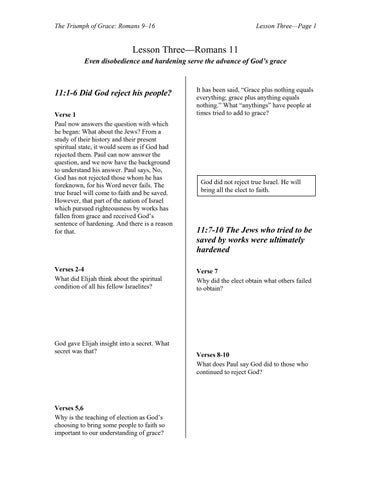
Lesson Three Romans 11
Even disobedience and hardening serve the advance of God’s grace
11:1-6 Did God reject his people?
Verse 1
Paul now answers the question with which he began: What about the Jews? From a study of their history and their present spiritual state, it would seem as if God had rejected them. Paul can now answer the question, and we now have the background to understand his answer. Paul says, No, God has not rejected those whom he has foreknown, for his Word never fails. The true Israel will come to faith and be saved. However, that part of the nation of Israel which pursued righteousness by works has fallen from grace and received God’s sentence of hardening. And there is a reason for that.
It has been said, “Grace plus nothing equals everything; grace plus anything equals nothing.” What “anythings” have people at times tried to add to grace?
Verses 2-4
What did Elijah think about the spiritual condition of all his fellow Israelites?
God did not reject true Israel. He will bring all the elect to faith.
11:7-10 The Jews who tried to be saved by works were ultimately hardened
Verse 7
Why did the elect obtain what others failed to obtain?
God gave Elijah insight into a secret. What secret was that?
Verses 5,6
Why is the teaching of election as God’s choosing to bring some people to faith so important to our understanding of grace?
Verses 8-10
What does Paul say God did to those who continued to reject God?
Read Matthew 13:9-16.
“Whoever has ears to hear, let him hear.”
10 The disciples came and said to him, “Why do you speak to them in parables?”
11 He answered them, “To you it has been given to know the mysteries of the kingdom of heaven, but it has not been given to them.
12 For whoever has will be given even more, and he will have an abundance. But whoever does not have, even what he has will be taken away from him. 13 This is why I speak to them in parables, because even though they see, they do not see; and even though they hear, they do not hear or understand. 14 In them the prophecy of Isaiah is fulfilled which says,
You will hear clearly, but you will never understand. You will see clearly, but you will never perceive. 15 Because this people’s heart has grown callous, their ears are hard of hearing. They have closed their eyes. Otherwise they would see with their eyes, hear with their ears, understand with their heart, turn, and I would heal them.
16 “But blessed are your eyes because they see and your ears because they hear.”
Discuss why Jesus told parables. (Note: In these verses Jesus is saying the same thing Paul says in Romans 11.)
11:11
The key verse of Romans 9–11
Everything Paul has said in chapters 9 to 11 leads up to this verse. Note: The NIV translation doesn’t do justice to verse 11. It reads, “Did they stumble so as to fall beyond recovery?” Substitute the following: “Did Israel stumble so that they might fall?” The point is not whether the Israelites fell beyond recovery or can still come to faith. The point is that God caused them to stumble over Christ and hardened them in their impenitence so that his elect might come to faith, not so that they themselves would fall.
EHV: “Did they stumble in order to fall permanently?”
God sent a “stupor” on those who tried to be justified by their works. He hardened their hearts and made it impossible for them to hear the gospel and come to faith.
Verse 11
What two reasons does Paul give for the Lord hardening the impenitent Jews?
Compare verse 11 to 9:17. How is the history of Pharaoh, king of Egypt, parallel to that of the Jews whom God hardened?
Romans 9:17
Indeed, the Scripture says in regard to Pharaoh, “For this very purpose I caused you to stand, that I may demonstrate my power in how I deal with you, and that my name may be proclaimed in all the earth.”
How will Paul’s making much of his ministry to the Gentiles make Israel envious? (See 10:19.)
Romans 10:19
Yet I ask, did Israel not understand? First, Moses says:
I will make you jealous of those who are not a nation; I will make you angry with a nation that does not understand.
Verses 16-24
God hardened impenitent Israel so that he could take the gospel from them and give it to the Gentiles. However, in giving the gospel to the Gentiles, God’s ultimate purpose is to make his own people Israel envious of the Gentiles, and in this way lead them to faith.
Even today the Jews have a special place in God’s eyes. Abraham is pictured as the firstfruits of the dough and the roots of the olive tree. Since the Jews are linked to Abraham, they are special in God’s eyes.
Explain the picture of the natural olive branches and the wild olive branches
11:12-24 God hardened the Jews not just for the sake of the Gentiles, but for the sake of the Jews as well
Verses 12-15
What does Paul mean when he speaks of making much of his ministry to the Gentiles?
What warning does Paul give his gentile converts?
Israel is the natural olive tree. Hardened Israel was broken off so the Gentiles could be grafted in. But an Israelite who gives up his unbelief can readily be grafted in again. And a Gentile who becomes proud and self-righteous will be broken off.
11:25-32 God’s dealings with Israel and the Gentiles in a nutshell
Verse 28 “enemies for your sake” “dear for the sake of the patriarchs”
Verse 29 “not regretted”
Verses 25-29
Note the following key words:
Verse 25 “mystery” “hardening of part of Israel”
Verses 30-32
How did God hand all people over to disobedience?
Verse 26 “in this way” “all Israel”
God has used Israel’s rejection of him in order to create a situation where all the elect Jews and Gentiles will be saved. He has made it clear to all people that they are disobedient so that all will appreciate his grace.
11:33-36 Paul’s hymn of praise
In the context of Romans 9–11, what aspect of God’s wisdom and knowledge is Paul praising?
All glory to God for working in such a marvelous way!
Summary
God patiently waited for Israel to repent. But they did not. So he hardened them so that the gospel would go to the Gentiles. In turn, this would make Israel envious. In this way God would fulfill his promise to purify Israel by bringing them to faith.
For next time
Read the following sections of Scripture about spiritual gifts: 1 Corinthians 12 and Ephesians 4:1-16.
Romans 11 (EHV)
11
God Graciously Chose a Remnant
So I say, did God reject his people? Absolutely not! For I myself am an Israelite, a descendant of Abraham from the tribe of Benjamin. 2God did not reject his people whom he foreknew or don’t you know what Scripture says about Elijah, how he was pleading with God against Israel: 3“Lord, they have killed your prophets and torn down your altars. I am the only one left, and they are trying to take my life.” 4But what did God’s answer tell him? “I have reserved for myself seven thousand men who have not bowed the knee to Baal.”
5So in the same way at the present time there is a remnant chosen by grace. 6Now if it is by grace, then it is not the result of works otherwise grace would no longer be grace.
God Planned a Way to Recover Some Hardened Jews
7What then? Israel did not receive what it was striving to get. The elect did, but the rest were hardened. 8Just as it is written:
God gave them a spirit of stupor, eyes that do not see and ears that do not hear, right up to the present day.
9And David says:
Let their table be a trap and a net, and a snare and a retribution for them.
10Let their eyes be darkened so they do not see, and let their backs be always bent.
11So I ask, “Did they stumble in order to fall permanently?” Absolutely not! Rather, by their trespass, salvation came to the Gentiles to make the Israelites jealous. 12Now if their trespass meant riches for the world, and their failure meant riches for the Gentiles, how much more will their fullness mean!
13I am speaking to you Gentiles. For as long as I am an apostle to the Gentiles, I am going to speak highly of my ministry. 14Perhaps I may make my own people jealous, and so save some of them. 15For if their rejection meant the reconciliation of the world, what does their acceptance mean other than the dead coming to life?
Gentiles Should Not Become Proud
16If the part offered as firstfruits is holy, so is the whole batch. And if the root is holy, so are the branches. 17But if some of the branches were broken off, and you a wild olive branch were grafted in among them and share in the rich sap from the root of the olive tree, 18do not boast that you are better than the branches. If you do boast, remember that you are not supporting the root, but the root is supporting you. 19Then you will say: “Branches were broken off so that I am grafted in.” 20That is true but remember that they were broken off because of unbelief, and you remain in place by faith. Do not be conceited, but stand in awe. 21For if God did not spare the natural branches, he will not
spare you. 22So take note of God’s kindness and his severity: severity on those who have fallen, but God’s kindness on you if you remain in his kindness; otherwise, you also will be cut off.
Some Jews Will Be Grafted in Again
23And if they do not remain in unbelief, those branches will be grafted in again, because God is able to graft them in again. 24For if you were cut off from a wild olive tree and, contrary to nature, were grafted into a cultivated olive tree, how much more easily will these natural branches be grafted back into their own olive tree?
25For I do not want you to be uninformed about this mystery, brothers, so that you are not conceited in your opinion of yourselves. There has been a hardening of part of Israel until the full number of Gentiles has come in. 26And in this way all Israel will be saved, as it is written:
The Deliverer will come out of Zion; he will remove ungodliness from Jacob.
27And this is my covenant with them when I take away their sins.
The Paradox of How God Shows Mercy
28In regard to the gospel, they are enemies for your sake. But, in regard to election, they are especially dear for the sake of the patriarchs, 29because God’s gracious gifts and call are not regretted. 30For just as you were once disobedient to God, but now have been shown mercy due to their disobedience, 31so also now they have become disobedient, so that by the mercy shown to you they may be shown mercy too. 32For God imprisoned all in disobedience so that he may show mercy to all.
33Oh, the depth of the riches and wisdom and knowledge of God! How unsearchable are his judgments and how untraceable his ways!
34“For who has known the mind of the Lord, or who has been his adviser?”
35“Or who has first given to God that he will be repaid?”
36For from him and through him and to him are all things. To him be the glory forever! Amen.