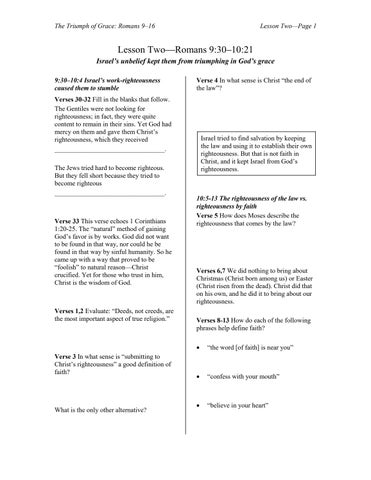
Lesson Two Romans 9:30–10:21
Israel’s unbelief kept them from triumphing in God’s grace
9:30–10:4 Israel’s work-righteousness caused them to stumble
Verses 30-32 Fill in the blanks that follow. The Gentiles were not looking for righteousness; in fact, they were quite content to remain in their sins. Yet God had mercy on them and gave them Christ’s righteousness, which they received
The Jews tried hard to become righteous. But they fell short because they tried to become righteous .
Verse 33 This verse echoes 1 Corinthians 1:20-25. The “natural” method of gaining God’s favor is by works. God did not want to be found in that way, nor could he be found in that way by sinful humanity. So he came up with a way that proved to be “foolish” to natural reason Christ crucified. Yet for those who trust in him, Christ is the wisdom of God.
Verses 1,2 Evaluate: “Deeds, not creeds, are the most important aspect of true religion.”
Verse 4 In what sense is Christ “the end of the law”?
Israel tried to find salvation by keeping the law and using it to establish their own righteousness. But that is not faith in Christ, and it kept Israel from God’s righteousness.
10:5-13 The righteousness of the law vs. righteousness by faith
Verse 5 How does Moses describe the righteousness that comes by the law?
Verse 3 In what sense is “submitting to Christ’s righteousness” a good definition of faith?
Verses 6,7 We did nothing to bring about Christmas (Christ born among us) or Easter (Christ risen from the dead). Christ did that on his own, and he did it to bring about our righteousness.
Verses 8-13 How do each of the following phrases help define faith?
• “the word [of faith] is near you”
• “confess with your mouth”
• “believe in your heart”
What is the only other alternative?
• “everyone who believes in him”
• “gives generously to all who call on him”
Agree or disagree:
Verses 9 and 10 contain an excellent encouragement for us to do evangelism work.
What does it mean that the person who trusts in Jesus will never be put to shame? In what sense is the word shame used here?
The righteousness of the law says “Do.”
The righteousness by faith says “Don’t do just trust, believe, call on God.”
10:14-17 God loudly proclaimed his gospel in the hearing of all the Jews
Verses 14,15 At the end of verse 15 Paul writes, “How beautiful are the feet of those who bring good news!” What point does Paul make by quoting this passage from Isaiah 53?
God sent preachers who proclaimed his message of salvation to Israel. This is how faith should have been brought to life in their hearts. But they did not believe.
10:18-21 The Old Testament proves God’s loving care and concern for Israel
How do each of the four Old Testament passages Paul quotes show that God was absolutely serious about saving every last member of his chosen nation?
• Verse 18 “The sound of their voice went out.”
• Verse 19 “I will make you angry with a nation that does not understand.” (Hint: See Paul’s introduction to this verse.)
• Verse 20 “I was found by those who were not looking for me . . . [or] asking for me.”
Verses 16,17 Did Israel have ample opportunity to hear the gospel and come to faith?
• Verse 21 “All day long I stretched out my hands.”
Where did the problem lie with God’s lack of zeal and seriousness for the Jews or with the Jews themselves?
The Jews both heard and understood the message (after all, it was so simple that an unlearned Gentile could under-stand it). But they rebelled against it.
In chapter 9 Paul had said God’s Word never fails. His elect always come to faith. In this chapter Paul has told us the Jews did not come to faith because of their own stubborn rebellion God had given them everything they needed to be saved.
We are saved by grace alone; God wants all to be saved. Both truths are bulwarks to our faith, even though we cannot reconcile them.
In the next chapter Paul will bring both truths together and use them in a pastoral way as he deals with his beloved gentile Christians and Jewish brothers.
Summary
God blessed Israel with the gospel and with men who preached the gospel to them. But they continued in workrighteousness and rebelled against God’s message of grace.
For next time
1. Reread Romans 9–11. Try to follow Paul’s overall discussion.
2. Read Isaiah 1 and 5:1-7, which speak about Israel and Judah’s spiritual condition. Note how these sections reinforce the fact that God did everything necessary for Israel’s salvation.
Romans 9:30–10:21 (EHV)
The Majority of Jews Rejected Justification by Faith
30What shall we say then? That Gentiles, who were not pursuing righteousness, have obtained righteousness, a righteousness that is by faith. 31But Israel, while pursuing the law as a way of righteousness, did not reach it. 32Why? Because they kept pursuing it not by faith, but as if it comes by works. They stumbled over the stumbling stone. 33Just as it is written:
Look, I am putting a stone in Zion over which they will stumble and a rock over which they will fall.
The one who believes in him will not be put to shame.
Prayer for Israelites to Believe
10 Brothers, my heart’s desire and prayer to God on behalf of the Israelites is that they may be saved. 2Indeed, I testify about them that they have a zeal for God, but it is not consistent with knowledge. 3Since they were ignorant of the righteousness from God and sought to establish their own righteousness, they did not submit to the righteousness from
God. 4For to everyone who believes, Christ is the end of the law, resulting in righteousness.
5Indeed, Moses writes this about the righteousness that comes by the law: “The one who does these things will live by them.” 6But the righteousness that comes by faith speaks like this: “Do not say in your heart, ‘Who will ascend into heaven?’ ” (that is, to bring Christ down) 7“or ‘Who will descend into the abyss?’ ” (that is, to bring Christ up from the dead). 8But what does it say? “The word is near you, in your mouth and in your heart,” that is, the word of faith that we are proclaiming. 9Certainly, if you confess with your mouth that Jesus is Lord and believe in your heart that God raised him from the dead, you will be saved. 10For it is with the heart a person believes, resulting in righteousness, and it is with the mouth that a person confesses, resulting in salvation.
11For Scripture says, “Everyone who believes in him will not be put to shame.”
12So there is no distinction between Jew and Greek, because the same Lord is Lord of all, who gives generously to all who call on him. 13Yes, “Everyone who calls on the name of the Lord will be saved.”
Israel Rejected the Message God Sent
14So then, how can they call on the one they have not believed in? And how can they believe in the one about whom they have not heard? And how can they hear without a preacher? 15And how can they preach unless they are sent? Just as it is written, “How beautiful are the feet of those who preach the good news of peace, who preach the gospel of good things!”
16But not all obeyed the gospel. For Isaiah says, “Lord, who believed our message?” 17So then, faith comes from hearing the message, and the message comes through the word of Christ.
18But I ask, did they not hear? Of course, they certainly did. The sound of their voice went out to all the earth, and their words to the farthest parts of the world.
19Yet I ask, did Israel not understand? First, Moses says: I will make you jealous of those who are not a nation; I will make you angry with a nation that does not understand.
20And Isaiah also boldly says: I was found by those who were not looking for me; I became well known to those who were not asking for me.
21But about Israel he says: All day long I stretched out my hands to a people who disobey and oppose me.