Lesson 1 Grace Makes All the Difference
Worship Read responsively (Psalm 32:1-8,11). Blessed is the one whose transgressions are forgiven, whose sins are covered. Blessed is the one whose sin the LORD does not count against them and in whose spirit is no deceit. When I kept silent, my bones wasted away through my groaning all day long. For day and night your hand was heavy on me; my strength was sapped as in the heat of summer. Then I acknowledged my sin to you and did not cover up my iniquity. I said, “I will confess my transgressions to the LORD.” And you forgave the guilt of my sin. Therefore let all the faithful pray to you while you may be found; surely the rising of the mighty waters will not reach them. You are my hiding place; you will protect me from trouble and surround me with songs of deliverance. I will instruct you and teach you in the way you should go; I will counsel you with my loving eye on you. Rejoice in the LORD and be glad, you righteous; sing, all you who are upright in heart! Prayer: Lord, I confess that I am by nature sinful and unclean. Yet you have cleansed me freely with the blood of Jesus and declared me to be righteous in your sight. Help me, Lord, to rejoice in your forgiveness so that I live a confident and joyous life in Christ, my Savior. Amen.
© 2021 Northwestern Publishing House. All rights reserved. Reprinted by permission
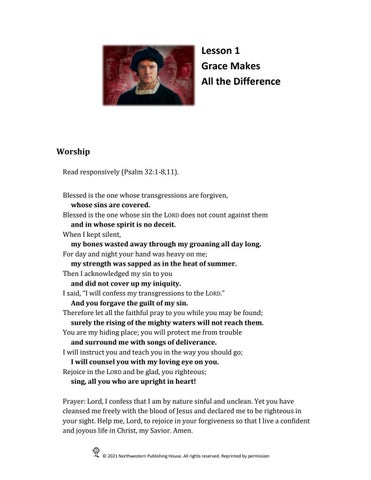
Introduction Luther was caught in a lightning storm and feared that he would die. He knew that if he died, he could not stand before God’s holy judgment. After the storm he decided to become a monk so he could be acceptable to God. But no matter how much he did, he still was unworthy and feared God’s punishment. You may have had the same feelings at some point, or perhaps someone you know may be fearful of God’s judgment. We cannot do enough good to stand before a holy God. Luther found that the answer was not in himself or what he did, but in what God did. He sent his Son Jesus to pay for all our failures and sins and give us forgiveness, life, and salvation. Luther understood that this truth was central to our hope of salvation and needs to be the foundation upon which the church is built. This truth was worth risking his life to proclaim.
We cannot achieve enough to win God’s approval. 1. Romans 3:9-18 very pointedly reminds us why we are unable to stand before God’s holy judgment. Read the passage and create a list of sins you see in our world that reflect the truth taught in this passage.
2. It is easy to find examples of sin in our world today, but Paul wrote, “There is no one who does good, not even one” (v. 12). No one? Really? Why are you included in the condemnation?
3. Read Isaiah 64:6. How does this passage help you understand the terror and despair that Luther felt about God’s attitude toward the sinner?
Here We Stand
2
4. If that were all you knew of God, would you feel the same as Luther did? Why?
5. What can we do? Most people today have their own ideas about how to answer that question. When they think of facing such a righteous God, what solutions do many people offer? (Consider eulogies you may have heard at funerals.)
6. Read Romans 3:19,20. Identify the flaws in the natural human response to the question.
God gives us the gift of righteousness freely through faith. 7. The despair that was evident in Luther’s life initially was the result of misunderstanding the law and the gospel. Ultimately, that is the end result of all human answers to the question: What can we do? Read Psalm 130:3,4. How does this passage dispel that despair?
8. Having the right answer to the question is the key to our salvation. Read Romans 3:21-25. Here God spells out his solution for sinners. Explain what it is. How is it different from human solutions?
Here We Stand
3
9. Read Romans 4:4,5. In your own words explain what the passage means to you.
10. How could you explain this gift of God to a friend troubled by sin and trying to become acceptable to God by his or her efforts?
11. Justification—“the righteousness that comes from God”—has changed our priorities. Read Philippians 3:7-9. Using Paul’s words as a guide, give specific examples of how justification has changed your priorities and attitudes.
Here We Stand
4
12. Read 1 Peter 1:3-9. Complete the following sentence. I can praise God for his gift of justification even when I face trials and troubles in life because . . .
13. Luther was also changed. He wrote, “For where there is such faith and confidence there is also a bold, defiant, fearless heart that risks all and stands by the truth, no matter what the cost, whether it is against pope or king, as we see that the dear martyrs did. For such a heart is satisfied and serenely sure that it has a gracious, kindly-disposed God. Therefore, he despises all the favors, grace, goods, and honor of men, and does not attach any value to these transitory things” (Luther’s Works, Vol. 44, p. 112). How does justification help us understand Luther at Worms?
Supplemental Questions: Luther wrote about the righteousness we receive from God, “Through faith in Christ, therefore, Christ’s righteousness becomes our righteousness and all that he has becomes ours; rather, he himself becomes ours” (Luther’s Works, Vol. 31, p. 298).
1. Where and when does justification take place?
2. Agree or disagree. Justification and salvation is a process that requires our free cooperation with God’s grace. Explain your answer.
3. How does the legal definition, declared righteous, help us understand what God did for us? How would you comfort someone who is troubled that life is so messed up God couldn’t forgive him or her?
Here We Stand
5
4. Faith is believing in something. Does it matter what you believe? Is any faith important? Explain your answer.
5. Does the church dispense forgiveness to those who deserve it? Explain your answer. When and how does the church dispense forgiveness?
6. Nine years after Luther’s confession at Worms, the churches again confessed their faith at Augsburg (1530). The article on justification reads: Our churches teach that people cannot be justified before God by their own strength, merits, or works. People are freely justified for Christ’s sake, through faith, when they believe that they are received into favor and that their sins are forgiven for Christ’s sake. By his death, Christ made satisfaction for our sins. God counts this faith for righteousness in his sight (Romans 3 and 4). (Augsburg Confession Article IV) Why is it necessary to repeat our confession of justification by faith in our own age?
Additional Reading: Justification: How God Forgives, by Wayne Mueller. A volume of the People’s Bible Teaching series from Northwestern Publishing House (NPH). God So Loved the World, by Lyle Lange, pp. 335-368. Grace Abounds: The Splendor of Christian Doctrine, by Daniel Deutschlander, pp. 347-408. “Two Kinds of Righteousness,” from Luther’s Works, Vol. 31, pp. 295-306. “The Disputation Concerning Justification,” from Luther’s Works, Vol. 31, pp. 145-196. This reading can provide significant additional questions to explore in another Bible class.
Here We Stand
6
Romans 3:9-18 9 What then? Are we any better off? No, not at all! In fact, we have already made the charge that all (both Jews and Greeks) are under sin. 10 Just as it is written: There is no one who is righteous, not even one. 11 There is no one who understands. There is no one who searches for God. 12 They all turned away; together they became useless. There is no one who does what is good; there is not even one.[d] 13 Their throat is an open grave. They kept deceiving with their tongues. The poison of asps is on their lips.[e] 14 Their mouth is filled with cursing and bitterness.[f] 15 Their feet are quick to shed blood. 16 They leave a trail of destruction and suffering wherever they go. 17 The way of peace they did not know.[g] 18 There is no fear of God in front of their eyes.[h] Isaiah 64:6 6 All of us have become like something unclean, and all our righteous acts are like a filthy cloth.[a] All of us have withered like a leaf, and our guilt carries us away like the wind. Romans 3:19-30 19 Now we know that whatever the law says is addressed to those who are under the law,[i] so that every mouth will be silenced and the whole world will be subject to God’s judgment. 20 For this reason, no one[j] will be declared righteous in his sight by works of the law, for through the law we become aware of sin. Psalm 130:3-4 3 If you, LORD, kept a record of guilt, O Lord, who could stand? 4 But with you there is pardon, so you are feared. Romans 3:21-25 21 But now, completely apart from the law, a righteousness from God has been made known. The Law and the Prophets testify to it. 22 This righteousness from God comes through faith in Jesus Christ to all and over all[k] who believe. In fact, there is no difference, 23 because all have sinned and fall short of the glory[l] of God 24 and are justified[m] freely by his grace through the redemption that is in Christ Jesus, 25 whom God publicly displayed as the atonement seat[n] through faith in his blood. God did this to demonstrate his justice, since, in his divine restraint, he had left the sins that were committed earlier unpunished. Romans 4:4-5 4 Now to a person who works, his pay is not counted as a gift but as something owed. 5 But to the person who does not work but believes in the God who justifies the ungodly, his faith is credited to him as righteousness.
Here We Stand
7
Philippians 3:7-9 7 But, whatever things were a profit for me, these things I have come to consider a loss because of Christ. 8 But even more than that, I consider everything to be a loss because of what is worth far more: knowing Christ Jesus, my Lord. For his sake, I have lost all things and consider them rubbish, so that I may gain Christ 9 and be found in him, not having a righteousness of my own, which comes from the law, but that which comes through faith in Christ, the righteousness that comes from God by faith. 1 Peter 1:3-9 3 Blessed be the God and Father of our Lord Jesus Christ! By his great mercy he gave us a new birth into a living hope through the resurrection of Jesus Christ from the dead, 4 into an inheritance that is undying, undefiled, and unfading, kept in heaven for you. 5 Through faith you are being protected by God’s power for the salvation that is ready to be revealed at the end of time. 6 Because of this you rejoice very much, even though now for a little while, if necessary, you have been grieved by various kinds of trials 7 so that the proven character of your faith—which is more valuable than gold, which passes away even though it is tested by fire—may be found to result in praise, glory, and honor when Jesus Christ is revealed. 8 Though you have not seen him, you love him. Though you do not see him now, yet by believing in him, you are filled with a joy that is inexpressible and filled with glory, 9 because you are receiving the goal of your faith, the salvation of your souls.
Here We Stand
8