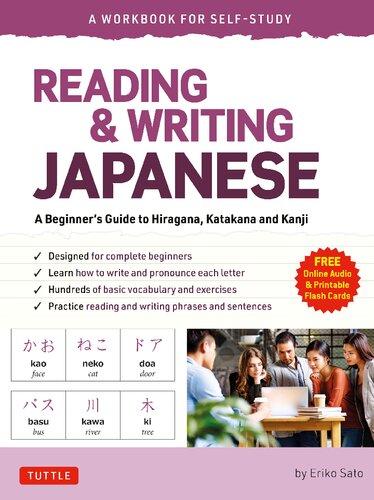
READING & WRITING JAPANESE
A Beginner’s Guide to Hiragana, Katakana and Kanji
by Eriko Sato
Illustrations by Anna Sato
TUTTLE Publishing
Tokyo Rutland, Vermont Singapore
Introduction
Modern Japanese is written horizontally or vertically by combining three types of scripts. These are kanji ( ), Chinese characters adapted to Japan, and two sets of phonetic symbols called kana ( ), which are hiragana ( ) and katakana ( ). These three types of scripts are mixed not only within sentences, but also within words. For example, the Japanese word that means “eraser” (keshigomu) is written as follows:
kanjihiraganakatakana
The rst element of the word, , is a kanji character representing the concept of “erasing.” The second is the hiragana character (shi ). It represents the sound “shi,” the in ectional part of the Japanese verb kesu, which means “to erase.” The third and fourth elements, (gomu), are katakana. Together, they represent the sound of the word "gum," loaned from English.
Hiragana and katakana each have 46 basic characters in modern Japanese, and the average Japanese person can read 1,000 to 2,000 kanjicharacters. However, if you learn the 50 most frequently used kanjicharacters and develop a thorough understanding of how kanjiare formed and used, you can understand about 30 percent of the texts in Japanese magazines. Building a solid foundation is the key to success! This workbook lets you master all hiragana and katakana characters and the 50 simplest, most basic, and/or most frequently used kanjicharacters, along with over 500 vocabulary words.
How to use this book
This book has three parts:
Part One: Hiragana
Part Two: Katakana
Part Three: Kanji
Each part consists of fteen short lessons. Most lessons are only two pages long and are placed on facing pages, except when there is an extensive instruction or explanation. Each of the rst ten lessons in each part introduces just three to ve new characters. This makes it easy for you to focus on the lessons one at a time.
Romanization is used as the preliminary pronunciation guide in Part One and partially in Part Two. You won’t see any romanization after that. Hiragana characters are used as the pronunciation guide in Part Three. Although the focus in Part Three is on kanji, practice exercises include a mixture of hiragana, katakana and kanji. Thus, it is essential to nish Part One completely before starting Parts Two and Three.
This book is accompanied by online audio recordings for almost all the exercises, which can be accessed via the link on page 12. As you learn the characters, you can learn more than 500 basic Japanese vocabulary words with authentic pronunciation. To help you learn vocabulary easily, words are introduced in thematic groups wherever possible.
Before you begin, let’s talk a little about the history and usage conventions of the Japanese writing system.
The history of the Japanese writing system
The ancient Japanese did not have their own scripts; they borrowed Chinese characters. The rst text from Japan dates to the fth century. During the sixth and seventh centuries, Chinese Buddhism was brought to Japan via Korea, making it necessary for the Japanese to read a large number of Chinese texts, or kanbun ( ). These were read in one of two ways: ondoku ( , sound reading) or kundoku ( , gloss reading). Kanbun-ondoku ( ), the sound reading of Chinese texts, involved reading sentences with their original pronunciation, word order and grammar, just as any second-language learner of Chinese would do. On the other hand, kanbun-kundoku ( ), the gloss reading of Chinese texts, involved reading the Japanese translation for Chinese words and sentences, a kind of instant mental translation of Chinese texts to Japanese.
Chinese and Japanese have very di erent vocabulary words, grammar and word order. For kanbun-kundoku reading, the reader had to quickly revise the word order, add needed Japanese particles and in ectional endings and replace many words with Japanese translation equivalents—all accomplished mentally and verbalized instantaneously. To facilitate this acrobatic mental translation, the ancient Japanese often used kunten ( ), a system of guiding marks for altering Chinese sentences into Japanese in terms of grammar and pronunciation along with gloss annotations.
In kanbun-kundoku readings, it wasn’t always easy to come up with an equivalent Japanese word for each Chinese word, which led to neo-borrowings from Chinese, where Chinese words were read with a Japanese accent. Kanbun-kundoku reading led to the Japanese assigning one or more pronunciations to each kanji. The pronunciation of a kanjicharacter based on the vocalized Japanese translation equivalent is called kun'yomi ( ). The pronunciation of a kanjicharacter based on the approximation of the original Chinese pronunciation is called on'yomi ( ). For example, the kanji character (mountain) is read as in kun'yomi and as in on'yomi.
Kanbun-kundoku reading resulted in the creation of numerous loan words from Chinese. The words written in kanjiand pronounced with their on’yomi have been called kango ( ), or Sino-Japanese vocabulary. The kunten annotation method employed in the kanbun-kundoku practice contributed to the development of kanacharacters.
How about writing? The ancient Japanese initially used kanjiexclusively in writing texts because there were no other scripts. In some places in a sentence, they would use kanji based on meaning; in other places they would use kanji based on sound—this sound-based writing system was called many gana ( ). For example, the Japanese word yama (mountain) could be written with the kanji for its meaning, because this character means “mountain” in Chinese, but it could also be written with a sequence of two kanjicharacters—for example, , or —whose combined pronunciation is ya-ma. The strange part is that these kanjicharacters are totally unrelated to the idea of “mountain”: (ya) means “night”; (ma) means “hemp”; (ya) means “ eld”; and (ya) means “to be.” The following poem, found in Japan’s oldest literary
san On´yomi
yama kun´yomi
rst used by Portuguese traders and missionaries who came to Japan in the seventeenth century. The romanization system based on English that is most prevalent in Japan is Hepburn romanization. This system is attributed to the American missionary James Hepburn (1815–1911), who created it in the process of compiling the rst Japanese-English dictionary in 1867.
Often, in romanized Japanese, especially in language-learning texts like this one, a long vowel is represented by a bar, called a macron, on top of that vowel. For example, ob san (grandmother) has a long vowel whereas obasan (aunt) doesn’t.
Japan’s current writing system
Currently, kanji is used to represent words and names from Japanese and Chinese culture; katakana is used to represent words and names from non-Chinese foreign culture; and hiragana is used to specify grammatical particles, su xes, pre xes, sentence-endings, and words and names in Japanese that are not covered by kanji or katakana. R maji characters are used on signs at airports and train stations to assist foreign travelers.
As of 2010, there are 2,136 kanji characters listed as j y kanji ( , daily-use kanji) by the Japanese Ministry of Education. There are 46 basic hiragana and 46 basic katakana listed in common syllabary tables like the one below (hiragana on the left and katakana on the right): (n) (wah) (rah) (yah) (mah) (hah) (nah) (tah) (sah) (kah) (ah) (ree) (mee) (hee) (nee) (chee) (shee) (kee) (ee) (roo) (yoo) (moo) (foo) (noo) (tsoo) (soo) (koo) (oo)
(seh) (keh) (eh) ([w]oh) (roh) (yoh) (moh) (hoh) (noh) (toh) (soh) (koh) (oh)
You’ll learn how to read and write these kana characters in Part One and Part Two of this book. Then, in Part Three, you’ll learn 50 basic kanji characters.
Additional background on kanji
Kanji characters are slightly more complex in terms of their structure and usage. The following is an overview of their internal structures, the way they are used in Japanese writing systems, and the way they are combined to create new meanings.
The formation of Chinese characters
Kanji are Chinese characters adapted to Japan. These originated in their initial form in the Yellow River region of China between 2000 and 1500 BC. Chinese characters can be classi ed into four main categories: pictorial characters ( , sh kei-moji); indicative characters ( , shiji-moji); compound ideographic characters ( , kaii-moji); and phonetic-ideographic
characters ( , keisei-moji). Pictorial characters originated from pictures of objects or phenomena. For example:
(mountain) (river) (tree) (sun) (moon)
Indicative characters were created as symbolic representations of abstract concepts using points and lines. For example: (one) (two) (three) (above/up) (below/down)
Compound ideographic characters were formed by combining multiple pictorial or indicative characters to bring out a new but simple idea. For example: (woods) (forest) (bright)
(tree + tree )(tree + tree + tree)(sun + moon)
Phonetic-ideographic characters were formed by combining an element of meaning and an element of sound. For example, the following characters all stand for some body of water: (inlet) (ocean) (river) (water + )(water + )(water + )
The left side of each character, , shows that the character’s meaning is related to water, and the right side of each character, , , or , shows how the character should be pronounced.
On-reading and kun
-reading
The Japanese language is very di erent from the Chinese language, having distinct sounds and syllable structures in addition to its own vocabulary and grammar. When Chinese characters were adapted to Japanese as kanji, they were assigned on-reading ( on'yomi) and kun-reading ( kun'yomi) pronunciations. As discussed earlier, the on-reading is the approximation of the Chinese pronunciation of a character and the kun-reading is the pronunciation of the existing native Japanese word whose meaning is similar to the given character. For example, the on-reading of the character (mother) is bo, and its kun-reading is haha. In most cases, on-readings are used when the kanji character is a part of a kanji compound word, but kun-readings are used in other contexts. This can be seen in the following sentence, which reads, “My mom’s mother country is America.”
kun-readingon-reading
Note that some kanji characters have more than one on-reading or kun-reading, and there are many exceptional readings, which will be discussed later.
Okurigana
Chinese verbs and adjectives do not require in ectional endings, but Japanese verbs and adjectives do. When a Japanese verb or adjective is written in kanji, the in ectional ending is written in kana. Such kana are called okurigana. In modern Japanese, hiragana is used for this purpose. For example, the Japanese verb that means “to walk” has di erent forms; the rst part ( ) is written in kanji and the rest is written in hiragana:
(aruku) walk, walks, will walk (aruita) walked
Similarly, the Japanese adjective that means “expensive” has di erent forms; the rst part ( ) is written in kanji and the rest is written in hiragana:
(takai) is expensive, are expensive (takakatta) was expensive, were expensive
As you can see, a kanji character and the okurigana jointly represent the whole Japanese word, along with the in ectional information. Okurigana are also used for some adverbs (e.g., , kanarazu, absolutely) and nouns (e.g., , ugoki, movement).
Furigana
Kanji characters are occasionally accompanied by kana that show how they should be read. Kana used as a pronunciation guide in this way are called furigana . These are used in newspapers for unusual readings and for characters not included in the j y -kanji discussed earlier. Japanese manga use furigana a lot! Elementary kanji textbooks also include furigana. Furigana are written above kanji in horizontal writing, and beside kanji in vertical writing, as shown below.
Ateji
Ateji are kanji or kanji compounds that have a meaning or pronunciation unrelated to that of their source kanji. For example, the kanji compound is an ateji. It was assigned to represent the Japanese word sushi because of its sound, ignoring the actual meaning of the kanji that constitute it. In fact, means “one’s natural lifespan” and means “to administer.” Neither is directly related to food, but their sounds, “su” and “shi,” are perfect for representing “sushi.”
Another example of ateji is the combination of the three kanji characters . This compound was assigned to the Japanese word samidare (early summer rain), because of the meanings of the kanji characters, which are “ ve/ fth,” “month,” and “rain,” irrespective of their sounds. The kanji phrase literally means “May rain,” which is perfect for representing the meaning of samidare. This type of ateji is also called jukujikun ( ).
Ateji may occasionally be used for non-Chinese loan words. For example, is an ateji for b ru (beer): means “wheat” and means “liquor,” so it is a perfect choice to represent “beer,” although, again, it does not re ect the pronunciation of these two kanji characters. Learning ateji o ers insight into the passion that the Japanese have for using kanji.
Kokuji
Many kanji characters were created in Japan by combining existing kanji characters, or components of a kanji character, following the basic principles of the formation of Chinese characters shown on page 8. These are called kokuji ( ). For example, the kanji (mountain pass) is a kokuji. It was created by combining three kanji characters: (mountain), (up), and (down); it is read as t ge, which is the Japanese word for mountain pass. In other cases, the pronunciation of the kokuji is based on the on-reading of its main component. For example, the medical term (gland), is read as sen because that is the on-reading of the component . The following are some examples of kokuji:
(t ge, mountain pass): combination of (mountain), (up), and (down) (shitsuke, discipline): combination of (body) and (beauty) (iwashi, sardines): combination of ( sh) and (weak) (tara, cod sh): combination of ( sh) and (snow) (namazu, cat sh): combination of ( sh) and (wish) (sen, gland): combination of (radical for body) and (spring) (sui, pancreas): combination of (radical for body) and (collect)
Kokuji show how the Japanese people of the past made an e ort to use kanji as much as possible when expressing concepts in writing.