g ourmand
Good Living Guide
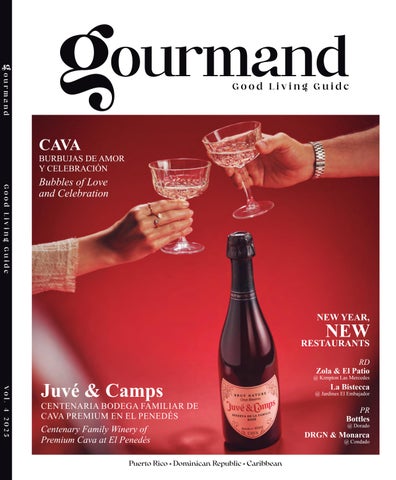
CAVA BURBUJAS DE AMOR Y CELEBRACIÓN Good Living Guide
Bubbles of Love and Celebration
NEW YEAR,
NEW RESTAURANTS RD Zola & El Patio @ Kimpton Las Mercedes
Vol. 4 2025
Juvé & Camps CENTENARIA BODEGA FAMILIAR DE CAVA PREMIUM EN EL PENEDÉS
Centenary Family Winery of Premium Cava at El Penedés Puerto Rico • Dominican Republic • Caribbean
La Bistecca @ Jardines El Embajador
PR Bottles @ Dorado
DRGN & Monarca @ Condado
Somos parte de tu destino
Estadía Café
Disfruta de una y aroma de
entre montañas
Hacienda Moraica es una hospedería & hacienda de café ubicada en Orocovis, Puerto Rico. Cuenta con 25 habitaciones, restaurante, piscinas, canchas de juego, área de pesca, centro de entretenimiento & experiencias de café.
Villas Hay formas de ir a Europa y solo una de volar aireuropa.com
Experiencias Hospedería Recorridos de Café Experiencia “Farm to Table” Campamento de Café Restaurante & Barra Bodas & Eventos
La Heredad
Finca Reservas
Carr. 157 Bo. Cacao km.2.9, Orocovis, 00720 787- 688- 4188 haciendamoraica.com @haciendamoraica Hacienda Moraica
Somos parte de tu destino
Hay formas de ir a Europa y solo una de volar aireuropa.com g ourmand
3
Carta de la Directora Director’s Letter
Querida comunidad Gourmand,
Dear Gourmand community,
Llegamos a nuestra cuarta edición en un momento del año que invita a brindar, a reunirnos alrededor de la mesa y a celebrar con burbujas los pequeños y grandes logros compartidos. En el Caribe, la Navidad se vive con una energía luminosa y generosa; es una temporada donde la gastronomía se convierte en lenguaje común y cada copa alzada cuenta una historia.
We have arrived at our fourth edition at a time of year that invites us to raise a glass, gather around the table and celebrate with bubbles the small and great achievements we share. In the Caribbean, Christmas is lived with a luminous and generous energy; it is a season when gastronomy becomes a universal language and every lifted glass tells a story.
En esta edición especial, las burbujas de celebración son las protagonistas. El Cava, elegante y vibrante, se presenta como el hilo conductor de nuestro recorrido editorial, acompañando la cocina festiva, los encuentros memorables y la coctelería clásica que vuelve a cobrar protagonismo en mesas y barras de todo el mundo. Más que una bebida, el cava simboliza el espíritu de estas fechas: frescura, tradición y la alegría de compartir.
In this special edition, bubbles of celebration take center stage. Cava—elegant and vibrant—emerges as the guiding thread of our editorial journey, accompanying festive cuisine, memorable encounters, and classic cocktail culture, which once again takes pride of place on tables and behind bars around the world. More than a drink, cava embodies the spirit of the season: freshness, tradition, and the joy of sharing.
Nuestro destino destacado nos lleva al corazón del Penedès, en Cataluña, una región donde la tierra, el clima y el saber hacer se unen para dar vida a algunos de los Cavas más emblemáticos. Exploramos sus paisajes, sus bodegas y las experiencias gastronómicas que nacen alrededor del vino, conectando la tradición catalana con una mirada contemporánea y cosmopolita que dialoga con la gastronomía internacional.
Our featured destination leads us to the heart of Penedès, in Cataluña, a region where land, climate and craftsmanship come together to give life to some of the most iconic Cavas. We explore its landscapes, its wineries, and the gastronomic experiences that unfold around wine, connecting Catalan heritage with a contemporary, cosmopolitan perspective that dialogues with international gastronomy.
Desde el Caribe para el mundo, Gourmand continúa siendo un punto de encuentro para quienes entienden la gastronomía como una experiencia cultural, sensorial y emocional. Que esta edición los inspire a descubrir nuevos destinos, a brindar con intención y a disfrutar de la Navidad con todos los sentidos.
From the Caribbean to the world, Gourmand continues to be a meeting point for those who understand gastronomy as a cultural, sensory, and emotional experience. May this edition inspire you to discover new destinations, to toast with intention, and to enjoy the Christmas season with all your senses.
Levantemos la copa y celebremos juntos esta temporada especial. Con gratitud y entusiasmo,
Let us raise our glasses and celebrate this special season together. With gratitude and enthusiasm,
Contenido
Content Nuevo Año, Nuevos Restaurantes New Year, New Restaurants
RD
• Zola • El Patio • La Bistecca
PR
• Bottles Dorado • DRGN • Monarca
10 D.O. CAVA El espumoso Español y El Penedés The Spanish Sparking Wine and Penedes
44 JUVÉ & CAMPS Meritxell Juvé nos habla de esta centenaria bodega familiar y su Cava Brut Nature
48 g ourmand
Meritxell Juvé tells us about this century-old family winery and its Brut Nature Cava
HELICAVE La revolución silenciosa del vino en casa The silent revolution of wine at home
72 GREEN BOWL Y TABLEHOOD Donde comer saludable no tiene por qué ser aburrido Where eating healthy doesn’t have to be boring
84 JUAN VALDEZ CAFÉ Inaugura su primera tienda en Santiago Opens its first store in Santiago
92 7
Good Living Guide
Puerto Rico • Dominican Republic • Caribbean DIRECTORA • DIRECTOR Roselyn O’neil EDITORA • EDITOR Yvonne Brown Ieromazzo PERIODISTA • STAFF WRITER Orlando Jerez DISEÑO • DESIGN Albert Polanco AUTORES INVITADOS • GUEST WRITERS Thomas Sartori Spot 21 • Hospitality Lab Carlos Mejía Mixólogo de Model M.I.X. FOTOGRAFÍA • PHOTO Juve & Camps, Javier Celado, Julio César Peña, Il Bacareto, Campari, Model Mix, Kimpton , La Bistecca, Bottles, DGN, Monarca, Vinseum, GreenBowl, Tablehood, Juan Valdez, Casa de Campo Resort & Villas, APUGA, Casarré, Helicave / Vinotilus EDITORIAL info@gourmandintl.net VENTAS • SALES sales@gourmandintl.net REP. DOMINICANA José Eduardo García 849-450-2579 PUERTO RICO Lourdes Rivera 787-402-0433 GOURMAND ES UNA PUBLICACIÓN DE
C/ 2, Villa Marina Sur, No. 8, Sto. Dgo. D.N, República Dominicana Tel.: 829-688-0256 @Gourmandintl • https://issuu.com/gourmandguideintl Gourmand Prohíbe la reproducción total o parcial de su portada, artículos y secciones fijas de la misma. No se hace responsable de las opiniones vertidas por los colaboradores o encuestas realizadas en sus artículos.
g ourmand
9
Nuevo Año, Nuevos Restaurantes New Year, New Restaurants
Con la llegada de un nuevo año, es muy común pensar en todas aquellas experiencias que nos gustaría vivir en los próximos 365 días.
With the arrival of a new year, it is very common to think about all those experiences that we would like to live in the next 365 days.
Tu lista para el 2026 debe incluir restaurantes que nunca has visitado y que se distingan por su creatividad, variedad y calidad, lo que te brindará la oportunidad de probar sabores alucinantes, combinaciones originales y maridajes espectaculares.
Your list for 2026 must include going to restaurants that you’ve never visited which stand out for their creativity, variety and quality, giving you the opportunity to try amazing flavors, original combinations and spectacular pairings.
Aquí te incluimos algunos de los restaurantes más interesantes que han abierto recientemente en la República Dominicana y Puerto Rico.
Here are some of the most interesting restaurants that have recently opened in Puerto Rico and the Dominican Republic.
Así que, en vez de seguir repitiendo los mismos de siempre, esperamos te animes a probar estas nuevas alternativas en tu próxima aventura gastronómica para que sigas expandiendo tus horizontes culinarios.
So, instead of repeating the same ones, time and time again, we hope you try these new alternatives on your next gastronomic adventure so that you continue expanding your culinary horizons.
g ourmand
República Dominicana
Zola
El Patio
La Bistecca
DRGN
Monarca
Puerto Rico
Bottles Dorado
11
ZOLA
Cocina italiana contemporánea en el corazón de la Ciudad Colonial Orlando Jerez
Zola llegó en julio de 2024 como un susurro italiano en pleno corazón de la Ciudad Colonial, donde lo viejo y lo nuevo se dan la mano para degustar sin prisa. Nacido dentro del exclusivo hotel boutique Kimpton Las Mercedes, este refugio del paladar promete una experiencia donde la tradición no es solo memoria, sino un puente hacia la exquisitez contemporánea. Desde su apertura, ha impresionado a los comensales dominicanos y visitantes con su fusión de tradición italiana con servicio impecable y una visión innovadora a cargo del Chef Cosimo Urso, un cocinero de Puglia que se trae a Santo Domingo su trayectoria internacional y su voluntad de casar raíces con creatividad.
g ourmand
Para el paladar exigente, Zola se lee como un poema de ingredientes: pastas hechas en casa que cantan al Mediterráneo, risottos que se nutren de mares y tierras, y una bodega que explora viñedos menos obvios, más secretos, lejos de la ruta masiva, para regalar sorbos de historia líquida. Sus muros coloniales gritan que Italia sabe a basílico, pomodoro y un toque de sal del mar; que es la patria de la pasta, el risotto y del buen vivir, invitando a un goce hedonista en la capital dominicana. Entre los platos que despiertan antojos, sobresale el risotto de chicharrones que elogian visitantes recientes. Es un sorpresivo giro caribeño al clásico del norte italiano, donde el cremoso arroz arborio se viste de crujiente dorado para lograr un contraste que abriga y sorprende.
Imaginemos también un plato de pasta al dente que se deja abrazar por mariscos locales, en una danza salada que habla de la costa; o un carpaccio de pescado del día, suave como un suspiro, apenas rociado con limón, pimienta negra y hojas verdes, todo ello pensado para que la frescura domine sin ser interrumpida por excesos. Y si el sibarita busca cerrar con un guiño dulce, el volcán de chocolate se presenta casi inevitable; un corazón fundido listo para derramarse, tal vez acompañado de helado artesanal o frutas de temporada, para que la dulzura se mezcle con el recuerdo del ambiente colonial iluminado. La atmósfera es otro ingrediente secreto: un salón elegante, posibles espacios al aire libre, barras con coctelería de autor, música y noches que combinan cena con fiesta discreta. Desde la primera mesa hasta el último sorbo de vino, Zola invita a un banquete donde Italia se saborea con lente caribeño, y donde cada plato es un verso dedicado al deleite. Considerada una joya del sello internacional Kimpton/IHG, Zola hoy se posiciona como una propuesta elegante y relevante dentro del renovado mapa gastronómico de Santo Domingo.
13
ZOLA
Contemporary Italian Cuisine in the Heart of the Colonial City Zola arrived in July 2024 as an Italian whisper in the very heart of the Colonial City, where the old and the new join hands to savor without haste. Born inside the exclusive Kimpton Las Mercedes boutique hotel, this refuge for the palate promises an experience where tradition is not merely memory, but a bridge toward contemporary exquisiteness. Since its opening, it has impressed Dominican diners and visitors alike with a fusion of Italian heritage, impeccable service, and an innovative vision led by Chef Cosimo Urso, a Puglia-born cook who brings to Santo Domingo his international trajectory and his desire to marry roots with creativity. For the discerning palate, Zola reads like a poem of ingredients: house-made pastas that sing of the Mediterranean, risottos nourished by sea and land, and a wine cellar that explores lesser-known, more secret vineyards—far from the mainstream path—offering sips of liquid history.
g ourmand
Its colonial walls seem to proclaim that Italy tastes of basil, pomodoro, and a touch of sea salt; that it is the homeland of pasta, risotto, and the art of good living, inviting hedonistic pleasure in the Dominican capital. Among the dishes that awaken cravings, the chicharrón risotto stands out, praised by recent visitors. It’s a surprising Caribbean twist on the northern Italian classic, where creamy arborio rice dresses itself in golden crunch, achieving a contrast that both comforts and surprises. Imagine a plate full of al dente pasta embraced by local seafood in a briny dance that speaks of the coast; or a fish carpaccio with the catch of the day, tender as a sigh, lightly sprayed with lemon, black pepper, and leafy greens, all crafted so that freshness reigns without excess. And for the sybarite wishing to end with a sweet wink, the chocolate lava cake becomes almost inevitable—a molten heart ready to overflow, perhaps accompanied by artisanal ice cream or seasonal fruit, letting the sweetness mingle with the memory of the softly lit colonial setting. The atmosphere is another secret ingredient: an elegant dining room, possible outdoor areas, author-driven cocktails at the bar, music, and nights that blend dinner with a discreet celebration. From the first table to the last sip of wine, Zola invites guests to a banquet where Italy is savored through a Caribbean lens, and where every dish is a verse dedicated to delight. Considered a gem of the international Kimpton/IHG brand, today Zola positions itself as an elegant and relevant offering within the renewed gastronomic map of Santo Domingo.
Calle Las Mercedes #155 Hotel Kimpton Las Mercedes Ciudad Colonial, Santo Domingo, RD (849) 512-5992 www.restaurantezola.com @zola.sdq @kimptonlasmercedes
15
EL PATIO
Fusión española con creatividad caribeña en el Kimpton El Patio es el más reciente espacio gastronómico del Hotel Kimpton Las Mercedes, inaugurado oficialmente en julio de 2025 con motivo de la celebración del primer aniversario del hotel. Aunque el Kimpton abrió sus puertas en 2024 como el primer hotel boutique de la marca en República Dominicana, El Patio representa una expansión de su oferta culinaria, enfocada en una fusión de comida dominico-española. Esto ha consolidado al hotel como un destino no solo de hospedaje, sino también como un centro de experiencias gastronómicas vibrantes en la Ciudad Colonial de Santo Domingo. El Patio combina lo mejor de una terraza al aire libre con áreas parcialmente techadas, ofreciendo un ambiente fresco, versátil y acogedor. Su propuesta culinaria se inspira en la cocina española con sabor local dominicano, integrando técnicas mediterráneas con ingredientes de la región. El menú está diseñado para compartir, con tapas, bocados y platos sociales que armonizan tradición e innovación.
g ourmand
Noches especiales De lunes a viernes, El Patio ofrece un atractivo 2x1 en cócteles de 6:00 p.m. a 10:00 p.m., ideal para after-work, grupos y encuentros casuales. Y los jueves, este encantador espacio se convierte en la noche más animada de la semana, con música en vivo, 2x1 en cócteles y parrillada. El Patio abre sus puertas todos los días, de 11 AM a 11 PM, para brindar un oasis en la Ciudad Colonial a los que quieran disfrutar de buena comida en un ambiente tropical muy especial. Se sugiere llamar o validar en redes sociales para confirmar disponibilidad, pues a veces cierra para eventos privados.
Bajo la dirección del Chef Cosimo Urso, la gastronomía de El Patio se presenta como una fusión equilibrada entre raíces europeas y creatividad caribeña. Urso —reconocido por su trabajo en Zola— aporta una visión culinaria contemporánea que se adapta perfectamente al ambiente del patio colonial. Diseñado como un bistró-lounge al aire libre, El Patio destaca por su atmósfera relajada rodeada de árboles de roble y mango, combinada con un espacio techado que permite disfrutar del lugar a cualquier hora del día. El entorno es ideal tanto para almuerzos informales como para cenas íntimas o encuentros sociales con música ambiente. Tentadora oferta gastronómica El menú combina tapas españolas —boquerones, pan con alioli y otros clásicos mediterráneos— con interpretaciones creativas de platos tradicionales dominicanos, incluyendo elaboraciones como ceviche, mini chimis, bollitos de yuca y otros bocados locales reinventados. Coctelería innovadora La barra del restaurante es un punto clave de su identidad, destacando por sus tragos artesanales elaborados con licores infusionados, frutas tropicales y técnicas contemporáneas. La carta está diseñada para acompañar la experiencia social y gastronómica del espacio, con opciones refrescantes y creaciones de autor.
17
EL PATIO Spanish Fusion with Caribbean Creativity at the Kimpton El Patio is the newest culinary space at the Kimpton Las Mercedes Hotel, officially inaugurated in July 2025 in celebration of the hotel’s first anniversary. Although the Kimpton opened its doors in 2024 as the brand’s first boutique hotel in the Dominican Republic, El Patio marks an expansion of its gastronomic offerings, focusing on a fusion of Dominican and Spanish cuisine. With this addition, the hotel reinforces its position not only as a lodging destination but also as a vibrant culinary hotspot in Santo Domingo’s Colonial City. El Patio blends the best of an open-air terrace with partially covered areas, creating a fresh, versatile, and welcoming atmosphere. Its culinary concept draws inspiration from Spanish cuisine with a Dominican twist, integrating Mediterranean techniques with local ingredients. The menu is designed for sharing, featuring tapas, bites, and social plates that harmonize tradition and innovation.
g ourmand
Under the guidance of Chef Cosimo Urso, El Patio’s cuisine presents a balanced fusion of European roots and Caribbean creativity. Urso—known for his work at Zola—brings a contemporary culinary vision that pairs perfectly with the ambiance of the colonial courtyard. Designed as an outdoor bistro-lounge, El Patio stands out for its relaxed atmosphere, surrounded by oak and mango trees, complemented by a covered area that makes it enjoyable at any time of day. The setting is ideal for casual lunches, intimate dinners, or social gatherings accompanied by ambient music. A Tempting Culinary Offering The menu brings together Spanish tapas —boquerones, pan con alioli, and other Mediterranean classics— with creative interpretations of traditional Dominican dishes, including ceviche, mini chimis, bollitos de yuca (cassava), and other reinvented local bites. Innovative Mixology The restaurant’s bar is a defining feature of its identity, showcasing handcrafted cocktails made with infused spirits, tropical fruits, and contemporary techniques. The drink menu is thoughtfully designed to complement the social and gastronomic experience of space, offering refreshing options and signature creations. Special Nights From Monday to Friday, El Patio features an appealing 2-for-1 on cocktails from 6:00 p.m. to 10:00 p.m., perfect for after-work gatherings, groups, and casual meetups. And on Thursdays, this charming space transforms into the liveliest night of the week, with live music, 2-for-1 cocktails, and a grill experience. El Patio is open daily from 11 AM to 11 PM, offering an oasis in the Colonial City for those looking to enjoy great food in a truly special tropical setting. Guests are encouraged to call or check social media for availability, as the venue occasionally closes for private events.
Calle Las Mercedes 155 Hotel Kimpton Las Mercedes Ciudad Colonial, Santo Domingo, RD (849) 512-5992 www.restaurantezola.com @elpatiosdq @kimptonlasmercedes
Calle Hotel Ciuda (849) www. @zola
19
LA BISTECCA Nuevo Italian Steak House con carnes premium a la leña Yvonne Brown Ieromazzo
Los amantes de la buena carne están de plácemes con la reciente apertura en Santo Domingo de La Bistecca. Tan pronto atraviesas su impactante puerta verde sabes que has llegado a un lugar muy singular. Localizado en Jardines de El Embajador, el nuevo Italian Steak House está especializado en cortes premium hechos a la leña, lo que añade aromas y sabores muy particulares a la carne, todo complementado con gastronomía italiana. Sus “signature dishes” son dos cortes Wagyu Americano de la reconocida marca SNAKE RIVER FARMS: Shell Steak — New York con hueso de 24 oz.— y Denver —corte sin hueso de 16 oz.— con ese toque mantequilloso tan característico del Wagyu. “Solo usamos leña local y tenemos un almacén donde la dejamos para secarse bien antes de traerla al restaurant. Y nunca rompemos la cadena de frío de nuestras carnes, ya que las mantenemos conservadas a una temperatura constante y de ahí van directo al fuego sin tener que congelarlas”, dice Antonio D’Accurso, co-dueño y chef del restaurant.
g ourmand
Nacido en Caracas de padres sicilianos, D’Accurso asegura que “La Bistecca nace del deseo de rendir homenaje a la tradición de la buena mesa italiana y la pasión por la carne”. Por eso, el menú incluye cortes italianísimos como la Cotoletta allá Milanesa (20 oz.), la Costata (ribeye con hueso de 16 oz.), y por supuesto, la reina de las carnes que la da el nombre al local: Bistecca Fiorentina, un magnífico porterhouse al estilo toscano de 24 oz. o 34 oz. Y todas se sirven con una salsa chimichurri especial con especies italianas, pistacchio y pignoli. La Bistecca también ofrece unos appetizers a base de carne: Carpaccio de Picaña, mucho más jugoso y sabroso que el tradicional por el marmoleado de la grasa; Crudo de Waygu, filete picado fino condimentado con sal y aceite de oliva servido sobre una galleta taralli original de Puglia, con yemita de huevo y picante italiano Nduja; y, Salsiccia della Casa, salchicha artesanal a base de cerdo al estilo siciliano. Una carne premium merece una guarnición de alto nivel, como el cremoso Fetuccini Alfredo al estilo tradicional, Patate all’Andrea (milhojas de papa con pancetta y crema de queso brie gratinado con parmesano), Puré de Papas trufadas y Espárragos con Pancetta al horno terminado con espuma de gorgonzola.
Y hay muchos otros platillos interesantes para degustar: Hamburguesa Italiana de 7 oz. en pan brioche con espuma de parmesano y pancetta, Branzino entero a la leña, varios tipos de carnes Alla Griglia (filetto di manzo, Picaña, Flap Meat, Tagliata Toscana, chuletón de cerdo) y Filetteria, un filetto di manzo con tres salsas a elegir—Pepe Verde, Noci e Gorngonzola o Tartufo. Para acompañar estas delicias, La Bistecca ofrece una carta de vinos variada, perfecta para maridar sus carnes. Y para terminar esta maravillosa comida, unos postres caseros que vale la pena probar: tiramisú al pistacchio, flan de mascarpone con dulce de leche, café affogato, mousse di cioccolato. En La Bistecca, cada plato es una celebración de lo artesanal, elaborado con respeto y amor. “Más que un restaurante, somos un espacio para disfrutar y celebrar la vida junto a las recetas de mi familia y de nuestra querida Italia”, añadió el chef D’Accurso.
21
LA BISTECCA New Italian Steakhouse Featuring Premium Wood-Fired Meats Meat lovers in Santo Domingo have a major reason to celebrate with the recent opening of La Bistecca. The moment you walk through its striking green door, you know you’ve stepped into a truly unique place. Located in Jardines de El Embajador, the new Italian Steak House specializes in premium wood-fired cuts, a technique that infuses the meat with distinctive aromas and flavors, all complemented by Italian cuisine. Its signature meat dishes feature two American Wagyu cuts from the renowned SNAKE RIVER FARMS brand: Shell Steak —a 24 oz. bone-in New York strip— and Denver —a 16 oz. boneless cut— with a buttery texture so characteristic of Wagyu. “We only use local wood, and we have a storage room where we let it dry properly before bringing it to the restaurant. And we never break the cold chain with our meats, as they’re kept at a constant temperature and go straight to the fire without ever being frozen,” says Antonio D’Accurso, the restaurant’s co-owner and chef. Born in Caracas to Sicilian parents, D’Accurso states that “La Bistecca was born from the desire to honor the tradition of fine Italian dining and a passion for great meat.”
g ourmand
And there are many more enticing dishes to try: a 7 oz. Italian Burger on brioche with parmesan foam and pancetta; whole wood-fired branzino; several Alla Griglia cuts (filetto di manzo, picanha, flap meat, tagliata Toscana, pork chop); and Filetteria, a filetto di manzo with a choice of three sauces—Green Pepper, Walnut & Gorgonzola, or Truffle. To accompany these delights, La Bistecca offers a varied wine list, perfect for pairing with their meats. And to finish a perfect meal, there are house-made desserts worth indulging in: pistachio tiramisu, mascarpone flan with dulce de leche, affogato coffee, chocolate mousse. At La Bistecca, every dish is a celebration of craftsmanship, prepared with care and love. “More than a restaurant, we are a place to enjoy and celebrate life through my family’s recipes and the traditions of our beloved Italy,” adds Chef D’Accurso.
That’s why the menu includes quintessential Italian cuts such as Cotoletta alla Milanese (20 oz.), Costata (16 oz. bone-in ribeye), and of course, the queen of meats that gives the restaurant its name: Bistecca Fiorentina, a magnificent Tuscan-style porterhouse available in 24 oz. and 34 oz. All are served with a special chimichurri made with Italian spices, pistachios, and pine nuts. La Bistecca also offers several meat-based appetizers: Picanha Carpaccio, richer and more flavorful than the traditional version thanks to its fat marbling; Wagyu Crudo, finely chopped raw filet seasoned with salt and olive oil and served on an original Pugliese taralli cracker with egg yolk and spicy Italian Nduja seasoning; and Salsiccia della Casa, a house-made Sicilian-style pork sausage. A premium cut deserves a high-level side dish, such as a creamy traditional Fettuccine Alfredo, Patate all’Andrea (potato mille-feuille with pancetta and Brie cream gratinée with parmesan cheese), truffled mashed potatoes, or oven-roasted asparagus with pancetta topped with a gorgonzola foam.
Jardines del Embajador Santo Domingo, RD (829) 481-2157 @labisteccard
23
C
M
Y
CM
MY
CY
CMY
K
g ourmand
25
BOTTLES
Esta icónica institución de gastronomía y vino en Guaynabo, ahora también deleita a Dorado Desde su fundación en 1996 como una tienda de vinos en Guaynabo, Bottles ha estado en continua evolución y expansión, hasta consolidarse como una de las instituciones gastronómicas más emblemáticas de Puerto Rico. Reconocido por su innovadora propuesta culinaria, servicio personalizado y una impresionante selección de vinos, Bottles ha marcado la pauta en la vibrante área de San Patricio. Hoy, tras casi tres décadas, inaugura un segundo espacio en Dorado, reafirmando su compromiso con el “fine dining and wining”. El nuevo restaurante y tienda de vinos, Bottles Dorado, llega con la misma filosofía que ha distinguido a la marca: una experiencia culinaria de primer nivel acompañada de una de las selecciones de vinos más completas de la Isla. “Bottles ha sido, por 29 años, un lugar donde la buena mesa y la pasión por el vino se encuentran. Abrir en Dorado representa un paso natural en nuestra evolución, acercándonos a una comunidad cosmopolita que valora la excelencia gastronómica”, expresó Robert Weakley, socio de Bottles.
g ourmand
“Siempre estamos escuchando a nuestros clientes e innovando para complacerlos. Tenemos un extenso menú con más de 75 platos y seguimos expandiendo nuestro portfolio de vinos italianos y franceses”, comentó Abe. Así han surgido nuevos platos como el Carpaccio Trio (salmon, pulpo y res) y el Egg Benedict Trio (salmón ahumado, Canadian bacon y burrata con tomate). Y aunque Bottles sigue creciendo —su capacidad sobrepasa las 540 personas entre ambos locales— estos siempre se enfocan en mantener la calidad que los distingue. Para estos fines, el Chef Trent Eichler lideró un proceso de entrenamiento intensivo durante siete meses para garantizar que los comensales de Dorado disfrutaran la misma experiencia culinaria que caracteriza a Guaynabo. También se adiestró al personal de servicio por varios meses antes de la apertura, asegurando un máxima estándar en cada detalle. De este modo, la tradición de excelencia gastronómica de Bottles continua viva, sea en Guaynabo o en Dorado.
Por su parte, Abe Ruiz, socio operador de la marca, destacó que esta nueva sede ofrecerá un ambiente bien similar, moderno y casual, pero regresando a su origen, pues cuenta con un área de deli, como fue en su origen: “Queremos que nuestros invitados sientan que Bottles Dorado es tanto un lugar para descubrir sabores y etiquetas únicas, como un espacio donde celebrar momentos especiales”. La propuesta de Bottles Dorado incluye un menú diseñado para resaltar ingredientes frescos y técnicas culinarias internacionales, acompañado de una enoteca que presenta etiquetas de todo el mundo seleccionadas por expertos sommeliers, incluyendo a Weakley, quien además de ser sommelier certificado, tiene vasta experiencia en restaurantes de Estados Unidos. Como parte de la expansión, Bottles Dorado también contará con un Deli & Butcher Shop, donde los visitantes podrán adquirir cortes de primera calidad, mariscos y pescados de temporada frescos, además de degustar los emparedados emblemáticos que lo han definido como un clásico. Todo ello enmarcado en un ambiente elegante y contemporáneo —ideal tanto para almuerzos ejecutivos como para cenas familiares y grupales— que busca mantener la esencia que siempre ha caracterizado a Bottles. La apertura de Bottles Dorado ocurre 9 meses después de que Weakley y Ruiz adquirieron Bottles Guaynabo en diciembre de 2024. Desde entonces, han realizado varios cambios a esa operación, y añadieron a su portafolio el restaurante DRGN en Condado. En el restaurante de Guaynabo, donde han operado los últimos 12 años, cambiaron la entrada y añadieron un “cigar area” exterior. Y ahora todos los lunes son “Prime Rib Night” y los domingos ofrecen un menú especial de brunch. También expandieron su horario para abrir los 7 días de la semana y ofrecen servicio de delivery, tanto de comida como de vino.
27
BOTTLES This iconic gastronomic and wine institution in Guaynabo, now also delights Dorado Since its founding in 1996 as a wine shop in Guaynabo, Bottles has been in constant evolution and expansion, ultimately becoming one of Puerto Rico’s most iconic gastronomic institutions. Renowned for its innovative culinary approach, personalized service, and impressive wine selection, Bottles has set the standard in the vibrant San Patricio area. Today, nearly three decades later, it inaugurates a second locale in Dorado, reaffirming its commitment to “fine dining and wining.” The new restaurant and wine shop, Bottles Dorado, embraces the same philosophy that has distinguished the brand: a top-tier culinary experience paired with one of the Island’s most comprehensive wine selections. “For 29 years, Bottles has been a place where great food and a passion for wine come together. Opening in Dorado represents a natural step in our evolution, bringing us closer to a cosmopolitan community that values culinary excellence,” said Robert Weakley, partner at Bottles. For his part, Abe Ruiz, the brand’s operating partner, emphasized that this new location will offer a similar modern and casual atmosphere, while returning to its origins with a deli area reminiscent of how it all began: “We want our guests to feel that Bottles Dorado is both a place to discover unique flavors and labels, and a space to celebrate special moments.”
g ourmand
“We are always listening to our customers and innovating to please them. We have an extensive menu with more than 75 dishes, and we continue expanding our portfolio of Italian and French wines,” Abe noted. This evolution has brought new dishes such as the Carpaccio Trio (salmon, octopus, and beef) and the Egg Benedict Trio (smoked salmon, Canadian bacon, and burrata with tomato). And although Bottles continues to grow—its capacity now exceeding 540 guests between both locations—the focus remains on maintaining the quality that sets it apart. To that end, Chef Trent Eichler led an intensive seven-month training process to ensure that diners in Dorado enjoy the same culinary experience that distinguishes Guaynabo. The service staff also underwent months of training before the opening, guaranteeing the highest standard in every detail. In this way, Bottles’ tradition of gastronomic excellence continues to thrive, whether in Guaynabo or in Dorado.
Bottles Dorado’s offering includes a menu designed to highlight fresh ingredients and international culinary techniques, accompanied by a wine shop featuring labels from around the world selected by expert sommeliers, including Weakley himself, who in addition to being a certified sommelier, has extensive experience in restaurants in the United States. As part of the expansion, Bottles Dorado will also feature a Deli & Butcher Shop, where visitors can purchase premium cuts of meat, fresh seasonal seafood and fish, and enjoy the emblematic sandwiches that have become a classic. All of this is set within an elegant, contemporary environment —ideal for business lunches as well as family and group dinners—carefully crafted to preserve the essence that has always characterized Bottles. The opening of Bottles Dorado comes nine months after Weakley and Ruiz acquired Bottles Guaynabo in December 2024. Since then, they have made several changes to that operation and added the restaurant DRGN in Condado to their portfolio.
Bottles Guaynabo 2 Cll Tabonuco, Suite 5 Guaynabo, PR (787) 775-1210
In the Guaynabo restaurant, where they have operated for the past 12 years, they relocated the main entrance and added an outdoor cigar area. Mondays are now “Prime Rib Night,” and Sundays feature a special brunch menu. They also extended their opening hours to seven days a week and offer delivery service for both food and wine.
Bottles Dorado Shopping Center, 500 PR-693 Suite 30, Dorado, PR (787) 796-3757 @bottlespr
29
DRGN
La nueva joya gastronómica de Condado donde el Chef Treviño le da alas a la cocina asiática creativa La escena gastronómica de San Juan recibe un impulso significativo con la llegada de DRGN, el nuevo concepto de cocina asiática creativa liderado por el reconocido Chef Roberto Treviño y localizado en el exclusivo hotel O:LV de Condado. Con una propuesta sofisticada y un diseño escénico impecable, DRGN se posiciona como uno de los destinos culinarios más exclusivos de Puerto Rico. El espacio destaca por su ambientación minuciosamente elaborada: una mezcla de lujo contemporáneo con guiños a la estética asiática, tonos borgoña, dorado y negro, lámparas escultóricas, espejos estratégicos y mobiliario elegante que envuelve al visitante en una experiencia sensorial completa. Todo diseñado para impresionar desde el primer vistazo. La visión detrás de esta nueva etapa combina la creatividad culinaria del Chef Treviño —quien revive y reinterpreta platos emblemáticos de su icónico Dragonfly— con el respaldo estratégico de Robert Weakley y Abelardo Ruiz, propietarios de Bottles y Bottles Dorado. Ambos aportan su vasta experiencia en hospitalidad, servicio y manejo de conceptos gastronómicos de alto volumen, fortaleciendo la operación, la calidad del servicio y la consistencia que distingue a DRGN en cada visita.
g ourmand
Combinación de técnica, memoria e innovación DRGN presenta una cocina asiática-latina contemporánea que rinde homenaje a los sabores que marcaron a toda una generación, pero reinterpretados con una ejecución más precisa, actual y audaz. El menú encuentra un equilibrio natural entre la nostalgia y la innovación, convirtiéndose en una experiencia atractiva tanto para quienes buscan reencontrarse con los platos emblemáticos del chef como para quienes desean explorar creaciones completamente nuevas.
Entre los estrenos culinarios más destacados de la temporada sobresalen: Crispy Rice Montadito Una versión moderna del clásico crispy rice, transformado en un montadito delicado donde la textura crujiente del arroz se combina con proteínas premium y acentos japoneses contemporáneos que aportan profundidad y contraste. Signature Peking Style Duck La interpretación personal del chef de una de las preparaciones más icónicas de Asia. Un plato de técnica refinada, piel perfectamente crujiente y una presentación que armoniza tradición, elegancia y carácter propio dentro del sello DRGN. El menú también incluye clásicos que ya celebran los comensales, como el Duck Fried Rice, el Nigiri de Pata Negra con caviar, los Pork & Amarillo Dumplings y el Churrasco con Ho Fun Noodles, consolidando una oferta variada, sofisticada y diseñada para complacer tanto a paladares curiosos como a amantes de la alta gastronomía. Platos que enriquecen la experiencia DRGN Además de sus platos insignia, DRGN incorpora una selección de creaciones que revelan la versatilidad del chef y la amplitud del concepto. Sea Bass al Vapor Se sirve con udon noodles en caldo shiro, acompañado de setas maitake y un puré de ajo negro, creando una combinación de sabores limpios, sofisticados y profundamente umami. Robata Colorado Lamb Chops Inspiradas en técnicas japonesas de robata, estas chuletas de cordero destacan por su cocción precisa y su textura jugosa. Se acompañan de batata tempura, haricots verts y una reducción de sake. Seared Bluefin Tuna Preparado con una técnica de sellado que conserva la frescura del atún, se presenta con kombu sauce, tobiko y wasabi peas, logrando un plato vibrante en sabor, textura y color. Kāo Churrasco Reinterpretación asiática de un clásico local: churrasco marinado y servido con ho fun noodles, salsa dulce de soja y un toque crujiente de chicharrón. Un ejemplo perfecto de cómo DRGN integra la fusión latina con técnicas modernas de la cocina asiática. A partir de esta temporada, el restaurant también abrirá los lunes, expandiendo así su operación para atender a los clientes los siete días de la semana y responder a la creciente demanda de experiencias de fine dining en el área de Condado. Hotel O:LV, Condado San Juan, Puerto Rico Horarios: lunes a domingo, 5:00 pm a 10:00 pm Reservations: 787-705-0820 o OpenTable @drgnrestaurant @olvhotel @chefrobertotrevino
31
ocina
o.
,
ción o con
nte a.
s
de en e alto a
DRGN
Condado’s new gastronomic jewel where Chef Treviño takes creative Asian cuisine to new heights San Juan’s culinary scene receives a notable boost with the arrival of DRGN, the new creative Asian cuisine concept led by renown Chef Roberto Treviño and located on the exclusive O:LV Hotel in Condado. With a sophisticated proposal and impeccable stage-like design, DRGN positions itself as one of Puerto Rico’s most exclusive dining destinations. The space stands out for its meticulously crafted ambiance: a blend of contemporary luxury and Asian-inspired aesthetics, featuring burgundy, gold, and black tones, sculptural lighting, layered mirrors, and elegant furnishings that envelop guests in a full sensory experience. All designed to impress from the very first moment. The vision behind this new chapter combines Chef Treviño’s culinary creativity—reviving and reinterpreting signature dishes from his iconic Dragonfly—with the strategic support of Robert Weakley and Abelardo Ruiz, owners of Bottles and Bottles Dorado. They both provide a vast expertise in hospitality, service, and high-volume culinary operations that strengthens DRGN’s execution, service quality, and the consistency that defines the experience in every visit.
g ourmand
A combination of technique, memory, and innovation DRGN showcases a contemporary Asian–Latin cuisine that pays homage to the flavors that shaped an entire generation, now reimagined with greater precision, modernity, and boldness. The menu strikes a natural balance between nostalgia and innovation, appealing to guests seeking the chef’s emblematic dishes as well as those eager to explore completely new creations. Among this season’s most notable debuts: Crispy Rice Montadito A modern take on the classic crispy rice, transformed into a delicate montadito where the crunchy texture meets premium proteins and contemporary Japanese accents that add depth and contrast. Signature Peking Style Duck The chef’s personal interpretation of one of Asia’s most iconic dishes. Refined technique, perfectly crisp skin, and a presentation that harmonizes tradition, elegance, and the distinctive character of DRGN.
The menu also includes some classics that are some of the guests’ favorites, such as Duck Fried Rice, Nigiri de Pata Negra with caviar, Pork & Amarillo Dumplings, and Churrasco with Ho Fun Noodles, solidifying a sophisticated and varied offering designed to please both adventurous palates and lovers of fine dining.
Chef Treviño
Dishes that Further Enrich the DRGN Experience In addition to its signature creations, DRGN incorporates a selection of dishes that reflect the chef’s versatility and the breadth of the concept. Sea Bass al Vapor Served with udon noodles in shiro broth, maitake mushrooms, and a black garlic purée, it delivers clean, sophisticated, deeply umami-rich flavors. Robata Colorado Lamb Chops Inspired by Japanese robata techniques, these lamb chops stand out for their precise cooking and succulent texture. It’s accompanied by tempura batata, haricots verts, and a sake reduction. Seared Bluefin Tuna Prepared using a high-heat sear that preserves the freshness of the tuna, served with kombu sauce, tobiko, and wasabi peas for a vibrant interplay of flavor, texture, and color. Kāo Churrasco An Asian reinterpretation of a local classic: marinated churrasco served with ho fun noodles, sweet soy sauce, and a crisp chicharrón finish. A perfect expression of DRGN’s Latin–Asian fusion approach. Beginning this season, the restaurant opens on Mondays as well, expanding its operation to serve guests seven days a week and responding to the growing demand for elevated dining experiences in the Condado area.
Josué Colón, Loisse Herger, Roberto Treviño, Robert Weakley, Abelardo Ruiz
Con más de dos décadas de trayectoria, Roberto Treviño es uno de los chefs puertorriqueños de mayor proyección internacional. Alcanzó reconocimiento global a través de programas como The Next Iron Chef, Beat Bobby Flay, Cooking Live y Food Nation, además de su recordada participación junto a Rachael Ray en $40 a Day. En Puerto Rico, su estilo de cocina asiática-latina redefinió el panorama gastronómico con conceptos icónicos como Parrot Club, Dragonfly y Budatai, que marcaron una era en el dining local. Su carrera también lo llevó a Florida Central, donde dirigió importantes cocinas y desarrolló nuevos conceptos, sin perder sus raíces ni su conexión con la isla. Con DRGN, Treviño regresa a Puerto Rico con una visión más depurada, contemporánea y segura que reafirma su legado como uno de los grandes innovadores culinarios de la región. With more than two decades of experience, Roberto Treviño is one of Puerto Rico’s most internationally recognized chefs. He has gained global visibility through programs such as The Next Iron Chef, Beat Bobby Flay, Cooking Live, Food Nation, and his memorable appearance alongside Rachael Ray on $40 a Day. In Puerto Rico, his Asian–Latin culinary style redefined the dining landscape through iconic concepts like Parrot Club, Dragonfly, and Budatai, which marked a pivotal era in local gastronomy. His career later took him to Central Florida, where he led major kitchens and developed new concepts—all while maintaining strong ties to Puerto Rico. With DRGN, Treviño returns to the island with a more refined, contemporary, and confident vision that reaffirms his legacy as one of the region’s great culinary innovators. 33
MONARCA
Un homenaje a la gastronomía y hospitalidad de México Un nuevo destino culinario llega al corazón del Condado con la apertura de Monarca Cocina Mexicana, un restaurante que celebra la riqueza, colorido y tradición de la gastronomía mexicana desde una perspectiva moderna, elegante y profundamente emocional. Ubicado en el #1451 de la Avenida Ashford, Monarca se posiciona como un punto de encuentro donde la hospitalidad y la excelencia culinaria mexicanas se unen para crear experiencias memorables. La cocina de Monarca es liderada por Claudia Viña, una talentosa chef puertorriqueña formada en escenarios de alto nivel como los hoteles The Breakers (Palm Beach, FL) y Hyatt Regency Reserve (Río Grande, PR). Su propuesta fusiona técnicas contemporáneas con recetas tradicionales, resultando en platos llenos de sabor y color que buscan contar historias. Detrás de este concepto están los empresarios puertorriqueños Jorge Rodríguez, Ivette Colon, Carlos Viña y Lizette Colón y sus socios mexicanos Carlos Bravo y María Llamas, quienes tienen vasta experiencia en la industria de restaurantes en EEUU. Inspirados en su gran amistad y pasión culinaria, decidieron crear un espacio que rindiera homenaje a las raíces mexicanas, en un ambiente familiar con el toque moderno y sofisticado de Condado.
g ourmand
Entre las propuestas culinarias más destacadas de Monarca se encuentran el Bocado Michoacano, relleno de carnitas y queso mexicano, servido con crema de aguacate y cebolla encurtida; el refrescante Aguachile, dorado curado en cítricos acompañado de aguachile verde, pepino, cebolla morada y aguacate; las clásicas Enmoladas, Enchiladas Divorciadas y el reconfortante Consomé del Alma, un caldo casero con pollo desmenuzado, arroz, tomate, aguacate y cilantro fresco. Otras opciones deliciosas incluyen el Burrito Monarca, relleno con la proteína de preferencia, arroz al cilantro, esquites, pico de gallo, frijoles refritos, guacamole, lechuga y queso mexicano, servido con salsa de jitomate, arúgula y cebollas encurtidas, gratinado al momento; el Pollo a la Brasa, marinado en achiote y cítricos y servido con papas al ajo y mojo de aguacate; el Filete de Arrachera, acompañado de mantequilla de poblano, tomates rostizados y salsa de habichuelas negras; y el Pescado en Pipián Verde, un filete de bacalao con pipián verde, ensalada de chayote, jícama y mandarina. Para el comensal vegetariano, el menú ofrece alternativas memorables, destacando los sabrosos Tacos del Campo, que incluye batata y calabacines asados con aguacate, frijoles negros, pico de gallo, cebolla encurtida y brotes verdes, ¡una opción llena de frescura y sabor! Para los amantes del dulce, brillan el Flan de Elote y Queso, servido con crema batida de elote, y el Tres Leches de Margarita, infusionado con tequila y lima. El ambiente de Monarca se transforma a lo largo del día: acogedor y familiar en horas tempranas, y en la noche se torna vibrante y sofisticado. La atmósfera se complementa con música suave y una estética contemporánea. También cuenta con una hermosa cava de tequilas y mezcales con capacidad de hasta doce comensales, perfecta para celebraciones privadas. Sin duda se convertirá en el punto de encuentro favorito en Condado para quienes buscan sabores mexicanos genuinos en un entorno contemporáneo y cálido. El nombre del restaurant rinde homenaje a la icónica mariposa Monarca, que simboliza la transformación, migración y belleza. Fue una idea de Ana Beatriz, hija de Jorge e Ivette, quien explicó: “Así como la mariposa Monarca migra todos los años a Michoacán, México, ahora posa sus delicadas alas en el Condado”.
35
MONARCA
A Tribute to Mexico’s Gastronomy and Hospitality A new culinary destination lands in the heart of Condado with the opening of Monarca Cocina Mexicana, a restaurant that celebrates the richness, vibrancy, and tradition of Mexican cuisine through a modern, elegant, and deeply emotional lens. Located at 1451 Ashford Avenue, Monarca positions itself as a meeting place where Mexican hospitality and culinary excellence come together to create memorable experiences. Monarca’s kitchen is led by Claudia Viña, a talented Puerto Rican chef whose experience includes prestigious hotels, such as The Breakers (Palm Beach, FL) and Hyatt Regency Reserve (Río Grande, PR). Her vision combines contemporary techniques with traditional recipes, resulting in dishes full of flavor and color that seek to narrate stories. Behind this concept are Puerto Rican entrepreneurs Jorge Rodríguez and Ivette Colón, who partnered with Carlos Viña and Lizette Colón and the Mexican couple Carlos Bravo and María Llamas, who have extensive experience in the U.S. restaurant industry. Inspired by their friendship and shared culinary passion, they set out to create a space that honors Mexican roots within a family-friendly environment with the sophisticated, modern Condado ambiance.
g ourmand
Among Monarca’s standout dishes are the Bocado Michoacano, filled with carnitas and Mexican cheese and served with avocado cream and pickled onions; the refreshing Aguachile, citrus-cured mahi-mahi accompanied by green aguachile, cucumber, red onion, and avocado; the classic Enmoladas, Divorced Enchiladas, and the comforting Consomé del Alma, a homemade broth with shredded chicken, rice, tomato, avocado, and fresh cilantro. Other delicious options include the Burrito Monarca, filled with the protein of choice, cilantro rice, esquites, pico de gallo, refried beans, guacamole, lettuce, and Mexican cheese, served with tomato sauce, arugula, and pickled onions, gratinated to order; the Pollo a la Brasa, marinated chicken in achiote and citrus and served with garlic potatoes and avocado mojo; the Arrachera Steak, served with poblano butter, roasted tomatoes, and black bean sauce; and the Pescado en Pipián Verde, a cod fillet with green pipián and a salad of chayote, jicama, and mandarin. Vegetarian diners will also find memorable alternatives, especially the flavorful Tacos del Campo, featuring roasted sweet potato and zucchini with avocado, black beans, pico de gallo, pickled onions, and microgreens—an option full of freshness and flavor! For those with a sweet tooth, the dessert menu shines with the Flan de Elote y Queso, served with corn whipped cream, and the Margarita Tres Leches, infused with tequila and lime. Monarca’s ambiance transforms throughout the day: warm and welcoming in the early hours, and sophisticated and vibrant at night. Soft music and a contemporary aesthetic complete the experience.
It also features a beautiful tequila and mezcal cellar for up to twelve guests—perfect for private celebrations. Surely, it will become a favorite meeting point in Condado for those seeking genuine Mexican flavors in a contemporary, welcoming atmosphere. The restaurant’s name pays tribute to the iconic Monarch butterfly, symbol of transformation, migration, and beauty. It was proposed by Ana Beatriz, daughter of Jorge and Ivette, who explained: “Just as the Monarch butterfly migrates every year to Michoacán, Mexico, now it rests its delicate wings in Condado.”
MONARCA COCINA MEXICANA 1451 Ashford Avenue Miércoles a Sábados 12 PM a 9 PM Domingos 12 PM a 6 PM 787-421-9590 @monarcacocinamex facebook.com/monarcacocinamexo
37
Convierte tus asados en una experiencia culineria
CONTACTANOS VÍA WHATSAPP
g ourmand
Gran variedad de accesorios
MESAS DE SOPORTE
SOPORTE PORTATIL
COVER DE PROTECCIÓN
MÓDULO DE EXPANSIÓN
CONVEGGTOR BASKET 2XL
EGGSPANDER KIT 5 BANDEJAS
PARRILLA CAST IRON
MEDIA PARRILLA CAST IRON
SET DE ESPÁTULAS PARA BBQ
VARIDAD DE MADERA PARA AHUMAR
VARIEDAD DE SALSAS PARA COCINAR
CARBON Y PAJA ENCENDIO
39
CAVA Y CORPINNAT Burbujas que cuentan la verdad Thomas Sartori
Hay vinos que se anuncian, y otros que llegan con la discreción de quien no necesita presentación. El Cava siempre me ha parecido de estos últimos: un vino que entra en escena con la humildad del que sabe que, cuando lo pruebas, él solo se defiende. Pero en los últimos años, el mundo del Cava ha vivido una especie de despertar. Una revolución silenciosa —más silenciosa que sus propias burbujas— que ha cambiado no solo la forma en que lo bebemos, sino también la forma en que lo entendemos. Y para hablar del Cava hoy, hay que hablar inevitablemente de Corpinnat. Porque en España no todas las burbujas son iguales. Y qué bueno.
g ourmand
Cava: el vino que nació para acompañar El Cava es, ante todo, un vino mediterráneo. Tiene el sol en la piel y una relación muy honesta con la tierra. Se elabora por método tradicional —igual que Champagne—, pero su personalidad es completamente diferente, más simple, más directa, más abierta. Durante décadas, el Cava cargó con el peso de producir millones de botellas para un mundo que pedía “burbujas buenas, bonitas y baratas”. Y las dio. Quizá demasiado. La consecuencia fue natural: cuando vendes tanto, tarde o temprano aparecen quienes quieren hacer algo distinto, más preciso, más territorial. No mejor en términos absolutos, pero sí más fiel a una visión.
Ahí empieza la fractura. Ahí nace la tensión. Ahí aparece, con toda intención, Corpinnat. Corpinnat: el movimiento que agitó la botella Corpinnat no es una denominación. Es una declaración. En 2019, nueve bodegas de alto nivel —hartas de limitar su identidad a un paraguas demasiado amplio— decidieron salir del Consejo Regulador del Cava y crear un sello propio. Un sello exigente. Un sello que dice: “Queremos que nuestras burbujas digan de dónde vienen.” ¿Qué exige Corpinnat? Elaboración íntegra en la propiedad con 100% uva ecológica y 100% vendimia manual. Larga crianza (mínimo 18 meses, más que el cava básico). Zona delimitada en el corazón del Penedès. Es decir: territorio, identidad y control total. Si el Cava es el Mediterráneo abierto, Corpinnat es el Mediterráneo concentrado. Si el Cava es celebración, Corpinnat es intención. La diferencia real: una cuestión de alma Cava es plural, democrático, diverso. Puede ser desde un vino joven, fresco y espontáneo, hasta un Gran Reserva profundo. Corpinnat es singular, disciplinado y serio. No busca cantidad, busca expresión. Cava es el vino que abres “porque sí”. Corpinnat es el vino que abres “porque quieres prestar atención”. Pero ambos tienen algo en común: cuando están bien hechos, te obligan a sonreír.
¿Por qué importa esta diferencia? Importa porque el consumidor merece saber qué está bebiendo. Importa porque no es lo mismo hablar de un espumoso de crianza corta —perfecto para un aperitivo ligero— que de un Corpinnat con 36 meses sobre lías que pide un buen jamón, un risotto cremoso o un pescado trabajado. Importa porque, por primera vez en décadas, España ha conseguido que sus burbujas cuenten una historia compleja, profunda y perfectamente legítima. Y porque, más allá de debates políticos entre regiones, consejos reguladores y sellos en la etiqueta, al final el vino es esto: una manera de decir la verdad sin levantar la voz. Hoy, el Cava sigue siendo imprescindible. Sin Cava, no existiría Corpinnat; y sin Corpinnat, el Cava no tendría el impulso de reinvención que necesitaba. Es una relación casi familiar, de esas intensas pero necesarias.
41
CAVA & CORPINNAT Bubbles That Tell The Truth There are wines that advertise themselves, and others that arrive with the discretion of those who need no introduction. Cava has always seemed to me part of the latter: a wine that steps into the scene with the humility of something that knows that, once you taste it, it can speak for itself. But in recent years, the world of Cava has experienced a kind of awakening. A silent revolution —quieter than its own bubbles— that has changed not only the way we drink it, but also the way we understand it. And to talk about cava today, you inevitably must talk about Corpinnat. Because in Spain, not all bubbles are created equal. Thank goodness. Cava: the wine born to accompany Cava is, above all, a Mediterranean wine. It carries the sun on its skin and maintains a very honest relationship with the land. It’s made by the traditional method —just like Champagne— but its personality is entirely different: simpler, more direct, more open. For decades, cava carried the burden of producing millions of bottles for a world that wanted “good, pretty, and cheap bubbles.” And it delivered. Perhaps too much. The consequence was natural: when you sell that much, sooner or later those who want to make something different appear—something more precise, more tied to place. Not better in absolute terms, but more faithful to a vision. That’s where the fracture begins. That’s where tension grows. That’s where Corpinnat appears, very much on purpose. Corpinnat: the movement that shook the bottle Corpinnat is not a denomination. It’s a declaration. In 2019, nine top-level wineries —tired of fitting their identity under an umbrella that was far too broad— decided to leave the Cava Regulatory Council and create their own seal. A demanding seal. One that says: “We want our bubbles to say where they come from.” What does Corpinnat require? Full production carried out on the estate with 100% organic grape and 100% hand-harvested. Long ageing (minimum 18 months, more than basic cava). A delimited zone in the heart of Penedès. In other words: territory, identity, and full control. If cava is the open Mediterranean, Corpinnat is the concentrated Mediterranean. If cava is celebration, Corpinnat is intention. The real difference: a matter of soul Cava is plural, democratic, diverse. It can go from a young, fresh, spontaneous wine to a deep Gran Reserva. Corpinnat is singular, disciplined, and serious. It doesn’t seek quantity; it seeks expression. Cava is the wine you open “just because.” Corpinnat is the wine you open “because you want to pay attention.” But both share one thing: when they’re well made, they make you smile.
g ourmand
Why does this difference matter? It matters because consumers deserve to know what they’re drinking. It matters because a short-aged sparkling wine —perfect for a light aperitif— is not the same as a 36-month-on-the-lees Corpinnat that calls for good jamón, a creamy risotto, or a well-prepared fish. It matters because, for the first time in decades, Spain has managed to make its bubbles tell a story that is complex, deep, and entirely legitimate. And because, beyond political debates between regions, regulatory councils, and label seals, in the end wine is this: a way of telling the truth without raising your voice. Today, Cava remains essential. Without Cava, Corpinnat wouldn’t exist; and without Corpinnat, Cava wouldn’t have the push for reinvention it needed. It’s an almost familial relationship —intense, but necessary.
@AperoSpritzMoments @AperoSpritzMoments
43
El consumo de alcohol es perjudicial para la salud ley 42-01.
El consumo de alcohol es perjudicial para la salud ley 42-01.
El consumo de alcohol es perjudicial para la salud, ley 42 01
Naturalmente distintivo g ourmand
www.juveycamps.com
EL PENEDÉS CATALÁN Y SU D.O. CAVA Regiones, denominaciones y tradiciones Yvonne Brown Ieromazzo
Con más de 3,000 años de tradición vitivinícola, El Penedés es una de las regiones productoras de vino más antiguas de Europa y se ha convertido en un referente mundial en la elaboración de espumosos de calidad. Por su ubicación privilegiada entre las montañas de Montserrat y el mar Mediterráneo, esta zona en Cataluña, España, tiene una diversidad de microclimas y suelos que lo convierte en un enclave excepcional para la viticultura: Clima Ideal. Inviernos suaves y veranos moderadamente secos, regulados por la brisa marina y el relieve. Origen Geológico. Hace 16 millones de años fue mar, lo que aporta fósiles marinos y un toque salino a los vinos. Diversidad De Altitudes. Viñedos desde el nivel del mar hasta los 750m, que permiten adaptar variedades a diferentes paisajes. Todos esos atributos le han ganado a la región una Denominación de Origen Protegida, Penedes DOP, que incluye cuatro comarcas catalanas: Anoia, Alt Camp, Baix Llobregat y Tarragona. Pero el Penedés es mejor conocido por su producción de Cava, el vino espumoso español con su propio D.O. desde el 1986. Macabeo, Parellada y Xarel-lo son los tres varietales de uvas más usadas para la producción de Cava. También está permitido el uso de las uvas blancas Chardonnay y Malvasia. Para hacer la Cava rosé, no se permite mezclar. Se debe utilizar el método Saignée solamente con uvas rojas Garnacha, Monastrell, Trepat o Pinot Noir. Únicamente los vinos elaborados con el método tradicional en las zonas autorizadas pueden ostentar el D.O. Cava. Los demás, solo pueden llamarse vinos espumosos. Al igual que otros espumosos, el Cava tiene diferentes niveles de dulzor que van desde el más seco, brut nature, seguido por el brut y brut reserve, luego el seco y semiseco hasta llegar al dulce.
El Cava está definido por ley como Vino Espumoso de Calidad Producido en una Región Determinada (VECPRD). Por eso, también está permitida su elaboración en otros poblados catalanes (Girona, Lleida, Tarragona y Barcelona) y varias villas españolas, como Aragón, Extremadura, La Rioja, El País Vasco, Navarra y Valencia. España produce 240 millones de botellas de Cava al año. Sin embargo, un 95% de esta se produce en el Penedés, siendo la villa de Sant Sadurní d’Anoia el hogar de las principales casas productoras catalanas. BURBUJEANTE TRADICIÓN La palabra cava significa cueva, ya que desde la antiguedad se conservaban los vinos en estos espacios subterráneos. Los productores de vinos españoles adoptaron el término cava oficialmente en 1970 para diferenciar su producto del champán francés. Pero la conexión con Francia viene desde su origen. Aunque el primer vino espumoso catalán se produjo en 1851, las raíces de la industria de la cava se remontan a los viajes que hizo Josep Raventós por Europa en la década del 1860, cuando iba a vender los “vinos tranquilos” de su bodega catalana. Sus visitas a la región de Champagne despertaron un gran interés al ver el potencial de hacer un vino espñol utilizando el mismo método tradicional champenois. Así fue como él creó el primer espumoso en 1872, luego de que la plaga de la phylloxera devastara los viñedos del Penedés y comenzaran a reemplazar las uvas rojas con las blancas. Al día de hoy, en la región se celebra cada año La Fiesta de la phylloxera para agradecer cómo lo que pudo ser una tragedia industrial, cambió para siempre la historia del Penedés. Los catalanes también hicieron otra gran contribución tecnológica a la producción de espumoso en la región con la invención del gyropallet, un aparato mecánico que sustituye el método manual de rotar o girar las botellas gradualmente para ir acumulando las levaduras en el cuello antes del proceso de degüelle y encorchado. Esto permitió aumentar significativamente el nivel de producción de Cava durante el Siglo 21 y viabilizó su exportación alrededor del mundo.
45
THE CATALAN PENEDÈS AND ITS D.O. CAVACAVA Regions, appellations and traditions
With more than 3,000 years of winemaking tradition, El Penedès is one of the oldest wine-producing regions in Europe and has become a world benchmark in the production of quality sparkling wines. Due to its privileged location between the mountains of Montserrat and the Mediterranean Sea, this area in Catalonia, Spain, has a diversity of microclimates and soils that makes it an exceptional enclave for viticulture: Ideal climate. Mild winters and moderately dry summers, regulated by the sea breeze and relief. Geological origin. 16 million years ago it was the sea, which provides marine fossils and a saline touch to the wines. Diversity of altitudes. Vineyards from sea level to 750m, which allow varieties to be adapted to different landscapes. All these attributes have earned the region a Protected Designation of Origin, Penedes PDO, which includes four Catalan regions: Anoia, Alt Camp, Baix Llobregat and Tarragona. But the Penedès is best known for its production of Cava, the Spanish sparkling wine with its own D.O. since 1986. Macabeo, Parellada and Xarel-lo are the three most used grape varietals for the production of Cava. The use of the white Chardonnay and Malvasia grapes is also allowed. To make the Cava rosé, mixing is not allowed. The Saignée method should be used only with red grapes Grenache, Monastrell, Trepat or Pinot Noir. Only wines made with the traditional method in authorized areas can boast the D.O. Cava. The others can only be called sparkling wines. Like other sparkling wines, Cava has different levels of sweetness ranging from the driest, brut nature, followed by brut and brut reserve, then dry and semi-dry until sweet. Cava is defined by law as Quality Sparkling Wine Produced in a Determined Region (VECPRD). For this reason, it is also allowed to be made in other Catalan towns (Girona, Lleida, Tarragona and Barcelona) and several Spanish towns, such as Aragon, Extremadura, La Rioja, the Basque Country, Navarre and Valencia. Spain produces 240 million bottles of Cava a year. However, 95% of this is produced in the Penedès, with the town of Sant Sadurní d’Anoia being home to the main Catalan production houses. BUBBLY TRADITION The word cava means cave, since since ancient times wines were preserved in these underground spaces.
g ourmand
Spanish wine producers officially adopted the term cava in 1970 to differentiate their product from French champagne. But the connection with France comes from its origin. Although the first Catalan sparkling wine was produced in 1851, the roots of the cava industry can be traced back to Josep Raventós’ travels around Europe in the 1860s, when he was going to sell the “still wines” from his Catalan winery. His visits to the Champagne region sparked a great deal of interest in seeing the potential of making a Spanish wine using the same traditional Champenois method. This is how he created the first sparkling wine in 1872, after the phylloxera plague devastated the vineyards of the Penedès and began to replace the red grapes with the white ones. That is why, to this day, the Phylloxera Festival is celebrated every year in the region as a way of thanking how what could have been an industrial tragedy, changed the history of Penedés forever. The Catalan cava producers also made another great technological contribution in sparkling wine production in the region with the invention of the gyropallet, a mechanical device that replaces the manual method of rotating or rotating bottles gradually to accumulate the lees in the neck before the disgorgement and corking. This allowed to significantly increase the level of Cava production during the 21st century and made its export around the world viable.
47
JUVÉ & CAMPS
Yvonne Brown Ieromazzo
Meritxell Juvé nos habla de esta centenaria bodega familiar y su famosa Cava Brut Nature de largas crianzas
Desde 1921, Juvé & Camps ha elegido la senda menos transitada: elaborar espumosos que reflejan la identidad del Penedés. Tras más un siglo de apostar por la máxima calidad, esta empresa familiar, se ha convertido en referente del cava premium en Cataluña, España y el mundo.
g ourmand
Juvé & Camps se ha posicionado como la casa más icónica de espumosos de largas y extremas crianzas brut nature. Su burbujeante espíritu representa el Mediterráneo desde una visión de bodega que elabora cada espumoso desde el origen, con gestión integral y con control absoluto del proceso: del viñedo a la copa.
Gourmand tuvo la oportunidad de visitar la sede de Juvé & Camps en Sant Sadurní d’Anoia para conversar en exclusiva con Meritxell Juvé, cuarta generación de la familia que ahora dirige los destinos de todo el Grupo Juvé & Camps. Quién mejor que ella para definir la visión y valores de esta exitosa marca.
“Este manejo integral te permite dar seguimiento y mejorar en cada una de las etapas, te da el prueba y error, te brinda mucho conocimiento de tu producto, te lleva a experimentar y descubrir nuevas posibilidades y al final puedes marcar tu sello propio”, añadió.
Meritxell la tiene bien clara cuando se trata de identificar los pilares sobre los cuales se ha desarrollado Juvé & Camps: “Lo primero es el amor por el viñedo. Antes de ser elaboradores, hemos sido viticultores. Desde el 1796, nuestra familia tiene viñedos en El Penedés. En 2026 se cumplen 230 años de que somos viticultores por seis generaciones y yo soy la cuarta generación de elaboradores. Mis bisabuelos, Joan Juvé Baques y Teresa Camps Ferrer, fundaron la empresa de elaboración en 1921. Y seguimos cultivando el vínculo con el Penedès, convencidos de que solo el respeto profundo por la tierra da lugar a vinos de primera calidad”. Desde sus orígenes, la bodega ha basado su filosofía en la calidad del terroir, siendo una de las primeras en apostar por el viñedo propio con la creación de la Finca de Espiells en los años 50, convirtiéndose hoy en una de las fincas más importantes del Penedès. En esta región Juvé & Camps tiene otras dos fincas: La Cuscona, con suelos perfectos para la uva macabeo, y La Mediona, donde se cultiva Chardonnay y Parrellada, uvas de gran acidez y riqueza aromática que sirven de base de vinos y espumosos con profundidad, sofisticación y fuerte identidad de origen. El segundo pilar de Juvé & Camps es, según Meritxell, el poder tener el control de todo el proceso de elaboración de la Cava, algo que, sin duda han logrado: “Siempre hemos hecho todo en casa, desde cultivar del viñedo, transportar la uva a la bodega, elaborar el vino base hasta hacer la segunda fermentación y etiquetar el producto final”.
49
Meritxell nos brinda el ejemplo perfecto de cómo esta práctica les ha beneficiado: “Nosotros hemos sido los grandes precursores del brut nature, que nació hace 50 años porque mi padre, mi abuelo, mi tío abuelo fueron probando, descartando, investigando y descubrieron que había un tipo de espumoso que era tan puro y tan versátil que no necesitaba de azúcar añadida. Y por eso, hoy nos hemos convertido en una de las casas de referencia en el mundo en la elaboración de brut nature, y su principal elaboradora en España”. El estilo Brut Nature, que hoy es el sello de la bodega, es una declaración de pureza y autenticidad, reflejando el terroir, la precisión en el viñedo y la expresión fiel de cada añada, dando lugar a vinos gastronómicos y versátiles en el maridaje. Por todo esto no nos debe sorprender que el tercer pilar que impulsa el éxito de Juvé & Camps sea la búsqueda contínua de calidad en todos los aspectos de la operación.
g ourmand
“El priorizar la calidad versus la cantidad también nos ha llevado a ser fiel a nuestro propio estilo y concentrarnos en producir espumosos de larga crianza con una media de 40-45 meses, y una entrada de 24-25 meses. Este es un mercado nicho con un producto premium que pone en valor el tiempo, el terroir y la maestría enológica. Y mientras los productores masivos tiene sacan al mercado unas 60-70 millones de botellas al año, nosotros nos mantenemos en los 2.4 millones botellas al año”. Sin duda, el DO Cava es un gran éxito en el mercado español e internacional y su producción anual alcanza 250 millones de botellas. “En Juvé & Camps, no somos una casa grande, pero sí somos una gran casa”, concluye con orgullo Meritxell, quien seguirá cuidando la calidad y personalidad de sus espumosos para expresar la riqueza del Penedès en cada copa y así continuar siendo parte de las grandes mesas y celebraciones de vida.
JUVÉ & CAMPS Meritxell Juvé tells us about this century-old family winery and its famous Brut Nature Cava with long aging Since 1921, Juvé & Camps has chosen the path less travelled: producing sparkling wines that reflect the identity of the Penedès. After more than a century of betting on the highest quality, this family business has become a benchmark for premium cava in Catalonia, Spain and the world. Juvé & Camps has positioned itself as the most iconic house of sparkling wines with long and extreme brut nature aging. Its bubbly spirit represents the Mediterranean from a winery vision that produces each sparkling wine from the source, with comprehensive management and absolute control of the process: from the vineyard to the glass.
Since its origins, the winery has based its philosophy on the quality of the terroir, being one of the first to bet on its own vineyard with the creation of the Finca de Espiells in the 50s, becoming today one of the most important estates in the Penedès. In this region, Juvé & Camps has two other estates: La Cuscona, with perfect soils for the Macabeo grape, and La Mediona, where Chardonnay and Parrellada are grown, grapes of great acidity and aromatic richness that serve as the basis for wines and sparkling wines with depth, sophistication and strong identity of origin.
Gourmand had the opportunity to visit the headquarters of Juvé & Camps in Sant Sadurní d’Anoia to talk exclusively with Meritxell Juvé, the fourth generation of the family that now manages the destinies of the entire Juvé & Camps Group. Who better than her to define the vision and values of this successful brand. Meritxell is very clear when it comes to identifying the pillars on which Juvé & Camps has been built: “The first thing is the love for the vineyard. Before being winemakers, we were winegrowers. Since 1796, our family has had vineyards in El Penedès. In 2026 it will be 230 years since we have been winegrowers for six generations and I am the fourth generation of winemakers. My great-grandparents, Joan Juvé Baques and Teresa Camps Ferrer, founded the production company in 1921. And we continue to cultivate the link with the Penedès, convinced that only deep respect for the land gives rise to top quality wines”.
51
The second pillar of Juvé & Camps is, according to Meritxell, to be able to have full control of the entire Cava-making process, something that they have achieved: “We have always done everything at home, from cultivating the vineyard, transporting the grapes to the winery, making the base wine to making the second fermentation and labelling the final product”. “This comprehensive management allows you to follow up and improve in each of the stages, it gives you trial and error, it gives you a lot of knowledge of your product, it leads you to experiment and discover new possibilities and in the end you can mark your own stamp,” he added. Meritxell gives us the perfect example of how this practice has benefited them: “We have been the great precursors of brut nature, which was born 50 years ago because my father, my grandfather, my great-uncle were trying, discarding, researching and discovered that there was a type of sparkling wine that was so pure and so versatile that it did not need added sugar. And for this reason, today we have become one of the leading houses in the world in the production of brut nature, and its main producer in Spain”. The Brut Nature style, which today is the hallmark of the winery, is a declaration of purity and authenticity, reflecting the terroir, the precision in the vineyard and the faithful expression of each vintage, giving rise to gastronomic wines that are versatile in pairing.
Meritxell y su padre, Joan Juvé
For all these reasons, it should come as no surprise that the third pillar that drives the success of Juvé & Camps is the continuous search for quality in all aspects of the operation. “Prioritising quality versus quantity has also led us to be true to our own style and concentrate on producing long-aged sparkling wines with an average of 40-45 months, and an entry of 24-25 months. This is a niche market with a premium product that values time, terroir and oenological mastery. And while mass producers have about 60-70 million bottles a year on the market, we remain at 2.4 million bottles a year.” Without a doubt, DO Cava is a great success both in the Spanish and international markets with its annual production reaching 250 million bottles. “At Juvé & Camps, we are not a big winery, but we are a great one,” concludes Meritxell proudly, who is determined to continue taking care of the quality and personality of their sparkling wines to express the richness of the Penedès in each glass and thus continue to be part of the great tables and celebrations of life.
g ourmand
JUVÉ & CAMPS
Arte y tradición en cada botella Art and tradition in every bottle
Luego de más de un siglo elaborando espumosos en El Penedés, Juvé & Camps se ha convertido en el referente de cava premium de España. Al presente, está disponible en la carta de vinos de prestigiosos restaurantes de alta gastronomía en todo el mundo y ha sido escogido por más de 107 con Estrellas Michelín, de los cuales 11 son españoles con tres estrellas. Y varios de sus espumosos han recibido reconocimientos internacionales, incluyendo Wine Spectator.
After more than a century making sparkling wines in El Penedés, Juvé & Camps has become the benchmark for premium cava in Spain. Currently, it is available on the wine list of prestigious haute cuisine restaurants around the world and has been chosen by more than 107 with Michelin Stars, of which 11 are Spanish with three stars. And several of its sparkling wines have received international recognition, including Wine Spectator.
53
ESSENTIAL
Espumosos frescos y elegantes que reflejan la esencia del Penedés. BRUT VINTAGE, CRIANZA MIN +24 MESES Fresh and elegant sparkling wines that reflect the essence of the Penedès. BRUT VINTAGE, AGED MIN +24 MONTHS
RESERVA DE LA FAMILIA
El ícono de Juvé & Camps, conocido por su textura fresca y su acabado de larga duración. También viene en versión rosé. BRUT NATURE VINTAGE, LARGAS CRIANZAS +24 MESES (+18 ROSÉ) Juvé & Camps icon known for its fresh texture and its long-lasting finish. It also comes in rosé. BRUT NATURE VINTAGE, LONG AGING +24 MONTHS
MILESIMÉ
Monovarietales de parcela única que expresan la identidad mediterránea de variedades singulares, como Milesimé Chardonnay, Blanc de Noirs y Xarel-lo. BRUT VINTAGE, LARGUÍSIMAS CRIANZAS +48 MESES, VIÑEDO ÚNICO Single-plot monovarietals expressing the Mediterranean identity of unique varieties, such as Milesimé Chardonnay, Blanc de Noirs and Xarel-lo. BRUT VINTAGE VERY LONG AGEING +48 MONTHS, SINGLE VINEYARD
GRAN JUVÉ
Un Blanc de Blancs emblemático, elaborado a partir de las mejores parcelas y envejecido a la perfección. BRUT VINTAGE, LARGUÍSIMAS CRIANZAS +60 MESES VIÑEDOS SELECCIONADOS An iconic Blanc de Blancs, made from from the best plots and aged to perfection. BRUT VINTAGE, VERY LONG AGEING +60 MONTHS SELECTED VINEYARDS
g ourmand
ESPUMOSOS EXCEPCIONALES LA CAPELLA
Una obra maestra del xarel-lo procedente de las viñas más viejas con más de 150 meses de crianza que le confieren un carácter y una sofisticación incomparables. PARCELA ÚNICA DE VIÑEDO VIEJO, 100% XAREL-LO BRUT NATURE CRIANZA EXTREMA +150 MESES, DEGÜELLE A DEMANDA A masterpiece of Xarel-Lo from the oldest vines and more than 150 months of aging that gives it an incomparable character and sophistication. UNIQUE PLOT OF OLD VINEYARD, 100% XAREL-LO BRUT NATURE EXTREME AGEING +150 MONTHS, DISGORGED ON DEMAND
LA SIBERIA
La mejor expresión del pinot noir de un único viñedo, envejecido para conseguir notas profundas, cremosas y elegantes. PARCELA ÚNICA DE VIÑEDO VIEJO, 100% PINTO NOIR, BRUT NATURE CRIANZA EXTREMA +100 MESES, DEGÜELLE A DEMANDA The best expression of pinot noir from a single vineyard, aged to achieve deep, creamy and elegant notes. UNIQUE PLOT OF OLD VINEYARD, 100% PINTO NOIR, BRUT NATURE EXTREME AGING +100 MONTHS, DISGORGED ON DEMAND
RESERVA DE LA FAMILIA – EDICIÓN LIMITADA
La enoteca Reserva de la Familia un homenaje a las cincuenta vendimias del espumoso más emblemático de Juvé & Camps. Y el V36 es una joya de extrema crianza y edición limitada. BRUT NATURE EN ESTADO PURO, LARGUÍSIMAS CRIANZAS +180 MESES VARIEDADES AUTOCTONAS DEL PENEDÉS: XAREL-LO, MACABEO Y PARELLADA The Reserva de la Familia wine bar is a tribute to the fifty harvests of Juvé & Camps’ most emblematic sparkling wine. And the V36 is a jewel of extreme aging and limited edition. BRUT NATURE IN ITS PUREST FORM, VERY LONG AGEING +180 MONTHS NATIVE VARIETIES OF THE PENEDÈS: XAREL-LO, MACABEO AND PARELLADA
55
Gourmand Traveler
JUVÉ & CAMPS
VISITA ENOTURÍSTICA • WINE TOURS Los amantes del enoturismo deben incluir en su lista de “must go” una visita a la bodega de cava premium Juvé & Camps en el Penedés, Cataluña.
Wine tourism lovers should include in their “must go” list a visit to the Juvé & Camps premium cava winery in Penedès, Catalonia.
Ubicado a una hora en auto desde Barcelona, el tour incluye una primera parada en la bodega original en Sant Sadurní d’Anoia, un pueblito de unos 13,000 habitantes, donde se produce vino desde la época de los romanos.
Located about an hour’s drive from Barcelona, the tour includes a first stop at the original winery in Sant Sadurní d’Anoia, a small town of about 13,000 inhabitants, where wine has been produced since Roman times. En este edificio de los años 1920s, que combina los estilos art-deco y modernista catalán, originalmente se concentraba toda la operación. Arriba vivía la familia Juvé, en el primer piso se recibían las uvas y se elaboraba el espumoso y abajo estaban las cavas para añejarlo. Ahora es sede del Grupo Juvé y alberga parte de las bodegas y las cavas. In this building from the 1920s, which combines the art-deco and Catalan modernist styles, the entire operation was originally concentrated. Upstairs lived the Juvé family, on the first floor the grapes were received and the sparkling wine was made and downstairs were the cellars to age it. It is now the headquarters of the Juvé Group and houses part of the wineries and cellars.
Estas cavas subterráneas se hacían sin arquitectos. Las construían artesanalmente las familias de campesinos que escarbaban la tierra y este tipo de arquitectura de arcos que aguanta mucho peso. These underground cellars were made without architects. They were built by hand by the families of peasants who dug the earth and this type of arched architecture that supports a lot of weight.
Los antiguos pupitres de madera aún se usan para añejar las gamas más altas. Ahora se están sustituyendo por los de hormigón, que son más fuertes, duraderos e higiénicos. The old wooden desks are still used to age the higher ranges. They are now being replaced by concrete ones, which are stronger, more durable and hygienic.
g ourmand
Las botellas se van girando manualmente, con un cuarto de movimiento, y va aumentando el grado de inclinación para que las levaduras vayan bajando al cuello antes del degüelle. Si son más de 50,000 botellas, se usan gyropallettes mecanizados. The bottles are rotated manually, with a quarter of movement, and the degree of inclination increases so that the yeasts go down to the neck before disgorgement. If there are more than 50,000 bottles, mechanized gyropallettes are used.
Este era el antiguo sistema de iluminación por cable que se usaba en las cavas. Aunque aún funciona, ahora se iluminan con led de luz fría para no calentar el área. This was the old cable lighting system that was used in the cellars. While it still works, the cellars are now illuminated with cold light LEDs so as not to heat the room.
La Capella es el área más antigua de la cava, donde se mantienen las viejas añadas y sirve como un archivo de los mejores años. La Capella is the oldest area of the cellar, where the old vintages are kept and serves as an archive of the best years.
Al concluir esta parte de la visita, se puede realizar una cata, y hay opciones con distintos tipos de cava y maridaje. At the end of this part of the visit, you can have a tasting, and there are options with different types of cava and pairing.
Justo frente se construyó un moderno edificio de cinco pisos para añejar y almacenar los espumosos, y ambos está conectados por un túnel soterrado. A modern five-story building was built right in front of it to age and store sparkling wines, and the two are connected by an underground tunnel.
Hace 30 años Juvé & Camps trasladó sus bodegas del edificio antiguo a unas amplias y modernas instalaciones en su finca D’Espiells. Nearly 30 years ago Juvé & Camps moved its winery operation from the old building to a spacious and modern facility on its Espiells estate.
57
Además de necesitar más espacio, J&C quería elaborar el vino lo más cerca posible de las viñas para evitar que las uvas se rompieran durante el transporte e iniciaran la fermentación.
En el moderno Celler D’Espiels ahora se hace el vino base de todos los cavas y vinos tranquilos que produce Juvé & Camps en El Penedés.
In addition to needing more space, J&C wanted to make the wine as close to the vines as possible to prevent the grapes from breaking during transport and starting fermentation.
In the modern Celler D’Espiels is now made the base wine of all the cavas and still wines produced by Juvé & Camps in El Penedès.
Juvé & Camps cuenta con varías Macías antiguas de las distintas fincas que ha ido adquiriendo en el área.
En las rusticas casas campestres se pueden realizar catas y maridajes especiales para grupos privados.
Juvé & Camps has several old farm houses, macías, from the different estates that it has acquired in the area.
In the charming farmhouses you can hold special tastings and pairings for private groups.
Para más información sobre las diversas rutas de visitas y opciones de catas y maridajes disponibles:
For more information on the various tour routes as well as wine tasting and pairing options available:
enoturismo@juveycamps.com • +34 679 79 06 08
g ourmand
59
VINSEUM
Museo de las Culturas del Vino de Cataluña Yvonne Brown Ieromazzo
Ubicado en Vilafranca del Penedès, en el corazón de la región del Cava, VINSEUM es el primer museo del vino fundado en España y uno de los primeros en su clase de toda Europa. Es el museo de referencia de Catalunya en cuanto a la divulgación de las culturas del vino del país, y su nueva propuesta expositiva lo sitúa entre los museos del vino más destacados del mundo. El Museo de las Culturas del Vino de Cataluña nació en 1935 como una exposición, e impulsado por la necesidad de salvaguardar el patrimonio vitivinícola de la región, en el 1945 inauguró su primera sede oficial en el histórico Palacio Real de Vilafranca. En el 2000 inició su transformación integral de un museo de origen local a uno de escala nacional. Después de mucha planificación y casi ocho años de obras, en noviembre de 2024 VINSEUM estrenó sus nuevas instalaciones.
g ourmand
Hoy en día, VINSEUM aporta un enfoque innovador y singular y que no limita su relato a la viticultura y a la enología, sino que ensancha la mirada y propone reconocer el vino como fenómeno cultural. Entiende el vino como un elemento identitario del país, y a diferencia de otros productos agroalimentarios, una bebida que durante sus más de 8,000 años de antigüedad ha legado un patrimonio histórico, cultural, natural y sobre todo humano inabarcable, que le concede un enorme valor añadido. Un museo, múltiples experiencias El renovado y ampliado VINSEUM incluye un nuevo edificio, tres exposiciones permanentes y espacios de servicios como aula de cata, aula educativa y nuevo vestíbulo de acceso. Este ofrece multitud de posibilidades, desde la imprescindible visita a la exposición, pasando por una tienda con novedades editoriales, artículos de regalo y souvenirs, todo alrededor del vino.
También ofrece ciclos de catas durante todo el año, actividades culturales casi a diario, la mayoría teñidas por la cultura del vino, y exposiciones temporales en la capilla gótica de Sant Pelegrí.
Entre su oferta anual cabe destacar la organización del Most Festival Internacional de Cine del Vino en noviembre y el festival del pensamiento VilaPensa en abril.
Y por supuesto, la Taberna del VINSEUM, que es el punto de encuentro de todos los territorios de vino catalanes, que busca dignificar y dar todavía más prestigio y valor añadido en el vino catalán. Es también un espacio abierto al público de promoción y degustación de vinos a copas de toda la geografía catalana.
También cuenta con el Centro de Documentación del VINSEUM que sirve como un valioso referente documental e informativo en las culturas de la viña y el vino de ámbito catalán.
Cultura, educación e investigación VINSEUM también ofrece una programación cultural diversa, donde el vino se explica desde múltiples puntos de vista y donde la gastronomía, el pensamiento, las artes escénicas y, en definitiva, la cultura, también tienen cabida.
Gran Final: Sala de cata La visita al museo siempre acabará en la sala de degustación del Palacio Real con una copa de buen vino catalán de la bodega de la quincena (una de las bodegas patrocinadoras del museo) o de mosto para menores de edad. También hay la opción de elegir un modelo de entrada que incluye una cata de tres vinos diferentes de alguna de las Denominaciones de Origen catalanas.
61
VINSEUM Museum of Wine Cultures of Catalonia
Located in Vilafranca del Penedès, in the heart of the Cava region, VINSEUM is the first wine museum founded in Spain and one of the first of its kind in Europe. It is the benchmark museum in Catalonia in terms of the dissemination of the country’s wine cultures, and its new exhibition proposal places it among the most outstanding wine museums in the world. The Museum of Wine Cultures of Catalonia was born in 1935 as an exhibition, and driven by the need to safeguard the wine heritage of the region, in 1945 it inaugurated its first official headquarters in the historic Vilafranca Royal Palace. In 2000 it began its comprehensive transformation from a museum of local origin to one of national scale. After a lot of planning and almost eight years of construction work, in November 2024 VINSEUM opened its new facilities. Today, VINSEUM brings an innovative and unique approach that does not limit its story to viticulture and oenology, but broadens its perspective and proposes to recognize wine as a cultural phenomenon. It understands wine as an element of the country’s identity, and unlike other agri-food products, a drink that during its more than 8,000 years of antiquity has bequeathed an unfathomable historical, cultural, natural and above all human heritage, which gives it enormous added value. One museum, multiple experiences The renovated and expanded VINSEUM includes a new building, three permanent exhibitions and service spaces such as a wine tasting room, educational classroom and new entrance hall. It offers a multitude of possibilities, from the essential visit to the exhibition, to a shop with new publications, gift items and souvenirs, all about wine.
Culture, education and research VINSEUM also offers a diverse cultural programme, where wine is explained from multiple points of view and where gastronomy, thought, performing arts and, in short, culture, also have a place. Among its annual offerings, it is worth mentioning the organization of the Most International Wine Film Festival in November and the VilaPensa thought festival in April. It also has the VINSEUM Documentation Centre, which serves as a valuable documentary and informative reference on the cultures of the vineyard and wine in Catalonia. Great Ending: Tasting room The visit to the museum will always end in the tasting room of the Royal Palace with a glass of good Catalan wine from the winery of the fortnight (one of the museum’s sponsoring wineries) or must for minors. There is also the option of choosing a starter model that includes a tasting of three different wines from one of the Catalan Denominations of Origin.
VINSEUM Plaça Jaume I, 1- 7 08720 VilafrancaT (34) 93 890 05 82 vinseum@vinseum.cat
It also offers wine tasting cycles throughout the year, cultural activities almost daily, most of them tinted by the culture of wine, and temporary exhibitions in the Sant Pelegrí Gothic chapel.
Cómo llegar: Tren: Línea R-4 de Rodalies RENFE Bus: Desde Barcelona con Hispano Igualadina Desde Tarragona con Autocars Penedès Autopista AP-7 Automóvil : Carreteras N-340 i C-15
And of course, the Taberna del VINSEUM, the meeting point for all the Catalan wine territories, an attentive that seeks to dignify and give even more prestige and added value to Catalan wine. It is also a space open to the public for the promotion and tasting of wines by the glass from all over Catalonia.
How to get there: Train: Line R-4 of Rodalies RENFE Bus: From Barcelona with Hispano Igualadina From Tarragona with Autocars Penedès AP-7 motorway Automobile : Roads N-340 and C-15
g ourmand
63
PAGOS DE ANGUIX Vinos de altura del Grupo Juvé en Ribera del Duero Yvonne Brown Ieromazzo
Pagos de Anguix, la bodega del grupo familiar Juvé en Ribera del Duero, recoge los frutos de su apuesta en esta región vitivinícola con un proyecto que reivindica el concepto de Riberas de Frontera: vinos de altura, forjados en un clima extremo y en un territorio singular situado en el llamado “Diamante Dorado” de la denominación. Este enclave se caracteriza por su altitud (850 m), sus contrastes térmicos y la pureza de sus suelos pedregosos sobre fondo arcillo-calcáreo, que convierten el cultivo de la vid en un desafío y una fuente de vinos con personalidad única. “Estamos en una frontera geográfica y conceptual: una Ribera exigente y a la vez generosa, que nos permite elaborar vinos frescos, frutales y auténticos”, explica Meritxell Juvé, directora general de J&C Prime Brands y cuarta generación de la familia Juvé.
g ourmand
Desde 2018, la familia Juvé encontró en esta tierra una prolongación natural de su compromiso con la viticultura de calidad, confiando el liderazgo enológico a José Manuel Pérez Ovejas, una de las figuras más reconocidas del panorama vitivinícola español y Premio Nacional a Mejor Enólogo 2023. Su profundo conocimiento de la Ribera del Duero ha sido clave para impulsar un estilo renovado, que mantiene la esencia del terruño y al mismo tiempo conecta con una nueva generación de amantes del vino. Con más de 80 hectáreas de viñedo propio, cultivado en ecológico y parcelado en pequeñas unidades singulares, Pagos de Anguix ha consolidado en los últimos años un estilo más fresco, contemporáneo y con vocación de guarda, que refleja con fidelidad la singularidad de este enclave de altura.
El proyecto se basa en un modelo vitivinícola íntegro y sostenible, con viñedos 100% ecológicos y prácticas regenerativas pioneras en Ribera del Duero. Pagos de Anguix elabora cuatro vinos, dos de los cuales reseñamos aquí por ser vinos auténticos, capaces de emocionar desde la primera copa: Ocho Dos Dos y Costalara 2022.
822 • OCHO DOS DOS
Este nace en un viñedo ubicado a 822 metros (de ahí su nombre), que está plantado exclusivamente con Tempranillo, con bayas pequeñas de alta concentración en sabores y estructura. Las uvas se recogen a mano y se seleccionan cuidadosamente antes de ser despalilladas y trasvasadas a depósitos de acero inoxidable. Se realiza una fermentación en frío para extraer progresivamente color y aromas frutales de los hollejos sin extraer taninos amargos. Después de la fermentación maloláctica, solo el vino yema pasa a barricas de roble (70% francés y 30% americano) para envejecer al menos durante 9 meses. El Ocho Dos Dos tiene un color rubí profundo con matices violáceos que denotan su vitalidad. En nariz, destaca por sus aromas de fruta roja fresca. Los toques de vainilla enriquecen su perfil aromático. En boca, el vino fluye suave, bien equilibrado, con taninos maduros que aportan estructura y acidez vibrante.
COSTALARA 2022
La nueva añada de Costalara 2022 encarna la esencia de las Riberas de Frontera y los frutos visibles de este proyecto enológico renovado. Elaborado a partir de viñedos propios de entre 25 y 30 años, este se define por su expresividad frutal, frescura y elegancia. Sorprende en nariz por su alta intensidad aromática, con notas de fruta roja y negra madura, complementadas con matices de canela y violetas. En boca, se muestra estructurado y envolvente, con taninos firmes y maduros, un alcohol perfectamente equilibrado y un final fresco y persistente. “Costalara 2022 es la prueba de que Ribera del Duero puede ofrecer vinos vibrantes, llenos de vida y con gran capacidad de guarda. Es un paso adelante en nuestra voluntad de situar a Pagos de Anguix en la élite de los grandes vinos de la región, desde la autenticidad y el respeto a la tierra”, afirma el director enológico, José Manuel Pérez Ovejas. Con el lanzamiento de Costalara 2022, Pagos de Anguix no solo presenta una nueva añada, sino que reafirma su papel como referente en una Ribera del Duero que se abre a nuevas expresiones, frescas, vibrantes y llenas de futuro.
65
PAGOS DE ANGUIX High-altitude wines from the Juvé Group in Ribera del Duero Pagos de Anguix, the winery of the Juvé family group in Ribera del Duero, is reaping the fruits of its commitment to this wine region with a project that vindicates the concept of Riberas de Frontera: high-altitude wines, forged in an extreme climate and in a unique territory located in the so-called “Golden Diamond” of the appellation. This enclave is characterised by its altitude (850 m), its thermal contrasts and the purity of its stony soils on a clay-calcareous background, which make the cultivation of the vine a challenge and a source of wines with a unique personality. “We are on a geographical and conceptual frontier: a demanding and at the same time generous Ribera, which allows us to produce fresh, fruity and authentic wines,” explains Meritxell Juvé, CEO of J&C Prime Brands and fourth generation of the Juvé family. Since 2018, the Juvé family has found in this land a natural extension of its commitment to quality viticulture, entrusting the oenological leadership to José Manuel Pérez Ovejas, one of the most renowned figures on the Spanish wine scene and winner of the 2023 National Award for Best Winemaker. His deep knowledge of Ribera del Duero has been key to promoting a renewed style, which maintains the essence of the terroir and at the same time connects with a new generation of wine lovers. With more than 80 hectares of its own vineyard, cultivated organically and parcelled into small unique units, Pagos de Anguix has consolidated in recent years a fresher, more contemporary style with a vocation for ageing, which faithfully reflects the uniqueness of this high-altitude enclave. The project is based on an integral and sustainable viticultural model, with 100% organic vineyards and pioneering regenerative practices in Ribera del Duero. Pagos de Anguix produces four wines, two of which we review here for being authentic wines, capable of thrilling from the first glass: Ocho Dos Dos and Costalara 2022.
g ourmand
822 • EIGHT TWO TWO
It is born in a vineyard located at 822 meters (hence its name), is planted exclusively with Tempranillo, with small berries of high concentration in flavors and structure. The grapes are hand-picked and carefully selected before being destemmed and transferred to stainless steel tanks. Cold fermentation is carried out to progressively extract colour and fruit aromas from the skins without extracting bitter tannins. After malolactic fermentation, only the yolk wine is transferred to oak barrels (70% French and 30% American) to age for at least 9 months. The Eight Two Two has a deep ruby color with violet undertones that denote its vitality. On the nose, it stands out for its aromas of fresh red fruit. Hints of vanilla enrich its aromatic profile. On the palate, the wine flows smoothly, well-balanced, with ripe tannins that provide structure and vibrant acidity.
COSTALARA 2022
The new vintage of Costalara 2022 embodies the essence of the Riberas de Frontera and the visible fruits of this renewed winemaking project. Made from our own vineyards between 25 and 30 years old, it is defined by its fruity expressiveness, freshness and elegance. It surprises on the nose with its high aromatic intensity, with notes of ripe red and black fruit, complemented by nuances of cinnamon and violets. On the palate, it is structured and enveloping, with firm and ripe tannins, a perfectly balanced alcohol and a fresh and persistent finish. “Costalara 2022 is proof that Ribera del Duero can offer vibrant wines, full of life and with great ageing capacity. It is a step forward in our desire to place Pagos de Anguix among the elite of the great wines of the region, from authenticity and respect for the land,” says winemaking director José Manuel Pérez Ovejas. With the launch of Costalara 2022, Pagos de Anguix not only presents a new vintage, but also reaffirms its role as a benchmark in a Ribera del Duero that is opening up to new expressions, that are fresh, vibrant and full of future.
67
POSTALS D’ESPIELLS
Vino blanco tranquilo de Juvé que captura la esencia del Penedés Por/By: Yvonne Brown Ieromazzo
La bodega Juvé & Camps, conocida internacionalmente por sus espumosos, ha extendido su saber hacer a los vinos blancos tranquilos con su colección Finca Espiells, que representa la esencia más pura del Penedés en Cataluña. Esta rinde homenaje a su origen, que se remonta al 1957, cuando la familia Juvé adquirió la primera finca en Espiells, marcando el inicio de un proyecto que, con el tiempo, se ha consolidado como una de las fincas vinícolas más importantes del territorio con más de 160 hectáreas de viñedo. Y ahora la bodega reafirma su compromiso con la autenticidad, las uvas autóctonas y la excelencia a través de su más reciente creación, Postals d’Espiells, un vino ecológico que nace de su vocación por expresar la identidad de la zona, con una elaboración minuciosa que respeta la singularidad de cada parcela y variedad. Postals d’Espiells es elaborado con xarel·lo y garnacha blanca. Su frescura, textura sedosa y expresión varietal nítida lo convierten en un reflejo del equilibrio entre tradición y modernidad, fiel captura de la esencia de la finca y del territorio. Y su vinificación respeta al máximo la tipicidad de las variedades, con fermentaciones controladas. Pepe Hidalgo, director técnico de Finca Espiells, subraya: “Nuestra misión es interpretar el viñedo con el máximo respeto, permitiendo que cada parcela se exprese en su plenitud. En el Penedès tenemos suelos y microclimas que nos permiten elaborar vinos de gran frescura, profundidad y capacidad de envejecimiento. Con Postals d’Espiells hemos trabajado con precisión para potenciar su carácter varietal. El resultado es un vino que habla del territorio con autenticidad, mostrando la esencia de nuestra tierra en cada copa.” La evolución de Finca Espiells Este lanzamiento marca un hito para la bodega: la histórica marca Propietats d’Espiells evoluciona y adopta el nombre de Finca Espiells. Un cambio profundo, que consolida la identidad de la finca como origen y alma de los vinos. Con esta nueva denominación, la casa reafirma su compromiso con el territorio y con una forma de entender el vino desde la precisión, la sensibilidad y el respeto. Postals d’Espiells se suma ahora a una colección que ya contaba con referencias consolidadas como Ermita d’Espiells, Gregal d’Espiells, Aurora d’Espiells, Miranda d’Espiells o Viver d’Espiells. Todas ellas han sido reinterpretadas bajo una nueva mirada enológica, más precisa y exigente: vinos con mayor tensión, profundidad y estructura, que reflejan con más nitidez el carácter del terruño y el potencial de cada parcela. Meritxell Juvé, cuarta generación de la familia, añade: “Finca Espiells representa nuestra visión de futuro basada en la tradición, la sostenibilidad y la excelencia. Nuestra apuesta por los vinos blancos de calidad, fieles a su origen y con vocación de emocionar, responde a la convicción de que el Penedès es un territorio excepcional para su elaboración”.
g ourmand
Espiells tiene una privilegiada ubicación a los pies de la sierra de Montserrat y disfruta de un clima mediterráneo moderado que favorece una maduración equilibrada de las uvas. Su orientación y altitud aportan frescura y profundidad a los vinos, convirtiéndolos en fieles embajadores del terroir. La historia de Finca Espiells ha estado marcada por una expansión constante y un compromiso con la calidad. Desde que los hermanos Joan y Josep Juvé Camps adquirieron la primera parcela en Espiells en 1957, el viñedo ha crecido con equilibrio y respeto hasta alcanzar sus 162 hectáreas. Cada una de estas incorporaciones ha enriquecido el alma de la finca, aportando diversidad geológica, altitudinal y paisajística. Más que una suma de parcelas, Espiells es una herencia viva que sigue evolucionando.
The evolution of Finca Espiells This launch marks a milestone for the winery: the historic Propietats d’Espiells brand evolves and adopts the name Finca Espiells. A profound change, which consolidates the identity of the estate as the origin and soul of the wines. With this new designation, the house reaffirms its commitment to the territory and to a way of understanding wine from precision, sensitivity and respect. Postcards d’Espiells now joins a collection that already had consolidated references such as Ermita d’Espiells, Gregal d’Espiells, Aurora d’Espiells, Miranda d’Espiells or Viver d’Espiells. All of them have been reinterpreted under a new, more precise and demanding oenological look: wines with greater tension, depth and structure, which reflect more clearly the character of the terroir and the potential of each plot. Meritxell Juvé, fourth generation of the family, adds: “Finca Espiells represents our vision of the future based on tradition, sustainability and excellence. Our commitment to quality white wines, faithful to their origin and with a vocation to excite, responds to the conviction that the Penedès is an exceptional territory for their production”.
POSTALS D’ESPIELLS
Juvé still white wine that captures the essence of Penedès The Juvé & Camps winery, internationally known for its sparkling wines, has extended its know-how to still white wines with its Finca Espiells collection, which represents the purest essence of the Penedès in Catalonia. It pays homage to its origins, which date back to 1957, when the Juvé family acquired the first estate in Espiells, marking the beginning of a project that, over time, has established itself as one of the most important wine estates in the territory with more than 160 hectares of vineyards.
Espiells has a privileged location at the foot of the Montserrat mountain range and enjoys a moderate Mediterranean climate that favours a balanced ripening of the grapes. Their orientation and altitude bring freshness and depth to the wines, making them faithful ambassadors of the terroir. The history of Finca Espiells has been marked by constant expansion and a commitment to quality. Since the brothers Joan and Josep Juvé Camps acquired the first plot in Espiells in 1957, the vineyard has grown with balance and respect to reach 162 hectares. Each of these additions has enriched the soul of the estate, providing geological, altitudinal and landscape diversity. More than a sum of plots, Espiells is a living heritage that continues to evolve.
And now the winery reaffirms its commitment to authenticity, native grapes and excellence through its most recent creation, Postals d’Espiells, an organic wine that was born from its vocation to express the identity of the area, with a meticulous production that respects the uniqueness of each plot and variety. Postals d’Espiells is made with Xarel·lo and Garnacha Blanca. Its freshness, silky texture and clear varietal expression make it a reflection of the balance between tradition and modernity, a faithful capture of the essence of the estate and the territory. And its vinification respects the typicity of the varieties to the maximum, with controlled fermentations. Pepe Hidalgo, technical director of Finca Espiells, stresses: “Our mission is to interpret the vineyard with the utmost respect, allowing each plot to express itself in its fullness. In the Penedès we have soils and microclimates that allow us to produce wines of great freshness, depth and ageing capacity. With Postals d’Espiells we have worked with precision to enhance its varietal character. The result is a wine that speaks of the territory with authenticity, showing the essence of our land in each glass.”
69
Manatí
TE LLAMA
¡Este verano es DE los Boricuas!
Quédate donde la diversión nunca se desaparece. Sol, playa y sonrisas te esperan en nuestro PLACE.
Oferta incluye:
20% de descuento en tarifa Desayuno bufé americano complementario Estacionamiento gratis Una (1) Pizza familiar con un padrino de refresco 15% de descuento en la entrada a Cueva Ventana
RESERVA AHORA (787) 854.1000
g ourmand
Oferta exclusiva para Residentes de Puerto Rico. Identificación valida al momento del registro. No se puede combinar con otras ofertas, promociones o descuentos. No válido para grupos. Pueden aplicar fechas bloqueadas y otras restricciones pueden aplicar.
Carnes, Pescados y Mariscos de la más alta calidad.
s
n n a s
71
HELICAVE
La revolución silenciosa del vino en casa Thomas Sartori
En un mundo donde el diseño residencial se fusiona cada vez más con experiencias de lifestyle, surge un concepto que transforma la manera en que los amantes del vino resguardan sus botellas: Helicave. Este sistema francés de cavas subterráneas redefine la sofisticación y precisión en la conservación doméstica al brindar una nueva forma de preservar, exhibir y vivir el vino. Helicave se ha convertido en la solución predilecta para arquitectos, desarrolladores, hoteleros y propietarios que buscan una cava excepcional, eficiente y sorprendentemente estética, sin sacrificar espacio ni alterar la armonía de sus ambientes. Una cava que vive bajo tus pies Lo que distingue a Helicave no es solo su diseño envolvente o su mecanismo de almacenamiento circular, sino su esencia: una cava subterránea que utiliza la estabilidad natural del suelo para conservar el vino en condiciones óptimas, 24/7 y sin esfuerzo. Enterrada bajo el piso—ya sea en una villa costera, una casa de campo o una residencia urbana—la cava mantiene de manera natural la temperatura y humedad ideales, reduciendo el consumo energético y evitando variaciones que deterioran los vinos.
g ourmand
Entre las particularidades que convierten a Helicave en una pieza de ingeniería sensorial sobresalen: Diseño espiral icónico: estructura circular que permite almacenar cientos de botellas en un espacio compacto y ergonómico. lIluminación escenográfica: iluminación LED que convierte la cava en una pieza de arte funcional. Construcción modular y adaptable: ideal para nueva obra o remodelaciones, integrándose en diversos espacios residenciales. Accesibilidad intuitiva: escalera helicoidal que transforma la experiencia de elegir una botella en un ritual arquitectónico. Estas son algunas de las ventajas de instalar un Helicave en el hogar: Conservación perfecta sin complicaciones Provee temperatura estable de 10°C a 14°C, humedad controlada y total oscuridad. Eficiencia energética natural Aprovecha la inercia térmica del terreno, reduciendo costos operativos y el impacto ambiental. Valor estético y arquitectónico Añade exclusividad y carácter, convirtiéndose en un punto focal de la residencia.
Optimización de espacio Libera metros cuadrados útiles en superficie gracias a su instalación subterránea. Seguridad y discreción Mantiene la colección protegida y resguardada visualmente. Un estilo de vida elevado Convierte el proceso de seleccionar y descorchar los vinos en un verdadero ritual sensorial y emocional. Sistema de protección contra filtraciones Helicave incorpora un sistema avanzado de impermeabilización que mantiene la cava totalmente aislada de la humedad externa. Su diseño integra una cámara estanca, paredes de concreto armado con materiales hidrófugos, sellos herméticos y un drenaje perimetral que controla aguas subterráneas. Este conjunto asegura un ambiente estable y seguro para la conservación del vino. Capacidades disponibles Gracias a sus distintos diámetros y alturas, Helicave ofrece capacidades que se ajustan a cualquier proyecto. Compactas: 800–1,100 botellas Intermedias: 1,200–1,800 botellas Gran capacidad: 2,000–2,500+ botellas Helicave es más que una cava: es una declaración de estilo, una inversión en conservación y una experiencia que transforma la relación del usuario con el vino. Para quienes buscan elevar su residencia con un elemento único, funcional y cargado de sentido, este sistema subterráneo representa la perfecta convergencia entre ingeniería, diseño y pasión.
Spot 21: el puente entre Europa y la región La llegada de Helicave a Latinoamérica y el Caribe ha sido posible gracias a Spot 21, firma especializada en la selección e importación de vinos. Como representante en la region, Spot 21 garantiza acompañamiento técnico, asesoramiento personalizado y la integración de estas cavas subterráneas en proyectos de cualquier escala. Para más información: +1 (849) 449-2921 • Tsartori@spot21.net Instalación y fotos por Vinotilus
73
HELICAVE
The silent revolution of wine at home In a world where residential design increasingly merges with lifestyle experiences, a concept emerges that transforms the way wine lovers safeguard their bottles: Helicave. This French system of underground cellars redefines sophistication and precision in home wine storage, offering a new way to preserve, showcase, and live wine. Helicave has become the preferred solution for architects, developers, hoteliers, and homeowners seeking an exceptional, efficient, and strikingly aesthetic cellar—without sacrificing space or disrupting the harmony of their environments. A cellar that lives beneath your feet What distinguishes Helicave is not only its enveloping design or its circular storage mechanism, but its essence: an underground cellar that uses the natural stability of the earth to keep wine in optimal conditions, 24/7 and effortlessly. Buried beneath the floor—whether in a coastal villa, a country estate, or an urban residence—the cellar naturally maintains ideal temperature and humidity, reducing energy consumption and preventing the fluctuations that damage wines.
Architectural and aesthetic value Adds exclusivity and character, becoming a focal point of the residence. Optimized space Frees up usable surface-level square meters thanks to its underground installation. Security and discretion Keeps the collection protected and visually concealed. An elevated lifestyle Turns selecting and uncorking a bottle into a true sensory and emotional ritual. Leak-protection system Helicave incorporates an advanced waterproofing system that keeps the cellar fully insulated from external humidity. Its design includes a sealed chamber, reinforced concrete walls with hydrophobic materials, hermetic seals, and a perimeter drainage system that manages groundwater. Available capacities Thanks to its different diameters and heights, Helicave offers capacities suited to any project: Compact: 800–1,100 bottles Intermediate: 1,200–1,800 bottles Large capacity: 2,000–2,500+ bottles.
Among the features that turn Helicave into a standout piece of sensory engineering are: Iconic spiral design: a circular structure that stores hundreds of bottles in a compact, ergonomic space. Scenographic lighting: LED illumination that transforms the cellar into a functional piece of art. Modular, adaptable construction: ideal for new builds or renovations, integrating seamlessly into a variety ofl spaces. Intuitive accessibility: a helical staircase that turns the act of choosing a bottle into an architectural ritual.
Helicave is more than a cellar: it is a style statement, an investment in preservation, and an experience that transforms the user’s relationship with wine. For those seeking to elevate their residence with a unique, functional, and meaningful feature, this underground system represents the perfect convergence of engineering, design, and passion.
These are some of the advantages of installing a Helicave at home: Effortless, perfect conservation Provides a stable temperature from 10°C to 14°C, controlled humidity, and complete darkness. Natural energy efficiency Takes advantage of the soil’s thermal inertia, reducing operating costs and environmental impact.
As the brand’s representative in the region, Spot 21 provides technical support, personalized guidance, and the integration of these underground cellars into projects of any scale.
g ourmand
Spot 21: the bridge between Europe and the region The arrival of Helicave in Latin America and the Caribbean has been made possible thanks to Spot 21, a firm specializing in the selection and importation of wines.
For more information: +1 (849) 449-2921 • Tsartori@spot21.net Installation & photos by Vinotilus
75
RAMÓN BILBAO 100 años de curiosidad y excelencia
Consolidado como uno de los proyectos enológicos más destacados de España y una de las bodegas más admiradas del mundo, Ramón Bilbao celebra su centenario durante el 2025. Durante estos primeros 100 años, ha trazado un camino pionero, marcado por un espíritu audaz, entusiasta, innovador y curioso. La bodega de la Rioja, que también opera en Rueda, es pionera en la elaboración de vinos de estilo distintivo y contemporáneo, así como en la elaboración de vinos de gran altitud, rosados para envejecimiento y aquellos elaborados con variedades ancestrales. Buscando constantemente nuevos retos, la bodega está comprometida a difundir la singularidad de los vinos españoles por el mundo a través de iniciativas como Spanish Wine Master Competition y Academia del Vino Español. Desde su fundación en Haro (La Rioja) en 1924, Ramón Bilbao ha recorrido un siglo de paisajes y viñedos, aportando nuevas ideas e hitos clave a la historia del vino español. Impulsado por su insaciable curiosidad y sed de excelencia, su futuro es el de un proyecto audaz que sigue innovando y abriendo nuevos caminos 100 años después de su nacimiento. Ramón Bilbao ha elevado la tradición, poniendo énfasis en el valor del origen y el territorio con el objetivo de crear vinos de mayor pureza, siempre desde la sostenibilidad y el respeto por la tierra. También busca preservar la biodiversidad y adaptarse al cambio climático, con el objetivo de alcanzar la neutralidad de carbono para 2050.
g ourmand
Poniendo en primer plano un estilo nuevo, más contemporáneo, fresco y afrutado en Rioja, Ramón Bilbao es pionero en la revisión conceptual de los vinos regionales, utilizando la viticultura de gran altitud y explorando los extremos geográficos de Rioja a través de viñedos de una refrescante tipicidad. . “Para nosotros, es clave centrarnos en elaborar vinos con mayor pureza y sentido del lugar, buscando la máxima expresión de la uva como parte fundamental de nuestro ADN. Siempre intentamos ir más allá e innovar desde el conocimiento y el respeto”, dice Rodolfo Bastida, director general y enólogo de Ramón Bilbao.
EXPANSIÓN Y GLOBALIZACIÓN Con esta filosofía, Ramón Bilbao se ha posicionado como una de las marcas más confiables entre los consumidores españoles de vino, como lo demuestra su continuo crecimiento. Esta bodega riojana ya se ha convertido en una marca global, exportando el 25% de su producción y llegando a más de 60 países. Su objetivo es seguir creciendo en mercados como Estados Unidos, Reino Unido y América Latina. UNA DE LAS MARCAS MÁS ADMIRADAS Al celebrar sus 100 años de historia, Ramón Bilbao se sitúa entre las 50 marcas de vino más admiradas del mundo por sexto año consecutivo. Esta prestigiosa selección realizada por la revista Drinks International enfatiza el reconocimiento global de la marca. Precisamente en el año de su centenario, Ramón Bilbao experimentó uno de los ascensos más significativos de la lista, subiendo 14 posiciones respecto al año anterior.
77
RAMÓN BILBAO
100 Years of Curiosity and Excellence Established as one of the most outstanding enological projects in Spain and one of the most admired wineries in the world, Ramón Bilbao is celebrating its centenary throughout 2025. During this first 100 years, it has carved out a path that is pioneering, marked by a spirit that is bold, enthusiastic, innovative and curious. The Rioja winery, which also operates in Rueda, is a forerunner in making wines with a distinctive and contemporary style, as well as in producing high-altitude wines, rosé wines for ageing, and those made using ancestral varieties. Constantly seeking out new challenges, the winery is committed to spreading the uniqueness of Spanish wines throughout the world via initiatives like Spanish Wine Master competition and Spanish Wine Academy. Since its foundation in Haro (La Rioja) in 1924, Ramón Bilbao has journeyed through a century of landscapes and vineyards, bringing new ideas and key milestones to the history of Spanish wine. Driven by its insatiable curiosity and thirst for excellence, its future is that of a bold project which continues to innovate and break new ground 100 years since its birth. Ramón Bilbao has succeeded in upgrading tradition, placing emphasis on the value of origin and territory with a view to creating wines of greater purity, always from a place of sustainability and respect for the land. It also seeks to preserve biodiversity and adapt to climate change, with the goal of achieving carbon neutrality by 2050. Bringing to the fore a new, more contemporary, fresh and fruity style of wine in Rioja, Ramón Bilbao is pioneer in the conceptual revisioning of the regional wines, using high-altitude winegrowing and exploring the geographical extremes of Rioja through vineyards of a refreshing typicity. “For us, it is key to focus on making wines with greater purity and a sense of place, seeking the maximum expression of the grape as a fundamental part of our DNA. We are always trying to go further, and innovating from a place of knowledge and respect”, says Rodolfo Bastida, managing director and winemaker at Ramón Bilbao.
g ourmand
EXPANSION AND GLOBALIZATION With this philosophy, Ramón Bilbao has positioned itself as one the most trusted brands by Spanish wine consumers, evidenced by its continuous growth. The Riojan bodega has become a global brand, exporting 25% of its production and reaching more than 60 countries. It aims to continue growing in markets such as the United States, the United Kingdom and Latin America. ONE OF THE MOST ADMIRED BRANDS In celebrating its 100 years of history, Ramón Bilbao ranks among the 50 Most Admired Wine Brands in the World for the sixth consecutive year. This prestigious selection carried out by Drinks International magazine emphasizes the brand’s global recognition. Precisely on the year of its centennial, Ramón Bilbao experienced one of the most significant rises on the list, climbing 14 positions compared to the previous year.
79
Explora una gran variedad de sabores en sus dos zonas gastronómicas El turismo gastronómico es uno de los elementos más valiosos para el crecimiento de la industria turística de Puerto Rico. Buscando diversificar la oferta culinaria dirigida al turismo interno y del exterior, surgió la Ruta Criolla en Caguas, que cubre dos zonas gastronómicas: Centro Urbano Tradicional y Barrio Bairoa. “En la Compañía de Turismo de Puerto Rico trabajamos con el compromiso de aumentar las capacidades para la oferta turística y maximizar la actividad económica en todas las regiones de la Isla, y el sector gastronómico es una pieza clave para impulsar la industria turística en cada región. Por esta razón, nos llena de satisfacción iniciar el desarrollo de estas dos nuevas rutas gastronómicas en Caguas, las cuales tenemos la certeza que impactarán positivamente el turismo y que proyectan inyectar unos $58 mil mensuales a la Ciudad Criolla y a toda la región aledaña”, expresó la directora de la CTPR, Willianette Robles Cancel. Por su parte, el alcalde de Caguas, William Miranda Torres, indicó: “La Ruta Criolla reafirma a Caguas como el centro y corazón de la gastronomía puertorriqueña. Más que una
g ourmand
experiencia culinaria, esta ruta celebra lo que somos: una ciudad viva, diversa y profundamente criolla. En cada plato servido por nuestros más de 130 restaurantes de la ruta, se cuentan historias de tradición, innovación y orgullo cagüeño. Exhortamos a todos a descubrir los mejores sabores de nuestra isla visitando Caguas y explorando su variada y auténtica oferta gastronómica”. Las características especiales que identifican la cocina y los sabores de la Ruta Criolla, sin duda se convierten en el corazón de una Zona de Turismo Gastronómico de primer orden y en un atractivo de gran valor para la proyección de Puerto Rico como un destino aún más atractivo para el turista local y el que nos visita del exterior. El desarrollo de las zonas gastronómicas del Centro Urbano Tradicional de Caguas y del Barrio Bairoa incluye más de 130 restaurantes que enriquecen la diversidad culinaria para el disfrute de los comensales y familias que ya lo han convertido en tradición como parte de sus paseos del fin de semana. Para más información de los comercios participantes de la Ruta Criolla visita www.gastronomiacaguas.com.
RUTA CRIOLLA IN CAGUAS
Explore a variety of flavors in its two gastronomic areas Gastronomic tourism is one of the most valuable elements to promote the growth of Puerto Rico’s tourism industry. Seeking to diversify the culinary offer aimed at domestic and foreign tourism, a gastronomic route was created in Caguas, Ruta Criolla, covering two main areas: The Traditional Urban Center and Bairoa Neighborhood.
celebrates who we are all about: a living, diverse city that’s deeply creole (criolla). In each dish served by our more than 130 restaurants on the route, stories of tradition, innovation and Caguas pride are told. We encourage everyone to discover the best flavors of our island by visiting Caguas and exploring its varied and authentic gastronomic offer.
“At the Puerto Rico Tourism Company (PRTC) we work with the commitment to increase the capacities for the tourism offer and maximize economic activity in all regions of the Island, and the gastronomic sector is a key piece to boost the tourism industry in each region. For this reason, we are pleased to start the development of these two new gastronomic routes in Caguas, which we are certain will have a positive impact on tourism and are expected to inject nearly $58,000 per month into Ciudad Criolla, as the City of Caguas is known, and the surrounding region,” said the head of the PRTC, Willianette Robles Cancel.
The special characteristics that identify the cuisine and flavors of the Ruta Criolla, undoubtedly become the heart of a first-rate Gastronomic Tourism Zone and an attraction of great value for the projection of Puerto Rico as a destination even more attractive for local tourists and those who visit us from abroad.
For his part, the mayor of Caguas, William Miranda Torres, said: “Ruta Criolla reaffirms Caguas as the center and heart of Puerto Rican gastronomy. More than a culinary experience, this route
The development of the gastronomic areas of the Traditional Urban Center of Caguas and the Bairoa Neighborhood includes more than 130 restaurants that enrich the culinary diversity for the enjoyment of diners and families who have already made it a tradition as part of their weekend walks. For more information on the participating businesses of Ruta Criolla, go to www.gastronomiacaguas.com.
81
GREEN BOWL Y TABLEHOOD Donde comer saludable no tiene por qué ser aburrido
Orlando Jerez
La escena gastronómica de Santo Domingo continúa evolucionando al ritmo de un público cada vez más consciente de lo que come y de cómo vive sus experiencias fuera de casa. En ese contexto, Green Bowl y TableHood refuerzan su presencia en Santo Domingo con la apertura de dos nuevos establecimientos, apostando por una propuesta que combina sabor, bienestar y ambientes pensados para compartir. Los más recientes “food halls” se encuentran en Bella Vista, avenida Sarasota No. 77, y en Arroyo Hondo, Plaza Patio Chiquito. Ambos espacios fueron diseñados para ofrecer una experiencia gastronómica cómoda y moderna, ideal para familias, grupos de amigos y personas que buscan alternativas más saludables sin renunciar al disfrute. El gran protagonista de esta expansión es Green Bowl, una marca que ha sabido conectar con quienes apuestan por un estilo de vida saludable. Su menú ofrece ensaladas frescas, ingredientes de calidad y combinaciones balanceadas que se adaptan a distintos gustos y necesidades. La propuesta apetitosa y variada demuestra que comer saludable no tiene por qué ser aburrido, sino todo lo contrario. La experiencia se completa con opciones que van desde pastas artesanales, pizzas de masa madre, hamburguesas gourmet tipo smash y postres variados, permitiendo que cada visitante encuentre su plato ideal.
g ourmand
Todo en un entorno de diseño industrial moderno, con espacios abiertos que permiten observar la preparación de los alimentos, reforzando la transparencia y la confianza en la cocina. Detrás de estos conceptos está Grupo Reysa Food, fundado por Carlos A. Liriano junto a su familia, con más de cuatro décadas de experiencia en el sector alimentario. Su visión ha sido clara desde el primer día: crear marcas con identidad propia, compromiso con la sostenibilidad y propuestas alineadas a las nuevas tendencias de consumo. Con más de 25 restaurantes en República Dominicana, Green Bowl y TableHood continúan posicionándose como una opción donde comer saludable, sabroso y variado se convierte en una experiencia cotidiana y accesible. En la sucursal de Bella Vista, los comensales pueden encontrar los cuatro conceptos que conforman el “food hall” de TableHood: Green Bowl, Pronto Pasta, Crost Pizza y Ground Burger. En tanto, Patio Chiquito integra Green Bowl y Ground Burger, manteniendo la esencia de variedad que caracteriza a la marca. Ambas operan en horario corrido de 11:00 a.m. a 11:00 p.m. Otras sucursales en estos centros comerciales: Downtown, Agora, 360, San Isidro, Sambil.
GREEN BOWL AND TABLEHOOD Where eating healthy doesn’t have to be boring
Santo Domingo’s food scene continues to evolve at the pace of a public that is increasingly aware of what they eat and how they live their experiences away from home. In this context, Green Bowl and TableHood reinforce their presence in the capital with the opening of new establishments, betting on a proposal that combines flavor, well-being and environments designed for sharing. These new locations are located on Sarasota Avenue No. 77, in Bella Vista, and in Plaza Patio Chiquito, in Arroyo Hondo. Both spaces were designed to offer a comfortable and modern dining experience, ideal for families, groups of friends and people looking for healthier alternatives without sacrificing enjoyment. The main protagonist of this expansion is Green Bowl, a brand that has been able to connect with those who are committed to a healthy lifestyle, offering fresh salads, quality ingredients and balanced combinations that adapt to different tastes and needs. Her proposal shows that eating healthy does not have to be boring, quite the opposite. The experience is completed with options ranging from artisanal pastas, sourdough pizzas, gourmet smash burgers and assorted desserts, allowing each visitor to find his own ideal dish. All in a modern industrial design environment with open spaces that allow you to observe the food preparation, reinforcing transparency and confidence in the kitchen. Behind these concepts is Grupo Reysa Food, founded by Carlos A. Liriano and his family, with more than four decades of experience in the food sector. Its vision has been clear since day one: to create brands with their own identity, commitment to sustainability and proposals aligned with new consumer trends.
With more than 25 restaurants in the Dominican Republic, Green Bowl and TableHood continue to position themselves as an option where healthy, tasty and varied eating becomes an everyday and accessible experience. At the Bella Vista branch, diners can find the four concepts that make up the TableHood food hall: Green Bowl, Pronto Pasta, Crost Pizza and Ground Burger. Meanwhile, the location at Patio Chiquito integrates Green Bowl and Ground Burger, maintaining the essence of variety that characterizes the brand. Both operate from 11:00 a.m. to 11:00 p.m. Other branches are located at the following shopping centers: Downtown, Agora, 360, San Isidro, Sambil. IG: @greenbowleatsalad
85
CUCINA ITALIANA Declarada Patrimonio Cultural de la Humanidad por UNESCO Declared a World Cultural Heritage by UNESCO Yvone Brown Ieromazzo
UNESCO reconoció a la cocina italiana como Patrimonio Cultural Inmaterial de la Humanidad, siendo la primera gastronomía de un mismo país en ser reconocida en su totalidad. La decisión unánime fue tomada a principios de diciembre 2025 por el Comité Intergubernamental de la Organización durante su reunión en Nueva Delhi, India. Según la UNESCO, la gastronomía italiana constituye una expresión cultural y social que integra materias primas específicas, técnicas artesanales de preparación y un estilo de vida que permite compartir historia, identidad y modos de relacionarse con el entorno. El organismo destacó además que estas prácticas ayudan a preservar expresiones culturales como el idioma, gestos y rituales. La primera ministra de Italia, Giorgia Meloni, celebró esta distinción como “un logro histórico” que rinde homenaje al pueblo italiano y destaca un estilo de vida admirado en todo el mundo: “Para nosotros los italianos, la cocina no sólo es comida o una colección de recetas: es cultura, tradición, trabajo y bienestar”.
UNESCO recognized Italian cuisine as an Intangible Cultural Heritage of Humanity, being the first gastronomy of an entire country to be recognized in its entirety. The unanimous decision was taken in early December 2025 by the Organization’s Intergovernmental Committee during its meeting in New Delhi, India. According to UNESCO, Italian gastronomy is a cultural and social expression that integrates specific raw materials, artisanal preparation techniques and a lifestyle that allows for the sharing of history, identity and ways of relating to the environment. The organization also stressed that these practices help preserve cultural expressions such as language, gestures and rituals. Italy’s Prime Minister, Giorgia Meloni, celebrated this distinction as “a historic achievement” that pays tribute to the Italian people and highlights a lifestyle admired around the world: “For us Italians, cooking is not just food or a collection of recipes: it is culture, tradition, work and well-being.”
Según la UNESCO, la gastronomía italiana constituye una expresión cultural y social que integra materias primas específicas, técnicas artesanales de preparación y un estilo de vida que permite compartir historia, identidad y modos de relacionarse con el entorno. El organismo destacó además que estas prácticas ayudan a preservar expresiones culturales como el idioma, gestos y rituales.
According to UNESCO, Italian gastronomy is a cultural and social expression that integrates specific raw materials, artisanal preparation techniques and a lifestyle that allows for the sharing of history, identity and ways of relating to the environment. The organization also stressed that these practices help preserve cultural expressions such as language, gestures and rituals.
Felicidades, Italia, por este premio colectivo para toda la sociedad italiana, desde las familias que transmiten sabores ancestrales hasta los agricultores, productores y restauranteros que mantienen viva la identidad culinaria del país.
Congratulations, Italy for this collective award to the entire Italian society, from the families that pass on ancestral flavors to the farmers, producers and restaurateurs who keep the country’s culinary identity alive.
g ourmand
Globally Inspired—
Modern Eclectic Cuisine
Elevate your
@sensory_pr
sensorypr.com 87
Mixology
Mariposa Verde Dominicano gana Negroni Challenge España con este cinemático cóctel Orlando Jerez
La noche madrileña tenía algo de cine antiguo y expectación contenida. En Sala Equis, ese espacio donde las historias se proyectan tanto en pantalla como en las conversaciones, el murmullo de bartenders, periodistas y amantes del buen beber anunciaba que no era una velada cualquiera. El Otoño apenas empezaba y el Negroni Week llegaba a su punto culminante con la final del Negroni Challenge España 2025, bajo el sugestivo lema Negroni de Cine. Entre luces y copas que brillaban como focos, Frederick Joel Castillo Javier esperaba su turno. Dominicano de nacimiento y madrileño por elección, él subió a la barra con la serenidad de quien sabe que no va a preparar solo un cóctel, sino a contar una historia. Frente al jurado (tres pesos pesados de la coctelería internacional), Frederick presentó “Mariposa Verde”, su particular interpretación del clásico italiano, inspirada en La lengua de las mariposas, la película de José Luis Cuerda que habla de memoria, libertad y transformación. El ritual comenzó con precisión casi cinematográfica. Campari, gin, vermut…pero no se detuvo ahí. Le siguieron lavanda de Brihuega, queso ahumado gallego y espuma etérea de matcha y flor de saúco que parecía flotar sobre la copa.
g ourmand
Esa noche, en Sala Equis, Mariposa Verde no fue solo un Negroni. Fue cine servido en copa. Cada gesto tenía sentido, cada aroma remitía a un recuerdo. “No quería un cóctel bonito, quería una historia líquida”, explicó Frederick. Y la historia estaba ahí: un Negroni que aceptaba lo amargo sin miedo, que encontraba belleza en la complejidad, y volaba suave como la mariposa que le da nombre. El silencio se hizo breve y el veredicto, inevitable. Finalmente, Frederick Joel Castillo Javier se convirtió en el ganador del Negroni Challenge España 2025, imponiéndose a finalistas de altísimo nivel procedentes de Barcelona y Madrid. El jurado destacó no solo la técnica impecable, sino la carga emocional y la coherencia narrativa de la propuesta, en una de las ediciones más reñidas que se recuerdan. El aplauso fue largo y sincero. Entre cámaras y felicitaciones, la victoria sabía a algo más que éxito profesional. Para Frederick —fundador de Neyba, La Coctelería Sin Nombre y actual Bar Manager de @ssspresso— el premio era también un guiño a sus raíces, a su recorrido desde Neyba hasta Madrid, y a su filosofía clara: el cóctel es lo último que llega a la mesa, pero la historia es lo primero que debe tocar al cliente.
Green Butterfly Dominican wins Negroni Challenge Spain with this cinematic cocktail The Madrid night had something of old cinema and contained expectation. In Sala Equis, that space where stories are projected both on screen and in conversations, the murmur of bartenders, journalists and lovers of good cocktails announced that it was not just any evening. Autumn had barely begun and Negroni Week reached its climax with the final of the 2025 Negroni Challenge Spain, under the suggestive slogan Negroni de Cine.
That night, at Sala Equis, Mariposa Verde was not just a Negroni. It was cinema served on a glass. Each gesture made sense, each aroma referred to a memory. “I didn’t want a nice cocktail, I wanted a liquid story,” Frederick explained. And the story was there: a Negroni that accepted bitterness without fear, which found beauty in complexity, and flew soft as the butterfly that gives him his name.
Between lights and glasses that shone like spotlights, Frederick Joel Castillo Javier waited for his turn. Dominican by birth and Madrileño by choice, he went up to the bar with the serenity of someone who knows that he is not just going to prepare a cocktail, but to tell a story. In front of the jury (three heavyweights of the international cocktail scene), Frederick presented “Green Butterfly”, his particular interpretation of the Italian classic, inspired by The Language of the Butterflies, the film by José Luis Cuerda that talks about memory, freedom and transformation.
The silence became brief and the verdict inevitable. Finally, Frederick Joel Castillo Javier became the winner of the Negroni Challenge Spain 2025, beating high-level finalists from Barcelona and Madrid. The jury highlighted not only the impeccable technique, but also the emotional charge and narrative coherence of the proposal, in one of the most hard-fought editions in memory.
The ritual began with almost cinematic precision. Campari, gin, vermouth... But it didn’t stop there. It was followed by Brihuega lavender, Galician smoked cheese and an ethereal foam of matcha and elderflower that seemed to float on the glass.
The applause was long and sincere. Between cameras and congratulations, the victory tasted like something more than professional success. For Frederick – founder of Neyba, La Coctelería sin Nombre and current Bar Manager of @ssspresso – the award was also a nod to his roots, to his journey from Neyba to Madrid, and to his clear philosophy: the cocktail is the last thing to arrive at the table, but the story is the first thing that must touch the customer.
89
g ourmand
BLACK RUBY Nueva versión del clásico whisky Johnnie Walker A new version of Johnnie Walker’s classic whisky Orlando Jerez
En una noche en la que el lujo y la feminidad se entrelazaron con elegancia, Johnnie Walker presentó en República Dominicana su nueva creación: Black Ruby, una exquisita reinterpretación del icónico Black Label. Esta edición especial deslumbra con un perfil seductor, envolvente y dulce, que conserva el toque ahumado que distingue a la m arca. Su sabor nace de un meticuloso proceso de añejamiento en barricas de vino y bourbon, que le confieren matices frutales, suaves y profundamente indulgentes. El resultado es un whisky que se siente como una experiencia sensorial completa.
On a night in which luxury and femininity were elegantly intertwined, Johnnie Walker presented its latest creation in the Dominican Republic: Black Ruby, an exquisite reinterpretation of the iconic Black Label. This special edition dazzles with a seductive, enveloping and sweet profile, which retains the smoky touch that distinguishes the brand. Its flavor is born from a meticulous aging process in wine and bourbon barrels, which gives it fruity, soft and deeply indulgent nuances. The result is a whisky that feels like a sensory experience.
Johnnie Walker Black Ruby se distingue por su perfil deliciosamente indulgente, donde notas frutales, suaves y dulces se entrelazan con el inconfundible toque ahumado de la casa Black Label.
Johnnie Walker Black Ruby is distinguished by its deliciously indulgent profile, where fruity, soft and sweet notes intertwine with the unmistakable smoky touch of the Black Label house.
Esta exquisita fusión da vida a una experiencia única, pensada para quienes buscan redescubrir el whisky desde una óptica audaz, femenina y sofisticada. Su carácter versátil y elegante abre paso a nuevas expresiones dentro de la coctelería contemporánea, elevando cada preparación con un matiz vibrante y refinado que invita a saborear el whisky desde una dimensión completamente nueva.
This exquisite fusion gives life to a unique experience, designed for those who seek to rediscover whisky from a bold, feminine and sophisticated perspective. Its versatile and elegant character opens the way to new expressions within contemporary cocktails, elevating each preparation with a vibrant and refined nuance that invites you to savor the art of whisky from a new dimension.
Quienes asistieron al evento de lanzamiento, probaron los cócteles Ruby Spritz y Ruby Ramble, acompañados de chocolate artesanal de Kah Kow, cuidadosamente seleccionado para intensificar las notas dulces del whisky.
Those who attended the launching event, savoured the Ruby Spritz and Ruby Ramble cocktails, accompanied by artisanal chocolate from Kah Kow, carefully selected to intensify the sweet notes of the whisky.
Black Ruby es una invitación a redescubrir el whisky desde un lugar de brillo, poder y exquisitez. Una declaración de sofisticación, sabor y carácter.
Black Ruby is an invitation to rediscover whisky from a place of brilliance, power and exquisiteness. A statement of sophistication, taste and character.
91
Mundo Barista
Alberto Jiménez, Tatiana Núñez, Reinaldo Rosario
Juan Valdez Café inaugura su primera tienda en Santiago
Orlando Jerez
Con un amor por el café que se consolida con el tiempo, Juan Valdez®, la emblemática marca impulsada por caficultores colombianos, abrió su primera tienda en Santiago de los Caballeros y la tercera en la República Dominicana, marcando un nuevo capítulo en su expansión y conexión con la comunidad local y los amantes del buen café. El nuevo espacio para disfrutar de la bebida premium elaborada por una empresa inclusiva y sostenible, está ubicado en el tercer piso de Ágora Santiago Center, que se ha convertido en símbolo de modernidad y encuentro en la región del Cibao. La tienda llega con una propuesta integral para consumir en el local: El café premium, 100% colombiano, en una gran variedad de opciones, acompañado de exquisitos bocadillos originales— pandebono, almojábana, palitos de queso, empanadas— y deliciosos postres. Todo servido en un entorno ideal para reuniones con familiares o amigos y un espacio propicio para trabajo remoto. Alberto Jiménez, presidente de Grupo Patria, empresa responsable de la operación de la marca en el país, destacó la importancia estratégica y simbólica de abrir su más reciente tienda en Santiago, ‘La Ciudad Corazón’: “No es casualidad que esta ciudad late con fuerza propia, marcando el ritmo económico, social y cultural de toda la región.
g ourmand
Aquí, en el corazón del Cibao, el café es más que una bebida: es parte de la esencia de sus habitantes”, expresó durante el acto inaugural. La apertura de la tercera tienda Juan Valdez® a nivel nacional refuerza el compromiso de esta marca internacional con el mercado dominicano, al ofrecer no solo productos de calidad excepcional, sino también un espacio donde el café se convierte en experiencia, tradición y pasión. “Queremos que cada visita a Juan Valdez sea una invitación a disfrutar, a conectarse, a crear momentos que trascienden. Gracias, Santiago, por recibirnos. Este será siempre su espacio para vivir el café como experiencia”, concluyó Jiménez. Juan Valdez® es la única marca de café de relevancia global que pertenece a productores de café. Creada en 2002 por la Federación Nacional de Cafeteros de Colombia, representa a más de 548 mil familias caficultoras. La marca tiene presencia en 21 países y opera un total de 654 tiendas a nivel mundial. El nuevo local de Ágora Santiago Center es la tienda número 280 fuera de Colombia. .
Juan Valdez Café opens its first store in Santiago With a love for coffee that consolidates over time, Juan Valdez®, the emblematic brand driven by Colombian coffee growers, opened its first store in Santiago de los Caballeros and the third in the Dominican Republic, marking a new chapter in its expansion and connection with the local community and coffee lovers. The new space to enjoy the premium drink made by an inclusive and sustainable company, is located on the third floor of Agora Santiago Center, which has become a meeting place and symbol of modernity in the Cibao region. The store provides a comprehensive proposal to enjoy on site. The 100% Colombian premium coffee, in its wide variety of options, accompanied by exquisite original snacks—pandebono, almojábana, cheese stick, empanada— and delicious desserts. All served in an environment ideal for gatherings with family or friends and a relaxing space for remote work. Alberto Jiménez, president of Grupo Patria, the company responsible for the operation of the brand in the country, highlighted the strategic and symbolic importance of opening its most recent store in Santiago, known as ‘The Heart City’: “It is no coincidence that this city beats with its own strength, setting the economic, social and cultural rhythm of the entire region. Here, in the heart of Cibao, coffee is more than a drink: it is part of the essence of its inhabitants,” he said during the opening ceremony. The opening of the third Juan Valdez® store nationwide reinforces this international brand’s commitment with the Dominican market, by offering not only products of exceptional quality, but also a space where coffee becomes experience, tradition and passion. “We want each visit to Juan Valdez to be an invitation to enjoy, to connect, to create moments that transcend. Thank you, Santiago, for receiving us. This will always be their space to live coffee as an experience,” Jiménez concluded.
Juan Valdez® is the only coffee brand of global relevance that belongs to coffee producers. Created in 2002 by the National Federation of Coffee Growers of Colombia, it represents more than 548 thousand coffee-growing families. The brand has a presence in 21 countries and operates a total of 654 stores worldwide. The new locale at Ágora Santiago Center is store number 280 outside of Colombia.
TIENDAS SANTO DOMINGO • Ágora Mall, Nivel 1 • Plaza Paseo Rovere,Mirador Sur TIENDA SANTIAGO Ágora Santiago Center, Nivel @juanvaldezcafe.rd
93
What’s Up
ALMA 2025
Un pedacito de España en Casa de Campo A little piece of Spain in Casa de Campo Orlando Jerez
La edición 2025 de ALMA convirtió a Casa de Campo en el epicentro de un encuentro único que fusionó el lujo y la cultura con el intercambio empresarial durante tres días inolvidables. El evento dejó claro que no se trataba solo de hacer contactos, sino de disfrutar de una experiencia sensorial donde las tradiciones españolas y la hospitalidad dominicana dialogaron en perfecta armonía.
The 2025 edition of ALMA turned Casa de Campo into the epicenter of a unique fusion of luxury and culture with networking for three unforgettable days. The event made it clear that it was not just about business, but also enjoying a sensory experience where Spanish traditions and Dominican hospitality dialogued in perfect harmony.
La jornada inaugural comenzó con Alma de Networking en el campo de golf Dye Fore, un escenario privilegiado que sirvió de punto de encuentro para empresarios, artistas y líderes culturales. En un ambiente relajado y sofisticado, los asistentes compartieron un brunch exclusivo, intercambiaron ideas y forjaron alianzas.
The opening day began with Alma de Networking at the Dye Fore golf course, a privileged setting that served as a meeting point for entrepreneurs, artists and cultural leaders. In a relaxed and sophisticated atmosphere, attendees shared an exclusive brunch, exchanged ideas and forged alliances.
El viernes, Alma de Gastronomía y Flamenco elevó la experiencia a otro nivel en el Marina Riverside Center. La noche estuvo marcada por un menú de alta cocina creado por el chef español Ramón Freixá, distinguido con tres estrellas Michelin, que llevó a los comensales por un recorrido celestial de sabores y creatividad.
On Friday, Alma de Gastronomía y Flamenco took the experience to another level at the Marina Riverside Center. The night was marked by a haute cuisine menu created by the Spanish chef Ramón Freixá, distinguished with three Michelin stars, who took diners on a heavenly journey of flavors and creativity.
La velada alcanzó su clímax con la presentación del afamado cantaor español Miguel Poveda, cuya intensidad y pasión flamenca transformaron la cena en un espectáculo multisensorial donde música y gastronomía se fundieron en una sola emoción.
The evening reached its climax with the presentation of renown Spanish flamenco singer Miguel Poveda, whose intensity and passion transformed the dinner into a multisensory show where music and gastronomy merged into a single emotion.
El cierre llegó el sábado con una vibrante Feria de Sevilla en el Campo de Polo, transformado en una auténtica celebración andaluza. Casetas, trajes típicos, tapas, vinos y música en vivo marcaron una tarde cargada de buena vibra, animada por el grupo Los Bomberay y la cantante Carla Fernández. Y para completar, un hermoso espectáculo de caballos y bailaoras flamencas.
The closing came on Saturday with a vibrant Seville Fair at the Polo Field, transformed into an authentic Andalusian celebration. Booths, typical costumes, tapas, wines and live music marked an afternoon full of good vibes, animated by the group Los Bomberay and the singer Carla Fernández. To top it off, a beautiful show of horses and flamenco dancers.
Un gigantesco y colorido portal alusivo al de la Feria de Abril en Sevilla, iluminó la entrada y sirvió de marco perfecto para hacer de ALMA una fiesta vibrante, dinámica y profundamente cultural, que celebra las raíces españolas en un entorno caribeño.
A gigantic and colorful portal alluding to Seville’s April Fair, illuminated the entrance and served as the perfect setting to turn ALMA into a vibrant, dynamic and deeply cultural festival, which proudly celebrates Spanish roots in a Caribbean environment.
Durante tres días, el evento trascendió el ámbito empresarial para convertirse en un punto de encuentro entre culturas, emociones y tradiciones, confirmando que la verdadera esencia de ALMA está en unir personas y experiencias de manera auténtica e inolvidable.
For three days, the event transcended the business world to become a meeting point between cultures, emotions and traditions, confirming that the true essence of ALMA is in uniting people and experiences in an authentic and unforgettable way.
g ourmand
WINE TASTING SERIES
Una celebración de los sentidos en La Piazzetta en Altos de Chavón A celebration of the senses at La Piazzetta in Altos de Chavón En los últimos dos años, Casa de Campo Resort & Villas, en colaboración con American Express, ha presentado una exquisita serie de experiencias enogastronómicas bajo el concepto Wine Tasting Series, realizadas en el icónico restaurante La Piazzetta de Altos de Chavón.
Over the past two years, Casa de Campo Resort & Villas, in collaboration with American Express, has presented an exquisite series of food and wine experiences under the Wine Tasting Series concept, held at the iconic La Piazzetta restaurant in Altos de Chavón.
Cada edición ha sido un viaje sensorial único, con menús de autor diseñados especialmente por el equipo culinario del resort para resaltar las características de cada vino.
Each edition has been a unique sensory journey, with signature menus specially designed by the resort’s culinary team to highlight the characteristics of each wine.
A lo largo del año, los amantes del vino han disfrutado de cenas temáticas exclusivas, con maridajes cuidadosamente curados que exploran distintas regiones vinícolas del mundo.
Throughout the year, wine lovers have enjoyed exclusive themed dinners, with carefully curated pairings that explore different wine regions around the world.
En julio celebramos Argentina Edition, una oda al Malbec y a los vinos de altura. Y agosto trajo una experiencia volcánica, Fire in the Vine: Volcanic Terroirs, con etiquetas de Sicilia, Napa y las Islas Canarias.
In July we celebrated Argentina Edition, an ode to Malbec and high-altitude wines. And August brought a volcanic experience, Fire in the Vine: Volcanic Terroirs, with labels from Sicily, Napa and the Canary Islands.
La edición de noviembre fue realmente espectacular. Parallel 40°, The Grenache Belt estuvo dedicada a las Garnachas que florecen a lo largo del paralelo 40°, desde España y Francia hasta California y Australia.
The November issue was truly spectacular. Parallel 40°, The Grenache Belt was dedicated to the Grenache that bloom along the 40th parallel, from Spain and France to California and Australia.
En este viaje por las Garnachas del mundo descubrimos la elegancia y diversidad de esta singular uva en una experiencia guiada por el sommelier certificado Eduardo García, con maridajes diseñados especialmente para resaltar cada matiz de esta cepa excepcional. Un encuentro inolvidable para quienes disfrutan del arte de combinar vino y gastronomía en su máxima expresión.
On this journey throughout the Grenache’s of the world we discovered the elegance and diversity of this unique grape in an experience guided by certified sommelier Eduardo García, with pairings specially designed to highlight every nuance of this exceptional variety. An unforgettable meeting for those who enjoy the art of combining wine and gastronomy at its best.
Estas experiencias se han consolidado como una de las citas gastronómicas más exclusivas @casadecampodr, combinando conocimiento, sabor y ambiente mediterráneo en un entorno incomparable.
These experiences have established themselves as one of the most exclusive gastronomic events @casadecampodr, combining knowledge, flavour and Mediterranean atmosphere in an incomparable setting.
“Estamos encantados de continuar ofreciendo a nuestros huéspedes experiencias únicas que celebran la riqueza y diversidad del mundo del vino. La Wine Tasting Series refleja nuestro compromiso con la excelencia, la creatividad y la pasión por la gastronomía de primer nivel”, comenta Charles Keusters, director de operaciones de Casa de Campo Resort & Villas.
“We are thrilled to continue to offer our guests unique experiences that celebrate the richness and diversity of the wine world. The Wine Tasting Series reflects our commitment to excellence, creativity and passion for world-class gastronomy,” said Charles Keusters, Chief Operating Officer of Casa de Campo Resort & Villas. Más información @casadecampodr
95
INDUSTRIA GASTRONÓMICA DEL CARIBE
¿Qué metas tiene ADERES a futuro? Queremos que RD sea referente gastronómico del Caribe en 2030. Para lograrlo, apostamos por fortalecer la cadena de valor, capacitar talento, atraer inversión, consolidar datos sectoriales y proyectar nuestra identidad al mundo.
ADERES y ASORE como ejes del cambio
Asociación de Restaurantes de Puerto Rico (ASORE)
Orlando Jerez
¿Qué motivó la creación de ASORE y cómo ha evolucionado? ASORE nació para unir y dar voz a la industria de alimentos preparados en Puerto Rico. Hoy es un referente en capacitación, representación legislativa y conexión estratégica para restaurantes, suplidores y otros actores del sector.
La gastronomía se ha convertido en un eje clave para el desarrollo turístico, económico y cultural del Caribe. En este contexto, tanto la Asociación Dominicana de Restaurantes (ADERES) como Asociación de Restaurantes de Puerto Rico (ASORE) han sido actores fundamentales en el fortalecimiento del sector de alimentos preparados en ambos países. ADERES, bajo el liderazgo de Omar Cepeda, impulsó importantes avances como el Plan Nacional de Turismo Gastronómico Sostenible y consolidó alianzas público-privadas, posicionándose como un gremio influyente en el país. Ahora, con Giancarlo Bonnarelli como nuevo presidente, se espera dar continuidad a esa visión con un enfoque innovador. ASORE, que estuvo presidida por Carlos Budet desde 2024 y ahora está liderada por Sonia Navarro, ha fortalecido su papel técnico ante el gobierno y el sector privado, destacando por su compromiso con la capacitación, sostenibilidad y transformación digital del sector. Ambas asociaciones reflejan cómo la organización gremial puede impulsar una gastronomía caribeña más profesional, resiliente y competitiva a nivel internacional, elevando el perfil del Caribe como destino culinario. Asociación Dominicana de Restaurantes (ADERES) ¿Qué lo inspiró a formar parte de ADERES y cómo ha sido su experiencia? Me motivó la necesidad de unir al sector restaurantero en RD para trabajar por su formalización, profesionalización y sostenibilidad. Desde 2009, ADERES ha sido una plataforma de crecimiento colectivo y mi experiencia ha sido enriquecedora tanto a nivel personal como profesional. ¿Cuáles han sido los logros más importantes durante su presidencia? Consolidamos la relación público-privada, logramos el reconocimiento institucional de ADERES y desarrollamos el primer Plan de Turismo Gastronómico Sostenible con el Basque Culinary Center. Además, iniciamos esfuerzos para posicionar a RD como destino de turismo gastronómico. ¿Cómo trabaja ADERES con el sector público y privado? Mantenemos alianzas con MITUR, Asonahores, INFOTEP y universidades. Participamos en comités clave como META 2036, impulsando políticas públicas para incluir la gastronomía como pilar del desarrollo turístico. ¿Qué iniciativas han promovido en sostenibilidad e innovación? Promovemos prácticas sostenibles como reducción de plásticos y uso de productos locales. En eventos como Restaurant Week, impulsamos innovación, creatividad y responsabilidad ambiental en la cocina.
g ourmand
¿Cómo ha crecido la industria de restaurantes en PR en los últimos años? La industria ha mostrado una gran resiliencia y hoy representa el 7.5% del empleo privado. Factores como la innovación, el emprendimiento y el cambio en el consumo han sido clave. ASORE impulsa este crecimiento con formación, estudios y networking. ¿Qué retos ha enfrentado la industria y cómo ha respondido ASORE? Huracanes, pandemia, inflación y problemas de servicios públicos han sido grandes desafíos. ASORE ha apoyado con propuestas legislativas, talleres de resiliencia, y fortaleciendo la conexión entre socios, suplidores y recursos clave. ¿Qué tipo de relación tiene ASORE con las autoridades? ASORE mantiene un diálogo activo con agencias y legisladores, participa en vistas públicas y propone cambios legislativos para crear un entorno regulatorio justo y competitivo. ¿Qué programas de formación ofrece ASORE? A través de su Centro de Capacitación, ofrece cursos como ServeSafe, talleres de liderazgo, manejo de costos y más. También integra formación en eventos como el ASORE Restaurant Show. ¿Cómo fortalece ASORE la relación entre restaurantes y suplidores? Organiza eventos como el ASORE Restaurant Show, que conecta a más de 280 exhibidores con 4,000 participantes. También realiza encuentros regionales para conectar necesidades locales con suplidores estratégicos.
CARIBBEAN GASTRONOMIC INDUSTRY ADERES and ASORE as Drivers of Change Gastronomy has become a key pillar for the tourism, economic, and cultural development of the Caribbean. In this context, The Dominican Restaurants Association (ADERES) and the Puerto Rico Restaurants Association (ASORE) have played a fundamental role in strengthening the prepared food sector. Under the leadership of Omar Cepeda, ADERES spearheaded major initiatives such as the National Plan for Sustainable Gastronomic Tourism, and forged strong public-private alliances, positioning itself as an influential organization in the country. Now, with Giancarlo Bonnarelli as its new president, the association is expected to continue that vision with a fresh, innovative approach. ASORE, which was chaired by Carlos Budet since 2024 and is now led by Sonia Navarro, has strengthened its technical and institutional role before both the government and the private sector, standing out for its commitment to training, sustainability, and digital transformation. Both associations exemplify how collective organization can drive a more professional, resilient, and globally competitive Caribbean gastronomy, elevating the region’s profile as a premier culinary destination. Dominican Restaurants Association (ADERES) What inspired you to join ADERES, and how has your experience been? I was motivated by the need to unite the restaurant sector in the Dominican Republic to work toward formalization, professionalism, and sustainability. Since 2009, ADERES has been a platform for collective growth, and my experience has been enriching both personally and professionally. What have been the most significant achievements during your presidency? We consolidated public-private collaboration, gained institutional recognition for ADERES, and developed the first Sustainable Gastronomic Tourism Plan with the Basque Culinary Center. We also initiated efforts to position the Dominican Republic as a gastronomic tourism destination.
Puerto Rico Restaurants Association (ASORE) What motivated the creation of ASORE, and how has it evolved? ASORE was founded to unite and give voice to the prepared food industry in Puerto Rico. Today, it is a benchmark for training, legislative representation, and strategic networking among restaurants, suppliers, and other industry stakeholders. How has Puerto Rico’s restaurant industry grown in recent years? The industry has shown remarkable resilience and now represents 7.5% of private-sector employment. Key factors include innovation, entrepreneurship, and changing consumer habits. ASORE supports this growth through training programs, research, and networking opportunities. What challenges has the industry faced, and how has ASORE responded? Hurricanes, the pandemic, inflation, and public service disruptions have posed major challenges. ASORE has responded with legislative proposals, resilience workshops, and stronger connections among members, suppliers, and key resources. What is ASORE’s relationship with public authorities? ASORE maintains active dialogue with agencies and legislators, participates in public hearings, and proposes legislative changes to foster a fair and competitive regulatory environment. What training programs does ASORE offer? Through its Training Center, ASORE offers courses such as ServeSafe, leadership workshops, cost management training, and more. It also integrates training into major events like the ASORE Restaurant Show. How does ASORE strengthen the relationship between restaurants and suppliers? It organizes events such as the ASORE Restaurant Show, which connects over 280 exhibitors with 4,000 participants. ASORE also holds regional meetings to link local needs with strategic suppliers.
What sustainability and innovation initiatives has ADERES promoted? We encourage sustainable practices such as reducing plastic use and promoting local products. Events like Restaurant Week foster innovation, creativity, and environmental responsibility in the culinary industry. What are ADERES’s future goals? Our vision is for the Dominican Republic to become the Caribbean’s leading gastronomic reference by 2030. To achieve this, we aim to strengthen the value chain, develop local talent, attract investment, consolidate industry data, and project our national identity to the world.
97
CASARRÉ @ WSA
La Cocina Dominicana Conquista Nueva York Orlando Jerez
Photos José Rozón
Durante la semana de cierre del New York Fashion Week, cuando la ciudad alcanza uno de sus momentos culturales más intensos, el chef dominico-suizo Oliver Bur viajó a NYC con su equipo del restaurant Casarré en la Ciudad Colonial de Santo Domingo para presentar Casarré @ WSA, una residencia culinaria de cuatro noches que convirtió la gastronomía dominicana en protagonista del diálogo global entre arte, moda y cultura. El escenario fue Water Street Associates (WSA), un espacio cultural y creativo contemporáneo ubicado en el Distrito Financiero de Manhattan. Este se ha consolidado como un hub multidisciplinario donde convergen arte, diseño, moda, música y experiencias inmersivas. Reconocido por su estética industrial y minimalista, así como por su curaduría de proyectos culturales de alto perfil, el espacio es sede de after parties de la Met Gala y de la New York Fashion Week, atrayendo a creativos, líderes culturales y marcas internacionales. Este contexto lo convirtió en la plataforma ideal para presentar una propuesta gastronómica dominicana de alcance global. Cada noche, entre 30 y 40 invitados participaron en una experiencia cuidadosamente diseñada para ir más allá de la mesa. Desde el ingreso, una exposición introductoria dedicada a ingredientes y procesos dominicanos ofrecía contexto cultural, preparando a los asistentes para un recorrido sensorial que celebraba la identidad y la biodiversidad de la República Dominicana. El WSA fue transformado en un poderoso contraste visual: exuberantes plantas tropicales, fibras naturales y texturas orgánicas dialogaban con estructuras metálicas, líneas limpias y una marcada arquitectura industrial. Esta tensión entre naturaleza e industria evocaba los paisajes del Caribe mientras resonaba con la energía urbana de Nueva York, reforzando el concepto del proyecto.
g ourmand
El corazón de la experiencia fue un menú de ocho tiempos con maridajes de cócteles, concebido como una narrativa gastronómica contemporánea. Ingredientes emblemáticos como el coco, la guáyiga, el hongo djon djon, la jagua y la mamajuana fueron reinterpretados con técnicas actuales. Cada plato y cada bebida funcionaron como una expresión de memoria, territorio e innovación. Casarré @ WSA fue una declaración cultural. El proyecto posicionó a la República Dominicana como una referencia emergente en la gastronomía creativa de alta gama, fortaleciendo vínculos con la diáspora y con líderes de los mundos de la moda, el arte y los medios, en uno de los escenarios culturales más influyentes de Nueva York.
CASARRÉ @ WSA Dominican cuisine conquers New York During the closing week of New York Fashion Week, when the city reaches one of its most intense cultural moments, Dominican-Swiss chef Oliver Bur traveled to NYC with his team of the Casarré restaurant in the Colonial City of Santo Domingo to present Casarré @ WSA, a four-night culinary residency that made Dominican cuisine the protagonist of the global dialogue between art, art, and art. fashion and culture. The setting was Water Street Associates (WSA), a contemporary cultural and creative space located in Manhattan's Financial District. It has established itself as a multidisciplinary hub where art, design, fashion, music and immersive experiences converge. Renowned for its industrial and minimalist aesthetics, as well as its curation of high-profile cultural projects, the space hosts Met Gala and New York Fashion Week after-parties, attracting creatives, cultural leaders, and international brands. This context made it the ideal platform to present a Dominican gastronomic proposal with a global reach.
The heart of the experience was an eight-course menu with cocktail pairings, conceived as a contemporary gastronomic narrative. Emblematic ingredients such as coconut, guáyiga, djon djon mushrooms, jagua and mamajuana were reinterpreted with current techniques. Each dish and each drink functioned as an expression of memory, territory and innovation. Casarré @ WSA was a cultural statement. The project positioned the Dominican Republic as an emerging reference in high-end creative gastronomy, strengthening ties with the diaspora and with leaders from the worlds of fashion, art and media, in one of the most influential cultural scenarios in New York.
Each night, between 30 and 40 guests participated in an experience carefully designed to go beyond the table. From the entrance, an introductory exhibit dedicated to Dominican ingredients and processes offered cultural context, preparing attendees for a sensory journey that celebrated the Dominican Republic's identity and biodiversity. The WSA was transformed into a powerful visual contrast: lush tropical plants, natural fibers and organic textures dialogued with metal structures, clean lines and a marked industrial architecture. This tension between nature and industry evoked the landscapes of the Caribbean while resonating with the urban energy of New York, reinforcing the concept of the project.
99
PREMIOS NACIONALES DE GASTRONOMÍA 2025 2025 NATIONAL GASTRONOMY AWARDS
La Academia Puertorriqueña de Gastronomía (APUGA) celebró la primera edición de los Premios Nacionales de Gastronomía, en un evento realizado en el Urban Hub del Popular Center, ante un nutrido grupo de chefs, representantes de la industria de alimentos y entusiastas de la alta cocina. Durante la ceremonia de premiación se reconoció a profesionales, proyectos y espacios que han contribuido al fortalecimiento de la cultura gastronómica de Puerto Rico, inspirados en los principios de una gastronomía Saludable, Solidaria, Sostenible y Satisfactoria (4S). Los premios 2025 se presentaron en 12 categorías. Los en las primeras 5 representarán a Puerto Rico en la próxima edición de los Galardones de la Academia Iberoamericana de Gastronomía a celebrarse en Madrid. Esta primera edición de los premios nacionales reflejan el compromiso de APUGA con resaltar el valor del industria gastronómica como pilar del patrimonio cultural y del desarrollo económico de Puerto Rico.
The Puerto Rican Academy of Gastronomy (APUGA) the first edition of the National Gastronomy Awards. The event took place at the Urban Hub of the Popular Center, gathering a distinguished group of chefs, food industry representatives, and fine dining enthusiasts. During the awards ceremony, APUGA honored those professionals, projects, and gastronomic spaces that have made significant contributions to strengthening Puerto Rico’s culinary culture, inspired by the principles of Healthy, Supportive, Sustainable, and Satisfactory Gastronomy (4S). The 2025 awards were presented in 12 categories, The firts 5 categories will represent Puerto Rico at the upcoming Ibero-American Academy of Gastronomy Awards in Madrid. The inaugural edition of the National Gastronomy Awards reflects APUGA’s commitment to highlighting the value of the gastronomic industry as a cornerstone of Puerto Rico’s cultural heritage and economic development.
www.apuga.org • @apuga.pr • info@apugapr.com.
g ourmand
GANADORES / Winners • Gastronomía Satisfactoria / Satisfactory Gastronomy: Chef Carlos Portela, Orujo Taller Gastronómico • Gastronomía Saludable / Healthy Gastronomy: Chef Gabriel Hernández, Verdemesa • Gastronomía Solidaria / Supportive Gastronomy: Chef Iván Clemente, El Comedor de la Kennedy • Gastronomía Sostenible / Sustainable Gastronomy: Crystal Díaz, El Pretexto • Galardón Global / Global Award: Chef Mario Pagán, MP Rest. Group • Servicio con Pasión / Service with Passion: Santaella • Producto Agro Culinario / Agro-Culinary Product: Efrén Robles y Angelie Martínez, Frutos del Guacabo • Mixología con Identidad / Mixology with Identity: Aramis Castillo • Innovación y Fusión Creativa / Innovation and Creative Fusion: Chef Natalia Vallejo, Cocina al Fondo • Preservación Patrimonio Culinario / Culinary Heritage Preservation María Dolores De Jesús, El Burén de Lula • Educación y Mentoría / Education and Mentorship: Chef Giovanna Huyke • Talento Emergente / Emerging Talent: Chef Francis Guzmán
Somos parte de tu destino
Estadía Café
Disfruta de una y aroma de
entre montañas
Hacienda Moraica es una hospedería & hacienda de café ubicada en Orocovis, Puerto Rico. Cuenta con 25 habitaciones, restaurante, piscinas, canchas de juego, área de pesca, centro de entretenimiento & experiencias de café.
Villas Hay formas de ir a Europa y solo una de volar aireuropa.com
Experiencias Hospedería Recorridos de Café Experiencia “Farm to Table” Campamento de Café Restaurante & Barra Bodas & Eventos
La Heredad
Finca Reservas
Carr. 157 Bo. Cacao km.2.9, Orocovis, 00720 787- 688- 4188 haciendamoraica.com @haciendamoraica Hacienda Moraica
g ourmand
Good Living Guide
CAVA
BURBUJAS DE AMOR Y CELEBRACIÓN Good Living Guide
Bubbles of Love and Celebration
NEW YEAR,
NEW RESTAURANTS RD Zola & El Patio
Vol. 4 2025
Juvé & Camps
CENTENARIA BODEGA FAMILIAR DE CAVA PREMIUM EN EL PENEDÉS
Centenary Family Winery of Premium Cava at El Penedés Puerto Rico • Dominican Republic • Caribbean
@ Kimpton Las Mercedes
La Bistecca
@ Jardines El Embajador
PR Bottles @ Dorado
DRGN & Monarca
@ Condado