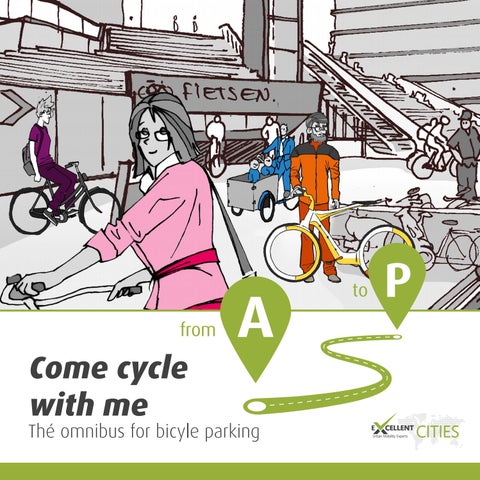
from
Come cycle with me
A
ThĂŠ omnibus for bicyle parking
to
P CELLENT Urban Mobility Experts
2
COME CYCLE WITH US CITIES ARE GROWING
Worldwide cities are growing rapidly. In the year 2050 more than 70% of the world’s population will be living in cities. Cities and metropolitan regions are the economic engine of countries. Meanwhile cities are facing massive mobility issues. Road-networks are heavily congested, public transport-systems are insufficient and cycling is unsafe. Mobility planning has become a key-factor in a succesfull further development of our cities. Cities will have to make crucial changes in their mobility planning to be able to adapt to the increasing population in a proper sustainable way.
OUR VISION: EXCELLENT CITIES USING SUCCESSFUL MOBILITY PLANNING
Excellent cities are economic vital, attractive, sustainable and social equitable. We believe in the power of mobility planning as a tool in the hand of governments to improve our cities in all these fields. With our program “Excellent Cities” we provide more than 50 years of experience in urban mobility planning for excellent cities in the Netherlands, one of the most populated countries in the world. We understand all aspects of urban mobility in design, effects and tooling but also in actor-involvement, descision-making and engineering. We are three companies, one family: Goudappel Coffeng (consultancy), DAT Mobility (tooling) and Move Mobility (international projects). Founded in 1963 with over 250 mobility-experts.
OUR EXCELLENT CITIES PROGRAM
In our Excellent Cities program we work together with universities, local consultants and governments in sustainable relationship: our partners. Together we offer urban mobility-policy for excellent cities. In an excellent city there is a coherent interaction between land use and mobility. Its urban transport policies are targeted towards a balance between car, public transport, walking and cycling modes, thus promoting a sustainable transport system, economical vitality, social equity and spatial quality. The excellent cities program consists of four main working fields: Strategic network development Sustainable Urban Mobilityplans Urban projects and tooling Knowledge transfer In this book three parts of Sustainable Urban Mobilityplans are brought together: Bikefriendly planning Effective Public transport Smart Parking Please enjoy our vision and approach, interesting examples and nice to know facts and figures.
PURPOSE DRIVEN, INTEGRATED AND EFFECT-BASED
Integrated: we think and work with integrated networks. Three mobility networks in our cities are influencing each other and need to be designed in coherent ways: car-networks, crossings and parking, public transportnetworks and cycling and walking. Urban developments and spatial development interact with these networks. Purpose-driven: for us mobility is no goal in itself. It aims to improve the economic vitality, the spatial development, the urban quality, the social equity and the environmental impact in our cities. Evidence- based: we are binding together a quantitative approach using a variety of mobility-data and designing skills of urban mobility-systems on different levels (regional, local). The result is a compelling plan with clear evidence on the effects.
from
Come cycle with me
A
to
P
Thé omnibus for bicyle parking
3
from
Come cycle with me
A
to
P
Thé omnibus for bicyle parking
COLOPHON Titel:
Come cycle with me Thé omnibus fot bicycle parking
Editors and Coordination:
Rico Andriesse, Niels Voogt, Marco Aarsen, Jos Waltmans (Goudappel Coffeng)
Graphic design and layout:
Jasper Mallekoote (Innatura), Lennert Bonnier (Goudappel Coffeng)
date of publication:
29 Mei 2017
CELLENT Urban Mobility Experts
4
CONTENT
A
COME AND CYCLE WITH...... • 6
1
LIVING AND CYCLING • 8
2
WHERE ARE YOU HEADED? • 10
3
MODAL CHOICE • 14
4
PARKING AT HOME • 18
5
ROUTE CHOICE • 20
6
PARKING YOUR BICYCLE • 22
7 8 9
AT THE BICYCLE PARK • 26
IN THE BICYCLE PARK • 30
PUTTING YOUR BICYCLE IN THE RACK • 32
10 CONNECTION TO PUBLIC TRANSPORT • 34 11 OPERATION AND SERVICE • 36 12 WHERE’S MY BIKE? • 38 13 EXITING THE CYCLE PARK • 40 14 NEARLY HOME! • 42
P
5
COME AND CYCLE WITH... KARIN (45) Karin is hurrying to work in “the City” very early in the morning. She has an important meeting at the office in the kind of Trump Tower where she works. Karin is a businesslike and efficient professional. She has a bright new electric bike that gets her from her stylish penthouse in a top location to the train station. It’s ideal for the commute to work and she does not arrive all red in the face and sweaty.
MAX (21) Max has overslept for college. It got late again last night and his room is still in a mess after the undergrad party. He grabs his backpack, makes a quick cheese sandwich, and jumps on his rickety granny bike, which he got from a housemate. He is on his way to his first uni lecture. What was it about again?
6
TOM (34) Tom lives in a refurbished, tastefully furnished house in a popular nineteen thirties neighbourhood. He’s taking his two children to school on his cargo bike. He’s taking his time – and has the time – to do everything at a leisurely pace. Tom’s a real family man. After dropping off the twins and giving them a big hug, he cycles on to work. Maybe he’ll do some shopping on the way. He’s got plenty of time left.
BART, THE MAN VOF THE FUTURE Bart is the cyclist of the future. On his ultra-modern bike, he races across town sometime in the year 2025. We’ll follow him on his journey and track his behaviour from his perspective. A computer engineer, Bart loves his gadgets and gizmos – which you can tell from his bike.
7
LIVING AND CYCLING
CAR OR BICYCLE?
Every city is made up of different neighbourhoods. The accessibility of a neighbourhood has a major influence on the competitive position of cycling: easy access to the nearest public transport hubs provides a strong incentive to cycling. That is true on every scale: from the competition between cars and cyclists on the main road network (how do I get to the centre quickest?) to the layout of the neighbourhood (are there any handy shortcuts or do I have to share the road with cars?) through to the detailed level of houses, gardens and sheds (will I go by bike or take my car that is outside?). With the arrival of the electric bike, cyclists’ action range has doubled. In 70% of trips using a standard bicycle, cyclists cover a distance shorter than 7.5 km. On an electric bike, this may be up to 15 km. Key destinations such as railway stations and shopping centres have seen their catchment area expand thanks to the advent of the e-bike. Cycle highways are being constructed to connect the main cycle networks in towns and cities and urbanised areas. This trend will need to be taken into account when planning and designing cycle parking facilities. In practical terms, that means that more and better cycle parking facilities will need to be built at major public transport hubs, with appropriate facilities also being provided in city centres to park electric bikes securely.
CITY LAYOUTS CONTROLS OUR MOBILITY
A recent study published in the scientific journal The Lancet shows that the layout of a residential area determines mobility choices. “Building green, sustainable, and liveable cities is hugely beneficial in the long run. A comprehensive approach is needed to design activity supportive neighbourhoods. Every aspect of a city must be built for people and interconnected with the city at large; planting a dozen trees while continuing to build isolated neighbourhoods inaccessible through walking, cycling, and public transportation is simply not an option.” (Source: Cycling Embassy of Denmark, based on “Physical activity in relation to urban environments in 14 cities worldwide: a cross-sectional study”, The Lancet, 1 April 2016’)
8
Did you know that 50% of journeys to school and universities in the Netherlands are made by bicycle? And that cycle use also accounts for 50% of commutes to and from train stations?
HOUTEN-VENIX VERSUS VELDHUIZEN
The layout of a residential area in terms of urban and traffic planning has proved to have a major impact on residents’ choice of transport mode. Different researchers have compared the Veldhuizen neighbourhood in the city of Utrecht with Houten-Zuid, the newly developed southern area of the town of Houten. Although there are many similarities between the two neighbourhoods, the remaining differences in terms of layout and detail are substantial enough to influence cycling behaviour. Houten has a highly developed system of recognisable cycle routes in place which, coupled with the green spaces, provide the basis for the town’s planning structure. Although Veldhuizen also boasts cycle thoroughfares, these are much less densely distributed, much less recognisable and, moreover, situated on the edges of the area and alongside busy roads. Did u cycle less after moving to a new home?
50 Percentage of respondents
1
Veldhuizen Houten-Vinex
25
0
More
Same
Less
These – and other, non-traffic related factors – have led to newcomers in Houten-Zuid taking to their bikes much more frequently than before. By contrast, the new residents of Veldhuizen are cycling much less often than before. This effect is partly explained by self-selection. Cyclists want to live in Houten because they love cycling. Thirteen per cent of residents in HoutenZuid indicated they had been motivated in part by the bicyclefriendly nature of their new neighbourhood, compared with 3% in Veldhuizen. [source: Kroeze, “Fietsverkeer 20”, 2008]
“Oh good morning… What’s the time? Wow, it’s already nine! Why didn’t my housemates say anything? They know I have to go to college today. Ah yes, I remember now. The party...that explains the beer cans too. Hopefully, there’s hot water in the shower. The house is a bit of a dump. The location is great and the rent is low, but other than that... The bus stops are around the corner, but I have a free public transport pass for the weekends only and I’d much rather go by bike than pay for the bus. It’s a fifteen-minute ride, but I don’t mind. Living closer to the university would cost me a lot more in rent. What I’m paying now is not bad for this city. Ah well, the uni is just around the corner. It’s just fifteen minutes away.”
“An attractive city is one that is accessible. It’s about finding the right balance between mobility, space, and people. How to use public spaces is something you decide on together. Having broad-based support is essential. The ultimate goal is, of course, to create routes that are actually used and neighbourhoods that are nice places to live.”
Marco Aarsen, Landscape architect, Goudappel Coffeng
9
2
WHERE ARE YOU HEADED? “Thursday morning. It‘s market day. The children are wearing coats against the chilly spring breeze, but the sun’s shining. I’m dropping them off at day care. I’m glad my first meeting does not start until ten. It‘s a 3 km or so bike ride to the centre and another 2 km to the railway station. An easy ride on my cargo bike. The route is a straight line and not too busy. The way to the station practically crosses the centre so I can easily pop in to the market this afternoon. I’m glad the day care centre is outside the city centre because traffic is very busy near the station and it’s difficult manoeuvring with the kids.”
Some places have already seen the first few bicycle tailbacks. Cycle use has increased rapidly in large towns and cities (although that varies a lot ). In Leiden, for example, a lot of people use their bikes, whereas in some towns in the hilly southern province of Limburg, driving is still dominant. In general, the number of cyclists is increasing in urban areas and declining in other areas. Overall, cycle use has remained more or less constant.
10
The number of cyclists and the modal share of cycling in towns and cities have gone up in recent years. Some local authorities are facing the question of how to deal with this growth. In a vitality benchmark conducted by urban economists, the Netherlands’ top 100 cities were compared on accessibility, demographics, quality of public space, and availability of amenities. A city centre’s vitality is determined to a large extent by its accessibility for cars, public transport, and cyclists. For example, the extent to which a destination is accessible by bike says something about the future-proofness of the infrastructure and whether destinations in the centre are easy to reach by bike. Like drivers, cyclists are important consumers for a shopping district. A cyclist “I’m a big fan and advocate of cannot perhaps carry as much an open planning process. If you stuff as a visitor who has talk with people in their daily come by car, but is likely to environment, it’s clear that they visit more often, especially if are very important partners.” there are good cycle facilities. (Liesbeth Couwenberg, Process However, some retailers don’t Manager for the Zandweg project, yet recognise the importance De Meern,12 April 2016) of cyclists as customers.
Despite the increase in traffic, Dutch cyclists still travel fast, reaching an average of 18 km per hour. In fact, a graduation project conducted in Utrecht has shown that the average speed of cyclists is even higher as traffic becomes more intense: go with the flow! That is, if you’re actually cycling. As soon as you have to wait at traffic lights, the heavy traffic will add time to your journey. Traffic lights are the biggest interruption by far on a cycle trip. Travel time ratio bicycle/car to distance (kilometers)
1,4 1,3 1,2 1,1 1,0 0,9 0,8 0,7 0,6 0,5 0,4
Car wins Bicycle wins
0-0.5 0.5-1 1-1.5 1.5-2 2-2.5 2.5-3 3-3.5 3.5-4 4-4.5 4.5-5 Kilometers
For distances under 3 km, cycling is faster than driving. In large cities (with a 100,000+ population), the time gain can be as much as 10% compared with driving. This is set to increase with the growing use of electric bikes. (source: “Fietsbalans-2”, Dutch Cyclists’ Union).
“There is a growing difference between urban areas and the countryside. Cities are becoming more and more bicycle and pedestrian-friendly, whereas rural areas are increasingly focusing on cars. The challenge is to make sure that these inevitable cars from rural areas don’t get too far into town. Particularly if they’re self-driving, we cannot and don’t want them in the centre. Transferring to a smart cycling system on the edge of town will probably be the answer.”
Rico Andriesse, Urban Mobility consultant, Goudappel Coffeng
11
MAKE PRINCIPLED CHOICES TO ENSURE GOOD FINDABILITY
1. Put first-time visitors first
They are searching and may come back more often
2. Focus on journey time perception
This will increase the time people spend in one place and encourage repeat visits
3. Look from the inside out
Don’t drop people off on the edge of town, but take them to their destination
4. Provide a total journey all the way to the destination Direct people to their (ultimate ) destination
5. Keep information density limited
Less is more, certainly at points where a choice needs to be made
6. Encourage combined visits Alert visitors to other possibilities
12
? =
BICYCLE ORIENTED DEVELOPMENT
Bicycle-friendly towns and cities not only have well-designed cycle paths, but also provide short average journey times due to high densities and a diversity of amenities. It’s only here that people, families and businesses can cycle to their daily activities. (source: Te Brömmelstroet, S+RO, March 2012). A good example is the northern city of Groningen. Seventy-eight per cent of its inhabitants live within a 3-km radius from the city centre and 90% of all jobs are located within that radius. Most of the built-up area is within a 5-km radius. (source: Fietsberaad, 2009) From the very start, the conditions for developing a compact city were favourable. In the early nineteen sixties, Groningen was the most densely populated city in the Netherlands. And although the original city sprawled over time, it continued to focus on creating important economic and social facilities in and around the centre. For example, the University Medical Centre (UMCG) is still located in the middle of town and has actually expanded. Major retailers, including IKEA, also arrived and are located close to the centre. Large numbers of new-build homes have been constructed near the centre, often at former industrial sites, which because of the original compactness of the city were also located close to the centre (source: Fietsberaad, 2009). As part of its new cycling plan, Groningen has introduced a mandatory “bicycle effect analysis” for each development project to investigate its impact on cycling.
m 3k
78% 90%
13
3
MODAL CHOICE
“What’ll I do? Go by bike or bus? Let’s have a look outside. It’s dry, okay. The e-bike is quickest anyway, certainly if I want to drop into the shops later on. Or should I perhaps take the cargo bike? Ah well, I don’t need that much. The few things I need will fit into my bike bag. Phew, these stairs are a bit of a climb. I’ve done a lot less cycling during the winter. Cycling keeps you fit without you noticing. If you cycle on a daily basis, you’re pedalling away quite a few kilometres unnoticed. I’ll go by bike then.”
14
“Expanding railway capacity will improve mobility and accessibility to a limited extent only and at relatively high cost. But what will make a difference, at little cost, is to improve the possibilities for getting to and from train stations, particularly for cyclists. Investing in transport facilities to and from train stations, for example by providing bicycle parking facilities, will be more effective and considerably cheaper than a costly expansion of the rail network. Incentivising cycle use is a good investment in and of itself. Although road safety will decline, this will be offset by the health gains achieved.” (source: Dutch Policy Analysis Bureau , De Volkskrant, 12 May 2016) It is important for local authorities to consider what likely users they wish to cater for by investing in transport facilities. Adjusting the infrastructure is not the only thing that needs to be done to get people on their bikes. People are creatures of habit and breaking a habit is difficult. A lot has been done in recent years to change people’s mindset about cycling. The many campaigns promoting the sustainability and health impact of cycling have led to a positive attitude to cycling. People’s social environment is also An overstretched or perhaps a contributing factor. If everyone infrequent public transport around you goes by bike, cycling service may provide a seems to be the normal thing reason for people to go by to do. And if it’s normal, people bicycle. like doing it. This is known as the subjective standard. The same goes for parking. If everyone parks neatly within the lines, it’s perceived to be the standard, and others will follow suit.
Did u know that
Well laid-out cycle paths on the right it only rains 6% routes and clear signposting will help of the time in the increase observed behavioural control. If Netherlands? the route is clear, it’s easier to visualise how to get to your destination or to select the right cycle park. If cycle parking is easy to find, people are more likely to go by bicycle. Once these facilities are in place, people will be more likely to want to cycle. The trick is to actually get them on their bikes once they have that intention. People are creatures of habit and breaking a habit is difficult, despite good intentions. By confronting them with their intention, you can persuade them to go by bike. This may be done by giving cycling a prominent place within urban planning, for example by getting people to make a deal with themselves (“I’ll go by bike on Monday”) and then to remind them of that.
Theorie van gepland gedrag Real challenge Werkelijke uitdaging
Attitude
Subjective Subjectieve standards normen
Observed control Waargenomen of behavior controle van gedrag
Intention Intentie
Behavior Gedrag
Theory of Planned Behavior, Ajzen 1991
“Did you know that you can add almost a year to your life simply through the health gain achieved by cycling? The same holds true for electric bikes. Although it’s less strenuous, people automatically tend to cycle more often and longer distances on an e-bike.”
15
CYCLING MAKES US HAPPY
CYCLING IN THE CITY (ACCORDING TO THE INSTITUTE FOR TRANSPORT POLICY ANALYSIS)
“I cycle because cycling gives me a mental boost.” Eighty-four per cent of Dutch people are positive about cycling, with 7% having a negative view. The overriding arguments for choosing to cycle rather than drive (in descending order of importance) are: 1. Cycling is healthy 2. Cycling is fun 3. Cycling is good for the environment 4. I can get cut through the traffic quicker by cycling 5. I can park my bicycle securely 6. Cycling is convenient (I don‘t have to look for a parking space for my car) However, the most striking finding is the positive attitude to cycling. In situations where cycling is chosen over driving, the choice is based mainly on the positive feelings that cycling inspires (healthy, fun, doing your bit for society) rather than the downsides of alternative options. See also the figure below: “Cycling brings happiness”
80%
Public Transport
70%
Bicycle
60%
Car
50% 40% 30% 20% 10% 0%
Joy
Fear
Anger
Sadness
Aversion
‘Figure: ‘Cycling brings happiness’. The emotional state that the use of car, bicycle or public transport brings. (Bron: Modal choice for trips up to 7,5 kilometers, Rijkswaterstaat, 2006)
16
The use of active modes of transport is determined not only by demographics but also by the degree of urbanisation and the size of a city. Cycling and walking are the most important transport modes within Dutch cities. This is because of our compact (inner) cities, with facilities located at distances that we consider to be within easy reach when cycling or walking. However, there are variations between cities. For example, in the “big four” cities people cycle less and walk more than in many medium-sized cities. Cycling has a 14% modal share in Rotterdam and 18% in The Hague, whereas in the university cities of Leiden, Groningen, Zwolle and Leeuwarden more than 40% of all local journeys are made by bicycle. There are also substantial differences in cycle use between mediumsized cities. The increase in the number of bicycles, especially extra-wide bikes (like cargo bikes), and the mix of fast and slow cyclists have led to crowded cycle paths. Sometimes there are even “bicycle tailbacks”. This is not only having an impact on the free flow of traffic but has also led to more conflicts between cyclists. Research by TNO has shown that narrow cycle paths have seen a rise in accidents. (Source: “Fietsen en lopen de Smeerolie van onze mobiliteit”, Dutch Institute for Transport Policy Analysis [KIM] 2015)
Bicycle use
Very high High Average Low Very Low
THE MANY BENEFITS OF CYCLING
Cycling and walking are healthy but come with safety risks. Depending on the situation, an increase or decrease in cycling or walking will have different effects on the accessibility, safety and liveability of an area. Increased cycle use in cities will lead to capacity bottlenecks at cycle parks and crowded cycle paths. At the same time, the use of electric and other bikes means that transport poverty – the situation in which people are unable to take part in activities due to constraints – is less of a problem in the Netherlands than in other countries. A substantial part of the Dutch population can reach a variety of amenities by bicycle. This is in contrast, for example, to the United States and United Kingdom. Cycling and walking generate major health gains. Absenteeism drops if people cycle more frequently and longer distances. Cycling and walking are also environmentally friendly. Obviously, they emit no air pollutants such as nitrogen and sulphur dioxides, fine dust particles, or carbon dioxide. At the same time, there has been a trend where cyclists account for an increasing number of road fatalities and, notably, severe injuries. The percentage of pedestrians in the number of road deaths remains stable.
“Amsterdam is just the right size. You can ride a bike all year round and everywhere: to work, to home, to the opera, to see a friend. Cycling keeps the mind fresh. Amsterdam is so simple and everything is so logically organized. I ride a bike every morning through the city centre, enjoying the colours of the canals, it makes me feel like I am in love.” Een expat uit Estland. (Bron: Herbert Tiemens, Provincie Utrecht)
17
4
PARKING AT HOME
“We’re the proud new owners of a cargo bike. It may be rather big, but with two kids it’s more convenient than a normal bike. Fortunately we have a big shed to park it in because I wouldn’t want to leave it out on the street. We live close to all the facilities in town so a cargo bike is not so bad. I can also use it to get to the train station and park it safely in the covered cycle park there when I go to work. I live close enough not to have to invest in an electric bike. It’s a pity that secure parking is often only available at train stations, because if I did have an e-bike I‘d also want to be able to park it securely near the sports fields or shopping centre, well protected from the weather.”
18
PARKING AT HOME
The use of cars can lead to a lack of space. Drivers in the city centre also need space to park. A bicycle takes up only one eighth of the space occupied by a car (KIM 2014). The Cycling Review conducted by the Dutch Cyclists’ Union in 2014 shows that city councils pay a great deal of attention to bicycle parking near inner city destinations such as shopping centres and railway stations, but less so outside the city centre. However, having an effective cycle parking policy in place for residential areas may improve the competitive position of cycling, increase cycle use, and ultimately reduce car traffic in the centre. Many neighbourhoods with flats that have no large storage area are having problems with parked bicycles. Moreover, unlocked storage space may create problems with theft of parked bikes. If these problems occur, installing a neighbourhood parking facility or providing secure “cycle parking boxes” for residents can be a solution. Under the Dutch Building Decree, it is mandatory for new buildings to come with bicycle storage, but there has been little or no enforcement of this rule in practice. But regardless of the rules: it’s a very good idea to build houses with good bicycle facilities anyway. In some cases, city councils are willing to revise car parking standards downwards so as to increase cycle use and provide adequate facilities.
LIFESTYLE TREND: BICYCLE MOUNTED ON THE WALL
Forget about stashing your bike in the garage. Just hang it on your wall! It’s the latest lifestyle trend: storing your bike in the living room. We hang up all sorts of things at home – paintings, posters, mirrors, even stuffed animals. But a bike tops it all. An antiquated granny bike, a cool fixie bike, or modern racing bike – they add character to your interior. You can mount your bike to the wall in all sorts of ways, using sturdy wall posts or nearinvisible hooks with a cool design.
Not everyone has a shed or garage these days to store their bike and if you leave it outside it will get pinched in no time. Instead of hiding it in your hallway, let your bike be seen and give it pride of place in your living room! (source: showhome.nl, October 2015)
Certainly the arrival of electric bikes makes it very important to provide secure parking. E-bikes are expensive and need to be
Did you know that electric bikes are increasingly used vfor commutes? And that e-bikes are becoming more and more popular among younger people?
Bicycle hangar in the municipality of Rotterdam
19
5
ROUTE CHOICE
“There’s exceptionally strong and broad-based support across the city and among experts for making radical choices in terms of the city’s mobility system. Promoting public transport and cycling as the key pillars of urban mobility and reducing the role of cars in public spaces, especially the central urban area.” (source: Results of interviews published in the “Utrecht: Attractive and Accessible” policy document). Cycle use, in particular, allows for a flexible choice of train station. An e-bike rider can check train delays in advance and decide to go to another station. For example, if you live in The Hague, will you cycle to Hollands Spoor or Central Station? If you live in Utrecht, will you use the Sprinter train station around the corner or cycle to Central Station instead, where all the intercity trains leave (the Sprinter will take more time, but the intercity may have been cancelled so I’ll need the slower Sprinter anyway)? E-bikers may alleviate the stress on the public transport system or car network because electric bikes can also bridge the distances between cities. This way, congestion can be avoided and the lack of good public transport services compensated for. Studies have shown that people’s route choice can be influenced by offering them an attractive route. This is sometimes more important than the distance to be travelled. A varied route along a good road with the lowest possible number of points where people have to change modes is perceived as shorter than a route that is just as long but unexciting, with a lot of waiting time and modal shifts. A study conducted by the Dutch Railways suggests that the walking distance from the cycle park to the platform is a really dominant factor in people’s subjective journey time perception. The shorter the subjective journey time perception, the more attractive the route is perceived to be. To influence route choice, it’s therefore important to provide cycle parking facilities close to people’s
20
GOOD FOR US ALL
Cycling is healthy, inexpensive, and environmentally friendly. We already know that. But the fact that investing in cycle infrastructure yields more than that it costs may come as a surprise to many people. Every euro invested in a cycle highway will generate at least double its value in health gains, and even bigger gains are achieved in practice. Researchers at the Flemish Institute for Technological Research (VIT) have developed a calculation model to compare the cost of infrastructure (between EUR 300,000 and EUR 800,000 per kilometre) with the proceeds in terms of health gains (if 600 to 4000 cyclists use a particular route) (source: Journal of Transport & Health). In the Netherlands too, a correlation has been found between the number of kilometres cycled per person per day and the percentage of the population with obesity (source: http:// kpvvdashboard-12.blogspot.nl).
Average number of kilometres cycled per person (2010-2013) versus the percentage of obesity (2012) by municipality (source: OViN and CBS Statline)
“Right, it’s time to go! I’d better check the Internet first because lately there have been many delays on my usual journey. I’m glad I have an electric bike, if there’s any problem with the trains, I can cycle to the other station. But everything seems to be okay today, so I’ll stick to my usual route. The cobblestones in the streets around here make for a bumpy ride, but fortunately the cycle highway is just five minutes away! That’s where my e-bike will show what it can do. The route’s not very exciting, I have to say, but it’s the fastest way to work. The cycle path is comfortably wide and there are no junctions where I need to give way to cars. This route is at least 5 minutes quicker. I know enough people who prefer the more scenic route across town because it’s nicer. It takes more time, but you go through the park and you see and hear a lot more. But for me, speed is what counts. I can always go for a real bike ride in the weekend. Perhaps I’ll try the new bridge this afternoon if the weather holds. It’s a bit out of the way but I could do some shopping while I’m at it…”
“Until recently, transport modelling focused almost entirely on motorised traffic and in major cities on public transport as well. Cycling was left out of the equation completely. In fact, it was cheaper to invest in cycle infrastructure than in cycling studies. That’s now changing. As more people take to their bikes in the cities, problems arise in terms of free traffic flow, parking and all sorts of other issues that are showing strong parallels to the growth in cars in the 1960s and which also demand serious investment. Transport models are being adjusted in line with this trend. Large-scale transport models are emerging dedicated to cycling.”
Stefan de Graaf, transport modelling consultant Goudappel Coffeng
21
6
PARKING YOUR BICYCLE “Where do I park my bike? I’m spoilt for choice here. I can park it in front of the shop to run a quick errand. Because of the bicycle parking bays, bikes are parked reasonably orderly and the spaces are not all taken by long-stay parkers. These modern bicycle stands are a good support for my bike. Things sometimes only go wrong when there’s a really strong wind. There are no parking spaces in front of the shops in the pedestrian area. But that’s a good thing really. My bike would only be in everyone’s way and it’s fun to go for a bit of window-shopping. Plus, there’s now a new, supervised bicycle park. Since they stopped charging a fee, I’ve been happy to park my bike there. It saves me the hassle of loose change and all that. It’s much more crowded now than it was when you still had to pay for it. It also means the city council is getting more value for money. The supervisors keep an eye on things. So I’ve no problem anymore going into town on my new bike.”
22
BE SURE TO PROVIDE ADEQUATE CYCLE PARKING
A study will need to be conducted to make an informed decision on the location and size of cycle parking facilities. For railway stations, the estimated number of bicycles can be based in part on projected passenger numbers. But how many people will actually come by bike? How long will those bicycles be parked for? And what direction do cyclists come from? A survey of parked bicycles and actual passenger flows will provide definite answers for existing train stations. “Well-organised cycle parking adds To predict bicycle flows, quality to the city.” Hugo van der the latest data from Steenhoven (Dutch Cyclists’ Union), Bikeprint may provide quoted in the “Utrecht: Attractive an understanding and Accessible” policy document. of where cyclists come from. It’s more difficult to accurately predict the number of bicycles parked in city centres. The cycle parking data compiled by Goudappel Coffeng for Fietsberaad provides a first impression. However, the margins are fairly wide. If counting is an option, it’s always more reliable. As far as city centres are concerned, one needs to realise that secure bicycle parking inevitably caters for only a limited number of cyclists. The vast majority prefer parking their bike on the street. For example, because they will only be gone for a short time or because their destination is not close to the cycle park. However, there’s some room for “nudging” here when designing public spaces.
No lamppost, no bicycle You can add elements to public spaces to control bicycle parking and you can remove them. Cyclists like to use fences or signposts to lock their bikes to. Certainly long-stay parkers will want to lock up their bike. So in places that are short on space, the rule is ”no lamppost, no bicycle”. This may done, for example, by replacing lampposts by overhead lighting and removing traffic signs or mounting them on the façade of a building. .
“It’s better to turn around the challenges that the city is facing. Instead of having the illusion that we can speed up the flow of traffic, we should accept that it’s here to stay. We actually need people to come into our city… But trying to accelerate in the city is not realistic. We should be channelling our efforts into calming traffic and making it more fun.” Thomas Straatemeier, mobility planning consultant Goudappel Coffeng
23
24
GPS DATA
Using GPS data, researchers retrieve a lot of information about road users’ behaviour. It opens up great opportunities for cycling studies, in particular. It’s been possible for quite some time now to accurately pinpoint the location and destination of car drivers, using car registration surveys or pneumatic tube automatic traffic counters. However, these methods are not effective, or a lot less so, for cycling. If you use GPS data, you can see exactly where cyclists come from and where they are headed. You can also see whether it’s crowded or quiet on a particular stretch of cycle path. This information can be used to develop apps that provide realtime route information. For example, if a cycle park is getting full, cyclists headed for the park can use the app to obtain alternative route advice. For its part, the city council may use the information to analyse the direction where most cyclists come from and on which side of the train station bicycle parking should be extended. Alternatively, they could adjust the route a little to get cyclists to automatically pass by an underused cycle park.
Bicycle movements in Utrecht, visualized with GPS data
“We are becoming increasingly aware of how cyclists choose a parking facility, which is not necessarily the most logical facility on paper. Because we know how cyclists select a parking facility, more effective measures can be taken to encourage them to adjust their behaviour in line with the policy choices made. Or we could stop trying altogether because there’s no point. The first image that springs to mind when thinking of bicycle parking in the Netherlands is probably a crowded train station with bicycles parked all over the place. It turns out that people tend to do what they retrieve from their memory quickest, even if it’s not necessarily the cleverest of choices. In this case, that’s to park their bike illegally.”
Kimberly Hulleman, Behavior consultant Goudappel Coffeng
25
7
AT THE BICYCLE PARK
The city council should provide clear information and communicate effectively about bicycle parking facilities and the availability of stands. Is a cycle park full? How many empty spaces does it still have for cyclists? And equally importantly, is it clear to cyclists where the parking facilities are? Nobody likes the town to be cluttered so it should be made unattractive for cyclists to leave their bikes out on the street. This means that there should be as few posts and railings to lock a bicycle to as possible. But even if these possibilities are reduced to a minimum, there will still be bicycles parked in places where you don’t want them with a view to protecting the quality and liveability of an area. Behaviour is an important part of the reason why people put their bicycles in a particular place, deliberately or without thinking. How can this behaviour be influenced? You can choose to do this either through punishment or reward. Punishment means enforcing the rules and removing illegally parked bicycles. Enforcement officials could be given powers to remove illegally parked bicycles, provided that the right legal steps are taken. Removing bicycles that have been parked for longer than, say, 30 days could be done by putting a sticker on them, saying that the bicycle will be removed after a certain date if the sticker is not removed by then. Bicycles that still carry a sticker on that date will actually be removed. A quicker measure would be to designate certain areas as no cycle parking zones where parked bicycles can be removed immediately. If policymakers choose to have bicycles removed, arrangements will need to be made in the background. For example, there should be sufficient capacity to store the removed bicycles, an accurate and up-to-date registration system to retrieve them, clear information for cyclists about the removal measures and how and where to collect their bicycle if it has been removed, a payment system at the point of collection, and sufficient manpower at the point of collection. A more pleasant way of influencing behaviour would be to deploy bicycle coaches. A bicycle coach can point out to the “offender” that using a cycle park is a much better option, and direct cyclists to the “appropriate place”. The bicycle coach’s role is basically that of a host and involves a more service-oriented approach than simply removing the bicycles.
26
“LOCATION, LOCATION, LOCATION”
People do not cycle somewhere just to park their bikes. They cycle somewhere because they want to go somewhere, for example a supermarket, train station, or shopping centre. Cycling provides freedom and in practice this means that people continue to cycle until they are as close to their destination as possible. The distance between where they park their bike and the (final) destination depends on the presence of physical obstacles. If there is a shortage of public space for cyclists, local authorities often opt for an underground parking facility. The exact location of the facility determines its “popularity”. Cyclists are more likely to use bicycle parks situated close to amenities than one that is further away or not on their route. Clear signposting in logical places along busy cycle routes will ensure that a cycle parking facility can be found. The immediately vicinity of a cycle park should be designed in such a way as to make it natural for people to head towards the cycle park. Proper lighting along the route and visibility of the parking facility are crucial for its findability and ultimately its success. After all, if you provide cycle parking, you want it to be used.
“There are unlimited options these days, a cycle highway is exactly that. A couple of pushes on the pedals and I’m at the cycle park. But then what? Do I go to the trouble of putting my bike in the cycle park or do I park it in the street? Unfortunately, there’s nothing to lock my bike to. If I do leave it outside, it will not be secure and it could be stolen. I don’t want that, obviously. Then there’s the city council to consider. Will they have my bicycle removed?“ ”Right, I’ve made up my mind. Safety first, I’ll put my bike in the cycle park. But where is the entrance? I have to find out how I get in. And when I get in, will I find an empty space? Maybe it’s full. I like to stick to my routines. I’ll use the cycle park this once and if it suits me, I’ll use the same cycle park next time. I’ll know my bike will be safe then. I also feel safe personally, when I come to pick it up at night. Because of the lighting and the presence of a supervisor, there’s very little chance of me or my bike coming to any harm.”
27
FRIS - CYCLE PARKING GUIDANCE SYSTEM Cycle congestion and abandoned bikes. The city of Utrecht decided to take on the challenge. Inspired by car park guidance systems, the city decided to put in place a cycle parking guidance system that directs cyclists to an empty parking space. A truly innovative procurement project. A team of consultants from International Tender Services and Goudappel Coffeng assisted the city in inviting tenders for a Cycle Parking Guidance System. Based on appropriate functional specifications, market participants were challenged to come up with a state-of-the-art solution. In putting out the system to tender, the city benefited from the unique strength of tender expertise, cycle mobility expertise and local knowledge all rolled into one: a cycle parking guidance system is not just a car park guidance system geared to cyclists. In the end, the city chose a software solution that “counts” the number of empty spaces
using smart cameras. The system takes into account spaces that are unusable, for example because of non-standard bikes getting in the way or bicycles with children’s seats being parked on the lower rack of a two-tier bike stand so the upper rack cannot be used. The information about the number of available spaces is shown on strategically positioned dynamic displays along the busiest cycle routes. They provide cyclists with the right information en route and direct them to an empty space located as close to their destination as possible, so that they will not end up at a cycle park that’s full. Coupled with strict enforcement around the cycle parking facilities, this is how the city of Utrecht makes sure that bicycles are parked in the right place, that the flow of cyclists looking for somewhere to park is kept to a minimum, and public spaces retain their quality. The system became operational on 3 June 2015.
“People are less likely to jump the lights if they know how long they need to wait.”
28
”Cycle parking is not a purpose in its own right. Like drivers, cyclists visit a place because of the amenities available there, not because there are good parking facilities. By the same token, the lack of good parking facilities may operate as a push factor. That’s why it’s important to match the parking facilities with the use made of those amenities. If a store draws many young families, access to parking should reflect that. Think cargo bikes and bikes with kids’ seats.”
Jeroen Roelands, Parking and area development consultant Goudappel Coffeng
29
8
IN THE BICYCLE PARK
A visible and obvious entrance is an important factor when parking a bicycle. Cyclists must feel welcome. Uniform logos, displays, colour use, and lighting make bicycle parking easy to recognise, find, and access. Displaying key information, such as opening hours and charges, at the entrance also helps. All these measures will prevent users from getting confused or disappointed. Having a ramped entrance/ exit for the cycle park is sometimes inevitable. However, a parking facility that is entirely situated at ground level scores high on accessibility. It should certainly not be made too difficult for people to park their bike. An open and welcoming appearance is a must so you cannot ignore its presence. As the owner of a bicycle parking facility, you should ask yourself the following questions as a minimum: What’s the target group and what local amenities are they using? What opening hours do I operate and are these in line with those of local amenities? Consider, for example, when the last train arrives or perhaps there’s a club around the corner that doesn’t close until four in the morning. You will want to avoid people coming to collect their bicycle and finding the facility closed. They’re not very likely to come back!
30
“It was easy to find the cycle park, I just followed all the signs. I could actually cycle all the way up to the entrance, I didn’t have to get off my bike unnecessarily and it prevented unsafe situations. It’ll be difficult, though, getting a cargo bike through the narrow entrance and manhandling it up that ramp is not very practical either, with a heavy bike like that. What’s nice though is that I can see till what time the facility is open. I sometimes have a late appointment and I don’t want to return and find the cycle park locked up. I need my bike the next morning when I go out with the kids.”
“Bicycle parking is still in its infancy compared with car parking. But there are many parallels to be found. A cycle parking facility needs to be operated and managed and its accounts kept accurately as well. Also, when putting it out to tender (construction, management and operation), you can benefit from the experience of your colleagues involved in car parking. So you don’t have to re-invent the wheel.”
Niels oogt, Parking and area development consultant Goudappel Coffeng
31
9
PUTTING YOUR BICYCLE IN THE RACK “In the end, it’s a question of education and common courtesy that we - men - put our bikes in the upper racks. The supervisor shouldn’t have to put up a notice reminding us.” User of a cycle parking facility in Zutphen, quoted in De Stentor newspaper, May 2010
A future-proof bicycle parking facility is the latest in sustainability. Make sure that you provide a flexible facility that can move with the times. Perhaps we’ll all be riding cargo bikes in twenty years’ time, who knows? Those bicycles are wider and need more space. A cycle park should be capable of being adjusted to meet user requirements, easily and quickly. Maybe theme parking is a good idea. A cycle park that is accessible to electric bikes only. That will increase the attractiveness of bicycle parking. Or a dedicated cycle park for dishevelled students with old granny bikes. Local authorities can take these measures to control the use of bicycle parking and ultimately bring back quality to the streets. Orphaned bicycles are another problem facing many cycle parks. They occupy an unbelievably large number of spaces, forcing people to park their bikes outside the racks. Make sure that orphaned bikes are removed in time before they become a nuisance. Only then will you have a true view of the capacity and use of a cycle parking facility and reliable information. Capacity utilisation should be used as management information to allow adjustments to be made to the number of spaces so as to meet the demands of potential users.
32
“That was a fun way to enter a cycle park. Hopefully, it’s just as easy to find a space and put my bike in a rack. The aisles look wide enough. I can tell the lower racks are the most popular. I’ve brought my heavy e-bike and the only empty racks are the ones on top. Typical! I suppose I’ll just have to try. Wow, that’s easy. I thought it would be much harder.”
Upper racks are retractable. In a large cycle park, the aisle will need to be at least 3 to 4 metres wide to allow someone to get past when you’re putting your bike into the upper rack.
”Of course, I want to lock up my expensive bike and chain it to the rack. Look, they’ve already thought of that, what a luxury! But will the next user have enough space to park his bicycle next to mine? They’ll have thought about the spacing too, I suppose.”
33
10
CONNECTION TO PUBLIC TRANSPORT
“Parking done, let‘s find the exit. It would be nice if I could catch the 9.52. There’s an information display over there with the train departure times. That comes in handy. Let me see, oh mine has a 5-minute delay, enough time then to grab a coffee at the station. I don’t have to hurry now.
34
THE BICYCLE AND THE TRAIN
The bicycle/train combination has a number of major benefits, both for cyclists and the transport system. Combined bike/train journeys have increased enormously in recent years due to more people cycling to the station. In 2013, 46% of all journeys to train stations were already made by bicycle. Use of the public transport rental bike scheme has also seen a spectacular increase. These bicycles are mostly used to get “The best innovations in the past from the station to your final ten years were often not about destination. Because people transport novelties but rather about are also using the railways connecting existing transport modes more, total growth of the smartly or deploying them in a bicycle/train combi has been around 5% a year. Cycling has different way.” From “Innovaties rond de Fiets” published in Fietsverkeer expanded the catchment area 25, June 2010. of train stations considerably. From the cyclist’s perspective, it has brought the train station - or multiple stations in large cities within easy reach. The larger train stations with many destinations and high-frequency services, in particular, are attracting more and more cyclists. Because the trip to the station has a relatively large impact on the total journey time, the quality of transport before and after the train journey determines the quality of the total trip to a large extent. It also influences whether you decide to go by train or (reluctantly) take the car as your main means of transport. Obviously, the quality of cycle parking plays an important part in the bicycle/train combination. (based on Roland Kager in “Toekomstbeelden van het fietsgebruik in vijf essays”, 2015)
‘The bicycle is the key to a high worthy public transport system.’
Niels van Oort, Public transport consultant Goudappel Coffeng
35
11
OPERATION AND SERVICE
The city council should provide secure bicycle parking with CCTV and, perhaps, supervisors. A supervisor will give users a sense of safety. As part of his or her role, a supervisor may also act as host for the parking facility and the city. A growing number of towns and cities have assigned supervisors to act as hosts and they greatly value the contribution they make. They are, of course, a kind of representative for the city. Proper training and monitoring will allow staff to achieve the desired service levels. That can also be done by including good “hospitality awareness” as a requirement when putting the operation of a cycle park out to tender. This is also part of the city’s role as a professional party.
”It’s great that I can recharge my e-bike while I’m at work. I know my bike is safe and nothing will happen to it and that it’s being recharged so those 15 kilometres cycling back home will be dead easy.”
The growing demand for electric bikes will have an impact on the layout of future cycle parks. Charging points will become important elements of a parking facility. The facility should in any case provide secure space to leave your battery. An electric bike is a bit of an investment so the user will want to park it securely. Similar to e-bike use, demand for e-bike parking facilities is likely to grow as well. The layout of a parking facility should take account of future changes. There should be a sufficient number of power outlets or lockers with an electric socket. Or maybe batteries will be so powerful by that time that they do not have to be recharged so often.
FUTURE TRENDS?
New trends are opening up opportunities in terms of the availability of bicycles. One of the most interesting trends is the sharing economy. Share your home, your hedge trimmer, and the back seat of your car and we are all the better for it. Bicycles can also be shared. Why cluttering up your shed if you use your mountainbike only once a month? Just think of the possibilities if we started using our bikes as a collective resource? Always a bicycle available and all bicycles reused. No sea of bicycles flooding the station forecourt, but just a handful of available, shared bicycles. A suitable bike whenever you need one. Whether you want to go mountainbiking in the woods, arrive at a remote metro station and have to walk some distance, or leave home to go to work. It’s also a chance to develop and test bicycle-like transport modes. Transport at the ready, inexpensive, from door to door, whenever and wherever you need it. Fast shared bikes to cover the “last mile” – as an addition to a not very widespread public transport network – are by definition much cheaper and much cleaner than smelly and expensive city buses. Modern apps and tools will allow you to find the right bike quickly. In fact, bicycle trips will become more reliable and predictable, without affecting the freedom and anarchy associated with cycling. You decide whether you want to get lost or get wet from the rain. Or not. And whether you want to take your time and do the scenic route, or follow the interactive “green wave” on the main road.
36
“These tyres are not what they used to be in the old days. They’re often too soft. Or is it because I use my bike a lot more these days and clock up more kilometres? I can pump the tyres up at the cycle park. They should start a repair shop there, customers enough.”
37
12
WHERE’S MY BIKE?
‘’I thought I’d left my bike here. I need to be quick, my exam ‘s starting soon. Or did I park it nearer the entrance? They all look the same...”
38
USER FRIENDLY
Modern technology never leaves you in the lurch. Smart tracking systems or apps will find you your bike.
The city council should provide clear and understandable information displays to tell people how to find the cycle park. Displays should be provided not only on the public road. Shopping centres and train stations are also places where many users of cycle parking facilities will go. Providing a safe and attractive route to the entrance of the parking facility is a must. Align the opening hours with those of local shops, pubs and clubs, and even the arrival and departure times of train services. Provide identifiers, such as colours, numbers and names, to help cyclists at the cycle park. They should not need to spend ten minutes looking for their bikes. The time spent finding your bike also affects the attractiveness of a parking facility. Once you’ve found your bike, it should be easy to pull it out of the rack. Stands and racks that work well and are wide enough certainly help.
HOW DOES IT WORK?
Oh no! My bicycle got stolen?!
I report my stolen bicycle through the PostNL app.
MET EEN TAG AAN MIJN FIETS WEET IK ALTIJD WAAR DIE IS!
More than 600,000 bicycles are stolen in the Netherlands each year. That is an annual loss of around 600 million euros. Much of it can be prevented by tagging bicycles. However, existing solutions are often too expensive. Prime Competence, a concept developer and consultancy firm based in Delft, developed a solution for PostNL using inexpensive sensors, which the PostNL network now uses as a means to trace and localise its bicycles. This solution provides an attractive and low-cost alternative. Bicycles are fitted with a bluetooth sensor that can transmit a signal. The signal is received by an app on the smartphone of the postman or woman or the hand-held scanner of the courier. The users of the PostNL app can also help find missing bicycles. For more information, go to www.primecompetence.com
The users of the PostNL app help search for my bike.
With the help of PostNL my bicycle is found in notime! (Source: Freek Smoes, Prime Competence)
39
13
EXITING THE CYCLE PARK
EXITING THE CYCLE PARK
The city council should provide clear exit signs. Wide aisles and, importantly, a logical route will contribute to smooth flows at the exit. It should also be clear to users how much they have to pay. Apply uniform rates and pay systems. What identification means and methods of payment can be used? A public transport smartcard, debit card, or mobile phone? Or maybe you can park your bike in a supervised parking facility for free? With e-bike riders only having to pay for recharging their bikes.
“Bicycle-friendly junctions start with the design.”
Rob de Wit, Traffic management consultant Goudappel Coffeng
40
FUNDING
In almost every town and city, bicycle parking costs more money than the parking fees generate because the first 24 hours are often free. This shortfall in funding is often covered by the proceeds from car parking or the mobility fund. Bicycle parking aspirations and requirements can be financed by highlighting the link between driving and cycling. If a profit is made on car parking, part of it may be used to fund bicycle parking. For example, the cities of Leiden and Utrecht, amongst others, used an integrated business case for bicycle parking, exploring various scenarios with different parking fees. Based on these scenarios, councillors were then able to make an informed choice in terms of the provision of bicycle parking facilities and the parking fees to be charged. A business case provides advance information about the financial implications of the choices made. For its part, the city of Amsterdam works closely with the Amsterdam Metropole Region (MRA) to develop new bicycle parking. The MRA also co-funds new cycle parking facilities. The more important a cycle park is within the mobility chain (for example, if it’s near a major public transport hub), the more funds the MRA will contribute. The rationale being that, like the city of Amsterdam, the MRA will benefit if public transport hubs are easily accessible for cyclists using those hubs.
I’ve got my bike, now where’s the exit? Wait a minute, I still have to check out. I can pay using my public transport smartcard or by debit card or mobile phone, I’m amazed. Hang on, I don’t have to pay anything this time, the first 24 hour are free. If I park my bike for more than 24 hours next time, the fee will be automatically charged to my public transport smartcard. If it’s run out of credit, I can always pay cash to the supervisor. ’Bye-bye, thanks for the service, see you next time!’ Friendly guy, the supervisor. He never stops smiling. I wonder how he does that. The exit is easy enough to find. Now I only have to get on my bike, hit the cycle path and head home. It takes me a while to get going, I’m glad they’ve thought of that. But once rolling, there’s no stopping me on my e-bike. Shall I go by the new bridge after all?”
41
14
NEARLY HOME! “It was a pretty relaxed day for a change: not too many meetings at work, so I could get a load of work done. And I’ve already done the shopping and picked up the kids. We can crash out this evening and just watch a film on TV. The end of a pretty perfect day. Hey…there’s my nephew Max. Now I remember – he started university here just recently. From the look on his face, he’ll be spending the evening in the pub. Good for him!”
“OK… now I can take it easy a bit. All that rushing around is a pain. Perhaps I need to get up a bit earlier next time. But the new bike park was great. I’ll use it again next time too. Then perhaps my bike won’t get stolen again. So what’s on tonight? I think they’re having a party next door. That’ll be cool!”
42
So what happens next? Max, Karin and Tom – all enthusiastic cyclists – make their way home. And what’s the future of bicycle parking in the Netherlands? That’s hard to predict, of course. The combination of cycling and public transport has proved really effective in an age of urbanisation, with people studying , working, and learning longer, using apps, and watching movies on the go. That looks set to continue. But it can still go in all sorts of different directions. We may suddenly need to start thinking about pedestrians on their way to the station, about the few bus users left, or where you should park your solar-energy car so as to charge it as quickly as possible. All that will need another little book of ideas to inspire us. So for now, we hope you’ve enjoyed reading this one because we’ve still got a lot of work to do to arrange and organise bike use – whether your bike is on the move or stationary. Because the Dutch love their bikes – even when they’re just parked up.
43
CELLENT Urban Mobility Experts
Are u interested in a digitaal copy, or do you have a question? Go to www.excellent-cities.com, or send an E-mail to info@excellent-cities.com