The Samaritan
GOOD SAMARITAN
212 West Lancaster Avenue | Paoli,
CLERGY
RECTOR
The Rev’d Phillip
Channing Ellsworth Jr
VICAR
The Rev’d Dr
Matthew Kozlowski
ASSISTING PRIEST EMERITA
The Rev’d
SAMARITAN
Marcia Wilkinson
VESTRY
Andy Balsan
Becky Bowersox
Heather Dill
Mark Dixon
Mary Ernst
Bette Ferris
Whitney T. Kuniholm
Angela Linden
Jim McGuire
Janet Prichard
Jonathan Purifoy
Amber Skinner
Rusty Smith
Mary Anne Weightman
Louise B. Wennberg
FELLOWS & RESIDENTS
TEACHING FELLOWS
Christopher A. Hall
Matt Messer
Matthew Moser
Christie Purifoy
Jonathan Yates
WRITER-IN-RESIDENCE
Christie Purifoy
PHOTOGRAPHER-IN-RESIDENCE
Larry McGill
STAFF
DIRECTOR OF STUDENT MINISTRY
Jessica Campbell
DAY SCHOOL DIRECTOR
Barb Condit
ASSISTANT TO THE DIRECTOR OF FAMILY MINISTRIES
Elrena Evans
GOOD SAMARITAN
DIRECTOR OF CHRISTIAN FORMATION
Jack Franicevich
DIRECTOR OF MUSIC
Connor Fluharty
EXECUTIVE ASSISTANT TO THE RECTOR
Missy Freiling
MAINTENANCE DIRECTOR
Connor Gisel
ORGANIST
Gary Gress
ASSOCIATE FOR CONTEMPORARY
LITURGY & DISCIPLESHIP
Josh Guenther
CONNECTIONS SPECIALIST
Neeka Guenther
DIRECTOR OF FAMILY MINISTRIES
Kimberly Lindquist
CREATIVE DIRECTOR
Melodee Dill Stephens
ADMINISTRATIVE SUPPORT
Cheryl Wardle
DIRECTOR OF DANCE MINISTRY
Karen Watkins
FINANCIAL ADMINISTRATOR
Betsy Wolford
MAINTENANCE TEAM
Alphonse Campanese
Beau McFetridge
Mayrel Vargas
Story of Worship
The Multi-Faceted Diamond of Worship Christopher A.
Each Wednesday we release The Samaritan Weekly via email. A thoughtful, quick-to-read newsletter with meditations, reflection prompts, and other resource links to encourage our journey together here at The Church of the Good Samaritan. Sign up at good-samaritan.org/TSW
FROM THE GENERAL EDITOR
Dear readers,
Writing a letter as General Editor is a bit like coming out from the back of house in a crisp apron and rattling off the chef’s specials to hungry, discerning diners.
The theme of this issue is worship. To whet your appetite, our Writer-in-Residence—and a man who very well might have held that title had he not already been our Rector—begins by describing worship at Good Sam. Fr Ellsworth opens with a stirring account of religion as a kind of sacred listening, drawing on Kenneth Grahame’s The Wind in the Willows. Dr Christie Purifoy follows with the important observation that Good Sam “worships in three ways” (10), describing how the multiplicity of our worship has prepared her—and might prepare the rest of us—for heaven. These pieces will make you wish you attended all three services, and wish you were young enough to take part in Kimberly Lindquist’s Godly Play program.
The chicken, fish, and beef of this issue (12–17) are three pieces from our music directors. The first comes from Connor Fluharty, who helpfully distinguishes between “tour” and “pilgrimage,” characterizing Evensong as a practice for pilgrims and reflecting on one particular treasure in our Hymnal. Ever wonder how Josh Guenther navigates the world of contemporary Christian music as he crafts sets for New Chapel and Tuesday Night worship? In his op-ed, Josh lets readers in on his rubric for selecting the songs we sing at Good Sam’s fast-growing worship service. Last up is a guest piece from Ryan Flanigan—songwriter, founder and lead man of Liturgical Folk, and Music Director at Resurrection South Austin (TEC). His reflections on “becoming Anglican” will help you appreciate the beauty of the worship tradition we’ve received. Read it, and then find Liturgical Folk on Spotify.
Dr Chris Hall and I offer two final pieces on worship (18–21). Neither quite counts as dessert, and neither will surprise readers who know us well. In what has become a standing column, I take the theme of congregational worship and ask one of my favorite questions: where do we see this in some underappreciated corner of the Old Testament? Chris asks one of his favorite questions as well: what does the broad witness of the Church Fathers have to say about this? As is often the case, Jesus’ Scriptures and the early Church hammer the same drum: to worship is to draw near.
For a digestif, read Christie’s profile of Gary Gress (27). You’ll be enriched by knowing what our organist thinks about as he leads us in worship.
Cheers,

Jack Franicevich Director of Christian Formation
Celebrating 150 Years: Responding Together
FRIDAY APRIL 24 • 6 PM
Join friends near and far for a reunion-style evening celebrating Good Sam’s story. Enjoy worship, dance, a special reception, and a feature video filled with cherished memories honoring God’s faithfulness across generations. Come for Friday night, then join us Saturday morning for our Saturday Seminar to continue the conversation and celebration.
SATURDAY APRIL 25 • 8:15 AM
Saturday Seminar with The Rev’d Dr Amy Peeler. Dr Peeler is a Professor of New Testament at Wheaton College (IL), and an associate priest at St Mark’s Episcopal Church in Geneva, IL.
Celebrating 150 Years: Seminars & Masterclasses
Save the dates! These guest speakers will invite us into deeper faith, wiser living, and formation in Christ.
SATURDAY FEBRUARY 21 • 8:15 AM
Dr Christie Purifoy, author and Writer-in-Residence at Good Samaritan, on the topic At Home with God
SATURDAY JUNE 6 • 8:15 AM
The Rev’d Dr Wesley Hill, Assoc. Professor of NT at Western Theological Seminary and Episcopal priest
SATURDAY JULY 25 • 8:15 AM
Dr Paul Gutacker, Adjunct of History at Baylor University, author of Practicing Life Together
SATURDAY SEPTEMBER 26 • 8:15 AM
Peter David Gross, Director of Communications for Cru City, a division of Cru’s US Ministries
SATURDAY OCTOBER 17 • 8:15 AM
Carolyn Arends, Director of Education for Renovaré Institute for Christian Spiritual Formation and singer, songwriter, and recording artist
SATURDAY NOVEMBER 14 • 8:15 AM
Dr Joy Clarkson, research associate in theology and literature at King’s College London and the books and culture editor at Plough Quarterly
Celebrating 150 Years: Andrew Peterson in Concert
SATURDAY OCTOBER 17 • 7 PM
Experience an evening with Andrew Peterson, known for thoughtful songwriting and soulful folk-inspired music. With Carolyn Arends adding her voice, this concert promises meaningful songs and inspiration. Tickets on sale in the coming months.
Stay up to date by visiting good-samaritan.org/events
FROM THE RECTOR
Listening Through Stories
BY THE REV’D PHILLIP CHANNING ELLSWORTH JR, RECTOR
The Wind in the Willows, by Kenneth Grahame, is a book about a group of small, vocal animals who lived once upon a time on the banks of the stripling Thames in Oxfordshire. There is one rather famous chapter in the book called “The Piper at the Gates of Dawn,” and the way the chapter begins is roughly this. A family of otters discovers that a small, fat, otter child named Portly is missing. Rat (a water rat) and Mole (a mole) decide to go search for him in Rat’s boat. And off they go one morning just before daybreak.
Strange things begin to happen. Rat suddenly hears a scrap of music such as he has never heard, and then before he knows it, it’s gone. “So beautiful and strange and new,” Rat sings (and since these are British animals you have to imagine the British accent). Rat also has a rather flowery way of expressing himself. “Since it was to end so soon, I almost wish I had never heard it. For it has roused a longing in me that is pain, and nothing seems worthwhile but just to hear that sound once more and go on listening to it forever.”
At first his friend Mole can’t hear anything— “only the wind playing in the weeds and rushes,” he says—but then when it comes again, he does hear it; and then, as Grahame writes, “breathless and transfixed, he stopped rowing as the liquid run of that glad piping broke on him like a wave, caught him up, and possessed him utterly. He saw the tears on Rat’s cheeks, and bowed his head and understood.”
Religion is listening the way Rat and Mole listen—which is listening with more than just your ears, which is listening with your hearts, with your intuition, with whatever is that part of you that longs to hear news from across the seas. Worship is a response to that
news, hearing it even in the ancient words of our forbears who themselves were listeners, who heard and then spoke of what they heard—Shema ’Yisrael, adonai Elohenu, adonai echad. Hear, O Israel, the Lord is our God. The Lord is one. Ecce agnus Dei qui tollit peccatum mundi. Behold the Lamb of God; behold him that taketh away the sins of the world.
Maybe it’s misleading to speak of religion as listening to something, maybe listening through would be more accurate—listening through the silence, through the prayer, through the music, through the sound of the wind in the rushes or through the sound of your own life, for whatever is to be heard beneath these things. It is listening the way a child listens or the way an animal listens for all I know, without any presuppositions about what you are going to hear or what you are not going to hear.
When you hear something like what Rat and Mole heard, what do you call it? Rat called it music that struck him dumb with joy and at the same time sent tears running down his cheeks. As for me, I would call it the sense that not the world certainly, not existence, but whatever it is that existence itself comes from, the power and ground out of which our lives spring, wishes us well, you and me, wishes to restore us to itself and to each other. It is the power that ultimately all theology is about. It is the power that stirs inside us at those rare moments when we make the effort of real speech with each other, and with it.
In beautiful language, Grahame gives us the scene wherein Rat and Mole find at last the fat little otter child Portly sleeping peacefully at the feet of the great Pan himself.
‘This is the place of my song-dream, the place the music played to me,’ whispered the Rat, as if in a trance. ‘Here, in this holy place, here if anywhere, surely we shall find Him!’
Then suddenly the Mole felt a great Awe fall upon him, an awe that turned his muscles to water, bowed his head, and rooted his feet to the ground. It was no panic terror—indeed he felt wonderfully at peace and happy—but it was an awe that smote and held him and, without seeing, he knew it could only mean that some august Presence was very, very near. With difficulty he turned to look for his friend, and saw him at his side, cowed, stricken, and trembling violently. And still there was utter silence in the populous bird-haunted branches around them; and still the light grew and grew.

‘Rat!’ he found breath to whisper, shaking. ‘Are you afraid?’
‘Afraid?’ murmured the Rat, his eyes shining with unutterable love. ‘Afraid! Of him? O, never, never! And yet—and yet—O, Mole, I am afraid!’
Then the two animals, crouching to the earth, bowed their heads and did worship.
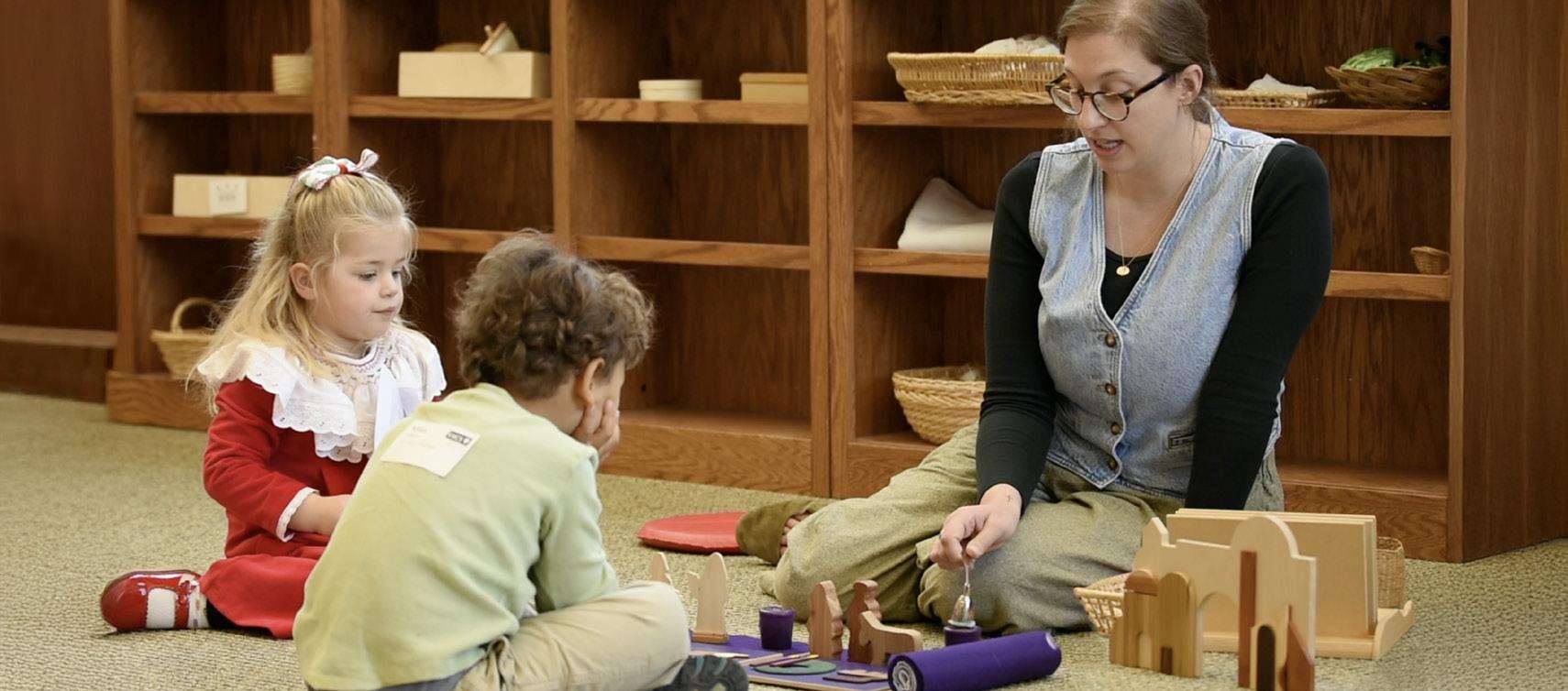
That feeling you have reading this? That’s what children feel hearing a Godly Play story. It slows them down—even the most kinetic child is quieted, in awe—and they bow their heads and worship.
It’s a bit dim, Edwardian, to express in prose a philosophy of teaching children religion, but I’ll give it a go. If the adjective ‘religious’ is taken to mean possessed of certain virtues such as faithfulness, compassion, integrity, humility, self-understanding, and selfdiscipline, you cannot teach people to be religious. If the noun ‘religion’ is taken to denote that area of human experience in which people encounter the Reality behind reality as a power which both judges and to their flourishing transforms them, you cannot teach religion.
with which religion is concerned involve people in every phase and area of their lives—to speak of a philosophy of teaching people religion is a kind of absurdity.
Maybe it’s misleading to speak of religion as listening to something, maybe listening through would be more accurate—listening through the silence, through the prayer, through the music, through the sound of the wind in the rushes or through the sound of your own life, for whatever is to be heard beneath these things.
To the extent that God is One whom we can never make the object of our speculation without to one degree or another reducing God to a god fashioned in our own image; to the extent that God can never become an ‘It’ which we reach at the end of a logical demonstration of divine existence, but remains always an ‘I’ confronting us with divine imperatives at times and in ways which we cannot control; to the extent that the most profound and subtle words we use to describe God are at best the crude metaphors that a blind man must resort to when speaking of the appearance of the sun which he knows only by feeling its warmth upon him, you can never teach God as an academic subject; to the extent that the deep and crucial questions
What then is left after all these resounding negations? Stories. That’s what Godly Play is: trained flesh and blood teachers, aided by creatures of wood and sand, telling sacred Bible stories. It is enchanting. At our Fall Fest, the mother of a preschool boy came up to me to express her gratitude. “William comes home every week excited to talk about Godly Play! He asked me to give him a Bible, so I did.”
What is it that we intend to do teaching your children at Good Samaritan? Only this, I think, and it is plenty: to help you train up a child to see what Job saw (and Rat and Mole and Portly), that it is not religion in itself that matters but what’s Real, the Reality to which true religion points. And this Reality is Jesus Christ in at least a double sense.
First, in the life of Jesus as a human being is made manifest human life as it was created to be, a life where all our tragic estrangement from ourselves, from others, and from God is overcome in his fearsome, sacrificial love. Second, in the event of Jesus as the Christ— his life, death, and resurrection, his coming to us in the Sacraments of Baptism and Holy Communion—a power is released among us which brings us to the One who hangs the stars in the heavens and calls us each by name.
CELEBRATING OUR YOUNGEST
Glad piping in my ears. That’s the sound of children in church at Good Samaritan. I rejoice that young families, in increasing numbers, are worshiping as new members coming into this Body of Christ. I am never more highhearted than when I baptize a child. These are the children whom we have baptized at Good Sam in the Year of Our Lord 2025:
Pauline Louise Badey
Jude Boxler
Parker Elliot Carlin
Asher David Cox
Lillian Grace Davis
Edward N. Flail IV
Reagan Winifred Flail
Colette Virginia Havrilla
Sloan Marie Havrilla
Eli James Holmes
Jack Michael Sawdey
Hudson Grant Sawdey
Wesley William Sawdey
Leilani Azoura Selden
Riley Danielle Sellers
Oberon Dove Sioma
This piece is dedicated to them, and to praise and call attention to our wonderworking Godly Play teachers: Victoria Ellsworth, Kimberly Lindquist, and Leah Sioma.
Kimberly Lindquist telling a story during Godly Play
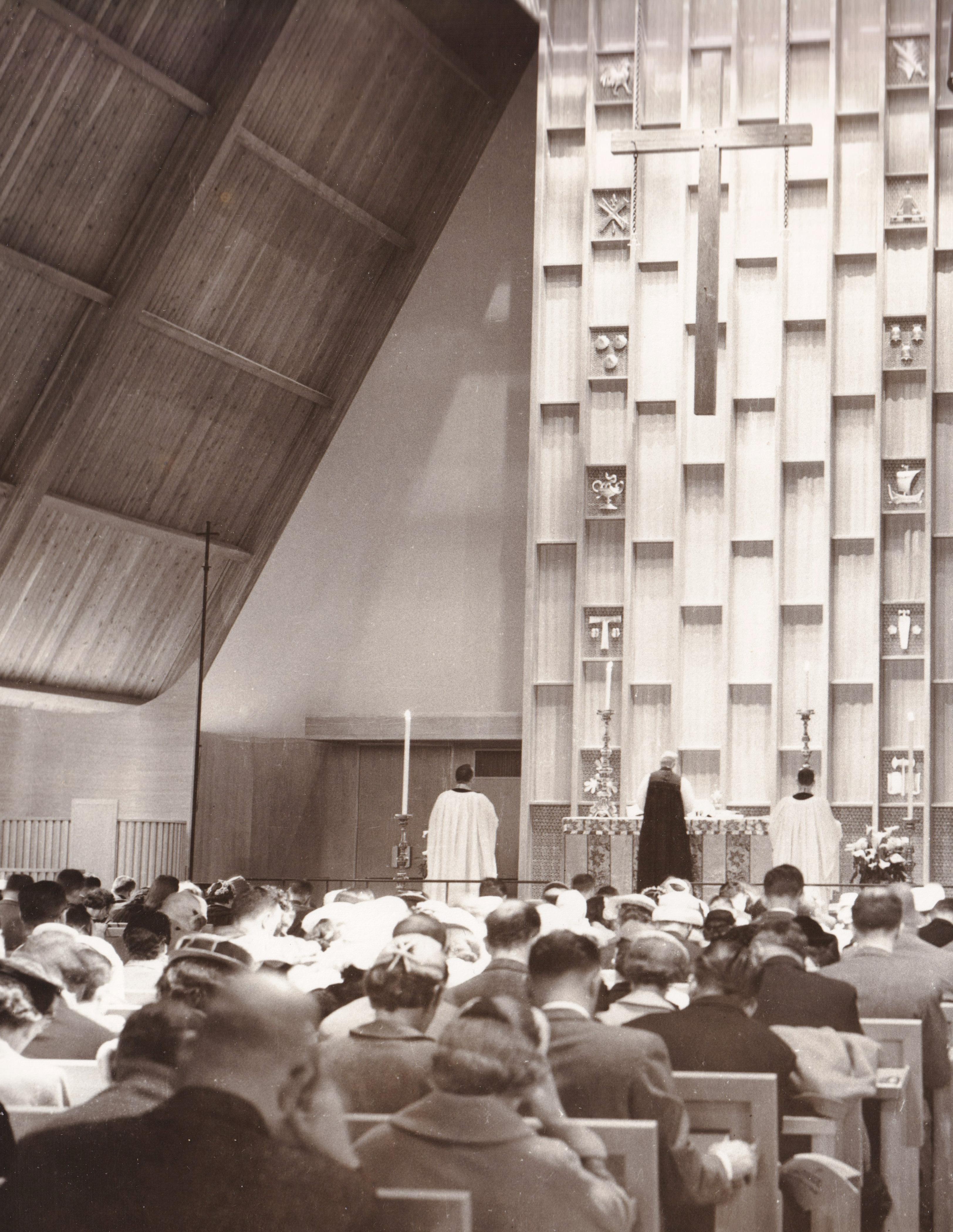
WORSHIP 150 Years of Gathering
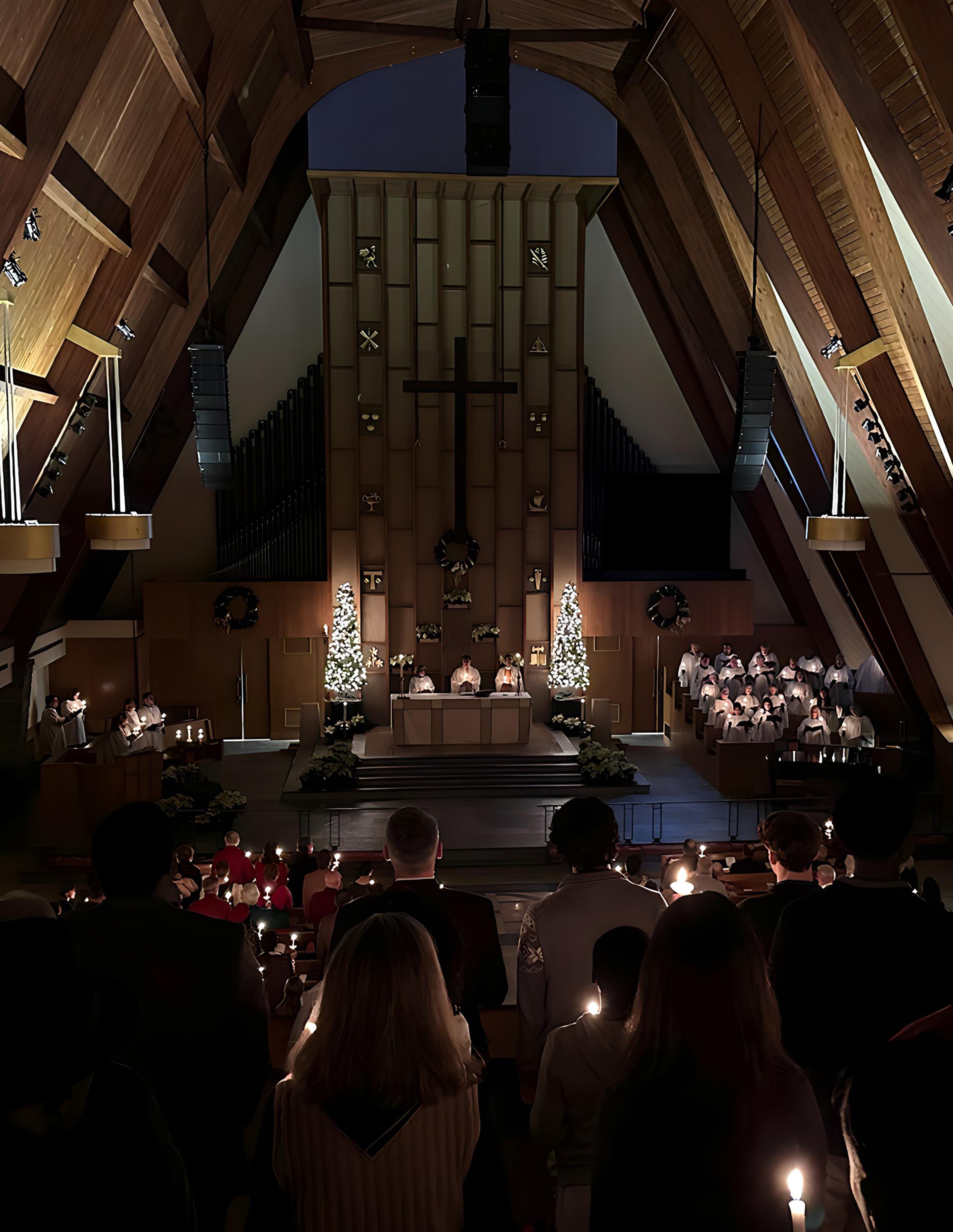
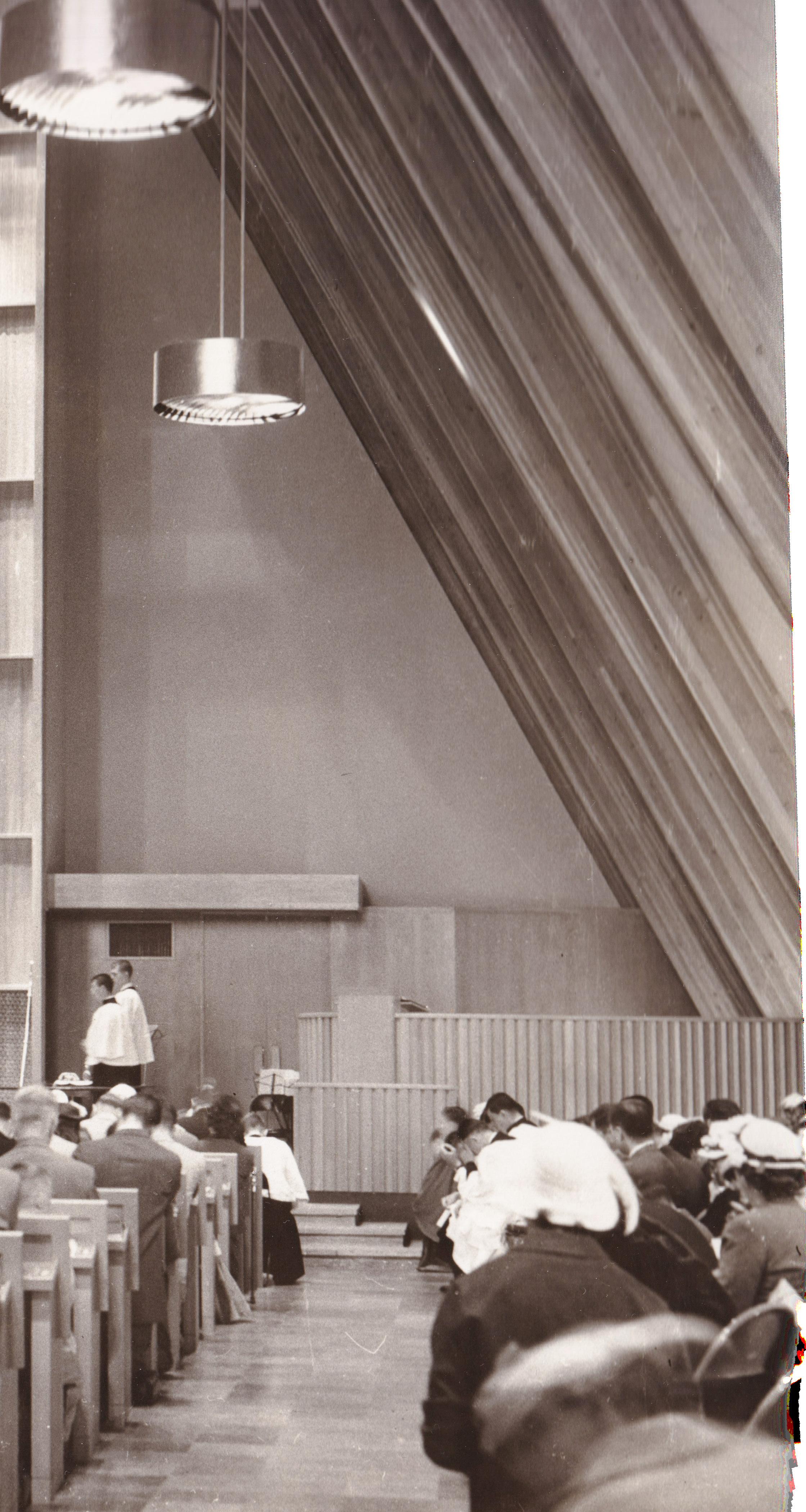
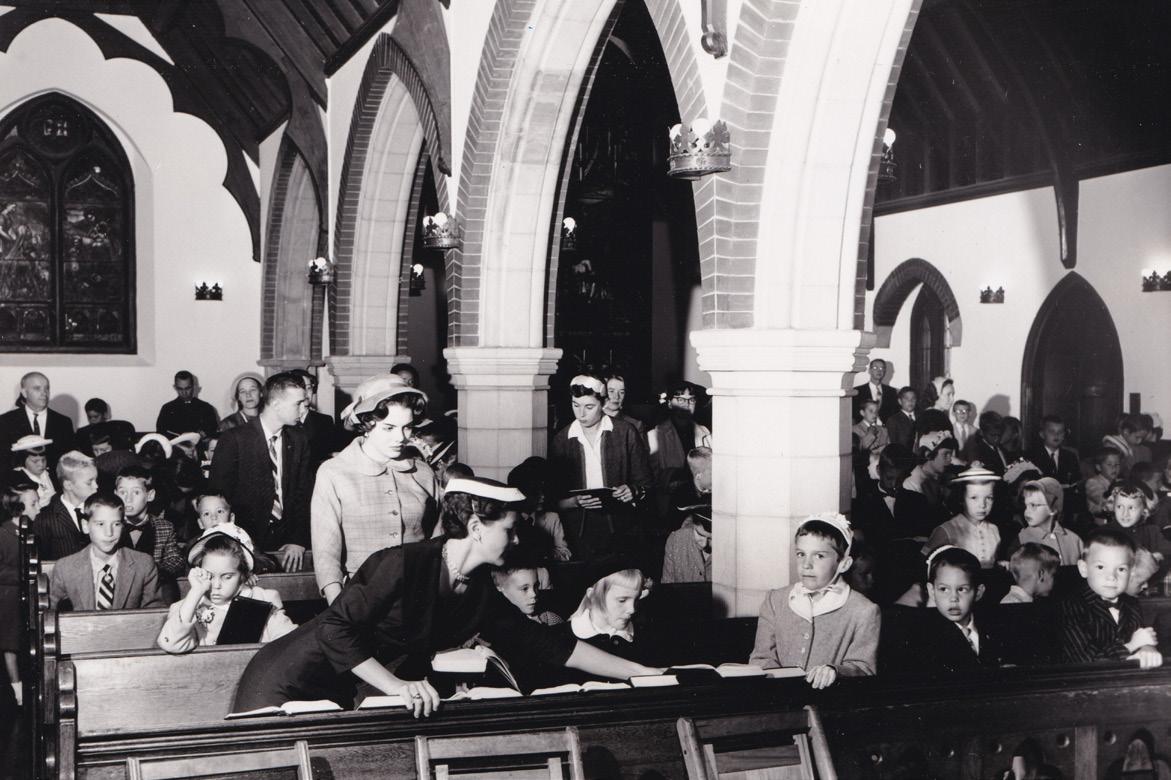
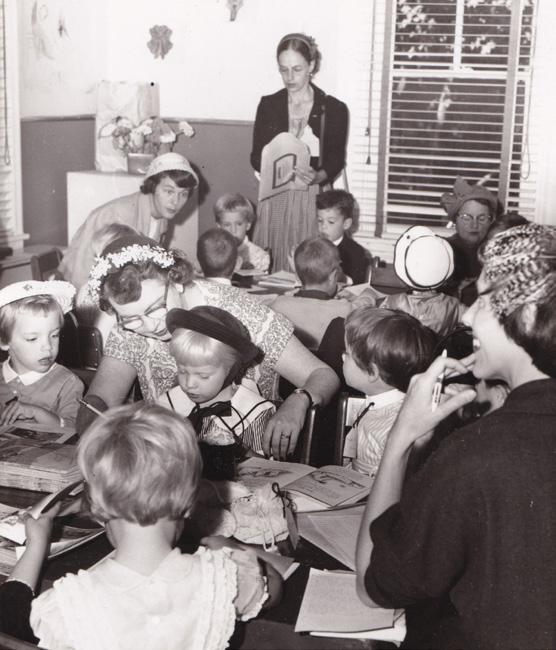
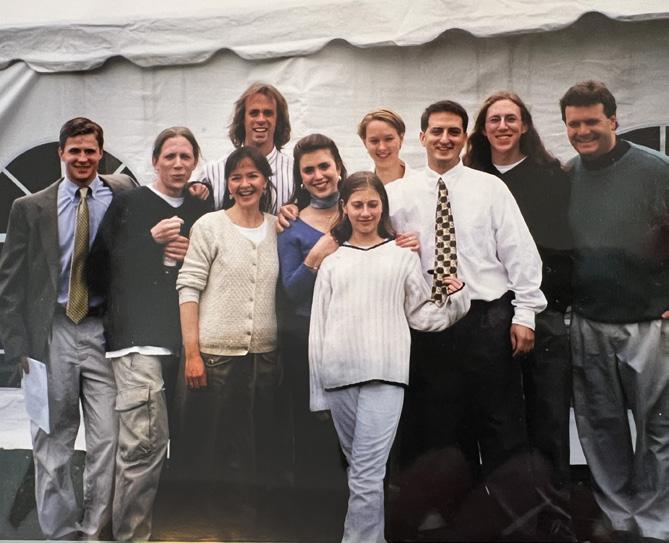
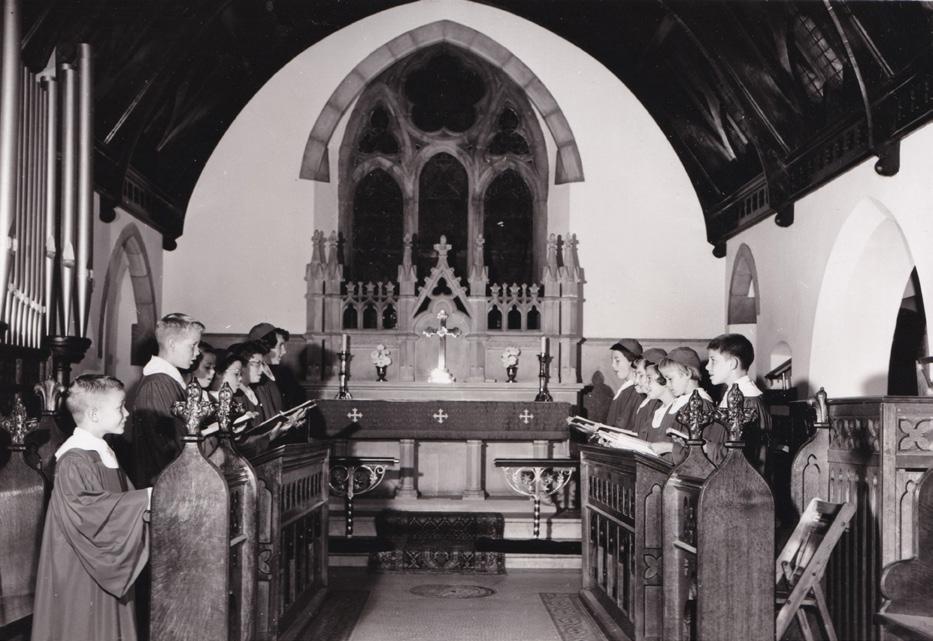
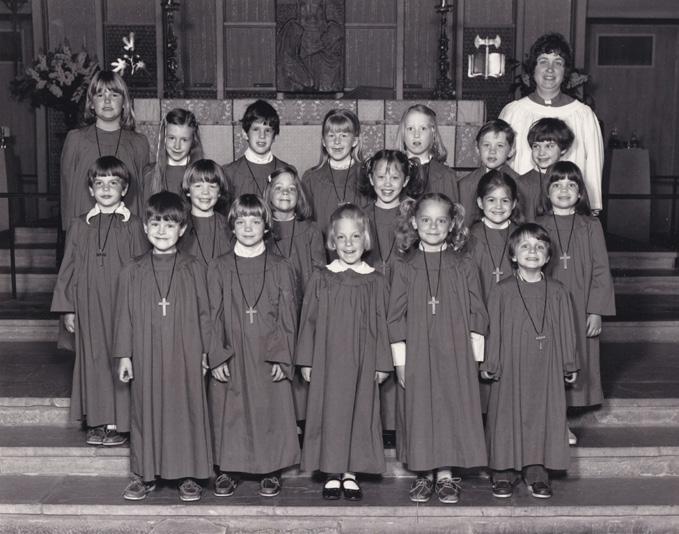
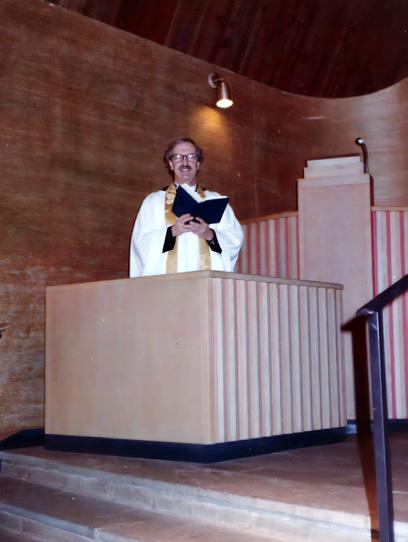
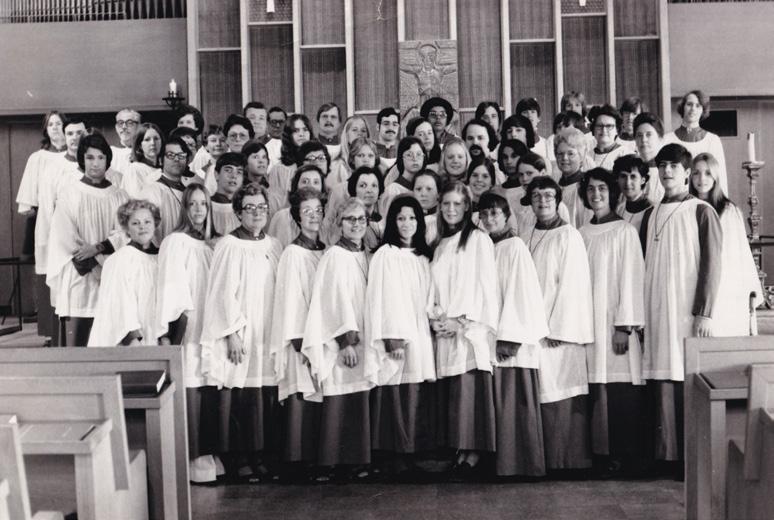
It is hardly possible to reconcile all of the changes 150 years have brought to Paoli, to our nation, and to our world. Yet here at The Church of the Good Samaritan, our worship is fundamentally unchanged. Then and now, we enter the story of our salvation every Sunday through praise and prayer, confession and communion. Then and now, we are immersed in Scripture. Then and now, we approach the Sacraments with faith in God’s power and grace. And though our worship is largely unchanged, the life of this place is not static.
Reenacting the story, we have, in each generation, become a part of the story, and thus our selves and our parish are continually transformed. What a privilege it is to continue joining our voices with angels, with archangels, with all the company of heaven, and particularly with those of earlier generations who once lifted their hearts to God in this place.
Dance Ministry
Chairs scraped gently across the dining room’s hardwood floor to make way for a simple circle dance—adding a new dimension to their home group and planting the seed for today’s vibrant Dance Ministry.
For Gwen Prestwood, it began in 1983, when Fr Dan Sullivan warmly welcomed her and John as new faces at Good Sam. Learning of Gwen’s artistic bent, the Rector recommended a home group made up of other performing and visual artists. The group met in the little yellow house across Cedar Hollow Road, where the church housed Kerry Beaumont. It was there that Gwen met Valerie Henry.
Valerie, a Christian dance missionary, soon caught Fr Dan’s attention, and he invited her to start a “dance choir.” Valerie began teaching dance in Walton Hall. Those earliest classes included Gwen, Ginny Guyer, Carol Longacre, and Karen Gregory.
Valerie’s ministry frequently called her out of town— including trips to Jerusalem as choreographer for the Feast
of Tabernacles and tours with John Michael Talbot and Steve Fry. During Valerie’s travels, Gwen recorded choreography, led rehearsals, and served as ballet mistress. Valerie first performed as part of a Good Samaritan service at Thanksgiving in 1983.
The Lord continued to build the house, bringing dancers from across the Philadelphia region.
Parishioner Heather Taylor designed liturgically appropriate costumes, while dancers sewed their own or hired seamstresses. The Dance Choir began performing We Are Called at other churches, followed by Earthen Vessels in a Sunday service at Good Sam in 1986.
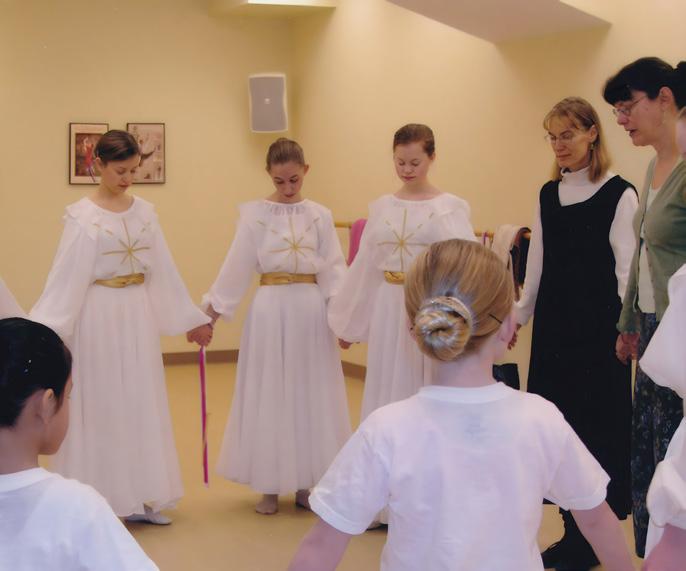
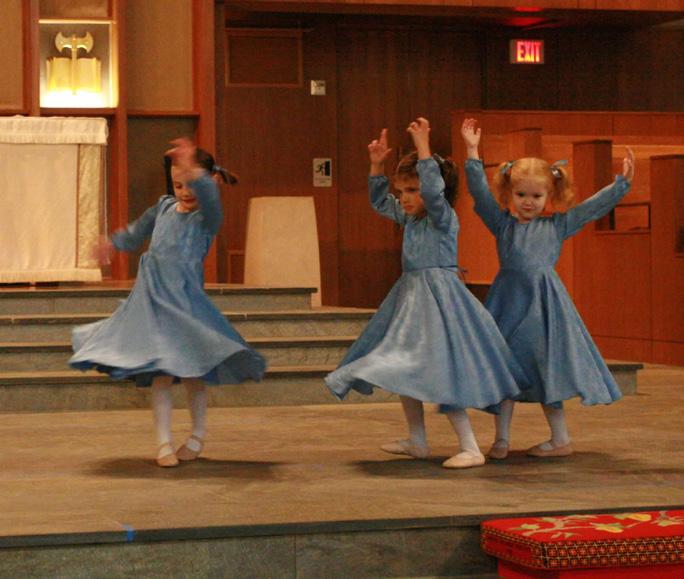
Today, more than 60 students participate in the ministry, presenting two annual concerts. The Dance Choir and Junior Dance Choir embody worship throughout the liturgical year, recently on Thanksgiving, Christmas Eve, and Epiphany.
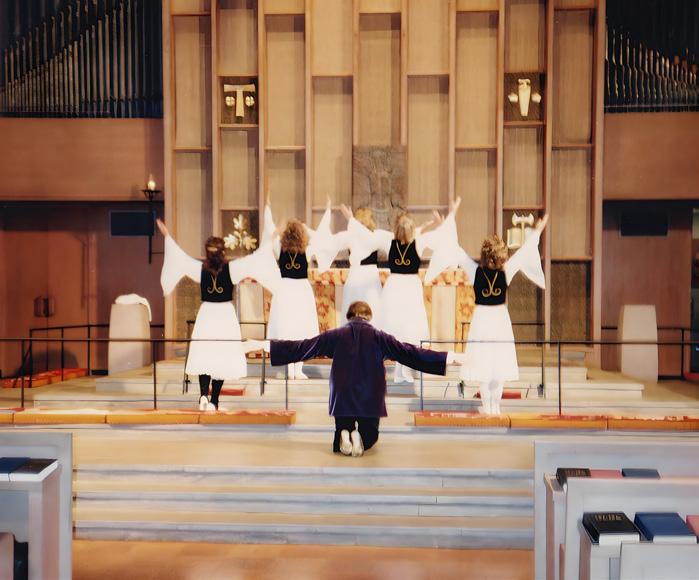
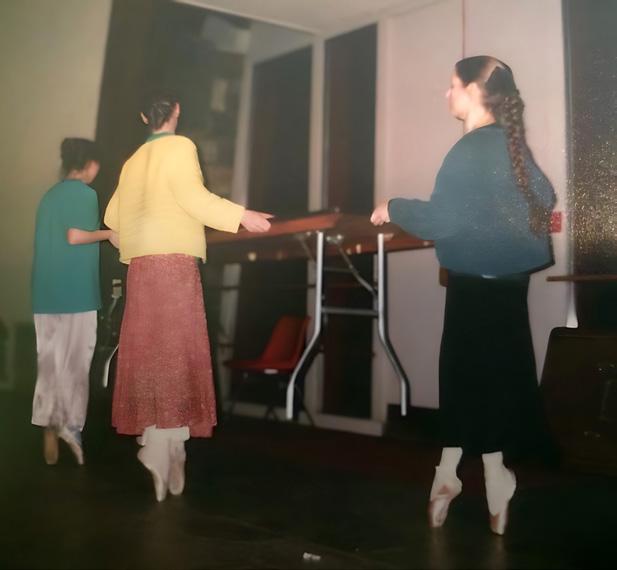
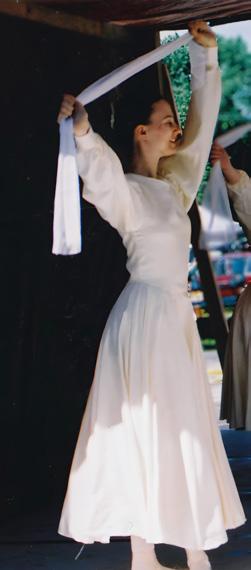
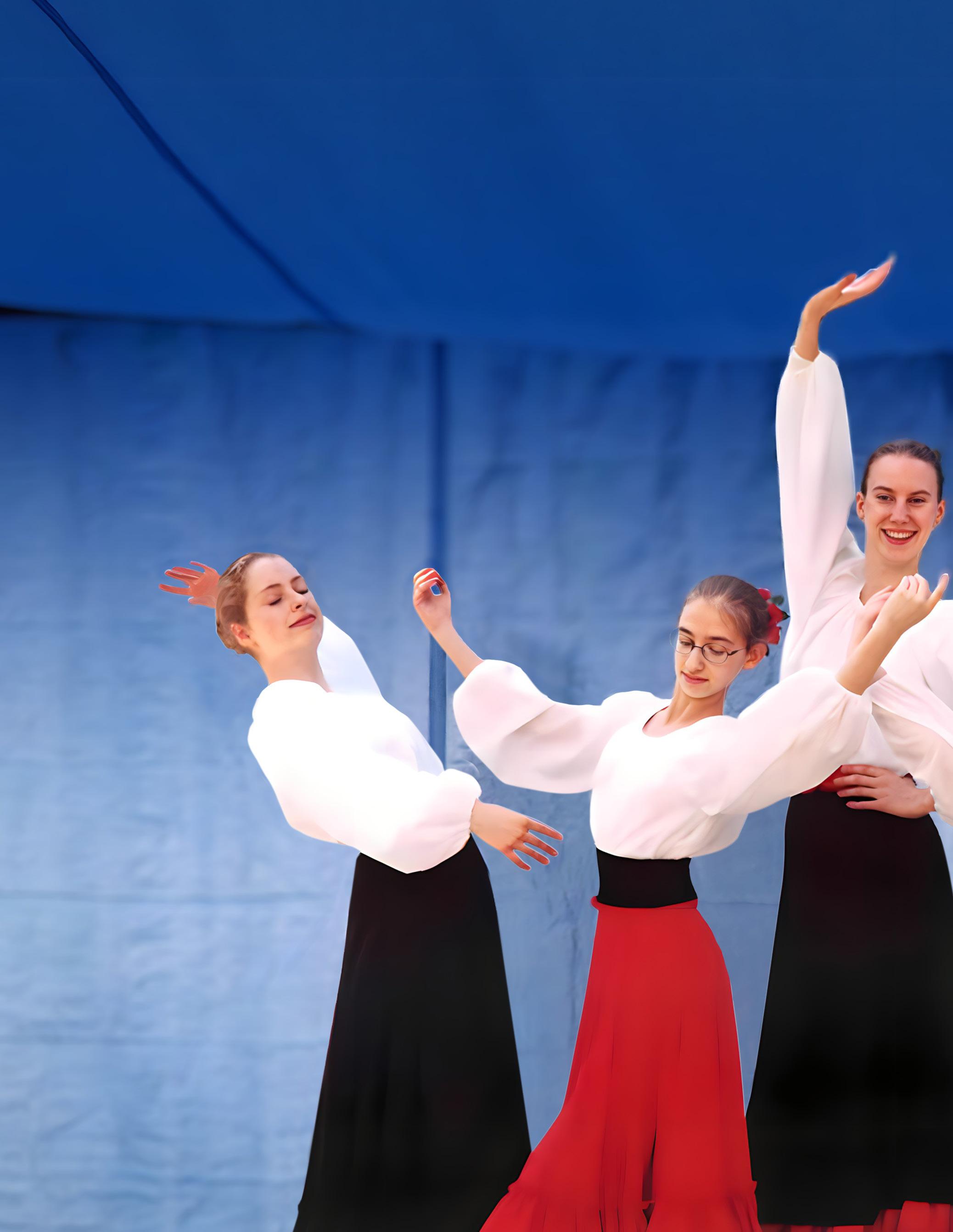
Fair Days Stage, circa 2000 Joanna ShawRuss, Laura (Adams) Cox, Angela (Stanert) Commiskey, Emily ShawRuss, Emily Adams Angela returns to lead Saturday morning ballet class in February!
Circa 1996 “Oh we can move that table” (rehearsal silliness!)
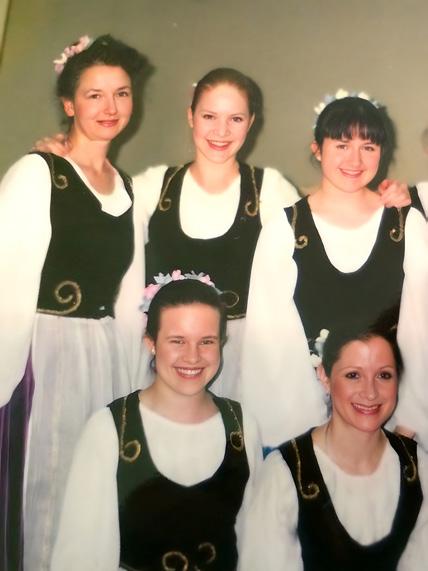
Folk dance (left to right top) Carla Kirk, Elrena (Carlson) Evans, Kristen Gee, (left to right front) Karen (Gee) Watkins, Jane Shaw 2004 Fair Days
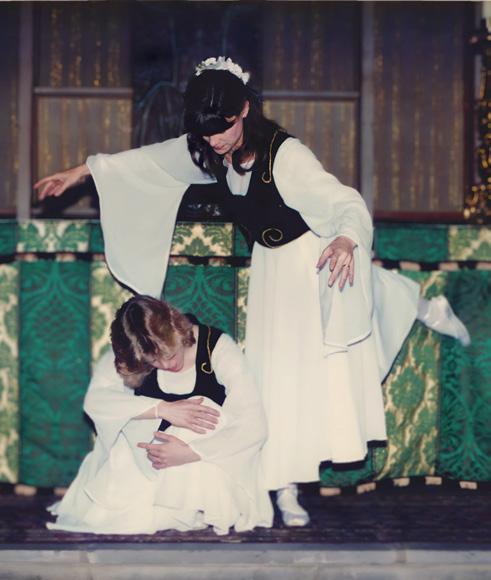
1986 Earthen Vessels: Heather Taylor (left) and Gwen Prestood (right)
1986 Earthen Vessels: Dance Choir’s first worship performance at Good Samaritan
1983
• Valerie Henry founds Dance Choir
• Classes and rehearsals start meeting regularly in Walton Hall
• First solo performance (Thanksgiving service)
1985
• Celebrating the Dance Ministry’s 43rd year A BRIEF HISTORY OF
• Dance Choir invited to perform at other local churches
1986
• Dance Choir performed Earthen Vessels at Good Sam, first Sunday morning
1988
• First Spring Concert presented in Ashton Hall (now twice annually)
• Joined first of many Lessons & Carols
1990
• Elrena Evans joins Dance Choir with previous ballet training
1991
• Karen Watkins joins as novice dancer
1992
• National Christian dance conference at Eastern University, Including Dance Choir
• Valerie and an Israeli composer collaborate, creating a piece about the history of the Jewish people, which was performed at Good Sam and a messianic synagogue in Maryland
1993
• A small delegation of dancers (Valerie, Elrena, Karen, and Jane Shaw) travel on a missions trip to Latvia and Russia, where they perform and witness many conversions
1997
• Gwen Prestwood promoted to Dance Choir Director
• Newly named Rector Fr Greg Brewer encourages more dance during services
• Good Samaritan Dance Academy formalizes and expands dance instruction
• Classes held in Walton Hall, Ashton Hall, and the Nave, using makeshift barres and mirrors hung from room dividers
2006
• Professional dance studio opens under Nave (former Thrift Shop location) with small lobby, office, changing room, costume storage, and dance floor with barres and mirrors
2016
• Lora Dutill, a dance choir mother, assumes leadership of the dance prayer group, encouraging other mothers to join her in prayer and scripture reading while their daughters take dance classes.
• After her daughter goes to train with a professional Christian dance company, Lora begins a monthly email devotional and prayer chain for Dance Ministry
2019
• Karen Watkins promoted to Director of Dance Ministry after 15 years as assistant director 2026

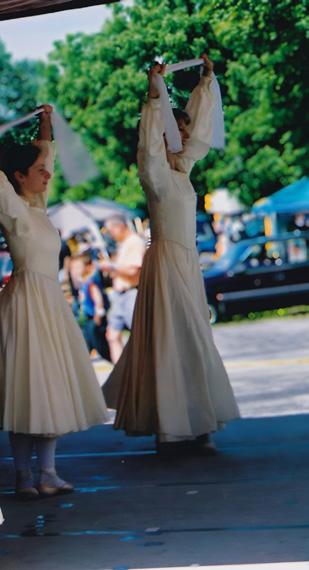
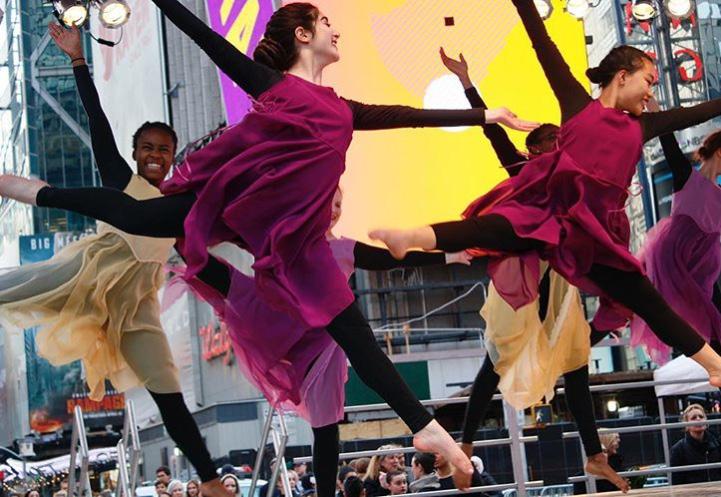

2018 Times Square
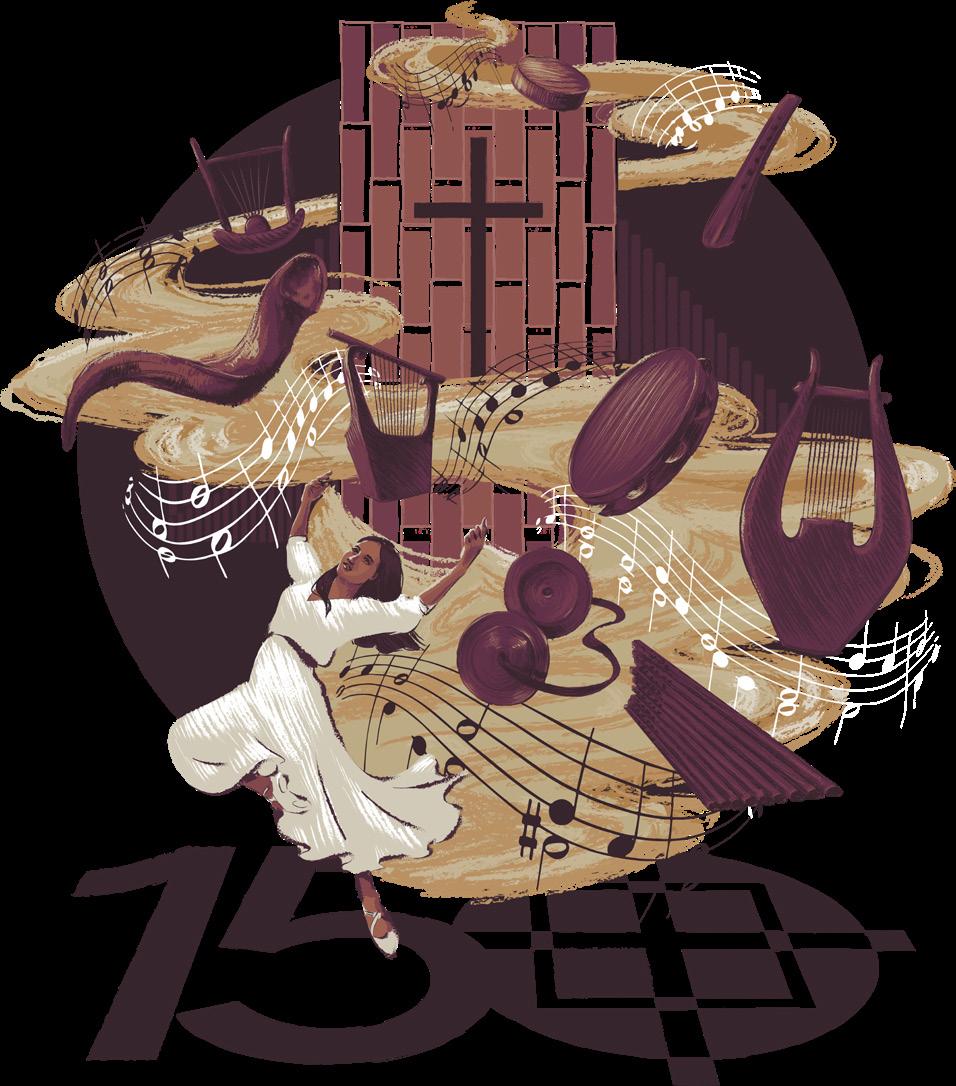
Illustration by Kristen Gee in honor of Dance Ministry and the 150th Celebration of Good Samaritan
Ministry grounded in prayer
2009 Dance Concert (including a young Annika Evans at right)
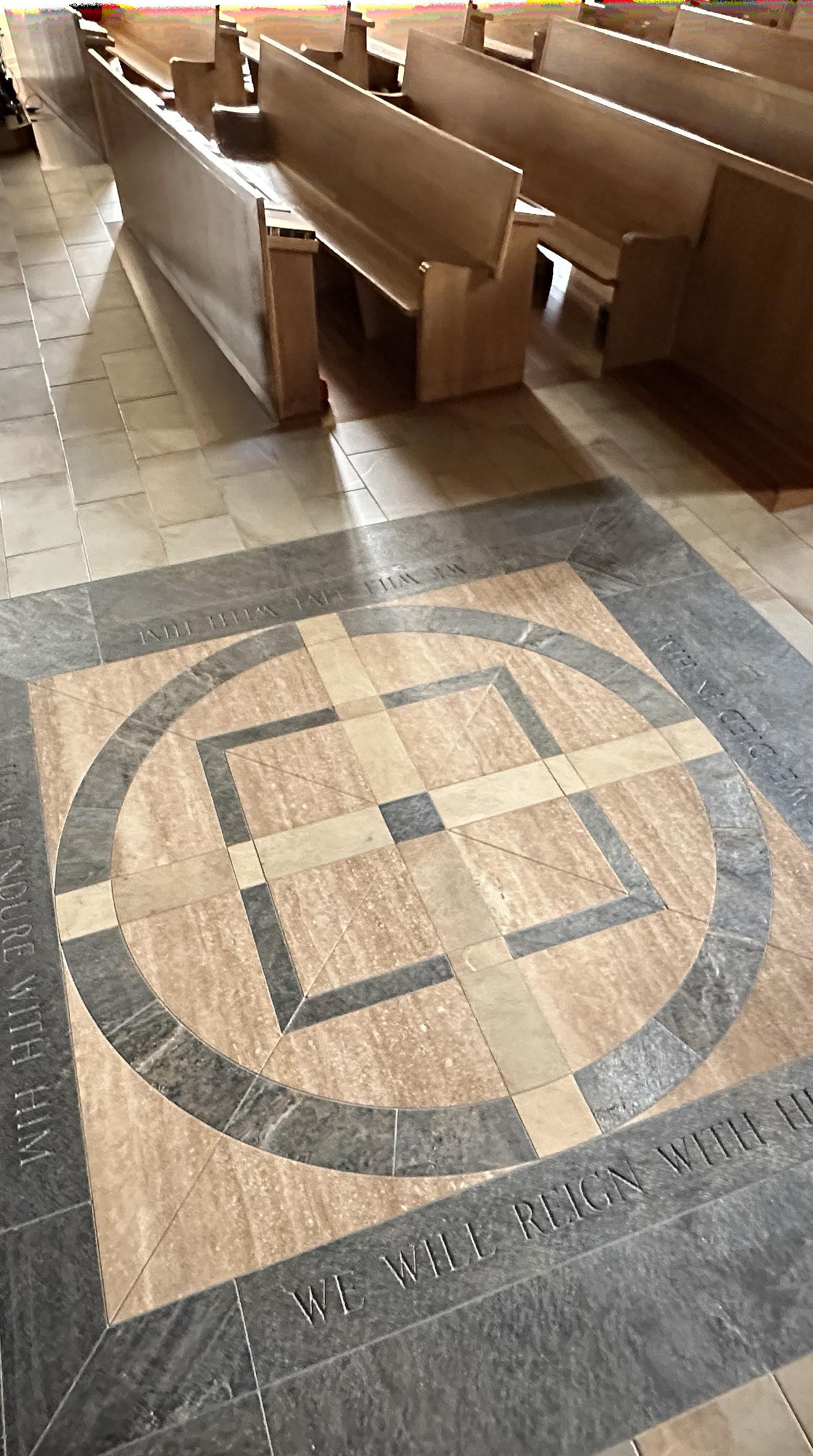
There is an invitation for us on the ground beneath our feet and in the logo we wear. Both echo the same sacred geometry: square, cross, and circle.
Let your eye rest on that central square and see how it is a still point. Can you imagine the heart of God there? Follow the arms of the cross. See how they stretch beyond the square shape of our building and into the circle of the world.
To “go and do likewise,” is to walk the Way of Christ’s cross.
For our 150th Anniversary video project, we have been interviewing long-time members of Good Sam. Here’s a sneak peek from our conversation with Glenna Geiger.
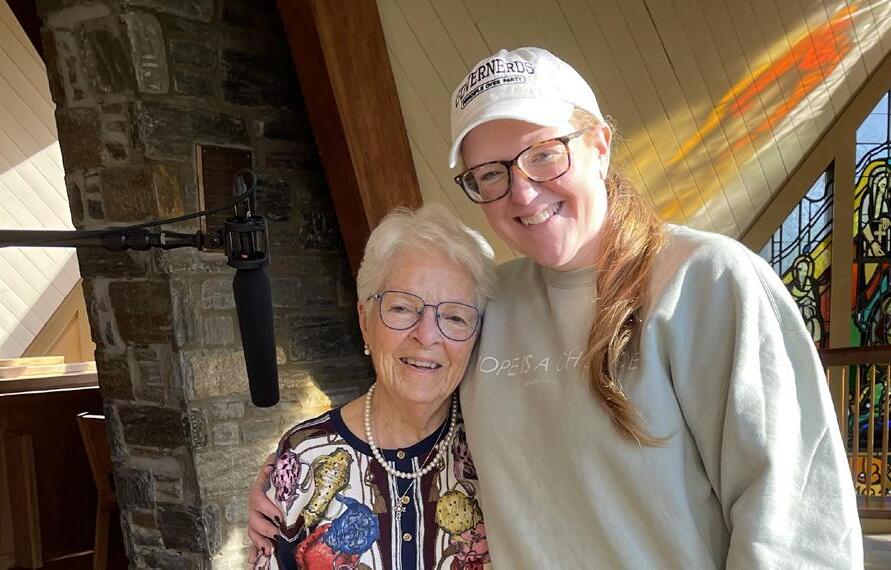
Glenna Geiger Member since 1964
What brought you to Good Sam?
I came to Good Sam with my husband and my five children in 1964. [The first Sunday] we all came and sat in the very front pew on the left side. The younger children did not misbehave if they sat in the front row because they could see everything that was going on.
Could you describe the impact of the Good Sam Community in the life of your family?
Good Sam was a huge part of our life. We were all involved in one way or another from the littlest to the biggest. If there was something Good Sam was doing, we were involved in it.
Tell us about being involved with the choir.
The choir was amazing. It was a community and we had a commitment to each other and to the music of the church. When Kerry Beaumont came, we had a director who inhabited the role of being our spiritual director too... The music making with other people was what I really loved. That’s always been my top pleasure.
What do you remember most about Fr Dan Sullivan?
Dan’s enthusiasm. He was enthusiastic when he taught the day school children about Zacchaeus in the chapel. He would get up and perch on top of the pulpit and jump down “out of the tree.” He’d bring a live lamb in. He was so creative and enthusiastic about everything all the time... He would call you on the phone and he would say, How would you like to do something nice for God? And what could you say?
What keeps you connected to Good Sam?
I like to stay it connected to Good Sam [and watch the livestream]. This is where my peeps are. More of my life has been spent here than in any other church. The memories are here and there are still people here whom I remember— children and grandchildren of my friends... This is a multigenerational church, which is one of the things I love about it. It is diverse on almost any axis you could mention. And yet it works. And that’s only through the power of God that that happens. We don’t always agree. That’s one of the fun things about diversity, but we all agree on one thing—Jesus is Lord.
Glenna Geiger with Jess Campbell, interviewer and Director of Student Ministries, after Glenna’s video interview
FROM THE RECTOR’S WARDEN
It’s Just a Penny
BY WHITNEY T. KUNIHOLM, RECTOR’S WARDEN
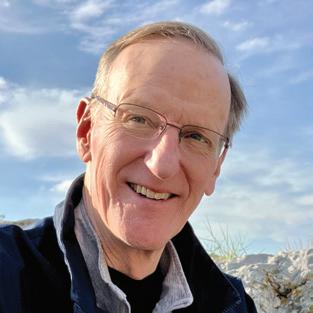
If you’re like me, you love Fr Ellsworth’s signature benediction:
“Life is short and we do not have too much time to gladden the hearts of those with whom we travel. So be quick to love, make haste to be kind…”
Every time I hear it, I’m reminded of how I want to live. And then, the moment I walk out of church, I often forget. Let me give you an example.
Some time ago, I went to the store to pick up a few small items. At the checkout, the total came to $4.23. I handed the cashier a ten-dollar bill and reached into my pocket for change. All I had were two dimes, two pennies, and some lint—twenty-two cents. I held it out, thinking the cashier might have a spare penny. Most people don’t want to make change anyway, and this guy was no exception.
“It’s $4.23… sir,” he said firmly, emphasizing “sir” in a way that felt a little accusatory. I put the change back in my pocket, gave a frozen smile, and left with a bunch of extra coins jingling in my pocket. Outwardly, I was calm. Inwardly? Irritated. What a jerk, I thought. He couldn’t scrounge up a penny?
Driving home, I replayed the scene. What bad customer service. No wonder they don’t get more business in that dump! Later, during my evening prayer walk, I circled back to it again, and the next morning in my quiet time, guess who came to mind as I began to pray? “That stickler at the cash register.”
That experience made me realize how easily a small offense can take over our inner life. I kept thinking about it, rehearsing what I should have said—one imaginary zinger after another. It became a low-grade obsession, like background music in my soul.
“Penny irritations” can become barnacles on our spiritual lives. Left unchecked, they can poison our spirit, make us harder to be around, and distract us from the life God wants for us. We might think nothing’s wrong, but inside we’re replaying arguments with the “jerks” we encounter every day, making it harder to love God and others (Matt 22. 37 – 39).
Jesus told a story about a servant forgiven an enormous debt who then refused to forgive someone who owed him a tiny amount (Matt 18. 21 – 35). God has forgiven us so much. Surely we can let go of a one-penny offense.
Is it really worth getting worked up over…
• An off-handed comment from your spouse?
• An irritating email from a co-worker?
• A difference of opinion at church?
• A political statement by “the other side”?
If you really want to make a difference for God today, maybe you don’t need to become an overseas missionary. Maybe it’s as simple as responding graciously—even lovingly—in a culture where insensitivity, outrage, and division are becoming the norm. Now, that would be radical.
“Penny irritations” can become barnacles on our spiritual lives. Left unchecked, they can poison our spirit, make us harder to be around, and distract us from the life God wants for us.
And then it hit me: Wait… it was just a penny!
Lately, I’ve been trying to make “It’s just a penny” my mental shorthand for letting go of small slights before they get stuck on auto-repeat. Of course, there are deeper wounds that require time, grace, and inner healing. But most of what trips us up day to day isn’t deep trauma— it’s micro-annoyances. The one-penny offenses. And if we can release them more quickly, we’ll experience more of God’s peace and presence.
Let’s be honest: we won’t become a Mother Teresa or a St Francis overnight. It takes daily practice. So, the next time I’m in a store, maybe I’ll just give the cashier exact change and a genuine smile. See what happens.
And one more thing: I think I’ll start adding a phrase to Fr Ellsworth’s benediction: “Life is short and we do not have too much time to gladden the hearts of those with whom we travel. So be quick to love, make haste to be kind… and remember: it’s just a penny!”
A Heart for Heaven
FINDING
HOME IN WORSHIP
BY CHRISTIE PURIFOY, WRITER-IN-RESIDENCE & TEACHING FELLOW
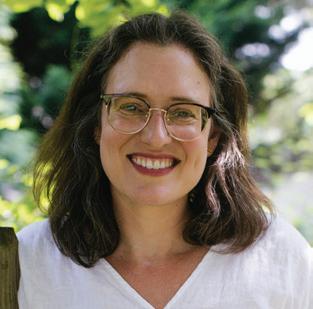
When we first came to Pennsylvania with our young children, my husband Jonathan and I began looking for a church even before we had signed the papers on our new house. We were still living out of suitcases in an “extended stay” motel when we piled the kids into the rental car one Sunday morning and told them we were off to worship.
If you had asked us then what we were looking for, I’m certain we would have said we wanted a vibrant community where we could belong and serve. If you had dug a little deeper, we probably would have admitted we really needed to get out of that motel room. Our toddler’s favorite pajamas had been inadvertently packed on the moving van, which was still making its slow journey up from Florida. Those two weeks, when a very young boy was painfully separated from the comfort of his Disney Cars pajamas, have gone down in family history as if we were survivors of the Oregon Trail—or the sinking of the Titanic. We were all feeling pretty desperate, which likely explains the urgency with which we began our search for a church home. But what makes a church feel like home? I’m not sure I could have put it into words then, but I now see that, like my son, I was longing for the comfort of the familiar.
When we first visited The Church of the Good Samaritan on the recommendation of a friend, we chose the New Chapel Eucharist, and you’ll still find us in that later service with our sleepy-headed teenagers most Sundays. The songs and the sound of the band were familiar from churches where we had worshiped before, but much in the liturgy was new to us. It felt like learning the steps to a beautiful dance, but with a few stumbles and toes stepped on along the way.
As we grew more comfortable with New Chapel, we became curious about the more traditional Rite II service held at the same time in the historic church. If you have worshiped in that intimate space, you know that even in the back pew you are not far from the front. One Sunday, Jonathan and I slipped into a middle pew with our two little boys between us. They would hardly have noticed loud drumming, but when a talented choir member sang an operatic solo just above their heads, the boys were so stunned by the power of the voice and their proximity that they began to laugh. Their snickering tickled their father’s funny bone, and by some miracle known only to desperate mothers, I managed to pinch three arms at once until sons and husband pulled themselves together.
It isn’t easy to try something new with young children in tow, but we persisted. Those little boys are practically grown now. They are no longer surprised when the organ trumpets, no longer lost when I hand them a hymnal. They are at ease with a barefoot guitarist and don’t even blink when everyone around them raises hands in praise.
My older son, now in college, recently told me how he and a few friends, curious to see the relics of a saint they had studied, visited a Catholic church and inadvertently stumbled into a Mass conducted entirely in Vietnamese.
“What did you do?” I asked, remembering the little boy who had once been seized by giggles in a strange new church.
“I took a seat and stayed till the end, Mom. It was great.”
“But could you understand anything that was said? Or sung?”
“Only the word Amen,” he said, as if that was more than enough.
Thirteen years after first choosing to worship at Good Samaritan, I see how the diverse worship of this church has allowed me to experience more of the fullness of heaven. This may sound idyllic, but the truly idyllic almost never lies within our comfort zone. Here, we worship in three different ways at our three Sunday morning services. Though I once sought the familiar, I have been given much that is unfamiliar.
Here, we worship with dance, we worship with chant, we worship with the intimate language of thee and thine. Our worship is carried by organ, by soundboard, and by candlelight. Do you imagine the worship of heaven will sound like choral Evensong? Having experienced that, I think you are right. Do you imagine it will sound like a guitar riff and a drumbeat? Having known those too, I believe you are also right. Colored glass and incense? So do I. But above all, Scripture shows us that God is worshiped with singing, and every Sunday we are given so many ways to sing along.
I am fascinated by the hours just before Jesus is arrested and crucified. As we read in the Gospels, he spends those precious moments around a table with his closest friends—and his betrayer. They eat, they talk, there is broken bread and the cup of wine—and then, just before going to
Gethsemane, Jesus and his disciples sing the hymn (Matthew 26. 30). It is easy to move past that detail. It is small and seemingly insignificant, like a crumb swept from the table. And how often do we imagine Jesus singing? Gary Gress, our organist, once asked me this question with wonder in his voice. One of the most important gifts I have received at Good Samaritan is a peek behind the veil that separates heaven and earth. What is happening in heaven right now? The answer is right there in our Communion liturgy:
“Therefore we praise you, joining our voices with Angels and Archangels and with all the company of heaven, who for ever sing this hymn to proclaim the glory of your Name.”
Right now, in heaven, God’s people are singing. Perhaps the Son of God who came to sing with us is even now singing at the throne of the Father.
In worship, we glimpse the unseen with eyes of faith. This vision puts so many of our disagreements and so-called “worship wars” into perspective. Should we worship your way or my way? Not every church can answer “both.” How blessed we are to belong to a church where we can lay down our preferences and worship in the way of another. I think heaven will feel more like home because we have not shied away from variety and difference here on earth. Even our difficult budget decisions gain clarity. I can no longer say that organ repairs benefit only the traditional service, or complain that new speakers mean nothing to me because I don’t attend the contemporary service. As we grow the excellence of our choir and upgrade lighting and sound systems so they no longer distract, the worship of our church as a whole grows richer and more robust. Worship remains a very earth-y business. Enabled by the Holy Spirit, it also relies on human talent, hours of practice, electricity, technique, and technology. These ordinary elements are part of the praise we offer together as one church.
I still think of the little boy who cried himself to sleep in our motel room because he missed the comfort of his familiar pajamas. I imagine he cried for more than pajamas. Weren’t we all missing the comforts of home at that time? All Jonathan and I could do was hold him, understanding his distress while knowing how much more we would be giving him in this new Pennsylvania home. Soon he would have the pajamas and toys he loved in Florida—but also a family dog, snow in winter, and one day a room of his own. His desire wasn’t misplaced. It just wasn’t big enough. His little heart needed stretching so that more of the world could feel like home.
The worship of heaven depends on all the nations of the world, and I want a heart wide enough to desire it. I give thanks to God for The Church of the Good Samaritan, where we have all the comforts of home. I give thanks to God for The Church of the Good Samaritan, where we have so many opportunities to feel uncomfortable—and so many chances for our hearts to grow.
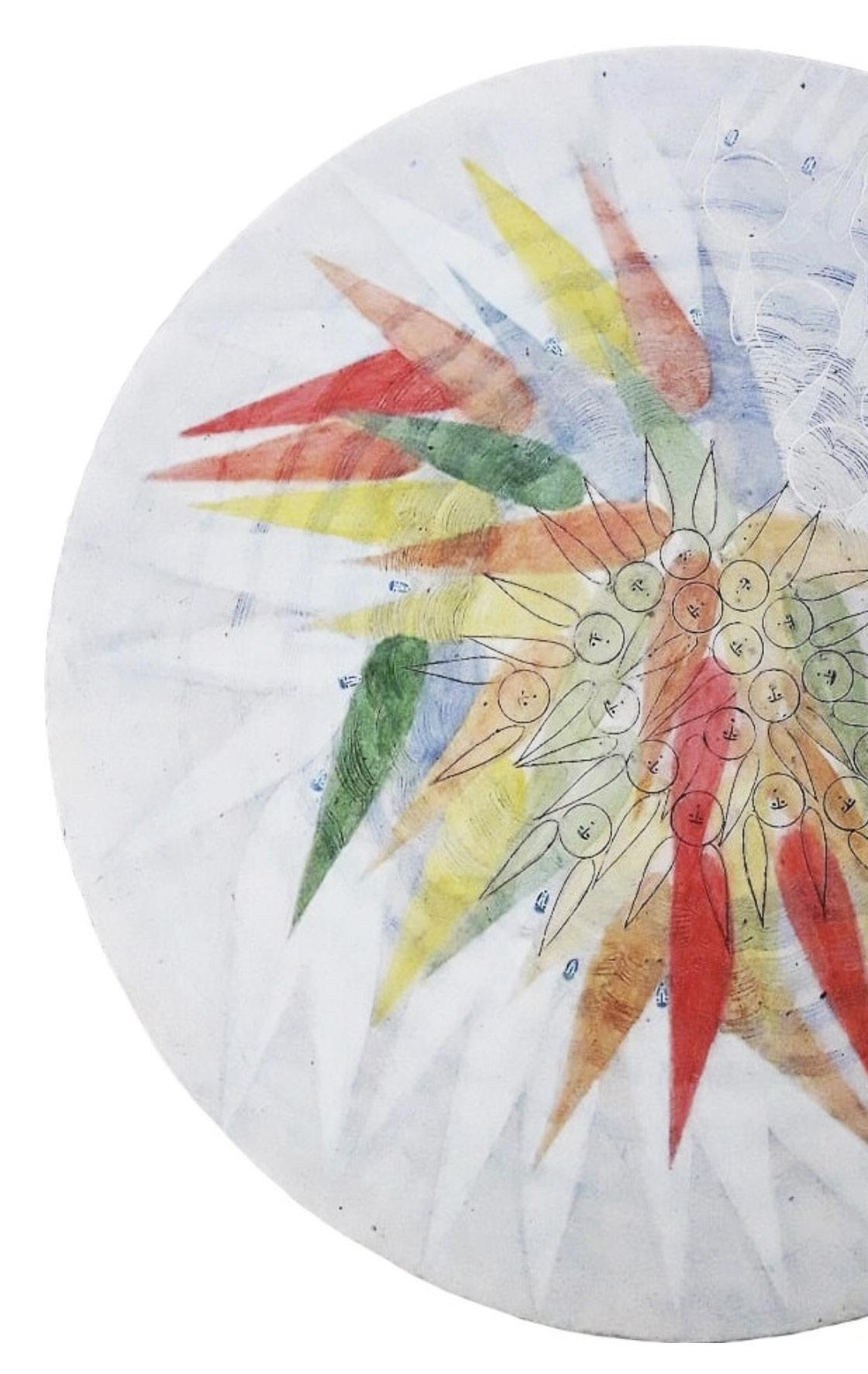
Angels, by Natalya Rusetska
A Hymn for all Seasons
BY CONNOR FLUHARTY, DIRECTOR OF MUSIC
How shall I sing that majesty Which angels do admire?
Let dust in dust and silence lie; Sing, sing, ye heavenly choir.
Thousands of thousands stand around Thy throne, O God most high; Ten thousand times ten thousand sound Thy praise, but who am I?
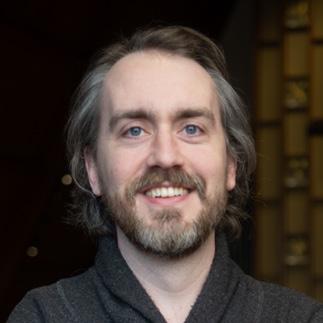
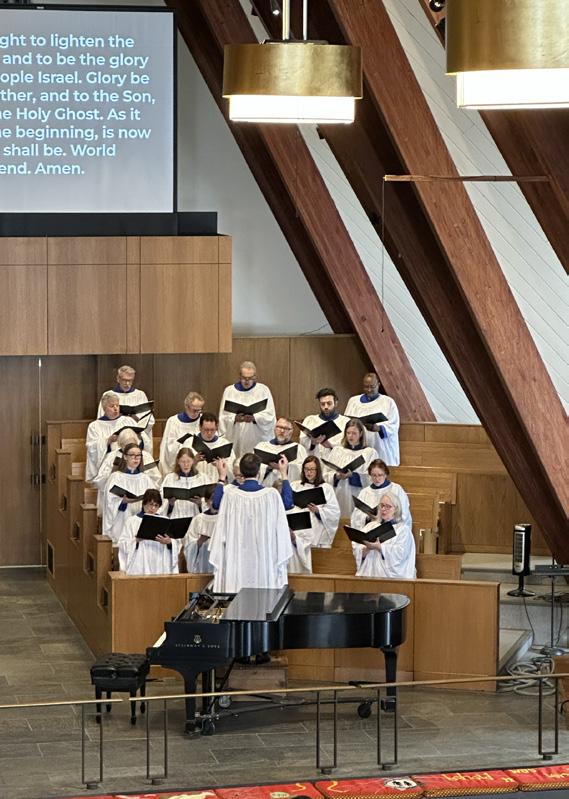
In the summer of 2025, I was fortunate to go on a choir pilgrimage to the UK with the choirs of Trinity Church, Boston. Over the course of two weeks, seventy choristers ages twelve to eighty-something sang for fourteen services.
The first half was spent at Canterbury Cathedral and the second at St Paul’s in London. The hymn How shall I sing that majesty, which is laid out here, we sang in both places. It was serendipity, really, as the hosting cathedral chooses all the hymns for visiting choirs. I didn’t know this hymn before, but it has quickly become one of my absolute favorites, and that sentiment was shared by many of my fellow pilgrims.
Trinity Boston chose to call it a pilgrimage rather than the more frequently used “tour,” specifically because we were going to Canterbury, which has been a place of pilgrimage since Thomas Becket was killed inside the cathedral in 1170. Canterbury is also associated with the introduction of Christianity into Anglo-Saxon England. There’s a great deal of history there, but you don’t need to be invested in medieval religious history or in long-dead saints and kings to feel—physically and palpably—the sense of standing in a long line of worshippers when you are in that church space. Becket’s tomb (the goal of early pilgrimages to Canterbury) was removed and destroyed in the 1500s, but at the top of the steps where it used to lie, you can see the deep divots worn into the marble by the knees of so many pilgrims coming to pray and worship in the cathedral.

This hymn text, written in the mid-1600s by Anglican priest John Mason, somehow illuminated and synthesized the experience of worship in that pilgrim context, and can do the same for us wherever we are. We were singing Evensong each night in a place that has offered daily Evensong for hundreds of years—a brief blip in a long line of prayers that would continue once we left. No matter how much work is put into the psalms and anthems, it’s still something of an exercise in humility to offer them in that long stream of worship. Ten thousand times ten thousand sound Thy praise, but who am I?
Thy brightness unto them appears, As I Thy footsteps trace; A sound of God comes to my ears, But they behold Thy face. They sing because Thou art their Sun; Lord, send a beam on me;
For where Heaven is but once begun, There alleluias be.
The Evening Prayer / Evensong liturgy was born out of a post-Reformation reorganization of two other monastic evening services said daily, vespers and compline. It grew and flourished as more music was written for its text, and now Evensong is one of the most well-known services in the Anglican tradition. It sounds counterintuitive, but this set liturgical structure gives us musical freedom through organization— a hook on which to hang all your creativity. It also connects us to innumerable worshippers and musicians through history who have done the very same thing. Services like Morning Prayer or daily Evensong are both highly devotional and highly traditional, but they’re not meaningful because they’re old—they’re old because they have been, and continue to be, meaningful. It’s a service that demands little from a first-time visitor, but still offers depth, challenge, and comfort for the person who has been to hundreds.
Enlighten with faith’s light my heart, Inflame it with love’s fire;
Then shall I sing and take my part
With that celestial choir.
I shall, I fear, be dark and cold,
With all my fire and light;
Yet when thou dost accept their gold, Lord, treasure up my mite.
The poetry of How shall I sing that majesty is not new to hymnals, but its popularity grew after 1958, when a new tune (Coe Fen) was written specifically for this text, fitting each stanza perfectly. The tune rises with each couplet, and halfway through (for example, in verse 3, at I shall, I fear…) the phrase begins on an unexpected minor seventh within the key signature. Launching us into an uplifting climax before settling back down and ending low and comfortable. This mirrors the shape of each stanza—take a look at the words. Each time, the final line is a bit humbler, a bit more resolute, less impassioned, less pleading, than the lines that came before.
How great a being, Lord, is thine, Which doth all beings keep!
Thy knowledge is the only line
To sound so vast a deep!
Thou art a sea without a shore,
A sun without a sphere;
Thy time is now and evermore, Thy place is everywhere.
&
3 En 2. Thy
3 En 2. Thy
4 How
1 How shall bright great lighI ness a tensing un be with faith’s that to ing,ma them Lord, light jes ap is my - ty pears thine, heart,which while which in an I doth flamegels thy all it - do foot be with steps ad ings love’sfire, trace; keep! mire? -
4 How 1 How shall bright great lighI ness a tensing un be with faith’s that to ing,ma them Lord, light jes ap is my - ty pears thine, heart,which while which in an I doth flamegels thy all it - do foot be with steps ad ings love’sfire, trace; keep! mire? -
Let a Thy then dust sound know shall in of ledge Idust God is sing, and comes the and si to on take lence my ly mylie; ears, line part sing, but to with sing, they sound that ye be so ce heaven hold vast lesly thy a tialchoir face deep: choir
Let a Thy then dust sound know shall in of ledge Idust God is sing, and comes the and si to on take lence my ly mylie; ears, line part sing, but to with sing, they sound that ye be so ce heaven hold vast lesly thy a tialchoir face deep: choir
Thou They Thou I sands sing, art shall, - of be a I thou cause sea fear,sands thou with beart out dark standa their a and round shore, cold, Sun;Lord, thy a with sun all send throne, O a with my God beam out firemost on a and high; me; sphere; light;
Thou They Thou I sands sing, art shall, - of be a I thou cause sea fear,sands thou with beart out dark standa their a and round shore, cold, Sun;Lord, thy a with sun all send throne, O a with my God beam out firemost on a and high; me; sphere; light;
Ten for thy yet thou where time when sand heaven is thou - times is now dost ten but and ac thou once ev ceptsand be er theirgun, more, gold, soundthere Lord, thy thy al place trea praise; le is sure butwho lu ev upery am ias myI? be where mite -
Ten for thy yet thou where time when sand heaven is thou - times is now dost ten but and ac thou once ev ceptsand be er theirgun, more, gold, soundthere Lord, thy thy al place trea praise; le is sure butwho lu ev upery am ias myI? be where mite -
Words: John Mason (ca. 1645-1694 / Music: Coe Fen, Kenneth Naylor (1931-1991)
Words: John Mason (ca 1645-1694)
Music: Coe Fen, Kenneth Naylor (1931-1991)
Words: John Mason (ca 1645-1694) Music: Coe Fen, Kenneth Naylor (1931-1991)
I find this final stanza particularly stunning. To me, expressing a lack of knowledge—and the acceptance of that lack—can be far more inspiring than a text that assumes we have figured everything out. It reminds me of another favorite hymn, There’s a wideness, which includes the line “For the love of God is broader than the measure of the mind.” In that case, the writer is musing on the nature of God’s mercy rather than the nature of God as a being in comparison to our own, but both hymns speak to something important about worship that we occasionally need reminding of. Worship and liturgy are acts of collective vulnerability, a recognition that there is something greater than ourselves, incomprehensible—a sea without a shore, a sun without a sphere.
The 1982 Hymnal includes a section titled Christian Vocation and Pilgrimage, and while many of these hymns are true classics, they are also so… individual. Scan the section and you will see these words repeatedly: “march, fight, victory, crown, battle.” Don’t get me wrong—I’m not saying these hymns are bad; I love many of them. But grouped this way, they give the impression that our vocational journey as Christians is simply to be defiant, and we miss an essential part of pilgrimage: humbling oneself to worship in unity with others.
When we worship in song, we are “joining our voices with Angels and Archangels, and with all the company of heaven,” as the Eucharistic Prayer says. No hymn expresses this better than How shall I sing that majesty.

But it’s SUCH a Good Song!
Guiding Principles for Choosing Congregational Music
BY JOSH GUENTHER, ASSOCIATE FOR CONTEMPORARY LITURGY & DISCIPLESHIP
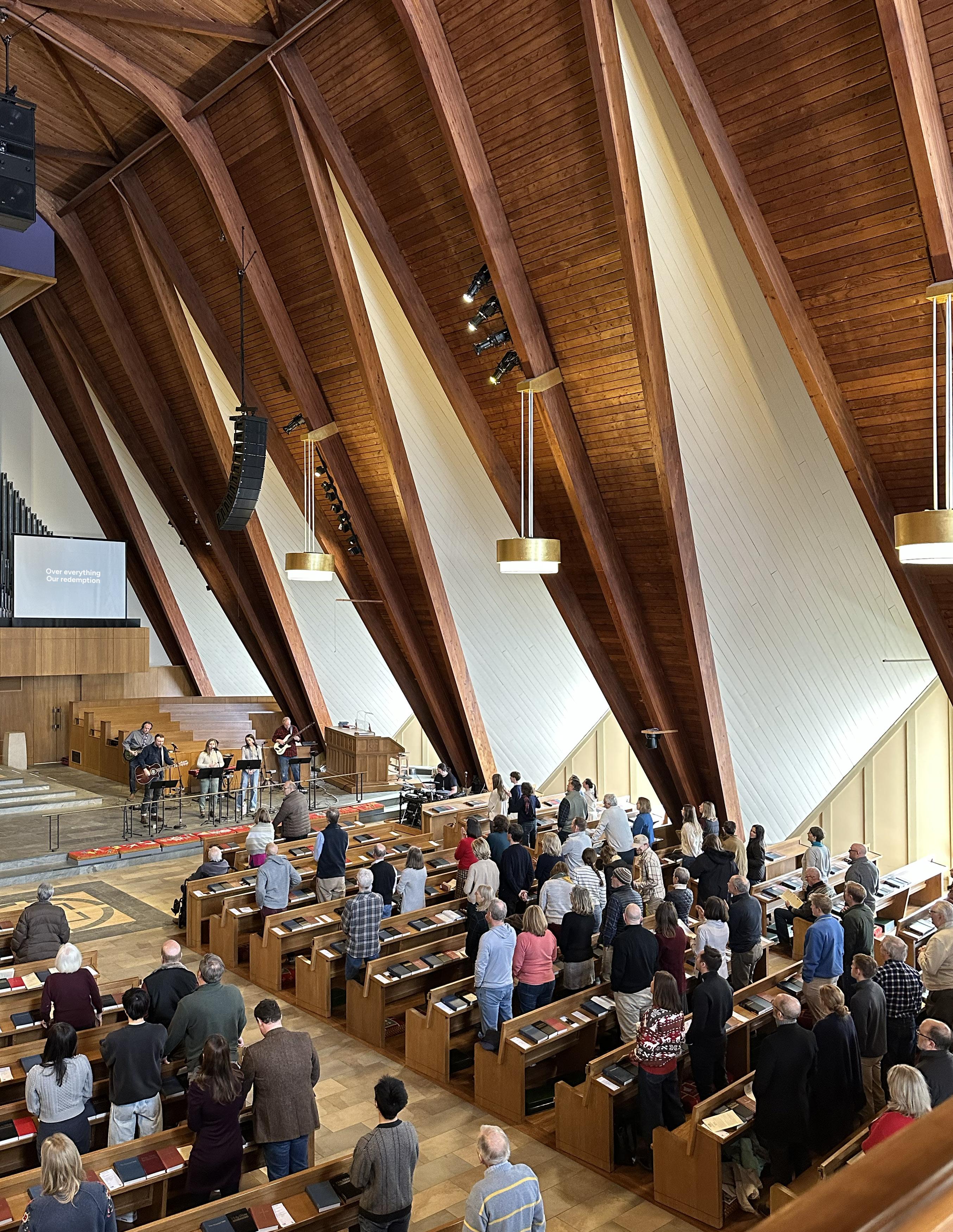
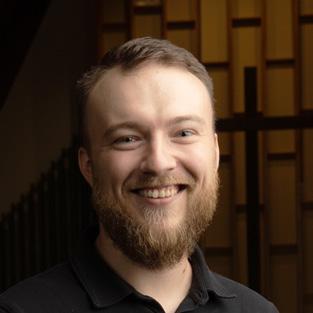
As a worship leader, I often have conversations with band members about new song suggestions. Usually those conversations are quick: “Hey, that song’s awesome. Let’s add it to the list!” Other times, they last a bit longer. Perhaps the lyrics are unclear. Maybe the song teaches a controversial theological concept. It could be difficult for the average churchgoer to sing. Even if we end up excluding the song from the New Chapel song list, I learn something from these conversations and my perspectives are often changed.
It’s important to navigate these conversations with grace and humility. Music elicits strong emotional responses, and most people hold their preferences strongly. Often we have intense spiritual experiences with music and want to share them with others in our community. These conversations work best when they are a twoway street. My goal (and I don’t always succeed) is to hold my thoughts with an open hand. More than once, I’ve introduced a new song and had another worship leader point out a theological implication or musical issue I didn’t see. These conversations work best when the participants humbly recognize their blindspots and acknowledge when they’re wrong.
Through these conversations, I’ve found a working definition of “congregational song.”
Generally, a congregational song focuses on God, is clearly understood, and everyone can sing it. That is the lens I use to evaluate worship songs and guide conversations with worship leaders and parishioners. Don’t get me wrong—it’s not like I have the market cornered on how to pick a congregational song. Any expertise I may have was gained through making mistakes and hopefully learning from them.
Constance Cherry’s book The Worship Architect has deeply shaped my thoughts on congregational song. I can’t recommend her book enough. Here are a few principles I’ve gleaned from her that help me evaluate congregational songs.
THEOLOGICAL STRENGTH
What is the song teaching us about God, his character, his purpose, and his church? Is it true? Is it overemphasizing one aspect of God’s character? Lyrics matter because they teach us our functional theology. Chances are, you’re more likely to remember What a Beautiful Name or Rock of Ages on a Wednesday morning than Sunday’s sermon. When I am afraid, discouraged, or spiritually low, the gospel’s truth and hope flood back to me through songs I learned as a child. We should select songs that will guide and sustain us, reorienting our hearts towards Christ in all circumstances.
Some congregation members have asked if I consider the reputation of songwriters and their associated churches when selecting songs. Hillsong and Gateway were recently in the news for the unfortunate and sinful actions of their leaders. Bethel and Elevation have some concerning theological undercurrents. I grew up in a church that decided not to sing any Bethel songs. I completely understand and respect that perspective. I choose to include these churches’ songs in my setlists because, though they own the copyright, they do not own the truth and beauty contained within these songs. To quote St Augustine: “All truth is God’s truth.” If these songs are biblically sound, spiritually edifying, and glorifying God, why wouldn’t we choose to sing them?
LYRICAL CLARITY
Is God’s love reckless (Reckless Love, Cory Asbury)? Is praise “the waters my enemies drown in” (Praise, Elevation Worship)? Do miracles “start breaking out when I open up my mouth” (Champion, Bethel Music)? If we spend five minutes talking through nuances of artistic license and theological impact, we can come to an understanding of the writer’s intention. Unfortunately that’s not usually possible on Sunday morning.
Here’s an example from Hillsong’s Grace to Grace: “The passion that tore through hell like a rose.” I’m emotionally moved by that lyric, and I’m sure others within our church would be, too. But what does it mean? Is it beautiful poetic impressionism? Or is it simply too imprecise for congregational singing?
That’s a strong stance for simplicity, but if you want everyone to sing a song, everyone must be able to sing the song. If the rhythm is too complex, if the melody has too many jumps, or if it simply isn’t memorable, the congregation stops singing.
Some songs sound great, but they’re hard for the average person to sing because the melodic range is too wide. Many modern worship songs use an octave jump for emotional impact. Songs like Living Hope, Cornerstone, and Lord I Need You come to mind. We sing those songs at New Chapel, but we sing them sparingly and ensure the highest note is still within the average singer’s range (middle C for men, C on the treble staff for women).
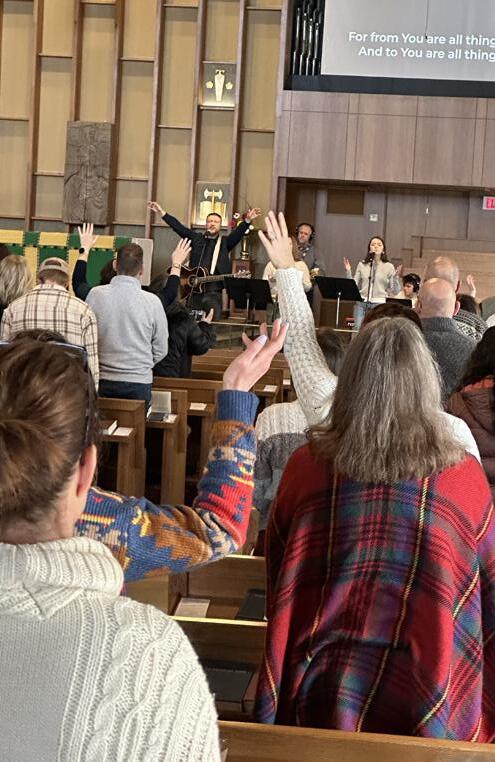
A congregational song focuses on God, is clearly understood, and everyone can sing it. That is the lens I use to evaluate worship songs and guide conversations with worship leaders and parishioners.
It’s also important to consider the song’s point of view. Who is singing the song? Are we singing as a congregation to God? Is it a song of personal praise and devotion, using primarily I statements? Or is it a song of testimony, responding to what Christ has done for the individual? A common critique of modern worship music is its perceived self-centeredness—and generally, that’s a fair critique. When we overemphasize God’s benefit in our life or our response to him in congregational songs, we risk projecting a narrow, underdeveloped view of God.
MUSICAL ACCESSIBILITY
I once heard Tim Hughes, a worship leader from the UK, explain his songwriting process. His last step is playing the song for his tone-deaf friend. If his friend can sing along to the chorus, the song is complete. Otherwise, he goes back and simplifies the melody and lyrics.
It’s also common to select a key that fits the worship leader, even if it means the majority of the congregation can’t sing it. There are valid arguments on both sides, and it’s a balancing act. We want everyone to sing, but we also don’t want the congregation distracted by a singer pushing the extremities of their vocal range. I don’t think there’s one right answer. In my experience, considering both the congregation and the lead vocalist yields the best result. Evaluating congregational songs isn’t easy, but it’s vitally important. Considering the theological strength, lyrical clarity, and musical accessibility of a song leads to the ultimate end: robust congregational worship in spirit and in truth. These assessments are best made in conversation within a worshipping community. My hope is that you will continue to lift up your hearts to the Lord and join the congregation in song.
And keep recommending songs. I’m always open to a conversation.
“I will proclaim your name to my brothers and sisters; in the midst of the congregation I will praise you” (Heb 2. 12).
WORSHIP IS
BY GUEST WRITER RYAN FLANIGAN, FOUNDER OF LITURGICAL FOLK AND MUSIC DIRECTOR AT RESURRECTION SOUTH AUSTIN EPISCOPAL CHURCH

VERSE 1
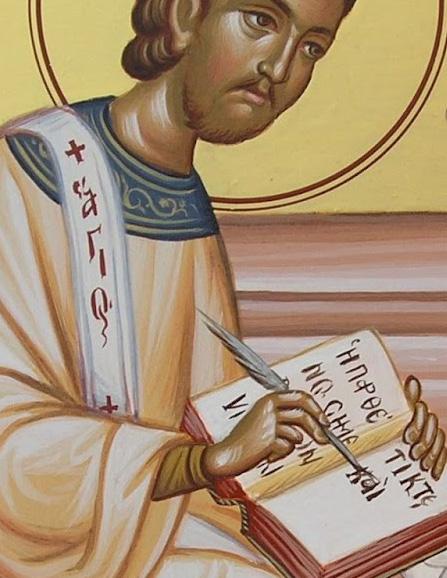
poetry
In 2015 I moved from Northern Indiana to North Texas where I finally became an Anglican. I had been secretly praying with the Book of Common Prayer since 2005 when my seminary professor Robert Webber required it for his classes on Worship & Spirituality. On our first day of class Bob asked us to open our prayerbooks to page 101 and proceeded to read his favorite prayer:
Lord Jesus Christ, you stretched out your arms of love on the hard wood of the cross that everyone might come within the reach of your saving embrace: So clothe us in your Spirit that we, reaching forth our hands in love, may bring those who do not know you to the knowledge and love of you; for the honor of your Name. Amen.
These were the first words I ever heard from the BCP. Up to that point in my life the authenticity of prayer was measured by heartfelt spontaneity. (I grew up Pentecostal and was educated Evangelical.) I had encountered various written prayers, and they were nice to read, but reading them didn’t count as prayer. It was merely an academic exercise.
What I experienced in the beautiful prayer for mission Bob prayed over us, however, was poetry. This prayer was crafted with care, with intent, with foresight that these words will be placed on the lips of countless worshipers for generations to come. He didn’t just read it to us, he recited it, he reenacted it in a way that came from a much deeper faculty than the intellect. The prayer inspired faith in my heart.
VERSE 2
I was on the Canterbury Trail for the next ten years until finally becoming the Music Director of a church whose worship and prayer life revolved around the BCP. I remember that glorious first staff meeting in 2015 when after a bit of banter the rector said, “Alright, open your prayerbooks to page 79.” Reaching into
my backpack I grabbed hold of that same prayerbook that had remained in my backpack since 2005, opened it up, and prayed the entirety of Morning Prayer with my community as if it was a perfectly normal thing to do. Tears filled my eyes. The poetry of that moment, ten years in the making!
About one month into my new job I received an email from a parishioner that simply said “Request” in the subject line. I tentatively opened it and found a poem this parishioner wanted to share with me about the Transfiguration. We were approaching the Last Sunday after the Epiphany when we would hear again the mysterious story of Jesus on Mount Tabor. “You don’t have to do anything with this,” he said, “but if you wanted to use it, you could set it to the tune of Amazing Grace and use it as a Sequence Hymn.” I read the poem:
On Tabor there was shown a light
In Jesus’ holy Self.
In clothes and face, in glory bright
Each saw true light itself.
So Peter, James, and John have told And witnessed in their word:
That glory shown and Christ, like gold, Was value, self-secured.
And all may see, if see they will, That glory still aglow
In Jesus’ face upon the hill
Or where we live below.
Though risen and ascended higher, His window’s still below, And Tabor is the heart afire, The eye with truth aglow.
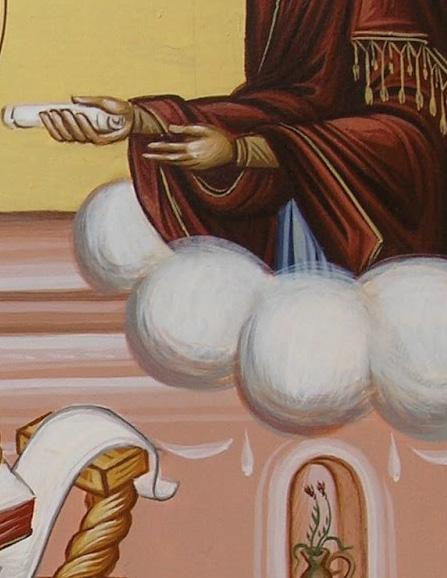
Inspired in that moment, I picked up my guitar, composed a little folk tune, recorded a voice memo, and emailed it to him, saying, “Thank you for sending me this beautiful poem. Here’s what I did with it. I think we’ll sing it in church next Sunday. By the way, who wrote this poem?”
He replied, “I’m sitting here with my wife, in tears, just blown away that you would take the time to consider my request, let alone make this out of it. I wrote the poem, and I’m tickled pink.”
“You wrote this poem?” I replied. “Do you have any more poems? Because I sense a songwriting partnership happening here.”
“No, but I’m a retired priest, so all I do all day long is pray. Why don’t I start versifying my prayers and send you what I come up with?”
Thus began my collaborative work with Fr Nelson Koscheski. We wrote nearly 50 hymns together before he died in 2019. Most of his poems came out of his forty-plus years of serving the holy Church as an Episcopal priest and from praying with the Book of Common Prayer for as long. Our partnership also inspired our music project called Liturgical Folk. “On Tabor” is on our album called Edenland. Our Lent and Advent albums consist of Nelson’s poems contemplating the Collects and assigned Scripture readings for each Sunday (and more) in those seasons. An old poet-priest and a young songwriter working together to bring new hymns into the worship life of the Church. The poetry of our relationship!
INTERLUDE
For we are what he has made us, created in Christ Jesus for good works, which God prepared beforehand to be our way of life. (Ephesians 2:10, NRSV)
The word here for “what he has made” is poema. We are the poetry of God. God reads us and delights in what he reads. The world also reads us. When people see our way of life, they are reading a love poem. Paul writes elsewhere “to present your bodies as a living sacrifice, holy and acceptable to God, which is your spiritual worship” (Rom 12:1b, NRSV). Our way of life is worship, and our worship is God’s love poem to the world. Worship is poetry.
VERSE 3
Nelson died, COVID hit, and we moved to England. Whilst on a study sabbatical in Oxford I began to find my own poetic voice. Reading The Crucified God in the basement of the Rad Cam Library these words poured out of me:
All glory to the crucified and resurrected Lord, Whose favor does not fall on us to climb the highest peak; It condescends to such a small and unexpected Word That few can hear its silent tone or what it wants to speak.
All glory to the crucified and resurrected Lord, Whose friendship is not won by force or twisting of the arm.
A sacrifice of love alone can turn the most abhorred Into a footstool for the throne, beheld in all its charm.
All glory to the crucified and resurrected Lord, Whose final revelation we await with longing heart: Apocalypse of pure compassion, set to see restored The human glory God intended from the very start. That sounds like something Nelson would write, I thought to myself. We moved back to the States and settled in Austin, Texas. An opportunity arose for me at Baylor University to be their Theological Artist-in-Residence. My main artistic outlet for the next two years was poetry. And in the spirit of my collaboration with Nelson I began to give my poems to my songwriter friends to set to music. Some of them are being sung for worship in churches around the world. For example, I wrote a series of poems on the three eternal virtues of faith, hope, and love. My friend Jon Guerra set them to music, and we recorded them for an EP called Three Gifts. Here are the words to “Faith”:
In you, Lord, is our faith; and we shall not believe in vain. For Christ is first among the resurrection of the slain. Yet some of us deny the dead can raise to life again; Were this the case, then Jesus’ bones the tomb would still contain.
And we would be most pitied for the faith we’d have to feign.
A certain mind may think belief is only in the head; That learning happens chiefly when The Word is heard or read. Beloved, this is not the way our Savior preached and led! To Jesus and his followers belief and action wed, And so his brother James knew faith apart from works is dead.
Now we behold in wonder this mysterious motif: That Christ has died, is risen, and is coming like a thief To break into our prison home and take away our grief; The doubt-filled and tormented mind may fin’lly find relief. This we believe with all our heart; Lord, help our unbelief.
I have begun sharing my poems publicly through my Substack called Wryan Rites.
At the top of this article I mentioned how I “became an Anglican,” but this was not something I could simply choose to become. Giving myself to the poema of Anglican worship is what made me an Anglican. It happened over time by entering with my community into the rhythms and practices of our beautiful tradition. May we all hear the poetry of God as we worship together.
Ryan Flanigan lives in Austin, TX with his wife Melissa and their three teenage children. He serves as Music Director at Resurrection South Austin Episcopal Church and helps other communities in the Episcopal Diocese of Texas develop band-led music ministries. Ryan is also the founder of Liturgical Folk, which seeks to create beautiful and believable sacred music for the church and the world. Ryan earned a BAS from Dallas Baptist University, an MA from Trinity Evangelical Divinity School, and a CTS from the University of Oxford.
The Story of Worship or Why God’s People Started Singing
BY JACK FRANICEVICH, DIRECTOR OF CHRISTIAN FORMATION
If you had to guess, in what book of the Bible would you say God’s people began a regular practice of worshiping together in song? That is to say, when did ‘congregational singing’ come to identify worship? The answer might surprise you: It’s 1 Chronicles.
In this essay, I’m going to write about the Torah’s vision for worship, the moment in David’s kingship that this worship began to be adorned with song, and what I think we might learn from these unfamiliar and unpopular pages of Scripture.
The Torah’s vision for worship
God starts talking about worship at the end of Exodus 20, in a chapter that’s better known for containing the Ten Commandments (20. 1 – 17). After God tells the Israelites neither to have “gods” nor to “make” idols at the beginning of the chapter (Exod 20. 1 – 6), he combines these two prohibitions in an addendum about worship. The first part is negative: “You shall not make gods” (v. 23). The next part is positive: “You shall make an altar.” When Israel worships him at this altar, God promises he “will come to [them] and bless [them]” (v. 24). Remember those two verbs God takes—come and bless— because God will take on two more action verbs.
God continues talking about worship in ch. 24, where he assigns an action verb to Moses. This simple verbal instruction is the bedrock for Torah’s entire vision of worship: “Come up (ʿōlâ) to Yahweh” (24. 1). Over the course of Exodus 24, this key verb ʿōlâ occurs four more times (24. 9, 12, 15, 18). If you’re willing, take me at my word that the verb ʿōlâ never ceases to define Israel’s worship. The latest example from my own reading comes from Isaiah 2. 3, a verse I was assigned to preach on the first Sunday of Advent. In that passage, the prophet exhorts his brothers and sisters, “Come, let us go up (ʿōlâ) to the mountain of Yahweh.” The Church has carried this tradition into its own worship through a handful of ‘goings up.’ The opening procession symbolizes our ascent to heaven. Our lifting up of our hearts and the celebrant’s raising of the consecrated bread are an ascent. Our movement toward the altar at Holy Communion signifies our going up to God.
In Exodus 29, God gives worship a more concrete form. He instructs his people to “come up” to worship him every morning and evening. Twice each day, every morning and evening, Israel was to present to God, on that same altar, a lamb, some bread and wine, and incense (29. 38 – 46). God had already said that when they worshipped him at the altar, he would come to them and bless them. In this passage, he gives himself two more verbs: This shall be a regular ʿōlâ offering throughout your generations at the entrance of the tent of meeting before Yahweh, where I will meet you to speak to you there (v. 42).
Did you catch that?1 When we worship God by going up to him every morning and evening, God promises to come to us, meet us, bless us, and speak to us.
Curiously enough, this vision of worship has influenced two very different forms of Good Sam’s worship. On the one hand, some of us maintain the practice of saying Morning and Evening Prayer. This tradition of coming together to say our prayers twice a day is not just an Anglican tradition; rather, it hearkens back to Exodus 29. On the other hand, others of us have borrowed imagery from Israel’s daily worship in our contemporary praise choruses. At New Chapel, we sing songs like “Worthy of it All,” which contains lines like, “Day and night, night and day, let incense arise.”
David introduces congregational singing
The Books of Chronicles aren’t gripping unless you know what to look for. In 1 Chronicles 23 –27, for example, you’re not going to find a story; rather, you’ll find something that looks more like a “Vestry Report.” I say that because, as if he were the seasoned rector of a large and growing parish, King David, “old and full of days” makes some strategic administrative decisions. Here’s a summary of the contents of these chapters.
First, David counts and organizes all the Levites, and there are 38,000 of them. He assigns 24,000 of them to work in and around the temple; 6,000 of them to provide community leadership; 4,000 more to work facilities; and the last 4,000 to “offer praises to Yahweh with the instruments that I have made for praise” (23. 5).
Next, David turns to the priests (24. 1). The text doesn’t tell us how many priests were serving on the temple clergy staff, but it does tell us that David organizes a ‘liturgical rota’ (24. 7 – 19). For those of you who don’t know what a liturgical rota is, imagine the Google Sheets
document that helps the staff remember who’s celebrating and preaching at which services. (Good Sam has one of those, too!) David’s rota assigns each priestly clan to one of 24 two-week shifts.
Once that’s settled, David calls in some military leaders to help him set apart musicians “who should prophesy with lyres, harps, and cymbals” (25. 1). That’s a lot to think about. Why would army officers assist with this? How do musicians prophesy? But here’s how the text continues. These musicians…
…were all under the direction of their father for the music in the house of Yahweh with cymbals, harps, and lyres for the service of the house of God. Asaph, Jeduthun, and Heman were under the order of the king. They and their kindred, who were trained in singing to Yahweh, all of whom were skillful, numbered two hundred eighty-eight. And they cast lots for their duties, small and great, teacher and pupil alike (25. 6 – 7).
I’ll be honest—when I picture Asaph, Jeduthun, and Heman, I imagine Connor Fluharty, Josh Guenther, and Gary Gress. (Don’t tell them I said that.) After all this has been done, David continues to assign gatekeepers, treasurers, officers, judges, military personnel, tribal leaders, and other community leaders (ch. 26 – 27).
After much more setup, (musical) worship begins in earnest when the ark is processed into the temple in 2 Chronicles 5. Here’s what happens:
All the Levitical singers, Asaph, Heman, and Jeduthun, their sons and their kindred, arrayed in fine linen, with cymbals, harps, and lyres, stood east of the altar with one hundred twenty priests who were trumpeters. It was the duty of the trumpeters and singers together to make themselves heard in unison in praise and thanksgiving to Yahweh, and when the song was raised… the house, the house of Yahweh, was filled with a cloud, so that the priests could not stand to minister because of the cloud, for the glory of Yahweh filled the house of God (5. 12 – 14).
And that’s the story of how worship began to include congregational singing.
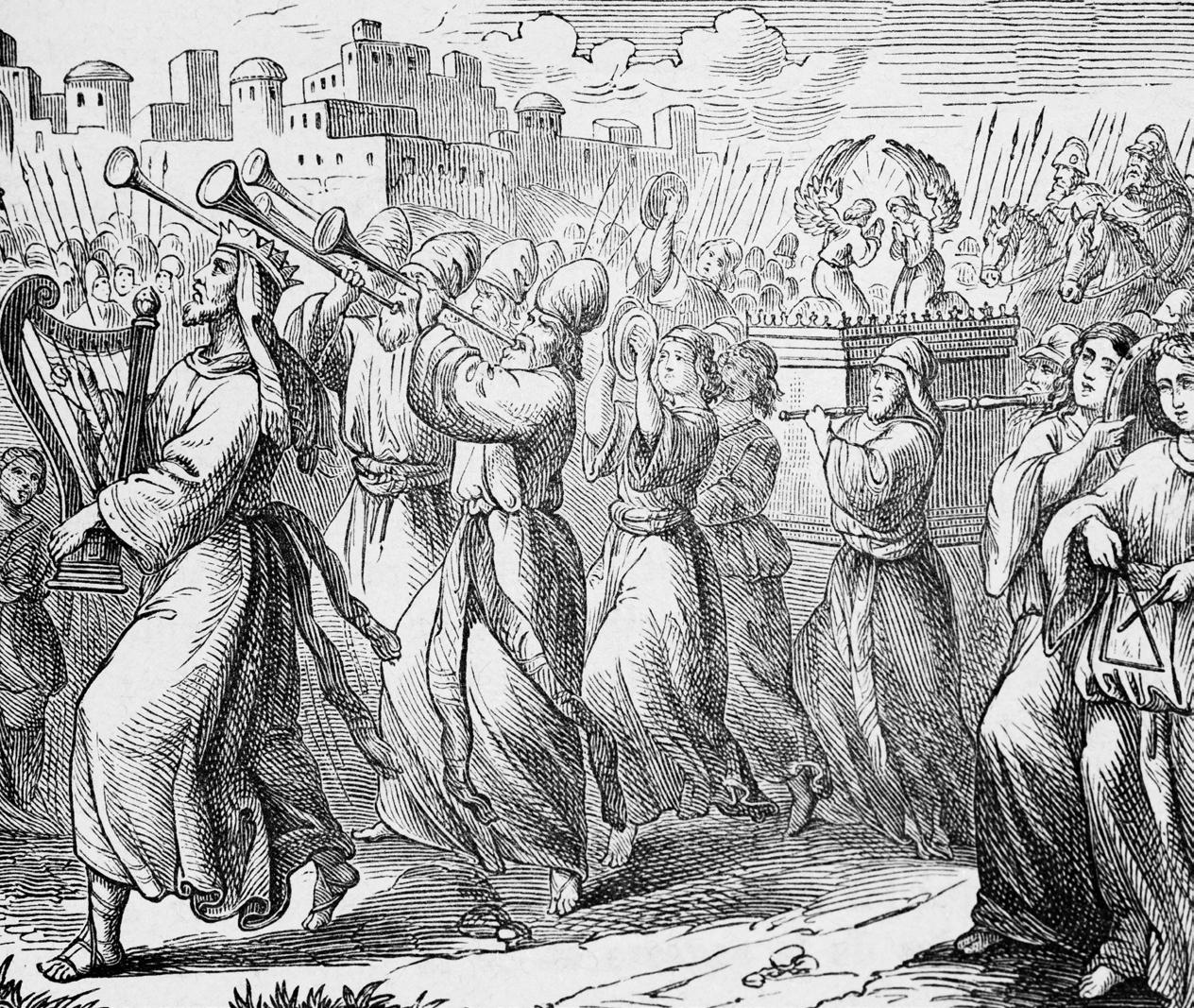
Good Sam, singing, and the Old Testament
There are some fun details to get lost in here, like the trumpet-playing priests, or the fact that the musicians have a ‘duty’ to ‘make themselves heard.’ But I’d like to draw out two lessons I think our church could take away from the Old Testament’s introduction of congregational singing.
First, David renews Israel’s worship not by changing their liturgy, but by enriching it. Chronicles presents David as a liturgical conservative. In a meeting with some of the lead priests, he had told them that God “burst out against us because we did not give [the ark] proper care” (1 Chron 15. 13).
Taking David’s constructive criticism, they make sure to “carry the ark of God on their shoulders with the poles, as Moses had commanded according to the word of Yahweh” (v. 14).
Commenting on this feature of the book, Peter Leithart argues, “David’s reorganization of worship at the tabernacle in Jerusalem was based on Mosaic ceremonial law, yet it was an expansive and creative application of the law, without ceasing to be an application.”2 Whatever ends up happening in Good Sam’s worship in the future, we can’t neglect the heart of worship: Going up to the God who comes down to us, to bless us, meet us, and speak with us.
Second, David renews Israel’s worship through hiring talent, laboring over job descriptions and organizational charts, and by soliciting pledges. To quote Leithart again, “Every revival in Judah’s history involves a renewal of priestly organization, increased contributions to the temple, and careful oversight of the temple and its treasuries… When you pray for revival, pray for more accountants. Pray for more musicians.”3
Can I put it more bluntly? Music follows personnel and money. In the story of Scripture, Israel’s worship grows because its Finance Committee approved a budget that included a new A/V installation, organ repairs, retaining several staff musicians and paid choristers, and contracting brass bands to enrich their Easter worship. Let us go and do likewise.
1 A tip of the hat to Fr Matthew Kozlowski for allowing me to use one of his preaching catchphrases here.
2 Peter J. Leithart, From Silence to Song: The Davidic Liturgical Revolution (Canon Press, 2003), 16.
3 Peter J. Leithart, “Who Needs Chronicles? We Do,” The Gospel Coalition, September 10, 2019, https://www.thegospelcoalition.org/article/needs‐chronicles/.
The Multi-Faceted Diamond of Worship
BY CHRISTOPHER A. HALL, SENIOR TEACHING FELLOW
Over the past thirty years I’ve spent a lot of time with the church fathers, the teachers of the ancient church from around 100 AD to 800 AD. Why do I continue to do so? The fathers help us all to understand what it means to be a Christian and how the early stages and models of Christian worship, practice, and reflection aid us in worship today.
The church fathers insistently remind us that the content of Christian belief and its lived practice in worship, prayer, and the many relationships of life must always remain one whole. Indeed, the fathers will insist that it is in the womb of worship and the experience of God’s redemptive in Christ that our thinking and acts concerning God are born, nourished and developed. Lactantius writes, “This is true worship: when the mind of the worshipper presents itself as an undefiled offering to God.”1
Ancient fathers taught that all life offered to God is prayer and worship. Ethics, for instance, in patristic thinking is inseparable from worship. When wealthy Christians perceive their material prosperity as a gift given to them to be used on behalf of the poor, this offering is prayer and worship. When an early Christian refused to sacrifice to the emperor and suffered martyrdom as a result, a genuine act of worship occurred. Since all of life can be offered as worship, it shouldn’t surprise us that the fathers’ reflection on ethical issues such
as abortion, marriage and the family, and military service flowed directly from their daily, habitual grounding in prayer and worship. Anthony Bloom, writing from an Orthodox perspective rooted in the teaching of the church fathers, writes of the importance of a life “turned in the same direction as your prayer… A prayer makes sense only if it is lived. Unless they are ‘lived,’ unless life and prayer become completely interwoven, prayers become a sort of polite madrigal which you offer to God when you are giving to him.”
The sacraments themselves are the backbone of worship; here I am especially thinking of the great initiatory rite of the church—baptism—and the celebration of the Eucharist. In both sacraments the church offers rich worship to the Father, Son and Holy Spirit. And so prayer, worship, ethics, and the sacraments form an integrated whole.
The church fathers viewed life and worship sacramentally. They believed that “God likes stuff,” that God uses tangible, earthy means such as wine, bread, water and oil to communicate blessing and nourish fellowship.
Cyril of Jerusalem rejoices in the blessings that baptism affords as he teaches his catechumens. “Great is the baptism that lies before you: the ransom of captives, the forgiveness of sins, the death of sin, the regeneration of the soul, the garment of light, the holy perpetual seal, a chariot to heaven, the delight of paradise, a welcome into the kingdom, the gift of adoption.”2
Consider the words of Basil of Caesarea, known among the Orthodox as “Basil the Great.” “Faith and baptism are two kindred and inseparable ways of salvation: faith is perfected by baptism; baptism is established by faith, and both are completed by the use of the same names. As we believe in Father, Son, and Holy Spirit, so we are baptized into the name of Father, Son, and Holy Spirit. Confession leads the way and brings us to salvation; baptism follows, setting the seal on our assent.”3
God delights to use tangible, earthy means—matter itself— to communicate his grace, redemption and presence to us, elements as simple and specific as bread, wine, water and oil. Sometimes this understanding of God’s earthiness is known as “sacramental realism.” We witness it every week at The Church of the Good Samaritan.
In Christian usage, the Latin word sacramentum is related to the word mysterion or mystery. As we celebrate the sacraments—the divine mysteries—we do so with the awareness that the sacraments entail certain obligations. For instance, to enter the church in baptism is to accept willingly clear and distinct obligations and to profess a commonly held faith.
Why do we as a church clearly affirm and practice worship sacramentally? There is only one safe, solid, coherent answer: Jesus Christ. In the incarnation of the eternal Word we discern the rhyme and reason of sacramental worship. In the wondrous, mysterious, divine-person nestled in the Virgin Mary’s womb, we encounter the sacramental principle. The eternal Word, the Son of God, has humbly joined his divine nature to the human nature trustfully and lovingly offered to him by Mary. In Christ the divine and human, the immaterial and the material, the Spirit and the flesh, are married.
to “someone who wants to cross a river by means of some spiritual power, while boats and bridges are at his disposal. Such a person will wait in vain for the power of the Spirit. And while others cross to the other side, he will be left on the riverbank, alone.” A sacrament, Theophan comments, “is like a framework that supports one’s inner attitude and ensures its stability.”5
Both Gregory of Nazianzus and Gregory of Nyssa emphasize that the sacraments are indissolubly linked to our salvation and to the events of the incarnation, life, death and resurrection of Jesus Christ. When the church fathers contemplate and participate in the sacraments of baptism and the Eucharist, they interpret their meaning through the lens of the biblical narrative from beginning to end. God has chosen to use water in baptism to signify and communicate redemption and re-creation in Christ. It should not surprise us to find the fathers mining the Old Testament references to water for deeper redemptive, christological meaning.
Picture Christian worship as a multifaceted diamond, with each facet reflecting the beauty, wonder, and wisdom of God’s actions toward us in Christ.
The sacraments of the church are not magical rites, divorced from the faith of the person receiving them. The sacraments’ pattern and efficacy are based on faith—faith in God’s actions in history on our behalf, that God in Jesus Christ is presently reigning in the midst of this present evil age. Our ancient teachers ponder God’s actions in history as related in the narrative of the Bible and build their sacramental worldview on this biblical basis. God has invaded this present evil age in Christ, and the sacraments communicate that reality to Christ’s followers. Indeed, a sacrament is a lively, living remembering of the Holy Trinity’s loving actions for human beings.
John of Damascus illustrates well the sacramental principle when he writes, “I do not venerate matter. I venerate the fashioner of matter, who became matter for my sake and accepted to dwell in matter and through matter worked my salvation, and I will not cease from reverencing matter, through which my salvation was worked… I reverence the rest of matter and hold in respect that through which my salvation came, because it is filled with divine energy and grace… Is not the gold and silver matter, out of which crosses and tablets and bowls are fashioned? And, before all these things, is not the body and blood of our Lord matter?” 4
So, in a realistic manner, we receive life through sacraments such as baptism and the Eucharist. Anglicans, Catholics, and Orthodox are in full agreement on this. Hence, to reject a sacramental world view is to cut oneself off from the very means God has ordained for human growth and flourishing. Theophan the Recluse, a 19th century Russian Christian and spiritual father of the Orthodox Church, puts it this way: to “reject” the “natural means” of the sacraments is similar
Both baptism and the Eucharist are concrete, grace-filled, earthy means God employs to communicate central themes of the gospel narrative and the overarching biblical story to the mind and body of a Christian. And of course, as I have already commented, we should never overlook the ethical dimension of the church’s sacramental life. To be baptized and to share in the Eucharist entails a definite “yes” to Christ and “no” to sin.
Picture Christian worship as a multi-faceted diamond, with each facet reflecting the beauty, wonder, and wisdom of God’s actions toward us in Christ. God has not remained far-off, silent, or unapproachable. No. God has drawn very close to us in Jesus, as close as the touch of water, the taste of wine or baked bread. God has drawn near, very near. In turn, let us draw near in response, and be transformed in the coming and receiving.
1 Lactantius, The Divine Institutes
2 Cyril of Jerusalem, Procatachesis 16.
3 Basil of Caesarea, On the Holy Spirit.
4 John of Damascus, Three Treatises on the Divine Images
5 Theophan the Recluse; Theophan is quoted in Tomas Spidlik’s book Prayer: The Spirituality of the Christian East
Nurturing Growth
CHRISTIAN FORMATION FOR EVERY AGE
Worship and Wonder
BY KIMBERLY LINDQUIST, DIRECTOR OF FAMILY MINISTRIES
Faith formation for our children is an invitation. On Sunday mornings, we invite the children enter the Godly Play space that has been thoughtfully and purposefully set to help them “get ready” to hear from God. We come together into the worship space of the Godly Play room, gather in a circle, and listen to a Bible story. Following the story, we invite children (and adults in the room!) to enter into a time of wonder. During this time, the focus is not over explaining, but rather creating a space that allows for time, silence, and curiosity.
Wonder is really the heart of this practice, with questions like I wonder which part of the story was your favorite? I wonder which part feels like the most important part? I wonder which part of this story feels like it is especially about you? These questions don’t have right or wrong answers, but invite children to enter into the narrative and discover meaning in an unhurried, self-driven pace. This personal engagement with the story and the circle of other children allows this worshipful space to grow authentically in knowledge and community with one another.
As adult leaders in this space, we recognize our role as guides or mentors, rather than solely as “teachers.” We know that our role is to help children discover the answers to their questions by going back to scripture, and that ultimately is the work of the Holy Spirit in our lives and the lives of our children. Worship, in this space, takes shape in the act of listening to the story, to each other, and to God at work with us.
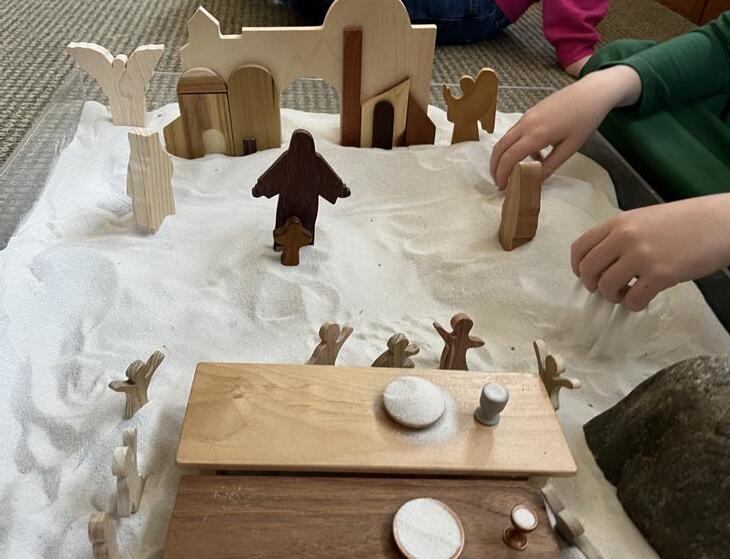
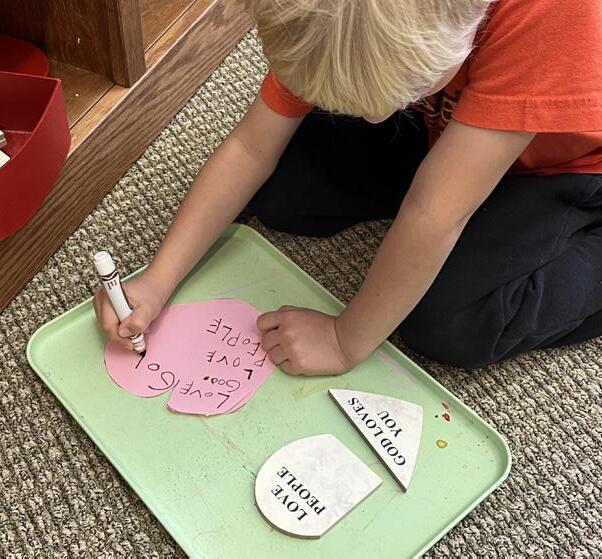
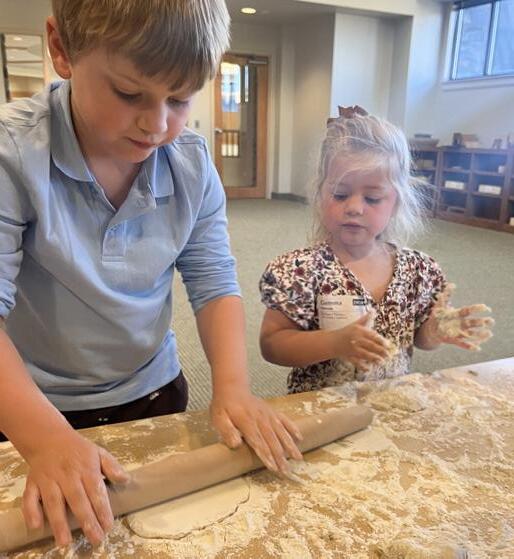
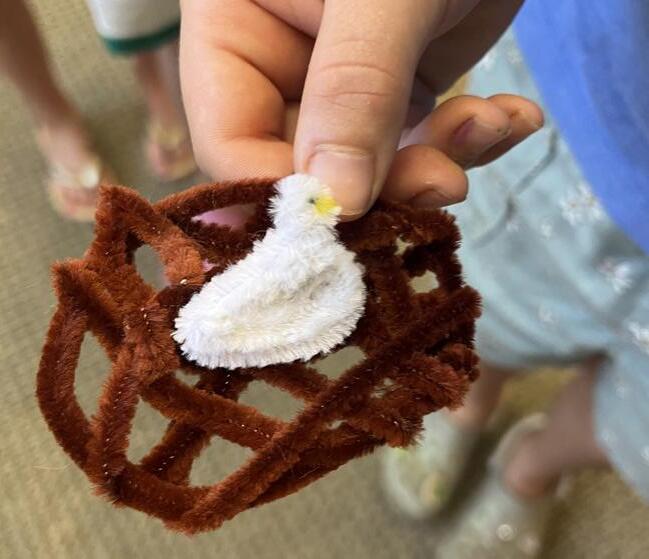
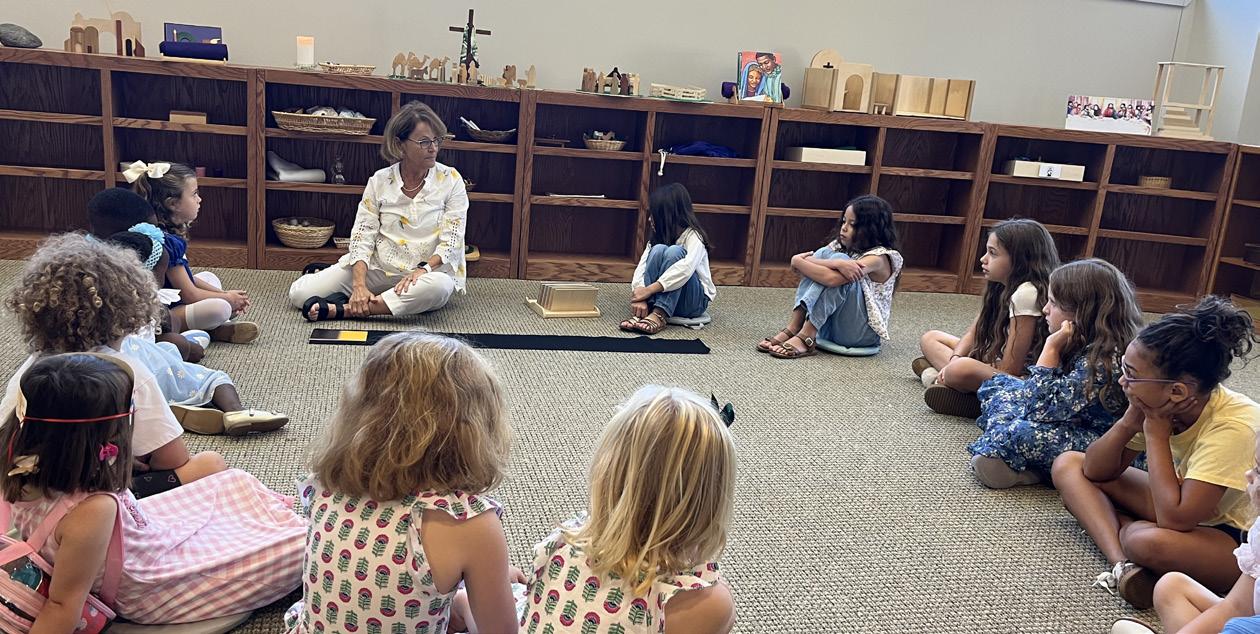
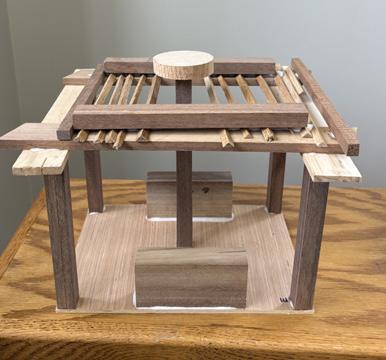
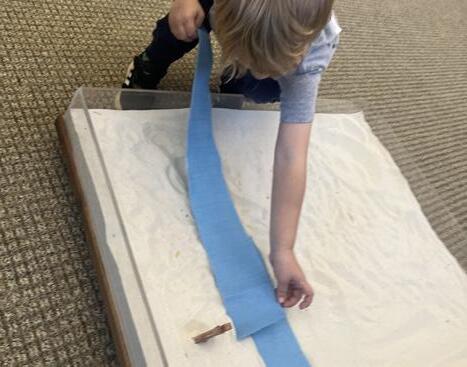
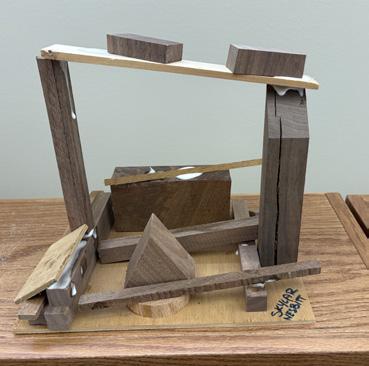
For a list of upcoming Kids events see the back cover.
Worship Milestones A Journey with Youth at Good Sam
BY JESSICA CAMPBELL, DIRECTOR OF STUDENT MINISTRY
My earliest memory of worship at Good Sam is as a child at the 9 am service. With four kids in my family, we usually sat in the balcony because of our later arrival. Also upstairs, wrangling twins my age, was Dale Cirillo, wife of Fr Jim Cirillo. I loved watching her raise her hands during the doxology.
So much of church seemed inaccessible to me— adults not making sense, music I couldn’t follow, and lots of words to sit through until I could get to the place I truly wanted to be: Sunday School. But watching Dale lift her hands in worship was captivating. She truly connected with the things I didn’t understand or like in the service, and it was beautiful.
Eventually, contemporary worship songs took the place of communion hymns. I loved peering down from the balcony and singing songs like As the Deer and Lord, I Lift Your Name on High. I found myself no longer merely biding my time before Sunday School, but engaging with and being filled with joy by a part of the service. To my delight, when I entered Youth Group, my time spent worshiping the Lord with songs like these doubled. Every Sunday evening, students in grades 6–12 packed around an overhead projector in a darkened Walton Hall. Being led in worship through songs written in my lifetime, I finally understood what our Kids Choir director had meant when she said, “To sing is to pray twice.” The stories of God’s greatness and faithfulness felt truer when I sang about them. I deeply meant the things I sang, directing my gratitude and adoration straight to Him. My faith journey was greatly impacted in my early high school years when Good Sam launched a new kind of Sunday service called New Chapel. Sometimes I ponder what my faith would look like if New Chapel hadn’t started. Would I be in ministry? Would I even still be actively pursuing Jesus? I feel certain I wouldn’t still be an Episcopalian, because Good Sam’s embrace of contemporary worship gave me access to the
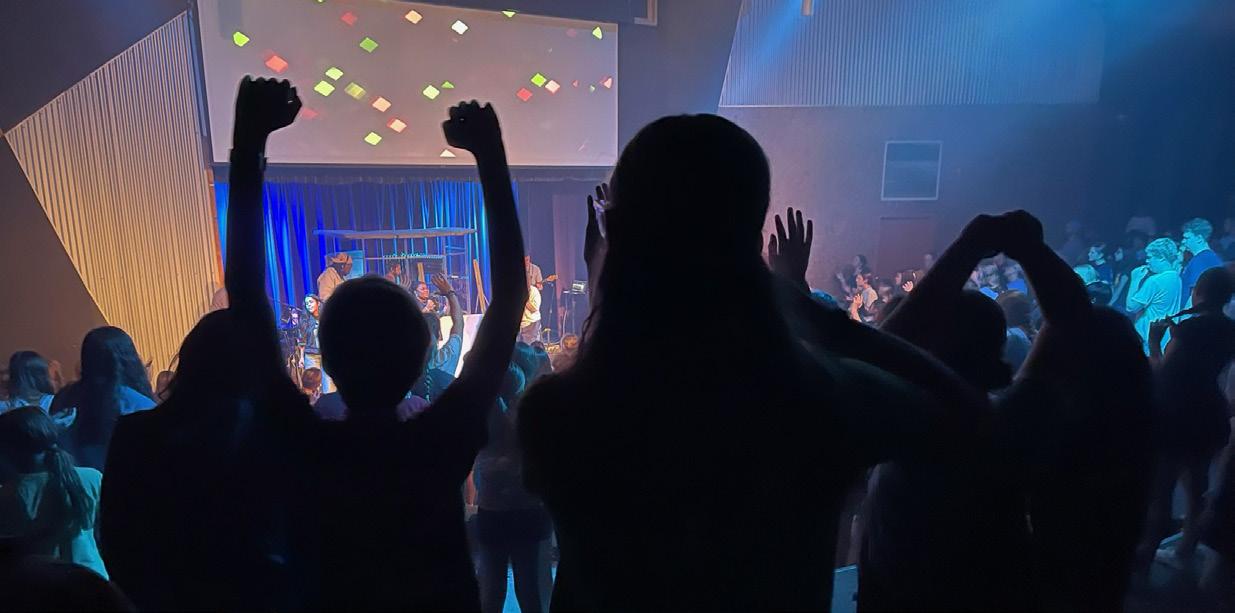
Anglican communion in a way I hadn’t seen before. I remember asking why church wasn’t more like youth group, and at what age the “liturgical gene” would suddenly kick in so I could finally “get it.”
I hold these worship milestones close to my heart when thinking about youth at Good Sam. Our leadership team is a mix of cradle Episcopalians, newcomers seeking liturgy, and charismatic low-church leaders. Our students are just as varied—acolytes and New Chapel worship team members, sacred dancers and curious new believers invited by friends, service loyalists and schedule-driven swappers. I firmly believe each of them needs an invitation to explore all the varied ways we are able to worship the Creator—on a Sunday morning and throughout the week.
This fall, at the Middle School Retreat, a student approached me with tears in her eyes after a session that included upbeat, modern worship songs.
“Jess! Why didn’t anyone ever tell me it could be like this? My heart is so happy—it just found its way to talk to God. Why didn’t I know about this?”
It’s an extreme example—most who attend the 9 am service have some idea of what New Chapel is like and vice versa—but it underscores an important reality. Another student encounter from a DNA group this fall highlighted it differently. While answering questions about the trustworthiness of what we believe, and the history of some councils and creeds, I began to recite the Nicene Creed with some gusto, giving occasional emphasis to certain lines. Afterwards, a student looked at me and said,
“I have gone to this church my whole life and never heard anyone say it that way, with passion. I usually tune it out or don’t really pay attention to what we are reading.”
How can we best expose students to the full breadth of worship? It’s a question many leaders are asking, and the answers will not come easily— or be found in the final sentences of this article. But the most important reality is that we at Good Sam Youth are actively joining that conversation. How can we share both the ancient and the modern in ways accessible to students, so that they too can say, “I have found the way my heart most easily speaks to and honors God”?
For a list of upcoming youth events see the back cover.
Listen to the Good Sam Youth Group Worship Song playlist here
ADULT CHRISTIAN FORMATION
See page 1 for upcoming Saturday Seminars!
Adult Christian Formation at Good Sam offers courses that invite parishioners deeper into the Great Tradition. Courses are taught by teams of talented teachers who are also subject area experts.
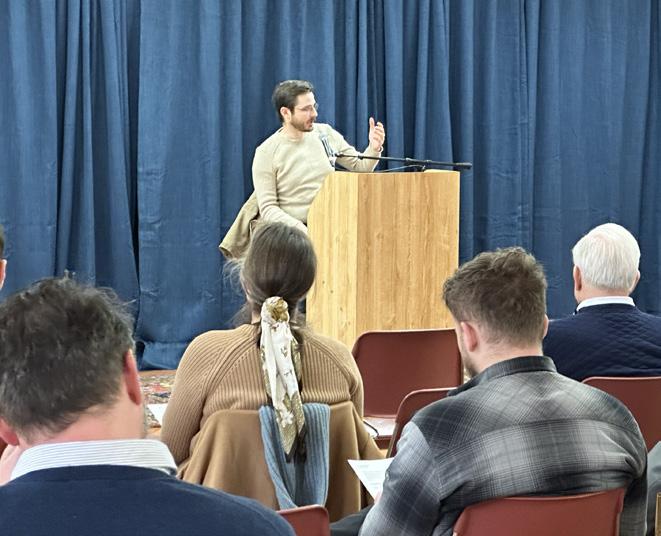
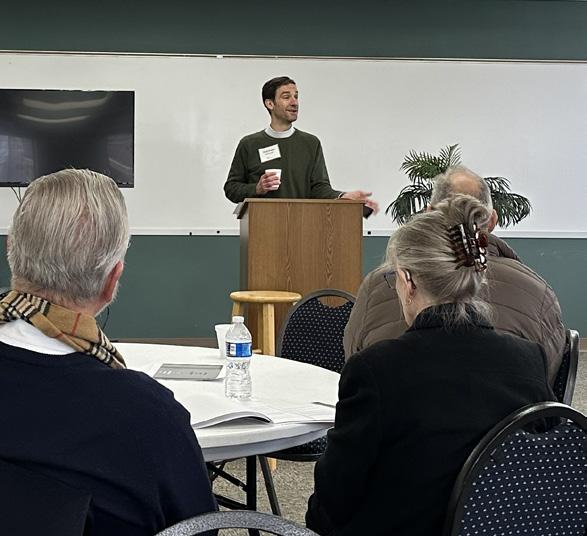
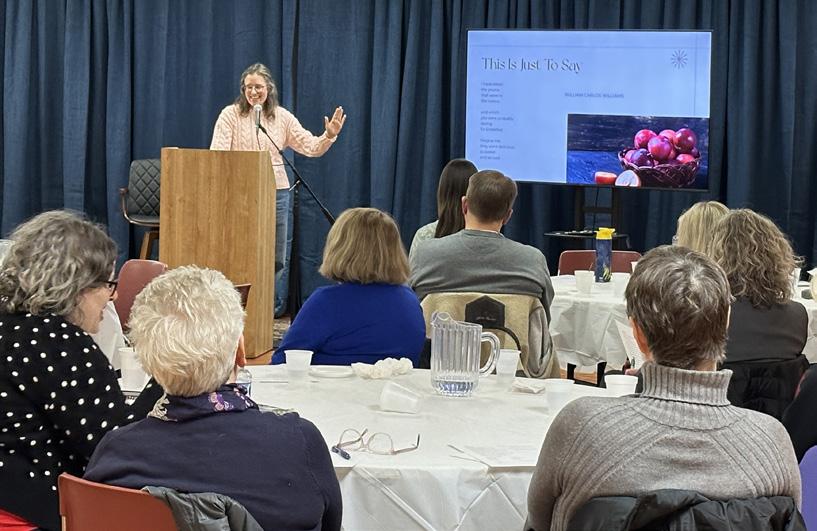
ASHTON SEMINAR
Understanding the Atonement
Sundays / February 22 and March 1, 8, 15, 22 • 10:15 am
Dr Matt Messer and Dr Matt Moser
Since its beginning, the Church has explored the logic of our salvation in Christ: how does salvation happen? What exactly does Christ’s passion do that leads to our salvation? Through its centuries, the Church has developed “atonement theories” that address these questions. In this course we will look at several influential accounts of Christ’s work, both to deepen our understanding and to expand our imaginations for thinking well (and thus loving well) the God of our salvation.
The Text and Theology of Ephesians
Sundays / April 12, 19, and May 3, 10, 17, 24 • 10:15 am
Jack Franicevich, Dr Matt Messer, Dr Steve Fowl, and Dr Matt Moser
In the Book of Ephesians, Paul spells out God’s plan for the fullness of time, which is to unite all things in his Son. This course will closely read a chapter a week over the course of six weeks. As we do, we will pay attention to the ways God in Christ overcomes both hostility and division. In this study, we will both enrich our understanding and appreciation of the gospel and also consider the ways God calls us to overcome hostility and division in the name of Christ.
CHRISTIAN LIFE FORUM
The Ruthless Elimination of Hurry
Sundays / February 1, 8, 22, March 1, 8, 15, 22, 29, and April 12, 19 • 10:15 am Discover a slower, simpler, more deeply rooted way of living. In this book study of The Ruthless Elimination of Hurry we’ll explore how hurry threatens spiritual formation and practice habits that lead to peace, presence, and purpose—silence and solitude, sabbath, simplicity, and slowing. Together we’ll examine the problem and share practical tools for emotionally healthy, spiritually alive lives in a chaotic world.. All ages are welcome. A variety of facilitators will lead this study and discussion.
TUESDAYS AT GOOD SAM
Reading Philosophy for Lent
Tuesdays / February 24, and March 3, 10, 17, 24 • 6 – 8 pm
Jack Franicevich, Dr Philip Carey, Dr Matt Moser, and Dr Amber Bowen
Merold Westphal, the great Christian philosopher, once said that Christians should read philosophy for Lent. Taking up Westphal’s charge, Drs Phil Carey, Matt Moser, and Amber Bowen will lead us on a tour through the works of CS Lewis, St Augustine, Friedrich Nietzsche, Karl Marx, Sigmund Freud, and Søren Kierkegaard. The goals of the course are to better recognize the besetting sins of our age and to better practice the Christian art of repentance.
Ephesians 201: Tough Topics in Christian Unity
Tuesdays / April 14, 21, 28, and May 5, 12, 19 • 6 – 8 pm
Jack Franicevich, Dr Matt Messer, Dr Ephraim Radner, Peter Gross, and Dr Justin Bailey
Our Sunday morning study of Ephesians will raise more questions than it can answer. To help us press deeper, Jack has invited a group of scholars and thought leaders to address some of the “tough topics” in Christian unity—including social division, relationships between men and women, and new approaches to evangelism in today’s world. The goal of this course is to deepen our appreciation for God’s unifying work and strengthen our commitment to bear witness to that unity in our own lives.
Dr Christie Purifoy teaching a Tuesday evening class on January 13— Reading the Bible Like a Poet.
Dr Matt Moser and Jack Franicevich teaching an Ashton Seminar course on February 1—Reading Biblical Wisdom
Fr Matthew leading a Christian Life Forum discussion on February 1—The Ruthless Elimination of Hurry
Good Sam News
Celebrating 150 Years: All Saints Concert
Good Samaritan’s 150th anniversary was the inspiration for an All Saints Choral Concert on November 1, 2025. Our full choir and a 15-piece orchestra performed Requiem in D minor, Op. 48 by Gabriel Fauré and works by primarily French Romantic and other 20th-century composers. As Director of Music Connor Fluharty explained, the pieces all centered around the thematic knot of mourning and victory, elegy and resurrection. This is a knot purposefully tied by the words of the Gospels and reflected in the art of countless musicians through the ages. It was an unforgettable evening made possible by an unnamed parishioner who, as Fr Ellsworth remarked, like Job has placed all trust in the One who raised Jesus bodily from the dead.
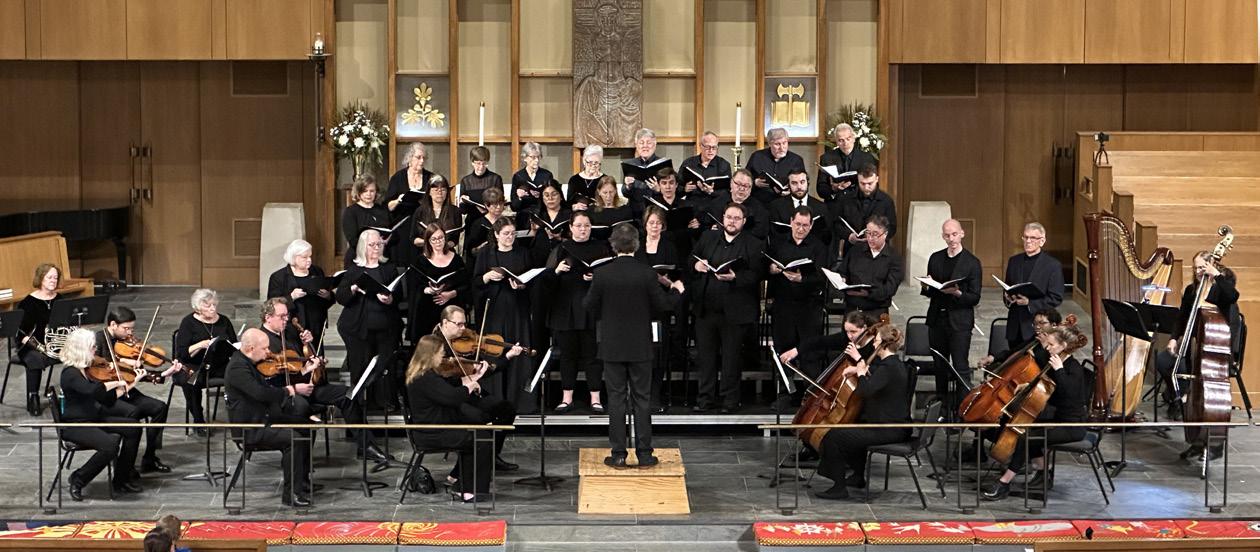
Celebrating 150 Years: Voice of Sacred Imagination
On November 9, 2025, we welcomed English poet and Anglican priest Fr Malcolm Guite to Good Samaritan. Dr. Guite, a former chaplain at Cambridge University, writes at the intersection of faith and the arts and is especially well known for the sonnets he has shared in collections like Sounding the Seasons and David’s Crown. The timing of his visit felt providential, as we were able to hear him preach on the day’s lesson from Job: “O that my words were written down! O that they were inscribed in a book!” Through his sermon and in a lively presentation in Ashton Hall, we witnessed a redeemed imagination making visible the invisible things of God.
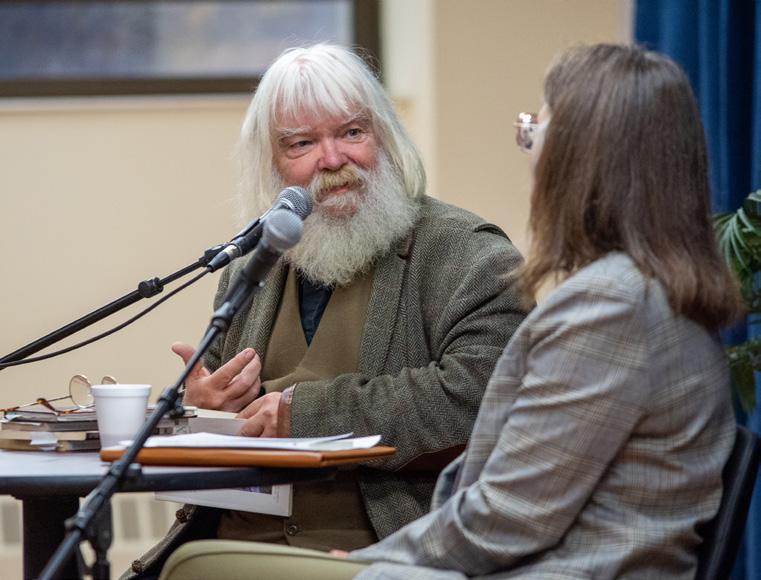
WINTER 2026
Welcome Neeka Guenther, Connections Specialist
We’re excited to introduce Neeka Guenther as Connections Specialist here at Good Sam, joining our professional staff in November. Born and raised in South Portland, Maine, Neeka brings a background in nonprofit operations, dance, and missional community life to her work with us. You’ll find her partnering with Fr Matthew to help newcomers get connected, managing prayer and ministry emails, assisting with digital and print communications, and serving in a variety of other ways behind the scenes. Neeka is active on our social media channels and website, is often found connecting with Youth Group students, and is a familiar face at Good Sam Central on Sundays. Outside of church, Neeka enjoys a good bagel, hiking, and traveling with her husband Josh, and rehearsing with her company Dancefusion.
Meet Cheryl Wardle, Administrative Support
Cheryl joins our staff as Administrative Support, bringing experience in education, ministry, and organizational leadership. With 16 years as an educator at The Haverford School and current work as a Reading Specialist and private tutor in West Chester, she offers a strong foundation in communication, care, and organization. Cheryl has also served in youth ministry at St David’s Episcopal Church and supports Christian student leadership through FOCUS. In her role at Good Sam, Cheryl will handle a variety of administrative responsibilities including database and data management, sacramental records, and coordinating tasks related to the churchyard and funerals, among other administrative needs.
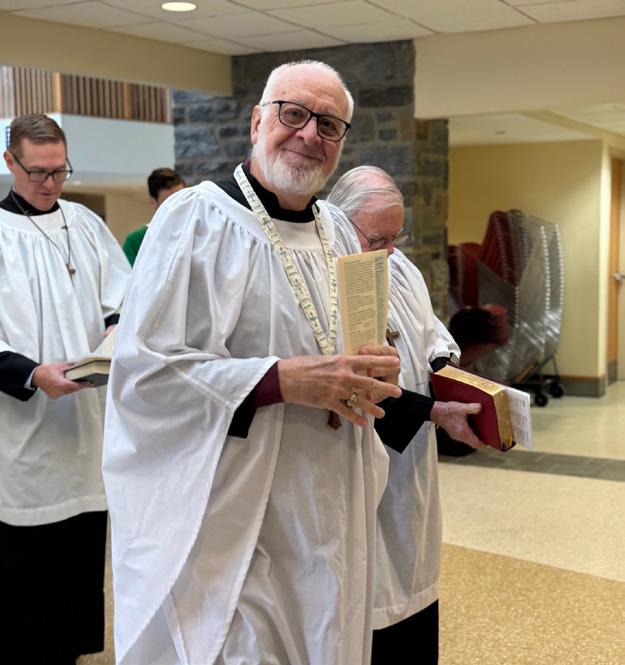
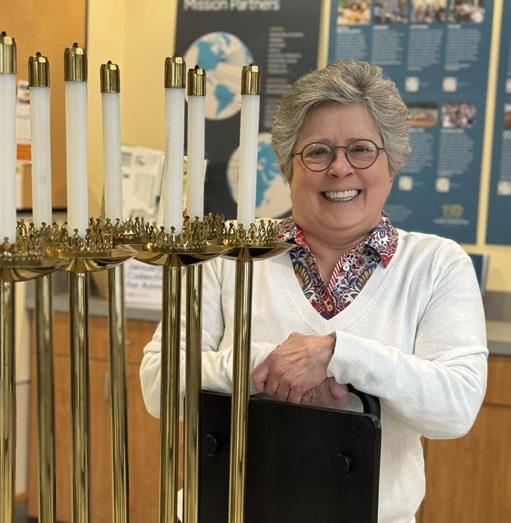
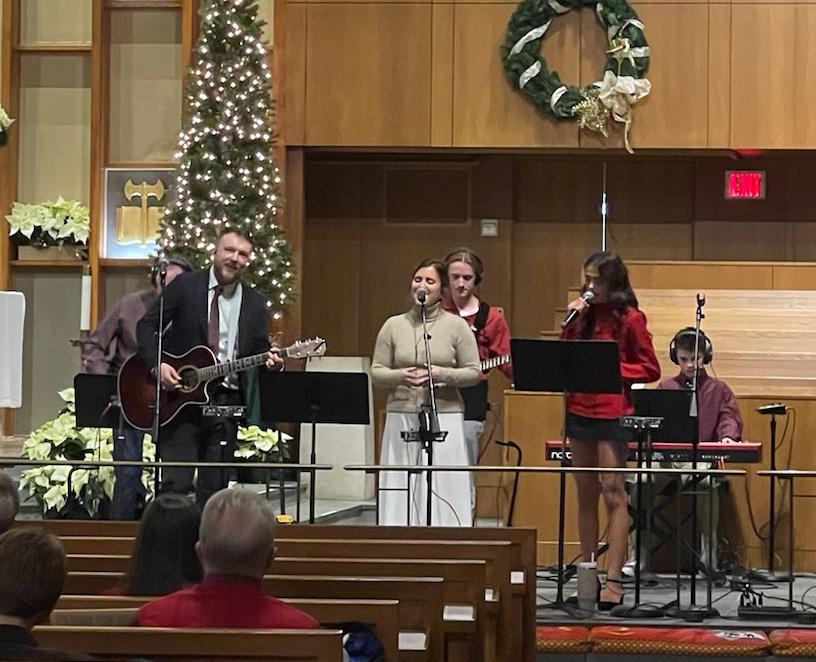
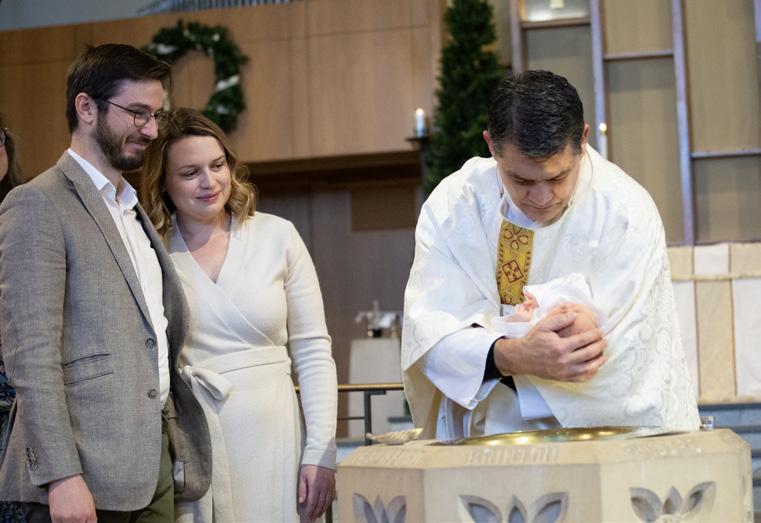
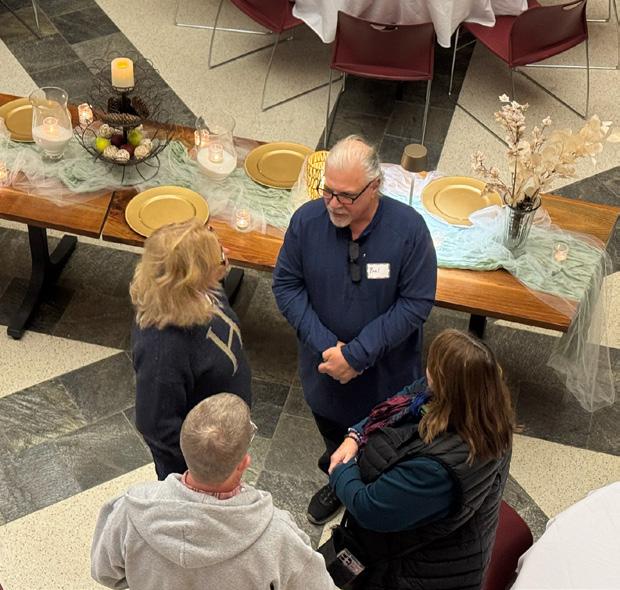
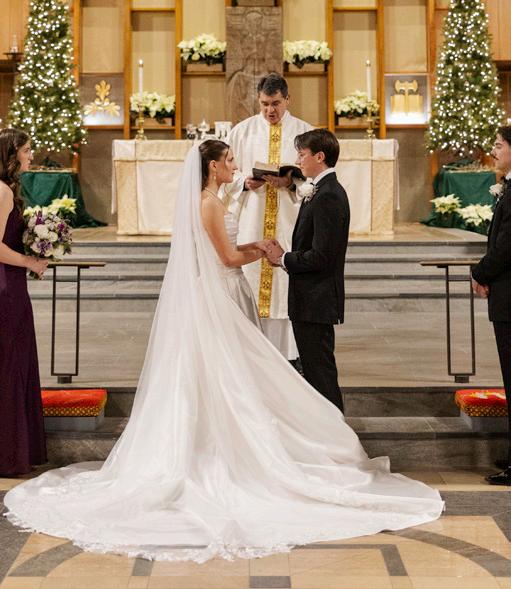
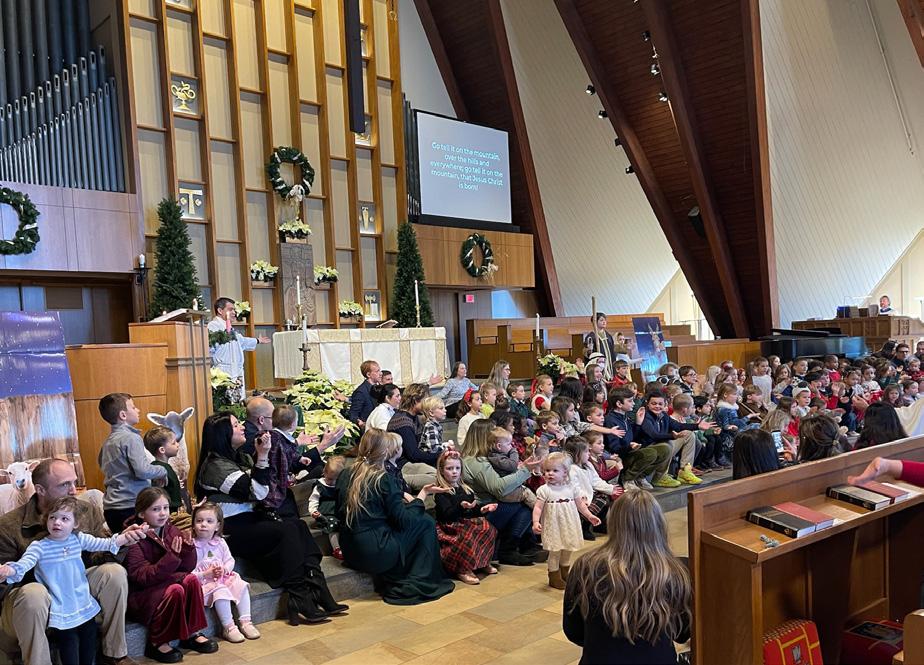
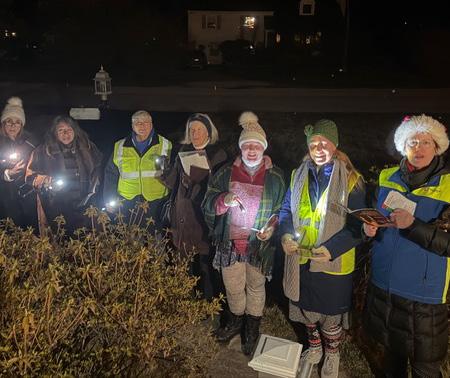
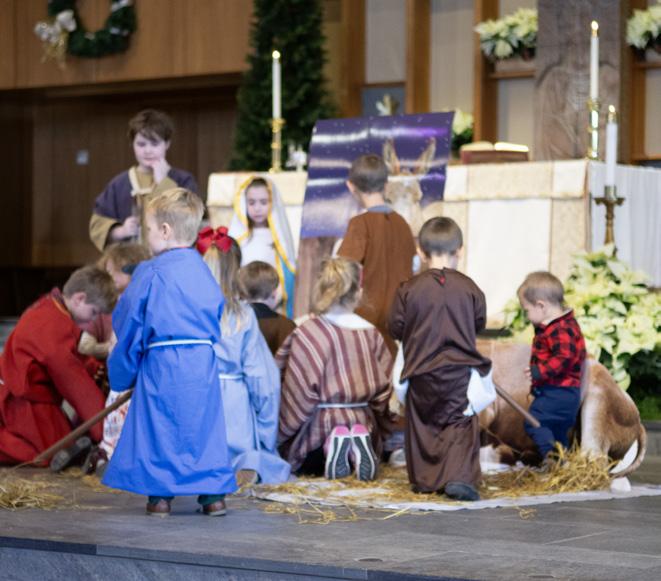
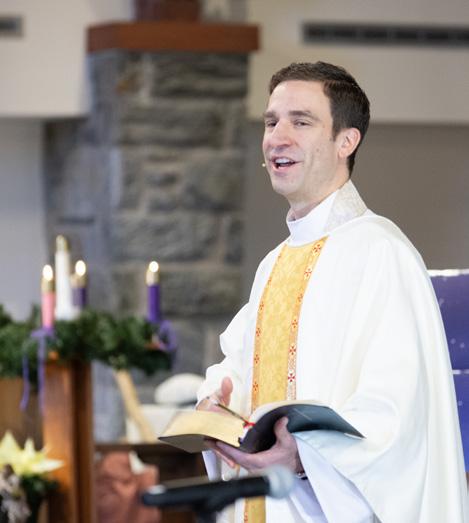
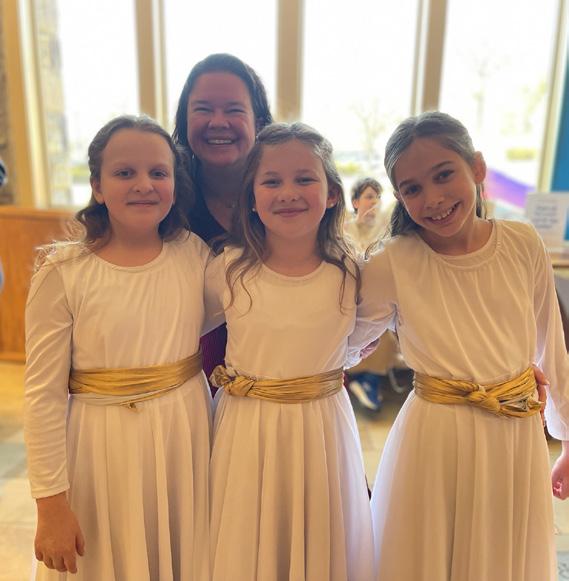
GOOD SAM LIFE IN COMMUNITY
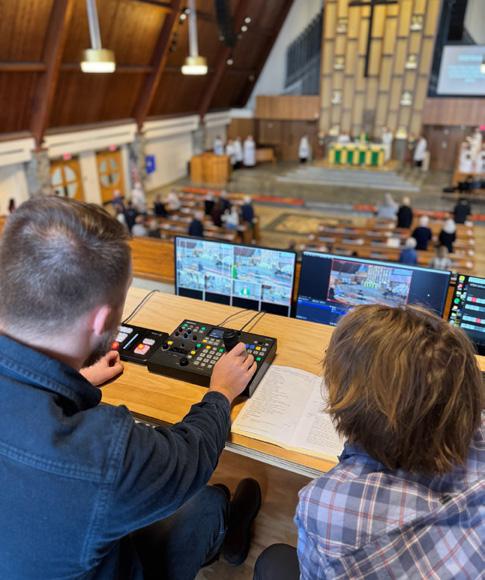
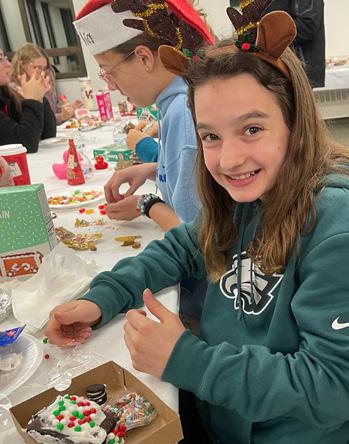
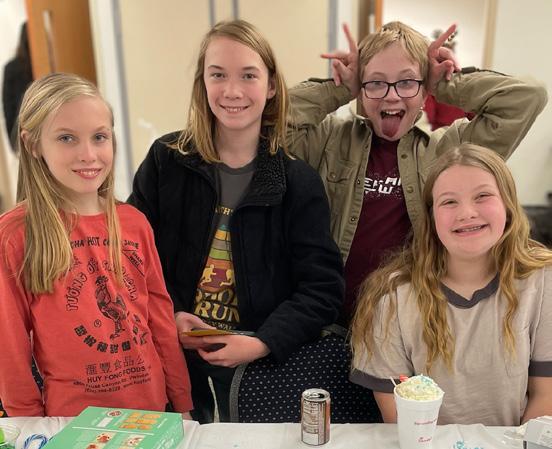
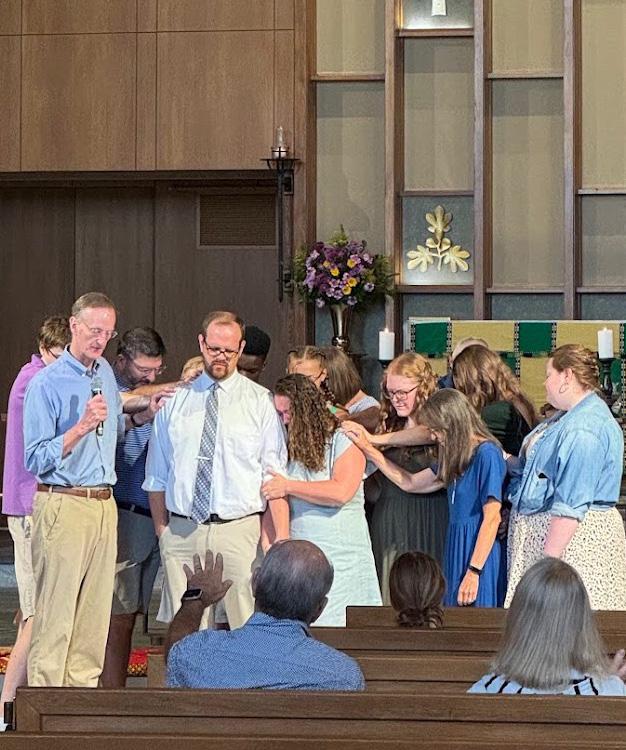
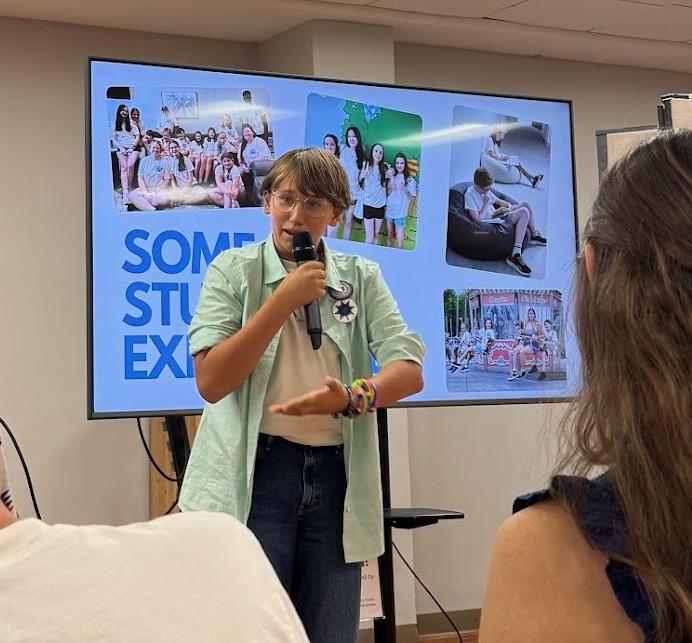

Fall Fest / Trunk or Treat
Candy… games… costumes… trunks? What’s not to like? Good Sam hosted several hundred people of all ages for the annual Trunk or Treat Fall Fest. It’s like trick-or-treating, but with cars decorated in thematic fashion. The highlight was a “petting zoo” themed trunk with live animals. This event reaches church families as well as members of the local community.
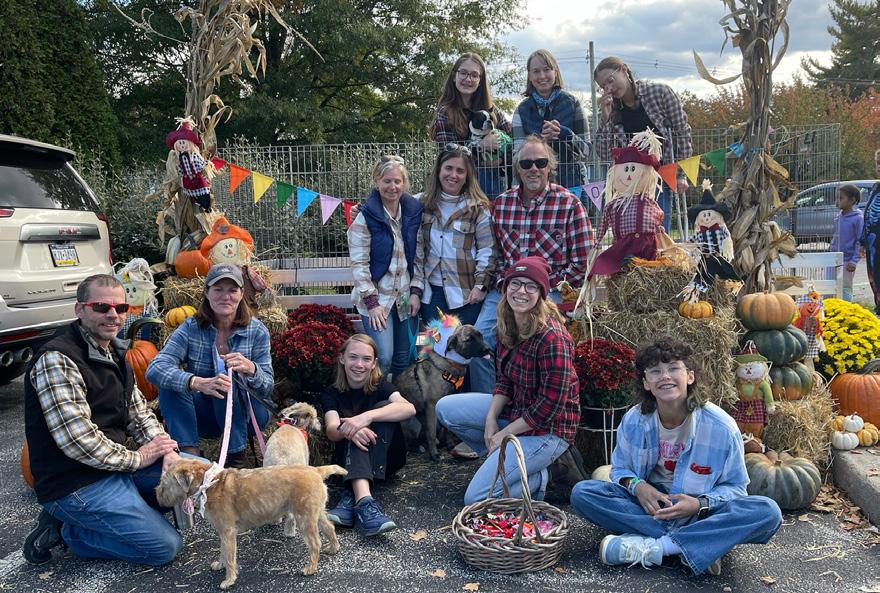
Christmas at Good Sam
Go tell it on the mountain: Jesus Christ is born! We had a sparkling celebration of the Feast of the Nativity here at Good Samaritan, with four unique worship services. On Christmas Eve, the 11:15 am family service was filled with happy voices including several hundred children, carols, and a children’s pageant. At 5 pm our traditional service with organ and choir were beautiful, culminating in the singing of Silent Night by candlelight. Our 8 pm contemporary service capped off Christmas Eve with joyful prayer and song ringing out in praise. Finally, Christmas morning featured a 10 am Eucharist in the historic chapel, with many gathered in that beautiful space. It was truly a Nativity to remember, and we offer special thanks to all the staff, musicians, volunteers, and participants who made it possible.
Living with Loss Grief Group
Nurse Mary Cramer, leader of our Pastoral Care Team, led a ten-week discussion on the book Dark Clouds, Deep Mercy: Discovering the Grace of Lament by Mark Vroegop. The purpose of the Living with Loss Grief Group study was to provide fellowship, support one another through shared experiences, and learn how Christian lament can bring us closer to God in times of difficulty. The next book study for the Living with Loss group is tentatively scheduled to begin the week of April 13.
A Visit from Rt Rev’d Ron Irene, Bishop of Paraguay
Longtime mission partner Ron Irene visited Good Sam in September, and his warmth and passion for the gospel was evident. The bishop spoke at all three services, participated in an interview conversation during the Adult Christian Formation hour, and joined a fellowship dinner at the home of Debbie Volk, chair of the Missions Committee. We pray for Ron and his wife in their ministry in Paraguay.
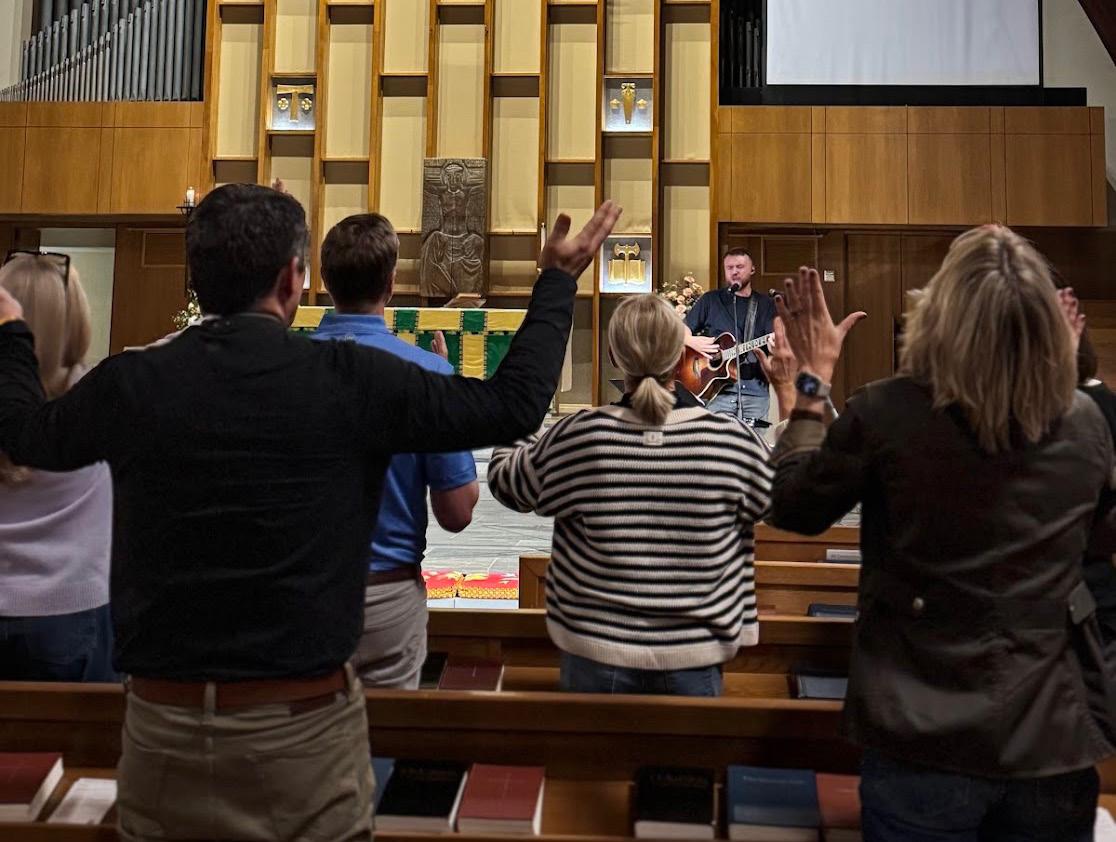
Evening Worship
Evening worship events have quickly become a “thing” at Good Sam. The choir offered a beautiful Compline service in September, followed by a full Evensong in October. Both took place in our historic 1876 chapel, a perfect setting for such gorgeous prayer and song. In the same vein, once-a-month worship nights have taken off on Tuesday evenings in the church or chapel. Combining Spirit-led prayer time with inspiring praise music, worship nights have brought generations together with joy. Keep your eye out for upcoming evening worship events!
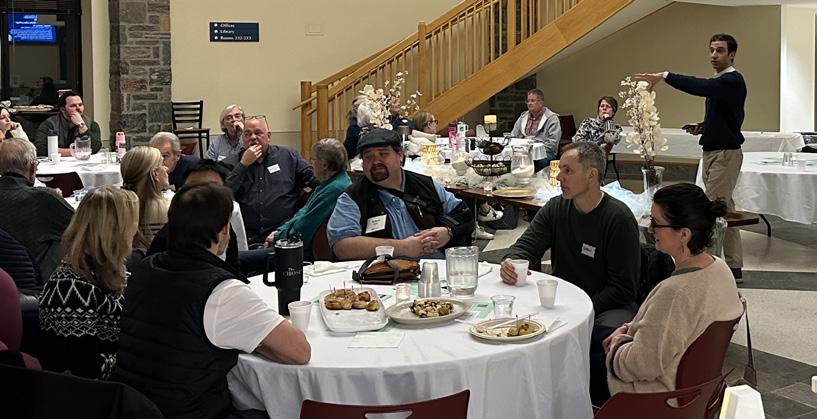
Alpha at Good Sam
The Alpha Course is a way for people to explore Christianity and grow closer to Jesus in a nonjudgmental and invitational space. We like to say, “It’s not church, it’s Alpha!” Good Sam launched a full Alpha course in January, and we are building the team and showcasing the “new look” of Alpha. It’s all about great food, engaging videos, fun fellowship, friendly discussion, and relying on the Holy Spirit. Think of a non-Christian friend or family member you would like to know Jesus. Pray about how you might invite that person to Alpha—it could be the most important turning point in that person’s life.
Good Sam Central
BY THE REV’D DR MATTHEW KOZLOWSKI, VICAR; NEEKA GUENTHER, CONNECTIONS SPECIALIST; AND MELODEE DILL STEPHENS, CREATIVE DIRECTOR
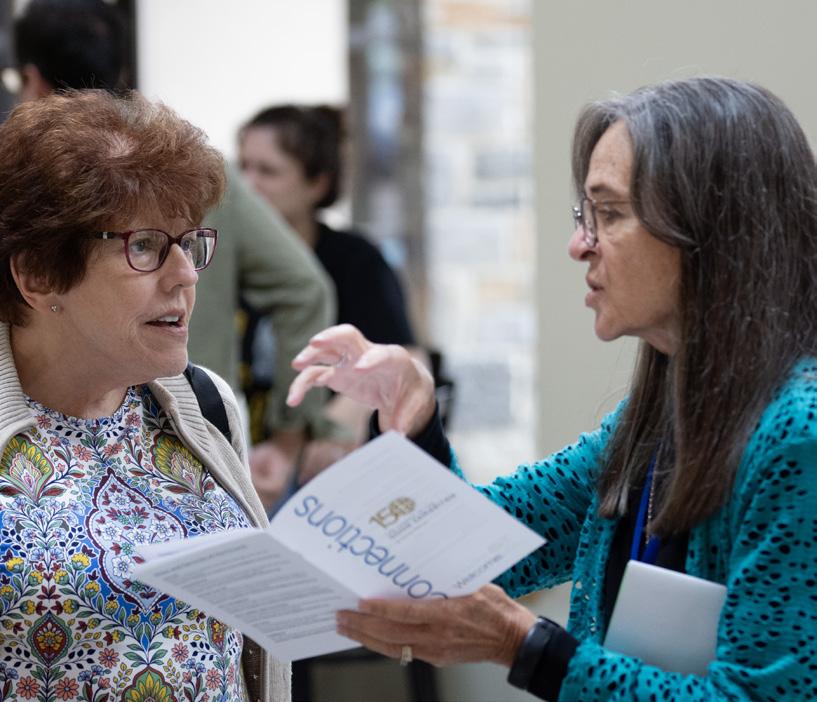
You may have noticed the tall, colorful banners and the beautiful handcrafted tables in the Atrium and at the back of the church. But what really brings Good Sam Central to life are the smiling faces standing beside them.
Good Sam Central is more than a table. It’s a welcome mat.
This year at The Church of the Good Samaritan, we’ve been grounding ourselves in the words of Revelation: “Behold, the home of God is with humans.” If we truly believe that we are part of God’s home here on earth, then hospitality matters. Home begins with welcome. And Good Sam Central is one of the ways we practice that welcome together.
In a world increasingly shaped by contactless communication—chatbots, forms, and selfservice portals—we’re choosing something different. We’re choosing presence. We’re choosing conversation. We’re choosing people.
Good Sam Central exists to help every person feel seen, known, and connected. Whether you’ve been part of this community for decades or you’re visiting for the very first time, this space is for you. It’s where you can ask simple questions (like where the bathrooms are), learn about upcoming events, request a name tag, or explore ways to get involved. It’s also where you can pause, say hello, and begin building relationships.
Because connection doesn’t happen automatically. It happens when we lean in.
One of the best ways to grow deeper here is through serving. Our handcrafted tables themselves were created as acts of worship. Holding a baby in the nursery, joining a ministry team, helping behind the scenes, or serving as a Connections Minister at Good Sam Central—each is a way of offering your time and heart to this community. Serving is often where friendships form and where faith takes root.
But getting connected is about more than programs or information. It’s about belonging.
We hope Good Sam Central feels like stepping into a living room where you can set down the weight of your week. Yet our invitation goes even further: pull up a chair. Share in the meal. Join us at God’s table. True connection ultimately leads us into communion—into relationship with Christ and with one another.
Good Sam Central is here to help guide that journey. It’s a place to be welcomed, to ask questions, and to take meaningful next steps— but most of all, it’s a place to begin building relationships. Our hope is simple: that everyone who walks through our doors feels seen, valued, and invited into community. So next time you pass by, stop for a moment. Say hello. Ask a question. Whether you’re brand new or have been here for years, we’d love to help you find your place.
At Good Sam Central you are invited to…
• Meet a friendly face
• Ask questions and learn about the church
• Share prayer requests
• Explore ministries and serving opportunities
• Pick up a Connections booklet
• Fill out a connect card if you’re new
• Request a name tag
• Discover ways to get involved
• Talk with a Connections Minister
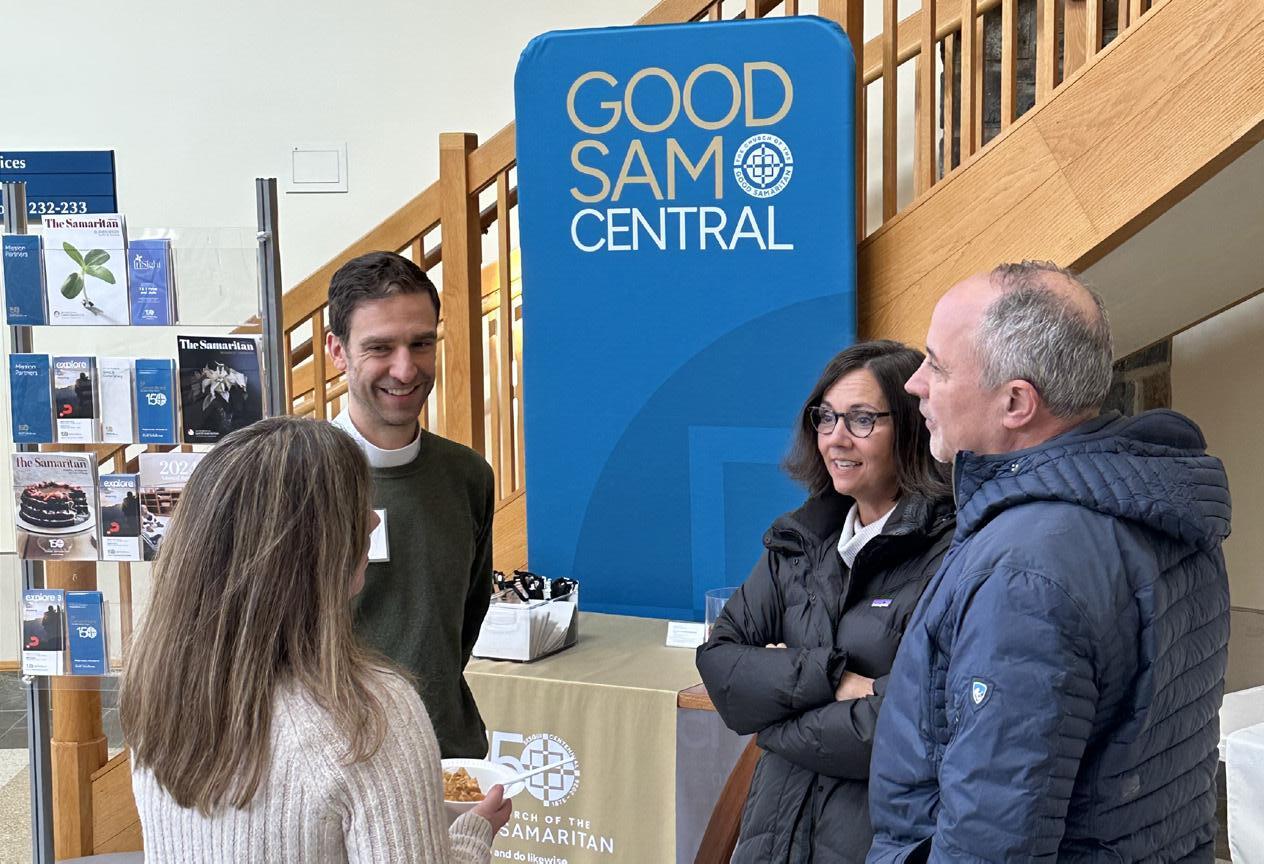
PROFILES
Good Sam Profile: Gary Gress
BY CHRISTIE PURIFOY, WRITER-IN-RESIDENCE & TEACHING FELLOW
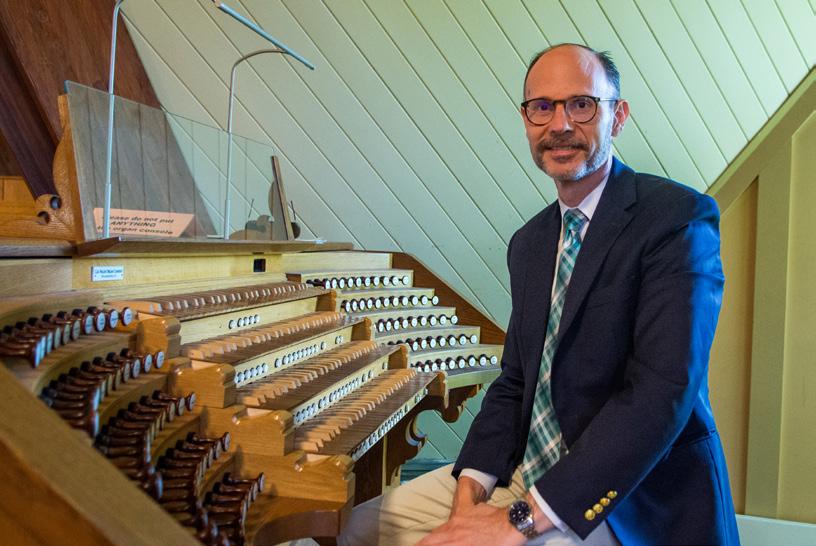
When Gary Gress said, My job is to listen and support, I stopped taking notes, struck by how much I did not know about what it is like to serve The Church of the Good Samaritan as organist. Gary has been an integral part of worship here for 16 years. We spoke by phone shortly after the All Saints Choral Concert, where I had heard him play a beautiful piece for piano by Francis Poulenc and watched a little boy in the front pew clearly mesmerized by Gary’s dancing fingers on the keys.
I had long appreciated that we are blessed to have an organist of Gary’s talent leading our choir and congregation each Sunday. But I had not fully understood that his leadership is the leadership of a servant.
Gary explained that his primary passion is as a collaborative musician—on organ, but especially on piano. He loves to amplify voices and help singers come alive by getting beneath their sound and supporting them with his instrument. He listens carefully, making adjustments so the organ or piano never overwhelms but instead supports, leads, and surrounds. He does this for soloists, for our choir, and for us, the congregation.
One of the things he loves most about Good Sam is that we sing. We really sing! He told me that if we go quiet, he must also go quiet. But when we sing out, he is able to give the organ more of himself and give us more of the organ. It is a beautiful picture of life in the Body of Christ. Perhaps, like me, you have never considered how much your voice matters to our organist.
Perhaps you sometimes forget how much our congregational singing depends on the sacrificial dedication of a lifelong musician. Gary is a pianist by training. His parents supported him with lessons from age five, and he had earned his first church music job by ninth grade.
In high school, he faced the question many young musicians must grapple with: Can I pursue my passion and still earn a living? Or give up this dream? By the time he finished college, he wanted to be done struggling. He went to work in a bank.
But he had become a Christian, and when he brought his questions about the future to God, he realized that a passion is not only for ourselves. Though he had never seen himself as a teacher and had assumed he could not be one, God opened a door to teach at Church Farm School. Gary began a ministry of music with the students there. God knows better than we what gifts he has placed in us—and why, he said.
Like the excellent teacher he is, Gary asked me a question: What is happening in heaven right now? In one of his favorite Scriptures, he explained, Jesus sang with his disciples just before his betrayal. And right now, in heaven, there is singing. The greatest privilege of his work as organist, Gary said, is that he has been given the task of pulling back the veil between heaven and earth. When he leads us in singing, our voices soar far beyond this life, joining angels and archangels and the company of heaven in a hymn of praise. No doubt, our voices join the voice of Jesus Christ himself. And Gary’s music serves and supports us all.
IN NATURE When Gary isn’t playing or teaching music, he is out in the natural world. He loves hiking and has a new appreciation for gardening. He sees the flower beds around his home as living art. Gary kindly requests that Good Sam’s gardeners send their best tips for discouraging deer his way.
OUR ORGAN Did you know our organ was damaged by an electrical storm ten years ago? The good news is that our refurbished organ is structurally sound. The damage can be repaired digitally, allowing our organists to offer an even wider palette of rich sound. A fund for these repairs has been long established.
As part of our 150th Anniversary video project, we’re gathering voices from across Good Sam— here’s a sneak peek at Mary Walmsley’s story.
Mary Walmsley has been part of Good Samaritan since August 1975, when on her very first Sunday she felt the Holy Spirit’s presence in worship and was immediately welcomed into the choir and embraced by parishioners at the door. Drawn by her love of singing—“to sing is to pray twice”—she treasures memories of Bill Evans building an 80-voice choir, orchestral concerts, and Prayer and Praise gatherings. Choir life became central to her faith, including decades of service as music librarian. Her favorite place remains the music library, where she quietly serves God for two hours every Wednesday, a ministry she has carried on for over forty years. A gifted and creative embroiderer, Mary has won prizes through the Embroiderers Guild of America, Philadelphia Chapter. She also fondly remembers Fr Dan’s Seder dinners in Ashton Hall and the unforgettable “Sound of Celery,” that one-second parish moment when everyone bit together and faith, fellowship, and joy were shared in a single very loud crunch!
Mary Walmsley Member since 1975
GOOD SAMARITAN
go and do likewise.
212 West Lancaster Avenue | Paoli, PA 19301
GOOD SAMARITAN
Upcoming Events
hello@good-samaritan.org | 610.644.4040 good-samaritan.org go and do likewise.
go and do likewise.
Tuesdays at Good Sam Tuesdays at Good Sam is a way for us to gather midweek—sharing a meal, building community, and growing in faith. From Youth Night for teens to Worship, Alpha, and Christian Formation Courses for adults, Tuesday nights offer meaningful connection.
Tuesday February 17 | 5 – 7 pm
Shrove Tuesday Carnival
Wednesday February 18
7:30 am, 12:15 pm, and 7 pm
Ash Wednesday Imposition of Ashes
Saturday February 21 | 8:15 am – 11:45 pm
Celebrating 150 Years:
Saturday Seminar / At Home with God, Christie Purifoy
Friday February 27 | 6 pm Campus Use Strategic Plan Gathering
Sunday March 1 | 6 pm
Choral Evensong
Sunday March 8 | 1 pm
Annual Meeting
Tuesday March 10 | 6 pm Worship Night
Saturday March 14 | 8:30 am
Lenten Quiet Morning for Women
Sunday March 15
New Member Recognition Sunday
Friday, Saturday March 20 – 21
RENEW Student Conference / grades 6 – 12
Sunday March 29 | 7:30, 9, and 11:15 am
Palm Sunday
Thursday April 2 | 7 pm
Maundy Thursday Eucharist With Foot Washing & Stripping of the Altar
Stay up to date by visiting good-samaritan.org/events
GOOD SAMARITAN
See page 24 for our Spring Adult Christian Formation Course Schedule
Friday April 3 | 9 am
Good Friday: The Way of the Cross Family Service
Friday April 3 | 12 – 3 pm
Three-Hour Devotion
Saturday April 4 | 9 am
The Holy Saturday Office
Saturday April 4 | 7:30 pm
See page 1 for all 2026 Saturday Seminars including a special October 2026 concert!
Easter Vigil: The Great Paschal Liturgy With Baptisms
Sunday April 5 | 7:30, 9, and 11:15 am
Easter Day: The Feast of the Resurrection of our Lord Jesus Christ
Easter Egg Hunt at 10:15 am No classes for children or adults
Tuesday April 14 | 6 pm Worship Night
Friday, Saturday April 17 – 18
InSight Women’s Ministry Retreat: Growing in Intimacy with Jesus
Friday April 24 | 6 pm
Celebrating 150 Years: Responding Together (see pg 1)
Saturday April 25 | 8:15 am
Celebrating 150 Years: Saturday Seminar / with The Rev’d Dr Amy Peeler
Sunday May 3 | 6 pm
Choral Evensong
Tuesday May 12 | 6 pm Worship Night
Tuesday May 26 | 6 – 8 pm
Good Sam Youth Senior Send Off
Friday May 29 | 6:30 pm
Dance Ministry Spring Concert
Sunday May 31 | 9 and 11:15 am
Senior Sunday
New Lent Devotional
This devotional doesn’t work like other devotionals. These words— contributed by 25 Good Sam authors—weren’t written merely to be read and contemplated. Nor were they written to accompany your study of Scripture. These words are to accompany you in your Lenten commitment to fast, to pray, and to give alms. Devote yourself to these practices—otherwise called spiritual disciplines— and these reflections will encourage, inspire, and guide you along your way. Pickup a copy in the Atrium, or Download a PDF, or Sign up for a Daily Lent Email directly to your inbox
Shop apparel now. More selections coming soon. Visit