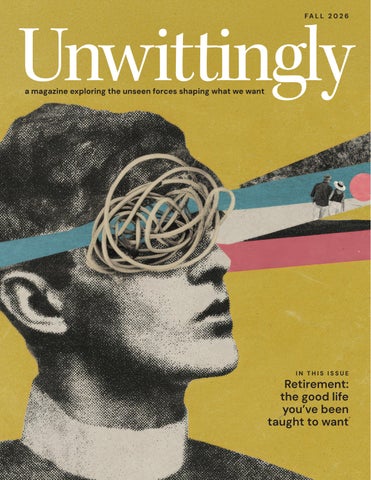
Unwittingly FA L L 2 0 2 6
a magazine exploring the unseen forces shaping what we want
IN THIS ISSUE
Retirement: the good life you’ve been taught to want
L E T T E R F R O M T H E E D I TO R
Culture points us to retirement and says:
Then the good life will be yours. I have been preparing for retirement for most of my adult life. I started saving in my twenties. Statements have arrived month after month quietly asking the question: Will there be enough? Around me is a familiar vision of the retired good life. Work eventually ends. Obligations and worries lighten. Time becomes my own. The images of freedom, travel, and leisure are easy to imagine (picture that attractive couple walking along a gorgeous beach at sunset without another soul in sight). After decades of work, this is the life I am told I have earned. And the closer retirement gets, the easier it is to be drawn into comparison. Someone my age has already retired. Someone younger has. With the children grown and the house quieter, the question begins to press a little harder: When will it be safe to stop working? Retirement planning is not wrong. Saving is wise and a season with more time can be a gift. But these practices and images may also, unwittingly, train my desires. I can be tempted to imagine security as something I can control, freedom as a lack of obligation, and flourishing as a life arranged around my own comforts and pleasures. In this issue, we’ll look at four recurring themes in this journey towards retirement. I wonder: What is the retirement good life I have been taught to want? What kind of person might I become as I journey towards it? Jesus offers another vision: seek first the kingdom, do not worry about tomorrow, and store up treasure somewhere else. Still learning to want differently, Melodee Dill Stephens Editor-in-Chief
Retirement asks for our attention long before it arrives. In our twenties we begin setting money aside for a life decades away. It is a wise habit, but it can also teach us to worry about the future: Are we preparing carefully enough? Will there be enough? Will the future be secure enough?
1 C U LT U R E : S TA R T E A R LY
The future begins now.
A D I F F E R E N T WO R D
“ Communities of disciples in cultures like ours, therefore, would do well to attend to the virtues that are being exalted and instilled within daily life to see if they might be forming habits of mind and patterns of action that that are at odds with God’s desires for the shape of human life.” PHILIP D. KENNESON, “EXEGETING CULTURE: FORMATION, IDENTITY, MISSION” P 4
As income grows, so does the pressure to save and plan. College, weddings, mortgages, and generosity all compete for resources. The future stays quietly in view, and worry can begin to steal some of today’s joy: Are we using too much now? Saving enough for later?
2 C U LT U R E : K E E P B U I L D I N G
Protect what comes next.
3 C U LT U R E : H A N G I N T H E R E
The good life is almost here. The children leave home. Friends and coworkers begin retiring. Someone younger gets there first. The imagined life feels closer and comparison becomes easier. We evaluate our potential longevity, calculate dates, balances, weigh the possibilities, and ask: When do we want to retire? Will we remain healthy? How long will we live? When will it finally be safe?
A D I F F E R E N T WO R D “ Liturgies are covert incubators of the imagination because they play the strings of our aesthetic hearts. Liturgies traffic in the dynamics of metaphor and narrative and drama as performed pictures of the good life, staged performances of some vision of the kingdom that capture our imagination and thus orient our love and longing. By an aesthetic alchemy, these liturgies implant in us a vision for a world and way of life that attracts us so that, on some unconscious level, Liz Lemonlike, we say to ourselves: ‘I want to go there.’ And we act accordingly.” JAMES K. A. SMITH, “THE IPHONE-IZATION OF OUR WORLD(VIEW)” P 1
4 C U LT U R E : YO U H AV E A R R I V E D
Now your time is your own. At last comes the good life the story has been pointing toward: freedom from work, fewer obligations, more travel, leisure, and choice. Retirement promises time arranged around our preferences. The deeper question: Is freedom of choice and freedom from responsibility really the same thing as flourishing?
WO R D S TO P O N D E R “ A way of life becomes habitual for us such that we pursue that way of life—we act in that way of life—without thinking about it because we’ve absorbed the habitus that is oriented to a corresponding vision of ‘the good life.’ Indeed, because this becomes sedimented into my background, I can’t even see the world otherwise; this way of seeing it just seems ‘obvious,’ and I don’t even feel the call to be otherwise.” JAMES K. A. SMITH, “THE IPHONE-IZATION OF OUR WORLD(VIEW)” P 6
B U T H OW C A N W E B E R E - F O R M E D ? If retirement culture teaches us to look toward a future good life when living will be easier when its on our own terms, Christian spiritual formation asks us to look again. The good life is not waiting somewhere beyond our last day of work. Jesus points toward a life centered on God and others, not simply on comfort, security, and freedom. That does not make saving foolish or retirement a bad idea. A season with decreased work demands on both time and mental capacity can be a gift. The question is: What is that freedom for? Retirement from a job does not mean retirement from the work of God’s kingdom. More available time can become more opportunity to serve and offer talents that have formed over a lifetime. Rest can become a deeper Sabbath rather than escape. Financial security can make generosity possible rather than ensuring our own comfort. If we can be formed unwittingly by the cultural story of retirement, then counterformation must become intentional. This issue began by asking what retirement good life we have been taught to want. Perhaps the better question is: What kind of life is teaching us to love the kingdom of God now?
Actually, the good life is not someday. It is this one real life with God we are already living.
Unwittingly “Implicit in [these] liturgies are visions of the kingdom— visions of human flourishing—that are antithetical to the biblical vision of shalom. And because they are formative, liturgical institutions, they unwittingly but powerfully shape and mold our desires and love toward that end… we need to see not only what vision of the kingdom is implicit in the practices of Christian worship but also the way in which Christian practices need to function as counter-formation.” JAMES K. A. SMITH, DESIRING THE KINGDOM P 121-122
A PUBLICATION INSPIRED BY AN ASSIGNMENT.