



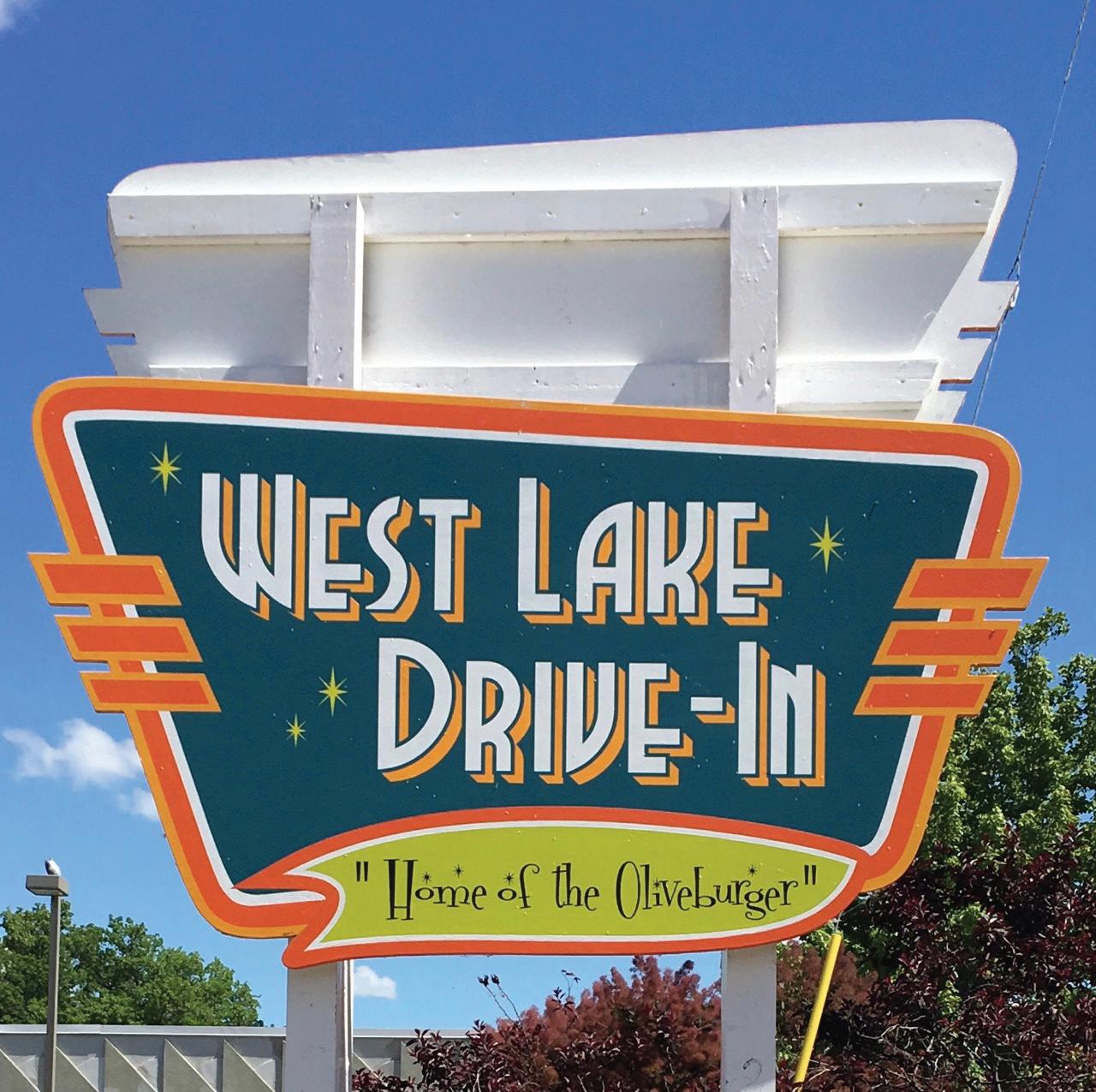
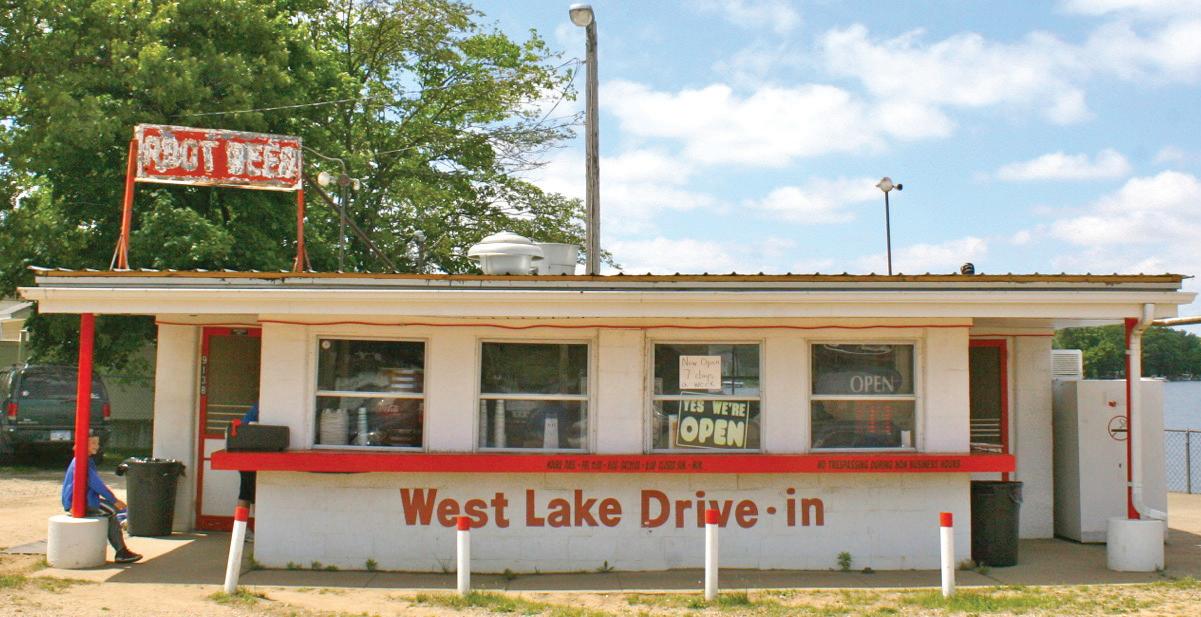
The opening of the West Lake Drive-In each year, marked the beginning of spring for many local residents.
They served classic drive-in farehamburgers, hot dogs, perch, chicken, French fries, onion rings, root beer, shakes and ice cream. However, their olive burgers, fried mushrooms and root beer floats, along with the gorgeous view of West Lake, were what they were best known, and loved for.
The drive-in restaurant was built in Portage at 9138 Portage Road in 1962 and opened for business in 1963. Jim and Arliss Mendham founded the iconic drive-in and operated the restaurant for many years.
Former patrons memorialize West Lake Drive-In with their posts on the popular Vanished Kalamazoo website, including: “I used to go there on dates in high school.” “The best olive burger anywhere!” “Had been frequenting since the 60’s. Sure miss it!” “I remember one visit, as my sister and I were sitting in the back seat, eating, with my parents in the front seat, a pontoon full of kids (late teens/early 20s - male and female) mooned the entire drive-in. Haha!” “The perch sandwich was my favorite.” “There was a ski jump near the drive-in - loved watching the skiers.” “I loved the chili dogs with onions applied with a shovel” “I used to ride my horse there.” “Used to drive over there in the boat, before we were
old enough to drive a car. Great memories!” “Best childhood memories eating there!”

“It was my first job. Olive burgers were the best. I still make them like I was taught. This place has many memories. I used to ride my bike there, and feed the fish before my shift. I remember several classmates also had jobs there.” “Loved the olive burgers. Spent many lunch breaks there to unwind and look out at the lake while working at Upjohn. Good ole days!” “That was Friday night dinner. As soon as dad got home from work, that was our special weekend treat” “I loved having dinner with my family - giving a few fries to the birds and sipping a root beer.” “My kids loved going there whenever they visited their Grammy. It was part of my childhood as well. Such a bummer it had to go.” “Yep! We used to ride bikes there when we were kids. Then I worked there as a teenager!! Yes, the olive burgers were awesome!!”
The Mendham’s sold the business to Kim & Sherri Neeb in 2012. The Neeb’s sold the business to the Neeberwits’ in 2019. West Lake DriveIn permanently closed in 2020, after serving the community for 6 decades!
Rising food costs and minimum wage hikes were cited as reasons for the closure. In addition, the drive-in was operating as “legal non-conforming use.” Which meant, it could be left as is, but any material change would require either the owner to bring it into compliance with current code or seek a variance.
The drive-in space was being rented by Rolling Soul BBQ until the property was sold.
In 2023, the city of Portage bought the lake-facing West Lake Drive-In property to convert it into a public greenspace, adding parking and picnic tables. The overhang was kept for shade, as part of the new project, but the rest of the drive-in was removed. Sadly, the heavy winds during the storm that hit Portage on May 15, 2025 destroyed the historic metal
overhang.
The former West Lake Drive-In site, is a great spot to bring carry out and enjoy the view or a sunset. The city just asks that guests use the trash receptacles to keep Portage beautiful! On a side note – Here is the olive burger sauce recipe, posted on the Vanished Kalamazoo Facebook page by the former owner, Kim Neeb: Olives must be drained and squeezed and then mixed with heavy mayonnaise, by a ratio of 3 to 1. They used 3 gallons of olives to 1 gallon of mayonnaise.
Jackie Merriam
Sources: Wkfr.com, Vanished Kalamazoo Facebook page, KG 6/7/23, KG 5/16/25.




Isn’t it great we can finally get out and enjoy our outdoor landscapes?
There are so many things to do in our lawns and gardens at this time of year! If done now, some of the items below will prevent issues later in the season.
To Prune or Not to Prune, that is the question!
To Prune:
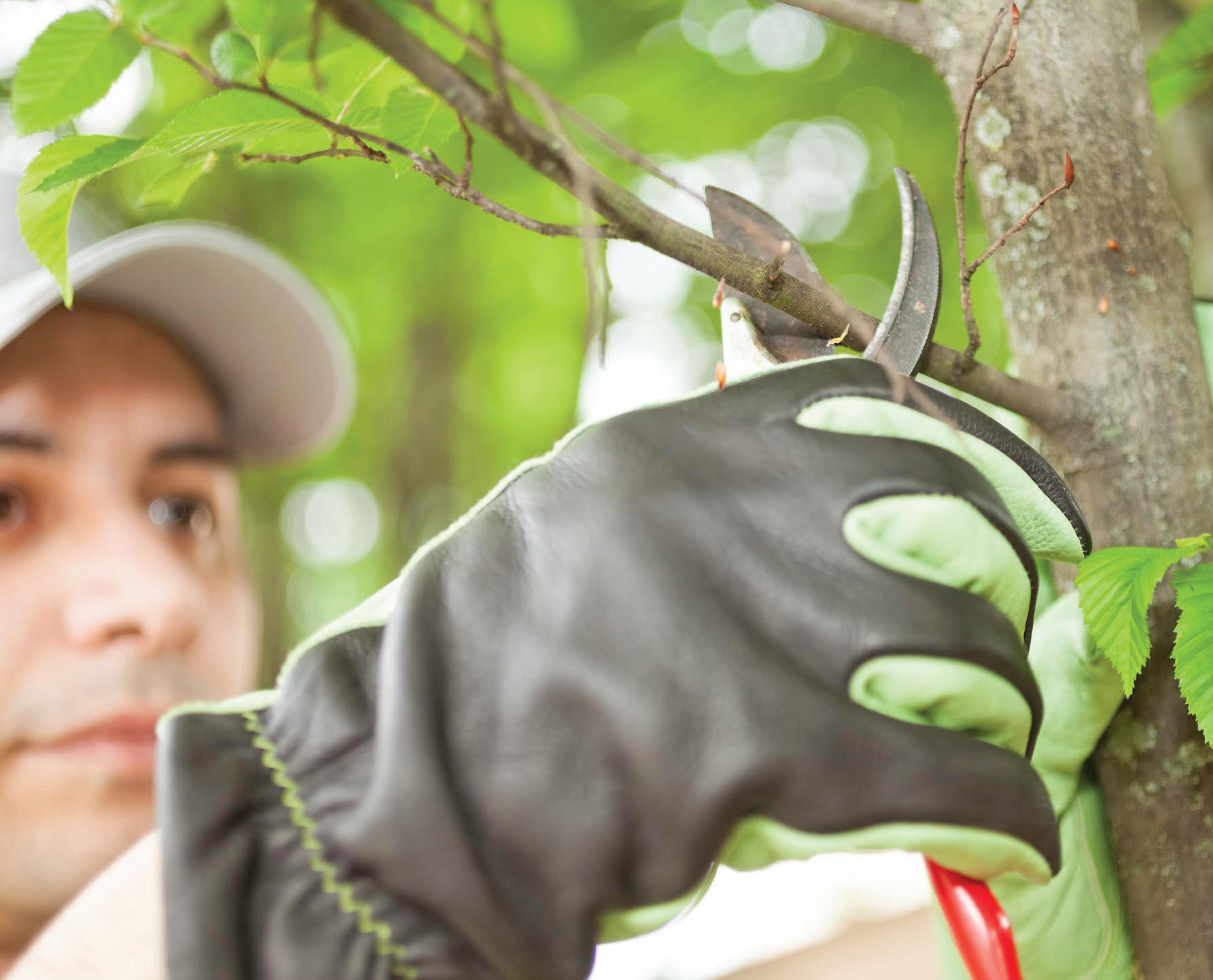
Prune woody plants while dormant, including fruit trees, summer and fall blooming shrubs and vines.
Prune out winter damage in rose bushes.
Only prune out sucker growth and broken branches on spring blooming trees & shrubs.
Prune new growth on needled evergreens, such as spruce, pine and juniper.
Don’t prune forsythia, quince, redbud and any other spring flowering trees and shrubs until after their flowers have fallen.
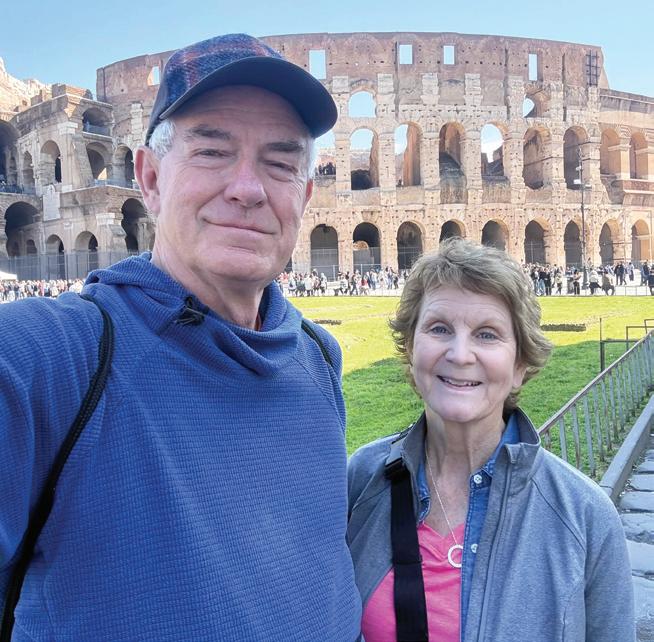
We recently returned from a trip to Italy. For me, part of the fun of travel are the language nuances. As Americans, we are fortunate, because in most countries they are taught to speak English in addition to their official language. We found their level
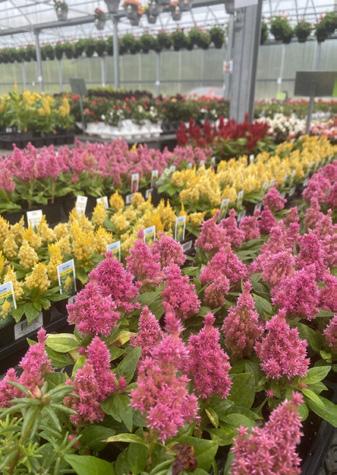
Moles eat grubs, earthworms, and beetles as they tunnel through the ground causing damage to your lawn. Putting all-natural Repellex Mole & Gopher Repellent on your lawn now will force moles out of the treated area by adding a protective coating around plant roots. Wedel’s also has mole traps and baits if you would rather go that route.
Now is the ideal time to plant grass seed, when there is more sunlight, since trees have not yet fully leafed out. Spring showers and cooler weather help with seed germination too. Wedel’s carries bulk grass seed blends exclusively formulated for our area.
Don’t know what’s wrong with your lawn? Bing in a sod sample and Wedel’s Lawn Experts can help diagnose
of speaking and understanding quite varied. However, you can typically communicate effectively by speaking slowly and by using facial expressions and gestures, much like playing the game of charades.
The first phrase that struck my funny bone was on the airplane, when the steward announced that the overhead bins are reserved for wheelie bags – I just love that term! Before take-off, the stewards go through the cabin to make sure passengers stowed everything away before take-off. If not, they would ask the person to pop (put) their jacket or blanket behind them – such a perky and polite request! After snacks and meals, the steward would

and recommend how to repair it.
No one likes the look of crabgrass! This common lawn problem is pretty easy to prevent, but not easy to get rid of!
You can’t see crabgrass now because it has not germinated yet, so it’s easy to forget about it until it shows up in July.
Wedel’s specialists recommend Fertilome Crabgrass Preventer Plus Lawn Food. When applied the first week of May, you can avoid the crabgrass problem before it shows up. If crabgrass is allowed to grow in lawns, each plant will produce hundreds of seeds to produce an even bigger crop next year!
There are several crabgrass products to choose from, but Fertilome contains Dimension, the longest lasting preemergent available!
Thin Garden Seedlings
It’s hard to pull out and toss some
ask if you had any rubbish (garbage) for the bin (trash can).
When we were getting into a vehicle, the woman told us that we could put our things in the boot (trunk).
I found it interesting that they used the same word, ciao, to mean hello and goodbye. In addition, prego means please and you’re welcome. This was confusing at first, but we quickly adjusted.
Although English is the world’s most spoken language, I’m sure there are words and phrases that tickle the funny bone of visitors to the United States.
See you later alligator!
Jackie Merriam
of those seedlings you’ve worked so hard to start!
If you leave seedlings in a crowded environment, they won’t thrive. If left to grow too close to each other, they will have to compete for nutrients, water and root space.
The time to thin is when seedlings have 1-2 sets of true leaves.
If you are starting seeds indoors, thin out all except the strongest one in each cell or pot.
Keep the strongest seedling and snip off any that are crowding it. (This should prevent disturbing the healthy seedlings roots.)
If you choose to separate the seedings from each other and transplant each into their own cell, be careful not to damage roots.
Initially, thinning is hard to do, but it will help ensure that the plants you keep will be happy and healthy.
Terrie Schwartz
Wedel’s Nursery, Florist & Garden Center

Graphic Designer: Lauren Ellis
Editor and Publisher: Jackie Merriam
Recently our community and our connections have experienced great loss and sadness. The details aren’t mine to share, but this sadness keeps repeating. I was talking to my boys about life and the future and choices and ever-changing emotional states. I don’t know what’s in their heads, I barely know what’s going on in mine, but I wanted to reassure them that this life has so much to offer us and be blessed with, be thankful for, and to look forward to.
I can’t speak to deep depression, severe anxiety, loss or pain that is debilitating, trauma, and tragedy that eats at your core. Who am I to say how one should feel? What I can say is what I know. I know of all the incredible beauty that surrounds us, the opportunities ahead, the choices we get to make for ourselves, and for the betterment of others. Where sadness ends, the light begins. Sounds easy enough. Yet it’s not. There is not some definitive line that one can see and cross. It’s very intentional. It’s the art of noticing. It’s smiling when you see the smirk on the face of the teenager in line at the grocery store caught in their own thoughts. It’s the sound of the birds returning to
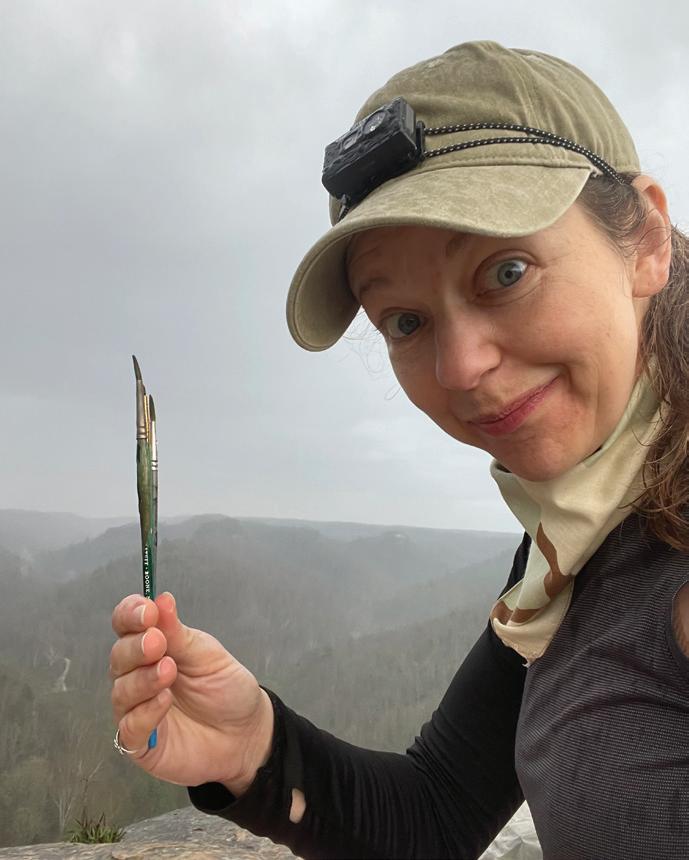
find spring has arrived and singing out a call to their friends. It’s laughing over how ridiculous you look after being caught in an unexpected downpour, atop a rock cliff, while trying to paint a plein aire watercolor painting. The chaos of life keeps us too busy to notice. The lack of noticing these little things causes slips into frustration, anxiety, worry, depression, and sadness. When we go slow, we notice. When we say no to the unnecessary, we notice. When we say yes to the phone call from a friend, we notice. When we sit on the stoop rather than rush indoors, we notice. Too much is lost because we have stopped noticing the right things and are focusing on all the demanding things.
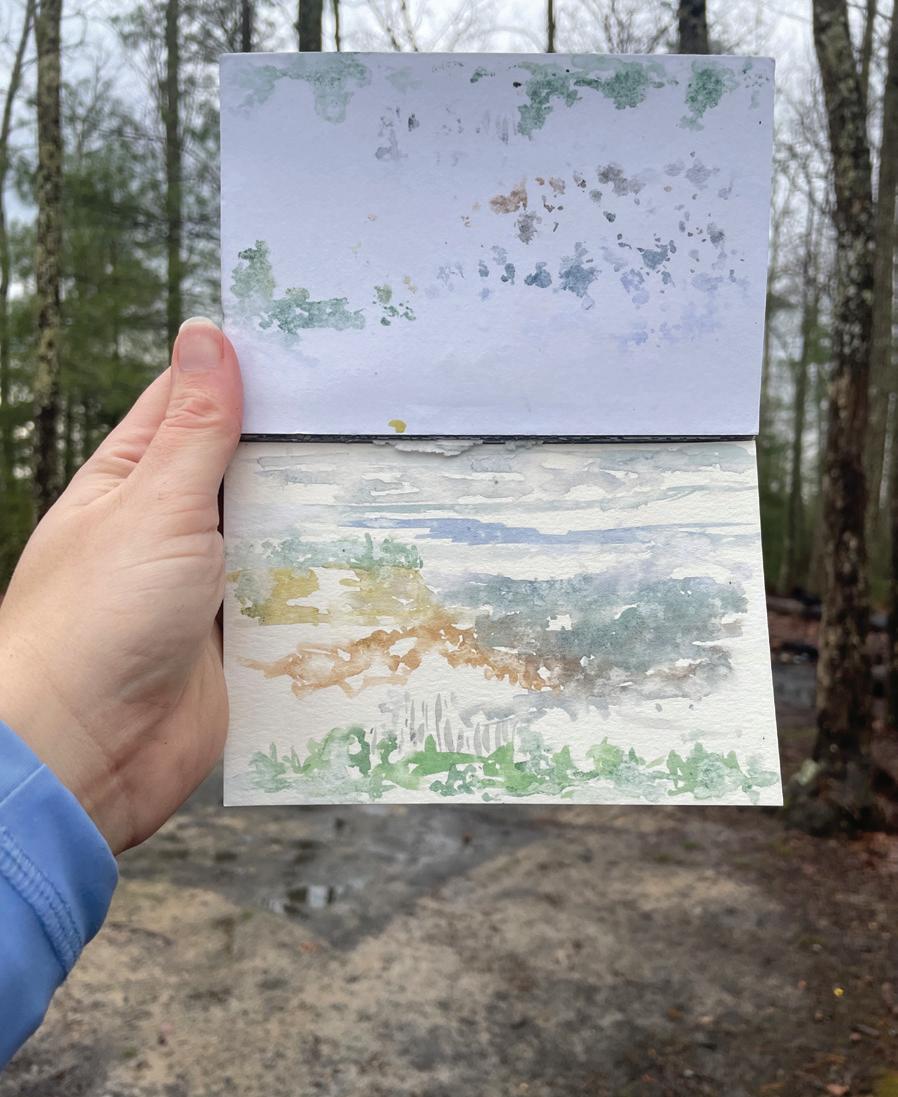
I hiked at Red River Gorge in Kentucky’s Daniel Boone’s National Forest this past weekend with friends. I climbed, rather crawled, up Indian Staircase. I survived as scared and worried as I was, I went
slow. I was intentional. I can tell you what I noticed, the grit of the rock face under my hands, grooves worn into natural steps from years of use. People have come before us; people will come after us. People have survived and thrived, because they noticed that even at the bottom of a cliff there is a way. They notice each mark on the path to hold onto leads to the next, etched a little deeper by
a predecessor, getting them to the top. Their own travels wear down a clearer direction for others to come. Others have been where you are now and have made a path to find the way through. Notice it, talk honestly about it, and move with a small crawl forward. Your own marks are on this journey and help make a clearer path for others still yet to come. May the path provide grit and natural steps to the top of the valley.
Original art prints are placed at random in 20 copies of this edition of the Good News Paper.
Peace, Love, and Art. -Amy Instagram: @amylgieschen











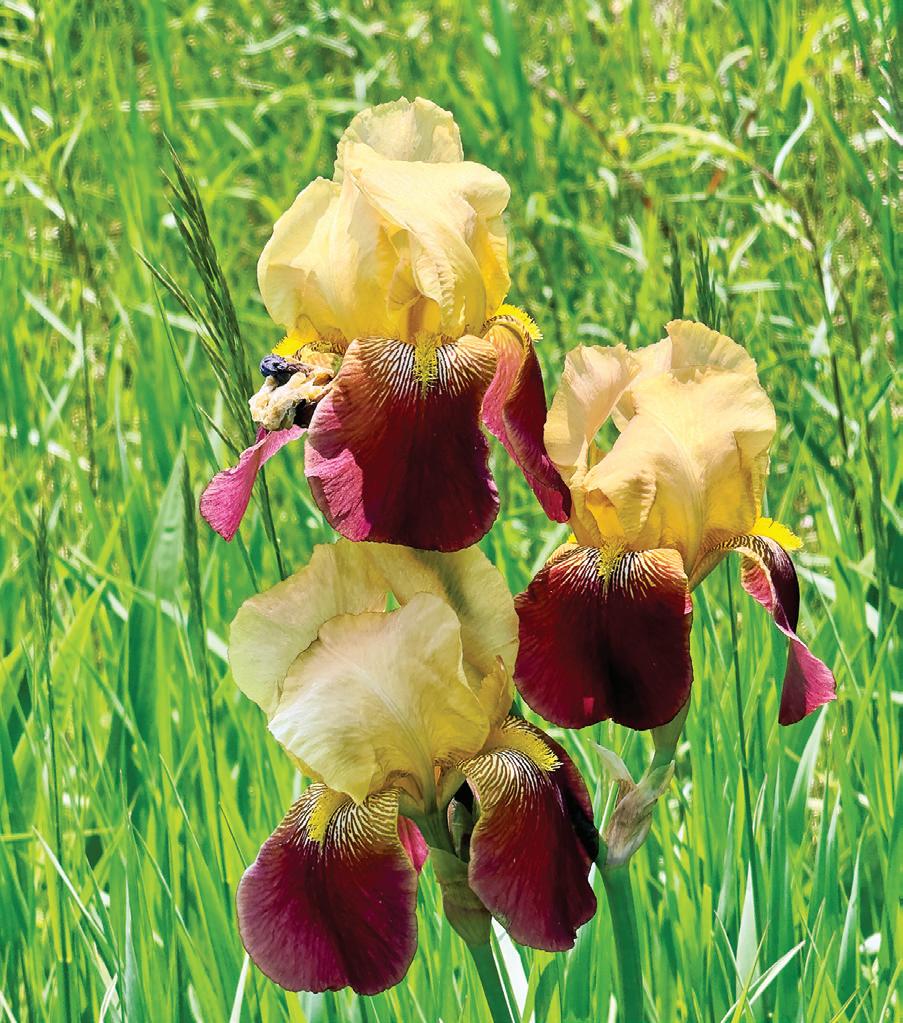
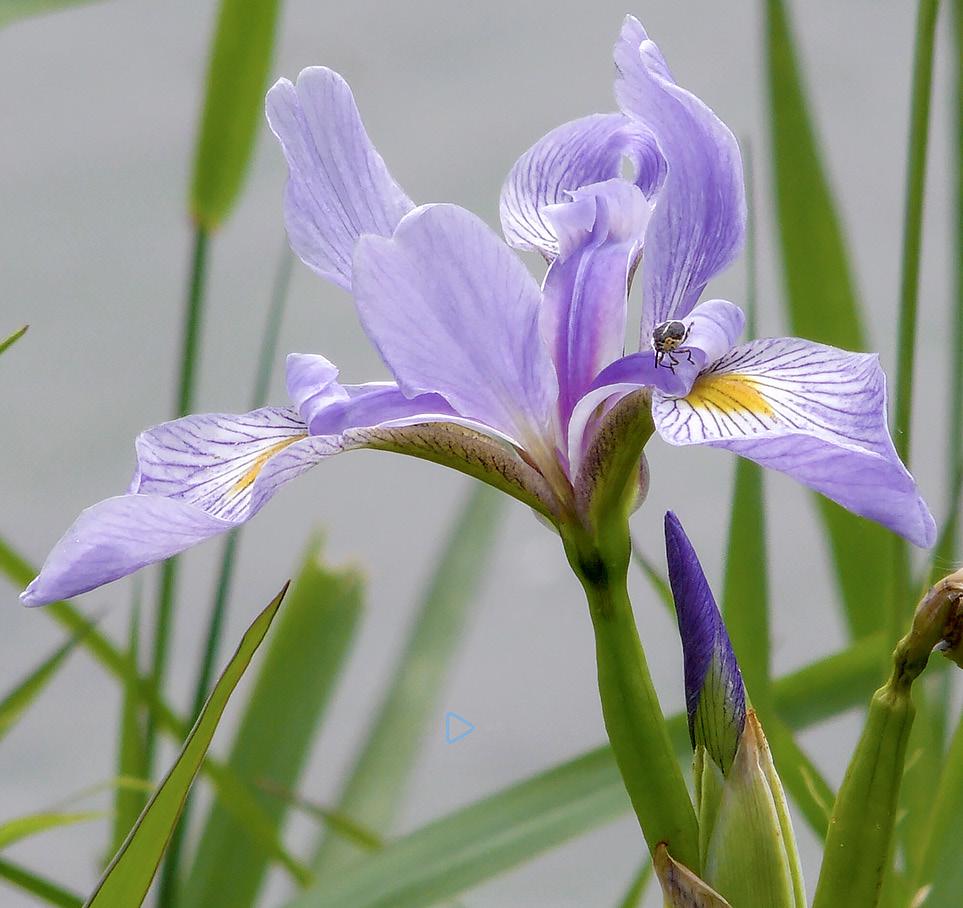
On a Sunday last year, my wife and I took our folding chairs and some snacks to Yankee Springs State Park to relax in the afternoon sun. On the way home, we took the back roads through Prairieville, and I spotted some beautiful irises blooming just off the road among the tall grasses and wild vegetation. I pulled over to get a closer look—and take a few photos.
There’s an undeniable majesty to bearded irises in full bloom—regal and audacious. Tall and upright, with petals that curve and ripple like folded fabric, they bloom in rich purples, blues, corals, yellows, and even soft copper hues. I’m fairly sure the ones I saw were Iris germanica.
Their sheer gorgeousness seems to go far beyond anything practical. I’ve had the same reaction while admiring the vivid plumage of a male Wood Duck or the glowing jade-green wings of a Luna Moth. It feels like nature is deploying beauty outside of functional purpose.
Surely, there’s a word in some language for that—beauty beyond usefulness and the kind of awe it inspires. I was once told my Grandpa Kaufmann used to invent words. I wonder what word he might have coined for it. He passed away seventy years ago, and I never got to hear one of his made-up terms or what it meant. Maybe a subject for a future post.
This week, I did a little digging into the story of irises and found it even more fascinating than expected. Irises have been with us for millennia. The Egyptians used them in perfumes and decoration. The Greeks wrote about them. And in medieval France, the stylized iris—the fleur-de-lis— became a royal emblem symbolizing power, wisdom, and culture.
But Iris germanica? It’s something
of a botanical mystery. It’s actually a hybrid—probably the result of two wild species crossed somewhere in the Mediterranean, perhaps with help from monks or especially passionate gardeners. Carl Linnaeus named it “germanica” in the 1700s, mistakenly thinking it originated in Germany. By the 1800s, iris cultivation had caught fire in Europe. Breeders sought ever-larger blooms and more vibrant colors. British botanist Michael Foster made a major contribution by introducing wild irises from Turkey and Asia—adding fresh traits and genetic diversity. That effort kicked off a wave of new hybrids, and by the early 1900s, America had joined the iris craze.
As I’ve mentioned before, my own love of plants started in high school, thanks to my biology teacher and mentor, Fred Case. Fred was more than a teacher—he was a true botanist. His home near Tittabawassee Road had two greenhouses packed with orchids, insectivorous plants, and rare hybrids. He collected wild seed and propagated new crosses. I still remember whole areas of his garden dedicated to Penstemons.
Marv and I—my friend from those days—would often help Fred and his wife collect wild Penstemon hirsutus, a native with soft, fuzzy leaves. (The name “hirsutus” for its “furry” foliage.) We weeded his rock garden, maintained the lily pond, and tended alpine species. Those afternoons with Fred lit a spark in both of us—a lasting interest in plants and botany.
One summer, Fred gave me an iris from his garden—a clump he was dividing. That’s when I first encountered a variety called “Dorothea K. Williamson.” Not a germanica, but a hybrid developed in 1918 by E.B. Williamson of Bluffton, Indiana. Even in high school, I was struck by
the name. In a garden world full of Latin, here was a flower named after a person. Dorothea was Williamson’s mother. He named the iris in her honor—and it’s still in cultivation today.
I often see irises blooming near the ruins of old farmhouses or crumbling foundations beside rural roads. The homes are long gone, but the flowers endure—quiet markers of past lives and tastes. I’ve thought about collecting some of these heirloom varieties. A small way to preserve the past and reconnect with it.
Gardeners have a term for this: “garden escapees.” These are plants that once lived in tended beds but now thrive in the wild, having spread through seeds or rhizomes. It’s a kind of irony—once-captive plants living free.
Of course, not all escapees behave so benignly. Some go rogue. Autumn olive, garlic mustard, and phragmites (those towering reeds taking over wetlands) are all escapees turned invasive—crowding out native plants and disrupting habitats.
Still, one of my lifelong favorites is a native: the Blue Flag Iris (Iris versicolor). First introduced to me in the ’60s by Fred Case on one of our first field trips, it grows in elegant clumps along Michigan’s streams and wetlands, blooming in early summer with striking purple-blue flowers.
That’s what makes irises special to me. They’re not just flowers. They’re legacy plants. Every spring when they bloom again, they remind us that something planted with care and joy can outlast time itself.
Curious to know more about the iris I saw last summer, I decided to test the powers of AI. I uploaded the photo and asked ChatGPT to identify it. This is what it told me:
“This striking two-tone iris is likely
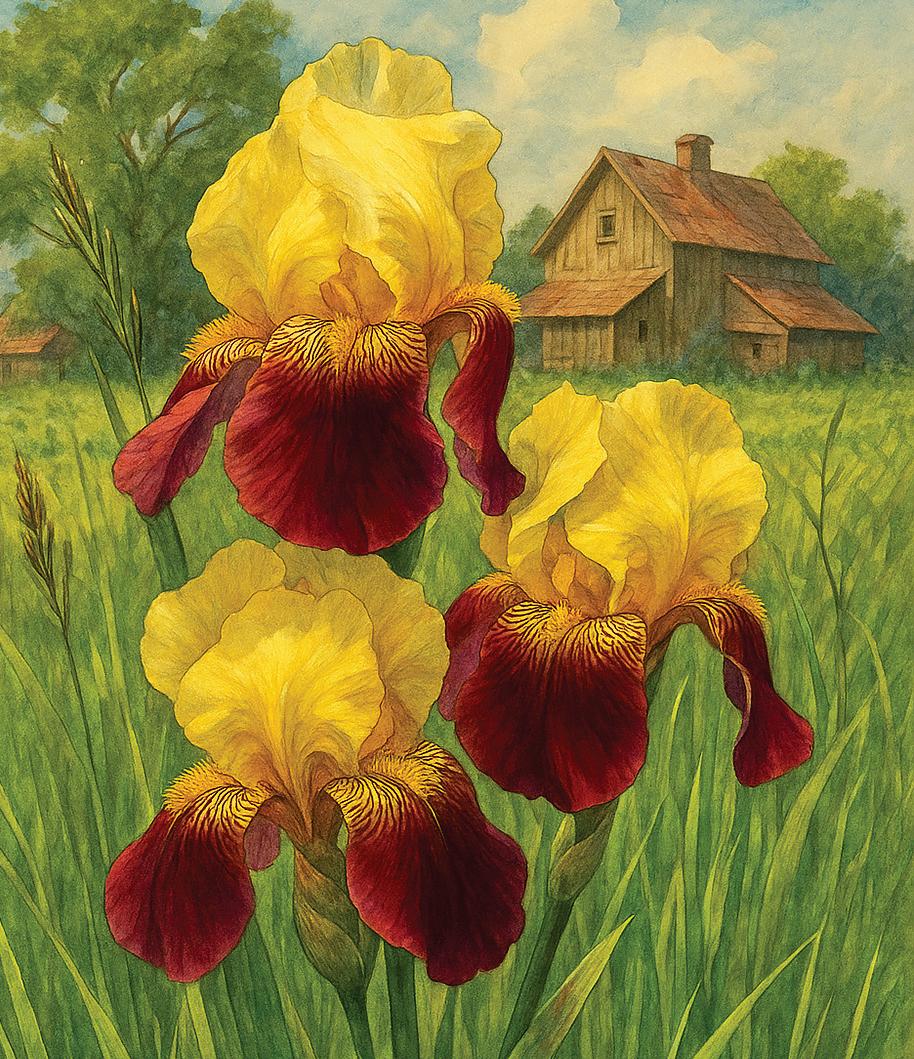
an old variety called Indian Chief, introduced back in 1929 by an American gardener named E.G. Lapham. With its coppery-gold top petals and velvety burgundy lower ones, it was once one of the most popular irises in the country—planted in gardens, passed between neighbors, and left to naturalize along old roadsides and farmsteads. It’s a true vintage beauty, still hanging on in places where the houses are long gone but the flowers remain.”
I couldn’t believe how close that description came to what I had already written for this piece. I simply asked ChatGPT to identify the flower in the image and explain its background—and there it was, a paragraph that read like it had been pulled straight from my own thoughts.
Digging deeper into the variety’s history, I learned that while Lapham may have introduced Indian Chief to the public, the man who actually hybridized it was Dr. Wylie McLean Ayres (1874–1945), a Cincinnati ophthalmologist and noted iris breeder. One thread leads to another. And who knows? Maybe that Dorothea K. Williamson iris I planted years ago in the backyard of our old house on Barnard Street in Saginaw still blooms. Or perhaps its descendants broke free and now blossom untended in a nearby lot. I don’t know—but I like to think so.
James D. Coppinger
A. The original photo taken when they were found.
B. Blue Flag Iris taken a few years ago.
C. An illustration using AI to put it into a graphic historical context.




April 2026
The T Top T op Ten en Adult Fiction and Nonfiction Chosen Monthly by America's Library Staff
e at w w w.Librar yReads.org
For book recommendations from your Kalamazoo Public Library Staff go to www.kpl.gov/blog/
Japanese Gothic Japanese Kylie Lee Baker (Hanover Square)
A troubled young man in 2026 begins communicating with the ghost of a female samurai from 1877 when he visits his father's new home in Japan. Both hold bloody secrets. A gory and suspenseful horror read that combines lyrical, dream-like writing with a compelling story of past meeting present
The Fervor by Alma Katsu

T The Duk he Duke e Anna Cowan (St. Martin's Griffin)
The romance between Celine and Kate is fraught with obstacles (mostly themselves) and the secret they are keeping from the ton: that Celine is a courtesan who is blackmailing Kate, a member of the House of Lords. A traditional historical full of yearning and intrigue this is what every Sapphic Regency reader has been waiting for
—Dontaná M., Oak Park Public Library, IL
read-alike: A Lady for All Seasons by T.J. Alexander
Mo Molklka a Monika Kim (Erewhon Books)
Dahye finds herself in a relationship with a rich, handsome man. But when a video scandal involving the two erupts, he flees Korea, leaving Dahye alone. When she realizes the extent of the betrayal, she seeks a terrible bloody revenge An unapologetic dive into female rage, exploitation, misogyny, and powerlessness
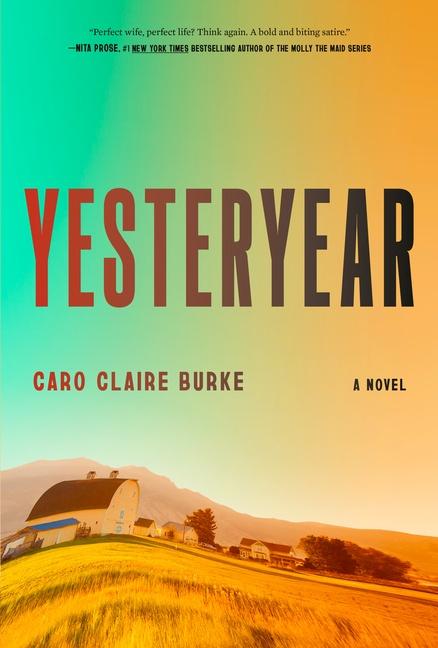
Y Yesteryesteryear: A No ear: Novveel l
Caro Claire Burke (Knopf)

Natalie is an influencer with a seemingly perfect life: perfect children, perfect husband, and a perfectly beautiful Idaho farm. Never mind the workers who actually run the farm, the nannies who care for the children. And never mind the women online who are jealous that Natalie can afford to be a trad wife who serves her family and, most importantly, her God. Natalie wakes one morning in her house...except it's not. Electricity has been replaced by a fire, her children are dirty, and her husband is old and gruff Where are the hidden cameras? Where is her real family? Creative, mind-bending, and incredibly wellwritten, this one is sure to be a blockbuster
—Jenny Davies, Oak Creek Public Library, WI
NoveList read-alike: The Influencers by Anna-Marie McLemore

T The Ending Writes Itse he Ending Itself
An oft-used trope—people lured to a remote island, then cut off from the outside world—gets a new life. Six writers, following the death of their famous host, must compete to finish his final manuscript for a massive payday. While hesitant at first the competition soon becomes intense, no one is quite who they seem to be, and death stalks the halls. A wonderfully twisty mystery and a wickedly satirical look at the world of publishing.

A thoughtful, emotionally resonant novel that will appeal to readers who enjoy stories about love, loss, and new beginnings. This “sliding-doors” story balances tenderness and hope, offering a meaningful reading experience that lingers after the final page. An excellent choice for patrons who enjoy contemporary literary fiction and book club–worthy reads
T The Car he Caretaketaker er Marcus Kliewer (Atria/12:01 Books)
Macy thinks she’s finally caught a break when she answers an ad for a weekend house-sitting gig that pays a ridiculous amount of money, even if it comes with some...unsettling instructions Unsettling turns eerie, which turns to horrifying as Macy realizes—too late—this is one job that she should have never accepted. The chills ramp up fast and never stop in this page-turner horror novel.
T The L he Left and the Lucky eft and Willy Vlautin (Harper)
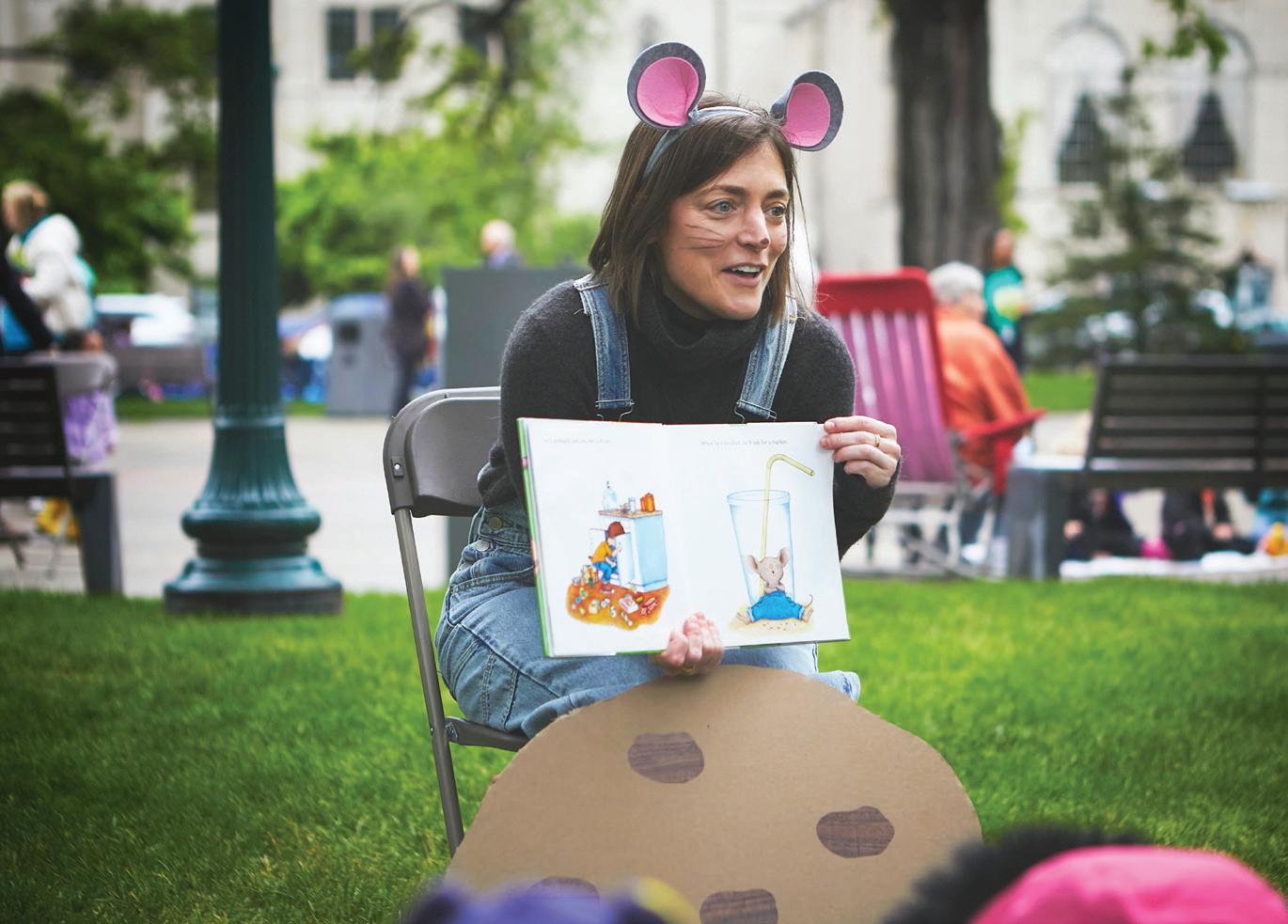
Wednesday, May 20, 2026 | 10–11 am | Bronson Park
Join Kalamazoo Public Library for this annual celebration of early childhood literacy. Enjoy a story hour in Bronson Park featuring costumed characters, community readers, a free book and gift, and a snack for each child. For children from birth to age 5
Can’t attend in person? We can deliver materials to you. Register or request delivery at kpl.gov/party-in-the-park.

T Thistlhistlemarsh emarsh Moorea Corrigan (Berkley)
WWI nurse Mouse receives notice that she is next in line to inherit the Faerie-blessed Thistlemarsh Hall in the English countryside. But she must do the impossible: fix the crumbling manor in just one month with the surprise aid of a handsome Faerie who can help defeat the magic protecting the manor Fantastic atmospheric style, worldbuilding elements, and sympathetic characters

L London F ondon Falallling: A My ing: A Mysterious Death sterious in a Gil a Gilded City and a F ded and Familamily's y's Sear Search f ch for T or Truth ruth Patrick Radden Keefe (Doubleday)
In 2019, the lifeless body of teenager Zac Brettler was discovered in the Thames River. Police conclude that Zac was suicidal, but his parents believe that something more nefarious led to his death, and discover he was caught up with gangsters and criminals Compelling narrative nonfiction that's deeply intimate and unnerving.
Go Gentl Go Gentle: A No e: Novveel l Maria Semple (Putnam)
Free Comic Book Day
Sat, May 2 | OPEN HOURS
All Library Locations
Adora is an Upper West Side philosopher who seems to have her life together. She practices stoicism, and it keeps her grounded and happy—until it doesn't. Who is the mysterious man who wants her to deliver a letter? What are her employers up to? How did she become a stoic? Readers follow along with Adora as she tries to find answers
It’s Free Comic Book Day! Visit any location and grab some free comics. While supplies last.
All the Ice Cream in the Land: A Library Celebration
Sat, May 9 @ 1:00 pm–3:00 pm
Oshtemo Branch - 7265 W Main St. | 49009
T The L he Lost Cities of El Norte: ost of Norte: Cor Coronado’onado’s Quest s the Unconquer Unconquered W ed West est and the Birth of American American Indian Resistance Peter Stark, (Mariner Books)
Celebrate the release of All the Ice Cream in the Land by local author Emmy Kastner with a sweet, book-centered library event! Enjoy fun activities inspired by everyone’s favorite frozen treat. Ice cream for attendees provided by Plainwell Ice Cream Company.
Spring Celebration
Wed, May 13 @ 5:30 pm–7:00 pm
Washington Square Branch -1244 Portage Street | 49001
Celebrate the return of warmer weather with food, music, face painting, balloon animals, llamas, crafts, bingo, and dance performances by local dance groups. Free fun for everyone!
Terrain Crafting with DM Scotty
Fri, May 15 @ 2:00 pm–4:00 pm
Central Library - Van Deusen Room - 315 South Rose | 49007
DM Scotty will host an in-person terrain crafting workshop for all ages. Learn how to level up your TTRPG map with terrain made from supplies around your home! Supplies provided.
Meet the Author: Mark Nepo
Thu, May 28 @ 5:30 pm–7:30 pm
Central Library - Teen Studio - 315 South Rose | 49007
Hear Mark Nepo read passages from his new book, The Fifth Season: Creativity in the Second Half of Life, and participate in a discussion with the author.
Garden Storytime Sat, May 30 @ 11:00 am–12:00 pm
Alma Powell Branch - 308 W. North St. | 49007
Stop by the Alma Powell Branch Pavilion to listen and learn about gardening, growing, and native pollinators. Afterward, guests will plant their very own starter flower to add to their own garden.
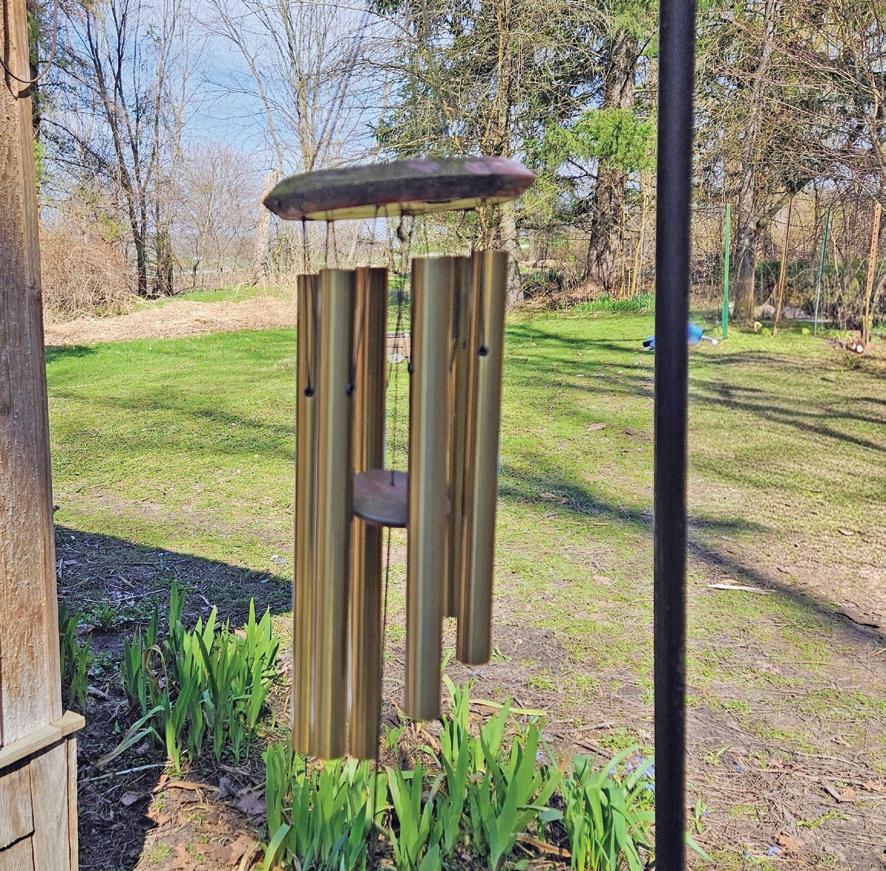
So many times, when I walk past the wind chimes hanging near my front door, they twinkle at me, chiming their pretty song, even when there is no breeze. Without even thinking about it, I reply: “Hi, Mama.”
A tag hangs from the bottom of the chimes—“In Memoriam,” with her name and the date of her death in 2021. It was a gift from her caregivers at a memory care center. She died eight months after my father, the two of them, as the saying goes, attached at the hip. There were days when she fully realized that he was gone. There were other days that she told me elaborate stories about how he had gone hunting for bison to feed the family. My father had never hunted in his life. Mama died of dementia. The last years of her life had been increasingly wrapped in fantasy.
May 10th is Mother’s Day, but I think about her every day. Don’t get me wrong. Mama and I were not especially close. We argued frequently, especially as her dementia progressed and before I heard the official medical diagnosis. It had been hard to understand why she would tell untrue
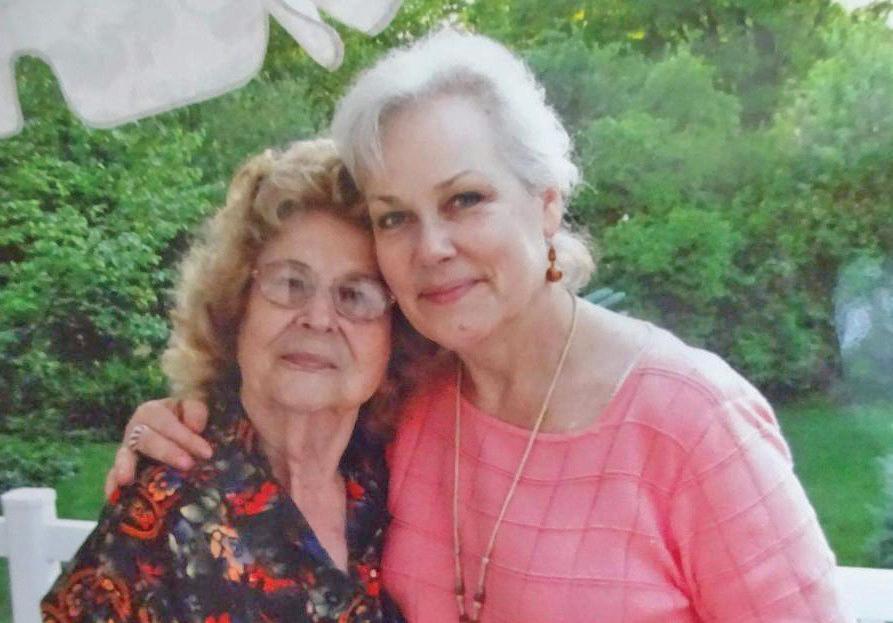
stories and picked fights without reason. Dementia, oh! Finally, I understood and vowed to be more patient. Especially once I moved closer to my parents’ home, I spent a great deal of time with them, helping with whatever needs arose. I learned to put aside our many differences. She loved to go shopping. I despise shopping. She adored a party. My goal in life was to live like a hermit in the woods. She was a city girl. I am all country. She watched the latest fashions and had a closet bursting with the newest styles. Hand me my sweats. She adored chocolate. More salt, please. Regardless, we have only one mama, and for all my inner voice chattering that her opinion didn’t
matter, it did. My heart warmed when she told me she was proud of me. I enjoyed cooking for her as her own kitchen skills waned, and it pleased me to see her smack her lips. Knowing her love for flowers, I took her to the landscape store and praised her beautiful garden, glad to see her pride in her work.
When that last night on this Earth came in her 94th year, I crawled into bed beside her. We lay nose to nose all night. Neither one of us slept. I smoothed her white hair back from her temple and watched slow tears gather alongside her nose. She no longer spoke, but she didn’t need to. I knew. She loved life and had so many times said—it goes by too fast.
During her months of deepening fantasy, I had learned not to argue with her imaginations. I went along with her belief that my father, her husband, would soon return home from work. Now, however, I changed to what was real.
Don’t be afraid, I whispered to her in the dark. He’s waiting for you. He loved you so much, Mama. His arms will be open to you. He will be so happy to hold you again.
The wind chimes twinkle sweetly now in a spring breeze. Hi, Mama, I say. Happy Mother’s Day. Thank you for being my best guardian angel.
Zinta Aistars


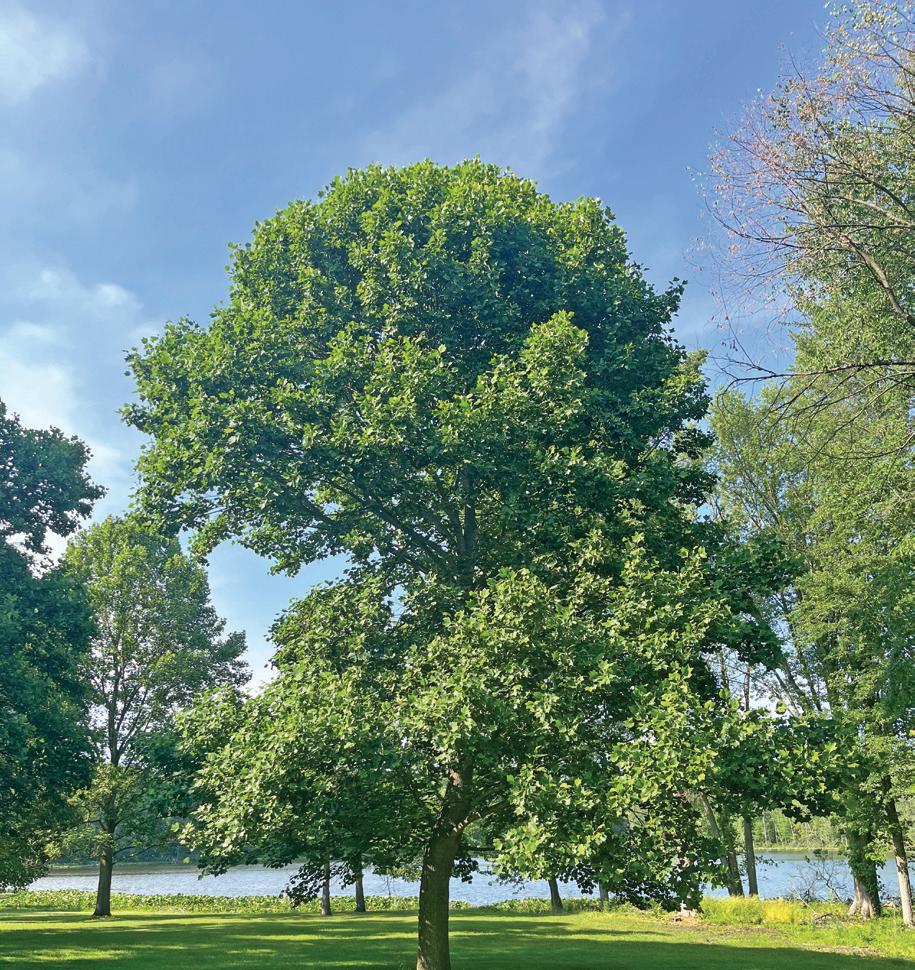
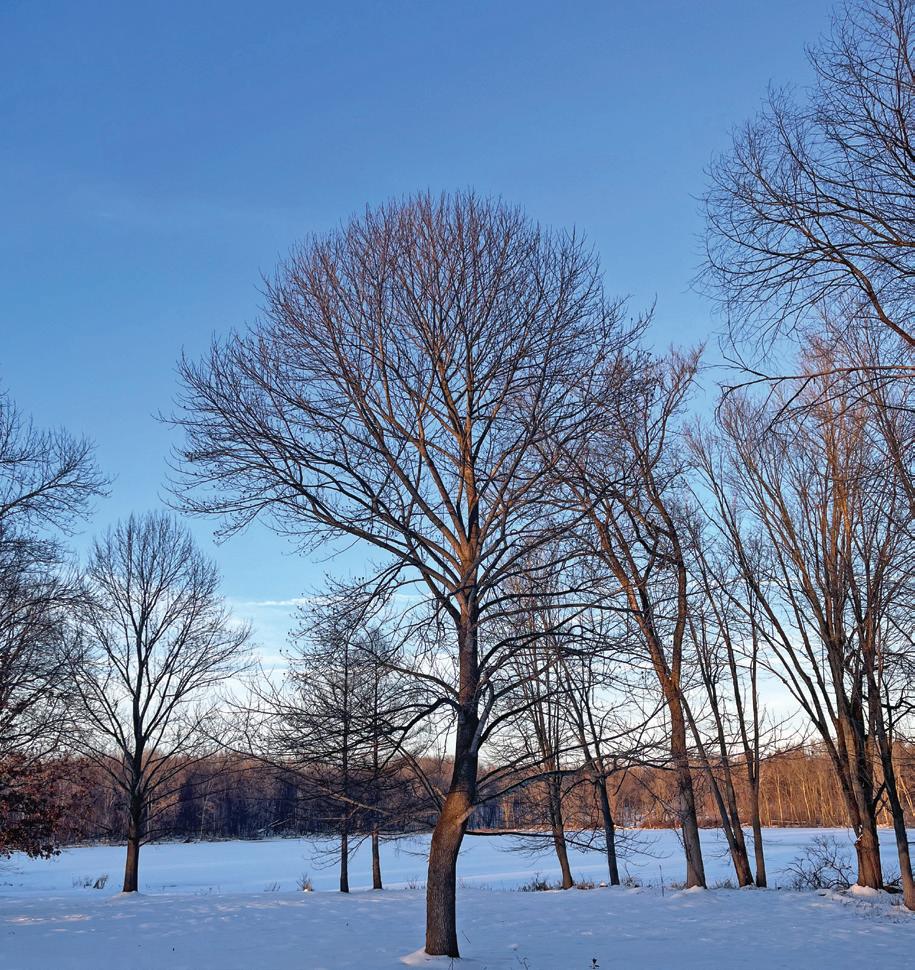
Forty more days, and I will have a daily year-long photo collection of this tree.
I was inspired by a student in one of my courses a couple of semesters ago who shared that when she worked for a summer on Mackinac Island, she walked to Arch Rock daily and took a picture from the same view every day. Something about that mindful presence in the “now” routine that offered this student opportunity to observe the daily changing landscape around a stationary place that she intentionally walked to and stood at captivated my attention and stirred a longing in me for a similar experience.
The tree I chose has also been an inspiration to me for several years. Early in its growth it was struck by
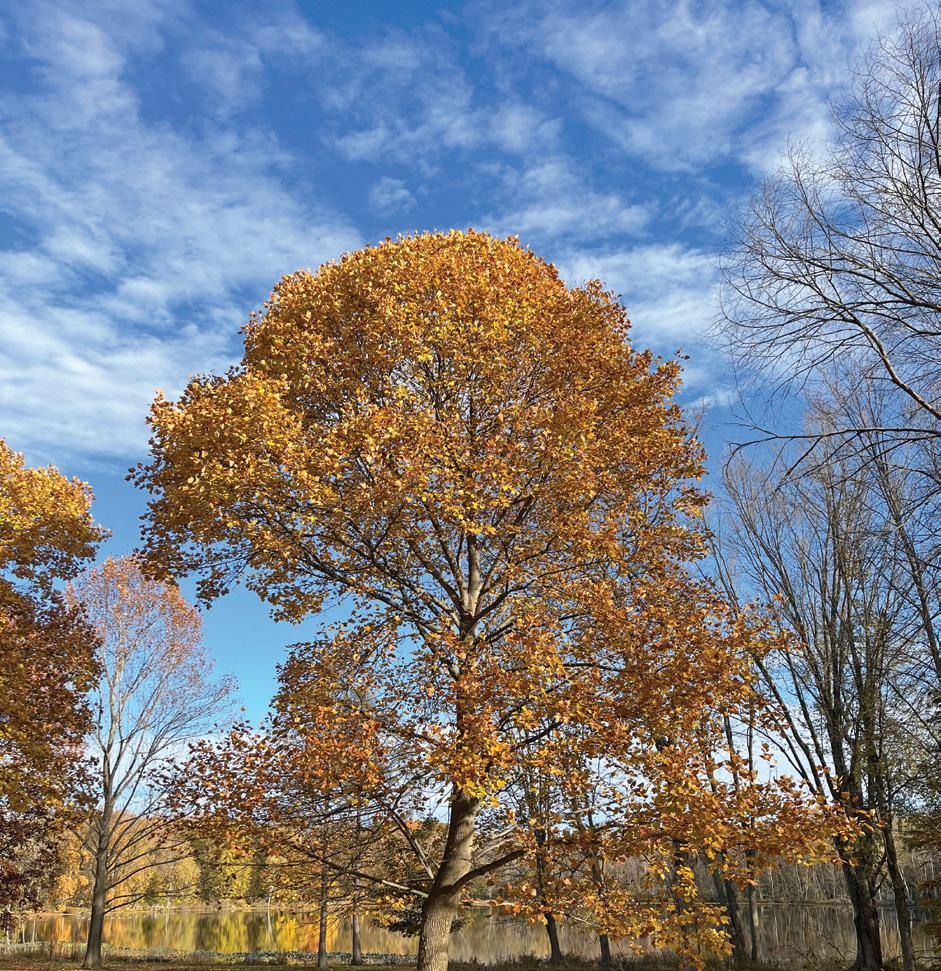
lightning. You cannot see it from the vantage point I’ve taken its picture, but there is a charred strip of wood, a scar of missing trunk that has not hindered this tree from flourishing year after year. It has continued to grow taller and its trunk larger in circumference, fully leafing out to shade the summer days and provide ample raking opportunities in the Fall. I have a dear friend whom we refer to each other as kindred writing partners because of our joy in routinely sharing our writing musings with each other. One of her writing prompts is “Where I Come From.” I’ve been thinking about how I came from a special love of trees long before I began a year-long presence with this tree. As a child, the tree visible from our kitchen window

and back porch where we entered our house had a nailed in board in the crook of it, where the branches fanned out in all directions above this tiny platform. A platform that was just right for my sitting once I climbed up the first few feet of the trunk.
Or the tree on the other side of our house that bordered the neighbor’s alfalfa field with a trunk like an elbow, perfect for either sitting in or using as a step to then clamber further into leafy foliage.
I remember scoping out many a tree to find the “just right” one to climb. I never aspired to have a tree house, but something about assessing a tree’s outstretched arms for climbing was magical to my young soul.
I still love walking among trees, any
woods my “happy place” each time I enter. It has been a long time, though, since I thought of how I used to want to live in their branches.
My year-long “friend,” this tree, isn’t a climber, but has been a “happy place” to my heart as I’ve intentionally stood at its roots observing and experiencing with it the changing seasons from spring thru summer, fall, winter, and back to the renewal of spring. Something about watching it stand tall through changing seasons, its branches moving in a dance with the wind, whispers endurance, joy, and peace.
Wishing you a vibrantly blossoming May.
Christine Hassing https://christinehassing.com

It was shortly after 11 a.m. on April 12, 1961 in the tiny Russian village of Smelovka. Out in the collective farm fields, five-year-old Rumiya (Rita) Nurskanova was digging small trenches with a hoe while her grandmother, Anikhayat (Anna) Takhtarova, dropped in chunks of potato.
Little Rita was suddenly startled by something approaching them. It was a humanoid “monster,” all bright orange except for a white helmet. Anna took Rita by the hand and they began backing away. Less than a year before, American CIA pilot Gary Powers was shot down by a missile over Russia during a spying overflight, and Soviet citizens had been warned of future incidents. But Smelovka’s visitor was not an alien, or even an American.
“Don’t be afraid! I’m a Soviet citizen, like you!” said the man inside the orange suit, removing his helmet: 26-year-old Yuri Gagarin. Over the previous 108 minutes, he had become the first human in outer space. Gagarin was launched aboard his ballshaped spacecraft, Vostok 1, from the USSR’s Baikonur Cosmodrome, reached an altitude of 203 miles, and reentered Earth’s atmosphere after one orbit. Gagarin asked Anna to help him find a telephone so he could call Moscow.
Like most of the Soviet and American launches in the 1960s, Vostok 1 experienced problems that could have ended tragically. Gagarin’s big prob-

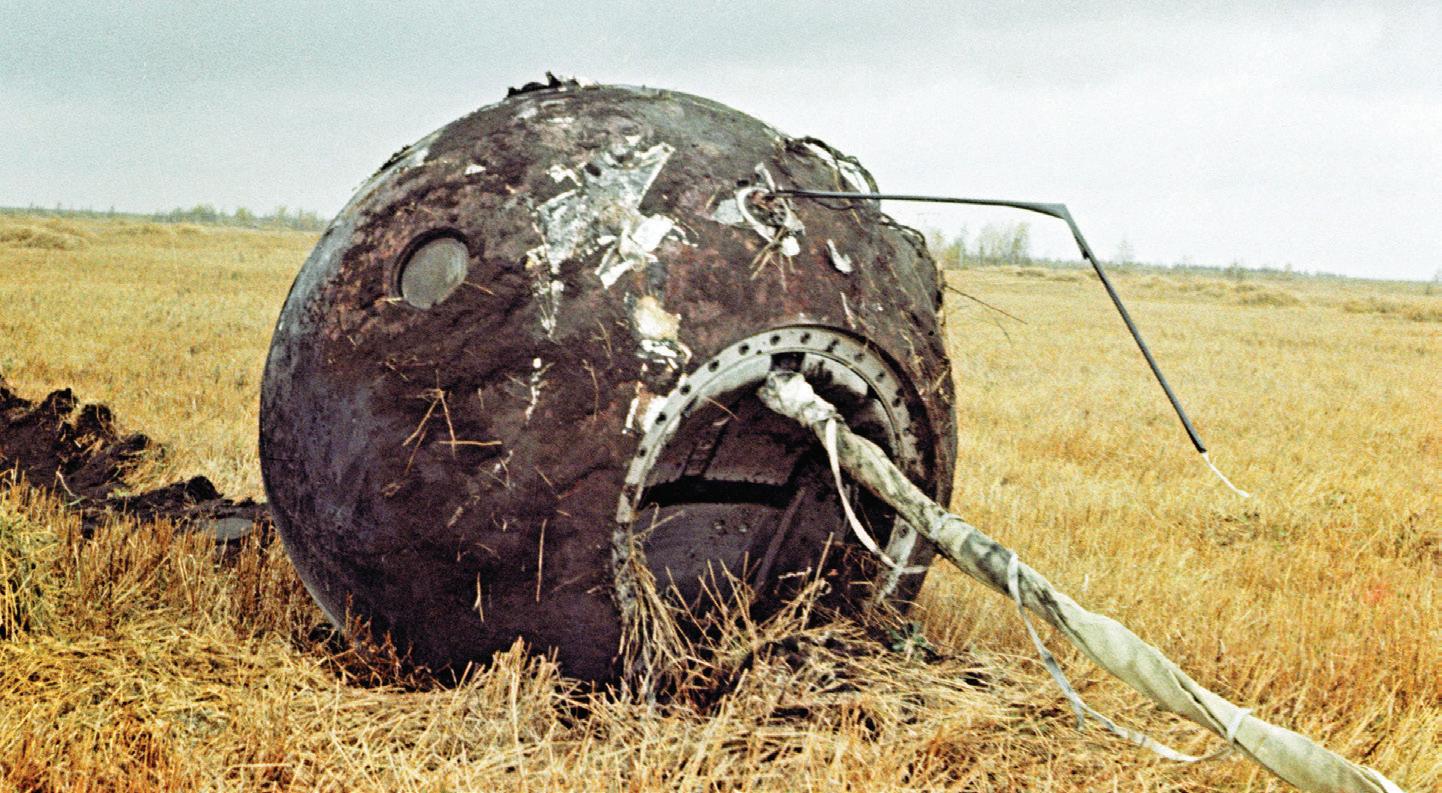
lem occurred during reentry. Vostok’s retro rockets fired as planned, but an equipment module that was supposed to separate remained attached with an umbilical cord, throwing Vostok into a spin that made Gagarin almost lose consciousness. Fortunately, the cord finally burned through during the fiery reentry and Gagarin regained control of the spacecraft.
Unlike the early American missions, which ended with a splashdown in the ocean, Soviet and Russian astronauts returned on land, a practice that has remained. With American splashdowns, up to 30 large recovery vessels including aircraft carriers awaited the return.
With Gagarin, it was Rita and Anna planting potatoes.
When Vostok was about four miles up, its hatch released as planned, and Gagarin ejected. His parachute opened soon after. A separate para-

chute on Vostok deployed about 1.5 miles up.
Soon after Gagarin made contact in the potato patch, dozens of local citizens gathered around him, with the military not far behind. By the time they arrived, local boys had climbed into the open hatch of Vostok 1, played with its controls, and distributed its tubes of liver paste and chocolate spread among friends. The residents of the town, like nearly everyone in the secretive Soviet Union, didn’t know about Gagarin’s flight until it was over. He couldn’t even tell his parents and siblings about the mission until he landed. His chances of survival had been calculated at about 50 percent.
Ironically, President Kennedy knew the day before about the attempt, and American radar stations began tracking Vostok and recording Soviet communications about 15 minutes
after launch.
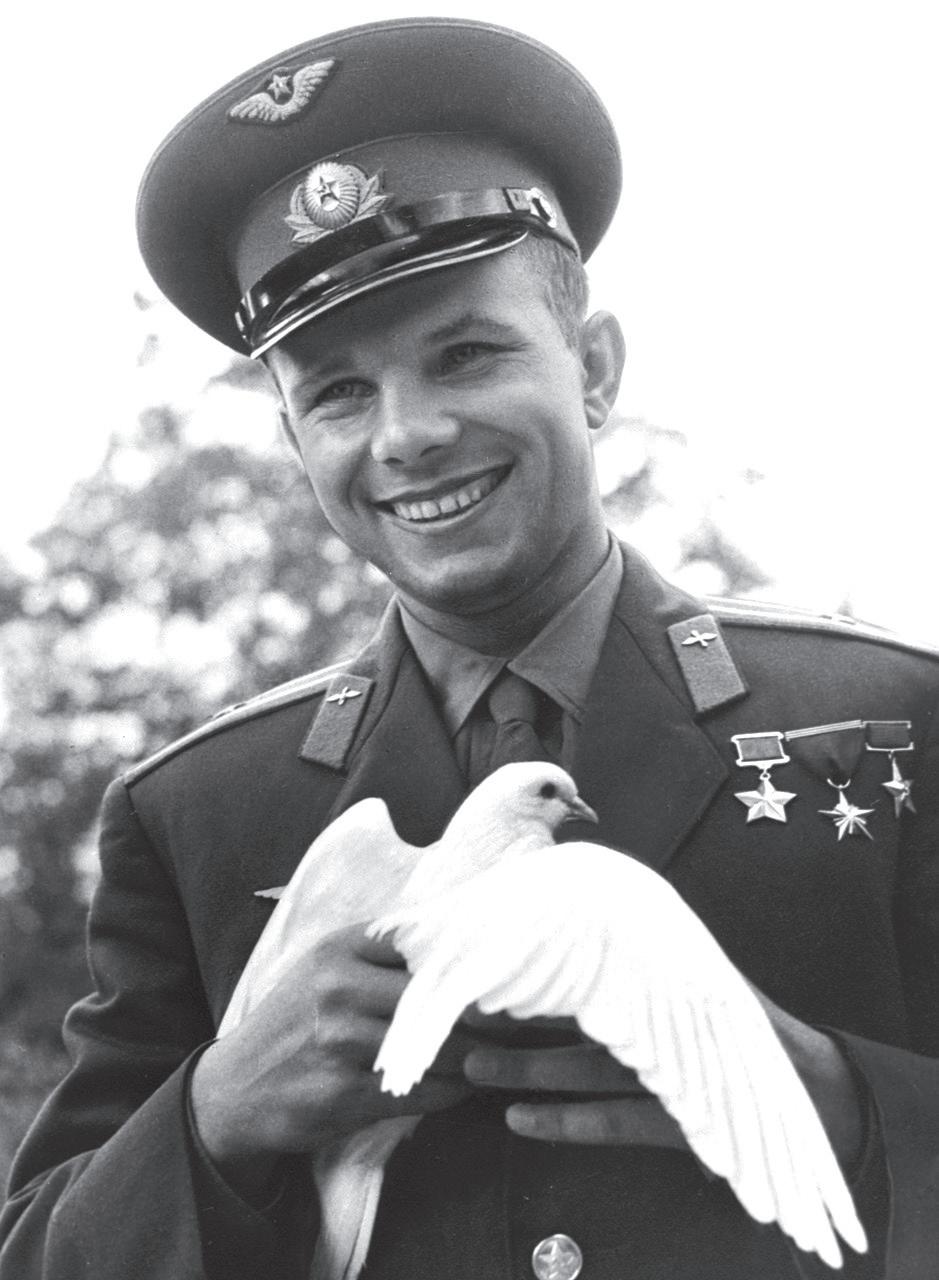
Yuri Alekseyevich Gagarin grew up during World War II in a farm town occupied by Hitler’s army. He was mischievous but quick to help friends. When America’s “Mercury Seven” astronauts found out about his flight, they were angry because their own first flight had been delayed by NASA program heads. Alan Shepard flew into space just 23 days after Gagarin. But they didn’t begrudge the accomplishment of the 5-foot-2 Soviet Air Force pilot with the constant ear-to-ear grin. They knew all too well the risks the first man in outer space had taken. When American astronauts met Gagarin later, they universally liked him. And they mourned his loss when he died in a senseless jet fighter accident in March 1968 at age 34.
Tony Ettwein HistoryZoo1837@gmail.com
Photo Credits
A. Gagarin aboard Vostok 1, launched from the Baikonur Cosmodrome on April 12, 1961
B. Gagarin during the ride to his rocket with backup cosmonaut Gherman Titov sitting behind C. The familiar grin of First Cosmonaut Yuri Gagarin
D. The Vostok 1, charred after reentry, landed a little more than a mile from Yuri Gagarin under its own parachute

Before the Renaissance, people held doors open with simple objects like rocks or bricks. By the 1700s, particularly in France and England, more refined doorstops had made an appearance. In the United States, decorative doorstops did not become common until after the Civil War. By the late 19th and early 20th centuries, American foundries were producing a wide range of cast iron designs. These affordable doorstops reached peak popularity in the United States between the 1920s and early 1940s. Production declined during World War II due to metal rationing.
Manufacturers used a traditional sand-casting process to produce each doorstop. Artisans created the master pattern by carving a design from wood or hammering it out of metal. In some cases, well-known illustrators supplied original drawings to work from. The pattern was pressed into fine casting sand to form a mold. Workers poured molten iron, heated to 3,000°F, into the impression and left it to cool and solidify.
Once hardened, the sand mold was broken away, revealing the rough casting. Craftsmen filed down excess metal, known as “flash,” and smoothed seams. If the piece was made in two parts, workers as-
sembled it with a recessed screw or bolt, often concealed under spackle. Finally, a base coat was applied, and artists hand-painted the design with enamel, resulting in subtle variations unique to each piece.
A number of American makers produced cast iron doorstops. Among the most recognized is Hubley of Lancaster, Pennsylvania, founded in 1894. Other prominent manufacturers include Bradley & Hubbard of Meriden, Connecticut; Albany Foundry of Albany, New York; Wilton Products Inc. of Wrightsville,

Pennsylvania; and A.M. Greenblatt Studios of Boston. Foundries often stamped the pieces with their names, aiding identification today.
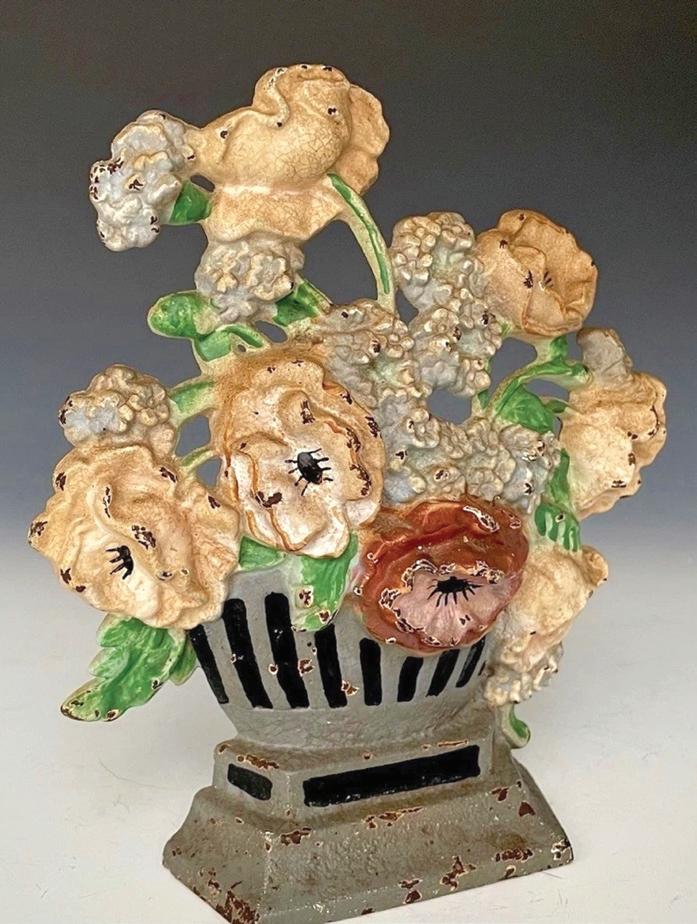
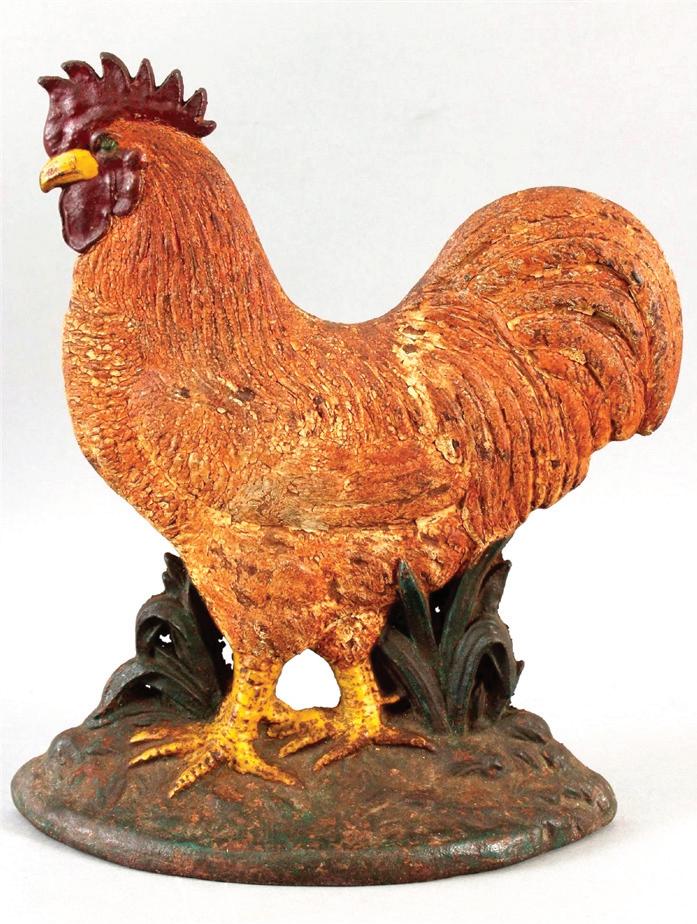
Styles reflected both everyday life and fanciful imagination. Common motifs included animals, flowers, lighthouses, cottages, ships, and human figures. While usually sold already painted, customers could also buy doorstops with paint kits for home decoration. Manufacturers sometimes made doorstops in matching or complementary pairs—like Punch and Judy—for use with double doors.
portant factor. Collectors seek original paint, light wear, and minimal rust or pitting. Expect minor paint wear on the bottom of a doorstop or in areas of frequent handling. Avoid repainting which can reduce value.

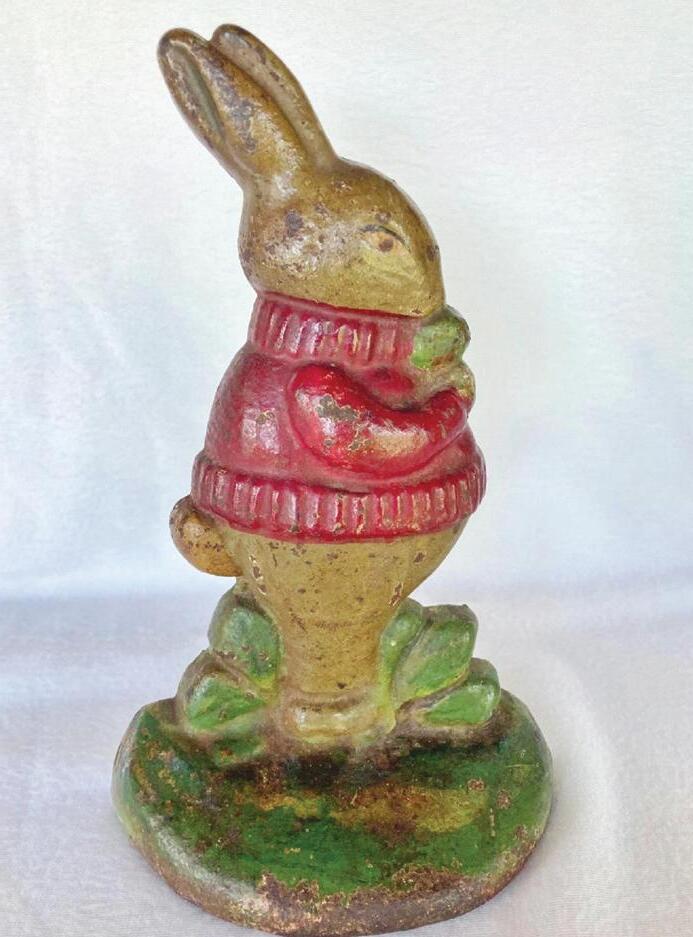
Determining the age and value of vintage cast iron doorstops can present a challenge, since popular designs were produced over long periods. Collectors look for identifying marks, including numbers cast into the back or bottom. Albany Foundry often placed model numbers inside hollow figures. Earlier models—like the No. 89 rabbit—generally command higher prices than later versions such as the No. 94.


Rarity and variation also influence desirability. Small differences, like the direction an animal faces, can impact price. Hubley produced Boston terriers in both left- and right-facing versions, but made far fewer leftfacing. As a result, these can sell for over $1,000.
Condition remains the most im-
Authentic doorstops have a smooth, hand-finished surface, tight seams, and use slotted screws to hold parts together. Reproductions often feel rough, show uneven seams, and use Phillips-head screws. Originals will display natural wear and are not painted on the back. In today’s market, most vintage or antique doorstops sell for $100 to $500, while exceptional examples can reach several thousand dollars.
If an open door signals hospitality, an antique cast iron doorstop propping it ajar can only add to the appeal. As sunlight and fresh air spill inside, the vintage doorstop anchors the room and the collector to history with just a touch of whimsy.
Bridget Klusman Owner, Retro Estate Sales
https://retroestatesales.wixsite.com/retroestatesales
Photo Credits
A. Albany Foundry Rabbit
F. Hubley Poppies
B. Bradley Hubbard Chicken

When your child is two, the world feels manageable.
They melt down in Target. You scoop them up.
They run toward the street. You grab their hand.
They don’t like broccoli. You cut it smaller.
At two, you are the regulator. You are the protector.
You are the interpreter of the world. And then they turn twenty.
And suddenly, the stakes feel higher, and your hands aren’t on the steering wheel anymore.
At twenty, you hope they listened. When they are toddlers, their world is small enough for you to contain. Their nervous systems borrow yours. Co-regulation is literal. Research consistently shows that early attachment relationships shape emotional development and self-regulation (Cassidy & Shaver, 2016).
You can redirect.
You can buffer consequences. You can choose the daycare. You can choose the pediatrician. You can choose the friend group. But in their twenties?
You cannot choose the friends or confidants.
You cannot choose the job. You cannot choose the living situation.
You cannot choose the life direction. And sometimes, you cannot protect them from themselves.
Parenting a 20-something is an exercise in restraint.
You see the red flags. You see the impulsive decisions. You see the emotional immaturity. You see the avoidant partner. You see the job they shouldn’t quit. You see the money mistakes. And you sit.
Because developmentally, emerging adulthood is a stage of identity exploration, instability, and self-focus (Arnett, 2000). Mistakes are not only
common, they are formative.
But knowing that intellectually does not make it easier emotionally.
Sometimes you have to sit back and watch choices explode.
And the explosion hurts you too.
“But I Taught You Better Than That.”
You raised them with values. You modeled resilience.
You sacrificed sleep, time, energy, and parts of yourself.
You want better for them than you ever wanted for yourself.
And sometimes your 20-year-old will say things that cut deep:
“You don’t understand.”
“This is my life.”
“You always try to control everything.”
“I didn’t ask for your opinion.”
“You care to much”
“You always ask about my feelings” Um…, well duh it’s cuz you are loved
“You are self-centered” Really, hmmm okay – guess they forgot all the ways you showed up for them.
Even when you have loved them fiercely.
Even when you have shown up.
It is important to remember: individuation requires separation. And separation sometimes comes out sharp.
That does not invalidate your pain.
Watching your adult child struggle activates:
• Fear
• Helplessness
• Catastrophic thinking
• Old attachment wounds
• Control impulses
From a polyvagal perspective, threat to attachment activates survival responses (Porges, 2011). Your body may move into:
Fight - trying to control Flight - withdrawing emotionally Freeze - shutting down Fawn - over-accommodating.
Before you respond to them, regulate yourself.
Tools for Parents of 20-Somethings
1. The Helicopter View
Ask:
Is this a life-altering crisis, or a developmental lesson?
Zoom out.
Will this matter in five years?
You can hope. You can model regulation.
But you cannot live it for them.
Perspective reduces limbic activation.
2. 90-Second Emotional Wave
Emotions physiologically peak and begin to subside if not fueled cognitively (Siegel, 2012).
When triggered:
• Breathe in for 4
• Exhale for 6
• Repeat for 90 seconds
• Do not text during this window?
3. Separate Love From Control
You can say:
“I love you.”
“I trust you to figure this out.”
“I’m here if you want to process.”
Support does not require steering.
4. Protect Your Peace
Protecting your peace does not mean withdrawing love. It means:
• Not replaying conversations repeatedly
• Not rescuing financially to ease your anxiety
• Not over-functioning
• Not making their crisis your identity
Boundaries preserve relationship longevity (Cloud & Townsend, 2017).
5. Radical Acceptance
You cannot choose their path. You cannot fast-forward their maturity.
You cannot spare them every consequence.
Acceptance reduces suffering (Linehan, 2015).
You can guide.
You can listen.
You can pray.




The Quiet Truth
When they are two, you carry them.
When they are twenty, you release them.
And that release feels like grief, even when they are thriving.
Loving a 20-something means holding pride and heartbreak in the same breath.
It means trusting that the seeds you planted will sprout, even if not on your timeline.
And sometimes protecting your peace looks like this:
Deep breath.
Open hands.
Steady love.
Dr. Julie Sorenson, DMFT, LPC, LMHC
Resources
Arnett, J. J. (2000). Emerging adulthood: A theory of development from the late teens through twenties. American Psychologist, 55(5), 469–480. https://doi.org/10.1037/0003066X.55.5.469
Cassidy, J., & Shaver, P. R. (Eds.). (2016). Handbook of attachment: Theory, research, and clinical applications (3rd ed.). Guilford Press. Cloud, H., & Townsend, J. (2017). Boundaries: When to say yes, how to say no to take control of your life. Zondervan.
Linehan, M. M. (2015). DBT skills training manual (2nd ed.). Guilford Press.
Porges, S. W. (2011). The polyvagal theory: Neurophysiological foundations of emotions, attachment, communication, and self-regulation. Norton.
Siegel, D. J. (2012). The developing mind (2nd ed.). Guilford Press.

and notable footage of winners like Northern Dancer in 1964.
Growing up in northwest Indiana, just a stone’s throw from Chicago, Dad was always thrilled to start off the month of May by watching the Kentucky Derby, which was considered a staple of national television during the 1960s, helping to turn the event into a widely watched cultural and fashion spectacle. In fact, we can thank CBS for providing extensive coverage, which not only enabled millions of viewers to watch it, but also elevate the popularity of its fascinating “best hat” traditions,
What’s interesting is that food at the Derby wasn’t making any news until the late 2000s, which is when official menus for the Kentucky Derby began being released online as part of the public, “at-home” celebration trend.
In 2018, Churchill Downs began publicly announcing their “Official Menu” and by 2019, provided recipes for an “at-home” party menu for fans watching from home.
This very late-to-the-party tradition of releasing full on-track menus for use at home, as well as virtual (online) cooking demos has continued


with this, the 152nd running of the Kentucky Derby, which will occur on May 2, 2026.
According to the Churchill Downs news release, the official 2026 Kentucky Derby menu will feature elevated Southern cuisine, including char-grilled short ribs with pomegranate glaze, honey bourbon grilled chicken with roasted peach chutney, and Kentucky BBQ shrimp.
Highlights also include Green Goddess pasta salad, kale salad with cider sorghum vinaigrette, and a pretzel board, bourbon pecan pie bars and mint julep cupcakes served alongside traditional mint juleps, of course! Loving a good source for recipes,
Made with tri colored cheese tortellini, fresh mozzarella pearls, cherry tomatoes, and basil, this vibrant Derby Day pasta salad is tossed in a creamy pesto and classic Green Goddess dressing for a rich, herb forward finish.
3 lbs fresh tri colored cheese tortellini
2 cups cherry tomatoes, halved
½ cup thin sliced red onion
12 oz fresh mozzarella pearls
½ cup fresh basil, chiffonade Creamy Pesto
1 cup packed basil
½ cup grated parmesan
2 garlic cloves
½ cup olive oil
2 tbsp lemon juice
or perhaps just some inspiration, I checked out some of the menu recipes and thought you might like to take a gallop at some too, so here now is a sampling of what’s going to be served at Churchill Downs this year that you can make in the comfort of your own home yourself, and without too much horsing around!
For the rest of the recipes for this year and all previous years, visit: kentuckyderby.com/recipes/cat/derbyday-dishes. Enjoy!
Laura Kurella is an award-winning home cook who loves to share recipes from her Michigan kitchen. She welcomes comments at laurakurella@yahoo. com.
Salt to taste
Dressing
1 cup mayonnaise
2 tbsp lemon juice
2 tbsp chopped chives
2 tbsp chopped parsley
1 small garlic clove
Salt & pepper
1.Cook tortellini in salted water. Drain and cool.
2.Blend pesto ingredients smooth.
3.Blend Green Goddess dressing until creamy.
4.Toss pasta with pesto first, then fold in dressing (start with ¾ and adjust).
5.Fold in tomatoes, onion, mozzarella, basil.
6.Chill 1–2 hours before serving.









This vibrant Derby Day appetizer
features heirloom cherry tomatoes, sweet mini peppers, baby heirloom carrots, broccolini, English cucumber, celery, Greek olives, and house quick pickled cauliflower.
Vegetables
1 head cauliflower (cut into florets)
1 lb sweet mini peppers
1 cup mixed Greek olives
10 oz celery sticks (with some leaves)
1 English cucumber
16 oz baby heirloom carrots
10 oz grilled broccolini
16 oz heirloom cherry tomatoes
Quick Pickled Cauliflower
1 cup vinegar
1 cup water
1 tbsp sugar
2 tsp salt
1 tsp mustard seed
1. Simmer brine, pour over cauliflower, chill 4 hrs.
Traditional Hummus
2 cans chickpeas, drained
This vibrant Derby Day salad features finely chopped kale, red cabbage, carrots, red quinoa, dried cherries, sunflower seeds, and pickled red onions for a colorful and nutrient rich dish worthy of the Kentucky Derby menu.
2 large bunches kale, finely chopped
2 cups shredded red cabbage
1 cup julienne carrots
1 cup cooked red quinoa – cooked ¾ cup dried cherries ½ cup sunflower seeds ½ cup pickled red onions


Sorghum Vinaigrette ½
⅓ cup tahini
¼ cup lemon juice
2 garlic cloves
¼ cup olive oil
2. Blend smooth.
Lemon Sweet Pea Hummus
2 cups frozen peas (blanched)
1 can chickpeas
¼ cup tahini
Zest + juice 1 lemon
2 tbsp olive oil
3. Blend smooth.
Buttermilk Herb Dip
1 cup sour cream
½ cup buttermilk
2 tbsp chopped dill
2 tbsp chives
1 tbsp parsley
Salt & pepper
4. Blend until it is consistent.
Method
1. Arrange all vegetables beautifully on platter or Boos board
2. Serve with hummus and dips on side

2.Whisk vinaigrette to emulsify.
3.Toss salad with all ingredients, saving some seeds for garnish, 30 minutes before serving.
4. Finish with seeds on top.


When I tell people I have a therapy dog, I usually get one of two responses. The first, from those that know about therapy dogs, is, “That’s great, where do you take him?” The other response is usually a pause as they consider what a therapy dog might mean and what is an appropriate response. In this case, I usually get the impression they are hesitant to ask what a therapy dog is, possibly thinking, “Is this the same as a service dog? An emotional support animal? Is it appropriate to ask what the dog is used for?” It can be confusing, so hopefully the following descriptions will help.
Service Dog: Most people are familiar with the term service dog but may not know of the wide spectrum of assistance they may provide. Service dogs are individually trained to perform specific tasks for people with widely varying disabilities including physical, sensory, psychiatric, intellectual, or other disability. The work of the service dog must be directly related to the handler’s disability. By law in the US, service dogs have full public access rights, which means they are allowed to go places where other animals aren’t, including restaurants and housing.
Emotional Support Animal (ESA): Emotional support dogs (or other pets) are not considered service dogs under the ADA (American Disabilities Act). They may provide comfort
to their owner and thus ease depression or anxiety, but the pet doesn’t need specific working abilities. ESA’s must be prescribed by a mental health professional stating the person’s condition and that the animal is part of the treatment. Emotional support animals do not have the same legal rights as a service dog but the Fair Housing Act does prohibit landlords from denying a tenant with an ESA, even if it is a no-pet facility.
Therapy dogs: So where does a therapy dog fall in this, and what rights do they have? Accompanied by their handler (usually their owner) they volunteer in places such as hospitals, schools, and senior centers, where they provide comfort and affection to those they visit. Additionally, some dogs have special training in crisis response, such as a natural disaster, where they provide reassurance and emotional support. Others work with patients receiving hospice care or Read to a Dog programs. Because of the environment they are in and the service they provide, they need to be calm, gentle, friendly, and enjoy human interactions, Most places hosting therapy dogs require certification. Certified pairs (a dog and its handler) are tested to ensure they are a good fit for this work and also give the facility insurance protection. Therapy dogs are not considered service dogs so legally do not have any special access privileges.

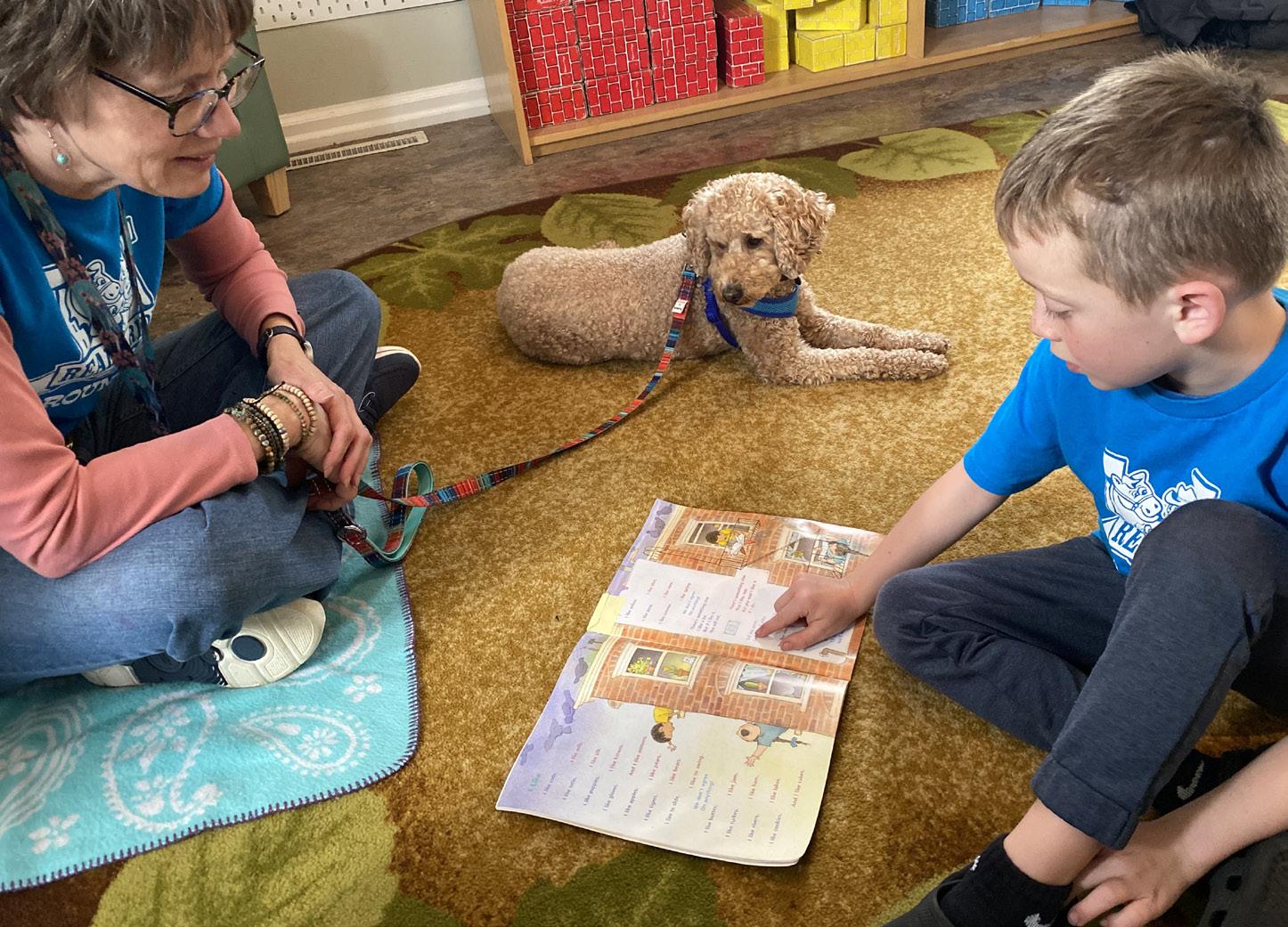
My therapy dog work: My therapy dog, Copper, is a mini-poodle and we are certified with Alliance of Therapy Dogs. We currently visit two local assisted living facilities – Beacon Pointe in Richland and Nazareth Center - Assisted Living in Kalamazoo. Copper also participates in a Read and Ride program at the Cheff Center where, in conjunction with other activities, young readers read books to therapy dogs. While we are considered volunteers in these situations, I feel we benefit as much as the people we are visiting!
If you have a dog that you think would be a good therapy dog or you are interested in a visit for an activity or facility, here are two resources that can help get you started. Alliance of
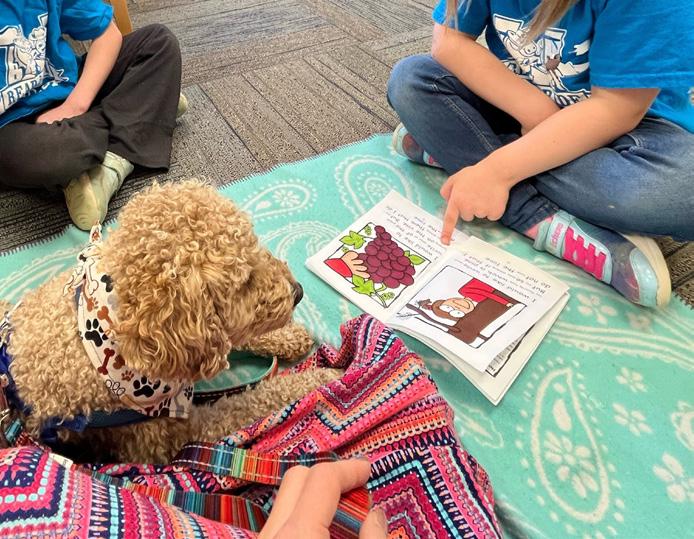
Therapy Dogs @ therapydogs.com is a national organization with a lot of resources. Locally, the Facebook page Kalamazoo Area Therapy Dogs offers related services as well as a chance to post requests. Hopefully when someone tells you they have a therapy dog, you will now be able to know what they mean!
Deanna Mayo


Ah, yes, we’re talking about the lowly potato, viewed by many as starch bombs. If your favorite version of a potato is the French fry or a potato chip, well, you’re probably right. However, make no mistake, potatoes are a very nutritious food.
A 6-ounce potato (medium) with the skin has just 160 calories and provides almost 25% of your daily vitamin C, an antioxidant that helps fight cell damage and supports your immune system. The red and purple flesh potatoes have special antioxidants that offer some protection against cancer, heart disease and type 2 diabetes. However, they’re not always easy to find. Potatoes are also rich in potassium, supplying about 20% of your daily need.
Of course, potatoes didn’t get their “fattening” reputation for no reason. They are rich in carbohydrates, what we need for energy and the best source of that energy is whole foods. What it generally comes down to is how we prepare them. Baking, boiling, or mashing potatoes does not raise the risk of type 2 diabetes. However, when it comes French fries, that’s another story. The same study that found that baked, boiled, or mashed potatoes do not raise the risk of type 2 diabetes, also found that three servings of French-fried potatoes a week, raised the risk of type 2

diabetes by 20%.
For you spud lovers, consider the following recommendations when preparing your next meal with potatoes:
Ditch the peeler: Eating potatoes with the skin gives you extra nutrients and fiber. Fingerlings and creamers have a more delicate skin

food while making the exterior crispy. Cook and then cool: Refrigerating cooked potatoes transforms their carbs into resistant starch, which acts like fiber in the body. Resistant starch can lower blood sugar levels and it helps feed healthy bacteria in the large intestine. So, potato salad, made with skin-on potatoes, sounds like a real winner.
For those of us who really like white, purple, or red potatoes, the super-potato is the sweet potato. It has all the benefits of the other potatoes, with one added benefit: it’s an excellent source of beta-carotene. The body converts this antioxidant to vitamin A, which is important for eye and immune health.
and are easier to eat.
Switch-up the flavorings: Instead of the usual sour cream and butter for baked or mashed potatoes, use Greek yoghurt, cottage cheese, or herbs, such as parsley or no-salt seasoning.
Make fryer-fries: An air-frier doesn’t “fry” foods. Instead, it works by circulating hot air and cooking the
As an added benefit of reading this column, you never know what tidbits of trivia you might learn and amuse your friends at the dinner table. This tidbit is how the name “spud” got associated with the potato. Well, it comes from the slender, sharp-nosed tool that field hands used to dig potatoes from the ground. The tuber got its name from the tool. It’s rumored to have come from New Zealand. Remember to MAKE your day great and be kind.
Till next time,
Ken Dettloff ACE Personal and Brain Health Trainer







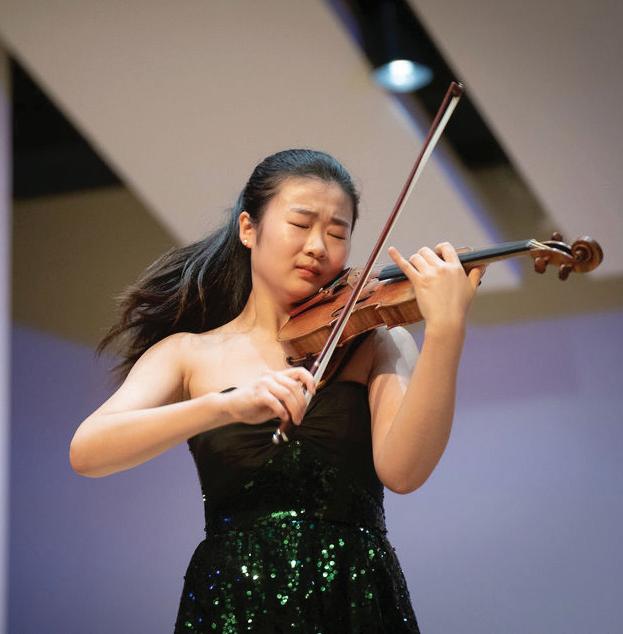
Building on the energy and celebration of its landmark 50th anniversary, the Stulberg International String Competition returns for its 51st year, welcoming 12 Semifinalists representing four countries to Kalamazoo for three days of world-class string performance. The competition will take place May 15–17, 2026. All events will take place at Dalton Recital Hall on WMU’s campus.
Selected from a pool of 226 applicants across 18 countries, all under the age of 20, this year’s Semifinalists represent the next generation of exceptional string talent on the world stage.
Semifinals — Friday, May 15, 9 a.m. to Noon and 1 p.m - 4 p.m. (Free & Open to the Public)
In either the morning or afternoon session, all 12 Semifinalists will perform concerto repertoire and compete for the Bach Prize Award, returning this year with a $1,000 cash prize for the strongest performance of an unaccompanied Bach piece. Community Master Classes — Saturday, May 16, 9 a.m. to Noon (Free & Open to the Public)
Local violin, viola, and cello students will have the opportunity
to work one-on-one with the Competition’s distinguished judges in an intimate masterclass setting. Participants are selected by submitting an audition application on the Stulberg’s website.
Finals — Saturday, May 16, 7:30 p.m.
Six Finalists will take the stage for an electrifying evening of performances, followed by an awards ceremony featuring medal awards (including a $10,000 cash prize for the Gold Medalist) and the announcement of performance opportunities. Tickets are $25 for general admission and $10 for students.
Following the tremendous success of last year’s broadcast, both the Semifinals and Finals will be live streamed, which drew nearly 110,000 viewers during competition weekend.
NEW THIS YEAR — Semifinalist Masterclasses — Sunday, May 17, 9 a.m to Noon (Free & Open to the Public)
For the first time, all 12 Semifinalists will have the chance to work oneon-one with the competition judges in a public masterclass, offering audiences a rare behind-the-scenes look at the artistic coaching process.
This year’s distinguished jury brings together three accomplished artists from across the string world:
Anne Francis Bayless, cello
The Stulberg Competition is especially proud to welcome back Anne Francis Bayless, a Kalamazoo native, as a judge this year. Currently on faculty at Utah State University (USU) and cellist with the Fry Street Quartet, the resident quartet at USU, Bayless has built a remarkable career in music.
Suli Xue, violin
A member of the Los Angeles Philharmonic and artist in residence at Azusa Pacific University, Suli Xue is one of the most acclaimed Chinese American violinists on the international stage today.
James Dunham, viola Professor of Viola and Co-Chair of Strings at Rice University’s Shepherd School of Music, James Dunham brings a distinguished performance and teaching career to the jury.
Thank You to Our Sponsors
The Stulberg Competition gratefully acknowledges the generous support of its sponsors, whose partnership makes this competition possible:
Kenneth Warren & Son, Ltd. Gold Medal Sponsor Elizabeth Upjohn Mason Competition Masterclass Sponsor Zhang Financial Judge Chair Sponsor (Suli Xue)
About the Stulberg International String Competition:
The Stulberg International String Competition is an internationally recognized competition that promotes excellence in string instrumental performances by gifted young artists under the age of twenty. Founded in 1975, the Stulberg Competition is based in Kalamazoo, Michigan, and is committed to recognizing and nurturing emerging string talent and to enriching the cultural life of the Kalamazoo community. Learn more at stulberg.org. For tickets to the Competition Finals or for more information please call the Stulberg office at (269) 343-2776 or visit online at stulberg.org.




I don’t remember the conversation when I learned that my dad was diagnosed with kidney disease, but I remember many conversations after. It started from discussing controllable ideas, like changing his eating and exercise habits then became anxietyinducing, and sometimes hopeless, talks between myself, my parents, and my older brother about watching my dad struggle with basic tasks like taking the garbage out, and what to do about the impending financial insecurity that came with the possibilities of my dad no longer being able to work and instead needing to afford new medications and treatments like dialysis. These conversations became harder and harder to stomach as hypotheticals slowly grew factual. Texts from my mom asking my brother and me to either call or stop by the house for another update and discussion came through my phone more often.
I remember receiving a text from my brother Stefan last winter saying that he wanted to call me, and only me, once I was home from class. Things with my dad weren’t looking great; after six short years, he was teetering between stages four and five of his kidney disease, and it was time to start thinking about dialysis. Dialysis being the last resort to keeping my dad alive. My brother had different plans for our dad. He began our conversation by urging
me to keep what he was about to say a secret from our parents. My brother wanted to donate a kidney and had already begun the year-long process. I didn’t know what to think. As someone who was barely at the legal age to drink alcohol, who would have known or expected me to have any resemblance of critical thought for the matter. It was a scenario that never crossed my mind, and now that it had been introduced it seemed unreal, too good to be true. Stefan didn’t want to tell my parents so that they wouldn’t be able to talk him out of it, or so that they wouldn’t prematurely get their hopes up in case things didn’t work out, and he needed to put my name, his little sister who had barely started paying taxes, as his emergency contact.
The secret didn’t last long when a couple months later we both decided that it would be best to tell

Saturdays, April 4 & May 9 th th 9:00am - 3:00pm
Booth rentals available contact:
269-383-8778
www.kalamazooexpocenter.com
our parents, that way my dad could start the testing process as well. My brother began the emotional conversation stating, “I’ve made a decision that I won’t be changing my mind on. I want to donate a kidney and I’ve already started the process.” After we shared tears, my dad—always making tough situations easier through humor— admitted that he thought, and feared, my brother was announcing his marriage or that his girlfriend was pregnant.
Six months later in February of 2026, my dad and brother completed the kidney transplant. My mom, a family friend, my brother’s girlfriend, and I waited for six hours in the hospital’s waiting room. Both procedures went perfectly. While it was scary watching my brother then dad be wheeled away towards one of the
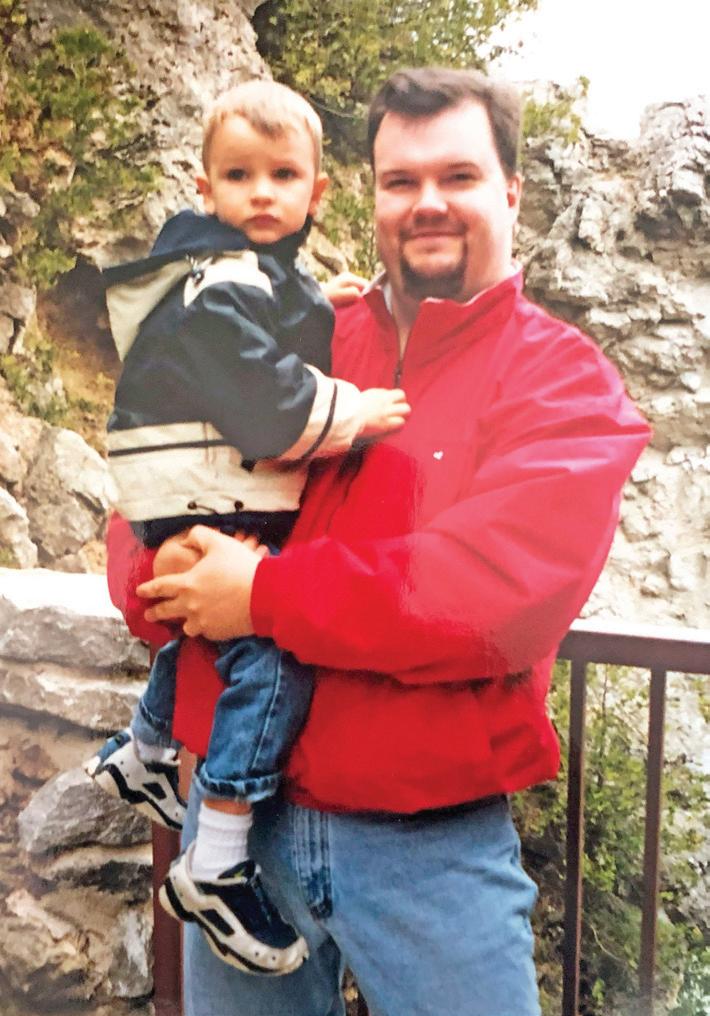
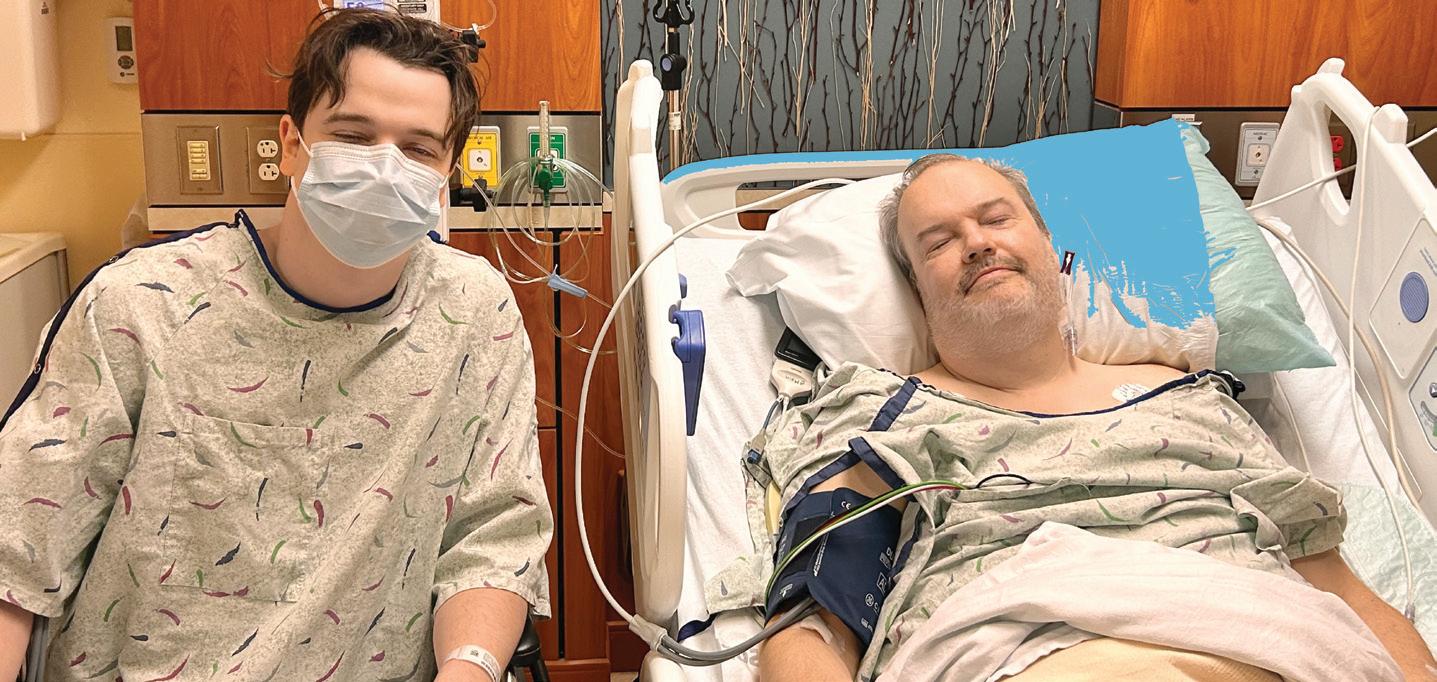
biggest operations any person could have in their lifetimes, it was worth it to see the color return to my dad’s face. That same night my brother, IV pole in hand, visited my dad in his room, each of them standing by the other for the start of a new—and second—chance to live.
I’m so lucky to be part of a family that wouldn’t think twice to make such a sacrifice. How often do parents get to call their children their heroes? It’s a story that is so much more than the words that tell it. It’s the heavy air that swallowed those first hard conversations. It’s the dread of seeing a phone screen show a text or call. It’s the words that couldn’t be said but were nonetheless felt. It’s hope, and above all, it’s love.
Carson Williams


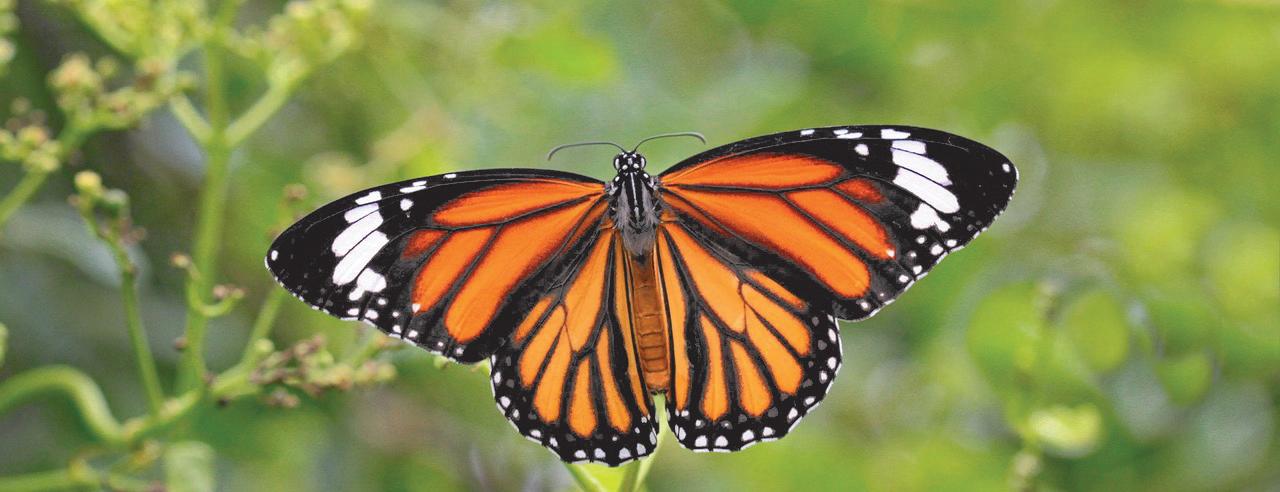
Readers might have read recently that, like many Michigan snowbirds, eastern monarch butterflies have left their winter vacation spots in Mexico and other sunny southern areas to return north for the upcoming spring/summer season. It’s even possible to track their progress on the Journey North website (https://maps. journeynorth.org/map/), which uses citizen science observations to track the date that the first adult monarch was observed in a specific locale. They are, at the time of this writing, in Ohio, Indiana, and Kentucky, fluttering toward Kalamazoo with the expectation that they will arrive here in southwest Michigan near the end of April or early in May, depending on the weather and prevailing winds, of course.
For those of you who are interested, Monarch Watch.org has information about the tagging program that teaches people how to safely capture a butterfly in the summer months and attach a tiny tag that allows researchers to monitor the movement of specific individuals as they begin and, hopefully, complete their winter migration. There are even programs that use radio-frequency identification (RFID) tags to monitor butterflies’ movements in real time. How neat is that?!
All the brouhaha about monarchs is certainly warranted. According to the Michigan Department of Natural Resources, the eastern monarch population has declined by about 80% over the past several decades. The U.S. Fish and Wildlife Service has proposed listing the insects as threatened to ensure that certain measures are taken to protect the imperiled population, but no action has been taken to date.
Don’t get me wrong! I’m a huge fan of monarch butterflies. I have both swamp and common milkweed prominently featured in my backyard wildflower garden. I encourage, to the best of my ability, a pollinatorfriendly space for all who wish to


drop (or fly) by. But it seems to me that monarchs are much akin to the biblical story of the Prodigal Son.
You may recall that in that parable, the older son of a wealthy father stays home and works the family land while the younger son leaves home. After a tough reversal of his fortunes, the younger son returns, and the father, so thrilled that he is home, “slays the fatted calf” and has a celebration to celebrate his homecoming, to the dismay of the older son.
Many of us celebrate the monarchs’ arrival with oohs and aahs and much sentimental merriment. True enough, those who arrive back home here in Michigan have traveled thousands of miles, and it’s no first-class ride. They deserve every bit of fanfare. But let’s not forget those other Lepidopterans (the scientific classification that includes butterflies and moths) who have toughed it out here. This past winter was no picnic! We rarely take the time to even think about insect species that don’t migrate. Notably, they have developed strategies that allow them to withstand extremely harsh conditions, and yet they live to emerge in spring, ready to initiate a new life cycle. I think it’s time to give them some recognition.
Before I sing the praises of spring butterflies, it’s useful to give a brief review of the metamorphosis that carries a butterfly (or moth) from egg to adult. Female butterflies that have mated during the final, beautiful, but usually short-lived, stage of their lives will lay some number of eggs. They are usually deposited on some plant material that will sustain the larva that will hatch from the egg. The number of eggs varies by species, and the plant material may or may not vary as well. For example, many people know that monarchs lay their eggs on the undersides of milkweed leaves, since the species’ larval stage feeds exclusively on those plants. As the eggs hatch, they begin to feed and can be voracious eaters! Perhaps you recall the children’s


book, The Very Hungry Caterpillar. During this time, they grow and molt, shedding their skin several times as they grow larger. They can actually do serious damage to a host plant from their munching! After this second life stage, the caterpillar spins a hard, smooth, semi-transparent chrysalis for a butterfly or a hairy-looking cocoon for a moth. Inside this covering, the caterpillar transforms from larva to pupa. The larval tissues break down and are restructured into the adult winged form we find so ethereally beautiful. The adult phase is frequently, but not always, fleeting, since its sole purpose is to mate and lay eggs that will produce the next generation. Spring butterflies are a special group. Depending on the species, they undergo a period of deep hibernation called diapause. As seasons change from summer to autumn, many of these nativebutterfly and moth species lay eggs that hatch and overwinter as either larvae (caterpillars) or pupae tucked into their hard, metamorphic coats. These caterpillars feast on late-summer vegetation or on decaying fall detritus. They continue their journey by undergoing pupation. The resulting cocoons and chrysalises may sometimes be found sheltered among dead garden vegetation, either on the ground or attached to stems, protected by twigs and leaves. As the temperature dips, they begin to produce a sort of biological antifreeze that prevents their metabolic fluids from bursting their cells and causing death. They hang out, literally, until repeated warm spring days signal that the harsh winter has passed. The metamorphic process of pupation is complete, and the butterflies emerge to feast on early nectar sources; they spread their new wings and meet up with prospective mates. Some of the early butterflies utilize this strategy, like tiny blue Spring Azures, Cabbage Whites, and some spring Swallowtails, which are typically active locally in April and early
“Happiness is not by chance, but by choice.”
-Jim Rohn
May, right about now!
The hardiest and earliest to venture out of the spring butterflies are those that somehow hibernate as adults! Yes, that dead-looking leaf litter that has been covered over by snow, drenched by spring rains, and, at my house, trampled on (or even worse) by dog paws, might contain live adult butterflies, also in a diapause state. They can be easily missed if you look for them, because these species typically keep their wings tucked and folded in close. They can look much like a brown twig or a bit of chopped wood mulch. Some, like the Mourning Cloak and the Eastern Comma, find relative safety under logs, emerging in late winter to partake of early sap as it begins to run. As early as late March, these are the first to make an appearance, just as soon as the weather gets warm enough to venture out.
How wonderful it is that nature supports such a magnificent variety of life forms. I’m always amazed on cold winter mornings to realize that amidst all that snow, there are many critters – winged, furred, and even six-legged -that are able (and even specially equipped) to survive, even in the harshest conditions.
At the same time, who could imagine that such a fragile creature as a butterfly could survive a thousandmile trip – overcoming winds that could knock over a semi-tractor trailer, snow, sleet, and hail, to arrive at a specific locale in Mexico—all to meet up with fellow travelers before venturing back home.
I remain, as always, in awe!
Cheryl Hach Retired Science Teacher Kalamazoo Area Math and Science Center

Please scan the QR code to be directed to references for this article.
Through July 26
Exhibit: Black Cowboys: An American Story, Kalamazoo Valley Museum
Through June 12
Westminster Art Exhibit, westminsterartfestival.org
Friday, May 1,8,15,22,29
Sit N’ Stitch, 10am-12pm Bring project, Richland Library
Fridays, May 1,8,15,22,29
Family Story Time, 10:15am, All ages, Richland Library
Friday, May 1
Memory Café- for people with mild dementia & care partners, 10:30am-Noon, Paw Paw Library
Friday, May 1, 5-8pm Art Hop, Downtown Kalamazoo
Friday, May 1
Kirk Newman Art School Opening Reception, 5-8pm, Kalamazoo Institute of Arts
Fridays, May 1, 8,15,22,29 Artist Meet up in the Vine, 5:30-8pm, 806 S. Westnedge
Fridays, May 1,8,15,22,29 Music Bingo, 7-9pm, LFG Gaming
Fridays, May 1,8,15,22,29 Karaoke Night, 8pm – 1am Old Dog Tavern, Kalamazoo
Fridays, May 1,8,15,22,29 Live Music @ The Dock at Bayview, 8pm-12am
Fridays, May 1,8,15,22,29 Xtreme Karaoke! 8:30pm-12am Shakespeare’s Pub, Kalamazoo
Saturdays, May 1,8,15,22,29 Kalamazoo Farmers Market 7am-1pm, 1204 Bank St.
Saturday, May 2
Beginning Birding Walks 9-11am, Wolf Lake State Fish Hatchery, Kalamazoo
Saturday, May 2, 9am-3pm Church Garage & Bake Sale Scotts United Methodist, 8458 Wallene, Scotts, MI
Saturday, May 2
Mother Goose Day (Preschool/ Kindergarten) & their families 12-2pm, Van Buren LibraryBloomingdale Branch
Saturdays, May 2,9,16,23,30 Live Music @ The Dock at Bayview, 8pm-12am
Saturdays, May 2,9,16,23,30 Karaoke Night, 9-12pm, Louie’s Trophy House, Kalamazoo
Sundays, May 3,10,17,24,31 Portage Farmers Market, 9am1pm, Portage City Hall
Sundays, May 3,10,17,24,31 Extreme Karaoke, 8-11pm, Shakespeare’s Pub, Kal.
Sundays, May 3,10,17,24,31 Karaoke Night, 8:30pm-12am LFG Gaming Bar, Kalamazoo
Mon. May 4 - Sat., May 9 Children’s Book Week Schoolcraft Library
Mondays, Apr. 6,13,20,27 Family Storytime 10-11am, Books, songs, Vicksburg Library
Mondays, May 4,11,18,25 Baby Time (ages 0-6mos), 10:15am, Richland Library
Mondays, May 4,11,18,25
Maker Mondays, grades 6-12, 3-5pm, Register: Richland Library
Monday, May 4, Star Wars Celebration, 5-6:30pm Drop in anytime, Richland Library
Mondays, May 4,11,18,25
Support Group: depression, Bipolar disorder & mental health challenges, 7-8:30pm, Portage Chapel Hill United Methodist Church
Mondays, May 4,11,18,25
Trivia, 7-9pm, Louie’s Corner Bar, Texas Corners
Mondays, May 4,11,18,25
Piano Karaoke, 7-10pm Old Skool Bar, Kalamazoo
Mondays, May 4,11,18,25
Open Mic Night, 8-11pm, Louie’s Trophy House, Kalamazoo
Tuesdays, May 5,12,19,26
Preschool Workshop (ages 3-5) 10:15am, Richland Library
Tuesday, May 5, Adult Scrabble, 1-2:30pm, Vicksburg Library
Tuesdays, May 5,12,19,25
Weekly Gaming, grades 6-12, 3-5pm, Register: Richland Library
Tuesday, May 5
Teens/tweens Dungeons & Dragons, 4-6pm, Vicksburg Library
Tuesday, May 5
Exploring Solo Travel, 6-7pm, Paw Paw Library
Tuesday, May 5
Open Mic Comedy, 7-9pm, Apoptosis Brewing Co., Kal.
Tuesdays, May 5,12,19,26
Trivia Night, 7pm, Louie’s Lake Bar & Grill, Portage
Tuesdays, May 5,12,19,26
Trivia Night, 7-9pm, Louie’s Trophy House, Kalamazoo
Tuesdays, May 5,12,19,26
Team Trivia, 7-9pm, Shakespeare’s Pub, Kalamazoo
Tuesdays, May 5,12,19,26
Music Bingo, 7-9pm, HighDive Kitchen
Wednesdays, May 6, 20, 10-11am Mugs & Hugs, Vicksburg Library
Wednesday, May 6,13,20,27
Wednesday Wigglers, infant/toddler, 10:15am, Richland Library
Wednesday, May 6, 2-3pm
Book Club: The Midnight Library By Matt Haig, Schoolcraft Library
Wednesdays, May 6,13,20,27
Teen Dungeons & Dragons, 3-5pm, Register: Richland Library
Wednesdays, May 6,13,20,27
Free ½ hour of Bowling, Crafted Copper, Kalamazoo, 4-10 pm
Wednesdays, May 6,13,20,27
Cruise-In, Gilmore Car Museum, 5-8pm
Wednesday May 6
Stormtrooper Storytime, 6-7:30pm, Paw Paw Library
Wednesdays, May 6,13,20,27 Trivia, 468 Wine, Portage, 6-8pm
Wednesdays, May 6,13,20,27
Trivia, LFG Gaming Bar, 7-9pm
Wednesdays, May 6,13,20,27
Trivia, 7 & 8pm, Brewery Outre
Wednesdays, May 6,13,20,27
Trivia, Apotosis Brewing, 7-9pm
Wednesday, May 6,13,20,27
Karaoke Bingo, 7-10pm Presidential Brewing, Portage
Thursday, May 7, 9:30-10:30
Book Club for Adults: The Accidental Veterinarian by Phillip Schott, Vicksburg library
Thursdays, May 7,14,21,28
Storytime, all ages, 10:30-11:15, Schoolcraft Library
Thursdays, May 7,14,21,28
Free Thursdays, 11am-8pm, Kalamazoo Institute of Arts
Thursday, May 7, 3:30-6pm Elementary “Drive-in” Movie night With popcorn, you bring, drink, blanket & cardboard box, Vicksburg Library
Thursday, May 7
Adult Writer’s Motivational Group 4-5pm, Vicksburg Library
Thursdays, May 7,14,21,28
Teen Dungeons & Dragons, 4:306:30pm, Register: Richland Library
Thursday, May 7
Gallery Gathering: From Cobalt to Indigo: The Power of Blue in E. Asia, 5:30-6pm, Kalamazoo Institute of Arts
Thursday, May 7
Dress Code: Edward Hopper, Urban Solitude, and Clothing of Modern Life 6-7pm, Kalamazoo Institute of Arts
Thursdays, May 7 & 21, 6-8pm Music Bingo, Zero: Non-Alcoholic Bar
Thursday, May 7,14,21,28, 6-9pm Blues Jam! Shakespeare’s Pub Thursdays, May 7,14,21,28, 6-9pm Music Bingo, Apoptosis Brewing
Thursdays, May 7,14,21,28 Triple Threat Trivia, 6:30-9:30pm Presidential Brewing Co., Portage
Thursdays, May 7,14,21,28 Trivia, 7pm, HopCat Kalamazoo
Thursdays, May 7,14,21,28, 7pm Trivia, Distant Whistle Brewhouse
Thursdays, May 7,14,21,28, 7-9pm Music Bingo, Louie’s Trophy House
Thursdays, May 7,14,21,28, 7-9pm King Trivia, Gull Lake Distilling Co. Thursdays, May 7,14,21,28, 7pm Music Bingo, Shakespeare’s Pub
Thursdays, May 7,14,21,28 Trivia, Alley Cat, 8pm-12am
Sat, May 9 – Sat., May 16
Friends of the Library Silent Auction, Schoolcraft Library
Saturday, May 9
Kalamazoo Indoor Flea Market, 9am-3pm, Kalamazoo Expo Ctr.
Saturday, May 9, 10am-noon
Internet Users group, Paw Paw Library Saturday, May 9, 10am-6pm Mother’s Day Tea/Open House, Passiflora
Saturday, May 9 Bedazzle a book, 10am-2pm, Register: Van Buren Library-Lawrence Branch
Saturday, May 9, 10:30am-Noon
Art Detectives: We’re All Works of Art Kalamazoo Institute of Arts
Tuesday, May 12
Cookbook Club: Sweet Enough By Alison Roman, select recipe, make & taste,6pm, Richland Library
Wednesday, May 13
Birds & Coffee Chat on Zoom, Peregrine Falcon 10am, Register: birdsanctuary@kbs.msu.edu
Wednesday, May 13
LEGO Challenge, youth/teen, 2-5:30pm, Richland Library
Wednesday, May 13
Adult D&D, 3-6pm, Richland Library
Thurs., May 14 – Sat., May 16
Book/Bake Sale, Schoolcraft Library
Thursdays, May 14 & 28
Teen Break & Bulldog Break, ages under 18, 2:45-4:45, Vicksburg Library
Thursday, May 14
Artful Evening: Bata Shoe Museum, Toronto, Director/Curator, 6-7pm Kalamazoo Institute of Arts
Thursday, May 14, 6:30-7:30pm Friends Read Book Club, discuss what you’re reading, Paw Paw Library
Fri., May 15 & Sat. May 16
Portage Garden Club Perennial Sale, 2732 Kalarama Ave.,7am-3pm
Friday, May 15
Book Bedazzling, 4pm, Richland Library
Friday, May 15, 6-9pm
Block Party: Celery Flats, music, art…
Saturday, May 16, 9-11am
Perennial Plant Swap, City of Portage
Saturday, May 16
Once Upon a Saturday, (all ages), Stories,10:15am, Richland Library
Saturday, May 16
Mini Origami Shoes, 11am-2pm, Kalamazoo Institute of Arts
Saturday, May 16, 1-3pm
Teens: Make Boba Tea & Slime, Ages 13-18, Vicksburg Library
Saturday, May 16
Spring Concert: Seasons, 3 & 7pm, First United Methodist Church
Sunday, May 17
Washington Ave., Kalamazoo Arts & Culture Crawl, 12-4pm
Sunday, May 17
Kalamazoo Recorder Players: America 250 Concert, 3pm Portage United Church of Christ.
Monday, May 18, 11am-12 STEAM event, Vicksburg Library
Tuesday, May 19
Lego & Duplo Club, 1-2pm & 5:30 – 6:30pm, Vicksburg Library
Tuesdays, May 19 & 26
Portage Garden Club Plant Sale 9am-1pm, 2732 Kalarama Ave.
Tuesday, May 19
Michigan Team Trivia, 7pm Register: Richland Library
Wednesday, May 20
Book Discussion: Sneaker Marauders: Poems by Ran Walker & Van G. Garrett, 2- 3pm Kalamazoo Institute of Arts
Tuesday, May 20
Adult D&D, 5-8pm, Richland Library
Wednesday, May 20
Gardening 101, 5:30-6:30pm, Van Buren Library-Webster Branch
Thursday, May 21, 5:45pm Wine & Euchre, Register: 468 Wine
Thursday, May 21, 6-7pm STEAM event, Vicksburg Library
Thursday, May 21, 6pm Book Club: The Secret Hours By Mick Herron, Richland Library
Thursday, May 21, 6:30-7:30pm Heartbreak Book Club: Say You’ll Be Mine by Naina Kumar, Paw Paw Library
Thursday, May 21
Best of the 48-hour film festival, 6-7:30pm, Kalamazoo institute of Arts
Tuesday, May 26
Meet MI Author: Robin Mather, 6pm, Richland Library
Tuesday, May 26
Walk with A Doc., 6:30-7:30pm Vicksburg Trail @ Richardson St.
Wednesday, May 27
Curating At The End Of The World: An Apocolyptic Manifesto, 12-1pm Kalamazoo Institute of Arts
Wednesday, May 27, 5:30=6:30pm Adult Photography Composition Class, Bring phone/camera, Vicksburg Library
Wednesday, May 27, 6pm Adult Romance Book Club, Register: Richland Library @ Ned’s on Gull Lake
Thursday, May 28
WMI Area Show Awards Night, 6-8pm, Kalamazoo Institute of Arts
Thursday, May 28, 6:30-7:30pm Book Club: The Alchemy of Flowers by Laura Resau, Paw Paw Library
Friday, May 29, 10:30-11:30am Audiobook Club: The Library Book by Susan Orlean, Paw Paw Library
Saturday, May 30, 11am-Noon Local History Walking Tour, Van Buren Library-Gobles Branch
Sunday, May 31
The Vine Barn Local Market, 311 Wall St., Kal., 12-4pm