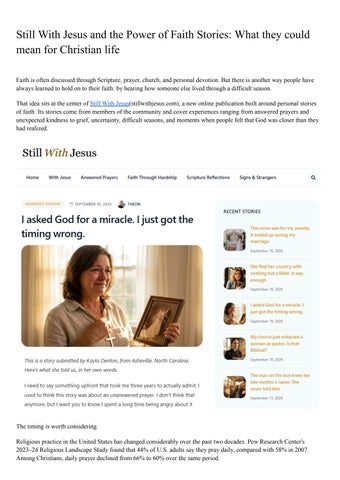
Still With Jesus and the Power of Faith Stories: What they could mean for Christian life Faith is often discussed through Scripture, prayer, church, and personal devotion. But there is another way people have always learned to hold on to their faith: by hearing how someone else lived through a difficult season. That idea sits at the center of Still With Jesus(stillwithjesus.com), a new online publication built around personal stories of faith. Its stories come from members of the community and cover experiences ranging from answered prayers and unexpected kindness to grief, uncertainty, difficult seasons, and moments when people felt that God was closer than they had realized.
The timing is worth considering. Religious practice in the United States has changed considerably over the past two decades. Pew Research Center's 2023–24 Religious Landscape Study found that 44% of U.S. adults say they pray daily, compared with 58% in 2007. Among Christians, daily prayer declined from 66% to 60% over the same period.
These figures do not explain why individual people pray more or less often, nor do they measure the influence of any particular website. They do, however, provide context for the environment in which digital Christian communities are developing. At the same time, interest in the Bible and Christian spirituality remains substantial. The American Bible Society's 2025 State of the Bible report found that 56% of American adults were curious about the Bible, Jesus, or both. The study also found that 51% of Americans wished they read the Bible more. This creates an interesting space between religious information and personal experience. Someone searching online for encouragement may not always be looking for another theological explanation. They may want to hear from somebody who has actually experienced something similar. A story about a person continuing to pray after losing a loved one can speak differently to someone experiencing grief. A story about waiting years for an answer can resonate with someone currently waiting. A story about forgiveness may cause a reader to reconsider a relationship they had given up on. The story does not promise the reader the same outcome. That distinction is important. Still With Jesus does not have evidence at this stage to claim that reading its stories directly increases faith, increases prayer, or changes behavior among its readers. Demonstrating such an effect would require independent audience research conducted over time. What can be examined is why this kind of storytelling may matter. Personal stories make faith concrete. Instead of discussing trust in God only as an abstract principle, they show what trust can look like when someone is frightened, grieving, uncertain, or simply trying to get through another ordinary day. For some readers, that recognition may itself be meaningful. The effect may be small and private: someone decides to pray again, opens a Bible after a long absence, reaches out to another person, or simply finds enough encouragement to keep going through a difficult week.
There is also evidence that digital access has become an important part of how Americans engage with Scripture. The American Bible Society reported in 2025 that two-thirds of Bible Users accessed the Bible digitally at least some of the time. That matters for projects such as Still With Jesus because the conversation around faith increasingly takes place online. A website cannot replace a church community, personal relationships, prayer, or Scripture. But it can become another place where people encounter stories that remind them of what faith has meant to someone else. The community aspect may be particularly important. Still With Jesus accepts stories from its readers rather than building its entire publication around a small group of writers. Those submissions can represent different ages, backgrounds, circumstances, and understandings of faith. Over time, that collection could become a record of how ordinary people describe their relationship with God during ordinary and difficult periods of life. There is value in preserving those experiences even when they do not have dramatic endings. Not every prayer is answered in the way someone expects. Not every difficult season produces an obvious breakthrough. Some people finish a story still carrying the same questions with which they began. Those stories can be important too. They present faith not as certainty that everything will work out, but as something people may continue practicing while they are still waiting, grieving, questioning, and hoping. That may be where Still With Jesus has its most interesting potential contribution. Its influence should not be measured simply by how many inspirational stories it publishes. The more meaningful question is whether those stories help readers reconnect with practices and ideas that matter to their faith — prayer, Scripture, hope, forgiveness, gratitude, and trust in God. That impact cannot yet be quantified. But the need for spaces where people can encounter faith through real human experiences is easier to understand when viewed alongside the broader data. Americans' religious practices are changing, while significant numbers continue to express interest in the Bible, Jesus, and spiritual life. Still With Jesus enters that landscape with a straightforward proposition: sometimes another person's experience can become a reminder for someone else. A reader may come across a story about a person who kept praying when nothing seemed to change. They may recognize their own situation. And perhaps the most important thing the story gives them is not an answer, but enough encouragement to take the next step in faith.