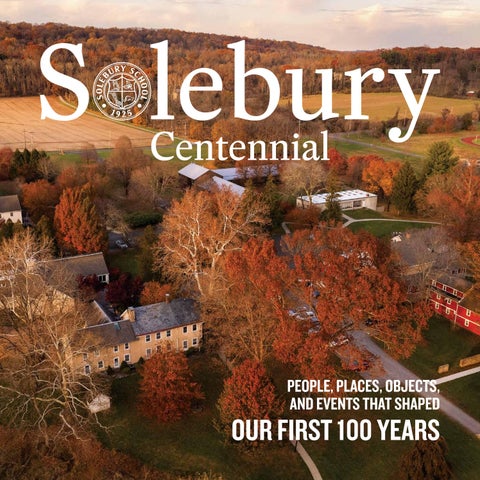
Centennial
PEOPLE, PLACES, OBJECTS, AND EVENTS THAT SHAPED
OUR FIRST 100 YEARS
THE SOLEBURY CENTENNIAL celebrates a century of Solebury School through the stories of 100 people, places, and moments that shaped our identity. From our bold founding in 1925 by four visionary educators to our evolution into a progressive, all-gender community, Solebury has a history of embracing differences, championing individuality, and fostering deep student-teacher connections. In these pages, you’ll meet trailblazing faculty, dedicated alumni, and generations of families whose lives are woven into the school’s legacy. You’ll visit iconic spaces— the Barn, the pond, the farmhouse— and uncover the values that endure: curiosity, inclusion, mutual respect, creativity, and care. Whether you’re an alum, student, or friend of the school, this book offers a rich, intimate look at Solebury’s first 100 years—and a glimpse into our future.
Dedication As current Chair of the Solebury Board of Trustees, it is my privilege to write the dedication to this book celebrating the first 100 years of Solebury School. Solebury is a unique educational establishment that has flourished since 1925 due to the vision, dedication, and wisdom of many people, some of whom this book recognizes and celebrates. I am proud to have been associated with Solebury for the last eighteen years of this journey, and to have seen the incredible blossoming of the school in this timeframe. In the pages that follow, you will see the story of our school come to life through the lives and work of the many people who shaped the Solebury that we know today. Let us salute and celebrate the many headmasters, faculty, staff, alumni, and supporters who have brought Solebury to its current position of strength, while maintaining the spirit of intellectual enquiry, truth-seeking, morals, and ethics that are the hallmark of a Solebury education. Thank you to all who have gone before, thank you to our current Head of School, Tom, and his dedicated faculty and staff, thank you to my fellow board members, and to all our students, both past and present. We look forward to a bright future and the next 100 years.
—LIZ WAVLE P’11 (pictured with her grandchildren)
CHAPTER 1
Starting Solebury From the beginning, Solebury School stood for something different. Progressive. Relational. Unorthodox. Willing to push aside convention. Dedicated to nurturing students who could think. Making a place where everyone felt included. This first chapter, Starting Solebury, tells the story of the vision, the people, and the early years. This is the story of our foundation. •
CHAPTER 1: STARTING SOLEBURY
A Vision for A New Kind of School SOLEBURY SCHOOL BEGAN WITH FOUR YOUNG PEOPLE AND A DREAM The four men met while working as staffers at Camp Marienfeld in New Hampshire. All of them had ample experience with traditional education—having attended well-known boarding schools and Amherst, Harvard, and Oxford, among other elite institutions. Three worked as teachers in these more staid, structured places. The fourth wrote adventure stories boys loved. They envisioned a school that was more informal and less regimented. They imagined a friendly, creative, relaxed place like camp, but still with high standards for academic achievement. They sought to found a school where students and faculty truly connected, debating over a piece of literature, going over a challenging math concept one-on-one, and wandering through a beautiful campus with those same faculty members during afternoon activities.
CHAPTER 1: STARTING SOLEBURY
“The purpose of the class is not to give or get marks, not merely to pass examinations, but to grow in the understanding of the subject, to become more proficient in the art of thinking.” —ARTHUR WASHBURN Julian Lathrop, who had studied at Cambridge, nudged the group forward. “What are we going to do about that new and better school we talk about?” he asked. By late 1924, the group had visited New Hope and planned to begin in the fall of 1925. In the words of Arthur “Doc” Washburn, an Amherst College graduate who became Solebury’s first Headmaster, the school should offer the “free exchange of opinions and ideas outside the classroom as well as within,” where “a boy was well-fitted not only for college, but for life.” By April, 1926—less than a year after the school was founded—it was clear that they were making waves. In a letter to Princeton Alumni Weekly titled “An Unconventional Preparatory School,” T.H. Vail Motter, a member of Princeton’s class of 1922 and chair of the English department at the Berkshire School, made the case for Solebury. “At the outset, they provided a remarkably workable library of 3,000 volumes, and these books distributed everywhere over the school building, have become the real heart of the school. In a recent visit to the school, I looked in vain for the conventional classrooms with their stiff rows of uncomfortable seats and their blank acreage of blackboard. Instead, I found a number of homelike rooms, the walls lined with books and easy chairs occupied by boys who, released from the mechanical formalism of class and recitation routine, were experiencing the real joy of making daily discoveries for themselves,” wrote Motter. A few years later, in 1932, Washburn elaborated on the initial vision and approach in an article published in Progressive Education: A Review of the Newer Tendencies in Education. “The method of conducting the class is no newer than subject matter study. It is rather an old method which is returning to favor, namely, small groups of boys sitting around a table with the teacher. They meet, in most cases, every day to work out, to practice, to talk over a certain subject or a small piece of the subject. The class meeting may take on a variety of forms, a consideration of the merits and defects of the work prepared outside, and the exposition of new or difficult material by the teacher, oral or written practice on the subject at hand, written test, open discussions. The purpose of the class is not to give or get marks, not merely to pass examinations, but to grow in the understanding of the subject, to become more proficient in the art of thinking,” Washburn wrote.
With seven years of Solebury under his belt, he reflected on the education as something powerful and worth other schools emulating. “There is more freedom about the life of the school than is common to most schools with this sort of atmosphere,” Washburn wrote. “It hardly seems like school, and it is not an uncommon thing for boys to ask if they may return early from a vacation. Indeed, it is far different from what is usually thought of as school, and it might rather be considered as an experiment in living carried on between the ages of 12 and 18. In carrying on the experiment, the directors of the school are not trying to follow the lead of our highly organized industrial civilization, intent on quantity and profits. They prefer to work for quality. They prefer to set their own ideals of open mindedness, sympathy, understanding and contented living. And they hope they might persuade others to follow their lead.” This ethos of collaborative education continues to be seen and felt on Solebury’s campus today. Faculty approach their students with respect and a shared sense of purpose. As current student Orly Bloom ’27 puts it, “Our teachers at Solebury teach with curiosity, not judgment.”
•
OPPOSITE TOP: (L–R, standing) Stanis Hoyt P’49, Julian Lathrop P’49 ’53 GP’73 ’76 ’77 ’79 ’80, Laurie Erskine, Herbert Boyd, William Orrick P’56 ’63, (L–R, sitting) Jake Propsner P’38 ’40, Arthur Washburn, Robert Shaw P’53 ’55. • OPPOSITE INSET: 1925 Announcement of the Opening of The Solebury School for Boys. • OPPOSITE BOTTOM: Barn complex, 1930s. • ABOVE INSET: January 1932 issue of Progressive Education: A Review of the Newer Tendencies in Education, published by The Progressive Education Association, Washington, D.C. • ABOVE: Students in the first Library, 1949.
our first 100 years • 6
CHAPTER 1: STARTING SOLEBURY
Intentionally Small A CLOSE-KNIT COMMUNITY WHERE EACH STUDENT IS KNOWN From the start, the founders envisioned a small school because they believed a connected relationship between students and faculty mattered. In Solebury School: The First Fifty Years, Robert Shaw P’53 ’55, one of the four founders, wrote that the founders pictured a place “where the needs of each individual boy could be looked after and promoted.” As the years have gone by, that intentional, small community has only grown stronger. Students find friendships with peers across grades, interests, and nationalities. Those friendships last beyond graduation: “We’ve all made lifelong connections here,” said Amel Ouji ’20 in a speech at her graduation. “As we go down our different paths, we’ll always come back to this Solebury community.” In her 2004 speech as Commencement Speaker, Rachel Simon ’77 reminisced about her arrival at Solebury. “Suddenly I was in a place where I felt accepted and cared about by the students, the staff, and the faculty. I found that teenagers could get respect from their elders here. This was shocking to me. I’d been in a public school where the teachers were mostly contemptuous toward the teenagers,” she shared. “My creativity was nurtured, and everyone was given the opportunity to speak and be heard. It really was a magical place, and I took full advantage of it.” The emphasis on a small community where students are known by both faculty and peers remains 100 years later. Solebury is a community big enough to offer robust opportunities but small enough to recognize and include each person. Even as the current strategic plan calls for growing Solebury to an enrollment of 300 students, the focus continues to be on a profound respect for the individual.
•
“My creativity was nurtured, and everyone was given the opportunity to speak and be heard.” —RACHEL SIMON ’77 TOP: Arthur “Doc” Washburn teaching a class, c. 1940. • MIDDLE: Students enjoying the snow, 1981. • BOTTOM: Izzy Mania ’20, Anna Schmidt ’20, and Aidan Holtz ’20, 2017.
CHAPTER 1: STARTING SOLEBURY
A School Seal THAT UNIQUELY SAYS SOLEBURY Everything about the Solebury School seal speaks to our ethos. A student carved the first rendering—an indication of young people’s agency at Solebury from its earliest days. John Orr, class of 1929, used a reclaimed white oak beam from the Barn renovation. And unlike most school seals from this era, there is no Latin motto. Instead, each founder chose an animal or agricultural symbol with traits they believed reflected the School’s core values. Robert Shaw favored a beaver— ever industrious and able to overcome adversity. “We grow as people, move institutions forward, and improve our societies when we are willing to confront head-on that which is difficult.” Arthur “Doc” Washburn chose an owl, wise and appropriate for a learning institution. “Uncle” Julian Lathrop wanted an oak leaf and acorn to highlight how the school grew from a tiny acorn of an idea into a thriving institution. Finally, “Uncle” Laurie Erskine selected a plow, representing that you must cultivate things to bring them to fruition. The values represented on the seal (also referred to as a shield or crest) have endured for 100 years.
•
ABOVE (left to right) 1: Stained glass portrait of John Orr ’29, commissioned by Herbert Boyd. This hung in the woodshop (now Faculty Lounge) until 2017. • 2: Herbert Boyd and John Orr ’29. • 3: Original Solebury School Crest, carved by John Orr ’29 with lettering designed by Anna Whelan Betts.
our first 100 years • 8
9 • solebury school centennial
A Pond FOR FUN AND MEMORIES A feature of the campus since the earliest days, Solebury’s pond was dug in 1929 by staff and students. Over the years, it has been the site of tug-of-war battles, a swimming hole, a skating pond, and a place for students to jump in on hot or important days. In 1988, the school dedicated the pond in memory of Jake Propsner P’38 ’40, who had done so much to maintain the facilities and campus for almost half a century.
•
From Old Farmhouse TO THE HEART OF THE SCHOOL The original farmhouse on Solebury’s property—for many years simply called “the house”—was built around the 1750s. The house contained seven fireplaces, three of them very large. The cellar included a fireplace with a hole on the side for removing baked bread. Architect Andrew Alpern ’56 believes previous owners expanded the farmhouse three times over the course of the 18th century. After purchasing the property, the founders recognized that the farmhouse would serve as the heart of the school— and it remains so to this day. Originally, the youngest students lived in rooms upstairs with classrooms downstairs. The founding Head of School Arthur “Doc” Washburn lived in the apartment above the Head of School’s office for 40 years. The apartment was in the oldest section of the house, accessed by a steep, narrow stair hidden behind a door in the original wood paneling. That stairway is still there, hidden behind a door in the Head’s Office. “Our living room remains the heart of the farmhouse, a warm and welcoming space where we greet hundreds of families and visitors each year,” says Director of Admissions Meg Perry. “Gathered around the large fireplace, excited and nervous prospective students and their parents get their first glimpse into our vibrant Solebury community. This room, rich with tradition, has been the setting for countless warm welcomes and meaningful conversations, making it a special part of our Solebury campus experience.”
•
11 • solebury school centennial
“Our living room remains the heart of the farmhouse… This room, rich with tradition, has been the setting for countless warm welcomes and meaningful conversations, making it a special part of our Solebury campus experience.” —MEG PERRY
OPPOSITE PAGE (left to right) 1: View of the Farmhouse, 2006. • 2: East side of the Farmhouse, c. 1940. • 3: The Farmhouse, by Judith Langan, hand-painted etching, 1989. • ABOVE (top to bottom) 1: Terri Miller P’16 ’18, Jacob Thomas ’26, and teacher Mike Knapp in the Living Room, 2025. • 2: Charles Lawson and students in discussion, c. 1950. • 3: Spring House, 2017. • 4: East side of the Farmhouse, 1955.
CHAPTER 2: LIVING WHERE WE LEARN
“Solebury is, to me, deeply rooted in the land. Sometimes I drive back and need to talk to no one—I just need to be there, feel the hills and fields, smell the trees.” —A WRITTEN RESPONSE TO AN ALUMNI SURVEY IN THE 1980s 13 • solebury school centennial
Life Outdoors SOLEBURY’S SECRET SAUCE The gorgeous farmland near the Delaware River has made Solebury what it is. This land attracted the founders, who sought to replicate the best parts of summer camp in their new school. From the beginning until today, many classrooms open directly to the outdoors, requiring students to step outside classes nearly ninety percent of the time. While this can present challenges—especially on cold, rainy, or snowy days—it is also a defining feature of the campus experience. The constant exposure to fresh air and the natural surroundings, with easy access to trees and open sky, has nurtured generations of students, fostering a unique connection between learning and the environment. Annalise Houghton ’24 sums it up beautifully, saying, “the campus of Solebury is where the community comes together. From picnics with friends under the shade of a sycamore tree to walks along a flower-speckled riparian buffer, campus provides a space to connect to nature and each other. It’s incredible that a school can be where you learn about Emily Brontë and see the first fireflies of the season.”
•
BACKGROUND: Liv Colbert ’19 and Sasha Guzman ’19, 2017. • ABOVE: Looking through the Carriage House window, c. 1940. • LEFT: Campus, c. 1940.
our first 100 years • 14
“Solebury School changed my life… It was the most wonderful thing, because all of [the Solebury teachers] saw my spark as an individual and my talents and my passions, and they valued all of this.” —RACHEL SIMON ’77 15 • solebury school centennial
ENGLISH CLASSES THAT CREATE
Writers & Thinkers At Solebury, students learn to write—and to write well. Teachers guide them in refining and strengthening their work, and many alumni return to say they felt well-prepared for the rigors of college writing. Writer-in-Residence and New York Times best-selling author Jonny Miles P’22 ’24 ’26 also supports young writers through evening classes and open office hours, nurturing their voices and creativity beyond the classroom. “What stood out most through an academic lens was Solebury’s commitment to developing good writers,” says Russell Witte ’07. “We often submitted multiple drafts and each draft received meaningful, thoughtful comments back on ways to improve. It wasn’t until I arrived at college that I truly came to appreciate Solebury’s rigorous approach because my writing skills were a cut above many of my peers.” A number of alumni have gone on to have robust careers as authors and thinkers, including:
CHAPTER 2: LIVING WHERE WE LEARN
Andrew Alpern ’56
Megan Gallagher ’01
An architectural historian, architect, and attorney who is an expert on historic apartment houses in his home city of New York, Alpern has written a dozen books and numerous articles (including for Solebury: The Magazine) on historical architecture.
An assistant professor in the Department of Gender and Race Studies at the University of Alabama, Megan Gallagher writes on contemporary feminist political theory, sex and gender in the history of political thought, and politics and literature. “I had always loved to read, but Solebury taught me how to think critically about what I read, how to discuss it, and how to appreciate it. I’m so grateful that my teachers cultivated that love and gave me the skills to pursue it in college and beyond,” she says.
Barbara Winslow ’63 A professor emerita at Brooklyn College, Barbara Winslow is the author of Shirley Chisholm: Catalyst for Change and Revolutionary Feminists: The Women’s Liberation Movement in Seattle. She is the founder and Director of the Shirley Chisholm Project of Brooklyn Women’s Activism. In her memoir essay “Primary and Secondary Contradictions in Seattle,” which appeared in The Feminist Memoir Project, she wrote, “I loved Solebury. There I was able to live with myself and my very strange contradictions as a bleach-blond cheerleader who at the same time protested the Bay of Pigs and the Cuban Missile Crisis. While at Solebury, I became committed to issues of peace and justice.”
Rachel Simon ’77 New York Times best-selling author of several books, including Riding the Bus with My Sister, which was adapted for a Hallmark Hall of Fame movie starring Andie MacDowell as Rachel and Rosie O’Donnell as her sister. Simon says in an online video, “Solebury School changed my life…It was the most wonderful thing, because all of [the Solebury teachers] saw my spark as an individual and my talents and my passions, and they valued all of this.” She added via email, “I was also moved and inspired to see how all the teachers and staff treated each student as I was treated: as an individual. And when you’re in a community where each student is valued for their uniqueness, you come to view the world that same way. Solebury didn’t only help me become better read and more expressive as a writer. It helped me become more open-minded and more open-hearted. I’ve kept that approach to the world ever since, and have lived a much better life because of it.”
Anna Vangala Jones ’03 An award-winning writer, her debut short story collection, Turmeric & Sugar, was published in 2021. “I didn’t know how to translate my lifelong dream of being a writer into a viable career choice, but I received complete support. For my Senior Project, I was paired with an editor, and by the end of the three weeks, I submitted a completed and revised version ready for publication. Now two decades later, I am the author of my first book, Turmeric & Sugar, with my writing also published in print and online journals and magazines. That early experience at Solebury was invaluable to my eventual career path, and I’m still so grateful.”
Matilda Bray ’24 As a senior, her play The Finale of the Magnolia Tree was one of six winners of the Phillips’ Mill Community Association’s “Play with Words” playwriting contest and she has published two books of poetry. In a Bucks County Herald story, Bray pointed to teachers Sarah May, head of the English department, and Zack Arrington, as “of enormous help” and she called out Head of School Tom Wilschutz for the creative environment he has crafted at Solebury.
•
our first 100 years • 16
CHAPTER 3
Special Moments In the end—10, 20, 100 years later—what lingers most are the moments. They stick in our heads like a slideshow, one image playing after another, bringing us back so we can hear and smell them vividly again. There are the expected ones beginning with Convocation, complete with house assignments and the procession of flags, and ending with Graduation, outside and with friends. And then there are some that couldn’t happen anywhere other than Solebury. (What other school has students who ask for more work days?) Special Moments touches on the experiences that bind Solebury people together. Most take place on campus, but we will journey as far away as Colorado. This chapter also includes moments where alumni remember feeling seen—a special Solebury strength. •
CHAPTER 3: SPECIAL MOMENTS
GO WEST! TRIPS TO
Ralston Creek Ranch It seems fitting that a school that grew out of a summer camp would eventually decamp to another one. According to Solebury School: The First Fifty Years, teacher Steve Strang P’44 ’46 suggested heading out to Colorado’s Rocky Mountains after a particularly hot bout of weather during summer school at Solebury in 1930. Students and faculty began making annual trips to Ralston Creek Ranch in the foothills west of Golden, Colorado, in 1931. Strang and his family moved there permanently in 1937, and two generations of students continued to enjoy their hospitality on forays out West. The students enjoyed unique activities such as wrangling horses,
riding bareback, multiday backpacking and fishing expeditions, and trips to the rodeo. “Few boys have left Ralston Creek without getting an idea of how necessities are produced and without learning something useful and a bit difficult: running the transit and level, working a team, shingling a roof, driving a truck, breaking a colt, making a workable grate, or ploughing contours for soil conservation,” the book quotes from a mid-’30s catalog. Ralston Creek crystallized Strang’s educational philosophy. “Something similar characterized early Solebury and is still in evidence today—learning by doing.”
•
“Let’s go where it’s cool next summer.” —STEVE STRANG, 1930
CHAPTER 4
Creative Spark Art is at the heart of Solebury School. Founded just down the road from historic Phillips’ Mill, where painter William Lathrop launched the New Hope Art Colony, it has always been a place that attracted and nurtured students with a passion for all kinds of arts. Creative Spark considers all aspects of the artistic experience at Solebury. We tell the stories of alumni, faculty, and parents who have made their mark in the visual arts, music, theater, dance, and film. We give a glimpse at the extraordinary individual pieces of art that remain on campus today, inspiring a new generation of students to see a future where their work hangs on campus, too. •
IN RECOGNITION OF THE MANY KINDNESSES OF
The Child Family
This painting by Bucks County artist Charles Child was donated by William Berkeley ’49 in honor of his mother, Dorene Pullinger Collins. A plaque says it is “in recognition of the many kindnesses of the Child family.”
•
CHAPTER 4: CREATIVE SPARK
William Lathrop PAINTING THE SOUL OF NEW HOPE Solebury School owes our bucolic location to William Lathrop, one of New Hope’s earliest and most influential artists. When his son Julian’s friends began discussing founding a school, he invited them to see this special spot near the Delaware River. But William Lathrop’s influence lingers far beyond the school. A founder of Pennsylvania Impressionism and the father of the New Hope Art Colony, Lathrop helped turn this quiet Bucks County town into a thriving center for American art. Born in Ohio in 1859, Lathrop’s artistic path wasn’t linear. He began as an illustrator and etcher in New York City before finding his home as a landscape painter, doing pieces like this one that hangs at Solebury.
By 1899, Lathrop had settled in New Hope, where he welcomed students onto his barge, Sunshine, to paint en plein air. His work reflects the light and spirit of the local scenery. He went on to exhibit nationwide and earned a gold medal at the Panama-Pacific International Exposition. Lathrop also helped establish Phillips Mill as a community arts hub. An adventurer and skilled sailor, he built his own wooden boat, The Widge, once hosting Albert Einstein on board. Lathrop died during the 1938 New England Hurricane, but his legacy endures—in the museums like the Metropolitan Museum of Art that house his work and in the artistic heartbeat of New Hope he helped set in motion.
•
our first 100 years • 24
CHAPTER 4: CREATIVE SPARK
Visual Arts IN THE CURRICULUM Influenced in part by the thriving arts community in the surrounding area, Solebury has long had a remarkable arts program across disciplines, including visual arts, music, theater, dance, and film. Solebury is distinguished by teachers who have their own robust art careers or practices and the breadth and depth of the department’s course offerings. In the early years, sculptor George Mellor, who served as art department chair from 1957–1965, inspired students. One was Ed Buffman ’65, who now works with wood and metal to create sculptures and beautiful handcrafted furniture. A self-described “jock,” Buffman credits Mellor with helping him find the artist in him. In the 20th century, women like Harlem Renaissance figure Selma Burke (see more on her on page 104) and woodworker Phoebe Chorley P’71 ’78 took up the mantle. Chorley began at Solebury in the 1970s and continued through the early 1990s. Under her leadership as the head of the art department and director of a robust woodshop, the department offered welding, ceramics, weaving, and woodworking. Rebecca Crowell ’72 wrote that Chorley “taught me about hard work, dedication, and having high expectations for myself.” Nancy Cabot continued that trajectory as the head of the art department in the 1990s. Scott Eckstein P’22 ’25 recalls her as “maybe the nicest human being I’ve ever met in my life,” adding, “She was a generous colleague who helped a young teacher like me grow into the job. Nancy was a model for how to engage students. And she was an incredibly talented artist who was particularly good at landscape work, but above all, was someone who was able to inspire students to explore creatively.” Likewise, Erika Fairchild P’13, ceramic teacher and arts department chair, and visual arts teacher Kirby Fredendall P’21 have inspired visual arts students. Fairchild was a professional tile and mosaic designer before arriving at Solebury in 2005 and she continues to produce tile and make art in her free time. Fredendall, who has been at Solebury since 1993, is a professional artist, displaying her work in art shows and galleries. Kelli Abdoney inspires students in the same way as the photography teacher. Her own journey as an artist began with a class trip. “A teacher saw something in a collection of photographs that would otherwise go unnoticed. It was an unexpected turn towards the light, and nothing would ever be the same again.” Over Solebury’s now century of existence, the school has been at the cutting edge on so many fronts including art. Indeed, Solebury has long offered drawing classes featuring live nude models, a highly unusual and sophisticated option for high school art students.
•
OPPOSITE PAGE (top to bottom) 1: Nikki Drummond ’89 and teacher Nancy Cabot. • 2: Carol Darnell ’61 and teacher Helen McCook P’60 ’62 ’64. • 3: Teacher Phoebe Chorley P’71 ’78 working with a student, c. 1965. • 4: Alexandra Babicki ’17 and teacher Kirby Fredendall P’21. • TOP TO BOTTOM 1: Students engaged in Life Drawing class, c. 1955. • 2: Student-made pottery piece, 1974. • 3: Ruth Trowbridge ’67 showcasing her skill in metalwork and sculpture, c. 1965. • 4: Art teacher, Erika Fairchild P’13 and Debby Qu ’19. • 5: Kelli Abdoney’s Advanced Photo class, 2024. • 6: Solebury student artwork displayed around campus, 2019.
CHAPTER 5
Solebury Spirit At Solebury, spirit is found in the cheers of students, alumni, and parents at athletic games from our earliest days up through today. Spirit is on full display when students use their voices to speak for what’s right, and when alumni and parents join together to raise critical funds for the school. Spirit lives in the connections created with teammates, friends, and family members. Solebury Spirit embraces both the individual—people of every gender and race—and honors a thriving community that helps both students and faculty members grow to their full potential. This chapter captures the essence of Solebury’s Spirit—in athletics, activism, and everyday life on campus. It’s a spirit that rallies at protests, defends the environment, and unites the community in moments of purpose. That same energy has driven capital campaigns that reshaped the campus and continues to inspire alumni who carry Solebury’s values into the world. •
CHAPTER 5: SOLEBURY SPIRIT
“We recognize that uniqueness is beautiful and wonderful, but also recognize that there’s a whole lot that connects us.” —SCOTT ECKSTEIN P’22 ’25
A FOCUS ON THE
Individual At Solebury, the word community is used often—and rightly so. But just as central to the school’s identity is our fierce commitment to honoring the individual. There is no single prescribed path through the curriculum. As a Solebury teacher and administrator for over 30 years, Scott Eckstein P’22 ’25 explains that Solebury is a place where both a high-achieving academic powerhouse and a student dreaming of winning an Oscar can thrive side by side. “The goal should be to figure out what course of study allows you as an individual to grow the most and to discover the things where there’s an intersection between what you love and what you’re good at,” says Eckstein. One way this plays out is the schedule at Solebury, which allows for both intensive study and balance in life. There are spaces for art, athletics, and meetings with peers and teachers. The intentional design enables each person to follow their own path to graduation but also to connect with others in a meaningful way. Students can also easily design their own independent study classes. It is a place that nurtured a love of learning for many individuals, including Theresa Quindlen ’80. “I was in an overcrowded public high school that lacked creativity, imagination, and academic rigor. I spent more time skipping school (to read good books) than I spent in school. I needed a different kind of school community,” she says. “Solebury changed my life. It was a place where it was cool to be an intellectual.” A unique piece of this value on individualism is that Solebury is a community where people see each other more fully and authentically, looking beyond their differences. “We recognize that uniqueness is beautiful and wonderful, but also recognize that there’s a whole lot that connects us,” says Eckstein. “Even when people seem on the surface remarkably different from us, there might be wonderful things that we share.” Solebury is a place where students can find themselves and find their place with others.
•
our first 100 years • 30
“It has been an absolute joy, both growing my teaching craft here and now being in a position to support teachers. I think we’ve got the best teachers in the world.” —HELEN MATTHEWS
A PLACE WHERE
Faculty and Staff Can Grow At Solebury, learning isn’t just for students. Faculty members find a place where they can grow, and some make it their permanent home. These “lifers” made dedication to the school a centerpiece of their lives, maintaining the philosophy, spirit, and culture throughout our history. The first “lifers” were obviously the founders and Jake Propsner P’38 ’40 who lived, worked, and breathed life into Solebury. From the ’60s to the turn of the century, the group included Frank and Maureen Ammirati P’73 ’74 ’77 ’79 ’81 ’82 ’86, Geoff Tilden, John ’67 and Linda Brown P’95 ’98, and Carol Hey P’03. From the ’90s through the present, this group includes Annette Miller, Steve Buteux P’27, Peter Ammirati ’82, Kirby Fredendall P’21, Martin Smith, Jon Freer P’26 ’27, Scott Eckstein P’22 ’25, and Bill Christy. Each group has helped the next cohort develop a love for the school and our unique approach to helping young people learn and grow. In 2025, more than 10 faculty and staff have been at the school for more than 20 years. But even those who have not yet hit that milestone have sacrificed to be at Solebury because they love it. Helen Matthews earned a PhD in French from the University of North Carolina and then rejected the collegiate rat race in search of meaning and purpose. She has now been at the school for 13 years. For Matthews it’s all about her colleagues. “It’s the teachers at Solebury that drew me here,” she says. “When I first interviewed, walking around campus and talking to folks, I was like, ‘I’ll have whatever they’re having.’ It has been an absolute joy, both growing my teaching craft here
and now being in a position to support teachers. I think we’ve got the best teachers in the world.” Matthews says curricular freedom is key at Solebury. She started teaching with a textbook, but when she took over as the world language department chair, the school supported her doing it differently. Matthews took professional development around ditching the textbook in favor of more comprehensive language learning. “I felt empowered to make significant changes, to try things that I felt were right, and then readjust if they weren’t right,” she says. “That meant the world to me.” Matthews is now encouraging that academic freedom in others as the Dean of Faculty. Ke’son Bullock-Brown ’15 is in his third year back at Solebury, this time as a teacher. He returned because he can reimagine courses, building on his strengths and interests. His electives have included a course on Civil Rights History through Film, and another on the Lived Black Experience from Reconstruction to World War II. Even teaching more traditional offerings such as Honors U.S. History gives him freedom to explore things thematically that he did not have in a previous job. “We’re looking a lot at ideology right now,” Bullock-Brown says. “It allows students to think about a term that they may hear about a lot, but hear how complex the definition is, and how you can apply it to how you analyze things historically. It’s a course that I have been able to kind of put a spin on, and students have really felt that.”
•
OPPOSITE PAGE (top left): Faculty and staff, 1991. • OPPOSITE PAGE (middle left): Helen Matthews and Leo Dieterly-Malone ’19, 2017. • OPPOSITE PAGE (background): Jon Freer P’26 ’27, c. 2015. • OPPOSITE PAGE (bottom left): Ke’son Bullock-Brown ’15, 2024. • OPPOSITE PAGE (bottom right): Carol Hey P’03 with Chloe Hey ’03, c. 1985. • ABOVE (left to right) 1: Scott Eckstein and Peter Ammirati ’82, c. 1990. • 2: Annette Miller, c. 2000. • 3: Bill Christy, 2019. • 4: Nancy Cabot and Kirby Fredendall P’21.
our first 100 years • 32
Weathering TOUGH TIMES No institution lasts 100 years without moments of heartbreak. For the Solebury family, a terrible period unfolded as the school learned in 2014 that there had been incidents of sexual abuse happening intermittently until 2005. While nothing can undo the wrongs of the past, Head of School Tom Wilschutz led the school’s response with honesty and openness. “I’ve been asked a number of times why openness and candor are important,” he wrote in Solebury: The Magazine. “In my mind, the answer is as simple as it is hard. We must have the strength to confront the difficult issues we face in an honest, straightforward fashion to retain the trust and support of our community. As Head of School, I have tried to be consistent: to uphold the values of Solebury School by supporting the victims in whatever manner we can and to care for our current students, faculty and staff, for alumni, for prospective families and students, and for the community that is Solebury School.” As the school continues to move forward, we have not lost sight of these lessons as we engage the students and families of the next 100 years of our history.
•
WELCOMING STUDENTS FROM
Around the World
During World War II in the 1940s, Solebury welcomed refugees from England and Holland. In the years that followed, throughout the 1940s and 1950s, the school enrolled students from Turkey, Egypt, Saudi Arabia, Chile, Mexico, and Greece—including a Greek boy who had served as a ten-year-old messenger during the Greek Civil War. By the late 1950s, Solebury had welcomed a Hungarian refugee and our first students from Africa: a brother and sister whose father served as a Ghanaian ambassador. The tradition of welcoming international students continues today. Most years, about 15 percent of the Solebury student body comes from outside the United States. The School has also continued the tradition of intentionally including those in need. Recent classes have included students fleeing strife in Ukraine and Afghanistan. One, Fatima Daryabi ’23, was elected class president. She journeyed from Kabul to Abu Dhabi, to Fort Bliss, Texas, and finally to Solebury. “Coming to Solebury, you join a community where everyone is so nice and so welcoming in making you feel like you count. That you matter,” she told the Bucks County Herald.
•
ABOVE: Preparing for the Flag Procession, Convocation, 2019. • LEFT (top to bottom) 1: Joseph Schaechter ’50 from Mexico. • 2: John C. Philippides ’50 from Greece. • 3: Felipe Sanfuentes ’50 from Chile. • 4: Abdu Razak Sulaiman ’51 from Saudi Arabia. • 5: Saud Mohammed Doghaither ’52 from Saudi Arabia. • 6: Manuel Caballero ’55 from Mexico. • 7: Ilan Yehiel Aslan ’55 from Israel. • 8: Masako Ohno ’59 from Japan. • 9: Hiroko Iwabuchi ’60 from Japan. • 10: Nahid Karimi from Pakistan ’27, 2024. • 11: Fatima Daryabi ’23 from Afghanistan.
our first 100 years • 34
OUR FIRST 100 YEARS
Appendix
APPENDIX
1925 1925
1929
Solebury opens with four students at Dr. George Marshall’s home, across from the Holmquist School. First student newspaper, The Solebury Scholar, published. Arthur “Doc” Washburn becomes first Head of School.
Pond (“swimming pool”) built by staff and students. Solebury graduates eight.
1926 Solebury purchases the Michener Farm and moves to our current location on Phillips Mill Road. The Solebury Scholar changes its name to The Scribe.
1927 Herbert Stuart Boyd becomes treasurer. First shack built. Solebury starts its own radio station, 3VU. First graduating class—of one!
37 • solebury school centennial
1930 Solebury accredited by the Association of Colleges and Secondary Schools of the Middle States & Maryland. Doc Washburn starts a non-credit philosophy course that continues for 30 years.
1931 First visit to Ralston Creek Ranch by Solebury students with faculty member Steve Strang.
1932 Solebury and Holmquist Schools join forces for barge parties on the canal and dancing instruction from Arthur Murray Studios. Autumn dance hosted by Holmquist for Solebury boys at White Oaks. Solebury boys celebrate their first football victory since 1929.
APPENDIX
1935
1945
1933
1937
1947
“A little while before Christmas, basketball took the place of that unpopular sport, soccer.” (The Scribe, February 1933)
Bill Orrick begins teaching at Solebury School. Rolf Bauhan, architect, draws plan for the new library to be built on the northwest side of the Farm House.
The Memorial Fund raises substantial money for “expansion to meet needs of a modern curriculum and larger student body” (Solebury Bulletin, October 1947). An original oil, Stockton Steeple by Daniel Garber, was auctioned for this Fund.
1934 Doc Washburn takes Solebury students to hear Robert Frost read his poetry in Flemington, NJ.
1939 Bill Orrick founds the Varsity Club, made up of Solebury lettermen.
1948
Solebury celebrates our 10th Anniversary.
1940
Solebury and Holmquist Schools plan the merger of the two schools. Bill Orrick is Acting Headmaster.
1936
Flagpole built and installed near Carriage House by Jake Propsner.
1949
1935
First Solebury Alumni Association formed by Dickson Hunt ’33, Bill Delaney ’28, Joe Anderson ’35 and Beverly Bowie ’31. Library Fund drive begins. Massive flood hits the New Hope area.
1942 Chef Elva Gleaves arrives to delight Solebury students until her retirement in 1967. Mike Foster ’43 helps war effort by picking the most apples—715 bushels.
1943 Miss Betts retires. Stanis Hoyne, RN becomes school nurse.
Solebury and Holmquist merge in fall. Bill Orrick becomes 2nd Head of School, following the retirement of Doc Washburn. Alumni Memorial Gym built.
$100.00 ISBN 979-8-218-75281-1
10000>
9 798218 752811