Year
in Review 2025-26
CONTENTS Message from the Dean....................3 By the Numbers...................................4 Human Impact of Engineering.........5 Ferro Center Opens...........................6 Kira Cowell Story.................................8 McKinstry Gateway Scholars Program................................9 Renouard Lecture: Avista’s CEO.....10 PNNL and Sylvia Garcia.....................11 Engineering Management................12 Biomedical Engineering....................13 GRO-MECS Expands..........................14 SSIP Cultivates Curiosity...................16 Cybersecurity, Data Science and AI...........................20 Senior Design.......................................22 Study Abroad........................................24 Student Clubs & Activities.................26 Beavers & Heavy Civil Construction................................27 Knife River Partnership......................28 High Bay Mural.....................................30 Student Achievements.......................31 Faculty & Staff Achievements..........33 New Faculty..........................................34 Jim Weston’s Legacy..........................35
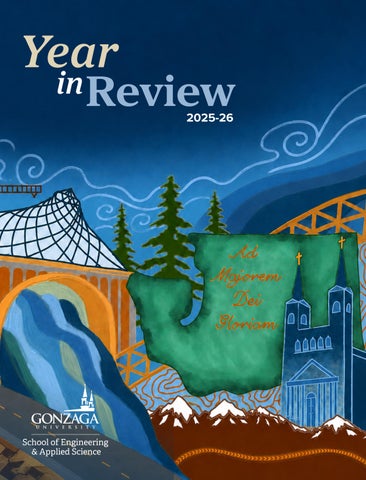
COVER ART Inland Foundations by Julia Heywood (’26). The winning design for the Structural High Bay Mural. See page 30 for more details.
2
2025–26 SEAS Annual Report
The opportunities, experiences, and innovations shared on the following pages are powered by the generosity of SEAS supporters. Join the effort with your gift today.
gonzaga.edu/give/seas
Building on Momentum: A Message from the Dean
The 2025–2026 academic year was one of remarkable momentum for the School of Engineering and Applied Science (SEAS). I was honored to be named permanent dean and grateful for the opportunity to continue serving a community grounded in Gonzaga’s Mission and defined by innovation, collaboration, and commitment to our students. This year, we celebrated investments in research, experiential learning, and industry engagement. In collaboration with the College of Arts and Sciences (CAS), we launched the Patrick Ferro Center for Materials Research (FCMR), supported by a new $1 million NIST equipment grant, and opened the Biomedical Engineering laboratories. We completed the Structural High Bay Mural, another collaboration with CAS, and the Precast Concrete Demonstration Structure. These additions bring together engineering, the arts, and hands-on learning and were made possible through the generosity and expertise of corporate partners. We expanded the Gonzaga Research Opportunities in Math, Engineering, and Computer Science (GRO-MECS) program by supporting two additional faculty research projects, which also enabled us to increase participation in the SEAS Summer Immersion Program (SSIP). We restructured leadership for our Engineering Management programs and the Center for Engineering Design & Entrepreneurship (CEDE). We also revamped the Senior Design sponsorship model to strengthen industry and community partnerships while enhancing student experiences. Our vision for growth advanced through a $500,000 grant from the Beavers Charitable Trust and matching donations to establish a professor of practice position in Construction Management. The accomplishments featured throughout this Year in Review report reflect the talent, dedication, and innovative spirit of faculty, staff and students. Looking ahead, we will develop a SEAS Strategic Plan, complete the ABET accreditation renewal process for six programs, and prepare for Gonzaga’s next capital campaign. These efforts will position us to expand in construction management, materials, cybersecurity, and other emerging fields while continuing to invest in faculty, facilities, partnerships, and student experiences. I am excited about what we will build together.
Jennifer N. Shepherd, Ph.D.
Dean, School of Engineering and Applied Science
2025–26 SEAS Annual Report
3
#1
IN THE NORTHWEST
#21 #14 NATIONAL RANKING
CIVIL ENGINEERING
OVER
Engineering programs without doctorates, 2026 U.S. News and World Report
800 SEAS STUDENTS
91%
SEAS STUDENTS FINISH IN 4 YEARS
SUCCESS RATE
96%
Six months after graduation
74% SEAS STUDENTS COMPLETE AN INTERNSHIP
89%
SENIORS PASS FUNDAMENTALS OF ENGINEERING EXAM Based on first attempt
Our Mission Produce broadly educated and capable engineers and computer scientists who are ready to contribute innovative solutions for a better world, guided by Catholic, Jesuit and humanistic values, a commitment to the whole person, and a focus on social responsibility and ethical leadership.
4
2025–26 SEAS Annual Report
Innovation for the Common Good
The Human Impact of Engineering Lived Out in Hillyard On paper, the Market/Haven Two-Way Street Conversion was a transportation engineering project. Four Gonzaga civil engineering students were asked to determine whether a one-way couplet through Spokane’s Hillyard neighborhood could become a safer, welcoming two-way corridor. Working with the Northeast Public Development Authority and the City of Spokane, the team analyzed traffic and crash data, developed models, reviewed roadway standards, engaged community stakeholders, and recommended a design meeting operational and safety goals. Their feasibility study can now support grant applications. The project also earned national recognition and Gonzaga’s top Senior Design award in Civil Engineering. The project grew from nearly a decade of relationshipbuilding in Hillyard through Gonzaga’s place-based community engagement efforts and Center for Community Engagement. Faculty participated in neighborhood immersions, community leaders visited classrooms, and students learned how infrastructure decisions can strengthen or weaken a neighborhood.
Students entered a relationship that was already developed by Gonzaga’s Center for Community Engagement. They listened to business owners concerned about parking, parents worried about safe crossings, and residents whose experiences did not always align with traffic reports. They learned that these perspectives were not opinions but essential data revealing transportation needs and design constraints. The team learned to translate between technical analysis and lived experience, presenting its work to engineers, city commissioners, neighborhood councils, and community boards. Young describes transportation engineering as designing “from 8 to 80,” considering children, older adults, drivers, cyclists, pedestrians, freight operators, and transit users. Although construction will depend on future funding, Hillyard now has a roadmap for change. The students gained experience navigating engineering, economics, politics, and community priorities. More importantly, they learned that successful transportation projects are not simply designed for streets. They are designed for people.
“When you walk into a community, you can’t just show up and say, ‘We’re here and we want to do this,’” said civil engineering professor Rhonda Young.
The project won a $10,000 NCEES Engineering and Surveying Education Award. Team members from L to R: Tim Schantz, Karlynn Kenny, Baila Burnam, & Alex Willis, advised by Mutasem Alzoubaidi, Ph.D., P.E. and Rhonda Young, Ph.D., P.E.
2025–26 SEAS Annual Report
5
Ribbon cutting ceremony.
Patrick Ferro Center for Materials Research Opens On February 27, 2026, Gonzaga University formally opened what is now called the Patrick Ferro Center for Materials Research (FCMR), cutting the ribbon on the second floor of the Bollier Center for Integrated Science and Engineering. Attendees included faculty, staff, students, trustees, donors, industry partners, and elected officials, including a representative from U.S. Sen. Maria Cantwell’s office. The shared-user facility, built initially around 11 instruments and a $1.75 million investment in imaging, spectroscopy and materialstesting equipment, is now fully open and ready to serve students, faculty, and industry. The name honors professor Pat Ferro, the longtime mechanical engineering professor who built Gonzaga’s reputation in materials science before his death shortly after retiring in 2024. “There was a time not long ago when you could hardly utter the word ‘materials’ in a sentence without also mentioning the name Pat Ferro,” said Harman Khare, who led the center through its buildout. President Katia Passerini and Dean Jennifer Shepherd also spoke. “Pat left such an incredible mark on Gonzaga,” Shepherd said. “He embodied our Mission.” The instruments, including a Fourier transform infrared microscope, nanoindenter, and confocal Raman microscope, are now in routine use for mechanical, thermal, and spectroscopic analysis. A scanning laser vibrometer and differential scanning calorimeter were added through a National Institute of Standards and
6
2025–26 SEAS Annual Report
Technology (NIST) grant. Windows along the laboratory walls and a slideshow outside the FCMR allow visitors to see the work underway. The shared facility is being used by Gonzaga faculty and students for research, laboratory courses, and Senior Design projects. The FCMR also serves as a regional testing laboratory. Partners such as ATC now draw on its instrumentation and expertise through work connected to the Inland Northwest’s Tech Hub for advanced aerospace materials manufacturing. We are actively recruiting new partners and have provided numerous tours to companies interested in the center’s capabilities. A second NIST grant for $1 million was recently awarded to SEAS and the College of Arts and Sciences that will allow purchase of additional equipment over the next year, further expanding the center’s capabilities. It is a long way from the unfinished laboratory space featured in the 2024-25 edition of the SEAS Year in Review report, demonstrating that Gonzaga’s investment in materials science has moved from blueprint to bench.
Learn more about the FCMR
gonzaga.edu/fcmr
Khare Receives NSF CAREER Award and is Appointed FCMR Faculty Director Harman Khare, Ph.D., associate professor of mechanical engineering and faculty director of the Patrick Ferro Center for Materials Research (FCMR), is the first SEAS faculty member to receive the prestigious National Science Foundation Faculty Early Career Development (CAREER) Award. The five-year, $548,632 award will support Khare’s research on the predictive design of low-wear polymer composite materials. By examining how fillers, polymers, and surfaces interact across length scales, his team aims to develop materials that reduce friction, conserve energy, and prevent mechanical failure, with potential applications in aerospace, automotive, biomedical, and manufacturing fields.
Harman Khare works with students in the FCMR Lab.
Khare also directs Gonzaga’s Tribology Research Laboratory, where he has mentored dozens of undergraduate researchers. As FCMR faculty director, he oversees the center’s research strategy and network of faculty and student collaborators. He guided the FCMR through construction and its formal opening, first as acting director and now in his current leadership role, helping establish the center as a hub for interdisciplinary materials research.
Bollier Center 238 Lab.
FCMR Lab Manager Scott Economu has managed scientific infrastructure for over a decade. At Gonzaga’s FCMR, he maintains sensitive, high-precision instrumentation for measurements. He also assists professors and students with complex materials science testing. Economu brings the same meticulous care and exacting standards to the Department of Chemistry & Biochemistry, drawing on years of advanced equipment maintenance experience to keep Gonzaga’s laboratories running smoothly and accurately.
Scott Economu 2025–26 SEAS Annual Report
7
Kira Cowell (’26)
Kira Cowell
From Baking to Building Systems at McKinstry Before becoming an HVAC design engineer, Kira Cowell (mechanical engineering, ’26) spent 20 years in the baking industry, including 16 years as a cake decorator. When she was ready for a new challenge, she discovered that engineering offered the creativity and problem-solving she had always enjoyed. Cowell believes a fulfilling career requires work you love, people you want to work with, and people you want to work for. “I cannot relate to all the memes about hating Mondays because I want to be here,” she said. “I think I knew immediately what I had and that I wanted to stay.” Cowell first encountered McKinstry by attending Gonzaga career fairs beginning her freshman year. The internship offered technical experience, mentorship, and a professional community. She participated in site tours, professional development sessions, and conversations with employees who had turned internships into careers. During her senior year, Cowell continued her internship and joined a McKinstry-sponsored Senior Design team. The multidisciplinary team analyzed building 8
2025–26 SEAS Annual Report
loads and designed a battery storage system for solar panels at a McKinstry manufacturing warehouse. The project prepared her for her work by using many of the calculations and software tools she now applies every day. Cowell also found a culture that reflects Gonzaga’s commitment to cura personalis, or care for the whole person. McKinstry employees participate in professional alliance groups, community service, and social activities. Nearly half of Cowell’s 14-person engineering team in Spokane are Gonzaga alumni, creating a supportive network. Now a full-time HVAC design engineer in McKinstry’s Spokane office, Cowell encourages students to explore careers early, ask questions, and seek mentors. Her journey demonstrates how internships and industrysponsored projects can ease the transition from college to career, helping students understand where their education can lead and build the confidence to pursue work where they can thrive.
New McKinstry Gateway Scholars Program Creates a Clear Path from Education to Employment The most important bridge an engineer crosses may not be built of steel or concrete but designed by universities and employers working together.
Gonzaga University and McKinstry share a city, a community, and a commitment to building a better future. Through the McKinstry Gateway Scholars Program, they are creating an intentional, multiyear pathway from engineering education to professional practice.
Spokane Gateway bridge
“Engineering education has never been just about transferring technical knowledge,” says Jennifer Shepherd, Ph.D., dean of Gonzaga’s School of Engineering and Applied Science. “Our responsibility is to help students become professionals who can lead, collaborate, and solve problems that do not come with textbook answers. The program’s use of ‘Gateway’ reflects the belief shared by Gonzaga and McKinstry that preparing engineers is a shared responsibility.” Beginning in their first year, students explore engineering careers and the built environment. As sophomores, selected scholars join a cohort centered on mentorship, advising, and professional development. Their industry engagement deepens each year, culminating in paid internships within McKinstry project teams and preferred consideration for full-time employment. In this model, an internship is not the destination but one milestone in a longer process of professional formation. Students build sustained relationships with faculty, practicing engineers, mentors, and project teams. McKinstry gains opportunities to coach students, observe their growth, and invest in future professionals well before hiring decisions are made. The Gateway Scholars Program moves beyond the traditional idea of a talent pipeline, which can suggest moving students toward a single destination. Instead, it creates an ecosystem in which faculty expertise,
authentic workplace experiences, mentorship, scholarships, and career exploration reinforce one another. By connecting these experiences, Gateway helps students develop technical competence, adaptability, collaboration skills, and professional identity. It also recognizes that the transition from education to employment deserves the same thoughtful design as the engineering curriculum itself.
Learn more about the McKinstry Gateway Scholars Program:
gonzaga.edu/gateway
2025–26 SEAS Annual Report
9
“How Might We?”
Heather Rosentrater on Engineering the Energy Future When Heather Rosentrater (’99) faces a challenge without an obvious solution, she asks a simple question: “How might we do that?” That curiosity has guided her journey from Avista Corp. intern to president and CEO. In February, Rosentrater delivered the School of Engineering and Applied Science’s Renouard Lecture during National Engineers Week. As the first female CEO in Avista’s 136-year history, she reflected on her career and the challenges facing the company, which provides electric and natural gas service to more than 1.5 million people. Rosentrater began working on fuel cells at Avista, then Washington Water Power, while studying engineering at Gonzaga. Applying classroom theory in the workplace, she said, kept her focused on her studies and showed the value of experiential learning. Today, the energy industry faces what Rosentrater called a “trilemma”: developing systems that are affordable, clean, and reliable. Changing technology, growing demand, and extreme weather require utilities to plan differently and build flexibility into the grid. “We can’t look back anymore and expect to be able to predict what we’re going to see moving forward,” she said.
Heather Rosentrater (’99) Potential solutions include microgrids, such as the resiliency hub at Spokane’s Martin Luther King Jr. Family Outreach Center, and the Scott Morris Center for Energy Innovation, where researchers can simulate and evaluate grid performance. Progress requires balancing experimentation with the reliability customers expect. Rosentrater credited Gonzaga with providing a foundation in service, critical thinking, and respectful dialogue across differing viewpoints. She also emphasized the value of industry partnerships and internships. Avista now engages students from engineering, cybersecurity, and other STEM fields in research and innovation addressing challenges. “We are blown away with the kind of work that they’ve been able to do and the new eyes they bring,” Rosentrater said. “We are so much better because we learn from them.”
Are you looking to advance your career in the power industry?
Meet distribution engineer Silvia Garcia who recently completed Gonzaga’s online Master in Transmission and Distribution while working full time and raising her children. For her, the degree represents the discipline and perseverance required to deepen her expertise and help build a stronger electrical grid for future generations. Read Sylvia’s story and learn about the T&D program:
gonzaga.edu/tadp Sylvia Garcia 10
2025–26 SEAS Annual Report
Gonzaga Faculty and Students Explore Research at PNNL Faculty and students from Gonzaga’s School of Engineering and Applied Science and College of Arts and Sciences traveled to Pacific Northwest National Laboratory (PNNL) in Richland, Washington, to explore opportunities for research and collaboration. PNNL staff led tours of the Environmental Molecular Sciences Laboratory and Energy Sciences Center, introduced
current work in data science and artificial intelligence, and shared information about internships and careers. The visit offered participants a firsthand look at research conducted within a national laboratory and strengthened connections between Gonzaga and PNNL. Beth Norris, Bill Pike, Erin Searcy, and Debbie Gracio from PNNL made the visit possible.
A Gonzaga Legacy of Connection and Opportunity Ed and Bernadette “Bunny” Renouard, both members of Gonzaga’s Class of 1959, have remained deeply connected to the University and to the lifelong friendships they formed as students. Ed earned a degree in mechanical engineering, while Bunny studied education.
Through their generosity, Ed and Bunny hope today’s students will build the same lasting friendships and sense of belonging they experienced at Gonzaga, while creating new opportunities for current and future Zags.
After graduation, Ed built a 40-year career with The Boeing Company. Known for his strong people skills and ability to solve complex operational challenges, he advanced through a number of prominent leadership roles before retiring in 1999 as vice president of Boeing’s Everett site.
A Gonzaga Legacy of Connection and Opportunity
The Renouards’ enduring connection to Gonzaga has inspired them to support scholarships, Gonzaga Athletics, and the Ed and Bunny Renouard Distinguished Lecture Series in the School of Engineering and Applied Science. The series, highlighted on the previous page, gives students, faculty, and staff exceptional opportunities to learn from leaders in engineering and computer science. 2025–26 SEAS Annual Report
11
Engineering Management Programs Offer Distinct Leadership Pathways In 2026, SEAS strengthened its engineering management programs by dividing leadership into two roles: an undergraduate director and a graduate director. The change recognizes that these distinct programs serve students at different stages of their professional development. The undergraduate program prepares entry-level professionals to work across engineering and business functions. Built on an ABET-accredited engineering foundation, it develops the commercial literacy needed to collaborate with both technical and business teams.
strategic planning, and technology advocacy. Electives in business and organizational leadership add important people-centered perspectives. Each program provides a tailored pathway for engineers to lead projects and guide innovation with technical competence, sound judgment, and attention to people.
The online Master of Engineering Management is geared towards mid-career professionals seeking to advance into leadership roles. Its asynchronous courses build expertise in systems, decision-making,
Explore our Master of Engineering Management:
gonzaga.edu/mem
New Engineering Management Leadership Engineering Management Undergraduate Director
Brooke Colburn, M.S.
Brooke Colburn brings an extensive background in complex systems, emerging technology, and engineering management to her work. She holds a bachelor’s degree in mechanical engineering from Walla Walla University and a master’s degree in aeronautics and astronautics from Stanford University. Her early career included developing planetary probes at NASA’s Jet Propulsion Laboratory and simulating navigation systems at Northrop Grumman. She then pivoted into autonomous systems and technical leadership. She successfully managed engineering teams in Spokane—leading hypersonic blasting development at HyperSciences—before managing autonomous vehicle software testing teams for Cruise.
Engineering Management Graduate Director Elizabeth Gibson brings 20 years of experience as an accomplished educator, scholar, and engineering manager to her courses at Gonzaga. Her experience in the fields of computer chip manufacturing and, most recently the space industry, brings a unique perspective to engineering management. Gibson’s academic credentials include a Ph.D. in engineering technology management from Portland State University, a B.S. in electrical engineering from Michigan State University and an M.S. in mechanical engineering from Colorado State University. Gibson is a recognized authority in the field as a published author, a recent associate editor for an IEEE journal and as a certified Engineering Management Professional (EMP).
12
2025–26 SEAS Annual Report
Elizabeth Gibson, Ph.D.
Biomedical Engineering is Meeting the Moment Gonzaga’s Biomedical Engineering program is growing, and research opportunities are expanding. Two new faculty members, Kerry Lane, Ph.D., and Nathan Zavanelli, Ph.D., are engaging students in research that demonstrates the breadth of this diverse and rapidly evolving field. Both led faculty-mentored projects through the GRO-MECS undergraduate research program in summer 2026. Lane’s work lies at the intersection of engineering and cancer biology. While traditional cancer research often focuses on genetic mutations and chemical pathways, Lane studies mechanobiology, exploring how the physical environment surrounding cancer cells influences their growth and behavior. Because tumors can cause tissue to become stiffer, her team recreates different physical environments in the laboratory and studies how epithelial ovarian cancer cells respond. The research could ultimately contribute to new approaches for slowing or preventing metastasis. Working alongside Lane last summer were biomedical engineering student Maura West and mechanical engineering student David Walz. Through the project, they gained hands-on experience in laboratory techniques, microscopy, and digital image analysis. In Gonzaga’s new Smart Bioelectronics Lab, Zavanelli and his students are developing soft, skin-like wearable electronics that could transform how health is
Kerry Lane and her students view cell protein patterns in a microscope.
monitored. Dillon Kamin, James Grout, and Arisa Cunningham are designing a stretchable heart monitoring patch, and Jordan Baumgartner, Max Knight and Andrew Metcalf are using specialized 3D printing technology to print electronic circuits directly onto soft, flexible materials. Their work builds on Zavanelli’s research developing a nanomaterial ink that is instantly conductive and self-healing, allowing complex, multilayer flexible circuits to be printed in minutes, even on curved surfaces. His research recently received additional support through a $50,000 SEMI FlexTech grant. Together, these projects illustrate the interdisciplinary nature of biomedical engineering, drawing from mechanical and electrical engineering, biology, and the health sciences. From understanding how cancer cells respond to their physical surroundings to creating next-generation wearable health technologies, Gonzaga faculty and students are approaching very different challenges with a common purpose: applying engineering to improve human health.
Nathan Zavanelli and his students preparing circuits. 2025–26 SEAS Annual Report
13
A Growing Culture of Discovery: GRO-MECS Expands Summer Research Opportunities
The Gonzaga Research Opportunities in Math, Engineering and Computer Science (GRO-MECS) program provided 12 Gonzaga students with an intensive, 8–10-week summer research experience under the guidance of six faculty mentors in the School of Engineering and Applied Science. Selected from a highly competitive pool of approximately 70 applicants, students investigated topics ranging from wildfire impacts on drinking water systems and hydrodynamic thrust bearings to printed medical electronic patches, cancer cell modeling, emotion recognition, and aluminum thermomechanical processing. Faculty-led research gives undergraduates the opportunity to contribute to the creation of new knowledge while developing skills that extend beyond the classroom. Each GRO-MECS team began with intensive, hands-on guidance from a faculty mentor before progressing to the design and execution of independent experiments.
Student in the Lane Biomedical Engineering Lab preparing cell samples for microscopy.
Students preparing water samples for testing in the Shimabuku Lab. 14
2025–26 SEAS Annual Report
A student in the Lutfullaeva Lab explains hydrodynamic thrust bearing physics.
Through this immersive work, students strengthened their critical thinking, creativity, and problem-solving skills while gaining a deeper understanding of complex concepts and the real-world significance of their research. All six teams produced results that they summarized in formal written reports and will present at conferences during the academic year. Students also delivered multiple research talks during weekly group lunches, creating opportunities for constructive dialogue and questions from fellow students and faculty.
Nathan Zavanelli, Ph.D., served as the GRO-MECS faculty coordinator.
process. Seeing that failure is simply part of the process, something to learn from and try again, that was actually kind of fun.” The program further connected participants with Gonzaga alumni and industry leaders, who shared professional experiences spanning national laboratories, major corporations, robotics startups, and international nongovernmental organizations.
Sam Allen, rising junior in Computer Science working with assistant professor Sophina Luitel, Ph.D.: “This experience taught me about the whole research
GRO-MECS students and laboratories also supported the Research Immersion component of the SEAS Summer Immersion Program, introducing a cohort of female high school students from across Washington to the excitement and possibilities of engineering and applied science research.
Python coding in the Luitel Lab.
Printing circuits in the Zavanelli Lab 2025–26 SEAS Annual Report
15
SSIP students measuring viscosity of household liquids. 16
2025–26 SEAS Annual Report
Cultivating Curiosity The SEAS Summer Immersion Program Expands Access and Inspires Future Engineers Gonzaga University’s SEAS Summer Immersion Program (SSIP) is helping high school students explore engineering and computer science while strengthening their connection to Gonzaga. Launched five years ago through donor support, SSIP was designed to encourage more young women to pursue engineering, particularly students from rural Washington who may have limited access to STEM coursework. Full scholarships and travel grants make the residential program accessible regardless of financial circumstances.
Students building robots.
In 2025, SSIP shifted from a single design project to a research-centered model. Participants now rotate through laboratories, conduct hands-on investigations, and present their findings to their families at a concluding research symposium. The new approach connects SSIP with Gonzaga Research Opportunities in Math, Engineering and Computer Science (GRO-MECS), a facultyled undergraduate research program launched in 2025. GRO-MECS students serve as mentors, helping participants see that research is approachable and that scientists and engineers develop their expertise over time.
SSIP student learning soldering from Daniel Clark, Cadwell Maker Center coordinator
Continued
SSIP students spent an evening in downtown Spokane for some teambuilding and ice cream. 2025–26 SEAS Annual Report
17
Cultivating Curiosity, continued The two programs have grown together. GRO-MECS expanded from four faculty-led projects in 2025 to six in 2026, while SSIP increased from 16 to 18 students. The impact is also evident in enrollment: four participants from the 2025 SSIP cohort will begin at Gonzaga in fall 2026. For some students, the experience opened entirely new possibilities. One participant shared that she learned research was “not as scary” as she had imagined. Another discovered an interest in biomedical engineering after gaining hands-on exposure to the field. Both SSIP and GRO-MECS depend entirely on donor support. SEAS hopes to establish an endowment to sustain undergraduate research, preserve full SSIP scholarships, and ensure that future students can continue discovering their potential through these transformative summer experiences.
Students experimenting in the transportation lab with Rhonda Young, Ph.D., P.E.
Student preparing polymer mixtures in the Zavanelli Smart Electronics Lab.
Power Innovation with an investment in student development through GRO-MECS.
gonzaga.edu/give/seas Students testing tensile strength of metals in the Weber Materials Lab. 18
2025–26 SEAS Annual Report
GRO-MECS students supported the SSIP Research Symposium where all six groups presented results from their research rotations. All SSIP students participated in the presentations as an exciting conclusion to the week.
Summer 2026 SSIP and GRO-MECS participants, faculty mentors, and support staff.
2025–26 SEAS Annual Report
19
Spokane’s Largest Cybersecurity Event Returns Home Computer Science alumnus Max Dulin (’19) created the Spokane Cyber Cup after recognizing that many local students were unaware of cybersecurity careers and lacked hands-on learning opportunities. His goal was to make the field approachable and inclusive for students. Gonzaga hosted the sixth annual Capture the Flag competition in February, bringing the event back to the campus where it began. Participation has grown from approximately 60 competitors at the inaugural event to 255 students in 2026. Fifty-eight beginner and advanced teams represented 13 colleges and three high schools, supported by 25 industry coaches from Amazon, Microsoft, Meta, and local technology firms.
Max Dulin (’19)
The growth reflects Dulin’s vision for an event focused on community and learning rather than identifying the strongest competitors. “Most competitions are about who’s the best,” he said when launching the event. “I wanted this to be about learning.” Challenges tested technical knowledge, creativity, persistence, and independent problem-solving. Students completed activities ranging from digital security puzzles to opening a physical lock with lock-picking tools, demonstrating that cybersecurity extends well beyond software. Competitors also worked without artificial intelligence tools, encouraging them to rely on their own knowledge, strengthen their analytical abilities, and develop the confidence to solve unfamiliar problems independently.
20
2025–26 SEAS Annual Report
Cyber Cup participants.
The Gonzaga Difference:
Students, Innovation, and a Commercial Opportunity What began as simply a “what-if” idea for students to explore as part of their curricular work evolved into a formal Senior Design project in 2025-26, and now a promising commercial opportunity and expanded partnership with cybersecurity leader ArmorText.
the technical excellence and integrity that inspire confidence in the next generation of cybersecurity professionals. That’s why we’re expanding our partnership with Gonzaga and sponsoring three additional Senior Design projects this year.”
Sponsored by ArmorText, Project Grimace challenged students to address a real-world problem facing security teams: how to efficiently evaluate large volumes of open-source intelligence while maintaining confidence in AI-generated insights. The resulting platform helps analysts prioritize intelligence based on organizational needs, identify relevant tactics, techniques and procedures, indicators of compromise, and review automatically generated eviction strategies and remediation recommendations.
While the platform is still being refined, ArmorText is exploring additional investment to bring it to market. The success of Project Grimace highlights what makes Gonzaga engineering and computer science so distinctive: student potential is guided by faculty expertise in collaboration with industry partners. The results are clear: students gain transformative professional experiences, organizations benefit from innovative thinking, and new ideas built on trust and ethical decision-making move closer to creating a realworld impact.
Its most distinctive feature is a built-in mechanism that evaluates the reliability of its own AI-generated output. By providing analysts with a confidence assessment, the platform encourages greater transparency around the strengths and limitations of artificial intelligence, helping users determine when additional validation may be needed. For Navroop Mitter, CEO of ArmorText, the focus on integrity and building trust is what makes this project stand out. “We look for innovative thinkers who can translate complex ideas into practical solutions,” Mitter said. “The Gonzaga team delivered exactly that: a solution with meaningful commercial potential, along with
Data Science Connects Coursework, Ethics, and Biomedical Research For Dillon Kamin, an M.S. in Data Science student, Gonzaga offers the rare ability to pursue rigorous, interdisciplinary studies focused on ethical considerations, within a close-knit academic community. The program’s small cohort has helped Kamin build relationships with classmates and faculty, while real-world projects let him explore topics and connect coursework to cutting-edge research. “Every professor I’ve had or interacted with has been a fantastic mentor,” he said. In Nathan Zavanelli’s Smart Bioelectronics Lab, Kamin helps develop a “smart patch”
Project Grimace Team from L to R: Ritchie Fu, Mark Sanghera, Cody Kesselring, & Gabriel Hoing.
that uses heart signals to predict changes in a user’s emotional state, aiming to support caregivers of people with dementia or nonverbal individuals. Kamin collects and visualizes data, performs signal processing, and develops machine-learning models for analysis. Lab discussions spark research ideas, while coursework in data science ethics sharpens his thinking on the technology’s implications. Kamin plans to pursue a Ph.D. and apply data science to biomedical research.
Explore Data Science & AI Master’s Program:
gonzaga.edu/msds
2025–26 SEAS Annual Report
21
New Senior Design Leadership
Last year, leadership for the Center for Engineering Design and Entrepreneurship (CEDE), which oversees the Senior Design Program, was restructured. Because the full-time CEDE program manager position had been difficult to staff, SEAS created two part-time roles to share responsibility for the Senior Design portfolio: a faculty director and a program coordinator. We also revised the sponsorship model to better support program costs. Through Senior Design, industry and community partners gain access to practical engineering prototypes, direct student recruitment opportunities, and cost-effective solutions to real-world challenges.
Sue Niezgoda, Ph.D., P.E.
CEDE Faculty Director
CEDE Program Coordinator
For the past decade, Sue Niezgoda has served as the civil engineering capstone coordinator, leading senior design efforts and working closely with sponsors, advisors, and students to deliver impactful real-world engineering projects. She has also advised more than 15 capstone teams. She is passionate about creating meaningful learning experiences and building strong partnerships among students, faculty, industry sponsors, and community organizations. As faculty director, she is excited to help shape CEDE’s future by advancing hands-on, client-focused learning and fostering collaboration, innovation, and student success across engineering disciplines.
Krystal Vergine Frias joined the School of Engineering & Applied Science Senior Design program summer 2026 after four years with the Sociology, Criminology & Political Science departments in the College of Arts & Sciences. A lifelong Spokanite, Krystal has her BA in Humanities from Whitworth & 15 years experience working in medical administration prior to becoming a Zag. She is excited to strengthen community partnerships and provide engaging, rewarding experiences for our engineering students in this new role.
Get Involved with Senior Design Gonzaga’s Senior Design program is required as the capstone project for all fourth year SEAS students. In addition to the Faculty Director, Program Coordinator and individual Sponsor Liasons, student teams are supported by the Design Advisory Board, a volunteer group of professional engineers who lend their expertise to the students. If you would like to get involved, please reach out.
22
Krystal Vergine Frias
2025–26 SEAS Annual Report
Get involved with the Senior Design program:
gonzaga.edu/cede
Senior design team members from L to R: Jack David, Ashton Bischoff, Ryan Spuck, and Luke Alfonso.
Selkirk-Sponsored Senior Design Project
Advances Pickleball Innovation Four Gonzaga mechanical engineering seniors partnered with Selkirk Sport to explore pickleball paddle design through a sponsored Senior Design project. Luke Alfonso, Ashton Bischoff, Jack David, and Ryan Spuck were challenged to create functional prototypes using innovative materials while meeting performance standards. Working with Selkirk engineers, the team moved through research, design, manufacturing, and testing in a professional setting. Selkirk provided mentorship, technical guidance, specialized equipment, and significant freedom to experiment. “Selkirk had a rough goal they wanted us to achieve and left us a lot of room to get creative,” Spuck said. “This led to us designing a total of 13 paddles, all with a different material composition and performance.” The students tested carbon fiber, fiberglass, and Kevlar to evaluate power, control, and durability. They also explored different foam densities and “floating core” concepts intended to enlarge the paddle’s sweet spot
and improve responsiveness. Prototypes underwent deflection measurements and structural testing aligned with governing standards. Collaboration with the Gonzaga Pickleball Club added another important dimension. Playtesting allowed the team to combine technical data with user feedback, helping students refine their designs. Several prototypes met or exceeded key benchmarks, while standout designs achieved a strong balance of power and control. Beyond producing functional paddles, the project strengthened the students’ skills in teamwork, project management, manufacturing, communication, and adaptation. Their work provided Selkirk with prototypes and insights for future product development while giving the students experience transforming engineering concepts into products that people could test, enjoy, and potentially bring to market.
2025–26 SEAS Annual Report
23
Gonzaga in Delft students, 2026.
Gonzaga in Delft 2026:
Bringing Dutch Civil Engineering Innovation Home to Spokane The 2026 Gonzaga in Delft: Sustainable Cities Study Abroad program challenged civil engineering students to explore how sustainable solutions from the Netherlands could help address real challenges facing Spokane. For three weeks abroad, students immersed themselves in Dutch transportation systems, water management strategies, and structural design practices before developing projects aligned with Spokane’s Sustainability Action Plan. The faculty-led program brought together students and faculty with expertise in transportation, water resources, environmental engineering, construction materials, and structural design to learn alongside each other. Their final projects translated Dutch lessons into practical recommendations for Spokane. Students proposed green parking systems to improve stormwater infiltration, protected bicycle routes connecting Gonzaga University with downtown Spokane and Kendall Yards, and a Rotterdam-inspired neighborhood scorecard to guide future investments in transportation, public spaces, and community development. These ideas were shaped by field experiences. While studying social sustainability in Rotterdam, students explored neighborhoods by bike
24
2025–26 SEAS Annual Report
and evaluated how infrastructure influences safety, community interaction, and quality of life. One student noted that navigating the city included “having to bring our bikes on escalators to access a bike-only tunnel under the river,” highlighting how integrated cycling is into daily Dutch life.
Learning about the canal systems to build cities below sealevel.
Students were equally impressed by innovative approaches to climate resilience. After visiting Rotterdam’s famous water square, one student remarked that it was fascinating to see a space that “works as both a public gathering place and a waterstorage facility,” demonstrating how infrastructure can serve environmental and social purposes simultaneously. In Rijswijk, students observed the transformation of a community once designed around automobiles. As one student reflected, “ seeing how a city built for cars was redesigned to prioritize biking and public transit made us think differently about what’s possible back home in Spokane.“ By combining technical analysis with firsthand experience, Gonzaga students returned home with innovative ideas for Spokane and a deeper appreciation for the role engineers play in creating sustainable, resilient communities. Gonzaga in Delft is offered by the Civil Engineering Department every
Experiencing the transportation system by bicycle.
other summer. The 2026 class was the fourth offering, and the program now has 66 civil engineering and engineering management alumni.
More Engineering Across Borders: From Berlin to Florence SEAS students can take their studies beyond campus through programs designed to combine academic progress with cultural experiences. A three-week summer program in Berlin invites students to explore information warfare, the history of computing, and the role of information in society. Coursework examines how technology shapes geopolitics, statecraft, espionage, and data collection. Visits to the German Spy Museum, Museum of TechnoGermanlogy, Berlin Wall, and historic sites turn the city into an extension of the classroom.
Gonzaga in Florence, the University’s flagship study abroad program and global hub, has offered immersive education for more than 60 years. The spring program is well suited for students in mechanical engineering, civil engineering, engineering management, and biomedical engineering. A SEAS faculty member teaches Dynamics and Mechanics of Materials, while a mathematics professor offers math courses. This course planning allows engineering students to experience life and learning in Florence while remaining on track for graduation.
Students at the Brandenburg Gate in Berlin.
A view from the Piazzale Michelangelo in Florence. 2025–26 SEAS Annual Report
25
Student Clubs and Activities
Engineering and computer science students don’t just attend classes—they build, lead, and innovate through vibrant clubs and professional chapters. These groups are powerhouses for learning, skill-building, and making a real impact on campus and beyond. Here are some of the standout activities and milestones our students achieved recently. SEAS Clubs: gonzaga.edu/seasclubs
Holy Rollers Compete at Baja SAE Oregon Gonzaga’s Baja Society of Automotive Engineers (SAE) Club, the “Holy Rollers,” competed at Baja SAE near Portland in May. Students spent the year designing, fabricating, and testing HR7, an off-road vehicle. Led by Owen Munger and Logan Ridgeway, groups developed the chassis, drivetrain, suspension, brakes, and steering using computeraided design, machining, welding, testing, and project coordination. Gonzaga placed 52nd of 77 teams overall, including 18th in business presentation, 40th in design, and 50th in acceleration. The team completed two endurance-course laps before poor track conditions forced its withdrawal. The experience strengthened students’ technical abilities, leadership, resilience, and teamwork.
ASCE Concrete Canoe Team Earns Top Regional Honors Gonzaga’s American Society of Civil Engineers (ASCE) Concrete Canoe Team earned second place overall in the Pacific Northwest regional competition in Seattle, including firstplace honors for its technical presentation and final prototype. Students spent the year designing, constructing, documenting, and testing a concrete canoe built to float and race. The studentrun project required continual problem-solving and coordination. Led by Rebecca Riley and Isabella Camarota, the team combined a strong work ethic with a positive spirit. Through the experience, students strengthened their technical knowledge, teamwork, leadership, and project-management skills while preparing for engineering careers.
SAMPE Club Builds Composite Materials Expertise Gonzaga’s Society for the Advancement of Material and Process Engineering (SAMPE) Club competed in bridge and pickleball paddle competitions at the 2026 SAMPE Conference and Exhibition in Seattle. For the Student Bridge Competition, university teams designed and tested lightweight composite structures. Students gained experience designing, laying up, and testing carbon-fiber beams, strengthening skills relevant to structural and mechanical engineering. Participation was supported by a $1,000 student chapter grant from SAMPE North America and travel funding from the Seattle SAMPE chapter.
26
2025–26 SEAS Annual Report
Hackathon Inspires Collaborative Problem-Solving Gonzaga’s Association for Computing Machinery (ACM) hosted its annual Hackathon on November 8, 2025, bringing together approximately 40 students from Gonzaga and regional schools. Led by club president, Orion Hess, and faculty advisor, Luke Johnson, Ph.D., the 10-hour competition challenged teams to develop innovative solutions to problems or advance technology ideas. Throughout the day, participants refined their concepts with guidance from mentors representing Gonzaga’s computer science faculty and industry. The event gave students opportunities to apply technical skills, collaborate under time constraints, build connections, and explore creative approaches to computing challenges.
Beavers Charitable Trust Introduces Students to Heavy Civil Construction Eleven Gonzaga civil engineering students explored heavy civil construction during the annual Beavers Student Day, sponsored by the Beavers Charitable Trust. The group toured Seattle’s Portage Bay Bridge and Roanoke Lid project, a $1.4 billion initiative led by Skanska USA Civil for the Washington State Department of Transportation. Students observed temporary work-access platforms and early bridge
construction while learning about the scale, coordination, and technical challenges of major infrastructure projects. Designed to meet modern seismic-resilience standards, the project includes two parallel bridges and improvements for transit, carpools, pedestrians, and bicyclists. John Bollier, retired CEO of Stacy and Witbeck and Dave Woods, executive director of Beaver’s, Inc. organized the experience.
2025–26 SEAS Annual Report
27
Expanding Partnership
From Capstone Project to Campus Legacy: A Precast Partnership to Build Future Engineers
What began as a Gonzaga University Senior Design project is now a permanent engineering education resource. Completed in August 2026 near Lake Arthur, the Precast Concrete Demonstration Structure showcases the versatility of precast construction while educating future architects and engineers. The project began in 2019–2020 through a partnership among Gonzaga, Knife River Prestress, Inc. (KRPI), and industry professionals. Guided by Senior Design advisor Melissa Verwest, P.E., now senior director of sustainability programs at National Ready Mix Concrete Association, the first civil engineering student team developed the conceptual design, structural calculations, erection drawings, and site layout. During 2020–2021, a second team refined the structural design, completed member and connection details, produced fabrication drawings, and incorporated educational features. Although the design was complete, the project remained on hold until 2025, when SEAS dean Jennifer Shepherd worked with leadership and industry partners to secure a campus location and advance fabrication and installation.
The project immersed students in the complete precast design process. In addition to gravity and lateral loads, they considered lifting, transportation, erection, connection detailing, and manufacturing requirements. Working with architects, structural engineers, precast producers, and contractors gave students firsthand experience with the collaboration required in professional practice. “Being able to apply the concepts we learned in class to a real, cohesive project was the stepping stone I needed to begin my career,” said Patrick Young (’20). KRPI provided expertise, software, manufacturing guidance, and mentorship. Tina Fischer of KRPI managed construction, coordinating production and erection with Precision Precast Erectors, Rhodes Crane, Sevy’s Trucking, Garco Construction, Corridor Contractors, and Architectural Polymers. Merit Electric installed a light and outlet in the structure. A ribbon cutting ceremony was held on August 31, 2026. The structure now serves as an outdoor classroom where students can examine precast
A 3D printed model of the Precast Concrete Demonstration Structure.
Groundbreaking Ceremony on May 4, 2026 with Knife River Prestress, Inc., Melissa Verwest, Tomson Spink, and dean Jennifer Shepherd.
28
2025–26 SEAS Annual Report
Installation of floor slab.
Ribbon cutting ceremony with civil engineering alumni, Pavel Germanovich (’21), Patrick Young (’20), Davis Wright (’21), and Darien Schneider (’20), KRPI colleagues, and Gonzaga leadership. Finished structure.
member behavior, reinforcement, structural connections, constructability, architectural integration, and erection sequencing at full scale. It stands as a lasting achievement for the eight students who designed it and a model of how university-industry partnerships prepare engineering and construction leaders. The demonstration structure is one example of Gonzaga’s growing partnership with Knife River. Under the leadership of KRPI president Peter Gay
(M.A. ’03), the company invested $120,000 toward a large-scale Material Testing System for Gonzaga’s Structural High Bay Laboratory. The equipment will expand opportunities for materials testing, research, and hands-on learning grounded in real-world industry challenges. Knife River also employs Gonzaga graduates, hosts interns, and contributes to the civil engineering concrete curriculum through guest instruction and plant tours.
2025–26 SEAS Annual Report
29
Art, Engineering, and Industry Transform Gonzaga’s Structural High Bay Lab Gonzaga’s Structural High Bay Laboratory now combines engineering, regional identity, and visual art through Inland Foundations, a mural designed by civil engineering senior Julia Heywood (’26) and installed during Spring 2026. Heywood’s design was selected through a student competition judged by representatives from Civil Engineering, Art, SEAS, and Plant Operations. The mural weaves civil engineering disciplines into Inland Northwest landmarks. The primary mural spans a 24-by-12-foot wall above the laboratory’s interior doors. Complementary sections extend across the top and side of the massive concrete strong wall. Under the direction of assistant professor Jennifer Seo, nine Art students transformed the laboratory into a studio throughout the spring. Shawn Gonzales of All Wall Contracting provided safety training, erected the scaffolding, and conducted regular inspections. Industry partnerships were essential to the installation. Walker Construction assisted with funding the
Winning artist Julia Heywood with her design which is also featured on the cover with Jennifer Seo and dean Jennifer Shepherd.
scaffolding and supplied work lights, while Mallory Paint and Benjamin Moore donated paint and materials. The campus community celebrated the mural with a ribbon-cutting ceremony in May. The installation reflects a distinctive collaboration between the School of Engineering and Applied Science and the College of Arts and Sciences. It also transforms a highly technical laboratory into an inspiring learning environment that celebrates Gonzaga, the Inland Northwest, and the civil engineers who help shape the region.
Scaffolding for phase II of the painting on the top and side of the strong wall with finished mural. 30
2025–26 SEAS Annual Report
Student Achievements
Outstanding Senior Awards
Isabella Camarota Civil Engineering
Elijah Chin Computer Engineering
Cash Hilstad Computer Science
Cooper Krossa Electrical Engineering
Kellen Wang Engineering Management
Emma Iwaniec Mechanical Engineering
SEAS Outstanding Senior Isabella Camarota was selected as both the Outstanding Senior in civil engineering and the School of Engineering and Applied Science Outstanding Senior. A civil engineering major with a Hogan Entrepreneurial Leadership minor, Camarota earned a 3.92 GPA while distinguishing herself through leadership and service. She guided Gonzaga’s Concrete Canoe Team with organization, resilience, and composure, helping it earn regional honors. She also supported classmates as a peer tutor. Camarota will begin her career in water resources engineering with Anderson Perry & Associates, creating positive impacts for communities.
2025–26 SEAS Annual Report
31
Wearable Patch Team Earns Outstanding Paper An interdisciplinary team of Gonzaga researchers earned an Outstanding Paper Prize at the international SPIE Smart Structures + Nondestructive Evaluation conference in Vancouver CA. Biomedical engineering students Arisa Cunningham and James Grout, neuroscience student Karina Fluegge, and data science graduate student Dillon Kamin are developing a wearable patch that could help caregivers track emotional changes in people with dementia. Advised by Nathan Zavanelli, Ph.D. the team was recognized for the quality of their paper and exceptional poster presentation.
Honors Research Advances to International IEEE Conference Gabriel DiMartino (’26, Computer Engineering) presented peer-reviewed research at the IEEE International Midwest Symposium on Circuits and Systems in August. His paper, “NeuroMatrix: HardwareRealistic Neuromorphic Simulation Framework with Foundry-Accurate Circuit Verification,” was accepted in the Neural Networks and Neuromorphic Systems track. The project grew from DiMartino’s Gonzaga Honors Program thesis and developed into a research paper with guidance from Claudio Talarico, Ph.D., and Graham Morehead. Two other undergraduates, Michael Baker and Noah Sabra, also contributed, creating a collaborative opportunity to explore cutting-edge neuromorphic systems.
Zags in Tech: Exploring the Future of AI at IEEE Rising Stars Electrical engineering student Miguel Alcira and computer engineering student Kirk Shelton attended the IEEE Rising Stars 2026 Conference in Las Vegas. The event connected emerging engineers with industry professionals and explored topics ranging from AI hardware and data-center energy needs to technology’s role in the arts. Alcira gained insight into the connections among power, manufacturing, aerospace, and electronics, while Shelton explored how engineers can create socially meaningful solutions. Student travel to conferences is supported in part by the SEAS Dean’s Excellence Fund. Donate to SEAS Excellence:
gonzaga.edu/give/seas 32
2025–26 SEAS Annual Report
Faculty and Staff Achievements Faculty Publications Extend SEAS Impact
Paul De Palma, Ph.D., receives his 35-year service award from president Katia Passerini.
MILESTONE ANNIVERSARIES: •
Paul De Palma, 35 years
•
Marc Baumgardner, 10 years
•
Tim Fitzgerald, 10 years
•
Rhonda Young, 10 years
PROMOTIONS: John Tadrous, promotion to full professor Joshua Schultz, promotion to full professor
RETIREMENTS: Paul De Palma, Computer Science Claudio Talarico, Electrical & Computer Engineering Jim Weston, Mechanical Engineering
OTHER AWARDS: •
•
NCEES Engineering and Surveying Education Award, $10,000, Civil Engineering (Mutasem Alzoubaidi & Rhonda Young, advisors) Beavers Charitable Trust Grant, $500,000 approved for FY 27, Construction Management Professor of Practice Position (PI: Jennifer Shepherd)
FACULTY GRANTS: Nathan Zavanelli, SEMI FlexTech, $49,914 Joshua Schultz, AISC Awards (two), $65,974 Harman Khare, NSF CAREER Award, $548,632
During his sabbatical, Shawn Bowers, Ph.D., professor of computer science, published two journal articles and five conference papers while submitting seven additional manuscripts. His research explores formal argumentation frameworks and the Logica declarative programming system. This work includes collaborations with colleagues at the University of Illinois Urbana-Champaign, Google, and Cardiff University. Nathan Zavanelli, Ph.D., assistant professor of biomedical engineering, published two journal articles from his postdoctoral research and two conference papers during his first year at Gonzaga, including one co-authored with Gonzaga undergraduates. Collectively, these publications advance the capabilities of wearable electronics for healthcare applications. Zavanelli is building upon this work with undergraduate researchers in his new Smart Bioelectronics Lab. Joshua Schultz, Ph.D., P.E., professor of civil engineering, co-authored Structural Design of Lightweight Architecture, published by Routledge in January 2026. The book received the 2026 Architectural Book Award in the Technical Reports category. Through this publication and numerous invited talks during the year, Schultz is establishing a prominent voice at the intersection of sustainable design, lightweight architecture, and structural ingenuity.
$1.66M
TOTAL SEAS GRANTS RECEIVED IN FY26
22
TOTAL PEER-REVIEWED SEAS FACULTY PUBLICATIONS IN FY 26 14 SEAS FACULTY APPLIED FOR EXTERNAL GRANTS IN FY 26
$3.86M
2025–26 SEAS Annual Report
33
Three SEAS Faculty Win University Awards Three SEAS faculty members were honored at Gonzaga University’s 2026 Faculty Recognition Celebration for their contributions to students, their disciplines, and the broader University. Mechanical engineering chair and professor Marc Baumgardner, Ph.D., received the Outstanding Undergraduate Faculty Advisor Award. Students praised his availability, proactive career guidance, and commitment to staying connected with advisees in Spokane and Florence while teaching abroad. Civil engineering professor Joshua Schultz, Ph.D., P.E., received the Professional Contributions Award in recognition of his outstanding scholarship and growing influence in the field. In addition to co-authoring the award-winning book featured on the previous page, Schultz received two grants from the American Institute of Steel Construction (AISC) to advance his research. Electrical and computer engineering professor and chair John Tadrous, Ph.D., received the Teaching Excellence Award. Colleagues recognized his
organized, interactive teaching and leadership in developing Gonzaga’s robotics curriculum, including a new first-year course exploring computers, robotics, artificial intelligence, and society
Welcome New Faculty
Joshua Fleck, Ph.D.
Joshua Fleck joins SEAS as a lecturer in mechanical engineering. He earned his Ph.D. in mechanical engineering from Rice University in Houston, Texas where he worked in the Mechatronics and Haptic Interfaces Lab. His doctoral research focused on the use of haptic touch-feedback technology to provide low-cost methods of improving
prosthetic device control for the upper and lower limbs. At Gonzaga, he seeks to implement a teaching philosophy focused on project-based collaborative learning and student-led design experiences, drawing on his experience with mechatronic systems and human-robot interaction.
Help Gonzaga SEAS to recruit and retain outstanding faculty in support of Zag students with a gift to the SEAS Dean’s Excellence Fund. Donate to SEAS Excellence:
gonzaga.edu/give/seas
34
2025–26 SEAS Annual Report
Jim Weston (’77)
A Full-Circle Journey:
Jim Weston’s Enduring Gonzaga Legacy For Jim Weston (’77), Gonzaga has long felt like home. The Spokane native transferred to Gonzaga after earning a two-year business degree at Spokane Falls Community College, following in the footsteps of his father, a 1942 Gonzaga graduate and mechanical engineer. Weston discovered a passion for mechanical engineering and, after graduation, began a successful automotive engineering career with General Motors in Michigan. Weston always hoped to return to Spokane. After retiring from General Motors in 2008 and losing his wife, Eleanor, to cancer in 2014, he found his way back to Gonzaga. Teaching provided renewed purpose during a difficult season. He began with a laboratory course and joined SEAS full time in 2016 while completing a certificate in computer-aided design. Over the next decade, Weston taught courses including Introduction to Mechanical Design and Vehicle Dynamics, a senior elective he developed. He also advised the Society of Automotive Engineers Baja Team, whose students design, fabricate, and race an off-road vehicle each year.
His contributions have extended beyond the classroom. As a longtime member of the SEAS Advisory Council, Weston has offered perspectives connecting industry and academia. His practical recommendations have strengthened relationships across the School and advanced its mission. Weston’s commitment is also reflected in nearly five decades of philanthropy. His first gift came in 1977, and he later established the James and Eleanor Weston Engineering Excellence Endowed Fund and included Gonzaga in his estate plans, creating opportunities for future students. Although Weston is stepping into retirement after 10 years of teaching, he is not leaving Gonzaga entirely. He plans to continue teaching Vehicle Dynamics as an adjunct. Fifty years after first walking the halls as a student, he remains part of the Gonzaga community, encouraging students to choose work they genuinely love and make a meaningful difference through their profession.
2025–26 SEAS Annual Report
35
502 E. Boone Avenue Spokane, WA 99258-0026
MAGAZINE CONTRIBUTORS Project Manager and Designer Jennifer Shepherd Editors Sandy Hank Tracy Martin Jaunessa Walsh Additional Writers Holly Jones Jordy Jones Harman Khare Janean Schmidt Jenna Turner Rhonda Young Nathan Zavanelli Photographers Zack Berlat Juan Espinosa Hernandez