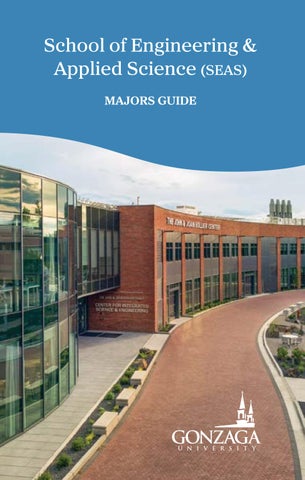
School of Engineering & Applied Science (SEAS) MAJORS GUIDE
Why Gonzaga Engineering & Computer Science? A COMMUNITY THAT KNOWS YOUR NAME
Join a close-knit community where undergraduates are the focus. Every class and lab is taught by a faculty member, so you learn directly from experienced engineers and computer scientists from day one. Gonzaga’s learning environment is built on collaboration, not competition. Faculty are invested in your growth and mentor you every step of the way. HANDS-ON LEARNING, ADVANCED LABS Learn in modern labs across the Bollier, Herak, and PACCAR centers as part of your coursework. Ready to start building as a first-year student? Get handson experience in the Cadwell Maker Center, Manufacturing Technology Center, or Ferro Center for Materials Research through clubs, competitions, or your own projects. Staff and faculty are there to guide you as you safely prototype, fabricate, and test using industry-standard tools. EMPLOYERS RECRUIT ZAGS Top companies and industry leaders recruit Gonzaga engineering and computer science graduates year after year. Past hires have shown employers that Zags arrive with real-world project experience, strong technical and communication skills, and the critical thinking and ethical discernment to lead and contribute from day one. INNOVATION WITH PURPOSE Rooted in Gonzaga’s Jesuit tradition, your education will develop the whole person, not just technical skills. You’ll learn to consider not only how to build new technology, but whom it serves and how it impacts society. That purpose comes to life in the Senior Design capstone through partnership with industry advisors and sponsors. Graduates leave ready to lead with technical excellence and a lasting commitment to the common good.
BE A ZAG!
gonzaga.edu/apply
STUDY ABROAD And still graduate on time! Take courses that count towards your degree, taught by SEAS faculty. Flagship program: Gonzaga in Florence in spring of sophomore year. Short summer courses in Germany and the Netherlands count as certain technical electives. Partner institutions offer engineering and computer science courses including popular programs in Auckland, Limerick, and Madrid.
REAL-WORLD EXPERIENCE Apply technical knowledge and practice teamwork, project management, and public speaking in Senior Design—a year-long, small team experience for real clients.
Learn more at
gonzaga.edu/cede
FOLLOW US ON INSTAGRAM
@gonzaga.seas
Biomedical Engineering DESIGN TECHNOLOGY, IMPROVE HEALTH CARE Biomedical engineers create lifechanging technologies, from prosthetics and imaging systems to wearable devices and medical diagnostics. Gonzaga’s Biomedical Engineering program blends engineering and computer science with biology, human physiology, and biochemistry, making it one of our most interdisciplinary degrees. Students begin engineering design coursework in their first year and complete a two-semester, industry-sponsored Senior Design project that tackles a real healthcare challenge. In their junior and senior years, students specialize through electives in areas like: • Biomechanics • Biomaterials • Biomedical instrumentation The Biomedical Engineering Laboratory Suite houses a new teaching laboratory, tissue culture room, and faculty research labs where students are encouraged to put theory into practice. Graduates are prepared for careers in hospitals, labs, manufacturing, start-ups, and more, or to continue on to medical, dental, or graduate school.
gonzaga.edu/biomed Brandon Sargent
Director, Assistant Professor sargentb@gonzaga.edu 509-313-5355
Civil Engineering BUILDING A SAFER, MORE SUSTAINABLE WORLD Civil engineers design and maintain the systems that keep our communities running, from clean water and safe buildings to efficient transportation. At Gonzaga, students may choose a specialized sub-discipline in Civil Engineering that shapes their electives and senior design projects: • Construction – Manage infrastructure projects on time, on budget, and to specification. An optional concentration includes a minor in Business for Engineering Technologies. • Environmental – Protect and improve water quality. • Geotechnical – Design safe foundations and retaining walls. • Structural – Analyze loads on buildings and bridges. • Transportation – Plan highways, rails, trails, and other transit systems. • Water Resources – Improve water distribution and flood control. Faculty bring Professional Engineer licensure and real consulting, design, and research experience into the classroom. The entire Spokane region becomes a laboratory to practice skills and see engineering improve our communities. Graduates are prepared to design the infrastructure for tomorrow.
gonzaga.edu/civil Mark Muszynski
Chair, Professor muszynski@gonzaga.edu 509-313-3530
Computer Science LEAD THE FUTURE WITH CODE, DATA & INNOVATION Gonzaga’s Computer Science Department offers four undergraduate degrees built on strong foundations in computing and mathematics. Students choose from a broad range of advanced topics, including: • Machine learning and artificial intelligence • Data science and data visualization • Cybersecurity • Software engineering and app development • Speech and natural language processing Several subjects are available as minors for non-CS students. Graduates pursue careers in technology, healthcare, finance, sports, and entertainment, fields where demand for digital expertise continues to grow. Gonzaga undergraduate students also have an accelerated option for an MS in Data Science & AI degree. These programs equip students with the tools to thrive in fast-paced, data-driven industries.
Learning with Competition Events Mentoring, skill building, and networking are at the heart of special events for Computer Engineering and Computer Science students. From the First-Year Design Challenge through advanced levels of the Hackathon and Cyber Cup, events build confidence and teamwork.
BACHELOR OF SCIENCE IN COMPUTER SCIENCE (BSCS) Focus on computing. Students pursuing the B.S. degree study mathematics, science, and computer science, including computer architecture, operating systems, programming language design, computer security, and theoretical computer science. BACHELOR OF SCIENCE IN CYBERSECURITY (BSC) Secure and defend vulnerable computing systems. Study networking, secure software development, ethical hacking, digital forensics, and cloud security. Apply these skills through hands-on laboratories, events, and a senior capstone experience. BACHELOR OF SCIENCE IN DATA SCIENCE (BSDS) Solve problems with data. Study programming, statistics, machine learning, artificial intelligence, data visualization, and data communication, while applying these skills to real-world challenges through interdisciplinary coursework and a senior capstone experience. BACHELOR OF ARTS IN COMPUTER SCIENCE (BACS) Combine computing with leadership, management and other disciplines. Take many of the same computer science courses, and have the flexibility to minor in a discipline outside of computer science.
gonzaga.edu/compsci Yanping Zhang
Chair, Professor zhangy@gonzaga.edu 509-313-5705
Electrical & Computer Engineering POWERING INNOVATION, CONNECTING THE FUTURE Gonzaga Electrical and Computer Engineering students learn to apply technology with purpose. Each major offers hands-on labs and expertise in a wide variety of topics, and concentrations in Applied AI and Robotics are available to both. ELECTRICAL ENGINEERING Design and build electrical systems, devices, and technologies that power modern life. From sustainable energy grids to nextgeneration wireless systems, students design solutions that are safe, reliable, and built to last. Topics include green energy, power systems, wireless communications, controls, electronic circuits, and more. COMPUTER ENGINEERING Integrate hardware and software systems to design intelligent systems from autonomous robots to AI-powered embedded devices. Gonzaga develops skills that are transforming industries. Topics include embedded systems, computer networks, computer architecture, digital systems, VLSI and microchips, and more. Graduates in electrical and computer engineering are well prepared for careers in security, aerospace, healthcare, defense, power, automotive, and tech innovation.
gonzaga.edu/ece John Tadrous
Chair, Professor tadrous@gonzaga.edu 509-313-5749
Engineering Management WHERE TECHNICAL EXPERTISE MEETS LEADERSHIP The engineering management bachelor’s degree bridges the gap between technical innovation and business needs. Teamwork, project management and resource management skills prepare these SEAS students to lead projects, oversee new product development, and manage technology portfolios. A key to student success is Gonzaga’s mix of foundational engineering courses, deeper experience in any additional SEAS discipline, and a minor in Business for Engineering Technologies. Graduates find careers in top industries, including aerospace, healthcare, manufacturing and technology development. Several have become entrepreneurs, pulling together a multi-disciplinary team. Students are also able to complete a Master of Business Administration at Gonzaga with only one additional calendar year.
gonzaga.edu/engm Brooke Colburn
Undergraduate Program Director colburnb@gonzaga.edu 509-313-5739
Mechanical Engineering DESIGNING THE TOOLS, SYSTEMS & TECHNOLOGIES THAT MOVE THE WORLD Mechanical engineers shape the world, designing everything from advanced technologies to everyday tools. As one of the most versatile engineering fields, mechanical engineering spans a broad range of industries and applications. Gonzaga’s Mechanical Engineering program builds a strong foundation in problem-solving, creativity, and ethical leadership, with coursework in: • Materials & Manufacturing: Discover how materials are tested, chosen, and shaped into high-performance products. • Thermal-fluid & Energy Systems: Learn how heat, fluids, and energy work together to power cleaner, more efficient technologies. • Dynamics & Controls: Apply physics to understand how forces affect structures, moving parts, and machinery. • Mechatronics & Robotics: Connect mechanical hardware with sensors, smart controls, and software to design automated systems. Beyond core engineering courses, specialized electives let you dive deeper into high-demand areas like renewable energy, vehicle design, biomedical devices, smart building technology, and advanced materials. Graduates are prepared to launch careers across major sectors such as aerospace, automotive, biotechnology, renewable energy, and modern manufacturing; or move directly into top graduate programs nationwide.
gonzaga.edu/meng Marc Baumgardner Chair, Professor baumgardner@gonzaga.edu 509-313-5513
CLUBS Build, lead, and connect through any of our 11 SEAS clubs. First-years welcome on any of the handson projects like the award-winning Concrete Canoe, Baja Car, Mars Rover autonomous robot and Design/Build/Fly Aircraft!
FIND CLUBS AT ZAGTIVITIES
FACULTY-LED RESEARCH Test next-gen materials, build smart tech, and solve real-world challenges directly with professors your very first year. Research opportunities in every department throughout the calendar year.
Learn more at
gonzaga.edu/gro-mecs
#1
IN THE NORTHWEST
#22 NATIONAL RANKING
Engineering programs without doctorates, 2027 U.S. News and World Report
OVER
800
91%
SEAS STUDENTS
SEAS STUDENTS FINISH IN 4 YEARS
92%
89%
SUCCESS RATE Employed, military or pursuing graduate degree six months after graduation
74% gonzaga.edu/seas Jennifer Shepherd
SEAS Dean & Professor seas@gonzaga.edu 509-313-3523
SENIORS PASS FUNDAMENTALS OF ENGINEERING EXAM on first attempt
SEAS STUDENTS COMPLETE AN INTERNSHIP
EXPERIENCE SEAS FOR YOURSELF
gonzaga.edu/visit