VOL. 67
2026
VOL. 67
2026
time
REFLECTION
REFLECTION
Volume 2026 in
Gonzaga University
Gonzaga University GONZAGA UNIVERSITY
GONZAGA UNIVERSITY
time in
67
67
Volume 2026
2026
LOST
in
time
Spokane, WA
REFLECTION
VOLUME 67
Gonzaga’s Journal of Art and Literature
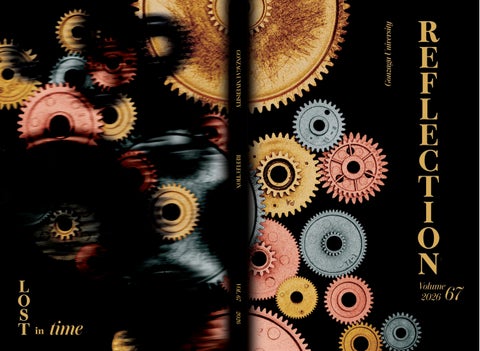
Copyright © 2026. Reflection. Gonzaga University. All rights reserved. No portion of this journal may be copied or in any ways reproduced without written consent of the editor and Gonzaga University. Views and opinions expressed in Reflection are those of the individuals and do not necessarily represent the views of Gonzaga University. This edition was published by Minuteman Press in Spokane, WA. Cover art by Callie Toney, student and Reflection’s Graphic Designer. Reflection submissions are evaluated and selected anonymously.
REFLECTION Erin Roney Julia Porter Irena Fischer Jamieson McHenry Lilly Alkumeidy Oren Remley Callie Toney Miranda McLeod
Editor-in-Chief Poetry Editor Visual Arts Editor Prose Editor Copy Editor Junior Copy Editor Graphic Designer Advisor
ACKNOWLEDGEMENTS Our team could not have produced this book without the help of Morgan Scheerer, Dana Parsons and Miranda McLeod. Thank you for your generous help and guidance. Additionally, our appreciation goes out to the readers of the Michael and Gail Gurian Writing Awards committee, especially Joshua Anthony and Colleen McLean. And to Russel Davis and the staff at Gray Dog Press and Julie Davis and Minuteman Press; thank you for your support of Gonzaga Student Media. This is only a fraction of the individuals who helped to produce this year’s journal. To all who have touched this volume in one way or another, we thank you.
TABLE OF CONTENTS
13
Insomnia Blake Tangney
14 16
Natalie Jenson
A Walk Home (Visiting Hours) Ella Jackson
17 18
Looking Towards Coughlin on a Cold Winter Evening
Paper-Mache Prose at 5AM Analea Redfox
stuffed animal Aislyn Ross
19
Dear Am For Infinity Grace Applegate
20 Inheritance Amelia Berthiaume 22 24
Through Her Eyes Elena Warwick
Step
Jami Janetski
25
beg (spark) Jack Champlin
26
Long Day Ahead Jesse Becker
28 30
Allison Kann
Natalie Jenson
Julia Porter
But the Fire Still Burns Kira 森 Bifone
Blind Luck Michael Roney
40 49
Shaded Interior Two Point Perspective
The Letter
37 38
Jesse Becker
The Shadow
34 36
Fishy Business
Clean
Darius Curry
A Rough Draft of Route 66 Charlotte Ury
50
Moment 7 Natalie Jenson
52
North 40 Aislyn Ross
54 56
Grace Applegate
Natalie Jenson
Cass Preston
Movement VII Jack Champlin
Coconut Raoul Perez
68 71
Outside my Dorm Window
Fall
65 66
Callie Toney
Life With Annie
62 64
Passing Time
Spirit of Home Rachael Bandy
Field Guide Rowyn O’Connor
72 CENSUS Nick David
82
In the Space Between Meianna Neumeyer
84 86
Sequoia Barger
The Spray of Destruction Bruce Sydow
88 90
Miss Marilyn Monroe
The Big Give Up Michael Roney
LOST AND FOUND Hailey O’Hara
104 Stimming Abby Warrington of the Whales 106 Morning Grace Applegate Horses 107 Wild Alexis Sandoval Wasco County 108 Rodeo, Lucy Booth My Town Has a Superstition
110 About Deer on the Road Irena Fischer
118
High Camp on Kilimanjaro Oren Remley
120 Reconnect Katie Berry 123 Edelweiss Grace Applegate Lake 124 The Natalie Jenson Crazy Confident
126 Michael Roney
and Fortune Telling 128 Flowers Hailey O’Hara Vase 139 Raku Michael Roney When our dead die, they don’t
142 just die.
Analea Redfox
Circles Are Bigger Than Others 144 Some Jeron Wisner Me, Mother 145 Forgive Aislyn Ross
Sonnet for Time Escaped 148 Love Jack Champlin
151
CONTRIBUTORS
157 HONORABLE MENTIONS 158
REFLECTION STAFF
LETTER FROM THE EDITOR
Dear Reader, Before anything else, I want to welcome you into this collection—a space shaped by many hands, many voices, and a shared devotion to art. I would like to thank my staff, who worked earnestly to read, edit, and thoughtfully shape every piece you will encounter in these pages. I am equally grateful to each author who entrusted us with their work, and to every artist who chose to brighten and deepen this book with their vision. Reflection has run since 1960, striving to uplift the words and art of Gonzaga’s students, and it has been an honor to serve as Editor in Chief this past year. Thank you for taking the time and care to pick up this book, and for supporting our contributors, our staff, and GU Student Media. In considering this year’s theme, Lost in Time, I was struck by how writing endures—not simply as a tool, but as a living presence across generations. I’ve always felt that writing is one of the few things that can outlast us, that can carry our voices beyond the limits of breath and time. There’s something deeply nostalgic about it: the way a sentence can summon a memory, a cadence can echo a vanished era. Even now, in a world shaped by AI and rapid automation, I find myself clinging to the intimacy of the written word—not because it’s obsolete, but because it reminds me of what it means to be human. Writing holds the texture of longing, the weight of moments we can’t quite name. It’s how we remember, how we return, how we remain. This theme, for me, is a tribute to that ache—for connection, for continuity, and for creativity. And perhaps that’s what makes writing feel so timeless— its ability to hold what slips through our fingers. Writing is a quiet rebellion against forgetting. It is the act of pressing ink into the skin of time, of coaxing memory into form before it vanishes. In poetry, prose, and visual art, we find not just
expression but excavation—fragments of selves, eras, and longings unearthed and reassembled. A single line can collapse centuries, a metaphor can resurrect a vanished street corner, a gesture in charcoal can summon the ache of a moment never lived but deeply felt. To write is to trespass across boundaries of chronology, to speak with ghosts, to archive the pulse of a culture before it slips beneath the surface. We write not only to remember, but to be remembered—to braid the past into the present, and the present into something that might endure. In this issue, we invite you to wander with us: to get lost, to linger, and to listen for the echoes that still hum beneath the page. Ever onward,
Erin Roney, Reflection Editor-in-Chief
13
Insomnia Blake Tangney
Time does not pass — it folds. Moments press against each other, like pages in a book that never ends, and we, small readers, believe the story moves forward. But perhaps there is no forward — only the illusion of motion, the mind’s desperate attempt to name the stillness it cannot bear. I have seen a shadow of my younger self in the reflection of tomorrow’s rain, and wondered which of us was dreaming — the one who waited, or the one who forgot. All that is lost may never have been, for nothing truly leaves the field of what is. Even the vanished hour is written somewhere in the silence. And so I walk, not through time, but through understanding — learning that to be lost is only to realize there was never a path at all.
14
Looking Towards Coughlin on a Cold Winter Evening
Natalie Jenson
15
ARTIST’S DESCRIPTION (4:08 pm, Dec. 3rd), 9 in. x 12 in. Acrylic on Canvas Paper, 12-152025.
16
A Walk Home (Visiting Hours) Ella Jackson
The old road is scattered with specks of light, flickering casting down on old footsteps replaying, watching the decay. At the end of the road, there is a house shielded by trees. A dome of emerald, intertwined with golden light. I stand still, like I could sink into the cracks beneath my feet. I would let the earth wrap vines around my ankles, turn my shoes mossy and green, I would become a nameless statue, a golden hand reaching, if it meant the earth would not seal and shake beneath my feet to say, “You do not belong here, not anymore.” If it is rejecting me or protecting me, I may never know. For now I just stumble from its grasp, my bones beginning to sink, crawling to reach warm kitchen windows and wreaths on wooden doors, packages on porches, and out-of-tune guitars. Scratching at the pavement saying, “I belong. I belong. I belong.”
17
Paper-Mache Prose at 5AM Analea Redfox
Disillusioned by a crush, you tear emotionally horny letters into paper-mache strips, plastering them on a padded wall in your asylum. Is it supposed to feel this way? A blue 5am sky stretches overhead, the backdrop of your reality, painted by the most malicious sixteen-year-old theater crew prop director. Your family sits in the audience, mouths gaping, eyes wide, no words needed. You won’t find validation in the explanation of existence. That’s years and years of forty-five-minute-long sessions in a starkly comfortable room, irony palpable, a muted, medicated TV show where everyone agrees the seasons just get worse and worse. Write something happy. Wind chimes in the summer, lying out on a hot day, sweat pooling behind your knees, consuming sunshine. An embrace, a real one, heart to heart, no bullshit, no tension. Did you know it only costs $7.35 to cook your own pasta? A jar of sauce, spaghetti noodles. It’s a lie, what they say; happiness can be cheap. But raindrops on roses and whiskers on kittens don’t quite alleviate, and you find yourself sitting, dreaming, writing, practicing the words over and over until they become real: We are okay.
18
stuffed animal Aislyn Ross
your giraffe body is limp as all bodies are or will be you just got used to it sooner. but i liked loving something that couldn’t handle its own weight. on your chest a faded green childsun where i sharpied you a heart an energy deposit a hole to hide in. the moodstone bracelet he sent became your necklace i never learned what each dawning color meant. some nights, it looked so heavy on you so i would fix the jeweled string taut on my wrist pink covers pulled to my chin princess aurora nightlight unplugged.
19
Dear Am For Infinity Grace Applegate
2026 Michael and Gail Gurian Writing Awards Recipient Poetry, Second Place Dear Am, I see craters from here. They ring from the force of drums shot through the outer layer—an instant carving of centers. I lie on this uncertain bed and see that from here, the gulls are walking backwards again. Water pulls into faucets, grass folds into sand, and from here, I am six, rummaging around my parent’s basement for a friend. I am climbing trees while you unknot yarn. I am washing rain from your true scalp lines. I am passing my hand over arrangements of china, rimming bathtubs gone milky around your thin leg. I am thinking of you, despite knowing this is an end, each ha! rattling my cage of teeth and ribs until I am doubled over and my pink-glowing gills widen as eyes from the belly to the tops of my ears. We watch music. We watch tangles of old folks playing guitar and green jazz musicians and show a weirdo. Don’t leave vague, you understand? I lie here uncertain as ever. I drift past the largest sun and I am still six, watching a lamp suspended, reluctant orange in this damned basement, swizzle burning against the grime.
20
Inheritance Amelia Berthiaume
After “Wild Geese” by Mary Oliver You say Tell me about despair, yours, and I will tell you mine. Tell me who you are, what makes you tick, what makes you rage, and I will tell you mine. I would tell you that I hurt, that I feel so deeply, yet, I have only known love in the arms of my closest kin. I would tell you that the rage inside, is not mine, but my mother’s, and her mother’s, and her mother’s, and her mother’s, and her I would tell you the face, behind the tears, is the face that he touched, that he held and broke, the same as he did my mother’s. I would tell you the clothes, are a cushion for protection, protection from you, from the comments, from the words that cut like razors. I would tell you that I have fought, fought for myself, when no one would, fought for my brother, when he could no longer.
21
I would tell you that you are forgiven, but you will never have access to me, the way you once did. For I am a force to be reckoned with. I am the keeper of my own flame, the daughter of women, who would not fall silent. I carry their fire, but I do not burn with it— I shape it, I wield it, I make it my own. You will not name me, nor claim me, nor bend me to your ruin. I am bone, I am blood, I am breath unbroken. I am here— unchained, unyielding, and becoming.
22
Through Her Eyes Elena Warwick
23
ARTIST’S DESCRIPTION This piece explores childhood creativity and expression, focusing on seeing though the eyes of my childhood self. Remembering the beauty and wonder she saw in everything. Acrylic painting on cardboard with a graphite portrait pasted on top and a cardboard cutout fish.
24
Step
Jami Janetski
I have watched you for years walk into my life like the savior you believe you are uprooting our traditions and creating your own you bulldozed your way into my heart planted a fantasy into my brain and left hope in my body you were supposed to be the one that stepped up you were supposed to make her happy you were supposed to support our dreams but you left us and didn’t look back to see the broken hearts under your footsteps. Anger and hatred have burned into my soul you are the root of this evil you were the danger to my kingdom and you are not my savior you made the choice to finally hang up the medal you never deserved to wear you are the one that stepped down no longer a dad, no longer a father.
25
beg (spark) Jack Champlin
To a child’s eyes, fire is stranger danger. Carnival dancing: carcasses entwined with logs or whatever else catches the criminal fancy of the spark. To the adult’s eyes, fire is a pile of stars. Relinquish control; subsume yourself into the wilderness and daybreak alone can force you home. To the dead man’s eyes, fire is a knock on the door. Shouting, shouting, shouting: splinter through and remind yourself that once there was color and once there was love. To the artist’s eyes, fire is the sweat inside the helmet. Blood cells and semen: external becomes internal (vice versa) and breath is visible in the cold. To my eyes, fire is your silhouette. I can’t take it and you can; cover me in ash and throw me into the sea, but please at least use your spark on me.
26
Long Day Ahead Jesse Becker
27
ARTIST’S DESCRIPTION These two pieces are a part of my senior portfolio titled, “The Monotony of a Dead-End Job.” This portfolio was a very last-minute idea that has become one of my favorite projects to work on. The work is about my fear of graduating with a Fine Arts degree and what that will mean for my future. Will I be a full-time artist? Will I be stuck in a basement somewhere sorting through busy work? Will I be financially stable? My work takes very real fears of mine and brings humor to them by putting random animals as the subjects of the work. I hope that in my final portfolio, the audience will look at these pieces, give a little smile, and find some relatability in them.
28
Fishy Business Jesse Becker
29
ARTIST’S DESCRIPTION These two pieces are a part of my senior portfolio titled, “The Monotony of a Dead-End Job.” This portfolio was a very last-minute idea that has become one of my favorite projects to work on. The work is about my fear of graduating with a Fine Arts degree and what that will mean for my future. Will I be a full-time artist? Will I be stuck in a basement somewhere sorting through busy work? Will I be financially stable? My work takes very real fears of mine and brings humor to them by putting random animals as the subjects of the work. I hope that in my final portfolio, the audience will look at these pieces, give a little smile, and find some relatability in them.
30
The Shadow Allison Kann
2026 Michael and Gail Gurian Writing Awards Recipient Creative Non-Fiction, First Place Mara always thought her house sounded like weather. Some mornings it was rain, steady footsteps moving across the thin upstairs hallway, her sisters arguing quietly like soft thunder in the distance. Other mornings it sounded like hail, her brothers stomping around with heavy, youthful energy that rattled every walled picture frame. Sometimes it was a full storm, her mother calling their names in a tired voice, pots clattering in the kitchen, morning cartoons on the television humming beneath everything. Mara moved through it all like a small shadow that never cast one of its own. She slipped sideways between bodies and noise without disturbing any of it. A quiet creature. A black cat. People often mistook her quiet for uncertainty, but really it was a kind of choice, a survival habit formed after years of having too many siblings and too little space. Everyone else in the family seemed to talk over one another in an endless tumble of noise. Mara learned early that silence was a way to stay whole. Silence wrapped itself around her like a cloak. Soft. Comfortable. Nearly invisible. But even as she learned the usefulness of smallness, she watched everything. She watched the curl of steam from the morning kettle. She watched which sibling pinched grapes from the bowl and which one pretended not to notice. She watched the sky outside the kitchen window to measure how late the bus was running. Most of her time, though, was spent watching Briar. Briar Fairchild moved through the world like she had been born knowing exactly how much space she deserved. When she walked into a classroom, the air shifted around her. When she entered the cafeteria, her bracelets jingled like tiny bells, all the noise rearranged itself to make room for her laugh. There was nothing careful about her. She was light poured into human form. Warmth given a heartbeat. Mara had tried to describe her in a lyric notebook once. She had written pages of metaphors, all crossed out and scribbled over. Sunrise. Bonfire. The honey that drips into your tea. A
31
window flung open on a spring morning. None of these felt quite right. Or maybe they all did. Briar was the first person who noticed when Mara fell silent in a way that meant she was drifting somewhere far inside. ‘Earth to Mara’, she would say, reaching out to tap her shoulder. Come back. Even her voice had a way of sounding golden. Mara always came back. She came back again. And again. And again. Repetition became both comfortable and aching. Watching Briar, following Briar, loving Briar. Quietly, quietly, quietly. Most of what Mara felt never made it to speech. But she discovered by accident that singing allowed her to lift the lid on the pressure in her chest. Once, while folding laundry in the cramped downstairs room, she hummed under her breath. The dryer was shaking with warmth. Socks tumbled like tiny hearts. Something inside her opened a little, as if a window had been cracked after years of being painted shut. She hummed again. Then again. Then louder. From that moment, singing became the way she breathed when the house felt too crowded. A small rebellion. A private doorway. She began slipping out on Monday and Wednesday evenings. Just enough time to leave without suspicion, not enough to attract questions. She took her notebook and rode the bus into the city, blooming in scattered clusters of light, a world away from her quiet suburb. She loved the way it felt to watch the lights grow larger in the windows, like little glowing islands rising from the dark. The Laurel Lantern was tucked between a tattoo shop and a place that sold handmade soap and crystals. Its wooden sign had faded, peeling paint, and its windows reflected the street as if holding secrets in their glass. Inside, the bar smelled like lemon cleaner and old stage lights. There was a warmth in the air that felt strangely soft, like a place built from sighs and beginnings. Mara slipped inside, hood always up, eyes always low. No one asked her name. That felt like mercy. Eli, the bartender, had once jokingly called her Shadow and everyone simply kept using it. It felt safer than Mara. It felt like a version of her she could manufacture. When she stepped onto the stage, the world narrowed. The tiny square of wooden flooring lit by a single warm spotlight was just wide enough for her to feel like she could unfurl herself without being watched too closely. Her voice belonged to no one but her.
32
She sang with her eyes closed. She sang as if speaking directly from the hollow behind her ribs. Sometimes the audience clapped. Sometimes they only murmured softly in the way people do when they have been unexpectedly moved. Sometimes a patron said something kind to her on the way out, something like ‘your voice feels like secrets I had forgotten.’ Mara would nod and slip away. Briar would like this place. She always wished Briar could hear her, but also feared it more than anything. Telling someone you loved them with words felt impossible. Telling them with a song felt even more dangerous. If I sang this for her, she would know. Her songs were not subtle. They were about honey-colored curls and bright laughter. About someone who smelled like peach and lemongrass. About longing that pressed against her ribcage in waves. Repetition. Repetition. Repetition. The constant thread of Briar woven through every melody. Sometimes, on the bus ride home, Mara imagined saying something. She imagined, for just a moment, standing in front of Briar with her hands fidgeting at her sides and her heart rushing like a waterfall as she said I like you. Or even, I think of you when I sing. But the thought dissolved every time. Instead she returned home, slipped through the cacophonous sounds of her house, and settled back into silence. One night, after a performance that left her chest trembling in a way that felt like possibility and fear braided together, she looked at herself in the window of the bus. She saw her own reflection layered with the reflection of the city lights. Her dark eyes. Her black hoodie. Her curls frizzed slightly from the humidity. Something inside her shifted. She did not look like a shadow. She looked like someone holding a secret that wanted to be known. A small glow. A quiet spark. A change beginning to gather shape. She had no idea what she would do with that. But she felt it all the same. A turn forming. A quiet click inside her ribs. In the days after, she did not become anyone louder. But she allowed herself to linger. She let herself look at Briar a heartbeat longer during conversation. She hummed little melodies under her breath while they studied. She wrote lyrics on her arm when she had no paper, tiny ink notes climbing up her wrist like vines. Briar noticed some of these small changes. She tilted her head in that way she did when she sensed something she had
33
not yet named. But she did not press. She simply smiled, that warm bright smile that made Mara feel both brave and terrified at the same time. One night, after everyone was asleep, Mara slipped outside onto the back deck with her notebook. The air was cold enough that it tightened her lungs. The sky above her was a deep velvet blue, soft and endless. The porch light hummed overhead, catching the edges of her dark hair in faint gold. Shadows of leaves stretched over the wooden deck like gentle fingers. The house behind her let out a long settling creak. Somewhere in the distance, a dog barked once, twice. The yard smelled like pine needles and late-night dew. Mara pressed her notebook to her chest. I want someone to hear me. Just once. I want someone to look at me and not look through me. She imagined a world where she did not shrink. Where she could sing with her eyes open. Where she could tell Briar the truth. She let that possibility sit with her, breathing in the cold air until her breath fogged in front of her. She opened the notebook. Her hand hesitated. Then she wrote a single line, one she had not let herself write before. Ink shimmered slightly under the porch light as it dried. The black cat steps into the light.
34
Shaded Interior Two Point Perspective
Natalie Jenson
35
ARTIST’S DESCRIPTION Graphite on Paper, 2024.
36
The Letter Julia Porter
A crumpled page covered in crossed out ink. Paper cuts litter cracked, dry hands. A letter that has been rewritten too many times. The rain keeps tapping - tap, tap, tap, on the roof. Another letter thrown in the trash. Every sentence is finally correct, the letter is finished, perfectly worded. You lift the cool metal off the wooden desk. You bring it to your head. The blood keeps dripping - drip, drip, drip
37
But the Fire Still Burns Kira 森 Bifone
The witches have become my friends. Those burnt at the stake and tried for being heretics. Quite comfort is found with them. A sense that we are all just trying to resist. They don’t burn you at the stake anymore, But the fire still burns. Shaking hands with the devil. Longing to be seen, for real this time. Called misunderstood and crazy. Always an angry feminist. Giving and taking, holding life in their hands. Grasping at a movement; lost in history, yet we remain. Tortured by a loss of sleep; leading toward a fire, a confession. A never-ending challenging of the patriarchy. A new direction for a new generation. They don’t burn you at the stake anymore, But the fire still burns. The fire is within us.
38
Blind Luck Michael Roney
39
ARTIST’S DESCRIPTION 5’x3’ pastel on paper.
40
Clean
Darius Curry
It’s 2016, and today I have everything. I live in the country with flat grass. Our house is white, green and orange. Finally, the pleasure of having things all to myself has arrived. Nobody else on my bus has a tablet, phone, and the newest Nintendo 3DS. My closet is full of baggy white tops, which contrast well with my fortunate skin tone, according to my mother. “I’m jealous,” she’d say. “People pay for what you were born with,” she’d tell me — a thought she’d follow with turning on the news. We have a few cars now, but whenever Stan is home, my sister and I enjoy walking along the paved backroads in our neighborhood with him. He taught us how to pick up garbage, and it’s become fun to clean the plastic-filled gutters that lined our street. Mom approves, yet acts contrary when it comes to cleaning up — but I am young, and I want to believe in her. Years back, I still lived with her and my dad. Our white duplex was tainted with age, and the black undercoating fought flake by flake to be seen. The grass outside allowed me the chance to become a football player as I always wanted. The cement stairs lowered us to our downfall, where we resided underneath the neighbors. Beatles snuck through the fallen leaves on the stairs that held hints of chlorophyll. They’d reach the gap beneath our backdoor-looking front door, which was just large enough for me to push them a few inches back outside. I was inside reading Dr. Seuss, who told of an orange man with ridiculous blonde hair and who was our savior. He cared about everything and everyone, but mainly trees. They weren’t always replaceable and should be appreciated. Freedom was so important to him, and I guess he thought that the trees deserved freedom as well. He looked like my hamster in stature and color. I’m sure they’d agree with each other a lot. After all, his name was Pumpkin, which could be found anywhere and everywhere just like trees. Not him though. He was here with us. Pumpkin seemed like such a cool creature. He’d run around in his cage, nibbling on anything we dropped inside. I could never tell if he was bothered with anything, as he’d run on his
41
wheel every day no matter how he was feeling. Mom wouldn’t let me take him out of his cage as much as I wanted to, but when I could, I would try to cup him in both my hands with just enough room to move. Usually, he’d bite me, but I didn’t mind. He felt like a warm cotton ball, and I loved him. My sister might’ve enjoyed him even more than I did. She was younger than me and much more clueless, as she’d grip him by his waist as if he was slippery. A few squeaks and bites and my mom would take him away from us. We weren’t careful enough according to her, but he was fine. Eventually, we found some alone time with him. It was a day when he seemed a little tired and where he didn’t enjoy our company as much. He’d maneuver around in his cage, narrowly dodging our hands until he took a water break, and we found a chance to grab him. His tiny bites and scratches seemed more persistent this time and annoyed us a bit, so my sister found a small tin container to carry him in, just big enough for wiggle room. Seeing how angry he was with us, we started having him interact with our toys. One in particular that he liked was my sister’s Barbie mansion. He ran inside and wouldn’t come out. We tilted and shook the house many times. Still, I had to reach inside and drag him out. My sister grabbed him again, holding him tighter than a real squeaky toy. His peeps were fast and long now, urging us to close the door so mom wouldn’t hear. She dropped him back in the container, and we all danced in excitement. We sang Disney songs aloud, skipping around the room in circles. Soon after, our mom called us out for food. When my sister opened the container, we saw him lying there. His arms and legs were scrunched into his tiny chest where his face was burrowed as well. She grabbed him and we poked a bit to wake him up, but he was still. We brought him out to Mom to see what she thought. Immediately, her eyes rose with anger and concern. She held and messed with him a bit, holding her finger on his chest, all while repeatedly asking us what we did. We were just playing with him, my sister proclaimed many times. She started to cry and contagiously saddened me as well. I grew flustered. My eyes watered and I balled my fists. Why me, I’d ask myself. Inside the room, his cage mocked me with its presence. The whole life of my pet all right there. All for nothing. I lifted its wire handle and prepared to swing it across the room. A quick realization paused me, and I spun with the momentum of the cage as to not spoil his remnants any further than I already had. We can always get another one.
42
As if their relationship was Pumpkin, my parents separated soon after. My dad went somewhere, and we moved into a large apartment building along the Spokane river near our new school. Our third-story location felt heavenly as I could simultaneously look out my window up at the white figured clouds and down at the people under them. The layout was very typical for a three-bedroom place, with the kitchen at the front door and a single hallway for all the rooms. It held a gray average that you might picture in an office job. Suitably, my sister and I would pretend to be co-workers in these spaces. She’d hand me papers, and I’d study them, squinting my eyes and tracing my finger across in a widened, letter “Z” motion down each file. Her fingers would slap on the kitchen counter, creating loud snaps with each impact. In two hundred words a minute she’d type away and I couldn’t keep up. She was a natural at her job. We were thrilled when Mom came home with a bin of supplies for us. She dropped it on the ground erupting a handful of junk into the air and rushed towards her room without saying much to us. The slam of her door was shaking but overshadowed by our ecstatic commotion. Inside the small box were pens, folders, paper clips—anything you would ask for in the office. We fought over the folders and accidentally ripped a few in half. Finally, she gave up, and I became the boss, ordering her around the building in pride of my new position. She’d happily fetch transparent cups of coffee or collect the copying-machine papers from the box television in her room. It was the sturdiest and most stumpy TV I’d ever seen— perfectly suited to our imaginations. Hours later, Mom came out. We apologized for the folders and explained ourselves similarly to the previous incident, only she didn’t react much. It’ll be okay, guys, she said over her shoulder while opening the fridge. That night was the last I saw of her for a day or so. Usually, we walked to school and lately we even did so by ourselves. However, we’d never been alone past ten-thirty at night— our bedtime. With just a half-hour remaining, I went into her room looking for answers. Her pillow covered bed sat messy as usual and both her lights remained on. If I hadn’t known her, this would’ve looked like a sign of trouble. Still, I stepped around. Under my foot, something hard had lain hidden in the carpet. I reached down and grabbed a thin orange cap. About an inch long, it looked like a vertically stretched firefighter hat for one of my Lego men. I placed it in my pocket for later and went into the kitchen to glance at our
43
microwave clock. Its green tint hardened and normally formed a sensation of safety. Whenever I’d look at it my mom would arrive soon after. Our door would racket a bit and she’d come in. Her promises held up and so the clock never let me down. Now, the clock was powerless, and with dad somewhere else, I was the only one in control now. The clock struck, and my sister got scared. I just followed the routine and brought her to her room. My hands shook tucking her in. She got on my nerves often, but I couldn’t remember how anymore. This power shift hit me hard, and her grievances left me as I trembled my way towards the light switch. I felt the hot whitening of my face as this wave of control turned me pale. Her door closed behind me and I stood in the hallway, head full and stomach hollow. A sharpness stuck my insides. I shouldn’t have had it— the decisions and responsibilities. I felt terrible for all the adults in my family who were in charge. Before their problems, my dad had to tell my mom and us what to do. One of my grandpas had to order around hundreds of police and prisoners for his job. How, I contemplated. I’m not playing office anymore. Once again, I looked at the fluorescent numbers that held a dim in the kitchen once the light was off. It defeated me. I took my time to my room, hoping to be interrupted by mom’s late arrival. Disappointed, I leapt into bed, fighting the splinter of worry that stabbed me above my hip— somewhere near my pocket. Early that morning, she arrived, and she was not alone. We woke up and ran to the door where we met her friend Justin. His goofy demeanor excited us and let me overcome my shyness. He could handstand and tried to show us how. I watched as his feet rose taller than me, revealing his scabbed legs that flung side to side down the hallway. Afterwards, their hands exchanged. Mom went into her room, cash in hand, while he followed with a small plastic bag. We were positive that they were still there when we got back from school and so we knocked. Their hustling voices softly urged us to give them a moment. Mom cracked the door and spoke to us, handing me a spoon to take to the sink. It stunk of fire and was charred brown in the center, ruining the appetite I had told her about. With my nose held shut, I set it near the drain. The year went on and we visited our cousins a lot. Their neighborhood looked so plain, yet I liked it more than mine. Mom complained a lot about how far her dad lived. Countless picket fence houses flew by before we arrived. Grandpa’s
44
trimmed grass and tidy pool resonated with me every time I visited. His hair situation resembled the Lorax, having only enough to lay an orangish patch over his upper lip, yet his trees were nowhere to be seen. Without grandpa, I wouldn’t have had a sense of what money really meant at that age. Along with office, my sister also loved being a cashier. I would buy things from her with paper we colored green, and she’d grab my change from a small drawer that her dresser sacrificed. Mom and dad would give us a dollar or two at the gas station for honey sticks but besides that, money didn’t make sense. I wanted it now, but mom told me I’ll have plenty if I do my homework. My cousins and I played everything—videogames, pool basketball, the trampoline, and all. They watched football together, but I would sneak off instead, rummaging through the kitchen and discovering wonders like jerky and sparkling water. Jake had every toy, including the accessory I always wanted. My favorite show at the time was Ben 10, a cartoon about a kid with a watch that could turn him into different aliens of his choice. I envied his powers, running up and down their spiral stairs, pressing my watch. My mom would never get it for me since I already got my birthday present that year and had to wait until Christmas most likely. It was a dumb rule, as there was no way Jake had this many birthdays. Closing the weekend off, they said my mom was picking me up soon, and I didn’t want to leave. I glanced down at the shiny green plastic on my wrist. In the center it showed my favorite, the giant orange alien dog. I pressed it and crawled downstairs like an animal. There in Jake’s room sat a pile of riches. Figures beyond his capacity and my reach scattered everywhere. So many times, I’d watch him walk in and out without touching a thing. I grew angry at him and at myself for not having that stuff. The more I saw, the more hateful I felt. In a desperate measure, I stuffed the few highlights among his pile along with the watch into my jacket and pants, filling my pockets with treasure that my mom wouldn’t get me. We drove back and as I looked at the dark building we called home, my satisfaction disappeared. Advancing in school, I made some new friends. A Hispanic boy named Elijah and I started the little group and effortlessly, I became the head. They followed me around and let me decide things for reasons I didn’t attempt to understand. It took a toll on my attention in school at first, as I now had four sisters to
45
worry about. Within a month or so, I adjusted and learned to take pleasure in leading my group. We sat where I wanted at lunch and did what I wanted at recess. Josh would sometimes skip out but just him. He would go on emotional rampages throughout the school that involved running around the premises without attending class. Oftentimes I’d see him crying outside the classroom in a helpless curdled position. During one of these, he came to sit by us at lunch and I felt urged to turn him away. I spoke deliberately and with scold like he was my child, placing the blame of his situation on him and him alone. He stormed off and I felt grieved, yet I needed him to go. It angered me as he was a friend, but I had three others this time, so all empathy slipped free from the cage of my consciousness. Mom was gone. Justin and my sister remained. Our couch tickled from his tattered belongings, draped in white cloth that hung like fatigued wings from his journey. He rested beside it. His fist would raise to the air when we spoke, yet his eyes stayed only slit open as he addressed us. In several forceful puffs, he assured that mom would be back tomorrow. The assurance fell flat, both in the morning and after school, when he was also gone. Nothing remained but us, but me. I was experienced in this sort of thing now. I was a decision maker in and out of school. With no mom, I prepared food for the both of us. Cereal was already one of our top choices, so the remaining milk was put to good use for the next few days. School would ring and my sister would run me home, looking for mom and never finding her. She’d tell me I wasn’t tucking her in right so I stopped and left her crying until she fell asleep on her own. When the milk ran out, water did the trick, soaking nicely into our bowls of miniature cookies. Our time became soggy and bitter, our routines numbed, and our dreams humbled. It may have been a week and I enjoyed school more than ever. Observing my teachers, they seemed happy. They would lead us every day with bright smiles. That could be fun, I thought. Dragging myself home, I found myself teaching my sister what I learned about grasshoppers that day. She showed little interest until her eyes widened, and she sprinted away. Lined with the curb sat mom’s car, hardly recognizable with a new shape in its front. Orange stretched along its exterior from a large blob in the front, where her hood bent upwards, and the bumper dabbed the street. I didn’t know what to make of it and excitedly ran inside.
46
There, she sat on our couch talking to an older man. His raggedy overalls and stringy grey hair leaned towards my mom, who got up to hug us and apologize. Tears welled as she cursed Justin. I can’t believe he left, she repeated, anger and sorrow tangled in her voice. The man walked her outside and we stayed, watching them hug through the window before he drove off. Our door unlatched and she sighed on her way in. Her eyes welled. She bent down with her hands on her knees and whispered, I’ll never do that again. One night, we had to pack. One night, our mom cried harder on the phone than she ever did with dad. In one night, we walked the streets with others. Down the roads they gathered, waddling in hordes alongside us. Our timid marching bested the many stiff bodies around us, and we took off ahead of them under the orange night lights. Mom clutched us on each side of her with a wool blanket that shown as brown. My mind raced, outstepping our pace. I thought of grandpa and my friends, my dad and his girlfriend, my favorite football player and my teacher. I stayed with them, eloping to journeys full of prosperity and rid of lack. The escape turned to ashes in my mouth, and my hanging hand felt a cool stream beneath me. Inside, its waves splashed up, till they ran down my cheeks. I longed for our scaly old house. We tripped near a large green dumpster, and two figures rose beside it. They stared in silence as mom apologized until one grabbed at her backpack. A ferocity sprung out of her; one I’d never seen her have with strangers. She tugged and cursed, sending us back behind her with the blanket. My sister screamed for her, and mom screamed for the bag. She tore against both the men who planted their feet in resistance. Our urgency echoed throughout the neighborhood and my tears froze on my face. I felt ashamed watching my sister grab mom’s leg in panic. The urge to try filled my blood and in adrenaline, I grabbed on. We pulled in wail, drowning out the grunts of the men. I kicked and punched at their grip in a raging fit until finally, they let go. The bag flew at us, carrying us a few feet away from the bandits who watched in frustration. Eye to eye, our perplexed gazes lined to theirs. A moment later, Mom grabbed us, and we walked off, never turning around to see the men again. Hours later, we arrived. Baggy shadows lined up to enter a building, and we followed. Inside, we found a cafeteria larger than my schools. It glowed white and emitted a safety that I settled nicely in. We sat in silence, shook but in recovery. The
47
pumpkin bread warmed my stomach for rest, so we found a room. Inside were others who shared the floor with us from a small distance. Our space was tight but with a few blankets, my surge of anxiety faded, and I slept. The apartment was long gone, and days later, my sister and I alone went to stay with grandpa and our cousins. Our luxurious time there almost distracted us from the absence of mom, who was going to be receiving help for a while. We had fun. The mornings were so lively, as all of us cousins would crowd the toaster, mass producing until we were full. If not for them, my sister would’ve cried every night for her tuck-in. Their field of a yard was even better than our old house was for football, and they played even more than I ever did. But that felt like someone else’s dream now, so I tended to my sister or my homework instead. Within a month or two, grandpa finally said we could go see mom. He drove us to another large building. Inside, we chose among the orange dining tables and sat on the stools attached. Its restaurant layout had a familiarity about it with an added glass booth in the center. Inside, a woman spoke through a speaker to whoever approached. Grandpa went ahead while we sat down. In a few minutes, our mom walked out in a baggy red suit that hung slightly creased along her torso and legs. Her smile fought the sadness in her eyes as the three of us embraced. She explained her situation, telling us that she’s getting better and will come get us once she’s all done. We didn’t accept and begged not to leave. She looked around at the cabinets in the room and smiled. Go pick out a game for us, she said. Stan will be here to play too. My sister searched around. Underneath our table, she grabbed a rectangular box that read Monopoly. The old, bearded man arrived and introduced himself as Stan. Mom spoke to him about our living situation, and they seemed to come to some kind of agreement, touching hands like she did with Justin. As a wad of his cash slipped into her palm, my sister lined up the Monopoly money in front of us. Beneath the table, his money was green; on top, ours was colored. The four of us played for hours, restarting each time we learned the rules a bit better. With every bad move, I felt the wink of the top-hatted man on the box. His round, white head and elaborate mustache carried the same demeaning weight as my successful grandpa. They both had a presence like no other. In our last and longest match, I finally was winning. Stan would repeatedly urge us to grant him a victorious set of
48
properties that he knew was unfair. He’d laugh as my mom interjected, telling us not to fall for such a thing. My sister eventually gave in, as she was just happy to be playing. Mom grew tired of Stan’s greedy chuckle and started cheating for us, allowing free passage for my sister and I. Her leniency annoyed Stan a bit, but he shrugged and moved on. They all looked at me in my powerful position for the next move, each with different telling eyes. Looking at my lead, I thought again of the man on the box. I thought of his wink—how it had shifted from something powerful to something performed, a mask to suggest control that never really existed. His responsible stash held me down, dragging me back until I reached the first mustache of power I encountered. He who wore my hamster’s color, caring for trees and us alike. With my powerful position, I traded, granting each of them favorable deals and balancing out the game. All but Stan rejoiced, who despite having just as much, thought of it as unfair. I shrugged at him and looked up. On the television above, my favorite player caught a pass in the endzone. A smirk grew across my face, and I looked at Stan, who still held a sidelong eye in my direction. In response, I winked.
49
A Rough Draft of Route 66 Charlotte Ury
How does one adopt a highway? Do they have to kneel to pick up cups and wrappers next to the police car with the speed gun? Can they send it to college with minimal aid? Fast food signs tower over hefty trees. The wind pushes branches into the sign of a lawyer promising to get me out of jail. You probably shouldn’t drink and drive. But when you do, call him. A minivan pulled over, blinkers on — we wrench our necks to see it better. Good luck, we laugh and I make eye contact with a crying woman in the back seat. The sun sets on a field of corn and wheat and sprinklers and hay barrels and rocks and dust devils and and and and and and Alaska! Ow. You always punched too hard, too fast. How does one even get a car from Alaska? You’ve only ever been suffocated by land your whole life so you wouldn’t know. I’m not stupid, stop laughing. A laminated photo of a child, black and white, bolted to a chain fence with Mother Mary candles lighting the road like little stars. Turn the music back up. There’s trash everywhere but we’re still trying to get to a less-familiar dirt, a less-familiar mess: from wet mud to dry dust. A well-lit billboard stained by bugs promises God can save us from our sins. Just give Him time. I think He just passed us in an SUV.
50
Moment 7
Natalie Jenson
51
ARTIST’S DESCRIPTION (abstracted by distance), 12 in. x 12 in. Acrylic on Stretched Canvas, 2025.
52
North 40
Aislyn Ross
Buck Branson is the exact kind of man you would expect to be born and raised in far north Idaho. He has a calloused nature to him that only those who’ve known wilderness understand, and he’ll tell you ‘bout it too—droning on in that slow, measured kind of way like time weighs on each word, about good old days in the Alaskan mountains. When I first met him I thought he was grumpy as any old man with aching bones and too many dead family members, but now I can’t tell if the years have hardened his heart or pecked away at it like starving birds. The first time he guides me through his late father’s property, he is quiet. His right hand hovers above a shotgun—not for the bears, he had told me as he strapped it to his waist, but for the neighbor’s dogs. They always jump the fence and are never friendly. “Last one almost took my arm off.” He lifted the hefty weapon. “Heard a gunshot later that night. Reckon Louie shot the damn thing himself.” He calls it the North 40: a near forty acres of privately owned Idahoan country beyond the field for the dairy cows, closest you’ll get to Canada without papers. From the house he built lifetimes ago, a red-soil cow trail leads to the end of the grazing field. Here, between aspens and pines, wild strawberries bloom around the dim-windowed cabin where Buck’s son used to occupy his grief. Beyond is the abandoned dump. Tractors,
53
rusted past recognition, sit halfsubmerged in earth, tires blooming wildflowers out of their bosoms. A weathered school bus is retired between two old-growth cedars, the windshield so dusty and cracked no one can see inside. Gears, car doors and miscellaneous scrap no longer faithful to any utility are scattered across the grassy opening like metal beasts basking in the sun. I imagine even the most civilized of city-dwellers dropping on all fours and ripping out throaty snarls when their feet touch this country. Past all of the forgotten machinery is a meadow of yellow grass, at the end of which stands the King: A lone Ponderosa so tall anyone would have to twist their neck to see her crest. I had never felt such raw, terrible power until I stood beneath her vastness. Buck knows it too—he has always hated the eagles, magpies, otters and bears, but even his soured nature can’t deny the sovereignty of this noble being. I lean into her mass, nose jutted between islands of bark and fingers curled around her waist, and say something like a prayer. “How long has it been here?” Buck squints up at the mighty creature standing tall and far like a father. He adjusts his felt hat and turns to face the old dump, eyes pale and searching for any running dogs.
54
Passing Time
Callie Toney
55
ARTIST’S DESCRIPTION This piece is made of the multiple photos I took of the grandfather clock at my friend’s house during my senior year of high school. I was thinking a lot about my future and the end of my childhood, and I wanted to explore the overwhelming, and often terrifying, feelings that we can experience when thinking about the passage of time. However, this piece also has a bright light at the center. The passage of time doesn’t just signify the end of an era—it also allows for a beginning that gives us new experiences and opportunities that can lead to joy. Photographs edited in GIMP.
56
Life With Annie Grace Applegate
2026 Michael and Gail Gurian Writing Awards Recipient Fiction, First Place It began with the sun. Late July brought an aching heat that spread itself on the seats of couches and armchairs, bringing the smell of leather to trees that hung their branches above my backyard. Along the grass lay rubble––blackened silverware in kettles, and jewelry wrapped up in my juniper bush, each dark berry bled dry. I was washing dishes. All the lights in the house were off, and each room was suffused with light. The afternoon haze settled on our scratched floors and ceramic counters like a dog. I thought of the house. Thought of King. God, and all his metal shit I could see in the backyard. Why he didn’t get rid of it all, I couldn’t understand. Then came the violent sound of a body hitting the window and the trill of a bird. I sighed and walked to the backdoor, wrenching it open and welcoming the wash of heat. It was red, with a narrow face and deep-set eyes. I watched it shudder violently, writhe on the ground as if it wanted to fold in on itself. And if I listened closely, I heard the turning of trinkets and coins. This was the first day.
I walk out of the grocery store, clutching my keys. It’s 7pm. The sun is showing bright and low across the backs of cheap restaurants lining the highway, the greens or yellows of stoplights barely perceptible against a white sky. Sweat drips down my shirt and chest. I’m carrying two bags of groceries, and their brown paper rubs on my skin. As I stand at a crosswalk, a single car turns the corner nearest to me and zips into a parking lot. I catch a glimpse of the driver: a smoking mother with bags under her eyes. A smaller version of herself sits in the backseat, pressing a stuffed rabbit up against the window. Hello there, it seems to say. The world is ours, a split oyster. That’s what my father always cried as he ran from one end of our house to the other in a hurry––blue shirt, fingers stained with coffee, big-framed glasses slipping down––and out the door. The world is full of
57
interesting things, and we’ve got to suck it all up, he would say. Suck it up, like the shooters at Wally’s, Annie. I spent the majority of my childhood witnessing him marvel at the marrow of the supposedly interesting world he compared to a mollusk. Opportunity always lay ahead for my father, out past the ocean, beyond our small town by the sea. When he finally left, I wasn’t surprised. My mother and I moved to Texas within a week of his desertion, leaving the ocean behind. Without the waves, life became eerily quiet. I preferred it this way. Now that I’m out of Texas, I think of my mother often––or rather, I think of her in relation to King. My mother is a proud woman and deeply Catholic; when he and I moved in together, she didn’t talk to me for months. She and my father met in New York and supposedly fell in love. He loved history. She loved theology. He loved her stories of revolution, drama, and family. She loved his thirst to learn, his will, and his courage. I met King at a Houston Hot Chicken while bussing his table. My arms have begun to ache under the weight of the bags. I pause to reposition them. Annie Volar. You get out of there, my mother recently told me over the phone. This time she wasn’t referring to my white boyfriend. It’s Exodus, she said, voice breaking. I could imagine her in a simple room, one dark hand wringing the other, a lined face gazing intently at the news, which, in truth, I had been watching too. In the exhaustion and anxiety of that last week of July, I could barely comprehend her voice above the radio, alarming messages, and talk of what would come next. Locusts? The Plague? She wasn’t the only one. Religious speakers had begun yelling out onto the street, pointing at the flocks that threatened to weigh down the powerlines of our town. When the birds came around, I was a licensed veterinarian, fresh out of graduate school. I had some vague inclination to be helpful, fill a role, and figured I could do something to lighten the load. But by the time I was in the field, I was being paid large sums of money to split animals open. I learned how to instinctively feel around for wedding rings, forks, or family heirlooms lodged down these creature’s throats. Sometimes they were already dead. I want everything in there, right now, clients would say, having brought the birds in cages or traps. As I pass shops and stores on the street––Verizon, Starbucks, Walmart––I try not to pay attention to the carcasses all around me. I try not to smell. They are dying from the poison, from people going out of their way to kill them, or because of people like me. When I see them, I am reminded,
58
strangely enough, of my childhood. I would often create art projects made up of washed-up sea creatures––starfish, isopods, the meat of jellyfish. When such creations were presented to my father, he would only look at my art and frown, shaking his head sadly. That’s not very nice, Annie. Even now, I wonder if he kept any of them. It’s been about two months now since the first bird theft. Ravens––I swore I saw a hawk at one point––swooped down upon the city like murder and went straight for the hardware stores. That last week of July, they descended onto our city like drugged, like insane. Chickens, magpies, finches. They flew into the thrift shops, made nests in the balconies of mansions, shit all over the place. They ingested our knives and jewelry right out of homes and off the necks of women and men alike. Some celebrated these winged animals as a political statement. Others were afraid they’d start eating us, too. And while my every day was consumed by this new problem, King was already comfortable. We can’t move, he said. My whole family lives here, and besides, I have that marathon next Spring. The only thing King worried about was Bill, a stupid, haggard parakeet he had saved from oncoming traffic a year back. King wasn’t a careful guy, often picking up random objects or animals off the road and parading around the house like a savior. This is Bill, he had said proudly. You’re similar, my love. You’re bound to get along. But sometimes, and more recently, Bill would scream into the night, and I’d wake up with sweat all over my body. God, Annie. Chill out. My bird gets nightmares just like us, you know? I didn’t like the way it regarded me, as if he knew I had blood on my hands. Why does it have to sleep in our room? Because. Come back over here. Give me a kiss. Instead, I’d bat his hand away and move out to the beat-up couch in our living room. It soon became a habit of mine to stare at the lights and shadows that passed across those walls. Our neighbors, Helen and John, rarely close their blinds. I had a particularly difficult time sleeping one night. On my way to the bathroom, I saw Helen interrupt her husband’s cooking with a thrown tomato and a furious expression on her face. I stood, transfixed by the golden glow emanating from their home, and at the photographs framing them and their argument. How on earth did they keep their plants healthy in this heat? She started yelling and threw her hands up in the air, face red. She pointed at the various things in their kitchen. John shook his head and turned away from her to stir whatever was bubbling on the stove. But Helen grabbed a spatula and
59
jabbed it at his chest, refusing to be ignored. Helen is 7 months pregnant. From this angle, she looked taller and larger than John. I watched as she, shaking, stared him down. I was certain she was going to beat him. I moved closer to my own window, resting my fingers on the glass. I was excited, and then disappointed. The strangest thing happened: John pulled Helen into an embrace. She broke down. I watched stupidly––I watched them cut onions, roll dough, then sway to the music on their radio. I slept on the couch that night, Bill screaming in my dreams.
I drop one of the paper bags on my way up the steps to our front door. Toilet paper rolls along the grass as King steps out. “Annie!” He laughs, hopping down the stairs. He’s wearing a cropped shirt that exposes his shoulders and stomach, and a pair of jogging shorts riding up his thighs. His carefree grin is always so casual, so unbothered. I shrug and kneel to grab a couple of lemons off the front porch. He grabs the new pair of scissors off the ground and gives me a pat on the head. “Apples, a new apron, gloves, and shampoo. Do we really need these, though? I thought we had a pair.” “They’re dull. Can you grab these?” “Yeah, sure.” First, King runs a hand through his red hair and winks at me. “Why the long face?” I shrug again. King leans over to pick up the bags, squints at me, and frowns. “Your eyes are red,” he says. He leans in to take a closer look, but I take a sharp step back, my shoulder brushing the doorframe as if I’m trying to anchor myself, to stay still. “Annie, are you alright? Did work go badly today?” King’s eyebrows contort into an expression of worry... or pity? It’s often hard to tell. “No,” I begin, wiping sweat from my brow. I want to explain, but King is already shaking his head. “Annie, we’ve talked about this. Did you have another episode? Have you been meditating lately? Listen, after dinner we can try to do a session and talk through this...” But he doesn’t know. Can’t understand. I am lonely. I hate the feeling of movement. Like when you put your hand in a flowing stream, and you touch the last and first of it every second. I hate movies in general, but most of all when characters know one another and then stop. I hate it all–– King’s hoarding. His pet bird. My father. And the sun––the deep
60
sun, that has completely sunk out of view. It is set. There is no moon. We are left starless, and the lines of clouds shine grey, so strangely bright and unnatural it glows across the rich purple sky. King talks about something important––something he finds important. “There’s one right there,” I interrupt. He stiffens and reflexively closes his eyes. “No. Annie. I don’t want to look.” But it’s true. He hesitates, opens his eyes slowly to find me watching. I’m transfixed by the small body, the sight of each wing thrashing and the small talons stretching out into the air. It’s delicate. Whatever it’s choking on, we both know it was found in King’s dump. “Give me the scissors.”
I spread my body across the entirety of our bed, stretching my hands and feet to contort my body in a more comfortable position. I’m wearing the same clothes as before, now with the cooking apron I purchased. The moon shines through our green drapes, giving the room an emerald glow. I slip off the comforter and find myself surveying the bedroom and all within it. While King had wanted to move his grandmother’s old chairs and books into the room, I insisted on keeping the space almost entirely empty. We have a mattress, two bedside tables, a dresser, and a vanity. On the vanity lies the new scissors. I can feel the cold metal along my neck as I cut close to my chin, closing the blades slowly and with precision. Finally, I sit and regard my reflection––the way the green light settles on my skin and new hair. I look good. Transcendent. I can hear everything in the house from this room. The rustling and chirping of Bill is unmistakable, and then there’s the creaking of odd trees near the house, the dripping of our leaky bathroom sink. King is snoring in the living room. As I move through the house, I can already imagine him sleeping––just like my mother and father. Above the mindnumbing roar of the waves, I’d sneak into their room and watch the turning of dreams in their heads for hours. Now, I admire the way King’s lips are parted slightly, the way he often drapes both arms over his head as if in surrender. I turn my head to look over at Bill in his cage. We regard each other. Before me is my future.
61
When I get there, the cage is open. I gaze into the eyes of his parakeet. The bloodied beak. And King, lying face down on the floor. I raise my arm to strike again.
I wake up, my back against the sticky kitchen floor, clutching a pair of scissors so tightly they’ve dug into my hand. I am covered in hair that clings to my skin and itches. It is morning. I am late for work. In a heartbeat I’m up and lurching around the kitchen in a daze, head throbbing and throat dry. In my haste to get to the next room, I ram my side into our center island. I cry out. Pain spreads through my abdomen, and I’m back on the floor. “Annie? Where are you?” I crawl to the door leading to our backyard and manage to pull it open when I hear King’s familiar step. He’s alive. “Oh,” he says. Has he seen Bill? “Annie, what did you do?” But I’m out the door. The air is already hot. My legs give out after a few steps, and as I kneel to the ground, I feel King crouch behind me. “Annie,” he whispers, pulling me close to his body. He holds my patchy head and wet face close to his chest, and I can hear his heart beating through my ear, loud and fast. I work my fingers through the grass and beads. I wonder––do Helen and John see us? “No, no, no,” I mumble, rocking in his embrace. “That wasn’t me. What’s going on?” What could have caused me to do such a thing? I can feel King shaking his head and saying something else above it all, but I’m throwing up. “I––holy shit, Annie.” His grandmother’s necklace lies in my vomit. The metal graveyard stands around us, and the morning sun stares from above. I look at the sky––see that pale star. I think of my mother. Her God. Our world, split.
62
Outside my Dorm Window
Natalie Jenson
63
ARTIST’S DESCRIPTION First Autumn Leaves (8:00 am, Aug. 27th), 10 in. x 9 in. Acrylic on Masonite Board, 9-7-2025.
64
Fall
Cass Preston
The air turns crisp, a golden sigh, Leaves drift down from a fading sky. The world slows down, the colors burn, Each tree a candle—its final turn. Boots crunch softly on amber ground, The echo of summer, a distant sound. Pumpkin light through windows gleams, Filling dusk with cider dreams. A hush of wind, a whispered call, The earth exhales, releasing fall. And in that quiet, hearts relearn— How beauty glows before the turn.
65
Movement VII Jack Champlin
Walls of caves and perfect slumber encased with time-blossomed sand rock and volcanic flesh. Geology bleeds for rest and structure, enter with desire, thought, and wit. As his squeamish footsteps smoke closer to the source of stone and clay, he grows drowsy. An aged vice – the indulgence in romantic admiration of beloved sculptures: to be smothered in creations. I don’t care much for the sunrise, nor the sunset. I dance the Waltz of the Day and Night as obliged. My heart beats to the tune of up-tempo trombones, trumpets, and horns! A symphony of horns! The atonal caress of mindless brass on brass akin to bloodshed or embrace and to steal the soul of young boys and girls, mold them to sculptures and cast them in bronze to turn to brass. Put them in museums museums museums, tell them not who to love – let them decide. And let the stars gaze at them and sigh cliched stricken with seasick admiration for the eternal brass on brass creation of the new.
66
Coconut Raoul Perez
Husk from the meat Meat from the milk I am from my ilk Separated Brown on the outside White within Born a contradiction Mexican American Oxymoron terms Bleach germs Out of skin like earth Ancient birth Washed by White Plague Consumption Leeching my lungs Of Ruach’s creation Virus of death Can’t catch my breath Ventilate this sham (M)ex-ican American Husk from the meat Meat from the milk I am from my ilk Separated “You’ll regret that one day” And I did, I feel shame No hablo español Dad gave it a name But a name is not truth If the truth is in part And the part that’s known Knows not the heart Am I known by my true name? Like Seuss, I have pseudonyms
67
And who owns my tongue? The truth will be new to him We’re not Mexican, Moors Aztec or Conquistadors The ancient truth is We’re the tribe of Issachar Husk from the meat Meat from the milk I am from my ilk Separated “Who are my people? Where do I belong?” Like a child’s dirge This is my song Until my Pillar Was put on a donkey Who walked me home To a new family They bear-up others, Heavy burdens and prophesiers Into the fray without question No mind the admirers They said, a colt carried Jesus Pillars pronounced at temples; Speak with fire, carry the people That’s the call, simple So, if this image is cast in me - Ancient kairos immemorial I’m proud my fruit hangs with them, And him, on the tree Husk and meat Meat and milk I am with my ilk United
68
Rachael Bandy
Spirit of Home
69
70
ARTIST’S DESCRIPTION This collage was created from one of the last editions of a Hana Hou magazine from a Hawaiian Airlines flight. The collage includes diverse images of Hawai’i; some can be understood on the surface level, and others that can only be understood by local residents. The text on the collage, “Bumbai you learn,” or later on you learn, is local slang used when teaching others. I wanted this text to be the focal point for my collage, as you cannot fully explain the lifestyle of the islands. In the background, a skyline of O’ahu is cut out to show how our islands are continuously being industrialized. To showcase the beauty of my home, I included images of a highway that goes through the rolling hills of Maui and a view of a native forest. To represent the beauty of the people, I included a boy diving on the sea floor, someone weaving a lauhala mat, and a local singing group. This collage was created during my first month at Gonzaga to capture the appreciation I have for my home. It consistently reminds me of the beauty that I left behind and am able to cherish while I am away.
71
Field Guide Rowyn O’Connor
I ask you to forgo detailed descriptions of your own pain— Not because I don’t care, But because I’ve been where you are. This forest you’re in? I know how it feels. If I’m lucky, I’ll never return. As you lick your wounds, I think of my own, Now pale and glazed over Like ghosts. People ask, “why would you do that to yourself?” Put simply, the ravine grew too deep, And we had no choice but to claw our way out. I’ll never forget The look on my father’s face When he saw what I had done. I don’t tell you that sometimes, I still feel more animal than girlboy-fuck-if-I-know, That sometimes, all I can see Is the fencepost I once tied myself to. You’re too busy Trying to stay alive, And, God, I hope you do.
72
CENSUS Nick David
(Burnet County, Texas, 1900) Eusebio removed his clay-colored handkerchief from his front pocket and wiped the beading sweat that ran down his forehead and into his eyes. He scanned the horizon for any coming rain—an old ranching habit. But on this July day he felt only the heat, the sweat, and the dull burn from the oils of the chilies on his skin. Even the usually robust red plants seemed to droop. At the sound of the shutting door, Eusebio glanced over to see his son on the porch of the adjoining farmhouse. “Pa, someone’s coming from town.” Will said. “¿Quién es?” Eusebio asked. “Not sure, but I heard the Koeneckies say they’re doing a census in town.” “Entonces, call Ida y Jake, I’ll be adentro in un minutito.” “Yes, Pa.” As Will walked back to the house, Eusebio viewed his work and removed his hat, revealing a grey, almost white shock of hair. He wiped his brow, and as he breathed in, he smelled the damp odor of his own sweat. The smell of sweat pleased him. He felt there was something earthy and honest about sweating in dry heat—something deeply right. His brown skin had a glistened, bronzed hue when he sweated, but it was in the lines and shape of his face that his Mestizo heritage showed. He paused at his morning work before wiping off his arms and neck to tread back towards his farmhouse. As he neared his adobe farmhouse, he saw Julia, Will’s wife, hurrying over from next door, the front of her work dress speckled with flour. “Her dress spotted con flour, siempre.” He chuckled. The chuckle shook his shoulders and made him grimace. He swore to himself, softly, in Spanish, and as he made his way back to the house wondering how he had ever managed to grow old enough to be sore from a morning’s worth of work. As he walked back to the farmhouse, he watched the news of the incoming rider unfold in real time. Julia practically glided to the stalls and chicken coops just east of the house to tell fourteen-year-old niece, Ida, and a minute later he heard
73
Ida arguing with her six-year-old brother, Jacob, to put down his “ant-prodding stick” and come inside. The man rode heavily down the last switchbacks of Calvo peak, like an old farmer, and Eusebio smiled when he recognized the Stetson hat that covered the balding head and spectacled face of Richard Meyer, the town registrar. “Beinvenidos Señor, welcome to my home.” Eusebio greeted, wiping the remaining chili oils off his hands. “Thank you, sir,” Richard replied upon dismounting, and taking Eusebio’s extended hand stated, “I am on official business for the United States Census….” “Richard, enter, have coffee.” Eusebio ordered before the man could continue. Richard respected “Old Joe” as a long time Gillespie County resident, and as he was let in the gate, he paused to admire the bright white bougainvillea plants that grew on both sides of the courtyard. He removed his glasses and hat and wiped away the sweat from his face and pink-hued scalp. “Thanks Joe, I’d be much obliged. But I’m just here as a census taker.” “Enter.” It was far cooler in the adobe-framed house than the sunbaked stone path to the house. The whole home spoke of a sparseness and frugality that seemed in line with the landscape. There was an unmistakable airiness to the earth-colored home; even the ceilings felt higher. “Ida, café.” Eusebio requested, and within moments Ida returned, coffee in hand. Eusebio watched her as she walked to serve Richard his coffee, his thoughts on her dress. He had bought the dress for her earlier that summer, a full four months shy of her quinceañera. The traditional bright blue and red floral print rested on her shoulders while the white background came to her small waist and then out again to her bare ankles. Eusebio thought she was acting overly formal and proper, as if she was putting on a play or trying to show off. He smiled and remembered Richard’s son was about her age. Richard took the cup and saucer, and following a measured sip, began, “Joe, I’ll start with you. First name?” “Joseph.” It was Eusebio Jose, but no one in town called him that—too strange, too Mexican.
74
“And you are the head of the house?” “Yes.” “Color or race?” “Mexican.” “Gender… Male?” “Yes.” Will whispered to six-year-old Jacob, “Answer quick, or they check.” Jacob giggled. “Birth month?” Eusebio remembered his saint’s day and stated. “March.” “Year?” “1825.” “So, you are seventy-five? “Yes, I have seventy-five years.” “Marital status?” “Viudo…widower.” The word “widower” unnerved Eusebio as he said it, and he watched the census taker’s pink hand scribble on the blank squares of the record. Clara was viuda, he thought. “Will, you’re next. Name?” “William Alonzo Garcia.”
Clara had unexpectedly rested peacefully the night before William was born, but Eusebio laid awake in thought. It was a warm August evening, and in the radiating heat that came from the walls themselves, his thoughts wandered to how he first met Clara. He looked at the swollen outline of her belly. He thought of names, certain it would be a boy, and thought Guillermo was a good one. He lovingly stroked her hand and noticed how worn and old it looked. “You can no hide age en las manos.” He said softly.
Richard continued, “Will, race? Will paused a moment, “Mexican, I suppose.” Eusebio looked down at his own age-spotted hands and saw the scar of an old rope burn on the back of his right hand. He thought of his ranching days, the long cattle drives, and the old Durham bull that gave him that scar.
75
The day the old Durham bull wandered was the day Clara’s uncle Alonzo told him of her visit. Alonzo said she was widowed soon after the war. He explained that while the husbands of Burnet County wives were dying at Antietam, Clara’s husband, Jacob Banta, was digging fence posts. And when the last of the men came back after Appomattox, they viewed his newly painted barn. Only later did Clara share how one day he had gone to fix a hole in the north fence and never came back. When she pleaded for help from the town sheriff, he merely replied, “You know it’s easy to get lost out here. He probably forgot which way was south.” Alonzo mentioned that rumor had it Jake had complained that his crop was doing poorly—not enough rain. “Joe, it don’t make good neighbors to have one man in the ground while the neighbor complains ‘bout the conditions ‘bove it.” Alonzo joked. Eusebio remembered everyone that year looking for the coming rain—it was so dry. “So, I’ve got to get this herd to the station so they can get to the northern markets. Otherwise, I can’t afford them, her and her two daughters.” Alonzo explained. It was then that the bull broke out of the herd, making a hard right. Alonzo called for Eusebio to head him off, so Eusebio rode, navigating the black tide of cattle to reach the old Durham. The bull had trotted off for a reason Eusebio couldn’t figure despite being an old cowhand. Finding himself unable to head the bull off before an arroyo, he lassoed it. But the old bull refused to turn, giving an unexpectedly strong tug, pulling the rope under Eusebio’s glove and into the flesh of his right hand. The rope burn bled mercilessly and made the whole glove a dark maroon. Eusebio grimaced and swore, winding the rope around the horn of his saddle, making the bull give way, forcing him back in line and into the swell of cattle. That night it was well after supper before Eusebio went to sleep. He stayed awake to finish washing and putting away the dishes, too dark to make more than a half-hearted attempt. His hand ached and he looked under a bandage to see the burn—a dark, meaty red. While he scraped out the dried-out bean paste and biscuit dough with his free hand, his eyes glanced at the still-burning coals; Alonzo never asked him about the rope burn. Eusebio knew why he wouldn’t: “No soy su vaquero.”
76
Eusebio’s thoughts were interrupted by Ida’s calculated reply, “I am fourteen years old, and I remain quite single, Mr. Meyer.” Will stifled a laugh that burst out full blown from Jacob. Ida feigned that she did not hear it, but everyone could see the color rising in her face. The census taker moved on and remarked. “Thank you, Miss Silvers.” Eusebio winced when others called her that. It reaffirmed Ida was getting older, and that she was not his flesh and blood. It was the sort of thing Angie, Ida’s mother, would always remind her of. It was the sort of thing that gnawed at his insides.
It was two months after the cattle drive that Clara and her daughters arrived. Eusebio spied the huddled rider with her youngest child seated in front and the other seated with Alonzo. The horses’ heads were submissive, their haunches moving without haste. He waved respectfully, but before heading over to make himself acquainted, he dipped his face and his arms to the elbows into the cool of a water trough that stood next to his small home. He surveyed his garden, a small patch in his backyard. He slicked his hair back and tried to convince himself he didn’t look forty-five. “Hello, Miss Banta, girls.” Eusebio called out as he approached Alonzo’s home, watching the girls exploring the front yard while Clara looked on. “Hello, Mr. Garcia,” Clara replied cheerfully. “Girls, please say hello to Mr. Garcia, Uncle Alonzo’s friend. Alonzo has told me you have a neighboring ranch.” “Yes, ma’am. You can just call me Eusebio, if it’s not too hard,” Eusebio replied. He had removed his hat, and upon seeing her daughters, he gallantly bowed and kneeled to whisper to them, “A present for you.” He took from his free hand bouquets of Indian Paintbrush flowers for each daughter. “And for you,” he said rising, giving Clara a bright orange Dahlia Zinnia. “Thank you, Eusebio. Are these from your garden?” Clara asked. “Yes, Señora.” He replied and smiled. While nine-year-old Eileen admired the beautiful flowers, five-year-old Angie stared straight at Eusebio, and then kicked
77
him in the shin and ran to her mother’s lap for protection. “Mama, don’t take flowers from no greaser!” She pleaded. “Angeline, inside! I will not abide you talking to Mr. Garcia that way!” Clara demanded, and swatted Angie. The child let out a whimper and turned around to look at Eusebio with hot tears running down her face. She walked back to the ranch house defiantly. Clara’s face was ashen and the sinewy fibers that held her frame erect seemed to sag. “My deepest apologies,” she said. “I’m so sorry. There is no excuse, but I know she is tired. I know I am, too.” “That is all right. You’re welcome, Señora.” Eusebio replied. “Please, call me Clara. I’m not old enough to be called Señora, at least I hope not. Angie is just tired,” she repeated and trailed off. A moment later she seemed to shake herself from her fog. “Perhaps my daughters and I can come by to see your garden,” she offered. “Of course, Clara.” Said Eusebio.
“It’s Julia Garcia.” She happily replied. “You know, I’ve called you Miss Williams ever since you were young…I guess it’ll take some time to get used to that name,” said Richard. “Well, it’s been five months now, so you’d better get used to it,” Julia responded. “I suppose so,” he replied.
Clara had been up again late, working on sewing something new for Ida, Angie’s ten-year-old daughter, and though Eusebio had usually gone to bed when she worked late, he decided to check on her. He found her where he had expected, again slowly rocking back and forth in her rocking chair, staring off into space, clutching some jade green material that would be a dress in her hands. “Clara, come to bed,” he pleaded. “No Eusebio, sorry” she said, broken from her reverie. “I was just about to make some cuts. I have to get this done,” Clara replied. Eusebio then bent down to look in her eyes. “Clara, I love you.” He took her hand to raise her up, and as he held her, Eusebio felt a soft stream of tears on his bare shoulder. He
78
held Clara carefully and inwardly felt a deep surge of strength supporting a woman like this, a machismo feeling deep in the blood. But he also felt a helplessness he had felt since the day three months ago that Angie had died of scarlet fever, a distance like the bare clay hills on the horizon that feel even more remote when approached. He was at a loss for what to say. Despite all his efforts, Angie always fought any effort of Eusebio’s that he could be a father to her. That night, when Clara was finally asleep, Eusebio found his way in the dark to the empty washroom and found the neglected beads he had put in the back of the cupboard. He knelt awkwardly, gently held the dark beads in both hands, and bowed his head as he repeated the rosary. His voice rang low and echoed in the broad sink. “Dios te salve, María. Llena eres de gracia: El Señor es contigo…” Clara had been so pleased to see him baptized a Methodist; he hoped that didn’t preclude this. It surprised him how quickly the words came back as his fingers moved from bead to bead. His mind heard in his own voice the slow moaning tone his mother used after his father died. He prayed for Angeline, and fearing his work unfinished, prayed for her daughter, Ida. He finished sighing, smiling. He looked out of the washroom window at the bright stars shining low on the horizon. His knees ached from being on the hard floor, but there was a stillness he felt as he returned to his sleeping wife in bed, a calm deeper than all the stars. He was glad to hear her snoring. As carefully as he could, he made his way under the blanket, and trying to not wake baby Jacob, turned his head, and reverently kissed her ear. “Mi santa,” he whispered.
“Jacob, you’re next. How old are you?” Richard asked. “Six.” “And your birthday is?”
On a November four years after Angie’s death, Eusebio decided to take Ida and Jacob to their father and mother’s gravesites. Clara warned that celebrating Dia de Los Muertos was pagan, but Eusebio thought it couldn’t hurt. He told Ida they would stop by the old tortilla woman in town for some flor de Cempasúchil, Mexican marigolds. Though Ida loved
79
the lady’s toothless smile and effortless speed with the tortilla iron, she disliked the dull smell of her flowers. Ida claimed they didn’t seem like flowers to her. After a long ride to the cemetery, Eusebio watched with hesitation as they placed the flowers next to the headstones. He brought out two of the pies Clara had sent with him for lunch and placed them with the flowers on small altars he had made. The silence made him restless. The children did not understand. He tried to get them into the spirit of the holiday by teaching the children old songs from Mexico in between bites of pie, but the children made the unfamiliar words run together. So, when Jacob saw a hawk, Eusebio let him chase after it with his arms outstretched. As Jacob flew around the hillside, Ida took her grandfather’s hand, and they picked wildflowers together. She said if they were giving her ma flowers, she would pick out the ones her ma would really like. As they walked with her, Eusebio thought of how Ida ought to learn the old dances, but Ida had the wrong kind of dress. The Americana dresses were too stilted, too flat— didn’t have the needed flair. He doubted Clara would approve of learning the dances anyway. They all returned to the cemetery, the children subdued at the sight of the gravesites overgrown with long, yellow-green grass. They were still looking back at the graveside as the horses slowly climbed the bluff overlooking the cemetery. Eusebio fidgeted with the reigns. He could not stand this view of death: silent, reserved, Methodist. He stopped the horses, hopped off with hat in hand and made Ida laugh with delight and surprise when he began “the grito.” It wasn’t tradition, but it felt right. The children’s voices grew stronger with each line. “Míjos, repitan: ¡Vivan los héroes!” “¡Vivan los héroes!” The children replied. “¡que nos dieron patria!” “¡que nos dieron patria!” “Viva Hidalgo!” “Viva Hidalgo!” The children responded. “¡Viva Morelos!” “¡Viva Morelos!” “Mexicanos, viva México!” He shouted the cry again and again, each time higher, louder, purer, ending with a deep mariachi laugh that swelled and climaxed in the chaparral-covered landscape. The children echoed and laughed in their best, high-pitched mariachi voice.
80
“The United States Government thanks you and your family for your help in this census, Joe,” Richard recited. Despite multiple efforts to make him stay for lunch, Richard mounted his horse and trotted off. The family stayed inside to eat. Even after they had eaten and the rest of the family had left the table, Eusebio sat for a long time looking at his hands before going back into the fields. He examined the scar on his right palm, the age spots, the dark hue of his own hands, and he felt the dull burn of the chili oils. He said his own name quietly a few times before it died away. He had not said his full name, even to himself, for a long, long time.
He remembered the bells of the San Lorenzo mission, the sound of it ringing independence in mid-September amid the cries of the pueblo. He remembered the sound of the bells, the same familiar sound that called the town to mass. He thought of how they had rung the day of his first communion, and how the chapel, filled with family, spoke of a holiness that frightened him; the ornate carvings and gilded woodwork told of the complexity and power of God. He remembered how that morning his mother had rested her hand on his shoulder before they left. He thought of the tight, high-collared shirt she had made him wear. “Bendito mío,” she said, kissing him loudly on the cheek, and adjusting his shirt. He remembered the long walk down the center aisle of the chapel, and the faint smell from the candles. He remembered how resolutely he walked. He remembered Father Gonzales’s broad yet pious smile. “Eusebio José Garcia y Marquez.”
Eusebio left the table slowly, and halfway to the field, he heard the tread of small feet behind him. “Papa, you feel okay, I mean…something wrong, Papa?” Ida blurted out. He replied with a teasing grin, “Nada, empanada.” Ida awkwardly smiled back, blushed, and examined her bare feet in the dust. She had forgotten to put on her shoes. Eusebio looked back at her with tenderness and thought of
81
how much he loved the darkness of his granddaughter’s eyes. It made him think of Clara, and how terribly he missed her. He looked again, more intently, and her face seemed to ask for forgiveness and approval. “Sí, ya está bien, ya está bien. It is all right.” “Gracias, Papá.” She hurried away, and he turned once more toward the chili patch. As he bent down to resume his work, he looked south, past the bend of the Cottonwood Creek, over the outline of the Edwards Plateau, beyond the graves of Clara and Angeline. He looked towards the Sierra Madres of his birth, searching for signs of coming rain, searching just as he did as a young vaquero, his own name still ringing in his ears.
82
In the Space Between Meianna Neumeyer
I walked into the halls of a world that wasn’t mine. With a name too hard for their tongues to pronounce, and a face that didn’t fit the mold. I was too Chinese for the kids who didn’t know me, and not Chinese enough for the ones who did. As if identity could be SO SIMPLE. As if the spaces could be erased with a slur or a laugh. I DON’T SPEAK THE LANGUAGE. Not the way they expect me to. They would laugh at the shape of my eyes, like a joke only they could control. And the other Asian kids, the ones who SHOULD have known they turned their backs. All because I didn’t speak the language. The inside jokes that were NOT for me. Not enough of either, yet too much, all the same. Too much of a culture I never knew how to wear. I tried to fit in. Tried to find my place. Bear the WEIGHT of the things I didn’t know. But I am more than the GAP. The empty space of nothingness. More than the silence that wraps around me when the world asks, Where are you from? In a world that doesn’t know how to see me, I still look for the pieces that make ME whole.
83
Even when the space between feels too wide to cross. Maybe one day I’ll learn their language. Or maybe - just maybe - I’ll learn to speak my own. And in the space between. That will be enough.
84
Miss Marilyn Monroe
Sequoia Barger
85
ARTIST’S DESCRIPTION This piece was done in graphite on sketch paper, and depicts the famous 1950s actress, singer, and model, Marilyn Monroe (Norma Jeane Mortenson) posing with a white fur stole. The work was inspired by a photograph taken by Frank Powolny in 1953, and I used a greyscale color scheme to evoke the black-andwhite photography that was common at the time to emphasize the nostalgic, vintage nature of the piece.
86
The Spray of Destruction Bruce Sydow
Woody shrubs, broadleaf plants, and trees are coated with the herbicide Agent Orange. The defoliant clings heavily over the canopy of the landscape. A moneymaker for Monsanto, the apocalyptic brew lays sections of Vietnam barren and reaps massive profits for a corporation famed for Roundup and AstroTurf. I watch in disbelief as a denuding mist coats the faces of children looking skyward in innocence and stains the conscience of United States citizens who believe they are a moral nation. America’s liquid doom is sprayed as if there is no tomorrow, because there isn’t with cancer, Parkinson’s disease, and Hodgkin’s lymphoma. Even I know, as a nineteen-year-old Marine, that there is something deeply wrong in this. A week later, I head out for the half-mile walk to the Catholic orphanage on China Beach, where many of the children victimized by the spray cling to survival. The Mother Superior greets me with a deep bow. It’s my first visit, and I bear the ungodly gift of Hershey’s chocolate bars. The Reverend Mother shakes her head no and gestures to my shoes. Behind her, a group of waifs, barefoot, imagine what could have been. That night I write a letter to my grandmother asking for a dozen pairs of size 2 sandals.
87
A month later, I dutifully make the trek back to the orphanage and deliver the footwear to Sister Luong, who smiles beatifically. She reaches into her tunic and offers me a brass icon burnished a tarnished green. The next morning, I pull the pocket shrine from my flak jacket. It is Mary, the most sacred woman I know, after my beloved Norwegian grandmother. I talk to the Mother of Mercy an hour before my combat mission and ask her to pray for me. Flying over a foggy An Hoa, I place my forefinger on the trigger of the M60 door gun and implore her Only Begotten Son to guide the fusillade of fire so that I won’t kill any children.
88
The Big Give Up Michael Roney
89
ARTIST’S DESCRIPTION 5’x3’ pastel on paper.
90
LOST AND FOUND Hailey O’Hara
OVER BLACK Words scrawl across the blank, black screen: “Two possibilities exist: Either we are alone in the Universe or we are not. Both are equally terrifying.”- Arthur C. Clarke CUT TO STREETS OF SPOKANE; UNDER A BRIDGE. EXT. NIGHT DISRUPTOR, an unhoused, nomadic woman in her early 30s, shakes a can of spray paint. She finishes her graffiti art, which reads “NO ONE IS ILLEGAL ON STOLEN LAND.” DISRUPTOR has added roots, plants, and trees around the words, creating a garden of graffiti paint. A train whistles and rattles above her. She wraps her ratted blanket tighter around her and fades deeper into the shadows. DISRUPTOR notices another bit of graffiti that says, “CLIMATE CHANGE IS FAKE.” She sighs, shaking her spray can in the hopes of painting over the message. A broken radio from a trash pile plays faintly in the background, fading in and out of coherence. RADIO MAN (O.S) The protests that started yesterday afternoon crumbled into violence as the National Guard was called in. Anger over what many are calling “an overreaction to a peaceful protest” has not stopped the state from making multiple arrests. These protests, which took place outside the police station, were organized in response to the six disappearances over the last six weeks in the city of Spokane. With no leads and very odd kidnapping circumstances, many are turning to the possibility of extraterrestrial interference. Protesters were not the
91
only ones who joined the gathering at the police station. Many so-called ‘UFO enthusiasts’ were seen in the square with signs and pamphlets The radio begins to choke, spitting out incoherent ramblings before crashing completely and emitting a low, foreboding humming noise. DISRUPTOR feels the hair on her arms stand up. She whips around. The screaming of the train whistle, which should be far away by now, rings out shrilly. It bounces off the walls of the tunnel and brings DISRUPTOR to her knees. She crawls out of the tunnel in a desperate attempt to escape the noise. Exposed to the open sky, unprotected from the unforgiving wind, DISRUPTOR looks up. Her mouth drops open, and she begins to scream. Blinding, fluorescent lights reflect on her face, consuming the street and sidewalk. The light vanishes. The whistling stops. DISRUPTOR is gone. Only her dirty blanket remains as proof that she existed at all. The wind blows her blanket back under the bridge and into the trash pile with the radio. RADIO MAN (O.S) We encourage everyone to stay safe, stay alert, and stay informed. The last thing we need, folks, is another disappearance. PAN UP to the graffiti that DISRUPTOR did not finish painting over. The fresh paint dribbles down like drops of blood. DISRUPTOR’s unfinished job reads “CHANGE IS FAKE.” CUT TO POLICE STATION. INT. NIGHT POLICEMAN sits at his desk, staring at his phone expectantly and fighting the urge to fall fast asleep. Right as he nods off, his phone rings. He picks it up. POLICEMAN Spokane Police Department. He listens to the person on the other end.
92
POLICEMAN Another one? More silence. POLICEMAN Yes, I understand. We’ll keep this one quiet, too. I’ll keep cruisers away from the area. Between you and me, I don’t think anyone’s gonna notice this one anyway. CUT TO POLICE STATION. EXT. Unbeknownst to local authorities, graffiti is splattered across the front entrance: intricate vines, roots, and trees. An undeniable symbol of hope. The title scrolls across the screen: LOST AND FOUND. CUT TO CUSHING DORM ROOM. INT. NIGHT A girl sits in the corner of her room. She wears fluffy pajama pants and a nightshirt. The girl appears to be around 17 years old. This is AMELIA. AMELIA reads a book titled The Best of H.G. Wells. A notable flying saucer adorns the front cover. As more of the room is revealed, the ‘flying saucer’ theme becomes only more pronounced: a map of the United States hangs on her wall, with red pushpins marking different UFO sightings. A poster hangs above her bed, depicting the gears and wires of a UFO. Books along her bookcase all have titles such as Project Blue Book or The Hynek Report. A telescope is propped next to the window. A walkie-talkie sitting on her nightstand begins to crackle with life. AMELIA looks up from her book. RUSTY (O.S.) Earhart, this is Fox. Come in, Earhart. Do you copy? AMELIA hurries to the radio.
93
AMELIA This is Earhart, I copy. RUSTY (O.S.) Listen. I have a code X. A CODE X. Over. AMELIA Are you serious? Over. RUSTY (O.S.) Earhart, I have never been more serious in my entire life. We need to meet, pronto. Over. AMELIA Holy Hynek. Yes. I agree. Our usual spot? Over. RUSTY (O.S.) Yes. Meet in 20 minutes. Oh, and bring the usual equipment. Over and out. AMELIA sets the radio down. She is all in a flurry, collecting items and shoving them into a backpack. These items include a bag of latex gloves, binoculars, her walkie-talkie, a flashlight, pepper spray, and a book. She throws a jacket on and laces up her boots before slowly creaking open her door. DORM HALLWAY. INT. AMELIA pokes her head out of her room. Her RA sits in one of the chairs, reading a textbook. AMELIA’S ROOM. Amelia closes the door to her room as silently as possible, then cracks open her window. She uses a rope to climb down and out of her room.
CUT TO
DORM. EXT. AMELIA hops onto her bike, buckles her helmet, turns on the self-built headlight on the front of her bike, and begins peddling. USE A CONTINUOUS SHOT WITH A HIDDEN CUT TO FILM HER BICYCLING.
94
She hits the road with ease, as if she has done this a thousand times. She bicycles across the silent streets of Spokane and under a bridge with graffiti saying, “NO ONE IS ILLEGAL ON STOLEN LAND” and “CHANGE IS FAKE.” DIRT TRAIL. She turns onto a dirt trail and through a clump of trees before arriving at... ABANDONED PROPERTY The land has obviously not been touched in many years. The only thing still standing is a rickety barn. Amelia dismounts her bike, nestles it against a tree, and heads to the building. She knocks 7 times (in a very precise rhythm). RUSTY (from inside the barn) Password? AMELIA I want to believe. The door opens, and AMELIA enters. CUT TO ABANDONED BARN. INT. A swinging lamp lights the room. Another girl stands in the middle of the small space. While she is the same age as AMELIA, this girl is grittier. She has a fresh black eye. Her jacket is thick and frayed. She has the same toughness as DISRUPTOR. This character obviously does not have a warm bed to return to. All the same, she has a manic gleam in her eye. Her body is coiled with excitement. This is RUSTY. AMELIA (beaming and moving to hug her) Rusty! I missed you! What is going on here? (noticing the black eye) What happened to your eye? RUSTY You’re going to want to sit down for this one. Confused, excited, and rather weary, AMELIA sits.
95
RUSTY What is your position on governmental Machiavellianism? AMELIA Come again? RUSTY I believe there is a reason alien existence has yet to be irrefutably proven, and that reason can be traced directly back to our “superior rulers.” AMELIA I think we’ve discussed this before. Didn’t we also agree it’s much more likely aliens are simply much more advanced than us? RUSTY Yes, we did talk about this. And then I found a radio in the dump. AMELIA Rusty, don’t you already have a radio? She takes her walkie-talkie out of her backpack and waves it in front of RUSTY to demonstrate. RUSTY No, I mean a... a base radio. One almost as big as me. Just lying there. AMELIA So, you took it? RUSTY Yes, of course I took it. With a few library books - and Nick’s help - I fixed it up in about three days. AMELIA So that’s what you’ve been up to. I hadn’t heard from you. I was starting to think you forgot about me. RUSTY Only a fool would do such a thing, Amelia. AMELIA beams to herself.
96
RUSTY (oblivious) Have you been paying attention to the weather lately? AMELIA Of course, that’s like UFO 101. I’m not a simpleton. RUSTY Spokane has fluctuated between warm and cold so intensely that it’s created windstorms. It’s hailed, snowed, and stormed in the span of one week. AMELIA Yeah, have you heard of global warming before? RUSTY waves this off dismissively. RUSTY Have you been paying attention to the news lately? AMELIA Unfortunately. RUSTY Amelia, in the last month alone, UFO sightings have practically doubled in our state. Furthermore, sightings of those bright lights have made a sudden comeback. They’re being reported as illegal fireworks or something like that. AMELIA And you don’t believe they are fireworks? RUSTY No. No, I do not. And get this. I was tinkering with the old base radio earlier tonight, and I picked up a police phone call. AMELIA What do you mean? RUSTY Base radios can pick up long-range frequencies. I was bored, trying to distract myself from the cold, when I picked up this conversation from the
97
police department. They were talking about an incident downtown. Amelia, they were trying to cover something up. AMELIA Oh my God. Are you sure? RUSTY Oh yeah. I’m damn sure. About 20 minutes after my little act of espionage, I checked, and someone reported another incident of “fireworks” downtown. AMELIA You think this was an abduction? RUSTY And I think our government was involved. At least in keeping it secret. AMELIA Holy Hynek. RUSTY But wait, there’s more. RUSTY pulls a wad of papers from her own backpack. RUSTY Something big is going down. Quite literally, if I’m correct. She hands AMELIA the papers. The first page has an enormous picture of the Bowl and Pitcher loop. A section of the woods is circled, along with coordinates scribbled in the margins. AMELIA Is this a map of Bowl and Pitcher? RUSTY The very same, but real far out there. Not part of the trail. Get this: for the past six weeks, every week, something has been... ‘nesting’ there. AMELIA Nesting.
98
RUSTY (manic whisper) Nesting. There is a moment of shocked silence, in which the two nerds process this information. RUSTY How about that, old girl. Did I deliver? AMELIA What are we waiting for? RUSTY Absolutely nothing. CUT TO BOWL AND PITCHER. NIGHT A train rattles past. The two girls (who had been clinging to the outside of the boxcar) jump off of it onto the tracks, which they follow down to the entrance of the trail. RUSTY holds a compass as they walk. She follows it dutifully. AMELIA appears to be getting rather nervous. Alone. In the pressing darkness of a secluded forest. AMELIA (clearing throat) Have you ever heard of Leonard Lake? RUSTY (unperturbed) The serial killer who lured victims to the forest and stabbed them to death? AMELIA Yep. RUSTY (catching on) That won’t happen here. Firstly, we came into the woods of our own accord, right? And secondly, we’ve both mastered all seven forms of lightsaber combat. AMELIA I guess that’s true.
99
A few seconds of silence. RUSTY remains deeply focused on her compass. RUSTY (out of nowhere) What do you think of alien abductions? AMELIA What do I think of them? I’m fascinated by them, obviously… but they do scare the hell out of me. The idea of being powerless, being completely at the mercy of someone or something else, is the basis of horror. It’s rather similar to the fear of darkness, I like to think RUSTY I wouldn’t mind it, really. AMELIA Being abducted? RUSTY shrugs. RUSTY Well, yes. The ultimate escape, you know? AMELIA Rusty, have you ever heard of an abductee who was pleased with their encounter? RUSTY Well, the goal isn’t to come back. A beat. RUSTY It just gets so cold here at night. And it’s so mean, everywhere. Last week, I had to watch men chase down my friends. These unprotected people who don’t even speak English. And these men, they laughed. They laughed as they tackled my friends and handcuffed them. How can you laugh at someone who’s starving? My friend only knew one word in English, and he kept screaming it: “freedom.” He begged for it, and the men laughed. It made me want to die, Amelia. How could an abduction make me feel any
100
more powerless than watching people that I love being dragged away to prison camps? AMELIA Rusty… RUSTY And some of these abductees who do come back describe… enlightenment. Everything makes sense in this one wild moment of light and warmth. All I know is here it’s dark and cold. AMELIA grabs RUSTY’s hand. AMELIA What you describe, this enlightenment, is the minority experience. Outliers in a spew of unreliable data points. If you really go by the popular census, you’re much more likely to end up with a probe up your butt. (pause) Rusty, this earth is all we’ve got. We are all we’ve got. This is the moment we live in, and we have to face it, not try to escape it. RUSTY Easy for you to say. They continue their trek through the forest, and finally, RUSTY halts. RUSTY Stop. AMELIA What? Do you see something? RUSTY is looking at the ground. RUSTY Amelia, hand me a pair of those gloves, would ya? AMELIA immediately rustles through her pack and grabs a pair. She hands them to her partner, then slips a pair on herself. Once the gloves are securely on her hands, RUSTY squats down.
101
The beam from her flashlight reveals a rock ambushed with an explosion of colors one would not expect to find in nature. Predictably, RUSTY picks it up. RUSTY That’s not something you see every day. AMELIA It’s not that uncommon to leave painted rocks in the woods. My younger cousins do it all the time. Don’t ask me why. RUSTY smells the rock. RUSTY Remind me, what do many abductees report smelling? AMELIA Cinnamon, burning paper, damp earth, yeast, over-ripe fruit, most commonly sulfur or ammonia. RUSTY Ammonia, you say? She hands the rock to AMELIA. She takes it hesitantly and sniffs it. Almost immediately, she coughs, eyes watering. AMELIA That... that is quite strong. I’ve never smelled ammonia like that before. Especially out here, in the woods for Pete’s sake! As AMELIA is speaking, RUSTY examines her surroundings a little more closely. The color promptly drains from her face. RUSTY Amelia? AMELIA No, no, this is a big deal, Rusty. We need to show this to someone. We RUSTY Amelia!
102
AMELIA What? RUSTY I think we should have brought the camera. AMELIA follows RUSTY’s flashlight beam and drops the rock. AMELIA Holy Hyneck. The two girls are looking at hundreds of rocks, all splattered with unnatural colors. From an aerial view, one can see a spiraling, very intentional center. Something indistinguishable, but bright, gleams there. Both girls stand there, mid-squat, mouths open. AMELIA (whispering) What do we do now? RUSTY What would Fox Mulder do? AMELIA (building up her courage) He would investigate. RUSTY Exactly. And without a second more, RUSTY takes off across the rocks towards the object. AMELIA Rusty! Rusty wait! RUSTY, in fact, does not wait. After a second, AMELIA slowly starts to follow, trying to keep her balance over the many rocks. A faint whistling breathes through the trees. AMELIA freezes. Meanwhile, RUSTY is getting closer and closer to the center. AMELIA aims her flashlight around her into the dense trees. Her walkie-talkie comes to life of its own accord, humming.
103
RUSTY reaches the center and sinks to her knees in front of a large, deep puddle of water. She stares at it in wonder and confusion. Is she looking at the water or something in it? Her face is alight with the wonders of the cosmos. She sees something reflected in the water, something she could not see before, and looks up. AMELIA’s walkie-talkie buzzes in her hand. It picks up a distinguishable sentence: POLICE OFFICER (O.S.) It’s happening right now? We’ll close off the path. AMELIA immediately understands. RUSTY reaches her hand out to touch the water. AMELIA RUSTY! STOP! The forest lights up. It is a blinding light that immediately swallows RUSTY. AMELIA is blown backwards. In the outline of the light, we see a diamond-shaped vessel that was invisible a moment earlier. AMELIA opens her eyes. She is in the forest. The rocks are gone. The craft is gone. RUSTY is gone. AMELIA Rusty! Rusty! Rusty, where are you? FADE TO BLACK UNKNOWN. RUSTY opens her eyes. She sees almost nothing. RUSTY Hello? Amelia? Is anyone there? MYSTERY VOICE Welcome, sister. END OF ‘LOST AND FOUND’
104
Stimming Abby Warrington
105
ARTIST’S DESCRIPTION Repetitive physical movements, sounds or behaviors that serve a variety of functions such as processing sensory input or an expression of feelings. This orange painting is focusing on the processing of good stimuli, of the incredible joy that fills one so completely it has no other choice but to burst forth from the body. The multimedia aspects of the art, the yarn, acrylic, and rhinestones are popping out of the canvas, just how those emotions seem to flow out of the body.
106
Morning of the Whales Grace Applegate
A screen sheer as silk, thin as the prosthetic layers of my grandfather’s glass eye, ice in a stone coffin among letters. His body distracts from the barn we lived in for ten years, and I recall my young self unsteady from the mewing of small bats birthed before us. I know their voices among the mother laying mangled, running blue and green down our porch as her sisters climb parapets, as her husband dreams alone. This dream— a shadow of fingers on fingers grows along my bedside table and chases flickers in boxes above our beds at dawn. I shudder as these hands reach through my body; plant themselves in my face. You have the look of wanting to see beyond. My grandfather becomes color patches floating parallel with each iris, lost behind two silver palms. Mother. Mother. I know their voices and the square of red above our beds during winter, melting white.
107
Wild Horses Alexis Sandoval
2026 Michael and Gail Gurian Writing Awards Recipient Poetry, First Place Horses don’t have collarbones. Instead, their shoulders slide and rotate, directly connected to the ribcage. This is why the grass trumpets when horses run. Horses the wild kind used to own Placitas and cough up copper Truchas dirt. I would find them in fives a mile from the house, smudging wet silver into half-dead brush. Those huge equine hearts dwarfed this little girl thing. And in my dreams we would crater moons together. Heal our hooves in clear water and bury suns. Flick flies. Claim desert. The wind Our shoulders
an instrument. some wings.
108
Rodeo, Wasco County
Lucy Booth
109
ARTIST’S DESCRIPTION Two boys sit on a fence, watching the events of the Wasco County Rodeo. The August evening is stiflingly hot, but the boys wear long sleeves and jeans anyway. Too young to compete, they watch from the bull pens, close enough that a slip from the fence could lead to disaster. One of the boys turns and looks directly at me. His gaze pulls the photograph inward, shortening the distance between observer and subject. In that moment, I am no longer outside the frame.
110
My Town Has a Superstition About Deer on the Road Irena Fischer
In a small town, entertainment is sparse. There’s only so many times you can return to the same mall before the sheer monotony of visiting the same shops wears you thin. It’s in this boredom that imagination takes hold; the world around you is a blank canvas after all. It’s easy to paint any manner of stories on a church that’s been closed down for years or that one supermarket with a backroom that never quite sat right with you. I live somewhere in the vast barren landscape between the Midwest and East Coast, the kind of place one stops by on a road trip and let’s slip away into the recesses of their memory. The trees here aren’t thick; instead they stand wiry and proud like the last surviving hairs on a balding man’s head. The cold is nearly intolerable for them, yet they somehow cling onto their prideful upright stances even as they’re stripped bare during the fall. It’s the fall that I loathe most. Here we aren’t afforded the privilege of its beauty, but rather a bitter reminder that all must come to an end. Watching once joyfully green leaves wither away into brown husks is not the wonderful ombré of warmth poets often describe. I say as much to you to truly illustrate how such a dismal and strange urban legend can emerge from this place. It does not shock me that in this patch of frozen mud we all call home, someone thought it’d be fun to create some level of mystique. To make those foggy late-night drives have an air of suspense to them beyond the occasional rogue squirrel or bundle of unfortunate fallen branches. The superstition goes as follows. If a deer is to die on the road, you must bury it on the side it was trying to cross to. If it is buried on the other side or left to rot, its soul cannot rest, and it will follow the last thing it saw home. Simple, but effective. Perhaps even a bid to keep our streets cleaner, as we do have quite a few deer crossings. Now, as someone of high school or college age may know, superstitions such as these are warped from ominous warnings to rites of passage. No longer are these mysteries of the great beyond, but rather a test to see what kind of lies adults are
111
throwing our way. It’s a bragging right to be able to stand before your friend group and tell them that you survived muttering taboo words into a mirror or used spinning pencils to commune with ghosts. These kinds of things capture the morbid curiosity of developing minds being freshly stripped of their innocence like nothing else. A moth to a flame. In this case, a lamb nearly to the slaughter. If you cannot tell, I was one of those kids who would always act as though the supernatural was bullshit. A real party pooper. I am tempted to say after all this that the universe favors these kinds of people to rip the wool out from over their eyes. It’s more fun to stun a skeptic than it is to affirm one who already wholeheartedly believes aliens exist and that they totally got abducted in sixth grade. I remember that November I was knee deep in pre-final work and the biting cold in the air had my ragged cardigan begging for mercy. It hardly was able to keep the chill from sinking into my bones as I hauled this sad meat sack I call a body to my first class. The content was the kind that made your eyes slowly roll back into your skull, drifting into half-hearted daydreams in some desperate attempt to entertain yourself. “Alice. Hey! Alice!” A sharp whisper from the only person who seemed to tolerate my general pessimism. “Yes, Tabitha?” Tabitha glanced around in an almost conspiratorial manner, as though she had the juiciest gossip in the world. “I heard you still haven’t done your deer run yet and there’s a body on the road today. Just down by the park.” “That is utterly grim,” I replied, trying to keep the disinterest from being painfully obvious in my voice. “I hope someone buried it.” “I wouldn’t be telling you about it if someone did, dumbass.” Tabitha growled, “Do you want to do your deer run tonight or not? I know you’ve been avoiding it.” Tabitha had been desperately trying to get me to do a deer run since the start of our freshman year. It wasn’t that she was obsessed with ghouls and the like, but rather she was a bit of an adrenaline junkie. The kind that would gladly join a gaggle of giggling boys in a Roman candle shooting competition armed with nothing but a trash can lid and a prayer. “I’ve been avoiding it for a reason.” I gave her the firmest look I could muster, surely a paragon of unwavering resolve. “One, I don’t want to touch roadkill. Two, literally half the
112
school has proven deer runs don’t do anything other than clear the road.” “Okay, well what about Derek? He said a deer chased him all the way home!” “Derek is a stoner.” “Weed doesn’t make you see an undead deer bolting after you in the dead of night, Alice.” “So?” I scoffed. “He could’ve had too much. I don’t know. Either way I wouldn’t trust someone with a history of substance use.” “Look.” Tabitha’s tone became pleading. “I just got my driver’s license. We can go tonight together and just do it real quick.” “That’s what you want to use your license for? Poking a deer carcass?!” I nearly surfaced above the hushed nature of our conversation. “Why don’t we just go to the movies or something?” “Because we’ve already done that!” Tabitha whined, “Please Alice, I’ll even bury the deer.” A moment of begrudging contemplation. “Fine.” I held up a finger. “But you’d better bring gloves if you’re touching that thing.” Tabitha’s face bloomed into a smile. “Of course.”
Getting ready to bury that deer felt like we were serial killers hiding a body. If this ritual wasn’t so normalized in this town, I think we would’ve had the cops called on us at some point. Two girls, about 16-17 years of age, walking side by side carrying metal buckets and shovels. One wearing bright yellow gloves and looking as though she was fully prepared to scrub away any evidence. It was the kind of getup that made the beast of teenage embarrassment gnaw at the bars of its enclosure. I recall repeatedly telling myself that day how many years I had been friends with Tabitha, and how much this must mean to her. Tabitha’s car was a hand-me-down from her father, a forest green Toyota pickup from the early 2000s that miraculously had not dropped its engine onto the road yet. Its yellowed headlights stared at me like an elderly dog’s cataracts, begging for the ability to retire from existing. “Are you sure we aren’t going to be the ones stuck on the road tonight?” I asked as I tied down the shovels to the truck’s bed.
113
“She hasn’t given up on me yet, and she carried me throughout the entirety of driving school.” Tabitha slapped the side as though that was any reassurance. I swore that I saw one of the side mirrors droop. “Uh huh.” I could only accept my fate as I crawled into the passenger seat. “And she never once broke down?” “Nope.” Tabitha turned the key in the ignition. “Not once.” The truck ambled along, bumbling over potholes and making its way towards the wooded stretches of road that led up to the park. Light was draining from the sky overhead, leeched away by the oncoming darkness of the night. The trees morphed as all the warmth was pulled from their bark, growing agitated and sharp as they leaned over our meager vehicle. Thin branches reached like antlers, ready to scoop us up at any moment and toss us upwards into the sky. It was on night drives like these that I could understand why these desolate, winding concrete paths became a home for the eerie and forgotten. “There!” Tabitha stopped hard enough to nearly slam my head into the dashboard. “Look! No one’s gotten to it yet!” I followed Tabitha’s finger as it jabbed against the windshield eagerly, eyes trailing across the cracked gravelly surface until I saw it. A deer corpse. One with its neck twisted so far that it nearly touched its back as its ribs laid open, spilling greying entrails onto the road. A young buck undoubtedly, as evident from the hard nubby shapes beginning to sprout from its skull. It was a little sad to think his life had been taken from him before they could grow to their full glory. “Okay, okay. We just have to bury it opposite to the way it’s facing.” Tabitha began eagerly as she climbed out of the driver’s seat. “Then we turn around and see if it chases us!” “Wow. I’m so excited.” I pulled the shovels from the back, dreading the idea of scooping deer guts into buckets. “Oh, come on.” Tabitha turned the shovel in her hands. “Look if anything, we are doing a public service by cleaning this up.” “There are people who do this for a job you know.” I began to tear into the dry grass and hardened muck under a yellow deer crossing sign. “How come we don’t hear any stories from them?” “Probably because they bury it the right way.” Tabitha joined me in my endeavor, both of us digging this grave with fingers so cold they felt like they were going to fall off. Eventually it took shape, an oval that looked about the right size for the young beast still lying on the road.
114
“So, why should we bury it the wrong way?” I jumped out of the hole, standing back to admire our work. “Doesn’t that feel disrespectful?” “I thought you didn’t believe in all that stuff.” Tabitha cracked a mischievous smirk. “Is the mighty Alice finally willing to admit maybe there are a few ghosts wandering this town?” “Ugh.” I shoved her shoulder, pushing her towards the deer. “Let’s just get this over with. It’s too cold for this shit.” Tabitha giggled as we both began the arduous process of shoveling loose flesh into our buckets. Thankfully, our noses were shielded from the worst of the smell, as the temperature prevented rot from progressing to an unbearable degree. I couldn’t imagine what it’s like to clean these bodies up in the middle of the summer. The deer carcass was harder to move than expected. It stuck to the road with blood frozen in a way that cemented its fur there. We had to chip at it with our shovels until it came loose, then Tabitha dragged it along into the grave. Yellow gloves shined in the beam of the flashlight I had thankfully remembered to bring with me. I poured its other bits into the hole with it, watching as they flopped against its hide pitifully. A certain somber air fell over us as we shoveled dirt over the deer. It was finally beginning to feel like a ritual. “All done.” Tabitha leaned on her shovel idly. “Now we get into the car and go.” “That’s it?” “Yeah.” Tabitha said, “What did you expect? A spooky chant?” I didn’t know what I expected. As we packed our tools back into the truck, I couldn’t help but feel like this was missing a certain level of dramatics that most urban legends had. Where was the writing of unholy names? The giving of blood? I always had thought that this legend had some untold twist that I had never been privy to, but apparently it was just as simple as the hundreds of recitations I’d heard throughout my schooling. “Off we go.” Tabitha turned that key once more startling the car to life, headlights bouncing off the crossing sign. “So.” I settled into the leather of my seat as we turned around. “It’s supposed to chase us now?” “Yeah, pretty much.” Tabitha shrugged. “Keep your eyes on the mirror I guess.” I leaned against the window, pressing my face against the frigid glass and watching as my breath created a gently pulsing
115
fog. The driving lines of the road slithered by, occasionally undulating with an unexpected bend or turn but otherwise remaining consistent. Guiding us back to civilization after the completion of our little rite of passage. “Hey, is something loose in the bed?” Tabitha touched my shoulder lightly. “I think I can hear rattling.” “Rattling?” I sat upright. “I’m pretty sure I secured the shovels.” Tabitha gave me a look. Clearly she didn’t trust my ability to use a basic rope. With a sigh, I turned around gazing down into the bed of the truck illuminated by flickering blue moonlight laced with spidery black shadows. The shovels were firmly secured; they didn’t even shift when the truck passed over yet another ancient pothole. Out of curiosity, I decided to look beyond that bed at the road behind us. A mistake. Hooves. A barely coherent one word thought trying to make sense of what was just a mile or so behind us. Prancing along trailing dirt. “Tabitha.” I felt my voice giving out as though this was a nightmare. “Tabitha. Rear view.” “What?” Tabitha almost seemed irritated until she saw my expression. “Alice? What is it?” One look in the rear-view mirror was enough to drain blood from her face. Wordlessly, the truck began to speed up. I found myself locked onto that dusty back window with the kind of fear that trapped you with the ice it formed in your veins. I was somewhere between morbid fascination and weeping out of pure terror. It’s a feeling I hope to never recreate. Tabitha seemed to have an opposite response, focusing all her energy into forcing that old vehicle to its limits without swerving out of control. Bend after bend. And ignoring stop signs here and there. I don’t know how it kept pace with us. “Weren’t the woods supposed to end by now?” I wheezed as my heart greedily ate up the rest of my oxygen with all of its incessant pounding. “No, no way. I’m going the right direction.” Tabitha gripped the steering wheel as though it was her only lifeline. “We just have to keep following the road.”
116
How long can we go? How much fuel do we have? Those questions are what drove me to make an incredibly stupid decision. I recommend nobody repeat this, as it is a miracle I didn’t become roadkill myself. I remember I fumbled for that seatbelt for what felt like several minutes, hands trembling violently with adrenaline. I practically wrenched the child safety lock free and pulled myself onto the side of the moving vehicle, clinging to its side as my life quite literally depended on it. Tabitha could only afford a second or two of shock as I did this, unable to muster up an adequate response for a friend that may have just gone mad. I don’t blame her. Wind whipped against my skin as I crawled into the bed with all my remaining meager strength. It felt like a thousand needles of frost were bearing down on me as I tore at the rope until my fingers were rubbed raw. The whole time I could hear its hooves, rhythmic tapping with the ghost of elegance. A marathon with only one clear winner. I was truly lucky my knots were crappy enough to undo in such a scenario. I pulled that shovel free as though it was the flaming sword of a cherubim from on high, preparing to smite the demon that lay behind us. I was no athlete, let me make this much clear, but the throw I performed that night was as impressive as much as it was a miracle. I clumsily thrust the shovel in its entirety towards our tireless pursuer with every fiber of my being. Crack. The shovel flew into the once majestic creature with enough force to cause it to crumple. Legs jutting every which way as it tried and failed to stop itself from tumbling backward. The stargazing head that hung on a broken neck whipped around furiously before it joined the undefinable heap of fur, dirt, and bone. The vision of it laying there, body contorted and clouded eyes staring upward, will forever burn itself in my memory. It looked like it could see beyond the sky into somewhere we wouldn’t know until death. Tabitha slowly brought the car to a halt, silently stepping out to help me down from the truck bed. Her eyes were also fixed on what remained of the deer, as though she was worried it would spring up again at a moment’s notice. “Let’s re-bury it.” “What?”
117
Tabitha stared at me as though I had just spoken in tongues. “We should re-bury it.” I re-affirmed, “It deserves as much.” To my surprise, Tabitha never fought me on this. We brought out our shovels again, removing one from the shattered torso of the deer. We traced from where it was facing to a patch of earth on the side of the road and dug. We dug and dug until that familiar oval was below us once again. We climbed out and both carried the deer towards it with the utmost care, lowering it into the hole slowly as though it was a priceless relic. Once it was laid in place, we added a few bits of leaf litter as a cushion before piling dirt on top of it. It felt like it was the right thing to do. As we once again turned onto the road proper, we both held our breath. Waiting for several agonizing minutes before accepting that this time, nothing was chasing us. The night had become still once again, as gentle silvery moonlight reflected off the pale few houses that indicated that we had made it to the edge of town. The relief that night was something beyond catharsis. It was almost euphoric to revel in the safety that familiarity brought us both. Tabitha dropped me off at my house, and we both halfheartedly waved goodbye. The exhaustion of the trip finally made itself known as I trudged into the warm lights of my family’s kitchen. My father nodded to me from his armchair as I passed, clearly placed on watch by my mother to ensure I made it home before morning. I filled a cup with water, my lips cracked and parched from the stunt I pulled. As I sat down next to the glass doors of my backyard drinking that water like I had wandered through a desert, I remember seeing something among the trees. They were far enough from my house to where they looked like eyelashes sprouting from the ground, wispy and waving. At the edge of it all was a deer. I was sure of it. Some primal instinct told me that barely definable dot had antlers and hooves with eyes like an overcast sky. And it was leaving. Onwards it tread in between those weary trees, onwards and onwards until it would go to that place only it knew. No longer bound to dirt and flesh.
118
High Camp on Kilimanjaro
Oren Remley
119
ARTIST’S DESCRIPTION Taken at 15,000 feet in elevation, shortly after sunset, this picture looks down upon a camp on the side of Mount Kilimanjaro, the tallest mountain in Africa. The temperatures are in the single digits, and in the far left of the picture, the clouds are visible way below the camp.
120
Reconnect
Katie Berry
So often climate change talk ensues within news or family dinners. Three minutes in, I find steam - literal steam exploding from my ears, eyes, and nose. The rage is excruciating as I try to make sense of how one of the most genius species can deliver such destruction. As I try to make sense of how we can spend millions and billions of paper bills on a place above called space when right beneath our feet is a place so surreal and magical, yet so unknown. A space called the ocean, vast and barely explored, its depths are inky black but bursting with life and mysteries that will keep you up at night. It is difficult for me to fathom that we search for another distant home while we have not even yet learned to understand our own. And then the anger shifts and I feel fear, the kind of fear that kept you up at night as a child, the kind of fear of a roaring four-eyed monster beneath your bed. It is the fear of waking from a nightmare. At once, you become relieved the dream is a fantasy, not real, too horrible to be. And yet the fear is still present,
121
you can feel it lurking within. So maybe, just maybe that monster is actually closer than it seems. It turns out there is a name for it. Of course there is, everything seems named. Eco-anxiety is what they call it… a chronic fear of environmental doom. It is the feeling of helplessness, of not knowing what to do, thinking you are too small because how can I, a tiny, tiny fraction of the world cause a great amount of change when the system is already so polarized, and it seems nothing ever really does change. It is the limitless lurking lists, of doubt, of saying what is possibly any point of action? Eco-anxiety is ultimately… debilitating. Because fear should drive us to action, rather than deprive us of passion. So when climate change intoxicates you, and you awake sweating with the fear our world will become like WALL-E - trash littering the ground, a single plant, the life line of green existence I urge you to remember, I urge myself to remember of the beauty of nature that stares at me in my face each and every day. With the burden of fear, I sometimes forget why I am passionate about the environment. I forget why I do what I do, why I speak to you and why any of us want to act and change these laws and help this and that.
122
I forget the reason why I do what I do is because nature is beautiful! Nature is truly so beautiful. When life is a swaying ship in a sea storm nature is my antidote, what gives me healing, tranquility in an ever-so-loud and busy society. In these moments, I feel part of something incomprehensible, with the wonder of just how the snowy-peaked mountains can rise so high and how nature paints the most ethereal colors of sunset scarlett and goddess green. I hear the buzzing of mosquitoes and flies that I thoroughly despise, yet come to see their vital importance in life. There is no place I would rather be than nature itself. So when you experience eco-anxiety, or when you simply don’t know what to do, first develop a relationship with the trees, the mountains, the worms, the sea, and the sky above. Reconnect, to find meaning, to place your fear or anger into action. Don’t forget why you care and why you love nature. Because finding joy in nature is simply the first step.
123
Edelweiss Grace Applegate
I have this dream, dangling starfish above water, yet still below a moon that rests on shared seas. I have this dream, you saw time as membrane, as salutation to us all in the form of solution. I watch the earth swallow circling tides and the clock, and our desire, some chance you had turned at the top to shout how strange: flight. Strange: the instinct to bend our knees and hold one another up all around and over these mercury fields, potentials! Bulbous stars, big-nosed, sunburnt lamps that hang ordinary, existing often in response to extraordinary thoughts. So, snow cradles deeper. So, salt rests the shore. You sit. They sit. how strange, if you did not exist, it would be necessary to invent you, you wincing, wonderful sameness
124
The Lake
Natalie Jenson
125
ARTIST’S DESCRIPTION (11:25 am, Nov. 24th), 8 in. x 12 in. Acrylic on Masonite Board, 12-14-2025.
126
Crazy Confident Michael Roney
127
ARTIST’S DESCRIPTION 3’x3.5’, pastel and chalk on butcher paper with a hint of rage and a pinch of cumin.
128
Flowers and Fortune Telling Hailey O’Hara
CHARACTERS CHRYSANTHEMUM: A character who would have done very well as a spoiled child-prince in medieval times. She would definitely have been burned at the stake if she were born in any other era. Written as female, can be played by any gender with any pronouns. If I had to guess, she would be in her early thirties. She is single-handedly keeping the early 2000s bohemian style in fashion. Chrysanthemum wishes she were evil - but in a sexy way. Unfortunately for her, she has never had the temperament needed to commit to pure wickedness. CLYDE BRUCKMAN: Imagine a stock image of a white American man working for a computer company. Wears tasteful bifocals. Around the same age as Chrysanthemum, suspiciously normal. A little too cookie-cutter, honestly.
129
CHRYSANTHEMUM’s Living Room; An Average Afternoon The scene takes place in a living room that can only be described as “Bohemian on a Budget.” Less flattering descriptions of the space would be “a white girl left alone with flowy blankets” or “dirt poor but trying to hide it.” CHRYSANTHEMUM is draped across her couch, filing her nails and looking evil. Two activities that she has mastered. Her outfit matches the spread of her living room. She is wearing enough dangly jewelry to sneak into a windchime convention. Music is playing on the radio. RADIO Annnddd welcome back to 102.7, The Lucky Fortune Teller’s radio station. Ladies and gentlemen, I hope you’ve all had a lovely day of crushing baby bird bones and shuffling tarot cards. I’m playing one more song before I head out for the evening. This one is for all those lover girls. May your special someone never forget you have the power to curse their lineage if they wrong you. The song My Girlfriend is a Witch starts playing. CHRYSANTHEMUM seems to approve of the song choice. She hums along. Her phone starts to ring. Clearing her voice and cracking her neck, CHRYSANTHEMUM picks up the device. CHRYSANTHEMUM (in a sultry voice) Hello, curious traveler and old friend. Welcome to Chrysanthemum’s Fortune Telling Services and Flower Arrangements Inc Phone Line. This is Chrysanthemum speaking. How may I help you on your journey through the mystical arts? (listening) Hmmm. Yes, I see. You’re here to have your future read. Well, brave soul, you have come to the right place. I offer palm readings, a line of potions, meditation, tarot card readings (listening) Oh. Oh, I see. You think your husband is going to cheat on you with the next-door neighbor? (gasp; suddenly very gossipy) She did not! Right there on your front porch? That little tramp! I… I mean… (back to a sultry voice)
130
…yessss. This does indeed seem to be a job for my inner eye. Please book an appointment on my website. Yes, that’s correct. It’s www.flowersandthefuture.com. My voice seems familiar? Well, I was recently on the news, actually. Yes, that one! Yes, the one about the bank robbery. I led the police right to the suspect. Yes, thank you. You know, between you and me, I met with the police yesterday to help them out with… something even bigger. Yep. Oh yes, honey. It should be all over the news soon. My inner eye has given me many blessings. While I’ve got you here, we are also offering a two-for-one bouquet deal. For every revenge potion we sell, we will also throw in a flower arrangement of your choice. You know, a little something that says, “If you sleep with the neighbor, I will poison you,” or something tasteful like that. CLYDE storms through the front door looking irate and wildly ruffled. CLYDE You rat bastard. Pause. CHRYSANTHEMUM (in her normal voice) I’m going to have to call you back. She hangs up. CHRYSANTHEMUM (vaguely guilty) Clyde darling CLYDE You rat bastard. How could you do this? CHRYSANTHEMUM You’re back three days early from your business trip. Can I make you some tea? CLYDE I don’t want tea, woman! I want answers! I booked a flight back the moment I found out. I told you. I told you not to do it. And what did you do, huh? The moment I left?
131
CHRYSANTHEMUM What are you talking about, Clyde? CLYDE You know what I’m talking about, Emily! CHRYSANTHEMUM Don’t call me Emily! CLYDE (breathing heavily) I don’t have time for this right now. We don’t have time for this right now. CLYDE walks further into the room and begins packing things up. CLYDE Come on, honey. We need to leave, now. CHRYSANTHEMUM What are you doing? What’s going on, Clyde? CLYDE stops and turns to CHRYSANTHEMUM. CLYDE You did another interview with the police. CHRYSANTHEMUM How do you know about that? It hasn’t been announced to the public yet. CLYDE Because the last interview you did with the police about that blasted bank robbery went so darn swimmingly, they invited you onto another case. And you said yes. You went into the station in person and everything yesterday at noon. You even encouraged a news station to film the meeting. CHRYSANTHEMUM Are you spying on me or something? Have you bugged my clothes?
132
CLYDE Of course I haven’t, don’t be stupid. You promised me you wouldn’t work with the police on any cases that involved the Cosa Nostra. You promised! CHRYSANTHEMUM Ok, Clyde, just because you’re paranoid about this “underground organization” CLYDE They’re the mafia, Emily. A real, actual mafia organization. The literal definition of a mafia! CHRYSANTHEMUM That’s beside the point. CLYDE (his voice getting higher and higher) Is it? IS IT? Not only did you agree to work with the police, but you’re going public with it! You’re using your real name and face. You sat down in front of cameras!!! CHRYSANTHEMUM (sneering) Oh, you naive little computer programmer. It’s called being a businesswoman. Publicity is good for my brand. Being a Seer isn’t just about brewing potions, tracking constellations, and being drop-dead gorgeous CLYDE Christ on a crutch! There’s a difference between casting spells and seeing the future! Those are two very different fields. Are you a fortune teller or a witch? Make up your mind, Emily. CHRYSANTHEMUM (huffy) The inner eye works in mysterious ways. I wouldn’t expect the human equivalent of plain porridge to understand. And I’ve told you to call me Chrysanthemum.
133
CLYDE The name Chrysanthemum makes me want to do something violent. Besides, you’ll change the name again in around three weeks and eight hours. You’ll change it to Celeste, which is arguably worse. But at least I can look you in the eye without laughing when I say it. CHRYSANTHEMUM That’s it! I’m cursing your lineage! CLYDE For the love of God, Emily CHRYSANTHEMUM (literally stomping her feet) Chrysanthemum! Chrysanthemum! CLYDE (with visible effort) For the love of God, Chrysanthe - no. I can’t. I can’t say it. Honey, if you wanted a flower-themed name, what the hell compelled you to choose… this one? CHRYSANTHEMUM I will not have my feminine wiles picked apart by some… popsicle stick with bifocals and slacks. I am a creature of the night. I see things you couldn’t even dream of. I bathe in blood during the full moon and dance naked near flowing streams. The secrets of the universe are in my hands! A pause.
CLYDE You… you absolute fool. You have no idea what you’ve done! You have no idea what I’m going to have to sacrifice in the coming weeks for you! CHRYSANTHEMUM What does that mean? CLYDE It means you’ve invented new forms of colossal calamity. You have messed up so bad, I’m surprised the forces of nature haven’t struck you down where you stand.
134
CHRISANTHEMUM I beg your pardon? CLYDE You’ve helped the police find the Cosa Nostra. And your face is going to be all over the news. You are about to be a very public figure to some very dangerous people. By sheer dumb luck, your little meeting with the police is leading them directly to one of Cosa Nostra’s safe houses as we speak. CHRYSANTHEMUM What do you mean, dumb luck? I am a fortune teller gifted with the ability to transcend this mortal plane CLYDE I know you’re a fake, honey. CHRYSANTHEMUM Excuse me? CLYDE Yea. I know you can’t see a wall three feet in front of you while squinting, never mind the future. You rely on smoke and bangs and half-hearted proclamations that are just vague enough to seem like actual predictions. CHRYSANTHEMUM (spluttering) My very poor eyesight has nothing to do with my ability to see the future, and frankly, I’m insulted you would bring it up at a time like this! And half-hearted proclamations? How dare you insinuate… wait. Hold on. You just said the police are closing in on a Costa Nostra safehouse right now. How do you know where Costa Nostra’s safehouses are? A pause CHRYSANTHEMUM Clyde? CLYDE (sighing) Here we go.
135
CHRYSANTHEMUM Darling, what do you do for work? CLYDE You know what I do for work. I program computers. CHRYSANTHEMUM Then how do you know anything about mafia groups and safe houses? CLYDE I didn’t say I know where their safehouse is, Emily. I said I know the police are about to find it. CHRYSANTHEMUM What does that mean? CLYDE (observing her, calculating something) In three seconds, you are going to feel the urge to scratch the top of your head. In about ten seconds, you are going to trip over your own shawls. In three minutes, you are going to kiss me right on the lips. But most importantly, something very, very bad is about to happen very, very soon. And I intend to do something about it. CHRYSANTHEMUM moves toward CLYDE, alarmed. She does indeed trip on her shawls. CLYDE catches her. CHYSANTHEMUM What is going on? CLYDE Put two and two together here. A pause. CHRYSANTHEMUM starts laughing. CHRYSANTHEMUM No way. You? CLYDE Yep.
136
CHRYSANTHEMUM You? You dress like a manila envelope. You have no natural scent. I once made money selling your business headshots as stock images. You are the most average person I have ever met in my entire life. CLYDE And that’s the secret, Emily. We’re hiding in plain sight. The most shocked and pregnant pause imaginable. CHRYSANTHEMUM would be less shocked if she found out the sun was made of curdled yogurt. CHRYSANTHEMUM You’ve known all this time that fortune-telling is real? You’ve seen me struggle and fight and lie to make a living, and you’ve just sat by? You’ve let me make a fool of myself for years, and you haven’t lifted a finger? CLYDE Haven’t lifted a finger? Why do you think we keep getting lucky with those scratchcards? Why do you think I begged you not to go on that trip to Reno three days before that bus crashed? Why do you think I encouraged you to buy a house in 2008?!? It’s always been for you, honey. All of it. I’ve even let you pursue a “career” as a bald-faced liar and raging fraud. CHRYSANTHEMUM WHY? Why the hell would you do that for me? CLYDE Because even though you are a little evil and dress like a runaway sequin tent, I love you. And there has never been a moment I’ve stopped loving you. Even though we are in imminent danger, I don’t plan on leaving your side. CHRYSANTHEMUM moves to CLYDE and kisses him on the mouth. CLYDE Right on time. CHRYSANTHEMUM What does that mean?
137
CLYDE Sweetie, could you do me a favor? CHRYSANTHEMUM Yes? CLYDE Could you take three steps backward? CHRYSANTHEMUM Sure? She begins walking backwards. CLYDE counts each step. CLYDE One. Two. Three. Perfect. Now don’t move. A poison dart whistles through the back window of the living room, impaling itself right where CHRYSANTHEMUM had been standing seconds before. It is followed by the breaking of glass and the earsplitting noise of a gunshot. CHRYSANTHEMUM screams. CHRYSANTHEMUM Did someone just try to impale me? CLYDE Yes, they did. They’re not happy you gave up their safehouse, dear. From offstage, there is the sound of muffled shouting on walkietalkies and the loading of weapons. Light from the windows has turned red, and sound effects for fire are employed. CHRYSANTHEMUM What are we going to do? CLYDE We’re going to leave out the back door, and we’re going to start running very fast. CHRYSANTHEMUM Is it safe?
138
CLYDE No. Not at all. But I’m going to spoil something for you: we are going to make it. CHRYSANTHEMUM Yea? CLYDE Yea. Now on the count of three. One. Two. THREE! Both characters duck and sprint for the door. Commotion ensues. Blackout.
139
Raku Vase Michael Roney
140
141
ARTIST’S DESCRIPTION 16”x 8” Raku fired vase. Hand thrown. I love working with raku. It is a very thick aggregate clay, hard to work with and even more difficult to throw on a wheel. But the great thing about raku is its spontaneity. The firing is quick, and watching it happen in the middle of the night is amazing. What you need is an upside‑down drum and a flamethrower. You fire the raku underneath the drum at a very high temperature with the glaze on it. When it’s time to pull the barrel, you lift it and use tongs to take your piece out. On the side of the barrel are combustibles that slow the heat down and reduce it very quickly. That’s why you need such an aggregate clay body—because it can handle that sudden temperature change without cracking. When you throw different combustibles in, the oxidation works differently, and the glaze comes to its final color in unpredictable ways. You can experiment with pine needles, old papers, rose petals—anything that will make the glaze change. The pot comes out glowing at night, and as it slowly snuffs itself out, you pull it into the light and watch the glaze transform and move as it finishes. Nine times out of ten, it never finishes the way you expect. What I love about raku is that it’s spontaneous, and almost every single time, it’s different.
142
When our dead die, they don’t just die.
Analea Redfox
When our dead die, they aren’t dead quite yet. The soul is still humming inside, reverberating off alabaster bones, bouncing back and forth like a pachinko machine, trapped beneath the flesh. They tell us we need to send them off properly. They tell us we need to let them go. Because when our dead die, we open the doors even in the dark and frigid winters. Winters so cold we huddle together in run-down gymnasiums. We sit in folding chairs waiting. We wait for hours; we wait for days. We eat and sleep; we stay right next to the deceased and pretend we don’t smell death, pretend we feel warmth, pretend everything to everyone as we rub decades between our fingers. When our dead die, we lose pieces of us. We run our hands through our sister’s long chocolate hair, thinking back to elementary school braids and curling-iron burns. We run our hands one more time over the faded adolescence before we chop it blunt and short. We lose more than just the person when they die; we lose parts of ourselves, whether it’s cut off in pieces or fading over time like sun-bleached ink. You see, when our dead die, we give them those pieces. We don’t let them go alone; they always seem to take us with them.
143
When our dead die, they die young. They die fast. They die blue and purple, foaming at the mouth, or beaten and bloody, staring at the sky. They die a son, a daughter, a grandchild, a cousin, a lover a victim of all that comes before and all that will come after. A serpent-cycle of trauma repeating and repeating until you get dizzy and the lines blur and you forget about it all. Until you wake one day to the banging on your door and as your feet carry you closer, you know. You just know. And when the news sinks in when you feel it in your body, in your bones All you see is that face: that son, that daughter, that grandchild, that cousin, that lover. When our dead die, they don’t just die. When our dead die, we all die with them.
144
Some Circles Are Bigger Than Others
Jeron Wisner
Ashes to rebirth. Rebirth creates a new life. New life brings tender love and care for some, for others a sense of loneliness. For we are all different in many ways. As we grow older, our loved ones and peers shape us, the playground becomes our kingdom. School forces us to grow older although we may not want to, wanting to play pokemon forever. We grow apart from the people we once held fond memories of. However, we chose new friends along the way. These friends are the ones that will be your best man or maid of honor at your wedding. You will one day get married, or you might not. That choice is one of the many you get to make along the way .Whatever you decide, you will get a job, or two, or get fired , maybe even get fired again. You will work to retire, meanwhile you Might have a family to raise. No matter What you do, have fun with it, because it might finish before this poem ends.
145
Forgive Me, Mother
Aislyn Ross
Paired with an art piece, charcoal on paper, 14” x 18,” 2025. Art piece found on the following pages (146-147). For there is a tick under my skin, nestled deep like the rooms of Hell. Annika had one too—for months she wore a bald spot like a crown where you peeled her hair back and dug the vile bug out. Ticks are easy to find but not to kill. Mine rests just below my scapula, where I can feel the alien lump but can’t pierce skin. Years ago you pressed a finger hard against my child back and when you couldn’t feel it, I poured hot tears into your neck. Some things are better off buried. Your eyes are blue and red like the world and when they fall, the world falls from my feet. Only within our cluttered rooms does that barbed mouth get thirsty and I am more host than girl, body of blood meal—when I cry out in pain, it looks like I’m screaming at you.
146
Forgive Me, Mother Aislyn Ross
147
148
Love Sonnet for Time Escaped Jack Champlin
When at last the time flees my borrowed grasp, the trees will shake with ancient exhaustion, the moons will tremble-night and soon collapse, and I’ll have one final complicit question: Why, when days have gone by and nights have dried up and wrestled evaporated love must I sink and writhe and mourn ‘til I’ve cried each tear for minutes that leave towards above? My question, of course, will stay unanswered, I’ll slice my palms upwards as if a plea to the heavens where time is left anchored and no soul, no soul, no soul will hear me. Time will make love to a great lack thereof and I’ll drown in the rhythm of empty, cradling time once loved.
151
CONTRIBUTORS Grace Applegate is a senior and poet studying English writing with a minor in music. Originally from rainy Oregon, she loves to paint, listen to jazz, watch movies, and spend time on her best friend’s farm. Rachael Bandy is a freshman from Maui, Hawai’i. She is majoring in Biology with a concentration in Ecology and Conservation. Sequoia Barger is a senior from Spokane, Washington, and is majoring in History with a minor in Art History. Jesse Becker is a senior fine arts major, born and raised in Spokane. She has been drawing all her life and will continue to do so until she runs out of money. If that happens, she will then work in food service. She currently works in food service, but she hopes to eventually be a 2D animator, so she can make cartoons like the ones that she grew up on. Katie Berry is an avid tree-hugger, creative writer, and poet! Her ideal day is drinking peppermint tea, journaling, and going on a lovely hike in the mountains. Her work reflects her emotions and passions, especially regarding the natural world. Through her words, she hopes to inspire others to slow down and reconnect with nature. There is so much joy and magic in the world to be explored! Amelia Berthiaume is a senior psychology major at Gonzaga University. She grew up moving between Western Washington and a small town in Minnesota, which gave her a deep appreciation for evergreens and open fields. Living in two very different worlds sparked her interest in people, behavior, and the subtle ways the environment shapes who we become. She enjoys the occasional nap and writing that is thoughtful but approachable.
152
Kira 森 Bifone is a senior with majors in Communication Studies and Women, Gender, & Sexuality Studies, and minors in English, history, and sociology. She was born in China but has called Seattle home since her adoption. When not doing school, you can find Kira reading, crafting, or attending a spin class. Lucy Booth is a junior from The Dalles, Oregon, and is majoring in International Studies and Political Science. Jack Champlin is a sophomore from Palo Alto, California. He is majoring in English with a minor in theatre. Darius Curry is a senior from Spokane, Washington and is majoring in English Writing. Nick David is originally from Southeast Arizona and currently serves as the director of Gonzaga’s English Language Center. The short story “Census” was inspired by the life of his third great-grandfather, Eusebio Garcia. He has been published in Western Poetry Publications. He enjoys spending time with his family, baking, and telling his kids groan-inducing jokes. Irena Fischer is a senior currently living in Spokane. She is majoring in Business Administration with a concentration in Marketing and has a minor in Art History. She has been creatively writing as a hobby for several years now and enjoys genres such as horror and science fiction. Ella Jackson is a sophomore from Lakewood, WA and is majoring in English. Jami Janetski is a senior at Gonzaga University. She is originally from Montana and plans to go to Law School after she graduates. She is an English major with a writing concentration. Jami has always loved poetry and writes poetry as a way of journaling her thoughts. Jami’s poem, for her, is about losing someone who was once her stepdad but is no longer in the picture. Jami believes that this poem can resonate with other individuals who have a rocky relationship with a parent.
153
Natalie Jensen is an artist currently pursuing her Art major and Teaching Certification at Gonzaga University. From her extensive travels around the United States and frequent moves with her family, she has come to understand how quickly memories fade and moments slip away. Her recent work depicts cityscapes from her home in the Wenatchee Valley, and from her new home in Spokane, Washington. Somewhere between realism and abstraction, these pieces document daily scenes in unexpected ways, conveying the experience of being surprised by beauty. In creating these works, her goal is to live more fully in the present, to capture and venerate these fleeting impressions of time and place, and to give viewers a moment to step out of the ceaseless clamor and experience the power of the ordinary. Allison Kann or Allie is a student at Gonzaga University studying business marketing. Originally from Southern California, she is a lover of the sunny and sandy shores of her hometown, though she appreciates experiencing the changing of the seasons in the PNW. This is the first time she has ever submitted her writing to any sort of competition, and she is astonished and grateful for an opportunity like this. In her free time, she enjoys playing video games and reading romance novels. Meianna Neumeyer is a junior studying Data Analytics, Human Resources, and Operations and Supply Chain Management with a minor in English at Gonzaga University. During her time at GU, she has served as a Community Liaison and Student Leader for Campus Kitchens and has taken on the roles of Treasurer and Secretary at the Gonzaga Country Swing Club, which she helped create. Born in China, adopted and raised in Boise, Idaho, she dreams of attending law school or getting her MBA degree. Rowyn O’Connor (they/them) is from Portland, Oregon. They are a senior majoring in English with a minor in Psychology. In their free time, Rowyn enjoys reading, writing, playing music, and participating in theatre.
154
Hailey O’Hara is a senior majoring in English with minors in Entrepreneurial Leadership and Solidarity + Social Justice. She likes breaking into old buildings to go ghost hunting (Hailey does not believe in ghosts). She enjoys the crunch of caramel leaves underfoot and the whistle of a travelling train rumbling the brick and mortar of Spokane. Most of all, Hailey likes disruptors and all those brave enough to be kind. Raoul Perez is a second generation Mexican American, a husband, a father of four, current Major Gift Officer at Gonzaga, and a former pastor. This poem is about the empowerment he feels belonging to something greater than himself; both in time immemorial and providentially in the present. At the same time, it wrestles with the labels and limitations he feels in-hisskin. Coconut, a racial epithet casually slurred at Mexicans integrating into American life, seemed an appropriate title to reimagine. Julia Porter is a junior at Gonzaga University and is from Sacramento, California. She is majoring in English with a concentration in writing as well as minoring in Women, Gender, and Sexuality Studies. She has had writing published in Carbonation Press, Charter, Reflection, and Our Voices. She loves going on hikes with her dog and can often be found talking about Oscar Wilde. Cass Preston is from Bellevue and is majoring in Business. Analea Redfox is a writer from Spokane, Washington, specializing in poetry. She writes from the spaces between memory and disappearance. Her work explores grief, love, childhood, and the fragile architectures of the inner world, using surreal imagery and intimate realism to trace how we process what is lost. She is drawn to fragmented forms, dream logic, and the ways imagination transforms reality. When not writing, she enjoys cooking for her family and friends and spending time outside near the Spokane River. Her poem “Paper-Mache Prose at 5AM” was written—true to its name—at five in the morning for her college poetry workshop. Oren Remley is a junior History major, originally from Boston, Massachusetts. When he’s not reading boring historical monologues, he enjoys outdoor activities such as skiing and hiking.
155
Michael Roney, an alumnus from Salt Lake City, Utah, graduated from Gonzaga University in 1988 with a Bachelor of Arts degree. He comes from a long line of artists on his mother’s side, and at fifteen was given the family’s traditional “art bin” by his Aunt Linda—signifying that he had been chosen as the next artist. He remained active in the arts through high school and initially studied Graphic Design at Utah State University before realizing it wasn’t the right fit. After visiting his sister, then a senior at Gonzaga, he transferred and found the community and education he was looking for. At Gonzaga, mentors Robert Gilmore and Terry Giebar shaped his work in oil painting and ceramics. He captained the crew team for two years and spent countless hours in Giebar’s ceramic shack and Gilmore’s art barn. After graduation, he worked on his master’s portfolio on an island in Essex county, Massachusetts, with his “crazy” Aunt Linda Emerson, producing extensive pastel and oil work inspired by the island’s old stone ruins, including The Big Give Up and Blind Luck. Instead of pursuing a master’s degree, he ran Art Master’s Galleries in Utah and California before beginning a thirty-year career in commercial trucking. Throughout those years he continued painting and some ceramics, and especially loved creating chalk art with his daughters. Aislyn Ross is a young poet and visual artist currently based in Spokane, WA. She is majoring in English with a writing concentration, and is minoring in Art. Aislyn is from Wenatchee, WA, where she attended Wenatchee Valley College and received her associate’s degree, and where she discovered her lifelong passion for the arts. Aislyn grew up on a farm in central Washington, and later far North Idaho, which bred in her a deep connection to nature; a subject often weaved into her art. Alexis Sandoval is a junior from Albuquerque, New Mexico, and she is majoring in English with a concentration in writing. Her poems have been published in Short Vine, Paper Dragon, and The Scapegoat Review.
156
Bruce Sydow is a former child and family therapist with Catholic Community Services of Western Washington. He is the recipient of the Sexual Assault Prevention Center’s Gold Star Award and the Tacoma Community College Board of Trustees’ Faculty Excellence Award. A combat-decorated Marine, Bruce was a 19-year-old helicopter door gunner in Vietnam. He was decorated with the United States Air Medal, the Marine Corps Combat Aircrew Wings with three service stars, and the Vietnam Cross of Gallantry. A Pushcart Prize-nominated poet, Bruce’s poem is based on a true event. Blake Tangney is a freshman from Los Gatos, California and is majoring in Business and Computer Science. Callie Toney is a sophomore majoring in Communications and English with a concentration in Literature and minoring in Art History and Women, Gender, and Sexuality Studies. Charlotte Ury is a junior pursuing dual degrees in Business with a concentration in Marketing and English with a concentration in Literature. Charlotte’s been published in The Florentine, Down River, Deep Root: A Spokane Poetry Anthology, and of course, Gonzaga’s Reflection Journal. In her free time, she loves to read, make zines (which Charlotte believes is a critically underrated form of media), collage, journal, and do poorly in intramural sports. Abby Warrington is a queer, neurodivergent artist from Spokane, Washington and is majoring in Fine Arts. Elena Warwick is a Washington-based artist and designer whose work blends creativity, emotion, and storytelling through illustration and design. Jeron Wisner is a freshman majoring in mechanical engineering at Gonzaga University. He is also on the Gonzaga Men’s Track and Cross Country team, and while in high school, he held several state and school records along with 4 state champion titles and a national championship title as well. He was inspired by the circle of life for this poem, hence the name “Some Circles Are Bigger Than Others,” and wanted to format this poem in the shape of a skull to go along with this theme.
157
HONORABLE MENTIONS
Additional 2026 Michael and Gail Gurian Writing Award Recipients The Seconds That Separate Souls by Josie Kuffner, Second Place in Fiction [Untitled] by Lola Pierce, Second Place in Creative Non-Fiction
158
REFLECTION STAFF Erin Roney is a junior majoring in English Literature and Writing from Salt Lake City, Utah, and is a member of the English Honors Society at GU. She has served as an intern and later an Editorial Assistant for Victress Literary. She has also edited the Amazon best seller Ballad of the Blade by Andrew P. Merrit. Her writing has appeared in Reflection and Charter, and she served as Prose Editor for Reflection last year. She especially enjoys writing short stories shaped by magical realism and mythology. Julia Porter is a junior at Gonzaga University from Sacramento, California. She is majoring in English with a concentration in Writing as well as minoring in Women, Gender, and Sexuality Studies. She has had writing published in Carbonation Press, Charter, Reflection, and Our Voices. She loves going on hikes with her dog and can often be found talking about Oscar Wilde. Irena Fischer is a senior majoring in Business Administration with a concentration in Marketing and a minor in Art History. She enjoys both digital art and writing fiction as hobbies, drawing inspiration from both her friends and favorite stories. She moved from Hollywood, California, to Spokane to pursue a degree at Gonzaga. This is her second year serving as Reflection’s Visual Arts Editor. Jamieson McHenry is a junior Political Science major with a minor in Writing. She’s interested in both academic essays and creative storytelling. In 2024, she placed in the Franz & Ann Schneider Essay Contest. She was published in Gonzaga’s Reflection journal the next year. Her other interests include visiting local cafes, reading, and baking. Lilly Alkumeidy is a junior History major at Gonzaga University. She’s drawn to creativity in all its forms and uses her spare time for reading, playing the piano, and spending time with friends and family. She enjoys strong coffee and nonfiction. This is her first year copy editing for Reflection.
159
Oren Remley is a junior History major studying at Gonzaga University. He is originally from Boston, Massachusetts. During his free time, he enjoys skiing, hiking, and doing a variety of other outdoor activities. Callie Toney is a sophomore majoring in Communications and English with a concentration in Literature and minoring in Art History and Women, Gender, and Sexuality Studies. In her spare time, she sings in Gonzaga’s Treble Choir, Musea. Her hobbies include reading, photography, and listening to music. She enjoys going to local bookstores and browsing craft fairs. This is her second year serving as Reflection’s graphic designer.
Want to be published in the next edition of Reflection? View our submission page at https://www.gonzaga.edu/studentlife/student-affairs/our-departments-and-programs/studentmedia/journals/submit-to-our-journals. View past issues at https://www.gonzaga.edu/student-life/ student-affairs/our-departments-and-programs/student-media/ journals/submit-to-our-journals/reflection.