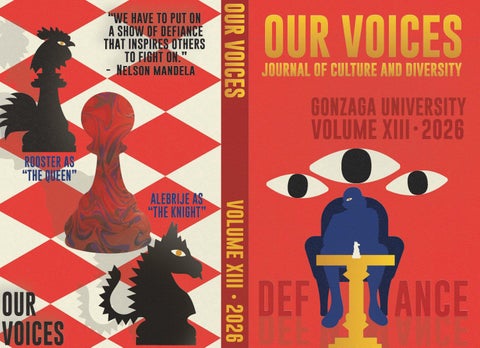
THA
OUR VOICES Journal Of Culture and Diversity
"Art should comfort the disturbed and disturb the comfortable." - Bansky
3
STAFF Carissa Kanae Editor-In-Chief '
Ines Marquez Editor
Grace Applegate Editor
Samantha Riggleman Editor
Jhanessty Vaye Bautista Graphic Designer
4
CONTENTS Poetry
P.35
Narrative
P.71
Essay
P.93
Visual Art
P.143
Diversity Monologues
P.165
5
VOL. 13
6
POETRY Ashkenazi
P.37
Because I Will Not Expire Until You Do
P.39
Chrysalis
P.42
Good Grief
P.44
Ku'u Home, Ku'u Pu'uwai
P.46
Metamorphosis
P.49
Julia Porter
Jhanessty Vaye Bautista Grace Applegate Samantha Riggleman
Zion Vaoifi
Rowyn O’Conner
7
P.50 The Words On The Margins Of My Notebook Devyn Hubbs
Reaction
P.54
Status
P.56
The Worms and the Rain
P.59
Undyed
P.61
Written Verbal Headspace
P.62
Findlay Green Araceli Lopez Ayala Vanover
Hailey O’Hara
Grace Applegate
Carissa Kanae
8
With Love, Bhuamma
P.65
A Walk Home
P.68
Deeya Chandran Ella Jackson
9
NARRATIVE At The Pool
P.73
A Queer Little Boat
P.76
Zoe Schinko
Savanna Raley
What Fish Sauce Taught Me P.83 About My Accent Thi Lan Anh Ha
P.87
Tick Tock
Dominic Pe Benito
10
ESSAY P.95 Alienation and Acceptance: A Journey To Belonging Meianna Neumeyer
An Obedient, Behaved P.99 and Compliant Student Angela Macabinguil
La Voz Que Casi Olvide'
P.102
Mi Heroina
P.108
Invisble
P.112
Isabella Caparroso Jasmin Ochoa Duarte Cheon Joo Yoon 11
The Wisdom of a Worn Book
P.122
Visibly Invisble
P.126
Who I Am
P.131
Hailey O’Hara
Caela Caberto
Camille Maggio
12
VISUAL ART Ponderosa
P.145
Spirit Of Home
P.147
Where The Kamal Blooms
P.151
A Life's Perspective
P.153
Trauma Challenges Truth
P.159
Aislyn Ross
Rachael Bandy
Leisl Fernandes
Adrian Valenzuela
Kira 森 Bifone
13
DIVERSITY MONOLOGUES Place-Based Wonder (Burien Love Letter)
P.167
Where Is His Love?
P.171
Teleological Witness
P.177
Sticks & Stones
P.197
Solidarity Forever
P.200
Daija Tramble
Bong Bong Barro Shay’den Howell Precious Lee
Roland Allen
14
Piece By Piece
P.206
My Kurdish Hair
P.213
Neide (IK) Idumwonyi Nermin Omar
Doctor (Dr.) - Doctor P.215 (M.D.) - Doctor (Ph.D,) Kira 森 Bifone
Conditional vs. Unconditional Love
P.218
Battling Adversity
P.224
Alyxandria Foster
Isabella Caparroso
15
Answering In Silence
P.228
80/7,000
P.232
I Wanted To Be A Teacher
P.236
Quinn Fedullo
Daija Tramble
Rajane Edwards
16
DEAR READER, In our current state of world affairs, there are many who believe that storytelling, particularly personal narrative, should be shut down. Public broadcasting systems and individual accounts, all shut down in the sake of a monolith. That said, we as a Gonzaga population and as a human populus have never been a monolith. We are filled with color and vibrance, a richness that no amount of desaturation could ever take. This year’s edition of Our Voices is Defiant. Not because we must be confrontational, not because we aim to be asserted as a resentful force, but because identity cannot be stripped, no matter what one endures. Our authors resist; they defy, they live, they breathe, and they do what may seem impossible on bleary days. We continue to live, and because we live, so do our stories. We are surrounded by administration who work against our common good for their own selfish gains, and restrict our speech, our bodies, and freedom originally promised in our country’s governing documents. Due to the shape of an eye or the color of one’s skin, due to the words that roll off a person’s tongue, people are being detained, kidnapped, stolen from their lives and disrupted during their stories for the benefit of a “superior” type of person, and those who do not fall into a specific subsection of the population are left to fight for scraps in an unspoken caste system.
17
Yet, in protest, we carry the names of those who have been lost to this corruption; children ripped from their parents and families torn apart for a crime they did not commit. We hold their names and stories in remembrance in the attempt to remind ourselves that this is not normal; this should not be something we adjust to. Even still, we continue to tell the stories of the people we love, and hold onto traditions for years. Life moves on, even if it begins to race like an anxious heart or slow with dread. In the stories we tell, lessons are learned and people live on beyond their bodies. We mourn, we grieve, we move, and as we grow, we hold onto fragments of those who have touched our lives in any capacity. In reading this journal, I hope you are invited into another person’s soul, and you find fragments of yourself. I hope that if you haven’t, you feel inclined to share your own story, so that others are able to speak up until we are filled with a community of those whose lives are spoken into air and carried on through the matter of the universe. Take it all in, slip on someone else’s shoes, and ask yourself, “how would I tell my story?”
WITH RESPECT, LOVE, AND GRATITUDE, Carissa Kanae
18
FOREWORD Pages 21-30
19
20
STUDENT REFLECTION
Araceli Lopez Ayala Vanover Diana Ramirez-Leon Having had plenty of opportunities to reflect on how my Gonzaga education has formed me with this mission at its core, I find it insulting for this institution to continue to lie to each and every one of us. Is allowing our vulnerable students, faculty, and staff to live in fear and uncertainty about their safety at this school showing solidarity with them? Is allowing Border patrol to table at our career fair a commitment to the dignity of the human person? It is unacceptable for this institution to continue to fall short of its promises while we sit in a classroom discussing how this same education will supposedly help us make the world a better place.
I am a fourth year philosophy major, here at GU which means that for the past year or two, I have been in at least one CIS course per semester. Without fail, the Gonzaga mission statement is discussed and put on some sort of pedestal. Each of these courses has claimed to be aiding Gonzaga in its mission to form the whole being intellectually, spiritually, culturally, physically, and emotionally. We are told that our education and institution will “foster a mature commitment to dignity of the human person, social justice, diversity, intercultural competence, global engagement, solidarity with the poor and vulnerable, and care for the planet.”
21
Our feeds constantly switch between ads, to families being torn apart.
I know that we’re here in front of you today as members of the Latino community to be some sort of example of the fear our people have, and to that I ask why. Why is it that you need the anecdotes, tears, and anger of two fellow Zags? What more do you need to be enraged? What more do you need to see and hear for you to demand more from this institution. We saw a 5 year-old Liam Ramos used as bait by ICE, we saw Keith Porter Jr. shot by an off-duty ICE officer, we saw 32 people die in detention centers this past year.
Why should we have to share with everyone the fear and anger we feel when we see people being used as bait, telling their families that everything will be okay as they are being shoved into a van, when they are targeted for speaking any language other than English? How many more violent and brutal injustices have to be committed before this university begins to care. Do you need your immigrant students weeping before you, do you need your Latino students to live in constant fear that they could be next before you say something.
22
and faculty and staff who carry the emotional labor of supporting students while receiving little institutional reassurance themselves. This does it affect only a small group of people. When immigrant students, students of color, and international students are targeted, the entire campus community feels the consequences. Fear does not stay contained— it spreads into classrooms, residence halls, offices, and community spaces. We cannot thrive in any environment where the fear of being targeted is always on our mind. We cannot thrive in an environment where Border Patrol has a table in the career fair. Silence from leadership does not create neutrality; it creates vulnerability.
Do you need to see one of our family members dragged out of their car before you can send the “thoughts and prayers” email? We understand that addressing statements like these can result in a decrease in government funding affecting the institution, but is risking the safety and wellbeing of students, staff, and faculty really worth it? These are difficult questions to ask but imagine all of the people— children who fear and question whether their parents may not come home, students who now sit in classrooms unsure if they will be allowed to finish the degree they worked years for,
23
We all know that Gonzaga is known for its motto, Zags Help Zags, painting this curated image that we are a united community, that we share a common goal in growing the whole self alongside being there for others. This branding is powerful, polished, and effective—but branding alone does not equate to genuine support. Yes, we hold the doors open for one another. Yes, show up for games, celebrate wins, and wear school colors with pride. And while these moments create the appearance of solidarity, they are also easy tasks. True community is not measured by how loudly we cheer, but by how we respond when members of that community are placed in harm’s way.
We are actively asking the institution to address how they are going to protect their students from ICE, yet there is silence. These students are not outsiders. We sit in classrooms, live in residence halls, contribute to research, lead student organizations, and excel academically. We attend basketball games, wear Gonzaga gear, and embody the very image GU promotes to the public. So why can’t you publicly address our demands? Is it because it goes against the GU image of Zags helping Zags? A university that relies on the language of unity must be willing to act on it, even when doing so is difficult.
24
Without transparency, accountability, and concrete commitments to protect vulnerable students, GU’s messaging becomes performative rather than principled.
25
A THOUSAND CRANES, SENBAZURU Yohei Aoki
Some people fold them for good luck, some for health, some for healing, and some for peace. When choosing this theme, we weren’t just looking for something decorative. We were choosing a story. We were choosing a tradition that represents hope in moments when hope is hard to hold onto.
I want to begin with something small. Not a big moment. Not a headline. Not a date in history. I want to start with a single square piece of paper. Just a square. Thin. Light and fragile enough that it can tear if you are not too careful. Because sometimes the smallest things can carry the heaviest meaning.
For many, the story of the one thousand cranes is connected to one young girl. Her name was Sadako Sasaki. She was just two years old when the atomic bomb was dropped on Hiroshima. Luckily she survived the bombing and grew up like any other child, running,
At first glance, paper cranes seem to be simple, just a piece of origami, something decorative, and something pretty to hang up. However, in Japanese culture, the paper crane carries deep meaning. There is a belief that folding one thousand cranes can grant a wish.
26
They are hung in colorful strands near the Peace Memorial, carrying messages of remembrance and hope. The paper crane became a symbol of peace.
playing, going to school. For many years, it seemed she had escaped the worst of it. Later, she became sick with leukemia, which was an illness that was connected to the radiation exposure. While she was in the hospital, Sadako began folding paper cranes, one after another. Each crane folded carried a wish. A wish to get better. A wish to go home. A wish to grow up.
A reminder that even after destruction, people still choose to create. Still choose to hope. And still choose to believe in a better future. This belief, however, is personal to me in a way. I was born in Japan and moved to the United States when I was 2 years old. I don’t remember much moving from Japan, but Japan was something within me rather than something I lived in every day. It lived in the food I ate at home. The language I spoke to communicate with my family.
A wish for a future she deserved. After Sadako’s death, the story spread. Children from around Japan and later around the world began folding cranes in her memory. Today, thousands of cranes are sent to Hiroshima each year.
27
That moment stayed with me.
And in traditions that felt normal to me but different to my friends. One of earliest memories of the meaning behind paper cranes wasn’t from school but was from watching my mom. When I was young, I don’t know how old, but this memory is vivid. My mom had a close friend who was very sick, and she was sitting at the table, quietly folding crane after crane. At the time, I didn’t understand why she was doing it. I just witnessed the repetition of her hands, the patience, and the care she put into each fold. Looking back, I realize that those cranes were her way of hoping for healing when there was nothing else she could do.
It showed me that the act of folding cranes isn’t about tradition. It is about intention. It is about putting care and emotion into something tangible when words aren’t enough. It is about trying to bring a sense of peace into situations that feel out of control. This is what connects Sadako’s story to everyday life. The cranes aren’t just about war, they are about healing. Healing doesn’t always mean curing, though. Sometimes healing means being present. Sometimes it means just showing up. Sometimes it means acknowledging pain instead of running away from it.
28
But the story of a thousand cranes reminds us that small actions are exactly where meaning begins.
When people fold one thousand cranes, they are doing it for someone who is sick, someone who is struggling, for someone who has experienced loss, or maybe even for themselves. The cranes become a way of holding onto hope when outcomes are uncertain.
One crane can’t change the world. But one crane becomes ten. Ten becomes one hundred. And suddenly a hundred is now a thousand, and what began as something as fragile as one origami crane becomes something collective.
This is what I think makes this tradition still meaningful today. Because if we are honest, the world today still needs healing. We see conflict. We see division. We see illness. We see communities affected by violence and injustice. In the face of all of it, it is easy to feel powerless. It is easy to think that small actions don’t matter.
So when you see the cranes around, or if you fold one for yourself, I hope you think about what you would wish for, not just for yourself, but for the people around you, for the communities you’re part of, and for the world we are all living in.
29
This image of a thousand cranes connects history, culture, and personal experience. It connects a young girl to people across the world decades later. It connects my mother folding cranes for her friend to all of us here tonight. Ultimately, the cranes remind us that even in moments shaped by pain, people will continue to choose care. They choose remembrance. They choose to believe that healing, in any form, is still possible. Thank you for taking the time to learn about this tradition. And thank you for helping us carry the meaning of a thousand cranes, Senbazuru forward. One fold at a time.
30
ACKNOWLEDGEMENTS By: Carissa Kanae
31
The Our Voices 2026 team would like to extend our heartfelt thanks to the many hands who worked on this year’s edition of the journal. As the Editor-in-Chief, I would like to acknowledge them for all they’ve done. To start, I want to extend a heartfelt gratitude to our faculty advisor, Dr. Yu-Kyung Kang, for all she has done this semester. In her first term as advisor, she has continually promoted our journal, as well as opened avenues for OV that I never would’ve previously thought possible. Dr. Kang is the reason for our multilingual submission, as well as the patience and kindness continuing to guide the team and I through a particularly crazy year in OV. We are beyond blessed to have her now that she’s begun this undertaking, among the billions of things she does for Gonzaga. Thanks to Dr. Kang, we additionally had a fortunate collaboration that allowed for more accessibility in Our Voices. Dr. Kang was quick to connect us to Dr. Alec Schumacher, who was passionate from the start about including multilingual pieces in the book, and worked hard with the Modern Languages Department and its faculty to open avenues to the other languages that were offered. This year, Our Voices offered the ability to submit pieces in Spanish, Portuguese, Italian, German, French, Korean, Japanese, Filipino, and Chinese. It is all thanks to Dr. Schumacher and his colleagues, Dr. Torunn Haaland (Italian), Ute Perz (German), Dr. Benjamin Semple (French), Dr. Yu-Kyung Kang (Korean), Yoko RoySensei (Japanese), and Robert Gipal (Filipino). These collaborators created so many more avenues for students to tell their stories that
32
would traditionally be closed to them, and it is because of them that we are able to empower more of our students who do not speak English as a first language. Every predecessor EIC of Our Voices has a hand in shaping how the book turned out today, and I want to thank Dominic Pe Benito, one of the authors in this book and the Editor before me, for showing me the platform OV has for Gonzaga students. If not for his leadership and guidance, I would not be here today, and if not for his ideas and suggestions, the book would not be Defiant, nor would it be the statement it is intended as. My editorial team of Ines Marquez, Grace Applegate and Samantha Riggleman deserve all of the kudos and all of the flowers for the work that they have put into this book. From copy editing, last-minute calls over breaks to review pieces, and stepping up beyond their posts, the team truly does define the journal. Because of their open-mindedness to this theme and their spirit in every meeting, working on Our Voices is a joy, and the editorial meetings are something that I looked forward to despite the overhaul that this took. Beyond that, my graphic designer, Jhanessty Vaye Bautista, is the one who took everything conceptual about the book, and made it a reality. The theme of Defiance sits heavily within her graphic design, and between a four hour long text thread about what different chess set-ups mean (since neither of us really play), throwing an inside cover request two weeks before it was due, the designing of a sticker, the inside of the book, and multiple
33
requests that required her keen eye, this book is all a labor of love on her end. In her two years as graphic designer, she has worked tirelessly to ensure the book in your hands (or on your screens, since she works on the digital copy as well) is fit for distribution. Finally, to my two supervisors at Student Media, Dana Parsons and Morgan Scheerer, thank you for encouraging me every step of the way, even when this journal seemed like an insurmountable project I could not undertake. Creating a journal centering identity and self-expression is a delicate task, but they helped to maintain that balance through advising and being the team’s biggest supporter every week, in every way possible. It is only thanks to the community of people behind this journal that we are able to tell our stories so freely. As a reader, I hope you feel all of the love that each person contributed, and continue to engage with Our Voices, Reflection, Charter, Student Media, and the diverse perspectives that Gonzaga has to offer. Telling stories this way is an act of courage, and I am deeply grateful for everyone who has allowed their own vulnerability to find manifestation in these pages.
34
POETRY Pages 37-70
35
36
ASHKENAZI
Julia Porter
Some people try to tell me that I am not Jewish— not a real one anyway. It’s true that I don’t practice, but that’s not the only way I am Jewish in the way that I have to test for the BRCA gene, a genetic mutation that increases the likelihood of developing breast or ovarian cancer. I’ll have to get my breasts removed and a hysterectomy by the time I am thirty-five. I am Jewish in
to be a Jew.
If I have the gene,
my DNA.
They tell me that I’m not Jewish, but I have experienced generational trauma from my family fleeing Nazi Germany, from how my grandmother’s parents were the only people in their families to have made it out alive. In the way that my great-grandfather found out his brother died through a documentary made forty years later -hung in front of his parents in a concentration camp.
37
I am Jewish in the way people have made jokes about me dying in a second Holocaust. So, don’t tell me that I am not a Jew. I am an Ashkenazi Jew and my body and family
38
bleed proof.
BECAUSE I WILL NOT EXPIRE UNTIL YOU DO Jhanessty Vaye Bautista
At my funeral, there will be no flowers for this casket only fits one, and there is no room for two dead things. There is no room for a flower that was never plucked, never picked, and the dining table has always been empty as something in my mind clicks. A dad with empty hands leaves a partner for another And a daughter with so much to give starts to resemble her mother. What goes around comes around. For what is a flower if given out of spite and not consideration? and how does a lover forget the thorns in every blooms’ creation? A weed or two would have sufficed. Lay me atop a field of sleeping grass, a series of touch me nots; because at least their touch will not consume me. For how could a child pray for love and death in the same whisper?
39
How can I look for love in the form of flowers and instead receive them withered? There is no room for two dead things. But, The leaves that will cradle me curl into themselves, gently, They graze my body—like fingertips wiping away tears etched on my cheeks. Like a fight between arms and bodies as their embrace wrestles against living room fights that end with “your sadness is nothing compared to the weight of another’s.” Like whispers from a mother to a daughter, their reflection may stay the same, but one breaks the mirror, breaks the cycle of hurt. She whispers to her daughter “Escape.” She says, “I love you.” At my funeral, there will be no flowers. Because you, my makahiya, will replace them instead.
40
Your names linger on my lips, people who do not know you, know you. And you’ll live to tell the tale of the girl who was finally seen. Finally, understood. My funeral may not be filled with flowers, but it will be filled with so much love. For as long as you are alive, I am alive For as long as I am alive, you are alive. I will not expire until you do.
41
CHRYSALIS
Grace Applegate Every damn night is a come-to-Jesus moment. Vermillion strains through stained glass windows, ripping air open for saints to swallow breaths of prayer. If you look close: saliva drips light angles on tile, wraps up navel oranges and hugs around the body incessantly: “They’re going to help me.” I knock and knock, but I am still a stranger, just the woman who wears only yellow: she who clasps her hands without music, save for sorry whispers of cicadas and children, charioteers who carry lanterns and move as hearth-fires, bright veils on bright heads. What percussive sound does a thought serve, shades scurrying through a young mind, quick-rate? Up above, voices strike, grimed feet crack, torsos writhe and bend impossibly on and on like the green and dying, hearts splitting happily in their breasts. I do not dare to be honest.
42
No man-made construction can protect me from this sound––the waves, running forever-tambourines like stallions. I stare at a closet of yellow.
43
GOOD GRIEF
Samantha Riggleman I hate thinking like you’re already gone. But I also know, you’re not all the way here. In this somewhere in between, I trace our times together, outlined in crayon and carefully colored in. Where are your office supplies now? I think you reorganized them when I was out, and now I can’t find them. We are different, and I’m losing both versions, and I think you are losing me too. To me, grief feels a little bit like coming home to all the lights off, smelling your body spray in a crowded mall, or hearing your song on the radio. It feels like forgetting the last digit of a phone number— and remembering the fine, thin hair I used to braid It sounds like shouting at the game on Thanksgiving, and tastes like Diet Coke. Maybe I am Grieving you now, or maybe I will in the future, but all I wish is that I could be a little kid again.
44
Pick me up from school. Give me a hug. Tell me it’s okay. Now I pick you up from appointments. And we come home to the lights off. And I give you a hug. It will be okay. How was your day?
45
KU’U HOME, KU’U PU’UWAI. Zion Vaoifi
Ku’u Home, Ku’u Pu’uwai. My Home, My Heart. Koʻu mau mokupuni nani o Hawaiʻi My beautiful islands of Hawaiʻi. Kou kahua pāʻani, Kou ka hoʻomaha. Your playground, your vacation. Koʻu mau mokupuni nani o Hawaiʻi. My beautiful islands of Hawaiʻi. Kou ka puke aʻo moʻolelo. Koʻu i ka ʻola. Your textbook. My Life. Koʻu mau mokupuni nani o Hawaiʻi. My beautiful islands of Hawaiʻi. — Ku’u Home, Ku’u Pu’uwai. My Home, My Heart. Koʻu mau mokupuni nani o Hawaiʻi. My beautiful islands of Hawaiʻi, I feel the echoes of my ancestors as I speak here today. I feel my ʻohana, hoaloha, nā mokupuni, lāhui, my community, my people. Ask me – through the hard times – what kept you going. Iʻd tell you I do it for myself, but I do it for the mixed Polynesian kid who comes after me – so they can go farther than I ever could.
46
I do it in opposition to the white man that came to my islands all those generations ago. Taking and taking until we had nothing to give. Give a white man an inch, he’ll take a mile. Give an early century colonizer a ship, and heʻll think he discovered something. Kou kahua pāʻani, Kou ka hoʻomaha. Your Playground, Your Vacation. Koʻu mau mokupuni nani o Hawaiʻi. My beautiful islands of Hawaiʻi, I feel the rage of my ancestors, of my fellow native brothers and sisters in this room — indigenous to the Americas, as it’s your land this institution occupies. Ask me how I navigated a system built for wealthy white men? I didn’t. I stuck out and leaned into the box set up for me and played your system. Call me the “in-house native boy” again – Iʻll wear it like a lei and walk with pride. Cause where I go my culture follows and where my culture is, is where my mana comes from. Kou ka puke aʻo moʻolelo, Koʻu i ka ʻola. Your Textbook, My Life. Koʻu mau mokupuni nani o Hawaiʻi. My beautiful islands of Hawaiʻi, I feel the generational sorrow when I look at our flags flown below one representing freedom but only within the social contract and conformity that they deem appropriate; non-savage life.
47
Over 30 countries – including global superpowers at the time such as the U.K., France, Germany, and Russia – signed treaties or formally recognized the sovereignty of the Hawaiian Kingdom. Ask me where the support was for Hawai’i during the overthrow? Beyond her people there was none. Methodically and strategically planned out by the Hawaiian Kingdom to ensure global protection from foreign powers. It is not just the U.S. that shares this blame but the entire world. When asked for supplies and goods we provided, when pleaded for justice of the illegal overthrow of the Hawaiian Kingdom, a formal apology was supplied. Words with no action are just that, words. Ku’u Home, Ku’u Pu’uwai. My Home, My Heart. I ka wā ma mua, i ka wā ma hope. In the time ahead, in the time behind. The success of our future depends on our indigenous people and cultures. Our indigeneity is what kept our worlds in balance for so long until the introduction of colonizers bringing disease and capitalistic values. Look to the past, where our roots run deep, to find the future they tried to bury. Ku’u Home, Ku’u Pu’uwai. My Home, My Heart.
48
METAMORPHOSIS
Rowyn O’Conner
The summer after you started binding your chest, you wished you could go to bed shirtless. This was not the first time, just the one that mattered. Like a butterfly emerging from their cocoon, you wriggled out of your t-shirt in the middle of the night and tossed it on the floor. You loved how the cold sheets felt against your bare torso, the beginnings of want. During the day, hyperbole boyhood. You fooled yourself into flatness in the dark. Laying on your stomach, perhaps you could pass for a cis man. But too soon, morning arrived, as did your father in the doorway. Only then did you remember what you were— not false, just unfinished, or waiting for this body to feel like yours.
49
THE WORDS ON THE MARGINS OF MY NOTEBOOK
Devyn Hubbs
i.
I want to write the stories of my life on my skin, carve the memories into my body so there is no telling what is me and what is where I’ve been. And when you come to me and ask who I am, I’ll take your finger and press it to my skin. And I’ll wait until you trace every part of me, every part of who I’ve been, until you know all of me inside and out.
ii.
I came home to shattered glass on my floor. It wasn’t a surprise, I broke the thing this morning. But instead of picking it up, hiding the shards away in the garbage bin I left it laying there, bleeding into the corners of my room. I could tell you a million reasons why it’s still there. No time, no help, no thoughts, no motivation to
50
take it away at all. But I think the truth about this broken thing is it reminds me I can be broken too. So I’ll keep tiptoeing around the glass at night to squeeze into my bed, as long as I can leave my own brokenness laying here next to it in the morning light.
iii.
Your assignment is to write about one of the recurring themes of this life and connect how it pertains to the essence of being we seem to forget is constantly growing, constantly changing, around us with every decision. Make sure to use real life examples that you would never admit you feel. You have your option of: • • • • • • • • •
The passage of time and its betrayal The energy it takes to hate a body Our true selves seeping through The not wanting to need someone The needing someone to need you The fear of being still The bags that stay half packed The fear of showing how desperate one is to be loved Water
iv.
Because I come with a set of instructions that only has one step: do not break.
51
But who even reads the instructions anyway?
v.
“to you, I am dust” I say to the mountain as i press my cheek to its feet. “you can crumble and fall, and bury me whole.” “to you, I am but nothing. nothing in a world of nothings. a thing with no name.” “to you, I am dust” I say to the mountain, A smile on my face, because dust I shall be.
vi.
dime un otro vez, como soy todo todo el aire, todas las bailes, y todas las cosas en las calles que recordamos por todo dime un otro vez, como soy todo. (Interpretive Translation) tell me again, how I am everything every breath, every movement,
52
And everything in everywhere that we remember for always. Tell me again, how I am everything.
vii.
If my body’s a temple, then I’m the one smashing cigarette butts in the sidewalk out front.
53
REACTION
Findlay Green Within the chest of femininity There is a chemical reaction A bubbling of gases and atoms That once reach open air, will ignite Girls are taught before boys to limit themselves “Boys will be boys, but you are better” I have been taught to filter my words Be unobtrusive while my brother curses well into the night disturbing my sleep Every time I ask a question in math class I bite back my impulse to start with ‘sorry.’ At some point in girlhood, I was convinced I must shrink my personality, my voice, To keep quiet and still A girl does not bleed first from her vagina it is from her mouth at the force which she clamps on her tongue to hold back her opinion
54
For she knows if she voices that thought It will be too emotional, Too dramatic, Too harsh She must grab that bubbling in her chest And beg it to be still To barter with her rage, say “When the time is right, I will speak my mind I will let you overflow. I will let you combust in those faces of laughter I will let you smoke and snarl at the belittlers I will let you!” I hear the jokes, the laughter, The people in power, the burning grows stronger, I will not let my anger die quietly! My anger will die like the death of a star.
55
STATUS
Araceli Lopez Ayala Vanover What is an illegal? Is it that they don’t have proper documentation to be on the land? Land that was stolen from Indigenous communities. Is it that they have committed a crime that revoked their citizen status? Is it that they were given asylum, but not permanent residency? Yet when they want permanent residency, to be considered a legal on the land, they can’t receive it because the courts are backed up, so they are deported by ICE agents waiting outside the court house. Or is it that they look like what you expect an “illegal” to look like? Are they illegal because they talk in a language other than English? Or in an accent that’s not romanticized like English or Australian? Truly, what is your definition of illegal? Who do you picture when you think of immigrants? The people who came to the United States to give themselves a better life and their children better lives.
56
Without any knowledge of their status, do you picture a white British man, who is undocumented, or do you see a person of color, who does have proper documentation? When you walk along the street, are you intrigued by a British accent or are you intrigued by a Spanish accent? Who would you assume is illegal? Would you see a multibillionaire as one? Would you see an orchard picker as one? Would you see a student as one? Would you see a staff member as one? Would you see my parents as one? Would you see my friends as one? Would you see me as one? All over the United States, week after week, fathers, mothers, sons, and daughters are being wrongfully detained, abused, and separated from families because they are seen as illegals.
57
All because they speak with an accent, speak in a different language, and look like an illegal in their eyes. So, what is an illegal?
58
THE WORMS AND THE RAIN
Hailey O’Hara
Incense and mahogany that creak with each step. Weight on my knees and light through the stained windows, weaving lace patterns on my face and arms. Like a widow or a mother in mourning. And indeed, I mourn. “Let us pray.” I bend my head and I hope. I hope I feel something besides the emptiness in my head. But I have never found God in a church. God is the sleepy sunlight peeking through forest leaves, bathing the earth in melted butter and gold. God is the smile on my sister’s lips. God is the unhoused man nursing a wounded dog back to health. God is the single caramel leaf on the ground.
59
I worry the more time I spend surrounded by statues and balconies, the further I get from God. How can we watch life grow inside the body of a woman and assume the secrets of the universe are about men? How do I understand myself outside the language of a patriarchal structure and religion? I am so angry at the world. At the hate justified by the Word of God. What do you do when nothing feels possible? “You understand that every little bit of love and hope you put out into the world is like energy,” my Religious Professor tells me. Perhaps, resistance is stopping during a rainstorm to save drowning worms on the concrete. Yes, I will keep finding God in worms and oozing bandages and frustrated tears. Perhaps God is resistance.
60
UNDYED
Grace Applegate Our minds—heavy on a land of wheat— steep and braided in a neat square I challenge the road that bears no rain nor heat. Who has chalk for clouds, or chalk for beetles—life built on mushroom and decay, life of some future we do not know? The inspiration for the rest of my own remembers him grasping a waxy pepper close to his heart while all around him: porchlight and mosquitos and dusk. I took for granted that warmth––I walk along this white path and look back.
61
WRITTEN VERBAL HEADSPACE
Carissa Kanae
i’m so sorry for being so loud all the time. i’m worried if i don’t say it like this, i won’t matter anymore. i grew up a girl in a herd of boys; my brother’s friends, his teams, always over. the smallest of the group, if i’m not fighting back with twice as much fervor, i will go under. i wonder if my culture is the same way. a mixed-ethnic asian girl, i am a small population in an already tiny population; my culture is not shown unless i show it. it is not shown unless someone else decides that it’s trendy, it’s profitable, it’s something they want to be. my culture is my own, until it’s everybody else’s to partake in, to have, to hold, to take from me. it is mine until they don’t want it anymore, until my culture is no longer shiny and new and young. until my culture is something to criticize, my food too pungent, my language too strange. until everything my ancestors did is my fault, and the blame becomes heavier than romanticization can carry. i sit in classes everyday and i listen. i listen to people telling me how racism is, white people telling me to listen to their stories of being a
62
bystander over telling my own stories experiencing it firsthand. because it hasn’t been relevant—nothing in my life has been relevant until someone of a more “normal” background tells it, until my story is just a story, and not a truth, not a fact of the matter, not an experience, but just word of mouth. i am a joke, until i am not. in your world, i am either a joke because my culture is a joke to you, or the joke is the people who like my culture. because they’ve never really liked my culture, they like pale skin and cherry blossoms and they like makeup and music and what they think it should be. they like playing dress-up with our cultural clothes and putting it on social media because they can go to my homeland and put my culture on to show people how much they know. they can go to my homeland and tell me that i don’t understand my own family, i don’t understand the motherland because i have not been able to go every year, because my family cannot afford to travel to and from the country like a white person with money will.
63
i am too loud for my culture, but i am too quiet, too complicit still, i let it happen, and i stay here, and i take it. i am too much until i am too little, and god, am i afraid of being too little. i am so afraid of being too little that i will sit here and act like the angry asian girl that i am, always fighting. i’m sorry for taking up so much space. i don’t want to be the reason my people disappear.
64
WITH LOVE, BHUAMMA
Deeya Chandran
My bookshelf is full of children’s books A little beaten up with frayed edges and folded pages from years of love Although now, they sit untouched, collecting dust. The truth is, at 21 years old, I have no practical use for The Giving Tree but its front page bares a faded, hardly legible signature in black ink “With love, Bhuamma” Every birthday, Christmas, and sometimes just because, my book collection expanded with her choices. It was my grandmother that gave me stories, but it was my mother who brought me along, to where I could choose them for myself Orchestrated my attachment to make believe Finding comfort in fairies, wizards, and heroes. How lucky was I to grow up immersed in a world of stories, kahaniyon ki duniya mein How lucky am I to have inherited theirs, my heroes, To have one to call my own. These women have written my story, or rather the prologue Because for the first time, this is one where the
65
daughter gets to write her own adventure, Freed from judgy eyes and the suffocating constraint of the idea that she is not worthy of opportunity Her story is one of abundance in place of loss One of choice in place of force Where getting lost is never a consequence, Almost an encouragement Because they know she will find her way It is because of them that I can navigate the hurdles, the obstacles, the villains, Never afraid to turn the page They are the binding of the book, blind to those who read it and forgotten to appreciate, preventing the pages from falling apart. I am just one chapter in a long history of strong women before me And I lead the way for those after me, laying the foundation upon which they will run. It is daunting to be responsible for their stability, to replace sinking quicksand with steel, so that their footsteps may be heard. But, it is an honor to be entrusted with that legacy.
66
A generational responsibility is just a story worth telling. I still love reading stories, especially now, as I find a way to tell my own, ya humari I still tear through novels although I’ve progressed past The Giving Tree. And when I visit, Bhuamma still gives me books, and my bookshelf continues to grow full
67
A WALK HOME
Ella Jackson
The old road is scattered with specks of light, flickering, casting down on old footsteps, replaying, watching the decay. At the end of the road, there is a house shielded by trees. A dome of emerald, intertwined with golden light. I stand still, like I could sink into the cracks beneath my feet. I would let the earth wrap vines around my ankles, turn my shoes mossy and green, I would become a nameless statue, a golden hand reaching, if it meant the earth would not seal and shake beneath my feet to say, “You do not belong here, not anymore.”
68
I would become a nameless statue, a golden hand reaching, if it meant the earth would not seal and shake beneath my feet to say, “You do not belong here, not anymore.” If it is rejecting me or protecting me, I may never know, for now, I just stumble from its grasp, my bones beginning to sink, crawling to reach warm kitchen windows and wreaths on wooden doors, packages on porches, and out of tune guitars. Scratching at the pavement saying, “I belong. I belong. I belong.” Scratching at the pavement saying, “I belong. I belong. I belong.”
69
70
NARRATIVE Pages 73-92
71
72
AT THE POOL
Zoe Schinko
It was a Tuesday and my skin was slathered in sunscreen, and I could feel the remaining droplets of water on my collarbone slowly drying in the L.A. heat. My cousin Maxi lay beside me on a beach towel, an arm thrown across his face to block out the glare from the sun as he read a Donald Duck comic. I had an open notebook resting on my chest, but I didn’t have much to say –– I have never been drawn to journaling. And yet, at the age of ten I was convinced that one day I’d be a writer.
stretched from my core and anchored me to the center of the earth. That I was like the kites we used to fly over the chamomile fields by Half Moon Bay — tethered to home no matter how far I drifted.
My Opa had died three months ago, and I found myself thinking about life and how lying beside the pool, I could imagine a string that
“Give it back.” I looked up and saw Aaron in the pool. A boy around my age towered over him,
It had been Opa’s wish that we would take a trip as a family. And so, we had all road tripped down from San Francisco to L.A. because distraction offers a way to divert attention from grief. Our distraction came in the shape of billboard signs, Best Western Inns, and roads flanked by redwoods.
73
And I guess that is love, isn’t it? It is brilliant, and it breaks, and it sits on the linoleum floor, wiping tears from your brother’s cheeks while sticking a Band-Aid on his scuffed shin, because you are older and can reach the medicine cabinet. It lives in clasped hands, in overthe-shoulder glances at Aaron as we biked down our street, legs kicking, because life was quick, but we were faster. It lives in sun-stained days with chlorine in my eyes and water on my skin and a curled fist. And maybe some of it left the day Opa died, but it is still mine and I can’t say I regret the bruise blooming on the boy’s chin. Forever breaking, barreling into the distance.
holding Aaron’s pool noodle high above his head. He smirked as he watched Aaron jump up and down, trying to reach his outstretched hands. But at the age of seven, Aaron was just too small. “You want it?” The boy pushed and Aaron’s head went under, hands flying out, in an attempt to tread water. I stood up. Aaron wasn’t a good swimmer. The boy never saw me when my feet left the pool deck. I hit the water and all I could see was white. I pushed against the wall, putting my weight into the stroke like a javelin throw, barreling through the pool, thrashing, the sting of the chlorine making my eyes burn.
74
Forever a rupture in the quiet.
75
A QUEER LITTLE BOAT
Savanna Raley
but nothing catching my attention. I felt I was floating in and out of each conversation, not paying any mind to a single one for more than a moment. I didn’t know these girls, not really. They all arrived at camp on the same day I did, carrying the entire summer in a single trunk. They were kind, but I was quiet and unsure of myself and the world around me. I lifted my head, my hair catching briefly on my glasses as I did so. Shaking to move it out of the way, I looked around the room. We were all there; it was the liminal time between dinner and quiet hour, with everyone in the cabin shaking off the sleepiness of late afternoon and beginning to move around.
The coarse wood dug into the back of my thighs as my legs dangled over the edge of the bed. My foot tapped a rhythm on the worn wooden floor of the cabin as I swung my legs back and forth. The air around me was sticky with the lingering humidity of summer, but I was comfortable, not moving enough to overpower the cool and calm of the coming evening. My hair was long then, draping over my shoulders in a curtain of brown and fading blue that tickled my cheek. I stared down at the floor as I watched my light blue tennis shoes fly in and out of view. The cabin around me was filled with chatter, some mindless and some more interesting,
76
and made to run the length of the small creek that ran through the camp. Perhaps she was planning on sending it on races against other brightly colored leaf boats, or maybe she just got bored and impaled a few leaves.
One girl that I tentatively considered one of my friends at camp was talking, her voice rising over the waves of chatter. She was holding an object in her hands. It was a vibrant green leaf, slightly shiny, reflecting the fluorescent light that bore down on us from overhead. A thin stick rose out of the center of the leaf, stabbed through just enough to see a bit of brown poking through the bottom. The stick itself was stabbed into a second smaller leaf, this one bowing outward as the twig pierced through the leaf. It was a boat, or at least the summer camp approximation of one, crafted of objects from the ground or plucked off trees,
I tuned into her conversation as she held the boat aloft, raising it to the sky in some dramatic proclamation. I waited, my breath holding in my lungs, my mind wandering in half-seconds to what she was going to say. Maybe she had found a suitably dramatic name, or she had a grand story about how it toppled the competition during the creek-racing. “This,” she paused, locking eyes with each person watching her,
77
the pansexuals and the the bisexuals have to sit, and I guess if straight people are allies, they can lie down on the boat.” After a moment to pause to consider: “Or maybe swim in the water.”
the drama in her words rising to its full crescendo, “is my boat of gays.” What. My thirteen-yearold brain stalled; it was not the grand story I was hoping for, nor was it the exciting name I thought it would be. One of the other girls in the cabin looked at her and raised an eyebrow. “What on earth do you mean by that, Alex?”
My little brain was swimming in all of this information. I had heard the words gay and lesbian before, but not in such casual conversation, and it wasn’t like I thought about it all that much. Alex forged on, her voice fading into the background as I thought about what she had said. I was an ally; I was straight and an avid supporter. It’s what I had been telling myself since my first Pride the summer before. I was just an excellent ally. But as I thought, an idea bobbed around
Alex confidently forged on, strutting around the small space on her side of the room. “I mean exactly what I said. This is the gay boat. Only people part of the LGBTQ community are allowed on here. The gays and the lesbians have to stand,
78
and that is why they have to sit. I’m bi, so I get to sit, and Lauran is a lesbian, so she can stand. So does anyone else want to be on the boat?” All the girls in the cabin started clamoring, either resigning themselves to swimming or telling the group where they would land on the boat. I just sat there, my mind swirling like a whirlpool, pushing this information deeper into my brain.
my brain like a little raft lost in a sea of identity. Not being on that boat didn’t sit right with me. I felt if I said I would swim, I would end up drowning. I tuned back into the conversation as one of the girls asked, “So bisexual and like pansexual. What’s that?” Inwardly, I breathed a sigh of relief, thanking whatever was looking down on that cabin that day that someone else had asked the question that I was far too shy to pose. Alex began again, “Okay, so bi is when you like all different kinds of people, but gender plays a role. Pan is when you like people regardless of their gender. They are kind of in the middle of straight and gay,
Technically, I knew being bisexual existed; I wasn’t that out of the loop, but I had never thought of it in the context of me before. The idea that I could be anything other than an ally was not something that had ever crossed my mind.
79
But at that moment, with the splintered wood of the cabin wall digging into my back, my knees tucked close to my chest, I thought, maybe, just maybe, this could be something for me. A community that I could have. A group of people that might just accept me for who I am, someone with two different tides pulling on their heart strings. A group of people where I didn’t have to stay quiet and subdued just because I didn’t feel quite like I fit.
I thought about the girls who made my heart flutter whenever they talked to me and the boys who I gossiped and giggled over. It was a label that just felt right when, for so long, there was something nagging at the back of my brain, something saying that a part of who I told myself I was wasn’t quite right. The tolling of the dinner bell stole me out of my reverie. The noise pierced through the waves of my mind, drowning out the white noise of mindless chatter. I began to get up and pull my sweater on, something light enough to cover up the evening cool.
I sat like that for a while, the sky darkening out the flimsy screen window. I turned everything over in my mind; the more I thought, the more it felt right. The idea of being able to love anyone across the gender spectrum felt like it was the right thing to do.
80
then it would be; this would be a part of myself that I could accept. She smiled down at me, nodded short and sure before walking out of the cabin. I stood there for a moment before following the rest of the cabin. I felt like something new had started, something felt so right. As I walked towards the dining hall, I smiled. I felt a bit more sure of myself, like a switch was flipped.
Everyone began to file out the door. I reached out to Alex as she passed, tugging on her sleeve. “Hey,” I looked up at her, fighting the quiet that wanted to take over my voice. “Can I sit on the boat?” She looked me up and down, raising her eyebrow and giving me a curious look. “Are you sure?” She asked, no dancing around the question or avoidance, just a simple matter-offact question.
Looking back on it now as a proud and comfortable queer woman, I know the nuances. I have seen my community: how we struggle, how we love. I have learned what it really means to be an ally and walk with all people. To help them up onto a life raft to weather the storm we call life.
My heart was pounding in my chest as I looked up at her and nodded, a tiny up-and-down of my head. I glanced back at her, the weight of anxiety heavy in the air. I felt like maybe if she thought it was okay,
81
It was poetic and perfect because while the sun was setting in, a tiny camp in the backwoods of North Carolina, it was rising in a whole new world that would push me to grow and learn, encourage me to settle into my heart and love with everything I am.
Back then, through the rose-colored glasses of summer camp, it was all so elementary, blunt and basic, but inspiring in the way that only thirteen- year-olds can be. It was a spark that lit the kindling for who I am today, a thing that now feels so passive, a single wave cresting in a massive ocean. But that night, when my world was still so small, I felt like something had shifted. I looked up towards the sky with oranges and pinks of the sunset peeking out from behind the thick leaves of the towering oak trees.
82
WHAT FISH SAUCE TAUGHT ME ABOUT MY ACCENT Thi Lan Anh Ha
Fish sauce was never optional in my house.
about that until I left home.
It was just there.
I’m from southern Vietnam, where heat settles into your bones and language comes easily. I started learning English when I was four. Not casually. Seriously. Flashcards. Repetition. Listening carefully, wanting to get it right. My parents believed language opened doors, and I believed them. Effort mattered in my family. If you tried hard enough, you earned your place.
My mom put it in everything. Vietnamese food, obviously, but also spaghetti, stir-fries, and soups that already had their own seasoning. Just a little. Enough to make it taste right. Enough to make it ours. Fish sauce is delicate if you grow up with it. If you don’t, it can feel like too much. It lingers. It announces where it comes from. For Vietnamese families, it isn’t something you replace. It is culture.
For a long time, I thought that would be true everywhere.
I didn’t think much
When I moved to the
83
down the hallway. Someone complained.
When I moved to the U.S., my accent showed up before I did. I became aware of my voice in a way I never had before. I edited myself mid-sentence. Replayed conversations after they ended. Wondered if I sounded wrong. I learned slang by missing jokes. I laughed a second late. I slowed down. I softened vowels. I tried to sound American, because I thought that was how belonging worked.
I stood there with fish sauce in my hand, feeling that familiar heat rise in my chest. The instinct to apologize. To explain. To promise I’d use less next time. To make myself smaller. That moment felt exactly like my accent. It lingered. People noticed. I couldn’t hide it.
Freshman year, my friend and I cooked in the Goller kitchen. Grilled chicken. Fish sauce. Garlic. Sugar. The same flavors my mom used back home. I remember holding the bottle and thinking, maybe just a little. The smell hit the air fast and drifted
When people asked, “What’s your first language?” or said, “I noticed your accent,” I used to feel ashamed. And angry. I had been learning English almost my entire life. I had worked so hard. Why did it still feel like I wasn’t enough? What changed wasn’t my accent.
84
American friends who didn’t treat my accent like something to fix.
I stayed. I stayed through visa renewals and homesickness that hit without warning. I stayed through long nights studying in Hemmingson, through moments where listening mattered more than speaking. I stayed long enough to find the Vietnamese student community. With them, my body relaxed. The sounds were familiar. The jokes didn’t need explaining. And outside of that space, I found people who stayed with me too. Friends who waited when I spoke slower. Classmates who listened without rushing. A cohort that made me feel seen without needing me to perform.
Being multilingual taught me something perfection never did. Language isn’t about sounding flawless. It’s about delivery. It’s about whether meaning gets through. And mine did. The smell of fish sauce didn’t disappear right away in the Goller kitchen. It lingered long after we finished eating. Just like my accent still lingers when I speak. Sometimes people notice. Sometimes they don’t. And now, I don’t rush to explain it or soften it. Maybe not everyone likes fish sauce. That’s okay. It’s still my culture.
85
It’s still something I bring with me. I used to think belonging meant sounding like everyone else, blending in until nothing about me stood out. Now I know it doesn’t work like that. Belonging isn’t about erasing where you come from. It’s about being comfortable carrying it with you. My accent stayed. So did my pride. And that’s what fish sauce taught me.
86
TICK-TOCK
Dominic Pe Benito Tragedy struck within seconds and suddenly I was back on the ground, sitting in a ball, and crying.
Genuinely, I’ve heard it all. “Tragedy only makes family stronger.” “God would not have let this happen if he did not think we could handle it.” “Pray and things will get better.” Well shit, I wish I could believe it. I wish it was only that simple.
Mom woke up. She wasn’t the same. We lost everything fast. Lost our way of life as a family. Lost our home because we could not afford it. My little sister lost her childhood and grew up fast with a different version of our parents than before. The family was split and broken. Mom needed another surgery months later. We almost lost her again. She has never been the same. Paralysis rules her world. Her mind is different. Mom is alive, but she is not the same Mom.
Junior year, life was at its peak. Twenty years old and nothing but fun, joy, and things to look forward to. New beginnings and hopeful feelings towards my future. Every day felt bright like I was floating. Until one random day, Mom’s body failed. Doctors said it was a brain stroke. Death was knocking on the door. Brain surgery was needed. Coma for weeks, which felt like years in purgatory.
87
It felt like I was trapped in this reality that was constantly trying to break me.
Stuck on this never-ending roller coaster with more flips and turns. When will it stop?
I went back to school, but could not be present. I had to miss my classes. I started to get depressed. I went to therapy because I felt heartbroken. My mind was falling like I was skydiving with no land in sight. How could I even go to school? How selfish. I suffered in pain; some people knew, others did not. People made assumptions about me, but I suffered in silence. I was told that my feelings and mental health did not matter. The therapist helped me look forward to things, but it was painful. PAIN. P-A-I-N. Mentally. Physically.
Yes, I graduated. Moved to a new city for grad school. People don’t know why I continued school. Professors told me it was stupid without professional experience. I was told the degree was just a piece of paper. Sure, maybe it is all these things, but it was about chasing what I lost. The version of myself before the tragedy changed my life. Feeling a sense of normalcy again. This new beginning did not mean that my negative feelings and emotions disappeared, but I made a lot of new friends and memories. I started to feel comfortable.
88
Tireless, sleepless nights. Stress chases me in my dreams. Why me? Why is this how my life is? How fucking frustrating. Every hand dealt to me sucks. Once anything feels good, something bad happens. Why? How do you expect me to move on? I can only ask myself these questions.
It felt like “home.” Finally, a sense of fulfillment. Closure? Maybe? Last day of grad school the next day. Last final ever. Last time I needed to ever think about school. Last time I needed to study. Fulfillment almost achieved. Celebrations prepared. Phone rings. It’s Mom. Shit. Dad’s heart failed. Shit, please not again. Doctors said it was an aortic dissection. Emergency surgery is needed. Paramedics left Mom by herself at home with the doors unlocked and no dinner. Long drive to Vegas but it was already 8pm. I got in at 3am. Christmas, New Years, and winter break were spent at the hospital. Struggles started to crawl back.
Resilience. People keep telling me that I’m resilient. What even is resilience? Can it be real if you acknowledge it yourself? I have heard that most people would quit if they were in my situation. That nobody could handle the mountain of pain and stress. That I am strong. That I can handle anything. But the real question is, is this going to help me in the future?
89
As my internal demons and angels fought over time, my mind began to calm down. I started running and it felt like I could breathe again, but this sudden feeling of hope motivated me. My negativity and worries chased after me, but I felt strength. A question hit me. What can I do for myself to make sure that I live my life to the fullest? I realized that I needed to try. Why give up or deny yourself happiness? I need to find ways to make the most of this time that I am given. The opportunity to live. Life experiences can be uncontrollable, but you have the opportunity to decide on what you want to pursue and experience. Say yes to experience. Choose the thrill.
Do I have any control over my future if there are these hereditary factors that flow through my blood? The answer, unfortunately, is no. Nothing is in my control. I have learned to accept it. I am so scared. I am lost in my own thoughts sometimes. I keep going through the ups and downs of life. So many highs and lows. Sunny days and other days with waves crashing down. What can I possibly do? Take care of my heart? Take care of my health? Go run? Eat less? Drink water? What do I have to do to make sure that I live my life to its fullest? Why is this my reality? No one can tell me why.
90
Life may be a ticking time bomb but do what you can. You have to try. I have to try. I’ll do what I can because I have to do it for myself and my loved ones. Life is too short to give up and let negativity run your life. If you don’t try, then all you’ll hear is “tick tock, tick tock, tick tock.”
Try new things. Do not waste your energy and time. Love yourself and love others. You and I can only control so much, but it is worth it if it makes us feel whole. I stand here today. I acknowledge the strength that I have because I am twenty-three years old and I have done everything I can to be the best version of myself through all these experiences. The only control that I have accepted is that I have to take care of myself. I have to do everything I can to protect myself from what could possibly be my potential future. I have to find happiness in anything and everything. Appreciate the good that life has handed me.
91
92
ESSAY Pages 95-142
93
94
ALIENATION AND ACCEPTANCE: A JOURNEY TO BELONGING
Meianna Neumeyer
DEDICATION
Finally, I dedicate the academic quality of this paper to my professors. Thank you for providing an environment in which I had the freedom to learn, develop, and express my own identity.
First and foremost, this is dedicated to my family. We may not be related in blood, but as an adoptee, joining this family was the best decision I never got to make. Thank you for all the encouragement, loyalty, and support that you have provided me with.
PERSONAL ANECDOTE Middle schools are chaotic in the best way, constantly crowded with a small army of children who are attempting to navigate personal relationships and fit in with others. I made many of my core memories in this environment.
Next, I dedicate this to my friends. Finding a place to fit in has been life’s hardest challenge so far. But because of you all, I laugh a little harder, cry a little less, and smile a lot more.
95
It wasn’t ok. It wasn’t funny. And I wasn’t laughing. Certain classmates of mine who were Caucasian felt the need to call out my differences by using derogatory slurs about my Asian heritage, making a point to isolate me from my peers.
When I was in middle school I desperately wanted to reinvent myself. I was in the parking lot of Eagle Middle School. Having just finished the first week of school, the teachers and students headed off to enjoy the freedom that comes with the weekend. I stood alone by the parking lot, waiting for the school bus to arrive. I remember being devastated due to a social interaction that had happened at lunch that day. It was the first time I experienced alienation. Sitting at those old lunch tables, obnoxious and yellow, it was like time hung in suspension, and for a brief moment, everything was ok. Then the moment came crashing down.
As a person of Asian descent, this struggle with racial distinction only continued as I went into high school. I was strolling through the grocery store during the COVID-19 pandemic. The mask, a N95 respirator, was suffocating as I ventured through the forests of food and the deserted kingdoms of empty toilet paper rolls. I was in an extreme situation, a game of six feet apart, and all the other masked customers
96
These mark just a few of my encounters with alienation, but I don’t focus on the negativity of these events. After leaving the grocery store, I kicked off a trip to Montana spending a week with my friends. We ran trails in the mornings, swam in lakes in the afternoons, and slept on cots under the starry sky. These were some of my greatest memories, even when the rain and lightning would force us back inside at three in the morning. As difficult as these encounters were, they shape who I am today.
were the obstacles. I had gotten roped into a conversation with an old man, loud and balding at the deli, and if you have ever been alone and encountered an overly talkative man, you might understand the overwhelming feeling of internal panic that occurred. He started talking about how the virus was an intentional attack from the Chinese, done in order to weaken the health and infrastructure of the United States before they started their ultimate attack. I ended up just leaving without the deli meat that I had been sent to get. Needless to say, my mother, who had sent me to the store, was not thrilled.
As an adopted first generation Asian American, I never felt like I fit in when I was growing up. I often found myself compelled to shape shift in order to fit into a crowd.
97
The situation with my parents, who were Caucasian, quickly accustomed me to the challenge of unsolicited questions about my ethnicity. I distinctly remember noticing a few other Asian kids in my classes and wondering if they would be my group. But I didn’t fit in with them either. Unfortunately not speaking Mandarin combined with my limited knowledge of Asian culture resulted in unintentional alienation.
friendship and human connection are necessary for us to find deeper meaning in our lives. We must continue to attempt to attain happiness in our lives, regardless of our circumstances.
Alienation sticks around, becoming increasingly difficult to overcome. It can be difficult to even understand how to get to the point where you feel like you fit in. But as my own friends have shown me, we must explore how to overcome this separation because ultimately,
98
AN OBEDIENT, BEHAVED, AND COMPLIANT STUDENT
Angela Macabinguil I cried, pleading to eat the candy first, to taste something sweet before choking down the punishment. My white teacher stood over me, unmoved, watching as I begged. There was no compromise, no empathy. Just the expectation that I obey. So, I did. I obeyed. I behaved. I complied.
Education Is a Scam. From the moment I entered the school system, I was taught that learning came with conditions. Not just the kind found in textbooks or classrooms, but the unspoken rules of obedience, silence, and assimilation. Education, I was told, was the path to success. But for me, it became a series of lessons in submission.
Years later, in middle school, I was pulled aside by another white teacher. He told me my grammar didn’t meet the “sixthgrade writing standards.” That I skipped words like “the” and “a”, and sometimes entire thoughts.
I learned my first lesson in kindergarten. I wasn’t allowed to eat my M&Ms until I finished my celery. The celery reeked—its bitter smell made me gag.
99
He said it was common for immigrant children to speak or write in broken English. That I would have to work harder than my peers. I sat in silence, tears welling up, unable to defend myself or my parents. He handed me a red pen and made me mark my own mistakes. I obeyed. I behaved. I complied. In high school, I tried to speak out. I participated in a video focused on microaggressions I had experienced and witnessed. However, the school created confusion in the daily email by stating that the video was mandatory for everyone, even though many of my white peers dismissed it as silly or unimportant
and felt that studying for exams mattered more than ‘watching dumb videos.’ Because the message made it sound required, their reactions came across as hostile and dismissive. I heard whispers of death threats, insults like “snowflake” and “too sensitive.” I felt the weight of glares from students who now knew my face. I told my white teacher I was scared, that I didn’t want to be in the video anymore. She watched me cry and said there was nothing to be done: the video was already edited. So once again, I obeyed. I behaved. I complied. Education from predominantly white institutions has promised me growth, opportunity, and
100
empowerment. But what I received was a system that demanded my silence, punished my difference, and rewarded my compliance. I was taught to swallow discomfort, to erase my identity, and to mark my own voice in red like it was a mistake. The lessons weren’t about knowledge; they were about control. Education is a scam when it teaches us to shrink in order to fit. But everything changed. Now, I speak with clarity and conviction. Now, I have taken my education in my own hands because it belongs to me.
Now, I stand in defiance of those who expected my silence and submission. I used my education as a catalyst, not just to learn, but to awaken. It taught me to stop sitting quietly in discomfort, to stop accepting situations that made me shrink, and to start using my own voice. Education gave me the language to name what was wrong and the courage to challenge it. Because real education doesn’t ask you to obey, behave, and comply. It asks you to show up fully, fiercely, and unapologetically. Now, I no longer comply. I no longer obey. and I am not silent.
101
LA VOZ QUE CASI OLVIDÉ
Isabella Caparroso
Español siempre ha sido importante en mi vida desde que era muy joven. De hecho, mi primer idioma fue español. Pero no siempre, me gustó hablarlo. Durante mi niñez pasé mucho tiempo con mi nana, ella me cuidaba mientras mi mamá trabajaba. Ella nomás hablaba español y pues hablando era la única manera que yo podía comunicarme con ella. Mi mamá originalmente es de México, y ella creció allí hasta que vino a los Estados Unidos a los catorce años para ir a la escuela. Ella pensaba que era importante que yo hablara español y que lo aprendiera desde una edad joven para que pudiera ser bilingüe. De hecho, no sé porque durante muchos años en la primaria y la secundaria no me gustaba hablar español.
Pero pienso que era porque las escuelas a las que asistí eran privadas y pequeñas, y ninguno de los otros estudiantes hablaba español. No había clases de español y no lo hablaba durante la escuela también después de cinco años de vivir con mi familia mi nana se mudó. Poco a poco mi familia dejó de hablar español en la casa porque todo lo que estaba afuera de la casa era en inglés. También cuando iba a la escuela no vi otros estudiantes que se parecían a mí. Me fijaba en el color de mi piel. Yo quería ser como todos los demás y pensaba en mi propia mente que si yo hablara español o me identificara como ser mexicana los otros niños no iban a querer ser mis amigos o hablar conmigo. Estos pensamientos continuaron hasta que fui a la preparatoria.
102
Cuando empecé la preparatoria yo decidí que quería hablar español más y tomar clases para comunicarme con mis familiares que viven en México. En la preparatoria también había otros estudiantes que se parecían como yo y que eran de países hispanos. Aprender más español, cómo leer y escribir fue difícil porque yo sabía mucho vocabulario pero nunca aprendí español de una manera formal. Ahora todavía muchas partes del lenguaje son difíciles para mí. Pero cuando voy a México a visitar a toda mi familia que vive allí me da confianza hablar español. Me gusta tener la habilidad de tener familia en otro país y aprender de sus experiencias y su forma de vida y cómo es diferente a los Estados Unidos.
Además, cuando voy a visitar México me siento conectada a mis raíces y a la cultura, pero también al mismo tiempo me siento como una extranjera en el país. Es un sentimiento confuso porque, aunque puedo comunicarme con los nativos en el país, siempre la gente puede notar que no soy de allí. No sé si es por mi acento o como me visto pero me dan más ganas de mejorar mi español. Ahora cuando alguien me pregunta de donde yo vengo les digo que mi familia es de México, pero yo nací aquí. Reconectar con mi familia en México y avanzar mi habla en español es un regalo y algo especial para mí.
103
Tener la oportunidad de visitar el país, hablar español, y conectarme con las costumbres es algo que no todos pueden experimentar. Habiendo aceptado mis antepasados y mi cultura mexicana, siento un profundo orgullo. Por eso, como estudiante universitaria, he decidido estudiar el idioma español. Estudiar español no solo representa mejorar mis habilidades lingüísticas, sino también honrar mi identidad, mi historia familiar y la cultura que siempre ha sido una parte esencial de quién soy.
104
(Interpretive Translation) Spanish has always been important to me from a young age. In fact, my first language was Spanish. But I didn’t always like speaking it. During my childhood I spent a lot of time with my nana; she took care of me while my mom worked. She only spoke Spanish, so speaking it was the only way I could communicate with her. My mom is originally from Mexico, and she grew up there until she came to the United States at age fourteen to go to school. She thought it was important for me to speak Spanish and to learn it from a young age so that I could be bilingual. Actually, I don’t know why, but for many years in elementary and middle school I didn’t like speaking Spanish. I think it
but for many years in elementary and middle school I didn’t like speaking Spanish. I think it was because the schools that I attended were small and private, and none of the other students spoke Spanish. There weren’t Spanish classes, and also, I didn’t speak it at school. After five years living with my family, my nana moved away. Little by little my family stopped speaking Spanish at home because everything outside the house was in English. Also, when I went to school, I didn’t see other students that looked like me. I noticed the color of my skin. I wanted to be like everyone else, and in my mind, I thought that if I spoke Spanish or identified as Mexican, the other kids wouldn’t want to
105
kids wouldn’t want to be my friends or talk to me. These thoughts continued until I went to high school. When I started high school, I decided that I wanted to speak Spanish more and take classes to communicate with my relatives living in Mexico. In high school there were also other students who looked like me and we were from Hispanic countries. Learning more Spanish, how to read and write, was difficult because I knew a lot of vocabulary, but I never studied Spanish formally. Even now many aspects of the language are still difficult for me. But when I go to Mexico to visit my all of my relatives that live there, I feel confident speaking Spanish. I enjoy having family in another country and learning from
another country and learning from their experiences and their way of life and how it’s different from the United States. In addition, when I visit Mexico, I feel connected to my roots and to the culture, but at the same time I also feel like a foreigner in the country. It’s a confusing feeling because, even though I can communicate with the locals, people can always tell that I’m not from there. I’m not sure if it’s because of my accent or how I dress, but it makes me want to improve my Spanish even more. Now when someone asks me where I’m from, I tell them that my family is from Mexico, but I was born here. Reconnecting with my family in Mexico and improving my Spanish speaking is a gift and something very special to me.
106
Having the opportunity to visit the country, speak Spanish, and connect with the customs is something that not everyone gets to experience. Having accepted my ancestors and my Mexican culture, I feel a deep sense of pride. That’s why, as a university student, I have decided to study the Spanish language. Studying Spanish not only represents the ability to improve my linguistic abilities, but also to honor my identity, my family history, and the culture that has always been an essential part of who I am.
107
MI HEROINA
Jasmin Ochoa Duarte Guerras y reinos. Tales as old as time and moments that shaped our childhood. When we hear stories about heroes, we think of sacrifice, honor, and power. Cuando yo pienso en esta palabra hay una persona que se me viene a la mente. When I think of these words there is one person who comes to mind. Y esa persona es mi mamá. “Why your mom?” you wonder. You see, just like the ancient or lost kingdoms and tribes of our culture, I think the power of a woman is overlooked. Por medio de nuestras madres son la razón que tenemos vida. A mother bears a child for 9 months, a mother is what brings a family to life; she provides food and warmth.
Pero también son las mismas que nos decían si no vas a comer entonces vete a tu cuarto y si no limpias la casa no sales. That is the tough love of a Latina mother. A love like no other, teaching us life lessons through “no” and “what did your dad say, did you ask him already?” I am not sure if this is the case for everyone, but I cannot recall a time my mom ever complained about being sick. Mi mama siempre decía que solo te sientes enferma si dejes que tu mente piense que estás enferma. Talk about tóxicas, am I right? She would even cook and clean regardless of how tired or sick she was. This was the resilience of a women-sorry, correctionwarrior.
108
They say a mother’s love knows no ends, y yo creo que eso si es la verdad. My mother gave up her career dreams for our family, but not before she graduated high school with 2 kids of her own. And somehow in between all the chaos of raising a family, they still remember our favorite color and snacks, were always there to pick us up from practice even if it was 10 or 30 minutes late, and drove us to the dreaded doctor & dentist appointments.
I can only hope to have a quarter of my mother’s powers, porque solo dios sabe cuánto ha sufrido y dado por mi y nuestra familia. Hoy y cada día agradezco a mi mamá por crear la mujer guerra que soy hoy. Today and every day I am thankful for my mother raising the warrior woman I am today. Te amo un chingo mamá.
My mom has always been my #1 supporter through everything. Mi mama me ha enseñado como se siente ser amada. Although their favorite phrase is to say “el día que yo me muera” they put up with so much.
109
(Interpretive Translation) Wars and kingdoms. Tales as old as time and moments that shaped our childhood. When we hear stories about heroes, we think of sacrifice, honor, and power. When I think of these words there is one person who comes to mind. And this person is my mom. “Why your mom?” you wonder. You see, just like the ancient or lost kingdoms and tribes of our culture, I think the power of a woman is overlooked. It is through our mothers that we have life. A mother bears a child for 9 months; a mother is what brings a family to life; she provides food and warmth.
But they are also the ones that told us, “if you’re not going to eat then go to your room” and “if you don’t clean the house then you’re not going out.” That is the tough love of a Latina mother. A love like no other, teaching us life lessons through “no” and “what did your dad say, did you ask him already?” I am not sure if this is the case for everyone, but I cannot recall a time my mom ever complained about being sick. My mom always said that you only feel sick when you let your mind think that you’re sick. Talk about toxic, am I right? She would even cook and clean regardless of how tired or sick she was. This is the resilience of a woman- sorry, correctionwarrior. They say a mother’s love knows no ends, and I think this is the truth.
110
My mother gave up her career dreams for our family, but not before she graduated high school with 2 kids of her own. And somehow in between all the chaos of raising a family, they still remember our favorite color and snacks, were always there to pick us up from practice even if it was 10 or 30 minutes late, and drove us to the dreaded doctors & dentist appointments.
because God only knows how much she has suffered and given for me and my family. Today and every day I am thankful for my mother raising the warrior woman I am today. I fucking love you mom.
My mom has always been my #1 supporter through everything. My mother taught me how it feels to be loved. Although their favorite phrase is to say “the day that I die,” they put up with so much. I can only hope to have a quarter of my mother’s powers,
111
INVISBLE
Cheon Joo Yoon 지난 6~7년간 몸담았던 교회와 그 회중에게 작별 인사를 하려 한다.
세금 보고서를 들춰 헌금 액수가 아닌 횟수를 세어 보았다. 주일마다 한 시간 반 남짓, 150번이 넘는 주일이었다.그곳에서만 225 시간 이상을 설교와 간증, 기도와 찬양, 광고와 친교를 하며 보냈다. 이주나 분쟁, 혹은 관계의 이유로 교회를 옮긴 적은 있었지만, 이렇게 오래 다닌 교회를 “조용히” 떠나는 일은 처음이다. 무엇보다도, 부족한 아빠를 묵묵히 따라와 준 큰딸에게 고맙다.
큰딸의 반 친구 부모의 소개로 처음 그 교회 문을 두드렸다. 아내와 함께 호주에서 오신 목사님의 부흥회에 참석했고, 팀 켈러 목사님의 영향을 받았다는 그분의 강해를 들으며, 한국 교회와 닮은 가족적인 분위기와, 예배와 설교 남녀노소가 함께 어우러진 공동체의 모습이 낯설지 않아 자연스레 일요일이면 발걸음이 그곳으로 향했다. 물론 그 225시간 안에서 내 실수와 잘못도 많았다. 누구를 탓하거나 원망하지 않겠다고 말하면 거짓일 테지만, 지금은 평온한 감정이다.
112
다닌 지 몇 년이 지난 어느 날, 담임목사님과 중 고등부 담당 목사님을 교회 밖 식당과 아이스크림 가게에서 마주쳤다. 하지만 인사하지 못하는 나를 발견했다. 그들이 우리 가족을 알아봐 주길 바랐던 걸까, 아니면 백인이 99% 인 교회에서 몇 안 되는 동양인을 알아봐 달라고 조용히 외친 건가? 둘째가 유치부에 들어간 후 몇 주가 지나도 이름표는 만들어지지 않았다. 행정의 실수일까, 아니면 우리가 조용한 보이지 않는 존재라서 일까. 너무나 착하게 생기신, 유치부 봉사하던 분께 조심스레 아니 퉁명스레 물었다.
“우리 아이 이름표는 도대체 언제쯤 만들어질까요?” 주위의 시선을 피해 2층 예배당에서 드리던 예배를 몇 년 후 1층으로 옮겼다. 예배가 끝나면 조용히 “ 빨리” 나가고 싶어서 였을까? 하지만 1층에 앉고 난 후, 2층 몇몇 백인 남성들의 시선이 매섭게 느껴졌다.
내가 동양인이기 때문일까?
113
어느 주일, 예배 마지막 순서인 축도가 끝나고 급히 화장실로 향했다. 안에는 이미 한 사람이 있었고, 나는 문 앞에서 기다렸다. 잠시 뒤 또 한 사람이 내 옆에 섰다. 내 차례가 되어 들어갔다 얼마 안 돼 누군가 문을 계속해서 쾅쾅 두드렸다. 급히 일을 마치고 문을 열자 중 고등부 목사님의 열 살 정도 된 아들이 밖에 서있었고 나를 보자마자 밀치고 들어왔다. 뒤에서 기다리던 백인 남성은 아무 말 없이 나를 바라봤다. 나는 속으로 물었다. “내가 뭘 잘못했나? 사과라도 해야 하는 걸까?”
지난봄, 파병 중 가장 힘들었던 순간은 둘째의 팔 골절 소식을 들었을 때였다. 기도가 절실히 필요했다. 우리를 교회로 처음 인도했던 큰딸 친구의 부모에게 문자를 보냈다.
“기도해 주실 수 있을까요?” 하지만 답장은 오지 않았다. 예배 후 사람들과 인사를 나누는 일이 종종 있었다. 1 년이 지나도, 6년이 지나도, 늘 같은 질문을 받았다. “처음 오셨나요?”
114
그리고 나는 늘 비슷하게 대답했다. “아니요, 다닌 지 꽤 됐어요. 6년? 7년쯤요.” 그때마다 아내와 딸은 나에게 핀잔을 준다.
“왜 그렇게 말해? 듣는 사람 미안하게…”
나는 속으로 생각했다. 조금 미안하면 안 될까. 2025년을 마지막으로 가족들과 상의 끝에 다른 교회를 다니기로 결정했지만, 오늘도 이상하게 그 교회로 향하는 발걸음을 멈출 수 없었다. 미련일까, 원망일까, 그리움일까.
큰딸과 나란히 앉아 예배를 드리는데 헌금 시간이 되자 옆에 앉은 사람이 헌금 주머니를 우리에게 건네지 않고 바로 뒷줄로 넘겼다. 딸이 손을 들고 받을 준비를 하고 있었는데도. 나는 헌금 위원을 따라가 예배당 뒤편에서 헌금을 드렸다. 단순히 못 본 걸까? 우리가 유일한 동양인이라서일까? 아니면 헌금을 안 낼 거라 생각했을까? 혹은, 그저 실수였을까. 오늘 옆에 앉은 사람들 그 이유가 무엇이든, 그 순간 우리는 “being skipped 아니 invisible” 보이지 않는 존재가 된 듯했다.
115
운전대를 잡고 교회를 떠나며 딸에게 말했다. “ 미안하다. 아빠가 신앙의 선배로서 실수가 많았네. 좋은 본보기가 되지 못했어.”
특히 2025년, 여기 예배당 의자에 앉아 있을 때면 나는 종종 스스로가 그들과 다르다고 느낀다. 정치 때문일까, 사회의 변화 때문일까. 99%가 백인인 교회를 6~7년 동안 다닌 이유는 무엇이었을까. 주님을 바라보고 온전히 예배와 경배를 들이기 위해? 한인 교회의 “ 친밀함”이 힘들어져서? 지금 돌아보면 위를 보는 것보다는 주위를 더 많이 본 나를 발견하게 된다.
파병을 다녀온 뒤, 군대를 상징하는 티셔츠가 많아졌다. 운동할 때도, 외출할 때도 자주 입는다. 굳이 티 낼 필요도 없는데 왜일까. 이제는 군인의 신분이 미국 생활에서 하나의 보호막처럼 느껴진다. 가족들에게도 늘 말한다. “군인 가족 신분증은 꼭 가지고 다녀.”
이런 걱정이 과한 걸까. 왠지 더 외롭고, 더 힘들어지 2025년의 미국 이민자 삶이다.
116
(Interpretive Translation) I am preparing to say goodbye to the church and the congregation I’ve called my church for the last six or seven years. I looked through my tax reports—not that I would like to see the amount of offering, but to count the frequency. It has been over 150 Sundays. Spending roughly an hour and a half each Sunday, I’ve spent more than 225 hours in that space— listening to sermons and testimonies, praying and praising, and participating in announcements and fellowship. I have moved churches before due to relocation, conflict, or relationship issues,
but this is the first time I am “quietly” leaving a church I’ve attended for this long. More than anything, I am grateful to my eldest daughter, who silently followed her imperfect father all this time. We first knocked on the doors of that church after being introduced by the parents of one of my daughter’s classmates. My wife and I attended a revival led by a pastor visiting from Australia. Hearing his expository preaching—influenced by Tim Keller—and seeing a community where young and old mingled in a family-like atmosphere (much like a Korean church) felt familiar. Naturally, our steps turned toward that place every Sunday.
117
or were we just quiet, invisible beings? I asked a very kind-looking volunteer—though my tone was blunt despite my caution:
Of course, within those 225 hours, I made many mistakes of my own. It would be a lie to say I don’t blame or resent anyone, but for now, I feel at peace. A few years into attending, I ran into the Senior Pastor and the Youth Pastor at a restaurant and an ice cream shop. I found myself unable to say hello. Was I hoping they would recognize our family? Or was I silently crying out for them to acknowledge one of the few Asian families in a church that is 99% white? Many weeks after my second child joined the preschool ministry, a name tag still hadn’t been made. Was it an administrative error,
“When exactly will my child’s name tag be ready?” After a few years of worshipping on the second-floor to try to avoid any attention, we moved down to the first floor. Perhaps it was because I wanted to leave “quietly” and “quickly” once service ended? But after sitting on the first floor, the stares from some of the white men on the second floor felt piercing. Was it because I am Asian?
118
One Sunday, after the benediction, I hurried to the restroom. Someone was already inside, so I waited at the door. Soon, another person stood beside me. When it was my turn, I went in. Shortly after, someone began pounding loudly on the door. I finished quickly and opened it to find the Youth Pastor’s ten-year-old son. The moment he saw me, he pushed past me and went in. The white man waiting behind him just stared at me without a word. I asked myself: “Did I do something wrong? Should I apologize?” Last spring, the hardest moment of my deployment was hearing that my second child had fractured an arm.
I desperately needed prayer. I texted the parents of my daughter’s friend— the ones who first invited us to the church. “Could you please pray for us?” No reply ever came. There were often times to greet people after the service. Whether it was one year in or six years in, I always got the same question: “Is this your first time here?” And I would always give a similar answer: “No, I’ve been coming here for quite a while. Six? Seven years?” Every time, my wife and daughter would scold me: “Why do you say it like that? It makes them feel bad.” I thought to myself: Is it so wrong for them to feel a little bad?
119
After discussing it with my family, we decided to switch churches starting in 2026. Yet today, strangely, I couldn’t stop my feet from heading back there. Was it lingering attachment, resentment, or longing? As I sat beside my eldest daughter, the offering bag began to circulate. The person next to us didn’t pass it to us; they passed it straight to the row behind. My daughter had her hand ready to receive it. I ended up following the usher to the back of the sanctuary to give our offering. Did they simply not see us? Was it because we were the only Asians? Did they assume we wouldn’t give? Or was it just a mistake?
Whatever the reason, in that moment, we weren’t just “being skipped”—we were invisible. As I drove away from the church, I told my daughter, “I’m sorry. As your father in faith, I’ve made many mistakes. I haven’t been a good role model.” Especially in 2026, sitting in those pews, I often feel that I am different from them. Is it politics? Is it the changes in society? Why did I attend a 99% white church for six or seven years? Was it to look only at the Lord and worship fully? Was it because the “closeness” of Korean churches became too much to handle? Looking back, I realize I spent more time looking at my surroundings than looking up.
120
Since returning from deployment, I’ve started wearing more militarythemed shirts. I wear them when I exercise or go out. There’s no need to show it off, so why do I do it? Now, my status as a soldier feels like a shield for living in America. I always tell my family: “Make sure you always carry your military dependent IDs.” Is this worry excessive? Somehow, the life of an immigrant in the America of 2026 feels lonelier and more difficult.
121
THE WISDOM OF A WORN BOOK Hailey O’Hara
There is such beauty in books—the red and gold covers, paperbacks that smell like soft wood, and the comforting “thunk” they make when you stack them on top of each other. A well-designed bookshelf is better than a Renaissance statue. Books are precious. I know this more than most. I clutch to them on road trips, fall asleep next to them in the evening, and sneak them into movie theaters or restaurants just in case. I am often sneered at for my treatment of these precious objects: I drop them constantly. I dog-ear the pages. Now and again, they accidentally
accidentally end up in a body of water. But, above all, I write in my books. I write in the margins, on the covers in black Sharpie, or in the corners of each book. Some readers consider this sacrilegious. I disagree. There are hidden depths to a worn and annotated book that people often miss. Books represent our oldest form of art: storytelling. As long as we have been able to breathe and think, we have been telling stories. It is our first form of deep connection. Nothing makes my heart beat faster than a character choosing good in the face of unimaginable evil.
122
Nothing breaks my heart more than a character laying down their life for those no one else will protect. It is Death in The Book Thief ending the story by saying, “I am haunted by humans.” It is Albert in The Color Purple saying, “The more I wonder, the more I love.” These stories, these moments, can convey emotions and values I could never describe on my own. They are adventures of a lifetime. And they are meant to be shared. I first annotated a book for someone when I was eighteen years old. The House in the Cerulean Sea is a book about found family, friendly monsters, and seaside cabins. It never fails to make me cry tears of joy.
I always finish the book feeling hopeful, joyful, and grateful. Above all else, I wanted my friend Jane to feel like this. Jane was struggling deeply at the time. Even though she is the smartest person I have ever met, school is difficult for her. At this time, she had been pulled out of college and was on suicide watch. I worried about her constantly and loved her ferociously. I sent her a copy of Cerulean Sea with my thoughts and feelings written in the margins. I highlighted my favorite quotes and wrote song recommendations on the front page. In the moments I couldn’t find the words, Cerulean Sea could. Today, it is still one of
123
her favorite books. She says it helped her survive such a dark time in her life. We still send each other annotated books every year, and reading annotated copies of her favorite books is like immersing myself in her very heart and soul. It feels like pure magic diving into the energy of someone I love. After Jane, I continued annotating books for the people in my life. I choose each story carefully, perfectly tailoring it to the person I care about. Each book takes an average of three to four days to read and annotate and it is all worth it. I can give people a story that reminds me of them but also reflects my beliefs and tastes.
I gave my mom a book of poetry to read every day while I was away traveling in Europe. Each poem mentions the importance of small joys and overwhelming love (two traits I learned from her). My cousin got a murder mystery book featuring the most intricately plotted storyline I have ever experienced (he is in school to be a writer). My first love received an adventure novel featuring two very goofy characters who slowly fall in love with each other as they cross through jungles and fight monsters. Fiction was created to understand the truths of real life. I believe life is about love. And love is fulfilled through connection.
124
Every time I write in a book, I am one step closer to connecting with another person. As the main character in House in the Cerulean Sea says, “Home is where you feel like yourself.” I’d like to be home to as many people as possible. I believe in the power of a worn book.
125
VISIBLY INVISBLE
Caela Caberto
Over the past few years, I have grown to be proud and unapologetic about my Filipino-American identity. My culture is something I have learned to celebrate and embrace. Gonzaga has given me a space to grow and figure out what I stand for, giving me a newfound confidence in my voice as a woman of color. With that being said, the reality is that me and the 30% of minorities at GU still have to deal with the subtle and not-so-subtle discriminations towards us on and off campus. I take this time to not only shed light on how powerless I feel when the institution chooses to protect those who harm the work minority groups have done,
but also to address the fact that this school hypocritically boasts about being 13th on Princeton Review’s “Most Politically Active Students” list while quietly approving a new policy during the 20242025 school year that restricts forms of protests students used once to advocate for the successful divestment in racist South African businesses during the Apartheid. Gonzaga hides behind this facade of being a progressive institution through its performative support for offices and clubs for minorities. This school encourages us to speak up against injustices and to fight for our rights, yet silences us when we need them most.
126
As a Filipino-American, I acknowledge my privileges on this campus while validating my own personal experiences with feeling oppressed. And while my experiences may not be as blatant as those who are more systematically oppressed than me, I feel as though Gonzaga expects me to conform to the Asian stereotype of silence and complicity. Let us not assume this silence and complicity within the Filipino American diaspora is due to the Model Minority myth, a stereotype that does
not always include Filipinos because of our own forgotten and marginalized histories of colonization and slavery. Rather, it is our struggles within our own community continuing to perpetuate the colonial mentality that gives us a sense of cultural and ethnic inferiority. The Filipino community continues to pass on these implicit and complicit mindsets to each generation, risking the manifestation of thoughts and actions that harm our own people and minorities around us. We teach our children to stay silent, to avoid conflict, and to prioritize familial peace rather than calling out our own racism, colorism, and discrimination.
127
I too used to shy away from conflict and confrontation, and sometimes still struggle with having hard conversations, especially with family members who continue to perpetuate certain mindsets due to their upbringing and environment. But by acknowledging my own and my communities’ own toxic mindsets and biases, I take a step closer to healing and rewiring the mindsets that are so commonly accepted within my community. By learning to love and accept my culture while acknowledging what my people have gone through and still
go through, I feel more and more confident each day in my ability to uplift others who are going through similar experiences. By taking the time to heal and understand the intersectionalities among my own identities and the identities of my friends and family, I consider this a form of retaliation and resistance against the oppressive systems that constantly try to break us apart, as we are all stronger united than divided. I take this time to show that although the many oppressive systems at play in this country continue to pass policies that silence and threaten minorities, our voices and our presence are still seen and heard despite the setbacks we face.
128
My work here does not stop at this piece, clubs, or even this campus. Because as a Filipino-American, there are moments where I feel so utterly visible to the eyes of the oppressor’s rage, yet completely invisible when they choose to focus on my face and silence my voice, trapping me in this cage unable to engage. I end my piece by encouraging everyone to use their voices to uplift cultural clubs and minorities on and off campus. Because although our festivals may be a form of entertainment to you, our culture lives outside of those spaces.
Our unity should not start and end with these cultural festivals, rather it should be a constant reminder that we are all fighting for our rights to be equal on this campus and in this country. And although we all have different privileges and disadvantages attached to our identities in this white patriarchal society, it is our responsibility to navigate these differences to bridge the gap between minorities that our oppressors constantly push against us. And to my Filipino and Filipino-American community, I urge you to rewire your minds, to break free from the chains of the colonial times,
129
and to realign with those who see us for who we are—not with those who mask their lies—but with those who honor us without disguise.
130
WHO I AM
Camille Maggio The summer before third grade, my family of six packed our bags for a weeklong trip to Anaheim, California—home of the most magical place on earth: Disneyland. On the morning of our departure, my mom was frantically folding my brother’s clothes and sealing each outfit into its own gallon-sized Ziploc bag—a packing method she’d perfected early in her parenting years to save time and stress out my environmentally-conscious older sister. My Lizzie McGuire carry-on had been packed for nearly two weeks—a strategy I reserved only for trips I was really excited about. I’ve always loved packing—an odd fascination,
considering most people dread it and put it off until the last possible moment. But for me, there’s something really satisfying about folding things neatly, gathering all my favorite items in one place, and preparing to bring them somewhere new. I love taking inventory of my belongings, noticing how each item reflects a small piece of who I am. I look for myself in material things, and I’m very much the “omg, that pencil case is literally me if I were a pencil case” type of person. The six of us piled into our twelve-passenger white van (yes, a twelvepassenger white van) for the 40-minute drive to SeaTac Airport,
131
each of us settling into our usual spots: Sophia in the back row, Gabe in the middle, and Fiona and I—being the youngest— sharing the front. We sat there, buckled in and ready, waiting for our mom who, just five minutes earlier, had been rushing us out the door. Now, she was busy with her signature pre-vacation ritual: vacuuming the first floor of the house. She did this before every trip to Nana’s, every summer vacation, and every road trip. Growing up, I never understood why my mom did this. If you’re in a rush to leave, why stop to vacuum a house that’s going to be empty? But I’ve come to see it differently.
That pre-vacation vacuuming wasn’t really about tidiness. It was a quiet ritual. A small moment she claimed for herself before stepping into the chaos of travel— chaos that, for her, probably didn’t feel like much of a vacation at all. My mom is the most selfless, caring woman I know. My dad continually reminds us how lucky we were that we were given a mother like Courtney. Big Court, we call her; affectionately, of course. She’s actually rather petite. My mom has given me some of my best qualities. When I was rubbing a random girl’s back as she vomited in the bathroom of a party, it was my mother’s hand that brushed circles in the small of her back.
132
When my roommate’s relationship of three years ended, it was my mother’s voice that whispered in her ear that everything would be okay. When people tell me, “you give great hugs,” all I can think is, “you should meet my mom.” We touched down in Anaheim, and the California sun poured through the airplane window, warming my skinny, pale, freckled eight-year-old arm. Stepping out of the Los Angeles airport in the outfit I had laid out nearly a week earlier, and the press-on nails I had BEGGED Big Court to let me wear, I looked around, took a deep breath, and thought, Oh yeah. I LOVE California.
My brother Gabe was unusually quiet that day. His normally goofy, outgoing personality seemed dulled, and the usual roasts and snarky comments were at an alltime low. To know Gabe is to love him. Gabe is extremely charismatic, funny, creative, and the best giftgiver. As my going-away to college gift, he gave me a notebook with nearly 20 hand-written pages of advice for my new journey. He often refers to me as his “mini me” when describing me to new people that he meets, but despite our similarities, we didn’t get along for the majority of my childhood. Lots of fighting, namecalling, and occasionally biting, although
133
my mom put a firm stop to that last one. When I look around at my various friend groups, all so different but so incredible in their own way, I think of my brother and his vibrant social life, his ability to befriend anyone and everyone he meets. When I make a dirty joke, as I often do, I hear my brother laughing his high-pitched, breathy laugh. When I spend hours hand-crafting birthday and anniversary gifts, it is my brother’s hands that guide me to glue each photo, write each sweet message, and tie each ribbon, as he has for me each birthday and Christmas.
We would later find out that poor Gabe was going through his very first breakup with his girlfriend, Tuesday. Their month-long relationship came to an end when Gabe received a text on Tuesday saying they’d be better off as friends. In classic, dramatic Gabe fashion, he did not take the news well. The rest of his day was spent sulking, snapping at my parents whenever they suggested he “smile” or “be present.” Unfortunately, our first day in Disneyland turned out to be a rough day for the Maggios. Well, for everyone except me. Gabe was emo, and my younger sister, Fiona, was being pushed around in a stroller—despite being 6 years old and far too old for one.
134
Weeks before our trip, Fiona had come down with a bad case of Hand, Foot, and Mouth disease, a viral infection that causes blisters on, you guessed it, your hands, feet, and mouth. The blisters on her feet, combined with the exhaustion from being bed-ridden the week prior, left her unable to walk without complaining, and Big Court had reached her limit. Stroller it was. Fiona and I are just about three years apart, which resulted in us being extremely close growing up. She was my best friend and playmate until I abruptly decided that I was too old to be shoving baby dolls under my shirt, pretending to be pregnant,
and climbing into trees to “spy” on our neighbors. Fiona is hard to describe in words. She was referred to as “feral child” in our household for many of her early years because she refused to be fully clothed and collected plastic rat figurines, amongst several other quirky personality traits. Of the four of us, she’s always been the quickest to speak her mind, talk back, and test limits—especially when it comes to my parents’ patience. Because we were so close—and with me being the older one—I naturally fell into a caretaker role in Fiona’s life. She confided in me in ways she didn’t with anyone else in our family.
135
Anyone else in the world, for that matter. Fiona had a tough childhood. She battled depression, disordered eating, and bullying. The things that seemed to come easily for the rest of the Maggio kids—school, friends, sports—never came easily for her. I became her confidant, her shoulder to cry on, and often her voice when she couldn’t find the words. I advocated for her with our parents, who, despite their best intentions, didn’t always grasp the full depth of what she was going through. But Fiona is so much more than her struggles. She’s wildly creative and effortlessly funny—so funny.
She loves her friends with an intensity that makes you feel like you’re the most important person in the world. She loves deeply and fears very little. In so many ways, Fiona and I are complete opposites. When I was 15, I was inviting friends over to drink Coke, bake cookies, and play Uno. I had just had my first kiss and was tucked under my Urban Outfitters peach duvet set by 10pm every night. When Fiona was 15, she was out partying with her senior friends, experimenting with alcohol and weed, and in her first relationship—with a woman. But when I lie in bed with a friend,
136
talking for hours about everything and nothing at all, I see Fiona’s blue eyes looking back at me. I feel her warmth, stretching from her heart to mine. When I do something spontaneous or a little rebellious—things that don’t come naturally to me—I can hear Fiona’s voice cheering me on. And when I spot a plastic rat, I always linger a little longer than most, laughing to myself softly. Fiona and I got matching Minnie Mouse ears that day in Disneyland— something that sparked an argument later due to her “incessant need to copy me,” as I dramatically put it. After a few rollercoasters and
plenty of greasy food, Gabe’s mood started to lift. And Sophia, who had been resistant to the whole Disneyland thing on account of being 14 and therefore “too cool,” was finally starting to come around. Even in her reluctance, Sophia still came on every ride, helped my parents get Fiona and me ready each morning, and managed to put on a smile—even when she wasn’t having the best time. In many ways, Sophia is the glue that holds the four of us together. Sophia is kind, sensitive, intelligent, silly, and deeply intentional. She’s an incredible artist, and I bring her artwork with me to every new place I call home.
137
She never goes more than a few days without checking in on the people she loves, and she’s handsdown the best person to talk to on the phone. When I call her, I hear her soft “hi baby!” before I even pick up. When I first came to Gonzaga and felt insecure and out of place, I’d call Sophia and walk along the Centennial for hours. She would make me laugh until I cried, or I would cry until she’d get me to laugh. By the time we hung up, I always felt a little more grounded, a little more like myself. When I go through my elaborate nighttime skincare routine, I picture Sophia sitting beside me, watching intently and asking what each product is and what it does— knowing full well she’ll never buy it herself,
thanks to a mix of frugality and the habit of caring more for others than she does for herself. When I walk downtown to get a cinnamon wheel from Atticus, I think about our shared love for pastries and all things carb. When I do my Jennifer Coolidge impression—or when my alter ego “Pookie” makes an appearance after a few drinks—I hear Sophia’s laugh, encouraging the silliness. Reminding me not to care so much about what people think, and to just lean into the weird. After a long day at Disneyland, we returned to our hotel and split into two elevator trips to get back to our room.
138
My dad and I went up just the two of us, and as soon as the doors closed, I took a deep breath and announced, “It smells like lemon meringue pie!” One thing about me: I’m always going to comment on a smell. Since I was little, I’ve been unusually in tune with my sense of smell. That awareness quickly turned into an obsession with perfume and body care—and once led to me quietly crying on a plane to Orlando because someone nearby smelled really bad. What probably registered as standard lemon-scented disinfectant to most people smelled,
to me, like a slice of fresh dessert. And of course, I had to say something. My dad laughed, pulled me into his side, and said, “Thank you for being so positive today, kiddo. I’m glad someone had a good time.” My dad is thoughtful, contemplative, crafty, and kind. Everything he does, he does for his family. When he was battling addiction and faced with a choice between alcohol and us, he chose us—and he’s continued to choose us every day for the eight years he’s been sober. In his free time, he makes leather bracelets that he sells at local farmers’ markets and the boutique where my mom works.
139
When I come home from school during breaks, he usually has something waiting for me— something he’s made with his own hands. My dad and I share a deep love of music. I first discovered that love sitting cross-legged on the carpet of his bedroom, singing karaoke with him on his iPhone 4. His favorite was “What’s Up” by Four Non Blondes. When I was singing Amy Winehouse at my Den After Dark performance this fall, I felt my dad’s hand on my knee, tapping out the rhythm—just like he used to when I’d sit on his bedroom floor all those years ago.
When I sneak upstairs for a late-night snack, I often picture him leaning against the kitchen counter, munching on some snack concoction he’s put together. And when I went to Missoula for spring break, it was my dad’s tripplanning skills that came through as I crafted the itinerary for my friends and me. The truth is, I didn’t have a great time at Disneyland. I wasn’t sick, or heartbroken, or hormonal—yet I was still hurting. I could feel the blisters forming on Fiona’s little feet, rubbing raw against her sandals. I could feel the weight of Gabe’s freshly broken heart, the silent question echoing inside him:
140
Why am I not good enough? I felt Sophia’s embarrassment, her frustration with our collective dysfunction and short tempers. I felt my parents’ stress over logistics, money, and making sure their kids were okay. I felt everything. I feel everything. Deeply. I always have.
and journal and do everything I can to quiet the constant worry, the persistent nagging voice that tells me something isn’t right. That I’m not quite right.
I try to make everything okay. I try to make everyone feel okay.
When I’m comfortable around you, I laugh loudly. I speak loudly.
I do things not because I want to, but because I know others need me to. I avoid sitting with my thoughts for too long— they pile up fast and get overwhelming and weird and confusing. I’m incredibly anxious. I take medication and go to therapy
But I’m also funny. I’ll be the first to make a fool of myself just to ease the tension.
I sing—constantly. Even when I know people probably wish I’d stop. Because I love it. But I still convince myself I’m not good enough at it. That I don’t want it as much as other people do.
141
That I don’t deserve to want it.
They are me, and I am them.
I am kind. I find deep fulfillment in making others feel good. But I’m not always kind to myself.
That’s who I am.
Most nights, I’d rather stay in than go out. And yet, I go out most weekends just to stay “in the loop.” I forgive people— sometimes too quickly. And when I can’t sleep, I rock myself side to side, the same way my mom does. I don’t know everything about myself. But when I feel lost, I look to my family— Mom. Dad. Gabe. Sophia. Fiona.
142
VISUAL ARTS Pages 145-164
143
144
PONDEROSA Aislyn Ross
145
“The erotic is feared, and so often relegated to the bedroom alone...For once we begin to feel deeply all the aspects of our lives, we begin to demand from ourselves and from our life pursuits that they feel in accordance with that joy which we know ourselves to be capable of.” -Audre Lorde, Uses of the Erotic: The Erotic as Power.
As Lorde teaches, eroticism is not strictly sexual and interpersonal; it is the house of feeling and power. This oil painting depicts an erotic closeness with nature. The warm, syrupy quality of the bark paired with the tense, sensual gripping of the hands make it both inviting and uncomfortable.
146
SPIRIT OF HOME
Rachael Bandy
147
This collage was created from one of the last editions of a Hana Hou Hawaiian Airlines magazine, shortly after being acquired by Alaska Air. The collage depicts multiple sights and images of Hawai’i; some that are surface level, and others that can only be seen or understood by local residents. The text on the collage was chosen to represent pieces that make up my home, such as my county islands (Maui, Moloka’i, and Lāna’i), local brands that I love and support (Kava Root Powder and Simply Sisters), and an ‘Olelo No’eau, Hawaiian Proverb, “He ipu a’o loko ’o Kīlauea” (Kilauea is a container of inspiration).
“Bumbai you learn”, or later on you learn, is local slang often heard when teaching others. My aunties and uncles would often reprimand me with this when I was an impatient keiki. I wanted this text to be the main focus point for my collage, as you can not fully explain the life we live on our islands. In the collage, a skyline of O’ahu is cut out to show how our islands are continuously being industrialized. Additionally, I chose to include a photo of children playing on a local pier near my home, while shipping containers are visible in the background instead of fishing boats.
148
To showcase the natural beauty of the island, I included images of a highway I frequent that goes through the rolling hills of Maui. Furthermore, I included photos of pua melia and puakenikeni, flowers commonly found in Hawai’i, that I often craft lei out of for people close to my heart. I also chose to include hobbies that are close to my heart that I truly miss. There is a little boy diving on the sea floor, someone weaving a lauhala mat, and a traditional hilo style ti leaf lei. These are all activities that connect and ground me to the culture that I have been surrounded with my whole life. Additionally, I chose to include an ukulele and a local singing group, as my best friends and I are always serenading each other with local kine music.
Growing up in Hawai’i, you will always run into someone playing the ukulele down by the beach. This collage was created upon my first month of arriving at Gonzaga to ease the heartache and feelings that I struggled with while adjusting to school in Washington. I feel that I was able to capture so much of my life in Hawai’i and it consistently reminds me of the beauty that I left behind and am able to cherish while I am away.
149
150
WHERE THE KAMAL BLOOMS Leisl Fernandes
151
Utilizing digital art, photography, and photo bashing, this piece reflects the rich natural beauty of India, a country that is deeply embedded in my blood, yet remains a place I still have much to learn about after being raised in the US and imposed to cultural assimilation. Indian textiles, patterns, and aesthetics have long been co-opted and stripped of context or credit.
This work acts as an act of defiance to historical colonization, reclaiming and speaking out about the distinctly Indian roots of what has been taken, commodified, and appropriated, giving voice to deeply personal traditions.
152
A LIFE’S PERSPECTIVE
Adrian Valenzuela
21
Fl.
Ob.
B Cl.
Bls.
Vc.
D.B.
153
Vla.
21
Vln.
21
Pno.
21
Perc.
A Life's Perspective
21
Timp.
8
My orchestral piece, A Life’s Perspective, was written for an Autoethnography assignment last year for my Freshman Year Seminar. This piece describes my life as a whole through the lens of music. The piece begins with describing what home is for me. Out in our front yard, there is a cherry tree, our small row of maintained plants, a swing set, and the iconic driveway basketball hoop that spurred my love for the sport ever since I was little. Outside, you cannot escape the sounds of nature, whether it is the chimes of the bells from the wind or the constant chirping of the birds.
As you listen to the piece, notice the woodwinds chirping incessantly just like the birds in my neighborhood, and the bells that chime not so shortly after. There is just something about the ambiance and tranquility of the neighborhood that I live in that I took for granted. The piece then turns towards me as a person. I am the youngest in the family, along with my older brother. You will hear a note sticking out when the piano starts playing solo chords starting on measure 25. That is me, roughly the same note as my brother but slightly below in pitch, symbolizing a smaller age, seniority, and authority.
154
Growing up, I’ve always had a bunch of ideas all at once, and it is really hard to pin them down sometimes. The lyrical arpeggio that comes in on measure 29 symbolizes the many rapid ideas that come to my head, each playing its part in creating the imaginative and energetic person that I am. Building from this personal theme, the composition then addresses a major personal issue: belonging. At measure 54, the piece modulates to a minor chord, as the tempo greatly slows down, symbolizing a dark and serious part of the piece.
My parents immigrated from the Philippines in the hope of giving my brother and me the greatest possible opportunities to succeed and prosper here in America. Unlike the familiarity of other Filipinos back on the other side of the Pacific, however, community and belonging were a lot harder and different for me growing up, living with a lot of other students coming from the same backgrounds, holding different values than I do. I found it hard to fit in, seeing all of the boys playing American Football during recess and eating their hot lunch, while I was stuck on the sidelines watching them, not knowing what was happening,
155
eating my Filipino cold lunch that didn’t fit into what everyone else had that day. This issue of belonging only grew as I became more selfconscious of who I am and who I am surrounded by. I started caring more and more about what people thought of me. Imposter syndrome began to arise, leaving doubt on whether I actually belonged with the people I am around. I started second-guessing myself. But what brought me to feel secure and like I belonged was music. It was my way of seeing the world, and I learned what the world was like through music, especially as I got older.
Music was a way to channel my rapid ideas into a more focused, concentrated thought filled with intention, art, and beauty. You will hear the piece gradually build back up, as even through adversity, I am reminded that I am never fighting it alone and that music is on my side. Music is my best friend, and music helped me walk through the rough and twisty road of life. It is the glue to my life—it binds my home, family, friends, and self into one. Music never abandoned me at my lowest moments, questioning me if I belonged or deserved to be in this position of privilege and opportunities.
156
It serves as a light when I am lost, a hand when I am alone, and most importantly, a reminder that I have somewhere that I belong, always.
157
Copy this link into your browser to listen to Adrian’s piece! https://www.youtube.com/watch?v=jQ532oCXwuI And take a look at the rest of his song with this QR code!
158
TRAUMA CHALLENGES TRUTH
Kira 森 Bifone
South Korean governments committed numerous human rights violations over decades in a controversial programme that sent at least 170,000 children and babies abroad for adoption, a landmark inquiry has found. It said the government’s lack of oversight enabled the “mass exportation of children” by private agencies that were driven by profit, and found examples of fraud, falsified records and coercion. Since the 1950s, South Korea has sent more children abroad for adoption than any other country, with most sent to Western countries. South Korea has sinced moved to tighten its adoption processes, but some adoptees and their biological parents say they are still haunted by what they went through. The BBC spoke to one woman who claimed her adoptive parents “took better care of the dog than they ever did of me”. “This is a shameful part of our history,” said Park Sun-young, the chairperson of the commission, at a press briefing. “While many adoptees were fortunate to grow up in loving families, others suffered great hardship and trauma due to flawed adoption processes. Even today, many continue to face challenges.” The report was released on Wednesday by the independent Truth and Reconciliation Commission following an investigation that began in 2022. Since then, 367 adoptees—all of which were sent overseas
159
between 1964 and 1999—had filed petitions alleging fradulent practices in their adoption process. Some 100 petitions have been analysed so far, of whom 56 adoptees were recognised as victims of human rights violations. The commission is still investigating other cases, with the inquiry set to end in May. In the aftermath of the Korean war, South Korea was one of the poorest countries in the world and few families were keen on adopting children. South Korea’s government then began a transnational adoption programme handled by private agencies, which were given significant powers through special adoption laws. But there was a “systemic failure in oversight and management”, which led to numerous lapses committed by these agencies, according to the report. The report noted that foreign agencies had demanded a set number of children every month and Korean agencies complied, “facilitating large-scale intercountry adoptions with minimal procedural oversight”. With no government regulation on fees, the Korean agencies charged large amounts and demanded “donations”, which turned adoptions into “a profit-driven industry”, according to the report. Other lapses include adoptions conducted without proper consent from birth mothers and inadequate screening of adoptive parents. The agencies also fabricated reports that made children appear as if they were abandoned and put up for adoption; and intentionally gave children wrong identities.
160
Because many adoptees had false identities listed in their paperwork, they now struggle to obtain information about their birth families and are left with inadequate legal protection, the report noted. The commission has recommended the government deliver an official apology, and to comply with international standards on transnational adoptions. ‘I have had a painful and miserable life.’ South Korea has moved to tighten its adoption processes in recent years. In 2023, it passed a law ensuring that all overseas adoptions would be handled by a government ministry instead of private agencies, which is due to come into effect by July. The South Korean government has yet to respond to Wednesday’s report. Inger-Tone Ueland Shin, 60, was one of the petitioners whose cases were investigated by the commission. She was adopted by a Norwegian couple when she was 13, and discovered later on that her adoption was illegal. BBC/Hosu Lee Inger-Tone Ueland Shin sits on a pink sofa wearing a thick beige turtleneck sweater, black trousers, and wire-rimmed glasses.BBC/ Hosu Lee Inger-Tone Ueland Shin was one of tens of thousands of Korean children adopted overseas. The couple, who were in their 50s at the time, had initially applied to adopt but were rejected by Norwegian authorities as they were too old. They then travelled to South Korea and visited an orphanage, where they selected Inger-Tone and took her with them to Norway.
161
The couple only submitted an adoption application to Norwegian authorities years later. The authorities approved it, despite acknowledging the illegality of IngerTone’s situation, because they determined that by then she had “no connection to Korea anymore”. Inger-Tone told the BBC she had great difficulty adjusting to life in Norway, and also alleged her adoptive father sexually abused her. “They took better care of the dog than they ever did of me,” she said. “It was so painful. I wasn’t able to talk or express myself, other than crying at night”. In 2022, she successfully sued her local government in Norway and was awarded damages. She also received her local government’s acknowledgment that it was liable for “failing to supervise” her adoptive home. Her adoptive parents have since died. “They have never spent time in prison for what they’ve done to me. They criminally picked up a child outside of the country... nobody has taken responsibility for what they did to me,” she said. While she is satisfied with the results of the commission’s investigation, she said: “I have been living in the wrong country and I have had a painful and miserable life.” “I don’t wish this for anyone and I sincerely hope they do not adopt any more children out of Korea.”
162
This is a piece of Blackout Poetry using a new article titled “South Korea admits to ‘mass exporting’ children for adoption.” Wong, Tessa, Hosu Lee, and Jean Mackenzie. South Korea admits to mass exporting children for adoption. BBC News. 26 March 2025.
163
164
DIVERSITY MONOLOGUES Pages 167-240
165
166
PLACE BASED WONDER (BURIEN LOVE LETTER)
Daija Tramble
I wonder by Kanye West is one of my favorite songs because I always, wonder, what it all really means The poverty, structural failure, understaffed, Underfunded, fights in the breezeway Poor school, dumb school, Stereotypes placed on my learning place Worst hospital, my Neighborhood, Up to no good, while being pushed out for the new unit, new family, new Sstarbucks. How could we begin to address the medical malpractice when 3 more men just came in with bullet holes I wonder Instead of a fit check, friends and family Choose an outfit for the casket One memorial on the street, 2 memorial on the street, Try talking to homeless man with nothing to eat I am enthralled by your lack of empathy. The kind of hyperawareness that led to
167
A loss of innocence Pass it off as calling me an old soul I felt that anxiety in elementary school Dads in jail, moms laid off, I’m in child therapy, But Never alone in my community
A melting pot, we come together to create new, The culture runs deep and I can smell it on me A Salvadorean bakery next to the Cambodian market, Most of us with jobs before we were 16 support the family, phone bill, translate, A language you look at sideways Never once coming to their aid White and poor but with more heart and character than the 6 figure rent takers, mom didn’t have money but we always had fun Taught the values of spirituality and a connection to nature Authenticity in rat city is the way they raised me I wonder I see dance and song passed down through generation A sacred tongue,
168
Tongan and Mexican folks teach their history through movement An education I won’t get in the classroom. Being challenged by two life altering events before teens were over COVID highschooler, moms passing, but my progress is not stalled A product of my environment, I am aware that I am not alone This internalized grief i sit with seeps through, Liquor, weed, gang to numb the pain Don’t call the blue and red lights, Hug tight, visit the graveyard at night Shut down Alki beach, sweep the streets Narcan, back to life, revive, second chance Gun violence, drug usage, mental illness and you think the response is more police Why is the chief apologizing to me for misconduct We had to grow up early I don’t blame them Doing what they think is the best During times of unrest, Redlined by the toxins Dark skin crinkled hands, A community united in hardship and triumph
169
I wouldn’t change it, no, I wouldn’t change it Resilience seeps through a weeping place Census designated, Washington state Break the curse, break the chain Elders watch over us Culture runs through us and what we touch Young entrepreneurs, artists, managers, academics, athletes, caregivers. Carriers of disappearing, native language to the homeland Speech with conviction you can’t buy in stores To redefine and build is a gift Offered scholarships On behalf of our leadership I wonder A generation of movers and shakers Stars in a world taking their rights away All we need is us, Because all we ever had, was us, A love letter, Burien and rat city A home where I found meaning
170
WHERE IS HIS LOVE?
Bong Bong Barro
Since I was a little boy, I have asked myself one recurring question: “Where is God’s love?” I have always considered myself a man of faith. Growing up Catholic in religious environments and Catholic schools, surrounded by stained glass and scripture. I pray. I believe. But I also question— a lot. In the year 2000, five years before I was born, my grandparents boarded Alaska Airlines Flight 261 enroute to SFO, headed home from a golf vacation in Puerto Vallarta. Three hours and forty-five minutes into the flight, the plane nosedived into the Pacific. No survivors. I was told this when I was just a child., and my innocent little mind whispered for the first time, “Where’s God’s love in this?” That question echoed even louder in my heart when I witnessed my dad get fatally shot by his patient in the home care we owned, eleven days after my 3rd birthday. Our family had just achieved that mythological concept called the American Dream. We prayed. We were faithful.
171
Where was God’s love in that? I didn’t ask again for a while. Not until ten years later. My cousin’s boyfriend—someone I was close to—died from an overdose, leaving behind my cousin and their 3-year-old son. Seven months later, my favorite aunt, Tita Lulu, suffered a hemorrhagic stroke and fell into a coma in the Neuro ICU, the night before her wedding. I was just starting 7th grade. School became a blur. Praying felt pointless. And again I asked, Where’s God’s love in this? In summer 2019, my cousin, Halina, was at the Garlic Festival in Gilroy when a gunman opened fire. Trauma like that doesn’t leave easily— the way she now flinches while her eyes scan every crowded room. And again I asked… Where’s His love in this? Then came my junior year of high school. My grandpa, Lolo Pete, passed from an ischemic stroke.
172
Even though we saw it coming, it struck like a grief I thought I had already learned to survive. Christmas break of senior year? God tested us again. My mom was diagnosed with a brain aneurysm. Her craniotomy was performed on Christmas Eve. She recovered—thank God— but still I wondered… Why does she have to endure so much? Where’s God’s love in this? Then, last January, right before heading back for second semester from holiday, my sister Shayla — only 23 years old, a brand-new nurse — was diagnosed with a small brain aneurysm. I sat next to her in urgent care. She cried. I was still. A single tear streamed down my face. And again — Where’s God’s love in that? Sitting beside my sister in urgent care, the sound of her sobbing filled the room, interrupted by the echoing alarms of the vitals monitor. The noise pulled me backward: back to the Neuro CCU, where my mom lay after surgery, hooked to a plethora of lines, her body tense with pain and fear.
173
For a moment, I felt myself drifting. Trauma has a way of doing that— of pulling you out of the present when the past starts looking familiar. But then I looked at my sister. And I stayed. I stayed in the room. I stayed in the moment. I stayed for my family. And in that choice— to be present instead of disappearing— I felt God’s love. Not in answers, but in the strength to remain. But my story turns because instead of running from God, I leaned in. Instead of silence, I prayed louder. Instead of blaming, I listened. And I realized something: all those moments of heartbreak, the trauma, the loss, the chaos— they shaped me. They made me empathetic. They made me compassionate. They made me me. They taught me to learn how to turn adversity into sources of strength and compassion. I have learned that some prayers may go unanswered beyond our understanding.
174
I have realized peace, joy, and love are all the same thing. Joy comes from love. Peace comes from love. So maybe I am at peace that I do not always need an answer to that question. Maybe the question itself is a way to find His own love. And if I have found any part of His love here on this planet — it’s within all of you. You all are a reminder that God shows up in people. In conversations. In the laughter we share in the dorms. In the late nights you’ll be studying or going out with your people. In quiet understanding, with hugs that say “I got your back.” So when life gets hard— when school is overwhelming, or home feels heavy, or you’re just sitting in the dark asking that same redundant and irritating question again… “Where’s God’s love in this?” Please don’t hesitate to come and reach out. To your friends. To each other. Even to me—my ears are always open. Each one of you inspires me.
175
You are smart enough. You are strong enough. You will be that doctor, nurse, educator, engineer, artist, leader— whatever your dream is. It is already within you. So if you ever find yourself lost, searching, wondering where God’s love is… look in the mirror. Because His love shines and lives in you.
176
TELEOLOGICAL WITNESS
Shay’den Howell
Proclamation of honor & dignity Emancipation Of the nation In the manner of degradation Truth buried Lies concealed Files sealed State of affairs Government of despair Extermination & Annihilation And they claim it’s fair. I’m here to tell you your disillusioned What was once beautiful is now ruined Manipulation and lies I see the truth, Vision bleeding from my eyes From being historically institutionalized. Plague of fascism Reinforced with leadership Imbedded with narcissism Obsessed with themselves How could they Have so much disdain For neighboring human beings They Focus on the machines That are utilized To create Horrific scenes Whatever can this Malicious display Truly mean?
177
Beauty in order Tragedy in repetition Continued through legislation That invokes internal damnation. Leaving many To hope for salvation The real situation Is the constant privation. Of people Like you and me Which has become their vocation. Speaking with Intentional negation To allow private rotation That enables depletion Of our resources. Leaving some with vexation Due to taxation And others In a constant state Of starvation. This is the translation Of Creating a mutation That’s spreads To dismember Our foundation. Stillness feels like failure Non-stop movement To prevent The collective urge To combat
178
What should be known as a purge Of World order. Allowing them to shift Your hatred At the border? Frontal Lobe Incapacitated Manipulated to worry About deportation When you should be worried The governmental Exploitation. I’m telling you, falling for Propaganda & misinformation Ensures their elevation Whether in election Or in their false showing of perfection. It is an infection Our brains Rotting attention span Shortening Seeking to understand Lessening To be quite frank This shit is frightening I am not an anomaly I am just a man from the community. Not your token commodity.
179
I’m here to be the equalizer Not the pacifier They administer pain For their financial gain All the while trivializing Those who have been slain. They hide behind jargon, In attempt to bargain There superficial wickedness That has become the sickness Of us. They do not see it as treasonous Which leaves me curious Why do we allow injustices? Why do we allow Contorted provisions that lack prospective vision Letting them make the decision…for you and I? As they speak with lies Wanting the prize Of a democracy in a frenzy Pointing fingers at each other At your mother or someone else’s brother Enabling them to foster The alienation of one another. This must be purpose, right? What’s that loom under the light? Is it the power that be Or the powers we can’t see? This is beyond conspiracy theories
180
This is now our present-day history. A school shooting? Sorry, we should be worried about looting Death of an influencer? Flags at half mast And it is widely broadcast But nothing for the children that have passed. A man hanged Man I’m drained Don’t strike fear into me You are not Jonathan crane And honestly it’s just a shame You misdirect us so we don’t know who to blame Man that shits lame Do not worry Because I promise, you will be named. Despite the travesties on the news We are focused on artificial intelligence Least concerned with governmental negligence For those in power This is brilliance An association of people That lack resilience You see their purpose for us? Modern day monarchy You don’t have to believe me Im here to grow a seed Into a plentiful tree
181
Giving you the height to look at The appointees and signee Controlling policies You may disagree But, I can guarantee you I haven’t said anything You haven’t already seen. Can our purpose be misaligned? Recognize the deceit and lies, for they have been comprised in front of our very eyes. Through carefully curated, Intentional disguise In every form of enterprise That you seek as the prize Always remember The winner is who gets to scribe. I come from generations of sacrifice I am amplified By centuries of Tyranny, bigotry, and partiality And you still think I’m speaking irresponsibly? For all I’m giving is a presage The revolution won’t be televised The message will take root subconsciously For it must held close delicately So that it can never be taken By a deputy or Any power-hungry fool With a sense of superiority. The people are my priority.
182
Psychological Safety, has been a denied entity for our community They are trying to cause divide between you and me We all want to be free But do you not see? We are incapacitated by another country However They want us to smile and abide with glee I’m here to you I WILL NOT BEND THE KNEE because I foresee A nation picking out the discrepancies Making me believe That we will form a new world order Sign our own decree They try to distract us with flesh, we must be obsessed with the civil unrest as it occurs we will want to capture the best form for us to protest. We are allowing active transgressions thievery of a society Led by conspiracy & covenants Conducted privately So that they may scheme quietly Inducing Mass anxiety Doing so violently Hidden behind notoriety What is their purpose? Be a witness
183
To our political fitness They shoot the weapon But Don’t question You will be met with aggression And they’ll reclaim your life as their possession Is that purpose?
Irony of authority I implore you to be Objectively critical It’s not about being apolitical It’s about examining the so- called indivisible Opening our eyes to what we thought was impermissible Is this within the context of our purpose? Death & destruction With no obstruction? We are in a state of abduction Of our minds & hearts Made to leave us blind And for some overseas It rendered them torn apart Was that their given purpose? Induced hysteria It’s a distraction In an attempt to dissuade your action Giving us only a fraction of Of the truth When it comes for its release
184
It’s somehow aloof What’s the purpose of this? Enveloped in secrecy, what is their true belief? Our captaincy? Are they our commander? Are we just a mere bystander? To something we can’t see? Following blindly with an unknown strategy Do you think they heard our pleas? Isn’t that their purpose? Do we deserve this? An ignorant bliss That when addressed Is dismissed Is this what was promised? As an individual We can’t each leave a residual Isn’t that how we should think? Allow our selves to sink Into our day to day we call: Life While there’s constant strife That’s our purpose right? We are in the age of information Fast news & communication Yet we are nation Suffering from stagnation? Have we lost our dedication? Allowing the powers to be
185
To exploit & manipulate so freely? That is our purpose, I’m supposed to believe? Enveloped in secrecy, what is their true belief? Our captaincy? Are they our commander? Are we just a mere bystander? To something we can’t see? Following blindly with an unknown strategy Do you think they heard our pleas? Isn’t that their purpose? Do we deserve this? An ignorant bliss That when addressed Is dismissed Is this what was promised? As an individual We can’t each leave a residual Isn’t that how we should think? Allow our selves to sink Into our day to day we call: Life While there’s constant strife That’s our purpose right? We are in the age of information Fast news & communication Yet we are nation Suffering from stagnation? Have we lost our dedication? Allowing the powers to be
186
To exploit & manipulate so freely? That is our purpose, I’m supposed to believe? This is no resurrection Of the black panther party This is an evolution A middle finger to the dilution My blood is from What you consider the The scum of humanity This under surface My peace & pain I speak for the sickly, and filthy I do so dominantly and fiercely Because I am no trainee I am a street solider Just like those in the 60’s that told me I’m allowed to dream However, This is not a peaceful protest This is a disrespectful address A message from the oppressed I’m here to tell you that These grilzz attached to me face Give you the chills But your Absent minded Of the senseless kills Received through black blood & meat Imposed by the elite Our injustices recognized silently Even the Statue of Liberty would feel defeat
187
Don’t believe me? Look up the shackles on her feet This has surpassed the metaphorically Or figuratively I mean look it up literally. My purpose is to widen vision Beyond your modern-slaver institution Exceeding the disgraceful political decisions Outside the bounds of falsified illusions Surpassing efforts of purposeful confusion Superior to your vengeful prosecution Out of reach of your hateful intrusion Death of me or our leaders Cannot unreal the revelation Of who you are In conclusion we are, The revolution. Direct enemy of the status quo They want me to keep my voice low But I am no background shadow Your cash flow is priority Ignoring the blood in tow on your hands. Division is their weapon, Policy’s and lies, We must unionize before they use crystallized laws meant to scrutinize. Their influence is prudent, only utilized when it is convenient Leaving their morals lenient Depending on the monetary climate
188
And you expect me to be quiet? You won’t listen, so we riot You sneak in private To fulfill your diet of bigotry & greed While America is in need This is pinnacle of America’s finest Misalignment & consignment Of death that creates wealth That is the value of their assignment Unruly, poor, and hostile Reflection of your accumulation of treatment But you are in denial We aren’t showing you our life We are expressing our suffocating survival We been on deaths door since our arrival Our existence makes you liable My homicidal emotions unjustifiable? We thought the same thing in shackles Justified through chapels We thought the same thing hanging from trees While you were overjoyed with glee, We thought the same thing on the cold pavement That was for your lack of fulfillment in life We thought the same thing being gunned down On your unreasonable account We thought the same thing with our last breath Resulting in countless innocent deaths Yet you have the audacity to me mad At our protests?
189
I am an involuntary participant Meaning I must remain vigilant For with one wrong move I will be met with your negotiable instrument This being the deciding factor Between false imprisonment or Another Breonna Taylor incident. Those that stood before me Reaching out as if it was a lucid dream Making me feel like I’m possessed Filled with an abundance Of the civil unrest I know that you see us as a pest But why don’t you decern this? We detest your preconceived notions And you wonder why We lack patriotic devotion Promotion of the so-called uniform society Based on the casualties of us Which you deny through public fallacies Yet your actions display a fondness For atrocities that you condemn overseas These behaviors are as well domestic illuminating your historic behavior Just like your actions with the Native Treaties Land of the free Not for those who cry out in pleas Not for those with genuine needs Not for those outside the noble creed
190
ONLY for those who have the highest proceeds ONLY for those who are imbedded with the most greed You want to terminate the culture you want to eliminate those your meant to serve, I have observed Methodologies to uphold Baseless & distasteful ideologies That lack essential qualities culminating dreadful policies Nah nigga, we don’t want hear apologies Halt your subsidiary Your distribution of misery Your contemporary solutions Is insolence and deliberate turbulence An injection of ignorance & tolerance So that you receive your currency A perfect display of your gluttony For all our eyes to see.
I can’t tell if this is all a dream Media sweeps of my psyche Have made me question everything From the moderate to the extreme Is it an administration or regime? Are they here to innovate or scheme? For what we have grasped, can they be redeemed? Are the regulatory changes for us?
191
Or those of the highest financial esteem? And the question pondered globally… Who’s to intervene? Now I am left superstitious Do you consider us objects? Dehumanized in all respects Treated only in the subjects of judicious decision My premonition signaling me that these are to upkeep your monthly pay checks That contribute to the global wrecks happening every moment, faster than you swipe your amex. Quicker than you can tweet for support and ignore the effects. Children put in cages No matter their ages Treated as criminals Reinforced through imbeciles Made to feel invincible We are living in a time Where death falls upon citizens Glorified by a powerful simpleton That stands for Testimonial Ravaging Under Monarchical Pigheadedness
192
You thought I forgot Reflections of your very behaviors Within OUR story. This is my eye- witness testimony I will not continue to stand in this purgatory My words may be inflammatory Some phrases even accusatory Reflections of your very behaviors Within OUR story. Utilize freedom of association Scream and shout, hone your voice For they will treat it as noise And tell the Proud Boy’s not to be annoyed But the proud will be implored To cause a storm Just like the nation’s capital they somehow can’t avoid. Continue to display their wicked intentions Bring all the attention So that it impacts them in every dimension From the public eye to their ever so treasured pension That is the culprit behind The prevention of our graceful elevation The same culprit That has turned your workstation Into a modern plantation. Ensure to observe the privileges conditions
193
That allowed for their notable recognition Image a future worth seeing Let it be freeing and be the drive To the see the purpose in your inner being My purpose is to tell you, it’s worth believing And never let a fool shrink that feeling For we stand strong & engage in revealing No longer will we idle by and continue kneeling For we are in need of connective healing And this is unattainable if we allow them to keep stealing. For we all must be willing to To unveil those the powerful that are sickening For they will be left Exposed and unconcealed Targeted for those much- needed appeals Then we will see the pigs squeal. We must acknowledge the deceit fortified through scare tactics Amplified by over stated heroics While they hide their wicked characteristics That aid in devastating ballistics. For that will be their mis-choice Chains and whips Evolve into cuffs & batons That revolve around mass dehumanization To ensure it improves their monetary compensation.
194
This the communication That we are our own salvation These grotesque demonstrations administered through a creation Of a state sanctioned FTO Federal Terrorist Organization Given immunization and no identification These members do so for any offer price They fill the streets like scared mice Men meant to traumatize They wear masks to not be publicizsed Because their actions and nature is uncivilized All the while they demonize families, people in our communities, humans that carry our cities These terrorists pleasure it These pigs treasure it They do it wherever Leaving a blood river Of whoever. Humans treated as a mere sacrifice In order to create their false paradise You shouldn’t have to think about this description twice I AM TALKING ABOUT I.C.E We are the resistance; United through our existence We will continue our persistence; Although the evil consistent My words are insistent Because Black and Brown to Asian and Causasian Is our umbrella of humanity for we have The tenacity, capacity, and mutuality To be the change we need drastically
195
And no brutality or administrative criminality Can stop this widely felt sentimentality That is purpose, and the way it ought to be. United we prevail Separated we fail Be the change Do not be left estranged Because purpose of this magnitude is greater than the stock exchange. Stay Aware. Be a Teleological Witness.
196
STICKS AND STONES
Precious Lee
There’s no reason to weep When you’ve got clothes on your back, Shoes on your feet, A roof over your head, And food to eat. All that you’d ever need. They said that there’s no reason to weep, Cause sticks and stones may break your bones But words will never hurt. Even though the worst pain Is caused by only four letters. But everything has been provided for you, And there’s a path to guide the way. Only to find That the road is long and dark, And you’ve got no light to lead you through it. But there’s no turning back now— Because you already know what they’ll say, and the fear of being another just number on the page,. Rings louder than the dark. Louder than the pain. Louder than the silence. They can see the cuts and bruises But not the words that set up camp beneath my skin
197
Or the statistics that have been internalized within They can’t see the same events that replay over and over again? They’re much louder than the pain in my feet, from this rough trail. Louder than the voices back home, that I know all too well. Louder than the exhaustion in my body from the path I had no say in choosing. But nothing is louder than their voices. Louder than the news. Louder than them telling me What I can, and cannot do. Louder than the whispers from the shadows telling me I’m losing. That there’s no sense in walking down the path that I’m using, in chasing a future that was never meant for me. Only hoping to free the next generation from the darkness of these trees. Sure, stones do some damage. But they bruise, they heal, and they fade. But some wounds will never heal.
198
And their hate weighs so heavy on my shoulders I can’t even think about my heels. But I must be louder than their news. Louder than their verdicts. As much as I may bleed down this path, I cannot let them get the last word in. So if my voice shakes, know it’s not fear. But the echo of every word Of those who have gone unheard, Shrouded by the words of the preferred. As sticks and stones may be weapons. Clearly words can be too. As they spread their hateful rhetoric, We must be louder than they can ever be. As they used their words as weaponry but despite the physical pain. Our stories are here to stay. No matter how hard they may try to take them away I may forget cuts and bruises But I will not forget their pain, Or the blood that paved the way To this road I that walk down today.
199
SOLIDARITY FOREVER
Roland Allen
When I began to think, I saw the man with my forty years on a plate. And in that suburb of white apathy, I saw my future of my vacant overworked eyes. But then, I heard a song… “When the union’s inspiration through the workers’ blood shall run There can be no power greater anywhere beneath the sun Yet what force on Earth is weaker than the feeble force of one, but The union makes us strong Solidarity Forever Solidarity Forever Solidarity Forever For the union makes us strong” In belly of the beast there is told a lie, a lie said to white boys so that they are good soldiers, The lie that the rich made the world. Yet no factory produces without workers. The lie that apathy is strength, as their wives do all the work. The lie of white moderates who set the date of another’s freedom.
200
But, there is a song out there… for those who made this world: WORKERS! “It is we who plowed the prairies, build the cities where they trade Dug the mines and built the workshops, endless miles of railroad laid Now we stand outcast and starving ‘mid the wonders we have made but The union makes us strong Solidarity Forever Solidarity Forever Solidarity Forever For the union makes us strong” I look and see the opulence of my suburban home, which is, the distilled blood of slaves and the billion chained folk. I look and see my own destiny in the stifled tears of young boys, boys who thought themselves too strong for that, I look and see patriarchy which means I still cry like y’all— I just cry alone. I look and I see pity, pity by guilty whites, pity put in the place of brotherhood, pity given to those who need none,
201
folk who need only the strength to break their chains. So I saw my chains, And I thought to myself: My Irish grandad did not flee the famine, my father did not labor for decades, my memaw wasn’t denied an education, Just for me to be a goddamn Scab! So damn it, I sing with pride… “Is there aught we hold in common with the greedy parasite Who would lash us into serfdom and would crush us with his might Is there anything left to us but to organize and fight? For… The union makes us strong Solidarity Forever Solidarity Forever Solidarity Forever For the union makes us strong” I tossed my pity out the window, covered a cold back with a blanket, filled stomachs slaked cracked lips because that’s my brother and that’s what brothers do. I read a little too…
202
heard Karl say “ Workers of the world unite!”, heard comrade Freddie say he’s got a bone to pick, he’s armed to the gills with socialism, he ain’t afraid of himself! In the future, when my daughter will say that she feels unsafe, I will not dress her moderate, but hand her a gun, whose bark is louder than the word “no”. I learned that revolution is necessary, I learned that revolution is inevitable, I learned that revolution is not won just with rifles but hope. “They have taken untold millions that they never toiled to earn But without our brain and muscle not a single wheel can turn We can break their haughty power, gain our freedom when we learn that The union makes us strong Solidarity Forever Solidarity Forever Solidarity Forever For the union makes us strong” And the throne of bloody guilty hands, which was placated with pity for the unclean, was overthrown.
203
And in its stead I had hope. I had hope because from Dr. King: “The moral arc of the universe is long, but it bends towards justice” From Lowell: “Truth forever on the scaffold, wrong forever on the throne, yet that scaffold sways the future and behind the dim unknown standeth God within the shadows keeping watch above his own.” From the Bible: “You will reap what you sow.” Deep in my heart, I do believe, we shall overcome. But let me tell ya, I didn’t buy it. I asked my family, all proletarians of the world. Y’all had my back and I’ve got yours. So if you see me around, shake my hand and tell me your story, let me know what you need. Because I need my siblings to be strong. “In our hands is placed a power greater than their hoarded gold Greater than the might of armies magnified a thousandfold
204
We can bring to birth a new world from the ashes of the old for But the union makes us strong Solidarity Forever Solidarity Forever Solidarity Forever For the union makes us strong” Ask what we’ve got to do, I’ll say “we’ve got a world to win!” We will stand before the mountain of deaths to imperialism, denied care, starvation and exposure. We shall stand before it and say– “Not one more!” This will be a great world. we will go forth and cast off disease, cast off injustice and exploitation, shatter the chains of overwork with art, life, human dignity for all. Our victory is in the happy laughter of our children, and we will make it so, “Don’t’cha get weary, The Union Makes Us Strong!
205
PIECE BY PIECE
Neide Idumwonyi
I’m sure we all or most of us know what colonialism is. It’s why I am up here talking to you all. It’s also the reason why all of us are gathered here. For those who don’t know, the colonial period was what Europeans would call the period of exploration. For everybody else, it was a period of exploitation and domination. The motivation for the Europeans to invade other countries was their belief of garnering gold, glory, and they did it all for their “God.” When Europeans came to Africa, they didn’t see poverty-stricken cities. They didn’t just see people living in mud huts. They didn’t see the people practicing dark arts or witchcraft. They didn’t come to Africa and witness savages who lacked order and civility. Those are all conclusions that they came up with after witnessing the local people from a European viewpoint. Not from an African standpoint. Africa, at the time, was thriving well on its own. There were numerous countries,
206
own cultures, practices, and ways of life, all thriving and flourishing. The Europeans misconstrued our cultures and deemed it all as backwards and in need of saving. So while they were busy saving us, they were also busy stealing our resources. As said by the late Desmond Tutu: “When the missionaries came to Africa, they had the Bible and we had the land. They said, “Let us pray.” We closed our eyes. When we opened them, we had the Bible and they had the land.” They systematically dismantled everything that made us US, and it is a scar that we all still carry. In our modern world, things have not changed that much. Despite being free (according to Google), we in the African diaspora are still victims of our history. In the United States, African Americans have been the subjugation of discrimination since the foundation of this country. Even though they and other ethnic groups helped to literally build this country, it is the African Americans that will face the most prejudice. Slavery, segregation, redlining, lynchings, to mass killings, are some of the injustices that they had to face.
207
Although most of those things have been outlawed, the hatred towards them is still alive. Now we go to Africa. Where the last African country to have gained their independence from colonization was in 2011. That was supposed to be the end of our misappropriation (again, according to Google). In reality, this forced assimilation never ended, and instead changed into a new disguise: Neocolonization. Neo-colonization is still present on the continent and is just as destructive as its predecessor. The continent is still being exploited and destroyed. And the only ones benefiting from it are the Western countries that employed the system. For example, France rakes in close to $500 Billion annually in taxes from 14 different African countries.
208
France is just one of the many Western countries taking advantage of the continent. If you are wondering to yourself why none of the countries have tried to resist the imperialists, many countries have tried. For centuries they have tried, time and time again, but have been met with the same result in every instance. Finally after so long, a few countries have managed to kick out Western influence. Even so, the Western countries don’t want to take a leave of absence. There has been an insurgence of African leaders kicking out Western influences, The most famous being the Interim president of Burkina Faso Ibrahim Traore. Of course, the Western world didn’t like being kicked out so they plotted to assassinate him twenty times now. Thankfully, he is alive and well, but this is not the first time that there have been assassination plots for those that opposed the West. Leaders like the liberator Patrice Lumumba of the DRC, the revolutionary Thomas Sankara of Burkina Faso, the empowering MuammarGaddafi of Libya, Mother of Africa Kimpa Vita o f Angola, and many many more.
209
They were all pan-Africanists who sought the sovereignty of their nations, the continent, and the people, but they were all assassinated for their belief in their principle. In today’s time, more and more countries are kicking out their imperial masters, and are now fighting for their independence and development. To the African Americans in the room, I am aware of our disconnect. Although we look the same and come from the same place, we have different backgrounds. It has caused a rift between us that makes us look at each other as “other” because we were taught to look at each other as “other.” Despite this, we are all still brothers and sisters who need each other. Thousands of miles of land and ocean cannot and should not make us forget who our brothers and sisters are. I am speaking to you because this is an issue that involves us all and we need all our people to stand together and reclaim what is rightfully ours.
210
Africa is your home just as much as the United States is. Although we have our differences, it has never stopped us from collaborating with each other. From the foundations of the pan-Africanist congress/ movement to the Festac festival of 1977 were collaborations for the whole black diaspora. In the modern day we have trends like Bring Back Our Girls in Nigeria or how Ishowspeed is touring all over Africa. It’s more visible In the entertainment industry with movies like Black Panther and Sinners, and music with artists like Burna Boy, Wizkid, and Davido making music with people like Drake, Beyonce, and Gunna. It just goes to show that we still hold strong bonds of unity, creativity, and shared struggle. Despite distance, history, and cultural nuances, we still continue to bridge gaps through art, activism, and collective resistance. Colonization might be over, but the effect of its influence is still present today. It is a problem that affects us all. There comes a point in time that we need to realize that we need each other to survive.
211
African Americans cannot fix the broken system in America by yourselves, and Africa cannot be free without the contributions of all her people. It will be a long process but with time and more clarity, I am hopeful that Africa and her people will be free to live in unity and prosperity.
212
MY KURDISH HAIR
Nermin Omar
YAKE YAKE YAKE -GAL KURD YAKE. My braided hair. Why does it scare them? Why is it intimidating you? Why are you so scared? Why are you calling me a devil or criminal or animal? Why do you want me to bark or howl for you? Why is me being Kurdish so scary to you!? WHY ARE YOU CALLLING GOD’S NAME WHILE STILL RIPPING ME APART? WHY ARE YOU CUTTING MY HAIR AND MAKING A GIF TO LAUGH AT WITH YOUR PEOPLE? WHO are YOU to call god’s name and kill me and my poor sisters and brothers, grandmas, grandpas, mothers and fathers. HOW ARE YOU A PERSON? Colonizers fear me wearing my traditional clothes or my being in soldier clothes. No matter what, my cultural traditions are me and who I am. Cut my braid, and my people will grow a thousand more. Throw me off the building, kick me in the gut and take out my eye and my heart, but you will never take my ethnicity. My braided hair is my identity, and you will never erase it; my Kurdish culture has been so suppressed by many different countries. But I will never dare to erase this beautiful part of me! My braided hair was passed down from my grandmothers to mothers to me! Every piece of hair or braid holds and carries my memory of village life, mountains, family story and, lastly, my pain.
213
My braids are my strength, survival and resilience. My hair is my identity. It’s my pride and resistance today. Wearing my braided hair is often a proud, intentional choice, and I’m not afraid and will never hide it. My lands are being taken over and occupied by an evil regime, and my people are being displaced and torn apart, but my traditions will forever be there. My home can be lost, and my people can die because they are willing to do so to keep their ethnicity strong, and they’re never afraid. We will never lose what has been carried on our body even if violent others try to take it away. My Kurdish identity is being threatened and always has been targeted. But we are beautiful—Şervano (Male soldiers) and Şervan e (female soldiers). Children, mothers, fathers, grandmothers, and grandfathers will never fear this ugly opposition and will forever raise our heads high even if blood is pouring from our hearts. My braids will tell you that I’m still here, and even when borders shift, my cities destroyed, and my communities scattered, I will hold my head high with no fear, wearing my braids. JIN JIYANE AZADI.
214
DOCTOR (DR.) - DOCTOR (M.D.) - DOCTOR (PH.D.) Kira 森 Bifone
I used to believe I could plan my life in a spreadsheet. And maybe a part of me still does… But I see how it can’t account for passion or purpose, heartbreak or hesitation. For as long as I can remember, I have wanted to make a difference in the world. The fifth grader who learned about Malala, and the high school freshman who wanted to be an epidemiologist before the world learned that word in 2020. The early awareness that China loved me less because I was a girl was the first heartbreak. Igniting an early desire for justice, manifesting in a desire to help people. At 18, I submitted my college application, committing myself to studying biology. I was going to be a doctor who saved lives and healed people. I lost track of my spark in the pages of notes; Stuck on the life cycle of a cell, I didn’t find the answers. My spreadsheet didn’t account for this confusion.
215
Between feelings of disappointment and doubt, I grounded myself in community, in building belonging. Understanding classrooms as spaces of change and community led me somewhere new. A home in articulating the heartbreak and hesitations of life, Of existing in spite of, and because of difference. College begged me to return to my roots and remember my spark. Social justice wasn’t just a passion; it was my way of understanding the world. I was drawn to human stories, not the ones of cells and plants. A friend once told me that when I switched majors, I did a 180… But I just kept doing cartwheels. A smile starts to peek through. Someone has seen and understood it. It was more than just a pivot; it was an energetic and joyful new way forward. At first, the stories were my own—a way of understanding immeasurable loss. But the stories were bigger than my own. It was the stories of birth mothers and a growing, connected world. I found hope in stories of social movements and women who defy odds.
216
Storytelling is a journey of healing. It has given me purpose and led me back to myself. When I started at Gonzaga, I was going to be a doctor. Nothing about that journey has changed. A winding road led me back to that purpose; A few too many classes, a few too many cartwheels, And far too many moments of celebration. When I graduate, I will be a doctor. Stethoscopes have turned into pens. Diagnoses into stories. Appointments turned into conversations. Notes turn into dissertations. I put the spreadsheet down. I find new ways to excel. I take the hesitations and heartbreaks, I turn them into passion and purpose.
217
CONDITIONAL VS. UNCONDITIONAL LOVE
Alyxandria Foster
In life, I strive to ensure that everyone feels loved and heard. While I have an amazing life, I have gone through many obstacles to become the strong person I am today. The biggest challenge is the relationship between my dad and me. Being a multiracial woman, this tension caused me to feel disconnected from my African-American ethnicity. My parents got divorced when I was a baby, and the parenting plan required me to stay with my father every other weekend until I turned 18. When I was a baby, my mom, father and I were living in an apartment. My dad was unkind toward my mom and would constantly overspend their money. Living in that apartment wasn’t all bad, though, because my mom and I went on walks with another mom. Little did they know that later on their daughters would go to school together for 10 years and become close friends. I am glad to have that one positive memory from living there. But one day she and my dad got into a bad argument. My dad got upset, and my mom said she saw my whole body tense up and heard me cry. At that moment, she knew that we had to remove us from that toxic situation. So that weekend, we moved out. My Nonna took us in, and we lived with her for six years. My mom was terrified of leaving that apartment, but she told me that I gave her the strength and motivation to create a better life for us.
218
However, the relationship between my dad and I continued to go downhill. There were so many times that I would cry my eyes out after talking to him or being in his presence. I dreaded going over there because, when it comes down to it, he and his wife always treated me as an outsider. He never showed me the love and acceptance I needed. I knew his love was conditional, and that he didn’t believe I deserved his time. He is a selfish man, and no matter what I do or did, he never acted like a good father. My dad and his wife threatened to hurt me but never followed through. The things that hurt me most were the emotional traumas he inflicted upon me. I remember feeling stuck in the situation because the courts weren’t willing to listen to my voice and my needs. This caused me to feel lonely and hopeless whenever I was with him. I am so grateful to have my mom and my family because I don’t know what I’d do without them. They helped me cope with having to visit my dad. During my time at his house, many events heightened my trust issues and caused me to feel lonely. On a typical Friday night, my mom dropped me off at my dad’s; we were both overwhelmed with tears.
219
I carried dread into the door and began to walk on eggshells. Later that night we had dinner, and afterward I retreated to my room to watch TV. Once my father and his wife were asleep, out of fear of upsetting them, I made my way upstairs to quietly get ready for bed. That Saturday, I ate breakfast and then my dad talked about wanting to practice basketball together. We used to play together on weekends, and that was usually one of the few positive moments we shared. We went outside and began shooting around. It started out light-hearted, but soon after, he began coaching my technique and things started to go sideways. Sometimes it takes me a few tries to do something correctly, and he wasn’t the most patient. I remember I was wearing a green shirt with sparkly gold lettering on it that read; “I am: Courageous, Brave, Intelligent and Beautiful.” Amidst his frustration, he looked at my shirt and told me that I was none of those things. I was only 10 years old, and at that moment I felt like a complete failure. Hearing that phrase come out of my father’s mouth made me feel as though I wasn’t good enough. As a little girl, all you want is for your dad to love you. So, when he said that, my young self took it to heart, and it tore me up inside. At that moment, I felt so distant from the world.
220
Even though I wanted to, I knew I couldn’t cry because he would always tell me that crying made me weak. I didn’t stop playing basketball, either, because I didn’t want to show him that his words bothered me. I powered through and finished the game. I never owned up to my feelings. I just tried to block that painful moment out of my mind. During dinner, breakfast, church, and even when my mom picked me up, I couldn’t stand him touching me. My body would tense up, and a frown would freeze on my face. I wasn’t happy until the end of the weekend when I sat down in my mom’s car. I felt safe in my mom’s car, but I still hadn’t fully escaped the mental trauma from the moment he said those words to me. I was so young, and he made me feel as though I was worthless and not worthy of his love. I remember constantly asking my mom, “Why doesn’t my dad love me?” And I still ask that question. She always says it wasn’t because of me; he just doesn’t know how to show love. That answer always irritates me because in a way I want it to be my fault. Because if it was my fault, then I could fix it. But I can’t. After many years of therapy, at the age of 12, I stood up for myself and told my dad how I truly felt about him and his wife. Since then, I haven’t been forced to see him very much. My father and his wife said…“It’s your choice whether or not you come over.”
221
I then realized that I have to do what’s best for me and my family, so I decided to distance myself from their neglect and negativity. I learned that my dad is just a relative; he isn’t my family. Family are the people who encourage you to love all of who you are. My mom put an abundance of effort into establishing positive connections between me and my cultures. But I always had a difficult time feeling connected to my Black side. For the longest time, I only saw being African-American as a result of being my father’s child. Hence, I felt a little shame because I didn’t want to be reminded of my relation to him. He was raised to have certain stereotypes of Black people, and whoever didn’t fit into those wasn’t considered Black in his mind. As a result, he made me feel as though I wasn’t Black enough. Nevertheless, I was able to push past that and find positive African-American programs that made me feel proud of my ethnicity. A major group that has helped me feel secure and happy with being African American is our very own Gonzaga Black Student Union. From the moment I walked into the first meeting, its members greeted me with love and support. They are people who bring me joy and allow me to learn about my culture. To me, they represent strength, positivity, and resilience because we empower each other to overcome the triumphs and trials of being minorities.
222
The Gonzaga Black Student Union has become my home, and I am forever grateful for their love and friendship. Between my friends, family, and my BSU family, I have been blessed to have them supporting me as I continue to grow and learn about myself. It took years of self-reflection and therapy for me to finally stop blaming myself for my father’s mistakes and begin the healing process. During those times, I relied heavily on my family for advice and emotional support. They have taught me to be proud of who I am and my cultures because they are part of what makes me the strong person who stands before you. From time to time, the words he said haunt me, but I have been able to overcome them because of my strong network of support.
223
BATTLING ADVERSITY Isabella Caparroso
Growing up my childhood was similar to my peers’ in many ways, but at the same time, it was also very different. I took part in activities many people look back on with nostalgia: spending time outside playing sports, drawing colorful but unrecognizable chalk masterpieces on the sidewalk during the summertime, and coming back home muddy after possibly falling while riding around the neighborhood for the first time without the assistance of training wheels. Beneath those ordinary moments, my life or my world was something no one could truly understand unless they were living it themselves. I was raised by a single, blind mother. For a long time, I didn’t question her abilities or see her blindness as a limitation. She was simply just my mom, but there really was nothing simple about her. Someone who was kind, caring, and a powerful role model. I always have, and still, look up to her. As I grew older, I became more aware of how others treated my mother, and especially our family, differently. I always wished people would not stare or speak to her in softer tones or slower voices, as if blindness meant incompetence. Adults always spoke to me as if I was the responsible and all-knowing adult but spoke to my mom as if she were a naive child. I did not hate my mom’s blindness or that she was “different from other parents.” Instead, I hated the way people treated her because of it.
224
One memory that I still carry with me is from when I was about eight years old. My mom, her guide dog, my twin sister, and I were at the mall and we tried to enter a tea store. We were stopped at the entrance as an employee quickly made sure to meet us halfway. They were positioned directly in our path, their eyes quickly glancing down and then telling us we couldn’t come in because the dog might knock over fragile teapots inside. We weren’t welcomed inside but the employee said “you are welcome to try out the new seasonal flavor.” The employee motioned down to me. Standing at the entrance I could see delicate teapots strategically placed closely on the tables and many glass jars filled with loose leaves that lined the walls. My mom calmly explained that denying entry to a guide dog was against the law. Meanwhile, I became acutely aware of the eyes around us. It felt like everyone was watching, waiting to see what would happen next. We had become an unexpected spectacle, not out of concern, but out of confusion and curiosity. I don’t think I will ever fully understand what made us so fascinating to strangers in moments like this. I felt like we were on display. It was just my short, petite mom standing with her twin daughters pressed tightly to her sides, dressed in matching outfits, our long black hair pulled back into one thick braid. My sister and I begged our mom to leave, not because she was wrong, but because we were embarrassed. I felt a lump in my throat continuing to grow and sometimes in situations similar to these tears would slowly fall down my cheek. I didn’t always cry. But like every time my family’s path failed to align with the rest of the world, my mom was faced with making a choice.
225
This time, she chose to give in and let us walk away. We walked away all arm in arm, our arms interlocked, as if we were one unit because this was my little family. At the time, I did not realize how much that moment would shape me. A part of me always felt disturbed by the confidence and attitudes of others’ ignorance. I couldn’t understand how the system, and the rest of the world built around it, felt so entitled to assume they knew how my mom lived her life. She was not a lost child in need of assistance or correction. If anything, it was everyone else who remained unaware of a reality they were never forced to consider. Years later, I have learned that while time has passed, public treatment toward people with disabilities has not changed but has essentially remained the same. Recently, I went to a bank with my mom as she was trying to initiate paperwork to transfer money between accounts. The clerk avoided eye contact with my mom and kept looking at me as if I were the one with answers when it came to my mom’s financial information. When my mother was asked to verify information on the printed paper, she explained that she could not. The clerk asked if I could verify the information for her. Immediately I was transported back to my eight-year-old self, embarrassed at the tea shop. Instead, I stood firm and told him it wasn’t my place to confirm that information. Many people assume I handle everything for my mother, but she is fully independent, capable, competent and provides for our family on her own.
226
Just because my mom navigated the world differently did not mean she was defined or confined by her blindness. The interaction unfolded in the middle of the bank lobby, drawing attention once again. When it came time to sign the form, the clerk insisted the paperwork could not be processed unless she personally wrote the date. He pushed back, claiming it was illegal unless she wrote the date herself. My mom asked to speak to a manager. As the clerk left with the papers my mom quietly said, “The world is not built for people like me.” That sentence stayed with me, painfully. Eventually, my mom decided that she would no longer be doing business with this bank and asked for a final statement. After what seemed like ages, the man returned with the statement in hand. Walking out of the bank, I thought about all the moments I had felt small, embarrassed, or powerless growing up. I realized that my purpose wasn’t about changing the world for my mom, or for me. I realized my purpose was never about changing my circumstances, it was about how I choose to respond to them. My purpose is rooted in advocacy, empathy, and ensuring that people like my mom are treated with the dignity and respect they deserve. Even in spaces that were never built for them. I cannot change how the world was built, but I can choose to help reshape it. We can’t choose our circumstances, but we can choose our response. And in that choice we find purpose.
227
ANSWERING IN SILENCE
Quinn Fedullo
What if I am meant to be silent? Words flee, elude me. They enstrangle; they entangle I am spinning webs of thoughts with no direction But if I silence my voice, There is nothing, no bluffing. Nothing encircling my throat, squeezing while I choke Nothing to hide if there is nothing to share I am afraid of everything But silence scares me more My own the most How to speak with nothing to say Why? With no story that hasn’t been spoken Perhaps that is what takes me apart until I am broken Frozen to the spot. Fighting with spirits, though no one sees it Some protect, others have crept, stalking my every step I’m turning in circles, running from my mind I can become merely a body I can choose to hide and just survive Shrink into myself, fade into the blackness Until I no longer recognize the face staring back
228
I look in the mirror, seeing a stranger My skin, my eyes, my hair clashing with the image in my head Pretend, blend in I’m better left unsaid I’m surrounded by people I could be Who I almost am An aspiration? An iteration? A reduction. Smaller, smaller, smaller Quieter, quieter, quieter
229
My family and I are confined in people’s minds We share a byline, but are limited to our outline But I can be close enough Enough that even I question why I have to be more Something that doesn’t quite fit the picture An errant line to be erased An excess mark Sometimes I wear a mask. It’s comfortable most days, But it cuts into my skin on others Red lines streaking across my jaw, down my throat My nails biting into flesh to remove it But it’s just me I can be both or nothing Ignore myself, push her aside, shut out the cries I can be enough Smaller to size, to fit But she doesn’t want to cross it – the line back into my childhood closet. I’ve been in there so often, I’ve made a note Block letters: You Are Strong
230
No, I’m not I’m balled in here So tiny, I can’t see Waiting for people to tell me what to be Smaller, I hear. But is it from them or me? I can’t hear above the noise So loud, suffocating, how can I breathe? I can be so small that my story becomes pocket-sized Not even a mouthful of words If I talk enough about how small I am How long is it until I’m not small anymore
231
80/7,000
Daija Tramble 80 out of 7,000 Loyal to the soil, Rose from the concrete, Semi-thankful, yet confused about the process. Systems knock me and community down Every step of the way. Care for the entire person—but what person? Who qualifies? Some have tried, employee turnover like bubbling fries, Black staff I won’t ever see again. Extra action, cross examination, Spirit murdering. a phrase coined Because black girls are experiencing A new type of violence Especially in science. melanated, isolated, I’m on an island. I like basketball, but I have real shit going on. Now nobody wants me in their group project. The lack of support resonates and shows face as an extra hurdle. Fetishization of our athletes and men, What do we do about them? All this and we stayed. Our history in DEI timeline.
232
Are you here for student or job title? Budget cut us, movement watch, Black culture on your feet and what you speak, But are you afraid to approach? Why is it like this? What culture have you built? I’m in a jar. No revolution here, Only education here, I’m running out of air, Do you hear the constant co-opting? Move that hair, play the role, Slavery is all of our first instinct. Words I heard in a building constructed on native land, A destructive path still lingers. Apparently it builds character. But I already had character. And I would never treat anyone like this. We will still grow. Still reach, still climb, all while reaching hands back for future leaders. My sense of self remains untamed. I’ll never let them burn out this flame– I lead by example, Because of what has been poured into me.
233
I came to this school in sweats. Already breaking the rules, A vow, To show up as myself and only myself. No real action but a home away from home. I have something, Cultural capital and linguistics, Backed by the chosen family, A garden of all different colors. Peer mentor, cultural club leader, Pride that can’t be silenced. We keep each other here. The cycle repeats but one thing remains true: It was always supposed to be you making that noise, spreading that joy, It’s in our bones to resist. I don’t care if my name is strange to you. Don’t care if this is a game to you. We are meant to be here. At this very moment at this exact time, Imposter syndrome won’t wrap me in its vine. The ancestors planted the seeds Each bearing a beautiful tree, Fruits bringing sustenance and gifts to us all.
234
branches hand us a mic so that we may speak truth for all. If you can do it, then I can do it too. We are in this together. The 80 out of 7,000.
235
I WANTED TO BE A TEACHER
Rajane Edwards
I
(From Diversity Monologues 2025)
You told me I could be anything I wanted Why is it now that you condemn me? For my pursuit for something more For my gift of thoughtfulness For my gift of patience I told you I wanted to be a teacher That I could mold the minds of our youth To give them the glory, the will, the blessing Of knowledge That my hands will ache by the end of the night From responding to what my children would say. Grading piece by piece, just to see if they comprehend What I have taught them. That my voice will grow hoarse. Riddled with weakness because I chose to lead a classroom. That each time a child has a lack of ambition, I will choose to have a broken heart Because in my eyes, I see a smart mind While they see less than who they truly are. I told you I wanted to be a teacher.
236
How could thou sit there? Perceiving our next Generation with the eye of unease. Wondering if they have lost thy minds. Thou ought to wonder the reason why? For ‘tis thou that creates this tension. “We know what we are, but not know what we may be.” Shakespeare placed that in our hands. To reveal one’s capabilities, to be greater than your past self, than your lower self. The self you don’t desire. Perhaps I neglected that I lost myself too. II The day I called myself an adult. That was the day I stopped learning. I stopped learning when the Quality of life became cash and commodities. I stopped learning when I had to give up My favorite toy because I was too old. I Stopped learning when the cousin’s sleepover Stopped happening. I stopped learning when Grades became a greater priority than my well-being. It was so easy to forget the joy that each gave to me, An aimless shot in the sky, uncontrolled by my thrill
237
Of a blissful, oblivious life. A time when Being overjoyed didn’t feel like a chore. My laughter Didn’t come with stress. But I learned something for the first time in a while. I learned that I am to be a teacher Because I know what I lacked before, and I would Falter at the sight if I knew someone who would Lack the same way. I am aware that many of us Lost a piece of ourselves. We don’t express joy Like we used to. We don’t smile at each other anymore. We don’t communicate. Have we lost our Humanity? I am to be a teacher to teach humanity. To teach the value of self-respect. To teach the value of love, compassion, the use of hate And how it drives our fears of the unknown. I am here to teach freedom of mind. I am here to teach the freedom of self.
238
III And when I have sets of eyes that meet mine. And my name is on a dotted line. Across the page that called me a professional. Dammit, I will be a teacher. I will be the one speaking life into our children. I will be the one to hold, to caress, to carry our sweet minds. I would rather die saving our youth, Than to leave the world with Nothing to show. Without the morality of others. The morality of yourself. You are nothing but a shell of a human. You told me I could be anything I wanted. I told you I wanted to be a teacher.
239
240
AUTHORS Pages 243-252
241
242
SPIRIT OF HOME Rachael Bandy
Rachael Bandy is a freshman from Maui, Hawai’i and is majoring in Biology with a concentration in Ecology and Conservation.
VISIBLY INVISBLE Caela Caberto
Caela “Cae” Caberto is a Senior from O’ahu, Hawai’i and is majoring in Kinesiology with minors in English, Health Equity, and Sociology.
LA VOZ QUE CASI OLVIDÉ Isabella Caparroso
Isabella Caparroso es estudiante de primer año de Edmonds, Washington, y está especializándose en relaciones públicas y español.
WRITTEN VERBAL HEADSPACE Carissa Kanae
Carissa Kanae is a senior Psychology major with minors in Dance and Leadership Studies from Mililani, Hawai’i. It has been her pleasure to serve as the Our Voices editor in chief for the past two years. She hopes that her story, along with the others in this book, are met with the joy she found in OV. 243
AN OBEDIENT, BEHAVED AND COMPLIANT STUDENT Rachael Bandy
Angela Macabinguil is a senior from Spokane, Washington, majoring in Biology with a concentration in Microbiology, Molecular, and Cellular Biology. She leads a busy academic life, serving as a Teaching Assistant for the Organic Chemistry Lab, a Technician for the Information Technology Department, Secretary for the Society for Advancement of Chicanos/ Hispanics and Native Americans in Science, a Research Assistant in a Chemistry Lab focused on drug development, and a Certified Emergency Medical Technician. While she’s unsure of her plans after college, she hopes to make a meaningful impact with the education and experiences she’s gained.
STATUS
Araceli Lopez Ayala Vanover Araceli Lopez Ayala is a Junior from Hood River, OR and is double majoring in English and Public Relations. As a first-generation Latina student, she is focusing her work on social activism and the Latine community, trying to learn and spread as much awareness as possible.
244
THE WISDOM OF A WORN BOOK, THE WORMS AND THE RAIN Hailey O’Hara
Hailey O’Hara is a Senior majoring in English with minors in Entrepreneurial Leadership and Solidarity + Social Justice. She likes breaking into old buildings to go ghost hunting (Hailey does not believe in ghosts). She enjoys the crunch of caramel leaves underfoot and the whistle of a travelling train rumbling the brick and mortar of Spokane. Most of all, Hailey likes disruptors and all those brave enough to be kind.
ASHKENAZI Julia Porter
Julia Porter is a Junior from Sacramento, California and is majoring in English with a concentration in writing and minoring in Women, Gender, and Sexuality Studies.
AT THE POOL Zoe Schinko
Zoe Schinko is a Gonzaga University Alumni from California, who graduated in 2025. 245
KU’U HOME, KU’U PU’UWAI Zion Vaoifi
Zion Kekua Aʻo Kalani is a 4th-year Political Science Student from Oʻahu, Hawaiʻi.
WHO I AM
Camille Maggio Camille Maggio, a Senior from Everett, WA, is majoring in Business Administration with a concentration in Marketing and minoring in Psychology and Leadership Studies. She is a member of Gonzaga’s only a cappella group, Big Bing Theory, and finds deep fulfillment in all things musical. In her free time, Camille enjoys long walks, junk journaling, spending time with friends, and calling her family, who are at the heart of this story. Written for a Leadership and Storytelling class during her junior year, the piece reflects her passion for storytelling. She shared a different story at Gonzaga’s Story Slam this fall and will serve as the TA for the class this spring.
246
WHERE THE KAMAL BLOOMS Leisl Fernandes
Leisl Fernandes is a Junior from Santa Clara, CA and is majoring in Business Administration with concentrations in Economics and Marketing and a Minor in Art.
UNDYED, CHRYSALIS Grace Applegate
Grace Applegate is a Senior studying English Writing with a minor in Music. Originally from rainy Oregon, she loves to paint, listen to jazz, watch movies, and spend time on her best friend’s farm. Grace writes poetry and works as a co-editor on the Our Voices staff.
BECAUSE I WILL NOT EXPIRE UNTIL YOU DO. Jhanessty Vaye Bautista
Jhanessty Vaye Bautista is a sophomore studying Psychology. She is from Maui, Hawaii and is a first-generation college student. She serves as one of two Barrio Festival Chairs for the 2025 to 2026 school year and is excited to share her Filipino culture with the Spokane Community. In her free time, she loves to read, write scrapbook, and do sudoku puzzles. Jhanessty also works as a Graphic Designer for Our Voices and Gonzaga’s Student Media. 247
GOOD GRIEF
Samantha Riggleman Sam Riggleman is a Freshman from Aurora, Colorado and is majoring in Biology and Art. She is an editor for Our Voices and PR for the Korean Student Association.
REACTION
Findlay Green Findlay Green is a Freshman from Sammamish, Washington and is majoring in Biology.
METAMORPHOSIS Rowyn O’Connor
Rowyn O’Connor (they/them) is from Portland, Oregon. They are a senior majoring in English with a minor in Psychology. In their free time, Rowyn enjoys reading, writing, playing music, and participating in theatre.
248
TICK-TOCK
Dom Pe Benito Dominic Pe Benito is a newly graduated MBA student at SDSU and an alum of Gonzaga University. He aspires to make a positive impact on others through any work he does in the future.
PONDEROSA Aislyn Ross
Aislyn Ross is a Sophomore from Wenatchee, WA, and is majoring in English, with a minor in Art.
WITH LOVE, BHUAMMA Deeya Chandran
Deeya Chandran is a senior from Portland, OR and is majoring in Biology and Spanish with a minor in Health Equity.
WHAT FISH SAUCE TAUGHT ME ABOUT MY ACCENT Thi Lan Anh Ha
Anh Ha is senior from Vietnam, is majoring in BA in economics and computer science and computational thinking, with a minor in Leadership studies. 249
POEMS
Devyn Hubbs Devyn Hubbs is a Junior from Parker, Colorado and is majoring in Computer Science and minoring in Spanish and Hogan Entrepreneurial Leadership.
MI HEROINA
Jasmin Ochoa Duarte Jasmin is a first-generation undergraduate student who studied Psychology and Sports Management. During her time in undergrad she was on the Executive Board for ALAS (Association of Latin American Students) for three years. This submission is her spoken word she presented at her last ALAS festival her senior year.
TRAUMA CHALLENGES TRUTH Kira 森 Bifone
Kira 森 Bifone is a senior from Seattle, WA. She is double-majoring in Communication Studies and Women, Gender, & Sexuality Studies with minors in English, History, and Sociology.
250
ALIENATION AND ACCEPTANCE: A JOURNEY TO BELONGING Meianna Neumeyer
Meianna Neumeyer is a junior studying Data Analytics, Human Resources and Operations and Supply Chain Management with a minor in English at Gonzaga University. During her time at GU, she has served as a Community Liaison and Student Leader for Campus Kitchens, and has taken on the roles of Treasurer and Secretary for the Gonzaga Country Swing Club, which she helped create. Born in China, adopted and raised in Boise, Idaho, she dreams of either attending Law School or getting her MBA degree.
A LIFE’S PERSPECTIVE Adrian Valenzuela
Adrian is a Sophomore from Portland, Oregon, double majoring in Electrical and Computer Engineering with a minor in Music. He loves to play basketball, piano, sing, and hang out with friends during his free time.
251
INVISIBLE
Cheon Joo Yoon Cheon Joo (“CJ”) Yoon is an MBA student at Gonzaga University and the Director of the University of Washington School of Dentistry’s RIDE Program in Spokane. After immigrating from South Korea to the U.S. in his late twenties, he pursued his undergraduate degree in biochemistry at the University of Illinois Urbana-Champaign and earned his dental degree from the University of Illinois Chicago. He has also served in the U.S. Air National Guard for the past fourteen years. Throughout his professional career, in administrative, clinical, and military capacities, Cheon Joo has been committed to improving access to dental care in underserved communities in the U.S. and abroad.
A WALK HOME Ella Jackson
Ella Jackson is a Sophomore from Lakewood, WA and is majoring in English.
252
DIVERSITY MONOLOGUE AUTHORS Pages 255-260
253
254
CONDITIONAL VS. UNCONDITIONAL LOVE Alyxandria Foster
Alyx Foster is a current freshman here at Gonzaga University. She is majoring in Psychology with a minor in sociology and solidarity and social justice. Her family is from Long Island, New York. But she was born and raised in Spokane Washington. In addition to academics, Alyx is also part of BSU, an intramural basketball team, BRIDGE, and the Learns to Lead LLC.
SOLIDARITY FOREVER Roland Allen
Roland Allen is a sophomore majoring in Math and Physics. He grew up in Portland. He is a member of mutual aid club. In his spare time he enjoys reading literature and math textbooks.
ANSWERING IN SILENCE Quinn Fedullo
Quinn Fedullo is a Junior majoring in Computer Engineering. She is from Anchorage, Alaska, and has lived there most of her life. She is interested in music and math. She wanted to be a novelist growing up, but decided to get paid with her skills and not her passion. 255
DOCTOR (DR.) - DOCTOR (M.D.) - DOCTOR (PH.D,) Kira 森 Bifone
Kira Bifone is a senior with a double major in Communication Studies and Women, Gender, and Sexuality Studies and minors in English, History, and Sociology. She was born in China but considers Seattle, WA, home. When not in school, you can find Kira reading, crafting, or attending spin classes.
TELEOLOGICAL WITNESS Shay’den Howell
Shay’den Howell is a Senior from Tacoma, Washington double majoring in Accounting and Finance with a minor in Leadership Studies. While at GU, Shay’den has been deeply involved- founding and serving as President of Grappling Club, performing as a Diversity Monologist, holding Honors Designation, emceeing BSU dinner, and being a Investment Club Sector Leader. He’s also been a Bachata Dancer, BSU Treasurer, BAP member, Spokesperson for Degrees of Change, and a Community Facilitator for Freedom Project.
256
80 OUT OF 7,000, PLACE BASED WONDER (BURIEN LOVE LETTER) Daija Tramble
Daija Joy is the current president of Gonzaga’s Black Student Union. Outside of running the club, she has been an active member of the community since freshman year, advocating for environmental sustainability and social justice. She calls Burien -Dub C-Seattle, home.
MY KURDISH HAIR Nermin Omar
I am Nermin Omar, majoring in public health with a minor in leadership. I come from Syria, the region of Kurdistan. I am Kurdish. I’m passionate about the medical field because of the idea of healing people and saving them from danger. I also wanna go back to my region and help out the families and the stranded.
STICKS & STONES Precious Lee
Precious Lee is a 1st year law student. She graduated from Gonzaga University Undergraduate with a double major in Political Science and Philosophy. She is from the Seattle area and enjoys attending different clubs and events on campus and volunteering in the Spokane community. 257
BATTLING ADVERSITY Isabella Caparroso
Isabella Caparroso is a Freshman from Edmonds, Washington studying Public Relations and Spanish. On campus she is involved in ALAS (Association of Latin American Students), PRSSA (Public Relations Student Society of America), and she is a Campus Ambassador for TWNW (The Women’s Network). Isabella’s work is inspired by her Mexican heritage and lived experiences shaping her passion for storytelling. Through her work, she hopes to explore heritage and language, while creating perspective, awareness, and connection. In her free time she enjoys photography and playing classical guitar.
PIECE BY PIECE
Neide (IK) Idumwonyi My name is Neide Ikpomnwosa Idumwonyi. I am a Junior majoring in Communications with a minor in Sociology. I call Spokane one of my homes. I am involved with the Black Student Union as one of the activities coordinator while also being involved in other cultural and sports clubs. In my spare time I like to play sports watch movies, and hang out with my friends.
258
WHERE IS HIS LOVE? Bong Bong Barro
Bong Bong Barro is a sophomore Student Nurse and a Unity Scholar. He is passionate about healthcare equity and is particularly interested in critical care nursing, with a focus on neuro intensive care. Originally from Tacoma, Washington, Bong comes from a closeknit family and is the youngest of five, with four elder sisters. He is actively involved in campus and community initiatives centered on service and inclusion. In his free time, he enjoys traveling, shopping, trying new foods, and playing volleyball.
I WANTED TO BE A TEACHER Rajane Edwards
Rajane Edwards (Raj) is 20 years old, a junior at Gonzaga and is majoring in English literature. Rajane loves to write dark fantasy books, loves to draw mythical beings vampires, zombies, mermaids, etc.), enjoys vocabulary flash cards, and thinks learning is one of the most amazing things a human could do. They aspire to be a teacher and a writer, eventually, wants to become a professor. They don’t know where yet, but they’ll figure it out. They want to leave a mark everywhere they go. They want people to recognize them for their art, writing, and values. They won’t stop until they make it a reality. They want to be at peace with themselves. They want to understand that they are enough and are worthy of doing all the good God has to offer them. 259
260
261
Thank you for reading this journal. Our Voices Volume 13 was published March _th, 2026 at Lawton Printing in Spokane, Washington with the assistance of Tammy Head. Our Voices is also supervised by its Faculty Advisor, Michele Pajer from the Gonzaga English Department. This journal was edited by Carissa Kanae, Grace Applegate, Inès Marquez and Samantha Riggleman. The cover and pages were designed by Jhanessty Vaye Bautista. It was printed using Accent paper, 80# C1S 4/0 for the cover and 70# Natural text for the inside pages. It is 8.5 inches by 5.5 inches. Additional journals can be attained by emailing ourvoices@gonzaga.edu or visiting the Student Media Office at College 433.
262