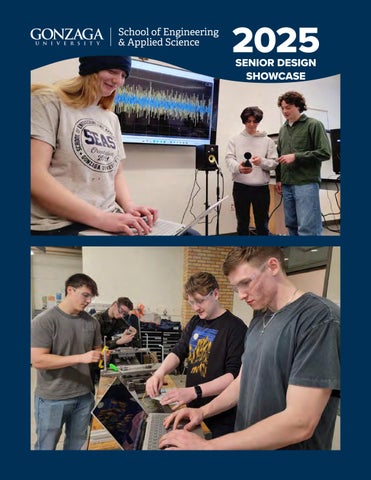
2025 SENIOR DESIGN SHOWCASE
WELCOME Welcome to Gonzaga University’s School of Engineering and Applied Science (SEAS) 2025 Design Expo Day. We’re celebrating an important milestone in our student’s academic journey—their senior design projects. To transform innovative ideas into proofsof-concept and prototypes, our students learned about project planning, communications, report writing, budgeting, and resource management. I am deeply grateful to all those who helped our seniors achieve this daunting feat—supervising faculty, industry sponsors, numerous community members, the SEAS Capstone Committee, outgoing CEDE Academic Director Ted Zhang, Manufacturing Technology Center Manager Beau Grillo, Project Support Coordinator Kevin Matulis, Cadwell Maker Center & Lab Coordinator Daniel Clark, and the Dean’s Office staff Mindy Ratcliffe and Janean Schmidt. To our seniors, congratulations on completing this monumental effort. Your design teams have worked hard all year long to take the project from ideation to the physical realization you are presenting today. Thank you for your dedication and commitment to excel in this demanding but gratifying pursuit. I wish you much success in all your future endeavors. Jennifer Shepherd, Ph.D. Interim Dean and Professor, School of Engineering & Applied Science
Welcome from the Academic Director Congratulations to our Senior Design graduates! Once again, you have demonstrated great ingenuity, resourcefulness, and perseverance. For everyone who has been cheering you on throughout the year, we could not be any prouder of your accomplishments. All of this would not be possible without the generous and kind support of our sponsors, advisors, and Design Advisory Board members, for which we are deeply grateful. I would also like to thank the Dean’s Office, the Capstone Committee, the MTC Lab, and all faculty and staff for their steadfast support of Senior Design. Seniors, these are but the first steps of your long and successful careers. As you begin the next exciting phase of your lives, may you always remember these times fondly, and draw strength from your experiences. In the words of Padre Pio, “Pray, hope, and don’t worry!” You will do great things.
Ted Zhang, M.S., M.B.A. Academic Director, Center for Engineering Design & Entrepreneurship 2 | Gonzaga School of Engineering & Applied Science
CONTENTS
COMPUTER SCIENCE
CS25-01 | Applicant Tracking System...................................... 4 CS25-02 | Medicare/Medicaid Reimbursement AI.............. 4 CS25-03 | Power Line Protection System Extension.......... 5 CS25-04 | AI Summarization Tool............................................. 5 CS25-05 | Graphical Doc. Generator from Datasets........... 6 CS25-06 | Multi-Platform eCommerce App........................... 6 CS25-07 | RF Chamber Software Design............................... 7 CS25-08 | Figure Skating Scheduling App............................ 7 CS25-09 | Smart Watering Sys. with Internet of Things..... 8 CS25-10 | Home Price Prediction System.............................. 8 CS25-11 | Discrete “World Model” for LLMs........................... 9 CS25-12 | Timeline........................................................................ 9 CS25-13 | Automated Part Counter (CS)................................. 10 CS25-14 | Walking Spaces AR Based Clutter Tracker......... 10 CS25-15 | Conveyer Monitoring System................................. 11 CS25-16 | Test Set Generator..................................................... 11
CIVIL ENGINEERING
EN25-20 | Structural Design of Engineering Building......... 12 EN25-21 | Gas Station Struct. Design & Life Cycle Anlys.... 12 EN25-22 | UKC Recreation Center Structural Design.......... 13 EN25-23 | Structural Design of Aerial Adventure Course.. 13 EN25-24 | Earth Retaining Structure Design.......................... 14 EN25-25 | Construction Eng.for I90/NSC Interchange....... 14 EN25-26 | Bus Transit Study and Design................................ 15 EN25-27 | Beaver Dam Analog Design in Thompson Ck... 15 EN25-28 | Bioretention Soil Media Study............................... 16 EN25-29 | Lacrosse Park Dev. and Stormwater Design...... 16
ELECTRICAL & COMPUTER ENGINEERING
EN25-40 | Electromagnetic Interference Mitigation............ 17 EN25-41 | Active Noise Cancellation System......................... 17 EN25-42 | Enhancement of Vision Inspection System........ 18
MECHANICAL ENGINEERING
EN25-51 | Open Air Cabin Window.......................................... 18 EN25-52 | Wire Pull Check Tool................................................ 19 EN25-53 | Combustion Sightglass Assy Modification......... 19 EN25-54 | Zero Hazwaste Glass Slurry Reservoir................ 20 EN25-56 | Boom Window Cleaning......................................... 20 EN25-57 | Specialty Container Cleaning Automation......... 21 EN25-58 | Roll Grind Optimization Model.............................. 21 EN25-59 | Digital Twin for Thermal Modeling of Motor...... 22 EN25-60 | High-Volume Manufact. Process for Foam........ 22 EN25-61 | Overland Conveyor System.................................... 23 EN25-63 | Large Seal Stretcher................................................ 23 EN25-64 | Automated Part Counter (ME)................................ 24 EN25-65 | Modular Sensor Mount Design............................. 24 EN25-66 | Wind Tunnel............................................................... 25
INTERDISCIPLINARY
EN25-70 | Energy Harvesting..................................................... 25 EN25-71 | 3rd Axis Addition to the Itron RF Chamber.......... 26 EN25-72 | Plumbing Insulation Tech Integration Ext............ 26 EN25-73 | LiDAR Belt Scale Solution....................................... 27 Engineering Management students are part of projects aligning with their specialty area.
THANK YOU SPONSORS Sponsoring organizations provide projects, resources, and professional influence to the senior design teams. Diverse sponsors provide a wide range of project options, giving students a more engaging learning experience.
» AAANI » Amend Health » Avista » BIMspire » Boeing » Budinger » City of Spokane » Coffman » Collins » Cushing Terrell » Dragon Jacket » Dwight Brayton » F5
» Fairchild » Framatome » Gonzaga Department of Computer Science » Gonzaga Department of Mechanical Engineering » Integrus » IPC » Itron » Jetseal » J-U-B » Kaiser Aluminum » Keytronic » Lands Council
» LCFSC » MathWorks » NIOSH / CDC » NSIN » Orebaugh » Pangeon » R7D » Reed Family Companies » STA » Tatitlek » Two Barrels » Welch Comer » WSDOT
DESIGN ADVISORY BOARD (DAB) Design Advisory Board members are experienced professionals who volunteer their time and talents with the teams, offering diverse guidance and mentorship.
» Skye Aldrich » Levi Arnold » Hunter Banks » Brent Barr » CJ Best » Les Bohush » TJ Bolser » Dustin Cassell » Brenna Doll » Terra Donley » Jordan Dunn » Jennifer EmersonMartin » Lee Firth
» Andrew Flagstead » Ryan Floyd » Lindsay Gilbert » Sarah Hagen » Dannielle Haraldson » Spencer Harper » Jay Hassel » Michael Herzog » Ben Higley » Karen Hills » Kayla Kassa » Jacob Krantz » Katie Larimer » Kayla Larson
» Nick Latham » Stuart Lauer » Colleen Little » Kaela Mansfield » Jared Marshall » Dawson Matthews » Glorilyn Maw » Ben McDonald » Jesse Phillips » Doug Pooler » Vince Poxleitner » Nick Questad » Duane Radmer » Nick Reasoner
» Eric Ryan » Emily Sackman » Scott Schwartz » Damiano Seghetti » Sushil Shenoy » Bob Turner » Kyle Umlauf » Nathan Vanos » Nathan Verboort » Melissa Verwest » Erik Wick » Byrl Williams » Chance Wilson » Roy Wortman Senior Design Expo 2025 | 3
CS25-01 | Applicant Tracking System Two Barrels LLC is a highly independent company experiencing rapid growth. As their hiring needs expanded, they faced challenges in managing their recruitment process efficiently. To address this, CS25-01 was tasked with developing a custom Applicant Tracking System (ATS) tailored to their workflow. This system streamlines the application lifecycle, enabling recruiters to track candidates, schedule interviews, and manage hiring stages with ease. The ATS features a user-friendly Vue.js front end for seamless navigation and an optimized Rails backend for secure data management and automation. This solution enhances the recruitment experience for both recruiters and potential employees, ensuring a more efficient and organized hiring process.
» Louis Cerda, Computer Science » Finn Dugan, Comp. Sci. & Comp. Thinking » Arjuna Herbst, Computer Science » Brandon Poblette, Computer Science Advisor: Bethany Alcamo
DAB: Andrew Flagstead
Sponsor: Two Barrels
Liaison: Conner Hiatt, Alex Love, Noah White
CS25-02 | Medicare/Medicaid Reimbursement AI
» Parker Bixby, Computer Science » James Jansma, Computer Science » Brady Keeley, Computer Science » Ian Myers, Computer Science Advisor: Christopher Sharman DAB: Jacob Krantz
Sponsor: Amend Health
Liaison: Andrew Richards
4 | Gonzaga School of Engineering & Applied Science
The CS25-02 team was engaged with Amend Health to address the issue of assisting medical startups in understanding what medicare reimbursement codes will apply to their product. These medicare reimbursement codes are public records of how much the federal government will reimburse for different medical procedures and services. These codes vary in reimbursement amount by state and change yearly. This variation makes it difficult for startups to understand where to launch their product to get the largest reimbursement amount. The team created a chatbot that uses a RAG (Retrieval Augmented Generation) system to leverage a Large Language Model (LLM). The RAG system uses a vectorized database containing the current CPT (Current Procedural Terminology) codes to retrieve the codes, along with their prices and descriptions, that are most relevant to the description of the startups product.
CS25-03 | Power Line Protection System Extension One of the leading causes of electricity-related deaths in the construction industry involves powerlines. Avista, a utility with over 30,000 square miles of service territory, has proposed an AI-driven solution using LiDAR technology to help identify the position of live powerlines on site, alerting construction workers when an object or person enters a danger range of 10’ or 2’2”. Team CS25-03 was tasked with developing user interface for Linux to run the powerline and object detection models built by last year’s team. These models were further researched via new features integrated into the GUI application, enabling more customization to the current models. The current detection models require more development, and the team has prepared ample documentation to assist Avista with this future research.
» George Calvert, Computer Science » David Giacobbi, Computer Science » Ryan St. Mary, Computer Science » Henry Stone, Computer Science Advisor: Alex Giacobbi DAB: Nick Latham
Sponsor: Avista
Liaison: Gregory Johnson
CS25-04 | AI Summarization Tool CPSC-04 developed a cost-effective AI-driven tool for transcribing and summarizing company meetings. The system integrates Whisper for high accuracy speech to text transcription and a multi-pass summarization pipeline to generate clear and concise summaries. To address token limitations, information loss, and inconsistent outputs, the team implemented DistilBART for chunk-based summarization and Phi3.5 for final refinement. A custom-built user interface allows users to upload audio files, view completed transcriptions and generate summaries with minimal effort. The system was optimized to process long-form audio without truncation, preserving key details. Integrated logging and error handling ensure reliability. Testing confirmed system accuracy, proving a scalable, no-cost tool for Boeing’s meeting documentation.
» Kyle Connall, Computer Science » William Garlington, Comp. Sci. & Comp. Thinking » Harrison McLain, Computer Science » Ronald Sorenson, Comp. Sci. & Comp. Thinking Advisor: Alex Giacobbi
DAB: Dustin Cassell
Sponsor: Boeing
Liaison: Dustin Cassell, Kalika Singh
Senior Design Expo 2025 | 5
CS25-05 | Graphical Document Generator from Datasets CS25-05 worked with Dwight Brayton of d2b Inc. and CS2516 to produce a VSTO add-in for Visio that will allow for the generation of instruction sets for websites via the assembly of a flowchart representation of the aforementioned page, which will be stored in a Neo4j graph database by converting each shape into a node with connections in between. Another team, CS25-16, further processed the components into a standard set of instructions to programmatically create automation tests. Made in C# and utilizing the .NET framework and AngleSharp library, this project helps customers create a design of their website using a visualization tool for process flowcharts so that a website is fully defined, allowing a client to gauge user interaction.
» Joseph Holdnak, Comp. Sci. & Comp. Thinking » Sebastian Matthews, History » Raja Sori, Computer Science » Joshua Venable, Computer Science Advisor: Pete Messina
DAB: Ben McDonald
Sponsor: Dwight Brayton
CS25-06 | Multi-Platform eCommerce App In today’s healthcare landscape, pharmacies need streamlined platforms for ordering products, tracking inventory, and accessing critical industry information. IPCRX’s current website allows pharmacies and pharmaceutical personnel to log in and make purchases, but fragmented solutions force them to juggle multiple platforms, hindering efficiency and increasing errors. Our project aimed to solve this problem by developing an intuitive, all-in-one mobile app tailored for pharmacies that centralized tasks such as product ordering, document management, and realtime notifications. This app provided instant alerts for orders and services, keeping pharmacists informed without manual email or website checks, and increased efficiency beyond what a mobile-friendly website could achieve.
» Yijia Chen, Comp. Sci. & Comp. Thinking » Yi Lu, Computer Science » Austin Tsow, Computer Science » Manny Uzoma, Comp. Sci. & Comp. Thinking Advisor: Jasmine Jans DAB: Jesse Phillips
Sponsor: IPC
Liaison: Dan Lenz
6 | Gonzaga School of Engineering & Applied Science
CS25-07 | RF Chamber Software Design Itron tasked CS25-07 with redesigning and consolidating their separate GUI applications, which use a Spectrum Network Analyzer and a Vector Network Analyzer to conduct frequency measurements tests. The team’s solution created an application using the C++ language, Qt framework for the GUI, and the windows API for serial communication. The application allows for control of the same 2-dimensional rotating table, antenna, and RF measurement devices for different types of tests. Communication from application to the instruments is through a GPIB-USB Prologix adapter for serial communication. Additional features included for the team was multiple file export of data measurements and integration of the 3-dimensional axis control and measurement from team EN25-71.
» Nicholas Barinaga, Comp. Sci. & Comp. Thinking » Jacob Simons, Computer Science » Jordan Wakefield, Computer Science » Asher Weitz, Comp. Sci. & Comp. Thinking Advisor: Tim Ecklund
DAB: Sarah Hagen
Sponsor: Itron
Liaison: Bob Strasser
CS25-08 | Figure Skating Scheduling App The CS25-08 team developed a scheduling application for the Lilac City Figure Skating Club in Spokane, WA, streamlining the club’s ice time sign-up process. Replacing the previous paper-based system, the app allows users to register for ice sessions, track reserved times, and monitor attendance. Additionally, the platform provides a centralized space for announcements, ensuring timely communication between administrators and skaters. The integrated user directory allows administrators to manage club members and keep track of payments. Built with C# and .NET-based tools, the application is designed to function on both Android and web platforms.
» Lindsey Bodenbender, Comp. Sci. & Comp. Thinking » Tyler Ciapala-Hazlerig, Computer Science » Talia Frausto, Comp. Sci. & Comp. Thinking » Myles Tala, Comp. Sci. & Comp. Thinking Advisor: Phillip Fishburn DAB: Ryan Floyd
Sponsor: LCFSC
Liaison: Susannah Hall
Senior Design Expo 2025 | 7
CS25-09 | Smart Watering System with Internet of Things CS25-09 developed an IoT-enabled drip irrigation system based on soil moisture levels using a state-machine approach. The system utilizes an ESP32 and Arduino Uno to collect sensor data and communicate with a MATLAB state machine via MathWorks’ ThingSpeak platform. This integration enables automated watering decisions, which are then executed by the physical system. ThingSpeak also provides real-time data visualization, generating graphs that are displayed on a web dashboard. The dashboard allows users to monitor growing conditions, adjust state machine configuration settings, and manually turn on or off watering as needed. This project aims to promote sustainable gardening and demonstrate the efficacy of MathWorks tooling in an agricultural problem space.
» Caleb Lefcort, Computer Science » Arvand Marandi, Computer Science » Matt Nguyen, Computer Science » Madison Spink, Computer Science Advisor: Rafael Pozos DAB: Kayla Larson
Sponsor: MathWorks
Liaison: Roberto Valenti
CS25-10 | Home Price Prediction System
» Maximilian Brown, Computer Science » Connor Goldschmidt, Computer Science » Cooper Stepanian, Comp. Sci. & Comp. Thinking » Do Duc Tu, Comp. Sci. & Comp. Thinking Advisor: Joe Dumoulin
DAB: Michael Herzog
Sponsor: Pangeon
Liaison: Sam Berkson, Graham Morehead
8 | Gonzaga School of Engineering & Applied Science
This project continued the aim of predicting home prices two years into the future accurately, to help anyone involved in real estate, from homeowners to investors, make more-informed decisions about their investments. Team CS25-10 focused on the AI possibilities. The team created two machine learning models, one of which is trained on economic data such as interest rates and the other on real estate data. These models work together in order to model how the real estate market works best. These are packaged into a web application that displays a map of King County in hexagons, as our data is from King County. Each hexagon represents a neighborhood, and individual homes are visible within each hexagon.
CS25-11 | Discrete “World Model” for LLMs The CS25-11 team worked with Pangeon, an AI Startup Factory, under Graham Morehead and Sam Berkson to further their Parsimony project creating a new product called “Vectionary”. “Vectionary” aims to create an advanced dictionary system that leverages natural language processing (NLP) techniques to provide more nuanced and context-specific definitions for words and phrases. The CS25-11 team developed an API which deconstructs a text input into Vectionary Elements, which are discrete objects that represent every unique definition of every word as it appears on Wiktionary. The product aims to provide a foundation for NLU projects which want to engage with language in a more comprehensive way by attempting to mimic human reasoning.
» Anna Cardinal, Computer Science » Alicia Domingo, Computer Science » Jaden Phan, Computer Science » Maya Tiu, Computer Science Advisor: Joe Dumoulin
Sponsor: Pangeon
Liaison: Sam Berkson, Graham Morehead
CS25-12 | Timeline
» Suyash Kushwaha, Computer Science » Sean Nave, Computer Science » Lauren Nguyen, Computer Science » Davis Sneed, Comp. Sci. & Comp. Thinking
CS25-12 collaborated with Ryan Kellogg to improve incident management and analysis. Engineering, criminal justice, and investigative journalism require streamlined visual models to effectively display and connect diverse types of information. The traditional methods of organizing information, such as using a media board connecting data with strings, are all manual and physical. This project aimed to develop a web application that simplifies the process of displaying, documenting and annotating the data. The application allows users to add data in various formats, including video, audio, text, and telemetry data, and display them in a chronological order. The team used PostgreSQL and React to develop the web application.They will hand off a fully-functional web application with a developer’s manual, detailing the system’s services, technologies, and API documentation.
Advisor: Daniel Lenz DAB: Ben Higley
Sponsor: R7D
Liaison: Ryan Kellogg
Senior Design Expo 2025 | 9
CS25-13 | Automated Part Counter (CS) JetSeal is a manufacturer of high-performance metal seals used in nuclear facilities, space exploration, and deepsea oil and gas operations. JetSeal currently utilizes a hand-counting system to count seals, which is inefficient and tedious when working with the large quantities they typically send and manufacture. Team CS25-13 was tasked with creating an automated parts counter to mitigate these issues. The team developed a YOLO image recognition system to count seals in real time as they are processed during manufacturing and shipping as well as a simple UI to display the seal count. Additionally, CS25-13 designed the automated counter to count parts continuously or stop after a specified number is met.
» Rebekah Blazer, Comp. Sci. & Comp. Thinking » Ryder Gallagher, Comp. Sci. & Comp. Thinking » Anthony Hidalgo, Computer Science » Colin McClelland, Comp. Sci. & Comp. Thinking Advisor: Christopher Sharman DAB: Sarah Hagen
Sponsor: Jetseal
Liaison: Todd Conley, Steve Hudlet
CS25-14 | Walking Spaces AR Based In-Home Clutter Tracker The HazARd project uses augmented reality (AR) technology to scan and collect a three-dimensional rendering of users’ living spaces, called mesh images. This is accomplished through the use of the Meta Quest 3 headset and an application developed to run on it. This application is able to detect and show objects that are hazards, such as clutter, through the mesh images that could be dangerous to those who are mobility impaired or aging. The mesh image data is stored, along with other identifying data, in a database and then pulled to the website application. Through the HazARd website interface, users are able to view and interact with their data to better understand the safety conditions of their own living spaces.
» Leif Forrest, Comp. Sci. & Comp. Thinking » Alex Keyser, Computer Science » Delainey Maxwell, Comp. Sci. & Comp. Thinking » Reid Plowman, Computer Science Advisor: Christopher Sharman DAB: Nathan Vanos
Sponsor: GU Dept. of Computer Science, AAANI
Liaison: Barbara Bisaro, Aaron Crandall, Sage Stoddard
10 | Gonzaga School of Engineering & Applied Science
CS25-15 | Conveyer Monitoring System
» Julian Fernandini, Comp. Sci. & Comp. Thinking » Mark Reggiardo, Computer Science » Scott Rincon, Computer Science » Kay Zhuang, Computer Science Advisor: Christopher Sharman DAB: Sarah Hagen
Sponsor: NIOSH / CDC
CS25-15 has developed a computer vision program that uses sensor fusion to detect humans within specified distances of hazardous exclusion zones. The team was tasked with developing a system to trigger warnings and other safety measures when humans were detected within close proximity to dangerous mining conveyor belts by the NIOSH (National institute of Occupational Safety and Health), a division of the CDC (Centers for Disease Control and Prevention). The team developed a program that uses a machine learning model to detect humans in a live camera feed and locate their real-world position with 3D depth map data from a LiDAR sensor, all in real time. The team expanded on the scope of their project to include wide ranging industrial applications by making the system capable of detecting human proximity to any spatial region, not just mining conveyor belts.
Liaison: Bob Bissonette, Cara Halldin, Samir Sbai
CS25-16 | Test Set Generator Team CS25-16 developed a system that automates test case generation using an engine that processes instruction sets. These sets, derived from structured data tables, dictate how the engine will simulate user interactions across web pages. The engine runs each test, either confirming successful navigation or identifying failure points, allowing for quicker and more efficient testing workflows. This automation aims to cut down the manual effort involved, saving companies both time and money.
» Ryan Guinn, Comp. Sci. & Comp. Thinking » Connor Jones, Computer Science » Ha Quan Tran, Computer Science » Luke Wallach, Comp. Sci. & Comp. Thinking Advisor: Pete Messina
DAB: Hunter Banks
Sponsor: Dwight Brayton
Senior Design Expo 2025 | 11
EN25-20 | Structural Design of Engineering Building Whitworth University seeks to construct an Engineering Building, approximately 21,000 gross square feet. The engineering building will have a metal fabrication shop, instructional labs, a clean room, research labs, classrooms, faculty offices, and storage areas to support these spaces. This project aims to help grow the engineering programs at Whitworth University. The team, “TUPS Engineers,” was tasked by Integrus Architecture to develop the building loadings conditions per ASCE 7-16 and design the gravity and lateral force resistance system. The team also developed a structural plan set, which includes framing and foundation plans, and a calculation packet containing all the design and analysis work.
» Shelby Phillipson, Civil Engineering » Kevin Sun, Civil Engineering » Ethan Tran, Civil Engineering » Marissa Uribe, Civil Engineering Advisor: Aaron Zwanzig
DAB: Levi Arnold, TJ Bolser
Sponsor: Integrus
Liaison: Aaron Zwanzig
EN25-21 | Gas Station Structural Design & Life Cycle Analysis A new gas station and convenience store are being developed with a focus on sustainability in Post Falls, Idaho. ENSC25-21 was tasked with designing the two-story store and conducting a comprehensive life cycle assessment. The team engineered the store’s gravity and lateral load systems per ASCE 7-16, ensuring structural resilience. Using Revit, they produced detailed structural plan sets for the first and second floors, as well as the foundation. Additionally, a cradle-to-grave life cycle assessment evaluated the structure’s environmental impact from construction to demolition. This project not only provides essential infrastructure but also integrates sustainable design principles to support Post Falls’ expanding community.
» Kalena Harris, Civil Engineering » Noah Kuhta, Civil Engineering » Theo Lommers, Civil Engineering » Kiara Reed, Civil Engineering Advisor: Adam Hutchinson
DAB: Kyle Umlauf, Melissa Verwest
Sponsor: BIMspire
Liaison: Adam Hutchinson
12 | Gonzaga School of Engineering & Applied Science
EN25-22 | UKC Recreation Center Structural Design Coffman Engineers tasked GBBG Solutions (Team EN2522) with completing a structural design for the natatorium of the Upper Kittitas Community Recreation Center. To complete the design, the team analyzed the loading due to wind, snow, and seismic forces that the completed building will experience. These loads were then used to design a structural system including the gravity force resisting system, the lateral force resisting system, and the foundation plan. This process included investigating multiple material alternatives for the design of the roof joists, along with developing a complete construction cost estimate. The final product includes 100% Design Development Documents, along with an extensive calculation packet detailing all design decisions made.
» Elizabeth Child, Civil Engineering » Matthew Jorgensen, Civil Engineering » Brian Leung, Civil Engineering » Katherine Mellander, Civil Engineering Advisor: Wesley Davis
DAB: Emily Sackman, Damiano Seghetti
Sponsor: Coffman
Liaison: Wesley Davis
EN25-23 | Structural Design of Aerial Adventure Course The ENSC 25-23 team collaborated with Cushing Terrell to design an aerial adventure course featuring five towers, three bridges, and two zip lines. The team calculated design loads and generated appropriate load combinations. Zip line cables were sized to meet tension requirements for rider safety and topographic conditions. Bridges were designed with cable tension and geometry to create the desired participant experience and meet loading conditions. Load cases were applied to the predetermined tower geometry to determine member sizes and connections. Foundations and guy-wire anchors were designed per geotechnical specifications. The final deliverable includes a calculation package and simplified drawings highlighting major member sizes and key connections.
» Joseph Bowen, Engineering Management » Bryce Cerkowniak, Civil Engineering » Charles Rock, Civil Engineering Advisor: Ted Bernards
DAB: Sushil Shenoy
Sponsor: Cushing Terrell Liaison: Ted Bernards
Senior Design Expo 2025 | 13
EN25-24 | Earth Retaining Structure Design Spokane Transit Authority (STA) plans to upgrade the Valley Service Center with two fuel tanks, improving their refueling capabilities. Team EN25-24 designed a temporary shoring system to support the construction of a concrete containment vault to house these tanks, meeting Environmental Protection Agency (EPA) requirements under the Clean Water Act. Due to space constraints, the excavation is confined to the 18-ft by 37-ft vault area, excavated to a depth of 18 ft with a small surrounding construction area. The vaults will act as secondary containment for the two tanks.
» Nathan Blackmer, Civil Engineering » Jacob Draxler, Civil Engineering » Matthew Ryan, Civil Engineering » Kenna Watson, Civil Engineering Advisor: Collin McCormick
DAB: Vince Poxleitner, Byrl Williams
Sponsor: Budinger
Liaison: Collin McCormick
EN25-25 | Construction Engineering for I90/NSC Interchange
» Dominic Blake, Civil Engineering » Elizabeth Cobb, Civil Engineering » Devin Franke, Civil Engineering » Teigen Staloch, Civil Engineering Advisor: Bill Meeks
DAB: Erik Wick, Mark Muszynski
Sponsor: WSDOT
Liaison: Bill Meeks
14 | Gonzaga School of Engineering & Applied Science
Team “Spokane Construction LLC” (Spo-Co) partnered with the Washington State Department of Transportation to develop a construction plan for a portion of the North Spokane Corridor/Interstate 90 interchange. Spo-Co completed detailed cost estimates, construction schedules, and designs for four bridges and a local road within the interchange project. The team also conducted quantity estimations and cost analysis with a construction timeline of approximately two years for these items. A Disadvantaged Business Enterprise participation plan was developed to meet the 15% requirement. Additional components included falsework design for Bridge 8, a typical two-lane local street section, and traffic control measures. The project documentation was delivered to WSDOT as part of a bid package, supporting the advancement of this critical transportation infrastructure for the Spokane region.
EN25-26 | Bus Transit Study and Design Spokane Transit Authority (STA) is planning to implement High-Performance Transit (HPT) infrastructure along the Wellesley Ave. corridor (existing STA Route 33) from Spokane Falls Community College to Spokane Community College to better serve the community. This project aims to support economic growth, advance transportation equity, and increase transportation opportunities for new and existing riders. This project studied existing transit options and identified areas for improvement, analyzed traffic and ridership growth, and created alternative concepts to support STA operations. These concepts were developed and modeled using CAD software.
» Aidan Nascimento, Civil Engineering » Anders Roback, Civil Engineering » Charlotte Sobol, Civil Engineering Advisor: Stu Barton, Ryan Brodwater DAB: Jennifer Emerson-Martin,
Jay Hassel, Bob Turner Sponsor: STA / J-U-B Liaison: Stu Barton, Ryan Brodwater, Tom Norton
EN25-27 | Beaver Dam Analog Design in Thompson Creek
» Joshua Braun, Civil Engineering » Myers Gorrell, Civil Engineering » Edward Rodriguez, Civil Engineering » Paul Talens, Civil Engineering Advisor: Sue Niezgoda
DAB: Spencer Harper, Kayla Kassa, Colleen Little, Dawson Matthews Sponsor: Lands Council Liaison: Kat Hall
The Lands Council sponsored this project addressing stream health and water quality in Thompson Creek. Team “Those Dam Engineers” (TDE) monitored existing beaver dam analog (BDA) complexes and developed designs for Phase III restoration. Site visits included soil probing, sediment sampling, GPS surveying, and drone imagery to assess stream conditions. Results indicated that BDAs increased pond surface area and macroinvertebrate diversity but did not significantly reduce phosphorus concentrations. HEC-RAS modeling was utilized to identify flood risks and evaluate proposed geometry for Phase III. The final design incorporated BDA structures to decrease stream velocity, increase channel length, and improve floodplain connectivity. The completed project enhanced ecosystem health and reduced phosphorus transport into Newman Lake. Senior Design Expo 2025 | 15
EN25-28 | Bioretention Soil Media Study
» Ally Delaney, Civil Engineering » Sammi Eckersell, Civil Engineering » Emma Logue, Civil Engineering » Alli Willmarth, Civil Engineering Advisor: Dave Moss, Aimee Navickis-Brasch DAB: Katie Larimer, Glorilyn Maw
Sponsor: City of Spokane
Liaison: Rebecca Casey, Bill Galle,
Trey George, Chad Phillips
EN25-28 partnered with the City of Spokane to evaluate the effectiveness of different media for stormwater treatment. The project assesses performance of nonvegetated bioretention swales using 60:40 media and High-Performance Bioretention Soil Media (HPBSM) through field monitoring and laboratory column testing. Field monitoring was conducted on Gonzaga’s campus in support of Evergreen StormH2O’s research, and analyzed pollutant removal efficiency and compliance with TAPE treatment criteria. Laboratory column tests simulated Spokane storm events to measure infiltration rates, treatment performance, compaction effects, and operational lifespan. The study evaluated media compositions that meet NPDES MS4 Permit requirements for treatment, and supported future stormwater infrastructure improvements. Results provide insights into BMP performance under local conditions.
EN25-29 | Lacrosse Park Development and Stormwater Design Team “Mantis Engineering” partnered with the City of Coeur d’Alene to plan improvements to land near Lacrosse Avenue along the Spokane River, addressing traffic congestion, utilities, environmental compliance, and recreation. The proposal extended Lacrosse Avenue to connect with N. Lakewood Drive, easing traffic and providing emergency access. Utility upgrades would improve water distribution, while stormwater treatment ensures MS4 permit compliance, reducing pollutants in the Spokane River. A new park would feature pickleball courts, soccer fields, trails, and ADAcompliant amenities. This initiative enhances connectivity, infrastructure, and community engagement.
» Jack Berard, Civil Engineering » Lola Faix, Civil Engineering » Andrew Parker, Civil Engineering » Will Thorsett, Civil Engineering Advisor: Jack Griffing
DAB: Lindsay Gilbert, Kaela Mansfield
Sponsor: Welch Comer Liaison: Jack Griffing
16 | Gonzaga School of Engineering & Applied Science
EN25-40 | Electromagnetic Interference Mitigation
» Jake Balog, Electrical Engineering » Riley Knies, Electrical Engineering » Matthew McHorse, Electrical Engineering » Erik Wig, Electrical Engineering Advisor: Jeff Gilbert
DAB: Terra Donley
Sponsor: F5
Liaison: Bret Britz
Team ENSC25-40 successfully characterized and remediated electromagnetic interference (EMI) produced by F5 network switching equipment. Using the anechoic chamber in Gonzaga University’s Smart Antenna Research Lab (SARL), the team conducted comprehensive emissions testing to identify specific frequencies with unacceptably high radiated emissions. The group then used bare blade testing to identify specific components and traces producing the problematic emissions. After the cause of the emissions were known, the team implemented and tested several remediation strategies, including the strategic application of RF absorbing foam inside of the equipment and copper tape shielding in relevant locations. These solutions reduced radiated EMI to acceptable levels, giving F5 a framework to modify the design for regulatory compliance.
EN25-41 | Active Noise Cancellation System
» Matthew Burkins, Electrical Engineering » Skylar Hayashi, Computer Engineering » Gabriel Mitrakul, Electrical Engineering » Juliana Peterson, Computer Engineering
Kaiser Aluminum tasked Team EN25-41 with designing an active noise cancellation system for their hydraulic pump room. The room’s average reading, while the pumps were under load, was significantly higher than the recommended 85 decibels (dB) for an 8-hour period. Kaiser requested a minimum reduction of 3 dB to effectively double the safe exposure time. This reduction improves communication and lower long-term health risks from sound exposure. The team’s designed solution incorporated a network of speakers, microphones, an audio interface, and a digital signal processor (DSP). MATLAB was utilized as the DSP platform to capture, process, and output the necessary antiphase noise to achieve the desired reduction. The final deliverable to Kaiser included a detailed design and comprehensive documentation, providing them a complete blueprint for independently implementing the system.
Advisor: Shane Pacini
DAB: Scott Schwartz
Sponsor: Kaiser
Liaison: Tim Kilbreath, Chris Nicol
Senior Design Expo 2025 | 17
EN25-42 | Enhancement of Vision Inspection System Keytronic is a global design and manufacturing services provider that utilizes a wide range of assembly lines. To continually improve the productivity and efficiency of the assembly manufacturing process, ENSC-42 was tasked with developing a vision inspection system to determine how long it takes an operator to complete a task at a workstation per unit. The team designed, developed, and tested a prototype of a system module that used an open-source hand tracking software model and reinforced machine learning algorithm to time the workstation process accurately. The team also developed and delivered an installation guide, which included connecting the workstation sub-modules, calibrating for each particular task, and how the off-site engineers could access the data collected.
» Cecilia Child, Computer Engineering » Zachary Petrogeorge, Electrical Engineering » Caedyn Reece, Computer Engineering » Connor Studebaker, Computer Engineering Advisor: John Tadrous DAB: Brent Barr
Sponsor: Keytronic
Liaison: Levi Lascari, Chad Orebaugh
EN25-51 | Open Air Cabin Window Team EN25-51 partnered with Boeing to design an innovative concept for an airplane air vent that provides a sensation similar to rolling down a car window. The aim of this project was to enhance the passenger experience by designing a system to distinguish Boeing as the premier commercial airline manufacturer. To accomplish this the team designed an air manifold, diffuser and vent that draws off of the in place air distribution network in the plane. The main deliverable of this project was a technology demonstrator with uniform airflow, low noise levels, and directional control. Additional subjective requirements included durability, sleek design, and comfortable air flow. These deliverables were to be accomplished without consideration of aerospace grade material selection or installation materials.
» Marco Verduzco Cohen, Mechanical Engineering » Sean Harrington, Mechanical Engineering » Ethan Hunt, Mechanical Engineering » Luca Maffoni, Mechanical Engineering Advisor: Bob Reed
DAB: Karen Hills
Sponsor: Boeing
Liaison: Kevin Barrick, Ryan Cole
18 | Gonzaga School of Engineering & Applied Science
EN25-52 | Wire Pull Check Tool A Boeing aircraft can have anywhere from 40 to 140 miles of electrical wiring. Each of these wires needs to be individually checked during the assembly process to ensure that they are fully seated in their locking collets. The current wire pull test process involves technicians pinching the wire between their thumb and forefinger and pulling until the wire slips on their fingers. This method causes the wires to be pulled on with an inconsistent force and is a physically demanding and tedious process for technicians. EN25-52 was tasked with designing and producing a working prototype of a wire pull check tool. The tool allows for a more controlled and consistent force to be applied to the wires, while also minimizing the physical strain on technicians.
» Blake Everett, Mechanical Engineering » Ellie Goodwin, Mechanical Engineering » Austin Pagan, Mechanical Engineering Advisor: Damon Taam
DAB: Nick Questad
Sponsor: Boeing
Liaison: Andrew Fabry
EN25-53 | Combustion Sightglass Assy Modification Collins Aerospace produces carbon composite brake discs at their Spokane carbon site, along with many other carbon products. One step in the process involves RCVD furnaces, and requires sightglasses attached to the chamber which allow for temperature measurements via optical pyrometers to be cleaned every 12 hours by operators. Collins tasked EN25-53 with creating a new design to secure the sightglass, allowing for improved usability as well as the ability to sense if the sightglass is fully secured. This is intended to mitigate the risk of sightglasses being left unsecured by operators, leading to business losses of less than $1M per instance.
» Dane Foster, Mechanical Engineering » Zachary Morley, Mechanical Engineering » Blake Solvie, Mechanical Engineering » Cal Tietjen, Mechanical Engineering Advisor: Max Capobianchi DAB: Jordan Dunn
Sponsor: Collins
Liaison: Sean Johnson
Senior Design Expo 2025 | 19
EN25-54 | Zero Hazwaste Glass Slurry Reservoir
» Ethan Carr, Mechanical Engineering » Caleb Evanson, Mechanical Engineering » Oliver Wermus, Mechanical Engineering
The EN25-54 team collaborated with Collins Aerospace to reduce waste within their glass slurry spraying system. Glass slurry is a chemical that is applied to carbon fiber aircraft brakes. The current reservoir used for holding this glass slurry produces waste due to the geometry and the outlet location. The team’s goal was to minimize this waste by redesigning, prototyping, and testing a new reservoir with the help of the Manufacturing Technology Center. Three prototypes were created with different geometries to test the effects of slope and volume on waste reduction. Additionally, the team manufactured a stand for reservoir support and a lid insert to locate the accessories needed for operation. The team delivered a working prototype, bill of materials, and cost benefit analysis to guide Collins Aerospace in implementing the redesigned reservoir.
Advisor: Colleen Nolting DAB: Eric Ryan
Sponsor: Collins
Liaison: Sean Johnson
EN25-56 | Boom Window Cleaning The Boom Operator Window project sought to ensure clear visibility for boom operators in air refueling tankers by addressing the issue of hydraulic fluid splattering onto the window. This contamination significantly obstructs the operator’s view, making precise refueling maneuvers difficult and compromising mission effectiveness. Additionally, cleaning the hydraulic fluid from the window is a time-consuming process that can take hours, reducing operational efficiency. This project focused on designing a system or modification that prevents visibility obstruction and minimizes downtime, ensuring that boom operators can perform their duties safely and efficiently in all conditions.
» Nicholas Baumuller, Mechanical Engineering » Lucas Bertnik, Mechanical Engineering » Cole Dugenske, Mechanical Engineering » Luke Stockelman, Mechanical Engineering Advisor: Harman Khare
DAB: Dannielle Haraldson
Sponsor: Fairchild, NSIN, Tatitlek
Liaison: Capt. Jordan Butler, Capt. Friedrich
Martin, Brady Ryan, TSgt. Justin Ulin 20 | Gonzaga School of Engineering & Applied Science
EN25-57 | Specialty Container Cleaning Automation
» Grace Carvo, Mechanical Engineering » Jasmine Nguyen, Mechanical Engineering » Jackson Swets, Mechanical Engineering Advisor: Sam Shoemaker DAB: Roy Wortman
Sponsor: Framatome
The EN25-57 team focused on the development of an automated cleaning system to decontaminate containers used in the transportation of uranium oxide powder for Framatome’s Richland, WA site. The team’s design requirements were to maintain or improve the cleaning efficacy while freeing up the man hours spent manually cleaning the containers. The project scope included two parts: (1) providing a proof of concept that the design solution effectively decontaminates the containers of any nuclear particles, and (2) an engineering design package of the team’s decontamination solution.The team developed a concept and drawing package centered on CO2 snow blasting. After completing testing, the results determined that CO2 snow effectively decontaminated the container of any UV powder and helped the team to determine the optimum angle and distance for the nozzles in their design package.
Liaison: Jared Marshall
EN25-58 | Roll Grind Optimization Model Kaiser Aluminum produces sheet and plate metal using large steel rollers to flatten alloy ingots into their final dimensions. This process occurs under high contact stresses, causing surface defects to form over time. As a result, rollers must be periodically removed and reground. Currently, Kaiser relies on time and visual inspection to track roller health, ignoring rolling conditions, which leads to excessive grinding and higher costs. The EN25-58 team was tasked with optimizing the process by monitoring the fatigue damage to better predict roll lifespan and determine optimal grinding intervals. They created a database to calculate stress, fatigue damage, and record revolutions for analysis. Finally, they plotted this data to develop a family of SN curves as well as damage versus revolution charts.
» Timothy Logan Doering, Mechanical Engineering » Byron Farmar, Mechanical Engineering » Vinh-Khiem Hoang, Mechanical Engineering » Sukhpret Singh, Mechanical Engineering Advisor: Chris Nicol DAB: Lee Firth
Sponsor: Kaiser
Liaison: Bart Mortensen, Chris Nicol, Josiah Poler
Senior Design Expo 2025 | 21
EN25-59 | Digital Twin for Thermal Modeling of Motor
» Samuel Casey, Mechanical Engineering » Junpeng Li, Engineering Management » Santiago Ramirez Mazuera, Mechanical Eng. » Madison Mufich, Mechanical Engineering Advisor: Max Capobianchi DAB: Doug Pooler
Sponsor: Kaiser
Liaison: Wilson Ibyishaka, Bart Mortensen,
Chris Nicol
This project aimeds to develop a thermal model, or “digital twin,” for two 5000 HP DC motors used at Kaiser Aluminum’s rolling mill. These motors drive rollers that flatten large aluminum ingots into plates of desired thickness as part of the aluminum manufacturing process. The digital twin serves as a virtual representation, predicting the motors’ internal heating and cooling over time under varying operational conditions. The need for this model arises from the current thermal model which is overly conservative and leads to unnecessary operational inefficiencies. By providing more accurate predictions the new model will help the plant avoid unnecessary shutdowns, optimize cooling schedules, and ensure the motors operate at peak efficiency, ultimately improving the overall production process.
EN25-60 | High-Volume Manufacturing Process for Foam
» Lexi Durbin, Mechanical Engineering » Sam Morozov, Mechanical Engineering » David Antonio Bueno Torres, Mechanical Eng. Advisor: Jeff Nolting
DAB: Stuart Lauer
Sponsor: Orebaugh
Liaison: Chad Orebaugh
22 | Gonzaga School of Engineering & Applied Science
The EN25-60 team developed a small-scale manufacturing process for the molding of low-resilience polyurethane (LRPu) foam and a proof of concept for a production line capable of achieving the full-scale production rate prescribed by the sponsor. The research and results of this project will contribute to the commercialization of a foam swab head intended to aid users in administering inner-ear medication. Such processes will leverage the unique properties of viscoelastic polyurethane foam to produce a product that meets industry standards and specifications provided by the sponsor (material composition, density, biocompatibility, compression set, cell structure, tensile strength, tear strength, durability).
EN25-61 | Overland Conveyor System
» Caleb Beil, Mechanical Engineering » Ryan Kennelly, Mechanical Engineering » Owen Rappoport, Mechanical Engineering » Huu Bach Tran, Mechanical Engineering Advisor: Anbara Lutfullaeva DAB: CJ Best
Sponsor: Reed Family Companies
George Reed Inc. has been utilizing haul trucks to transport shot rock material at one of their quarries. This method poses many challenges with limited efficiency, high operational costs, and safety concerns. Team EN25-61 was tasked with designing an overland conveyor system to mitigate these challenges. The team designed the conveyor system layout to match the terrain of the applicable site and sized the different components to ensure proper functionality. Quotes were gathered from manufacturers of these components to compare the conveyor system cost to the traditional trucking cost. A comprehensive 3D model was assembled with supplemental technical drawings. The team delivered a design report that justified design decisions, a 3D model, technical drawings, and a cost/ benefit analysis report to prove the system’s economic feasibility.
Liaison: Kenneth Cooper, Matthew Reed,
Cory Turney
EN25-63 | Large Seal Stretcher
» Charles Barr, Mechanical Engineering » Connor Cole, Mechanical Engineering » Andrew Munro, Engineering Management » Matthew Udell, Engineering Management Advisor: Anbara Lutfullaeva DAB: Nathan Verboort
JETSEAL manufactures fluid seals with complex geometries for aerospace and industrial applications. EN25-63 was tasked with the design and manufacturing of a machine capable of stretching seals with a minimum pulling force of 7,000 pounds, to any length between 12 to 50 inches. The team used power, cooling load, finite element analysis and manual structural calculations to design and build a machine that can pull over 7,000 pounds and stretch seals to lengths between 10 and 90 inches. Two parallel linear actuators provide the pulling force, controlled by Python logic that interfaces with CANBUS control signals. The machine accepts position and velocity inputs and provides pulling force feedback data to the operator.
Sponsor: Jetseal
Liaison: Steve Hudlet
Senior Design Expo 2025 | 23
EN25-64 | Automated Part Counter (ME)
» Diego Maldonado, Mechanical Engineering » Charles McVeigh, Mechanical Engineering » Matthew Luu Nguyen, Mechanical Engineering Advisor: Brooke Colburn DAB: Les Bohush
Sponsor: Jetseal
Liaison: Todd Conley, Steve Hudlet
The EN25-64 team developed an automated part counter to help JETSEAL keep an accurate inventory of its metallic seals. Previously, JETSEAL has been hand-counting their inventory, time that could be better utilized to manufacture, process, and test seals. The part counter is a vibratory table that uses directional brushes to arrange the parts into a single file line, an eccentric motor to induce the vibrations, leaf springs to allow the table to deflect, and an output ramp where the seals will be counted and deposited into a collection bin. The ENSC25-64 team worked in tandem with CS25-13 to integrate the mechanical design with an optical recognition system. Together, these two groups created a solution that will make JETSEAL’s inventory process more efficient and accurate.
EN25-65 | Modular Sensor Mount Design EN25-65 developed a modular sensor mount for a 1/14 scale autonomous haul truck as part of the Machine Situational Awareness initiative, sponsored by NIOSH. This project integrated LIDAR, thermal, vision, radar, and RTK sensors to optimize field coverage for autonomous mining applications. The team designed and tested two structural prototypes, both featuring quick-release mechanisms for efficient sensor placement and durability. After completing vibration testing, sensor validation, and incorporating customer feedback, the team finalized a design that meets all performance and environmental requirements, delivering a robust and adaptable sensor mounting solution for mining automation.
» Hunter Harden, Mechanical Engineering » Megan Harry, Mechanical Engineering » Logan Hipp, Mechanical Engineering » Matthew Lacambra, Mechanical Engineering Advisor: Marc Baumgardner DAB: Skye Aldrich
Sponsor: NIOSH / CDC
Liaison: Bob Bissonette, Cara Halldin,
Samir Sbai
24 | Gonzaga School of Engineering & Applied Science
EN25-66 | Wind Tunnel
» Kendal Peter, Mechanical Engineering » Patrick Sullivan, Mechanical Engineering » Cole Tenny, Mechanical Engineering » Owen Wild, Mechanical Engineering Advisor: Marc Baumgardner DAB: Nick Reasoner
Sponsor: Gonzaga Dept. of Mechanical Eng. Liaison: Marc Baumgardner
Team ENSC25-66 was tasked with repairing and upgrading Gonzaga’s Flotek 1440 Wind Tunnel in the Mechanical Engineering laboratory. The first phase of the project involved fixing the features of the stock wind tunnel that had broken due to neglect. This required the rebuilding and automating of the angle of attack servo controller, replacing the silicon microtubing, and repairing the LabVIEW VI that was last used for data collection. The second phase of the project expanded the capabilities of the wind tunnel to test objects with non-uniform cross-sectional areas, as well as characterizing and quantifying the edge and wall effects of the tunnel’s geometry. With completion of the project, Gonzaga’s Flotek 1440 wind tunnel can be reimplemented into mechanical engineering lab curriculum and will continue to be made available for studentled clubs for testing of prototypes.
EN25-70 | Energy Harvesting
» Matthew Conor Carrigan, Computer Engineering » Marion Haviland, Computer Engineering » Karisa Galindo Macias, Mechanical Engineering » Luke Pleas, Mechanical Engineering Advisor: Shane Pacini DAB: Brenna Doll
Sponsor: Boeing
Liaison: Karen Hills, Nolan Miller
The EN25-70 team partnered with Boeing to develop an innovative solution for powering Electrically Dimmable Windows (EDWs) using energy harvesting technologies. Current EDWs depend on power from the aircraft’s engine, which could instead be used for more critical systems. This project aimed to reduce dependency on traditional power sources by exploring thermoelectric, solar, and piezoelectric energy harvesting methods to sustain EDW functionality independently. The team developed a prototype integrating a stand-alone energy harvesting system allowing for easy retrofitting of aircraft, the window reveal attachment mechanism, and all associated circuitry to prove the viability of energy harvesting on aircraft. Additionally, the team delivered a comprehensive testing report, an installation guide, and a final project report to support future implementation. Senior Design Expo 2025 | 25
EN25-71 | 3rd Axis Addition to the Itron RF Chamber
» Daniel Jordan Barnes-McDonald, Mech. Eng. » Madelyn Cassens, Mechanical Engineering » Tyler Montague, Engineering Management Advisor: Tim Ecklund
DAB: Duane Radmer
Sponsor: Itron
Liaison: Bob Strasser
Team EN25-71 worked with Itron to minimize imperfections and increase the effectiveness of the meters they produce and distribute. Itron routinely measures antenna and unit characteristics as part of their design validation. These measurements are taken inside Itron’s anechoic chamber specially designed to mitigate the reflections of radio waves. Use of the anechoic chamber requires strict guidelines to avoid disturbances in taken measurements. Any conductive materials located within a certain proximity of the devices being tested may cause unrealistic representations of the device’s radiated emissions. The team designed and implemented a rigid, adjustable arm that can support and rotate devices being tested around a second axis, allowing for 3D measurements.
EN25-72 | Plumbing Insulation Tech Integration Extension
» Zakariya Choudry, Engineering Management » Tess Forster, Mechanical Engineering » Cole Merrill, Electrical Engineering » Logan Tjossem, Computer Engineering Advisor: Kevin Damron
DAB: Chance Wilson
Sponsor: Dragon Jacket
Liaison: Matt Nichols, Will Reebs
26 | Gonzaga School of Engineering & Applied Science
Dragon Jacket Insulation has been developing Electrical Heat Trace Insulation with embedded resistive heating. ENSC25-72 was tasked with progressing the Dragon Jacket Insulation technology through safety certifications and integrating leak detection into the 2023-24’ prototype to complete Dragon Jacket’s underlying goal of product safety. The team initiated certification by UnderwriterLabs (UL) to guarantee baseline safety requirements for electrical resistance trace heating in commercial applications. An Explosion-Proof prototype was designed and built to ensure safety in Class 1: Divisions 1 and 2 Hazardous Locations. The team further integrated leak detection functionality to the insulation’s human machine interface through the use of thermal imaging and machine learning.
EN25-73 | LiDAR Belt Scale Solution
» Ivan Chan, Mechanical Engineering » Bryan Campos Cuecha, Electrical Engineering » Ava Haines, Computer Engineering » Vincent Hsu, Mechanical Engineering Advisor: Gabe Achenbach DAB: Jared Marshall
Sponsor: Reed Family Companies
Liaison: Kenneth Cooper, Matthew Reed,
Cory Turney
• Biomedical Engineering • Civil Engineering • Computer Engineering • Cybersecurity (starting Fall 2025) • Computer Science • Data Science • Electrical Engineering • Engineering Management • Mechanical Engineering
The Reed Family Companies/George Reed Inc. has sought to lower expenses on the recalibrations of their current system that determines the mass of aggregate moving on conveyor belts every year. The ENSC-73 team was asked to develop a low maintenance, accurate solution to determine the mass of material that was transported. The solution is a LiDAR sensor solution in which the sensor hangs above the conveyor belt supported by a steel frame, scans the volume of the objects on the conveyor belt, and uses the known density of the objects to determine the mass. The team completed the project by building the frame, creating a program that finds the volume and mass and making a graphical user interface to display the mass and take in the density input.
PRESENTATIONS After the Design Expo, teams will gather in small groups to present their project findings and results to the sponsor liaison, Design Advisory Board members and peer teams. Members of the public are welcome to attend sessions, but are encouraged to stay for the full session. The schedule of sessions and teams is available at gonzaga.edu/cede or at the QR code below.
Senior Design Expo 2025 | 27
CENTER FOR ENGINEERING DESIGN & ENTREPRENEURSHIP