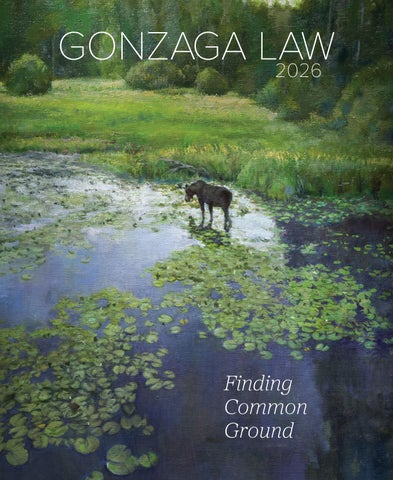
GONZAGA LAW 2026
Finding Common Ground
Wilson J. Ong Gonzaga University School of Law is grateful for its partnership with The Art Spirit Gallery in Coeur d’Alene, Idaho, which brings artists such as Wilson J. Ong to its hallways and magazine pages. This publication features a selection of Ong’s work. Ong grew up in the San Francisco Bay Area and attended Brigham Young University, where he earned a Bachelor of Fine Arts in painting and drawing. He continued his studies at the Art Students League of New York, working with nationally recognized figurative artists Ted Seth Jacobs and Harvey Dinnerstein. He has worked professionally as an artist and illustrator since 1983 and his work has been exhibited at numerous institutions and galleries, including the Butler Institute of American Art in Youngstown, Ohio. In addition to his studio practice, Ong served as a full-time art instructor and department chair for nine years at the Waterford School in Sandy, Utah. He now resides with his family in Coeur d’Alene, Idaho, where he pursues his art full time. He also teaches workshops for groups of varying sizes.
ON THE COVER Verdant Summer Saunter, 2023, Oil on Linen
Wilson J. Ong, Three Chairs, 2018, Oil on Board
Table of Contents Transition, Gratitude, and Opportunity
2
Scholarship Highlights
30
Finding Common Ground
5
Chief Justice Meagan Flynn
34
2026 Graduates
8
Alumni Excellence
36
Florence Intersession
16
Class Action
42
Faculty Profiles
23
In Memoriam
48
President Katia Passerini Interim Dean Linda D. Jellum Project Manager Jordyn Linnell Editor Thea Skokan Designers Julie Smetana Tracy Martin Contributors Crystal Atamian Luke Cairney Dallan Flake Sarah Guzmán Holly Jones Cheston Knapp Agnieszka McPeak Carol Osenga Sailor Rozema Photographer Zack Berlat
Gonzaga Law Magazine is published annually for alumni, faculty, staff, and friends of Gonzaga University School of Law to stay connected to one another and the Mission of Gonzaga University. The opinions expressed do not always represent the view of the administration but are intended to foster open dialogue and lifelong learning in the Jesuit tradition. If you have comments or suggestions, please email the Gonzaga Law School Foundation office: lawalumni@gonzaga.edu. Visit online: gonzaga.edu/law
2 | Gonzaga Law Magazine | 2026
Transition, Gratitude, and Opportunity As we look ahead to the next chapter of Gonzaga Law, we pause to express our deep gratitude to the faculty, staff, and leadership whose dedication has guided the school through a period of transition with professionalism, resilience, and an unwavering commitment to our Mission. We extend our sincere thanks to Former Dean Jacob Rooksby for his eight years of service and leadership. During his tenure, he helped establish and expand several clinical legal programs, strengthened philanthropic support for Law School initiatives and alumni engagement, and championed the success of students and faculty. His leadership has left a lasting impact on the Law School, and his contributions will continue to shape its future for years to come. We also wish to recognize Acting Dean Agnieszka McPeak for her steady leadership during this important transitional time. Transitions offer an opportunity not only to reflect on our strengths but also to embrace new possibilities. With that spirit, we are pleased to announce that Linda Jellum, J.D., has been appointed interim dean of Gonzaga Law School, effective July 20, 2026. Before joining Gonzaga, Interim Dean Jellum was a professor of law and the director of the tax program at the University of Idaho College of Law, where she also served as associate dean for faculty. She previously held the Ellison Capers Palmer Sr. Endowed Chair in Tax
Law at Mercer University School of Law, where she also served as the inaugural associate dean for faculty research and development. Throughout her career, she has taught administrative law, civil procedure, federal income tax, and statutory interpretation. She also taught in Gonzaga’s Summer Law Program in Florence, Italy. Interim Dean Jellum is a highly respected scholar, experienced academic leader, and collaborative colleague whose career reflects a deep commitment to legal education and student success. Her extensive leadership experience, strong connection to the legal profession, and appreciation for Gonzaga’s Mission make her exceptionally well suited to guide the Law School during this transition. I am confident that she will provide steady leadership and build on the school’s momentum and many strengths while continuing to advance excellence in legal education. As we begin this next phase, our focus remains firmly on the future. A national search for Gonzaga Law’s next permanent dean will commence this fall, providing an opportunity to identify a leader who will help shape the school’s future vision. We are confident that, with the dedication of our faculty and staff, the support of our alumni and friends, and the leadership of Interim Dean Jellum through this transition, Gonzaga Law is well positioned for a bright and promising future.
Mia Bertagnolli (’87), Ph.D. Interim Provost
A Farewell from Former Dean Rooksby This marks my final introduction to Gonzaga Law Magazine after serving eight years as your dean. Without a doubt, leading this community has been one of the great privileges of my professional life. Together, we launched and strengthened new programs and academic centers, including the Center for Civil & Human Rights, the Kennelly Center for Law, Ethics & Commerce, the Lincoln LGBTQ+ Rights Clinic, and the Gonzaga University Wine Institute, to name just a few. Since 2018, total student enrollment at the Law School nearly doubled, placing the institution on solid financial footing for years to come. The diversity, national prominence, and scholarly productivity of our faculty also grew dramatically during this period. Along the way, we navigated moments of profound challenge and change, both in the legal profession and society at large.
you spend your weekends, what you read, whom you know, what breaks your heart, and what amazes you with joy and gratitude.” Over the past eight years, Gonzaga Law captured my heart and became one of the great loves of my professional life. Institutions are shaped by people. But over time, people are also shaped by institutions. Gonzaga Law shaped me, too. As my family and I embark on a new adventure, my deepest hope for Gonzaga Law is that this school continues to form lawyers who are thoughtful and compassionate human beings in addition to being excellent advocates. The mark of a Gonzaga lawyer has always been someone prepared not merely to succeed professionally, but to lead a life of purpose.
Throughout it all, what stands out most to me is the spirit of Gonzaga Law School. A spirit profoundly influenced by the Jesuit charism of cura personalis, or care for the whole person. A spirit marked by the beauty of Spokane combined with the boundless optimism and rugged self-determination that characterize life in the Inland Northwest. A spirit defined by a deep sense of service, intellectual curiosity, and genuine care for community. It seems axiomatic that the best professional experiences in life do not feel like work. Instead, they feel like a calling. I am reminded of a prayer attributed to the Jesuit priest Father Pedro Arrupe that speaks to this point:
To our alumni, students, faculty, staff, and friends: thank you. Thank you for your trust, your support, your friendship, your grace, and your enduring belief in this Law School and its Mission.
“What you are in love with, what seizes your imagination, will affect everything. It will decide what will get you out of bed in the morning, what you do with your evenings, how
Jacob H. Rooksby, J.D., Ph. D.
Gonzaga Law will always hold a special place in my heart. With gratitude,
Former Smithmoore P. Myers Dean, School of Law Professor of Law & Leadership Studies
2026 | Gonzaga Law Magazine | 3
Finding THEA SKOKAN THE CENTENNIAL TRAIL runs beside the Spokane River, twisting along the banks and sweeping through Gonzaga’s campus. An artery, not a boundary, according to Law Chaplain Father Bryan Pham, S.J., that connects us with the river and the land beyond. Overlooking the trail is The Common Grounds, the Law School’s newly renovated space for reflection, meditation, and community. Built in the summer of 2025 thanks to a generous donor, The Common Grounds came to life in a collaborative effort by Former Dean Jacob Rooksby, Fr. Pham, Assistant Dean Susan Lee, Assistant Dean Dodi Stilkey, Gonzaga Law School Foundation Executive Director Sarah Guzmán, and Student Bar Association President Scott Kennedy (’24 J.D.).
foundation of our common ground is the ways we are alike, but what adds to that awesome relationship are the things that make us unique,” he continues. “If we were all the same, that would show a lack of creativity in God’s actions.” In the practice of law, disagreement is inevitable. One could argue the very nature of the practice is built on disagreement. What matters is how we navigate that. For law students, Fr. Pham advises having strong convictions − be willing to negotiate and argue, but remember at the end of the day there are humans on both sides of the table who share common ground. “Despite geographical,
“To be human is to be theological, political, and differences, we in relationship and to sociological will always be able to find be in relationship is to commonality.” find common ground.” The Common Grounds space
The space is a physical demonstrates that in more ways manifestation of a FATHER BRYAN PHAM, S.J. than one. concept rooted in Jesuit, humanistic tradition, and it is the theme of this The sturdy, marble structures and clear pathways year’s magazine: Finding Common Ground. represent those strong convictions. But they’re softened by bursts of nature that unite us with the “To be human is to be in relationship,” Fr. Pham land and remind us to grow. says, “and to be in relationship is to find common ground.”
He explains how this is an increasingly important idea as the world seems to have lost a sense of togetherness, searching for what divides us rather than what unites us. There is beauty in our differences; we simply have to look for it. “The
“This space is where we find our humanness, our human identity, in the context of nature,” Fr. Pham says, “and from there we become energized to engage in the world.” A constant reminder that despite our differences, we are still one.
2026 | Gonzaga Law Magazine | 5
ORGING BELONGING IN THE LAW At Gonzaga Law, the Lincoln LGBTQ+ Rights Clinic and The Catholic Charities Immigration Clinic: Client Advocacy offer foundational clinic experiences and more, thanks to the individuals who lead them. For lecturers and supervising attorneys Sarah Harmon (’13 J.D.) in the Lincoln LGBTQ+ Rights Clinic and Vanessa Montoya in the Immigration Clinic, the work is deeply personal and rooted in lived experience. Their clients often come from communities they are part of: Montoya is the daughter of immigrants, and Harmon is a member of the LGBTQ+ community. Both share a persistent awareness that, statistically, individuals with their identities are underrepresented in the roles they hold. Together, they bring perspectives that are illuminating and urgently needed in the legal field and in higher education. For them, the work is not only about teaching legal skills but also about reshaping who the law serves – and who sees themselves within it – while guiding students to discover their own paths in the profession.
6 | Gonzaga Law Magazine | 2026
Clinic Leaders Redefine Advocacy and Access Montoya knew education would be part of her path. Still, when she looked toward the legal profession, she struggled to see herself reflected there. That absence wasn’t simply about representation – it shaped her sense of belonging. Now, Montoya encourages her students not just to find their place in the legal field, but to actively redefine it. “The legal field is accessible to anyone,” she tells them. “And you should be able to move into the area that you want.” She encourages students who share similar identities to her own to release the pressure to choose certain types of work solely because of their background, reminding them that their careers can be as expansive and self-directed as they choose. “Sometimes, students tell me they feel like they’re betraying their community or family if they choose a path in business law,” Montoya
explains. “I can see the weight lift when I encourage them to trust that instinct and to bring their lived experience with them because their perspective is not only valid, it’s something the field truly needs.” For Harmon, the path to clinical work began in a very different environment: civil litigation. Even there, she felt a pull toward something more community centered. Since 2022, Harmon has served as director of the Center for Civil and Human Rights and supervising attorney of the Lincoln LGBTQ+ Rights Clinic. In those roles, she has worked at the intersection of law, identity, and systemic inequity. Her students encounter a legal system that, as she puts it, is often stacked against LGBTQ+ individuals. Harmon’s presence in the classroom and clinic carries particular significance for students. “For students who are part of the community, they can see me – out and proud – in this profession,” she says. “That visibility creates a sense of belonging that many students have never experienced before.”
Vanessa Montoya (left) and Sarah Harmon (right) are both lecturers and supervising attorneys at Gonzaga Law.
“This work and these identities very much belong in the law. There is space for them.” SARAH HARMON
For students outside the LGBTQ+ community, the lesson is different but equally important: learning how to advocate as allies within systems that were not built for equity. “This work – and these identities – very much belong in the law. There is space for them,” says Harmon. Although each student takes away something unique, Harmon notes that all leave with a deeper understanding of belonging and the challenges faced by LGBTQ+ individuals. At their core, both supervising attorneys consider it a privilege to train future lawyers. They are committed to creating clinical experiences that are both adaptable and humane; where advocacy is measured not only by outcomes, but by dignity.
“Whether the law will ultimately provide a remedy or not, what often matters most is that clients feel fully heard,” Harmon explains. “They deserve access to legal counsel free from assumptions or limitations, where the advice they receive does not change because of who they are, and where they are respected from start to finish.” For Montoya, one of the most important lessons students learn is how to support clients in ways that prioritize the client’s own sense of safety and security – even when that looks different from what the student might expect. “When we relate to these challenges because of our identities or the communities we’re part of, we can think we know what’s best,” says Montoya. “But no one knows that better than the client themselves.”
Even when legal remedies are limited, both attorneys emphasize the importance of empowerment – ensuring that clients feel heard, informed, and prepared. That impact is profound because of who Montoya and Harmon are: advocates who come from the very communities they serve. Their presence offers something deeply meaningful, not only to their clients, but to the students learning from them – proof that belonging in the law is not only possible, but powerful.
Give back to the clinics mentioned in this story. gonzaga.edu/clinics
2026 | Gonzaga Law Magazine | 7
GRADUATE PROFILES
Making Her Way MONIKA ECKHART (’26 J.D.) was first admitted to Gonzaga Law during the COVID-19 pandemic, but she couldn’t attend. She was pregnant with her second child, trying to leave an abusive relationship, and feeling isolated and far from her family. When her son was born by an emergency C-section, he had medical complications that kept him in the NICU. Law school would have to wait until her son was safe. Once he was healthy, she was able to start working toward the future she’d imagined for herself. She reapplied to Gonzaga in 2023, the last year her LSAT score was valid. And this time, she was ready.
while they figured things out. They got cars, houses, stable jobs – things that would’ve been impossible without childcare. When she arrived at Gonzaga, Eckhart was a single mother with full custody of two young children. She couldn’t leave her experience up to chance, so she built her support system deliberately. She leaned on close friends, her coworkers at Chastek Library in the Law School, and her professors, who understood her need to balance childcare with her academic responsibilities.
“If Gonzaga wasn’t here, I likely wouldn’t have been able to go to law school at all.’’
By the time she enrolled, Eckhart had already lived several lives. She’d been the youngest person ever to serve on Clarkston, Washington’s city council, had held positions at FedEx, and had participated in community organizing and advocacy work. But the years between her first acceptance and her enrollment were difficult. “I don’t entirely know how I got through it,” she says. “It feels like PTSD when I look back.”
What got her through was community. Eckhart found indispensable support through Head Start, the federal early childhood program where her son was enrolled. She became president of the organization’s policy council and watched as families who had battled addiction, poverty, and crisis were able to get their lives back on track because their kids had a safe place to be
8 | Gonzaga Law Magazine | 2026
“If Gonzaga wasn’t here,” she says, “I likely wouldn’t have been able to go to law school at all. I took on the challenge of law school with small children because I saw it as necessary to ensure their childhood was stable, to give them an advantage that I never had.” After graduation, Eckhart wants to pursue public defense work because she’s seen what happens to families caught in cycles of incarceration and poverty. Her long-term ambitions, like working in death penalty appeals or maybe taking another run at politics, follow the same thread. She’d like to use the law to help people in their most vulnerable moments, and, where possible, reform a system that’s stacked against them. “I have seen the drastic effects of incarceration on people and their families,” she says. “Living through domestic violence, I experienced the effects of a cycle of abuse and poverty firsthand.”
ONIKA ECKHART
2026 | Gonzaga Law Magazine | 9
GRADUATE PROFILES
NRIQUE
FULLER-AVALOS
10 | Gonzaga Law Magazine | 2026
The Missing Variable WHEN ENRIQUE FULLER-AVALOS (’26 J.D.) was in middle school in Portland, Oregon, his family fell on hard times and ended up homeless. As one of eight siblings, FullerAvalos was separated from his family. During this traumatic time, he was constantly calculating, trying to prepare for an uncertain future. He’d often wonder, “When should I eat? What happens if I sleep through my bus stop? How am I going to prepare for school?” He didn’t know it then, but he was developing the mind of a lawyer.
It wasn’t long before he found a supportive network of counselors, professors, and advisors, and his future started to sharpen into view. Thinking he’d want to be a police officer, he got an internship with the Multnomah County Sheriff’s Office. But after a ride-along where he watched an officer talk a man off a cliff, he started to doubt the job was for him. “I still wanted that community connection, though,” he says. “So, I started looking at law more seriously.”
“When they At Gonzaga on a Carl Maxey Scholarship, he used the see someone same approach that had who’s living always worked. proof that it’s “People have the capacity to possible, that’s help,” he says. “But you have to give them the opening.” the whole thing. “I didn’t know any attorneys,” Jason Gillmer Fuller-Avalos says. “You see That’s why I’m Professor nominated him to the Minority them on TV and they’re always and Justice Commission on the doing this.” the villain.” His mother, a resourceful gogetter, enrolled him in Friends of the Children, a nonprofit that matches at-risk youth with a dedicated, long-term mentor. His first mentor’s father was on the Oregon Supreme Court.
During one tough stretch, when Fuller-Avalos’ mounting absences resulted in him being kicked out of high school, his mother opened up and told the school what they were going through. Things began to shift. More help started to arrive. Fuller-Avalos took summer school to make up credits and won the UNCF Jordan Wings Scholarship, a full ride to any university. He enrolled at Western Oregon University. Stability, it turned out, was the missing variable all along. “School had never been hard because the material was hard,” he says. “It was hard because of my circumstances.” Fuller-Avalos was the first in his family to graduate and earn a degree, and in those first few semesters he had to shake a case of imposter syndrome.
Washington Supreme Court when he was a 1L, and he’s been clerking at the U.S. Attorney’s Office since then. After graduation, he’ll clerk for Chief Justice Debra Stephens (’87, ’93 J.D.).
What draws him to appellate work is its reach, the idea that he can help shape the law. And his mind is built for it. “It just feels normal to hold a lot of complexity in my head at once,” he says. Fuller-Avalos knows he wouldn’t be here without everyone who has helped him along the way. He’s already presented at Friends of the Children, where he sat across from young people. “When they see someone who comes from a background like theirs, who’s living proof that it’s possible, that’s the whole thing,” he says. “That’s why I’m doing this.”
2026 | Gonzaga Law Magazine | 11
GRADUATE PROFILES
A Life Built to Stay Afloat WHITLEY HOLTHAUS (’26 J.D.) always knew her husband’s job as a lineman was dangerous. But when their closest friend died in a freak accident, leaving a wife and five kids behind, she experienced something deeper than grief. “That was the slap across the face,” Holthaus recalls. “I could lose my husband the same way. I could have these four beautiful kids in front of me with no way to support them.” Holthaus grew up in western Washington on the Olympic Peninsula, in a home haunted by alcoholism and violence. She found her escape in school. Her teachers told her she was smart and she wore that identity like a life jacket. “When you’re in a constant state of violence, it becomes hard to figure out who you are outside of it,” she says.
They sold their property in Alaska and Holthaus enrolled at Gonzaga; her husband became a stayat-home dad in Idaho near his family. The sacrifice is real and ongoing. Holthaus drives six hours round-trip every weekend to be home. During her second year, a deadline kept her away for five weeks straight. “Everybody asks, ‘How do you do this with kids and a husband?’ But it’s because I have kids and a husband that I can do this,” she says. The stability and support of her home life – knowing who she’s coming home to and why she’s here – has freed her to give everything to the work. At Gonzaga, she serves as a member of the Gonzaga Law Review and she’s a teaching assistant for civil procedure, filling whiteboards and staying late, translating the law for students a decade younger. After a difficult week, a student told her that having Holthaus in the room made it feel like everything was going to be okay.
“Everybody asks, ‘How do you do She worked hard, became the this with kids and valedictorian of her high school, and graduated summa cum laude from a husband?’ But college. In 2013, pregnant with her first it’s because I have daughter, she enrolled in law school at the University of Idaho. She gave birth kids and a husband the first week of school and had to drop that I can do this.’’ out due to her daughter’s early health concerns. While thrilled to start a family, she was quietly devastated to drop out. She felt like she was surrendering the future she’d worked so hard to build.
“I always knew what I was running from,” Holthaus says. “But I didn’t know what I was running toward.” She spent the next decade building the foundation she’d never had. She traveled the country with her husband, eventually settling in Alaska where they stayed for five years. But when their lineman friend died, Holthaus saw herself clearly in his widow. She and her husband looked at each other and made the hard decision to give law school another try.
12 | Gonzaga Law Magazine | 2026
After graduation, the summa cum laude grad will join her husband full-time in Idaho County, Idaho – the largest county in the state by land, but one of the smallest by population – to clerk for a district court judge before joining the prosecutor’s office. She wants to work with victims of domestic violence and families in crisis, people in towns where everyone knows everything and shame has a way of keeping the worst things invisible. “I want to be a presence in a room for somebody who feels like they have nobody – to be the person I needed as a kid. There were so many times I needed somebody in my corner and there was just nobody there.”
HITLEY
HOLTHAUS
2026 | Gonzaga Law Magazine | 13
Gonzaga Law
A L U M N I WEEKEND OCTOBER 2-5, 2025 CAROL OSENGA
Gonzaga University School of Law welcomed Zag Law alumni back to Spokane for the 2025 Law Alumni Weekend, bringing alumni and their families together for four days of reflection, celebration, and community.
The weekend began on Thursday, with Red Mass, a tradition dating back to 1310 that historically marked the beginning of the Michaelmas term during the reign of Edward II of England. Gonzaga University President Katia Passerini, Former Dean Jacob Rooksby, and many members of the local judiciary participated in the Mass. George Critchlow (’77 J.D.) received the Distinguished Legal Service Award in recognition of his decades of service to Gonzaga Law, the legal profession, and the Spokane community. Critchlow, a professor emeritus and former director of Gonzaga University School of Law’s Clinical Programs, has had an impact on generations of students and clients in the community. On Friday, more than 300 guests arrived on campus for building tours, a welcome social, and the ribbon cutting for The Common Grounds, a new reflection and meditation space located behind the Law School. Former Dean Rooksby officially dedicated the space, thanking the anonymous donor and those who helped bring the vision to life. Tamarae Cooney Leong (ʼ09, ʼ13 J.D.), chair of the Gonzaga Law School Foundation, thanked the many alumni for being on campus and celebrating the time together. It was a great kick-off with live music, food trucks, and opportunities for Zag Law Alumni to reconnect with classmates and fellow graduates. Saturday’s events highlighted both fellowship and Gonzaga Law’s commitment to Jesuit education. Some alumni and their families participated in the Legal Dash Fun Run/Walk along the Centennial Trail, and others gathered for golf at Qualchan Golf Course. Throughout the day, alumni rekindled friendships, shared memories, and discovered connections within the Gonzaga Law community. The Clinical Legal Programs Open House celebrated 50 years of clinical education with alumni and community members gathering to recognize the enduring legacy of service, advocacy, and hands-on legal education that has shaped generations of students while providing meaningful legal assistance for those in need. The highlight of the weekend was the Saturday evening gala at the Historic Davenport Hotel where 240 guests gathered to celebrate their shared Gonzaga Law connection. A video, “A Legacy of Service: 50 Years of Clinical Impact,” and presentations showcased the history and future of the program. Jeff Hartje, a founding member of the Clinical Legal Programs, shared heartfelt reflections and received a standing ovation for his vision, leadership, and dedication.
Left to right: George Critchlow (’77 J.D.), Jeff Hartje, Al McNeil (’70, ’77 J.D.), Larry Weiser (’76 J.D.)
The other founding member, Mark Wilson, passed away in 2020. The weekend concluded on Sunday with a farewell brunch at The Bulldog in the John J. Hemmingson Center, giving alumni one final opportunity to gather before returning home. As the weekend came to a close, one thing remained clear: The Gonzaga Law community continues to be defined by service, connection, and a commitment to educating the next generation of lawyers. Mark your calendar for the next Gonzaga Law Alumni Weekend in October 2029!
2026 | Gonzaga Law Magazine | 15
Discovering Meaning in the Unexpected Gonzaga Law’s 3L Intersession in Florence, Italy, offers students a unique opportunity to step outside the traditional classroom and into immersive, short-term learning experiences. Since 2024, the program has expanded to include not only specialized courses and access
“Sometimes, whether in life, or in Florence, it is the places we never expected to go that end up meaning the most to us.” LAUREN SEUELL
Wilson J. Ong, Local Peddler, 2018, Oil on Linen
16 | Gonzaga Law Magazine | 2026
Since 2024, the intersession program has expanded to include not only specialized courses and access to practicing professionals as adjunct faculty, but also opportunities to study abroad. This past January, Associate Dean Agnieszka McPeak led a small group of students on a two-week trip to Florence, Italy, where legal education met history, culture, and discovery in one of the world’s most storied cities.
reflect, and observe daily life unfold. Between classes, it offered a different kind of learning: one rooted in presence rather than structure. “Sometimes, whether in life, or in Florence, it is the places we never expected to go that end up meaning the most to us,” she reflected.
“The Cathedral of Santa Maria del Fiore, best known simply as the Duomo, was almost always in sight,” she shared. “It became apparent to me that Florence is a city that demands to be explored.” With the Duomo as her constant point of reference, Seuell found herself navigating the city not just geographically, but intuitively, wandering narrow streets and embracing moments of curiosity. It was during one of these unplanned explorations that she stumbled upon Piazza della Passera, one of Florence’s smallest and most unassuming squares. The discovery felt serendipitous. Tucked into the Oltrarno neighborhood, the piazza became her own small corner of Florence, a place to pause,
The answer – because we now understand the universe to be infinite – was a powerful illustration of how knowledge evolves. “In that moment,” Kessler noted, “it wasn’t just an art piece. It was a snapshot of human understanding at a specific point in time.”
For recent graduates Lauren Seuell (’26 J.D.) and Kyle Kessler (’26 J.D.), the experience was more than an academic exercise; it was a shift in perspective that will stay with them long into their careers. Florence in January offered a quieter, more reflective backdrop for exploration. As Seuell recalls, the brisk air and intermittent rain gave way to something rare: space to experience the city without the usual crowds. What remained was Florence itself, its people, its rhythms, and its enduring Renaissance architecture.
The model, once presented as a gift representing the entirety of the known universe, sparked a simple but profound question: Why couldn’t such a gift be given today?
Standing in Florence, the birthplace of so many scientific and artistic advancements, the realization carried added significance. The city itself became a testament to human progress, demonstrating both how far we have come and how deeply the past continues to shape the present. While Seuell’s experience centered on the intimate and unexpected, Kessler’s reflections highlight Florence’s ability to broaden perspective on a global and historical scale. From its art and architecture to its food and infrastructure, Florence offered a powerful reminder of the depth of human achievement. For Kessler, some of the most impactful moments came while visiting the Uffizi Gallery, the Accademia, and the Galileo Museum. Spaces where history is not only preserved but brought into conversation with the present. Walking through these institutions, Kessler found himself reflecting on the evolution of human understanding. One moment in particular stood out: a guide’s explanation of a historical model of the universe at the Galileo Museum.
Together, Seuell’s and Kessler’s experiences capture the essence of Gonzaga Law’s Intersession in Florence: a program that extends learning far beyond the classroom. In Florence, education unfolds in quiet piazzas and world-renowned museums alike. It is found in moments of personal discovery and in reflections on centuries of human thought. Students are invited not only to study the law, but to consider it within a broader cultural and historical context. In a city where the past is always within view, Gonzaga Law students are reminded that perspective is not fixed. It is shaped by where we go, what we encounter, and how willing we are to explore both the expected and the unknown.
2026 | Gonzaga Law Magazine | 17
CHRIS & NAN KENNELLY
Leaving a Legacy As a boy growing up in Fargo, North Dakota, Chris Kennelly (’97 J.D.) knew exactly what he wanted to be. Not a fireman. Not an astronaut. Not a professional football player. No, in sixth grade, Kennelly wrote a paper about his dream of becoming an accountant and a lawyer. His grandfather ran an insurance agency, his father was a controller at a tractor factory, and his uncle was a lawyer. If those pursuits were good enough for the men he looked up to, then some combination of them would suit him just fine. He’s a grounded, practical man. And one gets the feeling that if young Kennelly had been able to gaze into a crystal ball, he would’ve nodded in sage-like approval at how his story turned out. Over the course of his career, Kennelly has formed more than a thousand business entities, helping guide clients from the birth of their business through its entire life cycle. He advises them on contracts, employment issues, partnerships, mergers, and tying up loose ends after winding down. He cofounded Kennelly Business Law in Fargo, North Dakota in 2016. He also owns the Frontier Title Group, which operates title companies across North Dakota. He loves his community today as much as he always has.
18 | Gonzaga Law Magazine | 2026
“People have a lot of respect for tradition and for the families who worked hard to build that community,” Kennelly says. “The vast majority of our practice comes from long-time family friends and word-of-mouth referrals. Every client is different, every case is different. But over time you develop real expertise.” Kennelly built the foundation of his expertise at Gonzaga Law. When it came time to choose a law school, he knew exactly where to look. His uncle graduated from Gonzaga and went on to a successful career practicing law in Cathlamet, Washington. When Kennelly arrived in 1994, he threw himself into the Law Clinic, working under professors Al McNeil (’70, ’77 J.D.), Larry Weiser (’76 J.D.), and George Critchlow (’77 J.D.). “Their generosity modeled something for me,” Kennelly says. He’s also made service a large part of his life, through pro bono work and his philanthropic endeavors with his wife, Nan. They recently made a significant gift to the Gonzaga Law School Foundation, endowing the Kennelly Center for Law, Ethics & Commerce (K-CLEC). He hopes this will help continue to give students the kind of practical, business-focused experience he got here.
“I’m also looking forward to volunteering my time and working with the programs on new ideas,” he says. “I’m just looking forward to giving back.” Nan Kennelly works as a speechlanguage pathologist. She supported Kennelly through law school while working at St. Luke’s Rehab Institute, back when they shared one car and she could walk across the street to work. When they moved back to Fargo, she started her own private practice in 2005, Onword Therapy, the first outpatient adult speech pathology practice in North Dakota. “We’ve been in business more than 20 years now,” she says. “And I still love what I do.” The Kennellys’ connection to Gonzaga now spans more than six decades and continues to deepen. Their son recently graduated with an undergraduate degree in engineering and their daughter graduated from Gonzaga Law in 2025. Professor Critchlow served as her advisor, too. “There’s a culture here of connection and support that feels genuinely special,” Kennelly says. “Lifelong friendships are made here. The students who come through Gonzaga Law go on to embody the Jesuit spirit of the place, the commitment to helping others. I hope to continue to find ways to pass that on.”
“Lifelong friendships are made here. The students who come through Gonzaga Law go on to embody the Jesuit spirit of the place, the commitment to helping others. I hope to continue to find ways to pass that on.” CHRIS KENNELLY
2026 | Gonzaga Law Magazine | 19
HE QUIET POWER OF LAW AND PRO BONO JUSTICE When The Honorable Sal Mungia took the podium to deliver the 2026 Gonzaga University School of Law Commencement address, he began with a simple but grounding reminder: He too once sat where the graduates were seated. Before becoming a Justice on the Washington State Supreme Court, he was an attorney navigating the same uncertainty, hope, and responsibility that now accompanies their new titles. Justice Mungia reflected on the idea that becoming a lawyer is not merely a professional milestone, but a personal transformation. With transformation comes a rare privilege – and an equally rare obligation. The true power of the law, he emphasized, lies not in prestige or income, but in its capacity to restore dignity and right wrongs. That perspective shapes how he views success itself. “There are times I see friends in passing and we ask each other, ‘How are you doing?’ And one of the responses I get is ‘Sal, I’m living the dream.’ And of course, the response is facetious. I say to myself, ‘You know what? I am living the dream. In fact, this is more than I could ever have dreamed of.’”
Justice Mungia’s understanding of justice and belonging was formed early. A child of the 1960s, he was raised by immigrant parents – his father from Mexico, his mother from Japan – who worked tirelessly to provide for their family. His upbringing was marked not only by resilience, but by an early and painful awareness of injustice. “Racism was pretty much all around me. My parents were working-class people. I saw how my parents were taken advantage of because of the color of their skin, the way they talked, and because they didn’t have much money. I will never forget the look on my mom’s face when she knew she was being taken advantage of and there was absolutely nothing she could do about it. That image is seared in my memory. It was a look of anger and hurt.”
that,” he said. “But you could also devote at least a portion of your time to fight battles for those who are unable to fight their own battles. You can speak for people who have been silenced. You can force open the courtroom doors for people who have been locked out of the courtroom.” Justice Mungia was equally insightful about the challenges of pro bono service. Time, he acknowledged, is never abundant – especially in the legal profession. “It won’t be easy. You’ll have so many commitments you have to meet: family, friends, and, of course, your practice, to name a few. You will not be able to find time. I can guarantee you that. There is a saying about exercising: You won’t find
Like many children of his generation, Mungia recalls walking home from school on his own, spending afternoons watching reruns on television until his parents returned from work. One “Pursuing justice – show in particular left a lasting impression. trying to right wrongs, “It was about a lawyer named Perry Mason,” Mungia said. “I saw how Perry Mason was able to defend the rights of those who had been unjustly accused. From second grade, I told myself, ‘That’s what I’m going to do, so that what is happening to my parents isn’t going to happen to me or my family.’ And I never wavered.”
giving a voice to those who have been silenced, giving hope to those who have long since forgotten what hope looks like – those actions will feed your soul.”
That childhood resolve grew into a lifelong commitment to justice, one that has guided him from the courtroom to the state’s highest bench. Addressing the graduating class, Justice Mungia spoke candidly about the deeper rewards of legal work driven by purpose. “But pursuing justice – trying to right wrongs, giving a voice to those who have been silenced, giving hope to those who have long since forgotten what hope looks like – those actions will feed your soul.” He reminded graduates their law degrees confer real power, and that power brings choice. “You will soon be lawyers. You can use that new power to simply meet your own needs. There is nothing wrong with
time to exercise, you have to make time. The same is true for doing pro bono work.”
Even then, doubt can creep in. “And trust me, no matter how much you do, you’ll be saying to yourself: Why? There are so many people who need help – can I really make a difference?” For Justice Mungia, the answer is clear. Impact is not measured by solving every problem, but by showing up for someone who cannot advocate for themselves. Gonzaga University School of Law is deeply grateful to Justice Mungia for sharing his time, lived experience, and wisdom with the Class of 2026 on their commencement day. For newly minted graduates and seasoned attorneys alike, his message is enduring: The law, at its best, is not about power for its own sake, but about using that power to serve.
2026 | Gonzaga Law Magazine | 21
The Environmental & Climate Law Clinic Returns to Gonzaga Reestablished through a partnership between the Law School and Gonzaga’s Institute for Climate, Water, and the Environment, the Environmental & Climate Law Clinic provides legal support to individuals and nonprofits facing pollution, unsafe housing, contested land use, and the pressures of a changing climate.
EXPERIENCED CHANGEMAKERS AT THE HELM
A ZAG PARTNERSHIP ADVANCING ENVIRONMENTAL JUSTICE
Clinic codirectors Vanessa Waldref and Dan Fruchter bring experience that students notice from day one. Waldref served as U.S. attorney for the Eastern District of Washington, while Fruchter led the district’s Fraud and White-Collar Crime Unit. Together, they bring decades of valuable experience to the classroom.
A defining strength of the clinic is its collaboration with Gonzaga’s Institute for Climate, Water, and the Environment, led by Director Brian Henning. This partnership reflects a university-wide commitment to addressing environmental challenges across disciplines.
LOCAL OPPORTUNITIES TO SUPPORT MEANINGFUL CASES Hosted at the Spokane offices of Singleton Schreiber, the clinic immerses students in an active legal environment. Students work directly with clients, draft demand letters and complaints, and negotiate with opposing counsel. This year, students engaged in one of the region’s most pressing ecological challenges: restoring salmon to the Upper Columbia and Spokane River systems. Their work explored legal and policy pathways for reestablishing salmon runs disrupted by dam construction nearly a century ago, while also examining the effects of a chemical in the waterways that is linked to widespread coho salmon mortality.
22 | Gonzaga Law Magazine | 2026
Alongside the Climate Institute, clinic students helped draft and advance a proposed cooling ordinance and presented the proposal to city leaders.
Provide more opportunities in the Environmental Law Clinic by giving today. gonzaga.edu/environment
Law, Imagination, and the with Professor Michael Cecil
Whether he’s running political campaigns or writing novels, in the classroom or in the courtroom, Professor Michael Cecil has built his life around a central question: “How deep does the well of the mind go?” And like all the best questions, it doesn’t demand an answer, but energy and attention. This question animates Cecil’s two great passions: the law and writing fiction. Prima facie, these might look like opposite pursuits. The law rests on precedent and rigor; fiction employs freedom and imagination. But for Cecil, they’re complementary pursuits that allow him to explore the world in different ways.
reelection campaign. But the closer he got to politics, the further away societal change seemed. He saw the law as a path to a deeper understanding of societal dynamics. He enrolled in Georgetown Law and went on to earn an LL.M. from NYU. After practicing immigration law in Baltimore and Arlington, Virginia, he concluded that in-court work addresses downstream problems. He wanted to train attention on upstream problems, which meant teaching lawyers how the law is made.
“We live in reality. But let’s not let dogma or tradition At Gonzaga, Cecil teaches constitutional law, jurisprudence, federal courts, and legislation. His approach completely guide in the classroom is improvisational – “More Broadway than Hollywood,” he jokes. While he always has a destination in how we think.” mind, he likes to let the journey take its own shape through
“We live in reality,” he laughs. “But let’s not let dogma or tradition completely guide how we think.” Cecil grew up in Southern California and was a late bloomer, intellectually. During his junior year of college, he had an awakening and became newly invested in political science, philosophy, and journalism. His curiosity was insatiable and he had the drive to match it. After college, he spent several years working for political campaigns. His work in communications, organizing, and policy development placed him at the center of many campaigns, including former president Barack Obama’s 2012
conversation and discovery.
“I’m trying to be a small part of an ancient debate,” he says. “We’ve been asking jurisprudence questions for thousands of years, from Athens and Rome to now. So long as there’s society, there will be questions about the best rules to govern it.” When the teaching day ends, Cecil turns his attention to his fiction, where he gives his imagination free rein. He writes longhand, filling notebooks with his cursive, feeling the world he’s building come alive under his pen. “I care about producing work that challenges me, that tells me something about myself,” he says. “I want to know if I can do something I haven’t done before.” 2026 | Gonzaga Law Magazine | 23
Professor Dan Morrissey’s
Dan Morrissey, who recently retired from his fulltime professorship at Gonzaga Law, found practicing corporate law fascinating when he was a young lawyer in Los Angeles. He was sharp and welltrained, having gone to Georgetown for law school, clerked for a federal judge, and worked at the Securities and Exchange Commission before landing at his firm. But something about him was always elsewhere. “Some of my colleagues would say that I was always more interested in the theoretical aspects of the law,” Morrissey says. This observation hit home in an unexpected way. Morrissey had already been doing some part-time teaching at Loyola Marymount and Pepperdine law schools. It’s where he discovered the passions that would govern the rest of his career: helping young lawyers and doing serious legal scholarship. “As an academic, you have more freedom to write about the issues you care about,” he says. “And I knew I’d find it fulfilling to help young people starting their careers in the law. So, I made the move to a fulltime academic position.” He started this new phase at the University of Tulsa College of Law, where he taught contracts, securities, corporations, and jurisprudence for more than a decade, earning tenure along the way. Morrissey also taught as a visitor at other law schools like Seton Hall and the University of Denver. On the side, he became involved in politics, running for Congress and chairing the Democratic Party in Oklahoma. Morrissey gained administrative skills and was chosen as Dean of St. Thomas University College of Law in Miami, a role that sharpened his sense of what a law school could, and maybe should, be.
24 | Gonzaga Law Magazine | 2026
He brought that vision to Gonzaga in 2001, where he arrived as dean just as the Law School’s new facility opened its doors. Gonzaga had always been known as a strong teaching institution, and when Morrissey arrived, he brought an enhanced commitment to scholarship. He made it a central priority, raising expectations for professors to do high-level legal writing. “When I came to Gonzaga, I emphasized scholarship more than had been the case in the past,” he says. “And that’s continued to be a real factor here, for hiring, promotion, and how we support the faculty. And it has lifted the school’s profile on the national scene. In addition, scholarship supports better teaching.” Morrissey himself exemplifies that. He has coauthored a casebook on securities litigation and has written numerous law review articles about the topics he teaches in corporate law. He is also called on by law firms around the country to serve as an expert witness and consultant in their cases. He plans to continue these activities and will maintain his connection with Gonzaga as an emeritus faculty member. In addition this fall, Morrissey will return to St. Thomas University College of Law to teach contracts. At the heart of Morrissey’s approach to law is a devotion to justice. An ideal, he says, that finds its fullest expression at a Jesuit institution like Gonzaga, a school he’s been proud to be part of for the past 25 years. “Lawyers should find satisfaction helping other people, and that outlook certainly has a moral dimension and maybe even a religious one. For that reason, law is a noble profession, and I’m proud to have served it.”
“Lawyers should find satisfaction helping other people, and that outlook certainly has a moral dimension and maybe even a religious one. For that reason, law is a noble profession, and I’m proud to have served it.” DAN MORRISSEY
2026 | Gonzaga Law Magazine | 25
Watch Professor Murphy’s viral goodbye from the Gonzaga Law community.
26 | Gonzaga Law Magazine | 2026
A Quarter of a Century: Professor Ann Murphy’s
For more than 25 years, Professor Ann Murphy has treated her classroom somewhat like a stage, taking her students through complex material like an actress might. She holds their attention with her tremendous energy, insight, and compassion, making topics like tax law and civil procedure come alive for them in a way that shouldn’t be possible. And like all the best roles, it’ll be hard to give up after retiring from full-time teaching. “It’s not an act, but I am performing,” she says. “After a good day of class, you’re walking on clouds.”
into 14 years as a trial attorney, with stints in San Francisco and Portland. She loved the courtroom, the pace of it, the pleasure of a well-prepared case coming together under pressure. But a prolonged tax fraud case eventually tested her loyalty to the work, and she started looking for another way to challenge her abilities.
“They have helped me just as much. That was something I didn’t expect. A real gift.”
Professor Murphy grew up in Chicago, the youngest of four siblings. She calls her younger self a dedicated goof-off, more interested in being liked than doing well in school. It wasn’t until college that she discovered the passion for research and academic achievement that she’s nurtured for more than 40 years. “I realized you can get as much attention by being a good student as being a goof,” she half-jokes.
After realizing that, she never looked back. She got all A’s and developed the work ethic that has served her throughout her career. As she neared graduation from college, she thought she wanted to become a paralegal, because she didn’t think she could handle law school. But one of her professors challenged her to try it, reassuring her she could. She surprised only herself by doing so well. During law school, she completed an externship with the Internal Revenue Service that turned
Teaching had always been the destination she’d been circling. She taught college economics for 18 months before law school and caught the teaching bug. She loved training IRS revenue agents, breaking down complex evidentiary rules, and watching understanding click into place. When the opportunity came to join Gonzaga’s faculty, she took it without hesitation. “I can remember back to exactly how I felt when I started law school,” she says. “I actually hated every moment of it, because I was so stressed. I remember clearly not comprehending an ancient case in my textbooks, just not getting it, so I can relate to the students.” These relationships, both in and out of the classroom, made her time at Gonzaga feel like she’s been part of a family. But she pushes back against the idea that she’s done the lion’s share of the work in these relationships. “To the extent that I’ve helped the students, I’m really happy,” she says. “But they’ve helped me just as much. That was something I didn’t expect. A real gift.” After a remarkable career, Professor Murphy will assume emerita status in the fall of 2026.
2026 | Gonzaga Law Magazine | 27
Welcome New Faculty Gonzaga University School of Law is proud to welcome an exceptional group of new faculty members whose scholarship, practice experience, and commitment to teaching will enrich our community for years to come.
Sonya Garza
Veronica Saladino
ASSISTANT PROFESSOR
ASSISTANT PROFESSOR
Sonya Garza joined the Gonzaga Law faculty in fall 2025 as a visiting assistant professor and will begin her appointment as assistant professor in fall 2026. Garza’s scholarship explores how constitutional doctrine, family law, and policy shape the lived experiences of marginalized communities. Her work has appeared in the UC Davis Social Justice Law Review, Louisiana Law Review, and New England Law Review.
Veronica Saladino returns to Gonzaga Law in fall 2026 as an assistant professor after serving as a visiting assistant professor in 2023-24. A corporate and international business law scholar, Saladino’s research examines legal challenges arising at the intersection of domestic law and global commerce. Her scholarship has been published in leading journals, including the Chicago Journal of International Law and Georgetown International Law Journal.
Garza earned her B.A. from the University of Texas and her J.D. from Stanford Law School, where she served as an editor on the Stanford Law Review. Before entering academia, she was a litigator at Akin Gump and Fulbright & Jaworski in Texas. She has taught at Texas Tech, New England, Elon, Barry, and Memphis law schools, earning multiple professor-of-the-year awards. At Gonzaga Law, she teaches constitutional law, comparative women’s rights, family law, and professional responsibility.
28 | Gonzaga Law Magazine | 2026
Saladino holds a master’s degree in law from Università degli Studi di Cagliari and a J.D. from UNLV’s William S. Boyd School of Law. She practiced as an associate at Rice Reuther Sullivan & Carroll and later consulted for EPG Law Group in Las Vegas. Before returning to Gonzaga, she served as an assistant professor at St. Thomas Crump College of Law in Miami. She teaches business associations, contracts, international business transactions, and transactional drafting.
Tim Fennessy (’79, ’83 J.D.) LECTURER Tim Fennessy joined Gonzaga Law in spring 2025 as a visiting assistant professor and will serve as a lecturer beginning fall 2026. A proud Gonzaga Law alumnus, Judge Fennessy practiced in Spokane for more than three decades, focusing primarily on litigation. Elected to the Spokane County Superior Court in 2016, he served eight years on the bench, including terms as chief criminal judge and presiding judge. He teaches civil procedure, construction law, foundations of appellate law, lawyering skills, and remedies.
Robert Hsu LECTURER Robert Hsu joins Gonzaga Law as a lecturer in fall 2026. Hsu earned his J.D. from Indiana University Maurer School of Law. Before entering academia, Hsu practiced business law at Dentons and later served as in-house legal counsel for Washington Prime Group Inc., in Indianapolis. At Gonzaga Law School, he teaches business associations, property, wills and trusts, advanced corporate law, and drafting for litigation.
Melissa Kilmer LECTURER
organizations in Maryland and Idaho, representing lowincome clients in a wide range of matters. She teaches contracts, lawyering skills, legal research and writing, and bar examination strategies and techniques.
Mirisa Torres LECTURER Mirisa Torres joined Gonzaga Law in 2024 as assistant director of career services and will begin her role as lecturer in fall 2026. She brings extensive experience as a litigator with Bradbury & Koyama PS and Evergreen Estate and Elder Law in Spokane, as well as teaching experience at Whitworth University and the Community Colleges of Spokane. At Gonzaga Law, she teaches foundations of experiential learning, wills and trusts lab, externship seminar, elder law clinic, and legal research and writing I and II.
Andrew Lah VISITING ASSISTANT PROFESSOR Andrew Lah joins Gonzaga Law School as a visiting assistant professor in fall 2026. His scholarship focuses on police accountability and civilian oversight systems; use-offorce investigations, training, and prosecution; constitutional policing; and broader issues in criminal justice reform and civil rights enforcement. He has significant trial experience in both the public and private sectors in California. At Gonzaga Law, he teaches criminal law, legislation and regulation, and legal research and writing III.
Melissa Kilmer joined Gonzaga Law in 2021 with various roles in the Academic Success Program. Beginning fall 2026, she will serve as a lecturer in addition to retaining her position as director of academic success. Before coming to Gonzaga, Kilmer spent most of her career in legal aid 2026 | Gonzaga Law Magazine | 29
Faculty Scholarship Highlights This past year has been an incredibly successful one for the Gonzaga Law faculty, producing scholarly works on a wide range of timely, important topics, with placements in some of the most prestigious law reviews. The following are notable recent and forthcoming publications.
Wilson J. Ong, Passing Through, 2021, Oil on Canvas
RECENT PUBLICATIONS Licensing Without Borders: Evidence from the Nurse Licensure Compact 74 Buffalo Law Review (forthcoming) By Nicholas Marquiss, Assistant Professor of Law Occupational licensing laws, which require a person to hold a state-issued license in their given profession to perform the activities associated with that profession, are under attack. This article
argues that the most effective path to reform occupational licensing lies in the compact clause of the U.S. Constitution, which permits states to join legally binding agreements with one another. In the licensure context, states can use this constitutional power to join multistate licensing agreements that mutually recognize licenses issued by other member states, alleviating many of the costs of licensure while retaining its benefits. To empirically validate this claim, this article analyzes the nurse licensure compact, which grants nurses in member states a multistate license. Using a data set of nearly 250,000 observations, this article shows that the compact increases interstate mobility among nurses while offsetting other social costs of licensing, including supra-competitive wages. It further shows that the compact preserves the training and educational standards for nurses that protect consumers. In addition, the article argues that multistate licensing compacts can mitigate regulatory capture by shifting disciplinary authority away from state licensing boards toward more independent interstate administrative bodies. Taken together, these findings demonstrate that interstate licensing compacts are the best path to reforming occupational licensing. Assistant Professor Marquiss is an empirical law and economics scholar who researches topics relevant to antitrust law and public health. His work focuses on the influence of state occupational licensing laws on labor markets and the provision of healthcare.
Transforming Teaching Through Theatre 32 Clinical Law Review 155 (2025) By Genevieve Mann, Associate Professor of Law Effective legal practice requires more than legal acumen: It demands emotional intelligence, skilled communication, and creative problem-solving. This article offers a new pedagogical tool — theatrical performance — as a reflective opportunity for students to contemplate, prepare, and envision themselves as effective, empathetic lawyers. The foundation for this article is a project that required law students at the beginning of their clinical experience to view the short play titled “Lily,” about end-of-life planning. This piece proposes that using theatre — or the arts generally — in legal education allows students to vicariously participate in the lives of their future clients and facilitates a better understanding of their challenges, values, and wishes. The emotional impact of theatrical performance emphasizes the human aspect of lawyering and stimulates student engagement, deepens learning of substantive material, and facilitates creative thinking. Associate Professor Mann researches and writes in the area of elder law, with a focus on reimagining legal tools that sit at the intersection of client selfdetermination and empowerment.
NEW AND FORTHCOMING SCHOLARSHIP Michael Cecil, Assistant Professor of Law, researches jurisprudence, constitutional theory, and structural equality. His article, Structural Guarantees: How the Constitution Combats Unequal Distributions of Liberty and Opportunity in the State, 2026 | Gonzaga Law Magazine | 31
was published in the New Mexico Law Review. His article, History as Justification: Constitutional Time and the Limits of Judicial Power in Trump v. CASA, will be published in the Iowa Law Review, and his article, Political Morality as Law: Constitutional Principles and Judicial Authority, will be published in the St. John’s Law Review. Dallan Flake, Associate Dean of Faculty Scholarship, Professor of Law, and Clute-Holleran Scholar in Corporate Law, researches the legality of workplace religious accommodations. His article, No Jab, No Job: Assessing the Religious Sincerity of VaccineExemption Seekers, will be published in the Boston College Law Review, and his article, Fired for Asking, will be published in the BYU Law Review. The sixth edition of his coauthored casebook, Employment Law, is forthcoming. Jason Gillmer, John J. Hemmingson Professor of Civil Liberties, is a legal historian with a focus on the antebellum South, the conquest of the American West, and the Civil Rights era. His article, Slavery in a Free State: California’s Fugitive Slave Act and the Coming of the Civil War, will be published in the California Supreme Court Historical Society Review. Erica Goldberg, Professor of Law, researches the intersection of tort law remedies and First Amendment rights. Her article, Academic Freedom Undermined, was published in the Maryland Law Review Online. Brooks Holland, Professor of Law and J. Donald and Va Lena Scarpelli Curran Chair in Legal Ethics and Professionalism, focuses his research on the intersection of professional responsibility, criminal law, human rights, and social justice. His article, I Waive Appeal—Except: What Challenges to a Guilty Plea May a Defendant Still Raise after Waiving the Right to Appeal?, was published in the U.S. Supreme Court Preview Journal, as was his article, The Emergency-Aid Exception to the Fourth Amendment Warrant
32 | Gonzaga Law Magazine | 2026
Requirement: A Traditional Probable Cause Standard, or Something Less? His article, 250 Years of Judicial Warrants: The Exceptions that Prove the Rule, will be published in the Journal of Social Education, and his article, The Bias Paradox in Criminal Defense Advocacy, will be published in the Idaho Law Review. He also edited the ABA International Law Section 2025 Year-in-Review: International Criminal Law. The third edition of his coauthored casebook, Learning Professional Responsibility: From the Classroom to the Practice of Law, is forthcoming. Luis Inaraja Vera, Associate Professor of Law, researches environmental and natural resources law. His article, Voluntary Regulation, was published in the Harvard Environmental Law Review. His article, Unifying Adverse Possession and Prescription, will be published in the Wake Forest Law Review. Agnieszka McPeak, Associate Dean for Academic Affairs and Program Innovation, Professor of Law, and Frederick N. and Barbara T. Curley Professor of Commercial Law, researches and writes on the intersection of law and technology, particularly as it relates to social media, ethics, privacy, and the innovation and sharing economies. Her article, AI, Ethics, and Augmented Lawyering, was published in the Toledo Law Review. Dan Morrissey, Professor of Law, researches corporate securities law and jurisprudence. His article, Private Equity and the Public Good, was published in the Buffalo Law Review. Ann Murphy, Professor of Law, focuses her research on tax and evidence issues. Her article, Nothing to Gain: The Disparate Impact of the Capital Gains Tax Preference on Women and Persons of Color, was published in the Nevada Law Journal. Her update, Evidence Privileges, in Federal Practice
and Procedure (commonly known as Wright & Miller), was also published. The 10th edition of her coauthored casebook, Evidence: Teaching Materials for an Age of Science and Statutes, is forthcoming. Olawale Olumodimu, Assistant Professor of Law, examines emerging legal concerns of the rights of internally displaced persons, stateless persons, and refugees. His article, Citizenship Revoked, Humanity Denied: The Existential Cost of Statelessness, was published in the Howard Law Journal. Abe Ritter, Assistant Professor of Law, researches behavioral legal ethics. His article, The Stories Attorneys Tell Themselves Prior to Misconduct, will be published in the Seton Hall Law Review. Jacob Rooksby, Former Smithmoore P. Myers Dean and Professor of Law, writes in the areas of intellectual property and higher education law. His symposium article, What Universities Should Be Asking About AI, But Aren’t, will be published in the Stetson Law Review. Kai Wang, Assistant Professor of Law, focuses his research on financial regulation, particularly in the regulation of cryptocurrency, banks, and payment systems. His article, Regulating Cryptocurrency Non-Custodial Service Providers Through the Bank Secrecy Act, was published in the University of Chicago Business Law Review.
A LIFETIME OF MENTORSHIP:
The Impact of Alaska’s Color of Justice Program For the past 20 fall semesters, Gonzaga Law Assistant Dean Susan Lee has packed her bags and traveled north to support the Alaska Color of Justice Program. JORDYN LINNELL What began during Susan Lee’s (’12 Ph.D.) tenure as director of admissions has grown into a lasting commitment that has shaped students’ lives across Alaska, strengthened communities, and fostered a lifelong mentorship with Pamela Hess (Smith) (ʼ16 J.D.), now a magistrate judge in Nome, Alaska. Founded by the National Association of Women Judges, Alaska’s Color of Justice Program introduces high school students to the legal profession through hands-on learning and direct engagement with judges, attorneys, and law schools. The program is a statewide collaboration among education, legal, tribal, and judicial partners, including the Alaska Court System, Alaska Native Justice Center, Alaska Bar Association, Sitka Tribe of Alaska, Kawerak Inc., and Koniag Inc., Pacific Northwest law schools, and the University of Alaska Anchorage. The initiative serves as an early pipeline to Gonzaga, engaging students before the LSAT and introducing them to the pre-law path. “For students, the program introduces them to civic engagement and shows how involvement in the legal system can strengthen their local communities and support people who share their lived experiences,” Lee explains. Judge Hess’ story reflects the program’s full-circle impact. Born and raised in rural Alaska, Hess knew she wanted
to be a lawyer but did not know how to get there. As a high school student, she participated in the Color of Justice Program, where she was inspired by volunteer judges and attorneys who looked like her and shared their experiences. The program provided an engaging introduction to the law and connected her directly with law school recruitment opportunities. Lee and Hess first met in 2005, when Hess stopped by Gonzaga Law’s recruitment table during the Color of Justice Program. From that initial conversation, Lee became a steady guide, supporting her through the law school application process, LSAT preparation, and participation in the American Indian Law Center’s Pre-Law Institute. “Assistant Dean Lee has always been supportive and encouraging,” Hess shares. “She was the positive presence I needed to get where I wanted to be and helped build the confidence I have today. Volunteering with the Color of Justice Program alongside her makes that support especially meaningful.” Hess went on to earn her J.D. from Gonzaga and today considers Lee both a mentor and a lifelong friend, crediting their relationship as a defining influence in her career. Lee shares that admiration. “Pam is truly exceptional – smart, driven, and deeply committed to her community,” Lee says. “Her journey embodies the purpose and promise of the Color of Justice Program, and it has been my privilege to walk alongside her.” Now serving on the bench in Nome, Hess’ path stands as a powerful example of how early exposure, sustained mentorship, and opportunity can shape meaningful legal careers. Gonzaga Law is grateful to be a part of Alaska’s Color of Justice Program and looks forward to supporting students, like Hess, on their law school journey.
2026 | Gonzaga Law Magazine | 33
The Journey of Oregon Supreme Court Chief Justice
AT THE 2026 COMMENCEMENT CEREMONY for Gonzaga University School of Law, Chief Justice Meagan Flynn (’92 J.D.) returned to her alma mater to receive the Law Medal, one of the school’s highest honors. In her remarks, Flynn reflected on the education, mentorship, and opportunities that shaped her path from Gonzaga Law to Oregon’s highest court. She spoke about the importance of public service, bridging the justice gap, and practicing law with empathy and integrity. The following timeline traces the milestones of her distinguished legal career and lifelong commitment to justice.
1989
1991
Chief Justice Flynn graduates cum laude in philosophy and political science from Willamette University. That fall, she begins law school at Gonzaga University.
She marries fellow Gonzaga Law alum Daniel L. Keppler (’92 J.D.), creating a partnership in both life and law.
The Start of a PNW Legal Journey
34 | Gonzaga Law Magazine | 2026
A Love Story
1992–1994 Judicial Clerkship
1992
She begins her career clerking for Judges Robert Durham and Rick Haselton on the Oregon Court of Appeals, gaining hands-on appellate experience that helps shape her future judicial path.
Gonzaga Law Graduation Chief Justice Flynn earns her J.D. from Gonzaga University School of Law magna cum laude as a Thomas More Scholar, launching her legal career and lifelong connection to Gonzaga.
1994–2014 Private Practice
Chief Justice Flynn spends two decades in private practice in Portland, becoming a partner at Preston Bunnell & Flynn and a respected appellate lawyer, arguing complex cases before Oregon courts and the Ninth Circuit.
2014
Court of Appeals Appointed by Governor John Kitzhaber, Chief Justice Flynn transitions from private practice to the bench, marking her entry into Oregon’s judiciary and the first regularly constituted all-female appellate panel. Flynn was later elected in 2016.
2017
Supreme Court Justice Chief Justice Flynn is appointed by Governor Kate Brown to Oregon’s highest court and is sworn in April 2017, elevating her statewide judicial leadership.
2023
2018
The court elects Flynn as Chief Justice of the Oregon Supreme Court, effective January 1, 2023. Selected by her peers to a six-year term, she now leads Oregon’s statewide judicial system. In 2024, she is reelected to her seat on the court.
She secures her seat through a statewide election, reinforcing public trust and continuing her work on the state’s most important legal issues.
Chief Justice Appointment
Statewide Election Victory
ALUMNI EXCELLENCE
Jessica Anleu
Showing Up Anyway:
THE WORK OF AN IMMIGRATION ATTORNEY
Wilson J. Ong, Dawn, 2022, Oil on Canvas
36 | Gonzaga Law Magazine | 2026
“But for that one, I made all the difference.”
When Jessica Anleu (’13 J.D.) loses a case, her client is often deported, sometimes as soon as the following day. Her job involves bearing witness to the kind of heartbreak she can’t leave at the office – husbands taken from wives, children from parents, people’s lives completely upended. And she didn’t plan any of it.
of habeas corpus to enforce bond hearings courts had already ordered and the government was simply refusing to honor.
Anleu grew up in Phoenix, close to the border, and while not Latina herself, she studied Spanish growing up and was immersed in a bilingual community. She then studied international affairs at Northern Arizona University, without yet realizing how valuable that degree would become later in her career. “When I went to Gonzaga, immigration law wasn’t even on my radar,” she says. Anleu always loved being around and helping people. She served on the Gonzaga Public Interest Law Project board, led student trips to the Dominican Republic, and jumped at a chance to study abroad in Guatemala between her second and third year. After graduation she landed a position at the Human Rights Ombudsman office in Guatemala City, working in the forced disappearances division. Guatemala’s armed conflict had ended less than two decades earlier, and investigators were still sorting through millions of recovered military records, piecing together the fates of activists who had spoken out and vanished. She spent hours in the archives tracing patterns: movements, orders, absences. She was supposed to stay three months. She stayed nearly a year.
“In thirteen years, I had never seen anything like it,” Anleu says.
Anleu also met her husband, Mario, a Guatemalan contracts attorney. They spent a year apart before marrying, navigating the immigration system themselves. This means when clients sit across from them, they’re not just talking to lawyers but people who understand the humanity of their situation. Today, they run Zava Immigration Law Group, named for their two daughters, Ava and Zara. The last year brought enormous changes to the system – overnight policy reversals, protections stripped with no warning, ICE officers appearing at immigration court to arrest clients who had entered the country lawfully. It’s been draining. She and Mario started driving clients to hearings themselves to protect them, but still it wasn’t enough. They began filing writs
What keeps her going is the bravery of her clients – people who show up to court knowing they might be detained on the way out, simply because they are going through the system. Anleu often returns to an old parable about a man throwing starfish back into the ocean. Scores of them have washed up on shore and a passerby remarks that the man can’t possibly save all of them. “But for that one,” she quotes, “I made all the difference.” She knows she and Mario can’t save everyone. Families will be separated. Cases will be lost. But they’ll continue to show up anyway – filing the writs, driving clients to court, and trying to make the math work in someone’s favor. Because for that one, it makes all the difference. 2026 | Gonzaga Law Magazine | 37
ALUMNI EXCELLENCE
Lindsay Walker Hobson
All the Right Turns:
A CLEAR VOICE IN SERVICE OF OTHERS
Wilson J. Ong, Above the Din, 2009, Oil on Linen
38 | Gonzaga Law Magazine | 2026
“If you have the skills and the resources to give a voice where there’s a void, you have an obligation.”
Lindsay Walker Hobson (’07 J.D.) has worn a lot of hats. She’s been an oil and gas litigator, a pro bono immigration attorney, a campaign communications director, a crisis communicator, and in-house counsel. This patchwork, as she calls it, was never quite the plan. But she’s seen all her professional experience come together as director of legal and administration at Alaska’s largest natural gas utility, and as of this spring, vice president and general counsel. When Hobson arrived at Gonzaga, she was convinced she’d go into immigration law. She’d studied Spanish in college and worked in a migrant education program, spending time with families from Mexico who’d come to Alaska for work. The lawyers she saw moving through those communities inspired her. While at Gonzaga, she also interned for World Relief, a refugee resettlement organization with an in-house legal clinic.
be managed, and the legal and communications functions had to operate in tandem. She found that having a lawyer’s instinct in a communicator’s role was “uniquely valuable.” “When people are scared, like after an earthquake or when their heat goes out or when they don’t know what’s happening, our communications are the public’s only window into what we’re actually doing,” Hobson says.
“There’s no bigger high than learning that a client has received their green card,” she says. “But there are a lot of lows, and I found I wasn’t able to separate myself from the work at the end of the day.” Realizing immigration law wasn’t her future was a shock, but she took it in stride. She moved back to Alaska and took a job at her father’s firm, practicing oil and gas law. When he decided to run for governor, she became his communications director, and helped guide him to victory in 2014. She has since landed at the Enstar Group, a global insurance provider, where she built the communications department essentially from scratch. Hobson was tested early. A major earthquake hit their entire service area not long after she started. Suddenly the job wasn’t theoretical: Safety information had to reach customers, media had to
But she’s never been able to shake her initial passion for immigration law. In 2017, Hobson went to Dilley, Texas to perform pro bono work, helping detained women and children prepare for their immigration hearings. The experience was so moving that she organized a trip for the following year, this time with a group of other attorneys from Alaska. “The traumas they were escaping were just a steady flow of nightmare fuel,” she says. “I don’t know a better way to put it.” Today, as Enstar’s vice president and general counsel Hobson is navigating a looming transition from domestic gas supply to imported gas, a situation Alaska has never faced. She also serves on the board of the Alaska Institute for Justice, a nonprofit providing immigration legal services in a state where the need is urgent and federal support is increasingly uncertain. “If you have the skills and the resources to give a voice where there’s a void,” she says, “you have an obligation to do that.”
2026 | Gonzaga Law Magazine | 39
Building Belonging When law students and alumni reflect on their time in law school, the conversation often begins with the defining moments such as time in Chastek Library, conversations in The Pit, outbidding each other for the coveted GPILP parking space, or getting much needed caffeine from Café Lawte. But just as often, it turns to the places where life actually unfolded – the spaces where friendships take root and where the intensity of law school life is, for a moment, set aside. I hope The Common Grounds is one of those spaces. I spent time there as the school year was closing, looking for a moment to calm the noise. What stood out was the ease with which people settle into it. There is no expectation in the space. It allows for simply being present. That may seem small, but in law school, it is not. Much of daily life here is defined by argument and analysis, learning how to construct a position, respond under pressure, and engage with complexity. These are essential skills for any legal education. Yet The Common Grounds offers a quiet reminder that none of it is sustainable without something beneath it: the ability to listen. Not only to respond, but to understand. St. Francis of Assisi prayed, “Where there is hatred, let me sow love; where there is doubt, faith.” It is easy to imagine he might view a space like this as a place where people are invited to lower their defenses, encounter one another with openness, and practice what it means to find common ground. Each brick represents someone who felt connected enough to Gonzaga Law to leave a mark – family members, mentors, classmates, and supporters who chose to say, “this mattered.” It feels especially meaningful to have the Burkempers’ story on the following page. It is alumni like them who help make spaces such as The Common Grounds possible, sustaining not only legal education itself, but the experience of belonging to a community shaped by reflection and care. The space is not simply an addition to campus life. It is a reminder that what is built together through generosity, intention, and community will shape not only where students learn, but how they learn to be in the world.
Sarah Guzmán, ’18 M.A. Executive Director of the Gonzaga Law School Foundation
An Enduring Argument for Access HOLLY JONES, ’22 M.A. When Ben Burkemper (’91 J.D.) left his small hometown outside St. Louis to attend Gonzaga University School of Law in 1988, he was searching for more than a degree – he wanted a Jesuit education grounded in service, discernment, and community. “I wanted a small school, I wanted a Jesuit experience,” Burkemper recalls. “It was a big, massive step for me.” At Gonzaga Law, Burkemper found a close-knit environment where professors invested deeply in students and legal education extended beyond the classroom. Through the law clinic, he encountered the realities of poverty and inequity in ways that would shape his future career in public service. After graduating in 1991, Burkemper returned to Missouri, practiced law with
his father and was later appointed to the bench. Today, he serves as a family court administrator in St. Louis County, guided by a belief that the legal system should serve all people fairly and with dignity.
a portion of their retirement assets through their IRA to support institutions that shaped their lives, including Gonzaga Law.
Ben’s wife, Sarah Burkemper, sees that commitment as deeply connected to his Gonzaga experience.
“We are fortunate we have what we need and what our children need,” Sarah says. “So, we chose to set aside a portion of our retirement funds for planned giving.”
“I think attending law school at a place like Gonzaga brings a strong commitment to justice,” she says. “His mission was truly to get a law degree and become the type of person who serves the community at large.”
For the Burkempers, education remains the priority. Their unrestricted gift reflects gratitude for Ben’s formation at Gonzaga Law and a belief that access to legal education creates stronger communities.
Now, the Burkempers are helping extend that mission to future generations through a planned gift benefiting the Gonzaga Law School Foundation. The couple designated
“We think we will live in a much better society if we have educational opportunities for others,” Sarah says. “Education is so expensive, and anything we can do to help give access to education is something we’re interested in supporting.” Through their generosity, the Burkempers are helping Gonzaga Law continue preparing future advocates, public servants, and leaders committed to justice and meaningful service.
To learn more and lock in your legacy, contact Gonzaga’s Office of Planned Giving at plannedgiving@gonzaga.edu or visit gonzaga.edu/plannedgiving.
2026 | Gonzaga Law Magazine | 41
Class Action 1976
Richard Sperling practices family law at Sperling Family Law. He specializes in premarital and postmarital agreements.
1987 Bob Kitsmiller is now employed at Foley Mansfield PLLP.
1990
Bill Nicholson retired on June 30, 2025, after serving as in-house counsel with Duke University for 15 years and working with the Washington Attorney General Office for 15 years.
1995
Tiffany A. Sanders joined the Minneapolis office of Ogletree Deakins as senior counsel, where her practice focuses on employment law and an advocacy for access to justice.
1997
Eric Wong was welcomed to MG+M The Law Firm where he handles complex litigation with precision and agility.
1998
Jason Johannes received the award of 2025 Arizona Juvenile Prosecutor of the Year by the Arizona Prosecuting Attorneys Advisory Counsel.
2006
Christina Estes-Werther was elected president of the Arizona City Attorneys Association.
2013 2007
Lindsay Walker Hobson was promoted to vice president and general counsel of ENSTAR.
2008
Stephanie Cotton-Maceta started a new position as attorney at Schwartz, McMinimee & Andrew, LLC. Benjamin J. McDonnell, Piskel Yahne Kovarik PLLC attorney, was named by Thomson Reuters as a Rising Star.
2009
Monica Smith joined Polsinelli in its real estate practice group located in Kansas City. She handles commercial real estate transactions.
2010
Richard Byers is managing attorney at Carlisle Byers Casey PLLC. Carlisle + Byers and Casey Law Offices recently merged to form Carlisle Byers Casey PLLC.
2011
Holly Winter was promoted to senior counsel at Wood, Smith, Henning and Berman (WSHB) in the firm’s Portland office.
2012
Cherlyn Walden Borjes started a new position as associate municipal court judge for the City of Columbia, South Carolina. Lindsay Box has started a new role at Numerica Credit Union in community impact and communications after 11 years leading Girls on the Run of Spokane County.
Catherine Kardong started a new position as partner at Hunter Kardong Law. Jennifer Niesen has been promoted to a partner within Christophoulos Law Group.
2016
Vincent Brunello started a new position as a partner at Burger, Meyer & D’Angelo, LLP. Jaime Cuevas Jr., has returned to Stokes Lawrence as a shareholder and works in the firm’s tribal law section. Additionally, he has been recognized as a 39 Under 39 in the Yakima Herald. Daniel Fenzel started a new position as a commissioner at the Judicial Branch of Arizona in Maricopa County. Mona Moghimian has opened her own law firm called MM Injury Law. Her practice focuses on seeking justice for individuals who suffered serious injuries in Oregon and Washington. Brian Nadler has started a new position as an attorney at Fennemore in Seattle, Washington. Rost Olsen started a new position as deputy district attorney at the Washoe County District Attorney’s Office.
2017
Anna Krzyminski O’Quinn started a new position as associate attorney at Winston & Cashatt, Lawyers.
2018
Lucio Maldonado is partner at Corr Cronin and has been named to Benchmark Litigation’s 2025 40 & Under list.
2019
Daniel Hershkowitz started a new position as an attorney at Gravis Law, PLLC. Connor Jepson started a new position as associate attorney at Law Offices of Michael Clark. Emily Sauvageau started a new position as deputy district attorney at Colorado’s 4th Judicial District Attorney’s Office.
2022
Chelsea Raine Phelps started a new position as an assistant attorney general at the State of Alaska, Department of Law. David Salgado started a new position as associate attorney at Perez Law Group, PLLC.
2023
Ethan Vodde is now an intellectual property attorney at Gray Ice Higdon, PLLC, protecting clients’ trademarks, copyrights, domains, and brands.
Jewel Christensen, an attorney with the Yakima County Department of Assigned Counsel, was recognized by the Yakima Herald as a 39 Under 39.
2021
Mary Hutti started a new position as a privacy and compliance analyst at Owlet Baby Care.
Sara Fukuhara and Joshua Grissom were married in a ceremony at the Hyatt Regency Waikiki in Honolulu, officiated by Professor Ann Murphy, with Jay Krohn (’21 J.D.) serving as best man.
Hannah Jonus joined the Winston and Cashatt firm as an associate attorney. Her practice focuses on civil litigation, insurance defense, and trust and estate litigation. Julia Zimny has been appointed as North Idaho’s first special assistant U.S. attorney. In this newly created role, she focuses on prosecuting federal drug trafficking cases and strengthening enforcement efforts across key regional corridors through a partnership with local, state, and federal agencies.
2025
Audrey Audette began her career as an assistant attorney general for Washington state. Marlee A. Carpenter received her LL.M. in taxation from University of Florida and started a position as a transactional tax attorney at Lukins & Annis, P.S. Her practice focuses on business structuring, commercial real estate, and mergers and acquisitions. Kriti Ganguly started a position as an attorney at Salmon Bay Law Group, PLLC, and as a new member of the Washington State Bar Association Board of Trustees. Miranda Gonzales started a new position as attorney at the Yakima County Department of Assigned Counsel. Alexia Howard-Mullins was elected trustee of the Young Lawyers Selection of the Spokane County Bar Association. Jed Ullrich joined Landye Bennett Blumstein LLP in Anchorage, Alaska, as an associate attorney. He focuses on Alaska Native law, environment and natural resources, labor and employment and municipal law.
Troy Sims was named by Thomson Reuters as a rising star for 2025 at Piskel Yahne Kovarik, PLLC. Sims started a new position as deputy district attorney at Washoe County District Attorney Office.
We would love to celebrate you. Let us know what you are up to. gonzaga.edu/classaction
2026 | Gonzaga Law Magazine | 43
sincere thanks to our donors, the Gonzaga Law School 2026 Honor Roll With Foundation proudly recognizes those who generously gave through May 31, 2026, to help ensure the Law School’s continued success.
LIFETIME CONTRIBUTORS $1,000,000 and Above -
Louis† and Kathryn Barbieri† ’40 Chester and Catherine Chastek† ’40 Fred and Barbara Curley† J. Donald ’60 and Va Lena Scarpelli Curran, ’58 John Hemmingson HD Herman Family Ventures, LLC (HFV) Howard and Darlene Herman† ’62 Paul ’59 and Lita (Barnett) Luvera, ’77 Smithmoore Myers† and Sandy Sandulo-Myers† ’39
$500,000 - $999,999 - Joshua and Janae Conaway, ’03 - John and Deborah Holleran, ’79 - Jewish Community Foundation of Greater Phoenix, Inc. - Joseph A. Lincoln, Jr. - Norm† and Rita Roberts, ’59 - Katharine Witter Brindley and Ralph Brindley, ’84
$250,000 - $499,999 -
John† and Nancy Clute, ’63 Kevin Curran and Jean-Carlo Rivera, ’88 Joseph† and Helen Delay† ’52 Law School Adjunct Faculty Dr. Nicholas and Katherine Lovrich Dean Lewis H.† and Mrs. Jackie Orland† Renee R. Reuther, ’90 Jim† and Beverly Rogers Sunbelt Communications Company
$100,000 - $249,999 -
American Endowment Foundation Matt and Eleanor Andersen, ’76 Charles Brink, ’78 Loren† and Janell Burke, ’83 Holly Louise Caudill† Ben B. Cheney Foundation Kelly and Sharon Cline, ’85 DAFgiving360 Harry and Dorothy Dano† ’41 William Eddleman† ’39 Goldman Sachs Philanthropy Fund Jerry† and Helen Greenan† ’57 Mark and Mary Griffin, ’86 The Honorable† and Mrs. Richard P. Guy ’59 Daniel P. Harbaugh, ’74 Jerome and Vicki Jager, ’57 George† and Shari Kain† ’58 Bob and Ginny Kane, ’77 William V. Kelley† Lukins & Annis P. S. Justice Barbara and Donald† Madsen, ’77 Yale Metzger† and Susan Richmond, ’95 Joseph and Muriel Murphy† ’42 Karl and Michelle Quackenbush The Honorable and Mrs. Philip M. Raekes† ’59 Bill Roach† Kurt Salmon† ’77 Dick ’79 and Karen Sayre, ’85 Patrick† and Diane Sullivan, ’59
44 | Gonzaga Law Magazine | 2026
-
James and Dee Sweetser, ’84 Sweetser Law Office Washington State Bar Association Washington Trust Bank Carrie Welch Trust Estate
$50,000 - $99,999 -
Gene† and Carol Annis, ’59 Blackbaud Giving Fund The Brink Foundation Janice Brown, ’83 John R. Clark† ’80 and The Honorable Ellen K. Clark, ’82 Harriet Clarke† Marvel Collins Estate Jack and Angela Connelly Reanette Cook Estate Dan† and Susan Corkery, ’76 Michael and Rebecca Costello, ’96 James and Carolyn Crowe† ’93 Vern Davidson† Delay Curran Thompson Pontarolo & Walker, PS Ralph Dixon, ’77 Mark Donahue John and Allison Durkin, ’80 Royce Ferguson, Jr., ’74 James and Frances Flanagan† ’40 Jim† and Margel Gallagher Bart, Hilke, and Bridget Gallant, The Horrigan Foundation Harold and Mary Anne Hartinger† ’54 Jeffrey and Diana Hartnett, ’76 Stephen† and Martha Haskell, ’77 Greg and Susan Huckabee, ’76 Intermountain Leasing Helen John Foundation Frank and Maureen Johnson† ’51 Chris and Nanette Kennelly, ’97 George and Nancy Lobisser, ’78 Timothy J. Lynes ’84 and Joan C. Morningstar, ’83 John E. Manders Foundation Dick Manning and Jen Gouge, ’60 Randall and Janet McNeice Ryan† and Sarah McNeice, ’05 Richard McWilliams Estate, ’58 John† and Guelda Messina, ’69 Wes and Mary Lee (Toepel) Nuxoll† ’54 PricewaterhouseCoopers LLP John R. Quinlan† ’60 Irene Ringwood, ’84 Elizabeth D. Rudolf John Curtis Rudolf Kenneth A. Scaz, ’98 John and Penny Schultz, ’63 Chuck† and Rojean Siljeg, ’60 Skip Smyser, ’77 Philip and Margretta Stanton† ’56 Joseph and Parker Sullivan, ’85 The Honorable and Mrs. Dennis Sweeney, ’72 David and Angelica Torres, ’86 Washington Trust Bank Financial Corporation The Honorable Bob† and Diane Waitt, ’57 Jim and Joyce Workland† ’64
$25,000 - $49,999 -
AccessLex Institute American Academy of Matrimonial Lawyers American College of Trial Lawyers Association of Corporate Counsel Washington State Chapter Bank of America Foundation David and Nancy Bayley, ’76 Mark Beggs and Florfina Cacanindin, ’80 Boise David and Ellen Bolin, Jr., ’84 John† and Kaye Condon, ’77 John† and Mary Jo Costello Patrick and Paula Costello Paul and Joan Delay, ’86 Gary J. Dmoch & Associates Gary and Claire Dmoch, ’76 Philip and Mary Dolan† ’47 Mr. Phillip E. Egger, ’81 Bill Etter, ’78 Richard C. Eymann, ’76 Chief Justice Mary E. Fairhurst† ’84 Fidelity Investments Charitable Gift Fund FIG.1 Rick Flamm ’79 and Vesna Somers, ’81 Michael A. Frost, ’73 Joe and Joan Gagliardi† ’59 Paul and Nancy Greeley, ’82 Stevan Hann Karen and Michael Harwood† Lloyd and Linda Herman, ’66 Dennis Hottell and Terese Colling, ’76 Innovia Foundation Robert Lawrence Ives and E. Marie Pintler Steven Jager, ’80 Jager Clark PLLC Richard† and Janet Johnson, ’75 Dan and Margaret Keefe† ’74 King County Bar Foundation Thomas† ’76 and Cheryl (DeMers) Kingen, ’76 The Honorable Frank L. Kurtz and Nanette Romney, ’74 Lasher Holzapfel Sperry & Ebberson G. Albert† and Nadine Lawton Lee & Hayes PC Ellen (Kremer) Lenhart, ’87 Bill and Suzanne Lindberg, ’73 The Honorable John J. Madden, ’68 Helen McDonald† Alejandra Mireles, ’04 The Honorable and Mrs. James M. Murphy, ’73 Joe Nappi, Jr. and Mary Nappi, ’72 Jack Nevin, ’78 Verne and Mary Oliver† Patton Boggs Foundation Donald† and Christie Querna Gary† and Sharon Randall Diehl† and Anne Rettig, ’69 The Honorable† and Mrs. J. Justin Ripley, ’54 Mrs. Mary Jean Rovai, ’59 Kerm and Fran Rudolf† ’51 Rudolf Family Foundation The Honorable† and Mrs. Barry E. Ryan, ’78 James and Marilyn Sachtjen The Honorable and Mrs.† Richard J. Schroeder, ’63
-
Mrs. Tod Sharpe† ’51 Roger† and Angelika Smith, ’58 Jim and Margaret Solan† ’49 Lee M. Solomon Estate Daniel Stoner and Anne Santee-Stoner The Honorable Gregory Sypolt, ’76 David and Kay Syre, ’72 Paul and Gail Taylor, ’84 Phebe Thompson Robert Thompson, Jr., ’73 Union Pacific Foundation United Way of Benton & Franklin Counties United Way of King County The U.S. Charitable Gift Trust Vanguard Charitable Endowment Program Donald Verfurth, ’85 J. Prentice Warner Estate Clifford and Karen Webster, ’77 Dennis† and Jackie Wheeler
$10,000 - $24,999 - Keller and Kathy Allen, ’89 - Phillip Armstrong, ’78 - Basil Badley† and Mary Margaret Haugen, ’60 - Jim and Linda Baker, ’79 - BarBri Bar Review - The Honorable and Mrs. Paul Bastine, ’64 - Jim and Lynelle (Wahl) Beaulaurier, ’77 - Cristine Beckwith, ’04 - Benevity - Maureen (Greenan) Bergquist - James Berlin† - Mr. David Berry and Dr. Kim Hamlett, ’91 - Jefferson W. Boswell, ’09 - Allen Brecke, ’77 - Joseph and Peggy Brennan† ’55 - Roger G. Brown, ’80 - The Honorable Franklin D.† and Mrs. Treava Burgess, ’66 - Paul Burglin and Ramona Sanderson-Burglin, ’84 - Bruce and Judy (Acher) Butler - William and Judy Carlin, ’76 - Carney Badley Spellman - Dr. and Mrs. William L. Carroll, ’76 - CEMEX Materials LLC - Thomas† and Joan Chapman, ’66 - Catherine C. Clark, ’91 - Paul Clausen Estate, ’40 - Mr. Charles A. Cleveland ’78 and The Honorable Joyce J. McCown, ’80 - John and Mary S. Close† ’38 - Thomas and Barbara Cochran, ’75 - Francis† and Audrey Conklin - James† and Marianne Connelly, ’53 - John and Barbara Cooper - The Honorable Kenneth L. Cowsert, ’73 - James and Carolyn Craven, ’74 - George and Diane Critchlow, ’77 - Mike and Alison Delay, ’88 - Fred O. Dennis Estate - John and Kristine Dippold, ’95 - Norb and Ruby Donahue† ’41 - Kevin and Jackie Driscoll - Leo and Mary Driscoll† ’51 - Paul† and Carol Eng - Robert Evans and Lisa Fitzpatrick, ’78 - James Fausone, ’81 - Roger Felice ’73 and Summer Rife, ’20 - Joe Fennessy, Jr.† ’40 - James† and Mikell Fish, ’62 - Dan and Karen Flynn, ’83 - Professor and Mrs. Michael F. Flynn, ’77
-
Francois and Debra Forgette, ’77 Merrit and Yolanda Foubert† ’51 Andrew and Susan (Maloney) Friedman Gary Gayton, ’62 Janice (Bennett) Geier, ’89 Jim Giudici, ’79 Phelps† and Mary Jean Gose, ’62 Constance D. Gould, ’79 William and Margaret Grant† ’54 Bill† and Norma Grismer, ’53 The Honorable H. John and Margaret (Jansen) Hall† ’67 Frederick† and Marie Halverson, ’61 Hands Off Cain - European Parliament Randy ’78 and Bridget (McInerney) Harris, ’79 Frank P. Hayes† ’43 Mary and Tom Herche Prof. Gerald Hess and Dr. Layne Stromwall Daniel and Jill Hulsizer, ’02 E. J. Hunt, ’80 International Business Machines Corporation Mark Iverson and Michaele Dietzel, ’88 Thomas and Sandra Jarrard, ’07 Johnson & Johnson Law Firm, PLLC Mary Lou Johnson and Dr. Daniel Schaffer, ’92 Joseph (Ortiz) Kaaiakamanu, ’08 Robert Keefe, ’73 Marcus† and Dorothy Kelly, ’57 Daniel Keppler ’92 and Meagan Flynn, ’92 Mike and Terri Killeen, ’77 James and Mary Anne (Metcalfe) King, ’78 Alan Lamia, ’70 Paul and Kristina Larson, ’74 Alex and Karen Laughlin, ’85 Richard and Roberta (Scott) League, ’91 Legal Foundation of Washington Tom Lewis Thomas J. Lucas, ’76 Earl and Laura Martin The Honorable Craig Matheson, ’76 Prof. John Maurice Lenora McBirney† George† and Colleen McCabe, ’57 Benjamin McDonnell and Kathleen Lynch, ’12 Mr. Leo A. McGavick† ’29 The Honorable† and Mrs. J. Ben McInturff, ’52 Robert and Christina McKanna† ’54 Scott ’90 and Nicole (Annis) McKay, ’92 Johnston Mitchell ’92 and Christine Coers-Mitchell, ’92 John Monahan, ’74 Donald and Mary Moore† ’53 Daniel and Mary Beth Morrissey Brian ’86 and Madeleine (Wanslee) Mullen, ’88 Ann Murphy Michael Myers and Carole Rolando, ’83 Jerry Neal† ’69 Northern Trust Bank Northwest Fund for the Environment Donald and Christine O’Neill, ’78 The Honorable Stephen and Karen Osborne, ’73 Charles and Helen Palmerton† ’52 PEMCO Mutual Insurance Company Tony and Patty Philippsen, ’73 Piedmont Trust Company Harry and Alethea Platis, ’69 Estate of Louis Powell Preston Gates Ellis & Rouvelas Meeds, LLP The Honorable† and Mrs Justin Quackenbush, ’57
-
Bill and Carol Quigg Joseph F. Quill and Dolores M. Quill Trust Tim Quirk and Sally Bulger Quirk Jeff Donahue and Theresa Rambosek, ’87 Les and Clara Randall † Timothy and Julie Reid, ’83 Prof. Speedy Rice and Judy Clarke John† and Joy Richards, ’87 Ridgway Law Group, P.S. Sheila C. Ridgway, ’84 The Honorable Jack J. and Patricia Ripple† ’50 Ronald and JoAnn (Salina) Roberts† ’64 The Honorable Michael P. Roewe† ’74 Jacob and Kelly (Drew) Rooksby, ’07 Sayre & Sayre Nicholas Scarpelli, ’74 Albert and Betty Schauble† ’58 Gerald and Rita Schears John† and Catherine Schultheis, ’61 Dennis and Marie Sheehan, ’76 Shell Oil Company Foundation Stokes Lawrence, P.S. The Stoner Foundation Irene Strachen Charitable Trust Stritmatter, Kessler, Whelan, Withey, Coluccio, Robert Sullivan, ’86 Gaetano Testini and Melissa Testini, ’00 The Honorable and Mrs. Joseph A. Thibodeau† ’66 James and Carmelita Thomas† Prof. Mary Pat Treuthart and Dan Webster, Jr., James† and Marian Triesch, ’41 Patrick and Kristina Trudell, ’80 Joseph and Janna Uberuaga, ’77 United Way of Spokane County The Unova Foundation Prof. James M. Vache Elvin† and Doris Vandeberg, ’54 Verizon Foundation Shannon M. Votava, ’85 Marc and Nancy Wallace, ’75 James and Kathleen Walsh, ’81 Patrick and Jaunessa (Wendel) Walsh, ’10 Dr. Thomas Walsh† and Bonnie Lupton, ’90 Washington Judges Foundation Martin and Jane Weber, ’64 Stan and Gina Welsh Western Atlas Foundation The Honorable Donna L. (Kamps) Wilson, ’81 The Honorable† and Mrs. John F. Wilson, ’56 Mark E. Wilson † Winston & Cashatt Lawyers PS James and Jackie Wolff, ’74 Women’s Law Caucus Mike Zdancewicz and Anita Zdancewicz, ’88 Kevin J. Zilka, PC Stephen and Debra Zwight
† Honors those who have passed Great care was taken to ensure the accuracy of this listing. Should there be any discrepancies, please email Sarah Guzmán, guzmans@gonzaga.edu.
2026 | Gonzaga Law Magazine | 45
ALMA MATTER
46 | Gonzaga Law Magazine | 2026
1976 Gonzaga University School of Law Celebrates the 50th Anniversary of the Class of 1976
G OL D CL U B
ZAG LAW FACTS:
U.S. Supreme Court Justice William H. Rehnquist delivers the fifth annual William O. Douglas Lecture.
Gonzaga Student Bar Association officers Patrick C. Cronan and Carl J. Butkus won the Most Outstanding SBA Award. Dean Smithmoore P. Myers and Associate Dean Vern G. Davidson accepted the award on the students’ behalf.
American Bar Association creates the Student Law Division. The Gonzaga Law Review, which began publishing in 1966, was also actively operating, with notable students like Helen Donigan (later a long-time faculty member) serving as comment editor.
OTHER NON-ZAG LAW FACTS:
Apple’s founding: Apple Computer was officially founded by Steve Jobs, Steve Wozniak, and Ronald Wayne.
Mars landing: NASA’s Viking 1 successfully landed on Mars on July 20, 1976, sending back the first-ever color photos of the Martian surface.
Peter Frampton’s double live album Frampton Comes Alive! was the best-selling album of 1976, eventually selling over 8 million copies.
Rocky was the highestgrossing film of 1976, earning an estimated $55.9 million in North American movie rentals during its release.
View a complete list of the Class of 1976 on the Gonzaga website. gonzaga.edu/lawgoldclub
2026 | Gonzaga Law Magazine | 47
In Memoriam
The Gonzaga University School of Law community extends its deepest condolences to the families of our beloved alumni and friends. Omer Ahern, Jr.
1979
Robert Anderson
1954
Hollis J. Anderson-Haldi
1984
Carol Baker
1993
Don Brockett
1961
The Hon. J. Kirk Bromiley
1974
Matthew C. Cardinale
2018
Jay Parker Compau
1965
Robert Crick
1996
Wendy J. Earle
2006
Debbieann Erickson
2000
James Graue
1977
The Hon. Richard P. Guy
1959
Douglas Harris
1981
Clark Jordan
1987
The Hon. Thomas E. Kelly
1966
Mickey Krom
1976
Robert H. Leeds, Jr.
1968
Stephen Lovejoy
1973
John Lynch
1977
Dennis O. McMullen
1978
Frank Murray
1976
Carlos Najera
1977
Phil Nino
1989
John Shultz
1982
James Tierney
1964
Mark Vucurovich
1978
Phil Wetzel
1978
The Hon. Patricia C. Williams
1974
Wilson J. Ong, Solo, 2024, Oil on Linen
A LEGACY COMMITTED TO STUDENTS
Honoring Justice Richard P. Guy Gonzaga University School of Law joined the broader legal community in mourning the passing of retired Washington Supreme Court Justice Richard P. Guy, who died peacefully at his home in Seattle on October 27, 2025, at the age of 93. A respected jurist and dedicated public servant, Justice Guy left behind a legacy that continues to shape both the legal profession and future generations of lawyers. Justice Guy served on the Washington Supreme Court from 1989 to 2001, including three years as Chief Justice. During his tenure, he was widely admired for his thoughtful leadership and unwavering commitment to strengthening the judicial system. He believed deeply that justice should be accessible to all and worked throughout his career to advance that principle. In his 1999 State of the Judiciary address, he called for increased support for trial courts and emphasized the need for greater equity in civil justice. His distinguished legal career began well before his appointment to the state’s highest court. Justice Guy served as a Spokane County deputy prosecutor and later as a Superior Court
judge, experiences that shaped his practical understanding of the legal system and the people it served. Even after retiring from the Supreme Court, he remained actively engaged in the legal community, serving as a mediator and educator while continuing to mentor aspiring attorneys. In recognition of his extraordinary contributions, Gonzaga Law honored Justice Guy in 2017 with the Gonzaga Law Medal, the school’s highest distinction. The award reflected not only his professional accomplishments, but also his integrity, humility, and lifelong dedication to justice. A defining element of Justice Guy’s legacy at Gonzaga Law was his commitment to expanding opportunities for students. He and his wife established the Richard and Lynn Guy Endowed Fund for Judicial Externships. This fund was created to provide stipends for law students entering their third year who sought externships with a State Supreme Court, whether in person or remotely. By helping cover travel and living expenses, the fund removed financial barriers that might otherwise prevent students from pursuing these transformative experiences.
2026 | Gonzaga Law Magazine | 49
END NOTES
A Global Footprint, Built in Spokane How Gonzaga Law’s Admissions Pipeline Reaches Far Beyond the Pacific Northwest LUKE CAIRNEY, ASSISTANT DEAN OF ADMISSIONS What Gonzaga Law has become over the past decade is nothing short of extraordinary. In the admissions office, we speak with thousands of prospective applicants every year, on campus, online, on the phone, and across the country. Still, the scale of our brand, our reach, and our alumni outcomes defies what anyone would expect on paper. By all traditional measures, a small undergraduate university in eastern Washington should primarily serve Washington students, perhaps with a modest footprint in Idaho and Montana. Yet, just over a third of our students come from our home state. The rest choose us from across the nation. In the fall 2027 incoming class, we anticipate nine different states will each send more than 10 students to Spokane to begin their legal education. Our 2025 graduates passed the bar on their first attempt at nearly 88 percent, and only about half of those sat for the Washington exam. The other half took the bar in 19 jurisdictions with similarly strong results. In the law school landscape, these patterns are anything but typical. So why are we here? What makes Gonzaga Law such a compelling choice for students pursuing a J.D.? Our Jesuit, humanistic Mission animates the classroom and continues to shape our graduates long after they cross the stage. Students choose Gonzaga because they want to become people for others, because they want to grow in a place
50 | Gonzaga Law Magazine | 2026
where balance is encouraged, community is real, and success is tangible. We are uniquely positioned to meet this moment. I am often asked, “What is Gonzaga Law known for?” It is a deceptively simple question. Many expect a short list: public service, environmental law, sports law. But the honest answer surprises them. We are a nationally recognized J.D. program intentionally designed and resourced to help students discover the area of law where their passion comes alive. Finding your place as a J.D. graduate is not as simple as following a PDF of recommended courses. The tropes of legal education do not make it easier. Any area of interest can feel overwhelming, vast, intimidating, or inaccessible. At Gonzaga Law, the three-year experience dismantles those barriers. Students uncover their passion, discern the gifts and talents that are uniquely theirs, and then leverage our brand, network, and resources to identify the professional path that aligns with their strengths, values, and ambitions. This moment in history finds our justice system strained and our profession in urgent need of well-trained, serviceminded people committed to the greater good. Gonzaga attorneys are prepared to meet that need and to confront the systemic challenges ahead.
Wilson J. Ong, Waiting For Me, 2024, Oil on Board
2026 | Gonzaga Law Magazine | 51
P.O. Box 3528, Spokane, WA 99220-3528
Mark Your Legacy in The Common Grounds
For Glen Honig (’93 J.D.) and his daughter, Maya Honig (’27 J.D.), purchasing a commemorative brick was a meaningful way to celebrate their connection to Gonzaga Law School and leave a lasting mark in The Common Grounds. Whether you’re the first in your family to pursue a law degree, a proud graduate, or someone supporting a student’s journey, this is an opportunity to leave your mark on Gonzaga Law School.
Purchase a brick today by scanning the QR code. gonzaga.edu/bricks