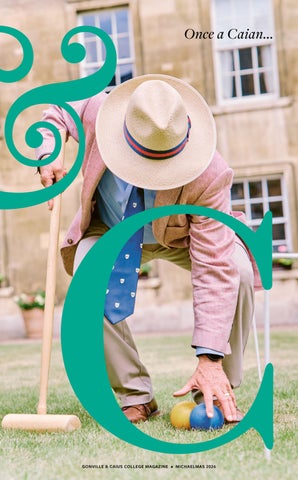
Once a Caian...
GONVILLE & CAIUS COLLEGE MAGAZINE • MICHAELMAS 2026
COULD YOUR EXPERTISE FUEL THE NEXT GENERATION? Staying in touch with new thinking. Widening your network. Sharing your unique experiences. Mentoring has a host of benefits – and is a crucial source of help, advice and support for young Caians at the start of their careers. HOW DOES IT WORK?
I GOT A HUGE AMOUNT OF VALUE AND JOY OUT OF THE MENTORSHIP. IT’S RARE TO HAVE SOMEONE WITH NO SKIN IN THE GAME WHO REALLY BELIEVES IN YOU” AARON SKATES (ENGLISH 2018)
It all started over coffee and a Zoom. When Aaron Skates (English 2018) had an idea for Cantilever, a curated independent music-streaming startup, he knew he needed advice. So he got in touch with the Caius mentoring programme. He was paired with Patrick Clifton (Archaeology and Anthropology 1992), former head of music at Amazon UK – and the two started meeting up online and face to face. Patrick advises companies in music, audio and technology through his eponymous consultancy. In 2025, he was appointed executive director for the Organization for Recorded Culture and Arts (ORCA), a thinktank and advocacy group founded by leading independent record labels – making him the ideal mentor for Aaron. And he was eager to help. “There’s something quite validating about being able to give people a bit of advice and help them out,” Patrick says. He supported Aaron to pursue his idea. But he encouraged his mentee to drive the relationship and the level of engagement. When Patrick suggested books, introductions or proposals which might be useful, Aaron was free to decide if they were avenues worth pursuing. “It was great to talk to somebody totally independent,” he says. “There was no set plan. Rather, for example, Patrick would suggest some resources that might be interesting for me to get another opinion on an idea.” Patrick thinks that the Caius mentoring programme will help students find pathways to make their ideas a reality. “This is just a small way of being able to help people who want to do something different when they graduate, rather than going to work for an accountancy or a legal firm,” he says. His mentoring has now developed into an advisory role at Cantilever, which Aaron acknowledges is unusual. Aaron now wants to be a mentor one day. “I got a huge amount of value and joy out of the mentorship,” he says. “It’s rare to have someone with no skin in the game who really believes in you.”
Looking for a mentor or want to become a mentee? The Young Alumni Programme (YAP) Pizzalumnight is the ideal place for mentors and mentees to meet informally. Join us on 6 November in the College bar and visit cai.cam.ac.uk/mentoring to find out more.
From the Editor
GONVILLE & CAIUS COLLEGE MAGAZINE • MICHAELMAS 2026
Dr Maša Amatt
02
Letters
12
03
Undercroft
04
Gate of Humility
We need to ask difficult questions about patient treatment, says Dr Zoë Fritz.
07
Recreation
No walking (or playing) on the grass? Croquet through the ages in Gonville Court.
08
Futureland
We can design everything better – including ourselves, says geneticist Adrian Woolfson.
16
10
FEATURES
Ready for takeoff
Professor Rob Miller is aiming to get sustainable flight off the ground.
12
Row, row, row your boat...
6am starts. Rain. Ergs. What drives Caians back to the river again and again?
16
22
Delivering world-changing ideas Early-career research is vital – but it is also under threat like never before.
22
ALSO IN THIS ISSUE
Porters’ Lodge
Student Jessica Brennan and Porter John Turton reflect on a College life in pictures.
26
EDITOR-IN-CHIEF: DR MAŠA AMATT (2020) FOR GONVILLE & CAIUS: MATT MCGEEHAN, HELEN MARTIN FOR YBM: EDITOR MIRA KATBAMNA (HISTORY 1995), COMMISSIONING EDITOR LUCY JOLIN, ART DIRECTION ROB FLANAGAN, COVER PHOTOGRAPHY JOE McGORTY PRODUCED FOR GONVILLE & CAIUS COLLEGE BY YBM LIMITED YBM.CO.UK PRINTED WITH VEGETABLE-BASED INKS ON PAPER CONTAINING MATERIAL SOURCED FROM RESPONSIBLY MANAGED FORESTS CERTIFIED IN ACCORDANCE WITH THE FOREST STEWARDSHIP COUNCIL.
Thank you
28
List of Donors 2025–2026
29
FROM THE EDITOR
Wherever you are, you are a part of our wonderful Caius family
o
ne theme has run through so many of my conversations this year: Caians are a family. (And a warm welcome to a new member of that family: our new Master Professor Richard Gilbertson). Whether you matriculated three years ago or 30, when you walk through the Gate of Humility you are coming home. Mind you, as families go, we are pretty extraordinary. In this issue we talk to Caians making a mark upon the world – from Adrian Woolfson’s (Developmental Biology 1988) vision of a genetically modified future on page 10 to Dr Zoë Fritz’s (Medicine 1995) work on patient consent on page 7. On page 12, Professor Rob Miller explains that reaching the goal of sustainable flight could be closer than we think. And on page 22, we speak to the brilliant minds of tomorrow, and find out why their work requires urgent support. Plus, we report on what draws rowers of all levels and generations to the river for a rainy 6am start (page 16) and the essential work of our beloved Porters (page 26). Of course, there is nothing quite like a family reunion. You are all invited – and it has been wonderful to see so many of you at our events. In London, Caians gathered for Caius Cocktails at Mercato Mayfair, including Emma Radford (NatSci 2020), Kate Castellino (MML 1983) and our host Adrian Pegg (Philosophy 2001). Legal Caians also spent a convivial evening at HSF Kramer at the launch of the new alumni law society, kindly hosted by Amanda Pinto (Law 1979) and Andrew Cannon (Law 1991). Our US-based Caius family turned out in force for our New York Spring gathering at the Harvard Club, generously hosted by Professor Peter S Walker (Medicine 1960) and his wife Wuliang, while San Franciscobased Caians, including Heather Deixler (Physiology 1999) and Graham Hills (NatSci 1968), gathered at The Battery in the city, hosted by Stephen Evans
(History 1994). Caians in Singapore were welcomed at Godmama by our hosts Siew Chua (Medicine 1984) and Mike Syn (Engineering 1990). In Malaysia, it was a delight to connect with Caians including Trudy Ganendra (Engineering 1993) and Patrick Helson (Law 1985) and to enjoy tremendous hospitality at Sunway University, courtesy of Tan Sri Jeffrey Cheah (2014). At High Table, we were joined by Trevor Ginn (NatSci 1993) and Nick Bunzl (MML 1972). If you have your MA, you have the right to dine with Fellows on High Table free of charge once every term during University Full Term. (To book, please email us at development@cai.cam.ac.uk.) And I was honoured to attend a reunion for the first female Caian undergraduates, led by Mary Lowth (Medicine 1979), one of the first women to be admitted to the College. Technology allows us to connect across continents. But something special happens when we meet in person. Old memories resurface, diverse opinions are shared without rancour and new memories are made. Here’s to another glorious year for the Caius family. ONCE A CAIAN...
02
DR MAŠA AMATT DEVELOPMENT DIRECTOR PHOTOGRAPHY AGNETTA LAZARUS
WE WOULD LOVE TO SEE YOU AT OUR EVENTS IN THE UK, ABROAD AND IN COLLEGE. SCAN THE QR CODE BELOW, SEE THE INSIDE BACK COVER OF THIS MAGAZINE OR VISIT CAI.CAM.AC.UK/EVENTS
LETTERS
WEB OF KNOWLEDGE WE ALWAYS LOVE TO HEAR FROM YOU – SO PLEASE WRITE AND TELL US WHAT YOU THINK ABOUT NET-ZERO FLYING, GENETIC ENGINEERING, CRAZY ROWERS, CROQUET AND ALL THINGS GONVILLE & CAIUS.
It has been a pleasure to read about the breadth of research undertaken by Caians past and present, from simulating the spread of viruses such as MERS-CoV to analysing the musical compositions of Aleksandr Scriabin and elucidating the significance of the pinecone atop the Gate of Virtue. I have long valued the College’s interdisciplinary character, having learnt a great deal through conversations with students and Fellows alike, and the regular news articles on the website capture this richness admirably.
BY EMAIL
LEON BRINDLEY (PHYSICS 2023)
EDITOR@CAI.CAM.AC.UK ON INSTAGRAM @CAIUSCOLLEGE ON FACEBOOK FACEBOOK.COM/ GONVILLEANDCAIUS
ON LINKEDIN LINKEDIN.COM/COMPANY/ GONVILLEANDCAIUS
FROM THE SOCIALS The demise of Tree Court’s most notable feature has been uppermost in our minds here at College, and the tragedy of the fallen trees prompted memories and thoughts for many of you, too. “Unless memory fails, those trees were saplings when I arrived in 1968,” commented David Webb (Economics 1968). “These trees were planted just before I came up to Caius and I measured the passing years with the increasing maturity of the trees, and can do so no longer – so sad,” remembers Anton Fishman (NatSci 1971). Others chose to look to the future: Bruno Sussat (Engineering 2011) reminded former Green Officer Orlando Gibbons (Engineering 2011) that they ran a competition in 2012 to select a new tree for the Court. (The winner, Orlando informs us, was snakebark maple with 58 per cent of the vote). “I believe it never got planted. Landy, maybe your time has finally come?! Earn that JCR title!” And kudos to Nicholas Ransley (Law 1999) who suggested a new name. “Stump Court?” (Too soon, Nicholas, too soon.) Turning to happier news, the College was delighted to celebrate nonagenarians Michael Prichard (now 98), Dr Michael Wood (almost 97), Neil McKendrick, Professor Tony Kirby and Professor Anthony Edwards (all 90) with a gathering of friends and family in the Senior Parlour. This has now become an annual occasion, organised by Professor Yao Liang. ...ALWAYS A CAIAN
03
The gathering of these beloved College veterans sparked an outpouring of praise from Michael Prichard’s former students – with many expressing astonishment at a visage and general demeanour seemingly unchanged by 75 years as a Fellow. “Yes! Unmistakeable and I was ’84 to ’87,” agreed Kate Lamburn (Law 1984). And congratulations flowed for our much-loved Porter Michelle Hancocks as she married Paul, her partner of 29 years, in – where else? – our beautiful Caius Chapel, surrounded by family, friends and colleagues. “Enjoy the best that life has to offer in the company of your husband,” wrote Housekeeper Marcia Lopes. “I wish you a long, contented, continuing life together,” added former Master Professor Pippa Rogerson (Law 1986).
UNDERCROFT
Caius news THE LEAVES HAVE FALLEN For years, Caians have enjoyed the peace and tranquillity of its cool green canopy. But now, Tree Court is without its whitebeams, walnuts and apples. All the trees were diseased and their health was of growing concern, particularly after strong winds in September 2025 saw a whitebeam limb come down over the lawn. It was, of course, a deeply difficult decision to remove them, particularly all at once, according to Fellow Dr Edmund Tanner, Chair of the Gardens Committee and a retired University Senior Lecturer in Botany. “The Tree Court we know and love has sadly changed for this generation of Caians,” he says. “But all trees have a life cycle and we knew this day would come.” So what might the future Tree Court look like? It will remain tree-free for now, as all stumps and roots have had to be removed to ensure disease does not return. But discussions are already under way to create a new space for trees and Caians to thrive.
The Tree Court we knew and loved is dead. Say it loud: long live the new Tree Court!
100+
LOVE AT FIRST BIKE It was not a happy Monday for oncology statistician Steven Fox. He had just collected the engagement ring with which he intended to propose to his partner, Jelena Dvorjanova. But when Steven returned to his beloved Brompton bike, which he had carefully locked up outside the Grand Arcade, he found it was missing. Steven was understandably furious at the loss of his bike. He had planned a week of romance with Jelena, concluding with the big proposal. Now, that had been derailed – and without his bike, he also faced a tedious two-and-a-half hour bus commute from his home in St Neots to his job at AstraZeneca in Cambridge. He reported the bike stolen and was, he says, “in a foul mood”.
YEARS SINCE GORDON STEWART WIMBUSH (LAW AND HISTORY 1908) ‘LIBERATED’ HIS COLLEGE PLATE
Who amongst us has not been tempted by a Caius crockery or cutlery souvenir? Gordon was no different. But when he died, his widow Ruth Wimbush gave the plate to beloved family friend and neighbour Yvonne Browne, then in her 20s. Now 85, Yvonne has returned the plate to College with fond memories of the couple. It will remain in the Archive as a testament to her story. ONCE A CAIAN...
04
CAIUS SEIZES HEAD OF THE RIVER!
O1 is back at the top of the table for the first time since 2019
They began in fourth place – but O1 secured Head of the River in Lent Bumps for the first time since 2019. The team bumped Clare, Downing and Lady Margaret (St John’s College) in successive days, before rowing over on the final day to take the headship. But O1 – the Men’s divisions have been renamed to be Open to all – was not the only successful crew. O2 bumped Homerton, Girton, Churchill and Lady Margaret II over four days, achieving blades and heading Division Two. The Women’s crews had a more challenging week. W1 slipped from sixth to eighth in the top division after being bumped by Pembroke and St Catharine’s. During a week-long battle with Lady Margaret II, W2 ascended from first place in Division Three into Division Two, but finished in second place in Division Three. An eventful May Bumps campaign followed. O1 finished in second place on the river – but Peterhouse prevailed as Head of the River. W1 remained third in Division One, giving Caius Boat Club the highest overall position.
But all was not lost. That same day, eagle-eyed Porter John Hall had decided to do one of his regular proactive security patrols. He found the bike hidden between two garages on the perimeter of some of the College’s properties near Parker’s Piece. It was clearly valuable, so he took it to the Porters’ Lodge and contacted Brompton. Luckily, Steven had registered his bike with the company, who put Steven and John in touch. On Friday, Steven collected his bike. “Steven’s happy and I’m happy,” says John. “I was just doing my job. It’s lucky that he had registered the bike and it’s great it’s all worked out in the end.” Positivity restored, Steven’s romantic weekend was back on track. He proposed to Jelena as planned – and, reader, she said yes. ...ALWAYS A CAIAN
05
IN MEMORIAM
GATE OF HONOUR
JEREMY PRYNNE 1936–2026 was a renowned poet and Fellow for more than 60 years. He was Director of Studies for English and held the position of Librarian from 1969 to 2006.
ROBIN BALFOUR (Medicine 1983) Lieutenant of the Royal Victorian Order for medical services to the Royal Family, King’s Birthday Honours
DAVID ABULAFIA cbe 1949–2026 was a Fellow for more than 51 years. He held the position of Emeritus Professor of Mediterranean History at the University.
ROBBIE BULLOCH (English 1991) OBE for services to Gibraltar negotiations, King’s New Year Honours
DAVID HOLBURN 1953–2025 was elected Fellow and College Lecturer in Engineering in October 1993, becoming Director of Studies in 2000.
EBEN EYRES (Music 2023) Royal Academy of Music place and London (Brompton) Oratory organ scholarship
All three made huge contributions to intellectual and College life. They will be greatly missed by their colleagues and students, past and present.
DR MIKE GUNTON (Zoology 1979) OBE for services to documentary filmmaking, King’s New Year Honours PROFESSOR CHRISTINE HOLT Kavli Prize for Neuroscience DR SHRUTI IYER LSA Dissertation Prize for her PhD thesis
PREGNANCY RESEARCH SUCCESS FOR CAIAN
DR VASILEIOS KOTSIDIS Bronze Medal at the QS Reimagine Education Awards
Dr Grace Amedor (Medicine 2019) has led a University study that built on her work at Caius. The study, published in Trends in Endocrinology and Metabolism and supervised by Fellow Professor Dino Giussani, found that stresses such as systemic racism and social disadvantage may sensitise key processes in the body during pregnancy. Read more at cai.cam.ac.uk/pregnancy.
AALIYAH RAZI (Medicine 2020) Society for Reproductive Investigation Award FLEUR RUDA (History 1994) OBE for services to the law, King’s Birthday Honours DR KEITH RUDDLE (Engineering 1968) British Empire Medal for services to the community, King’s New Year Honours KWAMÉ RYAN (Musicology 1989) Grammy Award for Best Opera Recording DR ADAM SAPNIK (Materials Science PhD 2018) British Crystallographic Association’s prize in Physical Crystallography TOBY SHEVLANE (Law 2012) British Empire Medal for services to AI, King’s New Year Honours PROFESSOR SUJIT SIVASUNDARAM Zeev Sternhell Prize runner-up for his book Waves Across the South PROFESSOR MALCOLM SMITH Elected a Fellow of the Royal Society PROFESSOR ANDREW STEPTOE (NatSci 1969) OBE for services to behavioural science, King’s New Year Honours
CHARITY BEGINS AT COLLEGE
PROFESSOR WENDELIN WERNER Appointed a Fellow of the Academy for the Mathematical Sciences
Our students showed their generosity and community spirit in the Cambridge FundRace, a fundraising competition between the 31 colleges. Led by GCSU President Max Ferrara (History 2025), the Caius team raised £547 from 64 donations in aid of charity Wintercomfort. They won both the overall award and the award for most donations. ONCE A CAIAN...
06
GATE OF HUMILITY
Ill and in pain, some patients do not want treatment. Why? WORDS ABI MILLAR PHOTOGRAPHY ZIA RATNASOTHY
T
he frail and immaculately dressed woman was becoming increasingly agitated. She had been admitted to hospital three days earlier, after a fall. Her routine blood tests were a little abnormal and doctors wanted – rightly – to investigate, organising more bloods and a CT scan to look for a possible underlying cancer. Now she had arrived on the ward of Dr Zoë Fritz (Medicine 1995). “When we told her what we were doing and why, she said: ‘I don’t want to know if I have cancer. Why would I? I turn 90 tomorrow.’ She just wanted to get home,” says Zoë, a consultant in acute medicine, a researcher in applied clinical ethics and a Fellow. “When you’re 90, you don’t necessarily have much time left. You might not want a week in hospital – especially around your birthday. And you might not want to know whether you have cancer.” Experiences like these inform the question that drives Zoë’s work: how can we ensure the patients’ wishes – or what she calls HOspitalisation PrioritiEs, or HOPES – have primacy of place? This question needs asking and answering urgently. Every year in the UK, 3.5 million older people are unexpectedly admitted to hospital. While receiving treatment is often essential, their time in hospital may prove detrimental to their mental and physical wellbeing. Some end up losing strength; others pick up an infection. Many want to get home as fast as they can – and many leave in a much more dependent state than they came in. “They’ve stayed in hospital because we, the doctors, have an agenda – getting to the bottom of the diagnosis, or fixing something that we want to fix rather than checking what it is the patient wants,” says Zoë. She is often struck by how often an older patient’s desires
Patients’ wishes should be paramount. But all too often their wants are sidelined or lost in a sea of complex information
A QUESTION OF ETHICS: FELLOW DR ZOË FRITZ BELIEVES THAT MEDICAL PROFESSIONALS NEED TO THINK DIFFERENTLY ABOUT WHAT THEIR PATIENTS WANT.
can be sidelined. “Someone coming in with pain needs pain relief, but what they might want next can vary,” she points out. “Some want to know what’s causing the pain, even if it means staying in hospital. Others just want to get home quickly without the pain – and maybe have the investigations at a slower pace, in the community, or not at all.” And, she says, rather than helping, digitising hospital systems has led to ‘note bloat’ – meaning that clinical information about what is important to the patient gets far more difficult to find. She says there is ground for humility on three counts. “First, processes need to improve – the way we take a medical history hasn’t changed since the 1850s. Second, we need to work out how to ask about patients’ HOPES in a way that they’re equipped to answer. Third, we need systems that can support and audit the new processes. If we don’t measure how well we’re doing, it won’t be considered as important.” Zoë is now looking to co-create and test a new HOPES intervention, ensuring that the entire treating team knows what matters most to older patients and acts on it. Shifting long-established clinical practice is not easy – but she already has form in this area. Previously, Zoë and her colleagues developed a national process for recording Recommended Summary Plans for Emergency Care and Treatment (ReSPECT), establishing people’s wishes for a future emergency. It is now used across the UK and has changed the nature of the conversations doctors have with patients. Importantly, it has also improved care for patients when compared with the previously used Do Not Attempt Cardiopulmonary Resuscitation (DNACPR) notices. HOPES would involve a similar cultural change. “We as doctors need to be humble about the fact we’re not getting this right,” she says. “But there’s nothing humble about my ambition to improve clinical practice!”
...ALWAYS A CAIAN
07
RECREATION
What a hoop-la in Gonville Court! 2026 –––––––––––––––––––––
PHOTOGRAPHY JOE McGORTY ARCHIVE ARTHUR BODINGTON ONCE A CAIAN...
08
–––––––––––––––––––– 1887
EVERYTHING TO PLAY FOR: THEN AND NOW, A FINE DAY SEES THE TRUSTY COLLEGE CROQUET SET MAKE ITS WAY FROM ITS TRADITIONAL HOME IN THE FELLOWS’ GARDEN TO OLD COURTS.
“Croquet is the only game in the world where you can be as vicious as you like and still remain a gentleman.” Or, we would suggest, lady. No one knows who first uttered these famous words, but whoever it was knew what they were talking about. Perhaps it was one of the gentlemen pictured above in 1887, enjoying a few turns in what seems to be a highly civilised fashion – but who knows what fury lurks beneath a hat when a stroke goes astray? One wonders, too, about the gardener’s wrath: perhaps the ‘Do not walk on the grass, or, indeed, hammer large metal hoops into it’ rule was not so rigorously enforced in those days. Luckily, today’s players – President Professor Peter Robinson (Computer Science 1971) and Registrary Dr Anita Bunyan (MML 1989) – have been given rare dispensation, enabling the thwack of ball on mallet to echo around Old Courts once again. We are happy to report that their behaviour – at least as far as one can tell – was of the highest standards: no crushes or double taps here. Polite applause all round. ...ALWAYS A CAIAN
09
FUTURELAND
A better world? Let’s do it by design, says Adrian Woolfson INTERVIEW MEGAN WELFORD
I
PHOTOGRAPHY MYLA FAITH
magine a world, in perhaps a hundred years’ time, where half the planet is rainforest and wilderness, teeming with nature. The other half, where humans live, is efficient, sustainable and healthy. Buildings are made from spider silk; clothing and car seats are intelligent; and all digital information is stored in DNA rather than data centres. It is a world that is designed and grown, not haphazardly evolved and limited to what already exists, or once existed. In my book, On the Future of Species, I explore how this might be achieved: through AI-driven genome design and construction. This means building genome foundation models so that we can design and then build DNA at scale. Think of it like language: generative AI’s large language models pull out grammatical rules; genome language models speak DNA. Once we learn to speak DNAese, we will be able to converse in the biological language of life. Once we are fluent, we will become authors of life. We are at a pivotal point, on the cusp of a third era of biological innovation. The first was observational – we catalogued and documented, culminating in the sequencing of the human genome. In the second, we edited genes, using technology like CRISPR. The third will be the era of generative biology, when we design and write DNA. This is where we decouple from history and nature becomes a blank page. If this sounds unsettling – it is. But it could have
ADRIAN WOOLFSON (MOLECULAR GENETICS 1988) IS AN AUTHOR, BIOTECH ENGINEER AND INVESTOR. HE IS CO-FOUNDER AND CEO OF SAN DIEGO-BASED BIOTECHNOLOGY COMPANY GENYRO. ONCE A CAIAN...
10
We are at a pivotal point, on the cusp of a third era of genome research: the era of generative biology, where we write DNA. We decouple from history, and nature becomes a blank page. If this sounds scary – it is. When biology becomes democratised, anyone will be able to play with it at home. But it could have incredible benefits for humankind
incredible benefits for humankind. Instead of Darwinian evolution – a blind, mindless creator, subject to historical contingency and time – we could reverse-engineer our own biology and remove most genetic disease and increase healthy longevity. We could make medicines and vaccines. We could grow fully sustainable biomaterials to replace plastics, and grow plants in the desert, so food poverty becomes a thing of the past. We could purify water and create energy: 10 per cent of the world’s energy is currently used to store information. We should be able to store it in DNA without using any energy at all. Of course, there is significant risk. Nuclear power, for example, requires knowledge of physics and access to specialist facilities. But as biology becomes democratised, anyone will be able to play with it at home. There will inevitably be bad actors – both individuals and nation states. My book ends with a manifesto for life, detailing the guardrails we could add, such as biosurveillance, which we should start now. We could potentially write a human genome today, so we need regulation before it happens. But regulation is slow and there will be unintended consequences that we cannot predict. Still, I am an optimist, and I see the huge potential for humankind. We cannot ignore or prevent this technology. It is already happening and it will likely provide
substantive economic benefits. Given the current state of the natural world, it would be unethical not to use it. We need to preserve nature, and learn to use these new technologies safely, responsibly and equitably. Our everyday materials – rice, wheat, rubber, cows – have evolved, but most of the future materials and proteins we will use do not yet exist. There’s a real estate of possible life that exists mathematically. We can map these possibilities and build some of them. Or rather, grow them. This will raise complex philosophical questions. If we can increase longevity, how long should we live for? What counts as a disease? Homosexuality used to be classed as a disease, and so did lovesickness. Deaf people do not see deafness as disease. What is human nature? If life is computable, is human nature itself at risk? It is already threatened by the prospect of artificial super intelligence, so programmable biology could potentially counter that. Or it could also write us out entirely. We are emotionally engaged with the idea of humans as we are today – yet the future might not involve humans like sapiens. Not so long ago we co-existed with multiple different human species, including Neanderthals. But if anything defines human nature, it is our imagination. We cannot help our drive to improve, develop and augment. We are on the verge of being able to design everything – including ourselves. ...ALWAYS A CAIAN
11
ON THE FUTURE OF SPECIES (BLOOMSBURY) IS AVAILABLE NOW AT ALL GOOD BOOKSHOPS
R E A DY F O R Making flying more sustainable is one of the world’s knottiest problems. Luckily, Professor Rob Miller is undeterred – and determined to get cleaner and greener planes (literally) off the ground. WORDS ABI MILLAR PHOTOGRAPHY JULIAN ANDERSON
H
alving aviation’s climate impact by reducing clouds? A new kind of jet engine powered by cryogenic hydrogen? Formula One speed applied to aerospace development? All glorious ideas to make flying greener – but how to bring them into the real world, at scale? Welcome to the world of Rob Miller, Fellow, Chair in Aerothermal Technology and Director of the Whittle Laboratory and the Rolls-Royce University Technology Centre. For anyone who has taken a flight in recent years – and felt the associated ‘flight guilt’ – zero-carbon aviation might seem like a pipe dream. While flying is becoming gradually more energy efficient, it remains one of the world’s most polluting sectors and one of the hardest to decarbonise. Indeed, aviation will be responsible for 16 per cent of the UK’s greenhouse gas emissions by 2035, up from seven per cent in 2022. (That is largely because emissions from other sectors are falling and aviation is failing to keep pace.) To put it into perspective, taking a single long-haul return flight spews out as much carbon as driving a car for a year. Meanwhile, flying London to Paris generates roughly 10 to 20 times the emissions of taking the Eurostar. If present trends continue, real carbon emissions from flying will be even higher in 2050 than they are today, putting the UK’s net zero plans in jeopardy. One of Rob’s key projects is the Aviation Impact Accelerator (AIA), a global initiative that seeks to expedite the transition to net-zero flying. Led by the Whittle Lab and the Cambridge Institute for Sustainability Leadership, it has set out four Sustainable Aviation Goals that could deliver on the dream by 2050. Two goals build on what the industry is already doing. The first is to ensure the scale-up of sustainable aviation fuel (SAF) is truly sustainable. Most SAF is currently made from waste biomass and used cooking oil. Demand is enormous: the AIA’s modelling shows that aviation could consume up to 30 per cent of the world’s sustainably available waste biomass by 2050. So how that biomass is sourced is critical. The UK has already legislated a Sustainable Aviation Fuel mandate, which the AIA modelled for government, requiring 22 per cent of jet fuel to be sustainable by 2040.
The other is to improve a plane’s efficiency at a systems level, such as designing planes which fly 15 per cent slower, saving fuel. “You’d have to regulate, as that won’t come from industry,” remarks Rob. “That said, The Times published a leader saying that for those who enjoy flying, slowing down would be a good opportunity for a cheeky extra gin.” The third goal is less intuitive but arguably more important: to minimise the persistent contrails caused by just five per cent of flights. “You’ll see the white lines behind planes – they don’t do any climate damage but around one in 20 of them creates a cloud, which grows and traps heat into the planet,” says Rob. “If you average it out, it turns out that about half of the global warming
ONCE A CAIAN...
12
TA K E O F F
It is possible to stop aeroplanes creating heat-trapping clouds simply by changing the altitude of flights
caused by aviation comes from carbon dioxide, and half from these clouds.” The good news is that you can stop the cloud formation in its tracks, simply by changing the altitude of the flights. Rob’s team think getting a contrail avoidance scheme under way within the next few years is achievable. On a global scale, this could be hugely significant, halving the climate impact of flying. And the final goal is ‘moonshots’ – experimental demonstration programmes focusing on new technologies. These are high-risk, high-reward technologies, each of which stands a relatively low chance of success but which, if successful, could transform the industry. However, it is only through serious R&D investment that one of them could (if you will excuse the pun) take off. F ...ALWAYS A CAIAN
13
The team pioneered a new rapid technology development for aerospace based on an F1-style rapid design loop – developing planes in the same way as racing cars
“In the road industry, if you went back to 2007 and asked people how to decarbonise cars, they’d say biofuels, because they didn’t see Tesla coming,” points out Rob. “We’re in a similar situation with planes at the moment. We need to maximise the chances of having a Tesla moment.” However, the analogy here only extends so far. Although electric planes are developing quickly, they are only suitable for short-haul flights, owing to the energy density of the batteries. That means the aviation industry’s Tesla moment is likely to be something else. Among other moonshots, Rob’s team are betting on planes powered by liquid hydrogen, or algae genetically engineered to produce biofuel. There are plenty of avenues, then, by which the industry could accelerate its path to net zero. But there needs to be a real will to change, as aviation is a notoriously slow-moving sector. “It’s been a very mature field for a long time,” says Rob. “The way we fly hasn’t really changed for 20 or 30 years, so the process of taking an idea and making it into a design and testing and learning was taking years to do.” His own frustration with this issue came to a head about a decade ago, when he was in the pub with a senior aerodynamicist from Red Bull Formula One. They were talking through their projects: Rob was developing a new blade for Rolls-Royce, which would take around four to six years to be on an aircraft. His friend had tested some adaptions to the rear wings of their F1 car, found the winning contender and introduced it onto the car by the next race. The discrepancy did not make sense. “F1 is easier than aerospace, but it’s not that much easier,” says Rob. His friend left F1 and joined the Whittle Lab. The team pioneered a new rapid technology development for aerospace, based on an F1-style rapid design loop:
OPEN FOR BUSINESS THE KING OFFICIALLY OPENED THE NEW WHITTLE LABORATORY IN JULY 2026. THE EVENT INCLUDED THE FRANK WHITTLE SUMMIT, WHEN 80 LEADERS FROM ACROSS AEROSPACE, ENERGY AND DEFENCE GATHERED WITH A SINGLE PURPOSE: PRODUCE A PLAN FOR CUTTING THE TIME IT TAKES TO DEVELOP NEW TECH IN THE UK. DINNER AFTERWARDS WAS HOSTED AT CAIUS BY MASTER PROFESSOR RICHARD GILBERTSON.
developing planes like racing cars. The result is that R&D processes that would once have taken years can now be completed in weeks. In tests, they were sped up by a factor of a hundred. After refining this process, Rob and the team at the Whittle Lab had a thought: how about we scale it up? “We had the idea for a new test facility, so that industry could work on a wider range of problems more quickly,” he says. This became real in July 2026, when His Majesty the King opened the New Whittle Lab. Its predecessor had a formidable record in jet engine and energy research, but the world had moved on. The new building is nearly double the size and houses two new capabilities. The Bennett Innovation Lab gives the New Whittle Lab a mission capability: small teams given the freedom to take transformative technologies from idea to industry. That is 20-30 missions over a decade – each a bid to build a new UK industry. The National Centre for Propulsion and Power scales the F1 approach: rapid test capability, applied across a far wider range of problems. Caius also has aviation heritage and foresight. Land owned by the College for more than 400 years at Duxford is earmarked for development as an aviation technology hub in a joint project with Imperial War Museums. The project is endorsed by Rob and the other engineering Fellows at Caius and offers potential for a collaboration, due to direct runway access. Rob discovered aerospace as an undergraduate: the challenge of translation drew him in. “I’ve always worked on real problems,” he says. “Turning science and engineering into flying real planes is incredibly exciting. Then the challenge of climate change kicked in: that’s a problem on a completely different scale.” Looking forward, he is excited about linking AI to the rapid test capability. As well as accelerating the innovation process, it would allow physical test data to train AI models grounded in the real world rather than simulation, changing the way aerospace works and giving the UK an opportunity to get back into manufacturing. He is less enamoured of the roadblocks. Current solutions for decarbonising flight make flying around 30 per cent more expensive. The market will not close that gap by itself; regulation will be necessary. He worries, too, that the UK’s research funding mechanisms are not up to the job. The money exists, but willingness to concentrate it on the teams most likely to deliver is missing. “Aviation is one of the few industries where the UK still has a global lead. If we want to keep that lead, we need radical not incremental change,” he says.
ONCE A CAIAN...
14
The UK aviation industry leads the world – for now. To stay ahead, we need rapid tech development and radical change
“That’s what the Bennett Innovation Lab and the National Centre for Propulsion and Power are for.” But Caius scientists have never shied away from tough scientific problems: Rob’s work since he joined the College in 2002 is no exception. “Caius’s science heritage is inspiring for the students and myself,” he says. “I still supervise, and meeting these young students keeps your knowledge fresh.” These ideas might still sound like a long shot. But with Rob at the helm of the New Whittle Lab – and game-changing new technologies in place – sustainable flying could become a reality faster than we think.
...ALWAYS A CAIAN
15
ROW, ROW, ROW YO UR B OAT M ER R I LY D OWN T HE C A M . . .
Caius Boat Club is 200 in 2027! But what dark magic keeps drawing us back to the unforgiving river? WORDS FRANCES HEDGES
Six am starts. Ergs. Lycra. Rowing is all well and good when you are in the First Boat and Head of the River. But when you are in the Third Boat, it is raining and you are likely to be bumped into the next division? The appeal can seem more… mysterious. Of course, it all starts very promisingly. When Katie Lister (HSPS 2024) innocently went along to a taster session and barbecue at the Caius Boat Club in the halcyon early days of Michaelmas, she had no idea what she was letting herself in for. A few weeks later, racing in the freezing rain, she pondered her life choices. “It really was horrendous,” she says. “But it’s all been worth it. In the summer, it’s an absolute joy.” David Hill (History 1973) fell for the same cruel trick some five decades earlier. “I went along to the Boat Club during freshers’ week as they were serving beer, and signed up,” he remembers. “I’d never rowed in my life. But I had worked for a year
driving a van for a wholesale delivery company, lugging crates of catering products around. So I had plenty of muscle.” That came in handy one Lent Term, he adds. “We went for an early morning row, and we must have been the first boat up the river, because the surface of the river had frozen. We hit it and the boat went up onto the ice and then crashed back down through it. We abandoned that morning training exercise…” But despite the early morning horror, Third Boaters keep coming back – though some have the wisdom to stop doing the actual rowing. Having started with an oar in hand, after a term’s worth of outings Katie was invited to try out coxing. “I’m 5’4” and struggled to match the power that the other girls could put down, but I knew I still wanted to be part of rowing at Caius,” she says. Katie took to her new duties – steering the boat, directing the crew, maintaining team morale and, of ONCE A CAIAN...
16
course, shouting at everyone – with aplomb. And one of the unexpected benefits of finding herself in charge of boatloads of strong men and women has been the impact on her self-esteem. “I’m naturally quite an anxious person, and I’ve struggled with my mental health in the past, so a big goal for me was being able to hold my own when sharing my views in academic supervisions,” she reveals. “Coxing has given me a way to practise that confidence, by empowering me to say things directly to people and to make them listen to me.” She might not have to do quite the same volume of ergs as her rowing counterparts (though she does sometimes join in on the rowing machines “for moral support”), but her contribution to each race is no less significant. “I act as a go-between, translating what the coach is saying on the bank to what
the crew need to do,” Katie says. “It’s quite a skill to navigate along the Cam. And it’s my job to check in on the crew’s welfare, making sure everyone is safe and comfortable.” The club is renowned for its success both within the University – Caius was the leading combined club on the river in the 2026 May Bumps, while the men have held Head of the River in 17 of the past 27 editions – and beyond, with Caius rowers regularly selected to represent Cambridge at the Boat Races. Yet those who only want to row for pleasure are as crucial to making club history as their more competitive peers. “You’re still really involved and part of everything, but you don’t have to sell your soul to rowing,” says Katie, who also makes time in her schedule to pursue her passion for swimming. “I think it’s important to stress that it’s open to everyone, and even if you don’t want it to rule
Cold comfort: there is snow stopping ‚ the Caius Boat Club s intrepid members. KATE McDAID/CAIUS BOAT CLUB
...ALWAYS A CAIAN
17
your university experience, it can be a valuable aspect.” And you can even find yourself drawn in through the enthusiasm of others. Jamie Maxen (Engineering 2022) has rowed throughout his time at College and is thus well used to jokes about insufferable levels of race analysis and highly demonstrative carb loading. (“No, it’s really not necessary for short races,” he admits.) He is the proud founder of the Engineers’ Beer Boat, which saw Engineering undergrads, postgrads and even some Fellows come together on the water over the summer. (All of them, he emphasises, were doing so entirely of their own free will.) While a number of his – very much motley – crew had, let us just call it, limited rowing experience, Jamie was confident their natural ability would prevail. “There’s always been a good link between engineers and rowing,” he says. “Maybe it’s F
about our physical understanding, an awareness of flow… or perhaps it’s just our masochistic traits coming to the fore!” Fellow Dr Vasileios Kotsidis, Director of Studies in Economics, is a newcomer to rowing who has already seen positive results through perseverance. He tried the sport at St John’s, where the Domestic Bursar set up a crew of Fellows to take to the May Bumps. They were trained by students – who, he says with a laugh, “seemed occasionally to be suppressing the urge to shout at us” – and gradually progressed as a team. “It happened rather organically – we started being more in synchronisation with one another, and learning what we needed to do more readily,” he explains. On arrival at Caius, he decided to repeat
What is behind that green door? More success for Caius rowers. @CAIUSBOATCLUB INSTAGRAM
Hats off: brave crews of yesteryear risk their headgear on the Cam. STEARN&SONS/LAFAYETTE PHOTOGRAPHY
We went out for an early morning row and we must have been the first boat up the river, because the surface had frozen. We hit it and the boat went up onto the ice and crashed through it
ONCE A CAIAN...
18
the experiment with the creation of a staff boat, which started in Easter Term 2026, populated with what he hopes will become a consistent crew. “It’s not even about the competition; it’s about sharing the joy,” he says. Without having to worry about securing a particular victory, Vasileios can revel in the things that make rowing in Cambridge so special – starting with the idyllic scenery (on a warm day, at least). “Unequivocally, being out on the river is magical… but you have to be open and receptive to that magic,” he says. “It’s easy for students to get bogged down in the routine of it all, whereas because I don’t have that pressure, it’s easier to look around and appreciate what we’re privileged to have around us.” Any stroll through Cambridge in the
small hours brings with it a sense of wonder, adds Vasileios. “If you find yourself in the city early in the morning and there’s a bit of mist, with no one around, you can feel as if you’re in a ghost town; perhaps you’ll even hear some music playing in your head. The river is no exception to that – it’s a beautiful place.” Rowing recreationally has brought Vasileios both physical benefits (the impact on his fitness level, he says, has been “real and very quick to show up”) and mental ones. “When you practise, you can’t think about anything other than what’s in the moment – you need to be present and aware of what’s happening, which is a skill that’s hard to develop but very important,” he points out. “Sometimes I can’t solve a problem because I’m tired of thinking about
it, but when I stop thinking and pick it up again after a while, the solution becomes immediately obvious.” This, for Vasileios, is the beauty of engaging in such a meditative form of exercise: “To facilitate that kind of pause in my daily life is sacred.” And sometimes it all comes together – and you understand what draws you back to the Caius Boathouse again and again. “There were times, as we got better at rowing and everyone was operating in a synchronised way, when you would feel the boat lift in the water and skim across the surface,” says David. “It’s quite a sense of achievement and it is not easy to get to that point. But when you hit that moment, it is wonderful.” Third Boat became David’s happy place. There were only a few early
...ALWAYS A CAIAN
19
starts required compared to First Boat’s punishing seven-day rowing and training schedule and nobody took it too seriously. Though he did reach the heady heights of Second Boat in May 1975, which required more effort, but still had considerable advantages. “Because we had evening training, we’d miss Formal Hall. So we’d get Boat Club Hall, just for First Boat and Second Boat. We’d get an extra pint of milk for some reason. To build up our strength, perhaps.” Despite this honour, David somewhat wisely decided to abandon Second Boat in his third year in favour of a return to Third Boat. “I thought I should focus on things like studying, revising and getting a degree,” he says. This proved F a propitious decision.
Because we had evening training, we’d miss Formal Hall. So we’d get Boat Club Hall, just for First Boat and Second Boat. We’d get an extra pint of milk for some reason. To build up our strength, perhaps In summer 1976, his swansong, his Third Boat made three bumps in the first three days. To win blades, they needed to make that final crucial fourth bump. “A few strokes, then back down the pub,” he says. Sadly, it did not quite work out that way. The boat two ahead messed up its start. The boat they were chasing crashed into it. “We ended up chasing the boat that was three ahead of us, eventually bumping it about halfway down the Long Reach. It was a much longer row than we’d anticipated.” (Luckily, they did eventually make it to the pub – and David’s blade still has pride of place on his wall.)
Of course, the social side of rowing is a little notorious. (Boat Club dinners, anyone?) Katie will not be drawn on exactly what went on at her last one: just that it included celebrations both formal and informal. “It’s a tale of two halves,” she says, with a wink. But crucially, the lower boats are fully integrated into those celebrations. Awards are given out for those who have contributed to the term’s biggest successes and every crew member, no matter how junior, gets their photo taken. If rowing is a sacred sport, then the guardian of the flame at Caius must surely be the College Boatman Simon Goodbrand, who has just ONCE A CAIAN...
20
passed his 20th anniversary of service. From coaching rowers of all standards to keeping the equipment spick and span, Simon is the invisible presence behind many of the club’s most impressive victories. Like Jamie and Vasileios, he emphasises that success in rowing is always a product of hard work and tenacity. “It just takes practice to repeat the stroke over and over until confidence and the correct technique have been learnt,” he says. Simon has one key message for budding rowers at Caius: there is no right way to be one. “We’ve had students start rowing for fun with friends and go on to become Olympic
Every rower’s dream: blue sky, fair winds and not a bump in sight. @CAIUSBOATCLUB INSTAGRAM
Rowing: a binding commitment. @CAIUSBOATCLUB INSTAGRAM
Up in the air: team work makes the dream work at Caius Boat Club. ALEX LAPSLEY
Fire and water: the newly-minted Head of the River crew take an old boat for the traditional burning. JETPHOTOGRAPHIC.COM
Bumps? Complex? How dare you. JOE McGORTY
champions, but we’ve also had highly competitive rowers reduce their training volume significantly due to work commitments, deciding instead to row for the enjoyment of being on the river.” Nonetheless, he cannot help being proud of Boat Club alumni, many of whom get in touch years after leaving Cambridge to tell him that they have continued to catch crabs and race across waterways of all kinds. “People have messaged me to say they’ve been rowing on lakes and rivers all over the world, and how they still find it rewarding, physically, mentally and socially,” he says. ...ALWAYS A CAIAN
21
And chances are that your rowing experiences will help you feel part of a bigger whole, whether that is being in a boat with students from other years or subjects, or roping in Fellows as crew members. “As rowers, we have to help each other, because otherwise the boat won’t move – and that creates a feeling of community that endures through time,” says Vasileios. “As any Caian knows, the sense of tradition is in large part what makes Cambridge. It’s not the building or the boat: it’s the generations of people who put their heart and soul into what they’re doing.” Long may that continue.
How do you deliver world-changing ideas? Nurture the early-career researchers Brilliant minds do not spring from nowhere. They need the freedom to explore, dream, create and experiment. In short, they need a place like Caius – and the financial support to make the most of their time here. WORDS PETE WATTS
W
hen Zaki Rehman (History 2017) first visited Caius as a callow sixth former having just finished his A-levels, he was bewitched by the library. The stacks of books and reader nooks seemed to promise almost limitless opportunities for study within a beautiful, silent haven of knowledge. (Though those with traumatic memories of frantic last-minute essay-writing may disagree.) Fast-forward several years and, having completed his undergraduate degree at Caius and then a Master’s and PhD at Oxford, Zaki is back at the College, this time as a Saunders Research Fellow. It is a fully funded position that enables him to engage in early-career research, exploring his chosen subjects at the intersection of intellectual history and political theory. “I still can’t quite believe my good fortune in having the freedom to go where the research takes me,” he says. Before they became household names and boundary-pushing thinkers, Francis Crick (Molecular Biology 1950), Professor Stephen Hawking and Professor Milton Friedman were early-career researchers just like Zaki. This is crucial thinking time: with no administrative and teaching responsibilities, brilliant minds are free to explore their subject, ask probing questions and work on fundamental problems, building the bedrock of knowledge on which their future work will rest. Scientists lock themselves in the lab; humanities scholars chain themselves to a library desk. It is usually a very happy period. “The umbrella term – early-career research – can include Research Fellows like Zaki who already have a PhD but also students who are in the process of obtaining one,” explains Dr Rebecca Sugden, Deputy Senior Tutor (Postgraduates), Fellow and Director of Studies in Modern and Medieval Languages. “Talking about PhD students as early-career researchers is a helpful way of understanding what they are doing. Ultimately, postgraduate students are the future of research, so an investment in postgraduate research is an investment in the future of research.” But ensuring that foundational work gets done is becoming more and more difficult. “Funded research is being cut and that goes all the way up from postgraduate studies to post-doctoral positions and then permanent jobs,” says Zaki. “You often hear of humanities departments being ONCE A CAIAN...
22
cut or squashed together, so positions like the Saunders Research Fellow are really special.” Rebecca agrees. “The funding situation out there is atrocious, particularly in arts and humanities,” she says. “And it disproportionately affects those from historically under-represented and less well-resourced backgrounds. One of our aspirations is that any Caius student holding a Cambridge bursary who gets a First in their finals and wants to go on to do a Master’s should be offered a bursary of £12,000.” This focus on postgraduate education also recognises the new reality of the value of degrees in a climate where so many young people are engaged in higher education. “Historically, postgraduate study might have been seen as a bit of a luxury but that is increasingly not the case,” says Rebecca. “With such a big rise in the number of students going to university, the differentiating criteria are shifting. A 2:1 is often no longer enough to be attractive to prospective employers and to ensure you have a great career ahead of you. Increasingly, you need a First and now, more than ever, a Master’s.” Philanthropy therefore plays a key role in ensuring that the trailblazers of the future get to lay their foundations. Maria Malik’s (Engineering 2023) research focuses on the vital area of energy efficiency. And having spent two years trying to get to Caius, she says she relishes every day. After completing her Master’s in Pakistan, she had appealing offers from universities in Australia, the US and Hong Kong – but her heart was set on Cambridge. She applied for a PhD place and, after a long, nervous wait, became the first recipient of the newly endowed Lord Choudrey PhD Scholarship, awarded to exceptional PhD students from Pakistan. The scholarship is funded by a generous donation from the Bestway Foundation, of which the Honourable Haider Choudrey (Economics 2006) is a trustee, and is named for Lord Zameer Choudrey, chairman of the Bestway Group. The scholarship pays for Maria’s fees, accommodation and subsistence. “Without that, it would be so difficult to focus on my work,” Maria says. “And it has given me the freedom to move my research from flexible solar cells to photon detectors – a field I had always been curious to explore. My research focuses on designing semiconductor photodetectors that can detect extremely weak light across a broad range of wavelengths. The challenge is to make these devices both highly sensitive and energy efficient by understanding exactly how light interacts with materials at the nanoscale. These sensors could ultimately contribute to technologies ranging from telecommunications and environmental monitoring to medical imaging and autonomous systems.” She did not expect to pivot when she started her research. But that is the joy of the work: testing ideas and seeing what is needed. “Much of my work involves designing experiments to understand why a device behaves the way it does,” she says. “I systematically modify materials and device structures, measure their performance, analyse the results and use those insights to improve the next design. Every experiment helps build a better understanding of the underlying physics.” Research is all about trying, failing, refining and trying again, she points out – and whatever happens, someone somewhere will be able to use it. “If it doesn’t work, you can still make a scientific contribution, saying: ‘Don’t try this route.’ And if it works, it becomes a baseline for somebody else’s research.” When Zaki applied for his fellowship, he knew there were four research postgraduate Fellows each year – two in sciences and two in humanities. But he did not know about the Saunders Research Fellowship and only learned that he was its recipient when he first arrived. F
Without the scholarship, it would be so difficult to focus on my work. It has given me the freedom to move my research from flexible solar cells to photon detectors MARIA MALIK (ENGINEERING 2023) ...ALWAYS A CAIAN
23
Eager to find out more about the person who had made his research possible, he discovered that Professor John Saunders (Pharmacology and Medicine 1967) lives in Australia and is a doctor. “I got in touch because I was interested in his motivation,” says Zaki. “He told me he supports research in general and the fellowship moves between disciplines depending on where it is needed.” Zaki’s research explores the history of ideas and the role ideas play in history, with a focus on religion and politics. “My PhD was on the relationship between Islam and the British Empire in the 20th century. I want to continue to look at the relationship between religion and politics from the perspective of intellectual history, but expanding my scope further to other empires and other religions,” he says. “I’m always thinking about these questions – often the best thoughts come when I am doing something else, and then I’ll rush to jot them down. I’m always mulling ideas over.” He readily admits that he is still at the beginning of his intellectual journey. “The first thing they told me as an undergraduate was that I didn’t know anything,” he says. “A decade later, I am still discovering how little I know. That is particularly true with interdisciplinary work, as disciplines have different ways of thinking, different methodologies, different jargon, different approaches. I go through a process of thinking how to do that correctly, as there is much to be gained from interdisciplinary research, but the risk is you end up speaking past each other or make jumps that don’t quite land.” Both Zaki and Maria say that being a Caian has enabled them to do better work. Zaki spends much of his time reading primary and secondary sources; at Caius, he has access to the historical manuscripts and archive in the Lower Library and the small Fellows’ Room. When not reading or writing, he is thinking – often while running in Grantchester Meadows or strolling round Harvey Court Gardens. When she moved to Cambridge in 2023, it was the first time Maria had ever left her home country. The city can be a little unnerving at the best of times, so unsurprisingly she found her first few days a surreal experience. “Am I in a movie?” she remembers thinking as she walked past students in their gowns. “I was really confused about the differences between Cambridge colleges, the University of Cambridge and Cambridge the city. But when I was shown around and I saw the Hall, I thought I was on a Harry Potter set, with these very long tables and the incredible surroundings. That was a dream come true. I felt like I didn’t need anything else in life, and after three years I still feel the same. It isn’t fading away.” Maria is now every inch a seasoned Cantabrigian, complete with her own gown, bicycle and favourite spots to sit and think. Like Zaki, she is drawn to the tranquillity of the library, feeding off the quiet energy of other students as well as the beauty of the room itself. But as she spends so much of her time in the lab, she also appreciates the outside spaces. “I like sitting on a bench outside King’s looking at the river, with this huge church behind you that has walls that have been standing there for so many years,” she says. “You think about all the people who have looked at those walls
The first thing they told me as an undergraduate was that I didn’t know anything. A decade later, I am still discovering how little I know. That is particularly true with interdisciplinary work, as disciplines have different ways of thinking ZAKI REHMAN (HISTORY 2017) ONCE A CAIAN...
24
These days it is very unusual for anybody to have the opportunity to dedicate four years to research, and the progress they make in that time is incredible. Ultimately, postgraduates are the future of research REBECCA SUGDEN, DEPUTY SENIOR TUTOR (POSTGRADUATES)
before you. Scientists who I had only encountered in textbooks once walked the same streets in the same city. Realising I had become part of that tradition was incredibly motivating.” Guaranteed accommodation is one of the core offerings Caius can make to scholars engaged in early-career research at postgraduate level. “Our aspiration is to take 115 postgraduate freshers every year, and we guarantee three years of accommodation for all postgraduate students,” says Rebecca. “They appreciate the postgraduate village on Harvey Road, as it provides a sense of community rather than having a series of houses dotted around the city. I would like to grow the community further, but we don’t want to expand at the risk of reducing the standard of provision. We need to properly house and fund them.” Caius’s famous minimum dining requirement for all is another way of reinforcing relationships between students and the Fellows, along with regular talks and events. “Last night we had one in the Long Room,” says Zaki. “We have dinners in the Dining Hall or the Fellows’ Dining Room and the food is very good.” Maria admits she misses the food back home and looks forward to the annual celebration held by her patrons, the Bestway Foundation, which hosts a dinner for its small community of funded scholars where wonderful Pakistani food is served. The landscape for early-career researchers may be challenging. But both the researchers and those who support them – from College staff to generous donors – are determined to make their work count. In fact, Caius will launch two more scholarships in 2026 – both as a result of the generosity of alumni. In the meantime, Maria is completing her PhD and hopes to continue her research career in Cambridge. And Zaki is at the start of his four years: he intends to write a book. “I am very privileged to be in this position,” he says. “It induces a drive to produce work which is worth the investment, and repay the Saunders Foundation’s trust.” ...ALWAYS A CAIAN
25
PORTERS’ LODGE
A Caius life – in pictures WORDS ABI MILLAR
CAMERA ANGLE: JESS HAS TAKEN A PHOTO WITH PORTER JOHN EVERY YEAR THROUGHOUT HER TIME AS A STUDENT.
Senior Shift Porter John Turton is used to taking snaps with students. In his 18 years in the role, he has dealt with hundreds of routine requests – giving directions, replacing lost key cards, administering first aid. Posing for a snap is just another one on the list. “Not bigging myself up, but it does happen a lot,” John remarks. He is not the only one. The Porters at Caius are the welcoming faces of the College, a constant presence for students. They oblige when asked to pose for photos in their bowler hats. John is among the most long serving, and, if you remember him, be assured that he remembers you. “I still recognise alumni from way back when,” he says, noting that he has an excellent memory for names and faces. Nonetheless, it was not till Jessica Brennan (HSPS 2023) arrived at Caius that anyone had requested an annual photo. Over her three years, she has amassed a proud collection of pictures with John in various locations around College – beaming outside the Plodge, in the bar after Formal Hall, and joined by a male student who turns out to be wearing Jess’s top. “Obviously you have your College family when you get College married,” explains Jess with a smile. “We did a bachelorette, where we all dressed up in our College partner’s clothes. John was in the Porters’ Lodge at the time, and so he took the photo.” But while the photo tradition started as a joke, it soon became something more, documenting a three-year student journey. John and Jess have had many jovial conversations since they first met at Jess’s matriculation, a day of great significance for her (Once a Caian…!), and for John. “It was my birthday,” says John. “When someone found out, that was it. There was a chorus of ‘Happy Birthday’.” His first impression of Jess was simply ‘smiley’, an impression that was reinforced as he got to know her. (Others concur: a post on the Spill the Baiuns Facebook page describes Jess as ‘genuinely just one of those people you talk to and feel great about yourself and life after.’) But he also notes her shyness when she started, and the way she has grown in confidence since. “When students come here, for most of them it’s their first time away from home,” says John. “They haven’t lived the life I’d lived at that age – when I was 16, I left home and joined the army. By third year, they’re a lot more mature.” The pastoral side of his role might not be anything more complex than a quick chat, but it can make all the difference when someone is struggling. “The Porters mean a lot to all the students,” Jess says. “Every time you walk through the Plodge you see a friendly face and it cheers up your day a little bit.” ONCE A CAIAN...
26
The photo tradition started as a joke. But over the years it has become something far richer Jess is looking forward to what comes next – a gap year followed by a tech grad scheme – but is wistful about leaving Caius. “I came from a state school and it was quite overwhelming at first, being in this place,” she adds. “But I honestly have had like the best three years. I wouldn’t change a thing.” That is not too surprising for a former Ents Officer who has enjoyed a buzzing social life and been awarded a Cheerleading Blue. But she says the Porters are still her favourite thing about Caius – and has now taken her final photo with John, on graduation day.
...ALWAYS A CAIAN
27
FUNDRAISING
How your generosity makes a tangible difference to students Thank you for supporting generations of passionate and brilliant students – rowers, choral scholars, postgraduate researchers and much more. Your generosity creates opportunities, inspires ambition and supports excellence. Whether you have given to a specific fund or ‘just’ general College expenditure, your donations have had a real impact. You have: X
given the most talented young academics a chance to pursue Master and PhD degrees
X
enabled Caius to recruit brilliant academics to teach our knowledge-hungry undergraduates
X
created early academic career opportunities
X
opened up the world to all Caius students to explore and participate in more than just academic study.
Yet again, the power of more than 1,800 of you shines throughout the year and shows what is possible when the Caius community comes together. Thank you! FUNDRAISING REVIEW 2025/26
1,805 £5.3 million donors
raised in total
1962
£424,000 1,660
Highest giving year group
spent on bursaries
alumni event attendees
£240,000 370
12
£560,000
raised by Giving Day
new Legators
raised by telephone campaign
reunion attendees ONCE A CAIAN...
28
THANK YOU The Master and Fellows wish to express their warmest thanks to all Caians, parents and friends of the College who have generously made donations in the period between 1 July 2025 and 30 June 2026. Your gifts are greatly appreciated as they help to maintain the College’s excellence for future generations.
DONORS 1944
The late Dr E A Cooper
1945
The late Professor C N L Brooke
1948
The late Mr A C Barrington Brown The late Mr E J Chumrow
1950
The late Professor K G Denbigh
1951
Mr S H Cooke The late Mr R B Gauntlett The late The Revd P T Hancock • The late Professor M J Whelan
1952
Professor J E Banatvala • Dr M Brett • Mr C J Dakin Dr T W Gibson • Mr P J Murphy • Professor M V Riley • Dr N Sankarayya Mr R P Wilding •
1953
Mr S F S Balfour-Browne • Professor C du V Florey The late Mr G H Gandy Dr D H Keeling • Professor J G T Kelsey Mr J E R Lart • Mr J P Seymour •
1954
Mr J Anton-Smith • Mr D W Bouette • Mr D J Boyd • Professor D P Brenton Mr D I Cook • Dr A E Gent • Mr D W James Mr R W Montgomery • Mr P Nield Mr B C Price Sir Gilbert Roberts Bt
1955
Mr A L S Brown Dr M Cannon • Mr D J Clayson • Professor P D Clothier Mr A A R Cobbold • Dr R A Durance • Professor R E W Halliwell •
Dr T G Jones • Mr J H Mallinson • Mr J J Moyle • Mr A B Richards •
1956
Dr R Cockel • Dr S K Deb Mr J A L Eidinow • Professor G H Elder • The late Professor J A R Friend • Mr R Gibson • Mr M L Holman • Professor A J Kirby • Dr R G Lord • Canon P B Morgan • Mr A J Peck • Mr J J C Procter Mr J P Woods • Dr D L Wynn-Williams •
1957
Dr N D Barnes • Mr J C Boocock Dr J P Charlesworth • Mr E J Dickens • Mr R E Gadsby The Very Revd Dr M J Higgins • Mr E M Hoare • Professor F C Inglis • Mr A J Kemp • Dr R T Mathieson Professor A J McClean • Mr C B Melluish Mr A W Newman-Sanders • Mr T Painter Mr G R Phillipson • The Rt Hon Sir Mark Potter • Mr P W Sampson • The Rt Hon Lord Tugendhat • Maj Gen E G Willmott Dr A Wright •
1958
The late Mr C Andrews • Professor R P Bartlett Dr J F A Blowers • Dr M S Bretscher Mr J P B Bryce • Mr J D G Cashin Professor A R Crofts Professor F W Heatley Mr J A Honeybone Dr P F Hunt Mr J R Kelly Dr G N W Kerrigan Mr G D King Dr R P Knill-Jones • Mr R D Martin Mr C P McKay • Dr D R Michell Dr J V Oubridge
Mr G D Pratten • Dr G R Rowlands Mr M P Ruffle • Dr F D Skidmore Mr A Stadlen • Sir Keith Stuart Mr A J Taunton • Mr F J W van Silver •
1959
Revd K N Bradley Mr J A Brewer Dr D E Brundish • Dr A G Dewey • The Revd T C Duff • The Rt Revd D R J Evans • Mr G A Geen • Mr M J D Keatinge • Mr C J Methven • Mr B M Pearce-Higgins The Revd D G Sharp Mr G S H Smeed Professor P Tyrer • Dr I G van Breda Mr J T Winpenny • Dr M D Wood • Mr P J Worboys
1960
Dr N A Bailey Mr J G Barham • His Hon Peter Cowell Mr J M Cullen • Mr T E Dyer Mr N Gray • Dr P M Keir • Mr A Kenney • Dr M J Lindop Dr P Martin • Mr M B Maunsell • Dr H F Merrick • Professor A E Pegg • Mr A C Porter Dr J D Powell-Jackson • Dr A T Ractliffe • Dr F H Stewart Dr M T R B Turnbull • Professor P S Walker Mr R B Wilson Dr A M Zalin •
1961
Mr C E Ackroyd • The late Mr M Billcliff Mr P A Bull Dr J Davies-Humphreys The late Dr J S Denbigh Mr D K Elstein • Mr J A G Fiddes • Mr M J W Gage • Dr M P Halstead Dr A B Loach • ...ALWAYS A CAIAN
29
Professor R Mansfield • Mr A G Munro • Professor R J Nicholls The late Dr R M Pearson Mr C H Pemberton Mr D C W Stonley • Mr V D West • Mr P N Wood • Mr R J Wrenn •
1962
Mr D J Bell • Dr C R de la P Beresford • Mr M D Braham Mr R A C Bye • Mr J R Campbell • Dr D Carr • Mr P D Coopman • Mr T S Cox • Mr D Hjort • Dr J B Hobbs • Professor A R Hunter • Mr J W Jones • Mr A R Martin • Professor Sir Andrew McMichael • Dr C D S Moss • Mr R Smalley • Mr R B R Stephens • Mr A M Stewart • Mr J D Sword • Mr F R G Trew • The late Mr M G Wade Mr G J Weaver • Dr R G Wilson
1963
Dr B H J Briggs • Mr R M Coombes • Dr J R Dowdle Mr T R Drake Dr S Field • Mr J E J Goad • Mr P M Grimaldi The late Dr P Kemp The late Mr M S Kerr • The late Dr R Kinns • Dr V F Larcher Dr R W F Le Page • The late Mr D A Lockhart • Mr J d’A Maycock • Mr D B Newlove Dr J R Parker • Dr J S Rainbird Mr J A V Rego Mr I H K Scott Mr P F T Sewell • Dr J B A Strange • Dr J Striesow Professor D J Taylor • Mr P H Veal • Mr D J Walker Dr M J Weston •
1964
Mr P Ashton • Mr D P H Burgess Dr J E Chisholm • Dr H Connor • Mr J M Dalgleish Mr H L S Dibley • Mr N R Fieldman Dr H R Glennie Professor N D F Grindley • Professor K O Hawkins Professor Sir John Holman • The Revd Canon R W Hunt Mr P T Inskip Mr A Kirby • Dr R K Knight • Dr T Laub Mr S J Mawer • Mr J R Morley • Mr A K Nigam • Dr W T Prince Mr J F Sell • Dr R Tannenbaum • Mr A N Taylor • Mr K S Thapa The late Mr F M Vendrell Dr T B Wallington • Mr R C Wells •
1965
Dr P J E Aldred • Dr J E J Altham Professor L G Arnold • Professor B C Barker • Mr R A Charles • The Rt Hon Sir Christopher Clarke • Dr C M Colley • Mr G B Cooper Dr W J Fielding Mr J H Finnigan Mr J Harris • His Hon Richard Holman • The late Mr R P Hopford • Mr I V Jackson Dr R G Jezzard • Mr K E Jones • Dr R R Jones Dr H J Klass • The Hon Dr J F Lehman • Dr M J Maguire • Dr P J Marriott • Dr W P M Mayles Mr J J McCrea His Hon Judge Morris Mr T Mullett • Dr J W New • Dr K J Routledge Dr D J Sloan • The late Mr M L Thomas Mr I D K Thompson • Professor J S Tobias • Mr I R Whitehead Mr A T Williams • Mr D V Wilson • Lt Col J R Wood •
1966
Professor D Birnbacher Mr D C Bishop Dr D S Bishop • Mr P Chapman • Dr K R Daniels • Dr T K Day • Mr C R Deacon • Mr D P Dearden • Mr R S Dimmick • Mr D R Harrison • Dr L E Haseler • Mr R E Hickman • Mr R Holden • Dr W Kenyon • Dr P I Maton Dr A A Mawby • Mr P V Morris • Professor R J Overy Dr K T Parker
123
Mr S Poster • Mr R B N Smither Dr R L Stone • Mr N E Suess • Mr D Swinson • Dr A M Turner • Mr J F Wardle • Mr S M Whitehead • Mr J M Williams • Mr N J Wilson
1967
Mr G W Baines Mr N J Burton • Mr R F Cooke Mr P G Cottrell • Mr G C Dalton • Dr W Day Mr A C Debenham • Mr A W Evans Mr P E Gore • Mr D G Hayes Mr J R Jones Mr N G H Kermode • Mr R J Lasko • Mr D I Last • Dr I D Lindsay • Mr R J Longman • Mr T W Morton Mr W M O Nelson • Mr G M O’Brien The late Mr J S Richardson Professor J B Saunders Mr H J A Scott • Mr G T Slater • Mr C A Williams The Revd Dr J D Yule • Professor G J Zellick
1968
Dr M J Adams • Mr P M Barker • Mr P E Barnes The late Dr F G T Bridgham • Mr A C Cosker • Mr J P Dalton • Mr D S Glass Mr M D Hardinge Dr P W Ind • Professor R J A Little • Dr D H O Lloyd • Professor J I McGuire Dr J Meyrick-Thomas • The late Mr J A Norton Mr M E Perry • Professor J F Roberts Mr E Robinson Mr P S Shaerf • Mr P J Tracy Dr G S Walford • Mr C Walker • Dr D P Walker • Mr P E Wallace Dr P R Willicombe •
1969
Mr L R Baker Dr S C Bamber • Dr A B E Benjamin Dr A D Blainey • Mr S E Bowkett • Mr A C Brown • Mr M S Cowell • Dr M K Davies • Mr S H Dunkley • Dr M W Eaton • Mr R J Field • Professor J P Fry • Dr C J Hardwick • Professor A D Harries Mr J S Hodgson • Mr S B Joseph • Mr A Keir • Mr C J Lloyd • Mr S J Lodder • Mr R G McGowan •
Mr A N Papathomas Dr C M Pegrum • Dr D B Peterson • Mr P J M Redfern Mr O G C Reid Mr B A H Todd Mr P B Vos • Mr A J Waters • Dr N H Wheale • Professor D R Widdess • Mr C J Wilkes • Mr D A Wilson Mr P J G Wright •
1970
Mr R B Andreas • Mr J Aughton • Mr C A Blunsdon Mr R Butler • Dr D D Clark-Lowes • Mr G J H Cliff • Mr R P Cliff • Professor J G H Fulbrook Dr D R Glover Mr O A B Green • Mr J D Gwinnell • Mr D P W Harvey Mr J W Hodgson • Professor J A S Howell • Mr G P Jones Mr S D Joseph • Mr C A Jourdan The late Mr N R Kinnear • Professor J MacDonald Mr B S Missenden • Mr A J Neale Mr J C Needes Mr W R Roberts Mr J S Robinson • Mr B Z Sacks • Dr R D S Sanderson • Professor R W Whatmore • Professor G Zanker
1971
Dr J P Arm Mr M S Arthur • Mr S Brearley • Mr J A K Clark • Dr R C A Collinson Mr C P Cousins Mr J A Duval • Mr J-L M Evans • Dr S H Gibson • Mr L J Hambly Professor D J Jeffrey Professor B Jones • Dr P Kinns • Dr G Levine • Dr P G Mattos • The late Mr R I Morgan • Mr L N Moss • Mr N D Peace • Mr S R Perry • Mr K R Pippard Mr R M Richards Professor P Robinson Mr P J Robinson • The late Professor R B Sales Dr P T Such Mr A H M Thompson • Dr S Vogt Mr S V Wolfensohn • The late Mr S Young
ONCE A CAIAN...
30
undergraduate students received means-tested bursaries in 2025/26, thanks to your donations
1972
Mr M H Armour Mr A B S Ball • Mr J P Bates • Dr D N Bennett-Jones Mr S M B Blasdale • Mr N P Bull Mr I J Buswell Mr C G Davies Mr P A England • Mr P J Farmer • Mr C Finden-Browne • Mr R H Gleed • Mr R S Handley • Mr P K C Humphreys Mr A M Hunter Johnston Professor W L Irving • Mr J K Jolliffe • Mr P B Kerr-Dineen Mr D E Lamb Mr M J Lane Dr D R Mason • Mr J R Moor • Mr D J Nicholls Mr S J Roberts • Mr J Scopes • Dr T D Swift • The Revd Dr R G Thomas • Dr A F Weinstein Professor R A Whitney Canon Dr J A Williams
1973
Dr S M Allen • Mr N P Carden Professor P Collins • Mr S P Crooks • Mr M G Daw • Mr A G Fleming • Mr R Fox Mr J R Hazelton Mr D J R Hill Mr F How Mr M H Irwing Mr C W Losh Mr J S Morgan • Mr J S Nangle • Professor T J Pedley • Mr J F Points • Dr W A Smith • Mr C P Stoate Mr H B Trust • Mr D G Vanstone Mr G A Whitworth •
1974
Mr H J Chase • Revd Dr V J Chatterjie Mr R G Conway Dr L H Cope • Mr M D Damazer • Professor J H Davies • Professor A G Dewhurst • Dr E J Dickinson • Professor L D Engle Mr R J Evans Professor J Gascoigne Mr P A Goodman • Mr S J Hampson • Dr W N Hubbard • Mr P Logan • Mr R O MacInnes-Manby • Mr G Markham • Dr C H Mason •
1975
Dr C J Bartley • Mr P S Belsman Mr D A L Burn Mr S D Carpenter Mr S Collins Sir Anthony Cooke-Yarborough Bt • Dr M J Franklin • Mr N R Gamble • Mr M H Graham • Professor J F Hancock Dr N Koehli Mr D M Mabb KC Dr R G Mayne • Mr K S Miller • Dr C C P Nnochiri • Dr H C Rayner Mr D J G Reilly • Professor J P K Seville Mr B J Warne
1976
Mr G Abrams • Mr J J J Bates • Dr M P Clarke • The Revd Canon B D Clover • Mr D J Cox • Mr R J Davis • The Hon Dr R H Emslie • Mr A G J Filion Dr M J Fitchett • Mr S D Flack • Dr P D Glennie Dr G C T Griffiths • Dr I C Hayes Professor J Herbert Dr J R E Herdman Dr A C J Hutchesson • Mr R A Larkman • Mr M des L F Latham Mr S H Le Fevre Dr B E Lyn Dr C Ma Dr P B Medcalf • Professor J M Morgan Dr S J Morris Dr D Myers Mr J S Price • Dr S G W Smith Mr S Thomson • Mr J P Treasure • The Rt Hon N K A S Vaz Professor O H Warnock Mr A Widdowson •
1977
Mr J H M Barrow • Dr M S D Callaghan • Mr J D Carroll Mr D M N Confino Dr P N Cooper • Professor K J Friston • Mr A L Gibb • Mr T-C Goh Mr R M House • Professor G H Jackson Dr P H M McWhinney • Dr L S Mills Mr R R Montague-Jones Dr R P Owens • Professor A Pagliuca • Mr G C Pattie Mr I M Radford Dr L F M Scinto
Mr M J Simon Dr P A Watson • Mr D J White • Mr M J Wilson Mr L M Wiseman • Professor E W Wright •
1978
Mr J C Barber • The Revd Dr A B Bartlett Mr M D Brown • Mr B J Carlin • Mr C J Carter • Mr J M Charlton-Jones • Mr S A Corns • Dr P G Dommett • Mr M J Eccleston Dr J A Ellerton • Mr J S Evans Mr R J Evans • Mr T J Fellig Professor P M Goldbart Mr A B Grabowski Mr P T B Hepworth Lloyd Dr M Hernandez-Bronchud Dr C N Johnson • Mr P R M Kavanagh • Mr D P Kirby • Mr R A Lister • Dr D R May • Mr C C Nicol Mr A J Noble • Professor F Ogée Mr S Preece Mr P J Reeder • Mr M H Schuster • The Revd A G Thom Mr P A F Thomas • Dr D Townsend • Mr R W Vanstone Dr P Venkatesan Dr W M Wong • Mr P A Woo-Ming •
1979
Mr D J Alexander Mr A J Birkbeck • Dr P J Carter Dr I M Cropley Mr W D Crorkin • Dr A P Day • Professor T J Evans • Mr P C Gandy • Ms C A Goldie Dr M de la R Gunton • Professor E Hagelberg Mr N C I Harding • Mr R P Hayes • Mr T E J Hems • Mr P J Keeble • Dr M E Lowth Mr D L Melvin Professor C T Reid Mr C S Rigby Ms A M Roads • Dr C M Rogers • Mr E J Ruane Professor P C Taylor Ms H Tierney Professor R P Tuckett
Mr S J Lowth Dr J Marsh Professor Sir Jonathan Montgomery • Dr T M Pickett Dr J N Pines • Mr J H Pitman Mr R N Porteous Mr T N B Rochford Ms J S Saunders • Mr J M E Silman • Mr R L Tray •
1981
Mrs J S Adams • Dr M A S Chapman Mr G A H Clark Professor N M Crickmore Mr J M Davey • Mr P M de Groot Dr M Desai • Mr D P S Dickinson • Mr N J Farr Mr R Ford • Mr A W Hawkswell • Mr W S Hobhouse • Mr R H M Horner • Mr P C N Irven • Professor T E Keymer • Dr R L Kilpatrick Ms F J C Lunn Mr P J Maddock • Dr M Mishra • Dr A P G Newman-Sanders • Mr G Nnochiri • Mr G A Rachman • Mrs B J Ridhiwani • Mrs M Robinson Dr R M Roope • Mrs D C Saunders • Mr T Saunders • Dr L A Silcock Dr N A Silcock Dr D M Talbott • Mr K J Taylor • Ms L J Teasdale • Ms A M Tully • Dr B A Weskamp Ms S Williams •
1982
Mr D Baker • Mr J D Biggart •
Dr C D Blair • Dr W G M Bremner Dr H M Brindley Dr C J Burrow Dr M Clark Mr P A Cooper • Professor S M Fitzmaurice Mr A R Flitcroft Mr D A B Fuggle • Mr J C Gordon Mr T K Gray Mr M Hall Dr I R Hardie Dr R M Hardie Mrs C H Kenyon Mr P Loughborough Professor M Moriarty • Ms N Morris • Mr D H O’Driscoll The Rt Hon Professor the Lord Roberts of Belgravia • Mr J P Scopes • Mr A A Shah Mrs A J Sheat • Ms O M Stewart • Mrs E I C Strasburger • Dr J G Tang • Professor M J Weait
1983
Ms A Athayde Dr J E Birnie • Mrs K R M Castelino • Professor S-L Chew • Professor J P L Ching • Mr H M Cobbold Dr S A J Crighton • Dr A Dhiman Dr N D Downing • Mr A L Evans The Hon Sir Timothy Fancourt • Mr P E J Fellows • Dr S F J Fellows • Dr W P Goddard • Mr W A C Hayward • Mr R M James • Mr S J Kingston Mrs H M L Lee • Mr J B K Lough • Mr A J McCleary • Mr M D B Mills Mr R H Moore •
1980
Dr L E Bates • Dr N P Bates • Mr C R Brunold • Mr S R Coxford Mr A W Dixon • The Revd Dr P H Donald Mr R M Glover Dr S L Grassie • Mr M J Hardwick Dr E M L Holmes • Mr R H Hopkin Dr J M Jarosz • Mr A Kabir Mr K M C Le Goy
PROFESSOR PIPPA ROGERSON
Professor B Reddy The late Mr H E Roberts Mr N J Roberts Professor D S Secher • Mr A H Silverman Mr S G Skinner Mr C L Spencer • The Rt Hon The Lord Turner of Ecchinswell Dr A M Vali • Mr D K B Walker •
...ALWAYS A CAIAN
31
7
new scholarships for MPhil students have been funded in 2025/26, thanks to your generosity.
Ms I C Omambala Mr R M Payn • Mr J A Plumley • Dr C P Spencer • The Revd C H Stebbing • Mr A G Strowbridge • Mr R B Swede • Mr P G Wilkins Dr K M Wood •
1984
Mr D Bailey • Mr R A Brooks • Mr G C R Budden • Dr R E Chatwin Professor H W Clark • Mrs N J Cobbold Mr S W DeVine Dr D J Earp Professor T G Q Eisen • Dr J R B Leventhorpe Ms E S Levy Mr G C Maddock • Mr A D H Marshall • Mr R J Miles Mr J R Pollock • Dr K S Sandhu • Dr M R Temple-Raston Mr N E Vickers Professor C Wildberg Dr H E Woodley •
1985
HE Mr N M Baker • Ms C E R Bartram • Dr I M Bell • Mrs J C Cassabois • Mr A H Davison • Dr J P de Kock Mr K J Fitch Mr M J Fletcher Mr R G Goodfellow Mr J D Harry • Ms P Hayward Mr J A Howard-Sneyd • Dr C H Jessop • Mr C L P Kennedy • Mr W P L Lawes Mrs C F Lister Dr G K Miflin Ms J M Minty The Very Revd N C Papadopulos • Dr R J Penney • Dr T L Pietroni Mr J W Pitman Ms S L Porter • Dr D S J Rampersad Mr R Sayeed • Mr E J Shaw-Smith • Dr P M Slade • Dr G P Smith Dr J A Scrine • Mr B M Usselmann Mrs J S Wilcox • Dr J M Wilson Mr N A L Wood Dr E F Worthington •
1986
Dr R C Silcock Mr A J Smith • Mrs A J L Smith • Mr R D Smith • Dr R M Tarzi • Ms F R Tattersall • Miss C Whitaker Dr F J L Wuytack •
Professor K Brown • Mr M T Cartmell Mr H D E Clark Mr A J F Cox • Professor J A Davies • Professor R L Fulton Brown Mr T Hibbert Dr M P Horan •
1989
Professor J M Huntley • Mr M C Jinks Mr B R Kent Mrs V K Kent Dr H V Kettle Professor J C Knight • Professor M Knight • Mr B D Konopka Ms A Kupschus • Professor J C Laidlaw • Dr A P Lock Dr G H Matthews Mr M R Niedermaier Dr D L L Parry • Dr R M Rao Professor P Rogerson Mr H J Rycroft Mr J P Saunders • Professor A J Schofield Dr A J Tomlinson • Dr M H Wagstaff Mr S A Wajed • Mr R C Wiltshire Mr C Zapf •
1987
Mr J P Barabino Mr O R M Bolitho Mr N R Chippington • Mrs H J Courtauld Mr A J Coveney • Dr L T Day • Dr H L Dewing Dr K E H Dewing Mr C P J Flower • Dr J W M Hak Mr S L Jagger Dr M Karim • Dr P Kumar • Mr D M Lambert • Dr J M Legg Dr J O Lindsay Mr L M Mair Ms P A Nagle Dr W P Ridsdill Smith • Ms E A C Rylance Dr J Sarma Professor M Shahmanesh • Mr D W Shores • Mr A B Silas Professor R A W Staley Mr J M L Williams • Dr T J A Winnifrith
1988
Dr K J Brahmbhatt Mr H A Briggs Mr J C Brown • Ms C Stewart • Mrs M E Chapple • Mr N P Dougherty Mr B D Dyer Mr N D Evans Dr E N Herbert Mr R G Hill Ms R C Homan • Dr A D Hossack • Dr O S Khwaja Mr F F C J Lacasse Mr F P Little • Dr I H Magedera Ms N S Masters Mr A P Parsisson Mrs R J Sheard Dr R M Sheard Mr S A Shoaib Mr A D Silcock
Dr C L Abram Dr C E Bebb • Professor M J Brown • Dr A M Bunyan Dr E A Cross • Dr S Francis • Mr G R Glaves • Mr S M Gurney Ms R C Harris Mr S M S A Hossain • Professor P M Irving • Mr G W Jones • Mr T E Keim Mr J P Kennedy • Mr J J-H Kim Dr H H Lee • Dr S Lee • Mr B J McGrath Mr P J Moore • Ms J H Myers • Dr S L Rahman Haley • Mr N J C Robinson • Mr A M P Russell • Mrs D T Slade Dr N Smeulders • Ms M R Somerset Webb Dr K M Strahan Dr K K C Tan Mr A S Uppal • Mrs E H Wadsley • Mrs T E Warren •
1990
Mr A Bentham Mrs C M A Bentham Mrs E C Browne • Mrs S C Butcher Mr M H Chalfen Professor L C Chappell • Dr A A Clayton • Mr I J Clubb • Mr P E Day • Mrs S V Dyson Dr E A Evans Professor A Ferro Dr D S Game • Dr J Griffiths • Mr A W P Guy • Mr R D Hill • Mr H R Jones • Dr P A Key KC • Mr D H Kim Dr S H O F Korbei • Mr G C Li Mr T Moody-Stuart KC • Mr G O’Brien Mr S T Oestmann • Dr C A Palin • Dr J M Parberry • Ms M J Rego Mrs L J Sanderson Professor M C Smith • Mr G E L Spanier Mr C Synnott Mr D S Turnbull Dr J C Wadsley • Ms R M Winden
1991
Mr B M Adamson Dr D G Anderson Dr R D Baird • Dr A A Baker • Mr C S Bleehen Mr A M J Cannon • Mr D D Chandra • ONCE A CAIAN...
32
Mrs B Choi Dr C Davies Dr A H Deakin • Mrs C R Dennison • Dr S Dorman • Mr J P Fell Dr S C Francis • Mr I D Griffiths • Dr A J Hodge • Ms N L Jeremiah Dr M H Jones Chesters Dr J P Kaiser • Professor F E Karet • Ms M J Langer Mr I J Long • Mr D F Michie Mr N S Nelson Miss W-L Low Mrs L P Parberry • Mr D R Paterson Mrs C J Richards Dr J E Rickett Ms I A Robertson Miss V A Ross • Mr A Smeulders • Mr J G C Taylor • Ms G A Usher • Mrs H-M A G C Vesey Mr C S Wale • Mr M N Whiteley • Mr S J Wright •
1992
Dr M R Al-Qaisi • Mr Z Al-Zaidy Ms E H Auger • Mr D Auterson Mrs R Auterson Mrs S P Baird • Ms S F C Bravard • Mr N W Burkitt • Ms J R M Burton • Mr G H J Frankland Mrs F M Haines • Ms K A Harrison Rowe Mr O Herbert • Dr S L Herbert • Mr E M E D Kenny Dr R M Lees Mr J Lui • Mr A J Matthews Dr C R Murray • Dr K M Park • Dr F H Perry Mr R A A Qureshi Dr M S Sagoo • Mrs E J Salsbury Mr J D Saunders • Mr N A Shroff Mr P Sinclair Mrs S L Sinclair Mrs R C Stevens • Dr S E Swinson Dr Y L Too Mr R O Vinall Mrs J M Walledge • Mrs E H Wygard
1993
Mr D O Bertschinger Mr M T Biddulph Dr A C G Breeze • Dr C Byrne • Mr C M Calvert Mr P M Ceely • Dr A Chandra Mr P I Condron Dr E A Congdon Mr J D Cooper Mrs J L Crowther Mr B M Davidson • Ms A D M de Chassiron Dr S T Dutson Mr P A Edwards Dr A S Everington • Professor I R Fisher
Dr F A Gallagher Ms G J Hallam Mr C E G Hogbin • Dr A Kalhoro Tunio Mr C Klotz Dr A B Massara • Dr S B Massara • Professor A D Oliver Dr A J Penrose • Mr R B K Phillips • Mrs A C Pugsley Dr J F Reynolds • Mrs L Robson Brown • Dr R Roy • Miss K Sharma Mrs A Worden Mr T J A Worden
1994
Mr J H Anderson • Mr G S Atwal Professor D M Bethea Mrs S A Biddulph Mr R P Blok Dr L Christopoulou • Dr D J Crease Dr D J Cutter • Mr N Q S De Souza • Ms V K E Dietzel Mr D R M Edwards • Professor T C Fardon • Dr J A Fraser Mr D P Gait Mr S S Gill Mrs E Haynes Mr R J M Haynes Dr P M Heck • Dr A P Khawaja • Mrs J M Moir Professor S G A Pitel • Mr P D Reel • Professor P Sharma Dr P J Sowerby Stein Professor M A Stein Dr K-S Tan Dr G Vinnicombe Ms M Whitaker Mr M A Wood •
1995
Dr R J Adam Mr B J H af Forselles Dr K J af Forselles Mr D F J-C Chang Mr C Chew • Dr P A Cunningham Dr S L Dyson Dr J S Feuerstein Dr Z B M Fritz • Mr A J G Harrop Mr J R Harvey • Dr N J Hillier • Ms L H Howarth • Ms M C Katbamna-Mackey Dr N Mace Canon Professor J D McDonald • Dr D N Miller • Dr M A Miller • Professor K M O’Shaughnessy • Mr S M Pilgrim • Dr B G Rock • Dr K L Scarfe Beckett Ms T J Sheridan • Mr M J Soper Mr S S Thapa Mrs S A Whitehouse Dr H A R Williams Dr C H Williams-Gray • Miss M B Williamson
3
FARIS QURESHI (MML 2022) IN THE TOWER ROOM AT CAIUS, OVERLOOKING KING’S PARADE. ‘FUI CAIUS’ MEANS ‘I WAS CAIUS’, A PHRASE USED BY DR JOHN CAIUS, WHO REFOUNDED THE COLLEGE IN 1557.
Mr E G Woods Dr X Yang
1996
Mrs S E Birshan • Dr J R Bonnington Miss A L Bradbury • The late Ms C E Callaghan • Mr K W-C Chan • Mr A E S Curran Mr J R F Dalton Mr G D Earl • Dr D A Evans Professor J Fitzmaurice Mrs J H J Gilbert Professor D A Giussani • Mr J D Goldsmith Dr V P Gunasekera Mrs K J Hardy Mr T M Lock Professor O A R Mahroo Miss F A Mitchell • Ms J N K Phillips • Dr S Rajapaksa • Mr A J T Ray • Ms V C Reeve • Mr P S Rhodes Mr J R Robinson • Mr A K Saha Mr C M Stafford Mr P M Steen Mr D J Tait Dr P G Velusami Mr B T Waine • Mr K F Wyre •
1997
Mrs L J Allen Mr P J & Mrs L J Allen Ms S R Bland Mr A J Bower • Mr J D Bustard • Miss J M Chrisman • Mrs R V Clubb • Mr I Dorrington • Mrs J R Earl • Dr E J Fardon • Mr J Frieda Dr D M Guttmann • Ms A M Hart Ms H Komrower Mr G P Lyons Colonel G D Maassen Dr E A Martin • Ms V E McMaw • Dr A L Mendoza •
new scholarships for PhD students have been funded in 2025/26, enabling vital early-career work.
Dr S Nestler-Parr • Ms R N Page • Mr P S Patel Ms E D Sarma Dr D Secker Walker Mr B Sulaiman • Dr R Swift Mr A Thakkar Mr J P Turville • Ms A A Zaharudin
1998
Ms H M Barnard • Mr D M Blake • Ms S H Chan Miss S K-V Chan Mr D W Cleverly • Mr B N Deacon Dr P J Dilks • Mr J S Drewnicki Mr J A Etherington • Dr S E Forwood • Mr A R Hood Dr A J Pask • Mr R A Wood •
1999
Mr P J Aldis • Mr I Anane • Mr R F T Beentje • Miss C M M Bell • Mr D T Bell • Dr C L Broughton • Ms J W-M Chan • Mr J A Cliffe • Mr J D Coley • Ms H B Deixler Ms L M Devlin • Mr P M Ellison • Mr A Fiascaris Ms S Gnanalingam • Mrs H C Jeens Mr R C T Jeens Mr A F Kadar • Ms R M Knight Mr C M Lamb • Mr M W Laycock • Mr N O Midgley • Mr N E Ransley Ms A J C Sander Dr J D Stainsby • Ms C C Stephens Mr R W Sutton Mrs L N Williams Dr P D Wright •
2000
Mrs R A Cliffe • Mr M T Coates • Dr A D Deeks Miss J L Dickey • Mr E W Elias Mr T P Finch • ...ALWAYS A CAIAN
33
Mr M J Harris Mrs S Hodgson Mrs J M Howley • Miss M Kaloghirou Mr G P F King • Mrs V King • Ms M Lada • Dr R Lööf • Dr S A McIntyre Dr A G P Naish-Guzmán • Lt Col D N Naumann • Mr H S Panesar • Mr O F G Phillips • Dr C J Rayson • Dr J Reynolds Mr C E Rice • Mr M O Salvén • Miss S S Shah Mr A K T Smith • Mr H F St Aubyn Dr M Tosic Dr H E Weston-Simons
2001
Mr D S Bedi Dr D M Bolser Mr J J Cassidy • Dr J W Chan • Dr C J Chu • Mr E H C Corn Mr H C P Dawe • Dr V L Edmonds Mrs A C Finch • Mr D W M Fritz Miss E Goulder Ms L D Hannant • Dr D P C Heyman Mr A J Kirtley Mr C Liu • Dr A Lyon • Mr M Margrett Mr A S Massey • Dr A C McKnight • Mrs J C Mendis Mr R J G Mendis Professor R J Miller • Mr H M I Mussa • Mr C P Normand Mrs S Normand Mr A L Pegg • Dr C L Riley Ms A E C Rogers • Mrs J M Shah • Mr K K Shah • Mr M M Shah Dr S J Sprague • Mr M R P Thompson Ms F A M Treanor • Mrs S J Vanhegan Dr C C Ward • Dr R A Weerakkody Mr C P Weston-Simons Dr H W Woodward •
HELEN MARTIN
2002
Mr C D Aylard • Dr J T G Brown Mr M L C Caflisch Dr N D F Campbell • Miss C F Dale Mr J-M Edmundson • Mrs K M Frost • Mr Y Gailani Dr E Galinskaya Mrs J H Gilbert • Professor E A Gonzalez Ocantos Mr S D Gosling • Dr A C Ho Mr O J Humphries Mr T R Jacks • Ms H Katsonga-Woodward • Miss H D Kinghorn • Dr M J Kleinz • Dr M F Komori-Glatz Mr T H Land • Mr R Mathur Mr P S Millaire Dr A Plekhanov • Mr S Queen • Professor D J Riches Mr N A Shah Mr A Singh Dr N Sinha Dr D L Smith Dr S Ueno • Dr L L Watkins • Mr A J Whyte Miss R E Willis
2003
Mr J E Anthony • Ms C O N Brayshaw • Mr C G Brooks Dr E A L Chamberlain Ms S K Chapman • Ms V J Collins • Mr J M Corby Dr B J Dabby Mr A L Eardley • Mr T H French • Miss A V Henderson • Dr M S Holt • Mr D C Horley • Dr S M Huisman
Mr D J John Dr A R Langley • Mr J A Leasure Mrs J Lucas Sammons • Mr R A K MacDonald Mr C A J Manning • Mr M McKenna Dr D J McKeon • Mrs R Patel Dr C D Richter Miss V K C Scopes • Miss N N Shah Ms M Solera-Deuchar • Mr T N Sorrel • Mr S Tandon Mr J L Todd • Dr R C Wagner • Mr C S Whittleston • Mrs S S Wood •
Mr M E Ibrahim Mr M T Jobson • Dr E D Karstadt • Dr E Lewington-Gower • Dr S A Li • Dr T J Murphy • Mr L J Panter • Mrs E L Rees • Mr J L J Reicher • Mr Y P Tan Mr N D Williams
2006
2004
Mr S R F Ashton • Mr M G Austin Dr E F Aylard • Mrs D M Cahill Mrs R C E Cavonius • Dr T M-K Cheng Dr J A Chowdhury Dr C W J Coomber Miss J L Impey Ms C L Lee • Mr W A Leslie Ms C M C Lloyd-Griffiths • Dr G C McFarland • Mr P E Myerson • Mr J W G Rees • Dr C Richardt • Mrs L R Sidey • Mr H P Vann • Mr L B Ward
2005
Ms P D Ashton • Dr E T Aw Mr B Barrat Mr R R D Demarchi • Mr M W Evans Miss E M Fialho • Miss K V Gray Mr J M Hunter •
Your expertise could benefit students and recent graduates. Find out more about mentoring: scan the QR code or visit cai.cam.ac.uk/mentoring
Dr D T Ballantyne Miss W K S Cheung Mr B E N Crowne Mrs R M de Minckwitz Mr P C Demetriou • Mr M A Espin Rojo • Mr R J Granby • Mr P I Hill Mr V Kana Miss Y N E Lai Dr C E S Lewis Mr S Matsis Mr E P Peace • Mr J R Poole • Miss H K Rutherford • Mr W J Sellors Mr S S Shah • Dr S K Stewart • Dr E P Thanisch • Mr H L H Wong
2007
Mr H Bhatt • Mr H Y Chen Mr S J A Coldicutt Dr J P A Coleman • Miss N R Di Luzio Mr D W Du Dr J Edwards Ms A E Eisen • Dr E Evans • Dr S S Huang Dr G J Lewis Dr A B McCallum Ms S K A Parkinson • Dr S X Pfister • Dr T J Pfister • Dr J A Polyblank Dr E M Quinque Ms S Ramakrishnan • Mr D G R Self • Dr B D Sloan • Dr V Vetrivel Mr O J Willis • Dr S E Winchester • Dr N Y Zhang
ONCE A CAIAN...
34
2008
Ms L Bich-Carrière Mrs N R Bowen Mr O T Burkinshaw • Dr O R A Chick Mrs E C Davison • Dr H G Füchtbauer • Mr G Ganchev Mrs J A Goodwin • Mr J E Goodwin • Dr M A Hayoun Miss H Kearney Dr R S Kearney Mr M Laska Mr K R Lu • Dr A W Martinelli • Ms K J McQuillian Mr J M Oxley • Mr A Prior Dr M C Stoddard Mr I Y Wang Mr X Xu •
2009
Miss R Ashraf Mr G M Beck Ms X Chen Dr S E Cope Mr E D Cronan Ms A E Earnshaw Dr C L H Earnshaw Mr E H Ferguson Mr C A Gowers Mr J H Hill • Mr J R Howell • Mr S I Kangas Dr J Ke Mr A W C Lodge • Dr A C R Lonergan Mr X Luo Mr R H Morton Dr O C Okpala Dr J M Pobjoy Miss F G Sandford Mr J P J Taylor Mr E W Wood
2010
Mr B D Aldridge Mrs J H E Bell Mr O M Burgess Dr C Chen • Ms H R Crawford • The Honorable Dr J M Dean Dr T A Ellison Miss A A Gibson • Mr S D Kemp • Dr J A Latimer • Mr N C J Lee
Mrs C E Matthews • Mr D P Murray Miss H M Parker Dr J O Patterson Miss J D Tovey • Ms E A Walker Miss C M C Wong • Dr S P Wright
2011
Mr A S Bell Mr A J C Blythe Mr M J P Campbell Mr J A Cobbold Miss K E Collar Mrs H C Dale Ms S P Duggan Dr L K Haigh Mr S L A Nigam Mr J C Robinson Miss S S Y Tan Dr R J Verhallen Dr B B Walker Miss H Zhang
2012
Dr M A W Alexander Dr L K Allen • Dr A M Bolitho Dr H R Simmonds • Ms C S Spera Dr B Stark Dr R I Wakefield
2013
Dr L Bibby Mr J A Connan Dr C E Gascoigne Mr M M Gill Mr P Jareonsettasin Mr A Miller Mr L M Seiler Miss E C Smith Miss S E Tapper
2014
Dr A J Bridgen Miss R G T Davies Dr S V Long Mr K Purohit Mr Y Xu
2015
Mr E Adair Miss M Baldrighi Dr A C Boardman Mr A Boruta Mr T J Charnley Mr M Coote Miss A E M Edwards-Knight Dr T A Fairclough Miss R C Fellows Mr M S J Fynn Miss N J Holloway Mr H J Mitson Dr I Posa Mr C M R Sparkes Mr B A Tompkins Mr V R Tray Miss E E Tremble Mr J P Webb
2016 onwards
Dr M Amatt Dr A Bakker Ms C B N Birkner Mr L A Britain Miss G L Brown Mrs V Carbonaro Dr C H K Chan Ms J Cheng Miss O A Crowcombe Dr E Crowley Miss E Diamanti Professor E Dimson Mrs M J Fairclough Mr F D Gill Mrs K Grabowska Mr H Gupta Mr N M Handa Ms L J Hoffmann Ms S H Hodgson Smith Mr C R Jackson Mr K S Khor Mr F J Labecki Mr L MacCallum-Webb Dr A Mahon Mr K Man Mr O McGiveron Dr A Moraitis Dr J E Muench Mr P Myers Mr C J P Newman-Sanders Mr A D Nicol Mr H Peng Mr J M Price Mr F Qureshi Dr M Sanguanini Dr A M Spencer Miss L K Thomas Miss L Treacy Mr S Ursprung Ms Y R K S Watson Mr D J Webb Ms E M M Witton
Parents & Friends
Mr D F & Mrs A F Andrews Ms T Arsenault Professor Sir John Aston Mr R Aylard Mr K & Mrs M Azizi Mr S & Mrs S L Barter • Mrs L M Bernstein • Mr S M & Mrs A Bhate • Mr R L Biava & Dr E J Clark Mr D Boyd Mr R L Buckner Mr J W & Mrs A Butler • Mrs T Caflisch Sir Geoffrey Cass S Castledine Mr M Chase Mr R N & Mrs A J Crook Dr T G & Mrs A J Cunningham Mr C H Jones & Mrs E L Davies Mrs A Eggleston Mr P Evans • Mr P J & Mrs S M Everett • Ms O Fitzsimons Mr H D & Mrs B A E Fletcher Mrs A Galea D Golden
Mr N & Mrs V M Gordon • Ms S Gorman Mr D Gubb Ms E Hamilton • Linda Hanssler Mrs E A Hogbin Mr A Hopkinson Mrs Y R Horsfall Turner Mrs A E Howe • Mrs J G Howell Jones Mr M & Mrs E Howells Dr & Mrs J A S M Huys Mrs A Kelly Mrs J Kemp Dr J Kendrick-Jones Mr G Lawrenson Mr A & Mrs A Lilienfeld • Dr D Loss Mrs J Mantle Mr P C & Mrs S M Marshall • Mr J & Mrs E Miller • Mr D Mitterdorfer Dr P Monck Hill • Mrs H Moore Mr J E Moore • Mr P Nash Mrs L Naumann Professor P E Nelson Ms T D Oakley • Miss E H Parton • Mr K G Patel • Mrs E A Peace • Professor S Peluse Mrs K E Plumley • Pati Rock Dr G & Mrs D Samra Mr A & Mrs C Scully • E Shalley Mr D A Smith Mr M & Mrs L J Spiller • Mrs K Suess • Mr P R & Mrs W P Swinn • Mr C S Tamkin Katharine Elisabeth Thomas Mr J E Thompson • Dr A Thrush & Dr H Bradley • A Timken The late Valerie Whitehead The late Mr G Wilkins Mrs D Williams Mr P M & Mrs J A Woodward • Dr A R & Dr H A Wordley • Mr S M Zinser
VOLUNTEERS
Corporations, Trusts & Foundations Arcadia Fund Arcadya Charitable Foundation Barclays Bank Charles McCutchen Foundation COFRA Drapers’ Charitable Fund Goldman Sachs & Co Google LinkedIn Novartis Sir Simon Milton Foundation
• DENOTES MEMBER OF THE TEN YEAR CLUB
£7.3 million
Hosts
Professor P S Walker (1960) & W S Walker Ms A E Pinto (1979) Dr S E Chua (1984) Mr W D L M Vereker (1985) Dr M H M Syn (1990) Mr A M J Cannon (1991) Mr R O Vinall (1992) & Mrs M Goy-Vinall Mr C E G Hogbin (1993) Dr D J Crease (1994) Mr S E R Evans (1994) Mr G P Lyons (1997) Mr A L Pegg (2001) Ms C S Spera (2012) The Caius Foundation
Development Advisory Group
Mr D R Hulbert (1969) Mr M D Damazer (1974) Mrs C F Lister (1985) Mr W D L M Vereker (1985) Mrs S V Dyson (1990) Ms V J Exelby (1991) Dr J P Kaiser (1991) Mrs S J Watt (1999) Mr C D Aylard (2002) Dr A P Marsden (2008) Mr S M Zinser
Development & Alumni Relations Committee Mr W D L M Vereker (1985) Ms M H L Chan (1992)
The Caius Foundation Professor P S Walker (1960) The Hon Dr J F Lehman (1965) Mrs E I C Strasburger (1982) Mr J P Barabino (1987) Ms K A Harrison Rowe (1992) Mr C E G Hogbin (1993) Mr S S Gill (1994) Mr I Dorrington (1997) Mr G P Lyons (1997) Ms C S Spera (2012)
Speakers
Sir Geoffrey Vos (1973) Mr S L Barter (1975) Dr M E Lowth (1979) Mr H M Cobbold (1983) Mr T G Portwood (1984) Dr A Woolfson (1988) Dr E A Evans (1990) Mr T P Ginn (1993) Mrs C R Pakenham (1993) Dr S L Dyson (1995) Dr M Tosic (2000) Mr A L Pegg (2001) Professor E Dimson (2016) Mr M Chase (2025) Ms K Radice
Annual shortfall the College faced between income received from, and spending on, students in 2024/25. Thank you for playing a crucial role in bridging this gap and enabling Caius to do all it does. To find out more about how you could contribute to our vital work, please contact us on development@cai.cam.ac.uk or call us on +44 (0) 1223 803720. ...ALWAYS A CAIAN
35
RECOGNITION
Caius is the only ancient College of the University named after its major benefactors – Edmund Gonville and John Caius. To this day, the College depends on the generosity of our community of alumni and friends to ensure that it provides a thriving environment for outstanding teaching and research IN RECOGNITION OF YOUR PHILANTHROPY, WE ARE DELIGHTED TO RECOGNISE YOUR GENEROSITY TO CAIUS THROUGH THE COURT OF BENEFACTORS. MEMBERSHIP IS ORGANISED BY GIVING LEVELS: ASSOCIATE MEMBER
£12,500
MEMBER
£30,000
PATRON
£100,000
FOUNDER
£250,000
GONVILLE FELLOW BENEFACTOR
£1 MILLION
THE JOHN CAIUS GUILD
£2 MILLION
Alongside distinct recognition at each level, all donors will receive invitations to special College events from time to time, as well as being mentioned in the roll of benefactors in College publications. Donors are, of course, welcome to remain anonymous, according to individual preference. All legacy donors are recognised with membership of the Edmund Gonville Society.
If you would like to find out more, or discuss your recognition or support for Caius, please contact us at development@cai.cam.ac.uk or +44(0)1223 803720. ONCE A CAIAN...
36
EVENTS 2026-2027
WEDNESDAY 14 OCTOBER 2026
CAIUS COCKTAILS MERCATO MAYFAIR, LONDON SATURDAY 24 OCTOBER 2026
CAIUS CLUB DINNER LEANDER CLUB, HENLEY-ON-THAMES FRIDAY 6 NOVEMBER 2026
YAP PIZZALUMNIGHT SATURDAY 14 NOVEMBER 2026
COMMEMORATION OF BENEFACTORS MONDAY 7 DECEMBER 2026
ALUMNI CAROL SERVICE ST ANDREW HOLBORN SATURDAY 12 DECEMBER 2026
ANNUAL GATHERING 2005, 2006 & 2007 MATRICULANTS FRIDAY 2 APRIL 2027
MA DINNER 2020 MATRICULANTS SATURDAY 10 APRIL 2027
ANNUAL GATHERING 1979, 1980 & 1981 MATRICULANTS SATURDAY 17 APRIL 2027
CBC BICENTENARY CELEBRATION DINNER SATURDAY 24 APRIL 2027
PATRONS OF THE COURT OF BENEFACTORS SATURDAY 19 JUNE 2027
MAY WEEK PARTY SATURDAY 3 JULY 2027
ANNUAL GATHERING 25-YEAR ANNIVERSARY FOR 2002 MATRICULANTS SUNDAY 12 SEPTEMBER 2027
FAMILY FUN DAY SATURDAY 18 SEPTEMBER 2027
ANNUAL GATHERING ALL MATRICULATION YEARS UP TO AND INCLUDING 1975
...Always a Caian
GONVILLE & CAIUS COLLEGE • TRINITY STREET, CAMBRIDGE CB2 1TA • CAI.CAM.AC.UK/ALUMNI