PUBLISHED BY THE NATIONAL ALLIANCE FOR ACCESSIBLE GOLF
GOLF
OCTOBER 2026 | ISSUE 44
INCLUSI N MONTHLY
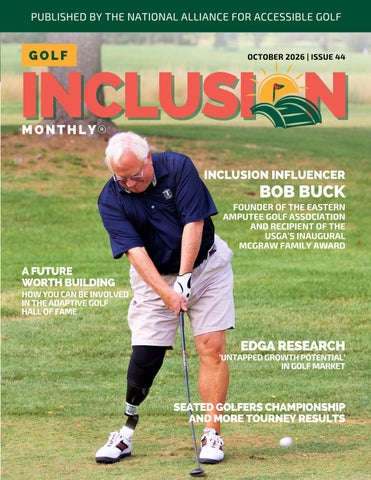
INCLUSION INFLUENCER
BOB BUCK
FOUNDER OF THE EASTERN AMPUTEE GOLF ASSOCIATION AND RECIPIENT OF THE USGA’S INAUGURAL MCGRAW FAMILY AWARD
A FUTURE WORTH BUILDING
HOW YOU CAN BE INVOLVED IN THE ADAPTIVE GOLF HALL OF FAME
EDGA RESEARCH
‘UNTAPPED GROWTH POTENTIAL’ IN GOLF MARKET
SEATED GOLFERS CHAMPIONSHIP AND MORE TOURNEY RESULTS
NATURAL STONE. GROUNDBREAKING SOLUTIONS.
GOLF PATHWAY MIX.
“Kafka’s support of our mission makes it possible for us to deliver education to the golf industry. We are proud to be associated with them and the commitment they have to delivering products that improve accessibility to golf facilities around the country!” Dave Barton, PGA, Executive Director, National Alliance
Click HERE to Connect with Kafka Granite
IN THIS ISSUE OCTOBER 2026
A MESSAGE FROM THE ALLIANCE Executive Director, Dave Barton, PGA
ACCESS + INCLUSION
The Alliance is a leader in access and inclusion - increasing the participation of people with disabilities in the game of golf. Source: Brock Leitner Instagram
INCLUSION INFLUENCERS
Excerpts from an interview with Bob Buck.
A FUTURE WORTH BUILDING
How you can be involved in the Adaptive Golf Hall of Fame.
BECOME A PATRON OF THE ADAPTIVE GOLF HALL OF FAME
GAIN SPOTLIGHT
EDGA HIGHLIGHTS ‘UNTAPPED GROWTH POTENTIAL’ IN GOLF MARKET
EDUCATION HUB SPOTLIGHT
AIR FORCE VETERAN FINDS NEW PURPOSE THROUGH ADAPTIVE GOLF AT VETERANS GOLF COURSE
No out of office assistants required. Access is not just a public facility issue.
BOARD & STAFF Melissa Low, CAE President Dana Dempsey, MS, CTRS Vice President Jan Bel Jan, ASGCA Secretary Sheryl Bindelglass, CSP ICAE Treasurer Source: GSGA
Dave Barton, PGA Executive Director
Justin Apel Chava McKeel Ronnie Miles Andrew Yeast Liz Cooper, LPGA Erik Nielsen, PGA Kevin Corn, PGA Rich O’Brien Joe Trauger Mike Tinkey
A MESSAGE FROM THE ALLIANCE Thanks for subscribing and staying connected with us! Our October Inclusion Influencer is Bob Buck, Founder of the Eastern Amputee Golf Association and calling him an inclusion influencer may be one of the bigger understatements of the year! Bob was the first recipient of the McGraw Family Award, presented at the 2026 U.S. Adaptive Open. The USGA created the award to recognize an individual who has demonstrated exemplary commitment to expanding opportunities in golf for people with disabilities. Looking ahead, the Adaptive Golf Hall of Fame nomination cycle begins in November. As we approach 2027, we’ve also launched our first Hall of Fame Patron Campaign to help drive awareness, advocacy, and financial support for adaptive golf programs nationwide.
Dave Barton, PGA
Together, let’s continue building on the foundation laid by those before us. Have a great fall golf season!
Executive Director
1
WHAT WE DO Advocacy and Awareness In addition to advocating for individuals with disabilities in print and online publications as well as social media marketing and interviews, the National Alliance engages in speaking opportunities at conferences and other public events. The Alliance also hosts GAIN, an adaptive golf community networking and engagement forum.
ACCESS + INCLUSION Our mission is to increase the participation of people with disabilities in the game of golf. The National Alliance for Accessible Golf (National Alliance) is the leader in inclusion — working to ensure the opportunity for all individuals with disabilities to play and participate in the game of golf. Formed in the summer of 2001, the National Alliance is represented by professional associations within the industries of golf, recreation and leisure, and health care providers as well as organizations that advocate for inclusion and provide services to individuals with disabilities. Join the Adaptive Golf Community on GAIN!
Education The Alliance Education Hub provides guidance to golf course owners and operators seeking ways to make their golf courses and facilities more welcoming, accessible, and inclusive to golfers with disabilities, including programs to bring new golfers into the game.
Resources The Alliance delivers resources including ADA guidance, policy templates and more to create accessible, inclusive, and welcoming environments.
www.accessgolf.org • info@accessgolf.org • Phone: (561) 709-8002
2
INCLUSION INFLUENCERS AN INTERVIEW WITH BOB BUCK
CLICK TO LISTEN TO THE ENTIRE INTERVIEW. In this month's Inclusion Influencer Interview, Alliance Executive Director Dave Barton speaks with Bob Buck - founder of the Eastern Amputee Golf Association and recipient of the USGA’s inaugural McGraw Family Award.
Returning Home From Service..."I stuck on my civies when I got off the plane coming back. I just wanted to be sure that I could get home okay because it wasn't a great time." Life Before the Injury..."When I came back from serving, it worked out okay and I made it back without any concerns. I started working for interim employment for Bethlehem Steel, and during that time, that's when I had my automobile accident." The Decision to Amputate..."I tried to save my leg, so I was on crutches for a year. After a year's time, we discovered that I had developed osteomyelitis and the leg was not going to get better, so I made the decision in 1970 to have it amputated." Realizing Golf Was Possible..."Before the surgery, I went out with my wife and her best friend and played a round of golf on one leg with crutches. It hooked every time I took a swing, but I realized I could still play and was looking forward to playing again with family and friends." Getting Back on the Course..."I had my leg amputated in April of 1970 and received a prosthesis, and I also walked down the aisle with my lovely wife, Linda, on June 20th. I realized that with that prosthesis, I would be able to play and continue to play golf." 3
Early Prosthetic Challenges..."Prosthetics weren't so fancy back in those days … you had sort of a balsam wood leg with a little rubber bumper on the back. It was not great for pivoting, so you learned to swing with your heel and let your heel turn as you made the swing." Advancements in Golf Technology..."Over those 40 years that I've been doing this, the prosthetic technology has just gone bananas. It's been perfect for those of us who love the game of golf, which is a very positive thing that we see now.
Back then, walking into a prosthetic place looked pretty scary, but we were able to develop ways of hitting a golf ball. The National Amputee Golf Association actually got started in 1944, so there was a whole group of people we could call on who could show us how to do things." Discovering National Amputee Golf..."In 1984, while working at Bethlehem Steel, I caught an article in Golf World magazine stating that the National Amputee Golf Championship was going to be played in Downingtown, Pennsylvania. I lived 40 minutes away, had never heard of the organization, but I went down, played, made the final foursome, and met wonderful people."
Forming the Eastern Association..."When I came back to Bethlehem, I decided we could develop a championship here in the East that we could all play in before heading to the National Championship. We established a constitution and bylaws, started our tournaments, and created the Eastern Amputee Golf Association." The Power of Shared Experience..."It was fun and different because I had never played golf with people who had similar types of disabilities. I was thrilled to be able to meet so many wonderful people who happen to have a disability and play this game together." Launching the First Clinic..."Laird MacCubbin, Director of Recreation Therapy at Good Shepherd Hospital, called to ask if we held clinics to show people how to play golf. I checked with executive director Bob Wilson, who said we hadn't developed that yet, so we put something together in Allentown, Pennsylvania." An Incredible First Response..."We had a clinic in Allentown with PGA pro Jim Booros, who was a terrific guy, and 35 people with disabilities showed up. We were shocked, but it was wonderful to know there were so many folks interested in playing the game." Surprised by Adaptive Ability..."At our first clinic, one fellow came up and doubted he could play because he was missing his leg above the knee and didn't have a prosthesis. I told him to just take a swing, and with great coordination, he hit a 5-iron out there 150 yards, which left me in a state of shock."
Early Amputation Flight Categorization..."In the early days, we were strictly amputees, flighted specifically by amputation type...below knee, above knee, below elbow, and above elbow. We didn't have seated golf back then because specialized equipment like the SoloRider wasn't available yet."
Providing Higher Education Scholarships..."On top of our tournaments, we've raised money to offer scholarships to amputee students, as well as the children and grandchildren of our members. Over 40 years, we've awarded roughly 250 to 300 scholarships, and we're very proud of that effort."
First Experience at Bethpage..."When we held our first tournament on the Red Course at Bethpage, the manager Dave was a bit apprehensive about how it would go. On the ninth green, he drove up in his cart amazed and asked, 'How the hell did you get here? I thought you were on the sixth hole!'
Defining Ability over Disability..."I'll never forget a Golf World headline about national champion Bic Long that read: 'Handicap No, Amputee Yes.' That became our philosophy: you have had an amputation, but you are not disabled or handicapped."
I told the manager at Bethpage that we play ready golf, move quickly, and don't take four hours just to play nine holes. It has always been important to me that our players move along in a regular, decent timeframe so we are never seen as holding up the course."
Evolution of Adaptive Terminology..."Back in those days, 'handicapped' was a prevalent word, and then it shifted to 'physically challenged.' Now, the language has evolved to simply recognize that you're an amputee or living with a disability, while focusing on what you can do."
4
Growth in Regional Associations..."Regional organizations are doing incredible work, such as Molly Baker heading adaptive golf for the Golf Association of Philadelphia and the Virginia State Golf Association developing its own programs. We're even looking to partner with Western PA on a regional tournament." Restoring Confidence on Golf Course..."When guys tell us they just want to get back to playing with their regular group, we assure them that they can do it. Giving those players a chance to be right back in the hunt of their fun golfing days means everything to us." Improving Championship Spectator Access..."In 2000, Saucon Valley Country Club hosted the U.S. Senior Open, and I worked with Tom Ellis from the USGA, who was an above-elbow amputee. I suggested making spectator stands accessible for Pride Mobility scooters, and Tom designed three bleachers that allowed spectators in wheelchairs and scooters to enjoy the event." Advocating for Tournament Accessibility..."Making championship golf accessible so people in scooters could travel around the course and sit in the stands was a great time. It impressed a lot of people, and it was an honor to help make that happen for spectators with disabilities." Shocked by National Honor..."When Colton Dean from the USGA contacted me about the inaugural McGraw Family Foundation Award, I was in a complete state of shock. This was work that I simply loved doing, so I was stunned to be recognized in that way."
Relieving Pressure on Golfers..."We impress upon our players to keep moving so they can enjoy the game more without worrying about the group behind them. When you play normal golf in a normal timeframe, nobody has to be concerned about players missing limbs or using adaptive carts."
Grateful for USGA Recognition..."It was wonderful to be recognized for the work we've been doing, but I am still a bit stage-struck by the award. I deeply appreciate what the USGA has done and enjoyed working with wonderful people like Beth Major and Stephanie Parel."
The Lifetime Value of Golf..."When I meet new amputees, I want them to know that they are going to be able to play and that it's going to be a great experience. It is a game you can play for a lifetime and have a ball with your family and friends."
Seeing Inclusion Vision Realized..."Years ago, I met with Mike Davis at the USGA to discuss how adaptive players might participate in mainstream golf. To see that fully come to fruition through the U.S. Adaptive Open and official ranking systems has been absolutely terrific."
Supporting Recovery from Trauma..."A traumatic injury or accident brings emotional challenges, whether or not someone served in the military. Encouraging people to understand and play the game with family and friends helps them work through that trauma."
Night and Day Progress..."You wouldn't even recognize the game of adaptive golf today compared to the 1960s and 70s … it is night and day. It is so exciting to see the sport flourish and watch major opportunities open up across the country."
Rejoining the Regular Foursome..."A new amputee will often show up to a clinic with three of his regular golf buddies right behind him saying, 'We want him back in our foursome!' Seeing that support from friends who just want their playing partner back is a wonderful, encouraging thing." 5
U.S. ADAPTIVE OPEN: MCGRAW FAMILY AWARD VIDEO - BOB BUCK UNITED STATES GOLF ASSOCIATION (USGA)
Inspiring New Adaptive Golfers..."If you have never played golf before, it is a game you will learn to love. We've seen so many people at our clinics become completely hooked on golf when they initially didn't believe it was possible."
Overcoming Privacy Communication Barriers... "Reaching out to new amputees has always been a challenge due to HIPAA privacy laws at facilities like Walter Reed. While I completely understand the privacy aspect, I've always wished we had direct communication channels to inform wounded veterans about adaptive golf opportunities."
The Holistic Benefits of Golf..."Golf is a great game because the benefits … emotional, mental, and physical…are immense. Beyond the sport itself, it comes down to the camaraderie of getting together with family and friends to enjoy the action around the course and the 19th hole."
Industry Partnerships Driving Growth..."Connecting with recreation therapists and working alongside prosthetic companies that sponsor clinics and tournaments has really driven the growth of adaptive golf. The broader golf community has truly welcomed our group into the fold."
Passing Along Educational Resources..."We are always happy to pass along our EAGA Golfers Magazine to let people know what we're doing and help others get programs started. I also have deep respect for leaders like Dana Dempsey, who do such fantastic work bridging healthcare and adaptive golf."
Shared Passion for Competition..."The golf community has embraced adaptive players because they see that it's just as much fun for us as it is for everyone else. We share the exact same interest, competitive drive, and love for the game that I've enjoyed since I was 12 years old.”
Editors Note: Published Inclusion Influencer quotes may be paraphrased or abbreviated for conciseness. Be sure and listen to the full audio on YouTube!
Encouragement for Experienced Players..."If you played golf before becoming disabled or losing a limb, you absolutely must get back on the links because you can do it. Come down to a clinic, and we will show you what you are still capable of achieving."
6
A FUTURE WORTH BUILDING THE ADAPTIVE GOLF HALL OF FAME By Dave Barton, PGA, Executive Director, National Alliance As we hope you may have already noticed, the adaptive golf community has a Hall of Fame now … the Adaptive Golf Hall of Fame, launching with the inaugural class of inductees in 2026. Time flies and we are rapidly approaching the nomination window for the Hall’s second year which will begin on January 1, 2027. Please know this. The Adaptive Golf Hall of Fame is envisioned to benefit the community. It exists as an amazing advocacy and awareness platform as we continue to work to bring more individuals with disabilities into the game of golf through the education and resources the Alliance provides to the golf industry.
7
One of our goals with the Hall of Fame is to generate increased financial support so the Alliance can put funds back into adaptive golf via program grants, and potentially educational grants as we move forward. We are moving in that direction but there is work to be done. We’re still a little bit ahead of the push for 2027 nominations, info about which will be provided in next month's Golf Inclusion Monthly®, but now is the time to talk about the impact the Hall of Fame can have on the entirety of the adaptive golf community and the importance of being involved.
Nominations - as the Administer of the Hall of Fame, the Alliance, as an organization, would not typically nominate individuals for the Hall, but we will certainly encourage others to do so. As you may have seen in 2026, we had some history to catch up with and the reality is we still do, but candidates for induction can not nominate themselves.
The Adaptive Golf Hall of Fame would not have been created without first discussing its potential “value” to the adaptive community and golf industry with the people and organizations involved in adaptive golf around the country and the world. Beyond the leading golf associations on our Alliance Board, you can readily see these organizations as they participate in not only the Selection Committee, but also serve as sounding boards for processes as we move forward. Year one went great, but we certainly seek continuous improvement.
Therefore, if you have worked with, or are aware of someone who you believe has had a Hall of Fame career, please nominate them and please do not assume someone else will. As with any Hall of Fame, everyone will not be inducted despite our best efforts to recognize all of these outstanding individuals. Certainly, we had an amazing inaugural class, but we are also keenly aware there are many, many other individuals out there, some of whom may no longer be with us, who have done outstanding things related to individuals with disabilities and the game.
We are extremely appreciative of our Hall of Fame Founding Partners, the PGA of America (PGA), the Ladies Professional Golf Association (LPGA), and the PGA Tour (PGA Tour, Inc), whose support has helped us "launch" and whose organizations lend great credibility to the Hall.
If they are not nominated by those that know them now or knew them in the past, the likelihood of being considered for induction is significantly reduced. Promotion and Awareness - As is the case with any organization, our reach only goes so far, whether Press Releases, social media, writing or speaking opportunities, interviews, etc., so we always welcome you helping us get the word out to a broader audience about the Hall of Fame. Anything we publish or say about the Adaptive Golf Hall of Fame may be shared with your organization and those it serves and we encourage you to do so.
So, a big THANK YOU goes out to the organizations that helped us validate the Hall of Fame’s potential, and these Founding Partners whose financial support facilitated the establishment and first years inductions, including a nice memento for each of the 2026 Inductees or their families.
There are so many amazing things going on around the world in adaptive golf and helping more people learn about the Hall will only help drive support that can be fed back into where it is most needed in the community.
How can you be involved? Here’s a few suggestions: Financial Support - contributions to the Adaptive Golf Hall of Fame directly support Alliance efforts to provide the Alliance Education Hub, GAIN - the Golf Access and Inclusion Network®, Golf Inclusion Monthly® and the Adaptive Golf Car, Programs and Facilities Database. Each of these platforms contributes to our continued efforts to serve as the leading resource related to the Americans with Disabilities Act (ADA) and the game of golf for facility owners, operators and the golfers themselves.
This is just the beginning but we sincerely believe the Hall of Fame can be a real catalyst for driving funds that will absolutely positively impact the greater community. Thank you for everything you and your organization does for individuals with disabilities and thank you for helping us identify a truly inspiring inaugural class in 2026. Please visit the Adaptive Golf Hall of Fame!
We are working diligently to reopen the National Alliance Grant Program. Your support of the Hall of Fame will help put money back into the adaptive golf community. where it is needed the most.
Your help and support will contribute to the induction of a great class in 2027 and our continued efforts to put funds back into the community.
We have created an Adaptive Golf Hall of Fame Patron Program that you can learn about in this edition and hope you or your organization will consider one of our Patron Levels of support.
8
BECOME A PATRON
OF THE ADAPTIVE GOLF HALL OF FAME Make a positive impact on the lives of individuals with disabilities!
As a Patron of the Adaptive Golf Hall of Fame, you help support the mission of the National Alliance for Accessible Golf, the organization dedicated to making golf more accessible and inclusive for individuals with disabilities. Your financial support helps drive meaningful change across the golf industry and the adaptive sports community by supporting initiatives that: Expand Access & Inclusion: Create welcoming, accessible environments where individuals with disabilities can learn, play, and thrive. Educate Industry Leaders: Equip golf facility owners, operators, and staff with education on ADA compliance, inclusive hospitality, and adaptive golf techniques. Connect the Adaptive Golf Community: Strengthen networks that share resources, support programs, and connect adaptive golfers nationwide. Advance Accessibility & Advocacy: Promote the rights, dignity, and inclusion of individuals with disabilities throughout the game. Resolve Accessibility Challenges: Provide guidance and resources to help golfers and facility operators address access concerns constructively. Change Lives Through Golf: Help individuals with disabilities experience the physical, mental, and social benefits of the game. Help us reactivate the National Alliance Grant Program Join us in supporting the National Alliance for Accessible Golf and help create a future where everyone has the opportunity to experience the game. Make a gift in memory or honor! Dedicate your gift in recognition of an Adaptive Golf Hall of Fame inductee. Gifts will be highlighted on the Patron Acknowledgement Page featuring the name of the inductee recognized with a listing of the donor(s).
TOGETHER, WE CAN MAKE GOLF ACCESSIBLE TO ALL. Established by the National Alliance for Accessible Golf in 2026, the Adaptive Golf Hall of Fame honors those who have dedicated themselves to creating pathways to the game of golf for individuals with disabilities.
GAIN SPOTLIGHT
JOIN THE COMMUNITY. JOIN THE CONVERSATION.
NO OUT OF OFFICE ASSISTANTS REQUIRED
“GAIN is not simply a community networking platform, it is the top national resource and education center for the golf industry related to ADA compliance, education, and the game. Existing programs are growing and new ones are developing. But, can we say that golf facilities around the country are universally prepared? No … we can’t say that.”
The most important thing a person or organization can do to help others is to “answer the call” and “listen” when they are asking for help. Regardless of the speed with which information now flows and the long list of great organizations around the country serving individuals with disabilities related to the game of golf, answering the call for guidance or help in a timely fashion is Job One. I have yet to meet any one organization or person who has all the answers. The Alliance provides GAIN to give experts in adaptive golf a place to share their knowledge beyond their immediate sphere of influence. It also provides an avenue for someone to seek information across a range of topics in adaptive golf including where to learn, who to call, equipment, rules and and more.
Dave Barton, PGA Alliance Executive Director
GAIN is a tool for the community designed to connect us all, but most importantly, it is designed to help get someone talking to the right person in the right place to assist. Join us on GAIN. It’s where experts and those looking for guidance connect.
9
EDUCATION HUB SPOTLIGHT
ACCESS IS NOT JUST A PUBLIC FACILITY ISSUE To be clear, it is a true statement that the Americans With Disabilities Act (ADA) does not apply to private golf facilities. Well … that is sometimes not true. “If” the club operates on more than a temporary basis regarding access to the facility by non-members beyond the typical “hosted guest of a Member” situation, the private facility could be held responsible for eliminating barriers in a permanent, versus temporary fashion. Barriers could include, but are not limited to ramps, parking spaces, narrow doors, or more. As one example, perhaps your facility routinely permits weddings that non-Members can have? Also, regardless of your status as a private facility, shouldn’t you still have processes and policies in place to ensure your loyal aging members, or members or guests who may have a disability can have a positive experience at your club? It’s not complicated. Learn more about making the game accessible to more golfers by visiting the National Alliance Education Hub.
HUB STATS
462 Enrolled Learners
569 Course Completions
342 Training Hours Completed
The Alliance Education Hub is a FREE service available to anyone in the golf industry.
10
EDGA HIGHLIGHTS ‘UNTAPPED GROWTH POTENTIAL’ IN GOLF MARKET Published by Golf Business News | September 16, 2026
Sporting Insights carried out the survey in the UK, Europe and other global regions in the second half of 2025, engaging with golfers and non-golfers with a disability, including those registered with EDGA (the European Disabled Golf Association).
Sporting Insights research shows golf market can grow by £265 million with support for golf for the disabled.
Latest research commissioned by EDGA suggests the clear market opportunity for significant growth in golf via golf for the disabled.
The survey’s findings support EDGA’s simple strategy of creating greater opportunities for more people with a disability to enjoy golf – and to experience what is a lifeenhancing game.
The new research, carried out by industry-leading research experts Sporting Insights, provides valuable evidence to inform strategic decision-making by EDGA and its partners, including national federations, and can help the market attract and retain individuals with a disability to the sport of golf.
EDGA is an acknowledged international authority in the G4D space and research is a core part of its work: this latest study sitting within an established programme of evidence-led insight that EDGA shares internationally as a not-for-profit volunteer-led organisation.
Research estimates potential value market growth of £265 million each year in GB&I alone from all golfers. 11
Figures show that 400,000 more people with a health condition, disability or learning difficulty in GB&I can be encouraged to enjoy golf (a jump from a present estimated 1.3 million to 1.7 million individuals with a health condition, disability or learning difficulty), bringing an additional £265 million in value to the golf industry and market each year.
from their health condition became part of their lives (including the EDGA database of players this is closer to 40 percent amongst UK players). The research data flagged up some of the barriers for people joining the game around cost, access, attitudes, awareness and adaptation. Golf has a higher proportion of male participants, despite the disabled population being 52 percent female.
Projections indicate that the number of G4D players who would be described as regular golfers could grow from an estimated 362,000 to 476,000 (a 114,000 increase) following targeted improvements in support, accessibility and promotion in golf and the golf infrastructure: this adding £96 million of annual value to the game.
Younger people with disabilities are engaging with golf, but mental health conditions, ASD, communication and learning differences, are more prevalent within this group, which can mean that without direct support young players can miss the opportunity to try the game. The findings reinforce that EDGA’s core areas of work remain well aligned with demonstrable need and opportunity, including:
Many of the established G4D players interviewed in the survey (from the UK, Europe and further afield) report the fun, enjoyment and the health benefits golf has given them – in a sport they recognise as being highly inclusive for players with a wide range of health conditions (65% of golfers with a disability in the UK agree or strongly agree that golf is a better sport for people with disabilities than other mainstream sports).
Structured pathways post diagnosis are effective and should be expanded, Perception remains a primary constraint, not capability, Coaching, education and workforce development are central to sustainable growth, There is untapped potential among multiple groups, including women and younger people with a range of disabilities.
EDGA is working with an increasing number of national federations (50 at present including the Home Unions of GB&I) to help grow the G4D offering, and during the last four years its ‘8-Stage Pathway’, endorsed by The R&A, has been adopted to assist federations.
The research shows that access to appropriate coaching and informed environments materially influences retention and progression. With appropriate adaptation, golf also offers a viable pathway for older people to remain active for longer.
The Pathway provides support in national competition structure, in the provision of inclusive and safe venues, staff and volunteer training, coach education and community activation. Federations are provided with best practice education on the promotion of G4D and support of the ‘player pathway’ – from the very first golf experience for a player to regular play and the opportunity to compete in tournaments.
Other notes of interest include:
The value of this strategy is reflected in the Sporting Insights research.
When considering golfers with a disability in the UK, including those UK golfers on the EDGA database, most golfers describe their experience of golf as positive or very positive, 69 percent play sport primarily for fun and enjoyment, 70 percent cite improving or maintaining general health as a key motivation, 89 percent agree that golf can be enjoyed by people with a wide range of disabilities, and 85 percent agree that golf can be easily adapted to meet different needs.
Golfers with a disability are more likely to encourage others to join in the game, driving organic growth, while 66 percent of the surveyed golfers say they will make use of specialised coaching where it is available. Some 28 percent of active golfers took up golf after limitations
EDGA President Professor Tony Bennett said: “With 16 percent of the world’s population having a disability and given EDGA’s long-held certainty that golf is such a good sport for the health and wellbeing of its players, we, our partners and national federations, have been convinced
Celebrating its 25th anniversary in 2025, EDGA also shares long-held expertise in medical assessment, eligibility and research, player knowledge, tournament and sport classes, and in growing the awareness of G4D with key stakeholders in the game. EDGA is currently working with 12 national PGAs, including the PGA of GB&I.
12
Three core reports were produced: Home Union Summary (November 2025): UK focused insight into participation patterns, timing of engagement and comparisons with other sports. Making the Case for Golf for the Disabled (November 2025): Market sizing, participation potential and economic impact analysis. EDGA Database Survey Data (November 2025): Insight drawn from golfers already engaged with EDGA, including competitive and more severely disabled players. Tony Bennett concluded: “We can now evidence the scale of the opportunity. The next stage is to turn that evidence into action that makes a difference. “Golf can reach hundreds of thousands more people, while strengthening the sport socially and commercially and helping to break down worn-out perceptions that the game is exclusive. We can do this by working together to remove barriers, improve access and create better pathways into the game.
of this market opportunity, which is now reflected in this excellent detailed research by Sporting Insights.
“For the golf industry, the question can no longer be whether the opportunity exists, but how we position our respective organisations to turn that opportunity into meaningful change.”
“We at EDGA have been very much aware that the game needs to attract more women and young people with diverse health conditions and disability, while at the same time supporting an ageing population to continue enjoying the game. These are genuine challenges but massive opportunities alongside the societal change that is occurring around us, where a new generation of consumers with disability rightly demand more as customers.”
To learn more about the research, EDGA’s work or how your organisation can support the growth of G4D, contact EDGA or visit edgagolf.com.
Prof. Bennett added: “EDGA believes the survey results indicate a major strategic opportunity around the untapped growth potential in the golf market, and how golf can build on the inclusive nature of the sport if barriers are addressed; in so doing enhancing the wellbeing of many more people.” Report details
The research included both golfers and non-golfers with a health condition, disability or learning difficulty from the UK, Europe, and other global regions. The research programme completing the survey included the following respondents: 1,001 UK residents who have a physical or mental health condition or learning difference 1,503 nationally representative sample of UK adults 523 contacts from the EGDA database – 135 UK, 168 Europe, 220 Rest of the World 13
AIR FORCE VETERAN FINDS NEW PURPOSE THROUGH ADAPTIVE GOLF AT VETERANS GOLF COURSE By Golf Post | September 20, 2026
Legally blind Air Force veteran Harvey Guary discovered confidence and community through adaptive golf at Tomah's Veterans Golf Course.
Air Force veteran Harvey Guary, who was diagnosed as legally blind in 2014, has found a new way to play golf and, more importantly, a path forward through adaptive sports at Veterans Golf Course in Tomah. After years of struggling with depression, Guary discovered that adaptive golf has transformed his physical, mental, and emotional well-being, giving him both confidence and purpose within a supportive community. In a recent video shared by the course, Guary describes the sensory experience of adaptive golf—relying on sound and feel rather than sight. "It's all in the sound and in the film," he explains, noting that he can hear when he hits the sweet spot. "Oh, it's the best feeling in the world because it gives myself confidence." Guary emphasizes that his experience at Veterans Golf Course has shown him what remains possible despite his disability, and he now encourages others facing similar challenges to pursue the sport. "If I can do it, you can do it," he says. Adaptive Golf Transforms Lives at Veterans Golf Course
Veterans Golf Course in Tomah is dedicated to serving the veteran community, offering programs and resources tailored to those who have served. The course's adaptive sports initiative has become a lifeline for veterans navigating physical and mental health challenges. Guary credits adaptive sports with pulling him out of isolation: "If it wasn't for adaptive sports, I would probably be in a depression and be sitting at home feeling sorry for myself." The combination of physical activity, acoustic feedback, and peer support creates an environment where veterans can rebuild confidence and reconnect with a sport many thought they had lost.
Photo: Veterans Affairs / X
veterans, regardless of ability. His message to others —"Once you get a taste of adaptive sports, you'll never get enough. You come back for more and more"— speaks to both the addictive joy of golf and the deeper human need for community and purpose. For veterans in the Tomah area struggling with similar challenges, Guary's experience demonstrates that adaptive golf at Veterans Golf Course offers not just a sporting opportunity, but a pathway to renewed hope and resilience.
Building Momentum in Tomah's Veteran Community
Guary's story reflects a broader commitment at Veterans Golf Course to make the game accessible to all 14
NEWS FROM THE ADAPTIVE GOLF COMMUNITY CARLOCK, LARSON AND SCHROEDER CLAIM OVERALL TITLES AT MINNESOTA ADAPTIVE OPEN By Jack Mendesh | September 28, 2026 Starting the round with three pars, Carlock hit a 3wood into the par-5 fourth to 15 feet and made the putt for eagle to jumstart his round. “I really was just trying to leave it a little short of the hole, so I didn’t race it by and the hole got in the way. Fun to start the day like that,” Carlock said. 2025 Men’s Overall champion, Max Togisala, cut the lead to six after making birdies on five of his last six holes on the front nine.
EDINA, Minn. — Calmer, rain-free conditions greeted the competitors for the final round of the 2026 Minnesota Adaptive Open at Braemar Golf Course. While Saturday’s opening round was defined by cold, wind and rain, the common theme throughout Sunday’s final round was camaraderie. Sarah Larson, looking to defend her 2025 Women’s Overall Division and Women’s Upper Limb Impairment Division titles, said of the round, “It was probably one of my favorite rounds so far this year, having Jamie [Santos] join me and having girls time elevated it to a different level than I am used to. “We laughed – we had music, I can’t describe the friendship that we had that really helped our game.” Larson used that camaraderie to claim her second consecutive title in both the Women’s Overall and Women’s Upper Limb Impairment Divisions and wants to carry that spirit to encourage more women to compete in the championship. “I am honored to defend the title,” Larson explained. “I have a lot of to work to put in but that’s something I need to do for myself. I am excited to come back next year and bring some more ladies because that’s truly what it’s about out here.” In the Men’s Overall Division, Justin Carlock carried an eight-shot lead entering the final round. He also led in the Upper Limb Impairment Division. 15
Carlock said of Togisala’s front-nine run, “It stressed me out a little bit. We made the turn to 10 and I hit it in the water so I had to take a drop. I hit up there to about to six feet behind the hole and missed that so I was not pleased with that. “We had good looks on 11 that snuck by and we both had a couple of good looks on the back nine and traded a couple of birdies and bogeys coming in. It was a very interesting second half just trying to stay as present as I could.” Carlock went on to solidify both titles with an eagle at the par-5 16th, one of the most difficult holes on the course. “I hit a pretty good drive – I pushed it a little bit. Yesterday, I took it a lot further left so I ended up having a 9-iron in. Today was a 6-iron on a little bit of downslope – not my favorite shot. “I hit a really good shot, hit the green and it snaked down about 15-feet above the hole. I tried to move the ball about three feet and it trickled in the hole,” Carlock said. In just his second Adaptive Golf tournament, Carlock explained the significance of the victory. “This is so cool – still just in my second adaptive event ever, just the fact that there is an avenue opening up for all of us that qualify to be here – I just think it’s such a cool thing and to be a part of that, I feel so honored to be in the conversation.”
FULL RESULTS
SEATED GOLFERS CHAMPIONSHIP September 28–30, 2026 Whirlwind Golf Club at Wild Horse Pass Chandler, AZ Overall: 1st - Max Togisala -2** (won in 1-hole playoff) 2nd -Brock Leitner -2 G10 Classification Division: Max Togisala -2 G9 Classification Division: Brock Leitner -2 Senior Classification Division: Larry Celano +6
FULL RESULTS
7TH GEORGIA ADAPTIVE OPEN September 16-19, 2026 Chimneys Golf Course Winder, GA Men’s Overall Gross - Chris Biggins Men’s Overall Net - William Jacobsen Women’s Overall Gross - Ryanne Jackson Women’s Overall Net - Amy Bockerstette Seated Gross - Justin Miller Seated Net - Skylar Miller
FULL RESULTS
SHARE YOUR NEWS Do you have an upcoming adaptive golf tournament or event that you want people to know about? Would you like to share your tournament stories and results with the adaptive golf community? Just let us know by the start of the month and we'll do our best to get in the upcoming edition! Photo: Candace Oehler
Email your news to info@accessgolf.org.
16
JOIN THE COMMUNITY. JOIN THE CONVERSATION. GAIN is your community ... a free networking forum to foster better access to adaptive golf experts across the country and resources to serve the community of golfers with disabilities and those that lead and support these efforts. All are welcomed on GAIN ... those seeking information about adaptive golf, the ADA and more with those that can provide the answers. ADA & Accessibility Competition & Rules Facilities, Programs, Adaptive Golf Cars Calendar of Events Open Forums
CONTACT US
FOLLOW US
Address: 5500 Military Trail, 22-261 Jupiter, FL. 33458
Email: info@accessgolf.org
ADVERTISE WITH US
Phone: (561) 709-8002
Website: accessgolf.org
Interested in supporting the Alliance through advertising in Golf Inclusion Monthly, please contact us at info@accessgolf.org