PUBLISHED BY THE NATIONAL ALLIANCE FOR ACCESSIBLE GOLF
GOLF
NOVEMBER-DECEMBER 2026 | ISSUE 45
INCLUSI N MONTHLY
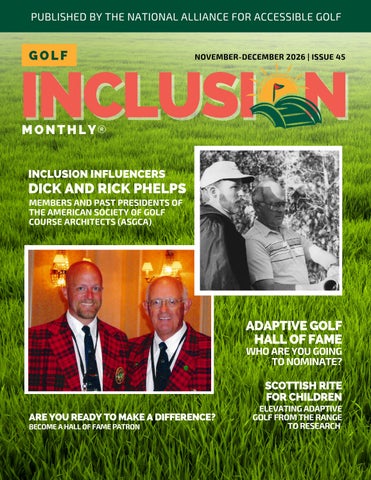
INCLUSION INFLUENCERS
DICK AND RICK PHELPS MEMBERS AND PAST PRESIDENTS OF THE AMERICAN SOCIETY OF GOLF COURSE ARCHITECTS (ASGCA)
ADAPTIVE GOLF HALL OF FAME WHO ARE YOU GOING TO NOMINATE?
SCOTTISH RITE FOR CHILDREN
ARE YOU READY TO MAKE A DIFFERENCE? BECOME A HALL OF FAME PATRON
ELEVATING ADAPTIVE GOLF FROM THE RANGE TO RESEARCH
NATURAL STONE. GROUNDBREAKING SOLUTIONS.
GOLF PATHWAY MIX.
“Kafka’s support of our mission makes it possible for us to deliver education to the golf industry. We are proud to be associated with them and the commitment they have to delivering products that improve accessibility to golf facilities around the country!” Dave Barton, PGA, Executive Director, National Alliance
Click HERE to Connect with Kafka Granite
IN THIS ISSUE
NOVEMBER/DECEMBER 2026 A MESSAGE FROM THE ALLIANCE Executive Director, Dave Barton, PGA
ACCESS + INCLUSION
The Alliance is a leader in access and inclusion - increasing the participation of people with disabilities in the game of golf.
Source: Texas Golf Association Instagram
INCLUSION INFLUENCERS
Excerpts from an interview with Dick and Rick Phelps.
ADAPTIVE GOLF HALL OF FAME
BECOME A PATRON OF THE ADAPTIVE GOLF HALL OF FAME
GAIN SPOTLIGHT
ALLIANCE IN ACTION: ELEVATING ADAPTIVE GOLF FROM THE RANGE TO RESEARCH
EDUCATION HUB SPOTLIGHT
NEWS AND TOURNAMENT RESULTS FROM AROUND ADAPTIVE GOLF
Nominations open January 1, 2027
No out of office assistants required. Access is not just a public facility issue.
Source: GAP Adaptive
BOARD & STAFF Melissa Low, CAE President Dana Dempsey, MS, CTRS Vice President Jan Bel Jan, ASGCA Secretary Sheryl Bindelglass, CSP ICAE Treasurer Dave Barton, PGA Executive Director
Justin Apel Chava McKeel Ronnie Miles Andrew Yeast Liz Cooper, LPGA Erik Nielsen, PGA Kevin Corn, PGA Rich O’Brien Joe Trauger Mike Tinkey
A MESSAGE FROM THE ALLIANCE Research, adaptive golf competitions, a Hall of Fame, and designing golf courses with access in mind. Is this a great community to be a part of or what! Dick Phelps, ASGCA, and his son Rick Phelps, ASGCA join as our Inclusion Influencers representing a family legacy across two generations and over six decades that has shaped public, accessible golf more profoundly than perhaps any other family in the modern era. Also, Alliance Board Vice-President Dana Dempsey and Director, Therapeutic Recreation, Scottish Rite for Children shares her recent experience at the American Academy for Cerebral Palsy and Developmental Medicine’s (AACPDM) annual meeting and touches on her own research.
Dave Barton, PGA Executive Director
Those stories, the upcoming Adaptive Golf Hall of Fame nomination window and some Tourney results from the Golf Association of Philadelphia and Texas await! So “dig in” and see what’s going on in adaptive golf!
1
WHAT WE DO Advocacy and Awareness In addition to advocating for individuals with disabilities in print and online publications as well as social media marketing and interviews, the National Alliance engages in speaking opportunities at conferences and other public events. The Alliance also hosts GAIN, an adaptive golf community networking and engagement forum.
ACCESS + INCLUSION Our mission is to increase the participation of people with disabilities in the game of golf. The National Alliance for Accessible Golf (National Alliance) is the leader in inclusion — working to ensure the opportunity for all individuals with disabilities to play and participate in the game of golf. Formed in the summer of 2001, the National Alliance is represented by professional associations within the industries of golf, recreation and leisure, and health care providers as well as organizations that advocate for inclusion and provide services to individuals with disabilities. Join the Adaptive Golf Community on GAIN!
Education The Alliance Education Hub provides guidance to golf course owners and operators seeking ways to make their golf courses and facilities more welcoming, accessible, and inclusive to golfers with disabilities, including programs to bring new golfers into the game.
Resources The Alliance delivers resources including ADA guidance, policy templates and more to create accessible, inclusive, and welcoming environments.
www.accessgolf.org • info@accessgolf.org • Phone: (561) 709-8002
2
INCLUSION INFLUENCERS AN INTERVIEW WITH DICK AND RICK PHELPS CLICK TO LISTEN TO THE ENTIRE INTERVIEW. This month, Alliance Executive Director Dave Barton, PGA doubles down with Dick and Rick Phelps, both Members and past Presidents of the American Society of Golf Course Architects, ASGCA. Dick is a pioneer in accessible course design and his son Rick started holding survey rods and planting grade stakes on project sites as a kid - continuing a family legacy that is tough to beat in the world of golf course design. Finding Design Passion [Dick ]..."Before that, and I'll just hit it briefly, I didn't play much golf. My family did, and I sort of was the rebel and decided not to play much golf. And then I found out in school, by golly, somebody designs these things, and maybe there's some interest or some ability in me to be able to go ahead and do that. So that's what I did." Returning to Colorado [Dick]..."Eventually, I formed a partnership with Don Brauer, who had his office in suburban Minneapolis … I was there about a year and moved to Colorado back home, because I was born and raised in Colorado Springs. And that's where I started things out, sort of on the hungry side." Public Golf Opportunity [Dick]..."I was also fortunate in that the two architects that were in this area both decided to retire about the time I was thinking about starting up. Both of them were doing country clubs more so than public courses. And I happened to hit, again … fate was with me … the need for public golf through North Jeffco, which is a recreation district." Early Municipal Projects [Dick]..."So they hired me to do an 18-hole plus a little short Par 3. The word got around, and pretty soon South Suburban asked me if I'd be interested in designing a course in a similar situation for them, which I did. And what was the other? South Jeffco? Foothills, yeah." 3
I designed the Foothills Golf Course with my then partner, Brad Benz. That's where we got it started, and why we got it started in public golf. There just wasn't any private golf that hadn't already been designed by the two gentlemen before me." Affordable Public Access [Rick]..."An opportunity presented itself really early in his (Dicks) career for affordable public golf, mostly municipal, but basically all public access. Press Maxwell was already here in Colorado and had done most of the private clubs in the '60s in the Denver metro area and around the state. But nobody was here doing public golf." Municipal Process Expertise [Rick]..."When Dad came in, he showed that he could do that with an understanding of the municipal design processes, bidding requirements, and things like that. That's kind of really what led to the early success…that was really it." Playing with Tonka Trucks [Rick]..."I have a brother who's 13 months older than I am, who's a golf course superintendent and now a manager of golf for the city of Fort Collins. My brother and I spent hours and hours and hours playing in the dirt with our Tonka trucks. We were, like, wearing Tonka trucks out, if you can imagine that."
Watching Real Earthmoving [Rick]..."When I got to go out on these sites for the first time and see the real-life Tonka trucks working, moving dirt, and bringing Dad's vision to life, that's when I saw that that was really cool and really fun … without really any understanding of the game of golf, or certainly not how design can influence the game of golf. It was all about watching the guys push the dirt around and shape it into a specific purpose." Serving Client Priorities [Rick]..."Well, I think I would say probably 90% of it I still adhere to, and really, to me, it revolves more around responding to your client’s needs and your client's wishes. Over the years, both of us have done a lot of municipal and public course work where their number-one concern is budget, and their number-two concern is getting as many people out on that golf course as they possibly can. That means no slow play and no hazards that slow play." Designing for Playability [Rick]..."So that drives your philosophy, whether you really want it to or not. I mean, sure, I would love to design a U.S. Open golf course at some point in my lifetime, but so far, my clients could care less about that…they want to make money, and they want to have as many people enjoying the golf course as they can." Promoting Access [Dick]..."That goes back to accessibility and getting the golfer that is limited in some fashion...whether it's an amputation or who knows what...the opportunity to play golf. One of the guys that was really active in that was Greg Jones here in Colorado. Greg had polio early in life … and had a hard time getting around." Hosting Adaptive Tournaments [Dick]..."He (Greg) got in touch with me, and we started doing public meetings and so forth to see where we could take an existing course and soften it a little bit for the golfer. He sponsored several tournaments in the Denver area; The Foothills Golf Course would make the golf course available. And so then he'd set up a tournament, bringing in golfers from all over the country who have all kinds of disabilities."
Rewarding Adaptive Work [Dick]..."You could just see it on his face when he'd hit a shot and his helper would say, 'So-and-so, you're right on the green! You're on the green, and you've got about a 20-foot putt,' and then he'd help him with his putt. I played through a number of tournaments that Greg had gotten sponsors on, and it was very, very rewarding to work with these people with amputations, sight problems, and whatnot."
Assistive Golfing Example [Dick]..."I'll never forget seeing this one scene: there were two guys, and one of them was bending over a putt while the other guy was kneeling down behind him. I thought, 'Well, that's probably a caddy,' but it turned out it was the guy's eyes, so to speak. He would say, 'Okay, turn about 10 degrees to the left so that you're aiming toward the fairway,' and he'd actually move the ball and the club to allow this golfer the chance to play golf because he couldn't see."
Family Golf Influences [Rick]..."Dave, I'd add to that a little bit and go back maybe a lot farther even to what Dad said about his education and whatnot. He did grow up as a rebel in a golfing family. He didn't play golf much as a kid because he was playing baseball, football, basketball, and every other sport. But his brother was a very accomplished golfer here in the state of Colorado...a top amateur growing up...and both of his parents, my grandparents, were avid golfers.
4
Advocating Accessible Design [Dick]... "Yes, very definitely. The guy I mentioned that was blind was just thrilled he could be out there in the fresh air and in the golf environment with a friend helping him play. But it was a struggle, and I faced quite a bit of resistance from the fellow members of the society.
I had to go through and sort of prove it to them by showing them a course that had had the access improved. Several of us were invited back to Washington, D.C. to meet with the Justice Department. Yeah, you get the lawyers involved. While we were there, different people gave their little speeches about why it was good or why it was bad. One woman in particular got up and was really saying that we should do what Rick said they were afraid we'd do, and that's flatten everything out. Greg just stood up in the middle of her talk and said, 'Ma'am, if you would keep your nose out of this! You're not disabled. Keep your nose out of it and let us golfers that are disabled decide what's good for us and what we can handle.'" Evolution of Adaptive Tech [Dick]..."That came about particularly with a bunker. Yeah, we can get the guy in the bunker in his wheelchair, but try to get him out or get him around in it; narrow areas just wouldn't allow that at all. As I said earlier, the prettier, tougher sites with rolling terrain became a real challenge to the architect to work with. But while it faced opposition on all sides without a doubt, we had people that answered the call and started making the SoloRiders and other adaptive types of carts, as well as fittings for broken limbs, missing limbs, and so forth."
So he grew up in a golf family, and I'm sure he played plenty with them, but he also watched them play and saw how they played. He saw not only how good his brother was and how he played the game, but he also watched his mom play and he got to see how women golfers had to navigate around a golf course."
Cart-Accessible Standard [Rick]..."Honestly, I hate to say it this way, but it's the only thing that's popping into my head right now: I think it is still somewhat of an afterthought. But that is only because it can be, and I'll explain what I mean by that in a second. I've heard other architects say the same thing, and I've said it to a few of my clients before, that today, to be determined to be an accessible golf course by ADA guidelines, if you can get a standard golf cart to every corner of the golf course, you're deemed to be accessible."
Accessibility Doesn’t Mean Flat [Rick]..."I think part of what we saw early on was that, like you might expect, as soon as you hear golf courses are going to be required to be accessible, the immediate image that comes to a lot of people's heads is that we're going to be flattening out and ironing out every bump and wrinkle, making things flat, smooth, and accessible. Well, in reality, that's not what was required."
Designing Accessible Features [Rick]..."So, how easy is that? I mean, a golf cart can go some pretty crazy places if you're careful with it, other than bunkers. Bunkers are really the only part of a golf course that's still kind of unrestricted or unencumbered. Because of the adaptive equipment and everything else that's been developed over the last 25 or 30 years, you could design a pretty crazy golf course and still have it be accessible, as long as you don't put up blockades like curbs."
Beauty Exists in Barrier Free Environments [Rick]..."Because of the way things have evolved, I don't think it's impacted the game or the design of the golf courses at all, other than very subtle things that the average person wouldn't even begin to notice, like not having curbs on cart paths. Simple little things like that make all the difference in the world in terms of accessibility without changing the beauty, the image, or the style of a golf course at all."
5
Reassuring Hesitant Clients [Rick]..."It's really a lot easier than people think it is, and I've had to talk a few clients down off the ledge who were afraid to do remodel work or afraid to do a certain design feature because they would jeopardize their accessibility status. It's like, 'No, you don't have anything to worry about. As long as you can still get there in a cart, you're fine.'" Inheriting a Strong Reputation [Rick]..."I was blessed that he had such an amazing reputation to begin with, so that the transition was easy and doors were open for me left and right. That's always humbling, and I'm grateful to have had that opportunity." Rick Phelps or Dick Phelps' Son [Rick]..."Even today, it's funny. I laugh with some people because you mentioned the shadow. I wouldn't call it that in a negative way, and I don't want this to be a negative comment at all, but I'm still introduced to new people as 'Dick Phelps' son.' I'm not Rick Phelps; there is no 'Rick Phelps, golf course architect.' There's 'Dick Phelps' son, the golf course architect.'"
I said, 'Yeah, this'll sound funny, but probably the best way will be to get a job with a golf course contractor and see what they're going through, and how they bid things, and so forth.’
Embracing the Legacy [Rick]..."That's just something I get used to, and it's not a big deal; it's just the way it is. Even though I just turned 60 and have been doing this for almost 40 years now, I'll always be known as just Dick Phelps' son, which is fine with me."
And he did, and he got shipped somehow over to Europe for a little while … Jim has turned out to be a very innovative-type guy, and very pleasant to work with, and we've done some work with him.
Mentoring Aspiring Architects [Dick]..."One day I was out walking the piece of ground to see what progress had been made and this young fella came over a mound and started walking toward me, and I thought, 'I wonder what this is all about.' Well, it turned out that young man was Jim Engh. Jim introduced himself and said he wanted to get into golf course architecture and what was the best way.
That was a good bit of advice, I think, to spread out. Don't try to just dive in and be a golf course architect, which a lot of kids in college thought they were gonna do. Don't get in a rush … spread out and get familiar with the other professions that are a part of it, including management. I mean, what can you see from the pro shop window?" Designing for Every Golfer [Rick]..."If I were to add anything and this is maybe a little more philosophical, it would be don't lose sight of everybody that you're designing for. It's very, very easy to get caught up in chasing headlines and seeing beautiful photos in print or online of stunning but difficult golf. There's 97% of the golfing population out there that can't play those golf courses because they're too difficult.
"That was a good bit of advice, I think, to spread out. Don't try to just dive in and be a golf course architect, which a lot of kids in college thought they were gonna do. Don't get in a rush…spread out and get familiar with the other professions that are a part of it, including management. I mean, what can you see from the pro shop window? - Dick Phelps
Keep designing also for the mom and pop players, the kids, and the whole family so that they can play together. Focus on fun, playability, and accessibility rather than headlines and U.S. Open Championships." To learn more about Dick and Rick's work, please visit phelpsgolfdesign.com Editors Note: Published Inclusion Influencer quotes may be paraphrased or abbreviated for conciseness. Be sure and listen to the full audio on YouTube! 6
WHO ARE YOU GOING TO NOMINATE? 2027 ADAPTIVE GOLF HALL OF FAME By Dave Barton, PGA, Executive Director, National Alliance It’s hard to believe another year is on its way out as 2027 rapidly approaches! First, we’d like to thank the Adaptive Golf Hall of Fame Founding Partners, the PGA of America, the LPGA, and the PGA Tour, along with our core of association supporters that helped make the launch of the Adaptive Golf Hall of Fame with our inaugural class in 2026. This support also includes numerous associations and organizations volunteering their time to serve on the Hall of Fame Selection Committee.
The Adaptive Golf Hall of Fame is administered by the National Alliance for Accessible Golf and our November/December edition of Golf Inclusion Monthly® officially sets things in motion for the second class of inductees who will be inducted in June of 2027. Things begin with the nomination window officially opening on January 1, 2027 and extending through March 31, 2027. Now is the time to begin collecting your nominee’s information so you are ready to complete the Nomination Form at the start of the year. The form is simply to use and all information regarding the form may be found here - 2027 Adaptive Golf Hall of Fame Nominations. The link to submit Candidate Nomination Forms will not be live until January 1st. The inaugural class of inductees can be viewed HERE and we encourage you to take a look. We are extremely appreciative of the opportunity to recognize these amazing individuals on the industry’s behalf but we know with certainty there are many more out there who have laid the foundation for this community of golfers we all work to bring into the game who have yet to be nominated. That’s where you come in!
7
As the Hall Administrator, the Alliance will not typically submit candidates for induction consideration, nor do we cast a vote on inductees unless a tie can not be broken through our established process. However, we certainly may encourage organizations or individuals to do so. The bottom line is that the only way to ensure someone you know, or know of should be considered for the the Adaptive Golf Hall of Fame is to nominate them. Year One helped us catch up on history a bit and we inducted a large class to do so. We still have some history to consider as we work on recognizing people that are still with us to receive this honor, but as you saw in the first year, we had numerous posthumous inductees as well. Induction class sizes are not set, nor publicized, however, large classes will not be the norm as we move forward. Presently, nominees remain in consideration for five years, including the first year they were nominated. We would ask that any of you considering nominating an individual for the Hall of Fame to not assume someone else is doing so. You are welcomed to contact us at info@accessgolf.org regarding any nominee you may be considering, or want to discuss. As the Hall of Fame site indicates, entrance into the Hall of Fame will be based on “Service and commitment to creating pathways to the game of golf for individuals with disabilities” and will include individuals and organizations who have gone above and beyond to create opportunities and support growth of the adaptive golf community. This includes golfers who, by the examples they have set for others by playing and/or competing, have advocated or continue to advocate and work, to bring others to the game. Hall of Fame candidates may include those who are still with us and/or those who have passed away (posthumous). The timeline for the 2027 Adaptive Golf Hall of Fame class is: January 1, 2027: Candidate Nominations Open March 1, 2027: Candidate Nominations Close June, 15 2027: Inductees Announced
Candidate criteria is summarized as follows and this information is what you will be asked to provide on the Nomination Form, which you may simply cut and paste into from your source material. Please note, we do not accept links to bios, websites, or social media pages to support your candidate’s nomination. The words must be on the form you submit as well as uploaded media as applicable (supporting images and videos):
If the candidate is/was primarily a golfer themselves, incorporating playing experience/record, major tournament victories is expected. However, consideration for the Hall of Fame goes beyond playing to include the use of the player’s contributions to advocacy efforts and growth of the game through leadership, service and initiatives as well. Candidates that are nominated will remain confidential to the Selection Committee.
Service and Leadership to the Game Growth of Game Impact (new golfers, coaches trained, programs - statistics Initiatives Previous Awards and Honors Endorsements (2)
As a leading education, advocacy and resource center with a mission to increase the participation of individuals with disabilities in the game of golf and, acknowledging we do not run programs or competitions, we view this opportunity as a privilege; a privilege to serve and support the people and programs out there every day bringing the game of golf to so many who have, and will continue to benefit from all that golf has to offer. We look forward to your participation and support of the Adaptive Golf Hall of Fame.
8
BECOME A PATRON
OF THE ADAPTIVE GOLF HALL OF FAME Make a positive impact on the lives of individuals with disabilities!
As a Patron of the Adaptive Golf Hall of Fame, you help support the mission of the National Alliance for Accessible Golf, the organization dedicated to making golf more accessible and inclusive for individuals with disabilities. Your financial support helps drive meaningful change across the golf industry and the adaptive sports community by supporting initiatives that: Expand Access & Inclusion: Create welcoming, accessible environments where individuals with disabilities can learn, play, and thrive. Educate Industry Leaders: Equip golf facility owners, operators, and staff with education on ADA compliance, inclusive hospitality, and adaptive golf techniques. Connect the Adaptive Golf Community: Strengthen networks that share resources, support programs, and connect adaptive golfers nationwide. Advance Accessibility & Advocacy: Promote the rights, dignity, and inclusion of individuals with disabilities throughout the game. Resolve Accessibility Challenges: Provide guidance and resources to help golfers and facility operators address access concerns constructively. Change Lives Through Golf: Help individuals with disabilities experience the physical, mental, and social benefits of the game. Help us reactivate the National Alliance Grant Program Join us in supporting the National Alliance for Accessible Golf and help create a future where everyone has the opportunity to experience the game. Make a gift in memory or honor! Dedicate your gift in recognition of an Adaptive Golf Hall of Fame inductee. Gifts will be highlighted on the Patron Acknowledgement Page featuring the name of the inductee recognized with a listing of the donor(s).
TOGETHER, WE CAN MAKE GOLF ACCESSIBLE TO ALL. Established by the National Alliance for Accessible Golf in 2026, the Adaptive Golf Hall of Fame honors those who have dedicated themselves to creating pathways to the game of golf for individuals with disabilities.
GAIN SPOTLIGHT
JOIN THE COMMUNITY. JOIN THE CONVERSATION.
NO OUT OF OFFICE ASSISTANTS REQUIRED
“GAIN is not simply a community networking platform, it is the top national resource and education center for the golf industry related to ADA compliance, education, and the game. Existing programs are growing and new ones are developing. But, can we say that golf facilities around the country are universally prepared? No … we can’t say that.”
The most important thing a person or organization can do to help others is to “answer the call” and “listen” when they are asking for help. Regardless of the speed with which information now flows and the long list of great organizations around the country serving individuals with disabilities related to the game of golf, answering the call for guidance or help in a timely fashion is Job One. I have yet to meet any one organization or person who has all the answers. The Alliance provides GAIN to give experts in adaptive golf a place to share their knowledge beyond their immediate sphere of influence. It also provides an avenue for someone to seek information across a range of topics in adaptive golf including where to learn, who to call, equipment, rules and and more.
Dave Barton, PGA Alliance Executive Director
GAIN is a tool for the community designed to connect us all, but most importantly, it is designed to help get someone talking to the right person in the right place to assist. Join us on GAIN. It’s where experts and those looking for guidance connect.
9
EDUCATION HUB SPOTLIGHT
ACCESS IS NOT JUST A PUBLIC FACILITY ISSUE To be clear, it is a true statement that the Americans With Disabilities Act (ADA) does not apply to private golf facilities. Well … that is sometimes not true. “If” the club operates on more than a temporary basis regarding access to the facility by non-members beyond the typical “hosted guest of a Member” situation, the private facility could be held responsible for eliminating barriers in a permanent, versus temporary fashion. Barriers could include, but are not limited to ramps, parking spaces, narrow doors, or more. As one example, perhaps your facility routinely permits weddings that non-Members can have? Also, regardless of your status as a private facility, shouldn’t you still have processes and policies in place to ensure your loyal aging members, or members or guests who may have a disability can have a positive experience at your club? It’s not complicated. Learn more about making the game accessible to more golfers by visiting the National Alliance Education Hub.
HUB STATS
479 Enrolled Learners
595 Course Completions
352 Training Hours Completed
The Alliance Education Hub is a FREE service available to anyone in the golf industry.
10
ALLIANCE BOARD MEMBERS IN ACTION: ELEVATING ADAPTIVE GOLF FROM THE RANGE TO RESEARCH By Dana Dempsey, MS, CTR, Director, Therapeutic Recreation, Scottish Rite for Children, Board Vice President, National Alliance for Accessible Golf As a Certified Therapeutic Recreation Specialist, I’ve spent much of my career using adaptive sports to transform lives. But there’s a distinct magic that happens when a person with a physical disability successfully sends a ball flying down the fairway. Recently, I had the privilege of representing both Scottish Rite for Children and the National Alliance for Accessible Golf at the American Academy for Cerebral Palsy and Developmental Medicine’s (AACPDM) annual meeting. Serving on the Alliance Board allows me to influence accessibility in golf at a national level, while my work at Scottish Rite gives me the joy of making a difference directly in the lives of children with physical disabilities. In each role, the mission is closely aligned: whether I’m teaching a patient on the range, presenting evidence-based outcomes to medical colleagues, or helping create educational materials for the Alliance, I’m working toward the same goal of giving children back their childhood while proving that golf is truly a sport for everyone.
imagine trying to distill months of clinical outcome data into 360 seconds?
Taking Research to the National Stage
Education is a cornerstone of advancing adaptive sports, which made presenting our research on adaptive golf at AACPDM such a major highlight. Our poster (SP50) - titled “Adaptive Jr. Golf Participation Supports Skill Development and Psychosocial Improvements in Children with Physical Disabilities” - focused on how structured adaptive programs directly support golf skill development, confidence, sense of belonging, and community inclusion for young players.
Beyond Access: Creating True Inclusion
When people talk about accessibility in sports, they often think about ramps and wide doorways. While physical access is critical under the Americans with Disabilities Act (ADA), our work at the Alliance and Scottish Rite goes far deeper: it’s about moving from simple access to true inclusion. Photo: Veterans Affairs / X
“Golf is uniquely positioned to improve physical strength, balance, social connection, and emotional confidence. Seeing a junior golfer realize that the game belongs to them just as much as anyone else - that moment never gets old.”
I’ll admit - standing beside my poster took me right back to feeling like a kid at a science fair, eagerly waiting to walk people through my project! But the engagement and feedback from attending clinicians, researchers, and physicians was incredibly validating. People stopped by throughout the session, genuinely eager to learn how to replicate adaptive golf initiatives in their own local health systems and communities.
Subtle adaptive modifications can completely open up the game: Biomechanical Tweaks: Adjusting swing mechanics for single-arm delivery or seated position or visual impairments using tactile markers.
Our Scottish Rite for Children team had a fantastic turnout across the conference. Most of our group had either poster presentations or podium presentations accepted. Fun fact: podium presentations at AACPDM are often capped at just 6 minutes long - can you
Specialized Equipment: Utilizing paramobile seating units or adaptive clubs that allow players to swing from sitting or standing positions. 11
Functional Outcomes: Linking game mechanics to rehab goals like core stability, balance, and rotation or range of motion. Empowering Golf Professionals & Community Leaders
A major focus of the National Alliance for Accessible Golf is bridging the gap between healthcare, community sports, and golf facility operators. Many golf professionals and course managers want to build welcoming environments, but they aren't always sure where to begin. As part of our Alliance educational outreach, we guide facility leaders and coaches through practical strategies: Creating Welcoming Environments: Training course staff to communicate effectively, respectfully, and confidently with individuals of all abilities. Adaptive Instructional Strategies: Equipping local teaching pros with effective coaching techniques tailored to adaptive players. Accessing Resources:Connecting people in healthcare, golf facility operators, and players through GAIN - the Golf Access and Inclusion Network® Looking Ahead
Leaving these events, my heart is full because of the ripple effect this work creates. When we present clinical data at conferences like AACPDM, equip a new coach, or help a facility become accessible, we open the door for dozens of future golfers to experience the lifelong physical and psychosocial benefits of the sport. At the National Alliance for Accessible Golf and Scottish Rite for Children, our goal remains clear: to ensure that anyone who wants to play golf has the opportunity to do so. To learn more about adaptive golf visit the National Alliance for Accessible Golf or Scottish Rite for Children Therapeutic Recreation Therapeutic Recreation & Adaptive Sports | Scottish Rite or email danadempsey@tsrh.org.
Click on poster to download.
12
NEWS FROM THE ADAPTIVE GOLF COMMUNITY CARLOCK, CUNHA HIT JACKPOT IN 3RD GAP ADAPTIVE Published by gapadaptive.org | October 14, 2026 Men’s category winners: (Above Knee: G1) Trevor Stephens, Greenwich, Conn.; (Below Knee: G2) Kyle Erickson, Minneapolis, Minn; (Multiple Limb: G3, G6, G7) EvanMathias, Indianapolis, Ind.; (Arm Unassisted: G4) Steven Shipuleski, Plainfield, Conn.; (Arm Assisted: G5) Justin Carlock, Eaton, Colo.; (Neurological & Coordination: G8) Mario Dino, Denver, Colo.; (Seated: G9) Stephen Kuketz, Quincy, Mass.; (Visual: G11, G12, G13) Tyler Cashman, Gold Canyon, Ariz.; (Short Stature: G14) Albert “Chaz” Bowker, Buellton, Calif.; (Intellectual: G15) Matthew Snowdon, Annapolis, Md. Women’s category winners: (Arm Unassisted: G4) Kellie Valentine, McKean, Pa.; (Arm Assisted: G5) Sophia Howard, Hudsonville, Mich.; (Neurological & Coordination: G8) Cassie Sengul, Manassas, Va.; (Visual: G11, G12, G13) Amanda Cunha, Kaneohe, Hawaii; (Intellectual: G15) Natasha Stasiuk, Oakville, Ontario, Canada.
NORTHFIELD, N.J. — A pair of new names has been added to the GAP Adaptive Championship trophies after the event’s third iteration concluded at Atlantic City Country Club Tuesday. Justin Carlock, an assistant golf professional from Eaton, Colo., held the keys to the Men’s Overall Division (par 70, 5,981 yards). He carded a 1-over-par 71 in Round 2 to finish at 1 under for the 36-hole tournament. He scorched the field by nine shots. Amanda Cunha of Kaneohe, Hawaii held on with an 82 in Round 2 take the Women’s Overall Division (par 70, 4,448 yards) at 23 over par. The Aloha stater finished two shots ahead of two-time defending champion Cassie Sengul of Manassas, Va. “It feels awesome,” Carlock, 31, said. “To come all the way out here from Colorado, [and] to pull it off feels awesome.” “I’ve been waiting to win for so long now. I’ve been working really hard, and just the opportunity to play at such a beautiful event and a beautiful course means the world,” Cunha, 22, said. “The competition was so hard this week, so being able to buckle down and get it done means a lot.” 13
FULL RESULTS
TEXAS ADAPTIVE GOLF CHAMPIONSHIP October 19-21, 2026 Prairie Lakes Golf Course Grand Prairie, TX That’s a wrap on the 2026 Texas Adaptive Golf Championship, sponsored by H-E-B! Adaptive golfers from across the U.S., Mexico, New Zealand and England came to Texas to compete, and every one of them brought the hard work and dedication that make this championship special. Congratulations to our champions and to every player in the field, and thank you to the families, volunteers and supporters who made this week possible. See you next year! [Credit: Texas Golf Association Facebook]
Men’s Overall Champion Drew Rice Hockley, Texas Women’s Overall Champion Daniella Belford New Zealand Senior Men’s Overall Champion Trevor John Belcher Hopkinsville, Kentucky
FULL RESULTS
SHARE YOUR NEWS Do you have an upcoming adaptive golf tournament or event that you want people to know about? Would you like to share your tournament stories and results with the adaptive golf community? Just let us know by the start of the month and we'll do our best to get in the upcoming edition! Photo: Candace Oehler
Email your news to info@accessgolf.org.
14
JOIN THE COMMUNITY. JOIN THE CONVERSATION. GAIN is your community ... a free networking forum to foster better access to adaptive golf experts across the country and resources to serve the community of golfers with disabilities and those that lead and support these efforts. All are welcomed on GAIN ... those seeking information about adaptive golf, the ADA and more with those that can provide the answers. ADA & Accessibility Competition & Rules Facilities, Programs, Adaptive Golf Cars Calendar of Events Open Forums
CONTACT US
FOLLOW US
Address: 5500 Military Trail, 22-261 Jupiter, FL. 33458
Email: info@accessgolf.org
ADVERTISE WITH US
Phone: (561) 709-8002
Website: accessgolf.org
Interested in supporting the Alliance through advertising in Golf Inclusion Monthly, please contact us at info@accessgolf.org