








MBy Paul Gueorgieff Editor, Golfer Pacific NZ
y home golf club was badly affected by a rain storm in Wellington last month.
I am a member of the Manor Park Golf Club which has a creek that runs through the golf course.
The creek couldn’t cope with the deluge and it flooded onto several holes leaving large amounts of mud silt.
It would take more than a week to clear much of the mud and therefore the course was shortened to 13 holes.
As a consequence there were no club competitions over the Anzac Day weekend which would normally be a very busy time.
I played over that weekend and found it boring not being able to play in a competition.
A few of the holes that re-

mained open were shortened in distance and it wasn’t worth submitting a card for handicap purposes.
I can’t be bothered playing golf with no incentive and playing a course that wasn’t the real course.
One of the par fives and two of the par fours were shortened to the equivalent of par threes.
But thankfully we came up with an idea.
On the Monday of the long weekend we played from Manor Park’s blue tees.
Most of us never play from the blue tees because the course is too long for most golfers. I often laugh to myself when I see visitors choose the blue tees to play from and there tee shot on the opening hole is topped into a bunker by the 18th hole which is about 30 metres away.
Manor Park used to be the lon-
gest course in the lower North Island at about 6000 metres from the blue tees even though it is only par 71.
The blue course has been shortened a little in recent times but it still measures 5700 metres and I enjoyed the challenge.
And it was the challenge that restored my interest, restored my drive, restored my incentive. Without something at stake is is just batting a ball around.
The fifth hole from the blue tees at Manor Park is a par three at a lengthy 190 metres. It was great to play it again at that distance and reminded me of a previous occasion years previous.
I was playing with a long-time member and when I contemplated pulling out three wood, instead of driver, he scolded me by saying: “Paul it is 190 metres.”
I often wonder how do profes-

sional golfers feel about a casual round of golf? Do they miss the competition or are they happy to be without the demands that come with it?
I have read that professionals are pleased to miss the grind of competition. For professionals, golf is rarely about fun in the traditional sense; it is a high stress job where a single bad shot can mean thousands of dollars.
I presume many pros enjoy casual rounds where they can play with friends, try different strategies, or enjoy the scenery without the intense, grinding pressure.
And I also presume the answer to the question do they miss competition the answer is both yes and now. They don’t miss the pressure, but they do miss the sense of purpose — not just batting a ball around.

By Paul Gueorgieff, editor Golfer Pacific
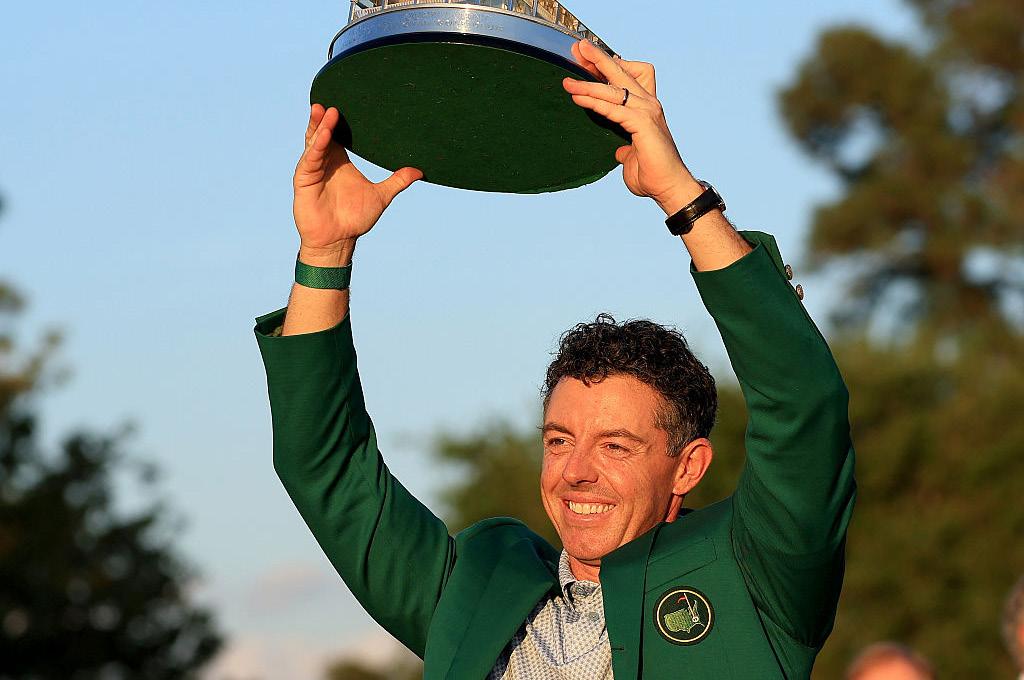
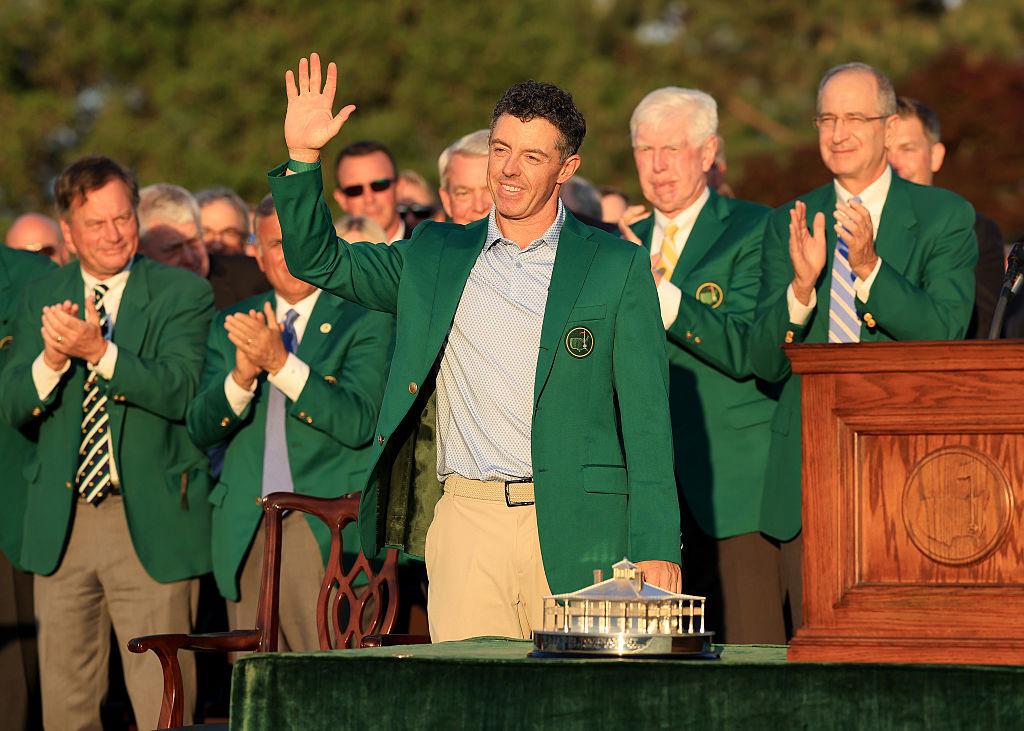
It was a rocky road to victory for Rory McIlroy in the Masters Tournament in the United States last month.
At the end of the second round he was on the open highway and cruising. He had shot a seven under par 65 and found himself with a six shot lead.
But then he took the wrong off ramp and for rounds three and four he spent most of time on a gravel road full of bumps.
He finished at one over par for round three and went into round four with a share of the lead with Cameron Young of the United States at 11 under par.
There were more rocks on the road early in round four. He three-putted the par three fourth hole and at one stage was three behind the leader.
But others were trying to navigate the same rocky road and McIlroy found himself two shots in front after birdies on holes 12 and 13.
McIlroy maintained his two-shot lead coming to the last but the traffic lights were flashing when he sliced his tee shot wide into the trees.
He hit a great second shot to finish in a large greenside bunker and got up and down for a bogey five to win the $US4.5 million first prize by one shot from Scottie Scheffler who had been bogey-free for the last two rounds.
and The Open in 2014.
McIlroy said he was not about to rest of his laurels.
“Last year, I thought winning the career grand slam was the finish line, and I was wrong ... I still have things I want to achieve.”
McIlroy is the fourth player to successfully defend the Masters title.
The previous had been Tiger Woods in 2001 and 2002 and the other two are Nick Faldo (1989-1990) and Jack Nicklaus (1965-66).
McIroy’s six major wins equals the feat of Faldo as the most wins in major championships by a European.
“I just won my sixth major and I feel like I’m in a really good spot with my game and my body. I don’t want to put a number on it ... it’s just a part of the journey.”
McIlroy was delighted to have his parents in attendance after they missed last year’s win as they were moving house.
It was the second Masters win in a row for McIlroy and he found it somewhat unbelievable after taking 17 attempts to win his first Masters Tournament at which the winner is presented with a green jacket.
“I just can’t believe I waited 17 years to get one green jacket and I get two in a row,” McIlroy said.
“I caught myself on the golf course a couple of times thinking about them ... It’s really cool to have them here,” McIlroy said.
Last year’s win completed the grand slam of men’s professional golf for McIlroy. He had previously won the United States Open in 2011, the PGA Championship in both 2012 and 2014
“I had to sort of convince them to come this year because they thought the reason I won last year was because they weren’t here. I’m glad we proved that wrong.”
Apr 9-12, 2026 | Augusta National Golf Club | Par 72 | Yardage: 7565 Augusta, Georgia | $US22,500,000







By Neville Idour
McIlroy accused of unfair advantage
In one of the more ridiculous stories to emerge at the Masters, Rory McIlroy was accused of having had an unfair advantage. American broadcaster ESPN’s First Take sport’s show host Stephen A Smith who reportedly earns up to $US40 million a year was the source of the ridiculous allegation.
Smith reasoned that McIlroy had the benefit of an “unfair advantage” because he was allowed to play the course several times in his preparation. The inference being that no one else received the same privileges. This was simply not true as virtually every player who receives an invitation to play the Masters Tournament can schedule several practice rounds in the months before the event.
In fact prior to the 2023 event McIlroy played 81 holes in the two and a half weeks preceding the Masters and then proceeded to miss the cut. That was some advantage … yeah right.
While any golfer or fan worth their salt would dismiss such nonsense from a talk show host, unfortunately many
ignorant souls might not. Smith has more than six million followers on social media platform X, therefore many followers will believe his nonsense, swallowing it as gospel and casting aspersions on McIlroy’s win.
Surely the 40 million dollar man, Smith could have made a real effort to garner some facts so he was informed on the subject before opening his mouth, thus revealing his incompetence.
American broadcaster CBS has been partnered with Augusta since 1956, therefore one would assume it’s coverage of the Masters would be without peer.
Well that could not be further from the truth. This year’s final round was the most watched since 2015, averaging almost 14 million viewers. Viewers found themselves watching key shots minutes after they had been played or, even worse, missing key shots or moments entirely.
PGA Tour winner Kevin Kisner sounded off big time on the Fore Play podcast. “The entire Masters coverage is fantasy world. It’s bullshit. I was so confused the entire time trying to keep

up. Showing stuff that I knew happened 10 minutes ago.”
Several of the most widely discussed misses came during the vital closing stretch on the 18th hole in the final round. McIlroy’s closing shot through the trees was not picked up leaving viewers wondering where the ball had donge until eventually it was found in the bunker. His final winning putt was obscured from viewers. Cameron Young’s shot was not picked up either.
Earlier in the round leading players stumbles were missed. Sam Burns double bogey plus a Justin Rose slip up were only revealed on the scores, but worst of all was completely missing Haotong Li, who was one of the leaders, scoring a stunning 10 on the 13th hole. Kisner fired off a message to the CBS anchor Colt Knost. “I’m better off following the f…..g app than your feed. Veteran host Jim Nantz defended the crew saying “We all make mistakes.”
For the first time Amazon Prime Video joined the broadcast and made for a great viewing experience. It added two extra hours of live coverage on Thursday and Friday along with interviews and an appearance from Jack Nicklaus. The Inside Amen Corner coverage featured real time shot tracing, swing
analysis and camera angles viewers had never seen before at Augusta.
There were also two on demand highlight tools Rapid Recap and Key Moments which let viewers select and rewatch specific shots. Apparently it felt like watching two completely different eras of sports broadcasting beside each other. One survey of viewers saw 41.7 per cent rate the coverage 5 out of 10, 41.1 per cent 6 out of 8 and 17.2 per cent 8 or more.
Surely the bottom line is for a television broadcast with no interruptions from commercials, plus 70 years of production expertise behind it, fans could surely expect better. On the contrary, many fans found the Masters app more reliable than their television coverage.
Robert McIntyre did his reputation no good with his behaviour at the Masters, particularly during a poor first round 80. He has been warned as a result may not receive an invite to the 2027 event. The initial incident, among several, occurred during the first round on the par five 15th hole. His approach shot just reached the
green, but rolled back into the water. He then raised his middle finger towards the hazard. He took a penalty drop and found the drink again, eventually carding a disastrous quadruple bogey nine.
Television coverage also picked up a series of expletives in the closing holes as his frustration mounted. Also he was heard swearing on the 12th and 13th, and slammed his club into the ground on the 17th.
He would have a better second round 71 but still missed the cut and endeared himself to no one by ignoring media and declining interview requests for the second time. He was spoken to privately by officials and reminded of the club’s conduct expectations. There have been no reports of suspension or fines.
MacIntyre’s response was puzzling to say the least, even if questionably humorous. He posted an artificial intelligence generated image of himself on Instagram styled as one of Augusta’s iconic garden gnomes with its middle finger raised. He clearly wasn’t going to go quietly.
Renowned former agent for Rory McIlroy, Chubby Chandler pulled no punches. “He’s just got to stop that. It’s ugly. He could have his invitation for next year voided. They’ve done it before. It’s immature from Bob. His game is brilliant. He can win a major. He just has to mature.”
Enough said.
Patrons stripped of their badges
Some patrons with resale tickets were stripped of their resold badges after being stopped on arrival for questioning. If their weekly badge scanned abnormally, they were held back and taken to a different building to submit their badges and proof of identification.
They were asked how they acquired the tickets and how long they had held the passes. If the officials were satisfied with the responses they were allowed to watch the golf. If not, they were escorted out.
A couple of them had their badges revoked and a life time ban imposed as well. One veteran who had been attend-
ing for many years was stopped at the gate this time. After the checks he was told that the badge he had been using, which he had received as a gift, was one from resale which had been purchased from online marketplace eBay. Augusta tracked it and blacklisted it.
Patrons were unhappy with the delays. The interrogations took about 10 minutes but the wait in queues was almost an hour for any patrons having to go through the process. Every ticket contains radio frequency identification technology which allows Augusta to track the location of the ticket. Also to scan it and allow entry without delay for most patrons. Purchasing one on a secondary market place risks a life ban without right of appeal.
The lesson is clear. Augusta is the only authorised seller of Masters tickets. So don’t purchase tickets and then try to resell them.
Bernhard Langer knew his time was up
Bernhard Langer’s name was missing from the 2026 Master’s field. He knew the day would come when the Masters would become ancient history for him … and so he decided the 2025 edition was his last. Langer had graced the fairways of Augusta for four decades, winning twice.
His farewell on the 18th green was emotional after a 44 year legacy and 37 Masters appearances. It was special as he sported an outfit similar to what he did during his 1985 win. The 68-year-old may have been unsure about his decision but the previous four consecutive missed cuts cleared any doubts. He realised walking 18 holes was now a bridge too far, especially competing against players half his age.
As Langer said: “I didn’t want to make a fool of myself. The course is just getting too long and I’m getting shorter and shorter. I’m hitting hybrids where the kids are hitting nine irons and eight irons, maybe even wedges, so I knew I wasn’t going to be contending any more.”
With his family and friends following with him to the final hole it was an emo-

tional walk on to the green. After his final putt sank he removed his visor to a standing ovation. He had only missed the cut by one shot, in the process having finished ahead of Brooks Koepka, Phil Mickelson, Adam Scott and Tony Finau.
Langer’s decision to end his Masters career is a pungent reminder to be graceful in the face of time and know when to say goodbye.
Rory McIlroy had a huge lead after two rounds and looked unbeatable but forward 24 hours and he looked anything but after a third round error strewn 73 which threw away his six shot lead.
So with the last spectators heading out the gates a lone figure could be seen at the end of the driving range under floodlights whacking balls, looking for answers to what had caused his lead to vanish. After all, the course had been at it’s receptive best and his chasers were reaping the rewards.
McIlroy cut a frustrated tired figure after skipping the customary leader’s press conference. Instead he said: “I didn’t quite have it. I wish I had a little more of a cushion, but I’m going to go to the range now to try to figure it out.”
Thankfully he did and duly completed his second Masters win.
The 365-acre property purchased for $US70,000 was called Fruitland Nurseries and was once an Indigo plantation. The trees on Magnolia Lane were planted in the 1850s. It was a dirt path until paved in 1947. Co-founder Bobby Jones suggested the name Augusta National. Alister MacKenzie was the architect and the course opened in 1932. The par three course opened in 1958.
There are underground tunnels at Augusta. There is no rough, just a second cut kept at 1-3/8 inches. Amen Corner was named in 1958, from the title of a jazz record called“Shouting in that Amen Corner. If it’s raining you can’t spot muddy patches watching on television because
the green gravel on the walkways almost perfectly matches the colour of the grass. The clubhouse is the home of the Crows Nest, a dorm style accommodation on the third floor, where amateurs in the Masters field stay. The famous white sand bunkers on the course are that colour because they contain granulated quartz, not sand. Augusta shuts after The Masters and reopens in the northern hemisphere autumn. The course record of 63 is held by Nick Price and Greg Norman.
McIlroy is a major frontrunner McIlroy is building a reputation for winning from the front, not from behind. He has led going in to the final round at eight major championships and won five of them. But he has never come from behind after three rounds. Here is the story. At the 2011 Masters he collapsed after a third round lead, scoring 80 and finishing tied 15th. In the same year at the US Open he did the opposite shooting 69 to win by eight shots.
Roll on to the 2012 PGA Championship where he shot a brilliant 66 and again won by eight shots. Next in 2014 at The Open Championship a final round 71 was good enough to give him a two stroke margin for victory. On to the 2014 PGA Championship where he would shoot 71 and win by two strokes. There was an eight-year hiatus until the next lead at The Open Championship when a 70 wasn’t good enough and he finished in third place two strokes behind the winner.
Three years later in 2025 he won the Masters after leading Bryson DeChambeau by two shots going into the final round. His lead was gone after two holes and a roller coaster final round led to a playoff against Ryder Cup teammate Justin Rose. McIlroy birdied the first extra hole for his emotional grand slam victory.
So it came down to this year and another roller coaster as he built a seemingly winning six shot lead after 36 holes before he came back to the field with a 73 and went into the final round tied with Cameron Young. The rest is history as he made it two in a row.
Roll on 2027.

caught up with New Zealand’s leading professional golfer Ryan Fox who talks about his love for Auckland and his top six courses which make it a great golf destination. These are are Fox’s words.
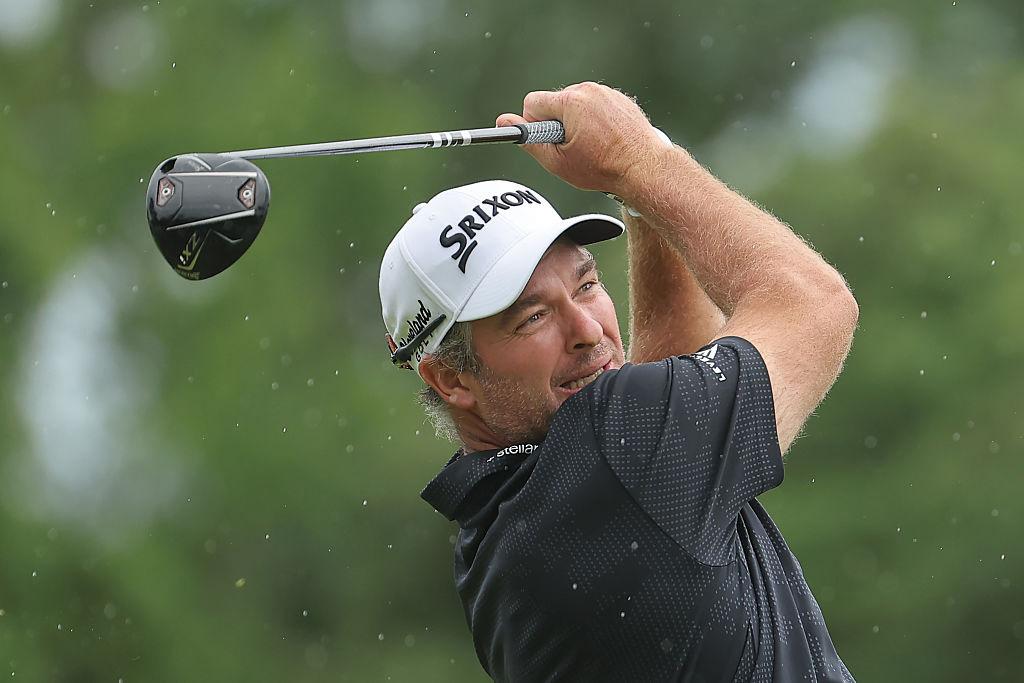
I’ve been lucky enough to see a lot of the world through golf, but no matter where I am, there’s one thing I always miss: being close to the ocean. Water has always been my happy place. It calms me, centres me and reminds me where I’m from. That’s why Auckland will always feel like home.
What I love about Auckland is that the sea is never far away. It doesn’t matter whether you’re on the North Shore, out east or down south, the water is always there. For a big city, it’s pretty chilled out and easy to live in, and that suits me perfectly. I love boating, I’m obsessed with fishing and having the Hauraki Gulf right on our doorstep is pretty hard to beat.
I grew up in Beachlands in east Auckland and my parents still live in our family home of more than 30 years. When I go back there, I can still hear the banter and laughter of family and friends echoing through the place.
Sport was my life growing up. We had a huge backyard and it felt like everything happened there. Endless games of cricket, golf balls being chipped around – and plenty of windows get-
ting smashed in the process – and rugby kicks between two trees that acted as goalposts. I still remember my grandad bowling a ball to me when I was five years old. Those moments stay with you.
There was a lot of freedom as a kid. Riding bikes around the neighbourhood with my mates, hanging out at the local beach, fishing off the rocks. I’m doing those same things now with my daughter, which is pretty special. It feels like things have come full circle.
Sport runs deep in our family. Mum was a natural tennis player, my sister was handy at netball, dad – Grant – was an All Black and my maternal grandad Merv Wallace captained New Zealand in cricket. To be the third generation to represent New Zealand, across three different sports, is something I’m incredibly proud of. But there was never any pressure. I was just encouraged to enjoy it.
Cricket and rugby were my main sports growing up and I was fiercely competitive from a young age – I definitely get that from dad. I played first five-eighth, kicked goals, and heard my
fair share of “let’s smash Foxy’s son” on the rugby field. That was all part of it.
Golf slowly became more serious, but it was always fun first. Some of my earliest memories are of making up holes in the backyard, cutting tin cans into the ground and shaping shots around imaginary trees. That creativity is what hooked me.
The first tournament I thought I might be good enough to at least try to turn pro was the North Island Amateur at Whakatane Golf Club in 2008. I finished second behind Danny Lee and played some really good stuff all week. I didn’t turn pro for another four years basically but that was the start of it being more serious for me. I made the New Zealand Golf academy soon after that event.
School was a big part of my Auckland story too. I went to St Kentigern College, where I made friends for life, then spent sixth form at King’s College. Any free moment I had, I was sneaking across the fence to Royal Auckland Golf Club. I may have done that during school hours once or twice. That place played a massive role in my development and it still does today.
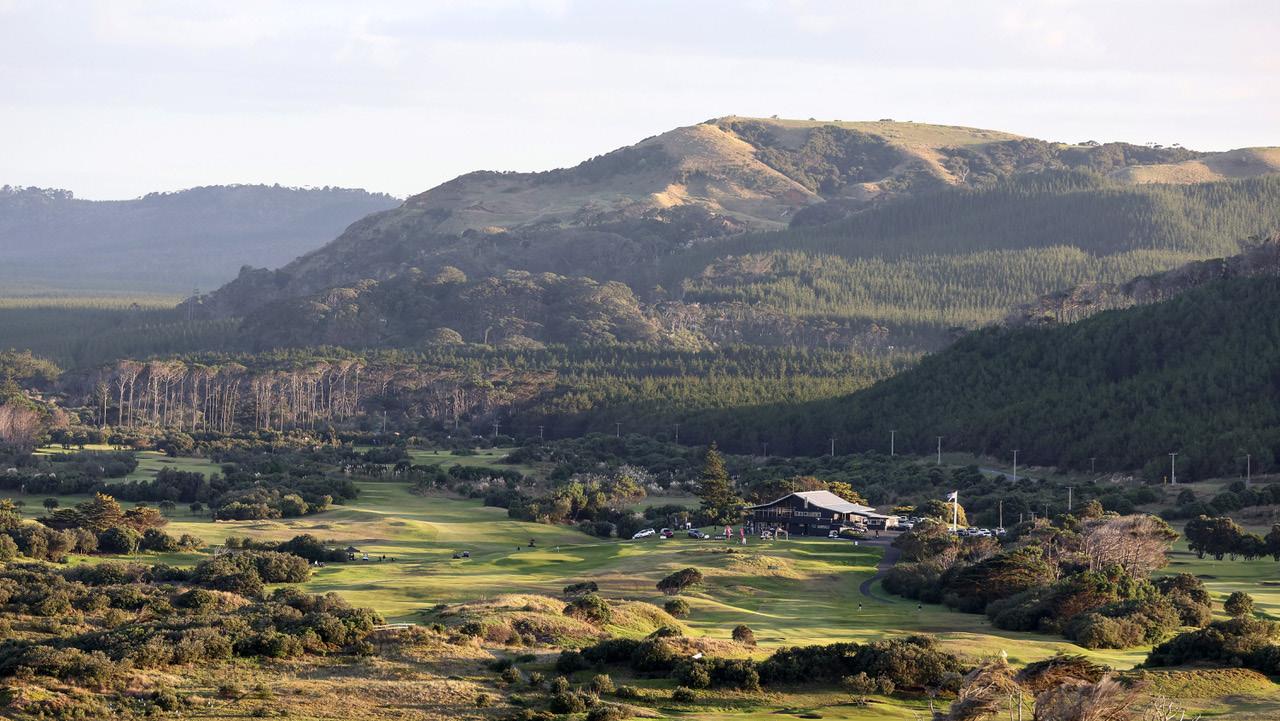
Auckland is also a brilliant golf city. We’re spoiled for choice. There’s a real variety – links golf, parkland, resort-style courses, and plenty of strong club tracks. If you’re coming here for a golf trip, you’re in for a treat.
If I had to narrow it down to my top five clubs in the greater Auckland region, I’ll admit I’m cheating slightly by naming six courses.
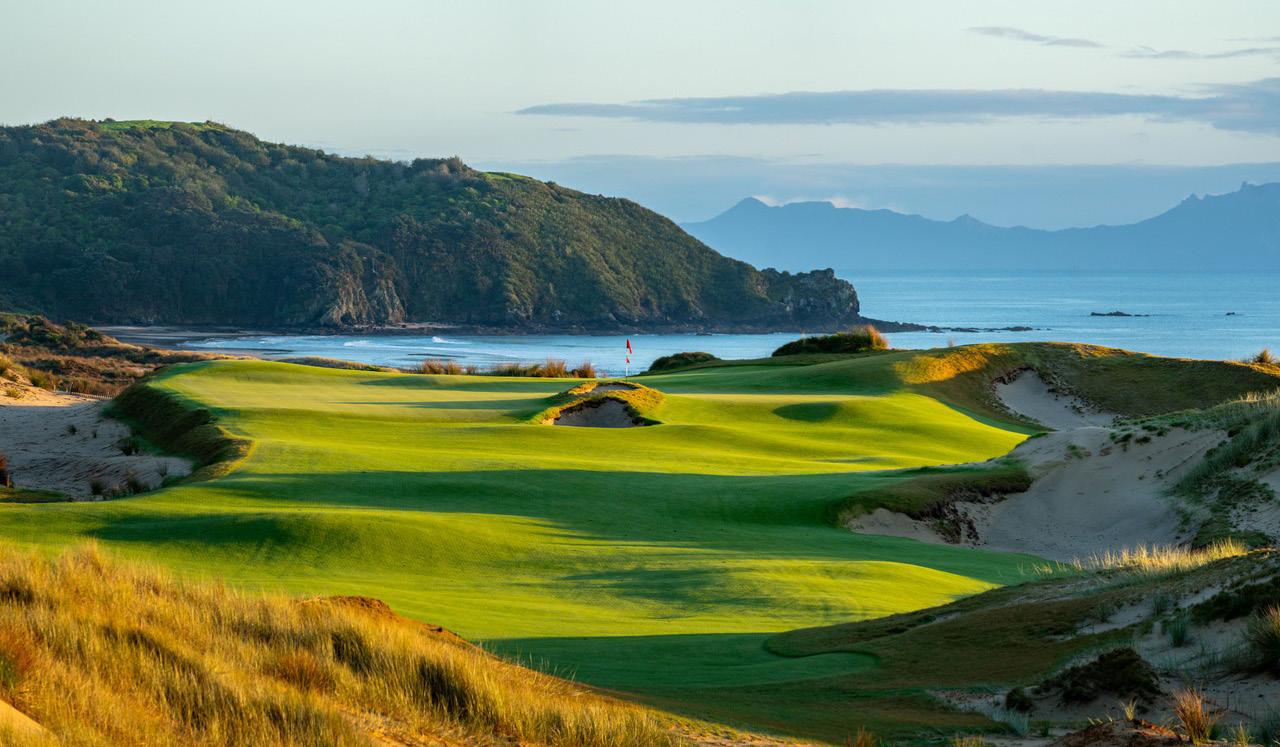
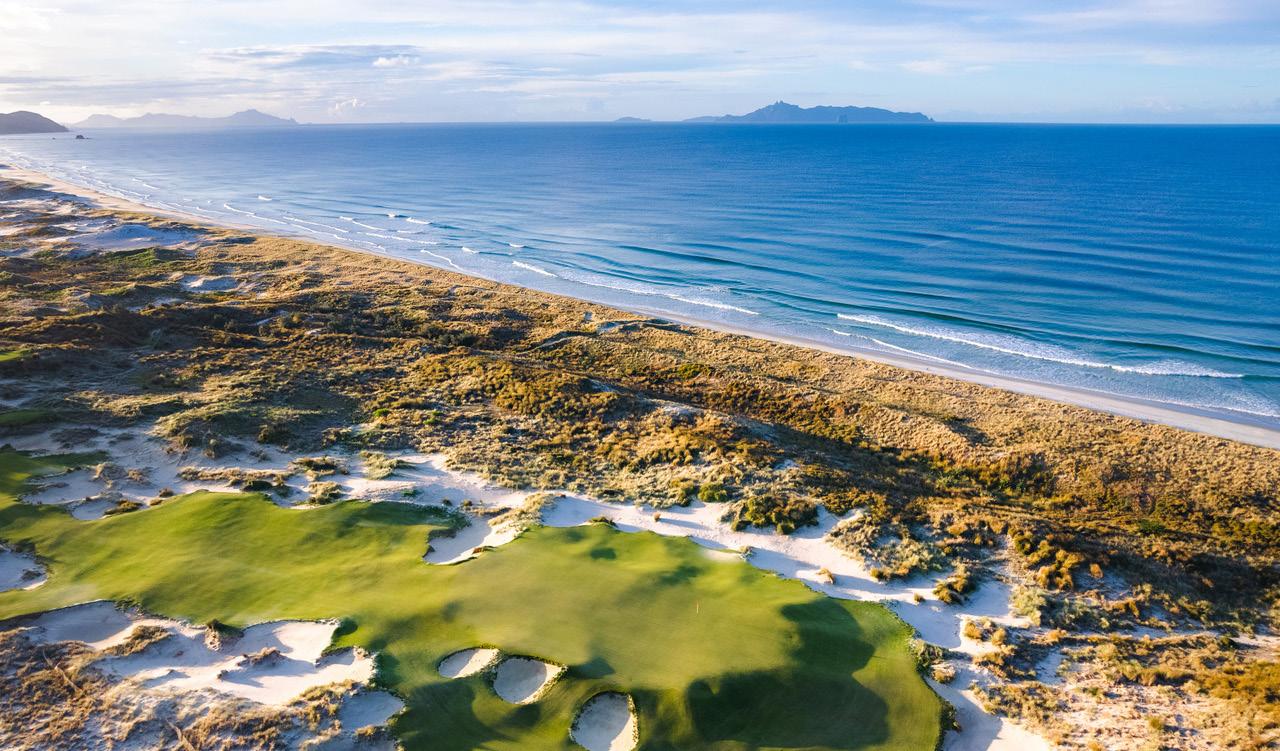
Te Arai Links is impossible to leave out. As a facility, it’s world class – accommodation, food, staff and two incredible courses. The South course is visually spectacular and a little more forgiving, with standout holes like 4, 5, 14 and 17. Holes 5 and 17 are spectacular par threes and 14 is one of the best short par fours I’ve ever played and hole No 4 has some of the best views anywhere. The North course asks more questions of your game, especially around the greens and re-
wards imagination. Holes like 1, 2, 13 and 18 are unforgettable. Hole 13 is a great downhill par three, it has lots of slopes around the green which can bank the ball back to the hole but if you miss them, you are in a bad way. No 18 off the back tees is a tough tee shot and can be a daunting second shot with a long iron too. It’s a cool finishing hole. I’m very lucky to represent Te Arai around the world and it’s always something I’m proud to talk about.
Tara Iti is my favourite place to play in New Zealand and easily one of my top courses anywhere in the world. What Ric Kayne has created there –and then followed up with Te Arai – has put New Zealand firmly on the global golf map. When you have someone like Rory McIlroy going out of his way to come and play it, that says everything. Its reputation is enormous and deservedly so. We are exceptionally lucky to have Tara Iti in New Zealand and it is easily in my top five courses in the world.
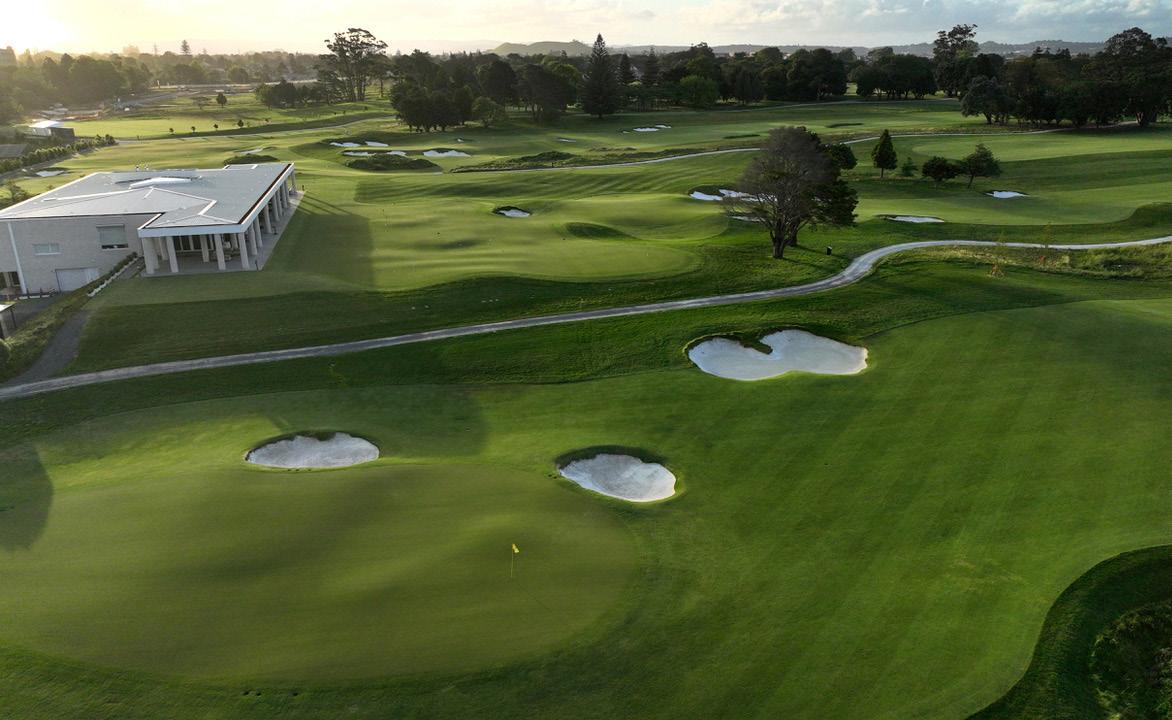
Royal Auckland and the Grange has been my golfing home for more than 20 years. I grew up there, practised there and competed day in, day out with a group of mates who all wanted to turn pro. That environment shaped me as a golfer. The amalgamation and redesign by Chris Cochran have turned it into a true championship test. Now I spend most of my practice time at home out there with my coach Marcus Wheelhouse, so it’s still a big part of my life. Grange No 4 is my favourite par three out there. Short but plenty of trouble and very hard to pick a club when the winds blowing. Hole 7 on Tamaki is a really strong par four, lots of options off the tee and a very precise second shot required. I have to pick No 5 Middlemore from a nostalgia perspective. One of the few holes that has its original routing and a beastly 450 metre par four. A clever redesign of the fairway has made it slightly fairer off the tee and precise second shot is required.
Titirangi holds a special place as
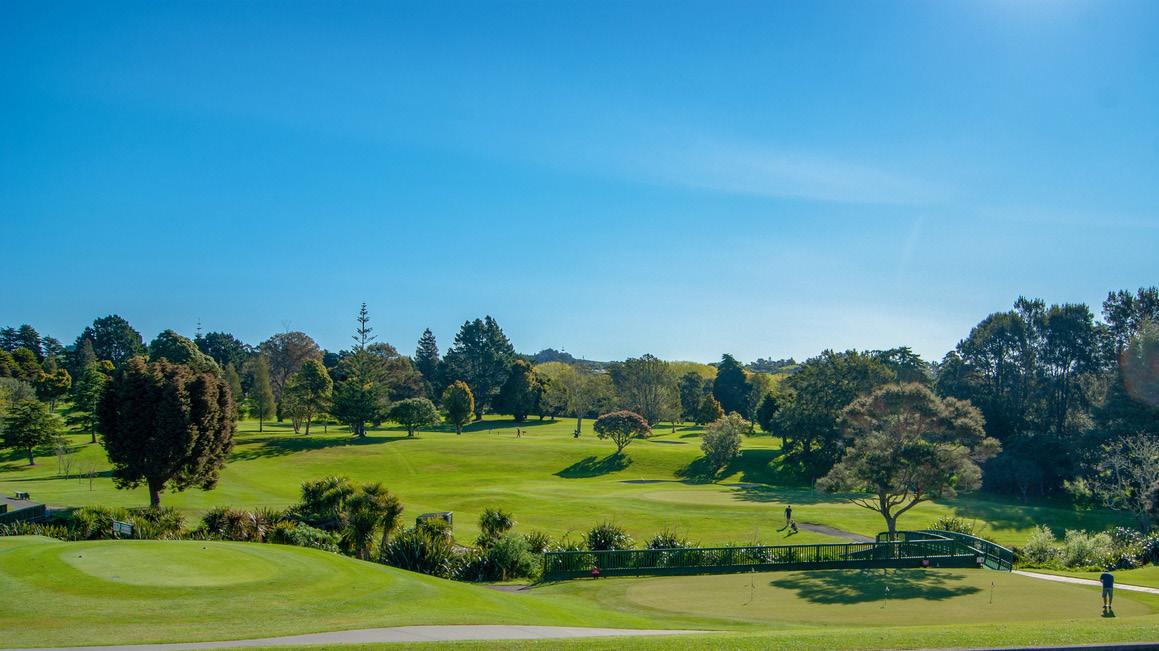
New Zealand’s only Alister MacKenzie-designed course. You can’t overpower it – it demands precision, thought and creativity. The greens are small and full of movement and the par threes are outstanding. It’s a course that has stood the test of time and still challenges the best players. My favourite holes at Titirangi are 8, 12, 13 and 14 – they ask a lot of questions of your golf game. Mackenzie is the perhaps the most iconic designer in the history of golf. And to have a course in New Zealand designed by him is very special. Finally, Muriwai represents every-
thing I love about links golf. Set on the rugged west coast, it can be friendly or brutal depending on the wind. When the south-westerly blows, you’re in for a proper test. Holes like 8, 14 and 17 are brilliant, and on a calm day it’s as enjoyable a round as you’ll find. Hole 8 is a par three playing directly into the prevailing sou’wester. I’ve hit anything from lob wedge to two iron in there. Hole 14 is a great risk and reward par five. Lay it back for a semi blind second shot with a long iron or take the tee shot on and have a short club in but if you miss your

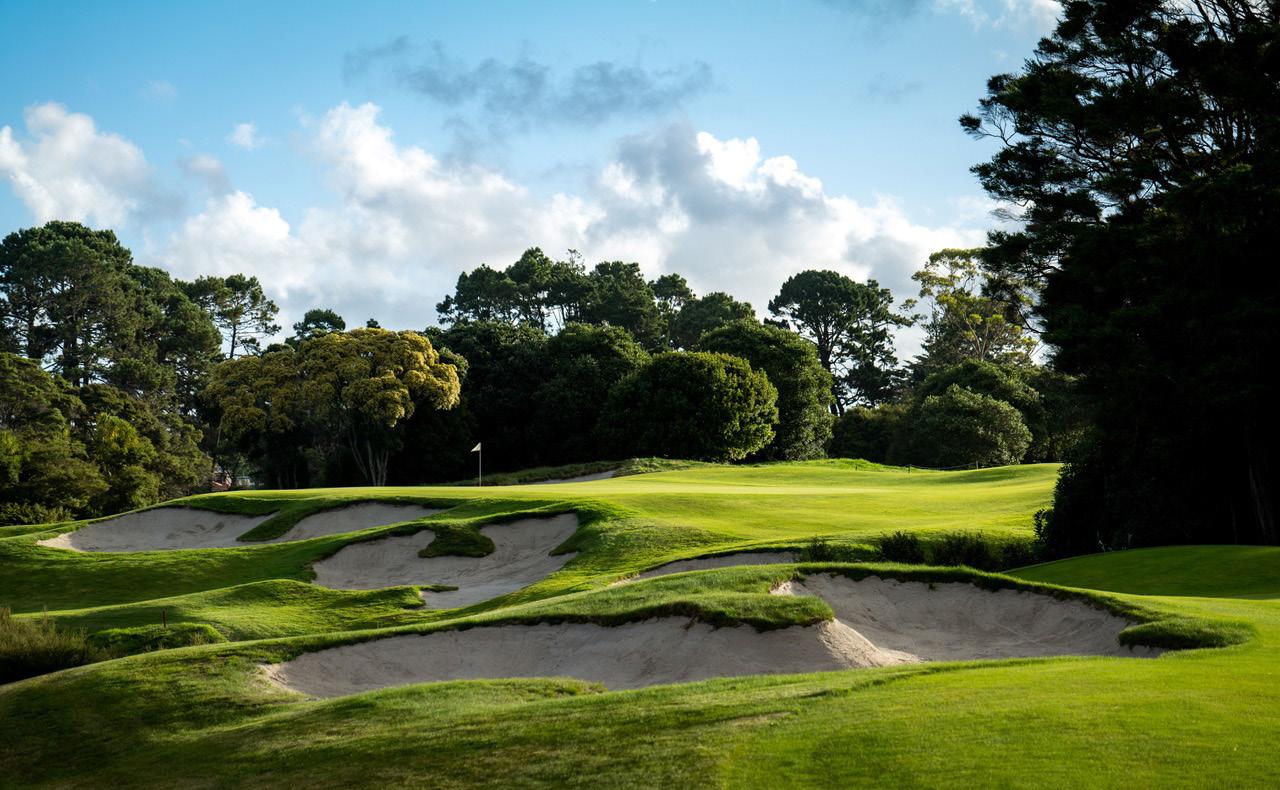
tee shot be prepared to reload. Hole 17 is a great little par three on top of a hill and requires some great ball control in the wind.
I also have a real soft spot for Whitford Park, where I was first a member. It’s where I spent countless school holiday days playing 36 holes with my mates, looking for lost balls and probably annoying a few members along the way. It’s a great club course; they could always get the greens running really well too. Plenty of tough tee shots around there and with the introduction of couch grass fairways the course became
really playable all year round. My favourite holes are 2, 10 – a couple of strong par fours where a great drive was needed –and 17 is a very solid par three.
Whether it’s golf, family, or just being close to the water, Auckland has given me everything. And when we escape north to our bach in the Bay of Islands, arriving at Parekura Bay and seeing the coast near Cape Brett, it just reinforces it.
In those moments, I’m reminded there really is no place like New Zealand. I feel incredibly fortunate to call this country –and this city – home.

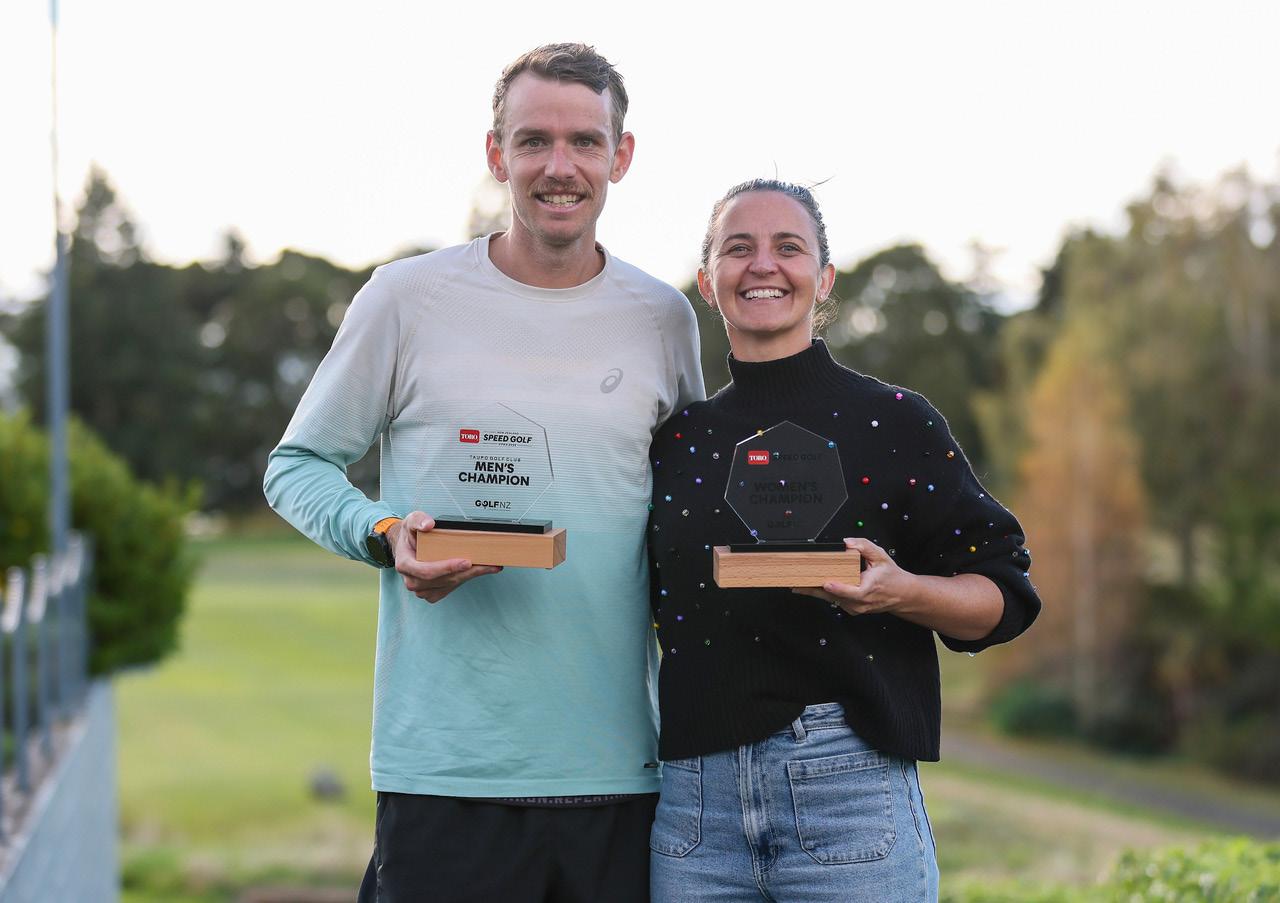
Amy Linton defended her women’s title and Jamie Reid claimed his seventh men’s championship at the New Zealand Speedgolf Open in testing conditions at Taupo Golf Club last month.
With rain and wind providing as stern of a challenge as fitness levels and stroke-making, the pair rose above a talented field to take the national titles of the tournament sponsored by Toro, an outdoor maintenance, construction and irrigation equipment provider.
With defending men’s champion Harry Bateman off early in order to make a tee time at Wairakei for a Cisco Series ProAm, Reid had a target to beat and he worked his way around the Centennial course at a blistering pace.
Reid’s scores of 114.51 (78 + 36.51) and 116.05 (78 + 38.05) saw him fend off the competition with a total of 230.56 points and return to the winner’s circle after missing last year’s open due to injury. His final round running time reflected his knowledge that keeping the ball in play would be his key to victory.
Reid said to win his seventh title after such a long time away from national competition meant a lot and to add to his record at the event was special.
“It’s been a long time coming. The last Toro I played, I think, when I was injury free was 2024.
“I think I came third in my first event of New Zealand champs and then now I’ve won the last seven. So yeah, something’s in the water about New Zealand champs and it means
a lot to me.”
It was a unique experience to begin a final round with a target in mind, as usually competitors are out on the course concurrently and unable to gauge how the rest of the field is going — Reid said it made his decision making easier to handle.
“If I can break 80, that sort of did give me a little bit of leeway along the way. Coming down the last few holes I could sort of chill out, enjoy it, which was nice.
“You don’t have any scores in your mind because everyone’s out there at the same time. Once you finish, you just go, well, what did you have?’
There’s no leaderboards along the way.”
With the depth of talent in the field, Reid said he knew he had to make sure the tournament was decided on his terms.
“Robin [Smith] shot eight under (par) in the last event to overtake me and Brad (Hayward), he could shoot under par easy. I still had to make sure I took care of those two as well.”
Harry Bateman finished second in the men’s field with a 36-hole total of 232.21, just edging Hayward in third at 236.13. Smith was fourth with 236.41 — separated from Hayward by less than half a point
— while Ben Taylor rounded out the top five with a total of 248.00.
Linton’s path to the title was cleared somewhat by the absence of reigning individual World Champion and her pairs World Champion partner Liz McKinnon, who pulled out of the tournament due to illness.
But Linton showed no sign of letting any sense of complacency into her game as she blew the field away to win a second successive national title.
Scores of 132.57 (80 + 52.57) and 122.57 (71 + 51.57) left a 255.07 total and her second round of two under par while a full minute off her run was
an impressive feat for those following in carts to witness first hand.
Linton said to win back-toback national titles was pleasing, but her final round of two under par 71 to seal the championship was satisfying personally.
“Feels pretty good actually. Pretty relieved. Very pleased that I played some better golf today, so I feel like I’ve earned it,’’ Linton said.
“Today all I thought was; take a breath, one good swing, take a breath, one good swing. And it just seemed to work throughout the whole round, so just kept with that thought process.
“Yesterday was a fight. It was just getting the ball in the hole.”
Unlike the men’s field, Linton had to push all the way without a target to beat but could afford to take more time over her shots.
“I didn’t actually know how far under I was until I finished. But I knew I was playing well ... I had a few shots at my sleeve coming into round two, so I could just take a little bit more time over my shots.”
Lucinda Searle claimed the runner-up spot with a 36-hole speedgolf total of 281.26, finishing ahead of Colette Blacklock, who posted 295.12 in third. Rebecca Mehew was fourth with a total of 322.12, while Felicity Paterson finished fifth at 339.09.
New Zealand Speedgolf now turns to the World Championships at Whitford Park in Auckland in November, with Aotearoa’s athletes primed to take on the globe.

New Zealand has completed a clean sweep of all three trophies at the 2026 Australian Junior Interstate Teams’ tournament at Moonah Links on the Mornington Peninsula, near Melbourne.
In New Zealand’s first appearance at the event in 28 years, the Kiwis went undefeated across all seven rounds, se-
curing the overall and boys’ titles with a round to spare, before the girls edged Victoria 2.5-1.5 to claim the girls’ championship despite a four all draw in the overall team’s match.
It marks the fifth-time New Zealand has raised the boys’ trophy, with the Kiwi’s adding the 2026 title to previous wins in 1981, 1989, 1990 and 1992 during

their stint between 1975 and 1997.
“It’s pretty cool to come over here and win all three,” said Cooper Moore, one of New Zealand’s leading amateurs.
“It’s cool to know that we’ve won four times and to follow on the legacy and history that New Zealand’s had in the Interstate.
“Hopefully from this opportunity, it can grow into bigger things between Golf New Zealand and Golf Australia.”
It’s the first time the Kiwis have featured in the girl’s event, which dates back to 1977, lifting the trophy on debut, while the eight-player team secured the overall title in the fifth edition of the combined event.
Teresa Wang remained undefeated with five wins and a draw, with her most important victory coming against Victoria’s Amelia Harris in the final round to help seal the girl’s trophy.
It was a timely rematch after Wang had led last week’s Australian Junior Amateur by four shots heading into the final round, before Harris overtook her to claim the title.
Said Wang: “I’m very happy and I’m really proud of all our teammates.
“I was pretty nervous this morning because of what happened last week, but it feels good to get the win this time.
“It’s a very fun and really good learning experience watching other people from the different states in Australia play.”
New Zealand’s inclusion has lifted the standard of junior team matchplay, with it’s strong development programme providing high level opposition, raising standards for Australian players and offering earlier exposure to international competition.
In the final round, Victoria posed New Zealand’s toughest challenge, handing it their first draw of the week to finish runner-up, while Western Australia’s 6.51.5 win over South Australia saw them finish third on countback of individual matches after finishing level on points with Victoria.
New South Wales and Queensland battled for fourth, with New South Wales edging the contest 5.5-2.5, while Queensland finished fifth in their title defence.
Tasmania’s 4-0 win over Australian Capital Territory/Northern Territory saw them move ahead of South Australia into sixth on countback after both finished level on two team points.
Three Kiwis went through undefeated, with Wang and Amy Tang winning five and halving one, while Ricky Kang extraordinarily won all seven matches without a rest.

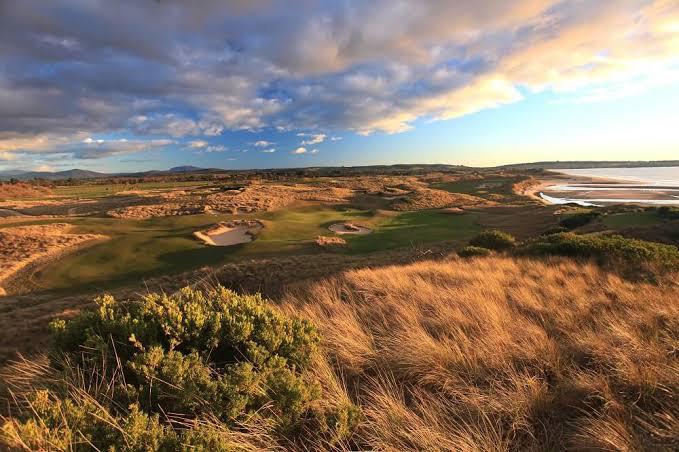
While playing golf in Dunedin, the “Edinburgh of the South”, you really must ‘tee-it- up’ on a Scottish-style links course. Dunedin Golf Club is currently listed in the 10% ‘true links’ golf course in the world and it’s all right here in Dunedin! With stunning beauty and ocean views, the course plays to a Par 71, measuring 5700 metres (6300yds). Ranked #1 in Dunedin, #23 in New Zealand by www.golfrankings.co.nz Golfrankings.co.nz is New Zealand’s leading ranking of golf courses throughout the country with 50 golf professional and golf industry personnel involved in the ranking process. Come and see why Dunedin Golf Club is Dunedin’s best golf experience!
If you’d told me a couple of years ago that I’d be sitting behind a microphone talking about golf instead of grinding away at it, I’d have laughed you off the course.
After more than three decades in the industry – teaching, managing and hosting players from around the world – I thought I’d seen every angle the game had to offer. But turning the age of 50 changed something.
I didn’t fall out of love with golf, but the relationship changed. When you’ve spent years making sure everyone else has a great day on the course, sometimes the joy you once felt quietly slips away. Last year I played one single round, and while it was alongside Ian Baker-Finch – a dream pairing – I spent more time worrying about looking like a Muppet than enjoying the walk.
Meanwhile, everyone around me was still laughing, playing and caring deeply about the game I used to play from sunup to sundown. That’s when I realised: it was time to reconnect.
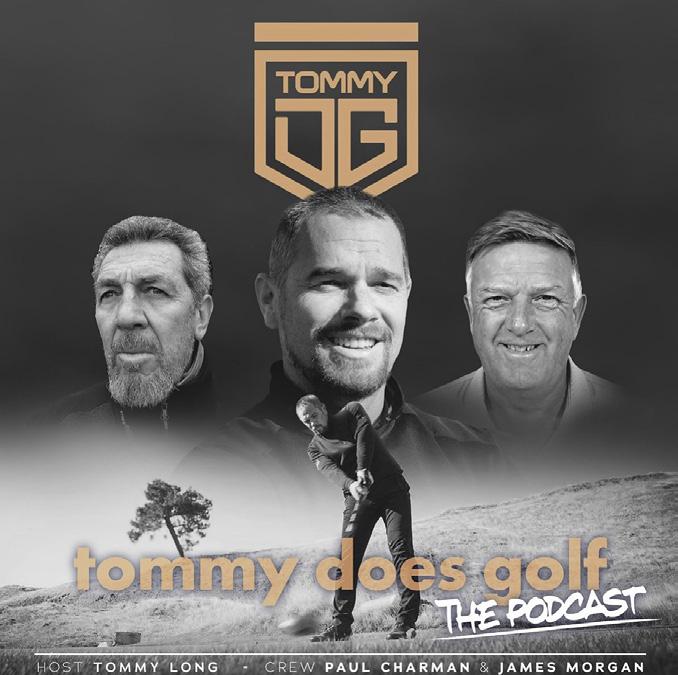
Time to have some fun again. That’s how Tommy Does Golf was born.
I’ve always loved golf’s stories – the characters, the travel, the madness. I’d written a bit, presented a bit, offered the odd tip. But podcasting? YouTube? Social content? That always felt like the domain of 20-year-olds on energy drinks.
Then one day I asked myself: Why not me? If I was going to do it, I didn’t want to mimic the endless stream of golf creators already out there.
I deliberately avoided consuming too much of what existed because I wanted our take to feel natural and unfiltered. If you and I both went to Auckland with a camera, our photos would come out differently – perspective is everything. I wanted that same authenticity to define Tommy Does Golf.
I knew immediately who I wanted beside me.
- Paul Charman, who gave me my first golf lesson 37 years ago and later became my golf operations manager at The Kinloch Club
- James Morgan, another British pro I’ve known for over two decades now based in Taupō.
Between us, we’ve chalked up more than a century of golf experience — which makes us sound ancient, but also means the stories never end. Such as: Paul giving Seve Ballesteros a lesson in Dubai. Jame’s playing golf in his younger days with Laura Davies and Colin Montgomerie and me having had so many adventures playing and working in the game around the world.
The stuff you forget until someone sparks a memory — and suddenly three old mates are laughing like juniors again.
That chemistry is the heart of the show. It’s not polished, scripted or

overly edited. Heavy editing kills the soul of a conversation. What you hear is essentially what happened, just trimmed enough to spare you the ums, barking dogs and background noise.
One of the biggest choices I made early was this: don’t binge other golf podcasts or YouTube channels.
Not because they aren’t good – plenty are – but because I didn’t want their rhythm, style or opinions seeping into ours. Fresh eyes make for fresh content. That thinking shaped everything from our 2025 season predictions to Ryder Cup chats, “hidden gem” course debates and a multitude of random stories from decades in the game.
The feedback thus far has surprised us. People enjoy the banter, the disagreements, the easy vibe. A few friends in broadcasting even said they appreciate our “harmony” – a generous word for three middle-aged blokes, but I’ll take it.
The podcast is only the beginning. The real magic, I think, happens on the course.
New Zealand is loaded with world class golf courses — but also with many small, “rough around the edges” gems that most golfers have never heard of.
Despite living here 21 years, I’ve never been to Queenstown. Shameful, yes. But maybe useful. Seeing New Zealand golf through fresh eyes is part of the charm.
The plan is simple. With the crew and occasionally without them, I plan to get out there and create some YouTube content filmed from a fresh perspective. Not to “review” in a traditional sense, but to wander, laugh, hit some outrageous shots, and show off the beauty and character of New Zealand’s golf scene.
And selfishly, it gives me a reason
to pick up the clubs again without the pressure of trying to perform at the level I once possessed. This is golf with freedom. Golf with mates. Golf rediscovered.
Through all the change, one thing has stayed steady: Kinloch.
This is my 20th year here. When I arrived, it was just sculpted dirt. Now it’s one of Jack Nicklaus’ most distinctive designs anywhere in the world. My daughters grew up here. My friendships grew here. And hosting guests from every corner of the globe – Portugal to North America to Dubai – has reminded me daily that golf is one big family, usually separated by just a couple of degrees.
The podcast has become another way to celebrate that. To connect with people, I’d never meet otherwise. To share the joy that first brought me into the game — before the job, before the responsibilities, before the long days where my wife jokes, I need a pedometer for my mouth more than for my feet.
I’m not doing Tommy Does Golf to build a media empire. I’m doing it because it’s fun. Because it’s reconnecting me to the game. Because mates kept telling me, “Tom, you’ve got too many stories not to share them.”
If it leads somewhere, brilliant. If not, that’s fine too. For now, we’ll keep recording. Keep laughing. Keep exploring. Keep telling stories from a lifetime in golf – the glorious, the ridiculous, the heartfelt, and everything in between. And if you’re listening or watching here or from afar — thank you. It means more than you know.
Listen to ‘Tommy Does Golf’ here: Spotify, Apple play etc and check out their website for links to content https://tommydoesgolf.com/


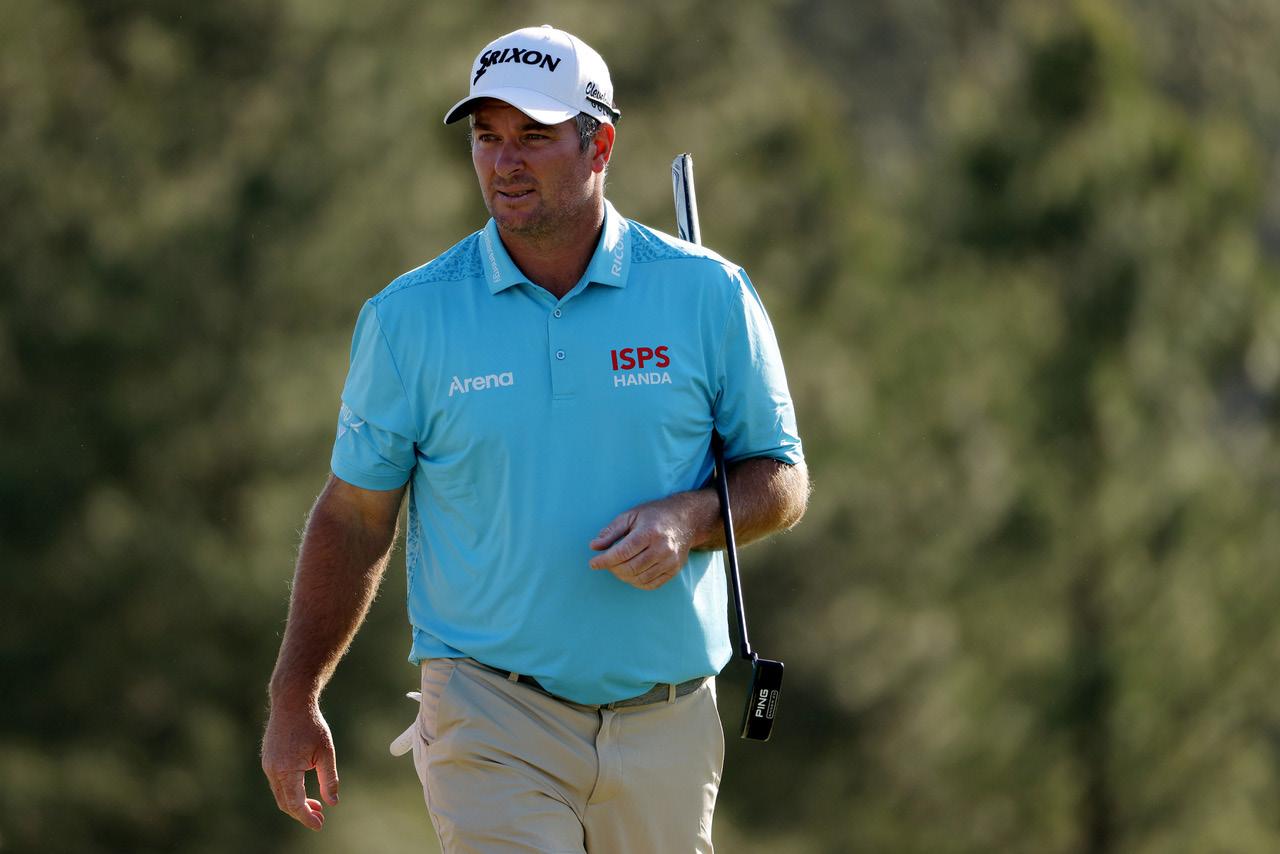
Ryan Fox is putting his golf clubs to work for the climate.
Foxy’s model is simple. A clean scorecard funds real-world climate action. The Kiwi pro, son of All Black legend Grant Fox and a regular on the PGA Tour and DP World Tour, has pledged $1,000 for every bogey free
round he plays this year.
“As athletes, we have a pretty big carbon footprint with all the travel we have to do,” says the two-time PGA Tour winner.
“Instead of ignoring it, I believe that taking action and mitigating at least some of the impact we have is im-

portant, and (climate fund) Sport One, Carbon Zero is a really effective way to do that.”
The 39-year-old from Auckland says the performance-based pledge is a nice fit with golf.
“Bogey free rounds on tour are an accomplishment, and it’s a little bit of incentive for me that they mean more and create an impact off the course.”
The pledge sits inside Sport One, Carbon Zero (SOCZ), a climate movement backed by more than 100 Olympians, Paralympians and sport professionals. Alongside Fox are fellow Kiwi Olympic gold medallist Hamish Kerr and Wimbledon quarter-finalist Lulu Sun, plus global names including basketball icon Pau Gasol, sailor Hannah Mills and canoe slalom great Jessica Fox.
SOCZ is powered by High Impact Athletes, the athlete-led charity founded by Kiwi Olympians Marcus Daniell and Hugo Inglis. The fund targets sport’s biggest emissions drivers: aviation, maritime shipping, stadium infrastructure and energy. Rather than offsetting past emissions, it funds the policy work and technology breakthroughs needed to decarbonise the future of sport.
A total of 100 percent of athlete and
supporter contributions are routed to four organisations independently vetted by Giving Green: Opportunity Green (aviation and shipping policy), Clean Air Task Force (zero-carbon fuels and grid innovation), Future Cleantech Architects (low-carbon cement and steel for stadiums), and Project InnerSpace (next-generation geothermal).
Research shows athletes often stay silent on climate issues for fear of being called hypocrites. Through Foxy One, Carbon Zero, Fox is pioneering evidence-based climate leadership in sport.
So, what is his advice for anyone who wants to support the campaign.
“Any little amount matters, so just checking out what we are doing with Sport One, Carbon Zero and donating to the cause would be great. Obviously, the gold standard would be matching my bogey-free rounds with a donation too.
“Every $10 we give is the equivalent of planting 97 trees, so the impact we can make is pretty cool.”
Back Foxy’s climate play: pledge a few bucks per bogey-free round, or chip in a one-off donation at socz.team/foxy.
When he was three years old, Guy Harrison had a seizure lying on his couch at home. He was lucky to survive and was diagnosed with cerebral palsy. In his recovery, Harrison was encouraged to pursue low-impact sports like golf and swimming to regain his mobility. Almost 20 years later, the Hawke’s Bay local won the New Zealand All Abilities Golf Championship at Windross Farm at Ardmore in Auckland in March. He tells his story.
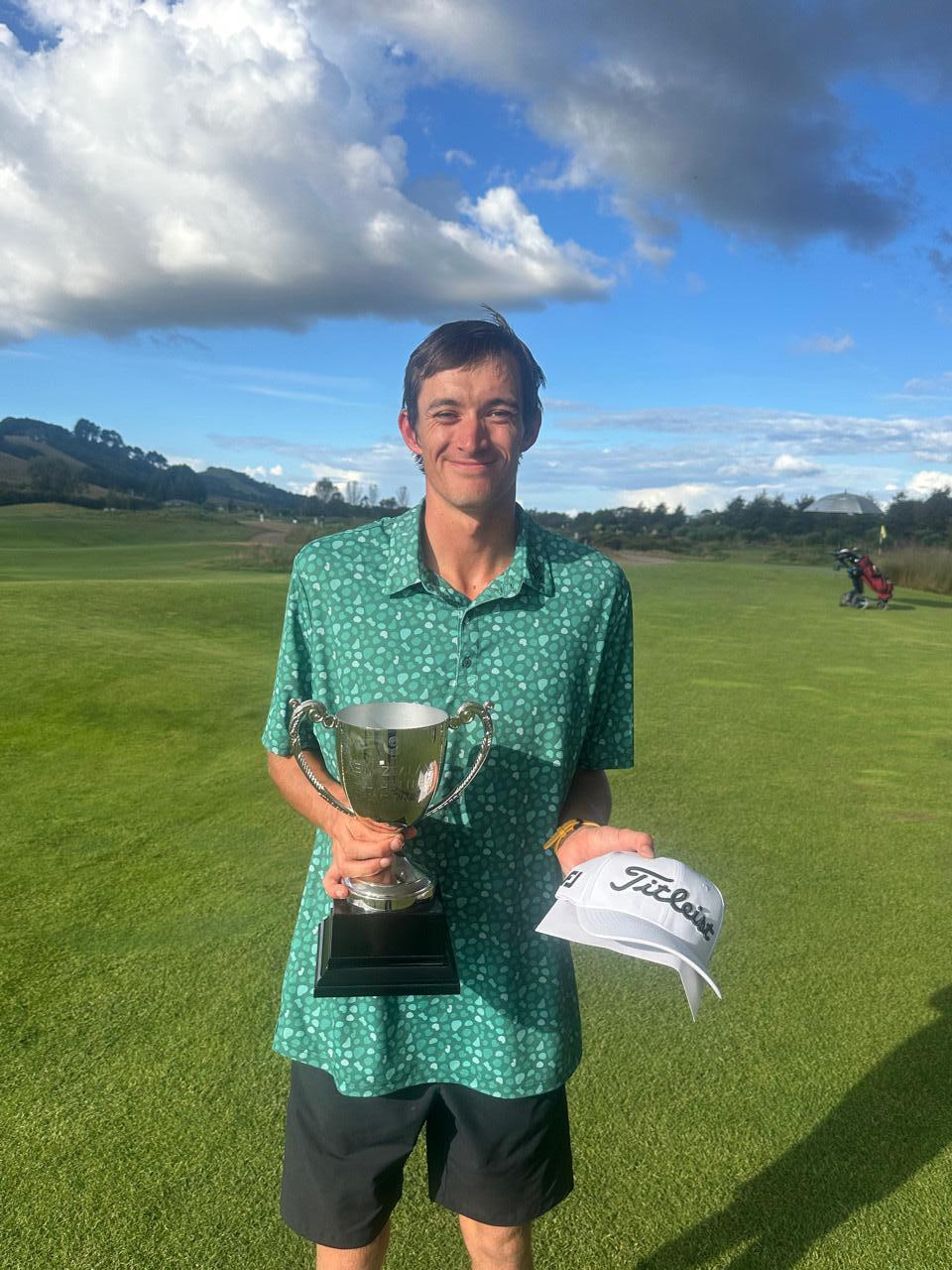
When I finally held the New Zealand All Abilities golf trophy in my hands, the first feeling wasn’t celebration. It was disbelief. Then relief.
For three years I’d watched Australian players across the Tasman take home our national title. Each time it stung a little more. So, to see my name etched on that trophy at last — a New Zealander again — was something I’ll never forget. It felt like a weight lifted not just for me, but for everyone back home who believed this was possible.
This was the one I really wanted to win. My major goal for 2026. And I knew I was playing well – but at the same time that knowledge brought pressure. I’ve been playing disability golf events since 2019. I finished second a few years ago, and that hurt more than I expected. It stayed with me. I knew I had the game — the ques-
tion was whether I could handle the moment when it mattered most.
The key was keeping it simple. Staying aggressive, keep the ball in play, focus on one shot at a time. Don’t look at leaderboards. Don’t worry about what anyone else is doing. Just play my game.
When I look back on that final putt, it’s impossible not to think about where my golf journey began — walking the fairways of Awatoto Golf Club in Napier with my dad, carrying just two clubs, determined one day to beat him. Those afternoons didn’t just teach me how to play golf. They changed my life.
Golf helped me move better. It gave me confidence to travel, to meet people, to belong. Doctors once doubted what I’d be able to do after I developed cerebral palsy at the age of three – they said I needed to prepare for a life in a wheelchair - but my parents never did. They pushed, supported, believed — and golf became the place where I proved those doubts wrong.
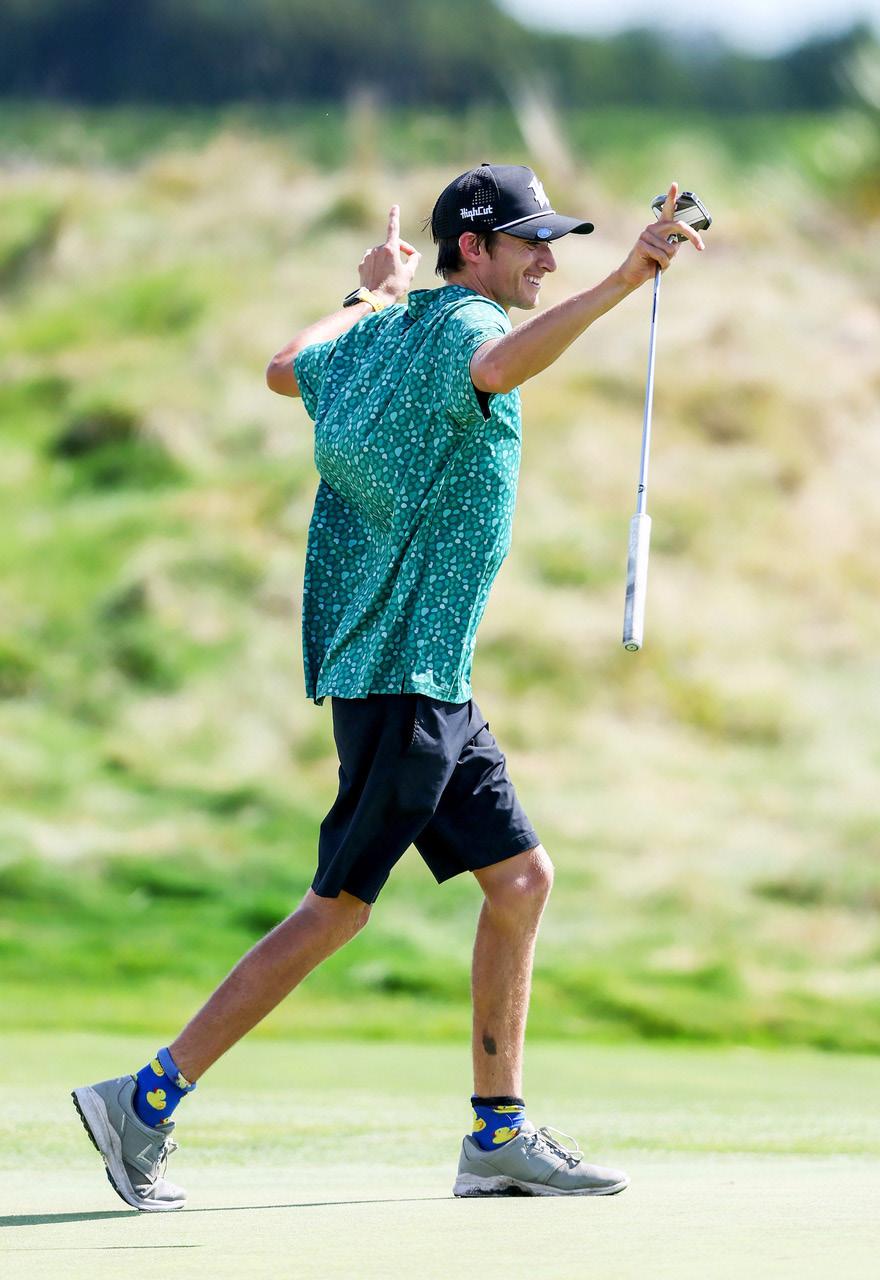
I’m incredibly grateful for that. Without my parents, my coaches, my friends, my High Cut team, who support me with apparel, and my family — my rock — none of this happens. They believed it was possible, but they also kept me grounded when my expectations grew.
It was also great to be a member of the Para Sport Collective run by Paralympics New Zealand (PNZ) and supported by the Accident Compensation Corporation (ACC). It was awesome to meet and spend time with other inspiring athletes from around the country. That programme was of massive benefit to me and gave me huge belief.
It helped me focus on the little gains which created massive benefits in sports psychology. Being able to have connections like that are invaluable moving forward.
Golf is special because it’s inclusive. Anyone can give it a go. For me, it’s about
connection — time outdoors, shared rounds, lifelong memories. Some of my favourite moments haven’t been tournaments at all, but travelling New Zealand with dad, ticking off courses along the way.
Now, that journey is taking me overseas. Last month, I headed to Europe to compete in the Disability Scottish Open, the European Disabled Golf Association (EDGA) Tour event at London Club, and the G4D (Golf for the disabled) Open in Wales. I didn’t go with specific performance goals. The trip was about learning, experiencing the highest level, and making connections.
Most importantly, I want other New Zealand disability golfers to see that this pathway exists. That overseas competition isn’t just a dream. I hope in the future we’ll have teams from New Zealand attending these events together.
The mental battle never really ends. Background noise — doubts, expectations — doesn’t disappear. I’ve learned to focus on enjoying the game, trusting the process, and remembering how lucky I am to play the sport I love. Golf gave me purpose when I needed it most, helped me out of my shell and opened doors I never imagined.
After missing selection in para swimming for the Paris 2024 Paralympic Games, I stepped into a new role as Parafed Manawatu Sports development advisor. My focus now is creating opportunities for kids with physical disabilities. Growing up with a disability isn’t easy. Doors can close quickly. That’s why role models matter.
If I can show even a few young athletes that anything is possible with hard work, support and belief, then everything I’ve done is worth it.
My advice is simple: get moving, spend time outdoors, set small goals, celebrate every win. Most of all, have fun and don’t be afraid to step outside your comfort
zone. You never know where one shot — one round, one opportunity — might lead. And for me, this one led to a trophy I’ll always treasure.
* The Para Sport Collective, which is supported by ACC, is for Para athletes and coaches at the pre-high-performance stage of the Para sport pathway.
* ACC and Paralympics NZ want to motivate and inspire disabled New Zealanders to live full and active lives by getting involved in Para sport.
* For more information: https://paralympics.org.nz/about/what-we-do/strategic-projects/para-sport-collective

By Neville Idour
Despite a backlash from many fans and others, 2027 Ryder Cup bosses say the demand for tickets has been unprecedented despite the eye watering prices.
A limited number of general daily admission match day tickets for Ireland residents sold out in under an hour. A hospitality package costs 899 euros ($NZ1790), general admission 499 euros ($NZ995). A full week package, including practice days, is 1999 euros ($NZ3987). It will cost 179 euros ($NZ357) just to watch the opening ceremony.
The prices are almost double the charges for the last time the Ryder Cup was in Europe, which was in Rome in 2023. Many fans took to social media expressing their frustrations.
Justin Rose’s caddie Mark ‘Fooch’
Fulcher slammed the “extortionately high” prices, describing it as a sad day for golf. “It seems to be a trend in sport to bleed true fans dry …. sad day.”
However it will cost roughly 25 per cent less than the $US750 charged last year at Bethpage, although that included food and drink.
Unfazed by all the backlash on pricing Richard Atkinson, the European Tour Group’s chief Ryder Cup officer, defended the prices, telling BBC Sport: “We acknowledge it’s an increase on Rome. But that was four years ago and a lot has happened in the world since then. We are lower than Bethpage. We’ve tried to make this as accessible as possible to a wide demographic of people.”
I wonder which demographic he is talking about? Possibly the wealthy to the very wealthy.
“Our prices are proportionate to a
global sporting event. This event has grown in stature and profile. It’s one of the biggest sporting events in the world. We’re confident in our pricing, but we’ve made it accessible to everyone.”
But here is the lolly on top. Atkinson has extensive plans to enhance the onsite experience for fans who turn up to the Ryder Cup venue of the Adare Manor Hotel and Golf Resort in County Limerick.
Just get all this. He has promised an entertainment programme beginning at 6.30am (yawn) in the morning, assuring fans they will get value beyond the golf. Infrastructure upgrades will include expanded grandstand seating for over 20,000, a record for any European Ryder Cup, along with big screens on every hole, and additional spectator viewing zones. All of this to supposedly justify the new pricing of
admission tickets.
But none of it can pacify the fans bothered by the price hike as it risks becoming a hospitality driven spectacle. This has been amplified by the week-long hospitality packages, reinforcing concerns among fans about the event’s shifting audience mix. Many fans and critics of the cost compare the event to a normal tour event with four rounds and a full field of up to 144 players. Just 24 players, fewer shots therefore much less golf. Despite all this organisers report more than 500,000 expressions of interest for tickets with total attendance expected to reach 250,000 across the week. Ryder Cup to Ryder Cup the price of admission does not seem to effect the huge crowds who turn up with their wallets wide open.

Takomo irons are aiming to make a big impact on the market. They are up there with the most affordable clubs on offer, but they are also great quality. Golfer Pacific writer Peter Thornton put them to the test.
Iwas scrolling through social network website Facebook one evening, wasting some time, when a reel made me stop and think.
Sam Heung Min, who I used to know pretty well from covering the amateur golf tournaments around New Zealand, delivered a line in his famous super dry manner than landed.
Sam is an ambassador for Takomo Golf and he said: “I am a pretty good player, and I can’t tell any difference between these clubs and the more expensive brands. That is my sales pitch.”
Nothing like good ol’ honesty.
As a quick side note, if you haven’t watched Sam and his mates on Instagram – Luke Toomey, Nick Voke, Taco Golf and Luke Kwon - their banter and natural camaraderie is worth your time.
I thought to myself why don’t we put the Takomo clubs to the test – the Takomo 201 MKII irons.
First, a few disclaimers. I have played Taylormade and Cobra forged irons for most of my fledgling amateur career. We were given a good deal on Taylormade clubs when they were our sponsor of the Phillip Leishman television golf show back in the day.
And for the latter years, when I worked at Golf New Zealand as it’s communications manager, they had Cobra as their equipment provider.
Everyone has their own preference when it comes to their favourite clubs. The likes of Titleist or Ping are up there with the best golf clubs you can buy, but they also come with a hefty price tag.
At $1299, the Takomo 201 MKII irons sit at more than half the price some of their rival brands – Taylormade P790 ($3199), Callaway Quantan Max ($2239), Cobra King Tec Irons ($2159 for 4 iron to 9 iron) – and a third of the cost of the premier brands. Takomo clubs are making a big impact on the market.
The 201 MKII irons are the middle offering from Takomo. They look to offer distance with forgiveness and are geared towards players from a 5- 25 handicap.
The more elite clubs are the 201T MKII (for 0- 15 handicappers) and the 101 MKII (15- 40+ handicappers) are more forgiving
and called the game improvement irons.
So, as an 18 handicapper, who plays around 10-12 times a year, the 201 MKII felt about right.
Opening the box a few days after completing my order, the first impression of the Takomo irons was they are a beautifully crafted club. They look great and present well at address.
My second impression was the clubs were lighter and shorter than my current Cobra Fly Z irons. But when I compared them side by side there wasn’t much in it.
I had my current golf set made for me during my Golf New Zealand days – they have larger grips to accommodate my big hands, and more weight in the head of the clubs.
Of course, the proof is in the pudding. With any set of golf clubs, it is all about how you hit them. I couldn’t wait to get to practice range to try the Takomo set out.
The beauty of most driving ranges these days is they have technology to trace your ball, and you are given instant

ries around there.
Pupuke is famous for being the first golf club of Kiwi legend and three-time major champion Lydia Ko and former New Zealand Open winner Michael Hendry.
It’s the sort of course you need to know to play well. Sidehill lies, fairways that are hidden from the tee and tricky greens. You need to hit the ball well to score well, especially when the wind is up.
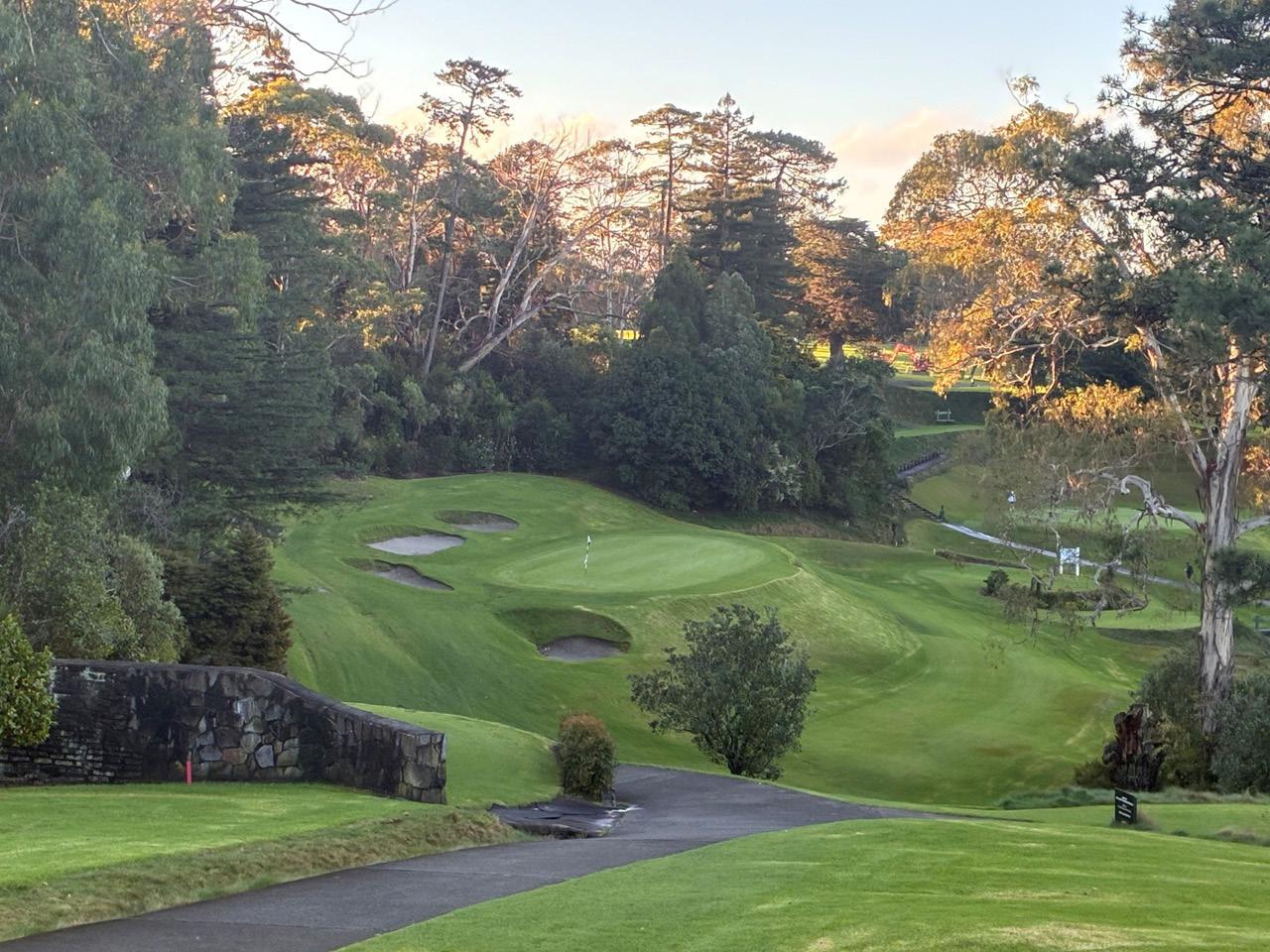
With the Takomo irons, I hit it great. It was nice to hit many of the greens in regulation. There are a number of great holes around Pupuke, the opening par four, the par three sixth and the risk and reward par four 14th, to name a few.
The par four 14th is an awesome hole. It’s only 285 metres from the white tees but there is trouble on both sides of the fairway. In the wet conditions, I hit driver and then pitching wedge into the middle of the green for a nice par.
and accurate information on your shot. It normally takes some time to adjust to new clubs, but I found the middle of the club straight away. I hit 10 eight iron shots with my current clubs – the Cobra Fly Z irons – and the average distance was 132 metres. I repeated the dose with the Takomo irons and the average was almost 10 metres longer at 141 metres. I was impressed. They felt lighter but they were good on impact and when you hit them well, it was a flushed, pure feeling. Even the ones I didn’t hit right in the middle of the club face still flew well and the shot dispersion was pretty good around the 140m mark.
As we know a driving range can be misleading with the bounce of the mat helping with swings that might not be right on point, so I was keen to try them out on the course.
In the elements, it was a similar feeling. I went out for a hit at my local golf club, the Pupuke Golf Club on Auckland’s North Shore. It’s where I grew up playing the game and I have a lot of fond memo-
The par three 17th is a fantastic hole and probably the signature hole of the layout. It measures 143m and the green is flanked by bunkers at the back and a steep bank at the front. I hit an eight iron to pin high in a quality strike.
The clubs stood up to the test at the range and on the course. To be honest, I haven’t settled on whether the Takomo irons will be my set going forward or I will stick to my trusty Cobra irons but that speaks volumes for these clubs.
The fact that I am considering replacing my fitted Cobra irons which I have played with for five years, with the Takomo 201 MKII set because of the quality in ball-striking says a lot.
And it also underlines Sam’s point.
There is little noticeable difference between these clubs and their much more expensive and well-known brands, in fact in my case they were going longer.
If you are in the market for a new set of irons, then take a set of Takomo irons for a go at the range. You’ll be impressed at the high quality and feel, and the value you get for your money.
It turns out that Sam’s old fashioned marketing pitch of keeping it simple and honest, works.

By Neville Idour
Kristine Kerr of Kura Golf Course Design, New Zealand’s most experienced golf course architect, is currently bringing her international experience to Boulcott’s Farm Heritage Golf Club in Wellington.
Having worked on all aspects of 50 projects worldwide, many with ninetime major championship winner Gary Player, her expertise is sure to enhance the standing of Boulcott’s Farm which is in Lower Hutt. Kerr has prepared plans for the remodelling of six holes, with two currently under way.
In 2010 the nine-hole Boulcott Golf Club (1938) merged with the neighbouring 18-hole Hutt Golf Club (1909) following the sale of land to Summerset Retirement Village. The merged club was
named Boulcott’s Farm Heritage with an 18-hole layout, a six-hole short course, chipping green and driving range.
The sale of land meant the ninth fairway would need to be relocated although the tees and green would remain in place. Also a new 10th hole has been created, formerly a lengthy par five, it is now a 275 metre par four.
The six holes of the former Hutt course, now 5, 7 and 10-13, are quite different from the other 12 holes.
Kerr’s plans include relocating hazards, updating shaping and completing work that would provide a consistent and uniform style.
Kerr said: “These six holes are on flat land near the Hutt River and have little contouring in comparison to the remodelled 12 with more movement and undulation. Tees and greens for

those six are also quite small. The bunkers are a bit shallow being cut into quite level ground. Our remodel will set bunkers into created landforms to enhance visibility and provide a different challenge.”
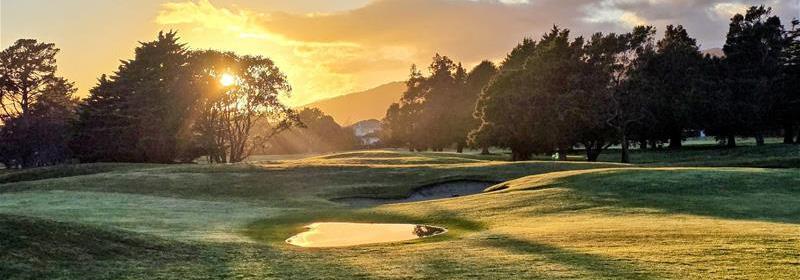
Kerr said the ninth fairway realignment involved some tree removal and earthworks to raise the new fairway to tie in elevations to an existing flood-mitigation stopbank. Foreboding bunkers on the left reflect the horizon line of the mountain range in the distance.
For the new par four 275 metre tenth hole, wind is a factor, especially for those who want to go for the green with their tee shot. The elevated green falls off to the right and the left and is guarded by bunkers front right and left. The safer option is to lay up short of the green then the approach shot
wants to be accurate for a birdie putt.
Head professional and golf operations manager Alastair Sidford described the new 10th hole as potentially becoming the course’s new signature hole.
Said Kerr: “The project will ensure maintenance is more efficient and simplified.”
Once these two holes are completed Kerr is hopeful that the next two will be on the radar for 2027 and the final two in 2029. Kerr concludes: “The remodel will create a coherent style by introducing more contouring and elevation change, more strategic bunkers and undulating greens in a variety of sizes.” From this writer’s experience with Kerr’s course designs the final outcome is sure to please all who play Boulcott’s Farm.
By Neville Idour
Located in the heart of Lower Hutt in Wellington, Boulcott’s Farm Heritage Golf Club is well appointed, providing every facility golf-wise or socially to satisfy anyone.
Situated close to where the Battle of Boulcott’s Farm took place during the New Zealand land wars between British forces and the local Maoris in the 1840s, the course was established in 1909
when a nine-hole layout was formed.
A further four holes were established a couple of years later but the outbreak of World War I halted the completion of a full 18 holes until the late 1920s. The golf clubs Hutt, formed in 1892, and Boulcott, founded in 1938, were amalgamated in 2010, thereby creating New Zealand’s first heritage golf club at Boulcott’s Farm.
Currently the course is being remodelled by Kristine Kerr of Kura Golf Course


Design, with two holes under way and in future years four more as explained in the other story in this issue. However there are no restrictions for play as there is a spare 19th hole plus the six-hole Summerset course which comprises two short par fours and four par threes, so having 18 holes always available is no problem.
The practice facilities are excellent with large putting and chipping greens and a driving range. The golf shop stocks all the leading brands including MGI trundlers plus all the best in clothing with Sporte Leisure, Greg Norman and Footjoy golf shoes.
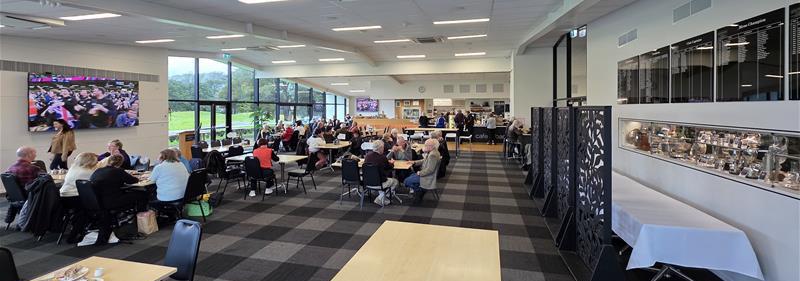
The clubhouse centrepiece is The Farm Café and Bar with all the best in food and beverages . The Farm also caters for private functions, including staff meetings and weddings.
As for the course itself it is lengthy and challenging from all three tees. It is 5113 metres from the front yellow tees. 5552 metres from the white tees and 5892 metres from the blue tees.
The longest hole from the yellow markers is a par five at 440 metres and the shortest a 100 metre par three. From the white tees the longest is a 480 metre par five and the shortest a 122 metre par three. From the blue tees the longest is a 500 metre par five and shortest a 140 metre par three. All three par fives from the blue tees are within nine metres in length.
It is reasonably flat with some undu-
lations, contours, mounds and swales to cope with. There are tree lined fairways and areas of juicy rough to welcome wayward shots. The greens are large and undulating with smooth surfaces. The course has excellent drainage so the playing surface remains firm in all but the very worst weather conditions. The club has a thriving membership. Golf New Zealand records 1093 members plus 120 juniors. The club offers a myriad of membership options from premium, full playing, flexible and short course. Premium is $2845 which includes all sorts of extra goodies which I have never encountered before. Such as 20 range ball vouchers, eight guest green fee vouchers, Masters breakfast and golf for four people, $200 Café food and beverage voucher and 15 per cent reward on café and bar spend. Full playing is $1845, nine hole is $1025, 18 years to 25 is $770 and short course membership is $350. There are several other categories, including a clubhouse facilities’ membership for $50.
Green fees are reasonable. Weekends are $70 or $60 as a member’s guest. Mid week it is $60 or $50 as a member’s guest. Short course fees are $10. Boulcott’s Farm usually receives high praise for it’s facilities and course from visitors. It is well worth the green fee if the opportunity arises to play.

By Neville Idour
DeChambeau updates his LIV future
There has been much speculation about the possible defection of Bryson DeChambeau and Jon Rahm from LIV Golf.
DeChambeau’s initial contract expires at the end of 2026, but he has stated he “will figure out a way for it to make sense.”
“We’re still working on a potential contract. I haven’t given up on that, and I think there will be a solution.”
“But as of right now, my job is to help make the league work after this year. I just feel like I have a responsibility. I’ve put a lot of effort into it. So that’s what I am going to do, we’re going to make this work. I’m going to do everything in my power and I really see the value in franchise golf.”
LIV Golf chief executive Scott O’Neil said of DeChambeau: “There is nobody more passionate about this game, team golf and growing the game in the most purest sense of the word than Bryson. He loves LIV Golf and I’m pretty confident we’ll find a solution.”
Stacy Lewis’ emotional farewell
Stacy Lewis, four months pregnant
with her second child, walked off the 18th green at last month’s Chevron Championship, having finished 12 over par, with tears streaming down her face.
These were not tears of disappointment at finishing 131st, but because of the man holding her bag on the final green, her father.
“I probably shouldn’t have looked at my dad. My emotions are probably a lot different than theirs which are probably a little bit sadder. But I’m ready for the next chapter.”
The 41-year-old’s family was watching the 13 time LPGA Tour winner close an almost 20-year long career. Her father had carried for her in earlier times as an amateur. She won two majors, the Kraft Nabisco in 2011 and the Women’s British Open Championship in 2013 and at that time moved up to world number one.
Lewis grew up in The Woodlands, Texas, and when Hurricane Harvey devastated Houston in 2017, she donated her winner’s prize money of $US195,000 from her Cambia Portland Classic win to relief efforts. Her sponsor KPMG matched that amount.
This was a mark of the popular person she is. Her goodbye is not bitter sweet. She said with daughter Chesnee reaching school age, staying home stopped feeling like a sacrifice. But she hinted her golf sto-

ry may not be over yet. She discussed the possibility of playing senior events, which made retirement seem more like a break than the end.
Charley Hull battling injury
Charley Hull played remarkably well to finish tied 10th at the Chevron Championship last month given her the injury she suffered last October. She fell down on the parking lot of the Centurion Club in London in October last year.
It totally disrupted her day to day fitness routine and stopped her from doing what she loves most, working in the gymnasium and maintaining her fitness.
“I lost some ball speed and club speed since my injuries. It’s been seven months now and I’m starting to notice it a lot. I’ve been unable to get to the gym.”
Her driving distance this season is 262 yards (104th) whereas last season it was 273 yards (12th).
However, while she is something of a fitness fanatic she says her training goes beyond golf.
“I don’t train for golf. I have zero interest in training for golf … I train because it’s good for my mental health and it’s good for me.”
Her lifestyle and demanding travel schedule on the LPGA Tour do not make it easy to heal completely.
“It’s like a battle I can never win.”
PGA Tour schedule changes not universally popular
The dropping of the Hawaii swing to kick off the season on the PGA Tour has angered some and puzzled others. The nearly 60-year run of the Sentry and the Sony Open are over. To add insult to injury the Sony Open is being pushed towards joining the Champions’ Tour schedule.
PGA Tour chief executive Brian Rolapp said: “Inclusive of the majors and The Players (Championship) we are looking at roughly 21 to 26 tournaments on a first track of elevated events with the best players competing for higher purses. We want to open big with a marquee event at an iconic venue.”
What is shocking in all of this is that despite nearly 60 years of the Hawaii events, the people associated with them were unaware of the decision to axe them. They are now asking why, in view of the massive repercussions.
Sentry, a jewel on the tour, was signed through 2035 as the title sponsor. No one knows what will happen to that but local businesses and the travel industry will be hardest hit by the ad hoc decision. The Sentry pumped $US50million into the local economy, while for the Sony Open it was $100 million. It was said 16,162 people travelled to Hawaii for the Sony.

A Champions Tour event is only likely to attract a small fraction of those numbers, if that.
Protest wind farm built on Trump Turnberry
It’s hard not to muster a chuckle, but a group of protesters have built a “wind farm” on the Ailsa course at Trump Turnberry in Scotland in protest at the US president’s opposition to wind energy.
At 6.30am one day, three Greenpeace protesters erected six model turbines on the fourth hole, alongside a sign reading “Choose wind, dump Trump”.
The 10-feet tall models were carried on to the course and greeted the day’s first golfers at the par three. Activists did dismantle them to avoid impeding play.
Greenpeace camaigner Lily-Rose Ellis said: “Donald Trump wants to keep us as life members of his golf club, where every time he starts an illegal war, bills go through the roof.
“We don’t need to stay stuck in his sand trap — the renewables Trump hates are the best insurance policy against the chaos he’s unleashed.”
Jon Rahm’s caddie’s luxury estate for sale
Adam Hayes may be a caddie but his estate in North Carolina is every golf fans dream — and you can get your hands on it for a cool $US13,995 million. Not too shabby for lugging a golf bag around 18 holes on a golf course. It’s a reflection of Jon Rahm’s success as a golfer and being valued as his caddie for the last 10 years. It is an incredible modern farmhouse style property of 5,435 square feet. The sale record for the area is $12 million. The living area includes four bedrooms, while a barn has been converted to a 3,000 square foot entertainment space with a state of the art Full Swing golf and sports simulator said to cost $75,000. Hayes is clearly a good caddie and his advice for Rahm after the third round at Augusta clearly led to his excellent final round.
Rahm making changes to preparation
After his disappointing early rounds at
the Masters Tournament last month Jon Rahm said: “There are definitely some things I’m going to change going forward.”
It was a battle to save some pride after a first round 78 that was birdie-less and in danger of an early exit. He recovered to just make the cut and finished with a final round 68 to finish 38th. This after he had arrived on a hot run of form on the LIV circuit.
His disappointment was obvious when speaking to the media after his final round. He put his performance down to a swing issue.
“It’s a hard golf course. Some of the players might have been able to manage a respectable round, but when you have no feel with the swing whatsoever, it’s just not an easy one. Today was much better. Crazy, same person, right? Even though I made some mistakes, I was able to rectify quite a few of them and have a good round. Too bad, the bogey on 18.”
Rectify his problems he did as he would produce a blistering performance at his next event, LIV Golf Mexico finishing 21 under par for a six shot victory.
Roll on the PGA Championship.
Two disastrous 80s at the Masters
Li Haotong of China began the final round at the Masters Tournament just four shots from the lead and probably dreaming of a somewhat unlikely maiden major championship title.
However, a disastrous score of 10 on the 13th hole dropped him 20 places into a tie 38th. This had a drastic effect on his chances of increased status in the FedEx Cup and qualifying for future signature events.
The other unfortunate to record 80 in the final round was Ireland’s Shane Lowry, whose luck of the Irish deserted him after starting the final round looking for his first major title, just two shots behind the leaders.
But his final round was his worst nightmare as he accumulated three double bogeys to plummet him to 30th and a take home pay of S$US146,250. That would be a fraction of the $1 million plus had

he maintained his fourth place when his final round began. Ouch.
Seventeen-year-old Asterisk Talley had the Augusta National Women’s Amateur title beckoning going into the final round with a one shot lead after rounds of 66 and 67.
But, as it has done to many players before her, Amen Corner would rob her of victory. Still with the lead, a bogey on No 11 would leave her sharing it with the eventual winner Maria Jose Marin. A quadruple bogey on the par three 12th and Talley knew she had blown it. It was a tough run home and by the time her final putt dropped the disappointment was flowing down her cheeks.
However Bryson DeChambeau, who was present, immediately came over to console her, hugging her with words of encouragement.
Talley revealed DeChambeau said: “Keep my head high and he’s been in my position before and he knows how it feels, especially here … You’re a great player. It doesn’t really matter. This isn’t going to define you.”
DeChambeau had first met Talley 10 years ago at swing coach Mike Schy’s performance centre. DeChambeau admired her tenacity at that time, and it was on full display after her defeat. She spoke to the media just like DeChambeau did after his crushing meltdown at the 2025 Masters.
As DeChambeau said: “From the losses you learn the most – that’s pretty much what I told her. She’s going to be fine. She’s going to be one of the best players in the world one day. I told her the most important thing is how you handle yourself and how you showcase yourself to inspire others.”
Rory McIlory to return for the Australian Open
Great news for fans down under. Grand slammer Rory McIlroy will return for the 2026 Australian Open at Melbourne sandbelt’s Kingston Heath Golf Club from December 3-6.
This represents a major drawcard for Australian golf and adds to the prestige of the tournament internationally.
Greg Norman spoke before last month’s Masters about his meltdown at the 1996 edition, which added to his 1987 Masters playoff defeat to Larry Mize.
Nick Faldo was the benefactor from Norman’s meltdown and although some kind words were shared on the 18th green, Norman remains somewhat frosty towards Faldo.
“Nick said some things about me during my time at LIV (Golf), so no respect for him. He still comes out with stuff that’s interestingly stupid, to be honest with you,” Norman said.
All this aside Norman’s take on defeat, however painful, is refreshingly true. Some athlete’s appear to be so
wound up in the philosophy of high performance that sporting defeats become genuine tragedies for them. But that is no way to live. That is not the case with Norman in reflecting on his 1987 playoff loss to Mize.
“Of course that embeds itself in your mind. But it’s not going to ruin your life … unless you let it,” Norman said.
One of the nice guys on the professional golf scene, Gary Woodland, scored his first win since the 2019 US Open, six years, nine months and 13 days previously, when taking out the Houston Open. What made it so remarkable was the trauma he has experienced in the last few years.
The 41-year-old had a benign brain tumour removed in 2023, and opened up about his recent struggles with post traumatic stress disorder, only diagnosed five weeks before the Houston Open. These troubles may have broken some, but not Woodland. They forged him. He had started the final round with a one shot lead, but streeted the field on the front nine and maintained a comfort zone until ultimate victory by five shots. It was an amazing sight with he and his playing partners walking to the green on the 18th. Woodland, in front and his playing partners 50 yards behind, pumping their arms and firing up the crowd who were roaring “Gary, Gary”. He had earned the ultimate respect from everyone on the course. Woodland’s message was poignant.
“Anybody that’s struggling with something, I hope they see me and don’t give up. Just keep fighting. I’m proud of myself right now.”
Fitzpatrick and Korda are the form number ones now
Currently, as far as form goes, Matt Fitzpatrick is distancing the field including Scottie Scheffler in the men’s game. He is clearly leading the way on recent results. Three wins in his last four starts is very Scheffler like and adds nicely to his record during his 12 year career which features big wins all over the world. He has one major championship success, the 2022 US Open. Many feel he is among the best English golfers of modern times.
Moving to the women’s game, Nelly Korda continues to show her wonderful ability and consistency. Her performance in winning the Chevron Championship last month was mesmerising.
Getting off to a leading start she was never headed and over the entire weekend no one got closer to her than four shots. She played the last 29 holes in even par and still won by five shots, the largest margin at the Chevron in 18 years.
This was her third major title and returned her to number one in the world, where she looks the part. It has been some start to the season. In the final group for all five tournaments, she has won twice and finished second in the other three.

By Neville Idour
What a sad, sad story the Tiger tale has become.
Tiger Woods’ demigod like status is in tatters. As the saying goes a leopard never changes its spots, but in this case, behind the wheel of a motor vehicle, the Tiger never changes its stripes.
There is another saying that emerged recently that was rather pointed. “You know a lion would never drink and drive, but a tiger would.”
Enough said.
There has been sufficient detail in the media about his many indiscretions over many years, behind the wheels of motorised vehicles, thankfully none of which resulted in deaths. Rather it is enlightening to delve a little deeper into aspects in his early life under the influence of his father Earl, which may have been like a lead balloon for him to carry through life.
Woods’ father Earl, in a famous interview in December, 1996, with Sports Illustrated reporter Gary Smith, made extraordinary claims about his son’s future impact, famously claiming that Tiger “would do more than any other person in history, including Jesus Christ and Mahatma Ghandhi, to change the course of humanity.”
He specifically referred to his son as “the chosen one”, claiming he would have the power to impact nations.”
Earl later clarified those remarks, stating he meant Tiger had the ability to be one of the biggest influences in history, but was not “predicting the next Messiah.” Then he expanded on it saying he believed Tiger’s mental toughness and multiracial background made him a unique global figure who could bridge racial and cultural divides. The upshot all this baloney was wide criticism of it as being “metaphysical hooey” and not surprisingly placed a massive burden of expectation on the then 21-year-old Tiger.
Initially his reactions to his father’s ridiculous messianic claims were a fruit salad of quiet acceptance, internal pressure and, eventually as he matured, self
correction. He did not publicly rebuff his father and his actions and reflections as time passed suggest the “chosen one” label was a heavy burden. In the early years of his career he usually maintained a deafening silence on the chosen one or Jesus Christ comparisons.
It was only after his personal scandals that in his 2010 public apology, Tiger admitted that the constant theme of being special had affected his psyche. This spurned a feeling of entitlement and that normal rules didn’t apply to him. Various critics and biographers stated that the saintly brand image Earl anointed him made his eventual fall from sainthood all the more dramatic. Tiger would later admit that his desire to live up to his father’s expectations gave him major internal struggles especially as Earl’s health declined.
This was evident at the 2006 Masters which was the last time his father would watch him play.
Tiger said at the time: “I put too much pressure on myself trying to win for dad.”
Ironically, Earl corrected him with “Haven’t I taught you anything? You do it for the inner joy. You don’t do it for anyone else.”
As he matured Tiger seemed to distance himself from the world changer role Earl had predicted and would become an outstanding golfer rather than a global messiah. He adopted Buddhism and often credited his mother’s Thai Buddhism for his mental approach and focus.
Unfortunately, his most recent and what was his fourth serious road accident, that mental approach and focus was clearly absent. This was clear when he told the arresting officers that he was not only distracted by his phone, but by “all the drones” that were flying over his home.
He claimed there were 10 to 15 drones coming over his car, some with GoPro action cameras equipped on them. Then he dropped the line of “I was just talking to the president” into the mix.
United States president Donald Trump later confirmed that. Woods has reportedly been in a relationship with Trump’s
former daughter-in-law Vanessa Trump for more than a year.
Thankfully Woods has realised he needs serious help and rehabilitation … again. He is taking an indefinite break from golf. This is the third time the 50-year-old has needed rehab. His previous spells were in 2010 and 2017. Woods posted on social media: “I’m committed to taking the time needed to return to a healthier, stronger and more focussed place, both personally and professionally.”
The facility he is attending is a high end clinic in Zurich, Switzerland, selected to ensure privacy. The 90-day programme focusses on physical rehabilitation, specifically addressing painkiller dependency. Reports indicate he is responding well to the intensive treatment, which is encouraging. It will no doubt please fans if he can make a full recovery.
Reactions from fellow players and commentators have been many, all wishing him well of course but several were highly critical of his actions that led to his predicament and not in favour of his return being greeted as if nothing serious happened to him.
Conversely the PGA Tour did not impose sanctions of any kind but issued a statement of support for Woods.
“Tiger Woods is a legend of our sport whose impact extends far beyond his achievements on the course (one could suggest the impact is questionable). But above all else, Tiger is a person, and our focus is on his health and wellbeing. Tiger continues to have our full support as he takes this important step.”
Nick Faldo was unimpressed with those three sentences. Faldo pulled no punches pointing out: “I feel sorry for Tiger that he is living in pain 24-7 … but it has all been self inflicted. There are two sides to this. One, let’s care for Tiger. Two, There has got to be a responsibility and accountability side as well.. This is a serious thing he has done. The PGA Tour statement was so predictably weak. The tour will look after him as always but then you have Jack Nicklaus saying it has tarnished the entire sport. We are not meant to be on the streets with two pills
in our pocket.
“Something more serious should be done than waving him off to a tropical island and saying welcome back in three or four months. I’ve got a feeling if he comes back in a couple of months, everything will carry on as normal. It’s not a good message to today’s kids.”
Woods chairs the PGA Tour’s future competition committee and is expected to continue in that role on his return. Faldo feels that is not right. The PGA Tour pay him tens of millions of dollars to be on course and work off course. In a normal walk of life you would expect accountability.
Others concur with Faldo. Former PGA Tour professional and broadcaster Mark Lye said: “They should take his name off the Genesis Invitational and the Hero World Challenge. It’s not a good look. I couldn’t even show my face again on or off course. His kids will suffer as well. Shameful and selfish.”
Kevin Kisner was clear that he does not excuse Woods’ decision to drive. “He made a terrible decision. I had a brother who was an addict and it’s terrible. If Woods is an addict he needs to get help. I’ll do anything to support him.”
Ireland’s Paul McGinley said: “A lot of people are running out of patience for Woods, including myself and my family.” McGinley doesn’t see Woods ever winning another major championship of the 15 he has won.
Australia’s Jason Day said: “It’s unfortunate. The only thing I don’t understand is it’s a little bit selfish of him to drive and put other people in harm’s way as well. He was my hero – he’s my hero. It’s hard to see him going through all this.”
The only positive from the latest crash was there was no vehicle coming towards him otherwise, as one of the police said: “We would have been dealing with something more serious. Like a fatality or more.”
The bottom line is one crash is an accident. Two warrants discussion. Any more is a huge problem. Some would say loss of license to drive.
By Neville Idour
The PGA Tour has banged the drums for the last two years for a profitable future for its US$12.9 billion business following the massive initial US$1.5 billion investment by the Strategic Sports Group (SSG). However despite the unprecedented growth and the time
for US$20 million purses, dark days have followed.
The first bombshell was the cancellation of the Hawaii swing’s two long running events, the Sentry and the Sony Open, both of which have been running for nearly 60 years. So there was a ‘tiny’ bit of history attached to them. Yeh right?

The reason given was ‘due to logistical and operational challenges’, whatever that means. More corporate gobbledegook speech that tells us nothing.
Worse still came the second bombshell just days later with the announcement that 56 full time employees were sacked. A consulting group brought in late 2025 to review operations recommended the layoffs. No warning. The PGA Tour says it is “reinvesting in new talent based on new priorities”. More gobbledegook. CEO Brian Rolapp called the move a “difficult but important step as part of a ‘profit first approach.” In addition 73 open positions were frozen.
When Strategic Sports Group made its investment it did so with the expectation that the PGA Tour and LIV Golf would come under the PGA Tour Enterprises structure, which has yet to materialize despite a push from the White House. While the PGA Tour is not fighting for survival it did report a US$452 million net loss in 2024. However it apparently reported a net profit in 2025.
Apparently SSG was pushing to cut tens of millions from the payroll, with insiders describing it as rank and file employees absorbing what executive restructuring would not. So the Signature events will continue to offer the bloated US$20 million prizemoney even though
so far in 2026 only one in four Signature events has shown a viewership increase. Even more to the point, recently departed CEO Jay Monahan has earned over US$113 million since 2017, including US$19,227,851 in 2024 alone. So over eight years he has averaged almost US$15 million. Nice if you can get it.
A voluntary retirement program has been introduced and by November, 30 employees had left. Rolapp has been busy on the Tour’s calendar compressing it to fewer higher stakes events, with tournaments like the Cognizant Classic having uncertain longevity. This is all a deliberate move away from the Tour’s traditional makeup to maximise profit. Longtime fans are unimpressed with the more cutthroat competitive approach and are miffed and worried about the future direction of the PGA Tour. Even Ian Poulter joined in. “It’s not good to hear people are losing their jobs. I heard the number was significantly larger. Next it’ll be 500.The bubble is bursting.” A fan said “Or you could not have paid Jay Monahan millions this year for no reason.” Another “Seems the Tour don’t value tradition when the choice is axing regular jobs or lowering their US$20million purses a little.” “PGA sound like hypocrites” said another. Probably enough said.

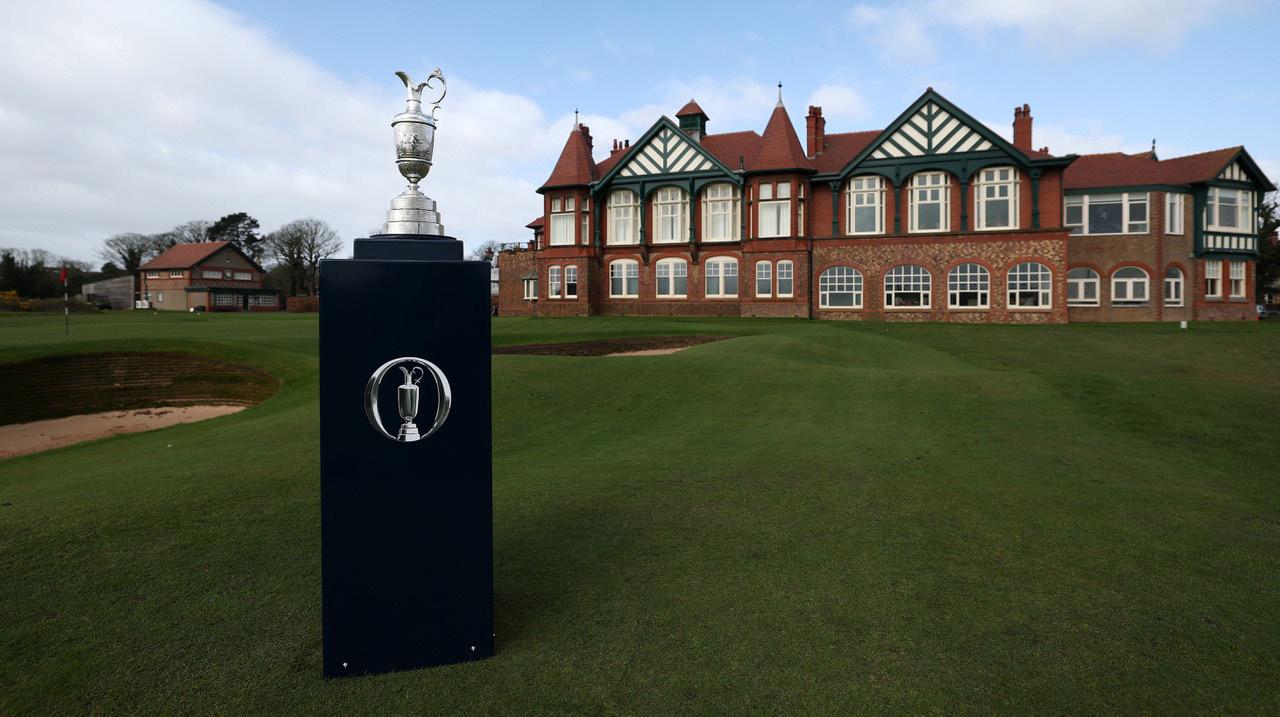
The 156th Open will be played at Royal Lytham & St Annes in England from July 30-August 6 in 2028.
The Open will be contested over the famous Fylde links for the 12th time in the history of the championship and returns there for the first time since 2012 when Ernie Els lifted the second Claret Jug of his celebrated career.

The South African joined an illustrious roll of champion golfers at Royal Lytham & St Annes, including Bobby Jones, Bobby Locke, Peter Thomson, Sir Bob Charles, Tony Jacklin, Gary Player, Seve Ballesteros, Tom Lehman and David Duval.
Mark Darbon, chief executive of The R&A, said: “Royal Lytham & St Annes is widely renowned as one of the world’s
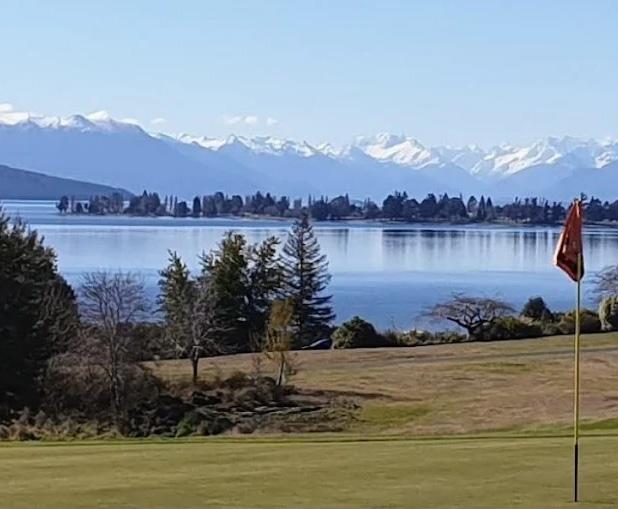
finest links courses and has witnessed many great championship moments since The Open was first played there in 1926 when the legendary Bobby Jones won.
“This is one of golf’s most cherished and historic venues and The Open’s return to these famous links will spark huge interest among fans to be part of one of the world’s great sporting events and celebrate the rich traditions of golf’s original championship.
“We are grateful to the members of Royal Lytham & St Annes and the local authorities for their support in making this happen. We look forward to enjoying another fantastic championship on England’s golf coast in 2028.”
Tim Walker, chairman of council at Royal Lytham & St Annes, said: “We are honoured to be chosen as the host venue for The 156th Open in 2028. The club has a long and successful association with The Open and we take great pride in our place within the championship’s history. It is fitting that this announcement comes as we mark 100 years since Bobby Jones’ victory here in 1926 and the granting of our royal status. We look
forward to welcoming the world’s leading players, together with spectators and audiences from across the globe, to our links on England’s golf coast.”
Mark Wynn, chief executive of Lancashire County Council, said: “I am really pleased to support the return of The Open to Royal Lytham & St Annes in 2028.
“Hosting one of the world’s most prestigious sporting events is a significant opportunity for Lancashire, bringing international attention to the county, boosting the local economy and showcasing the Fylde coast as a first class destination for major events.
“Later this year, we are also excited to be welcoming the 2026 AIG Women’s Open to the course, which will feature the world’s leading women golfers.’’ Fans eager to register their interest in attending The 156th Open at Royal Lytham & St Annes can do so via TheOpen.com
This year, the world’s best women’s golfers will compete in the Women’s Open at Royal Lytham & St Annes from July 29-August 2 with tickets still available via AIGWomensOpen.com.

This year’s Women’s Open in England will carry prize money of $US10 million.
The Women’s Open, which will be the 50th edition of the tournament, will be held at Royal Lytham and St Annes in Lancashire from July 29-August 2.
Mark Darbon, chief executive of The R&A, said: “This is the sixth consecutive year that the Women’s Open prize fund has been increased.
“These consistent and sustainable investments in the prize fund clearly demonstrate The R&A and (sponsor) AIG’s commitment to elevating the championship on the global stage.”
The growth of the championship is reflected in its evolution over five decades. In 1976, Jenny Lee Smith won the inaugural title when the total prize fund stood at £500.
By 2008, when the championship was last held at Sunningdale, which has been announced as the 2028 Women’s Open venue, Jiyai Shin claimed the winner’s share of a $US2.1 million purse.
Georgia Hall triumphed at Royal Lytham & St Annes in 2018, with a total prize fund of $US3.25 million, the year prior to The R&A and AIG partnership, and since then the purse has more than trebled in the eight years.
Green fees in the United States have kept pace with inflation, says a report from the country’s golf market researcher, the National Golf Federation (NGF).
Between 2019 to 2025, as roundsplayed at courses in the United States climbed to record levels, peak 18-
hole public playing fees have increased by roughly 29 per cent, said NGF. That’s almost lock-step with the 27 per cent cumulative rise in inflation over the same period.
At a macro level, this indicates golf has largely kept pace with the cost of living rather than dramatically outpacing it,

even at a time when operators have unprecedented pricing power and many have been investing their added revenue into improving courses and clubhouses.
When comparing golf within the broader landscape of discretionary spending (and staying in the world of entertainment and sport), consider that the average movie ticket price has jumped roughly 75 per cent over the past six years while the average cost to attend an National Football League (NFL) game has risen around 50 per cent over that same period.
Prices to attend games for certain teams and movies in certain cities or states fluctuate significantly. The same is true with golf – and the gap is most prominent at the high end of the market, specifically destination golf. Fuelled by record or near-record levels of golf travel and sustained demand for experiential leisure, average resort green fees have climbed about 36 per cent since 2019. Today, more than half of US golf resorts in the National Golf Foundation’s (NGF) facility database have peak-season rates above $US100.
That said, those numbers don’t reflect
what most golfers actually pay. Resort pricing is dynamic, with discounts tied to seasonality, time of day, replay rounds, local or resident rates, and more. In golf-rich sunbelt states like Florida and Arizona, the spread between peak season rates and off-peak summer pricing at resorts can be especially wide when temperatures soar.
Meanwhile, public golf cost increases have been less pronounced at the local level – the backbone of the game for most recreational players. The average 18-hole green fee for municipal and daily-fee courses (approximately $US41) has risen 27 per cent since 2019, meaning the core product has remained in line with inflation rates.
Ultimately, narratives about rising costs in the world of golf may be more indicative of where golfers are choosing to play (and spend) for their experience. That distinction is important. While the visibility of high-end pricing may shape perceptions, the reality is that golf’s cost structure is far more balanced – particularly for everyday golfers.

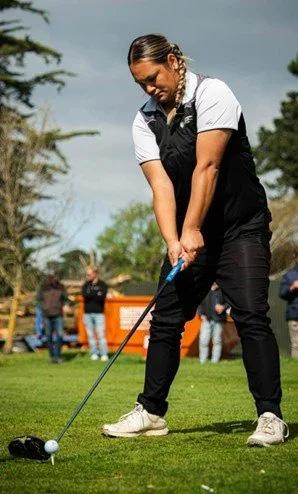
Along drive, and her name is Jessie Ann Mercer.
Explosive, fearless, and relentlessly driven, Mercer is fast becoming one of the most exciting young athletes in the sport. Known for showing absolutely no mercy on the tee, her power and precision have set a new benchmark—one that she’s determined not just to meet, but to redefine on the world stage.
A natural-born athlete, Jessie isn’t chasing wins—she’s chasing greatness. With her sights firmly set on becoming the best in the world, every swing reflects her commitment, discipline, and hunger to dominate.
Jessie’s journey has already made history. Scouted for selection into the inaugural New Zealand Long Blacks women’s team, she first made headlines as a junior when she shattered the record drive distance
at Templeton Golf Club during the Goodwin XDL Regional Christchurch Championship.
But she didn’t stop there.
Just weeks later, at a charity event supporting I AM HOPE, Jessie stepped up again—and broke her own record. A rare feat that cemented her status as a generational talent and a rising icon of the sport.
In recognition of her extraordinary back-to-back achievements, Jessie Ann Mercer will be awarded the first-ever XDL Record Breaking Trophy this December—a milestone not just for Jessie, but for the future of long drive.
Her story is only just beginning.
With unmatched power, unwavering belief, and a mindset built for greatness, Jessie Ann Mercer isn’t just part of the next generation— she’s leading it.
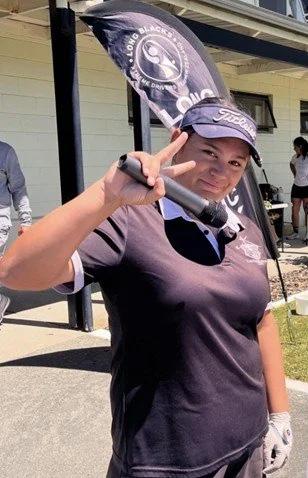

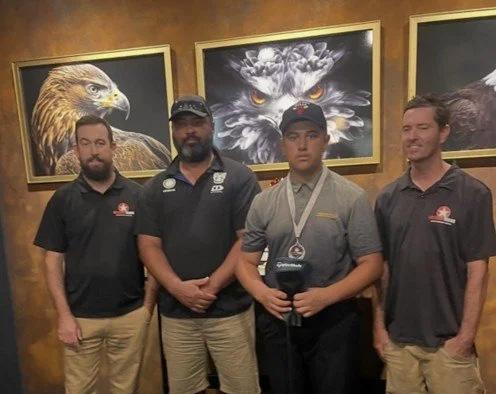
Te’Arnu Sofala made a clear impression at the Cambridge Homes XDL Waikato Regional Championship 2026. From the outset, his presence stood out—not only through his driving ability, but through his composure, discipline, and the way he conducted himself around the event environment. Te’Arnu took home a medal for both his longest drive and was runner up overall, qualifying for the XDL Nationals this November. His engagement with the XDL crew prior to competition reflected initiative and respect, setting a strong foundation before he even stepped onto the tee. On the day, Te’Arnu delivered consistent, powerful drives with a calmness under pressure that marked him as more than just emerging talent. He was steady, focused, and efficient in execution—qualities that translate well beyond a single event.
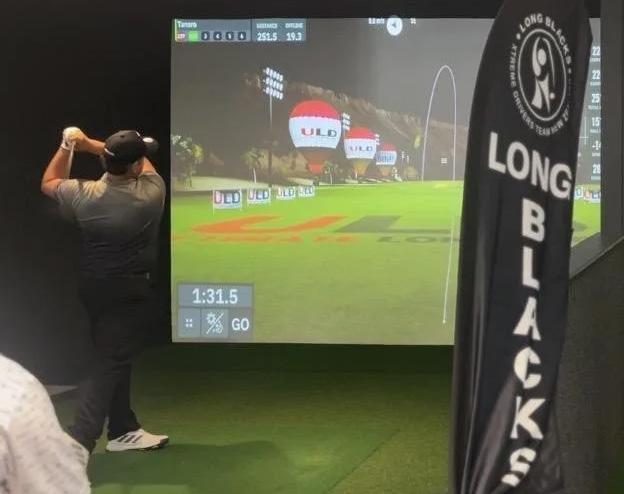
A moment of real delight for founder Olna Ford came through hearing Te’Arnu being recognised and congratulated for his performance beyond the event itself. These moments matter—they reflect the growing awareness of XDL athletes and continue to inspire both the organisation and its developing players. Following his standout showing, Te’Arnu Sofala has now been officially named a New Zealand Long Black—a significant step in his journey and a recognition of both performance and character.
He now joins the New Zealand Long Blacks Juniors pathway, contributing to XDL’s DRIVE initiatives across schools, national events, and emerging international opportunities.
The New Zealand Long Blacks proudly welcome Te’Arnu to the team!


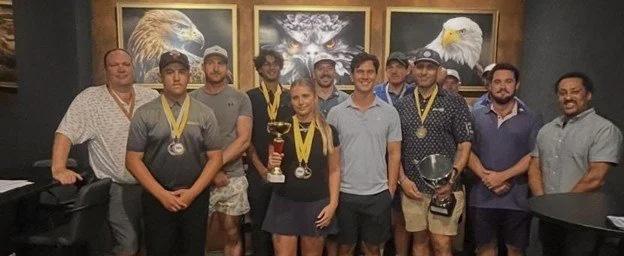
Xtreme Drivers League (XDL) is stepping into a defining new chapter — going indoors for the first time as it approaches its 10-year anniversary.
The Cambridge Homes Waikato Regional Indoor Championship 2026, delivered in partnership with Hamilton’s exciting new venue, The Eagles Nest, didn’t just host an event — it revealed an exciting future in the sport. With the country preparing for Cyclone Vaianu, and a down pour of rain on the Golf Course the decision to move indoors could have been a compromise. Instead, it became a breakthrough.
What might have disrupted the competition transformed into one of the most electric environments XDL has ever produced — fast, loud, and built for pure spectator energy. This isn’t a one-off moment, It’s a shift. Indoor championships are now set to become a cornerstone of XDL’s regional growth — unlocking new venues, new audiences, and new opportunities to scale the sport.
The New Zealand Long Blacks stood
strong in this new arena, bringing identity, pride, and presence to a format that clearly belongs in the future of XDL. This event scouted a SUPERSTAR Talent young Te’Arnu Sofala who we are proud to introduce and name as a New Zealand Long Black Junior.
To mark the occasion, every athlete received a Golden Pass — granting free entry into any XDL event for the rest of the year. More than a reward, it was a statement: XDL backs its players.
* Men’s Open: George Wardell – 386m
* Men’s Masters: Grieg Mooney – 344m
* Senior Men: Craig Williamson – 216m
* Women’s Open: Alison Glover – 216m
* Women’s Masters: Caroline Batley –225mSenior Women: Alison Glover – 209m
* Junior Boys: Krishnav Chand – 293m
* Junior Girls: Izaro Williamson Sasia –188m
Winners walked away with trophies, medals, and qualification into the New Zealand Nationals — along with oppor-


tunities to compete across XDL partner events. But beyond results, this event proved something far more important: XDL can go anywhere, Any conditions. Any format. Still delivering.
XDL’s evolution is grounded in strategy — recognising that indoor and outdoor formats each play a powerful, but very different role in the growth of the sport.
Indoor Championships are built for frequency, accessibility, and consistency.
They allow for regular use of high-quality venues, creating a stable competition environment that can run regardless of weather or external conditions. Indoor events are streamlined, efficient, and scalable — ideal for building momentum, increasing participation, and activating communities more often throughout the year. These events will form a key qualification pathway into XDL Indoor Nationals, with one exception — the inaugu-

ral Waikato Indoor Championship, held to celebrate and launch the indoor era, stands as a milestone event outside of the standard qualification structure. Outdoor Championships, on the other hand, deliver scale, spectacle, and presence.
These are large-format grid events — powerful, high-impact experiences that require crews, volunteers, logistics, and significant coordination. Outdoor events bring the full theatre of XDL to life, creating iconic moments and major drawcards for communities and partners. Together, these formats don’t compete — they complement each other.
* The Eagles Nest - Hamilton (our legendary indoor venue)
* Cambridge Homes Waikato (XDL Divisions)
* DW Earthmoving (Longest Drive Trophy)
* Hotshot Signs (XDL Juniors)
* Sal - Hamilton DJ Hire (XDL go to DJ)
* DJ Mills ( XDL local photographer)

Under 16 girls - Yuri Lee
Under 13 boys - Frank Hu
Under 13 girls - Aletta Kari (overall winner)
Under 19 boys - Rafe Fleming Bone
Under 19 girls - Amber Farrell
Under 16 boys - Ethan Jordan (overall winner)
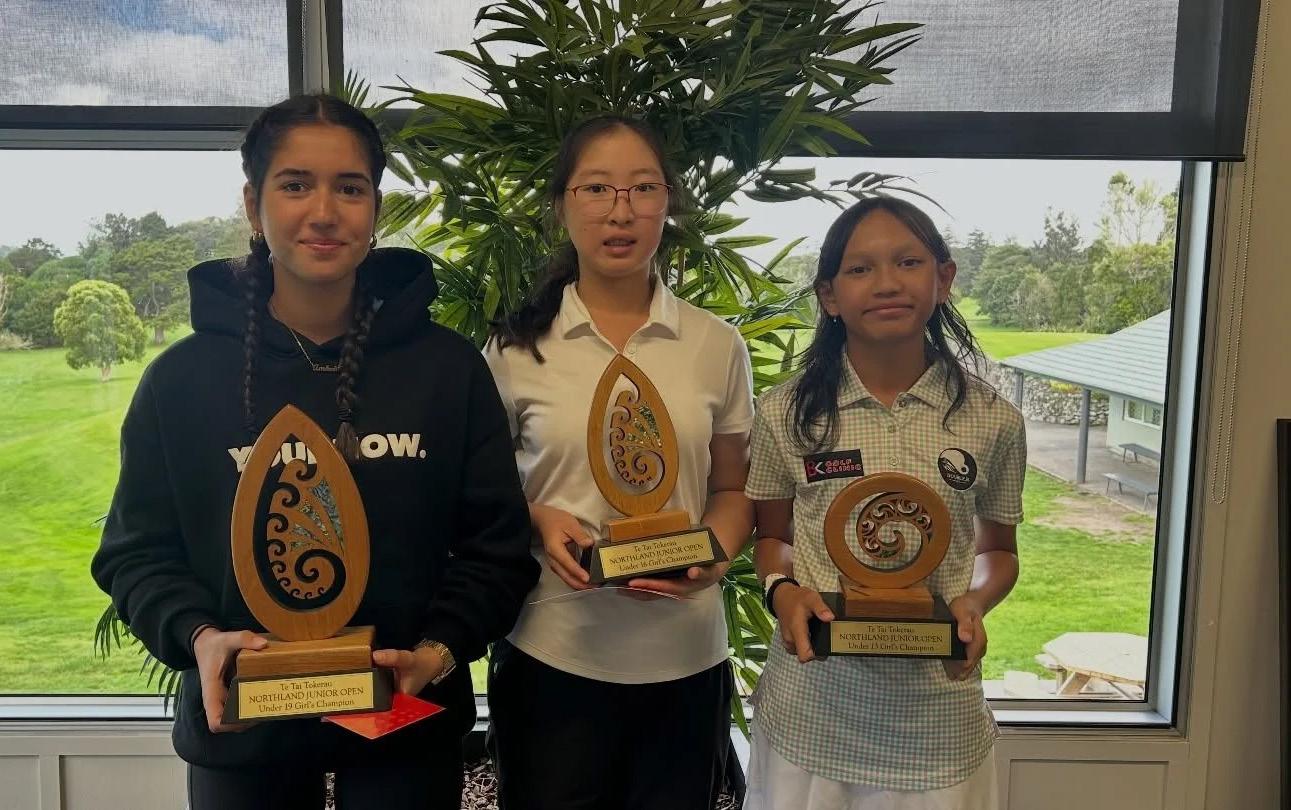
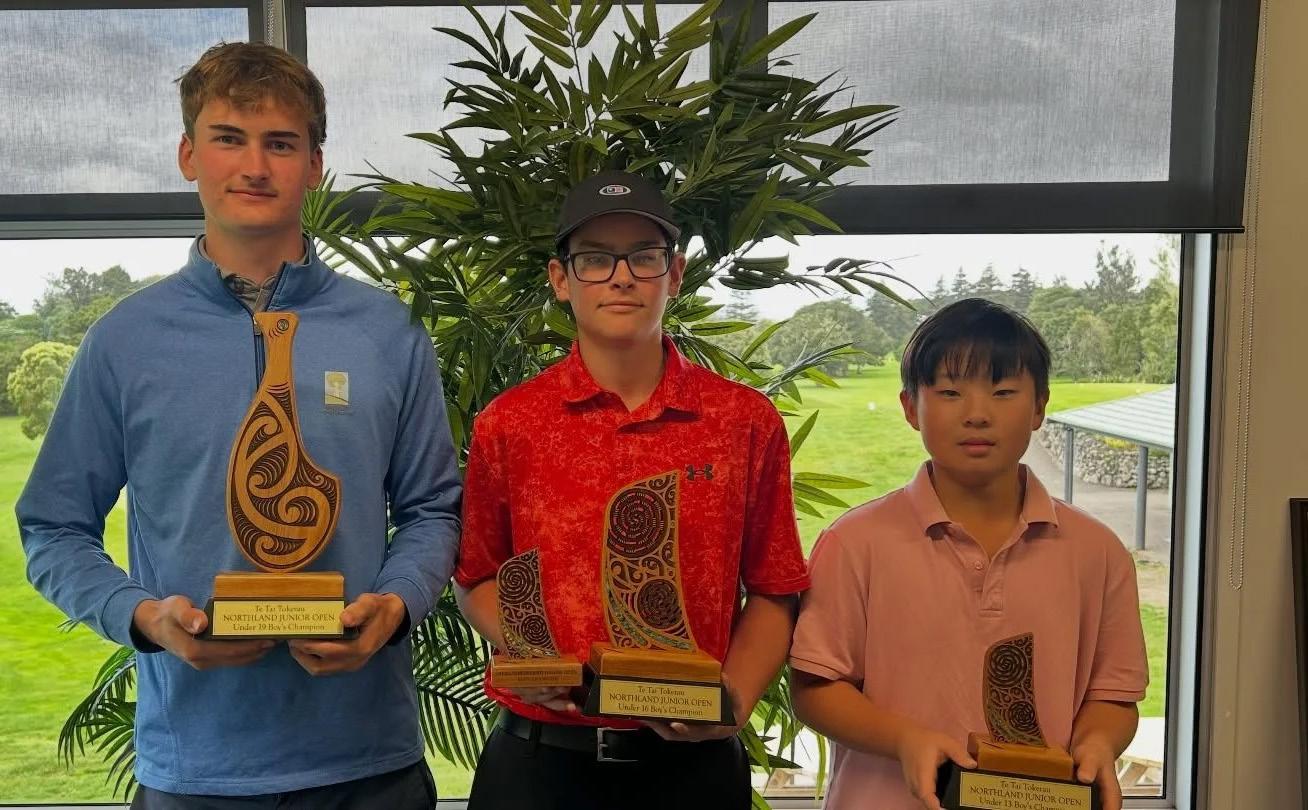



Tirau has claimed top honours in the 2026 Men’s Handicap Strokeplay Pennants Final, delivering a composed and consistent team performance at Hamilton Golf Club played recently.
Contested under the Waikato Golf Interclub format, the competition brought together the top 12 qualifying teams from two zones, each vying for the title over a demanding 27-hole final. With four players per team and only the best three nett scores counting, consistency across the lineup proved crucial.
Tirau rose to the challenge superbly, posting a winning total of 324, the lowest of the day. Their success was built on a standout team effort led by Christopher Parker, whose excellent 66 in the morning round set the tone. Strong support
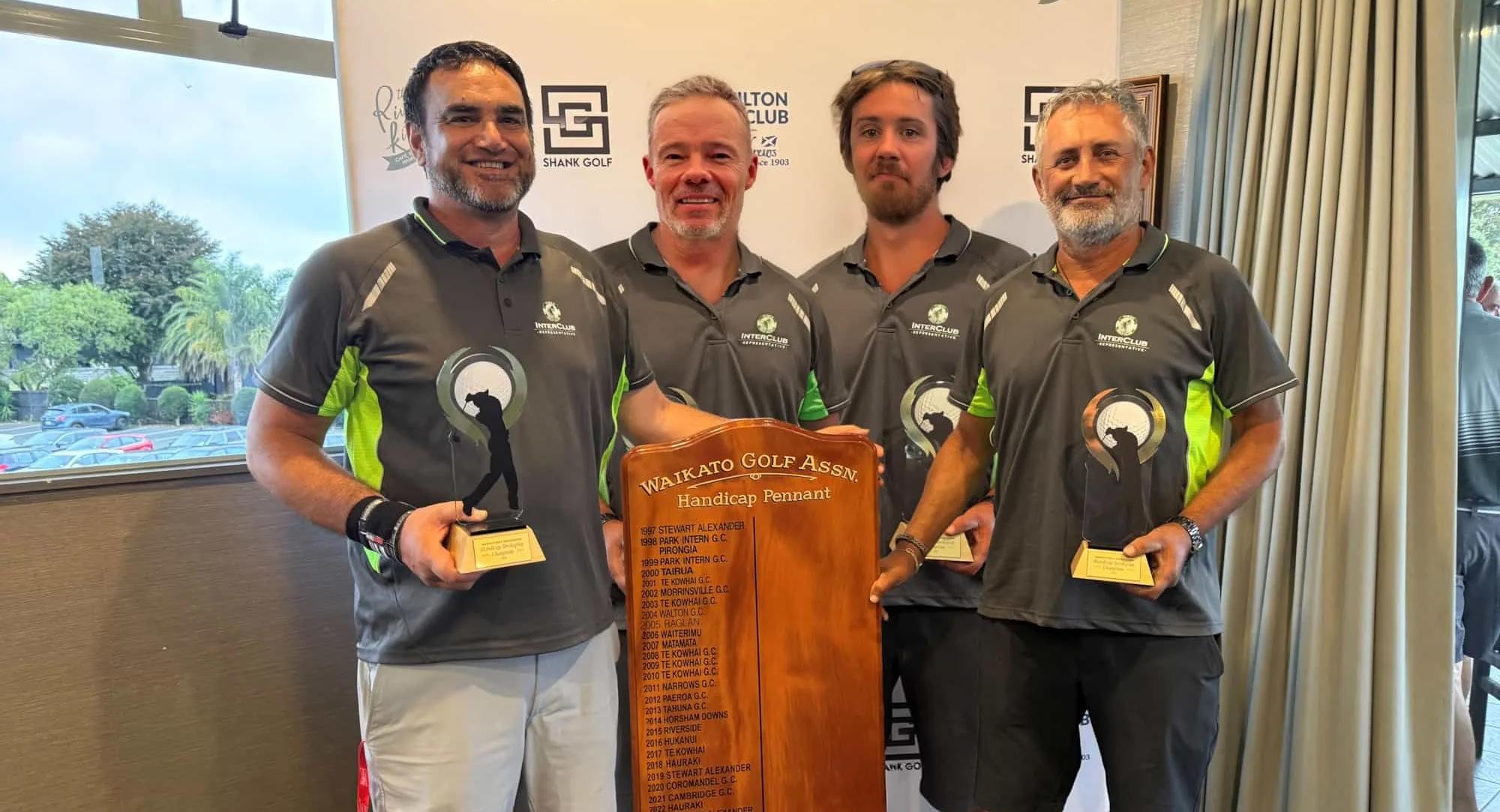

followed from Lukas Maree (108) and Evan Stevenson (110), ensuring Tirau maintained control throughout the day. Although Guy Henderson’s 121 did not count toward the team total, it provided valuable insurance under the format. The competition was tightly contested behind them, with Te Kowhai (325) finishing just one shot back in second place, while Tahuna (333) and Hukanui (335) were also in the mix. Several teams remained in contention deep into the afternoon round, highlighting the depth of talent across the region.
Tirau’s victory marks a deserved culmination of consistent performances throughout the campaign, and their ability to deliver under pressure on finals day ultimately proved the difference.
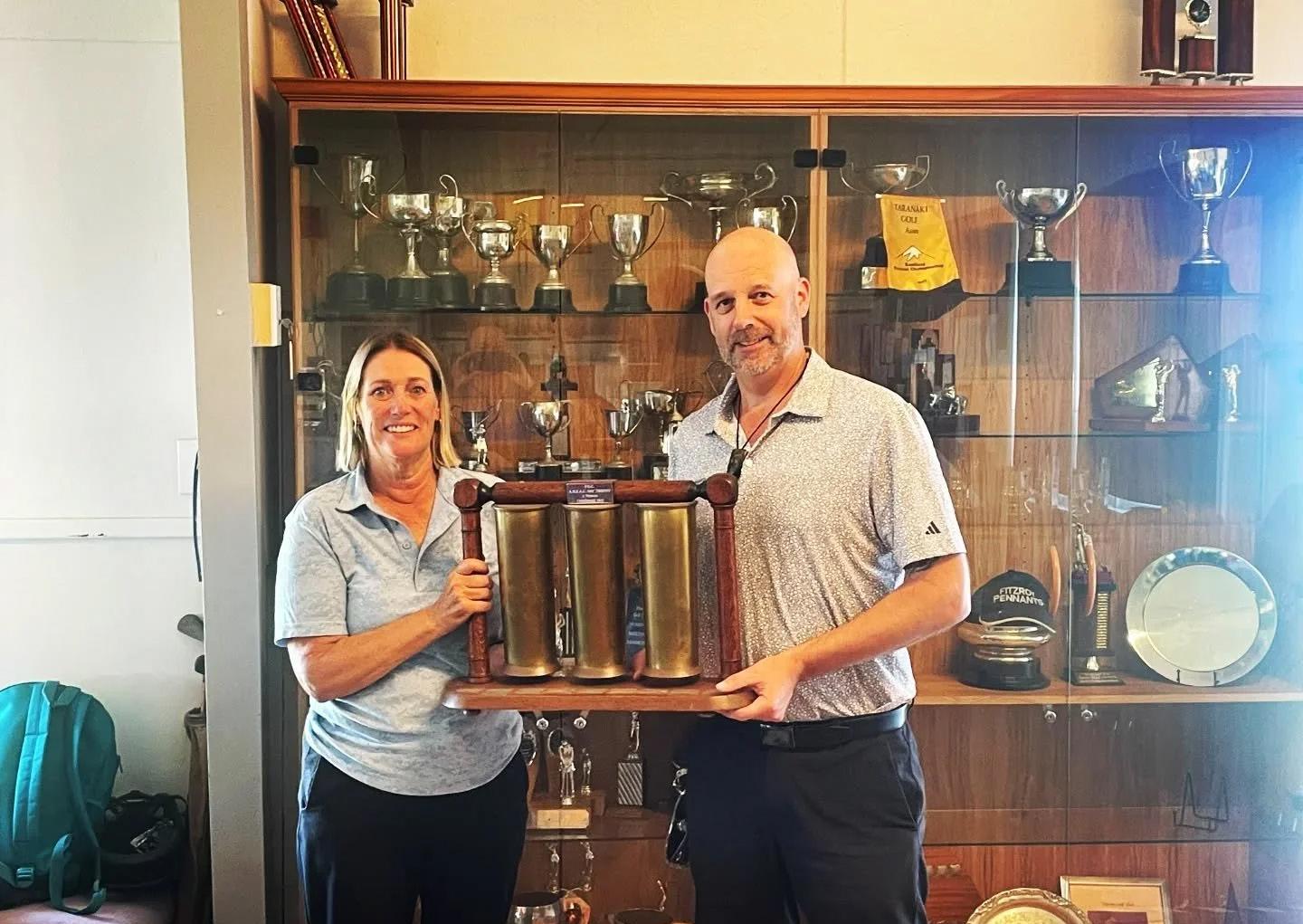

The Manawatū Wanganui 54 Hole Stroke Play, held alongside the Joe Kells & Palmerston North Ladies Classic delivered everything you want in championship golf - strong fields, hot conditions, incredible performances and plenty of drama right to the end.
Played recently at Palmerston North Golf club. 85 players started in Saturday’s
RD1 & 2, with 47 progressing to Sunday in near perfect conditions.
Kevin Bang claimed the men’s title, holding off a late charge that included a stunning 7-under-par final round.
The women’s championship went to a playoff, with Seungyeon Shim sealing the title in style on the second trip down the 18th.


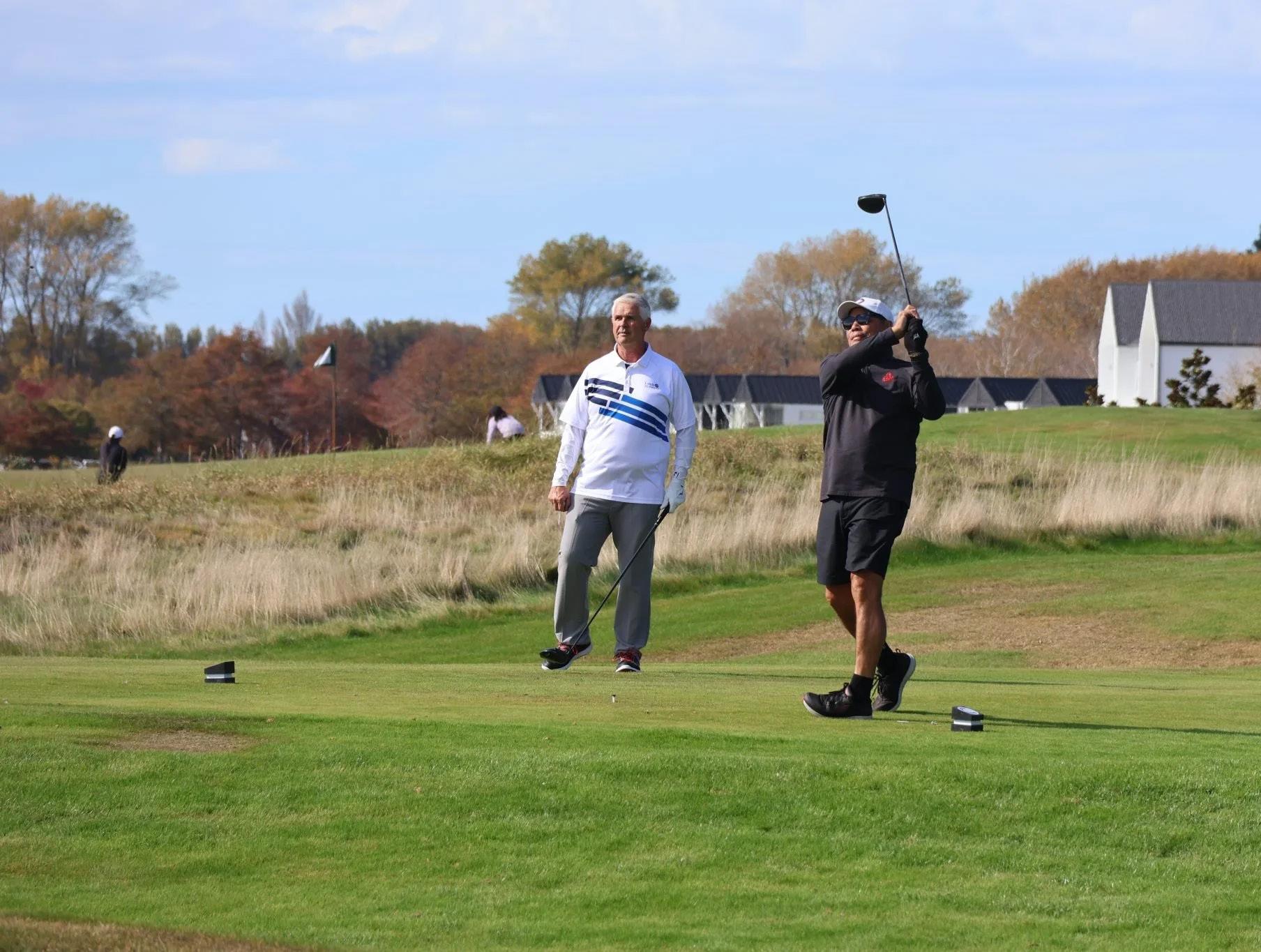
The 2026 Tour Championship event was held at Clearwater Golf Club recently in what is the finale event of the annual Order of Merit (OOM) Season. As well as providing a final opportunity for players in the various OOM divisions to compete for final points, the day also provides an opportunity to host various Canterbury Golf volunteers, supporters, and sponsors who are mixed into the field as part of an Am-Am Net Best Ball stableford format. This continues to act as a great way to thank these valuable people for their contributions to the game. The results of the Tour Championship Am-Am competition were as follows:
Furthermore, alongside the OOM titles being decided, the players were also competing for the development fund prizes with close to $8,750 worth of funds being awarded to players across
all playing divisions. These development funds can be used by players in the subsequent season towards their ongoing golf participation and/or their golf development expenses. The winners in each OOM category were as follows:
U13 Boys
1st – Tristan Bi (Clearwater) 2nd – Jack Ferguson (Clearwater) 3rd – William Kim (Russley) U16 Girls
1st – Vanessa Lim (Russley) 2nd – Aisha Lee (Russley) 3rd – Alice Fry (Russley) U16 Boys
1st – Maadi KiriKiri (Waimairi Beach) 2nd – Seiji Dimitrov (Russley)
3rd – Adam Riley (Pegasus) U19 Men
1st – Alfie Bell (Russley) 2nd – Etienner Collier (Avondale) 3rd – Shunsuke Nakamura (Pegasus)

The Otago Women’s National Teams was played recently at Alexandra.
20 teams braved the cold Autumn day with the Tapanui team of Mary-Anne Kane, Anne Robertson (63 nett) and Brenda Horton, Marilyn Redditt (65 nett) combined for the winning team score of 128.
Four shots back in second on 132 were
Kurow led by Denise Cochrane and Cindy Douglas on a nett 62.
Tied third were Taieri Lakes helped by a nett 64 from Janet Hobbs and Michelle Dean.
Clinton with the equal low score of nett 62 from Karen Mills and Sarah Burnet-Beattie combined for team totals of 133.
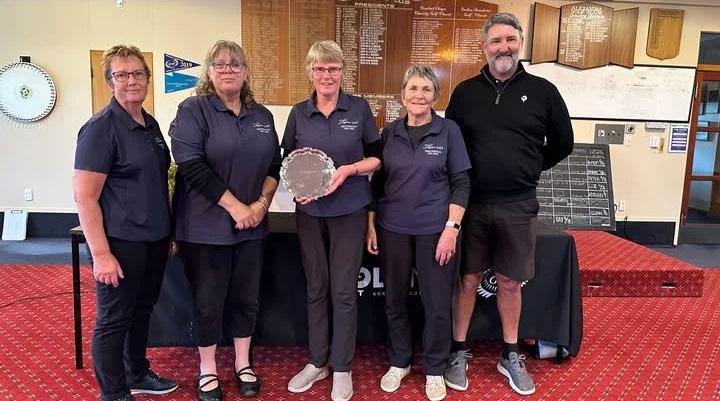
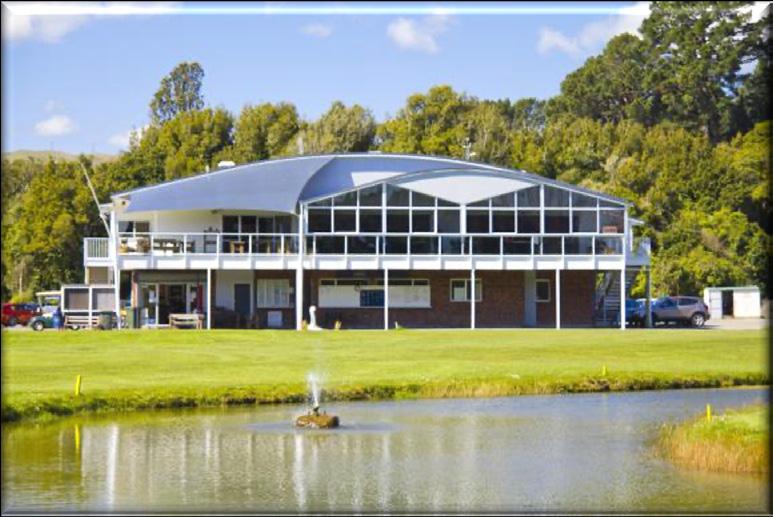
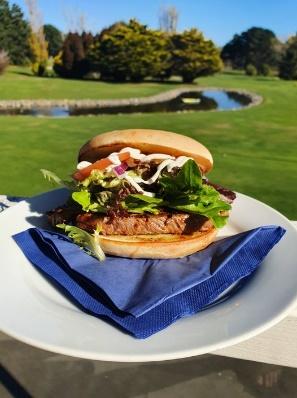

At the recent Golf Southland AGM, we were proud to announce our 2025 Golfers of the Year Senior Men’s Player of the Year: Justin