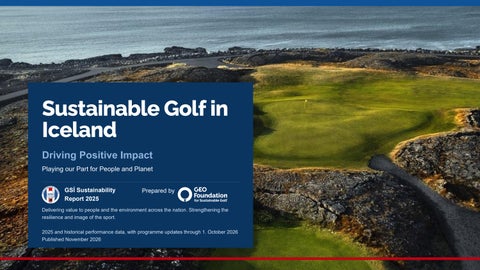
Sustainable Golf in Iceland Driving Positive Impact Playing our Part for People and Planet GSÍ Sustainability Report 2025
Prepared by
Delivering value to people and the environment across the nation. Strengthening the resilience and image of the sport. 2025 and historical performance data, with programme updates through 1. October 2026 Published November 2026
[Crest]
Contents Sustainable Golf in Iceland
3
Playing our part
4
Introduction
5–6
Sustainable Golf Impacts Fostering Nature
12–34 13–17
Strengthening Communities
24–30
Landscape and biodiversity
13
Golf course staff
24
About this report
5
Biodiversity practices
14
Health and wellbeing
25
The Sustainable Golf Framework
6
Turfgrass
15
Golf for all
26
Caring for the playing surfaces
16
Value of Icelandic golf
27
Pollution prevention
17
Golf courses as classrooms
28
Communications and advocacy
29
Club data and self-assessment
30
Strategy, priorities and objectives Recognition and pathway progress Education and knowledge European collaboration and shared learning
7–11 9 10
Conserving Resources
18–23
11 Water
18
Irrigation
19
Energy
20
Electric fleet and equipment
21
Waste and recycling
22
Sustainable procurement
23
Climate Action
31–32
Climate action
31
Carbon footprint
32
Summary
33–34
Sustainability and technology in operations
33
Golf course maintenance of the future
34
[Crest]
Sustainable Golf in Iceland The GSÍ’s goal is for golf to be a force for good for society and the environment in Iceland: protecting and restoring nature, using resources efficiently and contributing to the health of the nation and its communities.
Resilient, popular and successful clubs Advancing your club through the lens of sustainability is not only good for the environment and communities, it’s good for business and the golfer.
Vision of the Golf Union of Iceland Considering nature can help prioritise time and money spent on the management of the landscape, while also enhancing the golfers’ playing
Driving golf in Iceland further, together “Golf continues to struggle when it comes to its environmental impact and societal value, but that image is not always deserved. Now is the chance to change it for good.
experience Resource efficiency is directly linked to operating cost savings, as well as wider
Golf and nature can go well together, and the operation of golf clubs becomes more robust when it is financially sustainable and
long-term investments in energy, water and materials
resources are used responsibly. Sustainable innovation also supports permitting and funding, and goodwill is a tangible part of the balance sheet. Let’s harness the benefits sustainability can bring us.
Strong community ties build goodwill, greater understanding and access to
As golf across Europe makes ever greater strides in sustainability, Iceland has the opportunity to be at the forefront. We can be an
permitting and funding for further development of golf facilities
example to other nations, building on our strong links to nature and community and showing how a traditional sport can innovate in a modern world.
Sustainable innovation, technology and purpose can help attract and retain staff
Let’s play our part in protecting and improving the environment, because its quality directly affects our quality of life and our experience of golf.”
Hulda Bjarnadóttir
Gunnar S. Magnússon
President of the Golf Union of Iceland
Chair of the Sustainability Group and the Marketing and Communications Committee, GSÍ Board
Altogether this can generate even greater pride within the club membership, amongst visitors and the surrounding community by providing great golf as well as wider purpose and value to current and future generations.
See more: GSÍ Annual Report 2026
3
[Crest]
Playing our part The strongest possible knowledge base
Scandinavian Turfgrass and Environmental Research Foundation (STERF)
The R&A
European Golf Association (EGA)
GEO Foundation for Sustainable Golf
Association of Icelandic Sports and Golf Course Staff (SÍGÍ)
Through our close collaboration with STERF, our work is built on a solid understanding of responsible turfgrass management, biodiversity
We also draw on resources developed through The R&A Golf Course 2030 research programme.
Our transition plans for nature, water and turfgrass are aligned to the European Golf Association’s industry roadmaps.
Our sustainable golf framework, standards, programmes and reporting are provided by the international GEO Foundation for Sustainable Golf,
SÍGÍ promotes professionalism among course staff through educational meetings, courses, exhibitions and conferences, and works to maintain
recognised as Code Compliant by the global ISEAL Alliance.
and improve the quality of golf and sports facilities.
conservation, multi-functionality and water management.
Playing our part in national and local priorities Climate Targets
River Basin Management
Nature Restoration and Biodiversity Action Plans
Waste Reduction
Healthy and sustainable communities
Icelandic Climate Action Plan
Icelandic River Basin Management Plan 2022–2027
e.g. Reykjavík Biodiversity Management Plan 2030
Together Against Waste
Sustainable Iceland and Sustainable Development Goals Partnership Fund
Innovative and restorative new developments and course extensions Building net positive impact into the conceptualisation, planning, design and construction of any new developments or golf course renovations and extensions. Taking the opportunity to enhance landscapes and biodiversity; to increase accessibility to life enhancing recreation; offering new local employment in skilled, technology based and purpose driven careers.
5
[Crest]
About this report This is the Golf Union of Iceland’s third annual sustainability report. Results are presented across the nine Focus Areas of the Sustainable Golf Framework, using data clubs recorded in OnCourse. It shows what Icelandic golf clubs are doing for nature, resources, climate and community, and where the movement goes next.
Data Collection Clubs can record their Annual Data and Best Practices in OnCourse, GEO Foundation’s platform for tracking and reporting sustainability. Currently, 25 clubs are registered in OnCourse with 14 having completed their Best Practices (represented as A-N). The sample size for annual data is based on the number of clubs reporting.
A
B
C
D
E
F
G
H
I
J
K
L
M
N
Annual Sample Size
2017
6
2018
3
2019
4
2020
6
2021
3
2022
3
2023
4
2024
5
2025
6 submitted Annual Data that year
completed Best Practices only
Information was also gathered from a previous GSÍ report based on data for 2022, 2023 and 2024, which is noted when referenced; otherwise all findings are based on OnCourse.
Cleaning and Analysis All data is self-reported but GEO Foundation regularly reviews submissions for any anomalies through standardisation and normalisation. Data for certified clubs are further reviewed by an independent verifier through GEO’s ISEAL Code Compliant assurance and data management processes. All information on Best Practices and Annual Data is synthesised into a wider Sustainable Golf Data Lake.
5
[Crest]
The Sustainable Golf Framework Communications and Advocacy
Outreach
Golf’s shared reference point for its environmental and social priorities, shaped for more than 20 years by over 70 different organisations. This report follows its four themes and nine focus areas, so Icelandic results sit alongside golf’s international picture.
Landscape and Biodiversity
Turfgrass
Health and Wellbeing
Pollution Prevention
Materials
Water Energy
20+
70+
4
9
years of collaborative development
organisations have shaped it
connected themes
focus areas for facilities
UN Sustainable Development Goals The Sustainable Golf Framework is aligned with the United Nations Sustainable Development Goals, providing a practical way for Icelandic golf to contribute to shared global ambitions for people and the environment. Through the management of courses, the operation of facilities and its role in communities, golf can contribute to all 17 goals, with progress in one area often supporting several interconnected objectives. The SDG icons throughout this report highlight the goals most closely linked to each page’s findings and activities, connecting national, regional and local action with golf’s wider contribution to sustainable development. See also: previous GSÍ report on the UN SDGs
6
Strategy, priorities and objectives GSÍ Sustainability Report 2025
[Crest]
Strategy, priorities and objectives GSÍ’s 2030 strategy, approved at Golf Congress in November 2025, makes sustainability a core priority. This report sets it out against the Sustainable Golf Framework.
Aligning with the framework GSÍ aims to align its sustainability strategy and reporting with the European standard, and has adopted OnCourse, with 25 clubs now using it. The framework is open and practical, not a mandate, so GSÍ can adapt it to Icelandic conditions.
From framework to certification Framework
System
Certification
What matters most for sustainability in golf: four themes and nine focus areas, set through two decades of consultation.
OnCourse and the support around it: collect, interpret, improve, prove and promote.
Voluntary standards aligned to the framework, independently verified.
Golf bodies, including national associations like GSÍ, align their strategies and reporting to it.
Annual data in one place, benchmarks against peers, and evidence for national reporting.
Clubs that meet the criteria carry the GEO Certified eco-label.
See more: Strategy of the Golf Movement 2025–2030
8
[Crest]
Recognition and pathway progress GSÍ’s 2030 objectives track clubs from first data entry to independent certification.
26
Committed to the GSÍ Sustainability Mark
25
Clubs using OnCourse
4
GEO Certified clubs
1
Grant secured to support Golf 4 Circularity from Erasmus since May 2024
GSÍ Sustainability Mark
Action towards 2030 objectives Significant progress was made in 2025 aligned to GSÍ’s objectives for 2030 with some exceeding their annual expectations. In particular, there are now double the number of certified clubs in Iceland compared to last year. While looking to acquire new grants each year, the Golf 4 Circularity project has made progress since 2024 and concluded in 2025. Objective
2030 target
Progress to date
2025 progress
GSÍ Sustainability Mark
Every club by 2030
26 clubs
4 new clubs
Clubs using OnCourse
10 new clubs each year
25 clubs
3 new clubs
GEO Certified clubs
At least 6 certified
4 certified with 2 re-certifications
2 new certifications plus 1 re-certification
Icelandic stories on Sustainable.Golf
2–3 a year
19 available
9 newly published
The first step for any Icelandic club, organisation or individual to show their commitment to sustainability in and through golf.
The Mark is based on the Sustainable Golf Pledge, an international model developed by GEO Foundation. It helps clubs show their social and environmental values to members, visitors and partners, and makes golf an active part of tackling climate change, biodiversity loss and community wellbeing. Aligned to the 4 Themes of the Sustainable Golf Framework, 26 clubs in Iceland have so far committed to Fostering Nature, Conserving Resources, Taking Climate Action, and Strengthening Communities.
9
[Crest]
Education and knowledge GSÍ aims to deliver two sustainability education events each year, connecting international expertise with the experience of Icelandic clubs. While this report focusses on 2025 progress, there have already been a spring workshop and autumn webinar delivered with GEO Foundation in 2026.
Education delivered 6 March 2026 | GSÍ and GEO workshop, Laugardalur Held at the ÍSÍ Sports Centre, the workshop introduced the Sustainable Golf Pathway, alongside GSÍ’s sustainability priorities and Keilir’s experience of GEO certification. The programme included contributions from GEO Foundation’s Jonathan Smith and Kelli Jerome, GSÍ representatives and Keilir CEO Ólafur Þór Ágústsson. 9 October 2026 | GSÍ and GEO webinar Club representatives were invited and participated in the webinar, which included a demonstration from GEO and a shared experience from a practitioner (GKG). Subsequently, the recording was shared with the wider network of golf clubs across Iceland, extending insights beyond those able to attend live. An earlier event on robotisation and extreme weather, scheduled for 7 May 2025, was postponed following insufficient registrations. A revised delivery date for that programme is to be confirmed.
Sharing practical experience 3-6 March 2025 | SÍGÍ, GKG & Keilir The first three days were machinery maintenance training that brought together 14 course staff, with participant feedback informing plans for further training. Then, through Iceland’s greenkeeping network, the SÍGÍ’s conference attracted 60 attendees, with presentations covering course management, reuse of organic materials and maintenance technology.
Sustainable Golf Knowledge Centre A central resource on every aspect of sustainable golf, from nature and resources to climate and community. It signposts to research and materials from organisations around the world, always linking back to the original source. Content is curated with a steering group that began with the European Golf Association’s Technical Working Group, chaired by STERF’s director. Its experts from across golf and academia advise on what is included.
Research and guidance
Club highlights
Research papers, practical guidance, action kits and tools that dive into the science of sustainable golf and help deliver best practice.
Examples of leadership and action from clubs, associations and tournaments around the world. Any club can submit its own.
sustainable.golf/knowledge
sustainable.golf/highlights
GSÍ also hosted a Golf 4 Gens workshop in September 2026, connecting European research on circular economy, biodiversity and nature-based solutions with discussion of practical opportunities for Icelandic golf.
Resources in Icelandic
Objective
Recent progress
Existing resources
Publish at least one Icelandic translation of international guidance each year
GSÍ’s sustainability report, published in November 2025
Icelandic precision-fertilisation handbook and accompanying video, published in 2023, alongside guidance on winter protection and recovery
Presentation of the study on golf’s societal value, held in September 2026
10
[Crest]
European collaboration and shared learning GSÍ’s European partnerships connect Icelandic golf with research, practical guidance and experience from other countries, while providing opportunities to share Iceland’s own contribution. Together, these exchanges support more informed decisions across course management, club operations, community engagement and national strategy.
European Sustainable Golf Forum
Erasmus+ project
Erasmus+ project
Sharing Iceland’s experience and shaping common priorities
Golf 4 Circularity
Golf 4 Gens
In September 2026, EGA convened the European Sustainable Golf Forum at Bernardus Golf during Solheim Cup week. The two-day event brought together more than 80 representatives from over 30 countries to discuss climate action, nature protection and restoration, water stewardship, sustainable turfgrass management, regulation, impact measurement and credible communications.
GSÍ participated from May 2024, working with Reykjavík University on circular resource use and sustainability education. Activities included workshops in Iceland and Bulgaria, invitations to PGA instructors and contributions to PGA School lessons. University experts supported two surveys linking primary-school outdoor teaching with golf facilities, while a September 2025 youth activity used the Eco Golfer: Hack the Green quiz.
Launched in January 2026, this separate Erasmus+ Sport project builds on Golf 4 Circularity, extending into biodiversity, nature-based solutions and learning across generations.
GSÍ was represented by President Hulda Bjarnadóttir and Board Member and Sustainability Group Chair Gunnar S. Magnússon. Hulda contributed to two panels, highlighting Iceland’s recent research on golf’s social returns and bringing an Icelandic perspective to the discussions. The programme included the European Golf Water Stewardship and Turfgrass Roadmap, a preview of the Sustainable Golf Knowledge Centre and the forthcoming joint R&A/GEO Sustainable Golf Review. These resources provide relevant support for GSÍ’s programme and opportunities to inform future club education, share guidance and identify material for translation into Icelandic.
The project concluded in 2025, leaving practical resources for clubs, coaches and educators. Published resources include the Circular Roadmap for Grassroots Golf Clubs, an Activity Training Model for Schools and a youth hackathon report.
Explore the resources: golf4circularity.eu
GSÍ engaged stakeholders and hosted a workshop at KPMG in Reykjavík on 23 September to discuss research and practical opportunities. Good-practice examples, including Icelandic contributions, are available online; educational tools and pilot activities remain in development. École des Ponts Business School coordinates the partnership with GSÍ, the Austrian and Bulgarian Golf Associations, Romanian Golf Federation, Friends of Bulgarian Golf and Klassis Golf Club in Türkiye.
Explore the resources: golf4gens.eu
11
Sustainable Golf Impacts GSÍ Sustainability Report 2025
[Crest]
Fostering Nature
Landscape and biodiversity
Land area of the average Icelandic course
Greater understanding of habitat condition and monitoring wildlife use would help clubs identify current impacts and where further improvements could make the greatest difference for biodiversity.
33.35 ha
of new habitat reported on Icelandic courses since 2017, including 21.55 hectares added by 3 clubs in 2025
Habitats make up around 42% of the average golf course area reported in Iceland, complemented by smaller features that provide nesting, feeding and shelter opportunities for wildlife. Often inexpensive to create using existing materials, these microhabitats also offer ways to involve members, schools and volunteers, strengthening community connections with the course and its natural surroundings.
Microhabitats in 2025
5
3
2
open sandy areas
hedges
3
3
6
bird boxes
rock piles
woody debris piles
wildflower patches and meadows to support local pollinators
13
[Crest]
Fostering Nature
Biodiversity practices Clubs are showing general awareness of biodiversity, and are taking practical steps to undertake native planting and create and connect habitats. However, formal surveys and habitat management planning appear to be less common.
Knowing the course
Creating habitat
11 have knowledge of habitats and wildlife on the course
10 prioritise native species when planting
GKG Golf Club
Rewilding efforts breathe life into the course GKG has added 4,200 birch, larch and fir trees to rewilded areas across the Mýrin and Leirdalur courses, with members planting saplings alongside the greenkeeping team. By planting and growing these wild areas, the club aims to support carbon uptake and natural water filtration while adding to Iceland’s biodiversity and climate resilience. The initiative seeks to create nesting opportunities for birds and habitat for insects, encouraging wildlife to thrive on the courses, with plans to expand and monitor these areas for biodiversity benefits.
Golfklúbbur Þorlákshafnar
9 identify rare, protected or endangered species
9 create and maintain natural corridors between habitats
4 have carried out a habitat assessment or wildlife survey
8 connect course habitat to the surrounding landscape
2
clubs indicated that they review a habitat management plan every year
The vast majority of clubs reported to have knowledge of habitats and wildlife, while only 29% have undertaken an ecological survey and 14% review habitat plans annually. Structured approaches like surveys and plans help clubs solidify priorities for nature and track ecological outcomes, while expanding partnerships with local wildlife groups brings further expertise and strengthens community involvement.
5
clubs reported intensively managed areas replaced with natural habitat
Over a third of reporting clubs replaced intensively managed areas with natural habitat, which supports wildlife while reducing mowing and associated costs. As ecological value depends on habitat suitability in Iceland, open grassland and wetland are particularly important for breeding birds. Consideration of playing patterns and golfer awareness helps achieve lasting benefits for nature and the playing experience.
18,204 m² of turf returned to grassland During the 2025 season, the club combined golf course architecture expertise with custom golf-shot forecasting software to identify regularly mown areas receiving minimal play. Analysis of shot-dispersion patterns and play frequency informed the conversion of 18,204 m² of maintained turf into low-maintenance natural grassland, a 12.66% reduction in the mown footprint.
Keilir Golf Club
Wild rough making space for the arctic tern Following its first GEO certification in 2014, Keilir Golf Club has continued to identify areas of rough to leave unmown. Within three years, annual rough mowing time had fallen by 46% to 270 hours, delivering reported savings of more than $9,000. When Arctic terns began nesting in roughs just metres from fairways, the team adapted mowing patterns before nesting, encouraging them towards more suitable grassland nearby. The club reports increased birdlife, with golfers enjoying these magnificent birds during their round.
14
[Crest]
Fostering Nature
Creating a sustainable foundation for playing surfaces Grass selection is strongly guided by Iceland’s climate, with all reporting clubs considering winter stress and most accounting for disease, drought and wear. Fewer clubs report soil considerations, like type and pH, suggesting scope to better match grasses to the conditions beneath them. Bringing these factors together can support more resilient playing surfaces and reduce the need for corrective inputs and maintenance.
9
100%
clubs select turf species to account for winter stress
Considerations for selecting turfgrass species
13 disease tolerance 11
drought tolerance
11
wear tolerance
8
soil type
6
soil pH
Considerations for soil
clubs are helping to control nutrient levels by mowing and removing clippings according to local best practice
Reykjavík Golf Club
Golfklúbbur Mosfellsbæjar
Testing grasses for Iceland’s winters
Soil testing to reduce fertilisers
Reykjavík Golf Club participates in SCANGREEN, a Nordic research programme comparing turfgrass species and varieties for winter survival, disease resistance and playing quality. Testing under Icelandic conditions provides locally relevant evidence for grass selection, helping greenkeepers prepare for winter stresses and make informed decisions about the long-term resilience of playing surfaces.
Using Minimum Levels for Sustainable Nutrition (MLSN) guidelines to interpret soil tests, Golfklúbbur Mosfellsbæjar identified sufficient reserves of most essential nutrients, with nitrogen remaining the primary requirement for maintaining turf quality. This enabled more targeted applications: annual potassium use fell from 432 kg in 2022 to 12 kg in 2024, while phosphorus applications fell from 211 kg to zero.
15
[Crest]
Fostering Nature
Caring for the playing surfaces Integrated turfgrass management is well established among reporting clubs, particularly on greens. In Iceland’s short growing season, winter resilience largely depends on how practices are selectively timed and matched to local conditions. Unstable snow cover, ice encasement and meltwater can all affect turf survival, so connecting maintenance records with spring damage, recovery time and course closures is key to helping clubs identify which approaches work best at each unique site.
100% 50%
of clubs reported that they avoid fertilisation on natural rough in 2025
of clubs reportedly establish tolerance thresholds by area of the golf course and/or by objective tests of playing parameters.
Extending this approach would help target intervention where turf health or playability is at risk, reducing unnecessary treatments and aligning maintenance with the needs of each playing surface.
Share of the 14 reporting clubs carrying out each practice, by playing surface. Practice
Greens
Tees
Fairways
Sharpen mower blades
100%
93%
93%
Change hole or tee position
93%
93%
N/A
Aeration: solid tining, slitting or spiking
93%
79%
14%
Adjust mowing heights
86%
79%
86%
Adjust mowing patterns
86%
71%
79%
Remove surface water
86%
21%
N/A
Verti-cutting
64%
29%
21%
Aeration: hollow coring
36%
36%
14%
Scarifying
21%
21%
29%
16
[Crest]
Fostering Nature
Pollution prevention Every reporting club protects its most sensitive areas from spraying and spreading. All reporting clubs maintain buffer zones around ecologically sensitive areas, while 86% report specifically establishing further buffers around water bodies and wetlands. These untreated margins help reduce the risk of fertilisers and pesticides reaching vulnerable habitats with a wider margin helping to further minimise the risk of pollution. In fact, the average width of buffer zones increased by 46% compared to previous years, showing significant efforts towards best practice.
14 have buffer zones around ecologically sensitive areas
12 also buffer water bodies and wetlands
13.50 m average width of buffer zones in 2025, up from the historic average of 9.25 metres
17
[Crest]
Conserving Resources
Water Weather forecasts and soil moisture guide irrigation at most reporting clubs, helping match watering to local conditions. Rainfall, wind and dry spells all influence the needs of Icelandic turf, making responsive water management part of both resource conservation and adaptation to a changing climate.
Irrigation scheduling
Water plans clubhouse water use and encourage players and staff to 9 monitor save water
8 also monitor water use at their maintenance facility Average Annual Water Consumption
36,449 m³
m³ of water used in 2025 by one club reporting via OnCourse
13
use weather forecasts
11
monitor soil moisture
9
factor in wind speed
7
use data from an on-site weather station
7
use data from off-site weather stations
6
account for microclimates
Monitoring weather, including wind speed, along with soil moisture already informs irrigation at most reporting clubs. Only one third of reporting clubs use handheld meters and roughly a fifth use evapotranspiration data for more targeted insights. Combining these observations with local knowledge of drier or more exposed areas offers a relatively low-cost way to refine when and where water is applied. Used consistently, this information can help avoid unnecessary watering, make better use of rainfall and support turf health without relying solely on relatively costly investment in new irrigation infrastructure.
18
[Crest]
Conserving Resources
Irrigation Reliable irrigation helps clubs maintain healthy turf through dry spells and adapt to changing rainfall. Staff training and sprinkler adjustments are common among reporting clubs, supporting efficient use and even coverage. However, system audits remain less widespread. Irrigation technology
Irrigation optimisation
10 evaluate new irrigation technology
11 train staff on efficient irrigation
5 use modern sprinkler heads
11 adjust sprinklers for even coverage
4 use part-circle or adjustable sprinklers
8 water in the early morning or evening
2
irrigation services a year on average in 2025, compared with once a year historically
40%
rise in reported irrigation system calibration in 2025 compared to historic average
The majority of reporting clubs prioritise staff training and sprinkler adjustments, while roughly half avoid irrigation during the middle of the day. These practices provide a foundation for efficient water use, but only 29% regularly check pipework for leaks and 7% undertake an irrigation audit. To avoid additional investment in new irrigation systems, more targeted checks could help clubs identify water losses and establish where repairs, calibration or upgrades would offer the greatest value.
GKG Golf Club
Matching water to what the turf needs GKG has upgraded irrigation across 30 holes to Rain Bird CirrusPRO, replacing 187 decoders with ICM controls. Monitoring evapotranspiration will help the team understand moisture losses and match irrigation to what the turf needs. This matters in Iceland, where wind has a major influence on water loss.
19
[Crest]
Conserving Resources
Energy Most reporting clubs monitor energy use, and many naturalise non-playing areas to reduce mowing, connecting landscape management with efforts to cut fossil fuel demand. Measuring energy use
Cutting fuel use
11 monitor energy use in the clubhouse
12 naturalise non-playing areas to reduce mowing
11 monitor energy use in the maintenance facility
35%
2,251
kWh of electricity used on average in 2025, 6% decrease since 2022
2022 2023 2024
8%
decrease in hydraulic oil in 2025 compared to the historic average
increase in the amount of diesel consumed in 2025 compared to the historic average
Húsafell
Energy independence at unique geothermal location At Húsafell Resort and golf course, a location between glaciers, spring-fed streams and geothermal activity provides all required energy from local, renewable sources. Three on-site micro-hydropower plants generate electricity from two rivers, while two geothermal boreholes provide heating for buildings, around 200 cabins and the swimming pool. Drinking water comes from glacial melt that surfaces along the lava edge after years of natural filtration. The facility uses just 0.1% of this spring flow, and the golf course has gone through entire years without irrigation.
2025
The majority of clubs monitor energy use in both the clubhouse and maintenance facility. Efforts to continue to link these records to equipment use, operating hours and costs would help identify savings and prioritise investment. One club also reports on-site solar panels, while three others have electric car chargers; showing potential for solar generation to complement charging demand and wider energy needs.
Nearly all clubs reported to naturalise non-playing areas which can reduce mowing, improve habitat management, and simultaneously lower fuel use. Reported diesel consumption in 2025 was 8% above the historical average, so reviewing fuel use alongside mowing hours and other machinery tasks would help clubs understand demand and identify further efficiencies.
100%
650 kWh
of electricity from renewable sources every year
of on-site hydro power generated in 2025 20
[Crest]
Conserving Resources
Electric fleet and equipment Iceland’s almost entirely renewable electricity supply makes electrification of suitable equipment particularly relevant, with many clubs starting to adopt cleaner machinery. Electric equipment
Hybrid, solar and alternative fuels
9 use electric golf buggies
8 use hybrid mowers
6 use electric mowers
2 use solar-powered equipment
5 use electric robotic mowers
1 use hybrid vehicles
3 use electric hand tools
1 use alternative fuels
2 use electric utility vehicles
Hybrid mowers are used by 57% of reporting clubs, while solar-powered equipment, hybrid vehicles and alternative fuels are less common. Sharing experience from these early adopters could help others assess suitability for Icelandic conditions and equipment replacement around practical performance and costs over its working life.
2 use electric cars
Electric equipment is already used across several course operations with buggies and mowers being the most common. Better tracking these benefits alongside purchase costs, charging needs and performance would help clubs identify where further electrification offers the greatest value.
Akureyri Golf Club
2,250 litres of fuel saved a year after switching to robotic electric mowers, saving nearly €4,000 Akureyri Golf Club has introduced autonomous electric mowers to maintain rough on nine of Jaðarsvöllur’s eighteen holes. Replacing diesel ride-on mowers has reduced annual fuel consumption by 2,250 litres, saving nearly €4,000 in fuel costs and reducing greenhouse gas emissions. Automation has also freed staff time for other course and club activities that enhance the golfer experience, with an autonomous ball collector extending this approach to the practice area.
21
[Crest]
Conserving Resources
Waste and recycling Waste monitoring and recycling are established across many reporting clubs, but increased visibility of these efforts for example through the use of grouped, colour-coded and clearly labelled bins indicates a clear, relatively simple opportunity to improve reuse and recycling. Further formalising these existing systems would help to further prevent waste while supporting staff, golfers and the wider community to undertake sustainable behaviours. Waste plans
Clubhouse and/or Maintenance Facility
monitor and record waste
8
talk to their waste contractor
8
follow a waste management plan
3
partner with a reuse or recycling scheme
2
Recycling have a recycling system in place
8
add clear bin signage
8
cluster bins together
6
use colour-coded bins
5
label what goes in each bin
4
8
of 14 clubs reported they train their staff on a recycling programme
Golfklúbbur Þorlákshafnar
Transforming food waste into course improvements Golfklúbbur Þorlákshafnar has partnered with Icelandic circulareconomy specialists to turn clubhouse food waste into material for course repairs using an on-site composting machine. Mixed with sand and seed, the resulting material is applied to small bare areas, including divots, fairways and walking paths - giving food scraps a practical use on the course. The club also hopes that targeted application will reduce its need for synthetic fertilisers.
22
[Crest]
Conserving Resources
Sustainable procurement Clubs are already considering eco-labels and reduced packaging, but formal sustainable purchasing policies remain less common. Building on these practices with clear criteria for product durability, supplier standards and whole-life costs would help make sustainability a consistent part of purchasing decisions, reducing waste and securing better long-term value.
Purchasing practices 9 consider eco-labels
9 buy in large quantities to cut packaging
5 favour responsible suppliers
5 avoid single-use items
5 consider durability
Policies and supplier standards
3 of 8 benchmark clubs required suppliers to follow a code of conduct in 2024 Formal approaches remain the next step for most clubs. Three clubs have a sustainable procurement policy, two consider buying jointly with others, and one shares a code of conduct with suppliers. One club also buys goods made from recycled materials. Clear policies and supplier standards would help turn existing good practice into consistent purchasing decisions.
Erasmus+ project
Golf 4 Circularity GSÍ partnered in a European project to bring circular economy learning into grassroots golf. Its Circular Roadmap for Grassroots Golf Clubs offers practical guidance on reducing waste, keeping materials in use and making more sustainable purchasing decisions, alongside learning activities for young golfers and coaches.
Keilir Golf Club
Cooperation helps to reduce climate impacts During a fairway rebuild requiring approximately 12,000 m³ of material, Keilir Golf Club partnered with a nearby housing contractor to reuse excavation material. This shortened the transport distance for around 600 trailer loads from 27 km to 2 km, avoiding approximately 15,000 km of haulage. This collaboration saved time and money while reducing transportrelated Scope 3 emissions to support climate action.
23
[Crest]
Strengthening Communities
Golf course staff
It is essential to secure Access to skilled staff Stability and retention of knowledge An attractive working environment Technology adoption and higher productivity Long-term plan for staffing and renewal
High responsibility and workload in a short season and long working days at peak times.
Key staff carry responsibility for machinery, staff, quality and planning.
There is a risk that important knowledge is lost when a key employee leaves. Boards need to consider the working environment and ensure that key staff have the support, the right workforce and the conditions to carry out this vital role.
Key message The golf clubs of the future do not necessarily need more staff – but a well-organised, skilled and wellequipped workforce.
24
[Crest]
Strengthening Communities
Health and wellbeing Junior involvement, accessible facilities and fair membership policies show how clubs are helping more people participate in golf. However, there appears to be scope to further formalise this work through wider adoption of policies and programmes. These would also help translate accessible facilities into greater opportunities to play.
Young golfers
Accessible clubs
Fair and inclusive clubs
7 involve juniors in running the club, through a junior council or committee
8 have an accessible clubhouse for people with limited mobility or disabilities
10 have membership policies free from discrimination
7 offer mobility equipment
8 have an equal opportunity recruitment and hiring policy
2 run a dedicated accessible golf programme
4 monitor equal opportunities and offer a way to report discrimination
8 of 8 benchmark clubs have a policy on sexual harassment and equal opportunities (2024)
3 of 8 have an occupational health and safety policy (2024)
Golf for people with disabilities GSÍ works with EDGA and GSFÍ, Iceland’s association for golfers with disabilities, to develop opportunities to play, guided by EDGA’s eight-stage pathway. GSFÍ has provided regular coaching at Keilir, Vestmannaeyjar, Akureyri and Selfoss. On 4 August 2026, GSFÍ held a tournament at Korpúlfsstaðavöllur during Icelandic Championship week. Eleven golfers competed, with a practice session for golfers with disabilities held alongside the tournament.
25
[Crest]
Strengthening Communities
Golf for all
Keilir Golf Club
Encouraging juniors, women and girls to play is a common focus among reporting clubs, with beginner lessons and links to local schools providing further routes into the game. These activities can help people build confidence, develop skills and enjoy the physical and social benefits of golf. Promoting golf to all
Engaging with the local kindergarten At Keilir Golf Club, children from the neighbouring kindergarten visit weekly to try golf, play games and have fun. The club’s indoor putting and chipping facilities also host their artwork, with parents invited each year for an exhibition and introduction to golf. Partnerships with local schools include free group lessons for 14–16-year-olds each spring and autumn. These connections support a strong youth programme, with the club reporting over 130 members under 17 and more than 300 children taking part in its programme for five- to twelve-year-olds.
7
offer lessons for beginners
GKG
6
engage with local schools and groups
Supporting junior and youth golf participation
6
invite representatives of local groups to the club
While some approaches are relatively common for promoting golf amongst juniors and the wider community, partnerships and targeted engagement with under-represented groups are less widespread, with only 29% of reporting clubs indicating that they took this approach. Building these relationships, hosting open days and following up introductory sessions could help clubs broaden participation and strengthen connections with their communities.
Participation of golfers by demographic Age groups:
According to GSÍ Annual Report (2026) there were 33,600 registered golf club members across the 9 reporting clubs, of which 33% are women and 15% were under the age of 18. The 6 clubs that reported to OnCourse in 2025 indicated that their average membership was 29% female and 12% juniors. This variation is fairly insignificant but establishing targets for participation may help drive an uptake in each of these demographics.
At GKG, five coaches and four assistants support 290 young golfers through structured training that combines skill, fitness, mental strength and enjoyment. The programme provides a pathway from general participation to elite competition, with 200 players training twice weekly and 90 elite players training five times a week. A summer camp attracted 500 participants, while visits from local elementary schools introduce more children to the sport, combining broad opportunities to try golf with support for progression to national and international competition.
Golfklúbbur Mosfellsbæjar
Growing the game for people 65 and older The club’s programme for people aged 65 and over brings members together every Wednesday throughout the year. Summer golf and visits to other courses give way to winter sessions using indoor simulators and putting facilities, alongside talks on golf, wellbeing and looking after themselves as they grow older. A committee drawn from the group plans and runs activities with club support, giving participants an active role in sustaining opportunities to stay connected and involved beyond the outdoor playing season.
26
[Crest]
Icelandic Golf’s value extends beyond the course
ISK 31.2 billion Estimated annual societal value of golf in Iceland
Golf’s contribution to Iceland reaches beyond the rounds played. Research presented by GSÍ in September 2026 estimates its annual societal value at ISK 31.2 billion, bringing together wellbeing, economic activity and wider societal benefits. Against estimated annual expenditure of ISK 15.7 billion, the study reports around two krónur in societal value for every króna spent on golf. This expresses a broader value to society, rather than financial returns or realised cash savings.
The research also highlights golf’s role in keeping people active. Club members aged 19 and over were estimated to average 310 minutes of golf-related physical activity per week during May–August 2025. This seasonal finding illustrates how golf can provide regular opportunities for movement, alongside time outdoors and social connection. Together, these findings strengthen the case for recognising golf clubs as part of Iceland’s recreational and community infrastructure. The junior programmes, accessible facilities and activities for older golfers featured in this report show how clubs are opening those opportunities to different groups. Helping more people take part and remain involved throughout life can support both thriving clubs and the communities they serve.
About the research Produced by GSÍ and KPMG in collaboration with the Finnish Society of Sport Sciences, the study draws on membership and playing records alongside a June 2026 survey of 1,897 respondents from approximately 25,000 invited members. The activity estimate uses recorded rounds for 25,299 adult members in May–August 2025, assuming four hours per round; activity duration and intensity were not directly measured.
The social return on investment (SROI) calculation combines golf’s 2024 economic footprint, expenditure evidence from The R&A’s 2026 Affordability of Golf study as a proxy for wellbeing value, and societal-benefit assumptions adapted from Finnish research. It brings together different reference periods and depends on how benefits are valued and transferred between countries. Survey findings reflect respondents’ experiences, may not represent all members and do not establish direct causality between golf and the reported benefits.
Source: KPMG and GSÍ (2026), Virði golfíþróttarinnar fyrir líðan, heilsu og samfélag Íslendinga.
27
[Crest]
Strengthening Communities
Golf courses as multifunctional classrooms School partnerships, both young and collegiate, are the most common form of educational engagement among reporting clubs, showing how courses can support learning beyond golf. Expanding internships and apprenticeships would also give more people opportunities to develop practical skills and explore careers in golf and land management, while outdoor groups can recognise the value of nature in and alongside golf. Húsafell
Hiking routes around the course
Learning on the course
At Húsafell Resort in West Iceland, a network of ten themed hiking trails connects visitors with the area’s natural and cultural heritage, with many routes passing through the nine-hole golf course. Developed partly from ancient sheep and horse trails, routes range from the Water Trail’s active hot springs to the Artist Trail’s boulders etched with Viking artistry. Signs and free printed and digital maps help visitors explore trails of varying lengths and difficulty, opening the golf landscape to a wider community of outdoor enthusiasts.
7 work with primary and secondary schools
3 work with colleges and universities
2 offer internships or apprenticeships
2 host outdoor groups While outdoor groups and internships are less common, these approaches extend value to more people beyond the game. Partnerships with walking, birdwatching and other local groups could open up opportunities for recreation and learning, strengthen community relationships and introduce new audiences, with activities planned around safe access and golf. The emphasis on engaging with students at all levels is commendable, especially given the even greater representation of younger children in Icelandic programmes.
STERF handbook
Golf courses can offer much more than golf, with space for walking, outdoor learning, wildlife and community activities. This multifunctional approach has long been promoted across the Nordic region. STERF’s handbook on multifunctional potential can help clubs assess their landscape, identify suitable activities and explore how their course can serve golfers and the wider community.
Akureyri Golf Club
Proactive steps to make the golf course more accessible At Akureyri Golf Club, a public path network welcomes nearby residents to enjoy the course for hiking, running and cycling. Developed with the municipality following the club’s proposal in 2010, paths connect several entrances around the site with the central clubhouse, while welcome signs encourage everyone to use the area. The club is experiencing this as a win-win: breaking down perceived barriers, making golf more visible and approachable, bringing additional revenue to the clubhouse and strengthening community support for the course’s long-term future.
28
[Crest]
Strengthening Communities
Communications and advocacy Staff and golfer involvement is starting to provide a foundation for sustainability action, with annual data collection helping to track progress. Sharing stories through sustainable.golf and social media is also giving this work much more visibility and offering examples for others to follow. However, dedicated roles and plans covering the whole facility remain less common. Clear responsibilities, agreed priorities and closer integration into annual planning could help clubs coordinate their efforts and maintain continuity.
9
Icelandic highlights shared on Sustainable.Golf since February 2025
5 of 8 benchmark clubs have a formal environmental policy, unchanged since 2022
Promoting sustainability
7
involve staff and committees in sustainability
7
collect data aligned to the Sustainable Golf Framework every year
6
involve golfers in sustainability
5
share sustainability on social media
5
include sustainability in annual project planning
4
have a volunteer role for sustainability
2
have part-time staff for sustainability
1
has a sustainability plan covering the whole facility
29
[Crest]
GSÍ survey
Club data and self-assessment A 33-question survey on social responsibility was sent to all clubs in September 2026 – 21 clubs responded (about 33%)
48%
76%
Clubs perform fairly well in the Safety and equality category
18%
of clubs follow a privacy policy and a policy against forced labour
Disclosure is weakest – 2 of 21 publish a sustainability report
Safety, communication and equality in golf clubs
Environment
Community
Governance
Disclosure
48%
33%
44%
40%
18%
average yes
Anti-violence policy
67%
Case log
24%
Policy sign-off
24%
Contact counsellor Link to counsellor
average yes
Environmental policy
48%
52% 14%
Defibrillator
62%
Ambulance access
67%
Gender balance
71%
Energy management Climate risk: board Climate risk: action
Equality policy Work safety
Waste/energy policies
62% 10% 14% 33%
average yes 62%
Board separation
29%
Bonuses
Child labour
70%
Forced labour
76%
Supplier labour
38%
Human rights
19%
Supplier rights
17%
average yes
Supplier code of conduct Code of conduct & corruption
Sustain. report
29%
10%
Report scope
0% 48%
76% 24%
50%
To authorities
10%
To stakeholders
14%
UN SDGs
14%
SDG progress
10%
65%
Data protection GDPR
average yes
3rd-party check
19%
Some comments were received from clubs
CLUB COMMENT
CLUB COMMENT
CLUB COMMENT
“Smaller clubs find it harder to follow some of what is asked about”
“We are only a 100+ member club and do not have the capacity to follow all of this like a large company. :)”
“Work on the vast majority of these items began about 19 months ago and is well under way.”
Source: GSÍ survey on social responsibility of golf clubs (Nov. 2026). Percentages are based on the clubs that answered each question. Red bars: fewer than 15% of clubs answered yes.
30
[Crest]
Climate action Icelandic golf is working to reduce emissions while adapting to conditions that threaten courses and playing surfaces - with coastal flooding, erosion and unstable winters continuing to affect maintenance, safety and continuity of play.
49.00
Monitoring climate risk 10 collect data from weather stations
tonnes CO₂e as the average carbon footprint in Iceland 7 of these, have their own on-site weather station
3
clubs have an OnCourse scorecard with a carbon footprint
6 track historical climate records or microclimates
Brautarholt
Clubs are taking steps to monitor climatic trends, using weather stations and historical records to understand local conditions and support course management. Formal oversight and training are less widespread, however. Only one of eight benchmark clubs reported board monitoring of climate risk in 2024 (Klappir), while two of the 14 reporting clubs provide sustainability training, including carbon reduction. These findings highlight an opportunity to build on existing monitoring by giving climate risk a clearer place in club governance, investment planning and staff development, strengthening the connection between everyday maintenance and long-term adaptation.
Building climate considerations into course development Brautarholt’s expansion from 12 to 18 holes, completed in July 2025, incorporated measures to manage the challenges of its exposed coastal setting. The design considered local climatic conditions alongside the landscape, working with natural watercourses and vegetation and avoiding sensitive areas. During construction in 2022, five drainage collection points were installed to manage spring runoff across approximately 6.5 hectares, helping protect newly establishing turf from washouts. Further work tackled persistent wet ground through additional drainage and a channel cut through bedrock that had been obstructing water movement. Coastal recovery also remained part of the project. Following erosion around the fourth green in spring 2025, temporary repairs were undertaken to maintain safety and playability. Elsewhere, beach sand deposited on a lowlying fairway was cleared using a tractor and brush.
31
Climate Action
Carbon footprint Fuel use, maintenance inputs and course works all shape the reported carbon footprint of Icelandic golf. Renewable electricity helps to keep emissions from purchased power low, while machinery and the supply of materials remain important sources. Research, projects, practices and many other initiatives across nature, resources and community engagement are helping to manage emissions and tackle climate change throughout the country.
2025 Average Emissions (tCO2e) and proportion of total (%) Scope 1: fuel, denitrification of fertilisers
33.72
72.47%
Scope 2: electricity, heat
0.06
0.12%
12.76
27.41%
Scope 3: indirect emissions
65% renewable grid in Iceland keeps Scope 2 emissions very 100% low: 0.12% of the 2025 footprint of 2025’s footprint came from fuel burned by on-site equipment and machinery, down from 73% in 2024.
Direct emissions, including fuel and fertiliser use, account for the vast majority of the average footprint, with purchased electricity and heat nearly negligible, reflecting Iceland’s renewable energy supply. The main source of Scope 1 emissions is machinery use, maintenance inputs and course works. Indirect emissions (Scope 3) account for roughly a quarter, reflecting the use of other resources, like water and topdressing.
For reference: Klappir averages (9 reported courses); % = OnCourse average vs Klappir 30.03 tCO2e (+81.73%) in 2022, 33.30 tCO2e (+66.09%) in 2023, 57.39 tCO2e (-36.21%) in 2024 Covers club operations only; soil carbon and land-use emissions are excluded.
Emissions vary annually: 2025 is lower than 2022–23 but higher than 2024. Intentional efforts can be at least partially attributed to projects like Akureyri’s electric robotic mowing, which has cut annual fuel consumption by 2,250 litres (pg. 21), while Keilir’s reuse of nearby excavation material avoided around 15,000 km of haulage (pg. 23). At Þorlákshöfn, converting turf receiving little play into grassland reduced the mown footprint by 12.66% (pg. 14). Together, these example projects show how decisions about machinery, materials and land management are shaping a more sustainable future for Iceland’s courses.
32
[Crest]
Future developments in sustainable golf
Sustainability and technology in operations See next page: Golf course maintenance of the future – the year 2046
Sustainability and efficient operations
Technology and automation
Responsibility today and for the future
Greater efficiency and better quality
More efficient water use and smart irrigation
Robots and automated mowing
More targeted use of fertiliser and pesticides
GPS, artificial intelligence and smart sensors
Soil health and biodiversity
Data-driven decision-making
Environmental responsibility as part of the club’s image
Investments that can lower operating costs
Smart technology and sustainable practices go hand in hand: greater efficiency, better quality and lower operating costs. 33
[Crest]
Future developments in sustainable golf
Golf course maintenance of the future The year 2046 A vision of how technology, data and sustainability could shape golf course maintenance over the coming decades.
Self-driving mowers
More specialised greenkeeping roles
Machines that mow, tend and improve courses with precision, requiring less manual labour and delivering greater efficiency.
More emphasis on technology, analysis and managing complex systems, with greenkeeping staff taking on more specialised tasks.
AI-controlled irrigation
Data-driven decisions
Smart irrigation that uses real-time data on weather, soil and moisture to save water and improve course quality.
Integrated data on growth, traffic and maintenance supports better decisions, better use of resources and lower operating costs.
Drones monitor course condition
Electrification and solar power
Regular aerial surveys that detect turf health, growth and problems early.
Electric machinery and solar energy solutions reduce emissions and increase the sustainability of the course.
Hardier turfgrass varieties New, more resilient turfgrass varieties that require less fertiliser and pesticide and better withstand a changing climate. Published with the kind permission of Steindór Ragnarsson, General Manager of Akureyri Golf Club, who presented these reflections at the GSÍ Chairmen’s Meeting in November 2026. 34
Prepared for Icelandic golf by GEO Foundation for Sustainable Golf and GSÍ. Copyright © 2026 GEO Foundation Ltd. All rights reserved. Special thanks: Einar Gestur Jónasson (GL) and Kate Stillwell (GKG) for their contribution, and Viridi ehf. for technical support.