August 2026
ISSN 2979-2932
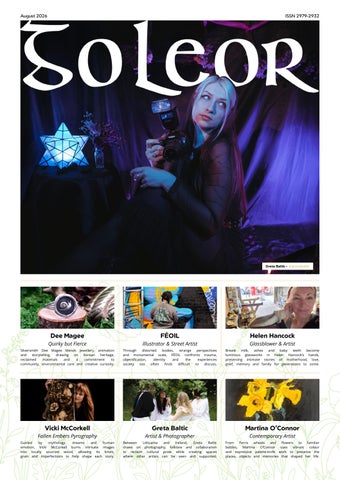
Greta Baltic - @gretabaltic
Dee Magee
FÉOIL
Helen Hancock
Quirky but Fierce
Illustrator & Street Artist
Glassblower & Artist
Silversmith Dee Magee blends jewellery, animation and storytelling, drawing on Korean heritage, reclaimed materials and a commitment to community, environmental care and creative curiosity.
Through distorted bodies, strange perspectives and monumental scale, FÉOIL confronts trauma, objectification, identity and the experiences society too often finds difficult to discuss.
Breast milk, ashes and baby teeth become luminous glassworks in Helen Hancock’s hands, preserving intimate stories of motherhood, love, grief, memory and family for generations to come.
Vicki McCorkell
Greta Baltic
Martina O’Connor
Fallen Embers Pyrography
Artist & Photographer
Contemporary Artist
Guided by mythology, dreams and human emotion, Vicki McCorkell burns intricate images into locally sourced wood, allowing its knots, grain and imperfections to help shape each story.
Between Lithuania and Ireland, Greta Baltic draws on photography, folklore and collaboration to reclaim cultural pride while creating spaces where other artists can be seen and supported.
From Ferris wheels and flowers to familiar bottles, Martina O’Connor uses vibrant colour and expressive palette-knife work to preserve the places, objects and memories that shaped her life.
Go Leor
Issue 12 - August 2026 © Go Leor 2026
Page Contents
4 FÉOIL 14 Helen Hancock 24 Vicki McCorkell 36 Greta Baltic 44 Martina O’Connor 56 Dee Magee Quirky but Fierce
Illustrator & Street Artist
Glassblower & Artist
Fallen Embers Pyrography
Artist & Photographer
Contemporary Artist
2
Issue 12
Supporters A special thanks to our first print subscribers:
Dee Magee David Baylis Laura McKenzie Atkins And thank you for the continued support of our founding supporters:
Mark Bonello Shirani Bolle Seanna O’Boyle Luke Fletcher Go Leor is built independently and sustained by its readers. Thank you for helping this publication grow.
Legal & Support © Go Leor 2026. All rights reserved. No part of this publication may be reproduced, stored, or transmitted in any form without prior written permission from the publisher. Visit us at go-leor. co.uk. The views expressed in this magazine are those of the contributors and interviewees, and do not necessarily reflect the views of Go Leor or its editorial team. For all queries or correspondence, please contact support at: support@go-leor.co.uk
3
Go Leor
Dee Magee
Quirky but Fierce From raven-sized lockets and reclaimed silver to animation and community, Dee Magee uses Quirky but Fierce to make room for the ideas that refuse to stay in one lane.
“I need something to kind of anchor me,” she says, “and then other things swirl around that.” That image suits Quirky but Fierce. Magee is a silversmith and jewellery designer, but the work around the jewellery keeps expanding into ceramics, animation, fiction, food, workshops and fundraising. Her collections move from sea glass and broken plates to forest creatures, Korean heritage and a rejection of hustle culture. The connection is Magee herself: curious, politically engaged and unable to leave an interesting possibility alone. An Anchor for Ideas Magee began silversmithing during the Covid furlough period, while working from home for a charity. There was not enough work to fill her time, so she found something else to learn. Five or six years later, she is still drawn to the scale of the subject. “There’s so many different avenues to go down that you can’t really get bored with it,” she says. “I think I could be doing different forms of silversmithing for the rest of my
Working with sand-casting, hand-forging and wire-drawing, she recently established her own in-studio lost-wax casting set up.
D
ee has a habit of giving herself more to do. A wedding cake for a friend, an unexpected market, new jewellery, the beginnings of a mail club and another YouTube film can all find their way into the same month. Instead of narrowing the list, she looks for the deadline that will hold it together.
4
life and still not have explored all of the avenues.” She has worked with sand-casting, hand-forging, wire-drawing, and recently established her own in-studio lost-wax casting set up. Online demonstrations can make a new technique appear deceptively accessible. Magee admits to watching a video and thinking, “I could do that,” before discovering how much more complicated it is in practice. For many silversmiths, the answer is to specialise. Magee’s answer is to move. She may focus intensely on one method, step away when her attention needs something different and return later with more skill or a clearer purpose. “It’s the theme of my life,” she says. “I can’t stay in my lane.” The movement is how she sustains her commitment. Silversmithing has lasted because it keeps asking new things of her. Something More Than Crisps Her move into YouTube came partly from frustration with what social media asks artists to produce: more clips, quicker edits and another post before the last has had time to settle. Magee compares short-form content to junk food. It is satisfying in the moment, but a poor substitute for being properly fed. YouTube offered the chance to make an elaborate meal instead.
Issue 12 “For me, YouTube was kind of an opportunity to almost cook this elaborate meal for people,” she says, “with all the ingredients I could get my hands on and all the skills I possess - and also don’t possess, but would figure out in doing it - and serve it up to them.” She wants to give viewers time to digest something or follow an idea into their own imaginations. If somebody dislikes the finished meal, at least Magee made what she wanted rather than another handful of disposable content. The films also combine forms that do not ordinarily fit inside a jewellery business. Writing more was one of Magee’s goals for 2026. She has short stories to develop and a novel at the back of her mind, but neither comes with an external deadline. A monthly film requires a script, scenes and transitions. It makes her practise storytelling rather than wait to feel ready. Magee scripts carefully and plans some shots, but leaves space for experiments. A camera might end up wedged in a tree or placed inside a bowl. If an angle fails, it can disappear in the edit. A small audience gives her freedom. “Maybe no one will even see this, so I can do whatever I want,” she says. “There’s no pressure there, and I think that’s a really lovely and important thing for creativity.” A Locket for a Raven The first film centres on a commission for an unusual client: a raven in need of a locket. The idea began with Magee’s wish to make pieces more ridiculous, absurd and specific than the commercial side of her work normally allows. She values the customers who buy smaller objects, but recognises another appetite beside that practical exchange.
5
Go Leor “The artist in me wants to make weird things,” she says.
the character digitally. A trial established that she did not yet have the patience for stop motion.
A detailed locket for a bird is unlikely to find the perfect buyer at a market. Its labour and specificity resist ordinary calculations of stock, price and demand. The film gives the object another reason to exist: it can carry a story and become the centre of a small invented world.
Once it arrived, the raven felt at home in her work. Jewellery is made of little treasures: bright metal, stones and twig-like forms that might catch a curious bird’s attention. The character allowed silversmithing to meet something funny and theatrical.
The raven appeared almost by accident. Magee remembers seeing the birds in the car park at Sainsbury’s. Conversations with Jo Pearson about puppetry pushed the thought further. Magee painted separate body parts, scanned them and animated
The raven was not the original plan. Magee had researched shrews after repeatedly finding dead ones on her walks. Their unusual biology sent her into a new trail of reading. The shrews have been postponed, not abandoned.
Jewellery is made of little treasures: bright metal, stones and twig-like forms that might catch a curious bird’s attention. YouTube - @QuirkyButFierce
6
Issue 12 BeeLeaf Earrings
Circles & Ovals Byzantine Bracelet
7
Go Leor
8
Issue 12 Living in the Middle Ground
Quirky but Fierce Before Silver
Financially, the bakery worked. Personally, it became untenable. The hours were long and unsociable, the work physically demanding and everything seemed sticky with buttercream. A successful business was making Magee deeply unhappy. “It was a very good business in the sense of numbers,” she says, “but I was so unhappy doing it.” She eventually stepped away, although the equipment remains in a cupboard she built for it. Now the tins come out when somebody she loves is getting married, or when food can contribute to something larger. Magee used them for a cake picnic raising funds for Palestine, returning to the skill without returning to the business that exhausted her. The experience sharpened a distinction that continues in her jewellery. Commercial viability matters, but good numbers cannot be the only measure of whether a practice is working. Before accepting an invitation to a Vault market this summer, Magee had taken a sabbatical from the business side of silversmithing. Even with little spare time, she wanted to arrive with something new. “I tend to make my life more difficult than it needs to be,” she says.
“I can either spend the rest of my life feeling a little bit ashamed, or I can take responsibility for the resources I have at my hands now”
Quirky but Fierce did not begin as a jewellery name. After moving from the United States to Northern Ireland in December 2017, Magee established Quirky but Fierce Bakery from her home in rural County Down. She made celebration cakes and opened her living room each Saturday as a small doughnut shop.
9
The Koreanish collection stands apart from Magee’s other work, and she is comfortable with that. Combining experiments in ceramics with silversmithing, it is a way to approach her Korean heritage without pretending that her relationship to it is simple. Magee is half Korean, born and raised in the United States by a Korean mother and white father. White classmates treated her as wholly Asian. In Korean spaces, including a church she attended with her mother, she was not always seen as Korean at all. “I’ve always kind of landed in this middle ground and felt I didn’t really belong anywhere,” she says. Her mother was not encouraged to speak Korean to her children. In the United States of the late 1980s and early 1990s, immigrants were pressured to assimilate and speak English. Magee never learned Korean, has met only one uncle from her mother’s family and has never visited Korea. Those absences produced a sense of not being Korean enough. The collection begins with Magee deciding that she cannot alter her childhood, but can decide what she does with the access she has now. “I can either spend the rest of my life feeling a little bit ashamed, or a little bit unsure of who I am,” she says, “or I can take responsibility for the resources I have at my hands now, and I can research and dive into that culture.” The “ish” in Koreanish matters. It leaves the mixed, partial and ongoing nature of the connection visible.
Go Leor Beyond the Korean Corn Dog
Dancheong Adjustable Bracelet
The collection arrives as Korean film, television, music, food and beauty products have entered the global mainstream. Magee appreciates the interest while recognising how quickly a culture is flattened into saleable fragments. The change brings its own whiplash. The food that drew insults when she was young is newly fashionable. After encountering racist gestures and slurs, Magee is now expected to explain kimchi or share in the latest K-pop phenomenon. Magee would rather use that curiosity as an invitation to go further: not just a Korean corn dog, but the whole spread, with its side dishes, work and histories intact. That approach shapes the kimchi workshops she sometimes teaches. Kimchi may be sold through the language of probiotics and gut health, but Magee places it within a longer account of survival and collective labour. Traditionally, families and neighbours gathered at one home to prepare enough for winter, then moved on to help the next household. Food preservation was also gossip, knowledge and care. “It is about community health,” Magee says, “and about a survival story of a very resilient people.” Koreanish will grow as she learns. It may never match the look of every other Quirky but Fierce collection, but uniformity is not the aim. Business advice tells her to repeat one recognisable aesthetic until the brand can be explained in three words. She knows that will not be enough.
10
Issue 12 No Separate Set of Values
Her work uses recycled precious metals, locally collected sea glass, reclaimed gemstones and broken ceramics. Magee avoids newly mined gemstones where she cannot trust the conditions behind them, uses recyclable or home-compostable packaging and favours second-hand tools. Her studio runs on renewable electricity, and ten per cent of profits have gone to charities since August 2025. Materials do not arrive without people or consequences. Human hands mine precious metals and extract materials for technology. The woods, shorelines and
Materials do not arrive without people or consequences.
Magee’s refusal to divide things into tidy categories extends to the politics of making. The environmental and social commitments of Quirky but Fierce are not intended as a charitable layer added after the jewellery is finished. They begin with the object itself.
creatures that feed Magee’s imagination are affected by the same economic systems. “I don’t think there should really ever be a separation between what a person would do and what a business would do,” she says. Jewellery cannot take priority over whether people are fed, housed and safe. A small maker cannot repair every supply chain alone, but Magee rejects the argument that responsibility belongs either to corporations or individuals. The better conjunction is “and”. Companies are responsible for exploitation, and customers have collective power in deciding what they support. This is why fundraisers, social causes and scrutiny of materials belong within the same practice. Magee jokes that it may make her a bad businessperson and, perhaps, a decent human being. She will not create objects while treating the lives and resources behind them as somebody else’s concern. Vintage-Style Mushroom Necklace
Broken Plates: Fireglow Collection - Yellow Daisy
11
Go Leor A Library of Stories
Storytelling gives these collections continuity. Magee’s mind begins making narratives from whatever she notices. Three apparent cherry tomatoes on a footpath can prompt an elaborate explanation before revealing themselves as fruit fallen from a hedge. The ordinary world readily offers an entrance into invention. Magee wants jewellery to retain some of that charge. A piece can be decorative and still act as a talisman: a prompt towards a memory, a more generous possibility or a detail in the world that deserves another look. “If I’m going to take my time and use the resources to make jewellery,” she says, “I’d really love for them to be almost talismans
“I’d really love for them to be almost talismans for people to conjure up ideas of what the world could be.”
Quirky but Fierce makes more sense as a library than a single shelf. Sea glass carries imagined journeys from the coast. Broken plates retain older patterns. Forest Fiends turn attention towards snails, mushrooms and easily missed lives. Koreanish follows an interrupted inheritance. A locket for a raven makes room for work that does not need to justify itself as stock.
Sea Glass T-Ring
12
for people to conjure up ideas of what the world could be.” The stories, materials and methods may change. The constant is an invitation to remain curious about who made an object, where its substance came from, what history has been compressed into a fashionable image, and what strange creature might be waiting for its own film. Quirky but Fierce does not resolve Magee’s interests into one answer. It gives them somewhere to gather. Dee helped coordinate artists and makers in raising funds for Anaka Women’s Collective’s emergency response following the recent racist attacks in Belfast. Follow and support their vital community work: @anakacollective Explore Dee Magee’s collections and discover more of the stories behind Quirky but Fierce: quirkybutfierce.com Follow the latest news via their social media: @quirkybutfierce Watch Dee combine silversmithing, storytelling and animation on her YouTube channel: @QuirkyButFierce
Issue 12 FUCK THE HUSTLE - Wax Seal Ring
13
Go Leor
FÉOIL
Illustrator & Street Artist From distorted bodies and three-headed wolves, FÉOIL turns experiences that resist easy conversation into images too large, strange and alive to be ignored.
F
ÉOIL wants to go bigger. Spray paint may be the foundation of their street work, but the real material they are trying to master is scale: the shift from an etching that fits in the hand to a figure capable of occupying an entire wall.
Different Strokes
“I think size is kind of an underrated medium,” they say.
The artists around them may share walls, events and paint jams, but their visual languages remain recognisably their own. That variety means there is less pressure for everybody to fight for the same narrow position.
Entering Belfast’s street-art community gave FÉOIL something they had struggled to find elsewhere: a creative environment where difference does not automatically become competition.
Throughout FÉOIL’s work, changing the size or proportion of a body also changes how it can be understood. Limbs stretch, viewpoints tilt and human figures slip towards beasts. A small drawing can hold something difficult to say; a public wall can place that feeling in front of thousands of strangers.
“We’re all interconnected, but there’s not very much competition in that way because we all kind of fit a different niche,” FÉOIL says. “It’s one of the best parts, because I struggle with competition a lot.”
Behind the moniker is Eibhlín “Eibh” Duffy, an Irish-Scottish illustrator and street artist raised in County Down and now based in Belfast. Working across spray paint, illustration, printmaking and painting, they create figures that are grotesque, funny, wounded, watchful and feminine. The work is personal, yet never settles for a straightforward portrait of victimhood.
The route into spray paint was also shaped by physical necessity. FÉOIL is dyspraxic and frequently injures their hands. Printmaking, particularly processes involving sharp cutting tools, became difficult to sustain. Spray painting presents its own strain - the joints in their fingers can become sore - but it offers another way to keep working when a different method becomes inaccessible. Moving between materials prevents one injury or limitation from closing down the entire practice. FÉOIL would now like to work more with brushes and emulsion. Whatever the material, the ambition remains the same: to move between the tiny and the monumental.
14
Issue 12
15
Go Leor
A large shutter on North Street became an early test of that ambition. Another artist had been expected to complete the job but withdrew, and FÉOIL was put forward as a replacement. They had only been spray painting for around a year and a half and were working beside artists with considerably more experience. On Culture Night in 2025, FÉOIL had two surfaces to complete: the North Street shutter and another wall barely the size of a door. Initially, the smaller spot felt disappointing. Once the reality of completing both in a single day became clear, it felt like a mission. The shutter was one of the biggest things they had painted. FÉOIL arrived unsure whether they could
“‘Oh my God, it’s this massive thing.’ But I did it and I smashed it.”
Taking Up More Wall
16
manage it, then did. “I was like, ‘Oh my God, it’s this massive thing.’ But I did it and I smashed it.” Their pride is immediately followed by an artist’s qualification: the piece is “all right”, and they keep considering whether to return and fix it. People pass it on foot and see it from buses; unless it is painted over, it remains part of North Street. FÉOIL had taken up a larger piece of the city than they knew they could handle. FÉOIL admires artists who move between extremely small prints and enormous murals without treating either as the lesser form. They want the same freedom. Size alters the physical relationship between the figure and the person looking at it.
Issue 12 A Distorted View Perspective is one of FÉOIL’s most effective tools. In pieces such as íte’s sacrifice (in the name of rot), where a girl looks down up from the bottom of a well, the angle places the viewer inside a moment of vertigo. The body and its surroundings do not simply describe a scene; they reproduce something of its sensation. “Perspective is one of those things that can really lend itself to communication in a piece - how it makes you feel as well,” they say. “It kind of tricks the eye, and that sort of makes you feel different about things.” Dyspraxia affects FÉOIL’s spatial awareness in daily life. They bump into things and fall, and do not feel that they perceive perspective in the same way as other people. In their art, that difference becomes a visual language of its own. Angles are pushed, bodies extended and the supposedly correct view loses its authority. Realism has never felt comfortable. FÉOIL found greater freedom in twisted characters whose proportions could answer to the image rather than a fixed idea of perfection. Body dysmorphia also informs the way they see and represent bodies: not as stable forms observed from a safe distance, but as shapes altered by perception. That distortion is sometimes read as body horror. FÉOIL welcomes the term because it recognises the estrangement inside the work. Objectification, difficult experiences of sex and men, and a sense that their body was the principal thing for which they might be valued all feed into figures that appear stretched, exposed or physically transformed.
FÉOIL works under a moniker that can appear to separate artist from art, yet their practice remains intensely personal. They describe it as a second skin and a means of communication. It shows how they see something when ordinary explanation has failed to make that view legible to somebody else.
“Everything’s kind of twisted and difficult, and you don’t quite fit your own skin,” they say.
“I kind of just make to get by,” they say. “I make to keep going.”
17
Go Leor
18
Issue 12 The Ulster Woman Looks Back
FÉOIL’s Ulster woman is not presented as passive. She has become a twisted form representing the way abuse twists and changes women - experience has taught her that protection must be constant. Fur covers her body like armour, while her strained posture retains the force of what produced the transformation. The piece is informed by FÉOIL’s experience of childhood abuse and by the difficulty of speaking about trauma in a way that permits a conversation to continue. A direct disclosure can leave both people inside a silence: one has offered a painful truth, while the other may not know what can follow it. Art enters that silence. FÉOIL is alert to the danger that an artwork can romanticise trauma, but it can also give thought somewhere to go. Rather than closing with the
It responded to the recorded number of women killed violently in Northern Ireland since 2020.
That need to communicate is at the centre of Bean Ultach, or Ulster Woman. The work considers violence against women across Ulster, including women who understand themselves as Irish and those who identify as British.
19
statement that a person was victimised, an image can ask what changed and why defensive behaviour is so often judged without regard for what made defence necessary. The wolf draws partly upon accounts of women imprisoned after fighting back against longterm abuse. FÉOIL is interested in the difficult ground between uncomplicated categories: a person can have been victimised without victimhood containing the whole of who they are; an act of resistance can be violent while still carrying the history of what preceded it. That ambiguity is especially urgent in a culture inclined to swallow pain, keep going and turn discomfort into a joke. When Bean Ultach was made, it responded to the recorded number of women killed violently in Northern Ireland since 2020. The figure written into the original project was 30. FÉOIL speaks about it not as a completed statistic but as a number that continues to change, rising to 33 earlier this year, binding the personal history within the piece to an ongoing public emergency.
Go Leor Speaking Without Speaking
“I want people to kind of feel a bit ‘oh’, but feel a wee bit better as it goes on - an exposure to it,” they say. “It’s talking to people without talking to people.” The monstrous bodies refuse a familiar picture of the ideal victim. They can be damaged and defensive, ugly and beautiful, frightened and dangerous. FÉOIL wants the work to remain raw without reproducing the objectification it examines or dictating its only meaning. Public art adds another negotiation. Illustration allows FÉOIL to confront the naked body directly; the street limits what can be shown. Artistic nudity can quickly be flattened into the assumption that all nudity is sexual. They have begun bringing more of that bodily language into murals while considering audiences who encounter a wall without choosing to enter a gallery. The tension suits a practice concerned with how bodies are read. A monstrous figure may be the more accurate portrait. Choosing FÉOIL The name FÉOIL grew from a longer history of self-renaming. After traumatic experiences while growing up, Eibh would adopt a new name or nickname and try to become somebody different. Each change felt like shedding a skin. When they began spray painting at university, they wanted a moniker:
“I want people to kind of feel a bit ‘oh’, but feel a wee bit better as it goes on - an exposure to it. It’s talking to people without talking to people.”
FÉOIL can name what happened to them, but understands that the subject creates a visceral reaction in other people. Their work does not attempt to make it comfortable. It asks viewers to remain with the initial recoil long enough for another response to become possible.
20
a more confident identity capable of entering the street-art world even when they did not feel able to enter it simply as themselves. Feoil is the Irish word for meat or flesh. Feoiliteach can mean a meateater or consumer of meat. For an artist preoccupied with bodies and objectification, the bluntness was right. “We’re all meat,” they say. “We’re all human bodies. We’re skin suits with stuff inside them.” The word reduces everybody to the same physical substance while reclaiming the idea of being treated as a piece of meat. It is genderneutral enough that somebody seeing it beside a wall cannot immediately decide the gender of the artist. It sounds sharp, carries an Irish connection and - despite proving awkward to spray as a tag has begun to feel permanent. Most importantly, this is the first time Eibh has taken another name for a good reason. FÉOIL does not mark an attempt to flee what happened or erase the person who experienced it. It names an identity they actively chose. As their understanding of Irish grows, the moniker encourages them to keep learning the language rather than use an Irish word as a detached aesthetic. The name acts as what they call “a carrot on a stick”. Femininity Without Permission Alienation appears throughout FÉOIL’s work because they spent much of their early life alone. They see a particular relationship between femininity and loneliness: women and feminine people can be isolated because their presence is treated as valuable only when it is useful to somebody else. FÉOIL remembers male friendships changing in adolescence as gender and the possibility of sex entered
Issue 12
21
Go Leor
They would like to see solidarity between women that is not organised solely around men or romantic relationships. At the same time, FÉOIL’s own relationship with womanhood does not fit into a simple declaration. They are nonbinary and prefer gender-neutral language. They do not object to being seen as a woman, but have never felt like a lady in the socially approved meaning of the word. Drawing offers another definition. In FÉOIL’s work, femininity is not always tidy, delicate or well behaved. “It’s ugly, it’s grotesque, it’s fat and it’s thin,” they say.
Femininity is not always tidy, delicate or well behaved.
how other people understood them. The message was difficult to miss: “You can’t be around unless you’re useful.”
It can encompass all of those conditions without any one becoming a rule. Their figures are predominantly feminine, but their meaning is not restricted to women. Experiences of being objectified, alienated, misread or condemned for protecting oneself can cross gender. The bodies are theirs, but a viewer may recognise what it means to become strange to oneself. Regrowth FÉOIL is often severe about their own work. They do not always enjoy what they make and can move quickly from loving a piece to hating it. The purpose of making is not constant satisfaction. It is that the act helps them continue. Looking backwards has nevertheless revealed a change. Old images show the practice shifting, flowing and adapting. FÉOIL compares the process to regrowing a limb: a body repairing itself does not return unchanged, but makes another form of movement possible. At 24, they feel more repaired than they have in a long time. It is not a claim that every injury has disappeared or that art provided a simple cure. It recognises the work involved in looking at something made years earlier without rejecting it completely. The same movement runs through the entire practice. An injured hand leads from one medium to another. Poor spatial awareness becomes exaggerated perspective. A history of unwanted names gives way to a chosen one. A body treated as an object grows fur, heads and the capacity to watch every direction at once. Now FÉOIL wants more wall. The ambition is practical - larger
22
Issue 12
FÉOIL is one of the most visually independent artists working in Ireland today. Beneath the immediate force of their imagery lies a depth of knowledge, rigorous self-questioning and a burgeoning confidence. Together, these qualities reveal an artist blossoming into one of the great creative voices of their generation. By confronting violence, objectification, alienation and other experiences carried by
One of the most visually independent artists in Ireland
commissions, greater confidence and new materials - but it is also consistent with everything their figures already do. They take private sensations that are too easily dismissed and alter their scale.
23
feminine bodies, FÉOIL creates work that is arresting without allowing spectacle to eclipse thought. Their figures do more than command attention: they bring us face to face with experiences our society has overlooked, minimised or made difficult to discuss, asking us to reckon with the blind spots that remain our own. Explore FÉOIL’s illustration, murals and public projects via their website: feoiliteach.co.uk. Follow their latest work, streetart events and works in progress on social media: @feoiliteach.
Go Leor
Helen Hancock Glassblower & Artist
Derry artist Helen Hancock transforms breast milk, ashes and other intimate materials into luminous glassworks that preserve stories of motherhood, loss and family.
It is an image that captures something essential about Hancock’s work. Her objects are beautiful in their own right: luminous forms shaped through heat, breath, timing and decades of skill. Yet they also carry stories far larger than their physical scale. Breast milk, ashes, baby teeth and
“I’m just excited to be able to work with the material”
H
elen Hancock likes to imagine one of her paperweights being discovered at the back of a drawer two hundred years from now. Its finder may not immediately understand the pale, cloud-like substance suspended inside the glass. They may have to follow a family story backwards, through parents and grandparents, before learning that it contains the breast milk of an ancestor, preserved for the child she once fed.
24
other intensely personal materials enter molten glass and become lasting records of care, grief, birth and belonging. What might otherwise disappear is given a form that can move through generations. For the Derry glass artist, this meeting of material and memory is not an intellectual exercise. It has emerged from a life in which art, motherhood, loss and community support have repeatedly crossed paths. Her practice is technically accomplished, emotionally perceptive and sometimes wonderfully irreverent. It is also built upon a radical act of attention: taking seriously the things people entrust to her, however small or unconventional they may seem to anyone else.
Issue 12 Staying in Love with Glass Hancock has been working with glass for more than thirty years. After studying Craft Design Glass at the National College of Art and Design in Dublin, she lived in Seattle, where she encountered an ambitious international glass culture and worked among some of the field’s most accomplished makers. Even now, decades into her practice, the material retains its power to surprise her. “I’m just excited to be able to work with the material,” she says. “Sometimes I surprise myself, being able to do things I didn’t think I’d still be able to do thirty years later.” Glassblowing asks for concentration and physical confidence. The artist must work with a substance that is fluid, intensely hot and always changing. There is little room for hesitation. Hancock now works alone, which places practical limits on the weight and scale she can handle, but she has come to see those limits as a useful part of her practice rather than something to fight. Her approach is increasingly guided by a desire to “work smarter, not harder.” After moving house and rebuilding her workshop, she initially imagined expanding: a larger hot shop, more equipment and more workshops. Instead, the experience clarified what she actually wanted. She began thinking about reducing the operation and protecting the pleasure she finds in making. The financial demands of creative work can easily disturb an artist’s relationship with their craft. Hancock is frank about that tension. “I want to stay in love with it as long as I can,” she says. Her definition of success is refreshingly grounded: keeping the car on the road, feeding her family, taking an occasional holiday and accepting
25
Go Leor pregnant again and lost her baby at twenty-six weeks following a termination for medical reasons. The loss was compounded by the treatment she encountered within the healthcare system and by the stigma surrounding the circumstances in which the pregnancy ended. During a period of profound grief, she chose to donate the milk her body had produced, knowing how valuable milk for premature babies could be.
exhibitions that provide a good reason to travel. “That’s a lovely life for me. I think that’s bloody brilliant.” There is no rigid house style governing what comes next. Breast milk commissions provide a dependable centre to the business, but around them Hancock gives herself room to experiment. “I don’t have a particular theme or colour that I run with,” she explains. “I’m just playing.”
Leaving the Furnace - and Finding a Way Back Hancock’s long relationship with glass has not followed a straight line. After more than a decade as a maker, she was persuaded that the craft would lead nowhere. She put away her tools and gradually stopped telling people she was an artist at all. Her world became centred on pregnancy, birth and supporting other mothers. That change grew from difficult personal experience. When her daughter Lily was born, both the birth and early feeding were traumatic. Despite many people becoming involved, Hancock felt that nobody could provide the knowledgeable support she needed. Lily struggled to receive enough milk, while Hancock was left isolated and confused by a system she had assumed would know how to help. Less than a year later, she became
“I have to try and change this in some way, I have to try and become a person that I wish I’d had there.”
That freedom is producing new forms. One developing series presents small objects like specimens beneath glass domes, set on turned wooden bases made by her partner, Brian. Their collaboration allows glass and wood to speak to one another: one material glowing and translucent, the other warm, grounded and marked by growth. The works feel at once scientific and mysterious, as though preserving evidence of something newly discovered.
26
When her son George was born, Hancock once again experienced a difficult birth and inadequate feeding support. Rather than accept that other women would continue to face the same confusion, she decided to become the person she had needed. “I have to try and change this in some way,” she remembers thinking. “I have to try and become a person that I wish I’d had there.” She undertook two years of training as a breastfeeding counsellor and subsequently trained as a doula and in infant massage, baby yoga and toddler yoga. The knowledge she acquired was not peripheral to her life; it became another vocation. Today, she continues to support parents through a large international WhatsApp community, bringing empathy and specialist understanding to people who may be frightened, exhausted or recovering from trauma. In 2016, Hancock and her children entered Women’s Aid and fled their home. She lost the business she had built around birth and infant support and spent an extended period living in isolation. It was during this upheaval that glass returned. An old college friend asked her to help in his workshop. Her first response was emphatic: she had been away too long and did not believe she could do it. At around
Issue 12
27
Go Leor
28
Issue 12 the same time, a Canadian biochemical engineer who was creating glass vessels for collecting breast milk encouraged Hancock to make them for a European audience. The two opportunities converged. She forced herself back into the hot shop and, within days, was producing dozens of vessels. The speed of that return suggests that the knowledge had never truly left her body. Glass had waited, and when Hancock picked up her tools again, she did so as both the artist she had been and the woman she had become. Giving Motherhood a Material Form In 2017, Hancock began developing the work for which she is now best known: incorporating human breast milk directly into hot glass. The process brought together two areas of knowledge that had previously seemed separate, but in retrospect appear almost destined to meet. Breast milk is usually understood through function. It nourishes a baby for a finite period before that stage of family life passes. Hancock allows it to be considered differently - as material, evidence, inheritance and a visible expression of care. Within her pieces, pale traces move through clear glass like clouds, moons or distant constellations. Something intimate and temporary becomes solid enough to outlast its maker. The trust required for these commissions is significant. People are not simply posting an ingredient to a studio; they are sending a substance inseparable from their bodies and from an often complicated period of their lives. For some, feeding has been joyful. For others, it has involved pain, medical difficulty, disappointment or bereavement. Hancock’s experience as a counsellor shapes every conversation around the work.
29
Go Leor
That understanding distinguishes the finished object from a conventional keepsake. Hancock knows how much effort may be represented by even a small quantity of milk. She also understands the grief that can gather around feeding when reality bears little resemblance to what a parent had hoped for. Her commissions do not flatten those experiences into a sentimental story. They give each person space to decide what the material means to them. The art also opens wider conversations about whose experiences are deemed worthy of serious cultural attention. Breastfeeding remains burdened by embarrassment, misinformation and judgement. Hancock has encountered people who dismiss the work because of its subject, as though material connected to motherhood cannot belong within contemporary craft. Her response is not to make the work more palatable. Instead, she continues to insist - through skill, beauty and longevity - that these experiences deserve form, visibility and respect. Her humour helps. Among mothers in her support group, there was once a running joke about “revenge glass”: an elegant vase containing breast milk, presented anonymously to a particularly unsupportive family member. The idea never needed to become a commercial line to make its point. Hancock’s practice may carry grief and tenderness, but it is not solemn. It belongs to living communities of women who laugh, vent, argue and sustain one another.
When a Tooth Becomes Gold
“The bubble turns gold - pure gold - It’s incredible. Each just creates its own thing with the glass, so it’s totally unique to that person.”
“It’s the language that I use around them,” she explains. “They’ll understand that I understand what they’re dealing with.”
30
Breast milk is only one of the materials people have asked Hancock to place in glass. She also works with ashes and has experimented with placenta, umbilical cord, blood and baby teeth. Her answer to an unfamiliar request is often simple: she will try. The results can be unpredictable. A tooth, subjected to the heat of the furnace, releases gas and creates its own natural bubble. Inside the glass, that void takes on a gold colour. “The bubble turns gold - pure gold,” Hancock says. “It’s incredible. Each just creates its own thing with the glass, so it’s totally unique to that person.” There could hardly be a more fitting transformation. The lost childhood tooth, usually tucked into a box or forgotten in a drawer, produces an image of preciousness without the artist having to impose it. The material makes its own mark. Hancock creates the conditions, but heat, chemistry and chance complete the work. Not everyone understands why somebody might want such an object. Hancock does not need them to. “Everyone does things for their own personal reasons,” she says. “It’s not my journey. It’s not about me.” That absence of judgement is vital, particularly when she is commissioned to combine milk with ashes. At times, the materials come from a mother and a baby who has died. Hancock’s own experience of loss, together with her counselling training, allows her to approach these commissions without evasiveness or empty reassurance. She cannot remove grief, but she can handle what has been entrusted to her with patience, skill and dignity.
Issue 12
31
Go Leor Objects That Keep Company The emotional effect of Hancock’s work is perhaps clearest in the objects that become part of a family’s daily surroundings. She recalls making a group of suspended glass lights for a mother of five children, two of whom had died. The mother had retained milk connected with each child. Hancock created an individual dome for all five, each coloured to represent its child and containing their milk. The lights now hang above the family’s dining table. They illuminate an ordinary domestic space while quietly acknowledging every member of the family. “Each light, each dome, represents their five children,” Hancock says. “It lights up their space, and there’s just this constant sense of presence.” The work does not demand a ceremony every time the family enters the room. Its power lies in being there: held within the rhythms of meals, conversations and passing days. It gives absence a place without allowing loss to erase the lives around it. This is why Hancock thinks so often about durability. Many breast milk keepsakes are made with resin, a material that will eventually discolour or degrade. Properly made glass can remain intact for centuries. Its apparent fragility is paired with remarkable endurance. The contradiction suits a practice concerned with bodies, children and memory: all vulnerable, all capable of leaving traces far beyond their own moment. The people who receive Hancock’s work often cry when she places it in their hands. The reaction is not simply to a beautiful object. It is the recognition that an experience which may have been invisible to everyone else has been witnessed and made tangible.
32
Issue 12 Beyond the Commission
Collaboration has also carried her work into jewellery. Working with jeweller Patrick McWilliams, Hancock has developed rings and other high-end pieces that set milk glass within carefully made metal forms. The partnership places her material research in dialogue with another craft and allows intimate
The breadth of her output is evidence of an artist who refuses to be confined.
Although commissioned work provides Hancock’s foundation, her wider artistic practice continues to expand. Sculptural pieces such as Embryo, made in partnership with Brian, move between glass and turned wood. A trio of domed works brings her fascination with specimens, containment and organic form into a gallery setting. These are not separate from her keepsake practice so much as another way of asking the same questions: what can a vessel contain, what does an object remember, and how does form alter the way we look at something vulnerable?
33
glass to be worn close to the body. The rings have travelled to international exhibitions, including Romanian Jewelry Week, while other sculptural works have appeared in group exhibitions in Ireland. Hancock also produces awards and exhibition pieces alongside the paperweights, pendants, vessels and baubles that sustain the studio. The breadth of her output is evidence of an artist who refuses to be confined by the category through which people first discover her. After a period of major change, she is deliberately leaving the future open. A move to a rural home near the Donegal border has altered how she wants to live and work. There are horses and chickens nearby, a hillside outside and enough distance from the city to think. The workshop will continue, but perhaps in a leaner and more focused form. Some long-running community projects
Go Leor are ending; new sculptural ideas are only beginning to take shape. “I haven’t really fully decided yet where things are going to go,” she says. “Watch this space.” For an artist whose practice depends upon transformation, uncertainty is not an empty space. It is raw material. Hancock knows that glass changes the instant it enters heat; that a tooth can leave gold in its wake; that a vocation put away for years can return with renewed purpose. Her work has grown not by separating art from life, but by allowing each to change the other. What she makes is not simply memorial glass, breast milk glass or contemporary craft, though it can be all of those things. It is an art of recognition. It recognises motherhood as a subject worthy of beauty and complexity. It recognises that grief and love frequently occupy the same object. It recognises the small physical traces through which families tell their stories. Above all, Helen Hancock’s glass gives permanence to experiences that are too often hidden, dismissed or allowed to disappear. It holds them up to the light - and asks us to look again. See Helen’s Gestation in Of Sand & Ash, a major exhibition bringing together over 65 glass artists at the National Design & Craft Gallery in Kilkenny, from 6 August to 24 October. Her piece Embryo is also showing at Artlink Fort Dunree. Explore Helen Hancock’s work and commission information through her website: helenhancockglass.com And keep up with her via social media: @helen_hancock_glass
34
Issue 12
35
Go Leor
Vicki McCorkell
Fallen Embers Pyrography Ballymena artist Vicki McCorkell transforms locally sourced wood into dark, intricate works shaped by mythology, dreams and human emotion.
There is now at least one hidden eye in every piece Vicki creates. Some are easy to find; others disappear within dense shadows and strange figures. At markets, once visitors discover the recurring motif, they begin searching for it across the entire collection. The work stops being something they simply look at and becomes something they explore. It is an appropriate emblem for an artist whose work depends upon sustained attention. Vicki burns imagery into wood by hand, building darkness slowly while remaining alert to every knot, split and irregular line. She arrives with a drawing, but the wood is never a passive surface. It has already lived a life of its own—and it can change the direction of a piece at any moment. “You might come up with this idea and think, ‘Right, I’m going to burn this image today,’” she explains. “Then you get the piece of wood, and the wood has its own idea. It’s got its own life, and you have to respect that.”
“This is basically shadow work. You’re using the dark burn and the negative space of the wood to create an image.”
A
knot in a piece of wood became an eye. It was not part of Vicki McCorkell’s original plan. Faced with the choice of burning over it or allowing it to remain, she began to see something staring back at her from within the grain. She shaped the image around it and, in doing so, found the detail that would become a quiet signature of Fallen Embers Pyrography.
36
Burning a Little Darker Vicki established Fallen Embers in 2024, but creativity had long been part of her life. She had painted, sketched and drawn for years without finding a medium that held her in quite the same way. Pyrography began almost on a whim, with an inexpensive burner bought simply to try something new. The response was immediate. “The minute I picked up that burner, I was like, ‘Wow, this is good.’ It’s so unlike any other medium.” Drawing remains central to her process. An image may be carefully planned in a sketchbook before being redrawn on the wood, or it may begin directly on the surface. What distinguished pyrography from the other art forms Vicki had explored was the way it allowed her to turn shading into a physical act. “I’ve always loved blackwork. I love artists who explore that relationship between light and dark,” she says. “This is basically shadow work. You’re using the dark burn and the negative space of the wood to create an image. It’s shading, but you’re burning.” Many pyrographers favour a lighter touch, creating marks that can resemble antique illustration. Vicki instead pushes the material towards deep blacks and striking tonal contrasts. This is where the Fallen Embers motto - Burn a Little Darker - begins to feel less like a
Issue 12
37
Go Leor
The light in her work matters just as much. Edward Hopper, particularly his use of illumination in Nighthawks, is a significant influence. Vicki admires the way light enters Hopper’s rooms and makes solitude visible. The precision of M.C. Escher and the surreal worlds of Salvador Dalí have also fed into her developing visual language, alongside the densely populated, fantastical paintings of Hieronymus Bosch. The Life Already Inside the Wood Vicki’s earliest experiments were made on plywood bought from a craft shop. It was readily available, but she quickly found that it neither burned well nor reflected the kind of work she
“The people become part of the story as well. It’s not just the wood.”
slogan and more like an artistic declaration. Darkness is both her subject and one of the materials from which the image is built.
wanted to make. That discovery led her towards local carpenters, mills and woodworkers, who began supplying offcuts that might otherwise have been discarded. The circle has continued to widen. People now contact her with stacks of unused wood, eager to see the material transformed rather than wasted. Their generosity has become another layer in the history of the finished piece. “People are so keen to pass wood on and become part of the story of whatever you’re creating,” Vicki says. “The people become part of the story as well. It’s not just the wood.” Through experience, she has learned which species best accommodate her fine lines and heavy shadows. Sycamore, beech and limewood provide pale, responsive surfaces that take a burn cleanly and are abundant locally. Oak and pine can be more resistant, their prominent grain making controlled lines difficult. Even with a suitable piece, however, certainty is impossible. Heat can reveal a weakness or cause the wood to split while she is working. A knot can obstruct a figure - or provide it with an eye. This constant negotiation is fundamental to Fallen Embers. Vicki is creating upon the wood, but she is also responding to it. The surface resists complete control, forcing her to leave space for accident and redirection. It is this quality that allows a material which has been cut down or cast aside to take on another life. “You’re taking something that’s very natural and giving it a new lease of life,” she explains. “A piece of wood that has been chopped down and is now dead, and that most people would throw away - you’re giving it a new life.”
38
Issue 12 Dreams, Myths and Human Traps Within that revived material, Vicki creates worlds shaped by dreams, folklore and mythology. Growing up, she was drawn to stories from Irish folklore as well as Norse and Greek mythology. Their figures and symbols continue to emerge throughout her work, sometimes directly and sometimes filtered through her own subconscious. Her Dreamscapes series draws heavily upon dreams and the strange narrative logic they can contain. Realistic faces and bodies meet impossible spaces, shadowed figures and images that seem caught between awakening and sleep. Vicki describes her current interests as moving between realism and surrealism: recognisable forms provide an entrance, before the familiar begins to fracture. She is particularly interested in developing more compact and densely detailed compositions influenced by Bosch - images crowded with objects, symbolism and fantastical creatures that refuse to make immediate sense. Such complexity would also give her more room to test the dramatic contrast at the centre of her work. Yet the darkness in Fallen Embers is not only fantastical. It also gives shape to feelings that can be difficult to admit or articulate. The title of The Human Trap series originated in a song that lodged itself in Vicki’s mind. As the phrase repeated, she began thinking about the human condition and the emotional prisons people can construct around themselves. “It explores the darker side of human emotions - the ones that we don’t really talk about that much, particularly here in Northern Ireland,” she says. “We’re not good at opening up and expressing emotion, or the negative side of emotions.”
39
Go Leor Breathe
40
Issue 12
Vicki often works in groups of three because the structure naturally suggests a beginning, middle and end. Although each series begins with her own idea, she does not want to close the work around a single prescribed meaning. Instead, the images offer fragments from which viewers can assemble stories of their own. An Experience Beyond the Image That desire for connection extends into the physical experience of Fallen Embers. Wood carries a texture, weight and scent that cannot be reproduced fully on a screen. Vicki wants people encountering the work in person to touch the surface, follow the grain and consider the feelings it brings forward. Markets are exhausting and logistically difficult - particularly when a small car must carry large slabs of wood - but they offer something social media cannot. Vicki can watch people react, learn which pieces attract them and see the moment someone discovers a detail embedded within a burn. Although she plans to be more selective about events, that direct encounter remains valuable.
“The minute you open that package, it’s a sensory overload, I want all of it to be an experience.”
Across works such as Paranoia, Sinking Feeling and Not Alone, those internal states become something viewers can encounter outside themselves. Another collection, Silent Architects, considers loss, decay, growth and the rebuilding of the self, while her Norse-inspired work explores destiny, guidance and the strength of women within ancient sagas.
“The minute you open that package, it’s a sensory overload,” she says. “I want all of it to be an experience.” Her own home bears the atmosphere of the process, usually smelling somewhere between burned oak and toast. It is a small reminder that these images are not printed or applied: they are made through heat, smoke and time. Collaboration, Not Commission Vicki takes the same personal approach to commissioned work, although she does not particularly like to call it that. “I always think of it as not a commission, but a collaboration,” she explains. Those who approach her have generally followed Fallen Embers for some time and understand the darkness and detail that define her style. Rather than reproducing a supplied photograph exactly, Vicki wants to learn about the person or story behind it. If the work is a portrait, she asks about the subject’s character, employment, interests and life. These details can then be translated into the final design, allowing the client’s idea to retain the distinct visual identity of Fallen Embers. This exchange keeps the work from becoming mechanical. A collaboration must belong to the person who requested it, but it must also contain something recognisably Vicki’s. As with the wood itself, the final image emerges from a conversation between two sources rather than one imposing itself upon the other.
She tries to carry the same sensory quality into online orders. Packages are assembled as experiences in themselves and can include a small extra, such as the necklace placed into one recent order, before being finished with a cedarwood scent. Before the artwork is even visible, the recipient is met by the smell of wood.
The Discipline of a Permanent Mark Pyrography is a slow and unforgiving art form. Time-lapse videos can compress days or weeks of careful work into
41
Go Leor seconds, disguising how gradually deep shading must be built. A large piece cannot simply be hurried into existence. For Vicki, that enforced pace is part of the medium’s appeal. Burning demands patience, concentration and control - qualities she finds harder to maintain in the movement of everyday life. “It instantly forces you to slow down and concentrate on what you’re doing, and nothing else,” she says. “Nothing else matters when you’re doing that.” Working with a natural material adds to that grounding effect, but it also brings risk. Paint can be covered and pencil erased; a sufficiently dark burn cannot be removed without damaging the wood. Sanding offers only limited rescue, especially when Vicki’s preference for heavy blacks leaves little material to spare. Mistakes therefore have to be absorbed. A misplaced mark may redirect a composition or become something entirely different. For an artist with perfectionist instincts, that permanence can be frustrating, but it has also taught Vicki to see unexpected outcomes with greater generosity. There have been works she disliked because they strayed too far from the original sketch, only for someone else to encounter them and immediately fall in love. “Maybe it wasn’t meant for me,” she reflects, “but it was meant for you.” Stories on a Larger Scale Although Fallen Embers began only two years ago, Vicki is already testing the physical limits of her art. She has completed pieces on five-foot planks and transformed live-edge boards into burned tabletops before legs were attached, allowing the image to become part artwork and part
42
Issue 12
Her greater ambition, however, is narrative. Vicki imagines a large wall panel capable of carrying an entire myth from one end to the other: perhaps the story of The Odyssey, burned into a long piece of wood like a tapestry or ancient frieze. It would be a labour measured in years rather than months, but it would bring together the ideas already running throughout Fallen Embers - myth, natural material, patient detail and storytelling through sequential images. “I think that’s what I always want my art to be: telling some sort of story,” she says. “When people look at my work, I want them to build their own little story about it as well.” For now, one recent piece remains particularly difficult to release: a face from which moths emerge. Vicki sees it as a turning point, the moment when a newly learned
“When people look at my work, I want them to build their own little story about it as well.”
furniture. In the future, she would like to explore resin and develop more work on this functional scale.
43
skill became visible and the work seemed to step into another stage of its development. She may eventually allow it to leave, but for the moment it stays with her. The piece captures what is so compelling about Fallen Embers. Transformation happens everywhere: discarded wood receives a new purpose; a mistake becomes part of the composition; an emotion becomes a figure; a knot becomes an eye. Vicki’s work is dark, but never empty. Something is always growing, watching or waiting to emerge from within the grain. Explore Vicki McCorkell’s original work and commission information through the Fallen Embers Pyrography website: fallenembers.co.uk Follow Fallen Embers Pyrography on Facebook: Fallen-Embers-Pyrography And keep up with Vicki via Instagram: @fallenemberspyrography
Go Leor
Greta Baltic
Artist & Photographer Lithuanian-born visual artist Greta Baltic uses photography, folklore and collaboration to explore life between cultures - while creating spaces in which other artists can be seen.
This instinct is not separate from her photography. It is one of the clearest ways to understand it. Greta is a Lithuanian-born, Irelandbased photographer, videographer and visual artist whose work can move from an intimate portrait to the surge of a live performance, from saturated colour to stark black and white, or from a digital image into drawing, audio and installation. Her photographs are technically assured and immediately atmospheric, but their impact comes from something deeper than style. Greta pays attention to the person in front of her. She listens for what they want to express and helps them find a visual language capable of carrying it. The same care extends beyond individual shoots. Greta has formed communities for women and non-binary people in the arts, brought people from outside traditional art circles into
“I was very disconnected from my roots, even though I am fully Lithuanian, I think I built it up over years in my head
B
y the end of a conversation intended to focus on her own work, Greta Baltic was already turning the attention towards everyone else. She wanted to know whether the artists sharing her studio could be featured, whether musicians were welcome and whether there might be an opportunity to speak with Rosina Law-Braney, whose work had created the exhibition in which Greta was preparing to participate. If the door was open, Greta intended to hold it open for as many people as possible.
44
cultural projects and used her own visibility to direct attention towards collaborators. She does not treat creativity as a scarce resource to be guarded. In Greta’s world, one person becoming more visible does not require another to disappear. Her newest work makes that generosity deeply personal. Through the Lithuanian Folk Project, Greta is returning to a culture she inherited but did not always feel able to claim with confidence. The result is a body of work about pride, memory and the strange experience of belonging to two places while sometimes feeling completely claimed by neither. Returning to a Remembered Country Born in Šiauliai, Lithuania, Greta grew up in Limerick within a fully Lithuanian family, but distance complicated her relationship with her country of birth. Lithuania existed through personal memories, the stories passed down by her family and an image of the country as it had been when they left. Meanwhile, Lithuania itself continued changing. “I was very disconnected from my roots, even though I am fully Lithuanian,” Greta explains. “I think I built it up over years in my head - what Lithuania is like, what my family think Lithuania is and how it was years ago.” That distance became the starting
Issue 12
45
Go Leor
46
Issue 12
Greta then travelled to Lithuania to attend and photograph Joninės, the midsummer festival rooted in ancient Baltic traditions. Bonfires, wreaths, music, movement and the symbolic search for the fern flower reconnect contemporary celebrations with the country’s pagan past. Greta arrived with an idea shaped by years of absence and discovered an event much larger and more confidently celebrated than even her family remembered.
Before returning, Greta wanted to explore the country held within her imagination
point for her Lithuanian Folk Project. Before returning, Greta wanted to explore the country held within her imagination: a place assembled from family recollection, partial memory, inherited culture and the perspective of somebody growing up elsewhere. The project was not intended to present Lithuania as a fixed or easily summarised identity. It began with the uncertainty of how much of that identity she could call her own.
“Going there was so surreal,” she says. “My family didn’t realise how big that festival had become because we hadn’t been back in so long. Things have really modernised. The tradition is very old and has pagan roots, but the festival is more prominent now than it was when my parents lived there.” Rather than watching history recede, Greta encountered a country actively investing in its return. Modernisation had not removed the old customs. It had given people new ways to gather around them. “It was a very pleasant and proud moment,” she remembers. “As a country, they have grown so much and put so much time and effort into bringing back these traditions. It was amazing to see. I wish I could go back every year.” Greta’s experience photographing live music and public events is visible throughout the resulting images. She is able to hold movement without losing detail: bodies passing through smoke and evening light, traditional clothing and woven materials, collective celebration and the quieter concentration of individual participants. The photographs do more than document how Joninės looked. They communicate how it felt to stand within a tradition that was at once culturally familiar and personally new. Reclaiming Pride On 14 August 2026, Greta will presenting her work at The People’s Museum of Limerick as part of Good Girls Gone Sinful. Created by artist and facilitator Rosina Law-Braney, the exhibition uses the seven deadly sins as a framework through which women artists can reclaim qualities historically used to discipline or shame them.
47
Go Leor
Greta was initially tempted by wrath. “As a woman, it is such a strong emotion,” she says. “I have work that I wanted to use to express that.” Pride, however, offered the more personal challenge. Greta had not always felt proud of being different while growing up in Ireland. Choosing pride would allow her to explore not only affection for Lithuanian culture but the hesitation, displacement and self-consciousness that had complicated it. “It was so dear to my heart - the Lithuanian people and Lithuanian culture, and how I haven’t always been proud to be different growing up in a different country,” she explains. “It was something I really wanted to do for myself.” Within Good Girls Gone Sinful, pride does not mean superiority or an absence of self-criticism. It is the refusal to remain ashamed of one’s origins. Greta transforms a word often treated as a moral warning into permission: permission to study where she came from, to celebrate what survived migration and to decide for herself what being Lithuanian can mean.
“When Rosina told me she wanted to exhibit some of my work in real life, I thought, ‘This is what needs to live in the physical,’”
The project grew from Rosina’s feminist research into the position of women in a male-dominated art world and the necessity of artists working together to be heard above its noise. Alongside the exhibition, she has created a collection of zines styled after teenage magazines, complete with illustrations, articles, puzzles and cut-out activities. Their playful presentation is part of a serious re-examination of the messages women receive about their bodies, ambitions, appetites and emotions.
Greta could search for it. That distinction matters enormously to her. “Part of Rosina’s work is giving people space and the platform to explore the things they want,” Greta says. “Memory was a big thing I wanted to explore, and she really allowed that to happen.” Greta speaks about Rosina with the same enthusiasm she brings to so many of her collaborators. She is quick to identify the labour that made her own opportunity possible and equally quick to encourage others to examine it. This generosity does not diminish Greta’s authorship. It reveals her understanding that important art rarely emerges without a network of trust, conversation and practical support around it. Bringing a Digital World Into the Room The Lithuanian Folk Project initially lived online as part of a documentary series examining personal creativity. Like much of Greta’s output, it was designed for screens, where photographs and video can circulate quickly between viewers. Rosina’s invitation created an opportunity to reconsider what the project could become when it occupied physical space. “When she told me she wanted to exhibit some of my work in real life, I thought, ‘This is what needs to live in the physical,’” Greta says. “I want to print things, sketch things and draw things.” The exhibition will bring together prints, video and audio alongside Greta’s drawn and handmade responses. Texture and scale become available in ways that a social-media feed cannot reproduce. Viewers will be able to move between fragments of the project, encountering contemporary documentation beside memory, folklore and
Rosina’s contribution was not to prescribe that answer but to create the conditions in which
48
Issue 12
49
Go Leor
50
Issue 12
“When it’s digital, it looks so different. You can’t touch it or feel it,” she explains. “It’s going to come together in a very new way. It will be an interactive experience.” This move beyond the screen reflects the breadth that has always existed within Greta’s work. Photography may be her principal medium, but she does not approach it as an isolated discipline. Graphics, editing, moving image, writing, sound and drawing can all become part of the same visual thought. Her studio is itself shared with Denisa Hasieberova, a painter and poet, within a larger collective where artists work independently while remaining surrounded by other methods of making. Greta’s willingness to cross those boundaries gives the Folk Project room to become something more complex than a collection of beautiful festival photographs. It can contain research, uncertainty and contradiction. It can ask how memory changes when it is printed, spoken, translated and placed beside the physical evidence of a country that continued developing in its owner’s absence. Living Between Ireland and Lithuania Returning to Lithuania did not provide Greta with a simple resolution. If anything, it gave greater definition to the space between her two cultures. “I don’t feel Lithuanian, and I also don’t feel Irish at all,” she says. “I’m in this in-between, in the diaspora of the two.” It is an uncomfortable position, but also an artistically fertile one. Greta can recognise connections that might be less visible from entirely within either culture.
“Whenever I don’t feel inspired, I read the poems over and over again as a way to connect - The things they speak about can be very specific to the culture.”
Greta’s developing understanding of herself.
51
Lithuania and Ireland have different histories, languages and traditions, yet both carry strong relationships with land, folklore, pagan custom, migration and cultural identity. Greta sees the logical continuation of the Folk Project as an exploration of its Irish counterpart. Placing the cultures beside one another would allow her to examine similarities without pretending they are interchangeable. More importantly, it could create an honest visual language for the hybrid identity already shaping her life. Such work would also speak to an Ireland that has never been as static as its narrowest definitions suggest. Migration is not an interruption to modern Irish identity; it is one of the forces continually remaking it. Greta’s perspective offers an opportunity to understand belonging as something constructed through participation and relationship, rather than granted only by birthplace or perfect cultural fluency. Language embodies this complexity. Greta speaks Lithuanian fluently, but because she left at a young age, her formal reading education in the language was interrupted. During her return, she searched galleries and cultural spaces in Vilnius and found a collection of Lithuanian and wider Baltic poetry translated into English. “Whenever I don’t feel inspired, I read the poems over and over again as a way to connect,” she says. “The things they speak about can be very specific to the culture.” The translated poems allow Greta to reach a part of her inheritance through the language in which she can now read most freely. Translation becomes neither a failure nor a lesser form of
Go Leor environment will allow them to do so without retreating behind self-consciousness.
connection. It becomes the bridge available to her. Poetry joins photography, philosophy and visual art within the wide field of material she continually consumes, carrying elements of Baltic culture back into her daily life in Ireland.
Her images can be vivid, strange, romantic, gothic or playful because the people within them have been invited to participate in the act of their own representation. Greta’s style remains recognisable, but it is spacious enough to hold another person’s identity.
When Words Are Not Enough
After the death of a close friend, Greta found that language could not contain the scale or complexity of grief. “When we go through very big emotions, traumatic things or the loss of somebody close, words don’t always make you feel better,” she says. “Grief isn’t something you can simply talk through. You have to experience it.” Making art became central to how Greta moved through that experience. Rather than leaving her earlier interests behind, she redirected them into visual work. She continues to read psychology and philosophy independently, and that knowledge informs the attention she gives to the inner world of the person being photographed. This is one of the qualities that distinguishes Greta’s portraiture. She can create theatrical, highcontrast images filled with stylised light, bold colour and carefully constructed personas, but she does not reduce the subject to an accessory within her own aesthetic. The question is not simply how Greta wants them to look. It is what they are trying to communicate and what kind of
Through Girl Club Ireland, she created a community for women and non-binary people working throughout the arts.
Before Greta imagined a career in photography, she wanted to become a therapist. She was fascinated by human behaviour, mental health and the relationship between thought, emotion and the ways people treat one another. That interest has never disappeared, but a profound loss changed the route through which she began pursuing it.
52
That capacity is especially visible in her collaborations with musicians. For Alana Henderson’s 2026 single Appetite, Greta directed and edited a black-and-white music video drawing upon silent cinema, surrealism and a darkly playful visual order. The song examines perfectionism, denial and the experience of building a life around what one believes one ought to want. Greta responded with roses, cake, ritualised movement and a self-contained world that never overpowered the emotional source of the song. Describing their collaboration, Henderson emphasised that Greta “listened, really listened” and translated the original idea into images that felt true to what had existed in her head. It is a brief statement, but it captures something essential about Greta’s impact. She does not arrive to impose a ready-made answer. She listens closely enough to discover the visual answer that belongs to the person beside her. A Community That Continues Without Her Greta’s belief in collaboration has also taken structural form. Through Girl Club Ireland, she created a community for women and non-binary people working throughout the arts. Musicians, producers, painters, ceramicists, photographers, fashion designers and others joined a group chat that grew to hundreds of participants. The premise was simple but
Issue 12
“When you’re independent, it’s so hard as a woman sometimes,” Greta says. “You can feel like you’re surrounded by men, and it can be intimidating. Having a space for women and non-binary people meant we could support each other if we needed anything, wanted to collaborate or wanted to promote something.” Not every artist can afford every service they need. Girl Club encouraged forms of mutual exchange, allowing people to trade time and skills rather than wait for financial circumstances to grant permission. A photographer might need styling; a musician might need images; a designer might need a model or a filmmaker. Greta understood that the resources were already present within the community if people could be given a trusted way to find one another. Although she has stepped back from actively driving the group at the same intensity, members continue using it to seek advice and make work together. This may be the clearest measure of what Greta created. The community no longer depends upon her constant presence to justify its existence. “That has been a big part of my work - that it’s not solitary and it’s not just me,” she says. “I really want to make spaces for people who need them.” Girl Club also became a subject of creative documentation. In one online series, filmmaker Marianna Martens interviewed women at different stages of their careers: somebody just beginning, Greta several years into her work and an
Her work already demonstrates an unusual combination of visual confidence, emotional perception and generosity towards other artists.
necessary: independent artists needed somewhere they could ask questions, exchange skills, find collaborators, promote releases and speak without the intimidation that can accompany heavily male-dominated creative industries.
53
actor with decades of experience. The project resisted the idea that an artistic career follows one universal timetable, allowing experience to pass between generations rather than remaining siloed within them. Greta’s community-building is especially impressive because it responds to an industry problem through practical action. It is easy to describe the arts as collaborative while continuing to reward individual visibility above collective wellbeing. Greta has done the slower work of introducing people, maintaining spaces and encouraging them to call upon one another. The resulting photographs, films, songs and working relationships may not all bear her name, but they remain part of her creative impact. The Courage to Be Visible For all the confidence of Greta’s images, she is candid about the uncertainty of releasing work into the endless movement of the internet. “Sometimes I’m just making stuff and wondering, ‘Does anyone see me? Hello?’” she admits. The comment is playful, but it reveals the vulnerability beneath a career built around visibility. Artists can spend their days making other people appear powerful, beautiful and understood while remaining unsure whether anybody has paused long enough to understand them in return. Greta deserves that attention. Her work already demonstrates an unusual combination of visual confidence, emotional perception and generosity towards other artists. She is capable of directing an image without suffocating the person inside it. She can use the camera to explore her own uncertainty while creating spaces in which hundreds of others become less isolated. Even when discussing a major step in her
Go Leor
The Lithuanian Folk Project represents a significant blossoming of these qualities. It brings Greta’s skill as an event photographer into conversation with her family history, her interest in psychology, her love of poetry, her collaborative instincts and a growing readiness to occupy physical space. Pride, in her hands, becomes neither vanity nor certainty. It is the courage to examine an identity she once felt pressure to minimise and to share what she finds without simplifying its contradictions. The work also changes the meaning of visibility. Greta is not asking only to be looked at. She is asking to be recognised in full: Lithuanian and shaped by Ireland, confident and uncertain, an independent artist and a member of a much larger creative network.
Greta is not asking only to be looked at. She is asking to be recognised in full
career, she remains alert to who built the platform, who else could benefit and whose work deserves to be encountered next.
54
In making that request for herself, she extends it to everyone she photographs and everyone she brings into the room. Greta Baltic has spent years helping other people see themselves more clearly. With this project, she is turning that same perceptiveness towards her own history - and emerging as one of the most thoughtful, generous and exciting visual storytellers working in Ireland today. Good Girls Gone Sinful opens at The People’s Museum of Limerick on 14 August 2026: @good.girls.gone.sinful Discover Greta’s photography, portraiture, live-music work and developing Lithuanian Folk Project via her website: gretabaltic.myportfolio.com And keep up with her via social media: @gretabaltic
Issue 12
55
Go Leor
Martina O’Connor
Contemporary Artist Martina uses vibrant colour and expressive palette-knife work to preserve treasured memories, familiar objects and the everyday places that have shaped her life.
When she finally returned to the image, it brought much more than a coastal scene onto the canvas. Its red and white structure rose against the familiar Portstewart skyline, with the Dominican College building standing beyond it, while the sea and surrounding light carried Martina back to the summers she had spent there as a teenager. She remembers her mother gathering with three sisters, her brothers and a crowd of cousins whenever the sun appeared. They would descend upon the beach together, playing games and sport before walking up to Morelli’s for ice cream. Martina still visits Portstewart regularly, but the painting allowed those different eras of her life to meet within the same image. “I took a picture of it at the time because of the colours - the red and the white - and obviously that
Each is a small moment held against time, ready to return when the artist and the image find one another again.
F
or around six years, a photograph of the Ferris wheel at Portstewart waited on Martina O’Connor’s phone. She had taken it knowing that she wanted to paint it, but other images arrived, life continued moving and the photograph remained among a growing collection of possibilities. Martina did not forget about it. She simply waited until its moment came.
56
skyline,” she says. “It took me probably about six years to paint it, but I always had it stored and thought, ‘That’s definitely one I want to paint.’” This is how inspiration often works for Martina. Her phone is filled with photographs of landscapes, buildings, flowers and passing scenes that may not reveal their full importance until years later. Each is a small moment held against time, ready to return when the artist and the image find one another again. Coming Back to the Easel Painting had been part of Martina’s life long before it became her profession. She loved art from a young age and devoted so much time to it at school that, when choosing her A-levels, she worried it might distract from other subjects. Martina set art aside, studied languages and went on to become a primary-school teacher - a career she loved for 27 years. The desire to paint never entirely disappeared. It remained “a wee thing in the background,” resurfacing whenever time allowed. During periods of maternity leave, and in the small gaps available while raising three sons and teaching, Martina repeatedly found herself returning to an easel.
Issue 12
57
Go Leor
Around six years ago, Martina was diagnosed with breast cancer. The diagnosis led her to step away from teaching and prioritise her health, closing a substantial chapter of her life while unexpectedly creating room for something that had been waiting alongside it. “Something that was difficult at the time turned into something really positive,” she says. “I thought this would be a time for me to do some painting. I just fell in love with painting again and found that I had all the time in the world to paint.” Art did not replace everything that had come before it. Martina has no regrets about teaching, and being a mother and camogie coach remain central to her life. Instead, painting became the next expression of the energy and curiosity she had carried through those other roles. What once had to be squeezed into occasional free moments was finally allowed to expand. Falling for Oil Paint Martina did not have the opportunity to use oils at school. They were expensive and largely absent from the curriculum she encountered, but an uncle who recognised her ability later asked her to paint several scenes from Galway. She bought a set of oils for the commissions and immediately connected with the medium. “I loved the texture of them and the thickness,” Martina says. “I loved the fact that they don’t dry too quickly, and you can come back to them and work over them.” Although she has used acrylics often as an underpainting beneath
“The palette knife gives me that freedom to swish and swirl it - You’re constantly moving it around until you get that nice flow and feel, and you think, ‘Yes, that works.’”
“Whenever I got a chance at all, I found myself going back and trying to squeeze in a painting or two,” she remembers.
58
oils - nothing else has offered the same physicality or freedom. Martina is self-taught, developing her understanding of colour and technique through experimentation, repetition and a willingness to discover what the paint can do. Her use of the palette knife grew in much the same way. Martina initially worked mainly with brushes before buying a knife and deciding to try it for herself. Each time she introduced it to a painting, the image seemed to become brighter and more alive. Returning exclusively to the brush began to feel like withholding something from the work. “I always had that temptation to think, ‘The palette knife is going to make it a lot more interesting,’” she explains. The knife now gives Martina’s paintings their recognisable movement and texture. Oil is pushed, lifted and drawn across the canvas in decisive marks, creating surfaces that remain visibly active. Her description of the process is fittingly tactile: it can feel like frosting a cake, constantly moving the material around until the right flow appears. “The palette knife gives me that freedom to swish and swirl it,” she says. “You’re constantly moving it around until you get that nice flow and feel, and you think, ‘Yes, that works.’” Turning the Everyday Magical Colour is fundamental to Martina’s way of seeing. She is fascinated by architecture, buildings, shape and form, but it is often colour that first makes her pause. While driving, walking or moving through a familiar place, she is continually composing possible paintings in her mind and photographing anything that catches her attention.
Issue 12 “I’m always looking and seeing the painting,” she explains. “I’m visualising it and taking photographs. They are little moments in time that can appear at any time and in any place.” Her use of strong colour does not remove a subject from reality so much as reveal the emotional brightness hidden within it. A building, bottle or ordinary household object may seem unremarkable when passed each day, but the palette knife allows Martina to heighten the light around it and recover the reasons it attracted her in the first place. “I love how strong colours and vibrancy can turn something that might look quite dull to the eye into something a bit more fantastic and magical.” That transformation is particularly evident in Ferris Wheel at Portstewart. The painting is recognisable as a specific place, but its saturated colour and energetic surface communicate something a photograph alone cannot: the excitement of summer returning, light striking the water and an entire family converging on the coast. Martina’s landscapes and cityscapes are therefore shaped as much by personal association as geography. When she lived in Belfast, she painted the Albert Clock, the Royal Mail building and other structures that formed part of her surroundings. Now her attention frequently returns to the North Coast and places such as Portstewart, Portrush and Bushmills. Photographs from Portnoo, Donegal and family travels in Greece are also waiting to become paintings, including a church where her cousin was married. Wherever Martina happens to be, the paintings follow the movement of her life.
59
Go Leor One Bottle Leads to Another
The collector who purchased it commissioned another featuring Bushmills. Several years later, he contacted Martina again to request two English bottles for his apartment in London. Other requests followed. Her husband’s fondness for HP Sauce inspired one painting; a ketchup bottle became a wedding present; mayonnaise was requested for Christmas; and Newcastle Brown Ale joined the collection through another personal connection. “One bottle led to the next,” Martina says. “It wasn’t my
The series grows whenever an object and its story insist upon being noticed.
The same eye for overlooked beauty has produced one of Martina’s most playful bodies of work: a growing collection of bottles, jars and familiar food labels. It did not begin with plans for a formal series. Her husband suggested that she paint a Guinness bottle already in their home, and the resulting work was exhibited in a gallery in Holywood.
60
intention to build up a little series, but it just happened over the years. I enjoy doing them - they’re good fun.” The collection has grown through conversation, humour and the small preferences people carry with them. Its subjects may be mass-produced objects, but individual stories gather around them: a favourite sauce, a drink associated with home or a label capable of immediately evoking a person. Martina’s tactile paint gives each object weight while capturing the way light passes through glass and glances from a printed surface. Even putting groceries away can produce the next idea. Mustard and Marmite have recently caught her attention in the pantry and may eventually find their way onto the canvas. There is no rigid schedule or predetermined endpoint. Like the rest of Martina’s work, the series grows whenever an object and its story insist upon being noticed.
Issue 12 Flowers That Remain in Bloom Martina moves freely between these still lifes, landscapes, cityscapes and floral paintings. She may spend a period absorbed in flowers before feeling the need to return to a landscape, allowing each change in subject to refresh the way she approaches the next. Hydrangeas hold a particular fascination, despite Martina associating them with “an old person’s flower” when she was a child. She now notices their abundance in gardens and the possibilities contained in each cluster of petals. Roses and magnolia appear frequently too, their layered forms ideally suited to the thickness of oil and the movement of her palette knife. Works such as Timeless build flowers petal by petal, allowing white blooms to emerge from a soft, restrained background. Other arrangements place vivid flowers against deep blues and browns, using contrast to heighten their presence. Martina draws inspiration from gardens encountered while travelling as well as flowers closer to home, although she jokes that she tends to look after her painted flowers better than the real ones.
Finding a Creative Home Since August 2025, Martina has worked from a studio at The Courthouse in Bushmills. The move began with an invitation from a friend to attend a series of social painting sessions called Brushstrokes and Brew. Martina had already seen the studios
“It is just a lovely environment to work in”
The florals reveal the quieter side of her attention. They do not depend upon a dramatic event, only the decision to stop and observe something while it is briefly in bloom. In preserving that encounter through paint, Martina creates another of the moments in time that connect her work.
61
advertised but assumed Bushmills would be too far away. After making the journey, she realised how manageable it was and took a walk through the creative spaces downstairs. She quickly fell in love with the building. “It is just a lovely environment to work in,” Martina says. “You’re working with other artists, and it’s a really lovely creative space that has grown from strength to strength.” The Courthouse brings artists, makers and visitors together beneath one roof. Alongside the studios, its bistro, Designerie shop and workshop rooms create a place where people can eat,
Go Leor
Her studio schedule still has to bend around family life. Martina’s sons are now 20, 17 and 15, each balancing sport, part-time work and summer plans of their own. Martina also coaches her local senior camogie team, having played the sport throughout her life. Painting may now be her profession, but it exists within a full network of commitments and relationships. Learning to Be Seen Becoming an artist publicly required a different kind of adjustment. After 27 years of being known as a teacher, sharing paintings online and describing herself through her art felt like entering entirely new territory. “You feel like you’re exposing your soul,” Martina says. “It takes a certain level of confidence to broadcast it. Even going on Instagram was a big thing for me.” A friend provided the gentle nudge she needed to publish that first post. Social media remains one of the less natural parts of the work - the task that has to be fitted around actually painting - but it has allowed Martina to show the details and textures of her canvases, connect with collectors and gradually become more comfortable claiming this new chapter of her life.
“I’m doing what I absolutely love doing, and I feel really content and happy that I am where I am right now”
discover locally made work, take part in an activity or encounter an artist in the process of making. For Martina, the people already working there were as important as the physical space. They spoke openly about their experiences and helped her imagine what it might be like to join them.
objects is inseparable from a life spent within classrooms, families and teams. Even her paintings frequently begin with another person: an uncle offering an early commission, a husband pointing towards a bottle, a collector requesting its companion or a friend encouraging her to share what she has made. Martina’s path towards painting was neither immediate nor carefully planned. It took decades, a long career, a growing family and a profound interruption before the ambition she had carried since childhood could move from the background to the centre of her days. She now speaks about that arrival with an unmistakable sense of contentment. “I’m doing what I absolutely love doing, and I feel really content and happy that I am where I am right now,” she says. “It might have taken me a few decades to get there, but I’m here and I’m doing it now.” Her paintings are filled with things that waited: a photograph held for six years, an old love of art preserved through a teaching career, flowers returning with the season and familiar objects accumulating stories from one owner to the next. Martina’s work reminds us that returning to something does not mean arriving late. Sometimes an image - or a life - simply needs time before its colours are ready to emerge. Visit Martina’s studio at The Courthouse in Bushmills to discover her original oil paintings and discuss commissions: thecourthousebushmills.com Her website and online shop also offer a selection of prints and available work: martinaoconnor.com
The change has not been a rejection of everything she was before. The teacher, mother, teammate and coach all remain present in the artist. Her ability to notice other people’s attachments to places and
And follow her via social media: @martina_oconnorart
62
Issue 12
63