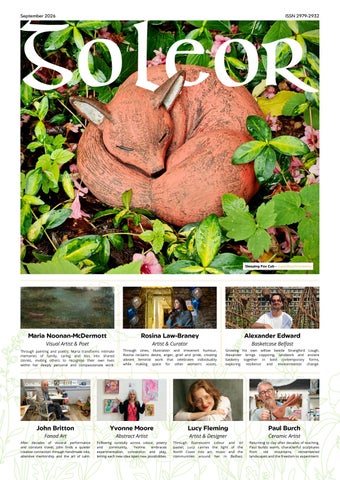
September 2026
ISSN 2979-2932
Sleeping Fox Cub - @paulburchceramics
Maria Noonan-McDermott
Rosina Law-Braney
Visual Artist & Poet
Artist & Curator
Basketcase Belfast
Through painting and poetry, Maria transforms intimate memories of family, caring and loss into shared stories, inviting others to recognise their own lives within her deeply personal and compassionate work.
Through zines, illustration and irreverent humour, Rosina reclaims desire, anger, grief and pride, creating vibrant feminist work that celebrates individuality while making space for other women’s voices.
Growing his own willow beside Strangford Lough, Alexander brings coppicing, landwork and ancient basketry together in bold contemporary forms, exploring resilience and environmental change.
John Britton
Yvonne Moore
Alexander Edward
Lucy Fleming
Paul Burch
Fanad Art
Abstract Artist
Artist & Designer
Ceramic Artist
After decades of visceral performance and constant travel, John finds a quieter creative connection through handmade inks, attentive mentorship and the art of calm.
Following curiosity across colour, poetry and community, Yvonne embraces experimentation, connection and play, letting each new idea open new possibilities.
Through fluorescent colour and oil pastel, Lucy carries the light of the North Coast into art, music and the communities around her in Belfast.
Returning to clay after decades of teaching, Paul builds warm, characterful sculptures from old mountains, remembered landscapes and the freedom to experiment.
Go Leor
Issue 13 - September 2026 © Go Leor 2026
Page Contents
4 Rosina Law-Braney 16 Alexander Edward 28 John Britton 42 Yvonne Moore 52 Lucy Fleming 64 Paul Burch 72
Maria Noonan-McDermott Visual Artist & Poet
Artist & Curator
Basketcase Belfast
Fanad Art
Abstract Artist
Artist & Designer
Ceramic Artist
2
Issue 13
Supporters A special thanks to our first print subscribers:
Dee Magee David Baylis Laura McKenzie Atkins And thank you for the continued support of our founding supporters:
Mark Bonello Shirani Bolle Seanna O’Boyle Luke Fletcher John Britton Go Leor is built independently and sustained by its readers. Thank you for helping this publication grow.
Legal & Support © Go Leor 2026. All rights reserved. No part of this publication may be reproduced, stored, or transmitted in any form without prior written permission from the publisher. Visit us at go-leor. co.uk. The views expressed in this magazine are those of the contributors and interviewees, and do not necessarily reflect the views of Go Leor or its editorial team. For all queries or correspondence, please contact support at: support@go-leor.co.uk
3
Go Leor
Maria NoonanMcDermott Visual Artist & Poet
Transforming intimate family memories into paintings and poetry, her work invites others to recognise stories of their own.
F
or once, Maria NoonanMcDermott’s studio is tidy. Paintings have been gathered, checked and packed in preparation for Time-Lapse at the Strule Arts Centre in Omagh, an exhibition that will mark almost four decades since her first solo show. The order is necessary, but it is not necessarily the part she loves.
familiar after so many years of exhibiting, yet it is still the encounter with an image - the moment when colour, memory and emotion begin to find a form that brings her back to the studio. There are many lives gathered inside the paintings waiting to leave it. Some hold Maria’s memories of her mother, Maisie, whom she helped care for through Alzheimer’s. Others return to a Donegal childhood shared between seven children, a mother running a business and a father who came home from sea carrying books and stories from around the world. As Time-Lapse has travelled, these personal memories have been joined by those of its audiences. Visitors recognise their parents, siblings, childhood homes and experiences of care within Maria’s work. They begin to tell her their own stories, and the exhibition changes again. What began as a deeply personal tribute has become something shared. Maria’s work contains the particulars of one family, but never closes around them. Its figures, landscapes, chairs and inherited objects retain enough mystery for another person to enter.
“I enjoy mainly the painting part,” she says. The lists, marketing and administration have become The Red Chair
“It’s not a piece of work in isolation anymore,” she says. “It’s for everyone. Everybody has a story to tell.”
4
Issue 13 The Healing Land
5
Go Leor
Maria grew up as one of seven children. She remembers herself as quiet and shy, often listening while the stronger voices of family, neighbours and visiting relatives filled the room. In a household that busy, it could be difficult to get a word in. Art offered her both a language and a place that was recognisably hers. Her earliest creative connection was with her mother. Maisie had trained and worked as a dressmaker and designer in London before returning home to care for her own grandmother. Maria believes she would have loved to remain there. Instead, Maisie opened a shop and found another way to put her ability and independence to use. She painted too, and recognised the same instinct in her daughter. “I seemed to be the only one who enjoyed and participated in the art side of things,” Maria says. “The fact that my mother gave me
“The fact that my mother gave me attention because I liked art was a big thing for me.”
A Place of Her Own
Waiting
6
attention because I liked art was a big thing for me.” When Maria was thirteen, Maisie asked if she would like to attend summer painting classes with her. Hosted by the artist Dawn Buchanan, for three successive summers, mother and daughter went together. In the grand surroundings of a large house with a working farm in Raphoe, Maria sat at an easel in a bay window beside adult painters and was treated as though she belonged among them. The work she produced still felt rudimentary beside her mother’s, but technical accomplishment was only part of what those days gave her. “It was my mum and me together, the two of us, which was kind of unheard of in such a large family,” she says. “I felt special.” Landscape did not immediately feel like her subject. At thirteen she was inhibited by it, but love arrived gradually, strengthened by the memory of those summers.
Issue 13 Shared Seeds I
Art initially distinguished Maria within the family, but storytelling bound the family together. Her father was a radio officer who could be home for as little as two months of the year. When he returned, he arrived as a charismatic presence, ready to play music, read aloud and give his children the time that their mother, sustaining a home, shop and seven young lives, rarely possessed. The family was not wealthy, yet their house contained what Maria remembers as an actual library. Her parents collected books, while her father brought more home from his travels. Birthdays were marked with classics: Little Women, Around the World in Eighty Days, Tom Sawyer, Dickens
As a child, Maria absorbed the stories circulating around her.
Decades later, the Irish landscape remains one of the central presences in her work. Its light and shifting weather allow her to approach a place as both something seen and something remembered.
7
and many others. He also wrote short stories and beautiful letters. Reading was never treated as an ornament to life. It was part of the family’s everyday vocabulary. As a child, Maria absorbed the stories circulating around her. She was particularly drawn to those that might have appeared unimportant to anybody outside the community: small incidents, eccentric characters, repeated anecdotes and fragments carried from one generation to the next. She admires writers such as Jennifer Johnston for making ordinary lives extraordinary, and recognises the same impulse within herself. “I think I’m more of a storyteller,” she says. “I like to hear somebody tell a little story, something that may not be important to anyone else, and find the narrative there.” The quiet child at the edge of the conversation was not absent from it. She was becoming its witness.
Go Leor
Deep Rooted
8
Issue 13 Finding the Right Instrument
Jewellery briefly provided another possibility. She enjoyed making it and sold successfully at festivals, but the cost of establishing a properly equipped business was prohibitive. A conversation with a friend eventually led Maria towards a year of visual education. It became one of the most exciting periods of her life: long days of experimentation, sculpture, lectures and the discovery of forms she had never previously been able to access. During an evening painting class, a lecturer watched Maria attempting a large still life of peppers with tiny brushes. She disappeared and returned with two palette knives, telling Maria that these were what she should be using. The change was immediate. “That was me then. I was totally hooked,” Maria says. “I still have that palette knife 35 years later, and I’m still painting with the palette knife.” The knife gave her paint a physical presence and a directness suited to the feeling she wanted an image to carry. Oil remained her principal medium for around 25 years, although new practical demands have continued to alter the work. Touring group exhibitions often requested paintings measuring 30 by 30 centimetres. Maria initially found the restriction difficult; a small work could require as much time and concentration as a large canvas, while leaving less physical room in which to move.
“You’re always experimenting, you’re never going to be a professional in any area - you’re always going to be learning.”
Maria began her professional life in Dublin, studying Fashion and Design. Entering the industry exposed a commercial and sometimes abrasive world for which college had not prepared her. She returned home unsure of the precise direction she would take, but certain that she could not abandon creativity altogether.
9
Yet the constraint opened another stage of experimentation. She began combining acrylic and ink and working on paper, widening a vocabulary that might otherwise have remained centred on oil. She now moves between sizes and materials, accepting that a long career does not remove the necessity of learning. “You’re always experimenting,” she says. “You’re never going to be a professional in any area - you’re always going to be learning.” That willingness to change has carried Maria through landscapes, portraits, figurative painting and ten years working in theatre. Studying actors and stage characters drew her towards bodies shaped by light, movement and narrative. Early portraits were realistic; later figures became more abstract and often lost their individual features. She now imagines returning to portraiture again, completing the circle through expressive, partially abstracted faces, perhaps accompanied by sculpted heads in clay. The subject changes, but the underlying need remains: finding the instrument capable of carrying a feeling that ordinary conversation cannot always contain. The Language That Remained Maria’s relationship with Maisie changed profoundly during the years of her mother’s illness. Maisie lived with Alzheimer’s for approximately a decade, with Maria involved in continual care during the final five years. The familiar ways they once connected gradually became more difficult. During her last three years, unfamiliar noises could confuse or upset her. Music, which she had loved, was eventually silenced. The television remained off. The world around her had to become quieter and gentler.
Go Leor
“Touch was a very, very important thing,” Maria says. “It was just to have something that she was still familiar with.” Maria also read aloud while her mother rested. In the long intervals of quiet, she began writing down fragments of what they were experiencing. Sometimes she recorded a detail from the day; sometimes only a word arrived. Painting and poetry became ways of approaching experiences she could feel more clearly than she could explain. There is no easy sentimentality in this movement from speech towards touch. It acknowledges the losses imposed by Alzheimer’s, but also the determination to keep seeking a point of connection. A hand could still be held. A texture could still awaken interest. A familiar creative act could remain between them. Love adapted itself to the language that was available. It was important to Maria and her family that Maisie remained in her own home, surrounded by places and objects that she knew, until her death. Afterwards, those belongings acquired another gravity. They were no longer simply objects from a family home; they formed an archive of a woman whose creative life, responsibilities and unrealised possibilities had shaped all seven of her children.
Time, Memory and a White Dress
Maria saw herself and her four sisters as children again: Adult frustrations briefly fell away, revealing the first intimacy beneath them.
Communication did not disappear, but its form changed. Maria would sit beside her mother, hold and gently stroke her hand, or massage cream into her skin so that touch could continue when words could not. They explored textured fabrics together. Maria and her family made small arrangements of material for Maisie to feel, responding to her fascination with different surfaces. They drew, even when Maria eventually did more of the drawing, because the activity still held something familiar.
10
Time-Lapse was first conceived as a tribute to Maisie a year after her death. Supported in its initial development by an Irish Hospice Foundation Seed Grant in association with Creative Ireland, it brought together paintings, poetry, installations and inherited objects. Maria expected it might exist as a single exhibition. Instead, it began travelling in 2022 and has continued to evolve with every place it has entered. The work had been forming long before Maria gave it a title. Notes written while sitting with her mother, family belongings, older paintings and episodes that only revealed their meaning later all became part of it. One such moment arrived during Covid, when Maria watched her niece’s small wedding through a screen. A little girl passed the camera wearing a white dress. Maria suddenly recognised it as the First Communion dress from her own childhood, unseen for fifty years. The sight reached across time. During a period when the pressures of care had created strain within a large family, Maria saw herself and her four sisters as children again: sharing secrets, laughing and wearing their Communion dresses. Adult frustrations briefly fell away, revealing the first intimacy beneath them. “Everything was put into perspective at that moment,” she says. “Everything else wasn’t important.” Maria responded first through poetry, writing Alma Gemela, and then through a painting of the child in white. This movement between forms is characteristic of her work. An image, line from a book, remembered conversation or single word can generate a poem; the poem can then release a painting. Neither
Issue 13
Alma Gemela
11
Go Leor
The family stories within TimeLapse are often intensely specific. Jolly Holidays recalls all seven children travelling with their parents in a green Morris Minor. The Hermit’s Hut draws upon the two precious months each year when Maria’s father returned home. In Cherished Memories, Maisie appears with her childhood dog, whom she spoke about repeatedly as Alzheimer’s drew her further into early recollection. At times she mistook ornaments for the dog and tried to feed them, a tender confusion through which the strength of that childhood attachment remained visible. These are Maria’s people, objects and memories, yet the emotional structures beneath them are
“That would make me happy, to think somebody thought that was them,”
simply illustrates the other. Each brings forward something that its companion cannot completely say.
First Light
12
widely understood. A family car becomes every impossibly crowded journey remembered with affection. A white dress holds the sudden return of childhood. An animal loved decades earlier embodies the peculiar endurance of memory. Maisie’s life is never reduced to her condition; she emerges as a designer, businesswoman, mother, artist and child with treasured stories of her own. What Other People Bring At the first presentation of TimeLapse, the atmosphere was understandably solemn. Maria was surrounded by relatives and friends, and the work remained close to the grief from which it had emerged. She could not have anticipated that she would still be developing the exhibition in 2026, or planning to bring it to Belfast in 2027.
Issue 13
The response has affirmed something Maria understood intuitively as a child: the story that appears smallest or most private can carry enormous meaning. One visitor looked at a figure and declared, “That’s me.” It was not a portrait of her, but Maria was delighted by the recognition. The viewer had not misunderstood the painting. She had completed its movement outwards. “That would make me happy, to think somebody thought that was them,” Maria says. “She felt that painting was her.” Maria wants Time-Lapse to make the experiences of carers visible and to loosen some of the stigma surrounding Alzheimer’s and dementia. It does so through emotional recognition rather than distance. The exhibition gives viewers room to remember the exhausting, loving and sometimes contradictory realities of care, while encountering a person beyond a diagnosis. In that sense, the project is not a monument fixed in one form. It behaves more like memory itself: gathering, fading, returning and changing according to the present moment. Each audience leaves something with it. The Essence of Something Maria describes her work as highly emotive. Even a landscape must contain an element of mystery
“With painting, it’s an essence of something, even in my landscapes, there always has to be an element of mystery. It has to draw me in for some reason.”
Its continuation has been shaped by the generosity of audiences. Visitors tell Maria about relatives who lived with dementia, the people for whom they cared and the characters who formed their own communities. A painting becomes the beginning of a conversation rather than its conclusion. Their stories lead Maria back towards others from her own life, allowing another poem, portrait or installation to emerge.
13
and connection before she is compelled to paint it. She is not searching only for a recognisable view, but for the atmosphere that allows a place to feel inhabited by memory. “With painting, it’s an essence of something,” she says. “Even in my landscapes, there always has to be an element of mystery. It has to draw me in for some reason.” Poetry allows her to reveal more. A painting can carry what she cannot yet articulate, while a poem can move closer to the detail of a thought, voice or recollection. Together they create the ethereal quality that runs across her work. Figures remain particular enough to feel loved, but open enough to become a stranger’s mother, sister or younger self. Landscapes are rooted in Ireland while appearing to contain many different times at once. Empty chairs and small domestic objects seem to wait for the stories another viewer will place upon them. Her poetry has also developed an independent life beyond the exhibitions. Maria has published three books bringing writing and visual art together, while Winter Tapestry, The Red Chair and The Empty Chair have been selected for successive volumes of Washing Windows: Irish Women Write Poetry. In 2025, Aunties received the Eilish MacBride Award at the Frances Browne Literary Festival. These poems return to the same apparently ordinary details that have always drawn her attention, revealing how much history and feeling can be held within a chair, a remembered voice or a familiar family role. This openness is not vagueness. It comes from Maria’s close attention to individual lives. She has spent decades listening to the details others might disregard, then locating the emotional current that connects them to something larger. Her art does not ask an
Go Leor Later, it helped her accompany her mother through a world that was becoming unfamiliar. Now it enables experiences once held within a single home to meet people across Ireland and beyond.
audience to adopt her memories as their own. It gives them permission to bring their own memories forward. For a child who once struggled to get a word in among seven siblings, Maria has built a life from listening and responding. Art gave her a distinct identity within her family and a precious private connection with Maisie.
As Time-Lapse arrives at the Strule Arts Centre, it will become Maria’s 30th solo exhibition, 37 years after her first. The milestone belongs to a remarkable career, but the work resists being presented as a completed journey. Maria is still experimenting, still considering portraits and sculpture, still listening for the stray word or recollection that might open another path.
The Codega
Most importantly, Maisie’s story continues to meet other lives. The quiet hours spent holding her hand have become paintings, poems and installations through which carers recognise their own tenderness. The dresses, books, textures and family journeys are not sealed away as relics. They remain active, gathering meaning as new people encounter them. “By exhibiting and not working in isolation, the journey continues for other people,” Maria says. “The work lives on, basically.” In Maria’s hands, that continuation is not an escape from loss. It is one of the forms love can take after a life has ended: a story retold, a memory offered freely, and an image spacious enough for somebody else to enter. Time-Lapse opens at the Strule Arts Centre, Omagh, on Thursday 3 September 2026 and features a Gallery Tour with Maria on Friday 18 September - Admission is free: struleartscentre.co.uk Discover Maria’s paintings, poetry and exhibition history: marianoonan-mcdermott.com And keep up with her via social media: @marianoonanmcdermott.
14
Issue 13
15
Go Leor
Rosina Law-Braney Artist & Curator
Through zines, illustration and humour, Rosina Law-Braney creates vibrant feminist stories that make room for identity, desire, grief and collective creative freedom.
Rosina Law-Braney had been wishing for a moment to rest when a sentence appeared on the wall of a café in Kenmare: ‘What a privilege it is to be busy with the things you once wanted.’ It arrived at the right time. She had recently joined Le Chéile Collective in Kenmare and, as Rosina cheerfully explains, become its spokesperson because the other members “have stage fright and I don’t.” She has also curated Good Girls Gone Sinful, the collaborative exhibition she created around the seven deadly sins, which barely concluded before The Five Stages of Grief of a Broken Heart, her solo exhibition began approaching. The work she once hoped to make was now asking everything of her at once. Rosina read the sentence and recognised her own life. This is the year, she says, in which she is working hard for everything. More importantly, it is the year in which she has permitted herself to be outrageous in asking for it.
“No, that happened, but I worked my arse off to make sure it happened somewhere else.”
F
rom seven hand-bound zines to a home built around heartbreak, Rosina LawBraney follows ideas wherever they lead - and makes room for other women to discover their voices.
16
That refusal to let an idea become smaller because its realisation is difficult runs throughout her work. When the original venue for Good Girls Gone Sinful became unavailable, Rosina considered the story that surrender would leave behind. She could say that she once planned an exhibition but circumstances prevented it - or make the story more interesting. “It’s a much more interesting story to turn around and be like, ‘No, that happened, but I worked my arse off to make sure it happened somewhere else.’” The exhibition happened. Yet Rosina’s force of personality did not place her alone at its centre. It gave her room to spare. Seven Sins, Seven Personalities Created during Rosina’s MA in Illustration at Kingston School of Art, Good Girls Gone Sinful reimagined the seven deadly sins through seven hand-bound zines and the work of seven female creatives. Kathy Angela responded to Sloth; Nicola Long to Gluttony; Aoife O’Neill to Lust; Anne-Marie Flannery to Envy; Joyce Zacks to Wrath; Emma Mulrooney to Greed; and Greta Baltic to Pride. Rosina chose the artists organically, looking for women
Issue 13
17
Go Leor says. “There’s only one Anne-Marie Flannery. There’s only one Nicola Long.”
whose personalities and existing work might pull each sin somewhere unexpected. She reviewed their work and offered possible directions if guidance was needed, understanding that complete freedom can become its own obstruction. These remained suggestions rather than instructions.
For Rosina, making space for herself and making space for other artists are part of the same action. Individualism is not isolation. Properly understood, it is the recognition that no woman should be reduced to a representative type when she could instead be encountered as a complete and singular person.
“I wanted each sin to feel like it had its own personality,” she says. “I wanted to give them the freedom to interpret it in the way it would be within their own practice and experience.” Greta Baltic’s Pride, for example, could speak from her Lithuanian identity in a way Rosina never could. Rosina was interested in how Anne-Marie Flannery might respond to Envy and whether an emotion commonly regarded as ugly could instead become constructive, guiding her towards what she wanted from her work and life. Each artist brought a life, discipline and perspective that expanded the project beyond Rosina’s understanding of any one sin. As curator, she built the structure that allowed those differences to meet. The zine format, her illustrations and the visual memory of teenage girls’ magazines supplied a common language: cohesive without becoming uniform. This distinction is crucial. Rosina did not demonstrate her strength by controlling seven interpretations. She demonstrated it by creating a framework secure enough to release them. For several participants, it was their first exhibition; nevertheless, Rosina speaks about each contribution as work capable of supporting an exhibition of its own. Her confidence does not require anyone else to become less visible. “There is only one Rosina,” she
18
Issue 13 None of Us Are Like Other Women
Young readers could compare the complexity of their private selves against those two-dimensional constructions and conclude that they were “not like other girls.” Rosina now sees the flaw in that promise. Other girls were never really like those images either.
The teenage magazine became an especially fertile object through which to explore that idea. Rosina was once obsessed with them. Their products and images offered a model of the person a teenage girl might become: the right spray could change her hair and, by suggestion, the course of her life. Bedrooms appeared curated to be messy, but never too messy. Girls were expected to look made-up without revealing the effort involved.
“We are none of us like other women, but we’re all like other women,” she says. “And that’s a great thing. I want to be like other women.” In Good Girls Gone Sinful, the format that once instructed girls how to become acceptable is turned against those instructions. Lust, anger, appetite, idleness, jealousy, ambition and pride become openings through which seven artists can discuss their lives. Their familiar brightness draws an audience close; what waits inside is more unruly than the culture that inspired them. Rosina is comfortable describing herself as a feminist artist, although she approaches the label with characteristic resistance. She once wondered whether she was a feminist artist at all, or simply “a woman creating work about being a woman and being pissed off.” In recent years she has leaned into the term because it gives people a useful way to locate her work. Still, the distinction matters to her. “Men tend to have the privilege of being their person first,” she says. “It can be quite exhausting to be a woman first. You should only hold me to the standards of myself.” Her feminism is most powerful here. It is powered by the freedom to be Rosina first: talkative, funny, restless, ambitious and drawn towards whatever form best serves the next story. This does not abandon collective struggle for individual expression. It shows why the struggle matters - because every person deserves room to become irreducibly themselves.
19
Go Leor
20
Issue 13 behind the sofa along the way.
Illustration is the foundation of Rosina’s work, but she moves between zines, bookbinding, embroidery, photography, printmaking and murals according to what an idea needs to do. A tiny book can create intimacy and control the order in which a story is revealed. Embroidery slows her down and brings peace through repetition. A mural carries the same visual directness into public space.
The cheerfully tactile construction and macabre joke belong together. Rosina’s work can address sex, heartbreak, resentment and shame without submitting to the idea that serious subjects require solemn treatment.
The movement between these forms appears instinctive. Rosina often makes a zine or book and only later realises that an exhibition is waiting inside it. Good Girls Gone Sinful began as zines. The Five Stages of Grief of a Broken Heart began as a pop-up book. Another interactive book, If I Was a Vengeful Woman, is already suggesting its own future exhibition. Made to resemble a children’s book, If I Was a Vengeful Woman is dedicated to the men who have hurt her. One page offers removable fingers with which to decorate a Christmas tree. In Lucy Loses Her Keys, readers help Lucy search in time to go for pints, discovering an ex-boyfriend
“You have to be upset, but at the same time realise how absurd it is to even be alive.”
A Vengeful Woman Having Fun
21
“You can have something shit happen and you can just have fun,” she says. “I’m a bit of an absurdist. You have to be upset, but at the same time realise how absurd it is to even be alive. We’re monkeys on a rock.” Humour creates distance between Rosina and whatever prompted the work, but it is not a disguise. She exaggerates, fictionalises and plays with experience, allowing personal influence without turning every image into literal autobiography. This preserves a boundary audiences do not always grant artists, particularly women making work about sex, anger or relationships. Rosina can be vulnerable without surrendering every private fact as proof of authenticity. Viewers may recognise themselves in the work without possessing the “real story” behind it.
Go Leor The Art Her Mother Makes Embroidery led Rosina towards a broader question about which forms society has historically called art. Her mother crochets. Painting and other male-dominated disciplines received the status of art, while intricate work traditionally undertaken by women was diminished as craft. “I do think my mother is an artist,” she says. “She does crochet, but because she’s a woman, it’s not considered as much as art. Crocheting is really hard.” Rosina does not need to imitate the seriousness of historically masculine forms in order to elevate feminine work. She draws power from the colour, humour, labour and materials already present within it. Embroidery can remain peaceful and tactile. A teen magazine can remain bright and funny. A zine can remain handmade and accessible. Their value does not depend upon disguising where they came from. The same thinking connects Good Girls Gone Sinful to feminist zine history: independent publishing allowed women to circulate ideas and create space beyond established institutions. Her project carries that lineage into a contemporary exhibition. “You can go back to those women and be like, ‘Thank you. You’ve done something so important here, and we’re trying to continuing it,’” she says. “It’s because of those women who created a space for themselves historically that we have the ability to create space for ourselves now.” Approximately 40 to 50 people attended the launch. Online, 40 likes might appear modest; within a room, they became people who had travelled, listened and chosen to support seven artists. Its fullest form appeared in the relationships between the work, the zines and
22
Issue 13
23
Go Leor
24
Issue 13
“These are real people with real lives and real experiences who came here and decided, ‘I’m going to be here, and I’m going to support you and these seven female creatives,’” Rosina says. “I hope that the girls feel the love, because I think they deserve to feel all of the love.” Conspiring in Her Favour The launch also challenged Rosina’s instinct to do everything herself. Her younger sister Isabel, her friend Timmy and one of the participating artists helped prepare the space. Others arranged their own work and contributed ideas about its presentation. What emerged was neither overly clean nor falsely prestigious. It was expressive, communal and alive. “I feel like people really are conspiring in your favour,” Rosina says. “People want you to do well.” That recognition is supported by a family willing to take her ideas seriously. Her twin brother Andrew, an animator establishing his own company, is one of her most valued critics. When early versions of the Good Girls Gone Sinful zines did not yet work as pieces of design, he told her. Rosina returned to the indexes, editor’s letters and surrounding pages with fresh eyes. Her father acts as a different kind of measure: if a provocative joke can make him laugh without crossing the line, she trusts its balance. Her mother offers support while discussing the uncertainty facing creative careers and the necessity of making a place for yourself within them. Support is not constant agreement. It is the criticism, practical help and belief that allow work to become stronger. Accepting it does not compromise Rosina’s independence; it makes
“These are real people with real lives and real experiences who came here and decided, ‘I’m going to be here, and I’m going to support you and these seven female creatives’”
the people handling them.
25
ambitious independence sustainable. That lesson will accompany The Five Stages of Grief of a Broken Heart, which Katie O’Rourke at Friarsgate has helped Rosina develop from a three-year-old pop-up book into a solo exhibition. The original work emerged after the end of a relationship, shortly after Rosina completed her BA in printmaking at Limerick School of Art and Design. Longlisted for the RDS Visual Art Awards, she was given the opportunity to propose a project for a printmaking residency in Paris. The city of love met a broken heart. Rosina translated denial, anger, bargaining, depression and acceptance into rooms within a home. Feeling trapped inside the house, it seemed natural for grief to reside there. As with the seven sins becoming magazines, she found a physical architecture for an internal experience. “If you live, it’s a good story,” she says. What began in personal pain now offers an audience a way to recognise its own heartbreak and eventually laugh at the scale it once occupied. Rosina has returned to the older work able to see how far she has travelled, revising it without dismissing the person who first made it. Something Made by Hand Rosina’s creative energy is perhaps most immediately shared through her workshops. She enjoys people and draws energy from speaking to them. Bookbinding instruction becomes performance, conversation and encouragement; technical details become memorable because her excitement makes them exciting. She invites participants to talk about themselves and imagine where the process might fit within their own lives.
Go Leor
After one workshop, a man was seen buying materials so that he could continue bookbinding independently. For Rosina, that single continuation was enough. It embodies the scale at which she believes cultural change can occur: not through waiting to become powerful enough to transform everything, but by making a difference within one reachable corner. Her commitment to physical media has deepened as artificial intelligence makes authorship feel less certain. The last thing Rosina’s grandmother wrote was a shopping list. Rosina kept it because her grandmother’s hand had moved across that paper on that morning. “I think it’s a spiritual experience to be creating anything,” she says. “What a beautiful thing for you to be able to have, from one human being to another.” Paper gathers folds, fingerprints and wear. Photographs become warm where somebody repeatedly strokes them. A hand-bound zine carries both its images and the movements that brought it into being. Rosina’s work insists upon that human trace while remaining open to other hands. She is a conduit for a particularly vibrant creative energy in Ireland because she refuses the false choice between the individual and the collective. Her personality powers the work, but it does not consume the room. It travels outwards: into seven artists trusted with seven complicated emotions; into a workshop participant buying his first bookbinding materials; into a family whose criticism and care sharpen her ideas; and into audiences invited to touch, laugh
“I think it’s a spiritual experience to be creating anything, what a beautiful thing for you to be able to have, from one human being to another.”
“It’s not just about creating something at the very end,” she says. “It could be absolutely crap. But at least you tried.”
26
and recognise themselves. Rosina is not asking feminine creativity to become quieter, cleaner or more respectable before it is taken seriously. She is asking women to become more fully themselves: angry without being reduced to anger, proud without apology, desirous without shame and individual without being isolated. Good Girls Gone Sinful showed what can happen when that invitation is extended with enough conviction. Seven artists did not disappear inside Rosina’s vision. They became more visible within it. There is only one Rosina. Her work matters because she knows the same is true of everyone else. See Rosina’s forthcoming exhibition, The Five Stages of Grief of a Broken Heart, at Friarsgate Theatre in Kilmallock, County Limerick. The exhibition launches at 7pm on Friday 4 September and remains open until 28 September. friarsgate.ie Keep up with Rosina via social media: @unadulterated.rosie Keep up with the future of Good Girls Gone Sinful, including news of its planned return and forthcoming open call: @good.girls.gone.sinful Explore more about her illustration, independent publishing and community workshops through her profile with Le Chéile Collective: lecheilekenmare.com
Issue 13
27
Go Leor
Alexander Edward
Basketcase Belfast Growing his own willow beside Strangford Lough, Alexander Edward brings coppicing, landwork and an ancient craft into bold contemporary forms.
Basketry is physical work. A basket can take hours or days, with Alexander using his own strength to manoeuvre rods through gaps while repeatedly wetting the willow to keep it flexible. If it dries, it breaks, and part of the work may have to begin again. Structure arrives through what he calls “managed tension”: each rod pushing or pulling against another until something that ought to spring apart becomes immeasurably strong. Under the name Basketcase Belfast, Alexander grows, harvests and weaves much of his own willow. It is an unusual combination. Most weavers buy prepared rods, but for Alexander the making begins
For Alexander the making begins in the ground, with the colour, thickness and character of each variety.
A
cross Alexander Edward’s workshop, lengths of willow splay into the air before they settle into form. At this stage, a basket can resemble something alive: a many-limbed creature turning in the hands, its rods held together by pressure, movement and the growing certainty of the weave. Alexander has compared it to a Demogorgon. It can also fight back. A loose rod might spring towards his face; a change in tension can become a snap; a form that wants to collapse has to be persuaded, held and worked into strength.
28
in the ground, with the colour, thickness and character of each variety growing on a plot beside Strangford Lough. He is a weaver, but also a landworker, following the material across a complete cycle from living stool to finished object. That closeness to the material has encouraged him to test what an old craft can be allowed to say. Traditional baskets sit alongside garden structures, sculptural experiments and angular bottle carriers; willow is joined by hazel, sycamore and, in one deliberately unsettling work, discarded tyre rubber. He values the knowledge carried through basketry, but does not believe its future has to look like its past. “It’s a little bit like punk basketry or something,” he says, before admitting that these days he listens to rather more Radio 3 and Radio 4 than punk. A Basket from the Skip Alexander’s route into basketry began around fifteen years ago, long before he considered claiming the craft as his own. He was working within a community supporting children and adults with complex needs. The site included a school, a college and a farm, as well as a resident basketmaker, Sabine Wolniczak.
Issue 13
29
Go Leor
“I had more interest in that than the art or the craft of it,” he says. “I was like, this is obviously very therapeutic. I really respect it for that.” At that point, willow belonged in Alexander’s mind beside activities such as candle dipping: pleasant, gentle and worthwhile, but not something he imagined becoming central to his own life. One of Sabine’s baskets began to change that relationship quietly. Alexander found it sitting in a skip, apparently destined for disposal, and could
“This is obviously very therapeutic. I really respect it for that.”
Alexander sometimes accompanied young people to Sabine’s weaving sessions. Some were non-verbal or experienced considerable challenges with communication, concentration and motor skills. Basketry could become technically demanding, but its basic movements were methodical and repeatable. He watched the young people find their way into that rhythm and was struck by what the process could offer.
30
not leave it there. He brought it home, where it remained for years and served as a bed for three adopted cats. The basket was useful, but it also retained the atmosphere of those earlier sessions. About a decade later, Alexander contacted Sabine and asked to attend a class. He took two introductory sessions over the following months and rediscovered the mechanical rhythm he had first noticed while watching others weave. Sabine recognised his enthusiasm. She was preparing to retire and had several plots on which she grew willow; someone would need to take responsibility for them. At the end of Alexander’s second class, she offered him the chance to assume the rent and care of one plot. It could produce around 14,000 rods in a year, enough for hundreds of baskets. For someone with only a few classes behind him, the scale was daunting. Alexander accepted it anyway.
Issue 13
The work Alexander does on the plot is coppicing: cutting willow down low during its winter dormancy so that it regenerates from the stool. Shoots rise throughout the following year, some reaching four metres, before he returns to cut them again. Far from exhausting the plant, the cycle encourages it. A stool that produced five rods might send up six after cutting, then seven or eight in later seasons. “Every time you hack it, it just doesn’t give up,” he says. “It likes it and it kind of wants you to do that - to grow yet more of it.” Every culture in the world has developed ways of weaving containers from the materials available to it. Willow became fundamental here because it grows readily in the local climate. Its basic logic may be familiar to anyone who wove rushes as a child, but willow is woodier and thicker, able to take and retain far greater tension. The heavy, moisture-retentive clay beside Strangford Lough suits it particularly well. The plot lies within a landscape Alexander had already come to regard as an adopted home. His mother settled near Downpatrick, towards the lower end of the lough, while Alexander is based closer to its upper reaches. The water travels in and out with the tide; lightbellied brent geese return in their thousands; egrets and whooper swans move between the shoreline and the rolling drumlins of County Down. The willow contributes another rhythm. Once harvested, each year’s growth must be sorted according to the rods’ size, thickness and variety, then dried and stored. Alexander can often
“I started to settle with doing the weaving and go to where I grow it, I was like, my God, this is a very resilient, regenerative space. This isn’t a drag. It’s work.”
Growing with the Lough
31
recognise a variety from its tip and from subtle changes in colour. None of the colour in his work comes from dye. It is the result of centuries of cultivation promoting particular natural tones, followed by the choices he makes about which varieties to keep and grow on his own plot. The relationship is practical as well as beautiful. Coppicing strengthens the plants, while the plot creates shelter for insects and birds and holds carbon within land that might otherwise be absorbed into more intensive agriculture. Alexander feels a kinship with Belfast’s community gardens: both use overlooked or vulnerable ground to create something local, shared and regenerative. At first, responsibility for so much willow felt overwhelming. Around the same period, what appeared to be an ordinary cold resulted in sudden sensorineural hearing loss, leaving Alexander with severe hearing loss on one side. He describes the NHS treatment he received as miraculous and remains profoundly grateful for the sound he retained. The experience changed how he listens and works, but it did not become the definition of his work. As his health stabilised, the plot offered a way back into physical, purposeful activity. What had initially seemed like an intimidating inheritance became a beautiful piece of land filled with material he could learn from. “I started to settle with doing the weaving and go to where I grow it,” he says. “I was like, my God, this is a very resilient, regenerative space. This isn’t a drag. It’s work - I have to harvest it - but what a beautiful place to be.” The tide completes its cycle roughly every six hours. The willow completes its own over a year. Alexander works somewhere between the two.
Go Leor
Weavers describe willow almost anatomically. Every rod has a back, a belly, a butt and a tip, and each part responds differently when placed under tension. Learning to weave means learning how those differences can be directed. A rod is not simply threaded into position; it is read through the hands, bent at the point where it will hold and balanced against the forces already contained within the basket. The vocabulary of the craft carries that physicality. Pegging means securing willow with a carved wooden insert, almost like driving in a nail. Slyping is a sharp cut made with a knife to accentuate an angle in the fibre. Pricking down requires the willow to be bent against a blunt point. Bodkins, knives, awls and a rapping iron all have their place in Alexander’s
“I’m counting just the same as I would have done when I played the drums.”
A Physical Language
32
workshop, but the work ultimately relies upon his hands: maintaining pressure, judging moisture and keeping the structure in place as it grows. There is rhythm within that labour. The hands repeat a sequence; rods pass around one another; the basket turns. Knitting may require a maker to keep track of dozens of stitches, while a willow pattern, at its simplest, might ask Alexander to count only to four. Four rods move on one side and four on the other: one, two, three, four, repeated until the movements become fluent. “It’s like rock and roll in comparison,” he says. “I’m counting just the same as I would have done when I played the drums.” Music was once a large part of Alexander’s life, particularly drumming, and his hearing loss
Issue 13
33
Go Leor
Alexander still describes himself as a beginner. Apart from three classes, much of his learning has been self-directed.
altered his relationship with it. Rhythm remains the most dependable element, something that can be felt and followed even when melody no longer arrives with the same fullness or precision. Weaving holds some of that same combination of timing, repetition and variation.
That humility acknowledges the extraordinary technical and sculptural work of more experienced basketmakers, but it also reflects what attracts him to the craft. Willow does not need to be elevated beyond ordinary life to be valuable. Its accessibility is part of its beauty.
The comparison extends beyond metre. A folk musician may use familiar chords, inherited structures and a vocabulary carried by generations, yet produce something unmistakably personal. Basketry works similarly. No single movement needs to be impossibly complicated; confidence accumulates through repetition until simple gestures can be combined fluently.
“This is just popular and normal stuff that could be made pleasant and decent,” he says. “It’s just bringing something that’s been done for years forward, keeping it alive and keeping it going - and doing it confidently and creatively.”
34
Issue 13 Beyond the Basket
That question has led him into gardens, where weaving becomes architecture. Working with landscaper and garden designer Michael Reid, Alexander recently helped create a woven structure for a kitchen garden enclosed by a high clay-brick wall. The wider garden drew upon formal French and Italian influences, while its planting brought edible and ornamental species together in a looser cottage-garden arrangement. The willow needed to connect those worlds without becoming either conventional fencing or freestanding sculpture.
Alexander is proud of basketry’s heritage but impatient with the narrow image that often surrounds it. Willow can be presented as picturesque and reassuring: a cottage craft placed safely within an imagined past. He readily admits that he enjoys “cottagecore stuff”, but wants to explore what else the material can do. For him, bringing the craft forward means using its knowledge boldly rather than simply preserving a familiar appearance.
35
Go Leor
36
Issue 13
The same collaboration produced an unusual piece of outdoor furniture resembling a barrel cut vertically and set against a wall. Reid’s initial inspiration came from woven artillery gabions: large baskets historically filled with earth or stone to form military defences. There was no ready-made guide for translating the idea into furniture, so Alexander worked out how to hold and weave the upright stakes with help from his partner. Irish sycamore, hazel and willow from his own plot eventually formed an object that carried a distant historical reference into a contemporary garden. Completing it gave Alexander a welcome measure of progress. He may still call himself a beginner,
“It makes me feel like a very competent and confident beginner - That’s a nice feeling”
Alexander looked towards Renaissance gardens for context, searching paintings and drawings for woven forms that might belong within a formal space. The completed structure bends through the garden rather than imposing a rigid boundary upon it. It performs a practical role, but its usefulness is allowed to be strange.
37
but the project required him to solve a problem for which he could not simply follow an established pattern. “It makes me feel like a very competent and confident beginner,” he says. “That’s a nice feeling to have.” His woven obelisks make a similar crossing between tradition and something less easily placed. Their purpose is familiar: they provide structure for sweet peas and other climbing plants. Yet as the willow twists upwards, Alexander sees something almost science-fictional in the result. An object that might once have been commonplace now appears distinctive beside mass-produced spirals of metal or plastic. The reversal interests him. Handmade natural structures can be treated as old-fashioned, yet the conditions that once made them ordinary have largely disappeared. To grow the material, understand each part of it and construct an object from the ground up now feels unusual perhaps even radical.
Go Leor Baskets of the Apocalypse
sewage treatment facility. Too much water could rot submerged stools; contamination could make harvesting unsafe. Elsewhere, drought and wildfire create different threats. A heritage craft rooted in the natural world is not protected from ecological crisis simply because its public image is green and peaceful.
Alexander pushes that contradiction further in an evolving series he calls Baskets of the Apocalypse. The works begin with a concern that much of willow culture remains too comfortable within its own imagery. Beautifully made baskets can still feel detached from the environmental conditions on which their material depends.
A single basket can require several hundred rods. Alexander began wondering what a weaver might use if those rods were no longer available. The answer led him towards what he calls “forever materials”: substances that endure not because they regenerate, but because they refuse to break down.
Willow is famously resilient. It pioneers damaged ground, tolerates wet conditions and grows back after severe cutting. That resilience can create an illusion of permanence. Alexander’s plot lies on a floodplain near a
38
Issue 13
“It’s very ugly and disturbing,” Alexander says. “There are consequences, I suppose, to the damage that comes to heritage crafts.” The basket could function, and that is what makes it unsettling. It does not present environmental collapse as an abstract idea; it offers a plausible replacement that nobody would want to need.
“It’s very ugly and disturbing - There are consequences
For one work, he replaced willow with strips of discarded tyre rubber. The form recalls a Moses basket, perhaps one of basketry’s most tender and traditional objects. Rubber proved remarkably effective to weave flexible, strong and functional - but it also smelled, resisted beauty and carried the history of thousands of journeys across tarmac. A material produced from ancient organic matter became a container for something precious in an imagined future where fresh willow was scarce.
39
Through it, Alexander moves beyond representing a threatened landscape and asks what people might physically carry when familiar materials disappear. The series also gives him a way to make his own music within basketry. He compares traditional forms to songs that can be covered faithfully. The Baskets of the Apocalypse retain the underlying structure but change the material, context and emotional register. They use an inherited vocabulary to tell a story belonging unmistakably to the present. Heritage in Use Even Alexander’s more playful ideas return to function. At The American Bar in Belfast, he plans to teach people to make small Buckfast baskets: angular, bodyhugging bottle holders carried by a canvas strap. The joke is immediate, but so is the intention. A conventional shopping basket
Go Leor might travel to an allotment or community garden. An obelisk might disappear beneath sweet peas. A fence might follow the uneven movement of a garden rather than forcing the land into a straight line. Use allows an object to gather the marks and associations that eventually make it irreplaceable.
may have little relevance to a younger person walking through Belfast or attending a festival. A woven bottle carrier might actually accompany them. “How can I make something that’s traditional and part of our heritage relevant to someone today?” he asks. “If you don’t use it, then what’s the point?”
Alexander understands that through Sabine’s rescued basket. After years of use, he could now reproduce its measurements and weave another version, but technical accuracy would not
That does not mean every object must solve an urgent problem. It means the life of the willow should continue after the weaving ends. A basket
40
Issue 13 replace it. The original carries the memory of the skip, the young people he watched weaving, the teacher who encouraged him and the cats that slept inside it. “I’d be devastated if I lost it,” he says. “It’s funny to say that as a weaver who could very easily replicate it, but I could never make it.” This is the strength at the centre of Basketcase Belfast. Alexander wants to disrupt the prettified image of weaving, confront the pressures facing its materials and invent bold forms that speak to people now. Yet he also respects the ordinary promise of a basket: that it can enter someone’s life, be carried and repaired, and become more valuable through use. The work begins beside Strangford Lough, where willow moves with the wind, water and return of birds. Alexander cuts it back to the stool, sorts it by variety, learns the character of every rod and carries it into his Belfast workshop. There, back, belly, butt and tip meet through the pressure of his hands. Tension becomes structure; material becomes form; something grown within a year may remain in a family for fifty. For Alexander, the future of basketry lies in that complete relationship: landwork and craft, heritage and experiment, usefulness and imagination. By growing the material as well as weaving it, he is not simply preserving an old way of making. He is finding out what it can become next. To discover more about Alexander’s work and find details of upcoming events, demonstrations and markets, visit: basketcasebelfast.com And keep up with them via social media: @basketcasebelfast
41
Go Leor
John Britton Fanad Art
After three decades of visceral performance and constant travel, John Britton has found a quieter connection through ink, mentorship and calm.
“It feels earthy and mineral and a bit dirty and not very polite,” he says. “All of those things I love.” The final design will be minimal: perhaps a circular movement across the green with a more formal shape held inside it. John has made related pieces, but something remains unresolved an energy held within rock and soil that he has not yet brought fully into view. There is no impatience in the admission. Speaking with John has something of the meditative quality he hopes people find within his paintings. His thoughts arrive with the confidence of someone carrying an enormous breadth of experience, but there is no pressure to force them into quick conclusions. He is comfortable pausing, questioning a word and allowing an idea to remain unfinished. The calm is hard won. Before John began working primarily as a painter, he spent three decades travelling internationally as a performer, director and teacher. His theatre could be physically
“It’s the moment where someone stands in front of a picture before they’ve had a thought about it -That moment of stillness.”
A
cross the largest canvas he has attempted, John Britton has spent the morning laying down a field of green earth. The pigment arrived as a powder alongside siennas, ochres and other colours drawn from minerals. Mixed into an ink and spread across the metre-square surface, it feels grainy, dirty and resistant to anything too polished.
42
extreme and his schedule relentless. Now, from a rural home near the sea in Fanad and a studio at The Courthouse in Bushmills, he makes paintings that ask both himself and the viewer to become still. The contrast appears dramatic, yet the centre of the work has remained remarkably consistent. Whether bodies were being hurled against factory walls or a solitary red figure now waits beneath an ink-black tree, John has always been searching for the moment when noise gives way to complete attention. The Moment After the Final Note John’s theatrical life moved across performance, dance, circus, improvisation, clowning and education. He worked internationally, led a master’s programme built around his training methods and served as artistic director of DUENDE and the DUENDE School of Ensemble Physical Theatre. Much of his work involved training actors, dancers and circus performers through the body. He directed productions and performed as an improviser, often making work far outside the security of conventional theatre. He remembers “naked bodies hurling against walls in the basement of factories”performances that were avantgarde, visceral and willing to push physical expression towards its edges.
Issue 13
“The heart of the performance was a shared moment of silence,” John says. “The moment that it ends, before the audience applauds, and everybody in the room knows that they’ve arrived in the same place at the same time.” He finds the same sensation at the end of a classical concert: the breath held after the last note and before applause restores everybody to their separate lives. It can also occur in front of a painting, before the viewer has found an opinion or decided whether they approve. “It’s the moment where someone stands in front of a picture before they’ve had a thought about it,” he says. “That moment of stillness, for me, is the centre of it all.” The intensity came with a cost. While travelling continuously, John suffered a heart attack during one of the rare occasions when he was at home. He returned to work aware that something remained
“It feels earthy and mineral and a bit dirty and not very polite All of those things I love.”
Yet spectacle was never the final purpose.
43
wrong. When the pandemic interrupted that life, burnout and a wider collapse followed. The realisation that emerged was unambiguous: he did not want to return to the way he had been living. There are parts of theatre he continues to miss, particularly the studio and the direct encounter of training. He occasionally returns to teach, including visits to Greece, but no longer desires the constant movement that once defined his work. The transition into painting was not a gradual career adjustment so much as an acceptance that one life had finished and another needed to begin. What carried across was his understanding of improvisation and the integration of mind and body. Those lessons remain fundamental. Theatre taught John how to act without knowing the outcome, respond to what another presence offers and edit spontaneously without extinguishing the original impulse. Painting asks the same of him.
Go Leor
44
Issue 13
John rarely approaches a painting with a fixed destination. He describes the process as a conversation between three participants: himself, the ink or paint and the surface beneath it. He may suggest an opening movement, only for the ink to spread in another direction. A handmade paper may blur an intended line, catch pigment within its fibres or alter a colour through its chemistry. John responds, the ink moves again and the surface exerts another quiet influence. “My job is to be attentive to what the ink and the surface are telling me,” he says. “I never have the last word, because when I think it’s done, the ink has yet to dry. As it dries, it and the surface have the last word.” For an artist whose earlier work depended upon live relationships, this material exchange offers a new kind of ensemble. Control is shared, each participant retains its character and the finished painting becomes something none could have created alone.
“I never have the last word, because when I think it’s done, the ink has yet to dry.”
A Conversation with Ink
45
John makes many of his inks at home, following a process used for thousands of years: colour is extracted into water and combined with a binding agent, usually gum arabic, so it will adhere to a surface. The principle may be simple, but every ingredient behaves differently. Gorse produces a yellow drawn from the bush outside his window. Moss creates a greenish brown, while pomegranate offers another strong colour. Peat has required further experimentation. Dandelion is the most unruly, breaking apart the pigments in almost any other ink it touches. John speaks of it affectionately as “a really bad-tempered friend.” His inks are not designed to imitate the dependable manners of commercial products. They have peculiarities that must be observed and learned. John warns anybody buying them not to demand politeness but to discover how each wants to behave. “It’s got its own character,” he says, “and it will teach me a thing or two before it’s finished with me.”
Go Leor
That attention to character extends to paper. John frequently works on sheets handmade from recycled cotton waste in India, plant fibres in Bhutan and specialist materials produced in Nepal. Their irregular edges and varied absorbency are not imperfections to disguise; they help determine the work. Combined with inks made from plants in Fanad or pigments supplied in mineral form, the papers have led John towards an idea he calls the “global local.” Materials rooted in specific places are brought together across borders, allowing artisans who may never meet to collaborate through the object they produce. In an age of artificial intelligence and increasing disconnection from how things are made, John sees value in using technology to sustain physical skill. The internet allows him to buy paper from a Bhutanese village, supporting that knowledge while enabling an artist in Donegal to make something new.
“It’s artisans getting their hands dirty, collaborating across borders”
Global and Local
46
“It’s artisans getting their hands dirty, collaborating across borders,” he says. “That feels like a hill I want to die on in the age of AI.” The celebration is accompanied by questions. John recognises that he relies upon importers’ assurances that makers are properly paid and treated with respect. He would like to understand and document supply chains more rigorously, while also acknowledging the limits of what one independent artist can reasonably verify. Ethical responsibility, for him, is not a claim of purity but an obligation to remain attentive and do what is possible. This respect for materials mirrors his wider relationship with nature. Around his home, John is growing a forest of more than 100 trees, with hedgerows providing shelter for birds and other wildlife. The landscape is not simply represented within his paintings. It enters through gorse, dandelion, earth and the patient timescale of things that grow without asking to be watched.
Issue 13
47
Go Leor
48
Issue 13
Ink requires John to enter a particular state. It does not respond well when he is distracted or physically tense. Before he can make a useful mark, he must quieten his mind, relax his body and pay attention to the relationship between brush, liquid and paper. Working with ink then deepens the same calm it demanded at the beginning. “There is a loop,” he explains. “Ink is the medium that asks us to be healthy and then gives us health.” John often calls this element of his work “the art of calm.” During workshops, he does not expect participants to master a separate meditation routine before they are permitted to paint. The material itself can become the meditation. He suggests dipping a brush into ink, breathing in and making one continuous stroke with the exhalation. Without reloading, the movement is repeated. Each mark becomes fainter as the brush empties. Attention settles upon breath, pressure, movement and the changing amount of pigment held between the bristles. Someone who finds conventional meditation difficult does not need to sit apart and silence every thought. They can allow a physical action to guide them towards quietness. The meditative appeal of John’s work therefore exists both in its making and its reception. The empty paper around a tree, the movement of an arc or the isolation of a red figure offers somewhere for the eye to rest. Even when a painting becomes gothic or turbulent, it does not overwhelm every inch of the surface. Space remains for the viewer to enter.
During workshops, he does not expect participants to master a separate meditation before they are permitted to paint. The material itself can become the meditation.
The Art of Calm
49
Red, Black and Monk John’s long association with red and black began through limitation. While travelling, he drew digitally using an ink-simulation programme that offered only those two colours, with a small number of variations between wet, dry and faded marks. When a later version introduced a wider palette, John found that he preferred the restriction. Fewer choices created greater concentration. Red and black became the visual language of Ratdog & Boy, his illustrated story of a child and feral dog living adventurously in a world without other humans, and followed him when he began transferring his digital instincts onto paper. The influence of Japanese and Chinese ink painting is clear and openly revered. John is drawn to the assurance of a single brushstroke and to work so simple that it can feel contemporary centuries after it was made. He does not attempt to reproduce those traditions, but measures himself against the clarity and beauty they demonstrate. His recurring figure Monk developed from images of Buddhist monks in nineteenthcentury East Asian painting. John wanted to create the simplest possible person: one red stroke for the body, accompanied by four small black marks forming a hat, cane and eye. That economy allows viewers to bring their own lives to him. Monk travels through mountains, storms, forests and snow, but is most often shown pausing. He watches, waits, rests and continues. For some collectors, he has become less a character than a companion. After receiving two commissioned Monk paintings in Arizona, one collector wrote to John that she had needed someone like Monk in
Go Leor
The red circles appearing elsewhere in John’s paintings arose from the same restricted palette but have continued evolving. Sometimes the circle is a sun or moon; elsewhere it becomes a formal presence held against a sweeping, incomplete arc. Movement and stillness occupy the same surface. John has made several iterations without yet exhausting what the relationship is trying to tell him. Teaching People How to Learn Although John made a clear break from his former way of living, he remains a natural teacher. He continues to work occasionally in schools and is involved in a crossborder primary-school initiative. Visitors to his studio encounter more than finished paintings: they are shown papers, powders and
“It feels like such an act of service to stimulate the curiosity of someone”
her life for years. With his arrival, she felt that both he and she had come home.
50
the moment when water releases colour from pigment. He describes the light appearing in a child’s face when they discover new possibilities. The same pleasure arises when an older visitor admits that they once painted but stopped. John gently encourages them to pick up a pen or a brush and start to create again. “It feels like such an act of service to stimulate the curiosity of someone,” he says, “whether they’re a child or a 70-year-old.” John’s experience gives him more than enthusiasm to offer. Across decades of training performers and leading formal education, he has thought deeply about the pedagogy of creativity. Showing someone how to reproduce a teacher’s technique may produce an imitation, but it does not necessarily equip them to continue independently.
Issue 13
“They’ve not just learned how to do something,” he says. “They’ve learned how to learn.” This principle now guides his mentorship. John is wary of a coaching industry that promises permanent happiness through simplified solutions. His own work is slower and more attentive. In one ongoing “creative soul work” mentorship, he meets weekly with an artist in Australia. They talk, but they also draw, write and move together before reflecting upon what the activity revealed. Through doing, habits and needs emerge before the conscious mind can organise them into a presentable account. John’s mentorship does not provide his answers; it helps people listen closely enough to recognise their own. Guidance Earned Through Experience The stillness surrounding John today has not been achieved by avoiding intensity. It was shaped by decades spent travelling, teaching, performing and repeatedly asking bodies - including his own - to move towards the limits of what they could communicate. His calm contains knowledge of what happens when motion becomes unsustainable.
John’s mentorship does not provide his answers; it helps people listen closely enough to recognise their own.
For John, a learning journey should be incremental and empowering. The most important outcome is not that a participant leaves able to repeat one exercise, but that they understand how to encounter uncertainty, reflect upon experience and keep developing after the teacher has gone.
51
That history gives weight to both his paintings and his guidance. John values quiet because he has lived through noise; he respects limitation because he has experienced excess; he understands the need for mentorship because he has spent a lifetime examining how people learn, create and remain connected to one another. The materials on his studio table reinforce those lessons. Ink cannot be bullied into obedience. Paper has a memory and character of its own. A mineral holds the slow energy of the ground it came from. The artist can offer direction, but must also recognise when to listen. John once pursued a shared silence through the extremity of live performance. He now finds it through a red stroke, the fading trail of a brush or the instant before somebody decides what a painting means. In both worlds, the achievement is not silence for its own sake. It is the rare moment in which artist, material and audience arrive fully in the same place, at the same time - held there briefly, before the applause begins. Explore John’s paintings and handmade inks: fanadart.com Discover his mentorship, writing and teaching: johnbritton.co See a timeline of John’s work here: washboat.art And keep up with him via social media: @fanadart
Go Leor
Yvonne Moore Abstract Artist
Refusing to settle into a single style, Yvonne Moore follows curiosity across colour, poetry and community, creating art that brings her - and those around her - fully to life.
For an artist, this could be treated as a problem to solve: identify the recognisable elements, refine them and continue until every new work carries a dependable signature. Yvonne has little interest in doing that. “I am not somebody who you would say has a cohesive body
“My whole modus operandi is experimentation.”
T
he paintings pictured lining the stairs to Yvonne Moore’s studio do not immediately announce themselves as the work of one artist. Abstract landscapes sit alongside energetic fields of colour, botanical shapes, experiments in texture and pieces made using stencils cut by Yvonne herself. Each seems to contain the remains of a different question.
52
of work,” she says. “And I’m quite happy with that.” She describes herself plainly as an experimental painter. Self-taught and only a few years into her development, she approaches a canvas with curiosity rather than certainty. One decision prompts another. A colour may suggest a shape; a mark may need to be hidden, repeated or pulled into an entirely different composition. “My whole modus operandi is experimentation,” she says. “It’s a kind of ‘what if?’ What if I did that mark? What if I used that colour? What if I used that tool? What would happen next if I did this? What if I covered this up?”
Issue 13
53
Go Leor Beginning at the Cooker Yvonne first painted in 2022, four years after her divorce. During those intervening years, much of her attention had been placed upon supporting the emotional wellbeing of her children while rebuilding a different identity for herself. As her children grew older and needed her less, an unfamiliar space began to open in the evenings. Homework was completed, dinner was finished and they disappeared to see friends or play games. Yvonne was left with a restlessness she could not easily settle. “I wasn’t in a great place, if I’m honest,” she says. “I was very restless, bored and lonely.” A video appeared unexpectedly in her Instagram feed showing someone experimenting with acrylic paint pouring. Yvonne was mesmerised by the movement of the paint, the meeting of colours and the blooms that appeared as the surface was manipulated. Until then, she had never considered herself artistic. She had not spent her childhood drawing or painting and had built her adult life around intellect, learning and professional responsibility. What attracted her to acrylic pouring was the suggestion that it might be a process she could understand. “It looked like a technique,” she explains. “I thought maybe even somebody who’s not artistic - meaning me - could do that, because it looked like something you could learn. And I’m great at learning things.” She bought inexpensive acrylic paints and several small canvases. Without a studio or permanent workspace, she cleared the dishes after dinner, spread newspapers across the cooker and began to pour.
54
Issue 13
“I immediately found that I felt alive doing this,” she says. “I was coming from a place where I wasn’t feeling very alive. The restlessness seemed to disappear whenever I was in that space.” The constant thoughts she describes as “50 tabs open in her brain” became quiet. Painting did not demand that she arrive with the right language or a fully formed idea. It asked only that she begin.
“If this feels good, I’ll do this - Then it’s: what will delight me next?”
It quickly became apparent that the process was not as simple as it appeared online. Colours became muddy when combined incorrectly and many early attempts were washed from the canvas and poured down the sink. The outcomes mattered less than what was happening within Yvonne while she made them.
55
Following What Feels Alive Acrylic pouring became a gateway rather than a destination. From there, Yvonne began moving between materials, methods and scales, following what she now calls “the breadcrumbs of my delight.” “If this feels good, I’ll do this,” she says. “Then it’s: what will delight me next?” Sometimes that means watercolour, oil pastel or a gel plate. At other times, she creates tiny pieces or works at the largest scale her studio can accommodate. Balloons, string, egg cartons, corks, Nerf pellets, leaves and the netting from a bag of oranges have all become tools. Every object is reconsidered through the mark it might leave.
Go Leor
56
Issue 13 A recent botanical idea developed into several related paintings after the first brought her the feeling she was seeking. One sold within hours of being shared on LinkedIn, bought by a collector in London who already owned one of her works. Yvonne made two more paintings exploring similar shapes and colours, but even their success does not oblige her to continue indefinitely. “I’m not sure I’ll do more of those,” she admits. “I might do.” That freedom contradicts much of the conventional advice given to artists. Yvonne has repeatedly encountered the expectation that she should establish a coherent visual language - something recognisable enough that a viewer could identify one of her paintings without seeing her name. She understands the commercial reasoning behind it, but the repetition required would leave her bored. Some collectors return precisely because they cannot predict what she will make next, building a relationship with one artist while choosing distinctly different paintings for their homes. The connection between the works is not a repeated palette or technique. It is the permission Yvonne gives herself to remain curious. From Intellect to Intuition Before painting, Yvonne’s appetite for discovery carried her through several industries, including five years as managing director of Galgorm Resort and Spa. After leaving Galgorm in 2013, she became a business coach and mentor, delivering training around leadership and customer experience. She later moved into parent coaching, studying conscious and mindful approaches to parenting before sharing that knowledge with others.
57
Go Leor
When painting began to feel like a possible career, that instinct intensified. Although self-taught, Yvonne’s education has included demonstrations, online classes and time within an art academy. She studied underpainting, layering, texture, composition and tonal values, discovering how much a hidden history can change the surface of a finished work. Yet as she accumulated knowledge, she noticed herself approaching the canvas through her head rather than her heart.
“Learning is another thing that makes me feel alive.”
Whatever the subject, Yvonne immersed herself completely through books, specialists and thousands of hours of podcasts. “Learning is another thing that makes me feel alive,” she says.
“I was moving further away from
my intuition,” she says. “I was coming to a painting with thoughts of composition and colour values at the beginning, instead of just coming with my curiosity.” She stepped away from the courses. The knowledge remained, but its role changed. Yvonne now begins intuitively and allows technique to enter when it is needed. If a painting reaches a difficult point, her understanding of composition or value can help her recognise what is not working. Knowledge supports instinct without being permitted to replace it. The First Painting to Leave Selling work was not part of Yvonne’s original intention. Painting had begun privately as a way through restlessness, but she was also sharing her development with a substantial network built over many years on LinkedIn. In August 2025, she posted a painting and asked her connections what it should be called. One person suggested ‘Sold’ before privately asking to buy it. The excitement was followed by panic. Yvonne had never priced a painting and had no framework for deciding what it might be worth. Once that sale was negotiated, however, another quickly followed. This time, a viewer told Yvonne that one of her paintings had rendered him speechless because it seemed to capture the soul of his late mother. Although Yvonne begins without a predetermined message, the work can still meet somebody else’s memories with startling precision. It also demonstrated that people were willing to buy her paintings without demanding the consistency she had been told an artist required. The art found its audience before she had written the correct statement or refined herself into a recognisable brand.
58
Issue 13
Yvonne is naturally suspicious of rules that appear without convincing explanations. She calls herself “the adult who never grew out of asking why,” and her arrival in the art world has given her plenty to question. The artist statement is one example. In ordinary conversation, she hears artists explain their motivation directly: they paint because they love it, because they cannot stop, because it grounds them or because it is where they feel happiest. Yvonne’s own explanation is similarly clear. “I paint because it makes me feel alive and because it cures my restlessness.”
“I paint because it makes me feel alive and it cures my restlessness.”
Beyond the Artist Statement
59
Yet artists are frequently expected to translate those instincts into elaborate statements. For Yvonne, there is a contradiction in asking people who paint what they cannot express in words to justify those paintings through words. “I’m good with words, so I can do that thing,” she says. “But I’ve spoken to artists who say, ‘I’m not good with words. This is why I paint.’” Her frustration is with the distance created when art is made needlessly exclusive. The same resistance shapes her feelings about formal exhibition openings, where viewer, artist and artwork can become separated by obligation and ceremony. She wants approaching art to feel less intimidating.
Go Leor An Invitation to Play
“I’m a jump-in-and-learn-whileyou’re-doing kind of person,” she says. “I could have taken three months or six months to plan it and put every step in place, but that’s not how I am.” Across four days, she exhibited paintings, prints, bags, cards, sketches and colour studies, sold work and spoke with visitors. Some elements succeeded; others showed her how advance local promotion and bookable activities might help shape a future event. The most meaningful element was a decision made almost at the last minute. Yvonne created a “Play Station”: a table where visitors could pick up an oil pastel and add a drawing, doodle or name to a large sheet of paper that she intends to transform into a collage. The oil pastels proved an ideal choice. For someone experienced in art, they offered rich colour that could be layered and blended. For a visitor with no confidence in drawing, they were simply crayons - familiar objects carried forward from childhood and therefore less frightening to touch. As people sat with their hands occupied, conversation changed. They were no longer required to stand before a painting and produce an immediate opinion, nor did they need to maintain direct eye contact with the artist. They could make an absentminded mark and allow their attention to move between the page and the person beside them.
“The way they opened up to me in conversation was very beautiful - This lovely, organic kind of conversation arose out of it.”
That belief was tested during Yvonne’s recent pop-up residency at The Lab on Belfast’s Lisburn Road. She committed to the exhibition only a few weeks before it opened, preferring to enter the experience quickly and learn through doing rather than spend months anticipating every problem.
60
“The way they opened up to me in conversation was very beautiful,” Yvonne says. “This lovely, organic kind of conversation arose out of it.” Some stayed far longer than they might have if they had simply looked at the paintings and left. One remained for close to an hour. The experience suggested new possibilities for exhibiting. Yvonne hopes to return to The Lab and develop workshops helping people create their own abstract work, perhaps alongside another residency. The aim would not be only to place finished paintings before an audience, but to let visitors experience some of the curiosity that produced them. Poetry from Another Place Words remain an important part of Yvonne’s creative life, although they arrive differently from paintings. She can enter the studio in an emotionally neutral state, choose a colour and begin working from curiosity. Poetry generally comes during moments of heightened emotion, whether joyful or painful. Rather than being assembled slowly, a poem often arrives almost complete, leaving her hand struggling to keep pace. Sometimes a finished painting provokes a poem. When the artwork is sold, Yvonne may write the words out by hand and send them to its new owner. She has considered bringing the forms together more formally, perhaps through a book combining reproductions of her paintings with poems and pieces taken from her online reflections. The process does not work in reverse. Yvonne does not begin with an existing poem and attempt to illustrate it. Painting depends upon not knowing what is waiting to emerge; translating a completed
Issue 13
61
Go Leor
62
Issue 13
Many poems remain unshared, among the open tabs in Yvonne’s mind waiting for the breadcrumb that might lead towards them. The Art of Connection Although Instagram introduced Yvonne to acrylic pouring and remains a source of visual inspiration, LinkedIn has become the more important home for her work. It is where she has sold many paintings, developed relationships with collectors and built friendships that have moved beyond the platform. She values the word “connection.” A response on LinkedIn is more likely to become a comment, a conversation, a Zoom call or an eventual meeting. When someone within her network has an exhibition or project to share, that support is often returned. “A lot of the people I’m connected with are very creative, and we support each other really beautifully,” she says. Whether she is arranging an event, inviting someone to draw at an exhibition or sharing an unfinished painting, Yvonne’s instinct is to turn an audience into participants. The Next Breadcrumb Opportunities have begun to arrive without Yvonne pursuing them through a conventional strategy. She has been interviewed by The Irish News and invited to take part in an exhibition in Liechtenstein at the end of October. Her participation in an interiors photoshoot fell through due to logistics, but still introduced her to an architect, stylist and photographer working within major interiors publications.
“If you show up as yourself, the right people tend to come and find you - That is what I have been finding, at least so far.”
piece of writing into an image would define the destination too early.
63
Yvonne learned a great deal from the process, which brought potential future opportunities onto her radar that she might not otherwise have considered. She believes this is partly a consequence of appearing online as herself rather than following every trend or manufacturing an image to attract opportunities. People respond to the energy, humour and unconstrained curiosity she shares. “If you show up as yourself, the right people tend to come and find you,” she says. “That is what I have been finding, at least so far.” Yvonne may never produce the cohesive body of work she has been told to pursue. The paintings might continue changing in colour, scale, surface and method. Poetry may become a book, a Play Station may become a workshop and an exhibition may feel more like an invitation. Beneath that movement, something consistent is already visible. Every strand begins with the same question - what if? - and continues for as long as it makes Yvonne feel alive. For someone who began painting on top of the cooker during evenings filled with restlessness, that aliveness is not incidental to the work. It is the reason the work exists. Explore Yvonne’s original paintings, prints and hand painted tote bags: yvonnemoore.bigcartel.com Keep up with her via social media: @thisisyvonnemoore And connect with her on LinkedIn: Yvonne Moore
Go Leor
Lucy Fleming Artist & Designer
Through fluorescent colour, oil pastel and an instinct for collaboration, Lucy Fleming turns the light of the North Coast into images that connect art, music and community.
Lucy does not want to reproduce the scene with botanical precision. She is interested in the colours that appear between what is physically present and what the moment feels like. A breeze, the warmth in the air or an unexpected memory can become as important as the shape of the tree itself. “I’m trying to describe how it looks, but also how it feels at the same time,” she says. “When I have colours in my hands, somehow I seem to be able to do that.” That desire gives Lucy’s work its recognisable brightness. Fluorescent pinks, electric blues, sharp greens and warm oranges are not used to escape reality. They allow her to describe more of it. The colours carry atmosphere, movement and memory, giving a translucent quality to leaves, windows, reflected skies and figures passing through public spaces. Her work now moves between oil-pastel drawings, graphic and motion design, music-related commissions and ideas for animation. Around those forms
“I’m trying to describe how it looks, but also how it feels - When I have colours in my hands, somehow I seem to be able to do that.”
T
here is a particular moment Lucy Fleming watches for: sunlight passing through the leaves of a tree, changing ordinary greens into something briefly luminous. Some leaves deepen into shadow while others seem to glow yellow, almost fluorescent, as though the light has entered them rather than simply landed on their surface.
64
is an expanding community of artists, musicians, organisers and charitable groups. Lucy may begin with colour, but the work rarely ends with her alone. Returning to the Page Lucy grew up in Portrush and studied Interactive Media at Ulster University’s Coleraine campus. The course brought together graphic design, web development, motion graphics and the wider Adobe suite, providing the practical route into creative employment that she had been searching for. It also changed the way she worked. Lucy had drawn throughout school, using acrylic paint and pencil, but during university she concentrated increasingly on digital media. Drawing gradually fell away as she focused on building the skills required for a professional design career. “I went into it thinking, ‘I kind of know what I want to learn,’” she recalls. “I basically wanted someone to tell me how to use the full Adobe thing.” The course gave her much more than software knowledge. With a small class and three lecturers overseeing the programme, Lucy describes it as a place where confidence mattered as much as technical ability. One short university animation, combining an excerpt from a speech by Greta Thunberg with motion graphics, was selected by an environmental film festival. The invitation offered
Issue 13 Photograph: Nathan Magee
65
Go Leor
After a placement brought her to Belfast during the restrictions of the pandemic, Lucy initially returned to the North Coast. She found work she loved but spent hours travelling between home and Belfast. Eventually the journey made the decision for her. She moved to the city and discovered that the change strengthened, rather than weakened, her sense of where she came from. “I was never more proud to be from the North Coast,” she says. “People would ask, ‘Where are you from?’ I’m from Portrush, I’ll have you know.” By then, her creative life was taking place almost entirely through screens. Professional design work could be followed by personal digital projects in the evening, turning what should have been a different kind of activity into an extension of the working day. Lucy needed something physical: paper, colour and a process that could not be endlessly adjusted through another menu or keyboard command. In April 2025, she found a box of oil pastels that had somehow followed her from school to Belfast. She picked up the materials with no clear plan beyond discovering whether she could still draw. Using whatever paper was available, she began with the objects in front of her. Oil pastel offered an immediate contrast to the controlled possibilities of digital design. The colour had weight. It caught against the paper, left evidence of pressure and made each decision difficult to erase. The uncertainty was part of its appeal. Lucy decided that she would post the result regardless of how she felt about it.
“I was never more proud to be from the North Coast - People would ask, ‘Where are you from?’ I’m from Portrush, I’ll have you know.”
an early indication that an idea made quietly at a computer could travel further than she expected.
66
“The exact words I said to myself were, ‘Even if this is shite, I’m going to put it on Instagram,’” she says. “It was just to get over that absolute perfectionism.” Nothing disastrous followed. People responded warmly, Lucy drew again and the account became a form of accountability. She tried making something each day and, crucially, began leaving the desk to do it. The North Coast in Fluorescent Colour Belfast gave Lucy new streets, parks and people to draw, but trips home immediately returned her attention to the coast. She sketched the Strand at Portrush, the promenade in Portstewart and the familiar line where land, water and sky meet. These were not formal expeditions intended to produce finished landscapes. Drawing gave her a reason to sit, look and translate a place she already knew into colour. The North Coast appears in Lucy’s work as both subject and visual foundation. Its light can change quickly, breaking across water, wet windows and broad skies. Because she knows these places intimately, she also recognises the rare moment when the light strikes them differently. A familiar view can become briefly strange and demand to be recorded. One drawing began with an early train journey from the coast to Belfast. Lucy noticed the sunrise reflected across the window and photographed it before the moment disappeared. When she returned to the image in oil pastel, she worked more realistically than she usually does, using black paper to draw additional depth from the light. The dark ground alters the behaviour of every colour placed upon it. Highlights seem to emerge from inside the image,
Issue 13
“I got up in the morning and thought, ‘I have to take a photo of this to draw,’” she says. “I find light fun.” Her apparent simplicity contains close observation. Rather than begin with the assumption that a leaf must take a particular shape or shade of green, Lucy looks for the pieces of colour surrounding it. One area may be yellow, another blue, another almost white. The image is constructed through their relationship. “I’m looking at what shape is there, what shape is about it and where the light is,” she explains. “There’s a bit of colour here and a bit of colour here, and you’re piecing it together.” The resulting drawings are impressionistic without being vague. Figures in a park remain distinct enough that Lucy can jokingly ask whether she happened to draw somebody who was there that day. Movement is preserved through swift marks and compressed forms, while colour communicates the temperature and rhythm of the scene. She is capable of highly realistic drawing, but accuracy alone does not contain everything she wants to retain. The fluorescent palette allows a landscape to hold the memory attached to it: a particular September, the smell after the beach, the atmosphere before rain or an unexpected sense of hopefulness. A Visual Language for Music Lucy’s creative community in Belfast developed partly through music. Her brother is a guitarist in Sweet Neptune, and his
“I’m looking at what shape is there, what shape is about it and where the light is - There’s a bit of colour here and a bit of colour here, and you’re piecing it together.”
while fluorescent marks take on the radiance of coloured glass. Lucy has continued exploring that effect in a drawing of morning light passing through the window of her own living room.
67
willingness to give her room to experiment created a bridge between her personal artwork and professional design skills. The band’s music is energetic, playful and difficult to contain within a restrained visual identity. Lucy responded with colour, illustration, portraiture, logos and branding that communicate not only how the band looks, but how listening to it feels. The work invites an audience into the music before the first note is heard. “Their music is so fun,” she says. “There’s a certain community surrounding that band where everyone is lovely and nonjudgemental. I can be as colourful or as quiet as I want to be.” That trust made risk possible. An unusual proposal could be tested rather than immediately made sensible. Through Sweet Neptune, Lucy met other bands and began making work for them, finding that Belfast’s art and music communities were not separate worlds at all. The same people moved between gigs, illustration, photography, performance and design. What initially felt like a large city became a network in which one introduction could lead to a new commission, friendship or collaboration. Lucy’s Instagram account helped her locate people who were also making work because the idea itself delighted them. Over time, the network became a community that continues to grow through messages, shared projects and nights of live music. Animation remains one of the forms she would most like to pursue further. When Lucy listens to music, she often imagines scenes moving alongside it: dramatic sequences, hand-drawn worlds or a sudden visual shift suggested by a change in sound. She is particularly interested in
Go Leor something consistent across Lucy’s work. Whether she is drawing a tree, designing a band identity or imagining an animated sequence, she is translating atmosphere from one form into another.
traditional cel animation and the demanding process of creating life through incremental movement. Ideas for Sweet Neptune are already waiting. They require time, but the ambition reveals
68
Issue 13
Community is not an addition to Lucy’s art. It shapes what she believes her creative skills are for. She has been vegetarian since she was thirteen and grew up in a home with rescue dogs. As her understanding of environmental and social issues developed, those early attachments became a wider commitment to kindness towards people, animals and the natural world. “I just want to try and be as kind as I can,” she says. “There’s a lot of awful stuff, and I want to try and make anything - plant, animal or human - feel slightly less awful.” That instinct makes work with a purpose especially meaningful. Lucy has supported Causeway Coast Dog Rescue for years and used the Belfast Marathon Relay to raise money for the organisation. Her workplace team regularly chooses charities connected to its members; when plans were less organised one year, Lucy decided to run for the rescue herself. The connection brings her Belfast life back towards home. The race takes place in the city where her creative community has expanded, but its benefit travels to a small rescue serving the Causeway Coast. Lucy is already considering how the fundraising could become more ambitious, including the possibility of tackling a longer distance in costume. Her ideas are not limited to direct donations. With experience in design, social media, video and styling, Lucy can see how those practical skills might help a small organisation become more visible. A charity shop could be photographed and promoted with the imagination of an independent fashion label. Outfits could be styled, stories could be told and more people could be encouraged
“I just want to try and be as kind as I can - There’s a lot of awful stuff, and I want to try and make anything plant, animal or human - feel slightly less awful.”
Giving the Work Somewhere to Go
69
through the door. Lucy’s mind moves quickly from recognising a need to imagining the creative infrastructure that might support it. “I’m going to create stuff anyway,” she says. “It’s just nice if there’s a platform for it, if there’s a space for that.” Her relationship with ROSA began through work she had originally intended to keep private. After seeing an open call for artists, Lucy felt that the piece belonged within the organisation’s publication and submitted it. ROSA selected the work - a darker, more ethereal image than much of her public output, with hands reaching through deep shades - and then placed it on the cover of its zine. Lucy discovered the decision while scrolling online. “A couple of weeks later, there’s the magazine and it’s on the front cover,” she remembers. “I thought, ‘What’s happening!?’” Seeing the image distributed around Belfast altered its meaning. Something drawn in solitude had become part of a collective feminist publication, placed in the hands of readers and carried into conversations Lucy could not have predicted. ROSA later invited her to contribute to further work, continuing a relationship that allows design and illustration to participate directly in organising. The cover also demonstrates the flexibility of Lucy’s visual language. Fluorescent brightness is central to her work, but it is not a compulsory surface treatment. Colour responds to purpose. When a subject requires darkness, the glowing quality remains through contrast: hands, edges and gestures become visible because of what surrounds them. Lucy does not speak about community work as a way of
Go Leor
Seeing an Environment Organically Lucy’s recent inspiration includes the work of Violetta Borigard, a Ukrainian artist whose route into painting has passed through illustration, photography and design. Borigard works primarily with acrylic and mixed media, creating environments through layered colour, shifting shapes and deliberately organic perspective. Lucy was initially drawn to an image discovered online. In one painting, warm light strikes a tiled surface without turning it into a perfectly measured exercise in perspective. The tiles shift slightly out of alignment, becoming reflective pieces within the atmosphere of the scene. Looking at it evokes more than a location. “It feels like a really warm summer’s day where the air is humid,” Lucy says, “like you’ve just come back from the beach and you’re chilling, and the sun is there. It just feels lovely.” Other Borigard works bring acrylic together with marks that resemble oil pastel or crayon. Leaves appear almost collaged, their forms changing as colour passes across them. Lucy recognises an approach to the environment that feels close to her own: instinctive rather than mechanically accurate, but highly attentive to the way light changes a place. The influence does not ask Lucy to imitate a finished style. It gives her another example of how an artist can keep perspective flexible, allow materials to remain visible and prioritise the sensation
“It feels like a really warm summer’s day where the air is humid, like you’ve just come back from the beach and you’re chilling, and the sun is there. It just feels lovely.”
building her own reputation. She is more interested in whether the image, campaign or idea can be useful. Design becomes a tool that can help an organisation communicate, raise money, reach an audience or give an important experience a visible form.
70
carried by a scene. Borigard’s work affirms that an environment can be recognisable without being fixed and that colour can describe humidity, heat and reflection as convincingly as it describes an object. Lucy’s own work is still expanding quickly. She only returned to physical drawing in 2025, yet the oil pastels have already connected previously separate parts of her life: the colour instincts of a designer, the environmental attention present in her early animation, the light of the North Coast, the energy of Belfast’s music community and the belief that creative ability becomes more valuable when it can be shared. She does not need every drawing to become a product or every experiment to settle into a single professional identity. The freedom lies in following what remains interesting. When one material stops being fun, she can move to another; when an unfinished idea finds a new purpose, she can return to it. The constant is attention. Lucy notices the moment a train window catches the sunrise, the possibilities inside a charity shop, the visual world surrounding a band or the way a small organisation might reach more people with the right image. She sees colour as something capable of travelling between them all. Light spills through leaves for only a moment. Lucy’s work begins by catching it, but its real strength comes from what she does next: carrying that brightness into the communities around her and giving it somewhere else to glow. Keep up with Lucy via social media: @lucyfleming.design
Issue 13
71
Go Leor
Paul Burch Ceramic Artist
After decades spent teaching others, Paul Burch has returned to clay, building warm, characterful sculptures from memory, landscape and the freedom to experiment.
The crowded walls are a continuation of Paul’s years as an Art and Design teacher. A good art room, he believes, should surround its students with ideas. Now retired, he has recreated that atmosphere for himself, filling a home studio with enough visual material to keep curiosity moving. “I just collect images and take hundreds and hundreds of photographs,” he says. “Anything that stimulates - ideas, possibilities. I kind of like that.” The space is private, but Paul’s imagination is anything but narrow. Hares, foxes, seals, elephants, musicians and fragments of landscape emerge from slabs of terracotta and stoneware. Some are shaped by the coast or the Mournes; others by museum collections, unfamiliar musical instruments or the challenge of making clay behave as though it were another material
“I just collect images and take hundreds and hundreds of photographs. Anything that stimulates - ideas, possibilities.”
A
cross the walls of Paul Burch’s Jordanstown studio, images gather faster than they can be filed away. He takes hundreds of photographs and keeps anything capable of stimulating another possibility. Behind him hangs an enormous moon made with chalk, charcoal and paint by his daughter before she left for Edinburgh. At nearly two metres square, it has nowhere else to go. Here, it belongs among the references, unfinished objects and material prompts from which new work might begin.
72
entirely. Each object begins as a construction problem and becomes a way of testing how much character a few carefully placed planes and gestures can hold. Returning to His Own Work Paul studied ceramics at Belfast Art College before moving to London, where he maintained pottery workshops during the early years of his career. When he married and began raising a family, the practical demands of life changed his direction. The workshops were given up, and Paul trained as a teacher at Goldsmiths before returning to Northern Ireland. Teaching required him to become conversant in far more than clay. Drawing, painting, textiles and printmaking all belonged to the curriculum, and Paul remembers working within a strong team of teachers who made the school an enjoyable place to be. He would still like to paint more and retains a particular affection for printmaking. What connects print and ceramics for him is process. A print is constructed through stages: an image is developed, transferred, worked and revealed. Paul approaches clay similarly. Rather than beginning with a rotating wheel and pulling a vessel upwards, he rolls flat slabs and builds from them, allowing an object to develop piece by piece.
Issue 13
73
Go Leor
For years, most of Paul’s creative energy went into helping other people develop their ideas. Retirement offered the chance to return to the work that had first interested him, but with the breadth of knowledge accumulated through teaching. The move was not a rejection of the classroom. His studio carries its best qualities forward: technical curiosity, openness to different forms and a willingness to try something without needing to know immediately whether it will succeed. That freedom matters. Younger ceramicists building a livelihood must consider whether a new object will sell and how quickly its labour can be recovered. Paul recognises that his pension gives him room to work differently. If an experiment fails or an audience does not respond, it does not threaten his income.
“I feel privileged that I have the space to be able to just explore these things”
“I like to construct,” he says. “You start with flat slabs of clay and build the ideas, in a way.”
74
“I feel privileged, in a way, that I have the space to be able to just explore these things,” he says. “If they go right, they go right. If they don’t, you work on it or move on to the next thing.” Old Mountains Paul calls terracotta “flower pot clay,” but the phrase is affectionate rather than dismissive. Ceramics contains its own hierarchy. At one end sits porcelain: pale, strong and capable of translucency, commonly treated as the finest expression of the material. At the other is red earth, abundant enough to be associated with ordinary plant pots and basic domestic use. Paul is drawn to the lower end of that hierarchy. Terracotta possesses a toasted warmth before any additional colour is introduced. Its iron-rich body makes its origins visible. During a visit to Vietnam, he watched women digging sticky red clay beside a river to supply a local pottery. The directness of that
Issue 13 relationship stayed with him: earth lifted from the ground and transformed through work and heat. “I quite like that it’s the most common, basic material you can have,” he says. Clay has been described to Paul as old mountains worn down across millennia. Rock becomes sediment, travels through rivers and settles in mudflats. In the hand, it is sticky and temporary. Inside a kiln, heat changes it into ceramic capable of surviving for thousands of years more. As a teacher, Paul used that endurance to excite his students. Leave a ceramic figure in the garden, he told them, and someone might excavate it in two thousand years and wonder whether it represented one of the gods worshipped inside a twentyfirst-century home. Much of what is understood about earlier civilisations has been drawn from the pottery they left behind. Clay can begin as one of the most ordinary materials on earth and end as evidence that a person lived, ate, played and imagined. That passage between impermanence and survival helps explain Paul’s interest in archaeology, erosion and decay. His pieces do not seek the immaculate surface promised by porcelain. Their construction remains legible. Edges, planes and joins contribute to objects that feel made rather than manufactured, carrying the warmth of the material and the decisions of the hand. Paul sources clay suited to the demands of each object, often through Scarva Pottery Supplies. Ordinary terracotta works for many indoor pieces, while larger garden sculptures require a higher-fired terracotta crank capable of resisting moisture and frost. It retains the red, iron-rich
75
Go Leor Capturing the Creature
colour he values but survives outdoors like a tougher flower pot.
The animals inhabiting Paul’s work are recognisable without being anatomically exact. A hare is unmistakably a hare, but it remains visibly built from clay. Planes meet where fur might otherwise soften the body. The forms have a geometric directness, as though each creature has been reduced to the movements and proportions needed to hold its personality.
Scale still requires negotiation. His kiln sits in the garage and imposes an absolute boundary on what can be fired. A two-metre garden piece must be constructed in sections and assembled afterwards. The ears of a large hare have to fit beneath the lid. Earlier versions pointed straight upwards because Paul feared that lowering them might cause cracks; as his confidence grew, the ears became larger, more expressive and better adapted to the available space.
“They’re not accurate hares, and they’re not soft like a hare,” Paul says. “They’re obviously built, and you can see the structure and the way it’s made.”
The kiln does not merely restrict the work. It encourages invention.
76
Issue 13
77
Go Leor
78
Issue 13
Hares carry deeper cultural associations. Paul is conscious of their place within Irish folklore as creatures capable of moving between this world and another, although he has not set out to illustrate those stories directly. The connection sits beneath the sculpture rather than dictating it. As the hares continue to evolve, he is interested in letting their surfaces carry more of that history. Other pieces emerge from memories of childhood and place. Paul grew up in Rathcoole when open land, a farm and a stream still lay close to the large housing estate. He remembers corncrakes in summer, along with newts and tadpoles found in flooded ground. Family holidays were spent near the foot of the Mournes, where a day might move between swimming in the sea and walking in the hills. At night, hares passed through the garden. When Paul constructs an animal moving, he is not reproducing one exact view. He offers enough to let another person enter with memories of their own. “It allows somebody to come into that story,” he says. “It takes them somewhere they will recognise not an actual, literal place, but an experience.”
“It allows somebody to come into that story - It takes them somewhere they will recognise - not an actual, literal place, but an experience.”
The subjects arrive through lived encounters as much as formal research. On Rathlin Island, Paul has eaten lunch surrounded by seals - wild animals watching from a cautious distance, curious but not yet driven away by human presence. Foxes fascinate him for the opposite reason: their ability to adapt to cities and continue using spaces reshaped around them. Hedgehogs visit his garden. Birds gather outside the studio. Each offers a point of contact with a natural world that survives beside people, despite the pressure placed upon it.
That invitation may help explain
79
the affection people feel towards his animals. They are specific enough to have individual character yet open enough to hold somebody else’s fox, seal or remembered hillside. The Third Attempt Paul has a theory that he needs to make something three times before he gets it right. The first version establishes whether the idea can stand. The second corrects what became obvious only after firing. By the third, construction, surface and intention begin to agree. One running hare demonstrated the difficulty of giving movement to a heavy material. Paul mounted it above a live-edge wooden base with a steel support, trying to suspend the angular body in motion. The sculpture remained unsold at a garden show. A friend supplied an unsentimental explanation: “it has a great big steel spike stuck in its stomach.” Paul laughs at the failure, but it contained a genuine technical problem. Clay readily suggests weight and stillness; making it appear airborne is considerably harder. He continues to consider how the head, body and support could be separated or reconfigured, although each solution introduces another anxious moment of assembly. His musical sculptures are developing through the same cycle. Paul is fascinated by instruments encountered during travel and in museum collections: their elongated bodies, openings and unfamiliar proportions make them compelling pieces of sculpture before a note is played. At a recent performance in Bangor, a Chilean musician played a charango, a small Andean stringed instrument traditionally associated with an armadillo-shell body. Its construction carried geography and cultural history within its shape.
Go Leor Paul’s own ceramic instruments bring those interests closer to home. Small stools, a bodhrán and a shining pint of Guinness made during the Belfast Fleadh suggest the social world of an Irish session. An early version taught him that a surface could become too green or too heavily glazed. The next would leave more clay exposed, allowing the instrument and furniture to retain the warmth of terracotta while using glaze only where sheen contributes meaning. The mistakes are not interruptions to the work. They are the method by which it becomes clearer. Made by a Real Person When Paul first worked in London, he attempted to become what he calls a “proper potter,” producing domestic cups, plates and bowls. It was difficult to compete with retailers capable of manufacturing inexpensive objects that imitated the marks of the hand. A mould could reproduce a fingerprint or irregular surface while removing the time and variation that gave those features meaning. The cultural appetite has shifted. After years of increasingly digital life, Paul believes people have become more conscious of touch and more willing to value evidence that an object was made by a person. A handmade mug can now command a price that once seemed impossible - not simply because it functions better, but because its differences connect the owner to its maker. Paul discovered the commercial appeal of his own work through smaller seasonal pieces. Stags, deer and other Christmas objects helped pay for clay, glaze and firing. Vicki Foster at 2020 Art in Whitehead offered valuable support and repeatedly asked for more as customers responded. Success created another problem. Paul had retired to
80
Issue 13 make personal work, not to exchange the demands of teaching for a production line governed by Christmas. Repeating the same objects began to feel like a chore. “I started to feel like a slave to Christmas,” he says. “I wanted to start making my own work again.” One-off sculptures offer the balance he wants. He does not mind returning to hares because each one changes. Commissions may begin with a customer pointing to an earlier piece, but the new animal will acquire its own posture, surface and character. Paul can respond to what people love without pretending that handmade work should be identical. A Studio Made Wider Paul is comfortable working alone. His studio opens onto the garden, and he is content to make, travel and exchange ideas with friends. Joining County Antrim Open Studios - CAOS - nevertheless expanded the possibilities around that solitary routine. The members are spread across the county and work in different disciplines. Through the group, Paul has visited workshops filled with unfamiliar skills and machinery and begun to imagine collaborations between clay, furniture and other materials. The collective presence also creates opportunities that are difficult for an individual maker to secure alone. The CAOS exhibition at the Oriel Gallery at Clotworthy House in Antrim proved transformative. It brought the members together physically, introduced Paul’s work to a much wider audience and generated commissions. For the first time, he could look ahead at an order book and tell someone that a piece might not be ready until October.
81
Go Leor
Paul has since become involved with Cré Collective in Belfast, introduced through connections made within CAOS. Each group offers a different focus, new exhibition possibilities and the simple momentum created when
“I just feel like I make stuff and like making stuff.”
Community also allows experience to circulate. Paul speaks warmly about Denise McAuley of Moneyvart Ceramics, whose energy and command of glaze he admires. Denise, in turn, has credited Paul’s work and encouragement as an influence. Decades spent teaching have not disappeared inside retirement; they re-emerge more informally through advice, reassurance and an ability to recognise what another maker is doing well.
artists share ideas. Sitting alone in a workshop, Paul could not have manufactured those encounters for himself. There are still many directions to follow. He wants to work at a larger scale, develop his animals and explore the sculptural language of musical instruments. Recent elephants began with the realisation that a wooden form he had seen elsewhere could be reconstructed easily from flat clay slabs. Each receives a small accompanying bird, turning a single figure into a relationship. Another object may begin with leftover clay and become a tiny stool - part pub furniture, part memory of the art-room stools that surrounded him throughout his teaching career. The strands do not always fit neatly together, and Paul no longer requires them to. The studio gives him room to follow an idea until it succeeds, changes direction or makes space for something else. The walls remain full. The kiln remains finite. Between those two conditions, the possibilities continue to multiply. Paul expresses surprise that his work might merit an article. “I just feel like I make stuff and like making stuff,” he says. That plain statement contains the character of his ceramics. They do not disguise their construction or strain towards a false perfection. They are made from common earth by someone who understands its history, enjoys its problems and finally has the freedom to follow where it leads. In Paul’s hands, old mountains become hares, musicians and remembered landscapes - objects built for the present, but capable of surviving long enough to puzzle somebody in the distant future. Keep up with Paul via social media: @paulburchceramics
82
Issue 13
83
Made by hand from human conversations