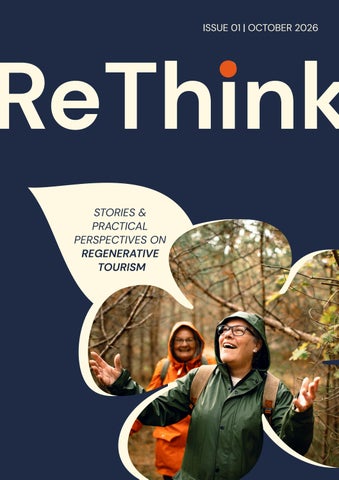
ISSUE 01 | OCTOBER 2026
ReThink STORIES & PRACTICAL PERSPECTIVES ON REGENERATIVE TOURISM
WHAT IF TOURISM COULD LEAVE PLACES STRONGER THAN IT FOUND THEM Welcome to ReThink, a digital magazine about the people and choices shaping regenerative tourism. ReThink explores how regenerative tourism can move from an inspiring idea to something we put into practice. Across northern regions, we are gathering experiences, perspectives and practical examples that challenge us to think differently about the relationship between tourism, communities and nature. This first issue brings together lessons from project conversations, a guidebook for entrepreneurs and four accounts of everyday practice in Västerbotten, Sweden. They offer different ways to begin: make a place useful for residents, care for cultural heritage, involve guests in learning, or build stronger relationships with local producers. Tourism can contribute to the places on which it depends. The question is what that contribution looks like, who decides it is needed, and how we learn whether it makes a difference. Welcome to ReThink, and to a conversation about what tourism could become.
2
Lessons from ReThink. Can tourism leave a place better than it found it? A starting point for rethinking tourism and its role in places and communities. What if tourism could contribute more than it consumes? This question sits at the heart of ReThink. Across northern destinations, tourism creates opportunities for businesses and communities, while taking place in environments shaped by seasonal pressures and changing conditions. Regenerative thinking starts with the place itself. What needs care? Which relationships make local life possible? Whose knowledge should guide decisions? The answers will differ between a riverfront in town, a small village and a protected cultural landscape.
A place is more than a destination The REGGAE guidebook describes regeneration as an approach to long-term renewal of ecosystems, communities and culture. It also distinguishes regeneration, which focuses on places, from transformation, which concerns changes in visitors, and accessibility, which makes participation possible for more people. These ideas can work together. A visit may help someone understand a landscape more deeply while also supporting a locally chosen activity. But a memorable experience alone does not show that the place has benefited.
Ask a different question Instead of starting with what visitors want to consume, ask what a place and its people want tourism to contribute. That shift changes how experiences are designed, who is involved and what success means. What does this place need, and who should help decide?
3
Why meeting in person still matters Shared work in Maxmo connected project ideas with a local place and its community. Regenerative tourism depends on relationships: between visitors and hosts, businesses and communities, and the people working to change tourism. During the ReThink meeting in Maxmo, Finland, partners came together to develop project outputs and exchange perspectives. Digital collaboration keeps international work moving and can reduce travel. Time together has another value: people can explore differences, ask follow-up questions and understand the setting behind an idea. The practical question is how to make a meeting worth the resources it uses. When regeneration leaves the meeting room In Maxmo, partners also worked with the local village association on a small activity responding to a local need. The point was to connect project work with the community and its context. That activity opened a wider discussion. Who benefits from an intervention? What environmental, social, cultural and economic effects might it have? Could an apparently helpful action create extra work for residents? What should be followed up afterwards? A practical activity does not settle these questions. It makes them easier to ask with the people who know the place. What matters is the connection between the activity, a locally identified need and continued learning.
4
A winter visit with a purpose In the Lake Saimaa region, a tourism experience connects guests with the conservation of a threatened seal. When snowfall is insufficient, Saimaa ringed seals can lack the snowdrifts they need for breeding lairs. The REGGAE guidebook presents a tourism example in which visitors help build artificial drifts as part of organised conservation work. The experience combines practical participation with learning about the seal, local nature and life in the Saimaa archipelago. The guidebook describes work led by an experienced entrepreneur in cooperation with expert partners.
Participation has a purpose The visitor’s role changes: an encounter with nature also becomes a way to support its care. The conservation need comes first, with the visitor experience designed around an appropriate contribution. For other destinations, the useful question is not which activity to copy. It is how to connect visitor participation with work that local partners actually need and can responsibly manage.
Build the relationship before the product A contribution needs more than willing visitors. It needs local agreement, relevant expertise, suitable timing and follow-up. Sometimes the best way to care for a sensitive place will be to limit access or leave it undisturbed. The Saimaa example offers a way to think about tourism design: begin with the place, identify a meaningful role for guests, and make the learning part of the experience.
5
A river becomes a winter living room Arena Älven makes the frozen Ume River a shared space for residents, associations and visitors. In Lycksele, Arena Älven turns part of the frozen Ume River into a winter meeting place. Cleared routes invite skating, skiing, kick-sledding and walking. Shelters and firewood make room to stop and spend time together. The initiative began with a Leader project in 2019. Today, its appeal reaches beyond visitors. Schools use the arena for outdoor days, equipment can be borrowed and local associations can book a barbecue kiosk free of charge to raise income and introduce their activities. Shared work keeps it running Gold of Lapland coordinates the initiative, while Lycksele Retroevent contributes resources and maintenance in consultation with the municipality. Sponsorship, hydropower community funds, event income and voluntary contributions support operation and development. The case account states that Retroevent allocates 33 per cent of its event revenue to the arena. This contribution should not be read as proof that the impacts of those events are offset. A lesson to take home Start with something useful for residents and give local associations a practical role. Accessibility and shared responsibility are strengths; weather, ice safety and limited resources remain challenges. Regenerative outcomes have not yet been systematically measured.
6
Small numbers with a larger purpose At Geunja Samic Lodge, tourism helps care for Sámi cultural environments. At Geunja Samic Lodge near Ammarnäs, a deliberately small visitor offer supports a larger purpose: caring for Sámi buildings, nature and cultural environments. Mikael and Ann-Kristin Vinka started the business in 1989. The case account describes a secluded lodge reached by boat, with visits arranged by invitation. Guest income supports preservation and care, while visits share knowledge of Sámi culture and the surrounding landscape. The place sets the scale The business limits visits to 12 groups a year, with no more than 12 people in a group. These boundaries help align tourism with the needs of the place and the capacity of its hosts. The owners’ relationship with their own culture guides what is shared and how. Tourism becomes a way to support cultural continuity rather than treating culture as an attraction detached from the people who hold it. A lesson to take home Decide what tourism should serve before deciding how much to grow. Make the connection between guest income and care visible, and respect the hosts’ authority. The case identifies restored heritage sites as a possible indicator, but provides no restoration totals.
7
A riding tour can also be a learning journey Horses of Taiga brings nature observation, local partnerships and travel choices into its everyday offer.
A riding tour can be a chance to notice more. At Horses of Taiga in Svansele, guests learn about nature, animal protection and the local community while spending time with horses. Founded in 2016, the small business records species encountered during tours and reports findings to the Swedish University of Agricultural Sciences, SLU. It also works to increase biodiversity on its farm. Care within the experience Guests arriving by train rather than flying are rewarded with extra time with the horses. Local partnerships and Sámi activities delivered by partners direct income to other providers and connect guests with their knowledge. These choices are part of the offer, rather than a separate activity guests must request. The account does not quantify biodiversity change, emissions avoided or additional employment.
8
A lesson to take home Look for contributions within the experience you already run: the journeys you encourage, the observations guides make and the partners you work with. For a small operator, time and capacity matter. Choose something meaningful that can be maintained, then learn from it.
Look at the experience you already offer. Where could care become part of it?
9
The people behind the plate Restaurant Wild River connects local ingredients with care for suppliers, staff and guests. At Restaurant Wild River in Vindeln, a meal begins with relationships. Freddy Holmgren and Emma Wåhlstedt put local ingredients and the people producing them at the centre of their changing menus. The business, founded in 2018, works with small farms, uses whole animals and grows or gathers edible plants. When an ingredient is unavailable, creativity helps the menu adapt to what the region can provide. The workplace belongs in the story The case account reports three full-time employees who moved to Vindeln after joining the restaurant. Student placements, restored second-hand furniture and attention to staff wellbeing are also part of its approach. The owners value honest conversations with suppliers and a workplace people feel proud of. These are their perspectives on quality and care, rather than a quantified assessment of wider impact. A lesson to take home Ask who makes the visitor experience possible, and how your decisions support them. Reliable relationships with producers and care for staff can help tourism’s benefits reach beyond the guest. Wild River is also open about not sourcing every ingredient locally: its story rests on actual choices, not an absolute promise.
Pic tu
A meal can tell you about a place through the people who make it possible.
river.se wild : re
10
The question is no longer only why but how Destinations need support that fits their day-to-day work. Interest in regenerative tourism is growing. The next challenge is how to turn it into decisions about services, partnerships and destination development. ReThink’s GAP analysis explores existing initiatives, tools and institutional capacity across the Northern Periphery and Arctic and Aurora regions. The emerging picture described by the project team points to gaps in implementation, measurement and governance. These are working insights, not final numerical findings from a published GAP analysis. What we heard from DMOs Destination Management Organisations are at different stages. Some are bringing regenerative thinking into strategy and local development. Others are introducing the concept to businesses and stakeholders. A common need is knowledge that people can use: practical tools, clear guidance and examples that explain how an approach works. A destination team with a specific challenge needs to find relevant material quickly. Learning from another destination can help, especially when the example explains its local context, resource needs and limitations. Peer exchange offers a way to ask the questions that a case description leaves unanswered. Useful knowledge includes uncertainty The four cases in this issue show promising practices, but they do not offer a common set of measured outcomes. That is a useful starting point for discussion: what should be tracked, by whom, and what would count as meaningful change locally? ReThink is working towards a toolbox and strategy support that help destinations take the next step. The task is to organise knowledge around real questions, test its usefulness and make space for feedback from the people applying it. 11
Reggae Guidebook. READ HERE
Nature for everyone Regenerative tourism needs to ask who can take part, as well as what a visit contributes. Steps towards Regenerative and Accessible Tourism is a guidebook for tourism entrepreneurs, edited by Maria Hofman-Bergholm and Sara KållFröjdö and published by Centria University of Applied Sciences in 2026. Developed through REGGAE, it combines research with practical examples from Finland and Sweden.
12
Access begins before arrival The guidebook treats accessibility as part of regenerative tourism. It considers different disabilities and offers practical advice for nature-based services. A visitor needs reliable information to decide whether an experience will work for them; a general claim that an activity is accessible may not answer their questions. For this magazine, we suggest reviewing the entire guest journey: finding information, booking, arriving, taking part, resting and leaving. Ask people with different access needs where uncertainty or barriers arise. Describe actual conditions rather than making a promise that fits only some visitors.
An experience needs room to learn The guidebook also explores wellbeing, nature connectedness, communities and cultural landscapes. Regenerative potential depends on how a service relates to its surroundings and the people involved, with opportunities for reflection rather than a programme filled with activity. The business must be able to care Its pricing chapter brings the discussion back to everyday viability. Time, staff, partners and the work behind an experience need to be accounted for. A contribution that depends on unpaid effort or an exhausted host is difficult to maintain. Start With one useful change A short conversation can connect an ambition with a locally meaningful first step. The examples in this issue begin in different places, but each offers a question worth taking into your own work. Use the prompts below with hosts, residents, businesses and relevant specialists. This is an editorial exercise, not an official ReThink assessment tool.
13
Listen before choosing an activity Ask what matters locally and where tourism might help. Invite the people affected by the idea to shape it. Be prepared to hear that the proposed activity is unnecessary, poorly timed or not welcome.
Give the contribution a clear purpose Describe the need, the planned action and who will benefit. Keep the scale manageable. Agree responsibilities for delivery, care and follow-up. Guests should understand their role and be able to participate without being pressured.
Check what makes it possible Consider staff time, funding, access, expertise and the effect on everyday local life. A good idea needs an operating model that supports the people who will carry it out.
Agree how you will learn Choose a few signs of change that fit the purpose. Record a starting point and revisit it. Listen to residents and partners as well as visitors. Notice unwanted effects and change the approach when needed.
14
A useful distinction Counting participants shows how much activity happened. It does not, by itself, show that an ecosystem improved or residents benefited. Combine records of activity with evidence about the change you hoped to create. Possible measures to discuss include participation by local associations, payments to local suppliers, access barriers addressed, heritage work completed and ecological indicators selected with specialists. These are suggested measures, not results from the cases in this issue.
15
From ideas to action: REGGAE project shares results for regenerative nature tourism
How can tourism contribute to healthier ecosystems, stronger communities and more meaningful visitor experiences? At the final seminar of the REGGAE project in Kokkola, Finland, researchers and tourism entrepreneurs shared practical answers – along with new tools to help the tourism sector take the next step. The final seminar of the Regenerative Nature Tourism (REGGAE) project brought together project partners, tourism businesses and industry representatives to reflect on the project's achievements and explore how its results can continue to create value. Held in the village of Öja, the event took place in a community centre that serves as a school, daycare, summer café and meeting place – a fitting example of how local spaces can benefit both residents and visitors.
16
A central theme throughout the seminar was the shift from sustainable to regenerative tourism. While sustainable tourism aims to reduce negative impacts, regenerative tourism goes a step further by asking how tourism can actively improve the places where it operates. Professor Henna Konu from the University of Eastern Finland highlighted the importance of changing perspectives: tourism can become a way for nature and communities to recover and thrive. This approach also means looking beyond traditional measures of success. Alongside economic performance, tourism businesses can consider their contributions to biodiversity, cultural heritage, accessibility and local wellbeing.
Practical examples from tourism entrepreneurs One of the seminar's highlights was hearing how businesses are already putting regenerative principles into practice. Floriane Colonier from Horses of Taiga in Sweden shared how the company combines nature-based experiences with animal welfare, biodiversity conservation and citizen science. Guests help observe and identify species during excursions, while the business works to improve biodiversity on its land and make its activities accessible to more people. Other entrepreneurs shared examples of preserving cultural landscapes, creating opportunities for young people, supporting local communities and helping visitors develop a deeper connection with nature. The discussions demonstrated that regenerative tourism does not necessarily require businesses to redesign their entire offering. It can begin by introducing meaningful regenerative elements into existing services. An important outcome of REGGAE is the development of practical resources to support tourism entrepreneurs.
17
The project has produced a digital guidebook, Steps Towards Regenerative and Accessible Tourism, bringing together research-based knowledge, real-life examples and hands-on advice for developing tourism experiences that benefit people, nature and local communities. Four online courses have also been developed, covering regenerative nature tourism, marketing and communication, cultural heritage and forest history, and accessibility and inclusive tourism. The courses are free and open to anyone interested in learning more, providing an opportunity for the project's knowledge to reach businesses and organisations beyond the original partnership. The seminar also highlighted that regenerative tourism is about people as much as nature. Accessibility and inclusion were discussed as essential elements of creating positive tourism experiences. Speakers emphasised the importance of clear information, flexible activities and understanding the different barriers visitors may face. Making nature tourism more accessible can benefit not only people with disabilities but also families, older visitors and those with limited outdoor experience.
18
From knowledge to action: REGGAE Project Shares Results for Regenerative Nature Tourism Building a shared resource for regenerative tourism across the Northern and Arctic regions. How can destination management organisations (DMOs) turn regenerative tourism principles into practical action? This question is at the heart of the ReThink Toolbox, now being developed on the existing NorReg platform. Led by Visit Reykjanes within the ReThink project, the Toolbox brings together knowledge, tools, methodologies and practical examples from ReThink, REGGAE, REGENERATE and other relevant initiatives. Its purpose is to make existing resources easier to find, understand and apply, supporting DMOs, tourism businesses and other stakeholders across the Northern and Arctic regions.
From research to practical needs The development of the Toolbox builds on the ReThink Gap Analysis and Needs Validation process. The Gap Analysis, coordinated by the Natural Resources Institute Finland (Luke), examined how regenerative tourism is understood and implemented across the Northern Periphery and Arctic region. Interviews revealed growing interest in the concept, but also significant differences in how destinations translate regenerative principles into everyday practice. The subsequent Needs Validation process explored what practical support DMOs require. The findings highlighted demand for step-by-step guidance, training materials, communication resources, case studies, monitoring tools and practical templates. Together, these findings reinforced a central message: the challenge is not simply to generate more knowledge, but to make existing knowledge accessible and actionable.
19
Building on what already exists Alongside the needs assessment, ReThink has been developing a Knowledge Inventory, mapping existing tools, methodologies and resources from REGGAE, REGENERATE and other initiatives. The aim is to identify relevant materials, assess their practical application and transferability, and organise them in a way that responds to the challenges faced by destinations and tourism businesses. Rather than creating another collection of project reports, the Toolbox will connect existing resources and help users identify the guidance, examples and tools most relevant to their work.
NorReg becomes the home of the Toolbox The existing NorReg platform is being developed into a shared knowledge hub for regenerative tourism across the Northern and Arctic regions, including Ireland, Greenland and the Faroe Islands. The Toolbox will be the central feature of the platform, with ReThink leading its development and REGGAE and REGENERATE contributing their resources and project outputs. Users will be able to approach the Toolbox through practical questions under the heading “I need to…”, including getting started with regenerative tourism, involving communities, designing experiences, measuring progress, planning destinations, and communication and marketing. Resources will also be organised by topic, with opportunities to explore materials according to user groups and geographical relevance. The intention is to create a resource that supports different stages of implementation, from understanding regenerative tourism to exploring practical examples and applying tools. The platform will combine publicly accessible information with a Toolbox available through free membership. Existing learning resources, including REGGAE online courses, will remain linked to their original learning platforms.
20
Three projects, one shared approach On 19 October 2026, representatives from ReThink, REGENERATE and REGGAE came together for an online co-development workshop facilitated by María Hjalmarsdóttir and Ásta Kristín Sigurjónsdóttir from the Iceland Tourism Cluster. The workshop focused on the structure and user experience of the Toolbox, priority resources, accessibility and how to bring together knowledge from the three projects. Partners agreed that the Toolbox should be the main entry point, with resources organised around users' practical needs rather than individual project structures. Each contributing project will retain its own identity and website, while making relevant outputs available through the shared platform. The workshop also confirmed the importance of keeping the Toolbox accessible, easy to navigate and adaptable as new resources and projects become available.
Next steps: Testing begins in November Following the workshop, the project partners are contributing materials, project information and resources for inclusion in the first version of the Toolbox. A first working draft is scheduled for presentation at the co-development meeting on 10 November 2026. It will then be tested with a selected group of DMOs, tourism businesses and network members, allowing the development team to collect feedback and refine the platform. The planned launch will take place during the final ReThink event in Sweden on 18 February 2027. By building on the existing NorReg platform and bringing together the results of several cooperation projects, ReThink aims to create a lasting resource that supports the transition from regenerative tourism ambitions to practical action. The ReThink Toolbox is not about starting from scratch. It is about connecting what we already know with what destinations need to do next. The ReThink project is co-funded by the European Union through the Interreg Northern Periphery and Arctic Programme. Visit Reykjanes leads the Toolbox development work package in cooperation with the ReThink partners.
21
The journey continues through ReThink The Interreg NPA project RETHINK, running until February 2027, will build on the work of REGGAE and REGENERATE. Its focus includes helping destination management organisations apply regenerative tourism principles, sharing practical tools and strengthening cooperation across Northern Europe. The final seminar delivered an encouraging message: regenerative tourism is not about achieving perfection overnight. It is about taking meaningful steps, working together and creating lasting positive change. With new resources, practical examples and continued cooperation, the REGGAE project leaves behind a foundation for tourism that helps both people and places thrive.
Explore the project resources and online courses.
22
This is ReThink
Your Place Has Something to Add Connect with people working on the same questions, and bring an example from your own region. Where to find us Visit the ReThink webpage for project information, news and resources. Follow Regenerative Nature Tourism on LinkedIn and Facebook through the network page linked below. How to join The Regenerative Nature Tourism Network brings together businesses, destinations, DMOs, researchers and other organisations. It began through REGGAE and has been developed further through ReThink. Contact Floriane Colonnier to learn more about joining: floriane.colonnier@goldoflapland.com. Bring something useful Share a practice, a question or a challenge. Explain who is involved, why the activity matters locally and what you have learned. Examples that include limits and unexpected effects help others adapt an idea responsibly. ReThink final event We will share the date, format and participation details once confirmed by the project team. Follow the project webpage for the announcement. There is room in this conversation for businesses taking a first step and destinations already testing a new approach. What connects them is a willingness to learn with the people whose places tourism depends on.
Discover us on Facebook and LinkedIn
23
What if tourism could leave places better than we found them? Continue the conversation
25