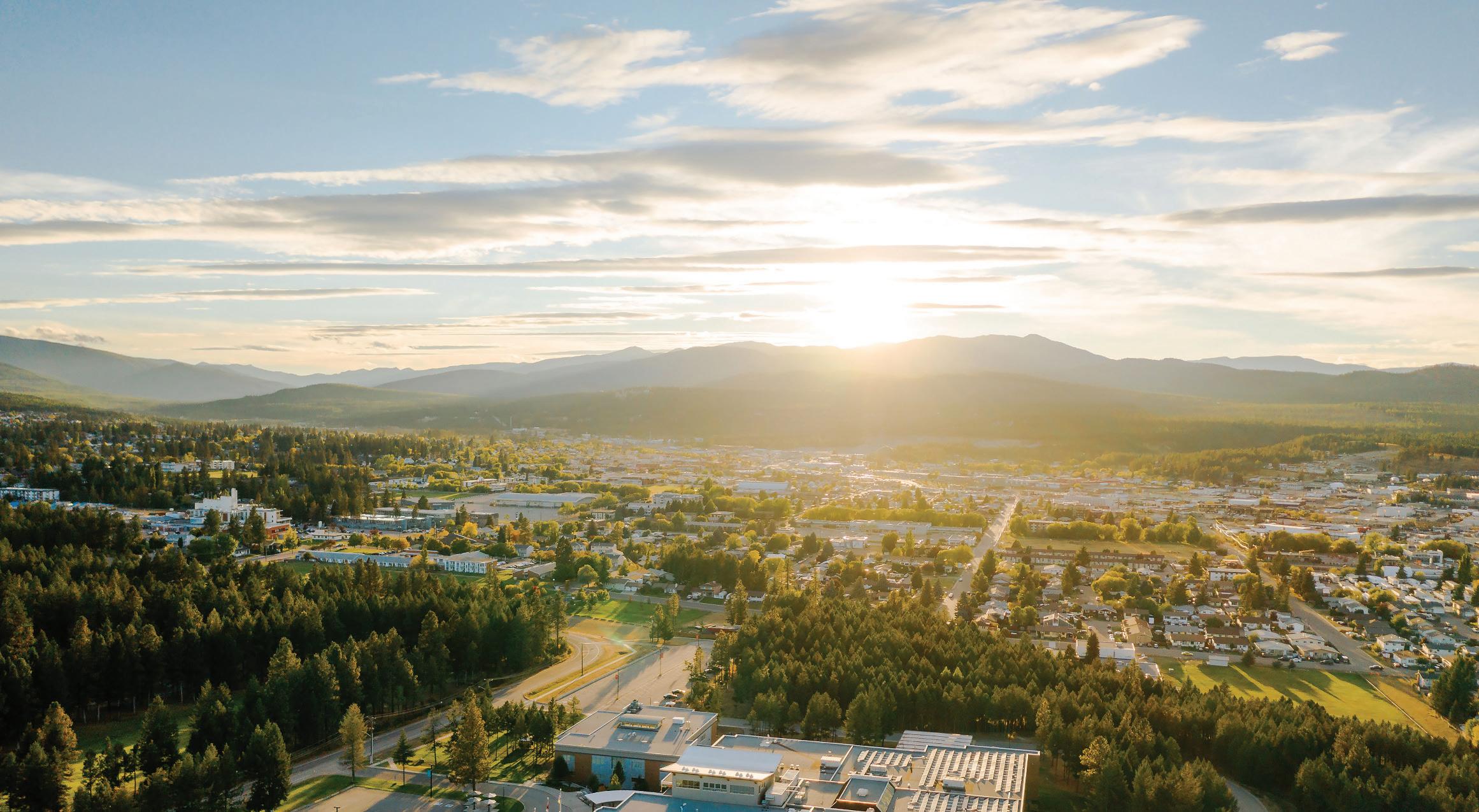
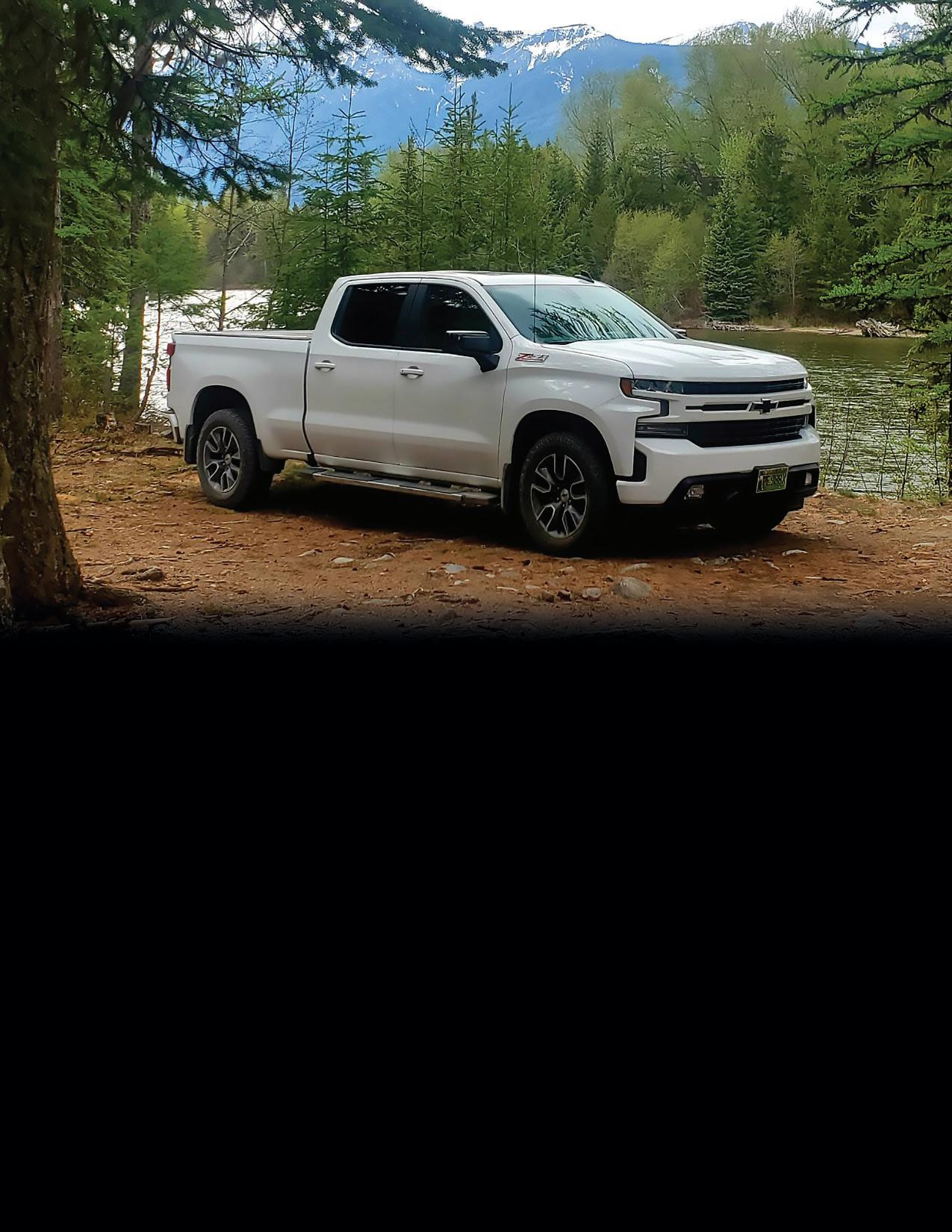
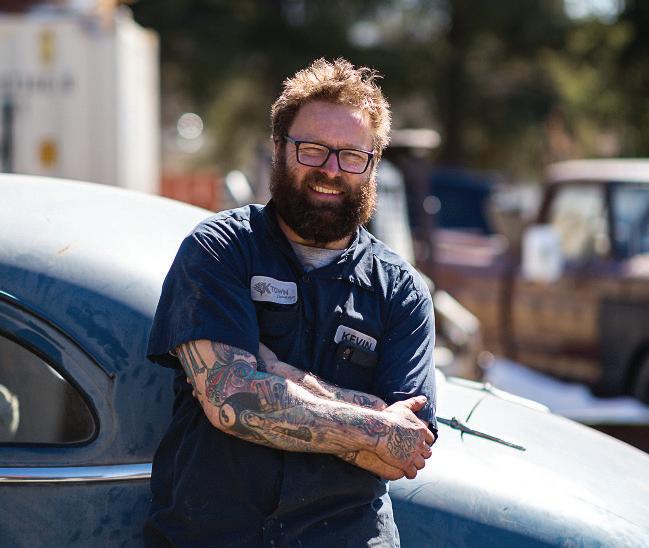
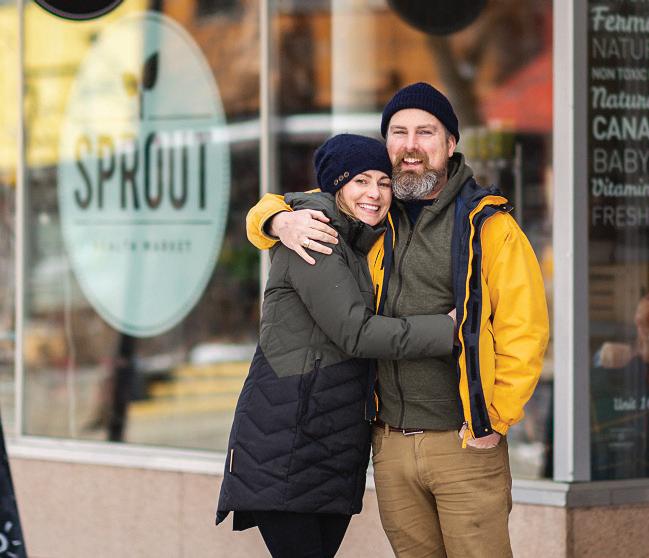
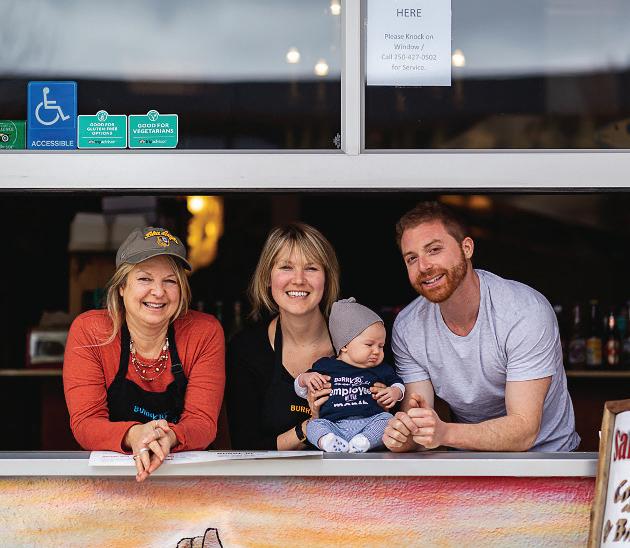
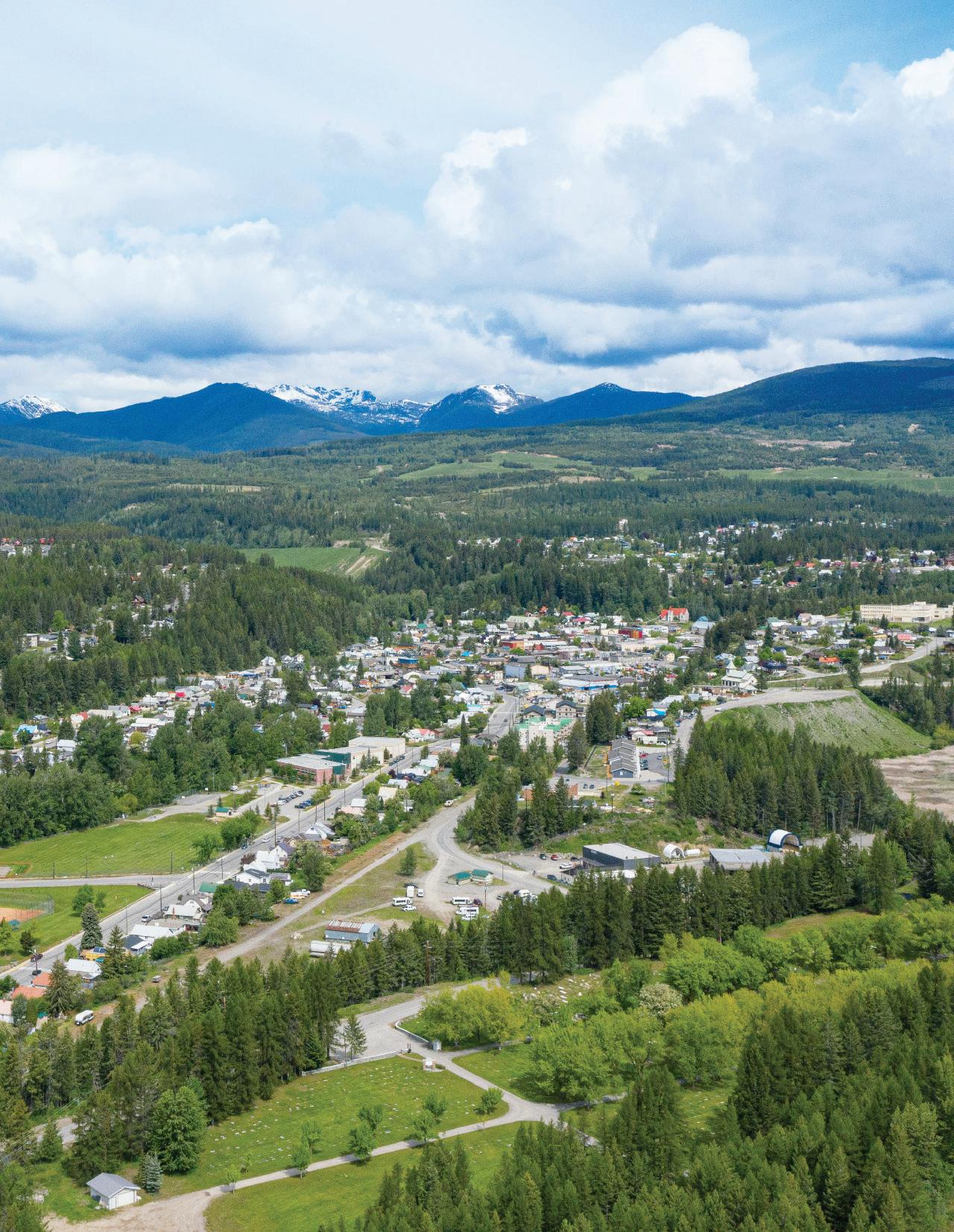
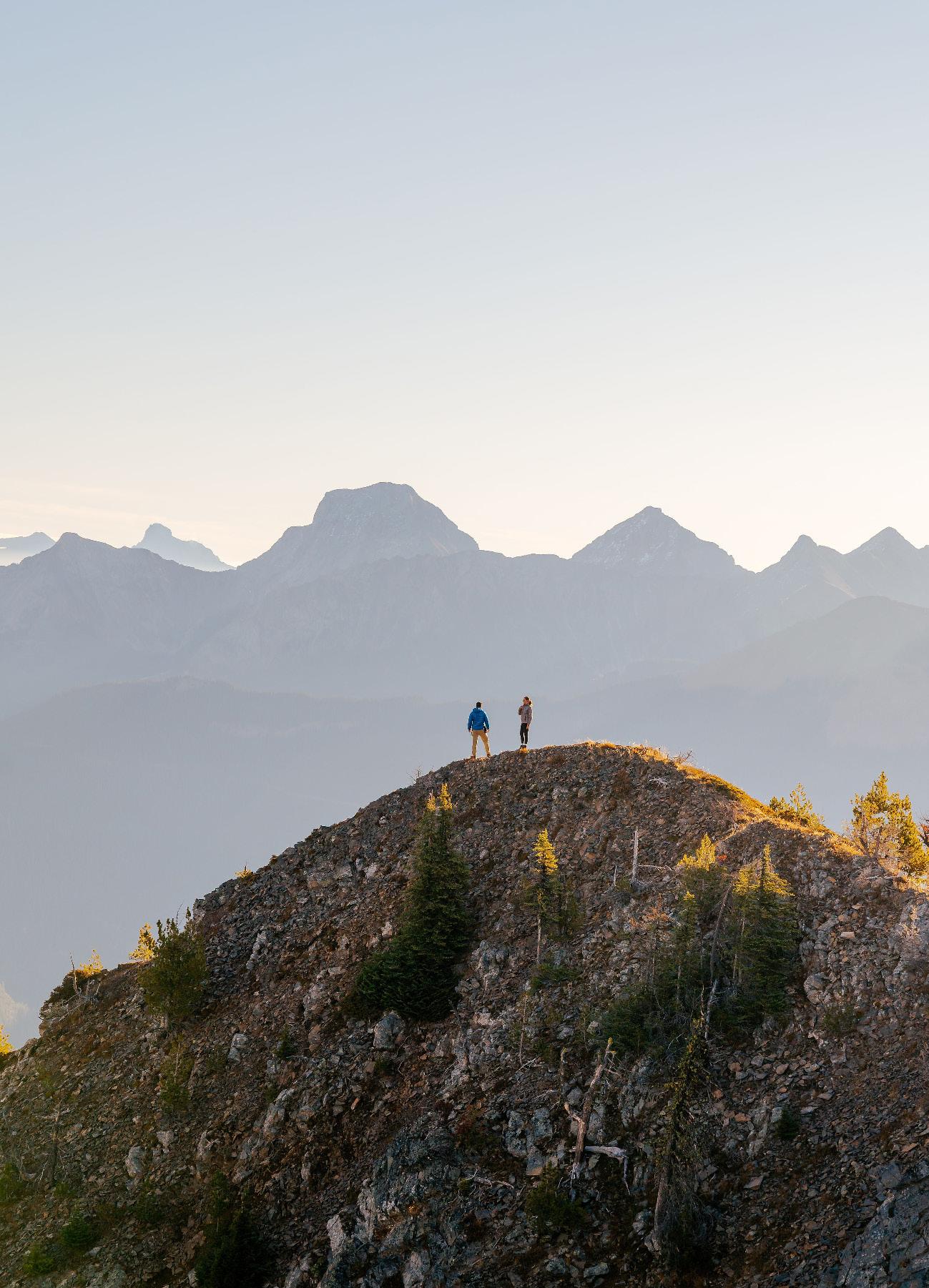
We are a strong, compassionate and caring community Cranbrook. In this continued time of uncertainty, this is our opportunity to shine by caring for and supporting each other. We have always come together in times of need. Please find ways to support our entire local business community. Your purchases and orders help keep local people working and local business going. Thank you Cranbrook!
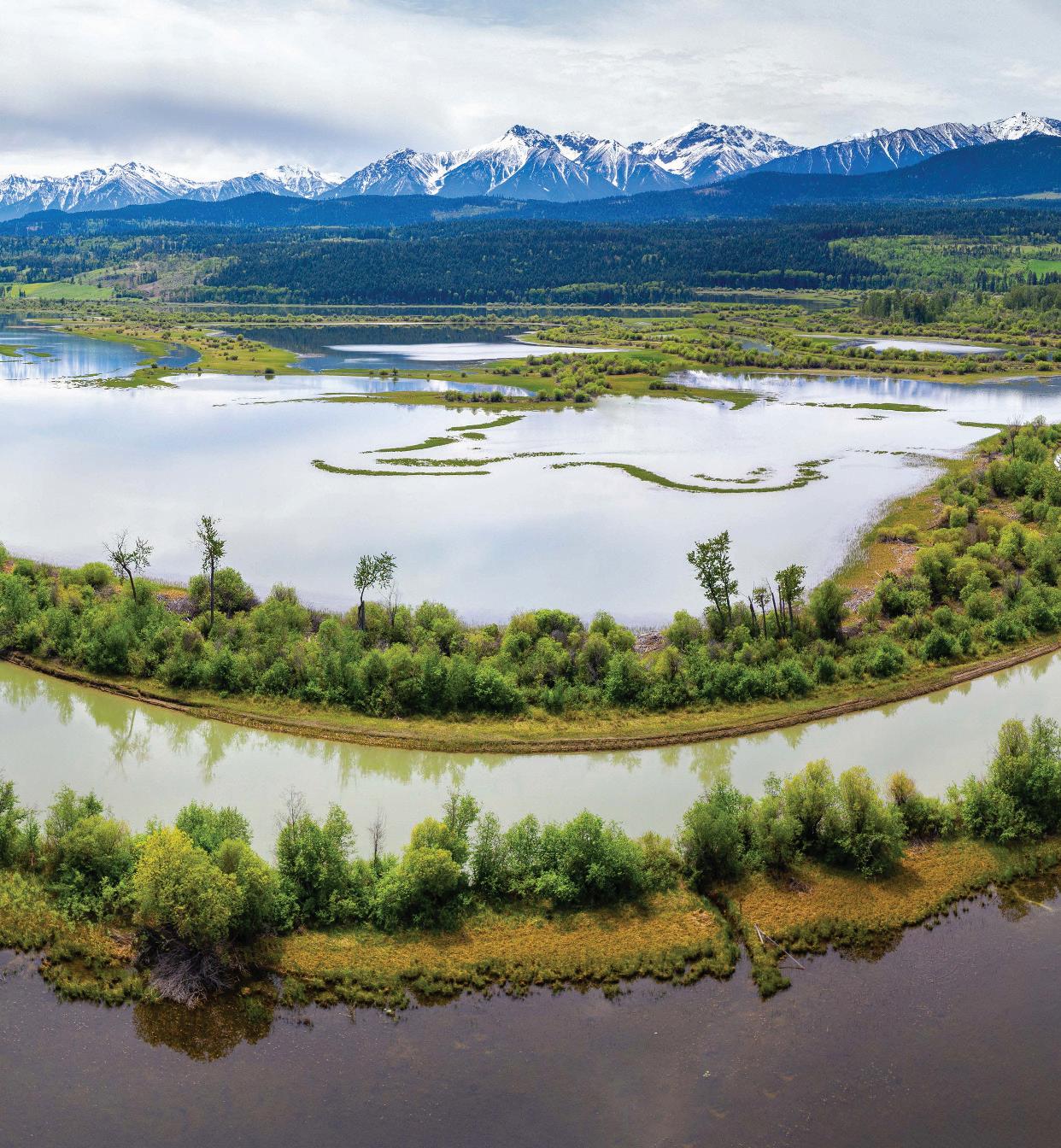
Photo: Cranbrook Tourism
A good place to be overdoin’ it.
Downtown Marysville? Platzl? Blarchmont? No matter what part of town, Kimberley businesses have gone above and beyond to stay open for you! Now is the time to support them with all of your might. Shop, eat and spend local and by all means, go ahead and overdo it...we won’t tell.
FOR ADVERTISING, DISTRIBUTION,OR GENERAL INQUIRIES, PLEASE CONTACT: grady@kootenaymedia.ca
For article submissions, please contact: karen@kootenaymedia.ca | 250.427.0808
Reproduction, in whole, or in part, is strictly prohibited. No part of this magazine may be reproduced or duplicated without the written permission of the publisher. All rights reserved on entire contents. GO Cranberley Magazine makes every effort to ensure the accuracy of the information it publishes and is not responsible for any consequences arising from errors or omissions. The opinions expressed in the articles are those of the authors.
GO Cranberley Magazine is published four times per year and is printed in Canada.
GO Cranberley is published by: Kootenay Media Ltd.
MANAGING EDITOR
Karen Vold
CREATIVE DIRECTOR
Grady Pasiechnyk
SALES & DISTRIBUTION
Grady Pasiechnyk
ART DIRECTION & DESIGN
Ashley Dodd
COPY EDITING & SOCIAL MEDIA
Monica Karaba
CONTRIBUTORS
Britt Bates
Ferdy Belland
Dan Mills
Grady Pasiechnyk
Jeff Pew
Sarah Stupar
COVER SUMMER 2021
Photo: Pat Morrow, Courtesy of Columbia Basin Trust
PART ONE
ARTS INSTITUTIONS OF KIMBERLEY AND CRANBROOK KEEP CALM AND CARRY ON
W: Ferdy Belland
THE COVID-19 PANDEMIC is one of the most significant global events of our time, resulting in the worst State of Emergency Canadians have faced since World War II. The communities of Kimberley and Cranbrook are not cocooned from the viral threat, and so much of what we love about our mountain splendor has been frozen in limbo due to the lockdowns and social-distancing protocols.
The Arts are a crucial component to the human experience; mere survival is insufficient for happiness and inner meaning. Even Stone Age hunter-gatherers painted the walls of their caves or banged rocks on hollow logs in repetitive trancing beats, or acted or sculpted. Tenacity and persistence are two key drivers that have risen us 50,000 years — from prehistoric wolfskins to postmodern Lululemons. And now in the Kootenays of the 21st century we find our local arts institutions keeping a stiff upper lip despite it all, soldiering on for the better times to come when we will all gather close again in joy and celebration.
We talked to four of our favourite local arts organizations to see how they have adapted and risen to the challenge of stewarding the Arts through this unique time. This issue we feature Cranbrook Community Theatre and Fisher Peak Performing Artists Society, and in the fall issue, we’ll look at how Key City Theatre and Kimberley Arts/Centre 64 have evolved their offerings.
Cranbrook Community Theatre
"It has been a challenge, no doubt about it," says Cranbrook Community Theatre (CCT) president Peter Schalk. "We had to cancel our production of The 39 Steps on the eve of opening night when the pandemic first erupted, which was beyond heartbreaking. Like everybody else, we were scared and didn't know how bad things might get. But we adopted a 'life during wartime' attitude and we challenged ourselves to continue. And we've kept the CCT engine warm and idling."
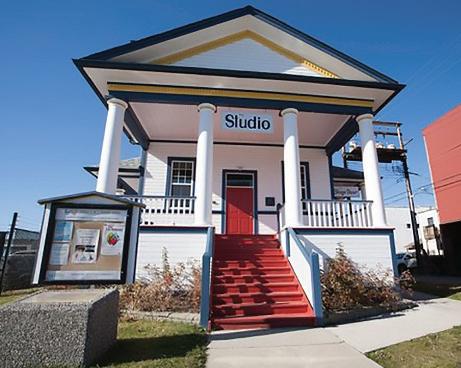
CCT is long renowned as one of BC's most bustling theatre troupes and has been the proud steward of downtown Cranbrook's stately Masonic Temple building since 1974. Rechristened the Studio Stage Door Theatre, the beautiful 82-seat venue has hosted countless professional-level productions featuring the best acting talent found in our twin communities.
"When we produced Almost, Maine in October 2020, we found ourselves the only active theatre troupe across all of BC," says Schalk. "Sobering? Sure. This was our make-or-break test run for our pandemic adaptation. There were on-the-job growing pains, but we learned fast. That play was a series of one-act shorts with only two actors apiece, so we kept a socially-distant conveyor
Trust and from provincial government grants, which has helped us upgrade our livestreaming equipment. And we'll continue exploring livestreaming options post-pandemic."
With virtually every other theatre across BC having completely shut down all operations, CCT bravely shines its theatrical beacon through the darkness. "We have to roll with the punches," says Schalk. "We all do. We miss the magic of the stage. We miss the excitement of the people. But we will be here when the lights come on again."
WWW.CRANBROOKCOMMUNITYTHEATRE.COM
WITH VIRTUALLY EVERY OTHER THEATRE ACROSS BC HAVING COMPLETELY SHUT DOWN ALL OPERATIONS, CCT BRAVELY SHINES ITS THEATRICAL BEACON THROUGH THE DARKNESS.
belt rolling, thirty people maximum in the audience, with the livestreaming cameras running. The show was well received by both the live and online audiences and the acting was as great as anything we'd done pre-pandemic. It was just such a joy to do something. We thought outside the box — and won."
Despite the obvious losses incurred with lack of production income, CCT keeps their administrative staff employed to keep the gears oiled and churning. "We're not rolling over and giving up," says Schalk. "We've embraced the online broadcasting angle for the pandemic meantime. There are over two dozen previous productions that we've filmed over the years that sit in our vaults, so we're negotiating with the rights holders for permission to present an online archive series. Our board of directors meets Zoom-wise to discuss many plans for our upcoming September 2021 to April 2022 Season. We're receiving support from the Columbia Basin
Fisher Peak Performing Artists Society
As a resident of Wycliffe, beloved local singer-songwriter James Neve (the Stephen Stills of the
East Kootenay) can claim in-between citizenship of both Kimberley and Cranbrook, which suits him just fine. As the outgoing president of the Fisher Peak Performing Artists Society (FPPAS) — a position he will soon pass along to an as-yet-unnamed successor — Neve, along with the motivated FPPAS board of di-
Cranbrook's venerable Studio Stage Door Theatre
PHOTO: PETER SCHALK
" WE NEED TO KEEP THE FIRES BURNING," SAYS NEVE. "WE NEED TO KEEP THE PASSION FOR LIVE MUSIC ALIVE. WE HAVE TO TRY."
rectors and volunteer staff, have invested an impressive surge of energy, vision, and positive obstinacy throughout the 2010s into promoting, developing, and largening the Summer Sounds live music performance series in downtown Cranbrook's Rotary Park, as well as deliriously well-received adjunct events such as the Winter Ale Series (hosted at the Key City Theatre) and the PEAK Performance Festival, which dominated Cranbrook's imagination over the 2019 Labor Day Weekend (featuring an utterly electrifying set from Five Alarm Funk) as the most exciting downtown event the city had seen in many years, hands down. And then, as with the rest of us, life happened while FPPAS was making other plans.
The pandemic was a painful blow to FPPAS, but not fatal. After the initial shock wore off, Neve and his cronies jumped into action. "You can't just hope," he says. "You have to plan." With Summer Sounds and the PEAK Festival mournfully out of the question, FPPAS changed direction and presented a well-received series of socially-distanced outdoor concerts (featuring the best in local talent) at Moir Park in September 2020. After
the dust settled from that alternate programming (literally as well as figuratively; it gets windy at Moir Park), the FPPAS board of directors realized that nothing was dead in the water.
"We all agreed to be optimistic," says Neve. "We planned to look ahead to better times. We aimed to improve the society's operations, increase our online presence, add new blood to the board, and put our combined imaginations to the test."
Like everywhere else, FPPAS is tentatively planning for the return of potentially modified Summer Sounds performances in a safe manner in Rotary Park through Summer 2021. But, like everywhere else, there runs the frustrating risk of last-minute cancel-
lations if COVID-19 infection numbers spike, locally or provincially — but it's the risk Neve and FPPAS are willing to take. "We need to keep the fires burning," says Neve. "We need to keep the passion for live music alive. We have to try."
On the administrative level, FPPAS is leaving no stone unturned in its efforts to recruit new society members, secure new sponsors,
continue educational outreach (sound and light gear tutorials, etc.), and win arts support grants at the regional and provincial levels. Much of the respectable success gained so far can be credited to the engine-like drive of FPPAS' tireless administrator Maureen Frank. "She's amazing," says Neve. "An incredible marketing force. We're lucky to have her."
Discussions on livestreaming productions were dismissed by the FPPAS board. "Livestreaming is already exploding across our area at a grassroots level, just like around the world itself, and it's being handled well by our local talent, most of whom were already tech-savvy before COVID," says Neve. "Now, more than ever, our focus is on live music, and we'll present it whenever we can, however we can."
FPPAS wants everyone to know that they are still here. What their society creates matters to, and is crucial for, the good of our communities. And when everything finally opens again, things will explode. Neve believes it, and so does everybody else. "After the pandemic," Neve promises, "we're going to do something BIG."
WWW.FISHERPEAKPERFORMINGARTISTS.COM
To be continued in the fall issue where we’ll share how Key City Theatre and Kimberley Arts have also found innovative ways to “weather the storm.”
The FPPAS-produced 2019 Peak Music Festival showcased a show-stopping finale by legendary Vancouver party band Five Alarm Funk. PHOTO: IAN COBB
FPPAS president James Neve PHOTO: ROD WILSON
Current Communities
PART ONE
This is the first part of a two-issue story covering the history of the Columbia River and the evolution of the Columbia Basin Trust. Part two will be published in our fall issue.
W: Britt Bates | P: Lucas Jmieff, Courtesy of Columbia Basin Trust
THE COLUMBIA RIVER HEADWATERS — flanked by the Rocky Mountains and spread through a wide valley, lush with pine forests — births one of the most iconic rivers in North America. The mighty Columbia flows from Canal Flats, through the East and West Kootenays, then down into the USA, where it travels along the Washington and Oregon border before emptying into the Pacific Ocean.
This regal river, with a basin larger than most European countries, has fed and nourished human culture, abundant wildlife, and entire ecosystems since time immemorial. Though its wide flow, curving through the folds of landscape, appears and feels gentle, this is a powerful and life-sustaining force of nature.
Many communities dot the Columbia Basin and are populated by people who have relied on the Columbia for their recreation and sometimes even their livelihoods, for generations — including many Indigenous Nations, whose culture and sustenance have long been deeply interconnected with the river’s flow and fish populations.
Throughout the Columbia Basin, there is a beating heart, a network of passionate people devoted to the flourishing of the Basin’s communities. It is an organization that has been dedicated to supporting the success of Basin residents for decades, whose generosity is felt and experienced, while its iconic name often remains behind the scenes: Columbia Basin Trust.
Columbia Basin Trust was formed in 1995, and its roots sink deep into the rich soil of community commitment. The Trust — which exists to support the economic, social, and environmental well-being of the Columbia Basin — was born out of the Columbia River Treaty Committee, which formed in 1993 to advocate for Basin residents.
To understand the need for such a committee, we can look even farther back in history. In fact, this group essentially has its origins all the way back in the early 1960s, with the formation of the Columbia River Treaty between Canada and the United States: a negotiation between the two countries that led to a series of dams being built on the Upper Columbia River.
Signed on January 17, 1961 by John Diefenbaker and Dwight D. Eisenhower, the treaty created a tight timeline for the creation of three dams on the Canadian side of the border — the Mica, Duncan, and Arrow Lakes, later called the Keenleyside — and one, the Libby Dam, in the United States. Generating power in both countries, this was, and still is, North America’s largest hydropower project.
dams also blocked the passage of salmon — a species vital to their culture, health, and food supply.
Needless to say, the residents of the Columbia Basin felt that the provincial government was prioritizing profit over people. Over
The treaty was ratified two years later to transfer more of the rights, benefits, and operations to the provincial government of British Columbia. The Province was responsible for the operation of its three dams and also the storage of 15.5 million acres of water across 270,000 acres of land. In exchange for this storage and for the large amount of power it generated south of the border, the Province was paid in generous sums of cash — none of which was distributed to Basin residents, who quickly learned that power came at a price.
Basin locals — who were vocally opposed to detrimental impacts of the project from the beginning — were virtually powerless against the development required for the dams and water storage, which forged ahead. Many thousands were displaced, their lands purchased by BC Hydro, often for a small fraction of the appraised value. Homes and farms were burnt down and flooded — and with it, entire livelihoods destroyed. Families who had lived, farmed, and ranched along the Arrow Lakes for generations were forced to move elsewhere in the province. Indigenous Nations suffered enormously with the loss of their homes and the landscapes they foraged, fished, and hunted on, and the destruction of many sacred ancient cultural sites. The
This regal river , with a basin larger than most European countries, has fed and nourished human culture, abundant wildlife, and entire ecosystems since time immemorial.
the decades that followed, Basin communities often experienced boom and bust cycles that came with the industry of the dams.
To be continued in the fall issue where we'll share how Basin residents united to renegotiate the treaty and develop the Columbia Basin Trust to ensure that the communities surrounding the Columbia River were prioritized and also benefitted from the funds accorded by the treaty.
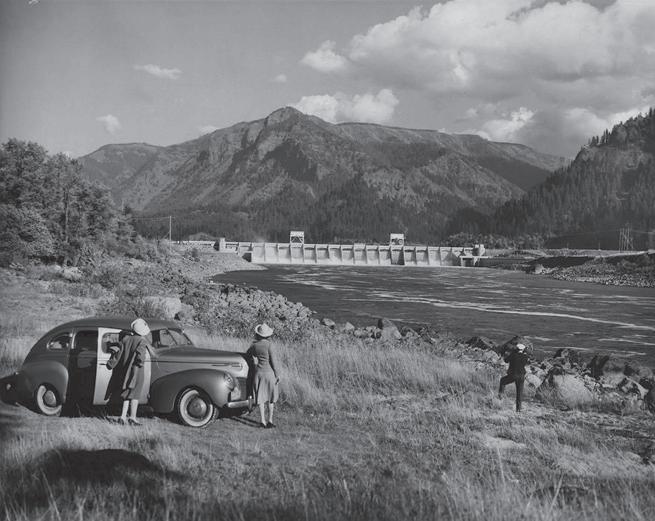
BONNEVILLE DAM 1937. WASHINGTON STATE ARCHIVES, COURTESY OF COLUMBIA BASIN TRUST.
A glimpse into the remarkable stories of people and places in the Columbia Basin.
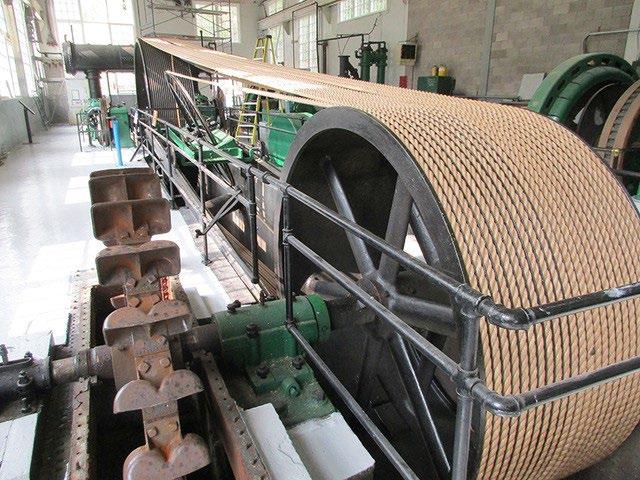
Stop by the Powerhouse on Your Next Visit to Sullivan Mine
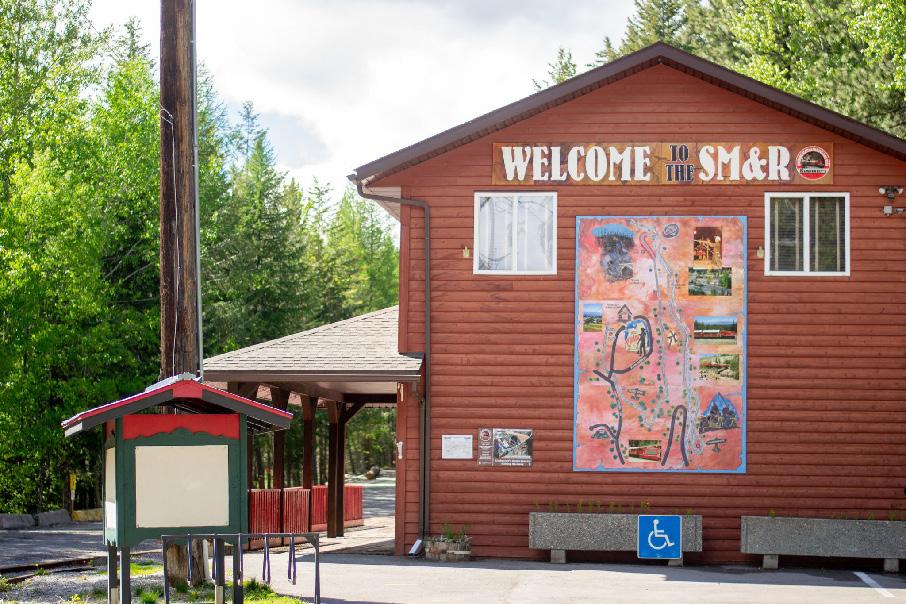
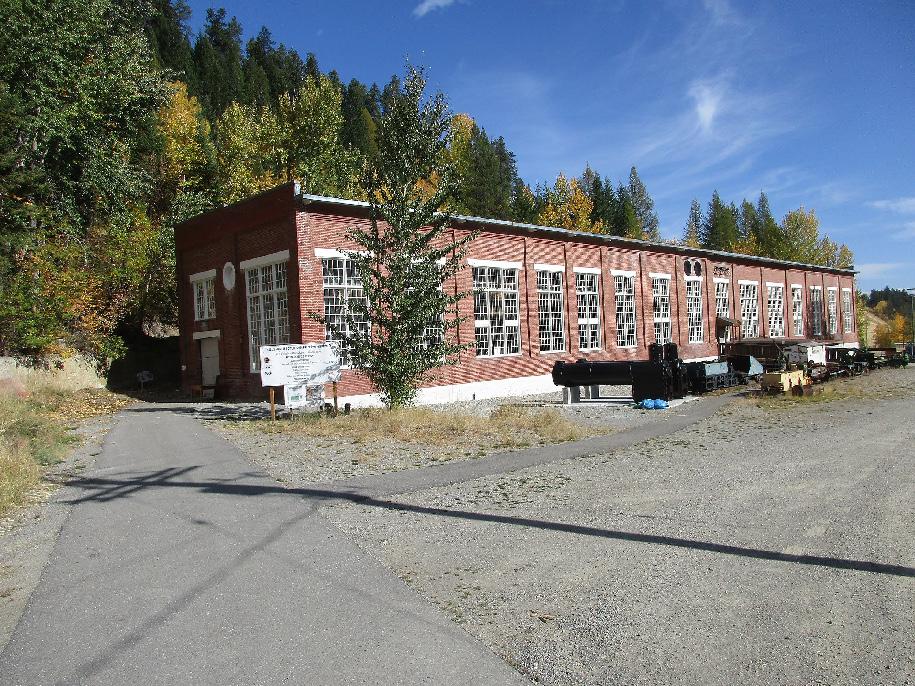
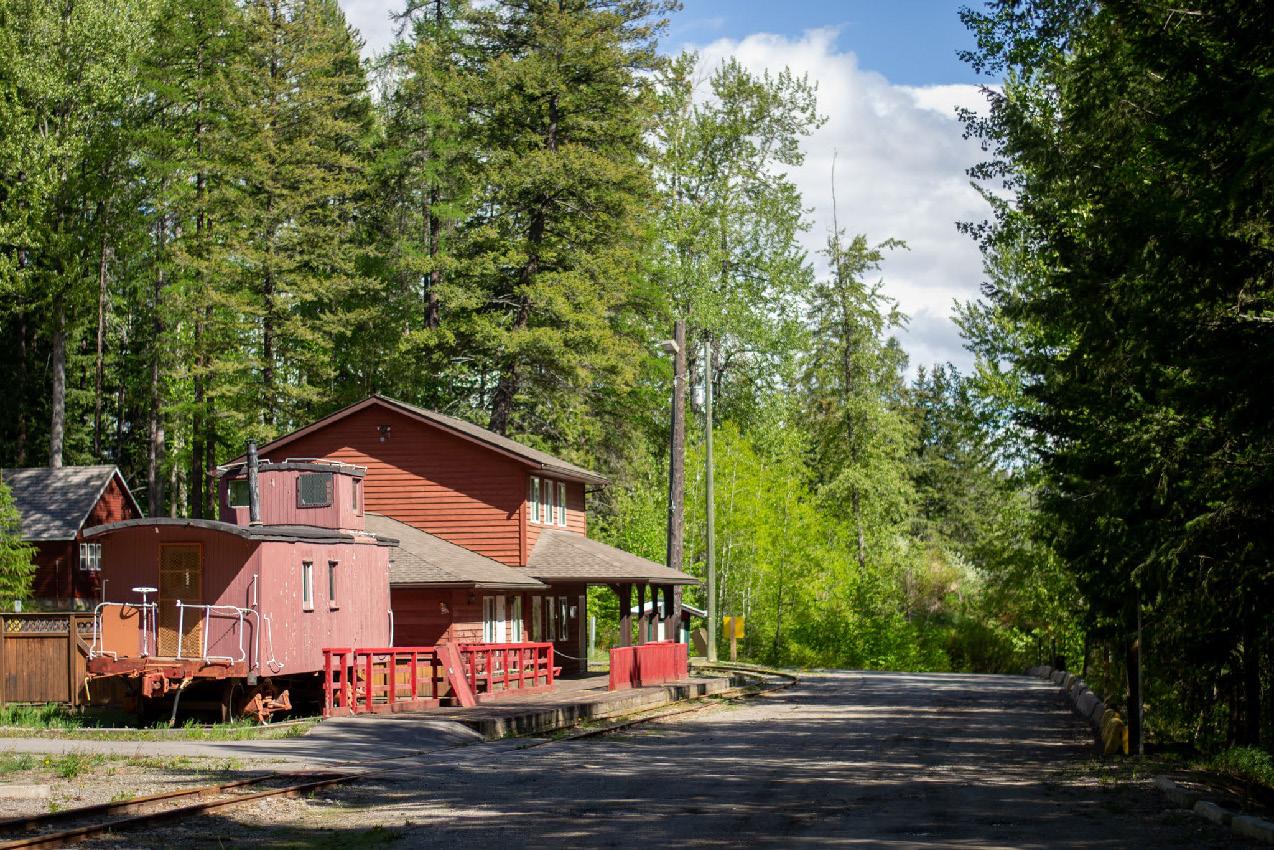
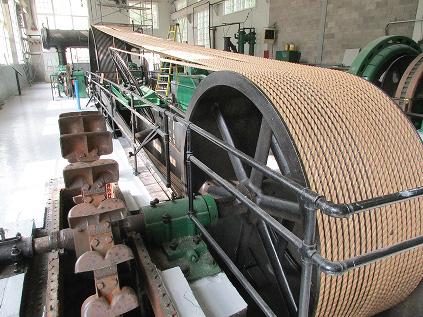
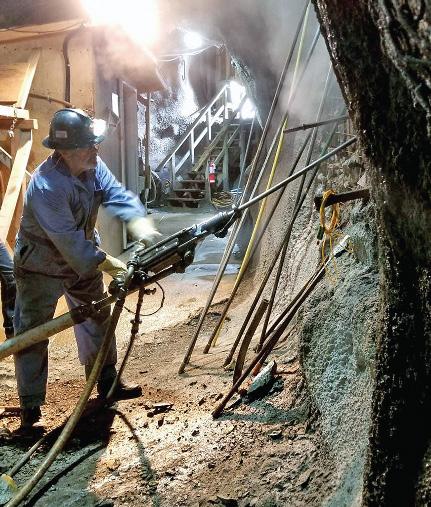
This summer, take the kids on a tour of Sullivan Mine, where the powerhouse has been restored to its former glory. The Sullivan Mine & Railway Historical Society hired local tradespeople for the work, with help from a Columbia Basin Trust grant. Vistors can learn the role mining played in Kimberley’s early days and experience its shift to a thriving tourism economy.
Full Story
Did You Remember the Flamingos? Did You Remember the Flamingos?
Five Backpacking Essentials You Didn’t Even Know You Needed.
W: Dan Mills | P: Pat Morrow & Dan Mills
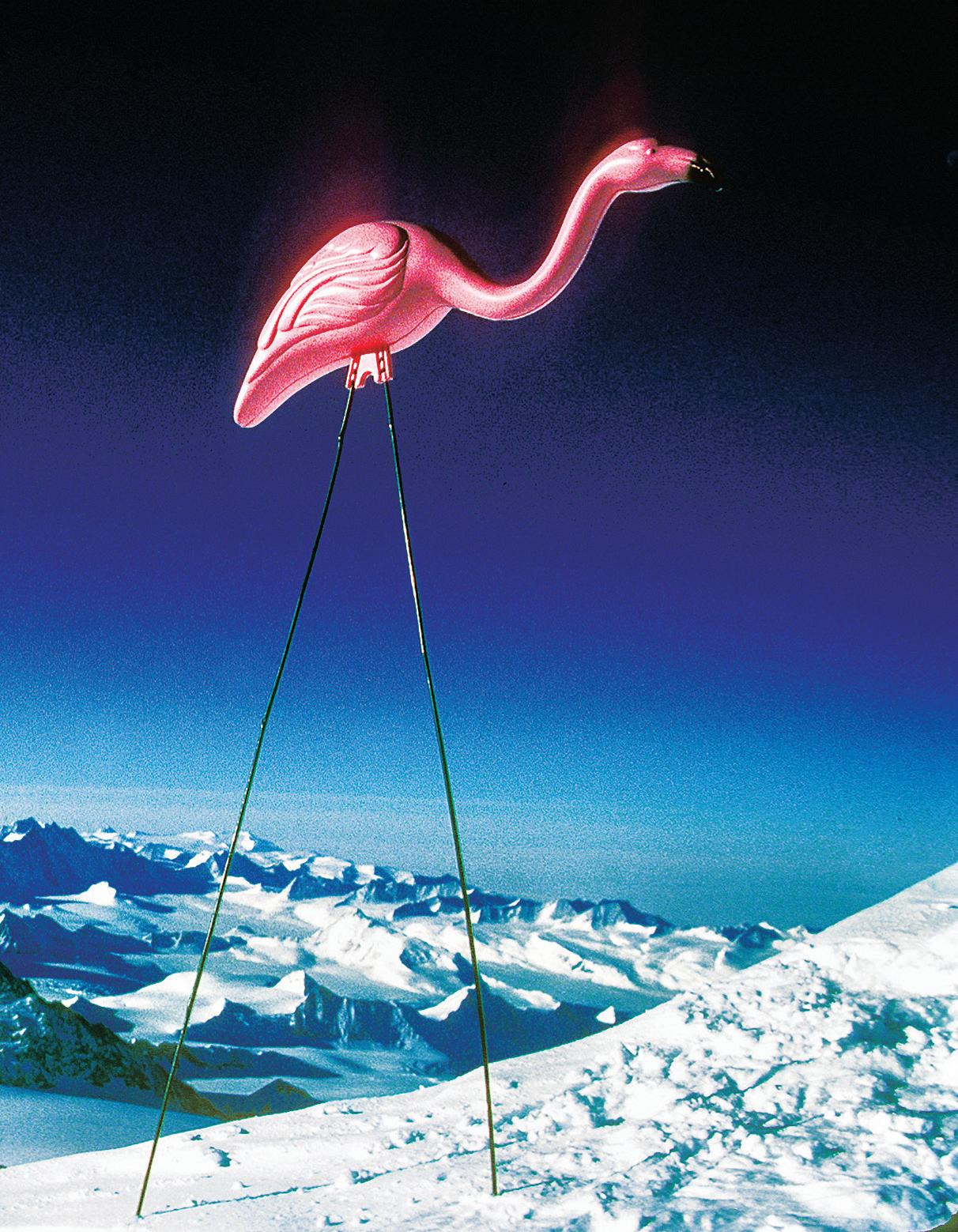
Over the years we have often been asked to explain the presence of our pink hiking companions.
There is a wise old adage that states “‘Tis an ill wind that blows no good.” If we are to accept that this idiom contains a truth, then these recent dark days — at least for those of us who haven’t been inordinately impacted by the virus — may just have offered up a few pearls along with their irritations and discomforts. One of those gems is the recognition that living in the Kootenays, with its unparalleled outdoor opportunities, is a privilege indeed.
Many who once sought recreation abroad or in large social situations have now discovered their wild backyard and are embracing it for the gift that it is. Not only are folks spending more time outside, they are also venturing deeper into the wilds, often staying overnight. This of course means shouldering a larger pack and carrying the necessities required to be comfortable and more importantly, safe. Sturdy boots, a warm sleeping bag, and a reliable shelter are of course essentials, but there are a few, less obvious items — at least to the uninitiated — that should not be overlooked when planning an overnight backpacking trip. After nearly 50 years of wilderness misadventure, and innumerable bad packing decisions, here are five items on my “don’t leave home without it” list.
Don't leave home without it
1
The Bandana
Any item that you can put in your pack that is versatile and multifunctional is a godsend. The bandana is definitely that. As a human who falls into the category of elite perspirer, initially, my bandana was utilized specifically to keep the copious volumes of sweat from flooding my eyes. It did this very well. However, it has also been used as a sunhat (here read doo-rag), potholder, bib/ napkin, nose hanky, tourniquet, bandage, neck sun protector, and as long as it has not been utilized for any of the previous, a coffee filter.
Perhaps my most appreciated use of this simple square of cloth came on an arid, late summer hike when all the water sources we had hoped to encounter turned out to be bone dry. Parched and dehydrated we came across a tiny trickle dampening a rock face but found it impossible to slurp up the precious liquid. Enter the spare, clean bandana, which was used to absorb the precious moisture and then joyously wrung into our dried-out mouths. Godsend indeed.
Recently, I have upgraded my old bandana to a buff, which is basically an elasticized fabric tube. It provides all of the above uses as well as one more: it also makes a darn fine pillowcase. See next item.
The Pillow
I know, I know, a pillow is hardly the first thing that springs to mind when some of you hardcore types think of roughing it. However, after decades of waking up in the tent grumpy, neck-sore and sleep deprived, I have come to appreciate the difference a pillow can make. Yes, cramming some clothes into your sleeping bag stuff sack to create a makeshift headrest is preferable to having nothing at all, but you can’t beat an actual backpacking pillow. A sleep aid that before inflation is both tiny and light but once deployed, is a full-size, game breaker-dream maker.
The Garbage Bag
As mentioned previously, multifunctionality in a piece of gear is often what sets apart the essential from the unessential. Enter the ever-versatile trash bin liner.
The mid-sized, heavy-duty plastic bag that lives in the bottom of my backpack has been used and reused for over a decade, so its ecological footprint is sound. It has been used for its intended purpose of organizing and containing the refuse I want to carry back out to civilization. It has also been employed to hold dirty and or wet clothing, to protect my sleeping bag during torrential storms, and as a receptacle in which I have gathered summer high country snow for icy libations back at camp. The predecessor to my current bag unselfishly gave itself up so that arm and neck holes could be torn into it, transforming it into a much needed, emergency raincoat.
Ear Plugs
As backpacking is more often than not a group activity, chances are good that you will be sharing a tent with someone (or at least will be, once The Goblin of Strange and Uncertain Times has been banished from the kingdom). Weary hikers often dream deeply and unfortunately, loudly. A snoring tentmate can make for an extremely uncomfortable and restless sleep. This in turn often leads to that most miserable of maladies, Grumpy Hiker Syndrome. This affliction is easily remedied with a good pair of ear plugs. Light, packable, and oh, so precious when the need arises. Take along an extra, unused pair, just in case you are the snorer. Your tentmate will appreciate your thoughtfulness.
Perhaps the story that best demonstrates the bin liner’s usefulness was on a hike up onto a limestone plateau. Although the hike initially followed a small stream, upon arriving at the meadow in which I planned to camp, I found the water source there dry as the proverbial bone. With darkness approaching I had no choice but to set up the tent, then make my way back down the trail several kilometers to where I had last seen water.
A couple of Nalgene bottles was not going to be an adequate supply for my multi-day stay, so I lined my now empty backpack with the garbage bag, returned to the creek, ladled in a copious quantity of precious water, and then sloshed happily back up the trail to camp. Proving yet again, that necessity is truly the mother of invention.
5
Lawn Flamingos
When I began my backpacking career in the late seventies, my hiking companions and I were a youthful, irreverent, barely post-pubescent lot. Hiking along, singing Monty Python songs, laughing, teasing and constantly trying to outdo each other. Back then, being out in nature was important but so was having too much fun. Perhaps that explains the flamingos.
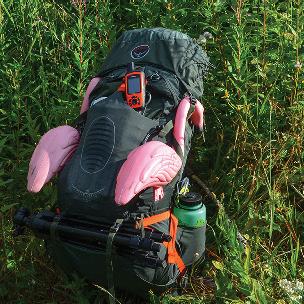
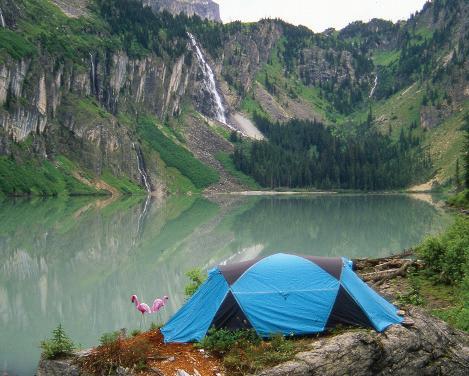
On one of our early overnight adventures, I brought along a pair of garden variety, plastic flamingos and placed them in front of our tent. The boys appreciated the cheeky absurdity of having lawn ornaments in the wilderness and thus, a backcountry tradition was born.
It is not a totally unique tradition as it turns out. World-renowned climber/photographer/writer and first person to summit the highest peaks on all seven continents, Pat Morrow, was adventuring with flamingos in the eighties as well. Proof positive of both the existence of synchronicity and the magic of flamingos.
For some their magic isn’t immediately apparent. Over the years we have often been asked to explain the presence of our pink hiking companions. I believe it was my “Brother in Vibram,” Mahone, who first came up with, “To keep the bears away, of course!” When questioned further about his strange assertion, Mahone would clarify with, “Why do you think there are no grizzlies in Florida? The bears are terrified of ‘em.”
Truth be told, the flamingos are less a bear deterrent than they are a metaphor. A physical reminder that one of the most important items you should carry with you — into the backcountry or anywhere for that matter — is a sense of humour. An appreciation for the irrational, the preposterous and the farcical will go a long way towards preparing us for, and getting us through, this glorious thing we call a life.
Get close to 30 bottles of wine for a fraction of what they cost at the liquor store. We can make any varietal or style you like, and we guarantee you’ll love it.* It’s as easy as coming to see us.
*Seriously! We really do guarantee every wine we make. Youcanexchangeyourbatchforanyreason.
A fresh approach to business education.
The Rocky Mountains have hosted many adventurers over the ages; people as interested in the journey as the destination. We take inspiration from those who came before, which is why our programs focus on a combination of academic and hands-on learning, providing real-world experiences that will expand your horizons and prepare you for future success in your field.
College of the Rockies. Let the adventure begin.
BACHELOR OF BUSINESS ADMINISTRATION
In Sustainable Business Practices
BUSINESS MANAGEMENT
Accounting | General Management | Marketing
TOURISM MANAGEMENT
RECREATION MANAGEMENT
ADVENTURE TOURISM BUSINESS OPERATIONS
HOSPITALITY MANAGEMENT
How Do You Know My Hyundai Is Electric? I’ll Tell You.
Let’s start
off by getting this admission out of the way: I have always liked fancy gadgets. As a general rule, I especially like them when they come from Silicon Valley. The way I see it, technological upgrades to our everyday lives are not a matter of if we’ll adopt them, it’s just when. Notice anyone taking calls on a flip phone these days, or getting up to press a button on a TV to change the channel (or having channels to change)? Didn’t think so.
It will come as no surprise then, that for the past decade I’ve planned on driving a Tesla.
I’ve had it planned out forever: drive our 2007 Honda CRV until it’s toast; and in 5-10 years we’ll sell it and buy a Tesla Model Y. Pretty clear schedule. Unfortunately, I didn’t account for the engine in our CRV burning all of its oil (literally all of it), which is how I found myself listening to a sympathetic mechanic give me directions to the local scrap yard. Looks like my timeline was about to be accelerated.
Like most decisions in the 21st century, my journey started on Google. I’d read that there were some rebates for electric cars and buying a new vehicle isn’t a cheap activity, so I wanted to make sure we were taking advantage of every option available. It didn’t take me long to confirm the rumours I had heard; the federal government provides a $5,000 incentive for purchasing a new electric vehicle, and the provincial government kicks in another $3,000. Not bad! The caveat for receiving these cash prizes is that the base model suggested retail price must be under $45,000. This requirement is actually a very smart way for the governments to incentivize auto makers to keep their electric vehicles somewhat affordable, and why you’ll now notice that basically every make and model is worth around $44,995. Well, not all of them: strike one Tesla.
The icing on the rebate cake was discovering the Scrap-It program, a not-for-profit independent society which offers an additional $6,000 cash on the condition that you scrap an older gas vehicle and replace it with a new, qualifying electric vehicle. We just so happened to have a vehicle to scrap! After a quick bit of
W + P: Grady Pasiechnyk
My wife and I loved the fact it just looked like a cool little SUV, not a spaceship.
research, we learned that Scrap-It issues credits to participating BC dealerships, which they can give out to customers on a first come, first served basis. The program relies on private funding, grants and contributions from a variety of sources as well as program partners. Instead of the $400 trade-in value that we were expecting for our CRV, we received six grand in cold hard cash, just to get it off the road. Tesla chose not to participate: strike two.
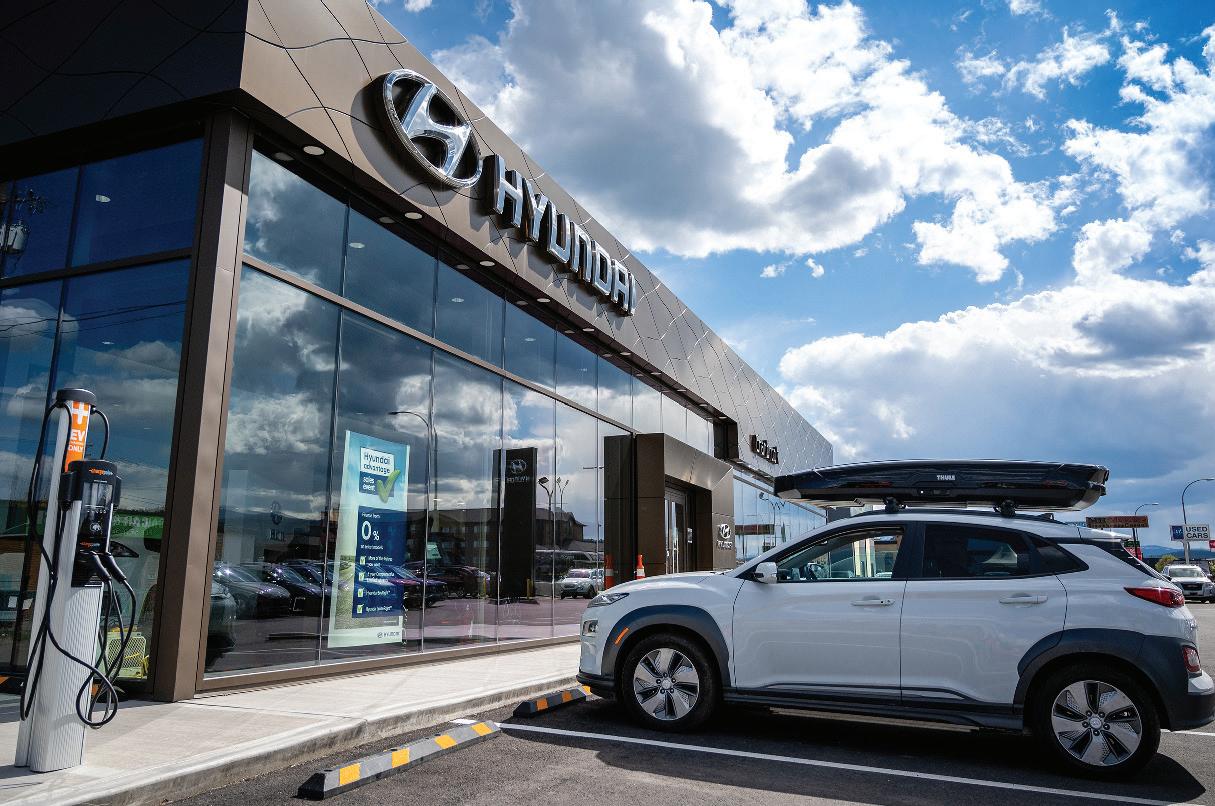
One of the knocks on electric cars is their futuristic design. Traditionally, they’ve played up the fact that they’re clearly different from their gas-burning predecessors, and here in the Kootenays, this hasn’t always been a point in their favour. Throughout my search, I kept noticing the Hyundai Kona, and the more I looked into it, the more I realized this could be the one. My wife and I loved the fact it just looked like a cool little SUV, not a spaceship.
The Kona comes in both electric and gas versions and they’re basically indistinguishable, making the electric option feel very, well, car-like. The Kona’s not huge, so our first order of business
was to instal a Thule box on the roof, and we’ve had no problem taking it to the ski hill with a family of four (plus, heaven forbid we leave the house without Blundstones or a Yeti mug, people will still know we’re from the Kootenays).
I think that in the interconnected world we live in today, with the sum total of knowledge instantly available on our phones, it’s easy to forget how much classic customer service and human interaction matter when making a big purchase. When we stepped foot in the new Cranbrook Hyundai dealership, we were quickly reminded how important it is to have a person we can trust to help navigate the myriad of choices. We felt like we had an entire team working for us to make sure we received all of the credits available, and then get us acquainted with some of the differences on an electric car.
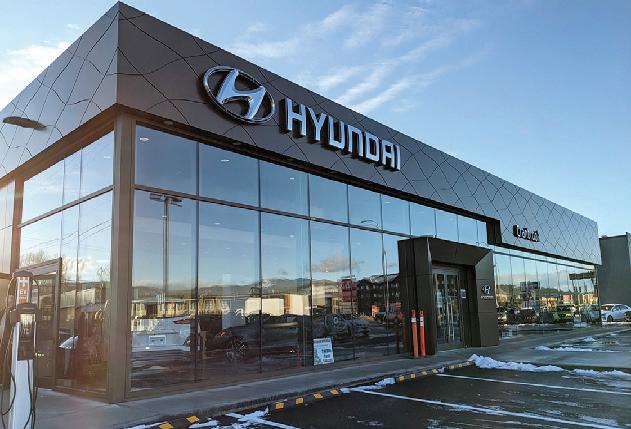
The dealership itself is a whole separate story: it’s stunning. The brand-new building is made even more impressive by the fact that it was built with an entirely local crew and suppliers, which was nothing new for Bob Bullock and his team. The Bullocks
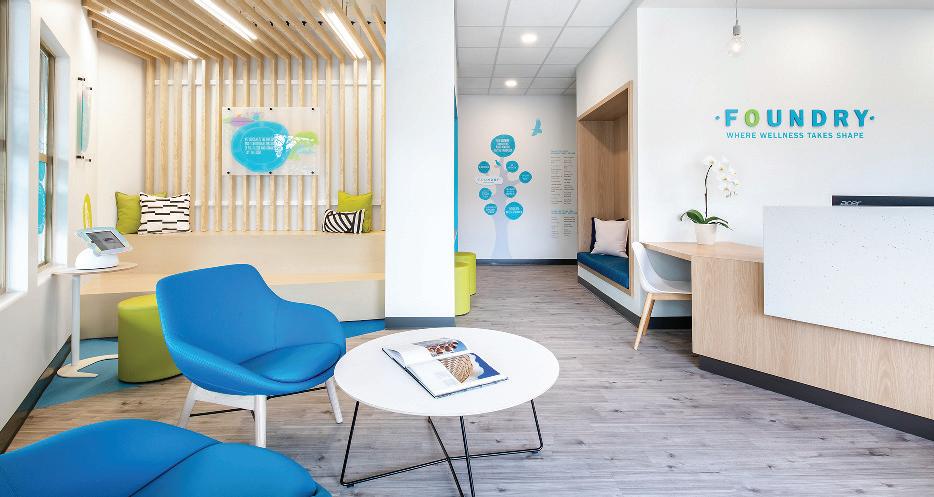
The Foundry : Holistic Healthcare for Our Youth
W: Sarah Stupar | P: Upper Left Photography
BACK IN 2007, a small group of psychiatrists working out of a hospital in downtown Vancouver initiated a new approach to healthcare for young people. The idea was essentially to integrate healthcare services and provide access to social services and health services under one roof. This integration, it was theorized, would help shift the focus of healthcare away from just treatment and onto prevention and early intervention. The hope was that it would help to provide young people with tools and support before their health problems became so severe that they would affect their lives or disrupt education and employment or family and social life. Originally called the Inner City Youth program, it later became known as the BC Integrated Youth Services Initiative as it expanded to other locations, before finally evolving into its current form as the “Foundry” in 2015.
What started out as five locations to help youth in the Lower Mainland, spread onto the Island, up north into Prince George and Terrace, east into the Okanagan, and now, the Foundry is coming to Cranbrook. For many people who come here, the charm of the Kootenays lies in its isolation, its position in the wilderness and its distance from major urban areas. When it comes to health however, the isolation can be the difference between life and death, but being born in a rural area should not be a death sentence.
Having to travel long distances for either physical or mental care is an experience that many in the Kootenays are familiar with, but hopefully now, with the commitment from the province to create a Foundry in Cranbrook, this experience will become a relic of the past. Along with eight other communities, Cranbrook has been pledged $1.2 million dollars from the Province in partnership
with the Ktunaxa Kinbasket Child and Family Services Society for the establishment and management of a Foundry health centre. “There is a lot of strength, knowledge and resiliency already in the community and in the youth and families that live here,” says Dale Handley, a manager in Service Implementation and Integration from the Foundry’s central office. “Trying to actually build off that is probably a key part of what’s going to be successful for each Foundry.”
The Ktunaxa Kinbasket Child and Family Services Society has been active in the Kootenays since 1992 and was a natural fit for a project of this kind. It will oversee the establishment and management of the Foundry for the benefit of all citizens of the Kootenays, both Indigenous and non-Indigenous. While the provincial government has committed $1.2 million to the project, it has asked the community to match that number (and a bit more)
FOUNDRY, RIDGE MEADOWS
Having to travel long distances for either physical or mental care is an experience that many in the Kootenays are familiar with, but hopefully now, with the commitment from the province to create a Foundry in Cranbrook, this experience will become a relic of the past.
with its own fundraising. The East Kootenay Foundry has a YouTube channel to help communicate the need for such a facility to the residents of the region, if they are not already intimately familiar with the challenges and barriers that exist for young people in accessing care. One such video is “Kassy’s Story,” told by Kassy’s mother Michelle Evans. Diagnosed with Obsessive Compulsive Disorder (OCD) at age 11, Kassy has changed dramatically. A person who suffers from OCD can experience intrusive negative thoughts or feel the need to perform certain routines repeatedly, to an extent that generates distress or impairs general functioning. Kassy’s mother explains the struggle of suddenly being faced with two Kassys: “There was the OCD that was telling her, ‘don’t do that, don’t do that, don’t do that, something bad’s going to happen,’ but then there was also the healthy Kassy who knew that was not true. She remembered life before her OCD, but it was just a battle every day.” Kassy was “spiralling fast”, but when Michelle tried to get help, she was often placed on waitlists, causing her to search farther and farther away for treatment options and support.
The family often found itself making the 10 or 11-hour drive to Vancouver to seek treatment at the BC Children’s Hospital, and the costs of time off work, gas, hotels, and food just added to the stress of an already suffering family. They were provided with a written care plan for Kassy, but the supports suggested were simply not available in the East Kootenay. Kassy was unable to access care in her own community and unable to build recovery in her everyday life. Each visit for help would be an event in itself, derailing any sense of normalcy in her life. “It would have meant so much to be able to stay close to home,” says Michelle, who saw that her daughter was struggling in her soul. At age 18, Kassy’s burden became so great that she took her own life.
Unfortunately, Kassy is not the only young person from the Kootenays who has “died on a waiting list,” and a robust future for the Kootenays simply cannot become a reality if we are unable to care properly for our youth. The Foundry will be able to
provide a holistic approach to healthcare, covering both the physical and mental needs of young people in one place. Everything from primary care physicians to mental health to social services will be available under one roof, with no waitlists or even advanced appointments needed. Young people will simply be free to walk in and ask for help, in a culturally responsive environment grounded in Indigenous values.
The Foundry also recognizes that for many people, the need for support may not magically disappear the moment a patient turns 19, which is why the Foundry will support youth up to the age of 24, continuing to assist vulnerable young people through the transition out of youth and into “adulthood.” The Foundry will also be collecting data and conducting research to determine how successful the model can be, which can hopefully lead to more Foundries in BC in the future. The projected opening of the Foundry East Kootenay will be in 2022, but it won’t be possible without community help. “Fundraising has been a real challenge. Due to the pandemic we’re no longer able to have events,” says Brenna Baker, current head of the fundraising initiatives, “but we have been able to raise funds in other ways.” Burger Month in Cranbrook was able to raise $55,000, while Calvin Domin’s “Starlite — Not Alone” campaign saw the Sparwood resident raise over $30,000 by running from Sparwood to Cranbrook.
Considering the population of the East Kootenay is around 60,000 people, a $25 donation from each citizen would certainly put us over the finish line.
If you would like to contribute to the Foundry, you can do so online at www.ekfh.ca, or if you have another fundraising idea, please contact Brenna Baker at 250.421.1649 or email her at brenna.baker@interiorhealth.ca.
Ticket to Ride
W: Britt Bates | P: John Mandryk
It’s a delight that every kid should experience: your hair whipping behind you from beneath your helmet, the increased heart rate trying to keep up with your friends, and the only four points of contact separating you from the wind your hands on the handlebars and your feet on the pedals.
Riding a bike is pure joy. And yet, it’s so much more than childhood play: it’s a life skill that continues to serve us well into adulthood. Cycling is, of course, a mode of transportation that contributes to a cleaner environment and keeps us healthy. And for so many lucky people, this way of moving through the world begins early in childhood.
Unfortunately, we are not all so privileged. Due to a myriad of circumstances, such as a lack of resources or support at home, many kids don’t get the chance to learn how to ride a bike. However, a dedicated team of volunteers, working alongside the Cranbrook Sunrise Rotary Club, is on a powerful mission to change that.
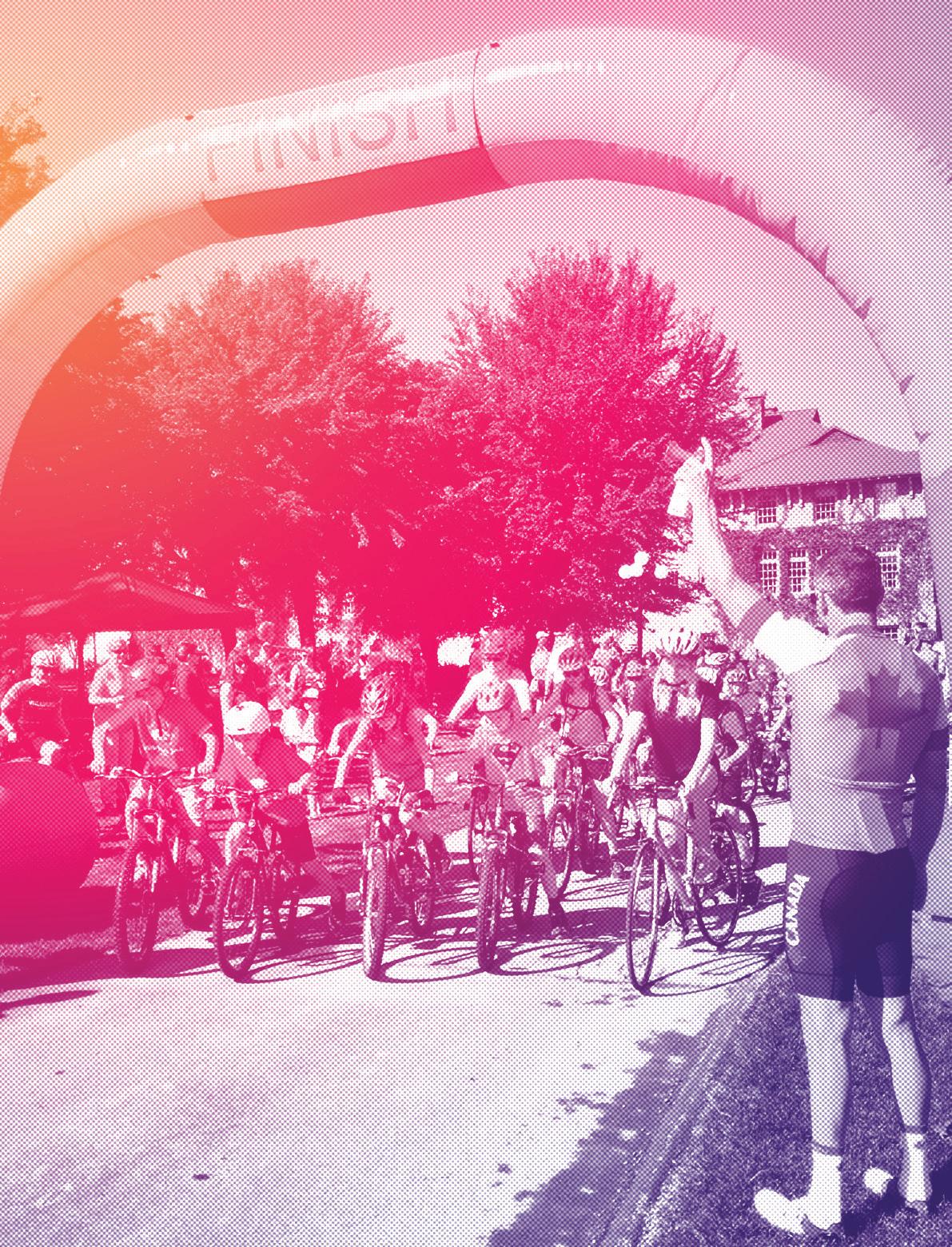
We-Bike is a locally-designed cycling program that’s offered to Grade 4 students, focused on building skills, understanding road safety, and — perhaps most of all — having fun.
Melanie McFarlane, the program’s coordinator and a member of the Sunrise Rotary Club, was instrumental in the program’s origins in 2016. The idea came after a near miss one evening: while making a left-hand turn in downtown Cranbrook, she narrowly
avoided a collision with a youth cycling on the wrong side of the road. It got Melanie thinking about the importance of teaching road safety to young people — an idea that she brought to her fellow Rotarians. From there, the idea expanded to include teaching the foundations of riding a bike, in an inclusive and welcoming environment — and We-Bike was formed.
“It’s turned into such a cool program,” Melanie says enthusiastically. “It’s huge for the kids and huge for the volunteers. We’re really proud of it.”
The program visits schools in Cranbrook, Kimberley, and Jaffray in early May, and runs for approximately six weeks. The hour-long sessions teach students the fundamentals of safe, effective, and fun cycling.
In the program’s pilot year, Melanie explains how they visited nine schools and only encountered two or three students who weren’t able to ride a bike, compared to its most recent year, when there were two or three who couldn’t ride in each class. “We wondered ‘why is this happening?’” Melanie says. “We really want to reverse that trend.”
maki
Riding a bike is pure joy. And yet, it’s so much more than childhood play: it’s a life skill that continues to serve us well into adulthood.
Whatever the reason for it, the coaches and coordinators of We-Bike are certainly doing their part to ensure that every child in the area has the opportunity to learn to ride a bike.
That learning often shows up as a profound change, sometimes taking kids from having no beginner skills at all to experiencing the effortless magic that comes from flying around on two wheels with friends. “One year we had one young girl who couldn’t figure out how to push the pedals down with her feet,” Melanie explains. “After a while, she was cruising around with a huge smile on her face. It was so rewarding.”
One of We-Bike’s foundational mandates is inclusivity: offering the opportunity to learn how to ride to every child, even if they would have never otherwise had the resources or support to do so. This is one of the core tenets that sets We-Bike apart from other sports development programs.
Melanie tells me that they consistently see students excitedly cheering on their classmates who are less naturally inclined; it’s an easy camaraderie and celebration that touches the volunteers time and time again and continues to stoke their passion.
Melanie’s enthusiasm for the program is matched by that of the program’s head coach and clinic instructor, John Mandryk, who was instrumental in getting the program up, running, and successful. An avid cyclist himself, John believes in nurturing the physical literacy and basic athletic competency that will serve kids for life.
“When kids have a physical understanding of what they’re capable of,” John says, “it’s like mental cross-training. It gives them the confidence to try other things in other areas. It gives them the ability to think, ‘I’ve got this.’”
Melanie echoes this sentiment, saying that teachers often report an uptick in their students’ determination and drive to succeed after going through the We-Bike program. “The teachers often say the kids start challenging themselves in a way they hadn’t seen before,” Melanie says.
Sadly, Covid-19 put a pause on the program, which hasn’t been able to run for the last two spring seasons. The spirited team behind We-Bike, however, is optimistic that they’ll come back stronger than ever, and hopefully sooner than later. “We’re playing with the idea of a fall program, to perhaps catch up the Grade 5s and 6s who missed their turn the last two years,” Melanie says.
The team hopes to gain further momentum in other ways, too, including the creation of a mentorship program that enables older students to coach younger ones, providing them with a relatable role model.
The We-Bike team also plans to share their program and curriculum with organizations in other communities as well, so that they’re resourced to start similar programs modelled after the successful one here.
However it evolves and builds though, We-Bike is certain to keep to its mission of enabling all children to learn how to ride regardless of circumstances or background.
Judging by their smiles, enthusiasm, and willingness to learn, We-Bike consistently provides an opportunity that students cherish. “At the end of the program’s first year, we asked students what riding a bike means to them,” Melanie says. “They said things like safety, family, health, and fresh air.” She pauses and laughs. “Then one hand shot up at the back of the class and a boy’s yell rang out.”
“Freedom!”
TAKING CARE OF BUSINESS
As
Finding Your Way Back: Sometimes We Quit to Fall in Love Again
W: Jeff Pew | P: Jeff Pew + Supplied by Shona Rubens
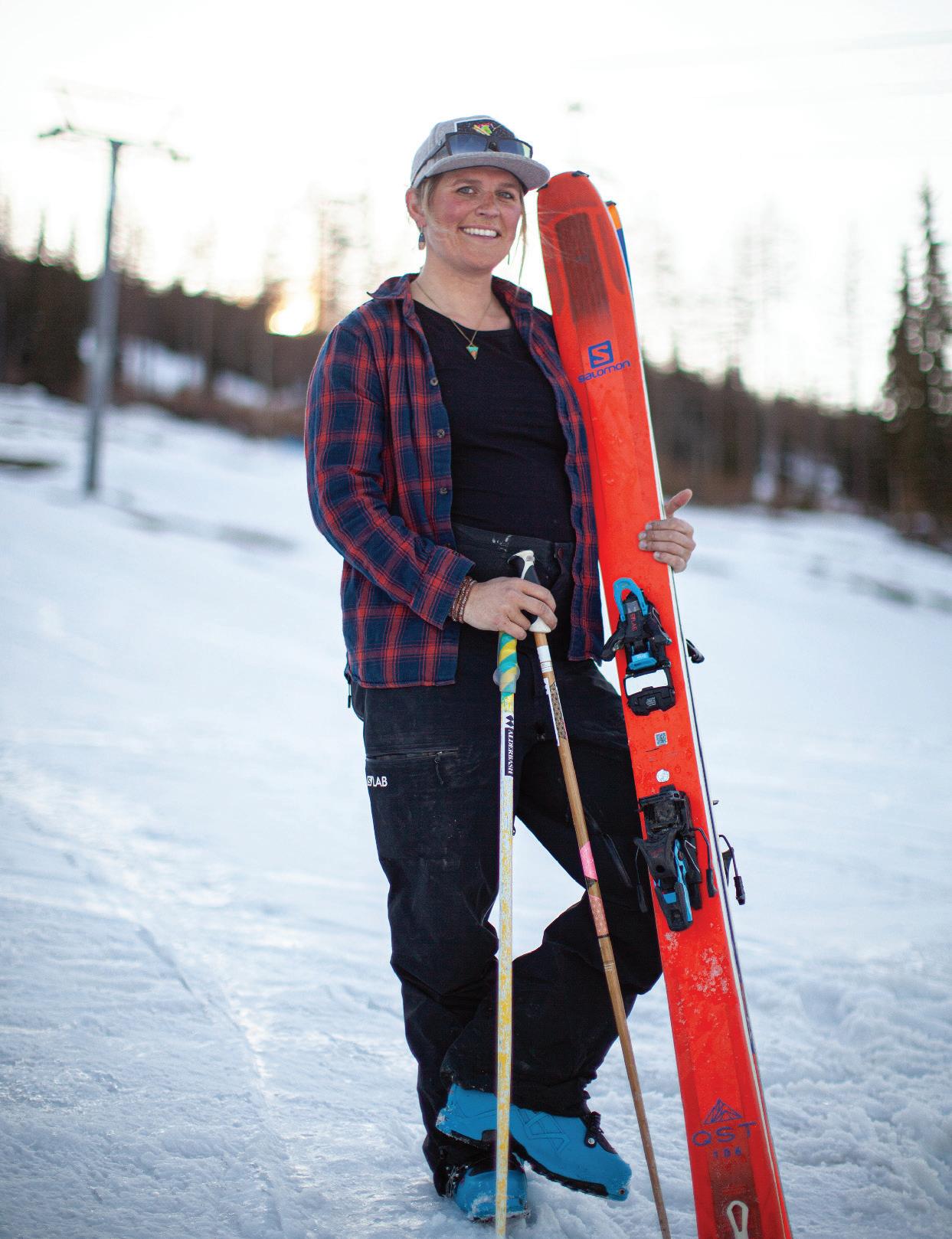
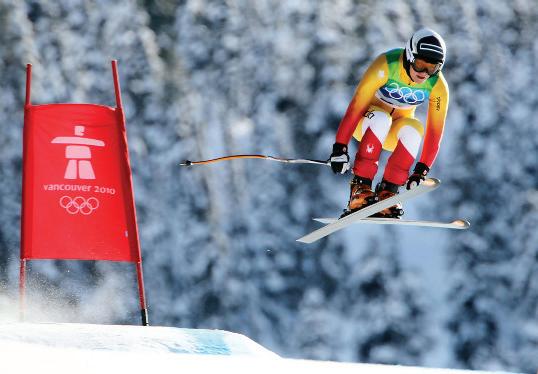
“I’m not coming back,” Kimberley’s Shona Rubens said, crying over the phone to the head coach of Alpine Canada. It was 2010, the final season of her five-year career with the Canadian Alpine Ski Team, which included six National titles, two Olympic Games (Turin, 2006; Vancouver, 2010) and 64 World Cup starts. “A lot of people might be better at faking it,” Rubens says, skinning up Kimberley Alpine Resort (KAR) while six-months pregnant, “but, I have to do things with my heart if I’m going to accomplish anything.”
Rubens, a 34-year-old environmental scientist, is describing the love-hate relationship she’s had with skiing since she was a three-year-old grom, racing her parents down the slopes of Sunshine Village Ski Resort. “Our winters were all about skiing,” she recalls. “It was where I felt most comfortable, my true self with the wind in my face and tingle of adrenaline. I had my ‘normal’ life in Calgary, the birthday parties and school dances, but the mountains always pulled me back. It was a constant push and pull of two distinct lives.”
Rubens spent every weekend on the hill as a child, dominating local club races, but at 12 she felt the sacrifice of childhood activities was too much to endure. “I was missing everything that most
kids do, like sleepovers, birthday parties and just being a regular kid,” she says. “I wanted to quit but my parents convinced me to join the club for just one day a week. If I didn’t have fun that year, they knew my ski career was finished.”
Over the next year — without the intense pressure she put on herself — Rubens fell in love with skiing again. At 13, she won her regional races and earned a chance to compete in Italy, where she placed third. “A lot of those people went on to the Olympics,” she recalls. “It was all I could think about. I became highly competitive.”
Soon, she rose through the ranks of provincial competitions and qualified for the Canadian National Team. Yet, at 16, after two training camps, she became overwhelmed balancing the pressure of ski racing and the demands of school. “I wasn’t having fun anymore,” she says. “I’d had enough and needed some time away.” Seven months later, with no competitions and certain she was going to graduate, she realized full-time school wasn’t as glamorous as she’d imagined. Once again, she re-entered competitive skiing when her provincial alpine coach asked if she’d be interested in competing in the Canadian Nationals. After taking time away and backpacking around Europe for six weeks,
“A lot of people might be better at faking it,” Rubens says, “but, I have to do things with my heart if I’m going to accomplish anything.”
“Yet, it’s as if the failures made me the strong person I am today. You pick yourself up. You realize that after all that, you’re still ok.”
Rubens realized that she had more to give to skiing and rejoined the provincial team, before advancing to the National Team and the World Cup Circuit.
At the age of 19, Rubens qualified for the 2006 Winter Olympic Games in Turin, Italy. “I was so into the experience, I can barely remember Turin,” she recalls. “Yet, in some ways I downplayed it, like it was just another weekend, but when I walked into the stadium I burst into tears. It was surreal. I was among some of the best athletes in the world.”
Four years later, while still on the senior National Team, she qualified for the 2010 Olympic Winter Games in Vancouver, finishing with her second-best career result. “At 23, I had my most successful season ever,” she recalls. “I put everything I had into ski racing and realized it was time to move on. A few months later, I knew I was done and ready to discover other aspects of life.”
After Rubens’ tearful goodbye to her coach and teammates, she hung her skis in the shed and, with her boyfriend, travelled for a year in a Volkswagen van from the Northwest Territories to the southern tip of Argentina. Upon her return to Calgary, she enrolled in an environmental science degree with the hopes of doing something good for the world.
Now, ten years later, Rubens is onto new adventures, just months away from becoming a mom. “I’m proud of my Olympic experience,” she says, “but it doesn’t define me. I feel like I’m much more than that. Skiing taught me so much about life’s outer edges, both its highs and lows. It was an incredible feeling at the start gates, believing in myself, that I was capable of being the fastest on the mountain that day. And then, there was having to deal
with utter defeat — like I couldn’t be less — moments when it felt like I’d let everyone, including my country, down. Yet, it’s as if the failures made me the strong person I am today. You pick yourself up. You realize that after all that, you’re still ok.”
“When I look back, it’s not the results and podium moments I remember,” she says while sipping a non-alcoholic beer at the top of the hill. “ It’s trying to switch places with my friends on the t-bars and seeing if we could do 360s and not fall off. Or asking the lifties for slingshots and barely hanging on because we were laughing so hard. I remember wrestling with the boys on my team while waiting for award presentations or falling down a race course, so excited to see my friends who made the podium. On the mountain, we inspire each other to be better in so many ways. It’s never just about us, individually.”
As the sun sets behind the St. Mary's valley, Rubens rips down KAR’s main run. The hill is closed for the season, and the chilly afternoon has left an icy crud scattered on the run, but Rubens doesn’t seem to mind. She’s hooting and hollering like it’s fresh pow. At the bottom, she walks to her truck and changes out of her boots, then drives towards town. A Tragically Hip song plays while she talks about falling in love with the humility of Kimberley and the expansive Kootenay backyard she and her family get to play in. Shona Rubens is smiling. She is back. She is winning, if there ever is such a thing.
Shona's Advice for Mastery
Have passion.
Feel invested and focused in more than the number of hours you put in. It’s about intent, training, analyzing and reflecting. Try to figure out every little thing you could do to be better.
Take risks.
Don’t panic.
Push through the trying times if you love something unconditionally (you can be bored and frustrated, but quitting that relationship isn’t an option).
Pay attention to when it feels like a sacrifice.
Remind yourself what you need to do to get to where you want to be.
STAY + PLAY
WE’VE GOT OUTDOOR ADVENTURE COVERED
We live in a mountain paradise. Our home is a destination. There has never been a better opportunity to explore our own back yard and discover why people travel from around the world to get here. If it’s backpacking, running, or exploring, we have all the gear you need. Thanks for keeping that travel budget local, we’re here when you need us.
Located in Kimberley’s Downtown Platzl | 15-196 Spokane Street
LOCALS 5 & 10 ROUND VALUE PACKS
Available to all East Kootenay Residents* 5 Pack $359.00 + Tax | 10 Pack $649.00 + Tax
• 2 for 1 Twilight Tuesday & Wednesday (After 3pm)
• Includes cart and range
LOCALS 5 & 10 ROUND VALUE PACKS
• Play anytime weekdays (Monday - Thursday)
• Play after 1pm weekends (Friday - Sunday)
Available to all East Kootenay Residents* 5 Pack $359.00 + Tax | 10 Pack $649.00 + Tax
LOCALS 5 & 10 ROUND VALUE PACKS
GOLF 8 PACKS
Available to all East Kootenay Residents* 5 Pack $359.00 + Tax | 10 Pack $649.00 + Tax
• 2 for 1 Twilight Tuesday & Wednesday (After 3pm)
• Includes cart and range
•
• Play anytime weekdays (Monday - Thursday)
• 2 for 1 Twilight Tuesday & Wednesday (After 3pm)
Only $749
• Includes cart and range
• Includes cart and range
• Play after 1pm weekends (Friday - Sunday)
• Play anytime weekdays (Monday - Thursday)
• Play anytime weekdays (Monday - Thursday)
• No blackouts. Valid any day, any time
• Play after 1pm weekends (Friday - Sunday)
• Play after 1pm weekends (Friday - Sunday)
• Fully Transferable
• Includes cart and range
• 2 for 1 Twilight Everyday
GOLF 8 PACKS
Only $749
GOLF 8 PACKS
GOLF 8 PACKS
Only $749
Only $749
• No blackouts. Valid any day, any time
• Fully Transferable
• Valid at Trickle Creek Golf Resort and Wintergreen Golf and Country Club Some restrictions may apply
• No blackouts. Valid any day, any time
• No blackouts. Valid any day, any time
• Includes cart and range
• Fully Transferable
• Fully Transferable
• Includes cart and range
• Includes cart and range
• 2 for 1 Twilight Everyday
• 2 for 1 Twilight Everyday
• Valid at Trickle Creek Golf Resort and Wintergreen Golf and Country Club Some restrictions may apply
• Valid at Trickle Creek Golf Resort and Wintergreen Golf and Country Club Some
JUNE 2021
“Artrageous Celebrating Pride” Open Adjudicated Art Exhibition
Ongoing Gallery Exhibition
Celebrating lesbian, gay, bisexual, transgender, non-binary, and queer (LGBTQ) communities, social acceptance, self-acceptance, achievements, legal rights, and pride.
June 8 – July 3, 2021 | Tuesday–Saturday | 1-5 pm | Centre 64 Gallery | 250-427-4919 | info@kimberleyarts.com | also available online at: https://kimberleyarts.com/in-the-gallery/
JULY 2021
Art Exhibition by Carol Gordon Ongoing Gallery Exhibition
July 6–31, 2021 | Tuesday–Saturday | 1-5 pm | Centre 64 Gallery 250-427-4919 | info@kimberleyarts.com | also available online at: https://kimberleyarts.com/in-the-gallery/
AUGUST 2021
Kimberley Kaleidoscope 2021
Open Adjudicated Art Exhibition “Celebrating Excellence in Fine Art” 17th Annual Adjudicated Regional Exhibition for Established and Emerging Artists
August 3–28, 2021 | Tuesday–Saturday | 1-5 pm | Centre 64 Gallery 250-427-4919 | info@kimberleyarts.com | also available online at: https://kimberleyarts.com/in-the-gallery/
Kimberley Kaleidoscope Arts Festival 2021 — Online Online Arts Festival
Art exhibition, music, spoken word, and workshops.
August 19-22, 2021 | kimberleyarts.com | Centre 64 Gallery: 64 Deer Park Avenue, Kimberley BC | 250-427-4919 info@kimberleyarts.com
SEPTEMBER 2021
Art Exhibition by Bob Kingsmill & Lyle Grisedale
Ongoing Gallery Exhibition
August 31 – September 25, 2021 | Tuesday–Saturday | 1-5 pm Centre 64 Gallery | 250-427-4919 | info@kimberleyarts.com also available online at: https://kimberleyarts.com/in-the-gallery/
JUNE
JUNE 8, 15, 22, 29 | Women's League Purcell Golf Course | Kimberley
JUNE 1 - JULY 3 | “Artrageous Celebrating Pride” | Open Adjudicated Art Exhibition Ongoing Gallery Exhibition | Centre 64 Gallery & Online | Tues-Sat | 1–5 pm kimberleyarts.com/in-the-gallery/
JUNE 2, 9, 16, 23, 30 | Men's League Purcell Golf Course | Kimberley
JUNE 2 | “New Roots” Online Documentary Premiere and Q&A with Director Mark Locki | Dcoumentary Featuring Two Local Farmers and How Farming Connects Them to the Past, Present and Future | Sponsored by Wildsight and Cranbrook History Centre 7 pm
JUNE 3 | RBC PGA Scramble Qualifier Team Format | Purcell Golf Course, Kimberley 7 am | purcell.golf
JUNE 4 | Watercolour Flower Cards Class for Youth with Wendy Franz | Ages 10+ Cranbrook Arts 401 | 5th St. North, Cranbrook $25 | 10 am – 12 pm | cranbrookarts.com
JUNE 4 | Painted Rock Bugs Class for Youth with Wendy Franz | Ages 6+ | Cranbrook Arts Council | 401 5th St. North, Cranbrook | $20 1–3 pm | cranbrookarts.com
JUNE 5, 12, 19 | Cranbrook Spring Farmer’s Market | 10th Ave. S by Rotary Park 10 am – 1 pm
JUNE 7, 14, 21, 28 | Little Artists –Drop-In Classes with Melissa Peters | Ages 1-4 | Cranbrook Arts Council | 401 5th St. North, Cranbrook | $5 | 10 am – 12 pm cranbrookarts.com
JUNE 13 | Kimberley Open | Men's and Ladies | Purcell Golf Course, Kimberley 7 am | purcell.golf
JUNE 17, 24 | Kimberley Farmers’ Market | Sponsored by Wildsight Howard St. | 5–7:30 pm
JUNE 23 | Ed Talk: Memories of Japanese Migrant Sex Workers in Transpacific Kootenays | Dr. Ayaka Yoshimizu, UBC Professor | Sponsored by Cranbrook History Centre | Online through Zoom at 7 pm
JUNE 26 | Cranbrook Summer Farmer’s Market | 10th Ave. S by Rotary Park 9 am – 1 pm
Summer Events Summer Events
JULY
JULY 1, 8, 15, 22, 29 | Kimberley Farmers’ Market | Sponsored by Wildsight Howard St. | 5-7:30 pm
JULY 3, 10, 17, 24, 31 | Cranbrook Summer Farmer’s Market | 10th Ave. S by Rotary Park | 9 am - 1 pm
JULY 5, 12, 19, 26 | Little Artists –Drop-In Classes with Melissa Peters Ages 1-4 | Cranbrook Arts Council | 401 5th St. North, Cranbrook | $5 | 10 am - 12 pm cranbrookarts.com
JULY 6, 13, 20, 27 | Women's League Purcell Golf Course | Kimberley
JULY 6 - JULY 31 | Art by Carol Gordon Ongoing Gallery Exhibition | Centre 64 Gallery & Online | Tues-Sat | 1-5 pm kimberleyarts.com/in-the-gallery/
JULY 7, 14, 21, 28 | Men's League | Purcell Golf Course | Kimberley
JULY 17-18 | 97th Annual Club Championship & Member's Day | Members' Stroke Play & Doubles Events | Purcell Golf Course, Kimberley | purcell.golf
JULY 21 | Ed Talk: 50th Anniversary of the Destruction of the Post Office By Local Historian Jim Cameron (hopefully in person) | Sponsored by Cranbrook History Centre | 7 pm
JULY 30 - AUG 2 | Rocky Mountain Triathlon Training Camp | Kimberley and Cranbrook Call 250.432.5667 for more info.
AUGUST
AUG 2, 9, 16, 23, 30 | Little Artists — Drop-In Classes with Melissa Peters | Ages 1-4 | Cranbrook Arts Council | 401 5th St. North, Cranbrook | $5 | 10 am - 12 pm cranbrookarts.com
AUG 3, 10, 17, 24, 31 | Women's League Purcell Golf Course | Kimberley
AUG 3-28 | “Kimberley Kaleidoscope 2021” Open Adjudicated Art Exhibition | Ongoing Gallery Exhibition | Centre 64 Gallery & Online | Tues-Sat | 1-5 pm | kimberleyarts.com/ in-the-gallery/
AUG 4, 11, 18, 25 | Men's League | Purcell Golf Course | Kimberley
AUG 5, 12, 19, 26 | Kimberley Farmers’ Market | Sponsored by Wildsight | Howard St. 5–7:30 pm
AUG 7, 14, 21, 28 | Cranbrook Summer Farmer’s Market | 10th Ave. S by Rotary Park 9 am – 1 pm
AUG 12 | Senior Scramble | Men's and Women's 55+ Event | Purcell Golf Course Kimberley
AUG 14-15 | Gerick Sports Wasa Triathlon Swim, Bike, Run – All Ages | Wasa Provincial Park
AUG 20-22 | Black Spur Ultra | Hosted by Kimberley Alpine Resort | Kimberley
AUG 25 | Ed Talk: Local Endangered Species — Presentation and Workshop | By Patricia Meldrum | Sponsored by Cranbrook History Centre | 7 pm
AUG 27-29 | Pucksters — Best Men's Tourney in the Valley | Purcell Golf Course, Kimberley | purcell.golf
AUG 31 - SEPT 25 | Art by Bob Kingsmill & Lyle Grisedale | Ongoing Gallery Exhibition Centre 64 Gallery & Online | Tues-Sat 1-5 pm | kimberleyarts.com/in-the-gallery/
SEPT 9-10 | Trans Rockies Single Track 6 Hosted by Kimberley Alpine Resort, Kimberley
SEPT 11, 18, 25 | Cranbrook Fall Farmer’s Market | 10th Ave. S by Rotary Park | 10 am - 1 pm
SEPT 25-26 | Community Fall Fair Marysville Arena | Kimberley
SEPT 26 | Men's and Women's Open & Closing Event | Purcell Golf Course, Kimberley purcell.golf
SEPT 28 - OCT 23 | Art by Helen Robertson Ongoing Gallery Exhibition | Centre 64 Gallery & Online | Tues-Sat | 1-5 pm kimberleyarts.com/in-the-gallery/
SEPT 29 | Ed Talk: Sharing Our Story: Living on a Métis Road Allowance | A once-in-a-lifetime cultural experience for all ages that will take you back to the early 1900s in Canadian history | By Métis Elder Marie Schoenthal Sponsored by Cranbrook History Centre | 7 pm
OCTOBER
OCT 2, 9, 16, 23, 30 | Cranbrook Fall Farmer’s Market | 10th Ave. S by Rotary Park 10 am – 1 pm
OCT 17 | Shayne Koyczan | Key City Theatre 7:30 pm
TIME & AGAIN.
UNLESS YOU only see potential.
UNLESS YOU can get past the gatekeeper.
UNLESS YOU have an opinion about the oxford comma.
UNLESS YOU can’t sit still.
UNLESS YOU are obsessed with the Kootenays.
UNLESS YOU can do work from a cafe, pub or boardroom.
UNLESS YOU could make a better ad than this.
If you still think a job as our Sales and Distribution Manager is for you, get in touch. grady@kootenaymedia.ca
NEW BUSINESS DIRECTORY
50,000 eyes are nothing to sniff at. That’s a lot of people! It means that every year the combined populations of Kimberley and Cranbrook will see this magazine. Wouldn’t it be great if they were looking at your business too? Our new directory format gives each ad enough space to stand out and ensures that your business has a consistent presence in each issue for the entire year. Our design team will help build it, and the price will probably surprise you. Send us an email or give us a call to find out more.
Better exposure, no hassle.
Raising the Bar
The partners have reinvested into their business generously, and it shows.
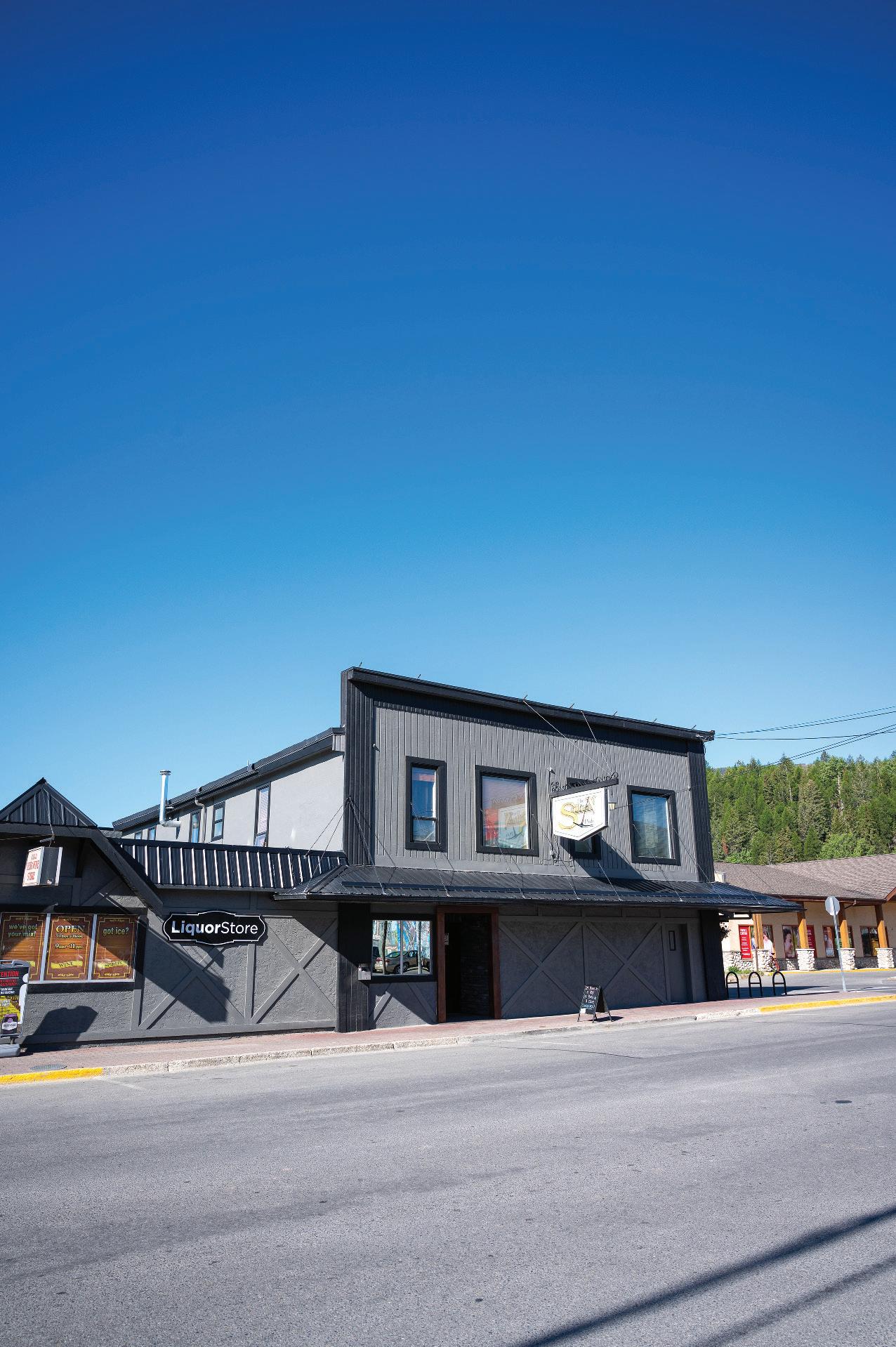
On a fall evening in 2004, two brothers sat down in a sunken booth at the Sullivan Pub in Kimberley and ordered burgers and a round of beers. One, an aircraft mechanical engineer from Vancouver, had finished a long day of fixing a broken helicopter in Skookumchuck and was visiting the other, who worked in commercial banking and lived in Kimberley.
The low-lit bar, painted entirely blue with its exterior lights burnt out, was the Sullivan Hotel: a local watering hole situated right in the center of Kimberley. It just so happened that the brother who lived locally happened to know it was coming up for sale.
“Do you think it would be fun to own a pub?” he asked.
A pause, a shrug. “Seems like a good idea.”
And that’s how Aaron and Kent Lees came to be the longtime proprietors of the Sulli-
van Pub, along with their third partner, Rob Van Barr. The trio has owned and operated the establishment since November 2004, with the latter being a silent partner and investor until his recent move to Kimberley last year, when he began a more hands-on role.
To say they’ve completely transformed the space for the better since that decision — which felt like a steep risk to the partners at the time — is an understatement. The building’s systems have been upgraded, every nook and cranny has been painted, and there have been multiple expansive renovations. The partners have reinvested into their business generously, and it shows.
Despite none of them having any previous experience in the hospitality industry, the Lees brothers and Van Barr successfully steward their establishment with care and attention. They consult their regular customers before almost every renovation, to be sure it will be well-received; after all, the Sullivan — locally known as the Sully — is the second rec room
to so many satisfied locals, many of whom have been socializing there for decades.
2008 saw the first major kitchen renovation, which came with a modest extension. In March 2020, they renovated the kitchen again, this time doubling it in size. Every other area of the pub — from the bathrooms, to the patio, to the rooms upstairs, and everything in between — has also received fantastic upgrades.
The result of this attention to detail and dedication to excellence is a clean, contemporary establishment that appeals to people from all kinds of lifestyles, aged 19 to 90, and that satisfies a broader clientele than ever before.
After that leap of faith one fateful evening over burgers and beers almost twenty years ago, and after years of hard work, the Sullivan Pub is a modern venue with a warmly welcoming atmosphere, run by owners who are passionate about its flourishing and who clearly take pride in their pub.