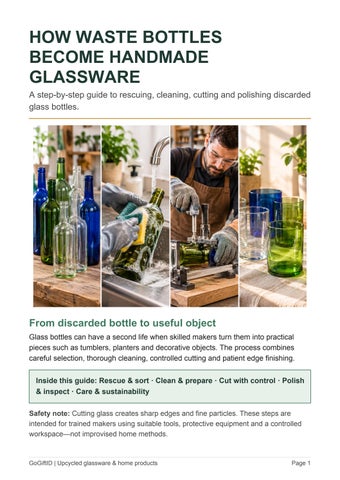
HOW WASTE BOTTLES BECOME HANDMADE GLASSWARE A step-by-step guide to rescuing, cleaning, cutting and polishing discarded glass bottles.
From discarded bottle to useful object Glass bottles can have a second life when skilled makers turn them into practical pieces such as tumblers, planters and decorative objects. The process combines careful selection, thorough cleaning, controlled cutting and patient edge finishing. Inside this guide: Rescue & sort · Clean & prepare · Cut with control · Polish & inspect · Care & sustainability Safety note: Cutting glass creates sharp edges and fine particles. These steps are intended for trained makers using suitable tools, protective equipment and a controlled workspace—not improvised home methods.
GoGiftID | Upcycled glassware & home products
Page 1
The journey in four stages Good glassware starts before the first cut. Bottle condition, cleanliness and a stable cutting setup all affect the quality of the finished rim.
01
Rescue & sort
02
Clean & prepare
03
Cut precisely
04
Polish & inspect
Choose intact bottles with suitable shape and glass condition. Reject cracked, chipped or heavily damaged bottles.
Remove leftover contents, labels and adhesive, then wash and dry the bottle thoroughly.
A trained maker scores the bottle evenly with a purpose-built cutter and separates the glass using a controlled, tool-appropriate method.
The cut edge is ground through progressively finer abrasives, then inspected for chips, sharp spots and defects before use.
Why upcycling matters Upcycling keeps a usable object in circulation for longer and gives its material a new purpose. Transport, water, energy, tools, packaging and product lifespan all matter, so durable items and long-term use are important. GoGiftID features products made by giving selected bottles a new purpose, including handmade bottle glassware and other upcycled home pieces.
GoGiftID | Upcycled glassware & home products
Page 2
Step 1 — Rescue and sort Only work with bottles that are sound and appropriate for the intended product.
What makers look for • No cracks, star fractures or chips around the base, body or neck. • A shape and diameter that suit the planned glass or object. • Glass that is not unusually thin, damaged or unsuitable for the process. • Bottles from a safe, clean source without unknown residue.
Sort before processing Group bottles by colour, shape and intended use. Keep damaged bottles separate for appropriate glass recycling; do not turn cracked glass into drinkware. Remove caps and non-glass components separately where local rules allow.
Quality checkpoint Reject cracked, chipped or structurally questionable bottles. A polished appearance cannot make defective glass safe.
Step 2 — Clean and prepare A clean surface helps the maker inspect the bottle and work accurately.
Preparation sequence 1. Empty and rinse the bottle. 2. Wash it with a suitable cleaning solution and bottle brush. 3. Remove labels and adhesive using a method compatible with the glass and workshop rules. 4. Rinse thoroughly and dry the bottle. 5. Inspect under good lighting for scratches, chips and hidden cracks. Do not mix cleaning chemicals. Follow product labels, ventilate the workspace and keep bottles containing unknown substances out of the process.
GoGiftID | Upcycled glassware & home products
Page 3
Step 3 — Cut with control Cutting is the most technically sensitive stage. A purpose-built bottle-cutting jig helps keep the score line consistent; makers must follow the tool manufacturer’s instructions and workshop safety procedures.
At a high level • Measure and mark the intended height. • Secure the bottle in a stable jig so it cannot roll or slip. • Make one even score line with the appropriate tool; repeated scoring can cause unpredictable fractures. • Separate the glass only with a controlled method suitable for the tool and glass type. • Treat separated pieces as sharp until the rim is fully finished.
Safety essentials Use suitable eye protection, task-appropriate cut-resistant handling protection, closed footwear and a controlled work area. Keep others away from the cutting zone. Never use improvised thermal-shock tricks, open flames or uncontrolled force. If untrained, leave cutting to an experienced glassworker.
Step 4 — Polish and inspect A freshly cut rim is not ready for drinking. It must be carefully finished and checked for defects.
Finishing sequence 1. Use appropriate glass-grinding equipment to remove sharp high points and even the rim. 2. Progress through suitable abrasive grades. 3. Control dust and slurry using wet-working or extraction procedures; never breathe glass dust. 4. Clean the piece thoroughly and check the entire rim. 5. Inspect for chips, cracks, unevenness and sharp areas under bright light. Reject any piece that fails inspection. “Polished” is not the same as “certified safe.” Drinkware should be made and quality-checked by a competent maker, with required product-safety testing completed for its intended market.
GoGiftID | Upcycled glassware & home products
Page 4
After the workshop: care and longevity Care for upcycled glassware according to the maker’s instructions. GoGiftID recommends hand-washing its bottle glasses. Avoid sudden temperature changes, inspect items regularly and stop using any glass that becomes chipped or cracked.
A few thoughtful habits • Wash gently by hand and dry with a soft cloth. • Avoid thermal shock, such as pouring boiling liquid into a cold glass. • Store glassware so rims do not knock against one another. • Reuse each piece for as long as it remains in good condition.
Explore GoGiftID Browse upcycled glassware and products or contact GoGiftID with questions. • GoGiftID homepage: https://gogiftid.com/ • Glassware and sets: https://gogiftid.com/collections/glassware-and-sets • Bottle lamps: https://gogiftid.com/collections/bottle-lamps • Upcycled planters: https://gogiftid.com/collections/upcycled-planters • Our Story: https://gogiftid.com/pages/our-story • Contact page: https://gogiftid.com/pages/contact
Contact GoGiftID Email: info@gogiftid.com Website: https://gogiftid.com/ Address listed on the website: 3, Egerton Road, Woodthorpe, NG5 4FF Editorial note: This guide describes a general professional workflow. Exact methods vary by glass type, tools and intended use. Follow equipment instructions and local health, safety and waste-handling requirements. Check GoGiftID’s website for the latest product and contact information.
Give glass a second life through thoughtful design, careful craftsmanship and long-lasting use.
GoGiftID | Upcycled glassware & home products
Page 5