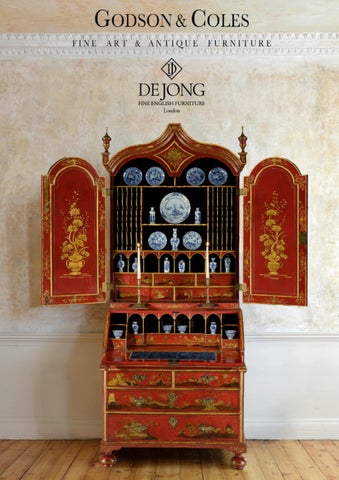
A GEORGE I PERIOD SCARLET AND GILT JAPANNED BUREAU CABINET Attributed to John Belchier London, circa 1720 Height: 102 in (260cm) Width 40 ½ in (102.5cm) Depth: 24 ½ in (62cm) This spectacular Bureau Cabinet has survived in a remarkable state of preservation.The serpentine shaped cornice creates a wonderful movement that is translated across the turned finials and centred by an intricately decorated cartouche with a foliate shell. The two mirrored doors flanking the middle section open to reveal an interior of a glorious colour decorated with figures, trees and trelliswork. This intricate japanning continues seamlessly into the decorative narrative of the lower section, unfolding through exotic scenes of island villages, birds and floral sprays, before finally terminating on the bracket and turned feet. This example is made truly exceptional by its quality and distinctive form. The refined japanning has survived in outstanding condition, its depth and detail accentuated by the striking scarlet paintwork. The folio slides are beautifully shaped and gilt, inviting the imagination to wonder at the lengthy letters once kept there. Within, the stepped interior with finely moulded drawers, pigeonholes and a velvet writing slide, provide the ideal setting for reading and writing under candlelight, offering the very same view once shared centuries ago. This cabinet’s design and idiosyncratic decorative details suggest an attribution to famed London cabinet-maker John Belchier (1717-1753).
Belchier’s authorship is based on comparisons to similar examples, such as the two cabinets supplied to Erddig Castle in Wales, that were described in 1732 as being ‘in ye grandest manner and after ye newest fashion’. Belchier was a prominent English cabinetmaker associated with the celebrated St. Paul’s Churchyard, a hub of fine furniture production in early Georgian London. Belchier is known to have gained popularity through his confident adoption of contemporary styles, which in turn secured him commissions from aristocracy and distinguished institutions, like Oxford and Cambridge. One of Belchier's most distinctive contributions to 18th century decorative arts was his japanned bureau cabinets, which were distinguished by their rich surface decoration, elegant proportions and restrained yet luxurious detailing. Surviving examples of Belchier’s japanned bureau cabinets are rare and highly prized, embodying the opulence and global influences that defined English furniture during the early 18th century. The japanning not only reflects the period’s fascination with the exotic East but further demonstrates Belchier’s commitment to high quality, fashionable goods tailored to elite tastes.
3
A GEORGE II PERIOD MAHOGANY GAINSBOROUGH ARMCHAIR English, circa 1755 Attributed to Paul Saunders Height: 38 1/2 in (98cm) Width: 30 in (76 cm) Depth: 26 1/2 in (67.6 cm) Provenance: Moss Harris, London, England Literature: Moss Harris, A catalogue and Index of Old Furniture and works of Decorative Art, Volume 2, p 204. (Fullpage image) L. Synge, Mallett’s Great English Furniture, London, 1991, p. 123, fig. 138 (illustrated behind the Chippendale Combe Abbey desk)
This exquisite piece of furniture is an outstanding example of English cabinetmaking. The refined craftsmanship allowing for the full expression of its design, which is beautifully carved from the highest quality mahogany. Given the remarkable condition and bold stature of this chair, we expect it to be part of an important commission, making it a rare survival in today’s market. Only one other chair of this model has been discovered and was part of the highly acclaimed collection of Gerald Hochschild, sold by Sotheby’s London, 1 December 1978, lot 38. And subsequently with Mallett and Sons Antiques. The present example is attributed to Paul Saunders, who supplied some of the most fashionable upholstered furniture in mid eighteenth century England. He operated from Carlisle House, Soho Square and 59 Greek Street, where he oversaw a successful workshop. Saunders undertook many important commissions in the 1750s namely for Thomas Coke, 1st Earl of Leicester, at Holkham Hall and the Earl and Countess of Egremont at Petworth House.
5
A GEORGE II PERIOD CARVED WALNUT SIDE TABLE With Breccia Marble Top English, circa 1735 Height: 32 in (81.5cm) Width: 49 ½ in (126cm) Depth: 29 in (74cm) Provenance: Frank Partridge, 26th Kings Street, St James The rectangular Breccia Rosata top, with a moulded edge, rests over a carved frieze of leaves. The panel beneath is veneered in beautifully figured walnut and herringbone banding and centred with a cartouche of Fleur de lys scrolls and acanthus. The four legs are similarly adorned with scrolled ears and acanthus foliage to the knees, terminating in finely carved ogee feet. This table flaunts an outstanding colour and is made especially interesting by the magnificent bellflower carving that cascades over the knees.
7
A PAIR OF GEORGE III PERIOD PAINTED ARMCHAIRS English, circa 1780 Height: 38 in (97cm) Width: 24 ½ in (62 cm) Depth: 24 ½ in (62cm) The squared, dished backs with arched top rails, carved throughout with fluting and acanthus leaves, headed by an anthemion. The well shaped open arms similarly carved with acanthus and husks, joining the fluted rails. The tapering front legs headed with paterae and carved with bell flowers. Painted throughout in an off white and now upholstered in blue silk damask. The design for these elegant armchairs is inspired by French styles of the period that were adapted for English patrons, by designers such as Robert Adam and cabinetmakers Ince and Mayhew.
9
A GEORGE II FIDDLEBACK WALNUT KNEEHOLE DESK English, Circa 1740 Height: 32 in (81cm) Width: 35 1/4 in (90cm) Depth: 20 1/2 in (52cm) This exceptional walnut kneehole desk is distinguished by its untouched condition and the striking quality of its surface, which has acquired a glorious patina over the centuries. The top is particularly striking, displaying a dramatic flame figure that showcases the rich character of the timber. The large upper drawer incorporates a walnut crossbanded, leather lined writing slide, which conceals a finely fitted interior with numerous compartments and several ingenious secret drawers. Both the top and drawer fronts are delicately banded with fine chequer banding composed of holly and ebony, providing an elegant contrast to the richly figured walnut. Of particular note, the desk retains its original handles, locks and elegant ogee bracket feet.
11
A PAIR OF GEORGE II CARVED WALNUT SIDE CHAIRS English, circa 1745 Height: 38 ½ in (98cm) Width: 22 ¾ in (58cm) Depth: 20 ¾ in (53 cm) The chairs with shaped top rails and carved with scrolls and acanthus over a vase shaped, carved and pierced splat, further adorned with acanthus motifs and terminating in a carved gadrooned shoe. Their carved cabriole legs enriched with cabochons, leaf carving and scrollwork, terminating in elegantly carved paw feet. The chairs retain a beautiful colour and patina throughout, the seats now upholstered in a soft green antique linen fabric.
13
14
A GEORGE II PERIOD WALNUT BACHELOR’S CHEST English, circa 1720 Height: 30 ½ in (77cm) Width: 29 ½ in (75cm) Depth: 12 ¾ in (32.5cm) The fold over top veneered in well figured burr walnut with herringbone inlay and cross banding. The interior similarly veneered with book matched veneers. The four long drawers are likewise veneered with burr walnut, herringbone inlay and cross banded, all retaining their original lacquered brass handles and raised upon bracket feet. The veneers throughout this chest have developed a complex and rich surface, which combined with its small size and original state make it a highly desirable piece. It is also extremely unusual for such an early example to retain both its original brassware and feet, constituting it a rare survival.
15
A GEORGE I PERIOD GILT GESSO MIRROR English, circa 1720 Height: 48 ½ in (123cm) Width: 29 ½ in (75cm) The cresting, finely carved with two facing heads with scrolled acanthus and two shells, either side of a central lambrequin. The ground finely chased with trailing foliage. The frame carved with strap work and flowers with scrolled brackets to the sides. The apron similarly carved with acanthus and a central fleur de lys and two brass candle sconces. An extraordinary early survival, this mirror retains its original finely cut gesso decoration. The mirror plate, an eighteenth century replacement.
17
A GEORGE III PERIOD CARVED MAHOGANY BUREAU ON STAND English, circa 1760 Height: 36 ½ in (93.5cm) Width: 36 in (92.5cm) Depth: 24 in (61cm) Provenance: Mallett and Sons Ltd Certain characteristics of this rare bureau closely associate it with the work of Thomas Chippendale. In terms of design, it certainly showcases highly distinctive and extremely well executed English Rococo carving of the circa 1760 period. These carved elements relate closely to those featured among the contemporaneous drawings, that appear in the three editions of Chippendale's seminal work, "The Gentleman and Cabinet-Maker's Director", published between 1754 and 1762. In particular, a drawing for a desk and bookcase No CXI in 1760, which shows a bureau with similarly carved stand. In regards to construction, the bureau employs chamfered drawer stops and short grain drawer kickers, both of which allow for the smooth opening of its drawers, and at the same time these have clearly minimised wear of the internal components. This construction also ensures that the drawers do not drop down much, if at all, during the drawer opening process. Such attributes are often found on carcass furniture produced in the Chippendale workshop, particularly in the early 1760s.
20
22
A GEORGE II CARVED MAHOGANY DESK CHAIR English, circa 1745 Height: 30 ¾ in (78cm) Width: 28 in (71cm) Depth: 26 in (66 cm) Provenance: Hyde House, Bedfordshire Francis Mallet Esq Literature: The Dictionary of English Furniture, Volume one, P272, Fig.145 This remarkable chair pushes the boundaries of cabinet making, with complex curves and a highly unusual format of central front and back legs; its elaborate design, a play of balanced form and refined carving. Over time, its mahogany surface has acquiring a wonderful depth of colour and patina.
23
A PAIR OF GEORGE III PERIOD GILTWOOD ARMCHAIRS Attributed to Ince and Mayhew English, circa 1780 Height: 37 ½ in (95cm) Width: 25 ½ in (66cm) Depth: 24 in (61cm) The present armchairs relate closely to designs by the architect James Wyatt and to the work of celebrated cabinet making partnership, Ince and Mayhew. Their overall profile and distinctive carving bear a particularly close resemblance to a suite of eight armchairs, probably originally comprising twelve, supplied by Ince and Mayhew to James Alexander, 1st Earl of Caledon, for the Oval Drawing Room at Caledon House, Ireland (illustrated in Hugh Roberts, ‘Unequalled Elegance: Mayhew and Ince’s Furniture for James Alexander, 1st Earl of Caledon’, Furniture History, vol. XLV, 2009, p. 105, fig. 2). The Caledon chairs share the elegantly shaped backs centred by stylised shells, serpentine aprons adorned with an identical draped patera, and closely related legs. The carving to the seat rails and legs is also identical to that of a pair of window seats inscribed ‘5715 Hornby’ which were sold at Christie’s, New York, 8 April 2004, lot 275. it is interesting to note that the silhouette of the chairs further recalls designs by James Wyatt dating to circa 1780 (illustrated in John Cornforth and John Fowler, English Decoration in the 18th Century, London, 1974, p. 29, fig. 13). This close affinity reinforces the association of the present examples with the refined neoclassical designs of the late George III period.
25
A GEORGE III PERIOD MAHOGANY CABINET English, circa 1770 Height: 30 in (76.5cm) Width: 34 in (86.5 cm) Depth: 13 in (33cm) This rare cabinet displays an exceptionally fine mahogany top, featuring twin tambour doors above a recessed shelf. Its innovative design establishing it as a most unusual piece of eighteenth century furniture, remarkably ahead of its time.
27
A GEORGE II PERIOD LACQUER BUREAU CABINET Chinese, circa 1740 Height: 102 in (260cm) Width 40 ½ in (102.5cm) Depth: 24 ½ in (62cm) This magnificent bureau cabinet is a particularly notable example as it survives in extraordinary condition, retaining its original decoration and lustrous colour. Moreover, as the art of lacquering itself originated in China, the displayed lacquer work is of a superior quality and detailing. The upper section is crowned by a serpentine shaped cornice, retaining its three original finials and centred by a vase of flowers, opening to reveal a complex arrangement of drawers and shelves, finely lacquered with foliage. Its exterior panels are beautifully decorated with serene landscapes of mountains, pagodas and bridges, scenes that capture the poetic vision of the East widely admired in Georgian England. The lower section with fall, is similarly decorated and opens to a fitted interior centred by a small door surrounded by further drawers and pigeonholes. The elegance of the cabinet's design is expressed throughout its form, extending even to the refined detailing of the bracket feet.
From the late 17th century and throughout the 18th century, Europe developed a deep fascination with Chinese art and design. Exotic goods, including lacquerware, flooded Western markets, captivating collectors and inspiring organisations such as the East India Company to commission skilled Chinese craftsmen to produce pieces that combined traditional motifs with forms and functions suited to European tastes. Among the most coveted were lacquer bureau cabinets like this example, which would have been at the height of fashion in the eighteenth century. Lacquered furniture of this kind became emblematic of wealth and sophistication, gracing the collections of aristocrats and affluent merchants alike, while reflecting a broader European desire to engage with and reinterpret the art and aesthetics of the East. Today, surviving examples, especially those retaining their original fittings and lacquer decoration, are sought after not only for their exquisite craftsmanship but also for their historical significance.
30
32
A GEORGE II CARVED MAHOGANY ARMCHAIR English, circa 1755 Height: 37 ¾ in (96cm) Width: 25 ½ in (65 cm) Depth: 23 ½ in (59.5 cm) The open back, carved with acanthus, ‘C' scrolls and interlaced strapwork, with carved shaped arms and an upholstered seat. The moulded legs carved with egg and dart, fluting and foliate corner brackets. This classic example of a Chippendale armchair, closely follows design No XI in his ‘Gentleman and Cabinet Makers Director’ of 1753. The vigorously carved back, with its fashionable Rococo details, combined with the chair’s generous scale and well balanced proportions, makes it an important example.
A note was discovered when reupholstering this chair in 1943 stating that it was bequeathed by Robert E Fry to his son John Clemence Fry of 17 Upper Wimpole Street London W1.
33
A GEORGE III CHIPPENDALE PERIOD MAHOGANY SILVER TABLE English, circa 1760 Height: 27 ¾ in (70.5cm) Width: 31½ in (80 cm) Depth: 23 ½ in (58.5cm) The top of the most extraordinary flame mahogany, with serpentine sides and a wonderful pierced border gallery; a plain frieze with a fine patina and standing on moulded legs, with pierced brackets and castors.
35