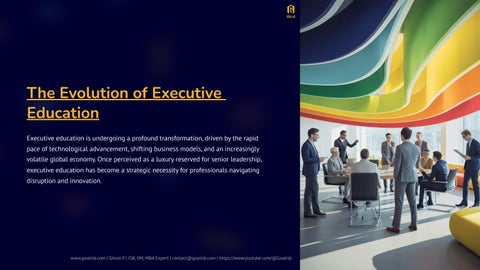
Executive education is undergoing a profound transformation, driven by the rapid pace of technological advancement, shifting business models, and an increasingly volatile global economy. Once perceived as a luxury reserved for senior leadership, executive education has become a strategic necessity for professionals navigating disruption and innovation.
$46.3B
Current global executive education program market value $112B
2024 Market Size
2032 Projection
Expected market value representing massive expansion 11.7%
Annual Growth Rate
Compound annual growth rate (CAGR) through 2032
This remarkable expansion signals not just rising demand but also a fundamental shift in how business schools around the world deliver and evolve their offerings.The market is responding to an urgent need for continuous leadership development in an era of constant disruption.
Key Drivers & Trends
Seven transformative forces are reshaping executive education, making it more accessible, relevant, and impactful than ever before.These trends reflect the evolving needs of modern leaders and organizations.
Technology & Flexibility Revolution
Technological Integration
Leading institutions are embedding AI,VR, and blockchain into their curricula.AI enables personalized learning paths, tailoring content to individual pace and goals.Virtual Reality simulates high-stakes decision-making and crisis leadership, while blockchain provides verifiable, secure credentials for lifelong learning.
Hybrid Learning Models
The pandemic catalyzed a structural shift towards hybrid education, combining the efficiency of online platforms with the impact of inperson collaboration. Executives can now access top-tier content with flexibility, making continuous learning more accessible.
Customization & Personalization
Executive education is no longer "one-size-fits-all." Programs are increasingly bespoke, designed around company goals or leadership challenges. Institutions offer cohort-based learning with real-time updates, ensuring immediate workplace applicability. www.goalisb.com | Shruti P | ISB, IIM, MBA Expert | contact@goalisb.com | https://www.youtube.com/@Goalisb
Leadership & Learning Ecosystems
Leadership Agility & Soft Skills
In an environment where change is constant, business schools now emphasize adaptability, resilience, critical thinking, and emotional intelligence.The focus has shifted from just strategic knowledge to navigating uncertainty and leading innovation.
Lifelong Learning Ecosystems
With the half-life of business skills shrinking, top programs are building lifelong learning pathways. From alumni refreshers to corporate L&D partnerships, the executive learning journey has become continuous.
Experiential Learning Methods
Modern executive education emphasizes real-world case studies, integrated coaching, and simulations, bridging the gap between knowing and doing.This practical approach ensures that leaders can implement insights from the classroom directly into boardroom decisions.
Industry-Aligned Curriculum
Schools are closely collaborating with corporates to build content around AI, digital transformation, ESG, and sustainability.This alignment ensures graduates are immediately deployable in dynamic market conditions.
Navigating Challenges
High Costs
Top-tier programs are often expensive, making them inaccessible to small businesses or individual professionals. However, digital models are lowering opportunity costs and democratizing access to world-class education.
Curriculum Obsolescence
As industries evolve rapidly, maintaining up-to-date, relevant course content is an ongoing challenge requiring agile instructional design and continuous faculty training to stay ahead of market demands.
Despite its momentum, executive education faces hurdles that institutions must address to maintain relevance and accessibility.The most successful programs are those that innovate around these constraints while maintaining quality.
Market Leaders
Prestigious institutions such as Harvard Business School, INSEAD, Stanford GSB,Wharton, and London Business School have significantly enhanced the credibility and global value of university-based executive education.Their continued participation, combined with innovation in delivery models, has helped reposition executive learning as a strategic career imperative.
Global Powerhouses
Elite institutions leverage global reach, industry partnerships, and brand equity to maintain leadership in executive education.
Indian Excellence
Programs like ISB PGPMAX, IIMA Executive Education, and IIMB Executive Education are attracting growing numbers of mid-career professionals seeking globally benchmarked learning.
In response to ongoing global challenges4including technological disruption, economic volatility, and evolving business models4executive education has shifted from a static credential to a continuous, lifelong development pathway. www.goalisb.com | Shruti P | ISB, IIM, MBA Expert | contact@goalisb.com | https://www.youtube.com/@Goalisb
Future Outlook
Executive education is no longer a static credential but a strategic enabler of leadership agility. With personalization, hybrid formats, and industry-integrated design becoming the norm, business schools are repositioning executive education as an ongoing investment in competitive advantage4for individuals and organizations alike.
Transformation Driver
Becoming not just a response to change but a driver of transformation
Competitive Edge
Strategic investment for both individuals and organizations
Continuous Evolution
Adapting as the global economy continues to evolve www.goalisb.com | Shruti P | ISB, IIM, MBA Expert | contact@goalisb.com | https://www.youtube.com/@Goalisb
Why Executive Education Deserves Its Own Spotlight
In a world where business disruption is no longer an exception but the norm, executive education has quietly become the power tool of smart leadership. No longer confined to a weeklong refresher or a vanity credential, today's executive programs4whether full-scale EMBAs or shortduration custom modules4are strategic platforms for transformation.
Audience
EMBAs and executive programs cater to professionals typically with 10320 years of experience.The peer learning is as valuable as the syllabus itself.
Outcomes-Oriented
These programs are judged less on academic rigor and more on what happens next: promotions, role transitions, global mobility, boardroom readiness.
Continuity vs Completion
While full-time MBAs have a clear endpoint, executive education fosters lifelong learning4with alumni returning periodically for advanced modules, certifications, and cutting-edge updates. This segment of business education has earned its spotlight because of one core reason: it evolves as the economy evolves.And as the rankings reveal, the institutions that consistently lead in this space are the ones that understand this fluidity deeply4and design for it.
Methodology Matters: What the FT Measures
The Financial Times Executive MBA Rankings are uniquely positioned to evaluate the kind of impact most relevant to senior professionals4not just academic prestige or classroom strength, but real-world ROI, career transformation, and cohort quality.
Here's a breakdown of the key FT methodology pillars and why they matter for executives making significant investments in their careers.
FT Ranking Criteria Explained
Salary Increase (%)
Measures the average percentage increase in alumni salaries from before the program to three years after graduation, adjusted for variations across regions and sectors. Salary is a proxy for market value and signals immediate ROI and long-term career acceleration. 02
Aims Achieved (%)
Reflects the extent to which alumni feel they achieved the goals they had when entering the program.This metric captures the program's adaptability to diverse goals4whether career switching, internal growth, or entrepreneurship.
04
Career Progress
A composite index based on change in level of seniority, size of the organization before and after, and degree of international mobility.This reflects transformation beyond the paycheck4movement across functions, borders, and into strategic roles.
Work Experience Score
Calculated based on pre-EMBA years of work and management experience, this metric emphasizes the maturity and diversity of the cohort.A seasoned cohort adds depth, credibility, and relevance to every classroom conversation.
Additional criteria include international course experience, faculty diversity and research, and ESG and DEI components in curriculum (growing weight in recent years).Together, these criteria make the FT Executive MBA Ranking niche, fit-for-purpose, and outcome-centric.
What the Leaders Are Doing Right
1 CEIBS
(China)
Strengths: Unparalleled salary increase (90%) and global industry connections.
Takeaway: CEIBS proves that executive education is booming in Asia4with world-class faculty and deep regional context.
2 ESCP Business School
Strengths: Pan-European flexibility, strong ROI, and cohort diversity.
Takeaway: The cross-campus model (Paris, Berlin, Madrid, London) works. Executives value immersion in multiple economies.
3 WashU Olin / Fudan
Strengths: Highest career progress score (64).
Takeaway: Joint programs like Olin-Fudan are redefining East-West leadership development. Great for regional mobility and MNC roles.
4 IESE Business School
Strengths: Consistently scores well in aims achieved and career momentum.
Takeaway: IESE leans heavily on values-based leadership, which resonates with senior executives facing ethical and strategic dilemmas.
5 INSEAD
Strengths: Global footprint, high salary impact, and cutting-edge electives.
Takeaway: INSEAD blends intellectual rigor with cultural fluency, making it ideal for top-tier consultants, MNC leaders, and entrepreneurs.
These schools are not just teaching4they are transforming careers, opening international gateways, and embedding leadership into action. Each brings a strategic differentiator to the table.
Executive Education Rankings: Open & Custom Programs
Unlike EMBAs, which follow a degree format, Executive Education is delivered as short, non-degree programs4often in partnership with corporations (custom) or as open enrollment (open programs).These cater to C-suite leaders, high-potential managers, and entrepreneurs who need a sharp burst of skills and strategic insight.
Open Programs
Participants enroll individually. Common themes include leadership, digital strategy, ESG, negotiation, and innovation. Custom Programs
Tailored for a company's workforce. Designed and delivered in collaboration with the institution.
FT 2025: Open Executive Education Rankings
3IMD
4Iese3NUS
5INSEADHighHigh40%90%
QS vs FT Rankings: Understanding the Difference
While the Financial Times (FT) Executive MBA rankings focus heavily on post-program outcomes like salary increases and career progression, the QS Executive MBA Rankings provide a broader evaluation of a school's brand strength, academic thought leadership, and global employer recognition.
Evaluation CriteriaFT RankingsQS Rankings
Salary IncreaseYes (heavily weighted)No
Career ProgressYesNo
Employer ReputationNoYes (30% of score)
Academic ResearchLimitedYes (25%)
DiversityYesYes (15%)
Alumni NetworkNot directlyYes
Reputation
as Currency
QS rankings heavily favor schools with longstanding brand equity in the corporate world
Emphasizes global alumni networks and cross-border delivery
Research Impact
Academic citations tie a school's ranking to its influence on business knowledge
Global Diversity
Tracks nationality spread, gender balance, and global delivery formats Network Strength
The FT ranking tells you how well a program delivers ROI4in salary terms, promotions, and personal development.The QS ranking tells you how well a program's brand and ecosystem position you in the global talent market.
Executive education is no longer a static, classroom-based credential4it's evolving into a dynamic, tech-enabled ecosystem designed to address the pace, uncertainty, and complexity of the modern business world.The next decade will see a redefinition of not just how executives learn, but why, when, and with whom.
Personalized, Modular Learning Paths
Business schools are moving toward modular and stackable learning formats. Institutions like MIT Sloan, INSEAD, and IMD offer Executive Certificates that can ladder into full degrees over time, with AI-powered adaptive learning platforms delivering customized content sequences.
Immersive Technology Integration
Technology is transforming executive learning from passive consumption to experiential mastery.AI enables personalization and mentorship simulations,VR creates real-time crisis scenarios, and blockchain secures digital credentials for global mobility.
Hybrid Delivery: The New Normal
The pandemic normalized online learning4but executives now expect hybrid learning that blends flexibility with engagement. Programs offer synchronous and asynchronous formats with global cohorts and local delivery hubs.
Emphasis on Human Skills
Soft skills are now hard requirements.The volatility of markets has forced executive programs to emphasize leadership in ambiguity, emotional intelligence, and change management4core to thriving in unpredictable environments.
Lifelong Learning Mandate
The "half-life" of business skills is shrinking rapidly4estimated at 2.5 to 5 years for many roles. Executive education is responding by offering subscription-based learning for alumni and corporate partners, embedding continuous capability building across decades.
Curricular Alignment with Emerging Industries
Top programs are rapidly integrating themes like AI and Machine Learning for Executives, Sustainability and ESG in Strategy, Geopolitics and Global Risk, and Digital Transformation in Legacy Enterprises.
Strategic Repositioning by Top Providers
As the demand for agile, career-integrated learning accelerates, top institutions are reimagining their executive offerings4not only to stay competitive but to address seismic shifts in workplace expectations, technology, and leadership readiness.
INSEAD: From Prestige to Practical Impact
Global Executive MBA (GEMBA) with multi-campus delivery in France, Singapore, and Abu Dhabi. Launch of AI for Executives and Sustainability
Leadership short courses. Strong use of simulations and leadership labs across geographies.
Stanford GSB: Immersive, TechnologyLed Leadership
Stanford LEAD became one of the earliest and most successful fully online executive learning programs. Programs now include innovation sprints,AI/ML decision-making frameworks, and cross-sectoral networking with strong emphasis on design thinking.
ISB: From Indian Pioneer to Global Contender PGPMAX for senior executives with 10325 years' experience. PGPpro weekend executive MBA across Delhi, Mumbai, Hyderabad, and Bangalore. Growing collaboration with international universities like Kellogg and Wharton, with heavy focus on modular delivery and digital transformation.
SDA Bocconi
Asia Center: European Excellence for Emerging Markets International Executive Master in Business (IEMB) with modular program in Mumbai and two-week immersion in Milan. Bridges European academic strengths with India's fastevolving economic ecosystem. Smartly positioning as high-impact, globally valid, yet regionally affordable executive education.
Wharton: Enterprise Leadership at Scale
A global EMBA strategy targeting cross-border executives and high-growth market leaders. Delivered in Philadelphia, San Francisco, and expanding to Dubai. Open programs in digital strategy, finance for non-finance leaders, and influence and persuasion.
London Business School: Global Resonance EMBA programs delivered in London and Dubai, with optional modules in New York and Hong Kong. Strong focus on experiential learning, especially in boardroom simulations and global case immersions. Seamless integration with alumni upskilling tracks.
Conclusion: Executive Education as Strategic Investment
Executive education is no longer a static credential or mid-career detour4it is a strategic enabler of leadership agility, global competitiveness, and continuous reinvention.
Rankings & Recognition
FT and QS rankings spotlight career progress, salary growth, and program relevance
1
2
Multi-Format Ecosystem
Blending digital innovation, industry alignment, and global peer learning
Pioneering Formats
Harvard, INSEAD, Stanford, and Wharton lead with innovative delivery models
3
4
Professional Resilience
Helping leaders not just keep pace, but lead with foresight and impact
From pioneering formats by Harvard, INSEAD, Stanford, and Wharton, to the field evolving into a multi-format, multi-market ecosystem, today's programs blend the best of digital innovation, industry alignment, and global peer learning4a clear response to the volatile, tech-driven, and deeply interconnected world of modern business.
As leading institutions localize and digitize their offerings while retaining global academic rigor, executive education has become a cornerstone of professional resilience4helping leaders not just keep pace, but lead with foresight and impact.