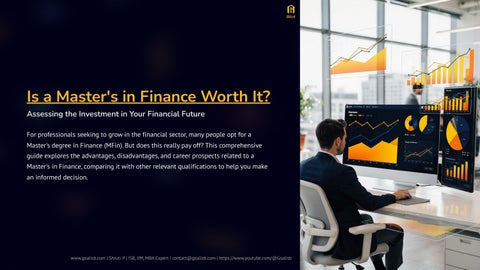
For professionals seeking to grow in the financial sector, many people opt for a Master's degree in Finance (MFin). But does this really pay off? This comprehensive guide explores the advantages, disadvantages, and career prospects related to a Master's in Finance, comparing it with other relevant qualifications to help you make an informed decision.
Explore Top Master of Finance Programs
Leading Global Programs
Compare curriculum, costs, and global opportunities across premier institutions:
MIT Sloan Master of Finance (MFin)
Berkeley Haas MFE Program
Cambridge Master of Finance (MFin)
Each program offers unique strengths in quantitative finance, corporate finance, and investment management.
Wharton Launches the Dr. Bruce I. Jacobs MSQF
A Next-Gen Master's in Quantitative Finance
Wharton has unveiled a revolutionary addition to its finance portfolio4the Dr. Bruce I. Jacobs Master of Science in Quantitative Finance (MSQF), a fifth-year STEM-certified master's designed exclusively for Penn undergraduates.
Cutting-Edge Curriculum
Combines Wharton's academic strength in finance with advanced training in data science, machine learning, and asset management
Unique Structure
Students apply in junior year, complete a finance internship postgraduation, then return for intensive one-year master's
Industry Focus
Concentrated training in advanced modeling and quantitative research for realworld applications www.goalisb.com | Shruti P | ISB, IIM, MBA Expert | contact@goalisb.com | https://www.youtube.com/@Goalisb
Wharton Jacobs MSQF
Admissions Snapshot for 2026 Intake
1 Program Overview
Institution: The Wharton School, University of Pennsylvania
Duration: One additional year after undergraduate completion
2 Ideal Candidate Penn undergraduates (third-year students or second-year transfers) with strong quantitative, coding, and analytical foundations
Target Careers: Quantitative asset management, hedge funds, risk management, trading, data analytics, portfolio research
3 Academic Structure
Credits: 10 Credit Units (6 Core + 4 Electives)
Capstone: Applied Research Practicum
STEM Certification: Yes (OPT extension eligible) www.goalisb.com | Shruti P | ISB, IIM, MBA Expert | contact@goalisb.com | https://www.youtube.com/@Goalisb
Prerequisites & Application Requirements
Academic Prerequisites
Math: MATH 2400 (Calculus III) or ESE 2030 (Linear Algebra)
Finance: FNCE 1000 Corporate Finance
Accounting: ACCT 1010 Accounting and Financial Reporting
Recommended: STAT 1010/1020 (Business Statistics) and OIDD
4770 (Python)
Application Components
Essay (300 words max) proposing Applied Research Practicum idea
One-page resume
One letter of recommendation
Video interview
Transcripts from all institutions
GRE/GMAT optional for 2025-26 cycle
Key Dates for 2026 Cycle
1 September 15, 2025 Application Opens
2 January 6, 2026
Application Deadline
3 February 11, 2026 Decision Release
4 February 27, 2026
Tuition & Fees: $72,850
Living Expenses: ~$28,100
GOALisB Perspective on Wharton's Innovation
Wharton's Jacobs MSQF sets a new precedent4merging finance, data science, and machine learning within an accelerated fifth-year pathway. For undergraduates, it's an opportunity to specialize early; for other universities, it's a model that redefines how quantitative finance education will be structured in the coming decade.
Unlike traditional Master's in Finance programs, the Jacobs MSQF represents Wharton's strategic response to the data-driven transformation of global finance. Its Applied Research Practicum4developed with advisory partners from firms such as Goldman Sachs, Citadel, and Vanguard4gives students hands-on experience solving live, industry-sourced problems.
New Graduate Profile
Equally fluent in markets, models, and machine learning4immediately attractive to quant shops and asset managers
Industry Signal
Technical depth plus applied experience will increasingly be the currency of choice in hiring for quant roles
Global Impact
Universities are building integrated, practice-first pathways that deliver turnkey career readiness
Strong employer ties at top programs, less integrated pipeline
Estimated Cost~$72,850 tuition + $28,100 livingVaries widely; often similar or higher
Best FitUndergrads seeking accelerated, marketintegrated quant credential
Applicants seeking deeper technical specialization or external brand
Benefits of a Master's Degree in Finance
Deep Expertise
Master's in Finance provides intensive knowledge in specialized areas like financial modeling, risk control analysis, derivatives, and portfolio management4far beyond basic money management.
Career Growth Prospects
Graduates are highly sought after by companies for positions such as investment bankers, corporate finance officers, financial advisers, and wealth managers.
Networking Opportunities
Students make lasting connections with alumni and professionals, gaining access into job markets that might not otherwise be open without this level of education.
Earnings Potential
Those holding MFins typically earn bigger salaries compared to individuals with only bachelor's degrees, making this course worth every penny spent on tuition fees.
Ready to leverage these advantages? GOALisB experts can help you craft a strong application, from SOPs to interview prep, so you land in the program that accelerates your finance career. Schedule a call today!
Important Considerations
Possible Cons to Keep in Mind
Financial Investment
Programs offering Master's in Finance can be quite costly. It pays to calculate potential returns before enrolling. Tuition ranges from $40,000 to $70,000+ at top schools, plus living expenses.
Time Commitment
These programs usually take between one year full-time and two years part-time, meaning you must sacrifice significant working hours. This could potentially derail your current professional path or put other ventures on hold.
Competitive Job Market
While vacancies exist within the finance industry, demand tends to outweigh supply, especially for top executive positions. Additional qualifications beyond just a master's degree may be necessary.
Worried about costs, time commitment, or competition? GOALisB provides tailored advice to ensure your investment in a Master's in Finance pays off4start your consultation today!
Application Deadlines 2025-2026
Key Dates for Top Master's in Finance Programs
ESCP Business School - Master in Finance
Round 1: January 7, 2026
Round 2: March 25, 2026
Round 3: June 3, 2026
Oxford Saïd Business School - MSc in Financial Economics
Round 1: October 24, 2025
Round 2: January 7, 2026
Round 3: March 4, 2026
HEC Paris - Master in Finance
Round 1: October 1, 2025 at 12pm
Round 2: December 12, 2025 at 12pm
Round 3: February 19, 2026 at 12pm
Round 4: April 9, 2026 at 12pm
ESSEC Business School - Master in Finance
Round 1: October 15, 2025
Round 2: January 7, 2026
Round 3: February 24, 2026
Round 4: April 14, 2026
London Business School - Masters in Finance
Round 1: September 29, 2025
Round 2: November 4, 2025
Round 3: January 5, 2026
Round 4: March 2, 2026
Round 5: April 20, 2026
Imperial College Business School - MSc Finance
Round 1: September 28, 2025
Round 2: January 7, 2026
Round 3: March 11, 2026
Round 4: April 29, 2026
Not sure which program aligns with your goals? Connect with GOALisB Admissions Consultants for personalized guidance to maximize your chances of acceptance.
Focus Specialized in financeBroader business curriculum with finance specialization Investment management and analysis Career Paths
Typical
Career Paths for Finance Graduates
Investment Banking
Analyst/Associate
Work on financial transactions such as mergers and acquisitions, IPOs, and corporate restructuring
Risk Manager
Identify and mitigate potential risks that could negatively impact organization's bottom line
Financial Analyst
Analyze business performance through assessment of investment plans and financial data provided by companies
Financial Consultant
Offer advice on personal or corporate financial matters tailored to meet particular client objectives
Portfolio Manager
Manage investments for individuals (retail investors) or organizations (institutional investors)
Corporate Finance Manager
Oversee all aspects of company's financial activities from budgeting and forecasting to capital allocation decisions
Want a clear roadmap to land high-paying finance roles? Talk to GOALisB experts for career-focused guidance in investment banking, corporate finance, and more. www.goalisb.com | Shruti P | ISB, IIM, MBA Expert | contact@goalisb.com | https://www.youtube.com/@Goalisb
Is a Master's in Finance Right for You?
Career Objectives
How much do you want to advance within the finance industry? What specific areas interest you most?
Financial Implications
Can you afford tuition fees? Will scholarships be available? Should you apply now or wait?
Learning Style
Do you prefer traditional classroom settings or self-paced online learning with occasional face-to-face sessions?
Time Allocation
Are you ready to undertake full-time studies lasting one to two years, or prefer part-time basis?
Competitiveness
Are you willing to put in extra effort to excel above average candidates in a competitive job market?
Take the next step with confidence. Get a free profile evaluation from GOALisB Admissions Consultants and discover which programs match your ambitions and financial plan. www.goalisb.com | Shruti P | ISB, IIM, MBA Expert | contact@goalisb.com | https://www.youtube.com/@Goalisb
Top Programs Comparison
ESCP Business School 15 months Investment Banking, Financial Markets
& London campuses, 100% employment rate, FT Rank #1 HEC Paris10 months Corporate Finance, Capital Markets
Featured Program: ESCP Business School
Master in Finance
Duration: 15 months | Language: English
Tuition: ¬29,100 | Scholarships: Up to 50% reduction for CROUS holders
Key Highlights
Dual Campus Experience: Paris and London provide comprehensive international exposure
Employment Rate: 100% within three months of graduation
Average Salary: $165,557
Diversity: Students from engineering, law, social sciences backgrounds
FT Ranking: #1 worldwide in 2024
Specializations
Investment Banking, Financial Markets
HEC Paris - Master in International Finance (MIF)
Program Structure
Duration: 10 months
Tuition: ¬43,800
Language: English
Career Impact
99% salary increase post-graduation with average salary of $183,928
Application Requirements
Bachelor's degree (minimum 180 ECTS credits)
Proficiency in English
GMAT/GRE scores
Professional experience preferred
Unique Features
Dual-location combining HEC Paris and Tsinghua University for dual degree option
Track Options
Business Track for finance graduates; Accelerated Track for quantitative backgrounds
More Top Programs
2
Oxford Saïd - MSc Financial Economics
Duration: 9 months | Tuition: £55,630 | FT Rank: #3
Combines rigorous academic training with real-world applications.
Developed in consultation with leading financial recruiters.
Graduates highly sought after in finance and consulting.
3
MIT Sloan - Master of Finance
Duration: 12-18 months | Tuition: $82,000 | FT Rank: #5
Strong emphasis on quantitative methods and financial engineering. Opportunities for international study and projects. Dedicated career development office.
SKEMA Business School - MSc Financial Markets & Investments
Duration: 1-2 years | Tuition: ¬18,000-¬42,000 | FT Rank: #4
Campuses in Paris, Sophia-Antipolis, Belo Horizonte, Suzhou, Raleigh. Emphasis on hands-on learning with Bloomberg terminals and simulation games.
4
Tsinghua University - Master in Finance
Duration: 2 years | Tuition: RMB 128,000 (~¬16,000) | FT Rank: #6
Strong emphasis on China-specific finance and global financial markets. Close ties with leading Chinese financial institutions and global firms.
Additional Leading Programs
London Business School - Masters in Finance
Duration: 10-16 months | Tuition: £62,500 | FT Rank: #8
1
2
Flexibility with full-time or part-time study options. Strong connections with financial institutions in the City of London. Comprehensive career services with high placement rates.
3
University of St. Gallen - Master in Banking and Finance
Known for rigorous academic curriculum and research. High employability with top financial institutions in Switzerland and globally. Strong emphasis on theoretical and practical aspects.
4
Esade Business School - MSc in Finance
Duration: 12 months | Tuition: ¬31,500 | FT Rank: #10
Study tours and internships worldwide. Strong emphasis on practical skills and hands-on learning. Excellent career services with high placement rates.
Imperial College Business School - MSc Finance
Duration: 12 months | Tuition: £45,400 | FT Rank: #11
Strong emphasis on quantitative skills and financial modeling. Close ties with leading financial institutions. High placement rates in top financial firms.
5 Warwick Business School - MSc Finance
Duration: 12 months | Tuition: £35,500-£41,750 | FT Rank: #12
Strong links with industry, CFA affiliated. Various scholarships available. Excellent career support and placement services.
For those serious about making careers in finance, a Master's in Finance can be an invaluable asset. It's important to understand the different paths available and choose one that aligns with your goals, preferences, and financial resources.
Frequently Asked Questions
Is MS Finance better than MBA?
An MS in Finance is better if you want specialized, technical expertise in finance, while an MBA is better for broad management skills, leadership roles, and higher long-term career flexibility. MS Finance is ideal for early-career professionals (12-18 months, $40K-70K), while MBA suits those with 3-7 years experience seeking leadership ($80K-150K+).
Is a Master's in Finance useful?
Yes, highly useful for building careers in investment banking, corporate finance, asset management, and financial consulting. Provides in-depth training in financial modeling, valuation, and risk management. Top programs offer strong ROI with starting salaries of $70K-100K and rapid growth potential.
Which is better, MSA or MBA?
An MSA (Master of Science in Accounting) is better for careers in accounting, auditing, or CPA certification, while an MBA is better for broad business leadership and management roles. Choose MSA if your goal is CPA track ($60K-80K entry), MBA for management and consulting ($100K-150K+).
Who earns more, CFA or MBA?
On average, MBA graduates earn more with salaries of $100K-150K+ compared to $70K-120K for CFA charterholders. However, CFA offers strong returns in investment management roles at lower cost. MBA provides faster career progression into management and consulting.
Is a Finance Master's better than a CFA?
A Finance Master's is better for academic learning, structured career entry, and global recognition, while the CFA charter is better for specialized investment careers, cost-effectiveness ($3K-5K total), and industry credibility. Many professionals combine both for maximum impact.
How much does a CPA make?
A Certified Public Accountant earns $70K-$100K on average in the U.S., with salaries rising to $120K-$150K+ at senior manager or partner levels. Entry-level: $55K-$70K, Mid-career: $75K-$95K, Partner/CFO: $150K-$250K+.
Who earns more, MBA or Master's in Finance?
MBA graduates earn more on average ($100K-150K+) compared to Master's in Finance graduates ($70K-110K), especially in leadership and consulting roles. MBA grads enter mid/senior positions while MFin grads start in analyst/associate roles but may catch up in specialized finance careers.
How hard is a Master's in Finance?
A Master's in Finance is moderately hard, involving quantitative coursework in math, statistics, and financial modeling. Manageable for students with backgrounds in business, economics, engineering, or math. Programs are 12-18 months with dense assignments and case studies.
Is an MSA worth it?
Yes, MSA is worth it if you want to pursue a CPA license, specialize in accounting/auditing, and advance in finance roles. Meets 150-credit requirement for CPA licensure. Strong ROI for accounting careers but less valuable for general management compared to MBA.