SINCE 1954
VOLUME 72 NUMBER 4
GEORGETOWNER.COM
JANUARY 14 - FEBRUARY 10, 2026
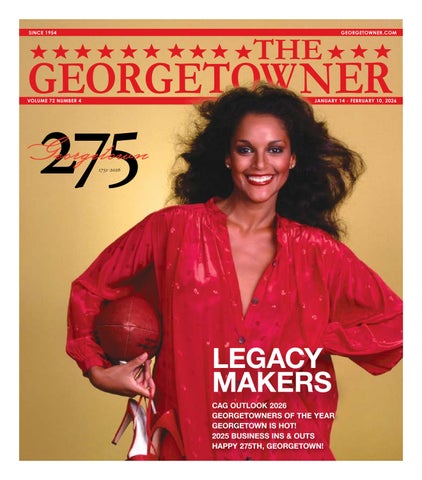
LEGACY MAKERS
CAG OUTLOOK 2026 GEORGETOWNERS OF THE YEAR GEORGETOWN IS HOT! 2025 BUSINESS INS & OUTS HAPPY 275TH, GEORGETOWN! THE GEORGETOWNER | JANUARY 14, 2026
1
NOW WHAT?
A Guided Support Program for Early Memory Changes YOU’RE NOT ALONE
After a diagnosis of Alzheimer’s disease or related dementia, many individuals and families feel overwhelmed and unsure where to turn next. Now What? helps you take your next steps —together.
WHAT YOU’LL GAIN
• Understanding of cognitive changes • Tools for planning without fear
• Strategies to support brain and heart health
• Guidance on relationships and communication
• Stress-relief techniques you can use immediately • A supportive community that “gets it”
PROGRAM AT A GLANCE
• 6-week, in-person program. • For individuals with MCI or early-stage dementia and their care partners.
• Small group: 6 participants + care partners
• Facilitator: Dementia Care Specialist, Marti Bailey
WHO SHOULD ATTEND
• Individuals diagnosed with MCI or early-stage dementia • A care partner willing to attend all sessions • Participants able to commit to all 6 weeks
WHEN & WHERE
Tuesdays | 11:00 AM – 12:30 PM Jan. 20 Jan. 27 Feb. 3 Feb. 10 Feb. 17 Feb. 24
Avoiding Common Pitfalls Understanding the Diagnosis & Planning Ahead Changing the Things You Can (Brain-Healthy Living) Building Your Team & Community Learning, Growth & Novelty Living Your Best Life — Moving Forward
Location: Inspīr Embassy Row Refreshments and materials provided. Advance registration and screening required. To learn more or inquire about participation, scan the QR Code, call 202.293.2100 or email embassyrowinfo@inspirsl.com.
Marti Brown Bailey is the Founder of Support for Aging, providing aging support and care partner coaching in the DC area, with a focus on Alzheimer’s and other dementias. Formerly Director of the Sibley Senior Association and Community Health at Sibley Memorial Hospital (Johns Hopkins), she founded Club Memory®, a nonpharmacological support program for people living with cognitive change and their care partners. Marti is a Certified Senior Advisor and dementia care trainer, an experienced speaker and facilitator, and the creator of programs including the Final Affairs Project and the Laugh Café.
InspirSeniorLiving.com | 2100 Massachusetts Ave NW Washington, DC 20008 | 202.293.2100
2 JANUARY 14, 2026 | THE GEORGETOWNER
An American Story C e l e b r at i n g 2 5 0 Y e a r s o f L e g a c y
Now accepting consignments Doyle.DC@Doyle.com 301-348-5282 We Tell the Stories of Objects and People Nei kord s s `enerlj mills s s `oston s s Charleston s sChicafo s s Connecticqt
Nei Yersej
North Carolina s s Palh `each s s Pennsjlnania s s Washinfton D.C.
THE GEORGETOWNER | JANUARY 14, 2026
3
IN THIS ISSUE
ON THE COVER
Town Topics
FASHION & BEAUTY DIRECTOR Allyson Burkhardt Lauretta McCoy
EDITORIAL & OPINION 10 Double Anniversary
GRAPHIC DESIGN Katie McKenney Heather Harris Roemer
Cold as ICE Pound (and Euro and Canadian Dollar) Foolish
PHOTOGRAPHERS Philip Bermingham Bill Starrels
THE VILLAGE 11 Zoning: Preserving Georgetown’s Human-Scale Urbanism
2025 Ins and Outs
Journalist and TV personality Jayne Kennedy, who is one of the subjects of the coffee table book “Black Is Beautiful: JET Beauties of the Week,” subtitled “The Photography of LaMonte McLemore,” who was the subject of a recent Govinda Gallery Live.
REAL ESTATE 13 Lilley Line Real Estate Sales
COVER 14-15 Black Luminaries of Georgetown Black is Beautiful: Govinda Gallery Live Spotlights Lamonte McLemore’s Portrait Photography
FOOD & WINE 16-17 Cocktail of the Month The Latest Dish
KITTY KELLEY BOOK CLUB 22 ‘The First Eight: A Personal History of the Pioneering Black Congressmen Who Shaped a Nation’
4 JANUARY 14, 2026 | THE GEORGETOWNER
MANAGING EDITOR & DIRECTOR OF CONTENT & ADVERTISING Kate Oczypok SENIOR CORRESPONDENT EMERITUS Peggy Sands
NEWS 6-9
BUSINESS 12
PUBLISHER & EDITORIN-CHIEF Sonya Bernhardt
Editorial Transitions at The Georgetowner To our loyal readers, advertisers, stakeholders, friends and family: The Georgetowner is pleased to announce several editorial transitions beginning in 2026 — changes that honor our 71-year history while positioning the paper for the future. After decades of extraordinary service, Editor-in-Chief Robert Devaney will assume the role of Editor-at-Large. Robert has devoted thousands of hours to The Georgetowner, shaping its voice, upholding rigorous editorial standards, mentoring writers and stewarding its reputation within the community. His impeccable editing, elegant writing and signature wit have left an indelible mark on the paper, and we are deeply grateful for his enduring dedication. We look forward to his continued storytelling and perspective in the year ahead. Peggy Sands will become Senior Correspondent Emeritus, focusing on stories aligned with her expertise and interests. Her experience, institutional knowledge and long-standing contributions remain an important part of the paper. We are also pleased to recognize Richard Selden, who continues in his role as cultural editor and as a regular contributor, bringing insight, depth and a discerning eye to our arts coverage — an essential pillar of The Georgetowner’s editorial mission. Publisher Sonya Bernhardt will also assume the role of Editor-in-Chief and Kate Oczypok, currently director of content and advertising, will transition to Managing Editor, ensuring continuity and strong editorial leadership. We extend our sincere thanks to our editors, contributors, columnists, photographers and creative partners — past and present — whose talent and dedication have shaped The Georgetowner for more than seven decades. We are grateful to everyone who continues to make this publication a trusted voice in the community.
EDITOR-AT-LARGE Robert Devaney ARTS EDITOR & COPY EDITOR Richard Selden CONTRIBUTORS Susan Bodiker Allyson Burkhardt Didi Cutler Donna Evers Michelle Galler Amos Gelb Wally Greeves Paulina Inglima Kitty Kelley Rebekah Kelley Jody Kurash Shelia Moses Kate Oczypok Ari Post Linda Roth Alison Schafer Celia Sharpe Mary Ann Treger Hailey Wharram
1050 30th Street, NW Washington, DC 20007 Phone: (202) 338-4833 Fax: (202) 338-4834 www.georgetowner.com “The Newspaper Whose Influence Far Exceeds Its Size” — Pierre Cardin The Georgetowner is published in print monthly with an online newsletter supplement posted twice per week — On Mondays we highlight news and on Thursdays goings on about town. The opinions of our writers and columnists do not necessarily reflect the editorial and corporate opinions of The Georgetowner newspaper. The Georgetowner accepts no responsibility for unsolicited manuscripts or photographs and assumes no liability for products or services advertised herein. The Georgetowner reserves the right to edit, rewrite or refuse material and is not responsible for errors or omissions. Copyright 2025.
Please send submissions of opinions for consideration to: editorial@georgetowner.com For advertising inquiries email Advertising@georgetowner.com or call (202) 338-4833
The Georgetowner is a Certified Business Enterprise
Please recycle.
Your number-one source for everything Georgetown. Subscribe to our e-newsletter at georgetowner.com.
WHAT’S ONLINE GEORGETOWNER.COM SUBSCRIBE to our twice weekly online Georgetowner Newsletter — simply click or scan the code and enter your email address. JAZZ ICON MONTY ALEXANDER USHERS IN THE NEW YEAR AT BLUES ALLEY B Y LA M A R R FU N N As the final hours of 2025 slipped quietly into memory, there was no place more alive—or more joyful—than Blues Alley.
TRANSFORMER CELEBRATES GLOBAL CREATIVITY AT THE LINE DC B Y T H E GEOR GETOWN ER The LINE DC buzzed with creative energy as arts leaders, cultural diplomats and supporters gathered to celebrate the pioneering work of Transformer
SHAKESPEARE STILL SLAYS AT THE 83RD GOLDEN GLOBES B Y K AT E OC ZYPOK Chef Geoff’s on New Mexico Ave. marked 25 years of “great food, libation, merriment and unforgettable memories” on June 2.
Rooted in Georgetown. Shaped by Perspective. I’ve entered a new chapter of my real estate career with Malcolm W. Dilley Residential at TTR Sotheby’s International Realty, shaped by having always called Georgetown home. Growing up here has informed how I see the neighborhood and how I approach my work, guided by quiet sophistication, sound judgment, and trust. I advise clients throughout Georgetown and Northwest Washington, as well as Virginia’s Hunt Country, with a calm, informed approach, bringing discretion, thoughtfulness, and a long-term view to each decision. Whether working with a historic townhouse or a long-held property, I believe the most meaningful real estate decisions are rooted in context, continuity, and care for place. I’m grateful to continue this work within communities I’ve long respected and been proud to be part of. Malcolm W. Dilley | TTR Sotheby’s International Realty | 571.209.7734 | mdilley@ttrsir.com Georgetown Brokerage | 1206 30th St NW, Washington, DC 20007 | 202.333.1212 © TTR Sotheby’s International Realty. All Rights Reserved. The Sotheby’s International Realty trademark is licensed and used with permission. Each Sotheby’s International Realty office is independently owned and operated, except those operated by Sotheby’s International Realty, Inc. TTR Sotheby’s International Realty fully supports the principles of the Fair Housing Act and the Equal Opportunity Act.
THE GEORGETOWNER | JANUARY 14, 2026
5
TOWN TOPICS
NewsBytes BY R OBE RT DEVA NEY
HUMAN REMAINS FOUND AT VOLTA PARK
During the Department of Parks and Recreation’s renovation of the Volta Park baseball field, human bones were found, halting work there. The park was formerly the Old Presbyterian Burying Ground, with 3,000 persons interred between 1802 and 1867. When the cemetery was closed, by 1900, around half the bodies were disinterred — many to Oak Hill. Last week, DPR said in a statement: “DPR is working closely with the City Archaeologist and our contracted archaeologist to move forward with an approved plan to respectfully reinter disarticulated human remains discovered at Volta Park. The site has been further secured. DPR anticipates completing drainage work by the end of winter, with field restoration underway for a spring reopening once the grass is established.”
130-YEAR-OLD SCHEELE’S TO CLOSE BY JULY 31
For 130 years, Scheele’s Market has occupied the corner of 29th and Dumbarton Streets, serving the neighborhood for generations as the go-to grocery store. Indeed, a few years ago, through an agreement with the property owner, neighbors contributed to a special fund to ensure that the building would remain a market. But this is no longer the case. “I love my customers and our neighborhood,” the optimistic Hong said as he acknowledged his Georgetowner of the Year award in 2024.
Louis Everard and Jennifer Nygard, husband-and-wife owners of the classic-witha-twist Everard’s Clothing at 1802 Wisconsin Ave. NW, had some stunning news for their friends last week:
WINDOW OPEN FOR GEORGETOWN MAIN STREET GRANTS
The application process for 2026 Competitive Edge Grants from Georgetown Main Street is open through Wednesday, Jan. 28. No fewer than eight projects will be funded from a $40,000 pool allocated by the Department of Small and Local Business Development. To be eligible, applicants must be a small, locally owned business operating in the Georgetown Main Street corridor. Applications will be evaluated based on: demonstrated need; project proposal and feasibility; and measuring and reporting impact. Complete information is available at georgetownmainstreet.com/grants. A virtual information session is scheduled for Tuesday, Jan. 20.
HALCYON LEAVES HALCYON HOUSE FOR 15TH STREET
Husband and wife Louis Everard and Jennifer Nygard, owners of Everard’s Clothing at 1802 Wisconsin Ave. NW. Photo by Troy Reimer.
COMPASS FILES FOR CHAPTER 11 BANKRUPTCY
Scheele’s Market at 1331 29th St. NW will likely close by July 31, business owner Daniel Hong told The Georgetowner last week. The issue involves a tenant-landlord dispute.
Evermay, the nonprofit of the S&R Evermay Foundation at 1623 28th St. NW, announced that it is “relaunching as an Embassy for the Future — harnessing the wisdom of the past, with the tools of the future, for the benefit of humanity. Over the next year we plan to introduce several new programs and initiatives, and are excited to invite you to join us on our new journey.”
EVERARD’S CLOTHING WILL SOON SHUT ITS DOORS
“After 27 wonderful years, we are preparing to close the doors of our store. This decision comes with mixed emotions, but above all, with deep gratitude. … As we begin this final chapter, we invite you to visit us once more. As a thankyou for your years of loyalty and support, the entire store is 30 percent off.”
Daniel Hong of Scheele’s Market. Photo by Robert Devaney.
S&R EVERMAY ENVISIONS ‘EMBASSY FOR THE FUTURE’
On Jan. 6, D.C.-based Compass Coffee filed for Chapter 11 bankruptcy. With assets of between $1 million and $10 million and liabilities of between $10 million and $50 million, the company is involved in lawsuits with suppliers, landlords and Harrison Suarez, who co-founded the chain in 2014 with Michael Haft. Having closed its roastery in the Hecht Warehouse development, Compass intends to continue running about 15 of its coffee shops, including the one at 1351 Wisconsin Ave. NW. A loan from the Haft family is reportedly being arranged to save the company.
Compass Coffee at 1351 Wisconsin Ave. NW, the former Georgetown Theatre building. Georgetowner photo. As part of the new effort, Evermay said: “We’re launching IMAGINE 2036, a short, mobile-friendly sentiment survey, to better understand how people feel about the future.” Meanwhile, Evermay’s Listening Room music programs continue and a yoga series has been added.
Nonprofit accelerator Halcyon, which has supported nearly 600 entrepreneurs since 2014, has departed Halcyon House, its historic Georgetown headquarters, and relocated to 1100 15th St. NW. The future of 30,000-square-foot Halcyon House, at 3400 Prospect St. NW, is unclear. Halcyon CEO Daniel Barker said: “The new space will not only house Halcyon’s staff and programs, but also serve as a vibrant hub to connect and convene Halcyon’s broader ecosystem of social impact entrepreneurs, partners and changemakers.”
!
Serving the auction and appraisal needs | Celebrating 136 Years of Georgetowners Since 1890
Sam Gilliam (Am 1933-2022) Red Clay, a yli e eled a a ld $378,000, i l
Accepting consignments for our late Winter auctions.
info@weschlers.com 2 2-628-1281 www.weschlers.com |
|
515 Dover Road, Suite 100, Rockville, Md 20850
6 JANUARY 14, 2026 | THE GEORGETOWNER
TOWN TOPICS
2026 Outlook from the Citizens Association of Georgetown BY AMY T IT US As Georgetown enters 2026, we have much to look forward to — and much to protect. This year marks Georgetown’s 275th anniversary, coinciding with America’s 250th, a reminder of the unique role our neighborhood has played in shaping the nation’s story. The year ahead is expected to be a strong one for Georgetown. Continued investment in residential, hotel and retail development reinforces the neighborhood’s appeal as both a destination and a place to live. Visitor activity remains high, and many residents report feeling safer overall, contributing to a sense of renewed vitality. At the same time, Georgetown faces significant challenges. Historic preservation, a defining feature of our neighborhood, is under increasing pressure from development demands and shifting regulatory priorities at both the local and national levels. Transportation planning, public safety and the cumulative impacts of tourism and growth remain top concerns for residents. The Citizens Association of Georgetown, in response, will focus on advocacy and community engagement to protect quality of life. Priorities include: working with elected officials and city agencies; educating residents on the preservation process and regularly commenting on significant
submissions to the Old Georgetown Board; responding to transportation proposals; and supporting public safety efforts in partnership with the Metropolitan Police Department. CAG will continue to expand its Block Captain network to strengthen block-byblock communication and neighborhood cohesion. Community engagement will continue to be a theme. Regular neighborhood events are planned to bring residents together, along with a special celebration marking both Georgetown’s 275th anniversary and the nation’s 250th. In addition, a new digital engagement platform called Hivebrite is being launched to improve communication and participation among residents. One of the District’s oldest civic groups, the Citizens Association of Georgetown was founded upon civic engagement. Our legacy remains active because of the residents who continue to support and advocate on issues that impact our historic neighborhood. We invite more Georgetown neighbors to help preserve our past and shape our future. Learn more about CAG at cagtown.org. Amy Titus is president of the Citizens Association of Georgetown.
Interested in selling your instrument or bow? We’re here to help. Ritz-Carlton Residences Georgetown
Complimentary DC evaluations Feb 2 FOR APPOINTMENT CONTACT: (212) 307 7224 • info@tarisio.com
3150 South St NW, Apt 1A | 3 BD | 3.55 BA | $4,000,000 The light-filled, open layout is designed for entertaining, features a dramatic custom bar and private terraces. The primary suite offers a spa-like bath, private sauna, and custom closets. Residents enjoy 24-hour concierge and security, valet parking, and convenient access to the Georgetown waterfront, parks, dining, and shopping.
Mark McFadden | Hunter McFadden mark.mcfadden@compass.com | 703.216.1333 THE GEORGETOWNER | JANUARY 14, 2026
7
TOWN TOPICS
2025 Year in Review: GEORGETOWN IS HOT! BY PEG GY SA NDS Perusal of the 2025 Year in Review leads to one conclusion ... “Georgetown is hot!” Mayor Muriel Bowser said it, city organizations said it, savvy observers said it. Even the Washingtonian wrote that Georgetown was “cool again” (meaning hot). More than any other neighborhood in Washington, D.C., Georgetown is lined with businesses both long-established and brandnew. High-profile stores such as IKEA, Google and Tesla have chosen Georgetown. The sidewalks and crosswalks of M Street and
serves a sumptuous selection of caviars in special trays with mother-of-pearl spoons — is frequented by residents and visiting foodies alike. At CUT by Wolfgang Puck, one finds delectables like grilled bone marrow served in bones and single plates of saffron rice with cheese. Residents step from well-tended homes on newly replaced brick sidewalks with new streetlights, trimmed trees and cleaned curbs. Georgetown’s major parks have seen additions and improvements — underway if not yet complete — monitored and pushed
spokespersons and bureaucrats. Georgetown business owners, organization heads and residents take their ideas and grievances to ANC 2E. Some say that Georgetown has the best ANC in the city. So a grateful shout-out is due. Of the hundreds of issues handled by ANC 2E this year, several stand out.
A messy, uninviting streatery. Courtesy Georgetown Coalition for Public Spaces.
Georgetown 30th and M Streets Wisconsin Avenue are crowded with pedestrians — many toting readily identifiable bags filled with purchases. While some favorites have closed, there are new eateries offering, for instance, Greek ice cream (Yala) and Italian gelato (Amorino). New restaurants with eager owners from around the globe offer casual meals, both sit-down and takeout — think Yellow or 7th Street Burger. Most are busy day and night. Cozy restaurant Apéro on P Street — which
by neighborhood volunteer organizations in conjunction with city departments. Speaking of which, a review of 2025 in Georgetown must include recognition of the Georgetown-Burleith-Hillandale Advisory Neighborhood Commission, made up of nine civil, dedicated, reliable and fair elected commissioners — volunteers who are not paid by District government. They meet publicly every month and spend many hours between meetings with various neighbors,
One is streateries, the expanded dining areas occupying sidewalks and parking spots. Supporters credit the streateries with an enlivened dining life in Georgetown. Opponents justly criticize the disappearance of business-front parking for customers and suppliers, as well as the increasing dishevelment of some of the traffic barriers and tent-like overhangs. New citywide and community regulations are being implemented. Naturally, the old and new issue of parking on residential blocks is another. How to accommodate the desire of residents to park near their homes is an ongoing topic, as is the need for more consistent ticketing of illegally parked vehicles.
In October, the Citizens Association of Georgetown held a town hall meeting about the perennial rat problem. Appeals for better garbage storage and collection have now extended to Georgetown’s popular parks, where the best new disposal units cost hundreds of dollars. Plus, how does one enforce the mandated pet poop pickup? Crime remained a major topic in 2025. Georgetown is especially afflicted with thefts from autos. But there is not a neighborhood that isn’t free of theft of packages from home stoops, tire and car window slashing and sometimes the outright removal of all tires, leaving the car sitting on bricks. Also of continued concern: auto thefts and assaults on pedestrians. At the start of the year, if you asked Georgetown residents if they felt safe or felt that their property was safe, you were likely to get a negative reply. But things changed by the end of 2025 for several reasons, including stepped up policing and the (controversial) presence of the National Guard. There’s other good news. Georgetown’s public schools, including the new high school on MacArthur Boulevard, are full. Student attendance, attention in class and retention are all apparently up, due in part to the no-phones-in-classrooms policy. The new year will mark a Georgetown milestone: the town’s 275th birthday. Of course, we’ll also be celebrating the 250th anniversary of the Declaration of Independence — and the U.S.A. — which will bring millions of visitors to D.C., many of them to Georgetown. With the embassies of, among others, Ukraine and Venezuela in Georgetown, we will no doubt witness activity in the coming year by supporters and protesters of international developments. On top of that, the upcoming District government elections — the most open in D.C. history — will actively engage many neighborhood residents. Georgetown, get ready. You are going to be busy.
SERVICE DIRECTORY
CHEVY CHASE FLOOR WAXING SERVICE
ACE WINDOW CLEANING, CO. Residential specialists inside and outside. Family owned and operated for over 30 years. We also offer glass, screen, and sash cord repair service • Ask about our no damage, low pressure Powerwashing.
Polishing, buffing, and waxing to preserve and protect your wood floors. Family owned and operated for 30 years. Licensed Bonded Insured.
_________________ (301) 656-WASH Chevy Chase, MD
8 JANUARY 14, 2026 | THE GEORGETOWNER
_________________ (301) 656-9274 Chevy Chase, MD
EMBASSY ROW PRIVATE FULL FLOOR EXECUTIVE OFFICES Rarely available • Exclusive boutique & elegant loft style atmosphere • Elegant lifestyle • Lots of natural light! High ceilings! • The full floor includes: windowed offices, conferece room, balcony & fireplace • Offices/storage room • Full kitchen/ bath • By appointment only. TEXT JAMES: 202-491-5300 jconnelly@summitcre.com
COTTAGE FOR RENT Newly renovated cottage on a private farm. 2 bdrm, 2 ba. Open floor plan with fireplace. All new appliances. Grounds keeping included. Located 3 miles from the town of Middleburg, Va. $3,400 per month. 1 year lease. References required.
_________________ (540)454-0680
TOWN TOPICS
Georgetowners of the Year for 2025 BY R OBE RT DEVA NEY The naming of Georgetowners of the Year has been a tradition of The Georgetowner newspaper for decades. Devoted and influential members of the neighborhood who have received this distinction include Billy Martin, Pamla Moore, Leslie Maysak, Jack DeGioia, Bob Woodward and Nancy Taylor Bubes — as well as Peacock Café, Cafe Milano, the Four Seasons Hotel, Mt. Zion Methodist Church, Dumbarton Methodist Church, Holy Trinity Church, Friends of Georgetown Waterfront Park and Friends of Rose Park. The 2025 group — selected by The Georgetowner’s editorial board — includes the owner of a popular wine shop near Book Hill, a relentless protector of a historic pair of cemeteries and the executive director of a group helping seniors age in place.
BASSAM AL-KAHOUAJI
Bacchus Wine Cellar The adventurous Bassam Al-Kahouaji arrived in the U.S. from Syria in 1997 with his wife Carole and family — picking Georgetown as their new home. The two were educators. Bassam, also a textile expert, then chose a mercantile and Dionysian pursuit: a wine shop. But Bacchus Wine Cellar, at 1635 Wisconsin Ave. NW near Book Hill, filled with wines and liquor from small producers, is no ordinary store. It is an oenophile’s haven, a neighborhood favorite — a kind of Cheers, thanks to its proprietor’s personality. Walk in and Bassam makes you feel at home. Al-Kahouaji told one admirer a few years ago: “I have so many customers who have their own cellar, with so many collections. Wine is art, too. It’s why I was impressed with the wine business. Wine makers, growers, farmers, the whole process — it’s an art. You put all your emotion into what you are doing.” Now celebrating its 25th anniversary, Bacchus Wine Cellar is involved with community events and its own fun parties and wine tastings. And Georgetown is all the happier for it. For such accomplishments — above and beyond — Bassam Al-Kahouaji of Bacchus Wine Cellar is a Georgetowner of the Year for 2025.
before the District Council and confronts the Department of Transportation’s impingement on the property. As a historian, she loves to give guided tours and organize clean-up weekends, but woe to any visitor or neighbor who disrespects the grounds. “I’m currently working on legislation — the D.C. African American Burial Grounds Act — that would help protect historic Black cemeteries and ensure their inclusion in the city’s historical records,” Fager told The Georgetowner last year. “I am also involved in an augmented reality project called 51 Steps to Freedom, which brings the stories of these burial grounds to life through immersive technology.” For such accomplishments — above and beyond — Lisa Fager of the Black Georgetown Foundation is a Georgetowner of the Year for 2025.
LYNN GOLUB-ROFRANO
Georgetown Village Founding Executive Director Lynn GolubRofrano began her work in May of 2011 to help Georgetowners aged 55 and older “to stay engaged with the community, their homes and to thrive.” The nonprofit Georgetown Village is now one of 17 neighborhood villages in Washington, D.C., each with its own services, programs and styles as part of a growing national “aging in place” movement. “The services are intended to help you stay in your home for as long as you wish to remain there,” says Golub-Rofrano, who holds degrees in social work and education. She works alongside President Judith Bunnell, Vice President Sherri Anne Green, Past President Carol Kelly and others. The collegial Golub-Rofrano has guided the nonprofit’s expansion to almost 200 members while increasing the service level to meet the special needs of some of its frailer members. She adds: “The Georgetown Village motto for our members is ‘Just Ask!’” For such accomplishments — above and beyond — Lynn Golub-Rofrano of Georgetown Village is a Georgetowner of the Year for 2025.
Bassam Al-Kahouaji of Bacchus Wine Cellar. Photo by Bill Starrels.
Lisa Fager of the Black Georgetown Foundation. Photo by Kim Johnson.
Lynn Golub-Rofrano of Georgetown Village. Photo by Bill Starrels.
LISA FAGER
The Black Georgetown Foundation The graveyards at 27th Street and Mill Road, bordering Rock Creek Park, Oak Hill Cemetery and Dumbarton House — the Mount Zion and Female Union Band Society Cemeteries — have been reborn as a proper memorial, thanks to the Black Georgetown Foundation and people like Neville Waters (already a GOTY awardee), Thornell Page and Lisa Fager. The nonprofit also goes by its original name: Mount Zion – Female Union Band Society Historic Memorial Park, Inc. Lisa Fager has served as the Black Georgetown Foundation’s executive director since 2019 — and a stronger protector of this sacred burial site you will not meet. Repping for the ancestors, Fager testifies THE GEORGETOWNER | JANUARY 14, 2026
9
EDITORIAL & OPINION
A Double Anniversary
Pound (and Euro and Canadian Dollar) Foolish Good news for Georgetowners who dislike sharing the neighborhood’s streets, parks, historic sites, shops and restaurants with foreign tourists: there are going to be fewer of them. Of course, it’s bad news for the historic sites, shops and restaurants — and even worse for our hotels. International tourism is, oddly enough, an export. While they’re here, visitors from the U.K., the eurozone and Canada are spending pounds, euros and Canadian dollars. Destination DC has yet to share its 2025 numbers, but the District’s 27.2 million visitors in 2024, a five-percent increase over 2023, were said to support 111,500 local jobs and generate $2.3 billion in tax revenue. Of those 27.2 million, 2.2 million were from beyond our borders. Just eight percent of the bodies (actually arrivals), they were responsible for fully a quarter of the $11.4 billion in visitor spending. As of 2023, Washington, D.C., was seventh on the list of the most popular U.S. destinations for international visitors, behind New York, Miami, Los Angeles, Orlando, San Francisco and Las Vegas. Thanks to our monuments, the cherry blossoms, the Smithsonian, the National Gallery and other museums — and, yes, Georgetown’s fame as a historic, beautiful, cosmopolitan neighborhood — we get about five percent of the total (New York gets nearly 30 percent). Businesses in D.C. and Georgetown are already feeling the impact of the DOGEtriggered flood of federal retirements, resignations and layoffs, plus the decline in the international student population. This
would have been a good time for international tourism to take up some of the slack. Canada was D.C.’s top international market in 2024, sending us 258,000 visitors, about 12 percent of the total. You know about that problem already. The president thinks Canada, not D.C., should be the 51st state. The next nine sources of international visitors to D.C. in 2024 were the U.K., India, Germany, China, France, South Korea, Mexico, Italy and Spain. Five of them — the U.K., Germany, France, Italy and Spain — are among the 42 countries covered by the Electronic System for Travel Authorization. The ESTA eliminates the need for a visa to enter the U.S. as a tourist. On Dec. 9, U.S. Customs and Border Protection proposed changes to the ESTA that would require prospective visitors to submit their social media history for the past five years, along with detailed personal, family and biometric data. If approved (travel industry stakeholders can submit comments up to Feb. 9), this will have what is usually referred to as “a chilling effect.” On April 14 and 15, D.C. will host Destination Capitol Hill, a travel industry event at which participants will “advocate for policies that ensure America is prepared to seamlessly welcome millions of visitors during a historic decade of events.” One of the first of those events: America250, for which Washington will be the place to be (along with Philadelphia and Boston). We doubt that our formerly good friends, the Brits and the Canadians, will feel much like celebrating.
Cold as ICE On Wednesday, Jan. 7, a 37-yearold woman was shot three times while in her car on a snow-dusted street in Minneapolis. Her name was Renee Nicole Good. She was a poet and the mother of three children, including a 6-year-old boy. She wasn’t killed by some random “bad guy” or by an undocumented “drugpeddling immigrant.” She was killed in cold blood by her own government, whose depraved brutality plays out daily throughout the U.S., disappearing mothers, fathers and children, in some cases American citizens, to black sites and prisons around the world. It has been reported that Immigration & Customs Enforcement officers prevented
emergency responders, including a doctor, from rendering aid, thus ensuring Good’s undignified, wholly unnecessary death. That all this happened the day after a horrific anniversary — the Jan. 6 Trumpincited insurrection — makes this especially painful. Our fall into chaos has been swift. Unsurprisingly, dog- and goat-killer Kristi Noem has defamed Good as a domestic terrorist. The president, high on his recent kidnapping in Venezuela, called her “a professional agitator” and defended the ICE officer who shot her. We are at a turning point. Do we proceed down the path to dictatorship, or do we rise together in resistance?
10 JANUARY 14, 2026 | THE GEORGETOWNER
1789 was a milestone year for the nation and for Georgetown. That year, the U.S. Constitution was adopted and Georgetown University — the oldest Catholic institution of higher learning in the country — was founded as Georgetown College. (Appropriately, 1789 is also the name of a neighborhood landmark restaurant.) This year, however, the honors go to two other years, 1776 and 1751. As we all learned in grade school, on July 4, 1776, the Declaration of Independence was ratified by the Second Continental Congress. Thus, by general agreement, the nation will celebrate its 250th birthday on July 4, 2026. Among other D.C. events of the semiquincentennial, Ford’s Theatre is reviving the Broadway show “1776,” which won the Tony Award for Best Musical in 1969. When Tom and Ben and the Johns — Adams and Hancock — were suffering through a Philadelphia summer, Georgetown was already a quarter-century old. In 1751, the Province of Maryland in England’s North American colonies authorized the purchase of 60 acres on the site of a tobacco trading post on the Potomac River. Our town was most likely named for the then-reigning monarch, George II. For 71 years following the creation of the District of Columbia in 1800, Georgetown remained an independent municipality within D.C. Eventually,
in 1895, its streets were renamed to conform with the District’s unique system. Bridge Street (as in Bridge Street Books) became M Street and High Street became Wisconsin Avenue. Despite that consolidation, and the many ups and downs of the 20th century, this corner of the nation’s capital city — a historic district since 1950 — has retained its distinct identity. Throughout 2026, The Georgetowner will be partnering with a variety of local organizations to highlight the many things we have to be proud of here in D.C.’s most historic neighborhood, while taking care not to sugarcoat or rewrite history. Regarding Georgetown’s involvement in slavery, for instance, which dates to its establishment as a tobacco port, we intend to follow in the footsteps of GU’s Slavery, Memory and Reconciliation Initiative; the Black Georgetown Foundation; the Georgetown African American Historic Landmark Project; Dumbarton House, which presented the exhibition “100 Dollar Reward” in 2018; and Tudor Place, which launched the installation and guided tour “Ancestral Spaces” in 2024. Are you connected with an organization planning a Georgetown 275 event? Tell us how we can help and send us the details when final. It’s time to share our stories and celebrate the place we call home.
COMMUNITY CALENDAR ART OF BOOKBINDING Thursday, Jan. 15 (first session) Adele Ross will lead an “Art of Bookbinding” class at Washington Printmakers Gallery, 1675 Wisconsin Ave. NW, on four Thursday nights from 6 to 9 p.m. Two books will be created using materials and techniques influenced by the Japanese stab book method. Tuition is $240 plus a $35 materials fee. Visit washingtonprintmakers.com. WINTER RESTAURANT WEEK Monday, Jan. 19, to Sunday, Jan. 25 During Winter Restaurant Week, hundreds of DMV restaurants — including 1789, Alara, Brasserie Liberté, CUT by Wolfgang Puck, Filomena, Fiola Mare and il Canale, among others in Georgetown — will offer three-course, prix-fixe meals priced at $25 or $35 for lunch or brunch and $40, $55 or $65 for dinner. Visit ramw.org. JOI CARTER AT BLUES ALLEY Saturday, Jan. 24 A fierce and soulful vocalist with a commanding stage presence, Joi Carter will celebrate the divas of disco at Blues Alley, 1073 Wisconsin Ave. NW, performing sets at 7 and 9:30 p.m. Tickets are $35 plus fees of $7 and a $15 food-and-beverage minimum per person. Visit bluesalley.com. ANC 2E MEETING Monday, Feb. 2 Advisory Neighborhood Commission 2E, representing Georgetown, Burleith and
Hillandale, will hold its February meeting at 6:30 p.m. at Georgetown Visitation School, 1524 35th St. NW, and via Zoom. The agenda will be available one week in advance at anc.dc.gov. HIDDEN DREAMS: THE WOMEN OF THE 1963 MARCH ON WASHINGTON Wednesday, Feb. 4 Holy Trinity and the Citizens Association of Georgetown’s Black History Month Program will be at 6:30 p.m. at the Nolan Performing Arts Center at Georgetown Visitation Preparatory School, 1524 35th St. NW. The speaker will be Professor Marcia Chatelain, the Presidential Penn Compact Professor of Africana Studies at the University of Pennsylvania. OLD GEORGETOWN BOARD TThursday, Feb. 5 The Old Georgetown Board–Commission of Fine Arts will meet at 9 a.m. at 401 F St. NW, Suite 312. Meeting documents are posted on the Monday afternoon prior to the meeting. Visit cfa.gov. GEORGETOWN CHOCOLATE TOUR Saturday, Feb. 7 Georgetown Main Street is collaborating with neighborhood chocolatiers to introduce residents to local businesses and support GMS. Time slots are noon to 1:30 p.m., 1 to 2:30 p.m. and 2 to 3:30 p.m. The welcome location is Grace Street Collective, 3210 Grace St. NW. General admission is $65.87 including the Eventbrite fee.
THE VILLAGE
Zoning: Preserving Georgetown’s Human-Scale Urbanism BY ZOE S HIEL DS Georgetown’s visual appeal is rooted in its textural immediacy: slurry-coated brick, the undulating f licker of a gas f lame, the single garden rose nodding to neatly wrestled ivy. Mature tree roots lift and fracture the sidewalk plane, a product of preservation law that protects the existing canopy and discourages wholesale streetscape replacement. As the neighborhood evolved, its architectural ornament evolved with it. These expressive thresholds shape the neighborhood’s visual rhythm and mark the transition between public and private space. This scale, and the intimacy with which buildings greet the street, underpins Georgetown’s enduring charm and its functionality. These qualities do not exist in isolation. They’re animated by land-use patterns that keep daily life close at hand. Supported by mixed land uses, Georgetown functions structurally as a small village: coffee shops, pharmacies and butcher shops punctuate residential streets, creating an everyday ecosystem that supports both convenience and community, an experience increasingly unreplicable in American cities. Georgetown is a rare pocket of humanscale urbanism — its built fabric far older and more walkable than national averages — demonstrating what’s possible when zoning responds to context and preservation adapts to contemporary needs. Its survival as a mixed-use district is not accidental, but the result of a regulatory framework that has allowed historic buildings and evolving uses to coexist productively. This relationship between design and policy is central to how Sara Bronin — architect, attorney and author of “Key to the City: How Zoning Shapes Our World” — understands the neighborhood. She returned to “arguably the best neighborhood in the United States” upon her relocation to Georgetown, the city’s first historic district, earlier this year. “I see so much value in the way the community has developed over hundreds of years,” she said during our conversation. “We benefit from so many decisions that people made in the past to maintain our parks, preserve our historic buildings, to promote our main-street businesses and to keep alive so many of the traditions and institutions that make Georgetown what it is.” Crucially, preservation of Georgetown’s 18th-century historic fabric hasn’t meant stasis. Bronin’s work illuminates important causal chains: preservation has maintained a human scale; mixed-use zoning has enabled a distinctly livable environment; and adaptive reuse has allowed for continued neighborhood vitality. As contextualized in “Designing for Delight,” part three of her book, she writes that the neighborhood’s zoning code may
appear to “lock in place what was there a century ago,” but that, in truth, “it’s the code’s flexibility — not its rigidity — that has helped make Georgetown what it is today.” Cady’s Alley offers the clearest expression of contemporary reuse, where existing industrial buildings along a former service alley south of M Street have become
An active member of the Washington Conservation Guild and the Foundation for Art and Preservation in Embassies, Zoe Shields is a D.C.-based brand strategist and writer whose work examines how design shapes the texture of contemporary life. Her studio develops visual identities across digital and material mediums.
Cady’s Alley.
Sara Bronin.
an active design district. Its development required unusually close collaboration among a design team, a developer, multiple architectural firms and key local and federal agencies, an example of how sensitive coordination can bring new life to historic structures. As a former and returning Georgetown resident, Bronin hopes zoning in its second century will be leveraged “creatively, imaginatively and carefully” — not as a blunt instrument that freezes neighborhoods, but as a tool that sustains them. She frames zoning as design thinking at the neighborhood scale: “curating built environments just like our art galleries — in the hope of inspiring joy and reaching our collective human spirit.” Georgetown offers a vivid case study of that philosophy in practice. Bronin’s leadership as chair of the Advisory Council on Historic Preservation helped produce the nation’s first climate change and historic preservation policy statements, underscoring her conviction that sustainability and historical preservation are not competing imperatives but mutually reinforcing ones. In a warming world, this becomes a revealing lens on the future of the field’s work. While Bronin notes that “not every place should become Georgetown, and many would not want to,” she argues that “sensitive zoning can help build a neighborhood, in the fullest sense of the word.” Cady’s Alley. THE GEORGETOWNER | JANUARY 14, 2026
11
BUSINESS
2025 Year in Review: 40 IN & 14 OUT BY R OBE RT DEVA NEY
IN: ALARA ALARA,
a Mediterranean restaurant, opened on Feb. 5 at 1303 Wisconsin Ave. NW.
ARC’TERYX
Canadian apparel company Arc’teryx opened on March 1 at 3218 M St. NW.
MEJURI
Jewelry store Mejuri opened at 3225 M St. NW.
MY LITTLE CHAMOMILE
My Little Chamomile, a Turkish restaurant, opened at 3210 Cherry Hill Lane NW.
CITIBANK
The Georgetown Citibank opened last spring at 1258 Wisconsin Ave. NW, former home to the Gap.
STAUD
SUGARED + BRONZED
Sugared + Bronzed hair removal and tanning opened at 1815 Wisconsin Ave. NW.
GEORGETOWN PRESCHOOL The Georgetown Preschool opened on Sept. 2 at 1230 31st St. NW.
Coffee shop Blossom Daily opened at 3207 M St. NW, replacing Bitty & Beau’s.
Replacing one Austrian (Wolford hosiery and lingerie) with another at 1234 Wisconsin Ave. NW, Swarovski returned to D.C. after a five-year absence.
SUSHI GAKU
Sushi chef Yoshi Ota opened Sushi Gaku at 1338 Wisconsin Ave. NW on May 21.
SALT & SUNDRY Florería Atlántico owners Renato “Tato” Giovannoni and Alex Resnik. Courtesy Florería Atlántico.
AMORINO
Amorino Gelato Al Naturale opened on Aug. 15 at 3401 M St. NW.
1310 PROVISIONS
Chef Jenn Crovato opened her 1310 Provisions on Aug. 20 at the Georgetown Inn.
FLOR.
PAUL FREDRICK
SWAROVSKI
Elly Ross, founder of Lil Sweet Treat, at 3285 M St. NW. Photo by Robert Devaney.
BLOSSOM DAILY
IKE BEHAR
Donald Trump Jr. and friends opened members club Executive Branch in the former Clubhouse at Georgetown Park. Membership of $500K plus dues reportedly guarantees access to Trump administration officials.
Lil Sweet Treat, founded by Elly Ross in New York, opened on Nov. 22 at 3285 M St. NW.
Monos luggage opened at 3124 M St. NW.
Women’s clothing store Staud opened at 3025 M St. NW.
EXECUTIVE BRANCH
Florería Atlántico, a speakeasy, and Brasero Atlántico, an Argentinian restaurant, set up in the old firehouse at 1064-1066 Wisconsin Ave. NW.
LIL SWEET TREAT
MONOS
Buenos Aires-inspired Flor. Coffee + Books opened on Aug. 18 at 1220 31st St. NW.
Men’s clothier Ike Behar relocated to the Fairmont Hotel at 2401 M St. NW.
FLORERÍA ATLÁNTICO, BRASERO ATLÁNTICO
The luxury menswear brand opened its first-ever brick-and-mortar location in Georgetown shop at 2922 M St. NW.
BIBIBOP ASIAN GRILL
Bibibop Asian Grill opened on Aug. 21 at 2805 M St. NW.
ANDY’S PIZZA
Andy’s Pizza opened at 1065 Wisconsin Ave. NW in August.
IT’S A SECRET MED SPA
This medical spa for skin care opened at 1365 Wisconsin Ave. NW.
VICTORIA’S SECRET
Victoria’s Secret returned to Georgetown at 1220 Wisconsin Ave. NW.
ORNARE
Ornare opened its newest furniture showroom on Sept. 25 at 3340 Cady’s Alley NW.
V-TECH, DRIPBAR
The renovated Holt Building at 1720 Wisconsin Ave. NW opened in September, housing V-Tech Solutions, the Dripbar IV MedSpa and the Holt Family Foundation. Amanda Hagerman Jewelry Amanda Hagerman Jewelry opened at 3259 Prospect St. NW.
MILO & MAV
The Swiss footwear company On opened at 1211 Wisconsin Ave. NW.
SPRINGBONE KITCHEN
New York-based Springbone Kitchen opened last month at 1426 Wisconsin Ave. NW.
MZ WALLACE
Also from the Big Apple, luxury handbag boutique MZ Wallace opened on Dec. 6 at 1246 Wisconsin Ave. NW.
NUNUMIA
Vintage fashion store Nunumia opened at 1610 Wisconsin Ave. NW.
HOSU
CURRENT BOUTIQUE
MOVED:
Carmen Lopez’s Current Boutique opened at 1068 31st St. NW.
Korean health and beauty shop Hosu opened at 1515 Wisconsin Ave. NW.
IZZY SALON
is now at 1510 31st St. NW.
IKEA
Home furnisher IKEA opened a planning store on Nov. 5 at 3307 M St. NW.
GOOGLE STORE
A brick-and-mortar Google Store opened on Dec. 5 at 3235 M St. NW.
J.CREW
The J.Crew clothing store reopened at 3077 M St. NW.
OUT:
FedEx, El Centro D.F., Reverie, Ladurée, Little Words Project, Solbiato, Smoothie King, Sweaty Betty, Starbucks at the Washington Harbour, Home Court, Georgetown Pantry, La Perla, Brompton Bikes, Sprinkles.
Koryouri Urara, a sushi restaurant at 1608 Wisconsin Ave. NW, took the place of Oki Bowl, which moved to 1614 Wisconsin Ave. NW.
COMING:
YALA GREEK ICE CREAM
Chrys Kefalas opened the nation’s first authentic Greek ice cream shop at 3143 N St. NW on July 20.
Ox & Olive steakhouse, Uniqlo, Otto Restaurant, PopUp Bagels, Puree Juice Bar, the Salty Donut, Dehli Belly, Flavor Hive, Cottage House Ethiopian, Hästens bedding, Dutch Darlings stroopwafels.
ATELIERS JACOB
The Canadian cabinetry manufacturer opened its U.S. flagship on July 7 at 3330 Cady’s Alley NW.
A full version of this compilation appears at georgetowner.com.
GEORGETOWN AUTO SPA
12 JANUARY 14, 2026 | THE GEORGETOWNER
ON
Milo & Mav, a coffee shop and dog boutique, opened at 3206 N St. NW in Georgetown Court.
KORYOURI URARA
Georgetown Auto Spa opened on July 14 at 1218 31st St. NW.
A 14th Street favorite, Salt & Sundry opened a pop-up at 3144 Dumbarton St. NW.
Ateliers Jacob. Photo by Nile Dev.
REAL ESTATE
Lilley Line Founder Weaves Her Mission Into a Bag Business BY C AR RINGTON C. TA R R and a few said yes.” The number of retailers Every time Stephanie Lilley took the large plastic totes to the grocery store, someone carrying the bags grew, as did her sales at would comment on their spaciousness and Atlanta Market. She also holds trunk shows in various cities throughout the year. On her durability. Her former housekeeper, a close website, prices range from $50 to $175 a bag. family friend, had brought the handwoven Producing the bags was a bit more bags from her home country of El Salvador. complicated, as Lilley Lilley realized she — with the help of could help the weavers Guadalupe Lopez, her make more money, and former housekeeper — hopefully improve their managed inventory. The lives, by selling the bags weavers, who use wire in the States. One day in produced in a large factory 2019, she threw a couple in San Salvador, live in dozen in the back of her tiny neighborhoods near car and headed to the local the town of Nahuizalco. farmers market. Providing retailer Southern “I took them out and Tide with her “factory” put a tablecloth on the address meant describing ground,” Lilley recalled. homes off a main road near “I didn’t even think to the town. bring change. The A surprising boost manager said I could occurred in 2022, when the borrow a folding table. That’s how bad it was. I A tote bag from the Lilley Line. Lilley Line’s striped clutch made it onto Oprah’s famous didn’t even have a table.” “O List.” But it also presented a few problems. She sold them all. “I went down there [to El Salvador] and this Eventually, the Lilley Line was born, new team we put together didn’t want to make featuring colorful totes in multiple sizes — online and in about 100 stores so far, it,” Lilley said. “Imagine if the most popular including the Georgetown Garden Shop. But person on TV here said they love this, and the path from that day at the farmers market someone said, ‘We don’t have TV, we don’t have running water.’” to producing 5,000 bags a year was anything An inconsistent workforce added to her but predictable. issues. “We will have an expectation of 500 In 2020, the pandemic forced Lilley to bags in a month and will get 400,” she said. consider a wholesale business, bringing on graphic artist Lalie Tongour as creative Lilley also learned that bags made with the director to build a website and design the bags. company’s wire were being sold in the street. Back in the U.S, the business operates out of Lilley also solicited input from two people in Lilley’s home in the Palisades neighborhood. the industry, including clothing designer and Collette Bruce joined as a partner, Maggie Sheedy boutique owner Ann Mashburn. “Ann gave me a list of stores,” said Lilley, as CFO and former intern Murphy McDonnell a former lawyer and the mother of three as director of operations and marketing. Also a adult children. “I just started calling them, partner, Gabriela Quiñónez, wife of the former
Guatemalan ambassador, provides the poms and the handwoven, adjustable clutch straps. Lilley’s husband Justin, who grew up in Georgetown, officially contributes to the business by emptying and breaking down the boxes after a shipment arrives from El Salvador. “Sometimes I wake up and there are eight to 12 boxes on the front lawn,” Justin said. “I open them all up and dump them out and have to dispose of them. My role is pretty limited. I’m just a cog in the wheel.” Described by his wife as “so awesome,” “tolerant” and “encouraging,” Justin is equally admiring. “It’s been impressive,” he said. “It’s a labor of love, I’m not going to lie. It’s a tough business. Nothing scares her. The more outrageous or bizarre it is, the more inclined she is to do it.” While the business is “barely breaking even,” according to Lilley, it is consistently expanding. She believes her penchant for taking action without overthinking has served her well so far. “If you’re a person that really thinks things through, you’d never do this,” she said, half-laughing. “You have to think, ‘That’ll be fine!’ You have to have that mindset.”
Propelling Lilley forward as she seeks to expand, scale production and hire more workers is her mission to help improve the lives of residents of El Salvador. Currently, two of the weavers have new homes — proof that she is making a difference, however incrementally. As she dreams of making an even larger impact, Lilley knows that seemingly insurmountable obstacles lie ahead. “I’ll put my head on the table one more time and say, ‘How am I going to get through this?’” she said. “Then, by the grace of God, we do.”
Stephanie Lilley and Hembir Moran, one of the chief weavers of the Lilley Line bags, in El Salvador.
DECEMBER 2025 REAL ESTATE SALES PROVIDED BY WASHINGTON FINE PROPERTIES
See the full list at georgetowner.com. Listed from highest to lowest sold.
ADDRESS
SUBDIVISION/ NEIGHBORHOOD BEDS
1545 35th St NW 2813 Q St NW 1611 Suter Ln NW 3042 P St NW 1683 35th St NW 3540 Reservoir Rd NW 1511 34th St NW 3417 O St NW 2516 Q St NW #C301 1211 35th St NW 1045 31st St NW #302 2500 Q St NW #113
GEORGETOWN GEORGETOWN GEORGETOWN GEORGETOWN GEORGETOWN GEORGETOWN GEORGETOWN GEORGETOWN GEORGETOWN GEORGETOWN GEORGETOWN GEORGETOWN
6 3 5 3 6 4 4 2 2 2 1 1
FULL BATH
HALF BATH
LIST PRICE
CLOSE PRICE
4 3 3 2 5 3 2 2 2 1 1 1
1 1 1 2 1 1 2 0 0 1 0
$5,750,000.00 $3,750,000.00 $2,195,000.00 $1,999,000.00 $1,895,000.00 $1,645,000.00 $1,695,000.00 $1,495,000.00 $1,175,000.00 $1,125,000.00 $549,900.00 $415,000.00
$5,475,000 $3,750,000 $2,080,000 $1,850,000 $1,850,000 $1,726,000 $1,650,000 $1,500,000 $1,120,000 $1,080,000 $542,450 $405,000
THE GEORGETOWNER | JANUARY 14, 2026
13
LEGACY MAKERS OF GEORGETOWN BY R OBE RT DEVA NEY
As we begin to celebrate Georgetown’s 275th birthday and our nation’s 250th, let us honor America’s Black legacy makers — especially those connected to Georgetown. It would be impossible to include every individual who shaped this community, but those remembered here reflect the depth and significance of that legacy. We can start by remembering Martin Luther King Jr., just in time for MLK Day. In Georgetown, an early example of delayed freedom was Yarrow Mamout, who arrived in America as an enslaved man in 1752. Gaining his freedom at age 60, Mamout became a financier, held stock in the Bank of Georgetown and owned a home at 3324 Dent Place NW. He was among the few Black individuals in D.C. to own enslaved persons. His portrait now hangs in the Georgetown Public Library’s Peabody Room. Fifth-generation Washingtonian, P Street resident and educator Monica Roaché has said: “The African American community contributed to Georgetown. There were doctors, lawyers, educators and more.” She also noted that “Georgetown was the first D.C. neighborhood to experience gentrification.” Roaché’s family was part of Black Georgetown Remembered, a video and book project by Georgetown University. In recent years, the university has confronted its connection to the Jesuits’ 1838 sale of 272 enslaved persons, establishing a Working Group on Slavery, Memory and Reconciliation in 2015 and offering legacy admissions status to descendants of the 272. Among Georgetown University’s luminaries is championship-winning basketball coach John Thompson Jr., whose name will soon adorn D.C.’s newest public high school. Deep respect is also owed to Patrick Ewing. The Rev. Patrick Healy, S.J., who led Georgetown University in the late 1800s, was the first Black president of a major university — a distinction fully acknowledged in the 20th century. Like Barack Obama, he was half Black and half Irish. It is both noteworthy and ironic that Georgetown’s skyline is anchored by a landmark named for an African American priest. The town’s list continues. Anne Marie Becraft founded a school nearby for Black girls and later became one of America’s first Black nuns. Emma V. Brown was the first African American teacher employed by the D.C. public school system. James H. Fleet Sr. was an educator and abolitionist. On the east side, Alfred and Hannah Cole Pope were among the most influential Black Georgetowners of the mid-to-late 19th century. Alfred Pope was a coal and lumber magnate, real estate investor, politician and philanthropist. Tennis doubles champions Roumania and Margaret Peters lived at 2710 O St. NW and played at Rose Park, once labeled “For Colored Only.” After residents tore down the sign, the park became one of the District’s first integrated public spaces. A memorial plaque honoring the Peters sisters was added in 2016. Today, historical markers throughout Georgetown remind us that Black history is not separate history — it is Georgetown’s history, and it is America’s history.
Barack Obama.
GOVINDA GALLERY LIVE SPOTLIGHTS LAMONTE MCLEMORE’S PORTRAIT PHOTOGRAPHY
14 JANUARY 14, 2026 | THE GEORGETOWNER
Monica Roaché
Coach John Thompson Jr.
BY TOM TU R C O While it is self-evident that “Black is beautiful,” it was once necessary to assert that notion vigorously to drive it home for a mass U.S. audience. The bold images captured by photographer LaMonte McLemore played a pivotal role in that transformation, and his photos resonate to this day. The coffee table book “Black Is Beautiful: JET Beauties of the Week,” subtitled “The Photography of LaMonte McLemore,” is indeed a beauty. Published in 2024 by Brooklyn-based powerHouse Books, it shows rather than tells with his evocative images of Black women in the 1960s and ’70s. The book’s quality is top shelf. Printed on a heavy stock of paper, McLemore’s highresolution, lushly saturated photographs practically jump off the page. One word to sum it up: Stunning. The editor of “Black Is Beautiful,” Govinda Gallery founder Chris Murray, who curates Govinda Gallery Live, hosted the latest
installment of the series on Nov. 11, an evening of storytelling that focused on McLemore, his work and its cultural impact. Murray shared a story about the book’s genesis, when McLemore visited Govinda Gallery, which stood at 34th and Prospect Streets in Georgetown. The gallery, which established itself as one of the most innovative contemporary galleries in the country, just celebrated its 50th anniversary. “LaMonte walked into my gallery more than a dozen years ago. He showed me some travel photos, beach landscapes from all over the world. Then he mentioned he was a founding member of the 5th Dimension, and that he was a photographer for Jet magazine.” They had a great conversation, kept talking and decided after a time they should do a book together. “Turns out, he had more than 40,000 photos from his Jet sessions over the years, and they were all on slides that had to be
CLOCKWISE FROM TOP LEFT: FOUNDING MEMBERS OF THE 5TH DIMENSION Ronald Townson, Billy Davis Jr., Lamonte McLemore (Jet Magazine Photographer and book author of Black Is Beautiful), Marilyn McCoo, and Florence LaRue.
scanned. We got some help with that piece of it, then went about selecting images for the book,” Murray recounted, noting that it was a painstaking process because the photos were of such high quality. Jet magazine, founded in 1951 in Chicago by John H. Johnson, was the seminal African American weekly. Its mission: “Serve as a news and entertainment digest for the Black community.” It did just that during its 63-year run. Well known for its coverage of the civil rights movement, Jet featured articles on culture, fashion and celebrities. According to Johnson, the name Jet (styled in all caps) exemplified fast and black. Its sister magazine, founded six years earlier, was Ebony. In 1952, Jet began presenting a full-page “Beauty of the Week” feature: a photograph of an African American woman in a swimsuit, along with her name, place of residence, profession, hobbies and interests.
Discussing McLemore’s legacy, Murray provided a captivating deep dive into the story behind the book. It was a fascinating glimpse into a transformative era in U.S. history, when the civil rights movement was making headway on multiple fronts and Eurocentric concepts of beauty were being upended. The full house at Jenn Crovato’s 1310 Kitchen & Bar in the Georgetown Inn was engaged throughout the evening, which began with music from the period by artists such as James Brown, Al Green and Stevie Wonder. The crowd chatted and enjoyed refreshments before digging into a sumptuous homestyle meal. Murray talked about his favorite images and told vivid stories about several of the women in the photos. McLemore’s mastery of the lens is on full display in the book; few words are needed to convey a powerful message. Capturing a vibrant and enduring era of American culture, “Black Is Beautiful” includes a perceptive forward by Murray and
compelling essays by former Jet senior editor Sylvia Flanagan, renowned artist Mickalene Thomas and trailblazing journalist and TV personality Jayne Kennedy. The essays offer illuminating observations about the cultural significance of McLemore’s work, placing it in historical context and describing what it meant to each author personally. Kennedy, the evening’s guest speaker, mesmerized the audience. The first Black woman to be crowned Miss Ohio USA, in 1970, the award-winning actress, first-ever female sportscaster, corporate spokesperson and supermodel discussed her lifelong collaboration with McLemore as his most photographed subject. She emphasized the relentless push needed to achieve success at a time when Black women were routinely dismissed due to the color of their skin. Still youthful and fit, Kennedy said her only regret is that it took so long for Black women to break through. She spoke with great affection
about her friend McLemore, now 86, who treated all with respect while accomplishing so much as a musician and a photographer over more than 40 years. Her book, “Plain Jayne: A Memoir,” recently published by Andscape, “offers an unflinchingly honest account of Kennedy’s rise in Hollywood and beyond.” Murray has spearheaded more than 250 exhibitions in museums and galleries worldwide. In 2027, the Museum of Fine Arts, Houston, will unveil a major exhibition of McLemore’s photography he organized. The show will cover all the facets of the photographer’s wideranging work, which spans culture, fashion, music and other areas. Although Govinda Gallery — the top gallery in the world specializing in photography relating to musical artists — closed its physical doors in 2011, it lives on via Murray’s other initiatives: pop-up gallery installations, the Govinda Gallery Live series and numerous book projects.
THE GEORGETOWNER | JANUARY 14, 2026
15
ARTS
At the Renwick: ‘State Fairs: Growing American Craft’ BY R ICHARD S E L DE N You know I. M. Pei’s pyramid at the Louvre? Well, you might say the Renwick Gallery’s got an A&P pyramid, courtesy of Rodney Zeitler, MD. Doc Zeitler’s prize-winning preserves — lovingly containerized fruits, vegetables, meats, jams and jellies — are stacked in an 11-by-11foot ziggurat with a supersized glass pear on top. Though 43 states and tribal nations are represented in “State Fairs: Growing American Craft,” curated by Mary Savig, the Renwick’s Fleur and Charles Bresler Curator-in-Charge, the Hawkeye State looms large. Adjacent to Mount Zeitler, an octagonal gallery holds an octagonal refrigerated stall for “Curious Regard,” a life-size, anatomically correct dairy cow sculpted by Iowa State Fair butter sculptor Sarah Pratt and her twin daughters, Hannah and Grace. But enough about Iowa. The Lone Star State welcomes Renwick visitors with the steel, Styrofoam and fiberglass cowboy boots of 55-foot-tall Big Tex, flanking the museum entrance, and, in the first gallery, a vertical marquee from a 2022 Starlight Parade float spelling out HOWDY FOLKS. The majority of the objects in the exhibition are on the first floor. As one soon realizes: “Most of the works on view were made by women, emphasizing their creative contributions to both American art and rural life.” The show’s subtitle,
“Growing American Craft,” indicates that the emphasis is on a continuing and blossoming tradition of art making, broadly defined. I counted 14 quilts on the first floor, including “one of the best-known American quilts,” made in
Self-Help (BOSH) group of the Kentucky Correction Institution for Women, reads: “This artwork contains depictions of graphic violence, physical abuse and sexual assault.” Insightful juxtapositions bridge the decades, sometimes the centuries. The Zephyr, a toy steamboat made by William K. Thomas, age 12, exhibited in 1835 at a fair in Portland, Maine, is paired with “Miss Sea,” a model Mississippi paddleboat of balsa wood and basswood made by Jim Ernst of Beverly Hills (the one in Florida) that won Best in Show at the 2021 Florida State Fair. Two smaller first-floor galleries zero in on folk art genres. On opposite walls in the first are two dozen “grainy” images of FDR and Eleanor, Johnny and Oprah, Dolly and Willie, Elvis (of course) and other notables. Crop portraiture sprouted when Owatonna hairdresser Lillian The Renwick pyramid of Rod Zeitler’s Iowa State Fair blue ribbon-winning jars. Photo by Richard Selden. Colton won Best in Show at the Minnesota State Fair for a portrait the early 1940s by Grace Snyder of North Platte, based on a 1969 magazine cover photo of Nebraska, who stitched together 87,000 tiny President Nixon. Her 1987 depiction of Prince is triangles (give or take) in a floral design. A label made from timothy grass, rapeseed, poppy, grits by another quilt, made by the Battered Offenders and bromegrass.
16 JANUARY 14, 2026 | THE GEORGETOWNER
In the second gallery, fish decoys carved this year and last by Rick and Connie Whittier of Lidgerwood, North Dakota, dangle above great blue heron and egret decoys crafted by Laurel Dabbs of Westfield Center, Ohio, since 2017. The little sculptures are bathed in blue light, which casts watery shadows on the walls. The first upstairs gallery is titled “Who Is The American Farmer?” Perhaps to be challenged by the Executive Branch, the text reads: “The success of American agriculture owed much to the disenfranchisement and relocation of Indigenous people ... along with the exploitation of enslaved people in the plantation system.” Margarita Cabrera of El Paso is represented by “Arbol de la Vida—John Deere Tractor Model #790” of 2007, a ceramic tractor referencing Mexican “tree of life” sculptures; and Syd Carpenter of Philadelphia by “Our Home Places” of 2014, three abstract assemblages of clay and steel inspired by African American farmers, whose photos are shown. Visitors can decompress in the Renwick’s Grand Salon, now home to Justin Favela’s sitespecific installation “Capilla de Maíz (Maize Chapel).” A sort of Twilight of the Cobs, the “chapel” is bordered by eight huge cornstalks constructed of polyester, cement and steel. State Fairs: Growing American Craft Through Sept. 7 2026
FOOD & WINE
THE LATEST DISH: TRANSFORMATION IN ADAMS MORGAN BY LINDA ROT H
When ala, a Levantine restaurant at 1320 19th St. NW, near Dupont Circle, reopens in midFebruary, the $1.5-million renovation will reveal a spectacular new front-of-the-house design and a new kitchen. The restaurant will continue to seat 150 indoors and 91 outdoors, without the secondfloor mezzanine, and continue to bring flavors of the Levant region to the area, including dishes from Syria, Israel, Lebanon and Turkey. Canton Disco, fusing Cantonese food with funky disco in the evenings, is slated to open in February at 1025 First St. SE in Navy Yard, where Pho Junkies used to be. The daytime café becomes a full-service restaurant and bar at night. Partners are Brian Schram of Side Door Pizza in Navy Yard, chef Timothy Yu of Hollywood East Cafe in Wheaton, Maryland, and sommelier and mixologist Brent Kroll, previously of Maxwell Park in Shaw. Ashok Bajaj of Knightsbridge Restaurant Group (Rasika, Rasika West End, Bombay Club, Sababa, Bindaas) will replace Rosedale, located at 4465 Connecticut Ave. NW in Forest Hills, with Malabar, a new Indian seafood concept. Bajaj and executive chef Vikram Sunderam created a menu that reflects
COCKTAIL OF THE MONTH: LIQUID SUNSHINE BY JOD Y KU R ASH
the multiple cuisines for which southwestern India’s Malabar Coast is known. It’s slated to open in the first quarter of this year. After his position as corporate executive chef for the Canadian-based chain, Brandon Thordarson became a franchisee, opening D.C.’s first Moxies at 1111 20th St. NW, with 270 seats in the 8,000-square-foot space. Moxies now has 58 locations across North America. Jamie Branda, owner of Dupont’s Floriana, has teamed up with Dino Tapper, son of the restaurant’s founder, Floriana Nestore, to open a second location at 277 S. Washington St. in Old Town Alexandria. In the Atrium Building, where Virginia’s Darling and Mae’s Market used to be, the restaurant, with 140 to 160 seats, will serve breakfast, lunch and dinner. An opening late in the second quarter is targeted. This new location will have outdoor patio space and atrium seating. Anani Hospitality Group plans to open Ayat DC, a Palestinian bistro, at 2112 Pennsylvania Ave. NW in Foggy Bottom, where Flower Child used to be. An early second-quarter opening is planned. It will feature authentic Palestinian recipes and, as with the New York locations, aims to be a gathering spot for Jews and Palestinians alike.
BERLIN IN LIGHTS Cabaret, Jazz, and Radical Theater in the Weimar Republic
Ángel Gil-Ordóñez MUSIC DIRECTOR
If countries were colors, Morocco would be a rainbow ... from the brilliant orange dunes of the Sahara, contrasting with eye-popping azure skies … to the narrow, maze-like souks of Marrakesh, where mounds of earth-hued spices fill the stalls on one side and kaleidoscopic waves of fabrics float away on the other. South of Spain, this gateway to Africa has earned its place in travelers’ lore, whether it’s a shepherd boy on his personal legend quest in Paulo Coelho’s epic odyssey “The Alchemist,” tales of the Rolling Stones at Tangier’s Café Baba or Graham Nash riding the “Marrakesh Express.” Also known as the Red City, Marrakesh is the hub of the country’s tourism. And perhaps its cocktails. Though, as a mostly Muslim nation, the most common evening libation is “Berber whiskey,” aka mint tea. Late last year, while on a North African sojourn, I discovered Baromètre, a hotspot that took the mixology experience to a higher level. Baromètre is the brainchild of visionary artist Shadni, who believes in “providing sensations with creation born from creativity, refined with harmony and perfected with excellence.” Luckily, I was able to avoid the brutal, warlike haggling of the city’s notorious taxis and walk to the venue. The lobby was like a speakeasy. On my left was a wooden door; on my right a floor-to-ceiling spice cabinet. After knocking, I was surprised when the decoy wall opened a portal into an enchanting den. Glass jars filled with exotic herbs lined the bar three deep and backlit bottles of booze glowed in the background. A barkeep with the grin of a Cheshire cat popped up like a jack-inthe-box, ready to fulfil my order.
March 11, 2026 | 7:30pm — TERRACE THEATER — Guided by guest curator Drew Lichtenberg, step into 1920s Berlin, a hotbed of artistic innovation inspired by a newfound spirit of openness, and radically inclusive politics. Celebrate the sounds and sights of this fascinating period before it was cut short by an oppressive crackdown on expression, with works by Weill, Shostakovich, Holländer, and more, with soprano Melissa Wimbish.
Tickets On Sale Now!
PostClassical.com • 202.467.4600
*Performances are an external rental presented in coordination with the Kennedy Center Campus Rentals Office and are not produced by the Kennedy Center.
The menu was a treasure trove of hand-drawn illustrations by Shadni, portraying concoctions of a multitude of natural elements, harvested and refined into creative cocktails. Everything was one-of-a-kind, featuring house-made infusions,
macerations and spices from the local terroir. My first choice was called the Marrakesh Market, which promised a liquid version of a walk through the alluring flavors of the city’s souks. My drink arrived in a camel sculpture carrying my glass on its back, just like the ancient days when dromedaries transported precious goods across the desert. The primary ingredient was “ras el hanout,” a mixture of the best-of-thebest spices, selected by the head of the market (the Arabic term’s English translation).
This jumble of more than 40 ingredients exploded on my tongue with seemingly endless layers, including cinnamon, cardamon and pepper. The perfect finish was a succulently sweet date, elegantly balancing the drink’s savory elements. But if we’re talking spices, there’s one that’s worth its weight in gold: saffron, which, depending on the quality, sells for anywhere from $400 to over $1,000 per ounce. When Shadni offered me a luxurious tipple with this exclusive component, I eagerly accepted. The cocktail is called Liquid Sunshine because, Shadni explained, saffron grows best in sunny Taliouine in the High Atlas mountains. The color of the drink radiated like the sun with a dazzling golden glow, topped with a flashy red chili. The pepper, he said, “embodies the human warmth and soul of Morocco.” The scent was scintillating and the taste sublime, with sweet, floral and honeylike notes. A double dose of saffron — one from the infused tequila and the other from a house-made syrup — creates a feast for the senses. White vermouth connects the flavors without allowing the piquant chill and sharp tequila to overshadow the transcendent saffron. I’ve heard of pricy novelty drinks garnished with liquid (flavorless) gold as a gimmick, but this divine mixture was all heart, an extravagant bath for my taste buds. While it would be possible to recreate this lavish tipple at home, it wouldn’t be a cheap endeavor. I’d recommend stashing that green away for an airline ticket to this magical, mystical land and having one in person. Bon voyage!
THE GEORGETOWNER | JANUARY 14, 2026
17
KITTY KELLEY BOOK CLUB
‘The First Eight: A Personal History of the Pioneering Black Congressmen Who Shaped a Nation’ REVIEW ED BY KIT T Y K E LLE Y The esteemed South Carolina lawmaker honors his predecessors. South Carolina is the state that gave rise to the Civil War. Three days after Abraham Lincoln was elected president, its legislature passed a resolution calling his election “a Hostile Act” because he was against enslavement. Weeks later, South Carolina seceded from the Union, followed by six more Southern states. Those seven states then formed a rebel government that declared itself the Confederate States of America. (Four other states joined the Confederacy after the South Carolina militia attacked Fort Sumter.) After four bloody years and over 700,000 deaths, the Confederacy surrendered. More than four million enslaved persons were set free, and the Reconstruction period began (despite “Black Codes” enacted to limit the rights of those freed). Since then, 153 African Americans have served in the U.S. House of Representatives, including nine from South Carolina, the topic of the new book “The First Eight: A Personal History of the Pioneering Black Congressmen Who Shaped a Nation.” The ninth, author Jim Clyburn, is the first Black man to represent South Carolina in Congress since 1897.
The Sixth Congressional District — the only bit of Democratic blue sky peeking through in the Republican red Palmetto State — is represented by James Enos Clyburn, dean of the state’s congressional delegation. Clyburn, who has been reelected every term since 1992, served as majority whip under Speaker Nancy Pelosi. He became a presidential power broker in 2020 when he endorsed Joe Biden in South Carolina’s Democratic primary, giving Biden the momentum to capture the nomination and later win the presidency. In 2024, Biden rewarded Clyburn with the Presidential Medal of Freedom. Now, the congressman is celebrating himself, his predecessors and their shared history in a tribute to the African Americans who fought so hard for equality against racial injustice. In honor of the movement to “Say Their Names,” here are the first eight African Americans to represent South Carolina in Congress: Joseph H. Rainey (1832-1887), born enslaved, became the first Black member of the House of Representatives and was the longest-serving Black member of Congress in the 19th century. Robert C. De Large (1842-1874) was “mulatto elite” — wealthy and a slaveholder himself. He moved to Charleston for an education despite laws
A highly trained and experienced Nurse Practitioner. Suzy French, MS, CRNP
LET ME HELP YOU LOOK YOUR BEST! Our services include IPL, Laser Hair reduction, Laser Vein treatments, Chemical peels and non-ablative skin resurfacing and more. Call or book online!
WWW.HELIOSLASERCENTER.COM (202) 4502230 4900 Massachusetts Avenue NW Suite 320 Washington, DC 20016
18 JANUARY 14, 2026 | THE GEORGETOWNER
against teaching Black people to read and write. De Large was considered “Brown” and accorded privileges not available to Blacks, earning him no respect from his colleagues and little from Clyburn. Robert Brown Elliott (1842-1884), a Northerner, didn’t grow up in a “slave state” but moved to South Carolina as an adult and a free man. He co-founded the nation’s first-known Black law firm in Charleston and married into a prominent mixed-race family, which put him squarely among the Black elite of the day. Richard H. Cain (1825-1887), likewise a Northerner who moved to South Carolina as an adult and a free man, became the first Black minister to serve in Congress. Cain personified the faith that sustained the Black community through the dark centuries of slavery. As Clyburn writes: “Faith is a through line in American history, particularly in the Black community.” Throughout the book, he celebrates the church as a pillar of that community, often citing the A.M.E. Church known as Mother Emanuel, established in Charleston in 1818. Clyburn also applauds Cain for purchasing and running a small newspaper to educate and inform his community, something that Clyburn did for several years before being elected to Congress. He continues to write columns in 200 Black newspapers across the country “to make sure our message gets through the fractured and polarized media landscape today.” Alonzo J. Ransier (1834-1882), the first of two Black lieutenant governors of South Carolina, served only one term in the House of Representatives yet made himself heard, stating: “We are circumscribed within the narrowest possible limits on every hand, disowned, spit upon and outraged in a thousand ways.” Defeated for reelection, Ransier returned to Charleston and worked as a day laborer for the city until his death. Robert Smalls (1839-1915) was a Civil War hero whom Clyburn describes as “the most consequential South Carolinian who ever lived.” While working on a Charleston ship during the war, Smalls plotted an escape when his white supervisors went ashore for a night of drinking, leaving the vessel unattended. During those hours, Smalls commandeered the ship and steered its enslaved crew and their wives into Union waters. “I thought this ship might be of use to Uncle Abe,” he told the Union blockade commander who boarded the stolen steamer. Harper’s Weekly heralded Smalls’s act as “one of the most daring and heroic adventures since the war commenced.” Smalls was summoned to meet President Lincoln, and when “Uncle Abe” asked why he’d dared such an escape, the young man simply said, “Freedom.” Thomas E. Miller (1849-1938) studied law
at the newly integrated University of South Carolina and became the first president of what is now South Carolina State University. He “was biologically white” but adopted by free Black parents. He asked that his gravestone be inscribed: “Not having loved the White less, but having felt the Negro needed me more.” Inspired by this, Clyburn instructed his family to one day inscribe on his own gravestone: “He did his best to make the greatness of America accessible and affordable to all.” George W. Murray (1853-1926), born enslaved and “of darkest hue,” became an emancipated orphan and taught public school for 15 years while tending to his farm and livestock. He was the last Black South Carolinian to serve in the House of Representatives in the 19th century. While this appears to be a staff-written book, it’s been read and annotated by Clyburn, whose 2014 memoir was entitled “Blessed Experiences: Genuinely Southern, Proudly Black.” Over a decade later, the congressman still stands “Genuinely Southern, Proudly Black” as he gives to his constituents — and other readers — their magnificent history. Kitty Kelley is the author of seven number-one New York Times Best Seller biographies, including “Nancy Reagan,” “Jackie Oh!” and “Elizabeth Taylor: The Last Star.” She is on the board of the Independent and is a recipient of the PEN Oakland/Gary Webb AntiCensorship Award. In 2023, she was honored with Biographers International Organization’s BIO Award, given annually to a writer who has made major contributions to the advancement of the art and craft of biography.
Thank you stakeholders for helping us reach our 72nd Anniversary! Georgetowner Hero Caleb Kramer & Ryan Allen Viyas Sundaram Sabin Bayer
Publisher’s Circle Charles Potts MK & Octavius Prince Edward Weidenfeld
Editorial Partner John & Kristen Lever Rick & Karen Murphy Anna Delligatti Christopher Sheeron Lisa Paul Koches Penny Farthing
Byliner Robin & Leon Andris Roger Carp Gertraud Hechl Coleman Jackson
Pamla Moore Lisa Rossi Paige and Tim Shirk Virginia Gerbasi Chris Putala Howard & Ellen Eisenberg Anne Randolph Robert Alan Stowers Mimsy Lindner Thomas Saunders Ashley Burke Lee Child Matthew Tyler Peter Harkness Frank & Florence Auld Marshall Andrea Dodd
Advocate Catherine Kerkam Nelson Cunningham Paul & Diana Dennett Diane Eames
Joan Kennan Peter Albert Brittany Sawyer Jerome Libin Mark Davis Marjorie Corwin Michelle Olenoski Antoinette Russin Stephanie Bothwell Iain Christie Topher Mathews Peter & Eve O’Toole Alan Cashell Lauren Thomas Cerand Saunders Paul Dennett
r e d l keho
a t S a come
Be Visit Our Website
Elizabeth Friedman Jackie & John Coombe Jerome Libin Marilyn Butler Peter Higgins Skip Moosher Christopher Wolf Kelly Garrett Mary Schlegel John Arundel John Rentzepis Jean Philibert Lisa Woods Elizabeth Webster Kate Oczypok Lisa Whisenhunt Cathleen Clinton Katherine Schwartz Page Evans Mary Beyda
Show your love of Georgetown and The Georgetowner by becoming a stakeholder today. With your help, we can continue to deliver the news coverage you depend on...in print and online. Visit our website to support us today! THE GEORGETOWNER | JANUARY 14, 2026
19
PRIVATE OFFERING POTOMAC
$4,460,000
SOLD WEST END
$3,999,999
9919 Logan Drive Potomac, MD
1111 24th Street, NW #83 Washington, DC
Ted Gossett 703-625-5656
Chauvin & Co. 202-256-9595
GEORGETOWN
$3,750,000
2813 Q Street, NW Washington, DC
Shaye Zakotnik 301-775-1874 (Represented Buyers)
GEORGETOWN
$3,700,000
1234 33rd Street, NW Washington, DC
Jamie Peva 202-258-5050
UNDER CONTRACT WEST END
$2,995,000
GEORGETOWN
$2,950,000
1177 22nd St, NW #7D, Washington, DC
3070 Q Street, NW Washington, DC
Chauvin & Co. 202-256-9595
Jean Hanan 202-494-8157
GEORGETOWN
$2,875,000
1412 34th Street, NW Washington, DC
Jamie Peva 202-258-5050
GEORGETOWN/BURLEITH $2,695,000
3622 S Street, NW Washington, DC
Lenore G. Rubino 202-262-1261
PRIVATE EXCLUSIVE DUPONT CIRCLE
$2,499,000
1752 17th Street, NW Washington, DC
Ted Gossett 703-625-5656
WEST END
1111 23rd Street, NW #PH3C Washington, DC
$1,645,000
Chauvin & Co. 202-256-9595
GEORGETOWN
$2,495,000
GEORGETOWN/HILLANDALE $2,125,000
2912 Dumbarton Street, NW Washington, DC
3930 Highwood Ct., NW Washington, DC
Nate Guggenheim 202-333-5905
Lenore G. Rubino 202-262-1261
GEORGETOWN
$1,495,000
The Elliott 3255 Prospect St, NW #One Washington, DC
Anne Hatfield Weir 202-255-2490 Heidi Hatfield 202-258-1919 Jamie Peva 202-258-5050
GEORGETOWN
Marion Smith Buglione 917-952-2367
BRINGING YOU THE FINEST AGENTS • PROPERTIES • EXPERIENCE
20 JANUARY 14, 2026 | THE GEORGETOWNER
$1,450,000
1238 Eton Court, NW #T17 Washington, DC. 1-car garage parking space conveys
WESLEY HEIGHTS
$1,895,000
4438 Lowell Street, NW Washington, DC
Margot Wilson 202-549-2100
CATHEDRAL HEIGHTS
$990,000
2801 New Mexico Ave, NW, #204 Washington, DC
Alyssa Crilley 301-325-0079