etc. Summer 2018
The Magazine of The Redwood Library & AthenĂŚum
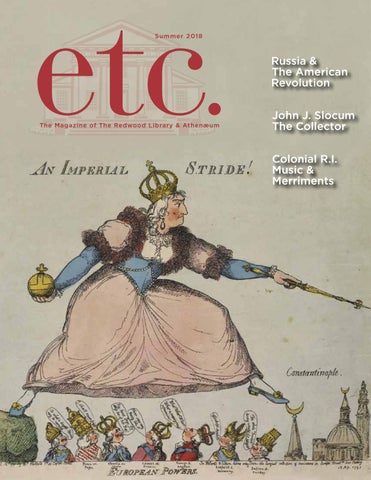
John J. Slocum The Collector Colonial R.I. Music & Merriments
Photo: Michael Osean
W e lc o m e
Contents
Dear Friends, It is with great satisfaction—and gratitude—that I present you with the first issue of the Redwood’s new magazine. It has been reconceived by our expert staff to reflect our expanded purview as an athenaeum/think space addressing history and culture—the humanities—in a consciously interdisciplinary way. That’s why you will find in it a multitude of interesting pieces about history, music, books and art across a range of disciplines—because intellectual pursuit should be fun as well as informative! (the aim is to ‘delight and instruct,’ as the old adage goes) The cover article addresses Russia’s involvement in the American Revolution. (Fortunately, there was no meddling, as they rejected England’s appeal for Russian troops to battle the Colonials). Another article features new research from a noted scholar on music in colonial Rhode Island, which proves—if proof were needed—that Newport, then as now, provided a rich cultural life to its citizens. Other features highlight the incredible trove of rare books given to the Redwood by the family of John J. and the late Jerry Slocum, as well as the political meanings that attach to a contemporary artist’s choice of materials. As with every issue, you will also peek into the Redwood vault, in addition to being informed about some very exciting upcoming events and exhibitions. This is YOUR magazine; please let us know your reaction, comments and suggestions for upcoming features. Thank you and see you at the Redwood!
2 Russia’s Little Known Role In The American Revolution Christopher Woolf 5 John J. Slocum The Collector Patrick Crowley 8
Colonial R. I. Music & Merriments Gloria Eive
1 3 Treasures of the Redwood Patrick Crowley 1 6 Material Ends: Or the Matter of the Curious Erasure of Matter Leora Maltz-Leca 1 7 18th-c. Breakfast James Chevallier 1 8 At the Athenæum
Benedict Leca, Ph.D. Executive Director
2 0 Exhibitions at the Redwood
etc.
Redwood Library & Athenæum 50 Bellevue Avenue Newport, Rhode Island 02840
redwoodlibrary.org
redwood@redwoodlibrary.org 401.847.0292
Editorial Director Benedict Leca, Ph. D.
Summer 2018
Editor Patricia Barry Pettit Editorial Advisor Don Dery @redwoodlibrary @theredwoodlibrary @RedwoodLibrary
Design Pam Rogers Design Reprint of any content herein must bear following credit line: Originally Published in Etc., The Magazine of the Redwood Library and Athenæum Summer 2018
Cover: “An Imperial Stride!” Hand colored etching, William Holland (1791) Courtesy of ©Trustees of the British Museum.
r e d w o o d l i b r a r y. o r g 1
Russia’s Little Known Role in the American Revolution Many people know how foreign powers helped the colonies win their independence from Britain. One little known player was Russia. Who knew? Well, The World's history guy of course. by Christopher Woolf On a hot summer’s evening in Philadelphia, as the crowds were still cheering the Declaration of Independence, John Dunlap was working quietly in his print shop on Market Street. His mission was nothing less than to print the first copies of America’s founding document. Copies were to be sent to each of the Thirteen Colonies, to the Continental Army, and, perhaps most importantly, to the royal courts of Europe.
“Dear King Louis of France. Please help us! Sincerely, America.” The success of the American Revolution was never a sure thing. The Founding Fathers were fully aware of how important foreign help would be in the struggle for independence from Great Britain and King George III. No man is an island. It’s as true in diplomacy as it is in ordinary life. As soon as it was printed, copies of the Declaration of Independence were rushed to the royal courts of France and Spain. In time, those nations intervened to provide the infant republic with the life support it so desperately needed: gunpowder, muskets, cannon, uniforms, cash, naval power and expeditionary armies. What’s less well known is the role played by Russia. That’s the focus of this story. Russia was one of the great powers of the 18th century, and while far-off, its decisions had an impact on the outcome of the American Revolution. The first significant impact was at the beginning of the war, before the Declaration of Independence was even a twinkle in Thomas Jefferson’s eye. “
4 2
etc etc..
Su pm r in mger2018 2 01 8
“Dear Catherine of Russia. May I please have 20,000 troops to crush American freedom. Regards, George.”
“You go to war with the army you’ve got.” That was the mantra of Defense Secretary Donald Rumsfeld in 2003 when challenged about America’s military readiness for the war in Iraq. The Brits faced a similar problem in 1775. The Brits didn’t realize they were in for a real fight with their colonists in America until the battle of Bunker Hill (or Breed’s Hill, if you want to be pedantic) on June 17th 1775. Britain had by far the biggest navy in the world, but its army—while good—was much smaller than its European rivals. Now, the key to crushing a revolt is to move swiftly and violently before your rebels can get organized. And in 1775, Britain simply didn’t have the reserves of trained manpower to do this. What Britain did have was plenty of cash. So it turned to Europe to see if it could purchase military help, and the first country that London turned to … was Russia. London asked Catherine the Great of Russia for 20,000 men.
Why did Britain think Russia might help? There were two main reasons Britain thought Russia would agree to help: the Russians needed the money, and they hated rebels. Russia had just concluded a successful but expensive war against Turkey, and it was also putting out the last flames of a peasant and Cossack revolt in the south: the so-called Pugachev rebellion. So Russia had more troops than they really needed for peacetime, and a serious need for cash. The Brits hoped to have 20,000 battle hardened Russian troops in Boston by the end of 1775 or early in 1776. It’s hard to imagine, but you could have seen Cossacks watering their horses in the Charles River. But, in the end, the Russians decided not to help Great Britain. They strung out the talks, and then said no.
Nathaniel Dance Oil on canvas Britain, 1773 King George III of England is seen here in a typical example of an official portrait intended as a diplomatic gift painted by Nathaniel Dance. Through the British ambassador in Russia, Lord Cathcart, Dance was commissioned to paint pendant portraits of King George and his wife Sophia-Charlotte to be presented by George III to Catherine the Great. Source of entry: English Palace, Peterhof, 1931
So why did Russia make that decision? Well, let’s not kid ourselves that Russia had the interests of the American colonists at heart, or that it had any concern for the future of liberty. Russia, then as now, acted only in the interests of Russia and its rulers. And Russia, like all the other great powers in Europe, believed Britain needed to be cut down to size. Britain had swaggered through the 1760s, after its victories in the French and Indian War, thinking it was better and more powerful than any rival. It had cornered most imperial markets for itself, and it dominated trade. So it was pretty unpopular. Now other countries have been in that position, at different times in history, and the way to manage it is to cultivate friends and allies. However, Britain’s foreign policy in the decade before the revolution had been too incoherent, and it paid the price during the war. That’s a lesson for any superpower in any age. How did that Russian decision impact the American Revolution? The Russian decision not to sell troops to Britain had a significant strategic impact, in that it imposed a real delay in the British mobilization for war with the colonists. It was only after Catherine of Russia had said no that the Brits turned to the Hessians—from Germany—to provide them with the manpower they needed. But the delay may have been critical. As a result of the Russian diplomacy, Britain was forced to delay its counter-offensive against America’s patriots until August 1776. Had a division of Russian or Hessian troops arrived in Boston in late 1775 and driven away Washington’s infant continental army, that could have swayed a lot of minds in America as to the wisdom of even declaring independence. Instead, the rebels were able to get much more organized, dig defenses, obtain resources like gunpowder and cannon, and provide their troops with training and equipment. It also allowed the Patriots to consolidate political power, intimidate their opponents at home, and eventually even to dare to declare independence. Once that bridge had been crossed it was almost impossible to go back and find a compromise with the mother country.
““Dear Catherine of Russia. Please help me end this war. I’ll give you a lovely island in the Mediterranean. Love, George.”
There were several other times that Russia indirectly affected the course of the American Revolution. The most significant was in 1780. By that year, the war was at a stalemate. France and Spain had intervened on behalf of America. But Britain had managed to hold on, against all odds. The American rebels were broke. If either side could gain another ally, it might tip the balance. Russia started putting together a loose alliance with other northern powers, called the League of Armed Neutrality. It involved Sweden, Denmark and Holland. The idea in Russia was to force everyone to make peace, and cut a deal that would benefit Russia. It’s what diplomats call an “armed mediation.” Britain’s spies got wind of it, and tried to head off this intervention by attacking Holland and trying to bribe Russia. This time, the idea was to offer the Russians an important colony. The prize the Brits offered was the island of Minorca, part of modern day Spain in the Mediterranean, which belonged to Britain at this time. It was a huge naval base and a warm water port - something Russia had coveted for decades. The negotiations went well. The English and Russian diplomats believed that France, which was struggling to pay for the war, would agree to make peace, rather than fight a wider war. For Russia, it would have been a win-win. The achievement of a long-term strategic goal, without much fighting, if any. A mediated peace at this time would have left Britain with New York, Maine, Virginia, Georgia and the Carolinas, and a solid claim to everything west of the Appalachians. It would have been even better for Britain if France had quit the war and made peace separately from its American allies. In that case, England could legitimately throw its full strength against the rebels here. r e d w o o d l i b r a r y. o r g 3
Again, Russia was purely acting out of self-interest, seeking a territorial gain for itself. Russia would have been quite OK if the American Revolution had been destroyed, as collateral damage. Who likes free-thinking rebels anyway? Sounds like a smart plan. So what went wrong? Well, this time, it was Britain that backed away. In early 1781, good news arrived in London from the battlefields of the American South, and intelligence assessments suggested France was out of cash, and out of credit. It couldn’t get new loans to finance its war effort. London assumed the French would end the war rather than risk a collapse of their own government. King George and his cabinet changed their minds about the Russian mediation and thought Britain could win this world war on its own. They thought they should go for complete victory rather than settle for a partial success. Big mistake! A few months later, the French navy was able to bring a decisive force to the coasts of Virginia, and the Brits were beaten at Yorktown. The rest, as they say, is history. The Russians considered retaliating against Britain. But they saw the Dutch get beaten by the Brits at sea, and thought better of it. With Holland effectively neutralized, the Russians decided the risks outweighed the potential benefits of an open confrontation with Britain.
So all of this provides plenty of lessons for today’s diplomats and policy makers: • The drawing rooms of diplomats are just as important as raw military power in deciding history, and the outcomes of wars.
• Maintain your alliances; look after your friends, so that they help you when you’re in trouble—even the biggest and richest superpower needs help, now and then.
• Trust your intelligence assessments, but be careful not to assume that they will tell you exactly what your opponents will do. • Have a coherent foreign policy, even in peacetime.
• If you talk the talk, make sure you have the military muscle and the diplomatic back-up to follow through; in other words, don’t pick a fight you can’t finish. Finally, perhaps the biggest take-away is to remember that the American Revolution did not have a pre-determined outcome. It was not an assured victory for the American cause. The Founding Fathers were blessed with courage and wisdom. But even they acknowledged, and gave thanks for, the series of apparent miracles that brought America its independence and freedom.
Christopher Woolf is “History Guy” for The World, the public radio program co-produced with the BBC World Service in Boston. He has worked for the BBC for more than 30 years, 20 of them in the United States. Before that he was a part-time soldier and a student of history at Cambridge University. Reprinted by permission The World, Public Radio International
4
etc.
S u m m er 2 018
John J. Slocum The Collector by Patrick Crowley Imagine your ideal study. For me this is a desk for working, some comfortable chairs for leisurely reading near windows overlooking lawn, Near Eastern and Asian carpets underfoot, and surrounding it all, floor-to-ceiling bookcases in wood the color of dark chocolate. This description would fit the library I walked into last July, the private study of John J. Slocum. But what is any study or library without books? There was no shortage of books; floor-level shelves filled with folios on art, archaeology, and natural history; the upper reaches of the bookcases brimming with carefully selected volumes on Middle-Eastern social and political history; foundational works on modern statesmanship and exem- John J. Slocum, 1964 plars of mid-century liter- Courtesy of the Slocum Family ature, some signed!—interspersed throughout an impressive collection of antiquarian books published in the sixteenth through the nineteenth centururies. The Slocum family has a long history of generosity and service to the Redwood Library. Most recently, we were given unparalleled access to that same library to select volumes that would support our collection, both in honor of John Slocum’s deep attachment to the library and as representative of the Slocum family’s sustained interest in and philanthropy toward the Redwood. John J. Slocum was many things: a scholar, a collector, a literary agent, a foreign serviceman. At Harvard he was an editor and contributor to the Harvard Advocate, bringing such noted literary figures as Wallace Stevens and Gertrude Stein to write for the magazine and to speak on campus. He was close friends with James
Laughlin. The two were primed to go into the publishing business together before World War II intervened. Slocum enlisted voluntarily. After his war service he remained in the United States Information Service. He was posted first in Belgium before being sent to Egypt, where his collecting and bibliophilic study was noted by Herman Liebaers, the director of the Belgian Royal Library, who acknowledged his fine taste in Netherlandish books. Returning to the United States and Newport, he continued collecting, amassing the world’s foremost collection of Joyciana, co-authoring a definitive bibliography and editing additional pages of the unpublished manuscripts of Joyce’s Stephen Hero. This collection he donated to Yale, where it remains. He also gave significant collections to the Folger Shakespeare Library. Finding the Redwood to be a place where his antiquarian vision could be fulfilled, he served on the board of directors and as board President from 1986-1991. During that time, he helped the library secure a number of additional volumes for its Original Collection. In bringing John Slocum’s collection into the Redwood, one of the first things we needed to do was to circumscribe the scope of the collection. What was there? What were the strengths? What are the connections between those strengths? How would those fit into the Redwood’s existing special collections? We quickly began to see strong overlaps, for example, with our deep holdings of ancient texts, notably a number of works by Latin poets: Catullus, Propertius, Ovid, and Horace. Published in the An Quatrième of the French Republican calendar (1795/6), a four-volume collection of Catullus is charming both for its small size and for the pleasant frontispiece engravings in each volume. A devoted Classicist, Slocum acquired a mass of Latin satire in the works of Juvenal, Perseus, Petronius, and esper e d w o o d l i b r a r y. o r g 5
We were also delighted to find a comprehensive collection of early editions of the eighteenth-century poet Thomas Parnell, a contemporary and friend of Alexander Pope, John Gay and Jonathan Swift.
6
e tc .
S u m m er 2 018
cially of the Neo-Latin poet, Johannes Secundus, represented by an extensive collection of editions from the 1500s to the 1900s. We were also delighted to find a comprehensive collection of early editions of the eighteenth-century Anglo-Irish poet Thomas Parnell, a contemporary and friend of Alexander Pope, John Gay, and Jonathan Swift, who wrote in his lifetime under many pseudonyms. His own work was published posthumously, edited and funded by Alexander Pope. Mr. Slocum’s collection included, among other editions, the first British edition of this work and the scarcer Irish first edition published in the same year. This material will form an important facet of an upcoming exhibition on the Scriblerus Club. And scattered amidst it all were modern first editions of works by authors some of whom were just emerging. Pristine first editions of Steinbeck and Orwell are notable for their amazing cover designs. While we could not take the large majority of the collection, we selected over 700 volumes that enhance existing strengths in our collection. These books offer new and exciting opportunities to staff in creating physical and digital exhibitions, to members and the public in presentations, and to classes and researchers in their scholarly endeavors. Patrick Crowley is the Ezra Stiles Special Collections Librarian at the Redwood Library & AthenÌum.
Photos: Jessica Pohl
r e d w o o d l i b r a r y. o r g 7
Colonial R.I. Music & Merriments by Gloria Eive Rhode Island’s strong traditions of independence, separation ‘Lining Out.’ A deacon or clerk was appointed to announce, at the of church and state, and freedom of religion are extensively docu- beginning of each psalm, which melody would be sung, and would mented as are also, their determining influence on the new state’s then sing the melody of each line of text as object instruction to the political structure and character. Less well known is the influence of congregation. The results were extremely disappointing. Each perthese traditions on the original colony’s musical activities for much son wanted to sing to a different tune, sometimes changing tunes of its early history. When Roger Williams’ (1603-1683) outspoken in the middle of the psalm. separatist convictions and demands for religious freedom led to his By the beginning of the eighteenth century, ministers and banishment in 1635, by the Massachusetts Bay Colony, he took congregants alike were calling for instructors and ‘singing schools’ refuge with the Narragansett Indians in a settlement that would to instruct people in the rudiments of reading music and singing become the town of Providence. Narragansett culture, like that of psalms. The ‘singing schools’ were most popular in New England other Algonquian tribes, was structured around the rhythms of the where the singing masters maintained a lively trade from 1720 to changing seasons, and they marked the seasonal changes in their after 1750. Once the congregations accepted the need for musinatural world as they articulated the rhythms of their daily lives— cal reforms, newly-trained ‘choristers’ were appointed to sound the with song and dance, accompanied by drums and rattles. Although first note of the psalm, either singing it or sounding a pitch pipe. Williams formed strong friendships with his Narragansett hosts, Traditionalists objected to the use of a pitch pipe however, claimtheir customs, music traditions and songs were evidently of little ing it was simply another type of musical instrument and as such interest to Williams and the colonists who violated the rule forbidding the use of mucreated the settlements that became Rhode sical instruments in devotional music. MatNarragansett culture, like that Island. ters were not improved when some of the of other Algonquian tribes, was The principal music-making in the coyoung choristers who had ‘graduated’ from structured around the rhythms of lonial churches of Williams’ era was singthe singing schools asked to sit together in the changing seasons, and they ing hymns and psalms, in unison, plainly, church so they could perform some of the marked the seasonal changes in and simply, in accordance with the Purimusic they had learned—effectively creattheir natural world as they artictans’ conviction that congregational singing ing ad hoc choir stalls. Slowly the churches ulated the rhythms of their daily of psalms was mandated by scripture, as a capitulated however, and by 1770, ‘singers’ lives—with song and dance, acmeans of instruction. Church choirs and seats’ were established additions in as many companied by drums and rattles. instruments—especially organs—were conas twenty-three New England churches, sidered unscriptural and Roman corrupproducing the anticipated improvements in tions, and the clergy were constantly on guard against scriptural the musical quality of the psalm singing. and doctrinal deviations. Apart from these prohibitions, the early Additional musical assistance and support for congregants’ encolonial churches were all too poor to purchase organs or other thusiastic psalm singing was provided by the church organists, who musical instruments such as violins or viols, and very few parish- doubled the melodic lines sung by the congregations, reinforcing ioners were trained musicians. The principal textual and musical their efforts. Anglicans and other denominations, who did not source were the psalm books—metrical versifications of translated share Puritan and Quaker objections to using musical instruments Hebrew psalms, each followed by a list of the commonly known for religious services, purchased organs as soon as their church fimelodies to which each psalm could be sung. After 1640, the most nances permitted. The Anglican King’s Chapel in Boston installed commonly used was The Whole Booke of Psalms Faithfully Translat- one of the first such organs—in 1714—and several congregations ed into English Metre, known commonly as The Bay Psalm Book. quickly followed. At mid-century organs had been installed in12 This was the first book published in the colonies, printed by Ste- of the major churches in New York, Virginia, Boston, and Philaphen Daye on a Harvard College press. delphia (Ogasapian, J. 2004). The ministers tried to achieve a semblance of unison singing The first organ acquired by a Rhode Island church was a gift but the results were at best very ragged and usually quite unmusi- by Bishop George Berkeley in 1733, to Trinity Episcopal Church cal. Each member of the congregation sang at his or her own pitch in Newport. The organ was constructed in England by Richard and speed, frequently adding ornaments to fill melodic spaces and Bridge, then disassembled for shipping to Newport. Charles Theleaps and coming together only at the beginning and ends of each odore Pachelbel (1690-1750), son of composer and organ master line. In an attempt to improve the musical quality of the congrega- Johann Pachelbel (1653-1706), was living in Boston in 1733 and tional psalm singing, the clergy resorted to a technique known as was asked to assist in reassembling the organ. The organ was in8
etc.
S u m m er 2 01 8
The Bridge Organ today, a gift from Bishop George Berkeley to the Trinity Episcopal Church, Newport in 1733
stalled in 1734 and Pachelbel stayed on as Trinity’s organist until mid 1735. The organ had a mechanical action, with two manuals enclosed by hinged doors, 12 stops, 12 registers, and 12 ranks of pipes, and was mounted in a gallery at the rear of the church. The organ has been renovated four times since 1733 (in 1880, 1901, 1929, and 2007), and of the original instrument, only the console, one manual, some pipes and the gallery mounting remain; the action and the other parts have been dispersed (“R. Bridge.” OHS Pipe Organ Database, D10002). Pachelbel seems to have spent most of his life in America. In 1736, after leaving Trinity Church, he gave two public concerts in New York (21 January and 9 March, 1736) and then went to Charleston, South Carolina where he organized the city’s first public concert (November, 1737). The program included vocal and instrumental works by contemporary European composers. He assumed the position of organist at St. Philips Church (1740-1749), and in his last year, opened a singing school (1749) in Charleston. If he composed during his years in America, all but three of his works have disappeared—a Magnificat for double choir (C major; probably composed before he emigrated to the colonies), and two Minuets (C major). Pachelbel’s musical interests were clearly focused on the European composers and musical repertoire he had learned from his father and as a music student in Germany, and he does not seem to have been very interested in the colonists’ psalm-singing efforts (“R. Bridge.” Ibid.). By mid-century however, there were several colonial musicians and composers whose training and musical interests were especial-
Photos: Jessica Pohl
ly suited to the colonists’ needs. Oliver Shaw (1779-1848), born in Newport, was an organist and composer. Despite his blindness (from childhood), his extant works include five volumes of songs and marches and he maintained an active career in Providence and Boston (Degen, “O. Shaw”). Bandmaster and composer Josiah Flagg (1737-1794) organized and drilled Boston’s first militia band, introduced the English anthem to the colonies (engraved by his friend Paul Revere), and as his musical gift to church congregations, left a large collection of psalm settings in 2, 3, and 4 parts (Crawford and Music). Perhaps the most well-known of this generation of colonial composers however, is William Billings (1746-1800) of Boston, composer, singing master, and pedagogue, considered today as the first American choral composer. Billings became a tanner to help support his family, and although he may have received some musical training from a choir member at the New South Church in Boston, he was essentially self-taught. He was active principally in and around Boston as a singing master, music educator, and author of two exemplary harmony texts. Billings was famous especially, however, for his choral settings of hymns and anthems which were known throughout the colonies and were widely performed—and plagiarized. The lack of adequate copy-right laws in the new United States made it impossible for Billings to adequately claim the rights to or credit for his own compositions during his lifetime, and much of his music was published spuriously by others (Kroeger). Continued on page 12 r e d w o o d l i b r a r y. o r g 9
William Billings: Wake ev’ry Breath Six-part canon with ground bass 1770: The New England Psalm Singer
William Billings: Chester LM
Brick Schoolhouse - Providence, RI
Four-part choral anthem (SATB) 1770: The New England Psalm Singer 1778: The Singing Master’s Assistant Key to practical musick
24 Meeting Street, Providence, RI Historic American Buildings Survey, creator Documentation compiled after 1933
1 score (15, 104 p.) Publisher: E. Russell, Pr. ..., Boston, [1781?], monographic. Engrav’d by Benja[min]. Pierpont Jun[io]r.
Built in 1768, this was the first brick schoolhouse in Providence.
All photos on page courtesy of the Library of Congress Prints & Photo Division, Washington, D.C.
10
e tc.
S u m m er 2 01 8
The images to the left show the frontispiece to Billings’ first collection of psalms, The New-England Psalm Singer (1770). The seven singers seated at the table are singing the six-part canon and ground bass, Wake ev’ry Breath, reproduced in the music staff encircling the engraving. Chester, the four-part patriotic anthem shown in the second engraving, was one of Billings’ most popular compositions, and in its second version (1778) was sung throughout the colonies during the Revolutionary War. As mercantile and manufacturing activities increased in Newport, Providence, and in New England and the colonies generally, the corresponding economic growth that followed not only promoted the growth of a wealthy upper class of merchants and financiers but also expanded leisure activities and diversions. Musical and theatrical entertainments, and especially dancing, in taverns, at parties and balls were favourite diversions of the colonists and the tourists from the West Indies and the Carolinas who came to enjoy Rhode Island’s pleasant weather. Their entertainment wishes were answered by a proliferation of newspaper ads offering singing and dancing lessons for adults and children, dance parties and balls, impresarios announcing concerts and dramatic productions, and salesmen offering a broad selection of sheet music, instruments, and music supplies. The conservative members of Providence’s Town Council and Newport’s General Assembly were especially apprehensive and fearful that the gay abandon of un-chaperoned dancing lessons, parties, and balls would provoke the gentlemen to uncouth, ill-mannered behaviour and the dancers’ unaccustomed close physical contact would surely provoke lewd and bawdy incidents. To reassure apprehensive parents and participants and forestall possible constraints and restrictions by the authorities, the fencing and dance instructors, impresarios, and entrepreneurs were very careful to phrase their announcements and invitations in the most genteel language, with repeated assurances that the guests would be treated with the utmost courtesy and respect. William Pope’s several advertisements in the Newport Mercury during June and July, 1768, are typical: N[ewport] M[ercury]. Jun[e] 1768:33 (511) “William Pope, dancing and fencing-master, has opened a school at Mr. Sisson’s on the hill, where he teaches dancing and fencing in the genteelest manner. Any young gentlemen and ladies who will please to favour him with their company, may depend on the most polite treatment: The terms may be known any time at Mr. Sisson’s.” [The ad was repeated on 27 June, and 4, 11, and 18 July] (Cory, V. W. Keller, and Keller).
William Selby, newly-arrived organist for Newport’s Trinity Church, published an even more ambitious invitation in 1773: N[ewport] M[ercury]. Dec[ember] 1773:33 (799)
“William Selby, organist of Trinity-Church, Newport, just arrived from London, begs leave to advertise the town, that he purposes (sic) to instruct young gentlemen and ladies to play upon the violin, flute, harpsicord (sic), guitar and other instruments now in use: And that he intends opening a dancing school early in the ensuing spring, for young masters and misses. As he has been entirely bred to those genteel professions, and shall make it is constant study, and greatest pleasure to merit the esteem ad approbation of the inhabitants of the town, he flatters himself with having their countenance and encouragement. N.,B. He will attend young ladies, in the musical way, at their own houses.” [The ad was repeated on 3, and 10 January, 1774, and in abbreviated form, offering only the dancing school, on 11 April, and 2, 9, and 16 May, 1774.] (Ibid.)
Similar invitations to dancing parties and festive entertainments were posted in most of the colonial newspapers and bulletins, with varying details and exhortations according to the nature of the event and the prospective audiences. Dance instructors such as John Baptist Tioli and Mrs. Treville who made the rounds of New England towns each year, beguiled their audiences with strict deportment protocols and attendance requirements, and by promising to teach a wide variety of country dances, the most fashionable European dances (such as the double and quadruple minuet, passepie, gavotta, alouver, and hornpipe). Mr. Tioli even promised violin lessons. Like the fencing and dancing instructors who periodically circulated through the colonies, travelling dramatic companies entertained their audiences with an extensive and remarkably diverse repertoire of concerts, farces, tragedies, and pantomimes. Actors in these itinerant companies were expected to be able to sing as well as perform every type of role, and undoubtedly created these eclectic programs especially to display their musical and dramatic skills. The programs produced in Providence by David Douglass’ company in 1762 are characteristic: Providence. B[oston] E[vening] P[ost] (F. 762.034) 9 Aug[ust] 1762:11 (1405) At the new school house in Providence, on Thursday next, being the 12th of August, will be performed, a concert of musick, vocal and instrumental. To begin exactly at 7 o’clock. VIVAT REX. Between the several parts of the concert will be presented (gratis) a tragedy, call’d The Fair Penitent.
There is a common theme underlying the stream of announcements, invitations and ads for singing schools, dancing lessons, balls and parties that tempted and beguiled the colonists—music and musicians. Colonial America was a very musical society. Whether they were singing psalms and anthems in church, or learning new dance steps from a favourite dance master, the colonists were hearing or performing music. In addition to the announcements and ads for singing schools, dance lessons, plays, parties, and balls in every issue, colonial newspapers ran dozens of ads for musicians whose services were urgently solicited: violinists, fiddlers and viols for dances, fifers and drummers for military bands before and during the Revolution, instrumentalists for military brass bands, and creating a shoppers’ paradise, dozens of ads listing musical instruments for sale—harpsichords, clavichords, even pianos, violins and strings, pegs, and bridges to maintain them, flutes, both English (end-blown) and German (transverse) sheet music copies of ballads, songs, and the latest instrumental works by European composers, and custom-made boots for dancing, On a sinister note, interspersed with these for instruments, music, and musicians for joyous events are dozens of ads to buy and sell slaves with musical skills, and ads seeking the return of run-away slave musicians, many who had taken their fiddles and instruments with them. Dancing masters always carried a violin to provide music for the steps they were teaching their pupils and additional musicians were always needed to fill out instrumental ensembles and bands for dance parties and balls. Well-to-do colonists were eager to hear the latest compositions by European composers, took music lessons themselves, engaged professional musicians and ensembles to play for them and provide concerts. Less demanding roles were filled by slaves whose masters had provided musical training or were self-taught. r e d w o o d l i b r a r y . o r g 11
One of these musically talented slaves, Occramer Marycoo, re-named Newport Gardner (1746-1835) by his master, was educated by his owners, and became a professional musician and gifted composer, and a respected Deacon in Newport’s First Congregational Church. He purchased his freedom and his family’s in 1791 with lottery ticket winnings, and supported his family by teaching music.
Rhode Island banned slavery in 1784, but the new law did not apply to existing slaves nor to Rhode Island citizens who were outside the colony’s borders. Accordingly, Newport’s flourishing ‘Triangle’ slave trade with the West Indies and West Africa continued unabated: Newport imported molasses from the West Indies, used it to make rum which was sold back to customers in the West Indies and to British merchants who traded it for slaves in West Africa. Rhode Island, like other colonies had a robust slave population that contributed significantly to the agricultural and manufacturing activities. Many of the slaves had musical skills, and played the fiddle, tambourine, banjo, and performed for British assemblies, dancing classes, and taverns. One of these musically talented slaves, Occramer Marycoo, re-named Newport Gardner (1746-1835) by his master, was educated by his owners and became a professional musician, gifted composer, and a respected Deacon in Newport’s First Congregational Church. He purchased his freedom and his family’s in 1791 with lottery ticket winnings, and supported his family by teaching music. Gardner actively supported the African colonization efforts and when President Monroe obtained property in Africa in support of the ‘Liberia’ movement, Gardner led a group of some 30 Africans emigrating to the new colony in Africa. Gardner, like many in the new colony, had lived in North America almost all his life and had lost whatever natural immunity he might have had to African diseases and infections. He died shortly after his arrival in Liberia, before he could fully realize his dream. Two of Gardner’s country dance songs have been preserved but the rest of his compositions, sadly, have been lost. He is honoured today, as he was during his lifetime, as the first black musician to become a professional music teacher and composer (Millar). The contributions of African musicians to colonial culture and American music have been slowly and very belatedly acknowledged, and the musical and cultural ‘bridges’ created by Newport Gardner’s and his successors’ musicianship have yet to be fully explored and traversed. Gloria Eive Fine Arts Editor ECCB: The Eighteenth-Century Current Bibliography Vice-President Education Chair, Board of Directors San Francisco Early Music Society
12
e tc .
S u m m er 2 018
Bibliography “1600-1754: Music.” American Eras. Encyclopedia.com. 19 Mar. 2018. <http://www.encyclopedia.com> Bridenbaugh, C. Cities in the Wilderness. The First Century of Urban Life in America 1625-1742. (1938). “Richard Bridge (1733)” The OHS Pipe Organ Database. D 10002. <https://pipeorgandatabase.org> Butler, J. “Charles Theodore [Carl Theodorus] Pachelbel.” The New Grove Dictionary of Music and Musicians. 2nd Ed.. 2001, 18:856-7. Cory, M. J., K. Van Winkle Keller, and R. M. Keller. The Performing Arts in Colonial American Newspapers, 1690-1783. Annapolis: Colonial Music Institute, 2010. Text Database and Index. <http://www.colonialmusic.org> Crawford, R. and D. W. Music. “Josiah Flagg.” The New Grove Dictionary of Music and Musicians. 2nd Ed., 2001, 8:919. Degen, B. “Oliver Shaw.” The New Grove Dictionary of Music and Musicians. 2nd Ed., 2001, 23:226. Keller, K. Van Winkle. Dance and Its Music in America, 1528-1789 (2007). Early American Dance and Music: John Griffiths, Eighteenth-Century Itinerant Dancing Master (1989). Kroeger, K. “Willam Billings.” The New Grove Dictionary of Music and Musicians. 2nd Ed. 2001, 3:571-2. Mason, G. C. Annals of Trinity Church, Newport, Rhode Island, 1698-1821 (1890). Millar, J. “Newport Gardner: From Slave to Musical Composer.” The Online Review of Rhode Island History. March, 2016. <http://www.smallstatebighistory.com> Ogasapian, J. Church Music in America, 1620-2000 (2007). Music of the Colonial and Revolutionary Era (2004). Owen, B. The Organ in New England. An account of its use and manufacture to the end of the nineteenth century (1979). Southern, E. The Music of Black Americans: A History (1971).
Treasures o f t h e R e dw o o d
by Patrick Crowley In honor of our new magazine, it felt appropriate to highlight one of our collected volumes of the Gentleman’s Magazine. The Redwood holds an impressive and nearly complete run of this periodical. While many of these volumes were added to the collection in the nineteenth and twentieth centuries, the Gentleman’s Magazine has the distinction of being among the books that form our Original Collection. We know, for example, that issues from 1736-38 bound as omnibus volumes were given to the Redwood anonymously by ‘a Society of Gentlemen,’ along with a number of other volumes. The Gentleman’s Magazine has numerous claims to fame. It ran continuously from its foundation in 1731 to the 1920s. It offered young authors steady opportunity to establish their careers and seasoned writers to offer cultural Samuel Johnson opinions in a Sir Joshua Reynolds c.1756 widely availCourtesy of @National Portrait Gallery, London able medium. It also brought the literary usage of the word magazine into being. This emergence of the term we have on the authority of no less than Samuel Johnson’s dictionary, which attributes the use of magazine to refer to miscellaneous pamphlets, a new usage and one coined in English for the Gentleman’s Magazine. He says, “Of late [the word magazine] has signified a miscellaneous pamphlet, from a periodical miscellany named the Gentleman’s Magazine, by Edward Cave.” Dr. Johnson’s word bears extra weight in this case, as he himself was a long-time contributor to the Gentleman’s Magazine. Edward Cave, an enterprising journalist and entrepreneur began the Magazine in 1731 in an old printing shop at St. John’s Gate in London. Still to be seen there, this gate serves as the woodcut masthead for the magazine. Conceived as a monthly amalgamation of news from the burgeoning newspaper culture of eighteenthcentury London and as a literary miscellany, it was not unique in its
aspirations. Nonetheless, through a canny business sense and a concerted effort to form a team of regular contributors, Cave managed to create a publication that was notably more long-lived and more widely read than some of its competitors. As a miscellany, it encompassed roundups of foreign and parliamentary news, literary reviews, contemporary poetry, and scientific and antiquarian studies. Dr. Johnson was a steady contributor starting in 1738 and lasting well into the ‘40s. His contributions ranged from parliamentary write-ups to miscellaneous literary pieces. It is also possible that he contributed anonymous theater criticism into the 1750s. Many other noted authors of the period contributed in the years after Cave’s death in the second half of the eighteenth century. What interest might these volumes have held for Colonial Newporters and Americans in general. On the one hand, they kept Colonial Americans up to date with news and society in England, helping to maintain a strong English identity in the colonies. On the other hand, the Gentlemen’s Magazine fed a sustained interest on the continent with news of the American colonies. The conscious act of blending news from Britain and the American colonies shows the way in which these were not necessarily distinct in the early part of the eighteenth century. To be British and cosmopolitan in the 1730-50s was per force to consider the colonies as integral to the Kingdom and their news as affecting the news in London.
r e d w o o d l i b r a r y . o r g 13
The Gentleman’s Magazine has numerous claims to fame. It ran continuously from its foundation in 1731 to the 1920s. It offered young authors steady opportunity to establish their careers and seasoned writers to offer cultural opinions in a widely available medium. It also brought the literary usage of the word magazine into being.
We continue to collect the Gentleman’s Magazine, slowly filling in the missing pieces. One of the more glaring holes in our run is in the mid- and late-1770s, leaving crucial coverage of the first days of the revolution unarchived at the Redwood. It is worth noting that this hole is now less, thanks to Mr. George Herrick’s recent donation of the July 1776 edition. As eighteenth-century periodicals remain a core of our Special Collections, we are grateful to have now a more complete run of a periodical publication so parallel to our own magazine.
Carlson, C. Lennart. The first magazine: a history of the Gentleman’s magazine, with an account of Dr. Johnson’s editorial activity and of the notice given America in the magazine. Providence, R.I.: Brown University, 1938. Greene, D. J. “Was Johnson Theatrical Critic of the Gentleman’s Magazine?” The Review of English Studies 3, no. 10 (1952): 158-61. Todd, William B. “A Bibliographical Account of “The Gentleman’s Magazine”, 1731-1754.” Studies in Bibliography 18 (1965): 81-109.
Photos: Jessica Pohl
14
etc .
S u m m er 2 018
r e d w o o d l i b r a r y. o r g 1 5
M at e r i a l E n d s : Or the matter of the curious erasure of matter by Leora Maltz-Leca Since the time of Aristotle, if not long before that, the world treat, Le Petit Écolier: that seemingly innocuous confection made and its myriad objects have been divided into two kinds of stuff: by the centuries old company, Lu. What are “les secrets” of this matter and form. Matter—dust, clay and all things humble—was buttery treat that Tayou might be alluding to here? Why would he deemed to be the lowly substance of the world, the raw material cover the taut whiteness of the canvas with a chocolate brown skin to be gathered and shaped into a higher state of being: a form. and saccharine colored hearts? Whether in Biblical narratives where mere matter is transformed It might seem obvious that all materials, whether chocolate or into life; or in the artist’s studio, where clay or wood acquired form oil paint, denim jeans or the indigo once used to dye them, have at the magical fingertips of the sculptor, matter was always a means social and economic pasts, histories of production and trade, and a rather than an end in itself. That meant that matter had to erase it- politics of labor that trails behind them. But these pasts are typicalself as clay or as wood in order to acquire form: to become art. In this ly erased in our everyday use of sugar, or our daily doses of chocosense, the materials of art have always played second fiddle to the late. It’s not only a necessary forgetfulness, inevitable in the speed master of form, hiding themselves, covering of daily life, but it’s also abetted by the fact It might seem obvious that all their tracks, or representing something else. that (dubious) sources and (exploitative) lamaterials, whether chocolate Yet recently, and increasingly, it seems as if bor chains are smoothed over, cleansed, and or oil paint, denim jeans or the materials have staged a tiny rebellion of sorts, concealed by shiny packaging, long before indigo once used to dye them, and are asserting themselves as ends in themour products of consumption even arrive for have social and economic pasts, selves. They are ends both in their refusal to us to forget their complex pasts. The erasure histories of production and trade, be subjugated to content, and in the sense of of that history of rawness, of raw goodness, and a politics of labor that trails being end-products, trailing with them long, is not only what underpins the possibilities behind them. cross-cultural histories of trade and labor. of mass production, but it has also long subThis notion is the starting point for an exhitended art, and its aspiration to transcend bition that the Redwood is organizing called Material Politics, one its own base materiality. A long and powerful history of art and which showcases how a generation of contemporary artists, many design wants to forget the politics of its materials; to render them of whom hail from the postcolonies, harness the messy materials of inert and given, all the more to declaim the transformative power the world to speak of the histories embedded in everyday materials of the artist and designer as an alchemist invested with extraordilike sugar, chocolate or soap. nary powers of transformation. The lionization of the artist goes Perhaps the most famous, recent example of this tendency in contemporary art was the sweaty sugar of Kara Walker’s A Subtlety, or The Marvelous Sugar Baby that filled New York’s Domino Sugar factory in 2014, which summoned the bloody politics of sugar in visceral, overpowering ways. On the one hand, the monumental sugary sphinx gave form and weight to history, crystallizing abstract ideas as the actual stuff that powered the triangle trade: sugar, rum, money. On the other hand, Walker’s installation mobilized sugar —and its processes of refinement and bleaching—as metaphors, which alluded to the price of cultural refinement in Europe and the Americas. In a similar vein, Camerounian-Belgian artist Pascale Marthine Tayou also works with materials like chocolate and coffee as a means to work through complex histories. His Chocolate Landscape (2012) recasts the monochrome painting, and the vaunted spirituality of modernist abstraction, as a material, chocolatey treat. Multicolored sparkles and a little yellow heart dance on the surface of the painting. As Tayou collapses the stern geometry of the modernist frame into what appears to be crumbly biscuit, his “landscape” painting recalls nothing so much as the classic French Pascale Marthine Tayou, Landscape, 2012, chocolate on canvas
16
e tc.
S u m m er 2 01 8
18th-c. Breakfast by James Chevallier, Food Historian
Lu, Petit Écolier, chocolate on biscuit base
hand in hand with the downplaying of the lives, pasts and complexities of the stuff they work: materials. Yet now, it seems, a generation of contemporary artists, by focusing our attention on materiality, not only refuse myths of genius by ceding agency to materials, but these artists also force us to question old hierarchies in which form is elevated over matter; soul valued over the body; transcendence, always, prized over material baseness. And yet what if transcendence is just another form of forgetting? In Tayou’s painting the landscape of chocolate remains as chocolate, inviting curious sniffs from the viewer. Even as it calls up its real-life twin—the Petit Écolier—it never transcends its material. Instead, via the seeming innocence of a chocolatey treat and its biscuity frame, the work invites us to think about the origins and contexts of Lu, founded in Nantes, and proudly trading since 1846. Nantes was the epicenter of France’s slave trade, where ships returned from West Africa laden with sugar and chocolate, coffee, cotton, indigo and humans. And biscuits—whose name derives from the French bis cuit, referring to the way that they were twice cooked—were a staple fare of sailors for centuries, sustaining them on long voyages. Both Lu’s production of the biscuit and its location in Nantes are therefore not coincidental; nor should they be incidental to the way that we might view a Petit Écolier. Tayou’s work, through the materiality of the chocolate, recovers a historical connection between Nante’s maritime trade and the subsequent confectionary industries that replaced it. It points to the “chocolate islands” on the West coast of Africa (São Tomé and Príncipe), and to a literal and metaphoric consumption of the African landscape that implicates Euro-American desires in its colonial pillage. By pointing to histories long forgotten, whether intentionally or not, Tayou’s work burrows down into material histories of trade and extraction, refusing ideals of transcendence for the uncomfortable memories embedded in a square of chocolate. Leora Maltz-Leca, Ph.D. is Associate Professor of Contemporary Art History and Chair of the department of Theory and History of Art and Design at the Rhode Island School of Design. She is the Redwood’s Curator of Contemporary Projects and Head, Redwood Contemporary Arts Initiative (RCAI).
In general, breakfasts in New England were more modest than in the Mid-Atlantic and Southern states, very likely because the colder weather both limited crops and diverted more effort to chores. In earlier years, several people mention chocolate, by itself or with bread. But the most commonly cited breakfast food is mush, typically with milk. A larger breakfast might include leftovers, bread and cheese. The meal could vary widely; Samuel Sewall had plum cake at one breakfast and cheesecake at another; a third was followed by almonds, raisins and a glass of wine. Or it could be just bread and milk. Cider became increasingly common. At Harvard, students had brown bread and sliced cheese washed down with hard cider for breakfast, followed by beer or cider in a late morning break. In later years, more meat appeared overall, including beef and, more rarely, venison. At an inn, the French traveler Brissot de Warville had “coffee, tea, boiled and roasted meat; the whole for ten-pense, New England currency, for each traveler.”
Photos: Jessica Pohl
r e d w o o d l i b r a r y . o r g 17
At The AthenĂŚum
18
e tc .
S u m m er 2 01 8
r e d w o o d l i b r a r y . o r g 19
Exhibitions at The Redwood chartered 1747
Mission Statement Founded in 1747 on the Enlightenment ideals of intellectual pursuit and civic engagement, and committed to lifelong, interdisciplinary learning, the Redwood Library & Athenæum generates knowledge in the humanities for the benefit of the widest possible audience with “nothing in view but the good of mankind.”
Modernity vs. Tradition: Art at the Parisian Salon 1750-1900
The signal aesthetic space of modern spectacle culture, the Salon endured into the twentieth century as the preeminent regular presentation of contemporary art, a history traced in a density of pamphlets, press images and volumes of period criticism, giving perspectives on everything defining today’s art world: from superstar artists and the art market to consumer culture and institutionalized art history. Van Alen Gallery until September 16, 2018 Curator: Benedict Leca
The Best Editions of Several Volumes: John J. Slocum, His Library and the Redwood
Redwood Library & Athenæum Board of Directors 2017-2018 R. Daniel Prentiss, Esq. President
Virginia Decker Secretary
Frank Ray Vice President
Zia Eftekhar Treasurer
Marvin Abney Holly Bannister, M.D. Daniel Benson Miles O. Bidwell David Brodsky Vincent Buonanno Jacalyn Egan Edwin G. Fischer, M.D.* Ronald Lee Fleming Michael K. Gewirz John R. Grace
Washington Irving III Dodie Kazanjian Elizabeth Leatherman Ronald E. Long Earl McMillen III Victoria Mele Janet Alexander Pell Douglas R. Riggs Allison Walk *Honorary Board Member
The private library of John Jermain Slocum was the culmination of a lifelong devotion to books, nurtured by his family, his education, his relationships, his travels, and his own character. Through a selection of volumes from his library, the exhibit traces his life and his intellectual journey as a book collector of both skill and passion. Peirce Prince Gallery until October 14, 2018 Curator: Patrick Crowley with Michelle Farias, Allison Graves & Gunnar Rice.
Ex Libris Ed Ruscha
Two eminent masters deeply invested in arts and letters—art critic Calvin Tomkins and artist Ed Ruscha—come together to commemorate the recent gift to the Redwood of Tomkins’ art book collection. In a large scale painting titled Ex Libris presented with three examples from the series of interpretive lithographs after it, Ruscha re-engages with the manifold possibilities of form and meaning when words and images are brought into dialog. Rovensky Room: Opening Summer 2018 Co-Curators: Benedict Leca in collaboration with Dodie Kazanjian
Remember Bimbia Pascale Marthine Tayou
In a site-specific installation commissioned by the Redwood Contemporary Arts Initiative (RCAI), Camerounian-Belgian artist Pascale Marthine Tayou considers the institution’s complex histories and its entanglements in Rhode Island’s slave economy. The paving stones that comprise Remember Bimbia evoke both revolutions past—barricades breached; paving stones hurled—and revolutionary dreams yet unfulfilled, mooring American history in the rubble of its repressed past. The Redwood Front Lawn: Opening Summer 2018 Curator: Leora Maltz-Leca Made possible by a generous gift of Cornelius C. Bond and Ann E. Blackwell
The Claggetts of Newport: Master Clockmakers in Colonial America
Coming to the fore during Newport’s ascendency as an Enlightenment city, the Claggett family and their production of fine clocks marked the pinnacle of American technical and artistic know-how. Bringing together the largest number of Claggett clocks from private and institutional lenders ever assembled, the exhibition will allow for an in-depth analysis of period clock design and craftsmanship within the specific historical context of Colonial Newport. Van Alen Gallery: Opening December 8, 2018 Curator: Benedict Leca
20
etc .
S u m m er 2 018
Opposite page credits: Clockwise: Andrea Hansen Photography, Slocum Family, The Redwood Collection, ©Ed Ruscha. Courtesy of the artist and Gagosian, Pascale Marthine Tayou: Courtesy the artist and GALLERIA CONTINUA Back cover graphic: Fleming + Company
From Redwood Library & AthenĂŚum charter, 1747
www.redwoodlibrary.org