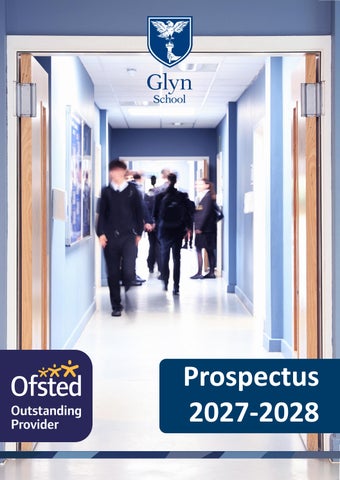
Prospectus 2027-2028
WELCOME TO GLYN SCHOOL The entire Glyn community is thrilled to welcome you to our outstanding Sixth Form. Deciding where to pursue your next steps is one of the most significant choices you will make. At Glyn, we have a proud history of exceptional achievement, consistently supporting students to reach their goals. Our students receive top-tier personal support, care and guidance, enabling them to excel in both further education and future careers. We encourage every student to strive for their best and we’re here to help them aim high. Our goal is to provide all students with the opportunities and challenges they need to prepare for their future, both inside and outside the classroom. Every student matters to us, and we are dedicated to helping each one succeed. Thank you for taking the time to read this prospectus. We look forward to having you as part of our vibrant Sixth Form community.
Mrs Jo Garrod Headteacher
73% graded A*- C 48% graded A*- B
A Level Results 2026
“Sixth-form provision is of the same high quality as for the rest of the school. Study programmes are appropriate and ambitious. A high proportion of pupils with SEND stay on at the end of Year 11. They are supported extremely well to make the transition into post-16 study. The quality of students’ sixth-form experience is reflected in their strong academic outcomes, progression to universities and high quality apprenticeships.” Ofsted 2023
WELCOME TO GLYN SIXTH FORM At Glyn Sixth Form, we pride ourselves on fostering an environment where students are empowered to achieve their full potential. We offer a dynamic learning experience, designed to nurture intellectual curiosity, personal growth, and readiness for the future. Whether you are looking to excel academically, explore new interests, or prepare for higher education or career opportunities, our Sixth Form is a place where you will be encouraged to explore new opportunities, build lasting friendships, and develop the skills needed to shape your future.
Our Vision
We envision a Sixth Form where students develop into confident, independent thinkers, equipped with the skills, knowledge, and resilience to succeed in an ever-changing world, where students are empowered to reach their full potential—academically, personally, and socially. We are committed to creating a community that values excellence, respect, and collaboration, where every student can thrive and make meaningful contributions to society.
Our Values • Kindness: Compassion and empathy are key to a strong and supportive environment. We encourage acts of kindness, large and small, to create a positive atmosphere where everyone thrives. • Respect: A culture of mutual respect and kindness underpins our approach to learning and community life. Our community is built on understanding, inclusion, and treating each other with dignity and respect. • Integrity: We hold honesty and responsibility in high regard. Integrity underpins our approach to learning and relationships, ensuring that students act with fairness and make ethical decisions. • Endeavour: Commitment and hard work lead to success. We challenge our students to strive for their best, embracing effort and perseverance in the pursuit of their goals.
Support and Guidance
We understand that the journey through Sixth Form is a time of personal growth and decision-making, and have a fantastic team of staff to support you every step of the way. Our dedicated pastoral team, subject
tutors, and career advisors provide tailored guidance to ensure that each student feels valued and wellprepared for their future. From university applications to career planning, our staff are committed to helping you achieve your aspirations.
• Aspire Programme: A programme designed to support students to ensure they receive targeted advice, opportunities to attend events at Oxbridge and other sought after universities and support to make successful applications to some of the most prestigious universities and degree apprenticeship schemes.
• Personal Tutors: Every student has a dedicated tutor to guide them academically and personally throughout their time here.
• Career and Higher Education Advice: Our experienced team offers support to help you explore your next steps, be it university applications, apprenticeships, or entering the workforce.
• Well-being Services: Mental health and well-being are priorities. We offer a range of services to ensure students feel supported and balanced.
Next Steps
Our Sixth Form is more than just a place of learning - it’s a stepping stone to your future. Whether you have your sights set on university, further training, or your first steps into a career, we are here to help you navigate the next stage of your journey with confidence and clarity. We look forward to welcoming you and supporting your growth and success at Glyn Sixth Form!
Ms M McKenna Head of Sixth Form
Mrs T Hopton Deputy Head of Year 13
Miss M Jeyarajah Deputy Head of Sixth Form
Mr T Oaten Deputy Head of Year 12
Mr A Summers Head of Year DDSL Year 13
Mr J Maude Sixth Form Study Area Supervisor
“Very supportive leadership team. Always on hand to help - lovely, approachable group of people” Year 13 student
Miss R Laidlaw Head of Year DDSL Year 12
Mrs S Florence Sixth Form Support Officer DDSL Years 12 and 13
Mrs M Johns KS5 Learning Mentor Careers Advisor
SUBJECT ENTRY CRITERIA FOR SEPTEMBER 2027 The requirements for entry into the Sixth Form for September 2027, are a minimum of 5 Grade 9-4 GCSEs, including Grade 4 or above in both one English qualification and also in Maths. Students also have to meet the specified entry requirements for the courses they wish to study (please see below). Most students will opt for a program of study that includes three courses, however when you apply, you may wish to indicate that you wish to be considered for 4 courses. Students can add EPQ as a fourth enrichment option. Subject Creative Arts Art and Design - Fine Art: Painting and Drawing Drama and Theatre Studies Music Performance
Level
Minimum GCSE Grade Requiremnets
A Level
Grade 6 or above in Art GCSE if studied.
A Level BTEC National Extended Certificate
Grade 4 or above in Drama GCSE if studied.
Computing and IT Computer Science
A Level
Digital Media
Level 3
Media Studies
A Level
Grade 5 or above in Computing GCSE (Optional) and Grade 6 or above in Maths GCSE. Grade 5 in English Language & Grade 5 in English Literature Grade 5 or above in Media if studied. Grade 5 in English Language & Grade 5 in English Literature Grade 4 or above in Media if studied.
Design Technology Product Design
A Level
Grade 5 or above in Design Technology GCSE with Grade 5 or above in the exam component.
English English Literature
A Level
Grade 6 or above in English Literature GCSE and Grade 5 or above in English Language GCSE.
Humanities Geography
A Level
History
A Level
Government & Politics
A Level
Philosophy
A Level
Grade 5 or above in Geography GCSE, if studied. Grade 5 or above in History GCSE, if studied. Grade 5 or above in English Language GCSE and English Literature GCSE. Grade 5 or above in English Language GCSE and Maths GCSE.
Maths Maths Further Maths Modern Foreign Languages Spanish
Grade 3 instrument ability on chosen instrument and grade 3 theory ability.
A Level A Level
Grade 7 or above in Maths GCSE.
A Level
Grade 6 or above in Spanish GCSE in the written exam component.
Grade 8 or above in Maths GCSE.
French
A Level
Grade 6 or above in French GCSE in the written exam component.
Physical Education Physical Education
A Level
Grade 5-5 or above in Combined Science GCSE or a Grade 5 in Biology GCSE, if studied. School entry criteria.
Sport
BTEC National Level 3 (Extended Certificate)
Science Biology
A Level
Chemistry
A Level
Physics
A Level
Social Sciences Business Business Studies
BTEC Business Level 3 A Level
Applied Criminology Economics Extended Project Qualification
Level 3 A Level EPQ
Law
A Level
Psychology
A Level
Sociology
A Level
Uniformed Protective Services
BTEC Level 3
Grade 6 or above in Biology GCSE or 6-6 in Combined Science GCSE, including Grade 6 in Biology exams. Grade 6 or above in Maths GCSE. Grade 6 or above in Chemistry GCSE or 6-6 in Combined Science GCSE, including Grade 6 or above in Chemistry exams and Grade 6 or above in Maths GCSE. Grade 6 or above in Physics GCSE or 6-6 in Combined Science GCSE, including Grade 6 or above in Physics exams and Grade 6 or above in Maths GCSE. School entry criteria. Grade 4 or above in Business Studies, if studied. School entry criteria. Grade 6 or above in Maths GCSE Grade 5 or above in English Language GCSE. Grade 4 or above in English Language and English Literature. Grade 5 or above in Biology GCSE or Grade 5-5 in Combined Science GCSE. Grade 5 or above in Maths GCSE. Grade 4 or above in Psychology GCSE, if studied. Grade 5 or above in English Language and Literature GCSE. School entry criteria.
ADMISSIONS TIMELINE
Timeline for Sixth Form Admissions, entry September 2027
Fri 16 October 2026 Application Process opens
Deadline to submit applications
Mon 14 December 2026
Wed 27 January 2027
Sixth Form Next Steps Meeting (internal and external applicants)
Offer letters sent out
Mon 1 March 2027
Fri 19 March 2027
Deadline for accepting offer for Glyn School Sixth Form
Year 11 into Year 12 Sixth Form Induction Day
Thu 24 June 2027
Thu 19 August 2027
Our website has the most up to date information regarding admissions, under the Sixth Form tab. Please visit www.glynschool.org
GCSE Results Day Enrolment of Internal Students (AM) Enrolment of External Students (PM)
September 2027 - Term starts
“I went to Glyn School and now I am a Cancer Biologist.” Bradleigh - Cancer Biologist
“I went to Glyn School and now I design London’s skyscrapers.”
Peter - UK Structures BIM Lead
FINE ART FINE ART PAINTING AND DRAWING PAINTING AND DRAWING What is Art? Students should take this course if they: • • • •
Have an interest in deepening their understanding and application of art. Are skilled in their manipulation of materials and media. Have the ability to create and develop individual ideas. Are able to record through written and visual forms.
SUBJECT LEADER
Mrs D McMullan
Structure of the Course
The examination board is Pearson
Assessment
Over the two year course, 60% of marks will derive from the coursework ‘Personal Investigation’. This includes practical investigations, final outcome(s), and a 1000-3000 dissertation written in continuous prose. 40% is derived from the ‘Externally Set Assignment’ which mirrors the assessment programme at GCSE.
Assessment Criteria A01
Develop ideas through sustained and focused investigations (25%).
A02
Explore appropriate resources, media, materials, techniques and processes (25%).
A03
Record ideas, observations and insights relevant to intentions (25%).
A04
Present a personal and meaningful response that realises intentions (25%).
Educational Experiences
A trip to a London gallery/museum/studio will help students pursue their personal projects by providing the opportunity for primary research of artwork and contextual understanding of ideas and themes.
Externally Set Assignment
The externally set assignment is released in February of Year 13 and incorporates two major elements: preparatory studies and the 15 hour period of sustained focus. Preparatory studies will comprise of a portfolio of practical and written development work. At the end of this period students will produce a final outcome extending from their studies under examination conditions.
Personal Investigation
They will work in a range of different materials as part of teacher-led, workshop-style lessons similar to the course structure of a Foundation Year. This component of the course follows the Foundation Workshops and allows students to work more confidently and individually as artists. It incorporates an extended practical portfolio and the written Personal Study. The timescale is between 12 and 14 months, beginning between October half term and Christmas of Year 12.
Entry Criteria
Grade 6 or above in Art and Design GCSE.
BIOLOGY
What is Biology? The study of living organisms, divided into many specialised fields that cover their morphology, physiology, anatomy, behaviour, origin, and distribution.
SUBJECT LEADER
Mrs K Bryan
Biology is for those students who have a vast interest and great enthusiasm for Science! Students will have the opportunity to study the differences between the physiology of the world’s largest mammals compared to the study of microscopic DNA in bacteria. As well as this we will look in detail at the key chemical processes that occur in plants and cover the vast topic of ecology discussing the importance of relationships between species and the environment.
Where can Biology lead me?
University Courses Medical Sciences, Medicine, Dentistry, Nursing, Pharmacy, Radiography, Veterinary Medicine, Environmental Sciences, Forestry, Agriculture, Forensic Science. Work Teaching, lecturing, research, business, conservation, agriculture, animal care.
Structure of the Course Assessment AQA The examination board is AQA
Specification-7402
All examinations for the A Level course are at the end of Year 13 •
Paper 1 - 35%
•
Paper 2 - 35%
•
Paper 3 - 30%
Practical skills are reported but do not contribute to the final A Level grade.
Educational Experiences • • • • •
Residential Field Trip. Weekly intervention sessions, open to all, compulsory for some. External Speakers/Lecturers at student conferences. Trips/Visits to Biology events. Access to UpLearn.
Assessment During the Course
Students are regularly assessed on their progression throughout the course. Assessment involves: • Homework booklets. • End of topic tests. • Pre-Public Examinations. • essays practise in preparation for Paper 3. • Homework tasks.
Entry Criteria
Biology: Grade 6 or above in Biology GCSE or 6-6 in Combined Science GCSE, including Grade 6 in Biology exams. Grade 6 or above in Maths GCSE.
BUSINESS BTEC
What is Business BTEC? A BTEC in Business Studies is an alternative to studying Business Studies at A Level. 50% of the BTEC course is coursework based with the remaining 50% externally assessed. Students will learn about businesses from a vocational perspective. For example, who are the stakeholders of a specific business, their objectives and what makes them successful? Students also study finance and marketing in this course.
SUBJECT LEADER
Mr M Day
Where can Business Studies BTEC lead me?
A qualification in BTEC Business Studies is recognised by universities and can pave the way to studying a Business related qualification at degree level. It is also valued by employers or, alternatively, if students wish to follow an apprenticeship route.
Structure of the Course
The examination board is Edexcel.
Unit 1: Exploring Business
This is a coursework element and students will be expected to investigate two businesses of their choosing and research what makes them successful.
Unit 2: Develop a Marketing Campaign
Students will be given pre-release exam material and will be expected to undertake research into a marketing campaign. They will have three hours to write this up in controlled conditions. This is externally assessed.
Unit 3: Personal and Business Finance
An externally examined unit, students will learn about the financial institutions as well as profit and loss accounts, cash fiow forecasts and balance sheets.
Unit 22: Market Research
The final coursework element where students will examine the types of market research used by a business.
Entry Criteria
Glyn School’s entry criteria.
BUSINESS STUDIES
What is Business Studies? Business Studies encompasses topics and issues that are relevant in today’s society. For example, is Nokia a true rival to Apple? What was the impact of the failing Monarch Airline? Why were Royal Mail’s share prices so high? Students will learn about marketing, globalisation, finance and leadership. Students will develop the knowledge and skills needed to analyse data, think critically about issues and make informed decisions - all skills that are needed for further study and employment.
SUBJECT LEADER
Mr M Day
Where can Business Studies lead me?
Business provides a solid foundation for studies at a higher level in the following areas: Business Management or Administration, Accountancy and Finance, HRM (Human Resources Management), Marketing, Retail or Tourism Management or International Business. An understanding of Business concepts will enable students to gain a future management position in the commercial world.
Structure of the Course
The examination board is Edexcel. The subject content of the specification is spread across three question papers:
Theme 1: Marketing and People
Meeting customer needs; marketing mix; managing people; entrepreneurs and leaders.
Theme 2: Managing Business Activities Finance; resource management; external infiuences.
Theme 3: Business Decisions and Strategy
Business objectives; growth; decision making; managing change.
Theme 4:
Globalisation and global markets and industries.
Entry Criteria
Grade 4 or above in Business Studies, if studied.
CHEMISTRY
What is Chemistry? The Chemistry course is an academically robust and intellectually challenging course that stretches students of all abilities. Many high-level concepts are covered, and the course is a true test of commitment to learning and ensuring determination to overcome challenges. The course allows students to make informed judgements about a range of issues, including climate change, energy security, the pharmaceutical industry and the role of science in society.
SUBJECT LEADER
Dr C Brooks
Where can Chemistry lead me?
Chemistry is an essential entry requirement for medicine, dentistry, veterinary studies and medical sciences. Courses that value Chemistry highly include Business, Finance, Economics and Law.
Structure of the Course
The examination board is Edexcel. All examinations in Year 13: • Paper 1 (1 hour 45 mins) - 30% • Paper 2 (1 hour 45 mins) - 30% • Paper 3 (2 hours 30 mins) - 40% Practical skills are reported but do not contribute to final A Level grade.
Paper 1: Advanced Inorganic and Physical Chemistry
This includes atomic structure, bonding, kinetics, energetics, redox and equilibria.
Paper 2: Advanced Organic and Physical Chemistry
This includes modern analytical methods, organic of aliphatic molecules, organics of arenas and organic synthesis.
Paper 3: General and Practical Principles in Chemistry
To include multiple choice, short answer questions, extended answer questions and calculations. All specification content is covered in this exam with a focus on the practical work carried out through the course.
Entry Criteria
Chemistry: Grade 6 or above in separate Chemistry GCSE or 6-6 in Combined Science GCSE, including Grade 6 or above in Chemistry exams and Grade 6 or above in Maths GCSE.
COMPUTER SCIENCE
What is Computer Science? Computing and computer technology are part of just about everything that touches our lives from the cars we drive, to the movies we watch, to the ways businesses and governments deal with us.
SUBJECT LEADER
Mr J MacGregor
Understanding different dimensions of computing is part of the necessary skill set for an educated person in the 21st century. Whether students want to be a scientist, develop the latest application, or just know what it really means when someone says “You’ve been hacked’’ studying Computer Science is an excellent choice.
Where can Computer Science lead me?
Computing is a discipline that offers deep and rewarding employment or research opportunities in a multitude of fields. Here are just a few: software developer, cyber security analyst, robotics, forensic scientist, artificial intelligence, information system manager, database administrator, systems analyst, the gaming industry, cloud architecture, technical author, software testing, networks engineer, web design, business information systems research, teaching and training, hardware design and development, the aerospace and defence industry, the human genome, vaccines, engineering. In addition, Computer Science facilitates national and international travel, and can ‘future proof’ career prospects and is an excellent support subject for those whose primary interest lies elsewhere.
Structure of the Course
The examination board is OCR. All examinations in Year 13: • Paper 1 (2 hours 30 mins) - 40% • Paper 2 (2 hours 30 mins) - 40% • NEA Coursework - 20%
The full syllabus can be found online on the OCR website and includes: • Abstraction and Decomposition. • Logic and Algorithms. • Data Representation. • Problem Analysis. • Creative and Innovative Thinking. • Computational Mathematics. • Systems Architecture. • Memory and Storage. • Wired and Wireless Networks. • System Security and Software. • Ethical, Legal, Cultural and Environmental Issues.
Entry Criteria
Grade 5 or above in Computing GCSE (Optional) and Grade 6 or above in Mathematics GCSE. A student needs a minimum of a grade 6 in Maths but does not have to have done GCSE Computer Science.
CRIMINOLOGY: DIPLOMA
What is Criminology? An understanding of Criminology is relevant to many job roles within the criminal justice sector, social and probation work and sociology and psychology. WJEC Level 3 Applied Diploma in Criminology is a qualification with elements of psychology, law and sociology that compliments studies in humanities.
SUBJECT LEADER
Mr S Sledmore
Where can Criminology lead me?
The main purpose of the WJEC Level 3 Applied Diploma in Criminology is to use the qualification to support access to higher education degree courses, and would be especially useful if applying for; BSc Criminology, BA Criminology, BA Criminology and Criminal Justice, BSc (Hons) Criminology and Psychology, LLB (Hons) Law with Criminology, BA (Hons) Criminology and Sociology, BA (Hons) Criminology, BSc (Hons) Psychology and Sociology, BSc Criminology with Law. Alternatively, the qualification allows learners to gain the required understanding and skills to be able to consider employment within some aspects of the criminal justice system, e.g. the National Probation Service, the Courts and Tribunals Service or the National Offender Management Service.
Structure of the Course
The examination board WJEC. The WJEC Diploma qualification is made up of 4 units of study which are assessed through a combination of both external exams, controlled assessments and internally assessed assignments.
Externally Assessed Units:
Entry Criteria
Unit 2: Criminological Theories
Glyn School’s entry criteria.
Unit 4: Crime and Punishment
Internally Assessed Units: Unit 1: Changing Awareness of Crime Unit 3: Crime Scene to Courtroom
DIGITAL MEDIA
What is Digital Media? Cambridge Technicals in Digital Media helps students develop the knowledge and practical skills required in the digital media industry. Students gain hands-on experience of the production process, developing their ideas from planning, through editing and postproduction, to final presentation.
SUBJECT LEADER
Mr J MacGregor
The course is made up of six units over a two year course. Unit One and Unit are exam units, the remaining four are coursework units. The coursework units may change each year depending on the specialist skills we have within the faculty.
Structure of the Course
Where can Digital media take me?
Unit 1 - Media products and audiences [Exam paper] Unit 2 - Pre production & planning [Exam paper]
The Cambridge Technical in Digital Media is a practical and engaging course that prepares students for a wide range of opportunities in the creative and digital industries. Through hands-on projects and industry-focused learning, students develop valuable skills in digital content creation, video production, graphic design, photography, social media and digital marketing. The course combines creative thinking with technical knowledge, helping students build confidence in planning, producing and evaluating media products for different audiences. Alongside specialist media skills, students also develop transferable skills such as communication, teamwork, problem-solving, research and project management, all of which are highly valued by employers and universities. Many students progress to higher education, studying subjects such as Digital Media Production, Film and Television, Graphic Design, Animation, Games Design, Digital Marketing, Photography, Journalism and Web Design. The practical nature of the course also helps students create a portfolio of work that can support university applications. For those wishing to enter the workplace, the qualification provides a strong route into apprenticeships in areas such as Content Creation, Digital Marketing, Creative Design and Media Production. These opportunities allow students to gain professional experience while continuing to develop their skills. Whether students aspire to work in film, design, marketing, gaming or online media, the Cambridge Technical in Digital Media provides an excellent foundation. It equips learners with the creativity, technical expertise and professional skills needed to succeed in an increasingly digital world and opens the door to a wide range of exciting future pathways.
The examination board is OCR.
Unit 3 - Create a media product [Coursework] Unit 20 - Advertising Media [Coursework] Unit 21 - Plan & Deliver a media pitch [Coursework] Unit 23 - Create a personal media profile [Coursework]
Entry Criteria
Grade 5 in English Language & Grade 5 in English Literature Grade 5 or above in Media if studied.
DRAMA
What is Drama? Drama is an integral part of everyday life and studying it enables us to understand how plays are constructed and the impact the theatre can have on every decision we make. In addition to understanding the construction of text, studying Drama allows students to look at script and performance construction as well as several design elements from a diversity of texts and practitioners. The varying performance elements allow students to grow as a confident individual going out into the working world or to study at a higher level.
SUBJECT LEADER
Mr C Beaney
You should take Drama A Level if you: • • • •
Have an interest in, and enjoy Drama, performance and theatre. Enjoy analysing, performing and play-texts. Want to pursue a career in performing arts, teaching primary or secondary education, film and television production and media. Want to develop communication skills required for presentations and working with others.
Where can Drama lead me?
Journalism, events management, advertising, marketing, teaching, theatre/arts development, film editing, producing theatre or film, casting, directing, stage management, photography, charity work, acting.
Structure of the Course
The examination board is Pearson. 40% final written exam at the end of Year 13. The remaining 60% is made up of practical performances and portfolios where students can show progress over a rehearsal period.
Component 1: Devising (40% of final A Level Grade)
This consists of students studying a play text (Spring Awakening) and using a practitioner creating their own piece of devised drama for performance to a public audience. This performance has a follow up portfolio (2500-3000 words) where students have the chance to show reasons for the decisions they made and can show their progress.
Component 2: Text in Performance (20% of final A Level Grade)
Students will take part in an entirely practical unit of work where they will perform in a group performance of up to 45 minutes in length and also perform a monologue or duologue from a contrasting play text.
Component 3: Theatre Makers in Practice (40% of final A Level Grade)
This is the exam based part of the course, students will see a live performance that they will review and answer a question on in the exam. Students will also study Machinal and Lysistrata and answer examination questions in the exam covering a range of practical skills they will have looked at in the course that go beyond performance, including technical and design elements of theatre.
Entry Criteria
Grade 4 or above in Drama GCSE.
ECONOMICS
What is Economics? The study of Economics will help students in understanding factors which have a significant impact on the lives of individuals, businesses and society. It helps answer questions such as: Why are the poor poor and the rich, rich? How can the changes in the European Union affect Britain as a country? How can globalisation help an economy or hinder it? What sets prices and why do they rise and fall?
SUBJECT LEADER
Mrs R Hall
Where can Economics lead me?
As a subject, Economics lends itself to a wide variety of careers and not necessarily those in finance. Some of the career options students will have include: Economist; Chartered Accountant; Investment Analyst; Management Consultant. With an Economics qualification, students can find work in both the public and private sectors for a range of different companies over many different industries.
Structure of the Course
The examination board is Edexcel Specification A.
Paper 1: Markets and Business Behaviour 35%
How prices are determined. Why is there inequality in society and how to solve it? How can we cure obesity and alcohol problems? Assessment is by data analysis and essays.
Paper 2: National and Global Economy – 35%
How the economy encourages economic growth and trade, but controls inflation and unemployment. Assessment is by data analysis and essays.
Paper 3: Microeconomics and macroeconomics 30%
This is a data response synoptic paper encompassing all the topics across both papers over the two years.
Entry Criteria
Grade 6 or above in Maths GCSE.
ENGLISH LITERATURE
What is English Literature? An English Literature A Level provides a cornerstone for any subject that requires extended academic writing. In terms of content, an English Literature A Level compliments a diverse range of subjects including History, Sociology, Philosophy, Drama and Psychology.
SUBJECT LEADER
Miss J Phillips
Where can English Literature lead me?
English Literature A Level is highly regarded by all universities and will be a requirement for English Literature degree courses, as well as many Media and Communications courses. English Literature can help prepare students for a vast range of career paths including jobs in media, publishing, teaching, law, academia and journalism. An English Literature A Level will also engender a lifelong passion for literature and the arts.
Structure of the Course
The examination board is Edexcel.
Level examination: Unit 1: 2 hour 15 mins examination worth 30% of qualification. Unit 2: 1 hour 15 mins examination worth 20% of qualification. Unit 3: 2 hour 15 mins examination worth 30% of qualification. Unit 4: Coursework essay worth 20% of qualification. Course Outline Unit 1: Drama:
Study of William Shakespeare’s ‘Othello’ and Tennessee Williams’ ‘A Streetcar Named Desire’. This section is open book.
Unit 2: Prose:
Comparison of Atwood’s ‘A Handmaid’s Tale’ and Shelley’s ‘Frankenstein’. This section is open book.
Unit 3: Poetry:
One section on comparing an unseen poem with modern poetry titled ‘Poems of the Decade’. The second section is the exploration and analysis of two Romantic Movement poems.
Unit 4: Coursework:
A comparative essay - teachers will suggest a range of texts including novels, short stories, drama and poetry anthologies.
Entry Criteria
Grade 6 or above in English Literature and Grade 5 or above in English Language GCSE.
EXTENDED PROJECT QUALIFICATION (EPQ)
What is an Extended Project Qualification (EPQ)? EPQ is an A Level standard standalone qualification designed to extend and develop students’ abilities beyond the A Level syllabus and prepare you for university and your future career.
SUBJECT LEADER
Ms J Clements
During the Course students will study: • • • •
It can be taken as an extension of other Level 3 qualifications or vocational qualifications. It is worth half an A Level (up to 28 UCAS points) It is recognised by universities and employers. Many universities make lower A Level offers to students undertaking an EPQ.
Structure of the Course
The examination board is Pearson. The EPQ allows students to lead their own projects. Students plan and carry out research on a topic that they have chosen and isn’t covered by their other qualifications. They can take inspiration from something touched on in class or something personal and unrelated to their studies. Students use this research to produce a written report and, in the case of practical projects, an artefact or a production. By taking responsibility for the choice, design and decision making of an individual project, students: • • • • •
Become more critical, reflective and independent learners. Develop and apply decision-making and problem-solving skills. Increase their planning, research, analysis, synthesis, evaluation and presentation skills. Learn to apply technologies confidently. Demonstrate creativity, initiative and enterprise.
Undertaking an EPQ can also deliver other benefits for students and schools, such as: • • •
Improved A Level performance for students taking EPQ. Increasing student motivation by allowing them to study topics of personal interest. Enabling students to apply their new skills to other areas of study.
Entry Criteria
Grade 5 or above in English Language GCSE.
FRENCH
What is French? A Level French helps students develop confident, effective communication skills in French and a thorough understanding of the culture of countries and communities where French is spoken. It develops an interest in, and enthusiasm for, language learning. It encourages students to consider their study of the language in a broader context and develops the skills that are sought after by both universities and employers alike.
SUBJECT LEADER
Miss S Mohamed
Languages are an integral part of day-to-day life. In a multilingual global society, there is everything to be gained from learning and speaking another language.
Where can French lead me?
French combines well with any subject. Students who study French often speak of the enjoyment they gain from French lessons and therefore many go on to study or use it post-A Level with an excellent level of accuracy. Jobs related to French include: translator, interpreter, broadcast journalist, diplomatic service officer, international development worker, teacher, patent examiner, tour manager.
Structure of the Course
The examination board AQA.
During the Course students will study: • • • • • •
Aspects of French speaking society. Artistic culture in the French speaking world. Multiculturalism in French speaking society. Aspects of political life in French speaking society. A French text and film. Grammar.
There are three exams at the end of Year 13 that make up the final grade: Listening, reading, writing and French to English translation (50%). Writing: 2 essays on a text and a film and an English to French
translation (20%). Speaking: on a French-related topic of the student’s choice and a photo card on one of the topics bulleted above. (30%).
Entry Criteria
Grade 6 or above in French GCSE in the written exam component.
FURTHER MATHEMATICS
What is Further Mathematics? Further Mathematics is an A Level qualification which both broadens and deepens the mathematics covered in A Level Mathematics. Further Mathematics must be taken alongside A Level Mathematics.
SUBJECT LEADER
Mr A Coleman
Students taking Further Mathematics overwhelmingly find it to be an enjoyable, rewarding, stimulating and empowering experience. If you enjoy mathematics, it will provide a challenge and a chance to explore new and/or more sophisticated mathematical concepts.
Where can Further Mathematics lead me?
Further Mathematics is suitable for students who intend to pursue degrees in engineering, computer science, physics, or mathematics.
Complementary Subjects at A Level:
Physics, Chemistry, Economics, Computer Science, Mathematics (must be taken).
Structure of the Course
The examination board is Pearson Edexcel. We adopt the consecutive delivery where students will learn all of A Level Mathematics (Pure, Statistics and Mechanics) in Year 12, and all of A level Further Mathematics in Year 13. The pace of the course is fast and students will be expected to undertake a lot of independent study (revision and homework) outside of lessons. Students will sit seven exams at the end of Year 13: three of which are A level Mathematics, and the other four Further Mathematics).
Entry Criteria
Grade 8 or above in Mathematics GCSE.
Paper 1: Core Pure Mathematics 1 (1.5 hours, 75 marks)
Paper 2: Core Pure Mathematics 2 (1.5 hours, 75 marks)
Paper 3: Further Mathematics Option 1 (Further Statistics 1, 3b) (1.5 hours, 75 marks)
Paper 4: Further Mathematics Option 2 (Further Mechanics 1, 3c) (1.5 hours, 75 marks)
GEOGRAPHY
What is Geography? Geography is the study of the world and how humans interact with and within it. In Geography, we look at how people, economies and the environment are interconnected and affected by a diverse range of global and national issues. In a world where populations are booming, there is political instability and uncertainty, and the frequency and intensity of natural hazards are worsening, it is up to Geographers to investigate sustainable solutions to help the planet and its people.
KEY STAGE 5 COORDINATOR
Mrs S Lace
Where can Geography lead me?
An A Level in Geography opens doors to a range of career opportunities. Being both a Science and an Art, students will develop a diverse range of transferable skills which employers find highly valuable.
Careers in Geography include: • • • • • • • •
Oil and energy resource exploration. Disaster management and risk insurance. Sustainability advisors. Environmental consultancy and law. City jobs: banking, audit and accountancy. GIS and remote sensing. Expedition coordinator. Development aid and international charities.
Structure of the Course
The examination board is Edexcel. A Level Geography is 80% exam based and 20% coursework based. Students will sit three examinations in the Summer Term of Year 13.
Paper 1: The Physical Environment: (30% of A Level) • • • •
Tectonic Processes and Hazards. Coastal Landscapes. Water Cycle and Water Insecurity. Carbon Cycle and Carbon Insecurity.
Paper 2: The Human Environment: (30% of A Level) • • • •
Globalisation. Diverse Places. Superpowers. Migration, Identity and Sovereignty.
Paper 3: Synoptic Paper: (20% of A Level) Coursework:
3000-4000 word independent investigation based on data collected within the field.
Entry Criteria
Grade 5 or above in Geography GCSE if studied.
GOVERNMENT & POLITICS
What is Government & Politics? Politics is the study of how we are governed, who has power, why and how we can use our rights to shape our country in the future. Politics is also a challenging and exciting subject, which is constantly changing and developing, and no other subject directly surrounds us in almost every aspect of our lives.
SUBJECT LEADER
Mr G Rice
Where can Government & Politics take me?
Government & Politics is a very well-respected subject at A Level and a good qualification for law, media, public relations and journalism. It is a popular undergraduate choice due to the passion and academic rigour that it demands.
Structure of the Course:
The examination board is Edexcel.
Students will study:
1. Political Participation
Democracy and participation, political parties, electoral systems, voting behaviour and the media.
2. Core Political Ideas
Conservatism, Liberalism and Socialism.
Component 2: UK Government 1. UK Government
The constitution, Parliament, Prime Minister and executive, relationships between the branches.
2. Non-Core Political Ideas Nationalism.
Component 3: The Politics of the USA Students will study: 1. The US Constitution and federalism, US Congress, US 2.
presidency, US Supreme Court. Civil rights, democracy and participation, comparative theories.
Entry Criteria
Grade 5 or above in English Language GCSE and Literature GCSE.
HISTORY
What is History? History encourages the development of critical thinking, analysis and debating skills. These skills are desirable to employers and universities which raises earning potential. Research shows that History turns out more Directors of top companies than any other subject. It allows students to examine our world and the influences that have shaped it and made us the people we are.
SUBJECT LEADER
Ms J Clements
Where can History lead me?
It can lead to employment in careers that require students to analyse information and form balanced and reasoned arguments based on their analysis, for example, Media, Education, Law, Business and Journalism.
Structure of the Course
The examination board is Edexcel.
Course Outline Unit 1: In search of the American Dream: the USA, c1917-96 (30% of course) Theme 1: The changing political environment in the USA , 1917-80. Theme 2: The quest for civil rights, 1917-80. Theme 3: Society and culture in change, 1917-80. Theme 4: The changing quality of life, 1917-80. Theme 5: What impact did the Reagan presidency (1981-89) have on the USA in the years 1981-96?
Unit 2: South Africa, 1948-94: from apartheid state to ‘rainbow nation’. (20% of course) Theme 1: The response to apartheid, cl948-59. Theme 2: Radicalisation of resistance and the consolidation of National Party power, 1960-68.
Theme 3: Redefining resistance and challenges to National Party power, 1968-83.
Theme 4: The end of apartheid and the creation of the ‘rainbow nation’, 1984-94.
Unit 3: Britain: losing and gaining an empire, 1763-1914 (30 % of course) Part A: Aspects in breadth: ruling the waves.
Part B: Aspects in depth: losing, gaining and governing territory.
Unit 4: Coursework: Nazi Germany (20 % of course) This unit involves writing an essay which focuses on assessing historical interpretations.
Entry Criteria
Grade 5 or above in History GCSE if studied.
LAW
What is Law?
SUBJECT LEADER
At first sight, Law appears to be the study of our justice system, exploring the origins of Law in the UK and its application to society. However, A Level Law goes beyond this, looking at the structure of criminal offences and the intricate details needed to establish a defendant’s guilt or innocence. It goes on to look at civil law exploring how liability is established through negligence and other civil issues and leads on to an investigation into the European Convention on Human Rights and how English Law seeks to uphold these.
Ms R Laidlaw
Studying Law will help students develop analytical, communication and extended writing skills. It requires commitment to the course and a good knowledge of current affairs.
Paper 2: Tort Law
Extracurricular Opportunities
•
•
Students have the opportunity to undertake a number of visits during their time studying Law, such as a visits to Parliament, exploring how the legal system works and workshops exploring how the law works in high profile cases.
Where can Law lead me?
Legal careers: solicitor, barrister, police, judges, ushers, probation officer, legal clerks. A career outside of law practice can be as rewarding as those within the profession and there are many opportunities for students to transfer the skills acquired in the study of law into other employment, for example Civil Service, business sector or teaching.
What goes well with this Course?
Studying Law at A Level requires extended writing and proposing well supported arguments. These skills can complement subjects such as Sociology, Government and Politics, History, English and Business Studies.
Structure of the Course
The examination board is AQA.
Paper 1: Criminal Law • •
The study of a range of criminal offences and defences, including homicide, theft, insanity and self-defence. The study of how the law is made and how the English legal system operates, including the criminal courts and roles of solicitors and barristers.
The study of civil offences, including negligence, land torts and relevant defences. The study of how the law is made and how the English legal system operates, including how a bill becomes a law and how the civil courts operate.
Paper 3B: Human Rights Law •
•
The study of 5 articles from the European Convention of Human Rights, and how English Law seeks to uphold and respect these rights. The study of how the law is made and how the English legal system operates, by delegating powers to create laws and the independence of the judiciary.
Entry Criteria
Grade 4 or above in English Language and English Literature.
MATHEMATICS
What is Mathematics? Mathematics at A Level is a continuation of Mathematics at GCSE, but is considerably more challenging. At A Level we continue to look at algebra, number, geometry and statistics, but also explore new branches of Mathematics including Calculus, Numerical Methods, and Mechanics.
KS5 COORDINATOR
Mr A Coleman
The mathematical topics students will learn about are important for some future careers but there are other things students will learn which have a wider application and which are much sought after by a wide range of employers. These include the ability to think logically, to construct coherent arguments, to understand abstract ideas and concepts and to solve practical problems.
Where can Mathematics lead me?
Mathematicians work in business (for example, in logistics, financial analysis, market research, management consultancy or operational research); in the finance industry (in banking, insurance, pensions, accountancy or actuarial work); in IT (in systems analysis or research); in the civil service (as scientists or statisticians); in medicine (as medical or pharmaceutical researchers or as statisticians); in the engineering industry (in aerospace, building), building design, transport planning or telecommunications); in scientific jobs (in biotechnology, meteorology, research oceanography and development) and, of course, as teachers.
Complementary Subjects at A Level:
Physics, Chemistry, Biology, Economics, Psychology, Business Studies.
Structure of the Course
The examination board is Pearson Edexcel. Pure Mathematics, Statistics and Mechanics are covered throughout Year 12 and Year 13. The Pure content constitutes the whole course’, and the remaining third Applied: Statistics and Mechanics combined. The pace of the course is fast and students will be expected to undertake a lot of independent study outside of lessons such as revision and homework. Students will study the AS/Year 1 content in Year 12, and A Level/Year 2 in Year 13. The final grade will be determined by the outcome of three exams taken at the end of Year 13.
Paper 1: Pure Mathematics 1 (2 hours, 100 marks)
Paper 2: Pure Mathematics 2 (2 hours, 100 marks)
Paper 3: Statistics and Mechanics (2 hours, 100 marks)
Entry Criteria
Grade 6 or above in Mathematics GCSE
MEDIA STUDIES
What is Media Studies? Media Studies helps to demonstrate skills of enquiry, critical thinking, decision making and analysis. It allows students to take a critical approach to the media and their role historically and currently in society, culture, politics and the economy. Students will learn about the relationship between media forms, products, media industries and audiences. Media Studies will also explore theoretical knowledge and specialist subject terminology in order to make substantial judgements, informed arguments and draw conclusions about media issues. Students will be expected to write in an academic manner and engage in critical debate. There is also opportunity for creative media production.
Structure of the Course
Examination board is Eduqas
Component 1 (Exam, 35% of mark): Media Products, Industries and Audiences. Section A: Newspapers, Adverts and Music Videos. Section B: Newspapers, Adverts, Film, Radio and Video Games. Component 2 (Exam, 35% of mark): Magazines, Mainstream and Alternative Media Section A: Television. Section B: Magazines. Section C: Online Media. Component 3: Media Production (Non-Exam Assessment, 30% of mark) Creation of a cross-media product.
Entry Criteria
Grade 5 or above in both English Literature GCSE and English Language GCSE. Grade 4 or above in Media Studies GCSE if taken.
SUBJECT LEADER
Mr J MacGregor
MUSIC BTEC LEVEL 3 NATIONAL EXTENDED CERTIFICATE IN MUSIC PERFORMANCE What is Music? Music is an integral part of our everyday life and brings creativity, dedication and specialist skill development together to produce music that we all enjoy. If you are passionate about learning the process and skills behind music, then this course is for you.
SUBJECT LEADER
Ms S Davis
Students should take this course if they: • Enjoy listening to a wide range of music. • Want to take part in live performances. • Enjoy learning about how music is created through theory and harmony. • Enjoy developing an understanding of the music industry.
Progression
By studying Music, many career paths are open to you. These include: professional and freelance musician either in an ensemble or as a soloist as well as live concert management. Students are able to access University and specialist College courses in all aspects of the music industry from this course.
Structure of the Course
The examination board is Edexcel. At Glyn School, we offer the BTEC Level 3 National Extended Certificate in Music Performance. This course consists of the following components:
Unit 1: Practical Music Theory and Harmony:
Examining the use of musical notation, elements, chords and cadences.
Unit 4: Optional choice chosen to suit the students strengths
Unit 2: Professional Practice in the Music Industry:
Entry Criteria
Understanding the organisational aspects of the industry and developing skills and knowledge for roles within the music industry.
Unit 3: Ensemble Music Performance
Understanding effective ensemble rehearsal skills, evaluating successful rehearsal techniques and performances.
Grade 3 instrumental ability on chosen instrument AND grade 3 theory knowledge.
PHYSICAL EDUCATION
What is Physical Education? A Level Physical Education equips students with both a depth and breadth of knowledge, understanding and skills relating to scientific, socio-cultural and practical aspects of sport and the development of physical education. A Level Physical Education is a qualification that allows students to play to their strengths and gain dynamic theoretical and practical skills for further education or work in the sport sector.
Where can Physical Education lead me?
Admission requirements for many relevant courses on full degree single or combined courses, such as BSc (Hons) Sports Business Management, BSc (Hons) in Exercise, Health and Fitness or BSc (Hons) in Sport and Exercise Psychology.
Structure of the Course
The examination board is OCR. Students will be assessed through a combination of external exams, written coursework and practical moderation, all of which will be submitted at the end of the two years.
Exam Paper 1: Physiological factors affecting performance (30%): • • •
Applied Anatomy and Physiology. Exercise Physiology. Biomechanics.
Exam Paper 2: Psychological factors affecting performance (20%): • •
Skill Acquisition. Sports Psychology.
Exam Paper 3: Sociocultural issues in physical activity and sport (20%): • •
Sport and Society. Contemporary issues in Physical Activity and Sport.
Non-Examined Assessment: (30%) • •
Practical performance in Physical Education. Evaluation and Analysis of performance in Physical Education.
Entry Criteria
Grade 5 - 5 or above in combined Science GCSE or a Grade 5 in Biology GCSE, if studied.
SUBJECT LEADER
Mr A Churchill
PHYSICS
What is Physics?
SUBJECT LEADER
Physics is the study of matter, energy, and the interaction between them. Physics is about asking fundamental questions of the universe and finding solutions through the use of mathematics and practical measurement. From the tiniest quark to the expanse of the universe; Physics embodies the pursuit of understanding, asking and answering the most important questions of our universe.
Miss S Caverhill
Where can Physics lead me?
Physics leads to a number of courses including Astrophysics, Engineering, Architecture, Mathematics, Medicine, Veterinary Medicine and Natural Sciences. It is also highly regarded for students applying to courses such as Law. Engineering (for example, aerospace, electrical, automotive), financial world (accountancy, actuarial, financial modelling), legal world (patent law, forensics), energy sector, technology sector, environmental sector (geophysics, meteorology), teaching, lecturing, research, scientific journalism, architecture, healthcare, film/TV special effects.
Structure of the Course
The examination board is AQA.
Paper 1: 2 hours - 34% Paper 2: 2 hours - 34% Paper 3: 2 hours - 32% Practical skills will be assessed in class and questions asked throughout all three papers.
Course Outline Year 1 • • • • •
Measurements and their errors. Waves and optics. Mechanics and materials. Electricity. Particles and Radiation.
Year 2 • • • •
Further mechanics. Thermal physics. Fields and their consequences. Nuclear physics.
Entry Criteria
Grade 6 or above in Physics GCSE or Grade 6-6 in Core and Additional Science GCSE and Grade 6 or above in Mathematics GCSE.
PRODUCT DESIGN: DT
What is Product Design? Simply put, the designing of products to solve everyday problems and make society better! It involves combining knowledge from many areas to create new products to help fix new and existing problems. As a Product Designer you will develop products through the full designing and making process and could cover anything from modelling the built environment to game controller design. Product Design is an enormously satisfying career; you have an idea and, with the use of tools and materials like card, timbers, metals and plastics or 3D modelling on computers combined with 3D printers and laser cutters, your ideas come to life.
SUBJECT LEADER
Mr M Toye
Where can Product Design lead me?
Any form of design combines well with other subjects and it is usually the combination of other A Levels that determines which aspect of design students might follow. There are many options: the computer game industry, Computer Aided Design, architecture, construction project management, advertising, graphic design, engineering and, of course, product design.
Structure of the Course
The examination board is Edexcel. The A Level studies cover two main components which students study over two years. Both components are worth 50% of students’ final grade. In Year 12 students will study both theory and practical components. The practical component focuses on developing A-Level skills, in a variety of material areas, in preparation for the design and make component which commences around May of the first year.
Part 2: Designing a Prototype
Design ideas, development of design idea, final design solution, review of develop ment and final design and communication of design ideas.
Component 1: Principles of Design and Technology
Part 3: Making a Final Prototype
2h 30m examination. This component is studied throughout the whole of the course.
Design, manufacture and realisation of a final prototype, including tools and equipment and quality and accuracy.
Component 2: Design and Make Task
Part 4: Evaluating Own Design and Prototype.
Students will produce a substantial design, make and evaluate a project which consists of a portfolio and a prototype. The portfolio will contain approximately 40 sides of A3 paper (or electronic equivalent) and will take around 11 months to complete.
There are four parts to the assessment: Part 1: Identifying and Outlining Possibilities for Design Research into a design and specification.
Testing and evaluation of the final product leading to conclusions.
Entry Criteria
Grade 5 or above in either DT Resistant Material GCSE, Graphics GCSE or Systems and Control GCSE, with Grade 5 or above in the exam component.
PSYCHOLOGY
What is Psychology? Psychology is the scientific study of the human mind and behaviour. It is a dynamic and fascinating discipline, which is extremely relevant to the world around us and regarded by universities as a highly academic subject. Psychology appeals to students who enjoy both sciencebased subjects or the arts and humanities. It provides a unique blend of scientific theories and social science, as explanations of human behaviour look at our biological make-up, our individual psychological processing and the impacts of our culture and social interactions on our behaviour.
SUBJECT LEADER
Mrs K Mohammadi
Where can Psychology lead me?
Psychologists conduct scientific research to find out what motivates, challenges or changes us and use this understanding to predict behaviour and consequently tackle personal and social problems in so ciety. This makes the subject highly applicable to everyone and relevant to a wide range of future undergraduate courses and careers such psychology, medicine, law, finance and business.
Structure of the Course
The examination board is AQA.
Paper 1: Students study four topics (33%, 2 hours) • • • •
Social Influence, including obedience and conformity. Memory, including considering how we can improve the accuracy of eyewitness testimony. Attachment, including the importance of early attachment on later relationships. Psychopathology, including symptoms, causes and treatments of psychological disorders.
Paper 2: Students study three topics (33%, 2 hours) • • •
Approaches in Psychology: the different theoretical perspectives of explaining behaviour. Biopsychology: Including the workings of our central and peripheral nervous systems. Research methods: How to conduct psychological research.
Paper 3: Students study issues and debates, as well as three chosen optional topics.
Free will vs. determinism; holism vs. reductionism; and nature vs. nurture. Students also consider ethical and cultural issues in research and theories, including reference to social sensitivity, gender and cultural bias, relationships, schizophrenia, and forensic psychology.
Entry Criteria
Grade 5 or above in Biology GCSE or Grade 5-5 in Core and Additional Science GCSE. Grade 5 or above in Mathematics GCSE and Grade 4 Psychology GCSE, if taken.
PHILOSOPHY
What is Philosophy? This engaging course offers students the opportunity to explore profound questions, such as how can I be sure that anything really exists? Does my mind accurately represent the world as it really is? Does God exist and, if so, why does God allow evil? Is there such a thing as right and wrong? Are mind and body separate?
Where can Philosophy lead me?
SUBJECT LEADER
Ms L Baxter
An A Level in Philosophy offers the opportunity to branch into many different fields. For example:
Component 3: Metaphysics of God Summary
• • • • • • • •
Component 4: Metaphysics of Mind Summary
Law. Academia and Education. Social Work. Political Consultant. Corporate Training and Development. Diplomacy and International Relations. Journalism and Writing. Technology and AI Ethics.
Structure of the Course
The examination board is AQA
Is Philosophy Right for Me?
You will enjoy A Level Philosophy if you: • You enjoy asking big questions about life, knowledge, morality, religion, and reality. • Like debating and evaluating different viewpoints. • Are willing to read challenging material and think critically. • Enjoy constructing logical arguments and defending your ideas with evidence. • Are prepared to engage with demanding academic content and extended essay writing.
Component 1: Epistemology Summary 1. 2. 3. 4.
Defining knowledge Perspective as a source of knowledge Reason as a source of knowledge Limits of knowledge
Component 2: Moral Philosophy Summary 1. Normative Ethical Theories: 2. Applied Ethics 3. Meta-ethics
1. The concept and nature of God 2. Arguments relating to the existence of God 3. Religious language: Philosophical religious language concerns whether claims about God or metaphysical concepts can hold literal or symbolic meaning.
1. What do we mean by ‘mind’? 2. Dualist Theories: Minds exist and are not the same as bodies 3. Physicalist Theories: Everything, including mind and consciousness, is entirely physical. 4. Functionalist accounts: Mental states are defined by their functional role, not their physical makeup.
Entry Criteria
Grade 5 or above in GCSE Mathematic Grade 5 or above in GCSE English Language. Grade 5 or above in GCSE English Literature. No previous experience of Philosophy is required.
Why are these requirements important? A Level Philosophy is a highly academic subject in which students engage with challenging philosophical texts and complex abstract concepts. Success in the subject requires strong literacy, analytical and reasoning skills. English Literature develops students’ ability to analyse and evaluate complex texts; English Language develops reading comprehension and written communication; and Mathematics develops the logical reasoning and analytical thinking essential for success in Philosophy.
SOCIOLOGY
What is Sociology? Sociology is the study of society, the ‘social world’. Sociology looks beyond the day to day and asks: why does society function as it does and for whose benefit?
SUBJECT LEADER
Mr S Sledmore
Sociology attracts students who are interested in developing a deeper understanding of contemporary society and the rapidly changing world around them. It can help develop important skills, such as analytical thinking, communication skills and independent enquiry.
Where can Sociology lead me?
Sociology combines well with many subjects, but especially Psychology, Law, Geography and History. Careers related to Sociology include: guidance counsellors, civil servants, Police officers, social workers, youth worker and family support workers.
Structure of the Course
The examination board is AQA
Module 1: Research Methods and Education
A critical analysis of the education system and how to conduct research in society.
Module 2: Families and Mass Media
Two agencies that affect, control and construct our identity and lives.
Module 3: The Sociology of Crime and Sociological Theory A social problem of crime and its implications in society. How to study society.
All modules are examined in Year 13 and are 33% of the total grade. There is no coursework element.
Entry Criteria
Grade 5 or above in English Language and Literature GCSE.
SPANISH
What is Spanish? A Level Spanish enables students to develop transferable skills, including communication, critical thinking and creativity; students develop an understanding of the society and culture of Spanish speaking countries. Students will be exposed to authentic spoken and written sources in Spanish and will learn about topics such as art, media, youth issues, politics, history, cultural identity and social issues within the context of the Spanish speaking countries. Students will learn how to analyze a film and a piece of literature in a written form and gain an insight of the historical and social context of both. Lessons involve reading, discussion, listening and writing. Students will learn to write analytical and critical essays, will develop advanced listening comprehension skills, will acquire skills for debate and independent research.
SUBJECT LEADER
Miss S Mohamed
Where can Spanish lead me?
A level Spanish provides an excellent qualification that is highly regarded among universities and employers. Spanish combines well with any subject, from business, to humanities, arts and even science courses. Knowledge of Spanish increases employment and international mobility, in a multilingual global society, language learning has never been so relevant. Jobs related to Spanish include: translator, interpreter, broadcast journalist, diplomatic service officer, international development worker, teacher, patent examiner, tour manager.
Structure of the Course
The examination board is AQA.
During the course students will study: • • • • • •
Aspects of Hispanic society. Artistic culture in the Hispanic world. Multiculturalism in Hispanic society. Aspects of political life in Hispanic society. A Spanish or South American text and film. Grammar.
There are three exams at the end of Year 13 that make up the final grade: Listening, reading, writing and Spanish to English translation (50%).
Writing: 2 essays on a text and a film and an English to Spanish translation (20%).
Speaking: on a Hispanic-related topic of the student’s choice and a photo card on one of the topics bulleted above. (30%).
Entry Criteria
Grade 6 in Spanish GCSE in the written exam component.
SPORT BTEC: EXTENDED CERTIFICATE
What is Sport BTEC? The BTEC Level 3 National Extended Certificate in Sport is an Applied General qualification for post-16 learners who want to continue their education through applied learning and who aim to progress to higher education and ultimately to employment in the sport sector. The qualification is equivalent to one A Level, and it has been designed as a two-year, full-time study programme, when studied alongside two further Level 3 qualifications, A Level or BTEC.
SUBJECT LEADER
Mr A McKay
Where can Sport BTEC lead me?
For learners who wish to study an aspect of sport in higher education, opportunities include: • • •
BA (Hons) in Sport Studies and Business, if taken alongside A Levels in Business and Mathematics. BSc (Hons) in Sport Psychology, if taken alongside a BTEC National Extended Certificate in Applied Science and A Level in Psychology. BA (Hons) in Sport and Exercise Science.
Structure of the Course
The examination board is Edexcel. The BTEC National Extended Certificate qualification is made up of four units of study, which are assessed through a combination of both external exams, controlled assessments and internally assessed assignments.
Externally Assessed Units Unit 1: Anatomy and Physiology. •
1.5 hr exam set and marked by Pearson.
Unit 2: Fitness Training and Programming for Health, Sport and Wellbeing. • 2.5 hr set task and marked by Pearson.
Internally Assessed Units Unit 3: Professional Development in the Sports Industry. •
2 Coursework assignments.
Unit 7: Practical Sports Performance. •
2 coursework assignments.
Entry Criteria
Glyn School’s entry criteria.
UNIFORMED PROTECTIVE SERVICES (BTEC) What is Uniformed Protective Services BTEC?
SUBJECT LEADER
Mr A McKay
Uniformed Protective Services are at the very heart of our community, and those who pursue a career within one of the uniformed services will be fulfilling a vital role in society. The BTEC in Uniformed Protective Services has a very practical emphasis. On completion, learners will have taken an important first step onto the ladder of a well-structured and rewarding career. BTEC Level 3 in Uniformed Protective Services will give students an insight into the different uniformed and non-uniformed Protective Services, from fire fighters, the army and the Police to mountain rescue, teaching and custodial care. The qualification will help students to understand the importance of teamwork and effective communication within the Protective Services.
Where can Uniformed Protective Services lead me?
The BTEC Level 3 National Extended Certificate is a vocational qualification. This does not mean that it will give students the skills needed to do a job, but it does mean that students will have the opportunity to gain specific knowledge, understanding and skills that are relevant to chosen areas of work.
Structure of the Course
The examination board is Edexcel. This is made up of four units of study, which are assessed through a combination of both external exams and internally assessed assignments.
Externally Assessed Units Unit 2: Behavior and Discipline in the
Uniformed Protective Services. • 2 hr exam set and marked by Pearson.
Internally Assessed Units Unit 15: Police powers and the law •
2 coursework assignments
Unit 5: Teamwork, Leadership and Communication in the Uniformed Protective Services • 3 coursework assignments
Unit 11: Expedition Skills •
2 coursework assignments
Entry Criteria
Glyn School’s entry criteria.
PASTORAL CARE AND YOUR PERSONAL TUTOR
The transition into sixth form can be a very challenging process for students as they face a myriad of challenges. At Glyn, we nurture our students through a pastoral system that is attentive, supportive, and inclusive: mindful of all the challenges that our students might be facing. We ensure that we maintain regular contact with them in order to ensure the pastoral care we offer is both thorough and well structured. Our key pastoral systems include: Daily Tutor Times - every student is assigned a tutor with whom they meet daily throughout their two year journey. Tutors ensure there is a regular check in with students which encourages conversations around wellbeing, workload, organisation, and next steps (pathways to follow after completing their sixth form courses). Full Year Group Assemblies - an essential part of how we build a community whilst considering factors that impact the everyday lives of our young people. Sixth Form Leadership Office - we are a dedicated team of staff who are based in the hub of the Sixth Form work area. Our door is always open to any students who need support throughout the school day. Drop Down Days - offering a wide range of opportunities from Careers Fairs to HE events and study skills workshops to community events. Your time with us will offer you a plethora of opportunities, catering for the many needs of our students.
A SIXTH FORM STUDENT’S WEEK
The timetable below reflects a typical day for a student who is studying 3 A Levels. We use a two week timetable which runs throughout the academic year. During study periods (non-contact time) students are encouraged to: • Remain on site, either in the sixth form private study area or the sixth form canteen • Engage with independent learning tasks (tutors and subject teachers introduce a variety of these to students within the first half term of Year 12 as part of their transition) • Participate in extracurricular activities (especially ones that enrich their knowledge within subjects they’re studying) • Dive into supercurricular reading, lectures, or online workshops to deepen their understanding of topics they’re learning Students, having received the privilege to leave the school site after a successful transition into sixth form, can choose where they work during study periods. Indicators that students are struggling (such as low attendance, poor progress, or other pastoral issues) would lead to the removal of the privilege to leave the school site during the school day as a supportive measure to help students back on track. Week 1 Form Time
Monday Assembly
Tuesday PSHCE
Wednesday Study Skills
Thursday Next Steps
1 2
Subject 1 Subject 2
Subject 3
Subject 3 Subject 2
3 4
Directed Study
Subject 1
Directed Study Subject 2 BREAK Subject 1
Friday Reflection/ Admin Directed Study Subject 3 Subject 3
LUNCH 5
Subject 3
Week 2 Form Time
Monday Assembly
Tuesday PSHCE
Wednesday Study Skills
1 2
Subject 3 Subject 1
Subject 3 Subject 2
Directed Study
3 4
Directed Study
5
Subject 2
Subject 1
Subject 1
BREAK Subject 1 Subject 2 LUNCH
Thursday Next Steps
Subject 1
Friday Reflection/ Admin Subject 2 Subject 2
Subject 3 Subject 2
Subject 3 Directed Study Subject 1
GLYN SIXTH FORM STUDENT LEADERSHIP
Melissa S Jess B Emma L Ben W Sam B Ollie D (left to right)
Our prefects and student leadership team play a vital role in our community. They are a link between the student body in the sixth form, the students in lower school and the staff. Our student leadership team embody our Glyn Values and are role models for our younger students, supporting whole school activities, representing Glyn at GLF events and working as mentors with younger students. Being part of the student leadership teams offers you an opportunity to make a change and have an impact on our school community.
BEYOND THE CURRICULUM & ENRICHMENT OPPORTUNITIES
We firmly believe in providing all our students with a rich programme of enrichment opportunities that extend beyond the classroom. These activities support personal growth, broaden horizons, develop leadership skills, and help prepare students for life beyond school. Gold Duke of Edinburgh While the opportunity to complete the Gold Duke of Edinburgh Award is not unique to Glyn, the support and guidance our students receive throughout the process is outstanding. We are proud to have a strong cohort of Year 12 students who take on the challenge each year. Field Trips Each year, a large number of Year 13 students take part in three days of fieldwork through Geography and Biology trips to Swanage and Wales, respectively. These experiences give students the opportunity to apply classroom learning to real-world environments while developing essential skills such as teamwork and critical thinking. Trips We are delighted to offer a range of trips that support students both within the curriculum and through enrichment opportunities. Some of the many trips we provide include a Year 13 visit to Iceland, theatre trips, visits to the Design Museum, and—new for this year—a Christmas market shopping trip for Year 12. Tutoring Many of our sixth form students offer tutoring to lower school students. The scheme offers students paid employment and supports our younger students in subjects where they need help and guidance. Liberate Our Year 12 students are learning mentors for our KS3 students, supporting them with literacy in a program called Liberate, which sees our oldest students working closely with our youngest to foster a love of reading for pleasure and to develop their literacy skills. Sporting Teams We are delighted to offer boys’ rugby and football, as well as girls’ netball — with girls’ football coming soon.
“I went to Glyn School and now I am working as a Music Artist Manager for artists all around the world.” Josh - Music Artist Manager
“I went to Glyn School and now I am a Graduate Associate at the Financial Conduct Authority and semi-professional rugby player at Richmond RFC.” Ayanfe - Graduate Associate
Notes Page
Please scan the QR code above for details of how to apply to Glyn School Sixth Form.
Glyn School The Kingsway Ewell Surrey KT17 1NB
@glynsixthform
@glyn_school_official
020 87164949 glynmail@glynschool.org
@glynschoolepsom
www.glynschool.org