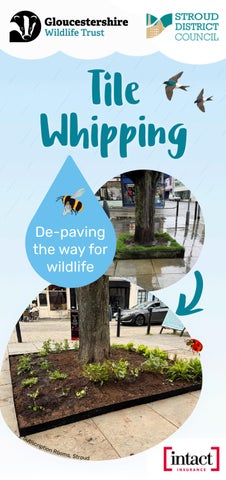
Tile Whipping De-paving the way for wildlife
Su
bs
c rip
tio n
Roo
m s, S
tro u d
What is ‘Tile Whipping’? ‘Tile whipping’ is more commonly known as de-paving. This is when hard surfaces, like tarmac or paving slabs, are removed and exchanged for natural surfaces that rainwater can drain into.
How does it help? Creates habitat for wildlife Helping nature, especially pollinator species, to move between habitats such as farmland and gardens.
Less flooding as water can drain into the soil, which removes pollutants so clean water will drain into our water courses. Reduces temperatures in urban areas as planted areas, especially with trees, reduce temperatures up to 20°c.
Quick FAQ Is there guidance on how to get involved? We have a full process document on our webpage which explains each step and you can ask us for advice. I’m outside the area but want to join in If you aren’t in the map area but want to join in, you can take your rubble to your local ‘Household Recycling Centre’ but you must pre-book online at: forms.gloucestershire.gov.uk/ HRC_CarBooking I can’t get involved, but my community space can, can you help? Yes, we can help community centres and areas with planning, removing surfaces and planting them up. Get in touch using the details on the back.
© NK Teg
elwippen
Upcycle your lifted bricks for things like this spiral herb garden
How easy is it? Lots of household patios are laid on sand, especially old ones, so it can be quite easy to remove tiles like this and dig 10cm down to plant new plants.
New ‘Tile Whipping’ Gloucestershire Wildlife Trust and Stroud District Council have partnered up to offer free collection of removed paving or hard surfacing so you can whip some tiles at home! For the first year of this campaign this free collection is across Stroud, and neighbouring villages and towns (anywhere inside the red boundary line on the map). Removing one brick or slab still makes a big difference... Planting just one plant will help passing pollinators to feed and keep going. © Gillian Day
Convert your driveway from tiles to gravel to provide habitat for spiders and insects which blue tits feed on! © John Bridges
Wildlife like hedgehogs and blackbirds feed on worms but they can’t reach them if they’re under slabs or tarmac.
campaign
Limit ed of fe Sign up no r! w to en sure your spot To see a bigger version, scan the QR code.
Sign up to take part Please sign up with Gloucestershire Wildlife Trust to see if you qualify for free collection of your hard surfaces, open until 31 July 2026. Collections will be 1 September to 16 October 2026. More information about collection online. Fill in the online form using the QR code or webpage below.
Scan here
to sign up and get involved gloucestershirewildlifetrust.co.uk /depaving
Stroud and Tewkesbury Waterscapes Project This project by Gloucestershire Wildlife Trust is being supported by founding partner Intact Insurance, and partners Gloucestershire County Council and the Environment Agency, to implement Nature-Based Solutions across Stroud and Tewkesbury to reduce flooding. Through work like de-paving, rain gardens, and green roofs, we are slowing the flow of water while creating new habitats for wildlife. Learn more about the project by visiting our website and search ‘waterscapes’.
Scan here
Sign up today & get involved gloucestershirewildlifetrust.co.uk /depaving Robinswood Hill Country Park, Reservoir Road, Gloucester, GL4 6SX. Tel : 01452 383333 www.gloucestershirewildlifetrust.co.uk info@gloucestershirewildlifetrust.co.uk Gloucestershire Wildlife Trust Registered Charity Number 232580