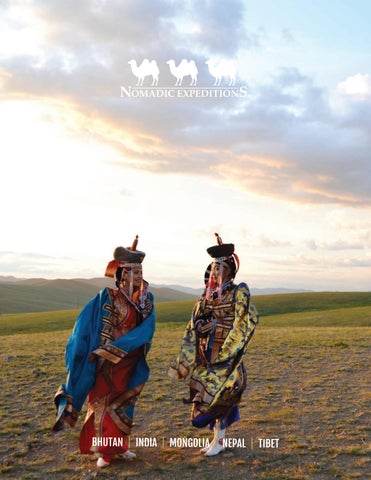
BHUTAN | INDIA | MONGOLIA | NEPAL | TIBET
DEAR ADVENTURER, Why just travel when you can undertake an unforgettable adventure? That very sentiment is why I founded Nomadic Expeditions in 1992. Back then, we were a boutique outfitter sharing the wild beauty of Mongolia with travelers from the West. It was the first time Mongolia was open to the outside world and it was, and continues to be, my greatest honor to introduce my ancestral homeland to so many people from around the world. Over the years, Nomadic Expeditions has expanded to include similarly remote but riveting destinations. Today, we design off-thebeaten-path journeys to Bhutan, India, Nepal, and Tibet. While each place has its own distinct style, our adventures go so much deeper than simply ticking off a list of must-see sites. Instead, you’ll be taking in the heady scent of a spice market, watching as a weaver expertly spins her thread, or nuzzling the soft forehead of a horse and witnessing the intimate connection between animal and human. True travel isn’t about seeing things—it’s about feeling them. It’s our raison d’être to design journeys that appeal to all of your senses and provide a window into fascinating countries and cultures we visit. Join us on the path less traveled!
Jalsa Urubshurow Founder and CEO
CONTENTS
Thar Desert, India
4 Why Nomadic Expeditions
MONGOLIA
6 Enriching Lives and Making a Difference
14 Destination: Mongolia
8
Media Productions and Special Events
10 How to Explore with Us: Small Group and Private Journeys 12 How to Explore with Us: Family Travel and Ultima Thule
16 The Gobi Desert 17
Western Mongolia
20 Northern Mongolia 22 Karakorum and Central Mongolia
INDIA
BHUTAN
NEPAL
32 Destination: India
46 Destination: Bhutan
66 Destination: Nepal
34 Northern India
48 Western Bhutan
68 Kathmandu
36 Southern India
50 Central Bhutan
70 Annapurna Region
38 Wild India: Central
52 Eastern Bhutan
72 Everest
54 Festivals of Bhutan
74 Festivals of Nepal
TIBET
ABOUT US
56 Destination: Tibet
76 Contact Us
24 Festivals of Mongolia
40 Hidden India: Northeast
26 Nomadic Expeditions’ own Three Camel Lodge
42 Trekking India: Ladakh and Sikkim
30 Nomadic Expeditions’ own Three Eagle Camp
44 Festivals of India
58 Central Tibet 60 Western Tibet 62 Everest 64 Festivals of Tibet
2
3
Why Travel with Nomadic Expeditions?
Monks, Bhutan
Yol Valley, Mongolia
OUR EXPERIENCE We are pioneers of adventure travel. Following the collapse of Communism, our founder Jalsa Urubshurow, a Kalmyk Mongolian-American, was asked by the first postdemocratic Prime Minister of Mongolia to promote the nation and its enchanting people. We were the first to bring travelers from the West to Mongolia, taking a relatively unknown destination and bringing it into the international spotlight. In India, we mapped trekking routes that are now the most popular routes in Ladakh. We did the first descent of the Brahamaputra River, filmed for the BBC series, Classic Journeys, and built the first eco-friendly houseboat using solar power and septic tanks to ply the canals of Kerala. 4
We also pioneered travel to Arunachal Pradesh and Assam in Northeast India.
Our Three Camel Lodge is one of the world’s best eco-lodges.
In 1976, we brought the first Western trekkers to Bhutan, and in 2001, led the first Western travelers on an overland journey from Kunming to Lhasa along the Tsangpo River in TIbet.
We own and operate Three Camel Lodge, an awardwinning luxury eco-lodge in the Gobi. The brainchild of Jalsa Urubshurow, the son of a Mongolian carpenter, the Lodge was built with a 100 percent commitment to authenticity while offering an elevated take on the traditional nomadic lifestyle.
We are the authority on luxury adventure travel. We are honored to be recognized as one of the world’s leading authorities on luxury adventure travel. We’re honored to have earned top industry awards and recognition, from Condé Nast Traveler’s Top Specialists List, Travel + Leisure’s A List, and Wendy Perrin’s WOW List. Our journeys have been chronicled for nearly every major publication in the United States, United Kingdom and other countries.
Our journeys are enriching, educational experiences unlike any other. We believe in the transformative power of travel. All of our trips are designed to incorporate immersive experiences with memorable encounters. We have spent nearly five decades gaining insight and expertise in the destinations in which we
operate, and we know what to expect and how to handle the unexpected. Of course, knowing these places is only half of the picture–it’s the network we have built over the years that truly sets us apart. Our guides are the most knowledgeable and experienced and our incountry network of the best and the brightest helps us gain access to people and places that others simply cannot go.
OUR PARTNERSHIPS AND CLIENTS Nomadic Expeditions is a trusted partner for prestigious organizations around the world. We’ve partnered with leading nonprofits, including the World Wildlife Fund, to provide access to cutting-edge research to travelers while financially
supporting their valuable work. We don’t just donate money— we get intimately involved. Our commitment to conservation is exemplified by our Quest for the Snow Leopard journey, designed in conjunction with the field biologists of World Wildlife Fund-Mongolia. Their researchers teamed up with our travelers, providing a fascinating look at these elusive creatures. One hundred percent of the proceeds from this trip were donated to WWF’s Mongolia research project.
Our clients are some of the world’s most prestigious and respected organizations. Harvard University, Stanford University, Massachusetts Institute of Technology, and Princeton University are just a few of the revered institutions who turn to us to design meaningful journeys for their communities. We
Prayer Wheels, Nepal
also work with National Geographic Expeditions, The Peregrine Fund, The Nature Conservancy, Denver Sister Cities International, Raymond M. Alf Museum of Paleontology, the American Harvard University Museum of Natural History, Young Presidents Organization and Chief Executives Organization and the American Harvard University Museum of Natural History. We are equally proud to work with curious, adventure-seeking individual travelers. 5
OUR COMMITMENT TO SUSTAINABILITY
MAKING A DIFFERENCE We take a holistic approach to sustainability, as it goes far beyond protecting the planet.
Enriching lives. Protecting Places. Long before it was a buzzword, we pioneered sustainable travel to Mongolia. When we expanded to include other destinations, our core business and values remained the same: respect for the land, its people, and their cherished traditions. Travel can be a force for good and by partnering with nonprofits, NGOs, and locals to support traditional arts, environmental education, and community development initiatives, we strive to make a positive impact. These beliefs are at the very heart of what we do in all of our destinations. We tread lightly and work tirelessly to protect and preserve precious ecosystems, wildlife, and ancient cultures.
Cultural Preservation We co-founded the Golden Eagle Festival in the Altai region of Mongolia in 1999 and continue to support this annual event and competition. The Golden Eagle Festival helps to preserve and spotlight the traditional culture of Mongolia’s Kazakh hunters. Wildlife We partnered with the Wildlife Science and Conservation Center of Mongolia and the Peregrine Fund in 2020 by creating and funding a five-year field research project on golden eagle conservation using citizen science. We have been a supporter of the Captain Planet Foundation for decades. Their mission to enable young people to become environmental stewards aligns with our core values. Young Performers, Gobi Desert
OUR COMMITMENT TO PEOPLE
at local universities, provided a helping hand to farmers during difficult times, and more.
We support the communities in which we operate.
We empower locals.
One of our core values is making a positive impact on the places and people we visit and our practices have made a difference. Rather than making a decision ourselves, we choose to work with locals to best determine their needs. We’ve endowed arts programs, supported local schools and developed sports programs, financed scholarships for study 6
Unlike many other travel companies who hire locals for lower-level work and bring in European or American leaders, Nomadic Expeditions is a model of empowerment. Our leaders are native to the destinations in which we operate. We believe that locals are the best ambassadors of their countries and have valuable experience and insight to share with visitors etc. In addition to paying the most competitive wages, we provide training and education
Arts and Education We have supported the Arts Council of Mongolia for over two decades, helping to raise awareness of Mongolia’s distinct art forms. From endowing programs to sending young musicians abroad to perform at the International Children’s Music Festival in Ankara, Turkey, to bringing artists to perform at our Three Camel Lodge, we believe in the power of our creative heritage.
to our staff in order to be able to promote from within. Buyandelger, our In-Country Director of Mongolia, started his career with us as a waiter at Three Camel Lodge. His passion for outdoor adventure led him to become one of our most experienced tour leaders, eventually designing some of our most logistically challenging and one-of-a-kind trips. Today, as In-Country Director, he oversees all ground operations in Mongolia.
Education is the most powerful tool for change. We have sponsored scholarships at leading universities and educational organizations across our destinations, focusing on wildlife preservations, the study of paleontology, and more. We also support the work of the renowned Explorers Club, a multidisciplinary society headquartered in New York City that is dedicated to supporting field research and education in the sciences. Health and Well-Being Sometimes it’s as simple as extending a hand to a farmer needing hay during an especially difficult winter. Other times, it’s supplying the local hospital in Ulaanbaatar with necessary medical equipment. Close to home in the United States, we support the Cystic Fibrosis Foundation and the Children’s Tumor Foundation. Golden Eagle, Mongolia
7
MEDIA PRODUCTION AND SPECIAL EVENTS Remote and rugged, our destinations lend themselves to backdrops for films, marketing campaigns, and once-in-a-lifetime special events. Nomadic Expeditions has planned and provided logistical support for a wide range of projects for a diverse list of clients. From documentary films and fashion photo shoots to ad campaigns for luxury brands, we combine our extensive destination knowledge with our network of in-destination experts to deliver a perfectly executed experience.
SPECIAL PROJECTS
We thrive on managing the details
We have been honored to
so you can focus on your goals.
work on a number of special FILM & MEDIA
projects.
• Expeditions for IMAX and National Geographic Television production crews • Media production excursions for print and online publications • Aerial filming production and projects requiring helicopter transportation
ADVERTISING • New vehicle launch campaigns such as the first overland expedition for Land Rover North America. • On-location production and logistics services for luxury brand advertising campaigns, including Infiniti, Mumm Champagne, and Stefano Ricci.
EDUCATION
One memorable project was the Compassionate Leadership Summit. Together with the University of Wisconsin, we designed a leadership summit with young leaders from around the world to meet with His Holiness The Dalai Lama in Dharamsala. It was an inspiring project to bring together these bright young people from around the world to better understand The Dalai Lama’s message of hope and kindness. Other special projects have included solar eclipse journeys for groups of over 200 travelers, as well as logistical planning and support for international rallies and marathons.
• Scientific expeditions, including dinosaur fossil excavations and wildlife surveys, for prestigious universities.
Private Camping/ Dining Mongolia
• Birding trips to spot Central Asian rarities and endemics • International and local nonprofit environmental study tours
MEETINGS AND INCENTIVES Board meetings, conferences, and incentive trips for Fortune 500 companies
MILESTONES • Weddings • Anniversary and Birthday Galas • Special Celebrations
Moltsog Els, Gobi 8
Private Camping/ Dining Mongolia
9
How to Explore with Us Three Camel Lodge
Rajasthan, India
SMALL GROUP JOURNEYS
PRIVATE JOURNEYS
Join one of our set itineraries, explore a new destination and make new friends.
Whether you want to deviate from one of our small group journeys or simply want to travel alone, our private journeys are tailored for your specific interests. We have designed private journeys for solo travelers as well as trips for groups with 50+ members.
How you travel is almost as important as where you go. Our small group journeys appeal to travelers seeking the opportunity to experience the best of a destination with an eye for the best value. Our group journeys feature regularly scheduled departures and are guaranteed to operate with as few as two participants. In order to ensure the level of quality we pride ourselves on, we limit all small group journeys to 14 participants, allowing us to give clients the individualized attention and service they deserve. There’s no getting lost in the crowd, as can happen with larger groups. Similar to our private journeys, all small group journeys are led by an English-speaking local guide who has access to our broad network of in-destination experts. Enjoy the comfort of knowing you’re in the best hands and make new friends from around the world.
We design trips with your interests in mind.
Gobi Desert
ACTIVE AND OFF-ROAD ADVENTURES
access to museums and institutions, and create
Whether you want to ride horseback to visit the remote village of nomadic reindeer herders in Mongolia, trek to Everest base camp in Nepal, or track wildlife with a field biologist in India, you want to travel in the spirit of the legendary explorers. We design active adventures for travelers seeking something off-the-beaten path—quite literally, as many of our adventures require off-road vehicles for an added boost of adrenaline.
locals. Imagine learning the ancient art of block
unforgettable opportunities to get to know printing in Rajasthani or enjoying a private sitar concert in the holy city of Varanasi. How about spending time with a Mongolian family at their ger, learning more about their nomadic lifestyle or watching in wonder as textiles are woven by hand in Bhutan.
SPECIAL INTERESTS We design interest-specific adventures for solo
10
CULTURAL ADVENTURES
travelers, small groups, and organizations. For
Lifelong learners who appreciate art, music, history and culture seek adventures where they are able to fully immerse themselves in our destinations. For these travelers, we design journeys around renowned festivals and cultural attractions, provide unprecedented
travelers with a passion for photography, we’ve curated itineraries designed to capture oncein-a-lifetime photos. We’ve also designed trips for wildlife and birding enthusiasts, as well as historic adventures focused on paleontology and archaeology, and the arts.
11
ULTIMA THULE What does it mean to be a true explorer? Is it to follow in the steps of others or chart your own path? Ultima Thule means “region beyond the map.” It’s the pinnacle of exploration–to go where others have not gone. It’s also what we call our bespoke, one of a kind and once-in-a-lifetime experiences, designed for clients seeking to push the limits of adventure travel and exploration. Ultima Thule expeditions are far from off the shelf. Instead, these journeys allow us to use our creativity, destination knowledge, and network to design something completely new and extraordinary. One adventurous client sought to fully explore India, so we designed a 98-day journey across Rajasthan that kept him inspired and challenged with new experiences every single day. Another group sought a driving adventure unlike anything else. We charted a 5,000 km journey across Mongolia into China with vintage luxury cars. Modeled after a safari with nights spent in field camps, by day, it was an adrenaline-filled journey speeding across the most remote parts of the country in 1929 Bentleys.
Kham, Tibet
If you had no limits, where would you go and what would you do? What will we create for you?
FAMILY TRAVEL
12
There are few things more precious than time spent with the ones you love. Whether it’s the family you’re born into or the family you choose, we chase every possible minute to spend with our loved ones. However, despite our best intentions, our days, and schedules, are full of distractions, but travel provides the perfect off-ramp. Nothing brings people together quite like sharing a new experience together and our destinations offer something beyond the typical family trip.
Traveling with my boys
Whether you’re traveling with little ones, teens, or adult children, we will design an itinerary that appeals to all ages and interests. Seeking something different for spring break? Bhutan is an ideal location for March travel. Winter break is the perfect time to visit Southern and Northern India, while Mongolia, Tibet and Ladakh are best in the summer.
that the family that travels
and my parents and experiencing new cultures through the lenses of multiple generations was a true gift. Eyes, hearts, and minds were opened wider and the memories are richer. Plus, I truly believe together, stays together.” — KIM GRACE KIECKHEFER
Kanchenjunga, Sikkim
13
DESTINATION
Mongolia
ULGI
to region. Most journeys begin in Ulaanbaatar, a bustling city in Central Mongolia with a curious blend of past and present. In addition to Central Mongolia’s natural wonders, there are many historical sites here, particularly in the Orkhon River Valley, home to archaeological remains dating back several centuries. Few traces remain of Karakorum, the 13th-century capital of the Mongol Empire, but the nearby temple of Erdene Zuu was reputedly built from its ruins. Northern Mongolia, bordering Siberia, is home to pristine Lake Hovsgol, known as Mongolia’s “dark blue pearl.” The country’s deepest freshwater lake is surrounded by dozens of small rivers and streams that empty into its waters, pristine taiga forest, and valleys and meadows rich with wildflowers.Northern Mongolia is also home to the nomadic Tsaatan, members of a small Tuvan ethnic group who have herded domesticated reindeer for centuries. The culture has changed little since the Ice Age. Western Mongolia is a place of unspoiled wilderness, where the snow-capped Altai Mountains tower above remote forests, lakes, and rivers. Teeming with wildlife, including endangered snow leopards and antelope, this region contains the most impressive mountain scenery and is a prime destination for adventurous climbers and hikers. It’s home to some of the most fascinating cultures, including the Kazakhs. Their longstanding tradition of hunting with golden eagles is celebrated annually at the renowned Golden Eagle Festival.
ULAANBAATAR
KARAKORUM
GOBI DESERT
Bayan-Ulgii, West Mongolia
Mongolia is a place of untouched beauty. This wild land is defined by its rugged terrain and fascinating culture rooted in ancient traditions. It is also a place that varies from region
LAKE HOVSGOL
Sands,” for the sound emitted when the wind blows. Tugrugiin Shiree is best known for its famous fossil find, the “Fighting Dinosaurs,” which contains the skeletal remains of a protoceratops and velociraptor locked in deadly combat. Of course, perhaps most famous are the Flaming Cliffs. Dr. Roy Chapman Andrews of the American Museum of Natural History gave them this moniker because of their brilliant orange glow at sunrise and sunset.
QUICK FACTS Time to Visit Best Apr – Nov
Weather 50° – 80°F Elevation 5,180 ft. Capital Ulaanbaatar
Mongolia is vastness. It is a place where silence has sound, and the sky stretches into eternity.”
Airport Ulaanbaatar (UBN) Language Mongolian Currency Tögrög
— ISABELLA TREE
Southern Mongolia is synonymous with the magnificent Gobi Desert, home to our award-winning Three Camel Lodge. Visit Mongolia’s magnificent sand dunes at Hongoryn Els, also known as “The Singing
14
15
THE GOBI DESERT Adventure and culture enthusiasts will find the Gobi rich in treasures and an unforgettable array of captivating landscapes. While many assume the Gobi is covered entirely in sand dunes, the landscape is incredibly diverse. Trek through the flower-filled meadows of Yol Valley National Park, a land dominated by hidden mountain springs, isolated forests, and canyons where ibex roam among prehistoric rocks paintings. The most magnificent dunes are to be found at Hongoryn Els, known as the “Singing Sands’’ because of the sound emitted when the wind blows. Explore the dramatic Flaming Cliffs, named for their orange glow at sunrise and sunset. This site is more than stunning—it’s also where the world’s first discovery of a nest of dinosaur eggs took place, and it remains a rich paleontological site today. Another unique feature of the Gobi is the nomadic lifestyle, and travelers are given the opportunity to visit a nomadic family in their ger and experience this centuries-old lifestyle firsthand. Nomadic Expeditions’ Three Camel Lodge is located in the Gobi. This award-winning eco-lodge offers an elevated take on the traditional nomadic lifestyle.
16
17
WESTERN MONGOLIA The westernmost region of Mongolia is rugged and remote. One of the last untouched wilderness areas in Asia, it’s home to Mongolia’s highest mountains, the Altai Mountains, with several reaching upwards of 14,000 feet. Highlights include hiking through the foothills of Tsambagarav Mountain, exploring the forests of Maraat Valley, and visiting peaceful Tolbo Lake. Of course, this region is perhaps most famous as the home of the Kazakh eagle hunters, famed for their tradition of hunting with golden eagles and renowned for producing colorful textiles. Whether visiting during the Golden Eagle Festival or another time, travelers will cherish the experience of interacting with these fascinating nomads who have preserved their rich culture. Nomadic Expedition’s own Three Eagle Camp is located here, at the foot of the majestic Tsambagarav Mountain, a permanent snow-capped peak that stands at 13,783 ft. Comprised of traditional ger suites with ensuite bathrooms, the camp is surrounded by the Altai Mountains.
Kazakh Falconer
18
Kazakh Ger
Tolbo Lake/Altai Mountains
19
NORTHERN MONGOLIA Northern Mongolia is defined by its pristine mountains, meadows, and endless expanses of breathtaking scenery. From hiking and biking to kayaking, horseback riding, and fishing, it’s a region well known for its outdoor pursuits. A highlight of any visit to the north is Lake Hovsgol, believed by scientists to be the cleanest freshwater lake in the world. Also in the north, curious travelers will want to seek out the rugged adventure and cultural interaction of a visit to the Tsaatan. These nomadic farmers, who live in the remotest stretch of the north, herd domesticated reindeer. Visiting these families feels like a step back in time in the serene mountain setting.
Lake Hovsgol
Reindeer Hunter
Lake Hovsgol
20
21
Orkhon Valley
KARAKORUM Located in central Mongolia in the Orkhon River Valley, a UNESCO World Heritage Site, Karakorum is one of Mongolia’s most treasured sites. This mystical place is the site of the 13th century capital of the Mongol Empire, once the largest in the world founded by native son, Genghis Khan. Karakorum is not revered simply for its historical importance—it is considered an enlightened place and is home to Mongolia’s largest Buddhist monastery, Erdene Zuu. Erdene Zuu is believed to be constructed from the ruins of the ancient capital and despite Communism’s total destruction of many of the country’s monasteries, Erdene Zuu was spared that fate. It is not simply a landmark, as it continues to serve today as the most important monastery in Mongolia and a guiding force for Buddhism’s resurgence.
Erdene Zuu Monastery
Erdene Zuu Monastery 22
23
FESTIVALS OF MONGOLIA
Naadam Festival July 11-13 in the capital; countryside events held throughout summer Naadam, Mongolia’s national games, is a time of great celebration. Held in the capital and in the countryside, these annual summer games are a time when family and friends get together to celebrate the short summer season. It’s also a time of fierce competition, as Naadam consists of three age-old sports—wrestling, horse racing, and archery. Traditionally used to measure the courage and strength of nomads and warriors, contemporary Naadam games showcase the abilities of local men, women, boys, and girls.
The Golden Eagle Festival First weekend of October Co-founded in 1999 by Nomadic Expeditions’ own Jalsa Urubshurow, the Golden Eagle Festival is now Mongolia’s second most popular festival. The heart-thumping, eye-catching festival was established to help preserve and celebrate the Kazakhs’ centuries-old tradition of hunting with golden eagles, a practice recognized by UNESCO as part of the intangible cultural heritage of humanity. It was founded at a time when no more than 20 falconers were actively practicing in the Ulgii province. Today, there are more than 300-400 falconers. The festival has revitalized pride in unique local traditions and supports many locals who earn income from providing various tourism services, ranging from transportation to local hotels. The festival is a two-day event held each October in western Mongolia’s Bayan Ulgii Province. This vast, rugged landscape is dominated by the country’s largest mountains and is also where the Kazakhs make their home. The festival features competitions testing speed, agility, and accuracy, while ceremonies, dance performances, a parade, and a Kazakh play are also part of the event. All proceeds benefit the Kazakh Falconry Association, which organizes the festival and is responsible for its operation.
24
25
THREE CAMEL LODGE, GOBI Nestled in the southern stretch of the Gobi on the edge of Gobi Gurvansaikhan National Park, Three Camel Lodge is a place of blissful quietude. Our award-winning eco lodge was opened in 2002, after careful consideration for the preservation of the Gobi’s delicate environment, culture, and people. Conceived by our founder, Jalsa Urubshurow, it was built entirely by locals, using indigenous materials, and in accordance with Buddhist canons of soum style—without the use of a single nail in its roof. The Lodge was designed to offer an elevated take on the traditional nomadic lifestyle. Comprised of an outcropping of 40 gers, or traditional felt and canvas tents used by Mongolian nomads, shares a distinctive pride of place with hand-carved and hand-painted furnishings and décor. Each ger features a private, ensuite bathroom crafted entirely of stone. The main lodge, designed to resemble a Buddhist temple, is home to the Thirsty Camel Bar. Expect five-star dining at our restaurant or enjoy relaxing treatments in our spa. Unforgettable adventures await just outside our door but it is the vast expanse of desert and the nighttime sky filled with a million twinkling stars that will leave a lasting imprint. A founding member of the Beyond Green partnership of sustainable resorts, the ecolodge stands among the most distinguished collection of hotels, lodges, inns, and resorts located in extraordinary places—offering exclusive and unique experiences and sharing the utmost dedication to high-quality service and sustainable tourism practices
Three Camel Lodge isn’t just a place to stay. It’s a state of mind. 26
27
28
29
THREE EAGLE CAMP Three Eagle Camp is situated at the foot of the majestic Tsambagarav Mountain, a permanent snow-capped peak that stands at 13,783 ft. The area is also home to the Kazakh and Uuld people who have lived in this region for centuries practicing Kazakh falconry, a tradition passed down for over a millennium. Our traditional Mongolian ger suites provide a comfortable home during your stay, complete with ensuite bathrooms and cozy wood stoves. You’ll dine in a restaurant ger that doubles as a lounge, where you can unwind and take in the stunning surroundings. Surrounded by the breathtaking Altai Mountains, you will witness the stunning natural beauty of Mongolia, enjoy hiking and horseback riding, and interact with local families. You’ll find yourself stepping into a living tapestry of culture and tradition, kept alive through the ages. Witness the stoic beauty of Mongolia and allow ancient traditions to shape your understanding of this vast, untamed land.
30
31
LADAKH
DESTINATION
DELHI
India
RAJASTHAN
SIKKIM
NORTHEAST
MUMBAI
Rajasthan
TAMIL NADU
India is a mystical land with so much to explore. It is a place of astonishing diversity, with fascinating culture and history across its many regions. Whether you’re a first-time visitor or you’re a return traveler, there is always something new. Ladakh, rich in Tibetan culture, is an outdoor enthusiast’s paradise, with scenic and challenging trekking through the Himalaya range, as well as thrilling river rafting. For panoramic views of the Himalayan snow-capped peaks, don’t miss an unforgettable experience in Sikkim, where two days of hiking gets you up close to a 28,000 ft. peak. Hike along a ridge opposite Kanchenjunga, the third highest peak in the world, or take a wilderness trek for a backcountry adventure. North India is home to the imperial cities of Delhi, Jaipur, and Agra and iconic sites such as the Taj Mahal, Varanasi, the oldest city in India, and the “pink city” of Jaipur. Wander the stunning palaces, forts, and ancient temples of these thriving cities, then take a step back in time with a camel safari and a visit to the tribal village of Jamba. Africa may steal the spotlight when it comes to wildlife encounters, but in India you can see the majestic tiger in a number of preserves across north, central, and south India, or visit Hemis in the North in winter for a chance to see the elusive snow leopard. Meanwhile, South India is home to Kerala, famed for its luxury houseboats plying the river. Explore ancient temples, walk the pristine beaches of the Bay of Bengal and the Arabian 32
Sea, and experience the Dravidian culture in the country’s south. Finally, Northeast India is the remotest region, where you’ll travel through rain forests with vistas of snowcapped mountains, or climb aboard a jeep for a once-in-a-lifetime safari in Kaziranga National Park.
So far as I am able to judge, nothing has been left undone, either by man or nature, to make India the most extraordinary country the sun visits on his rounds.” — MARK TWAIN
KERALA
QUICK FACTS Time to Visit Best Year-round
Capital Delhi Airport Delhi (DEL) Mumbai (BOM) Chennai (MAA)
Language Hindi, English Currency Indian Rupee 33
NORTH INDIA Come to North India in winter or late fall to experience this region in all of its glory. This is the India of postcards. It’s home to the imperial cities of Delhi, the “pink city” of Jaipur, and Agra, with its iconic Taj Mahal (best seen at sunrise and sunset). Grand palaces and forts await exploration in Udaipur, Jaipur, and Jodhpur, while the ancient Buddhist carvings and murals of Ajanta and Ellora caves and the millenniumold temples at Khajuraho inspire and enchant. Ancient wonders abound in the north, where the country’s oldest, and holiest, city of Varanasi beckons. Take a sunrise or sunset boat cruise on the River Ganges in this mystical and beautiful place. Dharamsala, home of the HH Dalai Lama, is also here in North India. Visit the desert cities of Jaisalmer, Bikaner, and Jodhpur and enjoy a camel safari in the Thar desert. Speaking of camels, the north is the site of the annual Pushkar Camel Fair, a unique event where over 100,000 camels, horses, and cattle gather for ten days. Held in October or November based on the lunar calendar, it’s a sight to be seen.
34
35
SOUTH INDIA Best visited in January and February, and again in November and December, South India is both scenic and distinctly Indian. Unlike the north, which has been influenced by invasions, the south retains its unique culture. See and explore the Dravidian culture here, and visit ancient temples and palaces in Trichy, Mahabalipuram, and Madurai. Walk the pristine beaches of the Bay of Bengal and the Arabian Sea. The region is also a center for textiles and theater. Ayurveda was founded here, and Zen seekers flock to the region to take advantage of its many spas and yoga retreats. Those who find peace on the water find serenity in the many houseboats that ply the canals of Kerala, a popular resort in the south.
Marari Beach, Kerala
It’s also a prime spot for wildlife enthusiasts, with tiger preserves located at Nagarhole/Bandipur and Nagarhole.
Meenakshi Temple, Madurai
Mahabalipuram Temple
36
37
WILD INDIA This is the India of Rudyard Kipling’s The Jungle Books. Intoxicating and pristine, it’s a wildlife lover’s paradise. Come in winter to spot snow leopard, while late spring is best for tiger and other wildlife spotting. Though the weather is hotter during this time, animal spotting is typically better. You won’t soon forget the experience of seeing an endangered animal in the wild. The region’s Kanha and Bandavgarh National Parks are two of the premier parks for tiger sightings; Kaziranga National Park is home to nearly two-thirds of the world’s population of greater one-horned rhinos; and Hemis National Park counts 4,000-6,000 snow leopards. Spot these stunning creatures, along with bears and elephants, on private safari excursions into the parks.
38
39
MV Mahabaabahu, Brahmaputra River
HIDDEN INDIA – NORTHEAST This area is the remotest in all of India, with some regions still closed to travelers. It’s an ideal destination in early winter or late fall for those travelers who have visited the other regions and are looking for something completely different. Travel through rain forests with vistas of snow-capped mountains. Home to 21 different tribes, the Northeast region is where the Buddhist monastery of Tawang is located. The birthplace of the 6th Dalai Lama, it’s also where the current Dalai Lama escaped to when he fled China.
Arunachal Pradesh
This region isn’t just limited to thrilling cultural exploration. It’s also a prime spot for nature lovers who will enjoy game viewing by jeep or taking a luxury cruise on the Brahamaputra River.
Tawang Monastery
Naga Tribals
Mishmi Tribal 40
41
TREKKING INDIA – SIKKIM Spring and fall are ideal time of year to visit Sikkim for trekking. This is a land of panoramic views of the Himalaya snow caps and hills covered in a kaleidoscope of 13 colors of rhododendron, come springtime. It is also a place with a rich Tibetan Buddhist culture.
Tso Morari Lake
This region is one of the most scenic in all of India, one of the many reasons the hill stations of Kalimpong and Darjeeling were established here. From Darjeeling’s Tiger Hill it’s possible to see Everest, Makalu, and Kanchenjunga—three of the five highest peaks in the world. Sit back and sip Darjeeling tea while watching the sunset over the mountains. Trekking in this region is some of the best available. Here, within two days of hiking, travelers get up close to a 28,000 ft peak. There is also the opportunity to hike along a ridge opposite Kanchenjunga, the third highest peak in the world. Trek routes are from 3 to 14 days and wilderness treks are available for those seeking more adventure.
TREKKING INDIA – LADAKH June through September is the optimal time to visit Ladakh, a fascinating place with rich Tibetan culture. The trekking is spectacular too, with few hikers in the region making the unspoiled setting that much more enjoyable. Scenic, mountainscape, 4 to 18 day treks, hiking over a 17,000 foot pass (views of the Karokaram Range)
Camp below Mt. Pandim
South face of Kanchenjunga
Visit Alchi monastery, with its 10th and 11th-century painting, and see Tso Morari Lake, a saltwater lake at 14,000 feet. Bird lovers visit the region just to spot the migratory black-necked crane. In summer, Buddhist Cham Festivals are held at various monasteries, with Hemis (June) being the largest and most important of all of the festivals. Give your legs a rest with a raft trip on the Indus River through a beautiful gorge to the confluence of the Zanskar River. Ideal for first timers, the rapids are grades 1 and 2. Kyi Monastery, Spiti 42
43
FESTIVALS OF INDIA Holi Timed to mark the beginning of spring, Holi is known the world over for its explosion of color. The twoday celebration is typically held in late February or early March. Bonfires kick off the festivities, symbolizing the burning of evil spirits, and the tossing of bright colored water and powder is a joyous event.
Diwali Diwali is a five-day festival of light, usually held in October or November (depending on the lunar calendar). It is celebrated by lighting diyas, or small lamps filled with oil. While each region celebrates additional aspects (the North celebrates the homecoming of Rama while the South marks Krishna’s defeat of the demon), it is largely a festival defined by good triumphing over evil.
Pushkar Camel Fair This unique event brings together 100,000 camels, horses, and cattle for ten days. Held in October or November based on the lunar calendar, it’s an annual tradition cherished for its auctions and celebrations.
44
45
DESTINATION
Bhutan
PUNAKHA PARO
THIMPU
BUMTHANG
PHOBJIKHA
QUICK FACTS Time to Visit Best Jan – May Paro Valley
Sept – Dec
Capital Thimphu Tucked high in the Himalaya bordering Tibet and India, Bhutan is about the size of Switzerland yet has a population of less than 800,000. Sheltered from the rest of the world until the 1960s, this serenely beautiful place remains protected yet far from backward. Indeed, industrial countries should look to Bhutan for direction, as this kingdom instituted a Gross National Happiness policy whereby the happiness of its people is vastly more important than its economic returns. Its emerald green valleys and towering, snow-capped peaks make it not only a stunning landscape, but a place of protection for abundant wildlife, including the endangered snow leopard and the golden langur. Whether you prefer hikes to ancient monasteries, more strenuous treks through the Himalayas, or relaxed strolls to browse the handiwork of local artisans and breathe in the heady aroma of exotic spices, a visit to Bhutan will leave a lasting impression.
46
‘Idyll’ was a word from which I was accustomed to recoil, yet truly I felt that there could be nothing lovelier than this peaceful windless valley, so innocent it did not know the meaning of the word.”
Airport Paro (PBH) Language Dzongkha
Currency Bhutanese Ngultrum
— PICO AYER (describing Paro Valley in "Falling off the Map.")
47
WESTERN BHUTAN Paro and Thimphu Monasteries and museums are part of the charm of Western Bhutan. Visit the world’s tallest Buddhist statue in Thimphu and delve into the artistry and history of textiles in this region’s many museums. Hike 2,000 feet to the iconic Taktsang Monastery, known as “Tiger’s Nest.” Perched atop a cliff and nestled into the mountainside, this monastery is the most recognizable sight in all of Bhutan.
Memorial Chorten
Taksang Monastery
Thimpu Valley Buddha
48
Masked Dancers
Thimpu Bazaar
49
CENTRAL BHUTAN Punakha and Phobjikha Valley Visit the enchanting Punakha Dzong built at the mesmerizing confluence of the Po Chu (Father) and Mo Chu (Mother) rivers. Witness the thrilling mask dances performed annually at festivities in temples and monasteries. By day, trek mountains and valleys where every step rewards you with breathtaking scenery, and by night, sleep beneath dazzling stars.
Kurjee Monastery
50
51
EASTERN BHUTAN Bumthang Region Explore timeless villages and rolling green valleys. Even in this sacred land, Bumthang is considered the holiest of valleys. It is also home to the Jambay Lhakhang Festival, one of Bhutan’s most colorful celebrations.
Nomadic Girls
Kurjee Monastery
Bumthang Road
Mandala Thangka
Young Monks 52
53
FESTIVALS OF BHUTAN Black-necked Crane Festival Tshechu Tshechu festivals are held across Bhutan in various monasteries. They vary in length from 3 to 5 days and include a variety of activities, including masked dance drama, folk dances, and a display of giant thangkas. These festivals are held in the spring or fall.
Black-necked Crane Festival is celebrated at the courtyard of Gangtey Goenpa, home to the largest population of the birds during the winter. Celebrated each year since 1998 on November 11, the festival was created to honor the arrival of the birds and mark the importance of conversation of this endangered species.
Jakar and Jambay Festivals Jakar Tshechu is held in Bumthang and is a five-day celebration held within the Jakar Dzong including masked dances and folk songs. Jambay Lakhang is a four-day festival in the oldest and most sacred temple in Bhutan, held annually in the fall. It is held in honor of Guru Rinpoche, responsible for founding Tibetan Buddhism and the temple. Perhaps its most awe-inspiring aspect is the fire dance, said to purify the earth of evil spirit and cleanse the spirits of those who pass through its fiery arch. 54
55
DESTINATION
Tibet MT. KAILASH LHASA EVEREST
QUICK FACTS Time to Visit Best May - June, Sept Holy Yamdruk Lake
In an isolated land cut off from the world for all but the last century, beauty and strangeness appear in equal measure. What causes our enduring fascination with Tibet, a high-desert plateau on the so-called “Roof of the World.” Surely its inaccessibility, mysterious gompas, lunar landscape and tenacious citizens transfix us. Beneath an often crystal-blue sky, the Tibetan exist in a world unlike ours. Their endurance has been tested both physically and spiritually. Yet despite the hardships of their daily lives, Tibetans remain good-humored and tolerant. Your encounters with these hardy people will leave you with a profound respect for a culture that binds men and women to the cosmos with such generosity of spirit. It is the combination of spectacular mountain scenery and a unique spiritual history that compels so many travelers to visit this remote and enigmatic place. Treks through valleys and grasslands to holy lakes and caves and the spectacular views of the snow-capped Himalayas are for many the highlights of any journey to Tibet.
This Himalayan wonderland is steeped in Tibetan Buddhism, introduced in Sanskrit from northern India and flourishing over the centuries —enduring despite the destruction of nearly all their beloved monasteries during China’s Cultural Revolution.
Capital Lhasa Airport Lhasa Gonggar (LXA) Language Tibetan and Mandarin Currency Yuan
The wind over the plateau carries more than dust — it carries the prayers of centuries.” — TIBETAN SAYING
56
57
Potala Palace
Tibetan Chorten with Mane´Wall Local Mural Painting
CENTRAL TIBET Ringed by mountains, Lhasa sits in as dramatic a location as any capital city on Earth, and its temples are among the most impressive in Asia. Jokhang Temple Monastery, the country’s most important spiritual center, draws a steady stream of visitors to its halls filled with exquisite Buddhist art. The Potala Palace, arguably Lhasa’s most famous landmark, is an aweinspiring 17th-century structure that served as the winter palace for generations of Dalai Lamas, while Samye, the first monastery in Tibet, was built in a remarkable mandala design. Spend time in Jokhang Temple, then wander the adjoining Barkhor Bazaar and join with Tibetan pilgrims as they ritually circumambulate the Barkhor and Jokhang koras. In Gyantse, stop to admire the historic Kumbum chorten. In Shigatse, visit the monastery at Tashilhunpo, home of the Panchen Lamas. The Panchen Lama is an important figure in Buddhism and is second only to the Dalai Lama.
58
59
WESTERN TIBET Western Tibet is a trekker’s paradise. Scenic short or long treks take hikers to beautiful monasteries accessible only by foot. Mt. Kailash is the highlight of a visit to this region. Mystical and steeped in ancient lore, it is sacred to many religions, especially in Tibetan Buddhism, which considers it the center of the universe. It is believed to be a link between heaven and earth and the majestic sight of this peak, where the snow never melts, is a sight to be seen.
Mount Kailash
60
Mount Shisapangma
61
EVEREST Everest. The single word carries so much weight. The tallest peak in the world, it is a mountain that has captivated, and claimed, many. The approach from Tibet is where the first climbing expeditions came after Peak 15 was identified as the highest peak (and later named Everest). Today, travelers can hike, mountain bike, and even overland drive to the base.
62
63
FESTIVALS OF TIBET Shoton
Losar This festival marks Tibetan New Year and is celebrated on the first day of the lunar calendar, typically in February or March. This festival is unique to Tibet, though other Asian cultures celebrate similarly. Offerings are shared, incense is burned, blessings are made, and families gather, all in an effort to bless the harvest and the beginning of the year.
Held at the end of June or the beginning of July, this arts and culture festival is focused on Tibetan opera. It is a colorful, joyous festival with outdoor performances and displays of art.
Saga Dawa
64
Held annually on the full moon day of the fourth lunar month (typically May or June),Sagadawa is the day attributed to the birth, enlightenment, and death of the Sakyamuni Buddha. It is celebrated across the Tibetan Buddhist world and is especially important at Mt. Kailash. Hiking the kora during Sagadawa is considered very auspicious, and travelers will encounter hundreds of pilgrims from all over the world.
65
DESTINATION
Nepal
MUSTANG POKHARA KATHMANDU
EVEREST
QUICK FACTS Best Time to Visit Sept – Nov En Route to Everest Base Camp
Feb – mid-Apr
Capital Kathmandu Bordering Tibet and India, Nepal is synonymous with the Himalaya. Here, the southern face of Everest dominates the surrounding Khumbu region, home to the renowned sherpas. This part of Nepal is legendary for its trekking experiences, rewarding travelers with several exquisitely beautiful valleys and meadows and Himalayan peaks of dizzying heights. Rising above them all is the “goddess” of all mountains, the colossal Everest. Reaching a stupendous 29,017 feet, the world’s tallest mountain exerts a powerfully magnetic pull. Indeed, for many an intrepid explorer, the lure of the summit has proved irresistible, even tragically so. From the Sherpa capital of Namche Bazaar to the amazing views of Everest from the 18,000-foot Kala Pattar, a Nepali trekking experience is truly rewarding, though it’s not just outdoor adventures to be had. Kathmandu, with its enchanting bazaars and historic sites, is a fascinating capital city.
Airport Tribhuvan (KTM) Something hidden. Go and find it. Go and look behind the Ranges Something lost behind the Ranges. Lost and waiting for you. Go!”
Language Nepalese Currency Nepalese Rupee
— RUDYARD KIPLING
Nepal, a soaring republic intertwined with the Himalaya, boasts eight of the world’s ten tallest mountains, drawing those captivated by the magnetic allure of rarefied peaks. 66
67
KATHMANDU This intoxicating city is far from just a pass-through on your way to the countryside. It’s an enthralling destination where you’ll be caught up in the hustle and bustle and mix of old and new worlds. Bargain for goods at the local bazaar, explore the city’s ancient temples, and visit a rug weaving center for Tibetan refugees. Before long, you’ll be caught up in the magic of this unusual city. Kathmandu, along with Patan and Bhaktapur are home to seven UNESCO World Heritage Sites that reflect the valley’s unique blend of Hindu and Buddhist traditions. Wander the medieval streets of Bhaktapur, once a royal city in the Malla dynasty, where the passage of time feels beautifully suspended. Known for its exquisitely preserved architecture and vibrant festivals, where every alley a tale of centuries past. Just across the Bagmati River lies Patan, or Lalitpur, a city revered for its artistic legacy and intricate metalwork. Stroll through Patan Durbar Square and marvel at ancient temples, palace courtyards, and local artisans at work.
Bodhnath Stupa Bhaktapur Temple
Other significant sites include the sacred Hindu temple of Pashupatinath, the Buddhist stupas of Swayambhunath (also known as the Monkey Temple) and Boudhanath, and the Changu Narayan temple, believed to be the oldest Hindu temple still in use in the valley. These sites collectively showcase the valley’s architectural brilliance and its spiritual legacy, making Kathmandu a vital cultural hub in South Asia.
68
69
MUSTANG Mustang itself is a land where the ancient and the modern coexist. The region is known for its unique Tibetan Buddhist culture, with stunning monasteries perched on cliffs and ancient caves carved into the rock. As you explore, you'll encounter colorful prayer flags fluttering in the wind and hear the soothing chants of monks, inviting you into a world of tranquility and spiritual reflection. The annual festivals celebrate this rich heritage, featuring vibrant processions, traditional music, and dance that embody the spirit of the people.
POKHARA Pokhara is a gateway to breathtaking treks through picturesque villages and terraced rice fields but also serves as the entry point to the mystical region of Mustang, a unique area steeped in rich culture and stunning landscapes. As you embark on your journey from Pokhara, you’ll find yourself winding through lush forests of rhododendron—the national flower of Nepal—before ascending the weathered stone staircases that lead you to higher altitudes. The trek reveals a tapestry of vibrant communities, each with their own traditions and stories. As you pass through quaint villages, you’ll encounter warm and welcoming locals, often engaged in their daily routines of farming or crafting. The fields are a patchwork of green and gold, with terraced rice paddies cascading down the hillsides, providing a glimpse into the agricultural heritage of the region. As you ascend, the landscape transforms dramatically. The lush greenery gives way to rocky trails and arid terrain, characteristic of the Tibetan Plateau. The air becomes thinner, and the views expand, revealing breathtaking panoramas of the Annapurna and Dhaulagiri ranges. Here, at altitudes above 10,000 feet, the rewards of your hard work become clear—snowcapped peaks rise majestically against a backdrop of deep blue skies, offering some of the most stunning vistas on Earth.
70
71
EVEREST Straddling the border between Tibet and its southerly neighbor, the Kingdom of Nepal, the world’s tallest mountains soar to the heavens, seemingly piercing the unimaginably blue sky. For the people of the Himalayan kingdoms, these mountains are sacred: for on their lofty heights dwell the gods and goddesses of Hinduism, Jainism, and Buddhism. In fact, the mountains themselves are considered manifestations of the deities. Rising above them all is the “goddess” of all mountains, the colossal Everest. Known as “Peak XV” by the early IndoBritish surveying team that established its summit as the world’s highest, the mountain was later named after Sir George Everest, head of the Great Trigonometrical Society. While this is the name most Westerners know, to Tibetans it is Chomolangma, or the “goddess mother of the universe,” while Nepalese call it Sagarmatha, or “the forehead of the sky.” Visit Namche Bazaar, the home base of the region’s famed sherpas, and trek to bask in the glory of the majestic south face in the Khumbu. It’s an adventure you won’t soon forget.
72
73
FESTIVALS OF NEPAL
Biska Jatra Typically held in April, Biska Jatra is one of the most colorful and spirited celebrations in the region. Held in Bhaktapur, Nepal to mark the Nepali New Year and honoring the god Bhairab and goddess Bhadrakali, it is characterized by lively processions, traditional music, and various cultural events. Biska Jatra is not just a celebration of the new year; it is also a time for communities to come together, honor their cultural heritage, and express gratitude for the past year. The festival’s rich rituals and lively atmosphere reflect the deep-rooted traditions of Bhaktapur, making it a cherished occasion for both locals and visitors alike.
Buddha Jayanti This event is held on the full moon based on the Buddhist lunar calendar, falling in May or April. Celebrated by Buddhists all over the world to mark the birth, awakening, and parinirvana of Siddhartha Gautama, or Lord Buddha, it is a day of reflection and honor. The three pivotal events are honored with rituals, meditation and reflection, prayers and offerings, along with community service. It is a time to promote peace, compassion, and harmony.
Dashain Dashain, or Bada Dashain, as it is known in Nepal, celebrates Goddess Durga's triumph over the demon Mahishasura. It is typically observed in late September or October over a 15-day period. It is marked with festive family gatherings and the special Tika Ceremony, where the elders bestow their blessings on the younger generation.
74
75
MANY THANKS to all of the photographers, both professional and hobbyist alike, who contributed to this brochure: Nikhita Ambre, Otgonsuren Baldorj, Buyandelger Ganbaatar, Tumendelger Humbaa, Michael Kleinberg, Putse, Sanjay Saxena, Ken Spence, Robert Hare Stavers and Tuguldur Unenbaatar
76
609-860-9008 | NOMADICEXPEDITIONS.COM | 800-998-6634