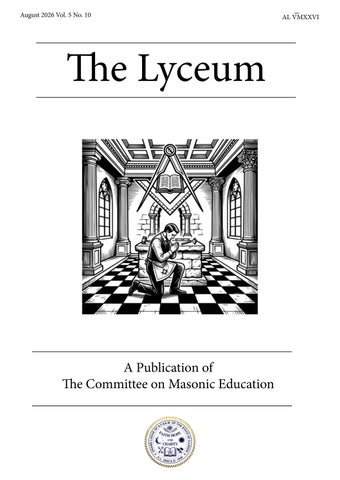
August 2026 Vol. 5 No. 10
The Lyceum
A Publication of The Committee on Masonic Education
AL VMXXVI
Contents From the Editor-In-Chief..............................................................3 RWB:. Robert H. Johnson, PDDGM, FILOR
From the Chairman’s Desk............................................................4
W:. Dr. Bernard Davis Jr.
Behind the West Gate: The Alpha Trap.......................................6
RWB:. Robert H. Johnson, PDDGM, FILOR
The First Lesson of Freemasonry is Humility...........................10 WB:. Darin A. Lahners, FILOR
Oration 1862.................................................................................13 MWB:. H.P. Bromwell, PGM Illinois 1854
Let's Disagree...............................................................................24
RWB:. Chad M. Lacek, 33˚
Memory, Mental Health & Freemasonry..................................20
WB. Darin A. Lahners, FILOR
Put It Into Practice.......................................................................26
Committee on Masonic Education, Illinois
Humility, Integrity, and Harmony..............................................27
RWB:. Owen Sandry, Australia
Humility.........................................................................................30
RWB:. Dr. Michael H. Shirley
The Practice of Humility: The Low Door.................................32 Bro. Kaleem Kamboj, 32˚
Masonic Conferences..................................................................42 Committee on Masonic Education, Illinois
Find us Online @ www.ilmason.org/masonic-education 2
Your Publication Staff & Contributors Robert H. Johnson - Editor-In-Chief, Darin A. Lahners Editor, Chad Lacek, 33˚, Bernard Davis, Chairman
From the Editor-In-Chief Welcome to the August 2026 issue of The Lyceum! As we move into the late summer, August brings with it a familiar shift in our routines. It is back-to-school time for the kids, a season of preparation, and for many of our Lodges, it means getting back to work after a summer recess. As I look over the incredible contributions in these pages, I have to admit that this is perhaps my favorite issue to date. We are diving deep into the theme of Humility—a virtue that is foundational to our Craft yet frequently misunderstood in the modern world. Our Chairman, WB Dr. Bernard Davis Jr., opens this issue by reminding us that humility is the quiet strength that keeps us teachable and allows us to hear the Great Architect more clearly. In my own column this month, I explore the "Alpha Trap," discussing how true humility requires the raw courage to take off our emotional armor and drop the performative masks we wear. WB Darin A. Lahners takes us on a journey back to the preparation room, beautifully illustrating how humility is the very first lesson we learn in Freemasonry. We also feature a remarkable piece of Illinois Masonic history with H.P. Bromwell's 1861 Oration, which tackles intellectual humility and warns against the traps of pride.
actively strengthen our families and homes. RWB Dr. Michael H. Shirley reflects on how true greatness requires taking oneself out of the center of the universe, and Bro. Kaleem Kamboj offers a certified masterclass on the "Low Door," reminding us that knowledge in Masonry must produce modesty rather than pride. I sincerely hope that this issue is deeply impactful and informative for you. May these lessons on humility guide your steps as you get back to labor in your Lodges this month and next. Wishing you all a wonderful and productive August! Fraternally,
R.H. Johnson, PDDGM, FILOR Editor-In-Chief for The Lyceum Grand Lodge AF&AM of Illinois
Adding to this robust lineup, RWB Chad M. Lacek shares a brilliant perspective in "Let's Disagree," reminding us that constructive disagreement is a valuable tool and that harmony is the proper application of humility, not just the absence of difference. RW Bro Owen Sandry from Australia expands our view beyond the Lodge doors, exploring how humility, integrity, and harmony can
3
From the Chairman’s Desk
by WB:. Dr. Bernard Davis Jr., Chairman- Masonic Education Committee
The Practice of Humility Brethren, As we continue our collective labor in the quarries of self improvement, I invite us this month to reflect on a virtue that is both foundational and often misunderstood, humility. In our Craft, humility is not the act of thinking less of ourselves, but the discipline of seeing ourselves clearly, strengths, shortcomings, and responsibilities alike, without distortion. It is a spiritual posture, a way of aligning our hearts with the Light we seek. Humility is the quiet strength that keeps us teachable. It reminds us that no matter how long we have traveled, there is still more Light ahead, more truth to uncover, more refinement to pursue. Humility opens the inner ear, allowing us to hear the whisper of the Great Architect more clearly. It is the virtue that allows us to listen deeply, to consider earnestly, and to act wisely. When we practice humility, we create space for growth, for fellowship, and for truth. In leadership, humility is essential. It keeps us from believing that authority alone grants wisdom. It encourages us to seek counsel, to welcome correction, and to empower others. A humble leader does not diminish his station, he elevates those around him. He understands that leadership is stewardship, and stewardship is sacred. In our Lodges, humility strengthens harmony. It helps us approach disagreements with patience rather than pride. It guides us to serve without seeking applause. It reminds us that our titles are temporary, but our character is lasting. Humility allows us to see the
4
divine spark within each Brother, recognizing that we are all traveling the same spiritual path, each at our own pace. And in our personal journeys, humility keeps us aligned with the Great Architect’s design. It teaches us that mastery is not achieved through boasting, but through continual refinement. It is the virtue that steadies the hand, softens the heart, and sharpens the mind. Humility is the gateway to deeper Light, for only the humble can truly receive instruction. As we move forward this month, I encourage each of us to practice humility intentionally. Let us listen more attentively, speak more thoughtfully, and serve more generously. Let us be mindful of the example we set, not through grand declarations, but through quiet consistency. Let us remember that every act of humility draws us closer to the divine pattern set before us. May humility guide our steps, temper our decisions, and enrich our fellowship. May it deepen our connection to one another, and to the Great Architect who shapes our destinies with infinite wisdom. Fraternally,
Dr. Bernard Davis Jr, WB Dr. Bernard Davis Jr.
Giving Back to our Members in Need and More
5
Behind the West Gate: The Alpha Trap & the Courage of Humility by Robert H. Johnson, PDDGM, FILOR, Education Committee
We learn how to lie before we learn how to speak clearly. I’m not talking about telling your parents you didn't eat the last cookie. I’m talking about the quiet, systemic lie of putting on a character to protect yourself. From the time we are young, men are conditioned to unlearn vulnerability and adopt performative "alpha" behaviors. We learn it on the playground. We learn it in locker rooms. We learn it in boardrooms. Be strong. Don't show weakness. Know every answer. Never admit defeat. Smart or average. Athletic or clumsy. Wealthy or struggling. It doesn't matter where you land on the spectrum. The social pressure forces us into an endless performance. We
6
build a character—a mask of what we think the world, our families, and our friends want us to be. Fear builds that mask. Pride locks it in place. Eventually, the mask stops being something you put on for work. It turns into your skin. You forget who you were before you put the costume on. That isn't living. That’s hiding behind an emotional barricade. The Hardened Shell Unchecked fear normalizes or becomes a part of you over time. When we live in constant terror of being judged or exposed as inadequate, we build a shell. It is a physical,
intellectual, and emotional defense system designed with one rule: Nothing gets in, and nothing gets out. Think about what happens when you live inside the armor you’ve created for twenty years: Our inward reflection dies: We can't look at our own mistakes because acknowledging a flaw feels like breaking the armor. Our outward empathy stops: We can't genuinely connect with anyone else's pain or walk in their shoes, because doing so requires dropping our own defenses. Ego inflates: Our pride skyrockets into boundless realms to mask our insecurities underneath. This pretended hardening doesn't make a man strong. It makes him fragile. Glass is hard, but when it hits a rock, it shatters. Armor isn't strength; it’s a cage from which there is no escape. This is where humility enters the room. Most men completely misunderstand what humility means. They think humility is passivity. They think it means standing in a corner, staring at your shoes, and letting people walk all over you. They are dead wrong. Humility is not weakness. Humility is the raw courage to take off the armor. The Five-Minute Test
ognizes game. If you're so caught up in your own self-righteous performance, you will never be able to appreciate real excellence in another human being. It makes you a self-centered, arrogant shadow of a man. Let's ground this in reality. Consider a simple, ugly test. You and your partner get into a heated argument. Objectively speaking, you were out of line. You spoke out of anger, you made a bad assumption, or your ego ran your mouth. What happens next? Can you sit in a room alone for five minutes with your own thoughts? No phone. No television. No pouring a glass of bourbon to dull the edges. Just sitting in silence with the uncomfortable truth that you blew it? Assuming you can even get there. Most men fail right there. They immediately run to rationalization. They build a courtroom in their heads where they act as judge, jury, and defense attorney. Well, she said this first. Work was stressful. I wouldn't have snapped if the house wasn't a mess. Now for the second part: Can you walk into the other room, look that person square in the eye, and say, "I was wrong. I let my pride control my words, and that behavior wasn't indicative of the man I am trying to be"? Could you do it in front of your boys? Your boss? Your co-workers?
Humility isn't saying, "Oh, shucks, it was nothThat takes real muscle. More guts than taking ing" when someone compliments your work. a punch in a bar fight. Why? Because taking a That's just being polite. punch is just more fake machismo. Humility demands that you murder your own ego on Humility is emotional muscle. It's the ability the spot. to recognize greatness outside of yourself without feeling threatened by it. Game rec-
7
"He Got Soft in His Old Age" We have all heard men talk about older guys this way. You’re at a gathering, and someone brings up a mutual friend. "Man, I don't know what happened to Bob. He used to be a tough SOB. Now he's getting soft in his old age." Nonsense. Bob didn't get soft. Bob got tired.
Army, Air Force, and Marine guys in the Lodge room. He walked and talked like the absolute blueprint of a hard-nosed, oldschool guy. One night over dinner at the Lodge, a dozen men were sitting around talking about random TV shows. This old sailor looks right at the table—surrounded by guys who had known him for forty years—and casually mentions that whenever he watches those home renovation shows where they give a struggling family a new house, he cries like a baby at every single episode. Do you know what those men did? Nobody laughed. Nobody called him soft. The table went quiet. Men nodded in agreement. They didn't see weakness; they saw an absolute lack of fear. This gruff old sailor was so secure in his own skin that he felt zero need to protect his image. He didn't care if people knew he felt deep emotions. That is true masculinity. That is real humility.
It simply took Bob sixty years, two broken marriages, and a health scare to realize that carrying a hundred pounds of emotional armor every single day was killing him. Bob finally felt safe enough to stop acting. He started listening to his heart, showing affection, and admitting when he was wrong. The tragedy isn't that Bob softened. The tragedy is that it took him six decades to get there. Imagine the wasted decades. Imagine the missed connections with his kids, his friends, and his brothers because he was too busy playing the tough guy. When I was raised into Freemasonry, I met an older Brother who left a mark on me. He’s an old Navy veteran. Gruff face, five o'clock shadow, and spent half his time roasting the
8
The Ashlar and the Gavel Why are we here as Freemasons if not to address this exact problem? Our Lodge rooms ought to be the safest place on earth for a man to drop his performance. Outside those doors, the world demands armor. The corporate ladder wants cold calculations. Social media demands a perfect lifestyle—which we readily feed it, cultivating more of the costume we end up having to wear out there—in the real world. Society expects men to be silent, unyielding rocks in person. Inside the Lodge, the playing field levels. (Yeah—we’re all on the Level, remember?) We talk endlessly about the Rough and Per-
fect Ashlars in the degrees and in education pieces. We repeat the lectures until we can say them in our sleep. But ask yourself: What are the rough edges on a man? They aren't just swearing, drinking, or bad manners (those superfluities). The sharpest, most dangerous corners on any man are his pride, his defensiveness, and his fragile ego. Those are the rough stones that prevent us from fitting together as building blocks in a real community. The Common Gavel isn't designed to smash the stone to dust. It is designed to knock off the jagged, unkempt edges—the armor—so the real structure underneath can emerge. You cannot carve a stone if you refuse to let the tool touch it. You cannot practice the Masonic art if you refuse to admit you have rough edges. If someone arrives believing their opinions are unchangeable, they’ve already disqualified themselves from membership before they even step through the door. Our gentle craft requires a workable mind—someone who can be taught, not a person who believes that they know everything there is to know. This type of person is attempting to erect a temple out of a mind that refuses to be refined. A Call to Drop the Armor If Freemasonry is going to mean anything in the modern world, it cannot be a monthly social club where guys put on aprons and play another set of characters. It has to be a gym for the soul. Not an acrobatic one either. No one needs to jump through hoops to work things out.
beings living in a fractured world. Imagine what happens when we actually bring this into the world: Imagine a father sitting down with his teenage son and saying, "I made a bad call yesterday. I reacted out of anger, and I was wrong. I'm sorry." Imagine a Lodge Master standing in the East and telling his Officers, "I don't know the answer to this issue. I need your help, and I need your wisdom." Imagine a community leader stepping up to a podium and saying, "The policy I supported failed, and it hurt people. I was wrong, and here is how we are going to fix it together." That isn't weakness. That is leadership. That is strength that commands respect because it doesn't rely on fear or posturing. Humility is elusive because our egos will fight to the death to protect the illusion of perfection. But we have the tools right in front of us. We have the obligations. We have the Charges. We have the Brotherhood. Stop waiting until you're seventy years old to drop the mask. Stop letting fear dictate how you interact with your family, your Brothers, and your own reflection. Chip away the armor. Own your mistakes. Give grace to the men around you who are still trying to figure out how to take their masks off. We make ourselves better not by building higher walls, but by having the courage to break them down from the inside out.
It starts with radical empathy, radical grace, and radical humility. These aren't trendy buzzwords. They are ancient, necessary survival tools for human
9
Featured Article
The First Lesson of Freemasonry is Humility by WB:. Darin A. Lahners, FILOR
While humility is not a virtue expressly taught in Freemasonry, it is an underlying theme in our labors. Humility is defined as: 1. The quality or condition of being humble. 2. The state or quality of being humble; freedom from pride and arrogance; lowliness of mind; a modest estimate of one's own worth; a sense of one's own unworthiness through imperfection and sinfulness; self-abasement; humbleness. The lesson in humility begins in the preparation room before their first degree. You are told to change out of your clothes and to put on the candidate’s uniform, and to divest yourself of all items of metal from your possession. This is immediately humbling for anyone. So much of our collective self-worth today seems to come from our material possessions, so to be stripped of them requires one to be humble. It is a lesson that teaches the candidate that their accomplishments in the profane world no longer matter.
10
The hoodwink is applied to further teach humility, as you are forced to accept that your sight, which has guided you in your development as an individual up until now, can no longer be used. You are to trust these strangers, many of them men who you are meeting for the very first time, to guide you on your initiatic journey. Giving up control of your actions, you are humbled before these men. The cable tow reinforces this lesson, as you are wrapped in rope so that you might be led out of the lodge with its help, never to discover the form thereof should you be found unworthy of being a brother. Upon being received in due form into the lodge for your very first time, you are told that no man should ever enter upon any great or important undertaking without first invoking the blessing of deity. Therefore, you are asked to kneel and to attend prayer. In plain English, you are asked to show your humility before the Great Architect. You are asked after the prayer, in whom you place your trust, and you answered: “In God”. You are
then told that your faith is well founded, told to arise, follow your conductor, and to fear no danger. Is it not humbling to reflect upon the Great Architect and realize that, ultimately, you possibly have the illusion of Free Will? If you contemplate the Great Architect, and you believe that they are omnipresent in all things and omniscient in all things, then every action you will ever take is already known by them. It is humble to accept that while you think you have free will, there is an equal possibility that your actions are pre-ordained. Humility continues as you are examined by the Junior and Senior Wardens, as well as the Worshipful Master. You are being judged worthy of continuing in your journey, and the humility is that you have no control of what is being said—the Senior Deacon who is conducting you around the lodge answers for you in his voice. You stand there blind and mute, in clothing worthy of a pauper. You are meant to feel powerless, to reinforce the lesson of humility. You are conducted to the west after your judgment, and told to take one step towards the east, your feet forming the angle of a square, your body erect before the Worshipful Master and Lodge. You kneel again at the altar, to again show your humility to the Great Architect, but also the three great and lesser lights of Masonry that rest upon the altar and that are near it. In essence, you are humbling yourself before the lodge as well. After your obligation,, the cable-tow is ceremonially removed because your obligation is a tie stronger than human hands can impose; you are soon after brought to light. In receiving light, the hoodwink is removed, and you see your brethren lined up on either side of the altar, giving you the duegard of an entered apprentice mason. This further illustrates humility, as each of these men has given up any pretext of ego to help the Worshipful Master bring you to light.
After being instructed to salute the Wardens as an Entered Apprentice Mason, you are examined again by the Junior Warden and Senior Warden. This requires your humility once more, again being silent and observing them return the duegard and sign to you. You are then conducted to the Worshipful Master, who presents you with your white lambskin apron, which is described as an emblem of innocence and the badge of a Mason. After the presentation of the apron, you are conducted to the Senior Warden, who teaches you how to wear it as an Entered Apprentice Mason. You are told why you wear it in a particular fashion, and commanded to keep yours unspotted from the world. Esoterically, this is also a lesson in humility, as the apron covers the organs which often can cause man to not be governed by his intellect, and to give way to his passions instead of subduing them. As the apron is a reminder of purity, it is also a reminder that one must often humble oneself to purify oneself. You are then reconducted to the Worshipful Master and asked to deposit something of a metallic kind. Again, you are humbled not due to the request, but that you are destitute. This is the reason for the request. As you are told it was not made to trifle with your feelings, it does teach you the humility of being poor. It then becomes a lesson that should you encounter a brother in a like situation, to contribute to his relief as much as possible without material injury to yourself. After this, you are presented with your working tools, the Twenty-Four Inch Gauge and the Common Gavel. The Worshipful Master describes the Twenty-Four Inch Gauge as a reminder to the individual to divide their time wisely among work, service, rest, and spiritual development. As such, the gauge fosters discipline and balance. Humility is required to recognize that one's time and abilities should be used not solely for personal gain but also for the benefit of others. The
11
Common Gavel, we are taught, is made use of for the more noble and glorious purpose of divesting our hearts and consciences of the vices and superfluities of life, thereby fitting our minds, as living stones, for that spiritual building, that house not made with hands, eternal in the heavens. The lesson of the common gavel encourages humility because it confronts us with the reality of our imperfections. Instead of focusing on the shortcomings of others, we are urged to examine our own character and begin the work of self-improvement. This perspective discourages arrogance and promotes self-reflection. You are then placed in the NE corner of the lodge as the youngest Entered Apprentice. As you are taught that you stand there as a just and upright Mason, you are then charged to act and walk as such. Again, this is a reminder to remain humble. You may have once aspired to be the cock of the walk, but you are now taught that you, as a just and upright Mason, must practice humility. Your actions should bring credit, rather than disgrace, to our institution. After this, you are then re-conducted from the place from whence you came, ie: the profane world, and you are reinvested with possessions that were taken from you before. Similarly, the explanatory lecture, forms and supports, tenets and cardinal virtues, and charge reinforce the above lessons of humility. Ultimately, they teach that Humility is a virtue that enriches every aspect of life. Humility is what enables Freemasons to learn continuously, to build meaningful relationships, to lead effectively, and to serve others with sincerity. Far from being a sign of weakness, humility reflects strength of character, self-awareness, and wisdom. The lessons of the Entered Apprentice Degree, in conjunction with the lessons of the Fellowcraft and Master Mason Degree, continually reinforce the importance of self-re-
12
flection, moderation, equality, and moral growth. Together, these lessons guide Masons toward a deeper understanding of themselves and their responsibilities to others. Freemasonry teaches that humility is not a destination but a lifelong practice. By recognizing our own imperfections, seeking wisdom, respecting others, and striving constantly for improvement, a Mason embodies the principle that genuine greatness is found not in pride or one's superiority, but in humble service to others, moral integrity to oneself, and the continual pursuit of self-improvement of one's intellect and character.
ORATION 1861 The Grand Orator, Bro. H.P. Bromwell, delivered, the annual Oration
*Editor's Note* In this great piece of Illinois Masonic history-an 1861 oration by H. P. Bromwell, you'll find a strong tie to this month's theme. We are exploring intellectual humility. Bromwell tackles this subject directly. He warns us about the trap of pride. He points out a hard truth. Deception is everywhere. Even when we think we walk in the true light, we can easily be wrong. His advice is simple. Be a student. Be a lover of wisdom. Do not act like you already know it all. It is a great lesson. We need it today just as much as they did back then. Before you read the text, let's set the stage. The year was 1861. The Civil War was just starting. America was tearing itself apart. You can actually feel that tension in his words. He talks specifically about the misery and crime of the earth. Times were incredibly hard. You also need to adjust to the language. People spoke differently in the 1860s. The style was grand. Orators loved sweeping phrases and formal words. It might feel a bit heavy at first.
Just stick with it. The core ideas are fantastic. Finally, let's talk about religion. You will notice several specific biblical quotes. He quotes Isaiah right at the start. Today, Masonry works hard to use universal language. We want men of all faiths to feel equally at home. But back in the 1860s, things were different. Masonic speakers often used the Christian language that was common in their local towns. Do not let that throw you off. Look past the specific religious terms. Focus on the lesson itself. The message of modesty belongs to every Mason. Humility is a tough virtue to practice. Intellectual humility is even harder. Bromwell gives us a great way to think about it. Enjoy the reading! “How beautiful upon the mountains,” saith our ancient Grand Master, ”are the feet of him that bringeth glad tidings, that publisheth peace.” Peace, which from the beginning has been so unknown on earth that man can scarcely form a conception of her beauties. Peace,
13
which has been seen but in glimpses on her passing, in the solitude of the wise and good, but whose presence amid the throng and turbulence of life has been only known to the dream of the poet and the hope of the enthusiast. Peace, whose home is in a higher degree of life than man’s, is of such heavenly excellence that even the feet of her messenger, seen in holy vision, were sandaled with beauty to the lofty and benevolent spirit of Isaiah. And well may Peace be beautiful, for she is twin sister of Harmony and Beauty, and these two, in Masonic language, are the same. Peace dwelt between the four rivers of the garden, before confusion drove forth the happy inmates, beneath the sword of the cherub, which still turning every way, defends the entrance of life and light, that none may return but those who are worthy and well qualified, and have permission. Peace was with the Supreme Architect when he laid the foundations of the world in wisdom, and set up its pillars in strength. And so, also, when the work of our ancient Grand Master was wrought in like manner, without the sound of offensive or defensive metal, in all its parts, that the work which was designed in wisdom and established in strength, might be perfected in beauty. In contrast with her smile, Confusion and Discord display all the horrors of their dragon forms—their work is war—at times bloodshed and destruction—at times vexation, strife and rancor among members of one brotherhood; but it is always war where peace is not, for they two walk round and divide between them the whole circle of duration. Peace is of the holy influences of the tabernacle, with its sacred treasures. War is of the confusion and sin of Babel. War destroys; Peace builds up. War comes with the clangor of drum and trumpet, and the clash of murderous engines; Peace comes with the
14
voice of flute and tabor, and the echoes of the Sabbath bell. War wields the flashing saber, stained with gore; Peace turns the glittering plowshare on the furrowed field. War fills the earth with blood, and marshals hellish passions to rage and shatter and devour; Peace descending, sows the earth with gold and flowers and corn, and calls the gentle affections to twine about all souls their garlands of delight. She is the almoner of blessings, which ever increase and multiply around her votaries; her messengers have the odors of Paradise upon their garments, and the brightness of Zion is their crown. Where she comes, brethren dwell together in unity, and her breath is as the precious ointment upon the head of Aaron, and as the dew which descended upon the mountains of the Lord. Would to God, Master, Wardens and Brothers, that I wore to-day, to you, a messenger of peace in all things, bringing tidings of peace throughout our borders, and the world. But this may not be. The world is still torn by the wrestling’s of discordant passions, treachery, folly and ambition, those destroyers of nations, still rage among us. The land in which we dwell, whose strength and harmony were the admiration of the world, has become the arena of the most terrible and gigantic war of modern ages. We are roused from our labors in the chambers of the temple by an alarm more terrific and ominous than that of old, when the ponderous engines of Nebuchadnezzar were thundering against the battlements of Jerusalem. A war is on us and about us, such as our fathers have never witnessed. A war between a kindred race—the dwellers by the same rivers, whose fathers wrought together in a league of patriotism and a brotherhood of arms—whose graveyards are filled with the mingled tombs of sires whose sons now raving for each other’s blood.
A war whose legions, as the sand for multitude, are marshaled in lines of a thousand leagues; and whose rival banners blaze across a continent; and whose clash of arms rises on every moment, on’ every wind that blows through a quarter of the civilized world. Devastation and death are sweeping the fairest regions of our country, and destruction rides on the midnight blaze of consuming cities, and the shock of battles thunders from a thousand fields. I wish not to dwell on this war or its horrors; I would not have introduced them here but for the solemn and stupendous facts which stare us in the face, and force upon our sight the terrible dangers to which society is now exposed—and because there is not a Lodge from which we are assembled, but has some member of its band within the fearful circle of fire and blood, from which how few we know not may return. Of those who last sat in this fraternal body, some are in the midst of battle, and some are now lying low upon the level of death; and around every altar within our limits are some anxious hearts and brimming eyes, that must throb and watch in vain for the returning footstep of a brother or a son. How could I be silent about that on which every heart about me is dwelling? How should I hold my peace, when Death, the great leveler, is sweeping down our brothers and friends with tenfold rapid strokes of his trenchant blade, and the voice of mourning is about all our homes? Yet even without this unusual work of death, would be many painful associations —memories of the departed—clustering around us, at this meeting, in this place. We should miss the forms of some who once lent pleasure and dignity to our counsels in former days. They have gone—some with locks grown hoary in the ways of righteous-
ness and truth, and some in the bloom of younger manhood, e’er time had warned them that the silent messenger from the land of shadows was at the outer door. They are ever passing before us, yet solemn as is the thought, it is still more solemn to think that there are some about us whom we must pass before. They have gone; some who were high in honor among us— Whitney, the venerable; Snow, the honored, - Douglas, the illustrious, Hobbs, the venerated, and Elwood, the beloved, and; “The sun shall rise, shall stand, shall fall, But these shall stand no more; No more the faithful Craft shall call, Or scan their labors o’er.” And wo say amen, “the will of God is accomplished, so mote it be.” Yet, Master and Brothers, notwithstanding the tumult of the nations, it is a pleasant thought that, in some measure, we meet today as messengers of peace. For her home, of right, is in the mystic East, and her walk among the burning tapers. The tessellated floor was laid for her footsteps, and between the pillars of the porch is the way of her going. Since that period which lies beyond recorded years, when the first Masonic Lodge set up its great pillars, and displayed its ornaments and jewels, Peace and Harmony have been not only welcome in our Lodges, but so necessary, that without their presence no Masonic work could be begun or completed. Because of these and other principles of Masonic philosophy, Masonry has seen the beginning and the ending of all human institutions, which have passed away, and to-day we are on the same soil where states have risen and decayed upon the sepulchers of those still more ancient, the Lodges of Ancient Craft Masonry rear their greater and lesser lights, and set up their altars in the name of Jehovah. Even amid the clash of arms in our own country, Masonry sits serene, content, while
15
she cannot prevent the dreadful calamities of war, to open on her ten thousand altars the great lights of her sublime mysteries and counteract as far as possible the baleful influences of evil passions, by the teachings of word and symbol, to which every Mason must give heed. From the influences of the Lodge room, how much wo know not, may the horrors and cruelties of war be mitigated. We only know that such a brotherhood, embracing almost as many members as the rival armies of the war, of the better and more reflecting minds, and constantly reminded of the benevolent principles and pure teachings of our Craft, cannot be without influence on the councils of the belligerents, civil as well as military. Therefore, instead of grieving that this great calamity has come upon us and the world, in spite of all the influences Masonry could exert to conduct society to more humane pursuits, and therefore giving up as lost all the watching’s and labors of the past, we have cause to rejoice in this at least, that, in the event of so fearful a convulsion, Masonry has already attained such a growth and influence to be exerted in mitigation of the evil. And after all, the picture of turbulence and wrong which we witness to-day, is but the passing scene of the great tragedy which has been going forward through though ages of man’s existence. A glance at the revolving spectacle of crime, which the eyes of all generations have witnessed in turn before us. What has been the work of Discord from the beginning? What an exhibition of pride, hatred, envy, deceit, pillage, murder, oppression, idolatry and blasphemy, does it not present? Peoples and nations and tribes, kingdoms and churches, warring and persecuting and tormenting. Now trampling in pride on human rights, now ground in the dust of tyranny’s chariot wheels, now seething in the
16
crucible of revolution. Has it not been always and everywhere the same, in Jewish, in Christian, and in Heathen lands ? The dungeon, the rack and the scaffold disfiguring every scene of human occupancy, to devour the hapless wretches whom even war’s unceasing carnage would have spared. Every agency of malevolence and impiety let loose, to render earth a hell. With such a history, what better could we expect of the world than what we see? With such surroundings, I wonder not that all good influences have achieved so little, but that aught of good remains. I wonder not that priest and prophet and apostle have sent down to us their words of wailing, that the winds wander moaning an unceasing miserere, and the waters are chiming a perpetual dirge. I wonder not that earth, grown weary of man, should open her mouth to destroy him—that she sends forth the earthquake and the whirlwind, to heave his abiding places to destruction and overthrow the refuge of his sin. I wonder not, O Ocean, that thou dost summon all thy waves to lash the frightened shore—to sweep away his works and blot out his remembrance. I wonder not, O ye Mountains, that ye were reared so high—that ye stand peering through your misty curtains upon the purer air and frigid light. For on your summits may weary passing spirits of mercy alight and weep not; for they alone have never borne witness to man’s crimes, nor echoed to his groan. Yet amid all the misery and crime of Earth, great influences for good have struggled against the forces of evil; and at times it has seemed that a better day was breaking on the world; so that in every age, men have not ceased to look forward to a near approach of
the period when the meek should inherit the earth, and when the lion and the lamb should lie down together, as prefigured in the badge and token of a Mason. Let us then consider for a moment the interest we have in coming together at this time. What came we here to do? Whence have we come? We are a handful of the Craft dispersed about the earth, whose duty it has become to meet for counsel and action in the preservation of our honored institution— a duty we share with some forty like bodies in our own country, and a far greater number of various jurisdictions hero and throughout the world. We have come from the various pursuits of life, and we meet both old and young. The old, that they may impart wisdom and dignity to our assembly, and because they have gone in and out before us, with honor to themselves and profit to the Craft, until they would rather be as doorkeepers in the house of benevolence than to stay in the tents of ease. The young, that we may make further proficiency in the knowledge of the Craft, and gain title to the respect of those who will be our juniors in after years, by doing honor, as becomes us, to our elders. We meet both rich and poor, for Masonry regardeth neither poverty nor riches, which, are the mere circumstances and not qualities of any; and as in life these things should not be regarded, so on the checkered floor they are entitled to no consideration. We meet to clasp the hand of friendship, to behold the dignity and honor of our ancient house, to give counsel to all in their labors, whether it be task or journey, and to strengthen the hands of the Craftsmen who, for their skill and assiduity, may be put as overseers of the work. Our ancient brothers wrought both in operative and speculative Masonry; the works of their hands corresponded, in beauty of
design and excellence of workmanship, to the mystic Temple of Wisdom and Virtue which they represented. But the former have passed away, and the latter stands. The former have perished by the ravages of time, which has no hold upon the other, for it is eternal. The towering structure of Babel lies beneath the sod of centuries. The stupendous temples of the Nile and Indus live only in their marred and shattered fragments, to tell how human glories perish. The temples of the sun, which shone on Persia and Peru, though thousands of years may have intervened between the laying of their cornerstones, are silent as the sepulchers of Idumea. The palaces of Nineveh and Tyre, the splendid creations of Grecian and Roman art, have yielded to the tempests of years and the more destroying hand of man. The Temple of our ancient Grand Masters, the most perfect and magnificent of structures, such as earth hath seen but once, hath no stone left upon another. Where the gorgeous gates blazed in the sunlight of the Feast of Palms, neither Jew nor Christian, dare set his forbidden foot, but the Mosque of those who were last in filling up the cup of Jerusalem’s tribulation, which multiplied centuries have pressed to her lips undrained, lifts its scorning and defiant minarets to the skies of Moriah, and the fugitive and trembling Hebrew walks in the twilight to weep upon the fragments of the Dionysian builders, in the valley once spanned by the arches of Solomon. For they who build of the crumbling and perishable things of Earth, must build but things that perish ; and the silver and the gold, the marble and the precious stones, olive wood and the cedar, and the beauty and the glory which is on them and of them, must mingle with the dust of revolving production and decay; while the art and knowledge, which wrought out their perfection, will live on, to
17
garnish other fields with new creations of beauty and magnificence, that the ceaseless labor of man may still be directed in feeble imitation of the works of the Eternal. But not so with the glorious structure of symbolic philosophy called Masonry—a term which, however derived, has been used as synonymous with geometry and light, for the reason that geometry is the noblest of sciences, and admits of no falsehood, and hence is used as the medium of light, which is truth. The Masonic temple, being fashioned after the divine plan, still stands upon its great supports, while the ebb and flow of life and action go on through the sweep of generations; and to-day the Craftsmen go in and out, and find the ground floor still as firm, and the jewels as untarnished, the ornaments as perfect, and the lights as pure, as when the servants of Solomon and Hiram rejoiced with the assembled Kings of the East, at the carrying up of the cap-stone. Within her courts is the home of every science, and the throne of every virtue. The sciences which once were to be found only within the veil of her adytum, have long since gone forth to enlighten the world, which, nevertheless, still wonders at the existence, and inquires for the objects, of Masonry, and looks with jealousy and distrust at its duration and expansion. Many of those who hold our sacred writings, which are the written part of Masonry, and who stand as lights and guides to the multitudes, upon the fair pathways of religion, look with aversion and even contempt upon an institution they do not wish to understand ; some of them even enter the pulpit, with the Bible as authority, to inveigh against us. But Masonry has not gone out to meet them on the field of controversy, for the reason that her advocates are taught that it is not by useless disputations with the uninformed that
18
the character of Masonry is to be vindicated. Nevertheless, at proper times, it is permitted to utter such truths as may correct the errors of honest opposition in those whose friendship and regard might be desirable. When such ask us where is your creed? We answer, our creed was furnished us by the pen of inspiration. If they say it is not specific, and that we may believe anything under it, we answer, it is as the maker thought proper to write, will you blame him also? If they say, you admit the Jew and the Indian to your Lodge, we answer, that he who made the great Lodge of the world, made us also, some Jews and some Indians, some of all nations under Heaven. If they say, you have secrets among you, we answer, that we are not so secret as the Almighty, and those we have we received as such, and the holy writings say that he that keepeth secrets is wise, but he that revealeth secrets shall be sawn asunder. And if they open the sacred volume to condemn us, we say, if we Masons had not preserved our Bible, of old, where would now your Bible be? After all, permit me to say to such, do ye well to be angry? What do ye teach yourselves? Do you enjoin a better maxim than to do justly, love mercy, and walk humbly before the Lord? Do you speak a language more truthful than geometry, or more honorable than the symbols of Moses and Elijah? Do you teach a better righteousness of conduct than to walk erect before God and man, by the plumb line of Ezekiel? A better justice than to square your actions by the square of Virtue? A better humility than that “he that humbleth himself shall be exalted?” A firmer faith than trust in God? A surer hope than in the Lion of the tribe of Judah, or a wider charity than love to God and man?
Is it not enough that you teach and we also? Is not the world in need of all good influences? There should be no war between us. Why should not all who have at heart the welfare of the race, join with us in promoting the peace and union of the world? We would not repel their fraternal efforts. We would not say, stand by thyself, I am holier than thou; but we would greet them with the old Masonic salutation, which is Health, Union and Peace. But whatever the enemies or opposers of Masonry may say or do, the light of true knowledge is burning and will burn within the open portals of the Lodge, and freedom of thought and conscience are guaranteed to all who pass the threshold. Science, which is light, belongs to the Fellow-Craft, yet not everything which lies within his reach does he make his own. There are some who still are content with being bearers of burdens, or loitering away their days about the outer courts, who do not know the symmetry and beauty of the upper chambers, because they will not be at the pains of climbing the steps of knowledge which conduct them thither. But the true Mason is one who seeks for knowledge in all directions that may present an opening for his advance—not only in the tyled Lodge room, but wherever human thought may find an object for its reflection. For Masonry and philosophy walk hand in hand, and their way is progress. Not the blind and battling philosophy which the atheist has wrought out of the prejudices and errors of wrangling disputants, who have gone before, but the philosophy whose voice is concordant with that of the first great light, whose teachings are wisdom. Without these, his course is one of labyrinthine paths, which ever return upon themselves, or are lost in mazes amid darkness. Without these, it is true, he may
go out as thousands have vainly done, and commune with the heavens above, and with the earth beneath, and with the realms of air, all full of wonders lie may read in the language of the outspread scrolls of night, the dim and awful lesson of infinity and power in the first great cause. He may hear the voice of wind and wave, chanting an eternal ave to some higher and mightier mind. He may dive to the depths of oceans, and penetrate the solid earth, holding converse with the voices that speak from the sepulchers of former life; in the depths of the valleys and the dark bowels of the mountains, appealing to rocks and winds and waves to render to him their mysteries. He may seek to solve the problem of himself, his duty and his destiny and the darker secret of the self-existent. And this search after the knowledge of itself, and of its cause, in the heavens above and in the earth beneath, he may call the first philosophy. But as it begins in confusion, so it ends in despair. But when he returns to the Masonic temple, behold there is written on its archway “Holiness to the Lord,” and upon its altars shine, in light that grows not dim, the words of wisdom, which say “this is wisdom the fear of the Lord, and to depart from iniquity is understanding.” Guided by this wisdom he may approach the source of light, ever advancing by upright steps on new degrees of knowledge; for in all things of light which the Creator has thought proper to be communicated to man, there is progress by degrees. The mind, at first enshrouded by ignorance, gropes in darkness, which obscures the form and beauty of all which is presented to its vision; but when light has been added to light, until the true characters of many things appear, and half-revealed beauties shine in those beyond, the observer would hasten with impatience to further discoveries of truth.
19
He is like a wanderer upon mountains, guided by a flickering torchlit light, before the break of day. Passing beneath the spreading oak, he perceives only the gnarled and uncouth form of the sturdy trunk. He gropes through the copes and sees only the trailing vines which impede his step, and the thorns which torment his flesh. He meets the impending rock but sees only the broken outline of a huge and somber mass, whose dismal caverns yawn as ghostly sepulchers. He hears the wind in the gloomy forest, but its sounds are as the wailing of unhappy spirits, auguring of coming woe.
raptured gaze. He sees the eagle’s nest upon the granite cliff, and still beyond, spread plains and fields and villages, and azure lakes, thrown perpendicular with all their waves. Proud navies ride, and portly argosies, inverted, spread their sails upon the sky above. Bright cities rise from the deep waters, with spires and bulwarks, and above them colossal forms are striding on the air. Armies and banners pass, and tented fields, and tall cathedrals rest on the tops of forests, or swing from upturned vineyards.
The wanderer holds his breath in rapture, and hurries that he may bring others to behold But behold! The torch of morn is kindling at the wondrous scene. But long ere he returns, the East, and the gates of hyacinth are turning the mists are dissipated by the solar blaze, on their opal hinges. The halo of the coming and but the real landscape now appears. The day is floating on the hills, growing brightwanderer returns, but no distorted imagery er and brighter on the burnished skies. He greets his expectant eyes. The scene which looks back upon his path, and behold the oak first appeared so lovely, truly appears, but this stands towering, a majestic monarch of the has lost its charm. He sees no grandeur in the forest, shaking tinted drops from his spanoak, no beauty in the bursting jewels of the gled boughs. The vines weave canopies of jasmine. There is no smile in the valley, no emerald and scarlet and gold for the dwellmusic on the breeze. In disappointment ho ing of the brilliant oriole. The thorns are but retires, not knowing how much he saw was the climbing roses, and the rock looms up a real and how much delusion. So, often, with battlement of porphyry, its base is laved by the seeker after wisdom. He seeks by a feecrystal fountains, its caves are garnished with ble light—the path is sad and irksome. Light the thousand forms of glittering stalactites, its breaks upon him, and he sees with rapture. brow is crowned with laurel. The dark abyss is But the false medium of imagination interopening beneath the silver mist, and behold, venes, and her phantom forms rise in distorta valley, spread with blossomed meadows. ed likeness of the truth. A thousand things, The wind has now the voice of the sweet which have no more substance than vapor, south-west, breathing of fields of spikenard are blended with those whose, base is truth. and hills redolent of odors. Where all was A further light may dispel the illusion, but it drear and cheerless, all is beauty and delight. often leaves his mind oppressed with doubts, a prey to disappointment. But again, as the sun rises through the mists, a brighter scene appears—the light, refracted Thus, in the search for knowledge, even with by impalpable vapors, produces that strange the true light about us, deception and error phenomenon, the mirage. He sees the most are on every hand. If even the appearances distant hills brought up before him; they of those natural objects, which are percepstand with their rocks, their towers, their tible to the physical senses, are so often but fountains, suspended in the marble air. The deception, what must those expect who far oft mountains swell upon the clouds, and venture upon the wilderness of abstract and spread their pines and glaciers to his eneven metaphysical ideas? And why should it
20
be strange that the world is filled with every folly, and every shade of doctrine, or that contending factions in science, politics or religion, should wrestle and fight, and lash each other up and down the world as long as man shall mingle with his fellows. Therefore, it is wise, in the pursuit of knowledge, to imitate the conduct of that illustrious teacher and Master, who, declining the title of Sophist, or wise man, took upon himself the humble name of Philosopher, or lover of wisdom. I have spoken of these things, Masters, because it is to avoid the consequences of error and confusion, which mar society, subvert law, destroy nations, and curse the earth with ignorance, persecution, woe and death, that Masonry exists; and because you are placed as guides and exemplars to all who are toiling and journeying in the work of your calling. You are to work out the perfection of your Masonic system; not to hope that idle wishes or vain forms will accomplish it.
time, which still goes on “to the undiscovered country,” entering in by the dim and awful veil.
Masonry is a system of labor—its first lessons are patience and perseverance, and that what each enjoys shall be the fruit of his own labor, assiduity and skill. Its character is not to be built up by ostentatious displays or sounding professions, but by the fruits of its action shall it be judged at last.
The symbols of all wisdom blaze along the m arch; the banners of the tribes of Israel, and the holy ark; the curtains of the tabernacle, and the veils of the temple; the book of the law and the testimony, and the volumes of the last hallelujahs; the music of Jubal, and the song of Moses; the prayer of Solomon, and the chorus of the Levites, and the shouting of the capstones of all temples, rises upon the air. The cloud-borne Stairs of Bethel rise beneath the blaze of the Shekinah, and the pillars of fire and cloud tower in their awful grandeur, midway of the scene.
There will be no want of opportunity for the proof and approval of your work. There is no want of material, that you should stand idle while others are gathering and fitting the silver, gold and precious stones, which shall bear their marks on the noblest ornaments of the temple. The unnumbered bands of the workmen, dispersed about the earth, will strive to share with you in every labor of benevolence. Your works will be formed and fitted by the instruments of Solomon, and their beauty shall be as the cunning workmanship of Hiram and Tubal. Your journey will be with the illustrious of the earth, in the goodly company of the wayfarers who have passed in the grand Masonic procession of all
What a noble host, with its ever-swelling numbers! How glorious are their trappings and the precious things they bear! Kings and Priests and Prophets, Warriors and Shepherds, Artists and Philosophers, through all the unending line. Seth, by his pillars, and Tubal, with the plowshare and stringed instruments. Abraham, walking with Melchizedek, and Moses, with the Tables of the Law. Jephthah, with his wheat sheaves, and David, with his sword and psalm. Jacob, with the stone of foundation, and Solomon, with the capstone. Hiram, with the cunning workmanship, and Zerubbabel, with the holy treasures. Ezekiel, Daniel, Pythagoras, John, Alfred, Godfrey, and the tens of thousands, hailed as most excellent architects.
The Masonic march, ever passing, must still go on; through perils and persecutions, through carnage and captivity, through desolation and death j for the bush of Moses, which is ever burning, is never consumed. Go on then, Masters and Brothers, the world has place for you all. It matters not that you sit in the councils or toil at the cable-tow or wander as wayfarers of the wilderness. Though you dwell in the depths of the un-
21
trodden waste and never may be cheered by the presence of congregated Masons, nor ever behold the works of their hands. You need no temple of human workmanship, for your Lodge is from the east to the west, and between the north and the south. The same Grand Master who laid your ground floor and spread your star decked canopy, is there, and it is all his temple. With your trust in him, and your spirit in harmony with every chord of nature, your hope as bright as the symbol of the covenant, you may go forth upon the outspread world with the freedom wherewith a Mason is most free, possessing all. The world shall be your temple, the rock your altar, and your arch the bow upon the cloud; the forest your sanctuary—its “birds of gentle beak” be all your choir—the winds your monitors, the clouds the curtains of your tabernacle, the blue spread heavens your dome, the milky scroll of night the charter of the life beyond, and every star a promise.
22
HUMILITY The Divine Master has said, "He that humbleth himself shall be exalted" (Luke, xiv 2), and the lesson is emphatically taught by a portion of the instructions of the Royal Arch Degree. Indeed, the first step toward the acquisition of truth is a humility of mind which teaches us our own ignorance and our necessity for knowledge, so that thus we may be prepared for its reception. Doctor Oliver has erred in saying (Landmarks ii 471) that bare feet are a Masonic symbol of humility. They are properly a symbol of reverence. The true Masonic symbol of humility is bodily prostration, and it is so exemplified in the Royal Arch Degree.
Skullandcrownltd.com 23
Let's Disagree by RWB:. Chad M. Lacek, 33˚
Freemasonry teaches us that harmony is essential. We are reminded that the Craft prospers when its members work together in unity, and that men should be placed where they can best work and best agree. At first glance, this might suggest that disagreement is something to be avoided. If harmony is the goal, then conflict appears to be the problem. But that is not quite right. Harmony is not the absence of difference. It is the proper application of humility. If every voice in a Lodge were identical, there would be very little worth listening to. Conversation would collapse into repetition. Ideas would go untested. Assumptions would remain unexamined. Agreement, in that sense, can become a kind of stagnation. It is comfortable, but it is not productive. Freemasonry is not designed to produce uniformity of thought. It brings together men from different professions, backgrounds, temperaments, and experiences. This diversity is not incidental. It is intentional. It ensures that no single perspective dominates without challenge. Where there are different perspectives, there will be disagreement. The
24
question is not whether disagreement should exist, but how it should be handled. Constructive disagreement is one of the most valuable tools available to a thinking man. It allows ideas to be tested, refined, and, when necessary, replaced. It exposes weaknesses that might otherwise go unnoticed. It forces us to articulate our reasoning more clearly. Without it, our beliefs remain largely unexamined. It’s easy to agree with a position when it is never challenged. It’s harder to defend when someone asks some simple questions. Why do you believe that? What evidence supports it? What assumptions are you making? These are not hostile questions; they are clarifying ones. Freemasonry, when practiced thoughtfully, creates an environment in which such questions can be asked without hostility. The Lodge is one of the few places where men with differing views can engage one another with a shared commitment to respect. That commitment is what makes disagreement constructive rather than destructive. Without
it, disagreement quickly becomes personal. We have all seen what happens when differences of opinion are handled poorly. Voices rise. Positions harden. The goal shifts from understanding to winning. At that point, nothing useful is accomplished. Each man leaves more certain of his position and less willing to consider alternatives. Constructive disagreement operates differently. It begins with the assumption that the other man may have something to teach us. This does not require agreement. It requires humility. When we enter a conversation with the intention of learning rather than proving, the tone changes. We listen more carefully. We ask better questions. We consider the possibility that our own view may be incomplete. This is not a sign of weakness; it’s a sign of confidence. A man who is secure in his thinking does not fear examination; he welcomes it. He understands that if his position is sound, it will withstand scrutiny. If it is not, it is better to discover that sooner rather than later. In this way, disagreement becomes a form of refinement.
In most areas of life, disagreement carries a cost. Friendships are strained. Conversations are avoided. Differences are either suppressed or exaggerated. Over time, this leads to isolation. We surround ourselves with those who think as we do, not because they are right, but because it is comfortable. Comfort, however, is usually the enemy of growth. If we are serious about improving ourselves, we must be willing to encounter views that differ from our own. We must be willing to test our assumptions against those of others. This does not mean adopting every new idea we encounter. It means examining them honestly. Freemasonry offers a setting in which this can be done productively. The shared commitment to respect, the emphasis on self-improvement, and the recognition of our common purpose all contribute to an environment where disagreement can be constructive.
Freemasonry provides a useful model for this process. The working tools we are taught to use are not instruments of destruction. They are instruments of correction. They are applied with care, with purpose, and with an understanding of the desired result. The same approach can be applied to conversation.
It’s worth noting that agreement still matters. The instruction to assign men where they can best work and best agree is practical. Work requires coordination. Decisions must be made. At some point, discussion gives way to action. But the quality of that action depends on the quality of the discussion that precedes it. If disagreement has been allowed, if ideas have been tested, if assumptions have been examined, then the resulting agreement is stronger. It is not the product of convenience. It is the result of consideration.
When we disagree with a Brother, we are not attempting to dismantle him. We are attempting to examine an idea. The distinction is important. People are not arguments. They are not positions to be defeated. They are individuals engaged in the same process of learning and improvement. When this distinction is maintained, disagreement can occur without damaging the relationship. This is rare these days, and it is valuable.
This is a different kind of harmony. It is not fragile. It does not depend on avoiding difficult conversations. It is built on the understanding that differences can be explored without destroying unity. That understanding requires discipline. It requires us to manage our reactions, to separate ideas from identity, and to remain focused on the purpose of the discussion. It requires patience, because understanding takes time. It requires humility,
25
because we will not always be right. Freemasonry does not promise that this will be easy. It offers something more useful. It provides a framework in which it can be practiced. To disagree well is to engage in one of the most important forms of learning available to us. It sharpens our thinking, strengthens our reasoning, and deepens our understanding of both the subject at hand and ourselves. It also preserves something increasingly difficult to find: the ability to disagree and remain friends. This is almost unheard of in our society today. It’s practically a superpower. We need people who care about us enough to disagree with us. They’re doing us a favor. When we say the common phrase, “Let’s agree to disagree,” that usually signals the end of the discussion. It suggests that we give up. That’s like finding the cause of a disease and deciding to omit the treatment. Let’s be willing to disagree actively. Let’s listen. Let’s think. Let’s find a better answer together! Freemasonry provides one of the very few places where that can happen these days. Let’s exercise that privilege. Let’s agree to disagree, and let that be the start of the conversation, not the end.
Put it into Practice: Listen to it:
Episode: 0532 https://tinyurl.com/TMR532 Masonic Values in the Workplace
Episode: 0429 The Call to Adventure https://tinyurl.com/WCY429
26
Humility, Integrity, and Harmony: How Family Involvement Strengthens Lodges and Homes by RW Bro Owen Sandry, Australia Freemasonry is more than just a gathering of men—it is a lifelong journey of self-improvement, service, and brotherhood. However, this journey does not take place in isolation. Behind every dedicated Mason, there is often a supportive family, and when that family is actively engaged in lodge life, both the fraternity and the home thrive. The Grand Master’s theme of Humility, Integrity, and Harmony is not just a principle for Masons—it is a guiding philosophy that strengthens the connection between Freemasonry and family. When families share in the values of the Craft, the bonds within the home grow stronger, and the lodge becomes more vibrant and inclusive.
a convenience but a necessity for a Mason’s growth. Without the understanding and encouragement of loved ones, balancing Masonic commitments with home life can become a challenge. When families are engaged in lodge activities, Masons are able to serve with confidence, knowing they have the backing of those who matter most. Likewise, when families see firsthand the good that Freemasonry does, they feel a stronger connection to its mission. Ways families provide invaluable support include:
Encouraging their Masonic partners and family members in their service to the Craft. Attending social events, strengthening the The Role of Family in Freemasonry bonds of the Masonic community. A Mason’s journey is one of personal growth, Supporting charitable efforts that align with the lodge’s mission. charity, and service, but it is also a commitA Mason who practices humility understands ment that affects his loved ones. By fostering family involvement, we create an environment that his success is not his alone—it is shared where both Masons and their families benefit with those who support him. from the principles of the Craft. Integrity: Strengthening Both Lodge and Humility: Recognizing the Strength in Family Home Life Support Integrity is at the core of Freemasonry, and it extends beyond the lodge into the home. A Humility teaches us that we do not walk this Mason’s commitment to honesty, duty, and path alone. The support of family is not just
27
moral uprightness should not only be visible within the lodge but should also be reflected in how he interacts with his family. When families are involved in Freemasonry, the values of the Craft—truth, respect, and charity—become part of everyday life. A home that upholds Masonic ideals becomes a place of learning, respect, and mutual support. Moreover, when lodges invite families to be part of the experience, they strengthen their own integrity as institutions. A transparent and inclusive approach fosters trust, helping to dispel misconceptions about Freemasonry. Ways integrity is reinforced through family involvement include: Ensuring that Freemasonry is not seen as a “separate” life but as a shared pursuit of good. Being open with loved ones about the purpose and values of the Craft. Encouraging intergenerational continuity by passing Masonic values on to children and future members. A Mason of integrity does not live by different sets of values at home and in the lodge— he embodies the same principles in both. Harmony: Uniting Lodges and Families Harmony is essential for any lodge to thrive, and the same is true for family life. Just as a lodge must work together in unity, so too must a Mason and his loved ones. When family and Freemasonry are in balance, both benefit. A lodge that welcomes family involvement creates a more inclusive, vibrant, and connected community. Social gatherings, Ladies nights, and charitable initiatives that encourage family participation foster deeper connections and shared experiences.
28
When family members feel included, they no longer see Freemasonry as something that takes their loved one away but as something that brings people together. Ways lodges can foster harmony through family inclusion include: Hosting regular family-friendly events to create a sense of belonging. Encouraging spouses and children to participate in lodge-related charity work. Recognizing and appreciating the contributions of families in the success of Freemasonry. Harmony ensures that both the home and the lodge are places of mutual support, respect, and shared purpose. The Impact of Family Involvement on Lodges When lodges actively involve families, they experience numerous benefits: 1. Improved Retention and Engagement A Mason who feels supported by his family is more likely to remain engaged in the Craft. If his loved ones understand and appreciate his Masonic journey, they will encourage him to continue, rather than seeing it as a competing obligation. 2. A Stronger Social Fabric Lodges thrive on brotherhood, but true community is built when families are included. Social events become more meaningful, lodge relationships deepen, and new members feel more welcome when they see an inclusive and family-friendly culture. 3. A Greater Charitable Impact Freemasonry is known for its charity work,
and when families participate in these efforts, the reach and effectiveness of Masonic philanthropy expand. Many Masonic families already contribute behind the scenes—recognizing and formalizing their involvement only strengthens the lodge’s charitable mission. 4. A More Positive Public Image A lodge that visibly includes families projects a message of openness, community, and service. This helps to combat outdated misconceptions about the Craft and makes it more appealing to potential new members. 5. Stronger Masonic Legacies Freemasonry is often a multi-generational tradition. When families are engaged, children grow up seeing Masonry as a positive influence, increasing the likelihood that they will one day continue the tradition.
goals fosters understanding and support at home. Support Affiliated Organizations – Groups such as the Order of the Eastern Star or youth groups like DeMolay help involve the whole family in Masonic traditions. Freemasonry thrives when it embraces the values of Humility, Integrity, and Harmony—not just within the lodge, but in the home. A Mason who acknowledges the support of his family (humility), lives by the same principles in both lodge and home (integrity) and creates balance between Freemasonry and family life (harmony) is truly embodying the Masonic ideal. By fostering a culture where families are included, lodges build stronger communities, ensure the longevity of the Craft, and reinforce the values that make Freemasonry a force for good in the world.
How Lodges Can Encourage Family Involvement To harness the full benefits of family participation, lodges should take active steps to make their communities more inclusive: Host Regular Family-Oriented Events – Picnics, open lodge nights, and social gatherings ensure families feel part of the lodge’s life. Recognize Family Contributions – Public appreciation, awards, or special acknowledgments reinforce the value of family support. Encourage Family Involvement in Charity Work – Providing structured ways for spouses and children to engage in Masonic charity work expands the lodge’s reach. Educate Families About Freemasonry – Transparency about Masonic values and
29
Humility by RWB:. Dr. Michael H. Shirley
“I believe that the first test of a great man is his humility. I don't mean by humility, doubt of his power. But really great men have a curious feeling that the greatness is not of them, but through them. And they see something divine in every other man and are endlessly, foolishly, incredibly merciful.” –John Ruskin Humility has a bad time of it in our society, in large measure because it’s a quality misunderstood by most people. People think of it as a willful disregard of one’s own ability, an abnegation of self that ignores talent and achievement. It’s not. Humility is the act of taking oneself out of the center of the universe, and recognizing that others are as deserving of God’s love as we are, which is to say, not at all. It is the ability to make requests, but not demands, for a demand is a way of saying “I am more important than you are.” A Mason can’t make that claim, because we are all Brothers, living on the level, with
30
no man more important than another. It’s easy, in this hierarchical fraternity, to miss that point. The Master who presides in the East is essentially a benevolent dictator, with great power in his lodge. But the power inheres in his office, not in him, and he forgets it at his peril. Once his term of office is expired, the now Past Master has only such influence as inheres in him personally. As Chris Hodapp puts it in his wonderful book, Freemasons for Dummies, “the Worshipful Master goes from having all the power in the lodge to having precisely none.” The Brother who rises to the Master’s chair is supposed to have the wisdom to render his office effectively for the benefit of his lodge, but his lodge is his Brethren, individually and collectively, and he is no better in the sight of the Grand Architect of the Universe than they are. The respect for his office is just that: respect for his office. He is not called “Worshipful” because of any quality he possesses, but because of the chair
in which he sits. The Master is called to serve his lodge, not the other way around. One of the great privileges of my life has been hearing Most Worshipful Brother Noel C. Dicks †, Past Grand Master of Masons in Illinois, give a speech to the Brethren assembled and to the new Master Mason after a Third Degree (he lives about fifteen miles away from me, so I’ve heard it a lot). Every time, he says something to the effect of, “you can join the Scottish Rite, the York Rite, the Shrine, rise high in those appendant bodies, rise high in the Blue Lodge, and maybe get one of these fancy aprons. But remember, we’re all Brothers. There is nothing higher than the Third Degree. There is no greater title than, ‘Brother.’” Another great Past Grand Master, Most Worshipful Brother Harry S. Truman †, said something similar in his last month as President of the United States: “It is fortunate that I’ve never taken an attitude that the kudos and kow-tows are made to me as an individual. I knew always that the greatest office in the history of the world was getting them, and Harry S. Truman as an individual was not. I hope I’m still the country man from Missouri.” Like Brother Dicks, Brother Truman understood humility, and lived it. So may we all.
31
THE PRACTICE OF HUMILITY
The Low Door
Knowledge, Humility, and the Masonic Labor of Wisdom by Bro. Kaleem Kamboj, 32˚
Pilgrims to Bethlehem learn the lesson before they learn the doctrine. The great entrance to the Church of the Nativity was walled down centuries ago until only a small opening remained, four feet high, so that no man could ride into the holy place on horseback. They call it the Door of Humility. Emperor and beggar enter the same way: bowed. Every Mason has passed through such a door, whether he remembers it or not. Knowledge in Masonry should produce modesty rather than pride. That sentence is easy to admire and difficult to practice. The human mind loves possession. It wants to say, "I know." It wants to move quickly from ignorance to certainty, from question to answer, from instruction to authority. But
32
Freemasonry begins with another posture. It does not present the candidate as a master of mysteries, but as a seeker. It does not hand him knowledge as property, but as light. It does not ask whether he can display what he has learned, but whether he can be changed by it. Humility is the low door through which Masonic knowledge must pass if it is to become wisdom. The August theme, The Practice of Humility, asks us to consider humility not merely as pleasant manners, but as an intellectual virtue, a virtue of the mind before it is a manner of speech. It is the discipline by which knowledge remembers its source, its limits, and its obligation. Without humility, knowledge becomes decoration. It may impress, but it does not transform. It may win arguments, but it does
not build character. It may fill the head while leaving the heart ungoverned. The Mason should know better, because everything in his formation was designed to teach him better. He receives light by degrees. He approaches the East because he does not already possess what the East represents. He is taught by symbols whose depths exceed his first understanding. He is clothed before he is crowned. He is given working tools, not trophies. He is placed within a tradition that existed before him and will remain after him. Everything in the Craft, rightly understood, conspires against intellectual arrogance. And yet pride is subtle. It can wear the apron. It can quote ritual flawlessly. It can speak of ancient mysteries, philosophy, and esoteric knowledge while quietly enthroning the self. The danger is not knowledge itself. The danger is knowledge that has not been purified. The white apron is the first answer. Albert G. Mackey, in his treatment of Masonic symbolism, reminds us that Freemasonry teaches through legends and symbols. A legend, in the Masonic sense, is not ordinary documentary history; its purpose is to convey doctrine and moral truth. A symbol carries an inward idea through an outward form. The plumb teaches rectitude. The square teaches moral proportion. The level teaches equality. The rough ashlar teaches the truth of our condition. The apron teaches purity. The Lodge itself becomes a school in which visible things are made to bear invisible meanings. But this method of teaching requires humility from the student. The impatient mind says, "Tell me plainly." The proud mind says, "I have understood it already." The shallow mind says, "This is only ceremony." The humble mind returns to the symbol again and again, knowing that a true
symbol is never exhausted by first contact. It waits. It listens. It allows the old forms to disclose new instruction. Watch it happen in any Lodge. A Brother of fifty years sits through a degree he has witnessed two hundred times, and afterward says quietly, "I heard something tonight I never heard before." He is not being sentimental. He is reporting the actual economy of symbols: they pay the patient and withhold from the proud. This is why humility is an intellectual virtue in Masonry. The humble Mason does not despise learning; he reveres it too much to make it serve vanity. He studies deeply, but not to appear deep. He asks questions, but not to defeat another Brother. He reads old books, but not to become a collector of curiosities. He seeks light because light is not his possession. To know Masonically is to stand under instruction. The very word "candidate" should restrain us. Every Mason was once a candidate. Every Past Master was once led. Every lecturer was once silent. The highest Brother in the room still stands before the Great Architect as a learner. The mind that forgets this has turned advancement into danger. ∵ The ancient philosophers understood that knowledge and humility belong together, and they arrived at the lesson the hard way. When the Oracle at Delphi declared that no man was wiser than Socrates, Socrates did not accept the honor. He set out to refute it. He questioned the statesmen, the poets, the craftsmen, every class of Athenian who claimed to know, and discovered that each man's genuine skill had convinced him that he understood everything else as well. The politician who could win a vote believed he understood justice. The poet who could move
33
a crowd believed he understood the soul. Socrates concluded that the Oracle was right in one narrow and devastating sense: he alone knew that he did not know. His wisdom was not a treasury. It was an honest ledger. Note what Socrates did not do. He did not make ignorance a resting place. He made it a doorway. Confessed ignorance is not anti-intellectual; it is the beginning of honest inquiry, and it is fatal only to pretense. Athens executed him for it, which tells us how much the proud will pay to avoid the mirror. Plato preserved this posture and deepened it into a spiritual discipline of the mind. In his account, the soul must turn toward the Good; it does not manufacture the Good. It must be educated, converted, drawn upward out of the cave. Pride, by contrast, treats opinion as sight. It mistakes shadows for reality and then boasts of its vision. The prisoner who returns to the cave with news of the sun is not celebrated. He is resented, because nothing offends the proud mind like the suggestion that there is more light than it currently possesses. Aristotle supplies the third part of the lesson. Knowledge must be ordered by virtue. The intellectual life is not the accumulation of facts; it requires habits of judgment, proportion, and practical wisdom – what he called phronesis. A clever man may reason brilliantly toward a corrupt end. A wise man reasons toward the good. Cleverness is a capacity; wisdom is a character. Here the Craft meets philosophy, and the meeting is not accidental. The working tools are not abstractions. They are instruments of judgment. The square asks whether our conduct is proportioned. The plumb asks whether our life is upright. The level asks whether our knowledge has made us more fraternal or merely more superior. The compasses ask whether our desires have been circumscribed. The trowel asks whether what we know can spread brotherly love rather than division. The test of Masonic knowledge is not brilliance. It is usefulness.
34
∵ This lesson appears across human spiritual history because the human problem is everywhere the same: the self wants to become the center. In the Islamic philosophical tradition, Ibn Rushd, known to the Latin West as Averroes, stands as the great commentator on Aristotle, and his importance for the August theme lies not only in what he wrote but in the posture in which he wrote it. The commentator does not begin by announcing himself as the origin. He enters a conversation already underway. He listens to a master separated from him by fifteen centuries, clarifies, distinguishes, argues, preserves, and transmits. In his Decisive Treatise, Ibn Rushd went further and made the humility explicit: truth is to be accepted from whoever brings it, he argued, even from nations remote from us in time and creed, for the craftsman gives thanks to those who came before him and corrects them without contempt. A Muslim jurist in twelfth-century Córdoba defending the disciplined study of a pagan Greek – that is intellectual humility with courage in it. That is also a Masonic lesson. The Mason likewise enters a received form. He did not invent the Lodge. He did not invent the symbols or the working tools. He is not diminished by this; he is dignified by being entrusted with something worthy of transmission. The proud mind wants originality at any cost. The humble mind asks first whether it has understood what it has received. Ibn Rushd's Aristotelian inheritance carries a further reminder: the intellect moves from potentiality toward actuality. It is not perfected by claiming knowledge. It must be formed, moved, disciplined by what is true. The Mason's progress by degrees is an embodied version of this truth. He is not given everything at once because he could not rightly receive everything at once. Light must be proportioned to preparation. William Chittick's work on the Islamic inner journey points toward the summit of this teaching. In the Sufi tradition, and above all in the world of Ibn 'Arabi,
the highest knowledge does not enlarge the ego; it dissolves the illusion that the ego is the center. The seeker comes to know not by possessing God but by discovering his own poverty before God, the poverty the Sufis called faqr, and wore as a title of honor. In that tradition it is said that the water takes on the color of its cup: the Real discloses itself according to the capacity of the receiver. The whole labor of the path, then, is not to seize more light but to become a cleaner vessel. This is the opposite of spiritual pride. Ibn 'Arabi's universe is not a flat field of objects to be mastered. It is a world of signs, in which reality unveils itself in proportion to the readiness of the heart. In such a world, arrogance is not merely a vice; it is blindness. The proud man sees only himself, even when he speaks of God. The humble man sees signs everywhere because he no longer needs every sign to point back to him. Freemasonry, rightly understood, stands nearer to this humility than to mere moralism. Its symbols train attention. They teach the Mason to see beyond the surface of things. But the more he sees, the less he should boast of seeing. The deeper the symbol, the lower the head should bow. The G in the Lodge does not stand for the Mason's genius. It reminds him of the Great Architect. ∵ Christian mysticism offers the same warning in another language. Thomas Merton's lectures on Christian mysticism return again and again to the shape of the inward journey: below oneself, within oneself, above oneself. The soul does not ascend by self-display. It is purified by love.
It comes to know God not through pride of concept but through transformation of being. The intellect has a role, but it is not sovereign. Love completes what thought alone cannot. This is crucial for Masonic education, because it names a distinction every reading Brother must learn to make in himself. There is a kind of study that softens the heart, and there is a kind of study that hardens it. There is reading that makes a Brother more patient, more reverent, more careful with words, more forgiving toward weakness, more awake to beauty. And there is reading that makes him impatient with others, eager to correct, hungry to display, contemptuous of those who know less. Only the first is Masonic. The second may quote Masonic books, but it has not received Masonic formation. T. S. Eliot, a modern poet of tradition, fragmentation, and spiritual longing, belongs in this meditation because his mature work faces the possibility that a civilization can possess immense learning and still lose wisdom. Tradition, for Eliot, was not a museum of dead achievements, but a living order: one that judges the present even as the present receives it, and one that cannot be inherited lazily – It must be won by labor. And in his later poetry, written amid the wreckage of a brilliant and self-confident century, he arrived at a stark conclusion: after all our knowledge, the one wisdom left for us to acquire is the wisdom of being humble, and that wisdom has no bottom. This is a lesson for the post-anniversary moment. July commemorated national memory and continuity; August must ask what kind of mind is worthy to inherit such memory.
35
A proud nation recites its founding principles as self-congratulation. A humble nation receives them as judgment and charge. A proud Mason recites the ritual as proof of belonging. A humble Mason asks whether the ritual has entered his conduct. Knowledge either becomes humility or it becomes danger. ∵ Benjamin Franklin gives us the most American form of the lesson, and the most honest. Printer, scientist, diplomat, civic organizer, inventor, Freemason – few founders better embodied practical intelligence. In his Autobiography, Franklin famously drew up a list of twelve virtues by which he intended to arrive at moral perfection, with a little chart for tracking his faults. The list did not include humility. A Quaker friend then kindly informed him that he was generally thought proud, overbearing in conversation, insolent in victory, and offered examples. Franklin added humility as the thirteenth virtue, and beside it wrote the shortest and most impossible precept on the page: imitate Jesus and Socrates. Then he told the truth about how it went. He confessed that he never mastered the reality of the virtue, though he became rather skilled at the appearance of it – and that even if he ever fully conquered his pride, he would probably be proud of his humility. No Masonic lecture has ever stated the problem more precisely. The ego survives its own defeat and awards itself a medal. Franklin knew the comedy of self-improvement, and he gave it a parable. Elsewhere in the Autobiography he tells of a man who bought an axe from a smith and wanted its whole surface polished bright. The smith
36
agreed – If the customer would turn the grinding wheel. The man turned, and turned, and tired, and finally announced that on reflection he believed he liked a speckled axe best. So it goes, Franklin observed, with men and their virtues: weary of the wheel, we decide our flaws are features. Why does this belong beside Socrates and Ibn ʿArabi? Because Franklin's genius was not false smallness – false smallness is only another disguise of self. His genius was practical teachability. He accepted the Quaker's rebuke and revised the list. He experimented with conduct. He treated character as something to be worked upon, publicly and without excuse. He understood that public usefulness required private discipline. In that sense he belongs beside Washington in the Masonic imagination: not as flawless marble, but as a man under correction who did not resent the tools. Franklin's humility belongs to the Lodge because the Lodge is a republic of correction. A Brother must be able to receive light from another Brother without humiliation. He must be able to admit error without collapse. He must be able to learn from a younger Mason, a quieter Mason, a Mason of lesser office, or even a critic outside the doors. If he cannot, then his rank has outgrown his wisdom. Humility is not self-hatred. It is truthfulness about proportion. The humble Brother does not deny his gifts; he knows they are gifts. He does not refuse responsibility; he accepts it without pretending to be its source. He does not hide his knowledge; he offers it in service. He does not despise honors; he refuses to confuse them with the man. This distinction matters especially in Masonry, where titles, jewels, aprons, collars, offic-
es, degrees, and honors can either support humility or feed pride. The external signs are not the problem. The problem begins when the sign becomes food for the ego rather than reminder of duty. The apron is safer than the jewel because it is older than the jewel. The white apron remembers the candidate. It remembers the beginning – the first night, before titles, before offices, before praise. It says to every Brother: whatever you have since received, do not forget how you entered. You came seeking light. You still do. ∵ Masonic books themselves can teach humility, if we read not only their contents but their prefaces. Mackey's Encyclopaedia is a monument of Masonic learning – history, symbolism, philosophy, ritual terminology, the accumulated scholarship of the Craft gathered into one treasury. Yet the spirit in which Mackey introduces that labor is worth studying. He does not present learning as self-glorification. He presents it as service: many Brethren, he observes, lack the means, time, or opportunity to purchase and master numerous Masonic books, and his work is an offering – a way to place within reach the materials by which a Mason may acquire knowledge of the science, philosophy, and history of the Order. Then comes the humbling sentence. He does not claim his work is perfect, because perfection cannot be attained by human effort. After decades of labor, after a scholar's lifetime of consultation and accumulation, Mackey still knows the work is unfinished. That is Masonic scholarship.
A. S. Macbride's Speculative Masonry gives us an even quieter model. He offers his lectures as a stone for the Temple, but does not pretend the stone is flawless. In his preface he thanks the Brethren who corrected and revised his rough notes, acknowledges the limits imposed by a busy life, and confesses that imperfections must remain. His language is not theatrical modesty. It is a workman's recognition that knowledge becomes useful only when it is submitted to correction. This is precisely the practice of humility. The proud scholar resents correction because he believes it diminishes him. The Masonic scholar welcomes correction because the work is meant for the Temple, not for the ego of the workman. If a stone is to be set in the wall, it must be squared. If a lecture is to instruct the Brethren, it must be tested. If a claim is to serve truth, it must be examined. Cornelius Moore's Craftsman and Freemason's Guide belongs here as well. A guide is not a throne; it is an aid. Its purpose is to arrange emblems and explanations so that the Brother may acquire knowledge of the rites and ceremonies – and such books remind us that Masonic learning is ordered, gradual, and practical. Ceremony is not empty form. It is meant to impress the mind, awaken reverence, and shape conduct. The Brother who knows the form but lacks the reverence has missed the guide's purpose. Daniel Sickels' General Ahiman Rezon places a warning at the very threshold: men often deride what they do not understand, and the ignorant, unaware of the weakness of their own minds, condemn what they ought to venerate. That warning belongs to the August theme. Intellectual humility begins when a man recognizes that his failure to understand something is not proof that the thing lacks meaning. The first obligation of the student is not derision. It is reverent inquiry.
37
These Masonic authors do not all speak in the same register – monitorial, encyclopedic, speculative, esoteric. But read through the August theme, they share one lesson: knowledge in Masonry is never meant to terminate in the self. It is meant to form the Brother, serve the Lodge, and honor the Great Architect. ∵ There is one more test of humility in our libraries, and it is the hardest. The nineteenth- and early twentieth-century Masonic writers often speak with sweeping confidence about the antiquity and universality of Masonry. De Clifford, Pierson, Leadbeater, King, and others range across the ancient mysteries, Egypt, Gnosticism, and esoteric correspondence with an expansiveness that can inspire the imagination, and tempt the unwary reader into overclaiming. Here, too, humility is needed, and it must cut in both directions. To dismiss the old writers entirely is to lose the fire that animated their search. To accept every claim uncritically is to confuse enthusiasm with evidence. The humble Masonic student receives both the aspiration and the warning. He honors the desire to find wisdom across the whole of human spiritual history, but he squares the claim before setting it in the wall. This is intellectual humility as Masonic method. It asks: What do we know? What do we infer? What is tradition? What is symbol? What is history? What is analogy? What is beautiful but uncertain? What is certain but less dramatic? What is useful for moral instruction even if unproven as literal descent? Mackey's careful distinction between symbol, legend, and history is therefore not merely scholarly. It is moral. It restrains the mind
38
from pride. It teaches the Mason not to force symbols into false history in order to make them important. They are already important. Their dignity lies in the truth they convey, not in our need to win every antiquarian argument. A symbol does not become deeper because we exaggerate its age. A legend does not become more Masonic because we confuse it with a newspaper report. A Brother does not become wiser because he can recite claims he has not examined. The humble student can say, "This I know." He can also say, "This I do not know." And, most importantly, he can say, "This I do not yet understand." That third sentence is the beginning of real Masonic education. ∵ What, then, is the practice of humility? It is not a mood. It is not a soft voice. It is not theatrical modesty. It is a discipline of the whole person, and it can be named in five movements. It begins in the intellect as teachability. The humble Mason can learn. He does not require every lesson to confirm what he already believes. He does not treat correction as insult. He does not confuse confidence with certainty. He is willing to be shown. It continues in speech as restraint. The humble Mason does not need to speak every time he can speak. He does not turn knowledge into domination. He understands that silence can be an act of reverence. A Lodge is harmed by ignorance, but it is also harmed by the pride that must always display its knowledge. It becomes visible in conduct as service. The humble Mason asks what the Lodge needs,
not only what office he may hold. He notices the Brother on the margin. He cares for the widow without announcement. He helps set the room, and returns the chairs. He learns the ritual not to be admired, but to serve the candidate well – because he remembers being the candidate. It matures into reverence. The humble Mason knows that the Craft is greater than his opinions about it, that God is greater than his language about God, that wisdom is greater than information, and that the Lodge, at its best, is a workshop of souls and not a platform for self-display. It ends – or rather, it never ends – in gratitude. The Brother looks at his apron, his tools, his Lodge, his teachers, his Brethren, his books, his failures, his corrections, his second chances, and he understands that he has received more than he has earned. This is why humility preserves wisdom. Pride consumes wisdom by making it serve the self. Humility preserves wisdom by making the self serve the good. ∵ August follows July for a reason in this 250th-anniversary sequence. In July we considered the living chain – how memory and tradition bind the generations of the Craft, hand over hand, across two and a half centuries of the Republic. In August we must ask the harder question: what kind of Brother is worthy to hold that chain? The answer cannot be the most learned Brother, if learning has made him proud. It cannot be the most decorated Brother, if honors have made him vain. It cannot be the loudest defender of tradition, if defending it has cost him the meekness that tradition was meant to produce. The worthy receiver is the Brother who
knows he has not finished learning. The nation needs the same virtue. After the fireworks, after the speeches, after the ceremonies of commemoration, the harder work begins. Washington's Farewell Address did not congratulate the young Republic; it warned it – against faction, against the erosion of the moral and religious supports on which political prosperity rests. America at 250 does not need only pride in its founding. It needs humility before its principles: enough moral modesty to confess contradiction, enough courage to preserve what is noble, enough wisdom to amend what is broken, and enough reverence to know that liberty without virtue becomes license. Freemasonry can contribute to that civic need because it has always taught that men are made better by submitting themselves to measure. The square is not an ornament. The plumb is not decoration. The level is not sentiment. The apron is not costume. Each is a rebuke to pride and a summons to disciplined life. Knowledge in Masonry should produce modesty because every true lesson reveals more work to be done. The man who learns the symbolism of the apron discovers purity, and asks whether his life is clean. The man who learns the square asks whether his dealings are just. The man who learns the plumb asks whether his conduct is upright. The man who learns the level asks whether he truly meets his Brother as Brother. The man who learns the compasses asks whether his passions are bounded. The man who learns the trowel asks whether he spreads harmony or division. The man who learns the letter G asks whether his knowledge has led him back to God. At every point, Masonic knowledge turns from concept to conscience.
39
That is humility. ∵ The proud man wants light so that others may see him.
And when he rises, he rises better fitted for the work.
The humble man wants light so that he may see his work.
∵
This is the difference upon which the whole matter turns. Masonry gives light, but not for vanity. It gives knowledge, but not for possession. It gives symbols, but not for cleverness. It gives tradition, but not for imprisonment. It gives degrees, but not for superiority. It gives honors, but not for self-worship.
Knowledge in Masonry should produce modesty rather than pride. Not because knowledge is small, but because truth is great. Not because the Mason is worthless, but because he is being prepared for use.
The Lodge is a school of humility because every Brother remains unfinished. The Entered Apprentice is unfinished. The Fellow Craft is unfinished. The Master Mason is unfinished. The Past Master is unfinished. The old Brother who has sat in Lodge for fifty years is unfinished. The young Brother just learning to stand in the northeast corner is unfinished. We are all, in different ways, rough stone under the tools.
Not because humility weakens the mind, but because it protects the mind from vanity.
If knowledge has not made us more patient, it has not yet become Masonic. If it has not made us more careful with truth, more charitable toward weakness, more reverent before God, more useful to our Brethren, it has not yet become Masonic.
The white apron still teaches before the lecture begins.
The practice of humility is therefore not an accessory to Masonic education. It is the condition that makes Masonic education possible. The low door remains. Every Brother must pass through it again and again: before study, before speech, before office, before correction, before commemoration, before judgment, before prayer. The
40
door does not humiliate him. It restores his proportion. It teaches him to bow not before man, but before truth.
Not because tradition fears inquiry, but because inquiry without reverence becomes noise. Not because the Craft despises learning, but because it knows that learning without virtue cannot build the Temple.
The working tools still correct before the Brother speaks. The Lodge still opens before the Great Architect, not before the ego of man. And the true student of Masonry, having received a little light, does not boast that he possesses the sun. He lowers his head. He thanks God. He returns to the work.
REFERENCES Aristotle. Nicomachean Ethics. Church of the Nativity, Bethlehem. Traditional account of the "Door of Humility." Chittick, William C., ed. The Inner Journey: Views from the Islamic Tradition. Morning Light Press, 2007. Cooper, John Xiros. The Cambridge Introduction to T. S. Eliot. Cambridge University Press, 2006. De Clifford, N. F. What Is Free-Masonry? Chicago: The Bronson Canode Printing Co., 1915. Franklin, Benjamin. The Autobiography of Benjamin Franklin. Hayden, Sidney. Washington and His Masonic Compeers. New York: Masonic Publishing and Manufacturing Co., 1869. Ibn''Arabi. Selected writings and teachings on the inner journey, divine self-disclosure, and the human being's experience of the Real. Ibn Rushd (Averroes). The Decisive Treatise (Fa'l al-Maqāl) and selected commentaries on Aristotle. King, C. W. The Gnostics and Their Remains, Ancient and Medieval. 2nd ed. London: David Nutt, 1887. Leadbeater, C. W. The Hidden Life in Freemasonry. Adyar, Madras: Theosophical Publishing House, 1926. Macbride, A. S. Speculative Masonry: Its Mission, Its Evolution, and Its Landmarks. Glasgow: D. Gilfillan & Co., 1914.
Mackey, Albert G. The Symbolism of Freemasonry: Illustrating and Explaining Its Science and Philosophy, Its Legends, Myths and Symbols. 1882 edition; originally entered 1869. Merton, Thomas. A Course in Christian Mysticism. Edited by Jon M. Sweeney. Liturgical Press, 2017. Milligan, William Lee Roy. The White Apron: A History of Occidental Lodge No. 40, A.F. & A.M., Ottawa, Illinois. Ottawa, Illinois, 1907. Moore, Cornelius. The Craftsman and Freemason's Guide. Cincinnati: Jacob Ernst, 1854. Pierson, A. T. C. Traditions of Freemasonry and Its Coincidences with the Ancient Mysteries. 4th ed. New York: Masonic Publishing Company, 1870. Plato. Apology and selected Socratic dialogues on wisdom, ignorance, and the examined life; Republic, Books VI–VII. Sachse, Julius F. Washington's Masonic Correspondence as Found Among the Washington Papers in the Library of Congress. Philadelphia: Grand Lodge of Pennsylvania, 1915. Sickels, Daniel. The General Ahiman Rezon and Freemason's Guide. New York: Masonic Publishing and Manufacturing Co., 1868. Washington, George. George Washington's Farewell Address. Originally published September 19, 1796. Williams, Clifford. Religion and the Meaning of Life: An Existential Approach. Cambridge University Press, 2020.
Mackey, Albert G. An Encyclopaedia of Freemasonry and Its Kindred Sciences. New and revised edition. New York and London: The Masonic History Company, 1914.
41
Masonic Conferences Midwest Conference on Masonic Education – April 24-26 - 2026, Omaha, NE
Masonic Camp - August 28-30, 2026 Erhard MN Moccasin Valley Camp
Yes! Masonic Con Chicago will be back in Spring 2027. If your lodge or organization is having an Educational Event (not related to instruction or charities), please let us know. Email the details to: Admin@wcypodcast.com Please give us at least a month notice so that we can ensure it is added.
42
43