September 2026 Issue 138
ENHANCING THE BUSINESS OF LOGISTICS
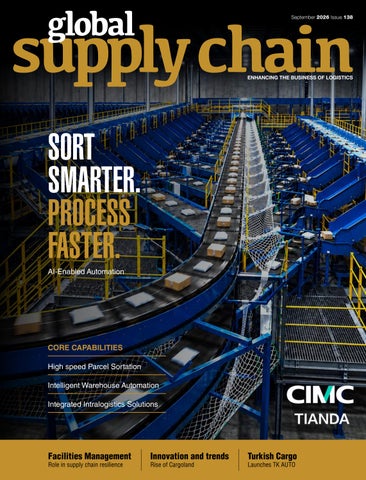
SORT SMARTER. PROCESS FASTER. AI-Enabled Automation
CORE CAPABILITIES High speed Parcel Sortation Intelligent Warehouse Automation Integrated Intralogistics Solutions
Facilities Management Role in supply chain resilience
Innovation and trends Rise of Cargoland
Turkish Cargo Launches TK AUTO
Drive the road of change. Full offering - Full range vehicles with the most advanced technologies - Highly customized product driven by market needs and optimized Total Cost of Ownership
European technology - High quality complete line-up in terms of tonnage, power, torque, safety, ergonomics - High performance and robust trucks for extreme Off-road conditions
High capillarity of aftersales - Repair and Maintenance contracts and competitive warranty conditions - Origin 100% IVECO Parts and a widespread network coverage
Customer centricity - Comfort, ergonomics and the latest safety technology to make on board easier - Driver Style Evaluation tool on Heavy ON-road range and optimized vehicle design to improve customer profitability
Your Trusted Partner for Chemical Logistics & HazMat Storage
HazMat-Approved Facility with EHS & DCD Compliance Handling & Storage Capabilities across DG Classes 2, 3, 4, 5, 6, 8 & 9 24/7 Security & Advanced Fire Safety Systems
Hellmann Indu Chemical Jebel Ali Freezone (South), Dubai, UAE Email: rohit.bose@hellmann.com Mobile: +971 5654 79584
SIGNATURE MEDIA FZ LLE P. O. Box 49784, Dubai, UAE Tel: 04 3795678 Email: info@signaturemediame.com Exclusive Sales Agent Signature Media LLC P.O. Box 49784, Dubai, UAE Publisher: Jason Verhoven jason@signaturemediame.com Editor: Abigail Mathias abigail@signaturemediame.com Art Director: Johnson Machado johnson@signaturemediame.com
Printed and Distributed by Masar Printing and Publishing L.L.C., Part of Dubai Media Incorporated Dubai, UAE
Contributor’s opinions do not necessarily reflect those of the publisher or editor and while every precaution has been taken to ensure that the information contained in this magazine is accurate and timely, no liability is accepted by them for errors or omissions, however caused. Articles and information contained in this publication are the copyright of Signature Media FZ LLE & SIGNATURE MEDIA LLC and cannot be reproduced in any form without written permission.
“We innovate by starting with the customer and working backwards. That becomes the touchstone for how we invent.” – Jeff Bezos As Bezos reminds us, true invention begins by working backwards with the customer in mind. This edition of Global Supply Chain explores that principle in action across the global logistics landscape. Our cover story with CIMC examines how the company is building a future proof logistics ecosystem designed to withstand disruption and accelerate growth. We also spotlight Turkish Cargo, which has launched TK AUTO, a dedicated product engineered for the evolving needs of the automotive sector. You’ll find perspectives on leadership accountability, alongside a deep dive into how automated visual inspection is reshaping factory floor quality control. Brand Finance adds a timely analysis on managing real time disruptions — a capability that has become non negotiable for modern supply chains. Closer to home, we bring you highlights from the National Association of Freight and Logistics (NAFL), which hosted a timely event for its members. There are also insights from the recently concluded IVECO Experience 2026, and a preview of major international logistics events scheduled for the months ahead. We hope these news and insights inspire you to shape a future where innovation drives resilience — and where every one of us can thrive. Abigail Mathias Editor abigail@signaturemediame.com www.globalsupplychainme.com
SEPTEMBER 2026 3
September 2026 Issue 138
06
CIMC Creating a future proof logistics ecosystem
12 16Swisslog NAFL 20 26Cargo terminals Turkish Cargo
Launch of TK Auto
Five pillars of SC automation
Hosts open majlis
Latest breakthroughs by Lödige Industries
28Quality control
Use of automated visual inspections
4 SEPTEMBER 2026
32 36The rise of Cargoland Brand Finance 42 46MAN Truck & Bus News from the industry 49 60The Business of Balancing Logistics Facilities Management
Growing role in SC resilience
Building future ready infrastructure
Navigating ME disruptions
Launches CKD partnership
All the latest from the logistics arena
Mahshad Sadeghulvad
YOUR YOUR PARTNER PARTNER FOR FORMATERIAL MATERIAL HANDLING HANDLING AUTOMATION AUTOMATION
@AEDLERLogistikSolutions @AEDLERLogistikSolutions
WWW.ALS.AERO Winfo@als.aero WW.ALS.AERO info@als.aero
CIMC TIANDA
CIMC:
Creating a future proof logistics ecosystem
Gustav Ryan, EMEA Operations Director CIMC 6 SEPTEMBER 2026
CIMC TIANDA
A
future ready logistics ecosystem, as defined by CIMC TIANDA, is one that stays agile, visible and seamlessly connected. Instead of isolated automation, it prioritizes integrated intralogistics across receiving, sorting, storage, picking and dispatch — ensuring operations can flex with shifting volumes and product profiles. With scalable infrastructure and lifecycle long maintainability, the goal is simple: build logistics operations that run reliably today and evolve effortlessly as business demands change. We caught up with Gustav Ryan, EMEA Operations Director CIMC, to find out more.
“The objective is not automation for its own sake. It is to help customers build operations that are reliable today and able to evolve as their business changes.”
GSC: As global supply chains become more volatile, what does a “futureproof” logistics ecosystem actually look like from CIMC TIANDA’s perspective? Gustav Ryan: A resilient intralogistics operation should be able to maintain stable performance while adapting to changing volumes, product mixes and operating requirements. For CIMC TIANDA, this means looking beyond individual machines and designing an integrated flow across receiving, conveying, sorting, storage, picking and dispatch. The system should provide operational visibility, support scalable capacity and remain maintainable throughout its lifecycle. The objective is not automation for its own sake. It is to help customers build operations that are reliable today and able to evolve as their business changes.
GSC: How does CIMC TIANDA envision the shift from traditional physical infrastructure to intelligent, selfoptimising logistics assets? GR: Equipment is increasingly becoming part of an intelligent, connected system rather than operating as a standalone asset. Sensors, control software and operational data can improve visibility into material flow, equipment status and system performance. This enables operators to identify bottlenecks earlier, improve maintenance planning and make more informed decisions about capacity and process optimisation. The real value comes from connecting physical automation with operational intelligence in a way that is practical for the customer’s day-to-day business.
SEPTEMBER 2026 7
CIMC TIANDA GSC: Where can AI create practical value in intralogistics today, and where does human expertise remain essential? GR: AI can create value where there is sufficient operational data and a clearly defined decision process. Potential applications include identifying recurring bottlenecks, supporting predictive maintenance, improving resource allocation and helping operators respond to exceptions more efficiently. At the same time, human expertise remains essential in system design, safety management, process improvement and the handling of unusual operational situations. High-performing automated operations rely on a thoughtful combination of technology, operational experience and human judgement. GSC: How does CIMC TIANDA combine global engineering experience with local project delivery? GR: Every logistics operation is shaped by local realities, including customer processes, facility conditions, regulations, labour models and service expectations. CIMC TIANDA combines its automation engineering and system-integration experience with project-specific localisation. This means understanding each customer’s operational priorities before defining the right solution, implementation approach and long-term support arrangement. Global capability is most valuable when it can be translated into a solution that works reliably in the customer’s actual operating environment. GSC: Which innovation priorities will have the greatest impact on warehouse and intralogistics performance in the coming years? GR: We see the greatest value in innovations that improve flexibility, system availability and lifecycle performance. For customers, this can include modular system design, more intelligent control and monitoring, stronger integration between equipment and software, and solutions that make more effective use of space, energy and labour. The priority should not simply be introducing more technology, but applying the right technology to address a specific operational challenge. 8 SEPTEMBER 2026
“The strongest operations will be those where people understand how to work with automation, interpret performance data and continuously improve the process.”
Key Takeaways
1
Future-proof logistics means flexibility, not automation alone. CIMC TIANDA’s vision is an integrated intralogistics ecosystem spanning receiving, conveying, sorting, storage, picking and dispatch, designed to adapt to changing volumes and product profiles. Connected automation creates real operational intelligence. Sensors, control software and data can provide greater visibility, identify bottlenecks earlier, improve maintenance planning and support better capacity decisions. AI should solve practical problems. The strongest applications include predictive maintenance, bottleneck identification, resource allocation and faster exception management—not simply adding AI for its own sake. Human expertise remains critical. Automation will shift people toward operational planning, optimisation, safety, exception management and continuous improvement. Technology works best when combined with human judgement and experience.
2
3
4
5
Global technology must be locally relevant. CIMC TIANDA combines global engineering and systems-integration expertise with solutions adapted to local processes, regulations, facility conditions and customer requirements. Data is valuable only when it drives decisions. Accurate, connected data, interoperability, governance and cybersecurity are essential to turn operational information into actionable insight. Sustainability and efficiency can go hand in hand. Energy efficiency, reduced unnecessary movement, durable equipment and better use of space can deliver both environmental and operational benefits. Performance is about more than throughput. A truly high-performing intralogistics operation must also be safe, reliable, adaptable, visible and easy to manage, while maintaining performance during peak periods and future growth.
6 7
8
CIMC TIANDA’s message is that the future of intralogistics is not about adding more technology—it is about integrating automation, intelligence, data and human expertise to create flexible, reliable and sustainable operations that can evolve with the business.
CIMC TIANDA
SEPTEMBER 2026 9
CIMC TIANDA
GSC: As automation accelerates, what uniquely human capabilities will become more valuable — not less — in logistics? GR: As repetitive work is automated, people can focus more on areas where judgement and experience make the greatest difference. These include operational planning, exception management, system optimisation, continuous improvement, safety oversight and cross-functional coordination. Automation changes the nature of work; it does not eliminate the need for capable operating teams. The strongest operations will be those where people understand how to work with automation, interpret performance data and continuously improve the process.
10 SEPTEMBER 2026
GSC: What needs to happen for data to become a genuinely useful operational asset? GR: Data becomes valuable when it is accurate, connected and linked to clear operational decisions. In intralogistics, the challenge is not simply collecting more data. It is integrating data from equipment, control systems and operational processes in a way that gives users actionable insight. Interoperability, data governance and cybersecurity are therefore just as important as analytics. The focus should be on helping customers improve visibility, respond faster to issues and make better operational decisions.
“Data becomes valuable when it is accurate, connected and linked to clear operational decisions.”
CIMC TIANDA
GSC: What role can CIMC TIANDA play in enabling circular, reusedriven logistics systems rather than linear, waste-heavy ones? GR: Sustainability should be considered as part of both system design and long-term operation. This includes improving energy efficiency, reducing unnecessary movement and idle time, designing equipment for durability and maintainability, and optimising material flow and space utilisation. In many cases, these measures can support both environmental objectives and operational efficiency. For CIMC TIANDA, sustainable design is not a separate add-on. It is part of building systems that deliver long-term value for customers.
GSC: Beyond throughput, how should companies define high-performing intralogistics operations? GR: Throughput remains important, but it is only one measure of performance. A high-performing operation should also be safe, reliable, adaptable and easy to manage. It should maintain availability during peak periods, respond effectively to changing demand, provide useful operational visibility and support consistent service levels over time. The strongest solutions are those that balance performance today with flexibility for the customer’s future growth.
GSC: What does global capability mean in practice for a customer investing in automation? GR: For customers, global capability should mean access to proven engineering experience, a broader understanding of operational challenges across markets, and the ability to adapt a solution to local needs. It is not simply about geographic presence. It is about delivering an integrated solution—from system planning and engineering to implementation, commissioning and ongoing support—that is aligned with the customer’s business objectives. That is how CIMC TIANDA approaches long-term customer value: combining technical capability with a practical understanding of real operations. SEPTEMBER 2026 11
Turkish Cargo
Turkish Cargo launches a new product for the automotive industry: TK AUTO
T
urkish Cargo, the global air cargo brand of Turkish Airlines, introduced TK AUTO, a logistics product specially developed for the sensitive and time-critical transportation needs of the automotive industry, at a launch event held during the Air Cargo China exhibition. Comprising two segments, TK AUTO provides fast and reliable transportation solutions for different operational requirements through its AUTO PART and AUTO FINISHED options. TK AUTO PART has been designed for the fast, reliable, and flexible transportation of critical automotive components required in both manufacturing and aftermarket operations, including engine and transmission components, braking systems, airbags, and electric vehicle equipment. Shipments within this service scope are handled with priority loading procedures compared to general cargo, helping ensure the uninterrupted continuity of production processes. TK AUTO FINISHED has been developed for
12 SEPTEMBER 2026
the transportation of motorized passenger cars, electric vehicles, prototype and test vehicles, as well as luxury and premium segment automobiles, in addition to special vehicles such as motorcycles, ATVs, Sea-Doos, and Ski-Doos. Going beyond standard cargo processes, this service provides expert team support, enhanced operational processes, and tailored vehicle transportation solutions: • Special loading plans and expert team support: Before each shipment, loading scenarios tailored to the specific type of vehicle are prepared. Certified Loadmaster teams manage the loading, securing, and unloading processes of vehicles onsite, ensuring that the operational plan is implemented correctly in the field. All processes are carried out in accordance with sensitive handling techniques and operational control procedures. • Secure storage and priority operation with the LUXE service: Vehicles within the LUXE service developed for high-value automobiles are stored in specially secured
areas at the SMARTIST facility. Critical steps in the operational process are documented through photographic recording. Supported by priority loading applications within its speed-focused services, this solution provides additional assurance and operational visibility in vehicle transportation that requires special care. • Operational control strengthened through digitalized processes: Reservations for automotive spare parts shipments can be easily made via the TK GO platform and digital sales channels. For finished vehicle transportation, prebooking processes are accelerated through customized volume calculations. Commenting on the launch, Turkish Airlines Chief Cargo Officer, Ali Türk said: “In automotive logistics, need-specific solutions are as important as speed. Therefore, in developing TK AUTO, we aimed to provide an end-to-end structure capable of meeting the diverse operational requirements of the automotive industry. In this way, we are able
Turkish Cargo
Ali Türk, Chief Cargo Officer, Turkish Airlines
to effectively manage sensitive processes ranging from time-critical spare parts transportation that supports production continuity to high-value vehicle operations. While our reservation processes are supported by digital integration, our on-site operations are carried out by expert teams and defined procedures. With this dedicated structure of TK AUTO, we provide not only the speed requirements of the automotive industry but also production continuity and greater visibility in transportation processes. As Turkish Cargo, we will continue to provide reliable solutions to the evolving needs of our business partners through our extensive flight network, modern infrastructure, and expertise in special cargo transportation.” TK AUTO, which extends Turkish Cargo’s expertise in value-added air cargo transportation to automotive logistics, aims to contribute to the automotive industry by supporting speed, reliability, and operational visibility across all processes from production to delivery, while further advancing Turkish Cargo’s expertise in special cargo operations. SEPTEMBER 2026 13
NEXT-GEN SUPPLY CHAIN TIER-1 WMS ARCHITECTURE FOR MID-SIZED DC
Manhattan Associates
MANHATAN ACTIVE®
ESSENTIALS / ENTERPRISE
SOLUTION DESIGN Active Orchestration AUTO
The mid sized warehouse finally has a different answer SYS_REF: 25.08_ACTIVE_LADDER
M
anhattan Associates is a global supply chain technology company headquartered in Atlanta, known for building some of the industry’s most advanced warehouse management, transportation management and omnichannel commerce software. Founded in 1990, the company has grown to more than 4,500 employees worldwide and is publicly traded on Nasdaq. Its flagship suite, Manhattan Active, is a cloud native, microservices based platform used by over 1,200 global retailers, manufacturers, distributors and logistics providers to run high performance supply chain operations. For several decades, the mid-sized warehouse has been told a version of the same thing: the best warehouse management system in the world is not for you. Not because the software
14 SEPTEMBER 2026
could not handle the operation. A 40,000-pallet DC does not confuse a Tier-1 WMS. The reason was always simpler and more brutal — the software fees, implementation cost and timeline were more than the operation could justify. That equation has now changed. Manhattan announced a restructuring of how Manhattan Active is packaged and priced. Set alongside what the company showed at Momentum in May, it amounts to the most significant shift in years in who can credibly buy a Tier-1 WMS.
The challenge: The real barrier was never the software Ask any Supply Chain Director in Dubai or Riyadh, Johannesburg or Cape Town, why they settled for a mid-tier WMS, and you will rarely hear a functional objection. You will hear about time and cost of
ownership. Months of workshops. Design documents that ran to hundreds of pages. Consultants translating what the warehouse manager said into what the system needed to be told — then translating it back again to confirm they had understood. That translation layer was the cost. It was also the risk. Every handoff between the person who knows the operation and the person who knows the configuration screens is a place where intent gets lost. Manhattan’s own CTO, Sanjeev Siotia, named this directly when the company launched Solution Design Studio: the design and configuration phases are where speed-to-value tends to suffer. For a large retailer amortising that cost across multiple sites, it was tolerable. For a single-site distributor doing 5,000 lines a day, it was the whole reason the answer was no.
MODE: PRE-CONFIGURED
Manhattan Associates
Editions lower the floor
DISPATCH & WMS Real-Time Routing OPTIMAL
Manhattan have announced three editions of Manhattan Active: Enterprise Premier, Enterprise and Essentials. Eric Clark was clear that this changes packaging and pricing rather than introducing new products, describing the structure as “a ladder, not a menu of different products”. The significance for our region is specific: • Enterprise brings Active Warehouse within reach at a lower entry point: a pre-configured, best-practice-led feature set, lower subscription pricing and a rapid implementation methodology. The distinction is how much bespoke configuration an operation needs, not how large or sophisticated it is. Plenty of high-volume operations run disciplined, standard processes that a pre-configured build serves well — and for a group, this is often the right fit for sites in a network even where the flagship DC sits on Premier. • Essentials extends warehouse, transportation, order management and store capability to less complex sites inside larger enterprises, to smaller companies, and — in Manhattan’s own framing — to additional geographic markets. Clark’s ladder framing is the part to hold onto. Enterprise Premier is what Manhattan has been selling for years. What is new is that an operation can start lower on the ladder and move up as it grows, without replatforming.
The shift: configuration becomes a conversation
Dr. Makrem Kadachi
A lower entry price on its own would not open the mid-market. If implementation still took months of workshops, the total cost would land in the same place. That is the second half of the story, and it is why the timing of these two announcements matters. Solution Design Studio takes a different route to configuration. Rather than a business user describing an operation to a consultant who then navigates multistep configuration screens, the user writes a blueprint — a living description, in ordinary business language, of how a part of the warehouse or transport network should actually run.
Michael Badwi
Blueprints can be authored directly in the Studio editor or uploaded from documents that already exist. The user reviews, edits and approves each section. Only then do the platform’s agents translate that blueprint into live configuration across Manhattan Active solutions.
The Verdict The interesting story in Manhattan’s 2026 announcements is not that AI can configure a warehouse system. It is that the economics of who gets to use a Tier-1 WMS have quietly shifted. For more than 20 years, the honest advice to a mid-sized distributor was that the best system was out of reach, and a compromise was the sensible choice. That advice is expiring. As the Manhattan Associates GeoPartner for Africa and the Middle East, we are already having these conversations with operations teams across both regions. If you have looked at Manhattan before and concluded you were too small, that conclusion is worth revisiting. Excerpts of an article written by Michael Badwi from Supply Chain Junction SEPTEMBER 2026 15
Swisslog Middle East
Ready for the next: Swisslog reveals five pillars of future-ready supply chain automation What separates automation that lasts from automation that limits you? Swisslog shares the five pillars every supply chain leader should consider for success in modern logistics.
S
wisslog, a global leader in warehouse automation and intralogistics solutions, has published a framework that addresses a key industry issue: the difference between automation that works when it is first introduced and automation that continues to function as the business evolves. Ready for the Next sets out five principles every operation must apply when evaluating whether its automation is built for the long term. The cost of getting that wrong is rarely immediate. Outdated or inflexible systems will reveal themselves through capacity constraints, costly retrofits, and technology decisions that become harder to unpick the longer they’re left. Swisslog’s framework closes that gap by grounding automation investment in long-term outcomes rather than point-in-time delivery. “Across the Middle East, supply chains are evolving rapidly as businesses expand capacity, diversify operations, and respond to higher customer expectations. Modern logistics has become a strategic game of chess, where every workflow, every technology decision, and every investment must support a much bigger long-term vision,” said Rami Younes, General Manager of Swisslog Middle East.
16 SEPTEMBER 2026
The Five Pillars
1
Outcomes over projects. Every automation investment should pass three operational tests. Can it sustain throughput in live production, not just at commissioning? Can it flex to accommodate volume spikes, SKU changes, and new fulfillment models? And can capacity grow without re-platforming? Software is the orchestration layer that holds those outcomes together long after go-live.
2
Automation as a journey. Early automation does more than improve picking speeds or reduce manual touches. It generates clean data, surfaces bottlenecks, and builds the connected infrastructure that makes every subsequent investment lower risk. A modular approach means capability can be added when needed, without downtime or overbuilding. Each phase compounds the value of the last. In the Middle East, this journey is accelerating as e-commerce drives demand for more advanced warehousing, with the regional market forecast to grow from $1.40 billion in 2026 to $1.81 billion by 2031.
3
Future-ready software. Readiness depends on a digital core that absorbs new demands without becoming unstable. That means a lean, predictable
architecture and AI-ready data structures that allow intelligence to be adopted when it drives real outcomes. Open orchestration integrates mixed technologies without lock-in, giving operations a foundation to extend rather than overhaul.
4
Scalable, integrated technology. The strongest automation strategies scale while operations stay live. Across the Middle East, demand for scalable automation is rising as the logistics automation market is projected to grow from $1.58 billion in 2025 to $4.78 billion by 2033. That spans AS/RS, shuttle systems, AMRs, cube storage, and case handling as SKU profiles evolve. A best-in-class integration mindset is essential: where a third-party technology is the strongest fit, it should be integrated. There is no prescribed path, only the one that best serves the operation.
5
People, expertise, and partnership. Technology determines what an operation can do. People determine whether it stays ready as the business evolves. Teams that remain engaged beyond go-live, helping operations anticipate change before it becomes urgent, make the difference. That continuity is what separates a project from a program, and a vendor from a long-term partner.
FedEx
FedEx advances smart logistics capabilities in Saudi Arabia with Surround Monitoring and Intervention AI-powered monitoring and intervention portfolio enhances visibility, prioritisation, and continuity for critical shipments
F
ederal Express Corporation (FedEx), one of the world’s largest express transportation company, has launched FedEx Surround Monitoring and Intervention (MI) Suite in Saudi Arabia, a multi-tiered portfolio designed to give businesses greater control over critical shipments. By combining near real-time visibility, AI-powered predictive analytics, and advanced handling capabilities, FedEx Surround MI Suite helps identify potential risks earlier – including those arising from evolving regional and global conditions – and enables faster, more informed decision-making while shipments are in transit. The FedEx Surround MI Suite integrates seamlessly with the company’s transportation network, supporting continuity of operations even as supply chain conditions shift - while strengthening its portfolio of shipping and tracking solutions. With three subscription tiers—Select (for visibility and predictability), Preferred (for Intervention and Prioritisation), and Premium (top tier, dedicated support)— the solution supports all shipment sizes, from packages to palletised heavyweight freight. The solution brings together shipment data, including scan events and sensor inputs, with 18 SEPTEMBER 2026
external factors such as weather conditions to assess shipment status and anticipate potential disruptions. “As supply chains become more complex and interconnected, the ability to anticipate and respond to challenges is a clear competitive advantage – particularly in times of heightened uncertainty,” said Nitin Tatiwala, vice president Marketing, Customer Experience, and Air Network for FedEx Middle East, Indian Subcontinent and Africa. “At FedEx, we are equipping businesses in Saudi Arabia with smarter, data-driven capabilities that strengthen resilience, support informed decision-making, and help ensure continuity of critical shipments. By combining the strength of our global network with intelligent solutions, we are helping businesses stay agile, operate with greater confidence, and support long-term growth.” FedEx Surround MI Suite is designed for industries, such as healthcare, high-tech, aerospace, industrial, and automotive, where oversight of sensitive and time-critical shipments is essential. It offers customers three key benefits: · Flexibility and control: A centralised
dashboard provides near real-time global visibility and predictive insights, supported by AI and SenseAware ID device to track and provide near real time visibility of customer shipments. · Greater operational value: Special handling code enables prioritized boarding and handling, cold chain support, and innetwork intervention. · Peace of Mind for mission-critical shipments: 24/7 expert support provides proactive monitoring and intervention with dedicated teams at hubs, ramps, and stations, including customised reporting for customers. Saudi Arabia’s non-oil exports, including re-exports, reached approximately SAR 97.5 billion in the fourth quarter of 2025, marking a 19% increase compared to the same period in 20241. As trade volumes grow, advanced solutions such as FedEx Surround® help strengthen reliability, support continuity of cross-border trade, and enable businesses to operate with greater confidence. This aligns with the Kingdom’s broader Vision 2030 ambitions by supporting more resilient and future-ready logistics capabilities.
NAFL: Open Majlis 2026
NAFL hosts Industry Open Majlis
T
he National Association of Freight and Logistics (NAFL) is a non-government, non-profits membership-based organisation representing freight forwarders in the region specifically in the UAE. It is an official chapter of FIATA in the UAE and by far the oldest association in the Middle East and Gulf region. NAFL’s membership is composed of 450+ corporate members from the UAE from the freight and logistics’ industry. It was founded in1992 and headquartered in Dubai, UAE. NAFL is the Arabian Gulf’s first national freight forwarders association and by far the most active association. The organisation recently organised an Open Majlis in Dubai, UAE and we caught up with the President of the National Association of Freight and Logistics (NAFL) Ms. Nadia Abdul Aziz, Senior Vice President FIATA, to find out more about the significance of the gathering.
20 SEPTEMBER 2026
NAFL: Open Majlis 2026
SEPTEMBER 2026 21
NAFL: Open Majlis 2026
GSC: Can you describe the purpose behind the event? Nadia Abdul Aziz: The purpose of the event was to foster public private sector dialogue on the prevalent issues, opportunities, solutions, and connect the investors with the relevant stake holders in the government authorities in case they need any assistance with their shipments. We want to showcase real operational challenges and get real solutions from senior officials at the ports, customs, etc. clear any misunderstandings, give out update policies by government offices to the delegates so they are updated, mitigate risk, showcase any new services offered by the government offices, airlines, airports, customs, ports etc. At NAFL, we have been working closely with various UAE government authorities ever since the crisis started and are fully committed to support the freight, logistics and trade industry in the country. We have been working with the Dubai Customs open majlis for almost three months to support the investors from various sectors. We are also working with the ports authorities as well as DMA, NAIC, DET, the chambers, airlines, dnata, DCAA freezones etc to assist the investors in our sector and beyond. As an organisation NAFL gave the investors from the industry the latest updates on NAFL work and upcoming collaborations, regional and global events we will be participating actively in to further promote the UAE as a logistics, trade and freight hub. Working together and collectively honestly has resolved many issues and effectively assisted in the efficient movement of goods into and out of the UAE.
22 SEPTEMBER 2026
NAFL: Open Majlis 2026
GSC: How many people attended the event and what was the general feedback received? NAA: The open NAFL Majlis hosted more than 160 senior professionals and business owners, government senior officials. GSC: Do you intend to host another such event in the near future? NAA: Yes, we do intend to host this again and intend to always keep the investors from the freight/logistics industry work closely with government offices to further streamline prices for the imports, exports and re-exports. This is a must during these challenging times and it will definitely have a positive impact on cargo handling and the entire freight ecosystem. GSC: What is the general mood of the industry at the current time? Is there optimism for the future? NAA: The current feel is much better than the start of the crisis, more confidence in the new freight corridors and people understand the dynamics of the new routes. In the future if things get back to normal, this will be smoother and amounts of inbound, outbound cargo movements will take place once strait of Hurmuz is fully operational. Members can connect with airlines, shipping lines, ports, customs, maritime, ministries at our event and engage and network too. Ask any questions about the industry if they are not sure about anything pertaining to the industry, processes, documentation or related matters.
SEPTEMBER 2026 23
IATA’s Board of Directors
IATA Board Appoints Saadia Zahidi as Director General
T
he International Air Transport Association (IATA) announced that Saadia Zahidi has been appointed by IATA’s Board of Directors to the position of Director General from 1 November 2026. Zahidi will be IATA’s ninth Director General and the first woman appointed to hold the position. She joins IATA from the World Economic Forum (WEF) where she is a Managing Director and Member of the Managing Board. Willie Walsh, IATA’s current Director General, will conclude his duties on 31 July 2026. The IATA Board of Directors has appointed Sandrine Le Borgne, IATA’s Chief Financial Officer and Senior Vice President for Corporate Services, as Interim Director General for the intervening period. “The Board is very pleased to appoint Saadia Zahidi as Director General of IATA. Saadia’s long and outstanding experience at the World Economic Forum will enhance and strengthen IATA as the voice of the world’s airlines. Global air transport is a trillion-dollar industry that has and continues to change the world for the better. Saadia’s appointment comes at a moment of significant change in the international environment. Technology and geopolitics, among others, will reshape the industry in the future and Saadia brings the right skills to effectively articulate what our industry needs to continue connecting people and economies safely, efficiently, and sustainably. She’ll bring a fresh perspective to IATA that will grow its support for the airline industry on the foundations of IATA’s well-established technical, financial, and data capabilities. I thank Willie for his outstanding leadership that helped IATA emerge from the COVID years stronger and with a more representative membership than ever. We now look forward to Saadia taking IATA’s work to even greater heights,” said Roberto Alvo, Chair of the IATA Board of Directors and CEO of LATAM Airlines Group. “I am honoured to help advance IATA’s mission to represent, lead, and serve the
24 SEPTEMBER 2026
airline industry at this pivotal moment. Aviation is critical infrastructure for economic growth, trade, tourism, jobs, investment, and opportunity. In a rapidly changing world, IATA’s role in bringing the industry together to collaborate through trusted standards, essential services, and advocacy has never been more important. I look forward to working closely with our member airlines, governments, and the ecosystem of partners to build on IATA’s remarkable foundation, ensuring aviation continues to connect the world while embracing innovation, strengthening resilience, and advancing sustainable growth. Together, we can expand the benefits of connectivity to more people and economies around the world. My top priority will be working with the IATA team and with the industry to build aviation’s future together,” said Zahidi. Zahidi spent more than two decades at the World Economic Forum, where she
served as Managing Director and Member of the Managing Board. She founded and currently heads its Centre for the New Economy and Society. Previously she has led the WEF’s Global Communications Group, Global Programming Group, and WEF’s engagement with academics, civil society, and international organizations. Zahidi founded and co-authors WEF’s Future of Jobs Reports, the Future of Growth Reports, the Global Gender Gap Reports, and Chief Economist Outlooks. She has served on the UN Secretary-General’s panel for Women’s Economic Empowerment and the European Space Agency’s High-Level Advisory Group. She is also the author of Fifty Million Rising, tracking the rise of working women in the Muslim world. Zahidi holds a BA in Economics from Smith College, an MPhil in International Economics from The Graduate Institute, and an MPA from Harvard University. She holds Swiss and Pakistani nationalities.
Air Cargo Terminal Technology
Redesigning the rhythm of cargo
L
GSC: What are the most critical foundational capabilities cargo terminals must build today to transition from basic automation to truly intelligent, AI-driven operations? NT: AI-driven operations are only as effective as the data foundation supporting them. To get there, a terminal needs to become datadriven first, unifying disparate data points, from shipment details and equipment availability to complex workflows into a single, real-time stream. The transition really starts with process transparency and the ability to orchestrate the entire cargo flow through a centralized digital layer. This is where a solution like our Cargo Direct becomes essential. It acts as the “brain” of the operation by synchronizing physical handling with operational data. Whether we’re supporting complex air cargo hubs or high-density distribution centers, our goal is to provide that orchestration layer, eliminating blind spots and ensuring the facility is ready to adapt to whatever the future demands. GSC: How can terminals overcome fragmented data, legacy systems, and inconsistent data standards that currently limit the effectiveness of AI? NT: It‘s a common misconception that the biggest hurdle is a lack of automation. In reality, the primary bottleneck is connectivity. Many cargo terminals are operating on a complex patchwork of legacy infrastructure and fragmented data sources that simply don’t communicate with each other. From our perspective, the solution is not necessarily a large-scale replacement of 26 SEPTEMBER 2026
Image credits: © Lödige Industries (all image rights reserved
ödige Industries been the global leader in air cargo terminal technology for more than 75 years, but its mission now stretches far beyond mechanical handling. As supply chains shift toward automation, intelligence and resilience, the company is equipping airports and industrial operators with the tools to thrive in a data driven future. Nicholas Tripptree, Managing Director for Asia Pacific at Lödige Industries, shares how the company is steering this transformation.
existing assets. Instead, operators should focus on creating an intelligent software layer that connects and optimizes existing infrastructure. This approach allows terminals to build a robust data foundation while protecting previous investments. By integrating terminal management systems, e-AWB data, equipment status, and external cargo community platforms into a common ecosystem, operators can eliminate information silos and create a trusted data environment that enables future AI applications. GSC: In what ways can predictive analytics reshape planning, resource allocation, and disruption management across the cargo chain? NT: Predictive analytics has the potential to fundamentally shift cargo operations from reactive execution to proactive orchestration. Solutions such as Cargo Direct enable dynamic routing decisions, optimised staging strategies, and more efficient allocation of personnel and equipment. The greatest value emerges during periods of disruption or peak demand. Rather than responding to bottlenecks after they occur, operators can anticipate constraints and proactively adjust workflows. Over time, predictive capabilities will help create cargo ecosystems that are not only more efficient but also significantly more resilient.
GSC: As AI becomes more embedded in daily operations, how will the role of ground staff evolve, and what new skills will be required? NT: Staff and machines complement each other. As automation and AI continue to advance, the role of ground staff will evolve from primarily executing manual tasks to supervising, managing, and optimizing increasingly intelligent systems. While technologies such as AGVs, automated storage systems, and digital orchestration platforms can automate repetitive activities, human expertise remains critical for managing exceptions and making judgement calls during irregular operations. Future workforce development will increasingly focus on digital literacy, automation oversight and data-driven decision-making. The most successful cargo operations will be those that combine advanced intelligent machinery with a workforce capable of overseeing these systems to drive continuous improvement. GSC: How can AI-driven equipment optimization go beyond automation to deliver measurable improvements in safety, turnaround time, and asset longevity? NT: In a high-throughput hub, optimization is not about making operations faster, it is about making them smarter. When we integrate a terminal‘s layout and shipment
Air Cargo Terminal Technology
data into a single intelligence layer, like our Cargo Direct module, we move operators away from reactive scrambles toward mathematical predictability. The software dynamically calculates the most efficient paths for put-away and retrieval which slash turnaround times. This eliminates workstation waiting times and keeps cargo moving continuously. A prime example of this is our implementation at the China Eastern Air Logistics (CEAL) Pudong Cargo Terminal 4. By seamlessly integrating a fleet of heavyduty, 10ft ULD Automated Guided Vehicles (AGVs) with China‘s first automated Lift and Run system under centralized software control, the terminal can execute rapid, simultaneous buildup and breakdown cycles through dynamic, multi-level routing, maximizing throughput within the exact
same physical footprint. By upgrading the software “brain” of your existing brownfield machinery, we minimize mechanical wear and can extend the service life of those assets. GSC: What does a future-proof digital architecture look like for cargo terminals aiming to scale AI adoption over the next decade? NT: A future-proof cargo terminal architecture must be built around scalability, modularity, and interoperability. From our experience, the most successful operators avoid large-scale “rip-and-replace” projects and instead implement phased modernization strategies that allow new technologies to be introduced progressively without disrupting live operations. At the centre of this architecture there
Nicholas Tripptree, Managing Director for Asia Pacific at Lödige Industries
should be a unified terminal management platform that serves as the operational source of truth. On top of this foundation, process orchestration solutions, automated storage systems, mobile robotics, and future AI applications can be integrated over time. This modular approach ensures that terminals remain adaptable as operational requirements and technologies continue to evolve over the next decade. GSC: What governance frameworks should operators put in place to ensure AI systems remain transparent, safe, and aligned with operational priorities? NT: Safety is a fundamental requirement. However, regulatory frameworks vary from country to country. It is therefore essential to implement measures while taking these rules into account. At Lödige Industries, our local expert teams manage these requirements and liaise with the relevant authorities where necessary. Before operators can rely on AIdriven recommendations, they must ensure that operational data is accurate, validated, and continuously synchronized across all systems. Structured workflows, such as scanand-confirm processes, provide an important layer of transparency by ensuring that every cargo movement is verified against operational rules and safety requirements. Ultimately, AI must reinforce operational priorities such as safety, reliability, and service quality, and never act independently of them. GSC: How important is cross-industry collaboration - between airlines, handlers, tech providers, and regulators - in accelerating the shift toward intelligent cargo ecosystems? NT: It is critical. We see a significant opportunity to eliminate cross-company data latency. By synchronizing physical inventory data directly with high-level terminal logic, the industry can create a truly predictive, end-to-end visibility network. This benefits everyone, from handlers to airlines to end customers. The future of intelligent cargo will depend on the industry’s ability to collaborate around common data standards and integrated platforms. We believe that by removing these data gaps, we can enable a more resilient, highly transparent global supply chain. SEPTEMBER 2026 27
AI Quality Control
How automated visual inspection is changing factory quality control and supply chain
F
actory quality control still operates on an uncomfortable contradiction: production is becoming faster, more variable and more automated, while many inspection processes still depend on sampling, fixed rules or tired eyes at the end of a shift. At its best, automated visual inspection in manufacturing does not simply replace an inspector with a camera. It turns inspection into a continuous data system—one that detects defects in real time, exposes process drift and gives supply-chain teams earlier warning of risk. Done properly, it makes AI Quality Control for manufacturers measurable at line speed. The real value is not simply that “AI finds scratches.” The real value is that quality becomes a usable process signal. 28 SEPTEMBER 2026
Automated visual inspection is more than a smarter camera A production-ready automated visual inspection system begins with physics, not algorithms. Lighting, optics, exposure, triggering, part presentation and motion control determine whether a defect is visible at all. AI cannot recover information the sensor never captured. Yet teams still debate neuralnetwork architectures while illumination changes from one shift to the next. This broader systems view is reflected in NIST’s work on AI-enhanced monitoring in manufacturing processes, where inspection cameras, sensors, data loggers and production equipment are treated as
connected parts of the same operating environment. Once image capture is stable, computer vision can classify parts, segment defective regions, detect anomalies or combine all three. Edge hardware can return a decision to a programmable logic controller, while platforms such as Spectron’s modular AI inspection and reporting environment can retain richer records for manufacturing execution systems, quality databases and production dashboards. Encoder signals, temperature, vibration and other process parameters can then help explain why a defect occurred—not merely confirm that it occurred. Traditional rule-based machine vision remains useful for predictable, repeatable
AI Quality Control
checks. AI is strongest where surfaces are noisy, products vary and defects cannot be described reliably with a simple threshold.
From sampling to continuous, contextual quality control The first operational shift is from sampled inspection to broader, often continuous coverage. A defect can be contained near its point of origin rather than discovered after a pallet, shift or production lot has already moved downstream. Manufacturers planning that transition should begin with a defined defect catalogue, a focused first use case and agreed acceptance criteria. A practical readiness guide for moving from manual to automated visual inspection can help
quality and operations teams establish those foundations before selecting cameras, software or models. Automated visual inspection also changes the inspector’s role. People spend less time making repetitive pass-or-fail decisions and more time resolving ambiguous cases, improving defect taxonomies and investigating root causes. This is not the elimination of human judgement. It is the concentration of human judgement where it has the greatest value. The second shift is real-time analytics. An AI inspection system can generate timestamped defect data by line, tool, supplier lot, stock-keeping unit and operating condition. A rise in edge chipping may indicate tool wear. A change in coating defects may
correlate with humidity, line speed or a particular material batch. Quality stops being a result that is reviewed after production. It becomes a signal that can influence production while the process is still running.
False positives are the economic test Accuracy figures alone are not enough. Factory teams must also track defect escape rates, false-reject rates, confidence calibration and performance by defect class. A system that catches everything by rejecting everything is not an effective quality system. It is an expensive stop button. False-positive reduction usually comes from better imaging, representative
Dr. Wilhelm Klein is the CEO and CoFounder of Zetamotion, an AI quality inspection company developing practical machine vision systems for complex manufacturing environments. Combining expertise in AI ethics, sustainability, and industrial applications, he leads Zetamotion’s mission to make advanced visual inspection more accessible, reliable, and useful on the factory floor. His work focuses on humancentred AI, sustainable manufacturing, and helping manufacturers reduce waste, improve consistency, and build greater confidence in quality control.
SEPTEMBER 2026 29
AI Quality Control
Highlights of the system 1. “The future of quality control isn’t finding defects faster; it’s preventing them before they disrupt production, supply chains, and customer trust.” 2. “Quality is no longer the final checkpoint on the factory floor; it’s becoming the intelligence that drives every operational decision.” 3. “AI-powered visual inspection transforms quality from a cost of compliance into a competitive advantage powered by real-time intelligence.” 4. “The true value of automated inspection isn’t that AI sees more defects; it’s that manufacturers learn faster, respond earlier, and build more resilient supply chains.” 5. “In modern manufacturing, quality is no longer a gate at the end of production; it’s the data signal that keeps the entire supply chain moving.” examples, disciplined decision thresholds and structured human review. It is rarely solved by changing the model alone. Where real defect examples are scarce, a controlled synthetic-data workflow for quality inspection can extend a limited dataset with variations in defect size, position, intensity and operating conditions. However, generated samples must be checked against real production conditions before they are accepted for training. That verification is part of the control system, not administrative overhead. Synthetic examples that look convincing but fail to represent the production environment can create misplaced confidence rather than better inspection.
The supply chain impact starts before shipment The supply-chain effect of automated visual inspection begins with shorter quality latency: less time between creating a defect, detecting it and acting on it. Shorter latency reduces work-in-progress exposure, rework queues, accumulated scrap and the chance that suspect material reaches another plant or customer. The same data can improve supplier management. Incoming inspection results can be tied to supplier lots, while recurring defect signatures can be traced across deliveries. Procurement teams gain evidence for supplier-development work rather than relying on anecdotal complaints. Planning teams can distinguish a contained process issue from a broader material risk. Image-level traceability also strengthens the response to later customer claims. Teams can review what was inspected, which conditions were present and how the system classified the product at the time. 30 SEPTEMBER 2026
That approach aligns with NIST’s digitalthread research on connecting product, manufacturing and quality information across the lifecycle. This is where automated inspection becomes a supply-chain resilience tool. It makes quality problems visible before they become scheduling problems, shipment delays or customer escalations. It can also support more intelligent buffers. Inspection intensity, review requirements and containment actions can follow measured risk rather than habit.
What leaders still get wrong about AI quality control The first mistake is treating AI visual inspection as a software purchase. AI Quality Control is an operational system spanning cameras, lighting, compute, controls, data governance, model maintenance and escalation procedures. Ownership must be explicit. Someone must be responsible not only for the model, but also for imaging stability, acceptance criteria, line integration and the response when performance changes. That systems perspective is consistent with NIST’s work on trustworthy smart manufacturing systems, which considers computing and connectivity alongside safety, performance, quality and cost. The second mistake is automating an unstable process. If part presentation, lighting or upstream settings vary without control, the model will spend its working life compensating for avoidable noise. Better training data may help, but it cannot substitute for basic process discipline. The third mistake is declaring victory based on pilot accuracy. Production acceptance should include
line-speed performance, false rejects, defect escapes, changeovers, new product variants, model drift, cybersecurity, downtime recovery and the ongoing cost of maintenance. Teams should also define what happens when the model is uncertain and who has authority to override or retrain it. A factory does not need another impressive demonstration. It needs a system that still works on Monday morning, after a changeover, under different lighting and with a new material lot.
The next advantage is closed-loop quality The next phase of automated visual inspection will combine edge AI, richer sensor integration and faster model adaptation. Inspection results will increasingly feed upstream controls, supplier scorecards, maintenance decisions and production planning rather than remaining in an isolated dashboard. The important shift is from detecting defects to using inspection data to prevent their recurrence. At Zetamotion, the ZELIA demo walkthrough shows the end-to-end inspection workflow step by step: upload representative clean and defective samples, generate and verify synthetic images, train the detection system, test it against new images and prepare it for deployment. None of these steps is individually glamorous. Together, they determine whether an AI model becomes a dependable factory system or another pilot that never reaches production. Manufacturers should begin with one costly, clearly defined inspection problem. They should establish the imaging and data architecture, define meaningful performance measures and connect the inspection result to an operational decision. Automated visual inspection will not strengthen a supply chain merely because it sees more defects. It creates value when the organisation responds earlier, learns faster and prevents the same problem from recurring. Quality control is no longer just a gate at the end of production. It is becoming an intelligence layer across the factory, its suppliers and the decisions that connect them.
Facilities Management
Facilities Management’s growing role in supply chain resilience
S
omething has quietly shifted in how we think about facilities management and its connection to supply chain operations. The two disciplines were once treated as entirely separate concerns, which is no longer the case. For a long time, facilities management meant keeping buildings running, meeting compliance requirements and ensuring people had a safe place to work. That is still part of the job, but it is nowhere near the whole picture anymore. As I write this piece, I can assure you facilities teams are expected to manage operational risk, support business continuity and keep assets functioning reliably through conditions that are harder to predict than they used to be. When you look at it through that lens, it becomes clear how much facilities and supply chain have in common. Both ultimately exist to keep things moving. A supply chain manager worries about products arriving on time. A facilities manager worries about whether the infrastructure supporting those operations will hold up. Different problems on the surface but the same underlying concern. Technology has made this relationship more complicated. Modern facilities depend heavily on interconnected digital systems including building management platforms, CAFM tools, IoT sensors and integrated 32 SEPTEMBER 2026
By Alex Davies, CEO, Ejadah
security technologies. These systems provide real time visibility and help teams make better decisions. However, they also create new dependencies that need to be understood and managed. The paradoxical element is these vulnerabilities tend to be invisible until something goes wrong. A supply chain can look perfectly solid on paper while quietly depending on physical infrastructure that has never been properly assessed. At Ejadah, we have learned to treat resilience as something that runs through everything we do, rather than a separate workstream. We know disruption can come from many directions including geopolitical events, transportation problems, supplier constraints, labour shortages and infrastructure failures. Therefore, we maintain strong relationships with our supplier and service partner networks, keep contingency plans in place and hold inventory strategies for critical equipment and materials. The goal is to understand where we are most exposed and to build protection where it matters most. One issue we have come to believe quite firmly is that resilience investment should follow operational criticality rather than asset age or replacement schedules. Assets connected to life safety, customer experience, regulatory compliance or core
operations deserve the most attention regardless of when they were installed. Data has been genuinely useful here. Through condition assessments, predictive maintenance programmes and operational monitoring we can see across large and diverse asset portfolios in ways that simply were not possible before. That visibility means teams can catch emerging issues earlier, respond faster and make decisions based on actual performance rather than assumptions. We have learned many times that the most effective form of resilience is prevention. Reducing dependency on emergency responses through proactive maintenance and long-term planning saves time, money and operational disruption in ways that reactive approaches never can. Recent years have made it hard to ignore how much resilience matters. Supply chains will keep facing new pressures - whether from economic shifts, geopolitical change, climate events or evolving technology. Facilities management will keep playing a bigger role in how organisations respond. The buildings and infrastructure and operational systems that support modern businesses are part of the supply chain. The organisations that understand that and act on it will be far better placed to maintain performance when conditions get difficult.
Opinion
Why clinical logistics is the backbone of advanced therapies Pr od uc
GMP Regulations
C
ell and gene therapies (ATMPs) are revolutionising modern healthcare. Delivering these living, hyper-sensitive medicines safely from the manufacturing cleanroom to the patient’s bedside demands an unbroken, fully validated, and auditable logistics architecture designed to safeguard product integrity at every mile. This is also pertinent to clinical sample handling. As cell-based clinical studies expand into rapidly growing healthcare hubs across MENA, sponsors face intensifying pressure from global regulators for compliance. In the world of ATMPs, Good Manufacturing Practice (GMP), Good Clinical Practice (GCP), and Good Distribution Practice (GDP) are no longer isolated silos, they are an inseparable, continuous chain. Consider a typical high-stakes scenario: a sponsor running a clinical trial in the MENA region using a cell-based product manufactured over 8,000 kilometres away in Japan. Success requires three core pillars that must align seamlessly:
1. GCP: The Clinical Foundation At the clinical site, sponsors need a rigorous GCP framework. This encompasses 34 SEPTEMBER 2026
ATMP Clinical Study Lifecycle
Product everything from trial protocols and Investigator’s Brochures to Data Safety Monitoring Plans, site audits, and rigorous staff qualifications. Crucially, regulations mandate drug mock receipt and thaw dry-runs alongside meticulous product reconciliation. Every single step, including clinical sample handling, must be documented, validated, and repeatable. All executed by human experts whose specialised knowledge simply cannot be automated or replaced by AI. A failure at any of these junctures directly jeopardises clinical study validity.
2. GMP: Quality Beyond the Cleanroom Inside a manufacturing facility, GMP governs raw-material qualification, viral vector production, cell-processing workflows, environmental monitoring, and batch release. For autologous (patient-specific) products, Chain of Identity (COI) and Chain of Custody (COC) protocols are nonnegotiable as these ensure the correct patient receives their specific cells every single time. The stakes are absolute: a manufacturing deviation can trigger an
nd es t a pl uc am od l s Pr ica in Cl
t
GCP Regulations
GDP Regulations USD 671.57 million Middle East clinical-trials market size in 2025 (not logistics, but trial operations)
CAGR 7.18% through 2033
High prevalence of diabetes, cardiovascular disease, obesity, cancer
Strong government support (Saudi Vision 2030, UAE Centennial 2071, Qatar NHS)
immediate clinical hold, while an improper handling deviation at the clinical site can invalidate the entire batch’s GMP status. This also applies to logistics and supply.
3. GDP: Extending Quality into Transit (product and patient samples) Once a batch is certified and released, GMP obligations naturally flow into GDP across the product supply chain to delivering the therapy to the patient. Additionally, the return journey involves clinical study
Opinion
Roger Phillips
logistics that equally governs the movement of biological samples from the clinical site to specialised central laboratories, testing facilities, and biobanks. Primary endpoints depend entirely on the integrity of patient blood, tissue, or cell samples post-infusion. ATMPs and biological samples are often fragile, time-sensitive, and degraded by ambient fluctuations. The size of the clinical trials in the Middle East is valued at approximately USD 671.57 Million in 2025 with a growth rate of 4% over the next four years with Saudi Arabia and the UAE being the front runners. In 2025 the estimated global number of samples volumes per phase can be seen below. With the advancement of biosimilars AI research in clinical development and biologics this number will only increase over the coming 10 years.
It All has to Come together Seamlessly At the centre of all this, high-specification passive shippers and dry-shippers play a vital role in protecting cryopreserved therapies and clinical samples, but hardware alone is insufficient. Real-world resilience relies on route validation, real-time telemetry, robust data-integrity controls, and proactive contingency planning working in unison to eliminate risk across both outbound drug supply and inbound clinical samples. Whether a therapy is manufactured in Japan, Singapore, or locally in MENA, a fully integrated, bidirectional logistics framework is what transforms a groundbreaking biotech innovation into a safe, compliant, and clinically successful reality. That is why CCP logistics, Cadiz Enterprises and GreyRigge Associates GK have formed a unique partnership across MENA and APAC to seamlessly facilitate manufacturing, supply logistics and Clinical Studies across the regions.
Andrew Thomson
Trial Phase
Share of Global Sample Shipments
2025 Estimated Sample Volume (Global)
Phase I
35–40%
1.44M – 2.20M samples
High-frequency sampling; intensive PK/PD; early safety biomarkers
Phase II
30–35%
1.23M – 1.93M samples
Dose-finding; efficacy signals; moderate sampling intensity
Phase III
25–30%
1.03M – 1.65M samples
Large patient cohorts; lower sampling frequency per patient
Operational Characteristics
Nabil Awan Founder & CEO, Logistics Expert, Supply Chain Innovator Nabil Awan began his entrepreneurial journey in the UK before relocating to the Middle East, where he has spent the last 17 years founding and scaling ventures across the region. With over 25 years of international business experience across the logistics and supply chain industry, he has built a reputation for tailoring technology-driven solutions backed by industry-leading service and value-added products. In 2007, Awan was personally recognised by HRH Princess Anne on behalf of the Chartered Institute of Logistics & Transport (CILT UK) for his achievements in the field. He went on to found and lead CCP Logistics, a leading provider of time- and temperaturesensitive cargo solutions.
SEPTEMBER 2026 35
Cargoland LGG
The rise of Cargoland LGG: Building tomorrow’s cargo infrastructure today
C
argoland LGG is accelerating its push into next generation cargo operations, advancing automation, digitalisation and scalable infrastructure as European freight gateways race to modernise. The initiative marks a concrete operational shift: LGG is deploying technology aimed at cutting manual processes, tightening transit times and creating a data driven backbone capable of supporting higher volumes with fewer bottlenecks. With build outs and system integrations now moving into active phases, LGG is positioning itself as a measurable indicator of where regional cargo infrastructure is heading—and how quickly the sector’s transformation is unfolding. To uncover more about operations Global Supply Chain speaks to Frédéric Brun, VP Sales & Marketing at CargoLand by LGG. 36 SEPTEMBER 2026
GSC: What guiding principles shape LGG’s approach to automation across its cargo ecosystem, particularly when balancing speed, operational reliability and effective collaboration between people and technology? Frédéric Brun: LGG develops digital solutions collaboratively with its cargo community. LGG Tracking was created following workshops and business-process analyses involving airlines, handlers, technology providers, authorities and other airport stakeholders. Automation is intended to improve speed and reliability by creating a single source of truth, providing real-time shipment visibility and reducing errors, delays and fragmented communication. Technology is also used to support people more effectively: automated status updates and customs
processes reduce manual requests and allow operational teams to focus their resources on higher-value activities. GSC: How does LGG develop scalable infrastructure that enables cargo handlers and logistics operators to respond efficiently to rapidly growing or fluctuating volumes and evolving storage requirements? FB: CargoLand by LGG represents a €500 million long-term infrastructure programme, including 90 hectares for logistics development, 38,000 m² of new first-line warehousing, large airside and landside e-commerce facilities, additional GSE parking stands and an MRO hangar. Infrastructure is being developed around different cargo requirements, including e-commerce, pharma, perishables and express cargo, with
Cargoland LGG
tailored processes and facilities designed to support future volume growth. LGG’s unrestricted 24/7 operations, dedicated freighter infrastructure and strengthened road, rail and port connections provide additional flexibility when volumes fluctuate or operators need to expand their activities. GSC: What steps is LGG taking to facilitate interoperability between the existing systems used by airport stakeholders and the next generation of automated and digital cargo platforms? FB: LGG Tracking consolidates information from different sources and operational stages into a centralised platform, providing authorised stakeholders with one shared view of shipment location and status. Its unified messaging system links communications directly to individual Air Waybills, while automated digital customs clearance helps
connect cargo tracking with regulatory processes. LGG Connect brings airlines, handlers, forwarders, logistics providers and public authorities into a shared cargo-community environment. GSC: How is LGG using real-time data, machine learning and digital twin technology to optimise cargo flows, infrastructure capacity, routing and overall operational performance? FB: LGG Tracking provides real-time cargolocation and status information, improving shipment transparency, coordination and cargo-flow management. LGG plans to use AI and big data through its Digital Twin to anticipate operational issues, predict disruptions and infrastructure stress points, and reduce safety or continuity risks. AIsupported route planning, predictive
maintenance and capacity simulations will further help LGG optimise cargo movements, infrastructure utilisation, energy consumption and overall operational efficiency. GSC: What resilience measures— including redundancy, predictive maintenance and infrastructure modularity—does LGG implement or encourage across its cargo ecosystem to minimise disruption and ensure operational continuity? FB: The Digital Twin supports predictive maintenance and identify potential disruptions, capacity constraints and infrastructure stress points before they affect operations. For temperature-sensitive cargo, LGG applies contingency measures including backup refrigeration systems, emergency response teams, real-time monitoring and dynamic alerts.
SEPTEMBER 2026 37
Leadership Accountability
When every function hits its numbers and the order still fails How leadership accountability drives supply chain performance and resilience By Sadek El Assaad
S
upply chain performance is rarely lost inside one function. More often, it is lost in the spaces between functions, in the handovers no one has been clearly made to own. I have sat in operations reviews where every dashboard on the screen was green and the customer clearly was not. On-time shipment, on target. Fill rate, on target. Inventory accuracy, on target. The warehouse had done its job, transport had done its job, finance had closed its part, and the order still arrived late, short, wrongly documented, or not quite as promised. Each function had passed its own test while the order, end to end, had failed. That is not only an operational problem. It is an accountability problem, and in supply chain, accountability problems almost always begin with leadership long before they surface in the warehouse, on the road, or in a customer’s inbox. APQC’s logistics benchmarking puts the median perfect-order rate at around 38 SEPTEMBER 2026
90 per cent, meaning roughly one in ten orders carries some form of failure: late delivery, incomplete shipment, damage, or inaccurate paperwork. The number matters, but the structure of the measure matters more. A perfect order depends on several conditions being met at once, and each is usually owned by a different function. The customer does not experience those functions separately. The customer experiences one promise. Internally, that promise is broken into targets, reports, and handovers. Everyone can be right from their own seat, and the customer can still be let down. I worked with a regional distributor whose founder, whom I will call Marwan, was facing exactly this. The business had grown fast: daily order volume had nearly tripled in two years as the company moved from one warehouse to three across neighbouring markets. On paper, the operation looked strong. Procurement was meeting its lead times.
The warehouses were hitting their pick rates. Transport and linehaul were reporting good on-time numbers. Yet complaints were rising, repeat orders were softening, and Marwan was spending his mornings personally chasing shipments that should never have reached his desk. When we traced the failures, almost none of them sat precisely inside one function. They lived in the handovers. An order picked correctly but invoiced wrong. A delivery on time but missing two lines that had never been flagged as short. A customs document with an error everyone assumed someone else had checked.
Every individual link looked acceptable. No one owned the chain. That is what growth does to accountability when leadership does not redesign it. While the company was small, Marwan was the point where the whole order
Leadership Accountability
came back together. He knew the customers, the exceptions, the stock issues, the approvals still pending, the people who needed pushing. Like many founders, he made the business work by holding the full picture in his head. That works for a while. It does not scale forever. Once the business scaled, the work was divided into functions, each with its own targets and reporting lines. But responsibility for the outcome the customer actually experienced was never reassigned. The work became functional; the promise stayed end to end.
Everyone owned a number. No one owned the order. Accountability here is widely misunderstood. It is not blame, and it is not about finding someone to punish when something breaks. It is clarity; the ability of a leader to ask one question about any outcome that matters and get a straight answer: who owns this, from beginning to end? In most underperforming supply
chains, that question produces either silence or a long list of names. In practice, those are the same answer.
A list of owners is the absence of an owner. What Marwan needed was not another warehouse system or another layer of targets; he had plenty of both. He needed to make the end-to-end order one person’s explicit responsibility — not a coordination role without authority, but an owner with the standing to reach across functions, challenge the handovers, clear the obstacles, and answer for the promise when it failed. Once that owner existed, the failures that used to live in the gaps had a name attached to them, and within a quarter the perfect-order rate began to climb. Not because anyone worked harder, most of them were already working hard, but because responsibility for the whole had finally become visible. This is why leadership accountability, more than technology or process, is the
real driver of supply chain performance and resilience. An operation performs at the level of ownership its leaders design into it. Define accountability only by function, and the spaces between functions become nobody’s job, which is precisely where service is won or lost. Define it by outcome, and the same people and systems produce a different result, because responsibility now follows the order rather than stopping at functional boundaries. The strongest operations I have seen are not the ones with the most advanced tools. They are the ones where every consequential outcome has a single, visible owner, and where leadership treats a failed handover as seriously as a failed function. That discipline cannot be installed like software. It is a standard leadership has to design, insist on, and protect. Mostly during growth, when the easier response is to add people, reports, meetings, and technology and hope the structure sorts itself out. It does not. More capacity does not fix weak accountability. It hides it for a while. So before the next investment in systems or capacity, there is a simpler test worth running. Take the last hundred orders that arrived late, short, damaged, or disputed, and for each one do not ask which function failed. Ask who owned that order from receipt to delivery. If the honest answer keeps coming back as no one, the real performance problem has been found, and it is not in the warehouse, transport, or the dashboard. It is in how leadership has chosen, or failed, to assign ownership of the whole.
Sadek El Assaad is a business transformation executive and the founder of Zeder Group. Over more than thirty-five years he has worked with more than fifty companies across a dozen industries and thirty countries, including senior roles as Global Chief Human Resources Officer at Aramex and VP HR for Carrefour across the GCC. He is creator of Business Fitness, a practical framework that helps founders, CEOs of growing companies, and leaders of family-owned businesses build businesses that get stronger as they grow, not heavier.
SEPTEMBER 2026 39
leadership accountability
IVECO outlines its renewed Brand Ambition at IVECO Experience 2026 IVECO Experience 2026 brought over 2,000 guests to Officine Grandi Riparazioni (OGR) in Turin from 1 to 4 July for an immersion into the new IVECO. Customers, dealers, partners, media and employees gathered to witness a defining moment for the brand and the vision driving it forward: Spirito in Movimento.
T
he IVECO Experience 2026 brought over 2,000 guests to Officine Grandi Riparazioni (OGR) in Turin for an immersion. Held from July 1 to 4 customers, dealers, partners, media and employees gathered to witness a defining moment for the brand and the vision driving it forward: Spirito in Movimento. More than a showcase of products and innovations, IVECO Experience 2026 signalled a renewed ambition for the brand, strengthening what it means to be a partner to the people who move goods, businesses and communities forward. Guests were able to discover a vision that places quality, purpose and care at the heart of everything IVECO does for its customers and drivers.
40 SEPTEMBER 2026
Establishing a brand vision for a new era Following the celebrations of its 50 years in 2025, IVECO takes its new brand positioning a step further, moving from supplier of industrial vehicles to a premium mobility partner – one that supports customers not just with vehicles, but with the services, tools and relationships that keep their businesses moving. The new IVECO era was presented during a plenary session led by Olof Persson, CEO of Iveco Group, together with Luca Sra, President of the Truck Business Unit, Marco Liccardo, Chief Technology & Digital Officer, and Domenico Nucera, Chief Quality & Operations Officer. Together,
they outlined the three pillars that gave Spirito in Movimento its concrete form. • Motion by Design was where engineering and creativity come together. For IVECO, design is a discipline that puts people at the centre of every decision, from the ergonomics of the driver’s cab to the logic of a digital interface. At the event, installations including front grilles and a sectioned cab showed how performance, efficiency and real-world use come together in every detail, with a high level of customisation meeting each customer’s specific mission requirements. • Motion through experience shapes the entire customer journey: from the configuration of the right vehicle to daily
leadership accountability
operations, from financing to renewal. It is IVECO’s commitment to making that journey simpler and more intuitive, through an integrated ecosystem of vehicles and services. At the event, tools such as the Total Cost of Ownership Calculator and the IVECO ON platform demonstrate how connected technology reduces complexity and supports smarter decisions at every stage. • Motion as family is IVECO’s commitment to taking care of drivers, customers, partners and everyone who share the road with the brand every day. It means anticipating needs, being present at every stage of the journey and building relationships that go beyond the transaction. From the Customer Uptime Centre to Mobile Workshops, the event showed what that commitment and caring looks like in practice. “Spirito in Movimento is not just a tagline. It is IVECO in action. It builds on over 50 years of history and points clearly to what comes next. From product design to services, from engineering to daily operations, everything we do is guided by our commitment to stand with our customers through a practical, passionate and human spirit” commented Luca Sra, President, Truck Business Unit, Iveco Group. “Rooted in our Italian DNA, this spirit takes shape in the new MY26 range. With it, we are setting a new standard — one where quality acts as a unifying thread, and closeness and community are strengthened as core elements that define IVECO.” IVECO Experience 2026: driving a new
standard with the Model Year 26 range At the event, this new generation of vehicles was on display - from the IVECO S-Way, Eurocargo and Daily to the electric line-up of S-eWay, eDaily, eJolly and eSuperjolly - with the three pillars bringing to life the brand’s broader transformation. These were showcased through dedicated areas and embedded throughout the guest experience in a coherent vision that reflected IVECO’s fully integrated ecosystem. Here, vehicles, services and digital tools worked seamlessly together to simplify operations, support smarter decisions and optimise total cost of ownership. IVECO Experience 2026 was designed around the creativity and conviviality that define Italian culture. The event space moved away from IVECO’s trademark flagship blue towards warmer tones, reflecting the evolution of the brand identity while preserving its core essence. Across the four days, guests were immersed in a series of experiences
that celebrated the Italian spirit and foster moments of connection in a welcoming, social atmosphere. The final day of the event was dedicated to IVECO’s employees. This choice reflected the importance the brand places on its people as the first ambassadors of the new positioning. Before Spirito in Movimento reaches customers and partners, it must be felt and owned by those who represent the brand every day. A reminder that, at IVECO, family begins at home. IVECO Experience 2026 marks a clear direction for the years ahead: a continuous evolution where product, services and relationships come together to support customers in a premium and more meaningful way. Rooted in its heritage and driven by a clear vision, IVECO translates its Spirito in Movimento into a concrete commitment to innovation, reliability and partnership, shaping the future of commercial mobility together with the people who move it forward every day. SEPTEMBER 2026 41
Brand Finance
AI at the frontline: How logistics brands are navigating the Middle East disruption in real time
A
cross the Middle East, logistics brands are navigating a landscape where disruption has become a daily variable rather than an occasional shock. With routes rerouted, costs fluctuating, and political tensions reshaping commercial flows, companies are improvising in real time—testing new corridors, accelerating digital visibility, and tightening regional partnerships. The result is a sector learning to thrive not despite uncertainty, but because it has mastered the art of rapid, data driven adaptation. To dwell more on this Global Supply Chain speaks exclusively to Alex Haigh, Global Sector Head of Logistics, Brand Finance. GSC: The Strait of Hormuz has been effectively closed to commercial shipping since late February, and Red Sea services remain disrupted. How is the cargo market coping with two of its most important chokepoints being unreliable at the same time? Alex Haigh: The market is coping by accepting that the cost base has
42 SEPTEMBER 2026
permanently shifted upward. Cape of Good Hope diversions are still adding 10 to 14 days to Asia to Europe voyages, fuel costs are higher, Red Sea insurance premiums remain elevated, and carriers have made clear they will maintain these diversions indefinitely. What started as a workaround in 2025 has hardened into the new operating baseline, and that baseline is now being priced into long term contracts rather than treated as a temporary surcharge. Underneath that, trade lanes are being rewired. Oman has emerged as a substitute hub for cargo that would normally move through Hormuz, with feeder vessels and overland transport handling onward movement into the Gulf. Saudi Arabia is pushing more crude through the Red Sea via the East to West pipeline, with weekly tanker calls at its Red Sea ports rising materially since the start of the conflict. These were emergency measures a year ago, and they are now being built into commercial network design. For brands, the implication is that resilience has stopped being a marketing
claim. It is a measurable capability that customers are pricing into their carrier decisions, and the carriers that invested early in network diversification are the ones holding brand value best in the 2026 ranking. GSC: There has been talk about AI in logistics for years. What is genuinely different about how it is being deployed now? AH: The difference is the time horizon. Two years ago, AI in cargo was largely longrange optimisation. Demand forecasting, warehouse layouts, weekly route planning. What has changed is that AI is now being used more immediately for exception management. When a security incident closes a corridor, carriers can re-plan voyages within hours using real time vessel tracking and predictive routing. When a port congests, intelligent sorting and autonomous last mile systems absorb the overflow. This often saves the customer from noticing the disruption at all. China Post illustrates this on the operational side, with heavy investment in AI,
Brand Finance
unmanned delivery and intelligent sorting across 2025 reinforcing its positioning as a technology enabled postal operator. JD Logistics carries the highest Brand Strength Index score of 91.9/100 in the Brand Finance Logistics 50 2026 ranking with a brand strength rating of AAA+, on the back of similar tech led fulfilment investment. This highlights how operational capability, rather than marketing on its own, translates into customer trust and price acceptance. The strategic question for the rest of the sector is no longer whether to invest in AI, it is whether they can deploy it fast enough to keep pace. GSC: How is AI changing the relationship between cargo brands and their end customers, beyond operational efficiency? AH: AI is starting to redraw the line where logistics sits in the customer journey. Cargo brands historically operated behind the scenes, invisible unless something went wrong. The customer engaged with the retailer or the restaurant, and the carrier was a black box in the middle. AI is beginning to change that relationship by making logistics providers more visible, accessible and involved in customer decision making. Maersk’s brand value increased 27% to USD5.9 billion in the Brand Finance Logistics 50 2026 report, reflecting the growing importance of logistics brands that are evolving beyond transportation into integrated supply chain partners. As Maersk continues its transformation from a container shipping company into an integrated logistics partner, it is increasingly using AI to strengthen customer engagement across the supply chain. Its AI-powered Trade & Tariff Studio helps customers navigate changing trade regulations by identifying tariff optimisation opportunities, assessing customs compliance risks and providing greater visibility into the impact of global policy changes before goods move. At the same time, ‘Ask Maersk’, the company’s generative AI-powered digital assistant, enables customers to receive instant answers to questions on shipment tracking, documentation, booking processes and logistics services,
making information more accessible and reducing the friction traditionally associated with complex supply chains. These developments demonstrate how AI is moving logistics brands beyond execution towards becoming trusted advisors. Instead of simply transporting goods after a purchase has been made, cargo brands are increasingly helping customers make better decisions before and during the movement of goods by providing greater visibility into supply chain risks, regulatory requirements, delivery options and potential disruptions. The logistics layer is no longer simply downstream of the purchasing decision; it is increasingly becoming part of how that decision is made. The implications for brand value are significant. As AI enables more personalised, proactive and transparent customer interactions, logistics brands have an opportunity to build stronger relationships based on trust, expertise and responsiveness. Brands that successfully combine physical logistics capabilities with AI-powered insights and customer support can differentiate themselves beyond price and delivery speed, creating deeper customer loyalty and greater long-term brand value. Those that remain largely invisible risk becoming increasingly commoditised, competing primarily on cost and operational efficiency rather than on the quality of the customer experience.
91.9 / 100: The Brand Strength Index (BSI) score earned by JD Logistics, the highest in the Brand Finance Logistics 50 2026 ranking, driven by continuous investment in AI and unmanned delivery tech.
AAA+: The top-tier Brand Strength Rating maintained by JD Logistics.
+27%: The growth in brand value for Maersk as it successfully shifts from a standard ocean carrier into an integrated supply chain partner utilizing tools like AI tariff platforms.
USD $5.9 Billion: The total brand valuation reached by Maersk in the 2026 report.
About Brand Finance Brand Finance is the world’s leading brand valuation consultancy. Bridging the gap between marketing and finance, the company evaluates the strength of brands and quantifies their financial value to help organisations make strategic decisions. Headquartered in London, It operates in over 25 countries. Every year, Brand Finance conducts more than 6,000 brand valuations, supported by original market research, and publishes over 100 reports which rank brands across all sectors and countries. Alex Haigh, Global Sector Head of Logistics, Brand Finance. SEPTEMBER 2026 43
Forklifts
Worldwide forklift evolution: Power moves and emerging trends
T
he global forklift market is large, fast growing, and increasingly driven by electrification, automation, and e commerce expansion. These are the key statistics that offer a clear snapshot of forklift sales, shipments, and market value worldwide. • Global forklift market value (2024): USD 81.8 billion. • Electric forklifts accounted for over 70% of total forklift sales in 2024 and is expected to exceed USD 100 billion by 2034. • Annual forklift orders expected to exceed 3.6 million units by 2034, with China and India driving 80% of this growth • China alone accounts for 66% of global electric forklift volume, selling 950,000 units in 2025. Chinese equipment manufacturer Heli recently launched its new heavy-duty G3 Series 12T-18T capacity forklifts on to the global market while Clark launched two new lithium-ion powered forklifts to the North American market. Swedish manufacturer ELME is also in the news for its launch of four new spreaders for container handling and we report on the opening of the Dematic Solutions Centre at the headquarters of the supply chain automation specialists in Michigan. German motion technology company Schaeffler and China’s Leju Robotics sign a deal to develop humanoid robots on an industrial scale and South Korea’s Hyundai Motor Group makes a move to gain 100% ownership of humanoid-development company Boston Dynamics.
A celebration of innovation Yale Lift Truck Technologies hosted a dealer showcase event in June this year, at its newly upgraded Frankfurt Experience Centre in Mörfelden-Walldorf, Germany. The inviteonly event brought together selected dealers from across DACH and Northern Europe to explore a range of advanced technologies and engage in knowledge44 SEPTEMBER 2026
sharing sessions designed to address the evolving demands of modern supply chains. A key highlight of the event was an exclusive preview of the Yale Route Runner, a materials handling solution designed to optimise direct-to-store deliveries, offering significant potential improvements in operational efficiency and last-mile performance. Dealers also had the opportunity to discover the recently launched Yale® MXLG series of lithium-ion forklifts, which combine efficiency and reliability for indoor and outdoor handling requirements, with a capacity up to 7-tonnes. In addition, attendees gained awareness around battery and charging technologies for Yale equipment which support customers in managing energy use and sustainability, while enhancing uptime. The showcase event also focused on Yale Series N internal
combustion engine lift trucks, designed with a choice of four distinct configuration options, to match different applications and optimise performance, while minimising costs and extending lift truck lifespans. The regional presence of Yale dealers, together with a shared support model, enables them to respond quickly and effectively to customer needs. The Yale independent dealer network is empowered to support customers with strategy and allied products and services, while their local market and industry knowledge provides a deeper understanding of operational challenges. Continued dealer collaboration strengthens the whole network and helps enhance the consistency of service delivered to customers worldwide. It also enables Yale to focus on designing and manufacturing innovative, reliable, and efficient lift truck technologies.
DATA AND ROBOTICS PERFECTLY SYNCHRONIZED. Our SynQ software delivers data-driven intelligence that empowers your business by synchronizing the performance of your people, processes and machines. The result is a level of efficiency and performance you never thought possible.
swisslog.com
MAN Truck & Bus
M
AN Truck & Bus continues its growth trajectory in North Africa and is relaunching CKD production in Algeria together with its longstanding partner Maghreb Truck Company (MTC). With the facility in Blida, the company is strategically expanding its local presence and tapping into additional sales potential in a key market in the region.
Partnership and Market Potential The resumption of CKD production is being implemented in close cooperation with local partner, MTC, which has been doing business for MAN in Algeria since 2003. MTC has maintained the existing CKD assembly plant for more than two decades - even during periods of temporarily suspended production. The plant in Blida has a production capacity of up to eight vehicles per day and offers a high degree of flexibility thanks to two parallel assembly lines. Depending
46 SEPTEMBER 2026
MAN Launches CKD Partnership • Production restart in Algeria: MAN relaunches CKD assembly together with Maghreb Truck Company (MTC) at the Blida plant • Clear growth target: Around 1,500 vehicles per year planned for the Algerian market in the medium term • Strong long-term partnership: Over 20 years of collaboration with MTC and high local production flexibility on market demand, both truck and bus chassis can be produced. The current focus is on models from the MAN TGS series in 4x2, 6x4 and 8x4 configurations, primarily for long-haul applications. With the reopening of the factory, the MAN brand will maintain its historically leading position as the first European commercial vehicle manufacturer to import CKD kits into Algeria and assemble them locally. The goal is to deliver approximately 1,500 vehicles per year in the Algerian market in the medium
term, building on the strong foundation already in place for further growth. “The restart of CKD production in Algeria together with our partner Maghreb Truck Company is an important step in further strengthening our international footprint. By combining our global expertise with strong local partnerships, we are bringing our products closer to our customers and responding even more flexibly to local requirements.”, said Friedrich Baumann, Member of the Executive Board for Sales & Customer Solutions, MAN Truck & Bus.
MAN Truck & Bus
CKD at MAN The Completely Knocked-Down (CKD) approach is a central component of MAN Truck & Bus’s international growth strategy. Under this model, vehicles are shipped to target markets as individual parts and assembled locally – offering both economic and regulatory advantages while facilitating long-term market access. At the same time, collaboration with local partners strengthens regional value creation and supports the development of long-term customer relationships. MAN operates a global network of CKD sites and works closely with local partners with active operations in Algeria, South Africa, Saudi Arabia, Taiwan, Malaysia, Thailand, the Philippines, Morocco, Kenya and Uzbekistan.
Focus on North Africa: Growth through Local Value Creation North Africa is one of the fastest-growing regions in the commercial vehicle segment and offers significant potential: particularly in construction, infrastructure and logistics. Against this backdrop, MAN is placing a strong focus on local
CKD production in order to align more closely with market requirements. The restart of CKD production is accompanied by targeted investments in infrastructure, processes and training. MAN has conducted technical training for local employees to ensure compliance with global quality standards and to further strengthen local production expertise. By combining local know-how with international expertise, MAN is establishing a high-performance production base designed for sustainable growth in the North African market.
Maghreb Truck Company Maghreb Truck Company has been MAN’s official and exclusive importer in Algeria since 2003. Over more than two decades, MTC has built a strong market position through continuous investment, high-quality customer service and long-term customer relationships. In addition to its headquarters and main workshop in Algiers, the company operates high quality service facilities in Oran, Sétif and Laghouat,
“We are proud to further strengthen our long-standing partnership with MAN through the restart of CKD production in Blida. Building on more than 20 years of successful collaboration, we are well positioned to serve the Algerian market with locally assembled, highquality vehicles tailored to customer needs.” – Nabil Salhi, CEO of Maghreb Truck Company.
ensuring nationwide customer support, reinforcing MAN’s leading position in the Algerian commercial vehicle market. MTC employs around 250 people, including a dedicated team of 50 employees working in CKD production at the Blida site, providing a solid foundation for the resumption of local assembly operations. SEPTEMBER 2026 47
NEWS Global Airports Forum 2026 elevates business engagement and industry recognition n Enhanced VIP Buyers Programme, expanded business engagement initiatives, and growing international participation reinforce the forum’s position as a leading platform for aviation business and industry recognition Global Airports Forum (GAF) 2026 continues to strengthen its position as Saudi Arabia’s leading platform for airport business, collaboration, and industry innovation. This year’s edition will feature the return of the Airport Excellence Awards, an enhanced VIP Buyers Programme, an expanded Business Engagement Programme, and growing international participation through national pavilions, reinforcing the forum's role in advancing the global aviation ecosystem. The Airport Excellence Awards recognise outstanding organisations, projects, and individuals driving excellence across the aviation ecosystem through 10 award categories. New for 2026, the Facility Performance and Optimization category has been introduced alongside Air Connectivity and Route Development, Airport Design and Infrastructure, Airport Security, Airport Staff Training and Human Capital Development, Baggage Handling, Ground Support Solutions, Innovation and Technology, Passenger Experience, and Sustainability and Environment. The awards have grown significantly in recent years, with the previous edition attracting more than 200 nominations and recognizing 38 winners across 10 categories, reflecting the industry’s continued commitment to excellence and innovation. Commenting on the upcoming edition, Daksha Patel, Event Director of Global Airports Forum, said: “Global Airports Forum has evolved into much more than an exhibition and conference. Today, it serves as a platform where airport operators, aviation authorities, infrastructure developers, investors, and solution providers come together to share ideas, build partnerships, and explore opportunities that support the future of aviation. The Airport Excellence Awards complement this mission by recognizing the organizations and individuals driving meaningful progress across the industry. Beyond industry recognition, Global Airports Forum 2026 will deliver an enhanced VIP Buyers Programme designed to connect exhibitors with qualified buyers, creating high-value 48 SEPTEMBER 2026
networking, procurement opportunities, and strategic partnerships. The enhanced VIP Buyers Programme will bring together senior airport decision-makers, procurement leaders, project owners, and government stakeholders with active purchasing requirements and development responsibilities. The initiative is designed to create meaningful opportunities for exhibitors while helping buyers identify solutions that support airport expansion, operational efficiency, digital transformation, sustainability, and passenger experience. Complementing the VIP Buyers Programme, the expanded Business Engagement Programme provides a dedicated meetings platform that enables registered participants to schedule pre-arranged oneto-one meetings before and during the event. The programme is designed to maximise networking opportunities, foster meaningful business connections, and accelerate discussions across the aviation ecosystem. The event is expected to welcome participation from leading airport operators, civil aviation authorities, regulators, and strategic airport development projects from across Saudi Arabia, the GCC, MENA, Africa, and Asia. Organisations currently engaged with the event include Tibah Airports, Red Sea
Global, NEOM, Cluster 2 Airports, King Salman International Airport, DACO, JEDCO, Riyadh Airports Company, Royal Commission for AlUla, Office of Civil Aviation and Airports (Tunisia), National Airports Office (Morocco), ENNA (Algeria), Directorate General of Civil Aviation (Kuwait), Civil Aviation Authority (Oman), Bahrain Airport Company, Hamad International Airport, Egyptian Airports Company, Al Najaf International Airport, General Authority of Civil Aviation (Syria), GMR Airports Limited (India), Civil Aviation Agency of Uzbekistan, Pakistan Airports Authority, and Airports Security Force Pakistan. Further highlighting the event’s international appeal, Global Airports Forum 2026 will feature national pavilions from Italy, France, Germany, and the United Kingdom, showcasing innovative technologies, services, and solutions supporting the future of airport development worldwide. As Saudi Arabia continues to advance its aviation ambitions under Vision 2030 and invest heavily in airport infrastructure, connectivity, and passenger growth, Global Airports Forum 2026 will provide a valuable platform for industry stakeholders to connect, collaborate, and contribute to the next chapter of global aviation development.
NEWS Qatar Airways Cargo boosts TechLift transport services with the addition of Van Riemsdijk Rotterdam’s (VRR) specialised containers n Qatar Airways Cargo, the world’s leading cargo carrier has added VRR’s specialised RGX and RZY containers to their portfolio to support in the transportation of advanced capital equipment within the semiconductor industry. This milestone underscores the airline’s continued commitment to delivering safe, efficient, and innovative logistics solutions for high-value and sensitive cargo. VRR’s RZY (16ft) and RGX (20ft) containers are purpose-built to support the secure transport of semiconductor fabrication machinery and related equipment. Both container types are equipped with advanced climate-control systems and enhanced shock-absorption technology, ensuring optimal protection throughout the journey. In addition, the containers are fully certified for carriage on the main decks of Qatar Airways Cargo’s Boeing 777 freighters. Through strategic partnerships with industry leaders, Qatar Airways Cargo continues to strengthen its TechLift product offering, ensuring that critical semiconductor technologies are transported securely and delivered on time, playing a vital role in supporting the resilience and efficiency of the global semiconductor supply chain.
Bahri expands maritime network with two new ship agency offices
n Bahri Logistics, a business unit of the National Shipping Company of Saudi Arabia (Bahri), a global leader in shipping, maritime transportation, and logistics, has expanded its ship agency operations with the opening of two new offices at Yanbu Commercial and Industrial Ports and Ras Tanura Industrial Port. The expansion strengthens the company’s operational presence at some of the Kingdom’s most strategically important ports serving the energy sector, complementing its existing operations at Jubail Commercial and Industrial Ports, Ras Al-Khair Port, Jeddah Islamic Port, King Abdullah Port, and King Abdulaziz Port in Dammam. The move reflects Bahri Logistics’ commitment to strengthening its on-the-ground capabilities and enhancing the efficiency of
its maritime services, supporting seamless operations while providing integrated ship and tanker agency solutions across Saudi ports. By expanding its presence in both the western region along the Red Sea coast and the eastern region along the Arabian Gulf, the company is further enhancing its ability to provide faster and more efficient support to customers across the oil and gas and industrial sectors. Through this expansion, Bahri Logistics will provide a comprehensive range of ship agency solutions, including coordination of vessel port calls, crew-related requirements, handling of vessel operational and cargo documentation, and specialized logistics support, ensuring smooth operations for various types of vessels calling at Saudi ports. The Yanbu and Ras Tanura offices will also serve as strategic coordination hubs, supported by advanced digital systems and Bahri’s nationwide network, with the aim of
accelerating port procedures and enhancing transparency in service delivery. Commenting on the expansion, Mohammed Alsinan, Vice President of Bahri Logistics, said the opening of the two new offices marks an important step in the company’s efforts to strengthen its operational presence and enhance the level of service provided to customers. “The opening of our new offices at Yanbu and Ras Tanura ports is a strategic step that brings us closer to our customers and partners at two of the Kingdom’s most important ports supporting the energy and industrial sectors. Through this expansion, we aim to respond more quickly to operational requirements, enhance coordination with relevant stakeholders, and provide integrated and reliable ship agency services that meet our customers’ needs and help improve the efficiency of their operations across the supply chain.” SEPTEMBER 2026 49
NEWS
From strawberries to aircraft engines: Emirates SkyCargo supercharges UK exports • 11% year-on-year growth in UK exports on Emirates SkyCargo • Aerospace, Life Sciences and Perishables driving growth this year • High demand for British food and specialty produce • Enhanced regional connectivity linking eight UK gateways directly to global markets n Dubai/ London 03 August 2026- Emirates SkyCargo, the freight division of Emirates, is flying the best of British exports across diverse sectors from delicate seasonal produce to high-performance engineering and lifesaving pharmaceuticals on its flights. The air cargo carrier transported over 57,000 tonnes of exports from the UK during FY 2025-26 to the rest of its global network, an increase of 11% from the previous year (FY 2024-25). Between April and June 2026, Emirates SkyCargo has seen exports from the UK growing at 7% when compared to the same period last year. Khawla Abdulla, VP Cargo Commercial Europe, Emirates SkyCargo, said: “The strong growth in exports from the UK reflects the increasing importance of fast, reliable and globally connected logistics networks in enabling international trade. Emirates SkyCargo plays a vital role in linking businesses across UK and Europe with high-growth markets in the Middle East, Asia, Africa and Australasia, providing seamless access to customers around the world. By bridging UK’s regional production centres directly to our expanding global network via our hub in Dubai and through our specialised cargo solutions, we continue to strengthen the flow of trade supporting industries ranging from life sciences and aerospace to perishables and advanced manufacturing.” Building on its strong performance, Emirates SkyCargo is supporting continued growth in UK exports, delivering the best of UK innovation globally with particular focus on the aerospace, life sciences and perishables exports. The cargo carrier offers wide body cargo connectivity on over 140 weekly flights from eight UK gateways including Birmingham, Edinburgh, Glasgow, London Heathrow, London Gatwick, Manchester, Newcastle and Stansted. 50 SEPTEMBER 2026
Aerospace and Advanced Technology One of the global leaders in the aerospace industry, the UK remains at the forefront of driving new technologies and innovations. Between January and June 2026, Emirates SkyCargo has transported over 570 tonnes of aircraft parts and aerospace components from the UK to Asia, Africa, Australia, New Zealand and the Middle East. Beyond aerospace, Emirates SkyCargo has transported high-value technology infrastructure, including data centre equipment and server racks from the UK to global markets. The majority of high-tech equipment and aerospace components transported by Emirates SkyCargo originate from manufacturing and engineering clusters around Manchester and London, with these airports serving as key gateways linking these products directly to international markets. With specialised handling capabilities and a global network, Emirates SkyCargo enables the seamless transport of critical technology assets to markets worldwide. Emirates SkyCargo has also played a key role in transporting world-class life sciences products whether pharmaceuticals, biologics or clinical trial medications from the UK to other markets. In the first half of 2026, Emirates SkyCargo transported over 1600 tonnes of pharmaceuticals on its aircraft from the UK. The carrier also carried more than 26 tonnes of clinical trial medications from the market. Newcastle is among the carrier’s key regional gateways for pharmaceutical exports, serving a major life sciences manufacturing base in the Northeast and enabling time and temperature sensitive products to connect rapidly with markets worldwide. With its modern fleet, GDP certified infrastructure as well as specialised multi-tier offerings for time and temperature sensitive
pharmaceuticals, Emirates SkyCargo continues to be an industry leader in the global movement of pharmaceuticals by air.
Food & perishables Over the first half of 2026, Emirates SkyCargo has been a key enabler of exports for British farms and food producers. The carrier facilitated the exports of specialty food from the UK, including more than 1500 tonnes of Scottish Shellfish as well as over 1200 tonnes of smoked salmon to international markets around the world. Much of the Scottish seafood transported by Emirates SkyCargo is shipped directly from Glasgow and Edinburgh, enabling exporters to reach international markets faster and helping premium products arrive fresher to consumers around the world. With Emirates Fresh, the carrier’s specialised product for perishables with three service levels designed for different handling requirements, Emirates SkyCargo ensures that items like fruits, vegetables, seafood and meat are protected from origin to destination.
Protecting wildlife Over and above the movement of trade goods, Emirates SkyCargo also remains committed to the protection of wildlife and habitats around the world. Recently the carrier supported British charity Dogs 4 Wildlife to transport two conservation dogs trained in the UK to Matusadona National Park in Zimbabwe. The dogs are working alongside rangers on the frontlines of the park protecting the wildlife of the park from illegal poaching activities. Emirates is one of the founding signatories of the Buckingham Palace Declaration and member of the United for Wildlife Transport Taskforce. The airline is a global leader in the fight against trafficking and exploitation of wildlife.
NEWS DX expands its dangerous goods capability across the mainland UK n DX, a leading provider of logistics solutions across parcel, freight, fulfilment and final mile, announces the expansion of its dangerous goods transportation service. Operating wholly within the Limited Quantity rules, the enhanced capability gives customers the ability to move more of their product range through a single integrated logistics partner. It is also part of DX’s ongoing plans to further develop the depth and scope of its operations. From DX’s initial entry into the sector with its biological materials service, DX now supports the delivery of a wide range of approved dangerous goods through its parcel and pallet services. This spans paints and
coatings, cleaning chemicals, aerosols, adhesives and sealants, lubricants and oils, as well as resins and solvents, industrial chemicals, lithium batteries and battery-powered equipment. DX is also able to assist customers whose goods fall outside its standard Limited Quantity service with alternative solutions, enabling them to maintain one point of contact and consignment visibility. Ian Truesdale, Chief Executive Officer of DX, commented: “The expansion of our dangerous goods service means that customers will be able to move more of their products across the mainland UK with a single logistics partner. That reduces complexity while delivering operational and cost advantages
for our customers. “As our customers’ requirements continue to evolve, so does DX. Investing in specialist capabilities, such as Limited Quantity dangerous goods, enables us to support a broader range of delivery requirements while continuing to deliver the high levels of service our customers expect from us.”
Aramex reports record quarterly revenue performance with highest freight forwarding revenue n Record quarterly revenue performance: Aramex reported Group revenues of AED 1.83 billion in Q2 2026, up 22% year-on-year (YoY), representing the highest quarterly revenue in the Company’s history. May and June each delivered record monthly revenues, while H1 2026 revenues reached AED 3.43 billion, an increase of 12% YoY. n Milestone Freight Forwarding performance: Freight Forwarding delivered the highest quarterly revenue in Aramex’s history, supported by strong customer demand, pricing discipline and the Company’s diversified multimodal offering. During a period of regional disruption, Aramex rapidly activated alternative routes across its established Middle East gateway network, including Europe-toMiddle East land solutions and air and sea charter capacity. These actions maintained trade flows, supported profitable growth and enabled the Company to continue responding to evolving customer requirements while preserving service continuity. n Significant improvement in profitability: Continued revenue growth, disciplined management of operating costs and overheads, together with the contribution of Accelerate28 initiatives, supported a significant improvement in
profitability. Compared with the prior year’s normalized results, EBIT nearly tripled to AED 87 million, while Net Profit increased seven-fold to AED 47 million. n Operational resilience: Despite continued disruption across the region, Aramex maintained uninterrupted service throughout the quarter. Leveraging its diversified network and flexible routing capabilities, the Company continued to support customers while maintaining service continuity. Domestic Express continued to grow, while International Express business volumes were broadly stable, indicating stabilization following declines in previous periods. n Strong financial position: Aramex maintained a robust financial position during the first half of 2026, supporting continued investment in its transformation program and long-term growth priorities. Aramex continues to maintain a robust financial position with a cash balance of AED 503 million and a Debt to EBITDA ratio of 2.7x (including IFRS16) as of 30 June 2026. Aramex, a leading global provider of comprehensive logistics and transportation solutions, announced its financial results for the second quarter (“Q2”) and first half (“H1”) ending 30 June 2026. Amadou Diallo, Group Chief Executive Officer, said: “The strength of this years’
second quarter results reflects the progress we are making in executing our strategy. In Q2 2026, we delivered our highest quarterly revenues in Aramex’s history, achieved the highest Freight Forwarding revenue while also significantly improving profitability. The robust performance demonstrates the resilience of our business and the strength of our diversified operating model. Throughout the quarter, our teams remained focused on supporting our customers despite continued disruption across the region. By leveraging the flexibility of our network, and our diversified multimodal capabilities, we adapted quickly to changing operating conditions and ensured uninterrupted services while prioritizing the safety and wellbeing of our employees. This response reflects the principles that guide how we operate; mainly through Alignment, Accountability, Agility and Adaptability.” SEPTEMBER 2026 51
NEWS SolitAir launches inaugural flight to Bucharest – Romania, expanding European network · Dubai-based cargo carrier leverages its ACC3 air cargo security designation to strengthen EU corridor
n SolitAir, the UAE’s dedicated B2B, airport-to-airport cargo airline, announced the launch of cargo services to Bucharest’s Otopeni International Airport (OTP), Romania – its second destination in the European Union made possible by the carrier’s ACC3 (Air Cargo and Mail Carrier from a Third Country) designation, granted by the Belgian Civil Aviation Authority. The new service connects SolitAir’s hub at Dubai World Central (DWC) directly to a market of 19 million reinforcing a corridor that links the carrier’s established Middle East, Africa and Asia network to the EU single market. The new route follows a few weeks after SolitAir launched the Dubai World Central (DWC)-EU corridor with its inaugural services to Sofia, Bulgaria’s capital city. Romania is rapidly emerging as a premier cargo and logistics hub in Southeast Europe, driven by its strategic Black Sea access via the Port of Constanța, full Schengen 52 SEPTEMBER 2026
border integration, and major investments in regional multimodal transport corridors. Romania’s trade with the UAE in 2025 totalled over $500 million, with Romanian exports reaching $405.75 million and imports from the UAE standing at $105.02 million according to UN Comtrade data. Core areas of cooperation included technology, transportation, logistics, real estate, energy, and food security. Machinery, wood products and cereals represent the largest categories of goods exported from Romania to the UAE, while perfumes, iron structures, and raw aluminium dominate imports from the UAE. Hamdi Osman, Founder & CEO of SolitAir, said: “Romania sits where the Black Sea trade routes meet the EU single market and that’s exactly the kind of corridor SolitAir exists to serve. Every new route we open is a promise to our customers: reliable capacity, on time, every time. That’s the main thing, and it stays the main thing as we grow
across Europe and the entire Global South.” The launch follows SolitAir’s receipt of ACC3 status, which authorises the carrier to transport cargo and mail into the European Union and European Economic Area in compliance with EU aviation security requirements. Combined with its existing UAE GCAA Air Operator’s Certificate and EASA Third Country Operator (TCO) authorisation, the designation completes the regulatory foundation required for SolitAir to operate scheduled freighter services into EU airspace. SolitAir operates a fleet of seven Boeing 737-800 BCF freighters, each with 20-tonne cargo capacity, optimised for the reliability, range and versatility required to carry dangerous goods, pharmaceuticals, perishables, valuable and oversized freight. The airline is targeting fleet growth to 20 aircraft operating from its 20,440-square-metre cargo hub at Dubai World Central (DWC), Al Maktoum International Airport.
Join NAFL / FIATA to get connected for networking and business opportunities Membership open for 2026
TRAINING
Most powerful network in the world for freight and logistics
SCHOLARSHIPS FOR DESERVING UAE NATIONALS
Here’s why you should consider being a member: International Benefits:
National Benefits:
+ The FIATA member certificate + Use of the Fiata logo + Entry in the FIATA members directory & networking events + Advertising in the FIATA members directory, review and information (FIATA e-Flash) + Special Rates for FIATA publication and articles + Access to secretariat›s assistance + FIATA arbitration code + Use of FIATA documents + FIATA worldwide member connectivity + Talent Connect Worldwide, E-Learning
+ The NAFL member certificate + Use of the NAFL logo + Free access to networking events + Discountes rates in participating in global and regional conferences + Asssistance in case of legal advocacy + Discounts for cargo/logistic events and exhibition stands + Discount training for NAFL members + Training/Certification for regional/international courses + Insurance at discounted rates (cargo/liability/medical) + Complimentary internship, Skill upgrade and Mentoring & Innovation ideas + Discounted supplier rates for industry products
Be the Industry voice, protect yourself by STC, Insurance and maritime advice, network B2B, B2C ACCREDITATIONS National Association of Freight & Logistics
the global voice of freight logistics
FIATA LEARNING ACADEMY
NAFL : National Association of Freight & Logistics P.O. Box 60944 Dubai, United Arab Emirates Tel: +971 4 3431112, Rayan Abdullah +971 56 146 5001
Register at info@nafl.ae or marketing@nafl.ae, www.nafl.ae
NEWS Global Air Cargo industry prepares to gather in Miami for Air Cargo Forum 2026 n The International Air Cargo Association (TIACA) is preparing to welcome the global air cargo community to Air Cargo Forum (ACF) 2026, taking place October 2629, 2026, at the Miami Beach Convention Center. Designed to unite every sector of the global air cargo ecosystem, ACF 2026 combines world-class educational content, a dynamic exhibition, executive networking, business development opportunities and signature Miami experiences into four days that inspire collaboration, innovation and growth. The event is expected to welcome more than 4,000 air cargo professionals from over 80 countries, representing every segment of the international air cargo supply chain. More than 150 exhibitors will showcase the latest products, technologies, services and innovations transforming global trade. Built around TIACA’s mission of Uniting the Air Cargo Industry, ACF 2026 will bring together airlines, airports, freight forwarders, ground handlers, shippers, technology providers, equipment manufacturers, logistics companies, government agencies and industry associations to strengthen relationships, explore new opportunities and help shape the future of air cargo. Under the theme “The Future Won’t Wait - Act Faster. Move Smarter. Lead Louder.”; this year’s Air Cargo Forum will challenge industry leaders to embrace change, accelerate
innovation and collaborate on the solutions needed to meet the demands of an increasingly connected global marketplace. “The air cargo industry is evolving at an unprecedented pace, making collaboration more important than ever,” said Glyn Hughes, Director General of TIACA. “The Air Cargo Forum is where our industry comes together not only to discuss the future, but to define it. Our 2026 theme reflects the urgency for organizations to embrace innovation, strengthen partnerships and lead with purpose.” “Air cargo has always been built on collaboration, and there has never been a more important time for our industry to come together,” said Roos Bakker, Chair of TIACA. “Air Cargo Forum 2026 is more than a place to do business; it’s where relationships are strengthened, new ideas emerge and the entire global supply chain comes together to tackle our biggest opportunities and challenges. Whether you’re an airline, airport, freight forwarder, ground handler, technology provider or shipper, your voice matters. Together, we will shape the future of air cargo by acting faster, moving smarter and leading louder.” The conference program brings together some of the most influential voices from across the global air cargo industry.
DC Aviation Al-Futtaim secures San Marino CAR-145 approval · The approval enables DCAF to provide comprehensive Line and Base maintenance support for T7 registered private and commercial aircraft from its Dubai South hub · Achieved in less than three months, the certification expands DCAF’s MRO capabilities to support ultra-long-range and large-cabin business jets n DC Aviation Al-Futtaim (DCAF), one of the UAE’s leading business aviation operators based at Al Maktoum International Airport, has received its standalone CAR145 maintenance approval from the San Marino Civil Aviation Authority (SMCAA). The approval allows DCAF to deliver both Line and Base maintenance services for San Marino (T7) registered private and commercially operated aircraft. The approval marks a significant milestone for DCAF, expanding its maintenance, repair, and overhaul (MRO) capabilities in the region. The approval process was completed in less than three months, a remarkable timeline for an undertaking of this scale and was made possible through close collaboration and support from the SMCAA. The approval is available to both DCAF54 SEPTEMBER 2026
managed aircraft and third-party operators, reinforcing the company’s commitment to supporting a broader customer base across its maintenance operations. Commenting on the certification, Holger Ostheimer, Managing Director of DC Aviation Al-Futtaim, said: “Securing the standalone SMCAA CAR-145 approval is a major step forward in our regional growth strategy. The approval reinforces our position as a trusted maintenance partner for business aviation operators in the region and being able to offer them fully independent Line and Base maintenance support right here in Dubai is a significant advantage. “This achievement is a testament to the hard work of our team and the incredible cooperation we received from the SMCAA to complete this rigorous process in under
three months. We look forward to offering our clients an even higher level of flexibility and service excellence,” he added.
Visit Our Website Visit Our Website
NEWS
Oman boosts pharma investments n Oman is increasing efforts to attract investment into pharmaceutical and medical device manufacturing by offering prospective producers preferential access to government procurement, tax and customs exemptions, full foreign ownership and other incentives, according to the Public Authority for Special Economic Zones and Free Zones (OPAZ). These include advance purchase agreements covering up to 30 per cent of the Ministry of Health’s requirements for locally manufactured pharmaceutical products. As the Sultanate of Oman’s largest customer for medicines and pharmaceutical products, the Ministry of Health provides a potentially significant and predictable
source of demand for investors establishing production capacity in Oman. The government is also offering pricebased incentives, including a price preference of up to 30 per cent for locally manufactured products and 20 per cent for products undergoing secondary packaging. The measures are designed to improve the competitiveness of Oman-made medicines in government procurement and encourage investors to move beyond importation towards domestic manufacturing. OPAZ said the incentives form part of a broader effort to establish Oman as a regional centre for pharmaceutical and medical industries. “Oman’s pharmaceutical
industry is accelerating, powered by a business-friendly investment environment, competitive incentives and diverse investment opportunities”, OPAZ said. “13 pharmaceutical projects and manufacturing facilities across Oman’s Special Economic Zones, Free Zones and Industrial Cities — offering investors a strategic platform to scale and grow”, OPAZ stated. Financial incentives include tax exemptions for up to 30 years, customs exemptions on raw materials and equipment, no minimum capital requirement and permission for 100 per cent foreign ownership. OPAZ also highlights exemptions from personal income tax, value-added tax and capital gains tax.
alongside continued demand from customers in Europe and the Middle East for products manufactured across the region. This new route boosts our network where
customers need it most, providing additional capacity and more direct connections between key production and consumption markets.”
DHL expands ChinaMiddle East air cargo link n In a boost to its operations, DHL Express has launched a daily Boeing 767 freighter service linking Shanghai, Bangkok and Bahrain, strengthening air cargo connections between China, Southeast Asia and the Middle East. The route will operate on a Shanghai-Bangkok-Bahrain-Brussels-Shanghai rotation, with the aircraft carrying up to 50 tonnes. For the Middle East, the new service adds capacity through Bahrain, which acts as a key DHL hub for shipments moving between Asian markets and the region. It also provides a link for cargo continuing to Europe through Brussels. “This route is a direct response to how trade flows in Asia are shifting,” said Peter Bardens, Senior Vice President for Network Operations & Aviation – Asia Pacific, DHL Express. “We’re seeing increasing movement of goods between China and Southeast Asia, 56 SEPTEMBER 2026
NEWS SUMEA opens 12,000 sqm global trade hub in JafzA n SUMEA, the Dubai-headquartered international sourcing, procurement and supply chain group, has opened SUMEAWORLD, a nearly 12,000 square metre global trade hub in DP World’s Jebel Ali Free Zone (Jafza), consolidating sourcing, procurement, warehousing and global distribution under one roof. The facility, secured on a 20-year commitment, will serve as SUMEA’s regional headquarters and central logistics platform, enabling customers and business partners to source, consolidate and re-export products across more than 75 countries from a single integrated hub in Dubai. Founded in Congo as a consumergoods business, SUMEA has evolved into an international sourcing and supply chain group supported by a network of over 300 suppliers, including global brands and leading OEM manufacturers. SUMEAWORLD brings together consumer electronics, building materials, retail goods, industrial equipment and other product categories into one integrated ecosystem, strengthening the company’s ability to serve customers across Africa, the Middle East, Asia and beyond. “SUMEAWORLD is the natural next step in
our journey. Dubai has given us the platform to connect sourcing, supply and distribution on a global scale, and SUMEAWORLD brings all of that together in one place. It is a faster, smarter and more connected way for our partners to move their products to the markets that need them,” said Dhirraj Tilani, Managing Director of SUMEAWORLD. “The company’s 20-year commitment reflects the kind of long-term confidence
that shapes Jafza’s growth. For businesses managing multi-market sourcing and distribution, having a partner of this scale operating from within the free zone strengthens the wider ecosystem they can plug into. It reinforces Jafza’s role as a base from which companies build resilient operations across Africa, Asia and the Middle East,” said Ebtesam Alkaabi, Senior Vice President, Sales, Jafza.
Jettainer selects Trackonomy’s next-generation IoT tracking technology for its global ULD fleet n Jettainer, a leading service provider for Unit Load Device (ULD) management, is equipping its ULD fleet with next-generation IoT tracking technology from Trackonomy. The two companies have entered into a long-term strategic partnership to bring real-time, end-to-end visibility to the ULD supply chain with unprecedented accuracy and intelligence. This will enable fewer losses, greater efficiency, and smarter global ULD operations. One of the main challenges with current tracking solutions is their dependence on fixed reader infrastructure at airports. This often results in blind spots that prevent true end-to-end visibility across the supply chain. Trackonomy’s devices take a hybrid approach: while LoRa and BLE readers continue to be installed at large and midsize locations, cellular-enabled units also act as mobile 58 SEPTEMBER 2026
readers, using meshing technology to create a dynamic, self-expanding network. The resulting data depth allows Jettainer to precisely determine where and how long each ULD remains at a location, significantly reducing search times and enabling faster recovery of misplaced equipment. It also unlocks new process insights supporting further optimisation of ULD fleets and across the unit’s lifecycle. “Tracking has become a critical factor in air cargo operations to monitor and control supply chains and respond proactively to irregularities,” said Dr. Jan-Wilhelm Breithaupt, CEO of Jettainer. “It’s essential for us to lead with reliable and forward-looking technology. While BLE and LoRa have been the standard so far, the integration of cellular connectivity and meshing technology marks a significant step forward.
SAUDI WAREHOUSING & LOGISTICS EXPO
Saudi Arabia builds momentum as logistics investment strengthens supply chains
G
lobal trade is undergoing significant change, with shifting trade routes, evolving supply chains, digitalisation and rising customer expectations, placing new demands on businesses and logistics networks. For Saudi Arabia, this is increasing the focus on resilience, efficiency and connectivity as the Kingdom invests to strengthen its position as a global logistics hub. As Saudi Warehousing & Logistics Expo returns to Riyadh for its third edition, the event supports the sector’s evolution by bringing together government entities, organisations, technologies and expertise from across the logistics, warehousing and supply chain sectors. Taking place from 8 – 10 September 2026 at the Riyadh International Convention & Exhibition Center, the event is held under the patronage of His Excellency Minister of Transport & Logistic Services, Eng. Saleh bin Nasser Al-Jasser. The National Transport and Logistics Strategy has backed investment in transport infrastructure, logistics services and multimodal connectivity, while growing industrial and e-commerce activity is increasing demand for efficient warehousing, fulfilment and distribution. Saudi Arabia’s e-commerce logistics market is projected to nearly double by 2027, while 25 logistics hubs are already operational as part of a planned network of 42 hubs nationwide. The trade event reflects these priorities by covering the logistics value chain, with solutions spanning cargo and cold chain, cross-docking and transloading, freight forwarding, last-mile delivery, multimodal transport, ports and terminals and thirdparty logistics. Exhibitors including Kaden, SAL, MS Logistics, Ajlan &Bros, Al Dress, Swisslog, SSI Schaefer, JAL, Al Majdouie, ALJ Machinery and Rfufco, among others, spotlight the breadth of solutions available across the Kingdom’s logistics ecosystem. The exhibition also features a dedicated Commercial Vehicles Zone, showcasing fleet and transport solutions for Saudi Arabia’s $6.7 billion commercial vehicle market.
Commenting on the exhibition, Muhammed Kazi, Senior Vice President, dmg events, said, “Saudi Arabia’s logistics growth is creating opportunities well beyond transport and warehousing. The next stage focuses on connecting infrastructure, warehousing, transport and digital capabilities to improve how goods move across the Kingdom and into international markets. This is creating demand for solutions that can improve visibility, optimize operations and strengthen supply chain resilience, as well as partnerships that bring these capabilities together.” Strengthening competitive edge with smarter logistics and strategic investment Complementing the exhibition, the CPDcertified Saudi Warehousing & Logistics Summit features a curated agenda focused on the priorities influencing the Kingdom’s logistics development. The summit gathers government authorities, logistics service providers, investors and supply chain leaders to discuss logistics infrastructure and investment, multimodal
connectivity, warehousing and distribution, digital resilience and supply chain security, trade facilitation and economic growth. The programme also reflects Saudi Arabia’s ambition to strengthen its logistics performance and reach the top 10 in the World Bank’s Logistics Performance Index. Discussions examine trade competitiveness, warehousing investment, economic growth and the logistics industry’s evolving role in connection Saudi Arabia with international markets. Representatives from the Ministry of Transport & Logistics, DP World, SAL, Kaden and Mawref are among those participating alongside speakers from DHL, NEOM Ports, Blue Hydrogen Industrial Gases, Zahrawi Group, Balsam Medical Care, Saudi Post | SPL and ACME. Saudi Arabia’s position between Asia, Africa and Europe, combined with continued investment and industrial growth, creates opportunities to strengthen road, rail, maritime and air connectivity. Saudi Warehousing & Logistics Expo gathers companies and decision-makers driving this increasingly integrated logistics ecosystem. SEPTEMBER 2026 59
Business of balancing logistics
” n io t c e f r e p s t a e b “Consistency often : What’s Abigail Mathias ad He e like? th y is d da l ghulva your typica ly, Mahshad Sade at n ulvad: Thankful tio gh ica de un Sa m Com Mahshad s ng ni or of Marketing & , m IS y M &C ! EA nt re s Cluster M every day is diffe ies MAN Truck & Bu reviewing priorit rporate by co , n gy gi te be ra lly st d ua us s ue leading bran ag with colle , and customer and connecting ing communications arkets. m gions before mov al re on nt gi re re ffe ss di ro ss ac t ro ac en m , ge enga rategic planning r role as focused into meetings, st She describes he , th ow ion. I enjoy the gr l ec mmercia d project ex ut an on supporting co d , an opportunity to and positioning variety and the strengthening br rt po enges each day. innovative trans solve new chall s. er communicating om st cu r eate value fo ? solutions that cr how e or tea person out more about : Are you a coffe ds fin AM y? ts Our Editor ec da nn y cups a industry that co If so, how man ng, but she thrives in an ies. om ffee in the morni on co ec ly d ite an s, fin se De es S: sin M bu Persian , a le peop see me say no to you will NEVER day. of e tim the heat or tea regardless of
u do to AM: What do yo fit? keep yourself urney, ly on a health jo nt MS: I’m curre le ab ain st ing su so I focus on mak style changes, life g in st -la ng and lo larly, hitting the gu re such as walking g dfully, and stayin gym, eating min ts are bi ha rm -te e, long consistent. For m . es nt than quick fix far more importa
n to which locatio AM: When and ? ay lid is your next ho gust liday will be in Au ho xt ne y M S: M visit to k ar nm ck to De where I will go ba have lly fu pe ho d an ends, bit. my family and fri a ge wind and rechar some time to un e you pursue AM: What mad stics? a career in logi out s always been ab ha er re ca y M MS: value te ica ses commun helping busines g kin or w r te stries. Af in complex indu d an g rin tu ufac in industrial man cial ing into commer ov m g, in er ne engi lt fe y ilit ssenger mob transport and pa stry du in an s It’ ogression. like a natural pr ob gl al technology, and where strategy, lve so me together to collaboration co y. da enges every real-world chall
do you AM: What time h? nc lu r break fo ugh nd 1:00 pm, altho MS: Usually arou try I . le du e day’s sche it depends on th re fo be t se a short re to use lunch as the afternoon. to in ck diving ba u unwind AM: How do yo g? in in the even family ding time with MS: I enjoy spen a g ing, or watchin and friends, read ply sim es im tary. Somet good documen g kin ta d an s ail m em disconnecting fro ge. ar ch re to ay w rfect a walk is the pe
our AM: To me and bal Supply lo G n associatio e is… Chain Magazin platform nt rta po im An MS: industry er th ge that brings to luable insights, leaders, shares va e people and highlights th n across the driving innovatio community. ain ch global supply
60 SEPTEMBER 2026
ce would AM: What advi r business you’d give othe ggling time? ju s professional and iorities, impact, MS: Focus on pr arn to Le t. lis o -d to ur value, not just yo otect pr , to ask for help delegate, learn member re d an c thinking, time for strategi ction. often beats perfe that consistency you catch up on AM: When do s events? world/busines over in the morning rly ea lly MS: Usua g, I ain in the evenin breakfast and ag t and tle ou rent media like a mix of diffe n io at rm fo anced in sources to get nu is it s, es sin bu of line and news. In my lps he informed, as it important to stay s nd tre t rstand marke me better unde . pe ca ds siness lan and the wider bu u hope to AM: What do yo gistics arena lo e achieve in th e years? in the next fiv technology, ssionate about pa ry ve MS: I’m ncy, d energy efficie sustainability an green e th ntribute to and I hope to co across ns io at er s and op transition of fleet role in ld like to play a our region. I wou lutions so tive transport bringing innova g how tin ra d demonst to the market an ciency effi th bo e improv technology can Most . tal performance and environmen inuing nt co ok forward to importantly, I lo g kin in th dith forwar to collaborate w e ar ho w s partner customers and ics. e future of logist th e ap sh g helpin
WAYBILL NO. 607 7218 5970
FROM: BRU
SHIP TO:
It’s never just an address,
which is why we go beyond borders with our partners to deliver