October 2026 Issue 139
ENHANCING THE BUSINESS OF LOGISTICS
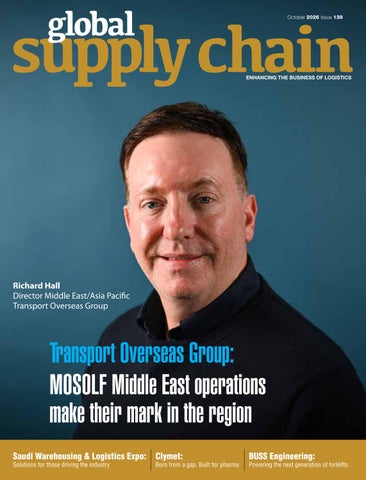
Richard Hall Director Middle East/Asia Pacific Transport Overseas Group
Transport Overseas Group: MOSOLF Middle East operations make their mark in the region Saudi Warehousing & Logistics Expo: Solutions for those driving the industry
Clymet:
Born from a gap. Built for pharma
BUSS Engineering:
Powering the next generation of forklifts
Drive the road of change. Full offering - Full range vehicles with the most advanced technologies - Highly customized product driven by market needs and optimized Total Cost of Ownership
European technology - High quality complete line-up in terms of tonnage, power, torque, safety, ergonomics - High performance and robust trucks for extreme Off-road conditions
High capillarity of aftersales - Repair and Maintenance contracts and competitive warranty conditions - Origin 100% IVECO Parts and a widespread network coverage
Customer centricity - Comfort, ergonomics and the latest safety technology to make on board easier - Driver Style Evaluation tool on Heavy ON-road range and optimized vehicle design to improve customer profitability
Your Trusted Partner for Chemical Logistics & HazMat Storage
HazMat-Approved Facility with EHS & DCD Compliance Handling & Storage Capabilities across DG Classes 2, 3, 4, 5, 6, 8 & 9 24/7 Security & Advanced Fire Safety Systems
Hellmann Indu Chemical Jebel Ali Freezone (South), Dubai, UAE Email: rohit.bose@hellmann.com Mobile: +971 5654 79584
SIGNATURE MEDIA FZ LLE P. O. Box 49784, Dubai, UAE Tel: 04 3795678 Email: info@signaturemediame.com Exclusive Sales Agent Signature Media LLC P.O. Box 49784, Dubai, UAE Publisher: Jason Verhoven jason@signaturemediame.com Editor: Abigail Mathias abigail@signaturemediame.com Art Director: Johnson Machado johnson@signaturemediame.com
Printed and Distributed by Masar Printing and Publishing L.L.C., Part of Dubai Media Incorporated Dubai, UAE
Contributor’s opinions do not necessarily reflect those of the publisher or editor and while every precaution has been taken to ensure that the information contained in this magazine is accurate and timely, no liability is accepted by them for errors or omissions, however caused. Articles and information contained in this publication are the copyright of Signature Media FZ LLE & SIGNATURE MEDIA LLC and cannot be reproduced in any form without written permission.
The month of September offered many firsts for our team. As media partners, of one of the largest events in the region, we visited the Kingdom of Saudi Arabia to witness the Saudi Warehousing & Logistics Expo 2026 in Riyadh. The unique hospitality and optimism of everyone who had travelled from far flung corners of the globe, was exceptional. Our cover story led the team to Jebel Ali Free Zone where Transport Overseas Group and MOSOLF is redefining precision‑built automotive supply chains. We witnessed breakthroughs at Sharjah’s Research, Technology and Innovation Park (SPARK) and Tathmeer Agri Tech (FZC) Innovation Centre, which is addressing food security and sustainable agricultural production. The Head of Industrial Projects Middle East & Africa, DHL Global Forwarding offers an insight into recent projects in Oman and the surrounding areas. With the event season in full throttle, we push back offering you insights into IATA’s 2027 Cargo and Ground Operations Manuals. There’s also an announcement from the National Association of Freight and Logistics (NAFL) which held discussions about the upcoming FIATA RAME 2026 in Qatar. All this and much more make up this compelling issue of Global Supply Chain. Wishing you a pleasant read. Abigail Mathias Editor abigail@signaturemediame.com www.globalsupplychainme.com
OCTOBER 2026 3
October 2026 Issue 139
06
Transport Overseas Group and MOSOLF Make their mark in the region
12 16IATA’s outlook for ‘27 Risks and Insurance 20 24Tathmeer Country focus
Moody’s Ratings trade report on China
Cargo and ground operations manual
A complete picture of risk management
New initiative to advance food security and sustainable agriculture
26NAFL
Discusses trade and logistics in the region
4 OCTOBER 2026
32 38Last mile delivery Silos to solutions 42 46Sustainability that delivers News from the industry 49 60The Business of Balancing Logistics
Saudi Warehousing & Logistics Expo ‘26 Where supply chain companies converge
Moving goods with precision
Smart logistics
Farizon’s EV Vans debut
All the latest from the logistics arena
Fiona McBride
YOUR PARTNER FOR MATERIAL HANDLING AUTOMATION
https://www.als.aero/air-cargo-equipment-solutions.php
@AEDLERLogistikSolutions
WWW.ALS.AERO info@als.aero
MOSOLF
Precision‑built automotive supply chains by Transport Overseas Group and MOSOLF
T
he Transport Overseas Group (TOG) is a young, dynamic and fast-growing company operating globally as an international logistics service provider for the shipping, logistics and port sectors. With the recent launch of MOSOLF Middle East in Jebel Ali, the company is stepping directly into the flow of automotive power, where speed, visibility, and regional influence decide who controls tomorrow’s trade corridors. Richard Hall, Director Middle East/ Asia Pacific explains how operations in Jebel Ali anchors the company’s next phase of automotive logistics expansion.
brings the international network closer to customers in these markets, particularly those moving commercial vehicles, passenger cars and heavy equipment. For me, the importance of a local presence is the ability to understand the customer’s business before discussing a shipment. A distributor planning stock for several markets has different priorities from a contractor waiting for equipment or a fleet operator
introducing new trucks. Those differences should shape the transport proposal. Dubai gives us a base from which to develop those relationships and connect regional requirements with colleagues and shipping partners overseas. As the wider MOSOLF presence develops, I see our role as connecting that additional capability with customer demand and commercially workable transport solutions.
GSC: What role does Transport Overseas Shipping DMCC in Dubai play within the wider Transport Overseas Group? Richard Hall: Our Dubai office opened in 2019 and provides a regional base for Transport Overseas Group’s work across the Middle East, Asia-Pacific and Africa. Transport Overseas Shipping (Dubai) DMCC
More power for finished vehicle logistics: n 20.000 sqm open yard n 1.200 storage spaces (expanding) n PDI services active, additional value added services planned n Container loading and unloading station n CCTV surveillance and 24/7 security personnel
6 OCTOBER 2026
The Management of MOSOLF Global Port Services: Dominic Cyriacks (Deputy General Manager), Steffen Klatte (Managing Director), Peter Menzel (Director Business Development MEA)
MOSOLF
The Jebel Ali facility adds approximately 15,000 square metres of space, including vehicle storage and a warehouse for predelivery inspection and technical preparation. ” Richard Hall Director Middle East/Asia Pacific Transport Overseas Group
GSC: Which customers and cargo sectors are central to the Dubai business? RH: Automotive sea freight is central to our focus, with particular emphasis on commercial vehicles and high-andheavy cargo. The customers we want to build lasting relationships with include manufacturers, regional distributors, vehicle dealers, fleet operators and equipment suppliers. The opportunity extends from passenger cars and trucks to buses, trailers and machinery. Construction, agriculture and mining equipment are areas where specialist transport knowledge can make a meaningful difference. A shipment may involve several types of equipment with different dimensions and handling requirements, all needed for the same project. The commercial discussion has to establish what must arrive first and whether the equipment is ready to move. My priority is to build repeat business around those requirements. Understanding a customer’s sourcing pattern and delivery commitments gives us a better basis for planning future shipments and recommending appropriate services as the relationship develops.
GSC: When did MOSOLF operations begin in the UAE and how long have they operated in Germany? RH: MOSOLF’s dedicated vehicle logistics and technical facility in Jebel Ali has been fully operational since March 2026, with its launch publicly announced in May. That is the milestone I would use for the start of this particular operation. It should be distinguished from Transport Overseas Group’s existing business in Dubai and the wider group’s earlier commercial presence in the region. MOSOLF was founded in Kirchheim unter Teck, Germany, in 1955, giving it more than 70 years of experience. For our customers, the relevance of that history is the practical knowledge accumulated in handling vehicles, managing their condition and preparing them for delivery. Those disciplines matter just as much in an emerging distribution operation as they do in an established European network. The Jebel Ali facility adds approximately 15,000 square metres of space, including vehicle storage and a warehouse for pre-delivery inspection and technical preparation. It gives us a physical base around which to develop a more complete regional service, combining local market understanding with MOSOLF’s automotive expertise.
GSC: How will MOSOLF Middle East be operationally integrated into Transport Overseas Group’s global network, and what specific efficiencies do you expect this integration to unlock for OEMs and fleet customers? RH: Transport Overseas Group is part of the wider MOSOLF organisation, so the opportunity is to coordinate complementary capabilities within the group. TO Group brings international forwarding and sea-freight expertise; the Jebel Ali operation adds local vehicle handling and preparation. From the customer’s perspective, those activities should form one clearly managed delivery process. The operating model I favour starts before a vehicle leaves its origin. The shipping plan should be aligned with the receiving site’s capacity, the documentation required and the customer’s release priorities. A vehicle identification number should connect the shipment record with the condition report and preparation status. Clear responsibility at each handover would reduce repeated data entry and the time spent chasing updates between separate providers. For an original equipment manufacturer, or OEM, the expected benefit is better coordination between vessel arrival and dealer availability. For a fleet customer, it is the ability to sequence releases around the OCTOBER 2026 7
MOSOLF
date vehicles are required for work. A fleet of commercial vehicles may need staged delivery, even when the units arrive together. We should measure the benefit through arrival-to-release time, inventory accuracy, avoidable movements and damage-free delivery. Those measures would show whether integration is actually helping the customer. I would avoid promising a fixed percentage saving before we have a comparable operational baseline. GSC: What does the Dubai team bring to RoRo and high-and-heavy shipments beyond obtaining a freight quotation? RH: The value begins with defining the shipment properly. For a truck or machine, the description alone is rarely enough. The proposed solution depends on its dimensions, weight, operating condition, origin and destination, together with the customer’s required delivery window. Missing information at the quotation stage can become an expensive problem later. Our role as a freight forwarder is to connect that requirement with suitable shipping options and coordinate the agreed movement. RoRo is an important part of the offer, alongside breakbulk and other solutions where appropriate. A useful proposal should explain the service scope, relevant restrictions and charges that the customer needs to budget for. I want customers to judge us on how well we manage the shipment from enquiry through delivery. Clear booking status, timely documentation and practical advice when circumstances change are all part of that responsibility. Vessel space and cargo acceptance still depend on the selected carrier’s confirmation. GSC: How has the current market changed your supply chain model and what do you believe are the road maps for success? RH: The current market makes flexibility a core part of supply-chain design. My view is that every important vehicle flow needs a realistic primary plan and a workable alternative. A competitive freight rate still matters, but customers also need to understand what happens if a sailing changes, a delivery window moves or stock 8 OCTOBER 2026
MOSOLF’s dedicated vehicle logistics and technical facility in Jebel Ali has been fully operational since March 2026
has to be held longer than expected. For automotive logistics, the commercial effect extends beyond the transport invoice. A truck waiting for delivery can delay a customer’s ability to earn revenue. Passenger vehicles held in the wrong location can tie up working capital while dealers elsewhere need stock. That is why I would assess a route against total delivered cost and the reliability of getting vehicles into use. The roadmap starts with better information from both sides. Customers should share forecasts, confirmed orders and release priorities early enough for us to plan useful capacity. Logistics providers should distinguish confirmed bookings from provisional options and explain the assumptions behind arrival dates. That gives the customer a sound basis for deciding how much flexibility to pay for. Specialisation is another priority. Passenger cars, buses, trucks and highand-heavy machinery need different planning. Dimensions, weight, handling requirements and technical readiness can change the shipping solution considerably. We need people who understand the equipment and its commercial purpose, as well as the freight movement.
Finally, growth has to be financially disciplined. Clear payment terms, agreed responsibility for storage and transparent treatment of additional costs help keep the service dependable. My preferred model is one where operational planning and commercial terms are settled together, so an urgent shipment does not turn into a dispute when the vehicle is ready for release. GSC: In a region defined by geopolitical volatility, how will MOSOLF’s Jebel Ali operations strengthen Transport Overseas Group’s ability to absorb and respond to disruption? RH: Jebel Ali gives us a local point at which vehicles can be held, inspected and prepared while onward delivery plans are adjusted. Subject to available capacity and the customer’s instructions, that can create breathing space between an international shipping disruption and a dealer or fleet delivery commitment. The value lies in having practical options close to the market. A useful example would be a shipment whose onward delivery is delayed after discharge. A coordinated storage and preparation plan could allow work on the vehicles to continue while the delivery team
MOSOLF
Signing ceremony with Dr. Jörg Mosolf (Former CEO of MOSOLF Group) revises the release schedule. The customer would need a clear view of which units are ready, which are awaiting action and what each option would cost. That is an illustration of the model, rather than a claim about a particular completed shipment. However, a hub within the Gulf cannot remove the region’s maritime exposure. Jebel Ali remains dependent on access through the Strait of Hormuz for its ocean connections. Resilience therefore also requires alternatives outside the same area of disruption. Depending on the shipment, an Omani gateway or a Saudi Red Sea port could merit assessment, alongside the feasibility of onward land transport. Those alternatives must be checked for actual vessel space, suitable handling capacity and border requirements before they are offered. My priority would be to agree decision triggers and authority in advance. Customers should know when we recommend holding cargo, when we propose changing route and who can approve the additional cost. Early, usable advice is far more valuable than an update after the original delivery plan has already failed. GSC: Can Transport Overseas Group’s Middle East operations accelerate greener vehicle logistics, or will regional infrastructure constraints slow sustainability ambitions? RH: I believe we can make meaningful
progress, provided we focus on improvements we can measure. Better coordination can reduce unnecessary vehicle transfers, empty running and repeated preparation work. These are operational decisions we can address while larger investments in vehicles, energy supply and charging infrastructure develop. The Jebel Ali launch announcement identified photovoltaic-powered compound lighting and a planned next phase involving solar-powered electric-vehicle charging. That offers a practical starting point. Any further electrification needs to match the site’s power availability, equipment duty cycles and the services customers require. We should report completed improvements separately from future ambitions. The regional challenge is that infrastructure and operating conditions vary by route. A predictable local operation may be suitable for electrification earlier than a long cross-border journey. Heat, charging access and vehicle utilisation all need to be considered. Our European colleagues’ experience can inform that assessment, while local trials establish what works here. For sea freight, our influence is mainly through service selection, shipment planning and dialogue with shipping partners. We should assess emissions alongside reliability and cost, using comparable information wherever it is available. Choosing a longer route to manage a disruption
can also create a genuine trade-off that should be explained openly. A sensible next step is to establish a baseline for site energy use and transport emissions, then track improvements against it. Emissions per vehicle moved can be useful alongside total emissions, because growth can otherwise obscure what is happening. Sustainability will be more credible when customers can see the calculation boundaries and the operational changes behind the numbers. GSC: What new skill sets will Transport Overseas Group need to cultivate locally to run a high-precision automotive logistics operation in Jebel Ali? RH: We need stronger connections between freight planning, technical vehicle knowledge and accurate operational data. A vehicle logistics team must understand the condition and readiness of each unit, as well as where it is located. That becomes especially important when one site handles different brands, powertrains and customer delivery standards. Vehicle inspection and quality control are fundamental. People need to recognise and record damage consistently, follow manufacturer instructions and maintain a reliable handover history. Electric vehicles add training needs around safe handling, charging and escalation when an abnormal condition is identified. Specialist tasks must remain with appropriately qualified personnel. OCTOBER 2026 9
MOSOLF
Digital competence matters at every level. If a vehicle moves within the compound or completes an inspection, the record should reflect that event accurately. Supervisors should be able to use the information to spot ageing stock, incomplete work or a release that is at risk. Technology only helps when the underlying records are dependable. We also need colleagues who can explain operational choices to customers in commercial terms. A fleet manager wants to understand the effect on deployment; a distributor wants to understand vehicle availability and stock cost. I would build local capability through structured training, supervised practice and knowledge exchange with MOSOLF’s established operations. The objective is a team that can exercise sound judgement independently and take responsibility for the quality of the service. GSC: How will MOSOLF’s presence influence emerging vehicle trade corridors linking Europe, the GCC, Africa, and South Asia? RH: MOSOLF’s presence can make Dubai more useful as a place to prepare
10 OCTOBER 2026
and allocate vehicles within a wider distribution plan. The opportunity is to connect international shipping with a local service that helps a manufacturer or distributor decide when and where stock should move next. Its value will depend on the economics of each trade lane. For European manufacturers, that could support a regional stockholding and preparation model serving selected GCC markets. It could also help commercialvehicle suppliers coordinate deliveries for fleet or project requirements. The critical question is whether a regional buffer gives the customer better availability at an acceptable inventory cost. For South Asian flows, including those involving India, the opportunity should be assessed against production origins, vessel services and the final market. Some shipments will be better served directly. Others may benefit from consolidation or regional preparation in Dubai. The existence of a hub is not, by itself, a reason to add another handling stage. Africa requires the same discipline, with an even stronger focus on the individual destination. North and East African markets differ in their import requirements, dealer
structures and onward transport needs. Vehicle specification, steering configuration and import eligibility must be established before stock is allocated. A vehicle available in Dubai is not automatically suitable for every African market. I would therefore develop these corridors around identified customers and repeatable flows. The wider MOSOLF and TO Group relationship can support consistent handovers and clearer accountability, but customer demand must justify the route. The strongest opportunity is to help customers enter or serve a market with fewer operational uncertainties and a better understanding of their delivered cost. GSC: How can the Dubai office help customers develop business between the Middle East, Asia-Pacific and Africa? RH: Dubai can be the place where a customer relationship is managed even when the cargo moves directly between two other countries. That distinction matters. A regional customer may source vehicles or machinery from several origins, and the most efficient route will not always pass through the UAE. The Transport Overseas Group in the UAE
MOSOLF
The opportunity for our team is to understand the customer’s regional plans and coordinate the relevant origins and destinations through the wider network. I see scope to deepen relationships across the GCC and develop selected opportunities involving Southeast Asia and North and East Africa. Each opportunity needs a clear customer requirement and dependable local execution. For a new trade lane, I would start with a defined shipment programme and evaluate its performance before expanding. That allows us to test communication, documentation and delivery arrangements in practice. Regional growth should make the service more useful and reliable for the customer. GSC: What kind of customer experience do you want Transport Overseas Shipping DMCC to be known for? RH: I want customers to find us accessible, commercially informed and clear about what happens next. They should receive a quotation they can understand, know who is responsible for their enquiry and be able to distinguish a confirmed arrangement from an option still being checked. That requires good coordination within our own team. Sales must pass on the customer’s actual requirements, operations must explain what is feasible, and finance must ensure that the agreed terms are understood. Customers should experience continuity as their enquiry becomes a booking and then a delivery. Regular communication is especially important when a shipment changes. My expectation is that we explain the impact
Logistics should be part of the commercial discussion from the beginning.” and present realistic choices early enough for the customer to act. Over time, that consistency is what earns repeat business. I would like the Dubai office to be seen as a team customers can consult when they are planning their next move, as well as when they need a shipment arranged. GSC: Give us an idea of some of the future possibilities for the Transport Overseas Group. RH: I see considerable potential in building a more complete service around the international movement of vehicles. For the Middle East, that means connecting the ocean journey with the preparation, stock management and release decisions that determine when a vehicle can actually reach its customer. Jebel Ali gives us an additional foundation for that development. One opportunity is deeper cooperation with manufacturers and regional distributors on recurring vehicle programmes. If we understand their forecasts and delivery priorities, we can help shape a practical shipping and receiving plan. The aim would be to become involved early enough to prevent avoidable delays, rather than only reacting once the booking is urgent. Commercial vehicles and highand-heavy equipment offer another important direction. Trucks, buses and machinery are working assets, so delivery performance can affect the start of a project or the productivity of a fleet.
I see value in developing stronger sector knowledge around construction, agriculture and mining equipment, while matching each opportunity to suitable shipping and handling capabilities. Digital customer service is also an area with substantial potential. A useful customer interface should make it straightforward to submit a complete enquiry, understand a quotation, approve the next step and access relevant shipment documents. Over time, connecting that information with vehicle status could help customers plan releases and manage their own commitments. The design should stay simple enough that customers actively choose to use it. There is also scope to develop additional trade lanes and local partnerships where recurring demand supports them. Expansion should follow evidence: identifiable customers, a workable operating model and a clear path to sustainable returns. Individual investments or new services should be communicated once the relevant decisions have been made. Personally, I would like customers to involve us earlier in their planning because they trust the judgement we bring. When a manufacturer considers a new market, or a fleet operator plans a major delivery programme, logistics should be part of that commercial discussion from the beginning. That is where TO Group can create lasting value and where I see the most promising opportunities ahead. OCTOBER 2026 11
Country Report – Moody’s Ratings
Rising Chinese competition will temper benefits of ASEAN supply-chain integration
A
ccording to Moody’s Ratings, the ASEAN-5, long a beneficiary of China’s growth and supply-chain integration, has navigated earlier trade frictions largely from the sidelines. But this positioning is becoming harder to sustain as Chinese export pressures broaden across sectors, increasing risks to operating performance for affected manufacturers in the next 5-10 years. China’s export reorientation fuels competitive and margin pressures. ASEAN-5’s deepening supply-chain linkages with China have supported regional manufacturing scale-up abut also entrenched reliance on Chinese networks. This reliance exposes the
12 OCTOBER 2026
region to competitive and margin pressures via trade concentration, import competition, outward direct investment (ODI)2 and geopolitical scrutiny. We assess the effects of rising Chinese competitive pressure through three channels. Our Manufacturing Vulnerability Index (MVI)3 captures displacement risk, economic sensitivity and export capacity. It measures where displacement4 is most concentrated across ASEAN-5, how economically significant affected sectors are and the extent to which export capacity offsets vulnerability. Sectoral vulnerabilities reflect structural bottlenecks, not broadbased displacement. Electrical & optical equipment and machinery
face the highest displacement risk, driven by intense import competition and deep upstream dependence on Chinese inputs. Domestically oriented sectors remain broadly resilient, reflecting low trade exposure rather than strong competitiveness. Country risk differentiation is driven by industrial composition. Indonesia (Baa2 negative) and Thailand (Baa1 stable) have the largest share of high-risk sectors, while Malaysia (A3 stable) and the Philippines (Baa2 stable) are more insulated. Vietnam’s (Ba2 positive) medium-risk profile reflects the positioning of its predominantly foreign-owned manufacturing base rather than displacement pressures on locally owned producers.
China’s manufacturing dominance across a spectrum of goods has reshaped exports strategies of Chinese manufacturers in recent years. As access to the US (Aa1 stable) and European markets tightened following the first Trump administration's trade measures in 2018, the ASEAN-5, alongside other emerging markets, has emerged as a key destination for Chinese manufacturing output (see Country Report –the Moody’s Exhibit 1). Geographic proximity, relatively open trade regimes and growing consumer markets have positioned region asRatings a central node in China’s export expansion strategy. Exhibit 1
China's exports to ASEAN-5 have strengthened markedly since 2020 Index (January 2015-June 2018 = 100), three-month moving average, $
US
Africa
EU-27 and UK average
Latin America
ASEAN-5 average
Middle East average 300 200 100 2020
2021
2022
2023
2024
2025
2026
Sources: China’s General Administration of Customs, Haver Analytics and Moody's Ratings
This shift has coincided with a structural transformation within the ASEAN-5. The region has evolved from a primarily transit base and aChina’s lower-cost assemblyreorientation center compared to China into a more advanced manufacturing hub and an increasingly important source of export global final demand. In fuels competitiveglobal andvalue chains, Vietnam, Malaysia and Indonesia have strengthened positions in electronics, machinery, autos and clean-energy margin pressurescomponents, respectively, with Thailand playing a complementary role in autos. China’s manufacturing dominance Deeper integration, however, cutsacross both ways. China's engagement with the ASEAN-5 has shifted from largely complementary a spectrum of goods has reshaped exportspolicy-intensive pattern, reshaping ASEAN-5 economies through four interrelated integration toward a more constrained, strategies of Chinese manufacturers in developments. recent years. As access to the US (Aa1
Deepening trade ties support manufacturing scale-up but also raise trade asymmetries and concentration risk stable) and European markets tightened Growing integration with China over the past decades has, alongside China+1 strategies, supported ASEAN-5 manufacturing followingtrade the first Trump administration’s trade measures in 2018,participation the ASEAN-5, in global value chains. Access to lower-cost and more diverse intermediate and capital goods has expansion and deeper alongside other emerging markets, has underpinned output growth – particularly in electronics, machinery and consumer goods – strengthening cost competitiveness across emerged as a key destination for Chinese a wide range of industries. ASEAN-5 absorbed roughly 15% of China's total goods exports in 2025, most of which are concentrated in into regional chains with a manufacturingand output (seegoods Exhibitthat 1). feed into aregional more constrained, intermediate capital productionpolicy-intensive chains with a gradually rising share ofproduction consumption goods. Geographic proximity, relatively open trade
pattern, reshaping ASEAN-5 economies
gradually rising share of consumption goods.
However, thisgrowing deepening integration has also widened trade asymmetries and increased concentration risk.deepening Chinese exports to the However, this integration regimes and consumer markets through four interrelated developments. ASEAN-5 have grown substantially faster than ASEAN-5 exports to China, resulting in a large bilateral deficit. The hasand alsorising widened tradetrade asymmetries and have positioned the region as a central increased concentration risk. Chinese node in China’s export expansion strategy. Deepening trade ties support concentration of imports in intermediate and capital goods has entrenched Chinese inputs in regional supply chains (see Exhibit 2). theas ASEAN-5 havecomponents grown This shift has coincided withonly a structural manufacturing scale-up but Import dependence has not risen but narrowed, increasingly concentrated in upstreamexports inputs to such electronic substantially faster than ASEAN-5 transformation within the ASEAN-5. also raise trade asymmetries and machinery parts that are critical to ASEAN-5's manufacturing base. This heightens exposure to shifts in Chinese pricingexports dynamics, to China, resulting a large and rising The regionpolicy has evolved from a primarily and concentration risk domestic supplier ecosystems industrial and domestic demand conditions – particularly where remain in shallow.
2
bilateral trade deficit. The concentration transit base and a lower-cost assembly Growing trade integration with China of imports in intermediate and capital center compared to China into a more over the past decades has, alongside goods has entrenched Chinese inputs advanced manufacturing hub and an China+1 strategies, supported ASEAN-5 regionalpage supply chains (see Exhibit 2).for the increasingly important source of global manufacturing expansion and deeper This publication does not announce a credit rating action. For any credit ratings referenced in this publication, please see theinissuer/deal on https://ratings.moodys.com most updated credit rating action Import dependence has not only risen final demand. In global valueinformation chains, and rating history. participation in global value chains. Access Vietnam, Malaysia and Indonesia have to lower-cost and more diverse intermediate but narrowed, increasingly concentrated in upstream inputs such as electronic strengthened positions in electronics, and capital goods has underpinned components and machinery parts that machinery, autos and clean-energy output growth – particularly in electronics, are critical ASEAN-5’s components, respectively, with Thailand machinery and consumer goods – 9 June 2026 Trade – Asia: Rising Chinese competition will to temper benefits manufacturing of ASEAN supply-chain integration playing a complementary role in autos. strengthening cost competitiveness across a base. This heightens exposure to shifts in Chinese pricing dynamics, Deeper integration, however, cuts wide range of industries. ASEAN-5 absorbed industrial policy and domestic demand both ways. China’s engagement with roughly 15% of China’s total goods exports conditions – particularly where domestic the ASEAN-5 has shifted from largely in 2025, most of which are concentrated in supplier ecosystems remain shallow. complementary integration toward intermediate and capital goods that feed OCTOBER 2026 13
Heavy Duty Cargo
DHL Industrial Projects navigates the Middle East’s toughest terrain
D
HL Industrial Projects is operating in one of the most demanding eras for heavylift logistics in the Middle East and Africa. With oversized cargo flows squeezed by geopolitical tension, narrow border infrastructure and the ripple effects of the Strait of Hormuz blockade, the sector is being tested on every front. We uncover more with Peter Dudas, Head of Industrial Projects Middle East & Africa, DHL Global Forwarding. GSC: Can you provide examples of recent heavy lift projects and the unique challenges overcome? Peter Dudas: DHL Industrial Projects supports large-scale energy, renewable energy, petrochemical and industrial developments across the Middle East and Africa. Recent work included the transportation of industrial process equipment, pressure vessels, transformers,
14 OCTOBER 2026
and pre- fabricated modules for projects across the Middle East. The disruption caused by the blockade of the Strait of Hormuz caused severe disruptions across regional supply chains. However, the project cargo sector was certainly most impacted. Long-distance and often crossborder transportation, more complex terrain, increased permit requirements and reduced availability of equipment are all major complications affecting the sector. Fixed border infrastructure is amongst the narrowest bottlenecks. GSC: How do you determine the optimal heavy-lift plan for a multi-site industrial deployment? PD: Delivery requirements in our segment are often dictated by rigid, sequential construction schedules, or operational emergencies. Early engagement of DHL Industrial Projects, in many cases several
years ahead of any cargo movement, is critical. When logistics is involved early, its input can be considered during the design phase, helping optimize the size, weight and configuration of cargo to improve transportability. GSC: What is your maximum cargo weight and dimension capability for heavy lifts? PD: Over the years DHL Industrial Projects has supported many projects by transporting all sorts of oversize and heavy lift goods to and from most Middle East countries. Very recently we delivered a 870,000 kg Reactor Vessel to a customer in Oman. Its 45-metre length alone would have made for a challenging transport, but this unit was more than 12 metres wide, and it was 14 metres tall! GSC: How do you handle OOG cargo,
Heavy Duty Cargo
engineering support, route planning and HSQE requirements? PD: Technical expertise is a fundamental part of DHL Industrial Projects’ offering. We provide route surveys, lifting engineering, stability and lashing calculations. Together with detailed risk assessments, these become the basis of our operational planning, which we execute safely, working closely with ports, authorities and transport providers. GSC: How does MMS360 provide visibility for complex projects? PD: The value DHL Industrial Projects provides goes far beyond that of a traditional logistics service provider. It is based on our experience gained over several decades and across industry segments as well as geographies. In these projects we assume the role of the integrated logistics function, acting as a bridge between the procurement and the construction functions. Due to this unique setup the visibility we need to provide to the stakeholders is deep and very granular. MMS360 is our web-based application tailor-made for this purpose. It can receive Purchase Orders (P.O.s)
Peter Dudas, Head of Industrial Projects Middle East & Africa, DHL Global Forwarding. directly from the customer via an API or EDI connection, it facilitates line item-level visibility and is fully integrated with all our other applications. It also gives 24/7 visibility to our customers through a user-friendly web interface. GSC: How do you measure CO₂ emissions and support sustainability goals? PD: DHL provides customers with emissions reporting and shipment visibility through its digital platforms. Sustainability considerations are increasingly incorporated into project planning, alongside operational resilience and transport efficiency. GSC: Looking beyond the immediate crisis, how do you see this conflict affecting the economics of breakbulk and project cargo? PD: The longer-term effects remain difficult to predict, but periods of instability generally reduce flexibility in project logistics. Breakbulk and heavy lift cargo are inherently less adaptable than containerised freight, as only a limited number of ports and transport corridors can accommodate oversized shipments. During recent disruptions, alternative gateways such as Duqm in Oman and Jeddah in Saudi Arabia
provided additional routing options for certain types of project cargo, highlighting the importance of resilience, contingency planning and route diversification. GSC: What longer-term impact could the hostilities have on project activity, particularly large-scale energy and infrastructure projects? PD: At present, we are not seeing projects stop. Instead, customers are exploring alternative ways to keep work moving on site, including air freight for time-critical components where necessary. While this comes at a higher cost, the delay of a project can be commercially more damaging than the additional transport expense. While it is still too early to predict the long-term impact on project activity, the situation reinforces the importance of resilient infrastructure, diversified logistics corridors and early planning. Once conditions stabilize, there might be a catch-up effect, and in some cases additional logistics support may be required. And looking ahead, the current environment may accelerate investments in alternative gateways and logistics infrastructure – some already announced - across the region as countries seek to strengthen access to global markets and supply chains. OCTOBER 2026 15
IATA 2027
IATA Releases 2027 Cargo and Ground Operations Manuals
T
he International Air Transport Association (IATA) has released the updated 2027 editions of key industry manuals for cargo and ground operations, which incorporate major changes and revisions to align with evolving global standards. Highlights of revisions include: Dangerous Goods Regulations (DGR) • Instructions to improve clarity on DGR packaging requirements • Restrictions and requirements for spare batteries and power banks • Requirements for lithium battery-powered mobility aids including new operator obligations for devices exceeding 300Wh • Updates to State and Operator Variations, including new variations from 17 states Battery Shipping Regulations (BSR) • Introduction of provisions for hybrid batteries containing both lithium-ion and sodium-ion cells • Revisions to packing instructions, particularly related to sodiumion and prototype batteries • Clarification on exclusions from the 4-cell/2-battery limit for certain battery shipments • New requirement for battery marks
16 OCTOBER 2026
to be displayed on the same package surface as other applicable hazard labels Live Animals Regulations (LAR) • Additions of specific pathogen-free laboratory animals to species listings • Standardised terminology and metric measurement across container requirements • Updated aircraft cargo compartment cleaning and disinfection procedures • Availability of a Portuguese version following Brazil’s adoption of LAR Airport Handling Manual (AHM) • New guidance for biometric handling in contactless travel, covering touchpoint processes and privacy/ethical considerations • Advanced provisions for autonomous ground service equipment activities near aircraft
Digital Tools Enhanced digital tools—which will increasingly leverage Artificial Intelligence (AI)—are linking IATA’s manuals more efficiently to the industry processes that they support, an important advancement as aviation continues its transition to more connected, automated and data-
driven operations. This also helps embed IATA standards into decision making and live operational environments. This includes: • LAR Verify, automated compliance verification tool for live animal shipments • e-Battery Shipping Regulations (e-BSR) introduces new Interactive Classification Scenarios • DG Digital, a module of DG Autocheck, to create and manage Shipper’s Declarations for Dangerous Goods (DGD) • DGR includes enhancements to the digital version, improving navigation and access to dangerous goods information • Digital Load Verification (DLV) to verify aircraft loading activities, reducing loading errors by more than 80% and loading-related delays by up to 30% “Our 2027 manual revisions reflect advancements in technology, regulation, and customer needs. As our manuals are used in a more digitally connected environment, we are focusing on creating tools that integrate them into the critical processes and activities that underpin cargo and ground operations. This is a major step toward advancing safer, more efficient airline operations, and is soon to be super-charged by the power of AI,” said Frederic Leger, IATA’s Senior Vice President of Products and Services.
Forklifts
BUSS Engineering – Powering the next generation of forklift performance
F
ounded in 1991 by the late George Cyril D’sa, BUSS Engineering & Heavy Equipment Repairing L.L.C. has grown to become one of the UAE’s leading specialists in forklift and material handling equipment solutions. The name BUSS stands for ‘Back Up Skills & Services,’ a philosophy that reflects the company’s unwavering commitment to delivering reliable expertise, quality workmanship, and exceptional customer support. More than three decades later, the vision established by its founder continues to serve as the backbone of BUSS Engineering. Headquartered in Dubai, United Arab Emirates, BUSS Engineering is an ‘ISO 9001, ISO 14001, and ISO 45001 certified company,’ demonstrating its commitment to quality management, environmental responsibility, and occupational health and safety standards. Today, recognised as a comprehensive one-stop solution provider for the material handling industry. Specialising in the repair and maintenance of all makes and models of forklifts and material handling equipment operating throughout the UAE. Its experienced technicians provide preventive maintenance, emergency breakdown support, major repairs, and complete refurbishments, helping customers maximize equipment uptime and productivity. In addition to a service division, BUSS Engineering offers flexible shortterm and long-term rental solutions for forklifts, reach trucks, stackers, pallet trucks, order pickers, and other material handling equipment. They also maintain an extensive inventory of genuine and aftermarket spare parts for virtually every forklift brand, ensuring quick availability and minimal downtime for its customers.
Safety first Safety remains a core focus for BUSS Engineering. The company provides 18 OCTOBER 2026
advanced forklift safety solutions including AI-powered camera systems, 360-degree monitoring systems, fleet management systems, pedestrian warning and detection systems, safety lights, impact monitoring systems, speed control devices, battery management systems, and other technologies designed to create safer and more efficient workplaces. It is also one of the region’s largest suppliers and stockists of forklift attachments. Through its registered brand, ALPHALIFT, it provides cost-effective and reliable attachment solutions while also supplying globally recognised brands such as Cascade, Bolzoni, and Kaup. Its expertise extends to the design, supply, refurbishment, and customisation of attachments to meet specific operational requirements. In addition, it manufactures and supplies air-conditioned forklift cabins for all major forklift models, enhancing operator comfort, safety, and productivity in demanding working environments.
As a trusted partner of Lisman Forklifts in The Netherlands, one of the world’s leading suppliers of quality pre-owned material handling equipment, BUSS Engineering facilitates the supply of premium pre-owned forklifts and warehouse equipment throughout the Middle East. This partnership provides customers access to a large inventory of carefully selected equipment that meets the highest standards of quality and reliability. Today, BUSS Engineering proudly serves customers across logistics, warehousing, manufacturing, ports, construction, retail, and industrial sectors, delivering dependable solutions backed by experience, innovation, and customerfocused service. Whether it is repairs, rentals, spare parts, safety systems, attachments, customized engineering solutions, air-conditioned cabins, or quality pre-owned equipment, we remain committed to helping its customers achieve operational excellence.
Risk management in logistics
Beyond insurance: the complete picture of risk management in logistics
I
nsurance is essential—but it is only one piece of the risk management puzzle. Too many logistics businesses assume that having a policy in place means they are protected, overlooking the critical interplay between insurance, contractual terms and communication. This article explains why a holistic approach is the only way to truly safeguard your operations—and what happens when even one element fails.
What is risk management? Risk management in logistics is a systematic approach to identifying, assessing and mitigating threats across the supply chain— cargo damage and loss, liability exposure, regulatory compliance and operational disruption. Yet too often businesses reduce it to a single question: do we have insurance? This oversimplification is dangerously misleading. True risk management is an interconnected system whose components must work together to provide genuine protection. Insurance is one important piece of a larger puzzle. 20 OCTOBER 2026
For freight forwarders: the seatbelt analogy Think of risk management as a car’s safety system. Insurance is the seatbelt— essential, but insufficient on its own. For a seatbelt to protect you, three components must work together: 1. The Seatbelt (Insurance) – The fundamental protection layer. Without it, you are completely exposed. But hanging unused on the seat, it provides zero protection—and it must be free of cracks to sustain the impact. 2. The Buckle (Standard Trading Conditions) – Your STCs define the framework of liability limitations and responsibilities. Without proper STCs, your insurance lacks the legal foundation to function effectively. 3. The Click (Communication to Clients) – This is where many freight forwarders fail. You can have insurance and comprehensive STCs, but if you do not communicate these terms to your clients—if you do not “click” the system together—the
protection mechanism never engages.
When the system fails Even with all three in place, there is a fourth critical element: your team’s understanding of how the system works. Consider this: without consulting senior leadership or the insurer, an employee admits full liability for AED 500,000. But your STCs limit liability to AED 30 per kilogram — totalling AED 75,000. Your insurance covers exactly this limited amount. Your company is exposed for the remaining AED 425,000. Every client-facing employee must understand liability limitations and consult leadership and insurers before making commitments.
For shippers: you need your own seatbelt Your logistics provider’s seatbelt cannot protect you. You are the passenger—the driver has their own seatbelt (their liability insurance), but it does nothing for you. You need cargo insurance: your own seatbelt.
Risk management in logistics
Understanding your actual exposure Most shippers underestimate their risk. Carriers and freight forwarders operate under strict liability limitations—often mere dollars per kilogram. A shipment worth USD 1 million might carry liability of just USD 2,000, leaving USD 998,000 at risk without your own insurance. Freight forwarder liability insurance responds only when fault is proven; forwarders are not liable for force majeure or acts of God. For those risks, you are completely exposed.
Knowing what your insurance actually covers
Migle Matelionyte is the Founder of SureForth Risk Partners, a logistics risk management consultancy helping logistics companies and shippers align their contracts, Standard Trading Conditions and insurance so that protection actually works when a claim arises. She is also Director Middle East & Europe at World Insurance Services (WIS), the in-house insurance broker of the WCAworld network, and a member of the WCAworld/WIS Risk Advisory Council, placing freight forwarder liability, cargo and project cargo insurance for WCA members. She holds an LL.M. in Maritime Law from Erasmus University Rotterdam and brings over 13 years of international experience in claims handling, marine underwriting and specialist broking. Her career includes roles at Nacora, the in-house insurance broker of Kuehne+Nagel, in Vienna and London, Lloyd’s syndicate Beazley, and HDI Global in Singapore, where she underwrote complex cargo programmes across ASEAN, India and the Middle East.
Cargo insurance is not one product. The Institute Cargo Clauses (ICC) define three basic levels of cover—A (All Risks), B (Named Perils) and C (Total Loss). One letter of difference, but the gap in protection is astronomical.
Understanding INCOTERMS: the “click” for shippers INCOTERMS 2020, the ICC trade terms, define when risk transfers from seller to buyer. Know exactly when that happens and ensure your insurance aligns with those risk windows. Any gap is unprotected exposure.
The CIF insurance trap: a real example A Dubai trading company purchased sugar from Brazil on CIF (Cost, Insurance and Freight) Shanghai terms and resold it to a local buyer, also CIF Shanghai—USD 20 million on board. Under CIF the seller arranges insurance, but risk passes to the buyer on loading. The trader presumed all-risks cover. But CIF’s minimum requirement is ICC C, and that is what the seller purchased. ICC C covers only fire, explosion, vessel stranding, grounding, capsizing or sinking, collision, general average and jettison. For any other cause, the trader and buyer would receive nothing. They had insurance—but a seatbelt full of cracks. The difference between assuming and checking the certificate: potentially USD 20 million. Disclaimer: Examples are simplified for illustration; actual scenarios vary by jurisdiction, cargo type and circumstances. OCTOBER 2026 21
Consumer Goods
Building Resilient Supply Chains
C
onsumer goods supply chains across the Middle East are evolving rapidly, creating new opportunities while increasing the need for greater flexibility, visibility and resilience. Tushar Sharan, Consumer Goods Vertical Sales Director IMEA at Hellmann Worldwide Logistics, shares how businesses can build agile, multi-gateway logistics models that support product availability, strengthen supply chain visibility and protect brand equity across fast-changing markets. GSC: As Head of the Consumer Goods vertical at Hellmann IMEA, what are your key responsibilities, and what strategic priorities are shaping your leadership today? Tushar Sharan: Consumer goods is an extremely dynamic sector, with high pressure on margins for our clients. Across the region, we work with a very diverse range of consumer goods customers, from FMCG, beauty and personal care brands to beverage, pet food and regional distributors. Each has different supply chain priorities, whether that is inventory management, promotional cycles, reducing logistics spent as part of overall COGs, product availability or working capital. My primary role is to grow our consumer goods vertical, ensuring that we create solutions that align with the evolution of the industry. My priority is to first understand what really matters to each customer and how their supply chain works end to end, and then develop scalable, tailored solutions around their specific business needs. It is not simply about moving goods from A to B; it is about helping customers make their supply chains more efficient, resilient and competitive by strengthening visibility, improving operational efficiency and addressing the challenges that matter most to their business. Ultimately, it is about building trusted, long-term relationships
22 OCTOBER 2026
with partners who know they can rely on us. At Hellmann Worldwide Logistics, this is deeply rooted in our culture and reflected in our Hellmann Promise, where “Relationship Matters” is our meta value. We believe relationships are the ultimate currency. GSC: What defining trends in logistics are shaping the consumer goods logistics landscape in the Middle East region, and how is Hellmann positioning itself to stay ahead of these shifts? Tushar Sharan: The Middle East logistics landscape is changing rapidly. While Dubai/ Abu Dhabi was traditionally seen as the main gateway to the Middle East and Africa, customers today are looking at multiple gateways, including Jeddah, KAP, Khor Fakkan, Salalah, Fujairah, Egypt and Jordan. Speed and flexibility have also become critical. Forecasts change quickly, routings need to adapt, and customers expect to understand not only when a shipment is delayed, but why, what the business impact is, and what alternatives are available. Customers are no longer asking for one routing; they want two or three viable options across different gateways, so they can adapt quickly when market conditions change. Thanks to Hellmann’s global network, deep industry expertise and highly customized approach, we can provide the flexibility customers need in a constantly
changing market. Rather than offering a one-size-fits-all solution, we connect different gateways, modes and capabilities to build tailored logistics solutions around each customer’s specific needs. GSC: With ongoing geopolitical and supply chain disruptions across the Middle East, what are the biggest challenges your consumer goods clients are facing right now? Tushar Sharan: I think the biggest challenge today is not disruption itself, but uncertainty. Businesses can usually plan around known increases in transit times or costs, as we saw when supply chains were adjusted following the shift to routes around the Cape of Good Hope. What is much harder to manage is when routes, capacity, lead times and freight rates continue to change due to factors beyond their control. For consumer goods companies, this uncertainty has a direct commercial impact. Carry too little inventory and you risk losing sales; carry too much and you tie up working capital and increase costs. As a result, the conversation with customers is shifting from “What is the cheapest or fastest route?” to “What is the most resilient and reliable supply chain design?” We are clearly seeing a move away from simply prioritizing speed towards prioritizing consistency and reliability. In the consumer goods world, a delayed
Consumer Goods
becomes extremely important. For example, high-volume base products may clearly be best suited to sea freight; however, for a new product launch, a promotional SKU, or inventory at risk of stocking out, air freight may actually be the more commercially sensible option. So, rather than looking purely at the freight rate, we look at the total cost to serve and total cost of ownership. For consumer goods, getting that balance right can have a significant impact on both profitability and service levels. It is all about finding the right speed to market and the right route to market for each customer.
product can mean a missed sale and, as a result, a missed market opportunity. Our responsibility goes far beyond simply moving cargo—it is about protecting brand equity by ensuring products remain available in the market when and where they are needed. GSC: How is Hellmann strengthening resilience and continuity for consumer goods supply chains amid fluctuating trade lanes, port congestion, and regional uncertainties? Tushar Sharan: The key words for us are optionality and adaptability. Hellmann has been developing flexible routing solutions across the Middle East, combining sea, air and road transport with alternative regional gateways and corridors. This could include trucking from Europe or Türkiye into the Middle East, or using Egypt or Jordan as hubs to access the GCC. For us, resilience is not simply about having a Plan B; it is about knowing when to activate it. Whether it is a significant transit-time delay, a sudden rate increase or a customer flagging that a key SKU is close to stocking out, the alternative routing should already be agreed and ready to activate. This requires strong visibility, scenario planning and close communication between the customer, our operational teams and carrier network. We cannot eliminate disruption, but we can reduce the time between disruption occurring and the right action being taken.
GSC: What role do multimodal solutions—air, sea, road, and rail— play in optimising consumer goods flows in the UAE, and where are you seeing the strongest demand? Tushar Sharan: Multimodal logistics has become increasingly relevant, particularly in today’s environment. Sea freight remains fundamental for consumer goods because of its cost efficiency. Air freight provides speed and is extremely valuable for product launches, urgent replenishment and highpriority shipments. Road transportation is becoming increasingly important for regional connectivity across the GCC, particularly as intra-GCC connectivity continues to expand. As a result, demand for road solutions has increased significantly. There are also hybrid solutions, such as sea-air, where the UAE is particularly well positioned geographically. The real value of multimodal logistics, however, is not simply having different modes available. It is the ability to switch intelligently between them depending on the business needs at any given moment. GSC: How do you help consumer goods brands strike the right balance between cost efficiency and service reliability when choosing multimodal transport options? Tushar Sharan: This is where understanding the customer’s business
GSC: How is Hellmann’s control tower model transforming visibility, decision making, and exception management for consumer goods clients? Tushar Sharan: Hellmann’s digital visibility solutions already provide door-to-door tracking across sea, air and rail, supported by connectivity with carriers. Hellmann’s broader control-tower approach also integrates transportation management, information flows, performance monitoring and coordination across supply chain partners. For a consumer goods customer managing hundreds or thousands of movements, that becomes extremely powerful. What I have noticed while running this is that the value is not the dashboard itself; it is that teams stop spending their mornings chasing status updates and start spending them on the key shipments that actually need a decision. That is the real shift, and it compounds the more volume and variety you are managing, which is exactly the position we are in. You do not want your supply chain team spending its day searching for information. You want them asking: Which shipment requires my attention? What is the commercial impact? And what action should I take? That is the real value: turning visibility into decisions, and decisions into action. But at the end, despite all the AI and data, global logistics is still a humanto-human business built on trust. And that is at the heart of Hellmann’s culture: people who build strong relationships, understand their customers and stand by them when it matters. OCTOBER 2026 23
Food security • New centre to combine smart farming, AI, R&D, technology testing and market access • The initiative comes as the UAE continues to place food security and sustainable agricultural production among its strategic priorities, with advanced technologies playing an increasingly important role in addressing challenges including water scarcity, limited arable land and demanding climatic conditions
T
athmeer Agri Tech, the UAE’s first Securities and Commodities Authority (SCA)-approved and Sharia-compliant AgriTech crowdfunding platform and ecosystem, recently launched MENA’s first Integrated Agri-Tech Innovation Centre in partnership with Sharjah Research, Technology and Innovation Park (SPARK) in Sharjah. Set to be established on a dedicated land plot within SPARK, the Tathmeer Integrated Agri-Tech Innovation Centre will create a real-world environment for agricultural technologies to be demonstrated, tested and validated before commercial deployment and scale-up. The centre will bring together controlledenvironment agriculture, hydroponics, vertical farming, automation, IoT and AIenabled monitoring, alongside Tathmeer’s FarmBridge digital platform. It will also support applied R&D pilots, farmer training, technology selection, startup development and connections between agricultural producers, technology providers, investors and markets. The initiative reflects SPARK’s role in attracting technology-driven companies and enabling them to develop, test and commercialise solutions within an integrated innovation ecosystem. By providing land, infrastructure, ecosystem access and facilitation, SPARK will support the development of a dedicated platform for advancing agricultural technologies in Sharjah and the wider region. Tathmeer Agri Tech has also partnered with Elevate Farms, a leading vertical farming technology company with operations and presence in Canada, the United States and Switzerland. The partnership is expected to
24 OCTOBER 2026
New initiative to advance food security and sustainable agriculture in the UAE strengthen the centre’s access to advanced vertical farming technologies and support their demonstration, validation and potential deployment in the UAE and the wider region. The initiative comes as the UAE continues to place food security and sustainable agricultural production among its strategic priorities, with advanced technologies playing an increasingly important role in addressing challenges including water scarcity, limited arable land and demanding climatic conditions. Hussain Al Mahmoudi, Chief Executive Officer of the Sharjah Research, Technology and Innovation Park (SPARK), said: “SPARK’s mandate is to transform research, technology and innovation into practical economic value. This collaboration with Tathmeer Agri Tech reflects the type of investment we want to attract to Sharjah: companies that combine technology, applied R&D, physical infrastructure and market access to address strategic priorities such as food security, sustainability and economic diversification. “By providing land, ecosystem access and facilitation, SPARK will support Tathmeer in developing an Agri-Tech centre that can demonstrate solutions, connect with government and industry, and help accelerate sustainable agriculture innovation.” Layth Dwairi, CEO & Co-Founder of Tathmeer Agri Tech, said: “Growers across this region are short of a way to test technology before committing capital to it. That is what this centre changes. Working with SPARK, we can put controlled-environment systems, vertical farming and AI-enabled monitoring in front of farmers under real operating conditions, then connect what proves itself
to financing through our SCA-approved platform and to buyers through FarmBridge. Our partnership with Elevate Farms brings internationally proven vertical farming technology into that environment. Success is reflected in farms being able to produce more with less water, and a clear route to market.” A key component of the centre will be Tathmeer’s FarmBridge Agri-Ecosystem, designed to connect farmers, technology companies, investors, government entities, entrepreneurs, SMEs, supply-chain operators and food and beverage businesses through a coordinated digital and physical platform. The model aims to help farmers address three fundamental commercial questions — what to grow, how to grow and where to sell — while enabling agricultural technologies to be tested under practical conditions before wider investment and deployment. Training and capacity building will form another major component of the centre, with planned certification, field-learning and skills-development programmes for farmers, agronomists, entrepreneurs and technology adopters. The facility will also serve as a testbed for emerging agricultural technologies, supporting startups and technology providers seeking to demonstrate their solutions, validate their performance and establish their commercial viability. Tathmeer is additionally expected to participate in the Agriculture Innovation Zone at Sharjah Next – Sustainability, with potential technology demonstrations and workshops contributing to the wider innovation programme.
NAFL 2026
Trade and Logistics in the GCC brought to the forefront The National Association of Freight and Logistics (NAFL) held an exclusive networking event at Dusit Thani, Dubai on 8th September 2026. With Chief Guest, H.E Eng. Ali Bin Abdullatif Al Misnad, Board Member at Qatar Chamber, Vice Chairman-(ICC) International Chamber of Commerce, President at Qatar Association of Freight and Logistics (FIATA) Association member, Member of Heavy Transportation Regulating Committee at Ministry of Transport & Communication. Mr. Humaid Almazrouei, Head Section Of Cargo carriers ( Air, Sea and land carriers), NAIC- National Advance Information Center – UAE, presented on the upcoming implementation of MPCI in October 2026 and answered questions of all attendees. The event brought to light various industry updates, GCC trade opportunities and the upcoming international logistics event, FIATA RAME 2026 which will be held in Qatar later this year. Global Supply Chain Magazine brings you the latest from this significant logistics event which was held exclusively for CEO’s and C-Suite executives.
26 OCTOBER 2026
NAFL 2026
OCTOBER 2026 27
GWC Group
GWC Group strengthens cold chain supply into Qatar through landmark Oman frozen bulk vessel operations
G
ulf Warehousing Company Q.P.S.C (GWC Group), one of the region’s leading logistics groups providing cross-border and integrated logistics solutions, has completed one of the first frozen bulk vessel operations in the Sultanate of Oman extending its cold chain capabilities from vessel handling and temperature-controlled storage to cross-border distribution and creating an additional route for frozen cargo into Qatar. Frozen goods entering Oman typically arrive in standard containers. Handling a full frozen bulk vessel required specialist cold chain expertise at every phase, from vessel offloading through temperaturecontrolled storage to onward distribution, maintaining uninterrupted temperature integrity from port to warehouse. Delivery of the first operation secured GWC Group a second, larger commission: the largest frozen bulk vessel operation the Group has handled to date. The customer subsequently awarded GWC Group a long-term cold storage contract, expanding the relationship from vessel handling into ongoing storage and regional distribution. The Group also began transporting frozen poultry products by road from Barka in Oman to Qatar and Kuwait, bringing combined volumes to more than 1,000 truckloads of frozen cargo handled, stored and distributed across GCC markets, including Qatar. Matthew Kearns, GWC Group CEO, said: “This operation demonstrates what our regional network is designed to do. By connecting our capabilities in Oman with our established infrastructure in Qatar, we are creating additional routes for temperature-sensitive goods into the country whilst strengthening resilience across the wider supply chain. As we grow across the GCC, our operations are increasingly working as one network, connecting markets and strengthening the infrastructure behind regional cold chain flows.” 28 OCTOBER 2026
• One of Oman’s first frozen bulk vessel operations demonstrates GWC Group’s end-to-end cold chain capabilities. • Successful first project delivery secures a larger second commission and long-term cold storage contract. • Over 1,000 truckloads of frozen cargo handled, stored and distributed regionally, including into Qatar.
The expansion of the Oman operation reflects the continued growth of GWC Group’s regional platform and its role in connecting logistics infrastructure and capabilities across GCC markets. The net revenue contribution from the Group’s international operations has tripled over the past two years as GWC Group continues to strengthen its presence across Qatar, Saudi Arabia, the UAE, Oman and Bahrain. Haitham Al Rawahi, General Manager of GWC Oman operations, said: ” Frozen bulk vessel handling demands strict, uninterrupted temperature control from port offloading through storage and cross-
border transportation. Our teams in Oman delivered this complex operation without compromise, supported by GWC Group’s specialised assets and technical expertise.” GWC Group’s cross-border cold chain capabilities are supported by an extensive logistics network across the GCC and a global freight network spanning more than 120 countries through over 550 partners worldwide. The Group operates more than four million square meters of logistics infrastructure, supported by over 1,600 specialized vehicles and 20 strategic locations across the GCC, moving more than two million tonnes of freight annually.
to-group.com/locations/dubai to-group.com/locations/dubai
YOU NEED ANY YOU NEED ANY CARGO SPACE? CARGO SPACE? ROLL-ON / ROLL-OFF! ROLL-ON / ROLL-OFF!
COMPREHENSIVE SPECIALIST KNOWLEDGE, SKILLS AND EXPERIENCE – WHEN THINGS GET REALLY TOUGH COMPREHENSIVE SPECIALIST KNOWLEDGE, SKILLS AND EXPERIENCE – WHEN THINGS REALLY TOUGH We act as an independent shipbroker specializing in Roll-On/Roll-Off and Breakbulk services,GET working with selected ocean carriers and securing vessel allocations. When complete industrial plants, heavy modules, wind turbines, We act as anvehicles, independent shipbroker Roll-On/Roll-Off and Breakbulk workingvessel with capacity. selected commercial or sensitive cargospecializing need to be in transported worldwide, we provideservices, the necessary ocean and securing vessel or allocations. When complete plants, wind turbines, Are youcarriers interested in our services, do you have a project that industrial will challenge us?heavy Don‘tmodules, hesitate to contact us. commercial vehicles, or sensitive cargo need to be transported worldwide, we provide the necessary vessel capacity. Are you interested in ourMiddle services, or do you havec)a| project will challenge us? Don‘t hesitate to contact Richard Hall (Director East/Asia Pacifi Email: that r.hall@to-group.com | Mobile: +971 58 577us. 9221 Transport Overseas Shipping (Dubai) DMCC | Unit No.1007 | Indigo Icon Tower | Cluster F | JLT – Dubai, UAE Richard Hall (Director Middle East/Asia Pacific) | Email: r.hall@to-group.com | Mobile: +971 58 577 9221
OP-ED – Project Logistics
Beyond Heavy Haulage: The ecosystem behind moving project cargo Moving oversized cargo takes more than a powerful truck. The aftermarket ecosystem of tyres, parts, diagnostics, workshops and skilled people is now an integral part of project delivery.
W
hen a transformer, turbine or industrial unit moves across the Gulf, attention settles on the load and the vehicle pulling it. Yet success depends on a wider aftermarket ecosystem: tyres, parts, diagnostics, workshops, maintenance teams and trained people, all aligned with the project schedule. That readiness is not simply a maintenance issue; it is part of successful project delivery. Project cargo leaves little room for improvisation. Routes may combine high temperatures, dust, gradients and off-highway surfaces. As payload and axle loading rise, so do the demands on suspension, driveline, braking, cooling and tyres. For example, according to the US Department of Transportation, most loaded heavy truck tractors are required to stop within 250 feet from 60 mph, while a small group of very heavy severe-service tractors is allowed 310 feet. These are regulatory test benchmarks, not project-cargo limits, but
30 OCTOBER 2026
they illustrate why braking capability and condition matter under load. The cost of a stoppage is rarely confined to repair. Project cargo can carry additional exposure from permits, escorts, road closures, lifting teams and site access. The figures are not Gulf heavy-haul rates, but they show why fleet readiness belongs within delivery planning, not in a separate maintenance silo. This is changing fleet planning. Rated capacity remains essential, but duty-cycle decisions increasingly consider gradients, temperature, surfaces, journey duration, maneuvering and support along the route. Procurement is becoming more collaborative, drawing on operational, technical and parts expertise to assess how vehicles and components will perform throughout the movement, not simply whether they meet a headline specification. Tyres illustrate why this wider view matters. They carry the load, influence
OP-ED – Project Logistics
stability and provide early evidence of developing problems. According to Michelin, under-inflation of 1.5 bar can reduce mileage performance by 10% and increase fuel consumption by 1%. Continental reports that, for one heavy-duty tyre size, operating 10% below the recommended pressure can reduce service life by 8%. The figures vary by application, but the message is consistent: specification and condition affect safety, efficiency and availability together. Parts availability is equally a question of project continuity. A cheaper component that arrives late, performs inconsistently or lacks traceable quality can create far greater exposure elsewhere. Resilient fleets depend on reliable supply channels, visible lead times and targeted stocks for critical items. The strategic issue is knowing where a supplychain gap could become a project delay. Digital diagnostics are moving maintenance from reactive or calendarbased activity towards condition-based decisions. The American Transportation Research Institute’s An Analysis of the Operational Costs of Trucking: 2024 Update found that respondent fleets averaged 37,700 miles between breakdowns or unscheduled repairs, while some heavierduty operations on irregular routes reported fewer than 10,000 miles even with reasonable preventive-maintenance
programmes. Telematics can help convert changes in temperature, pressure, vibration and component performance into earlier, journey-specific intervention. Workshop readiness is therefore as important as vehicle capability. Heavy-haul fleets may operate far from their depots, requiring a connected support network with clear escalation routes. Facilities need suitable lifting equipment, diagnostic tools, technical information and skills. Mobile assistance adds value only when it arrives with the expertise and components needed to restore safe operation. Maintenance practice is evolving in parallel. Mileage-based intervals remain useful but may not represent the strain of low-speed movement under load, extended idling, repeated braking or dust. The industry is combining manufacturer guidance with inspections, fault histories and journey data. This risk- and condition-based approach focuses resources where failure is most likely and consequential, linking maintenance decisions to delivery assurance. People remain central. Drivers need to recognise changes in vehicle behaviour; technicians require continuing development in diagnostics, electronic controls and digitally managed systems; and fleet managers must connect operations with maintenance intelligence. Suppliers
Tommy Le, Show Manager, Automechanika Dubai, Messe Frankfurt Middle East must also understand the urgency and technical requirements of project work. Communication across these roles can stop a minor warning becoming a major delay. Regional project development is increasing demand for specialised transport while raising customer expectations. Asset owners and contractors want visibility, predictable delivery and evidence that risk is managed. Operators that demonstrate preventive and predictive maintenance, competent personnel, verified components and resilient support strengthen customer confidence. Aftermarket readiness is becoming a competitive capability, not simply a measure of workshop performance. Industry conversations reflect this change. Automechanika Dubai, taking place from 10–12 November 2026, brings together specialists whose work overlaps across components, tyres, diagnostics, workshop capability and skills. That convergence mirrors heavy-haul operations: complex movements depend on connected expertise, reliable information and coordinated support rather than any single product or provider. Reliable heavy-haul operations are built before the engine starts. The truck may be the most visible part of a project-cargo journey, but successful delivery depends just as much on the readiness of the people, parts, data and support behind it. By: Tommy Le, Show Manager, Automechanika Dubai, Messe Frankfurt Middle East OCTOBER 2026 31
Event focus
Saudi Warehousing & Logistics Expo 2026 • The 3rd edition of Saudi Warehousing & Logistics Expo draw thousands of visitors on the opening day in Riyadh • The event was opened by His Excellency the Vice Minister of Transport and Logistic Services, Dr. Rumaih bin Mohammed AL-Rumaih, on behalf of His Excellency the Minister of Transport and Logistic Services, Eng. Saleh Al‑Jasser • Busy aisles on the first day of the event showcased increasing need for supply chain, warehousing and logistics solutions. • The third edition of the summit showcased a high-level gathering of supply chain experts and logistics leaders driving discussions on industry priorities
32 OCTOBER 2026
Event focus
OCTOBER 2026 33
Event focus
Saudi Warehousing & Logistics Expo: Where supply chains accelerate their next breakthrough
G
SC was on ground to cover this massive trade exhibition. We spoke to Mutaz Al Mazari, Portfolio Director at dmg events, on how the Saudi Warehousing & Logistics Expo 2026 is shaping connections, capabilities and commercial opportunity across the Kingdom’s fast advancing logistics ecosystem. GSC: What are the core outcomes you expect exhibitors and visitors to walk away with from this year’s Saudi Warehousing and Logistics Expo 2026 and how do these align with Saudi Arabia’s broader logistics transformation agenda? Mutaz Al Mazari: This is the third year of us organising this show. We have outlined clear outcomes for various people that attend this event. For exhibitors: We see this as a venue that enhances business connections and new opportunities within a rapidly growing market such as Saudi Arabia. For international companies, it is an opportunity to meet local businesses, understand market requirements and explore expansion opportunities in the Kingdom. It also offers exposure to potential customers, partners, investors and decision-makers from across the logistics ecosystem. And provides a better understanding of the specific needs and priorities of the Saudi market. For visitors: This event lends access to international products, technologies and solutions that can support local requirements and enhance operational capabilities. It also offers an opportunity to compare solutions across warehousing, transport, automation, digital technologies, cold chain and other areas. Overall, this Expo is about business networking, knowledge exchange and skills development, while connecting the private sector with government and public-sector stakeholders. The scale of this year’s edition reflects that opportunity: 350+ exhibitors,
34 OCTOBER 2026
25+ countries, 4,000+ products and services and 18,000+ industry professionals attended the event. This supports Saudi Arabia’s broader logistics ambitions by helping businesses connect, build capabilities and identify opportunities within the Kingdom’s developing logistics ecosystem. GSC: From your vantage point, what are the most pressing challenges facing Saudi Arabia’s logistics ecosystem today and how is this year’s Expo designed to help industry players confront them? MAM: The focus is increasingly on connectivity, efficiency, visibility and resilience across the supply chain. Businesses are looking at how to connect warehousing, transport, infrastructure and digital capabilities more effectively. As the sector develops, it is important that the Expo continues to reflect the needs and priorities of the market. We work closely with government and industry stakeholders to understand those priorities and ensure the event remains relevant to the Kingdom’s logistics agenda. As the industry evolves, our strategy and event model will evolve with it, ensuring future editions continue to respond to changing market needs, business requirements and emerging opportunities. GSC: How are you ensuring that both exhibitors and participants gain tangible commercial and strategic value from the event — whether through partnerships, technology exposure, or market access? MAM: We offer a common meeting ground where businesses can interact directly with serious buyers, potential partners and decision- makers from across the logistics ecosystem. The aim is to create the right mix of exhibitors, buyers, investors, government stakeholders and industry leaders, so that conversations can translate into real business opportunities in the near future. We are already seeing this translate into commercial
Mutaz Al Mazari, Portfolio Director at dmg events activity. 17 MoUs were signed across the three days at the Expo, involving companies, including Alkhorayef Commercial Company, SANY Trucks, Smartlog, Arabian Oud, Rabiyah Logistics, RUFFCO, Mawref, BLOMINVEST, Riyadh Dynamics and Zetta Technologies. We want the connections made here to continue beyond the three days, whether through new business relationships, partnerships, investments or opportunities to expand in the Saudi Arabian market. GSC: Looking ahead to next year, what new themes, formats, or international participation do you anticipate introducing to elevate the Expo’s impact and reflect the rapid changes in the logistics sector? MAM: We’re coming back for the 4th edition of Saudi Warehousing & Logistics Expo in 2027, alongside the launch of three new events, transport logistics Middle East, air cargo Middle East and project cargo Middle East, in a joint venture with Messe München, expanding our offering across the wider logistics ecosystem. With major developments including Expo 2030 Riyadh - official writing convention and FIFA World Cup 2034, demand for logistics, freight, warehousing and supply chain capabilities will continue to grow. We’ll continue to evolve our events around changing market needs and interests, supporting Saudi Arabia’s ambition to become an international logistics hub. GSC: How do you envision an event of this magnitude evolving into a longterm regional anchor event,
Event focus and what can exhibitors expect in terms of scale, innovation, and global engagement in future editions? MAM: We see Saudi Arabia becoming an increasingly important location for the regional logistics industry and we want the event to reflect that. The expansion of our logistics portfolio in 2027, with Saudi Warehousing & Logistics Expo alongside transport logistic Middle East, air cargo Middle East and project cargo Middle East
gives businesses access to a much broader logistics ecosystem. For exhibitors, this means more relevant buyers, more sectors to connect with and greater opportunities to access the Saudi and regional markets. For visitors, this means access to a more comprehensive, yet niche industry event. As major developments in the region create new logistics requirements, we expect the event to grow with the market and attract increasing international participation.
The commercial opportunity behind Saudi Arabia’s logistics transformation
S
audi Arabia’s logistics transformation is entering a more sophisticated phase, with Vision 2030 and the National Transport and Logistics Strategy driving the development of a connected logistics ecosystem that supports trade, manufacturing, e-commerce and the movement of goods Kingdom and into international markets. The foundations are being built at pace, with expanding infrastructure, developed logistics zones, improving multimodal connectivity and investment flowing into warehousing, transport and digital technologies. The next opportunity lies in bringing these elements together more effectively to improve efficiency, strengthen resilience and create greater commercial value for businesses across the logistics ecosystem. That is where warehousing’s role is evolving. As supply chains become more connected, warehouses sit at the intersection of inventory, fulfilment, transport, data and customer demand. Their location, design, automation and ability to exchange information across the supply chain can directly affect how quickly and efficiently goods move. We are seeing this play out through the technologies and business models entering the Kingdom. Automation and AI are creating greater operational visibility, while data gives businesses a clearer view of inventory, capacity and movement across their networks. At the same time, the growth of local manufacturing, distribution and
e-commerce is driving demand for logistics capabilities that can meet increasingly diverse requirements across the Kingdom. The wider trading environment makes this particularly relevant. Changing trade routes and regional developments are nudging businesses to examine their supply chains more closely, from sourcing and inventory to transport and last-mile delivery. Saudi Arabia’s position between Asia, Europe and Africa, alongside its investment in ports, roads, rail and logistics infrastructure, puts the Kingdom in a strong position to serve these evolving trade flows. One of the clearest indicators of where the market is heading was seen at our recent edition of Saudi Warehousing & Logistics Expo in Riyadh. Under the patronage of His Excellency the Minister of Transport and Logistic Services, Eng. Saleh Nasser AlJasser, the event ran from 9 – 10 September 2026, gathering more than 350 exhibitors and over 18,000 industry professionals, with government representatives, logistics providers, technology companies, developers and end users engaging around real projects and business requirements. The conversations on the exhibition floor have been highly commercial. International companies are meeting Saudi businesses to understand local requirements and explore opportunities, while established players are looking at new technologies, partnerships and ways to expand their capabilities. Over the three days, these discussions led to 17 MoUs between companies across the warehousing and logistics ecosystem.
Muhammed Kazi, Senior Vice President, dmg events That commercial interaction was complemented by the discussions across the curated content programme at Saudi Warehousing & Logistics Summit and the CPD-certified Hala Chats. During the programme, the Ministry of Transport and Logistic Services outlined the Kingdom’s logistics zones masterplan, including 59 logistics zones, with 24 currently activated, alongside specialized logistics zones at city entrances and micro-hubs supporting e-commerce fulfilment. Industry leaders have also explored the logistics requirements of major sporting events, supply chain resilience, technology and circularity. This is where industry gatherings can play a valuable role in a market developing as quickly as Saudi Arabia. Government can articulate direction and infrastructure priorities. Businesses can bring investment, technology and operational expertise. End users can articulate the requirements emerging on the ground. Bringing those perspectives together creates the conditions for partnerships that can turn plans into projects. The opportunity ahead is substantial. Saudi Arabia is building the infrastructure and networks to become a global logistics hub, while businesses across the region and internationally are looking for ways to participate in that growth. The next phase will be defined by the quality of the connections made across this ecosystem and the ability to turn those relationships into lasting commercial value. OCTOBER 2026 35
Heriot-Watt University Dubai
Business analytics and decision making Business analytics has become a fundamental capability for organisations seeking to make better decisions in increasingly competitive and uncertain environments. Businesses generate vast amounts of data from customers, operations, supply chains, financial systems and digital platforms.
T
he challenge is no longer simply accessing data, but transforming it into meaningful, actionable insights. Business analytics combines statistical analysis, data visualisation, predictive modelling, machine learning and business knowledge to help managers identify patterns, understand performance and make evidence-based decisions rather than relying solely on intuition. The value of analytics lies in its ability to connect data with action. A useful way to understand data-driven decision making is as a continuous process: Business Problem Data Analysis Insight Decision Action Monitoring Effective analytics should therefore begin with a clearly defined business problem, not simply with available data. Managers need to determine what they are trying to understand or improve, identify relevant key performance indicators (KPIs), collect
36 OCTOBER 2026
appropriate data, analyse it, and translate the results into action. They should then monitor the impact of those actions, creating a continuous cycle of learning and improvement. Business analytics is commonly divided into four categories: descriptive, diagnostic, predictive and prescriptive analytics. Together, they answer four increasingly important managerial questions: What happened? Why did it happen? What is likely to happen? What should we do? Descriptive analytics use historical data, dashboards, reports and KPIs to understand past performance. Diagnostic analytics investigates why particular outcomes occurred through techniques such as correlation, drill-down and rootcause analysis. Predictive analytics uses statistical models, historical data and machine learning to forecast future outcomes, such as customer demand, financial risk or equipment failure. Finally,
prescriptive analytics recommend actions using techniques such as optimisation and simulation. A logistics company, for example, may use predictive analytics to forecast demand and prescriptive analytics to determine optimal inventory levels or delivery routes. This progression matters because it shows how organisations can move from simply reporting the past to actively shaping future decisions. Analytics can reduce uncertainty, identify risks earlier and allow managers to respond proactively rather than reactively. The applications of business analytics extend across organisational functions. In marketing, analytics can support customer segmentation, personalised communication and understanding customer behaviour. In finance, it supports forecasting, fraud detection and risk assessment. In human resources, analytics can identify skills gaps and predict employee turnover. In manufacturing, predictive analytics can
Heriot-Watt University Dubai
identify potential equipment failures before they disrupt operations. Analytics is particularly valuable in supply chain and logistics, where organisations must coordinate large amounts of information across suppliers, inventory, transportation and customers. Data can support demand forecasting, inventory optimisation, supplier evaluation and transportation planning. During disruptions, analytics can also help organisations identify risks and evaluate alternative responses, strengthening both efficiency and resilience. At a strategic level, analytics enables managers to evaluate market opportunities, identify emerging trends and compare alternative courses of action. Scenario analysis can help decision makers understand the potential consequences of different choices before committing
significant resources. The strategic value of analytics therefore goes beyond improving operational efficiency; it can help organisations adapt more quickly to change, identify new opportunities and build competitive advantage. However, more data does not automatically result in better decisions. The quality of analytical insights depends heavily on the quality of the underlying data. Data should be accurate, complete, consistent, timely and valid. Poor-quality data or fragmented information across organisational departments can produce misleading conclusions. Strong data governance is therefore essential to establish responsibility for data quality, security, access and ethical use. Another important challenge is translating analytical results into managerial
understanding. Sophisticated analysis has limited value if decision makers cannot interpret or act upon it. Data visualisation and storytelling are therefore increasingly important analytical capabilities. Analysts need to communicate not only what the data shows, but why it matters and what to do about it. This requires technical skills to be combined with communication, critical thinking and business knowledge. Business analytics should also support rather than replace managerial judgement. Models are based on data and assumptions and may not fully capture organisational culture, stakeholder interests, unexpected events or changing environmental conditions. Managers must therefore critically evaluate analytical outputs and combine them with experience, contextual knowledge and professional judgement. The objective is not to replace human decision makers with algorithms, but to enable better-informed human decisions. Looking ahead, artificial intelligence, automation, cloud computing and real-time analytics are changing how organisations use data. Self-service analytics is making analytical tools increasingly accessible to non-technical managers, while AI can automate data processing, identify patterns and generate predictions and recommendations. As a result, the role of analysts is also evolving. Technical expertise remains important, but organisations increasingly require professionals who can combine analytics with business acumen, data storytelling, ethical awareness and strategic thinking. Ultimately, business analytics is not simply about having more data or more sophisticated technology. Its real value comes from an organisation’s ability to ask the right questions, use reliable data, generate meaningful insights and translate those insights into effective decisions. Organisations that successfully combine data, analytical capability, technology and human judgement are better positioned to reduce uncertainty, respond to change and create sustainable competitive advantage. By Dr Fabienne Chedid, Assistant Professor in Operations Management & Logistics at Heriot-Watt University Dubai OCTOBER 2026 37
Last mile delivery
Advancing last‑mile excellence across the Kingdom
S
audi Arabia’s last mile is entering a new phase—defined by precision, technology and customer control. With e‑commerce surging and delivery expectations tightening, AJEX is leveraging automation, AI‑driven routing and a nationwide network to deliver consistency at scale. In this interview, Chief E‑Commerce Officer, Ken Robertson explains how AJEX is reshaping last‑mile performance while preparing for a more connected, data‑driven future. GSC: How is AJEX positioning its last-mile network to stand out in a Saudi market where speed, reliability, and customer experience expectations are rising sharply? KR: As a Saudi-born logistics company, AJEX combines deep local market understanding with an extensive network and international standards. Our B2C last-mile network includes more than 600 vehicles and 20 delivery stations across Saudi Arabia, giving us the scale to serve customers reliably across the Kingdom. 38 OCTOBER 2026
We also design the delivery experience around customer needs, with real-time shipment visibility and flexible delivery options. Our #1 ranking for the lowest rate of customer complaints in the TGA Q2 2026 classification reflects our focus on delivering a reliable customer experience and earning customer trust. GSC: With Saudi Arabia’s e-commerce volume accelerating, what operational shifts has AJEX made to handle peak volatility and increasingly fragmented delivery patterns? KR: Automation and technology are playing an increasingly important role as e-commerce volumes grow and delivery patterns become more dynamic. In our warehouses, automation and AIpowered sorting help us process shipments faster and more accurately, while reducing errors across inventory management, order processing and sorting. On the last mile, technology enables us to rapidly adjust courier routes as volumes, demand and delivery conditions change, making the
network more responsive and helping us move shipments through the network faster. GSC: How does AJEX balance the cost and complexity of serving dense urban centres like Riyadh and Jeddah versus remote or hard-toreach regions across the Kingdom? KR: At AJEX, we offer customers nationwide coverage across Saudi Arabia. Our network reaches more than 240 cities, serving major urban centers such as Riyadh and Jeddah, as well as smaller cities and remote communities. Combined with our use of AI-powered route optimisation, our teams are able to plan deliveries more efficiently, make better use of our vehicles, and adapt quickly when volumes or delivery conditions change. This combination of reach and operational efficiency helps us maintain a consistent service for customers across the Kingdom. GSC: What role do route optimisation, real-time tracking, and predictive analytics play in AJEX’s last-mile
Last mile delivery
strategy, and where do you see the biggest tech gaps today? KR: Through AONE, our proprietary operating platform, we combine AIpowered route optimisation with realtime operational data to improve delivery performance, visibility and decision-making. Routes can be continuously adjusted based on shipment priority, delivery windows, vehicle capacity, traffic, driver availability and real-time conditions. We are also moving beyond simply tracking a vehicle’s location. By using GPS and operational data, we can identify route deviations, delays, excessive stops and potential SLA failures and take action earlier. The next step is to use predictive analytics and AI to anticipate delays, failed deliveries, workload and capacity requirements before they occur. Ultimately, the opportunity is to move from a system that tells us what is happening to one that helps us predict what is likely to happen — and what action we should take. GSC: As AJEX expands regionally, how are cross-border delivery expectations shaping your last-mile capabilities within Saudi Arabia? KR: As AJEX expands its regional network,
cross-border flows are increasingly shaping the way we develop our last-mile capabilities in Saudi Arabia. Our strong pickup and delivery network across Saudi Arabia, the UAE, Bahrain and the wider GCC enables us to manage shipments across borders with greater consistency and visibility. Our Middle East road network further connects the GCC through AJEX-operated trucks, providing a reliable regional link between markets and supporting efficient cross-border movement. At the same time, our partnership with DHL eCommerce extends our reach well beyond the region, connecting AJEX customers to 220 countries and territories worldwide. This combination of regional infrastructure and global connectivity allows us to strengthen the last mile in Saudi Arabia while responding to customers’ growing expectations for seamless cross-border delivery. GSC: Sustainability pressures — What practical steps is AJEX taking to reduce emissions in last-mile delivery, and how realistic is large-scale fleet electrification in the Saudi context? KR: For us, sustainability starts with practical steps that improve the efficiency of our network. Route optimisation, better vehicle
utilization and network planning can reduce unnecessary mileage and fuel consumption today. As we scale, we are also investing in the infrastructure and technology needed to operate a more efficient network, while closely monitoring developments in electric and alternative-fuel mobility in Saudi Arabia. GSC: How is AJEX redesigning the customer experience — from delivery windows to communication touchpoints, to meet the expectations of Saudi consumers? KR: Customers increasingly want control, not simply speed. AJEX is therefore giving recipients more choice over how and when they receive their shipments. The AJEX App enables live tracking, delivery updates, address changes and rescheduling, while WhatsApp, SMS and AI-powered customer service provide convenient communication around the clock. The aim is to make the last mile fit more naturally around the customer’s life. GSC: What emerging trends do you believe will reshape last-mile delivery in Saudi Arabia over the next five years? KR: Over the next five years, we expect last-mile delivery in Saudi Arabia to become increasingly shaped by customer expectations, technology and the continued growth of eCommerce. Customers will expect greater flexibility, more precise delivery options and better visibility throughout the delivery journey. This will require logistics providers to invest not only in delivery capacity, but also in the digital tools and data capabilities that allow them to manage growing volumes efficiently. We also see automation, AI and datadriven route optimisation playing a greater role in improving productivity and delivery accuracy, while alternative delivery models such as out-of-home delivery and parcel lockers are likely to become more relevant as the market evolves. Finally, as Saudi Arabia continues to strengthen its position as a regional logistics hub, cross-border connectivity will become increasingly important. The ability to combine a strong domestic last-mile network with efficient regional and global connections will be a key differentiator. OCTOBER 2026 39
Starlinks & Swisslog
Starlinks selects Swisslog for major aviation logistics automation programme in Saudi Arabia • Starlinks is delivering the overall supply chain solution for the new aviation maintenance, repair and overhaul (MRO) facility, with Swisslog providing the warehouse automation systems and software to support inventory storage, material handling and distribution operations. • The integrated solution combines a high-density AutoStore system with pallet automation and Swisslog’s SynQ software platform, enabling both small parts and palletised inventory to be managed through one coordinated material flow.
S
tarlinks, a leading logistics and supply chain solutions provider in the Gulf region, has selected Swisslog to deliver a major warehouse automation programme for a new aviation MRO facility in Saudi Arabia. The programme forms a key component of a broader supply chain solution for a leading aviation company in the Middle East. The programme will be implemented at a new aviation maintenance, repair and overhaul facility in one of the region’s most important aviation hubs. The facility is being developed to support growing demand for aircraft maintenance services and spare parts logistics across Saudi Arabia and the wider Middle East.
Supporting growth in a key aviation hub As local and regional airlines expand their fleets and increase passenger and cargo capacity, supply chains must process greater volumes of materials while ensuring rapid access to critical components. To meet these requirements, Starlinks is delivering the overall supply chain solution, including supply chain design, automation planning and operational implementation. Swisslog is providing the warehouse automation systems and software that will support inventory storage, material handling and distribution operations throughout the facility. 40 OCTOBER 2026
One integrated automation solution The integrated solution combines a high density AutoStore system with pallet automation and Swisslog’s SynQ software platform to support both small parts and palletised inventory within one coordinated material flow, forming a major investment in the facility’s future logistics capabilities. AutoStore provides compact, highdensity storage for MRO spare parts. Bins are stacked in a modular grid, with robots moving on top to access and retrieve items quickly. This helps ensure accurate handling of critical components and efficient use of warehouse space. The pallet automation scope includes a pallet automated storage and retrieval system with Swisslog Vectura stacker cranes, together with Swisslog ProMove pallet conveyors, a pallet shuttle car, inbound transport systems and picking stations. Together, these technologies will connect receiving, inspection, storage and order fulfilment processes into a seamless material flow across the facility. The combined automation programme will create a highly automated logistics infrastructure designed to support the storage and movement of aviation materials, while providing the capacity required for future growth. Alexander Komianos, Managing Director
UAE & Solutions, Starlinks, said: “Saudi Arabia is investing heavily in aviation, logistics and industrial capabilities. These developments require supply chains that can scale efficiently and support increasingly demanding operations. By combining our logistics expertise with proven automation technologies from Swisslog, we are delivering a robust foundation for long term growth and operational excellence.” Rami Younes, General Manager, Swisslog Middle East, said: “We are proud to support Starlinks on this important programme. The combination of AutoStore technology, pallet automation and SynQ software will help ensure high inventory availability, efficient use of space and reliable material flow. These capabilities are essential as aviation supply chains continue to grow in scale and complexity across the region. We look forward to more landmark collaborations with Starlinks.”
A strategic step for aviation logistics in the region The programme highlights the growing role of automation in aviation logistics and supports Saudi Arabia’s ambition to strengthen its position as a regional aviation and logistics hub. Together, Starlinks and Swisslog are providing the infrastructure needed to support the next phase of growth in the Middle East aviation sector.
Visit Our Website Visit Our Website
AERION
Silos to solutions: AERION’s modular approach to smart logistics
A
s volatile market dynamics demand greater precision, we explore how AERION, blends predictive AI, specialised vertical knowledge, and shared accountability to establish a brandnew standard for modern air freight. Launched as a collaborative framework under the QUITO umbrella, AERION unifies the distinct operational, commercial, and digital strengths of ECS Group, Global GSA Group, TCE, and CargoTech into a single cohesive engine. Global Supply Chain brings you this exclusive with Adrien Thominet, Chairman of AERION.
GSC: How is AERION prioritising its innovation pipeline, and what criteria determine which emerging technologies move from exploration to deployment? Adrien Thominet: AERION does not treat innovation as a separate pipeline or a technology showcase. We start with the airline’s commercial and operational reality: 42 OCTOBER 2026
where is it losing speed, margin, visibility, capacity or control? AERION then brings together the relevant capabilities of its ecosystem — commercial reach through ECS Group and Global GSA Group, operational control through TCE, digital and data expertise through CargoTech, and specialist capabilities across dedicated cargo verticals. CargoTech is a critical enabler, but AERION’s innovation is broader than technology alone. It lies in the ability to connect data, commercial execution, operational expertise and specialist knowledge so that airlines do not have to manage disconnected solutions. The value is not in adding another tool. It is in making the entire cargo model more intelligent, more responsive and more profitable. A new technology or capability moves from exploration to deployment only when it can demonstrate a clear contribution to airline performance: stronger revenue management, faster decision-making, improved capacity utilisation, more reliable operations or greater visibility. We validate innovation against practical criteria: can it integrate into an airline environment without unnecessary disruption? Can it improve a measurable commercial or operational outcome? And can it be scaled across markets, stations and cargo products? Technology becomes valuable only when it alters a commercial or operational outcome. GSC: What long-term market shifts does AERION anticipate will most reshape air cargo efficiency and customer expectations over the next decade? AT: The traditional GSSA model is being reinvented. Airlines will no longer want to coordinate separate providers for sales, operations, revenue management, technology, data and specialist cargo. They will increasingly look for a partner
able to take responsibility for the wider cargo equation: market access, commercial performance, digital intelligence, operational control and sector-specific expertise. From representation to integrated cargo performance. AERION was built for that shift. It gives airlines access to a connected cargo ecosystem through one coordinated commercial framework. Real-time intelligence will become a commercial standard, not a differentiator. Faster pricing, predictive capacity management, live performance visibility and dynamic revenue management will reshape how airlines compete. Customers will expect quicker answers, more reliable commitments and more transparency. Airlines will need to turn data into action immediately, not wait for a monthly report to discover a missed opportunity. The strongest cargo organisations will be those that connect commercial execution, digital intelligence, operational precision and specialist expertise rather than running them as isolated functions. Not a new layer of complexity, a new level of coordination. GSC: Which sustainability-driven technologies are closest to commercial viability within AERION’s operations? AT: The most immediate sustainability level is better use of the assets already in operation. Better forecasting, smarter capacity management, more disciplined pricing intelligence and improved load optimisation can reduce avoidable inefficiencies while strengthening commercial performance. Every unused kilogram of capacity, avoidable process, poor forecast or preventable operational error has both an environmental and economic cost. Data-led operations are where sustainability becomes measurable. More accurate planning, automated workflows
AERION
and stronger operational visibility can reduce errors, eliminate avoidable resource use and support more efficient cargo flows. For AERION, sustainability cannot sit alongside performance. It has to be designed into performance. Sustainable aviation fuel, new aircraft technologies and lightweight materials will remain primarily airline-, manufacturer- and fuel-provider-led developments. The company’s contribution is to help airlines build the commercial, operational and digital foundations required to adopt these changes effectively as the market matures. The more disciplined the cargo model is today, the more ready it will be for the next generation of sustainable aviation. This direction is reinforced by Quito, AERION’s parent company, which has been awarded the EcoVadis Silver Medal. The recognition reflects the strengthening of Quito’s sustainability management system across the group and provides a structured framework for turning commitments into measurable action. For AERION, this matters because sustainability must be embedded in the way the ecosystem is built, managed and developed, from governance and responsible business practices to operational efficiency and long-term cargo transformation. GSC: How is AERION integrating digital ecosystems—APIs, datasharing platforms, and predictive analytics—into its customer and partner workflows? AT: AERION is the commercial powerhouse of an integrated cargo ecosystem. AERION provides one commercial entry point into a connected cargo ecosystem. Airlines can draw on CargoTech’s digital and data capabilities, the commercial reach of ECS Group and Global GSA Group, TCE’s Total Cargo Management expertise, and dedicated capabilities in areas such as pharmaceuticals, mail and e-commerce. The key difference is coordination. Rather than forcing an airline to manage multiple disconnected providers, AERION can combine the relevant capabilities around one commercial and operational agenda. One entry point. Multiple proven
capabilities. One coordinated performance agenda. AERION’s approach is not to impose disruptive system replacement. It is to connect intelligently with existing airline environments and progressively increase their performance through modular, API-led connectivity where relevant. That creates a more realistic path to transformation: start with the operational and commercial priorities that matter now, then build deeper intelligence and automation over time. Predictive analytics matters when it becomes immediate action. Dynamic pricing, capacity optimisation, performance monitoring and revenue-management tools can help airlines respond faster to market changes, identify opportunities earlier and make better-informed decisions in real time. The objective is not more data. It is faster, stronger and more profitable decisions. GSC: In a crowded innovation landscape, which specific capabilities does AERION believe will differentiate it from other advanced technology logistics players? AT: AERION does not start with one type of technology. We start with an airline challenge. Whether the priority is market access, revenue performance, operational control, data visibility, pharmaceutical cargo, mail, e-commerce or a wider cargo transformation, we mobilise the most relevant capabilities of the ecosystem around that need. Airlines can activate a tailored combination of capabilities, commercial representation, Total Cargo Management, revenue management, data, technology, pharma, mail, e-commerce and support services, through one coordinated commercial framework. AERION turns group capabilities into an airline-specific performance model. This is not a standardised offer. It is an airline-specific cargo performance model. It can connect strategic ambition to local execution. It combines international reach, specialist expertise and operational capabilities to turn an identified market or performance opportunity into action across relevant markets.
That is the distinction: many organisations can identify an opportunity; far fewer can bring together the commercial, digital and operational means to pursue it at scale. AERION is designed to turn capability into performance and performance into competitive advantage. GSC: How does AERION balance investment in breakthrough technologies versus incremental improvements that deliver near-term operational gains? AT: AERION does not see breakthrough innovation and near-term performance as opposing choices. The strongest transformation starts by improving what matters today: quotation speed, data visibility, reporting, forecasting, capacity use, yield management and operational control. These immediate improvements create the discipline, confidence and quality of data required for more ambitious transformation tomorrow. Across the ecosystem, CargoTech contributes dedicated digital expertise; TCE brings operational depth; ECS Group and Global GSA Group bring commercial reach and market execution; and specialised capabilities add sector-specific value where needed. AERION connects these strengths around the airline’s priorities. Incremental gains are not small ambitions. They are the foundation of lasting transformation. Improvements in quotation processes, data visibility, reporting, forecasting and revenue management can deliver near-term value while preparing an airline for more advanced digital adoption. Transformation only works when it improves the business while it is being built. AERION’s coordinated structure makes it possible to pursue long-term innovation without losing sight of operational reality. Capabilities can be combined, tested against real airline priorities and progressively scaled across the ecosystem. The objective is clear: help airlines move from fragmented processes to a more connected, responsive and profitable cargo operating model. We are not building a bigger GSSA. We are building the next operating model for airline cargo. OCTOBER 2026 43
Bosch
A
t IAA Transportation 2026 in Hannover, Bosch announced its goal to double sales in the heavy-duty commercial vehicle business by the mid-2030s, targeting growth from today’s over 4 billion euros to more than 8 billion euros by 2035. The commercial vehicle industry faces immense pressure from rising transport demands, strict regulations, and a worsening driver shortage. Despite global vehicle production trending downward in 2026,
Bosch aims to double commercial vehicle sales by mid-2030s the heavy-duty segment (vehicles over six metric tons) remains resilient. Bosch expects global truck production to grow moderately by about 1% this year to 3.3 million units, reaching 4 million units by the mid-2030s. Assuming a solid final quarter, Bosch Mobility will maintain its 2026 revenue level despite current market challenges.
Powertrains and Technology for All Markets To drive this growth, Bosch is leveraging its strength as a global systems supplier to accelerate the transition to alternative powertrains and new vehicle architectures. A key element is technological diversity: • Battery-Electric: In 2026, one-third of all newly registered battery-electric trucks in Europe feature electric motors and inverters from Bosch, bolstered by a major new order from Daimler Truck for the eActros. • Global Trends: Bosch estimates that by 2030, one in four newly registered heavyduty trucks worldwide will be climatefriendly (battery or fuel cell), rising to about half by 2035. Electromobility is rapidly expanding in China, while North America continues to rely heavily on traditional and hybridized diesel engines. • Hydrogen and Synthetic Fuels: Because achieving global climate goals requires multiple solutions, Bosch supplies key components for hydrogen-powered combustion engines and fuel-cell modules alongside renewable synthetic fuels. • Diesel Optimization: Bosch continues to optimize conventional injection systems to help manufacturers meet stringent emissions standards like Euro 7. 44 OCTOBER 2026
To expand its business areas, Bosch also plans a new joint venture with Brakes India and Wheels India to develop smart actuators for compressed air systems, air suspension, and parking brakes.
Smart Sensors and SoftwareDriven Trucks Beyond powertrains, the industry is transforming through stricter safety regulations. The EU introduced mandatory driver-assistance updates in July 2026, requiring emergency braking systems to reliably identify pedestrians and cyclists, and driver monitoring systems to detect distraction. Bosch provides these critical sensors. In 2027, the company will launch new generations of its multipurpose camera and radar sensors utilizing AI and high computing power. Furthermore, a digital rearview mirror with built-in driver-
distraction analysis entered mass production in 2026 with two European manufacturers. Similar safety standard tightening is occurring in India and China, where Bosch is partnering with leading makers to implement advanced driver-assistance systems (ADAS). Ultimately, these cameras and radar systems pave the way for higher automation levels. “Level 4 automated driving is the goal, in part to address the driver shortage in the logistics sector,” said Dr. Markus Heyn, deputy chairman of the Bosch board of management. As modern commercial vehicles process massive amounts of data, electrical systems are growing more complex. To combat rising costs, Bosch is helping consolidate functions onto central computing platforms and systematically decoupling software from hardware, ushering in the era of softwaredriven commercial vehicles.
Farizon’s EV Vans
Sustainability that delivers: Farizon’s EV Vans shift UAE fleets into the future
E
lectric vans are no longer a sustainability soundbite—they’re becoming a hard nosed business decision for UAE fleet operators. In a market racing toward Net Zero 2050, Farizon is positioning itself at the centre of this shift, pairing purpose built electric commercial vehicles with Jameel Motors’ deep local expertise. Our Editor, Abigail Mathias, sat down with Eddy Al Chaar, Country General Manager for Farizon UAE, to unpack how EV vans are reshaping logistics economics and the region’s path to scalable, reliable commercial electrification.
Abigail Mathias: What core market dynamics convinced Farizon that the UAE is ready for large-scale adoption of new energy commercial vehicles, and how does the company define its competitive edge in this environment? Eddy Al Chaar: The UAE is one of the region’s most advanced markets for sustainable transport, and commercial fleets are a key part of that transition. Businesses are increasingly looking at EVs to improve efficiency, reduce operating costs and meet sustainability goals. Our advantage is the combination of Farizon’s expertise in new energy commercial vehicles and Jameel Motors’ deep understanding of the UAE market and after-sales support. Farizon vehicles are designed as electric commercial vehicles from the ground up, giving us an advantage in efficiency, space and practicality. Ultimately, our competitive edge is the right technology, the right products and strong local support. We are not just bringing EVs to the UAE—we are building a commercial EV solution that businesses can trust and scale. AM: How is Farizon addressing the economic barriers that logistics operators face when transitioning from diesel fleets to electric or alternative energy platforms? EAC: That’s a great question. For logistics operators, the transition to electric must make business sense—not just environmental sense. We focus on the total cost of ownership: energy, maintenance, uptime, utilisation and the vehicle’s overall productivity. The right solution depends on how each
46 OCTOBER 2026
fleet operates, so we work closely with customers to identify where EVs can deliver a real financial advantage. Our goal is to make the transition easier, reduce the risks for operators, and show them that electric commercial vehicles can be a strong business decision, not simply a sustainability decision. AM: To what extent does the UAE’s current charging and energy infrastructure support Farizon’s rollout plans, and what partnerships or investments are needed to accelerate readiness? EAC: The UAE has made strong progress in charging infrastructure, and we see that as an important enabler for commercial EV adoption. The key is not simply having more chargers but having the right charging solution for each fleet. Requirements depend on fleet size, daily mileage, operating hours and where vehicles are based. Our products support both AC and DC charging, giving operators flexibility. Going forward, closer cooperation between vehicle manufacturers, fleet operators, charging providers and energy companies will be important to build the infrastructure needed for larger-scale adoption. We believe the UAE has the right direction and momentum, and our role is to help turn that infrastructure into practical solutions for commercial fleets. AM: How do Farizon’s new energy trucks and vans perform in high temperature, high utilisation environments typical of the Gulf, and what engineering adaptations have been prioritised for the region? EAC: The Gulf presents demanding conditions—high temperatures, long operating hours and intensive fleet utilisation—so reliability and durability are critical. Farizon benefits from Geely’s strong engineering capabilities and global
Farizon’s EV Vans
experience in new energy commercial vehicles. At the same time, we work closely with customers in the UAE to understand real operating conditions and make sure the vehicles and support systems are suited to local requirements. Our approach is simple: the vehicle has to perform reliably in the real world, not just in a test environment. That is why local customer feedback, testing and after sales support are central to our rollout in the region. AM: What early adoption signals are you seeing from logistics, e commerce, and last mile operators in the UAE, and how do these insights shape Farizon’s product roadmap? EAC: We are seeing growing interest from logistics, e-commerce and last-mile operators, especially where fleets have predictable routes, high utilisation and clear opportunities to reduce operating costs. The key shift is that customers are no longer looking at EVs only as a sustainability initiative, they are evaluating them as a genuine business solution. These early discussions are also helping shape our priorities. They give us a better understanding of the
range, payload, charging, up-time and after-sales support customers need. That customer feedback is critical to ensure our product roadmap is built around real operating requirements in the UAE and the wider region, not just global trends. AM: How does Farizon plan to align its growth strategy with national sustainability targets such as the UAE Net Zero 2050 initiative, and what measurable impact does the company aim to deliver? EAC: We see the UAE Net Zero 2050 initiative as a strong opportunity to accelerate cleaner commercial transport. Our focus is on helping businesses electrify the fleets where it makes the most operational and financial sense. Ultimately, our impact will be measured by the number of commercial vehicles electrified, fuel consumption reduced, and emissions avoided. AM: What elements of Farizon’s operations — from after-sales support to assembly, parts availability, or talent development — will be localised to strengthen long term presence in the UAE?
EAC: For commercial customers, after sales is just as important as the vehicle itself. Through Jameel Motors UAE, we are building strong local capabilities across service, parts availability and technical expertise to ensure high levels of uptime and customer confidence. Over time, we also see opportunities to further develop local talent, training and other capabilities as the Farizon business grows. Our aim is to build a long-term local operation, not simply a vehicle distribution business. AM: Does Jameel Motors view the UAE as a standalone market or as a strategic launchpad for wider GCC expansion, and what milestones will define success over the next three to five years? EAC: The UAE is both an important market and a strategic base for our wider GCC ambitions. Over the next three to five years, success means building a trusted Farizon brand, growing fleet adoption, expanding the product range, and establishing strong local capabilities. The UAE will be our foundation, and as the market develops, we see clear potential to use that experience to support our growth across the wider GCC. OCTOBER 2026 47
Clymet Logistics
Built Around Pharma. Driven by Quality. Clymet Logistics is building a specialised pharmaceutical logistics platform in the UAE, combining regulatory expertise, customs clearance, validated transportation and uncompromising quality into one integrated operation.
I
n pharmaceutical logistics, the smallest break in the supply chain can have significant consequences. A product may travel thousands of kilometres under carefully controlled conditions, only to face its greatest vulnerability during customs clearance, inspection, airport retrieval or final-mile transportation. It was this gap that led to the creation of Clymet Logistics in Dubai in 2022. The company’s origins can be traced back to founder and Managing Director Thomas Paul’s years with DHL Global Forwarding, where his roles included managing relationships with major global pharmaceutical companies. Working closely with pharmaceutical supply chains provided a first-hand view of both the sophistication of the industry and some of the challenges that remained at destination. The UAE already had world-class airports, airlines and logistics infrastructure. What Clymet’s founders identified was the need for greater integration between regulatory approvals, customs clearance and validated temperature-controlled 48 OCTOBER 2026
transportation once pharmaceutical shipments arrived in the country. Quality and consistency across these critical handovers were particularly important. That observation became the foundation for Clymet.
A deliberate decision to specialise From the outset, Clymet made an important strategic choice: it would not become another general logistics company with pharmaceutical logistics as one of several divisions. It would focus exclusively on pharmaceuticals, medical devices and life sciences. That distinction has shaped how the company has developed. Rather than adapting conventional logistics processes to pharmaceutical cargo, Clymet built its operations around the requirements of healthcare products — including regulatory compliance, temperature integrity, validated transportation, trained personnel, quality systems and continuous shipment visibility.
Clymet Logistics
This becomes particularly important in the Gulf, where external temperatures can exceed 45°C while pharmaceutical products may need to remain continuously within controlled ranges such as +2°C to +8°C or +15°C to +25°C. For Clymet, temperature control therefore extends far beyond simply providing a refrigerated vehicle. Its specialised fleet is temperature mapped and validated, supported by real-time temperature and GPS monitoring through a central control tower. Dual temperature probes provide additional monitoring redundancy, while trained operational teams oversee the movement from collection through final delivery.
Connecting clearance with transportation One of Clymet’s key differentiators is its approach to the point where regulatory compliance and physical logistics meet. Pharmaceutical shipments entering the UAE can involve healthcare authority approvals, customs procedures, inspections, airport or seaport retrieval and tightly controlled delivery requirements. Managing these activities separately can create additional handovers, delays and potential exposure. Clymet’s model brings these elements together, combining regulatory coordination
and customs clearance with validated temperature-controlled transportation. The objective is straightforward: reduce uncontrolled touchpoints and maintain greater control over the product throughout its journey.
Quality as the starting point Four years into its journey, Clymet has expanded its specialised fleet to 27 vehicles and continues to strengthen its capabilities across the UAE. Yet its underlying strategy remains deliberately narrow. The company does not see its future in becoming a general logistics provider. Instead, it intends to deepen
its capabilities within pharmaceuticals and life sciences as the UAE expands its ambitions in healthcare, pharmaceutical manufacturing and global distribution. For Clymet, this specialisation represents more than a market position. It reflects the reason the company was created in the first place. As Thomas Paul puts it: “When the product can ultimately impact a patient’s life, quality cannot be an additional service. It has to be where the entire logistics process begins.” That principle — identifying a critical gap and building an operation specifically around solving it — continues to define Clymet’s journey. OCTOBER 2026 49
NEWS MAN electrifies the IAA with new eTruck generation • MAN eTGX in new aerodynamic design with a new battery generation and improved recuperation • New eTGX with up to ten per cent more usable energy and three per cent better efficiency, for up to 720 km of range and up to 25 tonnes of payload • Test drives available directly next to the MAN stand in Hall 11 for the first time • Greater efficiency and safety across the entire van and truck portfolio, from 3.5 to 250 tonnes, with electric and conventional drive • “Beyond Diesel”: new MAN strategy report shows the economic potential of fleet electrification • Near-production innovation vehicles: MAN TGE electrified by Flux • MAN TGE celebrates its tenth anniversary with new Individual and digital offerings
n At IAA Transportation 2026, taking place from 14 to 20 September 2026 in Hanover, MAN Truck & Bus is presenting its highly efficient truck and van portfolio, spanning 3.5 to 250 tonnes, under the motto “Driving. People. Partner.” This is complemented by a comprehensive ecosystem covering electromobility, charging and energy supply. In doing so, MAN demonstrates how the transformation of the transport sector can be shaped successfully and profitably. New at this year’s IAA Transportation are the test drive opportunities, which begin directly at the MAN stand in Hall 11. The central highlight on the stand is the new MAN eTGX, which, with improved aerodynamics, higher recuperation and a new battery generation offering ten per cent more usable energy, increases its range as a 4×2 tractor unit to up to 660 kilometres. With the new 6×2 tractor unit variant featuring a sev-
enth battery, a range of up to 720 kilometres is even possible. Battery weight nevertheless remains low: the 4×2 tractor unit, with an unladen weight of 10.7 tonnes, offers a payload of up to 25 tonnes with a standard trailer – comparable to that of a diesel tractor unit. In addition to greater efficiency, the new MAN eTGX, with its new design, also gives the driver improved direct visibility, meaning greater safety for other road users, particularly in urban traffic. “Our IAA motto, ‘Driving. People. Partner.’, sums up exactly what MAN stands for: with highly efficient, reliable and safe vehicles, we are driving forward the transformation of transport. Innovative and practical in equal measure, our new MAN eTGX makes the switch to electromobility even easier. And with our employees and our service network, we stay close to our customers, and together with our MAN partners, we are strengthening this proximity with investments of €700 million worldwide over the coming years. In doing so, we support our customers with holistic solutions on their journey towards an economically successful and sustainable transport business,” says Alexander Vlaskamp, CEO of MAN Truck & Bus.
Electric or conventional: efficiency in operation is what counts With the MAN eTGL, eTGM, eTGS and eTGX ranges, MAN will in future have a complete electric truck portfolio spanning 12 to 50 tonnes, on full display for the first time at IAA Transportation 2026. It covers almost the entire spectrum of applications, from urban distribution logistics and municipal applications to construction site traffic and long-haul transport. All ranges benefit from the highly efficient, modular battery technology developed by MAN specifically for commercial vehicles, offering the right configuration for every transport task.
50 OCTOBER 2026
NEWS
Etihad Cargo appoints AVIAREPS as General Sales Agent in Uzbekistan n AVIAREPS to support Etihad Cargo’s sales, customer service and market development following the launch of direct flights to Tashkent AVIAREPS, a global leader in aviation, tourism and hospitality representation with 77 offices in 71 countries around the world, has been appointed as Cargo General Sales Agent (Cargo GSA) for Etihad Cargo in Uzbekistan. Etihad Cargo is the cargo and logistics arm of Etihad Airways, the national airline of the United Arab Emirates. Based in Abu Dhabi, Etihad Cargo provides air freight solutions across major global trade lanes, connecting Africa, Asia, Australia, Europe, the Middle East and the Americas through Etihad’s international network. The Cargo GSA appointment follows the recent launch of Etihad Airways’ direct flights between Abu Dhabi and Tashkent, creating new opportunities for cargo connectivity between Uzbekistan, the UAE and Etihad Cargo’s wider global network. With immediate effect, AVIAREPS will support Etihad Cargo’s commercial growth in Uzbekistan through dedicated cargo sales, customer service, reservations and local
market development. The appointment further strengthens AVIAREPS’ long-standing partnership with Etihad. AVIAREPS already acts as Cargo General Sales Agent for Etihad Airways in two countries and as Passenger GSA in 18 markets across Asia and Europe, including recent appointments in Romania, Azerbaijan, Uzbekistan, Armenia and Georgia, in addition to existing partnerships in the Baltic and Nordic European countries and the Philippines. Under the new agreement, AVIAREPS will promote and sell Etihad Cargo’s air transportation services to cargo agents, freight forwarders and customers in Uzbekistan. The scope includes cargo reservations and booking administration, customer and post-sales support, sales visits, quotation and tender support, distribution of approved timetables, tariffs and promotional materials, sales reporting, and regular market insight. As part of its operational responsibilities, AVIAREPS will act as a local point of contact for customers and cargo agents, coordinate with ground handling partners where required, support shipmentrelated administration, and assist with the
roll-out of electronic AWB implementation in the market. Frederick Overton, Global Head of Cargo at AVIAREPS: “We are proud to further strengthen our partnership with Etihad through the new cargo appointment in Uzbekistan. The launch of Abu DhabiTashkent flights creates strong potential for cargo development between Uzbekistan, the UAE and Etihad Cargo’s wider global network. With our local market expertise, cargo know-how and established relationships with freight forwarders and cargo agents, we look forward to supporting Etihad Cargo’s commercial growth and customer engagement in the market.” Grant Kemp, Regional General Manager at Etihad: “Uzbekistan is an important addition to Etihad’s expanding network, and the appointment of AVIAREPS as our Cargo General Sales Agent will support our commercial development and service offering in the market. AVIAREPS’ local presence, cargo sales experience and strong customer relationships make them a valuable partner as we continue to grow our cargo activities and strengthen connectivity through Abu Dhabi.” OCTOBER 2026 51
NEWS Logistics corridors between UAE and India receive boost n Bilateral trade between the UAE and India reached US$101.25 billion in the 2025–2026 financial year, marking the second consecutive year that trade surpassed $100 billion The UAE and India continue to strengthen a growing strategic and economic partnership that serves as an effective model of co-operation within BRICS, underpinned by historic ties, shared interests and major projects that promote trade and logistics connectivity between markets. The 18th BRICS Summit opened on September 12, in the Indian capital New Delhi and continued for two days under the theme ‘Building for Resilience, Innovation, Co-operation and Sustainability,’ as India held the group’s presidency in a year marking the 20th anniversary of BRICS which stands for Building for Resilience, Innovation, Cooperation and
Sustainability. Bilateral trade reached $101.25 billion in the 2025-2026 financial year, marking the second consecutive year in which trade between the two countries exceeded $100 billion. These initiatives are helping strengthen supply chain integration and create new routes for trade and investment flows between the two countries and global markets. The two countries aim to raise bilateral trade to $200 billion by 2032. The UAE-India partnership continues to expand through a range of strategic initiatives and projects, including Bharat Mart and the Virtual Trade Corridor, alongside cooperation under the India-Middle East-Europe Economic Corridor (IMEC). The UAE-India Comprehensive Economic Partnership Agreement (CEPA) holds particular significance as the first agreement of its
kind concluded by the UAE. It entered into force in 2022 and has contributed to increasing the flow of goods, services and investment while expanding opportunities for the private sector in both countries. At the multilateral level, the UAE has been a full member of BRICS since January 2024 and is also a member of the New Development Bank, further strengthening its contribution to economic and financial cooperation among BRICS countries.
CBEC Forum 2026: Delivered as planned n Another EU CBEC Forum 2026 has come to a close and delivered what it set out to do, bringing global decision makers together to discuss, network, and collaborate on the challenges and opportunities facing e-commerce within air cargo. More than 850 top decision makers, industry experts, and relevant authority figures descended on Liege for three days of knowledge exchange and inspiration. Those attending represented more than 300+ companies, 100+ freight forwarders, 60 cargo airlines, and 15 media companies. 53 speakers across 17 expert panels and 11 keynotes shared insights, ideas, and views on the current and future status of e-commerce logistics, inspiring solutions and potential working groups. Definite highlights adding atmosphere to an already energised event, were the cruise on the Meuse, among the beautifully lit buildings of Liege and in the company of excellent local beers, a true reflection of taste and culture in more ways than one. Liege Airport terminal was transformed into a once-in-a-lifetime festive gala dinner and party venue, complete with a magician on stage, captivating the audience and who, instead of pulling a rabbit from hat, succeeded in having Alexis Lapot, Liege Airport’s Head of Commercial Cargo & Logistics, appear from a box. Air cargo magic at its best! 52 OCTOBER 2026
“It is fantastic to see how the EU CBEC Forum has developed and matured since it first started in 2019, and I am proud that it was already the fourth to be hosted by CARGOLAND. The atmosphere was amazing and we received excellent feedback highlighting the strong quality and diversity of this year’s speaker line-up, and our choice of venue. The EU CBEC Forum moved into a larger location which enabled even greater focus on networking, and B2B meetings, and, for the first time, we offered exhibition space for
company booths as well as a dedicated press corner, which were very well received,” says Frederic Brun, Vice President Sales & Marketing at Liege Airport. He adds, “Inviting the world’s largest e-commerce platforms, the regulating authorities, and the air cargo industry’s key players to join us for three days of in-depth e-commerce focus, ensures that everyone involved has a clear picture of the requirements, regulations, and challenges our industry needs to meet.”
NEWS DX expands its international delivery service n DX, a leading provider of logistics solutions across parcel, freight, fulfilment and final mile, announced the expansion of its international delivery service, DX International, including the launch of a new portal. The enhanced service covers the delivery of parcels and freight to 220 countries via road and air shipping networks. DX International is designed to give customers a wide range of delivery options to suit their requirements, with larger and commercial consignments supported through its freight capability. DX’s enhanced portal enables customers to obtain an instant quote, book, and arrange collection, as well as create paperless customs documentation and track consignments through to their delivery point, with proof of delivery available. The expanded capability is a value-added service for DX customers, enabling them to bring more of their logistics requirements through one integrated logistics partner. DX’s investment in enhancing its international service follows other recent initiatives to broaden its service offering, including the launch of DX Fulfilment last year, a new digital platform for DX SameDay and the recent
expansion of its Limited Quantity dangerous goods capability. Ian Truesdale, Chief Executive Officer of DX, commented: “Our investment to enhance our international service is part of wider plans to further develop DX so that
we continue to offer customers not just high service levels, but also greater range, increased convenience and added value. Investment in technology is a big part of this strategy and we have a significant investment programme under way.”
Scania G-series and R-series achieve five-star Euro NCAP results n Scania’s G-series and R-series have been awarded five stars in Euro NCAP’s haulage assessment, with a 96 percent score for crash avoidance. The results reflect Scania’s continued focus on visibility, driver support, and advanced driver assistance systems in long-haulage and regional transport operations. The Euro NCAP Haulage assessment covers: • Scania R-series 4×2 tractor • Scania R-series 6×2 rigid • Scania G-series 4×2 tractor • Scania G-series 6×2 rigid Scania’s G-series and R-series are made for different long-haulage and regional transport needs but share the same safety approach: supporting the driver through good direct vision, comfort, control, and advanced driver assistance systems. Euro NCAP’s haulage sector focuses on heavy vehicles in long-haul and highway-oriented operations. To enhance safety in these environments, Scania’s R- and G series have 54 OCTOBER 2026
SSCC (Speed Sign Cruise Control) and CSCC (Curve speed Cruise Control), adding safety in the driver support systems, especially in combination with SSA (Safe Stop Assist). The AEB (Autonomous Emergency Braking) and the VRUBS (Vulnerable Road User Brake System) strongly contribute to the score of 96 percent for the trucks in Crash Avoidance.
“Safety in long-haulage starts with supporting the driver. Visibility, comfort, driver assistance, and vehicle control all contribute to safer operations. The G-series and R-series show how Scania adapts these strengths to different transport assignments, while keeping the driver environment familiar,” says Lars Gustafsson, Head of Trucks, Scania.
Join NAFL / FIATA to get connected for networking and business opportunities Membership open for 2026
TRAINING
Most powerful network in the world for freight and logistics
SCHOLARSHIPS FOR DESERVING UAE NATIONALS
Here’s why you should consider being a member: International Benefits:
National Benefits:
+ The FIATA member certificate + Use of the Fiata logo + Entry in the FIATA members directory & networking events + Advertising in the FIATA members directory, review and information (FIATA e-Flash) + Special Rates for FIATA publication and articles + Access to secretariat›s assistance + FIATA arbitration code + Use of FIATA documents + FIATA worldwide member connectivity + Talent Connect Worldwide, E-Learning
+ The NAFL member certificate + Use of the NAFL logo + Free access to networking events + Discountes rates in participating in global and regional conferences + Asssistance in case of legal advocacy + Discounts for cargo/logistic events and exhibition stands + Discount training for NAFL members + Training/Certification for regional/international courses + Insurance at discounted rates (cargo/liability/medical) + Complimentary internship, Skill upgrade and Mentoring & Innovation ideas + Discounted supplier rates for industry products
Be the Industry voice, protect yourself by STC, Insurance and maritime advice, network B2B, B2C ACCREDITATIONS National Association of Freight & Logistics
the global voice of freight logistics
FIATA LEARNING ACADEMY
NAFL : National Association of Freight & Logistics P.O. Box 60944 Dubai, United Arab Emirates Tel: +971 4 3431112, Rayan Abdullah +971 56 146 5001
Register at info@nafl.ae or marketing@nafl.ae, www.nafl.ae
NEWS LogiMAT to remain in Stuttgart until 2031 Solidifies Stuttgart’s position as a trade fair venue
n One of the largest events for those in logistics was held in March 2026, LogiMAT. Now EuroExpo Messe- und Kongress GmbH has announced that it has extended the long-standing partnership with Messe Stuttgart for a further five years. This means that LogiMAT, one of the world’s leading trade shows for intralogistics solutions and process management, will remain at Stuttgart, Germany until at least 2031. The agreement underlines the importance of LogiMAT for the logistics sector and for Stuttgart as a trade fair venue. The event has continued to evolve since its debut in 2003. “LogiMAT is one of the most important events in our portfolio. We are therefore delighted to be able to continue our successful partnership with Messe Stuttgart and to continue offering the sector an effective platform in the future”, said Christoph Huss, Managing Director of EuroExpo Messe- und Kongress-GmbH. “The Stuttgart location is ideal for LogiMAT – thanks to its modern infrastructure, excellent transport links and proximity to numerous major industrial and technology centres.”
Michael Ruchty, Exhibition Director of LogiMAT in Stuttgart, adds: “LogiMAT thrives on the close interaction between the exhibiting companies, the trade visitors and the numerous industry experts in attendance. Our aim is to keep developing LogiMAT over the coming years and to further strengthen its position as the leading platform for innovations, trends and real-life solutions across the logistics process chain.” The region brings together companies from across the entire intralogistics value chain with trade visitors from industry, retail and the service sector. The focus of the trade fair is on the latest solutions and technologies for efficient, connected and sustainable logistics processes. In 2027, LogiMAT will celebrate its 25th anniversary in Stuttgart. According to EuroExpo, the trade fair achieved new record figures in terms of the
number of exhibiting companies, net exhibition space, the level of international participation and the number of trade visitors. Over the three days of the trade fair, a total of 69,856 trade visitors attended the Stuttgart Trade Fair Centre. “The extension of our partnership with EuroExpo is a strong sign of the trust and shared success we have achieved in Stuttgart over the past decades. Our international cooperation in relation to LogiMAT China also demonstrates just how successfully the partnership has developed”, remarked Stefan Lohnert, President of Messe Stuttgart. “LogiMAT has established itself as a key meeting point for the logistics sector. We are proud to continue hosting this influential trade show at Messe Stuttgart in collaboration with our partner and to play an active role in its development,” he concluded.
Oman, Saudi Arabia seek to boost logistics cooperation n Oman and Saudi Arabia are seeking to strengthen cooperation and investment in the transport and logistics sector, with a focus on enhancing connectivity, developing joint opportunities and supporting trade between the two countries. As part of these efforts, a delegation from Saudi Arabia, headed by Dr Rumaih bin Mohammed Al-Rumaih, Deputy Minister of Transport and Logistics, conducted a field visit to the ports of Sohar, Duqm and Salalah. The visit aimed to assess the operational and logistical capabilities of Omani ports and explore opportunities for greater cooperation and investment in the transport and logistics sector between the two countries. During the visit, the Saudi delegation reviewed the infrastructure, facilities and services provided by the three Omani ports, as well as their role in facilitating trade, improving supply-chain efficiency and strengthen56 OCTOBER 2026
Sohar port Duqm port ing logistical connectivity between regional and international markets. The Saudi delegation also held joint meetings with Omani officials to discuss potential areas of cooperation, including port management and operations, logistics services, and the exchange of expertise and experience. The Saudi delegation’s visit highlights the growing focus on strengthening econom-
Salalah port ic and investment ties between the two neighbouring countries, particularly in the transport and logistics sector, which plays a key role in facilitating trade and supporting economic diversification. The Saudi delegation was accompanied during the visit by H E Khamis bin Mohammed Al Shamkhi, Undersecretary of Oman’s Ministry of Transport, Communications and Information Technology for Transport.
NEWS Unilever Expands Zero-Emission Logistics network in the UAE through new partnership with Union Coop n Unilever and Union Coop are expanding their collaboration in the UAE on sustainable supply chain operations through the deployment of Unilever’s existing electric vehicle fleet on key distribution routes. The initiative will initially facilitate deliveries from Unilever’s warehouse to Union Coop’s distribution center before being scaled to selected retail stores across the country. The transition to electric mobility is expected to save 8,900 liters of fuel annually and reduce carbon emissions by nearly 23.9 tonnes of CO₂ each year. The truck has a capacity of 26 standard pallets, or 25 tonnes, and an average range of 375 kilometres on a single charge. This makes it suitable for high-volume FMCG distribution, where vehicle utilization, loading efficiency and route reliability are critical. The deployment builds on Unilever GCC’s successful run of the first EV van in 2023, and a heavy-duty electric truck in UAE logistics which together saved 98,500 litres of fuel, reducing approximately 257 tonnes of CO2 emissions since the onset. These initiatives were among the actions recognised when Unilever was named Middle East Fleet of the Year at the 2024 Truck and Fleet Awards. This partnership and additional route gives both companies a live operating environment to assess charging, route planning, loading, vehicle utilisation and service reliability under everyday supply-chain conditions.
The initiative supports Unilever’s wider Climate Transition Action Plan, with an ambition to reach net zero across its value chain by 2039. It also aligns with the UAE’s direction on cleaner mobility, including the UAE Net Zero 2050 Strategy, the National Electric Vehicles Policy and the new Climate Change Law, which strengthens the national framework for reducing greenhouse gas emissions. At a time when regional disruptions have placed pressure on supply chains and business continuity, the deployment shows how sustainability can remain embedded in dayto-day operations. Logistics remains one of the key areas where Unilever is working with partners to reduce emissions through transport optimisation, fleet transition, electric vehicles, alternative fuels and more efficient
Ahmed Kadous
Saleh Al Hammadi
58 OCTOBER 2026
distribution models. Ahmed Kadous, Vice President - Customer Operations, Unilever GCC, Turkey, Pakistan & Bangladesh said: “Building a lower-carbon supply chain requires collaboration across the entire value chain. The transition cannot be driven through one large move. However, we believe that it can be built route by route, with partners who are willing to test, learn and improve.” Saleh Al Hammadi - Director, Operations Div., Union Coop said: “At Union Coop, sustainability is an integral part of the way we operate and grow. We are committed to working with partners who share our vision of building a more sustainable future. Our collaboration with Unilever to introduce electric vehicle deliveries reflects our joint commitment to reducing carbon emissions through practical and innovative solutions while ensuring operational excellence.” As a trusted UAE partner, Unilever GCC continues to strengthen its front-runner role in environmental stewardship, in line with the UAE Net Zero 2050 Strategy. The inclusion of the EV truck builds on a series of pioneering sustainability initiatives introduced earlier by Unilever GCC, including piloting a rail freight transportation solution with Etihad Rails to reduce emissions and has undertaken wider supply chain network redesign initiatives across the region to drive greater efficiency and sustainability. Through pioneering operational initiatives, locally manufactured brands and cross-sector partnerships, the company translates climate commitments into practical, scalable action, and contributes to the UAE’s industrial and climate ambitions towards a more resilient future for the region.
NEWS dnata launches cargo integrated command centre to support million-tonne UAE operation • Enhanced command centre now provides near real-time visibility across dnata’s UAE cargo operations, with operational data refreshed every 10 seconds • Integrated operation spans DXB and DWC, handling more than one million tonnes of cargo in the last financial year n Leading global air and travel services provider dnata, has evolved its existing cargo control centre into a new Cargo Integrated Command Centre (CICC) in Dubai, bringing enhanced technology, operational data and decision-making capabilities together to strengthen the performance of its cargo operations across the UAE. Located at dnata’s Dubai International Airport (DXB) hub, the CICC provides teams with a centralised view of cargo operations across DXB and Dubai World Central-Al Maktoum International (DWC), enabling them to anticipate operational requirements, coordinate resources and respond quickly to changing conditions.
Connecting an operation of significant scale The CICC oversees an operation that handled more than one million tonnes of cargo, 189,000 flight movements and 46,000 truck movements in the 2025-26 financial year. The facility brings greater visibility across this complex operation, supporting coordination between teams, facilities and activities across both airports. The evolution of the command centre comes as Dubai continues to strengthen its position as a major global cargo and logistics hub. Global air cargo demand reached record levels in 2025, increasing 3.4% yearon-year, according to the International Air Transport Association (IATA). Dubai is also investing significantly in the future expansion of DWC, creating additional capacity to support the emirate’s long-term aviation and logistics growth.
Turning operational data into faster decisions At the heart of the CICC is dnata’s internally developed operational dashboard, which consolidates critical information and refreshes every 10 seconds, giving teams a near real-time view of operations. The centre draws on dnata’s core cargo management system, One Cargo, which re-
flects operational activities and transactions in real time, as well as its Appointment and Dock Management (ADM) system, which provides visibility of truck movements across both airports. It also includes data from Calogi, dnata’s cargo community platform, to help teams oversee landside activities and ancillary services, including last-mile delivery.
strengthen Dubai’s position as a leading global logistics hub. “The integration of our people, systems and operational data into a single operating environment gives us a stronger foundation to manage increasing complexity and support future growth.”
Enhancing operational visibility and coordination
The enhanced CICC builds on dnata’s continued investment in technology and digitalisation across its Dubai cargo operations. Recent initiatives include the integration of autonomous drones into warehouse inventory processes, delivering more than 99% accuracy in shipment tracking, as well as a centralised cargo screening control room developed with Dubai Police, which enables six X-ray screening machines at DXB to be remotely operated and monitored from a single location. The CICC has been designed with future growth in mind, providing a scalable model that can evolve alongside dnata’s expanding cargo operations and support increasing capacity and operational complexity across the UAE.
With a comprehensive view of the cargo journey, CICC teams can make faster, better-informed decisions around workload, capacity and resources. This helps maintain the smooth flow of cargo through dnata’s facilities and supports a consistently high level of service for airline and freight forwarding customers. Nabil Sultan Al Murr, Group Chief Executive Officer, dnata, said: “Cargo operations involve thousands of interconnected activities every day, making operational visibility essential to maintaining performance at scale. Our enhanced cargo command centre is part of our ambition to continuously evolve our operating model and infrastructure to
Building for the future
OCTOBER 2026 59
Business of balancing logistics
” e s o p r u p n o in a h c ly p sup ore women choosing
“I want to see m
y do hat time of da AM: Around w ce? is offi ty e ali th re e at rap up work ’s the dream. Th w at u th yo t bu h, et ac be rent. Som imes O. I always : Every day is diffe CEO of Emile pical day as a CE e ty FB th what no is e e’s er rid d th cB an Fiona M in winter m, depending on n major institutio it’s 5pm or its 9p a dog walk, 7ish E a , ith UA st w e Ea t th e e ar dl in th st id is to M it in Woolf coffee and ership what season en d ad th le an , d er on an m is m ng rs. su ni he 6ish in er. I in corporate lear e intense than ot former y business partn – some are mor ross the GCC. A ce with Mira, m offi it d an ng development ac ni or gg t every m fficer in the Kello write a to-do lis s, then Chief Financial O e you join the in d ke r about two task or te w af s d AM: What mad ha re e no rid ig ld cB ts M ge , g, ny tin pa ke Com and what wou BD, mar years. logistics field rope for over 13 y takes over with Eu da e gs ain th in ? rs Ch en ly Ev he k. ot pp or Su to y and client w be your advice n scinating journe content review a finance perso ts but I love She shares her fa I’m en it. ev . to by as in hi ll ed at fe pi I M : cu ail FB oc ig ller n ro Ab te r, nt of e ito Co ar . Ed ie r ain ov with ou pply Ch d watching a m and I became Su tely lu so ab I getting home an d an ’s, at Kellogg pe ro t’s Eu r ha fo W : r fo as ? e is not to wait Abigail Mathi e or tea person loved it. My advic ill y like? : Are you a coffe AM . Supply chain w y? your typical da ng in da lo e perfect way e to say it’s a many cups a th lik ks w I’d or ho w e: , y st so rid all re If re cB e s M th Fiona tea for a busines teach you how e first thing, then with friends, then t ffe . as Co kf : . ow ea FB ed kn br I iat ly le ec re e ro leisu other along th ery cup is appr faster than any ading and a walk of the day and ev Pilates, some re n to which locatio u do to AM: When and AM: What do yo liday? fit? is your next ho keep yourself d I love an y lla, in Spain! da be y ar er M s ev s ay ep FB: Alw FB: I walk 10k st I o ag ange it. s ar ch g. A few ye It works, so why ns hiking and bikin ea m a be to d cise ha decided the exer you give other ke t advice would ercise for the sa ex ha te W : ha e? I AM d en to an s juggling tim or ss professional walking the dog ne am si I s if bu t ha bu ne – yo it of being one thing ever od audible and FB: Time is the urs count. hiking with a go t bu – g kin nt of, so make yo bi ou is ite am e ur m vo sa fa e y th m ther that’s outside – if ing forward, whe c one now but ov tri m ec el ep an Ke on t I chea ilding something . ves you sore legs ng something, bu gi ni ill ar st le ht rig moving ed us mething or also or improving so still ng di ething. Stan do you away from som ing ov m AM: What time d an istake, h? is the only real m t. ar ap break for lunc u yo to t se nd will a set time. I te forward is what FB: I don’t have then skip d an t as kf ea br have a late s you catch up on r, which horrifie AM: When do lunch altogethe s events? ho will read this. world/busines ancial every dietitian w ng, I read the Fin FB: Every morni ding clu York Times (in Times, The New I . an di the Guar the quizzes) and so our d an edia of any sort, e m m l To cia : so AM don’t do ly re pp he Su l ew m ba so lo G m n fro associatio I want my news d its facts. e is... actually checke s Chain Magazin ha at th r fo rm fo FB: A great plat y en, and I’m reall u hope to supporting wom AM: What do yo y M u. yo et m ve ha gistics arena to delighted hieve in the lo ac e m ve ga ain e years? time in supply ch in the next fiv choosing ledge to move ow kn d an e more women se ills to sk t an the w I , : ce FB sin s verse area e rather than chain on purpos into all sorts of di ly pp su an om w young I did, through and I give every g into it the way llin fa t ge about it e: vic e ad ing and talking I mentor the sam mentoring, train ill w it is. If it n d an tio da ain un ch ant career fo illi a role in supply br e th as y d up crediting king in ever ung women en shape your thin yo w fe of a st re e th to for r careers the way role you move in ly chain for thei pp t. su lo a ’s gg llo e Ke at will do nicely. your career. I ow I credit mine, th
60 OCTOBER 2026
DATA AND ROBOTICS PERFECTLY SYNCHRONIZED. Our SynQ software delivers data-driven intelligence that empowers your business by synchronizing the performance of your people, processes and machines. The result is a level of efficiency and performance you never thought possible.
swisslog.com
Making the invisible visible AI powered transparent logistics
etihadcargo.com