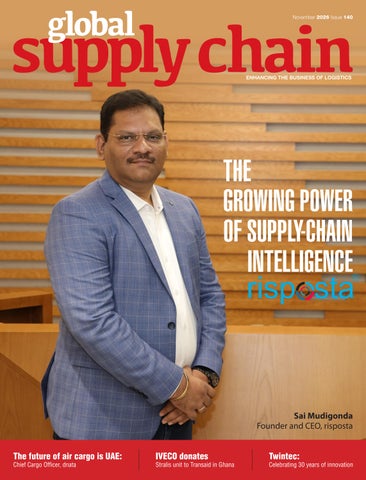
November 2026 Issue 140
ENHANCING THE BUSINESS OF LOGISTICS
THE GROWING POWER OF SUPPLY‑CHAIN INTELLIGENCE
Sai Mudigonda Founder and CEO, risposta The future of air cargo is UAE: Chief Cargo Officer, dnata
IVECO donates
Stralis unit to Transaid in Ghana
Twintec:
Celebrating 30 years of innovation
The FAMILY that makes the WORLD move.
From European roads to the highways of the world, the spirit of IVECO pushes people to give their best. Bold design, intuitive technology, and shared experience blend together in a harmony of lines, paths, and milestones. Today, we make progress move - with technology that empowers people and solutions designed to move the world forward.
Reliable Roadfreight & Bonded Land Bridge Solutions across the GCC Driving regional port‑to‑port trade from the UAE
Multimodal Solutions B2B Cargo Handling All Commodities Covered FTL Cross‑Border Trucking
Request Logistics Services
SIGNATURE MEDIA FZ LLE P. O. Box 49784, Dubai, UAE Tel: 04 3795678 Email: info@signaturemediame.com Exclusive Sales Agent Signature Media LLC P.O. Box 49784, Dubai, UAE Publisher: Jason Verhoven jason@signaturemediame.com Editor: Abigail Mathias abigail@signaturemediame.com Art Director: Johnson Machado johnson@signaturemediame.com
Printed and Distributed by Masar Printing and Publishing L.L.C., Part of Dubai Media Incorporated Dubai, UAE
Contributor’s opinions do not necessarily reflect those of the publisher or editor and while every precaution has been taken to ensure that the information contained in this magazine is accurate and timely, no liability is accepted by them for errors or omissions, however caused. Articles and information contained in this publication are the copyright of Signature Media FZ LLE & SIGNATURE MEDIA LLC and cannot be reproduced in any form without written permission.
Sustainability is no longer a standalone initiative. It has become a defining factor in how supply chains operate, innovate and grow. As businesses navigate increasing complexity, the challenge is not simply collecting more data, but turning insight into meaningful action. In this issue, we explore how technology, procurement strategies and operational excellence are helping organisations build more resilient and responsible supply chains. From Sai Mudigonda, Founder and CEO of risposta, who explains how SClanx is enabling businesses to transform data into decisive action, to expert perspectives on the evolving role of procurement, the focus remains firmly on achieving sustainable outcomes with measurable impact. We are also delighted to feature an exclusive column from the Chief Cargo Officer of dnata, offering valuable insights into the opportunities and responsibilities shaping the future of supply chain operations. We bring you valuable incites into e-invoicing which has become an invaluable asset for many in the industry. As sustainability moves from ambition to action, the conversations in these pages highlight one clear reality: the organisations leading tomorrow will be those that successfully balance efficiency, innovation and accountability today. Wishing you a pleasant read. Abigail Mathias Editor abigail@signaturemediame.com www.globalsupplychainme.com
NOVEMBER 2026 3
November 2026 Issue 140
06
The rise of supply chain intelligence risposta leads the way
12 advanced air 16Developing mobility infrastructure Future of air cargo
Exclusive column by dnata CCO
eplane Company and NIA
22Curbing Emissions CIMC 26 30Three decades of innovation Saudi Arabia’s super power
Shaping the future of logistics
Twintec’s resilient journey
4 NOVEMBER 2026
Sai Mudigonda with risposta South Africa team.
32 38Smarter procurement Driving the change 42 46AI-powered vision News from the industry 50 60The Business of Balancing Logistics e-invoicing
More than a compliance exercise
Unlocking efficiencies
Iveco donates Stralis to Transaid
Across cloud kitchens in KSA and Egypt
All the latest from the logistics arena
Kousik Harish
YOUR PARTNER
FOR AIR CARGO HANDLING AUTOMATION
@AEDLERLogistikSolutions
WWW.ALS.AERO info@als.aero
risposta
The rise of supply chain intelligence:
risposta
As supply chains become increasingly connected and data-driven, intelligence, speed and accountability are defining success. Sai Mudigonda, Founder and CEO of risposta, explains how SClanx is helping organisations turn data into decisive action. GSC: What are some data signals that risposta interprets that traditional visibility tools consistently miss? Sai Mudigonda: Traditional visibility tools are very good at telling you where something is — where the order is, where the stock is, where the truck is, or what milestone was missed. But in supply chain, the real value is not only in seeing the event; it is in understanding the business signal behind the event. At risposta, through SClanx, we look at signals that are often missed when visibility is treated only as tracking. We look at demand shifts caused by pricing and promotions, stock imbalance between locations, lead-time variability, supplier behaviour, order changes, workforce capacity, logistics constraints, master data gaps, and commercial leakage such as claims, rebates or missed recoveries. We also pay close attention to what I call decision signals — where an exception is open, who owns it, how long it has been 6 NOVEMBER 2026
pending, what impact it has on revenue or service, and what action should happen next. Many systems show the problem, but they do not always show the ownership and business consequence clearly. For us, visibility should not stop at “what happened.” It should help the business understand why it happened, what will happen next, who should act, and what outcome is at risk. That is where we believe traditional visibility needs to evolve. GSC: How has your company transformed over the years and what makes it lead with intelligence? SM: We have transformed from a founderled supply chain services mindset into a broader supply chain intelligence organisation. In the early days, the focus was on solving customer problems through experience, relationships, and hands-on execution. Over time, that experience shaped our product thinking, and today we are building SClanx as an AI-powered
supply chain platform supported by deep consulting, implementation, and customer success capabilities. The real transformation is that we are no longer looking at supply chain only as planning, visibility, or execution. We are looking at it as a connected decision ecosystem — where demand, pricing, promotions, replenishment, orders, workforce, logistics, trade flows, and data integration must work together. That is where intelligence comes in. For us, leading with intelligence does not mean only adding AI on top of existing processes. It means combining domain experience, data signals, practical execution, and decision support so customers can move from reactive firefighting to proactive business action. With more than 120 years of combined supply chain experience across our teams, our strength is that we understand not only the technology, but also the operational reality behind every decision.
risposta
“We do not just show customers more data. We help them make better supply chain decisions.” – Sai Mudigonda
NOVEMBER 2026 7
risposta
GSC: Many logistic companies struggle with legacy systems. How does risposta integrate with outdated TMS/WMS/ERP stacks without requiring a full digital overhaul? SM: Many logistics and supply chain organisations are running mission-critical operations on legacy TMS, WMS and ERP systems. Our view at risposta is very simple: customers should not be forced into a full digital overhaul just to start getting better visibility, control and intelligence. With SClanx, we take a co-existence and integration-first approach. We connect to existing systems through APIs, files, SFTP, database extracts, staging layers or customer-specific integration methods depending on what the legacy stack can support. The goal is not to disturb the core system on day one, but to create an intelligence layer that can read, validate, cleanse, map 8 NOVEMBER 2026
and interpret data across systems. This is where our Data Integrator capability becomes important. It helps bring data from older systems into a structured model, identify gaps, clean inconsistencies and connect information across orders, inventory, logistics, suppliers, customers and financial flows. We do not believe every transformation should start with “replace everything.” In many cases, the smarter approach is to wrap the legacy system, integrate with it, reduce dependency over time, and modernise in phases. This helps customers protect business continuity while still moving toward better decision-making. For us, integration is not only technical. It is also business-led. We first understand what the customer needs to see, decide and act on. Then we integrate the systems around that business outcome.
GSC: Please tell us more about SClanx and what it has to offer? SM: SClanx is our flagship supply chain platform at risposta. The name comes from our thinking of a supply chain “platter” — a connected set of capabilities that helps enterprises plan, execute, integrate, monitor, and improve their supply chain decisions from one platform. More importantly, it is not built as a single-point solution. It brings together key supply chain capabilities such as Data Integrator, Demand & Commercial Planning, Replenishment Planning, Order Management, Workforce Management, Logistics Management, TradeFlow, Command Centre, and Stock Management. The idea is to help customers connect demand, supply, inventory, orders, logistics, workforce, commercial flows, and enterprise data into one intelligent operating layer.
risposta
For example, demand and commercial planning helps customers not only forecast demand but also understand the impact of pricing, promotions, and commercial decisions. Replenishment Planning supports better stock availability and inventory movement. TradeFlow helps manage supplier agreements, claims, rebates, and commercial recoveries. Data Integrator helps bring data from different systems into a structured and usable model. And the Command Centre gives leadership a business-level view of what is happening, what is at risk, and where action is needed. Our goal with SClanx is simple: customers should not only see data; they should be able to act on it. SClanx is also designed to work in real-world enterprise environments. Many customers have legacy ERP, WMS, TMS, planning, and finance systems. We do not expect them to replace everything
overnight. SClanx can co-exist with these systems, integrate with them, and create an intelligence layer that helps customers modernise in phases. For us, SClanx is not just software. It is a supply chain intelligence platform built from practical experience, customer realities, and the belief that planning, execution, visibility, and decision-making must work together.
workflows, alerts, dashboards, and command-centre visibility. Our belief is simple: in volatile conditions, supply chains should not only become faster; they should become more intelligent. Performance is not just about system speed. It is about helping leaders make timely, confident decisions when the business environment is unstable.
GSC: How does your platform maintain performance when supply chains face extreme volatility such as geopolitical shocks or sudden demand spikes? SM: Extreme volatility cannot be removed from supply chains, but platforms can help businesses respond faster, with better visibility and better decision discipline. At risposta, we designed SClanx to support this kind of reality — where demand can change suddenly, lead times can shift, supply can get disrupted, and business teams need to act quickly. SClanx maintains performance at two levels: technology performance and business performance. On the technology side, the platform is built with a modular architecture so that different capabilities — demand, replenishment, orders, logistics, workforce, trade flows, data integration and command visibility — can scale and operate without everything depending on one large monolithic process. On the business side, SClanx focuses on exception-driven intelligence. When there is a demand spike, stock imbalance, supplier delay, logistics constraint, or commercial impact, the platform helps highlight what is changing, where the risk is, and what action is needed. The idea is not to flood teams with data, but to help them focus on the signals that matter. During shocks such as geopolitical disruption or sudden demand movement, organisations need three things: reliable data, faster scenario understanding, and clear ownership of actions. SClanx is designed to bring these together through integrated data, configurable
GSC: What does risposta automate, and where do you believe human judgement remains essential? SM: At risposta, our belief is that automation should remove noise, not remove judgement. Through SClanx, we automate areas where data is repetitive, rules are configurable, exceptions can be detected early, and actions can be workflow-driven. For example, SClanx can automate data ingestion, validation, cleansing, mapping, demand signal interpretation, replenishment recommendations, order exception alerts, logistics visibility, supplier claim workflows, rebate calculations, task notifications, approval flows, dashboards, and escalation triggers. These are areas where technology can bring speed, consistency, accuracy, and control. But supply chain is not only mathematics. There are moments where human judgement is irreplaceable — especially when decisions involve customer relationships, commercial trade-offs, pricing strategy, promotion decisions, supplier negotiations, service-risk decisions, market context, or exceptional business situations. Our philosophy is simple: automate the repetitive, highlight the exceptions, recommend the action — but keep accountability with people. We do not want technology to replace planners, buyers, supply chain managers, or leaders. We want SClanx to make them faster, sharper, and better informed. For us, the best supply chain intelligence is not human versus machine. It is human judgement supported by strong data, automation, and decision intelligence. NOVEMBER 2026 9
risposta
GSC: With AI systems increasingly scrutinised, how do you ensure data privacy, compliance, and ethical use across global platforms? SM: At risposta, we see data privacy, compliance, and ethical AI as foundational responsibilities, not afterthoughts. Supply chain platforms deal with sensitive information — customer data, supplier data, pricing, promotions, inventory, contracts, commercial flows, and operational performance — so trust has to be built into the platform from day one. With SClanx, our approach is based on privacy by design, controlled access, auditability, and customer ownership of data. We focus on role-based access, data segregation, encryption, audit trails, configurable approval workflows, and clear visibility into who accessed or changed what. For global customers, we also support deployment models and configurations that align with their security, data residency, and compliance expectations. On the AI side, our philosophy is very clear: AI should support better decisions, not become an uncontrolled black 10 NOVEMBER 2026
box. We believe in using AI responsibly to identify signals, detect exceptions, recommend actions, and improve decision speed — but final accountability must remain with people and the business. We are also careful about customerspecific data. Proprietary customer data, business rules, commercial logic, supplier agreements, and operational processes must be protected. We do not believe customer-specific intelligence should be casually reused across customers. Ethical use means respecting confidentiality, using data only for the intended purpose, and ensuring AI recommendations are explainable, reviewable, and governed. For us, trust is the real foundation of global platforms. Customers should know that their data is secure, their business logic is protected, and technology is being used to improve outcomes responsibly. GSC: The market is inundated with “AI-powered” logistic tools. What is the single most defensible capacity that sets risposta apart? SM: Our ability to convert real supply
chain domain experience into decision intelligence, sets us apart. Many AI-powered logistics tools focus on alerts, dashboards, predictions, or automation. Those are important, but they are not enough. In supply chain, the real challenge is not only identifying that something has gone wrong; it is understanding why it matters, what decision is required, who should act, and what business outcome is at risk. We are not approaching AI as a technology layer alone. We are bringing together deep supply chain experience, practical implementation knowledge, customer-side understanding, and platform capability through SClanx. Our strength is in knowing how supply chain decisions are actually made across demand, pricing, promotions, replenishment, orders, logistics, workforce, trade flows, and execution. For us, AI is not the differentiator by itself. The differentiator is domainled intelligence — AI guided by business context, operational reality, and execution ownership.
risposta GSC: How does your solution adapt to sector specific needs – automotive, FMCG, pharma, or e-commerce — without becoming a one size fits all platform? SM: At risposta, we do not believe a supply chain platform should force every industry into the same operating model. Automotive, FMCG, pharma, and e-commerce may all deal with demand, inventory, orders, logistics, and suppliers — but the way they make decisions is very different. That is why SClanx is designed with a core platform plus configurable industry logic approach. The foundation remains common — data integration, planning, replenishment, order visibility, logistics, workforce, trade flows, and commandcentre intelligence — but the business rules, workflows, parameters, exception logic, approval flows, and dashboards can be configured for each sector. The strength of SClanx is that we do not start by saying, “Here is the software, adjust your business to it.” We start by understanding the customer’s operating model, data reality, decision points, and business exceptions. Then we configure the platform around the outcomes they need. GSC: What does a “resilient supply chain” look like in your framework? SM: At risposta, a resilient supply chain is not one that never faces disruption. Disruption will always come — demand spikes, supplier delays, logistics constraints, geopolitical shocks, pricing changes, labour issues, or customer behaviour shifts. A resilient supply chain is one that can sense early, understand impact, decide quickly, act with ownership, and learn continuously. For us, resilience has five layers. Visibility — knowing what is happening across demand, inventory, orders, logistics, suppliers, workforce, and commercial flows. Intelligence — understanding what the signal means and what outcome is at risk. Flexibility — having alternate options in sourcing, fulfilment, replenishment, routing, or workforce planning. Decision speed — making the right decision before the issue becomes a crisis. Execution discipline — ensuring someone owns the action and closes it. Through SClanx, our aim is to help
customers move from reactive firefighting to proactive control. It is not enough to know that a shipment is delayed or stock is short. The business must know which customer is impacted, what revenue or service risk exists, what options are available, and who is responsible for the next action. A resilient supply chain is not just technology-driven. It is a combination of data, process, people, governance, and leadership accountability. Technology can provide the signals, but resilience comes when the organization has the discipline to act on those signals. GSC: What emerging capabilities, autonomous decisioning, predictive procurement — are you building that will redefine your value proposition in 2027? SM: For 2027, our focus at risposta is to move SClanx from visibility and workflow intelligence toward stronger decision intelligence. We are looking at emerging capabilities such as controlled autonomous decisioning, predictive replenishment, predictive procurement signals, supplier-risk intelligence, promotion impact sensing, exception-based workflows, and commandcentre recommendations. The goal is not to make the platform blindly autonomous.
The goal is to help businesses reduce the time between signal, decision, and action. For example, in replenishment, the platform should not only show a stock risk; it should recommend what needs to move, where, by when, and what service or revenue impact is at risk. In procurement and supplier management, it should help identify early signals around lead-time variation, supplier reliability, fulfilment risk, pricing impact, agreement leakage, or commercial exposure. We are also building toward a stronger “next best action” layer within SClanx, where the system can recommend actions, assign ownership, trigger workflows, and escalate exceptions based on business rules and risk levels. However, we believe human judgement must remain central. Autonomous decisioning should be applied carefully, especially in areas involving commercial impact, customer relationships, supplier commitments, or risk. Our approach is human-in-control automation — the platform recommends, accelerates, and automates where appropriate, but the business remains accountable. What will redefine our value proposition in 2027 is this shift: from showing supply chain problems to helping customers decide and act faster with confidence. NOVEMBER 2026 11
dnata
Why the future of air cargo is happening in the UAE – and why the world should pay attention? By Guillaum Crozier, Chief Cargo Officer, dnata
I
f you spend enough time in cargo operations, you learn that there’s a rhythm to the work – a pulse running through every warehouse, every flight, every team on the ground. But every so often, the rhythm shifts. Something changes in a way that tells you the industry isn’t just evolving. It’s stepping into a new era. For me, that moment became unmistakable last year when dnata surpassed one million tonnes of cargo handled in Dubai over a twelve-month period. It’s a milestone that carries far more meaning than a number on a chart. It tells us that the foundations we’ve been building – digital, operational, and collaborative – are not just working,
12 NOVEMBER 2026
but accelerating what’s possible. That growth, a 30 per cent increase year on year, happened in one of the world’s most dynamic aviation hubs. And it didn’t happen because of luck. It happened because the ecosystem around us – our people, our partners, our customers, our regulators – is moving together with ambition and a shared belief in what air cargo can become.
From automation to intelligence Across the industry, there’s a lot of discussion about automation, digitalisation, optimisation. These are essential themes, and they’ve shaped our work for years. But
increasingly, I find myself talking about something else: intelligence. Not intelligence in the abstract, but in the very practical sense of decision-making, anticipation, and real-time operational clarity. When we introduced centralised screening at DXB, for example, it wasn’t simply about adding a modern piece of equipment or shaving a few minutes
dnata
off a process. It was about creating an environment where security and efficiency coexist without compromise. Every screening machine now speaks directly to our Cargo Management System, updating information in real time. This is what intelligence looks like in practice: systems that speak to one another, teams that act before bottlenecks form, and operations that become faster precisely because they’ve become smarter.
Seeing the whole picture, in real time If there is one universal truth in logistics, it is this: you cannot manage what you cannot see.
Our Plan-Do-Review (PDR) dashboard has become central to how we run our operations. Every morning, teams look at real-time updates on cargo flows, resource needs, and performance indicators. Instead of reacting to yesterday’s challenges, we optimise today’s opportunities. This shift – from hindsight to realtime insight – has been transformative. It allows us to stay ahead of demand surges, reassign resources instantly, and reduce the small inefficiencies that compound into major operational delays.
Redefining customer experience in cargo The same philosophy extends to our customers. One thing that has become abundantly clear is that shippers and forwarders want transparency and certainty above everything else. They want to know where their cargo is, what’s required next, and how quickly they can move through the system. That’s why Calogi 2.0 has been such a meaningful transformation for us. The aim was to create an efficient ecosystem that brings airlines, customs, forwarders, and handlers into a single digital environment. When a customer submits documents online, pays electronically, books a slot, or accesses information at any hour of the day, they’re experiencing
Nabil Sultan Al Murr, Group Chief Executive Officer, dnata and Guillaume Crozier, Chief Cargo Officer, dnata NOVEMBER 2026 13
dnata
the simplicity and clarity that modern cargo movement demands. And when they arrive at a Smart Gate and move through the facility without unnecessary delays, that’s when digitalisation truly becomes a tangible “buzz word” in their working day.
Collaboration is UAE’s greatest strength One of the strongest advantages we have in the UAE is the collaborative spirit that underpins the entire cargo sector. Innovation doesn’t thrive in isolation; it thrives when everyone around the table sees the same goal. Our progress with autonomous technologies, drone inventory trials, automated dimensioning, and integrated customer engagement tools all rely on this kind of alignment. Whether it’s Dubai Customs, Dubai Police, technology providers, airlines, or ground transport partners, there is a shared willingness to explore what’s next and to scale it quickly when it works.
14 NOVEMBER 2026
The power of datadriven foresight Looking ahead, I believe the next big leap for our industry won’t simply come from new tools. It will come from the growing maturity of our data – and what we can do with it. As systems become more connected and datasets become richer, we will move from reacting to operational patterns to predicting them. We will be able to forecast demand with greater precision, model warehouse utilisation before the day even begins, and prevent equipment issues before they have operational consequences. A more intelligent cargo ecosystem is also a more sustainable one, because it reduces waste, unnecessary movement, and inefficiencies that add cost and emissions without adding value. All of this ties back to that one-milliontonne milestone. We knew that it’s hard evidence of scale, but looking back, I can also see why it’s a definitive proof of readiness. It shows that our digital backbone, our operational excellence,
and our partnerships are resilient enough to support the future we see coming. What truly excites me most is that this journey is still in its early stages. There is so much more to unlock, from AI-driven optimisation to autonomous material-handling systems, from smarter customer experiences to fully paperless, fully interoperable cross-border flows. The opportunity is enormous – not just for dnata, but for our customers and for the wider air cargo community that relies on Dubai as a global gateway. The future of air cargo will belong to those who combine innovation with operational discipline, who collaborate openly, and who turn data into intelligence rather than noise. In the UAE, we are building exactly that world. And if the last year has taught us anything, it’s that when the right ecosystem comes together, the results can exceed even our own expectations. This is an exciting moment for our industry. And in Dubai, we’re just getting started.
Airbus A350F freighter
Airbus A350F freighter successfully performs its maiden flight The A350F freighter (MSN 700), the first of two test aircraft, has recently completed its first flight. The aircraft, fitted with special flight test instrumentation, flew for 4 hours and 10 minutes reaching an altitude of 25,000 feet. The aircraft was flown by a dedicated Airbus Flight Test crew.
T
his maiden flight is a major milestone for the A350F and for our customers worldwide. As the latest development of our highly successful A350 platform, the A350F is a true game-changer for the air cargo market, combining unmatched operational flexibility, fuel efficiency, and range,” stated Lars Wagner, CEO Commercial Aircraft at Airbus. “I am immensely proud of the extraordinary dedication and hard work of all the teams who have made this achievement possible.” The second A350F prototype (MSN 701) is now at an advanced stage of final assembly and will enter the paint shop in the next
few weeks. During this inaugural flight, the crew carried out tests focused on verifying the basic airworthiness, fundamental flying qualities, and ensuring basic systems perform as predicted. This marks the start of an over 9 months flight test campaign. Designed to be the world’s most advanced cargo aircraft, the A350F meets the evolving demands of the global air freight market. Thanks to a range capability of up to 8,700 kilometres and a payload of up to 111 tonnes, it will allow operators to deploy it on international long-haul routes. Made of over 70% advanced materials, the A350F is resulting in a 46
tonnes lighter maximum take-off weight (MTOW) compared to competitor aircraft. Powered by the latest Rolls-Royce Trent XWB-97 engines, the aircraft will bring a reduction in fuel consumption and carbon emissions of up to 40% compared to competitor aircraft with a similar payload-range capability. It is the first new freighter to fully meet the latest ICAO’s CO₂ emission standards. At the end of August 2026, the A350F had already recorded 115 orders from 14 disclosed customers and it had captured up to 59% market share in the large freighter category.
NOVEMBER 2026 15
ePlane Company
ePlane Company and Noida International Airport to develop advanced air mobility infrastructure Ubifly Technologies Private Limited (The ePlane Company) has signed a Memorandum of Understanding (MoU) with Noida International Airport. Moving beyond just physical infrastructure, the agreement establishes a comprehensive framework to co-develop the regulatory Standard Operating Procedures (SOPs), Vertiport Management Systems, and operational ecosystem specifically required to deploy ePlane’s flagship e200X aircraft.
T
his collaboration paves the way for e200X-powered airport-to-airport transit, intra-city commutes, and emergency air ambulance services across the region. This infrastructure partnership complements key engineering progress, following the recent public unveiling of the full-scale e200X PT-01 prototype. With ground testing currently underway, the MoU ensures that the physical development of the aircraft is met with parallel advancements in ground operations and airspace integration.
Infrastructure and regulatory collaboration To facilitate these operations, YIAPL will allocate space within the airport premises for proof-of-concept trials, vertiports, and charging stations, while aligning its airport Standard Operating Procedures (SOPs) to accommodate eVTOL services. Simultaneously, ePlane Company will focus on securing necessary clearances from the Directorate General of Civil Aviation (DGCA) and the Bureau of Civil Aviation Security (BCAS), while executing the prototyping and flight testing of the e200X aircraft. The two entities will jointly engage with regulators, Air Traffic Control (ATC), and state governments to establish safety frameworks, Vertiport Management Systems, and AI-assisted fleet scheduling integrated with smart city systems. “Deploying electric air taxis requires more than just building the aircraft; it demands the parallel development of ground infrastructure, regulatory 16 NOVEMBER 2026
frameworks, and operational procedures,” said Dr. Satyanarayanan Chakravarthy, Founder and Director of Ubifly Technologies (The ePlane Company). “This MoU with Noida International Airport allows us to systematically validate our operational models using drone trials before transitioning to piloted e200X flights. It is a pragmatic, step-by-step approach to ensuring that when our aircraft are certified, the airport ecosystem is fully equipped to deliver on our core promise: bypassing urban gridlock and compressing hours of road travel into minutes of safe, emission-free transit for both passengers and critical medical care.” Founded in 2019 and incubated at the Indian Institute of Technology Madras (IIT Madras) Incubation Cell, The ePlane Company (Ubifly Technologies Pvt. Ltd.) is India’s leading deep-tech aerospace manufacturer pioneering the global transition to Advanced Air Mobility (AAM). Headquartered at the 163-acre IIT Madras Discovery Campus in Thaiyur, Chennai, the company operates the nation’s first and only dedicated 60,000+ square foot integrated electric vertical take-off and landing (eVTOL) prototyping, manufacturing, and testing facility. The company is the first private aerospace entity in India to receive a formal Design Organisation Approval (DOA) from
the Directorate General of Civil Aviation (DGCA) for electric aircraft, and its flagship e200X vehicle is the first eVTOL accepted into the DGCA’s official Type Certification pipeline. Backed by 10,000+ kilometres of cumulative physical flight testing across its ATVA and e50 technology demonstrators, ePlane specializes in high-efficiency, zeroemission aviation architectures tailored explicitly for high-density urban corridors. Daniel Bircher, Chairman, Noida International Airport stated, “Noida International Airport’s long-term vision is closely linked with bringing innovative, future-ready infrastructure to the region. Integrating Advanced Air Mobility into our airport framework is an important part of our commitment to seamless, multi-modal connectivity. We are pleased to collaborate with The ePlane Company on developing the ground infrastructure and operational SOPs required to deliver safe, zero-emission air transit and vital emergency services to Delhi-NCR.” Noida International Airport (IATA code DXN) connects the greater Delhi area and Western Uttar Pradesh with other cities in India and the world. This world-class airport offers rich experiences and comprehensive commercial attractions to its passengers. NIA is committed to an ambitious net zero emissions goal supported by sustainable design and operations principles.
to-group.com/locations/dubai to-group.com/locations/dubai
YOU NEED ANY YOU NEED ANY CARGO SPACE? CARGO SPACE? ROLL-ON / ROLL-OFF! ROLL-ON / ROLL-OFF!
COMPREHENSIVE SPECIALIST KNOWLEDGE, SKILLS AND EXPERIENCE – WHEN THINGS GET REALLY TOUGH COMPREHENSIVE SPECIALIST KNOWLEDGE, SKILLS AND EXPERIENCE – WHEN THINGS REALLY TOUGH We act as an independent shipbroker specializing in Roll-On/Roll-Off and Breakbulk services,GET working with selected ocean carriers and securing vessel allocations. When complete industrial plants, heavy modules, wind turbines, We act as anvehicles, independent shipbroker Roll-On/Roll-Off and Breakbulk workingvessel with capacity. selected commercial or sensitive cargospecializing need to be in transported worldwide, we provideservices, the necessary ocean and securing vessel or allocations. When complete plants, wind turbines, Are youcarriers interested in our services, do you have a project that industrial will challenge us?heavy Don‘tmodules, hesitate to contact us. commercial vehicles, or sensitive cargo need to be transported worldwide, we provide the necessary vessel capacity. Are you interested in ourMiddle services, or do you havec)a| project will challenge us? Don‘t hesitate to contact Richard Hall (Director East/Asia Pacifi Email: that r.hall@to-group.com | Mobile: +971 58 577us. 9221 Transport Overseas Shipping (Dubai) DMCC | Unit No.1007 | Indigo Icon Tower | Cluster F | JLT – Dubai, UAE Richard Hall (Director Middle East/Asia Pacific) | Email: r.hall@to-group.com | Mobile: +971 58 577 9221
Big 5 Global
Big 5 Global returns for its 47th edition, addressing supply chain resilience • Big 5 Global returns to Dubai World Trade Centre from 23-26 November 2026 for its 47th edition, bringing together the construction and urban development industry from across the MEASA region. • The event will spotlight four key priorities: Supply chain resilience, technology advancement, sustainable transformation and a future-ready workforce.
C
onsidered one of the most influential industry events for construction and urban development in the Middle East, Africa and South Asia (MEASA), Big 5 Global, returns to Dubai World Trade Centre from 23 – 26 November 2026. Supported by the UAE Ministry of Energy and Infrastructure, the UAE Ministry of Economy & Tourism and Dubai Civil Defense, the event is marking its 47th edition and comes at a time when the region’s active project pipeline is driving demand for efficient project delivery and future-ready capabilities. This year, the event spotlights four key priorities: Supply Chain Resilience, Technology Advancement, Sustainable Transformation and Future-Ready Workforce. These priorities reflect the region’s evolving built environment needs. Government-led economic transformation programmes, including We the UAE 2031, Saudi Vision 2030, New Kuwait 2035 and Oman Vision 2040, alongside urbanisation and infrastructure development across MEASA, are driving long-term investment and creating sustained demand for products, technologies and expertise across the construction value chain. “The scale of development planned across the MEASA region creates significant opportunity for the industry, but the nature of that opportunity is evolving,” said Josine 18 NOVEMBER 2026
Heijmans, Senior Vice President, dmg events. “Projects are becoming increasingly connected across disciplines, spanning technology and building systems, supply chains, sustainability and workforce capabilities. Big 5 Global brings these perspectives together, giving the industry access to the products, partners and insights influencing how projects are delivered, while creating space for senior leaders to address the wider priorities influencing the built environment.”
Connecting a network that shapes the future Big 5 Global brings together products, technologies and expertise spanning the full project lifecycle, from building materials, interiors and finishes to MEP, construction tools and equipment, digital construction, geospatial technologies and facilities management. Building on the international reach of the event, Big 5 Global will welcome exhibitors from more than 60 countries, with over 20 country pavilions bringing together companies from across the construction and urban development ecosystem. Participating pavilions include Austria, Italy, Germany, Oman, Greece, China, Morocco, UK, Türkiye, Spain, Russia, Egypt, Portugal and South Korea, among others. Italy will have a particularly strong
presence, with more than 100 Italian companies participating through the Italian Trade Agency, which will also contribute to the event’s Leadership Summits. Commenting on their participation, Valerio Soldani, Trade Commissioner to the UAE, Italian Trade Agency (ITA), said: “ Italy sees the Middle East as a region of significant opportunity for its construction and built environment companies, particularly at a time when markets are undergoing rapid transformation and investment decisions are accelerating. Through our participation at Big 5 Global, with more than 110 Italian companies represented across the event, we are reinforcing our commitment to supporting the region’s development while creating opportunities for Italian businesses to engage with key decision-makers and project stakeholders. This year Big 5 Talks will introduce Building Codes & Regulations Talks that will address the regulatory frameworks driving construction and development. “In 2025, 77% of attendees identified as decision-makers and attendee spend accounted for $3.34 billion, translating industry priorities into commercial opportunity,” said Heijmans. “As we gear up for this year’s edition, we look forward to gathering stakeholders to drive new business, collaborate and exchange knowledge that can accelerate the industry.”
Emirates SkyCargo
• Cargo carrier marks 10 years since launch of specialised Pharma product, dedicated GDP certified cool chain infrastructure at its hub in Dubai • Between 1.5 to 2 million kilograms of pharma transported every week on Emirates flights
E
mirates SkyCargo is marking several major milestones in the transportation of time and temperature sensitive pharmaceuticals through Dubai. The air cargo carrier is celebrating a decade of investment in world-class pharma logistics since September 2016 when it launched its specialised product for transportation of pharmaceuticals and unveiled its GDP (Good Distribution Practice) certified dedicated pharma handling hub in Dubai, ensuring the highest standards of quality and temperature-controlled handling. Since launching Pharma, Emirates SkyCargo has transported more than one million pharma shipments, equivalent to over 800,000 tonnes of pharma cargo, connecting pharmaceutical manufacturers, healthcare providers and patients across six continents. The milestone underscores Emirates SkyCargo’s leading capabilities and strengths in pharma logistics as well as the emergence of Dubai as one of the prominent global hubs for rapid and seamless transport of temperature sensitive pharma. Today, Emirates SkyCargo’s Dubai hub boasts over 16,500 sq metres of GDP certified handling 20 NOVEMBER 2026
and storage area across DXB and DWC as well as a dedicated fleet of over 55 cool dollies for pharma cargo. Cool Dollies are mobile temperature-controlled containers that maintain shipment temperature during transfer from aircraft hold to terminal or vice versa or during Quick Ramp Transfers between two aircraft. On average, Emirates SkyCargo transports between 1.5 and 2 million kilograms of pharmaceutical products every week on its flights. Badr Abbas, Divisional Senior Vice President, Emirates SkyCargo, said: “Over the last decade, Emirates SkyCargo’s pharma product has become the gold standard for air transportation of pharmaceuticals. This has not happened by chance or by accident. It is the result of years of investing in our processes, our capabilities, our people and our infrastructure. It is also an outcome of working closely with pharma shippers, freight forwarders, airports, ground handlers, multi-modal transport providers and other parties in the coolchain ecosystem to develop customised solutions that meet industry needs. We’re also constantly evolving our offerings to
keep pace with the latest developments. We ultimately have only one goal, and that is to make sure that we transport these lifesaving medicines and treatments in the best possible conditions as they directly touch the lives of people around the world.”
Connecting global pharma markets through Dubai Emirates SkyCargo facilitates the movement of pharmaceutical products across global markets, connecting major life sciences manufacturing hubs with healthcare providers around the world. Some of the largest pharma origin markets for Emirates SkyCargo include India, Germany, Belgium, UK, USA and Switzerland. Leveraging its extensive global network, high-frequency wide body flight capacity and purposebuilt pharma infrastructure in Dubai, Emirates SkyCargo provides seamless connectivity to pharmaceutical cargo.
A decade of innovation in pharma logistics The launch of Emirates Pharma in 2016 marked a major milestone in Emirates SkyCargo’s strategy to develop specialised
Emirates SkyCargo
cargo solutions for different verticals. Supporting Emirates SkyCargo’s pharma solution, the carrier inaugurated its dedicated GDP-certified pharmaceutical handling facilities in Dubai, creating a purpose-built environment for the storage, handling and transportation of temperature-sensitive medicines. Over the following decade, Emirates SkyCargo continued to invest in specialised infrastructure, equipment and services to support the evolving needs of pharmaceutical shippers and healthcare providers. Key milestones include: Initiating key partnerships with specialised container manufacturers for transporting pharmaceuticals onboard with very specific temperature requirements. Launch of Emirates Pharma Corridors, connecting high volume pharma hubs. Emirates SkyCargo partnered with local airports and local ground handling partners to safeguard product integrity from journey to destination. During the pandemic, Emirates SkyCargo played a pivotal role
2017 2018
2020-2022
in global healthcare logistics including setting up a dedicated GDP certified hub for vaccine transport and flying more than one billion doses of vaccines. With pharma supply chains becoming increasingly sophisticated, Emirates SkyCargo expanded its offering in 2023 with the launch of Emirates Vital and Emirates Medical Devices, providing specialised solutions for the transportation of critical healthcare shipments including human organs, tissues, cell and gene therapies, clinical trial materials and medical equipment. Emirates SkyCargo’s pharmaceutical network grew to 43 pharma stations worldwide. In addition, Emirates SkyCargo also established dedicated 2-8°C temperature corridors across select pharma hubs supported by specialised handling processes and agreed standards. Emirates SkyCargo has also pioneered the development and deployment of thermal protection solutions including thermal blankets for pharma shipments in order to provide end to end protection for pharma cargo. Emirates SkyCargo is the only global air cargo carrier to deploy thermal blankets
2023
2025
for all pharma shipments without exception. In 2026, the cargo carrier has also expanded its pool of suppliers for thermal blankets improving availability across key markets, reducing transportation costs and enabling faster lead times for customers worldwide. As Emirates SkyCargo’s pharma product enters its second decade, the carrier remains committed to continuously investing in specialised healthcare logistics capabilities, developing new solutions for emerging healthcare segments and working closely with partners around the world to strengthen global pharma supply chains. As the industry evolves beyond traditional pharmaceuticals towards increasingly specialised treatments, including cell and gene therapies, biologics and precision medicines, Emirates SkyCargo continues to innovate its infrastructure, processes and product portfolio to meet changing customer needs. Through ongoing innovation, strategic collaboration and continued investment in infrastructure and technology, Emirates SkyCargo will support the seamless global movement of pharmaceuticals while reinforcing Dubai’s position as a leading global hub for the transport of advanced healthcare products.
NOVEMBER 2026 21
Curbing Emissions
Saudi Arabia’s super power: Turning GHG data into capital advantage By: Francesco Colavita, SVP - MEAPAC, Jaggaer
Across Saudi Arabia’s capital markets, ESG (Environmental, Social, and Governance) is no longer a peripheral conversation. Investors, lenders and commercial partners increasingly expect companies to support environmental, social and governance commitments with credible evidence. Disclosure frameworks clarify what information belongs in an ESG report. The more revealing question is what happens to that information after the report is published.
G
reenhouse gas emissions (often referred to as GHG) offer a useful way to answer it. They create measurable accountability, yet their supplychain complexity exposes the underlying gap between corporate ambition and operational reality. A company may have a clear view of emissions from its own facilities while remaining uncertain about the environmental impact embedded across thousands of supplier relationships. That uncertainty matters because supplier-related Scope three emissions can represent a significant part of the overall footprint. That makes visibility and application parts of the same challenge. Companies first need a clear, dependable view of supplier emissions, then connect that information with sourcing, contracting and suppliermanagement decisions that can change performance. ESG maturity ultimately depends on closing both gaps and aligning 22 NOVEMBER 2026
these efforts with Saudi content-localisation priorities to embed ESG effectively across the Saudi market.
Following the data beyond disclosure When a procurement team prepares to source a major category, it may know the prices suppliers charge, their delivery history and whether their certificates are current. Yet their emissions data might sit in separate spreadsheets, arrive in inconsistent formats or lack the documentation needed to judge its reliability. ESG is visible at a corporate level, but becomes blurred at the moment of commercial choice. Closing that gap begins with connecting supplier emissions to the information procurement already uses: supplier records, contracts, categories, local and global certificates, risk indicators and purchasing activity. Standardised onboarding templates
can make clear what evidence suppliers must provide. Document validation can identify incomplete information, expired certificates or possible noncompliance before these issues surface during a tender or reporting cycle. Once information is brought together, an organisation can see where carbon is concentrated across categories and suppliers. An ambition to reduce supplychain emissions becomes a focused question: which relationships account for the greatest impact, where is the evidence weakest, and where could changed behaviour make a material difference? Analytics and AI can help reveal those patterns, but their value lies in directing attention rather than producing another dashboard. Procurement teams do not need every supplier to receive identical scrutiny. They need a credible basis for concentrating effort on the areas that matter most.
Curbing Emissions
performance does not automatically override every commercial factor; instead, the trade-off becomes visible, comparable and open to scrutiny. Nor does a weak score have to end a supplier relationship. Excluding every supplier that falls below a threshold may narrow competition without reducing emissions. In many cases, the more productive response is a structured development plan. Missing documentation can be requested, data quality can be improved and measurable objectives can be agreed. Updated scorecards and real-time metrics then show whether commitments are producing progress or simply better promises. This creates a continuous thread from disclosure to decision and from decision to improvement. Suppliers understand how environmental performance affects commercial relationships. Procurement teams gain a practical basis for engagement. Executives can see whether sourcing choices reinforce the emissions goals communicated to investors and stakeholders.
The advantage lies in the connection
When carbon enters the commercial conversation The real shift occurs when that insight reaches a sourcing decision. Imagine two suppliers competing for the same award. One presents the lower initial price but provides incomplete emissions information. The other offers stronger evidence and a credible record of improvement, although its commercial proposal is marginally higher. Without a consistent decision framework, the environmental difference may be acknowledged and then set aside. A supplier scorecard changes the conversation by placing carbon performance alongside cost, quality, reliability, ethical compliance and continuity of supply. Carbon pricing and sustainability criteria can also form part of RFx evaluations, helping decision-makers consider the wider implications of an award. Environmental
For Saudi companies, the significance extends beyond a more accurate carbon figure. A traceable link between supplier evidence and commercial action strengthens the credibility of ESG disclosures. It also reveals environmental dependencies that could affect supply chain continuity, reputation and access to international markets. Procurement occupies a distinctive position in this transition because it sits where corporate commitments meet expenditure. Each sourcing event, contract, order issuing, invoice/payment and supplier review is an opportunity to translate an emissions goal into a business decision. As Saudi Arabia’s ESG landscape matures, advantage will rest on this connection: credible measurement, informed commercial choices and demonstrable supplier progress. Reporting establishes intent, but execution shows whether ESG influences the business. That is where emissions data begins to create durable value. NOVEMBER 2026 23
Saudia
Saudia CCO, Arved von zur Muehlen on ‘Why the future of marketing starts with commercial outcomes
A
cross-solution marketing transformation led by Arved von zur Muehlen, EVP and Chief Commercial Officer at Saudia, has delivered significant growth and efficiency gains for the airline in the first half of 2026 achieving double-digit global revenue growth, improved return on ad spend and a doubledigit reduction in cost of sale compared with H1 2025. Built and run by Incubeta MENA, the marketing outcomes agency, the approach connects data, media, creative and technology into a single growth system that answers to commercial results rather than marketing activity. The results were achieved during a volatile period for the aviation sector, where traveller intent, demand, pricing and load factors continued to shift alongside seasonal peaks and regional disruption. For Saudia, this highlighted the need for a model capable of responding to change in real time rather than relying on static marketing cycles. At the centre of the approach is a growth system designed around relevance and commercial value. Saudia sets the commercial priorities and definition of a valuable booking, while Incubeta MENA has built and operates the system that connects these priorities across media, data, creative and technology. Arved von zur Muehlen, Chief Commercial Officer at Saudia, said: “The conversation around AI can very quickly become about the technology itself, but from a commercial perspective, the more important question is what you are asking that technology to achieve. For us, the starting point was defining what a valuable outcome looks like for the business and then building the system around it. That changes the role of marketing from delivering activity to responding intelligently to demand and creating measurable commercial value.” The model brings together live audience and behavioural signals with an integrated approach to search, dynamic creative and automated workflows. GenAI is used within the creative process to help assemble more relevant messaging for different audiences 24 NOVEMBER 2026
With double-digit revenue growth and a double-digit reduction in cost of sale, the airline’s evolving growth model offers a glimpse into a more responsive, AI-enabled future
and moments, with the ambition not to simply produce more creative, but to respond to traveller intent with greater relevance, speed and scale. The complexity of that challenge is significant. Saudia’s model accounts for 50 booking behaviours and more than 200 micro-personas, served by more than 2,000 creative variations live from a single dynamic creative library, while responding to an environment in which why, when and where people want to travel can change quickly. Rather than treating each component as a separate marketing discipline, the system is designed to allow signals to move through to creative execution and media decisions as demand evolves. For Katerina Bazalova, Managing Director, Incubeta MENA, the work reflects a broader shift in what businesses should expect from their marketing partners: accountability for commercial outcomes and better deployment of a client’s marketing capital, particularly as AI makes it possible to act on customer signals at greater speed. Bazalova adds, “There is a lot of focus on
what AI allows marketers to produce, but volume alone is not the opportunity. Our clients do not buy activity from us. They buy an outcome: revenue, marketing maturity and growth they can measure. The real value comes from connecting technology, data, media and creative around an outcome the business actually cares about. Plus it has to deliver the long and the short of it: capturing demand today while building the brand that wins market share tomorrow.” While the first-half results demonstrate the impact of the approach today, the longer-term opportunity lies in how these systems evolve as AI becomes increasingly embedded in consumer behaviour. In travel, booking journeys are expected to become less reliant on the traditional searchand-select model as AI agents increasingly participate in discovery and decision-making on behalf of travellers. For airlines, this will place even greater importance on having clear commercial priorities and the data and systems required to ensure their products and offers remain relevant and discoverable as the way people search and book evolves.
CIMC TIANDA
From Automation to Intelligence: Shaping the Future of Logistics The global logistics industry is evolving rapidly. As supply chains grow more complex, businesses need logistics systems that offer not only speed and efficiency, but also visibility, flexibility, and responsiveness. In this exclusive interview Gustav Ryan, EMEA Operations Director, CIMC TIANDA, offers insight into operations.
W
hile automation and system integration have transformed logistics operations, the next opportunity lies in using operational data more effectively and exploring how artificial intelligence can support better decisions. At CIMC TIANDA, we believe the future of logistics is about making operations more connected, intelligent and adaptable. GSC: What’s next for logistics efficiency beyond automation? Gustav Ryan: Modern logistics relies on technologies such as Automated Storage and Retrieval Systems (AS/RS), shuttle systems, AGVs, AMRs, conveyors and high-speed sortation equipment. Combined with Warehouse Management Systems (WMS) and Warehouse Control Systems (WCS), these technologies coordinate complex material flows. However, even highly automated facilities face fluctuating order volumes, changing equipment availability and shifting priorities. Connecting inventory, order, equipment and workflow data can improve operational visibility, identify bottlenecks earlier and support more effective resource allocation. CIMC TIANDA delivers integrated automation solutions across air cargo handling, e-commerce and parcel logistics, warehouse automation and manufacturing logistics, combining equipment, software and system integration expertise to meet diverse operational needs. GSC: What new possibilities could AI bring to logistics? GR: Artificial intelligence offers potential benefits in predictive analysis, operational
26 NOVEMBER 2026
optimization, and decision support. For example, AI-enabled tools could analyse order priorities, inventory availability and equipment status to identify potential disruptions and recommend alternative handling strategies. In parcel sorting and fulfilment operations, AI could help anticipate workload fluctuations, detect bottlenecks and improve resource planning. Predictive maintenance could also help identify equipment issues before they cause significant disruptions. Emerging technologies, including AI Agents, may further enhance these capabilities by supporting analysis and coordination across multiple systems.
However, practical implementation depends on reliable data, effective integration and human oversight. AI should complement established WMS, WCS and automation technologies rather than replace them. GSC: What will intelligent logistics need in the future? GR: Intelligent logistics requires more than advanced algorithms. Reliable equipment, integrated software, high-quality data and industry expertise remain essential. Interoperability, cybersecurity, and system reliability are equally important. Information must flow effectively between equipment
CIMC TIANDA
and software while remaining accessible to operational teams.Human expertise will continue to play a vital role in system design, safety management, exception handling, and continuous improvement. Technology should strengthen human judgement rather than remove it. Looking ahead, CIMC TIANDA will continue strengthening its integrated logistics automation capabilities while evaluating emerging technologies that can deliver practical value to customers. The future of logistics will be defined not only by operational efficiency, but by how intelligently equipment, software, data and people work together to respond to change. NOVEMBER 2026 27
Etihad and Swissport
Etihad Airways and Swissport expand global ground handling and cargo partnership • Memorandum of understanding signed at Arabian Travel Market expands Swissport’s support for Etihad from 30 to 40 airports • Agreement spans ground handling and cargo services, with scope to extend into airport hospitality
E
tihad Airways, the national airline of the United Arab Emirates, and Swissport, the world’s largest provider of aviation services by revenue, have signed a Memorandum of Understanding at Arabian Travel Market to expand their global partnership, increasing the number of airports at which Swissport serves the airline from 30 to 40. The expanded partnership covers airports across Africa, Europe, North America, the Middle East and Asia, adding 10 new locations to the work Swissport already carries out for the airline. Under the MoU, the two companies will work together across ground handling and cargo services, with scope to extend the relationship into airport hospitality through Swissport’s Aspire brand, which operates 110 airport lounges worldwide. Both sides intend it as a long-term partnership, giving them a framework to add airports 28 NOVEMBER 2026
and services as Etihad’s network grows. Captain Majed Al Marzouqi, Chief Operations and Guest Officer, Etihad Airways, said: “Etihad is expanding at pace, and each new destination we add depends on the right standard of service being in place on the ground before the first flight arrives. Working with one partner across 40 airports gives our guests the same experience whether they are departing from Europe, Asia or North America, and gives our operation the consistency it needs to match that expansion. By combining Swissport’s global expertise with Etihad’s ambitious plans, we can enhance efficiency, service quality and the guest experience across our operations, while creating a strong platform for what comes next.” Warwick Brady, President and Chief Executive Officer, Swissport, said: “Etihad and Swissport are a natural fit. We share the same ambition for operational excellence
and an uncompromising focus on the customer experience. Etihad is embarking on an exciting phase of growth, and Swissport is proud to support that journey with our global network, our teams’ operational expertise and our technology capabilities. Our track record in managing complex, large aviation hubs will enable us to support Etihad effectively wherever its growth takes it.” Technology and innovation will be important drivers of the expanded partnership as Etihad and Swissport explore opportunities to enhance operational efficiency, strengthen service delivery and improve the guest experience. By applying automation, artificial intelligence and data-driven insights, including Swissport’s work on autonomous ground vehicles, the two organisations aim to support safer, smarter and more seamless airport operations, while investing in the people and capabilities that will support it.
Twintec’s story
30 years of innovation, growth and performance From a pioneering European business to an international Group operating across more than 25 countries, Twintec’s story is one of innovation, ambition and continuous evolution. In 2026, Twintec celebrates 30 years, three decades that have seen more than 8,000 projects delivered and over 100 million square metres constructed worldwide.
“Over 30 years, Twintec has evolved from its European beginnings into an international Group, with the Middle East becoming an important part of that journey. What has remained constant is our entrepreneurial spirit, our commitment to technical excellence and our determination to challenge convention.” – Bruno Lazzari, Founder & Chairman
“Our focus is firmly on the future. As industrial environments become more automated, technically demanding and sustainability-driven, we will continue investing in engineering, innovation, sustainable technologies and our people, strengthening Twintec’s capabilities and the long-term value we deliver to clients worldwide.” – Julien Lazzari, Chief Executive Officer
30 NOVEMBER 2026
Twintec’s story
F
ounded by Bruno Lazzari in 1996, Twintec began with a clear ambition: to challenge conventional approaches to industrial concrete flooring through engineering precision and performance-led thinking. Early innovation centred on steel fibre reinforced concrete (SFRC) jointless slab technology, creating high-performance floors with fewer joints, improved durability and reduced maintenance. The 2000’s marked a significant period of international expansion. From its European foundations, Twintec established operations across major European markets while delivering its first projects in the Middle East and United States. At the same time, continued investment in research and development led to new technologies and solutions, including Twintec ULTIMATE® seamless slabs and the development of more sustainable flooring systems. Over the following decades, Twintec continued to evolve. What began with specialist flooring design and construction
has developed into a broader lifecycle offering combining engineering expertise, specialist construction, advanced fibres and joint systems, assessment, repair and performance upgrades. Strategic growth has further strengthened the Group, including the acquisition of Kalman in the United States and Mendes in France. The Middle East has also played an important role in Twintec’s international journey. From early projects in the region, the business has developed a strong local presence and delivered solutions supporting the rapid growth of logistics, warehousing, manufacturing, aviation and other industrial sectors. Alongside international growth, environmental responsibility has become an increasingly important part of Twintec’s development. Through engineering optimisation, Twintec works to reduce material consumption and embodied carbon while extending the service life of industrial floors. Innovations include Fibres,
which repurposes steel recovered from endof-life tyres for concrete reinforcement, and ECO flooring solutions designed to optimise concrete and steel consumption. Depending on project requirements and design, ECO Freeplan® can achieve embodied-carbon reductions of up to 66% compared with traditional concrete floor slab designs. This commitment extends to continued investment in research and development, responsible use of resources, knowledge-sharing and the development of people across the Group. 30 years after its foundation, Twintec continues to build on the entrepreneurial spirit established in 1996. With a global footprint, expanding capabilities and continued investment in people, technology and sustainable solutions, the Group enters its next chapter with the same ambition that started its journey: to challenge convention and continually raise the standard of industrial concrete flooring worldwide.
“The next chapter of Twintec is about connecting the expertise we have built across the Group and creating new opportunities from it. Through new markets, strategic partnerships and expanded lifecycle solutions, we can continue evolving alongside our clients and responding to increasingly complex challenges.” – Michel Loisel, VP Strategic Opportunities
“The Middle East has transformed enormously, and Twintec has evolved alongside it. We have built strong local expertise and long-standing partner relationships while supporting increasingly ambitious and technically demanding projects. With continued investment in industrial development across the region, we see significant opportunity ahead.” – Ruth Waugh, VP Sales & Marketing & General Manager, Middle East
NOVEMBER 2026 31
E- invoicing
E-invoicing, more than a compliance exercise for UAE businesses Selecting an e-invoicing provider does not make a business ready for e-invoicing. For UAE organisations preparing for implementation, the harder work often sits behind the technology: understanding their data, transaction scenarios, tax treatment and internal processes.
B
y turning invoices into structured, standardised data, it creates a consistent flow of information across procurement, finance, suppliers and regulators. In effect, e-invoicing is becoming the “digital nervous system” that connects these functions and enables them to respond to the same transaction data. Across the GCC, digital tax administration is accelerating. In the UAE, the move to e-invoicing is bringing transaction data, VAT logic and finance processes into sharper focus. Experience from readiness programmes shows that appointing
32 NOVEMBER 2026
an Accredited Service Provider (ASP) is only one part of the journey. A business may select an ASP yet remain some distance from operational readiness if its transaction scenarios, master data, tax codes, approval processes or ERP fields are not implementation ready. The distinction between platform selection and operational readiness has wider implications for supply-chain resilience. Before an invoice can move efficiently through a digital network, a business must understand what data it holds, where it originates and whether it
Imran Mushtaq Partner, Head of Indirect Tax, Grant Thornton UAE
E- invoicing
and monitoring around the e-invoicing process. Efficiency must not come at the expense of trust in the transaction. For UAE businesses, the priority now should be to look beyond selecting a provider and examine whether their data, systems and operating models are genuinely ready. E-invoicing may be driven by regulation, but businesses that use the transition to address existing gaps in their transaction data and processes can gain much more from it than compliance alone. By 5 October 2026, only around 12,200 UAE businesses had registered on the Peppol network, with the Phase 1 ASP appointment deadline of 30 October less than four weeks away. Registration is rising quickly, but it is still a first step and not proof of readiness. (Information correct at the time of going to print, but subject to change). This piece was jointly written by Imran Mushtaq, Partner, Head of Indirect Tax, Grant Thornton UAE and Harsh Bhatia, Director, VAT Advisory, Grant Thornton UAE.
is complete. Mapping invoice scenarios against data requirements often exposes issues hidden by manual workarounds: missing customer or supplier information, inconsistent VAT treatment, fragmented ownership or fields absent from the ERP. Addressing those gaps creates value beyond compliance. Reliable transaction data helps businesses monitor purchasing patterns, supplier activity, customer transactions and payment status more effectively. For multinational organisations, this visibility improves forecasting and working-capital oversight while making supplier concentrations and cross-border transaction patterns easier to identify. The operating model is equally important. E-invoicing is not solely a finance project. Tax, procurement, accounts payable, accounts receivable, IT, legal and business teams all influence how invoice information is created, approved, transmitted and used. Clear ownership and escalation procedures therefore matter as much as technology. This is particularly evident in legacy or complex ERP environments. Full API
integration may suit some organisations; others may need an interim approach, such as structured file exchange or controlled uploads. The right model depends on invoice volumes, system capability, data quality, implementation timescales and the wider technology roadmap. It should reflect the organisation’s operating environment rather than assume that platform selection resolves every implementation issue. Greater transparency strengthens governance and supports broader sustainability objectives. Better-quality supplier and procurement data creates a clearer audit trail, improves oversight and provides greater traceability across supplier networks. As expectations around responsible supply chains and ESG reporting develop, dependable transaction data will help organisations demonstrate how commercial activity is controlled and monitored. Digital connectivity does, however, introduce risks. Organisations need to ensure they have appropriate cybersecurity, access controls, supplier authentication
Harsh Bhatia Director, VAT Advisory, Grant Thornton UAE NOVEMBER 2026 33
Autonomous retail
Beyond the checkout: Why autonomous retail is really about reach
T
here is a simple problem hiding inside modern retail. A retailer may have thousands of products, an established brand and a sophisticated supply chain. A customer may be sitting only a few 100 metres away in an office, university, residential community, hospital or gym. Yet connecting them can be difficult. Opening a conventional store requires real estate, fit-out, staffing and ongoing operating costs. Those economics work in high-volume locations, but not in every pocket of demand. This is the gap autonomous retail infrastructure can address. I do not believe the defining feature of autonomous retail will ultimately be
34 NOVEMBER 2026
the absence of a cashier. The bigger shift is that physical retail is becoming increasingly software-defined: stores can become smaller, operations can be centralized, assortments can respond more closely to local demand, and retailers can reach customers in places where a conventional store may not be economical.
expensive. Autonomous retail introduces another possibility: extending the retailer’s existing infrastructure into smaller, distributed locations. The question changes from “Where should we open our next store?” to “Where is there customer demand that our existing network cannot efficiently reach?”
The retailer’s problem is reach
This is the opportunity we are building
Retailers have spent decades building capabilities that technology companies cannot easily replicate: trusted brands, supplier relationships, procurement, distribution networks, warehouses and merchandising expertise. But physical expansion remains
BYOND is not the retailer. We provide the autonomous retail technology and SaaS infrastructure that enables retailers to operate these new formats themselves. The retailer keeps what matters most: its brand, products, pricing, merchandising, supply chain and customer relationship.
Autonomous retail
The infrastructure behind a simple experience For the customer, autonomous retail should feel remarkably simple: enter, select what you need and leave. Behind that experience, access, product recognition, sensors, payments, connectivity and cloud software need to work seamlessly together. But the more difficult challenge begins after the transaction: how does a retailer operate 20, 50 or 100 autonomous locations as one network? This is where the software layer becomes critical. BYOND’s technology is designed to give retailers centralized visibility and tools to manage autonomous locations as one connected network, while integrating with wider payment, inventory, ERP, accounting and supply-chain systems. The result is not simply an autonomous store. It is operating infrastructure for autonomous retail at scale.
Lessons from distributed retail One of the clearest lessons from operating autonomous retail across different environments is that demand is highly local. Today, BYOND powers more than 45 autonomous retail locations across Saudi Arabia, spanning universities, fitness centres, corporate locations and other high-traffic communities. Demand differs significantly by environment. A fitness location behaves differently from a university, and a corporate environment behaves differently from a residential community. Products, shopping times and replenishment needs vary accordingly. Across a growing network, patterns begin to emerge around daypart, product mix, replenishment frequency and location type. AI can then become operationally useful, not as a headline, but as a tool for better decisions. Instead of only reporting that a product has sold out, systems can help anticipate replenishment needs. Instead of restocking every location according to a fixed schedule, retailers can respond to actual inventory levels and demand patterns. Product selection can also increasingly
reflect the behaviour of each location. The autonomous store becomes more than a point of sale. It becomes an intelligent node within the retailer’s wider supply chain. There is another challenge facing retailers interested in autonomous technology: complexity. Building computer vision capabilities, integrating sensors and IoT hardware, developing customer applications, connecting payments and managing cloud infrastructure require significant investment and specialized expertise. Most retailers should not need to build all of this themselves. At BYOND, we increasingly think about this category as Retail Infrastructure as a Service, (or RIaaS). Just as businesses no longer need to build their own data centres to access sophisticated computing infrastructure, retailers should not have to become AI, computer vision, IoT or software companies simply to operate autonomous retail. The retailer can focus on products, pricing, merchandising, logistics and customer relationships, while the technology platform provides the infrastructure required to deploy and scale new formats.
The opportunity is not necessarily to build a traditional store everywhere. It is to make the retailer intelligently present wherever demand exists.
Beyond the checkout The store of the future may not always look like a traditional store. It could be a compact autonomous space inside a residential community, a corporate building, a university, a gym or a hospital. The format matters less than the infrastructure behind it. Retailers already have the brands, products and supply chains. In many cases, the customers are already there. The opportunity is to close the final gap between them by giving retailers the technology, infrastructure and intelligence to extend their physical reach without recreating the economics of a conventional store every time they enter a new location. That is the future we are building.
The last few 100 metres Modern supply chains are remarkably efficient at moving products thousands of kilometres. Yet the final few hundred metres between available inventory and the customer can remain expensive. Traditional stores solve this by concentrating demand. E-commerce solves it by delivering individual orders. Autonomous retail offers another approach: move a curated selection of inventory closer to where demand already exists and make it continuously accessible. This is particularly relevant in Saudi Arabia. The Kingdom is seeing rapid development across residential communities, business districts, universities, healthcare facilities, tourism destinations and mixed-use developments. These environments are creating thousands of smaller concentrations of consumer demand. Not every one of them requires another full-size supermarket or convenience store. But the people inside them still need access to retail.
By: Muhammad Saqib Nazim, Co-Founder & CEO, BYOND Disclaimer: The views and opinions expressed in this article are those of the author and do not necessarily reflect the official policy or position of this publication. NOVEMBER 2026 35
Smart packaging technology
How packaging innovation reshapes logistics networks in the ME
F
uel price swings and ongoing supply chain disruptions have driven up Middle East logistics costs over recent years and forced shippers to rethink every line item in the transport chain. Supply chain packaging now absorbs damage risk and cuts repeat material spend. It also keeps fragile cargo stable across the region’s long ocean routes and fast air corridors.
Smart packaging technology strengthens cold chain logistics Cold chain logistics is one of the first areas where packaging innovation delivers significant results across the Persian Gulf. Logistics firms in Saudi Arabia and the United Arab Emirates have begun shifting away from dry ice and liquid nitrogen, both of which carry handling risks and storage limitations, toward Internet of Things (IoT)-enabled temperature-retention packaging that can maintain a controlled temperature range for days at a time. Saudi Arabia has connected this shift 36 NOVEMBER 2026
Source: Photo by Rinson Chory on Unsplash
to a broader infrastructure effort under the National Industrial Development and Logistics Program, which targeted a 70% operational port capacity utilization rate by 2025 as part of its ambitions to become a global logistics hub. Among ports supporting that goal, Dammam’s King Abdulaziz Port recently expanded its container capacity to 3.8 million TEUs, while Jeddah Islamic Port remains the Kingdom’s leading entry point for imports. Embedded Bluetooth and IoT sensors inside the packaging track temperature, shock, tilt and humidity in real time. That data feeds into warehouse management systems that predict damage and optimize stacking without triggering the dangerous goods restrictions common in air freight.
Returnable packaging pooling drives reverse logistics growth Rising fuel and energy prices inflate both single-use packaging production costs and the fuel surcharges added to every
shipment. Middle East logistics costs have climbed 15% over the past two years as a result. Durable pallets, crates, intermediate bulk containers and totes help companies manage supply chain packaging costs by reusing the same containers across multiple shipments rather than repurchasing single-use materials for every load. Companies that pool these containers across a regional network can cut transportation costs by up to 20%, according to research on returnable packaging systems. That model turns packaging into a core component of the reverse logistics system instead of a recurring expense.
Regional shipping conditions call for smarter packaging materials. The transit method itself decides which packaging materials make sense for a given shipment. For instance, a three-week ocean shipment through tropical ports presents different packaging challenges than overnight air freight on climatecontrolled planes. One route exposes
Source: Photo by CHUTTERSNAP on Unsplash
Smart packaging technology
cargo to weeks of humidity and heat, while the other moves goods through a controlled environment in hours. Electronics and metal parts shipped by sea also face a real risk of corrosion, which is why many shippers use vapor barriers for moisture-sensitive cargo to keep those products dry from origin to destination. Air freight routes carry fewer humidity concerns but still need packaging built for rapid pressure and temperature shifts during loading and flight.
are expanding at a 6.12% compound annual growth rate, a pace driven by bans like the UAE’s and by circular-economy mandates spreading across Gulf markets. Packaging built to be reused or safely decomposed fits the same circular model behind pooled pallets and returnable totes. The regulatory push and the reverse logistics gains already underway point in the same direction.
Logistics networks are being rebuilt around packaging Packaging no longer trails behind the supply chain in the Middle East, as cost pressures and stricter regulations have pushed it into a central role. Companies that build packaging into their network design from the outset will be best positioned as the region’s logistics landscape continues to evolve.
Government regulations push supply chain packaging toward sustainable materials Regulation has become the third major force influencing packaging choices across the region, often outpacing companies’ ability to adjust their supply chains. The UAE’s nationwide single-use plastic ban entered its second enforcement phase in January 2026, extending restrictions to beverage cups, tableware, foam containers and other disposable items. Despite that pressure, flexible packaging across the Middle East and Africa region still leans heavily on plastic, which holds a 65.35% volume share thanks to costeffective moisture barriers that alternatives struggle to match. Paper-based formats
Lou Farrell Lou is the senior editor of logistics and supply chain coverage at Revolutionized Magazine. With over five years of experience covering the impacts of industry advancements, he seeks to provide insight to readers towards the newest transformative processes in the supply chain sector. NOVEMBER 2026 37
Procurement
Driving cost leadership through smarter procurement
W
ith a career spanning procurement, supply chain and product development, Daniele Rossi, Head of Procurement, arrived at Electrolux Group in September with a clear ambition: to unlock greater value in operations. He discusses leadership, sustainability and the opportunities shaping the next chapter for the function. GSC: What drew you to Electrolux Group and your new role? Daniele Rossi: What excites me about Electrolux Group is the combination of its rich heritage, seen in its comprehensive product portfolio and global brand equity, and its forward-looking strategic transformation.
38 NOVEMBER 2026
I firmly believe that procurement is central to unlocking the value needed for this next chapter, and I want to help to lead this. GSC: How do you see Procurement supporting the Group’s wider goals? DR: As a function, we will further leverage Electrolux Group’s global scale to drive structural efficiency and cost leadership and develop the next generation of global leaders to drive success within procurement across the company. We will also focus more on unlocking our suppliers’ innovation potential to codevelop cutting-edge, sustainable products. GSC: What are your thoughts on the group’s procurement strategy?
DR: Procurement is now fully integrated into the new Product Organisation so we have a window of opportunity to drive more ‘design-to-cost’ initiatives in the early stage of R&D. By aligning component standardisation and platform-sharing across global product families, we can reduce complexity and cost before a product ever hits production. GSC; What trends are currently shaping global procurement? DR: Global procurement is being reshaped by three macro trends: a continued shift toward sustainability, the critical need for more agility, and the acceleration of AI. First, sustainability is fully integrated into sourcing decisions, meaning we need to
Procurement
evaluate suppliers based on their carbon footprint, environmental performance and respect for labour standards. Second, agility and responsiveness have become our main form of defence. In the current times of geopolitical turmoil and trade disruption, procurement must build highly adaptive, diversified supply networks that can move quickly to absorb uncertainty. Finally, AI and digital transformation are the enablers behind all of this, moving us away from manual tasks and toward predictive analytics. This means we can better anticipate market shifts and automate the tracking of indirect spend. Daniele Rossi has over 30 years of experience in procurement, supply chain, quality, product development and leadership roles. Most recently, he was Chief Procurement Officer for Italian steel company Acciaierie d’Italia (formerly ILVA). He holds a degree in Mechanical Engineering from La Sapienza University in Rome.
GSC: How can company’s balance responsible sourcing with cost savings? DR: Sustainability and responsible sourcing are no longer optional; they are interconnected strategic imperatives and a ‘must-have’ for modern procurement. We must leverage our industry leadership in sustainability further to position our products and brands as market champions. By doing this, we can command a better selling price in the market. GSC: What opportunities do you see for procurement over the next few years? DR: The biggest opportunity is to evolve from a traditional cost-control function into a strategic driver of innovation and cost leadership. Rather than just negotiating prices, we can engage with our direct material suppliers much earlier in the product lifecycle to codevelop sustainable solutions, improve time-to-market, and build supply resilience. Also, by standardising and automating our global indirect spend, we can unlock efficiencies. NOVEMBER 2026 39
Next Gen Procurement Summit
Procurement Summit to be held in Cairo
C
airo will host the “Next Gen Procurement Summit” on December 6 and 7 to discuss the transformations taking place across the procurement sector amid rising geopolitical risks, the development of artificial intelligence applications, increasingly complex supply chains, and the growing importance of sustainability in sourcing decisions. The conference will take place in Egypt on December 6 and 7 at Triumph Luxury Hotel in New Cairo, while its Dubai edition will be held on December 9 and 10 at The St. Regis Downtown Dubai. The conference is organised by New Level in Egypt and its Dubai branch, with the participation of procurement and supply chain leaders, executives, suppliers, technology providers, and specialists from a number of sectors. Hamada Mohsen, Head of the Conference Organizing Committee, said that developments in markets and supply chains over recent years have brought renewed attention to the role of procurement within organisations. He noted that procurement is no longer focused solely on securing the best price, but has become linked to a broader range of decisions related to risk, sustainability,
40 NOVEMBER 2026
business continuity, and technology. Mohsen added that the conference program focuses on the practical aspects of the transformations taking place in procurement, including how to address risks before they occur, leverage artificial intelligence and data, develop supplier relationships, and link procurement decisions to organizations’ key objectives. He pointed out that changes in the business environment require procurement professionals to develop their tools and decision-making mechanisms, particularly as supply chains face rapidly changing conditions that require greater ability to anticipate developments and respond to different scenarios. Mohsen explained that the “Next Gen Procurement Summit” program covers six main areas: procurement transformation and digital transformation; artificial intelligence and procurement intelligence; risk management and supply chain resilience; total cost of ownership and value creation; supplier collaboration and sustainable procurement; and the future procurement leader. The conference aims to bring together more than 1,000 decision-makers from the procurement and business sectors, including
procurement, supply chain, and operations professionals, as well as executives from business, finance, and marketing, along with suppliers, technology providers, and experts. The conference sessions will explore how to develop sourcing processes and digital operating models, as well as the use of data and artificial intelligence to support purchasing decisions, spend analysis, supplier evaluation, and forecasting market needs. The discussions will also address supplier risks, geopolitical disruptions, and business continuity, in addition to the shift from focusing on direct savings toward measuring the value procurement contributes to organizational performance. Part of the conference program will focus on the relationship between procurement departments and suppliers, the impact of tendering procedures, communication, and business practices on building longterm relationships, as well as the skills procurement leaders will need in the coming period. Mohsen said the conference will open with a session titled “Proactive Resilience: How Can Procurement Anticipate Geopolitical Risks?”, which will examine how procurement departments can prepare for and respond to disruptions before they develop into crises.
IVECO
IVECO donates an IVECO Stralis unit to Transaid in Ghana to deliver examiner and driver training IVECO collaborates with Transaid in its mission to support drivers, governments, and training institutions to improve road safety, offering training courses aimed to reduce traffic deaths and injuries.
B
acked by Iveco Group and its commitment to supporting local communities, IVECO donated an IVECO Stralis unit to Transaid, a UKbased international development charity, working with regional stakeholders to address transport challenges, to improve road safety, and to promote sustainable transport access across sub-Saharan Africa. Iveco Group has been supporting Transaid since 1998, and is a found partner of the international development charity. The donation is the latest milestone in a longstanding partnership between
42 NOVEMBER 2026
IVECO and Transaid to improve road safety across sub-Saharan Africa. A delivery ceremony was held for this occasion at Driver and Vehicle Licensing Authority Head Office in Accra with the participation of Ministry of Transport, Ghana Driving Association and other local stakeholders. The IVECO Stralis 4x2 tractor model AS440S50T/P has been provided to support Transaid’s Driving Safety Across Ghana project and facilitate the training of driver examiners and test F-class license applicants. The Driving Safety Across Ghana project works with transport associations
to support the rollout of a new national Heavy Goods Vehicle (HGV) driver training standard to HGV drivers, aiming to reach 8,000 drivers nationwide through direct engagement and sensitization. The project will also build training capacity of driver trainers in inland Ghana to respond to the anticipated increase in demand for training there, as well as support the establishment of an institutional home for the training of HGV driver trainers. Additionally, the project will train Master Examiners from the Ghana Driver and Vehicle Licensing Authority to enable them to access applicants in
IVECO
accordance with the new HGV standard and other associated assessment tools. IVECO and the local official dealer Silver Star Auto Limited, serving the Ghanian territory with the IVECO full range offer, played a pivotal role in coordinating and facilitating the logistic process to allow the vehicle to reach the final destination. We are pleased to announce that the Ghana Driver and Vehicle Licensing Authority will roll out the new HGV standard following the passage of the amended Road Traffic Act, L.I. 2180. This rollout will make refresher training compulsory for drivers prior to license renewal and will now allow HGV drivers to go through structured training prior to acquiring their F-class license.
Annalisa Citterio, Head of Sustainability at Iveco Group, commented: “Standing alongside local communities, understanding their needs, and providing concrete support represent a fundamental commitment for us. Our partnership with Transaid reaffirms our aim to generating tangible impact on the ground by promoting training, road safety awareness, and high professional standards for drivers and local stakeholders. At Iveco Group, we believe that sustainable development is also driven by education and capacity building, which are essential elements for fostering safer and more inclusive transport systems.”
Thelma Ayisi, Project Manager at Transaid and Team Lead for the Driving Safety Across Ghana project added: “This donation comes at a crucial time and affirms the work we have undertaken since 2021 to enhance driver training standards in Ghana. It places the DVLA in a stronger position to further build the capacity of its driver examiners, enabling them to operate at the high standards we have established. In addition, it creates an important opportunity for the Authority to assess F-class licence applicants using a standard vehicle. We extend our sincere appreciation to IVECO for this generous contribution, which will significantly support ongoing efforts to improve road safety in Ghana.”
Building lasting relationships This latest vehicle donation builds on a long history of support by IVECO, which included the donation of a Stralis for a similar driver training project in Tanzania in 2011. Previously IVECO donated three Daily Vans to support an access to healthcare project in Ghana, and an on/off-road Trakker to help with the post-Tsunami clean-up in Sri Lanka.
IVECO has also participated in Transaid’s cycle challenges for the last four years, including this year’s ride from London to the Isle of Wight. Transaid was also selected as the beneficiary for IVECO’s Mission Awards for 2026, an event that celebrates standout fleets, resilient businesses, and innovative vehicle body builds. NOVEMBER 2026 43
Forklifts
Fresh Investment: UK fruit specialist strengthens materials handling capabilities A leading UK fruit specialist has invested in a new fleet of forklifts and materials handling equipment, enhancing operational efficiency, boosting productivity, and strengthening its ability to meet growing demand across its distribution network.
U
K premium fruit specialists Mansfields, has just completed a major investment in materials handling equipment with the acquisition of 15 new Hyster forklifts and six power pallet trucks (PPTs). Mansfields says the investment - the value of which has not been disclosed - has been made as it works to strengthen its operational capabilities and enhance safety, efficiency and storage capacity. The new forklift fleet has been specified around the requirements of Mansfields’ busy fruit operation. Of the 15 trucks, two have a 5.5m mast height and 13 have 4.6m mast heights, allowing the business to maximise vertical storage and make more effective use of its existing warehouse footprint. Mansfields says the electric forklifts are powered by lithium-ion technology and capable of lifting loads of up to 2,000kg. The company provides a complete service in fresh produce, specialising in growing premium quality fruit at scale and providing professional storage and
44 NOVEMBER 2026
packing services 365 days a year. They have a tight turning radius which also provides greater manoeuvrability within busy packhouse and warehouse environments. Safety has been a key consideration in selecting the new fleet, with technology and design features incorporated to provide greater protection for operators, colleagues and pedestrians. This includes pedestrian awareness technology, capable of detecting pedestrians up to 5m away, across a 110-degree field of view, alerting the operator to their presence. Improved mirrors provide greater visibility and situational awareness when manoeuvring around the site. The six new A2 ride-on pallet trucks can be converted into A1 multi-functional trucks, enabling teams to adapt the equipment to different tasks and working environments. Keypad access replaces conventional keys, improving security and removing the risk of keys being left in the trucks, while power steering makes handling
and manoeuvring easier for operators. An automatic slow-down function provides additional support for safer operation, while protective arms that can be raised or lowered depending on how the truck is being, used have been incorporated with operator safety and protection in mind. Geoff Buckenham, MHE officer at Mansfields, says: “We wanted a fleet that would give us the performance and flexibility we need, but safety was equally important”. “From pedestrian awareness and improved visibility to automatic slow-down technology and greater manoeuvrability, the equipment has been selected with our people and working environment firmly in mind,” Buckenham continues. “The new fleet also enables us to make better use of the space we already have. The different mast heights give us the ability to maximise our vertical storage capacity, while the flexibility of the power pallet trucks will support our teams across different areas of the operation.”
Op-ed
The ROI question companies should ask before investing in AI For the past few years, the big question in most companies was how quickly they could get AI in, often out of fear of missing out and sometimes without a proper strategy. The focus has now shifted to what AI can actually deliver, and somehow the answers are not great.
M
any companies rolled out AI of every kind, from generative AI tools to autonomous agents, before they had the infrastructure, rules and oversight needed for employees and technology to work well together. The price of that rush is now showing up in the numbers. In PwC’s 2026 Global CEO Survey, 56% of CEOs said AI had not yet brought any significant financial benefit, and S&P Global found that the share of companies dropping most of their AI projects before launch rose from 17% to 42% in one year. I have seen this gap between promise and payoff from both sides of the table. At AI Sweden, I helped companies assess AI use cases and, together with partners who had implemented AI successfully, built a framework for measuring its return.
46 NOVEMBER 2026
We are now building Vizioneer, which brings vision AI to dark stores, kitchens and warehouses in the Middle East, and our technology has to prove its value to the operators who use it. Both roles taught me that a pilot can look brilliant, while a real business case has to survive reality. Reality is everything a demo gets to skip. People have to learn the tool and trust it, the data has to be cleaned and cleared by legal, and it has to work with systems the company has used for years. A mistake that seems harmless across fifty orders becomes a real cost across fifty thousand. AI can also save minutes in one department while creating review work in another, and many companies run dozens of experiments without deciding which should become permanent. Skipping
this groundwork has a name: “AI debt”, the cost that piles up when AI is rolled out without the right data, training and oversight. In a 2025 Asana survey, 79% of organisations expected to build some up. The excitement around AI has not disappeared, but expectations have changed, and the Middle East’s quick commerce market shows why. Since Keeta entered Saudi Arabia with free delivery and vouchers, competition has intensified, and players such as Careem, Nana and Rabbit have paused, restructured or reportedly pulled out. In a competitive market, every Riyal spent on technology has to earn its place. The same pressure shows where AI can help most: Saudi Arabia has made reducing food waste a national priority for 2030, and much of
Op-ed
The ROI question to ask before investing is simple: which problem does this solve, what is it costing us today, what is the cost of inaction and how will we know it paid off? A rough answer now beats a perfect business case next year. Sometimes the best answer to the ROI question is that a problem does not need AI at all. A clearer process or better training can deliver the same return faster and for far less. By Sara Zetterström, CEO & Founder of Vizioneer Disclaimer: The views and opinions expressed in this article are those of the author and do not necessarily reflect the official policy or position of this publication.
that waste happens in the supply chain, in how stock is ordered, stored and moved. That is why the ROI question belongs before the investment, not after the pilot, and it starts with which problems deserve AI at all.
Choosing the right use cases Every AI idea should connect to something the company is already trying to achieve. A simple check is to sketch how the business makes money, from profit down to everyday activities, and mark which part each idea would move. Ideas that connect to nothing on that map can wait. The rest can be sorted by value, meaning how big the problem is, and feasibility, meaning whether the data exists, the tool fits existing systems and people will use it. High-value, easy ideas are quick wins that build trust and budget, while high-value, harder ideas are bigger bets to plan over three to five years. A healthy portfolio has both. For the ideas that make the list, five questions help turn a pilot into a business case that survives reality.
1
What is this problem costing us today? Even a rough number gives a baseline, and doing nothing has a cost too.
2
Who will act differently, and where will the money show up? If nobody acts when the AI flags something, the company has bought an expensive dashboard. Time saved only counts once it becomes an operational return, like less waste or fewer errors, or a commercial one, like more orders or returning customers.
3
What does the whole investment look like? Count the groundwork as well as the license or subscription: training, data, integration, legal review, running costs and extra work for other teams. This is where AI debt is avoided or created.
4
How will we know it was the AI? Ramadan, promotions, competitor discounts and a new manager all move the same numbers, so agree on success upfront and compare against a similar part of the business without the tool.
5
When do we decide? Set a date to scale, fix or stop, or the experiment slowly becomes a permanent cost. NOVEMBER 2026 47
Automechanika Dubai 2026
Parts, platforms and the changing automotive aftermarket Ahead of Automechanika Dubai 2026, industry voices examine how local parts availability, connected diagnostics and digital procurement are reshaping the region’s aftermarket.
Jon Taylor
A
utomechanika Dubai, the Middle East’s largest international automotive aftermarket trade show, returns for its 23rd edition from 10–12 November 2026 at its new home, Dubai Exhibition Center, Expo City Dubai. Organised by Messe Frankfurt Middle East, the exhibition is expected to bring together more than 1,200 exhibitors from over 50 participating countries for sourcing, networking and knowledge exchange. As conventional, hybrid, electric, and connected vehicles create a wider range of aftermarket requirements, industry representatives will discuss the changes they are seeing across parts supply, diagnostics, and procurement.
Localisation and resilience of parts supply in the GCC Uncertain shipping schedules and volatile freight costs have reinforced the need for dependable local parts availability and trusted partners across the GCC. For Jon Taylor, Chief Growth & Innovation Officer, Al Arkan General Trading & Al Mokamel Auto Spare Parts, responding to these pressures involves both practical sourcing support and investment in digital capabilities. Alarkan has connected customers with third-party logistics providers, compared like-for-like quotations and explored alternative routes to balance cost, reliability and delivery time. “For me, partnership means understanding customers’ pressures, helping them keep trading today and building the capabilities to grow confidently tomorrow,” Taylor says. 48 NOVEMBER 2026
The company’s digital ecosystem brings together people, products and digital tools. SAP S/4HANA supports core operations, SAP EWM supports warehouse execution, and Syncron strengthens inventory planning. Further developments include Alarkan Parts Gateway for easier parts sourcing, Alarkan Pricing Platform for intelligent pricing, and SourceGrid to connect customer inquiries, quotations and ordering. These investments aim to improve visibility, simplify purchasing and support customers’ competitiveness and long-term business sustainability. Taylor summarises the underlying objective as “Right Part, Right Time, Right Customer, Right Price.”
Connected diagnostics and predictive maintenance Diagnostics is evolving from fault identification to intelligent, data-driven decision support. Increasing vehicle complexity, connected systems and growing software content mean workshops
need faster access to both data and the knowledge required to interpret it. “The automotive aftermarket is entering a new phase in which diagnostics is evolving from simply identifying faults towards intelligent, data-driven decision support,” says Dr. Nima Mehrdadi, Vice President Aftermarket Middle East, Africa, Central Asia & India and Managing Director, HELLA Middle East FZE. At Automechanika Frankfurt 2026, Hella Gutmann demonstrated this direction through its new diagnostic ecosystem, including the mega-macs PRO and macsNova. The approach combines more than three decades of diagnostic expertise, validated workshop knowledge and extensive vehicle data with artificial intelligence to help technicians move more efficiently from fault detection to an informed repair decision. “For us, the future is about connecting diagnostics, vehicle data, guided workflows, and technical expertise into one integrated ecosystem,” Mehrdadi says.
Automechanika Dubai 2026
Dr. Nima Mehrdadi He sees this approach helping independent workshops manage increasing complexity, improve efficiency and repair quality, and prepare for a more connected, data-driven aftermarket.
Digital parts commerce and fleet procurement Changes in supply and customer buying behavior are placing greater emphasis on reach, range and response time. At the same time, new brands, more vehicle platforms, and a powertrain mix spanning gasoline, hybrid, and new energy are making parts identification, stocking, pricing, and timely delivery more complex. “Traditional distribution is being outpaced wherever it lacks digital agility,” says Steven Pickering, General Manager, Buyparts24 FZCO, a joint venture between Ghassan Aboud Holding in the UAE and Basbug Group in Türkiye. Brand-agnostic platforms such as Buyparts24 give networks a single multibrand channel for sales, marketing and technical information. Since September 2021, the company has developed a platform covering OEM and aftermarket parts, tyres, batteries and lubricants. “We operate as a phygital business: field sales and parts-advisor RFQ teams work alongside our digital platform,” Pickering says. The company is pursuing digital adoption segment by segment, focusing on the product mix its customer base of more than 5,000 onboarded retailers, fleets, fuel station networks and workshops requires. “Our priority is delivering the right product mix to build customer lifetime value across more than 5,000 onboarded retailers, fleets, fuel station
networks and workshops,” he adds. Alongside these developments, electrification of commercial and light fleets, sustainability, and the circular aftermarket are among the other expected trends. Automechanika Dubai 2026’s program will examine emerging technologies and business models across mobility, fleets, logistics and workshops through platforms including Aftermarket Central, Innovation4Mobility, Fleet FWD, LABX and Modern Workshop. Bringing manufacturers, suppliers, distributors, workshop professionals, fleet operators and buyers together, the exhibition will reflect the broader mix of vehicles, technologies and business models shaping the Middle East and Africa aftermarket.
Steven Pickering NOVEMBER 2026 49
NEWS Ghassan Aboud Group evolves into Ghassan Aboud Holding, marking a new chapter of global growth • UAE-headquartered organisation strengthens its platform for continued diversification and international expansion n Ghassan Aboud Group has officially evolved into Ghassan Aboud Holding, marking a significant milestone in the organisation’s journey from an automotive business established in the UAE in 1994 into a diversified, international holding company. Ghassan Aboud Holding operates across automotive, logistics, food, FMCG and retail, hospitality, and healthcare, with a growing international footprint spanning the UAE, Australia, Belgium, Syria and Africa, and business activities reaching more than 100 countries. The evolution to Ghassan Aboud Holding reflects the scale and diversity of its businesses today, while establishing
a stronger platform to support future investment, partnerships and expansion across industries and geographies. “The evolution from Ghassan Aboud Group to Ghassan Aboud Holding reflects how far we have come and, more importantly, where we are going,” said Ghassan Aboud, Founder and Chairman of Ghassan Aboud Holding. “What started as an entrepreneurial venture in automotive trading has grown into a diversified organisation connecting industries, markets and communities. The Holding structure strengthens our ability to build businesses, develop strategic partnerships and create sustainable value across the world.” Over more than three decades, the organisation has progressively expanded beyond automotive into complementary and high-growth sectors. Its automotive
business spans vehicle distribution, commercial vehicles, machinery, spare parts, mobility and after-sales services, while its logistics operations provide integrated freight, warehousing, distribution and supply-chain solutions connecting regional and international markets.
Emerson to build new automation solutions service centre in Qatar • New facility expands Emerson footprint across the region will enable customers to operate with greater agility, reliability and cost efficiency.” The agreement was signed by H.E. Sheikh Mohammed Bin Hamad Bin Faisal Al-Thani, Chief Executive Officer of Qatar Free Zones Authority, and Judson Duncan, Group President, Global Sales at Emerson.
• Emerson plans to open first certified flow calibration lab in Qatar, helping regional customers reduce operational disruptions and accelerate time-to-market. • The announcement signals Emerson’s expanding automation and industrial technology footprint across the Middle East and Africa. n Global automation leader Emerson (NYSE: EMR) today announced plans to build the Emerson Middle East & Africa Service Centre, a new automation solutions service and operations centre, in the Umm Alhoul Free Zone. The facility will expand Emerson’s 50 NOVEMBER 2026
local capabilities for customers in Qatar and across the Middle East and Africa. It will include the region’s first certified in-country flow calibration lab, along with other critical automation technologies designed to help customers optimize operations, reduce turnaround time, minimize costs and accelerate project timelines. “This new investment reflects Emerson’s strategic commitment to accelerating innovation in Qatar and supporting the Middle East’s most critical operations,” said Judson Duncan, group president of Global Sales at Emerson. “Our additional capabilities
Strategic investment aligned with Qatar National Vision 2030 The new 3,500-square-meter facility reinforces Emerson’s expanding industrial technology presence in the region and advances Qatar National Vision 2030 objectives around economic growth and diversification. The new site will add to the existing footprint of manufacturing, service and distribution locations in the Middle East across Saudi Arabia and UAE along with a broad service network of Emerson accredited service partners in the region. New capabilities for Qatar In addition to being equipped to calibrate large-size flow meters for high-pressure and high-volume operations, the Qatar facility will feature: • Measurement instrumentation solutions and skid training systems • Off-the-shelf inventory and spare parts distribution • A training and experience centre for customer operations teams.
NEWS Dr. Thani Al Zeyoudi discusses opportunities to expand trade, investment partnerships with ministers, officials in New York n Dr. Thani bin Ahmed Al Zeyoudi, Minister of Foreign Trade, concluded a series of highlevel engagements on the sidelines of the United Nations General Assembly (UNGA) in New York, reinforcing the UAE’s position as a trusted global partner for trade, investment and economic cooperation. Across the week, Al Zeyoudi participated in ministerial meetings, investor roundtables, and business council engagements focused on expanding trade and investment flows, supporting sustainable development, advancing digital innovation and strengthening economic ties with partners around the world. Commenting on the UAE’s participation, Al Zeyoudi said, “The UAE’s active participation in the 81st session of the UN General Assembly underscores its commitment to playing a pivotal role in supporting global economic growth and prosperity. By forging strong partnerships and leveraging opportunities for integration among nations, we can boost trade and investment flows, accelerate innovation, and open new
pathways for sustainable growth that benefit our economies and business communities.” He also joined a panel discussion at the UAE Investment Council, where discussions centred on unlocking investment opportunities and strengthening publicprivate collaboration to support long-term economic development. As part of the visit, Al Zeyoudi met with senior counterparts including Thailand’s Minister of Commerce Suphajee Suthumpun, Peru’s Minister of Foreign Trade and Tourism Rogers Espinoza, and Argentina’s Minister of International Trade Pablo Quirno to discuss ways to deepen economic relations, promote bilateral trade and investment, and identify opportunities for cooperation across strategic sectors. The extensive participation of Dr. Thani bin Ahmed Al Zeyoudi in this year’s UN General Assembly events reflect the UAE’s enduring commitment to bolstering international trade and investment relations and fostering a spirit of cooperation that supports global prosperity.
This commitment is driven by a focus on innovation, public-private partnerships, and sustainable economic development. The UN General Assembly’s annual sessions serve as a vital platform for nations and business communities to discuss the most effective responses to global challenges and transform dialogue into tangible opportunities for trade, investment and shared growth.
Major logistics facility at Kezad with Jindong Property, announced n The project will comprise approximately 150,000 sqm of warehousing facilities, with delivery expected in 2028. Jindong Property, the infrastructure investment and asset management arm of JD.com, Inc., has entered into an agreement with Khalifa Economic Zones Abu Dhabi (Kezad Group), one of the largest operators of integrated and purpose-built economic zones in the region, for the establishment of its advanced logistics unit in Kezad Area A. The company will develop the facility to further strengthen Abu Dhabi’s position as a leading logistics and trade hub. Once operational, it is expected to create approximately 1,000 direct jobs across logistics, distribution and administration functions, while generating additional indirect employment opportunities in upstream and downstream sectors, including manufacturing, retail, transportation and support services. It will provide premium warehousing solutions and integrated logistics infrastructure, designed to support local and
international enterprises, enhance supply chain efficiency and facilitate the seamless movement of goods across regional and global markets. Leveraging Jindong Property’s strengths in high-quality warehousing, intelligent operations and green building, the project will introduce smart automated warehousing systems and digital operations technologies, while offering flexible, customised development services to customers. The construction phase will also contribute to local job creation and economic activity. Kezad Group CEO Mohamed Al Khadar Al Ahmed said: “The establishment of this advanced logistics facility reflects the growing confidence of international investors in Abu Dhabi’s economic ecosystem and highlights the pivotal role played by Kezad in driving industrial growth through its economic zones.” “Our agreement with Jindong Property will enhance KEZAD’s logistics capabilities, further cementing its position as a gateway for regional and global trade,
while advancing economic diversification, industrial expansion and sustainable development,” he added. Feng Guo, CEO of JD.com Middle East, said: “This milestone logistics facility in KEZAD represents a critical step in Jindong Property’s UAE expansion strategy.” Jindong Property manages more than 300 infrastructure assets globally, covering over 28 million square metres of gross floor area, with over $16 billion in assets under management. NOVEMBER 2026 51
NEWS ‘The Airport Show’ 2026 opens at Dubai World Trade Centre
n H.H. Sheikh Mansoor bin Mohammed bin Rashid Al Maktoum, Chairman of the Dubai Ports and Borders Security Council, opened today the 25th edition of ‘The Airport Show 2026’ at Dubai World Trade Centre. Running until 14 October, the event brings together more than 150 exhibitors from over 30 countries, showcasing the latest innovations and advanced solutions in airport development, digital transformation,
aviation security and sustainability. On this occasion, H.H. Sheikh Mansoor said that Dubai continues to strengthen its position as a global aviation hub by developing advanced infrastructure and adopting innovative technologies to enhance efficiency, competitiveness, and sustainable growth. Sheikh Mansoor also highlighted the role of aviation in driving economic growth and connecting global markets, noting that Dubai continues to invest in its airport ecosystem to keep pace with growth in travel and trade, improve service quality and enhance the passenger experience. During the tour, H.H. Sheikh Mansoor was accompanied by Lieutenant General Mohammed Ahmed Al Marri, Director General of the General Directorate of Identity and Foreigners Affairs – Dubai; and Khalifa Al Zaffin, Executive Chairman of Dubai Aviation
City Corporation and Dubai South. Sheikh Mansoor visited the pavilions of Dubai Aviation Engineering Projects, Smiths Detection, Empower, Schneider Electric, Emaratech, dnata, Amadeus, Dubai Air Navigation Services, Vanderlande, ADB SAFEGATE, NAFFCO Aviation, Dubai Police and the German pavilion. H.H. commended the international participation and innovations on display, highlighting the exhibition’s role in strengthening partnerships and advancing the aviation sector. Meanwhile, Khalifa Al Zaffin said that Dubai’s aviation sector had grown rapidly, with Dubai Aviation Engineering Projects playing a pivotal role in planning and developing airport infrastructure, strengthening the emirate’s position as a global aviation hub connecting East and West.
DP World expands contract logistics network in Thailand
n A new contract logistics distribution centre in Bang Na, Thailand has expanded the logistics capacity of DP World. This is also strengthening its ability to support customers across key manufacturing and consumer sectors. The distribution centre provides storage and distribution services for high-value and time-sensitive products, including consumer electronics, semiconductors and automotive 52 NOVEMBER 2026
cargo. The facility operates around the clock, helping businesses manage critical inventory and maintain reliable flows across domestic and international supply chains. The facility which is roughly 10,000-squaremetres is located in a modern industrial park in Bang Na, an established distribution hub within the Greater Bangkok metropolitan area, with connectivity to Laem Chabang Port and major manufacturing centres along
Thailand’s Eastern Economic Corridor (EEC). Jeanie Tan, Chief Commercial Officer, Logistics, Asia Pacific, DP World, said: “Thailand sits at the heart of some of Asia Pacific’s most important manufacturing and distribution networks. Our investment in Bang Na gives customers additional capacity in this important market while connecting them with DP World’s wider freight and logistics capabilities. By bringing these services together, we help customers reduce complexity, respond more quickly to changing demand and keep goods moving reliably within Thailand and across the Asia Pacific region.” In Asia Pacific, DP World employs over 12,000 people across 22 geographies. It operates 16 ports and terminals, complemented by a comprehensive suite of end-to-end supply chain solutions – to connect the region to the rest of the world. Operating across six continents with a team of over 125,000 employees, DP World combines global infrastructure and local expertise to deliver seamless supply chain solutions. From Ports and Terminals to Marine Services, Logistics and Technology, we leverage innovation to create better ways to trade, minimising disruptions from the factory floor to the customer’s door.
Join NAFL / FIATA to get connected for networking and business opportunities Membership open for 2026
TRAINING
Most powerful network in the world for freight and logistics
SCHOLARSHIPS FOR DESERVING UAE NATIONALS
Here’s why you should consider being a member: International Benefits:
National Benefits:
+ The FIATA member certificate + Use of the Fiata logo + Entry in the FIATA members directory & networking events + Advertising in the FIATA members directory, review and information (FIATA e-Flash) + Special Rates for FIATA publication and articles + Access to secretariat›s assistance + FIATA arbitration code + Use of FIATA documents + FIATA worldwide member connectivity + Talent Connect Worldwide, E-Learning
+ The NAFL member certificate + Use of the NAFL logo + Free access to networking events + Discountes rates in participating in global and regional conferences + Asssistance in case of legal advocacy + Discounts for cargo/logistic events and exhibition stands + Discount training for NAFL members + Training/Certification for regional/international courses + Insurance at discounted rates (cargo/liability/medical) + Complimentary internship, Skill upgrade and Mentoring & Innovation ideas + Discounted supplier rates for industry products
Be the Industry voice, protect yourself by STC, Insurance and maritime advice, network B2B, B2C ACCREDITATIONS National Association of Freight & Logistics
the global voice of freight logistics
FIATA LEARNING ACADEMY
NAFL : National Association of Freight & Logistics P.O. Box 60944 Dubai, United Arab Emirates Tel: +971 4 3431112, Rayan Abdullah +971 56 146 5001
Register at info@nafl.ae or marketing@nafl.ae, www.nafl.ae
NEWS UAE National Agriculture Centre joins Growtech Middle East as strategic government partner n Growtech Middle East, formerly known as Agra Middle East, was held at Dubai World Trade Centre from 26–28 October 2026, with the UAE National Agriculture Centre (NAC) joining as its Strategic Government Partner. In what can be viewed as a boost to supply chain operations, this partnership will put greater focus on the future of Emirati farming, agricultural innovation and food security, with a shared commitment to supporting UAE farmers, raising farming standards and encouraging the adoption of sustainable agricultural practices and technologies. Together, NAC and Growtech Middle East will connect farmers and the wider agricultural community with government, industry expertise and global solutions that can help drive the sector forward. At the event, NAC will also highlight its work to improve market access for Emirati produce and promote raising national standards through initiatives like UAE Good Agricultural Practices (UAE G.A.P.), which raises production quality and efficiency, and enhances the sustainability of farming operations, and the Integrated Farmer Centres project. Implemented by NAC in collaboration with government and private sector partners, the project provides farmers with an integrated system of services, including crop receiving and logistics, streamlining post-harvest operations, improving marketing efficiency, strengthening market access for agricultural
Left to Right - Alan Kelly, Commercial & Strategy Director, InD Group and Sultan Salem Al Shamsi, Director General, National Agriculture Centre produce and reducing production losses. health, livestock and aquaculture. Under the UAE National Food Security Sultan Salem Al Shamsi, Director General, Strategy 2051, the country continues to National Agriculture Centre, said: “UAE invest in advanced farming technologies, farmers are at the heart of the country’s sustainable production systems, and resilient agricultural ambitions and key partners in food supply chains. Against this backdrop, achieving sustainable food security targets. access to practical knowledge, relevant We are cultivating a dynamic ecosystem technologies and stronger partnerships will that enables them to access the knowledge, play an important role in supporting local technologies and partnerships they need to production and the continued development grow sustainably and strengthen intelligent of the UAE’s agricultural sector. local food production, which drives the Positioned under the theme “Powering whole sector forward. the Future of Agriculture Growth and Food The 2026 edition marked the next Security in the Middle East,” Growtech Middle chapter in Growtech’s 25-year legacy. East showcased innovations across seeds & An internationally recognised brand seedlings, plant nutrition and fertilisers, plant headquartered in Antalya, Türkiye, Growtech protection, greenhouse technologies, irrigation now has a growing global footprint spanning systems, agriculture machinery, poultry, animal Dubai, Lagos, Nigeria and Rimini, Italy.
Air Cargo Demand Grows 4.4%: IATA n According to International Air Transport Association (IATA) weekly reports, air cargo demand has grown 4.4% in August New data from IATA for August 2026 global air cargo markets shows: • Total demand, measured in cargo tonne-kilometres (CTK), increased by 4.4% compared to August 2025 (+5.3% for international operations). • Capacity, measured in available cargo tonnekilometres (ACTK), decreased by 0.1% compared to August 2025 (+0.1% for international operations). Marie Owens Thomsen, IATA’s Senior Vice President Sustainability and Chief Economist says, “Air cargo demand rose 4.4% year-on-year in August with all regions reporting growth even as capacity was trimmed by 0.1%.
54 NOVEMBER 2026
Strong demand and higher load factors helped airlines to recoup some of the exceptionally high fuel costs.” Several factors in the operating environment should be noted: Global trade increased by 6.0% year-on-year in July, extending the run of consecutive monthly expansions to 33 months, on a year-on-year basis. Jet fuel prices rose by 8.3% month-on-month in August and were 79.2% higher than a year earlier. Global manufacturing activity increased in August. The Global Manufacturing Output Purchasing Managers’ Index (PMI) increased 0.3 points to 53.0, while the New Export Orders Index rose 1.4 points to 51.4. Both indicators remained supportive of air cargo demand.
Visit Our Website Visit Our Website
NEWS ProConnect strengthens Saudi supply chain infrastructure with new Riyadh logistics centre n ProConnect, the logistics and supply chain solutions business of Redington, has inaugurated its new logistics centre in Riyadh, strengthening its presence in Saudi Arabia and expanding its ability to support customers with technology-enabled, endto-end supply chain solutions. Located within a 2.1 million sq. ft. logistics community, the new facility has approximately 400,000 sq. ft. of built-up space and has been designed to cater to the evolving logistics requirements of businesses across multiple industries. The facility was inaugurated in the presence of representatives from the Ministry of Investment of Saudi Arabia (MISA), the Saudi Export Development Authority, the Embassy of India, customers, partners and members of the wider business community. The launch reflects ProConnect’s continued investment in Saudi Arabia as businesses across the Kingdom expand their operations and seek more agile, efficient and technology-driven supply chain models. The facility provides more than 50,000 pallet positions, over 160,000 shelving locations, a 15-metre clear height and 41 loading bays, enabling ProConnect to manage high-volume and complex logistics requirements. Around 25% of the facility has been allocated for staging operations, supporting efficient movement of goods through the warehouse. Designed to serve a broad range of industries, the facility supports multiple
temperature environments ranging from -24°C to +24°C, covering frozen, chilled, ambient and dry storage requirements. It is SFDA compliant and ISO certified, enabling customers from regulated and specialised sectors to benefit from secure and compliant logistics infrastructure. Technology is central to the facility’s operations. A Warehouse Management System provides greater visibility and control across inventory and fulfilment, while smart dock management, AI-enabled dimension capture and real-time tracking help improve operational accuracy, efficiency and turnaround times. More than 190 CCTV cameras further strengthen security and monitoring across
the facility. Chidambaram S, President, Supply Chain & ProConnect, Redington, said, “Supply chains today need to be more agile, visible and responsive to changing business requirements. This facility has been designed with those needs at its core, combining scale with technology and operational expertise.” Rawad Ayash, President, Saudi Arabia, Redington, added, “Saudi Arabia is moving through an important phase of economic and digital transformation, creating significant opportunities for businesses across the Kingdom. As Redington deepens its presence here, we are investing in the infrastructure and capabilities that can support this growth.”
Korea’s exports reach US$26.1 billion in 10 days n The Republic of Korea’s exports more than doubled from a year earlier during the first 10 days of October, customs data showed Monday, on the back of the global semiconductor upcycle. Outbound shipments reached US$26.1 billion in the 1st-10th October period, according to data from the Korea Customs Service. It marked the highest export value for the period, surpassing the previous record of US$15.3 billion set in the first 10 days of October 2025. Imports went up 65.5 percent year-on-year to US$22.3 billion over the cited period, resulting in a trade surplus of US$3.8 billion. By sector, outbound shipments of chips vaulted 170.9 percent to US$12.1 billion, while exports of cars surged 82.7 percent to US$1.21 billion. Exports of petroleum products rose 45.6 percent to US$1.75 billion, while those of steel products increased 49.4 percent to US$1 billion. Ship exports, however, fell 13.4 percent to US$682 million. By destination, exports to China soared 167 percent to US$7.59 billion, while those to the United States jumped 159.9 percent to US$3.65 billion. 56 NOVEMBER 2026
DATA AND ROBOTICS PERFECTLY SYNCHRONIZED. Our SynQ software delivers data-driven intelligence that empowers your business by synchronizing the performance of your people, processes and machines. The result is a level of efficiency and performance you never thought possible.
swisslog.com
NEWS DSV, Hala Auto and EVIQ hope to boost the electrification of Saudi Arabia’s logistics sector
n EVIQ, Hala Auto and DSV are collaborating to support the adoption of electric mobility within Saudi Arabia’s logistics sector by establishing an integrated commercial ecosystem that brings together electric fleet solutions, dedicated charging infrastructure and fleet operations. The collaboration brings together the complementary capabilities of the three companies to address key requirements for logistics fleet electrification. Hala Auto will provide electric cargo vans and trucks aligned with DSV’s operational requirements, while EVIQ will develop dedicated charging infrastructure for DSV’s electric fleet and provide access to its charging network. DSV, in turn, will begin electrifying part of its fleet in Riyadh. Through this collaboration, EVIQ will support DSV with charging solutions designed around the operational requirements of its fleet, including the development of dedicated depot charging infrastructure exclusively for DSV’s electric 58 NOVEMBER 2026
vehicles. DSV’s fleet will also have access to the EVIQ charging network, providing additional charging options beyond its dedicated depot infrastructure. Hala Auto will contribute as the electric fleet provider, supplying electric cargo vans and trucks based on DSV’s requirements and supporting the deployment of suitable vehicles for logistics operations. For DSV, fleet electrification is expected to support a reduction in the total cost of ownership (TCO) by reducing reliance on fuel and lowering vehicle maintenance expenses. The transition will also contribute to reducing emissions from its fleet and supporting its sustainability objectives in line with the Kingdom’s broader environmental ambitions. The collaboration reflects the importance of an integrated approach to fleet electrification, where vehicle supply, charging infrastructure and fleet operations are developed together to create a commercially viable pathway for logistics
companies transitioning to electric mobility. Mohammad Gazzaz, Chief Executive Officer at EVIQ, said: “The transition to electric fleets requires more the right charging infrastructure that is designed around how businesses operate.” Hala Auto CEO said: “At Hala Auto, we believe the transition to sustainable mobility must be practical, scalable and aligned with the real needs of businesses operating in Saudi Arabia. Our partnership with EVIQ and DSV brings together the key elements required to accelerate fleet electrification, the right electric vehicles, reliable charging infrastructure and integrated logistics expertise.” Walid El Naameh, Director, Country Manager, Road, Saudi Arabia, DSV, said: “This partnership marks an important milestone in DSV’s sustainability journey in Saudi Arabia. By combining electric vehicle technology, charging infrastructure and logistics expertise, we are building the foundation for loweremission transport solutions that support both our customers’ sustainability goals and our own commitment to reducing emissions.” This collaboration represents a step towards creating a ready-made commercial ecosystem for logistics fleet electrification, supporting the growth of electric mobility in Saudi Arabia and contributing to the Kingdom’s Vision 2030 and sustainability ambitions. EVIQ | EV Infrastructure & Network • Provides charging solutions aligned with logistics fleet requirements. • Develops dedicated depot charging infrastructure for DSV’s electric fleet. • Provides DSV fleet access to the EVIQ charging network. Hala Auto | Electric Fleet Provider • Provides electric cargo vans and trucks based on DSV’s operational requirements. • Supports the deployment of electric vehicles suited to logistics operations. DSV | Fleet Operator • Will electrify part of its fleet in Riyadh. • Aims to reduce total cost of ownership through lower fuel and maintenance expenses. • Supports emissions reduction through the adoption of electric vehicles.
NEWS Oman, GCC push for joint digital logistics market n Oman and Gulf Cooperation Council (GCC) stakeholders are moving towards greater integration of trade and logistics services, with a proposal to establish a joint digital logistics market emerging as a key outcome of the 15th Consultative Meeting between GCC Ministers of Commerce and Industry and Presidents of the GCC Chambers of Commerce and Industry, held in Manama. The proposal forms part of wider discussions aimed at strengthening cooperation between the government and private sectors and addressing economic, logistical and geopolitical challenges facing businesses across the region. The Omani government delegation was led by Ghalib Said Al Maamari, Undersecretary for Commerce and Industry in the Ministry of Commerce, Industry and
Investment Promotion, while the Oman Chamber of Commerce and Industry (OCCI) delegation was led by Rashid Amer Al Maslahi, First Deputy Chairman of the chamber’s Board of Directors. Participants discussed establishing a joint digital logistics market to enhance the efficiency of trade exchange and logistics services across GCC states. Greater digital integration could facilitate the movement of goods, improve coordination between markets and contribute to a more efficient and connected Gulf logistics network. Supply-chain and transport challenges were also reviewed, particularly those related to containers and strategic commodity warehouses. Participants discussed ways to address rising shipping, transport and marine insurance costs, which have placed additional pressure on businesses and trade flows.
The meeting also considered the need to formulate a strategy to address accelerating geopolitical challenges and their impact on trade, logistics and economic activity across the GCC. Strengthening regional supply-chain resilience was highlighted as important to maintaining trade flows amid changing conditions.
Global GSA Group and Turkish Cargo celebrate outstanding cargo performance
n Global GSA Group has reached a new milestone with Turkish Cargo in the Netherlands, handling 3,101 tonnes of cargo in August. It is the first time the team has passed the three-millionkilogram mark in a single month, comfortably exceeding its previous best of 2,700 tonnes. The achievement reflects the excellent cooperation between Global GSA Group and Turkish Cargo in the Netherlands, where both teams have worked closely to build momentum and deliver for customers. Colleagues marked the occasion with a small celebration, recognising the hard work behind a record month. With a new benchmark set, the teams are looking ahead with confidence and enthusiasm as they continue to strengthen their partnership and support Turkish Cargo’s growth in the Dutch market. NOVEMBER 2026 59
Business of balancing logistics
“Logistics is an
” m o fr g in n r a le p e e k ocean: one I want to
arish meet, Kousik H This month we t en pm lo ve ess De a Sales and Busin , part ics st gi Lo s te ira Em professional with ing ad le e oup, one of th of the Sharaf Gr irates Em . on gi re ny ’s in the logistics compa tit en y, lly UAE-owned Logistics is a who and 3PL -end supply chain offering end-to s. rie st different indu solutions across who ne eo m so etter and Harish is a go-g ng, if hi yt an e ev hi ac u can believes that yo ur mind to it. only you put yo typical : What’s your Abigail Mathias day like? am I start around 8 Kousik Harish: off kin ing tasks, tic g by clearing pend ng hi yt an g d handlin my priorities, an s, most e, as part of sale er th om Fr . urgent , lls ca into meetings, of my day goes -ins. alk w es and sometim appointments,
our AM: To me and bal Supply lo G n, io at ci asso is… e in Chain Magaz Supply Chain al ob Gl e, KH: For m information hub Magazine is an stry connection. and a great indu team for quite I’ve known the genuinely love some time and we’ve built. the relationship ing alongside I see myself grow would love to the industry and ting with them continue associa as I grow.
60 NOVEMBER 2026
e u unwind in th AM: How do yo evening? e by myself some quiet tim KH: I usually like p, then I take a power na in the evening. ready for ge for a while, t speak to my mom , with ut ko or w en hit my the gym, and th air. aff t gh ni elat ing a dinner usually be n is your to which locatio u do to keep AM: When and AM: What do yo next holiday? yourself fit? well, I’m planning ness - I hit fit t ou ab us rio erything aligns se ev If ite : time qu KH I’m : KH active, to spend some es a week, stay Paris this winter it g vis yin to ud st is . the gym five tim tly r brother, who my diet consisten g with my younge kin or w d and try to follow an t anagemen Luxury Brand M d a good eak for br u be a nice trip an yo ld ou do sh e It tim e. t er ha th W : AM e city together. ce to explore th an ch lunch? k for lunch after KH: I usually brea ue a career in ght my lunch the ni made you purs t e ar ha ep W : pr I . AM pm 1:30 ep to t of the time I ke logistics? here I before, and mos week. e th ut a background w ho ug ro th es sh KH: I come from ring my Du the same di n. gs on my ow in th ild bu to d ha y school years in 2019, m undergraduate ess (an ted a small busin friends and I star volved in pany), and I was agri-export com stics, gi lo g in and arrang in procurement rest in te in y m d pe develo which gradually the industry. ve other ce would you gi AM: What advi g time? sionals jugglin business profes to ly still too young KH: I’m probab you’re in the if y sa I’d t bu is, comment on th I still feel work hard for it. early phase, just this is ase, and I believe I’m in an early ph cause be ourselves more the time to push we can. world/ you catch up on AM: When do ts? business even dIn, up through Linke ep ke ly ain m I : KH s, te da up s w Google Ne YouTube, quick ain Ch ly pp Su al ob like Gl ng and magazines ni ar le me of my best s, Magazine. But so or ni se d customers an every comes from my – e dg le ow kn industry who have great em th . experience from day is a learning eve in the u hope to achi yo do t ha W : AM e years? in the next fiv logistics arena so many an ocean, with KH: Logistics is arning I want to keep le verticals to learn. w ho d an stry, underst across the indu and ed ov m be needs to different cargo ns io ted with regulat stored, stay upda for , and always look and technology re the he w ’s at I believe th new solutions e. opportunities ar
rson? coffee or tea pe AM: Are you a y cups a day? If so, how man ps of person - two cu e KH: I’m a coffe ning or m e th in y, one black coffee a da lly ua us n, oo rn te the af and another in g. tin ee to any big m before getting in
CONCRETE FLOORS ARE THE FOUNDATION OF YOUR OPERATION.
We Design It.
We Build It.
We Guarantee It.
Our in-house engineers develop value-engineered concrete floor solutions tailored to your facility, operational requirements and long-term performance.
Specialist installation teams, innovative materials and proven construction methods deliver high-performance industrial flooring across the globe.
One accountable partner from design through installation and aftercare, backed by our commitment to quality, performance and long-term support.
30+ Years
8,000+
OF EXPERIENCE
PROJECTS
100M+ m²
OF FLOORS DELIVERED
Let’s talk about your concrete floor before construction begins. Call us: Email us: +971 (0)4 566 5911 mail@twintecgroup.com
Our website: twintecgroup.com
WAYBILL NO. 607 7218 5970
FROM: JFK
SHIP TO:
It’s never just an address,
which is why we go beyond borders with our partners to deliver