A
A
We’re unleashing the power of Viasat ΛMΛRΛ in-flight connectivity, with our latest terminal innovation, Viasat ΛERΛ.

LEARN MORE ABOUT VIASAT ΛMΛRΛ
PAX Tech
Mississauga, Ontario Canada
Website: www.pax-intl.com
PUBLISHER
Aijaz Khan
E-mail: aijaz@globalmarketingcom.ca
Jane Hobson, Managing Editor
Tel: (1 416) 997-3914
E-mail: jane@pax-intl.com
Robynne Trueman, Business Editor
Tel: (1 705) 471-4110
E-mail: robynne@pax-intl.com
Alex Preston, Senior Editor
Tel: +44 (0) 7969 092913
E-mail: alex@pax-intl.com
Eman Khan, Associate Editor
Tel: (1 416) 821-3665
E-mail: eman@pax-intl.com
ART DEPARTMENT
Kelly Wong, Senior Graphic Designer
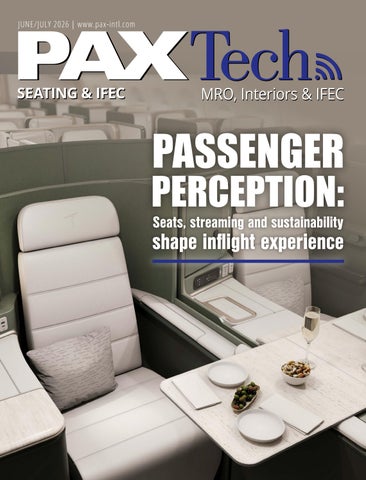
As we head into the summer season, PAX Tech is pleased to bring you our Seating & IFEC digital issue. From sustainable seating initiatives and securing inflight content, to improving accessibility for all travelers, one clear theme emerges in these pages: passenger perception is the most important benchmark for all tech innovations.
In the tech world, it is easy to get hung up on the details and specifications of the latest concepts and products. But sustainability in seating means nothing to the passenger if they find the seat uncomfortable during the journey. The latest IFE system does not impress the traveler who cannot access content they are excited about engaging with. Accessibility innovations are only as meaningful as the autonomy they afford passengers when they are in the cabin. As you will read throughout this issue, industry leaders are consistently viewing the conversation around technical achievements through the lens of the passenger experience.
In seating, experts from Muirhead, STELIA Aerospace and Geven explore what makes a “greener seat,” emphasizing that sustainability is about more than just weight reduction. As Muirhead’s Dr. Warren Bowden notes, transparent and standardized sustainability data can help airlines build brand identities that resonate with increasingly environmentally conscious travelers.
In IFEC, leaders from IMG, Viasat and DIRECTV discuss the complexities of delivering live FIFA World Cup coverage inflight, highlighting how passenger expectations are shaped by seamless entertainment experiences on the ground. That same expectation extends to onboard retail and personalization, where Omnevo’s Dr. Jan Christoph Meyer says travelers are not judging individual tech features. “Passengers do not think in channels. They think in experiences,” he says.
Plus, Diehl Aviation’s Mathies Gereke examines accessible lavatory concepts designed to preserve passenger autonomy and dignity, demonstrating how thoughtful design can improve the travel experience for all.

Whether the goal is sustainability, accessibility or connectivity, the challenge for suppliers and airlines remains the same: curating a passenger experience that is consistent, reliable and emotionally impactful. How you feel while cheering on your World Cup team from 35,000 feet is the metric by which industry innovators can measure success this summer and beyond.
PAX International and PAX Tech are published a total of 10 times a year by PAX International, Mississauga, Ontario, Canada. International Distribution.
ISSN 1206-5714
Key title: Pax International



Tech
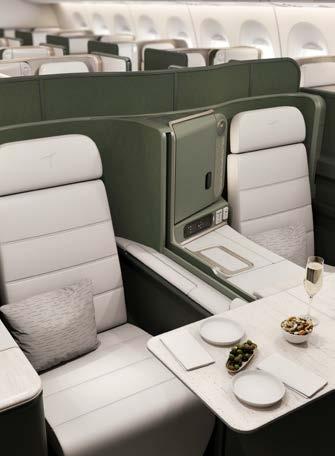
Thompson Aero Seating’s VantageXL+ First is reimagining the front row of the Business Class cabin and blending First Class luxuries with economic design choices
Seating experts weigh in on the undeniable shift in what it means to deliver sustainable products for the modern aircraft cabin
Unum’s Alan McInnes explains how sustainable Business Class seating is evolving to meet premium passenger expectations while addressing production realities
Stellar Entertainment’s Jono Fagg highlights the challenge of protecting premium content amid an evolving digital IFE landscape
In this guest colum, Carol Felton, Marketing Director at IdeaNova Technologies, examines what the evolution of inflight entertainment could look like in the age of social media
Panasonic Avionics highlights its latest seatback system retrofit program, LEO partnerships and self-service tools for the skies 30 ENVISIONING THE ECOSYSTEM
Omnevo CEO Dr. Jan Christoph Meyer shares his vision for the company as connectivity and commerce converge
32 INTELLIGENCE AT ALTITUDE
Rosen Aviation’s Lee Clark explains why the future of premium passenger experience depends on applying AI and intelligent systems in ways that meaningfully enhance the journey
34 THE NEXT CONNECTION
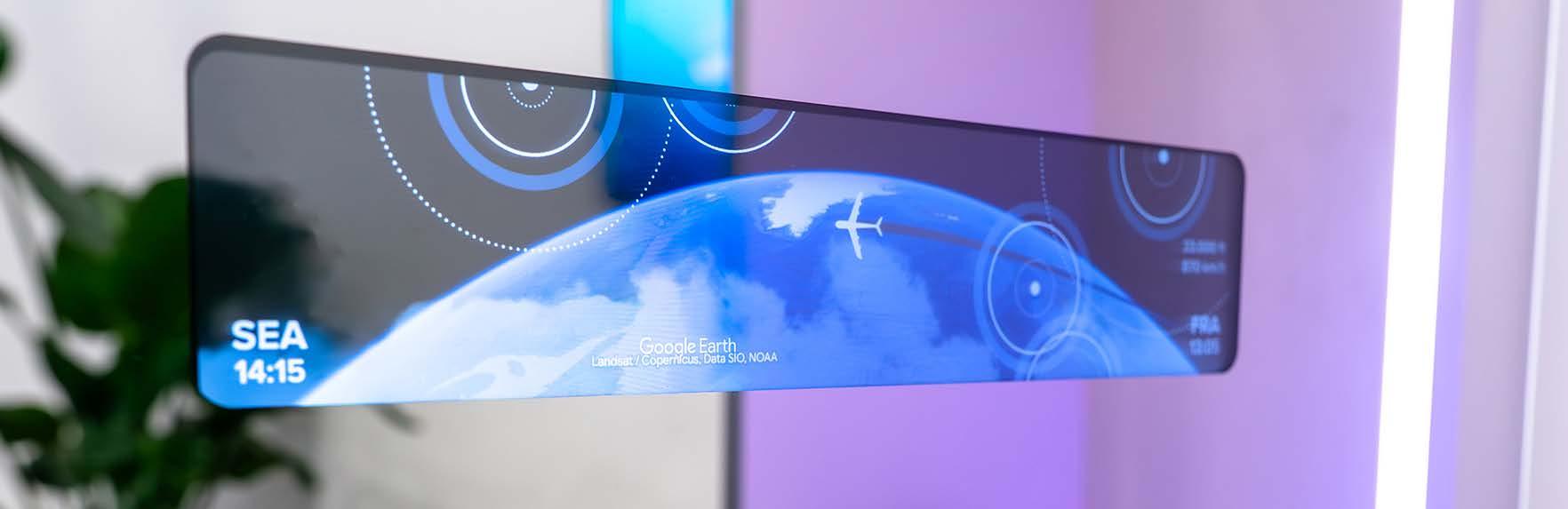
Viasat’s Laney Hind discusses how AERA is shaping the company’s multi-orbit strategy
36 STADIUM IN THE SKY
Industry experts from IMG’s Sport 24, DIRECTV and Viasat discuss the significance of delivering a collective entertainment experience onboard for global events such as the FIFA World Cup 26™
40 THIRTY AND THRIVING
As IFPL Group celebrates 30 years in business, Geoff Underwood looks back on the company’s modest beginnings, commitment to innovation and an evolution that continues to meet the moment
44 DESIGNING FOR DIVERSITY
Diehl Aviation’s Mathies Gereke emphasizes the importance of designing accessible onboard lavatory solutions that preserve autonomy and dignity of all passengers
46 ESSENTIAL OUTLETS
Burrana’s David Pook positions in-seat power systems, such as RISE, as a foundational infrastructure of the connected cabin
48 AMBITION TO ACTION
Gen Phoenix positions circularity as a design challenge to reshape aircraft interiors development with CirculAir Playbook

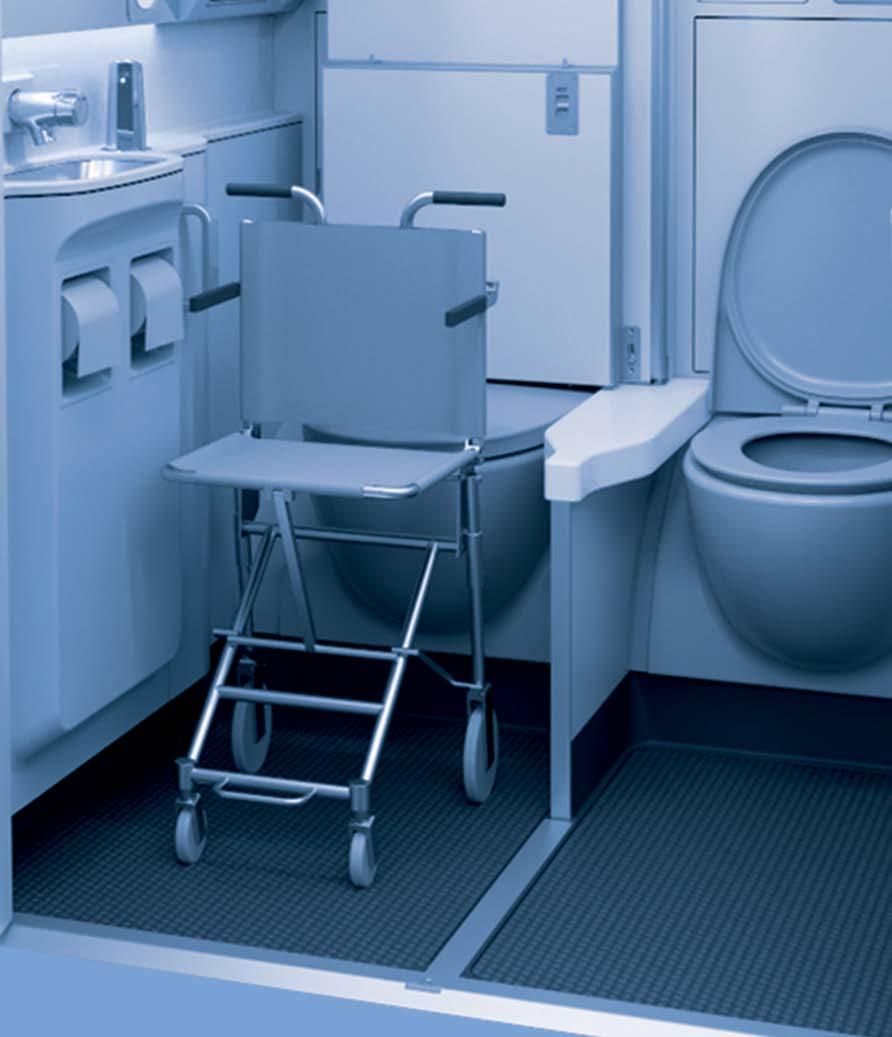

Diehl Aviation’s Space³ is an innovative cabin solution that ensures equal and dignified travel for all passengers, regardless of age, size, or mobility. The fully accessible layout includes three fully equiped lavatories and allows up to four additional seats, optimizing space while reducing weight through intelligent structural design. Space³ combines accessibility, e ciency, and revenue potential to set a new standard in inclusive air travel.
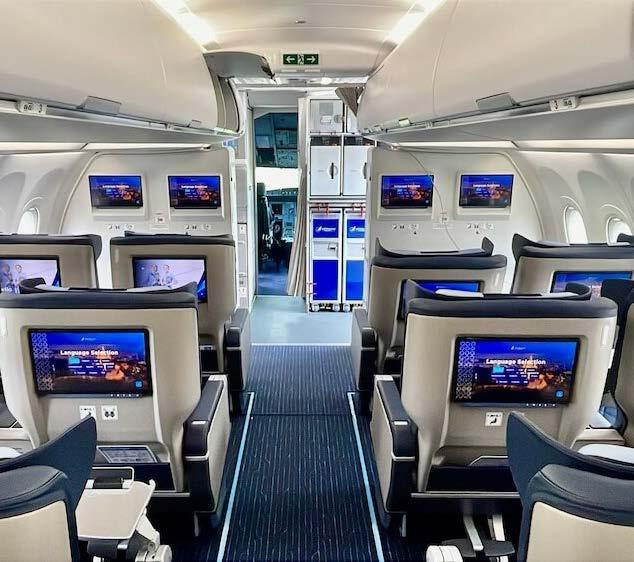
Panasonic Avionics Corporation (Panasonic Avionics) has announced that its Astrova inflight engagement (IFE) solution and Modular Interactive (MI) platform have entered commercial service with Azerbaijan Airlines onboard the carrier’s A320neo family fleet.
This in-service milestone marks a major step in the flag carrier of Azerbaijan’s cabin experience transformation program, and the growing rollout of Panasonic Avionics’ next-generation Astrova inflight engagement solution and MI platform.
Astrova and MI are being deployed across 11 Azerbaijan Airlines Airbus narrow-body aircraft, consisting of six A321neo and five A320neo aircraft, through a combination of line-fit and retrofit installations. In total, Astrova and MI are being rolled out across 22 aircraft in the Azerbaijan Airlines fleet.
Hernan Abbes, Senior Vice President of Global Sales at Panasonic Avionics, said, “This is a great milestone for Panasonic Avionics and Azerbaijan Airlines. Astrova’s modular design, combined with the power of Panasonic Avionics’ Modular Interactive platform, provides the scalability, flexibility and dynamic passenger engagement capabilities airlines need to keep pace with consumer trends in today’s fast-changing market.”
Air Tahiti Nui has extended its IFE agreement with Spafax through 2028, marking a renewal of the 13-year partnership.
Since 2013, Spafax has worked alongside the flagship carrier of French Polynesia to curate a thoughtful mix of French cinema, Hollywood blockbusters, world cinema and first-run Disney releases for passengers across its network.
Air Tahiti Nui was also an early launch customer of Prism, part of the Spafax One integrated digital suite.
“It has been a privilege to evolve the IFE experience together as the airline continues to grow - including the new twice-weekly Papeete to Sydney route launching this December. Thank you again to the Air Tahiti Nui team for your continued partnership and trust,” Spafax says.

a 13-year
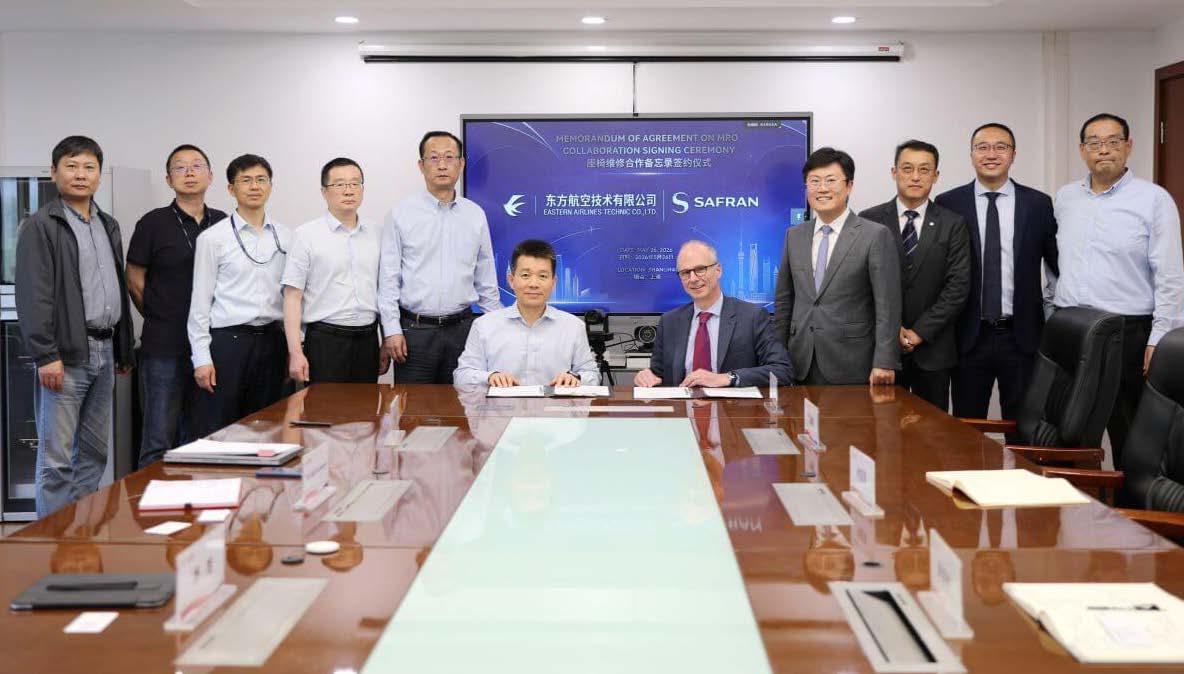
Safran Seats and Eastern Airlines Technic have marked a milestone in a longstanding partnership with the signing of a Memorandum of Agreement (MOA) for MRO collaboration.
Building on the existing relationship across the airline’s fleet, including its 777 aircraft equipped with Safran Seats’ First and Business Class seats, this agreement expands the collaboration to support selected seats throughout the lifecycle.
As part of Safran Seats’ SeatLife service offering, this project combines Safran Seats’ OEM expertise with Eastern Airlines Technic’s operational capabilities to ensure long-term support for China Eastern Airlines’ in-service seats.
ThinKom’s ThinAir Ka2517 terminal is now available as a line-fit option on the full range of Boeing commercial aircraft. The companies successfully completed implementation of a Technical Services Agreement earlier this year.
Achieving this milestone demonstrates the maturity of the Ka2517 offering, as well as the ability for ThinKom to reliably deliver the hardware to Boeing without placing aircraft production timelines at risk.
“Support for multi-constellation, multi-orbit communications is table stakes for airlines today,” Jeff Sare, ThinKom’s Chief Commercial Officer - IFC, tells PAX Tech. “Our ThinAir product line is the perfect solution for airlines that want superior connectivity for passengers, while maintaining flexibility and control over their installed hardware and services. We are immensely excited to now have it offerable as a factory-installed option across all Boeing types.”
The solution can be selected by airlines today for integration into pending aircraft deliveries. This includes support of Neo Space Group in the fitting of new 787s for Thai Airways.
Eutelsat and Anuvu have signed a multi-year agreement for capacity on the EUTELSAT 10B satellite. Under the agreement, Anuvu will leverage high-throughput Ku capacity on EUTELSAT 10B to enhance its inflight connectivity services, including for a major global airline.
In service since July 2023, EUTELSAT 10B is located at 10° East, an orbital position that offers unique visibility spanning from the Americas to Asia. An all-electric satellite, EUTELSAT 10B has a powerful fifth-generation digital transparent processor, enabling capacity allocation flexibility and optimal spectrum use. It also carries multibeam HTS Ku-band payloads specifically tailored to the mobile connectivity sector.
Thierry Polycarpe, VP Aero and Maritime Connectivity at Eutelsat, said, “We are pleased to partner with Anuvu on this multi-year agreement, leveraging the advanced capabilities of EUTELSAT 10B to deliver high-performance, scalable inflight connectivity worldwide. This agreement underscores the continued strategic importance of GEO within our multi-orbit architecture, enabling us to meet the evolving needs of the aviation market with flexibility, resilience and efficiency.”
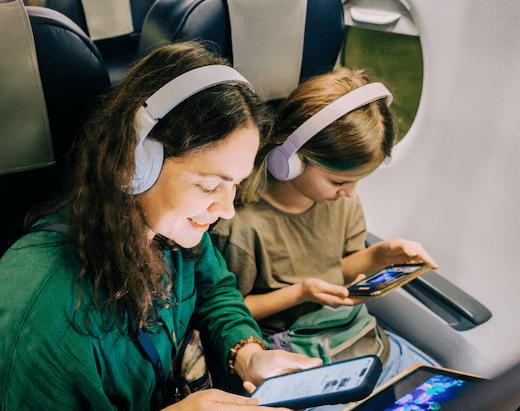
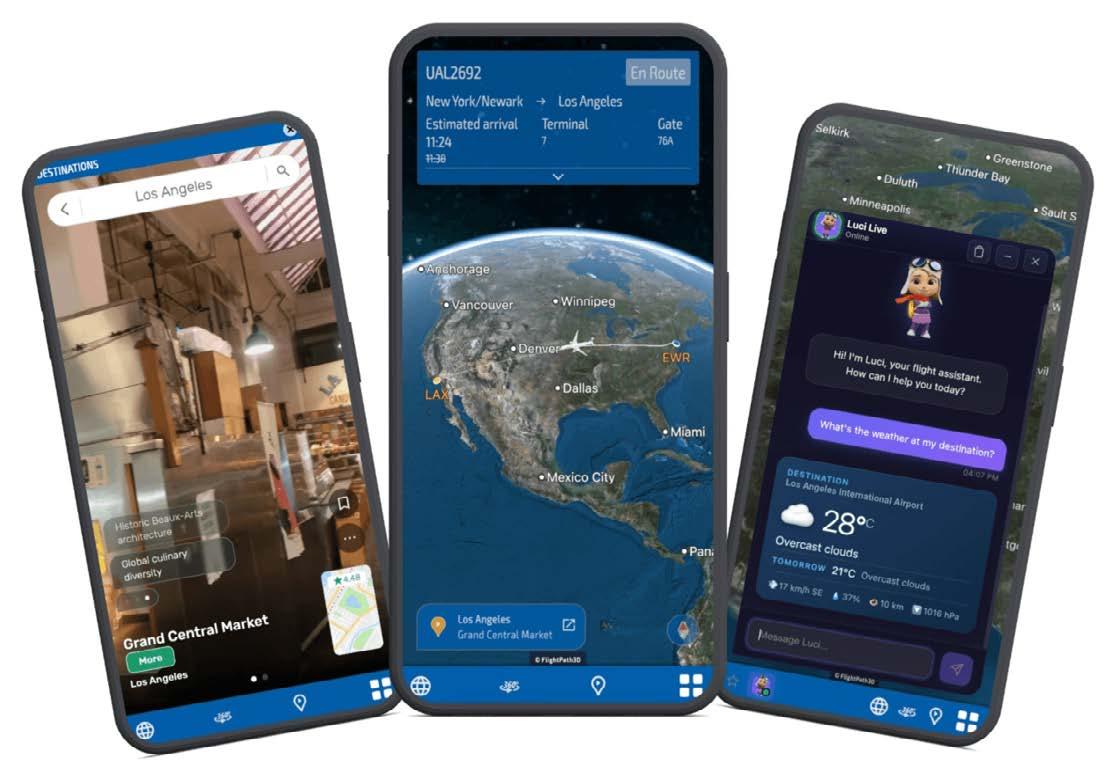
FlightPath3D has announced that its Cloud platform reached the 500 aircraft flying milestone, with 2,000 aircraft committed, reflecting a rapid adoption by leading global airlines including United Airlines and WestJet.
The Cloud system also supports the map interface on passengers’ personal devices, making it easier and less expensive for airlines to deliver personalized experiences and real-time content updates, while reducing maintenance requirements. Cloud enables airlines to take full advantage of this transition, while bringing the extended suite of FlightPath3D content – including map overlays, points of interest and advertising opportunities –to more travelers.
“Passengers already depend on FlightPath3D for information, entertainment, and destination discovery onboard,” said Duncan Jackson, President, FlightPath3D. “FlightPath3D Cloud extends that experience beyond the seatback, enabling airlines to deliver connected, real-time passenger experiences across aircraft, mobile devices and digital platforms.”
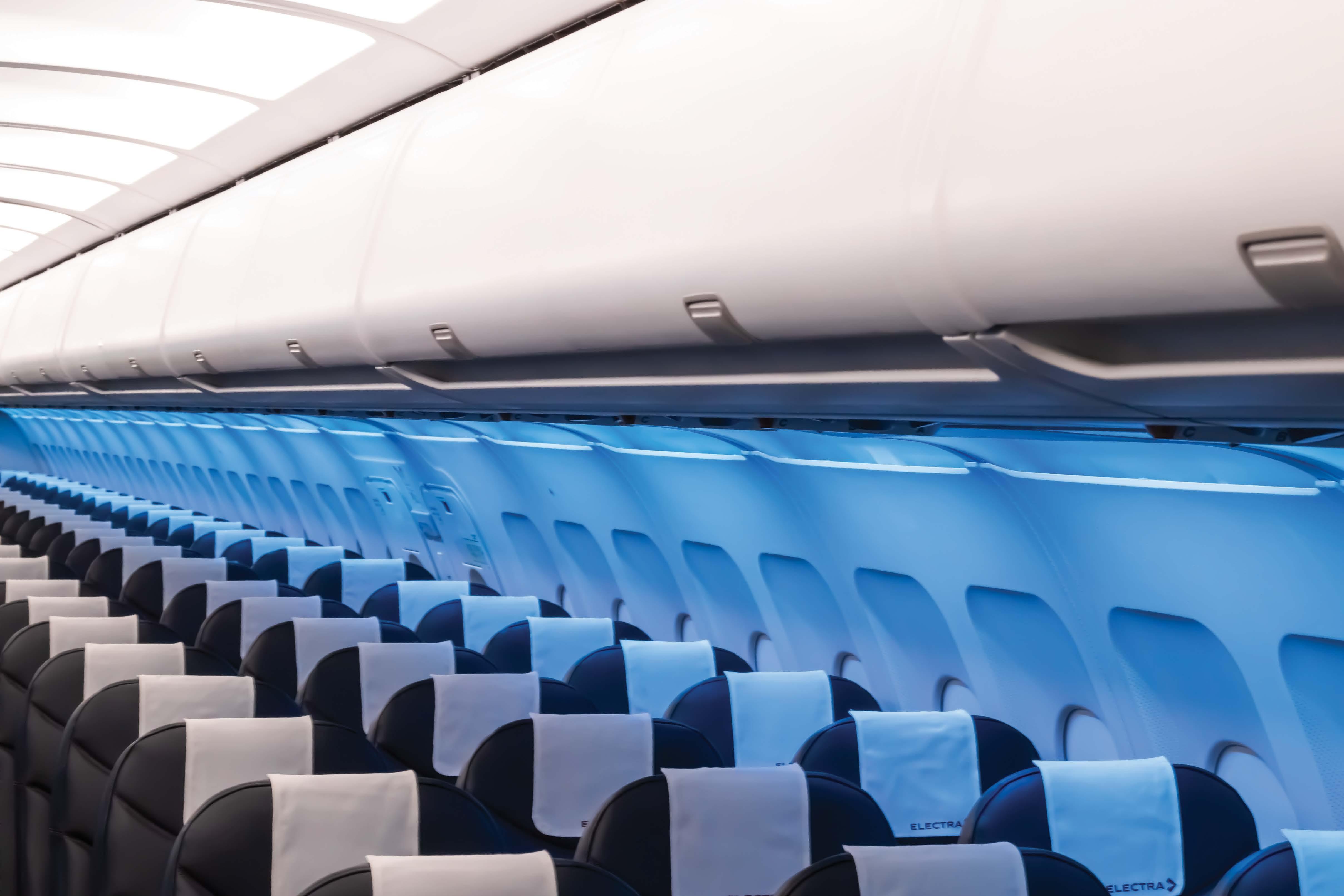
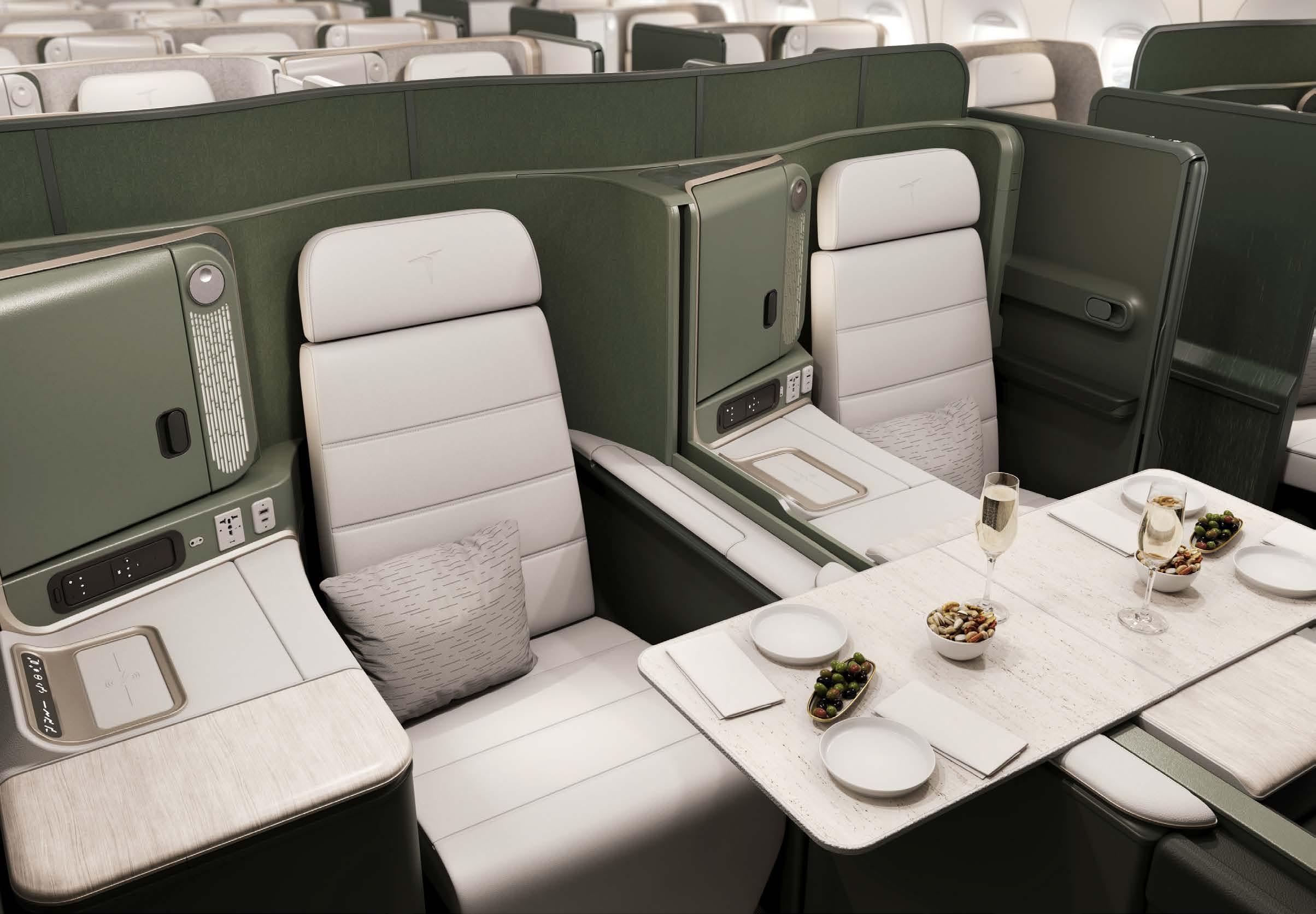

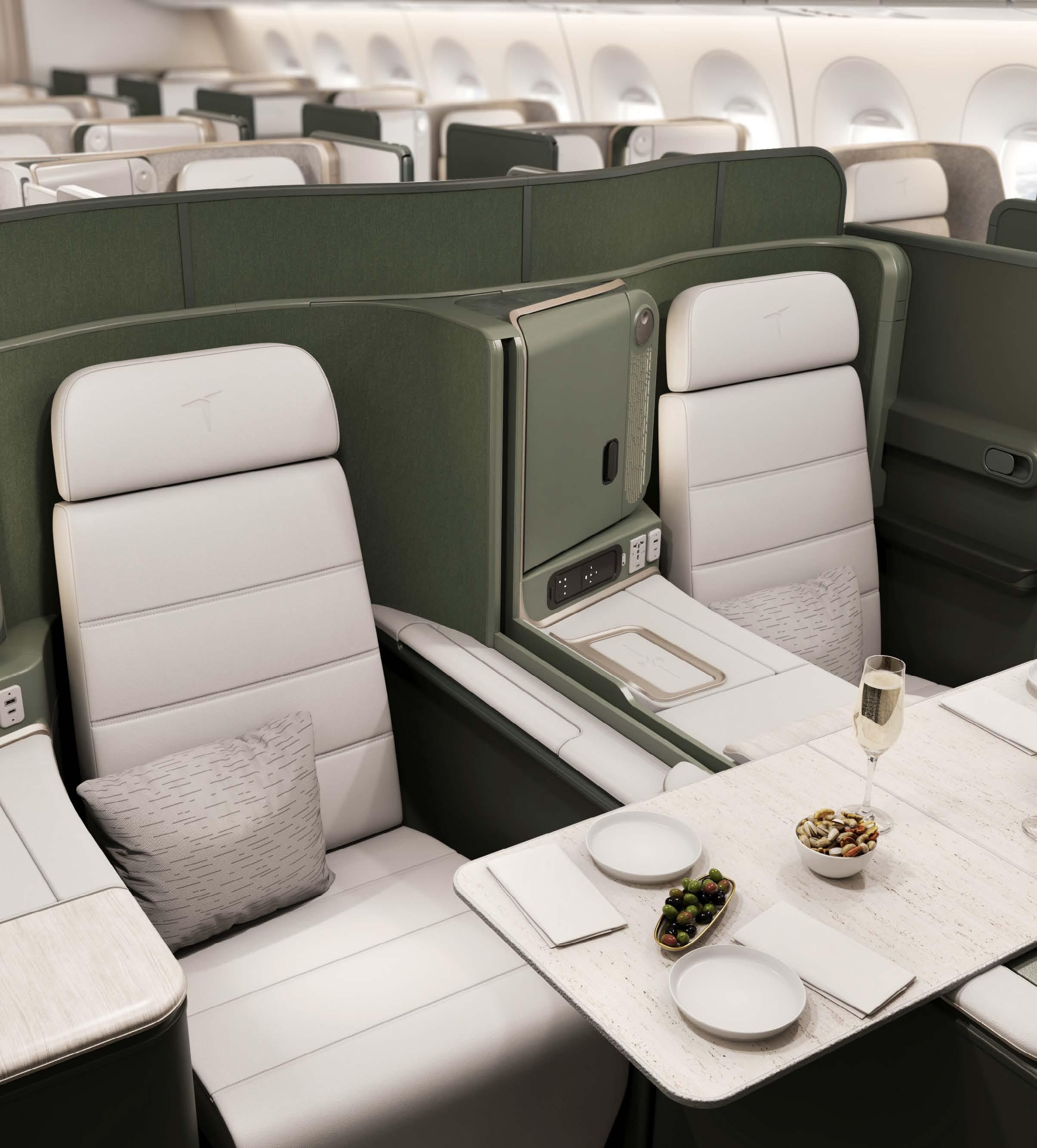
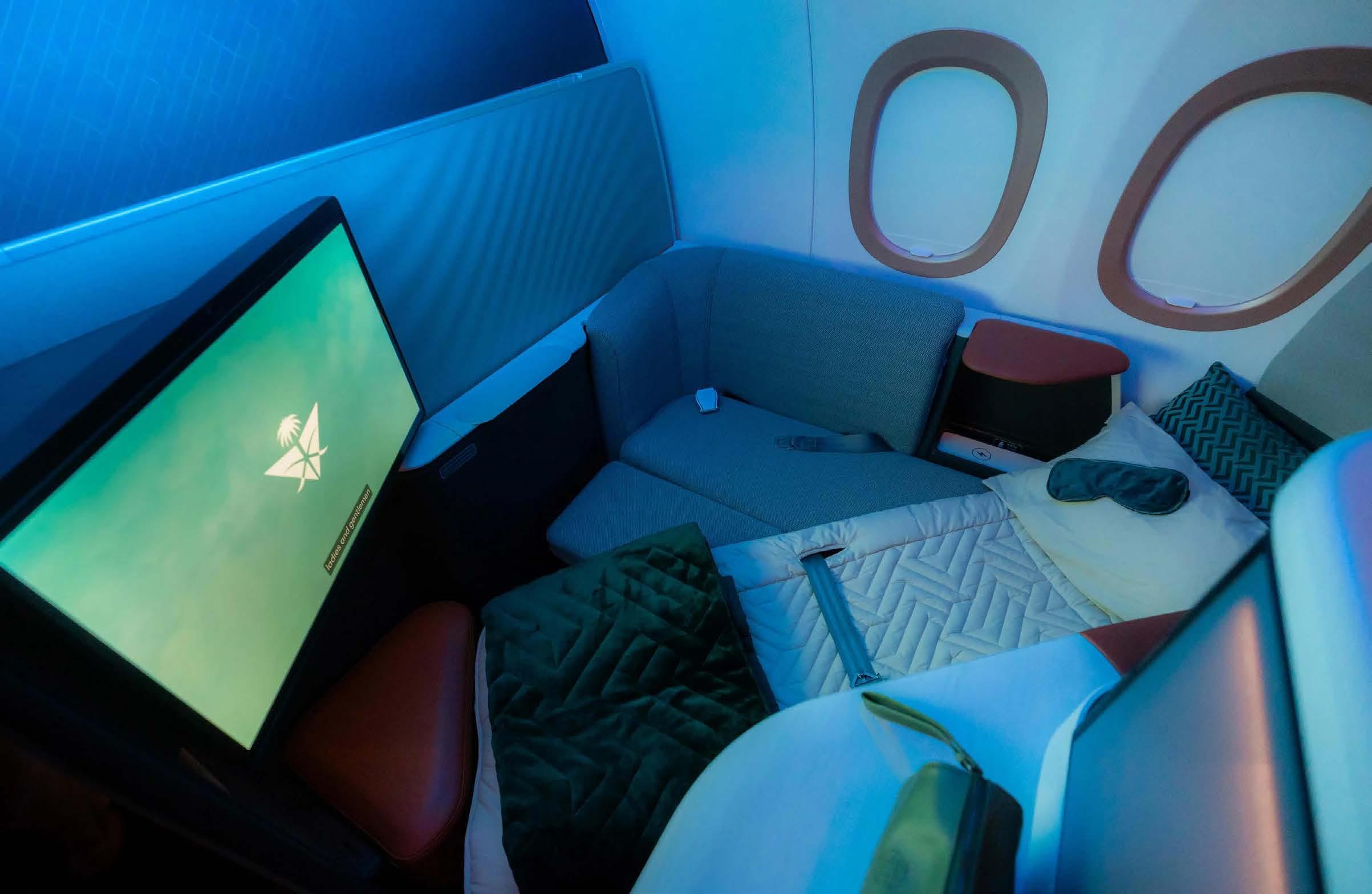
Thompson Aero Seating’s VantageXL+ First is reimagining the front row of the Business Class cabin and blending First Class luxuries with economic design choices
by ROBYNNE TRUEMAN
The traditional First Class cabin, designed to offer a hotel-like experience in the sky, is not always a feasible use of space for airlines. As more passengers demand a premium cabin experience, Thompson Aero Seating’s (TAS) VantageXL+ First seat offers a way to deliver that elevated experience without investing in a dedicated First Class cabin onboard. Instead, balancing the commercial demands of the Business Class product while integrating aspects of a First Class experience is a way to marry economic benefit and luxury for airline and traveler.
As Jonny McGreevy, Chief Technical Officer, Thompson Aero Seating, tells PAX Tech, “The triumph of Thompson Aero Seating’s enhanced front rows is that they enable airlines to offer a First Class experience within the same
LOPA as an all-Business-Class cabin.”
This option has been coined “First Class for free” and offers airlines an opportunity to sell select Business Class seats to passengers at a premium, elevating the travel experience at a fraction of the cost to the carrier.
“It is achieved by TAS with clever usage of the available cabin space and there is, therefore, no loss of density,” explains McGreevy.
TAS’s VantageXL, VantageSOLO and VantageNOVA all offer the opportunity for an enhanced front row, and now, the VantageXL+ First joins the lineup.
TAS unveiled the VantageXL+ First at the Aircraft Interiors Expo 2026 in April, showcasing the various features of this latest seat iteration that bring some typical First Class luxuries into
the Business Class cabin. VantageXL+ First features extended bed-level cushioning, resulting in a comfortable resting and sleeping position.
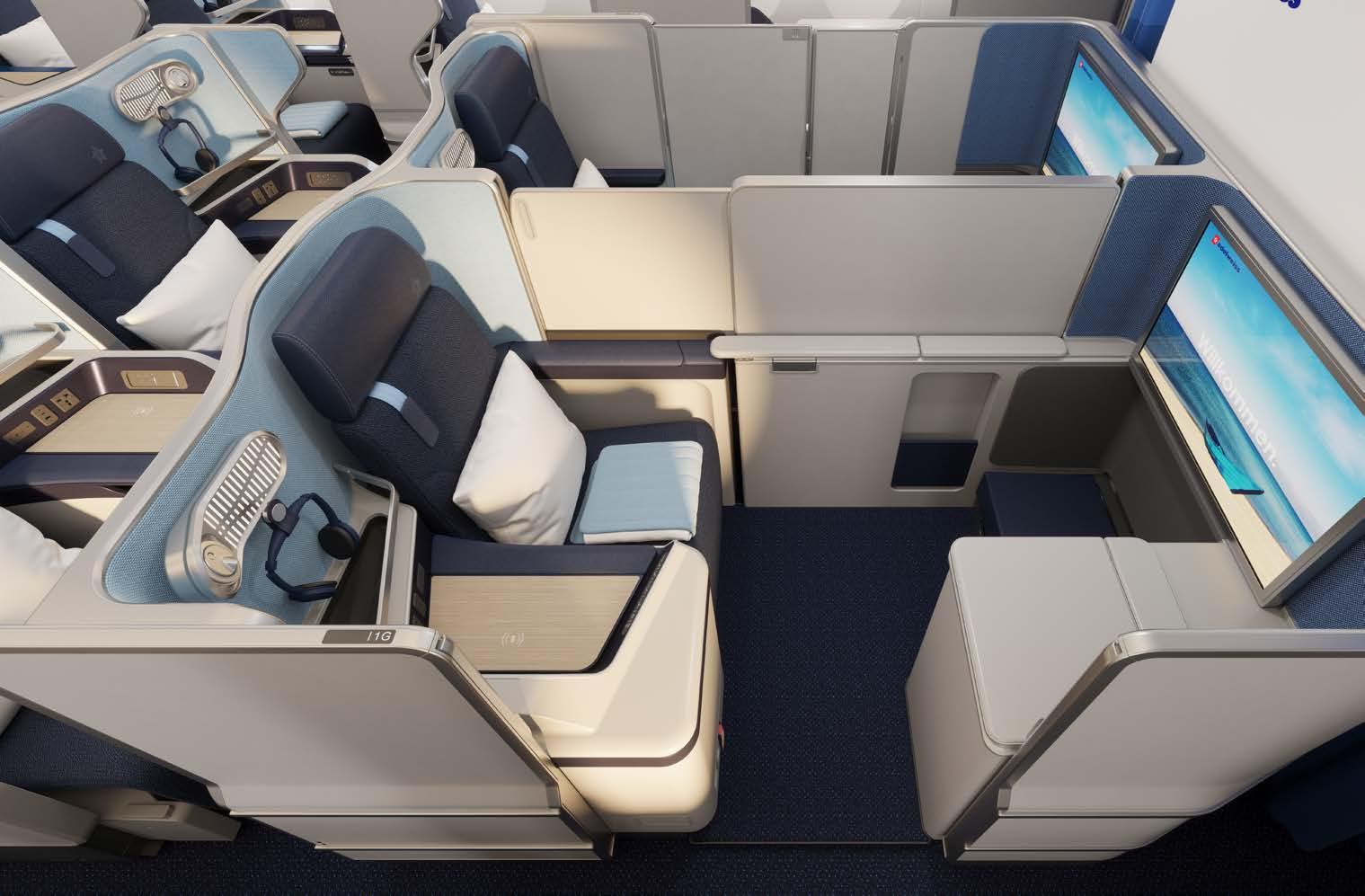
At a 40-inch seat pitch, the bed length is 79 inches and at a 44-inch pitch, the VantageXL+ First beds in lieflat position are 82.4 inches in length. There is a floating outboard armrest and a cocktail surface, as well as a customizable console area and various stowage options. The VantageXL+ First also has the option for a zero-g seating position. As well, an enhanced seat height “halo” (extended-height front panel) delivers increased passenger privacy.
“All of this together makes for a heightened flight experience,” says McGreevy.
The VantageXL+ First has been designed specifically for the wider A350 and 787 aircraft. The enhancements provide more room across the passenger’s shoulders and hips. The second-generation buddy seat is also wider, with a simple deployment mechanism and wraparound cushion.
McGreevy explains that storage has been brought closer to the passenger for easier access and the suites
accommodate up to 32-inch monitors.
“The suite has been restyled with softer forms and greater use of textiles to give an extremely comfortable look and feel,” he says. “The enhanced front row achieves the absolute maximum from the cabin space, which is then given back to the passenger in terms of additional comfort and luxury.”
As with all of TAS’s enhanced front rows, the VantageXL+ First enables dual and quad socializing and dining. McGreevy highlights that this is not normally found in Business Class suites.
“This is made possible by the buddy seats in each front row suite, dropping dividers and a clever mechanism to connect the tables. The dual and quad socializing and dining capability gives airlines a powerful opportunity to create a distinctive premium offering and further differentiate their onboard experience,” he says.
As for whether the line between First Class and Business Class is still clearly defined, McGreevy says there are many commercial reasons why enhanced Business Class seating may a preferable move for airlines over offering a traditional First Class cabin.
“Depending on the customization selected and the service offered, this can pretty much be First Class, if that is what the airline wants. There is still a place for First Class cabins, but the enhanced front rows we offer give airlines total flexibility and choice,” he says.
By reimagining the front row of the cabin, TAS is giving airlines the opportunity to reconcile commercial priorities with premium passenger expectations, delivering a standout experience for select travelers without impacting the rest of the Business Class cabin.
“The design minimizes the traditional trade-off between exclusivity and cabin efficiency by integrating the enhanced suites into the existing Business Class footprint,” McGreevy explains.
He notes that the suites can be customized to match the rest of the Business Class cabin, or with alternative CMF to further differentiate them as an elevated offering. And, as he tells PAX Tech, it is often these minute details that give the passenger environment a premium feel.
“It is the extra few inches here and there that make a really big difference to passenger comfort,” he explains. “Clever curves and sculpting enable TAS to give space back to the passenger in the VantageXL+ First and reprofiled forward corners allow the seat to sit further forward in the cabin, giving greater privacy.”
According to McGreevy, the industry response to the VantageXL+ First has been extremely positive, with Edelweiss becoming the first European carrier to announce that it will be bringing the suites onboard. The enhanced front row will be marketed as the “Edelweiss Business Suite” and the carrier has selected closable doors and large 32-inch monitors for a full cinematic experience. Delivery is scheduled for later this year.
Seating experts weigh in on the undeniable shift in what it means to deliver sustainable products for the modern aircraft cabin
by ROBYNNE TRUEMAN



The aviation industry has often equated a “greener seat” to one that is simply lighter weight. But as passengers demand sustainability they can see, airlines are progressively understanding the importance of an eco-friendly brand identity. In response, seating suppliers and material manufacturers are innovating to deliver products that offer greater longevity, better lifecycle assessments and sustainably sourced or upcycled materials.
As Bonaventura Vitolo, R&TD Project Coordinator at Geven tells PAX Tech, “Airlines’ current demand is to increase the seat’s recyclability rate close to 90 percent without compromising the weight-saving.”
But recyclability is not the only key aspect for the future of aviation. For Geven, “recyclability” must go hand in hand with “remanufacturing” of recycled materials to avoid downcycling and to use recycled products as primary materials for production.
In addition to improving the recyclability of seats, suppliers are focused on extending the lifecycle.
Frederic Rodriguez, Head of Sustainability at STELIA Aerospace, explains, “We are shifting the industry conversation by going beyond mere weight reduction to optimize a seat’s total lifecycle value through comprehensive Life Cycle Assessments (LCAs). By completely rethinking our seating architecture to reduce components, we maximize long-term
reliability and extend product lifespans while preserving an uncompromised, premium passenger experience.”
He notes that a holistic approach minimizes the environmental footprint while delivering versatile operational benefits, be it reducing fuel burn, extending flight range or allowing extra cargo payload.
Dr. Warren Bowden, Head of Innovation and Sustainability at Muirhead, highlights the critical role of textile manufacturers in improving seating longevity and environmental impact. He says material durability, lifecycle performance, sourcing and processing must be considered.
“There is now greater scrutiny on what happens across the full lifecycle, including manufacturing impact and end-of-life outcomes,” he explains.
Expanding the conversation beyond weight reduction requires suppliers to take these considerations into account from the start.
STELIA Aerospace’s Rodriguez tells PAX Tech that the company leverages three design principles: integrating eco-responsible materials, simplifying seat architecture and thoughtfully reducing electrical systems.
“This streamlined approach drastically enhances in-service reliability and repairability, significantly lowering the airline’s Total Cost of Ownership (TCO). Guided by our ‘Built to Last, Designed to Care’ philosophy, we prove that modern sustainability does not look recycled; it delivers the uncompromised, worldclass premium experience,” he says.
Geven’s Vitolo affirms that while weight reduction is the most important factor in reducing carbon dioxide emissions, it can no longer be the only parameter.
He explains that seat manufacturing has a significant impact on ozone depletion and freshwater eutrophication, reinforcing Geven’s focus on lightweight design, advanced materials and composite material
reuse to reduce environmental impacts across the seat lifecycle.
Muirhead’s Bowden echoes the industry-wide recognition that material sourcing, manufacturing and product lifecycle matter.
“Sustainability within the cabin should not be defined by weight alone,” he explains. “This thinking shaped our development of BioPRO foam, which offers a new approach to polyurethane by replacing conventional fossil fuelderived inputs with a protein derived from our own manufacturing process.”
BioPRO reduces productionrelated carbon emissions by approximately 50 percent compared to conventional graphite-based foams while meeting aviation fire safety and performance requirements. Its molded manufacturing process eliminates material waste while the lightweight, protein-based structure provides flame resistance, enhanced durability, improved bonding and a soft, comfortable seating experience without the need for additional flame-retardant additives.
“Together, these characteristics shift the focus from weight alone to a broader view of sustainability, encompassing carbon impact, material efficiency, durability and passenger
comfort,” Bowden says.
For an airline to actively promote sustainability in its brand story, passengers tend to favor cabin features they can see and feel.
Geven’s Vitolo says, “The use of bioderived materials for non-structural parts, such as the literature pocket net or bumpers, can contribute to strengthening this awareness among passengers.”
Embedding sustainability into cabin materials from the outset enables more authentic branding, Muirhead’s Bowden explains.
“This includes designing for end of life, enabling materials to be separated and recovered where possible and ensuring that sustainability claims are supported by robust, verifiable data,” he says. “By combining thoughtful design with transparent, standardized data, airlines can build more meaningful narratives around sustainability that resonate with passengers and stand up to scrutiny.”
STELIA Aerospace’s Rodriguez reiterates this, saying, “This allows airlines to leverage STELIA Aerospace’s expertise from the very inception of their cabin design across design,
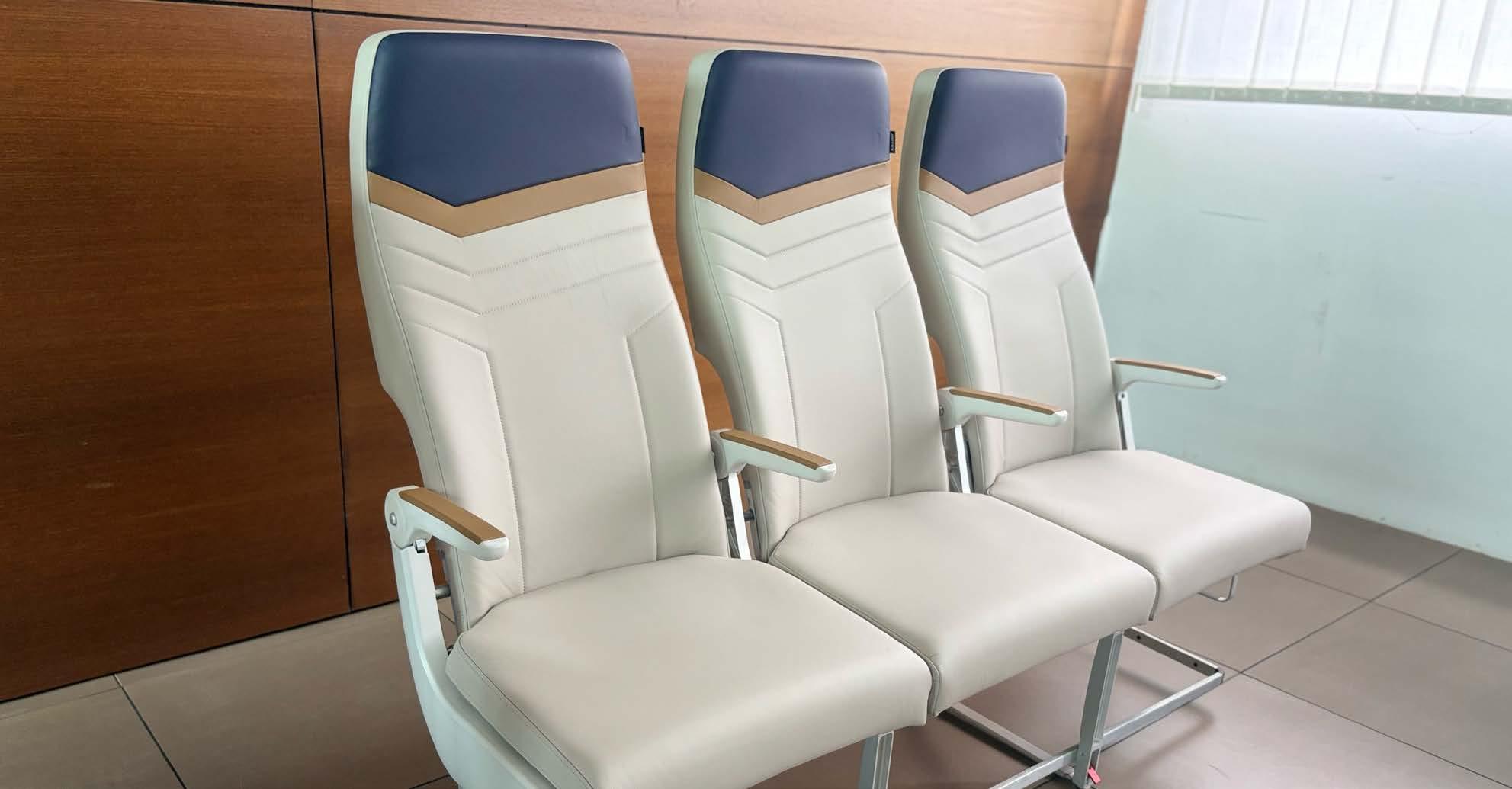
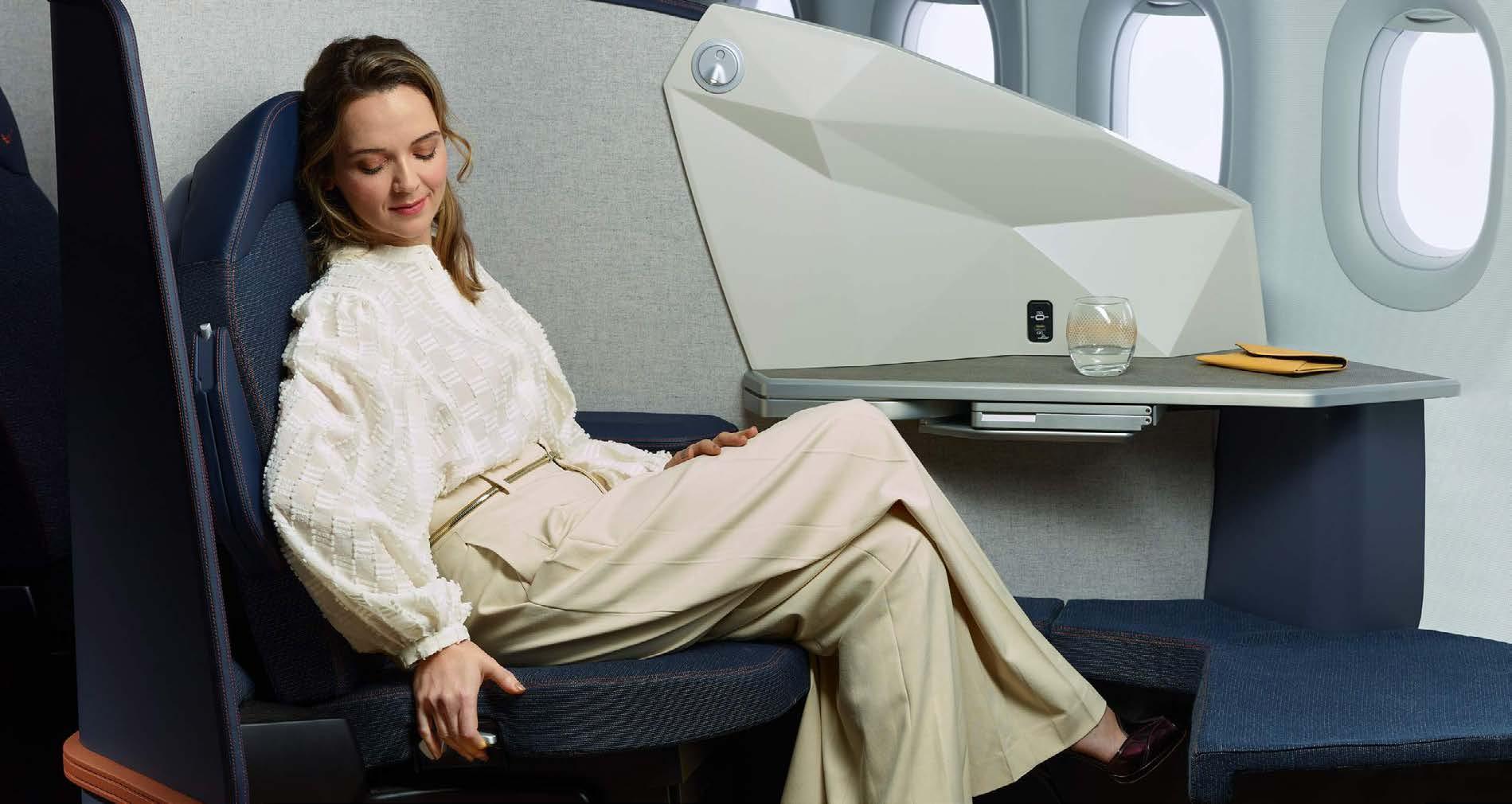
architecture, and material selection. This proactive partnership ultimately empowers airlines to perfectly align their unique brand identity with a superior passenger experience and highly visible environmental responsibility.”
Looking ahead, Bowden tells PAX Tech that airline carbon reduction expectations are evolving in two clear directions: operational and embedded.
“There remains a strong focus on reducing emissions in operation through lightweight, fuel saving materials, but this is now being matched by a growing emphasis on the embedded carbon of materials, particularly the lifecycle impact of how they are manufactured.”
The result is increased demand for materials that can address both considerations simultaneously.
“This dual focus reflects a broader shift in how sustainability is being evaluated by airlines in the cabin, moving from operational efficiency alone towards a more complete understanding of total environmental impact,” he says.
Muirhead’s BioPRO Foam bridges the gap between responsible material sourcing and performance expectations by combining responsible material sourcing with high-performance chemistry.
“The protein component is 100 percent bio-based, abundant and recoverable, offering a more responsible alternative to conventional inputs,” Bowden explains. “Its triamine bonding structure reduces the overall bill of materials required, resulting in a lighter weight but highly functional foam that outperforms, without additional ingredients.”
The result is a material that not only lowers carbon impact (equating to around 480 tonnes of CO2 avoided over a decade) but also outperforms conventional foams in comfort and durability. For Bowden, this reinforces the notion that more responsible sourcing does not require a compromise in performance.
“BioPRO demonstrates that sustainability cannot be measured through weight alone, but through total carbon impact over the full lifecycle and use of benign, natural components,” he says.
For airlines trying to implement sustainable products onboard, the premium cabin may seem like an area of compromise. But STELIA Aerospace’s OPERA® ESSENTIAL rewrites the story.
“OPERA® ESSENTIAL completely disrupts the myth that eco-design requires sacrificing comfort by maintaining our world-class

Business Class standards with durable, recyclable materials,” says Rodriguez. “By smartly stripping away unnecessary complexity, we unlock extra passenger space while introducing an intuitive, patented, manual kinematic system that is faster, quieter and more reliable than traditional alternatives.”
The OPERA® ESSENTIAL Business Class seat underscores a holistic approach to sustainable seating by delivering a 30 percent weight reduction and a 32 percent lower environmental footprint compared to its elder OPERA® SA by addressing the product’s entire lifecycle.
Rodriguez calls the seat, which was showcased in its latest iteration at AIX 2026 in April, a “triple win” because of its spacious premium experience, operational robustness with zero motor maintenance and significantly minimized carbon footprint.
The simplification of the seat also comes from limiting its reliance on non-essential electrical systems. In its design, STELIA Aerospace eliminated heavy electrical actuators and ECUs, reaching a 96 percent reduction in electronic components, in favor of its patented, manual “Fast Kinetic principle” mechanism, alongside a thermoplastic shell.
“This pioneering approach demonstrates how STELIA Aerospace continues to innovate by delivering a premium, low-impact Business Class passenger experience while maximizing reliability and reducing airline maintenance costs,” he explains.
Beyond sourcing, airlines are increasingly evaluating lifecycle impact of onboard products and seeking data to support procurement decisions.
STELIA Aerospace’s Rodriguez says, “Airlines have moved past surface-level green checkmarks and now demand hard, auditable LCA data to precisely track their environmental impact. Alongside this data-driven approach, there is a rapidly growing emphasis on long-term cabin operations, with reliability and ease of maintenance becoming paramount criteria. To withstand intensive operational use, airlines are actively seeking robust seating solutions that minimize ground downtime and guarantee flawless performance throughout the product’s entire lifecycle.”
With heightened awareness of lifecycle impact comes emphasis on reusability and upcycling, a key component of Geven’s RECREATE project.
“Material sourcing toward reusability becomes of fundamental importance to reduce indirect carbon emissions linked to material supply,” Vitolo explains. “The main objective of the RECREATE project was to develop a set of innovative technologies aimed at exploiting the potential of End-ofLife (EoL) complex composite waste as a feedstock for profitable reuse of parts and materials in the manufacturing industry and aeronautical as well.”
In the RECREATE project, Geven demonstrates the reuse of carbon fiber composites in aircraft seating and reprocessing of glass fibers for sidewall panels, showing sustainable end-of-life pathways for aircraft
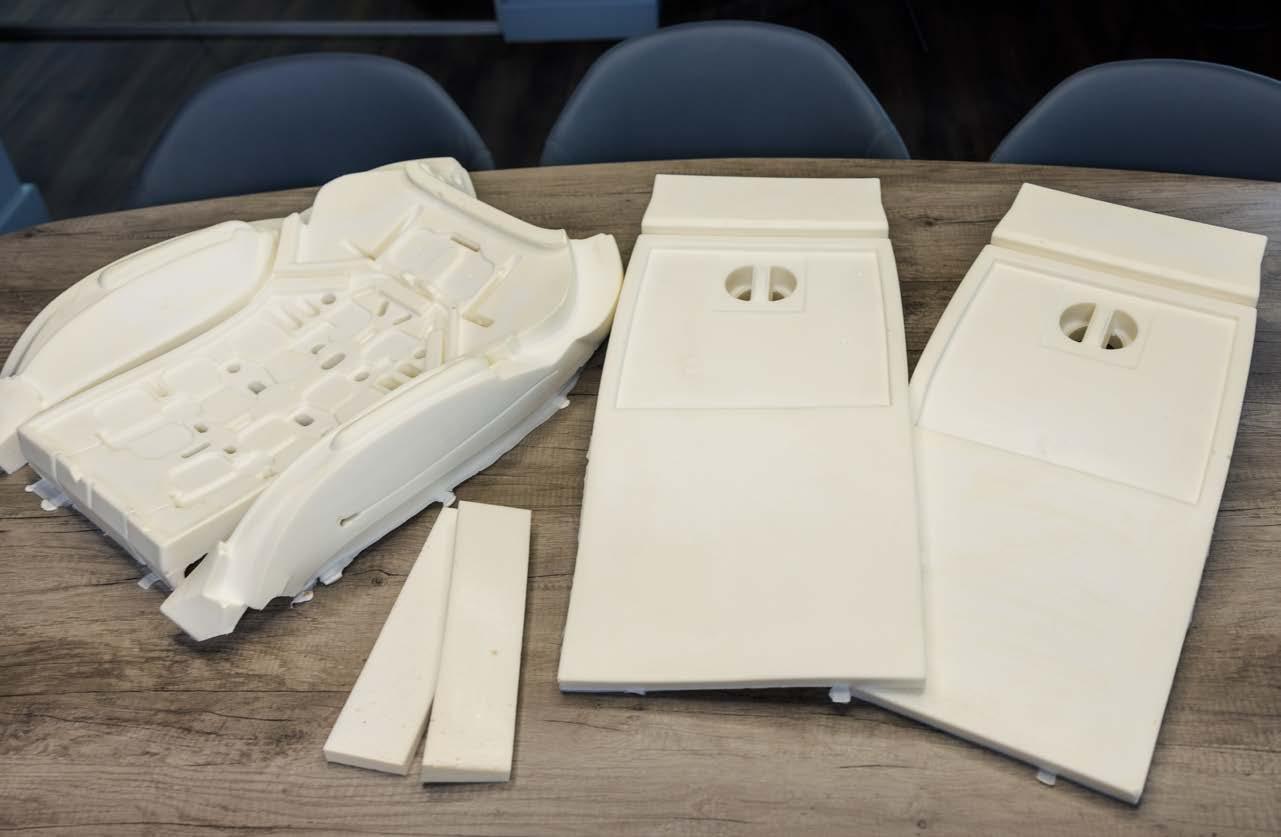
interiors. The project achieves up to a 90 percent material recovery rate and 80 percent remanufacturing rate, diverting composite waste from landfill. It also demonstrates significant environmental gains, including reductions in manufacturing energy use of up to 80 percent for glass fiber and 95 percent for carbon fiber, supported by lifecycle assessment and energy measurement data.
Transferring the results of RECREATE to the aviation industry, Vitolo forecasts a decrease of materials going to landfill of 44,100k Tons per year for glass fiber and 7.2k Tons per year carbon fiber by 2030.
Sustainable seating is no longer about reducing the weight per
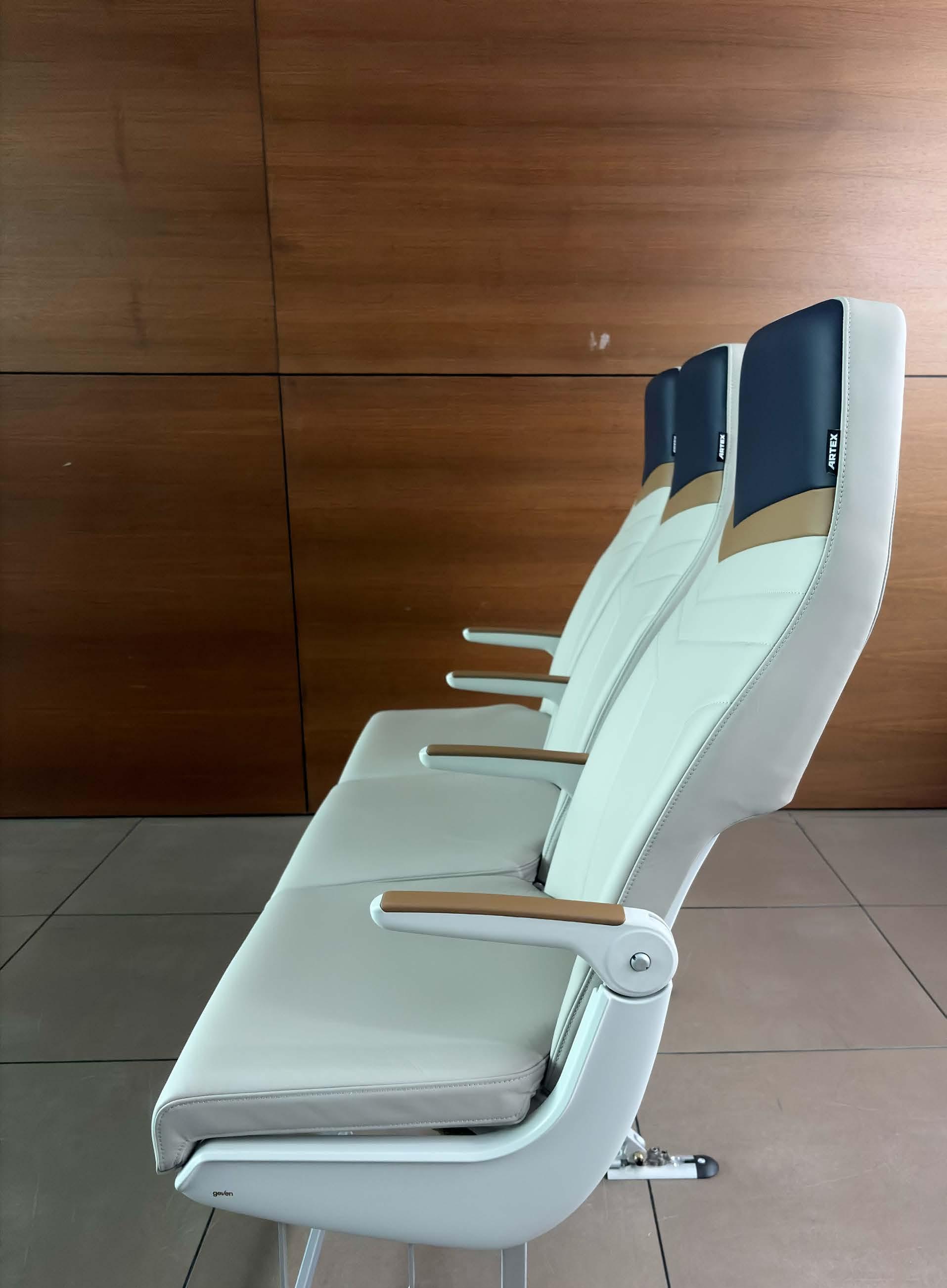
passenger but instead becoming a set of opportunities for airlines and suppliers to make more informed decisions at every step of the design process— from material sourcing and manufacturing to end-oflife upcycling—without compromising passenger comfort.
Transform crew catering from an operational into a streamlined digital process.
Every missed meal, allocation error, and manual reconciliation creates unnecessary cost and complexity.
Omnevo’s Crew Meal Application enables airlines to manage crew entitlements, preferences, special meal requirements, and onboard distribution through one connected platform.
The result?
Less waste. Fewer errors. Better compliance. Happier crews.
Fully integrated with Omnevo Retail and Logistics, giving airlines one ecosystem for connected onboard operations.

Automate crew meal allocation
Reduce catering costs and waste
Improve compliance and reporting
Gain real-time operational visibility

Unum’s Alan McInnes explains how sustainable Business Class seating is evolving to meet premium passenger expectations while addressing production realities
by ROBYNNE TRUEMAN
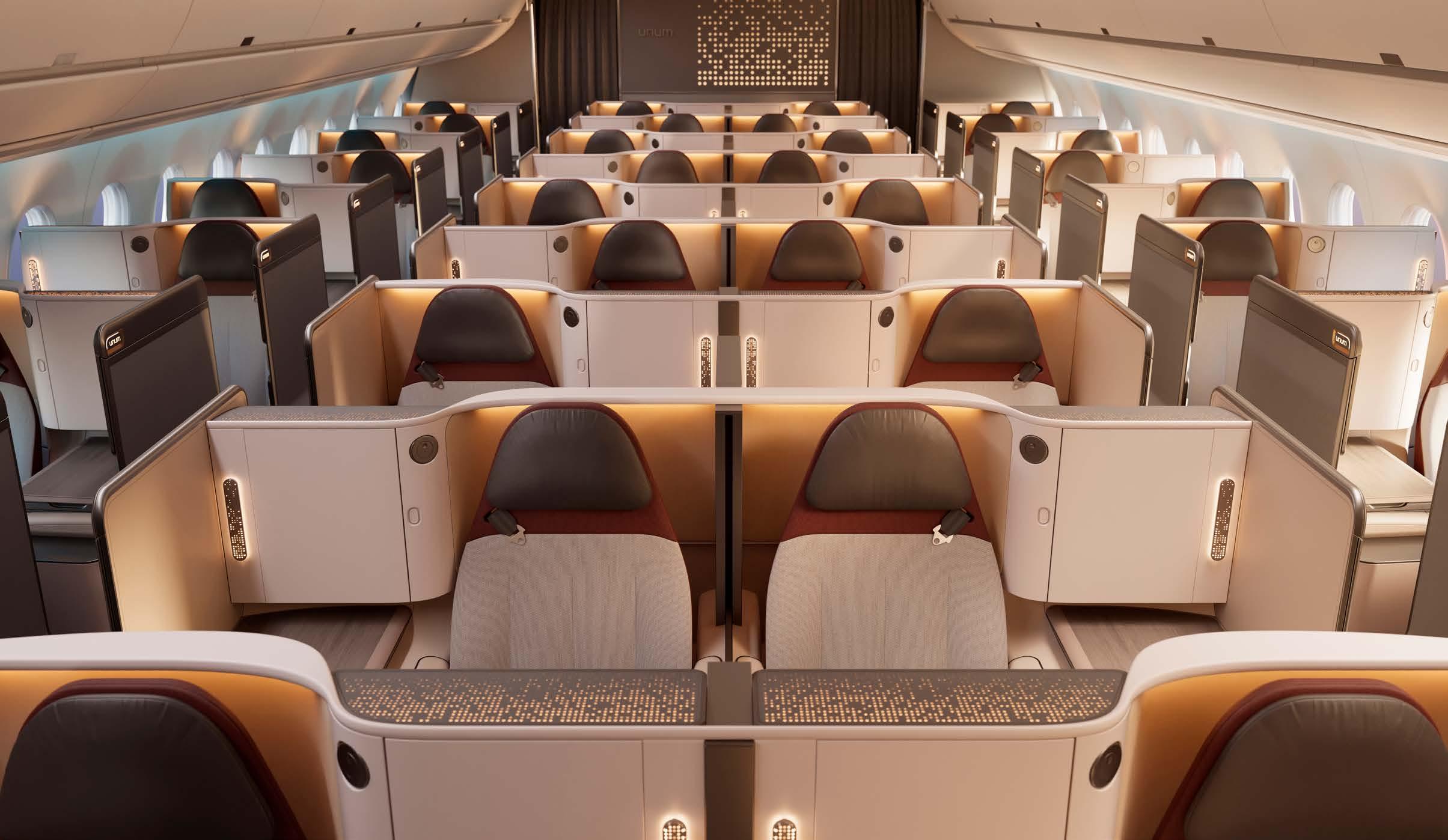
Unum Aircraft Seating’s VP Business Development, Alan McInnes, has long emphasized airline demand for increased capacity in the premium seating sector.
“Airlines are clamoring for more capacity in Business Class. That has not changed in six years,” he says.
As McInnes tells PAX Tech, the supplier’s presence at the Aircraft Interiors Expo (AIX) earlier this year focused on strengthening its flagship product, Unum One, including
versions for A330 and 787 aircraft, an optimized 787 variant and a single-aisle offering.
Featuring Unum’s patented Scimitar mechanism, the lightweight Unum One Business Class lie-flat seat offers airline customers infinite adjustability and excellent zero gravity benefits. 2026 marks Unum’s first certified A330 deliveries, with 787 certification to follow.
McInnes cites sustainability and premiumization as the two seating trends rising to the top.

“The trend that we have talked about over the last 18 months has been premiumization throughout the cabin,” he points out. “Unum is Business Class only, but we are seeing premiumization through enhanced pitch in Economy Class and investment in Premium Economy seats—and that is flowing through to Business Class as well.”
He continues, “We are proud to have one of the lightest-weight Business Class seats available,” he says of the Unum One and Unum Two products. “The price of jet fuel over the last month makes the business case that we provide even more compelling.”
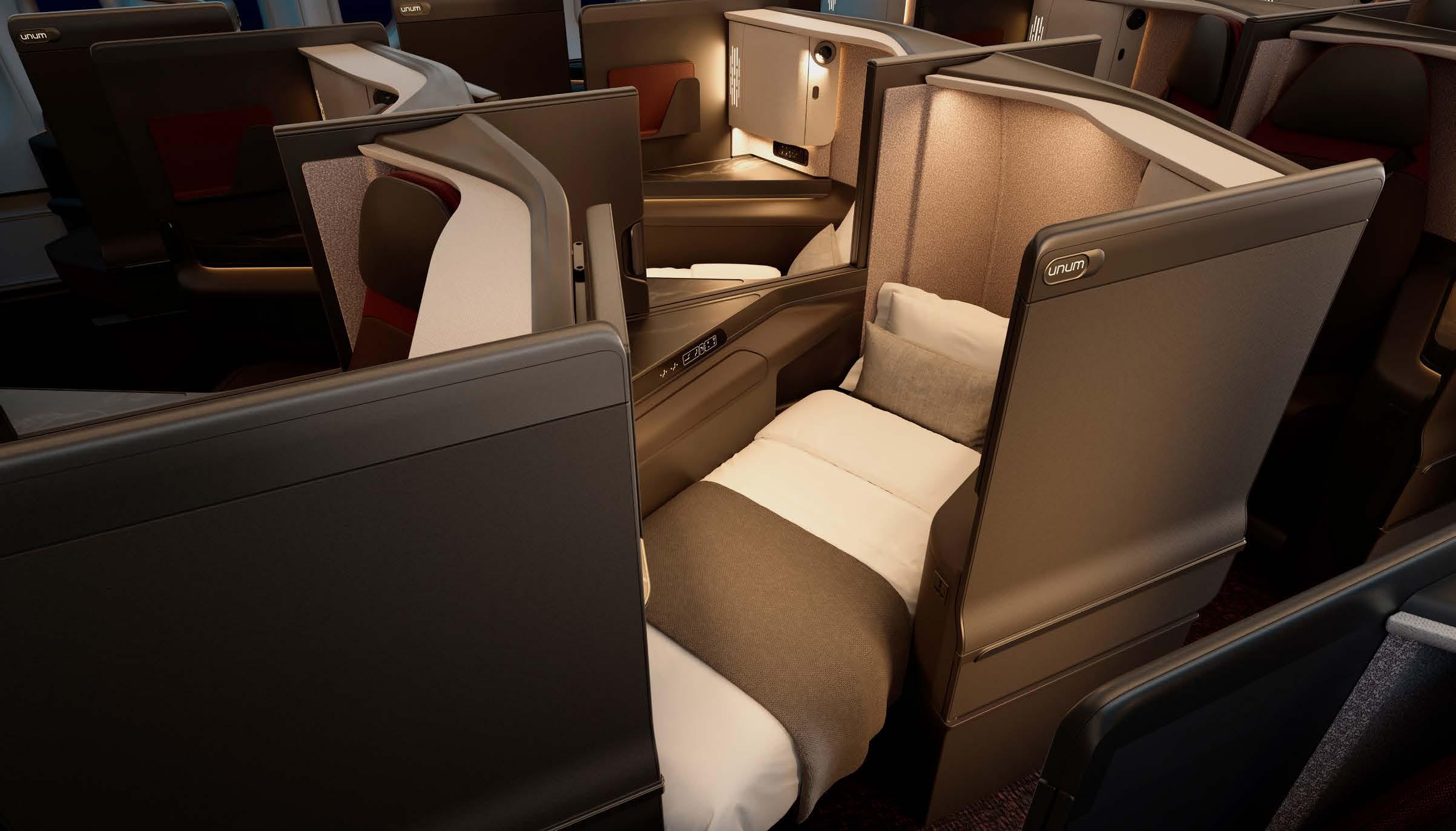
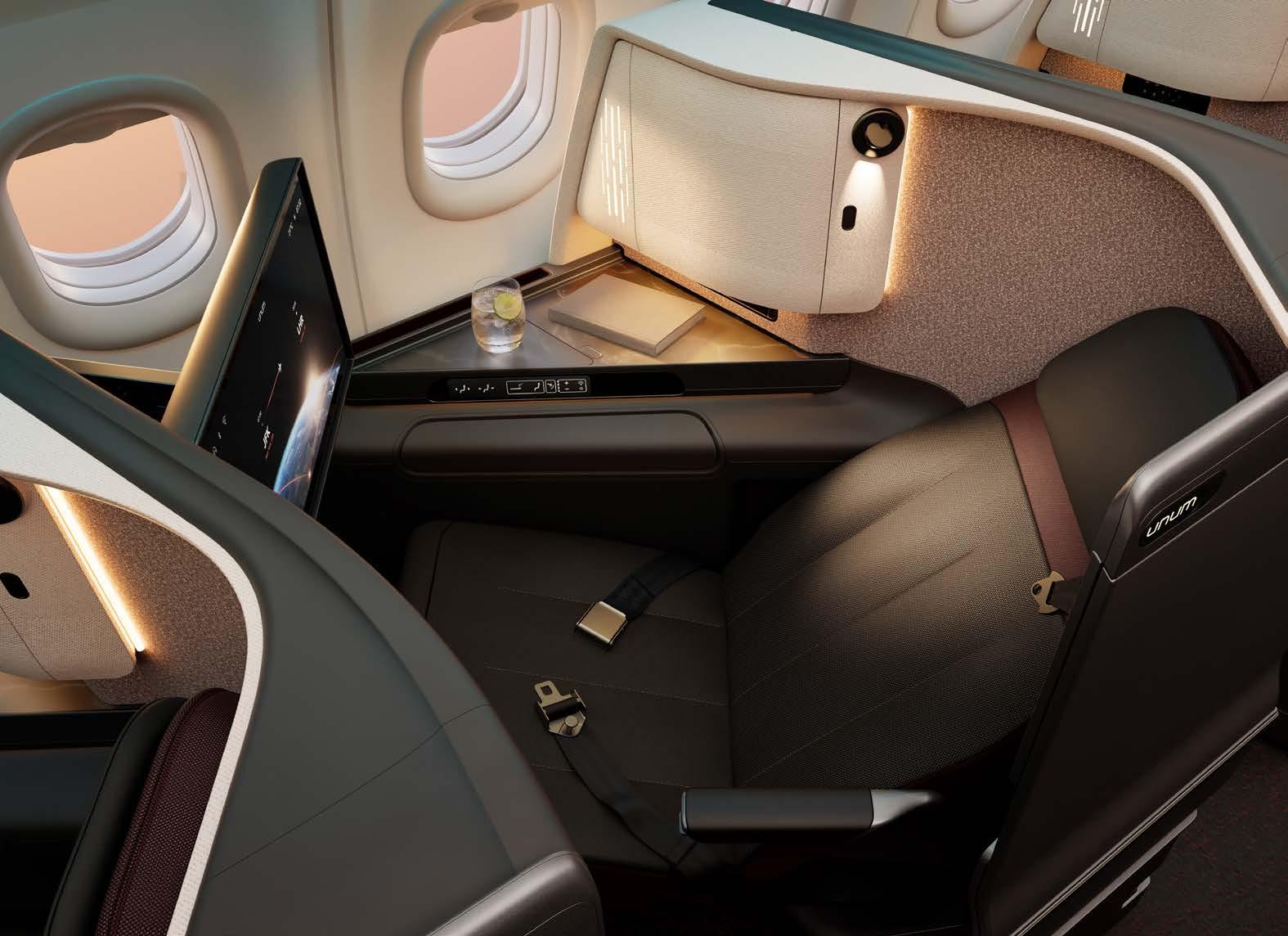
Pointing to the booth’s “Sustainability Corner,” McInnes highlights Unum’s commitment to responsibly manufacturing. The segment features a range of products from Unum’s supply chain, incuding partners such as Schneller, Kydex and Muirhead. These collaborations focus on materials that reduce carbon emissions and improve end-of-life recyclability.
“You have to think about sustainability before you start, because it is very difficult in aviation to introduce it midway through a program,” McInnes explains.
“At Unum, we have considered sustainability from the very beginning. In 15 years’ time, when our first seats come to the end of their life, there will be a route to recyclability. That is part of the reliably, comfortably, responsibly made message.”
Unum’s 787 launch customer, TAAG Angola, the national carrier of Angola, is set to takeoff with Unum One Business Class seats in 2027. The company’s A330 launch customer is Wamos Air, which will introduce Unum’s seats by the end of this year.
Stellar Entertainment’s Jono Fagg highlights the challenge of protecting premium content amid an evolving digital IFE landscape
by ROBYNNE TRUEMAN
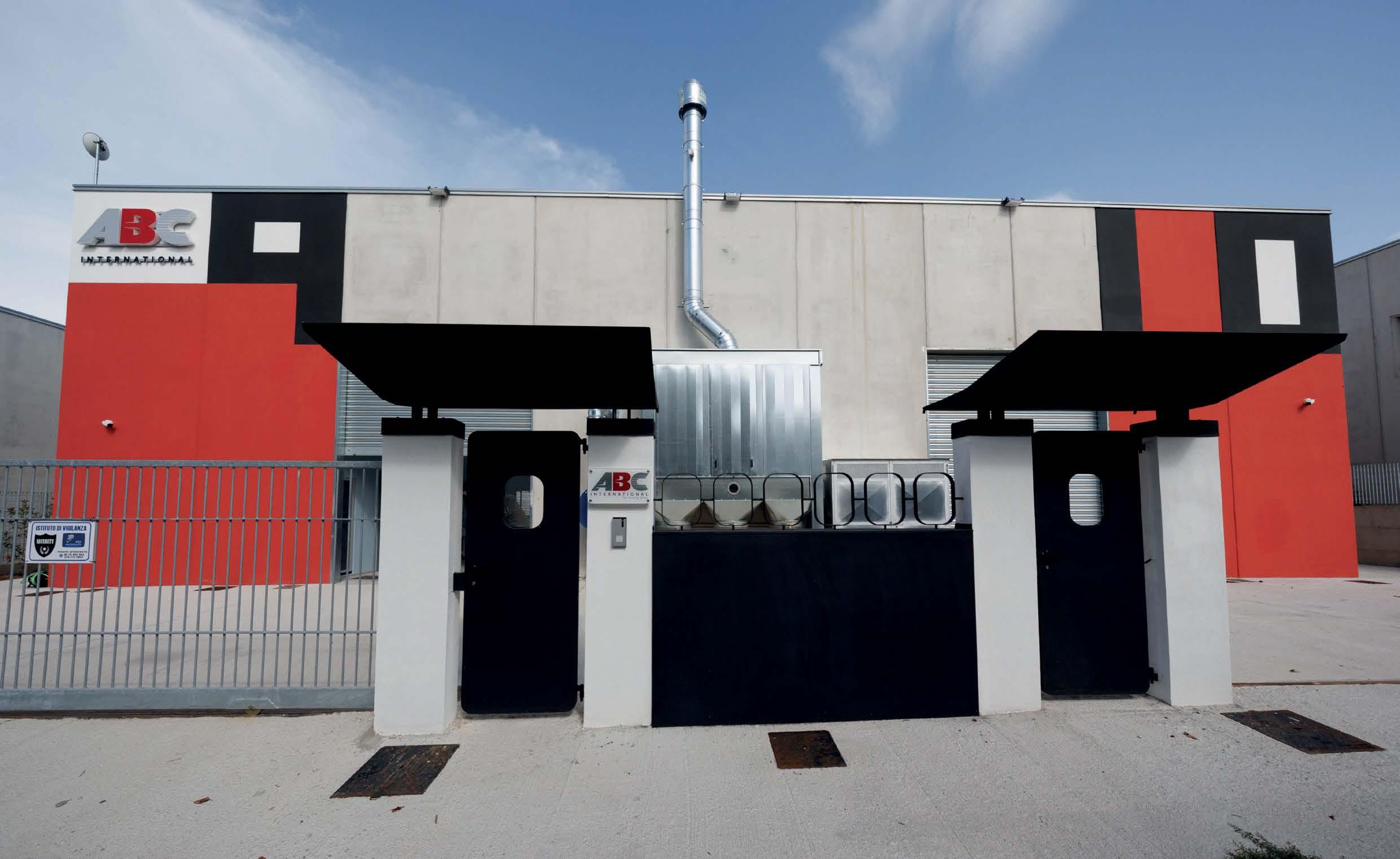
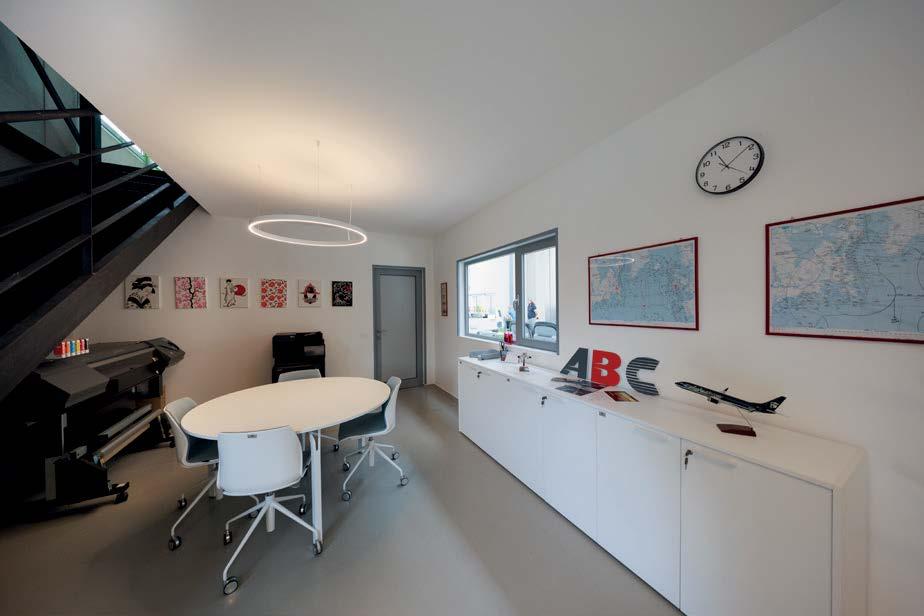
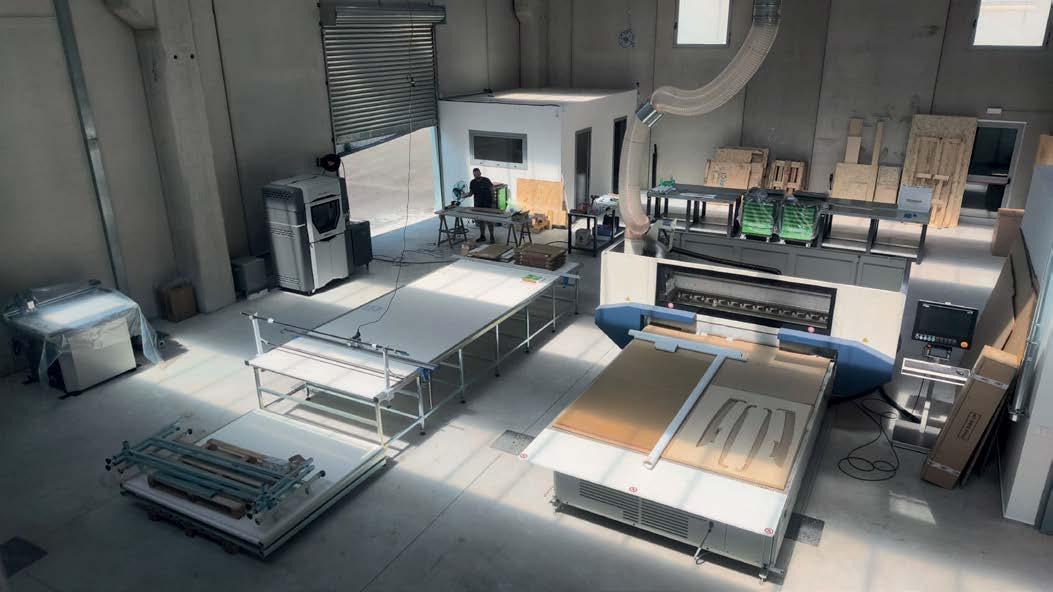
Stellar Entertainment recently received the TPN Gold Star Shield, the highest certification tier available within the Trusted Partner Network framework, representing the successful completion of rigorous thirdparty audits across Stellar’s content operations and security processes.
“For Stellar, the certification demonstrates operational maturity and validates that security is embedded throughout our workflow. It reflects documented, repeatable and auditable practices across every stage of the content supply chain, from content intake and preparation through to delivery,” Jonathan “Jono” Fagg, Senior Technology Strategist, Stellar Entertainment, tells PAX Tech
He notes that the certification is not simply a compliance exercise; it provides industry recognition that Stellar is equipped to manage premium
content at the highest level for studios, distributors and airline partners.
“As content workflows become increasingly digital and interconnected, having security built into dayto-day operations becomes a key differentiator,” he emphasizes.
Fagg joined Stellar Entertainment in April and brings valuable experience from organizations that have undergone significant digital transformation, providing a broader perspective on how emerging technologies can be applied within the aviation entertainment sector.
In the near term, Fagg says his focus will include deeper automation across Stellar’s workflows, greater integration with OEM and partner ecosystems, and the continued development of AI-enabled capabilities that improve efficiency and scalability across the content supply chain.

By taking a product-focused approach, Fagg plans to strengthen Stellar’s ability to align technology decisions with the needs of both airlines and passengers.
“As passenger expectations increasingly reflect the personalized experiences offered by platforms such as Netflix and Spotify, the industry must evolve to deliver more flexible, connected and intelligent entertainment ecosystems,” says Fagg.




He notes that meeting such expectations requires workflow innovation and smarter content management as well as security frameworks capable of scaling alongside a more dynamic and interconnected content environment
As airlines expand entertainment offerings across seatback screens, personal devices and connected platforms, the challenge of protecting premium content has evolved with new security considerations emerging for CSPs like Stellar.
At present, Fagg says that the most important security requirements airlines and IFEC stakeholders should understand include end-toend encryption, auditable supply chain records, as well as vendor and supply chain security. He notes that
Receiving the TPN Gold Star Shield represents the successful completion of rigorous third-party audits across Stellar’s content operations and security processes
the industry shift from seatback-only entertainment to personal devices and connected platforms expands the potential attack surface for premium content.
“Historically, content was stored on embedded systems within the aircraft environment. Today, content may move across airline networks, cloud infrastructure, multiple operating systems and passenger-owned devices, many of which sit outside the direct control of airlines and IFEC providers,” Fagg explains.
As a result, digital rights management must work consistently across a wider variety of devices and playback environments.
“Forensic watermarking has also become increasingly important, providing the ability to trace unauthorized distribution back to a specific point within the supply chain,” he adds.
At the same time, connected ecosystems introduce additional supply chain risks. For Fagg, security can no longer be viewed exclusively through the lens of an individual provider’s infrastructure.
“The security posture of every technology partner involved in the content journey has become a critical consideration,” he explains. “The industry is moving steadily away from physical media distribution towards fully digital delivery models. This transition reduces physical touchpoints, shortens delivery cycles, lowers operational costs and enables a more responsive passenger experience.”
Fagg explains that automation plays a central role in achieving this balance. It improves efficiency by reducing manual intervention, minimizing errors and accelerating time to delivery.
“As content volumes continue to grow, manual quality control and preparation processes become increasingly difficult to scale.
By embedding security checks, watermarking and validation processes directly into the content supply chain, Stellar can improve efficiency while maintaining strong security standards,” he says.
Cloud-based workflows have also transformed content preparation, allowing for more frequent content updates while reducing dependence on onboard storage, particularly with connectivity improving. In addition, Stellar continues to invest in automation and AI-driven capabilities that support workflow management, metadata creation and content screening.
“More broadly, content operations within aviation are beginning to resemble modern streaming platforms rather than traditional broadcast or physical media workflows,” Fagg says. “The future will be defined by increasingly connected, data-driven and dynamically managed content ecosystems.”


In this guest column, Carol Felton, Marketing Director at IdeaNova Technologies, examines why PEDs are not a problem to be solved but a reality to be designed for

At a recent industry event, someone asked me: “Should airlines give up and let passengers watch TikTok?”
The question points to something real. Watch a cabin at boarding and it is clear where attention goes—to phones. Platforms like TikTok have trained passengers to expect instant, highly personalized content.
Against that, many IFE systems still feel like they belong to another era.
Airlines will not hand the cabin over to social media, but they do need to understand why passengers reach for it instead of the seatback screen.
The TikTok gap
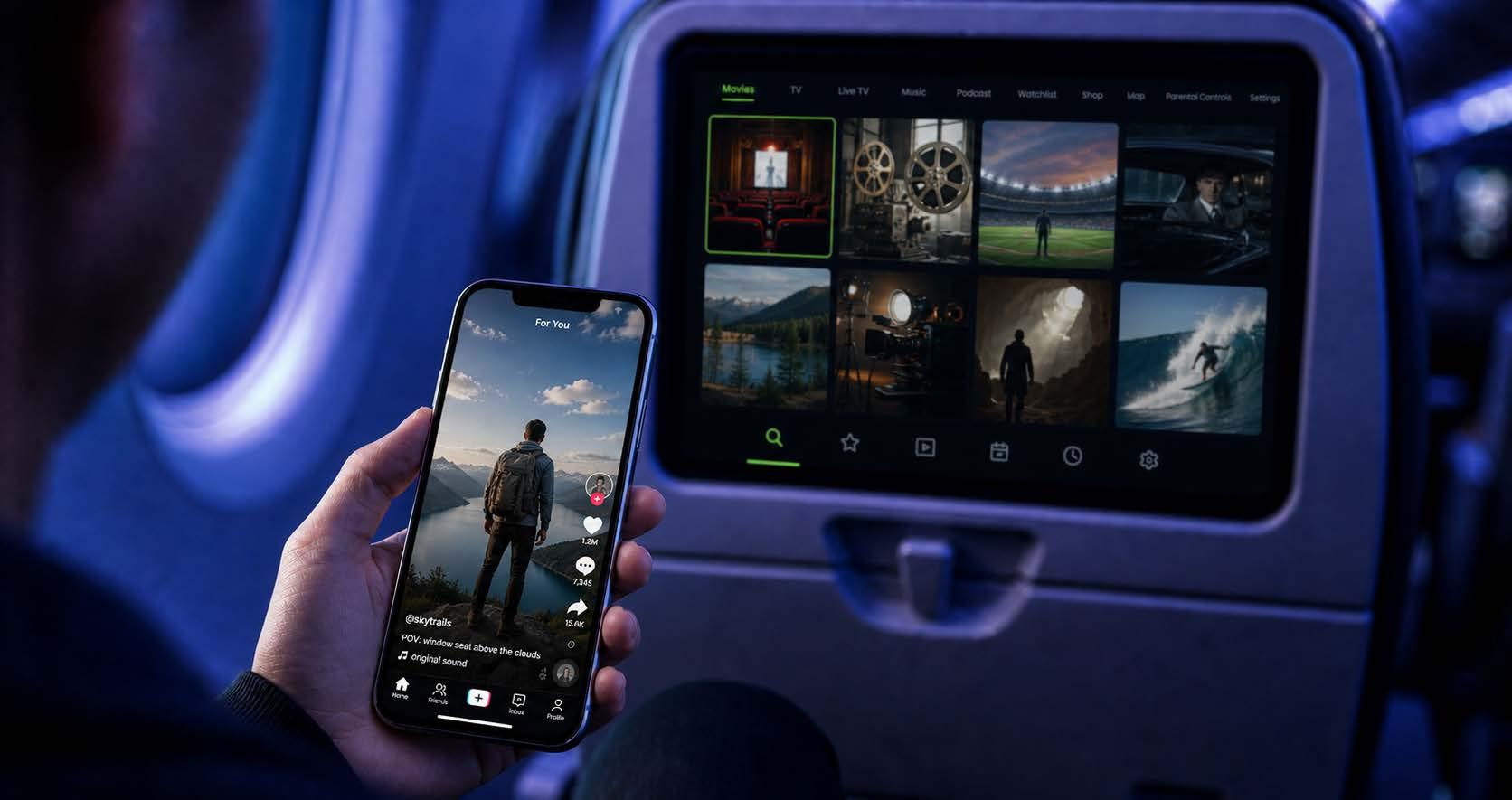
TikTok is not IFE’s competitor. It is IFE’s benchmark.
Passengers do not think in categories. They do not ask themselves, “shall I use IFE, or shall I use my personal device?” They just want to be entertained and have been conditioned by Spotify, Netflix and TikTok to
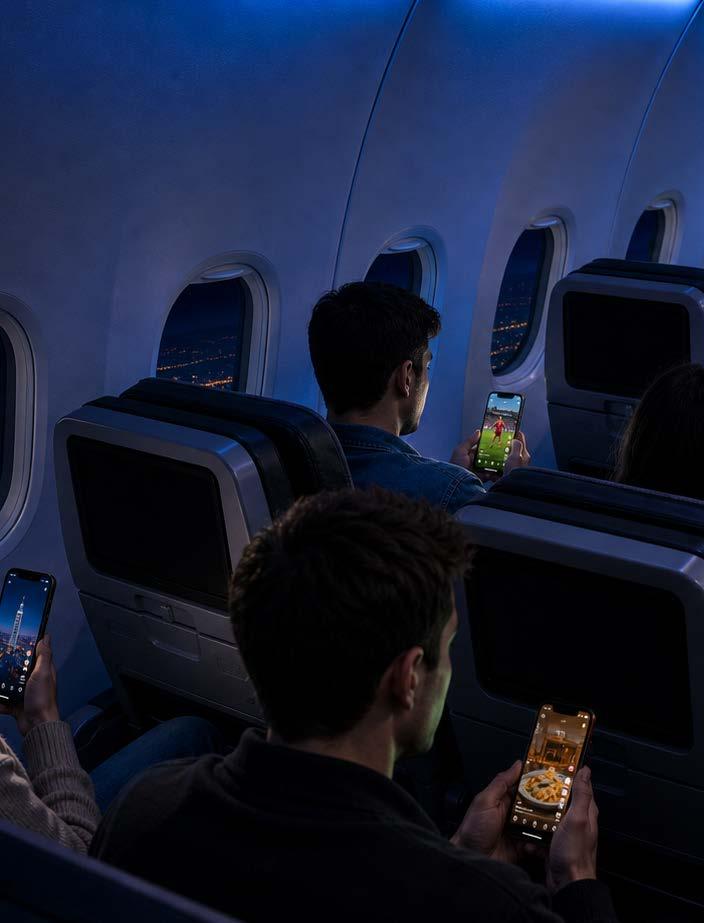
expect content that knows them. When IFE does not meet that bar, the phone wins. It is as simple as that.
The real question is: what does IFE need to become for passengers to use it? And what can it offer that a social media app structurally cannot? The answer, as it turns out, is quite a lot.
Outpacing the algorithm
Premium content requires controlled delivery. The studio films, first-run television and live sports that make up IFE’s most compelling content come with strict licensing requirements. Rights holders require DRM, auditable delivery environments and clearly defined distribution parameters— conditions that open social platforms cannot guarantee.
At IdeaNova, we have spent nearly two decades building secure streaming and DRM systems. The rights holders supplying IFE with its most valuable content have little appetite for platforms they cannot audit or control.
That content supply chain runs through IFE. Period.
Content providers have a role to play as well. Reintroducing early viewing windows for airlines—making content available onboard before it reaches streaming platforms—would immediately restore some of IFE’s premium appeal. Even a brief period of exclusivity could have a significant impact on passenger perception, although I understand this is wishful thinking.
Airlines cannot afford unpredictability. While platforms like TikTok thrive on user-generated, constantly shifting content, that model is incompatible with the cabin environment. Duty of care, corporate policies, and a mixed-age audience require editorial control, not openended feeds.
Connectivity may be improving, but it remains variable. IFE should not be.
Social media platforms and connected apps depend on consistent bandwidth to deliver a seamless experience. At cruising altitude over the Pacific, or on routes where connectivity is still limited, that cannot always be guaranteed. By contrast, an offlinefirst IFE platform delivers a reliable experience regardless of satellite coverage or network performance.
Another limitation that is often underestimated is that TikTok lacks
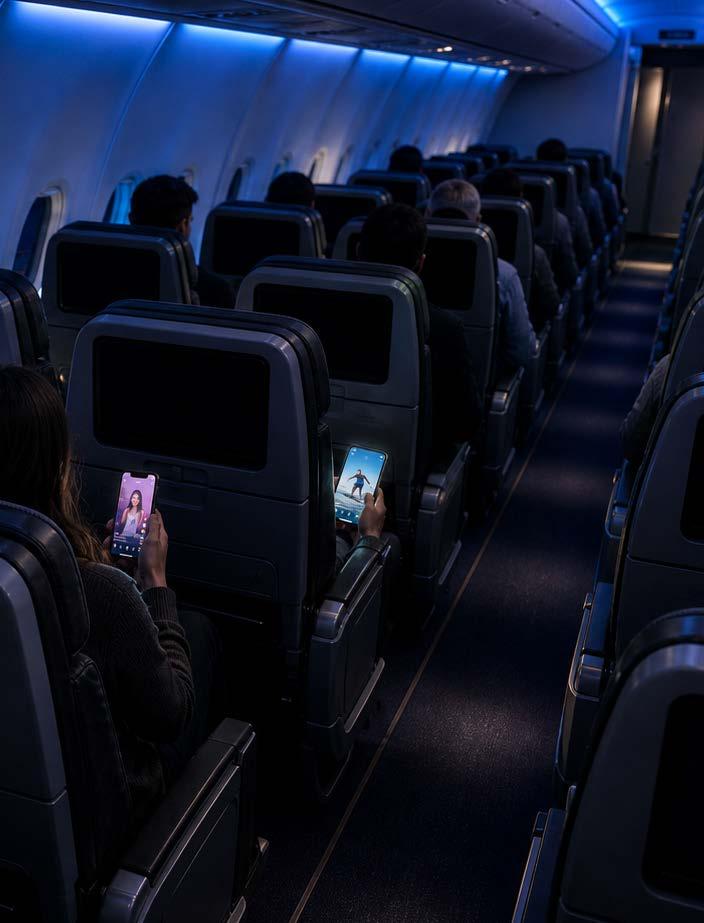
specific passenger information that airlines possess. That contextual awareness is one of IFE’s most powerful advantages. When used effectively, it allows carriers to surface content that is not just personalized in a generic sense, but genuinely relevant to the journey.
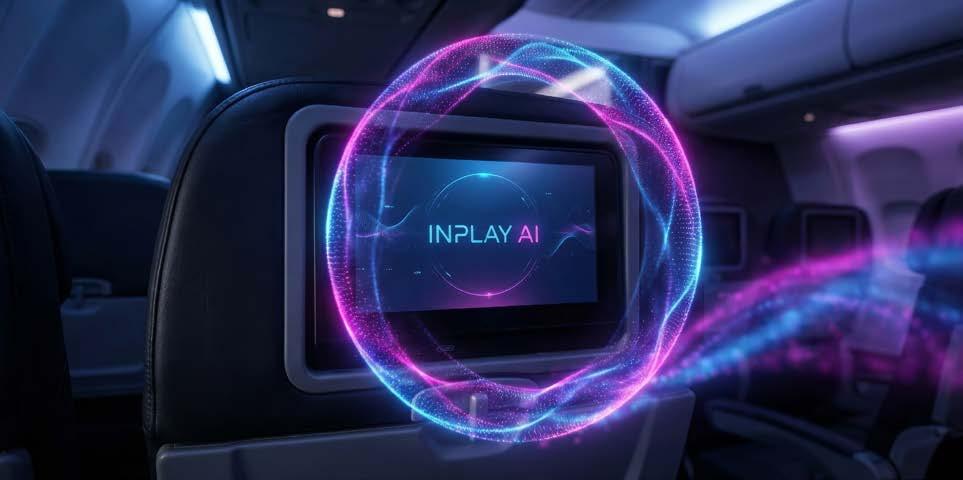
Personalization does not require connectivity, as we proved when launching Inplay AI earlier this year. Yet personalized content makes passengers feel understood. As the industry’s first offline inflight personalization engine, Inplay AI processes data locally on existing onboard hardware, adapting to individual passenger behavior in real time without transmitting personal data outside the aircraft. That is a meaningful differentiator for privacyconscious travelers.
Passengers are going to keep using their phones on flights. That is not a problem to be solved, it is a reality to be designed for.
The passengers who reach for TikTok are not lost to IFE forever. They are telling us exactly what they want: an experience that flows across the devices they already carry. The answer is not to fight against the phone screen. It is to make IFE the most compelling option in the cabin.
That is the thinking behind Inplay Flow, which lets passengers move between the seatback screen and personal device without losing their place. They can start a film on the seatback, continue it on their phone, pick it back up when they settle back in. For a passenger used to this continuity from Netflix on the ground, its absence is jarring. Its presence is noticed.

For routes where connectivity is available, Inplay Edge takes this further by giving passengers access to online content directly through the IFE portal without additional data costs – while improving passenger experience, turning the system into a genuine gateway rather than a closed library.
Combined with offline-first personalization via Inplay AI and robust DRM through our Inplay Suite, these are capabilities airlines can deploy today, in many cases on hardware already onboard. We have done exactly this with carriers such as Delta and United
The question was not, “Should we rip out the IFE system?”
It was, “How do we make what we have significantly smarter?”
The answer, almost always, focuses on software rather than seatbacks or personal devices.
As we wrote in these pages last year, the mission for airlines is clear: to deliver an experience so fluid, engaging and context-aware that passengers come to see IFE not as an add-on but as a defining feature of the journey. This is even more urgent now.
To the worried airline executive–stop treating IFE as a hardware problem. The carriers winning on passenger satisfaction are the ones who have invested in making the content layer smarter, more personal and more consistent across every device in the cabin.
Modernize the software before replacing the hardware. Legacy IFE systems still have significant life if approached correctly. Software upgrades enabling offline personalization, cross-device continuity and secure streaming can make older systems feel modern— without the cost and disruption of a full retrofit.
Take passenger data seriously and use it. Airlines sit on extraordinary insight into passengers. That knowledge is the one thing TikTok does not have and cannot get. Using it intelligently, privately, and in ways that genuinely improve the experience is IFE’s most durable competitive advantage.
For airlines considering advertising, use what you know. Serving a relevant ad to a profiled passenger on a known route is a fundamentally better proposition than a generic impression, for both the passenger and the
Treat IFE as an experience layer, not a check box. The best implementations are not just content libraries with a remote. They are an integrated part of the airline’s relationship with the passenger — one that starts before boarding, evolves through the flight and creates moments that make people feel genuinely looked after.
Many airlines are already heading this way. Seeing your name on the screen when you sit down is a small thing, but it signals something larger — that the airline knows who you are and is paying attention. That is just the entry point. The deeper opportunity is using that knowledge to serve passengers the most relevant content, products and services throughout the flight.
The honest answer is that airlines need safety, reliability, editorial control and premium content that only a purpose-built IFE ecosystem can provide. The real competition is not IFE versus social media, but between systems that have evolved with passenger expectations and those that have not.
The gap is closable. The tools and data exist. What is needed now is the will to use them.
NEW LOCATION IN 2026
DALLAS, TX


8-10 September 2026
Gaylord Texan Resort & Convention Center
HEADLINE PARTNERS:
Celebrating 20 years of innovation in aviation
Join us in Dallas for our biggest and most ambitious event yet
CONFIRMED SPEAKERS INCLUDE:








PPanasonic Avionics highlights its latest seatback system retrofit program, LEO partnerships and self-service tools for the skies upgrade the seats or delivery lines at present a chance to bring a product with the same capabilities as Astrova onboard.
by ROBYNNE TRUEMAN
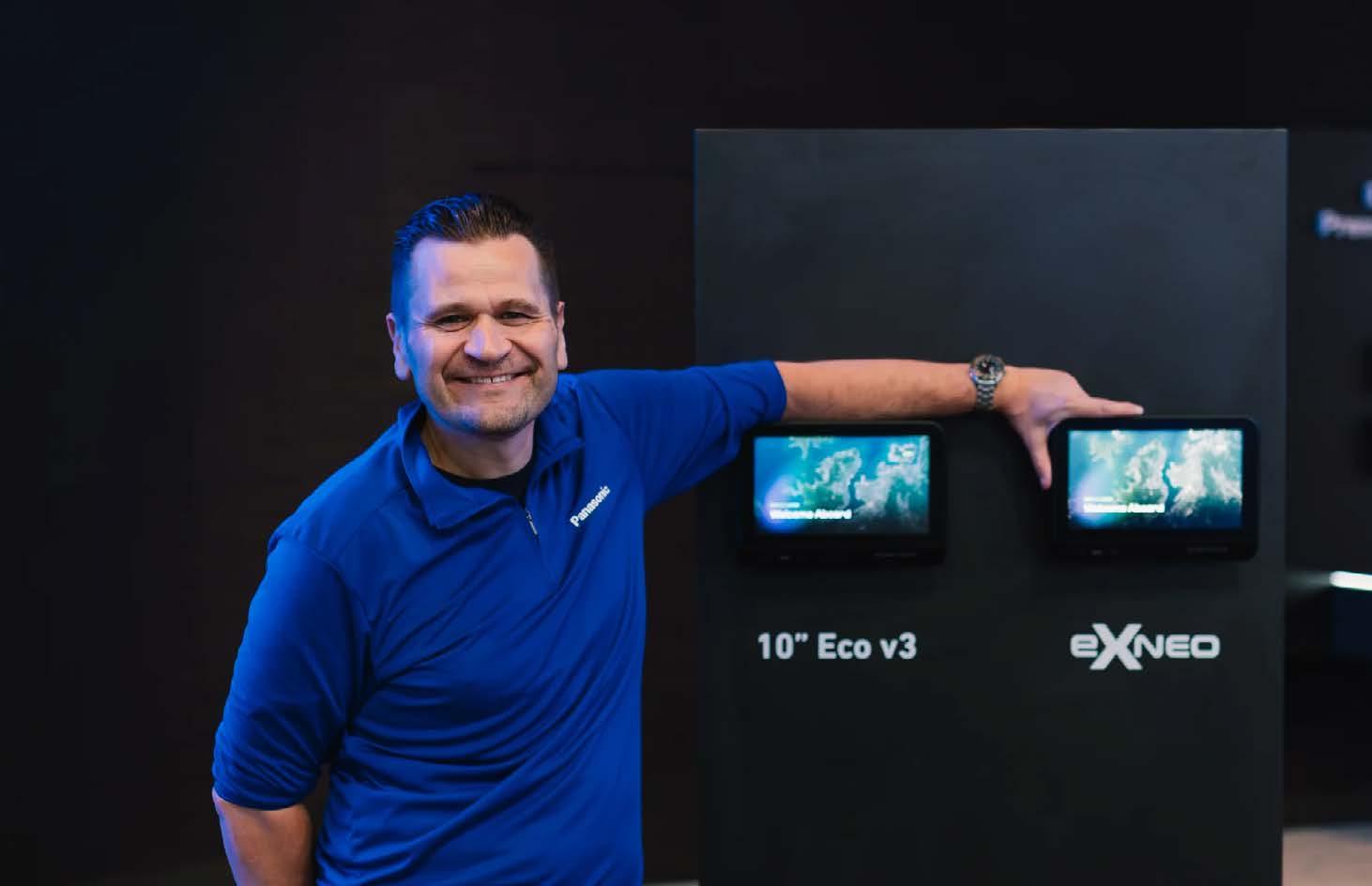
anasonic Avionics Corporation (PAC) is signaling a major step forward in closing the longstanding gaps in inflight entertainment (IFE) and connectivity, providing updates on Astrova and unveiling eXNeo as an upgrade to its legacy X-series IFE systems. The company also recently announced LEO satellite partnerships, reflecting the industry-wide push to bring an on-theground IFEC experience to passengers in the cabin.
Andy Masson, Senior Vice President Product & Strategy, PAC, underscores Astrova as the company’s most popular IFE platform to date.
“It has had an enormous response in the market,” he says. “It is lightweight, modular and upgradable, which is lowering the total cost of ownership significantly.”
Panasonic also launched eXNeo at Aircraft Interiors Expo 2026, which Masson coins as a “pragmatic product” for airlines that already have legacy Panasonic X-series systems onboard. eXNeo offers carriers that cannot
eXNeo is a seatback modification that minimizes certification efforts, helping airlines accelerate deployment while reducing complexity and downtime. It uses existing harnesses and interfaces to simplify installation, reduce aircraft downtime and minimize cost. The product will be available to existing Panasonic X-series customers for retrofit, bridging the gap with newer fleets that feature Astrova and Converix.
The new in-seat monitor leverages the latest generation CPU and GPU technologies available. Storage and RAM are increased, offering up to eight times more than older X Series monitors.
“This is the digital experience of Astrova on the X-series in terms of capability,” Masson explains. “We are doing a one-time replacement of all the CPUs, GPUs, RAM and other componentry and the X-Series. It will not have an OLED screen, but it has the compute capability of Astrova.”

As part of the retrofit program, Panasonic will install the eXNeo system by removing existing onboard monitors and replacing them with new units, while also upcycling the legacy equipment.
“We are constantly working on how to improve the market, how to improve our delivery process,” Masson says. “We are never resting on our laurels.”
As for inflight connectivity, Panasonic is moving into multi-network LEO connectivity. In February, the company signed a memorandum of understanding (MoU) with Shanghai Spacesail Technologies (Spacesail) to explore opportunities to add Spacesail’s LEO satellite constellation to Panasonic’s inflight connectivity global network.
“We already have our agreement with Eutelsat OneWeb for LEO and we fill in the gaps with GEO satellite capability,” Masson explains. “Spacesail is going to be imprinting into our
network, so you will be able to use both networks depending on where you fly.”
As a result of the partnership, passengers will no longer experience connectivity gaps when flying through regions not currently covered by Eutelsat’s LEO network, including China.
“We will be able to go to a different LEO network to provide that consistent global high bandwidth, low latency coverage,” Masson explains.
Panasonic is also bridging the gap between ground-based digital capabilities and onboard systems with its fully integrated IFE interactive design and publishing tool – Modular Interactive (MI). In March, EgyptAir became the first airline to fly globally with MI onboard, with Azerbaijan Airlines and Saudia also deploying MI onboard in June.
MI is the industry’s first interactive authoring and publishing platform, and is a key part of Panasonic Avionics’ vision to redefine the inflight experience and integrate IFEC as
a third digital channel for airlines. The cloud-based platform enables an airline to update and tailor its inflight experience quickly and seamlessly via a flexible, modular architecture.
Masson calls MI “a self-service tool” for airlines.
The tool allows airlines to test variations of onboard content and layouts across individual aircraft, analyze engagement through A/B testing and then seamlessly roll out optimized updates fleetwide over the air without requiring manual installation. He notes that because it is
an editing tool, it continues to function efficiently onboard as monitor sizes scale up.
MI also offers an opportunity for airlines to better understand passenger habits and preferences. Panasonic supplies airlines with comparative IFE engagement data across routes with and without LEO connectivity, helping the carrier to make informed strategic decisions.
“It has performed significantly above expectations, both in terms of its robustness and its reliability,” Masson says.
by ROBYNNE TRUEMAN
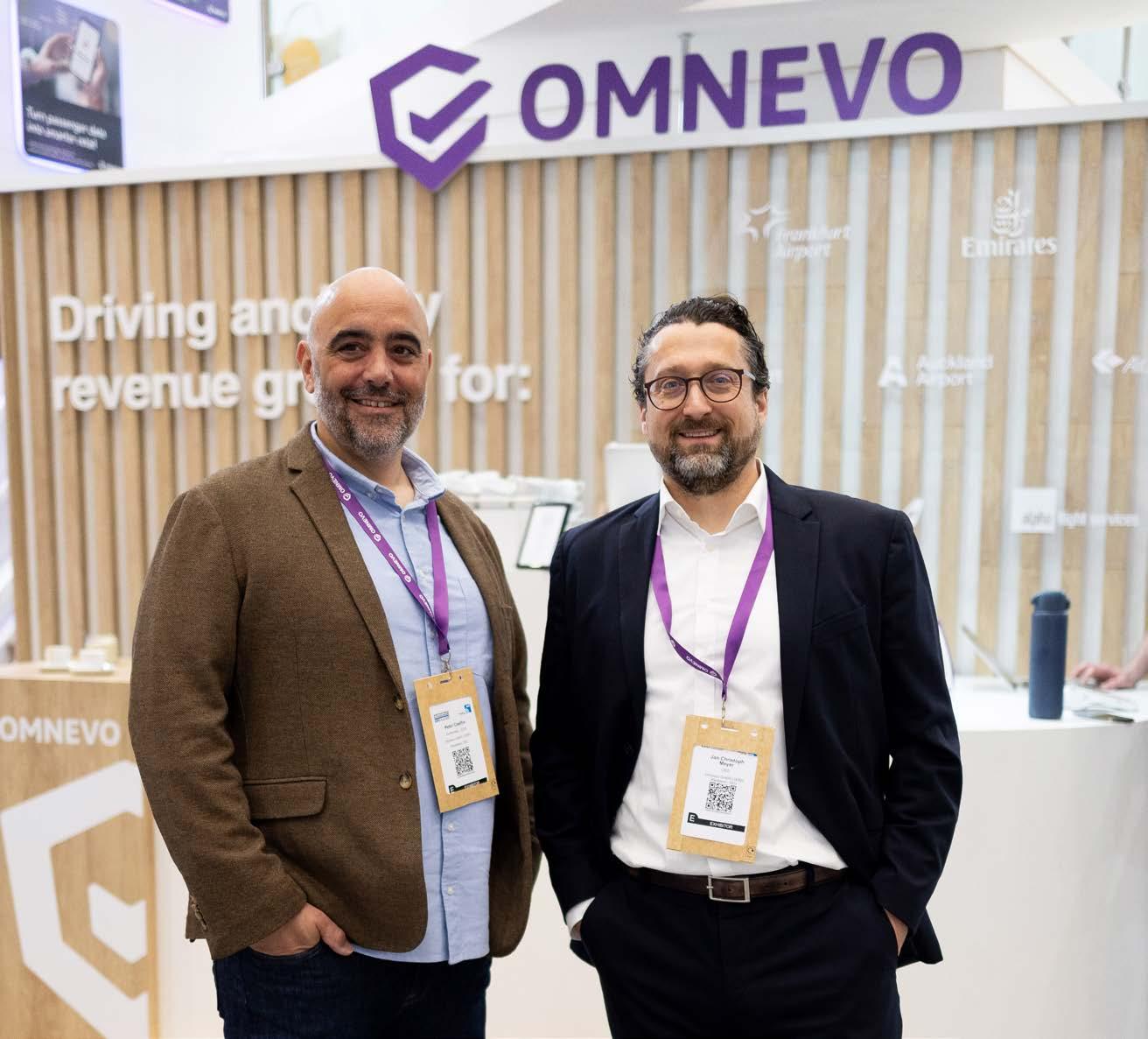
Earlier this year, Omnevo appointed Dr. Jan Christoph Meyer as Chief Executive Officer, signaling an evolution in the company’s growth. Under his leadership, the company is focused on strengthening its end-to-end retail platform capabilities and supporting travel operators connect onboard retail, logistics and digital commerce within a unified ecosystem. Having held senior leadership roles with Lufthansa Group and LSG Group, Meyer brings more than two decades of international experience spanning aviation operations, supply chain management and digital transformation.
“My vision is for Omnevo to be the strategic partner that helps airlines and airports navigate the next generation of travel commerce, while staying ahead of rapidly evolving passenger expectations,” Meyer tells PAX Tech in June.
He points to a shifting industry where the convergence of connectivity, data and commerce re-defines the passenger experience and creates an opportunity for airlines to weave ancillary revenue seamlessly into the end-to-end journey.
“Historically, onboard retail has operated with significant constraints around connectivity, payments, inventory visibility and customer data,”

Passengers now expect the same level of personalization and convenience onboard that they

he says. “As those barriers continue to disappear, airlines will be able to treat the onboard environment as an extension of their broader retail ecosystem rather than a disconnected sales channel.”
For Meyer, the future is about creating a continuous, intelligent retail journey that follows the passenger along every touchpoint before, during and after travel.
Creating this seamless experience requires an understanding of the current industry transformation, driven by connectivity, AI, data and shifting consumer behaviors.
Passengers now expect the same level of personalization and convenience onboard that they receive from retailers and technology brands on the ground. Understanding those expectations and helping airline passengers prepare for them is a critical part of Omnevo’s role.
“Passengers do not think in channels. They think in experiences,” Meyer says. “The opportunity for the industry is to remove the friction that exists between different stages of the journey and create a more connected experience.”
Whether a passenger is browsing products before departure, making a purchase onboard, redeeming loyalty points or engaging with an airline post-flight, Meyer emphasizes that each interaction should feel like part of a cohesive journey, rather than separate touchpoints.
Improvements in inflight connectivity also influence the level of frictionless experience that passengers expect onboard.
“Technology can bring together customer data, retail capabilities, loyalty programs and operational intelligence into a single ecosystem, enabling more personalized and relevant experiences throughout the travel journey,” Meyer explains. He also recognizes that technology itself is rarely the biggest challenge. Rather, integrating and aligning multiple systems into a singular commercial strategy is often the pain point. Omnevo’s role is to make these integration processes more intuitive, supporting the passenger experience.
“Airlines operate in highly complex environments where customer data, retail platforms, operational systems and partner technologies must work together seamlessly. Technology providers have a responsibility to simplify that complexity,” Meyer says.
He sees the most successful solutions as those that help airlines connect previously disconnected parts of the business, create actionable insights from data and deliver measurable outcomes.
“When done well, this creates a smoother, more convenient experience for passengers while unlocking stronger engagement and commercial opportunities for airlines,” Meyer says.
As CEO, Meyer sees the greatest opportunities for Omnevo’s innovation and growth within the airline retail ecosystem in helping the industry unlock more value from existing customer relationships.
“At Omnevo, we want to help airlines, airports and rail operators, not only adapt to change but capitalize on it. That means continuing to invest in innovation across areas such as intelligent forecasting, personalization and data-driven decision-making, while remaining focused on delivering measurable business value,” he says.
Despite having extensive passenger data and engagement touchpoints, many airlines struggle to turn these assets into measurable business results. Omnevo bridges that gap, with Meyer highlighting opportunities in predictive analytics, forecasting, personalization, retail optimization and the development of more connected commercial ecosystems.
“The goal is not simply to sell more products, but to help airlines create smarter, more relevant experiences that strengthen loyalty while driving sustainable ancillary revenue growth,” he adds.
Meyer positions Omnevo not just as a technology provider, but as a trusted partner that can help airlines shape the future of travel commerce.
“By combining technology, industry expertise and a deep understanding of customer trends, we can help our customers make smarter decisions, build stronger customer relationships and achieve sustainable growth in an increasingly dynamic market,” he says.
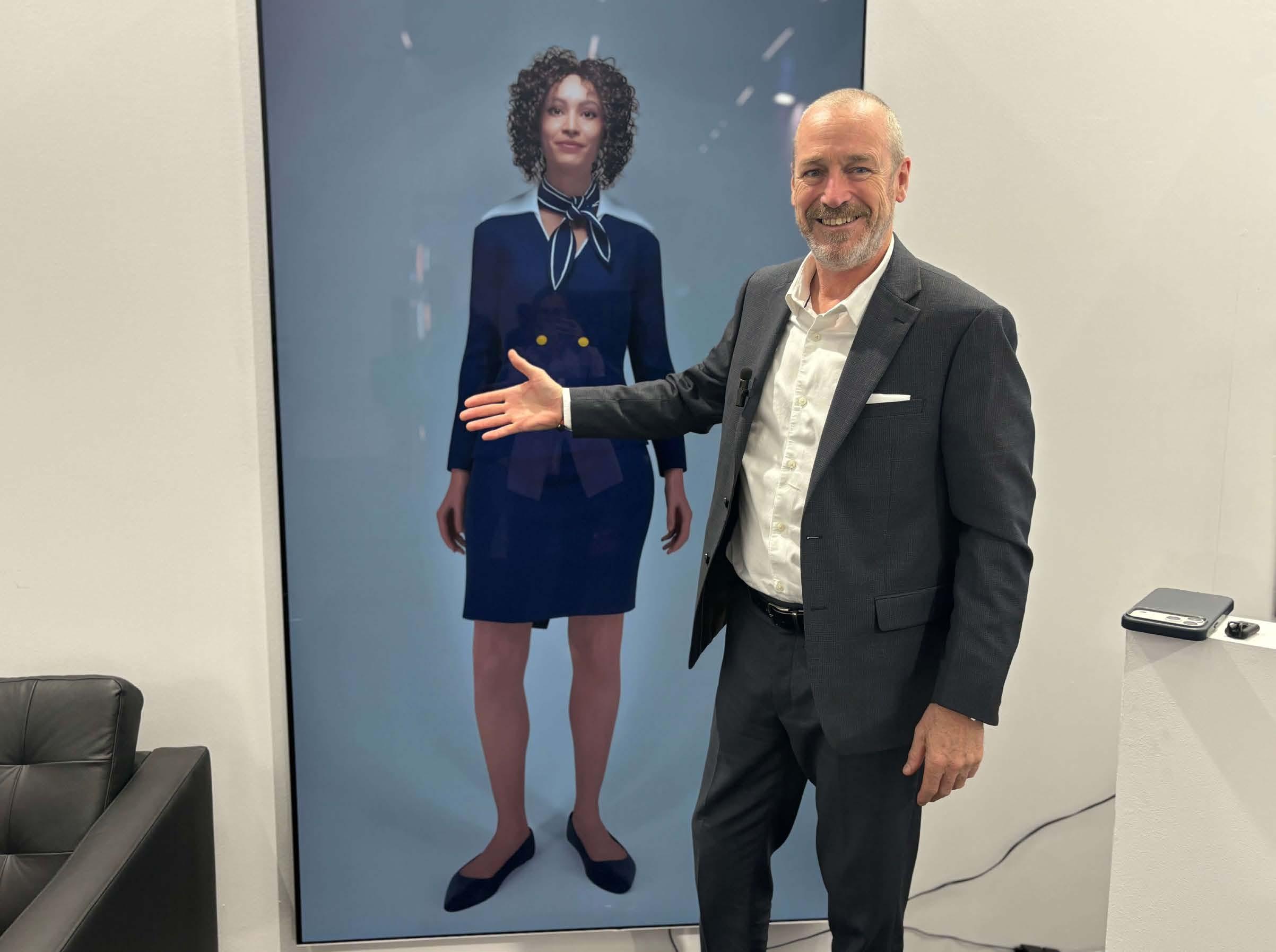

When integrated into Rosen’s
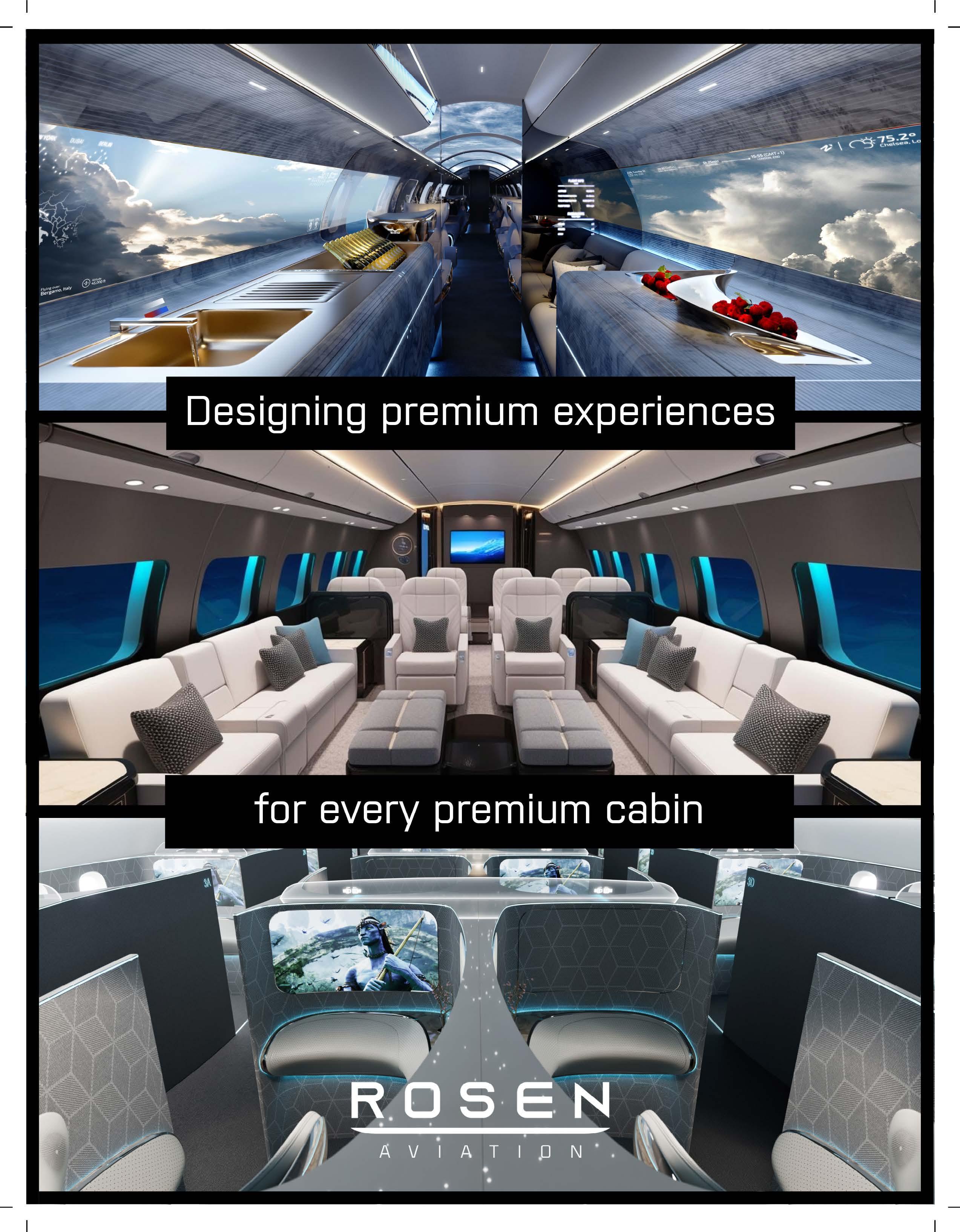
Rosen Aviation’s Lee Clark explains why the future of premium passenger experience depends on applying AI and intelligent systems in ways that meaningfully enhance the journey
by ROBYNNE TRUEMAN
As Rosen Aviation continues its expansion into the commercial aviation market, SVP Strategy Lee Clark describes the move as a natural extension of the company’s existing business rather than a significant shift.
“People traveling in an aircraft are still people traveling in an aircraft. Where Rosen brings enormous value to the market is a deep understanding of what premium really means for the passenger experience,” he tells PAX Tech

Whether passengers are traveling for leisure or work, Clark says Rosen Aviation’s 45 years of experience focuses on ensuring the entire end-toend journey is a seamless, premium experience through technology.

Collaboration with OEMs and suppliers is central to Rosen Aviation’s growth in the commercial aviation market.
“We work with everybody. We simply bring the reliability, the quality and the innovation to the marketplace. We try as hard as possible to be agnostic. We try as hard as possible to provide the best experience for the end user, the passengers,” Clark emphasizes.
The strongest collaborations begin early on the design process, he adds.
“When customers look at us as a true partner, they start to bring us into the architecture of the program from the beginning,” he explains.
Rosen Aviation positions itself as a solutions-oriented experience company
that understands its market niche.
Following the 2025 HEICO acquisition, Clark says there are additional capabilities and capacity, but also complete alignment with Rosen’s vision for the future.
“It is not about what the technology is,” he tells PAX Tech. “It is about how we apply that technology and leverage our size, our agility, our speed, but also the quality and reliability we are known for.”
Increasingly, the technology dominating the conversation is AI.
“People are struggling to understand what AI means and what difference it can make,” he explains. “How can it streamline my engineering processes? Is it giving procurement a greater reach? What does it do for the passenger experience?”
Clark points to Rosen Aviation’s AVIA product, unveiled at AIX 2026, as one of the opportunities for people
to see the “manifestation” of AI in the context of delivering a better passenger experience.
AVIA is a personal digital concierge. When integrated into Rosen’s Celestia Cabin Management System, AVIA can unlock a new level of service, customization and luxury. She can make informed decisions based on passenger trends and available cabin data, can infer context and spoken tones, and carries organic conversations across a several languages and dialects.
As Rosen Aviation pushes further into premiumization, the focus is on aligning with each airline’s brand to elevate its value proposition. With seemingly fewer opportunities to differentiate, Clark underscores experience-based technology as the next frontier for enhancing the passenger journey.

Viasat’s Laney Hind discusses how AERA is shaping the company’s multi-orbit strategy
by ROBYNNE TRUEMAN
Viasat continues to innovate in the global inflight connectivity (IFC) space with its Viasat Amara roadmap, encompassing the different network interoperability, multi-layers of capacity, the acquisition of Inmarsat and the multi-year contract for Viasat to utilize capacity on Telesat’s Lightspeed LEO satellite network.
Most recently, the roadmap also includes the unveiling of Viasat AERA, a key focus for Viasat at the Aircraft Interiors Expo 2026 in Hamburg, Germany, last month. Now in Boeing’s
technical evaluation process for factory installation, the antenna will launch service in 2028.
As Laney Hind, Senior Director Airline Programs at Viasat, tells PAX Tech, “What is special about this antenna is that it is a true dual-beam simultaneous LEO and GEO, or NGSO, which means it is making real-time smart decisions moment to moment.”
For example, when a passenger opens an app such as Instagram, latency-sensitive traffic can be routed via LEO at the packet level, while highcapacity demand is simultaneously handled by GEO, Hind explains.
“That is truly exceptional for the passenger experience on board,” she adds, underscoring Viasat AERA’s future-proofing capabilities. Hind says the system is designed to leverage additional Ka-band capacity as new networks come online.
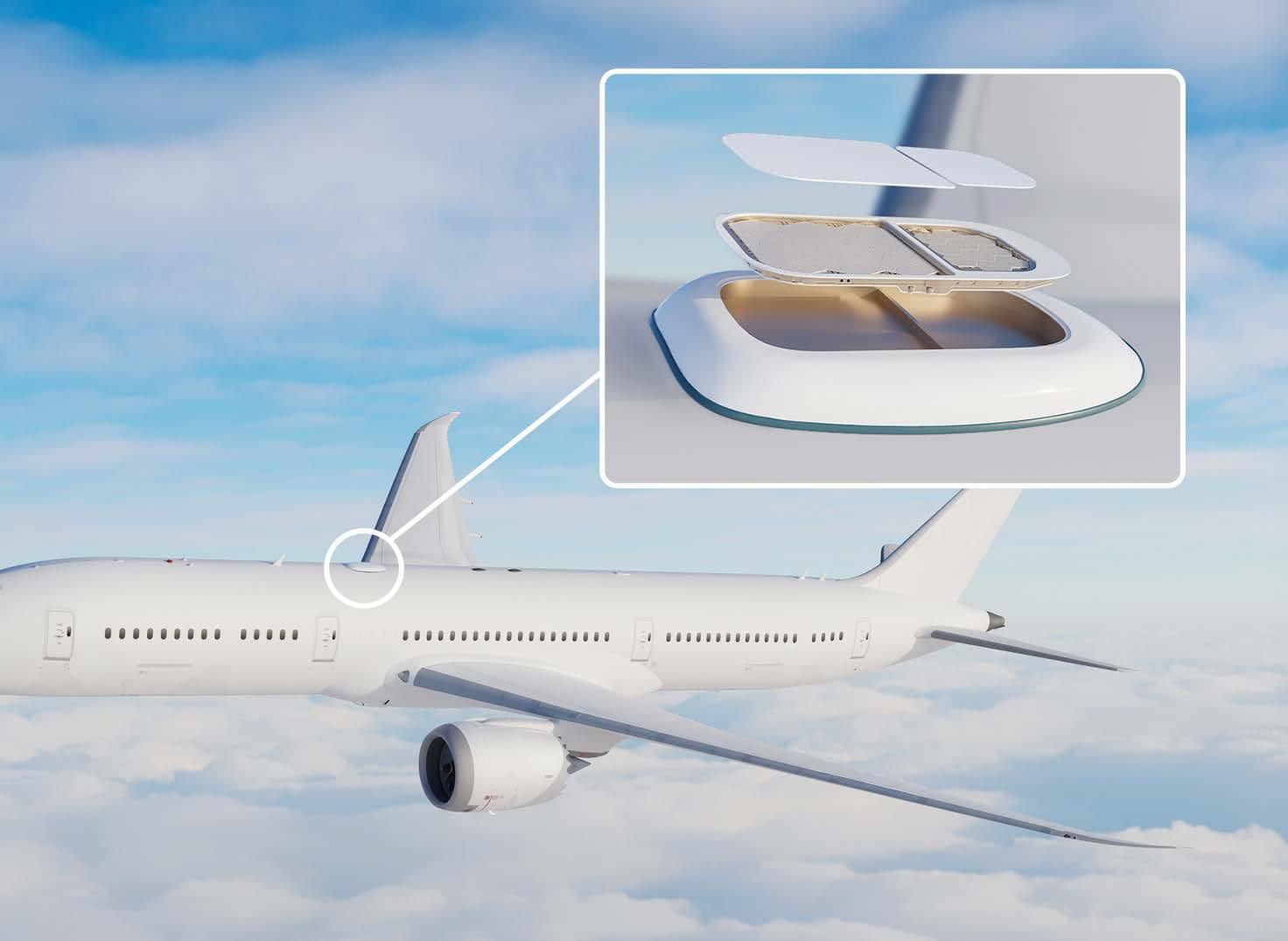
The antenna has a low-profile design at 2.9 inches, reducing drag and weight– an important factor for airlines as they focus on operational costs and fuel efficiency, Hind says.
Viasat AERA’s simultaneous multibeam technology is designed to unlock true multi-orbit flexibility, with the terminal leveraging multiple satellite networks at the same time to ensure consistent connection across a wide range of geographies. For passengers, this means a more seamless experience from gate to gate.
As for the future of the roadmap, Hind says “it is built to evolve.”
With Viasat offering multi-orbit connectivity, she says the blend of LEO and GEO coverage provides the best experience for passengers, delivering flexibility while providing redundancy.
“Being able to utilize the best of different orbits to serve the passenger experience is the goal with [Viasat] AERA,” she explains.
Hind notes that while LEO delivers low latency, GEO can provide highcapacity coverage in high-density areas such as airports–a combination that provides reliability to airlines and passengers.
When IFC is seamless and consistent, Hind says it becomes a platform
that helps airlines implement other strategies, such as ancillary revenue via products or access to live TV events. She notes the “special” feeling of collectively viewing a live event while inflight.
“Whether that is via IPTV, wireless IFE or an airline portal–the airline wants the passenger to feel like they are having an on-the-ground experience while in the cabin,” she says.
Hind notes that Viasat’s hardware and network enhancements–from Viasat AERA to the recent launch of the ViaSat-3 F3 satellite–are all part of the connectivity roadmap that powers those “at-home” experiences while in the air.
“Airlines want to add value for passengers and they want to do it in a differentiated way. All these things serve that goal,” she concludes.
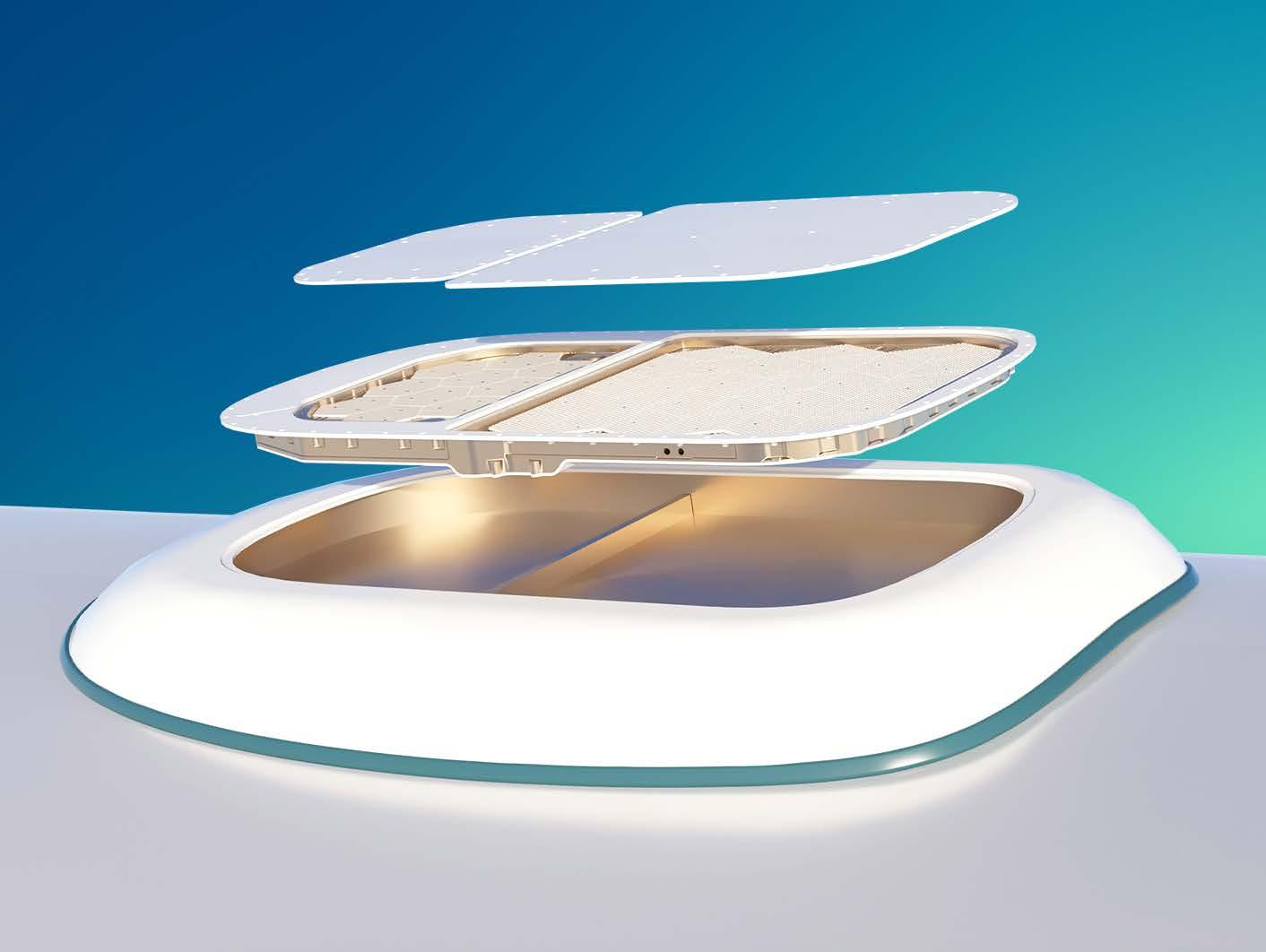
The Viasat AERA antenna has a low-profile design at 2.9 inches, reducing drag and weight
When evaluating live sports programming, DIRECTV’s Twiggs says airlines are typically focused on three priorities: relevance, reliability and reach.
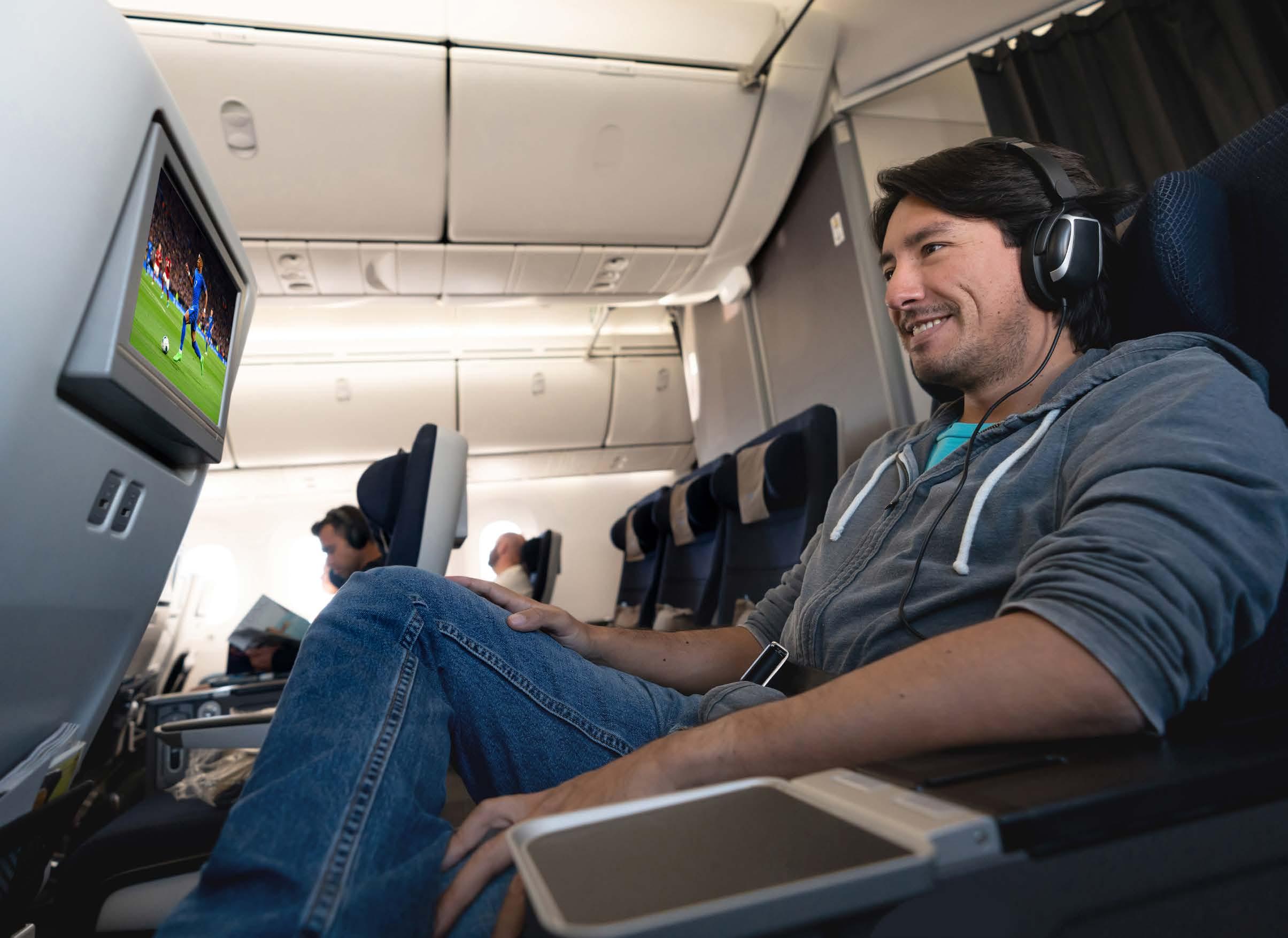

Industry experts from IMG’s Sport 24, DIRECTV and Viasat discuss the significance of delivering a collective entertainment experience onboard for global events such as the FIFA World Cup 26™
by ROBYNNE TRUEMAN


FOMO (the fear of missing out) is a natural extension of the desire for human connection. People want to feel included in social events and cultural moments, especially as the world becomes more digitally connected.
For airlines, this expectation creates the ideal opportunity to deliver a collective onboard experience through live entertainment, creating shared moments that passengers will not only feel like they are part of, but will reminisce on for years to come. This summer, the can’t-miss event is FIFA World Cup 26™.
Suppliers are supporting airlines through navigating the complex technical realities of delivering live content onboard.
IMG has been broadcasting live sport inflight for the last 14 years via its dedicated Sport 24 and Sport 24 Extra channels. It is the exclusive onboard broadcaster of FIFA World Cup 26™ on international and domestic routes outside the U.S. and Canada, and a non-exclusive onboard broadcaster on routes within the countries.


Beyond licensing the rights to inflight content, IMG works closely with airlines, connectivity providers and inflight entertainment partners to ensure live matches are delivered seamlessly to passengers.
“The FIFA World Cup is one of those rare events that captures global attention regardless of geography, and our job is to ensure passengers do not have to choose between traveling and staying connected to those moments,” Richard Wise, SVP Content & Channels, IMG, tells PAX Tech this summer.
For airlines, the World Cup presents an opportunity to offer something exciting to passengers.
As Kimberly Twiggs, Vice President of DIRECTV IN FLIGHT says, “We have seen demand for live sports continue to grow as airlines look for new ways to elevate the passenger experience. Major global events such as the FIFA World Cup 26™ are especially important because they bring together audiences from around the world and create a shared viewing experience that few other forms of content can match.”
With DIRECTV’s findings indicating 80 percent of travelers feel it is important for airlines to offer IFE, the need for live coverage intensifies.
As a result, Twiggs says airlines tend to view premium live sports, and the unmissable moments that come with them, as a valuable differentiator.
Similarly, IMG’s recent passenger survey findings show that 72 percent of passengers would consider switching airlines if their preferred carrier did not offer live sports coverage during a major tournament.
“The expectation around connectivity has changed dramatically. Today’s travelers are used to being connected wherever they are, and increasingly that extends to live sport,” IMG’s Wise affirms.
When evaluating live sports programming, DIRECTV’s Twiggs says airlines are typically focused on three priorities: relevance, reliability and reach.
“They want access to marquee events that resonate with a broad passenger base, confidence that the content will be delivered consistently throughout the flight and a solution that can scale across routes and fleets,” she explains.
The FIFA World Cup 26™ checks all three boxes, offering airlines the opportunity to connect passengers to one of the world’s largest sporting events in real time, ensuring they never miss a cultural moment.
Suppliers are rising to the occasion, though it presents unique technical challenges.
As IMG’s Wise explains, the inflight ecosystem has evolved rapidly, with advances in connectivity, onboard technology and content delivery giving airlines more ways than ever to offer live sport coverage.
DIRECTV’s Twiggs echoes this, underscoring the challenges around licensing live events for onboard viewership.
“Bringing live FIFA World Cup 26™ content from the pitch to the aircraft cabin requires both the right content rights framework and a highly reliable distribution infrastructure,” she explains.
Providers must secure rights for onboard FIFA World Cup 26™ coverage and ensure regional compliance through coordination across rights holders, broadcasters and distribution partners.
From a connectivity perspective, Viasat’s Head of Product Edwin Edillon cites concentrated demand on the network as the primary challenge.
“The hard part is not volume, it is concentration. On an ordinary flight, demand is spread across hundreds of people doing hundreds of different things,” he tells PAX Tech in June.
“During a live match, that often flattens into a single spike: everyone wants the same moment at the same instant.”
Viasat leans on both its network optimizations and Viasat In-Flight TV to deliver.
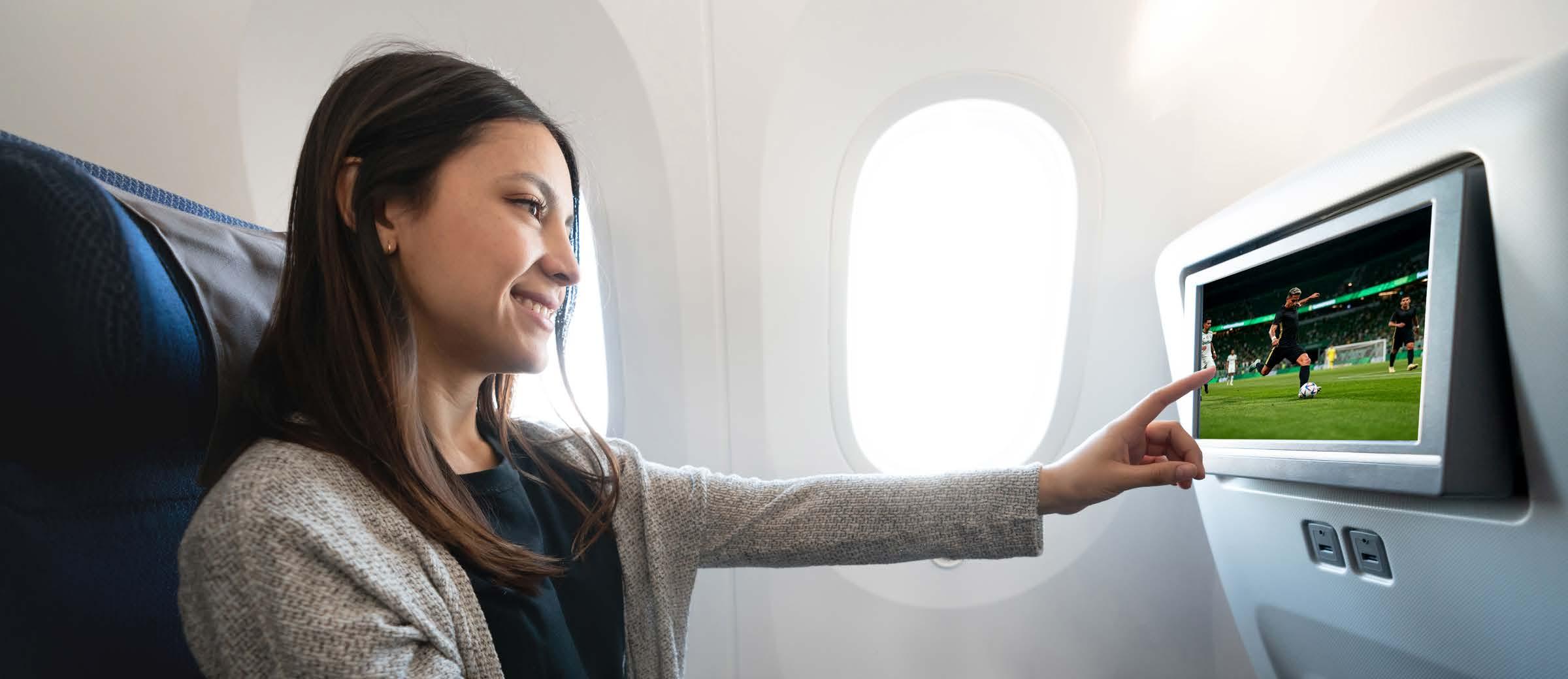
“While we are able to push many individual streams to hundreds of seats, Viasat In-flight TV delivers live channels efficiently to the whole cabin at once,” Edillon explains. Passengers can either stream via their own subscriptions or access airline-licensed broadcasts onboard, with both options supported.
Ensuring passengers are all experiencing the event simultaneously, with no spoilers from the row ahead or notifications before the moment plays out on screen, is crucial.
For Viasat, this requires focusing on protecting real-time traffic, adaptive bitrate, streaming efficiency and giving live video priority.
“We have purpose-built delivery like Viasat In-Flight TV for the biggest events, but it all rests on a network designed from the ground up to absorb synchronized, high-intensity demand,” Edillon says.
For IMG, the most powerful sporting moments are not about the action on the pitch, but about the shared memories they create for viewers. That is the philosophy behind Sport 24’s FIFA World Cup 26™ campaign, Where Will You Be?
“Everyone remembers where they were for iconic World Cup moments, whether it was watching Lionel Messi
lift the trophy in 2022, a dramatic lastminute winner or a historic upset that captured the world’s attention,” Wise says.
Key to fostering these shared experiences onboard is industry collaboration between content rights holders, broadcasters, technology providers and airlines.
“At DIRECTV IN FLIGHT, we view collaboration as a key enabler of innovation and service quality,” says Twiggs, highlighting that major sporting events test content distribution systems, requiring ecosystem-wide alignment.
She adds that passengers never witness the complexity behind the scenes that goes into delivering the content they want to see onboard. Nor do they care. Their perception is purely shaped by the quality and breadth of the content available.
Passengers expect content to be available as the match starts, a standard that only strong partnerships can reliably deliver during major global sporting events, she says.
Broadcasting major sporting events inflight creates opportunities for brand differentiation, passenger engagement and commercial activation across campaigns, onboard experiences and sponsorship.
“It is a premium feature, but it is also a loyalty driver: passengers remember the airline that let them stay in the moment,” shares Viasat’s Edillon. “Some of the best marketing we have seen was not ours at all—it was passengers filming a whole cabin erupting at a live goal and posting it themselves.”
More broadly, he says live events act as a visible proof point for the network itself, taking connectivity from utility to part of the product.
“Airlines increasingly see inflight connectivity as part of their brand promise, and a network that delivers live coverage reliably, across regions and full cabins, is a differentiator passengers can feel,” he explains.
For carriers that want to stand out from the crowd and build a reputation for leading in the IFE space, a commitment to live inflight coverage is a necessity. With millions of people traveling for FIFA World Cup 26 this summer, and many of the journeys coinciding with key matches, IMG’s Wise says airlines have a powerful opportunity to transform the cabin into a “stadium in the sky.”
“Passengers are not simply consuming content; they are sharing a live experience with fellow travelers, celebrating goals together and witnessing history unfold in real time,” he concludes.
by ROBYNNE TRUEMAN
As IFPL Group celebrates 30 years in business, Geoff Underwood looks back on the company’s modest beginnings, commitment to innovation and an evolution that continues to meet the moment

IFPL Group is marking its 30th anniversary in 2026 and, as a leader in practical innovation in the aviation market, the company has kept its goal of being a designer and problem solver for IFEC in focus since its inception.
For Geoff Underwood, Owner and CEO of IFPL Group, the mindset of understanding customers’ challenges has shaped the U.K. and Isle of Wightbased company for three decades. He paints a picture of a company that has seen significant technical evolution throughout its tenure but holds an unwavering commitment to teamwork and collaboration at its core.
“We have always been a company built by people who care deeply about what they do and who are passionate about delivering the best possible solutions for our customers. We challenge each other, support each other and share a common commitment to doing things properly,” Underwood tells PAX Tech in June.
A lot has changed since IFPL Group’s founding in 1996, not least aircraft cabin interiors and the general inflight experience.
“Passengers boarded with a book or magazine, watched the inflight movie and expected very little; the experience was enough,” Underwood explains. “I do not think many of us could have predicted just how much personal technology and sustainability would shape the future of aircraft interiors.”
Underwood says the company began with a very simple goal: to solve a costly and frustrating problem for both airlines and passengers.
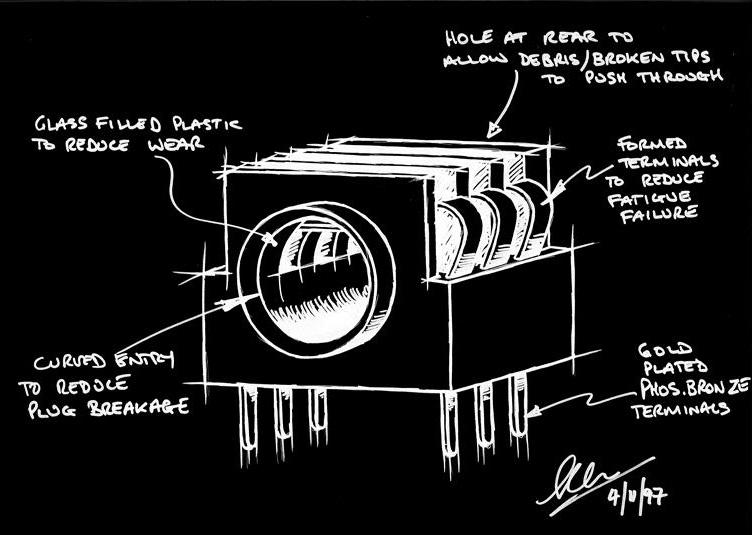
“In the mid-90s, the most common passenger complaint associated with technology in air travel was poor quality inflight audio,” he remembers. “The audio jacks fitted in aircraft seats were prone to damage and often failed after only a few thousand insertions.”
This was costly and created significant maintenance challenges for airlines, as well as negatively impacting the onboard experience.
“The industry had long accepted this as the norm, but we saw it as an opportunity to go back to basic design principles,” Underwood reveals. “We focused on understanding the problem and finding a better way to solve it. We created a more durable, reliable alternative – and our Long-Life Audio Jack was born.”
IFPL Group’s Long-Life Audio Jack is capable of more than 100,000 insertions, providing significant advancement over existing in-service jacks of the time.
Underwood calls the product “fundamental” for IFPL Group and notes that the first major achievement for the company came in 1999 with the first big order for 10,000 units.
“This saw us move from home production into our first commercial facility,” he explains.
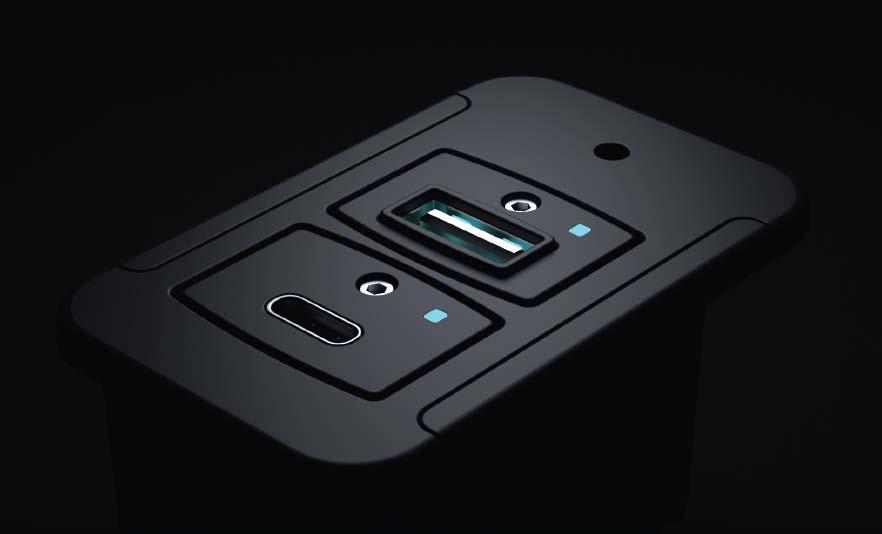
From there, IFPL Group expanded its product range beyond audio, evolving in tandem with passenger expectations and cabin technology to supply broader cabin solutions. The
progression meant taking on more complex challenges and expanding the product range through audio, IFEC and PCUs into cabin power and LED lighting.
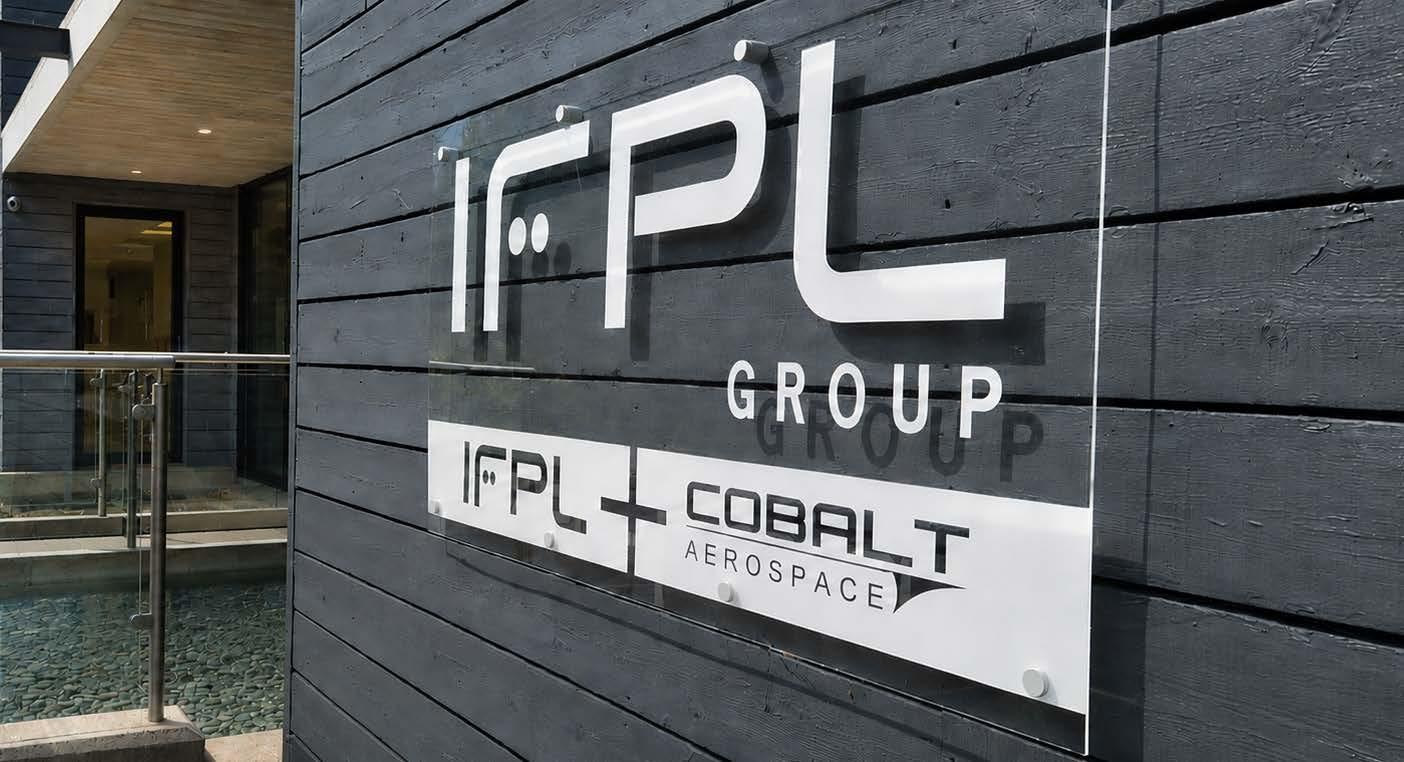
Underwood notes another significant milestone for the company was the acquisition of Cobalt Aerospace in 2021, calling it a “perfect complement” to the products IFPL was already developing in the aviation space.
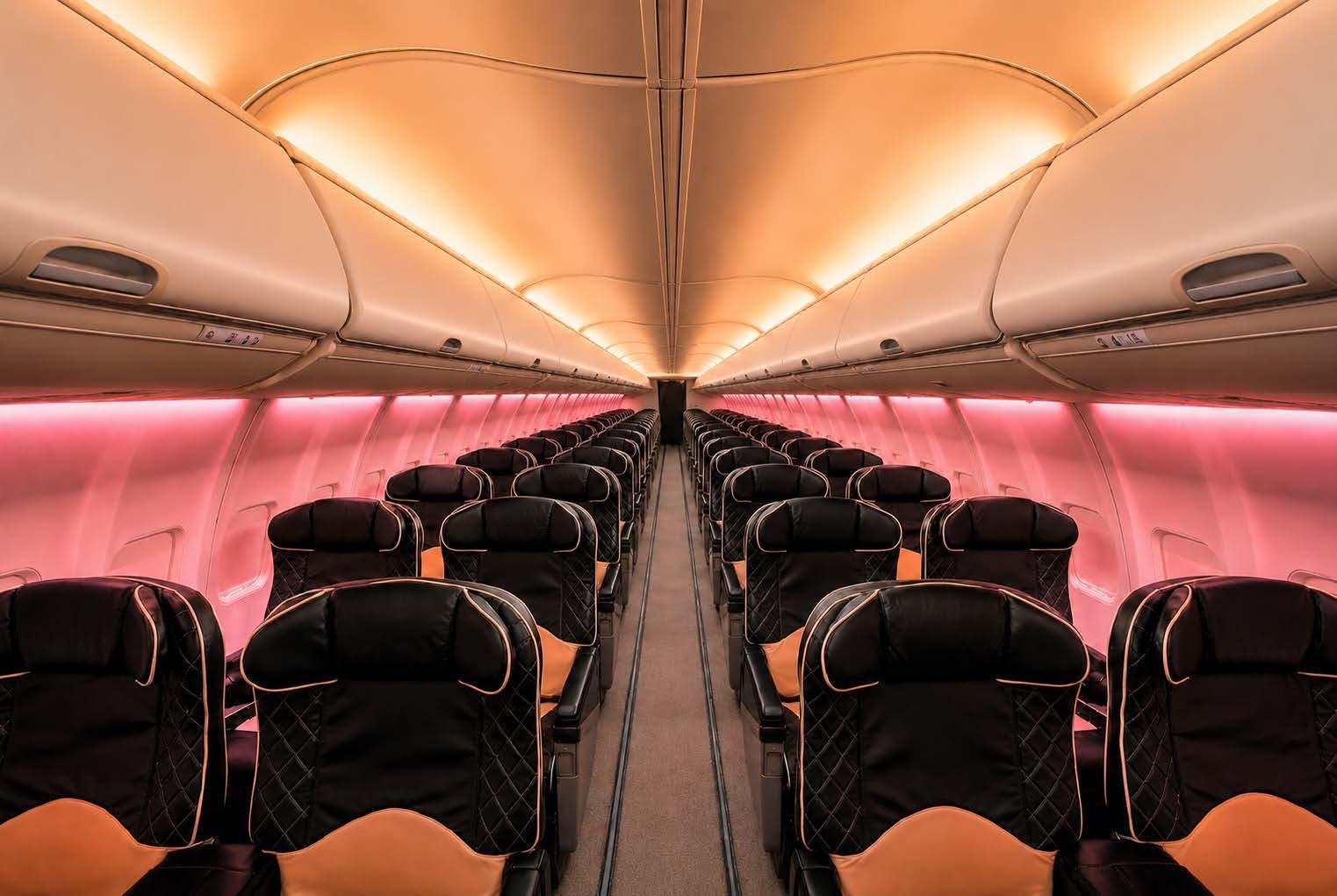
“The simplicity of Cobalt Spectrum LED Mood Lighting with its mesh technology and true plug-and-play installation was an evolution of that same principle that we started out with,” he points out. “Forming long-lasting solutions for airline challenges through practical and smart engineering.”
More recently, IFPL Group’s Transform In-Seat Power solution marks a strategic achievement in
its growth, responding to passenger demand with an in-seat power system designed around flexibility, maintainability and retrofit simplicity.
But for Underwood, the real innovation is not any single feature or product, but rather the ability to create products that are simple to install, easy to maintain and flexible enough to adapt as technology and passenger expectations continue to evolve.
“That combination of practicality, innovation and future proofing has been central to IFPL’s growth and reputation over the last 30 years,” he says. “The products have changed, but the reason behind them has remained the same. It has and always will be about solving problems effectively with commitment and passion.”
In addition to remaining focused on the company’s reason for continued innovation, Underwood reflects on the importance of the people who have been an integral part of IFPL Group’s story.
“Strong businesses are built on strong relationships,” he says. “Products, technologies and market demands will change over time, but trust remains constant.”
From the beginning, IFPL Group prioritized building long-term partnerships rather than quick wins. Underwood emphasizes that trust is earned through years of consistently delivering.
“We have been fortunate to work with many of our customers for decades, and those relationships have been one of IFPL’s greatest strengths,” he tells PAX Tech.
Those partnerships have also played a significant role in shaping the company’s products. For Underwood, some of IFPL’s most successful innovations have come from listening to customers, understanding operational challenges and working together to find a solution.
“When you develop that level of trust, customers are willing to share not only the problems they are facing today, but also the challenges they expect to face in the future,” he explains.
Reflecting on the anniversary, Underwood says the achievement that stands out most is not a single product launch, customer order or award. It is reaching the milestone as a team.
“Every engineer, designer, production team member, administrator, salesperson and support colleague has contributed to our success. Each person has brought their own skills, ideas and dedication, helping to shape the business into what it is today. That spirit is at the heart of IFPL,” Underwood shares.
He notes that every success along the way, whether integrating products into limited cabin spaces, reducing maintenance burdens or creating intelligent systems that can evolve alongside changing requirements, has been the result of individuals working together to achieve a common goal.
“Our anniversary celebrations will be focused on every person having played a part in the success,” Underwood concludes. “We cannot think of a better way to describe the journey we have been on.”
PAX issues are distributed at some of the biggest international onboard services, aircraft interiors and MRO trade shows around the world.
Get breaking industry news weekly to your inbox, and copies of our digital issues as soon as they are available.
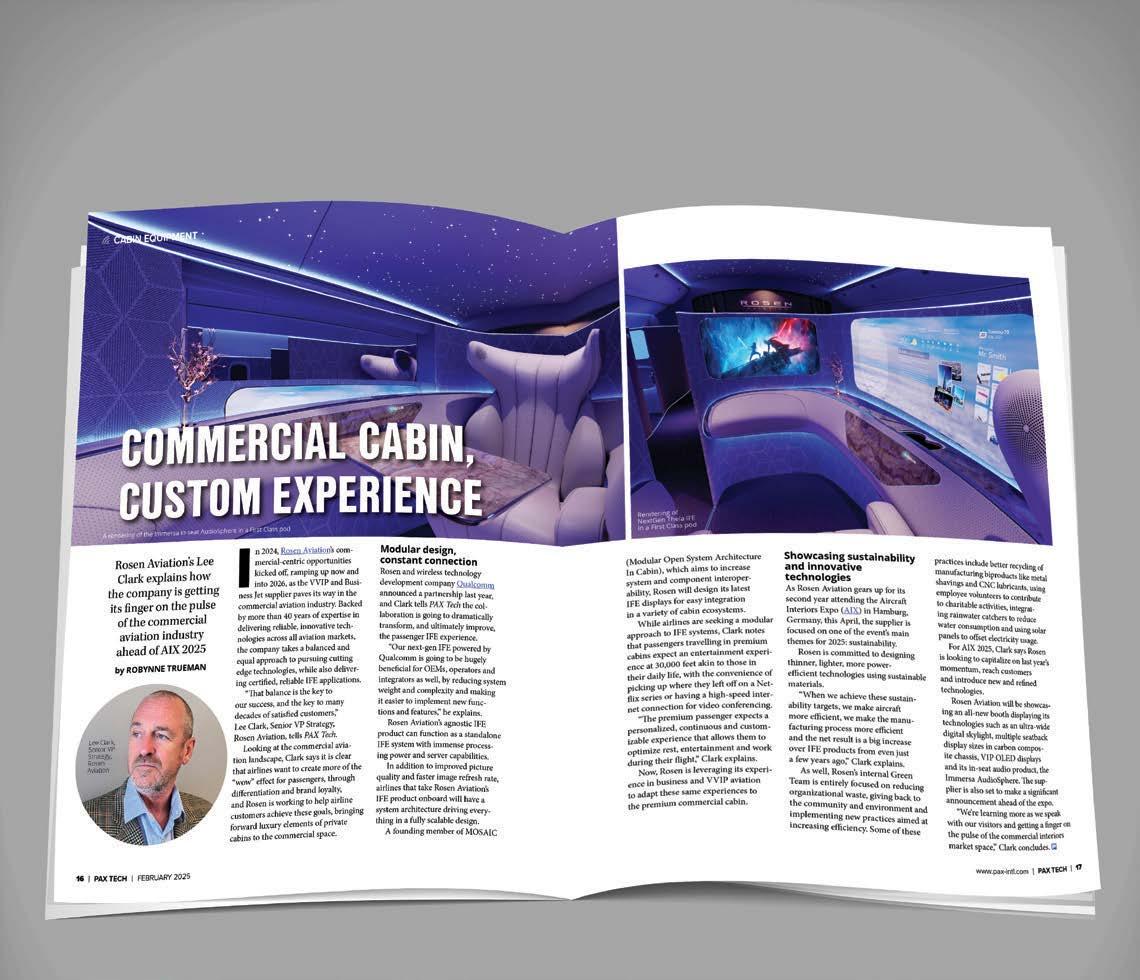
Our website is updated daily with content from the seating, interiors, IFEC and MRO industries, plus onboard catering and passenger services news.
For advertising queries, please contact jane@pax-intl.com or robynne@pax-intl.com
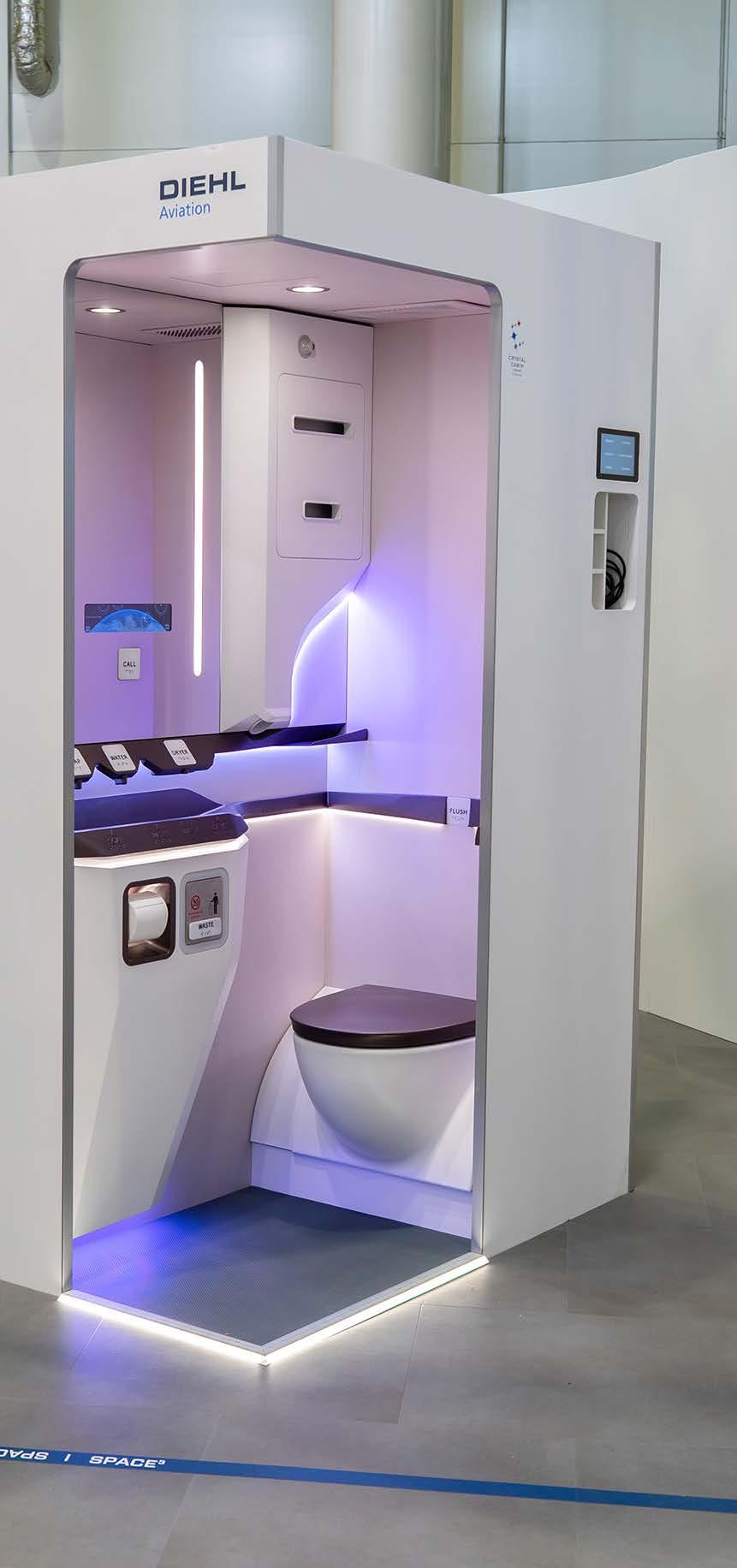

Diehl Aviation’s Mathies Gereke emphasizes the importance of designing accessible onboard lavatory solutions that preserve autonomy and dignity of all passengers by
ROBYNNE TRUEMAN
Diehl Aviation has long been a leader in accessibility in the aviation industry, proving its commitment the past two years with consecutive Crystal Cabin Award wins for its AURS and Space³ lavatory concepts in the “Accessibility” category.
The 2025 recognition was awarded to Diehl Aviation for Space³, a modular lavatory concept that combines two of the three lavatories onboard into one enlarged, flexible space and enables the installation of up to two additional seat rows onboard.
The 2026 award also went to Diehl Aviation, this time for the AURS (Adaptive User Routing System) which facilitates navigation in the lavatory through high-contrast surfaces, tactile guidance, Braille, clearly distinguishable controls and a mirror display with voice-to-text announcements.
As Mathies Gereke, Chief Project Lead Upgrade Solutions at Diehl Aviation, tells PAX Tech, these two accessibility innovations were designed to deliver a dignified onboard experience to all travelers.
Both AURS and Space³ were developed, Gereke says, to address a clear gap between what passengers with specific accessibility needs experience today and what they reasonably expect from modern air travel.
“For passengers using onboard wheelchairs, conventional center lavatories simply do not provide enough maneuvering space to use the facilities independently, a situation that affects dignity and autonomy in a very direct way,” Gereke points out. “For passengers with access needs related to vision or hearing, the lavatory has historically been
AURS
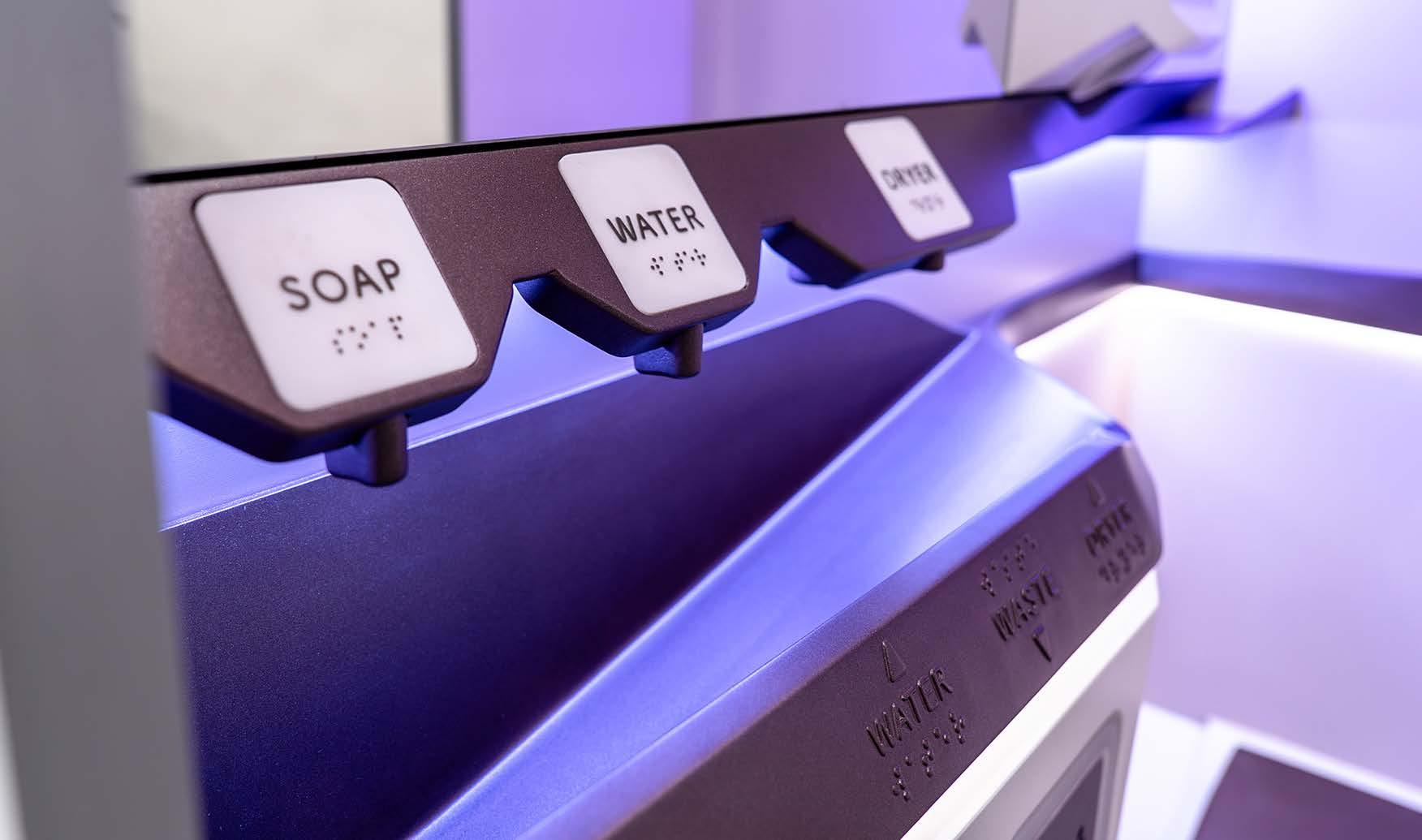
an environment full of unlabeled controls, poor contrast and safety announcements that are easy to miss.”
He emphasizes that these experiences are not edge cases. According to the World Health Organization, an estimated 1.3 billion people worldwide live with a significant disability.
“This means that, given the current design of the cabin, a significant number of passengers have not been adequately considered in terms of comfort and passenger experience,” Gereke says.
Dignity, independence and inclusivity are the three foundational principles guiding Diehl Aviation’s approach to accessible lavatory design. These core pillars derive more detailed design criteria, including optimizing the number and positioning of grab bars, minimizing operational steps, ensuring sufficient maneuverability space and designing intuitive interfaces.
“With Space³, the overarching goal was to achieve the highest possible level of accessibility, privacy and dignity for passengers with reduced mobility,” he explains. “To accomplish this, the core design criteria were deliberately defined in a simple and user-centric way: enabling independent use, ensuring full privacy behind closed doors and providing a dignified and comfortable lavatory experience throughout.”
With AURS, the same principle applies to passengers with sensory impairments: high-contrast surfaces, tactile guidance, Braille labeling and visual safety announcements on the mirror screen.
Safety announcements are displayed visually on an integrated mirror screen in the lavatory to ensure critical information reaches passengers who are hard of hearing. Adaptive lighting and optional audio cues provide an additional layer of support for passengers with low vision. The result, Gereke says, is a lavatory environment where passengers with sensory support needs can operate with the same confidence and privacy as any other traveler.
When designing the Space³ lavatory concept, Gereke tells PAX Tech that the primary challenge was fitting three functional lavatories into the space typically occupied by two, while allowing two to combine into a larger accessible lavatory when needed.
“That required a fundamental rethink rather than an incremental adjustment. The team used extensive 3D analysis to establish the minimum functional envelope for each component,” he explains.
Diehl Aviation then reinvested the space saved through engineering partly into accessibility features and partly into freeing up cabin space for additional seat rows, with attention to both weight and space optimization, contributing to potential fuel reductions.
“The result is a concept where accessibility, efficiency and commercial viability are not competing priorities but mutually aligned ones,” Gereke says.
Diehl Aviation designed both Space³ and AURS with end user involvement from the outset.
“Designing for accessibility means designing for diversity and Diehl Aviation built this recognition into the development process from the start,” Gereke explains.
As such, Space³ was tested with travelers with limited mobility at Hamburg Airport in September 2025 to collect user-centered feedback.
“The response was largely positive, with particular appreciation for the thoughts and consideration that went into grab handle placement and support surfaces,” Gereke reveals.
He says the tests confirmed there is no universal accessibility solution: passenger requirements vary depending on the nature and degree of mobility limitations.
“Space³ is therefore positioned not as a finished answer but as a foundation, which will be further developed driven by ongoing user feedback,” he explains.
For AURS, the co-creation approach went further, with the concept developed with direct input from advocacy groups for people who are blind or have low vision.
“AURS is currently deployed as a technology demonstrator in active trials with accessibility groups, continuing this dialogue into the next phase of refinement,” Gereke says. “Across both products, the underlying principle is the same: solutions designed for passengers with disabilities should be designed with them.”
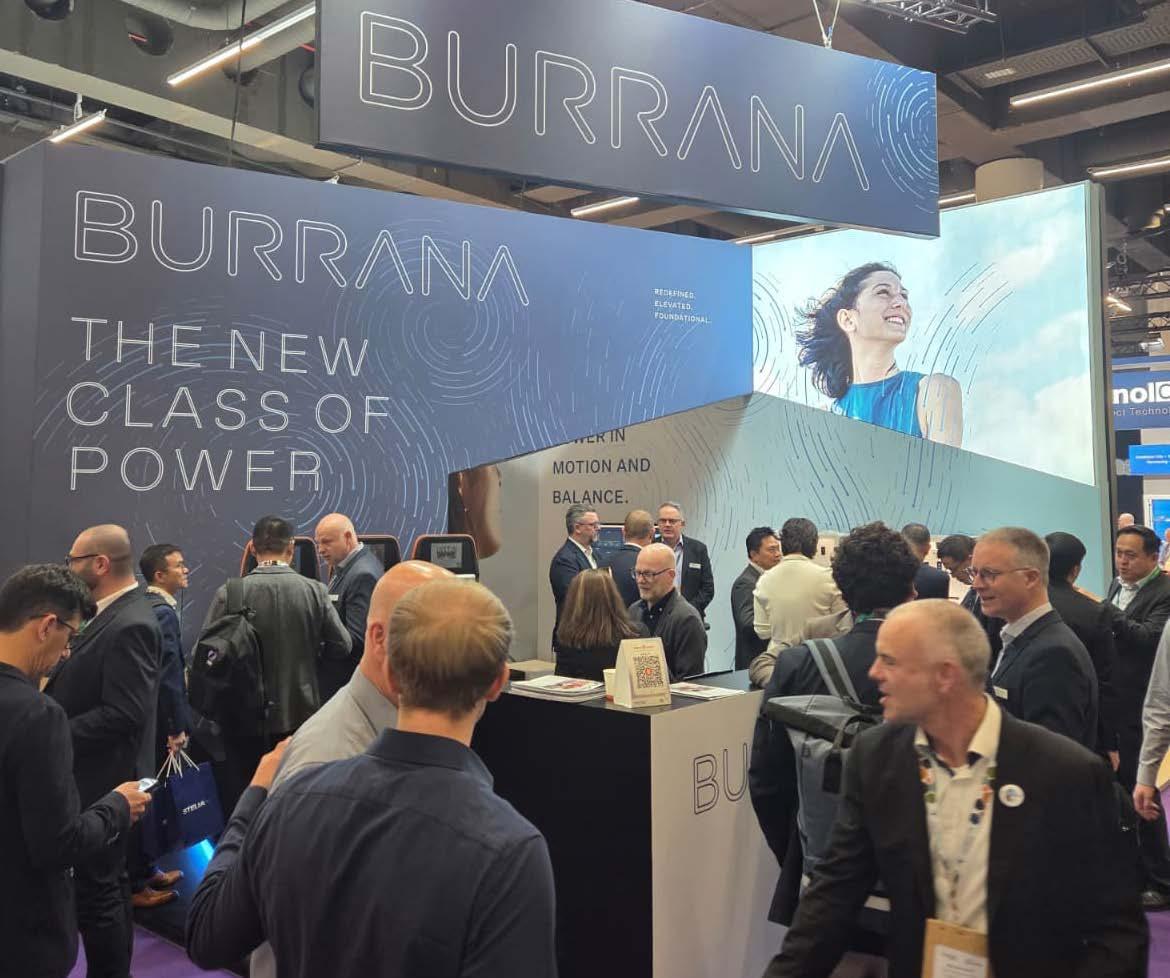
RBurrana’s David Pook positions in-seat power systems, such as RISE, as a foundational infrastructure of the connected cabin
by ROBYNNE TRUEMAN
eliable access to power has become a foundational component of the passenger experience as airlines continue to invest in connectivity, wireless entertainment and personalized digital services.
As David Pook, VP Global Marketing and Sales, Burrana, explains, in-seat power has evolved from being a mere convenience to an expectation among travelers. For airlines with seatback entertainment, power supports the trend of increasingly integrated entertainment services between the personal device and the seatback screen.
“But for airlines operating a BYOD model, its role becomes even more critical,” he tells PAX Tech. “The passenger’s phone, tablet or laptop is now the sole gateway to entertainment, connectivity, shopping and onboard
services. Without in-seat power, access to these services is limited.”
As a result, Burrana used its Aircraft Interiors Expo 2026 campaign to redefine both the role of in-seat power and the category itself, positioning it as critical cabin infrastructure rather than a passenger amenity. Under the banner of The New Class of Power, Burrana presented RISE Power as intelligent cabin infrastructure capable of enabling a growing ecosystem of digital services, operational insights, passenger engagement opportunities and future innovations delivered through personal devices.
“The message reflects a fundamental shift in how onboard power is viewed. It is no longer simply about charging devices; it is about enabling the connected cabin ecosystem that modern airlines are building around,” says Pook.

Passengers are relying on mobile devices, shifting their expectations of how that experience should be more personal.
“Many of the digital services airlines invest in depend on passengers having access to a charged device. Whether it is entertainment, connectivity, retail opportunities or food and beverage ordering or other personalized services, none of these experiences work effectively if passengers are concerned about battery life,” Pook explains.
While he acknowledges that in-seat power may not be the most visible part of the passenger experience, it is a key component to unlocking the full range of services airlines use to differentiate themselves, increase ancillary revenue and strengthen passenger engagement.
Just as the technology passengers bring onboard evolves rapidly, so must the solutions airlines provide to support these onboard experiences.
Pook cites the industry’s transition from 110V to USB-A to USB-C as one example, driven by changing consumer devices and growing demand for faster charging, while reducing size, weight and total cost of ownership.
“Our focus is on providing flexible, future-ready solutions that support today’s devices while remaining ready for what is next,” he explains. “We aim to make that transition as simple and cost-effective as possible, helping airlines modernize the passenger experience without unnecessary complexity or disruption.”
Burrana is currently in the process of upgrading one of its customers from USB-A to USB-C 60W outlets and removing the AC outlets, without any new LRUs or cables. Pook expects this upgrade to be accomplished overnight, allowing aircraft to return to service the next day with minimal operational impact.
“At Burrana, we have challenged traditional approaches to in-seat power by rethinking how power is distributed and managed throughout the aircraft. The result is a lighter, simpler and more intelligent architecture that helps airlines reduce complexity while maintaining a consistent passenger experience and adhering to OEM linefit requirements,” he explains.
Also key to in-seat power innovation is the ability to capture and analyze power usage data across the cabin. Burrana’s RISE Power system delivers insights into charging demand, device usage trends and system
performance for the airline, helping customers to optimize operations, provide proactive maintenance and make more informed decisions about future cabin investments.
Pook explains that these innovations transform cabin power from a utility to a smarter, more efficient platform, capable of doing more on a limited power budget. This is also how he envisions the next generation of cabin power: focused on delivering more capability with greater efficiency.
Passenger devices, charging standards and digital services are constantly evolving, often outpacing cabin refresh cycles. This reinforces the demand from airlines for flexible, scalable cabin power systems that can support future technologies, services and passenger behaviors.
For Pook, flexibility, intelligence and adaptability will define the future
of in-seat power, allowing airlines to upgrade systems without entirely replacing them.
“We also believe data and analytics will become one of the defining characteristics of next generation cabin power. In the same way airlines use operational and connectivity data to improve performance, power systems will increasingly provide valuable intelligence about passenger behavior, device trends and cabin utilization. The ability to turn power infrastructure into a source of actionable insights creates opportunities far beyond charging,” Pook explains.
For airlines, he believes the most effective long-term strategy is to invest in a platform that is scalable, upgradeable and designed for change.
“That is the essence of ‘The New Class of Power,’” Pook explains. “Not just meeting today’s charging needs but creating a foundation for tomorrow’s connected cabin.”

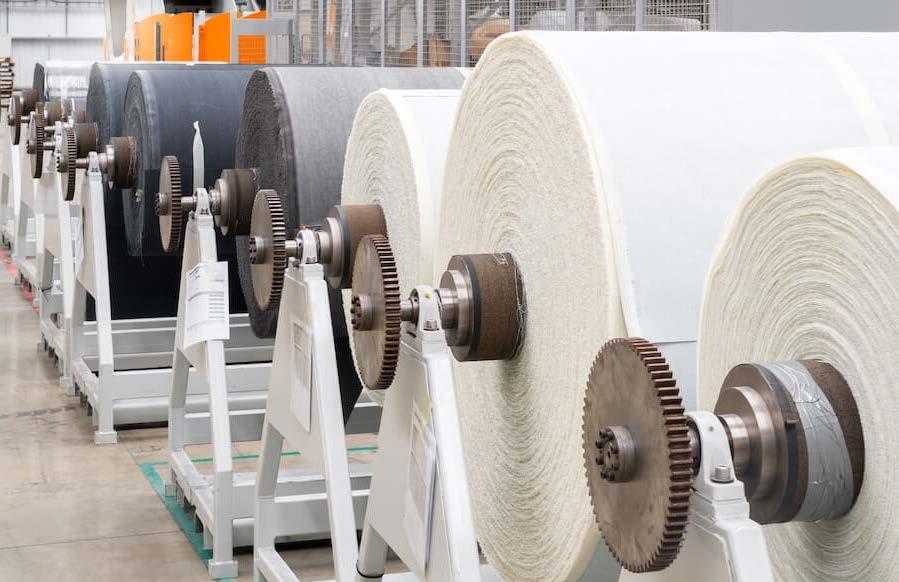
by KIERAN RICCI
As the aviation industry faces mounting pressure to reduce waste and improve sustainability, a growing shift is taking shape behind the scenes, one that starts not at end-of-life, but at the very beginning of product design.
Gen Phoenix’s CirculAir Playbook positions circularity not simply as an environmental initiative, but as a fundamental design and engineering challenge that could reshape how aircraft interiors are developed for decades to come.
At the heart of this shift is a simple but powerful idea: materials should be designed with their entire lifecycle in mind. For decades, cabin interiors have been engineered primarily for in-service performance, with little consideration for what happens once products are removed from aircraft.
The result is a largely linear system, where materials are discarded at endof-life with limited recovery options.
“Circularity changes the starting point for how cabin interiors are developed,” says Nicola Rapley, Director of Marketing & Aviation Sales, Gen Phoenix. “What the playbook sets out is a shift toward designing for full lifecycle value from the outset.”
That shift carries significant implications for the industry. It requires rethinking not only materials, but also construction methods and product architecture, integrating sustainability into core engineering decisions rather than layering it on afterward.
The urgency is clear. More than one million aircraft seat dress covers are discarded annually, highlighting the scale of waste generated by traditional cabin materials, Rapley points out. Yet while circular solutions exist, scaling

them remains a complex challenge.
Certification requirements, often cited as a barrier, demand that any new materials meet stringent aviation standards. But Rapley emphasizes that this is not an insurmountable obstacle.
“The materials and approaches we are presenting are designed to meet these standards,” she says, adding that the playbook demonstrates how circular concepts can comply with FAA and EASA requirements.
Beyond certification, the challenge becomes systemic. Supply chains are not yet fully equipped to support material recovery, and infrastructure for recycling aviation-specific products remains limited.
“Scaling circularity is therefore a system-level challenge,” Rapley explains, pointing to the need for alignment across certification, manufacturing and end-of-life recovery.
The industry’s best virtual roundtable discussion series, featuring executives and representatives from the industry’s most iconic companies
Share key insights, learnings and experiences from your sector in PAX Panel: All episodes available online Featured in digital editions of PAX International and PAX Tech
Share on your website and social channels Attract new clients

PREVIOUS SPONSORS INCLUDE: FOR ALL EPISODES CLICK HERE!


ALL PAX PANEL EPISODES ARE AVAILABLE ONLINE SO THAT EVERYONE CAN WATCH AND SHARE
The PAX Panel concept is created and hosted by PAX International and PAX Tech Contact jane@pax-intl.com to become a panelist
This is where collaboration becomes critical. Circularity spans the entire value chain, from design and material innovation to manufacturing and recycling. No single stakeholder can drive the transition alone.
“Circularity spans the entire value chain… and no single organization controls all of those elements,” Rapley says.
Industry-wide collaboration, supported by initiatives like Gen Phoenix’s Circular Dress Cover Innovation Engine, is already demonstrating how progress can be accelerated when stakeholders align. Designers, OEMs, suppliers and recyclers must work in tandem to create solutions that are not only sustainable, but also commercially viable and certifiable.
Innovation in materials is also playing a key role in enabling this transition. Traditional foam-backed laminates, which have long been a staple of seat cover construction, present challenges for recycling due to their multi-layer complexity. Rapley says that new alternatives, such as
spacer fabrics, offer a path forward.
By simplifying material architecture and eliminating foam layers, these constructions enable full recovery and recycling, while also improving durability and maintaining passenger comfort.
“Comfort, aesthetics and overall performance can all be maintained or enhanced,” Rapley says, reinforcing that circularity does not require compromise.
Perhaps the most important lesson emerging from early adoption efforts is that circularity cannot be retrofitted.
“If you try to retrofit it later, particularly once materials and constructions are locked in, it becomes very difficult to recycle without complex and costly disassembly techniques, which quickly become economically unviable,” Rapley notes. Instead, circularity must be embedded into products from the outset, supported by simplified designs and early alignment across stakeholders.
Looking ahead, meaningful adoption of circular design principles will require more than isolated innovation. It will depend on systemic change—where circularity becomes standard practice rather than a niche initiative.
Rapley envisions a future where seat materials are designed for recovery as standard, supported by infrastructure that enables collection, processing and reintegration into new products.
“The focus of our work is no longer on proving circularity can work, but on enabling consistent, scalable implementation across the industry,” she says.
The CirculAir Playbook is not just a roadmap, it is a call to action. For an industry built on precision engineering and long product lifecycles, the transition to circularity will not happen overnight. But by shifting the starting point of design, aviation has an opportunity to rethink not only how products perform in the air, but how they live beyond it.
Gen Phoenix’s CirculAir Playbook positions circularity as a fundamental design and engineering challenge that could reshape how aircraft interiors are developed for decades to come
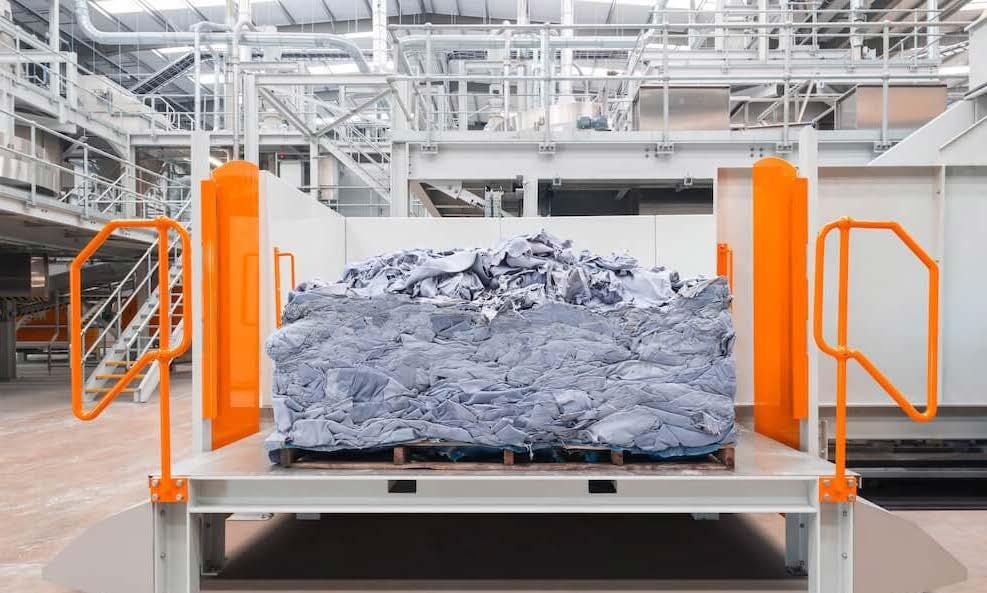
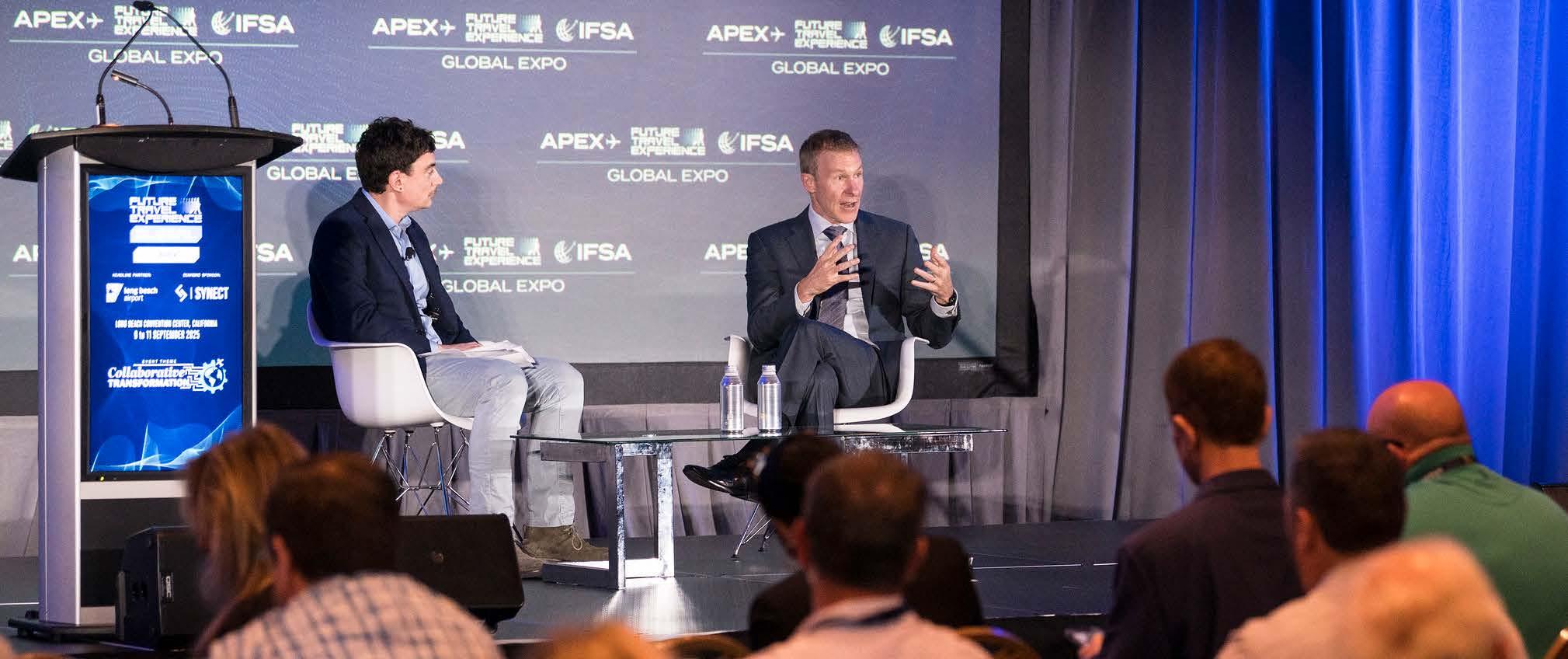
At FTE Global’s 20th anniversary, attendees can expect “Transforming Travel Together,” reflecting on the industry’s growing focus on collaboration across the aviation ecosystem
by EMAN KHAN
For its 20th anniversary edition, FTE Global is bringing the industry together under the theme “Transforming Travel Together,” highlighting the industry’s growing recognition that the biggest opportunities come from collaboration across airlines, airports, technology partners, government agencies and innovators throughout the aviation ecosystem.
“As we look ahead to our 20th anniversary, the focus is very much on how the industry moves forward together,” says Ryan Ghee, Chief Operating Officer, Future Travel Experience.
There will be a major focus on AI, automation, digital transformation, CX, sustainability, future mobility, alongside passenger experience and next-generation journeys.
“We are seeing rapid acceleration in technologies and trends like AI and automation, and we will draw focus to how they are actually being applied to deliver improvements,” says Ghee. “We
are seeing a move from experimentation to real operational impact.” Sustainability will remain a priority, while future mobility concepts and emerging technologies such as robotics and humanoids can also be expected.
A major milestone this year is FTE Global’s move to Dallas, supported by Dallas Fort Worth International Airport, Southwest Airlines and Dallas Love Field Airport. As one of the world’s major aviation hubs, Ghee says Dallas is a perfect fit for the event. The move has already attracted a wider mix of attendees and exhibitors. On top of that, co-locating with IFSA Global EXPO brings even more energy and creates great crossover between industries. PAX Tech is proud to serve as a media partner for the event.
The expo floor will feature returning partners and industry leaders, including

Synect, returning as Diamond Sponsor, alongside Samsung Electronics America, AWS, Motorola Solutions, SITA, Publicis Sapient and Airware
The event’s program will include keynotes, panels, case studies, innovation showcases and the introduction of a Moonshot Competition, all focused on sharing practical ideas and real-world examples of how aviation is evolving today.
“This year is as much about people as it is about ideas,” says Ghee. “It is about celebrating the relationships that have shaped the industry over the past 20 years.”

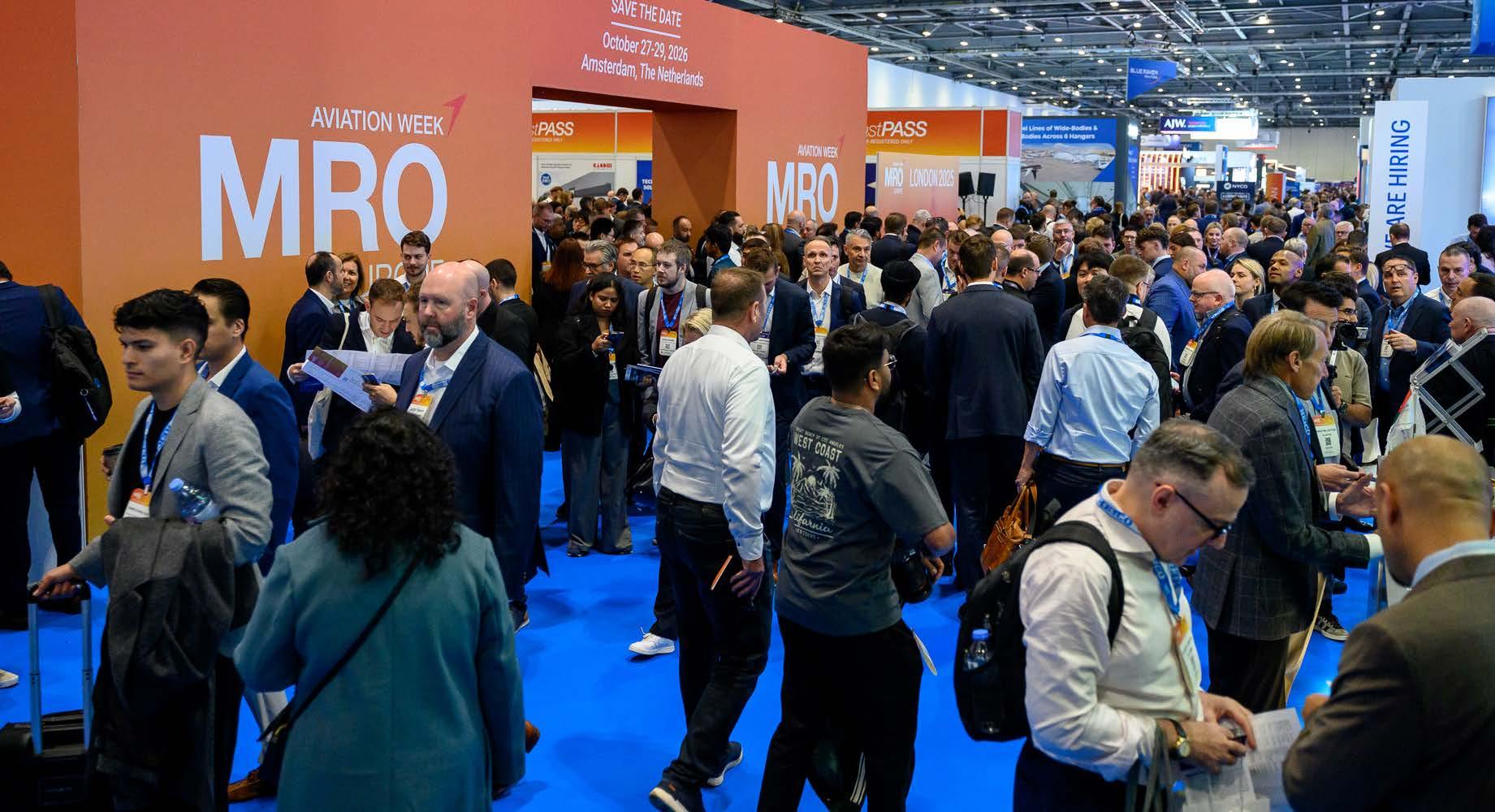
Aviation Week’s MRO Europe 2026 prepares to welcome the aviation aftermarket’s brightest minds for three days packed with innovation, networking and big-picture conversations
by EMAN KHAN
As the aviation aftermarket navigates rapid transformation, Aviation Week’s MRO Europe 2026 is set to bring together the industry’s biggest innovators, decision-makers and thought leaders for three days of insight, collaboration and discovery, with PAX Tech proud to serve as a media partner for the event.
This year’s event will spotlight the trends shaping the future of maintenance, repair and overhaul, with discussions focused on digital transformation, sustainability, workforce development and supply chain resilience. From predictive maintenance and AI-powered analytics to evolving regulations, attendees can expect a forward-looking agenda designed to help businesses remain competitive in a changing market.
“These themes reflect the industry’s adaptability and innovation as it navigates a period of rapid transformation,” Mark Thomas, Senior Director of Marketing at Aviation Week Network, tells PAX Tech.
As the largest event of its kind in Europe, MRO Europe continues to serve as a key meeting place for the global aviation community. More than 12,000 attendees are expected to gather, representing airlines, lessors, MRO providers, OEMs and suppliers from across the industry.
The event begins with a senior-level conference before opening onto an exhibition floor showcasing the latest products, services and technologies. Complementing the conference is the popular Go Live! Theatre, where attendees can access free educational sessions and practical industry insights.
Innovation will be on display across the show floor, particularly within the Showcase Pavilion, which highlights emerging companies and first-time exhibitors. This year’s participants include Air Worthy, Anemo Engineering, ATA 25, Aviation Repair Technologies, FCD Express, Herber Aircraft Service, Invirtus Technologies, MT Aero, Prodigy and Rohmann.
The conference agenda also features anticipated sessions, including the

OEM Fireside Chat with Boeing Global Services President and CEO Chris Raymond. Other highlights include discussions on circular economy initiatives, workforce development and technologies such as additive manufacturing, cybersecurity and predictive AI.
Beyond the stage and show floor, MRO Europe facilitates connections. Through its Networking App, dedicated meeting zones and attendeefocused spaces such as the Frequent Flyer Lounge and VIP Lounge, participants can build valuable connections before and during the event.
“Networking is at the heart of MRO Europe, and we have designed the event to facilitate meaningful connections at every turn,” says Thomas.
Whether attendees are seeking strategic insights, emerging technologies or new business opportunities, Aviation Week’s MRO Europe 2026 is set to deliver an engaging experience at the center of the global aviation aftermarket industry.
Put your passenger experience to the test. Invite a PAX reporter onboard and be featured in our PAX Perspective Verified Airline Review — where real journeys meet expert evaluation.


Our experienced editorial team assesses every detail, from food and amenities to comfort, entertainment and service, offering airlines the opportunity to earn the PAX Verified Award, declared by PAX Publisher Aijaz Khan.
Think your onboard experience stands out? Ready to fly us away? Contact aijaz@globalmarketingcom.ca to learn more.
PAX Tech is the leading voice of news and analysis for the MRO, interiors and IFEC industries. We cover the trends, challenges and changes facing the aviation industry now and we’re always on the hunt for the latest news. Share exciting developments with us anytime by visiting www.pax-intl.com or contacting robynne@pax-intl.com.
PAX issues are distributed at some of the biggest international onboard services, aircraft interiors and MRO trade shows around the world.
Get breaking industry news weekly to your inbox, and copies of our digital issues as soon as they are available.

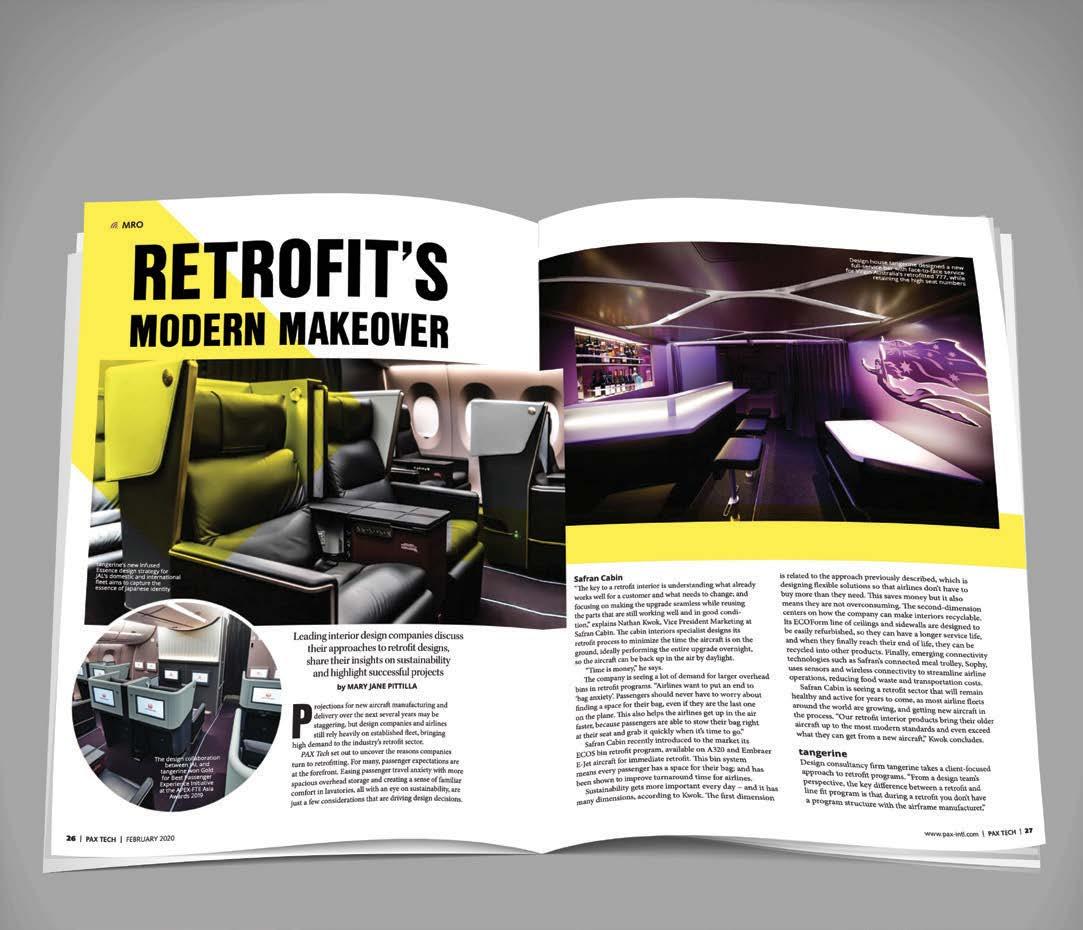
ONLINE
Our website is updated daily with content from the seating, interiors, IFEC and MRO industries, plus onboard catering and passenger services news.


For advertising queries, please contact robynne@pax-intl.com